Trump’s revolution … he can destroy, but he cannot create

Trump presides over the death of the old conservatism. The Trumpian paradox is that Trump himself, elected off the back of a powerful conservative movement, is not an authentic conservative. Paul Kelly.

From time to time, In That Howling Infinite republishes articles by News Ltd commentators that I believe are worth sharing with those who cannot scale the News paywall – and those who, out of misguided principle, refuse to read articles by its more erudite and eloquent contributors. This, by The Australian’s editor at large Paul Kelly, is one of those. Regarding what many commentators see as the demise of traditional American conservatism and the advent of a right wing ‘enlightenment’, he writes:

“Trump won in 2024 on, among other things, conservative votes. Yet the conundrum of his presidency is that Trump is reinvigorating conservatism but trashing it at the same time. What will be left of the conservative remnant when he finishes? Trump’s brand of governance is unique, a blend of executive intervention, American nationalism, trade protectionism, contempt for democratic checks and balances, and retreat from US global leadership. None of his successors will replicate this model because it belongs to Trump’s personality. Have no doubt, Trump will permanently change America, but what stays and what goes cannot remotely be guessed at this stage, nor how US conservatism will emerge”.

This is In That Howling Infinite’s second post regarding the present and future ramifications of Donald Trump’s second presidency. We recently published Trumps second coming … a new American Revolution? It noted:

“America made its choice – most, for quite understandable reasons that have little to do with populism, racism, fascism or in fact any of the other “isms’ that are tossed about like confetti at a wedding – and must live with it. The march to the “right side of history” has turned out just to be to the right …

Commentators and author Troy Branston wrote in The Australian, on 9th November 2024: “It’ll be a wild four years with Trump back in power. He remains a despicable and disgusting man devoid of integrity and ethical values, is boorish, moronic, and unstable, and I fear, by a narrow margin, Americans have made the wrong decision. But it a decision that they must live with we must accept”.

We published a similar piece exactly six years ago at the commencement of Trump’s first term: The Ricochet of Trump’s Counter-revolution. Back then, we were unsure what the next three years would bring. This time around, we probably have a good idea, and it’s likely to be a wild ride for America and also the world.

On other matters American in In That Howling Infinite, see My Country ’tis of thee

Trump can dismantle … but he cannot build
Paul Kelly, Th3 Australian, 22 March 2025

Donald Trump is the ultimate transformational leader. He has been characterised as a conservative, a populist and a libertarian, but he transcends any philosophical brand. Trump is unique, a charismatic autocrat whose political essence lies in his idiosyncratic personality.

Trump presides over a political phenomenon – the cultural right is ascendant yet divided and agitated. Trump has a dominant political personality, rather than an ideology, but his personality inspires followers and generates hatred. Trump cannot unite America because his core method is divide and rule.

His path to power involved the hijacking of the Republican Party – once seen as the embodiment of conservative values, free-market capitalism, personal liberty and US global leadership. But Trump has devoured the Republican Party along with the honoured rituals that it championed.

Trump presides over the death of the old conservatism. The Trumpian paradox is that Trump himself, elected off the back of a powerful conservative movement, is not an authentic conservative.

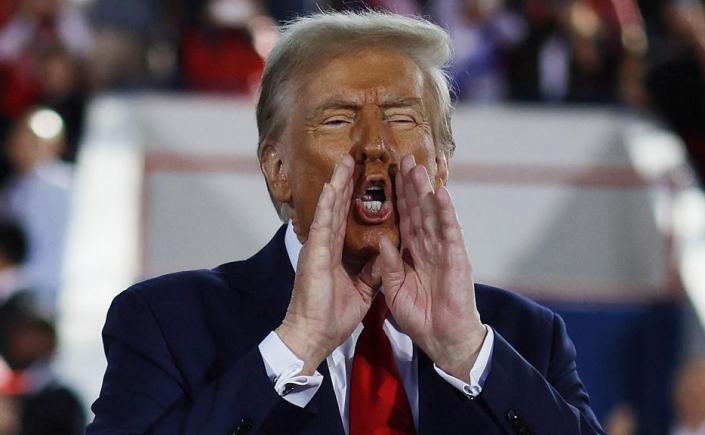
The Trumpian paradox is that Trump himself is not an authentic conservative. Picture: AFP

He has empowered the combined forces of the New Right and the national conservative movement yet in his first three months of office Trump has assailed the core institutions of the American state: the judiciary, the federal bureaucracy, the intelligence agencies, individual liberties, and the foreign policy and economic settlements of the past two generations.

Historian and economist Niall Ferguson, who cheered Trump’s win, recently wrote in The Free Press that few Trump supporters grasped they were voting not just for lower inflation and higher border security “but for a radical project to turn back the economic clock”, with their hero aiming “to reverse at least four decades of American economic history”.

Ferguson said ordinary Americans elected Trump to punish the Democrats for 9 per cent inflation at its 2022 peak and millions of illegal border crossers. While they may not necessarily believe Trump’s claim of a new “golden age” they expect things to get better. But the Trump administration says it is doing things “the hard way”, and delivering “cheap goods” is not such a priority.

The President has now moved into negative territory on the approval/disapproval ratings.

Trump won in 2024 on, among other things, conservative votes. Yet the conundrum of his presidency is that Trump is reinvigorating conservatism but trashing it at the same time. What will be left of the conservative remnant when he finishes?

Trump’s brand of governance is unique, a blend of executive intervention, American nationalism, trade protectionism, contempt for democratic checks and balances, and retreat from US global leadership. None of his successors will replicate this model because it belongs to Trump’s personality. Have no doubt, Trump will permanently change America, but what stays and what goes cannot remotely be guessed at this stage, nor how US conservatism will emerge.

None of this is to deny the impact he will have – cutting federal spending, red and green tape, punishing the curse of identity politics, even perhaps restoring integrity to the education system and reviving a sense of pride and belief in the American dream.

There is a justification for Trump – as a necessary and powerful corrective mechanism for the arrogant over-reach of the progressive establishment in its control of public and private institutions and its attack on the foundations of liberalism. Trump is the figurehead for a cultural transformation driven by an American right that turned traditional conservatism to a radical counter-revolutionary movement. Trump did not create this movement but he has seized control of it through his charismatic appeal.

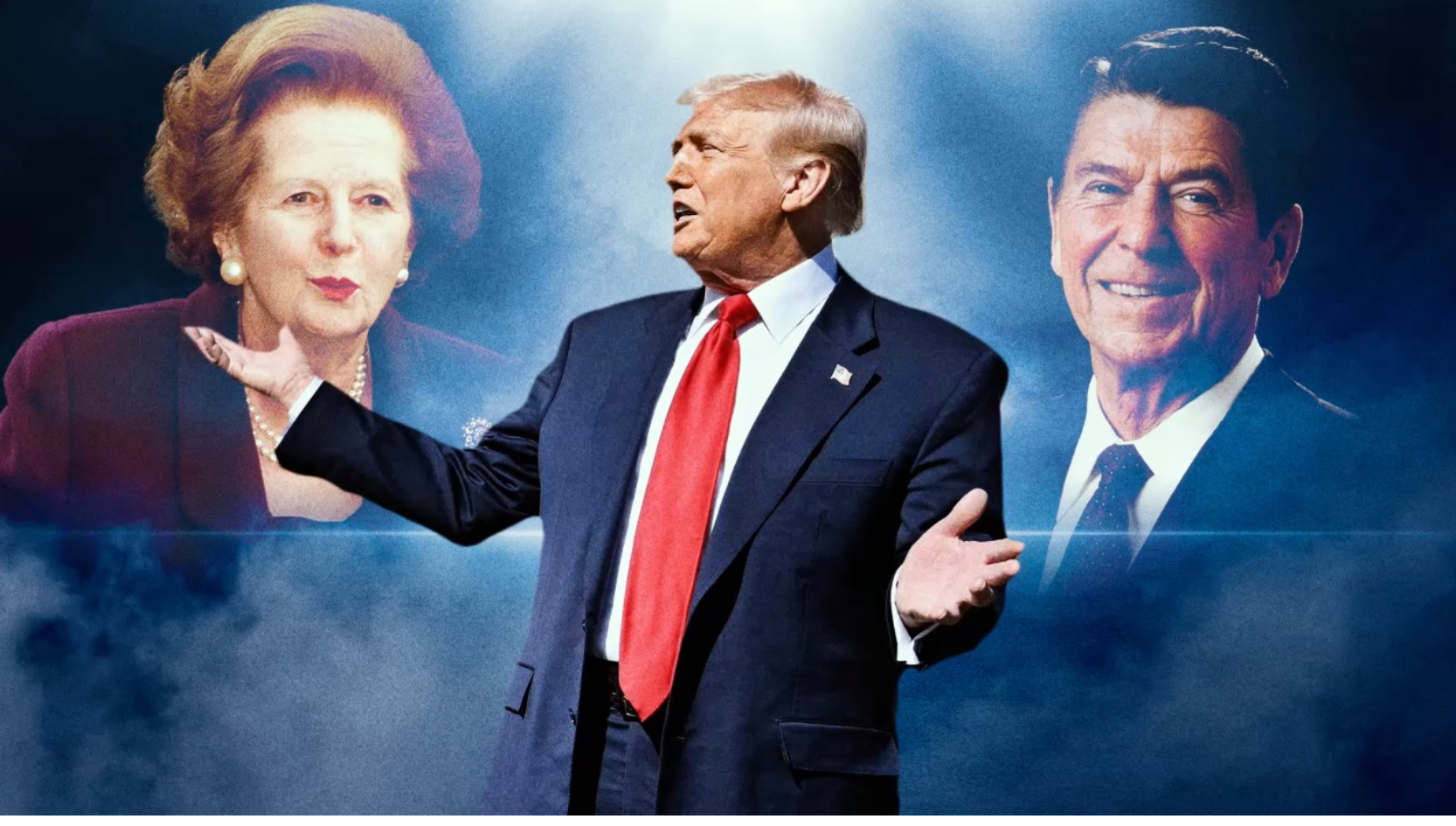
The extent of the transformation is best grasped in the comparison between Trump and Ronald Reagan, once seen as the best recent reflection of the American conservative presidency.

Reagan’s recent and best biographer, Max Boot, writes: “There were many obvious differences between Trump and Reagan, both in their policies and style. Reagan was pro-immigration, pro-free trade, pro-democracy and pro-NATO. He was also a consummate gentleman who never indulged in name-calling or acerbic putdowns. He was, moreover, a staunch believer in American democracy who would never have dreamed of instigating an insurrection to prevent a lawfully elected candidate from taking office.”

Ronald Reagan was once seen as the best recent reflection of the American conservative presidency. Picture: AFP

Ronald Reagan AFP

Reagan made Americans feel good about themselves – and, for better or worse, he was a two-term successful governing president while shifting the country decisively to the right.

Will Trump be a successful governing president? The jury is out but the omens aren’t encouraging. Interviewed by the author at an early stage of Trump’s first presidency, John Howard, issuing a warning, said: “It’s misleading the political landscape for conservative commentators in Australia to see Donald Trump as the embodiment of modern conservatism. Trump is not my idea of a conservative. Trump is no Reagan or Thatcher and they are the two most conservative lodestars in my lived political experience.”

Both Howard and Tony Abbott have a deeply conventional view of conservatism compared with the Trump project. Abbott previously said the conservative instinct “is to repair rather than to replace, it’s to leave well enough alone, it’s to fix only what needs to be fixing, it draws inspiration from the past and wants the future to be a better version of what we know and love”.

There are shades of Trump in this, but you need to look hard. Howard and Abbott had an orthodox interpretation of conservatism drawn heavily from Edmund Burke, who saw society as a partnership and espoused evolutionary change, backing the American Revolution but opposing the French Revolution.

But in the US this view was de-constructed pre-Trump by a new class of activists and apostles demanding a more radical conservatism. Indeed, Boot wrote: “If Reagan had been alive in 2016, he undoubtedly would have been derided by most Republicans as a RINO (Republican in Name Only) like the two Bushes, John McCain and Mitt Romney” – an accurate yet extraordinary situation.

Since Reagan there has been a mounting belief among US conservatives that they had lost their country; that even Reagan made too many compromises and look what happened! The view took hold that nearly all institutions were controlled by secular progressives hostile to notions of family, faith, nation and educational integrity.

Trump became the instrument of restoration. People with a grievance against the system flocked to him – from the displaced industrial worker to the world’s richest man, Elon Musk, forming an astonishing alliance to smash whatever they hated. And there was plenty of that.

Trump is a conqueror able to puncture and even dismantle an established progressive order – but he manifestly cannot create a replacement order.

Even in his first three months, this is the singular insight. It’s because his presidency is about himself and his colossal ego. Trump is not a builder. He lacks the institutional and policy capacity to strengthen America’s economic base; witness his misunderstanding about how high tariffs work given they will lift prices, penalise consumers and misdirect resources.

A former president of the American Enterprise Institute and self-declared “old establishment conservative” who shifted to the radical side, Christopher DeMuth, writing in 2021, outlined what drove the conservative reinvention: “Have you noticed that almost every progressive initiative subverts the American nation, as if by design?

Donald Trump’s presidency is about himself ... and his colossal ego. Picture: AFP

Donald Trump’s presidency is about himself … and his colossal ego. Picture.  AFP

“Explicitly so in opening national borders, disabling immigration controls and transferring sovereignty to international bureaucracies. But it also works from within – elevating group identity above citizenship; fomenting racial, ethnic and religious divisions; disparaging common culture and the common man; throwing away energy independence; defaming our national history as a story of unmitigated injustice; hobbling our national future with gargantuan debts that will constrain our capacity for action.”

So, the conservatives became the radicals.

Many became activists.

Manhattan Institute senior fellow Christopher Rufo, a leader in the fight against critical race theory in US institutions, outlined his manifesto for counter-revolution in January 2024: “The world of 18th and 19th-century liberalism is gone and conservatives must live with the world as it is – a status quo that requires not conservation but reform, and even revolt. For 50 years establishment conservatives have been retreating from the great political tradition of the West – republican self-government, shared moral standards and the pursuit of eudaimonia, or human flourishing – in favour of half-measures and cheap substitutes.

“The chief vectors for the transmission of values – the public school, the public university and the state – are not marketplaces at all. They are government-run monopolies. Conservatives can no longer be content to serve as the caretakers of their enemies’ institutions, or as gadflies who adopt the posture of the ‘heterodox’ while signalling to their left-wing counterparts that they have no desire to disrupt the established hegemony. We must recruit, recapture and replace existing leadership. We must produce knowledge and culture at a sufficient scale and standard to shift the balance of ideological power. Conservative thought has to move out of the ghetto and into the mainstream.

“My conviction is that ends will ultimately triumph over means; men will die for truth, liberty and happiness, but will not die for efficiency, diversity and inclusion.”

But will they die for Trumpian excesses?

Offering an alternative view, New York Times columnist David Brooks, a sympathiser with Burkean conservatism, warned in 2022 in The Atlantic that Trumpian Republicanism “plunders, degrades and erodes institutions for the sake of personal aggrandisement”. Brooks said, by contrast, the profound insight of conservatism “is that it’s impossible to build a healthy society on the principle of self-interest”.

In February, Brooks spoke to the Alliance for Responsible Citizenship conference in London – an organisation pledged to the revival of Western civilisational principles – saying of Trump, JD Vance and Musk: “They’re anti-left, they don’t have a positive, conservative vision for society, they just want to destroy the institutions that the left now dominates. I’m telling you as someone on the front row to what’s happening, do not hitch your wagon to that star.

US Vice President JD Vance exits the Oval Office in the opposite direction as US President Donald Trump and Elon Musk. Picture: AFP

President Donald Trump, Vice President JD Vance and Elon Musk. AFP

“Elite narcissism causes them to eviscerate every belief system they touch. Conservatives believe in constitutional government – Donald Trump says ‘I can fix this.’ Conservatives believe in moral norms – they’re destroying moral norms. The other belief system that they are destroying is Judeo-Christian faith – based on service to the poor, to the immigrant, and service to the stranger.”

Brooks highlighted the refrain: that Trump is not a conservative and it is folly for conservatives to claim him. In the end, they will be damaged.

Further evidence emerged this week when US Supreme Court Chief Justice John Roberts rebuked Trump – though not by name – after the President called for the impeachment of a federal judge who had ruled against the administration deporting to El Salvador nearly 300 alleged Venezuelan gang members.

When Judge James Boasberg issued an order to temporarily block the move and the administration said the planes were already in the air, the judge verbally ordered the planes to turn around. That didn’t happen.

An angry Trump called the judge a “Radical Left Lunatic”, pointed out the judge hadn’t won the election and nor did he win all seven swing states and should be impeached.

Roberts noted that “for more than two centuries” impeachment was not “an appropriate response to disagreement concerning a judicial decision”. Trump’s immigration tsar, Tom Homan, said: “We’re not stopping. I don’t care what the judges think.”

The Wall Street Journal asked in its editorial: “Are we already arriving at a constitutional impasse when the administration thinks it can ignore court orders?” It said: “What the administration can’t do is defy a court order without being lawless itself.”

Yet there is evidence Trump wants a showdown of sorts with the judiciary given a succession of court decisions that have restrained implementation of his executive decisions.

The messages from much of the MAGA (Make America Great Again) movement is that they want the executive to defy the courts. Trump’s line of attack – that Boasberg didn’t win an election – is revealing because it implies the executive has a legitimacy the judiciary lacks, rather than the two arms being co-equal branches in a separation of power.

Trump didn’t accept Joe Biden’s democratic election by the people; now the issue is whether he will accept decisions by the judiciary. These, obviously, are deep violations of conservative principles.

At the same time Trump and Musk in their campaign through the Department of Government Efficiency to dismantle the “deep state” and generate huge savings are guaranteed to provoke an electoral revolt, let alone make savings on the basis of efficiency.

In The Wall Street Journal, Peggy Noonan, summarised the epic lack of judgment on display. Noonan said: “Everyone knows DOGE will make mistakes, but that isn’t the point. You have to be a fool to think there won’t be dreadful mistakes with broad repercussions. To take on seemingly all parts of government at the same time is to unsettle and confuse the entire government at the same moment. That is dangerous. It was a mistake to announce going in that they’d find $2 trillion in savings.”

They can’t – or, if they do to keep face and honour their target, the issue will finish on the streets and Trump can kiss goodbye to ratings.

Governments around the world – led by Canada but also including Australia – are left with no option but to criticise or attack Trump’s tariff policy. He is bent upon penalising nations – whether friends or potential foes – as he acts on the conviction that America has been ripped off for decades by virtually everybody else. The steel and aluminium decisions have little direct impact on Australia. The issue is: what next? Might Trump damage our beef and pharmaceutical trade? Will he listen to US pharmaceutical company hostility to our Pharmaceutical Benefits Scheme? Will Trump listen to Musk’s demands and declare against Australia’s laws to rein in Big Tech through our ban on the use of social media by children under 16 and our proposed News Media Bargaining Incentive scheme to force digital companies to pay for the news they use?

This week, Jim Chalmers went hard against Trump’s tariff policies. The Treasurer said the decision not to exempt Australia was “disappointing, unnecessary, senseless and wrong”. Australia deserved better “as a long-term partner and ally”. Chalmers criticised Trump’s global policies – not by name – saying the rules underpinning “global economic engagement for more than 40 years are being rewritten”.

Australia’s attitude towards Trump – both the political response and public opinion – will move to resentment and anger if Australia faces more retaliation. Understand what is happening: Trump’s obsessive and flawed view of tariffs is damaging global trade, won’t deliver the gains he predicts for America and, on the way through, is punishing countries such as Australia.

Why would people in Australia support him?

How the Trumpian paradox plays out defies prediction. The movement that helped to put Trump into the White House was an authentic counter-revolution with deep roots in American culture. This is what makes Trump a complex historical figure. He is ignorant of history yet he sees himself as leading a historical revolution.

It is a revolution where Trump has scant interest in the limits to his power – executive power – within America’s constitutional democracy. It is a revolution that defies the basic principles of conservatism although it is given legitimacy by much of the conservative movement. US conservatives face tough political and moral choices ahead – whether to back a leader who has empowered them but thrashes the essence of conservatism.
Calling Australia! Reading the Trump revolution

Countless left-wing memes about American stupidity illustrate how out of touch, self righteous, arrogant and morally “superior” many of the so-called “left” have become – unlike the Democrats whom New York Times columnist Maureen Dowd said were “finally waking up and realizing that woke is broke” after having embraced a self-defeating world view of “hyper-political correctness, condescension and cancellation”.

The Democrats. – and indeed, our Labor party – would ignore the outcome of the presidential election at their peril. The people, for better or worse, have spoken, and it’s a pointless exercise for the Democrats to live in a fantasy world of denial, not accepting their own responsibility in the loss. The Sydney Morning Herald’s Peter Hartcher wrote on 12 November:“ It’s also extremely condescending and arrogant to assume you know better and anyone who didn’t agree must be an idiot. In that light, I’d suggest Trump didn’t win this. The Democrats lost it in a spectacular fashion, and if you can lose it to the likes of Trump, something is majorly wrong on the left side of politics”.

There are lessons aplenty for Australian politics. The Coalition wants to spend the months leading up to next year’s election talking about migration driving up household bills. It has no actual plan for decreasing immigration or reducing inflation, but voters don’t care. They don’t do nuance. They’re disatisfied with the status quo and disappointed in the government. They’ll just want to punish the mob in charge. Sure, they’ll be burning down the house, and they’ll be in the house when it burns down (two song references there!) but they won’t care. The question will be “are you better off today than you were four years ago?” And, like in America, for a great many, the answer will be a big “no!”

Waleed Ali’s recent article on why Trump won concurs with the above: “Last week, a historically unpopular government, presiding over a period of high inflation that saw food prices especially explode, got thrown out of office. There is quite simply nothing extraordinary about that”. Former Liberal attorney general and high commissioner to the UK George Brandis wrote similar in the Herald on 18 November:“… the sheer weirdness of Donald Trump himself: narcissistic, vulgar, bombastic, mendacious, idiosyncratic, outrageous; while at the same time flamboyant, mesmerizing and on occasions very funny. He broke every rule, told every lie, did the unthinkable, said the unsayable and still came up … (you complete the pun). The epic unconventionality of Trump’s campaign dramatised a result that would probably have been the same had the Republican candidate been less unorthodox. For that reason, the outcome is fertile ground for over-interpretation and exaggeration”.

On a different but not dissimilar tack, John Carroll, Professor Emeritus of Sociology at La Trobe University wrote in The Australian:

“The resounding Trump victory confirms the cardinal law: politics is about power. In times of peace and prosperity, such as we in Australia have enjoyed for almost 80 years, it is easy to forget, and continue along in the hopeful illusion that life is good, people are intrinsically nice, and problems can be solved amicably …

… One of the appeals of Donald Trump to the United States electorate – I suspect his main appeal – has been that, in his bluster and braggadocio, he flexes power muscles and seems to show he is unafraid to mobilise power for his own ends. There is an intuitive understanding across middle and lower-middle America that progressive posturing and feel-good speeches will not steer the ship of state safely through turbulent waters. In contrast, Trump policy appears clear, direct, and down-to-earth – booming economy, secure borders, and resolved international conflict. When 70 per cent of Americans feel worse off than they were four years ago, they want strength in leadership and focus on their everyday interests.

…The Trump persona – aggressive, confrontational, and petulant, not to mention pathologically narcissistic – also seems to have appealed to marginalised social strata. Those living in poorer states, young black and Latino males, recent immigrants, and the old city working classes resenting their decline, all seem to have been drawn to his maverick contempt for the trendy issues of the time. His character may be suspect – indeed he is widely disliked – but he appears powerful, practical, and not of the coterie elite. In politics, power eclipses niceness”.

I republish below an opinion piece by The Australian’s editor at large Paul Kelly. It is to my mind one if the best articles I have read to date regarding the outcome of the  American elections and how this may impact Australian politics. It is particularly interesting insofar as Kelly pushes back against the conservative narrative prevalent in the Murdoch media and among more extreme right wing commentators, politicians and culture warriors. Regarding Australian politics, he writes:

“If Trump succeeds he will further undermine the shaky policy framework of the Labor Party. The optics will be: Trump’s strength versus Albanese’s weakness. In this situation, the pro-Trump media and conservative drum-beaters in this country – in effect the Trump Appeasement Syndrome lobby – will demand the Peter Dutton-led Coalition follow their messiah while they will use Trump’s success to undermine Albanese. Destroying former prime minister Kevin Rudd as ambassador to the US is just the first step”.

“So what’s driving the campaign to target Rudd”, asked Hartcher on 16 November. “The Murdoch media, in short. Some other commentators have been drawn into it, too, useful idiots for the Murdoch effort. Ostensibly they demand that Rudd go because he was critical of Trump, but in reality, “this is revenge”, as Malcolm Turnbull explained this week. “This is a campaign that News Corp kicked off, and they are running a vendetta,” he told my colleague Matthew Knott. Revenge for what? Rudd founded a movement called Australians for a Murdoch Royal Commission. Murdoch’s empire was “a cancer on our democracy”, he said. A royal commission would examine the level of concentration in Australian media ownership and the conduct of the Murdoch group in particular”.
“But the Murdoch media is not monolithic”, Hartcher continues.”Its éminence grise is Paul Kelly. Kelly has the stature to make his own judgment. The campaign to remove Rudd as “a ritual sacrifice before Trump has even said anything” is “part of Trump Appeasement Syndrome”. “This shows a contempt for Australian sovereignty and a craven weakness before Trump,” Kelly wrote this week. “For any Americans wasting their time following this saga, we must look a sad, pathetic little country.”

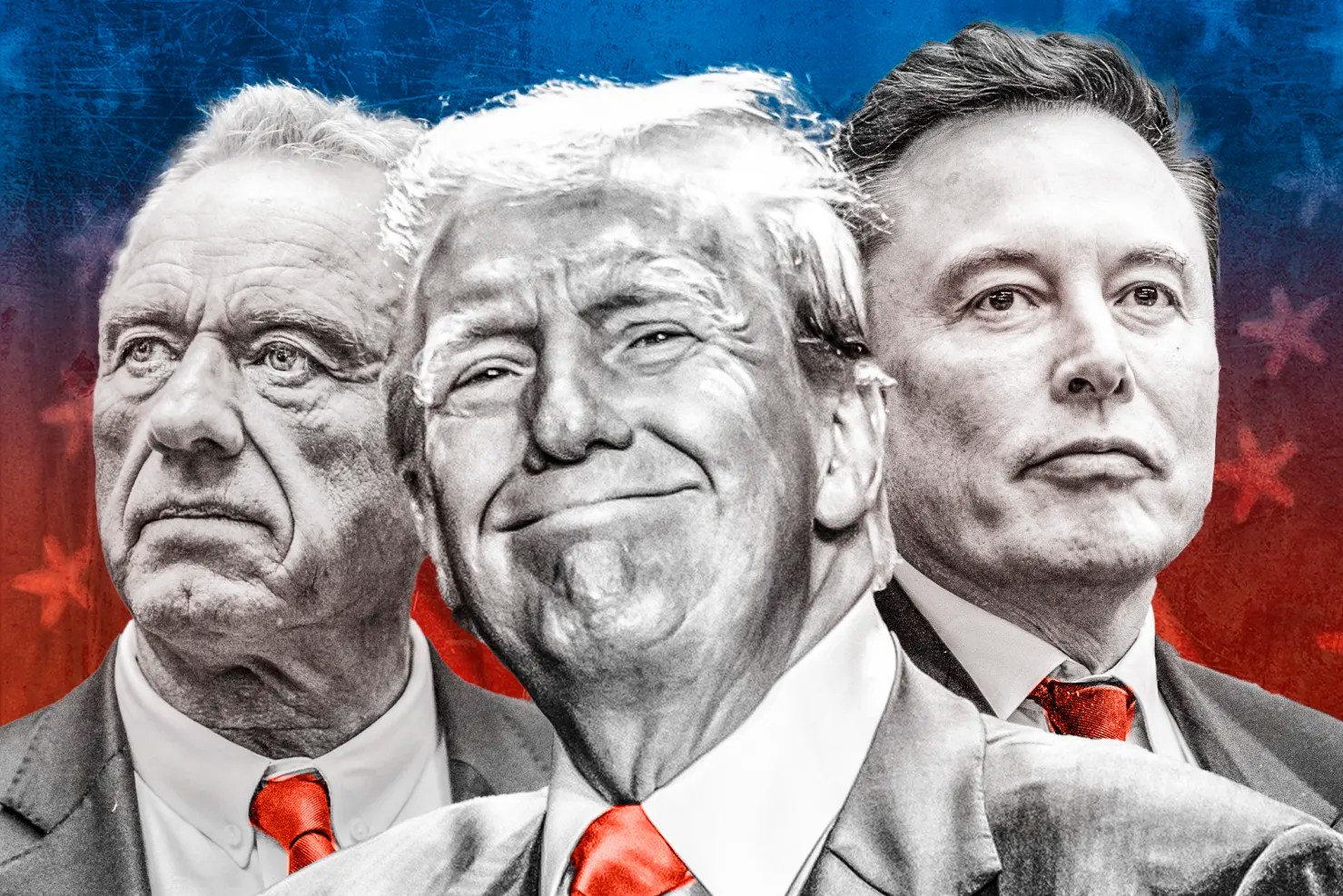
Trump and his cabinet picks Robert F Kennedy Jr and Elon Musk

Donald Trump’s revolution leaves Albanese exposed

America’s leap to the right will have political repercussions for Australia.

The Trump Revolution is coming and, like all revolutions, its outcome will fluctuate between a glorious remaking of the existing order or a spectacular overreach and fall – maybe even a contradictory mix of both – with Anthony Albanese and Australia in front-row seats for the drama.

[In the same issue as this article, national affairs editor Joe Kelly summed up this revolution: “Trump’s sweeping “day one agenda” includes dismantling the deep state, pursuing mass deportations, imposing across-the-board tariffs, scrapping the “Green New Scam”, withdrawing from the Paris Agreement, rolling back environmental regulations, ending the Ukraine conflict, unpicking pro-transgender policies, pardoning January 6 offenders, and rolling back the Biden health and education agendas. This is a blueprint to overhaul the country. Leading thinkers are already focused on which items are set in stone and which could merely be attempts to enhance Trump’s negotiating position. While Trump is a familiar political figure, this exercise reveals his policy agenda has still generated widespread uncertainty. Paradoxically, no one knows how the experiment will turn out or even exactly what it is – a recipe for a populist catastrophe, or a profound new American reinvention”.]


From the Trump appointments so far, the big “America First” play is on. The sharemarket has been excited, the bond market is wary, Big Tech is king, Beijing should be worried. President Trump Mark II is more resolute and revolutionary than Trump Mark I.

His hunger for change seems ferocious; his willingness to take risks is more pronounced. He is assembling a tribe of Trump loyalists to punch through the disintegrating Democratic scaffold. Trump demands loyalty and prioritises vindication.

Two lights are flashing – danger and opportunity. Some people will make a stack of money and others will be cast into painful obscurity.

Trump is going to remind everyone of the extent of power vested in the office of US president when pushed to the limit.

Consider the Elon Musk appointment. Surely this can’t be true. The world’s richest man, heading social-media platform X, hanging out at Mar-a-Lago, almost part of the Trump family, will now co-lead a Department of Government Efficiency – sitting outside the federal government – and while keeping all his existing corporate positions, he will pursue his pledge to cut US agency budgets by $US2 trillion ($3 trillion), or about one-third.

Tesla CEO Elon Musk will now co-lead a Department of Government Efficiency. Picture: AFP

Tesla CEO Elon Musk will now co-lead a Department of Government Efficiency. Picture: AFP

Of course, it is true – only in America. Think about this marriage: Trump’s America meets the Big Tech oligarchs. This is a serious moment for US capitalism, great for innovation, bad for integrity. Trump likens Musk’s brief to “the Manhattan Project of our time”. How many struggling Americans are going to be punished in the process? Australian officials, long familiar with our experience of external budget audits (think Tony Shepherd in 2013), know Musk’s promise is impossible in delivery terms. It can’t be done, short of a massive anti-Trump electoral revolt from the public.

At this time, however, such quibbles don’t matter. Nothing seems impossible in the exaggerated hype of Trump’s vindication. A tariff of 60 per cent on China’s imports? Sure. Cutting a third off federal agency budgets? No problem. Licensing the king of Big Tech, loaded with conflict-of-interest federal contracts, to stage a shooting gallery across the entire federal bureaucracy? Great idea. It’s called purging the deep state.

Change on the scale Trump wants generates both high excitement and high risk. Nobody can be sure of the consequences because these things have never been tried before and we don’t know where the line will be drawn between impression and reality. How long before Trump and Musk fall out?

Trump’s appointments show his priority to purge the “deep state” institutions of justice and intelligence. Given his history, these seem non-negotiable personal passions for Trump. He appointed former Democrat, now Trump loyalist, Tulsi Gabbard as director of national security despite, or perhaps because of, her sustained support for Russian leader Vladimir Putin.

He appointed a professional provocateur, Republican congressman Matt Gaetz, as attorney-general with Gaetz, already at political war with the Justice Department he is supposed to run, praised by Trump, who said Gaetz will end “the partisan weaponisation of our justice system”. That means a purge.

Trump has appointed Republican congressman Matt Gaetz as attorney-general. Picture: AFP

Trump has appointed Republican congressman Matt Gaetz as attorney-general. AFP

The wilful naivety of Trump’s apologists in this country looks embarrassing given Trump’s resolve to impose his will on the ­intelligence community, justice and the FBI. Gabbard’s appointment is highly dubious and Gaetz’s should be overruled, with The Wall Street Journal saying it would “undermine confidence in the law” and would be used for “political revenge”.

Trump’s mind seems a cross between powerful insights into the flaws of the Obama-Biden-Harris age and the vindictive fantasies of all rebels pulling down the established order.

But Trump’s experiment will resonate far beyond America. Markets seem alert to the inflationary consequences of his fiscal policy. The combination of Trump and our tight labour market will further weaken Anthony Albanese’s hope of an interest-rate cut before the election.

But the big picture consequences are far larger. At a time when most Western democracies are burdened by disillusion, poor economic and social outcomes and leadership that lacks either conviction or courage, Trump arrives as a giant on the stage of history.

He mocks the orthodox governing model. Much of Trump’s appeal is because he presents as a change agent against leaders running a failed status quo, witness the dismissed Biden-Harris team. More than 70 per cent of Americans felt their country was going in the wrong ­direction.

Trump’s win is the antithesis of Albanese’s victory in 2022 when Albanese ran on reassurance, incrementalism and “safe change”. Trump consigns “safe change” to the dustbin of history. He will steamroll Albanese’s “safe change” into the gutter. Trump’s American political strategy is the complete opposite of Albanese’s Australian strategy.

Of course, America is not Australia; we are different countries and in different moods. Yet the stakes for Australia cannot be denied – the more Trump succeeds, the more Labor’s policies will look feeble, ineffective and missing the big picture.

At almost every point in his agenda, Trump is diametrically opposed to Labor’s framework.

Consider the list: Trump wants savage public-sector cuts, a reduction in federal bureaucratic numbers, a purging of regulation, cutting the corporate tax rate to 15 per cent (half that of Australia), extending income tax cuts, imposing punitive tariffs on China where Australia is just restoring trade normality, repudiating free trade by resurrecting across-the-board tariffs, more support for oil and gas, walking out of the Paris Agreement on climate, dismantling ­environmental obstacles to development, cracking down on immigration, launching a domestic war on all forms of identity politics, boosting US defence spending and disdaining global institutions.

It is folly to think Trump won’t be influenced by the chasm between himself and Albanese. It’s good he told Albanese on the phone that Australia was the “perfect friendship”. Let’s cut to reality – if Trump has initial success in fuelling the animal spirits of the US economy, the governance model for Western democracy will be shaken to its foundations. Parties of the radical right will gain fresh traction everywhere.

It is folly to think Trump won’t be influenced by the chasm between himself and Anthony Albanese. Picture: AFP

It is folly to think Trump won’t be influenced by the chasm between himself and Albanese. AFP

If Trump succeeds he will further undermine the shaky policy framework of the Labor Party. The optics will be: Trump’s strength versus Albanese’s weakness. In this situation, the pro-Trump media and conservative drum-beaters in this country – in effect the Trump Appeasement Syndrome lobby – will demand the Peter Dutton-led Coalition follow their messiah while they will use Trump’s success to undermine Albanese. Destroying Kevin Rudd as ambassador is just the first step.

Of course, it might not evolve this way. It might be the precise ­opposite. You never know with Trump. He may overreach from the start, prioritising vengeance, smash too many institutional norms and, drunk on hubris, alienate even his own voters.

But last week Trump sent another message of profound significance for Australia – he is riding with the China hawks. This means Trump will expect Albanese to muscle up and toughen up against China. Forget the idea of Trump going cool on Australia – he likes us, he’ll go hot on Australia and ­expect more action from us to ­reinforce his China hawks.

This is surely the coming message from the appointment of Senator Marco Rubio as Secretary of State and Congressman Mike Waltz as his National Security ­Adviser.

Waltz, in a jointly written essay for The Economist, said the US must wind up the Ukraine conflict and direct its assets towards confronting and deterrence of China. Rubio warns China is “far more dangerous” than the old Soviet Union and poses the central threat of the 21st century. They will drive deeper US rivalry with China.

Rubio supports AUKUS. That’s the good news – but under Trump the US support for AUKUS means more action and commitment from Australia against China. That’s the transactional deal, got it?

China's President Xi Jinping. Picture: AFP

China’s President Xi Jinping. AFP

How does this fit with Albanese’s “stabilisation” agenda with China? Answer: not comfortably. History tells us that Australian domestic support for the US alliance falls when there’s a US president we don’t like, witness the fall in popular backing for the alliance under George W. Bush. Now we will likely have in Trump a US president who expects us to get more hawkish on China while domestic support for that Trump-induced option will plummet.

It’s better for Australia that Trump rides with the China hawks, not the China doves. But you cannot miss the problem. Paul Keating sees it and fell upon the remarkable political monitor poll in The Sydney Morning Herald showing that 57 per cent said Australia should avoid taking sides in any war between the US and China, with only 16 per cent disagreeing. Extraordinary stuff.

Keating said this repudiated ­Albanese’s “lock-in” military ­arrangement with the US, the AUKUS agreement and the ­assumption Australia is tied to the US in any conflict.

Trump’s China policy looks ominous for Labor – his tariff strategy will weaken our trade with China while his overall “get tough” strategy will intensify anti-Trump sentiments within the public in Australia and ignite a debate within Labor, with protests the party is too accommodating of Trump’s anti-China stand. It will be dangerous and unpredictable.

The broader political takeout from Trump’s victory is the failure of Democratic Party progressivism – economic and cultural. This is a mammoth event. Of course, direct political lessons cannot be simply transposed from America to Australia. These are very different countries. Yet it would be unwise to assume there is no connection point for Australia from this epic US election.

Here are three propositions – that US progressives are no longer the party of the working class or the non-college educated; that US progressivism contains the seeds of its own destruction, witness the Trump counter-revolution; and that the deepest faith of the progressives – that Trump is a threat to democracy – didn’t work because the progressives constitute their own threat to democracy.

Let’s consider the first proposition – in effect, the voter realignment. Australian pollster Kos Samaras wrote post-election that low-income, working-class voters were heading right-wing. This realignment would reshape politics including in Australia and was tied to the changing nature of left-wing politics with its new priorities around climate change, social justice, urban fashions and housing.

Analysis by the Financial Times shows that in the US poorer and less-educated voters think Republicans best represent them, with the Democrats now the party of high-income and college-educated voters.

Trump won a majority of households with incomes of less than $100,000 while the Democrats won more support from the top third of the income bracket. Education is a sharp line of division – nearly two-thirds of voters without a college degree supported Trump.

Samaras warns the realignment in Australia deepens the divide between urban and rural voters and between professional and low-income voters, “creating fertile ground for conservative and populist leaders”. Is the urban professional class slowly suffocating Labor? Obviously, Dutton will be exploiting this divide at the coming poll.

On the second proposition, most progressives and elites in Australia are in denial, unable to admit what is happening, despite the defeat of the voice referendum at home and the evidence in the American election – many people voted for Trump on cultural grounds, pointing to a counter-­revolution.

There are numerous pro-Trump commentators hailing the moment. Many exaggerate, yet the trend is manifest. Writing in the Financial Times, respected analyst John B Judis said Democrats must dissociate themselves from support for “gender-affirming care”, their opposition to strong borders, their backing of equal outcomes rather than equal opportunity on racial issues, their indifference to the plight of working-class men, just dismissing Trump supporters as racists and sexists, and their focus on imminent planetary apocalypse to justify draconian ­climate action.

He said the priorities of many voters who deserted the Democrats are decent jobs, safe streets and a proper safety net. But Judis warns even action on these fronts will fail politically “if Democrats don’t sever their identification with cultural radicalism”.

Labor hasn’t gone as far as the Democrats – but it is largely and proudly a progressive party now, and this risk is potent. Most progressive leadership elites in Australia don’t understand the consequences of the cultural positions they champion. Their cultural ignorance is astonishing and dangerous. They need to read the long masterclass provided in July this year by David Brooks in The New York Times.

Prime Minister Anthony Albanese. Labor hasn’t gone as far as the Democrats – but it is largely and proudly a progressive party. Picture: NewsWire / Nikki Davis Jones.

s

Brooks said that with the demise of religion, US public life became secular in recent decades with “science and reason” becoming the methods by which the nation could be held together. It is now obvious that this answer, championed by the elites, has failed. “By the 21st century, it became clear that Americans were no longer just disagreeing with one another,” Brooks said. “They didn’t even perceive the same reality.”

Was there anything to fill this moral void? As usual, the left produced an answer – identity politics. Brooks said: “This story provides a moral landscape – there are those bad guys over there and us good guys over here. The story provides a sense of belonging. It provides social recognition.” It is orientated around proper esteem for and inclusion of different identity groups.

The problem, however, is the incompatibility of identity politics with the liberal principle of equality – that regardless of identity we are bonded by a common humanity. This is the foundation stone of our liberal democracy. Undermine this principle and our society is undermined. As Brooks says, “the problem with this form of all-explaining identity politics is that it undermines democracy”.

Trump’s voters don’t offer such sophisticated reasoning for their vote. But their visceral distrust of how they are being treated says this is what they feel in their bones. It is reinforced by numerous examples across their lives, telling them they don’t really count.

The more progressives in Australia push this ideology, the more they guarantee a backlash. Dutton knows this – he just needs to judge how far it has gone in Australia and how much to advance the counter-revolution.

This leads directly to the third proposition. The Democrats were consumed by the idea of Trump as a threat to democracy. Ultimately, this was the Harris campaign – and the argument was correct. Watching Trump’s backers in this country trying to pretend black was white was pitiful intellectual dishonesty. Trump refused to concede he lost in 2020 – of course he was a threat to democracy.

But what the Democrats didn’t get was the point brilliantly made by political scientist Yascha Mounk – some exit polls suggested that people felt Harris was a greater threat to democracy than Trump. “This hints at the fundamental fact of the past decade,” Mounk said. “A fact that elite discourse still has not fully confronted: citizens’ trust in mainstream institutions has been absolutely shattered. Corporations and the military, universities and the courts, all used to enjoy a certain modicum of residual trust. That trust is now gone. It is unlikely to return any time soon.”

It is gone because of the left’s march through the institutions, the story in both America and Australia. Progressive activists took charge, while established leaders were weak and ignorant. When people look across the landscape – universities, bureaucracies, cultural bodies, corporates, government departments – they see progressive values, great and small, shoved in their faces. It’s not the democracy they voted for

Hearing voices – is Teal the real deal?

In the past, the major parties have seen independents as a passing nuisance that fades over time, like the Australian Democrats. Their only concern was their preference flow. Times are indeed changing; unless the major parties change, these independents are here to stay … There are no safe seats any more. 
Peter Beattie, former premier of Queensland, 22 April Sydney Morning Herald

To paraphrase old Karl, a spectre is looming over Australian politics – commentators on the right  believe it’s haunting the Liberal and National Party Coalition. But it also hovers over the Labor opposition.

One number is now keeping major party leaders and their confidants awake at night: 76. That is the bare minimum needed to form majority government in the 151 seat House of Representatives. It is the number the Coalition currently commands. And, right now, all the public polls show neither major party has electoral support to hit it.

Voters decide who gets their preferences, not parties. But history shows that the most disciplined flow is from the Greens to Labor. Antony Green’s research on the 2019 result confirms that more than 80 per cent of Greens voters put a two in the Labor column.  With the Greens primary at, or above, 10 per cent Labor appears in the best shape to form government because minor party preferences flow to the Coalition at a lower rate. And there is a smorgasbord on offer for disaffected Coalition voters on the left and right. Clive Palmer’s billions have bought roughly 3 per cent of the primary and Pauline Hanson’s One Nation commands a similar number. In 2019, both delivered 65 per cent of their second preferences to the Coalition and 35 per cent to Labor.

But a recent development in Australian electoral politics is sending the statistics skewiff.

Enter the self proclaimed ‘community independents, the so-called ‘voices of …’ movement, labelled by observers across the political spectrum as ‘The Teals’, named for their almost uniform choice in campaign colour. I republish below two typical opinion pieces.

The first is by Paul Kelly, The Australian’s Editor at Large. From time to time, I republish articles by News Ltd commentators that I believe are worth sharing with those who cannot scale the News Corporation paywall. Kelly is one of those. Though undoubtedly of the right, often assuming many of the positions adopted by his more partisan colleagues, though in a much more nuanced and ‘reasonable’ manner, he writes well and wisely, most probably due to his long experience and high reputation on the Australian political scene.

He recently wrote a cogent piece on how the cohort of Teal Independents, backed up by the financial and political resources, and very substantial donations ‘war chest’ of the Climate 200 group, are offering their electorates and ourselves a model of participatory parliamentary democracy that is built on shaky foundations. Climate 200 founder and funder Simon Holmes a Court claims that “the shortest and surest path to good government is a minority government with a quality cross-bench”.

It is probably one of the best analyses of the aspirations and apparent appeal of this relatively recent political phenomenon. I also republish a left-wing perspective by journalist Mark Stanley on the MichaelWestMedia blog. He endeavours to answer the same basic and obvious question as Kelly: is teal the real deal?

Kelly has observed that an unprecedented passion for independents is taking hold in some of the richest suburbs of Australia. Its vanguard comes from predominantly professional, business and educated women who reside in affluent inner-city suburb. Not exclusively so, however. There is Helen Haines, the sitting member for the rural Victorian seat of Indi – and her colour is actually orange. In my own seat of Cowper, on the mid north coast, the anointed independent is well-known and popular health professional with strong local and indeed left wing roots: she is a former member of the Greens. Nor are they all female. Andrew Wilkie, long time Tasmanian MP, Stephen is on the ticket as is Stephen Pocock in the ACT who is running for senate.

These independents believe their voice has been denied for too long. This denial is the genesis of the ‘voices of … ‘ movement although their call is a world of difference from the nihilistic ‘mad as hell and we ain’t gonna take it any more’ populism of the far right and it’s lugubrious svengalis. There is an apparent conviction that the political system somehow is either discredited or broken or corrupt – perhaps all three – and needs to be rescued by a higher moralism. And they appeal to the many voters who see the Labor and the Coalition as Tweedledum and Tweedledee, and possible hope that the independents will ‘keep the bastards honest”, to use an old and defunct catchphrase.

But, Kelly notes, “this is delusion on a grand scale. Public disenchantment with the major parties is a statistical fact. But leaping to the assertion the public wants minority government is a false conclusion”.

The preoccupations of Holmes a Court and his coterie of self-proclaimed ‘community’ Independents do not reflect the country at large. The idea that people in a few rich seats, some of the wealthiest (and least ethnically diverse) electorates in the nation, can redirect Australia towards the path of superior policy morality testifies to denial about the diversity and competing interests across Australia.

Whilst an infusion of progressive populists into the House of Representatives might sound exciting, the outcome could be a more fractured polity and a further decline in the capacity of parliament to legislate challenging national interest policy. This is no way to run a parliament or a government and to look after our country’s interests.

The most important function of an election, Kelly states, is to elect a government. Everyone knows where Liberals, Labor and the Greens stand – but the independents will not say, if given minority government, which party they want in office. A group espousing integrity and transparency will not be honest with the public on the single most important decision they would be required to take as MPs. The reason, of course, is they seek to maximize their vote; like the singer in Leonard Cohen’s sardonic song, they endeavour to be all things to all people: “If you want a lover, I’ll do anything you ask me to. And if you want another kind of love, I’ll wear a mask for you”. “In a sense”, Kelly notes, they trade genuine influence for gesture politics”.

So far so good – and for the most part, I couldn’t agree with him more. But at this juncture, Kelly removes HIS mask. I ought t gave seen it coming when he has commented earlier in his article : “if the public wants more action on climate change, here an easy answer. Vote Labor”. And then, midway through, he lets his conservative cat out of the bag: “It is one thing for these voters to elect independents over sitting Liberal MPs in an act of protest, but it is entirely another thing for voters to tolerate the independents putting a Labor government into power. Do that and your future as an independent is fatally compromised – your future will be tied to the Labor government and any decisions your electorate doesn’t like”.

He points to the lessons learned the hard way by erstwhile Coalition parliamentarians Tony Windsor and Rob Oakeshott who in 2010 ignored the conservative disposition of their seats when they put Julia Gillard’s government into office. Facing hate mail, trolling and even death threats, they were unprepared to stand at the next election. This is the salutary lesson for the teal wave of Independents – for that way madness lies.

Kelly sees the independents as a progressive movement to defeat the Morrison government and that this is their raison d’être: “They seek not just to defeat the Liberal Party but also to engineer, from the outside, a progressive remaking of the party

I disagree strongly with his contention that the independents seek to install Anthony Albanese and his social democrats, I actually regard them as a threat to the prospects of a Labor government. Teal, after all, is not a primary colour. Indeed, it’s primary color is blue, and it’s secondary is green. Chris Kenny,  a colleague  of Kelly’s  at The Australian, has quipped that teal is a blend of Green and blue blood – a thinly veiled swipe at what he perceives the affluent upper-middle class status of most of the inner city independents. But to my mind, one thing thing is for certain – teal is no friend of red.

But I do concur with the argument that are trying to change the system from within. But I would argue that these are conservative “wet liberals” who rather than betraying the party, are trying to drag its dominant right wing grudgingly towards the centre, the so-called “reasonable middle” where the majority of engaged Australians reside. Katrina Grace Kelly, another commentator for The Australian  reported a comment from an voter in treasurer Josh Frydenberg’s blue-ribbon but threatened inner-Melbourne seat of Kooyong: “We are educated, moderate and bewildered small ‘L” Liberals wondering what the hell happened top out party”. Kelly writes: ‘Using the brand “independent” is brilliant but also deceptive. They are not a party as such but they have a common cause, common funding and common strategy. They only target government MPs. Frydenberg calls them “fake independents”’. Grumpy former prime minister John Hoard recently referred to them as ‘anti-Liberal groupies’, his ‘banger sisters’ allusion going down a treat among those who reckon that the Coalition has a problem with women.

The irony is that far from recreating the Liberal Party in their own image, insisting en passant that Scott Morrison – and as a bonus, deputy PM Barnaby Joyce – are replaced, and targeting the seats of what moderate Liberal MPs remain in the government, members who actually agree with most of what the independents are advocating, and are also, incidentally, more culturally and ethnically diverse than their challengers, they could potentially hand the leadership and the Lodge not to all-around nice guy Josh Frydenberg but to the not so lean and but definitely hungry defence minister Peter Dutton. Maybe they believe that the prospects of the potentially unelectable Dutton ascending to the party leadership will shock the it into a rush to centre-field. But that is magical thinking!

I believe that the independents are actually a political party in all but name. They spruik the same issues and causes, they sing from the same song sheet, and whilst they receive many donations from idealistic sympathisers from across the political spectrum, they are heavily funded by Climate 200. They even share that body’s financial controller. And they cleave broadly to the mission of Climate 200 cabal – a fairly homogeneous collective of like-minded, disaffected former politicians and pundits. It’s advisory panel includes former Tory John Hewson, disgraced Democrat leader Meg Lees (who many believe destroyed that party), former member for Wentworth Karyn Phelps, Tony Windsor and Rob Oakeshott. The only former Labor luminary is Barry Jones. When I first viewed the panel a month or so back, I swear that list was considerably longer, including several high profile rebel Tories, including defecting MP Julia Banks.  As the say, “if it walks like a duck and squawks like a duck, then it is a duck”. QED.

The independents promote a false reality amid a fog of moralism. As Kelly notes, they might “offer much, but their capacity to change politics is heavily limited. In their strengths and flaws, they are a genuine manifestation of Australian democracy” – in all its infinite variety, I might add, and its contradictions. 

In the MichaelWest Media blog,  Mark Sawyer argues that if  the independents are a threat to the Liberals, why’s would Labor get in the way? After, all.the enemy of my enemy is my friend, right. But, he writes: “… smarter heads on the progressive side of politics are likely to be looking a bit further. They know the short-term gain of putting Liberal MPs to the sword could lead to long-term pain”.

Indeed. Whilst challenging the Coalition, the independents’ attitude of “a plague on both their houses”, and a  refusal to make deals with the major parties, not only hurts the Liberals, but also weakens Labor. Because, long story short.they want  the parties to depend on them.

And yet, as any soft-left and disaffected and defecting Labor and Green supporters argue naively, the Independents’s Big Four pledges around which they rally – climate, integrity, fiscal discipline and treatment of women – do resonate with the electorate.

But there scope is a restricted one.  The progressive policies in their brief manifesto theirs are feel-good positions, not policy. In being all things to all men and women they’ve cherry-picked what Sawyer called “the fun bits of the progressive agenda”.

They won’t touch the hard bits, including education and health, and the redistributive economic and fiscal policies (like including increasing taxes for the wealthy and for large corporations) which are central to the social democratic values of the true believers. The independents’ push for equity equality only goes so far.

And there are more areas where the independents fear to tread, other than acknowledging their worthiness. Support for the National Disability Insurance Scheme, for example; help for small business in recovery from the pandemic; truth in political advertising; enshrining a First Nations voice in the Constitution. Issues that require well-thought out policies.

It is much easier to argue as they do that the party system has run its course. But this disingenuous if nor ignorant of Australian history and politics. Although political parties are not mentioned in the constitution, they are parties are actually needed  to form and run governments. As all politics 101 students are told, parties inform, articulate and mobilize otherwise unorganized electorates around coherent political platforms. Our parliamentary system is representative democracy, not participatory democracy.

Sawyer states it bluntly: “Broad-based parties gave us Medicare, the NDIS, anti-discrimination legislation – an endless list of civilising measures that have enhanced our democracy. Whether the independents make a better replacement to these mass movements, and whether they are the solution to the challenges facing the nation, is a question that should be posed by the progressive side of Australian politics”.

I’ll leave the last word to Dennis:

Arthur: I am your king!
Woman: Well I didn’t vote for you!
Arthur: You don’t vote for kings!
Woman: Well ‘ow’d you become king then?
Arthur: The Lady of the Lake, her arm clad in the purest shimmering samite, held aloft Excalibur from the bosom of the water, signifying by divine providence that I, Arthur, was to carry Excalibur. THAT is why I am your king!
Man: Listen: Strange women lying in ponds distributing swords is no basis for a system of government! Supreme executive power derives from a mandate from the masses, not from some farcical aquatic ceremony. You can’t expect to wield supreme executive power just ’cause some watery tart threw a sword at you!! I mean, if I went ’round, saying I was an emperor, just because some moistened bint had lobbed a scimitar at me, they’d put me away!
Monty Python’s The Holy Grail

Where otherwise credited, © Paul Hemphill 2022.  All rights reserved


Also in In That Howling Infinite: Political World – thoughts and themes, and  Down Under – Australian history and politics

Election 2022: New ‘independents’ promote false reality in a fog of moralism

There are many delusions in election 2022 but few match the ambition of Climate 200 founder and funder Simon Holmes a Court with his claim that “the shortest and surest path to good government is a minority government with a quality cross-bench”.

“The assertion that Australia’s purpose and performance can be resurrected by building up the independent crossbench and shifting towards minority government is a triumph of cultural fashion over governing reality”.

Paul Kelly .The Weekend  Australian, April 8th 2022

Simon Holmes a Court ‘should pray his goal of minority government doesn’t eventuate’. Picture: Aaron Francis

Simon Holmes a Court ‘should pray his goal of minority government doesn’t eventuate’There are many delusions in election 2022 but few match the ambition of Climate 200 founder and funder Simon Holmes a Court with his claim that “the shortest and surest path to good government is a minority government with a quality cross-bench”.

This is an astonishing claim – that improvement in Australian governance hinges upon denying a majority party in the House of Representatives and expanding the cross bench. It is a novel idea seen by its champions as an idea whose time has come.

The assertion that Australia’s purpose and performance can be resurrected by building up the independent cross-bench and shifting towards minority government is a triumph of cultural fashion over governing reality. Campaigning in the cause of a weak national government – in order to maximizing your own leverage – makes the Liberal and Labor parties look honourable and honest in their effort to represent their broader constituencies.

Yet the passion for independents is taking hold in some of the richest suburbs of Australia. Its vanguard comes from professional, business and educated women who believe their voice has been denied for too long; from climate-change believers who are sure the supreme test of government today, beyond any other issue, is radical action against global warming; from a visceral distrust, and perhaps a loathing, of Scott Morrison; and from the apparent conviction that the political system somehow is either discredited or broken or corrupt – perhaps all three – and needs to be rescued by a higher moralism.

The independents enjoy a surge of refreshing, spontaneous support, against the backdrop of disenchantment with the major parties and Holmes a Court’s laments about a political system plagued by inaction, self-interest and corruption. He has waxed lyrical, saying if his plan works “the pay-off for Australia will be enormous”. His tweets talk about flipping three Liberal seats. That would do the job and “we wake up on the morning after the election to a new country, visualize that!”

A new country? Based on minority government? Well, we do need to visualize that. How does that actually work? Holmes a Court in his tweets offered an answer: “We’ve seen the strength of minority government. From 2010-13, Julia Gillard’s government worked effectively and efficiently with a quality cross-bench to deliver a well-designed framework for climate action” and, evidently, “opinion polls show there is enthusiasm among voters to make it happen again”.

This is delusion on a grand scale. Public disenchantment with the major parties is a statistical fact. But leaping to the assertion the public wants minority government is a false conclusion. It may be a consequence of a series of voting results across seats – but that’s a different issue. Certainly, the Gillard example cannot sustain the proposition.

If the public wants more action on climate change, there’s an easy answer. Vote Labor. Give Labor a sound mandate. But the leafy seats cultivated by Holmes a Court cannot stomach voting Labor. That’s because this movement (talking now about the blue-ribbon Liberal seats) is one of the most elitist, high-income revolts ever witnessed in our political history.

Its preoccupations don’t reflect the country at large while they do reflect a sizable slice of the post-material, high-wealth seats in question. The extent of uncritical media support for the independents is an insight into the outlook and values of much of the progressive media in Australia. The idea that people in a few rich seats can redirect Australia towards the path of superior policy morality testifies to denial about the diversity and competing interests across this big country.

Central to this movement is a community idealism, the rise of single-issue causes and crusades and intolerance of the major parties whose task is to reflect a wider constituency with its myriad views. The idea that climate-change independents holding the balance of power will intimidate or persuade the major parties into revising their election platforms and going for more climate ambition is neither realistic nor a sound basis on which to achieve change.

An infusion of progressive populists into the House of Representatives might sound exciting but the outcome will be a more fractured polity and a further decline in the capacity of parliament to legislate challenging national interest policy. How do we know this? We know by looking at the way the Senate is now hostage to special-interest minority crossbenchers and is a graveyard for any politically tough reform.

The more scrutiny the independents get, the more dubious their claims become. The most important function of an election is to elect a government. Everyone knows where Liberals, Labor and the Greens stand – but the independents won’t say, if given minority government, which party they want in office. They won’t be honest with the public on the single most important decision they would be required to take as MPs. Where’s the integrity in that?

The reason, of course, is they seek to maximize their vote. It’s about their self-interest, and that’s as old-fashioned as politics. Nothing new there. Holmes a Court should pray his goal of minority government doesn’t eventuate because that would mean the independents would confront the central dilemma of their existence: the conflict between their progressive policies based on their rejection of the Morrison Liberal Party, and the enduring Liberal identity of their seats in the Liberal-versus-Labor contest.

It is one thing for these voters to elect independents over sitting Liberal MPs in an act of protest, but it is entirely another thing for voters to tolerate the independents putting a Labor government into power.

Do that and your future as an independent is fatally compromised – your future will be tied to the Labor government and any decisions your electorate doesn’t like.

The examples of independents Tony Windsor and Rob Oakeshott in 2010 constitute the enduring morality tale. Violating the conservative disposition of their seats, they put the Gillard government into office – far preferring her policies – and neither was prepared to stand at the next election. This is the fast route to terminating an independent’s career.

Rob Oakeshott and Tony Windsor after announcing their decision to back Julia Gillard in 2010.Rob Oakeshott and Tony Windsor after announcing their decision to back Julia Gillard in 2010.

This dilemma was captured by independent Zali Steggall on the ABC’s recent Q+A program, when she vacillated on which side she would support in minority government only to suggest she might consider the Liberals if they ditched Morrison as leader and that her other problem was Barnaby Joyce as Nationals leader. What’s next? Because the good people of Warringah don’t like Joyce, does he have to go as well?

This is political farce, no way to run a parliament or government, and no way to advance Australia’s real interest. Our political system is already struggling to deliver public interest outcomes, and having minority government for one term or longer is the last step the nation needs.

Sitting Liberals, however, know they face a threat from pivotal cultural changes in their seats. ABC election analyst Antony Green recently told Michelle Grattan from The Conversation that he believed “some” of the new independent candidates will win, thereby increasing the size of the cross-bench and deepening the Liberal Party’s woes.

A bigger question arises about the 2022 election: might success for the independent movement presage a structural change or realignment within conservative politics and the Liberal Party? Is the formula on which John Howard relied – social conservatism and liberal economics – now outdated?

If so, how will the Liberals renovate their profile? And how deep might any re-positioning run?

Basic to this issue is how do blue-ribbon Liberal electorates feel about being rendered largely impotent in the parliament. These are the seats that now or in the recent past have been represented by the most influential figures in the Liberal Party and in Australian governments – Josh Frydenberg, Joe Hockey, Malcolm Turnbull, Tony Abbott, Peter Costello, Andrew Robb, Julie Bishop, Andrew Peacock, among others.

This history and guaranteed influence in the cabinet room is a substantial sacrifice to make. And for what? Independents always get far greater publicity than the standard Liberal MP. Most, if not all, independents are hardworking, intelligent and diligent in following the needs of their electorates. But independents have limited real impact, policy influence and political leverage. In a sense, voters, by making this decision, trade genuine influence for gesture politics.

Perhaps voters won’t care. Independents have a record of holding their seats once they win. Yet the full ramifications of the cultural realignment that is under way are not clear. The independents, driven above all by climate change, believe the Liberals have betrayed their mission and dismiss with contempt Morrison’s major shift in Coalition policy to net zero at 2050.

They demand a climate-change policy that a Coalition government in the current context of Australian politics cannot deliver. But if you are a Wentworth voter keen for climate action, on what basis would you prefer independent Allegra Spender to sitting Liberal Dave Sharma, who is a supporter of more action and destined for a future cabinet? Again, to be brutal, it is the difference between waving the flag and having real influence in future governments.

Cabinet potential: Dave Sharma. Picture: Renee NowytargerCabinet potential: Dave Sharma

The independents constitute a progressive movement designed to defeat the Morrison government. This is their reason for being and, in that sense, they assist Labor’s cause at this election. Indeed, their role in securing a change of government could be vital.

Using the brand “independent” is brilliant but also deceptive. They are not a party as such but they have a common cause, common funding and common strategy. They only target government MPs. Frydenberg calls them “fake independents”. They seek not just to defeat the Liberal Party but also to engineer, from the outside, a progressive remaking of the party.

They specialise in a “feel good” elusive rhetoric that sounds appealing but is designed to deceive and disguise. They say their task is always to consider legislation “on its merits” – but as journalist Margaret Simons pointed out in The Monthly, politics is about “competing merits” and competing interests. Their language aims only to conceal and deny scrutiny.

The job of politicians and parties is to arbitrate between competing merits. That’s what politics is about. It’s why politics is hard, tough and risky. It’s why political parties cannot satisfy everybody, why they need to compromise in meeting the demands of a diverse nation, and why they will always upset people.

The independents promote a false reality amid a fog of moralism. They offer much but their capacity to change politics is heavily limited. In their strengths and flaws, they are a genuine manifestation of Australian democracy.

The big question is whether they will peak at this poll with its anti-Liberal, anti-Morrison sentiment or whether they will put down deeper roots in promise of a political realignment.

Paul Kelly is Editor-at-Large on The Australian. He was previously Editor-in-Chief of the paper and he writes on Australian politics, public policy and international affairs.

Is teal the real deal? It’s not just the right facing a shake-up 

Mark Sawyer, 26th April 2022

Decapitating the Liberals, eliminating the Nationals from the councils of state: what’s not to like for progressive voters about the strong push by the climate independents at the May 21 federal election? Apart from the fact that they are pushing Labor where it cannot realistically go and eating the Greens’ lunch, quite a lot. Mark Sawyer looks at the progressive case against the independents  associated with Simon Holmes a Court’s Climate 200 political lobby, and the Voices Of movement?

One of the big pitches of this movement is that these candidates, if elected to Parliament, will vote not on the party line, but consider every issue on its merits and in keeping with the wishes of their electorates. And while it’s an uncomfortable comparison to make, that’s exactly what Manchin and Sinema are doing.

It’s not the thing the rising independents have in common with those so-called enemies of progressive policy.

It’s not only the right under threat

A lot of the attention surrounding the independents standing at the May 21 federal election has come from the right. Not surprisingly since they are a threat to the Liberals. Why would Labor get in the way – the enemy of my enemy is my friend, right?

Smarter heads on the progressive side of politics are likely to be looking a bit further. They know the short-term gain of putting Liberal MPs to the sword could lead to long-term pain.

For a start, there are elements of the progressive agenda that are neatly suppressed by the Independents. Redistributive policies on private schools, taxes, negative gearing  and franking credits are not a priority. In 2019 successful independent candidate Zali Steggall pledged to oppose any Labor government action on these issues. They are absent from the Labor agenda in 2022.

The most progressive of the mass-membership parties, the Greens, have switched focus to the Senate as the independent push diminishes their chances of adding to their one MP in the House of Representatives.

The Greens have their dossier of House votes by independents in favour of Stage 3 tax cuts for the wealthy and reforms which effectively restricted class actions against companies. Party hard-heads are making the best of the rise of the green-tinged independents whose economic stance is anathema to them.

As a senior Greens figure, who asked to be not named, put it: “We are glad they are there. We are all for it. They are stealing some of our funding – but that’s not our money anyway – and some of our voter base but they are on the same platform on climate and integrity.

“What we are most worried about is that they are against reform to the tax cuts.

“We still prefer them to LNP any day of the week but they will still pursue an inequality agenda whenever they get the chance.’’

Has the party system run its course?

Then there is the delegitimising of political parties as a vehicle for beneficial change. The Greens have derided the ‘’old parties’’. The independents shove them aside. The latter candidates refuse to answer direct questions about who they would support – Coalition or Labor – in the event of a hung parliament.

Their stance is dictated by the need to maximise support in traditionally conservative electorates. Partly this is because it has proved impossible for candidates to state clearly who they would support in the event of a hung parliament, knowing that most of their supporters want Labor and yet such an admission would open them to claims by the Liberals that they are captive to the left.

Better to argue that the party system has run its course. The future is not only female (in the case of almost all the candidates), but independent. The cause has been helped by the narrative that political parties are toxic places for women, full of bullying, assaults, cover-ups, sexism and even mean girls picking on other women.

But there’s a less comforting side to this individualistic vision. Collectivism is one of the keystones of progressive politics. ‘’Better together; stronger together’’ and all that. ‘’The people united, will never be defeated.’’ Now we are being told to trust the vision of one gifted individual, generally someone who has excelled in elite sport, the corporate world (such progressive beacons as McKinsey is on one CV), medicine and charitable activities. Calling Ayn Rand, it’s Margaret Thatcher on the line.

No person is an island and of course the independents have their networks and their supporters. And their big four pledges (climate, integrity, fiscal discipline and treatment of women) do chime with the interests of their electorate. But there are other issues.

As that previously quoted Greens operative puts it:

“They have to look after wealth, we get that.’’

A government of independents would be an unwieldy beast

Another little examined aspect of the independent push is the difficulties a big bloc of independents would experience and present under the current system.

Nobody reading this article needs to be told that the system expects MPs to form a government, not a ginger group. Over time, the system has demonstrated that political parties are the best way to form a government. And that’s the case even in Australia, where our constitution does not mention parties. The executive is formed from the legislature. The prime minister and other ministers have to be members of parliament.

A parliament of independents could only work in Australia if we separated the executive from the parliament, as in the US and France.

The last time Australians supported a referendum proposal, three propositions were adopted. One was designed to ensure that in the event of any vacancy in the Senate, a person from the former senator’s political party be appointed. The people agreed, in effect, that no independent  could replace an elected member of a party if a Senate vacancy arose. The referendum was held 45 years ago on May 21, this year’s election day.

Our parliamentary system is representative democracy, not participatory democracy. And in the chamber, it is that MP alone, voting on government and opposition bills, setting the laws of our nation. An individual, thinking for himself or herself – like Joe Manchin and Kyrsten Sinema. When it comes to a vote in parliament, it can’t be argued that every independent is at the top of a tree made up of grassroots supporters.

It’s not so simple with Simon

Which brings us to Simon Holmes à Court, convenor of Climate 200. Wherever he has made the money he is bestowing on the independents via Climate 200, well, it’s his money and he can do what he likes. And despite attempts by Liberals such as Warren Mundine to make the link, he’s not the Clive Palmer of the left.

But even in the softest interviews, this seemingly reluctant svengali leaves the impression something’s not right. It’s not just tendentious claims that Coalition MPs take their seats for granted (would that be true of any?), or statements that, with just one word change, would be racist or sexist: ‘’There are enough white men in Parliament, we don’t need any more.’’ (And in an era that rightly emphasises diversity in all aspects of society, the diversity presented by the climate independents is something readers can make up their own mind about).

Take the issue of a possible hung parliament and the question of who the independents would support. Interviewers allow Holmes à Court to claim that the Liberals are already in a minority government because of their coalition with the Nationals. Other candidates may be running that line, certainly Zoe Daniel (Goldstein) has said it.

It is political sophistry to match Clive Palmer’s claim that his United Australia Party is the same party that provided two prime ministers in the 1930s. The Liberals and Nationals are in a formal coalition that has been presented, explicitly, to the voters in advance of every election since World War II (except in 1987). The media should challenge the false claim that the Liberals are in a minority government. Hating the Nationals is one thing for a progressive, but to blot out the choices of 16 electorates is anti-democratic.

Holmes à Court hasn’t told us the public would happen to any erring candidate who deviated from the path, who voted in opposition to their colleagues, or gave the government a vital vote, in other words, did a Joe Manchin.

In the end we are left with a Mr Moneybags doing his small bit for a bunch of aspiring parliamentarians. Now there’s a new way of doing things!

Blue-sky thinking: just the fun bits

It seems clear that ‘’Community Independents’’ have a program that cherry-picks the fun bits of the progressive agenda.

Labor accepts that fossil fuels still have a place on the energy grid and as export income. Labor’s man-mountain candidate for Hunter (NSW), Daniel Repacholi, isn’t talking about getting out of coal in a hurry. Labor makes its spokespeople sit on the ducking chair of progressive opinion and defend the continued association with fossil fuels and that emissions target that is more modest than the one the voters rejected in 2019.

Climate change and energy spokesman Chris Bowen battled gamely on the ABC’s Q+A (April 14) but the deck was stacked. It’s easier to shout ‘’no brainer’’ and soak up the applause when calling for an end to the use and export of fossil fuels than get down into the difficult details.

The tough part (raising the money) is left aside. The Greens state they’ll make billionaires pay for their program. The independents don’t even give us that level of complexity. Take Georgia Steele in Hughes (NSW).

Like the fellow independents, Steele’s key planks are, as described on her website: Taking action on climate change; Integrity in politics; Building a robust, sustainable economy; Working towards a more equitable Australia. Opening up any of those topics gets a few extras, such as support for the National Disability Insurance Scheme, help for small business in recovery from the pandemic, truth in political advertising, enshrining a First Nations voice in the Constitution. Stuff Labor would do (minus the subjectivity quagmire of truth in advertising).

Steele’s policy states: ‘’Long term (but starting immediately), we need to transition the economy from one reliant on fossil fuels to one with renewable energy at its centre.

‘’The opportunities here are endless, and the Government needs to recognise and run with them. Maintaining a strong economy is key to a bright future for all.’’

Blue-sky thinking without any sharp edges, such as maintaining the level of exports that underpin the economy. In other words, the perfect pitch.

The new populism

It is possible the Liberal Party could be destroyed by the independents if elected. The Coalition would be reduced to a right-wing rump. That’s the good news, right?

Maybe. But maybe, too, Labor would be sucked into the undertow. In the 1980s Labor decided it needed more than the politics of the ‘’warm inner glow’’ to make lasting changes to Australia. But now we seem to be seeing some sort of mass hypnosis, using key words of integrity, climate and equality, on environment-destroying posters in some of the most affluent places in the nation.

The idea that broad-based political parties are the healthiest thing for Australian democracy might sound hokey, but it is true. Broad-based parties gave us Medicare, the NDIS, anti-discrimination legislation – an endless list of civilising measures that have enhanced our democracy. Whether the independents make a better replacement to these mass movements, and whether they are the solution to the challenges facing the nation, is a question that should be posed by the progressive side of Australian politics.

In 2016, progressives were stunned by the election of Donald Trump and the victory of the Brexit forces in the UK referendum. Hot on the heels of those earthquakes came the victories of Bolsonaro in Brazil and Orban in Hungary, and the strong electoral showing of the right in France and Italy. Some analysts saw these events as the revolt of the masses against the elites. But more analysts, especially on the progressive side, saw populism triumphing over policy.

Now we have populism’s respectable cousin. This is not the ‘’populism’’ that has become a byword for toxic rabble-rousing. This is sane policymaking. We are being told that there is a voice of the people that should be directly transmitted through the parliamentary process. And we are being told that it can only be delivered by independents, not the political parties.

The Climate 200 and Voices Of movements make no bones that, beyond the implementation of a few key principles, the electorate comes first. These movements are focused on some of the wealthiest (and least ethnically diverse) electorates in the nation.

But that’s a story for another day.

That was the year that was – going up against chaos

Reviewing 2017, I am reminded of Game of Thrones‘ Mance Rayder’s valedictory: “I wish you good fortune in the wars to come”.

On the international and the domestic front, it appeared as if we were condemned to an infernal and exasperating ‘Groundhog Day’.

Last November, we welcomed Donald Trump to the White House with bated breath and gritted teeth, and his first year as POTUS did not disappoint. From race-relations to healthcare to tax reform to The Middle East, South Asia and North Korea, we view his bizarro administration with a mix of amusement and trepidation. Rhetorical questions just keep coming. Will the Donald be impeached? Are we heading for World War 3? How will declining America make itself “great again” in a multipolar world set to be dominated by Russia Redux and resurgent China. Against the advice of his security gurus, and every apparently sane and sensible government on the globe (including China and Russia, but not King Bibi of Iz), his Trumpfulness recognized Jerusalem as the capital of Jerusalem. Sure, we all know that Jerusalem is the capital of Israel – but we are not supposed to shout it out loud in case it unleashed all manner of mayhem on the easily irritated Muslim street. Hopefully, as with many of Trump’s isolationist initiatives, like climate change, trade, and Iran, less immoderate nations will take no notice and carry on regardless. The year closes in, and so does the Mueller Commission’s investigation into Russia’s meddling in the last presidential election and the Trumpistas’ connivance and complicity – yes, “complicit”, online Dictionary.com’s Word of the Year, introduced to us in her husky breathlessness by the gorgeous Scarlett Johansson in a spoof perfume ad that parodies Ivanka Trump’s merchandizing.

Britain continues to lumber towards the Brexit cliff, its unfortunate and ill-starred prime minister marked down as “dead girl walking”. Negotiations for the divorce settlement stutter on, gridlocked by the humongous cost, the fate of Europeans in Britain and Brits abroad, and the matter of the Irish border, which portends a return to “the troubles” – that quintessentially Irish term for the communal bloodletting that dominated the latter half of the last century. The May Government’s hamfistedness is such that at Year End, many pundits are saying that the public have forgotten the incompetence of Labour leader Jeremy Corbyn, and predict that against all odds, his missus could soon be measuring up for curtains in Number Ten.

Beset by devilish twins of Trump and Brexit, a European Union written-off as a dysfunctional, divided bureaucratic juggernaut, appears to have found hidden reserves of unity and purpose, playing hardball with Britain, dismissing the claims of Catalonia and Kurdistan, rebuking an isolationist America, and seeing-off resurgent extreme right-wing parties that threaten to fracture it with their nationalist and anti-immigration agendas. Yet, whilst Marine Le Pen and Gert Wilders came up short in the French and Dutch elections, and centrists Emmanuel Macron and Angela Merkel hold the moderate middle, atavistic, autocratic and proto-fascist parties have risen to prominence and influence in formerly unfree Eastern Europe, driven by fear of a non-existent flood of refugees from the Middle East and Africa (these are headed for the more pleasant economic climes of Germany, Britain and Scandinavia), and perhaps, their historically authoritarian DNA. Already confronted with the Russian ascendency in the east, and the prospects of the Ukrainian – Donetsk conflict firing up in the near future, the EU’s next big challenge is likely to be reacquainting itself with its original raisin d’etre – the European Project that sought to put an end to a century of European wars – and addressing the potential expulsion of parvenu, opportunistic member states who fail to uphold the union’s democratic values. As a hillbilly villain in that great series Justifed declaimed, “he who is not with is not with us”.

The frail, overcrowded boats still bob dangerously on Mediterranean and Aegean waters, and the hopeful of Africa and Asia die hopelessly and helplessly. Young people, from east and west Africa flee poverty, unemployment, and civil war, to wind up in Calais or in pop-up slave markets in free but failed Libya. In the Middle East the carnage continues. Da’ish might be finished on the battlefields of Iraq and Syria, with the number of civilian casualties far exceeding that of dead jihadis. But its reach has extended to the streets of Western Europe – dominating headlines and filling social media with colourful profile pictures and “I am (insert latest outrage)” slogans. Meanwhile, tens, scores, hundreds die as bombs explode in Iraq, Syria, Yemen, Egypt, Afghanistan and Pakistan, with no such outpourings of empathy – as if it’s all too much, too many, too far away.

Bad as 2017 and years prior were for this sad segment of our planet, next year will probably not be much better. The autocrats are firmly back in the saddle from anarchic Libya and repressed Egypt to Gulf monarchs and Iranian theocrats. There will be the wars of the ISIS succession as regional rivals compete with each other for dominance. Although it’s ship of state is taking in water, Saudi Arabia will continue its quixotic and perverse adventures in the Gulf and the Levant. At play in the fields of his Lord, VP Pence declared to US troops in December that victory was nigh, the Taliban and IS continue to make advances in poor, benighted Afghanistan. Meanwhile, Africa will continue to bleed, with ongoing wars across the Sahel, from West and Central Africa through to South Sudan,  ethnic tensions in the fragile nations of the Rift Valley, and further unrest in newly ‘liberated’ Zimbabwe as its people realize that the military coup is yet another case what The Who called “meet the old boss, same as the new boss”.

This Syrian mother and her child were rescued by the Greek Coast Guard.

In our Land Down Under, we endured the longest, most boring election campaign in living memory, and got more of the same: a lacklustre Tory government, and a depressingly dysfunctional and adversarial political system. Politicians of all parties, blinkered by short-termism, and devoid of vision, insist on fiddling whilst the antipodean Rome burns. All this only accentuates Australians’ disenchantment with their representatives, warps their perception of the value and values of “democracy”, and drives the frustrated, disgruntled, fearful and alienated towards the political extremes – and particularly the Right where ambitious but frustrated once, present and future Tory politicians aspire to greatness as big fishes in little ponds of omniphobia.

Conservative Christian politicians imposed upon us an expensive, unnecessary and bitterly divisive plebiscite on same-sex marriage which took forever. And yet, the non-compulsory vote produced a turnout much greater than the U.K. and US elections and the Brexit referendum, and in the end, over sixty percent of registered voters said Yes. Whilst constituencies with a high proportion of Muslims, Hindus, Christians and Chinese cleaved to the concept that marriage was only for man and women, the country, urban and rural, cities and states voted otherwise. The conservatives’ much-touted “silent majority” was not their “moral majority” after all. Our parliamentarians then insisted on dragging the whole sorry business out for a fortnight whilst they passed the legislation through both Houses of Parliament in an agonizingly ponderous pantomime of emotion, self-righteousness and grandstanding. The people might have spoken, but the pollies just had to have the last word. Thanks be to God they are all now off on their summer hols! And same-sex couples can marry in the eyes of God and the state from January 9th 2018.

Meanwhile, in our own rustic backyard, we are still “going up against chaos”, to quote Canadian songster Bruce Cockburn. For much of the year, as the last, we have been engaged in combat with the Forestry Corporation of New South Wales as it continues to lay waste to the state forest that surrounds us. As the year draws to a close, our adversary has withdrawn for the long, hot summer, but will return in 2018, and the struggle will continue – as it will throughout the state and indeed the nation as timber, coal and gas corporations, empowered by legislation, trash the common treasury with the assent of our many governments.

And finally, on a light note, a brief summary of what we were watching during the year. There were the latest seasons of Game of Thrones and The Walking Dead. The former was brilliant, and the latter left us wondering why we are still watching this tedious and messy “Lost in Zombieland”. Westworld was a delight with its fabulous locations and cinematography, a script that kept us backtracking to listen again to what was said and to keep up with its many ethical arcs and literary revenues. and a cavalcade of well cast, well-written and original characters. Westworld scored a post of its own on this blog – see below. The Hand Maid’s Tale wove a dystopian tale all the more rendered all the more harrowing by the dual reality that there are a lot of men in the world who would like to see women in servitude, and that our society has the technology to do it. To celebrate a triumphant return, our festive present to ourselves were tee-shirts proclaiming: “‘ave a merry f@#kin’ Christmas by order of the Peaky Blinders”.  And on Boxing Day, Peter Capaldi bade farewell as the twelfth and second-best Doctor Who (David Tennant bears the crown), and we said hello to the first female Doctor, with a brief but chirpy Yorkshire “Aw, brilliant!” sign-on from Jodie Whittaker.

Whilst in Sydney, we made two visits to the cinema (tow more than average) to enjoy the big-screen experience of the prequel to Ridley Scott’s Alien and the long-awaited sequel to our all-time favourite film Blade Runner. Sadly, the former, Alien: Covenant, was a disappointment, incoherent and poorly written.  The latter, whilst not as original, eye-catching and exhilarating as its parent, was nevertheless a cinematic masterpiece. It bombed at the box office, just like the original, but Blade Runner 2049 will doubtless become like it a cult classic.

This then was the backdrop to In That Howling Infinite’s 2017 – an electic collection covering politics, history, music, poetry, books, and dispatches from the Shire.

An abiding interest in the Middle East was reflected in several posts about Israel and Palestine, including republishing Rocky Road to Heavens Gate, a tale of Jerusalem’s famous Damascus Gate, and Castles Made of Sand, looking at the property boom taking place in the West Bank. Seeing Through the Eyes of the Other publishes a column by indomitable ninety-four year old Israeli writer and activist Uri Avnery, a reminder that the world looks different from the other side of the wire. The Hand That Signed the Paper examines the divisive legacy of the Balfour Declaration of 1917. The View From a Balcony in Jerusalem reviews journalist John Lyons’ memoir of his posting in divided Jerusalem. There is a Oh, Jerusalem, song about the Jerusalem syndrome, a pathology that inflects many of the faithful who flock to the Holy City, and also a lighter note, New Israeli Matt Adler’s affectionate tribute to Yiddish – the language that won’t go away.

Sailing to Byzantium reviews Aussie Richard Fidler’s Ghost Empire, a father and son road trip through Istanbul’s Byzantine past. Pity the nation that is full of beliefs and empty of religion juxtaposes Khalil Gibran’s iconic poem against a politically dysfunctional, potentially dystopian present, whilst Red lines and red herrings and Syria’s enduring torment features a cogent article by commentator and counterinsurgency expert David Kilcullen.

On politics generally, we couldn’t get through the year without featuring Donald Trump. In The Ricochet of Trump’s Counterrevolution, Australian commentator Paul Kelly argues that to a certain degree, Donald Trump’s rise and rise was attributable to what he and other commentators and academics describe as a backlash in the wider electorate against identity and grievance politics. Then there is the reblog of New York author Joseph Suglia’s original comparison between Donald Trump’s White House and Shakespeare’s Julius Caesar. But our particular favourite is Deep in the Heart of Texas, a review of an article in The New Yorker by Lawrence Wright. His piece is a cracker – a must-read for political junkies and all who are fascinated and frightened by the absurdities of recent US politics.

Our history posts reprised our old favourite, A Brief History of the Rise and Fall of the West, whilst we examined the nature of civil wars in A House Divided. Ottoman Redux poses a hypothetical; what if The Ottoman Empire has sided with Britain, France and Russia in World War I? In the wake of Christopher Nolan’s blockbuster movie, Deconstructing Dunkirk looked at the myths surrounding the famous evacuation. On the seventieth anniversary of the birth of India and Pakistan, we looked at this momentous first retreat from Empire with three posts: Freedom at Midnight (1) – the birth of India and Pakistan, Freedom at Midnight (2) – the legacy of partition, and Weighing the White Man’s Burden. Rewatching the excellent sci-fi drama Westworld – one of the televisual gems of 2017 –  we were excited to discover how the plays of William Shakespeare were treasured in the Wild West. This inspired our last post for the year: The Bard in the Badlands – Hell is empty and the devils are here, the title referencing a line from The Tempest.

Happy Birthday, Indiaekkent

Our continuing forest fight saw us return to Tolkien’s Tarkeeth, focusing this time around on fires that recalled Robert Plant’s lyrics in Ramble On: In the darkest depths of Mordor. The trial in Coffs Harbour of the Tarkeeth Three and the acquittal of two of our activists were chronicled on a series of interviews recorded by Bellingen’s Radio 2bbb, whilst other interviews were presented in The Tarkeeth Tapes. On a lighter note, we revisited our tribute to the wildlife on our rural retreat in the bucolic The Country Life.

And finally to lighter fare. There was Laugh Out Loud – The Funniest Books Ever. Poetry offerings included the reblog of Liverpudlian Gerry Cordon’s selection of poetry on the theme of “undefeated despair”: In the dark times, will there also be singing?; a fiftieth anniversary tribute to Liverpool poets Roger McGough, Adrian Henri and Brian Patten, Recalling the Mersey Poets; and musical settings to two of our poems, the aforementioned Oh, Jerusalem, and E Lucevan Le Stelle.

And there was music. Why we’ve never stopped loving the Beatles; the mystery behind The Strange Death of Sam Cooke; Otis Redding – an unfinished life, and The Shock of the Old – the Glory Days of Prog RockLegends, Bibles, Plagues presented Bob Dylan’s laureate lecture. We reprised Tales of Yankee Power – how the songs of Jackson Brown and Bruce Cockburn portrayed the consequences of US intervention in Latin America during the ‘eighties. And we took an enjoyable journey into the “Celtic Twilight” with the rousing old Jacobite song Mo Ghille Mear – a piece that was an absolute pleasure to write (and, with its accompanying videos, to watch and listen to). As a Christmas treat, we reblogged English music chronicler Thom Hickey’s lovely look at the old English carol The Holly and the Ivy, And finally, for the last post of this eventful year, we selected five christmas Songs to keep the cold winter away.

Enjoy the Choral Scholars of Dublin’s University College below. and here are Those were the years that were : read our past reviews here:  2016   2015 

In That Howling Infinite is now on FaceBook, as it its associate page HuldreFolk. Check them out.

And if you have ever wondered how this blog got its title, here is Why :In That Howling Infinite”?

See you in 2018.


The ricochet of Trump’s counter-revolution

From time to time, I republish articles by News Ltd commentators that I believe worth sharing with those who cannot scale the News paywall. This, by The Australian’s Editor at Large, Paul Kelly, is one of those.

In this piece, Kelly argues that to a certain degree, Donald Trump’s rise and rise was attributable to what he and other commentators and academics describe as a backlash in the wider electorate against identity and grievance politics.

“This election, beyond its madness, was about a clash of moral ­vision. Trump stood for three ­visions: economic protection against free trade, nationalism against internationalism, and cultural tradition against social liberalism”.

He quotes US academic Mark Lilla: “In recent years American liberalism has slipped into a kind of moral panic about racial, gender and sexual identity that has distorted liberalism’s message and prevented it from ­becoming a unifying force capable of governing. One of the many ­lessons of the recent presidential campaign and its repugnant outcome is that the age of identity ­liberalism must be brought to an end”.

American voters were “disaffected with the liberal message”. He said: “Democrats have simply lost the country. They have lost the capacity to speak to the vast middle of America, an America that is, in large part, white, very religious and not highly edu­cated… identity liberalism was about self-expression, not persuasion, and claimed that “it’s narcissistic, it’s isolating, it looks within”.

Identity politics segue into grievance politics and the cultivation of victimhood and the creation of laws, rules and processes that appear to allow victims to pursue and punish the people who have offended them. This vests victims with a superior moral standing, even social status. Once the victim culture prevails, notions of morality and decency are redefined. As its scope widens any established idea is vulnerable: in Australian this is manifested in the belief that male-female gender norms should be respected, that Australia Day should be kept as January 26, and that the British civilization heritage should be fundamental to the school curriculum.

Kelly quotes another US academic, Jonathon Haidt, who writes that identity and grievance politics are tied to the idea of “emotional reasoning” or, the elevation of emotion over reason. Its essence is: “I feel it, therefore it must be true.” Feelings are permitted to guide reality. “A claim that someone’s words are ‘offensive’ is not just an expression of one’s own subjective feeling of offendedness. It is, ­rather, a public charge that the speaker has done something ­objectively wrong. It is a demand that the speaker be punished by some authority for committing an offense”.

We are now seeing the backlash, Kelly concludes. First in The UK, with Br sit, then with the triumph of Trump, this year in Europe, perhaps, and sooner rather than later, here in Australia:

“It is futile to think the counter-revolution will not occur. The only issues are its leadership, its rationality and the extent of its conservative or reactionary populism. If Prime Minister Malcolm Turnbull, as Coalition leader, feels this is not his responsibility then the vacuum will be ­occupied by others. As the two-generations-long campaign in the West for individual human rights reaches its logical cultural conclusion in identity politics, the results are an increasingly fragmented society, the ­decline of a shared historical narrative and a distorted moral order that damages us all”.

are we witnessing just another swing of the values pendulum, the correcting of a temporary imbalance, or something more challenging, permanent, and in the long-term, dangerous?

Read on…

Donald Trump’s election a rejection of identity and grievance politics

Paul Kelly, The Weekend Australian, 28th January 2017

As Donald Trump’s new presidency surges across our politics, creating chaos and uncertainty, there is one element in his victory where most Australian politicians remain in ideological denial — the revolt against identity politics.
Trump, in effect, was given permission to win the election by the US progressive class despite his narcissism, his coarseness and his smashing of the orthodox bounds of political and policy behaviour.

In retrospect, the 2016 US election story is a grand joke — enough voters in Middle America decided to tolerate Trump’s juvenile viciousness because they felt the narcissism of prevailing closed-minded progressive ideology was no longer to be tolerated. In the end, the alternative was worse than Trump. Is this too difficult an idea to grasp?

During the Obama era the US underwent a cultural revolution. Fuelled by social activists on race, sex and gender issues and the ­decisive swing by younger people to social liberalism as a way of life, the Democratic Party embraced identity politics as a brand. It mirrored the values transformation that swept through many American institutions: the academy, media, arts, entertainment and much of the high income earning elite. But revolutions are only guaranteed to bring counter-­revolutions in their wake.

Barack Obama won two presidential elections enshrining iden­tity and minority politics at the heart of his campaign. But Obama is a unique historical figure. What works for him doesn’t work for other Democrats — witness Hillary Clinton. In 2016 minority politics failed to deliver. Its momentum has been checked, with American progressives sunk in an angry valley of rage.

Last year Clinton, after a long and often tortuous journey, embraced not a call to all, but a collection of separate identity groups, a pervasive agenda of political correctness and pledges to end discrimination for lesbian, gay, bisexual and transgender people. This testified to the US Supreme Court decision in favour of same-sex marriage, the injustices visited on African Americans, the voting power of minorities and their ­decisive capture of the soul of the Democratic Party. The problem for the Democrats is now obvious: managing the Obama legacy without the magic of Obama.

This election, beyond its madness, was about a clash of moral ­vision. Trump stood for three ­visions: economic protection against free trade, nationalism against internationalism, and cultural tradition against social liberalism. In Australia there has been immense coverage of Trump’s victory combined with denial of its full meaning. It is a historic failure of progressivism.

In his defining New York Times article of November 18, “The End of Identity Liberalism”, US professor of humanities Mark Lilla said the liberal orthodoxy that ­society should “celebrate” its differences was splendid as moral pedagogy “but disastrous as a foundation for democratic politics in an ideological age”.

Lilla said: “In recent years American liberalism has slipped into a kind of moral panic about racial, gender and sexual identity that has distorted liberalism’s message and prevented it from ­becoming a unifying force capable of governing. One of the many ­lessons of the recent presidential campaign and its repugnant outcome is that the age of identity ­liberalism must be brought to an end.”

Lilla, no fan of Trump, said Clinton’s “strategic mistake” was slipping into “the rhetoric of ­diversity, calling out explicitly to African-American, Latino, LGBT and women at every stop”. It ­became a bigger problem when, having decided to play group politics, she ignored the biggest group: white voters without college degrees. They punted for Trump and who can blame them?

After the result Lilla said American voters were “disaffected with the liberal message”. He said: “Democrats have simply lost the country. They have lost the capacity to speak to the vast middle of America, an America that is, in large part, white, very religious and not highly edu­cated.” He said identity liberalism was about self-expression, not persuasion, and claimed that “it’s narcissistic, it’s isolating, it looks within”.

The superficial lesson of the US election is that identity politics failed at the ballot box. That’s ­important. But what’s even more important — for the US and Australia — is that identity politics is bad in its essence, bad for nations, bad for societies and bad for peoples. Identity politics is a far bigger issue in the US than Australia but that does not gainsay this reality.

It goes to the flaw in progressive politics — its blindness to consequences of its policies. This is relevant in Australia given the Labor Party is fully pledged to identity politics as a tactic while for the Greens it is core ideology. The pent-up backlash, however, will come in this country probably sooner rather than later.

Trump, personally liberal in many ways, rode the tide of conservative moral revolt. It was wider and deeper than liberals ­expected because the rising progressive ethos touches virtually every aspect of US life. Progressives misjudged partly because they felt Trump condemned himself as a bigot, sexist and anti-­Muslim extremist.

The genius of Trump’s “make America great again” slogan was that it resonated at multiple levels — with people who saw their jobs and incomes were being eroded along with something even bigger: they felt the values of their America were being stolen, that they were losing their country.

Lilla joins that other brilliant American academic, Jonathan Haidt, professor of ethical leadership at New York University and author of The Righteous Mind, whose speeches over the past year are a tour de force in documenting and exposing the crisis in the US university system caused by iden­tity politics.

These speeches are reinforced by Haidt’s 2015 Atlantic magazine article, “The Coddling of the American Mind”, co-authored with constitutional lawyer Greg Lukianoff, that reveals the ­destructiveness of identity politics.

The key lies in its cultivation of victimhood and the creation of laws, rules and processes to allow victims to pursue and punish the people who have offended them. This vests victims with a superior moral standing, even social status, with the assumption such pro­cesses represent superior public policy and prove the compassion of institutions that embrace these norms.

The argument “I’m offended” is the ultimate card. Once these norms are accepted, it is unbeat­able. This thinking is spreading rapidly into Australian institutions and is embraced by authorities who don’t understand the consequences of what they are doing.

Any Australian politician will gain currency by standing for the victim, winning moral acclaim and usually votes. The great examples are rejecting the same-sex plebiscite because it would offend and hurt gays and lesbians, the insistence under section 18C that people have a right to be offended because of racial comments, and the right of LGBTI students to have the school norms redesigned on gender grounds for self-protection. The principle in each case is the same: the norms of the majority must surrender to the demands of the victimised minority.

Once the victim culture prevails, then notions of morality and decency are redefined. As its scope widens any established idea is vulnerable: that male-female gender norms should be respected, that Australia Day should be kept as January 26 or that the British civilisation heritage should be fundamental to the school curriculum.

While Haidt’s analysis is university-based, it is valuable ­because US universities are the most advanced outreach of iden­tity politics. He argues this transformation weakens the integrity of institutions and damages the precise people it is supposed to protect.

“What has been happening since the 1990s is there’s been a change — the most sacred thing at university is the victim,” Haidt says. “There are six groups of victims traditionally since the 1990s so mostly whenever there are big political blow-ups and controversies they tend to be around race ­issues, gender issues, or LGBT ­issues. Those are the big three. There are three other groups that tend to be sacred but there seems to be less controversy around Latinos, Native Americans and the disabled. The last two years have been extraordinary ­because there’s been a revolution in just two years with a seventh group, now Muslims, in the ­sacred category. You know you’re in the presence of sacredness when any little thing, any affront or insult, elicits a huge reaction.”

Haidt describes how the process works at American univer­sities: “The transition to a victimhood culture is one characterised by concern with status and sensitivity.” The self-declared victim looks to the new norms for satisfaction. “They bring it to the attention of the authorities,” Haidt says. “If something happens, you don’t deal with it yourself. You ­report it. You get the president of the university, the dean, some older person, some bureaucratic authority, to bring them in. To punish the person who did this. In such a culture you don’t emphasise your strengths, rather the ­aggrieved emphasise the repres­sion and their social marginalisation. The only way to gain status is not just to be a victim but to stand up for other victims.”

This is an accurate description of the ethos and operating rules of the Australian Human Rights Commission.

What are the consequences? Haidt says: “Professors are ­increasingly afraid of students. Everybody’s on the Left but they’re increasingly being hauled up for some charge of racism or sexism. Professors all over the country are pulling videos, pulling material. Undergrads are being exposed to far less provocative material in 2016 than they were even in 2014. Just in the last two years professors all over the country are changing their teaching.”

The origins of this cultural sickness are deep and pervasive. Lilla says: “The fixation on diversity in our schools and in the press has produced a generation of liberals and progressives narcissistically unaware of conditions outside their self-defined groups and indifferent to the task of reaching out to Americans in every walk of life.

“At a very young age our children are being encouraged to talk about their individual identities, even before they have them. By the time they reach college many assume that diversity discourse exhausts political discourse and have shockingly little to say about such perennial questions as class, war, the economy and the common good.

“In large part this is because of high-school curriculums, which anachronistically project the iden­tity politics of today back on to the past, creating a distorted picture of the major forces and individuals that shaped our country.”

Haidt says that children born after 1980 got a message: “Life is dangerous but adults will do everything in their power to protect you from harm.” He’s right. But he misses the sharper political point. For progressives, identity politics and victimhood are a wedge to delegitimise leaders and institutions that sustain any conservative status quo against the radical ­social changes they want. This has played out in the politics of both the US and Australia.

Identity politics should be seen in its historical context. It is one manifestation of the chaotic yet momentous embrace of populism on both the Left and Right, fanned by social media, the crisis of traditional values and the debasement of the notion of what is a virtuous person. Emotional self-expression, not piety, is the behaviour that is now rewarded.

Haidt says identity politics is tied to the idea of “emotional reasoning” — or, to be crude, the elevation of emotion over reason. Its essence is: “I feel it, therefore it must be true.” Feelings are permitted to guide reality. Lukianoff and Haidt say: “A claim that someone’s words are ‘offensive’ is not just an expression of one’s own subjective feeling of offendedness. It is, ­rather, a public charge that the speaker has done something ­objectively wrong. It is a demand that the speaker be punished by some authority for committing an offence.”

Emotional reasoning is now evidence; it is seen as illegitimate for an authority or a government to inflict mental or emotional damage on people who constitute a historically repressed minority; subjective evidence of the hurt is all that is required to make the case. Let’s be clear: emotions and claims of mental damage have ­become political weapons to be ruthlessly deployed. This is a core tactic of identity politics.

Bill Shorten, the Australian Leader of The Opposition, grasps this and has used it brilliantly. Shorten and most of his parliamentary frontbench were ­explicit in their rejection of the same-sex marriage plebiscite: it had to be rejected because of the emotional damage it would do. Shorten said the “No” campaign would be “an emotional torment for gay teenagers” and raised the possibility of suicide. Many mental health clinicians backed him.

These views must be challenged. How healthy was it for the LGBTI community to present ­itself to the Australian public as such entrenched victims that they were unable to sustain a national vote on the marriage issue? Are such individuals better off having embraced this position? Are they better prepared for future life when, in an imperfect world, they will face inevitable discrimination from time to time?

Moving to the central contradiction in identity politics — as rele­vant in Australia as it is in America — Lilla said: “It says, on the one hand, you can never understand me because you are not exactly the kind of person I’ve defined myself to be. And on the other hand, you must recognise me and feel for me.”

Rates of mental illness have been increasing rapidly in both the US and Australia among young people. This is a serious issue but it is being exploited in the cause of ideology. As Haidt says, if young people are taught, encouraged and rewarded “to nurture a kind of ­hypersensitivity” that does not ­assist their lives. On the contrary, this new moral culture advocated by the progressives results in “an atrophying of the ability to handle small interpersonal matters on one’s own” while at the same time “it creates a society of constant and intense moral conflict”.

Nobody doubts that hurt and offence are genuine and justified across every minority group. That is a fact. But it is not the issue. The issue is the institutional, political and legal response. Haidt argues that the cult of victimhood in law and process “causes a downward spiral of competitive victimhood” and the generation of a “vortex of grievance”. The further tragedy is that victimhood penetrates both sides of the political conflict: men branded as sexist by feminists claim to be victims of ­reverse ­sexism.

Progressives have been setting the cultural agenda in Australia just as they have done in the US: on same-sex marriage, LGBTI rights, gender fluidity programs, social and ideological agendas in schools, the campaign against ­religious freedom, winning more support for affirmative action, radicalising the proposed indigenous referendum, shifting multi­culturalism towards the “diversity” side of the spectrum and deploying anti-discrimination law as an ­instrument of radical social change.

It is futile to think the counter-revolution will not occur. The only issues are its leadership, its rationality and the extent of its conservative or reactionary populism. If Malcolm Turnbull, as Coalition leader, feels this is not his responsibility then the vacuum will be ­occupied by others.

As the two-generations-long campaign in the West for individual human rights reaches its logical cultural conclusion in identity politics, the results are an increasingly fragmented society, the ­decline of a shared historical narrative and a distorted moral order that damages us all.