That was the year that was – going up against chaos

Reviewing 2017, I am reminded of Game of Thrones‘ Mance Rayder’s valedictory: “I wish you good fortune in the wars to come”.

On the international and the domestic front, it appeared as if we were condemned to an infernal and exasperating ‘Groundhog Day’.

Last November, we welcomed Donald Trump to the White House with bated breath and gritted teeth, and his first year as POTUS did not disappoint. From race-relations to healthcare to tax reform to The Middle East, South Asia and North Korea, we view his bizarro administration with a mix of amusement and trepidation. Rhetorical questions just keep coming. Will the Donald be impeached? Are we heading for World War 3? How will declining America make itself “great again” in a multipolar world set to be dominated by Russia Redux and resurgent China. Against the advice of his security gurus, and every apparently sane and sensible government on the globe (including China and Russia, but not King Bibi of Iz), his Trumpfulness recognized Jerusalem as the capital of Jerusalem. Sure, we all know that Jerusalem is the capital of Israel – but we are not supposed to shout it out loud in case it unleashed all manner of mayhem on the easily irritated Muslim street. Hopefully, as with many of Trump’s isolationist initiatives, like climate change, trade, and Iran, less immoderate nations will take no notice and carry on regardless. The year closes in, and so does the Mueller Commission’s investigation into Russia’s meddling in the last presidential election and the Trumpistas’ connivance and complicity – yes, “complicit”, online Dictionary.com’s Word of the Year, introduced to us in her husky breathlessness by the gorgeous Scarlett Johansson in a spoof perfume ad that parodies Ivanka Trump’s merchandizing.

Britain continues to lumber towards the Brexit cliff, its unfortunate and ill-starred prime minister marked down as “dead girl walking”. Negotiations for the divorce settlement stutter on, gridlocked by the humongous cost, the fate of Europeans in Britain and Brits abroad, and the matter of the Irish border, which portends a return to “the troubles” – that quintessentially Irish term for the communal bloodletting that dominated the latter half of the last century. The May Government’s hamfistedness is such that at Year End, many pundits are saying that the public have forgotten the incompetence of Labour leader Jeremy Corbyn, and predict that against all odds, his missus could soon be measuring up for curtains in Number Ten.

Beset by devilish twins of Trump and Brexit, a European Union written-off as a dysfunctional, divided bureaucratic juggernaut, appears to have found hidden reserves of unity and purpose, playing hardball with Britain, dismissing the claims of Catalonia and Kurdistan, rebuking an isolationist America, and seeing-off resurgent extreme right-wing parties that threaten to fracture it with their nationalist and anti-immigration agendas. Yet, whilst Marine Le Pen and Gert Wilders came up short in the French and Dutch elections, and centrists Emmanuel Macron and Angela Merkel hold the moderate middle, atavistic, autocratic and proto-fascist parties have risen to prominence and influence in formerly unfree Eastern Europe, driven by fear of a non-existent flood of refugees from the Middle East and Africa (these are headed for the more pleasant economic climes of Germany, Britain and Scandinavia), and perhaps, their historically authoritarian DNA. Already confronted with the Russian ascendency in the east, and the prospects of the Ukrainian – Donetsk conflict firing up in the near future, the EU’s next big challenge is likely to be reacquainting itself with its original raisin d’etre – the European Project that sought to put an end to a century of European wars – and addressing the potential expulsion of parvenu, opportunistic member states who fail to uphold the union’s democratic values. As a hillbilly villain in that great series Justifed declaimed, “he who is not with is not with us”.

The frail, overcrowded boats still bob dangerously on Mediterranean and Aegean waters, and the hopeful of Africa and Asia die hopelessly and helplessly. Young people, from east and west Africa flee poverty, unemployment, and civil war, to wind up in Calais or in pop-up slave markets in free but failed Libya. In the Middle East the carnage continues. Da’ish might be finished on the battlefields of Iraq and Syria, with the number of civilian casualties far exceeding that of dead jihadis. But its reach has extended to the streets of Western Europe – dominating headlines and filling social media with colourful profile pictures and “I am (insert latest outrage)” slogans. Meanwhile, tens, scores, hundreds die as bombs explode in Iraq, Syria, Yemen, Egypt, Afghanistan and Pakistan, with no such outpourings of empathy – as if it’s all too much, too many, too far away.

Bad as 2017 and years prior were for this sad segment of our planet, next year will probably not be much better. The autocrats are firmly back in the saddle from anarchic Libya and repressed Egypt to Gulf monarchs and Iranian theocrats. There will be the wars of the ISIS succession as regional rivals compete with each other for dominance. Although it’s ship of state is taking in water, Saudi Arabia will continue its quixotic and perverse adventures in the Gulf and the Levant. At play in the fields of his Lord, VP Pence declared to US troops in December that victory was nigh, the Taliban and IS continue to make advances in poor, benighted Afghanistan. Meanwhile, Africa will continue to bleed, with ongoing wars across the Sahel, from West and Central Africa through to South Sudan,  ethnic tensions in the fragile nations of the Rift Valley, and further unrest in newly ‘liberated’ Zimbabwe as its people realize that the military coup is yet another case what The Who called “meet the old boss, same as the new boss”.

This Syrian mother and her child were rescued by the Greek Coast Guard.

In our Land Down Under, we endured the longest, most boring election campaign in living memory, and got more of the same: a lacklustre Tory government, and a depressingly dysfunctional and adversarial political system. Politicians of all parties, blinkered by short-termism, and devoid of vision, insist on fiddling whilst the antipodean Rome burns. All this only accentuates Australians’ disenchantment with their representatives, warps their perception of the value and values of “democracy”, and drives the frustrated, disgruntled, fearful and alienated towards the political extremes – and particularly the Right where ambitious but frustrated once, present and future Tory politicians aspire to greatness as big fishes in little ponds of omniphobia.

Conservative Christian politicians imposed upon us an expensive, unnecessary and bitterly divisive plebiscite on same-sex marriage which took forever. And yet, the non-compulsory vote produced a turnout much greater than the U.K. and US elections and the Brexit referendum, and in the end, over sixty percent of registered voters said Yes. Whilst constituencies with a high proportion of Muslims, Hindus, Christians and Chinese cleaved to the concept that marriage was only for man and women, the country, urban and rural, cities and states voted otherwise. The conservatives’ much-touted “silent majority” was not their “moral majority” after all. Our parliamentarians then insisted on dragging the whole sorry business out for a fortnight whilst they passed the legislation through both Houses of Parliament in an agonizingly ponderous pantomime of emotion, self-righteousness and grandstanding. The people might have spoken, but the pollies just had to have the last word. Thanks be to God they are all now off on their summer hols! And same-sex couples can marry in the eyes of God and the state from January 9th 2018.

Meanwhile, in our own rustic backyard, we are still “going up against chaos”, to quote Canadian songster Bruce Cockburn. For much of the year, as the last, we have been engaged in combat with the Forestry Corporation of New South Wales as it continues to lay waste to the state forest that surrounds us. As the year draws to a close, our adversary has withdrawn for the long, hot summer, but will return in 2018, and the struggle will continue – as it will throughout the state and indeed the nation as timber, coal and gas corporations, empowered by legislation, trash the common treasury with the assent of our many governments.

And finally, on a light note, a brief summary of what we were watching during the year. There were the latest seasons of Game of Thrones and The Walking Dead. The former was brilliant, and the latter left us wondering why we are still watching this tedious and messy “Lost in Zombieland”. Westworld was a delight with its fabulous locations and cinematography, a script that kept us backtracking to listen again to what was said and to keep up with its many ethical arcs and literary revenues. and a cavalcade of well cast, well-written and original characters. Westworld scored a post of its own on this blog – see below. The Hand Maid’s Tale wove a dystopian tale all the more rendered all the more harrowing by the dual reality that there are a lot of men in the world who would like to see women in servitude, and that our society has the technology to do it. To celebrate a triumphant return, our festive present to ourselves were tee-shirts proclaiming: “‘ave a merry f@#kin’ Christmas by order of the Peaky Blinders”.  And on Boxing Day, Peter Capaldi bade farewell as the twelfth and second-best Doctor Who (David Tennant bears the crown), and we said hello to the first female Doctor, with a brief but chirpy Yorkshire “Aw, brilliant!” sign-on from Jodie Whittaker.

Whilst in Sydney, we made two visits to the cinema (tow more than average) to enjoy the big-screen experience of the prequel to Ridley Scott’s Alien and the long-awaited sequel to our all-time favourite film Blade Runner. Sadly, the former, Alien: Covenant, was a disappointment, incoherent and poorly written.  The latter, whilst not as original, eye-catching and exhilarating as its parent, was nevertheless a cinematic masterpiece. It bombed at the box office, just like the original, but Blade Runner 2049 will doubtless become like it a cult classic.

This then was the backdrop to In That Howling Infinite’s 2017 – an electic collection covering politics, history, music, poetry, books, and dispatches from the Shire.

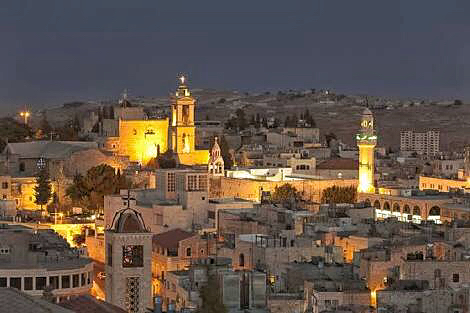
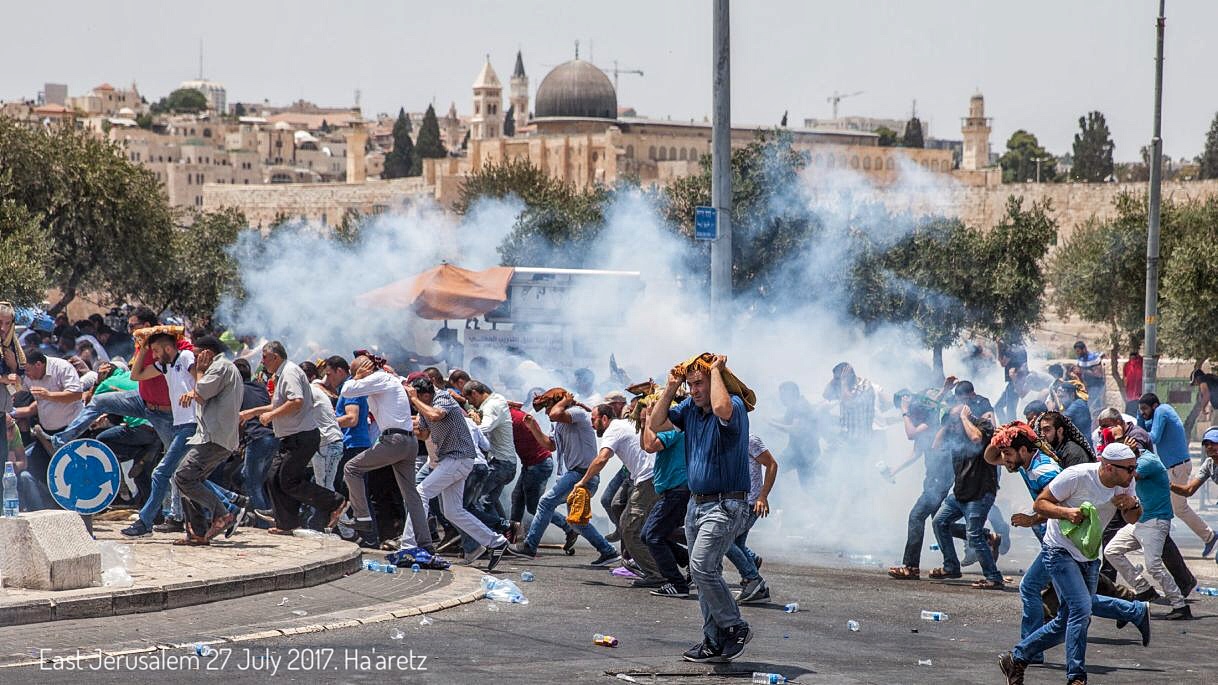
An abiding interest in the Middle East was reflected in several posts about Israel and Palestine, including republishing Rocky Road to Heavens Gate, a tale of Jerusalem’s famous Damascus Gate, and Castles Made of Sand, looking at the property boom taking place in the West Bank. Seeing Through the Eyes of the Other publishes a column by indomitable ninety-four year old Israeli writer and activist Uri Avnery, a reminder that the world looks different from the other side of the wire. The Hand That Signed the Paper examines the divisive legacy of the Balfour Declaration of 1917. The View From a Balcony in Jerusalem reviews journalist John Lyons’ memoir of his posting in divided Jerusalem. There is a Oh, Jerusalem, song about the Jerusalem syndrome, a pathology that inflects many of the faithful who flock to the Holy City, and also a lighter note, New Israeli Matt Adler’s affectionate tribute to Yiddish – the language that won’t go away.

Sailing to Byzantium reviews Aussie Richard Fidler’s Ghost Empire, a father and son road trip through Istanbul’s Byzantine past. Pity the nation that is full of beliefs and empty of religion juxtaposes Khalil Gibran’s iconic poem against a politically dysfunctional, potentially dystopian present, whilst Red lines and red herrings and Syria’s enduring torment features a cogent article by commentator and counterinsurgency expert David Kilcullen.

On politics generally, we couldn’t get through the year without featuring Donald Trump. In The Ricochet of Trump’s Counterrevolution, Australian commentator Paul Kelly argues that to a certain degree, Donald Trump’s rise and rise was attributable to what he and other commentators and academics describe as a backlash in the wider electorate against identity and grievance politics. Then there is the reblog of New York author Joseph Suglia’s original comparison between Donald Trump’s White House and Shakespeare’s Julius Caesar. But our particular favourite is Deep in the Heart of Texas, a review of an article in The New Yorker by Lawrence Wright. His piece is a cracker – a must-read for political junkies and all who are fascinated and frightened by the absurdities of recent US politics.

Our history posts reprised our old favourite, A Brief History of the Rise and Fall of the West, whilst we examined the nature of civil wars in A House Divided. Ottoman Redux poses a hypothetical; what if The Ottoman Empire has sided with Britain, France and Russia in World War I? In the wake of Christopher Nolan’s blockbuster movie, Deconstructing Dunkirk looked at the myths surrounding the famous evacuation. On the seventieth anniversary of the birth of India and Pakistan, we looked at this momentous first retreat from Empire with three posts: Freedom at Midnight (1) – the birth of India and Pakistan, Freedom at Midnight (2) – the legacy of partition, and Weighing the White Man’s Burden. Rewatching the excellent sci-fi drama Westworld – one of the televisual gems of 2017 –  we were excited to discover how the plays of William Shakespeare were treasured in the Wild West. This inspired our last post for the year: The Bard in the Badlands – Hell is empty and the devils are here, the title referencing a line from The Tempest.

Happy Birthday, Indiaekkent

Our continuing forest fight saw us return to Tolkien’s Tarkeeth, focusing this time around on fires that recalled Robert Plant’s lyrics in Ramble On: In the darkest depths of Mordor. The trial in Coffs Harbour of the Tarkeeth Three and the acquittal of two of our activists were chronicled on a series of interviews recorded by Bellingen’s Radio 2bbb, whilst other interviews were presented in The Tarkeeth Tapes. On a lighter note, we revisited our tribute to the wildlife on our rural retreat in the bucolic The Country Life.

And finally to lighter fare. There was Laugh Out Loud – The Funniest Books Ever. Poetry offerings included the reblog of Liverpudlian Gerry Cordon’s selection of poetry on the theme of “undefeated despair”: In the dark times, will there also be singing?; a fiftieth anniversary tribute to Liverpool poets Roger McGough, Adrian Henri and Brian Patten, Recalling the Mersey Poets; and musical settings to two of our poems, the aforementioned Oh, Jerusalem, and E Lucevan Le Stelle.

And there was music. Why we’ve never stopped loving the Beatles; the mystery behind The Strange Death of Sam Cooke; Otis Redding – an unfinished life, and The Shock of the Old – the Glory Days of Prog RockLegends, Bibles, Plagues presented Bob Dylan’s laureate lecture. We reprised Tales of Yankee Power – how the songs of Jackson Brown and Bruce Cockburn portrayed the consequences of US intervention in Latin America during the ‘eighties. And we took an enjoyable journey into the “Celtic Twilight” with the rousing old Jacobite song Mo Ghille Mear – a piece that was an absolute pleasure to write (and, with its accompanying videos, to watch and listen to). As a Christmas treat, we reblogged English music chronicler Thom Hickey’s lovely look at the old English carol The Holly and the Ivy, And finally, for the last post of this eventful year, we selected five christmas Songs to keep the cold winter away.

Enjoy the Choral Scholars of Dublin’s University College below. and here are Those were the years that were : read our past reviews here:  2016   2015 

In That Howling Infinite is now on FaceBook, as it its associate page HuldreFolk. Check them out.

And if you have ever wondered how this blog got its title, here is Why :In That Howling Infinite”?

See you in 2018.


The hand that signed the paper


Great is the hand that holds dominion over
Man by a scribbled name.
Dylan Thomas, The Hand That Signed the Paper,

Foreign Office, November 2nd, 1917

Dear Lord Rothschild,

I have much pleasure in conveying to you on behalf of His Majesty’s Government, the following declaration of sympathy with Jewish Zionist aspirations which has been submitted to, and approved by, the Cabinet

His Majesty’s Government view with favour the establishment in Palestine of a national home for the Jewish people, and will use their best endeavors to facilitate the achievement of this object, it being clearly understood that nothing shall be done which may prejudice the civil and religious rights of existing non-Jewish communities in Palestine or the rights and political status enjoyed by Jews in any other country.

I should be grateful if you would bring this declaration to the knowledge of the Zionist Federation.

Yours,

Arthur James Balfour

One wonders if, in the long, dark night of his eternal soul, Arthur James Balfour regrets the short letter he penned to Lord Walter Rothschild, of the international Rothschild financial dynasty, MP and Britain’s first Jewish peer. He remains a hero to Zionists and a villain to Arabs and their respective supporters. The brief document that bears his name is seen the beginning of what today is widely considered the world’s most intractable conflict. On that, if on little else, Israelis and Palestinians agree.

The Sykes Picot Agreement of  May 1916 and the Balfour Declaration of November 1917, the first, divvying up the Ottoman Empire between Britain and France, the second, ostensibly laying the foundation stone for a Jewish state between the Mediterranean and the Jordan River, were effectively redundant by war’s end, as other agendas interposed. Yet, their misbegotten shots ricocheted through the twentieth century and on into the twenty first.

After 100 years, the two sides in the most closely studied conflict on earth are still battling over the past. Truth and reconciliation, let alone closure, are remote fantasies. Unlike slavery, apartheid, the Irish famine, and western colonialism – all, at least formally, consigned to the dust heap of history – the Arab-Jewish conflict between the Mediterranean and the River Jordan shows no signs of abating. Indeed, it remains as bitter as ever, stuck in a cul de sac of continued occupation and political deadlock.

Here, in this beautiful, ancient, tortured land, the past is not another country. History is alive, exhilarating, toxic, intensely political, and bitterly divisive – and it will be revisited with passion and anger on this resonant anniversary.

In That Howling Infinite presents here three quite different commemorative analyses of the Balfour Declaration and its legacy.

The Guardian presents an historical overview in its “Long Read” essay, Britain’s Calamatous Promise. 

Ha’aretz discusses how Balfour’s legacy is toxic for both for Israelis and Palestinians,  how it nourishes the idea that somehow the conflict between the sides was caused by external powers and can be solved by them. Palestinians  maintain the myth that the Jews are somehow a foreign transplant that must be excised whilst Israelis persist in endeavouring to convince the world of the justice of our cause, as an alternative to actually making it in to a just one. “Lord Balfour did not give Palestine to anyone. Even if he had never written Lord Rothschild a letter, there would still be two nations with claims to this land. Their only hope of ever finding a way to share it is by letting go of these bankrupt historical myths”.

In The Original No – Why Arabs Rejected Zionism and Why it Matters, Natasha Gill examines the conflict from an original dispute resolution perspective. She argues that a viable peace process does not require either party to embrace or even recognize the legitimacy of the other’s narrative. It requires that both have an informed understanding of that narrative, and accept that it cannot be wished away, but must be recognized and acknowledged in the negotiation process.

Gill concludes: “Schoolyard choruses – “they started it” and “they are worse than us” – cannot serve as an interpretive framework for a 130-year-old conflict, or form the basis of national policy”.  She is referring here to Israel, but it applies equally to the Palestinians..

A common thread of the three articles referred to above that of reversing out of the dead-end of competing  and apparently irreconcilable perspectives and narratives  – my story versus yours, my feelings versus yours, my hurt versus yours – and finding common ground to move forward. This is indeed an important aspect of conflict resolution per se.  It is also about allaying assumptions and prejudices with regard to your competitor, opponent, or enemy, your mutual fears and suspicions.

Many would argue that the ‘peace process’ has been clinically dead for three years, and moribund for nearly three decades more. With Netanyahu’s ultra-nationalist coalition government contemplating the annexation of Area C, and ageing Mahmoud Abbas’ demise imminent, physically or polically, whichever happens first, time is running out for a just and equitable settlement that all sides can live with, no matter how begrudgingly.

The hand that signed the treaty bred a fever

A hand rules pity as a hand rules heaven;
Hands have no tears to flow
Dylan Thomas, The Hand That Signed the Paper

The following are some brief thoughts on the destructive aftermath of the Balfour Declaration.

The irony of the present Middle East is that so many many of its problems – its intractable conflicts, its porous and indefensible borders, its mosaics of coexisting, and at times competing and conflicting faiths and ethnicities, its artificially created states with shallow political and institutional roots, its unreconciled and conflicting allegiances to family clan, tribe, sect and country, its atavistic attachment to the ‘ra-is’, the big man – can be traced back to two documents initiated in the midst of a European war, the Sykes Picot Agreement and the Balfour Declaration .

Two documents that were driven and  shaped by the exigencies of that war and the planning for the peace that would follow it – and influenced by the diplomatic, strategic and imperial interests of European powers engaged in a long and bloody conflict, with hardly a thought for the millions of souls whose fate they were deciding, people who were in the most part, totally unaware and ignorant of the waves that were about to break over them. Hence the quotation from Dylan Thomas at the head of this post.

There is a school of thought that holds that the Balfour Declaration, like the Sykes Picot Agreement before it, was the cynical, opportunistic, duplicitous and predictably disastrous outcome of imperial skulduggery that set the Arab Middle East on a fateful course.  And yet, others hold that the die were already cast, and that HMG’s formal favour for a Jewish national home was aspirational rather than practicable, let alone realistic, designed to please the influential and wealthy Jewish diaspora – and particularly that in the USA, a late-entrant to the European war. Both, of course, has unintended consequences that led to a century of turbulence (see The Economist‘s article of the centenary of Sykes Picot).

Zionism was already on its determined way. It had grown out of the circumstances that prevailed in Europe at the time when Theodore Herzl was working on his project. Pogroms in the east, the Dreyfus case in France, and the conviction that antisemitism was indelible in the European psyche: Jews would never be fully accepted anywhere, no matter how well they assimilated. Hence the need for a Jewish national home. But he and his early Zionists were not initially exclusively focused on Palestine – there were vague visions of Jewish settlements in Kenya and Latin America. But the old, atavistic – secular Zionists would not have used the term “messianic” – yearning for Jerusalem got the better of them. It was the historical itch that couldn’t be scratched. And the Ottoman government was, as the time, quite amenable to the idea of enterprising, tax-paying settlers.

But, the notion of an actual Jewish state was quite clearly in the minds of the politically-aware and motivated Eastern Europeans, however, and this, augmented by a socialistic fervour common to  fin de siècle dissidents and refugees meant hat that there was little doubt about their intentions from the beginning. Regardless of the Balfour Declaration, the endgame was Eretz Israel – although those early pioneers hadn’t conceived a name for their ‘national home’, and indeed did not  do so until the very last minutes of the Mandate when David Ben Gurion made an executive decision.

Balfour did not actually commit to doing anything substantive. “Best endeavours to facilitate the achievement of this object” was as far as he went. It was the qualifier that followed that has forever branded “perfidious Albion”: “nothing shall be done which may prejudice the civil and religious rights of existing non-Jewish communities”.

The Palestinians Arabs were wise to the Zionist settlers’ long game, raising their concerns with the Ottomans and, post-Balfour, the British Mandate authorities, and rising in revolt when those concerns were ignored – only to be subdued by British arms. During the tumultuous and violent Mandate years, they were out-played, outwitted, out-gunned, never really having a chance against the well organized and determined Yishuv with its shadow government, institutions, and, most critically, military forces. And they were badly let down by the quality of their own leadership, by the political infighting, disunity, and opportunism, and a patriarchal political system that stymied the development of a coherent national consciousness and institutional framework to match that of the Jews.

The British too were outplayed and our-maneuvered, both before the Second World War and during the years leading up to 1948. As with India through the thirties and forties, lacking a cogent policy and a clear vision, Britain hamfistedly endeavoured to please everyone and ultimately satisfied no one. “Best intentions”, and “muddling through” concluded with “cut and run”, resulting in duplicity, desperation, death and destruction. The vagueness of Balfour’s promise came back to haunt them with a vengeance.

As events in Germany gave added urgency to the Zionist project, Ben Gurion and his colleagues adopted a wise if opportunist strategy of siding with the British in the war against Hitler. Arabs, like the Mufti of Jerusalem, Haj Amin al Husseini, in Palestine, and the Iraqi military junta led by Rashid Ali al Gaylani and Egyptian military conspirators, threw their lot in with the Third Reich, and indeed conspired against Britain. The Iraqi coup triggered Al Farhūd, a bloody pogrom in Baghdad in June 1941 in than 180 Jews were killed and 1,000 injured and 900 Jewish homes were destroyed. A bad move, paralleling, as it did, the Shoah. World opinion, or more precisely, the opinion of those who in those days controllled the new-born United Nations – the USA and the Soviet Union – weighed in behind the Zionists.

The Palestinian people, as most commentators have agreed, were essentially abandoned. By the British, by their Arab neighbours, by their own leaders. When all attempts by Britain to resolve the matter of Palestine by partition failed, and the Atlee government decided to abandon its mandate (in much the same hurried and chaotic manner as it had departed India the year before (see my post, Freedom at Midnight), the Arab inhabitants of the towns and villages of the area destined to become a Jewish state were disunited, unarmed and unorganized, and easy prey for the well-trained and determined Jewish military forces tasked by the Jews’ political leadership with the mission of seizing, clearing, and claiming The Land.

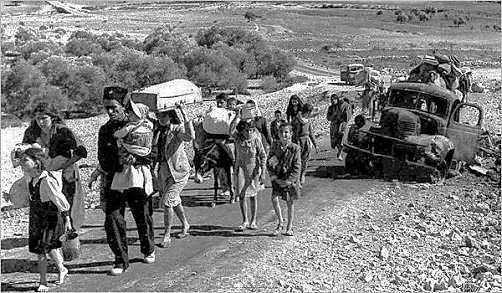
By the time neighbouring Arab armies entered Palestine, in numbers too small to make any difference to the military situation, Arab suburbs of the coastal cities has beeen emptied, hundreds of villages erased from the map, and over half a million people had fled to Egyptian Gaza, Lebanon, Syria, Jordan, and what is today the West Bank. The Palestinian state envisaged by British and the UN was strangled in its crib by King Abdullah of Jordan who seized for himself those areas not claimed by the new state of Israel, including Jerusalem, his hearts desire, whilst the ancient city of Gaza and its satellites was taken by Egypt.

Although the statement that the Palestinians “never missed an opportunity to miss an opportunity” is a cliche based on out-of-date and erroneous assumptions and prejudices, the cards were always stacked against them, and they were badly served by their leaders – most notably Husseini, who refused to let go of his pride and prejudice, King Abdullah of Jordan who played a game of double cross, his eyes fixed on al Quds, and who annexed what was to become Palestine instead of establishing its independence, and the Arab League which refused Israel’s offer after the Six Day War to return the West Bank in return for recognition (that Israel cannily knew this was an offer they couldn’t not refuse is another matter).

Almost seventy years have passed, and the Palestinians are abandoned still, by the world, by their Arab neighbours, and by their own leaders. Meanwhile, Zionism has moved on and has morphed into something much more sinister. Who knows how it will all play out.

Paul Hemphill, October 2017

Postscript – casting new light on an old narrative

In April 2025, In That Howling Infinite wrote a review of British historian Sean McMeekin’s excellent The fall of the Ottoman Empire and the birth of Türkiye 

“The Sykes Picot Agreement of 1916 – the bête noir of most progressive narratives of the modern Middle East, and to many ill-informed partisans, the causus bello of the intractable Arab Israeli conflict – was not the brainchild of perfidious Albion and duplicitous France, but rather a plan for the dismemberment of the Ottoman Empire concocted by the foreign minister of Imperial Russia. France’s Monsieur François-George Picot and Britain’s Sir Mark Sykes played second and third violin to the “third man” Sergei Sazonov. Both Russia and France had for decades sought to establish their political, strategic and economic interests at the expense of the so-called “sick man of Europe”, an ostensibly terminal invalid who throughout the nineteenth century, had experienced many deathbed recoveries. Czar Nicholas II, in common with his Russian Orthodox predecessors, dreamt of bringing Istanbul, formerly Constantinople, the heart of the orthodox patriarchate, or Tsargrad into the empire. It was no coincidence that the infamous Sykes Picot pact was outed by Russia’s Bolshevik regime after the collapse of the Czarist regime to discombobulate the revolution’s foremost European enemies”.

For more on the Middle East, see A Middle East Miscellany, and particularly, The first Intifada … Palestine 1936 

The Hand That Signed the Paper – Dylan Thomas

Never has as a poem been so precise in description of cause and consequence of great powers’ agreements, treaties, and declarations than that published by Dylan Thomas in 1936, a year replete with its own calamities:

The hand that signed the paper felled a city;
Five sovereign fingers taxed the breath,
Doubled the globe of dead and halved a country;
These five kings did a king to death.

The mighty hand leads to a sloping shoulder,
The finger joints are cramped with chalk;
A goose’s quill has put an end to murder
That put an end to talk.

The hand that signed the treaty bred a fever,
And famine grew, and locusts came;
Great is the hand that holds dominion over
Man by a scribbled name.

The five kings count the dead but do not soften
The crusted wound nor pat the brow;
A hand rules pity as a hand rules heaven;
Hands have no tears to flow.


Seeing through the eyes of ‘the other’

But who are the ones that we call our friends?
These governments killing their own?
Or the people who finally can’t take anymore
And they pick up a gun or a brick or a stone.
And there are lives in the balance;
There are people under fire;
There are children at the cannons;
And there is blood on the wire.
Jackson Browne, Lives in the Balance

Indomitable ninety-four year old Uri Avnery is an Israeli writer, founder of the Gush Shalom peace movement, veteran of Israel’s Independence War, and former member of the Knesset. He has written a weekly column for Gush Shalom since 1993. I republish his latest in In That Howling Infinite as a reminder that the world looks different from the other side of the wire.

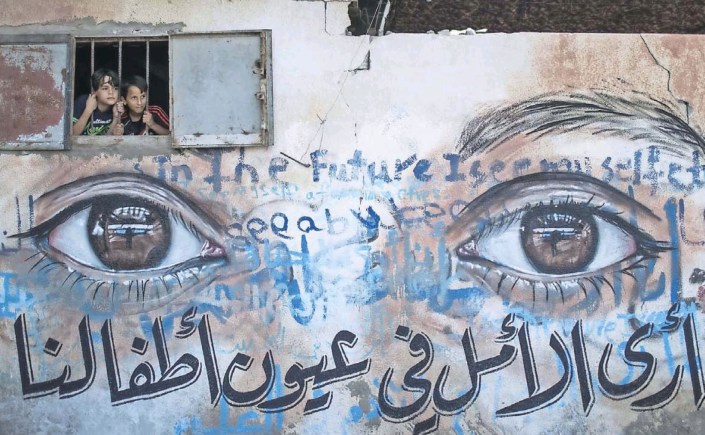
The Arabic in the featured picture says: “View Us Through the Eyes of Our Children”.

See also, my Facing the Fear of the Other, and Children of Abraham

For more posts on Jerusalem, Israel and the Middle East, visit:
https://m.facebook.com/HowlingInfinite/
https://m.facebook.com/hf1983/

A Tale of Two Stories

Uri Avnery, September 29, 2017

This is the story: at 7 o’clock in the morning, an Arab approaches the gate of Har Adar, a settlement close to the Green Line near the Israeli-Arab village of Abu Ghosh.

The man is a “good Arab”. A good Arab with a work permit in the settlement. He lives in the nearby West Bank Arab village of Beit Surik. He received a work permit there because he fits all the criteria – he is 37 years old, married and father of four children. The inhabitants of Har Adar know him well, because he has been cleaning their homes for years.

This Tuesday morning he arrived at the gate as usual. But something aroused suspicion among the guards.. He was wearing a jacket, though the weather was quite hot on this early autumn day. The guards asked him to remove his jacket.

Instead, the man took out a loaded pistol and shot three of the guards in the head at close range – two civilian guards and a member of the semi-military Border Guards. Two of the victims were Arabs (one of them a Druze) and one was a Jew. Another Jew, the local commander of the guards, was severely wounded. Since the assailant had never received military training, the precision of his shots was astounding. The pistol had been stolen 15 years ago.

All Israel was shocked. How could this happen? A good Arab like this? An Arab with permits? Why would he do such a thing in a place where he was well liked and well treated? Where he played with the children? And that after he was thoroughly vetted by the Security Service, which has innumerable Arab spies and is considered well-nigh infallible?

Something extraordinary must have happened. Someone must have incited him against the Jews and the nice people of Har Adar, who had treated him so well. Perhaps the UN speech by Mahmoud Abbas. Or perhaps some secret contacts with Hamas. “Incitement!” cried Binyamin Netanyahu.

But then another fact emerged, which explained everything. The man had quarreled with his wife. He had beaten her up, and she had escaped to her family in Jordan, leaving the four children behind.

So, obviously, he had become temporarily unhinged. In a state of mental derangement he had forgotten the kindness of the Har Adar people. Just a unique case, that need not trouble us further.

But it all shows that you can’t trust the Arabs. They are a bunch of murderers. You cannot make peace with them until they change completely. So we must keep the occupied territories.

THAT IS the story. But there is another story, too. The story as seen by the man himself.

From his home in neighboring Beit Surik, the man – whose name was, by the way, Nimr (“leopard”) Mahmoud Ahmed al-Jamal – could see Har Adar from his home every day when he woke up. For him, as for every Arab, it was a flourishing Jewish settlement, built on expropriated Arab land. Like his own village, it belonged to the Palestinian West Bank which is occupied territory.

He had to get up in the darkness of the night in order to get to Har Adar on time – 7.00 o’clock in the morning – and work hard until late in the night, arriving home at about 10 o’clock. This is the lot of tens of thousands of Arab laborers. They may look friendly, especially when their livelihood depends on it. They may even be really friendly to benevolent masters. But deep in their hearts they cannot forget for a moment that they are cleaning the toilets of the Jews who came to Arab Palestine and occupied their homeland.

Since most of the agricultural land of their villages has been expropriated for Jewish settlements, they have no choice but to work in these low-status jobs. There is no industry to speak of in the West Bank. Wages are minimal, often below the legal minimum wage in Israel proper (some 1500 dollars per month). Since they have no choice, they are not far from being slaves. Like the nice slaves in “Gone with the Wind”.

Such a man may be at peace with this reality, but if something bad happens, he may suddenly become upset with his status and decide to become a martyr. Nimr left behind a letter in which he defended his wife and absolved her from any responsibility for the deed he had planned for the next day.

So these are the two stories, which have very little in common.

The people of Har Adar are completely shocked. Since they live 20 minutes drive from Jerusalem, they do not consider themselves settlers at all, but Israelis like any other. They don’t really see the Arabs all around them as people like themselves, but as primitive natives.

The Har Adar people are not like the fanatical, religious and nearly fascist people in some settlements. Far from it. Har Adar people vote for all parties, including Meretz, the left-wing Zionist party which advocates the return of the occupied territories to the Palestinians. This is not seen as including Har Adar, of course, since there is a consensus among Zionists, right and left, that the settlements close to the Green Line should be annexed to Israel.

Har Adar people can rightly be proud of their achievements. From the air, the place looks very orderly. It has 3858 inhabitants. Their average income is about 5000 dollars a month, well over the national Israeli average (some 3000 dollars). Their local council is the third most efficient in the entire country.

Located in the mountainous area around Jerusalem, it has a beautiful landscape. It also has man-made amenities: a library, a youth club, a skate-park and an amphitheater that seats 720 people. Even for an average Israeli, this is paradise. For the Arabs around, who cannot enter without a special permit, it is a perpetual reminder of their national disaster.

Of course, like other settlements, Har Adar is not located on land that was empty. It occupies the location on which stood a village called Hirbat Nijam, a village which already stood there in Persian-Hellenistic times, some 2500 years ago. Like most Palestinian villages, they were Canaanite, then Judean, then Hellenist, then Byzantine, then Muslim, then crusader, then Mameluk, then Ottoman, then Palestinian – without the population ever changing. Until 1967.

WHEN NIMR was born, all this long history was long forgotten. What remained was the reality of the Israeli occupation.

This now looks like the normal state of things. The members of Har Adar are happy, feeling secure and well guarded by the efficient Security Service, the Border Guard and local mercenaries, mostly Arab citizens of Israel. Neighbors like Nimr seem content, and probably are, if they are lucky enough to have a job and a work permit, even with pitiful wages. The historical grudge lies deeply buried within their consciousness.

And then something happens, something that may be quite irrelevant – like the escape of his wife to Jordan – to bring it all up. Nimr the lowly laborer suddenly becomes Nimr the freedom-fighter, Nimr the martyr on his way to paradise. All his village respects his sacrifice and his family.

Israelis are furious that the families of “martyrs” are paid an allowance by the Palestinian Authority. Binyamin Netanyahu accuses Mahmoud Abbas (Abu Mazen) of incitement to murder with these payments. But it is quite impossible for Abbas to annul them – the outrage reaction of his people would be tremendous. Martyrs are holy, their families respected.

THE DAY after Nimr’s dastardly terrorist act and/or heroic martyrdom, a grandiose national ceremony took place in another settlement.

All the country’s major dignitaries, led by the President and the Prime Minister, assembled to commemorate the 50tth anniversary of “our return to our homeland, Judea and Samaria, the Jordan Valley and the Golan Heights”.

Missing in the list is the Gaza Strip, which Israel has evacuated, leaving behind a tight land and sea blockade aided by Egypt. In the Strip there are about two million Palestinians. Who the hell wants them?

All hell broke loose when the President of the Supreme Court, who was supposed to send a judge to represent the court at this ceremony, canceled his attendance because of the highly propagandist style of the event. She decided that this is party propaganda, in which her court would not take part.

Altogether not a day of quiet in this country, a state without borders and without a constitution, where every story has two totally different sides, where nice and quiet people suddenly become raging martyrs.

There will be no quiet until there is peace, with each of the two peoples living in their own state, a situation where real friendship has a chance of blooming.