Messing with the Mullahs – misreading the Islamic revolution

Most folk who are into history like to draw parallels and identify patterns in the past that reflect upon the present. As I do also, albeit in a more ambivalent way. Cleaving to Mark (Twain, that is). am fascinated more by the rhymes than the repetitions. Five years ago, i wrote Messing with the Mullahs – America’s phoney war? Events in the Middle East since October 7 2023, not least tit-for-tat aerial exchanges on we have seen in recent months between Israel and Iran, and the potential return of the unreformed and unchained prodigal son on January 6th 2025 render it relevant still. How long will it be before the war drums start beating on the Potomac and the Iran hawks circle over Washington DC seeking the restored king’s feckless and fickle ear? As they say, fools rush in where angels fear to tread.

Back then, I wrote:

“The story of the Iranian Revolution is a complex, multidimensional one, and it is difficult for its events and essence to be compressed into brief opinion pieces of any political flavour, no matter how even-handed they endeavour to be.

The revolution began slowly in late 1977 when demonstrations against Shah Reza Pahlevi, developed into a campaign of civil resistance by both secular and religious groups. These intensified through 1978, culminating In strikes and demonstrations that paralyzed the country. Millennia of monarchy in Iran ended in January 1979 when the Shah and his family fled into exile. By April, exiled cleric and longtime dissident Ayatollah Khomeini returned home to a rapturous welcome. Activist fighters and rebel soldiers overwhelmed troops loyal to the Shah, and Iran voted by national referendum to become an Islamic republic on April 1st, 1979. A new constitution saw Khomeini became Supreme Leader in December 1979.

The success and continuing durability of the Iranian Revolution derived from many sources, and many are not touched upon by commentators and pundits.

One can’t ignore the nature of the monarchy that preceded it – modernist on the one hand, and brutally repressive on the other; nor the unwavering and hypocritical support (including infrastructure, weapons, and intelligence) provided to it by western “democracies” since Britain and the US placed Reza Shah Pahlevi on the throne in 1953.

Nor should we ignore the nature of the unprecedented regime and state that was established forty years ago – a brutal, theocratic, patriarchal, quasi-totalitarian system that endeavours to control all aspects of its citizens’ lives, its rule enforced by loyal militias like the ruthless Basij and by the Revolutionary Guard, a military-industrial complex more powerful than the regular army.

The support and succour that the US gave to the deposed Shah and his family and entourage, and later, to the opponents of the revolution, served to unite the population around a dogmatic, cruel and vengeful regime, which, in the manner of revolutions past and present, “devoured its children”, harrying, jailing, exiling and slaughtering foes and onetime allies alike. One of the ironies of the early days of the revolution was its heterodox complexion – a loose and unstable alliance between factions of the left, right and divine. History is replete with examples of how a revolution besieged within and without by enemies actual and imagined mobilizes it people for its support, strength and survival.”

This brief outline summarises the events of 1979 and the decades which followed. It does not elaborate in any detail on the reasons for the downfall of the Shah and the durability of the regime that succeeded him. An impressive essay in the Jewish cultural e-zine Mosaic endeavours to do just that, providing as it does, insights into the history of modern Iranian history that few people today would be familiar with.

In it, the author suggests that “the most impressive of our experts persist in downplaying or ignoring the Islamic Republic of Iran’s driving forces can lead to misunderstandings of current affairs that are far from academic. Both nuclear negotiations and the sanctions, for instance, are premised on the assumption that Tehran is eager above all else to improve its country’s economy. While Ayatollah Khamenei and his minions doubtless care about trade and finances, they care much more about advancing their religious ideology across the Middle East, and like most religious believers, feel that spiritual concerns must ultimately trump material ones. It’s even possible that some might find the idea of suffering material hardships to achieve ideological goals appealing …

… If I’m right that Iranians didn’t rise up en masse because of the rising costs of onions or because they wanted to drive nicer cars, but because they were passionately opposed to secularization and American influence, then the U.S. cannot make peace with Iran even if the nuclear deal succeeds. The Islamic regime doesn’t oppose America because it supports Israel or Saudi Arabia, but because it represents Western secularism. Unless mass-conversion to Islam is in America’s future, that’s not something that’s likely to go away …

… One hopes that the loss of Afghanistan will finally hammer home the truth that the loss of Iran (in 1979) so signally failed to do: it’s religion, stupid.”

On matters messianic in In That Howling Infinite, see A Messiah is needed – so that he will not come and Al Aqsa Flood and the Hamas holy war. On the Middle East generally, see  A Middle East Miscellany:  
How Iran Thinks

Ze’ev Maghen, Mosaic, 7th March 2022

With a new nuclear deal on the way, attention is again turning to Iran. Four recent books, plus the deal itself, suggest that America and Europe are blind to the regime’s motivating spirit.

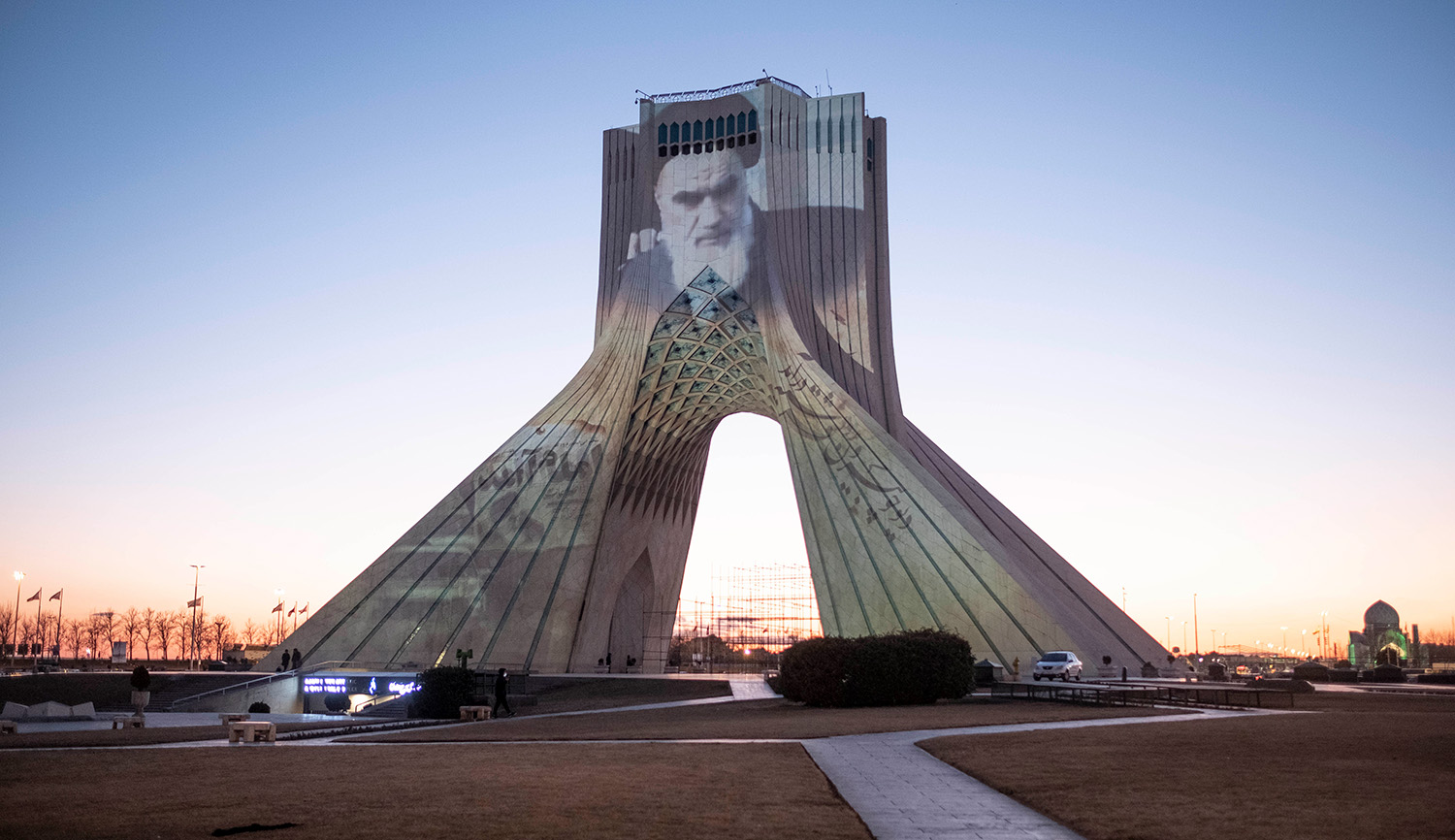
A portrait of the late Ayatollah Khomeini projected on the Azadi (Freedom) Monument in western Tehran on the 43rd anniversary of Iran’s 1979 Islamic Revolution in February 2022. Morteza Nikoubazl/NurPhoto via Getty Images.

A portrait of the late Ayatollah Khomeini projected on the Azadi (Freedom) Monument in western Tehran on the 43rd anniversary of Iran’s 1979 Islamic Revolution in February 2022. Morteza Nikoubazl/NurPhoto via Getty Images.

There is a well-known Persian children’s game in which a parent recites limerick-like poems while engaging in horseplay. One version, popular in the mid-20th century, had the father of the household seat himself on a carpet in the living room with one of his progeny standing to his right and the other to his left. The father would declaim:

There once was a cat (yek gorbeh bud)
Poor and miserable (bichareh bud)
A dog came and bit him in the belly (delash-o sag gaz gerefte bud)

(At this point the first child charges across the room and dives headlong into his father’s stomach.)

Next came a bear from behind and nearly killed the cat (khers az poshtesh taghriban koshtesh)

(The second son now bounds over and leaps onto his father’s back.)

But that cat, he rose, and he roared, and . . . turned himself into a lion! (gorbeh beh shir avaz shodeh bud)

(This being the signal for the father to get up and hurl his offspring this way and that onto the soft furniture.) 

More than just child’s play, this post-dinner diversion harbored an obvious historical-ideological meaning—a meaning as relevant today as it was 130 years ago. Anyone looking at a map of modern Iran will perceive the lineaments of what the country’s inhabitants call “the sleeping cat.” This cat—the Iranian state—was indeed in miserable shape domestically and geopolitically by the reign of Naser al-Din Shah (1848-1897). What little authority this Qajar king still possessed over his realm was retained by a method that a 20th-century Iranian intellectual would dub “positive equilibrium”: the sovereign survived by parceling out large swaths of Persian territory and granting irresponsibly generous economic concessions to local potentates and foreign powers so that each would defend the capital and environs against the encroachments of his counterparts. Of the many forces that Naser al-Din Shah had to “buy off” in this manner, none was more menacing than Russia, the bear that jumped onto the cat’s back, or more influential than Britain, the (bull)dog that bit the cat’s belly.

Before ousting the last Qajar ruler in a bloodless coup, the founder of the Pahlavi dynasty (1925-1979), Reza Shah, had risen through the ranks to become commander of the only serious military force in the country, the Cossack Brigade, created with Russian assistance decades earlier by that same Naser al-Din Shah. While in this post, Reza is said to have engaged every morning in a ritual reading of the newspaper, his face waxing redder with each account of Iranian failure or humiliation until finally, in a fit of rage, he would stand up and rip the tabloid to shreds. Soon, this determined corporal would rewrite the headlines that had so dismayed him, and do much to turn the sleeping cat into a rising lion.

Assisted by a cadre of military comrades and nationalist intellectuals, the new monarch set about pacifying the countryside, developing infrastructure, implementing reforms in fields like education, sanitation, technology, agriculture, and women’s rights, and in general shoving Iran, kicking and screaming, into the 20th century. He even gave his subjects three days to come up with last names for purposes of taxation, conscription, and general modernization (hitherto everyone had been known as “so-and-so son or daughter of so-and-so” or by a nickname reflecting his profession, town of origin, or infirmity). For all that Reza Shah has been depicted in post-revolutionary Khomeinist retrospect as the epitome of an incorrigible Westernizer, it cannot be denied that he raised Iran from a trampled and torn-apart virtual protectorate and a conspicuous consumer of European goods to the status of an essentially independent and self-respecting polity boasting border integrity and assiduously cultivating import-substitution industry. That the method employed to achieve all this progress was despotic was a price that even many liberal Iranian thinkers of the time were willing to pay.

Ousted by the allies in 1941 on the pretext of harboring Nazi sympathies—sympathies partially tied to the “Aryan Thesis” that made Germans and Persians ethnolinguistic cousins and that was all the rage in both countries at the time—Reza Shah was replaced by his twenty-one-year-old son Mohammad Reza Shah. In awe of his father, and having spent his teenage years in Switzerland at an elite boarding school, the new king was prepped to take up where the dynasty’s founder had left off. His career, and his overthrow in 1979 by the Islamist movement that now rules Iran, is at the center of four books published in the past decade which I will consider here. These books offer much in the way of fresh insights and original research, correcting some of the misconceptions that plague commentary about the country. And yet, for all their merits, they fail to grasp fully why the shah fell, what motivated the revolutionaries, and by extension, what motivates the current regime. For if we want to be able to make sense of the revolutionary ideologues who now rule Iran, we have to understand the political and cultural order they rebelled against, and why they rose up against it.

By looking at what these four works get right and, more importantly, what they get wrong, we can also better understand why so many Western experts and policymakers so consistently misread the Islamic Republic, its sensitivities, its hierarchies of honor and shame, holy and profane, just and unjust—and why academics are so ill-equipped to figure out a society that doesn’t conform to their own ideas of secular rationalism. With the U.S. about to conclude a second nuclear deal with the Islamic Republic, if press reports are to be believed, it’s worth considering how this regime came to be, and what makes it tick.

I. The Last Shah

As the Council on Foreign Relations scholar Ray Takeyh has shown better than any previous author in The Last Shah, Mohammad Reza’s reign began with an impressive geostrategic victory: with a little help from astute advisors at home and a determined postwar American administration, the fledgling Iranian sovereign induced no less a megalomaniacal expansionist than Joseph Stalin, at the zenith of his power, to pull his troops out of the northwestern province of Azarbayjan (not to be confused with the neighboring Soviet Republic of the same name), where they had supported local socialist secessionist movements. The cold war had begun, and Tehran was poised to reap the benefits.

Mohammad Reza’s next major challenge came from within, in the person of the charismatic prime minister Mohammad-e Mosaddeq (in office 1951-3), perceived ever since in popular imagination—and in much scholarship—as Iran’s fatefully foregone hope for true democracy.

Takeyh sets the record straight, demonstrating more effectively than any writer to date that Mosaddeq was, to the contrary, a highly unstable personality with dangerous dictatorial tendencies. (He also quashes once and for all the myth that the CIA and MI6 were primarily responsible for the 1953 coup that removed him.) The shah, argues this author, though no friend of democracy himself, was ultimately better for Iran than the prime minister. Indeed, Mohammad Reza eventually realized the very dream that Mosaddeq had failed so badly to achieve: not just oil independence, but oil hegemony for Iran. (Remember when we switched the limousine-like sedans we used to drive for the cramped, sardine-cans-on-wheels that we squeeze into today? That was because of the shah.)

Surrounding himself instead with one-dimensional, sycophantic technocrats, the shah soon became the lonely autocrat, a one-man-show.

The second Pahlavi sovereign got so good at his job, Takeyh maintains, that he felt he could dispense with the independent aristocratic elite whose corruption, bickering, and jostling for advantage threw a spoke into his rapidly rotating wheel of progress—even though it was just these aristocrats who had been the agents of his success, and had saved his throne on more than one occasion. Surrounding himself instead with one-dimensional, sycophantic technocrats, he soon became the lonely autocrat, a one-man-show. When the Middle East-wide, and worldwide, revolutionary fever of the second half of the 20th century finally caught up with him in 1979—another significant connection Takeyh makes—Iran’s ruler faced it bereft of the crucial assistance he needed to weather the storm.

II. The Fall of Heaven

The inability to delegate and insistence upon ruling instead of merely reigning that Takeyh perceives as a shortcoming, Andrew Scott Cooper sees as a strength: Mohammad Reza’s hands-on approach to monarchy got things done for his country. To Cooper, the shah is something very different from the corrupt autocrat of most histories, whose disastrous mistakes supposedly smothered democracy and brought about the revolution. Indeed, in The Fall of Heaven, Cooper’s 2016 history of the decline and fall of the Pahlavi dynasty, there is little that has traditionally been held against this despot that isn’t deftly turned into a virtue, or at worst a well-intentioned miscalculation. The abolition of the multiparty system in 1975, itself largely nominal by that time, and the inauguration in its place of the single Rastakhiz (“Resurrection”) party to which all citizens were obligated to pledge allegiance, is presented as a (botched) stepping-stone toward democracy—a claim doubly audacious since, as Takeyh had shown, Rastakhiz’s own leaders admitted that it was a bad joke from day one. Cooper does not scruple to attribute the refusal of Iran’s Westernizing monarch to rule constitutionally to “his skeptical attitude to the 1906 constitution, which he regarded as a European invention imposed on Iran by former colonial powers.” The shah’s innumerable affairs with married women and regular visits to Paris prostitutes were evidence of his “boundless energy,” and usefully cleared his head to attend to matters of state. Even the king’s leisurely helicopter rides (and those of his siblings) over a capital city choked to a stand-still by some of the worst traffic jams in history are depicted by this creative and sometimes credulous author as his majesty’s noble attempt to help alleviate that same congestion.

These impressive feats of legerdemain aside, however, Cooper is no cheap apologist. The Fall of Heaven is a stunning achievement, and will go down in literary-scholarly history as the book that did more to rehabilitate the Pahlavi family’s reputation than any volume published before or since the revolution. Cooper accomplishes this formidable task—punching a corridor through decades of pervasive and unrelenting vilification—primarily by amassing, organizing, analyzing, and presenting in vivid color an unprecedented amount of detail surrounding the final years of the monarchy. On top of play-by-play accounts of the political ins-and-outs, the economic ups-and-downs, the burgeoning unrest and the frantic diplomatic maneuverings, Cooper can tell us for any given date of 1978 what pop song topped the charts, which jewels Queen Farah Diba was wearing, whose child was killed in a hit-and-run accident, what TV series garnered the highest ratings, whether the king had indigestion (and what he took for it), which night-club was the hottest in town, and what the weather and pollution levels were like. Who knew, for instance, that on November 5, 1978, as the Khomeinist tidal wave crested and began to break over the Land of the Lion and the Sun, Fiddler on the Roof was playing to a full house at the Goldis movie theater in Tehran?

Cooper’s broad and meticulous sweep allows him to put a human face to Iranian society on the eve of what may plausibly be called the first genuinely popular revolution in modern times.

Such an accumulation of detail may seem frivolous; it is anything but. Cooper’s broad and meticulous sweep allows him to put a human face to Iranian society on the eve of what may plausibly be called the first genuinely popular revolution in modern times. It also allows him to put a human face to the royal couple—Mohammad Reza and his wife Farah Diba—painting them convincingly as benevolent, idealistic, patriotic, hard-working, fragile but fortitudinous, beleaguered but long-suffering, intelligent and generally likeable. Finally, this author’s wide grasp facilitates the assembly of an incomparably variegated collage of factors that, so he maintains, together contributed to the uprising of 1979. Beyond the usual suspects—a regime that educated the hell out of its subjects but denied them political participation; rapidly rising but no less rapidly disappointed economic expectations; the alienation and radicalization accompanying mass urbanization—Cooper adduces: a milk shortage, an egg shortage, a power outage, a cholera outbreak, a heatwave, a UFO sighting, an earthquake, a tax increase, the kidnapping and murder of a young boy, drought (on the one hand), unseasonably heavy rains (on the other), “a slew of disaster movies” that “emphasized failure of leadership, loss of control, and public panic,” the fact that according to the Asian zodiac 1978 was the Year of the Horse when people are prone to ”let loose” and “ignore the consequences of their actions,” and, to top it off, a plague of locusts.

The present writer admits to entertaining doubts about the “coalescence of causes” approach to historical convulsions. I remain convinced that people make history, and on the rare occasions when the particular person typing these lines does anything at all important, I tend to feel like I do it for one reason. Extrapolating to the relevant macrocosm, I’m basically with Ruhollah Khomeini, who famously remarked that “the Iranian people did not make the Islamic revolution to lower the price of watermelons” but rather did so “for the sake of throwing off the foreign yoke and restoring their kidnapped culture and creed.” (That’s two reasons, but they are closely related). Nevertheless, it cannot be denied that the human will, independent and focused though it may be, is nourished, guided, and battered this way and that by the context surrounding it, and for this reason Cooper’s litany is highly enlightening. Ironically, the only one of our four authors who is not Iranian digs more deeply into daily Iranian reality than any of his colleagues.

III. Moods of Self-Assurance and Insecurity

Louis XIV’s famous quip, L’etat c’est moi (“the state—is me”), rarely rang as true as it did in Iran of the 1960s and 70s. Flush with eleven-figure oil revenues and spoiled rotten by U.S. support that had gone from conditional to unconditional, Mohammad Reza neutered the government apparatuses, military command structures, and traditional pillars of the Persian state—court, bazaar, and mosque—that he saw as so many obstacles to his imperious charge in the direction of the “Great Civilization.” The king became the only game in town, his picture on the wall of every home and business, his decisions the only ones that mattered. Thus, an intimate biography of the man on the throne is essential to an understanding of the state of the Iranian nation in the decades immediately prior to the Khomeinist debacle. In his 2012 The Shah, Abbas Milani—a Stanford political scientist and Hoover Institution fellow—provides us with the best example of such a biography.

Milani chronicles the initially reluctant sovereign’s rise to power with an apposite mixture of objectivity, sympathy, and drama. He masterfully interweaves the personal and political, offering probing analyses of Mohammad Reza’s ambitions and inhibitions, phantoms and phobias, worldviews and prejudices. He covers more widely and perceptively than any earlier scholar the experiences and influences of the prince’s formative years, and arrays before the reader the alternating moods of self-assurance and insecurity, tenaciousness and irresolution, optimism and depression that helped make his reign something akin to a non-stop roller-coaster ride. Milani aptly points out that “many of [the shah’s] weaknesses as a leader were his virtues as a human being,” referring, inter alia, to this embattled ruler’s unwillingness to spill gallons of his countrymen’s blood in order to stay in power.

The king made use of authoritarian methods to propel Iranian society forward—which set that society on a direct collision course with those same authoritarian methods.

No work details and dissects to the same degree the myriad challenges facing this well-meaning monarch on the foreign and domestic scenes (not the least of which was the rampant corruption of his own family), challenges which—by exploiting the cold war, dispersing petrodollars, repressing Communists and clergymen, and generally playing his cards right—he faced down successfully for almost four decades. His inability to face down the final challenge Milani ascribes to a paradox: the king had made use of authoritarian methods to propel Iranian society forward in the direction of literacy, industry, professionalism, research, technology, consumerism, capitalism, nationalism, intellectualism, secularism, and individualism—all of which set that society on a direct collision course with those same authoritarian methods. (Or as Takeyh puts it, the shah “built the modern middle class, but refused to grant it a voice in national affairs.”) Indeed, Milani asserts, monarchy itself as an institution, and the squelching of political participation it inevitably entails, was fast becoming an anachronism by the mid-20th century, especially in the countries that Mohammad Reza held up to his subjects as models, and to whose universities he sent thousands of college students.

IV. Reasons for Ruination

Whereas from Milani we learn about the general from the particular—about the situation in the country from the personality of its ruler—the Yale historian Abbas Amanat, in Iran: A Modern History(2012), takes the reader on an oceanic voyage in the opposite direction. One of the many advantages of this impressively ambitious magnum opus is the historical depth and topical breadth it brings to bear on the issues that have preoccupied us so far, and that preoccupy all who think about contemporary Iran: Mohammad Reza’s record as leader, and the reasons for his ruination.

Amanat, one of the premier Iranologists of our time, whose vast and diverse erudition is matched only by the humanity that permeates his texts, is uniquely qualified to construct the stage upon which the 20th-century showdown between Pahlavism and Khomeinism would be played out. By the time we reach the reign of Mohammad Reza Shah—some 500 pages into the book—we have been exposed repeatedly to an interlocking network of patterns and trends that have functioned as the matrix of Iranian history for centuries, sometimes millennia. Many of these are couched in terms of dichotomies: centripetal versus centrifugal forces, tribal versus sedentary existence, antinomian heterodoxy versus a state-supported clerical establishment, Persian versus Arab, Turk versus Persian, Russian versus British, religion versus nationalism, tyranny versus just rule.

Amanat tackles the tenure of the “King of Kings, Light of the Aryans” (Mohammad Reza’s self-chosen moniker) with all these tensions in mind, while simultaneously illuminating the political, economic, social, and especially cultural mise en scene of the period. We do not get the shah as a willful individual, as a volatile jumble of psychological traits, as with Milani, but the shah as one actor among hundreds of others, in what sometimes feels like a non-fiction Persian version of War and Peace. The dense tangle of processes that eventually led to the fall of the monarchy cannot be easily untangled here, but it should be said that unlike Tolstoy, Amanat does not present the tragic denouement of 1979 as the inevitable result of an amalgam of impersonal forces. The hundreds of authors, artists, ambassadors, academics, activists, and agitators, together with no few vendors, workers, thugs, and other ordinary Iranians who contributed to this momentous event are more often than not introduced by name, their dreams and activities fleshed out, and these many human threads woven together into a kaleidoscopic revolutionary tapestry.

Amanat’s presentation is painfully balanced: he rakes the post-revolutionary regime over the coals for its many human-rights violations, but criticizes the Western supporters of Iraq during its war with Iran in the same breath, and no less fiercely. He takes Mohammad Reza to task for curtailing liberty and stifling creativity, but overall—as with Takeyh, Cooper, and Milani—appreciates much of what the ill-fated Pahlavi sovereign did for Iran, depicting him as a driven reformer with high ideals who transformed his country so profoundly that even the Islamists could not turn back the clock.

Certainly, one must be careful not to overdo such revisionist rehabilitation. It is one thing to debunk Amnesty International’s ridiculous claim— popularized with most effect by Reza Barahani’s powerful but unreliable 1977 Crowned Cannibals—that over 100,000 political prisoners were tortured in the shah’s jails. It is quite another to claim—as does Ervand Abrahamian, the highly regarded scholar who literally wrote the book on the subject—that torture as a method of repression virtually disappeared from the Iranian scene under the Pahlavis, re-emerging with a vengeance only with the onset of the Islamic Republic. The shah was a more benevolent dictator than the image conjured up for the West by the various shrill (and ungrateful) Iranian Students Associations that regularly marred his visits to Europe and the United States; but no small number of atrocities were carried out in his name and with his knowledge. Even Cooper, the Pahlavis’ biggest fan, saddles the king with the ultimate responsibility for decades of state-sponsored prisoner abuse, including not a few extrajudicial murders.

Women in today’s Iran may have to cover their hair, but they vote like maniacs and there are more of them in the universities and in a whole slew of prestigious professions than their male counterparts.

Still, to read these four authors, Iran’s final monarch did far more good than harm. He took a particularly ignorant populace (tellingly, Jewish academicians concluded that even Persian Jews were less knowledgeable than their co-religionists anywhere on the planet) and increased their literacy level sevenfold in less than two decades. He used the endless supply of black gold that percolated up through the Khuzestan flats not just to purchase tanker-loads of state-of-the-art weaponry (useless, in the event, as they had been for his father), but also to build schools, roads, hospitals, clinics, orphanages, universities, vocational colleges, sports centers, airports, sea-ports, factories, research laboratories, parks, zoos, commercial centers, chemical plants, railroads, theaters, galleries, and museums by the thousands. He divvied up latifundia all over the country, compensating the owners fairly and doling out hundreds of thousands of acres to the peasantry. (The fact that these peasants often preferred migration to shantytowns on the edge of big cities to farming their newly acquired plots was a worldwide problem, and not Mohammad Reza’s fault). He protected minorities—Jews, Bahais, Sunni Muslims—and, though a dyed-in-the-wool chauvinist himself, energetically promoted women’s causes. The last achievement was one that Khomeinism could not roll back: women in today’s Iran may have to cover their hair, but they vote like maniacs and there are more of them in the universities and in a whole slew of prestigious professions than their male counterparts.

The king made Iran into a respected player on the international scene, encouraging and inspiring other third-world countries by example, to say nothing of financing their development projects. Though easily irritated by independent thinking among his subordinates, he tolerated more societal dissent than is generally acknowledged, and his “liberalization program” of the late 1970s, as Takeyh points out, actually saw that tolerance increase just before things got really hairy. When the revolutionary tsunami finally hit, thousands of oppositionist intellectuals and activists were of sound enough body and mind to surf on it all the way to victory.

V. Economy or Religion?

So why did the tsunami hit at all? Why, in the end, did the country choose Islamist rule instead? If so many impressive accomplishments can be laid at Mohammad Reza’s door—and they indubitably can—then why did his people, whom he had benefited so greatly, give him the heave-ho in such a peremptory and humiliating fashion? For many, the answer revolves around the bottom line. Despite the dazzling economic success story that was Pahlavi Iran—between 1957 and 1977 the standard of living among the Persian populace rose no less than 500 percent—many Middle East specialists persist in seeking the underlying causes of the Khomeinist revolution in economic woes of one sort or another. Scores of analysts have proffered such confident assertions as the following, from the pen of the astute student of Islamism Nazih Ayubi, drawing on the no-less-astute Iran expert Fred Halliday:

“The revolution was the outcome of a complex and painful process of rapid and uneven economic development. The main reason why it occurred was that “conflicts generated in capitalist development intersected with resilient institutions and popular attitudes which resisted the transformation process.” (Political Islam: Religion and Politics in the Arab World, p. 387)

Takeyh himself opens his study with a question, “Why did Iran have a revolution in 1979?,” and an answer: “The immediate causes can be easily summarized: the economic recession of the mid-1970s had halted the shah’s development projects and created expectations that the state could not meet.” (This is the well-known but discredited “J-curve” theory, which states that an economic boom followed by a sudden downturn tends to cause revolution and unrest.) To his credit, Takeyh contradicts his own assessment at the very end of the book: “The economic recession of the mid-1970s is sometimes casually blamed for the revolution, but the Iranian people were frustrated with the shah’s dictatorship even when the economy was performing well.”

The main problem with such claims is that the various processes they blame for engendering discontent and consequent unrest in Iran—including “inflationary pressures,” “rising expectations,” and the catch-all urbanization and its manifold consequences—were in no way unique to Iran, and were in many if not most cases more moderate versions of simultaneous developments in other third-world polities where no comparable revolutions ensued. One of Amanat’s arguments, for instance, is not only questionable in itself, but could be applied just as well to any other country in the developing world:

”Since the beginning of the Pahlavi era, the Iranian population had improved in every generation physically, hygienically, and medically, from the frail, malnourished, and diseased population at the turn of the 20th century . . . to a relatively healthy, sanitary, and better nourished people in the last quarter of the century. The need for greater quantities and greater varieties of food, home appliances, electronics, and cars thus was bound to become a burden for a government anxious to keep its population economically content. “(p. 655)

None of this holds water. The citizens of Iran did not bare their chests to the bullets of the largest and best-equipped army in the region, overthrow their sovereign, and put an end to a millennia-old monarchical tradition, all for the lack of a toaster oven. The Washington Post had it right way back in 1978: “Rarely would contemporary history appear to provide such an example of a people’s ingratitude towards a leader who has brought about an economic miracle of similar proportions.”

The citizens of Iran did not bare their chests to the bullets of the largest and best-equipped army in the region all for the lack of a toaster oven.

Though no amount of counterargument will eliminate the widespread post-facto imagining of Iranian economic distress (which somehow went unnoticed before the revolution), if we seek to isolate the sui-generis ingredients that went into making the Khomeinist upheaval of 1979, we must look elsewhere. Admittedly, this additionally rules out factors like irritation on the part of the educated classes at the lack of opportunities for political participation: such irritation, too, existed in spades in other countries, and although secular democracy-seekers had kept the embers of Iranian dissidence glowing for years, it was not they who ignited the conflagration. The central motivations for the mass revolutionary action of 1978-9 must be sought in factors more specific to Iran, or at least more unique to the situation in the country at the time.

Where shall we look? Here our masters all fall short. Ask the average Joe who was compos mentis 40 years ago why the Iranians rose up against their ruler. (Mind you, not your average Iranian Joe: Persian-speakers are conspiracy freaks of a caliber beyond anything one finds in the West, and they are convinced to a man that the U. S. was behind the whole thing. Even the shah thought so.) Anyone who paid attention at the time—and who was not an academic and could therefore think straight—was cognizant of the simple truth that the king got canned because he had spat on his people’s most hallowed traditions. He and his coterie of “Westoxified” sophisticates had mocked their rituals, stripped their women, insulted their clergymen, blasphemed their god, replaced their sacred paragons with pagan nymphomaniacs, gotten drunk on their solemn holidays, razed their mosques (sometimes building banks and stadiums in their place), and made common cause with heretics and infidels—all in the name of progress.

We should pause to admit that Milani, Cooper, and others don’t see it this way: they make much of what they claim was the second Pahlavi sovereign’s backpedaling of his father’s harsh secularizing policies, pointing to everything from the son’s oath of office, which included appeals to Allah and commitments to promote Shiism; the widely publicized visit paid by the new monarch to the hospitalized Grand Ayatollah Borujerdi, head of the seminary system in the holy city of Qom; mystical experiences in which Mohammad Reza claimed to have received blessings from this or that imam; his habit of carrying a mini-Quran into his breast pocket; and a significant increase in the number of new places of worship, and a partial easing of the restrictions on the veil, under his reign.

While there is truth to all of this, the broader picture tells a different story. Oaths of office and hospital visits are recognized by the genuinely pious for just what they are: lip service. While assertions of dream visitations by saintly figures can be a feather in the turban of a respected theologian, in the case of non-observant ignoramuses like Mohammad Reza Shah—who once boasted to a gathering of Muslim divines that “I say my prayers every night before bed,” a decidedly non-Muslim comment—such claims merely point to the claimant’s abject irreligiosity. And, one might add, the irreligiosity of those who record and build theories upon such empty gestures.

More importantly, while the father’s anti-clericalism and march toward modernization may have been gruffer, under the son these tendencies matured and expanded relentlessly, to a large extent due to Iran’s exponentially proliferating contacts with Europe and even more so the United States. There were, albeit, more mosques built during this period, but the mushrooming cinemas were the up-and-coming place to be. The veil, it is true, could now be worn, but it was scorned by refined society, and more and more women preferred bouffant hairdos and mini-skirts. As uncomfortable and un-moored as traditional members of Iranian society began to feel in the 1930s, they would feel so to a far greater extent in the 1960s, and if they did not, that was because they had grown accustomed to the direction the country had been taking for decades, not because that direction had changed or been reversed.

The few supposedly regressive features that characterized the reign of the second Pahlavi monarch in connection with religion were offset ten times over by the juggernaut of modernization that was the hallmark of the era. And while traditionalism would on occasion receive disingenuous royal support as a counterweight to radicalism, the shah and his governments were, if anything, more inclined toward socialism than Shiism. Above all, as all our authors readily admit, their lodestar was always the West. In the eyes of the vast conservative sector of Iranian society, Pahlavism was hedonism, plain and simple. In the eyes of the increasing number of students who subscribed to the lay theoretician Ali Shari’ati’s militant neo-Shiiism—young people for whom faith had become cool again, and for whom the imperative of the hour was “the return to ourselves”—Pahlavism was the contemptible, traitorous antithesis of religio-cultural authenticity.

Political Islam has been eulogized by untold analysts almost since its birth, the classic example being Olivier Roy’s 1992 L’échec de l’islam politique (“The Failure of Political Islam”), a book that, given all that has transpired since its publication, should long ago have been renamed “My Failure as a Middle East Expert.” Incurable rationalist-materialists that so many Western thinkers are, it is extremely difficult for them to credit the power of the spiritual or theological, and they accordingly search high and low for alternate motivations, especially economic ones, to explain the behavior of individuals and collectives. Such an approach both informs, and is informed by, schools of thought like Marxism and realpolitik, as well as no few social sciences. Immune to religious passions themselves, scholars and journalists simply can’t accept that these passions can motivate tens of thousands of people.

If there is one deficiency common to the four undeniably outstanding studies we have been reviewing, it is that whereas Ayatollah Khomeini and company were sure that they had risen in revolt because Westernization in Iran had gone too far, our authors are all convinced that the revolution occurred because Westernization had not gone far enough. A related argument has been advanced by the prominent postmodernist scholar Ali Mirsepassi in his 2019 Iran’s Quiet Revolution. Mirsepassi notes correctly that intellectuals close to the Pahlavi court, and the sovereign himself, sometimes coopted the anti-“Westoxification” discourse of leftists and Islamists in order to take the wind out of their sails and, at the same time, delegitimize democracy as a foreign implant. He then maintains, based on this paradox, that it was the Pahlavi rejection rather than the Pahlavi adoption of modernity that led to the dynasty’s destruction, a theory as creative and counterintuitive as it is utterly spurious.

Islam as the central propelling factor in the resistance movement to the shah receives extremely short shrift from Takeyh, Cooper, Milani, and even Amanat. The last scholar’s profound knowledge of Shiism is matched only by his dislike for it: for instance, he calls the premier intellectual pursuit of the ayatollahs in their seminaries “tedious” on no less than four separate occasions in his massive tome. The revolutionaries aver in no uncertain terms that they did it for Islam; but our four authors, and scores of their colleagues, claim to know better.

Certainly, there were other modernizing rulers in other Middle Eastern countries who antagonized their Muslim constituents, both before and after the Iranian revolution. Taking Islam seriously as a motivating and enabling factor means, however, familiarizing ourselves with this confession’s considerable inner diversity. Iranian Islam has been Shiite Islam for over 500 years, and Shiism is a revolutionary vehicle like no other. Thanks to the circumstances of its evolution, the slogan “Fight the Powers that Be” is virtually encoded on its DNA. Moreover, Shiite clerics are comparatively independent of temporal rulers, while enjoying the wall-to-wall obedience of their flocks. Not for nothing did Khomeinism succeed so spectacularly where other Islamist movements had succeeded only partially or failed: the creed on which it is based provided both the impetus and the instrument for its triumph.

VI. Missing the Point

That the most impressive of our experts persist in downplaying or ignoring the Islamic Republic of Iran’s driving forces can lead to misunderstandings of current affairs that are far from academic. Both nuclear negotiations and the sanctions, for instance, are premised on the assumption that Tehran is eager above all else to improve its country’s economy. While Ayatollah Khamenei and his minions doubtless care about trade and finances, they care much more about advancing their religious ideology across the Middle East, and like most religious believers, feel that spiritual concerns must ultimately trump material ones. It’s even possible that some might find the idea of suffering material hardships to achieve ideological goals appealing.

Likewise, President Obama’s negotiations with Iran sought to recognize the country’s “equities” in the Middle East, with the ultimate aim of creating a balance among Iranian, Saudi, and Israeli spheres of influence. Again, Tehran may not be immune to such realpolitik considerations. But ultimately the Islamic Republic is engaged militarily in Yemen, Iraq, and Lebanon to advance the Islamic Revolution. The idea that well-meaning Western diplomats can simply sit Iranian diplomats down with their Saudi, Emirati, and Yemeni counterparts and work out a compromise based on mutual interests completely ignores the theological aspect of Khomeinist foreign policy.

Both nuclear negotiations and the sanctions are premised on the assumption that Tehran is eager above all else to improve its country’s economy.

And all this is even more true when it comes to Israel. Economics and power politics simply fail to explain the conflict between the two countries, which share no borders and had cordial relations under the shah. While Shiism historically contains ample anti-Semitic currents, it is not indelibly anti-Semitic—but Khomeinism is. And it views Jewish sovereignty in the Middle East as an unacceptable offense, which must be eradicated at almost any cost.

But Israel is only the Little Satan. The Great Satan is America, the main driver of “Westoxification.” If I’m right that Iranians didn’t rise up en masse because of the rising costs of onions or because they wanted to drive nicer cars, but because they were passionately opposed to secularization and American influence, then the U.S. cannot make peace with Iran even if the nuclear deal succeeds. The Islamic regime doesn’t oppose America because it supports Israel or Saudi Arabia, but because it represents Western secularism. Unless mass-conversion to Islam is in America’s future, that’s not something that’s likely to go away.

Only several months have elapsed since the richest and most powerful country in the world, having spent $300 million per day for twenty consecutive years on the restoration of the various branches of the national economy and on the creation of a 300,000-strong national army, was sent ignominiously packing with its tail between its legs by a bunch of ill-equipped local amateurs wearing turbans, robes, and sandals. One hopes that the loss of Afghanistan will finally hammer home the truth that the loss of Iran so signally failed to do: it’s religion, stupid

Ze’ev Maghen is chair of the department of Arab and Islamic studies at Bar-Ilan University. His latest book is Reading the Ayatollahs: The Worldview of Iran’s Religio-Political Elite. He is also the author of John Lennon and the Jews: A Philosophical Rampage.

Qatar’s caliphate – taqiyyah or hasbara?

Two Islamic terms and one Hebrew have been making the media rounds of late.

Taqiyyah is the employment of deception and dissimulation in an ostensibly Islamic cause. The term تقیة taqiyyah is derived from the trilateral root wāw-qāf-yā, literally denoting caution, fear, prudence, guarding against a danger), carefulness and wariness. It is related to kitmān (كتمان), the act of covering or dissimulation.  While the terms taqiyya and kitmān may be used synonymously, kitmān refers specifically to the concealment of one’s convictions by silence or omission. Kitmān derives from Arabic katama “to conceal, to hide”.

The Hebrew word ishasbara. It has no direct English translation, but roughly means “explaining”, a communicative strategy that seeks to explain actions, whether or not they are justified). It is often interpreted by critics of Israel as public relations or propaganda. It has even been described as the fool’s gold version of diplomacy.

The Hamas’ assault of October 7 2023 was an almost perfect act of Taqiyyah, It used unprecedented intelligence tactics to mislead Israel over months, by giving a public impression that it was not willing to go into a fight or confrontation with Israel while preparing for this massive operation. As part of its subterfuge over the past two years, Hamas refrained from military operations against Israel even as another Gaza-based armed group known as Islamic Jihad launched a series of its own assaults or rocket attacks.

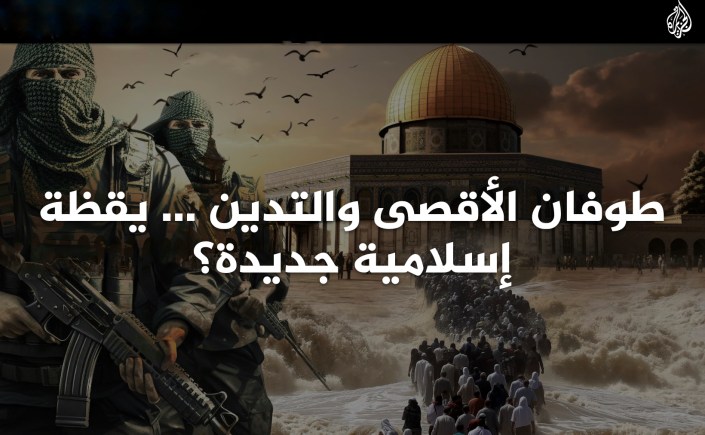
It has been said before and often, that the Qatari-owned news platform Al Jazeera presents the non-Arabic speaking world with a markedly different narrative of to what it relays to its Arabic readers – it is the most popular news source in the Arab world, particularly among Palestinians. Viewing or reading Al Jazeera English, you would think that Israel’s ongoing onslaught in Gaza is directed entirely against the defenceless and helpless civilians of the unfortunate enclave. There are very rarely images of the militants who are engaged on a daily basis in fierce battles and deadly firefights with the IDF. Al Jazeera Arabic on the other hand, posts pictures and videos of the fighters, illustrating their courage, their resilience in the face of overwhelming odds, and their successes in the face of overwhelming military odds. In that Howling Infinite recently covered the issue of divergent narratives in Al Aqsa Flood and the Hamas holy war.

The following opinion piece published this week in Haaretz suggests that the gas-rich and influential emirate of Qatar, erstwhile mediator in many contemporary of conflicts has indeed need playing a much more subtle long game of taqiyyah and kitmān.

I leave it to the reader to determine whether there is some truth in the author’s case or whether this is part of some deceptive hasbara.It would indeed be in Israel’s interests to propagate a narrative that emphasises the existential threat posed by its Muslim neighbours.

Personally, I am inclined to take this opinion piece with a large pinch of salt. For a start, it is badly written and many of its historical references are inaccurate. And then there is the matter of ascribing caliphate ambitions to  the Gulf emirate of Qatar, a tiny autocracy, albeit one of the richest, and until recently at odds with its equally autocratic Gulf neighbours with regard to it’s having given support and succour to the Islamist Muslim Brotherhood – from which Hamas evolved in Palestine – which is similarly reviled and repressed by the rulers of Egypt, Syria and Jordan, who have dealt brutally with the organisation in the past. Other Sunni Muslim regimes were, moreover, unimpressed by Qatar’s cordial relationship, political and economic, with The Shia Islamic Republic of Iran – although the Gulf regimes have of late been increasingly conducive to improving their relationships with the hardline theocracy. Indeed, it was not so long ago that Qatar’s neighbours endeavoured to impose a blockade on the recalcitrant emirate. They would be hardly inclined to countenance Qatar as the leader of an Islamic Caliphate – even if the Muslim street in most Arab states were enthusiastic about the idea.

In a brief article in Haaretz the following week, also republished below, a former Israeli diplomat took issue with Ronit Marzan’s “one-dimensional approach” to Qatar: “…Israel’s tendency to divide the world into “good” and “bad” is not a good approach to intelligent foreign policy. Skillful diplomacy identifies common interests shared by diverse and often opposing players – partners in one area who are adversaries in another. That is precisely why the term “frenemies” exists. Qatar is a classic example”.

For more on Israel and Palestine in In That Howling Infinite, see: A Middle East Miscellany

Qatar Is Preparing a ‘Ring of Fire’ Around Israel to Supplant Iran’s

Ronit Marzan Haaretz, Oct 15, 2024

On October 7, 2023, the idee fixe that Hamas was deterred was shattered. But Israel is still mired in another idee fixe – that Qatar is a friendly country that helps resolve conflicts.

Israel is ignoring the hearts-and-minds campaign Qatar is waging against it and against the entire Western world by arguing that liberating all of Palestine will liberate the Middle East from colonialism, liberate the world from the unipolar order of American hegemony and liberate the human psyche from Western culture.

The hashtags “Spain,” “Andalusia,” “Palestine” and “history and culture,” which Qatar’s online influencers regularly use, are not understood by either Israel or Spain.These hashtags are part of a historical, cultural and psychological campaign that links two central narratives. It seeks to convince Muslims worldwide that the medieval Islamic empire in Andalusia fell as a result of jealousy and rivalry among Muslim kings. Additionally, historical Palestine isn’t being liberated because of the rivalry among Arab countries and their cooperation with the Israeli enemy against Palestinian resistance organizations.

Tweets posted online by Qatari influencers such as “Haifa is beautiful, but it will be more beautiful when it burns down,” “Don’t dream about a happy world as long as Israel exists” and “Liberating all of Palestine is possible, and it has begun” have also not been met with any effective response by Israel’s official public diplomacy network.

And Qatar’s threats that it is considering deporting Hamas leaders from the country should not be taken seriously so long as senior Hamas leader Khaled Meshal, who lives there, keeps telling Muslims around the world that the Al-Aqsa Mosque is “the explosive that sets off intifadas”; inciting residents of the West Bank and “the 1948 Arabs” (i.e. Israeli Arabs) to resume suicide bombings; urging the Arab nation to embark on both a jihad of the soul and an armed jihad against the Zionist enemy, which isn’t a natural part of the region; encouraging the Arab masses to take to the streets and pressure their leaders to sever ties with Israel; and urging student leaders worldwide to renew street protests to put an end to Zionist and American hegemony.

It’s not only Israel that has fallen asleep while on guard duty. European and American leaders also don’t understand that Qatar is working via its agents of change to bring about a clash between the global north and the global south by exploiting the distress of failed states and the woke movement in the West. They are failing to recognize that it is undermining the Western model of the modern nation-state whose borders were drawn in the past.

Its goal is to replace this Western model with that of a traditional Arab state, meaning one where the regime’s legitimacy would come from its willingness to put the interests of the Arab-Islamic nation above those of its own country, first and foremost in the battle against Israel.

Tawakkol Karman, an Islamic activist from Yemen, received aid from Qatar to promote a revolutionary discourse in her country during the Arab Spring and was awarded a Nobel Peace Prize for it.

Now, she is helping Qatar incite a revolt against Western governments among young people and indigenous peoples. At the One Young World Summit in Canada, she argued that democracy, human rights and the rule of law are in retreat in the United States, Canada, Britain and France and urged action against powerful companies and governments that had stolen the resources of indigenous peoples.

In an edited Al Jazeera video of a speech by UN Secretary-General Antonio Guterres at an Arab League summit, the following chyrons were prominently displayed: “Guterres urged the Arab states to unite and not let outside parties manipulate them,” “Guterres highlighted the golden age of Islamic culture and praised the Arab contribution over the course of hundreds of years, from the Andalusian renaissance in the Iberian peninsula to Baghdad, which was a global center of culture and civilization,” “The secretary-general blamed the Arab states’ backwardness on colonialism and the war of liberation that the Arab nation had to wage.”

All of the above show that Guterres, like many former UN employees who are today employed at Azmi Bishara’s research institute in Doha, don’t represent the values in whose name the United Nations was established. Instead, they have become Qatar’s water carriers.

Israel and the United States erred when they let Qatar send aid to the Gaza Strip.And they are erring now by allowing it to send aid to Lebanon. Now that Gaza has been devastated, and the chances of Hamas returning to power are low, Qatar is racing ahead towards Lebanon.

It is part of the five-member committee that was established to help resolve Lebanon’s political crisis, along with Egypt, Saudi Arabia, America and France.

Qatar is embracing veteran Druze politician Walid Jumblatt, the former head of Lebanon’s Progressive Socialist Party, in the hopes that the Druze community will provide help in the future to topple Bashar Assad’s regime in Syria.

It is giving millions of dollars to the Lebanese army to help pay soldiers’ salaries ($100 a month per soldier). And it is cooperating more closely with Lebanese government ministries – for instance, the internal security ministry, which is responsible for training police officers – while moving forward on agreements in the field of solar energy.
Israel’s ground operation in Lebanonis giving Qatar an opportunity to settle itself in the hearts of the Lebanese people. After Israel dismantles Shi’ite Hezbollah for it, along with the ring of fire Iran has for years nurtured in the region, Qatar will appear in the role of the “savior” and repeat what it did with Sunni Hamas in Gaza.
But this time, it will do so with the Sunni Muslim Brotherhood in Lebanon, Syria, Iraq and Jordan. And Iran’s Shi’ite ring of firewill be replaced with Qatar’s Sunni ring, which will be no less dangerous, and might well lead Israel to new versions of the October 7 attacks, just as Meshal has been promising.

Saladin liberated Palestine, Jerusalem and Al-Aqsa after securing geographic and demographic depth for himself in Turkey, Syria, Iraq, Egypt and Jordan. That’s what Meshal and Mohamed El-Shinqiti, a faculty member at Qatar University, have been saying, and presumably not by chance.

Lolwah Al-Khater, the country’s minister for international cooperation, landed in Beirut a few days ago with a generous supply of aid and promises of “plans for the medium and long term.” We should believe what she says, because Qatar is a long-distance runner, and patience is a key value in the Muslim Brotherhood’s ideology.

Ronit Marzan is a researcher of Palestinian society and politics at the Tamrur-Politography

Qatar Can Be Part of the Solution, and Not Just Part of the Problem

Nadav Tamir Haaretz, Oct 21, 2024

In her article “Qatar is preparing a ‘ring of fire’ around Israel to supplant Iran’s,” (Haaretz, October 15), Dr. Ronit Marzan takes a one-dimensional approach toward Qatar. However, Israel’s tendency to divide the world into “good” and “bad” is not a good approach to intelligent foreign policy. Skillful diplomacy identifies common interests shared by diverse and often opposing players – partners in one area who are adversaries in another. That is precisely why the term “frenemies” exists.

Qatar is a classic example. It does indeed support the Muslim Brotherhood, but the conclusion that it therefore supports terrorism is mistaken and misleading. The Muslim Brotherhood spans a wide spectrum. Anyone who understands the dramatic difference between MK Mansour Abbas and Hamas, or Raed Salah and the late Mohammed Morsi, the former Egyptian president who, during his presidency, upheld the peace agreement with Israel, realizes this. Unlike Iran, Qatar has never sought to promote terrorism, even though it has not avoided connections with those involved in it.

The transfer of Qatari aid to Hamas was carried out in response to an Israeli-American request to create Western leverage over Hamas and mechanisms for ending the fighting in Gaza. Hosting the political leadership of Hamas in Qatar was part of a broader approach, aimed at distancing the movement from Iran.

Qatar’s assistance is highly valued by Israeli and American negotiators in the efforts to release hostages held by Hamas and this is a good example of the importance of working with Qatar. But even after the war, we will still need the Qataris as mediators and stabilizers, because Hamas will not disappear from Gaza and other Palestinian territories.

Qatar hosts the largest U.S. airbase in the Middle East, Al-Udeid Air Base. It is also home to branches of some of the most important American universities. Qatar and Iran are partners in a large offshore gas field, which allows it to influence and moderate Iran. Being the richest country per capita in the world enables Qatar to invest significant resources in rebuilding countries like Syria and Lebanon, and in Gaza – a capability that may be critical to any political settlement following the war.

Qatar’s soft power diplomacy could serve as an alternative to the ongoing military conflicts, which is perhaps a strategy Israel should also consider adopting. We should also learn from the U.S., which utilizes Qatar for diplomatic moves with hostile countries and organizations. For example, Qatar helped release American citizens from Iranian prisons and facilitated the agreement that allowed U.S. forces to exit Afghanistan.

After the Oslo Accords, Israel opened an Israeli interest office in Doha, Qatar’s capital. From this and other actions, we learned that Qatar is interested in helping create processes that promote peace and stability in the region through soft power. While Prime Minister Benjamin Netanyahu used Qatar to fund Hamas with the declared goal of weakening the Palestinian Authority and the chances of a political settlement, I propose using Qatar to help advance a settlement with the Palestinians as part of a regional agreement. Similarly, it is important to leverage Qatar, one of the five key countries assisting governance in Lebanon, to help weaken Hezbollah domination in Lebanon.

A country does not choose its surroundings and Qatar is not a friendly state, but it is a state that can serve as a counterforce to Iran’s rise. Qatar is an actor with economic and political interests in both the Western and Arab-Muslim worlds. It should be approached with caution but utilized rather than kept away.

Therefore, instead of denigrating Qatar’s significant influence in the region, we should consider how to leverage its skills in navigating among different regional alliances, which give Qatar unique capabilities – not as a sole player or even central one but as a country with influence that even much larger nations, such as Egypt and Saudi Arabia, don’t posses

The first Intifada … Palestine 1936

In 1929, there is violence at the Western Wall in Jerusalem – then a narrow alley named for Buraq, the steed with a human face that bore the Prophet Mohammed on his midnight journey to Jerusalem, and not the Kotel Plaza of today. The event, which was actually called the Buraq rising was incited by rumours that Jews planned to overrun the Haram al Sharif, the third holiest site in Islam. A massacre of Jews in Hebron in the south followed. These were a bleak precursor of the wars to come.

Fast forward to mid-April 1936. Following two incidents of killing carried out in by both Arabs and Jews, an Arab National Committee declared a strike in the city of Jaffa. National Committees were formed in other Palestinian cities and representatives of Arab parties formed the “Arab Higher Committee” led by Haj Amin al-Husseini. A general strike spread throughout Palestine, accompanied by the formation of Palestinian armed groups that started attacking British forces and Jewish settlements. Thus began the “Great Palestinian Revolt. It lasted for three years.

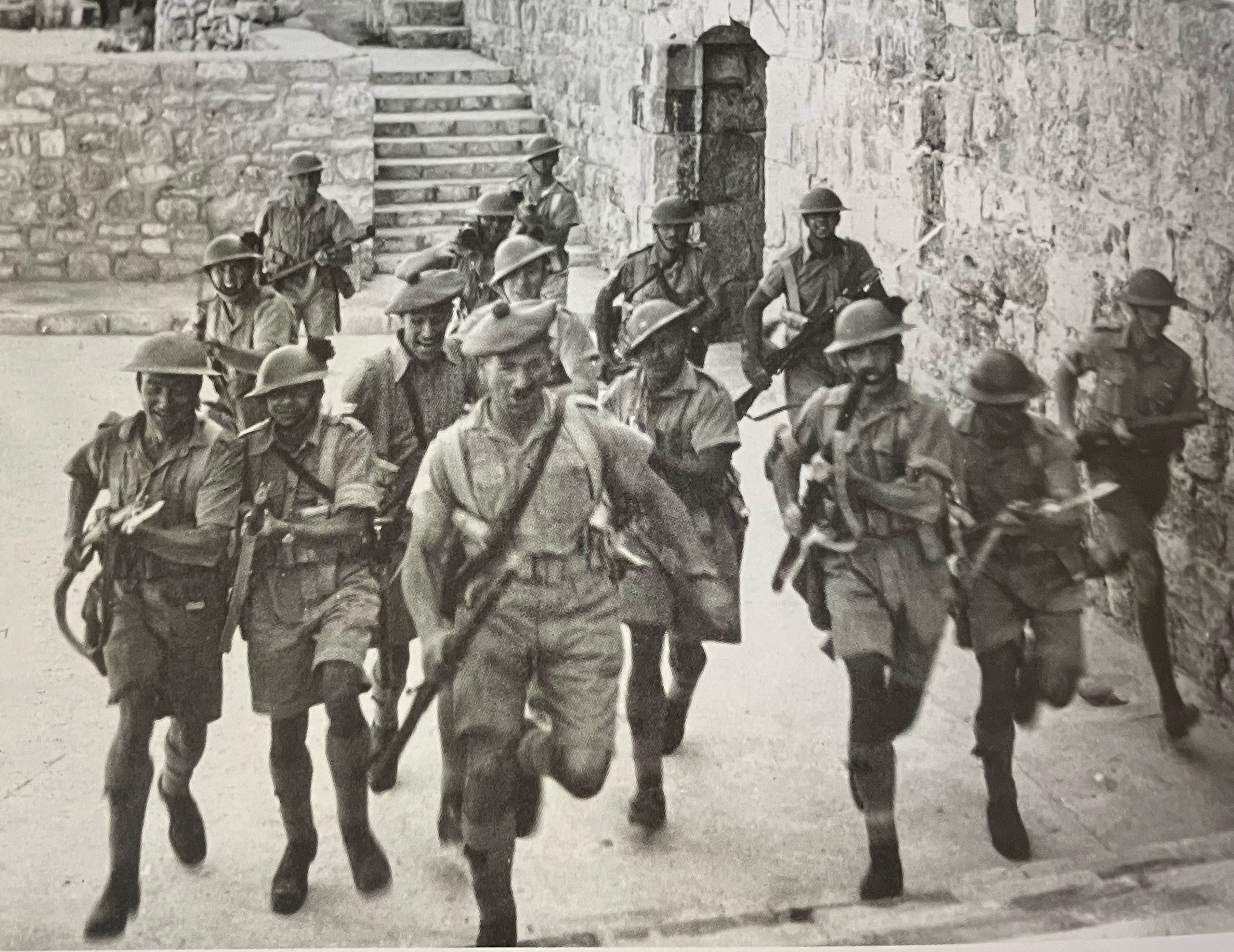
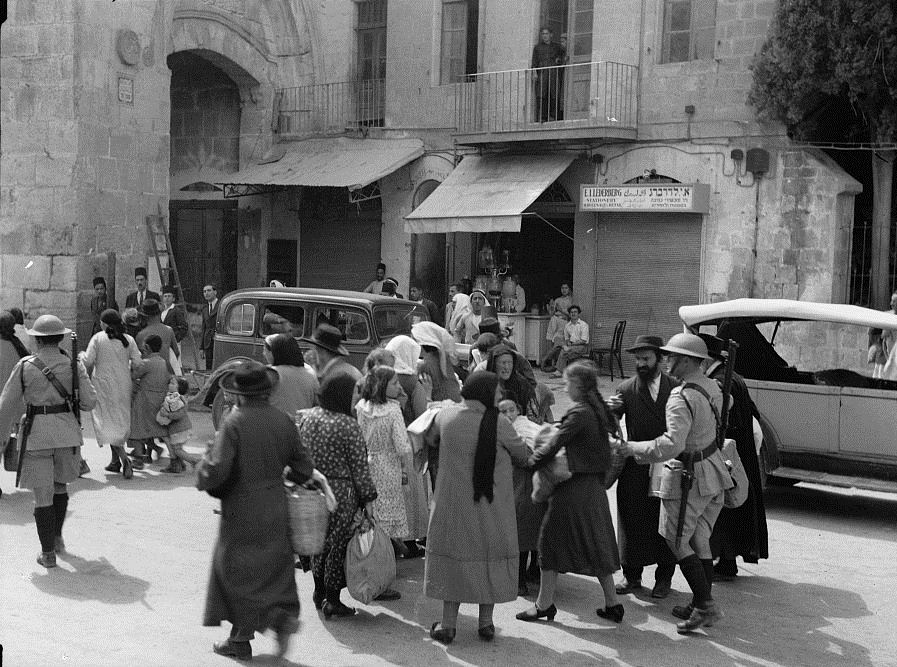
British troops run through Jerusalem’s’ Old City during the Great Revolt

Roots and fruits 

The ongoing struggle with regard to the existence Israel and Palestine is justifiably regarded the most intractable conflict of modern times. Whilst most agree that its origins lie in the political and historical claims of two people, the Jewish Israelis and the predominantly Muslim Palestinians for control over a tiny wedge of one-time Ottoman territory between Lebanon and Syria in the north, Jordan in the east, and Egypt to the south, hemmed in by the Mediterranean Sea. There is less consensus as to when the Middle East Conflict as it has become known because of its longevity and its impact on its neighbours and the world in general, actually began.

Was it the infamous Balfour Declaration of 1917 promising a national home for Jews in an Ottoman governate already populated by Arabs, or the secretive Sykes Picot Agreement that preceded it in 1916, staking imperial Britain’ and France’s claim to political and economic influence (and oil pipelines) in the Levant? Was it the establishment of the British Mandate of Palestine after the Treaty of Sèvres of 1922 which determined the dissolution of the defeated Ottoman Empire. Or was it the end of that British mandate and the unilateral declaration of Israeli independence in 1948 and the war that immediately followed?

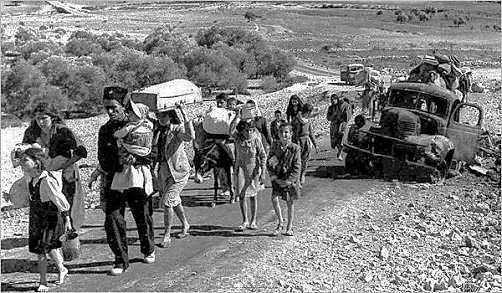
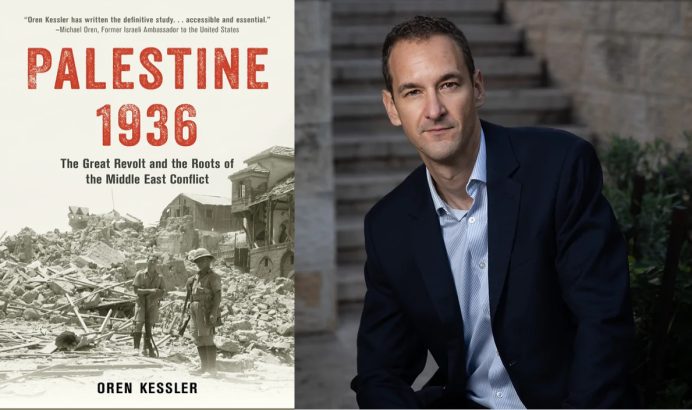
In his book Palestine 1936: The Great Revolt and the Roots of the Middle East Conflict (Rowman & Littlefield, 2023) Israeli journalist and author Oren Kessler argues powerfully that the events in Mandatory Palestine between 1936 and 1939 shaped the subsequent history of the conflict for Israelis and Palestinians. The book identifies what was known at the time as The Great Revolt  as the first Intifada, a popular uprising which actually sowed the seeds of the Arab military defeat of 1947-48 and the dispossession and displacement of over seven hundred thousand Palestinian Arabs, which has set the tone of the conflict for almost a century.

It is a tragic history shared with knowledge in hindsight of the decades of violence and bloodshed in the region that followed. It begins in the time before Palestine became political entity, when mainly Eastern European Jews began settling in progressively larger numbers to the consternation of the Arab populace.

The 1936 conflict stemmed from questions of how to divide the land and how to deal with the influx of Jewish people – questions that remain relevant today. In an extensive interview coinciding with the book’s publication (republished below) Kessler notes that, for the Arab residents, the problem was one of immigration and economics; for the Zionists, it was about finding a home. These two positions soon became irreconcilable issues, leading to sporadic violence and then to continual confrontation.

He believes that the Revolt is the point when both sides really came to see the conflict as zero sum. insofar that whichever community had the demographic majority in Palestine would be the one that would determine its fate. However, in the 1920s, the Jews were so far from that majority that both sides were able to postpone the final reckoning. In the 1930s, the Jews threatened to become a majority, and this was the immediate precursor to the rising. There was no way that the objective of bringing as many Jews to the land as possible could be achieved without bringing about some serious Arab pushback.

It is Kessler’s view that it was during revolt that a strong sense of Arab nationalism in Palestine extended beyond the urban elites to all corners of the country. All segments of Arab society – urban and rural, rich and poor, rival families, and even to a large extent Muslim and Christian – united in the same cause against Zionism and against its perceived enabler, the British Empire. The Arab public in Palestine was becoming increasingly politically aware and consciously perceiving itself as a distinct entity – distinct from its brethren in Syria, in large part because it has a different foe: not simply European imperialism but this very specific threat presented by Zionism.

The British government made early efforts at keeping the peace, but these proved fruitless. And when the revolt erupted in 1936, it sent a royal commission to Palestine, known to history as the Peel Commission, to examine the causes of the revolt. It proposed in effect the first ‘two state solution.’ The Emir Abdullah of Transjordan publicly accepted this plan. The main rival clan to the Husseinis, the Nashashibis, privately signaled that they were amenable – not thrilled, but amenable. And their allies held the mayorships of many important cities – Jaffa, Haifa, and even Nablus, Jenin and Tulkarem, which today are centres of militancy. And yet the Mufti makes very clear that he regards this plan as a degradation and a humiliation, and all of these erstwhile supporters of partition suddenly realise that they are against partition.

Kessler believes that this is the point at which a certain uncompromising line became the default position amongst the Arab leadership of Palestine, with dire consequences for the Palestinians themselves, and when Yishuv leader David Ben Gurion saw an opportunity to achieve his long-standing objective of creating a self-sufficient Jewish polity, one that could feed itself, house itself, defend itself, employ itself, without any help from anyone – neither British or Arabs. When the Arabs called a general strike and boycott, cut all contacts with the Jewish and British economies and closed the port of Jaffa in Spring 1936, he lobbied successfully with the British to allow the Jews to open their own port in Tel Aviv, ultimately causing a lot of economic pain to the Arabs and helping the Jews in their state-building enterprise.

This is a mosaic history, capturing the chaotic events on the ground through snippets of action. And also, the people involved. 

There are heroes and villains aplenty in this relatively untold story. The urbane and erudite nationalists Muhammed Amal and George Antonius who strive for middle ground against increasingly insurmountable odds, and who died alone and exiled having failed to head off the final showdown that is today known as Al Nakba. The farseeing, resolute, and humourless Ben Gurion and the affable, optimistic Chaim Weizmann, who became Israel’s first prime minister and president respectively. The New York born Golda Meyerson, more of a realist than either leader, who would also one day become prime minister. The irascible revisionist Vladimir Ze’ev Jabotinski, the forebear of today’s virulent rightwing nationalists

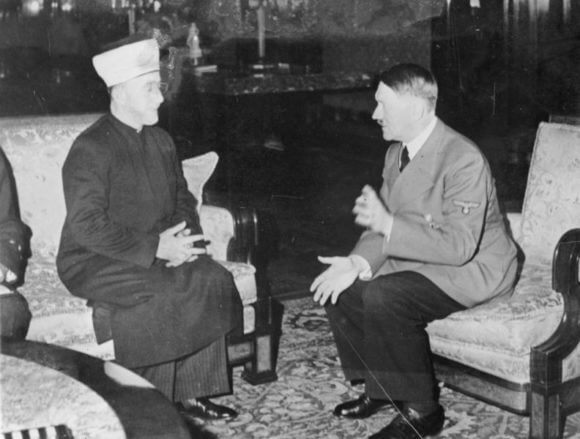
The hardliner Mufti Haj Amin al Husseini, whose uncompromising stance, malign political influence, and conspiratorial association with the Nazis set the stage for a long general strike, the Great Revolt, and ultimately, the débâcle of 1948. The flamboyant rebel leaders, Syrian Izz al Din al Qassam, who is memorialized in the name of the Hamas military wing and a Gaza-made rocket, and Fawzi al Qawuqji. Qassam was gunned down by British soldiers during the revolt whilst Qawuqji lived on to become one of the most effective militia leaders in the war of 1948, and to perish therein. Both are remembered today as Palestinian martyrs whilst the Mufti is an arguably embarrassing footnote of history. There’s an article about his relatively unremarked death at the end of this post. 

Amin al-Husseini in 1929

And in the British corner, the well-intentioned high commissioners who vainly endeavoured to reconcile the claims of two aspirant nations in one tiny land, and quixotic figures like the unorthodox soldier Ord Wingate who believed he was fulfilling prophecy by establishing the nucleus of what would become the IDF (like many charismatic British military heroes, and particularly General Gordon and Baden-Powell, both admirers and detractors regarded him a potential nut-case); and the Australian-born ex-soldier Lelland Andrews, assistant district commissioner for Galilee, who also conceived of his mission as divinely ordained. Lewis was murdered by Arab gunmen and Wingate went down in an aeroplane over Burma during WW2.

There are appearances from among many others, Lloyd George, Winton Churchill and Neville Chamberlain, Adolph Hitler and Benito Mussolini, Franklin D Eisenhower and Joseph Kennedy.

The book highlights the work of powerful British functionaries in handling early confrontations: they are memorialized for starting commissions to study the matter and to generate ideas, though many of their ideas weren’t followed or were followed to ill effect. None solved the problem, making this account of the earliest days of the conflict all the more heartbreaking.

All under the shadow of the impending Shoah, and the inevitable showdown that would culminate in al Nakba.

The road to Al Nakba

Kessler argues that the Arab social fabric and economy are completely torn and shattered by the end of this revolt that in many ways the final reckoning for Palestine between Jews and Arabs – the civil war that erupts in 1947 – is actually won by one side and lost by the other nearly a decade earlier.

The final paragraphs of Kessler’s enthralling book are worth quoting because they draw a clear line between the events of the Great Revolt and the catastrophe, al Nakba, of 1948:

“For the Jews, perhaps the greatest shift was psychological. they had withstood of powerful sustained assault and lived to tell about it. One book on Zionist leaders” thinking in this era is titled Abandonment of Illusions. The belief of material gains would bring Arab consent now naïve and, worse, dangerous. Instead, by the end of the revolt and the start of the world war, much of Palestine’s Jewish mainstream had accepted the fact that the country’s fate would ultimately be determined and maintained by force.
 
“By 1939, the Yishuv had achieved the demographic weight, control of strategic areas of land, and much of the weaponry and military organization that would be needed as a springboard for taking over the country within less than a decade”, writes the Palestinian American historian Rasheed Khalidi.
 
Khalid argues that the Palestinian catastrophe of 1947 -1949 was predicated on a series of previous failures: “a deeply divided leadership, exceedingly limited finances, no centrally organized military forces or centralized administrative organs, and no reliable allies. They faced a Jewish society in Palestine which although small relative to theirs, was political unified, had centralized para-state institutions, and was increasingly well-led and extremely highly motivated”.
 
For Palestinians, he maintains, the Nakba – the catastrophe of their military drubbing, dispossession and dispersal – was but a forgone conclusion. For them, the terrible events that bookended the year 1948 “were no more than a postlude, a tragic epilogue to the shattering defeat of 1936- 39”.
 
The Great Revolt, Kessler says, has cast its shadow over the Israeli-Palestinian conflict ever since – for the Arabs, for the Jews, and for attempts to resolve the conflict. It is still remembered by Palestinians and Israelis alike. Palestinian folk songs still celebrate the revolt, and in my he regards the. BDS movement as direct descendant of the general strike that preceded the revolt. The two-state solution that is still the international community’s favoured solution to the conflict is but a variation of that original partition plan of 1937.

In so many ways, for both Israelis and Palestinians, this revolt rages on.

© Paul Hemphill 2024.  

Kessler’s interview in Fathom e-zine follows, together with serval informative articles on the Great Revolt and its aftermath

For more on Israel and Palestine in In That Howling Infinite, see: A Middle East Miscellany

The picture at the head of this post shows British troops marching through Ibn Khatib Square in 1936 past King David’s Citadel and towards the Jaffa Gate

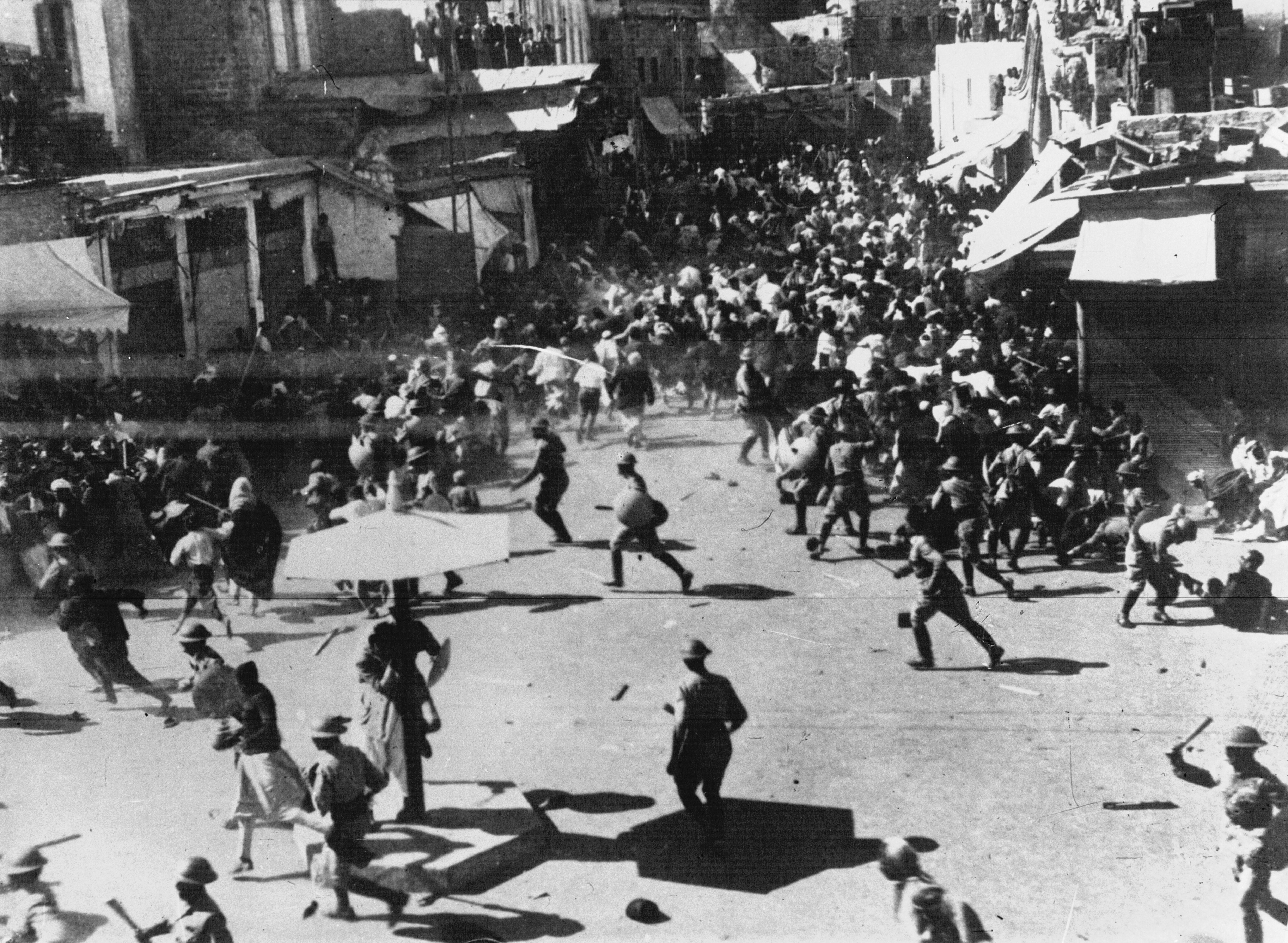
British policemen disperse an Arab mob during the Jaffa riots in April 1936 (The Illustrated London News)


Jews evacuate the Old City of Jerusalem after Arab riots in 1936.

An interview with Oren Kessler

by Oren Kessler
 
 
3365748242
Great Arab Revolt, 1936-1939
A Popular Uprising Facing a Ruthless Repression
 
In 1936, widespread Palestinian dissatisfaction with Britain’s governance erupted into open rebellion. Several key dynamics and events can be seen as setting the stage for this uprising. In Palestine, as elsewhere, the 1930s had been a time of intense economic disruption. Rural Palestinians were hit hard by debt and dispossession, and such pressures were only exacerbated by British policies and Zionist imperatives of land purchases and “Hebrew labor.” Rural to urban migration swelled Haifa and Jaffa with poor Palestinians in search of work, and new attendant forms of political organizing emerged that emphasized youth, religion, class, and ideology over older elite-based structures. Meanwhile, rising anti-Semitism—especially its state-supported variant—in Europe led to an increase of Jewish immigration, legal and illegal, in Palestine.

Unsurprisingly, the combination of these various trends produced periodic upheavals, from the 1929 al-Buraq Uprising to multicity demonstrations in 1933 against the British Mandate. In October 1935, the discovery of a shipment of arms in the Jaffa port destined for the Haganah fueled Palestinian concerns that the Zionist movement was introducing the human and military resources necessary for its state-building project under the nose of the British. Meanwhile, the popular and populist Syrian Shaykh Izzeddin al-Qassam , who preached to the slum-dwelling rural transplants near Haifa’s rail yards and who had spent the early 1930s building a cell-based paramilitary network, was killed in a firefight with British forces in November 1935. Qassam’s funeral in Haifa elicited a mass outpouring of public outrage. These events are often seen as direct predecessors of the mass Palestinian uprising that took place in 1936.

The Great Palestinian Rebellion , or the Great Arab Revolt, as this uprising came to be known, lasted for three years and can be generally divided into three phases. The first phase lasted from the spring of 1936 to July 1937. With tensions throughout Palestine running high since the fall of 1935, the revolt was ignited in mid-April 1936 when followers of Qassam attacked a convoy of trucks between Nablus and Tulkarm , killing two Jewish drivers. The next day, the  Irgun killed two Palestinian workers near Petah Tikva , and in the following days, deadly disturbances ensued in Tel Aviv and Jaffa. In Nablus, an Arab National Committee was formed and a strike was called on 19 April. National Committees in other cities echoed the call to strike, and on 25 April the Arab Higher Committee (Lajna) (AHC) was formed, chaired by Haj Amin al-Husseini , to coordinate and support a nationwide general strike, which was launched on 8 May.

The strike was widely observed and brought commercial and economic activity in the Palestinian sector to a standstill. Meanwhile, Palestinians throughout the countryside came together in armed groups to attack—at first sporadically, but with increasing organization— British and Zionist targets. Some Arab volunteers joined the rebels from outside Palestine, though their numbers remained small in this period. The British employed various tactics in an attempt to break the strike and to quell the rural insurrection. The ranks of British and Jewish policemen swelled and Palestinians were subjected to house searches, night raids, beatings, imprisonment, torture, and deportation. Large areas of Jaffa’s Old City were demolished, and the British called in military reinforcements.

Concurrent with military operations and repressive measures, the British government dispatched a commission of inquiry headed by Lord Peel to investigate the root causes of the revolt. In October 1936, under the combined pressure of British policies, other Arab heads of state, and the effects of a six-month general strike on the Palestinian population, the AHC called off the strike and agreed to appear before the Peel Commission . A period of lower intensity conflict prevailed as the Peel Commission toured the country, but tensions continued to build in anticipation of the commission’s report. In July 1937, the Peel Commission published its report, recommending Palestine’s partition into Jewish and Arab states. Dismayed by this negation of their desires and demands, the Palestinian population relaunched their armed insurgency with renewed intensity, initiating the second phase of the revolt.

This second phase, lasting from July 1937 until the fall of 1938, witnessed significant gains by the Palestinian rebels. Large swaths of the hilly Palestinian interior, including for a time the Old City of Jerusalem , fell fully under rebel control. Rebels established institutions, most significantly courts and a postal service, to replace the British Mandate structures they sought to dismantle. The British, meanwhile, imposed even harsher measures to try to quash the revolt. The AHC and all Palestinian political parties were outlawed, political and community leaders were arrested, and a number of high-profile public figures exiled. The military aspects of counterinsurgency intensified, and British tanks, airplanes, and heavy artillery were deployed throughout Palestine. The British also meted out collective punishment: thousands of Palestinians were relegated to “detention camps”; residential quarters were destroyed; schools were closed; villages were collectively fined and forced to billet British troops and police. Zionist military institutions took advantage of the situation to build up their capacities with British support. By early 1939, members of the Jewish Settlement Police (about 14,000) were subsidized, uniformed, and armed by the British government as a thinly veiled front for the Haganah, and so-called Special Night Squads  comprising Jewish and British members launched “special operations” against Palestinian villages.

The third phase of the rebellion lasted roughly from the fall of 1938 to the summer of 1939. The British dispatched another commission of inquiry, this one headed by Sir John Woodhead , to examine the technical aspects of implementing partition. In November 1938, the Woodhead Commission report concluded that partition was not practicable, marking a certain British retreat from the Peel recommendation. At the same time, however, the British launched an all-out offensive: in 1939 more Palestinians were killed, more were executed (by hanging), and nearly twice as many were detained than in 1938. Such brutality placed immense pressure on the rebels, exacerbating rifts between the political leadership of the AHC exiled in Damascus and local leadership on the ground, between rebel bands and village populations that were expected to support and supply them, and ultimately between Palestinians who remained committed to the revolt and those willing to reach a compromise with the British. British-supported Palestinian “Peace Bands” were dispatched to battle their compatriots.

In May 1939, the British government published a new White Paperthat proposed the following: Britain’s obligations to the Jewish national home had been substantially fulfilled; indefinite mass Jewish immigration to and land acquisition in Palestine would contradict Britain’s obligations to the Palestinians; within the next five years, no more than 75,000 Jews would be allowed into the country, after which Jewish immigration would be subject to “Arab acquiescence”; land transfers would be permitted in certain areas, but restricted and prohibited in others, to protect Palestinians from landlessness; and an independent unitary state would be established after ten years, conditional on favorable Palestinian-Jewish relations.

The combined impact of Britain’s military and diplomatic efforts brought the rebellion to an end in the late summer of 1939. Over the revolt’s three years, some 5,000 Palestinians had been killed and nearly 15,000 wounded. The Palestinian leadership had been exiled, assassinated, imprisoned, and made to turn against one another. At the same time, the White Paper—despite its limitations—offered certain concessions to the rebels’ demands. Whatever gains Palestinians might have made through the revolt, however, were quickly overtaken by the larger geopolitical processes of World War II , and the combined British-Zionist assault on Palestinian political and social life during the revolt had a long-lasting impact.

 
Selected Bibliography:

Anderson, Charles W. “State of Formation from Below and the Great Revolt in Palestine.” Journal of Palestine Studies 47, no. 1 (Autumn 2017): 39-55.

Hughes, Matthew. “From Law and Order to Pacification: Britain’s Suppression of the 1936–1939 Arab Revolt in Palestine.” Journal of Palestine Studies 39, no.2 (Winter 2010): 6–22.

Kanafani, Ghassan. The 1936–39 Revolt in Palestine.

Shbeib, Samih. “Poetry of Rebellion: The Life, Verse and Death of Nuh Ibrahim during the 1936–39 Revolt.” Jerusalem Quarterly 25 (Winter 2006): 65–78.

Sufian, Sandy. “Anatomy of the 1936-39 Revolt: Images of the Body in Political Cartoons of Mandatory Palestine.” Journal of Palestine Studies 37, no.2 (Winter 2008):  23–42.

Swedenburg, Ted. Memories of Revolt: The 1936–1939 Rebellion and the Palestinian National Past. Fayetteville: University of Arkansas Press, 2003.

Britain says releasing a 1941 document about Palestine might ‘undermine security’

A two-part archive, labeled “Activities of the Grand Mufti of Jerusalem” and dated 1940-1941, sits in Britain’s National Archives in Kew. This writer successfully had the first part declassified in 2014. The second part remains sealed. My 2018 attempt to have these ten pages declassified was refused on the grounds that the archive might “undermine the security of the country [Britain] and its citizens.”[1] None of its secrets are to be available until January, 2042; and if the paired file is any precedent, even in 2042 it will be released only in redacted form.

The ‘Grand Mufti’ in the archive’s heading is Haj Amin al-Husseini, the Palestinian leader whom posterity best remembers for his alignment with the Italian and German fascists; and the years 1940-1941 place him not in Palestine, but in Iraq — and if the second archive extends to late 1941, in Europe. What could possibly be hidden in a World War II document about a long-dead Nazi sympathizer that would present such a risk to British national security eight decades later, that none of it can be revealed? At present, only the UK government censors know; but the answer may have less to do with the fascists and al-Husseini than with British misdeeds in Iraq, and less to do with Britain’s national security than with its historical embarrassment.

When in 1921 votes were cast for the new Mufti of Jerusalem, Amin al-Husseini came in last among the four candidates. But votes in Palestine mattered as little then as they do now, and the British, Palestine’s novice replacement occupiers for the Ottomans, handed the post to al-Husseini. At first, he proved to be an asset to the British. But as the years passed, his opposition to Zionism, support for Palestinian nationalism, and ultimately his involvement in the 1936 Palestinian uprising, led to calls for his arrest.

Photograph labelled 'Arab demonstrations on Oct. 13 and 27, 1933. In Jerusalem and Jaffa. Return of Grand Mufti from India. Met by hundreds of cars at Gethsemane, Nov. 17, 1933.'

“ARAB DEMONSTRATIONS ON OCT. 13 AND 27, 1933. IN JERUSALEM AND JAFFA. RETURN OF GRAND MUFTI FROM INDIA. MET BY HUNDREDS OF CARS AT GETHSEMANE, NOV. 17, 1933.” LIBRARY OF CONGRESS, LC-M33- 4218.

In mid-October of 1937, he fled from hiding in Palestine to Beirut. Two years later and six weeks after the outbreak of World War II, in mid-October of 1939, he slipped to Baghdad, where his sympathies for the Italian fascists further alarmed the British. Fast-forward another two years to late 1941, and al-Husseini is in Europe, meeting with Benito Mussolini on the 27th of October, and on the 28th of November meeting with the Führer himself at the Reich Chancellery in Berlin.

Al-Husseini’s motivation for embracing the Axis was likely a combination of selfish political opportunism and the belief that the alignment would help safeguard against the takeover of Palestine by the Zionists. The reasoning, however grotesque, was the same used by Lehi (the ‘Stern Gang’) in its own attempted collaboration with the fascists: Britain was the obstacle both to Palestinian liberation, and to unbridled Zionism, and for both the Mufti and Lehi, defeating that obstacle meant embracing its enemies. Even the ‘mainstream’ David Ben-Gurion had no moral qualms about taking advantage of Britain’s struggle against the Nazis — a struggle for which his Jewish Agency was already conspicuously unhelpful — by exploiting Britain’s post-war vulnerabilities.[2]

Posterity has treated Lehi’s and the Mufti’s flirtations with the fascists quite differently. Lehi, the most fanatical of the major Zionist terror organizations, was transformed into freedom fighters, and ex-Lehi leader Yitzhak Shamir was twice elected as Israeli Prime Minister. In contrast, Zionist leaders quickly seized on al-Husseini’s past to smear not just him, but the Palestinians as a people, as Nazis.

The use of al-Husseini’s unsavory history to ‘justify’ anti-Palestinian racism continues to the present day. Most bizarrely, in 2015 Israeli Prime Minister Benjamin Netanyahu claimed that Hitler had not intended to exterminate the Jews — that is, not until al-Husseini planted the words in his ear — which translates as “got the idea from the Palestinians”. A private citizen would likely have been arrested under German law for this attempt to rewrite the Holocaust.

The mufti of Jerusalem, Sayid Amin al Husseini, meets with Hitler, November 1941.

THE MUFTI OF JERUSALEM, SAYID AMIN AL HUSSEINI, MEETS WITH HITLER, NOVEMBER 1941.

Iraq won limited independence in 1932, just before the Nazis came to power. When the Mufti ensconced himself in Iraq seven years later, the country was under nominally ‘pro-British’ Prime Ministers, and Regent ‘Abd al-Ilah for the four-year-old king, Faisal II. This uneasy British-Iraqi equilibrium ended on first day of April 1941, when four Iraqi officers known as the Golden Square, wanting full independence (and similarly aligning themselves with the fascists in the foolish belief that doing so would help them get it), staged a coup d’état. It lasted two months. British troops ousted the coup on the first day of June — and as they did, anti-Jewish riots rocked Baghdad. An estimated 180 Jewish Iraqis were killed and 240 wounded in this pogrom known as the Farhud.

Why would the momentary power vacuum of the British takeover lead to anti-Jewish terror? While doing research for my 2016 book, State of Terror, I was intrigued by the claim of one Iraqi Jewish witness, Naeim Giladi, that these ‘Arab’ riots were orchestrated by the British to justify their return to power.[3] Indeed, the riots seemed unnatural in a society where Jews had lived for two and a half millennia, and the “pro-Axis” Golden Square takeover two months earlier had not precipitated any such pogrom. Yet it was also true that Zionism had created ethnic resentment, and Giladi did not question that junior officers of the Iraqi army were involved in the violence. The evidence provided by Giladi was compelling enough to seek out clues among British source documents that were not available to him.

And that, along with the hope of shedding new light on the Mufti’s pro-fascist activities, brought me to the archive at issue and my qualified (redacted) success in getting the first part declassified– officially titled, CO 733/420/19. Not surprisingly, much of the file focused on legitimate worry over the Mufti’s dealings with the Italian fascists. Some of the British voices recorded considered him to be a serious threat to the war effort, and a report entitled “Inside Information” spoke of the Mufti’s place in an alleged “German shadow government in Arabia”. Others dismissed this as “typical of the sort of stuff which literary refugees put into their memoirs in order to make them dramatic” and suggested that the Mufti’s influence was overstated.

Whatever the case, by October 1940, the Foreign Office was considering various methods for “putting an end to the Mufti’s intrigues with the Italians”, and by mid-November,

it was decided that the only really effective means of securing a control over him [the Mufti] would be a military occupation of Iraq.

British plans of a coup were no longer mere discussion, but a plan already in progress:

We may be able to clip the Mufti’s wings when we can get a new Government in Iraq. F.O. [Foreign Office] are working on this”.

So, the British were already working on re-occupying Iraq five months before the April 1941 ‘Golden Square’ coup.

A prominent thread of the archive was: How to effect a British coup without further alienating ‘the Arab world’ in the midst of the war, beyond what the empowering of Zionism had already done? Harold MacMichael, High Commissioner for Palestine, suggested the idea “that documents incriminating the Mufti have been found in Libya” that can be used to embarrass him among his followers; but others “felt some hesitation … knowing, as we should, there was no truth in the statement.”

But frustratingly, the trail stops in late 1940; to know anything conclusive we need the second part’s forbidden ten pages: CO 733/420/19/1.

The redacted first part partially supports, or at least does not challenge, Giladi’s claim. It proves that Britain was planning regime change and sought a pretext, but gives no hint as to whether ethnic violence was to be that pretext. Interestingly, Lehi had at the time reached the same conclusion as Giladi: its Communique claimed that “Churchill’s Government is responsible for the pogrom in Baghdad”.[4]

Does the public have the right to see still-secret archives such as CO 733/420/19/1? In this case, the gatekeepers claimed to be protecting us from the Forbidden Fruit of “curiosity”: They claimed to be distinguishing between “information that would benefit the public good”, and “information that would meet public curiosity”, and decided on our behalf that this archive fit the latter.[1] We are to believe that an eight-decade-old archive on an important issue remains sealed because it would merely satisfy our lust for salacious gossip.

Perhaps no assessment of past British manipulation in Iraq would have given pause to the Blair government before signing on to the US’s vastly more catastrophic Iraqi ‘regime change’ of 2003, promoted with none of 1940’s hesitation about using forged ‘African’ documents — this time around Niger, instead of Libya. But history has not even a chance of teaching us, if its lessons are kept hidden from the people themselves.

Note: According to Giladi, the riots of 1941 “gave the Zionists in Palestine a pretext to set up a Zionist underground in Iraq” that would culminate with the (proven) Israeli false-flag ‘terrorism’ that emptied most of Iraq’s Jewish population a decade later. Documents in Kew seen by the author support this. But to be sure, the Zionists were not connected with the alleged British maneuvers of 1941.

1. Correspondence from the UK government, explaining its refusal to allow me access to CO 733/420/19/1:

Section 23(1) (security bodies and security matters): We have considered whether the balance of the public interest favours releasing or withholding this information. After careful consideration, we have determined that the public interest in releasing the information you have requested is outweighed by the public interest in maintaining the exemption. It is in the public interest that our security agencies can operate effectively in the interests of the United Kingdom, without disclosing information that would assist those determined to undermine the security of the country and its citizens.

The judiciary differentiates between information that would benefit the public good and information that would meet public curiosity. It does not consider the latter to be a ‘public interest’ in favour of disclosure. In this case, disclosure would neither meaningfully improve transparency nor assist public debate, and disclosure would not therefore benefit the public good.

2. Ben-Gurion looked ahead to when the end of the war would leave Britain militarily weakened and geographically dispersed, and economically ruined. He cited the occupation of Vilna by the Poles after World War I as a precedent for the tactic. For him, the end of WWII only presented an opportunity for the takeover of Palestine with less physical resistance; it also left Britain at the mercy of the United States for economic relief, which the Jewish Agency exploited by pressuring US politicians to make that assistance contingent on supporting Zionist claims to Palestine. At a mid-December 1945 secret meeting of the Jewish Agency Executive, Ben-Gurion stressed that “our activities should be directed from Washington and not from London”, noting that “Jewish influence in America is powerful and able to cause damage to the interests of Great Britain”, as it “depends to a great extent on America economically” and would “not be able to ignore American pressure if we succeed in bringing this pressure to bear”. He lauded Rabbi Abba Silver in the US for his aggressiveness on the issue, while noting that he was nonetheless “a little fanatical and may go too far”. (TNA, FO 1093/508). The Irgun was more direct in 1946, stating that Britain’s commuting of two terrorists’ death sentences and other accommodations to the Zionists “has been done with the sole purpose to calm American opposition against the American loan to Britain”. (TNA, KV 5-36). Meanwhile, in the US that year Rabbi Silver’s bluntness on the tactic worried Moshe Shertok (a future prime minister). Although like Ben-Gurion, Shertok said that “we shall exploit to the maximum the American pressure on the British Government”, in particular the pre-election period (and in particular New York), but urged “care and wisdom in this” so as not to give ammunition to “anti-Zionists and the anti-semites in general”. Shertok criticized Silver for saying publicly that “he and his supporters opposed the loan to be granted to the British Government”. (TNA, CO 537/1715)

3. Suárez, Thomas, State of Terror: How Terrorism Created Modern Israel[Skyscraper, 2016, and Interlink, 2017]; In Arabic, هكذا أقيمت المستعمرة [Kuwait, 2018]; in French, Comment le terrorisme a créé Israël[Investig’Action, 2019]
Giladi, Naeim, Ben-Gurion’s Scandals: How the Haganah and the Mossad Eliminated Jews [Dandelion, 2006]

4. Lehi, Communique, No. 21/41, dated 1st of August 1941

Update: This post originally referred to the “four-year-old Prime Minister, ‘Abd al-Ilah,” not the four-year-old King Faisal under Regent ‘Abd al-Ilah. Commenter Jon S. corrected us, and the post has been changed.

The day the Mufti died 

Yes, Hajj Amin al-Husayni collaborated with the Nazis, but that’s not why he was dropped from the Palestinian narrative 

Martin Kramer, Times of Israel Blogs, July 5, 202

Please note that the posts on The Blogs are contributed by third parties. The opinions, facts and any media content in them are presented solely by the authors, and neither The Times of Israel nor its partners assume any responsibility for them. Please contact us in case of abuse. In case of abuse,

“To His Eminence the Grand Mufti as a memento. H. Himmler. July 4, 1943.” Israel State Archives.

Fifty years ago, on July 4, 1974, Hajj Amin al-Husayni, the “Grand Mufti” of Jerusalem, passed away in Beirut, Lebanon, at the American University Hospital. At age 79, he died of natural causes. The Mufti had faded from the headlines a decade earlier. In 1961, his name had resurfaced numerous times during the Jerusalem trial of Adolf Eichmann. But a couple of years later, the Palestinian cause gained a new face in Yasser Arafat. With that, the Mufti entered his final eclipse.

When he died, the Supreme Muslim Council in Jerusalem asked the Israeli authorities for permission to bury him in the city. Israel refused the request. Any Palestinian who wanted to attend the funeral in Lebanon would be allowed to do so, but the Mufti of Jerusalem would not be buried in Jerusalem. Instead, the Mufti was laid to rest in the Palestinian “Martyrs’ Cemetery” in Beirut.

The Mufti was appointed to his position by the British in 1921. Within the British Empire, authorities preferred to work through “native” institutions, even if they had to create them on the fly. So they established a supreme council for Palestine’s Muslims and placed the Mufti at its helm. Although he lacked religious qualifications, he came from a leading family and appeared capable of striking deals.

In fact, he used his position to oppose the Jewish “National Home” policy of the Mandate. The “Arab Revolt” of 1936 finally convinced the British that he had to go, and in 1937 he fled the country.

After a period in Lebanon, he ended up in Iraq, where he helped foment a coup against the pro-British regime. When British forces suppressed the coup, he fled again, making his way through Tehran and Rome to Berlin. There, the Nazi regime used him to stir up Arabs and Muslims against the Allies. He was photographed with Hitler and Himmler, recruited Muslims to fight for the Axis, and attempted to secure promises of independence for colonized Arabs and Muslims. None of his efforts met with much success. His role, if any, in the Holocaust is a contested matter. Hitler and his henchmen hardly needed any prompting to execute their genocidal plans. Clearly, though, the Mufti rooted for Jewish destruction from the fifty-yard line.

After the Nazi collapse, he fell into French hands and spent a year in comfortable house detention near Paris. Later, he fled to Egypt and subsequently moved in and out of Syria and Lebanon. Following the Arab debacle of 1948, Egypt established an “All Palestine Government” in the refugee-choked Gaza Strip, leaving the presidency open for the Mufti. It didn’t last long. He continued to maneuver through Arab politics, but he was yesterday’s man to a new generation of Palestinians born in exile. During the Eichmann trial, the prosecution sought to implicate the Mufti as an accomplice. Yet the Mossad never came after him, and he didn’t die a martyr’s death.

Man without a country

The Mufti was a formidable politician. In 1951, a State Department-CIA profile of him opened with this evocative enumeration of his many talents, which is worth quoting at length:

King of no country, having no army, exiled, forever poised for flight from one country to another in disguise, he has survived because of his remarkable ability to play the British against the French, the French against the British, and the Americans against both; and also because he has become a symbol among the Arabs for defending them against the Zionists. His suave penchant for intrigue, his delicate manipulation of one Arab faction against another, combined with the popularity of his slogan of a united Muslim world, has made him a symbol and a force in the Middle East that is difficult to cope with and well nigh impossible to destroy. The names of Machiavelli, Richelieu, and Metternich come to mind to describe him, yet none of these apply. Alone, without a state, he plays an international game on behalf of his fellow Muslims. That they are ungrateful, unprepared, and divided by complex and innumerable schisms, does not deter him from his dream. 

Profilers would later write similar things about Arafat, but the Mufti had none of Arafat’s cultivated dishevelment. He was manicured, even chic:

The Mufti is a man of striking appearance. Vigorous, erect, and proud, like a number of Palestinian Arabs he has pink-white skin and blue eyes. His hair and beard, formerly a foxy red, is now grey. He always wears an ankle length black robe and a tarbush wound with a spotless turban. Part of his charm lies in his deep Oriental courtesy; he sees a visitor not only to the door, but to the gate as well, and speeds him on his way with blessings. Another of his assets is his well-modulated voice and his cultured Arabic vocabulary. He can both preach and argue effectively, and is well versed in all the problems of Islam and Arab nationalism. His mystical devotion to his cause, which is indivisibly bound up with his personal and family aggrandizement, has been unflagging, and he has never deviated from his theme. For his numerous illiterate followers, such political consistency and simplicity has its advantages. The Mufti has always known well how to exploit Muslim hatred of ‘infidel’ rule. 

So why did the Mufti fade into obscurity? (By 1951, he was on his way out.) Many mistakenly believe his collaboration with Hitler and the Nazis discredited him. It didn’t. Not only did the Arabs not care, but Western governments eyed the Mufti with self-interest. The general view in foreign ministries held that he had picked the wrong side in the war, but not more than that.

The above-quoted American report expressed this view perfectly: “While the Zionists consider him slightly worse than Mephistopheles and have used him as a symbol of Nazism, this is false. He cared nothing about Nazism and did not work well with Germans. He regarded them merely as instruments to be used for his own aims.” If so, why not open a discreet line to him and let him roam the world unimpeded?

Nakba stigma

What finally discredited the Mufti in Arab opinion, where it mattered most, was his role in the 1948 war. It was a war he wanted and believed his side would win. In late 1947, the British sent someone to see if there might be some behind-the-scenes flexibility in his stance on partition, which he had completely rejected. There wasn’t. He explained:

As regards the withdrawal of British troops from Palestine, we would not mind. We do not fear the Jews, their Stern, Irgun, Haganah. We might lose at first. We would have many losses, but in the end we must win. Remember Mussolini, who talked of 8,000,000 bayonets, who bluffed the world that he had turned the macaronis back into Romans. For 21 years he made this bluff, and what happened when his Romans were put to the test? They crumbled into nothing. So with the Zionists. They will eventually crumble into nothing, and we do not fear the result, unless of course Britain or America or some other Great Power intervenes. Even then we shall fight and the Arab world will be perpetually hostile. Nor do we want you to substitute American or United Nations troops for the British. That would be even worse. We want no foreign troops. Leave us to fight it out ourselves. 

This underestimation of the Zionists proved disastrous, even more so than his overestimation of the Axis. He later wrote his memoirs, blaming “imperialist” intervention, Arab internal divisions, and world Zionist mind-control for the 1948 defeat. To no avail: his name became inseparable from the Nakba, the loss of Arab Palestine to the Jews. His reputation hit rock bottom, along with that of the other failed Arab rulers of 1948.

Upon his death in 1974, he received a grand sendoff in Beirut from the PLO. In 1970, Arafat had transferred the PLO headquarters from Jordan to Lebanon, and the funeral finalized his status as the sole leader of the Palestinian people. Four months later, Arafat addressed the world from the podium of the UN General Assembly, achieving an international legitimacy that the Mufti could never have imagined.

The PLO then dropped the Mufti from the Palestinian narrative; nothing bears his name. Even Hamas, which inherited his uncompromising rigidity and Jew-hatred, doesn’t include him in their pantheon. (Their man is Izz al-Din al-Qassam, a firebrand “martyr” killed by the British in 1935.)

If anyone still dwells on the Mufti, it’s the Israelis, including their current prime minister, who find him useful as a supposed link between the Palestinian cause and Nazism. One can understand Palestinians who push back on this; the Mufti was no Eichmann. But that doesn’t excuse Palestinian reluctance to wrestle candidly with the Mufti’s legacy. He personified the refusal to see Israel as it is and an unwillingness to imagine a compromise. Until Palestinians exorcise his ghost, it will continue to haunt them.


Al Aqsa Flood and the Hamas holy war

It has been said before and often, that Qatari owned Al Jazeera presents the non-Arabic speaking world with a markedly different narrative of the Gaza war to what it relays to its Arabic readers – it is the most popular news source in the Arab world, particularly among Palestinians.

Viewing or reading Al Jazeera English, you would think that Israel’s onslaught is directed entirely against the defenceless and helpless civilians of the unfortunate enclave. There are very rarely images of the militants who are engaged on a daily basis in fierce battles and deadly firefights with the IDF. Al Jazeera Arabic on the other hand, posts pictures and videos of the fighters, illustrating their courage, their resilience in the face of overwhelming odds, and their successes in the face of overwhelming military odds. 

On 13 August 2024, Al Jazeera Arabic published a series of seven articles under a forward titled The Al-Aqsa Flood and Religiosity… A New Islamic Awakening

The title refers to the pogrom of October 7 in which Islamic militants slaughtered some 1,200 Israeli men, woman and children and kidnapped over 200. It was given the name  Amaliyyat Tufān al Aqsa – Al Aqsa Flood, insofar as its purpose was to  preempt a Jewish takeover of Al Aqsa Mosque in Jerusalem, the third holiest Islamic shrine – notwithstanding the fact that nothing of the kind was happening. Israel’s angry response has been biblical in its brutality, with nine months of air and ground assault that has devastated the enclave of Gaza and, according to health officials killed more than 40,000 people (uncorroborated figures provided by the Hamas-run health authorities that include thousands of militants killed in the fighting, and persons who would have died under normal circumstances had war not broken out).

An earlier piece in In That Howling Infinite, Lebensraum Redux – Hamas’ promise of the hereafter revealed the Hamas master plan for the destruction of the state of Israel and the dispersion and disposal of its Jewish inhabitants. Statements like this and the longstanding foundational Hamas Covenant, which also calls for the eradication of Israel do not generally attract mainstream and social media interest, even after October 7.

Few have actually read the 1988 Hamas Covenant or the revised charter that was issued in 2017. The neglect is nonetheless surprising considering the clear exposition of the Islamist, genocidal intent of the Hamas and Islamic Jihad. This accords with a view held by many knowledgeable and well-informed observers and commentators that the original intent of Operation Al Aqsa Flood was to race en-masse across the Negev to the Occupied Territories and spark a general Palestinian rising which would precipitate an invasion of Israel by its Arab neighbours – a repeat of the war of 1948 without its outcome, but rather, al Nakba in reverse.  

We’ll probably never really know why this scenario was not followed through, and what may have been the outcome. Some may argue a 100km sprint across the open desert to the nearest Palestinian city, Hebron, was an impossible task. Others might surmise that the militants who descended on the borderland kibbutzim and the Nova Trance Festival to molest, maim and murder were distracted by the easy prey and the release of pent-up rage and brutal vengeance.

Al Aqsa Flood  may have failed, with only the Black Shabbat and the destruction of Gaza to show for it, but without doubt, it ignited a wildfire that has reinvigorated the Palestinian cause in the eyes of the world and severely damaged Israel’s standing on the world stage. The Hamas maintains that the ongoing carnage is justified, with many senior officials, declare in the safety of their sanctuaries in Qatar and Beirut that they’d do it all over again … and again.

The Al Jazeera series is enlightening in several respects, particularly insofar as it does not recognise the events of October 7 for what they were; and whilst acknowledging that there is a battle raging in the enclave but eschewing any reference to the carnage it is causing among the Gazan population, it presents the moral and humanitarian disaster of the Gaza war as the beginning of an Islamic enlightenment:

“Outside the military battlefield, there was another battle raging alongside the flood, which is the battle of conflicting identities that the world witnessed with the flood, and the accompanying signs of a noticeable religious awakening among young people around the world, and the restoration of the centrality of the role of religion in Arab public affairs”.

By happenstance, I read this series not long after In That Howling Infinite published A Messiah is needed – so that he will not come, which discussed the phenomenon of messianism with particular reference to the connections between the conflict and catastrophe of the Gaza war on the one hand and an emerging messianism on the other among both religious and non-religious Jew. It noted:

In the eyes of Israel’s principal foes, the so-called “Axis of Resistance”, Iran and its Islamist proxies in Palestine, Lebanon, Syria, Iraq and Yemen, the current Arab Israeli conflict is in reality a holy war with inseparable and uncompromising religious, political and military dimensions that take on a messianic character.

The irony is that increasingly in the Jewish state, the existential crisis emanating from the catastrophe of October 7 and the encirclement of the tiny country by enemies determined to wipe it off the map, has arguably fostered a messianic fervour in Israel too.

We republish the foreword to the Al Jazeera series below in both English and Arabic.

See also in In That Howling Infinite, A Middle East Miscellany:  

Al-Aqsa Flood and Religiosity …  A New Islamic Awakening?

“Outside the military battlefield, there was another battle raging alongside the flood, which is the battle of conflicting identities that the world witnessed with the flood, and the accompanying signs of a noticeable religious awakening among young people around the world, and the restoration of the centrality of the role of religion in Arab public affairs”.

What is the religious symbolism of the red cows that the Zionist settlers brought before the flood? Why did the spokesman for the Qassam Brigades denounce them in a speech? And what is the meaning of the concept of the nation in the speeches of the resistance leaders? Why did the Zionist Prime Minister invoke the story of the “Amalekites” from the Old Testament to justify the Israeli brutality in the Gaza Strip? And why do we only receive clips of resistance fighters accompanied by glorification and praise and mention of the virtue of martyrdom?

Many questions about religion and religiosity and their relationship to the flood have imposed themselves since the outbreak of the flood on October 7, 2023. From the first moments of the flood, and with the resistance members crossing the security fence of the Gaza Strip, the sounds of glorification and praise of the resistance fighters preceded the sounds of the Kalashnikovs. During the battle, the leaders of each team did not limit themselves to the military and strategic mention of the battle, but they loaded the battle itself with many religious symbols, which are no less present and important than the importance of the security, intelligence and military machine. Outside the military battlefield, there was another battle raging alongside the flood, which is the battle of conflicting identities that the world witnessed with the flood, and the accompanying signs of a noticeable religious awakening among young people around the world, and the restoration of the centrality of the role of religion in Arab public affairs.

All of this prompted us to ask the question: What is the position of religion and religiosity in the battle of the flood? This was the file titled “The Flood of Al-Aqsa and Religiosity… A New Islamic Awakening?!” which consisted of 7 articles.

The first article was an extensive article titled “From the Tortured of the Earth to the Beloved of God… How did Arab Youth Return to the Questions of Faith and Religiosity after the Events of October 7?” The work on the article took 8 months, during which we met with dozens of young people around the world between the ages of 20 and 40 to monitor the transformations of Arab youth after the flood, and the transformation of many of them from “indifference” to a state of sweeping religiosity, and sometimes even readiness to engage in the broad Islamic state, and support the Islamic resistance. All of this was monitored by the article, and their testimonies recorded the impact of the flood on them and its effect on the transformations they went through.

As for the second article, it was a conceptual article entitled “Cultural Wars and the War on Gaza… How did October 7 formulate the concept of the nation?” The article followed the conflict of identities that accompanied the flood, and how the speeches of the resistance spokesman restored the concept of “nation” and made it the heart of the battle of the flood, and how the Zionists and their allies tried to redraw the concept of the term “nation” in the past decades!

Then we delved into the third article into a forward-looking article entitled “The Flood, Prophecy, and the Hour… Welcome to the Exceptional Times!” to tell us how prophecy can have its effect on military reality? And how faith becomes a refuge for salvation for the resistance fighters when all roads are narrow, moments of foresight are absent, and work becomes based on the sites of destiny.

As for the fourth article, it was about the presence of the Zionist religious narrative on social media platforms, especially TikTok. The article “Religious Zionism on TikTok… This is how genocide was legitimized in Gaza” attempted to monitor the religious presence of Zionist figures and those influenced by them on TikTok, and how this presence helped justify the genocide with a clear conscience! The article placed this Zionist religious narrative in a comparative case with the role of Arab influencers and the religious narrative they carried during the war.

From TikTok to psychology, in the fifth article we went to reconsider Western psychology and the problem of Western standards on religion and religiosity in the article “What is faith? About Gaza and the Istisqa prayer in the summer”, which monitored the academic deficiency in Western standards of religiosity when trying to apply them to Muslim peoples. The article revealed that the case of “Gaza” remains a unique case that is difficult to frame within the material framework of the psychology of religiosity in its Western perspective.

Then we reinforced it with the sixth article, in which we returned to the impact of religion on the battlefield, which is the article “Psychology of Religiosity… The Infrastructure of Resistance in Gaza”, which attempted to draw the line between religious motivation and mental health in crises, and monitored the religious beliefs of the people of Gaza that created meaning from the womb of suffering, and concluded the article by talking about the uniqueness of Islam in drawing the path of salvation for its followers in the two cases of life or martyrdom.

Finally, we concluded with the seventh article, which tells the expansion of the circle of influence to the ends of the world by reviewing the story of an evangelical Christian Islam, and how the Gazan model of religiosity was transformed into a beacon of global guidance.

طوفان الأقصى والتدين … يقظة إسلامية جديدة؟!

مقدمة الملف ما الرمزية الدينية للبقرات الحُمر التي استجلبها المستوطنون الصهاينة قبيل الطوفان؟ ولمَ ندد بها المتحدث باسم كتائب القسام في خطاب له؟ وبأي مدلولٍ حضر مفهوم الأمة في خطابات قادة المقاومة؟ ولماذا استدعى رئيس الوزراء الصهيوني قصة “العماليق” من العهد القديم تبريرًا للوحشية الإسرائيلية على قطاع غزة؟ ولماذا لا تصلنا مقاطع مقاتلي المقاومة إلا مصحوبة بالتكبير والتهليل وذكر فضل الشهادة؟

أسئلة كثيرة حول الدين والتدين وعلاقتهما بالطوفان فرضت نفسها منذ اندلاع الطوفان في السابع من أكتوبر ٢٠٢٣. فمنذ اللحظات الأولى للطوفان، ومع عبور أفراد المقاومة السياج الأمني لغُلاف غزة كان أصوات التكبير والتهليل للمقاومين تسبق أصوات الكلاشنكوف. وفي أثناء المعركة لم يكتف قادة كل فريق بالذكر العسكري والإستراتيجي للمعركة، وإنما شحنوا المعركة ذاتها بكثير من الرمزيات الدينية، التي لا تقل في حضورها وأهميتها عن أهمية الآلة الأمنية والإستخباراتية والعسكرية. أما خارج ميدان المعركة العسكري، فكان ثمة معركة أخرى تدور رحاها إلى جوار الطوفان، وهي معركة الهويات المتصارعة التي شهدها العالم مع الطوفان، وما صاحب ذلك من بوادر استفاقة دينية ملحوظة في أوساط الشباب حول العالم، واستعادة محورية دور الدين في الشأن العام العربي.

كل ذلك دفعنا إلى طرح سؤال: ما هو موقع الدين والتدين في معركة الطوفان؟ فكان هذا الملف الذي حمل عنوان “طوفان الأقصى والتدين … يقظة إسلامية جديدة؟!” والذي تكون من 7 مواد.

كانت المادة الأولى مادة مستفيضة بعنوان “من معذبي الأرض إلى أحباب الله … كيف عاد الشباب العربي إلى سؤالي الإيمان والتديّن بعد أحداث السابع من أكتوبر” وقد استغرق العمل على المادة 8 أشهر، التقينا فيها بعشرات الشباب حول العالم من الفئة العمرية ما بين 20 إلى 40 لرصد تحولات الشباب العربي بعد الطوفان، وتحول كثير منهم من “اللامبالاة” إلى حالة التدين الجارف، بل وأحيانا التأهب للانخراط في الحالة الإسلامية الواسعة، ومناصرة المقاومة الإسلامية. كل ذلك رصدته المادة، وسجلت بشهاداتهم وقع الطوفان عليهم وأثره في التحولات التي خاضوها.

أما المادة الثانية كانت مادة مفاهيمية بعنوان “الحروب الثقافية والحرب على غزة.. كيف صاغ 7 أكتوبر مفهوم الأمة؟” تتبعت المادة صراع الهويات التي صاحب الطوفان، وكيف استعادات خطابات المتحدث باسم المقاومة مفهوم “الأمة” وجعلته في القلب من معركة الطوفان، وكيف حاول الصهاينة وحلفائهم إعادة رسم مفهوم مفردة “الأمة” في العقود الماضية!

ثم دلفنا في المادة الثالثة إلى مادة استشرافية بعنوان “الطوفان والنبوءة والساعة … مرحبًا بك في الأزمنة الاستثنائية!” لتخبرنا كيف يمكن للنبوءة أن يكون لها أثرها في الواقع العسكري؟ وكيف يصبح الإيمان ملاذ الخلاص للمقاومين عندما تضيق جميع الطرق، وتنعدم لحظات الاستشراف، ويصبح العمل على مواقع القدر.

أما المادة الرابعة فكانت عن حضور السردية الدينية الصهيونية على منصات التواصل الاجتماعي، وخاصة التيك توك. فكانت مادة “الصهيونية الدينية على “تيك توك”.. هكذا شُرّعت الإبادة في غزّة” حاولت هذه المادة رصد الحضور الديني للخامات الصهاينة والمتأثريين بهم على التيك توك، وكيف ساعد هذا الحضور على تبرير الإبادة بضمير مرتاح! ووضعت المادة هذه السردية الدينية الصهيونية ضمن حالة مقارنة مع دور المؤثريين العرب والسردية الدينية التي حملوها أثناء الحرب.

ومن التيك توك إلى علم النفس، فقد ذهبنا في المادة الخامسة إلى إعادة النظر في علم النفس الغربي وإشكالية المقايس الغربية حول الدين والتدين في مادة “ما الإيمان؟ عن غزة وصلاة الاستسقاء في الصيف” والتي رصدت النقص الأكاديمي في مقاييس التدين الغربية عند محاولة تطبيقها على الشعوب المسلمة. وكشفت المادة أن حالة “غزة” تظل حالة فريدة ومستعصية على التأطير ضمن الإطار المادي لعلم نفس التدين في منظوره الغربي.

وثم عززنا بالمادة السادسة التي عُدنا فيها إلى أثر الدين في أرض المعركة، وهي مادة “سيكولوجية التديّن.. البنية التحتيّة للمقاومة في غزة” والتي حاولت رسم الخط بين الدافع الديني والصحة النفسية في الأزمات، ورصدت المسلمات الدينية لأهل غزة والتي خَلّقَت المعنى من رحم المعاناة، وختمت المادة بالحديث عن فرادة الإسلام في رسم مسار الخلاص لأتباعه في حالتي الحياة أو الشهادة.

وأخيرًا ختمنا بالمادة السابعة، التي تحكي اتساع دائرة التأثير إلى أطراف المعمورة باستعراضنا لقصة إسلام مسيحيّ إنجيليّ، وكيف تحول نموذج التديّن الغزيّ إلى منار هداية عالميّة.

من معذبي الأرض – 1

الحروب الثقافية والحرب – 2

الطوفان والنبوءة والساعة

الصهيونية الدينية على تيك توك – 4

ما الإيمان؟ عن غزة – 5

سيكولوجية التديّن -6

قصة إسلام إنجيلي أميركي


A Messiah is needed – so that he will not come

In our more secular, rational times, we condemn those who maim and murder in the name of their god. But do not for a moment dismiss the power of religious fervour … The promise of a full remission of all sins and a place in paradise was a powerful motivator (and among some faithful, it still is).
Al Tariq al Salabiyin – the Crusaders’ Trail, In That Howling Infinite

… it would be a mistake to assume that the pattern of apocalyptic thought exists only within the framework of religious belief. Its fingerprint can also be found in secular revolutionary movements and in modern ideological worldviews
Amit Vershinsky, Israeli historian and author

Messianism, the belief in the advent of a “promised one”, a Messiah or Mahdi, who emerges as the saviour of a people and who will bring about a better world, has never gone out of fashion, particularly in the Middle East, its theological birthplace. It originated as a Zoroastrian religious belief and flowed into the Abrahamic religions, Judaism, Christianity and Islam, but other faiths also harbour messianistic proclivities. And yet, messianism can be temporal as much as spiritual, as illustrated by the ideological movements which determined the course of twentieth century history.

The yearning for an ideal leader has long been ingrained in our collective psyche: a hero, mortal or divine, who would appear at the darkest hour and lead his people through the struggle to ultimate triumph. Even though we may not personally subscribe to a spiritual belief in the end of days, it is there in our historical memory and in the myths that are often shaped by it, as the following lines, referencing Alexander the Great, Genghis Khan and King Arthur, these “once and future” kings, illustrate:

We sing such songs as we might hear
In dreams before day breaking,
As ancient echoes hide between
The slumber and the waking.
We remember,
Yes, we remember

Iskander marched this way and back
Across these battlefields of old.
Persepolis he burned and in Babylon he died,
And now, embalmed in gold,
He lies waiting.

The killer khan in death reclines
Amidst his guards and concubines,
Who died so none would ever see
The final resting place where he
Lies waiting.

And in our own imagining
The fabled, once and future king
Upon an island in a lake,
He slumbers still but will awake
One day.

Ruins and Bones, Paul Hemphill

World-renowned Critical Theorist, activist, psychoanalyst, and public Marxist intellectual, Erich Fromm (1900-1980) distinguished two kinds of messianism. One he saw as radical and progressive, the other as regressive and potentially reactionary: “prophetic messianism” and “catastrophic or apocalyptic” messianism.

Prophetic messianism, Fromm argued, conceives the messianic event as occurring within history and time and not arriving through a rupture from history and time. Regressive catastrophic messianism on the other hand sees the messianic event entering history from outside, a force majeure, and not as an outcome of human activity. He saw “prophetic messianism” as a “horizontal” longing, a longing for human-made change, and “catastrophic messianism” as a vertical” longing, a longing for an external, transcendent “saviour” (perhaps a human leader or a deterministic law governing history) that will enter history from a realm outside of human affairs.

Because prophetic messianism views the messianic event as the outcome of human progress, it encourages productive and revolutionary action, and it makes planning or “anticipatory change” possible. By contrast, because catastrophic messianism views the messianic event as the outcome of the transcendent entering history to rescue a fallen humanity, catastrophic messianism encourages passive waiting or even destructive or unnecessarily violent action aimed at speeding the coming of the apocalypse. Like the types of false hope that Fromm warns against, catastrophic messianism risks becoming quietism on the one hand or actively destructive nihilism on the other.

[These two previous paragraphs are an edited extract of a review by Dutch publishing house Brill of Erich Fromm’s Revolutionary Hope by Joan Braune, 1st January 2014}

Today, catastrophic messianism is active and influential in our world’s most enduring conflicts – the clear and present danger facing the non-Muslim world by Islamic extremism, and the current war between the predominantly Jewish State of Israel and the Islamic fundamentalist Hamas and its allies

In islamic eschatology, the end of times will portend Malhama Al-Kubra, the “last battle between the forces of light and of darkness, an apocalyptic struggle so intense that according to some Hadith narrations, were a bird to pass their flanks, it would fall down dead before reaching the end of them. Many texts say that this will take place at Dabiq in northern Syria. As testament to its relevance in contemporary Islamist thinking, the brutally fundamentalist Islamic State adopted the name for its magazine.

In the eyes of Israel’s principal foes, the so-called “Axis of Resistance”, Iran and its Islamist proxies in Palestine, Lebanon, Syria, Iraq and Yemen, the current Arab Israeli conflict is in reality a holy war with inseparable and uncompromising religious, political and military dimensions that take on a messianic character.

The irony is that increasingly in the Jewish state, the existential crisis emanating from the catastrophe of October 7 and the encirclement of the tiny country by enemies determined to wipe it off the map, has arguably fostered a messianic fervour in Israel too.

In an informative article in Haaretz, writer and historian Amit Varshizky contemplates the connections between conflict and catastrophe on the one hand and an emerging messianism on the other among both religious and non-religious Jews.

This article reminded me of British historian Norman Cohn‘s influential book The Pursuit of the Millenium which I first read in ‘seventies. Indeed, Varshinsky refers to him. Cohn’s work as a historian focused on the problem of the roots of a persecutorial fanaticism which became resurgent in modern Europe at a time when industrial progress and the spread of democracy had convinced many that modern civilization had stepped out forever from the savageries of earlier historical societies. In The Pursuit, he traced back to the distant past the pattern of chiliastic upheaval that marred the revolutionary movements of the 20th century. He had described all his work as studies on the phenomena that sought “to purify the world through the annihilation.

Vershinsky writes:

“The origins of this craving for destruction and strife reside in the belief that the coming of the Messiah will be preceded by a period of “pangs of the Messiah,” characterized by suffering and ordeals; in short, there is no redemption that is not acquired without torments. This is a basic element of political messianism, which interprets historical events in a mythic light, as the embodiment of sanctity in concrete reality … the power of this redemptive mysticism derives from the fact that it does not talk about far-reaching cosmic transformations in the order of creation, as predicted by the Prophets. It refers, rather, to messianic fulfillment within the realm of historical, concrete time, and as such it is tightly linked to human deeds … History demonstrates how apocalyptic interpretations can be created from the experience of an existential crisis, which brings to a head the everlasting tension between deficiency and the striving for fulfillment – a tension that characterizes the human condition in general. Since the start of recorded history, periods that were marked by political crises, plagues, social anxieties and collective despair have been accompanied by the rise of apocalyptic interpretations that have vested history with a new and sanctified significance and have charged the events of the hour with redemptive meaning. As Norman Cohn showed, marking a low point as a formative moment of spiritual renascence that leads to redemption is part of a recurring pattern that appears in all apocalyptic interpretations of events throughout Western history. Cosmic disorder is a precursory and necessary stage for the coming of the Messiah and the establishment of the Kingdom of God … But it would be a mistake to assume that the pattern of apocalyptic thought exists only within the framework of religious belief. Its fingerprint can also be found in secular revolutionary movements and in modern ideological worldviews”.

See also in In That Howling Infinite, A Middle East Miscellany    A Short History of the Rise and Fall of the West and Lebensraum Redux – Hamas’ promise of the hereafter

Amit Varshizky, Haaretz, Aug 3, 2024

Disasters are a fertile ground for purveyors of apocalyptic prophecies

Oil-storage facility in Hםuthi-held Hodeida, Yemen after the port was hit by Israeli planes July 20. “War advances “the purification, refining and galvanizing of the Jewish people” Rav Kook.”: AFP

Social media is flooded with clips of rabbis calculating the end times and intoxicated with salvation as they declare that we are poised at the onset of the flowering of our redemption. Rabbi Naftali Nissim, a YouTube star in-the-making, waxed poetic: “There has never been a beautiful period like this… What happened on Simhat Torah [October 7] is a prelude to redemption.” Rabbi Yaakov Maor explained that “Rafah [in Gaza] refers to ‘288 sparks’ [the numerological value of the word ‘RFH,” and a concept in kabbalistic literature]. The redemption is near!” And Rabbi Eliezer Berland, head of the Shuvu Banim group in the Breslav Hasidic sect, promised: “This is the last war before the Messiah. After this war, Messiah Son of David will come.”

But such talk is not confined to the yeshivas and the kollels (yeshivas for married men), it’s even voiced on commercial television. Dana Varon, a presenter and commentator on the right-wing Channel 14, stated, “It’s written in the Mishna: The Galilee will be destroyed and the Golan shall be emptied, and the people of the border wander from city to city, that’s the Mishna coming to realization within us literally, I’m happy about this.”

Her colleague Yinon Magal went even farther in a radio broadcast. “The feeling is that we are approaching great days. We are in a redemptive process, and prophecies are happening.” And on another occasion: “Only the Messiah [can] supplant Bibi.” Magal is a demagogue and the embodiment of narcissism, but his remarks reflect a prevailing sentiment among broad circles of the settler and Hardali (nationalist ultra-Orthodox) right, and one that has also been adopted by broad segments of the ruling party.

The sentiment itself is not new. Since the advent of religious Zionism, it has greased the movement’s ideological wheels and been the driving force of the settlement project and the vision of Greater Israel. What is new is the popularity these ideas enjoy in the present-day political and public discourse, and how they have traveled from the margins of right-wing politics into the Likud center. Prime Minister Benjamin Netanyahu, who is captive by choice of power-hungry Kahanists and other extremists, is dragging Israel into the grip of an apocalyptic ecstasy that is deepening the existing crisis and creating new conditions for realizing the messianic fantasy of conquering all the territories of the Land of Israel, replacing Israeli democracy with the kingdom of the House of David and building the Third Temple.

This accounts for the enthusiastic spirit that has gripped the messianic camp since October 7, as well as the repeated provocations on the part of individuals and groups in an attempt to ignite a conflagration in the West Bank and pull the Arabs in Israel into the blaze.

War of Gog and Magog

The origins of this craving for destruction and strife reside in the belief that the coming of the Messiah will be preceded by a period of “pangs of the Messiah,” characterized by suffering and ordeals; in short, there is no redemption that is not acquired without torments. This is a basic element of political messianism, which interprets historical events in a mythic light, as the embodiment of sanctity in concrete reality. According to this approach, the birth of Israel and the Zionist enterprise, particularly since the victory in the 1967 Six-Day War, are manifestations of emerging redemptive reality. This reading of events is based in part on tractate Berakhot in the Talmud, according to which between this world and the time of the Messiah there is only “servitude to the [foreign] kingdoms.”

Indeed, the power of this redemptive mysticism derives from the fact that it does not talk about far-reaching cosmic transformations in the order of creation, as predicted by the Prophets. It refers, rather, to messianic fulfillment within the realm of historical, concrete time, and as such it is tightly linked to human deeds. Rabbi Shlomo Aviner, the dean of Ateret Yerushalayim Yeshiva and the former rabbi of the settlement of Beit El, put it succinctly: “We assert the absolute certainty of the appearance of our redemption now. There is no barrier here of secret and hidden.”

The same applies to the present war; it needs to be seen in its biblical dimension and perceived through a messianic prism. In this sense, the history of our generation is not much different from the chronicles of the Exodus from Egypt and the conquests of Joshua. At that time, too, the events occurred by natural means and the military victories opened the age of redemption.

The Gaza war, from this perspective, is bringing closer the Jewish people’s collective redemption. Light and dark are intertwined here, destruction and revival are interlocked like revealed and concealed, and as material and spiritual reality. Accordingly, the greater the dimensions of the destruction and the devastation, so too will the spiritual transformation brought by the campaign in its wake be augmented. The war is the purgatory that will steel the spirit of the Jewish people, which is already at the stage of incipient redemption. Anyone seeking a foundation for this idea will find it in the thought of Rabbi Zvi Yehuda Kook (the son of Abraham Isaac Kook): “What is the reason for the War of Gog and Magog? Following the establishment of Israel’s sovereignty, war can possess only one purpose: the purification, refining and galvanizing of Knesset Israel [the Jewish people].”

What is the conclusion? The more that suffering increases, the more good there will be; and “the more they were oppressed, the more they increased and spread out” (Exodus 2:12). They will multiply and burst forth, for like the measure of justice, so too is the measure of mercy. And as Dana Varon noted in replying to her critics, “It’s a good sign. Because if all the bad and the wicked materialize, that is a sign that the good is also guaranteed and is arriving.”

Sanctified victims

The designation of catastrophe as a condition for salvation is not new in human history. History demonstrates how apocalyptic interpretations can be created from the experience of an existential crisis, which brings to a head the everlasting tension between deficiency and the striving for fulfillment – a tension that characterizes the human condition in general. Since the start of recorded history, periods that were marked by political crises, plagues, social anxieties and collective despair have been accompanied by the rise of apocalyptic interpretations that have vested history with a new and sanctified significance and have charged the events of the hour with redemptive meaning.
As the British historian Norman Cohn showed, marking a low point as a formative moment of spiritual renascence that leads to redemption is part of a recurring pattern that appears in all apocalyptic interpretations of events throughout Western history. Cosmic disorder is a precursory and necessary stage for the coming of the Messiah and the establishment of the Kingdom of God.

But it would be a mistake to assume that the pattern of apocalyptic thought exists only within the framework of religious belief. Its fingerprint can also be found in secular revolutionary movements and in modern ideological worldviews. Marxism, for example, is based on the assumption that history is progressing toward a final end, after which there will be no more oppression, injustice or wars. The realization of the Marxist utopia sees extreme aggravation in the living conditions of the working class as a necessary condition for world revolution, and for the formation of a classless society that will bring about the end of history.

Fascism, and German fascism in particular, preserves a central place for apocalyptic patterns of thought. In Hitler’s Third Reich, whose followers adopted the Christian eschatological concept of the “Thousand Year Reich,” extensive use was made of the narrative of fall and redemption as a means to consolidate the Nazi movement’s ideological hold on the German public. The Nazi ideologues and propagandists were successful in evoking the deepest fears of their contemporaries, and in depicting Germany’s military defeat in World War I and the national nadir as a formative moment of illumination, resurrection and renewal.

As the Nazis conceived it, the catastrophe of the war marked the watershed – it was a rupture that exposed the subversive activity of the Jews, awakened the German people to recognize its inner strength and accelerated a process of national renewal. It was precisely the destruction and the mass killing of the Great War that made it possible to formulate a new worldview and philosophy of life that was based on recognition of the vital powers of the race and the organic essence of the people (the Volk). As such, the sacrifice of the war’s fallen was vested with sanctified validity.

The totalitarian movements thus secularized the apocalyptic pattern of thought and implanted it in their worldview. They offered their believers a utopian vision that was based not on divine redemption but on scientific progress, naturalism and the sovereignty of humanity. Their followers were driven by a sense of moral eclipse and existential dread, accompanied by a call to eradicate the old world and to build on its ruins a new, orderly world. The total war, in the Nazi case, or the total revolution, in the communist case, were perceived as a necessary stage to realize the secular utopia, and made it possible to normalize the most horrific crimes and sanctify every form of violence. The historical lesson is thus clear: Every attempt to establish the Kingdom of God on earth is destined to ignite the first of in the abode of man.

Here lies the danger in striving for a politics of “total solutions,” whether on the right or on the left. That form of politics entrenches a false picture of reality and paves the way for demagogues and populist false messiahs who are adept at exploiting social distress and anxiety by appealing to the urge for redemption and the human need for absoluteness.

Not only does political messianism cast on its leaders a sanctity of religious mission that is insusceptible to doubt; it also requires the marking of enemies (or political rivals) as foes that are delaying redemption, in the spirit of the Latin phrase, “Nullus diabolus, nullus redemptor” (No devil, no redeemer). In this sense, the more powerful the messianic idea is, the greater the violence and the destruction it sows when the demand for absoluteness shatters on the rocks of reality; the height of the sublimity toward which it thrusts is matched only by the depth of the abyss into which it is liable to slide. For the more that reality declines to acquiesce to the absolutist demands of the advocates of political messianism, the greater the strength they wield to shape it in the image of their utopian visions; and the more untenable this becomes, the more they attribute their failure to an internal enemy and to the power of abstract conspiracies.

David Ben Gurion: “The Messiah has not yet come, and I do not long for the Messiah to come. The moment the Messiah will come, he will cease to be the Messiah”. Fritz Cohen / GPO

Between the absurd and the meaningful

It’s only natural for people to seek to inform their lives with meaning that transcends their temporary, ephemeral existence. It’s also natural that in periods of mourning and distress they should wish to console themselves and imbue their sacrifice and loss with cosmic meaning. Crisis and catastrophe can indeed serve as an opportunity for renewal, and there is also nothing intrinsically wrong with the longing for redemption or for the absolute that is innate in the human psyche. The danger lies in the attempt to transform redemption into a political program, and the ambition to bring the heavenly kingdom into being in this world. The demand for absolute justice always ends in injustice. Moreover, a cause that relies on unjust means can never be a just cause.
In a meeting with intellectuals and writers in October 1949, David Ben-Gurion said, “The Messiah has not yet come, and I do not long for the Messiah to come. The moment the Messiah will come, he will cease to be the Messiah. When you find the Messiah’s address in the phone book, he is no longer the Messiah. The greatness of the Messiah is that his address is unknown and it is impossible to get to him and we don’t know what kind of car he drives and whether he drives a car at all, or rides a donkey or flies on eagles’ wings. But the Messiah is needed – so that he will not come. Because the days of the Messiah are more important than the Messiah, and the Jewish people is living in the days of the Messiah, expects the days of the Messiah, believes in the days of the Messiah, and that is one of the cardinal reasons for the existence of the Jewish people.”
Those remarks can be taken at face value, but it’s desirable to understand them as a message that encapsulates universal human requirements: People need belief, vision and a guiding ideal, but as is the way with ideals, it’s certain that this too will never materialize but will remain on the utopian horizon toward which one must strive but to which one will never arrive. Humanity, thus, is fated to exist in the constant tension between want and fullness, between the absurdity and futility of life and our need for meaning, purpose and significance. That tension can be a millstone around our necks and enhance the attraction of political messianism in its diverse forms.

Accordingly, it’s a mistake to assume that the allure of messianism can be fought only with rational tools. Myth cannot be suppressed by reason, and the yearning for the absolute cannot be moderated by means of learned, logical arguments. It was Friedrich Nietzsche, of all people, the philosopher who perhaps more than any other is associated with modern atheism and the “death of God,” who maintained that the death of God does not necessarily herald the death of faith, and that the rejection of religion and a consciousness of God’s absence do not mean that the craving for the absolute has ceased to exist.

On the contrary, it is precisely the death of God, precisely his nonexistence, that keeps alive more forcefully the longing for him, and spurs man to find substitutes. Hence Nietzsche’s famous cry: “Two thousand years have come and gone – and not a single new god!” The secular individual who has been orphaned of God is fated to give birth from within to new gods that will provide a response to one’s unfulfilled religious longing. God is dead, but his shadow continues to pursue humanity and to drive people to act in numberless forms and ways.

The denial of God’s shadow and of the unrequited longing of the human psyche for the absolute are the root of the blindness of secular culture in our time, and the source of its weakness in the light of the messianic sentiment. Under the guise of post-ideological pragmatism and economical rationalism, secular liberalism has completely forsaken the psycho-religious needs of the current generation in favor of material utilitarianism, narcissistic individualism and consumerist escapism, and has abandoned the possibility of bringing into being a life of a spiritual and cultural character capable of providing a response to the basic need for meaning and self-transcendence. Secular culture may perhaps allow freedom of choice (and that’s not a little), but in itself it does not offer another positive meta-narrative, guiding idea or existential meaning in an era of consumer and technological alienation. Into this vacuum political messianism has penetrated, as it offers an answer for spiritual longings and existential anxieties.

The formulators of state-oriented Zionism, head by Ben-Gurion, understood this well. They sought to harness the religious impulse to nation building and to the formation of a new Hebrew (Jewish) identity that draws on the messianic sources but does not attach itself to their religious content and instead secularizes it. In this way the messianic tension served Ben-Gurion to forge an ideal vision of a Jewish state that would be a moral paragon and a light unto the nations.

Is a return to the fold of Ben-Gurion-style Zionism the answer? Probably not. One thing, however, is certain: besides the urgent need to separate religion and state, and to anchor Israel’s secular-liberal character in a constitution, a deep transformation is also necessary in secular culture, in education, in artistic creation and in the intellectual-spiritual life. Because in order to do battle against the messianic myth, a counter-myth is needed, one that does not lie within the realms of religion and meta-earthly redemption, but in the imperfect world of humankind. It alone is capable of providing a substitute for the temptations of the diverse types of political messianism and of providing human beings with a horizon free of all supernatural, theistic, utopian or redemptive qualities.

A Messiah is needed – so that he will not come.

Lebensraum Redux – Hamas’ promise of the hereafter

We must differentiate between Jews who should and should not be killed.
The Promise of the Hereafter Post-Liberation Palestine conference September 2021

Mainstream and social media are naturally focused on the plight of Palestinian civilians caught in the crossfire between the IDF and the Hamas terrorists embedded amongst and below them with total disregard for their safety and welfare. Negligible attention is paid to what is not in plain sight.

Hence the widespread denial among pro-Palestinian activists and academics of the atrocities committed by Islamist fighters on October 7th notwithstanding the (belated) corroboration by the United Nations and reputable media outlets. Hence also, reports of the flight to Egypt of tens of thousands on Gazans with the means to cough up the exorbitant fees demanded by Egyptian middlemen.

That such stories are largely disseminated by Israeli media may lead outside observers unsympathetic to Israel to dismiss them as hasbara, derived from the Hebrew for explaining, but interpreted by many, particularly the lazy and the partisan as public diplomacy propaganda, public relations or spin. But to people with a deeper knowledge of Israeli and Palestinian history, politics, and society, and of the Middle East generally, they are potentially quite credible.

The same is true of a conference held in Gaza in September 2021: the Promise of the Hereafter Post-Liberation Palestine conference, sponsored by the Hamas’ leader in Gaza Yahyah al Sinwar and attended by senior officials from Hamas and other Palestinian factions. Whereas much western media commentary discuss what will happen to Gaza and its unfortunate populace “the day after” the war, this gathering discussed preparations for the future administration of the state of Palestine following its “liberation” from Israel after the latter “disappears”.

It is, in essence, a blueprint for expulsion and mass murder, a kind of Lebensraum Redux.

Though reported in October 2021 by the Israel-aligned Middle East Media Research Institute (MEMRI), the conference did not attract mainstream and social media interest at the time. Even after October 7, it has received little coverage, with the exception of Israeli media including Haaretz and Times of Israel – presumably because it might have seemed to some as elaborate hasbara.

The neglect is nonetheless surprising considering its clear exposition of the Islamist, genocidal intent of the Hamas and Islamic Jihad,  and accords with a view held by many knowledgeable and well-informed observers and commentators that the original intent of Operation Al Aqsa Flood was to race en masse across the Negev to the Occupied Territories and spark a general Palestinian rising which would precipitate an invasion of Israel by its Arab neighbours – a repeat of the war of 1948 without its al Nakba outcome.

We’ll probably never really know why this scenario was not followed through, and what may have been the outcome. Some may argue a 100km sprint across the open desert to the nearest Palestinian city, Hebron, was an impossible task. Others might surmise that the militants who descended on the borderland kibbutzim and the Nova Trance Festival to molest, maim and murder were distracted by the easy prey and the release of pent-up rage and brutal vengeance after years of siege in Gaza.

The conference’s concluding statement made clear the Resistance’s understanding of “from the river to the sea” and also its Islamist mission. Its very name originates in Quran 17:104: “And We said thereafter unto the Children of Israel, ‘Dwell in the land. And when the promise of the Hereafter comes to pass, we shall bring you as a mixed assembly”.

It claimed as its historical pedigree Muslim victories in the past – over Christians, not Jews, mind – and proposes what appears to be a “back to the future” plan for “the day after“. The following extract is taken from MEMRI’s report on the event:

“Immediately after the liberation, the liberation forces will issue a Palestinian independence document setting out the Palestinian principles, highlighting the Palestinian national identity and its Arab, Islamic, regional and international depth. The formulation of this document will be overseen by a team of experts in the spheres of politics, law and media, for this will be a historic document on the legal and humanitarian levels, a direct continuation of the Pact of ‘Umar Bin Al-Khattab and of the announcement issued by Salah Al-Din upon his liberation of the Al-Aqsa Mosque [in 1187].”

The conference published a concluding statement listing “ideas and methods of operation [to be implemented] during the liberation of Palestine” after Israel ceases to exist. This list included, inter alia, a call for drafting a document of independence that will be “a direct continuation of the Pact of ‘Umar Bin Al-Khattab” concerning Byzantine Jerusalem’s surrender to the Muslim conquerors which took place apparently in 638; a definition of the leadership of the state until elections are held; recommendations for engagement with the international community and the neighbouring states; a call for preparing in advance appropriate legislation for the transition to the new regime; a call for establishing apparatuses to ensure the continuation of economic activity once the Israeli shekel is no longer in use and to preserve the resources that previously belonged to Israel; and a call for compiling a guide for resettling the Palestinian refugees who wish to return to Palestine.

The conference also recommended that rules be drawn up for dealing with “Jews” in the country, including defining which of them will be killed or subjected to legal prosecution and which will be allowed to leave or to remain and be integrated into the new state. It also called for preventing a brain drain of Jewish professionals, and for the retention of “educated Jews and experts in the areas of medicine, engineering, technology, and civilian and military industry… [who] should not be allowed to leave.” Additionally, it recommended obtaining lists of “the agents of the occupation in Palestine, in the region, and [throughout] the world, and… the names of the recruiters, Jewish and non-Jewish, in the country and abroad” in order to “purge Palestine and the Arab and Islamic homeland of the hypocrite scum”.

Read the complete MEMRI report HERE. It is republished below in full.

A former high-ranking Fatah member from Gaza who was well acquainted with the Hamas leadership recently spoke to Haaretz about another aspect of Hamas’s scheme for the “day after,” namely the administrative division of “liberated Palestine” into cantons. He said he was contacted by a well-known Hamas figure who informed him that Hamas was “preparing a full list of committee heads for the cantons that will be created in Palestine.” In 2021, he was reportedly offered the chairmanship of the “Zarnuqa” committee, named after the Arab village where his family lived before 1948, that was slated to cover the cities of Ramle and Rehovot.

The Fatah official reportedly reacted to the Hamas offer in disbelief: “You’re out of your minds.”

We will do this again and again

Al Aqsa Flood, or Amaliyyat Tufān al Aqsa may have failed, with only the Black Shabbat and the destruction of Gaza to show for it, but without doubt, it ignited a wildfire that has reinvigorated the Palestinian cause in the eyes of the world and severely damaged Israel’s standing on the world stage. The Hamas maintains that the ongoing carnage is justified, with many senior officials, declare in the safety of their sanctuaries in Qatar and Beirut that they’d do it all over again … and again.

One such spokesperson, Ghazi Hamad of the Hamas political bureau, said in an October 24 2023 programme on Lebanon’s LBC TV that the Hamas is prepared to repeat the October 7 “Al Aqsa Flood” Operation time and again until Israel is annihilated. He added that Palestinians are willing to pay the price and that they are “proud to sacrifice martyrs.” Hamad said that Palestinians are the victims of the occupation, therefore no one should blame them for the events of October 7 or anything else, adding: “Everything we do is justified.”

Some extracts:

“We must teach Israel a lesson, and we will do this again and again. The Al-Aqsa Flood is just the first time, and there will be a second, a third, a fourth, because we have the determination, the resolve, and the capabilities to fight. Will we have to pay a price? Yes, and we are ready to pay it. We are called a nation of martyrs, and we are proud to sacrifice martyrs”.

“We did not want to harm civilians, but there were complications on the ground, and there was a party in the area, with [civilian] population… It was a large area, across 40 kilometers”.

“We Are the victims of the Occupation. Therefore, nobody should blame us for the things we do … Everything we do is Justified”

Hamad: “The occupation must come to an end … I am talking about all the Palestinian lands.”

News anchor: “Does that mean the annihilation of Israel?”

Hamad: “Yes, of course”.

“The existence of Israel is illogical. The existence of Israel is what causes all that pain, blood, and tears. It is Israel, not us. We are the victims of the occupation. Period. Therefore, nobody should blame us for the things we do. On October 7, October 10, October 1,000,000 – everything we do is justified”.

Watch the interview HERE.

About MEMRI

The Middle East Media Research Institute is an American non-profit press monitoring and analysis organization that was co-founded by Israeli ex-intelligence officer Yigal Carmon and Israeli-American political scientist Meyrav Wurmser in 1997. It publishes and distributes free copies of media reports that have been translated into English—primarily from Arabic and Persian, but also from Urdu, Turkish, Pashto, and Russian.

Critics describe MEMRI as a strongly pro-Israel advocacy group that, in spite of describing itself as being “independent” and “non-partisan” in nature, aims to portray the Arab world and the Muslim world in a negative light by producing and disseminating incomplete or inaccurate translations of the original versions of the media reports that it re-publishes.[9][10] It has also been accused of selectively focusing on the views of Islamic extremists while de-emphasizing or ignoring mainstream opinions.

For more on Israel and Palestine in In That Howling Infinite, see Middle East Miscellany. See also, Total war in an urban landscape – Israel’s military quandary, Flight into Egypt, and the promise of the hereafter , and The Calculus of Carnage – the mathematics of Muslim on Muslim mortality

‘Promise of the Hereafter’ Conference for the phase following the liberation of Palestine and Israel’s ‘disappearance’: We must differentiate between Jews who should and should not be killed, and prevent a Jewish ‘brain drain’ from Palestine

MEMRI October 4th, 2024

The September 30, 2021 “Promise of the Hereafter[1] – Post-Liberation Palestine” conference, sponsored by Hamas leader in Gaza Yahyah Al-Sinwar and attended by senior officials from Hamas and other Palestinian factions, discussed preparations for the future administration of the state of Palestine following its “liberation” from Israel after the latter “disappears.”

The conference published a concluding statement listing “ideas and methods of operation [to be implemented] during the liberation of Palestine” after Israel ceases to exist. This list included, inter alia, a call for drafting a document of independence that will be “a direct continuation of the Pact of ‘Umar Bin Al-Khattab” concerning Byzantine Jerusalem’s surrender to the Muslim conquerors which took place apparently in 638; a definition of the leadership of the state until elections are held; recommendations for engagement with the international community and the neighboring states; a call for preparing in advance appropriate legislation for the transition to the new regime; a call for establishing apparatuses to ensure the continuation of economic activity once the Israeli shekel is no longer in use and to preserve the resources that previously belonged to Israel; and a call for compiling a guide for resettling the Palestinian refugees who wish to return to Palestine.

The conference also recommended that rules be drawn up for dealing with “Jews” in the country, including defining which of them will be killed or subjected to legal prosecution and which will be allowed to leave or to remain and be integrated into the new state. It also called for preventing a brain drain of Jewish professionals, and for the retention of “educated Jews and experts in the areas of medicine, engineering, technology, and civilian and military industry… [who] should not be allowed to leave.” Additionally, it recommended obtaining lists of “the agents of the occupation in Palestine, in the region, and [throughout] the world, and… the names of the recruiters, Jewish and non-Jewish, in the country and abroad” in order to “purge Palestine and the Arab and Islamic homeland of this hypocrite scum.”

The conference was organized by the Promise of the Hereafter Institute, which was established in 2014; the institute called it “a conference that looks to the future.” Dr. Issam Adwan, chairman of the conference’s preparatory committee and former head of Hamas’s department of refugee affairs, said that the conference’s recommendations would be presented to the Hamas leadership, which also funded the event.[2] The recommendations were also included in the strategies that the Promise of the Hereafter Institute had been drawing up since its establishment to address the phase following the liberation of Palestine.[3]

In his statements for the conference, which were delivered by Hamas political bureau member Kamal Abu Aoun, Hamas leader Al-Sinwar stressed that “we are sponsoring this conference because it is in line with our assessment that victory is nigh” and that “the full liberation of Palestine from the sea to the river” is “the heart of Hamas’s strategic vision.”

This report will review the concluding statement of the September 30, 2021 Promise of the Hereafter conference and statements by several participating officials.

The Concluding Statement Of The “Promise Of The Hereafter” Conference

“Today, on Safar 30, 1443 AH, September 30, 2021, under the generous sponsorship of the leader Yahya Al-Sinwar Abu Ibrahim, head of the Hamas movement in the Gaza Strip, the Promise of the Hereafter Institute held the first strategic vision conference of its kind: the Promise of the Hereafter Conference, which formulated ideas and methods of operation [to be implemented] during the liberation of Palestine in various areas that were discussed at the conference. This complements the strategies that have been formulated by the Promise of the Hereafter Institute since its establishment in 2014, with the aim of providing a clearer vision for those in charge of liberating Palestine. The following are some of the recommendations [formulated at] the conference:

“1. The sovereign body that is to lead the liberation is the Council for the Liberation of Palestine, which is to include all the Palestinian and Arab forces who endorse the idea of liberating Palestine, with the backing of friendly countries.

“2. The liberation of Palestine is the collective duty of the entire [Islamic] nation, first and foremost of the Palestinian people. Its is [therefore] crucial to formulate a plan for utilizing the nation’s resources and dividing the labor among its different components, each according to its abilities. That is the responsibility of the Council for the Liberation of Palestine.

“3. The Council for the Liberation of Palestine will be headed by a general secretariat, led by a steering council, which, upon the liberation of Palestine, will become an executive council headed by an interim presidential council until the holding of presidential and parliamentary elections and the formation of a new government.

“4. Immediately after the liberation, the liberation forces will issue a Palestinian independence document setting out the Palestinian principles, highlighting the Palestinian national identity and its Arab, Islamic, regional and international depth. The formulation of this document will be overseen by a team of experts in the spheres of politics, law and media, for this will be a historic document on the legal and humanitarian levels, a direct continuation of the Pact of ‘Umar Bin Al-Khattab[4] and of the announcement issued by Salah Al-Din upon his liberation of the Al-Aqsa Mosque [in 1187].[5]

“5. Following the liberation, the Palestinian judicial system will be directly regulated by an interim basic law that will allow implementing  the laws from before the establishment of the independent state, each in its area of application, as long as they do not contradict the content of the Palestinian Declaration of Independence or the laws that will be legislated and ratified by the judiciary authorities in Palestine during the interim period or after it, until the unification of the judiciary authorities in Palestine – because the disappearance of states [i.e. Israel] does not mean the disappearance of legal effects, for the law is not abolished but rather amended by another law.

“6. The liberation forces will declare a series of interim laws, to be formulated in advance, including a land and real estate law granting [these forces] control over all state lands and assets, as well as laws [regulating the activity of] the civil service, the interim government, the Palestinian army, the judiciary and security [apparatuses], the return [of the refugees], the [state] comptroller and the municipal authorities.

“7. A [document] will be prepared declaring the application of Palestinian sovereignty over the 1948 territories, setting out a position on various agreements and contracts.

“8. An announcement will be addressed to the UN declaring that the state of Palestine has succeeded the occupation state and will enjoy the rights of the occupation state, based on the articles of the 1978 Vienna Convention on Succession of States.[6]

“9. Upon the liberation, the fate of the national agreements signed by the occupation or the Palestinian Authority will be at the discretion of the Palestinian state, given that the circumstances that prevailed during the occupation of Palestine are not similar to the circumstances that will prevail later. Therefore, it will be possible to consider these agreements from a different perspective, should the [Palestinian] state be inclined to renounce these commitments, born of international agreements that are the basis for the changing circumstances addressed by the 1969 Vienna Convention on the Law of Treaties.[7]

“10. The state of Palestine is likely to inherit from the defunct state of ‘Israel’ the agreements delineating the borders with Egypt and Jordan, as well as the economic zone delimitation agreements with Greece in the eastern Mediterranean, the passage and shipping rights in the Gulf of Aqaba, etc. Wise diplomacy will surely find a way to ensure that no side’s interests in the international agreements will suffer, neither the [interests of] the succeeding state (Palestine) or of the other states.

“11. A committee of legal experts will be established today, to study all the agreements, contracts and organizations that the state of ‘Israel’ has joined, and submit recommendations regarding each of them, determining which agreements the state of Palestine [should] choose to inherit and which it [should] not.

“12. The international community and the peoples of the world will be addressed, in order to clarify Palestine’s foreign policy, based on cooperation and mutual respect; a first diplomatic meeting of the ambassadors and representatives of the [various] states will be held in Palestine, in Jerusalem, the city of peace and freedom, so as to underscore the adherence of the free state of Palestine to the international commitments that promote security, stability and development in the region and the world; letters will be sent to the UN, the ambassadors of the various states and the representatives of the various religions in Palestine.

“13. It is inconceivable that one should lose ownership over one’s land… Therefore, land must be restored to its owners as long as no strategically [important] buildings or facilities have been built on it, in which case the owners will receive fair compensation, in money or land.

“14. A basis for a financial administration must be established, which will be ready to start operating immediately, [even] during the liberation efforts… To this end, the new Palestinian junayh[8] should be circulated at the crucial juncture, in order to prevent a deterioration of the situation, and it should be introduced domestically even now, so that people will become accustomed to it. In addition, we may agree with one of the neighboring Arab countries on the use of its currency on a temporary basis during the interim period. In any case the conference advises the Palestinian people not to keep [Israeli] shekels but to change their savings into gold, dollars or dinars.

“15. In dealing with the Jewish settlers on Palestinian land, there must be a distinction in attitude towards [the following]: a fighter who must be killed; a [Jew] who is fleeing and can be left alone or be prosecuted for his crimes in the judicial arena; and a peaceful individual who gives himself up and can be [either] integrated or given time to leave. This is an issue that requires deep deliberation and a display of the humanism that has always characterized Islam.

“16. Educated Jews and experts in the areas of medicine, engineering, technology, and civilian and military industry should be retained [in Palestine] for some time and should not be allowed to leave and take with them the knowledge and experience that they acquired while living in our land and enjoying its bounty, while we paid the price for all this in humiliation, poverty, sickness, deprivation, killing and arrests.

“17. The return of the refugees must be prepared for gradually, by coordinating in advance with the host countries and establishing temporary absorption centers near the borders with these countries. In this interim period, [the refugees] will register with the census bureau and be issued identity cards, and the Law of Return will be applied to them.

“18. The minute ‘Israel’ collapses, the interim government’s security apparatuses must put their hands on the data regarding the agents of the occupation in Palestine, in the region and [throughout] the world, and [discover] the names of the recruiters, Jewish and non-Jewish, in the country and abroad. This is invaluable information that must not be lost, [for] using this information we can purge Palestine and the Arab and Islamic homeland of the hypocrite scum that spread corruption in the land. This important information will enable us to pursue the fleeing criminals who massacred our people.

“19. A guide book must be compiled explaining the mechanism for repatriating all the refugees who wish to return, and the international community must be charged to do its duty of helping in their repatriation and in realizing the plans for absorbing them in their cities. Wealthy Palestinians must be encouraged to contribute [to the repatriation project] through housing, employment, and investment activity.

“20. When the campaign for the liberation of Palestine begins, the Palestinian fighters will be too busy to secure Palestine’s resources. This means that there will be others not engaged in warfare but possessing physical and mental abilities and the required training who will be recruited to popular committees which can be called ‘guard teams.’ These will comprise men over 40 years of age, as well as women, Palestinians from inside and outside Palestine, whose main job will be to secure the resources of the land and monitor them. They will be trained and then assigned to [different] work teams. Each team will familiarize itself with the institutions and resources it must secure, and record their [status] in an application that will upload [the information] into a central database, part of an administrative system coordinated with the military commander. Preparations for this will begin right now, first of all in the Gaza Strip.

“In sum, the time has come to act. Preparations for the liberation of Palestine began with the spirit of liberation that emanated from this conference, and from the preparations of the fighters whose souls yearn to liberate the land of Palestine and its holy places. We are headed for the victory that Allah promised his servants: ‘O you who have believed, if you support Allah , He will support you and plant firmly your feet [Quran 47:7]’; “They will say, ‘When is that?’ Say, ‘Perhaps it will be soon.’ [Quran 17:51].”

The Promise of the Hereafter conference, sponsored by Al-Sinwar (Source: Palsawa.com, September 30, 2021)

Al-Sinwar’s Statements At The “Promise Of The Hereafter” Conference: Palestine’s Liberation From The Sea To The River Is The Heart Of Hamas’s Strategic Vision

Statements by Yahyah Al-Sinwar, delivered at the Promise of the Hereafter conference by Hamas political bureau member Kamal Abu Aoun, underlined that “the battle for the liberation and the return to Palestine has become closer now than ever before.” Al-Sinwar emphasized the importance of preparing for what was to come, giving as an example the Sword of Jerusalem battle – i.e. the May 2021 Hamas-Israel conflict – which, he said, “did not suddenly break out… rather, the resistance had prepared for it with years of planning, training, and military and intelligence development.” Noting that “the conflict can end only with the implementation of the promise of victory and control that Allah gave us – that our people will live with dignity in its independent state with Jerusalem as its capital. To this end, we are working hard and making many efforts on the ground and in its depths, in the heart of the sea, and in the heights of the heavens… We [can already] see with our eyes the [imminent] liberation and therefore we are preparing for what will come after it…”

He added: “Liberation is the heart of Hamas’s strategic vision, that speaks of the full liberation of Palestine from the sea to the river, the Palestinian refugees’ return to their homeland, and the establishment of a Palestinian state with full sovereignty over its lands, with Jerusalem as its capital… We are sponsoring this conference because it is in line with our assessment that victory is nigh.”[9]

Hamas political bureau member Mahmoud Al-Zahhar referred to the battle of the End of Days, saying in an interview with the Gaza Filastin daily that the Palestinian people and the entire Islamic nation stood at the beginning of a final battle in which Lebanon, Syria, and Jordan must participate. He added that “their participation will finish off the occupation entity in a single day.” The battle of the End of Days will, he said, be a bigger and more intense version of the May 2021 Sword of Jerusalem battle and that “Hamas’s dispute with the plan of [Palestinian Authority President] Mahmoud ‘Abbas and Fatah is that they are settling for the western side of Palestine being for the Jews and the eastern side for the Palestinians – what is known as the two-state solution… We must not relinquish a single inch of our land.”[10]

Palestinian Islamic Jihad Official At The “Promise Of The Hereafter” Conference: The Zionist Entity’s End Is Mentioned In The Quran

In statements on behalf of the National and Islamic Forces, Palestinian Islamic Jihad official Khader Habib said at the conference: “The resistance is engaged in an existential conflict with the Israeli occupation, and it will emerge victorious, as promised by Allah.” He added: “The only conflict which the Quran discusses in detail is the conflict between us and the Zionist enterprise, which is the pinnacle of evil on the global level.” Calling on the Palestinians to be prepared for the ramifications of the divine victory, he noted that the end of the Zionist entity is mentioned in the Quran, and is certain and credible.[11]

Conference Chairman: Israel’s Disappearance Will Be An Historic Event; We Have A Registry Of Israeli Apartments, Institutions, And Resources

Also at the conference, conference chairman Kanaan Obeid explained: “The aim of establishing ‘The Promise of the Hereafter’ institute in 2014 was to act to implement in every way the vision of the phase that will follow liberation – with regard to the economy, politics, security, and society.” Stating that “liberating the Gaza Strip from the occupation in 2005 was an experience of liberation, and we learned a lesson from it – particularly when the resources of the [abandoned Israeli] settlements [in Gaza] were lost,” he added that following this, “we said [to ourselves] that there is no escape from establishing an institution that will be in charge of preparations and of drawing up the plans for the post-liberation stage.”

He added: “We have a registry of the numbers of Israeli apartments and institutions, educational institutions and schools, gas stations, power stations, and sewage systems, and we have no choice but to get ready to manage them… We believe that the liberation [will come] within a few years, [and] that the disappearance of Israel will be an unprecedented historic event on the regional and global levels will have global ramifications.”[12] He also called on the Palestinians “get rid of with the [Israeli] shekel, because it will have zero value – just as the occupation will have zero value.”[13]

[1] The name apparently originates in Quran 17:104: “And We said thereafter unto the Children of Israel, ‘Dwell in the land. And when the promise of the Hereafter comes to pass, We shall bring you as a mixed assembly.'”

[2] Al-Ayyam (Palestinian Authority), September 6, 2021.

[3] Safa.ps, September 30, 2021.

[4] According to Islamic tradition, the Pact of ‘Umar was signed between the Second Caliph ‘Umar Bin Al-Khattab and Sophronius, the Christian patriarch of Jerusalem, upon the Islamic conquest of the city in 638.

[5] Apparently a reference to Salah Al-Din’s decision upon his conquest of Jerusalem to allow Christians and Jews to reside in the city under Islamic rule.

[6] Article 2b of this convention states that “‘succession of states’ means the replacement of one state by another in the responsibility for the international relations of territory.”

[7] Legal.un.org/ilc/texts/instruments/english/conventions/1_1_1969.pdf.

[8] The Palestinian Junayh (also called the Eretz-Israeli funt or lira) was the currency of Mandatory Palestine.

[9] Palinfo.com, Shehabnews.com, September 30, 2021.

[10] Filastin (Gaza), September 30, 2021.

[11] Shehabnews.com, September 30, 2021.

[12] Shehabnews.com, September 30, 2021.

[13] Filastin (Gaza), September 30, 2021.

Flight into Egypt, and the promise of the hereafter

Mainstream and social media are perennially focused on the plight of Palestinian civilians caught in the crossfire between the IDF and the Hamas terrorists embedded amongst and below them with total disregard for their safety and welfare. Negligible attention is paid to what is not in plain sight.

There have recently been reports of Israel endeavouring to recruit influential families and clans in Gaza who traditionally wield social and economic authority at the grassroots level and are often unaligned with groups such as Hamas and Islamic Jihad, to manage the distribution of humanitarian aid and ostensibly to form the nucleus of a future administration once the present hostilities cease. There have also been reports of Hamas operatives reacting violently against those believed to be assisting and indeed organizing the distribution of aid – including attacks on convoys that they are guarding, and the murder of such collaborators and of members of the Palestinian Authority who have also been co-opted to assist. Many may not recall in this febrile political environment that the Hamas and the PA have been mortal enemies for

There are also reports of members of elite families and the well-off paying their way out of Gaza into Egypt via the Rafah crossing, transits that are believed to cost many thousands of dollars to fixers with the appropriate connections.

Left-wing Israeli platform Haaretz reports that one of the recurring stories of the Israel-Gaza war has been the exorbitant fees being charged by Egyptian fixers to get Palestinians through the Rafah border crossing into Sinai. A report last month claimed that one Egyptian travel company has generated nearly $90 million in a few weeks by charging the desperate over $5,000 to leave the Strip. Gazans on social media have grown increasingly critical of the practice, which shows no sign of abating for those able to raise the hefty fees required to leave the war behind.

Many less  well-off Palestinians have resorted to trying to raise money with desperate appeals on digital platforms such as GoFundMe. Over the past eight months, an estimated 100,000 people have left Gaza, Diab al-Louh, the Palestinian ambassador to Egypt, said in an interview. Though some got out through connections to foreign organisations or governments, for many Palestinians, exiting Gaza is possible only by way of Hala, a firm that appears to be closely connected to the Egyptian government. Hala charges $US5000 to co-ordinate the exits of most people 16 and older and $US2500 for most who are below that age, according to seven people who have gone through this process or tried to do so.

Other pathways out of Gaza exist, but many of them require large payments, too. One route is to pay unofficial middlemen in the enclave or in Egypt, who demand $US8000 ($12,000) to $US15,000 per person in exchange for arranging their departure within days, according to four Palestinians who had either made the payments or had tried to.

Palestinians connected to international organisations and governments, holders of foreign passports or visas, wounded people and some students enrolled in universities outside Gaza have been able to leave without paying large fees, but most of the more than 2 million people in the enclave do not fall into those categories.

Now the future of that avenue is uncertain, especially after the Israeli military launched an offensive against Hamas in Rafah and took over the crossing there, leading to its closure in May. No Palestinians have been allowed to pass through it since, and it is unclear when it will reopen.

That such stories are largely disseminated by Israeli media may lead outside observers unsympathetic to Israel to dismiss them as hasbara, derived from the  Hebrew for explaining, but interpreted by many, particularly the lazy, as public diplomacy propaganda, public relations or spin. But to people with a deeper knowledge of Israeli and Palestinian history, politics, and society, and of the Middle East generally, they are potentially quite credible.

I personally surmised as much when the Australian authorities recently cancelled the visas of several Gaza residents whilst they were in transit from Cairo to Australia – much to the outrage of pro-Palestinian activists and NGOs down under. Our Department of Home Affairs intimated that the rushed visa assessment process raised questions of how the travelers in question had exited Gaza, not just through Egyptian and Hamas controlled checkpoints, but also underneath the border via the so-cheeked Gaza “metro”. These families were clearly well-turned out and well-nourished, looking nothing like the bloodied, hungry and traumatized souls we are seeing daily on our television and social media feeds. Straddling the fence between support for and condemnation of Israel, and running scared of pro-Palestinian public opinion, the Australian government let this matter go.

Haaretz reports that one of the recurring stories of the Israel-Gaza war has been the exorbitant fees being charged by Egyptian fixers to get Palestinians through the Rafah border crossing into Sinai. A report last month claimed that one Egyptian travel company has generated nearly $90 million in a few weeks by charging the desperate over $5,000 to leave the Strip. Gazans on social media have grown increasingly critical of the practice, which shows no sign of abating for those able to raise the hefty fees required to leave the war behind.

The “flight into Egypt” is actually the primary story of the long Haaretz article published below despite its catchy, sensationalist and potentially contentious title which refers to the “Promise of the Hereafter Post-Liberation Palestine” conference, held in Gaza on September 20, 2021, a gathering that has only now, in the wake of the Shabbat pogrom on October 7, received a modicum of media attention.

The promise of the hereafter 

This conference was sponsored by the Hamas’ leader in Gaza Yahyah Al-Sinwar and attended by senior officials from Hamas and other Palestinian factions. It discussed preparations for the future administration of the state of Palestine following its “liberation” from Israel after the latter “disappears”.

It is, in essence, a kind of Lebensraum Redux.

Though reported in October 2021 by the Israel-aligned Middle East Media Research Institute (MEMRI), the conference did not attract mainstream and social media interest at the time. Even after October 7, it has received little coverage, with the exception of Israeli media including Haaretz and Times of Israel – presumably because it might have seemed to some as elaborate hasbara. The neglect is nonetheless surprising considering its clear exposition of  the Islamist, genocidal intent of the Hamas and Islamic Jihad,  and accords with view held by many knowledgeable and well-informed observers and commentators that the original intent of Operation Al Aqsa Flood was to race en masse across the Negev to the Occupied Territories and spark a general Palestinian rising which would precipitate an invasion of Israel by its Arab neighbours – a repeat of 1948 without its al Nakba outcome.

We’ll probably never really know why this scenario was not followed through, and what may have been the outcome. Some may argue that the militants who descended on the borderland kibbutzes and the Nova Trance Festival were distracted by the release of pent-up rage and brutal vengeance after years of siege in Gaza.

The conference’s concluding statement made clear the Resistance’s understanding of “from the river to the sea”  and also its Islamist mission. Its very name originates in Quran 17:104: “And We said thereafter unto the Children of Israel, ‘Dwell in the land. And when the promise of the Hereafter comes to pass, We shall bring you as a mixed assembly”.

It claimed as its historical pedigree Muslim victories in the past – over Christians, not Jews, mind – and proposes  what appears to be a “back to the future” plan for “the day after“. The following extract is taken from MEMRI’s report on the event:

“Immediately after the liberation, the liberation forces will issue a Palestinian independence document setting out the Palestinian principles, highlighting the Palestinian national identity and its Arab, Islamic, regional and international depth. The formulation of this document will be overseen by a team of experts in the spheres of politics, law and media, for this will be a historic document on the legal and humanitarian levels, a direct continuation of the Pact of ‘Umar Bin Al-Khattab and of the announcement issued by Salah Al-Din upon his liberation of the Al-Aqsa Mosque [in 1187].

The conference published a concluding statement listing “ideas and methods of operation [to be implemented] during the liberation of Palestine” after Israel ceases to exist. This list included, inter alia, a call for drafting a document of independence that will be “a direct continuation of the Pact of ‘Umar Bin Al-Khattab” concerning Byzantine Jerusalem’s surrender to the Muslim conquerors which took place apparently in 638; a definition of the leadership of the state until elections are held; recommendations for engagement with the international community and the neighboring states; a call for preparing in advance appropriate legislation for the transition to the new regime; a call for establishing apparatuses to ensure the continuation of economic activity once the Israeli shekel is no longer in use and to preserve the resources that previously belonged to Israel; and a call for compiling a guide for resettling the Palestinian refugees who wish to return to Palestine.

The conference also recommended that rules be drawn up for dealing with “Jews” in the country, including defining which of them will be killed or subjected to legal prosecution and which will be allowed to leave or to remain and be integrated into the new state. It also called for preventing a brain drain of Jewish professionals, and for the retention of “educated Jews and experts in the areas of medicine, engineering, technology, and civilian and military industry… [who] should not be allowed to leave.” Additionally, it recommended obtaining lists of “the agents of the occupation in Palestine, in the region, and [throughout] the world, and… the names of the recruiters, Jewish and non-Jewish, in the country and abroad” in order to “purge Palestine and the Arab and Islamic homeland of the hypocrite scum”.

Read the complete MEMRI  report HERE. It is republished in full after the following Haaretz article.

A former high-ranking Fatah member from Gaza who was well acquainted with the Hamas leadership recently spoke to Haaretz about another aspect of Hamas’s scheme for the “day after,” namely the administrative division of “liberated Palestine” into cantons. He said he was contacted by a well-known Hamas figure who informed him that Hamas was “preparing a full list of committee heads for the cantons that will be created in Palestine.” In 2021, he was reportedly offered the chairmanship of the “Zarnuqa” committee, named after the Arab village where his family lived before 1948, that was slated to cover the cities of Ramle and Rehovot.

The Fatah official reportedly reacted to the Hamas offer in disbelief: “You’re out of your minds.”

The Middle East Media Research Institute (MEMRI), officially the Middle East Media and Research Institute, is an American non-profit press monitoring and analysis organization that was co-founded by Israeli ex-intelligence officer Yigal Carmon and Israeli-American political scientist Meyrav Wurmser in 1997. It publishes and distributes free copies of media reports that have been translated into English—primarily from Arabic and Persian, but also from Urdu, Turkish, Pashto, and Russian.

Critics describe MEMRI as a strongly pro-Israel advocacy group that, in spite of describing itself as being “independent” and “non-partisan” in nature, aims to portray the Arab world and the Muslim world in a negative light by producing and disseminating incomplete or inaccurate translations of the original versions of the media reports that it re-publishes.[9][10] It has also been accused of selectively focusing on the views of Islamic extremists while de-emphasizing or ignoring mainstream opinions.

https://www.memri.org/reports/hamas-sponsored-promise-hereafter-conference-phase-following-liberation-palestine-and

For more on Israel and Palestine in In That Howling Infinite, see Middle East Miscellany. See alsoTotal war in an urban landscape – Israel’s military quandary, and The Calculus of Carnage – the mathematics of Muslim on Muslim mortality

Hamas believed it would conquer Israel. In preparation, it divided it into cantons

Tens of thousands of Gazans have fled to Egypt since the war broke out, many of them members of the elite who are able to pay the enormous costs. I met old friends in Cairo who were still astonished at the messianic insanity that seized Hamas’ leadership.

Shlomi Eldar,

CAIRO – In Gaza, they’re known as the “new Jews.” They’re the rich merchants of the Gaza Strip who were the first to flee for their lives after October 7, managed to save themselves and their families, and are continuing to run their businesses safely by remote. While enjoying the good life in Cairo’s luxury hotels, they’re selling the Strip to the highest bidders. When a kilogram of sugar costs 70 shekels (almost $19) and a liter of gas 150 shekels, it’s only natural for the 1.5 million internal refugees in Gaza to add the profiteers to their list of enemies, after Israel and Hamas. Not necessarily in that order.

Escaping the inferno costs around $10,000 per person. It entails finding a wakil (Arabic for “macher”) who can organize entry to Egypt via the Rafah crossing, and getting there safely, hoping that you don’t run into the Israeli army on the way. Having done that, there’s a chance that the gates of paradise to the Land of the Nile will open wide for you. But that doesn’t yet ensure tranquility and security. Cairo is very cheap, by almost any measure, but it’s still expensive in terms of the Gaza Strip. And with no income, and your home in ruins, your property lost, your savings depleted from paying for the exit permits – what future, exactly, is there to dream about? Only a successful Gaza merchant who is adept at maneuvering and surviving between Hamas and Israel will be able to live in Cairo and enjoy its delights. And the city has plenty to offer.

The last time I was in Cairo was after the removal from power of Hosni Mubarak, in 2011. The city was turbulent and frightening. The millions of angry demonstrators who flooded the streets were a third way, beyond the corruption of the Mubarak regime and the fundamentalist takeover of the Muslim Brotherhood led by Mohammed Morsi. That ended with the Egyptian army taking matters into its hands and stifling the breezes of the Arab Spring. Today, photographs of President Abdel Fattah al-Sissi are ubiquitous in Cairo, but they are smaller and more modest than the likenesses of the ousted omnipotent president, who died a pariah.

Cairo has gone back to being a city that never stops, even during Ramadan. The appalling poverty and ostentatious wealth fuse into a bustling urban patchwork of vast shopping malls, narrow alleys, bicyclers precariously carrying sacks of food on their head as they ride, dangerously overloaded pickup trucks swaying to and fro, and packed minibuses carrying the dwellers of this dense city of 10 million through the congested streets.

It’s easy to get lost and disappear here, and that is exactly what thousands of Gazans who fled from the war are trying to do. Their hope is to stay under the radar until they can start a new life in some corner of the world that will agree to accept them. It’s clear to them that they will not be able to stay in Egypt indefinitely. Egypt is hosting them, legally, until things settle down, but it’s not an easy place for foreigners, certainly not for Palestinians.

I flew to Cairo to meet Gazans who fled from the war, some of them old friends from the years when I worked in the Gaza Strip – though not all of them were willing to meet with me. I began by calling S., the brother of my former late cameraman, who died of cancer a year and a half ago. S. was evasive and I couldn’t understand why. After all, I had often stayed in the family home when I was covering the second intifada for Israeli television. On the day of the coup led by Hamas in the Strip in 2007, when armed militants from the Iz al-Din al-Qassam Brigades tried to apprehend my colleague, I saved his life by getting him out of Gaza to Ramallah, in the West Bank. S.’s nephew Amjad explained to me now that S.’s daughter had been killed by an Israeli bomb; besides which, he didn’t want problems with the Egyptians. “It wouldn’t have been easy for him to tell you,” Amjad said apologetically and asked me to forgive S. I understood.

Arriving in Cairo around midday on a Friday, I made my way to the area around the Intercontinental Hotel where many of Gaza’s leading merchants are staying. It’s an extensive complex of structures that include luxury hotels and an immense mall – 10 floors of outlets carrying the world’s top labels and brands. Many young Gazans can be seen here riding the escalators up and down, some carrying bags stuffed with purchases, others just feasting their eyes on the shop windows and trying to digest the disparity between Gaza and Cairo, between a place where death lurks around every corner, and the place that signifies, perhaps, what Gaza could be if its leaders implemented just a fraction of the fantasies that they promised would materialize after the Oslo Accords were signed.

One of the big dreamers from the Oslo period is Sufyan Abu Zaydeh. How ironic it is that the man who dreamed that a Palestinian state would be established alongside Israel is now living in a gated neighborhood called Dreamland, which is about an hour’s drive from the center of Cairo and generations from Palestine Square in Gaza City.

Abu Zaydeh, who’s 64, was one of the first Palestinians to be released from Israeli incarceration following the White House ceremony in 1993. In short order he became something of a Palestinian media star among Israelis, analyzing on local television, in his fluent Hebrew, the complex situation that characterized the period after Oslo. Now, too, he quickly became something of a star on Egyptian TV. Back then he provided a running commentary on a collapsing peace process; today he’s doing the same for a war.

In a taxi on the way to meet him, I passed Ain Shams University, where Sheikh Ahmed Yassin was a student in the mid-1960s and where he hooked up with the Muslim Brotherhood, two decades before he founded Hamas. Along the way we also went by Al-Azhar University, the Muslim world’s most important academic center, which to this day turns out the religious sages shaping modern Islam, and which drove a wedge between the moderate Muslim world and fundamentalist Islam.

Not far from there is the stadium in which President Anwar Sadat was assassinated on October 6, 1981. Indeed, the month of October shouts from every corner of Cairo. For an Israeli, that shout resonates even more powerfully. The debacle and trauma of the Yom Kippur War blend into the trauma of a new, accursed October.

Sufyan Abu Zaydeh, at home in Cairo. His house in Gaza became the Israel Defense Forces’ headquarters in the Jabalya area.Credit: Shlomi Eldar

Wearing slippers, Abu Zaydeh was waiting for me on the shoulder of a side road in his neighborhood, a gated and guarded community of tall, desert-hued buildings. We hadn’t met in person since 2001, the period of the second intifada, and even then the encounter had been in England, where he was a doctoral student. As I stepped out of the cab, we both burst into liberating laughter at the vagaries of fate that have brought us together in different regions of the world.

“When I was released from your [Israel’s] prison in 1993, I was certain that the suffering and pain were over, that – enough – we were starting a life of quiet, peace and hope,” he said with a smile. “But since then I have known only wars. All the time, wars.”

Abu Zaydeh spent time studying Israeli history at Sapir College in Sderot, obtained a doctoral degree in England, and in 2005 was appointed minister of prisoner affairs in the Palestinian Authority. In 2006, he was abducted from his home by the Iz al-Din al-Qassam Brigades, and afterward was persecuted by Palestinian President Mahmoud Abbas, because he was considered loyal to Abbas’ rival, Mohammed Dahlan. Abbas deprived him of his salary and seized his pension and his house in Ramallah. In 2019, Abu Zaydeh was compelled to return to the Gaza Strip, from which he had fled after Hamas’ coup. He lived in Jabalya refugee camp in a closed enclave ruled by Yahya Sinwar‘s gang. “And when I thought I’d already endured everything,” he said, “the war broke out and I became a refugee again.”

He met with Sinwar on many occasions. Their talks, he says, dealt mainly with the economic aid, consisting of funds from the United Arab Emirates, that Dahlan – who himself went into exile in Abu Dhabi in 2011, where he became close to the ruler, Mohammed bin Zayed al Nahyan – sent to the inhabitants of Gaza, principally for projects in the Jabalya and Khan Yunis refugee camps. “We founded many projects and awarded study scholarships totaling millions of dollars to young people,” Abu Zaydeh says. “Hamas had a vested interest in this, because in practice we made things easier for them. That’s the reason they didn’t harass us.”

Not able to hold back, I said, “In other words, you were like [Israeli Prime Minister Benjamin] Netanyahu, who channeled Qatari money to Hamas that helped them build tunnels and establish an army? You also wanted quiet and got smacked in the face.”

But unlike Netanyahu, Abu Zaydeh does not shrink from taking responsibility. He admits his mistake and explains that the Dahlan group wanted to alleviate the distress in Gaza, because they saw themselves as being responsible for their people. They too believed that Hamas was aiming to arrive at a modus vivendi with Israel, and their ambition was to have as many Gazans as possible work in Israel.
On the morning of October 7, when he saw dozens of rockets being fired from the Strip, he thought that Israel had assassinated a top figure in Hamas and that this was the response. But when he saw a military jeep go by his home, and understood that it was carrying a woman abducted from Israel, and saw how dozens of jubilant local residents surrounded – he grasped the intensity of the storm that was about to engulf all of the Gaza Strip. “I knew that Gaza was finished. Gaza was on the road to perdition.”

A compulsive consumer of the Israeli media, Abu Zaydeh is well acquainted with the outlook of the public and the leadership. “I told my wife that the Israelis were going to run over us with tanks and that they would destroy everything. ‘All these tall buildings that you see around you,’ I told her, ‘the Israelis will topple them. One after the other. They will level all of Gaza.'”

Which is indeed what happened. The buildings are gone. Abu Zaydeh’s house became the Israel Defense Forces’ headquarters in the Jabalya area.

On the basis of his experience, observing previous IDF operations, he expected the army to split the Strip into two parts, and that if he did not move fast to leave the north, he would not make it to the Rafah crossing and get his family out. His primary concern was for the life of his daughter and her infant son: They had arrived from Boston for a visit a few days earlier and now were caught on the battlefield.

Only holders of Palestinian passports were being allowed to leave via Rafah, but his American-born grandson didn’t have a local passport. By the time his exit was arranged, the crossing to the south had been closed. But the Abu Zaydeh family hadn’t waited, having arrived at Rafah before the IDF blocked the passage from north to south.
“I had tears in my eyes,” Abu Zaydeh recalls. “I knew I would never return to that place.”

Sufyan Abu Zaydeh in his prison cell in 1993. He was one of the first Palestinians to be released from Israeli incarceration following the signing of the Oslo Accords.Credit: Courtesy of Kan

He was born in Jabalya, as were his children. At the beginning of the 1980s, he was imprisoned in Israel for his membership in Fatah. After his release, he returned to the alleyways of the refugee camp, determined to be a Palestinian leader who would change the world. And when he fled to Ramallah for fear of Hamas, the home in Jabalya remained the object of his longing.

“I didn’t cry only for the house,” he says. “I cried for the dreams that had vanished. For the state that would not be established, for the children who would die for no reason. I had many dreams and hopes – and nothing remains of them. Everything collapsed, together with my house.”

He took a few items, some clothes, photographs and keepsakes, all in one small suitcase for the family. As they entered the car, they still saw happy people around them. “I saw that they were pleased. I saw them and I told my wife that we were headed for perdition.”

I asked him whether he understood the jubilant shouts of many Palestinians when they saw the captives who were brought triumphantly into Gaza.

Not for a moment did he try to defend their reaction. “You can write it in capital letters,” he said. “From my point of view, it’s a disgrace.” He raised his voice so I would not miss his determination. “I, as a Palestinian, say to you in a loud voice: It is a disgrace. I am ashamed that they murdered and abducted people – children, women, old people. I am ashamed. That is not heroism. Absolutely not heroism.”

In the first two days of the war, he recalls, he heard even Hamas figures say that the civilians should be released. “If there was a little sense, the Israelis could have got back the women, the elderly and the children for free. I tell you this with certainty. From knowledge. But Israel thought that pressure would lead to the release of the captives. They didn’t understand what Hamas is.

“But again I say, and I am not afraid to say it: To kill civilians and to abduct women, old people and children is not heroism. And I tell you this as a Palestinian who knows that there are now 32,000 killed and at least 10,000 buried under the rubble. Ten people were killed in my family alone. Nine had nothing to do with Hamas, including a cousin and a nephew. They went to look for food and a missile was fired at them.”

Abu Zaydeh has never been one who feared to utter what he thinks, and from the time we first met, in 1993, I found that he could be unsparingly critical of both the Israelis and the Palestinians. He sometimes paid a price for that attitude. In 1996, after Israel assassinated Yahya Ayyash, the Hamas bombmaker nicknamed “The Engineer,” Abu Zaydeh told Israeli state television that the timing was wrong – not the act itself. (During the two months that followed the killing of Ayyash, Hamas carried out four suicide bombings in Israel, killing a total of 78 people.)

“I understand the Israeli response,” he says about the current, unprecedented round of violence. “I knew there would be a response. But I didn’t believe there would be a response of this cruelty. To kill Ahmed Andor you destroy a whole neighborhood? Have you gone mad?”

Andor was Hamas’ northern Gaza brigade commander, and the man in charge of developing the military wing’s rocket arsenal. On November 16, the IDF bombed the site where he was hiding along with other ranking personnel. IDF Spokesperson Daniel Hagari said afterward, “Two powerful attacks were carried out against two underground compounds.”

According to Abu Zaydeh, the IDF used tons of explosives in the attack, wiping out an entire neighborhood and killing about 250 Palestinians. It was later reported in Israel that three captives – Sgt. Ron Sherman, Cpl. Nick Beizer and civilian Elia Toledano – were killed in a nearby tunnel, apparently as a result of the attack.

“For one person whom you wanted to assassinate, you killed hundreds of people. Does that make sense to you?” Abu Zaydeh says accusingly. “Even if the goal was justified from your viewpoint, and you are fighting against Hamas, do you not have any limits? No red lines? Afterward you are amazed that the whole would comes out against you. Because from your perspective, there are no innocent people in Gaza. As you see it, compassion died and therefore you are shutting your eyes to what is happening in Gaza.”

Destruction in Rafah following the operation to rescue two Israeli captives, during which more than 100 people were killed, according to Palestinian reports .Credit: Ibrahim Abu Mustafa/Reuters

True, I reply. Many Israelis lost the little compassion they still had after seeing the atrocities that Hamas perpetrated in the communities adjacent to the Gaza Strip, and the shouts of joy in the Strip. Those who exulted are now crying, Abu Zaydeh says. “But you can’t undertake an angry response and revenge that go on for six months. Shlomi, for us every day has been an October 7 – every day, for half a year already.”

What riles him no less is the attitude of the Israeli media toward the events in Gaza. As an example, he cites the rescue of two Israeli captives, Fernando Merman and Luis Har, from a refugee camp in Rafah on February 11, in the course of which more than 100 people were killed, according to Palestinian reports.

“You undertook a heroic action to liberate captives who never should have been abducted,” Abu Zaydeh says. “But you also killed 100 civilians, [including] women and children, in order to provide cover for the Israeli force. Is that an act of heroism by the Israelis? To liberate two captives and to kill 100 innocent people?” Abu Zaydeh pounds the table with his fist. “And that doesn’t even merit a mention of one second in the Israeli media?”

I checked his allegation. With the notable exception of Jack Khoury in Haaretz, there was hardly any mention of the circumstances surrounding that rescue in the Israeli media. “So then you say that these are Hamas numbers, and they’re lying,” Abu Zaydeh continues. “Well, no. They are not Hamas numbers. We see it with our eyes. Watch television. Forget Al Jazeera; every other television channel in the world showed the images from Rafah – except for you. And then you say that the Israeli army is the most moral in the world. They are so trigger-happy, Shlomi. It’s wrong. You must not lose compassion.”

In fact, contrary to what is going on today in Gaza, Israel was careful for many years to avoid mass attacks on civilians. If civilians were hurt, Israel was quick to explain, express remorse and learn from the event. The Israeli media took a critical stance and asked questions. The best example is the response to the decision to assassinate Salah Shehadeh, the head of Hamas’ military wing, at the height of the second intifada, in July 2002. The missile that struck his home also killed another 14 civilians. The event caused a public furor in Israel, and 27 Israel Air Force pilots famously sent a letter to protest the action. The then-commander of the IAF, Maj. Gen. Dan Halutz, who defended the assassination, was asked about the event in an interview in Haaretz, and replied that in a situation of that kind, a pilot feels “a light tremor in the wing.” The phrase entered the language as a synonym for a loss of compassion and morality.

I asked Abu Zaydeh whether he had ever thought that Hamas was capable of perpetrating horrors like those of October 7. “If you had asked me,” he replied, “I would have answered like any Israeli intelligence officer: It’s inconceivable that this is what they’re planning. I would not have believed that they would not take into account what would happen to them on the day after.”

He adds, “There were many statements by Hamas before October 7, and we in Fatah would laugh. For example, someone from Hamas wrote on Facebook: ‘Remember, in another few months the al-Qassam men will get to Ashkelon, enter the jail and free all the prisoners.’ That was the atmosphere. It was hard for us to grasp that they believed that with 3,000, 5,000 or even 10,000 armed militants they would conquer Israel. That’s insane. But when you believe that God is sending you to do his bidding, there’s no one to argue with. The signs were out there the whole time.”

Indeed, Abu Zaydeh is well aware that for the past two years the Hamas leadership had been talking about implementing “the last promise” (alwaed al’akhir) – a divine promise regarding the end of days, when all human beings will accept Islam. Sinwar and his circle ascribed an extreme and literal meaning to the notion of “the promise,” a belief that pervaded all their messages: in speeches, sermons, lectures in schools and universities. The cardinal theme was the implementation of the last promise, which included the forced conversion of all heretics to Islam, or their killing.

In a militant speech Sinwar delivered in 2021, after the IDF’s Guardian of the Walls operation in Gaza, he made it clear that he was preparing for a broad war. “We stand before an open confrontation with the enemy, who is stubbornly insisting on transforming the battle into a religious war,” he screamed into the microphone. “We must be ready to defend Al-Aqsa. Our whole nation needs to be ready to march in a ‘raging flood’ in order to uproot this occupation from our land.”

But outside the hard core of the Hamas leadership, talk of an apocalyptic showdown was considered no more than a pipe dream in Gaza, nonsensical prattle that was intended to serve the PR purposes of Sinwar and his group, in order to divert public discussion away from the distress of Gazans. The group’s madness was apparent to many. In fact, anyone who watched the Hamas television channel, heard Sinwar’s speeches or followed his colleagues on Twitter, could have understood that a process was underway in Gaza of preparing people for a large-scale military operation. Yet only a few realized that these were not just fantasies, but a concrete ambition that would be translated into a concrete plan.
An Israeli tank captured near the Gaza border. Those who exulted are now crying”, Abu Zaydeh  Credit: Yousef Masoud / AP

Another friend whom I met in Cairo made it clear to me just how operative the plan was.

“We’ve known each other for exactly 30 years and three months,” the friend said, and sat down next to me. Yes, we met in days of hope, when he was released from prison and I spent a night at home shooting a story for Israel TV. He’s 60, a former high-ranking figure in Fatah, who remained in Gaza even after the Hamas takeover. He arrived in Cairo with his family exactly a month ago, still looking for a direction and at pains to keep under the radar. As such, he agreed to speak freely but under an assumed name. I’ll call him “Iyad.”

He’s a well-known figure in Gaza. Despite the hardships there, he never aspired to leave. Not even now. But he had to save his family, he says. After being released from Israeli imprisonment during the Oslo period, he formally renounced the path of violence, and connected with many Israeli peace activists, who to this day call him “brother.” In the past, his son was wounded by an IDF missile, and his Israeli friends raised money to help pay for his medical treatment within Israel. That’s something he will never forget.

Over the years, in all the struggles between Hamas and Fatah, he tried to calm the situation and mediate between the sides, efforts that earned him the confidence of the moderate leaders in Hamas. They didn’t see him as one of theirs, but treated him with respect.

Iyad is well acquainted with Hamas and its leadership, and they with him. A few years ago, during a meeting with Sinwar, the latter crowed about Hamas’ achievements and showed him and a few others their vast tunnels project in Gaza. “He said they had invested $250 million in order to put Gaza under the ground,” Iyad relates. “I told him he was crazy.”

Already then, he says, he knew that Hamas had gone off the deep end. When they started talking about “the last promise,” he too didn’t think it was serious. But in 2021, his opinion changed. By then Iyad realized that this wasn’t some off-the-wall idea propounded by a coterie of “wild weeds,” but that the entire leadership had been taken captive by the Sinwar group’s deranged idea of an all-out battle. They had an orderly plan and they believed they were fulfilling a divinely ordained mission.
“So strongly did they believe in the idea that Allah was with them, and that they were going to bring Israel down, that they started dividing Israel into cantons, for the day after the conquest.”
Iyad describes an astonishing event, which demonstrates the scale of the madness in Hamas. “One day, a well-known Hamas figure calls and tells me with pride and joy that they are preparing a full list of committee heads for the cantons that will be created in Palestine. He offers me the chairmanship of the Zarnuqa committee, where my family lived before 1948.”
The Arab village of Zarnuqa lay about 10 kilometers southwest of Ramle; today the Kiryat Moshe neighborhood of Rehovot stands on its land. Iyad was being informed that he would lead the group that would be in charge of rehabilitating the Ramle-Rehovot area on the day after the realization of “the last promise.”

Iyad says he was flabbergasted. “You’re out of your minds,” he told the Hamas person, and asked him not to call him again.

Iyad’s account may sound wacky, but it will not surprise those who know what went on in “The Promise of the Hereafter Conference,” which was held on September 30, 2021, a few months after the end of Operation Guardian of the Walls. The event, which was held in the Commodore Hotel on the Gaza seashore, discussed in great detail the deployment ahead of the future management of the State of Palestine, following its “liberation” from Israel.

The conference was funded by Hamas and organized by the organization’s Kanaan Obeid. Obeid, who is not a member of the military wing and seems to be a bland, unthreatening administrator, is considered the progenitor of the idea that prepared the hearts of the Hamas leaders and the residents of Gaza for the “Judgment Day” takeover of Israel. He is currently imprisoned in Israel, having been captured as he tried to flee to the south of the Gaza Strip.

Kanaan Obeid at “The Promise of the Hereafter” conference. “We have a registry of the numbers of Israeli apartments and institutions … and we have no choice but to get ready to manage them,” Obeid told the conference.Credit: The Muthana Press’ Youtube account

In a written speech that Sinwar sent to the conference, the organization’s leader hinted that the campaign for the complete conquest of “the state of the Zionists” was “closer now than ever before.” He averred that “victory is nigh” and that the “full liberation of Palestine from the sea to the river” is “the heart of Hamas’ strategic vision… To this end, we are working hard and making many efforts on the ground and deep below it, in the heart of the sea, and in the heights of the heavens… We [can already] see with our eyes the [imminent] liberation and therefore we are preparing for what will come after it…”

Following a lengthy day of discussions, conclusions were reached – which were published at length on the website of MEMRI (the Middle East Media Research Institute), headed by Col. (res.) Yigal Carmon. They dealt with the question of how Hamas should prepare for the day after Israel’s conquest and destruction, and with the establishment of a different state on its ruins. (All quotes from the conference were translated by the institute.)

So detailed were the plans that participants in the conference began to draw up list of all the properties in Israel and appointed representatives to deal with the assets that would be seized by Hamas. “We have a registry of the numbers of Israeli apartments and institutions, educational institutions and schools, gas stations, power stations and sewage systems, and we have no choice but to get ready to manage them,” Obeid told the conference.

One issue was how to treat the Israelis. “In dealing with the Jewish settlers on Palestinian land, there must be a distinction in attitudes toward [the following]: a fighter, who must be killed; a [Jew] who is fleeing and can be left alone or be prosecuted for his crimes in the judicial arena; and a peaceful individual who gives himself up and can be [either] integrated or given time to leave.” They agreed that, “This is an issue that requires deep deliberation and a display of the humanism that has always characterized Islam.”

More specifically, the issue of a brain drain was discussed. “Educated Jews and experts in the areas of medicine, engineering, technology and civilian and military industry should be retained [in Palestine] for some time and should not be allowed to leave and take with them the knowledge and experience that they acquired while living in our land and enjoying its bounty, while we paid the price for all this in humiliation, poverty, sickness, deprivation, killing and arrests,” the conference’s concluding statement asserted.

The participants discussed the establishment of political apparatuses and decided that, “An announcement will be addressed to the United Nations declaring that the State of Palestine has succeeded the occupation state and will enjoy the rights of the occupation state.” They also assumed that the new state would inherit the border agreements with Egypt and Jordan, “as well as the economic zone delimitation agreements with Greece in the eastern Mediterranean, the passage and shipping rights in the Gulf of Aqaba, etc.” Because the shekel’s value was likely to be reduced to “zero,” they would recommend to Palestinians that they to convert all their savings “into gold, dollars or dinars.”

One day, a well-known Hamas figure calls and tells me they are preparing a full list of committee heads for the cantons that will be created in Palestine. He offers me the chairmanship of the Zarnuqa committee, where my family lived before 1948.

Iyad

The conference dealt with the need to recruit personnel for popular committees that would “secure the resources of the land… They will be trained and then assigned to [different] work teams,” the statement declared, adding, “Preparations for this will begin right now, first of all in the Gaza Strip.”

“We are headed for the victory that Allah promised his servants,” the summarizing statement asserted. “The time has come to act.”

“Everyone laughed when Kanaan organized that big show in Gaza,” I was told by a leading Fatah figure from Ramallah with whom I spoke after October 7. “But I didn’t laugh. I knew that the head [behind it] was the head of Sinwar.”
He also added details about the conference. “They invited refugees from 1948 [survivors or their descendants] who are considered to have high status, and gave them tasks in all seriousness. Not only as committee heads, but more than that, genuinely professional roles: handling of land, education, even transportation and communications.”
Because of this, the senior figure says, he was not in the least surprised by Hamas’ attack last October. “I knew where it was going, once Sinwar seized power and removed all his opponents,” he says. “If you’re talking about a blunder, the release of Sinwar from prison in Israel [in 2011] is the forefather of your blunder. You [in Israel] talk about Hamas all the time, and don’t understand that it’s Sinwar. As long as he’s breathing, he manages things, and he is an insane fanatic.” He notes that while Sinwar was “in prison in Israel, he only became more extreme, to the point where he believes truly and sincerely that he is ‘the helper of the prophet Mohammed.'”
The senior figure relates that on one occasion he met a ranking Israeli figure in a Jerusalem hotel and warned him about Sinwar’s character. Israel, he said, doesn’t know who it’s messing with.
Everything was out in the open, but Israel didn’t hear and didn’t see. The Hatzav group in Unit 8200, the signals intelligence division of IDF Military Intelligence, whose personnel collected open intelligence material, was shut down in 2021. Israeli intelligence completely missed the picture that was taking shape.

Volunteers pack food that is slated to be shipped to Gaza, in Cairo this week. Egypt isn’t promising security for those who fled Gaza.Credit: Shokry Hussien/Reuters

It didn’t have to be this way, Iyad relates sorrowfully. From his acquaintanceship with the people involved in Hamas, he notes that Sinwar actually lost the election for the top position that was held on March 10, 2021, half a year before the conference. Nizar Awadallah, from Hamas’ political wing, won the secretly held election by a narrow margin, but Marwan Issa, the No. 2 figure in the military wing, who was killed recently, and his personnel threatened the local members of the Shura Committee, who supervised the polling places, to induce them to change the results. That was done and Sinwar was declared the leader of Hamas for the second time, having previously won an election in 2017.

Reports published around that time contain clear hints about what was to come. In Haaretz, Jack Khoury noted on March 10, 2021, that according to unofficial reports, Sinwar lost to Awadallah in the first round of voting by a few votes. Hamas denied this, claiming that the vote was indecisive and therefore a second round had been declared, which was won by Sinwar. In the second round the fix was in. Awadallah, who was forced to concede defeat, fled from Gaza while he still could.

Nor was he the only one who left. Iyad relates that after Sinwar and his aides seized power, some of the pragmatic figures in the leadership realized that they were heading for a fall and abandoned the Gaza Strip. Although Hamas is a movement that sanctifies death, its leaders turn out to want to keep on living. Ismail Haniyeh, for example, the leader of the organization’s political bureau, settled in Qatar, as did his deputy, Khalil al-Haya. “They didn’t know the date. But they definitely knew where things were heading,” Iyad says.

Others fled from the Strip days before October 7. Dr. Razi Hamad, who was in charge of the negotiations for the release of the abducted soldier Gilad Shalit (held captive for five years, beginning in 2006), left Gaza a week before the invasion and has been in Beirut since then.

Haniyeh’s eldest son took a similar course of action. Around midday on October 2, Abed Haniyeh chaired a meeting of the Palestinian sports committee, which is headed by the minister of sports, Jibril Rajoub. Suddenly he received a phone call, left the room for a few minutes and then returned, pale and confused. He immediately informed the committee – whose members were in a Zoom conference with counterparts in the West Bank – that he had to leave for the Rafah crossing straightaway, as he had just learned that his wife had to undergo fertility treatment in the United Arab Emirates. (He was lying.) He granted full power of attorney to his deputy and left the Gaza Strip hurriedly.

“When the war broke out,” Iyad relates, “two of the committee members who had been at that meeting called me. ‘Look at that bastard,’ they said. ‘If he had told us, we would have run, too.'” Another person who called him said sadly, “Wallah, if we had known that they were going to implement their insane ‘promise,’ we wouldn’t have bought homes, wouldn’t have married, wouldn’t have had children. Now they are in Qatar and we are eating shit.”

This information casts doubt on the view that has prevailed since October 7, to the effect that the Qatar-based political leadership of Hamas wasn’t in on the attack. Even if Haniyeh and his staff weren’t part of the planning, they had advance information about the date of the attack. “Everyone knew the attack was coming,” Iyad says. “But they weren’t sure about the date. It was only on Monday, five days beforehand, that there was apparently a leak.”
“Tell me,” I asked him, “it is possible that everything you’re recounting wasn’t seen or heard by Israeli intelligence?”
Iyad paused for a minute and replied, “They didn’t take heed of the data. They knew about the conference at the Commodore Hotel, which was even reported in the Israeli media. But they didn’t attach any importance to it. It sounded so crazy, they thought it was nothing.”
On October 7, Iyad went to pick dates from the tree that grew in his backyard in Jabalya. When he grasped the scale of the invasion, and saw that abducted civilians and soldiers were being transported into the Strip, he drove his wife and relatives to his home in Sheikh Redwan, which was far from the border with Israel. He remained in the house for the time being. On Tuesday, when the din of the artillery, the tanks and the planes became unbearable, he tried to get into his car and flee, but then the ceiling of his house collapsed, with him inside. He was barely able to pull himself out.
As soon as I reached my daughter’s house, I saw that the house next door had been destroyed and had collapsed on its occupants. So I realized I had to start looking for a way to leave Gaza.”

He reached Cairo a month ago, and he too is troubled by a harsh feeling of defeat and discomfort for having left the people of Gaza to fend for themselves. “I had no choice,” he says. “My wife and my relatives had breakdowns. I couldn’t let that happen.”

Now he’s in Egypt. It’s not clear how and from what he will earn a living, or how he will pay for the house he’s rented on the outskirts of a neighborhood in the vast metropolis of Cairo.

It’s hard to estimate just how many Palestinians have been able to leave the Gaza Strip since the start of the war. Palestinians I spoke to think it’s between 30,000 and 50,000. Naturally, those who managed to get out are those with status and families who had the wherewithal “to buy” an exit ticket to Egypt. But there are also young people whose parents scraped together every dollar they could to send their children out of the Gaza inferno. I met two of them by chance.

When I got to Cairo, I promised myself that I would not approach Palestinians I didn’t already know. Even when I saw dozens of Gazans wandering about the mall in packs, and when I gazed from afar at Palestinian families who were strolling in Tahrir Square or along the Nile promenade, I was very tempted to approach them, but I overcame that journalistic instinct. Who knows? What if they had lost their homes or had people in their family who were killed? How could I introduce myself to them as an Israeli journalist? I was also very meticulous about upholding the terms of my entry visa to Egypt and not to do anything to irk my hosts. I tried to walk the streets of Cairo as though I were transparent.

One day I went for a walk in Tahrir Square. The place where the great revolution of the Arab Spring was launched has changed unrecognizably in the past 13 years. These days it’s neat and quiet. The Egyptians “planted” large concrete pots in which trees are now growing, so that the square will no longer be able to be accommodated large masses of people.

The issue of a brain drain was discussed. ‘Educated Jews and experts in medicine, engineering, technology and industry should be retained [in Palestine] for some time not be allowed to leave.’

Thousands of people come to the historic square every evening, and it wasn’t difficult for me to spot Palestinian families among them, with babies and small children. They didn’t mix with the Egyptians, but sat by the side, in the corners of the square, speaking among themselves.

I saw a group of young Egyptians who were repeatedly photographing their thumbs. I asked them, in English, what they were doing. Two inquisitive young people nearby the side listened to the conversation and laughed. They too thought it was a bizarre trend. Then we started to speak. They spoke fluent English, better than mine. We talked about Egypt. About the square, and they said enviously: If only we could have “Freedom” one day, like the Egyptians. That’s when the penny dropped for me.

They were brothers – Imad and Husam. Their family is from the Rimal neighborhood of Gaza City, their father worked in the Arab Bank, but the whole neighborhood had been destroyed. Their friends and neighbors had been killed. Their parents used all their savings to send them away from the battlefields of Gaza.

Before they could finish their story, I told them that I too had something to say. I told them that I was an Israeli, a Jew, a journalist by profession. The silence didn’t last long, and to my surprise they weren’t alarmed by my revelation. Imad, the older of the two, said he had suspected me from the start, because of the interest I showed in them. “What else do you want to hear?” he asked. I said I’d like to hear the whole story.

They suggested that we go to the bank of the river. So, two young Palestinians and an Israeli who had already seen a lot in Gaza went for an evening stroll to talk about war.

Imad, who’s 21, said that he had completed electrical engineering studies but hadn’t been able to find work and had taken odd jobs. His brother, Husam, 19, is studying computers. Now they have to rebuild their lives from the bottom up.

I asked whether their home is a “total loss.” They laughed at the expression, which of course generally refers to cars. “Why are you laughing?” I asked.

They replied that they were laughing on the outside, but crying inside. I couldn’t possibly know, they told me, how much crying they had accumulated over the years.”

They told me about the day when their mother decided that she had to part from her two older sons. By then, they were staying with an aunt in Dir al-Balah, in the south of the Strip. “We have two sisters and a 7-year-old brother who remained In Gaza, but we couldn’t get them out,” Imad said. To which his brother added, “Mom said that it was her duty to get out whomever she could. Dad was against it at first – he said everyone had to stay together. But when we heard that Israel had destroyed the whole Rimal neighborhood, Dad relented.”
They managed to leave three weeks ago. “Dad was silent, didn’t say a word. Mom cried. I asked her why – told her we’ll return and build a new house.” But their mother was determined. She brought a Quran and had them swear on it that they will never return to Gaza. “Don’t come back here,” she told them. “Look for somewhere else to work, to marry, to build, to live.”

And what did your father say?

“Nothing. Dad was silent. Maybe he knew that he would never see us again.”

Is there any chance of their getting out?

“No. Dad is looking after his mother. She’s 85. And our mother is tired. Where would they go? To Egypt? What’s for them here?”

Do they have food? Money? What will they do?

“What all the Gazans do. Live, die, it’s fate.”

And what about you two?

They referred the question back to me: “And what about you [Israelis]? How long will you go on killing us, huh?”

Their dream is to find a university that will award them a scholarship in Europe or in America. Or, as Husam said, laughing, even in the Congo – as long as there’s no shelling going on.

It was 1:30 A.M. when I got back to the hotel. Two Gazan merchants were sitting in the lobby. I didn’t approach them. Thy were busy selling Gaza to the highest bidder, and I didn’t want to disturb them. Let them go about their business, and I’ll tend to mine

‘Promise Of The Hereafter’ Conference For The Phase Following The Liberation Of Palestine And Israel’s ‘Disappearance’: We Must Differentiate Between Jews Who Should And Should Not Be Killed, And Prevent A Jewish ‘Brain Drain’ From Palestine

MEMRI October 4th 2024

The September 30, 2021 “Promise of the Hereafter[1] – Post-Liberation Palestine” conference, sponsored by Hamas leader in Gaza Yahyah Al-Sinwar and attended by senior officials from Hamas and other Palestinian factions, discussed preparations for the future administration of the state of Palestine following its “liberation” from Israel after the latter “disappears.”

The conference published a concluding statement listing “ideas and methods of operation [to be implemented] during the liberation of Palestine” after Israel ceases to exist. This list included, inter alia, a call for drafting a document of independence that will be “a direct continuation of the Pact of ‘Umar Bin Al-Khattab” concerning Byzantine Jerusalem’s surrender to the Muslim conquerors which took place apparently in 638; a definition of the leadership of the state until elections are held; recommendations for engagement with the international community and the neighboring states; a call for preparing in advance appropriate legislation for the transition to the new regime; a call for establishing apparatuses to ensure the continuation of economic activity once the Israeli shekel is no longer in use and to preserve the resources that previously belonged to Israel; and a call for compiling a guide for resettling the Palestinian refugees who wish to return to Palestine.

The conference also recommended that rules be drawn up for dealing with “Jews” in the country, including defining which of them will be killed or subjected to legal prosecution and which will be allowed to leave or to remain and be integrated into the new state. It also called for preventing a brain drain of Jewish professionals, and for the retention of “educated Jews and experts in the areas of medicine, engineering, technology, and civilian and military industry… [who] should not be allowed to leave.” Additionally, it recommended obtaining lists of “the agents of the occupation in Palestine, in the region, and [throughout] the world, and… the names of the recruiters, Jewish and non-Jewish, in the country and abroad” in order to “purge Palestine and the Arab and Islamic homeland of this hypocrite scum.”

The conference was organized by the Promise of the Hereafter Institute, which was established in 2014; the institute called it “a conference that looks to the future.” Dr. Issam Adwan, chairman of the conference’s preparatory committee and former head of Hamas’s department of refugee affairs, said that the conference’s recommendations would be presented to the Hamas leadership, which also funded the event.[2] The recommendations were also included in the strategies that the Promise of the Hereafter Institute had been drawing up since its establishment to address the phase following the liberation of Palestine.[3]

In his statements for the conference, which were delivered by Hamas political bureau member Kamal Abu Aoun, Hamas leader Al-Sinwar stressed that “we are sponsoring this conference because it is in line with our assessment that victory is nigh” and that “the full liberation of Palestine from the sea to the river” is “the heart of Hamas’s strategic vision.”

This report will review the concluding statement of the September 30, 2021 Promise of the Hereafter conference and statements by several participating officials.

The Concluding Statement Of The “Promise Of The Hereafter” Conference

“Today, on Safar 30, 1443 AH, September 30, 2021, under the generous sponsorship of the leader Yahya Al-Sinwar Abu Ibrahim, head of the Hamas movement in the Gaza Strip, the Promise of the Hereafter Institute held the first strategic vision conference of its kind: the Promise of the Hereafter Conference, which formulated ideas and methods of operation [to be implemented] during the liberation of Palestine in various areas that were discussed at the conference. This complements the strategies that have been formulated by the Promise of the Hereafter Institute since its establishment in 2014, with the aim of providing a clearer vision for those in charge of liberating Palestine. The following are some of the recommendations [formulated at] the conference:

“1. The sovereign body that is to lead the liberation is the Council for the Liberation of Palestine, which is to include all the Palestinian and Arab forces who endorse the idea of liberating Palestine, with the backing of friendly countries.

“2. The liberation of Palestine is the collective duty of the entire [Islamic] nation, first and foremost of the Palestinian people. Its is [therefore] crucial to formulate a plan for utilizing the nation’s resources and dividing the labor among its different components, each according to its abilities. That is the responsibility of the Council for the Liberation of Palestine.

“3. The Council for the Liberation of Palestine will be headed by a general secretariat, led by a steering council, which, upon the liberation of Palestine, will become an executive council headed by an interim presidential council until the holding of presidential and parliamentary elections and the formation of a new government.

“4. Immediately after the liberation, the liberation forces will issue a Palestinian independence document setting out the Palestinian principles, highlighting the Palestinian national identity and its Arab, Islamic, regional and international depth. The formulation of this document will be overseen by a team of experts in the spheres of politics, law and media, for this will be a historic document on the legal and humanitarian levels, a direct continuation of the Pact of ‘Umar Bin Al-Khattab[4] and of the announcement issued by Salah Al-Din upon his liberation of the Al-Aqsa Mosque [in 1187].[5]

“5. Following the liberation, the Palestinian judicial system will be directly regulated by an interim basic law that will allow implementing  the laws from before the establishment of the independent state, each in its area of application, as long as they do not contradict the content of the Palestinian Declaration of Independence or the laws that will be legislated and ratified by the judiciary authorities in Palestine during the interim period or after it, until the unification of the judiciary authorities in Palestine – because the disappearance of states [i.e. Israel] does not mean the disappearance of legal effects, for the law is not abolished but rather amended by another law.

“6. The liberation forces will declare a series of interim laws, to be formulated in advance, including a land and real estate law granting [these forces] control over all state lands and assets, as well as laws [regulating the activity of] the civil service, the interim government, the Palestinian army, the judiciary and security [apparatuses], the return [of the refugees], the [state] comptroller and the municipal authorities.

“7. A [document] will be prepared declaring the application of Palestinian sovereignty over the 1948 territories, setting out a position on various agreements and contracts.

“8. An announcement will be addressed to the UN declaring that the state of Palestine has succeeded the occupation state and will enjoy the rights of the occupation state, based on the articles of the 1978 Vienna Convention on Succession of States.[6]

“9. Upon the liberation, the fate of the national agreements signed by the occupation or the Palestinian Authority will be at the discretion of the Palestinian state, given that the circumstances that prevailed during the occupation of Palestine are not similar to the circumstances that will prevail later. Therefore, it will be possible to consider these agreements from a different perspective, should the [Palestinian] state be inclined to renounce these commitments, born of international agreements that are the basis for the changing circumstances addressed by the 1969 Vienna Convention on the Law of Treaties.[7]

“10. The state of Palestine is likely to inherit from the defunct state of ‘Israel’ the agreements delineating the borders with Egypt and Jordan, as well as the economic zone delimitation agreements with Greece in the eastern Mediterranean, the passage and shipping rights in the Gulf of Aqaba, etc. Wise diplomacy will surely find a way to ensure that no side’s interests in the international agreements will suffer, neither the [interests of] the succeeding state (Palestine) or of the other states.

“11. A committee of legal experts will be established today, to study all the agreements, contracts and organizations that the state of ‘Israel’ has joined, and submit recommendations regarding each of them, determining which agreements the state of Palestine [should] choose to inherit and which it [should] not.

“12. The international community and the peoples of the world will be addressed, in order to clarify Palestine’s foreign policy, based on cooperation and mutual respect; a first diplomatic meeting of the ambassadors and representatives of the [various] states will be held in Palestine, in Jerusalem, the city of peace and freedom, so as to underscore the adherence of the free state of Palestine to the international commitments that promote security, stability and development in the region and the world; letters will be sent to the UN, the ambassadors of the various states and the representatives of the various religions in Palestine.

“13. It is inconceivable that one should lose ownership over one’s land… Therefore, land must be restored to its owners as long as no strategically [important] buildings or facilities have been built on it, in which case the owners will receive fair compensation, in money or land.

“14. A basis for a financial administration must be established, which will be ready to start operating immediately, [even] during the liberation efforts… To this end, the new Palestinian junayh[8] should be circulated at the crucial juncture, in order to prevent a deterioration of the situation, and it should be introduced domestically even now, so that people will become accustomed to it. In addition, we may agree with one of the neighboring Arab countries on the use of its currency on a temporary basis during the interim period. In any case the conference advises the Palestinian people not to keep [Israeli] shekels but to change their savings into gold, dollars or dinars.

“15. In dealing with the Jewish settlers on Palestinian land, there must be a distinction in attitude towards [the following]: a fighter who must be killed; a [Jew] who is fleeing and can be left alone or be prosecuted for his crimes in the judicial arena; and a peaceful individual who gives himself up and can be [either] integrated or given time to leave. This is an issue that requires deep deliberation and a display of the humanism that has always characterized Islam.

“16. Educated Jews and experts in the areas of medicine, engineering, technology, and civilian and military industry should be retained [in Palestine] for some time and should not be allowed to leave and take with them the knowledge and experience that they acquired while living in our land and enjoying its bounty, while we paid the price for all this in humiliation, poverty, sickness, deprivation, killing and arrests.

“17. The return of the refugees must be prepared for gradually, by coordinating in advance with the host countries and establishing temporary absorption centers near the borders with these countries. In this interim period, [the refugees] will register with the census bureau and be issued identity cards, and the Law of Return will be applied to them.

“18. The minute ‘Israel’ collapses, the interim government’s security apparatuses must put their hands on the data regarding the agents of the occupation in Palestine, in the region and [throughout] the world, and [discover] the names of the recruiters, Jewish and non-Jewish, in the country and abroad. This is invaluable information that must not be lost, [for] using this information we can purge Palestine and the Arab and Islamic homeland of the hypocrite scum that spread corruption in the land. This important information will enable us to pursue the fleeing criminals who massacred our people.

“19. A guide book must be compiled explaining the mechanism for repatriating all the refugees who wish to return, and the international community must be charged to do its duty of helping in their repatriation and in realizing the plans for absorbing them in their cities. Wealthy Palestinians must be encouraged to contribute [to the repatriation project] through housing, employment, and investment activity.

“20. When the campaign for the liberation of Palestine begins, the Palestinian fighters will be too busy to secure Palestine’s resources. This means that there will be others not engaged in warfare but possessing physical and mental abilities and the required training who will be recruited to popular committees which can be called ‘guard teams.’ These will comprise men over 40 years of age, as well as women, Palestinians from inside and outside Palestine, whose main job will be to secure the resources of the land and monitor them. They will be trained and then assigned to [different] work teams. Each team will familiarize itself with the institutions and resources it must secure, and record their [status] in an application that will upload [the information] into a central database, part of an administrative system coordinated with the military commander. Preparations for this will begin right now, first of all in the Gaza Strip.

“In sum, the time has come to act. Preparations for the liberation of Palestine began with the spirit of liberation that emanated from this conference, and from the preparations of the fighters whose souls yearn to liberate the land of Palestine and its holy places. We are headed for the victory that Allah promised his servants: ‘O you who have believed, if you support Allah , He will support you and plant firmly your feet [Quran 47:7]’; “They will say, ‘When is that?’ Say, ‘Perhaps it will be soon.’ [Quran 17:51].”

The Promise of the Hereafter conference, sponsored by Al-Sinwar (Source: Palsawa.com, September 30, 2021)

Al-Sinwar’s Statements At The “Promise Of The Hereafter” Conference: Palestine’s Liberation From The Sea To The River Is The Heart Of Hamas’s Strategic Vision

Statements by Yahyah Al-Sinwar, delivered at the Promise of the Hereafter conference by Hamas political bureau member Kamal Abu Aoun, underlined that “the battle for the liberation and the return to Palestine has become closer now than ever before.” Al-Sinwar emphasized the importance of preparing for what was to come, giving as an example the Sword of Jerusalem battle – i.e. the May 2021 Hamas-Israel conflict – which, he said, “did not suddenly break out… rather, the resistance had prepared for it with years of planning, training, and military and intelligence development.” Noting that “the conflict can end only with the implementation of the promise of victory and control that Allah gave us – that our people will live with dignity in its independent state with Jerusalem as its capital. To this end, we are working hard and making many efforts on the ground and in its depths, in the heart of the sea, and in the heights of the heavens… We [can already] see with our eyes the [imminent] liberation and therefore we are preparing for what will come after it…”

He added: “Liberation is the heart of Hamas’s strategic vision, that speaks of the full liberation of Palestine from the sea to the river, the Palestinian refugees’ return to their homeland, and the establishment of a Palestinian state with full sovereignty over its lands, with Jerusalem as its capital… We are sponsoring this conference because it is in line with our assessment that victory is nigh.”[9]

Hamas political bureau member Mahmoud Al-Zahhar referred to the battle of the End of Days, saying in an interview with the Gaza Filastin daily that the Palestinian people and the entire Islamic nation stood at the beginning of a final battle in which Lebanon, Syria, and Jordan must participate. He added that “their participation will finish off the occupation entity in a single day.” The battle of the End of Days will, he said, be a bigger and more intense version of the May 2021 Sword of Jerusalem battle and that “Hamas’s dispute with the plan of [Palestinian Authority President] Mahmoud ‘Abbas and Fatah is that they are settling for the western side of Palestine being for the Jews and the eastern side for the Palestinians – what is known as the two-state solution… We must not relinquish a single inch of our land.”[10]

Palestinian Islamic Jihad Official At The “Promise Of The Hereafter” Conference: The Zionist Entity’s End Is Mentioned In The Quran

In statements on behalf of the National and Islamic Forces, Palestinian Islamic Jihad official Khader Habib said at the conference: “The resistance is engaged in an existential conflict with the Israeli occupation, and it will emerge victorious, as promised by Allah.” He added: “The only conflict which the Quran discusses in detail is the conflict between us and the Zionist enterprise, which is the pinnacle of evil on the global level.” Calling on the Palestinians to be prepared for the ramifications of the divine victory, he noted that the end of the Zionist entity is mentioned in the Quran, and is certain and credible.[11]

Conference Chairman: Israel’s Disappearance Will Be An Historic Event; We Have A Registry Of Israeli Apartments, Institutions, And Resources

Also at the conference, conference chairman Kanaan Obeid explained: “The aim of establishing ‘The Promise of the Hereafter’ institute in 2014 was to act to implement in every way the vision of the phase that will follow liberation – with regard to the economy, politics, security, and society.” Stating that “liberating the Gaza Strip from the occupation in 2005 was an experience of liberation, and we learned a lesson from it – particularly when the resources of the [abandoned Israeli] settlements [in Gaza] were lost,” he added that following this, “we said [to ourselves] that there is no escape from establishing an institution that will be in charge of preparations and of drawing up the plans for the post-liberation stage.”

He added: “We have a registry of the numbers of Israeli apartments and institutions, educational institutions and schools, gas stations, power stations, and sewage systems, and we have no choice but to get ready to manage them… We believe that the liberation [will come] within a few years, [and] that the disappearance of Israel will be an unprecedented historic event on the regional and global levels will have global ramifications.”[12] He also called on the Palestinians “get rid of with the [Israeli] shekel, because it will have zero value – just as the occupation will have zero value.”[13]

[1] The name apparently originates in Quran 17:104: “And We said thereafter unto the Children of Israel, ‘Dwell in the land. And when the promise of the Hereafter comes to pass, We shall bring you as a mixed assembly.'”

[2] Al-Ayyam (Palestinian Authority), September 6, 2021.

[3] Safa.ps, September 30, 2021.

[4] According to Islamic tradition, the Pact of ‘Umar was signed between the Second Caliph ‘Umar Bin Al-Khattab and Sophronius, the Christian patriarch of Jerusalem, upon the Islamic conquest of the city in 638.

[5] Apparently a reference to Salah Al-Din’s decision upon his conquest of Jerusalem to allow Christians and Jews to reside in the city under Islamic rule.

[6] Article 2b of this convention states that “‘succession of states’ means the replacement of one state by another in the responsibility for the international relations of territory.”

[7] Legal.un.org/ilc/texts/instruments/english/conventions/1_1_1969.pdf.

[8] The Palestinian Junayh (also called the Eretz-Israeli funt or lira) was the currency of Mandatory Palestine.

[9] Palinfo.com, Shehabnews.com, September 30, 2021.

[10] Filastin (Gaza), September 30, 2021.

[11] Shehabnews.com, September 30, 2021.

[12] Shehabnews.com, September 30, 2021.

[13] Filastin (Gaza), September 30, 2021.

The calculus of carnage – the mathematics of Muslim on Muslim mortality

Call it moral relativism or “whataboutism” (or, like some conjuror’s trick, “don’t look here, look over there!) but it is not a matter of opinion, more a simple matter of observation, to point out that Muslims are in the main subdued when their fellow Muslims are killed by other Muslims.

The Syrian civil War has killed over half a million souls. 150,000 have did in Yemen.  In Sudan, more than ten thousand people have perished in the latest civil war. ISIS killed tens of thousands. Iraq, Libya, Afghanistan. Muslims killed by Muslims. And millions displaced and enduring famine and disease.

In recent years Muslims have slain more Muslims than those killed by Israeli forces and settlers since 1948 (though we”ll never know how many  – official and semiofficial figures cite casualties from the Independence War and al Nakba of 1948 to 2021, 63,543, including 31,227 fatalities, plus, of course, the ghastly toll of the current Gaza war, but this is probably massively understated).

There has been no significant unrest in the West over the hundreds of thousands of Muslims killed by fellow Muslims (apart from a visceral horror of the violence inflicted upon civilians and prisoners by the jihadis of the Islamic State. No public outcry or social media fury, no angry street protests by left-wing activists of vacuous members by armchair, value-signaling clicktavists.

Why this apparent indifference? Many left-wing impressions are coloured by a an antipathy for the policies of the United States, an antipathy that for many was born of the Vietnam War and was perpetuated by America’s interference in the affairs of nations large and small since then – and of course, America’s strong ideological and military support for Israel. Uncle Sam certainly does have a case to answer. There’s no denying the hundreds of thousands, millions maybe, of bodies of men, women and children that could be laid at the foot of Abe Lincoln’s huge statue in Washington DC.

And what of the rise in antisemitism around the world? After the blood Hamas pogrom of October 7, it took just 24 hours for anti-Israeli sentiment to turn into anti-Jewish sentiment. It was on full display throughout the West before the bodies of the men and women and children murdered had even been counted and identified, and the number of hostages revealed; and before Israel’s relentless and brutal retaliation again Gaza which has killed tens of thousands more innocents.

A charitable explanation would be a mix of political and historical ignorance and a dogmatic belief that renders Jews, whether Israeli or in the diaspora ‘white’, ‘colonial’ and ‘oppressors’, and Muslims ‘oppressed’, and encourages progressives to turn a blinkered or blind eye to some of the most hideous crimes on the planet. It is an ideological stance uninformed by knowledge and awareness of the nature of the Israeli and Palestinian entities, their peoples, and their cultures in the 21st Century.

But there is also reality that what we’ve been seeing in cities around the world is that antisemitism is the devil that never goes away.

I republish below an article that summarizes quite well the mathematics of Muslim on Muslim mortality. It is written by a rightwing author in a right-wing publication, and many of his observations thereon may be selective, subjective, controversial, and potentially exaggerated and inaccurate, but the underlying basic arguments is sound. Countries subject to interminable potentially intractable and often internecine conflict, rigid, authoritarian, and ofttimes theocratic conservative beliefs and social structures, and endemic political instability rarely prosper in our modern interconnected world and often end up serving as expendable pawns in more powerful players’ power games. 

I also republish a recent article by The Australian’s foreign editor Greg Sheriden on how the rising antisemitism in the West is undoubtable fueled by the increasing numbers of migrants form conservative countries where antisemitism is encouraged and inculcated by the media, by educational systems and by socialization.

These communities often have an enormous political and cultural impact on their host countries. While the overwhelming majority of Muslims in Australia and other western countries are law-abiding, productive citizens, a small minority is attracted to some form of political violence or intimidation. And, if Australia’s Arab and North African Muslims are remotely similar to those in Europe and the US, they harbour serious anti-Semitic attitudes, plus other views that are anti-Western.

In 2014, the Jewish Anti-Defamation League conducted an immense survey that sampled the opinions of 53,000 people in numerous countries. It found that 74 per cent of Middle East and North African respondents (not necessarily all of them Muslim, though the overwhelming majorty would be) expressed anti-Semitic attitudes, which was measured by endorsing six or more of 11 common anti-Semitic stereotypes, such as Jews controlling world banking, or the US government, or being responsible for most of the world’s wars. This figure of 73 per cent was vastly in excess of any other regional or national group. Non-Jewish think tanks produce similar results. A survey conducted by the Henry Jackson Society in 2020 found nearly half of British Muslims hold anti-Semitic views.

See also in On That Howling Infinite, “You want it darker?” … Gaza and the devil that never went away …

For more on antisemitism in In That Howling Infinite, see: Little Sir Hugh – Old England’s Jewish Question; and The Shoah and America’s Shame – Ken Burns’ sorrowful masterpiece 

For more on Palestine and Israel in In That Howling Infinite, see: A Middle East Miscellany

The paradox of piety
Observes no disconnect,
Nor registers anxiety
As the ship of fools is wrecked.
So, leaders urge with eloquence,
And martyrs die in consequence.
We talk in past and present tense.
As greed and fear persist.
For reasons only dead men know,
Few can resist the call to go.
That is your fate, the wise man said,
The good book in his fist!

From E Lucevan Le Stelle, Paul Hemphill

Journalists should not be duped into blaming Jews for the Middle East’s problems

Chris Mitchell, Australian Business Review, 17 December 2023

Syrians run for cover following Syrian government air strikes on the Eastern Ghouta rebel-held enclave of Douma, on the outskirts of the capital Damascus in 2018. Picture: AFP

Syrians run for cover following government air strikes on the Eastern Ghouta rebel-held enclave of Douma, Damascus 2018. AFP

Why do so many journalists analysing the Middle East’s problems think the answers lie in a tiny country of 9.7 million people, seven million of whom are Jewish?

Israel has no natural resources while Arab countries surrounding it occupy 1000 times more land, dominate global oil production and have a combined population of more than 400 million?

Look at income distribution patterns and one thing becomes apparent. The Arab and Persian worlds are among the poorest areas on Earth, despite the vast wealth of their rulers. Israel, with ingenuity its only resource, has average income about the same as Australia’s, while most in the Middle East languish on lower wages than black South Africans or Brazilians.

Yet it’s not only the grinding daily poverty of the Arab street that the moralising Western left ignores. It’s also the violence done to ordinary Muslims across the Middle East and North Africa by other Muslims. Add the 48,000 Islamic terror attacks listed by the French think tank Fondapol between 1979 and 2021 and their 210,000 mostly Muslim victims.

Where is the left on the medieval Arab and Persian regimes that spread Islamist terror from the Middle East to Europe, Pakistan, Afghanistan and Indonesia?

This is not another call for a Muslim reformation, but for political and media honesty.

Yet the Islamic Middle East certainly needs modernisation. The left’s favourite French economist Thomas Piketty and fellow Paris School of Economics writers Facundo Alvaredo and Lydia Assouad in 2018 analysed income inequality in the Middle East. They found “the Middle East appears to be the most unequal region in the world with a top decile share as high as 64 per cent (of national wealth) compared with 37 per cent in Western Europe, 47 per cent in the US and 55 per cent in Brazil”.

Regular readers will know this writer has a daughter living in Tel Aviv and working in the tech sector. Previously, family members have lived and worked in Jordan. Comparisons between the two countries are fascinating given both were once part of British mandate Palestine.

Thomas Piketty and colleagues analysed Middle East income inequality. Picture: Getty Images
Thomas Piketty and colleagues analysed Middle East income inequality. Getty 

Jordan has a slightly larger population of 11.3 million. With at least three million Palestinians according to the government, and perhaps many more if you follow the historical arguments, it occupies four times the land area of Israel.

Life expectancy for males in Israel is 81 years and 85 for females.

In Jordan the averages are 72 and 77.

Israel’s unemployment rate is 3.5 per cent, Jordan’s 17.9.

Average income in Israel is $80,000 and in Jordan $6,500.

Jordan is a good and safe place to visit but it is clear within hours that it is much poorer than Israel. Israel’s GDP of $783bn dwarfs Jordan’s of $72bn.

The wealth picture is less stark comparing Israel with the Middle East’s oil states. Saudi Arabia has 32 million people, GDP of $1.5 trillion and is the world’s No.18 economy. Its GDP per capita is $40,000, so half Israel’s. Saudi average wages are less than Israel’s, although Saudi prices can be cheaper.

Iranian GDP sits at $549bn but its wage levels are far below those in Saudi Arabia and Israel. Its legislated minimum wage this year sits at $1700 a month.

The Western left also ignores violence against Muslims by Muslims. Few demonstrators took to the streets of Western cities to protest during the Syrian civil war this past decade. The death toll as of last March stood at 613,000, dwarfing the casualties in Gaza the past two months.

Ditto the ongoing Yemen civil war that started in 2014 and in which 150,000 have died fighting and 227,000 have perished in famine.

The disastrous Somalian civil war has been going for 40 years. Genocide Watch last year said between 350,000 and one million mainly Muslims have been killed since 1991 and 3.5 million displaced Somalis, including 1.5 million children, face starvation. The country is 99 per cent Muslim.

Add the millions killed in the Iran-Iraq war in the 1980s and the thousands killed by al-Qa’ida in Iraq after the US invasion in 2003.

To put the Israel story into perspective, between 1948 and 2021 total Palestinian deaths number 31,227. Total Israeli deaths in war excluding terrorism number 24,981. The 1948, 1967 and 1973 wars that cost Palestinians so much of their land followed invasions by Israel’s Arab neighbours.

Former farmer Habiba Osman Ahmed in Dollow refugee camp in southern Somalia in 2011. After Somalia's 20-year civil war pushed the drought into famine she didn’t even have a pot to cook in, and had to share with another family.
Former farmer Habiba Osman Ahmed in Dollow refugee camp in southern Somalia. 2011. After Somalia’s 20-year civil war pushed the drought into famine she didn’t even have a pot to cook in, and had to share with another family.

Islam has also been waging war on black Africa for much of the past 100 years.

Tablet Magazine on December 12 said “the same Jihad that targeted Jews on October 7 has been targeting black Africans for decades”.

Tablet discusses the “hidden holocaust” from 1983 to 2005 when “northern Sudanese Arabs sought to subjugate and enslave the black Sudanese of the mostly Christian south. The onslaught cost the lives of perhaps 2.5 million black Sudanese. The Arab Muslim government’s jihad utilised kidnapping as its terror weapon of choice, not to mention casual gang rape and mutilation”.

Tablet cites Arab pogroms against black Africans in Nigeria, Mauritania and Sudan’s Western Darfur. Asking why the civil rights left ignores these, it says “on account of their ‘intersectional’ dogma – which makes Jews ‘white’ and Muslims ‘oppressed’ – the Western human rights industry, media and campus left activists are ideologically determined to mostly ignore some of the most hideous crimes on the planet”.

Trouble is, most journalists know nothing about Islam or Islamism. The Koran is not a peaceful book: it does encourage Jew hatred and other violent behaviours against non-believers. When large communities celebrate the martyrdom of their sons and daughters, the left needs to understand that fanatics mean and do what they say. They really do see Jihad as the road to paradise.

This religious outlook has served the interests of the Sunni princes who finance the spread of Wahabism and the Islamic boarding schools (Pesantren) that spread it to Pakistan and Indonesia. It serves Iran well to finance Hamas and Hezbollah.

Blaming Jews for the Middle East’s problems lets the mullahs and princes off the hook for what they don’t do for their own people. Journalists covering the Middle East should not be duped the way the Arab street is. Of course Palestinian lives matter but Islamism is the real “context”.

Matti Friedman
Matti Friedman

Back on August 26, 2014, after another Israeli-Gaza war, former AP Jerusalem bureau editor Matti Friedman published a fascinating account in Tablet explaining how much the Western media mis-reports what is really happening in Israel and Palestine. He says AP had more than 40 staff in Israel in 2011 but only a single stringer in Syria where tens of thousands were dying each week. Its Israel bureau was bigger than staff numbers in Russia, China or India. Why?

The answer then was the same as now: it’s about Western media assumptions about Jews, power and victimhood.

That combines with a complete media disregard for what real Palestinians think and want and what Islamists really believe.

Here’s a clue. Most Palestinians and Hamas do not support a two-state solution. They support the elimination of Israel, and at least some support the elimination of all Jews.

A poll last week by the Palestinian Centre for Policy and Survey Research found 72 per cent support across Gaza and the West Bank for Hamas’s murder of 1200 civilians on October 7. While 95 per cent thought Israel had committed war crimes since October 7, only 10 per cent believed Hamas had.

Chris Mitchell began his career in late 1973 in Brisbane on the afternoon daily, The Telegraph. He worked on the Townsville Daily Bulletin, the Daily Telegraph Sydney and the Australian Financial Review before joining The Australian in 1984. He was appointed editor of The Australian in 1992 and editor in chief of Queensland Newspapers in 1995. He returned to Sydney as editor in chief of The Australian in 2002 and held that position until his retirement in December 2015.

Muslim migrants and Western Left create new anti-Semitism crisis

Greg Sheridan.

Palestinian supporters demonstrate in Melbourne against the current Israeli bombardment and invasion of the Gaza Strip.
Palestinian supporters demonstrate in Melbourne against the Israeli bombardment and invasionThe worldwide crisis in anti-Semitism, so much of it fuelled by Arab and North African anti-Semitism, now in a crude alliance with the anti-Semitism of the far left, points to a deeper malaise in Western democ­racies.

It raises again the compatibility of large Arab and North African populations with the traditions and culture of liberal democracy.

Consider. EU Home Affairs Commissioner Ylva Johansson declared Europe confronts a “huge risk of terrorist attacks” over Christmas because of the conflict between Israel and Hamas in Gaza.

In December a terrorist killed one tourist and injured others in Paris. In Dublin a knife attack allegedly by a Muslim asylum-seeker left children and adults severely wounded, though Irish police say they believe it was not terror related. In Germany, alleged terrorists were arrested preparing a bomb. In Brussels in October a Tunisian terrorist killed two Swedish football fans.

If Middle East conflict pro­duces terrorism in Western democratic nations, it’s reasonable to ask how anyone living in a modern, free, democratic society views random murder as a constructive, purposeful, moral response.

Australian agencies believe there is an increased risk of politically or communally motivated violence here, too, but not to the point where they’ve formally altered the terror alert level.

We’ve also seen US President Joe Biden plead for the world, including Western feminists, to condemn the “horrific” sexual violence of the October 7 Hamas atrocities. The deliberate, premeditated Hamas attacks were the most depraved, sexualised sadism the world has seen. Yet Western feminists, deafening in their silence, practise #MeToo unless you’re a Jew.

In Australia, the authorities decided that Islamic clerics who welcomed the Hamas atrocities and urged all Muslim nations to spit on Israel so it would drown had no legal case to answer. Demonstrators filmed on the Sydney Opera House forecourt screaming “Kill the Jews! Gas the Jews! F..k the Jews!” – none of them has been arrested or charged either.

Imagine the shuddering national convulsions that would follow if some group of extremist Christian activists gathered a few hundred demonstrators to scream: “Kill the Muslims!” All society would be rightly outraged. The whole nation would denounce it. The counselling bill at the ABC alone would double the national debt.

But society seems never to react this way when the target group is Jewish, although NSW has moved to strengthen its laws.

The Albanese government has been mealy-mouthed, equivocal, all at sea on all of this. It can’t mention anti-Semitism without conjuring a spectral, matching Islamophobia. Let’s be clear. The global anti-Semitism crisis, a profound civilisational challenge, is not matched by an equal, opposite and morally equivalent phenomenon called Islamo­phobia.

Start with the numbers. There are perhaps 1.9 billion Muslims and about 16 million Jews. There are about 50 Muslim majority nations and one Jewish majority nation. In dozens of other nations, Muslims make up a big minority. Only in the US do Jews pass even 2 per cent. Within Australia there are about 100,000 Jews, perhaps a touch more, and almost 900,000 Muslims. The size of the Jewish population is static. The Muslim population will continue to grow rapidly. Its age profile is younger, it has a higher birthrate and continuing Muslim immigration.

Opposition foreign affairs spokesman Simon Birmingham will lead a bipartisan delegation to Israel in solidarity with the Jewish state. The Albanese government is terrified of being seen as too pro-Jewish or pro-Israel. No head of government solidarity visit from it. Instead, in response to Birmingham, the anonymous Tim Watts, Assistant Minister for Foreign Affairs, will call in on Israel as part of a Middle East Cook’s tour. Foreign Minister Penny Wong will visit Israel early next year as part of a wider Middle East tour. By then it’s certainly not a visit of solidarity but an old-fashioned Australian pretence of participating in Middle East diplomacy.

Jews are the most intensely targeted people in the world for terrorism and irrational hatred. It’s true there have been a small number of violent attacks on Muslims in the US by people it would be fair to call far-right terrorists. Such attacks are horrific and deserve absolute condemnation. Their number, thankfully, is very small.

The vast majority of Muslims who die in terrorism are killed by fellow Muslims. Hamas killed Israeli and foreign Muslims on October 7.

A pro-Palestinian rally in Sydney in October. Picture: NCA NewsWire / Monique Harmer
Pro-Palestinian rally in Sydney in October. CA NewsWire / Monique Harmer

The plague of anti-Semitism is a crime against Jewish people. It is the world’s oldest racial hatred. There are distinct anti-Semitic traditions in the West, but after the Holocaust, in which the Nazis murdered six million Jews, all of the old Western traditions of anti-Semitism have been repudiated.

The West has a new tradition of anti-Semitism in the West, on the far left, especially at universities.

This week, in US congressional testimony, Harvard University president Claudine Gay, Liz Magill of the University of Pennsylvania and Sally Kornbluth of the Massachusetts Institute of Technology all said anti-Semitism was a serious and growing problem at their institutions.

That is astonishing, and grotesquely illiberal, for 2023.

But it’s hooked up with an entirely different anti-Semitism too. For by far the most important dynamic of anti-Semitism, globally and within the West itself, is the age-old Arab and North African anti-Semitism.

Naturally, a concern for the suffering of innocent people in Gaza is not a sign of anti-Semitism. Every human being feels compassion for the people of Gaza. The moral responsibility for their suffering lies 100 per cent with Hamas.

Anti-Semitism has broadened and is now a deep, pervasive ideological, cultural and fanatical strain in contemporary Western life. Proceeding from the left’s identity politics ideology, which damns the entire Western project as intrinsically unjust, sexist, economically exploitative, colonialist, racist, hetero-normative, the left has, logically enough, arrived at a hatred of Jews, for the Jewish tradition is so central to the West. And because the left sees all Muslims as victims, it has allied with Islamic anti-Semitism.

But the cross-pollination of Islamic and Western anti-Semitism goes back a long way. It reached a height in the deep Nazi collaboration with both the Muslim Brotherhood and the mufti of Jerusalem. Arab anti-Semitism long predates either Nazis or the Muslim Brotherhood.

The earliest military victories of Muslims involved conquering and sometimes slaughtering Jewish communities. Christians and Jews were often allowed to live reasonably safely in Muslim kingdoms, but only as acknowledged inferiors, dhimmis. Frequently that status was abrogated.

Bernard Lewis, the legendary scholar of Islam, has written that “the golden age of equal rights (under Islam) was a myth”. In the ninth century Baghdad Jews were required to wear a yellow badge, echoed by the Nazis a millennium later. This happened in many Arab centres.

It’s important to note many Christian kingdoms practised similar or worse persecution of Jews. The facts about Arab history simply establish the obvious that a long and pervasive anti-Semitism flourished in Arab and North African culture. There are indeed some explicitly anti-Jewish pas­sages in the Koran.

The contrast with Christianity is that all Christian denominations comprehensively repudiated their past anti-Semitism, which in any event was never uncontested. There has not been a similar Arabic repudiation of anti-Semitism. Some Arab states are liberalising a little, but it’s easy to over-estimate this.

Arab anti-Semitism also obviously long predates the modern state of Israel.

From the mid-1930s the Nazis strongly backed Arab anti-Semitism. They co-operated especially with Amin al-Husseini, the mufti of Jerusalem, who helped recruit Bosnian Muslims into Hitler’s SS.

Sayyid Qutb, the leading thinker of the Muslim Brotherhood, was notable for his hatred of the West. However, he also hated Jews, describing them as “the bitterest enemies of Islam” and urging Muslims: “Do not rest until your land is free of the Jews.”

Sayyid Qutb.
Sayyid Qutb.

The Nazis provided money for the Muslim Brotherhood and translated some Islamist publications into German. The Nazis wanted to eradicate European Jews and also the Jews of the Middle East. For six years, the Nazis broadcast anti-Semitic material, in Arabic, on radio. In the 1930s and ’40s, radio was the one true mass medium.

The first most important rejection of the two-state solution, a Jewish Israel next to an independent Palestine, came when all of Israel’s neighbours and the local Palestinians refused to accept the UN partition of the territory and launched an all-out war against Israel.

Today there are probably 40 million Muslims in Western Europe and North America, though so much population movement is irregular and undocumented that it’s impossible to establish reliable figures. They are having an enormous political and cultural impact. They also have introduced into those nations a savage new burst of anti-Semitism. It is neither racist nor discriminatory to look at the beliefs and behaviours of potential and actual immigrant populations and question problematic features for a liberal democratic society.

It goes without saying, but must be said, that the overwhelming majority of Muslims in Australia are law-abiding, productive citizens. A small minority is attracted to some form of political violence or intimidation. And, if Australia’s Arab and North African Muslims are remotely similar to those in Europe and the US, they harbour serious anti-Semitic attitudes, plus other views that are anti-Western.

In 2014, the Jewish Anti-Defamation League conducted an immense survey that sampled the opinions of 53,000 people in numerous countries. It found that 74 per cent of Middle East and North African respondents (not necessarily all of them Muslim, though the overwhelming majorty would be) expressed anti-Semitic attitudes, which was measured by endorsing six or more of 11 common anti-Semitic stereotypes, such as Jews controlling world banking, or the US government, or being responsible for most of the world’s wars. This figure of 73 per cent was vastly in excess of any other regional or national group.

Non-Jewish think tanks produce similar results. A survey conducted by the Henry Jackson Society in 2020 found nearly half of British Muslims hold anti-Semitic views.

In 2015 German chancellor Angela Merkel admitted a million Muslim irregular immigrants to Germany. By 2017 she pronounced that German multiculturalism had “utterly failed”. By 2018 she said “refugees or people of Arabic background” had brought a new wave of anti-Semitism to Germany.

In 2020, the libertarian Cato Institute published a long essay, Freedom in the Muslim World, by Mustafa Akyol. This was a systematic comparison of human freedom across a range of dimensions among Muslim societies and against international averages.

Akyol found that Muslim societies were substantially less free than the global average, and much less free than Western Europe or North America. Of course, there was great variety among Muslim nations and some were relatively free. The least free of all were the Muslim nations of the Middle East and North Africa.

He also found, paradoxically, in numerous Muslim nations increasing democracy led to decreasing personal liberties. In other words, the curtailing of human freedom was often a popular move by Muslim governments.

I’ve spent some time in the past few years in Poland, Hungary and Greece. In Poland and Hungary I interviewed Jewish leaders who told me these were the safest countries for Jews in Europe. In every case the government and society had turned against traditional anti-Semitism. But, most important, there were very few Muslims, so little active, threatening anti-Semitism.

Greece does receive a lot of asylum-seekers but doesn’t give them much welfare and they quickly move on. In Thessaloniki in northern Greece recently I saw a hotel hosting a big international delegation and there was the Israeli flag flying proudly out the front with no sign, in the days I was there, of demonstrations or disturbance.

Australia, on the other hand, is subject to an Israeli travel warning; it’s not safe for identifiable Jews or Israelis.

Nobody wants a religiously or ethnically discriminatory immigration program. But countries and cultures with deep traditions of anti-Semitism and anti-Western sentiment pose a big challenge if they are a major source of immigration.

Consider three books.

The French Intifada, by Andrew Hussey, establishes an extraordinary degree of hostility towards France itself by its Muslims. Reflections on the Revolution in Europe by Christopher Caldwell establishes how attitudes have in some manner grown more radical through succeeding generations among Europe’s Muslims. He also establishes that European voters never wanted this huge influx. The Strange Death of Europe by Douglas Murray shows Europe being eaten up by hostile attitudes among its citizens, both some immig­rants and the left establishment at universities, with no one to defend Europe’s traditional beliefs.

As we watched anti-Semitic demonstrations in London recently, an English colleague remarked: “Imagine what it’ll be like in 20 years, when the Muslim population is twice as big as now.”

In France, where Muslims may be nearly 10 per cent of the population, they are younger and have a higher birthrate than the host population. They could be 40 per cent of France by 2060.

Islam holds that its mission is to establish a political order in accordance with its teachings. Once the Islamic minority becomes big enough, that becomes a problem.

To settle immigrants successfully, a society should be self-confident, secure in its history, civic identity and ethical culture. Sound like the West at the moment? There are now types of self-loathing in our societies almost beyond parody. The Canadian Human Rights Commission recently argued that having public holidays for Christmas and Easter is discriminatory because other religions’ holiest days don’t have public holidays.

There’s plenty of equivalent nuttiness in Australia. When we hate our own traditions that much, how can we imagine migrants with contrary ideas will fall in love with our nation?

Greg Sheridan is The Australian’s foreign editor. His most recent book, Christians, the urgent case for Jesus in our world, became a best seller weeks after publication. 

“You want it darker?” … Gaza and the devil that never went away …

They’re lining up the prisoners
And the guards are taking aim
I struggle with some demons
They were middle-class and tame
I didn’t know I had permission
To murder and to maim
Leonard Cohen, You want it darker?

There is no decent place to stand in a massacre”.
Leonard Cohen, The Captain

The events of the past four weeks in Israel should make us all question our previous assessments and assumptions. One assumption is that antisemitism is no longer a major threat to Diaspora Jews, and that much of the talk about it was an obsession and distraction from much weightier issues that Jews should be focusing on.

The Hamas’ assault was almost perfect act of Taqiyyah, deception and dissimulation in an ostensibly Islamic cause. The term تقیة taqiyyah is derived from the trilateral root wāw-qāf-yā, literally denoting caution, fear, prudence, guarding against a danger), carefulness and wariness. It used unprecedented intelligence tactics to mislead Israel over past last months, by giving a public impression that it was not willing to go into a fight or confrontation with Israel while preparing for this massive operation. As part of its subterfuge over the past two years, Hamas refrained from military operations against Israel even as another Gaza-based armed group known as Islamic Jihad launched a series of its own assaults or rocket attacks.

One of the reasons Israel was caught unaware was because its security apparatus believed Hamas had changed its ways. Contrary to all the evidence afforded by a long history and a painful present, a belief emerged that its leaders are at least somewhat “like us” – they want the same things, they act the same way. Israel watched Hamas train for October 7 believing that the training for the real thing was itself the deception. All of the country’s formidable military technology meant nothing for the simple reason that — despite decades filled with thousands upon thousands of Hamas-directed attacks and kidnappings — they believed there was nothing on the other side of that fence to be overly alert to.

The audacity and brutality of the attack were as astonishing as its secrecy. The images of fear and bloodletting, of ecstatic attack and capture, guarantee that October 7, 2023, will become an indelible tragedy in Jewish history. Hamas probably succeeded beyond their expectation. Now they are having to deal with an Israel determined to decimate them

Since the Simhat Torah massacre, which mirrored in so many ways the pogroms inflicted upon Jewish communities in Eastern Europe in the late nineteenth and early twentieth centuries, what we’ve been seeing in cities around the world is that antisemitism is the devil that never goes away. One could also ask whether anti-Zionism is but an old hatred clad in new clothes. One phenomenon of anti-Semitism is its ­ability to mutate over history: from religious hatred to ethnic hatred to hatred of Israel in any form. If the marchers want a two-state ­solution, a pathway to peace, they do not say so. They chant “From the river to the sea”, which is a call for ethnic cleansing at best, and genocide at worst, though many do not know the name of the river, or the name of the sea.

Hamas recorded and broadcast the images of its atrocities on October 7 to make sure Israel and the world knew exactly what it had done. Israel has struck back hard on Gaza, killing many civilians in the densely populated region to reach Hamas targets. The Palestinian authorities say over 10,000 civilians have been killed, over a third of them children, and about two-thirds of Gaza’s 2.3 million people have been made homeless, unable to escape the territory. As tens of thousands flee and the bodies pile up, the brief moment of sympathy for Israel has receded and a tide of anti-Jewish sentiment is rising around the world.

International political theorist Arta Moeini wrote in Unherd on 4th November: “The moment Hamas carried out its heinous terror attacks against Israel, the war in Gaza was instantly globalised, reverberating in the hearts and minds of people oceans away who were neither Israeli nor Gazan. Millions on social media picked a side, proudly displaying their solidarity flags and condemning their opponents as either evil terrorists or genocidal oppressors. Both foreign states and populations assumed reflexive positions, railing against antisemitism or settler-colonialism and identifying with the “victims” in a Manichaean struggle that cares little for historical context, nuance or open debate. They became virtual participants in the conflict, as if their own lives and futures depended on it, cancelling and dehumanizing their opposition other just as the most extreme Hamasi Islamist or Israeli Zionist would do”.

In western, Liberal-democratic countries with some of the largest Jewish communities there are mass marches with open calls to kill Jews; there is the defacement and removal of posters of hostages being held in Gaza; and Israel is being held responsible by mainstream politicians and media figures for war crimes committed by Hamas; and there’s a flood of antisemitic poison on social media. It appears to have given permission for progressive activists to clothe antisemitism as anti-colonialism, and indeed, an alibi to say the most racist of things, and yet to retain all innocence in their own minds. And the more morally certain people are that they are right, the easier it is for them to miss their own complicity.

Rare is the criticism of the less savoury aspects of Muslim religion and society, like its patriarchal authoritarianism, its latent misogyny, and its antisemitism and homophobia. The intersectional narrative inhaled by activists, giving comfort to the “oppressed” legitimizes unspeakable cruelty against the “oppressor”. Hence, we have the sublimation of antisemitism into support and justification for the atrocities of the Hamas. [Pogrom, by the way, is a Russian-Yiddish word derived from “to destroy by violence]

Many people, particularly on the left, have forgotten or just ignore what triggered the latest bloody episode in the long running bloody saga. If you deliberately target civilians, regardless of your ideology, religion or ethnicity, you have lost all moral authority whatsoever. There are no excuses, no mitigations and no explanations. You have become the very thing you purport to hate.

For sure, an almost sixty year long occupation of the West Bank and the ongoing blockade of Gaza are criminal, and Israel’s behaviour thereby, is inexcusable. We can argue forever whether it is justifiable or necessary. But remember that in Gaza, the Hamas is a quasi-government, and a reactionary, exclusivist outfit with a “post-Israel” vision that will produce an ethnically cleansed theocratic dictatorship. And when it launched its troops on the kibbutzs of the Negev twith orders to behave like Da’ish, murdering kids at a music festival killing, raping, mutilating, and abducting unarmed men, women, children and babies, the opprobrium inevitably and unfortunately attaches to all Palestinians.

It is not helped when in the West Bank and elsewhere, such “bravery” is celebrated with sweets, ululation and “happy shots”, when people in a crowd in the forecourt of the iconic Sydney Opera House chant from the river to the sea” and “gas the Jews”, and social media is awash with memes that display but limited knowledge of the history and politics of the Middle East.

The Hamas now holds some 250 Israeli men, women and children captive in Gaza, adding to over two million Palestinians that are serving as human shields against what it knew would be inevitable Israeli vengeance. It has reportedly three months of supplies in its tunnels whilst above them, the Gazans run out of gas, food and water and medical facilities are brought to a standstill. Hundreds of thousands of civilians are now caught in a crossfire of Hamas’ making. There are reports that the Hamas is preventing Gazans from leaving, determined to use them as human shields, and has actually fired on fleeing convoys. They need to be protected, but how? We need to seek justice for Palestinians without glorifying unspeakable violence.

Luxury beliefs and historical illiteracy 

The term “luxury beliefs” was coined to describe how privileged progressives like to traffic in a kind of unhinged extremist rhetoric. Partly, it’s a byproduct of their insulation from ever having to experience the practical impact of what they advocate. When people in Australia chant “from the river to the sea”, and “gas the Jews”, relatively few are saying this because they have a material interest in obliterating the real Israel and rendering the land “Judenfrei” (remember that word!) More have no particular animus toward Jewish people – they just don’t care about them. But most are moved by a desire to weaken what Israel symbolizes: the US.

Many left-wing impressions are coloured by a an antipathy for the policies of the United States, an antipathy that for many was born of the Vietnam War and was perpetuated by America’s interference in the affairs of nations large and small since then – and of course, America’s strong ideological and military support for Israel. Uncle Sam certainly does have a case to answer. There’s no denying the hundreds of thousands, millions maybe, of bodies of men, women and children that could be laid at the foot of Abe Lincoln’s huge statue in Washington DC. But giving aid and comfort to a regime that is antithetical to your beliefs and also your lifestyle does not compute. It is an ideological stance uninformed by knowledge and awareness of the nature of the Israeli and Palestinian entities, their peoples, and their cultures in the 21st Century. None of these are what they were in the nineteen seventies and eighties.

Writing in The Australian on 29th October, commentator Gemma Tognini wrote: “As I watched mainly white, middle-class privileged (in the truest sense of that word, not the co-opted, cheapened version) people parade themselves around as soft apologists for a declared terror organization, I felt despair. How? How did we get here? … What’s been on display on university campuses since October 7 has been terrifying in its historical illiteracy, lack of humanity and ideological zealotry”.

It’s worthwhile quoting what else she had to say about such “luxury beliefs”:

“… This is the soft generation. Their grandparents fought type 2 diabetes, not Nazism. It was reported that (perhaps unsurprisingly) the University of Sydney Student Representative Council urged students to “stand against oppression … until Palestine is free”. Let me tell you one thing I’m willing to bet on. Not one of them would volunteer to go help the cause. Not one of them would give up their Uber eats, days at the pub and total freedom to go live in a place where being gay is an offence punishable by death, fewer than 20 per cent of women are allowed to work and more than 20 per cent of women are married under the age of 17. Good luck wearing a bikini or your active wear in downtown Gaza.

And then, there’s a punchline: “… this conflict in the Middle East, this visceral, existential attack on Israel, and on Jewish people the world over, seems to have ripped something open to reveal an ideological hatred that I don’t understand. It’s a good impetus to raise the voting age, to be honest. If your response to the fact that the Arab states are refusing to take refugees, that Egypt won’t open its northern border for the same reason, is “Israel’s committing genocide”, then sorry, you’re not intellectually agile enough to be in the conversation … If it were 1400 young people barbarically slaughtered anywhere else in the world, if it were any other ethnic cohort, these same junior cowards, and the universities they attend, would be condemning the act and the actors”

I couldn’t say it better, particularly her allusion to “historical illiteracy, lack of humanity and ideological zealotry”. Many people out there in the world of university politics, social media, and reflex virtue signalling, have, for a variety of reasons a limited, even cursory knowledge of the roots and fruits of intractable conflicts that originated decades, centuries, millennia ago. As the late Israeli Amos Oz explained in his excellent book, How to Cure a Fanatic, Arabs and Jews typically understand each other far better than westerners understand either of them. Cost-free wisdom from western liberals is so often pathetically ill-informed and bathing in self-righteousness.

Russia’s invasion of Ukraine did not originate in 2022 or 2014 or even 1991 when Ukraine departed the defunct Soviet Union. The wars of the Yugoslav secession did not begin when Serbia attacked the newly independent states of Slovenia, Croatia, Bosnia and Kosovo from 1991. The seeds of the Syrian civil war were sown well before 2011. So too with the story of Israel and Palestine, one of the world’s most intractable conflicts, did not begin on October 7th.

A war of words 

Understanding is not enhanced when a conflict morphs into a battle of words as well as weapons, the words invariably loaded with emotional and ideological weight. Enter the old adage “one person’s terrorist in another’s freedom fighter. The Hamas calls itself al muqawamah, resistance – it’s the “m” in its acronymic name – see below) as also does Hezbollah, which means literally Party of God (though the deity him/herself has no say in the matter). Türkiye’s opportunistic president calls Hamas fighters mujahidin, holy warriors, a name that recalls Afghanistan resistance to Russia’s invasion in the eighties. Whilst some refer to a terrorist attack, many pro-Palestinian groups have called it an intifada, as have memes and posters put up by “progressives” recalling the two earlier risings against the occupation, implying that it was the work of freedom fighters resisting colonialism. Some have even called for a “global intifada”, though against what and whom is unclear.

Then there’s the sad semantics around other descriptors, each loaded with partisanship and emotion. Self-defense. Proportionate or disproportionate response. Collective punishment. Moral equivalence. Human shields. Hostages. Refugees. Collateral damage. Just war. War crimes. Genocide. Justice, Revenge. Warriors. Executioners. Shahidiin (or martyrs). Thugs. Pick a side, pick your vocabulary to suit. It makes you wish for the now depleted ammo of syntax like “shock and awe” and “war on terror” – though we’re getting plenty of both right now as “we sit back and watch while the death count gets higher”.

Only two things are certain: antisemitism is the devil that has never gone away, and everything is broken.

As Leonard Cohen sang, “There is no decent place to stand in a massacre”.

Meanwhile, in the corridors of power

On 24th October, Antonio Gutierrez, the perennially exasperated and disappointed secretary general of the United Nations, told the Security Council that “it is important to also recognize the attacks by Hamas did not happen in a vacuum. The Palestinian people have been subjected to 56 years of suffocating occupation. They have seen their land steadily devoured by settlements and plagued by violence; their economy stifled; their people displaced, and their homes demolished.

Truth be told, it has indeed been the past that has brought us to this. Lost in the miasma of violence is the fact that Israel has occupied the West Bank for 56 years and, along with Egypt, maintained  a cordon sanitaire around the Gaza Strip. Prominent features of life for Palestinians in these areas are violence, dispossession, and dehumanization. Under these circumstances, there are few Palestinians who regard resistance as illegitimate. The ‘Hamas attack was a reaction to many things, including settler attacks on and evictions of Palestinians in the West Bank; attacks on Muslim and Christian holy sites by Israeli extremists; and Israel’s normalization with Arab countries, that is seen as an attempt by Israeli Prime Minister Benjamin Netanyahu to “liquidate” Palestinian rights and the Palestinian cause.

“But” as Guterres then stressed, “the grievances of the Palestinian people cannot justify the appalling attacks by Hamas.  And those appalling attacks cannot justify the collective punishment of the Palestinian people”. Their hopes for a political solution to their plight have been vanishing”.

Israel’s delegate was predictably enraged. But Guterres’ statement at least condemned the Hamas – unlike a UN General Assembly resolution a few days later which condemned Israel for its collective punishment of defenseless Gazans whilst completely ignoring the direct causus bellum. Making no reference to the barbarous attack by the Hamas was an absurdist denial of reality, as if Israel had decided to bomb Gaza on a whim, unprovoked.

Like Guterres, politicians across the western world endeavour to straddle the barbed wire fence, calling almost out of habit for the elusive “two state solution” as a panacea for the Palestinians’ plight. But in reality, there can be no two-state solution when an immovable and irredentist Hamas remains as a powerful if beleaguered “third state”. As Australian prime minister Anthony Albanese stated, “we have picked a side against Hamas. And we did that very clearly and unequivocally because the actions of Hamas are against the interests of both the Israeli population, clearly, but also against the interests of Palestinians”.

Calls for a ceasefire by world leaders and humanitarian organization’s go unheeded in the stark reality that a ceasefire would effectively give the Hamas the justification to declare victory whist permitting the mortal threat it poses to Israel to continue. Israel knows that if its response to the terrorists is unconvincing, the attacks on it on all sides will redouble. The sharp rise in global antisemitism reminds Jewish people that they may never be truly safe anywhere., and this intensifies, rather than weakens, the desire for a defendable homeland.

The Hamas and together with the ineffectual, corrupt and discredited Palestinian Authority which ostensibly governs the West Bank, and Hezbollah, the Lebanese paramilitary force on Israel’s northern border, most Arab states, Iran, and their western and southern sympathizers blame the situation on the historical behaviour and present policies of Israel and the US, implying that really, Israel had it coming.

There is much discussion in the mainstream media about what comes next if the Hamas is destroyed or effectively neutered and Gaza is “liberated” from its thrall. Should the IDF reinstate the occupation it ended two decades ago? Should Israel hand the enclave over to the Palestinian Authority, to use a decidedly un-Muslim analogy, organize a piss up in a brewery? Or should the UN, or at a stretch, the Arab League, a club of autocrats and tyrants, assume military and political administration until it can be reincorporated into a reformed and workable Palestine?

And even then, should any of these scenarios work out, would Israel be in the mood to make nice? The Hamas pogrom has not helped Palestinians in besieged Gaza, nor will it help those in the occupied West Bank who have been subjected to IDF incursions and vigilante violence by angry settlers. Nor will it encourage Israel to moderate its draconian policies and end the occupation.

Little mention has been made, both before and after outbreak of war of what may have been going on in the PA’s domain. The old, ineffectual and rejected Mahmoud Abbas, “emir” of Palestine, in the eighteenth year of his four-year term, is ill and probably dying, so there is a power struggle already underway in what are in fact three Palestines, Gaza, the West Bank, and the Diaspora (principally Syria, Lebanon and Jordan) over the succession. Meanwhile, Iran and its proxy, Hezbollah are stirring the pot, whilst even the Yemeni Houthis, who you’d think were busy with their own nasty civil war, the third strand, with Hezbollah and the Hamas of Iran’s “Axis of Resistance”, are lobbying missiles Israel’s way up the Red Sea.

The whole thing is a bloody mess (literally and figuratively) and the implications for Israel, Palestine and others unpredictable. The violence reminded me of the Lebanese civil war, and particularly, of Maronite Christian militia’s massacre of Palestinians in Sabra and Chatila (ironically, with Israeli connivance) in 1982. I am reminded also of Chaim Nachman Bialik’s poem, Al haShehita (On the Slaughter), about the Kishinev Pogrom in present day Moldova in the spring of 1903:

And cursèd be he that saith: avenge this! Such vengeance for blood of babe and maiden Hath yet to be wrought by Satan.

Whosoever sows the wind reaps the whirlwind.

Rafah, Gaza

From the river to the sea, Palestine will be free 

It is much more than a snappy chant. The Hamas’ stated goal is the “liberation” of what is presently Israel and the expulsion annihilation of its people, and it pays little heed for the suffering of the people of Gaza – Hamas leader Moussa Abu Marzouk, for example, in a recent interview on Russia Today’s Arabic channel, told an interviewer that his movement had not built bomb shelters in Gaza for its population because it was the job of the UN and the “occupation” – that is, Israel – to look after the civilians of the Strip.

In an interview on October 24, 2 on Lebanon’s LBC TV. Ghazi Hamad of the Hamas political bureau declared that the Hamas, was prepared to repeat the October 7 “Al-Aqsa Flood” Operation time and again until Israel is annihilated. He added that Palestinians are willing to pay the price and that they are “proud to sacrifice martyrs.” He said that Palestinians are the victims of the occupation, therefore no one should blame them for the events of October 7 or anything else, adding: “Everything we do is justified.”

Some extracts:

“We must teach Israel a lesson, and we will do this again and again. The Al-Aqsa Flood is just the first time, and there will be a second, a third, a fourth, because we have the determination, the resolve, and the capabilities to fight. Will we have to pay a price? Yes, and we are ready to pay it. We are called a nation of martyrs, and we are proud to sacrifice martyrs”.

“We did not want to harm civilians, but there were complications on the ground, and there was a party in the area, with [civilian] population … It was a large area, across 40 kilometres”.

“The existence of Israel is illogical. The existence of Israel is what causes all that pain, blood, and tears. It is Israel, not us. We are the victims of the occupation. Period. Therefore, nobody should blame us for the things we do. On October 7, October 10, October the millionth – everything we do is justified”.

Hamad: “The occupation must come to an end … I am talking about all the Palestinian lands”
News anchor: “Does that mean the annihilation of Israel?”
Hamad: “Yes, of course”.

If the Arabs put down their weapons today, there would be no more violence. If the Jews put down their weapons today, there would be no more Israel.
Golda Meir, Israeli prime minister, 1973

© Paul Hemphill 2023 All rights reserved

Note: al Hamas is the Arabic word for ‘zeal’ and also, an acronym for Ḥarakah al-Muqāwamah al-ʾIslāmiyyah, the “Islamic Resistance Movement”; Hezbollah means ‘Party of God’.

For more on antisemitism in In That Howling Infinite, see: Little Sir Hugh – Old England’s Jewish Question; and The Shoah and America’s Shame – Ken Burns’ sorrowful masterpiece 

For more on Palestine and Israel in In That Howling Infinite, see: A Middle East Miscellany

Addendum – poster wars

Why are Americans tearing down posters of children held hostage by Hamas?

Linda Dayan wrote in Haaretz on 26th October:

Those removing flyers may not be ready to look into the eyes of ‘the other side’ and acknowledge that they are people. But the consequences of this lack of introspection go far beyond posters

If you’re a Jew on Instagram, you’ve probably seen a particular genre of video going around: a shaky phone camera follows a person, either in a big city or on a college campus, as they tear down posters bearing the names and faces of Israeli civilians kidnapped by Hamas.

Sometimes they’re smiling, sometimes they’re defiant, sometimes they hide their faces from the person filming them. In one, the person says “kalba” (the Arabic word for bitch) while tearing down a flyer. In another, a man holding a wad of posters says he is doing so because “Jews in Israel – I mean, the Israeli government – are bombing Gaza.” When the cameraman asks, in a thick Israeli accent, why Hamas killed babies and even pets, he responds: “I can’t explain what people filled with rage do.”

Channel 12’s Yuna Leibzon tweeted photos from New York of posters that had been defaced – instead of “kidnapped,” they now read “occupier.” (If the person who did this is not Algonquian, I have unfortunate news for them about their own status.)

It is clear that the posters rouse discomfort in these people, and not in the “this could have been me” way that many Jews view them. Some, like the aforementioned man, look into the faces of abducted children and see the airstrikes that followed. Others have mentally transformed them into human embodiments of the occupation. A few accounts state that the people tearing down the posters do not believe that Hamas took hostages at all.

The people kidnapped by Hamas, much like the October 7 atrocities, represent a kink in a very clear narrative thread. The people holding tight to this thread might not be ready to face the realization that not all acts are justified so long as they bear the banner of “resistance.” They might not be ready to hold the idea that it’s okay to say out loud that the occupation is wrong, but so is holding an infant hostage. They might not be ready to look into the eyes of “the other side,” and acknowledge that they are people.

But the consequences of this lack of introspection go far beyond posters and posing. After a silent vigil in which they held photos of the kidnapping victims, Jewish students at the Cooper Union had to barricade themselves into the library as anti-Israel protesters stormed the building. The Anti-Defamation League reported 193 antisemitic incidents since October 7 – a 21 percent spike in the United States. A University of California, Davis, professor posted online against “all these Zionist journalists who spread propaganda and misinformation,” and noted that their children are vulnerable.

It is good, correct and just to stand up for Palestinians, to make the plight of Gazan civilians known, to mourn for the innocent lives lost. None of that demands erasing the reality of Hamas’ campaign of kidnapping and murder. And none of that demands harassing, threatening and attacking Jewish institutions and individuals, wherever they may be.

Of course, this may not be about Palestinians at all: Alawi and Shi’ite students in America did not have to barricade themselves in after Bashar Assad’s airstrikes on the Yarmouk Palestinian refugee camp. And in that case, perhaps these people can leave the Palestinians out of such campaigns, and be open about the narratives and ideologies that drive them to erase the faces of our children.

A defaced poster depicting a woman held captive by Hamas is seen as people attend a pro-Palestinian rally as part of a walkout by New York University students

Authors Note

Whenever In That Howling Infinite posts commentaries such as this, people ask why I rarely forward my own opinion on the issues I am presenting or discussing. On the contrary, I would argue that my views are fairly transparent in in the subjects I chose to engage with, the words I use, and the vein in which I use them. 

The following is an updated version of a postscript I wrote six years ago after I’d last visited Israel. It does not mention in detail the events since then, including the Israel’s rapprochement with its autocratic neighbours, the political paralysis that has afflicted Israeli politics for several years, and the war now being wages in the besieged enclave of Gaza. The rest still holds true.

With respect to my numerous posts about Israel and Palestine, and the Middle East in general, I  come to my conclusions from a political science and sociology perspective – that’s where my academic experience came from – and a background in conflict resolution, supported by study and travel. If I do on occasions display any particular bias, it originates in my longtime interest, understanding and affection for the history, politics, and culture of the region, of its geography and archeology, and of its people of all faiths and nationalities.

I believe that the systematic dispossession of almost a million Palestinians and the destruction of half of their towns and villages in 1948 is Israel’s original sin. It is the primal stain that colours and corrupts all that followed. And yet, if not for the actions, often daring, often brave, often questionable, and often deplorable, of the politicians and soldiers of 1948 – and of the generations that followed –  Israel would not exist today. This paradox is addressed sympathetically by Avi Shalit In My Promised Land, referred to above, and scathingly by ‘new history’ scholar Ilan Pappe in The Ethnic Cleansing of Palestine.   

The Occupation, fifty-six years old this year, which grew out of the unexpectedly total victory of June 1967, has taken on strategic, ideological and indeed messianic dimensions by many in the  Israeli government and political elite. It compounded the original sin, deepened the primal stain, released the demons of messianic fervour, and wounded Israel’s soul. The settlements locked the nation into the colonialist project. With the close call of the Yom Kippur War, the violence and murder of the first and second Intifadat, and present Palestinian jacquerie, Israel’s heart has not just hardened, it has become sclerotic.

I admit that I have always been sympathetic towards Israel – from my first visit in 1972. I’ve travelled its length and breadth and also visited the major Palestinian cities of the West Bank. But mine is not a blinkered viewpoint. I am deeply critical of Israeli politics and policies and have no respect for many of its leaders. Yet there are hundreds of thousands of Israelis who oppose the present government and long for justice and peace. And if – a very big “if” – Arab Israelis and the Israeli left could work together, they could obtain a majority in the Knesset and change Israel’s politics.

Meanwhile, Binyamin Netanyahu and his nationalist coalition allies call all the shots, the Israelis continue to control and exploit the land, its people, and its resources, whilst varying degrees of annexation are on the cards. The settlements are an abomination, as are the policies and practices of the state and its occupying army. There’s no escaping these facts.
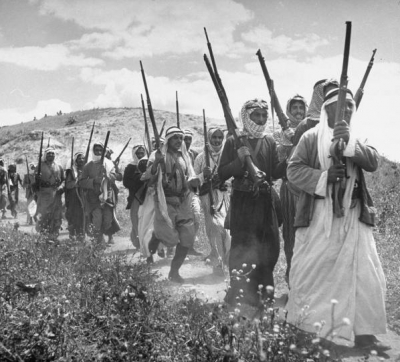
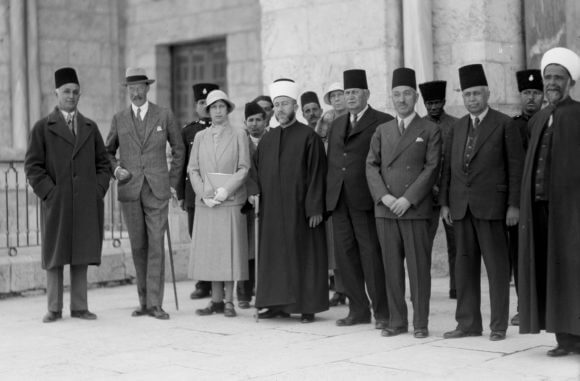
But I am likewise critical of Palestinian governance, politics and politicians. The Hamas and the PA are on the nose in their respective fiefdoms, and if a moderate “third force” were to arise – and survive, because sure as hell, they would risk being murdered – Palestinians who just want a quiet, normal life, adequate services, and opportunities for their children, and Israelis who want likewise, might – just might – reject their extremist, dogmatic, entrenched leaders and reach some form of modus vivendi.

Palestinians themselves have to take control of their own lives, kick out their corrupt leaders, cease inculcating their children with hatred and jihadism, and use all that international good will and dollars to build a viable economy that can provide jobs, opportunities, and security, economic and physical to the people. Only this way will they be inoculated against cronyism, corruption and extremism. And yet, the dead hand of a moribund, patriarchal, conservative and ethnocentric culture holds them back – but that is the subject of another, future discussion for In That Howling Infinite.

Today, the ‘powers that be’, defenders and beneficiaries of a status quo that looks more like a cul de sac, predominate over a dispiriting array of competing, clamouring factions, left, right, nationalist, secular, tribal, Haredi, and Islamist alike. New, young, brace, local voices in both Israel and Palestine, are not heard.

So what happens next?

I get that question too. And I am perennially reluctant to venture an answer beyond one that runs like “on the one hand…but then on the other”.  I inevitably fall back on Robert Fisk’s response to the same question with regard to the calamitous freezing over of the Arab Spring and the fall and rise again of the same old autocrats and tyrants: “my crystal ball is broken”. It’s a cop out, really, but just as cogent as that famous line in that UK spy drama Spooks: “What’s going to happen to me?” “Bad things!”

One thing is for sure: as songwriter Warren Zevon sang, “the hurt gets worse, and the heart get harder”.

October 8th, 2017, and 6th November 2023

The new anti-Semitism looks a lot like the old hatred

The current wave of anti-Jewish hostility did not originate with the Gaza war, and its horrors. It has been building for decades.

Anti-Israel signs are held at a Palestine rally in Melbourne’s CBD. Picture: NCA NewsWire / David Crosling

Anti-Israel signs are held at a Palestine rally in Melbourne’s CBD. Picture: NCA NewsWire / David Crosling

Since the Hamas mass terrorist attack on October 7 and Israel’s military response, we have witnessed an explosion of anti-Jewish hatred. It is frequently mixed in with legitimate expressions of support for Palestinian civilians suffering the terrible violence of a protracted conflict. The Netanyahu government’s conduct of the war is certainly a reasonable target for trenchant criticism, including by Israel’s own citizens.

The combination of these themes makes the public response to the Gaza war complex and difficult to process. For most Jews it is nothing short of a continuing nightmare.

Deep anti-Semitism has been on vivid display in certain parts of the movement leading the anti-Israel protests. This has been explicit in celebrations of Hamas and its terrorist massacre of Israeli civilians as a heroic act of resistance, together with calls for such attacks to be repeated. This has been paired with simultaneous insistence, in some quarters, that no atrocities were committed. The dual response is reminiscent of a certain type of Holocaust denial. On one hand the mass violence that the Nazis committed against European Jewry is justified as a response to the odious behaviour of the Jews, and the threat that they posed to their host societies. On the other the historical reality of the Nazi genocide is questioned, or it is denied entirely.

Shalom Lappin.

Shalom Lappin.

The New Antisemitism by Shalom Lappin

The New Antisemitism by Shalom Lappin

Some anti-Israel demonstrations have skidded into violent assaults on local Jewish communities, and harassment of Jewish students on campuses around the world. Boycotts, exclusions, and “political” acceptability tests in the academic, publishing and entertainment worlds are now common phenomena. They recall darker periods of Jewish history. No other diaspora ethnic group associated with a country run by a widely censured regime is subject to this sort of marginalisation.

When racists target Muslims, or other immigrant groups after terrorist attacks, or the misdeeds of a foreign government, broad segments of public opinion, particularly on the liberal left, defend the victims of prejudice, precisely as they should. By contrast, attacks on Jews are explained away as possibly misguided expressions of fully comprehensible outrage at Israel’s egregious behaviour.

The current wave of anti-Jewish hostility did not originate with the Gaza war, and its horrors. It has been building for decades, as indicated by the steady annual increase in anti-Semitic incidents across the globe, at least since 2000. This has now become a flood. It is the result of deeper economic and political forces that have undermined the social contract that once defined the post-war era. A sharp rise in economic inequality within countries across the world is a major factor driving the unravelling of the post-war era. The unconstrained globalisation of financial markets and trade has been largely responsible for the skewed within-country (as opposed to between-country) distribution of wealth. It is creating a cleavage of populations into a comparatively small group of wealthy beneficiaries of economic growth, and increasingly large groups of people who endure a declining standard of living and jarring social dislocation. This disaffection has provided the basis for a variety of extremist anti-globalisation movements that exploit identity politics as the focus of their reaction to the chaos and instability that is attending the collapse of the post-war order.

A pro-Palestine activist in New York. Picture: AFP

A pro-Palestine activist in New York. Picture: AFP

These movements thrive on the sense of powerlessness among electorates. This is feeding a breakdown of mainstream political institutions, which are increasingly perceived as unable to respond effectively to the pressing problems that people are contending with in their daily lives. Polarisation between far-right and far-left anti-globalisation movements has now become a defining feature in the political life of many countries, with traditional centrist parties fading into irrelevance in a variety of places. The alliance of much of the far left with radical Islamist movements (also a form of anti-globalist, identity-focused reaction) has accentuated this clash. The nature of the alliance has come sharply into view in the course of the ongoing anti-Israel protests over the past 10 months.

The far-right threat has emerged in recent European elections, in Trump’s current presidential campaign, and in the current riots sweeping the UK. It is also apparent in the authoritarian regimes that control Russia, Hungary and Turkey, as well as in Modi’s Hindu nationalist government.

Anti-Semitism is a central feature of the anti-globalisation movements of the far right, the far left and radical Islamism. This is due to the fact that it is deeply entrenched within both Western and Middle Eastern cultures. It encodes myths of power and conspiracy that provide simple, satisfying answers to complex problems in times of severe crisis. It turns on the notion that the Jews are an illicit collectivity whose continued existence as a group obstructs the realisation of the respective (and mutually incompatible) utopian programs to which each of these movements is dedicated.

Anti-Semitism was marginalised in the West during the post-war period. It has now flooded back into mainstream discourse as a potent factor in mobilising support for totalising ideologies across the political spectrum. In its capacity to cross political boundaries from right to left, anti-Semitism is a unique form of racism. To identify it properly, it is necessary to understand its history throughout the millennia that it has plagued the societies where it has taken root. It is essential to recognise its very specific expression as a reaction to the current political and social crisis. It is also important to combat it in its current manifestation, rather than through the backward-looking ideologies of the past.

For the most part the gate keepers of liberal opinion and the custodians of public discourse have simply stepped aside while anti-Jewish campaigns, often packaged as “anti-Zionism”, have been raging in their institutions. They issue pious incantations of their commitment to banishing racism, gender discrimination, anti-Semitism and Islamophobia, while doing nothing to implement this commitment in the current crisis. They take strong action against assaults on other embattled ethnic minorities and gender groups, as ought to be the case. They assume the role of neutral moderators when such attacks are launched against Jews. They frequently sanitise these attacks as an exercise of the right to free speech, even when this speech crosses into active incitement to hatred and violence.

The current wave of anti-Jewish racism is not only a threat to Jews. It is a challenge to the survival of democracy and the viability of liberal values. Political leaders are singularly failing to address this threat, and the forces that have produced it. They are largely content to step back and allow the manifestations of anti-Semitism to multiply, as long as the appearance of public peace is maintained. In fact, this peace is increasingly frayed. The extremist movements that converge on the Jews as the source of their problems have much larger agendas. They seek to transform the social order in their own image, overturning the foundations of liberal democracy.

In treating anti-Semitism as a parochial development, threatening only Jews, current political and cultural leaders are allowing large swathes of public life to be taken over by movements that are determined to overturn democracy. Recent history is littered with precedents that warn of the dangers involved in ignoring the larger threat that anti-Semitism presages. By failing to address these movements, and the deeper causes of the crisis that generated them, political and cultural leaders in the West risk repeating past historical errors that have led to disastrous consequences. It is long past time to address this issue honestly and effectively. To start to do so requires that we acknowledge the extent of the problem, and that we describe it accurately. Most people who shape mainstream opinion in the West have yet to take this initial step.

Shalom Lappin’s The New Antisemitism (Polity Books, 1 September) investigates the upsurge of anti-Jewish racism now manifest across the world

.

Getting back to the garden – Tom Holland’s Dominion

The Battle of Basildon 2011

There’s a whisper in our souls – the world has suffered long.
Beneath these skies have rolled two thousand years of wrong.
Bless This Day, Paul Hemphill
(after Edward Sears’ carol It Came Upon A Midnight Clear)

There’s a memorable scene towards the end of Martin Scorsese’s masterful adaptation of Nikos Kazantzakis’ historical novel The Last Temptation of Christ (he also wrote Zorba the Greek) in which the peregrinating proselytizer Saint Paul meets a raised and reluctant Jesus who has sought domestic anonymity in contented cohabitation with reformed hooker Mary Magdalene – or so we are led to believe, for there is more than meets the eye in this iconoclastic film (the soundtrack alone, Passion, by Peter Gabriel, is more than worth the price of admission). “I am so glad that I’ve met you”, says the pompously dismissive Paul, “and now, I can forget you”.

I thought of this scene often whilst reading British historian Tom Holland’s revelatory and wide-ranging Dominion (2019), recounting the origins and the transformative and disruptive influence of the world’s biggest faith. Saint Paul, a central character in the drama, has a lot to answer for – though the Persians, Greeks, Romans, Jews and Muslims are significant supporting actors.

Tom Holland is an erudite British historian, specializing in classical and early medieval history. I’ve read many of his books. His Roman trilogy, RubiconDynasty and his recent Pax read like thrillers, as does In the Shadow of the Sword which chronicles the rise of Islam. He’s also written on Greek and Persian classical history. Together with fellow historian Dominic Sandbrook,, he writes and broadcasts The Rest is History, an excellent podcast [Sandbrook is an informative and entertaining authority on postwar British history and society, and his quad of books on the fifties to the early eighties are wide-ranging and highly entertaining and informative – particularly so as I actually grew from boy to man in these dynamic decades.

In an earlier book, Dynasty, the saga of the Augustan caesars, Holland wrote: “The age was a rotten one: diseased, debased and degraded”. But to us, two thousand years on, it seems like it was always thus. He doesn’t shy away from criticism. All over Europe and the New World, Holland writes, “in church after church, we encounter the same fascinating admixture of the salacious, the sexual, the sadistic, and the sacred”.

We of the western world are heirs to a civilization that has for two millennia endeavoured to get back to the garden – in a continual cycle of striving for perfection and falling into to evil ways. 

Holland argues that all “western” moral and social norms are the product of what he defines as the Christian revolution, a revolution that continues to shape the modern world. Even if churches across the West continue to empty, Christian values continue to define who we are and the battles we choose to fight. In a recent interview in The Australian occasioned by the imminent arrival DownUnder of The Rest is History podcast’s roadshow, Holland refers to instincts and muscle memories that derive from 2000 years of Christianity.

Though Christianity’s spiritual roots go deeper than year one of the Christian era, it had to actually begin as it did – with believers. As American author EC Morgan wrote in her magnificent Deep South epic The Sport of Kings, “Our stories about life and death are meaningless if they aren’t shared. Community is what religious faith is all about. Believers are persistent. They refuse to forget. Without believers, the sacrifice of Jesus Christ would have been forgotten, a lost relic of history, just the story of a wandering radical with a vision for a new kingdom. It was only the witness of a community through storytelling that transformed Jesus’ tragic death into God’s ultimate sacrifice. In their rebelling, he was no longer a political dissident put to death by the state, but a hero”.

Holland is not a nostalgic Christian who reads history. At the time of Dominion’s publication, he confessed to being an atheist. Like atheists, including myself, he sways to the rhythm of a spiritual drum. He is, rather, a historian observing the influence of Christianity without making moral judgments. He says large swathes of Western modernity are having arguments within a Christian framework, often without realising it.

Even those who reject religion – those who hold to atheism, humanism, scientism, secularism, egalitarianism, feminism, and many other ‘isms, find their beliefs ineradicably shaped by Christian preconceptions, prejudices, and, indeed, superstitions. Holland writes that Christianity continues to infuse people’s morals and presumptions “so utterly that many failed even to detect their presence. Like dust particles so fine as to be invisible to the naked eye, they were breathed in equally by everyone: believers, atheists and those who never paused so much as to think about religion … perhaps the most compelling point is the way Christianity defines even its opponents. Even as the woke generation condemns Christian history as oppressive, patriarchal, racist and all the other now-standard derelictions, the standards of justice and equality by which they judge these shortcomings remain ineradicably Christian. In that sense, Holland concludes, Christendom will remain with us a while yet”.

Our conservatism, our fear of change, our contempt for “the other”, our atavistic hopes and fears, our yearning for renewal and revolution, and in the contemporary argot, our political correctness and value signaling, even – our love for our neighbour and our intolerance of his and her resistance and reticence, doubt and difference, our hostility and our hubris, our ethnocentrism and our ecumenism, all spring from the same source: that lowly stable in a satellite suburb of Jerusalem, in the Roman colony of Judea two millennia ago. O Little Town of Bethlehem, how still we see thee lie

In his interview with The Australian, Holland said that at the centre of social movements of the ’60s and onwards, from civil and gay rights to the more recent Black Lives Matters and #MeToo is “Christ’s great promise that the last should be first”.

“The 1960s will come to be seen as a decade as significant for Christendom as the 1520s. We are living through a process of moral and ethical and, indeed, theological change comparable to the Reformation in the 16th century. And the idea of reformation, the idea of casting off superstition, idols, opening yourself to the spirit. You get that in the 1520s, and you get that in the 1960s. The difference in the 1960s is that what is being cast off is essentially what you might call a conservative Christian understanding of how society should function, going to church, experiencing liturgies, Sunday schools, familiarity with the Bible.”

There is, he continues, “a kind of Christ-shaped hole in our public culture. And George Floyd kind of filled that gap for that summer of 2020 … Two thousand years of Christian sexual morality had resulted in men and women widely taking this for granted. Had it not, then #MeToo would have had no force”.

Again, Holland makes no judgment about this. He is simply observing that Christianity explains “woke­ism”, whatever that portmanteau word might mean to the mind of the beholder. Not to mention our polarized and argumentative modernity.

Whatever Holland’s own spiritual beliefs – in Dominion he is quite discreet – there is a curious dualism, disconnect even, in the manner in which Dominion has been presented to its prospective readership. On the one hand, it is offered as an essentially humanistic tract linking the rise and rise of Christianity with humankind’s eternal striving for perfection of a sort. When I bought the book, it this aspect that drew me to it after reading the reviews I republish below. And yet, as illustrated by its two distinctively different covers, it has also been deliberately targeting a Christian market. here they are, the opaquely secular and the transparently sacred.

But, back to Dominion.

The reviews below provide an excellent overview of the scale and achievement of Holland’s project. I see no reason to compete with them. but I must add that I was mightily impressed by the literal cast of thousands he assembled to tell his story. There are many surprising and entertaining but always pertinent segues, from Adam to Zarathustra (of Nietzsche fame), with cameo appearances from a long-dead famous white men, iconic persons of colour like Martin Luther King, Nelson Mandela and Desmond Tutu, some most impressive women, and contemporaries as diverse as Harvey Weinstein, Margaret Atwood and Angela Merkel. There is a cornucopia of texts from Job’s tears to John Lennon’s Imagine, a connecting of movements and zeitgeists from crusaders to slavery abolitionists to #MeToo, from the protestant reformation to revolutions political and social, and a globetrotting, time-shifting odyssey from Megiddo to Mordor, the Crucifixion to California Dreaming.

Surprisingly, the Bard of Avon doesn’t earn a guernsey. You won’t find him in the glossary. It was after all he who held up a mirror to our humanity, and who is in his turn held most highly in the canon of our Anglosphere. Is it because there was no room at the inn? Because that rundown inn in that little town of Bethlehem, is the alpha and omega, the hopes and fears all our years, and they abide with us still.

And by us, I also include myself. My father was an Orangeman from Ulster, and my mother, a Catholic from County Wexford. I was born in Birmingham, England, baptized as a Catholic, and raised as a Catholic. I was educated in the British cultural milieu, with Roman Catholic teaching and thinking, but received prodigious input from a British upbringing and an education in an English grammar school grounded in the Church of England and replete with the history of invasions, civil wars, reformation, revolution and empire.

 All these laid the bedrock of my spiritual and cultural identity. Much of this was inherited from “priest-ridden Ireland” and its centuries of resistance to the Sassenach (Saxon, that is) overlord, from whence I acquired most of my DNA and to which I ascribe to myself (a subjective thing and not for others to judge) a Celtic soul and a rebel heart.

“Once a Catholic, always a Catholic” they used to say to me when I’d declare that I’d given up practicing when I was good enough. That was not long after my confirmation by the Archbishop of Birmingham in St Chad’s Cathedral. There was no great epiphany. No revelation from the sea of unknowing. I remained in a Catholic scout troop and participated in church parades and attended mass of a Sunday to pleased my mother. I just kind of slip slided away, and then came the sixties with its Marx and music, and all the rest: the sights, sounds, sensibilities and substances of that generous decade …

But, as my songs and stories and politics attest, like Holland, I’ve not ventured all that far from the mother ship.

As a parting disclaimer, I am named not for Saint Paul but for the acclaimed American socialist and singer Paul Robeson.

Lord of the starfields
Ancient of Days
Universe Maker
Here’s a song in your praise
Bruce Cockburn

We are stardust
Billion year old carbon
We are golden
Caught in the devil’s bargain
And we’ve got to get ourselves
Back to the garden

Joni Mitchell, Woodstock

Featured picture: Dale Farm – The Battle of Basildon 2011

© Paul Hemphill 2023 All rights reserved

Postscript

By 2025, Tom Holland has openly returned to the Christian fold, as have many prominent intellectuals, including historian Niall Ferguson, or converted like and his wife, activist and author Ayaan Hirsi Ali who was formerly a Muslim. The reasons why such thinkers seek the transcendent in their later years is beyond the remit of this review, though Holland admits to having been wrong about Christianity, that his spiritual quest led him to Dominion. now come to see Christianity as the story of power willingly spent on behalf of the vulnerable; strength deployed to protect the weak, power that is used to take the vulnerable off of crosses, rather than put them there. https://theopolisinstitute.com/tom-holland-and-the-liberating-power-of-christianity/

As for myself, I still hear the thrum of that spiritual drum, but even though I head for that inevitable final exit and the “great unknown”, I do not hear the call of the numinous. I was unexpectedly presented with an opportunity to contemplate this recently when old friend of my own age shared with me the story of how he’d taken the hallucinatory drug mescaline for the first time in a bucolic Welsh setting in 1972:

“I had an experience of enlightenment, of self-discovery, that transformed my understanding of the world. I realised that all is one, and that this One is what ‘I’ am – an unborn, undying, eternal, formless Reality – that is all that exists and all that has ever existed – and that this world of form that we perceive is nothing other than this formless Reality. This experience led me down the path of spiritual search from that moment on. Scriptural writings like the Upanishads which had previously seemed obscure and impenetrable suddenly became dazzlingly clear to me as I realised that their writers were describing the experience I had just had myself. I found numerous teachers who were describing the same experience and showing a path to discover it. I felt a particular affinity for the teaching of the South Indian guru Ramana Maharshi, but also found my experience reflected in the teachings of the Sufis and the Zen masters”.

Though I too had taken mescaline and acid in the late sixties, I did not travel down such paths. “For whatever reasons”, I wrote him back, “nature, nurture or narcotics, I’ve never experienced anything like what you describe, nor, for good or ill, have I sought it. Transcendence is something I read about but have never encountered, although I might’ve got a hint of it momentarily in the Taj Mahal when I was high on speed (to keep me awake on overnight train Indian journeys). Maybe that might explain my perspective on history, politics, society and culture, and life, even. Matter of fact. Hard-boiled. Blunt. Brutal even. Quizzical, yes. Cynical, certainly. Your favourite song of the seventies is probably John Lennon’s Imagine. Mine is more like David Bowie’s Life on Mars”.

See also in In That Howling Infinite: The Rest is History – a gift that keeps on giving ; O Little Town of Bethlehem, how still we see thee lie

Barney Zwartz, Sydney Morning Herald November 15, 2019
Caravaggio's The Crowning with Thorns.

Caravaggio’s The Crowning with Thorns.

This huge and sweeping account of the past 2500 years has a similarly large-scale ambition: “to explore how we in the West came to be what we are and to think the way that we do.” And his argument is compelling: even those who reject religion – those who hold to atheism, humanism, scientism, secularism – find their beliefs ineradicably shaped by Christian presuppositions.

Holland writes that Christianity continues to infuse people’s morals and presumptions “so utterly that many failed even to detect their presence. Like dust particles so fine as to be invisible to the naked eye, they were breathed in equally by everyone: believers, atheists and those who never paused so much as to think about religion.”

Holland explores the influence of the world’s biggest faith.
Holland manages to traverse Western history from the Persian invasion of Greece in 480BC to Donald Trump by the technique of taking some often-obscure figure or event and expanding from that to social transformation. So he leaps from the Apostle Paul, herald of a new beginning, to church fathers Irenaeus and the development of the canon, Origen and the invention of theology, the council of Nicaea, Martin of Tours and the exaltation of poverty, and Bede and a calendar based on the birth of Christ.

Perhaps Holland’s most important contribution is to lay waste the secularist founding myth that reason, empiricism, evidence, humanism and the like emerged in the Enlightenment fully formed like Botticelli’s The Birth of Venus, not only owing nothing to the preceding centuries but indeed in contrast to them.

Holland, an atheist, is no apologist for Christianity but is honest enough to acknowledge that his values and world view emerged from Christianity rather than pagan antiquity.

Take human rights, a key concept in modern law and ethics. Rights are by no means self-evident or inalienable, as the US Declaration of Independence states, and would have attracted contempt in pre-Christian societies such as ancient Rome or China.

Rights’ essential precondition is the Genesis teaching of humans made in God’s image, and therefore endowed with dignity and worth. It led Gregory of Nyssa in the fourth century to rail against slavery and abandoning unwanted infants on rubbish heaps and was made explicit by 11th-century canon lawyer Gratian, who pronounced that everyone was equal in the sight of God. Anything in the legal system obstructing this idea had to go.

“Much flowed from this formulation that earlier ages would have struggled to comprehend. Age-old presumptions were being decisively overturned: that custom was the ultimate authority; that the great were owed a different justice from the humble; that inequality was something natural, to be taken for granted,” Holland writes. In 1550 Bartolome de las Casas demanded justice for South American Indians, using the term “derechos humanos”, human rights. The genius of the authors of the US Constitution 200 years later was to garb in the robes of the Enlightenment the radical Protestantism that shaped the fledgling nation.

Darwin, in contrast, pointed out how unnatural such a concept is in the light of evolution, observing that “philanthropy and care for the poor must be highly injurious to the race of man”.

And today the insistence of the United Nations and others on the antiquity and broad acceptance of human rights is a fiction to allow it to be a global rather than merely a Western understanding. Secularism, in an identical manner, depended on the care with which it covered its tracks, Holland says.

The idea of the secular, contrasted with the religious, is an important theme of the great fourth-century theologian Augustine, in The City of God, and reaches fulfilment in the humiliation of Henry IV before Pope Gregory in 1076, which divided the religious and secular realms (giving the Church great power in both).

So embedded is it that nearly a millennium later German chancellor Angela Merkel appealed to it in 2014 to claim that Islam belongs as much as Christianity in modern Germany. So it may, but not because traditional Islam admits the idea of the secular, a notion born purely from Christian history. To Islam, it is an artificial divide. But, as Holland notes, the West has become skilled in repackaging Christian concepts for non-Christian audiences.

The idea that science needed to set itself free of dogma and superstition, possible only in the Enlightenment, is another fiction that can be believed only by those ignorant of history. Holland turns to Abelard – the ill-fated lover of Heloise – who devoted his post-castration life to promoting the idea that God’s order was rational and governed by rules that humans could seek to comprehend. His conviction that identifying the laws that governed nature would honour the God who made them led to the founding of universities in the 12th century.

Similarly, humanism has smuggled in Christian assumptions unacknowledged. Without the biblical story of creation in God’s image, the reverence of humanists for their own species “risks seeming mawkish and shallow”. Indeed, philosophers such as Peter Singer have attacked such notions as “speciesism”.

And the claim in the Humanist Manifesto that morals can be developed from science is another fantasy. “The primary dogma of humanism – that morality is an intrinsic part of human nature based on understanding and a concern for others – found no more corroboration in science than did the dogma of the Nazis that anyone not fit for life should be exterminated,” Holland writes. “The wellspring of humanist values lay not in reason, not in evidence-based thinking, but in history.”

An interesting thesis is that those who most truly understood Christianity’s radical role were those who most despised it, and here Holland cites Nietzsche, the Marquis de Sade, Thomas Huxley and Heinrich Himmler. Nietzsche thought Christianity a slave morality, a way for the weak to bind the strong, but also recognized its values could not survive without the God who sanctioned them. Himmler, who had a 50-year plan to eradicate Christianity, believed the strong had both a duty and obligation to eliminate the weak.

Holland acknowledges that the course of Christianity has been a mixed blessing. Christians have indeed been oppressors and exploiters, although the backlash against that has also been Christian. He details many embarrassing aspects, from crusades to corruption, and especially the totalitarian idea of truth that justifies persecuting those who differ. The heresy hunters of the inquisition survive today in the self-righteous “woke” fanatics, who no longer have the power to burn people at the stake but try to end careers, ruin reputations and close down discussions.

This is an astounding book, not only for its scope – cultural, political, social, intellectual, historical – and its originality, but for its masterly writing. Holland has a knack for the colourful twist. Writing of the summer of love, 1967, he notes: “Preachers, seen through the marijuana haze of a squat in San Francisco, had the look of bigots. Where was the love in short-haired men jabbing their fingers and going puce?”

He also has an eye for fascinating detail. For example, we owe capital letters and question marks to the abbot Alcuin of Tours, adviser to Charlemagne in the eighth century, who did a vast amount to popularize the Bible as a single source of revelation.

But sometimes Holland is a bit too graphic to be comfortable. His detailed discussion of death by crucifixion is stomach-churning; still more so the Persian punishment of the scaphe, in which the victim is trapped inside a log but for his extremities, covered in honey, and devoured over days by insects and maggots from within. Believe me, Holland’s account is horrifically more detailed.

In an enterprise as vast as Dominion, there are inevitably lacunae. Critics have observed that Holland underplays the role of Eastern Orthodox Christianity and the rise of trade, but the book is already nearly 600 pages. Another occasional weakness is that Holland’s narrative style means that he may pass over contested aspects of history to stick with his main line, though footnotes can redeem him.

For me, perhaps the most compelling point is the way Christianity defines even its opponents. Even as the woke generation condemns Christian history as oppressive, patriarchal, racist and all the other now-standard derelictions, the standards of justice and equality by which they judge these shortcomings remain ineradicably Christian. In that sense, Holland concludes, Christendom will remain with us a while yet.

Barney Zwartz is a Senior Fellow of the Centre for Public Christianity.

The legacy of Christianity

An absorbing survey of Christianity’s subversive origins and enduring influence is filled with vivid portraits, gruesome deaths and moral debates

Holland might also have pointed out that the ancient Romans reserved crucifixion mostly for political rebels. Jesus may not have been a Lenin, but it might have suited the Jewish leaders to persuade Pontius Pilate, the Roman governor, that he was. He would certainly have knocked around with Zealots, the anticolonial revolutionaries of the day. A few of his disciples were probably paid-up members of the group, as (probably) were the two so-called thieves between whom he hung on the cross. Pilate wouldn’t have needed much convincing to reach for the hammer and nails. Contrary to the gospels’ portrait of him as a kind of Guardian-reading liberal, reluctant to use his power and bemusedly in search of truth, the historical Pilate was a moral monster who would have crucified his own grandmother, and who was finally dismissed from the imperial service for corruption.

Despite these omissions, Dominion packs an astonishing amount of stuff into its 500 pages on Christianity’s enduring influence. Holland has all the talents of an accomplished novelist: a gift for narrative, a lively sense of drama and a fine ear for the rhythm of a sentence. He also has an intense, sometimes rather grisly feel for the physical: the book is resonant with the cracking of bones, flaying of flesh and shrieks of small children tossed into fires. Some of this was inflicted on Christians, and some of it inflicted by them.

Rather than unpack complex theological debates, the book gives us a series of vivid portraits of some key figures in Christian history: St Paul, St AugustinePeter Abelard, Catherine of Siena, a former playboy known as Francis of Assisi and a host of more modern luminaries. Yet this is not just a galaxy of Christian superstars. They are all embedded in their historical contexts, as the book moves from Caesar Augustus to the #MeToo movement. There is even a medieval forerunner of feminism in the figure of the Milanese noblewoman Guglielma, who announced that she was the Holy Spirit made flesh for the redemption of women, and with engaging modesty baptised them in the name of the Father, the Son and herself.

Other intriguing details abound. When Notre Dame was being built in medieval Paris, a collective of prostitutes offered to pay for one of its windows and dedicate it to the Virgin Mary. Followers of Satan around the same time were obliged to suck on the tongue of a giant toad and lick the anus of a black cat. Galileo had a craving for celebrity and was an inveterate social climber. Yet, though the book is full of such titbits, there is a seriousness at its heart. Holland argues that all “western” moral and social norms are the product of the Christian revolution. He is haunted by St Paul’s claim that God chose the weak and foolish things of the world to shame the strong, and to drive the point home he might have looked at the beginning of Luke’s gospel. We encounter there an obscure young Jewish woman called Mary who is pregnant with Jesus, and Luke puts into her mouth a cry of praise that some scholars believe is a Zealot chant. It speaks of how you will know who God is when you see the poor coming to power and the rich sent empty away. It is this which must be weighed in the balance against the killing fields of Christendom.

Louis IX en route to Egypt, leading the Seventh Crusade.
Louis IX en route to Egypt, leading the Seventh Crusade. Photograph: Alamy

So, too, must the notion of love. This book is full of saints and martyrs selflessly devoted to others. Yet what distinguishes the Judeo-Christian idea of love from the romantic, erotic, touchy-feely sense it has acquired in modern times is that it has nothing to do with feeling. Love for the New Testament is a social practice, not a sentiment. How you feel about the person whose place you take in the queue for the gas chambers is neither here nor there. You don’t even have to know him. Only a love of this ruthlessly impersonal kind, which couldn’t care less about the gender, rank, skin colour or personality of whoever needs your help, could prove equal to what St John darkly calls the powers of this world: Trump, PutinBolsonaro and their lackeys.

You can, however, make a fetish or idol out of anything, as Freud instructs us. Such false gods fill every chapter of this illuminating study. Yet Holland is surely right to argue that when we condemn the moral obscenities committed in the name of Christ, it is hard to do so without implicitly invoking his own teaching.

Terry Eagleton is a literary critic, writer and chair in English literature in Lancaster University’s department of English and creative writing. His latest book is The Event of Literature