Between heaven and hell … Syria at the Crossroads

There are moments in the Middle East when history suddenly shift gears and takes us all by surprise. Lenin knew the cadence: there are decades, he wrote, where nothing happens; and then, weeks in which decades happen. A year ago, Syria – trapped in the vortex of its civil war for almost fourteen years  and virtually ignored by the rest of the world since October 7 2023 – suddenly leapt into one of those crazy weeks, leaving allies, enemies, and analysts alike blinking in the dust. Even now, a year after the astonishing fall of Damascus, the country sits like Kipling’s Tomlinson at the gates of judgement: not quite damned, not fully redeemed, suspended between heaven and hell.

Sleepers awake …

For years, as The Independent’s Bel Trew observed last December (see Syria. Illusion, delusion and the fall of tyrants) the world forgot about Syria – notwithstanding the courageous efforts of western and Syrian reporters and humanitarian workers who strove in perilous circumstances to bear witness. The civil war had become the background hum of the region, a grim drone many had learned to tune out as Ukraine and Gaza dominated the world stage. The regime of Hafez al Assad, brutal and immovable, bolstered by Russia, Iran and Hezbollah, looked set to endure indefinitely. The jihadi rebel enclave in Idlib, though supported by Türkiye, was dismissed as a besieged hold-out. Even those who professed expertise couldn’t reliably tell you whether the war was still ongoing, who was fighting whom, or what stage the conflict had reached. It was as if the wheels of war had stopped spinning.

Then, over the space of days – eleven, to be precise – the wheels spun again. Hay’at Tahrir al-Sham’s fighters burst from their confined redoubt with a momentum no one expected (including, it seems, themselves), sweeping through Aleppo and racing down the highway to the capital. Analysts reached instinctively for historical parallels: Havana 1959, Saigon 1975, Kabul 2021. Analyst David Kilcullen pointed instead to Timur Kuran’s theory of the “preference cascade”: the sudden collapse of a regime that had mistaken silence for loyalty and compliance for consent. Assad’s security apparatus – omnipresent, omniscient, yet somehow oblivious – realised too late that its soldiers had no stomach left for the fight. The all-powerful giant had feet of clay.

It didn’t help that Iran, Assad’s indispensable patron, had stumbled into the most grievous strategic miscalculation of its post-1979 history. Flush with revolutionary zeal, Tehran had kicked the hornet’s nest in Lebanon, prompting Israel to pivot from Gaza to Hezbollah with stunning force. Suddenly Iran’s expeditionary assets were exhausted, its proxies over-extended, and its clerical leadership exposed as both ageing and isolated. Even the Ayatollah’s conspiratorial refrain – that the fall of Damascus was all a plot by the Great Satan, the Little Satan, and the Sultan in Ankara – couldn’t mask the fact that this was less Zionist cunning than simple imperial overreach. When the rebels came, neither Iran nor Hezbollah, nor Russia, entangled in its Ukrainian quagmire, could ride to the rescue.

But the rebels, too, were surprised. Their mandate from Ankara was modest – expand the borders of their statelet a little, test the regime’s nerve. Instead, they found themselves virtually unopposed on the road to Damascus.  In an Informative article in E-zine Unherd republished below, British writer and investigative journalist Tam Hussein  writes how many of the fighters interpreted the victory as divine intervention – not jihadi zealotry, but a sincere theological attempt to explain the inexplicable. The suddenness of Damascus’s collapse felt, to them, like an echo of Muhammad’s bloodless conquest of Mecca. And in a land where the eschatological imagination has always saturated politics, it didn’t take long before social media brimmed with end-times speculation. Ahmed al Shara’a – formerly Abu Mohammad al-Jolani, with a $10 million American bounty on his head – was seen by some as “the one”, and the precursor of the Mahdi and the foretold end of days.

Yet as Hussein rightly notes, miracles make poor policy. The survival of the new Syrian administration will depend not on prophecy but on governance, and on whether Shara’a, interim president and ex-jihadi turned statesman, can transform a miraculous seizure into a sustainable state.

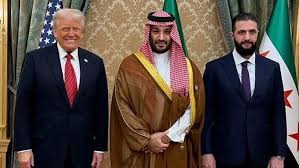
To his credit, he has avoided the catastrophic purges that helped destroy post-invasion Iraq. He has kept the civil service intact, flirted audaciously with Western diplomacy, and allowed at least the theatrical semblance of elections. He has restored the embassy in London, opened channels to Washington, even  visiting the White House  and played the charm-game with Gulf capitals that only recently readmitted Assad into their fold. As Hussein writes, he has shown political finesse: keeping the constitution, appointing seventy parliamentarians himself, and balancing piety with pragmatism.

But the tightrope is frayed. Sectarian wounds – Druze, Alawite, Sunni, Christian – remain raw and unstitched, with the Latakia massacres now entering their fraught judicial phase, and Israel stirring the Druze pot. Kurdish anxieties simmer: the old “Arab-first” chauvinism must be abandoned if Syria’s patchwork is ever to become a tapestry again. Foreign fighters, once lionised, now loiter between hero and hazard, implicated in sectarian atrocities. Kurds clash with Syrian forces; Turkish troops press deeper into Rojava; Israel remains the unpredictable neighbour bestride the Golan; and Iran, though weakened, is never entirely out of the game. It is not inconceivable that the forces that helped topple Assad could yet turn their sights toward Jerusalem in the belief that prophecy demands it.

And there are darker portents too – those flickering shadows that hint the wind of freedom may be blowing from the wrong quarter. The new government’s early gestures toward Islamisation – the hair-covering admonition, the curriculum purge, the dismissal of women from key posts, the torching of a Christmas tree in Hama – suggest that pro-Russia and anti-western platforms like RT and Mint may have a point when they warn that the leopard has not fully changed its theological spots. Shara’a’s declaration that elections may be four years away, the dissolution of the old constitution, and the folding of all rebel factions into state structures recall less a liberal transition than a consolidation of revolutionary power.

Meanwhile, the country remains a mosaic of mini-wars. In the north, Turkish proxies grind against Kurdish forces in Rojava. In the south, local militias continue to resist HTS’s claim to national authority. In the west, Alawite formations cling to their shrinking redoubts. To the east, Islamic State survivors eye the chaos, waiting for the prison gates to break. And overhead, as ever, the Americans and Israelis fly their competing deterrents, ensuring the war never quite ends.

So: Syria stands at the crossroads. Will Syria’s future be heaven, hell, or merely another circle of the inferno?

Optimism is possible – cautiously so. If the West can avoid its habitual fatalism, if, when sanctions are lifted, investment flows, if Turkey and Israel can be coaxed into tolerable coexistence, if Kurdish autonomy is honoured, if sectarian grievances are handled with equity and not vengeance — then Syria could, in time, become a conservatively stable hub. Shara’a’s Idlib experiment shows he can build an economy under duress.

But the inverse is equally imaginable: a Lebanon-style implosion, a Yugoslav-style partition, or a Gaza-style fortress of permanent mobilisation. As Isreali commentator and contributor to Haaretz Zvi Bar’el wrote a year ago, writes, the warm international “envelope” around Damascus is generous but tentative. Nobody quite knows where Shara’a is heading. They simply assume anyone is better than Assad – the same mistake Syrians once made about the old Ba’athi patriarch Hafez al-Assad himself.

Right now, the future’s not ours to see. Something’s happening, but we don’t know what it is, and anyone with a deep knowledge of the Middle East knows that one must expected the unexpected. The old regional wars – Gaza, Lebanon, the Red Sea, Iran’s Axis of Resistance – though seemingly on hold, have not paused to let Syria breathe. The war in Ukraine grinds into winter, the bizarre Gaza peace plan shuffles on, and there are constant political shifts in Washington. Each of these could rewrite the geopolitical chess board yet again.

Still, as Robert Fisk wrote in the final line of the final book he never lived to promote: all wars come to an end, and that’s where history restarts. Syria is restarting now – painfully, precariously, imprecisely –  but restarting nonetheless.

Whether Syria walks toward heaven or hell remains to be seen. The choice –  as ever in the Levant – will not be its alone.

Syria Today: Walking Through the Wreckage

A year after the Assads fell, Syria still moves through its own ruins – startled by its freedom, and half-afraid of it. The dynasty’s collapse ended the nightmare but did not usher in a dream; it simply exposed, in unforgiving daylight, the damage done over half a century of dictatorship and more than a decade of war. The smashed cities are visible to any passer-by; the deeper wreckage – the traumas, resentments, and debts of blood – is harder to map and harder still to mend.

Sednaya prison’s opened gates remain the sharpest indictment. The men who stumbled out were not just survivors but witnesses, their bodies forcing the nation to acknowledge what many had whispered and few had dared investigate. Yet even this reckoning has not united the country. Sectarian reprisals and atrocities on the coast, more atrocity and calls for Druze autonomy demands in Sweida, tribal restlessness in the south and northwest, Kurdish self-rule in the north, and Alawite fear of collective punishment keep the national psyche taut and divided. Bitterness circulates like a second economy.

The economy, meanwhile, balances on a fraying tightrope. Western aid and investment have brought cranes, reopened highways, and a flicker of commerce, but also inflation that is hollowing out households. Reconstruction glimmers like a desert mirage: real enough to chase, never close enough to touch. Corruption accompanying nepotism and patronage has survived the revolution, and many returnees discover that rebuilding a home now costs more than earning one.

Politically, the country sits in an improvised equilibrium. Al Shara’a rules as both liberator and question mark – trusted by some, tolerated by others, watched by all. His pivot toward Washington, his quiet coordination with US forces, and his break with former comrades offer a new direction, but also a gamble. Around him, sovereignty is nibbled at the edges: Israel digs deeper into Quneitra province; Türkiye tightens its grip in the Kurdish north. Liberation has shifted the map without fully restoring control over it.

So Syria stands on the threshold, like Tomlinson, neither damned nor redeemed, simply called to account. The war is over, but its aftershocks and tremors linger in regional loyalties, local vendettas and regional manoeuvres. The people are free, yet unsure of that freedom’s limits and what it asks of them. And the vast machinery of the state still creaks with old habits and temptation.

And yet – a small, highly qualified yet – Syrians are imagining a future again. Not the predetermined script of dictatorship, nor the fatalism of war, but something open, negotiable, theirs’. For a people long told that nothing changes, the mere possibility of change is its own quiet revolution. Hope is not guaranteed; neither is stability. But the impossible has already happened once, and that alone shifts the horizon.

Postscript: the strange, messianic weather of revolutions

Among the HTS fighters Tam Hussein describes, the astonishingly swift and almost bloodless collapse of Damascus could never be reduced to battlefield arithmetic. After over a decade of stalemate and slaughter, the conquest of Damascus and the fall of Assad felt too abrupt, too neat, too historically implausible to be merely human. And so they reached, perhaps instinctively, for the vocabulary of prophecy that has long circulated in the Levant: the old stories of tyrants toppled in the final days, of a just ruler rising at history’s eleventh hour, of a brief season of peace before a climactic confrontation with “the Romans,” a term that in popular imagination now stretches elastically to include Israel, America, or the West at large.

In this folk-level cosmology – not the carefully parsed doctrine of scholars, but the lived, emotional scripture of men who have lived too long fear, death and loss loss – the victory in Damascus reads like a prophetic epic ballad. When a fighter told Hussein that Syria would enjoy “ten years of peace before the war with Israel,” he was drawing from a hazy amalgam of hadith traditions and battlefield folklore to make sense if the improbable: the idea of a lull before the storm, a breathing space before the world tilts into its final reckoning. It is vernacular eschatology, shaped as much by trauma and longing as by text.

Within that register, the murmurs that Shara’a/Jolani might be “the one” carry an unmistakable Mahdist echo. No fatwas or proclamations like when Da’ish leader Abu Bakr  al-Baghdadi famously declared the caliphate from the minbar of Mosul’s al-Nuri Mosque in 2014; but the emotional charge behind the phrase is unmistakabl: an intuitive reach for a Mahdi-shaped idea of the righteous restorer, the unifier, the man who appears when everything has fallen apart. It’s not that anyone literally thinks Jolani is the Mahdi; it’s that the mood of the moment makes such thoughts feel briefly within arm’s length. A silhouette on the horizon, nothing more.

And here, Syria is not unique. Revolutionary periods everywhere – the Protestant Reformation, the French Revolution, the Russian Revolution and Civil War, the Arab Spring even, have their magical phase — those jittery days when people begin to speak as if the world has cracked open, meaning is pouring through the seams, and events blur into myth. When a regime that seemed immovable collapses in a fortnight, people fall back on stories larger than themselves. Sudden upheaval, long suffering, and the ascent of a charismatic figure combine to crack open the ordinary world. Prophecy offers a narrative frame when history seems to be behaving like fable.

So the eschatological edge in these fighters’ conversations tells us less about doctrine and more about psychology. It’s a very human response: a form of magical thinking that arises when reality becomes too strange to process, a way of giving shape to chaos, of telling themselves that their suffering fits into a larger story. A coping mechanism, if you like –  a mythic vocabulary for a moment when Damascus fell, and the ordinary rules stopped making sense and the earth seemed briefly to tilt on its axis.

See also in In That Howling Infinite, Syria. Illusion, delusion and the fall of tyrants and Cold wind in Damascus – Syria at the crossroads. And  on the subject of messianism in general, see A Messiah is needed – so that he will not come

Will civil war return to Syria?

Its future is in the balance

Tam Hussein, Unherd December 8, 2025

A few months ago in Damascus, I discovered a medieval hospital. The door had been left slightly ajar, and I wandered in with my companion Hassan Idlibi — a rebel fighter and old friend. He hadn’t been in the Old City since the fall of Syria’s capital, exactly a year ago today. “When Damascus fell,” he told me, “we were at our lowest ebb. Even the attack on Aleppo was our last gasp. We wanted to break the stalemate. And then we just pushed and pushed, and we ended up sleeping inside the Umayyad Mosque. It was a miracle.”Idlibi, like many Syrians, did not interpret the taking of Damascus through geopolitics — but as divine intervention. This wasn’t because he was a mindless zealot. Far from it. He is one of the most well-read men I know. But, to his mind, the fall of Damascus was so sudden, so unexpected, that only the miraculous could explain it. The victory, he noted, had been achieved by those who had been motivated by Islam. Help had come from foreign fighters, the mujahideen, who travelled from across the globe to aid their co-religionists. And the campaign had been led by a former jihadi, Ahmed al-Sharaa, now the interim president of Syria. At the time, the old al-Qaeda operative, then known by his nom de guerre, Abu Mohammad al-Jolani, had a $10 million American bounty on his head.

After more than a decade of slaughter, no one had expected the capital to collapse. Assad, then president, had seemed like a stubborn wart: unpleasant but immovable. Jolani’s rebel enclave in the northern city of Idlib looked too small, too besieged, to pose a serious threat — though in fact it was performing better economically than inflation-ravaged Damascus, helped along by a reliable flow of Turkish hard currency. I myself expected the rebels to negotiate. What leverage did they have? Yet this rebel government, roughly the size of Croydon, took over the instruments of state, and since then has avoided stumbling into a new civil war.

The unexpected and largely peaceful victory was attributed to piety, prophecy, steadfastness. Some have even compared the final conquest of Damascus to Muhammad’s bloodless conquest of Mecca in 630. The idea of a “miracle”, here, is not mere rhetoric — it shapes political expectations. Some Syrians, at least based on my social media, think all this makes Sharaa “the one”, with my Facebook messages and WhatsApp chats awash with prophetic readings of the present. One believed Syria would now enjoy 10 years of peace before the war with Israel begins. Perhaps, he suggested, this was the prelude to the end of times. After all, so-called “Greater Syria” — encompassing much of the Levant — plays an important role in the Syrian and indeed Muslim sacral imagination. It is where prophets walked and is the place where many of the end of times narratives will play themselves out.

Yet if the fall of Damascus seemed miraculous to many Syrians, the survival of the new administration will depend less on providence than on governance. Despite his past, Sharaa has so far demonstrated an unexpected level of political finesse. He has kept the constitution, held elections — albeit with 70 seats appointed by himself — and all the while has acted the statesman. He is savvy enough to not mind having President Trump spray his latest fragrance on him in the Oval Office, or Syrian Jewish rabbis blessing him.

Sharaa has made some promising early decisions. By keeping the civil service intact, he has avoided the catastrophic purge that helped destroy post-invasion Iraq. He should continue recruiting highly-educated young Syrians from the diaspora — people familiar with Western administrations and political norms. Even so, the administration still has a tendency to fear scrutiny and behaves as if under siege. It should welcome a regulated free press, which would expose blind spots, not undermine authority. The British press has reported that Jonathan Powell’s Inter Mediate is working with the new government. This should be welcomed rather than criticised — not only for reasons of conflict resolution and soft power, but for its value in statecraft and building institutional capacity.

Sharaa’s priorities for the coming year are clear. The country remains immensely fragile, caught in a regional tug-of-war between Israel and its neighbours, and divided along ethnic and sectarian lines. The situation could easily drift into a reprise of Lebanon’s civil war. Sharaa’s first task is therefore to mend Syria’s sectarian and ethnic fractures with a sense of equity. The trials that began this month over the coastal massacres in Latakia will be an important test of how the country intends to move forward. The Druze and Alawite communities — already bruised by conflict and mistrust — require justice delivered without the language of sectarianism.

Meanwhile, Kurdish anxieties must be addressed by ending the Arab-first ideology of the old regime. Syria has never been a purely Arab country: even its favourite son, Saladin, the builder of that hospital I visited and whose grave in Damascus still draws multitudes, was a Kurd. Last year’s tentative permission for Kurdish new year celebrations (Newroz) suggests that a more pluralist future is possible. Yet it remains unclear how far Kurdish cultural expression will be allowed to develop. Already this month, exchanges of fire between Syrian government forces and Syrian Democratic Forces (SDF) units under Kurdish command show how fragile the situation is.

Perhaps the most difficult balancing act involves the foreign fighters who fought on Sharaa’s side. They carry immense symbolic weight in Syrian society — and are the cause of immense fear in the West. Many are ready to resume normal life, but others still see themselves as Islam’s warriors. Recent clashes in the Idlib countryside involving French foreign fighters reflect anxieties that any rapprochement with the West might see them handed over to their home governments. The image of Sharaa standing beside Trump, receiving a symbolic “anointing” of his new fragrance, alarms them even if such engagement is politically necessary.

Granting these fighters legal status, regularising their papers, integrating some into the national army or demobilising them with stipends and educational opportunities — not unlike the GI Bill for US veterans — could go a long way toward neutralising one of Syria’s most volatile pressures.

Then there is the conundrum of Israel. On this, Sharaa has cultivated deliberate ambiguity. At the United Nations, Syria has repeatedly noted its restraint regarding Israel’s illegal strikes on Syrian territory, yet Sharaa has resisted pressure to join Trump’s flagship Abraham Accords. Signing them now would be political suicide. But ambiguity buys him room to manoeuvre — and time to consolidate the state. The question is how long this can last.

For its part, the West has worked to prevent Syria from sliding into another civil war — one that would inevitably spill over into Europe, potentially replaying the exodus of 2015. With regional partners like Saudi Arabia and Turkey, Western governments have effectively restrained Israeli escalation, aware that renewed instability would eventually reach Jerusalem’s door. It’s not impossible to imagine rebels, having overthrown a “pro-Western stooge” like Sharaa and aided by foreign fighters, actually marching toward Israel, convinced that “the infidels” will never allow them to determine their own future. As they did in Damascus, so too — in their imagination — must they do in Jerusalem.

Thus far Sharaa has governed with surprising openness. He has welcomed Britain’s foreign secretary David Lammy, met American diplomats and General David Petraeus, played basketball with US soldiers, and cooperated in counter-terrorism operations. He has also restored relations with London, with foreign minister Asaad al-Shaibani reopening the Syrian embassy.

If Western governments refuse to work with him because of his Islamist roots, they will share responsibility should Syria fracture again. Sharaa’s past is not erased; he may remain an uncomfortable partner. But what is the alternative? That he be excluded from political life and drift into a Castro- or Maduro-like role on the sidelines? If the Saudi Crown Prince can be brought in from the cold after the Khashoggi murder, then almost anything is possible.

Here I recall a meeting with former Saudi spy chief Turki al-Faisal in his South Kensington apartment after the release of his memoir. Faisal lamented how his advice went unheeded after the Afghan-Soviet war. He had urged the international community to launch something akin to a Marshall Plan — an investment programme to stabilise Afghanistan. Had that happened, the region might not have unravelled. Instead, the country collapsed into years of civil war.

Likewise, fully lifting sanctions on Syria and providing a major investment programme, coupled with training and cultural exchange, could restrain the country’s more radical elements. Reining in Israeli escalation, de-escalating the Druze conflict, and mediating between the SDF and Damascus would all help prevent new wars. On this, the West could also spare itself a future security headache by helping Damascus regularise or demobilise foreign fighters rather than leaving them to drift. This would all help to displace messianism.

What, then, would such investment bring the West, beyond avoiding another gaping wound on its eastern flank? For sure, it will not turn Damascus into another Beirut, a place for foreign journalists to party, nor into a Deano-friendly Dubai. Syria will likely remain socially conservative, more like Muscat in Oman. Given time, however, it could become a commercial hub with a distinct cultural life, just as it has been for much of its epic history. This isn’t mere optimism: Sharaa turned Idlib, once a distant town, into a magnet for Damascenes seeking commercial opportunity. Investment now would bring the West a friendly partner, business prospects and political influence. The choice is stark. With support, Syria could become a kind of West Germany: rebuilt, integrated, and stable. Without it, the country risks becoming a new Jerusalem — a battleground charged with fire and prophecy.

Tam Hussein is an award winning investigative journalist and writer. His work has been recognised by the Royal Television Society Awards.

Syria. Illusion, delusion and the fall of tyrants

So we march to the rhythm of the revolution;
Oh it is our shining hour.
Move to the rhythm of the revolution,
And the revolution’s power.
Run with the rhythm of the revolution,
Storm the palace, seize the crown.
Rise to the rhythm of the revolution,
Shake the system, break it down!
Paul Hemphill, Rhythm of the Revolution

Recent events in the Middle East seem to validate Vladimir Lenin’s aphorism, “there are decades where nothing happens; and there are weeks where decades happen”.

For years” wrote Bel Tru, the Independent’s correspondent in the Levant, a worthy successor to the late Robert Fisk and now retired Patrick Cockburn.East, “the world forgot about Syria. Many believed it was lost in an unsolvable abyss following the collapse of the 2011 revolution into a bloody civil war – made increasingly complex by the intervention of a mess of internal and international actors. Most assumed that the immovable regime of Bashar al-Assad had won, and that nothing would ever change. Few could even tell you if the war was still ongoing, let alone what stage it was at”.

Until Syrian rebel fighters stormed out of their fastness in Idlib province, which had been besieged and contained and for years by government forces and Russian bombers, and in an off sense that too the world by surprise, they took control of Aleppo, Syria’s largest city?

Over the space of a week, it seemed as if the nightmares of the past had come rushing into the present as the current wars in Gaza and Lebanon were pushed to the sidelines.

Iran’s theocratic tyrant Ayatollah Khamenei declared that the rebel offensive that destroyed the 52-year-old Assad dynasty in a mere eleven days was all a foreign plot concocted by the Great Satan and the Little Satan, aided and abetted by the wannabe Sultan of Türkiye (and there might indeed be a kernel of truth in that). In his opinion, it had nothing to do with the fact that the brutal and irredeemably corrupt Syrian regime was rotten to its core and that like the Russian army in 1917, its reluctant conscript soldiers, neglected, poorly paid and hungry, refused to fight for it whilst its commanders ran for their lives. Built to fight Israel and then to subdue Syrians, it had over time ate itself in corruption, neglect and ineptitude. Western radicals of the regressive left will doubtless believe the good ayatollah because that is what they are conditioned to believe rather than learning anything about Syria or the region generally.

if Khamenei could only have removed the mote from his eye, he’d have seen that the fall of Bashar al Assad was the indirect result of the most disastrous series of foreign policy miscalculations since the theocratic regime took power in Tehran in 1979. In the wake of Hamas’s murderous attack on Israel on October 7, 2023, Iran made the fatal error of ordering its proxy Hezbollah in Lebanon to begin a low-level war against northern Israel, lobbing missiles and drones into it almost daily. What Tehran did not calculate was that once Israel had largely destroyed Hamas in Gaza it would turn its guns on to Hezbollah with stunning force. The indirect effect of Iran’s miscalculation was that neither Hezbollah nor Iran was in a position to help Assad repel the rebels when they launched their assault. Iran has now lost its regional ally Syria, in addition to Hezbollah and Hamas, leaving it unusually isolated in the region when its ageing clerical leadership is increasingly unpopular with its own people.

Over the coming weeks and months, commentators, pundits and so-called experts will ruminate on the causes of the fall of one of the Middle East’s most enduring and also, even by the region’s low standards, brutal regime, and on what may or may not happen now.

I republish below two excellent opinion pieces offering some answers to each question respectively. Each in their own way follow the advice of most scholars of the Middle East: expect the unexpected. And whilst most observers admit to having been taken by surprise when Hayat al Tahrir al Sham fell upon Aleppo, including intelligence organizations that ought to have known better, none were perhaps more surprised than the insurgents themselves when only a fortnight ago, they were given the nod by their Turkish patron to endeavour to expand the borders of their statelet and suddenly found themselves on an almost empty highway to Damascus.

Analyst and commentator David McCullen (who has featured prominently on this blog in the past) examines warning signs that may have indicated that all was not well in the Assad kingdom, drawing on on historical parallels to explain why the Bashar al Assad and his longtime all-pervasive and ever-watching security apparatus failed to see the gathering storm unlit it had engulfed them.

He references particularly the political scientist Timur Kuran, the originator of the concept of “preference cascade”: “… under repressive regimes (or ostensibly democratic ones that censor dissent) the gap between public pronouncements and private opinions increases over time, until many individuals dissent from the approved narrative and lose faith in institutions that promote it but remain reluctant to reveal their real views. This “preference falsification” creates a deceptive impression of consensus. It can make regimes believe they have more support than they really do, while convincing dissidents they are all alone so there is no point expressing a contrary opinion. But when an unexpected shock reduces the regime’s power to suppress dissent, people suddenly feel empowered to express their real opinions. They realise these opinions are widely shared and the false consensus evaporates. This can trigger a “preference cascade”, where individuals or institutions suddenly change sides and support for the government collapses overnight”.

Kilcullen concludes: “Given the speed and totality of Assad’s collapse, some observers seem to be assuming that HTS will now, by default, become the dominant player in Syria. On its face, this may seem a reasonable assumption, given what happened in similar situations – Havana 1959, Saigon 1975, Kabul 2021 and so on”. But he cautions that “it would be premature in Syria’s case since the war is very much ongoing. As the northern hemisphere winter closes in and Western allies prepare for a change of administration in Washington, Syria – along with Gaza, Lebanon, the Red Sea, Ukraine, Taiwan and the Korean peninsula – will remain a major flashpoint into the new year”.

Indeed, the immediate future is far from clear. It is axiomatic to say that most commentators who say they understand what is going to happen in the Levant often don’t. To quote B Dylan, something’s happening, and we don’t yet know what it is …

In the second article republished below, Israeli commentator Zvi Bar’el examines possibilities, including the Herculean task of putting the fractured state of Syria back together again. As Australian diplomat David Livingstone wrote in the Sydney Morning Herald on 3 December, “Syria and its conflict is a mosaic of combatants rather than a dichotomy of good versus evil. Loyalties usually reflect a person’s religion or ethnicity. The Sunnis hate the nominally Shiite regime of Assad; Assad himself is the inheritor of atrocities by his father’s regime against the Sunni, including the destruction of Hama and slaughter of many of its inhabitants in 1982; the Kurds want an autonomous homeland; and the Turkmen are no friends to Assad or extremist Sunnis”.

So, where to from here? Syria now pauses at a crossroads, where both hope for a better future, and scepticism that it will be achieved, are equally warranted. Whether or not the new Syrian regime can succeed is an open question.

There is much to be done, with little time and meagre resources to do it. Forces, factions and faiths will now have to be reconciled. The divided country is shattered physically, economically and psychologically. Some 410,000 Syrians are estimated to have been killed in war-related violence up to the end of last year making it the bloodiest conflict of the 21st century to date. The dead will have to counted and accounted for, including tens and tens of thousands lost in the regime’s jails and prisons, and the survivors of rehabilitated. Scores may have to be settled either in blood or in spirit. About half of the country’s pre-war population has either fled abroad or internally displaced. The new government will need to ensure civilians’ safety, enable the return of millions of refugees and internally displaced, and rehabilitate the infrastructure and civil services. But the country is broke, while one economist estimates that the physical damage across the country amounts to $150 billion.

What form will a government take? Does the new administration intend to hold elections? Will HTS leader Ahmed al Shara and his comrades set up a government that will be agreed on by all the communities, factions, militia, and foreign forces? Will the new constitution be Islamic? To this his new prime minister replies, “God willing, but clearly all these details will be discussed in the constitutional process.” When Italian journalist Andrea Nicastro asks him “do I understand correctly when I say you’re ready to make peace with Israel and that you’re hostile to Iran, Hezbollah and Russia?” Al-Bashir thanks him and leaves without answering.

Meanwhile, Arab states, who once spurned Assad’s regime and were tentatively cozying up to him only recently, having invited Syria back into the Arab League. European states are contemplating whether or not to remove HTS from their lists of proscribed terrorist organizations. Assad’s erstwhile backers, Iran and Russia, which in fact controlled large parts of Syria, left Dodge in haste and are now replaced by two new-old occupiers, Israel, and Turkey. One took over the “Syrian Hermon” and a little further – to the condemnation of Arab regimes and the United Nations, the other is completing the occupation of the Kurdish regions in northern Syria.

No love is lost between the two of them, but it seems fate insists on making them meet in war fronts. As Bar’el adds, “… once as partners when they helped Azerbaijan in its war against Armenia and once as enemies in the Gaza front or now on Syrian soil. There’s no knowing, maybe al Shara will be the best man who will get to reconcile between them. Miracles happen, even if under the nose of the best intelligence services in the world, who didn’t know and didn’t evaluate the complete collapse of the Assad regime”. “The warm Arab and international envelope tightening around Damascus”, he writes, “is ready to give him credit although it doesn’t know yet where he’s heading, assuming any leader will be better than Assad. That, by the way, is what the Syrians also believed Assad senior would be when he toppled the rule of General Salah Jedid, only to get a new mass murderer.

Right now, as the old song goes, “the future’s not ours to see …” But we might take hope from the last line of the late Robert Fisk‘s last book, The Night of Power, published posthumously earlier this year: “… all wars come to an end and that’s where history restarts”. 

Author’s note

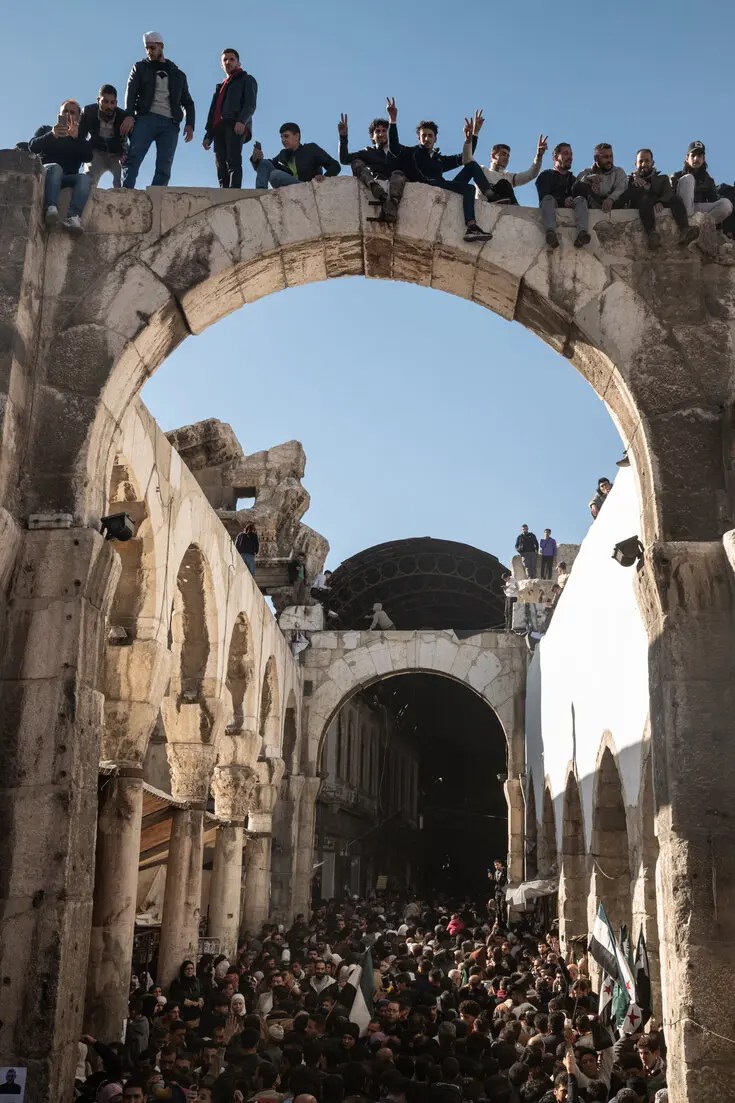
There have been many stunning pictures published to date of the Syrian revolution, but none that I’ve found as personally poignant as this one. It depicts jubilant Syrians lining the Roman archway that stands at the eastern end of Damascus’ historic Suq al Hamadiyah. When we were last in Syria, in the Spring of 2009, I photographed the arch from inside the darkened Suq (during one of the city’s frequent power cuts) , revealing the impressive remnants of the Roman Temple of Jupiter and the magnificent Omayyad Mosque, the fourth holiest place in Islam (after Mecca, Medina and Al Quds/Jerusalem).

For more on the Middle East in in That Howling Infinite, see A Middle East Miscellany:  

Syrians atop the Roman archway at the end of Damascus’ historic Suq al Hamadiyah

The Suq Al Hamadiyah, Temple of Jupiter and the Umayyad Mosque Mosque. P Hemphill 2009

The Suq Al Hamadiyah, Temple of Jupiter and the Umayyad Mosque Mosque. P Hemphill 2009

Aleppo shock to Hama huge leap forward: triggers in Syria’s 11-day blitz that unravelled Assad

David Kilcullen, The Australian, 13th December 2024

The speed of the regime’s collapse was startling, but it should not have been. Beyond the general dynamics of government collapse, something else was happening.

The regime’s collapse accelerated dramatically after the fall of the central Syrian city of Hama on the evening of Thursday, December 5, Syria time. Picture: Emin Sansar/Anadolu via Getty Images

The regime’s collapse accelerated dramatically after the fall of the central Syrian city of Hama on the evening of Thursday, December 5, Syria time. Picture: Emin Sansar/Anadolu via Getty Images

This was not strictly true: HTS had been biding its time in its stronghold of Idlib province, on Syria’s northwestern border with Turkey, for five years since a ceasefire brokered by Turkish and Russian negotiators in 2020, avoiding direct confrontation with the regime and building its own structure outside state control.

Its parallel government included several ministries and a civil administration, the Syrian Salvation Government, governing a population of four million, the size of Croatia or Panama. Though dominated by HTS, the SSG has been somewhat politically inclusive, and several non-HTS leaders have had key roles in its administration.

It sought to include the independent governance councils that had arisen organically during the early days of the anti-Assad rebellion, and it established local municipal managers to provide essential services across its territory.

HTS’s small combat groups operated like a fast-moving light cavalry force. Picture: Omar Haj Kadour / AFP

HTS’s small combat groups operated like a fast-moving light cavalry force. Picture: Omar Haj Kadour / AFP

American analysts in 2020 assessed the SSG as technocratic, “post-jihadi”, focused on internal stability and non-ideological governance, seeking acceptance from Turkey and the US, and unlikely to become a launch pad for external attacks.

Aaron Zelin – the Western expert most familiar with HTS and the author of an important book on the organisation, The Age of Political Jihadism – has observed that despite still holding extremist beliefs, HTS acts more like a state than a jihadist group.

While the SSG was focusing on social services and economic activity, HTS commanders were investing in advanced military capabilities. Building on experience from before the 2020 ceasefire, HTS organised its forces into small combat groups of 20 to 40 fighters that could mass quickly to swarm a target using several teams, or disperse to avoid enemy airstrikes or artillery.

They were highly mobile, operating like a fast-moving light cavalry force, mounted in a mix of hard and soft-skinned vehicles that included captured armoured vehicles and armed pick-up trucks (known as technicals).

Reconnaissance teams, scouts and snipers moved in civilian cars or on motorcycles. HTS combat groups carried heavy and light weapons including rocket launchers, captured artillery pieces, mortars, recoilless rifles, anti-tank missiles and Soviet-bloc small arms seized from the government or rival resistance groups including Islamic State.

Rebel fighters stand next to the burning gravesite of Syria's late president Hafez al-Assad at his mausoleum in the family's ancestral village of Qardaha. Picture: Aaref Watad / AFP

Rebel fighters stand next to the burning gravesite of Syria’s late president Hafez al-Assad at his mausoleum in the family’s ancestral village of Qardaha. Picture: Aaref Watad / AFP

HTS also used the ceasefire to professionalise itself, studying the wars in Ukraine, Gaza and Lebanon. It established a military academy to educate officers in “military art and science”, and created civil affairs units, humanitarian agencies and a specialised organisation to convince government supporters to defect.

It used drones for reconnaissance, for leaflet drops on regime-controlled areas and as one-way attack munitions to strike targets with explosive warheads. It manufactured weapons and drones, and modified technicals with additional armour. HTS leaders built intelligence networks and command-and-control systems while allegedly also forging relationships with regional intelligence services and special operations forces.

Thus, the strength of HTS was not unexpected in itself. On the other hand, the rapidity of the regime’s collapse – which accelerated dramatically after the fall of the central Syrian city of Hama on the evening of Thursday, December 5, Syria time – was startling. It probably should not have been. Governments, unlike resistance movements, are tightly coupled complex systems that rely on numerous institutions and organisations, all of which must work together for the state to function.

As Joseph Tainter showed in The Collapse of Complex Societies, once co-ordination begins to break down, these interdependent systems unravel, the collapse of each brings down the next, and the entire structure falls apart. For this reason, in a process familiar to practitioners of irregular warfare, resistance groups (which tend to be loosely structured and thus more resilient to chaos) degrade slowly under pressure – and rebound once it is relieved – whereas governments collapse quickly and irrevocably once initial cohesion is lost.

As a team led by Gordon McCormick showed in a seminal 2006 study, governments that are losing to insurgencies reach a tipping point, after which they begin to decay at an accelerating rate. The conflict then seems to speed up and the end “is typically decisive, sudden and often violent”.

This pattern was very noticeable during the fall of the Afghan republic in 2021, for example, which also occurred in an 11-day period. The final Taliban offensive captured every province but one, and took the capital, Kabul, in a series of victories between August 4 and 15, 2021. Many garrisons surrendered, fled without fighting or changed sides.

Initial rebel successes made the regime look weak, allies failed to offer support, the security forces defected and other rebel groups suddenly rose up across the country. Picture: Aaref Watad / AFP

Initial rebel successes made the regime look weak, allies failed to offer support, the security forces defected and other rebel groups suddenly rose up across the country. Picture: Aaref Watad / AFP

To be sure, the Taliban’s final campaign was built on years of coalition-building and insurgent warfare. Similar to HTS, the Taliban relied on patient construction of parallel networks largely illegible to an Afghan state increasingly alienated from, and seen as illegitimate by, its own people.

It also was enabled by a stunningly shortsighted political deal with the US in 2020 and an incompetent US-led withdrawal in 2021. Even so, the collapse of the Kabul government was faster than expected, with president Ashraf Ghani fleeing by helicopter in a manner remarkably similar to Bashar al-Assad’s exit last weekend.

The fall of South Vietnam in 1975 was likewise extraordinarily rapid, occurring in just nine days after the decisive battle of Xuan Loc, with South Vietnam’s last president, Nguyen Van Thieu, fleeing for Taiwan on a military transport plane.

Similarly, Fulgencio Batista’s government in Cuba fell in only five days, between December 28, 1958 – when a rebel column under Che Guevara captured the town of Santa Clara – and the early hours of January 1, 1959, when Batista fled by aircraft to the Dominican Republic. He had announced his resignation to shocked supporters a few hours earlier at a New Year’s Eve party in Havana, starting a scramble for the airport.


In Syria’s case, beyond these general dynamics of government collapse, something else was happening: a military version of what political scientists call a “preference cascade”.

As Timur Kuran, originator of the concept, points out, under repressive regimes (or ostensibly democratic ones that censor dissent) the gap between public pronouncements and private opinions increases over time, until many individuals dissent from the approved narrative and lose faith in institutions that promote it but remain reluctant to reveal their real views. This “preference falsification” creates a deceptive impression of consensus. It can make regimes believe they have more support than they really do, while convincing dissidents they are all alone so there is no point expressing a contrary opinion.

But when an unexpected shock reduces the regime’s power to suppress dissent, people suddenly feel empowered to express their real opinions. They realise these opinions are widely shared and the false consensus evaporates. This can trigger a “preference cascade”, where individuals or institutions suddenly change sides and support for the government collapses overnight.

In particular, the moment when security forces, particularly police, refuse to fire on protesters is often decisive, as seen in the fall of the Suharto government in 1998, the overthrow of Hosni Mubarak in 2011 or the collapse of the East German regime in 1989.

Kuran’s initial work centred on the East European revolutions of 1989, which were unexpected at the time but seemed inevitable in retrospect, something Kuran later came to see as inherent in revolutionary preference cascades.

The most extreme case was the fall of Nicolae Ceausescu in Romania. During a mass rally on December 21, 1989 the dictator suddenly realised, his face on camera registering utter shock, that what he had initially perceived as shouts of support were actually calls for his downfall. When his security ser­vices refused to fire on the protesters, Ceausescu was forced to flee by helicopter. Four days later, he and his wife Elena were dead, executed after a brief military trial.

A woman poses for a photograph with a rebel fighter's gun in Umayyad Square in Damascus. Syria’s population finally felt free to dissent from the dominant narrative. Picture: Chris McGrath/Getty Images

A woman poses for a photograph with a rebel fighter’s gun in Umayyad Square in Damascus. Syria’s population finally felt free to dissent from the dominant narrative. Picture: Chris McGrath/Getty Images

Syria this week was another example of a preference cascade. Initial rebel successes made the regime look weak, allies failed to offer support, the security forces defected and other rebel groups suddenly rose up across the country. Syria’s population – previously reluctant to express anti-regime sentiment for fear of repression or social ostracism – finally felt free to dissent from the dominant narrative. Assad lost control, was forced to flee, and his government collapsed. It is worth briefly recounting the sequence of events.

On November 27, the HTS offensive began with a sudden attack on Aleppo City. The outskirts of Aleppo are only 25km from the HTS stronghold in Idlib, so although the outbreak of violence was a surprise, there was little initial panic. The regime responded with airstrikes and artillery, with Russian warplanes in support.

The first major shock was the fall of Aleppo on November 30, after three days of heavy fighting. As Syria’s second largest city, scene of a bloody urban battle in 2012-16, Aleppo’s sudden collapse was a huge blow to the government. The HTS capture of Aleppo airport, east of the city, denied the regime a key airbase from which to strike the rebels, and cut the highway to northeast Syria. At this point the regime seemed capable of containing HTS, though clearly under pressure, and there was still relatively little panic.

But then on December 4, HTS attacked the city of Hama, which fell on the evening of December 5. This was a huge leap forward – Hama is 140km south of Aleppo down Syria’s main north-south M5 highway, meaning the rebel forces had covered a third of the distance to Damascus in a week. The fall of Hama was another political and psychological blow to Assad’s regime: Hama had never been under rebel control at any time since 2011.

Syrian rebel fighters at the town of Homs, 40km south of Hama, a critically important junction controlling the M5 and the east-west M1 highway that links Damascus and central Syria to the coast, and dominating Syria’s heavily populated central breadbasket. Picture: Aaref Watad / AFP

Syrian rebel fighters at the town of Homs, 40km south of Hama, a critically important junction controlling the M5 and the east-west M1 highway that links Damascus and central Syria to the coast, and dominating Syria’s heavily populated central breadbasket. Picture: Aaref Watad / AFP

The collapse at Hama – and the perception of regime weakness this created – triggered a preference cascade. Immediately, commanders began negotiating with or surrendering to the rebels or evacuating their positions. Also, after Hama’s fall, Iranian forces negotiated safe passage and began withdrawing from Syria, denying the government one of its key allies, further weakening Assad’s credibility, and encouraging yet more supporters to defect.

The regime’s other main ally, Russia, had already retreated to its bases at Khmeimim and Tartous, on Syria’s Mediterranean coast, after losing large amounts of military equipment and a still-unknown number of casualties. The same day, Hezbollah declined to offer material assistance to the Syrian government, given that it was still under Israeli pressure and had taken significant damage in 66 days of conflict.

The town of Homs lay 40km south of Hama – not much closer to Damascus but a critically important junction controlling the M5 and the east-west M1 highway that links Damascus and central Syria to the coast, and dominating Syria’s heavily populated central breadbasket. By early Friday, December 6, HTS combat groups were massing to assault Homs, but the city’s defences collapsed and it fell without a significant fight. By this point, security forces were dispersing, some retreating to Damascus but many fleeing to coastal areas.

The fall of Hama and Homs in quick succession encouraged other rebel groups to pile on, with several now mounting their own offensives against the regime. Uprisings broke out in the southern cities of Daraa and As-Suwayda on Friday and Saturday, December 6 and 7. These were less of a shock than the loss of Hama – Daraa was, after all, the cradle of the revolution in 2011 – but given everything else that was happening, the government simply lacked the forces to suppress them.

Simultaneously, US-backed forces in the far south advanced north from their base at al-Tanf, near the Jordanian border, while US-allied Kurdish troops of the Syrian Democratic Forces attacked in the east, crossing the Euphrates and seizing regime-controlled territory near Deir Ezzour. American aircraft flew airstrikes to support the SDF, which also seized the border post at Bou Kamal, blocking access to Iraqi militias that had been crossing into Syria to support the regime.

By Sunday, the regime had collapsed and the rebels occupied Damascus without a fight. Picture: Louai Beshara / AFP

By this point – last Saturday evening, December 7, Syria time – the government was on its last legs. That night an uprising broke out in Damascus, launched by civilian resistance groups and disaffected military units keen to distance themselves from the regime as the rebels closed in. Government troops began abandoning their posts, changing into civilian clothes, ditching their equipment and disappearing into the night. Large numbers of armoured vehicles, including T-72 tanks, were abandoned in the streets of the capital. Assad had planned to address the nation that evening but did not appear.

Later that night, apparently without asking Assad, the high command of the Syrian armed forces issued an order to all remaining troops to lay down their weapons and disperse. Assad fled about 2am on Sunday, flying out in a Russian transport aircraft. Assad’s prime minister, Mohammed al-Jalali, announced that he was willing to act as caretaker during transition to a provisional government, showing that Syria’s civil government, like the regime’s military forces, had collapsed. Despite initial reports that Assad’s aircraft had been denied entry into Lebanese airspace then shot down over Homs, Russian media reported later on Sunday that he had arrived in Moscow.

By Sunday, the regime had completely collapsed and the rebels, led by HTS commander Ahmed al-Sharaa, formerly known as Abu Mohammed al-Jolani, occupied Damascus without a fight.

The same day, US aircraft mounted dozens of airstrikes across the country, targeting Islamic State or regime forces, while Israeli troops crossed the Golan Heights buffer zone and began advancing towards Damascus. By Monday, despite initially claiming their incursion was limited and temporary, Israeli forces were 25km from Damascus, Israeli politicians had announced the permanent annexation of the Golan, and Israeli aircraft were striking Syrian military bases and sinking Syrian ships at the Latakia naval base.

Israel has denied media reports that its troops have taken control of Syrian territory.
In addition to the Israeli incursion through the Golan, Turkish-backed troops of the Syrian National Army are attacking the SDF across a strip of northern Syria, apparently attempting to create their own buffer zone separating the SDF – which Ankara sees as allied to the Kurdistan Workers Party – from Turkish territory.

The SDF has seized a chunk of eastern Syria, other US-allied rebel groups hold key parts of the south, and Islamic State still has numerous supporters and active cells in the country. Russia still controls its two Syrian bases, while Syria’s ethnic and religious minorities including Christians and Alawites are deeply anxious about the future, despite promises of tolerance from HTS.

Given the speed and totality of Assad’s collapse, some observers seem to be assuming that HTS will now, by default, become the dominant player in Syria. On its face, this may seem a reasonable assumption, given what happened in similar situations – Havana 1959, Saigon 1975, Kabul 2021 and so on.

But it would be premature in Syria’s case since the war is very much ongoing. As the northern hemisphere winter closes in and Western allies prepare for a change of administration in Washington, Syria – along with Gaza, Lebanon, the Red Sea, Ukraine, Taiwan and the Korean peninsula – will remain a major flashpoint into the new year.

David Kilcullen served in the Australian Army from 1985 to 2007 and was a senior counter-insurgency adviser to General David Petraeus in 2007 and 2008, when he helped design and monitor the Iraq War troop surge.

The Most Courted Leader in the Middle East Still Has No State

Arab and European heads of state are lining up to meet Ahmed A-Shara, the leader of the Syrian rebel organizations that ousted Assad, who has returned to his original name and is no longer calling himself al-Golani

Zvi Bar’el, Haaretz ,Dec 13, 2024
After taking control, he hastened to renounce his underground name and resumed his local name, Ahmed A-Shara. He ousted Bashar Assad’s horror regime and started to sprout the first buds of “new Syria,” whose outcome is still hard to fathom. The race for shaking his hand is in full swing.
Qatar is an old friend of A-Shara (one has to practice the name) and during the years of his organization’s existence it supported the militias that made up Hayat Tahrir al-Sham, which he set up on the ruins of Jabhat a-Nusra and it’s also expected to help him rehabilitate his country.

Qatar isn’t alone. In the race to the presidential palace in Damascus the Turkish Foreign Minister Hakan Fidan came first to shake A-Shara’s hand. The foreign ministers of other Arab states, such as Egypt, Saudi Arabia, and the UAE are preparing to land in Damascus in the coming days to personally congratulate the leader of the sister state.

At the same time Biden’s administration is examining the possibility of removing A-Shara and his group from the terrorists’ list while European leaders, headed by Italian Prime Minister Giorgia Meloni, who only two weeks ago spoke of the possibility to normalize their relations with the Assad regime, are already trying to coordinate meetings with the new regime’s leadership.

The irony doesn’t stop there. Iran and Russia, which in fact controlled large parts of Syria, are now replaced by two new-old occupiers, Israel, and Turkey. One took over the “Syrian Hermon “and a little further, the other is completing the occupation of the Kurdish regions in North Syria. No love is lost between the two of them, but it seems fate insists on making them meet in war fronts.

Once as partners when they helped Azerbaijan in its war against Armenia and once as enemies in the Gaza front or now on Syrian soil. There’s no knowing, maybe A-Shara will be the best man who will get to reconcile between them. Miracles happen, even if under the nose of the best intelligence services in the world, who didn’t know and didn’t evaluate the complete collapse of the Assad regime.

The warm Arab and international envelope tightening around Damascus is ready to give him credit although it doesn’t know yet where he’s heading, assuming any leader will be better than Assad. That, by the way, is what the Syrians also believed Assad senior would be when he toppled the rule of General Salah Jedid, only to get a new mass murderer.

The first declarations and interviews of A-Shara and senior officials of his administration sound good and even encouraging. The temporary prime minister, Mohammed al-Bashir, said in an interview to the Italian newspaper Corriere della Sera on Wednesday that at this stage the new administration has three top goals – to ensure the civilians’ safety, to return the refugees and to rehabilitate the infrastructure and civil services.
How to achieve those goals? “It will take time but we’ll get there,” says the former prime minister of the Idlib region’s rescue government under A-Shara’s command and was blasted publicly for the brutal way he ran the rebel province.
Al-Bashir also says the temporary government will serve until the beginning of March, but does not clarify what will happen after that date. Will he manage to draft a new constitution and election law by then? Does the new administration even intend to hold elections, or does he hope within that time to set up a government that will be agreed on by all the communities, factions, militia, and foreign forces?
Will the new constitution be Islamic? To this he replies, “God willing, but clearly all these details will be discussed in the constitutional process.”
Journalist Andrea Nicastro asks him “do I understand correctly when I say you’re ready to make peace with Israel and that you’re hostile to Iran, Hezbollah and Russia?” Al-Bashir thanks him and leaves without answering.
There can be no complaints about a prime minister or organization head who only two weeks ago merely prepared to expand the borders of his control region and suddenly found himself on an empty highway to Damascus, for having no political, economic, or strategic plan and for having to wriggle around ideological and religious issues. A-Shara has more urgent business, for example, an empty state coffer.
If he wants to ensure civilian safety and public services he’ll have to pay wages to thousands of policemen, teachers, judges, garbage contractors, rebuild the crushed electric system, mend roads and traffic lights when not a single dollar, according to al-Bashir, remain in the till.
Head of the Syrian trade bureau said this week Syria will move from a state-controlled economy to a free market economy. This is encouraging but to apply it they will need investors and ensure their investment.
Government ministers, most of them served in the “rescue government” in Idlib, estimate they’d be able to raise funds from Arab countries and mainly the UAE and Turkey, persuade Syrian businesspeople in exile to invest in the homeland and also return to Syria funds that were smuggled out by the Assad regime. But Arab and international aid usually comes with a list of rigid conditions, like demands for a profound economic reform, preserving human rights and minority rights, civilian safety, and no less important a political agenda that is compatible with the donor states’ aspirations.
Syria is not an only child. Soon the donor states will be asked to help to rebuild Lebanon and perhaps later Gaza as well. A conservative estimate sets Syria’s national debt at some $31 billion, $5 billion of them to the IMF and $26 billion to Russia and to Iran.
More realistic estimates cite a debt of more than $30 billion to Iran alone, which invested some $50 billion in the last 14 years.
The oil wells that remained in the Assad regime’s control produced only some 9,000 oil barrels a day, now the new administration can produce oil from the oil fields controlled by the Kurds in the northeast of the state after they retreated from Dir A-Zur, which was reoccupied by the pro-Turkish militias.
But perhaps this will no longer be enough to reinstate the agriculture and food production industry, or to generate millions of workplaces that were lost during the war.
A-Shara portrays himself as “everyone'” leader and his prime minister aspires to set up an administration that represents all the ethnic communities and minorities. But will he gain the cooperation of the Alawite minority, which makes up 10 percent of the population? Will the Kurds in the north give up their aspirations for autonomy?
A large concentration of Alawites resides in the Latakia province on the Mediterranean coast, its people are well armed and afraid that armed militias or the regime itself would want to take revenge on them. Will they agree to disarm?
The Kurds are being pushed out of some of their provinces and only this week retreated from Manjib city west of the Euphrates River, after the Syrian National Army, the large pro-Turkish militia, conquered the city.
This retreat is the outcome of American mediation leaning on a Turkish commitment not to harm Kurdish civilians who leave the city. But Kurds continue to control the regions east of Euphrates, and Turkey wants to keep them away from those too. AT the same time their conduct has made it clear it is ready to cooperate with the A-Shara regime and be an integral part of Syria.

But it’s not clear yet under what terms. Will they want to preserve their provinces’ autonomy, and will the Syrian regime agree, when Turkey operates its military and economic leverages. Will the Kurds even have a bargaining chip left when Trump enters the White House? Trump tried already in 2019 to withdraw U.S. forces from Syria and was blocked by internal and external pressure. Now he may implement his wish with his ally Recep Erdogan.

Syrian commentators have begun to draw a map in which Syria could be a federation divided into autonomous cantons, Kurdish in the north, Sunni-Arab in the center, Alawite in the west and perhaps Druze in the south, a sort of expansion of the Iraqi model where an autonomous Kurdish region exists. The Shi’ites in the south are demanding their own province.
It is doubtful whether this model has a chance of being implemented in Syria but bringing it up in itself shows the explosives in store for the new Syrian regime. This is only a partial list because beyond the various ethnic communities and minorities, A-Shara will have to deal with a population that is mostly Sunni but secular. Will this population toe the line with a radical religious agenda, on which A-Shara was raised and has preached?
So far Syria has conveniently been attached to the “Shi’ite axis though it was an organ of Iran’s Islamic revolution.
But the Alawite faction doesn’t count in Iran as an authentic Shi’ite faction. Hafez Assad himself had to ask his friend, the influential religious leader Moussa al-Sader, to issue a ruling that the Alawite religion is part of the formal “Shi’a” and therefore part of the Islam religion.
This was after a long violent clash he conducted against Sunni and Shi’ite religious leaders who ruled the Alawite faction wasn’t Muslim at all and therefore Assad senior cannot be president, because the constitution stipulated the state’s president had to be Muslim.
A-Shara won’t have that dilemma, but as one who hasn’t concealed his aspiration to set up a religious state, he will have to decide how to settle between the religious vision and the character of the population and the state that hasn’t yet been established

Total war in an urban landscape – Israel’s military quandary

Commentator and counterinsurgency expert is always worth reading – and below is his latest piece for The Australian. In my opinion, he is one of the most articulate and knowledgeable analysts of political and military affairs in the contemporary Middle East.

In the following analysis of Israel’s invasion of the Palestinian enclave of Gaza, in response to the Hamas’ murderous assault on October 7th last year, he argues that despite calls from the US and others to “fight a different war”, the realities on the ground and the torturous dynamics of Israeli and Palestinian politics – which few outside observers are aware of or are even interested – dictate that is that the present carnage and destruction is unavoidable when you conduct large-scale combat operations in a heavily populated city in which a committed and unscrupulous enemy has spent years and millions of dollars constructing an elaborate and powerful attack base within and below a crowded and built-up urban landscape unmindful of the human consequences of its actions. The Hamas and its Islamist allies have taken Mao Zedong’s dictum that “the guerrilla must move amongst the people as fish swim in the sea” to extreme lengths, not only embedded within civilian population, but denying it protection and shelter whilst exploiting its vulnerability.

UN and world opinion is demanding Israel cease its brutal operations, and the Arab street and western progressives, if not expressing support for the Hamas, are  justifying its actions, including downplaying or even denying the atrocities of October 7. Israeli military planners are therefore in a moral and tactical quandary. With the Hamas and its Islamist allies and enablers posing a real and long-proclaimed existential threat to the Jewish state, what would a rational, reasonable person have Israel do to defend itself? If the current approach is inhumane, what is the alternative?

Kilcullen concludes that the only way Israel could have avoided the present outcome would have been to not go into Gaza at all – or for October 7 never to have happened. Short of a permanent ceasefire, which seems highly unlikely, or the Hamas surrenders and releases the remaining hostages living and dead, which also seems improbable – or a fundamental transformation of the conflict through direct intervention by Hezbollah in the north – “things seem set to continue as they are for the immediate future”.

And then what?

I wrote in an earlier piece:

“There is much discussion in the mainstream media about what comes next if the Hamas is destroyed or effectively neutered and Gaza is “liberated” from its thrall. Should the IDF reinstate the occupation it ended two decades ago? Should Israel hand the enclave over to the Palestinian Authority, to use a decidedly un-Muslim analogy, organize a piss up in a brewery? Or should the UN, or at a stretch, the Arab League, a club of autocrats and tyrants, assume military and political administration until it can be reincorporated into a reformed and workable Palestine? And even then, should any of these scenarios work out, would Israel be in the mood to make nice? The Hamas pogrom has not helped Palestinians in besieged Gaza, nor will it help those in the occupied West Bank who have been subjected to IDF incursions and vigilante violence by angry settlers. Nor will it encourage Israel to moderate its draconian policies and end the occupation”.
I concluded then, and believe still that “the whole thing is a bloody mess (literally and figuratively) and the implications for Israel, Palestine and others unpredictable”.

For more on Israel and Palestine in In That Howling Infinite, see A Middle East Miscellany..See also, The Calculus of Carnage – the mathematics of Muslim on Muslim mortality

The bloody reality of fighting an embedded enemy

David Kilcullen, Weekend Australian March  24, 2024

An Israeli soldier walks past army bulldozers deployed near the border with Gaza. Picture: Menahem Kahana/AFP        Bulldozers deployed near the Gaza border. Menahem Kahana/AFP

You can tell a lot about a military force, and the conditions under which it operates, by watching how it prefers to fight. Americans, for example, prefer stand-off strikes with laser-guided bombs and long-range rockets: they seek the illusion of distance, precision and cleanness, avoiding the bloody, complex reality of ground combat. Russians, by contrast, are famous for massing enormous weights of artillery against a single point, then flinging “disposable infantry” into meat-grinder assaults.

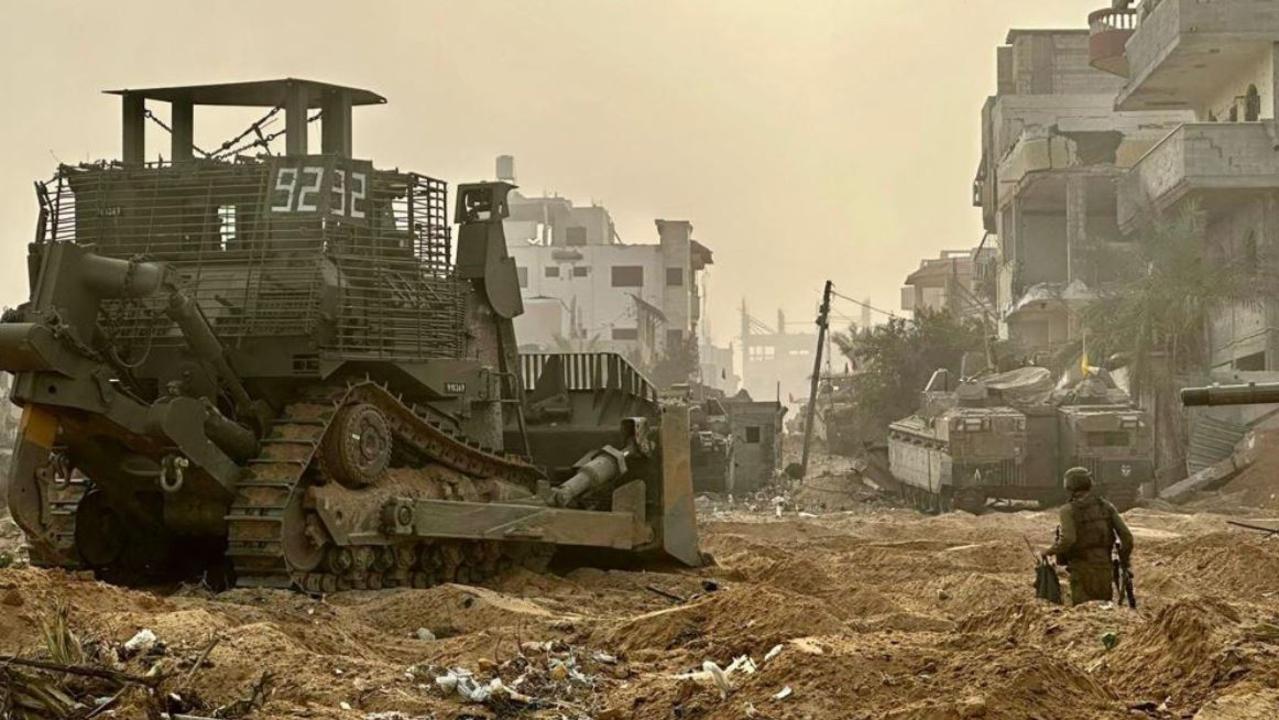
A central tool of Israeli tactics is the armoured bulldozer: slow, implacable, destroying obstacle after obstacle as it grinds forward. Israel’s ground campaign in Gaza has relied heavily on these bulldozers, which weigh more than an Abrams tank and can demolish buildings, clear rubble, destroy strong points or build berms under heavy fire.

US criticism of Israel’s approach reflects the preference for precision. Council on Foreign Relations president emeritus Richard Haass, one of America’s most distinguished foreign policy thinkers, wrote recently that Israel could have fought a different war. Its approach, Haass wrote, “should have been more precise, giving priority to eliminating Hamas’s leadership and key fighters as intelligence allowed. Israel should have relied more on small-unit operations rather than aerial bombardment.”

A central tool of Israeli tactics is the armoured bulldozer. Picture: Menahem Kahana/AFP
Armoured bulldozer.Menahem Kahana/AFP

While acknowledging that this might have taken months or years, and “some Hamas fighters who embedded themselves in schools and hospitals would have escaped punishment”, he argued that “this would have been preferable to killing thousands of civilians, further radicalising the Palestinian population and alienating the region and the world”.

It might indeed have been preferable, but would it have been possible? Could Israel really have adopted a stand-off approach, using small-team raids and surgical strikes to target Hamas leadership, do minimal damage to Gaza and its population, and still achieve its objectives? Answering these questions starts by understanding why the armoured bulldozer has become so central to Israeli tactics in the first place.

We are talking here of what is, rather than what ought to be. In an ideal world, October 7 would not have happened, Israel would never have needed to mount a full-scale ground invasion of the Gaza Strip, and thousands of civilians – Israeli and Palestinian, men, women and children – would be alive and well today instead of dead, wounded or held hostage.

But those things did happen, and any attempt to make sense of the war needs to take that fact as its starting point.

Richard Haass. Picture: Alex Wong/Getty Images
Richard Haass. Alex Wong/Getty Images

For reasons we will explore, destruction of the urban environment itself, rather than merely defeating an opponent within it, has become a key part of how the Israel Defence Forces fight in cities.

This, in turn, reflects the reality that, in a multi-generational struggle for territorial and demographic dominance, across a tiny area – all of Israel is only about twice the size of Greater Melbourne – it’s often simply impossible to disentangle opponents such as Hamas from the populations and landscapes in which they hide. Under these conditions, military commanders sometimes see destroying an urban area outright (or flattening parts of it) as the only way to achieve their missions. Some analysts (including several Israelis) condemn this as “urbicide” – killing entire cities rather than just fighting within them – but many IDF commanders, tasked by Israeli politicians with clearing a deeply embedded enemy from a densely urbanised, heavily populated area, see few other options.

On the ground in Gaza, infantry and armour move together in integrated combat teams with dismounted troops, tanks and armoured personnel carriers co-operating to support the manoeuvre of bulldozers as they push forward, clearing rubble, destroying Hamas positions and knocking down houses. Demolition teams, equipped with explosives and moving on foot, systematically blow up structures that could pose a threat. Tunnels and bunkers are blown up or bulldozed, their entrances sealed, with explosions often caught on video and disseminated on social media by the troops themselves. These videos have prompted criticism and some were cited as evidence in the genocide case against Israel in the International Court of Justice. But the videos also encourage civilians to evacuate ahead of advancing troops, reinforcing official IDF calls for the population to leave, and arguably reducing their exposure to combat.

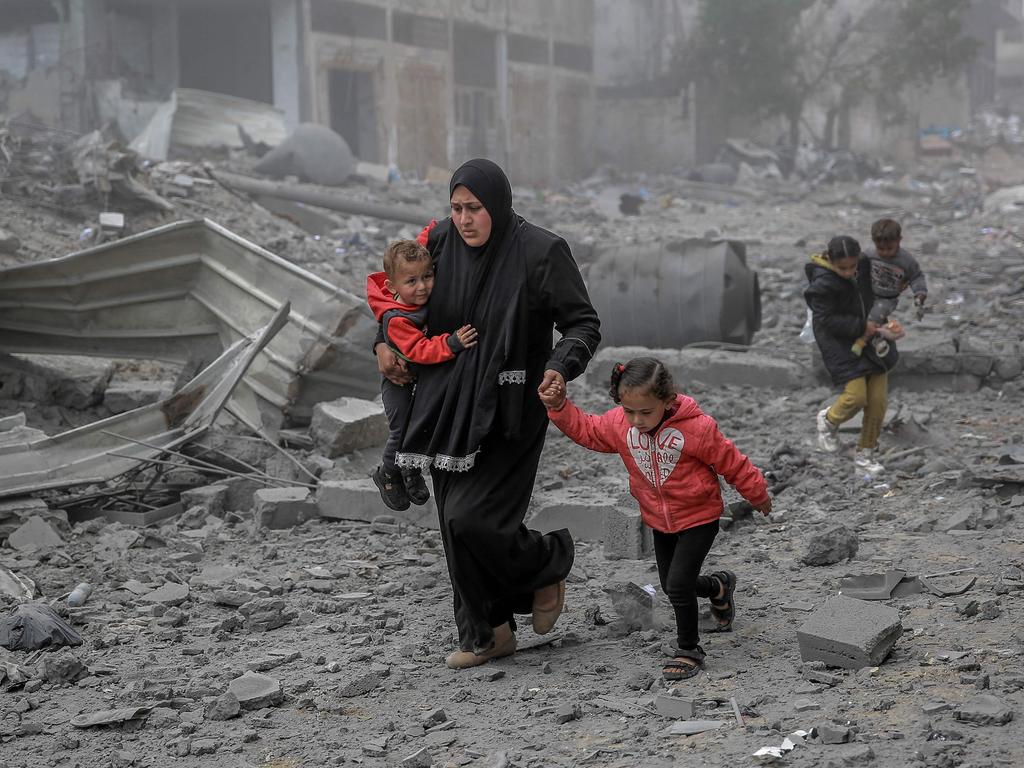
Palestinians flee the area after Israeli bombardment in central Gaza City. Picture: AFP
Palestinians flee after Israeli bombardment in central Gaza City. AFP

Much of the Gaza Strip is now not only uninhabitable but uninhabited. The IDF advance has pushed the population ahead of it, with civilians fleeing along evacuation corridors such as Salah al-Din Road, the main thoroughfare that runs down the middle of the strip and connects Gaza City with Khan Younis farther south. Both are depopulated, with 1.5 million civ­ilians now crowded into Rafah in the far south. Only about 300,000 civilians now remain in northern Gaza. (Before the war, the entire strip had a population slightly less than 2.2 million people.)

As the advance pauses each evening, rather than withdraw and thereby cede territory that would then have to be recaptured, the bulldozers build berms and defensive positions for the assault troops, allowing them to encamp in the ruins and restart the advance after resting. Most camps are used for one or two nights, then abandoned as the advance moves on, but some are semi-permanent forward operating bases. Attack helicopters provide fire support and air cover.

By January, entire neighbourhoods in Gaza had been razed using these methods.

Israeli forces also are constructing a buffer zone along Gaza’s landward border. Described before the current war as the “world’s largest open-air prison”, Gaza already had a 300m-wide exclusion zone that separated residential areas from the border fence. Israeli observation posts covered that zone and could shoot anyone approaching the fence.

But October 7 showed that a determined enemy could cut the fence at numerous places, so bulldozers and combat engineers have been widening the buffer since. Israeli officials say this is a critical security measure to allow civilians to return to the settlements that Hamas attacked on October 7. IDF engineers also are bulldozing buildings to construct an east-west road across the northern third of the strip, cutting Gaza in two and creating a field of fire 300m wide.

IDF D9 Israeli bulldozer in Gaza. Picture: IDF Spokesperson's Unit
IDF D9 Israeli bulldozer in Gaza. IDF Spokesperson’s Unit

The bulldozer (or perhaps the steamroller) is an apt metaphor for the campaign itself – the IDF is, in effect, bulldozing its way across Gaza, slowly but implacably pushing the population ahead of it, destroying Hamas as it goes, while removing much of the urban area itself. This represents a brutally terrain-centric approach to battle. But it also reflects the reality of deep entanglement among armed enemies, civilian populations and dense urban areas, in a zero-sum territorial conflict fought explicitly for control of living space. It embodies decades of tit-for-tat adaptation by both sides.

One battle – the Battle of Jenin, fought in a West Bank refugee camp in April 2002 – was an inflection point. The term refugee camp is technically accurate but gives the wrong impression: the Jenin camp was not a temporary collection of huts but a densely built-up area with multi-storey concrete structures. The IDF entered the camp to clear it of Hamas and other militants who were using it as a base for suicide bombings against Israeli civ­ilians. Nine days into the battle, after severe losses in an ambush, the IDF pulled back, reorganised, then re-entered using new tactics based on small combined-arms combat teams centred on armoured bulldozers. The bulldozers cleared improvised explosive dev­ices and booby traps, destroyed fighting positions, then flattened a 200m-by-200m area in the centre of the camp, which became an IDF base, effectively ending that round of fighting.

The IDF approach in Jenin was studied by US and Australian commanders during the Iraq war. They concluded its impact on civilians – and its physical destructiveness – made it a last resort at best. US forces tried (often unsuccessfully) to protect Iraqi civilians and avoid urban incursions. They built kilometres of concrete T-wall in Baghdad, for example, to keep hostile populations apart, separate them from insurgents and stop militants moving around the city, precisely so as to avoid destructive armoured forays into inhabited areas.

But Iraq – where the US-led coalition saw itself (and was seen by locals) as a purely temporary presence, trying to defeat an enemy with minimal damage, then stabilise things enough to leave – was far different from Israel, where both sides claim much of the same territory as their own. This is a demographic and territorial conflict between populations with irreconcilable claims to the same tiny area of land, a zero-sum contest where destruction of settlements and denial of access helps cement control at the expense of the adversary.

A more apt analogy for today’s fighting would be the battle against Islamic State in the northern Iraqi city of Mosul during 2016-17. This was an enormous battle, about the same size and duration as the current Gaza campaign. It did massive damage to Mosul, which before the battle had a population of 1.2 million people, and lasted nine months.

Islamic State had just over two years to put Mosul into a state of defence – from June 2014, when it captured the city, until October 2016, when the Iraqi-led offensive to retake it began. In that short period, Islamic State fighters developed dense belts of booby traps, dug deep defensive positions, and embedded themselves in the human and physical fabric of the city, thereby making it impossible for an opponent to attack them without also damaging the city and killing civilians.

Ultimately, Mosul soaked up more than 90,000 Iraqi troops and hundreds of foreign advisers, against 6000 to 12,000 Islamic State fighters. The battle displaced at least a million people, destroyed large parts of the city and may have killed as many as 40,000 civilians, according to the Asayish, the Kurdish Regional government’s intelligence service.

Hamas, by contrast, had almost two decades in complete control of Gaza (from 2006 to 2023). It used that time to develop a fearsome defensive complex, with numerous strong points and hundreds of kilometres of underground passages, embedding itself thoroughly into the physical environment of the strip and its population. The organisation had 30,000 fighters in total before the Gaza campaign began, far more than the Islamic State garrison defending Mosul.

Any ground invasion of Gaza was therefore bound to be bloody, protracted and destructive, on the scale of Mosul or larger. This is exactly what we are seeing, and what most military analysts expected.

Palestinians gather in a street as humanitarian aid is airdropped. Picture: AFP
Palestinians gather as humanitarian aid is airdropped: AFP

The notion of a clean, surgical, stand-off campaign, using precision strikes and small-team raids to destroy Hamas without damaging Gaza or harming civilians – as attractive as it sounds in theory – is simply not practicable, as our own recent history in places such as Mosul shows. Again, we are talking about what is rather than what ought to be. But reality is reality: the only way for Israel to avoid the kind of campaign that is happening now would have been not to go in at all, leaving Hamas in control of Gaza, which was politically unacceptable after October 7. To understand why that was so, we need to return briefly to Jenin.

Jenin was designated in the 1995 Oslo II Accord as part of “Area A”, putting it under the control of the Palestinian Authority, but the IDF repeatedly raided the camp before and after the 2002 battle.

From March 2022, incursions increased to an almost nightly tempo under Operation Breakwater, a counterterrorism effort targeting Jenin and the town of Nablus, 35km farther south.

The IDF said in mid-2023 that at least 50 attacks against Israeli civ­ilians had originated from Jenin in the preceding two years. In late July, weeks before the October 7 attacks, Israeli tanks, bulldozers and infantry launched their largest incursion into Jenin since the 2002 battle. Since the IDF launched its full-scale ground invasion of Gaza, raids into Jenin, Nablus and other West Bank towns have continued.

This is what some Israelis call “mowing the grass” – repeated raids into an area to disrupt terrorist groups and reduce the threat.

IDF commanders historically knew that such incursions were only a temporary measure, doing little more than managing the threat until it inevitably regenerated. They recognised the destruction and enduring hatred that the raids caused among local populations but accepted that the intractable politics behind the conflict precluded any permanent solution.

Israeli Prime Minister Benjamin Netanyahu. Picture: Leo Correa/AFP
 Prime Minister Benjamin Netanyahu. Leo Correa/AFP

This attitude – resignedly mowing the grass, forever, with no hope of any permanent settlement given the underlying politics – changed radically for many Israelis on the morning of October 7. After that assault, public pressure for a final defeat of Hamas built up inexorably on the Netanyahu government, from a population stunned by the audacity, scale and suddenness of the attacks, infuriated by the intelligence failure that allowed them to happen, horrified at their brutality, and demanding Hamas be destroyed once and for all.

Mowing the grass was no longer acceptable.

Tactics are downstream from politics, and this fundamental change in the underlying politics of the conflict is why, despite escalating criticism from the Biden administration and a genocide accusation in The Hague, Israel’s campaign has unfolded in such an implacable, bulldozer-like manner.

Since October 7, opinion has hardened even further on both sides: in polls last month a large majority of Israeli respondents expressed opposition to a Palestinian state “under any circumstances” and opposed a ceasefire until all hostages are released. Likewise, in November last year, 59 per cent of Palestinians surveyed said they “extremely supported” the October 7 attacks, while 16 per cent “somewhat supported” them.

The IDF’s campaign, successful though it has been in achieving the goals laid down by Israeli political leaders, has reached the point where politicians themselves have to take it to the next stage. This is all that any military operation can deliver. But given the hardening of Israeli and Palestinian public opinion – and the fact Hamas still holds 130 hostages and has refused to guarantee their safety – it’s hard to see any space for a political solution.

The pre-October 7 political conditions, of uneasy coexistence and periodic mowing of the grass, have been overtaken by events, suggesting that the campaign (with or without a temporary ceasefire) will end only with a complete Israeli tactical victory in Gaza. Whether such a victory would meet Israel’s broader strategic goals – and whether the country could then rebuild relationships that have been tested by the conflict – is a more complex question.

Israeli soldiers stand near a roadblock of burning tires placed by Jewish settlers. Picture: Sven Nackstrand/AFP)
 Israeli soldiers near a roadblock of burning tires placed by Jewish settlers. Sven Nackstrand/AFP

The next military objective is Rafah, where vast numbers of civilians are now crowded, under horrific conditions, into one of the last remaining Hamas-controlled areas. The more the advance squeezes civilians into this southwestern corner of the strip, the greater the pressure on Israel for a ceasefire or evacuation of non-combatants. That pressure has been growing from the US congress and the Biden administration, with stop-start negotiations periodically raising hopes of a temporary ceasefire but offering little likelihood of an enduring end to the fighting.

But even as the campaign inside Gaza itself comes to a crisis, two other crises threaten to expand the conflict. Roughly 1900 km south of Gaza, in the Bab al-Mandab, the narrowest point of the Red Sea, forces loyal to Ansarallah – the so-called Houthi movement that controls much of Yemen – have mounted a successful campaign to interdict shipping, using drones and missiles, in support of Hamas and probably at the behest of Iran, which sponsors both the Houthis and Hamas.

Targeting Western and Israeli-connected ships, the Houthis have managed to reduce regional shipping by more than 90 per cent since last November. Perhaps more important, the cost to ship a 40-foot container from China to Europe has almost tripled since the start of December, putting significant pressure on global trade. This brings other players – including several European powers and, most important, China – into the equation. China’s approach has been characteristically cautious, but the Red Sea crisis is increasing pressure on Tel Aviv to end the conflict, even as the IDF nears its last major objective.

A second problem is Hezbollah, another Iranian proxy whose forces sit just across Israel’s northern border and are vastly more militarily capable than those of Hamas. Indeed, it is hard to overstate how much more powerful Hezbollah is than Hamas: it possesses an enormous inventory of rockets, drones and missiles, exercises functional control of Lebanon’s government, and has barely used its most capable assets since the start of the Gaza conflict. Hassan Nasrallah, head of Hezbollah, repeatedly has called for an end to the war, and Hezbollah is intensifying its artillery and rocket attacks against northern Israel but is yet to mount a ground offensive or unleash its full force. If it were to do so, Israel’s strategic position would worsen catastrophically, overnight.

All this is true, but also perhaps irrelevant. In war, military action is driven by political decisions, and political decisions are shaped by public opinion.

In Israel’s case, public pressure for a permanent defeat of Hamas is now overwhelming, and this in turn drives political decisions that have resulted in the Gaza ground campaign. In turn, the evolution of Israeli (and Hamas) tactics and tools over decades of conflict have shaped the way that campaign is being conducted. To imagine that Israel could or should have fought the campaign using a surgical, precision, stand-off, small-team approach would be a fundamental misunderstanding of urban warfare and of how the underlying politics driving the conflict have shifted since October 7.

While many Australians are rightly watching the Gaza war with horror, the harsh reality – as Mosul shows – is that this is what happens when you do large-scale combat operations in a heavily populated city. The only way to avoid this would have been for Israel not to go in at all or for October 7 never to have happened. Short of a ceasefire (which seems highly unlikely) or a fundamental transformation of the conflict via direct Hezbollah intervention, things seem set to continue as they are for the immediate future.

David Kilcullen served in the Australian Army from 1985 to 2007 and was a senior counter-insurgency adviser to General David Petraeus in 2007 and 2008, when he helped design and monitor the Iraq War troop surge. His 2015 essay Blood Year: Terror and the Islamic State won the 2015 Walkley award for long-form writing and was published as a full-length book in 2016 by Oxford University


Tangled! – a cynic’s guide to alliances in the Middle East

The paradox of piety observes no disconnect
Nor registers anxiety
As the ship of fools is wrecked
So leaders urge with eloquence
And martyrs die in consequence
We talk in last and present sense
As greed and fear persist
E Lucevan Le Stelle, Paul Hemphill

At a recent conference in Berlin, Germany’s prime minister Angela Merkel and and UN Special Representative Ghassan Salamé managed, at least on paper, to cajole the external actors guilty of super-charging Libya’s misery to sign onto a unified agenda. Russia’s Vladimir Putin, Turkey’s Recep Tayyip Erdoğan, France’s Emmanuel Macron, Britain’s Boris Johnson, and Egypt’s pharaoh (and Donald Trump’s “favourite dictator”) Abdel Fatah el-Sisi,  joined a dozen or so others (with Secretary of State Mike Pompeo representing the United States) in declaring an intention to end foreign interference in Libya’s internal affairs: “We commit to refraining from interference in the armed conflict or in the internal affairs of Libya and urge all international actors to do the same,” states the communiqué, in language one hopes all participants endorsed in (what would be uncharacteristic, for some) good faith.

This corroboree of hypocrites acknowledged that the increasingly violent and globally tangled Libyan civil war could only be ended if outside powers backed off and ended their meddling. They made altruistic and totally disingenuous declarations about a conflict  that they themselves have incited, exacerbated and perpetuated for nine years. And yet, explicitly excluded Libyan participation, contradicting the 2012 UN Guidance for Effective Mediation and its insistence on “inclusivity” and “national ownership” as fundamental elements for peaceful conflict resolution. It’s focus at this point was on the on the external, rather than the Libyan, actors and for reviving the world’s attention on the Libyan conflict.

A follow-up conference in Munich was convened in mid-February to renew its pledges to quit meddling. Stephanie Williams, the UN deputy special envoy for Libya reported zero progress and declared the agreed-upon arms embargo to be a joke. A sick joke, indeed – plane after plane land in Benghazi loaded with weapons from the UAE and other arms-suppliers destined for self-anointed warlord Khalifa Haftar‘s self-styled Libyan National Army.

Unfortunate Libya is neither the first nor the last pawn to be used and abused by outsiders in the new Great Game as the following guide demonstrates.

But first, there’s this letter to a British daily from Aubrey Bailey of Fleet, Hampshire (where hurricanes hardly happen):

Are you confused by what is going on in the Middle East? Let me explain.

We (she’s talking if Britain and us generic “good guys”) support the Iraqi government in the fight against Islamic State. We don’t like IS but IS is supported by Saudi Arabia, whom we do like. We don’t like President Assad in Syria. We support the fight against him, but not IS, which is also fighting against him. We don’t like Iran, but Iran supports the Iraqi government against IS.

So, some of our friends support our enemies and some of our enemies are our friends, and some of our enemies are fighting against our other enemies, whom we want to lose, but we don’t want our enemies who are fighting our enemies to win. If the people we want to defeat are are defeated, they might be replaced by people we like even less. 

And this was started by us invading a country to drive out terrorists who weren’t actually there until we went in to drive them out. Do you understand now? Clear as mud! 

It casts new light on that thorny old aphorism “the enemy of my enemy is my friend”!

A cynic’s guide to alliances in the Middle East

Libya

We begin with  Libya, the “beneficiary” of the Berlin talk-fests.

On the side of the internationally recognized government in Tripoli, Libya’s capital there’s: Not many … Italy (former colonial oppressor, in it for the oil, who’d just love to see an end to those refugee boats that wash up on its shores); Turkey (former Ottoman oppressor now ruled by a wannabe Ottoman sultan Recep Tayyip Erdoğan, and eager for offshore oil and gas leases); and potentially, Qatar (who fell out with Egypt, Saudi and the United Arab Emirates over its tepid support for the Sunni grand alliance against Shia Iran).  Turkish soldiers fly the government’s drones whilst Turkey’s Syrian jihadi mercenaries provide military muscle – Turkey would like to move them out of Kurdish Syria on account of their murderous behavior).  

On the side of the self-anointed warlord Khalifa Haftar, based in Benghazi in the east, whose sharp uniform is festooned in medals for this and that act of service and heroism), there’s: Egypt, (the US’ impecunious, brutal “partner in Freedom” – strange bedfellows in this amoral “new Middle East” that is just like the old Middle East); Saudi Arabia, and the UAE (see above, re. Qatar, whom they blockaded for several years); Jordan (perennially cash-strapped and dependent on rich Arab relatives), France and Russia (arms, oil, and influence); plus Russian mercenaries (plausibly deniable, capable and reliable, and familiar with the Middle East – see below); and Sudan’s murderous Janjaweed Arab militias (broke Sudan seeks Saudi favour).

And on the sidelines, a disinterested and divided UN, the UK and the US – although Britain, with France, helped wreck the joint by ousting longtime dictator Gaddafi; arguably, the US, although Donald Trump has confused matters by phoning Haftar and then saying that he’s a great bloke (he has a thing for dictators actual and potential, including Putin, Erdogan, Al Sisi, and the thuggish Saudi crown Prince Mohammed bin Salman); and in the middle, and against all of the above, the ever-opportunistic and troublesome Da’ish and al Qa’ida.. 

As American baseball wizz Yogi Berra once said, “It feels like déjà vu all over again”.

Syria

On the side of the internationally recognized government in Damascus headed up by Bashar al Assad, there’s: The Islamic Republic of Iran (Iran’s Shia Muslims are related to Syria’s heterodox Alawi minority, whose elite happen to have rule the country for half a century, and Iran is consolidating it’s Shia axis across the Middle East); Russia (oil, pipelines, and restoring Soviet greatness); Lebanese Shia Hezbollah (de facto ruler of Lebanon) and its soldiers; the Iranian Quds brigade (the expeditionary arm of the Revolutionary Guard, a military-industrial complex that virtually runs Iran); sundry Iraqi and Afghan Shia militias beholden to Iran for cash, weapons, training and ideology); Russian and Chechen mercenaries (see above – deniable, reliable and capable); and, quite surreptitiously, Turkey (former Ottoman oppressor) which is ostensibly opposed to Assad, but needing Russian pipeline deals, runs with the hares and hunts with the hounds – but see below, and also, above with respect to Libya. As the song goes, “I’m so dizzy, my head is turning” already! 

On the side of “the other side”, which is not really a “side’ at all, but a grab bag of sundry rebels who were once supported by the US and are predominantly Islamist, with some indeed linked to al Qa’ida, which, of course, we all love to hate (Twin Towers, Osama bin Laden and all that), there’s: the US, Britain and France (why do they persevere so in what Donald Trump has called these forever, endless wars?); Saudi Arabia (Salafi Central and banker for all the bad guys) and the United Arab Emirates (also a financier for the foe); Israel (of course – mortal foe of Iran and of Hezbollah (“the enemy of my enemy” fair-weather friend – anything that distracts its perennial enemies is good for Israel); Hamas, the Islamists who rule the Palestinian enclave of Gaza, and oppose the Alawi oppressor of Sunni Muslims and of Palestinian refugees in Syria; and Turkey (see above –  hares and hounds, on the outer with Saudi and the UAE and pals with outcast Qatar, and engaged in an ongoing blood feud with Syrian Kurds ostensibly allied with Turkey’s outlawed separatist Kurds), and as we write, ominously trading blows with the Syrian Army and its Russian allies; and Turkey’s Syrian jihadi mercenaries – erstwhile former rebels and al Qa’ida and Da’ish fighters who are in it for the money, for vengeance against the Kurds and the Assad regime, and, for many, good old blood-lust. 

And stuck in the middle: Those Syrian Kurds, of formerly autonomous Syrian enclaves Afrin and Rojava (betrayed by America, invaded by Turkey, and forever abandoned by the rest of the world, they have been forced to come to terms with the Assad regime which has discriminated against them forever; sundry Bedouin tribes who work to a code of patronage and payback; the scattered remnants of Da’ish which was at the height of its power a veritable “internationale” of fighters from all over the world, including Europeans, Australians, Chechens, Afghans, Uighurs, Indonesians and Filipinos – the remnants of whom are still in the field and hitting back; and sundry die-hard jihadis from constantly splintering factions. Da’ish and the jihadis have been dubiously aided and abetted by money and material from allegedly unknown patrons in the Gulf autocracies, as evidenced by those long convoys of spanking new Toyota Hi Lux “technicals” – which have now curiously reappeared in Haftar’s Libyan National Army (see Libya, above).

Yemen 

On the side of the internationally-recognized government of Yemen, there’s: Saudi Arabia, the US, and Britain; plus sundry mercenary outfits from Australia and Brazil; and Sudan (its militias paid by Saudi, as in Libya). The UAE was formerly on this side, but now supports a breakaway would-be Yemeni government Opposed to the present one. On the side of Houthis, a rebel Shia tribe in the north of the country, there’s: Iran and ostensibly its Iraqi and Lebanese auxiliaries – see above, the Shia ‘Arc” of Iranian influence. And in the middle, and against all of the above, the ever-opportunistic and troublesome Da’ish and al Qa’ida.

Afghanistan

Its America’s longest ever war – ours too …

On the side of the UN recognized government there’s: NATO, including the US, Canada, Britain, Germany, Denmark and Norway; and also, Australia and New Zealand – though why antipodeans want to get involved in the faraway Afghan quagmire beats me … Oh yes, the US alliance, and our innate empathy for the poor and downtrodden.

On the other side, there’s: The ever-patient, ever-resilient Taliban, aided and abetted by duplicitous Pakistan (an ally of the US – yes!), and al Qa’ida and Da’ish, both dubiously aided and abetted by money and material from Gulf despots. 

And on the sidelines,  miscellaneous corrupt and well-armed Afghani warlords who take advantage of the ongoing turmoil and grow rich on bribes, option and smuggling; and the rest of the world, really, which has long ago zoned out of those “forever, endless wars”. 

So, what now? 

More of the same, alas. Great Power politics and proxy wars are taxing intellectual and actual imaginations. It is business as usual in the scattered killing grounds as a bewildering array of outsiders continue to wage their proxy wars in Syria, Libya and Yemen. Bombs still explode in Afghanistan and Somalia, and whilst Islamists terrorise the countries of the Sahel, and even distant Mozambique, warlords rape and pillage in Congo. As usual in these proxy conflicts the poor people are stuck in the middle being killed in their thousands courtesy of weapons supplied by the US, European, Israeli, Russian and Chinese arms industries.

As outsiders butt each other for dominance, and the Masters of War ply their untrammelled trade, we are condemned, as Bob Dylan sang in another time and another war, to “sit back and watch as the death count gets higher’. I am reminded of WH Auden’s September 1, 1939, a contemplation on a world descending into an abyss: “Defenseless under the night, our word in stupor lies’. All is, as Kent lamented in King Lear, “cheerless, dark and deadly”.

 © Paul Hemphill 2020.  All rights reserved

In That Howling Infinite, see also; A Middle East Miscellany

A postscript  from Alice’s Adventures in Wonderland

‘What I was going to say,’ said the Dodo in an offended tone, ‘was, that the best thing to get us dry would be a Caucus–race.’

‘What IS a Caucus–race?’ said Alice; not that she wanted much to know, but the Dodo had paused as if it thought that SOMEBODY ought to speak, and no one else seemed inclined to say anything.

‘Why,’ said the Dodo, ‘the best way to explain it is to do it.’ (And, as you might like to try the thing yourself, some winter day, I will tell you how the Dodo managed it.)

First it marked out a race–course, in a sort of circle, (‘the exact shape doesn’t matter,’ it said,) and then all the party were placed along the course, here and there. There was no ‘One, two, three, and away,’ but they began running when they liked, and left off when they liked, so that it was not easy to know when the race was over. However, when they had been running half an hour or so, and were quite dry again, the Dodo suddenly called out ‘The race is over!’ and they all crowded round it, panting, and asking, ‘But who has won?’ This question the Dodo could not answer without a great deal of thought, and it sat for a long time with one finger pressed upon its forehead (the position in which you usually see Shakespeare, in the pictures of him), while the rest waited in silence. At last the Dodo said, ‘EVERYBODY has won, and all must have prizes.’

The tears of Zenobia – will Palmyra rise again?

The National Museum in Damascus is a magical place.

It’s most amazing exhibits are its smallest, the tiny alphabet of the bronze age city of Ugarit from the 4th Century BC, said to be the world’s first alphabet, and its largest, the interior of second century synagogue from the Greco-Roman city of Dar Europa on the Euphrates.

The museum has not only survived Syria’s war unscathed, and for a long time closed to safeguard its contents, it has been reopened for almost a year. Whilst this is wonderful news, reflect on the memory of Khaled Mohammad al Asaad, renowned Syrian archaeologist and historian, and Director of Antiquities in Palmyra who was murdered by Islamic State in August 2015 for endeavouring to protect Syria’s archaeological treasures, and reflect also on the destruction of the World Heritage site for which he sacrificed his life.

Palmyra, the ancient and venerable ‘Pearl of the Desert stands in an oasis in the Syrian desert, north-east of Damascus. This once great city was in its day one of the most important cultural centres of the ancient world, at the junction of trade routes between Europe, Asia and Africa. Although a vassal of Rome, it was the capital of the third century Palmyrene Empire, and of its famous queen, Zenobia. She led a revolt against the Roman Empire, expanding her domain throughout the Levant and conquering Egypt, and ruled until 271, when she was defeated by the Romans and taken as a hostage to Rome by Emperor Aurelian.

Palmyra contains monumental ruins from the 1st to the 2nd century, its art and architecture spanning several civilizations, combining Graeco-Roman techniques with local traditions and Persian influences. There are few remnants of the ancient world that compared wit it. Ba’albek, in Lebanon, maybe; Ephesus, in Turkey, possibly; and also, Apamea, in western Syria between Hama and Aleppo. Palmyra’s treasures hide in plain sight. For all the world to see and wonder.

When Da’ish captured Palmyra and Tadmor, the adjacent town (it’s name means ruin in Arabic) al Asaad refused to flee and though tortured for a month, refused to reveal where valuable artifacts had been moved for safekeeping. He was then publicly beheaded, his remains displayed amidst the ruins he has spent his life preserving for us, for humanity, for history. His murderers declared in a sign hanging from his body, that he’d did because he had overseen idols and had attended infidel archaeological conferences as his country’s representative.

Da’ish then proceeded to dynamite Palmyra’s monuments.

Four years on and the suffering of the Syrians continues unabated. The so called-civilized rulers of the so called-civilized world stood by and watched, first with fear and loathing, and then opportunistically and strategically as innocent Syrians were savaged by all sides in a war of all against all. For want of will and resources, and party to the proxy wars that are still being playing out between neighboring states and heat powers. Whilst the territorial Caliphate is no more, thousands of of the murderers and desecrators have melted into the Syrian and Iraqi deserts to carry on their atavistic struggle.

What is happened in Palmyra is no worse than what has happened in many Syrian and Iraqi towns and villages during the last nine years.

We now confront the fact that whilst the recent destruction of Paris’ iconic Notre Dame Cathedral encouraged a deluge of plutocratic philanthropy, the great and good of the western world, having expressed horror and outage at Islamic State’s destructive iconoclasm, are not demonstrating such open-pocketness when it comes to the reconstruction of Syria’s ancient and priceless archaeological heritage. The reason, it is said, is because the Assad government, victorious in its vicious and bloody reconquest of the country, is subject to international economic sanctions. Neither aid for the destitute and displaced nor the reconstruction of ancient monuments is forthcoming on the scale theses crises require.

Expensive, inspirational 3D representations of Palmyra’s lost monuments in London, Paris and New York are no substitute for for actually funding the reconstruction of the real thing.

We republish here a timely feature from the Sydney Morning Herald addressing this melancholy irony. It recalls many of the places we visited when we were last in Palmyra. We drove in from Damascus on a long desert highway that even in peacetime, had mukhabarat checkpoints and also boasted The Baghdad Cafe where we took refreshment, and departed a few days later on the Homs road. The feature photograph was taken from the breakfast room of our  hotel in Tadmor – which the author says is now destroyed. The picture below was taken from Fakhr-al-Din al-Ma’ani Castle above Palmyra. It was a magnificent vantage point for a panoramic view of the ancient city, and also for watching the most spectacular sunsets over the Syrian desert. It is now a military outpost.

In ages far beyond our ken,
These stones weren’t set by mortal men.
In friendly fields and foreign lands.
They say these walls were by giants’hands were raised.
But few, few remember when.
With mortar mixed with blood and soil
And leavened thence with sweat and toil.
The masons and the muscle
All are bones, bones, dry bones,
And nothing else remains.
Their histories are carved in stone.
Their mysteries are locked in stone.
And so the monuments decay
As lonely sands stretch far away,
And hide the stones.
Paul Hemphill, Ruins and Bones

The article follows our small photo gallery.

Read also, in In That Howling InfiniteRuins and Bones, a tribute to al Asaad, and to Palmyra, and all, The Rubble Of Palmyra by Leon Wieseltier, published in The Atlantic, 5th September, 2014.

And more on Syria in In That Howling Infinite:

Queen Zenobia’s Last Look Upon Palmyra, by Herbert Gustave Schmalz (1888). Art Gallery of South Australia, Adelaide.

Palmyra – will she rise again?

Chris Ray, Sydney Morning Herald,

All the world talks about the damage to Palmyra, Aleppo and our other World Heritage sites, but hardly anyone outside Syria does anything to help.  Damascus museum archaeologist Houmam Saad 

Islamic State barbarians almost destroyed this World Heritage-listed site. Its wonders can be saved – so why is there such little international will to do so?

“Your heart will break when you see Palmyra,” says Tarek al-Asaad, looking out the window pensively as we cross the wide Syrian steppe on the road towards the ancient city. For Tarek, Palmyra represents a deep reservoir of sorrow that includes the public execution of his father Khaled, a renowned archaeologist and historian. Khaled had been instrumental in achieving Palmyra’s UNESCO World Heritage listing in 1980. The world stood by, horrified, while the fanatics of Islamic State, also known as IS, took to its majestic monuments with explosives and sledgehammers 35 years later.

We stop at a roadside store, where a young boy with old eyes is gathering aluminium cans to sell for scrap. Inside, soldiers of the Syrian Army guzzle sugary vodka drinks and beer. It’s May and the Muslim fasting month of Ramadan, when Tarek eats and drinks nothing from dawn to dusk, but the young conscripts are on leave and in a mood to celebrate. Tarek buys supplies for his first night in Palmyra since he fled the city in 2015 for the relative safety of Damascus, Syria’s capital.

Palmyra’s Temple of Bel in March 2014, and the same view two years later.
Palmyra’s Temple of Bel in March 2014, and in 2016. Getty Images 

Tarek’s father, Khaled al-Asaad, was 83 when he was beheaded by IS. He had devoted more than 50 years to uncovering, restoring and publicising the remnants of this historic Silk Road hub that reached its peak in the third century. Tarek, one of his 11 children, grew up in the modern town of Tadmur next to the site. “Every day I would rush out of school to ride in the wheel-barrows and buckets that carried the soil from the diggings,” he remembers. Khaled retired as Palmyra’s head of antiquities in 2003 but stayed on as an expert much in demand. Fluent in ancient Palmyrene, a dialect of Aramaic, he translated inscriptions, wrote books and advised foreign archaeological missions. Meanwhile, Tarek, now 38, a nuggety, full-faced man with a ready smile, ran a successful tourism business.

We’re travelling towards Palmyra from the western city of Homs, through undulating pasture sprinkled with crimson poppies. Bedouin herders, austere and watchful, graze flocks of long-haired goats and fat-tailed sheep. Soldiers hitch rides on passing trucks through concrete-block settlements edged with green rectangles of wheat and barley. Roadside military checkpoints mount extravagant displays of patriotism: the double-starred national flag is painted on concrete barriers, oil drums and blockhouse walls while banners depict Syria’s president Bashar al-Assad looking resolute behind aviator sunglasses, or waving to crowds. Sentries who inspect identity papers are relaxed and happy to banter. “I hope the fasting is going okay for you?” asks a driver. “We’re not fasting, we’re kuffar [non-believers],” jokes a guard,  alluding to the jihadist insult thrown at adversaries.

Further along, pasture gives way to stony ground studded with pale green tussock. Remnants of the war are more evident here; burnt-out trucks and tanks, toppled electricity pylons and fortified berms of rammed earth crowned with barbed wire. Near a military airbase ringed by radar stations the checkpoint is heavily guarded and businesslike.

A Russian tank transporter going our way is a reminder that IS still fights in the desert beyond Palmyra, where several Syrian troops were reportedly killed this month. While IS lost its last Syrian stronghold of Baghouz in March, small bands continue to mount guerrilla attacks. This is my first visit to Palmyra since a trip as a tourist in 2009, drawn by the mystique of its spectacular architecture beside a desert oasis. Two years later, Syria was torn apart by war. As we approach Palmyra through a gap in a low mountain range, one question is playing on my mind: has the remote and mesmerising site suffered a fatal blow, or can it rise again?

Palmyra’s Grand Colonnade suddenly emerges out of a sandy plain. It is the city’s still magnificent spine, a kilometre-long avenue of towering limestone columns that slowly turn from pale gold to burnt orange in the setting sun. We park near the ruins and set out on foot to take a closer look. At the Grand Colonnade’s eastern end, the great temple of the Mesopotamian god Bel lies in ruins – though its portico somehow survived IS’s explosives – and the ornately carved triumphal arch is a pile of massive blocks. The invaders also blew up the tetrapylon that marked the city’s crossroads and the Baalshamin temple, a richly decorated combination of Roman and indigenous building styles. The theatre’s finely chiselled facade is a pile of rubble along with several multi-storey burial towers that sat on a bare hillside.

On the crossroads of international trade, cosmopolitan Palmyra developed an unorthodox and pluralist culture reflected in its surviving art and architecture. That, along with its location between the Mediterranean coast and the Euphrates river, made it a tempting symbolic and strategic target for modern-day fundamentalists. Muslims lived at Palmyra for 13 centuries, establishing mosques in structures that earlier functioned as Byzantine churches and pagan temples, but the bigots of IS were scandalised by almost everything they found. Every act of vandalism was videoed for use in IS propaganda, its shock value aimed at attracting extremist recruits and intimidating opponents.

An Islamic State-released photo showing the destruction of Palmyra’s 1900-year-old Baalshamin temple.
Islamic State-photo of the destruction of Palmyra’s 1900-year-old Baalshamin temple. AAP

IS occupied Palmyra twice: between May 2015 and March 2016, and between December 2016 and March 2017. During its first takeover, Tarek escaped, but Khaled refused to leave. “I phoned my father and begged him, ‘Please leave; Palmyra has been lost to evil people and you are not safe,’ Tarek says. “He answered, ‘I’m glad you got away, but this is my home and I’m not leaving.’”

After six weeks of house arrest, Khaled was imprisoned in a hotel basement and tortured to reveal the location of hidden treasures that Tarek says never existed. After a month in the basement, the old man was beheaded with a sword in front of an assembled crowd. “He refused to kneel for the blade, so they kicked his legs out from under him,” Tarek says. An online photograph showed his corpse tied to a traffic pole and his head, spectacles in place, positioned mockingly at his feet. A placard tied to his body labelled him an apostate who served as “director of idolatry” at Palmyra and represented Assad’s government at “infidel” conferences abroad.

Before war broke out in 2011, tourism and agriculture supported more than 50,000 people in Tadmur. Only a few hundred have returned, burrowing into half-demolished buildings along streets that sprout giant weeds from bomb craters. Tarek is not among the returnees; he lives with his mother Hayat in Damascus, where he manages a cafe. Russian sappers have cleared Tadmur of IS mines and booby-traps and power and water is back on. Commerce has made a tentative recovery, with a bakery, a hole-in-the-wall pharmacy and a simple restaurant. Its owner, Ibrahim Salim, 45, grills chicken on the footpath under a banner portraying President Assad and his Russian patron Vladimir Putin. Salim says he fled Palmyra after IS killed his wife Taghreed, a 36-year-old nurse, for the crime of treating an injured government soldier. “Security is good, so I can sleep peacefully in Tadmur now,” he says. “We hope the school will reopen soon, so more families will return.”

UNESCO has extolled Palmyrene art – particularly its expressive funerary sculpture – as a unique blend of indigenous, Greco-Roman, Persian and even Indian influences. As IS battled Syrian troops for control of Tadmur in 2015, Tarek rushed to save the most valued examples in Palmyra’s two-storey museum. With him were his archaeologist brothers, Mohammed and Walid, and their brother-in-law, Khalil Hariri, who had succeeded Khaled al-Asaad as museum director. They packed sculptures, pottery and jewellery into wooden crates and were loading them into trucks when mortars exploded around them. Shrapnel hit Tarek in the back and Khalil took a bullet in the arm. They got away with hundreds of pieces, but left many more behind. UNESCO has praised Syria’s wartime evacuation of more than 300,000 exhibits from the country’s 34 museums as “an extraordinary feat”.

We walk to Palmyra’s museum. Khaled’s former workplace is a desolate shell, its walls pockmarked by bullets, windows blown out and the foyer roof holed by a missile. Galleries that showcased the accomplishments of millennia are bare save for a few statues and bas-reliefs. They are minus heads, faces and hands – desecrated by IS cadres enraged by “idolatrous” objects, Tarek says, adding: “They even pulled the embalmed mummies out of their cabinets and ran over them with a bulldozer.”

I find only one intact exhibit – a portrait of Khaled (pictured) by Sydney artist Luke Cornish, a work that I and Cornish assumed had been lost. Painted onto a steel door, the portrait is propped against a wall and covered in a protective sheet of clear plastic. Tarek doesn’t know how it survived or who put it in the museum. “Someone must have hidden it from IS, because they would have destroyed it for sure,” he says.

Tarek al-Asaad with the portrait of his late father, Khaled, by Sydney artist Luke Cornish.
Tarek al-Asaad with the portrait of his late father, Khaled, by Sydney artist Luke Cornish. Alex Ray 

No fewer than 15 employees of Syria’s museum network have suffered violent deaths in the eight-year war, but only Khaled’s murder made world headlines. The news prompted Cornish to pay him a remarkable tribute. Cornish makes art by spraying aerosol paint over layers of stencils. Twice a finalist for the Archibald Prize, his award-winning work achieves a near-photographic realism and carries strong humanitarian themes. In June 2016, he went to Syria to film a group of Australian boxers on a “hope-raising mission” led by a Sydney Anglican priest, “Fighting Father” Dave Smith, known for his use of boxing to help at-risk youths. Between bouts and training, Cornish held impromptu stencil-art demonstrations for children in war-ravaged places such as Aleppo, once Syria’s biggest city.

“The kids were fascinated by the immediacy of the medium,” he told me in Sydney. “Most were very poor and had never known anything but war, so it was great to see them having fun putting stuff like [cartoon character] Dora the Explorer on a schoolyard wall or along a bombed-out street. Even with soldiers around and artillery going off, we always drew a curious crowd.”

Before leaving for Syria, Cornish prepared a stencil in the hope of painting Khaled’s portrait somewhere in the country. He got the chance when the boxers went to Palmyra. They arrived more than two months after a Russian-backed offensive first expelled IS from the city, and a week after St Petersburg’s Mariinsky Theatre Orchestra played a concert there to celebrate – prematurely, as it turned out – Palmyra’s liberation. The orchestra performed Prokofiev, Bach and Shchedrin in a Roman-era theatre that IS used as a backdrop for mass executions.

Cornish chose the door of the theatre’s electrical room to paint the man he calls “a hero who sacrificed his life for what he loved”. A YouTube clip of Cornish working on the painting led Tarek to contact him. “Luke’s painting was a beautiful gesture and a very kind gift to our family. We think of him as our friend and brother,” Tarek says.

But six months later, IS retook Palmyra, dynamiting the theatre and posting a gloating video of the damage. Cornish had assumed his painting was lost, too. “I’m used to having my work destroyed on the street, but having it blown up by IS is something else,” he says.

A beheaded and mutilated statue in a Palmyra museum.
A beheaded and mutilated statue in a Palmyra museum. Getty Images

Syria boasts six World Heritage cultural sites and all are on UNESCO’s endangered list. Normally, World Heritage funds would be released to protect the threatened properties. In Syria’s case, UN support has been limited to the restoration of a single Palmyrene statue, and training for museum staff. A UNESCO emergency appeal for $US150,000 ($222,000) to safeguard the portico of Palmyra’s Temple of Bel has failed to attract support from potential donors. At the national museum in Damascus, white-coated conservators have begun the exacting job of repairing hundreds of Palmyra’s damaged exhibits. It is an almost entirely Syrian effort, done on a tiny budget. “We hope for more international help because Palmyra belongs to the world, not just to Syria,” says Khalil Hariri, the Palmyra museum director. He says the fallen stones of the triumphal arch, theatre and tetrapylon are mostly intact and can be put back together, but the museum service can’t afford to employ workers and buy machinery. Says a Palmyra specialist at the Damascus museum, archaeologist Houmam Saad: “All the world talks about the damage to Palmyra, Aleppo and our other World Heritage sites, but hardly anyone outside Syria does anything to help.”

More than two dozen European and US organisations have sprung up to promote Syria’s imperilled heritage. They collect data, hold meetings and issue statements of concern. One such group spent £2.5 million ($4.1 million) to erect a two-thirds-scale model of Palmyra’s triumphal arch in London’s Trafalgar Square, then repeated the exercise in Washington, D.C. Money raised for Syrian antiquities would be better spent where the damage was done, writes Ross Burns, a former Australian ambassador to Syria and author of four books on its archaeology and history: “Putting money into faux arches and 3D models vaguely mimicking historical structures does little more than salve the consciences of outsiders whose nations have encouraged – even funded and armed, then walked away from – the conflagration that grew to overwhelm Syria.”

Syria is a nation of many faiths and ethnicities that emerged in its present boundaries only in 1945. Its rulers have popularised a shared history as a tool to promote national identity and social cohesion. In 2018, UNESCO’s Director-General Audrey Azoulay acknowledged this heritage as “a powerful force for reconciliation and dialogue”. She added a caveat: UNESCO would help rebuild Syria’s historic sites “when conditions allow”. That could mean a long wait.

The UN has banned its agencies from providing reconstruction aid until a “genuine and inclusive political transition negotiated by the parties” is achieved. The ban reflects the stance of the US, European Union and other nations which have imposed economic sanctions on Syria. The Australian government did the same in 2011 in response to what it called the “deeply disturbing and unacceptable use by the Syrian regime of violence against its people”. A year later, the Gillard government applied further sanctions and called for “intensified pressure on Damascus to stop its brutality”.

Luke Cornish ran up against the sanctions when he tried to send $28,000 raised for Syrian orphans to SOS Children’s Villages International last year. Sanctions have isolated Syria from global banking and payment systems, so the charity advised him to wire the money to its German bank account. However, his Australian bank declined the transfer, Cornish says, adding: “I made the mistake of using the word ‘Syria’ on the transfer description.” The UN Special Rapporteur on sanctions, Idriss Jazairy, says the restrictions have “contributed to the suffering of the Syrian people” by blocking imports ranging from anti-cancer drugs and vaccines to crop seeds and water pumps. Though not endorsed by the UN, the sanctions have had a “chilling effect” on humanitarian aid and obstruct efforts to restore schools, hospitals, clean water, housing and employment, Jazairy reported in 2018.

What, then, are the prospects for restoring Syria’s endangered antiquities, including Palmyra? Answers may lie in an ambitious Russian-funded project to rebuild Aleppo’s Great Mosque. It’s a masterpiece of Islamic architecture and symbol of the city, which lies north-west of Palmyra and lost one-third of its famed Old Quarter in fighting which ended in 2016. The mosque’s 45-metre minaret stood for more than 900 years until it collapsed during fighting in 2013. Today, it is a thousand-tonne pile of limestone blocks overlooked by a towering crane. Putting the minaret back up is the job of an all-Syrian team of architects and engineers, stonemasons and woodworkers. They must also restore the badly damaged columns, ceilings and walls of the prayer hall and arcades surrounding the mosque’s vast courtyard. Project director and architect Sakher Oulabi, who showed me around the site, says the workers feel a heavy responsibility: “We all understand we are doing something very important for the soul of our city and our country.”

Driving the rebuild is the Syria Trust for Development, chaired by Asma al-Assad, the President’s wife – so the project has considerable clout. Nevertheless, its technical challenges are almost as formidable as Palmyra’s. The minaret’s 2400 or so fallen stones must be weighed and measured, strength-tested with ultrasound and photographed from many angles so that photogrammetry – the science of making three-dimensional measurements from images – can help to determine where every stone fits. Materials and techniques must be as close as possible to the original: “An expert may notice the difference between new and old, but the public must not,” engineer Tamim Kasmo says. However, limestone that best matches the original is in a quarry outside government control, in Idlib province. As a senior US Defence Department official, Michael Mulroy, noted, Idlib harbours “the largest collection of al-Qaeda affiliates in the world right now”.

The Grand Colonnade, built in the second and third centuries; noted by UNESCO as an example of Rome’s engagement with the East.
The Grand Colonnade, built in the second and third centuries; noted by UNESCO as an example of Rome’s engagement with the East. Alex Ray

 Palmya’s giant stones are as white as old bones when we leave the site one evening at dusk. Tarek joins friends for iftar, the meal that breaks the Ramadan fast and begins with dates and water in line with a tradition supposedly begun by the prophet Muhammad. Our driver, Ahmad, has put aside the pistol he’s been carrying in his belt. He insists there is no prospect of an IS comeback, but says he carries the weapon because local roads can be dangerous. All the town’s hotels are destroyed, so we bed down in a private home and hear artillery fire throughout the night.

At dawn, a steady wind blows cold off the mountains. A road runs past the wreckage of a luxury hotel, where guests once dined while overlooking the ruins and below which Khaled al-Asaad was chained for his last 28 days, to the high perimeter walls of the Temple of Bel complex. From here, having sought the blessings of temple deities, ancient camel trains made the long desert crossing eastward to the Euphrates, with merchandise destined for markets as far away as China.

At the temple entrance today, a young soldier is hunkered down in a guard-post made from ammunition boxes and corrugated iron plastered with mud. “I was here all winter, but at least it didn’t snow,” he says. He apologises for having to inspect our papers and invites us to wait on plastic chairs while he clears our visit with a superior. I ask about the night’s gunfire. “It was only the army practising,” he says, pointing to a nearby mountain with a medieval citadel on its summit. A decade ago, I stood on its ramparts to take panoramic photos of Palmyra, but now it is an off-limits military zone.

Tarek and the soldier discuss welcome news: the spring that feeds Palmyra’s oasis is flowing for the first time in 27 years. The source of the city’s historic wealth, it has watered settlements here since Neolithic times. The spring’s revival has come too late for Tarek’s family orchard; its olive and pistachio trees have withered and died. But he takes it as a hopeful sign that enough of fabled Palmyra can be restored, for the prosperity of its people and the wonder of the world.