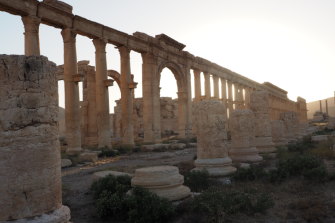
The Night of Power – Robert Fisk’s bitter epilogue

“All wars come to an end and that’s where history restarts”

“History stretches out into the future as well as the past”

“All wars may end in negotiations, but not all negotiations end wars”

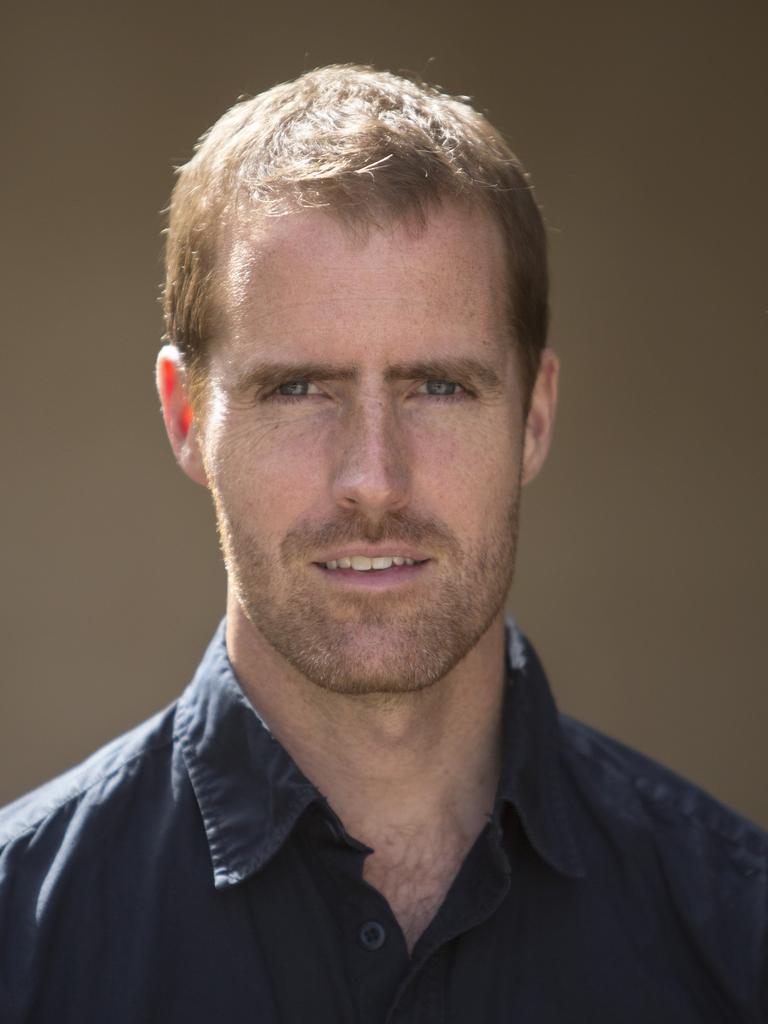
The indefatigable British journalist, author, and longtime Beirut resident Robert Fisk Robert Fisk died of a stroke in St Vincent’s Hospital, Dublin, on October 30, 2020. He was 75. Fearless and inquisitive, often iconoclastic and controversial, “Mister Robert,” as he was known from Algeria to Afghanistan, was one of the finest journalists of his generation—the greatest reporter on the modern Middle East. There is probably no better body of work for understanding the region. Respected and reviled in equal measure by left and right alike, Fisk spoke truth to power for more than half a century.

He was obsessive, he was angry, and – having read many of his books – I believe he suffered from undiagnosed PTSD throughout his career in the Middle East. His lifelong obsessions were the arrogance and misuse of power, the lies and impunity of the rulers: presidents and prime ministers, kings and emirs, dictators and theocrats, torturers and murderers. And always the countless innocents who endured and suffered, dying in their tens – and tens – of thousands on the altar of power and greed.

The Night of Power 

His last book, The Night of Power: The Betrayal of the Middle East, published posthumously in 2023, takes up where his monumental The Great War for Civilisation (2005) ended—with the contrived U.S.-British-Australian invasion of Iraq. The Great War for Civilisation was a tombstone of a book, literally and figuratively, as was its predecessor Pity the Nation (1990), his definitive history of the Lebanese civil war.

The Night of Power  is no less harrowing, covering the occupation of Iraq, the 2006 Israel–Lebanon war, the Arab Spring, the rise of Egypt’s new pharaoh Abdel Fattah al-Sisi, the lonely death of Mohammed Morsi, Israel’s occupation of the West Bank and seize of Gaza, and the Syrian civil war. It ranges widely – but its coherence lies in Fisk’s unrelenting theme: the cycle of war, the corruption of power, and the persistence of memory. To read it is to feel Fisk’s own cynicism, sadness and anger.

The title is deeply symbolic. In Islamic tradition, Laylat al-Qadr, the Night of Power, is the night the Qur’an was first revealed to the Prophet Muhammad: “The Night of Power is better than a thousand months … Peace it is, until the rising of the dawn” (Qur’an 97). It is a night of blessing beyond measure, greater than a lifetime of devotion. The title is bitterly ironic: the “night of power” he recounts is one of betrayal, cruelty, and endless war.

It is both a summation of his life’s work and a testament to his method. Over four decades, Fisk was a witness to almost every major conflict in the Middle East — Lebanon, Iran, Iraq, Palestine, Algeria, Afghanistan, Syria, Egypt — and the wars of the Yugoslav succession. His dispatches carried both forensic detail and moral outrage. This last work, published in the year of his death, is less a memoir than a vast chronicle of empire, war, betrayal, and resistance.

Fisk had long insisted that reporters must “be on the side of those who suffer.” He was no neutral stenographer of official sources. He distrusted governments – Western and Arab alike – and prized first hand testimony, walking the ruins, speaking to survivors, writing down the words of the powerless. The Night of Power continues in this vein, but with a sharpened sense of history. Fisk threads together centuries of conquest and resistance, showing how imperial arrogance, local despotism, and religious zealotry have conspired to devastate the region.

The last two paragraphs Robert Fisk wrote before his death, closing The Night of Power, cut like a blade through the pieties of Western journalism:

“Failure to distinguish between absolute evil, semi-evil, corruption, cynicism and hubris produced strange mirages. Regimes which we favoured always possessed ‘crack’ army divisions, ‘elite’ security units, and were sustained by fatherly and much revered ruling families. Regimes we wished to destroy were equipped with third-rate troops, mutineers, defectors, corrupt cops, and blinded by ruling families. Egypt with its political prisoners, its police torture and fake elections, was a tourist paradise. Syria with its political prisoners, police torture and fake elections, would like to be. Iran, with its political prisoners, police torture and fake elections was not — and did not wish to — be a tourist paradise.” (p. 533)

In the end, according to those closest to him, including his wife Nelofer Pazira-Fisk, an award-winning Afghan-Canadian author, journalist and filmmaker, who edited the book and wrote its final chapter, Fisk despaired. He feared that nothing he had written over four decades had made any difference – that things had, in fact, grown worse. As Kent says to the blinded King Lear, “All is cheerless, dark, and deadly”.

And yet the worst was arguably still to come: the chaotic retreat of America and its allies from Afghanistan and the Taliban’s reimposition of rule, including the literal silencing of women’s voices; Russia’s invasion of Ukraine and its murderous war of attrition that has now passed its thousandth day; Hamas’s atrocity of October 7, 2023, Israel’s biblical-scale revenge, and the utter destruction of Gaza; and the latest Israel–Lebanon war that saw the decapitation and emasculation of Hezbollah.

The Legacy of a Fearless Reporter

The Night of Power stands as a testament to Robert Fisk’s fearless journalism and his relentless moral compass. Across decades of war reporting, Fisk bore witness to suffering few dared to confront. He was unflinching in exposing the hypocrisies of Western powers, the brutality of dictators, and the costs of occupation, war, and empire. Yet he also captured the human dimension: the courage, endurance, and resilience of those who suffered, whether in Iraq, Gaza, Egypt, or Syria.

This final work synthesizes Fisk’s signature qualities: exhaustive research, direct engagement with the people whose lives were upended, and an ethical rigor that held both oppressors and complicit outsiders accountable. The Night of Power is not merely a chronicle of events; it is a meditation on power, betrayal, and history itself.

Fisk’s prose, vivid and often lyrical, reminds readers that journalism can be a form of witness — bearing truth against overwhelming odds. Even in despair, he recognized the persistence of human agency, the cycles of history, and the moral imperative to see, to name, and to remember. His death in 2020 marked the end of a career unparalleled in courage and conscience, but his work, particularly this last book, endures as both a warning and a guide for understanding the Middle East and the forces that shape our world.

In reading The Night of Power, one cannot avoid Fisk’s central lesson: history may restart at the end of every war, but the witness to injustice is what shapes the moral memory of humanity. The quotations at the head of this review, indeed, the final words of the book, weary yet resolute, are a fitting epitaph. Fisk saw the world as it was, not as we wished it to be: corrupt, cruel, but always turning, always restarting.

All wars come to an end and that’s where history restarts
Robert Fisk, The Night of Power

Postscript

The final chapter of The Night of Power was written by Fisk’s wife Nelofer Pazira-Fisk, She was based in Beirut for fifteen years working alongside her late husband and reported from Iraq, Afghanistan, Turkey, Egypt and Syria. The following podcast by American war correspondent Chris Hedges, with Fisk’s first wife Lara Marlowe is a worthy tribute .

See also, in In That Howling Infinite The calculus of carnage – the mathematics of Muslim on Muslim mortality 

The following briefly summarizes the main themes of The Night of Power drawing largely upon his own words

Robert Fisk’s Catalogue of Carnage

Hear the cry in the tropic night, should be the cry of love but it’s a cry of fright
Some people never see the light till it shines through bullet holes
Bruce Cockburn, Tropic Moon

Iraq: Catastrophe Foretold

Fisk argued that Iraq’s occupation was fraudulent from the start, brutal in execution, and ferocious in its response to insurgency. The Americans tolerated the inhuman behaviour of their own soldiers, relied on mercenaries and “greedy adventurers,” and mixed Christian religious extremism with an absurd political goal of “remaking the Middle East.” It was “tangled up in a web of political naivety and Christian muscularity”.It was bound, he wrote, to end in catastrophe.

“We were pulling at the threads of the society with no sense of responsibility as occupiers just as we had no serious plans for state reconstruction. Washington never wanted Iraq’s land. Of course the countries resources were a different matter, but its tactics did fit neatly into the prairies of the old West. The tribes could be divided and occupiers would pay less in blood. as long as they chose to stay. One set of tribes were bought off with guns and firewater the other with guns and dollar bills. Serious resistance, however, would invoke “the flaming imperial anger” of all occupation armies.

The rhetoric echoed the 19th century missionary zeal of empire. Western fascination with the Biblical lands was used to justify conquest: as Lieutenant General Stanley Maude told the people of Baghdad in 1917, the Allies wished them to “prosper even as in the past when your ancestors gave to the world Literature, Science, and Art, and when Baghdad city was one of the wonders of the world” (p. 92).

The modern occupation, Fisk observed, was nothing but “the rape of Iraq”. Oil wealth was divided up in a scandal of corruption involving US contractors and Iraqi officials. “The costs were inevitably as dishonest as the lies that created the war … I knew corruption was the cancer of the Arab world but I did not conceive of how occupying Power supposedly delivering Iraqi their long sort freedom could into a mafia and at such breathtaking speed”.

Security became a malignant industry; by 2006 mercenaries accounted for half of Western forces, sucking money out of the country. The food system, 10,000 years old, was destroyed by Paul Bremer’s infamous Order 81, which forbade farmers from saving their own seed. Iraq became a “giant live laboratory for GMO wheat,” its people “the human guinea pigs of the experiment”.

And through it all, a campaign of suicide bombings –  unprecedented in scale –  turned Iraq into the crucible of modern terror. Editors never tried to count them. The figures, Fisk noted, were historically unparalleled.

The trial of Saddam Hussein

The US ambassador to Iraq once claimed she had been “unable to convince Saddam that we would carry through what we warned we would.” Fisk dismissed this as absurd. Saddam, he argued, was well aware of Western threats, but the framing of his trial was designed to obscure deeper truths.

If Saddam had been charged with the chemical massacre at Halabja, defence lawyers could have pointed out that every US administration from 1980 to 1992 was complicit in his crimes. Instead, he was tried for the judicial murder of 148 men from Dujail — heinous, but “trifling in comparison” (p. 92). The great crimes of the Baathist regime — the 1980 invasion of Iran, the suppression of Shia and Kurdish revolts in 1991 — were deemed unworthy of the court’s attention.

Pakistan: Fragile State, Useful Pawn

Fisk’s lens widened to Pakistan, where he recorded with scorn the ISI’s admission that the reality of the state was defined not by American might but by “corrupt and low-grade governance”. A US intelligence officer boasted: “You’re so cheap … we can buy you with a visa, with a visit to the US, even with a dinner.”

This, Fisk suggested, was not just Pakistan but almost every Arab or Muslim state in thrall to Washington: Egypt, Jordan, Syria, the Gulf states under their dictators and kings, even Turkey. He wrote that Osama Bin Laden’s choice to hide in Pakistan embodied a weird symmetry: the man who dreamed of a frontierless caliphate sought refuge in the very sort of corrupt, Western-backed dictatorship he despised.

Rendition: Complicity in Torture

The “war on terror” extended beyond borders. CIA, MI5 and MI6 operatives were deeply involved in rendition. Prisoners were knowingly dispatched to states where torture was inevitable, even fatal. Fisk insisted on repeating this uncomfortable truth: Western democracies had integrated torture into their security architecture.

Israel and Palestine: The Last Colonial War

Fisk was unsparing in his treatment of Israel’s expansion. He rejected any obfuscation: Israel seized the opportunity to consolidate its control with a land grab for the most prominent hilltops and the most fertile property in the West Bank for settlements constructed on land legally owned for generations by Arabs, destroying any chance the Palestinian Arabs could have a viable state let alone a secure one.”). These settlements, he wrote, “would become the focus of the world’s last colonial war.”

He surmised: “Will the Jews of what was Palestine annex the West Bank and turn its inhabitants into voteless guest workers and all of mandate Palestine into an apartheid state? There was a mantra all repeat that only other way to resolve Israeli rule in the West Bank would be a transfer of the Palestinians across the Jordan into the Hashemite kingdom on the other side of the river. In other words, expulsion”

The Wall 

Fisk’s Fisk’s description of the Separation Wall is dramatic and unforgettable: an   “immense fortress wall” which snakes “firstly around Jerusalem but then north and south of the city as far as 12 miles deep into Palestine territory, cutting and escarping its way over the landscape to embrace most of the Jewish colonies … It did deter suicide bombers, but it was also gobbled up more Arab land. In places it is 26 feet or twice the height of the Berlin wall. Ditches, barbed wire, patrol roads and reinforced concrete watchtowers completed this grim travesty of peace. But as the wall grew to 440 miles in length, journalists clung to the language of ‘normalcy’ a ‘barrier’ after all surely is just a pole across the road, at most a police checkpoint, while a ‘fence’ something we might find between gardens or neighbouring fields. So why would we be surprised when Italian Prime Minister Silvio Berlisconi, traveling through the massive obstruction outside Bethlehem in February 2010 said that he did not notice it. But visitors to Jerusalem are struck by the wall’s surpassing gray ugliness. Its immensity dwarfed the landscape of low hills and Palestinian villages and crudely humiliated beauty of the original Ottoman walls Churches mosques and synagogues .. Ultimately the wall was found to have put nearly 15% of West Bank land on the Israeli side and disrupted the lives of a third of the Palestine population. It would, the UN discovered, entrap 274,000 Palestinians in enclaves and cut off another 400,000 from their fields, jobs, schools and hospitals. The UN concluded that many would “choose to move out.” Was that the true purpose?“.

Leftwing Israeli journalist Amira Haas, who lives in the West Bank, takes Fisk on a tour of the wall: “Towering 26 feet above us, stern, monstrous in its determination, coiling and snaking between the apartment blocks and skulking in wadis and turning back on itself until you have two walls, one after the other. You shake your head a moment – when suddenly through some miscalculation surely – there is no wall at all but a shopping street or a bare hillside of scrub and rock. And then the splash of red, sloping rooves and pools and trees of the colonies and yes, more walks and barbed wire fences and yet bigger walls. And then, once more the beast itself, guardian of Israel’s colonies: the Wall”.

See also, in In That Howling InfiniteBlood and Brick … a world of walls

Banksy on The Wall. Paul Hemphill, May 2016

Gaza: Junkyard of History

Although Oslo’s creators fantasied that it would become part of the Palestinian state, Gaza’s destiny was isolation. It has been a junkyard of history variously ruled by Christians and Muslims, ruined and rebuilt under the Ottomans, and fought for by the British and Turks in the First World War, and now reduced to a prison state.,

Egypt: A Revolution Betrayed

Mohammed Morsi embodied both hope and tragedy. “An intelligent, honourable, obtuse, arrogant and naïve man”. No visionary, he was “was shambolic, inspiring, occasionally brutal and very arrogant”.  He set off down the road to Egyptian democracy with no constitution no parliament and no right to command his own countries army …set off down the road to democracy “with no constitution, no parliament and no right to command his own country’s army”. And when the end came, as come it must, he could not smell trouble; he did not see what was coming.

In a coup that was not a coup, which former British prime minister Tony Blair called “an awesome manifestation of power”, “the democratically elected president was suspended, the constitution annulled, tekevion stations closed, the usual suspects arrested … Yet President Obama could not bring himself to admit this. He asked the Egyptian military “to return full authority back to a democratically elected civilian government… Through an inclusive and transparent process” without explaining which particular elected civil civilian government he had in mind”.

This was just the beginning. In the six years that followed, Egypt’s executioners and jailers were kept busy. “They hung 179 men, many of them tortured before confessing to murder, bomb attacks or other acts of terrorism”. It was claimed that Al Sisi had returned the country to a Mubarak style dictatorship in the seven years of his own war against the brotherhood between 1990 and 1997. Mubarak’s hangman had executed only 68 Islamists and locked up 15,000. By 2019  Al Sisi had 60,000 political prisoners

To Fisk, this was a sign of fear as much as it was evidence of determination to stamp out terror. Al Sisi had three separate conflict on his hands: his suppression of the brotherhood on the ground that they were themselves violent terrorists, the campaign by Islam extreme groups against Egypt’s minority Christian cops, and most frightening of all the very real al Qaeda and ISIS war against Al Sisi’s own regime. “The prisons of the Middle East, Fisk concluded, were “universities for future jihadi”.

See also, in In That Howling Infinite and Sawt al Hurriya – remembering the Arab Spring
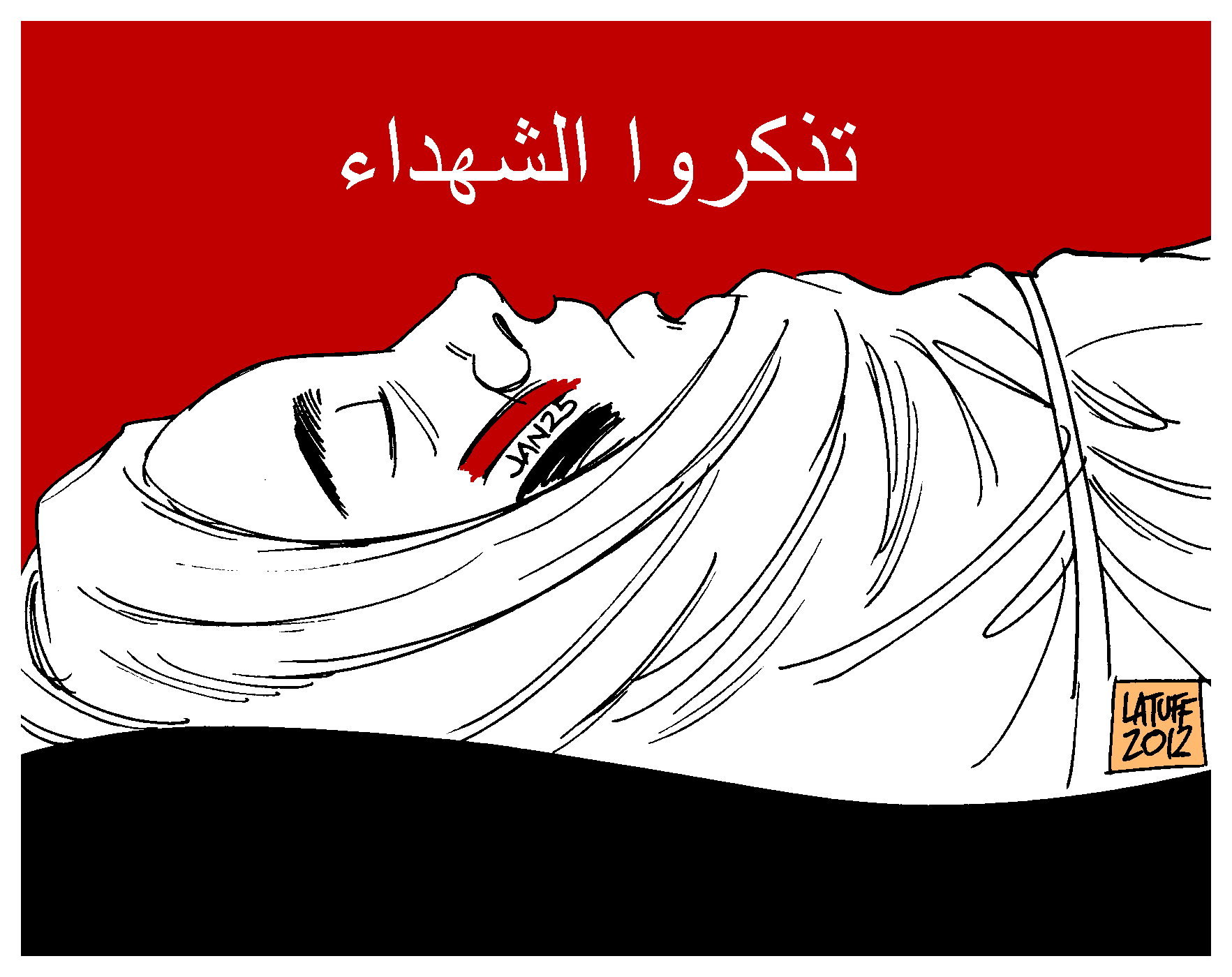
Remember and witness

Silencing the women of the revolution 

The misogyny if the counterrevolution was stark. Fisk wrote: “… if the senior officers wished to prune the branches of the revolution the participation of women was something that could not be tolerated. Why did there suddenly occur without apparent reason a spate of sexual attacks by soldiers that were clearly intended to frighten young women off the street,  revealing a side to the Egyptian military that none of us had recognised. The misogynistic and shocking display of brutality towards women that could not have been the work of a few indisciplined units”. With sexual assaults on women protesters, virginity tests and public humiliation, “heroes of the 1973 war had become molesters”.

The lonesome death of Muhammad Morsi

Morsi would struggle on for years before a series of mass trials would entrap him and his brotherhood colleagues and quite literally exhaust him to death. Morsi’s slow death in solitary confinement was, Fisk insisted, “utterly predictable, truly outrageous and arguably a case of murder”. He was denied treatment, denied family visits, denied a funeral. “To die in a dictator’s prison, or at the hands of a dictator’s security services”, Fisk wrote, “is to be murdered.”

It did not matter, he continued “if it was the solitary confinement, the lack of medical treatment or the isolation, or if Morsi had been broken by the lack of human contact for those whom he loved. “The evidence suggested that Morsi’s death must’ve been much sought after by his jailers, his judges, and the one man in Egypt who could not be contradicted. You don’t have to be tortured with electricity to be murdered”.

Fisk’s description of Morsi’s death is a sad one. “Symbolism becomes all”, he wrote. “The first and last elected president of a country dies in front of his own judges and is denied even a public funeral. The 67-year-old diabetic was speaking to the judges, on trial this time for espionage, when he fainted to the floor. Imagine the response of the judges when he collapsed. To be prepared to sentence a man to the gallows and to witness him meeting his maker earlier than planned must’ve provoked a unique concentration of judicial minds. could they have been surprised groups had complained of Morsi’s treatment for the world media and the world had largely ignored the denunciations. What might have been surprising to his judges was that he managed to talk for five minutes before he departed the jurisdiction forever?”

See also, in In That Howling Infinite, Nowhere Man – the lonesome death of Mohamed Morsi 

Mohammed Morsi in the cage of justice

Russia in the Syrian Cockpit

Regarding Russia’s critical intervention in the Syrian civil war, Fisk wrote:

“We Westerners have a habit of always looking at the Middle East through our own pious cartography, but tip the map 90° and you appreciate how close Syria is to Russia and its Chechen Muslim irredentists. No wonder Moscow watched the rebellion in Syria with the gravest of concern. Quoting Napoleon, who said “if everyone wants to understand the behaviour of a country, one has to look at a map”, my Israeli friend (the late) Uri Avnery wrote that “geography is more important than ideology, however fanatical. Ideology changed with time”.

The Soviet Union, he continued was most ideological country in the 20th century. “It abhorred it predecessor, Tsarist Russia. It would have abhorred its successor, Putin‘s Russia. But Lo and behold – the Tsars, Stalin and Putin conduct more or less the same foreign policy. I wrote that Russia is back in the Middle East. Iran is securing its political semicircle of Tehran, Baghdad Damascus, and Beirut. And if the Arabs – or the Americans – want to involve themselves, they can chat to Putin”.

Yarmouk camp, Damascus. Once the thriving home of Syria’s Palestinian refugees, September 2025

Author’s note

Laylatu al Qadri

لَْيلَُةاْلَقْدِر َخْيٌر ِّمْنأَْل ِف َشْھٍر. َسَلاٌم ِھَي َحَّتى َمْطلَِعاْلَفْجِر
Laylatu alqadri khayrun min alfi shahriin.Salamun hiya hatta matla’i alfajrii
The night of power is better than one thousand months.
(That night is) Peace until the rising of the dawn.
Al Qur’an al Karīm, Surat Al Qadr 97

I first learned about the Quran and The Night of Power in Cairo when I was staying at the home of Haji Abd al Sami al Mahrous a devout Muslim doctor who had cared for me when I had fallen ill. There was a particular beauty and magic about the idea of a night that surpassed all other nights in sacredness. The fascination stayed with me, and when I returned to London and was learning Arabic and studying Middle East politic at SOAS, it inspired a song.

Shape without form, a voice without sound,
He moves in an unseen way;
A night of power, eternal hour,
Peace until the break of day;
The doubter’s dart, the traveller’s chart,
An arrow piercing even to the coldest heart,
A hand surpassing every earthly art,
And shows everyone his own way

Paul Hemphill, Embryo

When Freedom Comes, She Crawls on Broken Glass

In an earlier post in In That Howling Infinite, I wrote:

My song  When Freedom Comes is a tribute to Robert Fisk (1946-2020), indomitable, veteran British journalist and longtime resident of Beirut, who could say without exaggeration “I walk among the conquered, I walk among the dead” in “the battlegrounds and graveyards” of “long forgotten armies and long forgotten wars”. It’s all there, in his grim tombstone of a book, The Great War for Civilization (a book I would highly recommend to anyone wanting to know more about the history of the Middle East in the twentieth century – but it takes stamina – at near in 1,300 pages – and a strong stomach – its stories are harrowing).

The theme, alas, is timeless, and the lyrics, applicable to any of what Rudyard called the “savage wars of peace” being waged all across our planet, yesterday, today and tomorrow – and indeed any life-or-death battle in the name of the illusive phantom of liberty and against those intent on either denying it to us or depriving us of it. “When freedom runs through dogs and guns, and broken glass” could describe Paris and Chicago in 1968 or Kristallnacht in 1938. If it is about any struggle in particular, it is about the Palestinians and their endless, a fruitless yearning for their lost land. Ironically, should this ever be realized, freedom is probably the last thing they will enjoy. They like others before them will be helpless in the face of vested interest, corruption, and brute force, at the mercy of the ‘powers that be’ and the dead hand of history.

The mercenaries and the robber bands, the warlords and the big men, az zu’ama’, are the ones who successfully “storm the palace, seize the crown”. To the victors go the spoils – the people are but pawns in their game.

In 2005, on the occasion of the publication of his book, Fisk addressed a packed auditorium in Sydney’s Macquarie University. Answering a question from the audience regarding the prospects for democracy in the Middle East, he replied:

“Freedom must crawl over broken glass”

When Freedom Comes, She Crawls on Broken Glass 

There goes the freedom fighter,
There blows the dragon’s breath.
There stands the sole survivor;
The time-worn shibboleth.
The zealots’ creed, the bold shahid,
Give me my daily bread
I walk amongst the conquered
I walk amongst the dead

Paul Hemphill, When Freedom Comes

I reference this melancholy state of affairs in man of my songs:

High stand the stars and moon,
And meanwhile, down below,
Towers fall and tyrants fade
Like footprints in the snow.
The bane of bad geography,
The burden of topography.
The lines where they’re not meant to be
Are letters carved in stone.
They’re hollowed of all empathy,
And petrified through history,
A medieval atrophy
Defends a feeble throne.
So order goes, and chaos flows
Across the borderlines,
For nature hates a vacuum,
And in these shifting tides,
Bombs and babies, girls and guns,
Dollars, drugs, and more besides,
Wash like waves on strangers’ shores,
Damnation takes no sides.
Paul Hemphill, E Lucevan Le Stelle

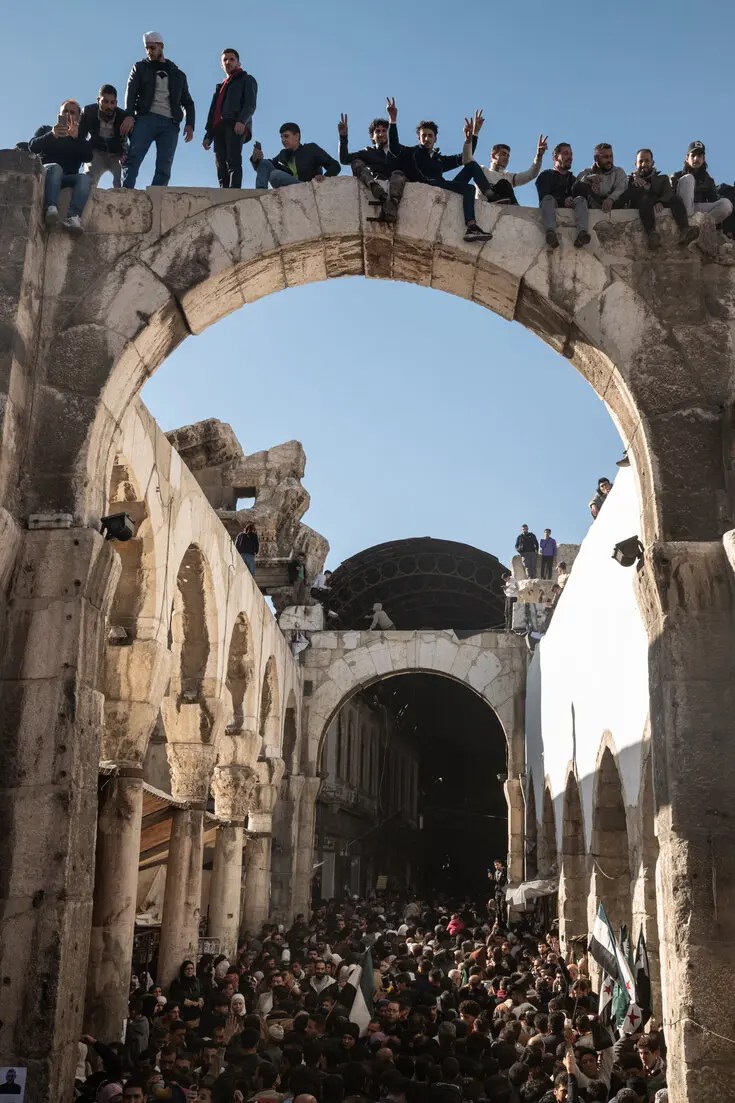
Syria. Illusion, delusion and the fall of tyrants

So we march to the rhythm of the revolution;
Oh it is our shining hour.
Move to the rhythm of the revolution,
And the revolution’s power.
Run with the rhythm of the revolution,
Storm the palace, seize the crown.
Rise to the rhythm of the revolution,
Shake the system, break it down!
Paul Hemphill, Rhythm of the Revolution

Recent events in the Middle East seem to validate Vladimir Lenin’s aphorism, “there are decades where nothing happens; and there are weeks where decades happen”.

For years” wrote Bel Tru, the Independent’s correspondent in the Levant, a worthy successor to the late Robert Fisk and now retired Patrick Cockburn.East, “the world forgot about Syria. Many believed it was lost in an unsolvable abyss following the collapse of the 2011 revolution into a bloody civil war – made increasingly complex by the intervention of a mess of internal and international actors. Most assumed that the immovable regime of Bashar al-Assad had won, and that nothing would ever change. Few could even tell you if the war was still ongoing, let alone what stage it was at”.

Until Syrian rebel fighters stormed out of their fastness in Idlib province, which had been besieged and contained and for years by government forces and Russian bombers, and in an off sense that too the world by surprise, they took control of Aleppo, Syria’s largest city?

Over the space of a week, it seemed as if the nightmares of the past had come rushing into the present as the current wars in Gaza and Lebanon were pushed to the sidelines.

Iran’s theocratic tyrant Ayatollah Khamenei declared that the rebel offensive that destroyed the 52-year-old Assad dynasty in a mere eleven days was all a foreign plot concocted by the Great Satan and the Little Satan, aided and abetted by the wannabe Sultan of Türkiye (and there might indeed be a kernel of truth in that). In his opinion, it had nothing to do with the fact that the brutal and irredeemably corrupt Syrian regime was rotten to its core and that like the Russian army in 1917, its reluctant conscript soldiers, neglected, poorly paid and hungry, refused to fight for it whilst its commanders ran for their lives. Built to fight Israel and then to subdue Syrians, it had over time ate itself in corruption, neglect and ineptitude. Western radicals of the regressive left will doubtless believe the good ayatollah because that is what they are conditioned to believe rather than learning anything about Syria or the region generally.

if Khamenei could only have removed the mote from his eye, he’d have seen that the fall of Bashar al Assad was the indirect result of the most disastrous series of foreign policy miscalculations since the theocratic regime took power in Tehran in 1979. In the wake of Hamas’s murderous attack on Israel on October 7, 2023, Iran made the fatal error of ordering its proxy Hezbollah in Lebanon to begin a low-level war against northern Israel, lobbing missiles and drones into it almost daily. What Tehran did not calculate was that once Israel had largely destroyed Hamas in Gaza it would turn its guns on to Hezbollah with stunning force. The indirect effect of Iran’s miscalculation was that neither Hezbollah nor Iran was in a position to help Assad repel the rebels when they launched their assault. Iran has now lost its regional ally Syria, in addition to Hezbollah and Hamas, leaving it unusually isolated in the region when its ageing clerical leadership is increasingly unpopular with its own people.

Over the coming weeks and months, commentators, pundits and so-called experts will ruminate on the causes of the fall of one of the Middle East’s most enduring and also, even by the region’s low standards, brutal regime, and on what may or may not happen now.

I republish below two excellent opinion pieces offering some answers to each question respectively. Each in their own way follow the advice of most scholars of the Middle East: expect the unexpected. And whilst most observers admit to having been taken by surprise when Hayat al Tahrir al Sham fell upon Aleppo, including intelligence organizations that ought to have known better, none were perhaps more surprised than the insurgents themselves when only a fortnight ago, they were given the nod by their Turkish patron to endeavour to expand the borders of their statelet and suddenly found themselves on an almost empty highway to Damascus.

Analyst and commentator David McCullen (who has featured prominently on this blog in the past) examines warning signs that may have indicated that all was not well in the Assad kingdom, drawing on on historical parallels to explain why the Bashar al Assad and his longtime all-pervasive and ever-watching security apparatus failed to see the gathering storm unlit it had engulfed them.

He references particularly the political scientist Timur Kuran, the originator of the concept of “preference cascade”: “… under repressive regimes (or ostensibly democratic ones that censor dissent) the gap between public pronouncements and private opinions increases over time, until many individuals dissent from the approved narrative and lose faith in institutions that promote it but remain reluctant to reveal their real views. This “preference falsification” creates a deceptive impression of consensus. It can make regimes believe they have more support than they really do, while convincing dissidents they are all alone so there is no point expressing a contrary opinion. But when an unexpected shock reduces the regime’s power to suppress dissent, people suddenly feel empowered to express their real opinions. They realise these opinions are widely shared and the false consensus evaporates. This can trigger a “preference cascade”, where individuals or institutions suddenly change sides and support for the government collapses overnight”.

Kilcullen concludes: “Given the speed and totality of Assad’s collapse, some observers seem to be assuming that HTS will now, by default, become the dominant player in Syria. On its face, this may seem a reasonable assumption, given what happened in similar situations – Havana 1959, Saigon 1975, Kabul 2021 and so on”. But he cautions that “it would be premature in Syria’s case since the war is very much ongoing. As the northern hemisphere winter closes in and Western allies prepare for a change of administration in Washington, Syria – along with Gaza, Lebanon, the Red Sea, Ukraine, Taiwan and the Korean peninsula – will remain a major flashpoint into the new year”.

Indeed, the immediate future is far from clear. It is axiomatic to say that most commentators who say they understand what is going to happen in the Levant often don’t. To quote B Dylan, something’s happening, and we don’t yet know what it is …

In the second article republished below, Israeli commentator Zvi Bar’el examines possibilities, including the Herculean task of putting the fractured state of Syria back together again. As Australian diplomat David Livingstone wrote in the Sydney Morning Herald on 3 December, “Syria and its conflict is a mosaic of combatants rather than a dichotomy of good versus evil. Loyalties usually reflect a person’s religion or ethnicity. The Sunnis hate the nominally Shiite regime of Assad; Assad himself is the inheritor of atrocities by his father’s regime against the Sunni, including the destruction of Hama and slaughter of many of its inhabitants in 1982; the Kurds want an autonomous homeland; and the Turkmen are no friends to Assad or extremist Sunnis”.

So, where to from here? Syria now pauses at a crossroads, where both hope for a better future, and scepticism that it will be achieved, are equally warranted. Whether or not the new Syrian regime can succeed is an open question.

There is much to be done, with little time and meagre resources to do it. Forces, factions and faiths will now have to be reconciled. The divided country is shattered physically, economically and psychologically. Some 410,000 Syrians are estimated to have been killed in war-related violence up to the end of last year making it the bloodiest conflict of the 21st century to date. The dead will have to counted and accounted for, including tens and tens of thousands lost in the regime’s jails and prisons, and the survivors of rehabilitated. Scores may have to be settled either in blood or in spirit. About half of the country’s pre-war population has either fled abroad or internally displaced. The new government will need to ensure civilians’ safety, enable the return of millions of refugees and internally displaced, and rehabilitate the infrastructure and civil services. But the country is broke, while one economist estimates that the physical damage across the country amounts to $150 billion.

What form will a government take? Does the new administration intend to hold elections? Will HTS leader Ahmed al Shara and his comrades set up a government that will be agreed on by all the communities, factions, militia, and foreign forces? Will the new constitution be Islamic? To this his new prime minister replies, “God willing, but clearly all these details will be discussed in the constitutional process.” When Italian journalist Andrea Nicastro asks him “do I understand correctly when I say you’re ready to make peace with Israel and that you’re hostile to Iran, Hezbollah and Russia?” Al-Bashir thanks him and leaves without answering.

Meanwhile, Arab states, who once spurned Assad’s regime and were tentatively cozying up to him only recently, having invited Syria back into the Arab League. European states are contemplating whether or not to remove HTS from their lists of proscribed terrorist organizations. Assad’s erstwhile backers, Iran and Russia, which in fact controlled large parts of Syria, left Dodge in haste and are now replaced by two new-old occupiers, Israel, and Turkey. One took over the “Syrian Hermon” and a little further – to the condemnation of Arab regimes and the United Nations, the other is completing the occupation of the Kurdish regions in northern Syria.

No love is lost between the two of them, but it seems fate insists on making them meet in war fronts. As Bar’el adds, “… once as partners when they helped Azerbaijan in its war against Armenia and once as enemies in the Gaza front or now on Syrian soil. There’s no knowing, maybe al Shara will be the best man who will get to reconcile between them. Miracles happen, even if under the nose of the best intelligence services in the world, who didn’t know and didn’t evaluate the complete collapse of the Assad regime”. “The warm Arab and international envelope tightening around Damascus”, he writes, “is ready to give him credit although it doesn’t know yet where he’s heading, assuming any leader will be better than Assad. That, by the way, is what the Syrians also believed Assad senior would be when he toppled the rule of General Salah Jedid, only to get a new mass murderer.

Right now, as the old song goes, “the future’s not ours to see …” But we might take hope from the last line of the late Robert Fisk‘s last book, The Night of Power, published posthumously earlier this year: “… all wars come to an end and that’s where history restarts”. 

Author’s note

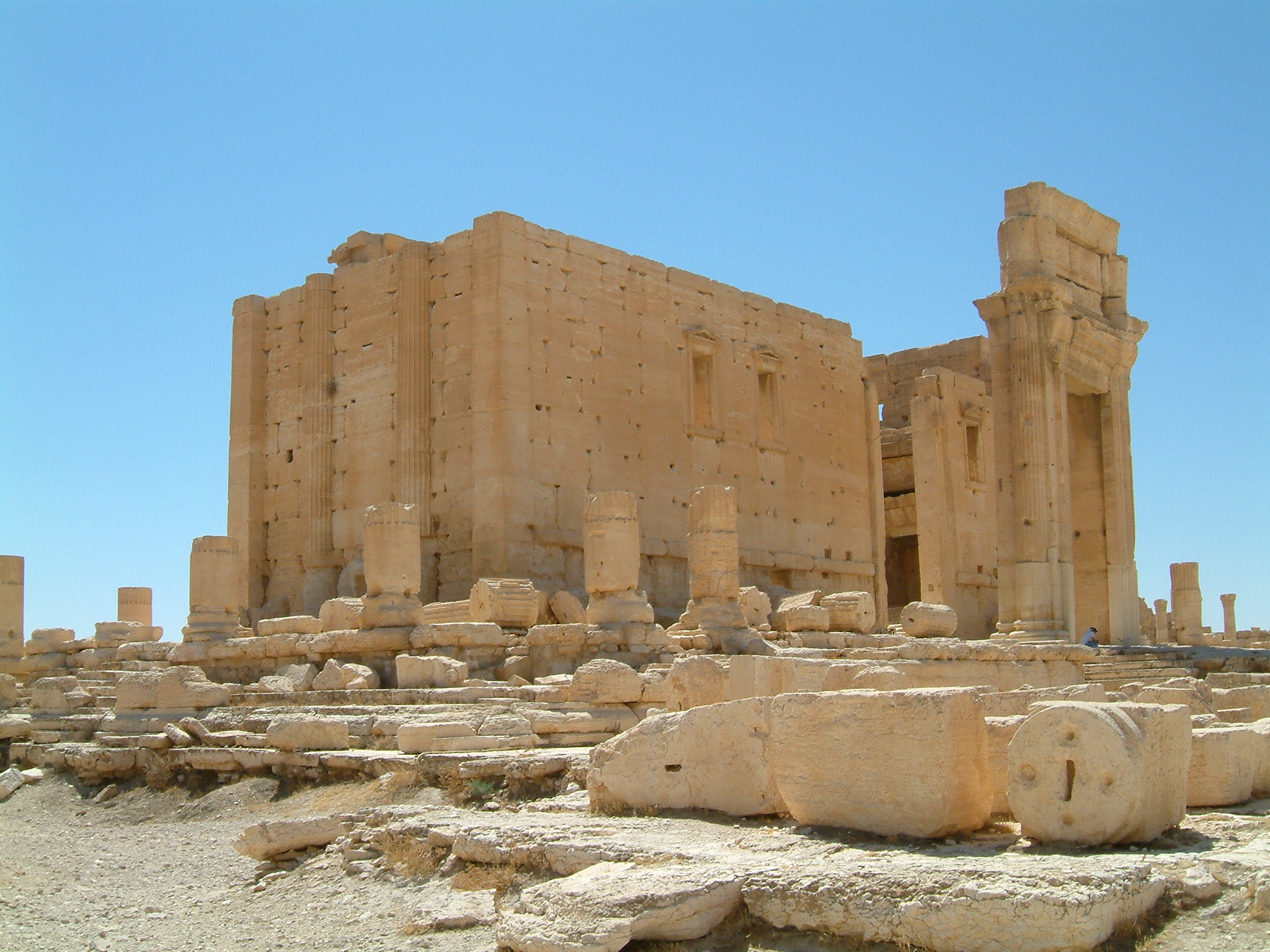
There have been many stunning pictures published to date of the Syrian revolution, but none that I’ve found as personally poignant as this one. It depicts jubilant Syrians lining the Roman archway that stands at the eastern end of Damascus’ historic Suq al Hamadiyah. When we were last in Syria, in the Spring of 2009, I photographed the arch from inside the darkened Suq (during one of the city’s frequent power cuts) , revealing the impressive remnants of the Roman Temple of Jupiter and the magnificent Omayyad Mosque, the fourth holiest place in Islam (after Mecca, Medina and Al Quds/Jerusalem).

For more on the Middle East in in That Howling Infinite, see A Middle East Miscellany:  

Syrians atop the Roman archway at the end of Damascus’ historic Suq al Hamadiyah

The Suq Al Hamadiyah, Temple of Jupiter and the Umayyad Mosque Mosque. P Hemphill 2009

The Suq Al Hamadiyah, Temple of Jupiter and the Umayyad Mosque Mosque. P Hemphill 2009

Aleppo shock to Hama huge leap forward: triggers in Syria’s 11-day blitz that unravelled Assad

David Kilcullen, The Australian, 13th December 2024

The speed of the regime’s collapse was startling, but it should not have been. Beyond the general dynamics of government collapse, something else was happening.

The regime’s collapse accelerated dramatically after the fall of the central Syrian city of Hama on the evening of Thursday, December 5, Syria time. Picture: Emin Sansar/Anadolu via Getty Images

The regime’s collapse accelerated dramatically after the fall of the central Syrian city of Hama on the evening of Thursday, December 5, Syria time. Picture: Emin Sansar/Anadolu via Getty Images

This was not strictly true: HTS had been biding its time in its stronghold of Idlib province, on Syria’s northwestern border with Turkey, for five years since a ceasefire brokered by Turkish and Russian negotiators in 2020, avoiding direct confrontation with the regime and building its own structure outside state control.

Its parallel government included several ministries and a civil administration, the Syrian Salvation Government, governing a population of four million, the size of Croatia or Panama. Though dominated by HTS, the SSG has been somewhat politically inclusive, and several non-HTS leaders have had key roles in its administration.

It sought to include the independent governance councils that had arisen organically during the early days of the anti-Assad rebellion, and it established local municipal managers to provide essential services across its territory.

HTS’s small combat groups operated like a fast-moving light cavalry force. Picture: Omar Haj Kadour / AFP

HTS’s small combat groups operated like a fast-moving light cavalry force. Picture: Omar Haj Kadour / AFP

American analysts in 2020 assessed the SSG as technocratic, “post-jihadi”, focused on internal stability and non-ideological governance, seeking acceptance from Turkey and the US, and unlikely to become a launch pad for external attacks.

Aaron Zelin – the Western expert most familiar with HTS and the author of an important book on the organisation, The Age of Political Jihadism – has observed that despite still holding extremist beliefs, HTS acts more like a state than a jihadist group.

While the SSG was focusing on social services and economic activity, HTS commanders were investing in advanced military capabilities. Building on experience from before the 2020 ceasefire, HTS organised its forces into small combat groups of 20 to 40 fighters that could mass quickly to swarm a target using several teams, or disperse to avoid enemy airstrikes or artillery.

They were highly mobile, operating like a fast-moving light cavalry force, mounted in a mix of hard and soft-skinned vehicles that included captured armoured vehicles and armed pick-up trucks (known as technicals).

Reconnaissance teams, scouts and snipers moved in civilian cars or on motorcycles. HTS combat groups carried heavy and light weapons including rocket launchers, captured artillery pieces, mortars, recoilless rifles, anti-tank missiles and Soviet-bloc small arms seized from the government or rival resistance groups including Islamic State.

Rebel fighters stand next to the burning gravesite of Syria's late president Hafez al-Assad at his mausoleum in the family's ancestral village of Qardaha. Picture: Aaref Watad / AFP

Rebel fighters stand next to the burning gravesite of Syria’s late president Hafez al-Assad at his mausoleum in the family’s ancestral village of Qardaha. Picture: Aaref Watad / AFP

HTS also used the ceasefire to professionalise itself, studying the wars in Ukraine, Gaza and Lebanon. It established a military academy to educate officers in “military art and science”, and created civil affairs units, humanitarian agencies and a specialised organisation to convince government supporters to defect.

It used drones for reconnaissance, for leaflet drops on regime-controlled areas and as one-way attack munitions to strike targets with explosive warheads. It manufactured weapons and drones, and modified technicals with additional armour. HTS leaders built intelligence networks and command-and-control systems while allegedly also forging relationships with regional intelligence services and special operations forces.

Thus, the strength of HTS was not unexpected in itself. On the other hand, the rapidity of the regime’s collapse – which accelerated dramatically after the fall of the central Syrian city of Hama on the evening of Thursday, December 5, Syria time – was startling. It probably should not have been. Governments, unlike resistance movements, are tightly coupled complex systems that rely on numerous institutions and organisations, all of which must work together for the state to function.

As Joseph Tainter showed in The Collapse of Complex Societies, once co-ordination begins to break down, these interdependent systems unravel, the collapse of each brings down the next, and the entire structure falls apart. For this reason, in a process familiar to practitioners of irregular warfare, resistance groups (which tend to be loosely structured and thus more resilient to chaos) degrade slowly under pressure – and rebound once it is relieved – whereas governments collapse quickly and irrevocably once initial cohesion is lost.

As a team led by Gordon McCormick showed in a seminal 2006 study, governments that are losing to insurgencies reach a tipping point, after which they begin to decay at an accelerating rate. The conflict then seems to speed up and the end “is typically decisive, sudden and often violent”.

This pattern was very noticeable during the fall of the Afghan republic in 2021, for example, which also occurred in an 11-day period. The final Taliban offensive captured every province but one, and took the capital, Kabul, in a series of victories between August 4 and 15, 2021. Many garrisons surrendered, fled without fighting or changed sides.

Initial rebel successes made the regime look weak, allies failed to offer support, the security forces defected and other rebel groups suddenly rose up across the country. Picture: Aaref Watad / AFP

Initial rebel successes made the regime look weak, allies failed to offer support, the security forces defected and other rebel groups suddenly rose up across the country. Picture: Aaref Watad / AFP

To be sure, the Taliban’s final campaign was built on years of coalition-building and insurgent warfare. Similar to HTS, the Taliban relied on patient construction of parallel networks largely illegible to an Afghan state increasingly alienated from, and seen as illegitimate by, its own people.

It also was enabled by a stunningly shortsighted political deal with the US in 2020 and an incompetent US-led withdrawal in 2021. Even so, the collapse of the Kabul government was faster than expected, with president Ashraf Ghani fleeing by helicopter in a manner remarkably similar to Bashar al-Assad’s exit last weekend.

The fall of South Vietnam in 1975 was likewise extraordinarily rapid, occurring in just nine days after the decisive battle of Xuan Loc, with South Vietnam’s last president, Nguyen Van Thieu, fleeing for Taiwan on a military transport plane.

Similarly, Fulgencio Batista’s government in Cuba fell in only five days, between December 28, 1958 – when a rebel column under Che Guevara captured the town of Santa Clara – and the early hours of January 1, 1959, when Batista fled by aircraft to the Dominican Republic. He had announced his resignation to shocked supporters a few hours earlier at a New Year’s Eve party in Havana, starting a scramble for the airport.


In Syria’s case, beyond these general dynamics of government collapse, something else was happening: a military version of what political scientists call a “preference cascade”.

As Timur Kuran, originator of the concept, points out, under repressive regimes (or ostensibly democratic ones that censor dissent) the gap between public pronouncements and private opinions increases over time, until many individuals dissent from the approved narrative and lose faith in institutions that promote it but remain reluctant to reveal their real views. This “preference falsification” creates a deceptive impression of consensus. It can make regimes believe they have more support than they really do, while convincing dissidents they are all alone so there is no point expressing a contrary opinion.

But when an unexpected shock reduces the regime’s power to suppress dissent, people suddenly feel empowered to express their real opinions. They realise these opinions are widely shared and the false consensus evaporates. This can trigger a “preference cascade”, where individuals or institutions suddenly change sides and support for the government collapses overnight.

In particular, the moment when security forces, particularly police, refuse to fire on protesters is often decisive, as seen in the fall of the Suharto government in 1998, the overthrow of Hosni Mubarak in 2011 or the collapse of the East German regime in 1989.

Kuran’s initial work centred on the East European revolutions of 1989, which were unexpected at the time but seemed inevitable in retrospect, something Kuran later came to see as inherent in revolutionary preference cascades.

The most extreme case was the fall of Nicolae Ceausescu in Romania. During a mass rally on December 21, 1989 the dictator suddenly realised, his face on camera registering utter shock, that what he had initially perceived as shouts of support were actually calls for his downfall. When his security ser­vices refused to fire on the protesters, Ceausescu was forced to flee by helicopter. Four days later, he and his wife Elena were dead, executed after a brief military trial.

A woman poses for a photograph with a rebel fighter's gun in Umayyad Square in Damascus. Syria’s population finally felt free to dissent from the dominant narrative. Picture: Chris McGrath/Getty Images

A woman poses for a photograph with a rebel fighter’s gun in Umayyad Square in Damascus. Syria’s population finally felt free to dissent from the dominant narrative. Picture: Chris McGrath/Getty Images

Syria this week was another example of a preference cascade. Initial rebel successes made the regime look weak, allies failed to offer support, the security forces defected and other rebel groups suddenly rose up across the country. Syria’s population – previously reluctant to express anti-regime sentiment for fear of repression or social ostracism – finally felt free to dissent from the dominant narrative. Assad lost control, was forced to flee, and his government collapsed. It is worth briefly recounting the sequence of events.

On November 27, the HTS offensive began with a sudden attack on Aleppo City. The outskirts of Aleppo are only 25km from the HTS stronghold in Idlib, so although the outbreak of violence was a surprise, there was little initial panic. The regime responded with airstrikes and artillery, with Russian warplanes in support.

The first major shock was the fall of Aleppo on November 30, after three days of heavy fighting. As Syria’s second largest city, scene of a bloody urban battle in 2012-16, Aleppo’s sudden collapse was a huge blow to the government. The HTS capture of Aleppo airport, east of the city, denied the regime a key airbase from which to strike the rebels, and cut the highway to northeast Syria. At this point the regime seemed capable of containing HTS, though clearly under pressure, and there was still relatively little panic.

But then on December 4, HTS attacked the city of Hama, which fell on the evening of December 5. This was a huge leap forward – Hama is 140km south of Aleppo down Syria’s main north-south M5 highway, meaning the rebel forces had covered a third of the distance to Damascus in a week. The fall of Hama was another political and psychological blow to Assad’s regime: Hama had never been under rebel control at any time since 2011.

Syrian rebel fighters at the town of Homs, 40km south of Hama, a critically important junction controlling the M5 and the east-west M1 highway that links Damascus and central Syria to the coast, and dominating Syria’s heavily populated central breadbasket. Picture: Aaref Watad / AFP

Syrian rebel fighters at the town of Homs, 40km south of Hama, a critically important junction controlling the M5 and the east-west M1 highway that links Damascus and central Syria to the coast, and dominating Syria’s heavily populated central breadbasket. Picture: Aaref Watad / AFP

The collapse at Hama – and the perception of regime weakness this created – triggered a preference cascade. Immediately, commanders began negotiating with or surrendering to the rebels or evacuating their positions. Also, after Hama’s fall, Iranian forces negotiated safe passage and began withdrawing from Syria, denying the government one of its key allies, further weakening Assad’s credibility, and encouraging yet more supporters to defect.

The regime’s other main ally, Russia, had already retreated to its bases at Khmeimim and Tartous, on Syria’s Mediterranean coast, after losing large amounts of military equipment and a still-unknown number of casualties. The same day, Hezbollah declined to offer material assistance to the Syrian government, given that it was still under Israeli pressure and had taken significant damage in 66 days of conflict.

The town of Homs lay 40km south of Hama – not much closer to Damascus but a critically important junction controlling the M5 and the east-west M1 highway that links Damascus and central Syria to the coast, and dominating Syria’s heavily populated central breadbasket. By early Friday, December 6, HTS combat groups were massing to assault Homs, but the city’s defences collapsed and it fell without a significant fight. By this point, security forces were dispersing, some retreating to Damascus but many fleeing to coastal areas.

The fall of Hama and Homs in quick succession encouraged other rebel groups to pile on, with several now mounting their own offensives against the regime. Uprisings broke out in the southern cities of Daraa and As-Suwayda on Friday and Saturday, December 6 and 7. These were less of a shock than the loss of Hama – Daraa was, after all, the cradle of the revolution in 2011 – but given everything else that was happening, the government simply lacked the forces to suppress them.

Simultaneously, US-backed forces in the far south advanced north from their base at al-Tanf, near the Jordanian border, while US-allied Kurdish troops of the Syrian Democratic Forces attacked in the east, crossing the Euphrates and seizing regime-controlled territory near Deir Ezzour. American aircraft flew airstrikes to support the SDF, which also seized the border post at Bou Kamal, blocking access to Iraqi militias that had been crossing into Syria to support the regime.

By Sunday, the regime had collapsed and the rebels occupied Damascus without a fight. Picture: Louai Beshara / AFP

By this point – last Saturday evening, December 7, Syria time – the government was on its last legs. That night an uprising broke out in Damascus, launched by civilian resistance groups and disaffected military units keen to distance themselves from the regime as the rebels closed in. Government troops began abandoning their posts, changing into civilian clothes, ditching their equipment and disappearing into the night. Large numbers of armoured vehicles, including T-72 tanks, were abandoned in the streets of the capital. Assad had planned to address the nation that evening but did not appear.

Later that night, apparently without asking Assad, the high command of the Syrian armed forces issued an order to all remaining troops to lay down their weapons and disperse. Assad fled about 2am on Sunday, flying out in a Russian transport aircraft. Assad’s prime minister, Mohammed al-Jalali, announced that he was willing to act as caretaker during transition to a provisional government, showing that Syria’s civil government, like the regime’s military forces, had collapsed. Despite initial reports that Assad’s aircraft had been denied entry into Lebanese airspace then shot down over Homs, Russian media reported later on Sunday that he had arrived in Moscow.

By Sunday, the regime had completely collapsed and the rebels, led by HTS commander Ahmed al-Sharaa, formerly known as Abu Mohammed al-Jolani, occupied Damascus without a fight.

The same day, US aircraft mounted dozens of airstrikes across the country, targeting Islamic State or regime forces, while Israeli troops crossed the Golan Heights buffer zone and began advancing towards Damascus. By Monday, despite initially claiming their incursion was limited and temporary, Israeli forces were 25km from Damascus, Israeli politicians had announced the permanent annexation of the Golan, and Israeli aircraft were striking Syrian military bases and sinking Syrian ships at the Latakia naval base.

Israel has denied media reports that its troops have taken control of Syrian territory.
In addition to the Israeli incursion through the Golan, Turkish-backed troops of the Syrian National Army are attacking the SDF across a strip of northern Syria, apparently attempting to create their own buffer zone separating the SDF – which Ankara sees as allied to the Kurdistan Workers Party – from Turkish territory.

The SDF has seized a chunk of eastern Syria, other US-allied rebel groups hold key parts of the south, and Islamic State still has numerous supporters and active cells in the country. Russia still controls its two Syrian bases, while Syria’s ethnic and religious minorities including Christians and Alawites are deeply anxious about the future, despite promises of tolerance from HTS.

Given the speed and totality of Assad’s collapse, some observers seem to be assuming that HTS will now, by default, become the dominant player in Syria. On its face, this may seem a reasonable assumption, given what happened in similar situations – Havana 1959, Saigon 1975, Kabul 2021 and so on.

But it would be premature in Syria’s case since the war is very much ongoing. As the northern hemisphere winter closes in and Western allies prepare for a change of administration in Washington, Syria – along with Gaza, Lebanon, the Red Sea, Ukraine, Taiwan and the Korean peninsula – will remain a major flashpoint into the new year.

David Kilcullen served in the Australian Army from 1985 to 2007 and was a senior counter-insurgency adviser to General David Petraeus in 2007 and 2008, when he helped design and monitor the Iraq War troop surge.

The Most Courted Leader in the Middle East Still Has No State

Arab and European heads of state are lining up to meet Ahmed A-Shara, the leader of the Syrian rebel organizations that ousted Assad, who has returned to his original name and is no longer calling himself al-Golani

Zvi Bar’el, Haaretz ,Dec 13, 2024
After taking control, he hastened to renounce his underground name and resumed his local name, Ahmed A-Shara. He ousted Bashar Assad’s horror regime and started to sprout the first buds of “new Syria,” whose outcome is still hard to fathom. The race for shaking his hand is in full swing.
Qatar is an old friend of A-Shara (one has to practice the name) and during the years of his organization’s existence it supported the militias that made up Hayat Tahrir al-Sham, which he set up on the ruins of Jabhat a-Nusra and it’s also expected to help him rehabilitate his country.

Qatar isn’t alone. In the race to the presidential palace in Damascus the Turkish Foreign Minister Hakan Fidan came first to shake A-Shara’s hand. The foreign ministers of other Arab states, such as Egypt, Saudi Arabia, and the UAE are preparing to land in Damascus in the coming days to personally congratulate the leader of the sister state.

At the same time Biden’s administration is examining the possibility of removing A-Shara and his group from the terrorists’ list while European leaders, headed by Italian Prime Minister Giorgia Meloni, who only two weeks ago spoke of the possibility to normalize their relations with the Assad regime, are already trying to coordinate meetings with the new regime’s leadership.

The irony doesn’t stop there. Iran and Russia, which in fact controlled large parts of Syria, are now replaced by two new-old occupiers, Israel, and Turkey. One took over the “Syrian Hermon “and a little further, the other is completing the occupation of the Kurdish regions in North Syria. No love is lost between the two of them, but it seems fate insists on making them meet in war fronts.

Once as partners when they helped Azerbaijan in its war against Armenia and once as enemies in the Gaza front or now on Syrian soil. There’s no knowing, maybe A-Shara will be the best man who will get to reconcile between them. Miracles happen, even if under the nose of the best intelligence services in the world, who didn’t know and didn’t evaluate the complete collapse of the Assad regime.

The warm Arab and international envelope tightening around Damascus is ready to give him credit although it doesn’t know yet where he’s heading, assuming any leader will be better than Assad. That, by the way, is what the Syrians also believed Assad senior would be when he toppled the rule of General Salah Jedid, only to get a new mass murderer.

The first declarations and interviews of A-Shara and senior officials of his administration sound good and even encouraging. The temporary prime minister, Mohammed al-Bashir, said in an interview to the Italian newspaper Corriere della Sera on Wednesday that at this stage the new administration has three top goals – to ensure the civilians’ safety, to return the refugees and to rehabilitate the infrastructure and civil services.
How to achieve those goals? “It will take time but we’ll get there,” says the former prime minister of the Idlib region’s rescue government under A-Shara’s command and was blasted publicly for the brutal way he ran the rebel province.
Al-Bashir also says the temporary government will serve until the beginning of March, but does not clarify what will happen after that date. Will he manage to draft a new constitution and election law by then? Does the new administration even intend to hold elections, or does he hope within that time to set up a government that will be agreed on by all the communities, factions, militia, and foreign forces?
Will the new constitution be Islamic? To this he replies, “God willing, but clearly all these details will be discussed in the constitutional process.”
Journalist Andrea Nicastro asks him “do I understand correctly when I say you’re ready to make peace with Israel and that you’re hostile to Iran, Hezbollah and Russia?” Al-Bashir thanks him and leaves without answering.
There can be no complaints about a prime minister or organization head who only two weeks ago merely prepared to expand the borders of his control region and suddenly found himself on an empty highway to Damascus, for having no political, economic, or strategic plan and for having to wriggle around ideological and religious issues. A-Shara has more urgent business, for example, an empty state coffer.
If he wants to ensure civilian safety and public services he’ll have to pay wages to thousands of policemen, teachers, judges, garbage contractors, rebuild the crushed electric system, mend roads and traffic lights when not a single dollar, according to al-Bashir, remain in the till.
Head of the Syrian trade bureau said this week Syria will move from a state-controlled economy to a free market economy. This is encouraging but to apply it they will need investors and ensure their investment.
Government ministers, most of them served in the “rescue government” in Idlib, estimate they’d be able to raise funds from Arab countries and mainly the UAE and Turkey, persuade Syrian businesspeople in exile to invest in the homeland and also return to Syria funds that were smuggled out by the Assad regime. But Arab and international aid usually comes with a list of rigid conditions, like demands for a profound economic reform, preserving human rights and minority rights, civilian safety, and no less important a political agenda that is compatible with the donor states’ aspirations.
Syria is not an only child. Soon the donor states will be asked to help to rebuild Lebanon and perhaps later Gaza as well. A conservative estimate sets Syria’s national debt at some $31 billion, $5 billion of them to the IMF and $26 billion to Russia and to Iran.
More realistic estimates cite a debt of more than $30 billion to Iran alone, which invested some $50 billion in the last 14 years.
The oil wells that remained in the Assad regime’s control produced only some 9,000 oil barrels a day, now the new administration can produce oil from the oil fields controlled by the Kurds in the northeast of the state after they retreated from Dir A-Zur, which was reoccupied by the pro-Turkish militias.
But perhaps this will no longer be enough to reinstate the agriculture and food production industry, or to generate millions of workplaces that were lost during the war.
A-Shara portrays himself as “everyone'” leader and his prime minister aspires to set up an administration that represents all the ethnic communities and minorities. But will he gain the cooperation of the Alawite minority, which makes up 10 percent of the population? Will the Kurds in the north give up their aspirations for autonomy?
A large concentration of Alawites resides in the Latakia province on the Mediterranean coast, its people are well armed and afraid that armed militias or the regime itself would want to take revenge on them. Will they agree to disarm?
The Kurds are being pushed out of some of their provinces and only this week retreated from Manjib city west of the Euphrates River, after the Syrian National Army, the large pro-Turkish militia, conquered the city.
This retreat is the outcome of American mediation leaning on a Turkish commitment not to harm Kurdish civilians who leave the city. But Kurds continue to control the regions east of Euphrates, and Turkey wants to keep them away from those too. AT the same time their conduct has made it clear it is ready to cooperate with the A-Shara regime and be an integral part of Syria.

But it’s not clear yet under what terms. Will they want to preserve their provinces’ autonomy, and will the Syrian regime agree, when Turkey operates its military and economic leverages. Will the Kurds even have a bargaining chip left when Trump enters the White House? Trump tried already in 2019 to withdraw U.S. forces from Syria and was blocked by internal and external pressure. Now he may implement his wish with his ally Recep Erdogan.

Syrian commentators have begun to draw a map in which Syria could be a federation divided into autonomous cantons, Kurdish in the north, Sunni-Arab in the center, Alawite in the west and perhaps Druze in the south, a sort of expansion of the Iraqi model where an autonomous Kurdish region exists. The Shi’ites in the south are demanding their own province.
It is doubtful whether this model has a chance of being implemented in Syria but bringing it up in itself shows the explosives in store for the new Syrian regime. This is only a partial list because beyond the various ethnic communities and minorities, A-Shara will have to deal with a population that is mostly Sunni but secular. Will this population toe the line with a radical religious agenda, on which A-Shara was raised and has preached?
So far Syria has conveniently been attached to the “Shi’ite axis though it was an organ of Iran’s Islamic revolution.
But the Alawite faction doesn’t count in Iran as an authentic Shi’ite faction. Hafez Assad himself had to ask his friend, the influential religious leader Moussa al-Sader, to issue a ruling that the Alawite religion is part of the formal “Shi’a” and therefore part of the Islam religion.
This was after a long violent clash he conducted against Sunni and Shi’ite religious leaders who ruled the Alawite faction wasn’t Muslim at all and therefore Assad senior cannot be president, because the constitution stipulated the state’s president had to be Muslim.
A-Shara won’t have that dilemma, but as one who hasn’t concealed his aspiration to set up a religious state, he will have to decide how to settle between the religious vision and the character of the population and the state that hasn’t yet been established

The calculus of carnage – the mathematics of Muslim on Muslim mortality

Call it moral relativism or “whataboutism” (or, like some conjuror’s trick, “don’t look here, look over there!) but it is not a matter of opinion, more a simple matter of observation, to point out that Muslims are in the main subdued when their fellow Muslims are killed by other Muslims.

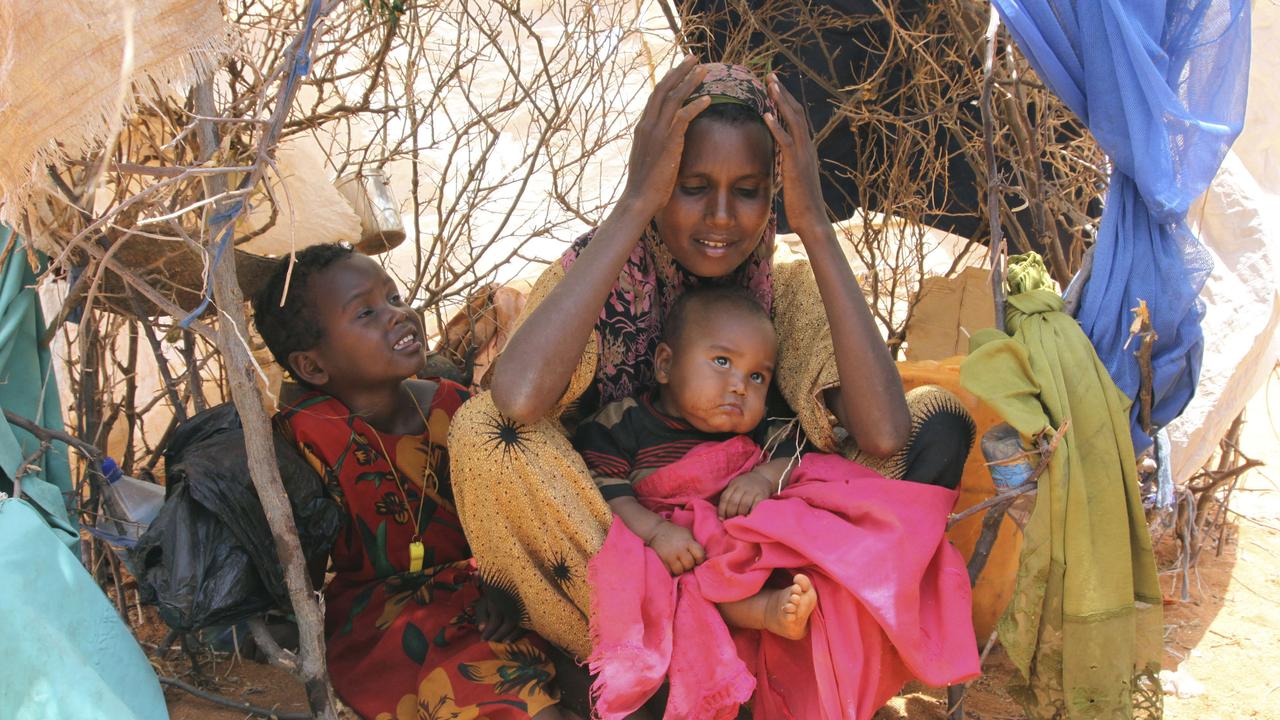
The Syrian civil War has killed over half a million souls. 150,000 have did in Yemen.  In Sudan, more than ten thousand people have perished in the latest civil war. ISIS killed tens of thousands. Iraq, Libya, Afghanistan. Muslims killed by Muslims. And millions displaced and enduring famine and disease.

In recent years Muslims have slain more Muslims than those killed by Israeli forces and settlers since 1948 (though we”ll never know how many  – official and semiofficial figures cite casualties from the Independence War and al Nakba of 1948 to 2021, 63,543, including 31,227 fatalities, plus, of course, the ghastly toll of the current Gaza war, but this is probably massively understated).

There has been no significant unrest in the West over the hundreds of thousands of Muslims killed by fellow Muslims (apart from a visceral horror of the violence inflicted upon civilians and prisoners by the jihadis of the Islamic State. No public outcry or social media fury, no angry street protests by left-wing activists of vacuous members by armchair, value-signaling clicktavists.

Why this apparent indifference? Many left-wing impressions are coloured by a an antipathy for the policies of the United States, an antipathy that for many was born of the Vietnam War and was perpetuated by America’s interference in the affairs of nations large and small since then – and of course, America’s strong ideological and military support for Israel. Uncle Sam certainly does have a case to answer. There’s no denying the hundreds of thousands, millions maybe, of bodies of men, women and children that could be laid at the foot of Abe Lincoln’s huge statue in Washington DC.

And what of the rise in antisemitism around the world? After the blood Hamas pogrom of October 7, it took just 24 hours for anti-Israeli sentiment to turn into anti-Jewish sentiment. It was on full display throughout the West before the bodies of the men and women and children murdered had even been counted and identified, and the number of hostages revealed; and before Israel’s relentless and brutal retaliation again Gaza which has killed tens of thousands more innocents.

A charitable explanation would be a mix of political and historical ignorance and a dogmatic belief that renders Jews, whether Israeli or in the diaspora ‘white’, ‘colonial’ and ‘oppressors’, and Muslims ‘oppressed’, and encourages progressives to turn a blinkered or blind eye to some of the most hideous crimes on the planet. It is an ideological stance uninformed by knowledge and awareness of the nature of the Israeli and Palestinian entities, their peoples, and their cultures in the 21st Century.

But there is also reality that what we’ve been seeing in cities around the world is that antisemitism is the devil that never goes away.

I republish below an article that summarizes quite well the mathematics of Muslim on Muslim mortality. It is written by a rightwing author in a right-wing publication, and many of his observations thereon may be selective, subjective, controversial, and potentially exaggerated and inaccurate, but the underlying basic arguments is sound. Countries subject to interminable potentially intractable and often internecine conflict, rigid, authoritarian, and ofttimes theocratic conservative beliefs and social structures, and endemic political instability rarely prosper in our modern interconnected world and often end up serving as expendable pawns in more powerful players’ power games. 

I also republish a recent article by The Australian’s foreign editor Greg Sheriden on how the rising antisemitism in the West is undoubtable fueled by the increasing numbers of migrants form conservative countries where antisemitism is encouraged and inculcated by the media, by educational systems and by socialization.

These communities often have an enormous political and cultural impact on their host countries. While the overwhelming majority of Muslims in Australia and other western countries are law-abiding, productive citizens, a small minority is attracted to some form of political violence or intimidation. And, if Australia’s Arab and North African Muslims are remotely similar to those in Europe and the US, they harbour serious anti-Semitic attitudes, plus other views that are anti-Western.

In 2014, the Jewish Anti-Defamation League conducted an immense survey that sampled the opinions of 53,000 people in numerous countries. It found that 74 per cent of Middle East and North African respondents (not necessarily all of them Muslim, though the overwhelming majorty would be) expressed anti-Semitic attitudes, which was measured by endorsing six or more of 11 common anti-Semitic stereotypes, such as Jews controlling world banking, or the US government, or being responsible for most of the world’s wars. This figure of 73 per cent was vastly in excess of any other regional or national group. Non-Jewish think tanks produce similar results. A survey conducted by the Henry Jackson Society in 2020 found nearly half of British Muslims hold anti-Semitic views.

See also in On That Howling Infinite, “You want it darker?” … Gaza and the devil that never went away …

For more on antisemitism in In That Howling Infinite, see: Little Sir Hugh – Old England’s Jewish Question; and The Shoah and America’s Shame – Ken Burns’ sorrowful masterpiece 

For more on Palestine and Israel in In That Howling Infinite, see: A Middle East Miscellany

The paradox of piety
Observes no disconnect,
Nor registers anxiety
As the ship of fools is wrecked.
So, leaders urge with eloquence,
And martyrs die in consequence.
We talk in past and present tense.
As greed and fear persist.
For reasons only dead men know,
Few can resist the call to go.
That is your fate, the wise man said,
The good book in his fist!

From E Lucevan Le Stelle, Paul Hemphill

Journalists should not be duped into blaming Jews for the Middle East’s problems

Chris Mitchell, Australian Business Review, 17 December 2023

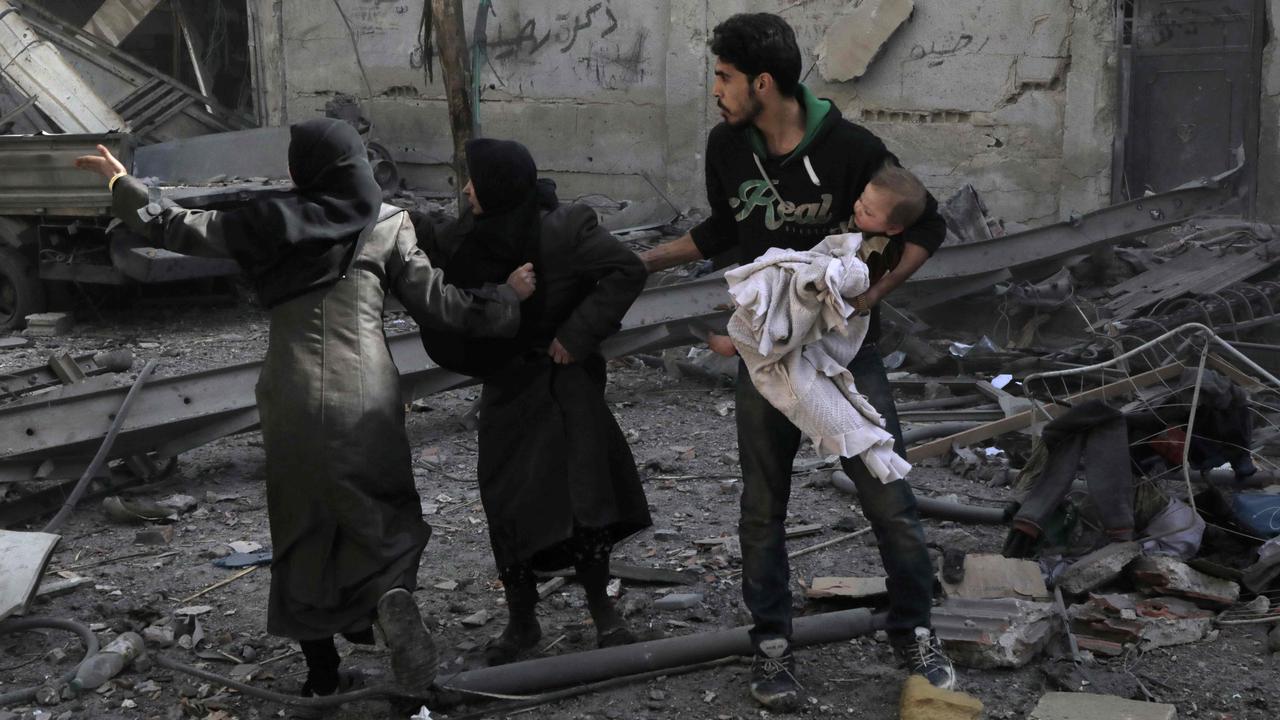
Syrians run for cover following Syrian government air strikes on the Eastern Ghouta rebel-held enclave of Douma, on the outskirts of the capital Damascus in 2018. Picture: AFP

Syrians run for cover following government air strikes on the Eastern Ghouta rebel-held enclave of Douma, Damascus 2018. AFP

Why do so many journalists analysing the Middle East’s problems think the answers lie in a tiny country of 9.7 million people, seven million of whom are Jewish?

Israel has no natural resources while Arab countries surrounding it occupy 1000 times more land, dominate global oil production and have a combined population of more than 400 million?

Look at income distribution patterns and one thing becomes apparent. The Arab and Persian worlds are among the poorest areas on Earth, despite the vast wealth of their rulers. Israel, with ingenuity its only resource, has average income about the same as Australia’s, while most in the Middle East languish on lower wages than black South Africans or Brazilians.

Yet it’s not only the grinding daily poverty of the Arab street that the moralising Western left ignores. It’s also the violence done to ordinary Muslims across the Middle East and North Africa by other Muslims. Add the 48,000 Islamic terror attacks listed by the French think tank Fondapol between 1979 and 2021 and their 210,000 mostly Muslim victims.

Where is the left on the medieval Arab and Persian regimes that spread Islamist terror from the Middle East to Europe, Pakistan, Afghanistan and Indonesia?

This is not another call for a Muslim reformation, but for political and media honesty.

Yet the Islamic Middle East certainly needs modernisation. The left’s favourite French economist Thomas Piketty and fellow Paris School of Economics writers Facundo Alvaredo and Lydia Assouad in 2018 analysed income inequality in the Middle East. They found “the Middle East appears to be the most unequal region in the world with a top decile share as high as 64 per cent (of national wealth) compared with 37 per cent in Western Europe, 47 per cent in the US and 55 per cent in Brazil”.

Regular readers will know this writer has a daughter living in Tel Aviv and working in the tech sector. Previously, family members have lived and worked in Jordan. Comparisons between the two countries are fascinating given both were once part of British mandate Palestine.

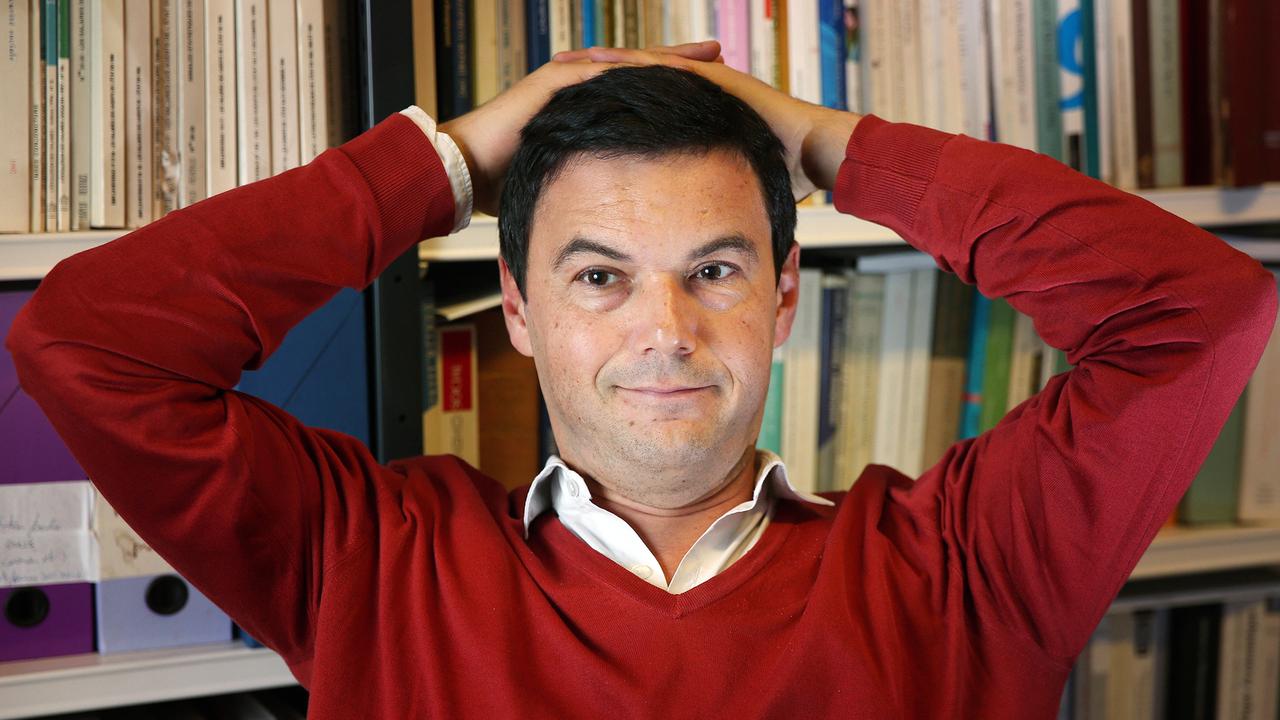
Thomas Piketty and colleagues analysed Middle East income inequality. Picture: Getty Images
Thomas Piketty and colleagues analysed Middle East income inequality. Getty 

Jordan has a slightly larger population of 11.3 million. With at least three million Palestinians according to the government, and perhaps many more if you follow the historical arguments, it occupies four times the land area of Israel.

Life expectancy for males in Israel is 81 years and 85 for females.

In Jordan the averages are 72 and 77.

Israel’s unemployment rate is 3.5 per cent, Jordan’s 17.9.

Average income in Israel is $80,000 and in Jordan $6,500.

Jordan is a good and safe place to visit but it is clear within hours that it is much poorer than Israel. Israel’s GDP of $783bn dwarfs Jordan’s of $72bn.

The wealth picture is less stark comparing Israel with the Middle East’s oil states. Saudi Arabia has 32 million people, GDP of $1.5 trillion and is the world’s No.18 economy. Its GDP per capita is $40,000, so half Israel’s. Saudi average wages are less than Israel’s, although Saudi prices can be cheaper.

Iranian GDP sits at $549bn but its wage levels are far below those in Saudi Arabia and Israel. Its legislated minimum wage this year sits at $1700 a month.

The Western left also ignores violence against Muslims by Muslims. Few demonstrators took to the streets of Western cities to protest during the Syrian civil war this past decade. The death toll as of last March stood at 613,000, dwarfing the casualties in Gaza the past two months.

Ditto the ongoing Yemen civil war that started in 2014 and in which 150,000 have died fighting and 227,000 have perished in famine.

The disastrous Somalian civil war has been going for 40 years. Genocide Watch last year said between 350,000 and one million mainly Muslims have been killed since 1991 and 3.5 million displaced Somalis, including 1.5 million children, face starvation. The country is 99 per cent Muslim.

Add the millions killed in the Iran-Iraq war in the 1980s and the thousands killed by al-Qa’ida in Iraq after the US invasion in 2003.

To put the Israel story into perspective, between 1948 and 2021 total Palestinian deaths number 31,227. Total Israeli deaths in war excluding terrorism number 24,981. The 1948, 1967 and 1973 wars that cost Palestinians so much of their land followed invasions by Israel’s Arab neighbours.

Former farmer Habiba Osman Ahmed in Dollow refugee camp in southern Somalia in 2011. After Somalia's 20-year civil war pushed the drought into famine she didn’t even have a pot to cook in, and had to share with another family.
Former farmer Habiba Osman Ahmed in Dollow refugee camp in southern Somalia. 2011. After Somalia’s 20-year civil war pushed the drought into famine she didn’t even have a pot to cook in, and had to share with another family.

Islam has also been waging war on black Africa for much of the past 100 years.

Tablet Magazine on December 12 said “the same Jihad that targeted Jews on October 7 has been targeting black Africans for decades”.

Tablet discusses the “hidden holocaust” from 1983 to 2005 when “northern Sudanese Arabs sought to subjugate and enslave the black Sudanese of the mostly Christian south. The onslaught cost the lives of perhaps 2.5 million black Sudanese. The Arab Muslim government’s jihad utilised kidnapping as its terror weapon of choice, not to mention casual gang rape and mutilation”.

Tablet cites Arab pogroms against black Africans in Nigeria, Mauritania and Sudan’s Western Darfur. Asking why the civil rights left ignores these, it says “on account of their ‘intersectional’ dogma – which makes Jews ‘white’ and Muslims ‘oppressed’ – the Western human rights industry, media and campus left activists are ideologically determined to mostly ignore some of the most hideous crimes on the planet”.

Trouble is, most journalists know nothing about Islam or Islamism. The Koran is not a peaceful book: it does encourage Jew hatred and other violent behaviours against non-believers. When large communities celebrate the martyrdom of their sons and daughters, the left needs to understand that fanatics mean and do what they say. They really do see Jihad as the road to paradise.

This religious outlook has served the interests of the Sunni princes who finance the spread of Wahabism and the Islamic boarding schools (Pesantren) that spread it to Pakistan and Indonesia. It serves Iran well to finance Hamas and Hezbollah.

Blaming Jews for the Middle East’s problems lets the mullahs and princes off the hook for what they don’t do for their own people. Journalists covering the Middle East should not be duped the way the Arab street is. Of course Palestinian lives matter but Islamism is the real “context”.

Matti Friedman
Matti Friedman

Back on August 26, 2014, after another Israeli-Gaza war, former AP Jerusalem bureau editor Matti Friedman published a fascinating account in Tablet explaining how much the Western media mis-reports what is really happening in Israel and Palestine. He says AP had more than 40 staff in Israel in 2011 but only a single stringer in Syria where tens of thousands were dying each week. Its Israel bureau was bigger than staff numbers in Russia, China or India. Why?

The answer then was the same as now: it’s about Western media assumptions about Jews, power and victimhood.

That combines with a complete media disregard for what real Palestinians think and want and what Islamists really believe.

Here’s a clue. Most Palestinians and Hamas do not support a two-state solution. They support the elimination of Israel, and at least some support the elimination of all Jews.

A poll last week by the Palestinian Centre for Policy and Survey Research found 72 per cent support across Gaza and the West Bank for Hamas’s murder of 1200 civilians on October 7. While 95 per cent thought Israel had committed war crimes since October 7, only 10 per cent believed Hamas had.

Chris Mitchell began his career in late 1973 in Brisbane on the afternoon daily, The Telegraph. He worked on the Townsville Daily Bulletin, the Daily Telegraph Sydney and the Australian Financial Review before joining The Australian in 1984. He was appointed editor of The Australian in 1992 and editor in chief of Queensland Newspapers in 1995. He returned to Sydney as editor in chief of The Australian in 2002 and held that position until his retirement in December 2015.

Muslim migrants and Western Left create new anti-Semitism crisis

Greg Sheridan.

Palestinian supporters demonstrate in Melbourne against the current Israeli bombardment and invasion of the Gaza Strip.
Palestinian supporters demonstrate in Melbourne against the Israeli bombardment and invasionThe worldwide crisis in anti-Semitism, so much of it fuelled by Arab and North African anti-Semitism, now in a crude alliance with the anti-Semitism of the far left, points to a deeper malaise in Western democ­racies.

It raises again the compatibility of large Arab and North African populations with the traditions and culture of liberal democracy.

Consider. EU Home Affairs Commissioner Ylva Johansson declared Europe confronts a “huge risk of terrorist attacks” over Christmas because of the conflict between Israel and Hamas in Gaza.

In December a terrorist killed one tourist and injured others in Paris. In Dublin a knife attack allegedly by a Muslim asylum-seeker left children and adults severely wounded, though Irish police say they believe it was not terror related. In Germany, alleged terrorists were arrested preparing a bomb. In Brussels in October a Tunisian terrorist killed two Swedish football fans.

If Middle East conflict pro­duces terrorism in Western democratic nations, it’s reasonable to ask how anyone living in a modern, free, democratic society views random murder as a constructive, purposeful, moral response.

Australian agencies believe there is an increased risk of politically or communally motivated violence here, too, but not to the point where they’ve formally altered the terror alert level.

We’ve also seen US President Joe Biden plead for the world, including Western feminists, to condemn the “horrific” sexual violence of the October 7 Hamas atrocities. The deliberate, premeditated Hamas attacks were the most depraved, sexualised sadism the world has seen. Yet Western feminists, deafening in their silence, practise #MeToo unless you’re a Jew.

In Australia, the authorities decided that Islamic clerics who welcomed the Hamas atrocities and urged all Muslim nations to spit on Israel so it would drown had no legal case to answer. Demonstrators filmed on the Sydney Opera House forecourt screaming “Kill the Jews! Gas the Jews! F..k the Jews!” – none of them has been arrested or charged either.

Imagine the shuddering national convulsions that would follow if some group of extremist Christian activists gathered a few hundred demonstrators to scream: “Kill the Muslims!” All society would be rightly outraged. The whole nation would denounce it. The counselling bill at the ABC alone would double the national debt.

But society seems never to react this way when the target group is Jewish, although NSW has moved to strengthen its laws.

The Albanese government has been mealy-mouthed, equivocal, all at sea on all of this. It can’t mention anti-Semitism without conjuring a spectral, matching Islamophobia. Let’s be clear. The global anti-Semitism crisis, a profound civilisational challenge, is not matched by an equal, opposite and morally equivalent phenomenon called Islamo­phobia.

Start with the numbers. There are perhaps 1.9 billion Muslims and about 16 million Jews. There are about 50 Muslim majority nations and one Jewish majority nation. In dozens of other nations, Muslims make up a big minority. Only in the US do Jews pass even 2 per cent. Within Australia there are about 100,000 Jews, perhaps a touch more, and almost 900,000 Muslims. The size of the Jewish population is static. The Muslim population will continue to grow rapidly. Its age profile is younger, it has a higher birthrate and continuing Muslim immigration.

Opposition foreign affairs spokesman Simon Birmingham will lead a bipartisan delegation to Israel in solidarity with the Jewish state. The Albanese government is terrified of being seen as too pro-Jewish or pro-Israel. No head of government solidarity visit from it. Instead, in response to Birmingham, the anonymous Tim Watts, Assistant Minister for Foreign Affairs, will call in on Israel as part of a Middle East Cook’s tour. Foreign Minister Penny Wong will visit Israel early next year as part of a wider Middle East tour. By then it’s certainly not a visit of solidarity but an old-fashioned Australian pretence of participating in Middle East diplomacy.

Jews are the most intensely targeted people in the world for terrorism and irrational hatred. It’s true there have been a small number of violent attacks on Muslims in the US by people it would be fair to call far-right terrorists. Such attacks are horrific and deserve absolute condemnation. Their number, thankfully, is very small.

The vast majority of Muslims who die in terrorism are killed by fellow Muslims. Hamas killed Israeli and foreign Muslims on October 7.

A pro-Palestinian rally in Sydney in October. Picture: NCA NewsWire / Monique Harmer
Pro-Palestinian rally in Sydney in October. CA NewsWire / Monique Harmer

The plague of anti-Semitism is a crime against Jewish people. It is the world’s oldest racial hatred. There are distinct anti-Semitic traditions in the West, but after the Holocaust, in which the Nazis murdered six million Jews, all of the old Western traditions of anti-Semitism have been repudiated.

The West has a new tradition of anti-Semitism in the West, on the far left, especially at universities.

This week, in US congressional testimony, Harvard University president Claudine Gay, Liz Magill of the University of Pennsylvania and Sally Kornbluth of the Massachusetts Institute of Technology all said anti-Semitism was a serious and growing problem at their institutions.

That is astonishing, and grotesquely illiberal, for 2023.

But it’s hooked up with an entirely different anti-Semitism too. For by far the most important dynamic of anti-Semitism, globally and within the West itself, is the age-old Arab and North African anti-Semitism.

Naturally, a concern for the suffering of innocent people in Gaza is not a sign of anti-Semitism. Every human being feels compassion for the people of Gaza. The moral responsibility for their suffering lies 100 per cent with Hamas.

Anti-Semitism has broadened and is now a deep, pervasive ideological, cultural and fanatical strain in contemporary Western life. Proceeding from the left’s identity politics ideology, which damns the entire Western project as intrinsically unjust, sexist, economically exploitative, colonialist, racist, hetero-normative, the left has, logically enough, arrived at a hatred of Jews, for the Jewish tradition is so central to the West. And because the left sees all Muslims as victims, it has allied with Islamic anti-Semitism.

But the cross-pollination of Islamic and Western anti-Semitism goes back a long way. It reached a height in the deep Nazi collaboration with both the Muslim Brotherhood and the mufti of Jerusalem. Arab anti-Semitism long predates either Nazis or the Muslim Brotherhood.

The earliest military victories of Muslims involved conquering and sometimes slaughtering Jewish communities. Christians and Jews were often allowed to live reasonably safely in Muslim kingdoms, but only as acknowledged inferiors, dhimmis. Frequently that status was abrogated.

Bernard Lewis, the legendary scholar of Islam, has written that “the golden age of equal rights (under Islam) was a myth”. In the ninth century Baghdad Jews were required to wear a yellow badge, echoed by the Nazis a millennium later. This happened in many Arab centres.

It’s important to note many Christian kingdoms practised similar or worse persecution of Jews. The facts about Arab history simply establish the obvious that a long and pervasive anti-Semitism flourished in Arab and North African culture. There are indeed some explicitly anti-Jewish pas­sages in the Koran.

The contrast with Christianity is that all Christian denominations comprehensively repudiated their past anti-Semitism, which in any event was never uncontested. There has not been a similar Arabic repudiation of anti-Semitism. Some Arab states are liberalising a little, but it’s easy to over-estimate this.

Arab anti-Semitism also obviously long predates the modern state of Israel.

From the mid-1930s the Nazis strongly backed Arab anti-Semitism. They co-operated especially with Amin al-Husseini, the mufti of Jerusalem, who helped recruit Bosnian Muslims into Hitler’s SS.

Sayyid Qutb, the leading thinker of the Muslim Brotherhood, was notable for his hatred of the West. However, he also hated Jews, describing them as “the bitterest enemies of Islam” and urging Muslims: “Do not rest until your land is free of the Jews.”

Sayyid Qutb.
Sayyid Qutb.

The Nazis provided money for the Muslim Brotherhood and translated some Islamist publications into German. The Nazis wanted to eradicate European Jews and also the Jews of the Middle East. For six years, the Nazis broadcast anti-Semitic material, in Arabic, on radio. In the 1930s and ’40s, radio was the one true mass medium.

The first most important rejection of the two-state solution, a Jewish Israel next to an independent Palestine, came when all of Israel’s neighbours and the local Palestinians refused to accept the UN partition of the territory and launched an all-out war against Israel.

Today there are probably 40 million Muslims in Western Europe and North America, though so much population movement is irregular and undocumented that it’s impossible to establish reliable figures. They are having an enormous political and cultural impact. They also have introduced into those nations a savage new burst of anti-Semitism. It is neither racist nor discriminatory to look at the beliefs and behaviours of potential and actual immigrant populations and question problematic features for a liberal democratic society.

It goes without saying, but must be said, that the overwhelming majority of Muslims in Australia are law-abiding, productive citizens. A small minority is attracted to some form of political violence or intimidation. And, if Australia’s Arab and North African Muslims are remotely similar to those in Europe and the US, they harbour serious anti-Semitic attitudes, plus other views that are anti-Western.

In 2014, the Jewish Anti-Defamation League conducted an immense survey that sampled the opinions of 53,000 people in numerous countries. It found that 74 per cent of Middle East and North African respondents (not necessarily all of them Muslim, though the overwhelming majorty would be) expressed anti-Semitic attitudes, which was measured by endorsing six or more of 11 common anti-Semitic stereotypes, such as Jews controlling world banking, or the US government, or being responsible for most of the world’s wars. This figure of 73 per cent was vastly in excess of any other regional or national group.

Non-Jewish think tanks produce similar results. A survey conducted by the Henry Jackson Society in 2020 found nearly half of British Muslims hold anti-Semitic views.

In 2015 German chancellor Angela Merkel admitted a million Muslim irregular immigrants to Germany. By 2017 she pronounced that German multiculturalism had “utterly failed”. By 2018 she said “refugees or people of Arabic background” had brought a new wave of anti-Semitism to Germany.

In 2020, the libertarian Cato Institute published a long essay, Freedom in the Muslim World, by Mustafa Akyol. This was a systematic comparison of human freedom across a range of dimensions among Muslim societies and against international averages.

Akyol found that Muslim societies were substantially less free than the global average, and much less free than Western Europe or North America. Of course, there was great variety among Muslim nations and some were relatively free. The least free of all were the Muslim nations of the Middle East and North Africa.

He also found, paradoxically, in numerous Muslim nations increasing democracy led to decreasing personal liberties. In other words, the curtailing of human freedom was often a popular move by Muslim governments.

I’ve spent some time in the past few years in Poland, Hungary and Greece. In Poland and Hungary I interviewed Jewish leaders who told me these were the safest countries for Jews in Europe. In every case the government and society had turned against traditional anti-Semitism. But, most important, there were very few Muslims, so little active, threatening anti-Semitism.

Greece does receive a lot of asylum-seekers but doesn’t give them much welfare and they quickly move on. In Thessaloniki in northern Greece recently I saw a hotel hosting a big international delegation and there was the Israeli flag flying proudly out the front with no sign, in the days I was there, of demonstrations or disturbance.

Australia, on the other hand, is subject to an Israeli travel warning; it’s not safe for identifiable Jews or Israelis.

Nobody wants a religiously or ethnically discriminatory immigration program. But countries and cultures with deep traditions of anti-Semitism and anti-Western sentiment pose a big challenge if they are a major source of immigration.

Consider three books.

The French Intifada, by Andrew Hussey, establishes an extraordinary degree of hostility towards France itself by its Muslims. Reflections on the Revolution in Europe by Christopher Caldwell establishes how attitudes have in some manner grown more radical through succeeding generations among Europe’s Muslims. He also establishes that European voters never wanted this huge influx. The Strange Death of Europe by Douglas Murray shows Europe being eaten up by hostile attitudes among its citizens, both some immig­rants and the left establishment at universities, with no one to defend Europe’s traditional beliefs.

As we watched anti-Semitic demonstrations in London recently, an English colleague remarked: “Imagine what it’ll be like in 20 years, when the Muslim population is twice as big as now.”

In France, where Muslims may be nearly 10 per cent of the population, they are younger and have a higher birthrate than the host population. They could be 40 per cent of France by 2060.

Islam holds that its mission is to establish a political order in accordance with its teachings. Once the Islamic minority becomes big enough, that becomes a problem.

To settle immigrants successfully, a society should be self-confident, secure in its history, civic identity and ethical culture. Sound like the West at the moment? There are now types of self-loathing in our societies almost beyond parody. The Canadian Human Rights Commission recently argued that having public holidays for Christmas and Easter is discriminatory because other religions’ holiest days don’t have public holidays.

There’s plenty of equivalent nuttiness in Australia. When we hate our own traditions that much, how can we imagine migrants with contrary ideas will fall in love with our nation?

Greg Sheridan is The Australian’s foreign editor. His most recent book, Christians, the urgent case for Jesus in our world, became a best seller weeks after publication. 

Tangled! – a cynic’s guide to alliances in the Middle East

The paradox of piety observes no disconnect
Nor registers anxiety
As the ship of fools is wrecked
So leaders urge with eloquence
And martyrs die in consequence
We talk in last and present sense
As greed and fear persist
E Lucevan Le Stelle, Paul Hemphill

At a recent conference in Berlin, Germany’s prime minister Angela Merkel and and UN Special Representative Ghassan Salamé managed, at least on paper, to cajole the external actors guilty of super-charging Libya’s misery to sign onto a unified agenda. Russia’s Vladimir Putin, Turkey’s Recep Tayyip Erdoğan, France’s Emmanuel Macron, Britain’s Boris Johnson, and Egypt’s pharaoh (and Donald Trump’s “favourite dictator”) Abdel Fatah el-Sisi,  joined a dozen or so others (with Secretary of State Mike Pompeo representing the United States) in declaring an intention to end foreign interference in Libya’s internal affairs: “We commit to refraining from interference in the armed conflict or in the internal affairs of Libya and urge all international actors to do the same,” states the communiqué, in language one hopes all participants endorsed in (what would be uncharacteristic, for some) good faith.

This corroboree of hypocrites acknowledged that the increasingly violent and globally tangled Libyan civil war could only be ended if outside powers backed off and ended their meddling. They made altruistic and totally disingenuous declarations about a conflict  that they themselves have incited, exacerbated and perpetuated for nine years. And yet, explicitly excluded Libyan participation, contradicting the 2012 UN Guidance for Effective Mediation and its insistence on “inclusivity” and “national ownership” as fundamental elements for peaceful conflict resolution. It’s focus at this point was on the on the external, rather than the Libyan, actors and for reviving the world’s attention on the Libyan conflict.

A follow-up conference in Munich was convened in mid-February to renew its pledges to quit meddling. Stephanie Williams, the UN deputy special envoy for Libya reported zero progress and declared the agreed-upon arms embargo to be a joke. A sick joke, indeed – plane after plane land in Benghazi loaded with weapons from the UAE and other arms-suppliers destined for self-anointed warlord Khalifa Haftar‘s self-styled Libyan National Army.

Unfortunate Libya is neither the first nor the last pawn to be used and abused by outsiders in the new Great Game as the following guide demonstrates.

But first, there’s this letter to a British daily from Aubrey Bailey of Fleet, Hampshire (where hurricanes hardly happen):

Are you confused by what is going on in the Middle East? Let me explain.

We (she’s talking if Britain and us generic “good guys”) support the Iraqi government in the fight against Islamic State. We don’t like IS but IS is supported by Saudi Arabia, whom we do like. We don’t like President Assad in Syria. We support the fight against him, but not IS, which is also fighting against him. We don’t like Iran, but Iran supports the Iraqi government against IS.

So, some of our friends support our enemies and some of our enemies are our friends, and some of our enemies are fighting against our other enemies, whom we want to lose, but we don’t want our enemies who are fighting our enemies to win. If the people we want to defeat are are defeated, they might be replaced by people we like even less. 

And this was started by us invading a country to drive out terrorists who weren’t actually there until we went in to drive them out. Do you understand now? Clear as mud! 

It casts new light on that thorny old aphorism “the enemy of my enemy is my friend”!

A cynic’s guide to alliances in the Middle East

Libya

We begin with  Libya, the “beneficiary” of the Berlin talk-fests.

On the side of the internationally recognized government in Tripoli, Libya’s capital there’s: Not many … Italy (former colonial oppressor, in it for the oil, who’d just love to see an end to those refugee boats that wash up on its shores); Turkey (former Ottoman oppressor now ruled by a wannabe Ottoman sultan Recep Tayyip Erdoğan, and eager for offshore oil and gas leases); and potentially, Qatar (who fell out with Egypt, Saudi and the United Arab Emirates over its tepid support for the Sunni grand alliance against Shia Iran).  Turkish soldiers fly the government’s drones whilst Turkey’s Syrian jihadi mercenaries provide military muscle – Turkey would like to move them out of Kurdish Syria on account of their murderous behavior).  

On the side of the self-anointed warlord Khalifa Haftar, based in Benghazi in the east, whose sharp uniform is festooned in medals for this and that act of service and heroism), there’s: Egypt, (the US’ impecunious, brutal “partner in Freedom” – strange bedfellows in this amoral “new Middle East” that is just like the old Middle East); Saudi Arabia, and the UAE (see above, re. Qatar, whom they blockaded for several years); Jordan (perennially cash-strapped and dependent on rich Arab relatives), France and Russia (arms, oil, and influence); plus Russian mercenaries (plausibly deniable, capable and reliable, and familiar with the Middle East – see below); and Sudan’s murderous Janjaweed Arab militias (broke Sudan seeks Saudi favour).

And on the sidelines, a disinterested and divided UN, the UK and the US – although Britain, with France, helped wreck the joint by ousting longtime dictator Gaddafi; arguably, the US, although Donald Trump has confused matters by phoning Haftar and then saying that he’s a great bloke (he has a thing for dictators actual and potential, including Putin, Erdogan, Al Sisi, and the thuggish Saudi crown Prince Mohammed bin Salman); and in the middle, and against all of the above, the ever-opportunistic and troublesome Da’ish and al Qa’ida.. 

As American baseball wizz Yogi Berra once said, “It feels like déjà vu all over again”.

Syria

On the side of the internationally recognized government in Damascus headed up by Bashar al Assad, there’s: The Islamic Republic of Iran (Iran’s Shia Muslims are related to Syria’s heterodox Alawi minority, whose elite happen to have rule the country for half a century, and Iran is consolidating it’s Shia axis across the Middle East); Russia (oil, pipelines, and restoring Soviet greatness); Lebanese Shia Hezbollah (de facto ruler of Lebanon) and its soldiers; the Iranian Quds brigade (the expeditionary arm of the Revolutionary Guard, a military-industrial complex that virtually runs Iran); sundry Iraqi and Afghan Shia militias beholden to Iran for cash, weapons, training and ideology); Russian and Chechen mercenaries (see above – deniable, reliable and capable); and, quite surreptitiously, Turkey (former Ottoman oppressor) which is ostensibly opposed to Assad, but needing Russian pipeline deals, runs with the hares and hunts with the hounds – but see below, and also, above with respect to Libya. As the song goes, “I’m so dizzy, my head is turning” already! 

On the side of “the other side”, which is not really a “side’ at all, but a grab bag of sundry rebels who were once supported by the US and are predominantly Islamist, with some indeed linked to al Qa’ida, which, of course, we all love to hate (Twin Towers, Osama bin Laden and all that), there’s: the US, Britain and France (why do they persevere so in what Donald Trump has called these forever, endless wars?); Saudi Arabia (Salafi Central and banker for all the bad guys) and the United Arab Emirates (also a financier for the foe); Israel (of course – mortal foe of Iran and of Hezbollah (“the enemy of my enemy” fair-weather friend – anything that distracts its perennial enemies is good for Israel); Hamas, the Islamists who rule the Palestinian enclave of Gaza, and oppose the Alawi oppressor of Sunni Muslims and of Palestinian refugees in Syria; and Turkey (see above –  hares and hounds, on the outer with Saudi and the UAE and pals with outcast Qatar, and engaged in an ongoing blood feud with Syrian Kurds ostensibly allied with Turkey’s outlawed separatist Kurds), and as we write, ominously trading blows with the Syrian Army and its Russian allies; and Turkey’s Syrian jihadi mercenaries – erstwhile former rebels and al Qa’ida and Da’ish fighters who are in it for the money, for vengeance against the Kurds and the Assad regime, and, for many, good old blood-lust. 

And stuck in the middle: Those Syrian Kurds, of formerly autonomous Syrian enclaves Afrin and Rojava (betrayed by America, invaded by Turkey, and forever abandoned by the rest of the world, they have been forced to come to terms with the Assad regime which has discriminated against them forever; sundry Bedouin tribes who work to a code of patronage and payback; the scattered remnants of Da’ish which was at the height of its power a veritable “internationale” of fighters from all over the world, including Europeans, Australians, Chechens, Afghans, Uighurs, Indonesians and Filipinos – the remnants of whom are still in the field and hitting back; and sundry die-hard jihadis from constantly splintering factions. Da’ish and the jihadis have been dubiously aided and abetted by money and material from allegedly unknown patrons in the Gulf autocracies, as evidenced by those long convoys of spanking new Toyota Hi Lux “technicals” – which have now curiously reappeared in Haftar’s Libyan National Army (see Libya, above).

Yemen 

On the side of the internationally-recognized government of Yemen, there’s: Saudi Arabia, the US, and Britain; plus sundry mercenary outfits from Australia and Brazil; and Sudan (its militias paid by Saudi, as in Libya). The UAE was formerly on this side, but now supports a breakaway would-be Yemeni government Opposed to the present one. On the side of Houthis, a rebel Shia tribe in the north of the country, there’s: Iran and ostensibly its Iraqi and Lebanese auxiliaries – see above, the Shia ‘Arc” of Iranian influence. And in the middle, and against all of the above, the ever-opportunistic and troublesome Da’ish and al Qa’ida.

Afghanistan

Its America’s longest ever war – ours too …

On the side of the UN recognized government there’s: NATO, including the US, Canada, Britain, Germany, Denmark and Norway; and also, Australia and New Zealand – though why antipodeans want to get involved in the faraway Afghan quagmire beats me … Oh yes, the US alliance, and our innate empathy for the poor and downtrodden.

On the other side, there’s: The ever-patient, ever-resilient Taliban, aided and abetted by duplicitous Pakistan (an ally of the US – yes!), and al Qa’ida and Da’ish, both dubiously aided and abetted by money and material from Gulf despots. 

And on the sidelines,  miscellaneous corrupt and well-armed Afghani warlords who take advantage of the ongoing turmoil and grow rich on bribes, option and smuggling; and the rest of the world, really, which has long ago zoned out of those “forever, endless wars”. 

So, what now? 

More of the same, alas. Great Power politics and proxy wars are taxing intellectual and actual imaginations. It is business as usual in the scattered killing grounds as a bewildering array of outsiders continue to wage their proxy wars in Syria, Libya and Yemen. Bombs still explode in Afghanistan and Somalia, and whilst Islamists terrorise the countries of the Sahel, and even distant Mozambique, warlords rape and pillage in Congo. As usual in these proxy conflicts the poor people are stuck in the middle being killed in their thousands courtesy of weapons supplied by the US, European, Israeli, Russian and Chinese arms industries.

As outsiders butt each other for dominance, and the Masters of War ply their untrammelled trade, we are condemned, as Bob Dylan sang in another time and another war, to “sit back and watch as the death count gets higher’. I am reminded of WH Auden’s September 1, 1939, a contemplation on a world descending into an abyss: “Defenseless under the night, our word in stupor lies’. All is, as Kent lamented in King Lear, “cheerless, dark and deadly”.

 © Paul Hemphill 2020.  All rights reserved

In That Howling Infinite, see also; A Middle East Miscellany

A postscript  from Alice’s Adventures in Wonderland

‘What I was going to say,’ said the Dodo in an offended tone, ‘was, that the best thing to get us dry would be a Caucus–race.’

‘What IS a Caucus–race?’ said Alice; not that she wanted much to know, but the Dodo had paused as if it thought that SOMEBODY ought to speak, and no one else seemed inclined to say anything.

‘Why,’ said the Dodo, ‘the best way to explain it is to do it.’ (And, as you might like to try the thing yourself, some winter day, I will tell you how the Dodo managed it.)

First it marked out a race–course, in a sort of circle, (‘the exact shape doesn’t matter,’ it said,) and then all the party were placed along the course, here and there. There was no ‘One, two, three, and away,’ but they began running when they liked, and left off when they liked, so that it was not easy to know when the race was over. However, when they had been running half an hour or so, and were quite dry again, the Dodo suddenly called out ‘The race is over!’ and they all crowded round it, panting, and asking, ‘But who has won?’ This question the Dodo could not answer without a great deal of thought, and it sat for a long time with one finger pressed upon its forehead (the position in which you usually see Shakespeare, in the pictures of him), while the rest waited in silence. At last the Dodo said, ‘EVERYBODY has won, and all must have prizes.’

The tears of Zenobia – will Palmyra rise again?

The National Museum in Damascus is a magical place.

It’s most amazing exhibits are its smallest, the tiny alphabet of the bronze age city of Ugarit from the 4th Century BC, said to be the world’s first alphabet, and its largest, the interior of second century synagogue from the Greco-Roman city of Dar Europa on the Euphrates.

The museum has not only survived Syria’s war unscathed, and for a long time closed to safeguard its contents, it has been reopened for almost a year. Whilst this is wonderful news, reflect on the memory of Khaled Mohammad al Asaad, renowned Syrian archaeologist and historian, and Director of Antiquities in Palmyra who was murdered by Islamic State in August 2015 for endeavouring to protect Syria’s archaeological treasures, and reflect also on the destruction of the World Heritage site for which he sacrificed his life.

Palmyra, the ancient and venerable ‘Pearl of the Desert stands in an oasis in the Syrian desert, north-east of Damascus. This once great city was in its day one of the most important cultural centres of the ancient world, at the junction of trade routes between Europe, Asia and Africa. Although a vassal of Rome, it was the capital of the third century Palmyrene Empire, and of its famous queen, Zenobia. She led a revolt against the Roman Empire, expanding her domain throughout the Levant and conquering Egypt, and ruled until 271, when she was defeated by the Romans and taken as a hostage to Rome by Emperor Aurelian.

Palmyra contains monumental ruins from the 1st to the 2nd century, its art and architecture spanning several civilizations, combining Graeco-Roman techniques with local traditions and Persian influences. There are few remnants of the ancient world that compared wit it. Ba’albek, in Lebanon, maybe; Ephesus, in Turkey, possibly; and also, Apamea, in western Syria between Hama and Aleppo. Palmyra’s treasures hide in plain sight. For all the world to see and wonder.

When Da’ish captured Palmyra and Tadmor, the adjacent town (it’s name means ruin in Arabic) al Asaad refused to flee and though tortured for a month, refused to reveal where valuable artifacts had been moved for safekeeping. He was then publicly beheaded, his remains displayed amidst the ruins he has spent his life preserving for us, for humanity, for history. His murderers declared in a sign hanging from his body, that he’d did because he had overseen idols and had attended infidel archaeological conferences as his country’s representative.

Da’ish then proceeded to dynamite Palmyra’s monuments.

Four years on and the suffering of the Syrians continues unabated. The so called-civilized rulers of the so called-civilized world stood by and watched, first with fear and loathing, and then opportunistically and strategically as innocent Syrians were savaged by all sides in a war of all against all. For want of will and resources, and party to the proxy wars that are still being playing out between neighboring states and heat powers. Whilst the territorial Caliphate is no more, thousands of of the murderers and desecrators have melted into the Syrian and Iraqi deserts to carry on their atavistic struggle.

What is happened in Palmyra is no worse than what has happened in many Syrian and Iraqi towns and villages during the last nine years.

We now confront the fact that whilst the recent destruction of Paris’ iconic Notre Dame Cathedral encouraged a deluge of plutocratic philanthropy, the great and good of the western world, having expressed horror and outage at Islamic State’s destructive iconoclasm, are not demonstrating such open-pocketness when it comes to the reconstruction of Syria’s ancient and priceless archaeological heritage. The reason, it is said, is because the Assad government, victorious in its vicious and bloody reconquest of the country, is subject to international economic sanctions. Neither aid for the destitute and displaced nor the reconstruction of ancient monuments is forthcoming on the scale theses crises require.

Expensive, inspirational 3D representations of Palmyra’s lost monuments in London, Paris and New York are no substitute for for actually funding the reconstruction of the real thing.

We republish here a timely feature from the Sydney Morning Herald addressing this melancholy irony. It recalls many of the places we visited when we were last in Palmyra. We drove in from Damascus on a long desert highway that even in peacetime, had mukhabarat checkpoints and also boasted The Baghdad Cafe where we took refreshment, and departed a few days later on the Homs road. The feature photograph was taken from the breakfast room of our  hotel in Tadmor – which the author says is now destroyed. The picture below was taken from Fakhr-al-Din al-Ma’ani Castle above Palmyra. It was a magnificent vantage point for a panoramic view of the ancient city, and also for watching the most spectacular sunsets over the Syrian desert. It is now a military outpost.

In ages far beyond our ken,
These stones weren’t set by mortal men.
In friendly fields and foreign lands.
They say these walls were by giants’hands were raised.
But few, few remember when.
With mortar mixed with blood and soil
And leavened thence with sweat and toil.
The masons and the muscle
All are bones, bones, dry bones,
And nothing else remains.
Their histories are carved in stone.
Their mysteries are locked in stone.
And so the monuments decay
As lonely sands stretch far away,
And hide the stones.
Paul Hemphill, Ruins and Bones

The article follows our small photo gallery.

Read also, in In That Howling InfiniteRuins and Bones, a tribute to al Asaad, and to Palmyra, and all, The Rubble Of Palmyra by Leon Wieseltier, published in The Atlantic, 5th September, 2014.

And more on Syria in In That Howling Infinite:

Queen Zenobia’s Last Look Upon Palmyra, by Herbert Gustave Schmalz (1888). Art Gallery of South Australia, Adelaide.

Palmyra – will she rise again?

Chris Ray, Sydney Morning Herald,

All the world talks about the damage to Palmyra, Aleppo and our other World Heritage sites, but hardly anyone outside Syria does anything to help.  Damascus museum archaeologist Houmam Saad 

Islamic State barbarians almost destroyed this World Heritage-listed site. Its wonders can be saved – so why is there such little international will to do so?

“Your heart will break when you see Palmyra,” says Tarek al-Asaad, looking out the window pensively as we cross the wide Syrian steppe on the road towards the ancient city. For Tarek, Palmyra represents a deep reservoir of sorrow that includes the public execution of his father Khaled, a renowned archaeologist and historian. Khaled had been instrumental in achieving Palmyra’s UNESCO World Heritage listing in 1980. The world stood by, horrified, while the fanatics of Islamic State, also known as IS, took to its majestic monuments with explosives and sledgehammers 35 years later.

We stop at a roadside store, where a young boy with old eyes is gathering aluminium cans to sell for scrap. Inside, soldiers of the Syrian Army guzzle sugary vodka drinks and beer. It’s May and the Muslim fasting month of Ramadan, when Tarek eats and drinks nothing from dawn to dusk, but the young conscripts are on leave and in a mood to celebrate. Tarek buys supplies for his first night in Palmyra since he fled the city in 2015 for the relative safety of Damascus, Syria’s capital.

Palmyra’s Temple of Bel in March 2014, and the same view two years later.
Palmyra’s Temple of Bel in March 2014, and in 2016. Getty Images 

Tarek’s father, Khaled al-Asaad, was 83 when he was beheaded by IS. He had devoted more than 50 years to uncovering, restoring and publicising the remnants of this historic Silk Road hub that reached its peak in the third century. Tarek, one of his 11 children, grew up in the modern town of Tadmur next to the site. “Every day I would rush out of school to ride in the wheel-barrows and buckets that carried the soil from the diggings,” he remembers. Khaled retired as Palmyra’s head of antiquities in 2003 but stayed on as an expert much in demand. Fluent in ancient Palmyrene, a dialect of Aramaic, he translated inscriptions, wrote books and advised foreign archaeological missions. Meanwhile, Tarek, now 38, a nuggety, full-faced man with a ready smile, ran a successful tourism business.

We’re travelling towards Palmyra from the western city of Homs, through undulating pasture sprinkled with crimson poppies. Bedouin herders, austere and watchful, graze flocks of long-haired goats and fat-tailed sheep. Soldiers hitch rides on passing trucks through concrete-block settlements edged with green rectangles of wheat and barley. Roadside military checkpoints mount extravagant displays of patriotism: the double-starred national flag is painted on concrete barriers, oil drums and blockhouse walls while banners depict Syria’s president Bashar al-Assad looking resolute behind aviator sunglasses, or waving to crowds. Sentries who inspect identity papers are relaxed and happy to banter. “I hope the fasting is going okay for you?” asks a driver. “We’re not fasting, we’re kuffar [non-believers],” jokes a guard,  alluding to the jihadist insult thrown at adversaries.

Further along, pasture gives way to stony ground studded with pale green tussock. Remnants of the war are more evident here; burnt-out trucks and tanks, toppled electricity pylons and fortified berms of rammed earth crowned with barbed wire. Near a military airbase ringed by radar stations the checkpoint is heavily guarded and businesslike.

A Russian tank transporter going our way is a reminder that IS still fights in the desert beyond Palmyra, where several Syrian troops were reportedly killed this month. While IS lost its last Syrian stronghold of Baghouz in March, small bands continue to mount guerrilla attacks. This is my first visit to Palmyra since a trip as a tourist in 2009, drawn by the mystique of its spectacular architecture beside a desert oasis. Two years later, Syria was torn apart by war. As we approach Palmyra through a gap in a low mountain range, one question is playing on my mind: has the remote and mesmerising site suffered a fatal blow, or can it rise again?

Palmyra’s Grand Colonnade suddenly emerges out of a sandy plain. It is the city’s still magnificent spine, a kilometre-long avenue of towering limestone columns that slowly turn from pale gold to burnt orange in the setting sun. We park near the ruins and set out on foot to take a closer look. At the Grand Colonnade’s eastern end, the great temple of the Mesopotamian god Bel lies in ruins – though its portico somehow survived IS’s explosives – and the ornately carved triumphal arch is a pile of massive blocks. The invaders also blew up the tetrapylon that marked the city’s crossroads and the Baalshamin temple, a richly decorated combination of Roman and indigenous building styles. The theatre’s finely chiselled facade is a pile of rubble along with several multi-storey burial towers that sat on a bare hillside.

On the crossroads of international trade, cosmopolitan Palmyra developed an unorthodox and pluralist culture reflected in its surviving art and architecture. That, along with its location between the Mediterranean coast and the Euphrates river, made it a tempting symbolic and strategic target for modern-day fundamentalists. Muslims lived at Palmyra for 13 centuries, establishing mosques in structures that earlier functioned as Byzantine churches and pagan temples, but the bigots of IS were scandalised by almost everything they found. Every act of vandalism was videoed for use in IS propaganda, its shock value aimed at attracting extremist recruits and intimidating opponents.

An Islamic State-released photo showing the destruction of Palmyra’s 1900-year-old Baalshamin temple.
Islamic State-photo of the destruction of Palmyra’s 1900-year-old Baalshamin temple. AAP

IS occupied Palmyra twice: between May 2015 and March 2016, and between December 2016 and March 2017. During its first takeover, Tarek escaped, but Khaled refused to leave. “I phoned my father and begged him, ‘Please leave; Palmyra has been lost to evil people and you are not safe,’ Tarek says. “He answered, ‘I’m glad you got away, but this is my home and I’m not leaving.’”

After six weeks of house arrest, Khaled was imprisoned in a hotel basement and tortured to reveal the location of hidden treasures that Tarek says never existed. After a month in the basement, the old man was beheaded with a sword in front of an assembled crowd. “He refused to kneel for the blade, so they kicked his legs out from under him,” Tarek says. An online photograph showed his corpse tied to a traffic pole and his head, spectacles in place, positioned mockingly at his feet. A placard tied to his body labelled him an apostate who served as “director of idolatry” at Palmyra and represented Assad’s government at “infidel” conferences abroad.

Before war broke out in 2011, tourism and agriculture supported more than 50,000 people in Tadmur. Only a few hundred have returned, burrowing into half-demolished buildings along streets that sprout giant weeds from bomb craters. Tarek is not among the returnees; he lives with his mother Hayat in Damascus, where he manages a cafe. Russian sappers have cleared Tadmur of IS mines and booby-traps and power and water is back on. Commerce has made a tentative recovery, with a bakery, a hole-in-the-wall pharmacy and a simple restaurant. Its owner, Ibrahim Salim, 45, grills chicken on the footpath under a banner portraying President Assad and his Russian patron Vladimir Putin. Salim says he fled Palmyra after IS killed his wife Taghreed, a 36-year-old nurse, for the crime of treating an injured government soldier. “Security is good, so I can sleep peacefully in Tadmur now,” he says. “We hope the school will reopen soon, so more families will return.”

UNESCO has extolled Palmyrene art – particularly its expressive funerary sculpture – as a unique blend of indigenous, Greco-Roman, Persian and even Indian influences. As IS battled Syrian troops for control of Tadmur in 2015, Tarek rushed to save the most valued examples in Palmyra’s two-storey museum. With him were his archaeologist brothers, Mohammed and Walid, and their brother-in-law, Khalil Hariri, who had succeeded Khaled al-Asaad as museum director. They packed sculptures, pottery and jewellery into wooden crates and were loading them into trucks when mortars exploded around them. Shrapnel hit Tarek in the back and Khalil took a bullet in the arm. They got away with hundreds of pieces, but left many more behind. UNESCO has praised Syria’s wartime evacuation of more than 300,000 exhibits from the country’s 34 museums as “an extraordinary feat”.

We walk to Palmyra’s museum. Khaled’s former workplace is a desolate shell, its walls pockmarked by bullets, windows blown out and the foyer roof holed by a missile. Galleries that showcased the accomplishments of millennia are bare save for a few statues and bas-reliefs. They are minus heads, faces and hands – desecrated by IS cadres enraged by “idolatrous” objects, Tarek says, adding: “They even pulled the embalmed mummies out of their cabinets and ran over them with a bulldozer.”

I find only one intact exhibit – a portrait of Khaled (pictured) by Sydney artist Luke Cornish, a work that I and Cornish assumed had been lost. Painted onto a steel door, the portrait is propped against a wall and covered in a protective sheet of clear plastic. Tarek doesn’t know how it survived or who put it in the museum. “Someone must have hidden it from IS, because they would have destroyed it for sure,” he says.

Tarek al-Asaad with the portrait of his late father, Khaled, by Sydney artist Luke Cornish.
Tarek al-Asaad with the portrait of his late father, Khaled, by Sydney artist Luke Cornish. Alex Ray 

No fewer than 15 employees of Syria’s museum network have suffered violent deaths in the eight-year war, but only Khaled’s murder made world headlines. The news prompted Cornish to pay him a remarkable tribute. Cornish makes art by spraying aerosol paint over layers of stencils. Twice a finalist for the Archibald Prize, his award-winning work achieves a near-photographic realism and carries strong humanitarian themes. In June 2016, he went to Syria to film a group of Australian boxers on a “hope-raising mission” led by a Sydney Anglican priest, “Fighting Father” Dave Smith, known for his use of boxing to help at-risk youths. Between bouts and training, Cornish held impromptu stencil-art demonstrations for children in war-ravaged places such as Aleppo, once Syria’s biggest city.

“The kids were fascinated by the immediacy of the medium,” he told me in Sydney. “Most were very poor and had never known anything but war, so it was great to see them having fun putting stuff like [cartoon character] Dora the Explorer on a schoolyard wall or along a bombed-out street. Even with soldiers around and artillery going off, we always drew a curious crowd.”

Before leaving for Syria, Cornish prepared a stencil in the hope of painting Khaled’s portrait somewhere in the country. He got the chance when the boxers went to Palmyra. They arrived more than two months after a Russian-backed offensive first expelled IS from the city, and a week after St Petersburg’s Mariinsky Theatre Orchestra played a concert there to celebrate – prematurely, as it turned out – Palmyra’s liberation. The orchestra performed Prokofiev, Bach and Shchedrin in a Roman-era theatre that IS used as a backdrop for mass executions.

Cornish chose the door of the theatre’s electrical room to paint the man he calls “a hero who sacrificed his life for what he loved”. A YouTube clip of Cornish working on the painting led Tarek to contact him. “Luke’s painting was a beautiful gesture and a very kind gift to our family. We think of him as our friend and brother,” Tarek says.

But six months later, IS retook Palmyra, dynamiting the theatre and posting a gloating video of the damage. Cornish had assumed his painting was lost, too. “I’m used to having my work destroyed on the street, but having it blown up by IS is something else,” he says.

A beheaded and mutilated statue in a Palmyra museum.
A beheaded and mutilated statue in a Palmyra museum. Getty Images

Syria boasts six World Heritage cultural sites and all are on UNESCO’s endangered list. Normally, World Heritage funds would be released to protect the threatened properties. In Syria’s case, UN support has been limited to the restoration of a single Palmyrene statue, and training for museum staff. A UNESCO emergency appeal for $US150,000 ($222,000) to safeguard the portico of Palmyra’s Temple of Bel has failed to attract support from potential donors. At the national museum in Damascus, white-coated conservators have begun the exacting job of repairing hundreds of Palmyra’s damaged exhibits. It is an almost entirely Syrian effort, done on a tiny budget. “We hope for more international help because Palmyra belongs to the world, not just to Syria,” says Khalil Hariri, the Palmyra museum director. He says the fallen stones of the triumphal arch, theatre and tetrapylon are mostly intact and can be put back together, but the museum service can’t afford to employ workers and buy machinery. Says a Palmyra specialist at the Damascus museum, archaeologist Houmam Saad: “All the world talks about the damage to Palmyra, Aleppo and our other World Heritage sites, but hardly anyone outside Syria does anything to help.”

More than two dozen European and US organisations have sprung up to promote Syria’s imperilled heritage. They collect data, hold meetings and issue statements of concern. One such group spent £2.5 million ($4.1 million) to erect a two-thirds-scale model of Palmyra’s triumphal arch in London’s Trafalgar Square, then repeated the exercise in Washington, D.C. Money raised for Syrian antiquities would be better spent where the damage was done, writes Ross Burns, a former Australian ambassador to Syria and author of four books on its archaeology and history: “Putting money into faux arches and 3D models vaguely mimicking historical structures does little more than salve the consciences of outsiders whose nations have encouraged – even funded and armed, then walked away from – the conflagration that grew to overwhelm Syria.”

Syria is a nation of many faiths and ethnicities that emerged in its present boundaries only in 1945. Its rulers have popularised a shared history as a tool to promote national identity and social cohesion. In 2018, UNESCO’s Director-General Audrey Azoulay acknowledged this heritage as “a powerful force for reconciliation and dialogue”. She added a caveat: UNESCO would help rebuild Syria’s historic sites “when conditions allow”. That could mean a long wait.

The UN has banned its agencies from providing reconstruction aid until a “genuine and inclusive political transition negotiated by the parties” is achieved. The ban reflects the stance of the US, European Union and other nations which have imposed economic sanctions on Syria. The Australian government did the same in 2011 in response to what it called the “deeply disturbing and unacceptable use by the Syrian regime of violence against its people”. A year later, the Gillard government applied further sanctions and called for “intensified pressure on Damascus to stop its brutality”.

Luke Cornish ran up against the sanctions when he tried to send $28,000 raised for Syrian orphans to SOS Children’s Villages International last year. Sanctions have isolated Syria from global banking and payment systems, so the charity advised him to wire the money to its German bank account. However, his Australian bank declined the transfer, Cornish says, adding: “I made the mistake of using the word ‘Syria’ on the transfer description.” The UN Special Rapporteur on sanctions, Idriss Jazairy, says the restrictions have “contributed to the suffering of the Syrian people” by blocking imports ranging from anti-cancer drugs and vaccines to crop seeds and water pumps. Though not endorsed by the UN, the sanctions have had a “chilling effect” on humanitarian aid and obstruct efforts to restore schools, hospitals, clean water, housing and employment, Jazairy reported in 2018.

What, then, are the prospects for restoring Syria’s endangered antiquities, including Palmyra? Answers may lie in an ambitious Russian-funded project to rebuild Aleppo’s Great Mosque. It’s a masterpiece of Islamic architecture and symbol of the city, which lies north-west of Palmyra and lost one-third of its famed Old Quarter in fighting which ended in 2016. The mosque’s 45-metre minaret stood for more than 900 years until it collapsed during fighting in 2013. Today, it is a thousand-tonne pile of limestone blocks overlooked by a towering crane. Putting the minaret back up is the job of an all-Syrian team of architects and engineers, stonemasons and woodworkers. They must also restore the badly damaged columns, ceilings and walls of the prayer hall and arcades surrounding the mosque’s vast courtyard. Project director and architect Sakher Oulabi, who showed me around the site, says the workers feel a heavy responsibility: “We all understand we are doing something very important for the soul of our city and our country.”

Driving the rebuild is the Syria Trust for Development, chaired by Asma al-Assad, the President’s wife – so the project has considerable clout. Nevertheless, its technical challenges are almost as formidable as Palmyra’s. The minaret’s 2400 or so fallen stones must be weighed and measured, strength-tested with ultrasound and photographed from many angles so that photogrammetry – the science of making three-dimensional measurements from images – can help to determine where every stone fits. Materials and techniques must be as close as possible to the original: “An expert may notice the difference between new and old, but the public must not,” engineer Tamim Kasmo says. However, limestone that best matches the original is in a quarry outside government control, in Idlib province. As a senior US Defence Department official, Michael Mulroy, noted, Idlib harbours “the largest collection of al-Qaeda affiliates in the world right now”.

The Grand Colonnade, built in the second and third centuries; noted by UNESCO as an example of Rome’s engagement with the East.
The Grand Colonnade, built in the second and third centuries; noted by UNESCO as an example of Rome’s engagement with the East. Alex Ray

 Palmya’s giant stones are as white as old bones when we leave the site one evening at dusk. Tarek joins friends for iftar, the meal that breaks the Ramadan fast and begins with dates and water in line with a tradition supposedly begun by the prophet Muhammad. Our driver, Ahmad, has put aside the pistol he’s been carrying in his belt. He insists there is no prospect of an IS comeback, but says he carries the weapon because local roads can be dangerous. All the town’s hotels are destroyed, so we bed down in a private home and hear artillery fire throughout the night.

At dawn, a steady wind blows cold off the mountains. A road runs past the wreckage of a luxury hotel, where guests once dined while overlooking the ruins and below which Khaled al-Asaad was chained for his last 28 days, to the high perimeter walls of the Temple of Bel complex. From here, having sought the blessings of temple deities, ancient camel trains made the long desert crossing eastward to the Euphrates, with merchandise destined for markets as far away as China.

At the temple entrance today, a young soldier is hunkered down in a guard-post made from ammunition boxes and corrugated iron plastered with mud. “I was here all winter, but at least it didn’t snow,” he says. He apologises for having to inspect our papers and invites us to wait on plastic chairs while he clears our visit with a superior. I ask about the night’s gunfire. “It was only the army practising,” he says, pointing to a nearby mountain with a medieval citadel on its summit. A decade ago, I stood on its ramparts to take panoramic photos of Palmyra, but now it is an off-limits military zone.

Tarek and the soldier discuss welcome news: the spring that feeds Palmyra’s oasis is flowing for the first time in 27 years. The source of the city’s historic wealth, it has watered settlements here since Neolithic times. The spring’s revival has come too late for Tarek’s family orchard; its olive and pistachio trees have withered and died. But he takes it as a hopeful sign that enough of fabled Palmyra can be restored, for the prosperity of its people and the wonder of the world.