Martin Sparrow’s Blues

You cannot stop the birds of sadness from passing overhead, but you can sure as hell stop them nesting in your hair. 

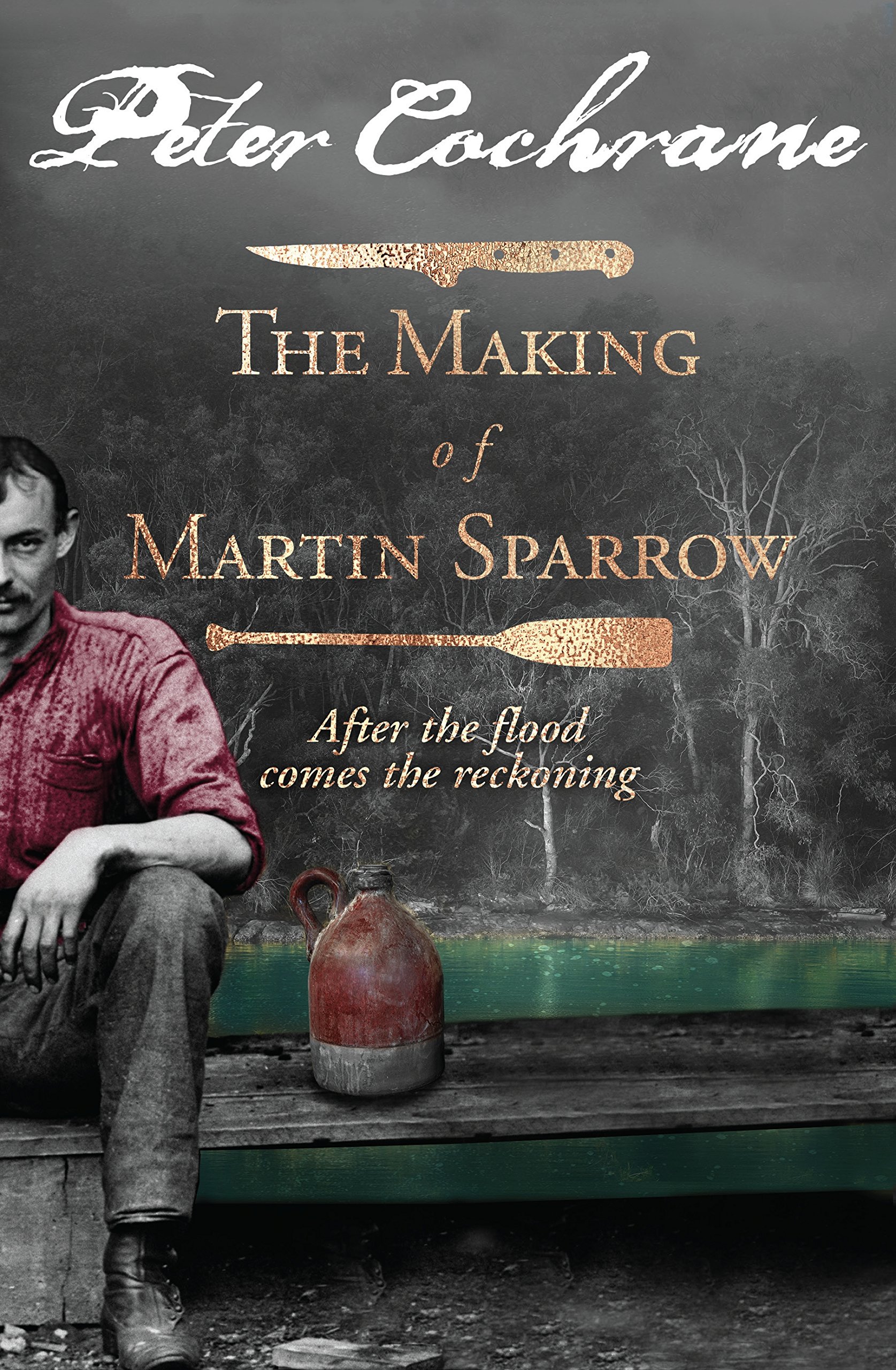
It is late summer in 1806, in the colony of New South Wales. After he loses everything he owns in a disastrous flood, former convict, failed farmer, and all-round no-hoper and ne’er-do-well Martin Sparrow heads into the wilderness that is now the Wollemi National Park in the unlikely company of an outlaw gypsy girl and a young wolfhound.

The Making of Martin Sparrow, Historian Peter Cochrane’s tale of adventure and more often than not, misadventure, is set on the middle reaches of the Hawkesbury River, north of Windsor, and the treacherous terrain of the picturesque Colo Gorge.
But first, some background history …

Between 1788 and 1868, about 162,000 convicts were transported by the British government to various penal colonies in Australia. It had began transporting convicts to the American colonies in the early 17th century, but the American Revolution had put an end to this. An alternative was required to relieve the overcrowding of British prisons and on the decommissioned warships, the hulks, that were used to house the overflow. In 1770, navigator Captain James Cook had claimed possession of the east coast of Australia for Britain, and pre-empting French designs on Terra Australis, the Great Southern Land was selected as the site of a penal colony. In 1787, the First Fleet of eleven convict ships set sail for Botany Bay, arriving on 20 January 1788 to establish the first European settlement on the continent. Botany Bay, named by Cook for its abundant and unique flora and fauna, was deemed unsuited, and six days later, the fleet hove to in the natural harbour to its north and established Sydney, named for the fleet’s commander.

Other penal colonies were later established in Tasmania – Van Diemen’s Land – in 1803 and Queensland In 1824, whilst Western Australia, founded in 1829 as a free colony, received convicts from 1850. Penal transportation to Australia peaked in the 1830s and reduced significantly in succeeding decades. The last convict ship arrived in Western Australia in 1868.

Convicts were transported primarily for petty crimes – serious crimes, like rape and murder, were punishable by death. But many were political  prisoners, exiled for their participation in the Irish Rebellion of 1798 and the nascent trade union movement. Their terms served, most ex-convicts remained in Australia, and joining the free settlers, many rose to prominent positions in Australian society and commerce. Yet they and their heirs bore a social stigma – convict origins were for a long time a source of shame: “the convict stain”. Nowadays, more confident of our identity and our national story, many Australians regard a convict lineage as a cause for pride. A fifth of today’s Australians are believed to be descended from transported convicts.

A wise man doesn’t burn his bridges until he knows he can part the waters

In the young colony, for free and unfree, men and women alike, life  could be nasty, brutish and short, beset by hard labour, hard living and for many, hard liquor, cursed with casual violence, and kept in order by a draconian regime of civil and military justice. Particularly so for the felons, formerly of the convict transports, and only moderately less for free settlers and the expirees, former convicts endeavouring to make a living on hard-scrabble blocks on the outer fringes of the Sydney Basin, far from  young and barely civilized Sydney Town.

Sydney Society 1800

Cochrane’s history credentials are evident in his feel for the time and the place, the lifestyle and its accoutrements. And it’s a good pitch for a motion picture. A colonial “western” indeed, for the book echoes those fine films that portray the sordid and seedy side of the pioneer story, like Altman’s chilly McCabe and Mrs Miller, and latterly, the magnificently decadent Deadwood, with less brutal elements of Alexandra Iñárritu’s The Revenant. I noted at least two lines borrowed from classic westerns – Clint Eastwood’s avenger tale The Outlaw Josie Wales, and Arthur Penn’s  frontier drama The Missouri Breaks – and there are probably more.

Cochrane has assembled a cast that is as representative and as colourful of the transplanted populace as it undoubtedly was, although some may come across to readers as a tad stereotypical and over-the-top. Loyal and honest servants of the crown like dour, Scottish Chief Constable Alister Mackie and his erudite sidekick American Thaddeus Cuff, who is never lost for bon mots and folk wisdom; whores that would not be out of place in Deadwood’s seedy Gem; cruel; corrupt soldiers who are a law unto themselves; and veterans of the Indian wars (waged by the East India Company, that is). Some are soberly righteous and others less so, given to either producing or consuming in excess a hooch named for its after effects: “bang-head”); unscrupulous and violent sealers, hunters, bushmen, and escaped convicts; and a wise and inquisitive doctor and an eccentric and obsessively peregrinating botanist intent on determining how the platypus produces its young. And, that unlikely trio at the commencement of this piece.

For many of the characters, and particularly the melancholy Martin Sparrow, it is a tale of hope and renewal, survival  and redemption – again like those iconic westerns. There is something about “the frontier”, on the lawless and dangerous edges of civilization, that tries and proves a man or woman’s soul. Cuff declares that “all life turns on a pitiless wheel”, but, he adds, “we ain’t stuck in brutishness. We got a choice”.

Damnation and redemption walk hand in hand. It is perhaps no coincidence one of the river’s most righteous settlers, the former Redcoat Joe Franks, has a passion for seventeenth century Puritan preacher John Bunyans A Pilgrim’s Progress, that allegorical saga of faith in adversity written whilst the author was doing a twelve year stretch for his religious beliefs. Hope springs eternal on the Hobbesian frontier, and we are constantly reminded of this by the sardonic constables: “hope is the poor mans bread”, but he who lives on hope dies fasting.  Whilst hope might be “the mainspring of faith, it is also “physician to misery” and “grief’s music”. And yet, to the irrepressible Romany girl, who has seen and suffered much, it might also be the “little songbird in the well of our troubled soul”.

… the search for happiness can be like the search for your spectacles when they’re sittin’ on your nose. 

The country into which most of the cast venture is not, as we now acknowledge, an empty land. It was a peopled landscape, a much revered, well-loved, and worked terrain, its inhabitants possessed of deep knowledge, wisdom and respect for “country”. Cochrane acknowledges the traditional owners as they roam the fringes of his story and often venture into it, mostly as a benign presence, aiding and advising the protagonists in the mysterious ways of the wilderness.

Whilst many colonists, particularly the soldiery, regard the native peoples as savages and inflict savage reprisals upon them for their resistance to white encroachment, others, in the spirit of the contemporary ‘Enlightenment’ push back against the enveloping, genocidal tide with empathy and understanding. “It’s the first settlers do the brutal work. Them that come later, they get to sport about in polished boots and frock-coats … revel in polite conversation, deplore the folly of ill-manners, forget the past, invent some bullshit fable. Same as what happened in America. You want to see men at their worst, you follow the frontier”. “They don’t reckon we’re the Christians, Marty … We’re the Romans. We march in, seize the land, crucify them, stringing ‘em up in trees, mutilate their parts”.

But they know in their hearts that this ancient people and its ancient ways are helpless against the relentless tide of the white man’s mission civilatrice. “It might be that the bolters have the ripest imagination, but sooner or later, an official party will get across the mountains and find useful country, and the folk and the flag will follow, that’s the way of the world. It’s a creeping flood tide and there’s no ebb, and there’s no stopping it. No amount of … goodwill”. To paraphrase Henry Reynolds, acclaimed chronicler of the frontier wars, they can hear that uneasy whispering in their hearts.

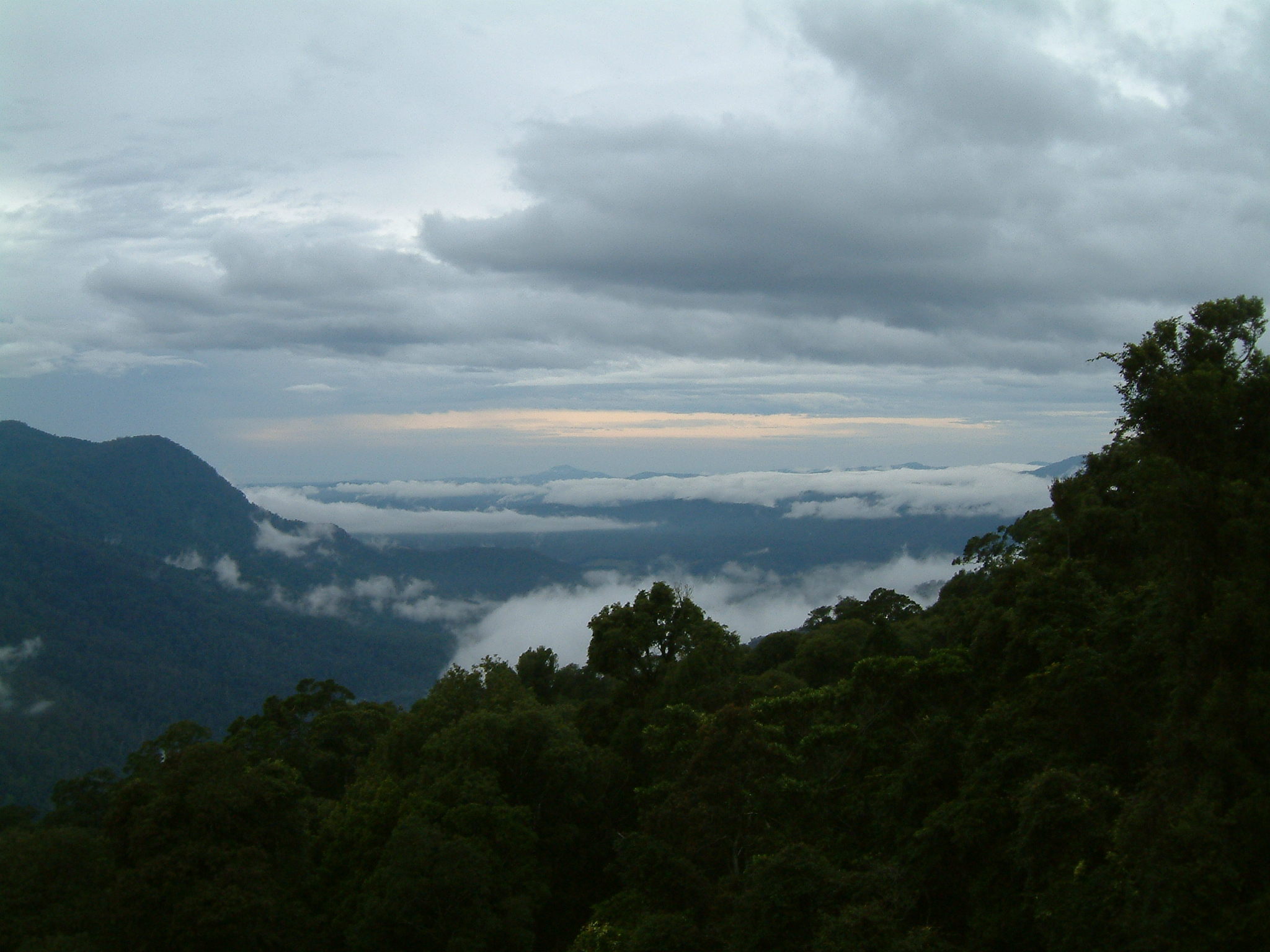
It is Cochrane’s description of the landscape that makes an otherwise entertaining but derivative “quest” narrative soar to literally panoramic heights:

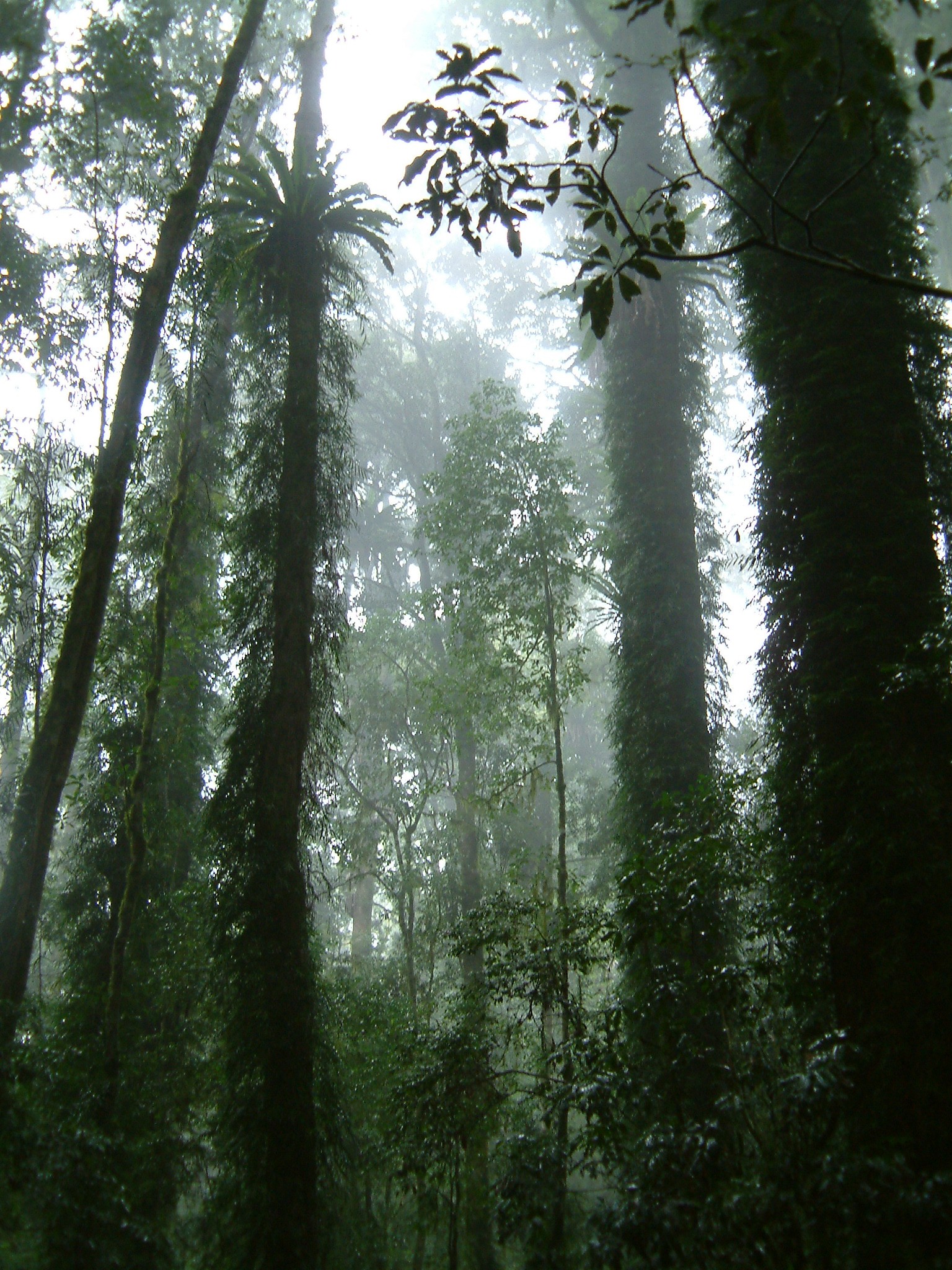
“They heard the sound of frogmouths and boobooks and night birds unknown to them, and heard the whoosh and splash and smack of fish jumping in the shallows and the constant sound of the tide chafing the banks and far off a dingo howling, and they saw the river rats scurrying for cover and myriad shapes in the dark recesses of the forest, and higher up they saw great bands of ancient sandstone, moonlit, cracked and fissured by the chisel work of ages”.

“They stood atop a cliff wall that ran north to the dense green line that marked the horizon, above a point where the valley was lost in the braided folds of mountain spurs and  patches stone and a wash of the darkest forest green … The far cliffs were fractured by heavily forested gullies and slot canyons carved deep through stone. To the north he could see open patches of grassland on the valley floor, the lumpy shapes of marsupials grazing, smaller things foraging, clustered together, wood ducks and a flock of black cockatoos in full flight following the line of the far wall, the stone there fissured and scarred like the hide of a dragon”.

“Soon they were there, standing four in a line atop the stone cliffs, a sheer drop to the thickly  timbered slopes that flattened to a valley floor perhaps a mile away, the river there flanked by irregular patches of forest and grass meadow and game feeding on the grasses – emu and wallaby, a wild dog loping along, and wildfowl breaking from the reeds. They saw a flock of parrots skimming the canopy, their colours coursing down like windswept rain. They saw a wedge-tailed eagle, those ragged wings, wheeling, slow, hypnotic, in the heavens above”.

Landscapes such as these are familiar to me. I view them from high places and walk the forests, and I have seen and heard the myriad birds and animals that inhabit the lands east of our Great Dividing Range. Indeed, many of them I view from my home in the forest. I felt the thrill of recognition as Cochrane’s adventurers ventured forth.

Breathtakingly beautiful it might be, but, then and now, it’s a hard and dangerous land. “… deadly cruel if you’re lost in there. I tell you both this: the wilderness in the west begs a certain reverence and demands a certain humility”.

The weather swings from searing heat to devastating floods – it is such a deluge that propels Martin Sparrow on his odyssey. The terrain in treacherous – one careless misstep and a fall can be deadly. The flora and the fauna might be exotic and magical to behold, but not everything is benign. There are snakes, funnel webs, wild dogs, eels, and bull sharks, and a particularly unpleasant wild pig. The travelers are constantly checking for mosquitoes, leeches and ticks. And the deadliest of all, the humans.

Well, these days it seems all the wilderness does is abet a multitude of crimes and occasionally a smidgen of restitution I suppose. Small mercies. 

A perilous place the bush may have been, but that did not deter those who sought to venture there and indeed, find a path through the Great Dividing Range. In ensuing decades, many explorers would weave their way westwards to view that “vision splendid of the western plains extended”, as our national bard described it. But in convict days, the vision splendid was one of freedom, from slavery’s metaphorical chains -actual irons were not required in the colony because the dense and impenetrable forests that covered the lowlands and the slopes of the ranges were as “iron bars all the way to the sky” and the nomadic “savages”, de facto guards, so to speak, and for freedmen, from backbreaking toil of the their meagre farmsteads. “… it’s the misery of this mercantile tyranny … or the sovereignty of the commonweal, fire of the brutish parties that govern us here”.

Tales of an inland haven, a sanctuary from the military despotism and the rigours of pioneering  were part of the convict “dreaming”.  Some say this was a rhetorical ploy to throw the Law off the scent as the real escape route was by boat along the coast. The authorities dismissed it as a fantasy, a fable, or, to quote Robbie Robertson, “a drunkard’s dream if ever I did see one”. All that lay out yonder was trial and tribulation and death by a thousand stings, bites, or spears.

And yet, the magical thinking of a happy land far, far away is part of our human storytelling. “Somewhere over the rainbow, skies are blue, and the dreams that you dream of really do come true”. Even Westworlds androids, who yearn, like Pinocchio, to be human, roam relentlessly towards the freedom of “the valley beyond”.

The notion of becoming a “bolter”is the primary theme of the story, and indeed the “making” of the luckless, lovelorn, indebted and hence perennially, melancholy Martin Sparrow who was ever wont to “stagger from one calamity to another”. A paradisaical village of free folk beyond the mountain fastness and the long arm of the constabulary, on the banks of “a river of the first magnitude” that winds its way to a mighty, whale-splashed ocean far to the west of the unknown continent, as they note, the celebrated  Mr Flinders himself had surmised, their wants satisfied by bevies of copper-coloured women:

“And there it is, the most beautiful grassy woodlands that you are ever to see, and way below, a small village, embosomed in a grove of tall trees, by a most majestic river, flowing west, as far as the eye can see, and small boats gliding the channels between little islands, and women, knee-deep in the  shallows, casting their nets … Olive-skinned, well-favored by nature and most pliable and yielding in all regards”.

Give a man his wish, you take away his dreams. 

And so, amidst Cochrane’s historical and political exposition – and he wears his historian heart on his sleeve – and remarkable scenic descriptions, a mob of folk of widely disparate authority, status, means, temperament and ability head off in twos and threes into the wild. Some are driven by duty; for others, it’s a living; and for our unlikely duo and dog, it’s a quixotic leap in the dark. Some perish, others sicken, and several arrive at their own epiphanies and apotheoses. I recall Paul Simon: “Some have died, some have fled from themselves, or struggled from here to get there”; and also, Robert Lewis Stevenson’s observation that often, “to travel hopefully is a better thing than to arrive, and the true success is to labour”.

Till a voice, as bad as Conscience, rang interminable changes
On one everlasting Whisper day and night repeated—so:
“Something hidden. Go and find it. Go and look behind the Ranges—
“Something lost behind the Ranges. Lost and waiting for you. Go!
Rudyard Kipling, The Explorer (1898)

Orphan Girl

This beautiful song was written by Brendan Graham for the Annual Great Famine Commemoration at Sydney’s Hyde Park Barracks in 2012 to commemorate the immigration to Australia of over four thousand female orphans who, between 1848 and 1850, were brought from Ireland during the Great Hunger. It is performed by the celebrated Choral Scholars of University College of Dublin, featuring soloist Abby Molloy


For wider reading about Australian history, I highly recommend William Lines’ challenging Taming of the Great South Land, the late Robert Hughes’ magisterial The Fatal Shore, and David Day’s Claiming a Continent Posts in In That Howling  Infinite include We got them Australia Day Blues and Outside Looking In.

As part of its marketing strategy, publisher Penguin Books, has seen fit to share extracts from the opening chapter of The Making of Martin Sparrow.  I have republished them below.
1.

Sparrow woke on wet sand somewhere downriver with a terrible stink in his nostrils, the smell of death and decay, rot and ruin all about. At first he did not stir, there in the pre-dawn, pale light to the east beyond the river, the tide on the turn, ebbing now, the flow yet a faint murmur in his ears.

Confusion held him still, as did the formidable lassitude in his bones and the damp cold on his skin. The sound of his breathing con­firmed the likelihood that he was alive. He raised his head and looked about, sucked up a wad of gritty phlegm and spat onto the sand. He wondered if perhaps his deliverance was the work of a kindly fate, a chance to make good his miserable existence. Hard to know.

The sand was strewn with muck and wreckage. The hen coop was there, his hens dead, in company with tangles of lumber and thatch, fence posts and scoured saplings, a big, raggedy cut of wagon can­vas and a lidless coffin, the muddied panelling infested with yellow mould that glowed bright in the soft dawn light.

He sat up and brushed himself off, noticed a long cut on the inside of his forearm, but it wasn’t bad. If it was bad, deep, he might have bled to death while he lay there in the dark, half drowned. But it wasn’t and he didn’t. That was lucky.

He studied the coffin; reckoned sooner or later he’d have to take a look, in all probability stare rotting death in the face. A crow alighted on the rim, shuffled one way then the other, then hopped in, keen to join its companions. Sparrow saw a flurry of black wings as the disputatious gathering settled to its work.

There was a blood-soaked tear in his britches and a hungry leech on his thigh, like a small, fat velvet purse. He flicked the greedy little sucker onto the ground, took a twig and pierced it, watching his own blood spill out and colour the sand to russet.

In the shallows he scooped up a fragment of the Sydney Gazette, but the newspaper dissolved in his fingers as he tried to unfold the sodden sheet.

Sparrow surveyed the farms beyond the river, the flooded fields; wildfowl feeding on the flattened corn, flood-wrack washing seawards on the flow. He dropped to his knees and laved water onto the little puncture wound on his thigh and the cut on his arm. Quite why he did that he did not know for he was otherwise layered in muck all over.

Memories washed about inside his head dispelling some of the confusion – the lightning storm, the torrents of rain, the hen coop caught in the violent flow; wheat stacks coursing the river; the unremitting fury of the waters, crops awash, the bottoms gone; the exodus of reptiles; the dismal cries from distant quarters, the sound of muskets dangerously charged.

He got up and turned about, scanned the lowlands to the west, the mountains far off, full of mystery and foreboding, and full of promise too.

The sound: the ebbing tide, the pecking crows.

Sparrow stepped quietly from the water. Stood. Listened some more. He crossed the sand, took hold of the wagon sheet, heavy with wet, and edged towards the coffin until he could see the beaks spear­ing into that shrunken face riddled with wounds, a fledgling on the old man’s chest, pecking at his coffin suit. He did not hesitate, for their pleasure had filled him with an unfamiliar wrath and rendered him vengeful. He hurled the wagon sheet across the coffin. The cap­tive birds panicked and leapt into the cloth and flapped and squawked and leapt again, like hearts beating in some hideous thing.

Sparrow took hold of a heavy stick and began to beat the cloth with all his might. A wing appeared askew the panelling and he smashed at it and heard the creature scream. And he kept on just so, until the canvas lay sunken in the coffin and the birds were all but still, dead or dying, their frames faintly visible. He leant on the stick, suck­ing for breath, awaiting further movement in the coffin, watching as blood seeped into the cloth. The birds made a few pitiful sounds, now and then a ripple or a shudder or the flap of a wing.

Sparrow stood over the coffin until the cloth stopped moving. He looked west to the mountains. Tiredness took hold. ‘Maybe it’s true, maybe I don’t got the mettle,’ he said.

He crossed the sand, stood over his coop, dropped to his knees. His hens in death, his good, sweet, giving birds, were naught but a lumpy pile of dirty feathers and claws.

He reached into the coop and gently palmed his birds apart, set­tling his hand upon a muddied wing; recalled the signs: the lightning storm in that inky blackness over the mountains, the discolouration of the flow and the rapid rise of the river.

But the waters had receded, briefly – a most deceptive interval that filled Sparrow with a false notion of security and he had not then seized his opportunity. He had not got in his crop, not one ear of corn; nor had he got his scarce possessions off the floor of his hut, nor moved the coop to higher ground, thus condemning the hens to a most frightful expiration, such an end as filled Sparrow with dread for reasons he did not care to contemplate. For all that, he was truly sorry.

More than once Mortimer Craggs had told him to stop being sorry. ‘Sorry for this, sorry for that,’ said Mort. ‘You got to stop being sorry, Marty, you gotta stop forthwith and seize the dream, for therein lies our path to an unfettered liberty, y’foller me?’

Sparrow did not quite follow, but he’d said yes anyway for he did not want further badgering from Mort, who was a fierce badgerer and a most indiscriminately violent man once roused. Mort might well whack a man; or he might take a filleting knife and slit his nose. You never did know what Mort might do.

Sparrow felt the sun on his back at last. Once more he looked west across the water-logged lowlands to the foothills and thence the mountains. He recalled his last conversation with Mort Craggs, before Mort took off with Shug McCafferty, before they bolted for freedom.

‘I just ain’t ready to go,’ he’d said. He was uncertain as to why Mort had invited him to join the bolt, for they were not friends, just acquaintances, a lethal acquaintance dating back to the years of his youth in the village of Blackley on the river Irk.

‘I think you don’t got the mettle, Martin,’ said Mort, fingering the ridge of proud flesh on his cropped ear.

‘I have things to say to Biddie first,’ said Sparrow.

‘Forget the whore, there’s women on the other side, there’s a big river, there’s a village, women aplenty, copper-coloured beauties, the diligence of their affections something to behold.’

‘How do you know that?’

‘Can’t say, not till you commit to the venture, swear a binding oath.’

‘I cannot swear an oath, binding or otherwise, not yet.’

The very idea of copper-coloured women on the other side of the mountains puzzled Sparrow, deeply. He was somewhat lost for a per­spective on this startling infomation. ‘Like the Otahetians?’ he said.

‘No, nothin’ like them and I can say no more Marty, not another word.’

And that was the last conversation he’d had with Mort Craggs.

Sparrow had to wonder if perhaps his yearning for Biddie Happ was a foolish dream. If it was not a foolish dream before the flood it most likely was now. His thirty-acre patch was swamped, his corn crib gone, his corn crop flat in the mud, the wildfowl, the borers and the mould most likely hard at work this very day. His hut might well be gone too, lost to the flood. His hens were dead, he was deep in hock, mostly to Alister Mackie, and would have to beg for seed for another crop and that meant more hock, regardless of the weather to come. In short, it was now most unlikely that Biddie would see any chance of elevat­ing her prospects by joining with him, Martin Sparrow, former felon, time-expired convict, failed farmer on the flood-prone bottoms of the Hawkesbury River. Fool of a man.

He sat on the sand, bowed his head and ran his fingers down his forehead, over the faint indentations that continued onto his eyelids and cheeks, the all but faded scars that folk took to be the remnants of small pox.

He tried to sort his pictorial thoughts. That wasn’t easy with Biddie presenting herself in one instant and the copper-coloured beauties in the next. ‘I should have gone with Mort,’ he said aloud. He thought about the birthmark on Biddie’s face, the mark she tried to hide with that lovely sweep of hair, pinned just so. He wondered if copper-coloured women ever got birthmarks. As to that, he just didn’t know. The mysteries, numberless.

2

Alister Mackie sipped his Hai Seng tea, treading the porch boards by the tavern door, treading to waken his bones as the pale grey light of dawn brought the distant mountains into view and the mass of hud­dled humanity on the village square came to life, the refugees from the flood stirring from makeshift tents on rickety frames, tattered paniers lumpy with tools and keepsakes, waifs bedded in carts and barrows, piglets trussed and tumbled in the mud, game dogs on tethers and crated fowls crooning their disquiet.

He held the mug in his two hands, sniffed at the steam com­ing off the brew, searching the scene: the double guard on the stone granary and the commissariat store; soldiers by the barracks door in various measures of infantry undress; washerwomen in and out of the washhouse; the butcher, busy on his scaffold, a hundred pounds of pork on the hook; the little church, the smithy, the stone gaol. The village they called Prominence.

The drudge called Fish joined Mackie on the porch. He wiped his hands on his apron. ‘You want I take the mug?’ he said.

Mackie handed him the mug.

‘They’re hammered, like castaways, every last one of them,’ said Fish.

‘They are, yes.’

‘I seen floods, but I never seen a flood like this one.’

‘Nor I.’

‘Here and there the tops of trees, otherwise an ocean.’

‘Yes.’

Mackie stepped off the porch. He weaved his way through the bivouac to the commissariat store on the far side of the square and from there he followed the ridgeline past the granary to the top of the switchback path, where he paused by the doctor’s cabin to scrutinise the work of the floodwaters below. The government garden, gone, an acre of greens torn from the slope as if scythed away by some pale rider’s mighty blade; the cottages on the terrace, squat and sodden, the weatherboard swollen and warped. Felons in the shallows, gathering up the ruins of the wharf, the guards perched on their haunches.

Mackie joined his constables, Thaddeus Cuff and Dan Sprodd, at the foot of the switchback path and together they stepped from spongy duckboards into the shallows and clambered aboard the government sloop. Packing away the mooring lines, they drifted into the current and settled at their ease. A light westerly, a port tack, the wind and the tide obliging.

Cuff patted the planking beneath the rowlock, looking up into the big gaff rig as the sail took the wind. ‘This tub reminds me of Betty Pepper,’ he said. ‘Deceptive quickness in stout disguise, charms you’d never guess first off.’

He glanced back at the cottages on the terrace and there she was, Bet, watching them go; her porch strewn with soaked possessions, the high-water mark like a dirty wainscot on the cottage wall. The young strumpet Biddie Happ was there too, squaring a muddied rug on a makeshift line. Cuff raised his hat and Bet responded with a curt swish of her hand and took a broom and set to sweeping the mud off her porch. Biddie patted at the swathe of red hair that covered the birthmark on her face.

‘They’ll miss me,’ said Cuff, ‘they cannot help themselves.’ He grabbed the wicker handles on a gallon glass demijohn, upended it, took a swig, then another, and then he passed the receptacle to Dan Sprodd.

Sprodd took a swig and passed it back to Cuff who took another swig, knowing it would aggravate the chief constable.

‘Hardly underway, you set a fine example, Thaddeus,’ said Mackie.

‘Thank you!’ said Cuff.

‘You should ration that.’ Mackie wagged a finger at him.

‘I don’t go with the shoulds, the shoulds are a tyranny. I see no joy in rationing bang-head, or anything else for that matter,’ said Cuff.

‘Americans take their liberties very seriously,’ said Sprodd, as if Mackie was sorely in need of the information.

‘Indeed, we do!’ said Cuff.

‘As do I,’ said Mackie.

‘I’ll tell you now, spirits put clout and vigour in a man. You’ll get honest toil from a pint of bang-head, miracles of effort from a quart.’

‘That or the fatal dysenteries!’

Cuff quite liked the sound of the chief ’s lowland brogue but it was too early to argue with any persistence. Sleepiness, briefly, had the better of his contrarian temperament. ‘Hear that Dan?’ he said, ‘We are not to be trusted with the drink; we, the meritorious constabulary.’

The Boys of Wexford – memory and memoir

We are the boys of Wexford, who fought with heart and hand
To burst in twain the Saxon chain, and free our native land!
The Boys of Wexford, RD Royce 1898

Glory-o, Glory-o to her brave men who died
For the cause of long down-trodden man.
Glory-o to Mount-Leinster’s own darling and pride
Dauntless Kelly, the boy from Killane.
Patrick Joseph McCall, 1898

It was on this day in 1798, during the first great Irish rebellion against British dominion, that the Battle of Vinegar Hill took place at Inis Córthaid, now the second-largest town in County Wexford.

The Rebellion of 1798 (Éirí Amach) also known as the United Irishmen Rebellion, was an uprising against British rule in Ireland during the summer of ‘98. The United Irishmen, a republican revolutionary group influenced by the ideas of the American and French revolutions, were the drivers of the rebellion. It was led by Presbyterians irate at being shut out of power by the Anglican establishment whilst Catholics became increasingly involved. Plans called for significant French support, which never eventuated. The uprising was poorly organized, uncoordinated, and quickly suppressed by much more powerful British forces. Both sides indulged in bloody reprisals. Between 10,000 to 30,000 souls perished, most of them Irishmen and women of all denominations.

The rebellion raged Ireland-wide, but County Wexford was its heart. Overlooking the town, Vinegar Hill was the site of the largest camp and the headquarters of the Irish rebels who held County Wexford for thirty days against vastly superior English forces; and it was there, after inflicting several defeats upon the insurgents that the English sought to finally destroy the rebel army. Battle raged on Vinegar Hill itself and in the streets of Enniscorthy with considerable loss of life among both rebels and civilians. It marked a turning point in the rising, being the last attempt by the rebels to hold and defend ground against the British military.

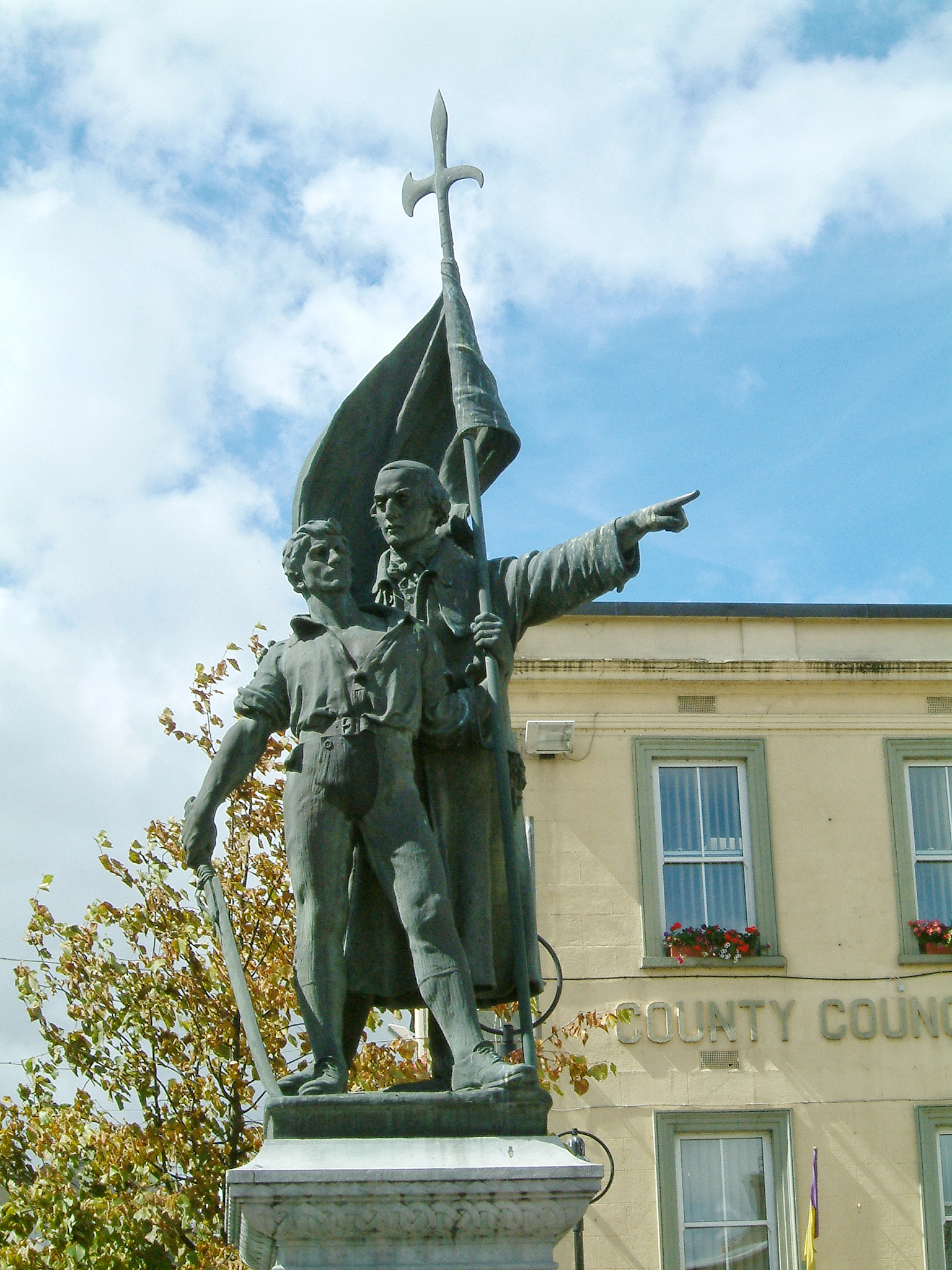
The famous statue in the market square of Enniscorthy shows the doomed Father Murphy, a leader of the ’98, pointing the way to Vinegar Hill for a young volunteer, ‘The Croppy Boy’.

Father Murphy and The Croppy Boy

The Battle of Vinegar Hill, Enniscorthy

History – and indeed, our lives – have a way of echoing across the world and down the years. In 1804, Irish convicts in the far-away penal colony of New South Wales, raised the flag of rebellion against the British soldiery and the colonial masters they served. It was the only convict rising in Australia. Many of those convicts would have been involved in the ‘98, and transported to Botany Bay for their part in it. Their quixotic Intifada was crushed at a place they called Vinegar Hill after the Wexford battle. In 1979, having migrated to Australia, I visited what is believed to be the site of the convicts’ revolt, the Castlebrook lawn cemetery on Windsor Road, Rouse Hill, where a monument commemorating the revolt was dedicated in 1988, Australia’s bicentennial year. Once open farmland, a place of market gardens and horse riding (back in the day,we would canter across its  gently rolling paddocks), it is now a suburban sprawl of McMansions.

The Battle of Vinegar Hill, New South Wales

Myth and memory often embellish the stories and the glories of oppressed people rising up against the power, but when we recall these oftimes forlorn hopes, from Spartacus to the Arab Spring, it is difficult to imagine ourselves, in our relatively comfortable, free and democratic countries, in the position of people desperate and passionate enough to risk life and limb and to face the terrible consquences of heroic failure.  We can but sense, vicariously, the ache and the urge behind Lord Byron’s passionate couplet:

Yet, Freedom! thy banner, torn, but flying,
Streams like the thunder-storm against the wind.

And ponder Seamus Heaney’s poignant Requiem for the Croppies:

The pockets of our greatcoats, full of barley
No kitchens on the run, no striking camp
We moved quick and sudden in our own country.
The priest lay behind ditches with the tramp.
A people, hardly marching on the hike
We found new tactics happening each day:
We’d cut through reins and rider with the pike
And stampede cattle into infantry,
Then retreat through hedges where cavalry must be thrown.
Until, on Vinegar Hill, the fatal conclave.
Terraced thousands died, shaking scythes at cannon.
The hillside blushed, soaked in our broken wave.
They buried us without shroud or coffin
And in August the barley grew up out of the grave.

Father Murphy and me

I’ve always felt a connection with Vinegar Hill and “the boys of Wexford” who fought there.

In Birmingham, back in the early fifties, we lived with our aunt in a cold-water, back-alley walk-up on the border of Balsall Heath (just inside Moseley, a ‘better’ suburb). Aunty Mary was my mother’s mother’s sister. Her family had lived through Ireland’s war of independence and the civil war that followed, and she carried with her the memory of those times when she migrated to Birmingham before the Second World War – after her husband had run off “with another woman” (these things happened in Catholic Ireland). She lived in that same old house right through the Blitz when German bombers regularly targeted The Second City’s engineering, motor and arms factories, and not a few public buildings including the Piccadilly and Waldorf cinemas on nearby Stratford Road which were destroyed with considerable loss of life. Mary would serve tea to the bomb-disposal lads as they carried out their dangerous work. When her sister died and daddy Paddy (Patrick Joseph, my middle names) had decamped – he’d found a new Love – Mary brought their six children over to Birmingham from Enniscorthy one by one.

I never met nor learned what became of my grandfather. My aunt and mother would say that if Paddy Whelan died, the devil himself would come and tell us. Old Nick never did, but my brother Robert recently chased down the records. Paddy also crossed the water, passing on in Leicester – not that far from Brum – in 1985 at the age of eighty.

My father arrived in Brum by another road. He was born in Castlederg in County Tyrone. An Ulster man, indeed, and Protestant too, He and several of his brothers has likewise crossed the water in search of a new life. Most Ulster ‘Proddies’ migrated to Glasgow in those days – the original homeland of the the Protestant settlement of Ulster initiated by King James I of England and consolidated with Orange King Billy’s victory over the forces of catholic ex-king James II at the Battle of the Boyne in 1690. you can read more about all that here, and its legacy in Northern Ireland here. How he and my mom got together is another story and quite unrelated to this one. But it had a lot to do with the times. geography, coincidence, miscommunication, innocence – and romance.

I was born in Mary’s house. She had a friend who had once given birth so that friend was the midwife. My brothers followed over the next two years. By then, the National Health Service had kicked in, and they were born in hospital. Childbirth, forever dangerous, was now rendered less life-threatening. There we all lived, three kids, our folks, Aunty Mary, three uncles, two aunts, a pekingese called Monty, named for the famous field Marshall, and an ancient white cat called Gorgee. Monty was flattened by a bus on Moseley Road, right outside our home.

Three bedrooms, girls in one, boys in another, and our family in the third. Outside loo and coal shed, no bathroom or hot water (we kids bathed in the kitchen sink and grown-ups went down to The Baths). Cold and damp, and close to the shops. And there we lived until 1956 when a council house in Yardley Wood became our first family home. Cold and colder running water that froze in winter, but it was at least inside the house; a bathroom with hot water heated in a big gas boiler; and an outside flush lavatory that was nevertheless immediately adjacent to the backdoor and not down in the garden. A big garden it was too, for winter and spring vegetables, snowmen and summer camp-outs.

There we grew, with free medical treatment for all our ailments, and free optical and dental care. I still have crooked teeth – no fancy orthodontics on the NHS – but I have all my teeth still. And my eyesight. We were educated for free. This came in during the war with the Butler Act. So, thanks to the Welfare State, we were housed and healthy enough to get to primary school and beyond. Once there, we had free books, free pens and paper and compulsory sport, and doctors and nurses would turn up on a regular basis to check our vitals. And thus, we were able to reach the glorious ‘sixties ready to rock ‘n roll.

In 1956, my uncle took me “across the sea to Ireland” to meet our family – my mother’s, that is. Dad was a proddie from County Tyrone, and we didn’t talk about them. We stayed in the tiny terrace house in Patrick Street where my mother was born in 1928, a crowded place with an outside toilet and a whitewashed back wall that looked out onto windswept fields beyond.

Uncle Sonny (Philip, really, but knicknamed for Al Jolson’s famous song), took me to the top of Vinegar Hill, and it’s lonely ruined round tower, used then as a shelter for cattle. We visited the statue of Father John Murphy and the young volunteer, and I learned the story of The Croppy Boy. Today, the term “croppy” is used derogatively to refer to a country bumpkin. Back then, it also referred to the young patriots who answered to the call “at the rising of the moon”. Their name came from their cropped hair – interpreted by some at the time as symbolic of the rejection of the powdered wigs of the gentry and also of the style popularised by French revolutionaries. Sonny took me to The Bloody Bridge on the outskirts of town where Father Murphy was tortured and executed by the English soldiers, the ‘yeos’ (or yeomen). I put my fingers in the groove in the  bridge’s stone parapet, said to have been made by the dying priest himself. We walked across the bridge in Wexford Town where so many martyrs perished at the hands of the foe – and, alas, so many innocents were murdered by the rebels. Little matter that the bridge we now trode was the third built there since those fateful days.

History was alive, and it was black and white. People remembered, as if it was yesterday, how Oliver Cromwell cut a bloody swathe through Catholic Ireland and massacred the innocents of Wexford town. It was said that people hung Cromwell’s picture upside down in their living rooms, and turned his face to the wall for good measure. Relatives would recount how the Black and Tans, the English paramilitaries raised to terrorise the populace, held their bayonets to women’s throats demanding “where’s your husband?”…or father…or son…Even the English teachers at my English grammar school would remark that the ‘Tans were war veterans who’d survived carnage of the Western Front and wanted more.

In the summer of 1969 my brother and I and an old chum spent several weeks in an Enniscorthy that looked and felt felt like it had not changed since Aunty Mary’s day – so well portrayed in the academy award nominated film Brooklyn. Dressed as we were in hippie garb and sporting long locks, we cut incongruous figures in the pubs and at the local hop, and were so unsuccessful hitchhiking around the county that we walked many a long Irish mile. We hiked to Killane, Sean Kelly’s country, and inspired by the song, climbed upwards though heath and hedge to the top of Mount Leinster. We stayed at 13 Patrick Street, and spent a lot of time sitting up on Vinegar Hill, beneath its round tower, looking down on the River Slaney and the town beyond. My brother was a keen photographer, and he took the following pictures:

The Croppy Boy 1969

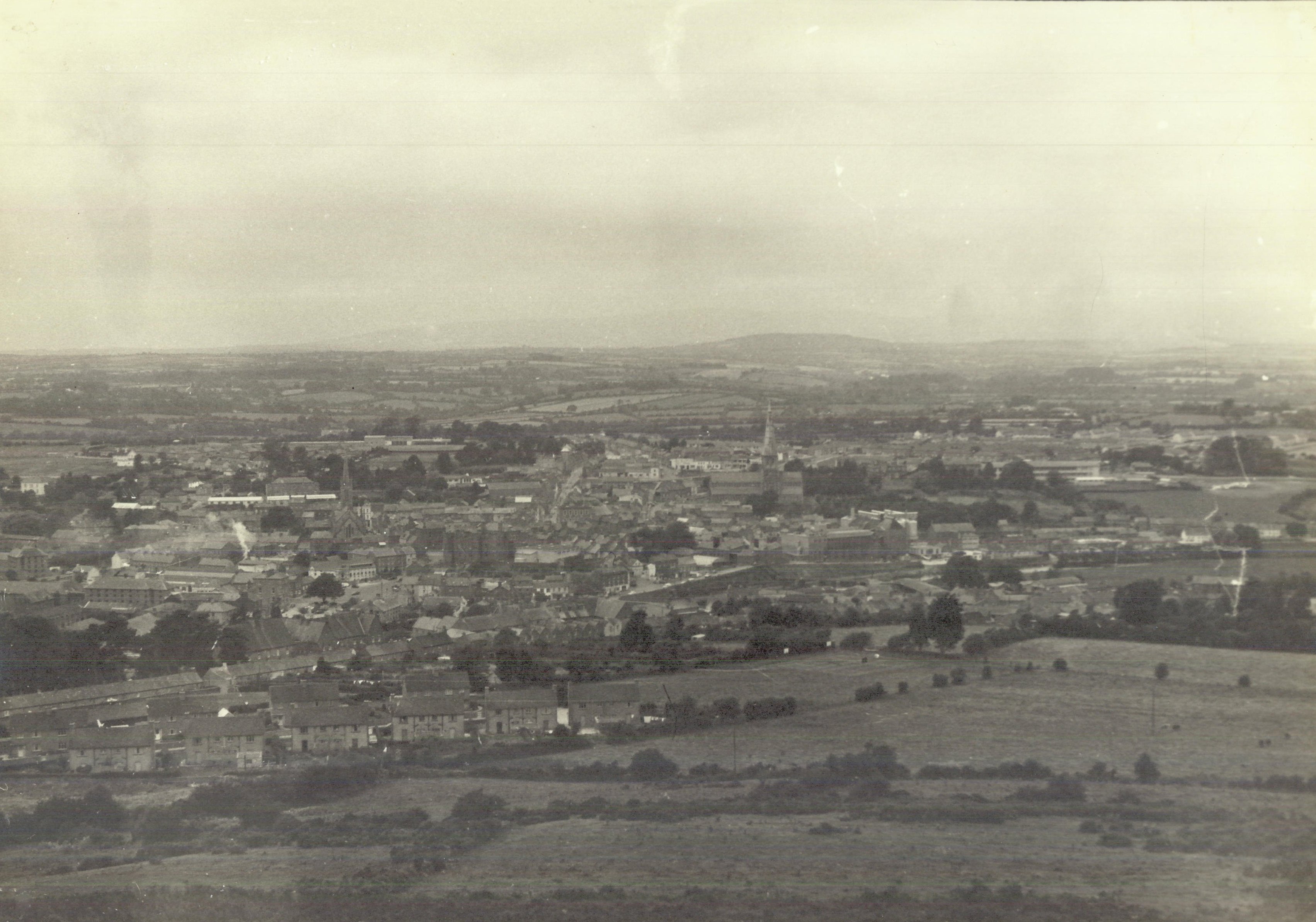
Enniscorthy from atop Vinegar Hill August 1969

Enniscorthy Sunset August 1969

Fast forward into another century, and I was “on the Holy Ground once more”. Adèle and I attended the wedding of an old pal and cosmic twin (born on the same day as me at about the same time, in English town beginning with B) we were the only Brits in a seminar at London’s School of Oriental and African Studies. Back then, SOAS was known to many Arabs as the school of spies, a status I was reminded of by the owner of our hotel when we all visited Damascus in 2006. But I digress.

The wedding was held at an old pub in right in the heart of Ireland, and in getting there, we did a whistle-stop tour of the south, including Enniscorthy, Wexford and Ross, the heartland of the ‘98 rebellion. When I first visited Enniscorthy, you could lie down in the middle of the Main Street and not be disturbed by traffic. This time, you could still lie down in th middle of Main Street – we were stuck in a traffic jam as we wound up the hill past Saint Aiden’s Cathedral to Patrick Street, which was no longer on the edge of town. The old house was still standing, as the song goes. Clean and crisp and pebble-dashed. As we stood outside number thirteen, a young goth girl in a multicoloured hoodie with tattoos and piercings opened the door. I told her how my mother and her brothers and sisters were born in this very house a long, long time ago, and that we’d come all the way from Australia to see it. “You don’t say!” she said.

13 Patrick Street, August 2004

Vinegar Hill August 2004

I was best man at that wedding, and in a speech largely devoted to the groom and our mutual, lifelong appreciation of Bob Dylan, I was able to relate to guests young and old tales of my Irish childhood, taking us all “down the foggy ruins of time”, and sang extracts from songs I actually did learn at my mothers knee. When I was little, mother Mary would march us up and down the parlour as she sang Enniscorthy’s songs of rebellion: Kelly the Boy From Killane, Boulavogue, and the eponymous Boys of Wexford.  “In comes the captain’s daughter, the captain of the Yeos …” – I’ve always wondered what became of that young rebel lass. Transported to Australia with hundreds of others, maybe? The songlines of my Celtic twilight.

We were told that such songs were banned in Britain, and that we must never sing them in public. There’s nothing so tempting as forbidden fruit. A relative brought us over Irish Songs of Freedom, sung in a sweet tenor by Willie Brady – a daring deed indeed, listening to it was,   and perhaps my first act of rebellion. We know now that this was all a cod. The Clancy Brothers were singing those rebel songs to packed houses the length and breadth of the British Isles and North America. And today, of course, you lose count of the collections and anthologies of Irish songs of freedom, rebellion or resistance, sung with vim, vigour, and nostalgic gusto from the Clancy Brothers and Dubliners back in the day to Sinead O’Connor and Celtic Woman.

In true men, like you men – songs of ‘98

So, on this, the two hundredth and twentieth anniversary of Vinegar Hill, let us remember the patriot men with a few of those old songs.

At Vinegar Hill o’er the pleasant Slaney
Our heroes vainly stood back to back
And the yeos at Tullow took Father Murphy
And burnt his body upon the rack
God grant you glory, brave Father Murphy
And open heaven to all your men
The cause that called you may call tomorrow
In another fight for the green again
Boulavogue Patrick Joseph McCall 1898

The song commemorates local parish priest Father John Murphy, he of the statue in he market place, who led his parishioners into battle in Wexford. Father Murphy and the other rebel leaders were captured and executed. He was hanged, decapitated, his corpse burnt in a barrel of tar, and his head placed on a spike as a warning to other rebels.

Enniscorthy is in flames and old Wexford is won
And tomorrow the barrow will cross
On the hill o’er the town we have planted a gun
That will batter the gateway to Ross
All the Forth men and Bargy men will march o’er the heath
With brave Harvey to lead in the van
But the foremost of all in the grim gap of death …
Will be Kelly, the boy from Killane

But the gold sun of freedom grew darkened at Ross
And it set by the Slaney’s red wave
And poor Wexford stripped naked hung high on a cross
With her heart pierced by traitors and knaves.
Glory-o, Glory-o to her brave men who died
For the cause of long down-trodden man.
Glory-o to Mount-Leinster’s own darling and pride
Dauntless Kelly, the boy from Killane
.

Patrick Joseph McCall 1898

Sean Kelly was one of the leaders of the ‘98, celebrated for his role in then Battle of Ross, where he was wounded. After the fall of Wexford on 21 June, he was dragged from his sick bed, tried and sentenced to death and hanged on Wexford Bridge along with seven other rebel leaders. His body was then decapitated, the trunk thrown into the River Slaney and the head kicked through the streets before being set on display on a spike as a warning to others.

These were bad times for brave men.

The “grim gap of death”
The battle of Ross, April 5th 1798

Some on the shores of distant lands
Their weary hearts have laid,
And by the stranger’s heedless hands
Their lonely graves were made;
But though their clay be far away,
Beyond the Atlantic foam,
In true men, like you, men,
Their spirit’s still at home.
Who Fears to Speak of ‘98, John Kells Ingram 1843

See also, Irish Rebel Music, and A Selection of songs of ’98.

And in In That Howling Infinite, see Mo Ghile Mear – Irish myth and melody

Easter 1916 … a Wexford postscript

History might not repeat, but indeed it sometimes rhymes. The republican tricolour flew for a week over Enniscorthy in April 1916. A month before, Padraig Pearse, who would be one of the leaders of the Dublin insurrection, visited Enniscorthy for the commemoration of Robert Emmet, the Republican leader hanged for his rising of 1803, and told officers of the town’s republican Irish Volunteers that orders for an armed uprising would come soon. One of the Volunteers’ active supporters was actually a local priest called Father Murphy!

This article by John Dorney in The Irish Story website recalls these little known events.

“County Wexford is famous in Irish nationalist folklore as the site of the 1798 rebellion. In that year the republican Society of the United Irishmen proclaimed a “Wexford Republic”, which operated for a month before it was bloodily suppressed. What is less well-known is the role of the county in the Easter Rising of 1916, when the town of Enniscorthy was taken over for a week by the local units of the Irish Volunteers. Although much less bloody than the celebrated events of ’98, or of the Rising in Dublin, in which almost 500 people were killed within five days of fighting, the Wexford rebellion of 1916 does provide a fascinating look at reactions to the insurrection in provincial Ireland”. 

The Easter Rising in County Wexford

We’ve got them Australia Day blues … again

We Acknowledge the Gumbaynggirr People, the traditional custodians of the Land we live upon, and the Land from the Tablelands to the sea. We also pay respect to Elders past, present and emerging of the Gumbaynggirr nation  

Australia Day has always been celebrated on 26th January – except when it wasn’t …

On this day, we celebrate the first settlement of white settlers on Australian shores. Captain Cook had been here a decade before, and Dutch, Portuguese and English mariners had touched land at various point earlier in the century, but didn’t find the amenities attractive enough to stick around.

People, particularly right wing politicians and opinionistas, and white Anglo-Celtic nationalists regards this seminal moment as “a good thing” to borrow a phrase from “1066 and All That”. After all, it brought the benefits of European civilization to those whom Rudyard Kipling might later have referred to as “fluttered folk and wild, half demon and half child”. After two centuries of dispossession, enslavement, massacre, and, in recent times, gradual steps towards recognition and restitution, many descendants of the first peoples think otherwise and regard 26th January as Invasion Day, a time of mourning, as do an ever increasing proportion of the population generally, particularly the younger generations.

The day is celebrated throughout the land with ceremonies and performances by representatives of our many cultures. But indigenous artists, dancers, and musicians face a profoundly deep dilemma when asked to perform. By participating in official commemorations, are they helping to sanction and even sanitize a day they associate with deep historical pain and trauma? Conversely, by boycotting the event, would they be giving up an important opportunity to celebrate and promote indigenous culture, helping non-indigenous Australians to understand that Australia has an indigenous history as well as a white one, and that this is a living culture and that over two hundred years, it is still with us today.

Australia Day January 26th 1988

The days and weeks leading up to Australia Day have become a time for debating our history, and also, our  identity. Author and commentator Henry Ergas as wrote in The Australian on 18 January 2025: “Historical events need to be faced, not defaced. We can celebrate foundational events such as Australia Day without reducing them to a Manichean choice between good and evil, sin and virtue: as John Stuart Mill aptly put it, “Ages are no more infallible than individuals”, our own included. Rather, the point is that foundational events are foundational: they set a beginning whose course always remains to be shaped. And by maturely commemorating those events we can find, as others have, the enduring values to steer us along that course and make our common future one all Australians consider well worth having”.

Australia Day is also very much about memory and myth. As American author CE Morgan has written, “Repeated long enough, stories become memory and memory becomes fact”. German academic Ulrich Raulff put it this: “ … our historical memory is a motherland of wishful thinking, sacrificed to our faith and blind to known facts … This is why historical myths are so tenacious. It’s as though the truth even when it’s there for everyone to see, is powerless – it can’t lay a finger on the all powerful myth”.

And so  around this time every year, people argue about moving the date to one that is less divisive, and indeed, to one that more realistically commemorates the founding of the Commonwealth of Australia. January 1st for example. is put forward as the day six states came together as one Commonwealth under a federal government. The problem with January 1st is of course that being New Year’s Day, and already a fireworks and hoopla day off, no one would notice. The British monarch’s official birthday weekend in June (it’s actually George III’s, but never mind) is also mooted. But that’s wintertime And not good for the beach and a cold beer. Moreover, January 26th is ideally placed as the last long-weekend before the kids go back to school.

As if responding to Pavlov’s bell, folk of a conservative persuasion evoke the irrevocable sanctity of January 26th as a commemoration of how we became who we are – that is, a mainly white and Christian but increasingly multi-hued and multi-faith democracy at the fag-end of the earth. The conservative media seize upon it as an opportunity to serve up overblown, meretricious flimflam not withstanding the fact that the story of the First Fleet is thrilling enough without over-leavening it with patriotic flag-waving, triumphalism, and a big serve of manifest destiny.

The idea of celebrating the acknowledged virtues of our country – its tolerance and openness, its acceptance of immigrants of all colours, cultures, and religious beliefs, its mythical values of “mateship” and a “fair go” are sound. In citizenship ceremonies across our island continent, migrants from all over swear allegiance to our nation and it’s English monarch (but we won’t go there). And yet, the day itself has evolved into a shibboleth, a caricature, a bombastic, jingoistic carnival of flags and fireworks, partying and posturing. It’s as if we forget that on January 26 1788, Captain Arthur Phillip established a penal colony – not a nation. Of the 1336 souls who landed, over half of them were in chains, and most of the others were guarding them.

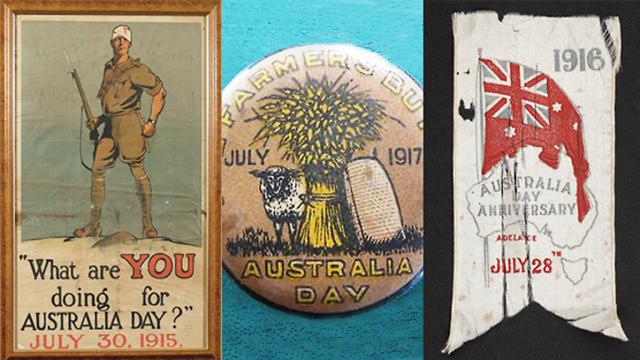
Ironically, the day is not at all sacrosanct. For most of the century of our existence as a nation, most Australian states did not see a reason to celebrate this Sydney-centric beano with such gusto. Indeed, as the picture below shows, the date itself was quite portable. the It was only on the occasion of our bicentenary in 1988 that it officially donned the aura of a secular holy day of obligation – and, of course a public holiday conveniently placed between the hot and lazy Xmas holidays and the commencement of the school year.

Recent polls have show that a majority of Australians wouldn’t be too fussed if the date was moved, although since the failure of the referendum for an Indigenous Voice to Parliament in October 2024, more Australians appear to favour sticking to the holiday we know (though a significant proportion are hard pressed to say what it is we are actually commemorating). Commentators on the right attribute the poll results to what they see as “the end of woke” (and emboldened by the failure of the referendum, they also advocate a winding back of Welcome to Country ceremonies and acknowledgements like the one at the head of this piece).

But has support for changing the date we celebrate Australia Day really fallen away, or was it never really there in the first place (“Australia Day roars back into favour: poll”, January 24, 2025)? The media megaphone has been magnifying the issue for some years, stoking controversy to create something of a self-fulfilling prophecy. Some Australians may be eager for change, but probably most of us Australians have always been content with 26th January, and besides, we have more pressing matters to think about.

“For now”, wrote Stan Grant, author, commentator, and Wiradjuri man, “26 January is all that we are. It is all that we are not. Australia lives in that tension”. We have yet to come to terms with it, and no matter what date we chose, it will continue to be challenged: Indigenous leader and Voice advocate Megan Davis said she was not a “change the date” person because the shift would only move rather than resolve a toxic argument.

Perhaps one good reason we ought to abolish Australia Day is that we are not grown up enough as a nation to deserve it.

And so, enjoy our national day, as the “black armband” and “white armband” tribes leave off their month-long cage-fight that has dominated the media during the Xmas holiday doldrums, and just enjoy a day off.

And we can have a break from self righteous patriotics until our next official day off: Anzac Day, when we celebrate our defeat the hands of Johnny Turk at Gallipoli, and when, of course, The Australian and it’s hired hacks will get carried away by all the Anzacery bluster, and express their indignation with all who criticize that shibboleth. The irony of Anzac Day is that whilst it rightfully remembers the cost and futility of war, its commercialization has meant that more money is spent on political and patriotic posturing than on our serving soldiers and on those who return home injured and traumatized. As Samuel Johnson quite rightly (is said to have) said, “patriotism is the last refuge of the scoundrel”.

© Paul Hemphill 2018, 2025. All rights reserved

We republish below a bit of Australia Day history, and. also, what I consider a reasonably well-nuanced appraisal of the culture wars being fought out over Australia Day. Paul Kelly of The Australian  is a conservative commentator, and is obliged to recite form the News Corp song sheet when it comes to repeating the cliched mantras of his mother-ship – or is it ‘fathership’?) but he weighs well the tired arguments of left and right and argues for what would, could or should pass for the ‘reasonable middle’.

See also, The Frontier Wars – Australia’s heart of darkness, and We oughtn’t  fear an indigenous voice – but we do.

For more in In That Howling Infinite on Australian history and politics, see Down Under


We’ve had those Australia Day blues for a long time as this report from the ABC demonstrates:

We thought they were going to be massacred’ 

ABC Broken Hill. Aimee Volkofsky, 25 January 2018

Watch the  video here:  Eighty years since forced First Fleet re-enactment (ABC News)

WARNING: This story contains images of deceased Indigenous people.

Aboriginal men perform a dance at a 1938 re-enactment of the landing and proclamation of Captain Arthur Phillip at the 150th Australia Day celebrations.    (State Library of NSW)

On January 26, 1938, as the first rally against Australia Day was held, 25 Indigenous men were told if they did not perform the role of ‘retreating Aborigines’ in a re-enactment of the First Fleet, their families would starve.

Government officials had selected the best dancers and singers from Menindee mission in far-west New South Wales and told them they were required to perform cultural dances in Sydney. What they were sent to take part in was a re-enactment of the landing and proclamation of Captain Arthur Phillip at the 150th Australia Day celebrations.

Ngiyaampaa elder Dr Beryl (Yunghadhu) Philp Carmichael, born and raised on the mission, was only three at the time, but her memory of the fear in the community never left her.

Ngiyaampaa elder Dr Beryl (Yunghadhu) Philp Carmichael,

My grandfather protested Australia Day in 1938

The inescapable reality is that Australia’s current national day excludes and alienates Indigenous people — 80 years after my grandfather marched the streets in a fight for equality, writes Ngarra Murray. “All I can remember is the crying, all the women were crying,” she said.  “Whether they were taking them away to be massacred or what, no-one knew. The community went into mourning once they were put on the mission truck.”

The men returned a week later, but Dr Carmichael said it was many years until they would talk about their experience. ‘They came back very quiet,” she said. “It was only in the late 70s they started saying something about what it was like down there. We knew whatever happened down there really hurt them and we didn’t question them.”

Hidden from friends and family

It is speculated that part of the reason for bringing Indigenous people all the way from Menindee was because those in Sydney refused to take part. In Sydney plans were afoot to hold a rally on Australia Day; the Aborigines Progressive Association would declare it a ‘day of mourning’.

Aboriginal rights leaders William Ferguson and John Patten published the Aborigines Claim Citizen Rights! pamphlet on January 12, 1938. In it they declared, “We do not ask you to study us as scientific freaks … the superstition that we are a naturally backward and low race … shows a jaundiced view of anthropologists’ motives”.

Those in power at the time seemed eager to keep the Menindee men well away from activists, keeping them locked away in police barracks.

The incident was detailed in a biography on William Ferguson, written by Jack B Horner in 1974. “The Secretary of the Protection Board had a shrewd idea that Ferguson would try to prevent the Menindee men from taking part in this re-enactment. The Board was taking no chances. Nobody could meet the Aborigines in the coming week in Sydney, without … obtaining personal permission.” — from Vote Ferguson for Aboriginal freedom: a biography by Jack B Horner
Dr Carmichael said there had been whisperings of the movement on the mission, and a direct link to Mr Ferguson.

“Most people on missions couldn’t read and write; that made it really hard for them to understand the government documents they were throwing around,” she said. “Old Bill [Ferguson], because he knew his brother Duncan was back on the mission, he used to send messages back to him. But in the end the mission manager found that out, picked the old fella [Duncan] up in a truck and dumped him over the hill [outside the mission boundary].”

Mr Ferguson attempted to get word to the Menindee men while they were in Sydney but, as elaborate as they were, his efforts were unsuccessful.  “Then followed in the week before the celebrations an amusing battle of tactics between the Protection Board officers and the executive of the Aborigines’ Progressive Association….Some Sydney relatives of a Peter Johnson from Menindee tried to see him at the barracks.  The relatives had been sent by Ferguson, of course, in order to pass to Hero Black (the leader of the Menindee party) a message not to take part in the mortifying ‘retreat’ from the ‘first party of Englishmen’.” (From Vote Ferguson for Aboriginal freedom: a biography by Jack B Horner) . They were eventually allowed a closely supervised visit from two female relatives.

The men soon discovered their duties would include playing the part of Aboriginal people fleeing British soldiers.

Threatened with ration cuts

While the activists may have gotten their message through to the performers, discouraging them from taking part in the re-enactment, the men were left with little choice.

Dr Carmichael said when it came to performing traditional dance, the men were troubled to find they would be led by an Aboriginal actor who did not speak their language or know their culture.

“The government unknowingly or knowingly put up a big Aboriginal, good looking fella as the leader of the dancers and they didn’t even know him. He wasn’t from Ngiyaempaa,” she said. “That really devastated the people and they refused to dance. [The government] threatened them and threatened them; if they didn’t perform they’d cut off the rations to their people on the mission. It was the toughest time of their lives, I think.  I’m just happy we survived’

Eighty years on, as debate continues around whether January 26 is celebrated or mourned, Dr Carmichael said she was happy to have survived, even though she was sad about the past. “We were brought up to tolerate a lot of things and to give thanks for being alive,” she said. “I’m just glad I survived with my culture intact and am alive to teach and pass it on. We should strive for peace, between all nations. We need to come together as people.”

Australia Day: we must face the two truths about January 26

Paul Kelly, Editor-At-Large, The Australian,  
Illustration: Eric Lobbecke

Australia Day is getting bigger, brighter, more celebratory and stained by the rising tide of culture war hostility. The transformation of January 26 from a sleepy public holiday two generations ago into a boisterous party and civic commemoration has provoked a political backlash conceived in two different sentiments — grievance and exploitation.

The debate is not just about our national day. It’s really about who we are, what symbols we honour and, ultimately, the legitimacy of our civilisation. This debate can break one of two ways: robust differences can generate a better understanding of Australia and its national day or the upshot can be a destructive orgy of self-interested identity politics leading to a diminished and divided country.

The progressive crusade to ­remove January 26 as Australia Day has won fresh momentum for a movement bent upon imposing its views on the nation. Nobody should be surprised.

The volatility of social media, the power of negative politics and the emotional manipulation around “invasion day” constitutes sufficient warning that things could go badly wrong.

A nation ignorant of its history or simply unable to handle its history is heading for trouble in the present age of populist and cheapjack disruption.

Those pledged to “change the day” underestimate the popularity of the late January public holiday before the kids return to school, when barbecues abound in parks and backyards, fireworks make a spectacular night, the Australian flag adorns cars and front verandas, the sense of community is tangible, and civic and citizenship ceremonies at the local level testify to a beating patriotism.

In every such event there are tributes to the first Australians. This is embedded in our civic ­culture. More indigenous peoples are participating and being recognised on Australia Day, with its ­official emphasis on multi­culturalism and diversity. Since governor Lachlan Macquarie nominated the public holiday in 1818, the day has seen enormous and essential reinterpretation.

Beware, however, the emerging malaise — a culture war between the green-identity, politics-progressive left determined to destroy the current day and the hopelessly unpersuasive conservatives who defend the status quo, speak and listen only to one another and lose every battle because they cannot find a language to appeal to a ­diverse mainstream.

There are two truths about January 26, 1788. It was the threshold moment for one of the most audacious experiments of the ­Age of Enlightenment seeding a British settlement and society on the continent most distant from Britain under the practical yet visionary leadership of Arthur Phillip, in many ways the true founder of Australia who, against almost every prospect, had the ­insight to believe this convict ­colony at the ends of the earth would one day be “the most valuable ­acquisition Great Britain ever made”.

Those who say the story of the First Fleet and settlement are boring and uninspiring are dead in their imagination and blind in their vision.

The associated truth is that the oldest civilisation on earth, isolated for thousands of years from the rest of the globe and hence ­extremely vulnerable, was unable to defend ­itself and suffered dis­possession of its lands, ravage from disease, loss of life in conflict and loss of its way of life.

Despite the ­initial good ­intentions towards the Aborigines displayed by Phillip, the great moral failure in Australian polity was the belief there was no place, no dignity and, indeed, no life for the original Australians.

Both truths are authentic. Neither can, nor should, be denied. This is our inheritance and, in its soaring achievement and murderous squalor, it constitutes the unique meaning of Australia. One of the central purposes of our existence is to find a way of living with these truths and ensuring the peoples who embody such different traditions can live together and thrive together. There is simply no alternative.

We should exist neither in perpetual grievance nursed by the ­indigenous peoples and those, like the Greens, who recklessly exploit their grievances, nor in the complacency of those Europeans who still pretend there was no dark side to the civilisation we enjoy.

The issue is whether we have the maturity to hold together conflicting truths and sort things through, or whether we choose ideological indulgence and cynical zero-sum politics.

Australia Day needs to stand because the nation cannot run or hide from either the glory or ­tragedy in its duality. The answer to indigenous feelings about January 26 is to construct, not destroy — if there is sufficient agreement, then construct a new day of indigenous commemoration, suffering, survival and triumph. That will take time but over time it may emerge as one of the constructive solutions for Australia.

Declaring that January 26 must be shut down as a day of shame, genocide and mourning offers no solution to anyone. Telling the ­descendants of Arthur Phillip that the origin of the British civilisation and prosperous multicultural democracy they have built lacks sufficient legitimacy to be honoured as the national day is dishonest and destructive. How could it not be?

In this paper today, indigenous leader Noel Pearson says the blackfellas were here 65,000 years before whites arrived and it is vital we “recognise and honour this”. Pearson also says the whitefellas aren’t going away, they created something and it is also vital to “recognise and honour this”.

Tearing one truth down in the cause of another is the road to ruin for Australia. Both truths need to be confronted and engaged. “Trying to erase January 26 is denying the very history we want Australians to face up to,” Pearson says. “There is no other relevant time or date other than those 24-48 hours when ancient Australia passed into the new Australia.” It is this transition the nation must face.

The enemies of this obligation are thick on the ground as radicals and conservatives, often peddling phony mantras. The self-interested cynicism in the stand of Greens leader Richard Di Natale is gobsmacking. With his eye on stealing future votes in inner-city Melbourne, Di Natale announces changing Australia Day will be a priority for the Greens during the rest of the year since the day is about theft and genocide.

What will replace January 26? Why should Di Natale bother with such trifles when there are ideological axes to be swung and votes to be purchased through cultivating national self-abasement under the fraudulent cover of morality?

In response, Labor leader Bill Shorten was just pathetic: he won’t defend Australia Day, he won’t abandon Australia Day and he doesn’t like another day of ­Aboriginal commemoration. In the end he says the day itself is not what really counts. Yes, this is the alternative PM on our national day. Perhaps we should be grateful he didn’t line up with Di ­Natale’s view that the flag should be flown at half mast on the national day.

Malcolm Turnbull, unsurprisingly, said he’d like to hear Shorten speak “proudly and passionately” about Australia Day. But Shorten has a problem, given the embrace by much of the Labor rank and file of a progressive orthodoxy ­towards changing the national day anyway and at odds with majority public opinion.

Indigenous ALP frontbencher Linda Burney stepped into this confusion, criticising the Greens, saying Australia Day won’t be changing any time soon, but highlighting the difficulty it poses for Aborigines as a day of celebration. Aware that NSW ALP policy calls for consultation about a new and separate public holiday devoted to indigenous commemoration, Burney put this idea on the table. It is not ALP policy but Burney was being constructive and her proposal merits serious consideration.

Turnbull preaches an Australia Day that brings people together and celebrates our multicultural diversity. The government has properly removed the right of local councils to hold citizenship ceremonies if they refuse to recognise Australia Day and hold citizenship ceremonies on that day. But the ­reality cannot be avoided: division over Australia Day will mount in the future and this will require astute leadership and management.

For many Aborigines, January 26 will remain invasion day, and that is understandable. But any alternative national day that commemorates British settlement or the foundation of Australia has a similar problem. The logical ­alternative of January 1 — the ­inauguration of the Commonwealth of Australia — would honour an event that denied any role or existence for Aboriginals and assumed they were a dying race.

In truth there is no escape from the history — yet the historical story must be authentic, not convenient mythology. Australia was always destined to be settled by a European power. The force of the Enlightenment and the Industrial Revolution would never be denied from the great southern land. There are few inevitabilities in history and this was inevitable.

We are fortunate the European power was Britain, not France or Spain. This was an 18th-century blessing. We are fortunate the British came not just to establish a convict colony but to bring their values and institutional ethos.

Phillip had an 18th-century faith in improvement, a belief he was founding a new British society and serving the cause of humanity. With slavery still not abolished in the empire, Phillip declared from the inception of Australia that “there can be no slavery in a free land and consequently no slaves”.

The Aborigines he encountered were not a nation state. They were a collection of hundreds of tribes speaking different lan­guages, devoid of collective political purpose or leadership, often at war with each other and without the structures to allow sovereign negotiations or dealings.

To say the British should not have come is a ludicrous denial of reality and makes as much sense as saying the early explorers should not have advanced inland to ­discover the continent. To pretend the Aborigines could or should have retained their possession of the continent forever is delusional and is a device to avoid historical reality.

The encounter between the British and the Aborigines was without precedent in human history. The idea that good intentions were enough for success is absurd. Historian Geoffrey Blainey says in first volume of his The Story of Australia’s People: “The racial conflict in Australia — nearly all would agree today — should have been handled more wisely and firmly but the British leaders lacked the political and cultural experience needed to handle a ­dilemma that was exceptional in world history. Furthermore, London at one end of the globe and Sydney and Hobart at the other end viewed the dilemma and their duties and powers, differently.”

The idea that the British ­arrivals should have negotiated a treaty is nonsense. With whom and on what basis? There is no ­answer. During the 70 years after settlement many thousands of ­Aborigines were killed by Europeans — though far more died from diseases — creating a moral legacy the nation cannot deny and must confront.

Efforts to do this have been substantial while incomplete. Witness the Reconciliation process, the Mabo case and granting of native title rights, huge though flawed public funding, and the continuing process of constitutional ­recognition.

The first Australians lost much from the events of 1788 yet they also gained much, eventually — proving that indigenous peoples could live and thrive in a modern urban society. Aborigines are poised to become more prominent in every facet of Australian life.

The related truth, however, is that as a nation we cannot pretend there is full atonement for the ­dispossession. We cannot say: “Sorry, let’s leave.” We could not do this in 1808, let alone 1901, let alone 2018. There can be no full rendering of justice, no full recompense after dispossession. History cannot be reversed.

We must honour and reflect on the history, restore Aboriginal rights, and strive for justice as much as practicable. But it cannot serve indigenous Australians to engage in perpetual grievance, to magnify the sins of the past in an endless demand for atonement and more atonement still, part of a futile quest to deny any legitimacy to January 26. That is the road to a self-defeating misery.

The bulk of the Australian population, including the millions of post-World War II immigrants and their descendants, will neither accept nor tolerate the idea that the British founding of this country was a shameful and illegitimate event. When the Greens and other progressives promote this sentiment — exploiting indigenous ­resentment for their own ideo­logical and electoral gains — there is no upside for our polity, just ­counterproductive bitterness with the risk of violence.

Where is the legitimacy in January 26? It lies in the society that evolved and continues to evolve, a nation that, for all its faults, is democratic, egalitarian, tolerant and, in per capita terms, has opened its door to immigrants on a more sustained basis than ­virtually any other developed country. This constitutes a powerful legitimacy.

It was Noel Pearson more than a decade ago, in a famous letter to John Howard, who offered the most honest and enduring framework for presenting and understanding contemporary Australia. For Pearson, the nation embodies three traditions: the indigenous peoples, the first Australians, who roamed this continent for 65,000 years, long before the ages of Babylon, Athens and Rome, finding a way to live and thrive in this environment; the British inheritance dating first from the voyages of James Cook and then from the ­initial colony under Phillip, followed eventually by Lachlan Macquarie and more settlements across the continent that led to a polity of British-derived laws, values and institutions that still operate today; and the immigrant tradition, the ethnic input from so many nations that broadened and deepened the culture and led to a multicultural nation, one of the most successful on earth.

These three traditions need formal embodiment. Pearson’s vision was adopted by Tony Abbott as PM. But it needs a more declaratory form authorised by the parliament or the people. This is a critical step in finding a national identity that is shared and inclusive and can win wide support ­because of its validity.

The issue of constitutional recognition of indigenous peoples needs to be reopened with a new process. This time there needs to be greater realism on all sides. The Turnbull cabinet rejected the final recommendation for an indigenous advisory body to be inserted into the Constitution because it believed such a referendum had no prospect of success. Those ­attacking this decision have singularly failed to offer any explanation or strategy of how such a referendum could be passed.

There have been some suggestions that the Australia Day issue can be postponed pending the ­inauguration of an Australian ­republic. That is a tempting but most unwise proposition. The ­republic will not provide the ­answer and, moreover, it is probably many years or decades away.

While the republic is a necessary step in Australia’s evolution, its cause is currently weak and devoid of energy. This is because of the ­destructive transformation in progressive politics to embrace change based on individual and group rights around sex, gender and race, a combination of tribal and narcissistic imperatives.

The republic has no voice or ­appeal in this world. It won’t change your personal life, it won’t relate to how you live, it won’t speak to your gender, sexual or ­racial identity. Paul Keating once lamented the republic had been consigned to an after-dinner conversation; these days it doesn’t even win that rating. When was the last dinner party you attended where the republic got anything more than the briefest mention?

Shorten pledges that in office he will launch a path to the republic. But that will prove immensely difficult in today’s Australia. The republic is now a token of progressive politics, nothing more. The emotions, energy and priorities of progressive politics lie ­elsewhere.

The nation must face the Australia Day issue and competing historical truths as a constitutional monarchy or not at all.

The Twilight of the Equine Gods

The horse has been man’s most important companion – forget cats and dogs – and the most durable of historical alliances – against which every other covenant has been fragile and ephemeral – not even our relationship with our gods has shown a comparable degree of stability. Our story resonates with an equine leitmotif – in our dreams, our fantasies, our histories, our literature, and our movies; in our aesthetics and our notions of speed, strength, power, courage, fortitude, loyalty and beauty.

Hey and away we go
Through the grass, across the snow,
Big brown beastie, big brown face,
I’d rather be with you than flying through space. 
Mike Oldfield, On Horseback

Pastorale

Oh the world is sweet
The world is wide
And she’s there where
The light and the darkness divide
And the steam’s coming off her
She’s huge and she’s shy
And she steps on the moon
When she paws at the sky
Leonard Cohen, The Ballad of the Absent Mare

What is there not to love about a horse?

Its big, brown, doe eyes; its earthy, sweaty aroma from a land somewhere between babies and barnyards; the warmth of its neck on your palm; the rough feel of its mane in your fingers; the smell and the squeak of saddle leather; the jingle-bells of the bridle. The strength you sense through your thighs; an exhilaration that is close to fear as you kick his flanks into a trot, a canter, a gallop, and whoa! and you’re never one hundred percent sure she will obey you. And then, when it’s over, the radiated heat, the damp hide, the glow of sweat, almost a mist of equine energy as you dismount after the ride. You feel wired, alive, and at one with the horse, with the land, with nature.

I first rode a horse in the late seventies, on my first visit to Australia with my first wife. Her old man was a doctor on locum in Coolah, New South Wales, beyond of the Black Stump’, which is to say, the back of beyond (and there really WAS a black stump on the outskirts of town, for the infrequent tourist to be photographed by in pre-selfie days). A local farmer had invited us out to ride his large property, and so we rode, in the heat haze of high summer, through wide, dry, open, paddocks, mobs of roos scattering as we approached, flocks of cockatoos roosting riotously in the branches of dead trees, and flies. Yes, I learned about the “Aussie salute” that summer. I fell in love with the Australian bush then and there, the “wide brown land” of Dorothea Mackelllar’s sunburnt country“. A few years later, as a newly arrived immigrant, I would go riding again, this time with country friends in the Dungog cattle country north of Sydney.

I was not a good rider, but I loved the craic. Not a natural like my future wife. When we first met, she kept four horses and looked after a whole riding school of them, bringing them in bareback riding, stock-whip cracking, a proper jillaroo. ‘Western pleasure’, it was called. No jackets and jodhpurs – it was cowboy hats, boots and blue jeans – before helmets and Occupational Health and Safety. I rode her gorgeous chestnut quarter horse called Twopence, and she, a handsome palomino named Trigger (of course). A riding accident put me in hospital – and I never rode a horse again.

Twopence & Trigger

That was a decades ago, but living in the bush, I still feel pleasure when I see horses in their paddocks. The sight, sound, and smell strike a melodious, atavistic chord that many would  recognize as distinctively Australian. How many Aussies of a certain age would not thrill at the Banjo’s ballad of the bushman that is almost our national poem:

He hails from Snowy River, up by Kosciusko’s side,
Where the hills are twice as steep and twice as rough,
Where a horse’s hoofs strike firelight from the flint stones every stride,
The man that holds his own is good enough’.

In this centennial year of the Palestine Campaign of WWI and the gallop of the Australian Light Horse towards the strategic Beersheba wells – praised, inaccurately, as history’s last great cavalry charge, the Light Horseman and his hardy “Waler” (from New South Wales) have achieved iconic status in a media supercharged on “Anzackery”. Calmer voices have argued that on the scale of the carnage on the western front, where Diggers died in their thousands, and indeed the Gaza battle itself, where the Anzacs were a very small part of a very large army, it was really no big thing, But never let the facts get between a politician and a photo-opportunity. During the closing scenes of The Man Who Shot Liberty Valance, the journalist says: “This is the West, sir. When the legend becomes fact, print the legend”.

And it was always thus. As German academic and cultural scientist Ulrich Raulff’s tells us in his captivating “micro-history” Farewell to the Horse: The Final Century of Our Relationship: 

“Like love and the stock exchange, our historical memory is a motherland of wishful thinking, sacrificed to our faith and blind to known facts…This is why historical myths are so tenacious. It’s as though the truth even when it’s there for everyone to see, is powerless – it can’t lay a finger on the all powerful myth”.

Farewell to the horse

It is an easy segue from my Australian pastorale to Raulff’s illuminating canter through the story of the “Centaurian Pact” between humans and horses. it is at once a ride, a revelation, and a reminiscence of my short-lived ‘cowboy’ days.

“The horse” Raulff begins, “has been man’s most important companion – forget cats and dogs – and the most durable of historical alliances – against which every other covenant into which we have entered has been fragile and ephemeral – not even our relationship with our gods has shown a comparable degree of stability”.

He then recounts how over the span of a few decades, a relationship that endured for six millennia went “to the dogs” – excuse my awful pet-food pun. And it happened almost unremarked, unnoticed, and unsung. “For a century, the oat-powered engine was the universal and irreplaceable power unit of the forced mechanization of the world”. And then it was gone, replaced by the internal combustion engine. And yet, the term “horsepower” is to this day a measure of the performance of vehicle engines (although now mostly replaced by kilowatts) – a horse was the equivalent of seven men.

“The twilight of the equine gods”, as Raulff describes it, was a long goodbye indeed, and in the realm of myth, memory and metaphor, horses are with us still; or as he so lyrically expresses it: “ghosts of modernity” (echoes of Dylan, in my mind, at least) that “haunt the minds of a humanity that has turned away from them”.

Like its subject, Farewell to the Horse is a handsome, wide-ranging, beast. More elegy than epitaph, eclectic and imaginative in scope, viewing the horse as muse, as mount, and as metaphor, Raulff sings the song of the horse – and if ever there was a ‘horse opera’, this is it.

Eloquently and at times poetically translated, and generously illustrated with pictures from galleries, libraries, and photo archives, Raulff takes the reader through the many worlds of the relationship. On his academic home-turf of sociology and psychology, his references are primarily German, but straying from his academic stable, he ambles into a lush and diverse pastureland of history and mythology, politics and philosophy. economics and geography, industry and commerce, physics and biology, science and medicine, sport and recreation. And art and literature: how artists and writers brought their perspectives, personas and passions onto canvas, photographs and the printed page. In many ways, its infinite variety reminded me of English historian Simon Schama’s fascinating Landscape and Memory.

Raulff has divided his book into four broad thematic sections, each with an evocative title – The Centauran Pact, A Phantom in the Library. The Living Metaphor, and The Forgotten Player – each exploring a particular aspect of the horse’s story. But he allows himself much extempore stream of consciousness as he periodically wanders off-script with childhood reminiscences and collected anecdotes, and dips into favourite paintings, books and films. He time-travels through six thousand years, and traverses the globe too in his long ride – from the Steppes of Eurasia to the Great Plains of America, from the cities of MittelEuropa to those of the Midwest, with side trips to the Middle East and Andalusia.

It was contagious. I too got to thinking beyond the page, recalling and contemplating a miscellany of ideas and images that came to mind whilst reading, and indeed, whilst writing this review, wandering down forgotten bridle-ways (literally, a horse riding path, or trail originally created for use by horses, but often now serving a range of travelers). And is this not what a good book should do?

The Song of the Horse

The horse, the intelligent mammal, the great vegetarian, a prey animal whose strength is in flight, who has no desire or need for confrontation or quarrel. It’s speed, its main asset, enabling it to flee its predators, is also what attracted it to the attention of man, with whom it entered into a long-lived, unequal devil’s bargain. “They were able to turn the inconspicuous potential energy of tough prairie grasses, inedible to almost all other animals into the spectacular energy of a fast endurance runner. Thanks to its natural properties as a converter of energy, the horse could bear kings, knights, female lovers and rural doctors, draw carriages and cannons, transport hordes of workers and employees, and mobilize entire nations”. And indeed, Raulff takes us on a jaunt   through these tableaux.

He quotes historian Ann Hyland: “it was a small step, albeit a brave one, for man to mount a horse”, and writes: “The comparison with the moon landing is certainly not exaggerated. The moment when man began, by domestication and breeding, to connect his fate to the horse – not with a nutritional intention, but with a vectorial aim – may have been, before the invention of writing, the narrow gate through which man entered the realm of history”.

And lo, our story resonates with an equine leitmotif.

The horse is in our dreams and our fantasies, in our literature, and our movies, in our aesthetics, and our notions of speed, strength, power, courage, fortitude, loyalty and beauty. In their mythology, the ancient Greeks gave them wings and narwhal horns, whilst centaurs, part human and part horse, were believed to represent the combined forces within human beings – animal instinct and intellect – and the connection between the physical and spiritual realities, symbolizing independence, knowledge, adventure, fertility and spiritual wisdom.

In our western culture their variety is infinite – from the diverse mounts that conveyed Chaucer’s pilgrims to Canterbury to that paragon of American folk culture, the cowboy. From the rambunctious centaurs and cute coloured unicorns of Disney’s’ Beethoven Fantasia to the gaunt quartet bearing the seer of Patmos’ four horsemen of the Apocalypse. From the teenage innocence of National Velvet and Black Beauty to Thomas Hardy and Carey Mulligan’s sensual and photogenic jaunt in the recent remake of Far From the Madding Crowd. From the patriotic jingoism of Alfred J Tennyson’s The Charge of the Light Brigade and Rudyard Kipling’s East is East and West is West to Banjo Patterson’s blokey bush ballad The Man From Snowy River, which I have quoted above (and will reprise below). The horse has even entered into the invented worlds of science fiction, with Joss Whedon’s rollicking space-pirate adventure, Firefly, and more recently, Westworld with its Wild West theme park populated by lifelike android cowboys and Indians on their robot horses.

Westworld

[If I have one small quibble about Farewell to the Horse, it is in its Eurocentricity. The Land Down Under doesn’t rate a mention even though the horse has played an important role in the evolution of Australia’s perceived national identity – “perceived” because here too, we are captive to that “powerful myth” that Raulff believes subverts fact]. We see horses every time we leave our rural property. They are an intrinsic part of our country life, and many of our friends are riders. Here are a couple of pictures of our good friend Chris riding the National Trail through Guy Fawkes National Park:

Whilst drawing cleverly on the arts – and the book is well-furnished with illustrations that are  well spoken to in the text – Raulff does not venture into poetry, where there are to be found many wonderful images. Take but a few examples drawn from just one poem, East is East and West is West, referred to above, and marvel at the metaphors in Rudyard Kipling’s ‘Boys Own’ tale of a young British officer tracking down a daring Pathan bandit:

The Colonel’s son has taken horse, and a raw rough dun was he,
With the mouth of a bell and the heart of Hell and the head of a gallows-tree”.

“It’s up and over the Tongue of Jagai, as blown dust-devils go,
The dun he fled like a stag of ten, but the mare like a barren doe.
The dun he leaned against the bit and slugged his head above,
But the red mare played with the snaffle-bars, as a maiden plays with a glove”.

“They have ridden the low moon out of the sky, their hoofs drum up the dawn,
The dun he went like a wounded bull, but the mare like a new-roused fawn”.

And, of course, there are the songs. Here’s the doomed Texan troubadour Townes van Zandt’s enigmatic anti-hero:

Pancho was a bandit, boys
His horse was fast as polished steel,
Wore his gun outside his pants
For all the honest world to feel
Pancho and Lefty

And whilst Raulff includes a poignant picture of a lone, pedestrian cowboy carrying his saddle through the scrub like a mariner lost on the land, he doesn’t mention Leonard Cohen’s bereft and distraught cowpoke :

Say a prayer for the cowboy
His mare’s run away
And he’ll walk til he finds her
His darling, his stray
The Ballad of the Absent Mare

But more from St. Leonard of Montreal later…

Frederic Remington’s Bronco

A Phantom Limb

The horse’s glory days may be over, but the echoes of a long and fruitful relationship linger in our lives and in our language – in our idioms and our figures of speech: “getting back in the saddle”, “pulling the reins” and “taking the reins”, “champing at the bit”, “gaining the whip hand”, and the timeless put-down, “get off your high horse!” Phrases such as these are used everyday by people who have never been physically close to a horse let alone ridden one, and whose visual encounters are limited to country outings, circuses, televised equestrian events and westerns (in Australia, as in the US, we can still enjoy country fairs and carnivals that feature rodeos and endurance rides).

Joe Curtin falls from his horse at a combined rodeo, branding, campdraft and gymkhana weekend in Birdsville, Australia. Nick Moir

And note that these usages are somehow connected to power, control, and aggression – and often, casual, almost matter-of-fact violence (the idea of being “horse-whipped”) – violence inflicted not only on humans but on the animals too.

Raulff asks: Why is it that the most powerful visual images of horses are in their warrior role?  Does it not say more about ourselves than what was genetically a passive, docile, tame-able (we call it “horse breaking”) grazer?

Equestrian Statues

Salah ud Din al Ayubi, Damascus

The horse has a complex and varied curriculum vitae. For six millennia, it has been our dependable beast of burden, the bearer of people, packages and progress, shrinking distance and opening up new lands. But it has also been the agent of power, politics and pogroms. A bearer of great ideas, and also of great tyrants.

The horse has long been a living metaphor of power – the absolute political metaphor, indeed.

“The combination of horse and rider is a powerful symbol of domination, and one of the oldest in the book”. The caudillo, the martial “man on horseback” so beloved of painters and sculptors – and of putative dictators (although Stalin and Hitler, Raulff reminds us, despised horses). There’s Alexander the Great on Bucephalus, defeating Darius; David’s conquering Napoleon crossing the Alps; bodacious Boudicca reining in her chariot steeds on The Embankment. To be physically and violently unhorsed is to be taken down literally and figuratively. Hence Richard III’s anguished “my kingdom for a horse”, and George Armstrong Custer and the men of the Seventh Cavalry demountd and doomed on Last Stand Hill.

The rise of the horse changes the position of the people and along with it, their view of the world around them – what Raulff calls the ‘cavalier perspective’. It is rooted in an age-old fantasy of the fusion of man and beast, from centaur to chevalier. The unfortunate Aztecs believed the mounted conquistadors to be half man half beast. That dismissive rebuke “get off your high horse” echoes a primal fear of the mounted marauder, be he the Scythian archer, the Mongol warrior, the rogue knight or the Red Indian (“savage” he was called back in the day) of the Great Plains. Recall the Cossacks lining up on the snow-covered square, about to charge the defenseless marchers in David Lean’s Dr Zhivago. Recall, in Game of Thrones, the Dothraki, screaming their war cries, thundering down on the doomed Lannister infantry. “We still see traces of horses’ archaic role as inspirers of terror when required to intimidate picketing workers or to drive rallies of protesters out of shopping precincts”.

Something wicked this way comes – Clive Owen’s Slav King Arthur

During his travels, Raulff visited Israel, where he chanced to observe ultra-orthodox Jews protesting against their youth being conscripted into the Israeli Defense Force. Jerusalem authorities mobilized mounted police officers against the recalcitrant religious. He indulges in pogrom projection, imagining the Haredim being intimated by a Cossack Shtetl flashback. Fanciful, perhaps, but as a young man during the Vietnam demonstrations in London’s Grosvenor Square, I learned that there’s no greater killer of revolutionary passion than the sight of than a wall of fat horse’s arses backing towards you with those nervous hooves a’twitching.

And yet, the use of the horse in this manner forces it to go against its nature, trained to stand its ground in dangerous circumstances when all its instincts are to flee danger. Ostensible police brutality in Grosvenor Square was juxtaposed by the reality that police horses were stabbed by banners and tripped and stoned with glass marbles. Several were so injured that they had to be euthanized.

Horse meets Haredim in Jerusalem

…and meanwhile, in the other side of town

 The Wide-Open Spaces

The power bestowed upon men by horses is much more than such authoritarian, martial muscle. The horse enabled landsmen to conquer what Australian historian Geoffrey Blainey called “the tyranny of distance”. For Rudyard Kipling’s “fluttered folk and wild”, it ushered in a tyranny of a malevolent kind.

The horse-led conquests of European and Asian empires during the second millennium BCE by the chariots and later, cavalry of the horse-people disgorging from the steppes like some equestrian blitzkrieg, transformed world history. They brought their political structures, their warfare, their masculine, spiritual character – their “asabiyyeh” or, literally “muscle” as famed Arab historian Ibn Khaldun put it. The Eurasian nomadic warrior, “that ‘natural born’ combatant, who, as tough and austere as his resilient horse, emerged as the terror of the sedentary populations of Europe and the orient”. The same could be said of the warriors of Islam as they erupted out of their Arabian heartland and reached the walls of Constantinople and the frontiers of the Franks.

One powerful factor in these invasions was the horsemen’s speed. “In every contemporary account of the Mongols, great stress is laid on their speed: suddenly they were there, only to vanish and appear somewhere else even more suddenly”. The alliance between man, horse, and the arrow was likewise significant, providing the ability to kill from a distance, whilst moving, on horseback.

“Thanks to the horse, distant territories could be conquered and vast dominions could be established. The horse and its rider made the land they traversed tangible, recognizable, and able to be taken”. The horse became indispensable in terms of control of the land, subduing its inhabitants, and enabling Its exploration. In America, it brought the conquistadors, and in time, ensured that The West was won with catastrophic consequences for the native Americans with the loss their land and hunting grounds.

War Horse

Since it’s domestication, we humans have never resiled from putting our beloved horses in harms way. As an inspirer of terror and as a battering ram of blood and bone, mounted cavalry have been used on battlefields against soldiers and in streets and villages against civilians. Horses and mules have long provided most of the muscle used to move men and machines – the true “horsepower” of any war effort – serving in a wide variety of roles, including being ridden, as draft animals pulling vehicles and heavy weapons, and as pack animals. They, like their human comrades have perished in uncounted numbers by shot and shell, by accident and cruelty, disease and starvation, and during World War I, by poison gas. Sending animals to war seems, today, somehow even more awful than sending people to war, but in the past, there was little room for that sentiment. Animals were absolutely essential to any war effort, and they had to be sent – during WWI, millions of them, Most were horses and mules, but dogs, pigeons, camels, and even water buffalo and elephants were also found in some theatres of the war.

Celebrated English composer Sir Edward Elgar wrote in August 1914: “Concerning the war I say nothing … the only thing that wrings my heart and soul is the thought of the horses … oh! my beloved animals … the men … and armies can go to hell but my horses: I walk round and round this room cursing God for allowing dumb brutes to be tortured … let him kill his human beings but … how can he? Oh my horses.”

Farewell Old Friend by Fortunio Matana

A Day at the Races

Our pact with the horse was much more than the power and the glory, the conquest and the trail-blazing. Horses’ fleetness, stamina and beauty satisfied other, more hedonistic yearnings, and today, their days on the field of battle long over, they serve to give us pleasure – and profit.

And they have always done thus – particularly in the antecedents and descendants of the Ancient Greek hippodrome (named thus for horses and the racing thereof). In the downtime between warring and raiding, hunting and horse and chariot racing attracted many a warrior’s energy and enthusiasm, and provided  less martial spectators with, vicarious thrills. We have been racing horses for as long as they have been our companions, and wagering on their speed and stamina. This passion fostered complementary endeavours in breeding, training, thieving, and gambling.

The racing carnival still exerts an atavistic, ofttimes addictive spell over riders, owners and punters alike. “The spectacle of race day echoes times and indeed conflicts past, the jockeys’ bright colours, representing a return of heraldry, a way of distinguishing otherwise indiscernible participants”.

It’s there you’ll see the jockeys and they’re mounted out so stately,
The pink, the blue, the orange and green, the emblem of our nation,
When the bell was rung for starting, all the horses seemed impatient,
I thought they never stood on ground their speed was so amazing
Galway Races (Ireland, traditional)

Wincanton races

In horse racing, nothing and no one is hunted, only the shadows of time”, Raulff notes prosaicly.

American author EC Morgan is similarly lyrical: “Time is a horse you never have to whip”,

In That Howling Infinite recently published a review of Morgan’s masterwork The Sport of Kings, a long and deep story about an old Kentucky horse-breeding family. She displays an unerring instinct for metaphor and music. A horse’s neck shudders under its rider’s hands “like a dreaming dog”. Of the racehorses, she writes: “they exploded out of the gate like doves from a cote”; and, “now the school of horses swung round the turn as if caught in a sweep net”.

Raulff explains why horse racing was indeed ‘the sport of kings: Britain emerged as the world power of thoroughbred racing under the racIng-mad Stuart Kings who transformed the sleepy village of Newmarket into the Mecca of the turf, supplanting hunting with punting as the favourite pastime of the idle rich and the indolent upper classes. When Scots King James wasn’t corralling and coaxing the best minds in the land into producing his beautiful Bible, he was both patron and participant with a keen eye for quality horse-flesh.

Teenage Daydream

Did I mention that horses can be dangerous? They are large, high, broad, and heavy, and for all their tameness in the hands of a seasoned rider, they can also be excitable, unpredictable, and wild. When you take up the reins, you literally put your life in your hands. In My Early Life , his biography of his cavalry days, Winston Churchill wrote: “No hour of life is lost that is spent in the saddle. Young men have often been ruined by owning horses or through backing horses, but never through riding them, unless, of course, they break their necks, which, taken at a gallop, is a very good way to die”.

But danger can come in other guises.

There was probably no way a cultural scientist trained in sociology and psychology could or would avoid how in its variegated pedigree, the horse has also figured as a sexual metaphor, conjuring up thoughts erotic with images of fair maids carried away by amorous riders. Raulff’s copious images include those famous abduction scenes beloved of renaissance painters, but there are many encounters in literature, art, cinema and song that are much less violent. It is as if the rider’s skill with his mount presages his prowess in the sack. There is titillation, there is temptation, and perhaps, surrender. Picture Ross Poldark cantering broodily across the Cornish clifftop, and lifting his Demelza up onto Seamus’ back (that is indeed his name).

True you ride the finest horse I’ve ever seen,
Standing sixteen one or two with eyes wild and green,
And you ride the horse so well, hands light to the touch.
I could never go with you no matter how I wanted to.
Jimmy McCarthy, Ride On (listen to the song at the end end of this post)

Ross Poldark and Seamus

Ulrich gets into his stride, so to speak, when he commits to print his daydreams of the object of many a teenage baby boomers’ longing, the androgynous, pony-tailed cow-girl. He ponders also the puzzle of pubescent girls and horses – that tom-boy world, temporary “islands in the flowing river of time”: “Somewhere between a doll and a real-life partner, the horse is the ultimate sex toy. It’s the largest, most beautiful and final plaything before the transition from home and family to a new relationship with a sexual partner”.

Arwen Evenstar

Having raised the subject of women on horseback, there no ignoring the Amazons. Legend says that they were adept horse-women. As are the heroines of the literary canon who express their subversive sexuality in equestrian interludes – Emma Bovary, Anna Karenina, and Thomas Hardy’s Bathsheba Everdene. Each are subjected to the author’s affectionate attention. When JRR Tolkien wanted to present a strong and wilful heroine in his ostensibly homoerotic epic, he placed Éowyn on a horse, albeit incognito. But she was the exception to JRR’s macho rule. He would never have sent elf princess Arwen Evenstar out like that. But director Peter Jackson, sensing how well it would translate to film, substituted the luminous Liv Tyler for elf lord Glorfindel to confound the Nazgul riders at the ford of Bruinen.  Here is a Carey Mulligan in glamorous array as Bathsheba:

The horse, the healer

So what is this spell that horses weave? We’ve talked about power. We’ve talked about prowess. We’ve talked about passion. Raulff doesn’t venture into the imaginative, the mystical, the magical, and, going further, ameliorative power of horses – that inexplicable feeling you sense when you’re in  close proximity to a horse. presence, an aura of sentient calmness. Let’s reprise our opening paragraph:

“What is there not to love about a horse? Its big, brown, doe eyes; its earthy, sweaty aroma from a land somewhere between babies and barnyards; the warmth of its neck on your palm; the rough feel of its mane in your fingers; the smell and the squeak of saddle leather; the jingle-bells of the bridle. The strength you sense through your thighs; an exhilaration that is close to fear as you kick his flanks into a trot, a canter, a gallop, and whoa! and you’re never one hundred percent sure she will obey you. And then, when it’s over, the radiated heat, the damp hide, the glow of sweat, almost a mist of equine energy as you dismount after the ride. You feel wired, alive, and at one with the horse, with the land, with nature”.

It is said that there there is more to a horse than its rider and that undeniably physical allure – that if you put your hands on or even near a horse’s body and close your eyes, you can feel a golden thread of energy travelling from your hands to its body, and from that body to your hands. There is a quiet strength to a horse that communicates a state of calm, relation, and peace. Therapists who work with grief and trauma are discovering that an emotional connection can exist between a horse and a human, that being in nature, in the presence of horses, seems to help children, teenagers and adults expand their emotional awareness and enhance their mental health, beginning the work of reconnecting them to the self, and to their environment, and even healing something inside that has been broken, often for years.

Poets might describe it as an opening up the heart – WH Auden’s “healing fountain”. Therapists call it limbic resonance, the capacity for sharing deep emotional states arising from the limbic system of the brain, which can include heightened feelings of empathic harmony. Horses, they believe, are highly sensitive creatures and possess an uncanny ability to read and mirror us because it is a skill that keeps them alive. They are instinctively prey animals, and in order to survive, they had to become excellent interpreters of energy, emotion and intention. Their sensitivity has been bred into their DNA for millions of years. But It is still all about the heart and the emotional states of calm and even joy when we feel positive emotions.

As a coda to this brief commentary on the horse as healer, a friend of mine passed away recently in Bellingen Hospital. The hospice ward is an impressive place in terms of its staff and the care they give. As he lay in declining repose, a horse came to his bedside and lay its head on his chest – a small horse, but a horse nonetheless. I have learned since that this pony is a regular visitor to hospices and aged care homes in the area. Bellingen hospital also allows cats and dogs to visit their owners.

For further reading on the horse as therapist, read this piece on horse heart math and an article by Candida Baker, an equine facilitated learning practitioner who helps people suffering  from trauma in the  Sydney Morning Herald. 

The Unequal Bargain

There are wealth of emotions associated with horses, such as pride and admiration, a desire for power, fear and joy, compassion, and companionship, and a lust for freedom. The pony is the cowboys’ closest pal. Western star and crooner Roy Rogers described it best:

Who carries your burden, who carries your load
On tumbleweed land or a long dusty road
Who asks you no questions, who tells you no lies
That four legged friend with the two honest eyes
A four legged friend, a four legged friend
He’ll never let you down
He’s honest and faithful right up to the end
That wonderful four legged friend
Roy Rogers, A Four Legged Friend (listen to the song at the end end of this post)

Over two millennia we have lavished depthless emotion, boundless affection and unlimited treasure upon horses. But we have also been capable of great cruelty both casual and calculated, – from willful neglect and senseless whipping to silent sacrifice as expendable extras on battlefields and motion picture sets. Raulff documents in prose and picture the violence inflicted upon our “four-legged friend”, and also how pathos and sympathy for the horses’ plight evolved into a worldwide movement for the prevention of cruelty to all creatures great and small.

That very same Banjo Paterson who gave us the Snowy Mountain man’s famous ride also glorifying the racetrack – and yet the annual Melbourne Cup,  Australia’s ‘race that stops a nation’, sees horses killed every year. we as a nation continue to praise and perpetuate what many see as animal cruelty. In Paterson’s day, horses were valuable and relied upon for transport and pleasure – theft was common – yet they were treated appallingly. Read The Man From Snowy River and reflect on the agony the hero inflicts upon his mount, which could barely move by the end of the ride and ‘was blood from hip to shoulder from the spur’. Yet Banjo, like apologists for the deaths on the track today – suggests that the horse was reveling in the chase.

But horses’ iconic place in our hearts and souls are sealed by their status as mobile metaphors of speed, of grace, of the wind in one’s hair, of wild, exhilarating, uninhibited freedom: “Run wild, run free”, like the troubled teen and the wild blue-eyed white colt in the 1969 British film of that name.

As Victorian bush poet James Cayce write in his poem A Magnificent Contradiction, a reminder of a debt that cannot be repaid:

The swirl of your mane alive in the wind, the glow on your flanks in the sun
The spirit of freedom you stir in my soul, the rhythm and grace when you run.
A whirlwind of power to wield or withhold; each movement made with conviction, 
A titan at work, a child at play; a magnificent contradiction

And it is with this in mind that Raulff concludes his epic ride, for it  is one of the most poignant paradoxes that the idea of freedom and movement associated with horses and being on horseback, the image of the wild mustangs in The Misfits and Banjo Paterson’s Colt from Old Regret, is juxtaposed with the reality that this “creature of the wind”, as the Arabs described him, has surrendered her freedom and free will in the service of man.

Quoting the poet Albrecht Schaefer, Raulff tells of how “the horse knows that it would like to be free … but the burden is never ending, and it is rarely allowed to run and has to stand there even when it is frightened and when it is seized by the urge to return to its nature, to flee … It is trapped in eternal captivity, always overshadowed by an inescapable will to which it resigns itself without ever realizing”.

This magnificent animal, Raulff  writes, “held in perpetual captivity, is seen by us as the epitome of all in nature that embodies nobility and magnanimity, stature, pride, and courage”.

Now the clasp of this union
Who fastens it tight?
Who snaps it asunder
The very next night
Some say the rider
Some say the mare
Or that love’s like the smoke
Beyond all repair
Leonard Cohen, The Ballad of the Absent Mare

© Paul Hemphill 2018.  All rights reserved


Icelandic horses play at a stud farm in Wehrheim near Frankfurt. M Proust/AP

 Epilogue

The Troubled Trail – an equine parable 

In primeval times, horses were indigenous to North America, but were long extinct by the time the white man came into the new world. He brought with him his deity and his diseases, his guns and his greed – and his horses. He conquered the land and broke it – its ecology, its  pre-Colombian history, and its people.

In the early years, the horses of the conquistadors humbled and harried the Native Americans. In time, many horses scattered and ran wild, and on the open prairie grasslands, they prospered and multiplied. The free people of the plains captured and tamed those feral mustangs, and so mounted, were better able to travel over great distances to fresh pastures and to the wide grazing grounds of the vast herds of buffalo, a rich source of food and fashion.

The horse gave the Native Americans mobility and speed, and an economic asset of value. They began trading horses with their neighbours, and also horse stealing, whilst their mounts gave them the edge in their territorial vendettas with neighbouring tribes. They bought steel axes and knives From the white traders who ventured into their lands from the east, and also, firearms which augmented their already effective mounted archery. This gave them a tactical edge when they first came up against the mounted soldiers of the US Army.

They were a formidable foe, their speed and maneuverability and their skill with bow and rifle, were more than a match for the clumsy, old-school heavy cavalry, and these, indeed, were compelled to adjust their own style and tactics to match their guerrilla adversaries, taking up light weapons – carbines and revolvers – and fighting on foot as circumstances dictated.

An irony of the Battle of Little Big Horn in the summer of 1876 is that George Armstrong Custer and his men rode over-confidently and fatefully onto a battlefield in which they were out-horsed, outgunned, and outmaneuvered by their numerically stronger foe. Another irony is that the only US Army survivors of that famous battle were the cavalry horses. As a contemporary witness of the aftermath wrote:

“As the men looked up and searched the broken terrain with weary, tearful eyes, down by the river a horse was struggling to get to its feet. Several of the men recognized the horse because of its peculiar buckskin-like colour. It was Comanche, the favourite mount of Capt. Myles Keogh, who had valiantly rallied the men of “I” Company right up to the end… He had apparently sustained at least seven wounds, and his coat was matted with dried blood and soil.” Comanche’s wounds were serious, but he recovered and spent his days as a celebrity, taking part in ceremonies and parades as a symbol of Custer’s memory. After his death, he was stuffed and placed on display at the University of Kansas Museum of Natural History. https://www.globetrotting.com.au/comanche-the-horse-that-survived-custers-last-stand/

The US Army exacted a terrible revenge for Little Big Horn. The days of the Plains Indian were numbered as the army and the hunters destroyed the buffalo herds that fed and clothed the tribes, and killed their horses, ending forever their wandering ways. As Neil Young was later to sing in Pocahontas:

They killed us in our tepee
And they cut our women down
They might have left some babies
Cryin’ on the ground
But the firesticks and the wagons come
And the night falls on the setting sun

© Paul Hemphill 2018.  All rights reserved

Frederic Remington’s Braves


The Ballad of the Absent Mare

Leonard Cohen 

Say a prayer for the cowboy
His mare’s run away
And he’ll walk til he finds her
His darling, his stray
But the river’s in flood
And the roads are awash
And the bridges break up
In the panic of loss.

And there’s nothing to follow
There’s nowhere to go
She’s gone like the summer
Gone like the snow
And the crickets are breaking
His heart with their song
As the day caves in
And the night is all wrong

Did he dream, was it she
Who went galloping past
And bent down the fern
Broke open the grass
And printed the mud with
The iron and the gold
That he nailed to her feet
When he was the lord

And although she goes grazing
A minute away
He tracks her all night
He tracks her all day
Oh blind to her presence
Except to compare
His injury here
With her punishment there

Then at home on a branch
In the highest tree
A songbird sings out
So suddenly
Ah the sun is warm
And the soft winds ride
On the willow trees
By the river side

Oh the world is sweet
The world is wide
And she’s there where
The light and the darkness divide
And the steam’s coming off her
She’s huge and she’s shy
And she steps on the moon
When she paws at the sky

And she comes to his hand
But she’s not really tame
She longs to be lost
He longs for the same
And she’ll bolt and she’ll plunge
Through the first open pass
To roll and to feed
In the sweet mountain grass

Or she’ll make a break
For the high plateau
Where there’s nothing above
And there’s nothing below
And it’s time for the burden
It’s time for the whip
Will she walk through the flame
Can he shoot from the hip

So he binds himself
To the galloping mare
And she binds herself
To the rider there
And there is no space
But there’s left and right
And there is no time
But there’s day and night

And he leans on her neck
And he whispers low
“Whither thou goest
I will go”
And they turn as one
And they head for the plain
No need for the whip
Ah, no need for the rein

Now the clasp of this union
Who fastens it tight?
Who snaps it asunder
The very next night
Some say the rider
Some say the mare
Or that love’s like the smoke
Beyond all repair

But my darling says
“Leonard, just let it go by
That old silhouette
On the great western sky”
So I pick out a tune
And they move right along
And they’re gone like the smoke
And they’re gone like this song


Grosvenor Square, London 1968

Poll Tax Riots, London 1990

Grosvenor Square 1968

Sic semper tyrannis

You come at the king, you best not miss.
Omar Little, The Wire (after RW Emerson)

The phrase “one man’s freedom fighter is another man’s terrorist” is at once apt, correct, and yet often oversimplified to the point of disingenuousness. The word “terrorist” itself describes its goal. To instill fear in the heart of the enemy. In the past, the target would have been the king, the dictator, the ruling class, and those who served them and upheld their rule. Politicians, officials, solders and policemen. Today, terrorists indiscriminately target whole societies. Irish bombers blasted communities of the rival faith, murdered shoppers, office workers, and pub patrons, as well as soldiers and policemen. Palestinian suicide bombers hit malls and pizza bars in city centres. ISIS, al Qa’ida and the Taliban detonate cars in busy city streets and publicly execute prisoners in callous and calculating “lectures in flesh” (the phrase is civil rights lawyer Geoffrey Robertson’s, from his chilling account of the trials and execution of King Charles I of England and those who sentenced him, The Tyrannicide Brief.).

But targeted and random terrorism has a long historical pedigree. For centuries, it has been the desperate and nihilistic weapon of last resort of resistance and rebellion against perceived oppression and injustice, and against invaders and occupiers.

In the second century BCE Palestine, the Maccabees used assassination in their resistance to the Seleucid Greeks, and a century later, the Jewish zealots, the Sicarii, named for the easily concealed small daggers, paid the Romans in like coin, and ultimately in an insurrection that culminated in the destruction of Jerusalem in 70CE and the scattering of the Jewish race (giving history the emotive and symbolic last exit that was Masada). In an etymological irony that Mark Twain would have been proud of, the present unrest in Jerusalem, a large number of young Palestinians have perished in attempting to stab jewish soldiers and civilians. Their jaquerie is called the “Intifada Sakni-in”, the ‘Knife Uprising – an echo of those long-dead Sicarii “dagger men”.

Nowadays, one would be excused for thinking that “terrorism” and “terrorist” are synonymous with Arabs and Muslims. And a historical precedent reinforces this erroneous assumption. The Hashishan or “Assassins” of Middle East fame (yes, that is where that noxious noun originated) were Muslim men and boys mesmerized and mentored by Rashid ad Din as Sina-n, the “Old Man of the Mountain” (and all this, before Osama in the caves of Tora Bora), and were Twelfth Century  hit-men contracted out to rival Muslim princes in the internecine conflicts that plagued the Levant in the wake of the Crusades and the demise of the great Arab Caliphates.

But the assassin’s knife (and in modern times, the gun and bomb, and latterly cars and trucks) predates these medieval hoods and links the Hebrew rebels of old to the Irgun and Stern Gang who encouraged Britain and the UN to abandon Palestine in 1948, bequeathing most of it to the new state of Israel, and triggering the Palestinian diaspora. European anarchists and Irish rebels and loyalists were adept at shootings and ambushes. In Algeria, during the ‘fifties, the nationalist FLN and the “colon” OAS shot and bombed each other and those unfortunates caught in the crossfire. The IRA perfected the improvised explosive device that today has crippled thousands of American, Canadian, and Australian soldiers in Iraq abd in Afghanistan. Hindu Tamil separatists of Sri Lanka introduced the suicide bomber, an economical and efficient weapon against soft (civilian, that is) targets, deployed today by Islamist killers in the streets of London and Lahore, Damascus and Dar es Salaam, Jerusalem and Jakarta. Whilst Arabs – and particularly Palestinians may have given the world the hijacking of aircraft – a tactic that fell into disuse due to diminishing political returns and rapid response forces – other Arabs showed us how to fly them into public buildings as the whole world watched in horror and disbelief. The shockwaves of this one are still reverberating through the deserts of the east and the capitals of the western world.

In going up up against their occupiers, the Palestinians have an old heritage. In my old country, Boudicca and Caractacus fought a losing battle against the Romans in Britain during the First CE. The Roman historian Tacitus ascribed to a vanquished chieftain the memorable words  “solitudinem faciunt, pacem appellant” – they make a desert and they call it peace. After the battle of Hastings in 1066, the defeated Saxons pushed back against the Normans and brought the genocidal wrath of William the Conqueror down on their heads with the devastating “Harrying of the North”. The Green Man and Robin Hood legends are said to be a retrospective and romanticised remembering of the Saxon resistance. Warrior fugitives from that failed guerilla war fled as far as Constantinple, where many joined the Emperor’s acclaimed Varangarian Guard, (see When Harald Went A Viking) 

In the streets and the countryside of Ireland, my parents’ birthplace, the United Irishmen, Fenians, Free Staters, IRA and Unionists fought against the redcoats, tommies, and black and tans of the British Army. Fought amongst themselves, fought against each other, and killed and were killed in their centuries long war of liberation. And in my adopted country, indigenous Australians fought a futile frontier war against settlers and soldiers just as native Americans did, albeit on a much smaller scale, and paid the price in hangings, massacres, poisoned wells, dispossession, marginalization, and “stolen children”. The legacy of those times lingers still – see The Frontier Wars – Australia’s heart of darkness.

In Central America, Juarez led the Mexicans against the French, and Sandino, Nicaraguans against US marines. Spaniards rose up against Napoleon’s forces, giving the world the word “guerilla”, or “little war”. Russian partisans ambushed the Grande Armé and the Wehrmacht. Throughout occupied Europe, the very term “resistance” became synonymous with the heroic unequal struggle against tyranny. In another of history’s ironies, muqa-wamat, Arabic word for resistance, unites sectarian rivals Hamas and Hizbollah against Israel.

And not just resistance to invasion and occupation, but also against oppression by one’s own rulers. Religious tracts tie themselves in knots reconciling the obligation to obey our rulers with the right to resist and overthrow those that rule badly. The unequal struggle against tyranny – or what is perceived by the perpetrators as tyranny – is the cause that inspires men and women to desperate acts.

The most celebrated in fact, film and fiction is the death of Julius Caesar at the hands of peers who feared that he intended to usurp the ostensibly democratic Republic (ostensible because democratic it was not) and institute one-man rule. That ended badly for the conspirators, and for Rome, as it precipitated years of civil war and ultimately, half a century of empire).

In 1880 the reforming Czar Alexander II of Russia, discovered the hard way that liberating the serfs did not inoculate himself against the bomb that took his legs and his life. His fearful and unimaginative successors hardened their hearts and closed their minds against further reform. setting in train the crackdown on dissent and democratic expression that led eventually to the storming of the Winter Palace on Petrograd in 1917. Narodnaya Volya, the killers called themselves – the People’s Will. And that is what terrorists do. They appeal and owe fealty to a higher court, a greater good, a savage God.

So it was when student and Serbian nationalist Gavril Princip assassinated Archduke Ferdinand of Austria-Hungary in June 1914 and ignited the spark that lit the conflagration of World War 1 which precipitated the demise of the old European empires.

So too when John Brown and his sons brought their broadswords to bear on slavers and their sympathizers and made a date with destiny at Harpers Ferry. Their famous raid may or may not have accelerated the downward slide to the secession and civil war that erupted the following year, but it provided a moral and symbolic prelude and also, the resonating battle hymn of the republic. John Wilkes Booth bookended this bloody era with his histrionic and public murder of Abraham Lincoln, shouting “sic semper tyrannis”, “thus always to tyrants,” attributed to Brutus at Caesar’s assassination – today, it’s the Virginia state motto. Brown and Booth were quite clear in their motives. As was were the segregationalist shooters who did for African Americans Medgar Evers and Martin Luther King. Less so were the killers of the Kennedy brothers in the sixties.

To conclude, sometimes that savage, rebel God is one of faith, sometimes, of blood and soil. In some instances, it is revenge for wrongs real and imagined – the reasons at times lost or forgotten through the passage of time and fading memories. And often, “the cause” is corrupted by the immoral economics of illicit commerce, including contraband, kidnapping, blackmail and extortion. Sometimes all merge in an incongruous hybrid of religious passion, ethic identity, libertarian or anarchistic fervour, and protection racket. As was the case in Northern Ireland, in Lebanon, in sub-Saharan Africa, and currently so in Syria and Iraq.

But most times, terror and turmoil is simply a political weapon planned, targeted and executed as a mechanism of regime change. Rebellion, revolt and revolution. Resisting, opposing, challenging, confronting and defeating the central authority. The seizing, holding, consolidation and keeping of political power.

And one thing is for sure. The outcome is unpredictable. History does not move in straight lines, but often follows a bitter and twisted path. Cliched as it is, the phrase “be careful what you wish for” is an apt one. And when, as Bob Dylan sang, “the line it is drawn, the curse it is cast”, there is no going back. To quote WB Yeats’ famous lines, “all is changed, changed utterly”.

Terrorism, then, can shift the course of history. If we were to stumble into the swamp of alternative histories, imagine what might of happened

If Caesar had walked home from the senate on the Ides of March
If Lincoln had been able to guide the Reconstruction
If the reforming Czar had introduced democratic government to Russia
If Gavril Princip’s shot had missed the archduke
If Kennedy had returned from Dallas
If John Lennon outlived George Harrison
If Yitzak Rabin had left the peace concert in Tel Aviv
If the Twin Towers stood still

To quote “Stairway to Heaven”, a curiously apposite title given the millenarian mindset of many terrorists, “Oh, it makes you wonder!”

The Watchers Of The Water

A song about Gallipoli, sung by a Turkish soldier

Once upon a war…

Monday 25th April is Australia and New Zealand’s national day of remembrance for all Anzac solders killed and wounded in their nation’s wars, and to honour servicemen and women past and present. At first, the Anzacs fought in the British Empire’s Wars, beginning with the Boer War, and then through two World Wars. From the mid -twentieth century, they have fought and died in what could ostensibly be called America’s wars even though these were waged under UN, EU or western alliance auspices: Korea, Gulf Wars II and III, Afghanistan, and the current interventions in Syria and Iraq. Incidentally, Australian veterans commanded mercenary forces hired by Saudi Arabia and the United Arab Emirates that laid waste to towns and villages in Yemen during its recent civil way – with the help of American and British weaponry.

At the heart of the Anzac Day remembrance is the Australian and New Zealand Army Corps’ role the Dardanelles campaign of 1915-16, Winston Churchill’s grandiose and ill-conceived plan to take the Ottoman Empire out of the war by seizing the strategic strait between the Black Sea and the Mediterranean, thereby threatening Istanbul, the Ottoman capital. It was a military failure. From the initial seaborne assault to the evacuation, it lasted eight months and cost 114,000 lives with 230,000 wounded.

In 1915, Australians greeted the landings at Gallipoli with unbridled enthusiasm as a nation-making event. But it wasn’t long before they were counting the dreadful cost. More than 8000 Australians died during the Gallipoli campaign. As a loyal member of the British Empire, Australia eventually sent 330,000 men overseas to fight for the King. Volunteers all, not all of them white men – despite the authorities policy of recruiting only Australians of Anglo-Celtic stock, their ranks included many indigenous, Chinese and others. By the time the war ended in 1918, 60,000 of them were dead. As the late historian Ken Inglis once pointed out: “If we count as family a person’s parents, children, siblings, aunts and uncles and cousins, then every second Australian family was bereaved by the war.

[As for the Anzac Day march], I’d say only returned people could march. And then the day would come, I’d hope, when there’d be the last person marching, the last survivor as it were. And I’d think what a great day that would be … because it would mean we’d been at peace for a long time. And that’s what those men in the First World War were fighting for.”
Bill Gammage, historian and author of The Broken Years.

Gallipoli is cited as the crucible of Australian nationhood, but the Anzacs’ part in the doomed campaign was but a sideshow of the wider campaign. Although it is celebrated in Australian song and story, it was the Ottomans’ most significant victory in the war that was to destroy the seven hundred year old Ottoman Empire secure the reputation of its most successful general Mustafa Kemal, who as Ataturk, became the founder of modern Turkey.

Some thirty four thousand British soldiers died on the peninsula, including 3,400 Irishmen, and ten thousand Frenchmen – many of these latter being “colonial” troops from West and North Africa. Australia lost near on ten thousand and NZ three. Some 1,400 Indian soldiers perished for the King Emperor. Fifty seven thousand allied soldiers died, and seventy five thousand were wounded. The Ottoman army lost fifty seven thousand men, and one hundred and seven thousand were wounded (although these figures are probably much higher). An overlooked fact is that some two thirds of the “Turkish” solders in Kemal’s division were actually Arabs from present day Syria, Israel and Palestine – and  a small number of European Jews who had settled there and who as Ottoman citizens were subject to conscription.

Gallipoli was indeed a multicultural microcosm of a world at war.

Whilst the flower of antipodean youth is said to have perished on Gallipoli’s fatal shore, this was just the overture. Anzac troops were despatched to the Western Front, and between 1919 and 1918, 45,000 Aussies died there and 124,000 were wounded.

Once upon a war, the Dardanelles Campaign of 1915-16 was a sideshow to the bigger theatres of the Eastern and Western Fronts. To some, it was a reminder that they could not stomach Winston Churchill for this was said to be his greatest stuff up in a career replete with such (although they would admit that he more than exonerated himself his and Britain’s Finest Hour). For many Australians and New Zealanders, it was a national baptism of fire, of youthful sacrifice on the altar of Empire. And notwithstanding the  military defeat and retreat, the folly and foolhardiness, in the harrowing adversity and heroism, lay the bones of a young country’s enduring creation myth.
Former soldier James Brown, Anzac’s  Long Shadow

There are abundant primary and secondary sources relating to the Dardanelles campaign and the Anzacs, but here is a wiki primer: Gallipoli Campaign

The genesis of a song …

Back in the last century, before ANZAC Day became the secular Christmas that it has become, before marketing people and populist politicians saw its commercial and political potential, before the fatal shore became a crowded place of annual pilgrimage, my Turkish friend, the late Naim Mehmet Turfan, gave me a grainy picture of a Turkish soldier at Gelibolu carrying a large howitzer shell on his back. Then there was this great film by Australian director Peter Weir, starring young Mel Gibson and Mark Lee. There were these images of small boats approaching a dark and alien shore, of Lighthorsemen sadly farewelling their Walers as they embarked as infantry, and of the doomed Colonel Barton humming along to a gramophone recording of Bizet’s beautiful duet from The Pearl Fishers, ‘Au fond du temple saint’ before joining his men in the forlorn hope of The Nek.

There were other melodies I could never quite get out of my head. One I first heard in a musical in Beirut before that magical city entered its Dark Ages  –  Al Mahatta, written by the famous Rabbani Brothers and starring the Lebanese diva Fayrouz. And The Foggy Dew, one of the most lyrical and poignant of the Irish rebel songs:

Right proudly high over Dublin town, they hung out the flag of war. ‘Twas better to die ‘neath that Irish sky than at Suvla or at Sud el Bar…Twas England bade our Wild Geese go that small nations might be free,  But their lonely graves are by Suvla’s waves or the fringe of the grey North Sea.

Over three thousand Irishmen died at Gallipoli.

The song grew out of these many inspirations.

It was first performed in public by HuldreFolk in the closing concert of Coffs Harbour Folk Festival at the RSL on Australia Day 1984. When we had finished, there was absolutely silence in the hall. Then a voice cried out “the sky didn’t fall down!”, and the hall erupted with applause.

And here is HukdreFolk’s rendering of Russian poet Yevtushenko’s account of the parade of German prisoners of war through the streets of Moscow in 1941, juxtaposed with The Watchers of the Water.

Anthem for Doomed Youth
Wilfred Owen

What passing-bells for these who die as cattle?
Only the monstrous anger of the guns.
Only the stuttering rifles’ rapid rattle
Can patter out their hasty orisons.
No mockeries now for them; no prayers nor bells;
Nor any voice of mourning save the choirs,—
The shrill, demented choirs of wailing shells;
And bugles calling for them from sad shires.

What candles may be held to speed them all?
Not in the hands of boys, but in their eyes
Shall shine the holy glimmers of goodbyes.
The pallor of girls’ brows shall be their pall;
Their flowers the tenderness of patient minds,
And each slow dusk a drawing-down of blinds.


Yuri The Storyteller … we’ll sure miss the old bastard!

No man could kill him – but his heart did. Anon

My old friend and Huldrefolk founder member, George Hofsteters, Yuri The Storyteller, passed away peacefully in his sleep yesterday morning, 9th July 2014.

Passing strangest is Yuri’s passing. He had such a life force. He was a force of nature, even, the kind of person you’d think would outlive us all. And it was ironic that he who raged so long against the establishment should go so quietly into the night. I would have expected a contrarian like Yuri to have been lynched by a mob of irate god-botherers.

Yuri’s departure brought me back to the dying decades of the last century, when the shadowy and iconoclastic HuldreFolk appeared out of nowhere with their unique combination of stories and songs, and then almost as suddenly, disappeared into the mists of memory.

I was playing at the celebrated Three Weeds Folk Club in Rozelle in the spring of 1983, performing a cover of Roman poet Meniscus Diabetes‘ popular song Roman Holiday.  I was distracted by a cackling in the front row; and there was Yuri, laughing his head off. After my set, we got together and swapped notes on life, the universe and everything. Fate would have it that celebrated bandurist Victor Mishalow was also on the bill that night. And Yuri and I were enthralled by the magic of the Carlingford Cossack’s grand instrument.

Yuri told us he was a Russian Storyteller, and that he was performing at the Humanist Society the following Tuesday. “Come along and play some songs and tunes”, he said. And so we did. Yuri enthralled us with his spirited rendering of Alfred Noyes’ The Highwayman.  And it was there, in Shepherd Street, Surrey Hills, that HuldreFolk was born. Over the next two years, HuldreFolk, named for the mythical and mystical ‘hidden people’ of Icelandic legend, played throughout Australia.

One such occasion was the very first time I visited Coffs Harbour, a seaside graveyard with lights on the mid north holiday coast of New South Wales, sometimes known as the Costa Geriatrica (as fate would have it, we now live in the forest some forty clicks away from there). Looking for a parking space outside the venue, Yuri cut into a space ahead of a car that had already bagged that spot. A few minutes later, the occupants of the car approached us, looking mean and moody. Tall, broad and hairy, they looked like bad news. Yuri was unperturbed. “My mate Paul is a black belt in karate”, he chirped …

On a return visit to Coffs Harbour, he and Victor Mishalow got a gig performing on the back of a flatbed truck in the mall for a smattering of disinterested passers-by. When they’d finished, the organiser asked Yuri how much they wanted, “Two hundred dollars”, Yuri said. Before the paymaster could reply, Yuri added: “Each!” And they got it.

Yuri could be a proper bastard sometimes.

Although HuldreFolk pursued their own paths and projects, during the following decades, they would pop up in unexpected places, like their namesakes, in ones, twos, threes, and on occasions with guest HuldreFolkies. Their last outing as a trio was in October 2007 at the North By Northwest Poetry And Folk Club. Google the videos on YouTube.

Such was his energy, after a series of concerts, I’d need several months away from him to recover. Whenever we had to do a road trip, Yuri would tell jokes non-stop – it was as if they were on a loop. Once he’d finished his repertoire, he’d automatically start again.

Whenever HuldreFolk worked together, their collaborations were creative and at times, crazy.

Listen to Victor’s haunting bandura arrangements behind many of Yuri’s stories, the bravado of ‘The Ballad of Boreslav’ and the wackiness of ‘The Song Of The Volga Shearers’. Back in the day when I was performing ‘I Still Call Mongolia Home’, ‘Brave Goliath’, and ‘Roman Holiday’, Yuri would say: “There has never been as song about the Spanish Inquisition. Why don’t you write one”. Or, “How about a song about the Vikings?” The rest, of course, is hysterical.

We would always introduce George as “The One And Only Yuri The Storyteller”. Watch him on You Tube reciting the epical ‘McArthur’s Fart’ or the poignant ‘Claudy’, and telling the magical story of ‘The Algonquin Cinderella’ or the faerie ‘Green Lady’, and you will see that he really was.

Goodbye old friend.

Blast from the past

On 28th October 2013, Yuri posted on the HuldreFolk Facebook page:

Hi, Amigo!

You’ve done a great job on the Huldrefolk page, I’m with you 100% and will support at every opportunity. Could not be on your side more if I was Eddie Obeid. Now here comes the ‘but’. It’s only a tiny elephant in a big room.

It’s been quite a while since we’ve trod the boards together. Obviously neither of us will get the applause or the audiences we once had and sensibly, we should be content to let someone else drive the celebrity bus. We once had the opportunity to be bigger than the Kingston Trio and Tiny Tim together, but the choices that were made ensured we would never be plagued by the paparazzi. Yet I do believe we have influenced others with the idea we once spearheaded. Story, song, music are being metamorphosed in countless variations. I’m glad we had something to do with that.

Today, however, I’m puzzled at why one would go to the trouble of going to the ‘Pet Cemetary’ of entertainment to resurrect on social media a tired old dinosaur that is hardly remembered, let alone noticed by all but a small coterie of moth eaten folkies whose perception of “Macarthur’ is deemed akin to ‘high culture’. Traditional folktales, I’m afraid, will always belong in the musty archives and forgotten bookshops. They are a relic. Fossils belong in museums. But then, being the sentimental bastard that my nature dictates me to be, I hope you get something nice and rewarding for your efforts. If it’s sentiment before oblivion, light the fuse. Cheers!

Yuri’s race had less than a year to run when he penned this piece.

In many ways, he was right – a cruel man but fair, as they say.

But what times we had!