I have always wanted to write a tribute to the Beatles, but I can’t better Australian journalist and author David Leser’s piece in the Sydney Morning Herald on Nov 25-26 2017.
I was 6½ years old when I saw the Beatles perform Love Me Do on Britain’s Granada Television. Like anyone old enough to remember that moment in 1962, I was thunderstruck – by the harmonies, the haircuts and the wavering harmonica that John Lennon was playing.
Our generation had never heard anything like it – not until we heard Please Please Me, and then I Saw Her Standing There, and then From Me to You, and then She Loves You, I Want to Hold Your Hand, Can’t Buy Me Love, I Feel Fine, Ticket to Ride, Help …
They just kept coming didn’t they? One glorious foot-stomping pop classic after another. Songs that took us to places of head-shaking ecstasy in less than 2½ minutes, blending influences of rock ‘n’ roll, rhythm ‘n’ blues, rockabilly, skiffle and – later – reggae, folk, country and western, Indian, psychedelia and string quartets.
Songs that started with choruses. Songs that went from minor falls to major lifts. Songs with beautiful bridges and mysterious openings, like that indescribable shimmering announcement of A Hard Day’s Night, or the 16-minute medley that concluded Abbey Road, their final recorded album. (And, yes, Abbey Road was always my favourite, even though Rubber Soul, Revolver, Sgt Pepper and The White Albumcould always ambush me with their brilliant innovations.)
Police officers hold back the tide of fans screaming for the Beatles outside the Sheraton Hotel, where they stayed in Sydney during their 1964 Australian tour. Photo: George Lipman
Songs that were arrows aimed at the collective heart of nations. Songs that captured the tempo and temper of a generation. Songs that saw two geniuses – John Lennon and Paul McCartney – hunting as one pair to become the greatest songwriting duo in history – and this before George Harrison finally emerged from their oversized shadow.
Songs that came to represent arguably the greatest outpouring of melody from one source since Mozart. Not scores of good songs. Hundreds of great songs that are still being analysed, deconstructed and, of course, played today.
I was eight when the Beatles came to Australia in 1964 and 300,000 people poured onto the streets of Adelaide to welcome them. I had photos of the Beatles all over my bedroom wall (actually I still have photos all over my wall, although not my bedroom) and I remember crying when my mother went to see them at the Sydney Stadium and told me I couldn’t go.
I was 14 when the Beatles disbanded in 1970 and my world was shattered for that central part of my history – our history – that had just died. And then again 10 years later when John Lennon was murdered in New York. I remember the moment as though it were yesterday – standing in a hospital corridor waiting to see my sick grandmother – as a woman in the room next door yelled to her deaf mother: “Did you hear mum? A madman just shot John Lennon.”
Fans await the arrival of Ringo Starr of the Beatles at Kingsford Smith Airport,Sydney, in June 1964. Photo: Trevor Dallen
It was as if I’d lost a member of my own family, which in a way I had; only to be repeated 21 years later when George Harrison died from cancer.
The Beatles were the stuff that dreams and screams were made of and like millions of boys my age, I learnt to play guitar and sing because of them. I fell in love to the Beatles. And with the Beatles – George first, then Paul, then John, then George all over again.
Paul McCartney and John Lennon begin writing songs together in 1962. Photo: AP
And, truth is, this love has never deserted me – nor many in my generation – no matter how far we’ve travelled from their phenomenon, in time and space. Of course there were other loves too: the Beatles’ great rivals – the Rolling Stones, the Who, Cream; the Beatles’ successors – Led Zeppelin, Talking Heads and Fleetwood Mac; the Jewish songwriters – Bob Dylan, Leonard Cohen and Paul Simon; the androgynous ground breakers Bowie, Michael Jackson and Prince; not to mention Nick Drake, Tim Buckley, Van Morrison, Cat Stephens and Bruce Springsteen. And all this well before we’d even entered the ’90s.
Such a long list of musical loves, but never like that first great love. And now that Paul McCartney is about to arrive on our shores after a near 25 year absence it feels appropriate to reflect on why this should be so, notwithstanding the millions of words already penned about the Greatest Band the World has Ever Known.
I remember the moment as though it were yesterday – standing in a hospital corridor waiting to see my sick grandmother – as a woman in the room next door yelled to her deaf mother: ‘Did you hear mum? A madman just shot John Lennon.’
It was always about the music, but the multiple stories that attached themselves to the Beatles were no less compelling. Two motherless Liverpool teenagers, one caustic and witty (Lennon), the other conciliatory and hugely ambitious (McCartney), crossing their city one day to find the only person who could teach them the B7 chord.
And then, in the space of a few short years, forging a songwriting partnership that would see them, by early 1964, capturing 60 per cent of the American singles market, all top five positions on the Billboard’s singles and then, the following week, 14 of the top 100 US singles.
The Beatles give a press conference during their 1964 Australian tour
They’d honed their stage craft during their Hamburg years (1960-62) when – among the bouncers, gangsters and sex workers of the notorious Reeperbahn – they’d performed 800 hours on stage, mostly on Preludin to stay awake, with show-stopping songs like Ray Charles’ What’d I Say.
They were the Rolling Stones before the Rolling Stones ever declared themselves a white Chicago blues band from London. For one thing, McCartney was a virtuoso musician who already knew his way around his left-handed guitar by the age of 15.
Paul McCartney on his One On One tour in 2016
Son of a big band leader, he was steeped in famous music hall songs, while also imbued with the rock ‘n’ roll of Fats Domino, Little Richard, Elvis and Chuck Berry, not to mention the revival of British jazz, known as skiffle. Plus he could sing harmonies like an angel and he taught Lennon how to tune his guitar.
By the time he’d reached his prime, he was playing bass, electric guitar, acoustic guitar, piano, harmonica, trumpet, recorder, oboe, flugelhorn, cello, violin, harpsichord, even the drums.
I had photos of the Beatles all over my bedroom wall and I remember crying when my mother went to see them at the Sydney Stadium and told me I couldn’t go, writes David Leser. Photo: Supplied
“Mr Lennon, is Ringo Starr the best drummer in the world?” a breathless interviewer once asked John Lennon. “Ringo isn’t even the best drummer in the Beatles,” Lennon replied.
It was an apocryphal story and it belied Ringo’s mastery – his rock-steady backbeat, his tom tom grooves, his syncopated propulsion, his languid rolls. As McCartney noted after Ringo first sat in for original drummer Pete Best: “I remember the moment standing there and looking at John and then looking at George, and the look on our faces was like …what is this? And that was the moment, that was the beginning, really, of the Beatles.”
And then the so-called “Quiet Beatle” George Harrison, the lead guitarist, whose magnificent songwriting talent only began to fully reveal itself in 1968, four years after Beatlemania had swept the world, with songs like While My GuitarGently Weeps, Here Comes the Sun and Something, the latter Frank Sinatra describing as “the greatest love song ever written.”
All great stories naturally have their tension and for the Beatles it was, firstly, the global hysteria that saw them turn their backs on live performances in favour of the studio. There they would end up penning their most brilliant songs – Day Tripper, We Can Work it Out, Norwegian Wood, Nowhere Man, In My Life, Paperback Writer, Eleanor Rigby. And all this before they got around to Sgt Pepper, The White Album, Let it Be and Abbey Road.
It was the tension also of the Lennon-McCartney rivalry that, at its best, would see them trading song for song – Lennon’s Strawberry Fields Forever for McCartney’s Penny Lane; or lyric for lyric, as in Day in the Life, arguably their greatest collaboration.
At its worst, though, was the feud that finally erupted in the wake of manager Brian Epstein’s death from a drug overdose in 1967. That’s when, according to Lennon, McCartney began bossing the others around, trying to assert his will over the band.
Lennon was withering about McCartney in his final Rolling Stoneinterview, claiming McCartney was an “egomaniac” who’d tried to destroy – subconsciously – his [Lennon’s] songs. He also damned Yesterday, the most covered song in history, with faint praise.
“Well, we all know about Yesterday,” he said. “I have had so much accolade for Yesterday. That is Paul’s song, of course, and Paul’s baby. Well done. Beautiful … and I never wished I had written it.”
That final interview came three days before Lennon was gunned down and whatever chance there might have been of a true reconciliation between these old Liverpool friends ended with those five shots from Mark Chapman’s .38 Special revolver.
In the 47 years since the Beatles disbanded the question has often been asked: “Who was the better songwriter, Lennon or McCartney?” In 2014, an American documentary crew attempted to provide an answer after spending 10 years asking 550 musicians, directors and actors for their verdict.
One respondent said it was like choosing between your mum and dad. Another said it was like deciding between “food, shelter and clothing”. Lennon got the highest number of votes, although when US President Barack Obama awarded Paul McCartney the annual Gershwin prize for popular song in 2010 he described the now 75 year-old McCartney as “the most successful songwriter in history.
“He has composed hundreds of songs over the years – with John Lennon, with others, or on his own. Nearly 200 of those songs made the charts. Think about that. And stayed on the charts for a cumulative total of 32 years. His gifts have touched billions of lives.”
My friends and I are among those billions, although I might be the most hopelessly devoted of all. Once a month a few of us gather for a night of Beatles songs and I’ll be damned if I’m still not trying to work out the complex chord progressions and the high notes to their two and three-part harmonies.
My daughters, too, are fans, even though they were born two decades after it all ended. When each girl turned five I gave them the complete works of the Beatles with the instruction: “If you want to learn about songwriting and melody then listen to this.”
My elder daughter is now a singer-songwriter, my younger daughter a photographer. No prizes for guessing where we’ll be the night McCartney rolls back the years.Liverpool
It refers to Herman Melville’s “Moby Dick”, a magnificent study in mania and obsession:
“But as in landlessness alone resides highest truth, shoreless, indefinite as God – so better is it to perish in that howling infinite, than be ingloriously dashed upon the lee, even if that were safety!” Chapter 23
In a figurative sense, it speaks to me of the themes and schemes that are addressed in the thoughts, ideas, songs, poems and stories that will feature in this blog.
Other memorable quotations follow:
“For long months of days and weeks, Ahab and anguish lay stretched out in one hammock as his torn body and gashed soul bled into one another, and so interfusing, made him mad”. Chapter 41
“Drink, ye harpooneers! drink and swear, ye men that man the deathful whaleboat’s bow — Death to Moby Dick! God hunt us all, if we do not hunt Moby Dick to his death!” Chapter 36
“Now small fowls flew screaming over the yet yawning gulf; a sullen white surf beat against its steep sides; then all collapsed, and the great shroud of the sea rolled on as it rolled five thousand years ago”. Chapter 135
The great and the good, the wise and the weary, have all offered a definition of ‘history’. To Napoleon, it was “a myth that men agree to believe”. Historian Marc Bloch observed that it was “an endeavour towards better understanding”. His Nazi killers disagreed – their’s was a less nuanced, more zero-sum approach. Abba Eban, long time Israeli foreign minister, wrote that it “teaches us that men and nations behave wisely once they have exhausted all other alternatives”. Aldous Huxley wrote “that men do not learn very much from the lessons of history is the most important of all the lessons that history has to teach.” And channeling Mark Twain and Karl Marx, Buffy Summers remarked, “You know what they say. Those of us who fail history are, doomed to repeat it in summer school”. But best is John Banville’s admission in The Sea that “the past beats inside me like a second heart”. Simply put, we like to see some pattern, some sense of order to it all. Arthur Schlesinger Jr. commented: “The passion for tidiness is the historian’s occupational disease”. Niccolo Machiavelli wrote: “Whoever wishes to foresee the future must consult the past; for human events ever resemble those of preceding times. This arises from the fact that they are produced by men who have ever been, and shall ever be, animated by the same passions. And thus they necessarily have the same results”. And yet, whilst seeking patterns, we cannot really use them to predict outcomes. And it is impossible to know what really happened. The past is another country and all that. All we can say for sure is that in the end, history will remember where we end up much more than how we got there. And, history takes time. All the time in the world.
As Mark Twain remarked sardonically, “history doesn’t repeat itself. A best, it sometimes rhymes”. A recent rhyme was evident when an opulent exhibition on the life and legacy of Alexander The Great of Macedon was brought from ‘old world’ St.Petersburg, the twice renamed city of Peter The Great of Russia, to ‘ new world’ Sydney, Australia. For all his ‘greatness’, young Alexander was, like Lord Byron “mad, bad, and dangerous to know”, but with murderous psycho mixed in. In his ‘Inferno’, Dante had him standing in the river of boiling blood, along with war-mongers and murderers. Why don’t these people just stay at home! Well, what would you think? You are minding your own business down beside the rivers of Babylon, and then suddenly, there’s an army of 50,000 Greeks on the other bank intent on doing damage. Or there you are, beside the sacred Indus, just about to tuck into your chicken vindaloo, when a rampaging horde of homesick Greeks come charging over the horizon. And you ask to no one in particular, because they have all been massacred or enslaved by now, “Why don’t they do the things they do back in their own bloody country?” And there you are on the banks of the Tigris, minding your own business, and keeping out of the way of the Mukhabarat, when over the horizon in a cloud of dust and disco sweeps a column of armoured vehicles and hordes of ka-firi-n with rifles and ray-bans. And you ask to no one in particular, because they have all been bombed or strafed by now, “Why don’t they do the things they do back in their own bloody country?” Plus ça change, plus c’est la meme chose. Nothing much has changed, really.
Which brings us back perhaps, to what Basil Fawlty called ‘the bleeding obvious”. Beyond the scholars’ passion for patterns, and the dry dialectics of cause and effect, there is the personal dimension. Who were the actual inhabitants of ‘history’? What did they think and feel? The thinking of another time can be hard to understand. Ideas and ideologies once compelling may become unfathomable. And the tone and sensibility that made those ideas possible is even more mysterious. We read, we ponder, and we endeavour to empathize, to superimpose the template of our value system, our socialization, our sensibilities upon the long-dead. And thence, we try to intuit, read between the lines, draw out understanding from poems, plays, novels, memoirs, pictures, photographs, and films of the past. We feel we are experiencing another facet of the potential range of human experience. But in reality, we are but skimming the surface, drawing aside a heavy curtain for a momentary glimpse through an opaque window into the past. Simply put, people who lived ‘then’ are not at all the same as we who live ’now’.
Over two and a half thousand years ago, the controversial Greek poetess Sappho wrote:”I tell you, someone will remember us; even in another time”. And so we do, for one thing is for certain: we all love a good story. As they say, in Arabic, as indeed in all tongues, times and places, “ka-n ya ma ka-n bil ‘adim izzama-n wa sa-lifi al aSri wa la-wa-n”‘ or, “once upon an time”.
So, let us walk down what Welsh poet RS Thomas called ‘the long road of history”, beginning with, yes, the usual suspects: power and pride, greed, and aggrandizement, and as accessories after the fact, dolour, devastation, and death.
Time: Year Zero of the Christian era. Place: The Mediterranean littoral
Often, with overwhelming political and military power and economic wealth come arrogance, decadence, and complacency. And with lean and hungry barbarians on the borderland, the geographical interface between the desert and the sown, and soon hanging around the gates, so the seeds of decline and destruction are scattered and germinate. The Pharaohs conquered and ruled over much of North Africa and the Middle East for centuries. Indeed, the first historical record of a ‘formal’ set piece battle between two armies took place in 1468 BCE at Meggido, just south east of Haifa in present day Israel – some five thousand Egyptians took on and bested two thousand Canaanite soldiers of local city states. But Egypt was to fall to the ascendant and ambitious Greeks and Persians, and later, the Romans. And down went these mighty successors. Thebes, Athens, Sparta, Persepolis, Ctesiphon, Rome, Carthage, Byzantium, Constantinople. Grand names, but now bones, bones, dry bones. The Bard of Avon declaimed “The cloud-capp’d tow’rs, the gorgeous palaces, the solemn temples, the great globe itself, Yea, all which it inherit, shall dissolve”. As Percy B Shelley intoned: “My name is Ozymandias, king of kings: look on my works, ye Mighty, and despair!” Nothing beside remains. Round the decay of that colossal wreck, boundless and bare, the lone and level sands stretch far away”.
It was the English historian Toynbee who suggested that “civilizations die from suicide, not murder”. They lose their “mojo”. The 14th Century Arab philosopher of history, Ibn Khaldun, called it “assabiyah” – in short, they lose their élan, their sense of direction and their minds. His point was that the moribund Byzantine and Sassanian empires were broke and militarily overstretched, corrupt, venal and soft, and hence no match for the desert hardened, combat keen, tribally cohesive, spiritually zealous warriors of the one true faith.
At the dawn of the Christian era, the known world was divided up between the those Romans and Persians, who themselves had subjugated and subsumed the Greeks and Phoenician Carthaginians, and Hittites and Assyrians respectively (in the east, the Chinese and Indians boasted powerful, prosperous civilizations as old as The Pharaohs, but this is not their story). Anyhow, the Romans, who morphed into the Byzantines with the loss of the western empire (to nomadic rovers from out of the east) in the third and fourth centuries, and the Persians, were over extended and overspent, slave societies living off the land and labour of conquered peoples. Until they were challenged and defeated by another ascendant power. Those Arabs of Arabia and of the imperial marches.
For generations this lot had served as mercenaries and satraps of both empires, and fired up by the energy and unity of a new but hybrid faith, and muscled up with a martial spirit built upon generations of mercenary employment and privateering, stormed the sclerotic empires from within and without, and in the space of fifty years after the prophet’s death, built a domain that extended from Spain to Afghanistan. Modern genetic analysis has shown that the bloodline of these desert conquerors is as much a mosaic as most other overlords. Assyrian, Babylonian, Hittite, Persian, Egyptian, Nubian, Greek, Phoenician, Roman, Arabian, Hebrew. And whoever else may have been passing through. Many races came and settled, and many too were invaded and scattered. The ruins and artefacts endure still to remind us of their passage.
And this genetic calabash was stirred some more with the Arab conquests. As they surged eastwards and westwards, slaves were sent homewards as plunder and labour. This was the modus operandi of carnivorous empires throughout history. The Babylonians did it; the Romans too. They conquered and controlled though mass death and deportation, dragging their broken subjects in tens and hundreds of thousands across the known world. So too with the Arabs, therefore, as hundreds of thousands of souls from afar afield as the Pyrenees and the Hindu Kush ended their days in Cairo, Damascus, Jerusalem, and Baghdad. Blue eyed blondes and redheads, sallow skinned Turkic and Chinese. You see their heirs today in Homs and Aleppo, Gaza and Hebron. In a fascinating post-classical irony, the European empires were likewise catalysts for ethic trans-migration. The suburbs of Paris and Marseilles, Birmingham and Bradford reflect the colours, cuisines, and conflicts of once-upon-a-homeland.
It is the view of some revisionist historians that whilst Mohammad and his revelations provided the impetus for the Arab “surge”, the religion that we know as Islam was actually retrofitted to the Arab adventurers’ ethos, a kind of ex post facto justification for what was in reality an old fashioned smash and grab. They suggest, therefore, that Islam and the role of Mohammad within it as the messenger and final word were cleverly constructed one to two hundred years after his death by Arab dynasties seeking legitimacy and heavenly sanction for their own aggrandizement. But then, wasn’t it always thus? As Jarred Dimond and others have written, this pandering to invisible friends and post-mortem insurance is part of our genetic baggage. It goes back to way back, to Neanderthals, and before them, to chimpanzees, our closest relatives).
Notwithstanding this, these parvenus ushered in the flowering of Arab culture in the arts, architecture, literature, and science as caliphs encouraged intellectual inquiry, and invited polymaths from across the known world to abide in their domains. Indeed, much of the work of the Greek and Roman philosophers, mathematicians, astronomers, doctors and scientists was translated into Arabic and preserved for posterity when the Roman Empire was overrun by waves of barbarians, the beginning of what are called The Dark Ages.
One other ‘safe house’ for these tracts during these dire days was Ireland, in the monasteries of the far west, where monks would meticulously copy rare texts, often embellishing them with their own, ‘Celtic’ art work. The Book of Kells owes a stylistic debt to the monasteries of the Byzantine Levant. And whilst we digress on the subject of books, it is believed by some scholars that The Quran was not actually written in Mecca or Medina, but most likely in Baghdad, which did not exist whilst Mohammad breathed. Learned iconoclasts also purport that it was originally written in Aramaic, the language of the Levant at the time of Jesus, and that Arabic has not yet evolved as a written language. The Torah, the basis of Jewish law and custom, and of The Bible, was written in Babylon and not Jerusalem. And The New Testament? Well. that was assembled all over the shop: in cosmopolitan Athens, Rome, the desert solitudes of Syria and the Sinai. The Quran itself drew on both of these. Such is the power of foundation myths. There are always issues surrounding the literal ‘Word of God’.
Contrary to popular assumptions, these centuries were not that dark at all. The Islam tide was turned at Tours by the Frankish forces of Charles ‘the Hammer’’ Martel, named nostalgically for the Israelite rebel who defied and defeated the Seleucid Greeks in the Maccabee Revolt in the second century BCE. Charlemagne founded the French monarchy which endured until the unfortunate Louis the Last lost his head to the French revolutionaries in 1793. The Western Christian church established many fundamentals of law, politics and theology that endure to this day. There was, nevertheless, a lot of fighting, most of it between squabbling European potentates, and a major doctrinal rift in the Christian Church that saw it bifurcate, often with accompanying bloodshed, into the Catholic Church of Rome, and the Eastern Church of Constantinople. Between the Christian ‘West’ and the Muslim ‘East” however, there endured an armed peace interspersed with occasional warfare until the eleventh century. The Byzantine heirs of Constantine were reasonably content to maintain a kind of Cold War with the many fractious emirs who ruled the lands to their east, and to sustain their power and influence through canny diplomacy, alliances, mercenaries, and proxies (It is testament to the ‘byzantine’ skills of these emperors and their servants that the empire endured for a thousand years as a powerful political, economic, and military force until Constantinople fell to the Ottoman Mehmed the Conqueror in 1453).
Things changed utterly for east-west relations towards the end of the eleventh century. The heirs to the Roman Empire in the west, the Franks and the Normans, descendants of those nomadic marauders who broke the power of Rome, fired up with religious zeal and the prospects of material gain, embarked upon a series of Crusades to free the Holy Land, the paths that Jesus trode, from the heathen Mohammedan. But do not for a moment dismiss the power of religious fervour in those far-off days. The promise of a full remission of all sins and a place in paradise was a powerful motivator. Nevertheless, God and gilt, backed by martial grunt, conveniently colluded with another new power, out of the east. The Mongols had spilled out of the steppes of central Asia, having conquered the ancient Chinese empire, and once again, the nomads were on the move as the sons and heirs of Genghis Khan sought khanates and kingdoms of their own in the west. And when they advanced into the Levant, they came up against, and collaborated with the Franks against the Saracens. History is never black and white – the crusaders also did deals with Muslim warlords if it suited their common interests. In their politics as well as their lifestyles, many ‘went native’.
It was always thus. The barbarians, usually horsemen originating from central Asia, surge in from the wild lands, devastate the settled lands, and take the cities. In Eastern as well as Western Europe, and the Middle East, they came, they saw, they conquered, and they moved in. Settled down, intermingled, and developing a taste for the good life, and gave up their roving, rampaging ways. We are their heirs and successors, us descendants of Celts and Saxons, Goths and Vikings, Vandals and Huns, as are French people, Italians, Spaniards, Turks, and Arabs.
Vaslily Grossman encapsulated all this poignantly and succinctly in An Armenian Sketchbook: “The longer a nation’s history, the more wars, invasions, wanderings, and periods of captivity it has seen – the greater the diversity of its faces .Throughout the centuries and millennia, victors have spent the night in the homes of those whom they have defeated. This diversity is the story of the crazed hearts of women who passed away long ago, of the wild passion of soldiers intoxicated by victory, of the miraculous tenderness of some foreign Romeo towards some Armenian Juliet”.
The story of the Vandals is an epic in itself. From out of what we now call Sweden they came, ethnic kin to the Norsemen and Vikings. Scouring through the Baltic lands, and present day Poland, Germany, and France, they settled in Spain. Andalusia is Arabic for ‘Land of the Vandals’. And eventually they established a kingdom in Libya, challenging and then paying tribute to the ascendant Roman Empire.
But the Norsemen were not quite finished with the east. On a rail of the gallery of the beautiful Aya Sofya basilica in Istanbul, there is some graffiti carved by Halvden, a 9th Century soldier of the Emperor’s Varangarian Guard, an elite force of Viking mercenaries. One commander of this guard was Harald Hardrada, who, as King of Norway, died in Yorkshire at the Battle of Stamford Bridge, the first of two kings to die during the English summer of 1066. Whilst specifically the imperial bodyguard, the Varangarians fought on the empire’s frontiers against Arab pirates and raiders, marauding nomads from the steppes, Saracens, Normans and Bulgarians. How Harald came to Mickelgard, or Great City, as the Norsemen called Contantinople, is a story in itself, but the sagas say that he even travelled to Jerusalem, protecting caravans of Christian pilgrims. Just picture it. A brigade of Norseman slashing and bashing their way through the wadis and wastelands of Syria, fifty years before the first crusaders put Jerusalem to the sword. One further Scandinavian digression: in 1110, Sigurd, the teenage King of Norway, having fought his way around the Mediterranean with a sixty ship fleet massacring infidels as he went, landed at Acre in Palestine and wintered in what the Norsemen called Jorsalaberg (See Harald Went a ‘Viking).
“If I forget thee, Oh Jerusalem!” The Arabs call the city ‘Al Quds’, “The Holy’. It was deemed sacred from pre-history. Those aforementioned iconoclast scholars suggest that Jerusalem was actually the holiest place in Islam, and that like Islam itself and the Prophet, Mecca and Medina were retrofitted to suit the conqueror’s narrative. A city of the mind as much as of this earth, it haunts the prayers and dreams of three faiths, and to this day, it is coveted and contested. “The air above Jerusalem”, wrote Israeli poet Yehuda Amichai, “is filled with prayers and dreams, like the air above cities with heavy industry. Hard to breath”. Arthur Koestler wrote: “The angry face of Yahweh is brooding over the hot rocks which have seen more holy murder, rape and plunder than any other place on earth”. Perhaps it is because Jerusalem is mankind’s number one hot spot. “There’s this thing that happens here, over the Hell Mouth”, says Buffy, “where the way a thing feels – it kind of starts being that way for real. I’ve seen all these things before – just not all at once”. More Jews have probably died violently in Jerusalem than in the Holocaust. And countless folk of other faiths have likewise perished.
Razed down to the bedrock like Jerusalem of old
The crusader kingdoms of Palestine lasted a hundred years, leaving their castles and churches to remind us of their passing, and have haunted the Arab historical memory to this day. The Arabic word for foreigner, ‘faranjiye’ is derived from Frank (or maybe not – it is also said that Varangarian derived from the Greek Varangos, for the Scandinavian Varing or Vara, either a placename or a family name, which became the Arabic Varank). They fell to the Kurdish warlord from Tikrit (hometown of Saddam Hussein, small world that it is), Salah ad Din Ibn Ayyubi, and were restored to the House of Islam. But even this renowned soldier and schemer could not escape the assassin’s poison forever (it may have been just typhoid, but why spoil a good yarn?). He was supplanted by other despots, not the least, the famed one-time slave, the blonde, blue-eyed Mameluk Barbars who ruled Egypt, conquered Syria, and died when he inadvertently ate the poison he intended for his dinner guest. And then, out of the east, came the aforementioned Mongols, and these brought the house down. They conquered, settled, assimilated, and then weakened and fell as they, in their turn, were supplanted by, yes, another nomad band, this time the Turkic Ottomans (and again, out of central Asia). That’s how assabiyeh works. Once you have it, you have to work on it. Lose it and you are done.
The Ottoman Empire inherited the Arab, Islamic patrimony and assumed the caliphate as the official ‘Deputy of God’. The Ottoman Caliphate, successor to the famed Umayyad and Abbasid Caliphates of Damascus and Baghdad, endured until its abolition in 1924 by Kemal Ataturk, the creator of modern Turkey. It was restored in 2014 as ad Dawlet al Islamiye fi Iraq w ash Sham or Da’esh. We will get to that later, but meantime, the wars and plagues and famines that beset the Middle East brought an end to the golden age of Arab civilization, with all its ecumenical, martial, intellectual, artistic, and scientific adventurousness (the same wars, plagues, and famines scoured the western world too, but these had less far to fall). And so, time stood still for Islam and the Arab world, as the outlying, often neglected provinces of the ascendant Ottoman Empire. It is said of old, that before the advent of the Mongol lord, Hulagu, a cockerel could graze from Baghdad to Basra without alighting to earth, such was the fertility and prosperity of the Land of the Two Rivers. In the wake of the Mongol, with his mass slaughter and the destruction of the long-lasting irrigation systems, came the Arab proverb: “When God made Hell he did not think it bad enough so he created Mesopotamia.” The place never recovered, although the Marsh Arabs of southern Iraq endured through all of this until the present, when their way of life was finally destroyed by Saddam.
Meanwhile, the focus of our story shifts westwards with the crusader armies returning home, bringing with them a taste for the luxuries of the east, and scientific and philosophical ideas and inventions lost to the west during the Dark Ages (what they didn’t take home, however, was a tolerance for folk of different colours and creeds). The Islamic world settled into the backward looking atrophy that we see today. And in time, came the rise of the great European powers. To Western Europe came the social and economic upheavals of war and plague, and the social and intellectual unravelling that was to lead to the age of discovery. Came the power of the papacy, the questioning of that power, the end of the feudal system and the rise of absolute monarchy, and the invention of the printing press and with it, the dissemination of knowledge. All this set the stage for the next act.
Enter the Spanish and Portuguese, resource poor and priest-ridden, astutely patronizing the adventurers, and hence, made wealthy and powerful on the riches that then flowed in from the New World. Enter the inquisition and the straighteners of religious conformity, the bedrock of imperial power. And enter also, the mercantile nations who challenged their claim to the Americas (sanctioned and sanctified as it was by Alexander, the Borgia Pope) and papal supremacy: England, France, and Holland. The era of world empires thus began against a backdrop of trade and religious wars that would set the stage for the very gradual evolution of what would become democratic institutions. But that was way, way down the bloody track.
The wars of religion, between Catholicism and Protestantism morphed into great powers’ wars by proxy (for there is nothing new under the sun). These endured some two hundred years, giving us the renaissance and the reformation, and many, many people perished. And amidst the scramble for colonies and resources, and the ever-widening scope of scientific and intellectual inquiry, there ensued interminable blood-letting. Folk got much too close to the fire, literally and figuratively. Many were dragged there, and many were eager pyromaniacs. The Thirty Years War wasn’t called that for nothing, and unlike The Hundred Years War between France and England before that, which enjoyed a few time-outs between bouts, this was an interminable danse macabre that was at once mediaeval and mid-20th Century in its savagery. ‘Full on’ is the term we use today. It is said that it staggered to an end in 1648 because the combatants just collapsed with exhaustion.
And in its shattered wake, came the decline of the Spanish and the Portuguese, and the ascendency of the English, the French, and the Dutch. Germany and Italy were still a profusion of principalities and oppressed satellites, Russia had yet to emerge out of an anarchic fog, and the USA had not even been thought of. Meanwhile, in the most populous parts of the planet, the Chinese and Indian empires carried on ever, in splendid isolation, narcissistic and ethnocentric, though not above trading profitably with the occident. The potentates that is – the lower orders were, and in many in many ways remain, in a state of repression and submission.
So came an era of religious and intellectual ferment and the mass movement of peoples across the known world and beyond it, to the Americas. Innovation in transport, communications, industry and warfare, and the trans-global transit of armies and of international commerce in goods and in humanity literally changed the face of the planet. Eleven million slaves crossed the Atlantic in four centuries. Over forty million migrants “went west” in less than one. The inscription on Our Lady Of The Harbour, a gift from the Old World to the New, still says: “Give me your tired, your poor, your huddled masses, yearning to breathe free, the wretched refuse of your teeming shore, send these, the homeless, tempest tost to me, I lift my lamp beside the golden door”. And so indeed did folk travel, fleeing poverty and pogroms, powerlessness and persecution, seeking “a new home in the sun”. From the glens of the Gael, from the shtetl and the steppe, from Old Europe and Old Asia. The Great American Dreaming. Today, some 1,300 airplanes a day cross ‘the pond” (475,000 transits a year).
And the printing press and the bible in the vernacular changed the way men thought. Merchants and missionaries and military men, seekers and makers of fortunes, slavers and saviours, prophets and potentates, philosophers and pamphleteers, poets and painters. Enlightenment, revolution, and war. And in America, the creation of democratic institutions.
Royal France was a midwife to this American Revolution, and endured the ironic blowback when French armies returned home harbouring the virus of republicanism and the concepts of liberty and equality. Be careful what you wish for, for liberty wields a two-edged sword as the revolution devours its children. Mounting the scaffold, the doomed Girondin Manon Roland exclaimed “Oh Liberty, what crimes are committed in thy name!” The redoubtable journalist Robert Fisk noted that freedom and liberty often had to crawl over broken glass.
And thence, the Nineteenth Century and the Age of Revolutions – political, industrial, and ideological, bountiful and bloody. And the rise of new empires – Russia, Germany, and the USA, competing with the old, and all extending their power and influence throughout the world, conquering and colonizing the oldest – India, China, and the Ottomans – and spanning the globe. The Americas, Africa, Asia, Australasia, no place was beyond the reach of the empire’s military and mercantile power, and no indigene was safe from the depredations of these latter-day Medes and Assyrians. Diamond again: it was all down to “guns, germs, and steel”. The ‘discovered’ world was ripe for plunder. For land, for minerals, for food. And if the natives got fractious, we had machine guns and gun boats to back us up. For this was the era of militant and muscular Christianity and gunboat diplomacy, synergized in a divine plan to render the world a holier and happier place. Rudyard Kipling said it best: “Take up the White Man’s burden, send forth the best ye breed. Go bind your sons to exile to serve your captives’ need”. A new age of Empire had arrived wherein competing white countries seeking economic and political aggrandizement, sent their boys to die far away from home. The West, it seemed, had got its mojo back!
So far away from home
A little known facet of that century’s history is that contemporaneous to the western expansion of ‘These United States” and the spread of British red across the globe, Imperial Russia was moving eastwards. One outstanding volume of George McDonald Fraser’s rollicking, picaresque and quite political incorrect Flashman series sees the eponymous anti-hero fleeing eastwards out of The Crimea having precipitated the disastrous Charge Of the Light Brigade (Captain Nolan was fitted up), and making his way through the vast Asian hinterland, one step ahead of the invading Czarist armies, and of sundry Muslim warlords. In the Flashman books, the unreconstructed villain of Thomas Hughes’ Victorian yarn “Tom Brown’s Schooldays” is roving and rogering his way through the late nineteenth century, somehow managing to escape by the skin of his teeth from one military disaster after another, including Custer’s famous “Last Stand” at Little Big Horn, and the last stand of the 44th Foot at Gandamak during the disastrous First Afghan War of 1842.
Amidst the humour and ribaldry is a poignant reminder of those ‘lost worlds’ that succumbed to the relentless blade of progress, a theme revisited in Thomas Berger’s Little Big Man and Theodore Olsen’s Soldier Blue, set in the American West, and Vincent Cronin’s The Last Migration and James A Michener’s Caravans, set in Iran and Afghanistan respectively. Ibn Khaldun’s ‘asabiyyah’ is no match for modern weaponry.,
With trade and economic wealth creation came the rise of the middle class. The urban, mercantile elite who seek political power commensurate with their economic clout thus demand a say in how they are governed. In an age of mass production and the beginnings of mass communication, we see the emergence of the masses as a political concept, and of mass society in which rulers are responsive and reactive to the needs fears, and rages of the masses and their representatives. The times of Machiavelli give way to those of Marx. And the focus of history is as much on the ruled as on the rulers.
So passed the Nineteenth Century. The Old World ruled. The New had its own preoccupations, with civil war and western expansion. The east and the south were conquered and colonized. God (European and most probably, English-speaking) was in His heaven and all was good and right in the world. The old scourges continued as they has since time immemorial: plague and famine, drought and flood, economic boom and bust, migration and invasion, war and peace, and comme d’habitude, death and destruction on a large scale. Good times and bad times as ever, with little to impede the onward march of progress. A reporter once asked Gandhi: “What do you think of Western civilization?” The Mahatma replied: “I think it would be a very good idea”.
In came the Twentieth Century. Same old, same old, but with markets and machines much more efficient, and likewise our capacity to create and destroy. A time of totalitarian regimes and total war, social change and technological wizardry. In 1905, the Imperial Russian Navy sailed eighteen thousand miles to the Korea Strait only to be broken by the Imperial Japanese Navy. There was a new boy on the block, and once the guns of Tsushima Bay had fallen silent, signalling that the white man could indeed be beaten, and thence, the decline of the colonial empires of old as the “our new-caught, sullen peoples” threw off their chains. In the political, economic, military and demographic spheres, balances of power changed, and changed again. In the wake of two World Wars, from Old Europe to the USA and the Soviet Union, and then, in these present times, to a totally new configuration that reflects the transitory rise and fall of nations. As I write, we see a hesitant America and a struggling Europe competing with a resurgent and belligerent Russia, and the rise and rise of its fellow BRICs, Brazil, India and China – an ascendency that is not however assured in this unstable and unpredictable world of ours. And in the post-Cold War, global financial crisis world of wide-open borders and the mass movement across them of people, goods, and capital, everything has a price and can be bought and sold. Immoral mathematics: “in these shifting tides, bombs and babies, girls and guns, dollars, drugs, and more besides, wash like waves on strangers’ shores – damnation takes no sides” (from E Lucevan le Stelle).
And passing strange it is that whilst we can place men on the moon and machines on Mars, we still live in a world riven by superstition. We have come through the age of enlightenment, the age of revolutions, the age of machines, the age of mass society, mass war, and of mass communications, And yet, we are so, so ignorant. We thought that the rising tide of progress and knowledge would raise all the boats. But how wrong we were. The Muslims in their glory days would refer to what went before as al Jahiliyya, the age of ignorance. But in so many ways, we have returned there. Helped in no small part by their more atavistic descendants who see some wisdom and benefit to all in reverting to a mediaeval ethos and lifestyle.
One thing is pretty certain. We are almost closing a circle. The history of the West, for the past two millennia has been dominated by the emergence and triumph of Christianity and of Islam. As the early Muslims saw it, al Dar al Harb and al Dar al Islam, the houses of war and peace respectively. A pretty good description if the terms are used interchangeably. Much of what has passed has been refracted through the prisms of these theologies. Call it crusade or call it jihad; or call it blow back on a grand scale. The legacy of two millennia of empire is coming back up the pipes. “Take up the White Man’s burden (or any conqueror’s burden, in fact) and reap his old reward: the blame of those ye better, the hate of those ye guard”.
For surely, “by all ye cry or whisper, by all ye leave or do, the silent, sullen peoples shall weigh your gods and you”. Weigh them all and find them wanting. In compassion and loving kindness, in reason and rationality, in patience and peacefulness. And the greatest, saddest irony of all for all who have a passion for history and for charting the unbroken story of humankind, and for those with this passion who treasure the depths of their cultural lineage through all the fugues, follies, and fault lines of our heritage, is the dawning realization and regret, that after two millennia, the religion that kicked off so much controversy and conflict, schism and schadenfreude, brilliance and bigotry, bounty and bloodshed, that was the heir to ancient faiths and the progenitor of many more, is probably now doomed in the lands wherein it was born.
It’s as if over a millennium of painful, staggering, stuttering, blood soaked, inventive, and pioneering progress has meant naught, and that we might as well have remained in the dark, literally and figuratively. “It is written in the Book of Days where the names of God a wrought, where all our dead a buried and all our wars a fought”. We range through “the battlefields and graveyards and the fields our fathers knew”. The cartography of carnage: Bali, Beslan, Gaza, Grozny, Kabul, Kigali, Sabra, Srebrenica, to mention but a few of those “far-away places with strange sounding names”. ”Many have perished, and more most surely will”. This latter quotation is adapted from Auden’s often overlooked masterpiece The Age of Anxiety, a meditation on a world between the wreckage of The Second World War and the foreboding for the impending armed peace. “The bane of bad geography, the burden of topography. The lines where they’re not meant to be are letters carved in stone”. And all this against a back-drop of the revolution despoiled, hijacked and betrayed. “The revolution’s father, the hero psychopath” shows us how hopes and dreams can be “fooled by the riddle of the revolution”. “Words carried far in time and space will topple tyrants, but there’s no salvation”. (see In That Howling Infinite – Poems of Paul Hemphill)
When Miranda exclaimed “what brave new world, with such people in’t!’, when the dismal Dane moaned ‘what a piece of work is man, how noble in reason, how infinite in faculty, in form and moving, how express and admirable’, was the Bard being singularly ironic? He was writing at the dawn of the Sixteenth Century when the wars of religion were well under way, and yet, the reign of Elizabeth had brought a degree of civil calm, and King James was determined to heal the schisms, using his translation of The Bible as his balm. Reasons to be cheerful, perhaps. The Thirty Years War had yet to devastate continental Europe, and the English Civil war had still to come. Sweden had not yet ravaged Eastern Europe (yes, the Swedes had indeed attempted world dominion before ABBA). The Pilgrim Fathers were not to set sail for a decade, the Inca and Aztec were already no more, and as the Plains Indians rode the range mounted on the descendants of the conquistadors’ horses, the American West had not yet been discovered let alone ‘won’.
Some digression, that! So, back to where are we now, in the first decade of the 21st century. A world of wonders, no doubt, of technological advances in medicine, machines, and mass communications. But the new millennium began with the destruction of the Twin Towers, and war in Afghanistan and Iraq. The wars in these sad states continue. Conflagrations now engulf Syria, Libya, and Yemen, and turmoil threatens Egypt and Turkey. These are all the battlegrounds of old. Alexander marched this way and back (he burned Persepolis and died in Babylon, and his body, embalmed in gold, lies waiting to be discovered). In 1853 Czar Nicholas I of Russia demanded the right to protect Christian shrines in Ottoman Jerusalem, setting in train the chain of events that led to the Crimean War, and thence to the dissolution of the once grand Ottoman Empire. Indeed, the long decline and eventual demise of what the ascendant Europeans called ‘the sick man of Europe”, accompanied by Europe’s cultural and political – and in the case of France, territorial – conquest of the Muslim Middle East and South Asia bred a bitterness that endures and manifests today. In June 1914, in Sarajevo, a former outpost of that empire, a wrong turn put Archduke Franz Ferdinand, the heir to the throne of the imminently moribund Habsburg Empire in pistol range of Bosnian Serb Gavrilo Princip. The sixth attempt on his life that morning sounded the first shot of “the war to end all wars”, which led, incidentally to the destruction of the long-declining Ottoman Empire, to the Balfour Declaration, and to the Sykes Picot Agreement that created the tortured Middle East that today is the sum of all our fears.
So, we are still paying the price as all these ghosts watch over a brave new world of asymmetrical, ideological warfare weaponized by the Lords of War who know no frontiers or ethics, and waged by rag-tag armies who likewise know neither. The sundered and sullied tribes of man are caught up in the dreams and fears of their fathers and grandfathers, all the old hatreds and habits, schemes and shibboleths, the ethnic, sectarian and partisan traps of their elders. “There rides the mercenary, here roams the robber band. In flies the emissary with claims upon our land. The lesser breed with savage speed is slaughtered where he stands, his elemental fantasy felled by a foreign hand” (from ‘Freedom Comes’).
Over to the good and the noble players of the new Great Game who wage those ‘savage wars of peace’ that are “the white man’s burden”. As the seventeenth century philosopher Thomas Hobbes expounded gloomily, “I show in the first place that the state of men without civil society (which state may be called the state of nature) is none other than a war of all against all; and that in that war, all has a right to all things”. He had the English civil war on his mind, but, if he had slept for over four hundred and fifty years, and awoke today, he would cry “See! What did I tell you?” In the war of all against all, Homer’s blinded Cyclops is staggering around, endeavouring to catch the one who robbed him of his sight.
And he wages his savage wars of peace with weapons that would make the inquisition jealous. In his tombstone of a book about Lebanon’s civil war, and Israel’s intervention therein, the redoubtable journalist Robert Fisk writes of a Lebanese doctor, Amal Shamaa: “I had to take the babies and put them in buckets of water to put out the flames. When I took them out half an hour after, they were still burning. Even in the mortuary, they smouldered for hours”. “Next morning”, Fisk continues, “Amal Shamaa took the tiny corpses out of the mortuary for burial. To her horror, they again burst into flames”. Such is the effect of phosphorous shells on mortals. Made in America, used on Arabs, by Jews. But it happens anywhere and everywhere, inflicted by anyone on everyone.
And meanwhile, back in the lands of the rich folks, economic recession and high unemployment, and political and social instability, financial graft and funny money dressed up in manufactured metaphors like derivatives, sub-prime mortgages, and collateralised debt obligations. And in the lands of the poorer folks, those “faraway places with strange sounding names”, as The Springfields once sang, and of those who are climbing out of the mud, a sliding scale of prosperity and poverty, venality and violence. And threatening all of us, environmental degradation and climate change, with ice caps melting, low lands flooding, pasturelands turning to dust, and oceans becoming deserts. Fires and floods, and twisters and earthquakes, famines and plagues. As Joni Mitchell sang, paraphrasing Yeats, “Surely some revelation is at hand, surely it’s the second coming and the wrath has finally taken form” (the word ‘apocalypse’ is derived from the Greek for ‘revelation’).
We are not on the ‘Morningtown Ride’ to Honalee, but are we on the road to Pichipoi? This not the last stand of the 44th Foot at Gandamak but are we Israelites looking out over Canaan Land? We are not climbing Jacob’s ladder to Paradise, but are we sliding down the road to Ragnarok? In Dante Alighieri’s Inferno, the poet begins his descent into Hell saying:”I came to myself in a dark wood where the straight way was lost”. Journeying down and then back up through the seven levels of Hell, he finally returns to the surface saying: “And thence we emerged to see the stars again”. We yearn, to quote Nigella Lawson, “that blissful moment when the bagpipes stop”. But in all truth, the crystal ball is shattered. All bets are off. Everyone has a game, and all is now in play. And remember what Bob said: “Come writers and critics who prophesize with your pen, and keep your eyes wide, the chance won’t come again. And don’t speak too soon for the wheel’s still in spin, and there’s no tellin’ who that it’s namin’, for the loser now will be later to win, for the times they are a-changin”’.
Epilogue
Yarmouk Camp, Damascus 2014
Since I wrote this history, the final paragraph has effectively been mugged by reality. The heady days of February 2011, with the green of the Arab Spring fresh sprung from the soil of the economic and political bankruptcy of the Arab Middle East, had not yet transformed into a long, hard and bloody winter. Five years on, the wars of the Arab Dissolution have dragged the world into its vortex. Great Power politics and proxy wars are taxing intellectual and actual imaginations.
The fall of longtime dictators Zine el Abidine Ben Ali of Tunisia and Hosni Mubarak of Egypt, was precipitated by the yearning of their oppressed and impoverished people, and particularly the young, for freedom, justice, dignity and employment, and an end to endemic corruption, nepotism and brutality. It was followed rapidly by the outbreak of insurrections in Syria, Libya, and Yemen that have led, five years later, to the virtual destruction and disintegration of these countries, the ongoing dismantling of Iraq, and an expanding arc of violence, bloodshed and repression from Morocco to Pakistan, that has extended southwards across Africa into Mali, Nigeria, Somalia and the Sudans, and their unfortunate neighbours.
Civil war and economic desperation have propelled millions of refugees across the Mediterranean and the Aegean into Europe, threatening the unity and stability of the European Union. Islamic fundamentalism has filled the vacuum created by crumbling dictatorships and vanishing borders, unleashing atavistic, uncompromising and vicious Jihadis against their own people and coreligionists, and onto the streets of cities as far apart as Paris, Istanbul, Beirut, Djakarta, and Mogadishu. In Syria particularly, but also in Iraq, Libya and Yemen, outsiders have intervened to further complicate the chaos, rendering an early end to these wars a forlorn hope.
In the game of political ifs and buts, the world reaps the whirlwind of bad decisions by our owners and rulers. If “the Coalition of the Willing” hadn’t destroyed Iraq in the Third Gulf War; if the war in Afghanistan hadn’t been subcontracted out to warlords and private security firms; if the west hadn’t propped up tyrants and kleptocrats for decades; if it hadn’t turned a blind eye to its Saudi friends financing and inspiring the Salafi Killers; if the US had destroyed the Da’esh convoys as they crossed the open desert to capture and desecrate Palmyra; if the Russians had attacked IS rather than other Syrian militias; if the coalition had made as many bombing runs as the Russians. If so many events that had come before had not happened – the fall of the Shah and Iraq’s invasion of Kuwait (apparently given the nod by the US), and the wars that ensued; the Russian invasion of Afghanistan and the civil war that followed it; the rise of al Qa’ida. If, if, if. But, at the end of the day, Muslims pay the price, and yet, it will have to be Muslims who sort it out. Western boots on the ground will not fix it, but, rather, as in days of yore, it will create yet another whirlwind for us all to reap.
We are in midst of what could be described as the final phase of the Wars of the Ottoman Succession. The lines drawn on maps by British and French bureaucrats in the years after The Great War have been dissolved. The polities fabricated by Messrs Sykes and Picot, and manifested in the mandates that evolved into the present states of Syria and Iraq have effectively disintegrated. The future of the other former mandates, Lebanon, Jordan and Israel, is uncertain, as is that of Turkey, the country which rose out of the ashes of defeat and civil war to inherit the Ottoman Anatolian heartland. Indeed, new states could emerge from the maelstrom. A Kurdistan long denied; a partitioned Iraq; Ottoman redux: and the atavistic Islamic Caliphate.
All is, as Kent lamented in King Lear, “cheerless, dark and deadly.
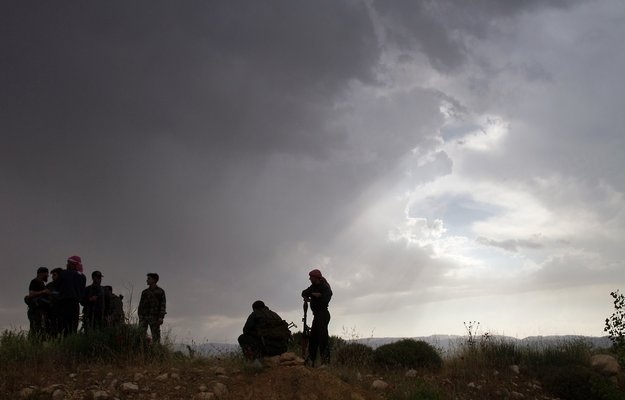
The featured image: Timeless. A Syrian moment, in Foreign Policy 23rd July 2012. Paul Simon once sang “On the side of a hill in a land called somewhere”. Little changes.
The Destruction of the Temple, AD70, Francesco Hayes
So Far From Home, William Barnes Wollen’s The Last Stand of the 44th Foot at Gandamak, 13th January 1842 (1898). The phrase ‘so far from home’ is the title of young Mary Driscoll’s 1847 account of her migration from Ireland to America.
Yarmouk Camp, Damascus February 2014. Al Jazeeraz 26 February 2014
Babes in the Wilderness. Syrian children in the eye of the storm. Al Jazeera, September 2011
Some References
In addition to a multitude of Wiki and Google searches, and references to and quotations from many songs and poems, including my own poetry and verse , special note is made of the following books that I have read of late that have inspired this piece:
Karen Armstrong, Fields of Blood (Knopf)
Thomas Cahill, How The Irish Saved Civilization (Sceptre)
William Dalrymple, From The Holy Mountain (Harper Perennial)
William Dalrymple, Return Of A King (Knopf)
Robert Fisk, The Great War For Civilisation (HarperCollins)
Robert Fisk, Pity The Nation (Andre Deutsch)
Vaslily Grossman, An Armenian Sketchbook (NYRB Classics)
Tom Holland, In The Shadow Of The Sword (Doubleday)
Robert D Kaplan, The Revenge Of Geography (Random House)
Amin Malouf, The Crusades Through Arab Eyes (Schoken)
Simon Sebag Montefiore, Jerusalem, The Biography (Orion)
Simon Winchester, Atlantic (HarperCollins)
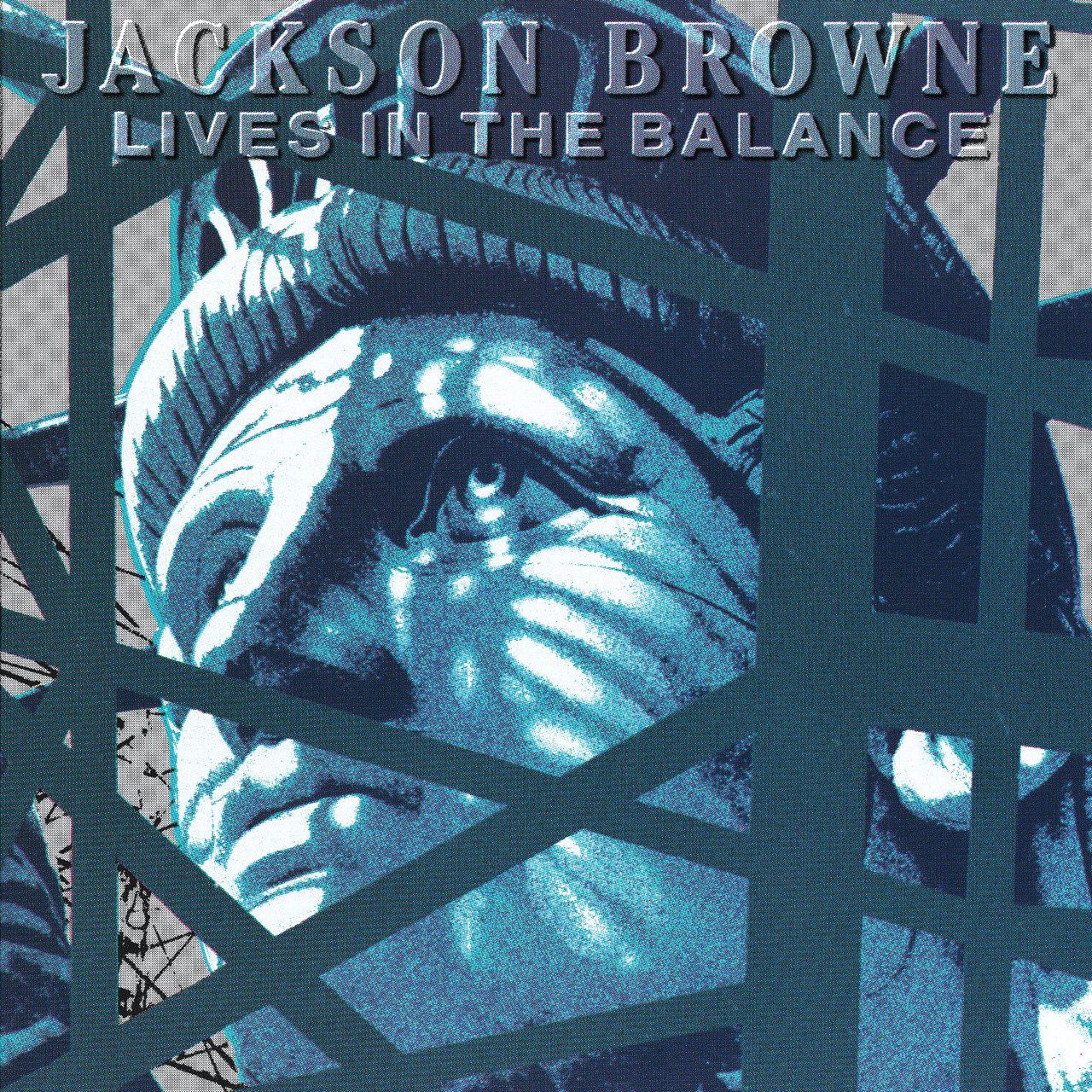
When Jackson BrownereleasedLives in the Balance in 1986, critics reckoned that its contemporary content, the USA’s bloody meddling in Central America, limited its appeal and long-term significance. And yet, here in the early twentieth first century, with the wars of the Arab Dissolution dragging the world into its vortex, the Great Power politics and proxy wars that taxed intellectual and actual imaginations in that seemingly distant decade jump back into the frame like some dystopian jack in the box. As Mark Twain noted, “history doesn’t repeat itself, but it does rhyme”.
Lives in the Balance was certainly a record for and of its times. Months before the Iran-contra scandal broke, Browne sang “I want to know who the men in the shadows are, I want to hear somebody asking them why. They can be counted on to tell us who our enemies are but they’re never the ones to fight or to die”. After the “arms for hostages” deals hit the news, increased public awareness of the US’ secret and dirty war in Nicaragua inspired him to produce a video for the title track well after the album had passed its sales peak.
The album’s other songs sustained the assault. Soldier of Plenty condemns America’s paternalism towards its poor Latin neighbours. Lawless Avenues, with poignant Spanish lyrics by Browne and Warren Zevon’s old friend and collaborator, Jorge Calderón, takes us down the mean streets of Latino Los Angeles before sending its young anti-hero off to die in America’s wars. In the driving and ironic For America, Browne regrets his prior indifference and qualifies his conflicted patriotism: “I have prayed for America; I was made for America; it’s in my blood and in my bones. By the dawn’s early light! by all I know is right, we’re going to reap what we have sown”. in Til I Go Down, he sings “I’m not gonna shut my eyes, I’ve already seen the lies on the faces of the men of war leading people to the killing floor”. This song aptly plays out the end credits of the harrowing academy award winning The Panama Deception which documents the US’ invasion of that unfortunate country.
Browne was not the first mainstream singer and songwriter to address America’s long and troublesome relationship with its Latin American neighbours. In his 1983 Stealing Fire and 1984 World of Wonders, Canadian Bruce Cockburn gave us the tragically beautiful Nicaragua and Santiago Dawn and the visceral If I Had a Rocket Launcher.On The Trouble With Normal (1983), there is Tropic Moon, with its cinematic imagery, and the lyrically deceptive Waiting For The Moon. The theme is the same as Browne’s – the North’s intervention in the politics of the South – particularly when comes to financing and arming rogue militias and warlords, and pliable, vicious and corrupt dictators: “Yanqui wake up, don’t you see what you’re doing, trying to be the Pharoah of the West bringing nothing but ruin…You’re my friend but I say Yanqui go home!”
In this sad world, whenever Uncle Sam (or Uncle Ivan for that matter) plays his hand, something wicked this ways comes: “Little spots on the horizon into gunboats grow – waiting for the moon to show. Might be a party, might be a war when those faceless sailors come ashore. Whatever’s coming, there’s no place else to go, waiting for the moon to show”.
Cockburn’s poetic muse trumps Browne’s agit-prop. These lines from Tropic Moon are nonpareil: “Away from the river, away from the smoke of the burning, fearful survivors, subject of government directives. One sad guitar note echoes off the wall of the jungle. Seen from the air they’re just targets with nowhere to run to”. And: “the light through the wire mesh plays on the president’s pistol like the gleam of bead of sweat in the flow of a candle”.
Very little has changed since Browne and Cockburn sang their Tales of Yankee Power. “But who are the ones that we call our friends? These governments killing their own? Or the people who finally can’t take anymore, and they pick up a gun or a brick or a stone. And there are lives in the balance; there are people under fire; there are children at the cannons; and there is blood on the wire”. And if you were one of those people, why wouldn’t you say “If I had a rocket launcher, I would retaliate!“ As Cockburn sings in Santiago Dawn, “military thugs with their dogs and clubs spreading through the poblacion, hunting whoever has a voice, sure that everyone will run. They come in strong but its not that long before they know its not that easy to leave. To keep a million homeless down takes more than a strong arm up your sleeve”.
From Petrograd to Palestine, the story-line endures. The eighties were also the years of Russia’s Afghan quagmire, which led, ideologically if not geographically to the Chechen pogroms; and of a decade of bloodletting in Lebanon and in what in reality was the First Gulf War, that between Iran and Iraq. The Berlin Wall fell a few years before the events that drove these records, inspiring an outpouring of optimism as the countries of Eastern Europe broke free of the Soviet thrall. But this was not the Kumbaya moment that dreamers yearn for. Ensuing decades have seen a cartography of carnage: Bali and Beslan, Gaza and Grozny, Kabul and Kigali, Manhattan and Mogadishu, Sarajevo and Srebrenica.
We witness the anatomy of the new world economy in which millions of souls are on the move and everything can be traded for value. Bombs and babies, girls and guns, dollars, drugs and more besides. False prophets and bad dreams, broken promises and forlorn hopes, obscured visions and false horizons. “Many have perished, and more most surely will” – a line taken from WH Auden’s often overlooked masterpiece The Age of Anxiety, a meditation on a world in transition between the wreckage of The Second World War and foreboding for the impending armed peace that was itself to endure for another forty five years.
It is sadly ironic that our present world is passing through another time of uneasy transition, between the fixed certainties of great power rivalry and the intractable and bloody asymmetrical conflicts of today.
The other day, I was listening to Dire Straits’ excellent 1985 album Brothers in Arms, and was reminded that several of the songs thereon refer, albeit obliquely, to the “bush wars” of Central America, and possibly also, to the US and Soviet Union’s proxy wars in Southern Africa and Afghanistan. There is Ride Across the River, with its Latino mood, and the beautiful and haunting title track. And there is TheMan’s Too Strong, a powerful indictment of the cult of “the big man” that plagues countries all over the world. How often have these tyrants “re-written history with my armies and my crooks. Invented memories. I did burn all the books”. And how often too have they been tolerated, supported and bankrolled by Uncle Sam and Comrade Ivan.
Its story does not relate to Bob Dylan’s cryptic and nihilistic Señor (Tales of Yankee Power), from Street Legal (1978), played here by bluegrass wiz Tim O’Brien. As for the meaning of the Bobster’s song, well, that’s pretty hard to fathom. A cowboy fever dream, perhaps; one of those strange illusions you channel in the early morning between sleeping and waking, more about mood than meaning. Perhaps it deserves a post of its own one find day.
Listen to Lives in the Balancein full be clicking on the blue text. Amid the its hard-hitting political commentary sits In the Shape of a Heart, considered to be one of Browne’s finest love songs. Yet this too might be regarded as controversial with regard to what it may or may not imply about the doomed relationship it describes. But like “the ruby she wore on the chain around her neck”, it is a finely cut gem.
Singer-songwriter Otis Redding was born on September 9, 1941, in Dawson, Georgia. He became known the voice of soul music. Just as his career was taking off, he died in a plane crash on December 10, 1967. “(Sittin’ on) The Dock of the Bay” became posthumously his first and only Number One hit in January 1968.
In the wake of controversial production of Shakespeare’s play in New York’s Central Park, here is an excellent exposition of the politics of this play by American screenwriter, novelist and producer Joseph Suglia. One forgets just how politically sophisticated and daring William Shakespeare was – potentially dangerous and, indeed, deadly during the unsettled and bloody times of the Tudor monarchs.
“Nackt kann die Wahrheit vor dem Volke nicht erscheinen.”
—Arthur Schopenhauer, Die Welt als Wille und Vorstellung, Zweiter Band, Kapitel 17
The election of Donald Trump to the presidency of the United States of America gives further evidence, if needed, that Americans wish to be led by cartoon characters. It was not Trump the human being who acceded to the presidency. It was his screen double, which is all the American electorate has ever known of him. It was Trump the Rich Man of Home Alone 2: Lost in New York (1992). It was Trump the Boss of The Apprentice (2004-2015). It was Trump the Billionaire of Wrestlemania 23 (2007). Donald Trump is every bit as unreal as Flo the Progressive Insurance Girl or Colonel Sanders—all three of these characters are strategic unrealities. All are holograms, shadows of living beings rather than living…
Listening to my good friend Demitri and his King Street Blues combo inspired me to revisit the early soul standards of the late fifties and early sixties. Inevitably the journey took me to Sam Cooke.
Sam Cooke (January 22, 1931 – December 11, 1964), born Samuel Cook, was an African-American recording artist, singer-songwriter and entrepreneur. He is commonly known as the King of Soul for his distinctive vocal abilities and influence on the modern world of music. His pioneering contributions to soul music led to the rise of Aretha Franklin, Bobby Womack, Al Green, Curtis Mayfield, Stevie Wonder, Marvin Gaye, and Billy Preston and popularized the likes of Otis Redding and James Brown.
Cooke had 30 U.S. top 40 hits between 1957 and 1964, and a further three after his death. Major hits included “You Send Me”, “A Change Is Gonna Come”, “Cupid”, “Chain Gang”, and “Twistin’ the Night Away”. And few remember that Herman’s Hermits “Wonderful World” was written and first recorded by Cooke.
He was also among the first modern black performers and composers to attend to the business side of his musical career. He founded both a record label and a publishing company as an extension of his careers as a singer and composer. He also took an active part in the African-American Civil Rights Movement.
On December 11, 1964, Cooke was fatally shot by the manager of the Hacienda Motel in Los Angeles, California, at the age of 33. At the time, the courts ruled that Cooke was drunk and distressed, and that the manager had killed Cooke in what was later ruled a justifiable homicide. Since that time, the circumstances of his death have been widely questioned. Wiki tells the story: http://en.wikipedia.org/wiki/Sam_Cooke
“Texas is as politically divided as the rest of the U.S., but a recurrent crop of crackpots and ideologues has fed its reputation for proud know-nothingism and retrograde thinking”. This is a cracker. And a must-read for political junkies and all who are fascinated and frightened by the absurdities of recent US politics”.
This is a cracker. And a must-read for political junkies and all who are fascinated and frightened by the absurdities of recent US politics.
I haven’t enjoyed a lengthy American “fly on the wall” opinion piece since Variety despatched a writer to spend time with Lyndsay Lohan on the set of the The Canyons, her doomed porno-thriller (in case you are tempted, and it is indeed a hoot, there’s a link to it below).
Lawrence Wright’s piece reads like a tragicomical dystopian thriller, and indeed, Thomas Pynchon and Michael Chabon would find some great storylines here. His tale becomes increasingly surreal as the author charts the passions, policies and personalities that collude and collide in this chronicle of the recent legislative session of Texas’ State House.
It is full of stories short and tall, quips and quotes, and daring and dastardly deeds that would be hilarious and worthy of the best political satires if only they were not actually true! An Austin newspaper columnist recounts the story of an absconding representative: the police “tracked him to earth at his momma’s house, where he was found hiding in the stereo cabinet.” She added, “He always did want to be the Speaker.” A wannabe Republican candidate for the State Board of Education posts on Facebook that Barack Obama had worked as a male prostitute in his twenties: “That is how he paid for his drugs,” she reasons, (and) went on to assert that climate change is a “ridiculous hoax,” and that dinosaurs are extinct because the ones on Noah’s Ark were too young to reproduce”. Another representative tweets: “Top priority for Travis GOP: beautiful Big Titty women!!” A former governor once said of then presidential nominee, George H. W. Bush. “He can’t help it. He was born with a silver foot in his mouth.” She wore designer suits but picked her teeth, and she cleaned her fingernails with a Swiss Army knife. Successively opposing the placing of a Christmas manger scene in the state capitol, she said ““I’m afraid so…and it’s a shame, because it’s about the only time we ever had three wise men in the capitol.”
These are a selection of the more anodyne tales. Many others are downright scary, and one shakes one head in disbelief at what legislators and elected officials think and do. To bowdlerize the Bard, “what brave, bad world that has such people in it”.
“Texans…are hardly monolithic. The state is as politically divided as the rest of the nation. One can drive across it and be in two different states at the same time: FM Texas and AM Texas. FM Texas is the silky voice of city dwellers, the kingdom of NPR. It is progressive, blue, reasonable, secular, and smug—almost like California. AM Texas speaks to the suburbs and the rural areas: Trumpland. It’s endless bluster and endless ads. Paranoia and piety are the main items on the menu”.
Accordingly, Wright presses all the red (and blue) buttons that inspire, ignite and implode, delight, dismay and divide US politics and society, including in no particular order:
Abortion, gender and toilets. Obamacare, health insurance, and death panels (rememeber those?). Public schools, vouchers, and toilets. Gerrymandering, voter registration and electoral fraud. Lobbyists, political donations, and corruption. Immigration, Muslims, latinos, and sanctuary cities. Guns of all calibers, mass-shootings and pig hunting. Budgets, appropriations, and toilets. Donald Trump, the religious right, and the liberal menace – and, yes, toilets. You have to read the article if you want to understand how things always seem to come back to the rest room.
Maternal mortality rates (up), foster-care and child protection (down). The Poo Poo Choo Choo (really!), texting whilst driving, the right to say Happy Christmas instead of Happy Holiday, and a proposed law to fine masturbation outside of a woman’s parts or of a medical faculty – “an act against an unborn child, and failing to preserve the sanctity of life”. There’s the heroes : William Travis, Sam Houston, Davy Crockett, and, naturally, the Alamo (see below). Famous Texans Willie Nelson, Marty Robbins, and Kinky Friedman (and his band, the Texas Jewboys) get cameos, and Bruce Springsteen, a passing reference. But no Jimmy Webb or Galveston (Wichita is in Kansas in case you ask, and Phoenix is in Arizona), whilst Oklahoma is a refuge for dissenting Democrat legislators. And, whatever “they” do, “don’t California Texas!”
You will be amazed and horrified in equal measure as Lawrence Wright connects these dizzying dots. I never thought that politics could be so exciting. It makes the schoolyard bluster and the minor party shenanigans of our Australian Parliament seem like Children’s Play Time.
As we often say DownUnder: “Only in America Texas!”












 In That Howling Infinite