100 years of Mein Kampf … the book that ravaged a continent

Perfection, of a kind, was what he was after,
And the poetry he invented was easy to understand;
He knew human folly like the back of his hand,
And was greatly interested in armies and fleets;
When he laughed, respectable senators burst with laughter,
And when he cried the little children died in the streets.
W H Auden, Epitaph On A Tyrant (1939)

The English poet W. H. Auden spent some time in Berlin during the early 1930s – the last years of the Weimar Republic prior to the Nazi ascendency –Some commentators suggest that Auden actually wrote Epitaph on a Tyrant in Berlin. But It was published in 1939, the year that the Second World War broke out – and Auden had departed the city before the end of Weimar in 1933. But he was full aware of where the world was heading – during the mid-thirties, he’d briefly journeyed to Republican Spain in the midst of the Civil War and to Kuomintang China during its war with Japan – see In That Howling Infinite’s Journey to a war – Wystan and Christopher’s excellent adventure.

The poem has been interpreted as a very brief study in tyranny, but few could doubt whom Auden had in mind. In this very short poem, Auden turns a familiar phrase from the New Testament in upon itself   evoking and then evicting ‘But Jesus said, Suffer little children, and forbid them not, to come unto me: for of such is the kingdom of heaven’ (Matthew 19:14). There is nothing Christlike about this tyrant: he will not suffer the little children to come unto him. The little children, instead, will be the ones to suffer. he also inverts a specific phrase by the nineteenth-century writer John Lothrop Motley, in The Rise of the Dutch Republic (1859), citing a report of 1584 about the death of the Dutch ruler William the Silent: ‘As long as he lived, he was the guiding star of a whole brave nation, and when he died the little children cried in the streets.’

I recalled the poem, one of the very first of Auden’s poems I encountered nearly sixty years ago, as I was reading the essay republished below written by the most erudite economist and academic Henry Ergas on the occasion  of the centenary of the publication on 16 August 1925, of Mein Kampf  (lit.My Struggle), Nazi Party founder and leader Adolf Hitler‘s combined autobiographical reflections and political manifesto, encompassing an uncompromising ideological programme of antisemitism, racial supremacy, and expansionist ambitions.

A century later, the impact of Mein Kampf on the world remains both undeniable and deeply troubling. Initially dismissed by some as the ramblings of a failed revolutionary, the book became the ideological blueprint for the Nazi regime, legitimising policies that culminated in the Holocaust and a world war that claimed tens of millions of lives. Beyond the destruction of the mid-twentieth century, Mein Kampf has endured as a symbol of hate literature, resurfacing periodically in extremist movements, political propaganda, and debates over free speech and censorship. Its centenary compels reflection not only on the book’s historical role in shaping one of the darkest chapters of human history, but also on the persistence of the prejudices and authoritarian impulses it so virulently expressed.

Mein Kampf‘s bitter harvest

The Second World War began on 2nd September 1939 with Germany’s sudden and unprovoked invasion of Poland on 2nd September, and Britain and France’s declaration of war on Germany the day after. On 17 September, the Soviet Union invaded the country from the east in accordance with the Treaty of Non-aggression between Germany and the Union of Soviet Socialist Republics,  ,forever known as the Molotov-Ribbentrop Pact. a neutrality pact between Nazi Germany and the Soviet Union signed in Moscow on August 23, 1939, by foreign ministers Joachim von Ribbentrop and Vyacheslav Molotov, respectively.

Japan formally entered the war on September 22, 1940 with the invasion of French Indochina, having been at war with China since 1931, and officially formed an alliance with Germany and Italy five days later. The United Kingdom declared war on the Empire of Japan  on 8 December 1941, following the Japanese attacks on British Malaya, Singapore and Hong Kong on the previous day, as well as in response to the bombing of the American fleet at Pearl Harbour on December 7. The United States to enter World War II the following day.

World War II ended in Europe on May 8, 1945, with Germany’s unconditional surrender, known as Victory in Europe Day (V-E Day). The war in the Asia Pacific concluded on September 2, 1945, with Japan’s formal surrender aboard the USS Missouri, designated Victory over Japan Day (V-J Day). This followed the atomic bombings of Hiroshima and Nagasaki and the Soviet Union’s declaration of war on Japan

The Nazis, with a little help from their allies and collaborators, murdered (there is no other word) an estimated six million Jews and 11 million others In camps and jails, reprisals and roundups, on the streets of cities, towns and villages, in fields and in forests, and in prison cells and torture chambers. And in the fog of war, the dearth of accurate records, and the vagaries of historical memory, the actual number is doubtless higher – much higher.

The term ‘Holocaust’ generally refers to the systematic and industrialized mass murder of the Jewish people in German-occupied Europe – called the Shoah or ‘catastrophe’ by Jews. But the Nazis also murdered unimaginable numbers of non-Jewish people considered subhuman – Untermenschen (the Nazis had a way with words!) – or undesirable.

Non-Jewish victims of Nazism included Slavs who occupied the Reich’s ostensible lebensraum – living space, or more bluntly, land grab (Russians – some seven million – Poles, another two – Ukrainians, Serbs and others in Eastern Europe caught in the Wehrmacht mincer; Roma (gypsies); homosexuals; the mentally or physically disabled, and mentally ill; Soviet POWs who died in their tens of thousands; Roman Catholics, Protestants, and Orthodox Christians who defied the regime; Jehovah’s Witnesses and Freemasons; Muslims; Spanish Republicans who had fled to France after the civil war; people of colour, especially the Afro-German Mischlinge, called “Rhineland Bastards” by Hitler and the Nazi regime; leftists, including communists, trade unionists, social democrats, socialists, and anarchists; capitalists, even, who antagonized the regime; and indeed every minority or dissident not considered Aryan (‘herrenvolk’ or part of the “master race”); French, Belgians, Luxemburgers, Dutch, Danes, Norwegians, Albanians, Yugoslavs, Albanians, and, after 1943, Italians, men, women and young people alike, involved with the resistance movements or simply caught up in reprisals; and anyone else who opposed or disagreed with the Nazi regime. See below, Ina Friedman’s The Other Victims of the Nazis and also, Wikipedia’s Victims of the Holocaust

Worldwide, over seventy million souls perished during World War II. We’ll never know just how many …

Lest we forget …

From In That Howling Infinite’s  2nd September 1939 – the rape of Poland (1)

The immoral mathematics of World War II – Deaths by Country 

COUNTRY MILITARY DEATHS TOTAL CIVILIAN AND MILITARY DEATHS
Albania 30,000 30,200
Australia 39,800 40,500
Austria 261,000 384,700
Belgium 12,100 86,100
Brazil 1,000 2,000
Bulgaria 22,000 25,000
Canada 45,400 45,400
China 3-4,000,000 20,000,000
Czechoslovakia 25,000 345,000
Denmark 2,100 3,200
Dutch East Indies 3-4,000,000
Estonia 51,000
Ethiopia 5,000 100,000
Finland 95,000 97,000
France 217,600 567,600
French Indochina 1-1,500,000
Germany 5,533,000 6,600,000-8,800,000
Greece 20,000-35,000 300,000-800,000
Hungary 300,000 580,000
India 87,000 1,500,000-2,500,000
Italy 301,400 457,000
Japan 2,120,000 2,600,000-3,100,000
Korea 378,000-473,000
Latvia 227,000
Lithuania 353,000
Luxembourg 2,000
Malaya 100,000
Netherlands 17,000 301,000
New Zealand 11,900 11,900
Norway 3,000 9,500
Papua New Guinea 15,000
Philippines 57,000 500,000-1,000,000
Poland 240,000 5,600,000
Rumania 300,000 833,000
Singapore 50,000
South Africa 11,900 11,900
Soviet Union 8,800,000-10,700,000 24,000,000
United Kingdom 383,600 450,700
United States 416,800 418,500
Yugoslavia 446,000 1,000,000

WORLDWIDE CASUALTIES*

Battle Deaths 15,000,000
Battle Wounded 25,000,000
Civilian Deaths 45,000,000

*Worldwide casualty estimates vary widely in several sources. The number of civilian deaths in China alone might well be more than 50,000,000.

Read also, in In That Howling Infinite: Righteous Among the Nations and Las Treces Rosas – Spain’s Unquiet Graves 

Mein Kampf made depravity the highest form of morality: Hitler’s ‘Nazi bible’ a playbook for hate

A picture-illustration showing Adolf Hitler in Munich in 1932 and his book, Mein Kampf. During WWII Hitler wore a simple uniform rather than the elaborate costume of a supreme commander, highlighting his affinity with the ‘grunts’ on the line. Picture: Heinrich Hoffmann/Archive Photos/Getty Images

A picture-illustration showing Adolf Hitler in Munich in 1932 and his book, Mein Kampf. During WWII Hitler wore a simple uniform rather than the elaborate costume of a supreme commander, highlighting his affinity with the ‘grunts’ on the line. Picture: Heinrich Hoffmann/Archive Photos/Getty Images


W
hen Adolf Hitler’s Mein Kampf (My Struggle) was published exact­ly 100 years ago, the reviews were scathing. The reader, proclaimed the Frankfurter Zeitung, could draw from the book one conclusion and one conclusion only: that Hitler was finished. The influential Neue Zurcher Zeitung was no kinder, lambasting “the sterile rumination of an agitator who is incapable of rational thought and has lost his grip on reality”. As for Karl Kraus, the great Austrian essayist and critic, he famously dismissed it, quipping: “When I think of Hitler, nothing comes to mind.”

But while the book that would become known as “the Nazi bible” was hardly an immediate bestseller, it was far from being a dismal flop. By the end of 1925, nearly 10,000 copies had been sold, necessitating a second print run, and monthly sales seemed to be trending up. Even more consequentially, Mein Kampf, with its comprehensive elaboration of the Nazi world view, proved instrumental in consolidating Hitler’s until then tenuous position as the leader of the Nationalsozialistische Deutsche Arbeiterpartei  (National Socialist German Workers’ Party) or NSDAP. Both Hitler and Max Amann, who ran the Nazis’ publishing house, had good reason to be pleased.

After all, the initial circumstances of the book’s production were scarcely promising. When Hitler arrived at Landsberg prison in November 1923, following the failure of a farcically mismanaged putsch, he was assessed by the staff psychologist as “hysterical” and suicidal. However, having determined to end it all by embarking on a hunger strike, he sat down to write his valedictory statement – and with the full support of the prison’s director, a Nazi sympathiser who was happy to accommodate his every need, the project soon expanded, until the writing came to consume Hitler’s days.

Once Emil Georg, a director of the powerful Deutsche Bank and generous funder of the NSDAP, provided the aspiring writer with a top-of-the-line Remington typewriter, a writing table and all the stationery he required, Hitler’s new career as an author – the profession he proudly declared on his 1925 tax return – was well and truly under way.

The difficulty, however, was that Hitler wrote very much as he spoke. Page after page required substantial editing, if not complete revision. Some of it was undertaken by Rudolf Hess, who had a university degree, and Ernst Hanfstaengl, a German-American Harvard graduate. But many of the most difficult sections were eventually worked over by the unlikely duo of a music critic, Josef Stolzing-Cerny, and Bernhard Stempfle, a priest.

The greatest tensions arose in settling the title. Hitler, with his habitual grandiloquence, had called it Four and a Half Years of Battling Lies, Stupidity and Betrayal. Convinced that title would doom it to failure, Amann adamantly insisted on, and seems to have devised, a shorter alternative. Thus was Mein Kampf, the name that would go down in history, born.

Mein Kampf’s singular lack of focus proved tobe a strength.

Mein Kampf’s singular lack of focus proved to
be a strength.

Viewed superficially, the text, despite its editors’ best efforts, seems inchoate, veering across a bewildering range of grievances, pseudo-historical accounts and exhortations. Yet its singular lack of focus proved to be a strength. It meant there was something in it for each of the social groups the Nazis were attempting to mobilise, with every one of those groups finding the real or imagined harms that afflicted it covered in its pages. And whenever they were discussed, each group’s darkest nightmares were portrayed in striking, often lurid terms.

Hitler himself explained his approach in the book’s discussion of propaganda.

“Most people,” Hitler said, “are neither professors nor university graduates. They find abstract ideas hard to understand. As a result, any successful propaganda must limit itself to a very few points and to stereotypical formulations that appeal to instincts and feelings, making those abstract ideas vividly comprehensible.”

That is exactly what Mein Kampf set out to do – and it did so by hammering three basic themes: that the Germans were victims; that the culprit for the wrongs they had suffered were the Jews; and that only a fight to the death against “world Jewry” could bring Germany’s redemption and return it to the pre-eminence that was its birthright and historic destiny.

What gave the book its resonance was that each of those themes was well and truly in the air. Nowhere was that clearer than in respect of victimhood.

Thus, the end of World War I had not been viewed in Germany as a military defeat. Rather, the widespread perception, vigorously propagated by General Erich Ludendorff, was that had the German army, which retained undisputed mastery over its home soil, not been “sabotaged” by liberals, freemasons, social democrats and communists, it would have held out, forcing the Allies to a settlement.

Key themes in Mein Kampf was that the Germans were victims and the culprit for the wrongs they had suffered were the Jews.

Key themes in Mein Kampf was that the Germans were victims and the culprit for the wrongs they had suffered were the Jews.

The capitulation was, in other words, the result of a “stab in the back” that treacherously delivered the nation to the harsh, grotesquely unjust, treatment eventually meted out at Versailles by the war’s victors.

Closely associated with the resulting sense of unfairness, and of an undeserved defeat, was the smouldering resentment felt by returning soldiers.

World War I had ushered in the glorification of the rank and file, expressed in countries such as France, Britain and Australia by the erection of national memorials for the Unknown Soldier. Here was a figure that represented both the individual and the mass: sanctified by the nation, the Unknown Soldier also stood for the multitudes sent out to die and too quickly forgotten.

That was the case almost everywhere – but not in the newly established Weimar Republic. Unlike its counterparts, the republic erected no national monument, created no worthy memorial: the ghosts of the dead were left unburied.

Moreover, unable to deal with the trauma of the war, the republic accorded veterans no special status: even when their wounds made them entirely disabled, they were entitled only to the paltry benefits accorded to others suffering from similar levels of disability.

With the country’s new leaders abandoning those who had borne so many risks and so much pain on Germany’s behalf, an unbridgeable cleavage opened up between “those who had been there” – with all of their rage and frustration, fury and disillusionment – and those who had not. It is therefore no accident that both for innumerable forgotten soldiers and for the families who had lost their sons and fathers, Hitler, who had lived through the carnage, came to symbolise the unknown soldier of World War I.

Nor is it an accident that during World War II he always donned a simple uniform rather than the elaborate costume of a supreme commander, thereby highlighting his unshakeable affinity with the “grunts” on the line.

Hitler, chancellor of Germany in 1933, is welcomed by supporters at Nuremberg. Picture: Hulton Archive/Getty Images

Hitler, chancellor of Germany in 1933, is welcomed by supporters at Nuremberg. Picture: Hulton Archive/Getty Images

The last, but perhaps most broadly felt, source of the sense of victimhood was the devastation wreaked by the “great inflation”.

The immediate effect of the price hikes, which began in 1921, accelerated in late 1922 and became a hyperinflation (that is, one involving monthly price increases of more than 50 per cent) in 1923 was to obliterate the savings of skilled workers, pensioners and the middle class. No less important, however, it also shattered those groups’ social standing which, in a society still geared to honour and respectability, relied on the ability to conspicuously maintain a dignified lifestyle appropriate for one’s status. Instead, for the first time in their lives, previously comfortable professionals, foremen and highly trained workers were reduced to a struggle of all against all, as they vainly attempted to sell once prized, often hard-earned assets that had suddenly – and mysteriously – become utterly valueless.

And as well as leaving a legacy of trauma, that experience created an enduring sense of unpredictability, casting the new republic as incapable of maintaining intact even the elementary foundations of daily life.

Stefan Zweig was therefore not exaggerating when he wrote, in his The World of Yesterday, that “nothing ever embittered the German people so much, nothing made them so furious with hate as the inflation. For the war, murderous as it was, had yet yielded hours of jubilation, with ringing of bells and fanfares of victory. And, being an incurably militaristic nation, Germany felt lifted in her pride by her temporary victories. But the inflation served only to make it feel soiled, cheated, and humiliated. A whole, scarred, generation could never forget or forgive.”

But where there are victims there must be victimisers – and Hitler delivered those too. Towering among them were the Jews.

Mein Kampf’s obsession with Jews is readily demonstrated: including cognate terms, such as Jewry, the 466 references to Jews in the book outnumber those to every other substantive term, including race (mentioned 323 times), Germany (306), war (305) and Marxism, which gets a paltry 194 – still ahead of national socialism and national socialists which, taken together, are referenced only 65 times.

It is certainly true that there is, in those obsessive references, virtually nothing original. Hitler’s tir­ades largely reassemble the anti-Semitic tropes that had emerged in the late 19th century and that were widely disseminated in a notorious forgery, The Protocols of the Elders of Zion.

But Hitler’s formulation, while substantively irrational, was arguably more logical than most in the way it combined and superimposed elements from conventional anti-Semitism, pseudo-biology and social Darwinism.

Mein Kampf’s promise of redemption was crucial … from the midst of despair, a new notion of German glory and greatness began to emerge. Hitler with Nazi officials in Munich in the summer of 1939, just before the start of WWII.

Mein Kampf’s promise of redemption was crucial … from the midst of despair, a new notion of German glory and greatness began to emerge. Hitler with Nazi officials in Munich in the summer of 1939, just before the start of WWII.

Thus, relying on a loose biological metaphor, it defined Jews as a parasite – but as one that had deliberate agency and that consciously (and collectively) sought to infect its victims, notably the “purer”, more advanced “races”.

Second, it asserted that the resulting infection was not only fatal to its victims but ultimately to their entire “race”.

Third, it projected on to that account the image of a Darwinian struggle that had been fought across recorded history’s entire course, between Jews on the one hand and the superior races on the other: a struggle that could end only with the extinction of the Jews or their adversaries.

And finally, it argued that, unless anti-Semites learnt to display the same degree of ruthlessness, the same insistence on ethnic loyalty, the same stealth and the same forms of manipulation of media and the public sphere, the Jews stood every chance of triumphing because they entirely lacked ethical standards, were exceptionally cunning, ambitious, aggressive and vindictive and – last but not least – had a natural bond to each other, combined with a murderous hatred of others.

The resulting portrayal of Jews was as terrifying as it was bizarre. Jews, it seemed, were chameleons, who were both subhuman yet extraordinarily capable, both fanatical Bolsheviks and natural capitalists, both physically repulsive yet immensely able to seduce and “infect” innocent Aryan maidens.

Moreover, they could shift effortlessly and surreptitiously from any one of those myriad shapes into any another, choosing whatever form was most likely to succeed in destroying their opponent.

As the great German philosopher Ernst Cassirer later recalled, he and his other Jewish friends found those claims “so absurd, so ridiculous, and so crazy, that we had trouble taking them seriously”. But others did not have any difficulty in doing so.

Many forces were at work. Some resulted from the war years. For example, the terrible food shortages caused by the British blockade (which was lifted only two years after the war ended) had resulted in spiralling prices for basics on the black market – with the finger being readily, although entirely incorrectly, pointed at alleged hoarding by Jews.

And more indirectly, but no less potently, the horrific second wave of the 1919 influenza pandemic, in which 400,000 Germans died, had given enormous prominence to notions of infection and contagion. As careful statistical studies subsequently showed, that prominence had enduring effects, as the Nazis secured significantly greater electoral support in the worst affected areas than in those where the death toll was lower.

But by far the greatest factor was the profound disruption of the post-war years, when everything Germans had taken as solid melted into thin air, leaving a pervasive feeling of bewilderment.

For all of its myriad flaws, the Kaiserreich, as the German Empire was known, had exuded a stability that made the future predictable. Now, with one seemingly incomprehensible event piling up on top of another, the desperate search to make sense of the world triggered an equally desperate search for someone to blame.

That was precisely what Hitler’s vast Jewish conspiracy offered. Mein Kampf, Heinrich Himmler pithily noted, was “a book that explains everything”. If it was so effective, Hannah Arendt later reflected, it was because its playing on tropes and stereotypes that were relatively familiar could, at least superficially, “fulfil this longing for a completely consistent, comprehensible, and predictable world without seriously conflicting with common sense”. All of a sudden, things fell into place – with consequences for Europe’s Jews that would forever sully Germany’s name.

Sign erected by British forces at the entrance to the Bergen-Belsen camp. Picture: Imperial War Museum

Sign erected by British forces at the entrance to the Bergen-Belsen camp. Picture: Imperial War Museum

Bodies being flung into a mass grave at Belsen. Picture from the book Children's House of Belsen, by camp survivor Hetty Verolme

Bodies being flung into a mass grave at Belsen. Picture from the book Children’s House of Belsen, by camp survivor Hetty Verolme

If those horrendous conse­quences eventuated, it was because Mein Kampf did not only identify an alleged disease; it also set out a path to national redemption. In that respect, too, its main points were entirely unoriginal.

However, what was relatively new, and especially important, was the unadulterated celebration of death and violence in which they were couched.

Whether Hitler called for Jews to be massacred is a matter of interpretation. What is beyond any doubt is that he came as close to it as one possibly could. The Jews, he claimed, would “accentuate the struggle to the point of the hated adversary’s bloody extermination”. As that happened, it would be absolutely impossible to defeat them “without spilling their blood”. And when it came to that, their opponents, locked “in a titanic struggle”, would have to “send to Lucifer” – that is, to hell – “those who had mounted an assault on the skies”: that is, the Jews.

There would be, in the process, countless victims; but the Aryans who perished would be martyrs, “acting in accordance with the will of the Almighty Creator”, and like Hitler himself “fighting for the work of the Lord”.

As with so much of Mein Kampf, the sheer violence of those calls, and of the text more generally, fell on fertile ground, again especially among veterans.

If those veterans had one thing in common it was the experience of “total war”, characterised by the ever-growing porousness of the boundaries between soldiers and civilians both as combatants and as targets of destruction.

Once they got to the front, it did not take long for ordinary soldiers to discard the fantasies of splendid bayonet charges across fields of flowers. Instead, burrowed underground in trenches filled with slime and excrement, rats and rotting body parts, what many learnt was that life was war, and war was life.

And at least for some, the sacrifice and devotion of their comrades also taught that violence brought out the best qualities in man.

Winifred Williams, a Welsh woman who became a friend and supporter, provided the paper on which Hitler wrote Mein Kampf while he was in jail.

Winifred Williams, a Welsh woman who became a friend and supporter, provided the paper on which Hitler wrote Mein Kampf while he was in jail.

Rendering that habituation to violence even more extreme was the experience of the 5 per cent or so of German soldiers who volunteered for Freikorps (Free Corps) units that fought, from 1918 to 1923, against the wave of revolutionary movements throughout central and eastern Europe.

Particularly in the Baltic states, those struggles were brutally uncompromising, with mass executions not only of adversaries but also of entire villages of helpless Jews. It was in those struggles that many ingredients of Nazism were forged – its symbols, like the death’s head and the swastika; its core staff, who later largely comprised the leading personnel first of the Nazi’s paramilitary units and then of the SS; and the unbridled anti-Semitic savagery of its killing squads. To all those who lived through those struggles, Mein Kampf seemed to perfectly capture their world view.

But Mein Kampf’s promise of redemption was crucial, too. Yes, Germany experienced the aftermath of World War I as an unmitigated disaster. Yet, from the midst of despair, a new notion of German glory and greatness began to emerge. When the war finally ended, the survivors could not but feel an urge to endow it with meaning – with the hope that the countless deaths would be redeemed by creating a better future, not only for themselves but also for the nation, a future shorn of the causes of everything that had gone wrong.

And no one, in the chaos and misery of post-World War I Germany, painted the path to that national salvation as starkly, and as effectively, as Hitler.

Death and destruction follow delirium as surely as dust and ashes follow fire. Two long decades, punctuated by Hitler’s accession to power in 1933, separated, almost precisely, the publication of Mein Kampf from the “Zero Hour”, as it became widely known, on May 7, 1945, when Germany, reduced to rubble, surrendered and officially ceased to exist. The vision – or hallucinations – Hitler had produced in Landsberg’s ja

Death and destruction follow delirium as surely as dust and ashes follow fire. Two long decades, punctuated by Hitler’s accession to power in 1933, separated, almost precisely, the publication of Mein Kampf from the “Zero Hour”, as it became widely known, on May 7, 1945, when Germany, reduced to rubble, surrendered and officially ceased to exist. The vision – or hallucinations – Hitler had produced in Landsberg’s jail ensured that the 20th century’s fields of glory would be sown with the corpses of innocent victims and the distorted fragments of shattered ideals.

Between those dates, the book’s fortunes closely tracked those of its author. After the crash of 1929, and the onset of the Depression, sales boomed; and once the Nazi regime was in place it became ubiquitous. A second volume had appeared in December 1926; it was added to the 400 pages of the first in 1930.

To cope with the length, the combined book was printed on extremely fine paper, exactly like a bible. Soon after that, an ever-wider range of formats – going from cheap paperback versions to extremely luxurious versions bound in leather – was offered to readers.

The regime recommended that municipalities give a good quality copy to newly married couples as they stepped out of the wedding ceremony; estimates vary but it seems two million couples benefited (if that is the right word). The book also became the standard prize in schools, workplaces and party organisations, bestowed on recipients with all the pomp the Fuhrer’s great work demanded. Altogether, by the “Zero Hour”, 12.5 million copies had found their way into the hands of potential readers – yielding Hitler copyright payments, partly deposited in a Swiss bank account, that made him an extremely wealthy man.

How many Germans actually read it is hard to say; the answers given to immediate post-war surveys were understandably evasive. What seems likely, however, is that its influence came less from the scrupulous consumption of the “Nazi bible” than from short excerpts, read out at meetings and over the radio or printed near the mastheads of major papers, as well as from the million or so copies of “reader’s digest”-like variants sold during the Reich’s golden years.

In the chaos and misery of post-WWI Germany, no one painted the path to that national salvation as starkly, and as effectively, as Hitler

In the chaos and misery of post-WWI Germany, no one painted the path to that national salvation as starkly, and as effectively, as Hitler

But its greatest impact was almost certainly indirect. Regardless of what ordinary Germans may or may not have done, abundant evidence shows it was carefully studied and frequently consulted by the Nazi leadership. The regime’s core principle, the so-called Fuhrerprinzip, specified that “what the Fuhrer says is law”: but what the Fuhrer had actually said, and even more so, what he wanted, was almost always hopelessly unclear – yet entire careers depended on guessing it accurately.

As a result, the everyday life of the Nazi hierarchy’s upper echelons was consumed in a competi­tion to “work towards the Fuhrer”, as Hitler’s great biographer, Ian Kershaw, called it: that is, in trying to anticipate the Fuhrer’s will and show that no one could be more ruthless or determined in putting it into effect. It was in that process that Mein Kampf was absolutely fundamental, invariably referred to and systematically used.

And it was through that process that Hitler’s words made depravity the highest form of morality, atrocity the surest sign of heroism, and genocide the key to redemption.

Outside Germany, very few grasped that those horrors would unfold. Winston Churchill, Franklin Delano Roosevelt, Charles de Gaulle and David Ben-Gurion were among those few, carefully annotating early versions and gasping at the book’s implications.

But their warnings were ignored because Mein Kampf was plainly the work of a madman. As the British Labour Party’s leading intellectual, Harold Laski, said, when he was asked why he dismissed it, rational men and women “could not bring themselves to contemplate such a world”, much less believe that “any child of the twentieth century” would regard it as a realistic possibility.

But the Nazi art of politics, as Joseph Goebbels concisely defined it, consisted precisely in making the impossible possible and the absolutely inconceivable a practical reality. That art did not disappear with Nazism’s demise, nor did the murderous anti-Semitism whose seeds Hitler sowed a century ago.

As we mark Mein Kampf’s grim anniversary, we must, this time, take them seriously.

So far away from home – the Diggers who fought in Spain

The Spanish Civil War was long, brutal and bloody, and medieval in its savagery. It was a war of armies and of militias, of men and women, of skirmishes and set-piece battles, of massacres and reprisals, and of wars within wars. It saw cities besieged and starved into surrender and towns destroyed by bombers and heavy artillery. It cut a swathe across the country leaving scars that endure to this day.

It became a proxy war for three dictators – Hitler, Mussolini and Stalin – who dispatched men and machines to fight under false flags in what would appear in retrospect to be a rehearsal for wars to come. It was a magnet for idealists and activists of disparate political creeds and from many lands who were to fight and die on both sides, including the celebrated International Brigades. It lured writers and poets who were to chronicle its confusion and carnage, including Ernest Hemingway, George Orwell, WH Auden, André Malraux and Arthur Koastler. Many perished, the most famous being the Spanish poet Federico García Lorca, murdered by Nationalist militia and buried in an unmarked grave, one of many unquiet graves scattered throughout the land.

We republish below a remarkable story of that long forgotten army in a long-forgotten war, and also, an article about the International Brigades.

See also, in In That Howling Infinite, Las Treces Rosas – Spain’s Unquiet Graves

The Shoah and America’s Shame – Ken Burns’ sorrowful masterpiece

And high up above my eyes could clearly see
The Statue of Liberty
Sailing away to sea
And I dreamed I was flying
Paul Simon, American Tune

Ken Burns is a documentary maker and storyteller without equal. All his films are masterpieces of American history. I’ve watched much if not most of his work. They are among the most unforgettable histories I’ve ever viewed, high up in what I’d consider the pantheon of the genre, alongside The Sorrow and the Pity, The Battle of Algiers, Salvador and Waco – Terms of EngagementThe Civil War raised the bar so high that very few documentary filmmakers have reached it, with its mix of surviving photographic images (in an style that Apple now promotes as its “Ken Burns Effect”) and the mesmerizing recitation of diaries, letters home, and official communications. The West confronted his country’s enduring creation myth with an honesty balanced by empathy. The Dustbowl was breathtaking in its images, its narrative and the spoken testimonies it presented. The Vietnam War was a relentless, harrowing story told in pictures and the witness of the people ground zero of a a conflict that has been called “chaos without a compass”.

The US and the Holocaust is Burns’ latest film. It does not make for easy viewing being a searing indictment of America’s response to the catastrophe that was approaching for European Jewry. It’s a significant exposition centred on just how much evidence was accessible to Americans during that appalling time, and asks just why rescuing Jews was no priority, except for those few individuals who actually took risks to help. As Burns observed: “There is an American reckoning with this, and it had to be told. If we are an exceptional country, we have to be tough on ourselves and hold ourselves to the highest standard. We cannot encrust our story with barnacles or sanitise our history into a feel-good story”. As historian Rebecca Erbelding suggests, “There is no real perception in the 1930s that America is a force for good in the world or that we should be involved in the world at all. There is no sense among the American people, among the international community, that it is anyone else’s business what is happening in your own country”. There is indeed a disconnect between America’s self regard as the land of the free and the “light on the hill”, and the cold reality – and realpolitik – of its actual record at home and abroad. There is a none too subtle irony in the titles Burns has chosen for each two hour episode, drawn from extracts from the poem by Emily Lazarus that adorns the base of The Statue of Liberty (see below).

Burns work reminds us that historical memory in America, Europe, and indeed Australia is often like a sieve. Give it a good shake and only the big chunks are left. The story of the US’ public opinion and government policy regarding the worsening plight of European Jewry during the nineteen thirties and the a second World War is not one of those. When I posted an article about the film on Facebook, many Americans commented that they were unaware of their country’s disregard and outright obstruction. Burns has opened a crack that has let the light in.  

The quotations cited above are from a review published recently in the Weekend Australian which I have republished below – it is an excellent and quite detailed account of the issues and the incidents featured in this sorry tale, and I cannot better it. But I will note one distinctive feature of Ken Burns’ documentaries – his skill at recounting unfolding stories which he interweaves through the ongoing narrative, drawing viewers inexorably in and acquainting them with the characters, their hopes and their fears, and ultimately, their fates be these tragic – alas. in the most part – or fortunate.

In The Vietnam War, I followed the journey of an eager and patriotic young soldier, Denton “Mogie” Crocker, as he roved out from mall town USA to the battlefields of Indochina. I recount it. in The Ballad of Denton Crocker – a Vietnam elegy. In America and the Holocaust, there is the story of Anne Frank’s family as they sought asylum in the USA from the moment the the Nazi regime started to come down hard on Germany’s Jewish community. We all know how that ended for Anne and her sister. There is also the saga of what Hollywood called “the voyage of the damned”, the subject of an overwrought and overacted feature film, which nevertheless was based upon the actual voyage of the SS St.Louis which departed Hamburg with nearly a thousand desperate but hopeful travellers, but was refused entry into American and Canadian ports, and returned eventfully to Rotterdam where Britain, Belgium, France and the Netherlands gave them shelter. The latter three were conquered by the Wehrmacht in 1940, with harrowing consequences for those passengers who settled there, but a half of the St. Louis’ human cargo survived the war, predominantly those who were permitted to settle in Britain. 

On a personal note, whilst I am myself of Irish descent, Catholic and Protestant in equal measure on each side, my wife’s father’s family were Jews from eastern Germany and Czechoslovakia and experienced the same travails as those described in Burns’ film. Many, including her father’s elderly parents, perished in the death camps, and are memorialised the Yad Vashem shrine of remembrance in Jerusalem – which I have visited many times. Others managed to leave Germany, including her father, who settled in London, where she was born, and her uncle who a  lawyer who left Germany in 1933 after the promulgation of the infamous Nuremberg Laws, who settled in England and  and then made Aliyah to Palestine, ending his days in Haifa, in an independent Israel. Others headed westwards to Latin America in the hope of securing entry to the US from there.

Epilogue. Antisemitism, the devil that never dies

It has been said, with reason, that antisemitism is the devil that never dies. And yet, is antisemitism a unique and distinct form of racism, or a subset of a wider fear and loathing insofar as people who dislike Jews rarely dislike only Jews?

Fear of “the other” is a default position of our species wherein preconceptions, prejudice and politics intertwine – often side by side with ignorance and opportunism. it is no coincidence that what is regarded as a dangerous rise in antisemitism in Europe, among the extreme left as much as the extreme right, is being accompanied by an increase in Islamophobia, in racism against Roma people, and indeed, in prejudice in general, with an increase in hate-speech and incitement in the media and online, and hate-crimes.

We are seeing once again the rise of nationalism and populism, of isolationism and protectionism, of atavistic nativism and tribalism, of demagogic leaders, and of political movements wherein supporting your own kind supplants notions of equality and tolerance, and the acceptance of difference – the keystones of multicultural societies. It is as if people atomized, marginalized and disenfranchised by globalization, left behind by technological, social and cultural change, and marginalized by widening economic inequality, are, paradoxically, empowered, energized, and mobilized by social media echo-chambers, opportunistic politicians, and charismatic charlatans who assure them that payback time is at hand. These days, people want to build walls instead of bridges to hold back the perceived barbarians at the gates.

© Paul Hemphill 2023 All rights reserved

From Little Sir Hugh – Old England’s Jewish Question

Also, on American history and politics, My country, ’tis of thee- on matters American

The New Colossus

     Emily Lazarus

Not like the brazen giant of Greek fame,
With conquering limbs astride from land to land;
Here at our sea-washed, sunset gates shall stand
A mighty woman with a torch, whose flame
Is the imprisoned lightning, and her name
Mother of Exiles. From her beacon-hand
Glows world-wide welcome; her mild eyes command
The air-bridged harbor that twin cities frame.
“Keep, ancient lands, your storied pomp!” cries she
With silent lips. “Give me your tired, your poor,
Your huddled masses yearning to breathe free,
The wretched refuse of your teeming shore.
Send these, the homeless, tempest-tost to me,
I lift my lamp beside the golden door!”

Ken Burns’ “The US and the Holocaust” tells of a shameful past

Graeme Blundell, The Weekend Australian, 11th March 2023

A scene from The US and the Holocaust
The latest documentary series from Ken Burns’s Florentine Films, The US and the Holocaust, is inspired in part by the US Memorial Museum’s “America and the Holocaust” exhibition. The series was developed with the assistance of the museum’s historians (many of whom appear in it) and its extensive archives.

It’s a significant exposition centred on just how much evidence was accessible to Americans during that appalling time, and asks just why rescuing Jews was no priority, except for those few individuals who took the risk to help.

For Burns, the series is the most important work of his professional career.

“There is an American reckoning with this, and it had to be told,” he says. “If we are an exceptional country, we have to be tough on ourselves and hold ourselves to the highest standard. We cannot encrust our story with barnacles or sanitise our history into a feel-good story.”

The US and the Holocaust was originally supposed to be released in 2023 but Burns accelerated production by several months, “much to the consternation of my colleagues, just because I felt the urgency that we needed to be part of a conversation”. That conversation for Burns and his colleagues is about “the fragility of democracies” and demonstrating how, “we’re obligated then to not close our eyes and pretend this is some comfortable thing in the past that doesn’t rhyme with the present”.

The filmmaker is fond of quoting Mark Twain’s, “History doesn’t repeat itself but it often rhymes,” and like all his films he wants this one to rhyme with the present.

“We remind people that it’s important that these impulses are not relegated to a past historical event,” Burns says. “It’s important to understand the fragility of our institutions and the fragility of our civilised impulses.”

As Holocaust historian Deborah Lipstadt, a significant voice in Burns’s documentary, says with some alarm in the series, “The time to stop a genocide is before it starts”.

And Peter Hayes, also a revered historian, says, underling the subtext of the documentary, “exclusion of people, and shutting them out, has been as American as apple pie”.

The three-part, six-hour series is directed and produced by Burns, Lynn Novick and Sarah Botstein, two of his long-term collaborators, and beautifully written by another Burns regular, Geoffrey Ward. As always Burns manages to find major actors to play the parts of his central characters in voice over, including Liam Neeson, Matthew Rhys, Paul Giamatti, Meryl Streep, Werner Herzog, Elliott Gould, Joe Morton and Hope Davis.

And like so many of Burns’s films it’s narrated in that mesmerising way by Peter Coyote, who Burns calls “God’s stenographer”. Coyote is able to voice such complex ideas with authority and empathy, often with a kind of beguiling liturgical intonation.

Stylistically recognisable and cinematically audacious, Burns’s memorable documentaries (many of which he has co-produced with Lynn Novick) include The Civil War, Baseball, Jazz, The War, The National Parks, The Dust Bowl, Prohibition, Country Music and more recently Hemingway. He constructs a compelling narrative by using almost novelistic techniques, imaginatively selecting archival material, photographed in his now famous way, immersing us in photographs, developing characters and arranging details around their stories.

The filmmakers present their story in this new series across three overflowing episodes in six challenging, engrossing hours: the first The Golden Door (Beginnings-1938); the second Yearning to Breathe Free (1938-1942); and the final The Homeless, Tempest-Tossed (1941-).

There are two parallel storylines that continuously reverberate off each other – the American side details the history of American anti-Semitism, the notion of “race betterment” and the evolving immigration policy; the German narrative arc deals with the way hatred of the Jews sprouted over time, how the Nazis pursued the end of Jewish intellectualism, and of course the process of their extermination.

The first episode covers the period from roughly the end of the 19th century to the late 1930s, a historical background that delivers context and perspective for the complex narrative that follows.

A scene from The US and the Holocaust

It’s broken by a short pre-titles sequence that involves new archival material from the centre of Frankfurt in 1933 of Otto Frank, father of Anne, Hitler having been in power for some months. Otto is desperate to get his family to America, but in the absence of an asylum policy, Jews seeking to escape Nazi persecution in Europe had to go through a protracted emigration procedure. It’s an unanticipated and surprising piece of the Franks’s story highlighting an American connection to the Holocaust.

(It’s a lovely, if distressing, example of the way Burns likes compelling personal narrative to wrap his ideas around, finding “characters” who become involved as events dictate.)

There was limited willingness to accept Jewish refugees. America did not want them, as Coyote says. Frank would continue to apply when they moved to Amsterdam but his immigration visa application to the American consulate in Rotterdam was never processed.

As the filmmakers later show so tragically, existence for European Jews became a deadly, exhausting pursuit of passports, identification cards, transit visas, and affidavits. As the journalist Dorothy Thompson, who features in the series, said, “For thousands and thousands of people a piece of paper with a stamp on it is the difference between life and death.”

We then cut to a beautiful period film sequence of the Statue of Liberty, Mother of Exiles, surrounded by slowly floating clouds, and a beautiful reading of the famous poem by 19th-century poet Emma Lazarus printed on a bronze plaque mounted inside the lower level of the pedestal:

Give me your tired, your poor,

Your huddled masses yearning to breathe free …,

I lift my lamp beside the golden door!

But the Golden Door, which gives the title for the first episode, had begun to close. The filmmakers take us back through history at quotas and the favouring of northerners over immigrants from southern or eastern Europe. Asians were largely locked out by the time of the Chinese Exclusion Act of 1882.

A so-called “racial abyss” was feared by Americans as the new century began; white people feared they would be outbred by the newcomers and their offspring. The white Protestant majority at the end of 19th century was certain that unless things changed they were about to be replaced.

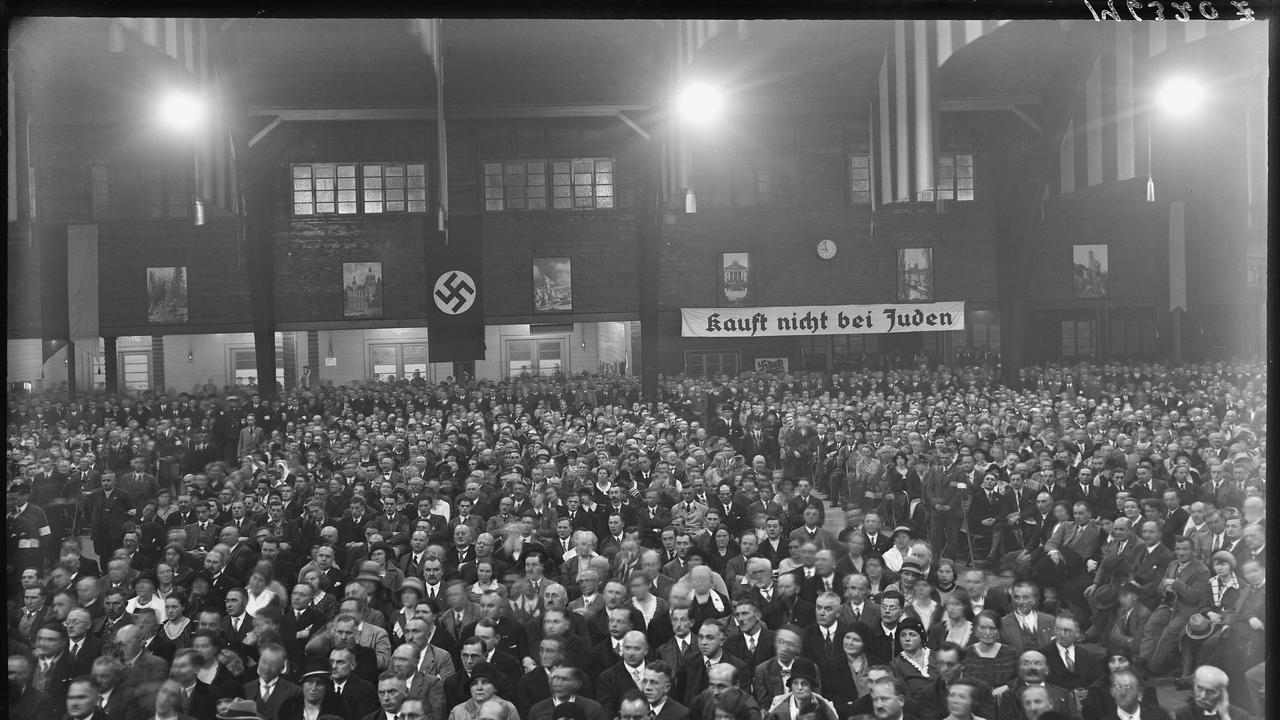
A part meeting with a sign reading "Kauft nicht bei Juden"- Don't buy from Jews.
A US Nazi Party meeting with a sign reading “Kauft nicht bei Juden”- Don’t buy from Jews.

A “mordant sentimentalism” was blamed by some for the US becoming “a sanctuary for the oppressed”, and “suicidal ethics” were leading to the extermination of the white people.

Helen Keller called it “cowardly sentimentalism” and Henry Ford, the series reveals, blamed Jews “for everything from Lincoln’s assassination to the change he thought he detected in his favourite candy bar”. He even published a hugely successful newspaper to triumphantly publish anti-Semitic harangues.

Jews were dismissed as “uncouth Asiatics” and the hogwash “science” of eugenics, the theory that humans can be improved through selective breeding of populations, was promulgated by conservationist Madison Grant’s The Passing of the Great Race. The filmmakers show how it evolved and thrived in response to America’s changing demographics.

It was a concept taken up by Hitler who also admired America’s expansion across the continent from east to west, brushing aside those who were already there. This was manifest destiny. “The immense inner strength of the US came from the ruthless but necessary act of murdering native people and herding the rest into cages,” he wrote. His dream was of territorial expansion and Germany would in time conquer the wild east of Europe he believed. “Our Mississippi,” he said, “must be the Volga”.

Jews, scapegoats for centuries, watched as anti-Semitism was normalised in the US, in and out of Washington. Burns and his colleagues closely follow the complex manoeuvrings of President Roosevelt as he coped with the anti-immigrant xenophobiaas well as a wilful, and for many, all-consuming obsession with white supremacy.

As historian Rebecca Erbelding suggests, “There is no real perception in the 1930s that America is a force for good in the world or that we should be involved in the world at all. There is no sense among the American people, among the international community, that it is anyone else’s business what is happening in your own country”.

The series unfolds with Burns’s typical elegance: the stylised organisation of personal anecdote, Coyote’s sonorous narration, erudite, subdued commentary from historians and some ageing witnesses to atrocities, an elegiac soundtrack from Johnny Gandelsman, and gracefully realised visual documentation.

Much of the German archival footage is not unfamiliar but some new sequences horrify and disturb deeply. SS soldiers parade in the streets, chanting “When Jewish blood spurts off a knife, everything will be all right”. And the midnight book burnings on May 10, 1933, are a frenzied, phantasmagoria of volumes hurled into bonfires, including the works of Jewish authors like Albert Einstein and Sigmund Freud as well as blacklisted American authors such as Ernest Hemingway and Helen Keller.

The series is an extraordinary piece of work, resonant and at times frightening. As historian Nell Irvin Painter says, “Part of this nation’s mythology is that we’re good people. We are a democracy, and in our better moments we are very good people. But that’s not all there is to the story”.

The US and the Holocaust is streaming on SBS On Demand.

Actor, director, producer and writer, Graeme Blundell has been associated with many pivotal moments in Australian theatre, film and television. He has directed over 100 plays, acted in about the same number, appeared in more than 40 films and hundreds of hours of television. He is also a prolific reporter, and is the national television critic for The Australian.

17th September 1939 – the rape of Poland (2)

On 17 September 1939, sixteen days after Germany invaded Poland from the west in an sudden and unprovoked assault [see our post 2nd September 1939 – the rape of Poland (1)], the Soviet Union invaded the country from the east in accordance with the Treaty of Non-aggression between Germany and the Union of Soviet Socialist Republics,  ,forever know as the Molotov-Ribbentrop Pact. a neutrality pact between Nazi Germany and the Soviet Union signed in Moscow on August 23, 1939, by foreign ministers Joachim von Ribbentrop and Vyacheslav Molotov, respectively.

The Red Army vastly outnumbered the Polish army and the undeclared war lasted 20 days and ended on 6 October 1939 with division and annexation of the entire country territory by Nazi Germany and the Soviet Union. Some 320,000 Polish soldiers became prisoners of war and a campaign of mass persecution in the newly-acquired territory began immediately with a wave of arrests and summary executions targeting Polish figures of authority such as military officers, police and priests. In May and June 1949 alone, some 22.000 polish officers, politicians, intellectuals and professionals were murdered in the Katyn Forest.There were other such massacres as the NKVD endeavoured to eliminate the Polish elite. Hundreds of thousands of Poles were transported from eastern Poland to Siberia and other remote parts of the Soviet Union in four major waves of deportation between 1939 and 1941. 

In November 1939 the Soviets annexed the eternity under its control and some 13.5 million Polish citizens became Soviet subjects following  sham elections. Soviet forces occupied eastern Poland until the summer of 1941, when they were expelled by the German army in the course of Operation Barbarossa, and the area was under German occupation until the Red Army reconquered it in the summer of 1944.

This was but the beginning.

Around six million Polish citizens perished during the Second World War about – one fifth of the pre-war population. Most were civilian victims of the war crimes and crimes against humanity during the occupation by Nazi Germany and the Soviet Union, and half of them were Jews.

An estimated 26 million Soviet citizens died during The Great Patriotic War that was to come, including as many as 11 million soldiers. Some seven million were killed in action and another 3.6 million perished in German POW camps.

And then there were the deportations. Some 2 million people were transported to Siberia and the Central Asian republics – ostensibly for treasonous collaboration with the invading Germans and anti-Soviet rebellion. Mere suspicion was sufficient to attract collective punishment.  The Crimean Tartars were deported en masse, whilst Volga Germans, settled in Russia for centuries, and other non-Slavic nationalities of the strategic Crimea, Black Sea coast lands and northern Caucasus were also dispatched eastwards. Whilst many were permitted to return to their homelands in the years and sometimes decades after the war, we’ll never know how many perished in exile from violence or privation.

On the other side of the ledger, the Wehrmacht suffered three-quarters of its wartime losses fighting the Red Army.  Some four million died in action and another 370,000 in the Soviet camp system. Some 600,000 soldiers of Germany allies, mostly Eastern Europeans, died also. In Stalingrad alone, the total Axis casualties (Germans, Romanians, Italians, and Hungarians) are believed to have been more than 800,000 dead, wounded, missing, or captured.

Having sowed the wind, Nazi Germany reaped the whirlwind when the tides of war changed and the Red Army retreated, recouped, stood firm and finally advanced, pushing onwards ever onwards until it reached Berlin. As the Soviets exacted revenge for the carnage and devastation wrought by the Wehrmacht, German citizens paid a heavy price. Civilian deaths, due to the flight and expulsion of Germans, Soviet atrocities and the transportation Germans for forced labour in the Soviet Union range from 500,000 to over 2 million.

These melancholy statistics are but a portion of the millions of lives lost or changed utterly by the events of September 1939.

Lest we forget …

They crossed over the border, the hour before dawn
Moving in lines through the day
Most of our planes were destroyed on the ground where they lay
Waiting for orders we held in the wood
Word from the front never came
By evening the sound of the gunfire was miles away
Ah, softly we move through the shadows, slip away through the trees
Crossing their lines in the mists in the fields on our hands and on our knees
And all that I ever was able to see
The fire in the air glowing red
Silhouetting the smoke on the breeze
Al Stewart, Roads to Moscow

Worldwide, over seventy million souls perished during World War II. We’ll never know just how many …

DEATHS BY COUNTRY  

COUNTRY MILITARY DEATHS TOTAL CIVILIAN AND MILITARY DEATHS
Albania 30,000 30,200
Australia 39,800 40,500
Austria 261,000 384,700
Belgium 12,100 86,100
Brazil 1,000 2,000
Bulgaria 22,000 25,000
Canada 45,400 45,400
China 3-4,000,000 20,000,000
Czechoslovakia 25,000 345,000
Denmark 2,100 3,200
Dutch East Indies 3-4,000,000
Estonia 51,000
Ethiopia 5,000 100,000
Finland 95,000 97,000
France 217,600 567,600
French Indochina 1-1,500,000
Germany 5,533,000 6,600,000-8,800,000
Greece 20,000-35,000 300,000-800,000
Hungary 300,000 580,000
India 87,000 1,500,000-2,500,000
Italy 301,400 457,000
Japan 2,120,000 2,600,000-3,100,000
Korea 378,000-473,000
Latvia 227,000
Lithuania 353,000
Luxembourg 2,000
Malaya 100,000
Netherlands 17,000 301,000
New Zealand 11,900 11,900
Norway 3,000 9,500
Papua New Guinea 15,000
Philippines 57,000 500,000-1,000,000
Poland 240,000 5,600,000
Rumania 300,000 833,000
Singapore 50,000
South Africa 11,900 11,900
Soviet Union 8,800,000-10,700,000 24,000,000
United Kingdom 383,600 450,700
United States 416,800 418,500
Yugoslavia 446,000 1,000,000

WORLDWIDE CASUALTIES*

Battle Deaths 15,000,000
Battle Wounded 25,000,000
Civilian Deaths 45,000,000

*Worldwide casualty estimates vary widely in several sources. The number of civilian deaths in China alone might well be more than 50,000,000.

Postscript

Former Soviet spy, former Ukrainian government minister and author Viktor Suvorov kick-started a historiographical battle royal in the early eighties when he presented controversial evidence that contrary to long-held opinion, Stalin had planned to actually attack Germany in 1941, only to be preempted by Operation Barbarossa.  Read more about it here.

See also, in In That Howling Infinite: Ghosts of the Gulag, The Death of Stalin is no laughing matter, and Thermidorian Thinking


Las Trece Rosas – Spain’s Unquiet Graves

Things fall apart; the centre cannot hold;
Mere anarchy is loosed upon the world,
The blood-dimmed tide is loosed, and everywhere
The ceremony of innocence is drowned;
The best lack all conviction, while the worst
Are full of passionate intensity.
WB Yeats, Easter 1916

On the morning of August 5th 1939 thirteen young women were put against the walls of Madrid’s La Almudena Cemetery and shot…

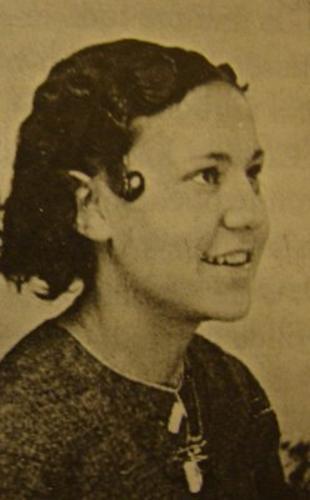
They were: Carmen Barrero Aguado (age 24), Martina Barroso García (age 22), Blanca Brissac Vázquez (age 29), Pilar Bueno Ibáñez (age 27), Julia Conesa Conesa (age 19), Adelina García Casillas (age 19), Elena Gil Olaya (age 20), Virtudes González García (age 18), Ana López Gallego (age 21), Joaquina López Laffite (age 23), Dionisia Manzanero Salas (age 20), Victoria Muñoz García (age 19), and Luisa Rodríguez de la Fuente (age 18).

They sang the “Youthful Guardsmen,” the anthem of the JSU, as they were taken from the prison they shared with other members of the organization to the cemetery.

Eighty years ago this month, the Spanish cities of Madrid and Valencia fell to the nationalist forces of Francisco Franco. Victory was proclaimed as Franco placed his sword to rest upon the altar of a church declaring that he wouldn’t raise the blade again until Spain was in peril. The Spanish Civil War that had claimed hundreds of thousands of lives (upwards of half a million, possibly up to two) was at an end; the long march of the generalissimo was over and the reign of the Caudillo had begun. It endured until his death in 1975.

The Spanish Civil War was long, brutal and bloody, and medieval in its savagery. It was a war of armies and of militias, of men and women, of skirmishes and set-piece battles, of massacres and reprisals, and of wars within wars. It saw cities besieged and starved into surrender and towns destroyed by bombers and heavy artillery. It cut a swathe across the country leaving scars that endure to this day.

It became a proxy war for three dictators – Hitler, Mussolini and Stalin – who dispatched men and machines to fight under false flags in what would appear in retrospect to be a rehearsal for wars to come. It was a magnet for idealists and activists of disparate political creeds and from many lands who were to fight and die on both sides, including the celebrated International Brigades. It lured writers and poets who were to chronicle its confusion and carnage, including Ernest Hemingway, George Orwell, WH Auden, André Malraux and Arthur Koastler. Many perished, the most famous being the Spanish poet Federico García Lorca, murdered by Nationalist militia and buried in an unmarked grave, one of many unquiet graves scattered throughout the land. 

Since Franco’s death, successive Spanish governments have endeavoured to heal the wounds of the war and the dictatorship by condoning what could be described as historical amnesia. And yet, such official forgetfulness, well-intentioned as it might be, is often suborned by our species’  instinctive need to remember and to memorialize our dearly departed.

Valle de los Caidos, the Valley of the Fallen, in the Sierra de Guadarrama mountains near Madrid, is one such monument.  This grandiose necropolis hosts a mass grave of some 34,000 war dead of all sides, as well as the tombs of an embalmed Franco and of José Antonio Primo de Rivera, the founder of the fascist Falange Española. It is a shrine and a place of pilgrimage for nationalists and  Falangists old and young, and a bitter reminder for the families and friends of the vanquished.

The current socialist government has shattered the deafening silence. it is determined to move Franco’s remains out the basilica and to make the Valley of the Fallen a more neutral place to honour the victims of the war and its vengeful aftermath.

The mass graves of Spain’s civil war victims is a live issue as the nation comes to terms with its history. Even the weather compels the soil to give up its dead, revealing the scale and the savagery of the slaughter that followed the victory of Franco’s Nationalists. Recent storms have swept away soil in an area of Madrid’s La Almudena public cemetery, exposing the bones of three thousand people executed on the orders of Francoist military courts in the five years after Spain’s civil war ended in 1939. They include, it is believed, the remains of Las Treces Rosas, the Thirteen Roses

Outside the history books and the stories, songs and folk memories of ageing socialists and anarchists, there is but limited interest, knowledge and understanding of the causes, chronology and  consequences of the civil war – and I am not about to rectify that in this post. Click here to and here to read reasonable synopses.

Rather, I will take the opportunity to publish a story about the war – one tragedy among so many – that illustrates its systematic ruthlessness. Here is the story of those thirteen young victims. 


Thirteen roses ..and forty three carnations

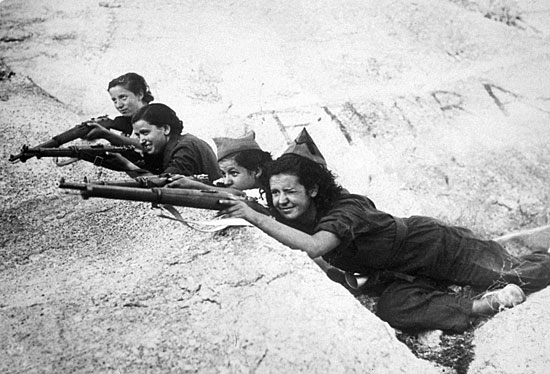
MILICIANAS-2

On the morning of August 5th 1939 thirteen women were shot dead against the walls of Madrid’s La Almudena Cemetery.

Nine were minors, because at that time the age of majority was not reached until twenty-one. Ranging in age from 18 to 29, all had been brought from the Sales women’s prison, a prison that was designed for 450 people and in 1939 contained 4,000. Apart from Brisac Blanca Vazquez, all belonged to the Unified Socialist Youth (JSU) or PCE (Communist Party of Spain). Although they had not participated in the attack that killed Isaac Gabaldon, commander of the Civil Guard, they were charged with being involved and conspiring against the “social and legal order of the new Spain”.

The trial was held on August 3rd and 56 death sentences were issued, including the perpetrators of the attack. The Thirteen Roses went to their execution hoping to be reunited with their JSU comrades. In some cases it would have meant a boyfriend or husband but their hopes crumbled upon learning that the men had been shot already.

conesa

The brick wall clearly showed the bullet holes and the earth had been turned dark by blood. Some days, the death toll exceeded two hundred and machine guns were used to facilitate the work. Between 1939 and 1945, four thousand people were shot in the Eastern Cemetery, including Julián Zugazagoitia, Minister of the Interior with Juan Negrín and remarkable writer and socialist politician.

According to Maria Teresa Igual, prison officer and eyewitness, the Thirteen Roses died with fortitude. There were no screams or pleas. In an eerie half-silence, only the steps of the firing squad were heard, the sound of the guns striking the straps and the voice of the commanding officer. Lined up shoulder to shoulder, after the shooting all received the coup de grace, which was clearly heard in the Sales women’s prison. Apparently, one of the condemned (whether Anita or Blanca is not known), did not die immediately and had shouted, “Am I not to be killed?”

Antonia Torre Yela was spared execution by a typing error. In transcribing her name, the letters danced and became Antonio Torres Yera. The error only postponed death for Antonia, a member of the JSU and only 18. She was shot on February 19th, 1940, becoming the 14th Rose. In her farewell letter, Julia Conesa, nineteen and member of the JSU, wrote: “Let my name not be erased from history.” Her name and that of her comrades has not been forgotten, unlike those of their tormentors, who enjoyed impunity for 38 years of dictatorship and a shameful amnesty which only helped to deepen the hurt suffered by all victims of Francoism.

The PSOE (main social-democratic party — DB) tried to appropriate the Thirteen Roses, concealing that at the time of the executions the PSOE had split from the JSU to found the Socialist Youth of Spain (JSE), with the purpose of clearly distancing themselves from the Communist Party of Spain (PCE). In fact, the Law of Historical Memory of Zapatero’s government (the first PSOE government after Franco — DB) did not even consider overturning the dictatorship’s judicial verdicts. It should be remembered that nearly fifty men were also shot dead that sad August 5th, the “43 Carnations”. Franco showed the same ruthlessness to men and women.

A hell

Sales jail was a hell, with children, elderly and mothers with children huddled in hallways, stairs, patios and bathrooms. Manuela and Teresa Basanta Guerra were the first women executed against the walls of the Eastern Cemetery. They shot them on June 29th 1939 along with a hundred men. Some historians claim that other women preceded them but their names were not recorded in the cemetery’s files. Like others on death row, the Thirteen Roses could only write to their families after receiving confession. If they did not take confession, they gave up the opportunity to say goodbye to their loved ones.

Brisac Blanca was the eldest of the thirteen and active in no political organization. Catholic and one who voted for the Right, she nevertheless fell in love with a musician who belonged to the PCE, Enrique Garcia Mazas. They married and had a son. Both were arrested and sentenced to death in the same trial. In fact, Enrique was in Porlier prison and would be shot a few hours before her. Blanca wrote a letter to her son Enrique, asking him not to harbour ill-will towards those responsible for her death and to become a good and hardworking man.

MILICIANAS-3

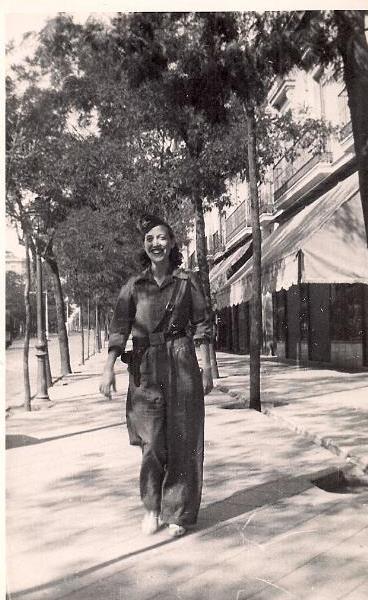
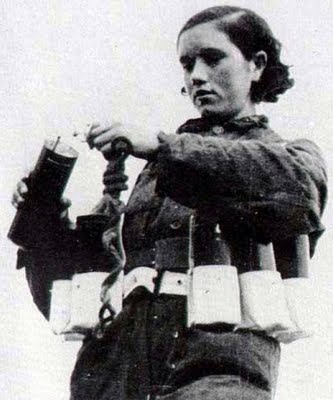
In postwar Madrid there was vicious persecution and resentment of any citizen suspected of “joining the rebellion”, the technicality that was used to reverse the law, accusing supporters of the Second Republic of violating the law in force. Only the military, the clergy, the Falange and the Carlists could breathe easily. No one dared to walk around in workers’ overalls or wearing the traditional local bandanna (worn by men around the neck and by women as a kerchief around the head, it is still worn today at festival in Madrid — DB).

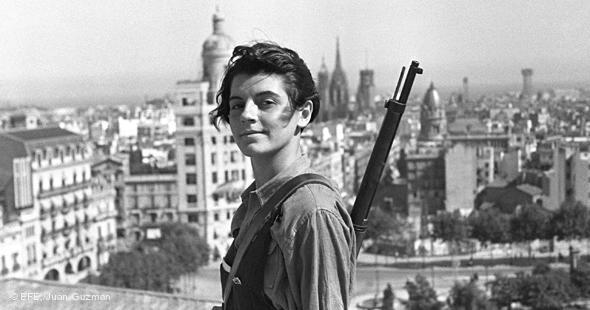
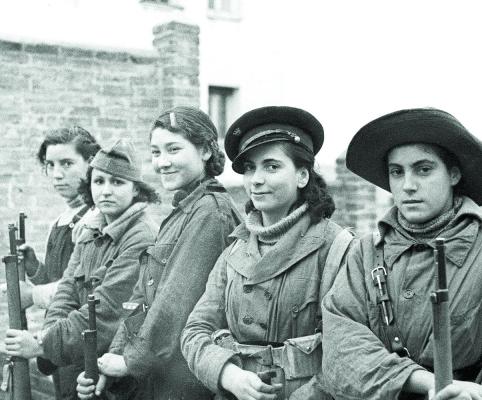
The city was a huge prison where “hunt the red” was taking place. The earlier militia-women aroused particular animosity. The Arriba newspaper edition of May 16th 1939, featured an article by José Vicente Puente in which his contempt does not mince words: “One of the greatest tortures of the hot and drunk Madrid were the militia-women parading openly in overalls, lank-haired, with sour voice and rifle ready to shoot down and end lives upon a whim to satiate her sadism. With their shameless gestures, the primitive and wild, dirty and dishevelled militiawomen had something of atavism, mental and educational. … …. They were ugly, low, knock-kneed, lacking the great treasure of an inner life, without the shelter of religion, within them femininity was all at once extinguished.”

In this climate of hatred and revenge, denunciations proliferated — they were the best means of demonstrating loyalty to the fascist Movement.

The interrogations …. copied Gestapo tortures

The interrogations in police stations copied Gestapo tortures: electric shock on the eyes and genitals, the “bathtub”, removing fingernails with pliers, mock executions. Women suffered especially because the torture was compounded by sexual abuse, castor oil and hair cut down to the scalp. In some cases they even shaved eyebrows to further depersonalize. Rapes were commonplace. The testimony of Antonia Garcia, sixteen, “Antoñita” is particularly chilling: “They wanted to put electric currents on my nipples but since I had no chest they just put them in my ears and burst my eardrums. I knew no more. When I came to I was in jail. I spent a month in madness”.

Among those responsible for the interrogations was General Gutierrez Mellado, hero of the Transition and Captain in the Information Service of the Military Police (CPIS ) during the toughest years following the war. He regularly attended executions, seeking last-minute confessions. On August 6th 1939 he pulled Cavada Sinesio Guisado, nicknamed “Pioneer”, military chief of the JSU after the war, out of the execution line. “Pioneer” had been lined up against the Eastern Cemetery wall and was awaiting the discharge of lead along with the rest of his comrades. Gutiérrez Mellado stepped forward and ordered his release. He forced him to witness the executions and asked for more information about PCE clandestine activity. Although he was cooperative and diligent, he was shot in the end on September 15th. Some claim that Gutierrez Mellado witnessed the execution of the Thirteen Roses but I was not able to verify the data.

MILICIANAS-4

The women’s prison in Sales was run by Carmen Castro. Her inflexibility and lack of humanity found expression in the conditions of life of the children in prison with their mothers. No soap or hygienic facilities — almost all had ringworm, lice and scabies. Many died and were placed in a room where the rats were trying to devour the remains. Adelaida Abarca, JSU activist, said the bodies were only skin and bones, almost skeletons, for hunger had consumed them slowly. Another prisoner said: “The situation of the children was maddening. They were also dying and dying with dreadful suffering. Their glances, their sunken eyes, their continuous moans and stench are branded on my memory.” (Testimony given to Giuliana Di Febo in Resistance and the Women’s Movement in Spain [1936-1976] , Barcelona 1979).

The prisoners lived within the shadow of the “pit”, the death penalty. Since the execution of the Basanta Guerra sisters, they knew that the regime would have no mercy on women. On the morning when the Thirteen Roses were shot, Virtudes Gonzalez ‘s mother was at the jail doorway. When she saw her daughter climbing into the truck that was carrying prisoners to the cemetery walls, she began shouting: “Bastards ! Murderers ! Leave my daughter alone!” She chased the truck and fell. Alerted by the commotion, the Sales jail officers went outside and picked her off the ground, taking her into the prison. She was kept inside as yet another prisoner.

“If I had been sixteen they would have shot me too”

No less dramatic were Enrique’s repeated attempts to find out the whereabouts of his parents, Blanca and Enrique Garcia Brisac Mazas. In an interview with journalist Carlos Fonseca , author of the historical essay Thirteen Red Roses ( Madrid, 2005 ), Enrique gave his bitter account: “I was eleven years old when they shot my parents and my relatives tried to conceal it. They said they had been transferred to another prison and therefore we could not go to see them, until one day I decided to go to Salesas and there a Civil Guard Brigadier told me they had been shot and that if I had been sixteen they would have shot me too, because weeds had to be pulled up by the roots.

My grandmother and my aunts, my mother’s sisters, who had fallen out with my mother, ended up telling me that if Franco had killed my parents it would be because they were criminals. They even concealed my mother’s farewell letter for nearly twenty years.”

MILICIANAS-6

I will not end this article by invoking reconciliation, because the Transition was not based on repairing the pain of the victims, but rather on the acquittal of the executioners. In fact, the reform of the criminal dictatorship was designed by those as low as Manuel Fraga, Rodolfo Martín Villa and José María de Areilza. Martín Villa concealed and destroyed documents to bury the crimes of Francoism and the dirty war he organized against anarchist and pro-independence activists of the Basque, Catalan and Canaries areas, from his post as Minister of the Interior between 1976 and 1979. Among his achievements one should list the Scala case (an attack that killed four workers, which was blamed on the CNT), the attempted assassination of Canaries independence leader Antonio Cubillo, the machine-gunning of Juan Jose Etxabe, historic leader of ETA and his wife Rosario Arregui (who died from eleven bullet wounds), also the murder of José Miguel Beñaran Ordeñana, “Argala”.

The impunity of the perpetrators

He is now a successful businessman, who gets excited talking about his role in the Transition. He lives quietly and no one has called for his prosecution. His example is an eloquent one of the impunity of the perpetrators, who continue to write the narrative while demonizing those who dared to stand against the miseries of the dictatorship and false democratic normalization.

No justice has been done. So it is absurd to talk of reconciliation, because nobody has apologized and repaired the damage. Franco committed genocide but today Manuel Gonzalez Capón, Mayor of Baralla (Lugo), of the Partido Popular (the main right-wing party), dares to declare that “those who were sentenced to death by Franco deserved it.” The Biographical Dictionary of the Royal Academy of History, funded with nearly seven billion euros of public funds, says Franco “set up an authoritarian but not totalitarian regime”, although in his speech in Vitoria/ Gastheiz, Franco himself said that “a totalitarian state in Spain harmonises the functioning of all abilities and energies of the country …”. The current scenario is not a reconciliation but instead is a humiliation of the victims and society, obscenely manipulated by a media (ABC, El País , El Mundo, La Razón), playing a similar role to newspapers of the dictatorship (ABC, Arriba, Ya, Pueblo, Informaciones, El Alcázar), covering up and justifying torture cases and applauding antisocial measures that continue reducing working class rights.

Let us not remember the Thirteen Roses as passive and submissive but instead for their courage and determination. With the exception of Blanca, trapped by circumstances, all chose to fight for the socialist revolution and the liberation of women. I think that if they were able to speak out today, they would not talk of indignation and peaceful disobedience, but would ask for a rifle to stand in the vanguard of a new anti-fascist front, able to stop the crimes of neo-liberalism. Let us not betray their example, forgetting their revolutionary status, they who sacrificed their lives for another world, one less unjust and unequal.

rosario-dinamitera

Postscript

Just as the Civil War stirs Spain’s historical memory, so the spectre of the Paris Commune of 1870 haunts still the French soul. One can walk through the centre of  modern Paris from the Louvre to the celebrated Père Lachaise cemetary Père Lachaise retracing the steps of defeated communardes as retreated to to last stand among the tombstones. It was there, in front of la Mur des Fédérés that the bloodied and ragged survivors were lined up and shot.

The beautiful church of Sacre Coeur was built as a penance for, and a solemn reminder of the bloodletting of what is aptly called la semaine sanglante – in much the same way as Justinian raised the glorious Hagia Sophia in Constantinople as a form of contrition after the Nika Riots when his soldiers slaughtered tens of thousands of his rebellious citizens and buried their bodies under the Hippodrome.

See also in In That Howling Infinite:

The Spanish Civil War – a brief overview

80 years ago today in 1939, as the world waited with bated breath  on Hitler’s next move in Central Europe, in Spain, with the help of allies within the city, Madrid fell to the Nationalist forces of Generalissimo Francisco Franco. The next day, beleaguered Valencia would also fall and a few days after that victory was proclaimed as Franco placed his sword to rest upon the altar of a church declaring not to raise the blade again until Spain was imperiled. The Spanish Civil War that had claimed hundreds of thousands of lives was thus at an end, and the reign of the Caudillo had begun in earnest that was to last until his death in 1975.

Born in 1892 in Galicia, Franco belonged to a devoutly Catholic upper class family with a long tradition of serving in the Spanish navy. Unable to follow in the footsteps of his forefathers, Franco had chosen the army instead at the age of 14 and conducted himself with disciplined excellence from the outset, swiftly gaining a reputation as a highly professional and trusted leader of fighting men at a time when the Royal Spanish army was characterized by a general sloppiness and lack of discipline. A severe and austere man who placed his faith in tradition, Catholicism, and the monarchy, Franco had risen up through the ranks as the youngest officer in the army in Spain’s colonial wars in Morocco as an example to them all. When the Spanish monarchy was abolished in 1931 Franco was disgusted, not least because shortly afterwards the new republic laid him off and placed him on the inactive list. Franco accepted his fate like a soldier and patiently waited until a conservative government came to power and he was called back to service, jumping back into military life with alacrity as Spain’s political system steadily disintegrated. By 1936 however he could stand by no longer and watch his country fall apart, after much hesitation he joined with his fellow officers and rebelled against the Republic, marching an army into Spain from North Africa and starting the long and bloody struggle against the Republicans supported by the USSR and the International Brigades whilst Franco received aid from Fascist Italy and Nazi Germany. With the death of all the other major military leaders by late 1936, Franco was chosen as the man to lead the Nationalists to victory and as the war drew to a close his government was recognised by the British and French governments.

Despite popular depictions of him as a Fascist dictator akin to Hitler and Mussolini, Franco in truth had little time for Fascism. While he certainly presided over a one-party state, unlike in Italy and Germany, the party firstly was not on a par with the state and secondly only a component of it, the Phalange, were Fascists, the rest were Carlist monarchists, traditionalists and conservatives. As a committed Catholic and monarchist, Franco had no time for the esotericism and mysticism of National Socialism and Fascism. While Hitler and Mussolini both had experience of war along with much of their inner circle, they were not of the upper officer echelons as Franco was. He was a military dictator, not a messianic god-like figure of a mass movement. The characterization of his regime as totalitarian is also problematic too since totalitarian would imply that he ruled through terror, annihilating segments of the population beyond those who were openly opposed to his regime. Tens of thousands did indeed perish under his regime with summary executions in the White Terror that followed his Civil War victory coupled with the brutal campaigns against sporadic rebellions and expressions of dissent in subsequent years, however he did not go beyond crushing those he did not need to to stay in power, he did not seek out a helpless ‘objective enemy’ that was to be continuously exterminated as was the case in Nazi Germany and Stalinist Russia. His interest was not a radical reshaping of the world but as might be expected of a man of his background and career, order, stability, and a restoration of traditional norms. 

That all being said he was undoubtedly predisposed towards the Axis powers due to his hatred of Communism and no doubt a certain degree of debt he owed to them after their help in the Civil War. Despite his country having gone through three hellish years of war he was more than eager to join the Axis after the Fall of France in 1940. He envisioned the formation of a Latin Bloc to dominate the Mediterranean consisting of Spain, Italy, the Vatican, Vichy France, and Portugal. That year he met Hitler in Hendaye to discuss this possibility. At this meeting between the Caudillo and the Führer, Franco laid down his conditions: he wanted food, fuel and supplies for his country in the event of an Allied naval blockade, in expectation of Britain’s defeat he wanted Gibraltar along with French Morocco, a portion of Algeria and the colony of Cameroon. This proved too high a price to pay, the demand on Cameroon was especially jarring to Hitler since this had been a German colony prior to 1919. Mussolini moreover had his eye on Algeria. In the end the three dictators could not reconcile themselves to one another and Spain remained neutral though volunteers were sent to aid the Axis against the USSR in the form of the Blue Division. Franco likewise refused any prospect of the Wehrmacht being allowed to march through Spain to take Gibraltar themselves, a move which had it been made could have crippled the British position in the Mediterranean and altered the course of the war completely. Spain remained independent, remaining friendly with the Axis but not so much as to be roped into their ungodly self-destruction. During the war he was credited by having given sanctuary to tens of thousands of Jews fleeing the Nazi Empire.

Spain found itself isolated in the immediate aftermath of the war and was excluded from the Marshall Plan. With the mounting tensions of the Cold War however the Western powers slowly started to align themselves with the conservative anti-communist military dictator. In 1953 President Eisenhower visited the country and concluded the Pact of Madrid which brought Spain out of isolation and eventually led to the country joining NATO. Many of the old guard in charge of the economy were replaced by technocrats who brought in a free market economy. By the 1960s economic growth rocketed upwards, resulting in the Spanish Miracle, giving rise to a new middle class. The colonial empire moreover which Franco had so passionately fought for in the past was steadily let go of with both Morocco and Equatorial Guinea let go of by the end of the 1960s. Behind this economic prosperity however the regime remained as traditional as ever, with strict Catholic morality on abortion, divorce, homosexuality and prostitution holding sway in both law and society. Women were confined to the home and had practically no rights, their financial affairs managed by their fathers and husbands. Any languages or traditions not considered Spanish enough were systemically suppressed. When university students protested in the 1960s and the 1970s against the regime, Franco resorted to his old ways and crushed them. 

The Caudillo was an old man now though and by the early 1970s he recognised that death was moving upon him. Before death could claim him he decided to restore the monarchy – even though the country had always officially been a monarchy since he had taken power. Though he initially offered the throne to Otto von Habsburg, the last Crown Prince of Austria-Hungary, in a bid to restore Spain to her Habsburg Golden Age and to avoid another Carlist War of succession. In the end however he gave it to the Carlist pretender, Juan Carlos of the House of Bourbon. Franco died in late 1975. His regime was swiftly converted to a democracy with the help of the new king.l