Land of the fearful – home of the heavily armed

Vladimir Lenin once remarked that “there are decades where nothing happens and there are weeks when decades happen”. As the leader of the Russian revolution, he was a bit of an expert on sudden upheavals following long stasis. We are living through such weeks now.  The worldwide reaction to the death of George Floyd under the knee of a Minneapolis police officer has all the hallmarks of one of those momentous weeks.

Predicatively, such outbursts of outage, where peaceful protests are often accompanied by mayhem and wanton destruction, are a magnet for opportunists of all persuasions. It’s a revolutionist’s dream. Lenin called moments like this a “revolutionary situation”. Most self-respecting Bolsheviks and Nazis never let such volatile circumstances go to waste. One mob’s crisis was always some other mob’s opportunity – I’m talking in the Aussie vernacular here, by the way, a ‘mob’ is a bunch of folks, or livestock, sheep or roos, mainly – and not necessarily a Pythonesque “wabble of wowdy webels ”  – although the featured photograph would suggest this this might indeed be so. The smiling chappie with the brolly looks like he was doing a Hong Kong “umbrella revolution”. Maybe He was just an accidental tourist caught in the camera’s gaze. But his nonchalance belies the seriousness of America’s turmoil.

David Kilcullen, Australian author, strategist and counterinsurgency expert refers to these agents provocateurs as ‘accelerationists’. In the following article, He writes of how the rise of militias and armed protesters across the US is sometimes seen as a fringe right-wing issue, but argues that it is much broader. Armed groups have formed across the political spectrum, reflecting divisions in American society that the coronavirus and it’s social and economic impacts have exacerbated. There are, he says, “already hundreds militias of varying political complexions across the country. Donald Trump is as much a symptom as a cause of America’s toxic polarization. Thus, far from being a purely right-wing phenomenon, rifts within US society that are most stressed by the coronavirus — urban versus rural interests, racial and class tensions, state overreach versus anti-government militancy, far left against alt-right, “collectivist” coastal elites versus rugged individualists in “flyover country” – align with pre-existing grievances. And heavily armed ­actors across the spectrum are poised to exploit them’.

Kilcullen writes: “One reason for the overemphasis on right-wing extremism  is that analysts often characterized armed actors as “hate groups”. It is absolutely true that the intense hatred from right-wing extremists dwarfs most other groups. But the focus on hate is a misunderstanding of what drives violence in internal conflicts … the worst atrocities are driven not by hate but by fear. Fear of other groups, encroachment of those groups into one’s territory and collapse of confidence in government’s ability to impartially keep the peace are the key factors that provoke communal violence. Hate follows and rationalizes fear, not the other way around. And fear of the coronavirus, alongside the demonstrable inability of government to keep people safe, is driving today’s growth in armed militancy”.

Commentators on the left and right have for a long time now been discussing the the prospects of a second American civil war; and its has been particularly talked up during the reign of the incendiarist in chief. in the White House. but Kilcullen begs to differs, suggesting a less dystopian but nonetheless disturbing outcome:

“In ‘contested areas’ – where the territories of left and right-wing militants overlap – we can expect violence irrespective of the outcome. Whether it spreads will depend on level-headed political leadership – and today’s hyper-partisan coronavirus debate offers little hope of that. If violence does spread, it will not be a re-run of the American Civil War. Rather, given the multiplicity of groups involved, their geographical overlap and loose structure, we can expect something much more diffuse”.

In the land of the fearful, the home of the heavily armed, matters can very easily spiral out of control get out of hand. Conflict resolution expert and mediator Lawrence Susskind encapsulated it thus: when two sides are locked into an apparently intractable conflict, “you must engage the constructive middle. When you lose the constructive middle, extremists on all sides are empowered” (from 51 Days at Waco, Paul Hemphill September 2003 – see below ). When the going gets tough, the mild get going. As the indestructible but fictitious Agent Jack Bauer, said between 11 and 11.14 am in the turn of the millennium series 24:

If you bring in the CTU (Counter terrorism Unit), they could screw up and there’d be another Waco”.

See also, Salon’s piece on the subject of America’s militias,  Soldiers of the Boogaloo -the far rights plans for a new civil war and the Washington Post’s  What is antifa and Why does Donald Trump want to blame if for the violence in the US?

For other posts on world politics in In That Howling Infinite, including several articles by David Kilcullen, see: Political World – thoughts and themes. 

Home of the hateful, fearful and heavily armed

David Kilcullen, The Australian, 30th May 2020

The rise of militias and armed protesters across the US is sometimes seen as a fringe right-wing issue, but it is much broader. Armed groups have formed across the political spectrum, worsening divisions the coronavirus has exposed in American society.

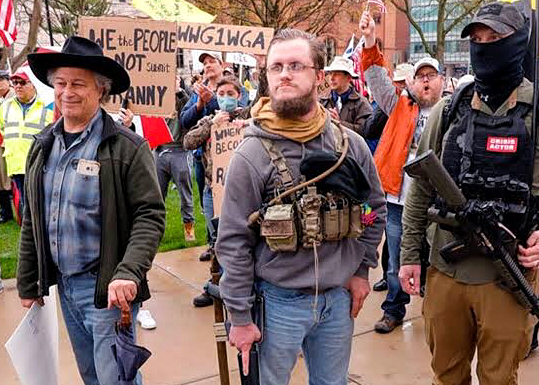
Protesters, some heavily armed, are out in force to demand reopening of the economy. The husband of one leader posted a Facebook video this week expressing his readiness to take up arms against the government to prevent a “new world order” being imposed through lockdowns.

Protesters in Lansing, Michigan, during a rally earlier this month organised by Michigan United for Liberty to condemn coronavirus pandemic stay-at-home orders. Picture: AFP
Protesters in Lansing  during a rally earlier this month organised by
Michigan United for Liberty to condemn coronavirus pandemic stay-at-home orders. AFP

As I write, there are 1.7 million coronavirus cases in the US and more than 100,000 deaths. The little county where I live — only a half-million people, in a part-urban, part-wilderness area of the Rocky Mountains — has a death toll higher than Australia and New Zealand combined. And this is one of the safe places, positively benign compared with hot spots such as New York or New Jersey with deaths in the tens of thousands.

Second to its health impact, the economic crisis wrought by ­government-imposed lockdowns has grabbed the most attention: 40 million Americans were forced on to the dole in the past 10 weeks. The job market, strong until mid-March, has fallen off a cliff. A flood of bankruptcies is sweeping US business; analysts expect a wave of municipal bankruptcies as tax ­revenue collapses. Congress has committed $US2 trillion ($3 trillion) in crisis spending, even as public debt nears $US30 trillion, or roughly 120 per cent of gross domestic product. If the first wave of the coronavirus tsunami was its health effect, the second — economic devastation — may be worse. But there is a third wave coming: the possibility of armed conflict towards the end of this year, when the combined health and economic impacts of the crisis will peak amid the most violently contested presidential election in memory.

READ MORE :President vows to send in army|Trump faces a dangerous test|Race riots spread after death of unarmed black man|Why the US is in serious trouble

There were already many militias of varying political complexions across America — one pro-militia website lists 361 groups across all 50 states. Membership surged after the 2008 financial crisis, then accelerated as thugs from both political extremes fought each other with baseball bats, ­bicycle chains and pepper spray in the streets of Washington, DC, Seattle, Portland and Detroit. The deadly “Unite the Right” rally in the normally sleepy university town of Charlottesville, Virginia, in August 2017 brought the danger home to many Americans, but the trend was longstanding.

Rioting among groups such as Antifa (on the anarchist left), Patriot Prayer and the Proud Boys (on the alt-right) and mass demonstrations by issue-motivated groups such as Black Lives Matter, ­Extinction Rebellion and the Women’s March kicked into high gear after Donald Trump’s election.

Far-left militias such as Redneck Revolt and the John Brown Gun Club emerged, copying the methods and military-style weapons of right-wing militias while opposing their politics. Both far-right and far-left armed groups were at Charlottesville, with ­cadres of gun-carrying militants guarding protesters on both sides and a third-party “constitutionalist” militia, the Oath Keepers — composed mainly of military and law-enforcement veterans — standing by as self-appointed umpires.

In the west, a separate rural militia movement had already coalesced around “sovereign citizen” groups that rejected federal authority. Despite media portrayals of its leaders as racially motivated, in fact the sovereign citizen ideology is neither left nor right in a traditional sense — it might better be described as a form of militant libertarianism with roots in the self-reliant cowboy culture of the old west. In April 2014, a dispute over grazing rights in Nevada triggered an armed stand-off between militia and federal agencies including the Bureau of Land Management and the FBI. This dispute — over federal attempts to impound the cattle of a rancher named Cliven Bundy — brought hundreds of militia members from across the country to Nevada where they surrounded federal agents, trained weapons on them and forced them to back down.

The 2014 stand-off ended in a bloodless militia victory, but almost two years later Bundy’s son Ammon led an armed occupation of the headquarters of a federal wildlife refuge in southeastern Oregon. This time, things went the other way. The occupation prompted a six-week siege by federal and state agencies in January-February 2016. It resulted in the death of LaVoy Finicum, a charismatic Arizona rancher whose killing, captured on government aerial-camera footage that appears to show him with hands raised in surrender before being shot, made him a martyr.

Though Trump is as much a symptom as a cause of America’s toxic polarisation, the passions he inspires among friend and foe alike have exacerbated it: during the 2016 election campaign, ­Arizona militias mounted armed patrols to support his border wall. In response, Redneck Revolt held a heavily armed show of force in Phoenix, Arizona, later posting a YouTube video showing members shooting semiautomatic rifles at targets displaying alt-right symbols. A few months later, Antifa convened an “anti-colonial anti-fascist community defence gathering” near Flagstaff, Arizona, that included weapons training and coaching in anti-police tactics. Today, far-left and far-right groups operate within close striking distance of each other in several border states and in “contested zones” including the Pacific Northwest, parts of Michigan, Pennsylvania, Virginia and the Carolinas.

A Youtube still of Neo-Nazi group Atomwaffen Division training outside Seattle.

A Youtube still of Neo-Nazi group Atomwaffen Division training outside Seattle.

The pandemic — and the grievances inspired by heavy-handed responses to it — have brought these tensions to a head. Camouflage-clad militia sporting semiautomatic rifles and body ­armour and riding in military-­surplus trucks joined an armed protest against the governor of Pennsylvania in April. Similar protests took place in Ohio and North Dakota. A week later demonstrators, some carrying AK-47 rifles, swarmed into the state ­capital in Lansing, Michigan, to confront politicians.

A racial edge also emerged: a week after the Lansing incident a group of African-Americans, armed with AR-15 rifles and automatic pistols, mounted a show of force outside the Michigan State Capitol building to support a black member of the legislature. Class inequities, which track closely with racial disparities here, have prompted socialist groups — notably Antifa but also traditionally nonviolent Trotskyist and anarchist networks — to arm themselves for an incipient revolutionary moment.

In Minneapolis, the killing by white police officers of an unarmed black man, George Floyd, brought thousands of protesters on to the streets for several nights of rioting, with multiple buildings and cars burned and shopping malls and restaurants looted. By Thursday, militarised police were on the streets firing tear gas and rubber bullets against vociferous opposition. At least one person has been killed in the riots and the Minnesota National Guard is expected to join the police in attempting to restore order.

Thus, far from being a purely right-wing phenomenon, rifts within US society that are most stressed by the coronavirus — urban versus rural interests, racial and class tensions, state overreach versus anti-government militancy, far left against alt-right, “collectivist” coastal elites versus rugged individualists in “flyover country” — align with pre-existing grievances. And heavily armed ­actors across the spectrum are poised to exploit them.

One reason for the overemphasis on right-wing extremism, I believe, is that analysts often mis­characterise armed actors as “hate groups”. It is absolutely true that the intense hatred from right-wing extremists dwarfs most other groups. But the focus on hate is a misunderstanding of what drives violence in internal conflicts.

As Stathis Kalyvas demonstrated a decade ago in The Logic of Violence in Civil War, the worst atrocities are driven not by hate but by fear. Fear of other groups, encroachment of those groups into one’s territory and collapse of confidence in government’s ability to impartially keep the peace are the key factors that provoke communal violence. Hate follows and rationalises fear, not the other way around. And fear of the coronavirus, alongside the demonstrable inability of government to keep people safe, is driving today’s growth in armed militancy.

Like Iraq, like Somalia

To me, current conditions feel disturbingly similar to things I have seen in Iraq, Lebanon, Libya, Somalia and Colombia. Indeed, the theory of guerrilla and unconventional warfare fits today’s situation all too well.

If we visualise an armed movement as a pyramid, then the thousands of protesters on the street (and the tens of thousands who support and sympathise with them but stay home) represent the mass base. A smaller group of organisers and support networks (physical and virtual) plays an auxiliary role further up the pyramid. The armed, gun-toting element is smaller still, but higher in skill, weaponry, organisation and motivation. It’s worth remembering that almost three million Americans served in Iraq and Afghanistan, coming home familiar with urban and rural guerrilla warfare to a country where 41 per cent of people own a gun or live with someone who does.
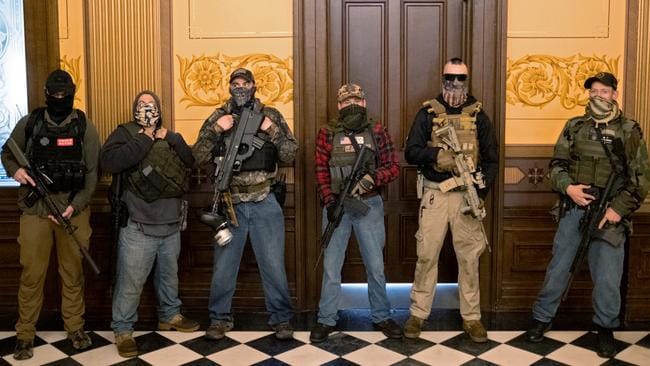
A militia group with no political affiliation from Michigan stands in front of the Governor’s office after protesters occupied the state capitol building on April 30.
A militia group with no political affiliation from Michigan stands in front of the
Governor’s office after protesters occupied the state capitol building on April 30.

The US has no national firearms register, so only estimates are possible, but analysts believe around 100 million firearms are in private hands in the US, and hundreds of billions of rounds of ammunition. Given widespread com­bat experience from the war on terror, this reservoir of military potential sets the US apart from any other Western democracy.

The pandemic has seen a surge in gun purchases, with background checks spiking to their highest number. Many of these are first-time buyers from the ­pro­gressive end of politics, who traditionally shun firearms and have little knowledge of weapon safety.

Racial war, class war

More worrying, on left and right, are underground groups including so-called “accelerationists”. These tend to be small, secretive and far more violent than the militias or mass movements. They follow a decentralised command-and-­control philosophy known as “leaderless resistance” that was pioneered by far-right groups in the 1980s but has since been taken up by terrorists across the political spectrum, including jihadists. Their goal is to accelerate the collapse of a social order they see as doomed, by bringing on a racial war, a class war or both.

Underground networks operate using a clandestine cell structure, and communicate via the deep web and tools such as Telegram or RocketChat, secure-messaging apps that have become havens for extremists as more open channels, including chat rooms such as the neo-Nazi forum Iron March, have been shut down.

Language policing on social media has not only pushed accelerationist groups underground; it has created a whole new language.

The term “Boogaloo” is widely used for the coming civil war. Variants — coined to avoid Twitter censors — include “The Big Igloo” or “The Big Luau”, the last explaining why Hawaiian shirts are popular among militias. Memes from television (“Winter is Coming”, “Cowabunga”) are popular, as are meme-based references such as “Spicy Time” or acronyms such as BAMN (“by any means necessary”) and BFYTW (“because f..k you, that’s why”). Some call the urban guerrilla aspect of the Boogaloo “Minecrafting”: Twitter threads seeming to discuss the game may actually refer to the coming conflict — context is everything. Some discussion hides in plain sight on social media: more open, practical and gruesome conversations are left to the deep web, Telegram or neo-Nazi sites such as Daily Stormer, which ­resides on the orphaned former Soviet “.su” internet domain as a way to avoid censorship. Doctoral dissertations could be written on the kaleidoscope of visual symbols used by groups, left and right, to signal allegiances.

Accelerationism has a long history on the Marxist left and among environmental activists such as Earth Liberation Front or Earth First! It has since been embraced by right-wing extremists including 2019 Christchurch killer Brenton Tarrant, whose manifesto included environmentalist ideology and was celebrated by neo-Nazi ecoterrorist group Green Brigade.

Other right-wing accelerationist groups include Atomwaffen ­Division (which has a presence in Australia) and The Base, a white-supremacist group founded in mid-2018 whose name is a play on al-Qa’ida (“the base” in Arabic). FBI agents targeted The Base after its members allegedly sought to ­attack a massive pro-gun rally outside the Virginia State Capitol building in Richmond in January. In a classic accelerationist move, they planned to infiltrate the rally, start shooting both protesters and law enforcement officers, provoke a massacre and thereby convert a peaceful ­(albeit armed) demonstration into a militant uprising.

A heavily-armed young man poses for a photo with his assault rifle during the protest at the State Capitol in Salem, Oregon on May 2.
A heavily-armed young man poses for a photo with his assault rifle
during the protest at the State Capitol in Salem, Oregon on May 2.

The group’s leader, until recently known by his nom de guerre “Norman Spear”, was unmasked in January as Rinaldo Nazzaro, a New Jersey native based in St Peters­burg, Russia, from where he directed cells in Maryland, Delaware and New Jersey. There is no public evidence of any relationship between Nazzaro and Russian intelligence, though his presence in Russia triggered speculation in the media and within The Base itself. But this highlights another risk factor for 2020: the possibility of foreign interference astride the upcoming presidential election.

A new cold war

The US and China are fast descending into a new cold war, as recriminations over the pandemic heighten conflicts that were already acute. Each is seeking to improve its military position against the other: the Chinese navy has ramped up activity in the South China Sea, for example, while US forces mounted more incursions into the area in the past three months than in all of last year. China’s history of sponsoring agents of influence in the US and other Western countries (including Australia) and its track record of cyber-espionage and technology theft make it a reasonable assumption that some (with or without official backing) may be considering ways to exploit America’s internal tensions. Indeed, it would be intelligence malpractice if they were not.

Likewise, Iran — which lost Qassem Soleimani, head of its Revolutionary Guards covert action arm, the Quds Force, to a US drone strike in January — has been on a path of military confrontation with the US for years. A ­series of incidents in the Middle East and the increasing pain of US economic sanctions motivate Tehran to create internal distractions for the US, relieving pressure on itself. The regime has a history of sponsoring lethal covert action inside the US — most recently in 2011, when Quds Force members recruited a criminal gang in an ­attempt to assassinate the Saudi ambassador by bombing an upscale Washington, DC, restaurant.

Again, there is no public evidence of such activity at present, but ­Iranian operatives watching the US today would be remiss not to consider it.

If interference does occur, US armed groups probably would not know it. Just as members of The Base were dismayed to discover their leader living in Russia, militant groups in the US — many of which are patriotic, albeit opposed to the current character of government — would likely spurn any overt foreign approach. But anonymous funding, amplification of online messaging, offers of training or equipment through “cut-outs” such as tactical training companies or non-government organisations, or “false flag” operations (where agents of one organisation pretend to belong to another) would allow ­hostile foreign actors to inflame tensions.

It is, of course, impossible to say with certainty whether significant violence will occur this year. All we can conclude from the available evidence is that the risk is real and growing. We can also make some judgments about where and when violence might break out and what form it might take.

Given the pandemic health crisis, widespread economic disruption over the northern summer, then a predicted second wave of infection in October-November, peak compound impact — when the combined health, economic and security effects of the coronavirus will be at their worst — will likely run from late October until March-April next year, astride the next election and transition to the next presidential term.

Even without the virus, the election was already set to be a flashpoint; the combined health, economic and security effects of the pandemic could make it far worse. If Trump is re-elected, mass protests are a given, while factions within the militant left might undertake what they term “direct action”. As The Base’s targeting of January’s Richmond rally showed, street protests are fertile ground for provocations. If Trump is defeated, elements of the militia movement or street protesters might also engage in violence.

In “contested areas” — where the territories of left and right-wing militants overlap — we can expect violence irrespective of the outcome. Whether it spreads will depend on level-headed political leadership — and today’s hyper-partisan coronavirus debate offers little hope of that. If violence does spread, it will not be a re-run of the American Civil War. Rather, given the multiplicity of groups involved, their geographical overlap and loose structure, we can expect something much more diffuse.

Remember Colombia

Perhaps the best analogy is ­Colombia, which saw 10 years of amorphous conflict from 1948 to 1958, a decade known as La Violencia. Starting as rioting in Bogota — driven by pre-existing urban-rural, left-right, class and racial divisions — violence spread to the countryside as the two main political parties, the Colombian Liberal Party and the Conservative Party, mobilised rural supporters to attack each other’s communities. Local governments weaponised police to kill or expel political opponents. Extremists joined in and “conflict entrepreneurs” emerged to prolong and profit from the violence. In the end 200,000 people were killed, two million were displaced and the Colombian Army — after initially staying out of the conflict — eventually stepped in to end the violence, seizing control in a coup in 1953. External actors, including the Cold War superpowers, also interfered.

Colombia is not the only precedent. Last month marked the 25th anniversary of the Oklahoma City bombing, the deadliest domestic terrorist attack in US history. The bomber, Gulf War veteran Timothy McVeigh, claimed to be enraged by government over­reactions at Ruby Ridge (1992) and Waco, Texas (1993), which between them saw law ­enforcement kill 78 civilians including 26 children. He bombed a building that housed the federal agencies he blamed, along with a childcare centre. His comment after his trial — that the 19 children killed, of 168 dead and 680 injured, were “collateral damage” — highlighted his military mindset and intent to trigger an anti-­government uprising. There was indeed a huge rise in militia ­activity. But the callousness of McVeigh’s attack made most militias condemn him, and — by ­tarnishing the self-perceived righteousness of their anti-­government cause — undermined the movement he hoped to inspire. He was executed a few months ­before 9/11.

Protestors try to enter the Michigan House of Representative chamber.

In retrospect, the risk that Ruby Ridge and Waco would trigger a terrorist backlash seems obvious. Analysts warned this year that extremism poses as much risk today as it did in 1995. Ahead of time, McVeigh’s attack was far harder to foresee and its specifics impossible to predict. But far from a fringe issue of neo-Nazi nut cases, the pandemic has made the risk of ­violence in 2020 far more widespread, larger in scale and more militarily serious than we might imagine. America may well be in a “pre-McVeigh moment”.

https://howlinginfinite.com/wp-content/uploads/2015/07/51-days-at-waco.pdf
Bad company – how Britain conquered India

In September 1599, as William Shakespeare was putting the finishing touches to Hamlet, in Southwark, a mile to the north across the Thames, a group of London merchants, artisans, adventurer and privateers formed history’s first joint-stock, limited-liability company with tradeable shares.

The East India Company developed over two centuries into “a state in the guise of a merchant”, to use English politician Burke’s phrase, with a private army 260,000 strong – twice as large as that of Britain at the time, and the proving ground of many celebrated British officers, the most famous of those being Arthur Wellesley, later to become the Duke of Wellington and who at the time of his Indian service, was the capable younger brother of the equally capable Richard Wellesley, Governor General of the principality Bengal, the keystone of the British hold on the Indian subcontinent.

At its peak, it had built a third of London’s docklands, its annual expenditure was half that of the British government, and it oversaw a third of the country’s imports and exports. For Britain, the East India Company was a gift that kept on giving. Unwittingly and haphazardly, it established and solidified British power in India and China, seeing off their European colonial competitors – the French and the Dutch, who also coveted a piece of the Indian action – and overseeing the transfer west of massive wealth to the home country. It set the keystone for the British Empire, with India, “The Raj”, the jewel in the crown.

William Dalrymple, author, historian, Indophile and longtime resident of India, has written a page-turner of a book called The Anarchy about the rise and fall of what became known as ‘The Honourable Company’ – yes, that’s what it was called with no hint of irony! It is a harrowing tale of how a small limited stock company managed to build an empire.

When the East India Company was first established, the Britain had about 1% of world GDP compared to 43% per cent for Mughal India. By the time it was wound down over one hundred and fifty years later, it had more or less inverted that. In co-opting, corrupting and conquering the powerful warlords of the fractious Mughal Empire, it effectively established the British Empire and in the process, destroyed India’s sovereignty, economy and society. The word “loot” is of Indian origin – it came to symbolize how the company drained the blood from India’s veins, sucked the marrow from out of Its bones, and sending its wealth back to Britain, many historians argue, substantially financed the nascent industrial revolution.

Sepoys of the East India Company

Granted the right to ‘‘wage war’’ in its royal charter, the Honourable Company was the first multinational corporation to run amok (a Malay word for unrestrained rampage) on a grand scale. Having established itself in eastern India, by 1765 it had control of a production and distribution network for opium that was illegally imported into China, sowing the seeds for the Opium Wars – and a Chinese animus that resonates to this day. It bought Chinese tea, which it sold in Britain and the continent, and established tea plantations in India. It was in fact company tea that ended up in Boston Harbour in 1773 – fear of what the company could do if it was granted access to the New World was one of the causes of the American Revolution.

The company effectively bankrolled the British economy, yet ironically, it was also the Bank of England’s largest creditor. It could also be said to have invented corporate lobbying. Members of the British Parliament were on retainers, and were offered shares in exchange for extending the company’s monopolies: some  two-fifths of British MPs held stock, including most members of the cabinet. Many members were in fact former employees who had repatriated millions of pounds in ill gotten gains from Bengal.  And yet, it overextended itself and its resources and was on the verge of insolvency. The contrast between the bankruptcy of the company and the vast riches of its employees was too stark not to be investigated, and indeed it was. but was deemed “too big to fail”,  and was bailed out by the British government  in 1773.

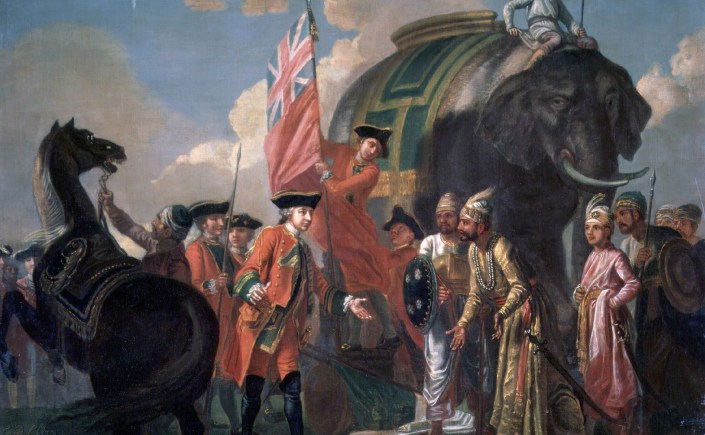
The Company’s premier enabler and exemplar was the first governor of the Bengal Presidency, Robert Clive, or Lord Clive of Plassey, as he was ennobled after a battle that demonstrated the aphorism that one should never enter a gunfight armed with just a knife. But wasn’t that just how the East – and West – was won?

Clive was a humble accountant labouring on the ledgers, but found his calling as a soldier (just like the Spanish conquistador Hernàn Cortéz “the killer” – as Neil Young called him), and rose to great heights of power and riches through remarkable grit and graft. When arraigned by parliament for his rapacity – and acquitted – he exclaimed: “My God, Mr. Chairman, at this moment I stand astonished at my own moderation!”

If ever you are in London, visit the small, quiet and shady Berkeley Square, where the fabled nightingale sang, and where Clive of India, as he became known, his mind curdled by corruption and conscience, and haunted by guilt and ghosts, cut his own throat with a blunt paper-knife. “How are the mighty fallen”. Leonard Cohen’s poet King David said that. “Not often enough!”  I said that.

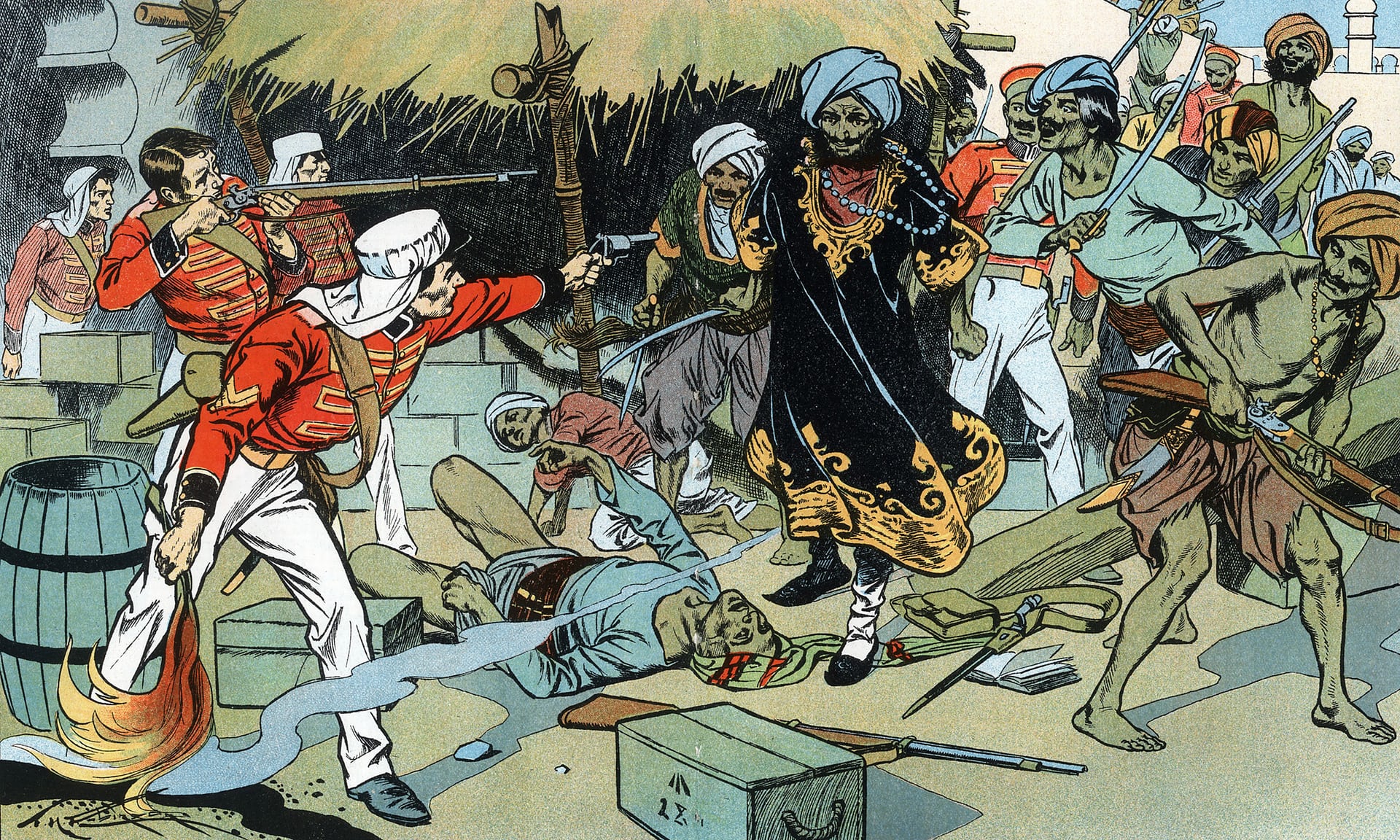
Eventually, the company – whose lobbying efforts saw its original fifteen year charter last for 274 years – became an embarrassment for the English government and establishment. Its Indian “subjects” rebelled unexpectedly and violently in the Great Rebellion of 1857, and it was only by considerable military effort and repression that the British Army was able to save the company and its Indian ’empire”. In the wake of what the British called The Indian Mutiny, which saw cruel atrocities committed by Indians and Britons alike, tens of thousands of rebel sepoys (Indian soldiers in the company’s employ) were executed in vicious reprisal. As George McDonald Fraser’s antihero says in Flashman in the Great Game, “there’s nothing as cruel as a justified Christian”. Assuming full control, the British government nationalized the company in 1859. Long outliving its purpose it was wound down in 1874. Read more about what the British did for India in Weighing the White Man’s Burden  

Imagine today, a protection racket at the heart of government with the complicity of the British establishment, A company with the global reach of Facebook and Google, the economic tentacles of the likes of Halliburton and Exxon, and the military reach of Erik Prince’s mercenary armies. The corruption and criminality of the now defunct and disgraced BCAC (the so-called “Bank of Crooks and Criminals”), and the immunity and impunity of all the big corporates who took the world for a ride in the Global Financial Crisis, and not only got away with it, got governments to bail them out and we’re permitted to persist with their banditry. As Dalrymple himself has put it, The East India Company was literally Facebook with guns!

Read more about India and The Raj in In That Howling Infinite: Weighing the White Man’s Burden; Freedom at Midnight (1): the birth of India and Pakistan; Freedom at Midnight (2): the legacy of partition ; and Paradise Lost – Kashmir’s bitter legacy

Flashman in the Great Game

The Indian Mutiny – Weighing the White Man’s Burden

Visualizing the Palestinian Return – the art of Ismail Shammout

The Key and the Return – Palestine as a metaphor

And who will live in the house after us, my father?
The house, my son, will remain as it was!
Why did you leave the horse alone?
To keep the house company, my son.
When their residents go, the houses will die.
Together we will hold on
until we return.
When, my father?
Tomorrow, my son, and perhaps in another day or two!
That tomorrow trailed behind them, chewing the wind
in the endless winter nights.
Mahmoud Darwish

Palestinian poet Mahmoud Darwish saw Palestine as a homeland but also as a metaphor –  for the loss of Eden, for the sorrows of dispossession and and of exile, for the diminishing power of the Arab world in its relationship with the west (Mahmoud Darwish, Palestine as Metaphor). Arab-Israeli commentator Raja Natoor wrote in Haaretz that Darwish “wrote, faithfully communicated and defended the undisputed Palestinian narrative – the linguistic realm that dealt with the homeland and its loss, with displacement and being a refugee. It shaped the awareness and work of many Palestinians, which turned the poet, knowingly or not, into the Palestinian narrative itself and even into the Palestine lost” (June 28, 2020). Blogger Samah Sulaimi wrote a few days later in a reply to Natour: “In the eyes of most of the Palestinian people, Darwish was able to bring the Palestinian narrative into every home where an olive-wood map of Palestine hangs in the living room, on which the following words are engraved in Arabic: على هذه الارض ما يستحق الحياة – “We have on this land all of that which makes life worth living” (8 July 2020).

Palestinian Australian author and academic Nejmeh Khalil-Habib – and my Arabic teacher for many semesters at the University of Sydney – published a paper in Nebula magazine in 2008 examining how the “Return”  – al ‘awda العودة – a recurring theme in contemporary Arabic literature – has been dealt with in Arabic fiction, and how it depicted those who live the dream of “Return” and those who actually returned to Palestine after the 1967 war or after the Oslo Accords.

She writes: “The concept of “Return” throughout this literature manifests itself in various ways including the spiritual return (as manifested in dreams and aspirations); the literal, physical return; an individual’s return (a “Return” on the basis of family reunions); the “Return” as a result of the occupation of Gaza and the West Bank after the war of 1967; and the “Return” as a result of the peace process after the “Oslo Accords.”

Al Muftah, المفتاح, the key is an enduring symbol of al ‘awda. It is present in street art and in signs and posters throughout Palestine and in the refugee camps. It is a symbol, of a memory, of one day returning – to lost homes, villages, suburbs, towns, lives and livelihoods. As Nejmeh writes,“The Return” (Al-Awda) is deeply implanted in the Palestinian collective memory. It is rooted in their conscience like a faith that could not be denied, because denying it would mean uprooting the lynchpin upon which modern Palestinian history and identity depends”.

Al Mufta مفتاح

But for many, it is something more than that. Nejmeh writes: “Whether exile happens voluntarily or under oppressive circumstances, the dream of returning home stays alive in the mind of the exiled person. It flares or fades from person to person and from one circumstance to another; however, the concept of “return” ceases to be about its basic meaning, but comes to be seen as a means of resistance and challenging oppression”.

She notes American-Palestinian author and activist Fawaz Turky assertion that “the right and dream of Return is the rock upon which our nation was established and the social balance that unites the nation in this wretched world”.

It is the dream, the hope that enabled tens of thousands of refugees in camps throughout the Levant to perceive their situation as temporary and to resist the allure of assimilation and mainstreaming in their host countries – if this was indeed possible given that most hosts have steadfastly resisted granting Palestinians rights and privileges enjoyed by their own citizens. Whilst being much of the diaspora in the West has accepted inclusion and naturalization, these Palestinians connect with their people and their culture in Palestine, and still celebrate their national holidays.

Between seven and eight hundred thousand Palestinians fled their homes in present day Israel or were expelled during the 1948 war (a similar number of Jews were expelled from Arab countries after 1948). Many remained in Israel either in their original homes or where they sought refuge. They became Israeli citizens, but even for these, the memories endure and many continue to refer to the towns and villages and localities by the names they had prior to the establishment of the state of Israel.

And yet, al ‘awda, and the Right of Return is a chimera, a dream dangled before their eyes by their leaders like a hypnotist’s show. And UN refugee status, a tired old delusion perpetuated by UNRWA to justify its existence and well-paid salaries, and the Arab League as a fig leaf for their pulsanimity. UNWRA’s definition and establishment was at fault from day one, and whilst creating generational refugeedom, it engendered false hope, unrealisable dreams, and a road-block to subsequent peace efforts  There is indeed a whole economy, a living, a lifestyle devoted to and dependent on managing the conflict and the refugee problem rather than solving it. The exile was unreasonable and unjust, but the past will never be undone – and most certainly never by UN resolutions.

UNRWA is the only agency dedicated to helping refugees from a specific region or conflict and is separate from the UNHCR, the main UN refugee agency, which is responsible for aiding other refugees all over the world. Unlike UNRWA, UNHCR has a specific mandate to aid its refugees to eliminate their refugee status by local integration in current country, resettlement in a third country or repatriation when possible. It focuses on resettlement and rehabilitation of refugees and building new lives, not maintaining services that prop up a six-decade-long status quo. UNRWA , uniquely, allows refugee status to be inherited by descendants.

Palestinians were not helped by the original establishment of UNRWA which created a special, indeed, unique category of refugee where by heirs and successors are entitled to the aid and benefits normally given only to the dispossessed generation. Normally, the original refugees and their children have either returned to their homelands or have been resettled in another country within one generation. Hence, for better or for worse, Vietnamese, African, Burmese, and even Afghan, Syrian and Iraqi refugees leave the UNHCR’s care in the short to medium term.

But generations of Palestinians are locked into their special jail of statelessness by the duplicity and discrimination of their Arab “brethren” and by their inherited culture of victimhood and dependence. It is a vicious circle which gives all (dis)interested parties an excuse to do nothing but bloviate, and posture, and propose unrealistic resolutions. 

The key, therefore, is a forlorn hope, a closed door that no amount of keys can unlock; and the reality is that of a lock-out, out of politics, out of society, out of the jobs and housing market. The refugees are a minority in Palestine. There are no keys for the new houses and apartments that are going up in and around the cities of the West Bank in a property boom that has been going on for several years now and accessible and affordable only for a growing middle class of employees of the PA and foreign NGOs and young professionals.

But for refugees, all this is paradox. They are locked out of the old Palestine of their parents and grandparent and forebears. But they are also locked out the new Palestine that is struggling to be born.

Poets like Darwish and novelists have internalized and reflected al Nakba and al ‘awda in their work. The dream of al ‘awda is reflected in their writing. As it is also done with graphic artists – none as powerfully and poignantly as the late Palestinian artist Ismail Shammout, born in Lydia, Palestine in 1930. When last In Ramallah, de facto administrative “capital” of that part of the West Bank government by the  Palestinian Authority – Area A Continue reading

The view from the grassy knoll – the resilience of conspiracy theories

Plots he has made, so ingenuous.
Dangerous follies and schemes
For he has stage-managed quite strenuous
Drunken prophecies, libels and dreams.
Lucifer, Paul Hemphill, after Shakespeare’s Richard II

Everybody who was alive when JF Kennedy was assassinated remembers where they were, just as we remember where we were when Neil Armstrong made that “great step for mankind”, and when we’d heard that the Twin Towers had been hit. And there is an almost universal consensus as to how, why and when these events occurred.

But many beg to differ, and cynical or suspicious, curious or just plan mischievous, they say “Ah, but …” and ascribe ulterior motives, describe oblique patterns, and maintain that they possess clear sight whilst the rest of us sport white sticks and dark glasses.

So, it was inevitable that some folk would some how find a link between COVID19, atmospheric chemtrails and the roll-out of the 5G telecommunications network. Before the coronavirus outbreak even began, 5G was being blamed for everything from cancer to infertility. Now, there are hints of deep state” plots and Illuminati plans to control population growth.

Many of the people spreading such theories are the same that share unfounded warnings about the dangers of vaccinations.​ indeed, folk who grasp conspiracy theories tend to go for the buy one, get five free deal – and the rest! Antivax, chem trails, JFK, 9/11, Apollo II, climate change, Illuminati, deep state, white replacement, the Rothschilds, George Soros, Satanic cults, black helicopters, Freemasons, Jews … Yes, it always come back to the Jews …

Although many common conspiracy theories flourished – some would say festered – in back streets and bedsits, the advent of social media has energized and amplified them. Facebook groups that act as petri dishes for new viral rumours to spread can be easily found by searching for ‘5G’ or ‘coronavirus’ on the social network.

Opportunistic political groups stir the pot, often for subversive and strategic ends. For example, RT, the Kremlin-backed broadcaster, has given a platform for 5G conspiracy theories long before coronavirus existed. The New York Times recently suggested that consistently reporting the “5G apocalypse” through its foreign media channels could all be part of a ploy to slow the roll-out of the technology so that Russia won’t be left behind.

Fear, suspicion, insecurity, resentment, powerlessness and a feeling that things are out of our control have much to do with it, rendering people of a bitter, misanthropic or nihilistic disposition – or a compendium of such traits – susceptible to unproven facts, untethered rumours, and in some cases, outright fantasy, and subscribing to alternative narratives, histories and universes.

In Contagion, a 2011 film about a deadly worldwide pandemic that has killed seventy million, a public health official retorts to a conspiracy theorist: “In order to get scared, all you have to do is come into contact with a rumour”.

Below, In That Howling Infinite provides links to three recent articles that endeavour to cast a light into the shadowy world of conspiracy theories and its inhabitants. But first, the irrepressible Sybil Fawlty’s excruciating exposition on fear and loathing:

“Old people are wonderful when they have so much life, aren’t they? Gives us all hope, doesn’t it? My mother on the other hand is a little bit of a trial, really. You know, it’s alright when they have the life force but Mother – well she’s got more of the death force really. She’s a worrier. She has these, well, morbid fears they are, really. Vans is one. Rats. Doorknobs. Birds. Heights. Open spaces. Confined spaces. It’s very difficult getting the space right for her really, you know. Footballs. Bicycles. Cows. And she’s always on about men following her, I don’t know what she thinks they’re going to do to her. Vomit on her, Basil says”.

Lies travel faster than facts

“Lies travel faster than facts and, perversely, efforts to debunk a conspiracy theory can end up reinforcing it …  Increasingly, authorities treat such misinformation contagion like their biological equivalent – proactively pushing out the right facts to inoculate people against unfounded theories or encouraging good information hygiene (such as checking sources) … such theories more as symptoms of a bigger problem, whether it be lack of transparency or a failure of communication … For most people, the more consistent and clear the messaging is from the people higher up, the better – even if that information is “we don’t know yet”.

How conspiracy theories about COVID-19 went viral, The Sydney Morning Herald

Never let the facts get in the way of a good story

“Conspiracy theories aren’t fueled by facts; they are fueled by attention. Twitter in particular, as the platform of choice for many national journalists as well as Trump, has become the perfect vehicle for conspiracy theories, misinformation and racist screeds to find massive audiences; messages grow from a few viral tweets, to a trending topic, to news coverage … When you ask experts about ways to limit the reach of racism and conspiracy theories on platforms such as Twitter, they’ll tell you to watch how it’s amplified: Sharing a meme to condemn it is still a share. Retweeting a racist tweet to shame its writer still gives the tweet more eyeballs … Even though many journalists and media organisations have gotten better at realizing that trending hashtags are often more representative of the weaponization of attention rather than a reflection of popular opinion, trending hashtags are still an effective tactic for courting news coverage of fringe ideas – even if that coverage is intended to debunk it”.

A dangerous cycle of conspiracy theories circulate around Donald Trump, The Sydney Morning Herald

The internet’s dark spaces

Christopher French, a professor of psychology at Goldsmiths, University of London explains in a Scientific American article. “As a species, one of our greatest strengths is our ability to find meaningful patterns in the world around us and to make causal inferences. We sometimes, however, see patterns and causal connections that are not there, especially when we feel that events are beyond our control.”

Voting for Brexit and Trump was found to be associated with a wide range of conspiratorial beliefs, with researchers uncovering that these groups are more likely to believe climate change is a hoax, vaccines are harmful, and that Illuminati-style groups rule the world. They also found that 33 percent of British and French people believe their governments are obscuring the truth about immigration and that many also supported a theory known as “the great replacement” which posits that Muslim immigration is part of a plan to make Muslims the global majority …

… As is the case with the Holocaust and the Second World War, as time passes, truth and fact often become distorted and replaced with myth and alternative stories to support new, disruptive thought. Although many common conspiracy theories flourished – some would say festered – in back streets and bedsits, the advent of social media has energized and amplified them. In the dark recesses of the Internet, all amplified by the likes of QAnon and 8chan which are only loosely tethered to reality, and para-State organs like RT which have more subversive and strategic motives.

How moon landing conspiracy theories influenced the far-right, The Independent

Read other posts about politics in In That Howling InfiniteA Political World – Thoughts and Themes

The Bard in the Badlands 2 – America’s Shakespearean dreaming

Two years ago, we published The Bard in the Badlands – Hell is empty and the devils are here,  a contemplation on the part played by William Shakespeare in the history and society of the American West – and more specifically in those original and excellent HBO series Westworld and Deadwood. It quotes Daniel Pollack-Pelzner  in Slate Magazine::  

“What these portentous allusions don’t seem to register … is the actual role that Shakespeare played in the American West…(Settlers) performed Shakespeare from Missouri to San Francisco in the Wild Frontier. Gold-miners queued up to land a plum part in favorites like the bloodthirsty Macbeth or Richard III. “Traveling through America in the 1830s, Alexis de Tocqueville observed “There is hardly a pioneer’s hut that does not contain a few odd volumes of Shakespeare. I remember that I read the feudal drama of Henry V for the first time in a log cabin.” An army scout in Wyoming traded a yoke of oxen for an edition of Shakespeare; mines named Cordelia, Ophelia, and Desdemona dotted the Colorado mountains. More recent evocations of this period link the Bard to territorial conquest…When the United States prepared to defend the newly annexed state of Texas from Mexico in 1846, Ulysses S. Grant was cast as Desdemona in an army production of Othello in Corpus Christi”.

President Abraham Lincoln used to love reciting, and was particularly enamoured of Macbeth, the play, not the disturbed anti-hero; ‘Nothing equals it’, he confided, “I think it is wonderful: he confided. John Wilkes Booth, his murderous nemesis, was also an aficionado. Booth, from an acting family, had a particular liking for Henry IV’s fiery and treasonous Geordie rebel, Hotspur, and was impressed in a less theoretical way by the regicidal Brutus in Julius Caesar.  

Whilst Shakespeare  and his plays attracted countless aficionados of high and low estate, he also found himself involuntarily conscripted into the young nation’s contentious race and immigration debates. eminent abolitionist and and former president John Adams believed that Desdemona was a “wanton trollop” for falling in love with a blackamoor”. Senator Henry Cabot Lodge opposed immigration and used the Bard as one of his weapons against the ‘Calibans” from Southern or Eastern Europe.

These are just a few examples of how The Bard of Avon popped up in at times in American history like a figurative and literary Doctor Who as guide, mentor, exemplar and even catalyst. in his new book, Shakespeare scholar James Shapiro informs us that when great (and small) things happened in the United States, someone, somewhere, was brushing up their bard – as the following review from The Times illustrates. These do not include, however, the present resident of 1600 Pennsylvania Avenue who “may be the first American president to express no interest in Shakespeare”. Or else, as the reviewer remarks, “maybe we’ll see a tweet soon revealing that at private school his Desdemona was accounted the most fabulous Desdemona ever seen”.

See other posts on American history from In That Howling Infinite: Blind Willie McTell – Bob Dylan’s Americana, Rebel Yelland The Bard in the Badlands – Hell is empty and the devils are here,.

Androids Dolores and Teddy enjoy the Westworld view

Deadwood’s wild bunch

The Bard in America’s Uncivil Wars

David Aaronovitch, The Australian, 14th March 2020

On May 10, 1849, outside the Astor Place Opera House in New York, more than 10,000 residents turned out to try to stop the great British Shakespearean actor William Macready giving an interpretation of Macbeth that they didn’t care for. The militia and the hussars were mobilized, artillery was deployed and in the ensuing riot more than a score died and twenty thousand were injured. This was arguably the most extreme event in the history of drama criticism.

This was just one example, according to Shakespeare scholar James Shapiro, of the way in which the playwright turns up at critical moments in American history as guide, mentor, exemplar and even catalyst. When great things happen in the US, someone, somewhere, is brushing up their Shakespeare.

In the case of the 1849 riots, the Bard was largely a pretext. The poor of the city were being roused by populists to attack the wealthy who exploited them, and the blacks and newer immigrants whom they despised. But the bard was a crowd magnet – on one turbulent night, ten thousand New Yorkers saw Macbeth in three separate productions.

Shakespeare in a Divided America

As Shapiro explains in his new book, Shakespeare in a Divided America, the theatre then was cheap and became a place where people of all classes gathered. The public battle about how to play Hamlet between Macready and the much more masculinist American actor Edwin Forrest was taken up by partisans as being a matter of tribal importance.

When demonstrations (including the flinging of animal carcasses on stage) led to Macready being invited to perform more safely in a new, smarter, more expensive venue — the Opera House — the “mob” took it amiss. So Shakespeare became a proxy for the war between the wealthy and cosmopolitan on the one hand, and the poorer and angrier on the other.

Indeed, it was a contention of more sophisticated exponents of American nationalism and nativism that Shakespeare was more like the Americans than like the British. His spirit was more authentically represented by those pioneers who left England for the New World than by the descendants of those who remained.

Certainly it is true that some of our best, most popular Shakespearean scholars have been American, and Shapiro is one of them. Readers who have invested in his two books about seminal years in Shakespeare’s creative life, 1599: A Year in the Life of William Shakespeare and 1606: Shakespeare and the Year of Lear, know what a lucid, lively joy he is to read.

And his dissection of the controversy over whether the Elizabethan Mr S wrote his own plays, Contested Will, settles the issue for any sensible reader.

Shapiro is the erudite tip of an American iceberg. He tells us that there are no fewer than 150 summer Shakespeare festivals in the US. I looked them up and decided that the Fairbanks Festival in Alaska looked particularly committed.

This enthusiasm is not universal, however, for, as Shapiro points out, the present incumbent “may be the first American president to express no interest in Shakespeare”. Or maybe we’ll see a tweet soon revealing that at private school his Desdemona was accounted the most fabulous Desdemona ever seen.

This was a fate narrowly avoided by Ulysses S Grant, who as a young officer was slated to play opposite Othello in an army production. His Civil War boss, Abraham Lincoln, though never called to act a part on stage, adored Shakespeare, had a particular affection for Macbeth and would recite long and apposite chunks when he felt moved to.

It was ironic, then, that his murderous nemesis, the actor John Wilkes Booth, was also an aficionado. Booth, from an acting family, had a particular liking for Henry IV’s Hotspur and was impressed in a less theoretical way by the regicidal Brutus in Julius Caesar. Indeed, he was playing as Mark Antony opposite his brothers to 2000 playgoers in a large theatre on lower Broadway in 1864 when Confederate sympathizers set fire to the building next door, hoping the flames would spread. Had the plot worked, it would have been the biggest death scene in theatre history.

Booth’s murder of Lincoln was animated by Lincoln’s promise to give limited suffrage to American blacks. And Shapiro writes a brilliant chapter on how Othello was interpreted in the first part of the 19th century as America’s original sin of slavery began to dominate the nation’s politics.

He focuses on the writings of the former president John Quincy Adams, who in 1836 published an essay on The Character of Desdemona. In it Adams wrote of Desdemona that “when Othello smothers her in bed, the terror and the pity subside immediately into the sentiment that she has her deserts”. Why?

As Shapiro tells us, two years earlier Adams had been at a dinner in Boston with the visiting British actress Fanny Kemble. According to her journals, he told her much the same thing, “with a most serious expression of sincere disgust that he considered all her misfortunes as a very just judgment upon her for having married a ‘n***er’ ”. Kemble had married a Texan slave owner. And she noted the Southern hypocrisy about “amalgamation”, given that, as she now knew, “throughout the South a large proportion of the population is the offspring of white men and coloured women”. One of those instances in which British bluntness punctures US social hypocrisy.

This isn’t a long book and it’s easy to read, elegant, to the point and with well-chosen quotes. Other chapters range from how the character of Caliban informed immigration debates in the early 1900s, to the way in which the screenplay of the movie Shakespeare in Love was watered down because of concerns about positive gay themes and Will’s unpunished adultery.

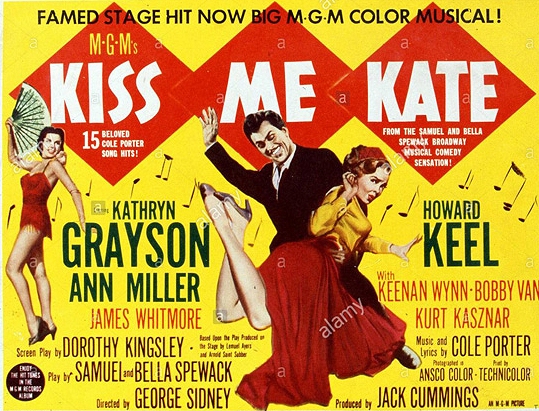
Possibly my favourite chapter convincingly links the musical Kiss Me Kate (based on The Taming of the Shrew) to the post-war situation of American women. During the war, when Rosie was a Riveter, American women went into occupations previously only held by men. And they liked it.

With those men due back from serving abroad, social psychologists and marriage experts expected trouble. Their answer was clearly that women needed to go back into the home and re-become pliant wives.

That many didn’t meekly accept their lot may be measured in the soaring divorce rate, and possibly in the hugely increased incidence of domestic violence. And it’s at this point that one of America’s most successful Shakespeare-inspired productions, Kiss Me Kate, appears, first on stage and then on film. In the film, one of the most famous scenes is when Petruchio puts Kate over his knee and “spanks” her. It’s even on the poster (see the featured image).

This spanking scene, though it had never occurred in any of the previous productions of The Taming of the Shrew, was by now common in US movies. Shapiro tells us there were five films featuring men spanking grown women in 1945 alone. Now Google the words of that most famous song from the show and you’ll see that Brush Up Your Shakespeare is practically a hymn to wife-beating. Someone really should tell the President.

David Aaronovitch is a columnist at The Times.

Shakespeare in a Divided America, James Shapiro Faber, $39.99


Tangled! – a cynic’s guide to alliances in the Middle East

The paradox of piety observes no disconnect
Nor registers anxiety
As the ship of fools is wrecked
So leaders urge with eloquence
And martyrs die in consequence
We talk in last and present sense
As greed and fear persist
E Lucevan Le Stelle, Paul Hemphill

At a recent conference in Berlin, Germany’s prime minister Angela Merkel and and UN Special Representative Ghassan Salamé managed, at least on paper, to cajole the external actors guilty of super-charging Libya’s misery to sign onto a unified agenda. Russia’s Vladimir Putin, Turkey’s Recep Tayyip Erdoğan, France’s Emmanuel Macron, Britain’s Boris Johnson, and Egypt’s pharaoh (and Donald Trump’s “favourite dictator”) Abdel Fatah el-Sisi,  joined a dozen or so others (with Secretary of State Mike Pompeo representing the United States) in declaring an intention to end foreign interference in Libya’s internal affairs: “We commit to refraining from interference in the armed conflict or in the internal affairs of Libya and urge all international actors to do the same,” states the communiqué, in language one hopes all participants endorsed in (what would be uncharacteristic, for some) good faith.

This corroboree of hypocrites acknowledged that the increasingly violent and globally tangled Libyan civil war could only be ended if outside powers backed off and ended their meddling. They made altruistic and totally disingenuous declarations about a conflict  that they themselves have incited, exacerbated and perpetuated for nine years. And yet, explicitly excluded Libyan participation, contradicting the 2012 UN Guidance for Effective Mediation and its insistence on “inclusivity” and “national ownership” as fundamental elements for peaceful conflict resolution. It’s focus at this point was on the on the external, rather than the Libyan, actors and for reviving the world’s attention on the Libyan conflict.

A follow-up conference in Munich was convened in mid-February to renew its pledges to quit meddling. Stephanie Williams, the UN deputy special envoy for Libya reported zero progress and declared the agreed-upon arms embargo to be a joke. A sick joke, indeed – plane after plane land in Benghazi loaded with weapons from the UAE and other arms-suppliers destined for self-anointed warlord Khalifa Haftar‘s self-styled Libyan National Army.

Unfortunate Libya is neither the first nor the last pawn to be used and abused by outsiders in the new Great Game as the following guide demonstrates.

But first, there’s this letter to a British daily from Aubrey Bailey of Fleet, Hampshire (where hurricanes hardly happen):

Are you confused by what is going on in the Middle East? Let me explain.

We (she’s talking if Britain and us generic “good guys”) support the Iraqi government in the fight against Islamic State. We don’t like IS but IS is supported by Saudi Arabia, whom we do like. We don’t like President Assad in Syria. We support the fight against him, but not IS, which is also fighting against him. We don’t like Iran, but Iran supports the Iraqi government against IS.

So, some of our friends support our enemies and some of our enemies are our friends, and some of our enemies are fighting against our other enemies, whom we want to lose, but we don’t want our enemies who are fighting our enemies to win. If the people we want to defeat are are defeated, they might be replaced by people we like even less. 

And this was started by us invading a country to drive out terrorists who weren’t actually there until we went in to drive them out. Do you understand now? Clear as mud! 

It casts new light on that thorny old aphorism “the enemy of my enemy is my friend”!

A cynic’s guide to alliances in the Middle East

Libya

We begin with  Libya, the “beneficiary” of the Berlin talk-fests.

On the side of the internationally recognized government in Tripoli, Libya’s capital there’s: Not many … Italy (former colonial oppressor, in it for the oil, who’d just love to see an end to those refugee boats that wash up on its shores); Turkey (former Ottoman oppressor now ruled by a wannabe Ottoman sultan Recep Tayyip Erdoğan, and eager for offshore oil and gas leases); and potentially, Qatar (who fell out with Egypt, Saudi and the United Arab Emirates over its tepid support for the Sunni grand alliance against Shia Iran).  Turkish soldiers fly the government’s drones whilst Turkey’s Syrian jihadi mercenaries provide military muscle – Turkey would like to move them out of Kurdish Syria on account of their murderous behavior).  

On the side of the self-anointed warlord Khalifa Haftar, based in Benghazi in the east, whose sharp uniform is festooned in medals for this and that act of service and heroism), there’s: Egypt, (the US’ impecunious, brutal “partner in Freedom” – strange bedfellows in this amoral “new Middle East” that is just like the old Middle East); Saudi Arabia, and the UAE (see above, re. Qatar, whom they blockaded for several years); Jordan (perennially cash-strapped and dependent on rich Arab relatives), France and Russia (arms, oil, and influence); plus Russian mercenaries (plausibly deniable, capable and reliable, and familiar with the Middle East – see below); and Sudan’s murderous Janjaweed Arab militias (broke Sudan seeks Saudi favour).

And on the sidelines, a disinterested and divided UN, the UK and the US – although Britain, with France, helped wreck the joint by ousting longtime dictator Gaddafi; arguably, the US, although Donald Trump has confused matters by phoning Haftar and then saying that he’s a great bloke (he has a thing for dictators actual and potential, including Putin, Erdogan, Al Sisi, and the thuggish Saudi crown Prince Mohammed bin Salman); and in the middle, and against all of the above, the ever-opportunistic and troublesome Da’ish and al Qa’ida.. 

As American baseball wizz Yogi Berra once said, “It feels like déjà vu all over again”.

Syria

On the side of the internationally recognized government in Damascus headed up by Bashar al Assad, there’s: The Islamic Republic of Iran (Iran’s Shia Muslims are related to Syria’s heterodox Alawi minority, whose elite happen to have rule the country for half a century, and Iran is consolidating it’s Shia axis across the Middle East); Russia (oil, pipelines, and restoring Soviet greatness); Lebanese Shia Hezbollah (de facto ruler of Lebanon) and its soldiers; the Iranian Quds brigade (the expeditionary arm of the Revolutionary Guard, a military-industrial complex that virtually runs Iran); sundry Iraqi and Afghan Shia militias beholden to Iran for cash, weapons, training and ideology); Russian and Chechen mercenaries (see above – deniable, reliable and capable); and, quite surreptitiously, Turkey (former Ottoman oppressor) which is ostensibly opposed to Assad, but needing Russian pipeline deals, runs with the hares and hunts with the hounds – but see below, and also, above with respect to Libya. As the song goes, “I’m so dizzy, my head is turning” already! 

On the side of “the other side”, which is not really a “side’ at all, but a grab bag of sundry rebels who were once supported by the US and are predominantly Islamist, with some indeed linked to al Qa’ida, which, of course, we all love to hate (Twin Towers, Osama bin Laden and all that), there’s: the US, Britain and France (why do they persevere so in what Donald Trump has called these forever, endless wars?); Saudi Arabia (Salafi Central and banker for all the bad guys) and the United Arab Emirates (also a financier for the foe); Israel (of course – mortal foe of Iran and of Hezbollah (“the enemy of my enemy” fair-weather friend – anything that distracts its perennial enemies is good for Israel); Hamas, the Islamists who rule the Palestinian enclave of Gaza, and oppose the Alawi oppressor of Sunni Muslims and of Palestinian refugees in Syria; and Turkey (see above –  hares and hounds, on the outer with Saudi and the UAE and pals with outcast Qatar, and engaged in an ongoing blood feud with Syrian Kurds ostensibly allied with Turkey’s outlawed separatist Kurds), and as we write, ominously trading blows with the Syrian Army and its Russian allies; and Turkey’s Syrian jihadi mercenaries – erstwhile former rebels and al Qa’ida and Da’ish fighters who are in it for the money, for vengeance against the Kurds and the Assad regime, and, for many, good old blood-lust. 

And stuck in the middle: Those Syrian Kurds, of formerly autonomous Syrian enclaves Afrin and Rojava (betrayed by America, invaded by Turkey, and forever abandoned by the rest of the world, they have been forced to come to terms with the Assad regime which has discriminated against them forever; sundry Bedouin tribes who work to a code of patronage and payback; the scattered remnants of Da’ish which was at the height of its power a veritable “internationale” of fighters from all over the world, including Europeans, Australians, Chechens, Afghans, Uighurs, Indonesians and Filipinos – the remnants of whom are still in the field and hitting back; and sundry die-hard jihadis from constantly splintering factions. Da’ish and the jihadis have been dubiously aided and abetted by money and material from allegedly unknown patrons in the Gulf autocracies, as evidenced by those long convoys of spanking new Toyota Hi Lux “technicals” – which have now curiously reappeared in Haftar’s Libyan National Army (see Libya, above).

Yemen 

On the side of the internationally-recognized government of Yemen, there’s: Saudi Arabia, the US, and Britain; plus sundry mercenary outfits from Australia and Brazil; and Sudan (its militias paid by Saudi, as in Libya). The UAE was formerly on this side, but now supports a breakaway would-be Yemeni government Opposed to the present one. On the side of Houthis, a rebel Shia tribe in the north of the country, there’s: Iran and ostensibly its Iraqi and Lebanese auxiliaries – see above, the Shia ‘Arc” of Iranian influence. And in the middle, and against all of the above, the ever-opportunistic and troublesome Da’ish and al Qa’ida.

Afghanistan

Its America’s longest ever war – ours too …

On the side of the UN recognized government there’s: NATO, including the US, Canada, Britain, Germany, Denmark and Norway; and also, Australia and New Zealand – though why antipodeans want to get involved in the faraway Afghan quagmire beats me … Oh yes, the US alliance, and our innate empathy for the poor and downtrodden.

On the other side, there’s: The ever-patient, ever-resilient Taliban, aided and abetted by duplicitous Pakistan (an ally of the US – yes!), and al Qa’ida and Da’ish, both dubiously aided and abetted by money and material from Gulf despots. 

And on the sidelines,  miscellaneous corrupt and well-armed Afghani warlords who take advantage of the ongoing turmoil and grow rich on bribes, option and smuggling; and the rest of the world, really, which has long ago zoned out of those “forever, endless wars”. 

So, what now? 

More of the same, alas. Great Power politics and proxy wars are taxing intellectual and actual imaginations. It is business as usual in the scattered killing grounds as a bewildering array of outsiders continue to wage their proxy wars in Syria, Libya and Yemen. Bombs still explode in Afghanistan and Somalia, and whilst Islamists terrorise the countries of the Sahel, and even distant Mozambique, warlords rape and pillage in Congo. As usual in these proxy conflicts the poor people are stuck in the middle being killed in their thousands courtesy of weapons supplied by the US, European, Israeli, Russian and Chinese arms industries.

As outsiders butt each other for dominance, and the Masters of War ply their untrammelled trade, we are condemned, as Bob Dylan sang in another time and another war, to “sit back and watch as the death count gets higher’. I am reminded of WH Auden’s September 1, 1939, a contemplation on a world descending into an abyss: “Defenseless under the night, our word in stupor lies’. All is, as Kent lamented in King Lear, “cheerless, dark and deadly”.

 © Paul Hemphill 2020.  All rights reserved

In That Howling Infinite, see also; A Middle East Miscellany

A postscript  from Alice’s Adventures in Wonderland

‘What I was going to say,’ said the Dodo in an offended tone, ‘was, that the best thing to get us dry would be a Caucus–race.’

‘What IS a Caucus–race?’ said Alice; not that she wanted much to know, but the Dodo had paused as if it thought that SOMEBODY ought to speak, and no one else seemed inclined to say anything.

‘Why,’ said the Dodo, ‘the best way to explain it is to do it.’ (And, as you might like to try the thing yourself, some winter day, I will tell you how the Dodo managed it.)

First it marked out a race–course, in a sort of circle, (‘the exact shape doesn’t matter,’ it said,) and then all the party were placed along the course, here and there. There was no ‘One, two, three, and away,’ but they began running when they liked, and left off when they liked, so that it was not easy to know when the race was over. However, when they had been running half an hour or so, and were quite dry again, the Dodo suddenly called out ‘The race is over!’ and they all crowded round it, panting, and asking, ‘But who has won?’ This question the Dodo could not answer without a great deal of thought, and it sat for a long time with one finger pressed upon its forehead (the position in which you usually see Shakespeare, in the pictures of him), while the rest waited in silence. At last the Dodo said, ‘EVERYBODY has won, and all must have prizes.’

Clouded Vision – no peace, no plan, no Palestine, no point

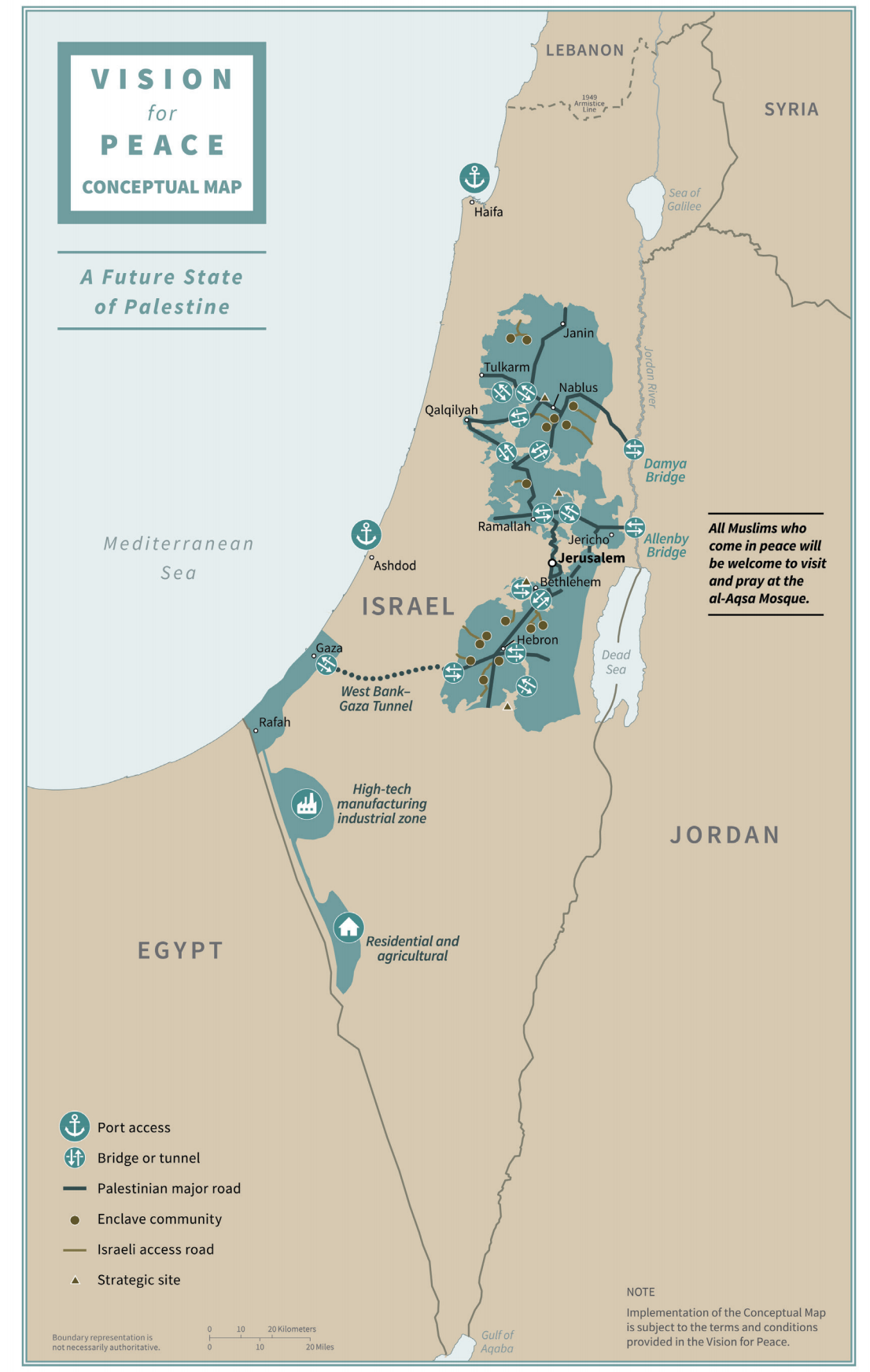
After months of waiting, President Trump finally unveiled his peace plan for Israel and Palestine on 28th January 2020, to the delight of Israeli prime minister Netanyahu, the disgust of the Palestinians, and the bemusement of many. Amid the sound and the fury, most commentators apparently missed the point – or willfully chose to to do so – that it is not a “plan” as such, but a “vision”. The word is used some sixty times in eighty six pages that contain the political and economic framework. The remaining eighty pages, with an executive summary and copious tables and charts, more resemble a business plan, complete with SWOT analysis, than an actual peace proposal.

But a proposal is exactly what it is – not a plan per se, nor a diktat, as some have labelled it ; nor is it a mediation – as some have inaccurately described it. Rather, its authors claim, it is a basis for further negotiation – should anyone ever get around to talking together. In an excellent piece in Times of Israel, When a vision gets clouded (which I strongly recommend reading) blogger Wendy Kalman gets right to the point:

Both Israelis and Palestinians have long-standing negotiating positions but also must recognize that compromise is necessary to move forward. It is inevitable that each side will support and oppose aspects of this Vision. It is essential that this Vision be assessed holistically. This Vision presents a package of compromises that both sides should consider, in order to move forward and pursue a better future that will benefit both of them and others in the region.

A peace agreement will be forged only when each side recognizes that it is better off with a peace agreement than without one, even one that requires difficult compromises….

The role of the United States as facilitator in this process has been to collect ideas from around the world, compile them, and propose a detailed set of recommendations that can realistically and appropriately solve the conflict. The role of the United States is also to work together with other well-meaning countries and organizations to assist the parties in reaching a resolution to the conflict. But only the Israelis and Palestinians themselves can make the decision to forge a lasting peace together. The final, specific details of the Israeli-Palestinian Peace Agreement, must be worked out directly between the parties

I have read that many who object to the Vision because Jared Kushner and Jason Greenblatt did not consult with Palestinians. The PA cut ties with the White House after the Trump declared Jerusalem the capital of Israel in 2017. In June 2018, US officials said they’d meet with PA officials if invited. They apparently had not been, and with this policy in place for over two years, Abbas refused to take calls from the White House even last month. So, if the Palestinians refused to meet with US officials, they could not have been consulted”.

So, as Kalman suggests, people really ought to read the document rather than barrack for or  against it sight unseen and text unread. To this end, we would hope that has been published in Arabic and Hebrew by a neutral third party which would render it accurately and not redact the parts the Palestinian and Israeli Street may not like.

At first glance, the Vision appears solid enough for friends of Palestinian and critics of Donald Trump and Benjamin Netanyahu to suggest that it is a start, at least, the end of the beginning, rather than the beginning of the end. It ticks many boxes, holding out hope for lasting peace, a Palestinian State, normalized relations, and economic opportunity. But, considering the resources available to the authors, and the work that seems to have gone into the economic side of things, it is surprising for its lack of historical and political depth and indeed, accuracy, and for the number of elephants lurking mischievously and maliciously under the worn carpet. And it is these elephants that are disturbing – they whisper that all is not quite what it seems.

The Vision has a black heart insofar as it legitimizes Israel’s past actions, entrenches it’s control, and actually rewards its ongoing bad behaviour whilst giving Netanyahu the green light to commence annexations quicksmart – which he declared he would do until the US  pulled sharply at his reins, demanding that he wait the outcome of Israel’s elections in March – its third poll in a year.

The President has called his Vision a “win win”, but Israeli human rights watchdog B’Tselem has described the “Deal of the Century” as “more like Swiss cheese, with the cheese being offered to the Israelis and the holes to the Palestinians”, encapsulating a world view that sees Palestinians as perennial subjects rather than free, autonomous human beings.

On Al Jazeera on the evening of the White House presentation, Daniel Levy, President of the US/Middle East Project, former Israeli diplomat and veteran of past peace plans, pulled few punches:

“It is not an attempt to be viable or fair”, he said. “This is America taking an Israeli proposal and translating it into an American position. But it’s worse than that. It takes what ostensibly looks like what a model peace agreement might look like, and wraps into that an act of aggression, close to a declaration of war, on the Palestinians. It is not intended to advance peace. It’s intended to force the Palestinians to say no, to depict Palestinians as rejectionists, and to allow Israel to pursue, with greater pace and greater support, Israel’s unilateral plans. It’s a very dangerous, cynical and aggressive move”.

Regarding contentious but critical issues, like prisoners, refugees, and settlements , Levy continued, “Instead of putting it in the language of a peace agreement, they’ve put it through this supremacist, extremist and exclusivist grinder where there’s only one side that has to be paid attention to. It turns the entire logic of what peace should be on its head. Israel retains control everywhere. Israel agrees to take on itself not to do things it didn’t intend to do anyway, like this  question of Jerusalem … The Palestinians will be under increasing pressure. But bludgeoning them into negotiating won’t achieve peace. It’s taking a sledgehammer to peace efforts”.

He elaborated further 30th January in Don’t call it a peace plan in American Prospect magazine, adding: “In its outward appearance, the plan had such a familiar feel to it, like returning to a place of one’s childhood. But as I absorbed the words, nostalgia gave way to a feeling of having entered a topsy-turvy Alice in Wonderland. The language of peace had been cut and pasted, then put through a grinder, delivering an act of aggression dripping with the coarse syntax of racism. A hate plan, not a peace plan“ … A peace plan has to be predicated on both sides saving face, on both sides being able to declare some kind of victory. The plan announced is a 180-page hate letter from the Americans (and by extension the Israelis) to the Palestinians. Until one reads the entire document (and unless one knows the history of the conflict), it is hard to convey the depth of contempt and scorn this text displays toward Palestinians. It oozes colonialist supremacism”.

There has been commentary aplenty from pundits and partisans on all sides of the argument, many of whom will not have read the document but rather “take their instructions” from their various positions and paymasters. But anyone with a serious interest in the matter, whether by position, profession, or amateur passion, and certainly all with skin in the game, ought to read it, faithfully translated and unredacted. Because It is illuminating – and possibly even hallucinating.

One thing is for sure, it is humiliating. For the Israelis who been promised all they they could wish for – they should by embarrassed by its bias. For the Palestinians who are invited to drop their longtime demands – some of them perfectly reasonable and others, unattainable shibboleths – in return for buckets of cash and international good will. For America’s allies – including its Arab “partners in freedom”, who, reluctant to upset the truculent Trump, gingerly but optimistically posit the that the “vision” is a perfectly good springboard, opening offer, ambit claim or whatever to get long-stalled negotiations going (meanwhile, they are ever wary of a hostile backlash from their sullen, captive citizenry). And for America, so blatantly and cynically giving the thumbs up to what amounts to the occupation and dominion of a powerful country over a weaker one.

Many outside and within the Middle East condemn it because it is one-sided, supremacist and exclusivist – and just plain unfair. And for all it’s worthwhile bits and pieces, it is all of these. Saying that Palestinians should grab a good deal because there won’t be a better one, that they have only themselves to blame for their leaders, and that they never miss an opportunity to miss an opportunity, is to occupy the low moral ground whilst simultaneously eyeing the exit.

It has also been condemned as actually endangering Israelis. The US President has given his blessing to a potentially explosive policy that is not even popular with the Israeli public: polls show that most Israelis are not interested in annexation. This ostensible Israeli “win” offers Israel control over areas of the West Bank that most Israelis have never heard of, let alone lived in (according to the Israeli NGO Peace Now, less than 5% of Israelis live beyond the Green Line). And the price will be paid by the Israeli exchequer, the Palestinians, assorted NGOs, and the soldier boys and girls who will have to maintain order and carry the scars for the rest of town lives.

Reading the Vision, I identified contradictions and cul de sacs that appear to signal it’s true intent – that dark heart I referred to above. David Levy and  Yossi Klein Halevi touch on most of them and well merit close reading – but here are my own thoughts.

Distorted Vision

The first pages set the scene. Whilst careful not to spook the horses from get-go, they are anodyne and, indeed, simplistic in recounting the origins and the contemporary status of one of the most intractable international conflicts since World War 2 – very much Arab-Israeli Conflict 101 from  a moderately informed albeit partisan and pro-Israel American perspective. But as it gets down to the nuts and bolts, and formulates proposals for a just, equitable and lasting solution (or I assume that this is the intent of all this), it is as if the authors have got all the words and got all the notes but haven’t quite got the song. Put more bluntly, to quote Daenerys Targaryen they have come not to stop the wheel but to break it.

A Capital Idea

An immutable Palestinian demand since the Six Day War of 1967 has been that Jerusalem be the capital of an independent Palestinian State. Notwithstanding the US recognition as Israel’s capital, there was an understanding that if and when such a state eventuates, its capital would be in East Jerusalem. The Vision now proposes that the run-down town of Abu Dis, on the Eastern side of the Separation Barrier (the proposed border between Israel and Palestine) should be the Palestinian capital – in “eastern” but not “East” Jerusalem. It suggests also that the Palestinians can rename it Al Quds and then continues thereafter to refer to the prospective capital as Al Quds, as if saying it makes it so.

This demonstrates either an ignorance of history and of Jerusalem’s significance in both the political and spiritual space, or, worse, a contempt for it. Or both. Al Quds means “The Holy” in Arabic. It has been used to describe Jerusalem for centuries, and indeed, by all Palestinians today and by Muslims the world over. It is not some made-up moniker that can just be attached to Abu Dis like some clever #tag. If it was merely just a location for an administration, Ramallah already boasts a modern parliament building, multi-million dollar presidential palace, and the mausoleum of Abu Amar (Yasser Arafat to us), not to mention a burgeoning middle class and an accompanying building boom.

Soul searching

The casual treatment of the idea al Quds is more than lazy etymology. It is indicative of how the Vision skirts the reality of the deep spiritual belonging and the atavistic yearning that lies at the root of the two competing historical and political narratives: the millennia-old connection with The Land, Ha’Aretz, that is held by religious and secular Jews, Zionist and nationalist alike; and the deep, centuries-old – roots of Arab, Islamic and Christian history and culture in the land of Christianity’s birth. These can’t be distilled down to real estate deals, the involvement of disconnected outside parties, be these brokers honest or dishonest, the chialistic urgings of American evangelicals yearning for ”the End of Days”, and Iran hawks pushing for a Grand Alliance against Shiah Iran and its Arab proxies.

No Going Home

This shallowness is evident also respect to its treatment of refugees, and its cursory dismissal of the Right of Return of the refugees of 1948 and 1967 and their successors. It is not so much that this perspective is a false one. The Right of Return is a chimera, a dream dangled before their eyes by their leaders like a hypnotist’s show. And UN refugee status is a tired old delusion perpetuated by UNRWA to justify its existence and well-paid salaries, and the Arab League as a fig leaf for their pusillanimity. UNWRA’s definition was at fault from day one and whilst creating generational refugeedom, engendered false hope, unrealisable dreams, and a road-block to subsequent peace efforts. But it ought to be addressed sympathetically and not summarily swept off the table in like manner to the matter of Jerusalem.  “The Return” (al Awda) is deeply implanted in the Palestinian collective memory – as is “the key’, a a symbol, of a memory, of one day returning – to homes, villages, suburbs, towns, lives and livelihoods lost in al Nakba. These are rooted in the Palestinian conscience like a faith that cannot be denied, because denying it would mean uprooting the lynch-pin upon which modern Palestinian history and identity depends.

According to the Vision, Israel does not deem it justified to foot the bill for the refugees of al Nakba and al Naksa, the generation and their successors who are also registered as refugees in perpetuity under UNRWA’s questionable criteria. The onus will be upon Palestine and neighbouring Arab countries who have refused to recognize their own Palestinian refugees as citizens to sort this one out – with some goodwill and financial assistance from the international community. For, why indeed should the world continue to pay for Palestinian refugees? By way of explanation, the Vision notes that the international community is struggling to find sufficient funds to address the needs of the over 70 million refugees and displaced persons in the world today. And what’s more: “the State of Israel deserves compensation for the costs of absorbing Jewish refugees from those countries. A just, fair and realistic solution for the issues relating to Jewish refugees must be implemented through an appropriate international mechanism separate from the Israel-Palestinian Peace Agreement”. So, “upon the signing of the Israeli-Palestinian Peace Agreement, Palestinian refugee status will cease to exist, and UNWRA will be terminated and its responsibilities transitioned to the relevant governments”. End of story.

Let My People Go

All prisoners in Israel jails will be released on signature of a peace agreement commencing straightaway with minors, women, and seniors, then all others who meet Israel’s release criteria – but all must first sign an undertaking not to say or do anything that annoys Israel. Then there are those who Israel won’t and will never release. There is no mention in the Vision, neither in the historical preamble nor the detail, of a policy of indefinite detention that has seen tens of thousands of minors incarcerated. It is as if the fifty year old occupation and its punitive system of passes and checkpoints, of demolitions and administrative detention, and the civilian population’s continuing resistance to it have occurred in some parallel dimension.

Moreover, the refusal to acknowledge the emotional and psychological influence of the prisoners issue – which has impacted on the loves of thousands upon thousands of people who have passed through the penal system or are still enmeshed within it, and their families and friends, much like the dismissal of al Quds and al Awda, could be interpreted as negligence bordering on contempt.

Borderlines

A territorial swap gives Israel what is already controls – the fertile, strategic Jordan valley in return for two arid and barren strips of land at the fag end of the Negev Desert, bordering on the bleak and unforgiving Sinai, and a chunk of unutilized desert south-east of Hebron. Sure, Israel has a well justified reputation for “making the deserts bloom”, and the many towns, farms and vineyards of the Negev is testament to that. But chucking a bunch of money and technology at a brace of “development” zones strung along a dangerous and well guarded border hardly seems like a fair swap. Nor does a neat new network of highways between scattered Palestinian towns and villages, and segregated access to two Israeli ports (Gaza’s historically famous harbour will not be resurrected). Meanwhile, international boarders are the sole business of Israel, with the compliant assistance Egypt and Jordan.

The Triangle

This is an area originally designated as Jordanian in 1949, but were retained by Israel for military reasons. These communities largely self-identify as Palestinians, and they can now be Palestinians. – notwithstanding the fact that very, very few Israel Arabs would want to live in an Arab state, even if that state was Palestine. And indeed, residents commenced their protests immediately the proposal was mooted.

Freebie

“Every country spends a very significant sum of money on its defense from external threats. The State of Palestine will not be burdened with such costs, because it will be shouldered by the State of Israel. This is a significant benefit for the economy of the State of Palestine since funds that would otherwise be spent on defense can instead be directed towards healthcare, education, infrastructure and other matters to improve Palestinians’ well-being”. So, “don’t  worry, be happy,”

Gonna Build a Lego House

The US and Israel will not accept the establishment of a state of Palestine until the Palestinians attain certain standards of good governance. These include a constitution or another system for establishing the rule of law that provides for freedom of press, free and fair elections, respect for human rights for its citizens, protections for religious freedom and for religious minorities to observe their faith, uniform and fair enforcement of law and contractual rights, due process under law, and an independent judiciary with appropriate legal consequences and punishment established for violations of the law. They include also: transparent, independent, and credit-worthy financial institutions capable of engaging in international market transactions in the same manner as financial institutions of western democracies with appropriate governance to prevent corruption and ensure the proper use of such funds, a legal system to protect investments and to address market-based commercial expectations, and meet the independent objective criteria to join the International Monetary Fund. Palestine must establish civilian and law enforcement control over all of its territory and demilitarize its population. And it must also end all programs, including school curricula and textbooks, that serve to incite or promote hatred or antagonism towards its neighbours, or which compensate or incentivise criminal or violent activity.

Once these fortuitous conditions are established to the satisfaction of the US and Israel, “The United States will encourage other countries to welcome the State of Palestine as a full member in international organizations”. Whilst there is absolutely nothing wrong and indeed everything right with this wish-list, this world’s best practice if you will, of good governance – and as the Vision indeed states, no country, least of all Israel wants a failed state on its doorstep – the sad fact is that most countries in the world would fail these worthy and worthwhile criteria, including the Arab countries the US is looking to for support for its project.

Lucky Old Jordan

Whilst matters of borders and security are to be managed by Israel and the US, in close cooperation with Egypt and Jordan, Jordan cops much of the burden of the nation building project: “By virtue of territorial proximity, cultural affinity and family ties, the Hashemite Kingdom of Jordan is well placed to play a distinctive role in providing this assistance in fields such as law, medicine, education, municipal services, historic preservation and institution building. In a manner consistent with the dignity and autonomy of a future State of Palestine, the Hashemite Kingdom of Jordan will offer long-term, on-the-ground assistance in designing relevant institutions and procedures and training of relevant personnel. The objective of such assistance will be to help the Palestinians build strong and well governed institutions”. As noted above, the irony is that cash-strapped, authoritarian  Jordan – and indeed most nations in the Middle East – would find it hard to reach the standards of good governance now demanded by the US and Israel.

The Company We Keep

On the subject of less than perfect enablers and abettors, we’d like to thank … “Much appreciation is owed to the Kingdom of Saudi Arabia for its role in the creation of the Arab Peace Initiative, which inspired some of the ideas contemplated by this “Vision”. And acknowledgment too to Egypt, Jordan, and the UAE without whose cooperation and input, this “Vision” would not have been possible”. And yet, as the risk of bearing on a dead horse, none of these would seriously subscribe those qualities and qualifiers that would in the US and Israeli eyes render the prospective state of Palestine suitable to be admitted to the community of nations.

Who’s Country Is This Anyway?

And finally, after the prospective state of Palestine has met all the standards, criteria, qualifies and metrics (I did say the Vision read like a business plan), after neigbouring Arabs states have shouldered their various designated burdens, and the international community have coughed up much of the cash to pave the path to prosperity, all matters related to security and demilitarization, and based upon its own interpretation, Israel has the right to intrude, intervene, interfere, interdict, and otherwise involve itself in the affairs, interests, sovereignty and territorial integrity of the ostensibly independent State of Palestine.

I am reminded of what Hannibal Lecter says to FBI  Agent Starling when asking her what motivates serial killer ‘Buffalo Bill’: “He covets”, Lecter says. “That is his nature. And how do we begin to covet, Clarice? Do we seek out things to covet? … We begin by coveting what we see every day … And don’t your eyes seek out the things you want?”

So, what now? 

A month has passed since that coopted corroboree in the Oval Room. To quote Rudyard Kipling, “The tumult and the shouting dies; the Captains and the Kings depart”. Israel’s elections are fast approaching, and are expected to be as inconclusive as the previous two, raising the prospect of a fourth – and continuing political paralysis. The world’s fickle focus has shifted to the coronavirus, China’s Belt and Road tilt at global  aggrandisement,  the bitterest of US elections, and Syrian Idlib’s cruelest of winters. The “deal of the century” has receded into the background noise. But it will not go away, nor will it’s apparent absence make hearts grow fonder.

Ha’Aretz nailed it with a headline: “Trump’s unreal deal: No peace, no plan, no Palestinians, no point”. And in Canada’s Globe and Mail, Israeli author and journalist Yossi Klein Halevi wrote’: “The Trump plan for Palestinian-Israeli peace will almost certainly go the way of all the other failed blueprints to resolve our 100-year conflict. With leaders across the Arab world backing Palestinian opposition, the plan will likely remain an American-Israeli conversation about peace – a wedding without the bride. And yet the release of the plan has had one bracing consequence: It has exposed deeply held myths among both Israelis and Palestinians”.

Some say that this deeply flawed, one-sided and duplicitous Vision was designed to fail, and peevishly contemptuous and prejudiced comments about the Palestinians by Jarred Kushner immediately after their immediate repudiation of his Vision appear to hammer home that conclusion. But should it indeed join previous plans on the garbage tip of barren and broken hopes, it doesn’t warrant or deserve a second coming. Presently, with the status quo effectively frozen, the Israel determines the rules of play. But it does put a ball in the Palestinians’ court. They really do need to get something happening outside the dominant and dominating US-Israeli paradigm that doesn’t involve violence, useless rhetoric and impotent willy-wagging as this just plays into their detractors’ hands. If they, the Palestinians, were able to get their act together (including acquiring half-decent leaders and achieving some of the governance performance indicators highlights in the Vision), they could do what Hawkeye and Trapper did in the uneven football game in Mash, the movie : steal the ball – and throw in a new one.

© Paul Hemphill 2020.  All rights reserved

In That Howling Infinite, see also:  Jerusalem, and A Middle East Miscellany

Al Mifta مفتاح

Author’s Note

Whenever I pen commentaries such as this, people ask why I rarely forward my own opinion on the issues I am presenting or discussing. On the contrary, I would argue that my views are fairly transparent in the subjects I chose to engage with, the words I use, and the vein in which I use them.

With respect to my numerous posts about Israel and Palestine, and the Middle East in general, I  come to my conclusions from a political science and sociology perspective – that’s where my academic experience came from – and a background in conflict resolution, supported by study and travel. If I do on occasions display any particular bias, it. originates in my longtime interest, understanding and affection for the history, politics and culture of the region, of its geography and archaeology, and  of its people of all faiths and nationalities that I make my observations.

I am presently working on a piece that encapsulates my thoughts on this complex and controversial subject. But meanwhile, here is a brief exposition.

I do believe that the systematic dispossession of almost a million Palestinians and the destruction of half of their towns and villages in 1948 is Israel’s original sin. It is the primal stain that colours and corrupts all that followed. And yet, if not for the actions, often daring, often brave, often questionable, and often deplorable, of the politicians and soldiers of 1948 – and of the generations that folllowed –  Israel would not exist today. This paradox is addressed sympathetically by Avi Shalit in My Promised Land, referred to above, and scathingly by ‘new history’ scholar Ilan Pappe in The Ethnic Cleansing of Palestine.   

The Occupation, fifty years old this year, which grew out of the unexpectedly total victory of June 1967, has taken on strategic, ideological and indeed messianic dimensions by many in the  Israeli government and political elite. It compounded the original sin, deepened the primal stain, released the demons of messianic fervour, and wounded Israel’s soul. The settlements locked the nation into the the colonialist project. With the close-call of the Yom Kippur War, the violence and murder of the first and second Intifadat, and present Palestinian jaquerie, Israel’s heart has not just hardened, it has become sclerotic.

I admit that I have always been sympathetic towards Israel – from my first visit in 1972. But it is not a blinkered viewpoint. I am deeply critical of Israeli politics and policies, and have no respect for many of its leaders.

Ayelet Shaked, the nationalist’s La Passionaria, and her boss Naftali Bennett do not not represent ALL Israelis! They hold extremist views just like we in UK, US, and Australia have parties and individuals with extremist views. But there are hundreds of thousands of Israelis who oppose the present government and long for justice and peace. And if – a very big “if” – Arab Israelis and the Israeli left could work together, they could obtain a majority in the Knesset and change Israel’s politics.

Yet meanwhile, Binyamin Netanyahu and his nationalist allies call all the shots, the Israelis continue to control and exploit the land, its people, and its resources, whilst varying degrees of annexation are on the cards. The settlements are an abomination, as are the policies and practices of the state and its occupying army, as described by Lyons and others. There’s no escaping these facts.

But I am likewise critical of Palestinian governance, politics and politicians. Hamas and the PA are on the nose in their respective fiefdoms, and if a moderate “third force” were to arise – and survive, because sure as hell, they would risk being murdered – Palestinians who just want a quiet, normal life, adequate services, and opportunities for their children, and Israelis who want likewise, might – just might – reject their extremist, dogmatic, entrenched leaders and reach some form of modus vivendi.

Palestinians themselves have to take control of their own lives, kick out their corrupt leaders, cease inculcating their children with hatred and jihadism, and use all that international good will and dollars to build a viable economy that can provide jobs, opportunities, and security, economic and physical to the people. Only this way will they be inoculated against cronyism, corruption and extremism. And yet, the dead hand of a moribund, patriarchal, conservative and ethnocentric culture holds them back –  but that is the subject of another, future discussion for In That Howling Infinite.

Today, the ‘powers that be’, defenders and beneficiaries of a status quo that looks more like a cul de sac, predominate over a dispiriting array of competing, clamouring factions, left, right, nationalist, secular, tribal, Haredi, and Islamist alike. New, young, brace, local voices in both Israel and Palestine, are not heard.

So what happens next?

I get that question too. And I am perennially reluctant to venture an answer beyond one that runs like “on the one hand…but then on the other”.  I inevitably fall back on Robert Fisk’s response to the same question with regard to the calamitous freezing over of the Arab Spring and the fall and rise again of the same old autocrats and tyrants: “my crystal ball is broken”. It’s a cop out, really, but just as cogent as that famous line in that UK spy drama Spooks: “What’s gong to happen to me?” “Bad things!”

One thing is for sure: as songwriter Warren Zevon sang, “the hurt gets worse, and the heart get harder”.

October 8th 2017

For more posts on Jerusalem, Israel and the Middle East, visit:
https://m.facebook.com/HowlingInfinite/
https://m.facebook.com/hf1983/

See also, my collection of posts about Jerusalem, and A Middle East Micellany

Australia’s choice – survive by respect or die by stupid

Normally, the weeks preceding our national day see social and mainstream media, posturing politicians and personalities and cultural warriors of all our tribes caught up in argument and invective about its meaning and significance. And then, it’s all over. Calm is restored as summer winds down, the kids return to school, and the working year starts in earnest – until the next national shibboleth lumbers into view – Anzac Day in late April. 

This year, however, things are unseasonably quiet. As a nation and a community, we are too preoccupied with Australia’s unprecedented bush-fire crisis to wage our customary wars of words.

The fires have dominated the media space, with harrowing photographs and video footage of their impact on people, property, and wildlife, stories of heroism and resilience, and circular debates and divisions, political posturing and finger-pointing. They have crowded out others news and reportage from around Australia and overseas where much is happening, be it the US’ assassination of Iran’s foremost general, ongoing protests in Beirut and Baghdad, the continued pounding on tons and villages in Syria’s beleaguered Idlib province, devastating floods in Indonesia, and volcano eruptions in the Philippines and and Zealand – and, less catastrophic but infinitely entertaining, Britain’s imminent retreat from Europe, and Harry and Meghan’s divorce from the royal family.

The fires have also crowded out the predictable argy-bargy over our national identity. It’s as if the partisans and opinionistas right across our political spectrum have holstered their weapons in deference to our collective pyro-purgatory.

There is one piece, however, that I deem worthy of republishing in In That Howling Infinite insofar as it encapsulates perfectly a cognitive and cultural dissonance at the heart of our national identity that I touched upon recently in How the ‘Lucky Country’ lost its mojo.

Sydney journalist Elizabeth Farrelly is always worth reading for her perspective on our identity, our culture and our natural and built environment. On this Australia Day 2020, she asks the perennial rhetorical question: what does it mean to be Australian? Her observations are illuminating. Here is my summary – you can read it in full below.

“As the fires rage on, bringing little but anti-green and pro-coal propaganda from our governments, we have a choice. We can go on pretending that exploitation is a sustainable way of life. We can pursue this culture of denial, where truths about nature, climate, women and Indigenous peoples are held in contempt. Or we can smarten up …

Australian culture has always relied on easy exploitation. From the moment white people arrived, we’ve been kidding ourselves that arrogance and theft add up to a lifestyle with a future. We dig stuff up and flog it, no value added, no questions asked. We grow food in the most destructive possible manner – clear-felling, mono-culturing, irrigating and overgrazing; destroying soil, desertifying land and belching carbon. We crowd to the edge of the continent, gazing out to sea, chucking our trash over our shoulders, pretending it won’t come back to bite.

Even now, our Indigenous peoples are being displaced three and four times over. Last year we extinguished native title for Adani’s foreign coal-mining interests, making the Wangan and Jagalingou people trespassers on their own land. We relentlessly export such coal, helping drive temperatures in central Australia beyond the habitable, exiling people for a second time from their ancestral homelands. Then, should anyone dare critique this mindlessness, as Bruce Pascoe obliquely has, we label them non-Indigenous and  set the federal police onto determining their ancestry.

And we apply this domineering denialism, this refusal to listen, across the board. In agriculture it says, we don’t care what naturally grows here. We’re going to poison the insects, suck the water from ancient caverns and nuke the living daylights out of the soil with petroleum-based fertilizers. We’re going to burn oil and coal, and if we get fires that destroy our townships, we’ll clear the forests too. 

In politics and at home it says, if our women are troublesome, we’ll ridicule, intimidate and beat them into submission (with one woman murdered every week by her current or former partner and our political sphere internationally recognized for its misogyny).

In sport, it says it’s fine if our cricketers – so long as they don’t get caught. And in social relations, if people insist on different hierarchies – if they demand gender fluidity, or optional pronouns, or same-sex marriage or voluntary race-identity or anything else that questions our superiority we’ll come down on them like a ton of bricks.

It’s the arrogance we came with, two centuries back, but it’s getting worse, not better … God gave us white guys dominion and we’ve weaponized it. We’ll show this country who’s boss. 

Forget the Aussie flag, the flag of dominion. 

This we should carve on our hearts: there is no economy without ecology”.

See also: We got them Australia Day Blues;  and Down Under – Australian History and Politics

Survival-by-respect or death-by-stupid: your choice Straya

Elizabeth Farrrelly, Sydney Morning Herald 26th January 2020

It’s invasion day again only, this time, the eyes of the world are upon us. Under headlines like “Australia shows us the road to hell“, the world is wondering if our economy isn’t every bit as fragile as the landscape it routinely exploits. It’s wondering about our tourism, with massive cancellations already from China and a US travel warning putting Australia on par with Gaza and PNG. It’s asking how long Australia will be habitable. But beneath those questions lies another. What, at this crossroads, does it mean to be Australian?

The first three are questions of both fact and perception. As such they may be partly addressed by Scott Morrison’s $76m commitment to beef-up Australia as a brand. But the last is a question for us. Who are we, as a nation, and who do we wish to be going forward? 

Australia Bushfires: Tourism fire effects

The tourism industry has lost some $4.5 billion as overseas visitors cancel trips over bushfires.

As the fires rage on, bringing little but anti-green and pro-coal propaganda from our governments, we have a choice. We can go on pretending that exploitation is a sustainable way of life. We can pursue this culture of denial, where truths about nature, climate, women and Indigenous peoples are held in contempt. Or we can dust off our angel wings and smarten up.

Australian culture has always relied on easy exploitation. From the moment white people arrived, we’ve been kidding ourselves that arrogance and theft add up to a lifestyle with a future. We dig stuff up and flog it, no value added, no questions asked. We grow food in the most destructive possible manner – clear-felling, mono-culturing, irrigating and overgrazing; destroying soil, desertifying land and belching carbon. We crowd to the edge of the continent, gazing out to sea, chucking our trash over our shoulders, pretending it won’t come back to bite. 


Illustration: Simon Letch

Illustration: Simon Letch

And sure, to some extent, that’s just colonialism. Colonialism is inherently macho, and inherently denialist. But it should be transitional. Now, as the NY Times argues, our political denialism is “scarier than the fires”. Smarten up? It’s time we grew up.

This is Australia’s moment of reckoning. It’s time we lost the attitude. Time we made a clear, rational and collective choice between survival-by-respect and death-by-stupid.

On top of Auckland’s Maungakiekie, the volcanic Māori pa also known as One Tree Hill, stands an obelisk. The land was bequeathed to the city in the mid-19th century by the beloved Scot Sir John Logan Campbell, who designed the obelisk as a permanent record “of his admiration for the achievements and character of the great Maori people”. That was then – now, New Zealand has Jacinda. And yes, these dots are connected.

Australia has shown no such reverence. Indeed, unable even to express genuine remorse for our repeated attempts at genocide and erasure-by-other-means, we’re still doing arrogant displacement. And we, as a result, have Scott Morrison, who must live with the disparaging epithet concocted by the lads at the Betoota Advocate – Scotty from marketing – because many Australians believe there is a ring of truth to it.

Morrison who responds to bushfires by wanting to clear more land. Who thinks hazard reduction is climate action and more advertising can persuade them back to a charred continent. Death by stupid.

It’s the arrogance we came with, two centuries back, but it’s getting worse, not better. Even now, our Indigenous peoples are being displaced three and four times over.

Last year we extinguished native title for Adani’s filthy foreign coal-mining interests, making the Wangan and Jagalingou people trespassers on their own land. We relentlessly export such coal, helping drive temperatures in central Australia beyond the habitable (Alice had 55 days above 40 degrees last yearand recorded street-surface temperatures between 61 and 68 degrees celsius), exiling people for a second time from their ancestral homelands. Then, should anyone dare critique this mindlessness, as Bruce Pascoe obliquely has, we label them non-Indigenous and set the federal police onto determining their ancestry.  

As if that very ancestry, those very records, hadn’t been, for two centuries, the subject of our energetic erasure. As if being Indigenous had always yielded some special right to speak, instead of the precise opposite. As if the speaker’s genetic makeup validated or invalidated his speech. What?

And we apply this domineering denialism, this refusal to listen, across the board. In agriculture it says, we don’t care what naturally grows here. We’re going to poison the insects, suck the water from ancient caverns and nuke the living daylights out of the soil with petroleum-based fertilisers. We’re going to burn oil and coal, and if we get fires that destroy our townships, we’ll clear the forests too. That’ll show them. 

In politics and at home it says, if our women are troublesome, we’ll ridicule, intimidate and beat them into submission (with one woman murdered every week by her current or former partner and our political sphere internationally recognised for its misogyny).

In sport, it says it’s fine if our cricketers cheat – so long as they don’t get caught. And in social relations, if people insist on different hierarchies – if they demand gender fluidity, or optional pronouns, or same-sex marriage or voluntary race-identity or anything else that questions our superiority we’ll come down on them like a ton of bricks. 

God gave us white guys dominion and we’ve weaponised it. By golly we’ll show this country who’s boss. Then if things get really rough, we’ll pop to heaven. Let’s hear it. A recent street poster picturing Morrison declaring Pentecostals for a Warmer Planet! may seem extreme, but Meritus Professor of Religious Thought, Philip C. Almond, explains why Morrison’s faith meansreducing carbon emissions … may have little intellectual purchase with the PM” – because world’s end means the second coming and, for the chosen, salvation. It’s also why Morrison’s beloved Hillsong church can happily advertise its coming conference, called Breathe Again, with Bishop T D Jakes saying “it’s amazing how God can strike a match in Australia and the whole world catches on fire”. As if the fires were God given.

That’s choice A, Scott Morrison’s choice. Business as usual but with extra cheesy advertising. Choice B, survival-by-respect, recognizes that even cheese can’t sell a pile of ash.

Survival-by-respect means just that: respect for Indigenous peoples, for nature and for women. It means knowing that listening is no weakness, but a path to greater strength.

On the ground, the shift would be dramatic but not impossible. Zero carbon cities would become an immediate priority: solar vehicles, green roads, every surface productive of food or energy. It would mean ending coal production. Investing in renewables. Creating whole new industries. 

This would mean listening to people who’ve spent 60,000 years here. Not copying, necessarily, listening. And listening, above all, to nature, heeding the fires’ overwhelming lesson. Forget the Aussie flag, the flag of dominion. This we should carve on our hearts: there is no economy without ecology. 

Sure, we can stick with lazy old Plan A. We can bow to Brand Australia and trust our grandchildren’s futures to the Rapture Hypothesis. Good luck with that, and happy Straya Day!

Bare Dinkum

Elizabeth Farrelly is a Sydney-based columnist and author who holds a PhD in architecture and several international writing awards. She is a former editor and Sydney City Councilor. Her books include ‘Glenn Murcutt: Three Houses’, ‘Blubberland; the dangers of happiness’ and ‘Caro Was Here’, crime fiction for children (2014).

Small Stories – the schools of the Tarkeeth

Remember the days of the old schoolyard
We used to laugh a lot, oh don’t you
Remember the days of the old schoolyard
When we had imaginings and we had
All kinds of things and we laughed
And needed love…yes, I do
Oh and I remember you
Cat Stevens

Prologue

We live in Bellingen Shire, some ten kilometres west of the seaside town of Urunga on the mid north coast of New South Wales. Tarkeeth forest lies between the Bellinger and Kalang Rivers, and these are connected tidally to the ocean at Urunga – the only place in Australia where two rivers meet the ocean together. The forest rises from the rivers on either side of the Fernmount Range, ann extension of the Great Dividing Range that spans the eastern edge of our island continent. Above and between the two rivers, it is a rain-harvesting, filtration and stabilization ecosystem vital to the waterways and wetlands around them, and is a habitat for bird, reptilian, mammalian and marsupial wildlife, including koalas, wallabies, echidnas, quolls, goannas, owls, fruit doves and cockatoos. The east-west Fernmount Range Trail is an ancient highway called the Yildaan Dreaming Track. It led from the plains beyond the Dorrigo massif to what is now the seaside town of Urunga, known then to the Gumbaynggirr people as a “place of plenty”. The first people would descend the spurs on the north and south flanks of the range to fishing and ceremonies on the riverside. The Tarkeeth Forest therefore contains areas of significant indigenous culture, recalling song lines and stories of the Dreamtime, places of ceremony, of birth and burial, and of atrocity. It is also a place cultural significance with regard to European settlement

As I wrote, two years ago, when retelling the story of the Fells Family and Twin Pines, “One of the pleasures of moving to the Australian bush and living in Bellingen Shire is discovering its often overlooked history”. Here then is another tale  of the Tarkeeth, and an echo from it’s past.

Bellinger beginnings

This is a copy of Hodgkinson’s “Aboriginals spearing fish on the Bellinger” from his 1845 book. The original  watercolour is believed to be in the National Library

Let’s begin at the beginning – the white man’s beginning, that is. The Gumbaynggirr have been travelling through these lands for centuries. Europeans entered what was to become Bellingen Shire in 1840 when stock-man William Miles led a party into the Bellinger Valley to ascertain the abundance of much prized, avidly sought (and rapidly depleted) Red Cedar in the area. They came on foot, all the way from Kempsey – a trek of some one hundred kilometres through virgin bush. Such was abundance of the “red gold” that Macleay Valley government surveyor Clement Hodgkinson financed and supplied Miles to take him there the following year to see for himself.

Arriving at the estuary of a large river, they headed west along that very ridge walked by the Gumbaynggirr for untold centuries. [The present day Fernmount Range Trail from Raleigh in the east to Old Brierfield Road east of Bellingen township follows the same ridge]. Following a stream that descended southwards from the ridge, they encountered another large river that the Gumbaynggirr called the Odalberrie. Ascending the ridge once more, close to present day Tarkeeth, they descended the northern flank of the range through dense red cedar-rich forest to another large river that had cut a steep and deep course through forest meadows of swamp mahogany. [It is believed that they reached that river at the place that was to become Fernmount]

Further exploration revealed that the Odalberrie was the southern arm of this larger river, named the Bellinger – derived from the Gumbaynggirr name for the spotted quoll, a totemic and now endangered marsupial. It’s southern sister was unimaginatively christened The South Arm. A draftsman’s transcription error led to Boat Harbour, the settlement established on the Bellinger River during the 1860s, being renamed Bellingen. In subsequent decades, the deep and wide Bellinger River was navigable as far as Bellingen although one wouldn’t know it from today’s wide, shallow and gravelled-up successor. It featured in Carey’s novel Oscar and Lucinda and the film of the same name as the destination of the story’s ship of glass.

Back in the day, there was no road along the northern bank of The South Arm. Access to the farms that were established along the river was by small jetties. Farmers and their families would travel by boat to visit the estuarine port of Urunga and to visit each other. In the late 19th century, Moses Lacey, the first selector, ran a store on the river bank.

.

Tarkeeth’s mighty Odalberrie – Kalang

A quarry was established at Tarkeeth in 1892 to supply stone for the construction of the breakwater at Urunga. The stone was loaded onto lighters at Tarkeeth and carried down the South Arm to the harbour at Urunga. South Arm Road was constructed primarily to serve the quarry. Whilst the river became the Kalang, after the Gumbaynggirri “galanga” – the native tree known as white beech, now uncommon although we have reintroduced scores of them on our property – the road kept its name, just one of many South Arm Roads on our north coast. [On a side note, we’ve often traveled right to the end of the nearest if these just this week, into the heart of the Dunggir (koala in Gumbaynggirri) National Park, to visit a friend whose house was miraculously saved during the recent and devastating Kian Road bushfires. His land, sheds, and machinery were destroyed, but he and his dogs and chooks were spared. Others weren’t so lucky – eleven nearby homes were lost  and a neighbour perished when his ute rolled over a long drop. Sadly, our friend died in his sleep in December 2023, and we made what was probably our last journey to his valley hone]

South Arm Road by the Kalang and the Tarkeeth Forest

The Quarry was abandoned in 1901, and new one opened across the river on the north side of Pickett Hill (about 250 metres past the junction of the old Pacific Highway – now Giinagay Way, “welcome” in Gumbaynggirr) – and Martells Road. You can still visit the Tarkeeth Quarry – it’s just west of the junction of South Arm Road and Fells Road – if you’re game – it is overgrown with treacherous pits and venomous residents.

And this is where our story of the schools of the South Arm begins.

Loading stone onto the Steam Drogher Matilda from the South Arm Quarry  for the Urunga breakwater (c.1900). From With Luck and a Fair Wind – Bellinger Shipping 1843 to 1933, Garry Barnett, Bellinger Valley Historical Society


Tarkeeth quarry blacksmith shop c.1900. Charles Thompson, 2nd from left ;Daniel Thompson,5th from left. Daniel was foreman. He died in 1905 in an explosion at the quarry (Scott Thompson)

Remember the days of the old schoolyard

In the late 19th Century, it was customary in remote areas for quarry management to establish a school for the children of its employees, and when a quarry was worked out, or outlived its usefulness, it was closed down and operations moved to a new location. The school would close and move also. And so it was with the Tarkeeth Quarry.

To facilitate clear-felling and plantation re-establishment of the Tarkeeth Forest at Twin Pines, the Forestry Corporation of NSW cut a a new forest road linking the old Twin Pines Trail with Eringtons Trail, and called it Old School Road. By design or happenstance, some planner or surveyor sounded a historical echo.

As with most history where there are no longer any traces left on the ground, there is conjecture.  Col Sutton of the Bellingen Valley Historical Society advised me that it refers to the Barrieton School – named for the contractor who worked the old Tarkeeth Quarry between 1892 and 1901. . Ian O’Hearn, who like Col, has a deep knowledge of our local history, has reported that the Old School Road refers to the first Brierfield School called Fernmount South, and that the road connected up to the Old Brierfield Road which crosses the Fernmount  Range and joins Waterfall Way between Fernmount and Bellingen at Marx Hill. This school was relocated to the southern side of the river in 1906.

Barrieton School

Barrieton School  c. 1895. Scott Thompson:“William Thompson 2nd from right later became a school teacher at Bellinger Heads; my grandfather Charlie Thompson, 6th from right resided in Urunga his whole life.

The Barrieton Provisional School was established on 2nd April, 1896 and it closed in 1901 when the quarry was closed down. But another school called Nessville was opened on the south side of the river, off Martell’s Road, and near the quarry at Pickett’s Hill. People still remember the old Nessville school, some referring to it as “the rainbow house”. After the school closed, the property was owned by a well known local affectionately called Brad the Donkey Man. Frances Wit recalls: “My best friend lived there for years. He painted the house all different colours in the late 1990s  and had donkeys named Eeyore and Kinoki. He’d walk to town with his donkey and grocery-shop then walk back”.

The “rainbow house”, site of the old Nessville School, Giinagay Way

We would imagine that although the Barrieton School was established for the quarry-men’s youngsters, other children of the South Arm would have attended also; and it would have have been a mighty inconvenience when the school closed and they now had to walk or ride to Fernmount, Brierfield, Nessville or Urunga.

There was, therefore, considerable local pressure to establish the Tarkeeth School in the nineteen twenties. The folk of the Lower South Arm had to crawl over broken glass and put their hands in the pockets to get that. They petitioned the Inspector of Schools in distant Kempsey on the need for another school in Tarkeeth:

“To ensure an education for the children … both Brierfield and Nessvikke schools are a considerable distance” claimed the parents of twenty two children of school age. “Some of the children on the west end attend Brierfield, the Kruckows in the centre attend Fernmount, and the Dallaways on the extreme east attend Nessville. Those pupils attend badly, arriving at 11 o’clock, leaving early,  and missing generally two or three days a week. The children therefore practically receive little schooling” (from The Bellinger Valley Historical Society’s  The History of the Tarkeeth School).

And so it came to pass: delayed at first, due to a lack of government funds, the Tarkeeth School was built a little further down South Arm, opening in 1923 as South Arm Road Provisional School. By 1923, some twenty to thirty pupils were in attendance, and on January 1st 1927, it was deemed to be permanent school and gazetted as a public school. Not long afterwards, the education department asked the parents to come up with a more distinctive name for the school – its location was often confused with the South Arm Roads on the Bellinger and Nambucca rivers – and  at a public meeting, they settled on Tarkeeth School.

Small country schools never had it easy. Public funds were forever hard to come by, and improvements to buildings and amenities rare and hard-fought for, often through parents’ own efforts. Tarkeeth School’s requests for an all-weather shelter to protect the children from the heat and cold and the wind and rain were continually rejected by the education department, as was a proposal to build a tennis court out the back. The locals held fundraisers to get these done. But as the years passed, the department was more forthcoming. When the shelter’s roof was blown off by a severe gale, it stumped up the cash. When the water tank was deemed unfit to drink, the department found money; it paid for repairs and maintenance over the years, and as world war approached in 1939, even had air-raid shelters constructed.

Numbers fluctuated over the years, and the school’s status was therefore perennially tenuous, but the Parents and Citizens were a determined bunch and continually lobbied to keep it open. The history records how card parties were held at the Fells’ home, and bonfires and other entertainments were held in the school grounds.

And so the school endured for fifty years. That’s almost two generations. Many, many children passed through and moved on. Quite a few still live in the Shire and fondly recall their “days in the old school yard”, including our neighbours. Until, at last, it closed in May 1972 when declining school numbers made it unviable.

Tarkeeth School – the class of ’68

The school was sold to Swedish Erik Johannsen who lived there for many years with a collection of animals. Tragically, he ended his own life after setting fire to the school. When were working at the pre-poll for the state elections in 2023, I met a man handing out for the National Party who recalled actually visiting Johannsen’s home before he died.

The school building is no more, and few recall its actual location. Adèle and went exploring and door-knocking, and rediscovered it. There is now an ageing weatherboard house on the site. But some of the old outhouses stand still. The children’s outdoors shelter survives, albeit somewhat worse for wear with white ant damage, as does the adjoining chuck shed and the girls’ lavatory. All that is left of the boys’ toilets are an old stone urinal trough which is in remarkably good condition. And you can still see where there was a small tennis court to the east of the school building.

The house now where the Tarkeeth School stood

Formerly, the school’s tennis court

The stone ‘trough’ of from the boy’s toilets

The remains of the weather shelter and girls’ toilets

The forest to the north of the school grounds

Schools of the Shire

The first public school in the valley was opened at Boat Harbour late in 1870 and as settlers spread further west along the river the village developed in the 1880’s when stores, a hotel, and churches were established, and by the turn of the century Bellingen had become the main town in the valley. The postal name Boat Harbour had preceded Bellingen and continued to be used until 1890 when the official postal address was changed to Bellingen.

Over the years, many schools large and small were established in the Bellinger Valley. local Kay Saunders has listed the following: Bellingen 1870, Fernmount 1871, East Raleigh (Repton), 1879, South Bellingen (Quinn’s, Fernmount South), 1883, Raleigh 1887, Urunga 1889, Thora (Beattie’s) late 1890s, Barrieton (South Arm Quarry) mid 1890s, Baradoc (Joyce’s) late 1890s, Nessville 1901, Hyde’s Creek, 1914, South Arm Road/Tarkeeth 1923, Thora 1923. Between 1900 and 1969, schools were established at Orama, Three Bridges, Best’s (Scotchman Kalang), Gordonville, Glennifer, Pine Creek, Snarebrook and Valery. The featured photograph is believed to be of Best’s in Kalang, in the early 1900s.

References and acknowledgements

  • For the story of Twin Pines and also, the Tarkeeth School, Small Stories  – a Tale of Twin Pines
  • Read more about our farm in The Country Life
  • Read the full story of Twin Pines here in Lloyd Fell’s small but captivating book.
  • Here is the The History of the Tarkeeth School – 923-1972. It can be obtained from the Bellingen Museum.
  •  John Lean’s The Settlers of South Bellingen and the Lower South Arm, for the Bellinger Valley Historical Society.
  • Photographs: Best’s School, John Gibson; Barrieton School, Ian O’Heane: Tarkeeth School Class of 68,Beverley Ferguson Crompton. Pictures of Tarkeeth and Nessvile Schools today, Paul Hemphill.
  • Read read more about ‘Bello’ on wikipedia.
  • Lean about the Gumbaynggirr language hereOur local indigenous language is still spoken  from the Nambucca river, up along the Nymboida to the west and along the Clarence river.
  • Many thanks to present and former Tarkeeth residents, to  alumni of Tarkeeth School who shared stories of the So You Are From Bellingen FaceBook page, and, Col Sutton, Ian O’Hearne, Lloyd Fell, and the Bellinger Valley Historical Society.
  • For other posts in our Small Stories series of ordinary folk doing extraordinary things, see: The Odyssey of Assid Corban, the story of a Lebanese migrant to New Zealand, and The Monarch of the Sea, the rollicking tale of an unlikely “pirate king”.
  • No Bull! a true though somewhat overwrought local saga of battling bovines – set in Bonville, not far north of us.

© Paul Hemphill 2020.  All rights reserved

Postscript – About Bellingen

We have been visiting Bellingen Shire for the last thirty years, and moved a house onto our bush block over twenty years ago. Bellingen, the Bellinger Valley on the Mid North Coast of New South Wales, is well known as a picturesque, well-preserved (founded in 1870) country town. In former times, it was the centre of a thriving dairy and timber industry, and more recently, as a popular tourist spot between the university city of Armidale and the country music capital of Tamworth to the west, and the Pacific “holiday coast” of Coffs Harbour, Sawtell, Urunga, and Nambucca Heads, to the east, with their sand, surf and sun.

Between the two is the Great Dividing Range, the rolling, high country escarpment of the New England Plateau with its gorges and waterfalls, and the world-heritage Dorrigo National Park with it timeless, untouched rainforests – a “land that time forgot”. And linking them all, the old trunk road, aptly if touristically named Waterfall Way.

Bellingen is popular for its cafes and coffee shops, craft industries and shops, music festivals, and federation facades. It’s visual appeal, and it’s bucolic rural environs have seen the town used on many occasions as a film location. In the seventies, it was a Mecca for young people seeking an alternative lifestyle. The hills thereabout are still scattered with cooperatives and communes, or, in local council-speak, multiple occupancies. In the old days, no love was lost between the “hippies” and the farmers and loggers, and politics were dominated by the rural, conservative “born to rule” National and Country Party. Nowadays, it’s heir, the National Party still dominates the political scene, but its clear majorities decrease fractionally election by election, and by the turn of the century, there may no longer be a National Party member. But demographics do change, as does society. The hippies’ children and the farmers’ kids grew up together, attended the high school together, played, partied, and paired together, and now, there are grand children and great grandchildren.

As the timber and dairy industry has declined, Bellingen’s economy has changed. Once exclusively agrarian – including a time as one of the prime producers of cannabis sativa – tourism now plays a vital role. Bellingen advertises itself to visitors and to present and future residents as a clean, green and sustainable shire. Nature’s wonderland, from its golden beaches to its mountain rainforests and waterfalls. A Tourist Heaven with a cornucopia of recreational activities for young and old – from lazy bathing and picnicking to energetic rambling and trecking, camping and climbing, canoeing and fishing. A cultural mecca with many cafes, live music, craft and artisan shops, and music and writers’ festivals.

Two years ago, the online magazine Traveller published a breathless paean to “the bohemian town that is heaven on earth’. Happy traveller Sheriden Rhodes wrote: Some places are so beautiful; it feels like holy ground. For me, Bellingen has always had that consecrated feeling. It’s obvious, given the name the early pioneers gave the Promised Land, a scenic 10 minute-drive from Bellingen’s township itself. Here the land is so abundantly verdant and fruitful; it literally drips with milk and honey. It’s a place so special the fortunate locals that call it home, including its most famous residents George Negus and David Helfgott would much rather keep all to themselves”.

This is the marketing spin hyped up by the council, the chamber of commerce, and real estate and B&B interests. The reality is somewhat different. Bellingen and the “Holiday Coast” generally have seen a large influx of city folk seeking a different lifestyle for themselves and their children, and also of retirees seeking rural or seaside tranquility – in such numbers that Coffs Harbour and its seaside satellites have become in many ways the Costa Geriatrica.

Many newcomers are not fully aware that the Coffs Coast generally is one of the poorest areas of rural New South Wales. Statistics for youth unemployment and senior poverty are among the highest in the state with all the attendant economic, social and psychological impacts as evidenced by high rates of depression, domestic violence and substance abuse. Health and transport services outside the urban centres are  pretty poor. Rising property values and high rents price low-income families and singles out of the market. Decreasing profit margins have forced many of those attractive cafes and coffee shops to close.

Nor is the clean, green, sustainable shire as picture perfect as the brochures portray It. There is environmental degradation with clear-felling and land-clearing, and flammable, monoculture, woodchip-bound eucalyptus plantations that encircle Bellingen – a potential fire bomb primed to explode during one of our scorching, hot dry summers. There is generational degradation of the Bellinger’s banks and the graveling up of its once deep depths. And there the encroachment and expansion of water-hungry, pesticide and herbicide reliant blueberry farms,

But on the right side of the ledger, we in the Shire are indeed blessed by Mother Nature. The coastline boasts magnicent headlands and promontories, and long, pristine and often deserted beaches. The World Heritage Gondwana rainforests are a national treasure, and surrounding national parks truly are a natural wonderland. We never tire of the drive from Urunga to Armidale via Waterfall Way, as it crosses the Great Dividing Range and the New England Plateau. The Kalang River as it flows beside South Arm Road and between the Tarkeeth and Newry State Forests is itself one of the Shire’s hidden and largely unvisited secrets, a haven for fishermen, canoeist and all who love mucking about in boats.

Compared to many places on this planet, we’ve really not much to complain about …


That was the year that was – the end of the beginning

It was a frustrating year, an exasperating year, and at year’s end, and DownUnder, a fiery one. We had an election that saw the so-called “quiet Australians” opt for a stultifying, uninspiring and potentially disappointing status quo. The warring houses of the US government drove themselves into an impeachment cul de sac, and we or may not see Donald Trump re-elected next November. The British electorate, exhausted with three years of Brexit convolutions thought “enough already” and, in a Monty Python Meaning of Life capitulation, cried “craven” and surrendered their. All in all, the ordinary folks who so demonstrably rejected the establishment in 2016, had by year’s end 2019, welcomed them back as to the manor born. That which goes around comes around ad Infinitum.

Australia managed a rare moment of national pride when in October, the ban on climbing Uluru was made official. To sweeten the moment, Pauline Hanson – still a racist and a dim-witted menace in the Senate – fell down trying to climb it. And yet we found ourselves unable to advance constitutional recognition of our first People’s and an indigenous voice to parliament.

Climate change concentrated many people’s minds here and elsewhere in the developed world, but talkfests, backsliders and contrarians generated more hot air than action. Young Greta Thunberg was beatified by the young and the environmentally committed but was demonized by powerful grumpy old white men and women. Australia’s nationwide end of year bushfire crisis provided an  ironic, powerful and perfect coda.

The media in the Anglosphere and its opinionistas waged their culture wars over disparate and disputed “national values” whilst partisans traded accusations and recriminations that predictably blamed political correctness, identity politics, value signalling, ‘wokeness’, and other slings and arrows of contemporary new-speak.

This weekend, as the media farewelled the old decade and welcomed the new, the message from both the News Corp masthead The Australian, taking its cue from the UK’s conservative Spectator, and its ostensibly opposed Sydney Morning Herald was that despite all the doom and gloom, the talk of dystopia and all, in we’ve never had it so good. In statistical terms, that is. Matt Ridley writes:

“Let nobody tell you that the second decade of the 21st century has been a bad time. We are living through the greatest improvement in human living standards in history. Extreme poverty has fallen below 10 per cent of the world’s population for the first time. It was 60 per cent when I was born. Global inequality has been plunging as Africa and Asia experience faster economic growth than Europe and North America; child mortality has fallen to record low levels; famine virtually went extinct; malaria, polio and heart disease are all in decline. Little of this made the news, because good news is no news”.

A Sydney Morning Herald editorial wrote optimistically of the upcoming twenties: “A great deal of our confidence comes from a belief in the power of science and technology to make people’s lives better. Just look at the past decade. Poverty levels in Asia and Africa have mostly fallen. Life expectancy has risen in most countries, including Australia, where at birth we can expect to live a year longer than a decade ago”. But others, like Nicole Hemmer in the Herald failed to differ.

Some may see the ‘twenteens’ as halcyon day, but outside our occidental comfort zones and our social media bubbles, things were pretty crappy with few signs of improvement in the coming years.,

We can look fondly back upon the forlorn Arab Spring and the re-ascendancy of the autocrats, the destruction of beautiful Syria, Europe’s refugee crisis and its populist backlash, Fukushima, Brexit, Donald Trump, the exposure of child abuse and sexual predation  in the affluent, democratic and Christian “west”, the rise and fall of ISIS – and its metastasizing across t weary and war torn parts of our planet, and today,  the sound of marching feet and chanting voices in towns and cities as far flung as Paris, London and Sydney, Delhi and Hong Kong, Caracas, La Paz and Santiago, Algiers, Beirut and Baghdad, and many other places in between.

Tarkeeth Sunrise

In the wider world it is business as usual in the scattered killing grounds as a bewildering array of outsiders continue to wage their proxy wars in Syria, Libya and Yemen. Bombs still explode in Afghanistan and Somalia, whilst Islamists terrorize the countries of the Sahel, and even distant Mozambique, Warlords are still raping and pillaging across Africa, The convoys of spanking new Toyota Hi-lux utilities that once used to feature in ISIS propaganda videos are now parading along the dusty highways of Libya in the service of yet another warlord, rogue Field Marshal Khalifa Haftar.

And 2019  was a veritable “year of revolutions”.

For six months, the people of Hong Kong have been telling President Xi Jinping that they don’t want to go to his Party. The youth of Lebanon and Iraq have told the sectarian elites that have misgoverned and misappropriated for years, and the foreign powers that have called the literal and figurative shots to, well, fuck off! Kulkum ya’ni kullkum  – all of you means all of you! A similar chant has been taken up in Iraq, Algeria and Sudan, and across the Atlantic in Chile, Bolivia and Colombia. Poeple of all ages, genders, religions and social background are protesting about growing impoverishment and inequality, demanding work and justice, and calling on the self-entitled elites and their foreign masters to hand the country back to its people

The elite, the establishment, the Old Guard – call it what you will – will not let go of their ill-gotten gains without a fight; they possess the final sanction, and there’s a high chance there’ll be tears and bloodshed before bedtime.  It’s big boys” rules out there, as Jamal Kashoggi discovered when he went up against thuggish Saudi wunderkind, as did Julian Assange, alone in his Bellmarsh cell, the fall guy for America’s opportunistic, muddled and failed realpolitik.

As a further sign of America’s retreat from glory, it failed to effect regime change in Venezuela, blustered powerlessly at Iran, and be betrayed it’s Kurdish allies in Syria, whilst President Trump continue to kowtow to his favourite autocrats, including Egyptian pharaoh  Abdel Fattah al Sisi, rogue Saudi crown prince Mohammad bin Salman, Russian strongman Vladimir Putin, and POTUS’  new bestie wannabe Turkish sultan Recep Tayyip Erdogan. Tens of thousands of unfortunates in Yemen, Egypt, eastern Ukraine, and in the Syrian districts of Afrin, Rojava and Idlib suffer as a consequence.

Meanwhile, from Central America to the Donbas, from Sudan to the Congo,  tens of millions are on the road. Never in modern times – since the Second World War – have there been so many refugees. There are over sixty nine million people around the world on the move today – people who have been forcibly displaced from their homes and are fleeing from persecution or conflict. Forty million people have been internally displaced within their own countries – including six million Syrians. Over 25 million are refugees in neighbouring countries and further afield – 25% of them are in Turkey, Lebanon, Iran, Pakistan, and Uganda. five million are Syrians. These figures are of those registered by the UNHCR. The real numbers are much higher.  See In That Howling Infinite’s No Going Home.

Syrian refugees wade ashore on Lesbos, 2016

We enter a new decade with an American election that will focus our attention; Britain’s  long farewell to Europe; an end, maybe, to Syria’s agony(accompanied by renewed repression and victor’s revenge); the rise and rise of China and the geopolitical challenge it presents to the  senescent “Old World”. And that is just a few things we have to look forward to.

I’d very much like to see what happens next. But looking back on the great, the good and the groovy, and my less illustrious nearest and dearest, have slipped off this mortal coil over the last decade. I observed with just a wisp of melancholy how so many had reached three score and ten, and were not to travel much further. I and mine are now in that danger zone.

Happy Birthday Dear Walt!

Our year in review

In That Howling Infinite addressed many of these matters and more in an eclectic swag of messages from the forest.

In retrospect, much of our focus this year has been upon the Middle East, ranging from Cairo to Kashmir. We reviewed the historical and actual travails and betrayals of the Kurds of Syria and Iraq in Rojava and this Kurdish Conundrum, Afghanistan’s ongoing agony in The Ghosts of Gandamak, India’s apparently ham-fisted endeavour to resolve one of the most intractable issues outstanding from its bloody partition in Paradise Lost – Kashmir’s bitter legacy, and The US equally ham-fisted attempt to bring Iran to heel in Messing with the mullahs – America’s phony war.

Lebanon’s WhatApp Intifada examines the resurgence of the Arab street, as does Sawt al Hurriya  – Egypt’s slow-burning fuse. The latter casts a glance back to the heady days of January and February 2011, whilst Nowhere Man – the lonesome death of Mohammed Morsi and The tears of Zenobia – will Palmyra rise again? recall its destructive denouement.

We dissected the folly of the US taking on a proud but oppressed nation that has seen many empires come and go, and reported from partitioned Hebron and its conflicted Children of Abraham. We asked if Jarred Kushner’s Deal of the Century is designed to fail, and countered that with our own solution to the intractable Israeli-Palestinian Question with Bob Dylan’s 116th Dream – a Jerusalem reverie. As Yasser Arafat once said, it’s not a sin to dream!

2019 saw many anniversaries of significant historical events. We were moved to recall the first days of the Second World War – Germany’s invasion of Poland in 2nd September 1939 – The rape of Poland (1), and the Soviet Union’s reciprocal invasion a fortnight later in 17th September 1939 – The rape of Poland (2). 1939 also saw the end of the bloody Spanish Civil War. This and the impending removal of the body of Generalissimo Francisco Franco from his triumphalist sepulchre inspired Las Trece Rosas – Spain’s Unquiet Graves.

As the Brexit negotiations were deadlocked on the matter of the Irish border, we revisited the dark days of “The Troubles”: Free Derry and the battle of the Bogside.  As Britain headed in slo-mo to  its decisive December  election, the Labour Party was mired in accusations of anti-Semitism. Little Sir Hugh and Old England’s Jewish Question reminds us that in reality, it is the devil that never dies.

In the midst of many gloomy commemorations, there were some delights, and we chose to celebrate America’s glorious national bard with I hear America Singing – happy birthday Walt Whitman.

In That Howling Infinite did not neglect its own turf.

The Agony of Julian Assange addressed the ongoing trials and tribulations, and the ostensible abandonment by his mother country of our own though expatriate techo wide boy.  We discussed the apparent deterioration in our national, political, cultural and moral fabric in How the “Lucky Country” lost its mojo, a modern riff on the old and ironic tag. Back in 1964, Donald Horne put it thus: “Australia is a lucky country run mainly by second rate people who share its luck. It lives on other people’s ideas, and, although its ordinary people are adaptable, most of its leaders (in all fields) so lack curiosity about the events that surround them that they are often taken by surprise”. Nothing, it seems, has really changed. This is also the leitmotif running thought our other posts, dealing with the destruction of our natural environment – the folly of the Bonfire of the Insanities – the biofuel greenwash, the optimism of Paradise Regained – back to nature in Queensland, our immediate and proximate Clear and present danger – Australia’s unfolding bushfire drama  – and our apparent unwillingness to take further and meaningful steps towards reconciliation with our original owners: We oughtn’t to fear an Indigenous Voice – but we do, and Frontier Wars – Australia’s heart of darkness.

Happy New Year. See you on the other side.

Our reviews of previous years: 2018; 20172016; 2015