
For two years the chant was rehearsed, circulated, aestheticised: “globalise the intifada!”. A resistance moment. A noble liberation struggle, cleansed of consequence. Now that it has arrived not as metaphor but as blood, the same people who normalised the rhetoric – progressive activists, influencers, podcasters, the Greens, the Labor left – present themselves as mourners. Today it is condolences, unity, and prayers.
But you do not get to globalise the intifada and then feign surprise when it turns up.
This did not erupt spontaneously. It was built – patiently, rhetorically – until violence no longer felt aberrant but earned. Shock, at this point, is not innocence; it is evasion.
The Prime Minister calls for unity and convenes the National Security Committee of Cabinet. Necessary, yes – but no longer enough. The problem he faces is credibility. For two years the response to antisemitism has been managerial rather than moral: statements instead of lines, calibration instead of resolve.
The record is plain. Within hours of the October 7 Hamas massacre, and before Israel inflicted its biblical rage upon Gaza, Jews were openly abused outside the Sydney Opera House. Synagogues and childcare centres were firebombed and homes and vehicles vandalised. Hate preachers operated freely. Jewish students and academics were harassed on campus. Jewish artists were doxed and frozen out of cultural life. Antisemitism was rhetorically dissolved by equating it with Islamophobia, converting a specific hatred into a moral blur.
Week after week, marches moved through our cities celebrating “resistance”, praising terrorism, calling for Israel’s elimination, and chanting explicitly for the globalisation of the intifada: violence against Jews, everywhere – for what else could that word mean?
The Second Intifada (2000–2005) was not a civil-rights uprising or a campaign of mass non-violent resistance. It was a sustained period of armed violence marked by suicide bombings, shootings, lynchings and rocket attacks against Israeli civilians—buses, cafés, nightclubs, markets—alongside heavy Israeli military responses, incursions, assassinations and widespread Palestinian casualties. Over 4,000 people were killed, the majority Palestinian but with a deliberate campaign of mass-casualty attacks on civilians at its core. It ended the Oslo peace process, entrenched mutual radicalisation, and normalised the targeting of civilians as political theatre.
So when activists chant “globalize the intifada,” they are not invoking protest or solidarity in the abstract. They are gesturing – whether knowingly or not – toward the export of that model: decentralised, ideologically justified violence against civilians, transposed from one conflict zone into the wider world. The slogan’s power lies precisely in its ambiguity; its danger lies in what history makes unambiguous.
Step by step, the chant has been normalised.
The year ends with an Islamist terrorist attack at Bondi Beach – an ordinary, intimate place, place many of us walk, eat, linger. We were in Sydney last weekend, and had we stayed another night, we would very likely have been there ourselves, walking the promenade and then taking refreshment, as is our custom, at the North Bondi RSL, just across the road from the park where the atrocity occurred. Authorities had warned such an incident was probable. They were not speculating; they were reading the climate.
Antisemitism in Australia has risen to levels unseen in living memory – even in small country towns like the one we live near and in Byron Bay, meccas of alternative lifestyles and long-styled as havens of inclusion and wellness. Alongside this rise sits another failure: the government’s inability to confront antisemitism with clarity and force, preferring symbolic gestures and offshore moral posturing while hatred hardened at home.
Now, suddenly, our leaders discover grief. Social media is more revealing. Facebook fills with empathetic words and memes from politicians, public figures and keyboard activists who spent the past two years condemning Israel in ways that blurred – and often erased – the distinction between Israeli policy and Jewish existence, creating at best, indifference to Jewish fear and, at worst, a permissive climate of hostility toward Jews as such. Today it is all tolerance, inclusivity and unity – and an air of regret and reverence that reeks of guilt.
But not all. Social media has fractured along familiar lines. At one extreme are conspiracy theories — false flags, invented victims, claims the attackers were Israeli soldiers. At the other is denial: what antisemitism? Between them sits a more revealing response. There is genuine shock and horror, even remorse – but also a careful foregrounding of the Syrian-Australian man who intervened, coupled with a quiet erasure of the victims’ Jewishness; a reflexive turn to whataboutism; and a refusal, even now, to relinquish the slogans and moral habits of the past two years. If antisemitism is acknowledged at all, it is ultimately laid at the feet of Benjamin Netanyahu.
Why this reticence, this resistance to reassessment after the Bondi attack? Perhaps it lies less in ideology than in psychology. For some, there is a simple inability to relinquish prior convictions- positions publicly held, repeatedly performed, and now too entangled with identity to abandon without cost. For others, perhaps a deeper reluctance to acknowledge having been misinformed or misdirected, an admission that would require not just intellectual correction but moral self-reckoning. Empathy, too, has become selective: extending it fully to Jewish victims would require suspending, even briefly, a framework that collapses Jewish identity into the actions of the Israeli state. And finally, many are no longer reasoning freely at all, but are caught inside the machinery – the rhythms of platforms, slogans, group loyalties and algorithmic reinforcement – where reconsideration feels like betrayal and pause feels like capitulation.
So the question must be asked plainly: can many on the left side of politics, no matter how well-intentioned (and ill-formed) honestly say that nothing they have posted over the past two years contributed, even indirectly, to prejudice against Jewish people? Nothing that helped turn anxiety and empathy into hostility, criticism into contempt?
Australian Jews warned that today’s chant would become tomorrow’s attack. They were told they were exaggerating, weaponising history, crying wolf. Yet despite inquiries, legislation, and repeated arson and vandalism, the ecosystem of hate was allowed to deepen. Two years of weekly protests chanting “From the river to the sea”, “Globalise the intifada” and “Death to the IDF” – calling for the eradication of a nation state and its people – were treated as politics, not incitement.
In July 2024 the government appointed Jillian Segal, a lawyer and businesswoman, as Australia’s first Special Envoy to Combat Antisemitism (followed soon afterwards by the appointment of Aftab Malik as Special Envoy to Combat Islamophobia). Her report, released a year later, was unambiguous: antisemitism had become “ingrained and normalised” across universities, schools, media and cultural institutions. She called for curriculum reform, university accountability, migration screening, and a serious national effort to explain what antisemitism is and why it corrodes societies.
Five months on, the government is still considering it. It has been under heavy pressure from many quarters to hasten slowly, including from within its own ranks: there were calls from the Labor left, including motions from branches and petitions, for Segal to be sacked and her report shredded.
Mere days after Bondi, the pushback has already begun. Pro-Palestinian platforms – and even some Labor branches and members – have denounced Jillian Segal, her report, and Prime Minister Albanese’s intention to implement its recommendations as an assault on democratic institutions and civil liberties. So, argue that that the Australian government is using the atrocity as a pretext to accelerate its repression of the Palestine movement, and, even, to protect and defend Australia’s complicity in what is viewed as the Gaza genocide. What this framing conspicuously avoids is any reckoning with the antisemitism the report documents- or with the immediate, practical questions now facing authorities. Among these are the potential for copycat attacks, and what duty of care is owed to the Syrian-Australian man who intervened to stop the attack? Hamas and sections of Middle Eastern media have already branded him a traitor. In this moral economy, even heroism is conditional – and quickly becomes a liability.
The partisan responses have been opportunistically predictable. The Murdoch media accused the government of weakness. The Liberal Party, led by Opposition Leader Sussan Ley, accused Labor of neglect. Pauline Hanson followed, reliably. None of it alters the central fact identified by historian Simon Sebag Montefiore: the taboo on antisemitism has collapsed. Perhaps because Jewish identity is lazily collapsed into Israel. Perhaps because the world’s oldest hatred never disappears; it waits for permission. That permission was granted – gradually, rhetorically, respectably. And antisemitism does not arrive announcing itself. It seeps. It jokes. It chants. It flatters those who believe they are on the right side of history, until history arrives and asks what they tolerated in its name.
This did not come out of nowhere. It arrived exactly as advertised, and this is what it looks like.
And shock, now, is not a moral position.
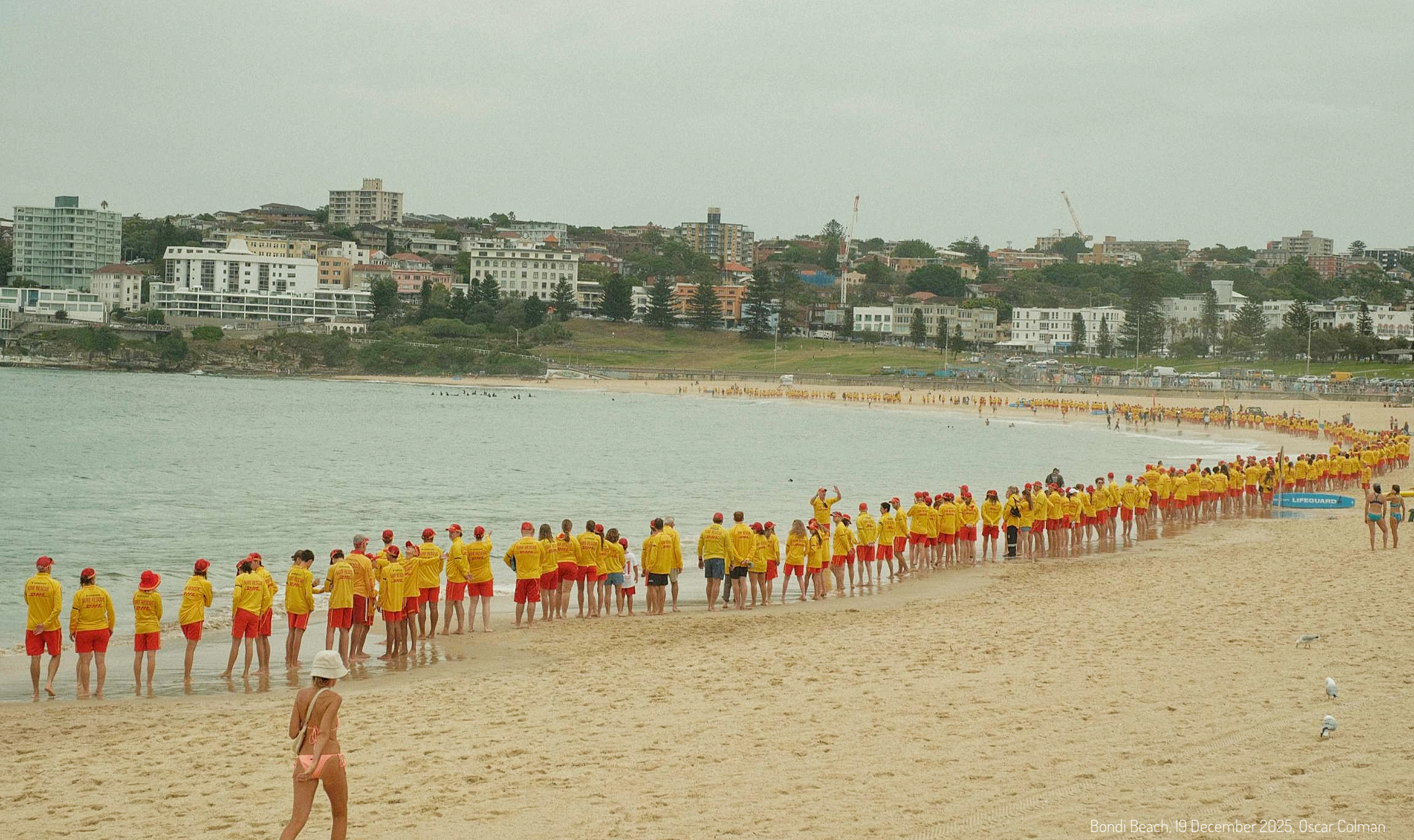
Lifesavers line Bondi Beach, 19 December 2026, Oscar Colman
Postscript … just saying …
The following is a précis of an opinion piece in the Sydney Morning Herald on 20 December 2025 by satirist and presenter Josh Szeps entitled “What kind of Australia do we want to be? Let’s stop dodging the hard questions”. It encapsulates succinctly the questions we must ask ourselves. It is no satire:
In the aftermath of Bondi, everyone has an explanation and a slogan. Blame is flung in all directions – Israel, its critics, Muslims, the prime minister, “the world’s oldest hatred” – and consensus collapses into a hollow refrain: say no to hate. Comforting, yes; clarifying, no. Meanwhile, Jewish Australians now fear public gathering, and Muslim and Palestinian Australians brace for backlash of their own. This is the brittle edge of multiculturalism when the shared glue has weakened.
That glue once went by a plain name: liberal universalism – free speech, equality before the law, scepticism toward dogma, the right to criticise ideas without condemning people. Over the past decade it has been displaced by a politics of identity, grievance management, and performative outrage, leaving us unwilling to ask hard but necessary questions: how to integrate insular communities, how to criticise religious fanaticism without collapsing into bigotry, how to balance pluralism with a shared civic culture. Into that vacuum rush provocateurs, algorithms, and foreign actors only too happy to inflame old hatreds.
The weekly Gaza marches exposed this failure. Slogans like “globalise the intifada” or “from the river to the sea” may sound abstract or benign to some, but to many Jews they carry a very concrete historical threat – especially after October 7. That most marchers may not have grasped the implications is precisely the problem. Chanting borrowed slogans in mass, without curiosity or restraint, is not moral seriousness. Nor is pretending that theocratic, homophobic, antisemitic religious doctrines are merely “cultural differences” compatible with the values that made Australia attractive in the first place.
Multiculturalism survives only if it demands something of everyone: discomfort and openness from the majority; reciprocity, restraint and abandonment of imported feuds from minorities. If liberals won’t defend universal values — plainly, without euphemism or ritual throat-clearing — others, far less liberal, will step in and do it for them.
Here are three particularly resonant paragraphs:
“Week after week, chunks of our cities were overtaken by protesters carrying signs that had nothing to do with Israeli policies, such as “globalise the intifada” and “by any means necessary”. The ubiquitous “from the river to the sea”, benign-sounding to bystanders, proposes that an Arab state ought to sit on top of all the land of Israel – that Jewish people should live at the pleasure of rulers whose theocratic education would make Australia’s most radical imam look like a Jew-loving hippy. Is such a sentiment just innocent political speech? Or, in the wake of the jihadism on October 7, 2023, could it be understood as a threat to conquer the world’s only Jewish safe space?
… if you found yourself marching across the Sydney Harbour Bridge chanting slogans you didn’t write, about a complex issue you’re not really across, surrounded by crowds chanting the same thing, which others found intimidating … you may, in fact, not have been elevating the discourse. “Intifada” technically means “uprising”, but in the context of Palestinian resistance it implies exploding buses, drive-by shootings and suicide bombers in cafes. (See: “Second Intifada” in Wikipedia, kids). Presumably, most of the protesters didn’t know this. After last weekend, they do. The Intifada has been globalised …
It’s up to all of us to refresh multiculturalism by tethering it to universal values and admitting that it demands sacrifices all around. It demands that people in the majority make themselves uncomfortable, around unfamiliar languages, faiths, customs and food. And it demands that people in the minority give up dogmatism, grudges and cultural feuds”.
i couldn’t express it better myself …
Josh Szeps, satirist and presenter Sydney Morning Herald 20 December 2025
See also in In That Howling Infinite, “You want it darker?” … Gaza and the devil that never went away … , How the jihadi tail wags the leftist dog and Little Sir Hugh – Old England’s Jewish Question
For more on the Middle East in in That Howling Infinite, see A Middle East Miscellany.

Sydney July 2025 (Getty)
 In That Howling Infinite
[…] See This Is What It Looks Like […]
[…] This Is What It Looks Like, published very soon after the Bondi Beach massacre, we […]
[…] Infinite, A Political World – Thoughts and Themes, and A Middle East Miscellany. and also: This Is What It Looks Like, “You want it darker?” … Gaza and the devil that never went away … , How the jihadi tail […]
[…] This Is What It Looks Like, published very soon after the Bondi Beach massacre, we […]
[…] Infinite, A Political World – Thoughts and Themes, and A Middle East Miscellany. and also: This Is What It Looks Like, “You want it darker?” … Gaza and the devil that never went away … , How the jihadi tail […]
[…] This Is What It Looks Like, we wrote: “… antisemitism does not arrive announcing itself. It seeps. It jokes. It chants. It […]
[…] Infinite, A Political World – Thoughts and Themes, and A Middle East Miscellany. and also: This Is What It Looks Like, “You want it darker?” … Gaza and the devil that never went away … , How the jihadi tail […]