Feints, refrains and unfinished business. 2025 in review

And we are here as on a darkling plain
Swept with confused alarms of struggle and flight,
Where ignorant armies clash by night.
Mathew Arnold, Dover Beach

We called 2024 a “year of everything, everywhere, all at once”, and it earned the name. Crises collided, news arrived faster than we could process it, and the world seemed to exist in a state of constant shock. 2025 did not bring relief. Instead, the chaos began to settle. Wars dragged on, political divides hardened, social tensions deepened, and technology reshaped how we saw and understood it all.

It was the year the world stopped exploding in real time and started being what it had already become: messy, uneven, morally complicated, and stubbornly persistent. A year, indeed, in a world of echoes, refrains and unfinished business. And we spent the year watching power bargain brazenly in plain sight, trying to describe what was happening while it unfolded around us.

From Gaza to Ukraine, Sudan to Syria, from America’s self-inflicted fracture to Australia’s sudden wake-up call on Bondi Bondi, 2025 forced a reckoning: the world did not pause, but it did sort itself – deciding what we would notice, what we would ignore, and what we would learn to live with. Alongside human crises came the continuing advance of AI and chatbots, and the dominion of the algorithms that now govern attention, proving that disruption can be structural as well as geopolitical.

Gaza: War, Then “Ceasefire”

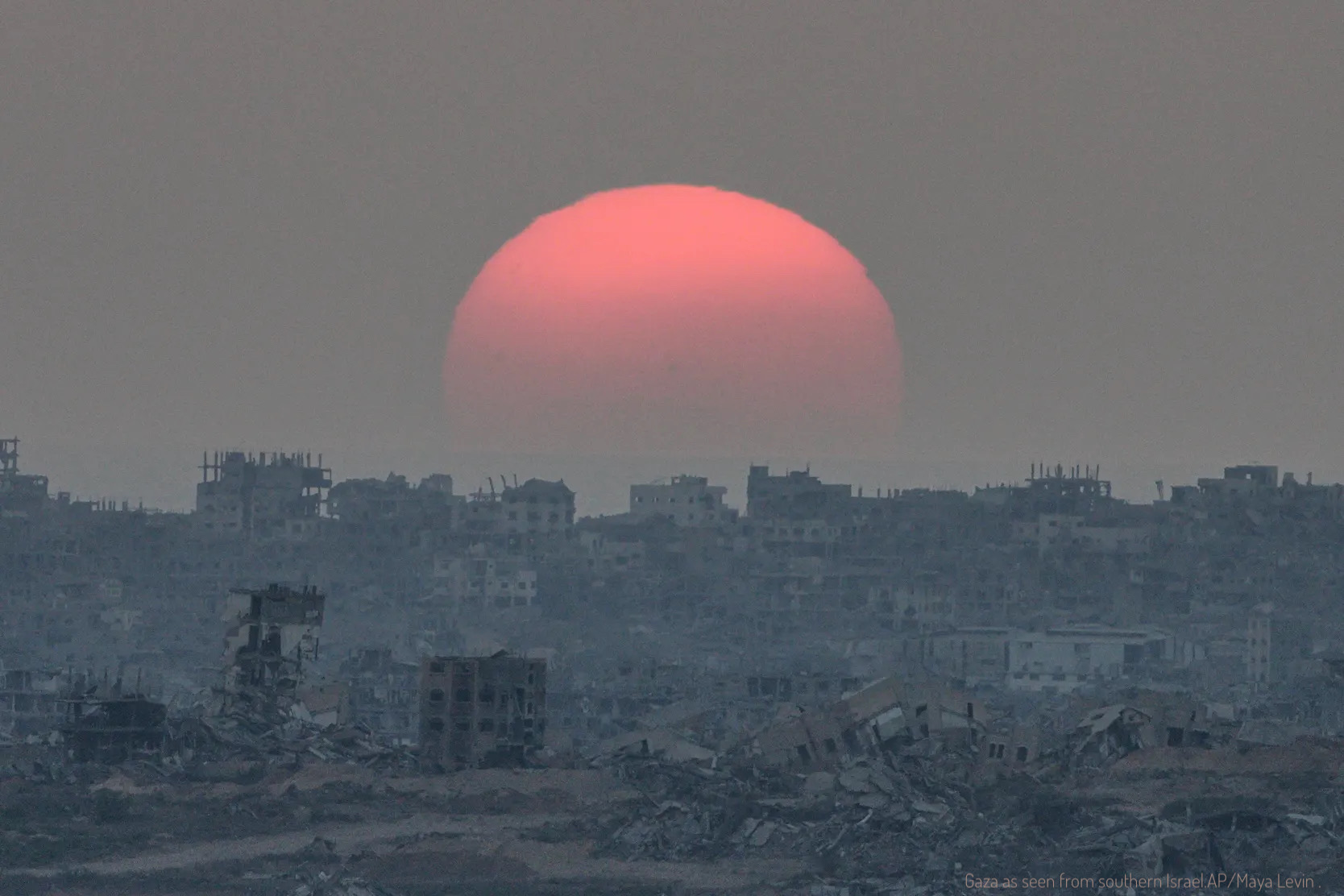
The war in Gaza dominated the year internationally and here in Australia, even as attention ebbed and flowed. Military operations continued for months, followed eventually by a “ceasefire” – a word doing far more work than it should or even justified. Fighting paused, hostages living and dead were returned and prisoners released, but the devastation remained: tens of thousands dead, cities demolished, humanitarian catastrophe unresolved. And the causes of the consequences standing still amidst the ruins and the rubble.

Western governments continued to back Israel while expressing concern for civilians, a contradiction that grew harder to defend, while street protests and online anger seethed all across the world. At the same time, antisemitism surged globally, often hiding behind the language of anti-Zionism. Two realities existed together, and too many people insisted on choosing only one.

By the end of the year, the war had not been resolved – merely frozen. Trust in Western moral leadership had been badly damaged, and Israelis and Palestinians remain in bitter limbo.

See Gaza sunrise or false dawn? Spectacle or Strategy
Iran, Israel and America’s bunker busters

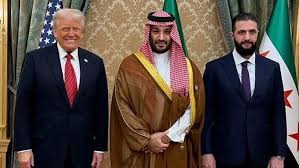
Long-simmering tensions between Israel and Iran spilled into open conflict. What had once been indirect – proxies, cyberattacks, covert strikes – became visible. A brief but destructive war of missile exchanges ended with the United States asserting ordinance, deterrence and control.

The episode was brief but telling. It showed that America still reaches for its guns quickly, even as it struggles to define long-term goals. Another line was crossed, then quickly absorbed into the background of “normal” geopolitics.

Russia, Ukraine and Trump’s “Peace”

Ukraine entered 2025 mired in stalemate. Front lines barely moved. Casualties continued to mount. Western support held, but with clear signs of fatigue. And Donald Trump’s re-emergence reshaped the conversation. His promise to deliver instant “peace” reframed the war not as a question of justice or sovereignty, but of exhaustion. Peace was no longer about what Ukraine deserved, but about what the world was tired of sustaining and what the “art of the deal” could deliver.

The war didn’t end. It simply became something many wanted to stop thinking about. Not Ukraine and Russia, but. The carnage continues.

Donald Trump’s one-way crush on Vladimir gave us the one of the+most cringeworthy moments in global politics – Trump greeting the Russian president in Alaska: As the US president rolled out the red carpet for the world’s most dangerous autocrat, Russia’s attack on Ukraine accelerated. Trump got precisely nothing out of the meeting, except for the chance to hang out with a gangster he so obviously admires and of whom he is embarrassingly in awe.

Syria: Free, but stranded at the crossroads

A year after Assad’s fall, Syria remained unstable and unresolved. The regime was gone, but the future was unclear. Old sectarian tensions resurfaced, often in bloodshed, new power struggles emerged, powerful neighbours staked claims and  justice for past crimes remained distant.

Syria in 2025 was neither a success story nor a collapse – but suspended between heaven and hell, a country trying to exist after catastrophe with the rest of the world largely moving on.

See Between heaven and hell … Syria at the Crossroads
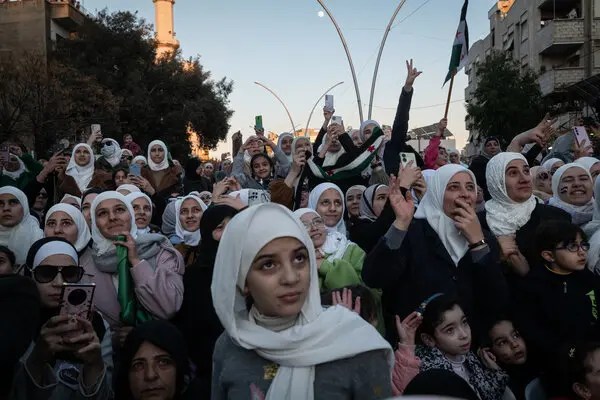
Women in Damascus celebrate the fall of the Assad regime

Sudan: what genocide actually looks like

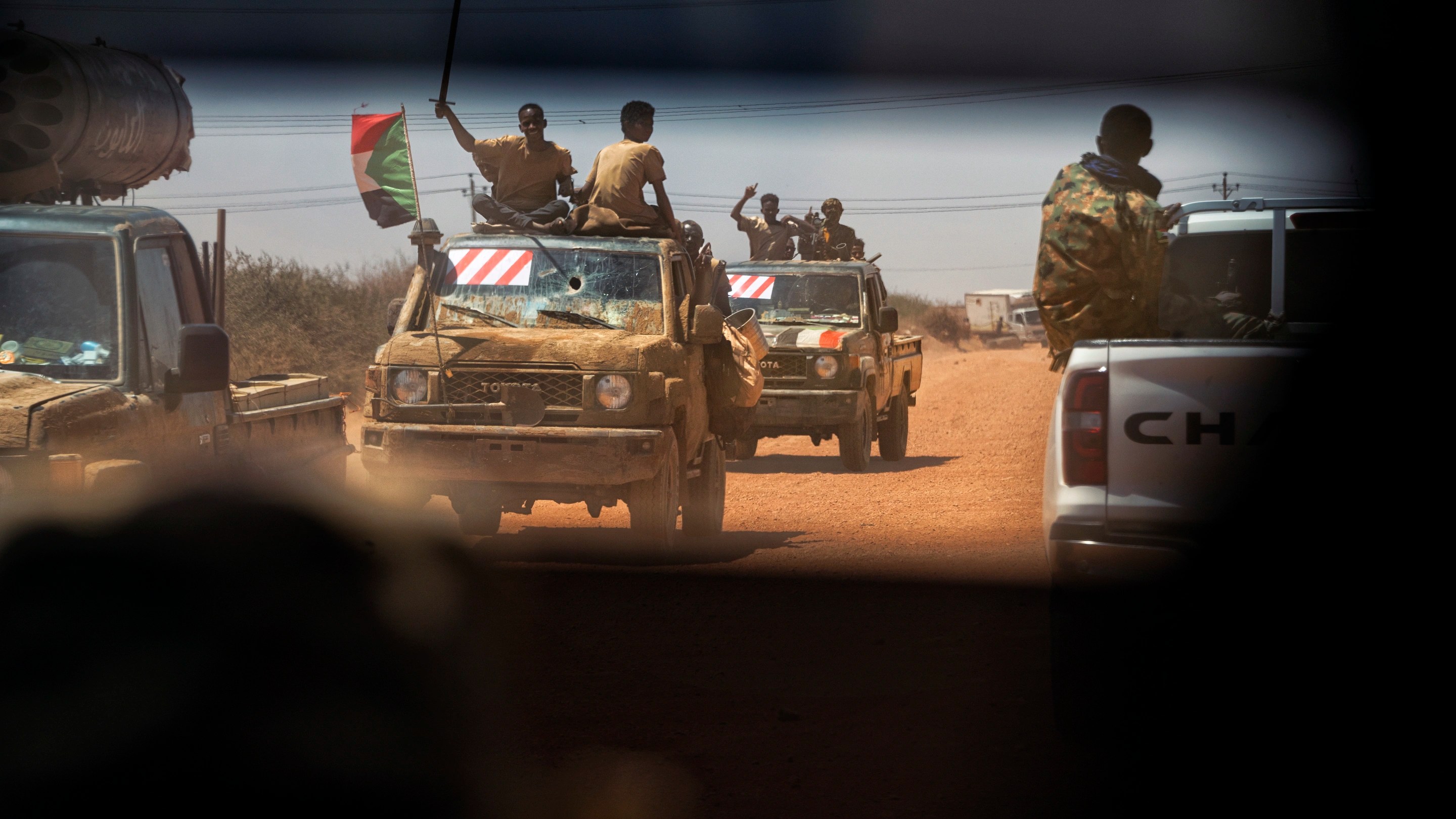
Sudan’s civil war continued with little international attention. Mass killing, ethnic cleansing, famine, and displacement unfolded slowly and relentlessly. This was genocide without spectacle. No clear narrative. No sustained outrage. It showed how mass atrocity can now occur not in secrecy, but in plain sight – and still be ignored.

see The most nihilistic war ever …Sudan’s waking nightmare
America: a country divided against itself

The United States spent 2025 deeply divided, with no sign of healing. Pew Research polling showed that seven out of ten republicans think that the opposite side is immoral while six of ten democrats thinks the same of their rivals.

Trump’s return to power sharpened those divisions. His administration governed aggressively: mass deportations, punitive tariffs, the dismantling of foreign aid, political retribution, and pressure on democratic institutions. The country looked inward and outward at the same time – less cooperative, more transactional, more openly nationalist. Democratic norms eroded not overnight, but through constant stress and disregard. With three years still to run and the tell-tale midterms approaching, allies and cronies are adjusting, bickering rivals are taking notes, and uncertainty has become the defining feature of American leadership. Meanwhile, #47 is slapping his name on everything he can christen, from bitcoins to battleships.

See, for light relief, Danger Angel … the ballad of Laura Loomer 

Monroe Redux: the return of “the Ugly American”

US foreign policy took on a blunt, old-fashioned tone. Pressure on Canada and Mexico increased. Talk of annexing Greenland resurfaced. Venezuela, caught in the maw of Yanqui bullying and bluster, waits nervously for Washington’s next move. The administration promised imminent land operations – and then bombed Nigeria! The revival of the old Monroe Doctrine felt, as baseball wizz Yogi Berra once remarked, like déjà vu all over again, not as strategy, but as instinct. Influence asserted, consultation discarded. The “ugly American” was back, and unapologetic.

See Tales of Yankee power … Why Venezuela, and why now?

Europe at a inflection point

Europe in 2025 didn’t collapse, as many pundits suggested it might, but it shifted. Far-right ideas gained ground even where far-right parties didn’t win and remained, for now, on the fringes albeit closer to electoral success. Borders tightened; policies hardened; street protests proliferated – against immigration and against Israel, Support for Ukraine continued, but cautiously. The continent stood at a crossroads: still committed to liberal values in theory, but increasingly selective in practice.

Uncle Sam’s  cold-shoulder

Rumbling away in the background throughout year was the quiet but  cumulative alienation of America’s allies. Not with a single rupture, but through a thousand small slights. transactional diplomacy dressed up as realism, alliances treated as invoices rather than covenants, multilateralism dismissed as weakness. Europe learned that security guarantees come with a mood swing; the Middle East heard policy announced via spectacle; Asia watched reassurance coexist uneasily with unpredictability.

The new dispensation was illustrated by the Trump National Security Strategy. It is at once candid and contradictory: it outlines a narrower, realist vision of American interests, emphasising sovereignty, burden-sharing, industrial renewal, and strategic clarity, yet it is riddled with silences, evasions, and tensions between rhetoric and likely action. Allies are scolded for weakness while the document avoids naming Russia’s aggression, underplays China, and projects American cultural anxieties onto Europe. These contradictions expose both strategic incoherence and the limits of paper doctrine against presidential temperament, leaving Europe facing an irreversible rupture in trust and revealing a strategy as much about America’s insecurities as its actual global posture.

The post-WW2 order has not so much been dismantled as shrugged at, and indeed, shrugged off. Trust eroded not because the United States has withdrawn from the world, but because it has remained present without being reliable, and presumed itself to be in charge. Power, exercised loudly but inconsistently, has discovered an old truth: allies can endure disagreement, but they struggle with contempt.

Australia in 2025 … high flight and crash landing

Though beset by a multitude of crises – the cost of living, housing, health and education services – the Albanese Labor government was returned comfortably in May, helped by a divided, incoherent, and seemingly out of touch opposition. For the rest the year, federal politics felt strangely frictionless with policy drift passing for stability. The Coalition remained locked in internal conflict, unable to present a credible alternative. The Greens, chastened by electoral defeat and in many formerly friendly quarters, ideological disillusionment, treaded water.

But beneath the surface, social cohesion frayed. Immigration debates sharpened. Antisemitism rose noticeably, no longer something Australians could pretend belonged elsewhere. Attacks on Jewish Australians forced a reckoning many had avoided and hoped would resolve once the tremors of the war in Gaza had ameliorated. Until 6.47pm on 7th December, a beautiful evening on Sydney’s iconic Bondi Beach. Sudden, brutal and in our summer playground, sectarian violence shattered the sense of distance Australians often feel from global disorder. At that moment, politics stopped feeling abstract. The world, with all its instability, barged in and brought the country down to earth.

See This Is What It Looks Like

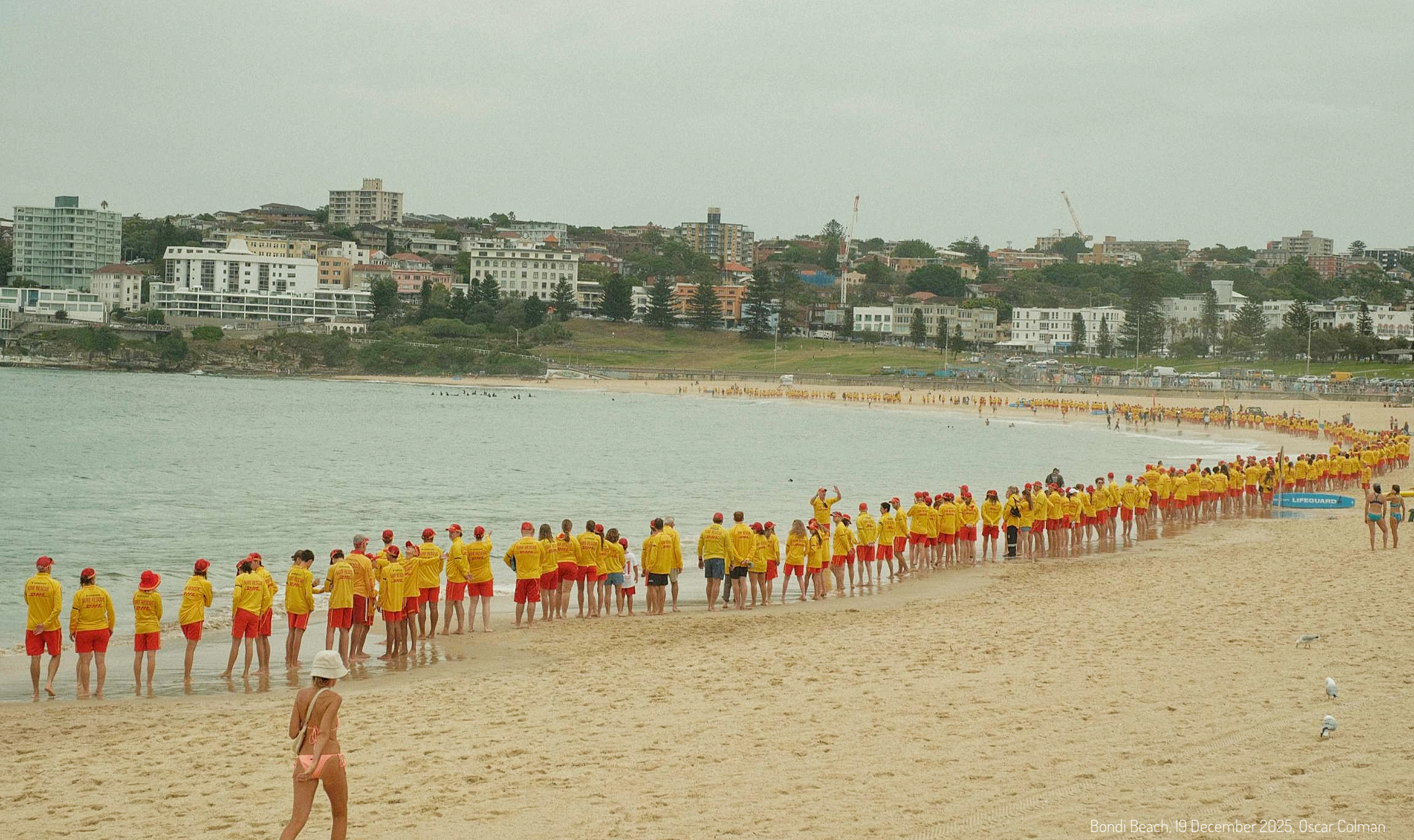
Lifesavers on Bondi Beach, 20 December 2025. Edwina Pickles

Featured photograph and above:

A handful of bodies on Bondi Beach, and behind them, the howling infinite of expectation, obligation, and the careful rationing of human empathy. The smallness of the beach against the vastness of consequences. On December 20, 2025, Bondi’s iconic lifesavers formed a line stretching the entire length of the beach -silent, solemn, a nation visibly in mourning. Similar tributes unfolded from Perth to Byron Bay, gestures of unity in the face of a shock that touched the whole country.

The Year of the Chatbot: Promise, Power, and Risk

And now, a break from the doom and gloom …

2025 was the year when artificial intelligence became part of daily life. Chatbots ceased to be experimental and became integral, transforming from novelty to utility seemingly overnight. People used it to write, research, translate, plan, argue, comfort, and persuade; institutions and individuals adopted it instinctively. Setting tone as much as content, the ‘bots have lowered barriers to knowledge, sharpened thinking, and helped people articulate ideas they might otherwise struggle to express. Used well, they amplified curiosity rather than replace it.

The opportunities are obvious – but so are the risks. Systems that can clarify complexity can also flatten it. Chatbots sound confident even when wrong, smooth over disagreement, and made language cleaner, calmer, and more persuasive – but not necessarily truer. They reinforce confirmation bias, outrage, and tribal certainty, generating arguments instantly and flooding the zone with plausible-sounding text. As information has became faster, cheaper, and less reliable, Certainty has spread more easily than truth, so truth has to work much harder.

Dependence is subtler but real. Outsourcing thinking – summaries instead of reading, answers instead of wrestling – did not make humans stupid, but less patient. Nuance, doubt, and slow understanding became harder to justify in a world optimised for speed. Yet conversely, man people still seek context, history, and complexity. Used deliberately, AI could slow the pace, map contradictions, and hold multiple truths at once.

By the end of 2025, the question was no longer whether AI would shape public life – it already had. The real question is whether humans would use it as a shortcut, or as a discipline. The technology is neutral. The danger – and the promise – lies in how much thinking we are willing to give up, and how much responsibility we are prepared to keep.

See The promise and the peril of ChatGPT 
Algorithm and blues

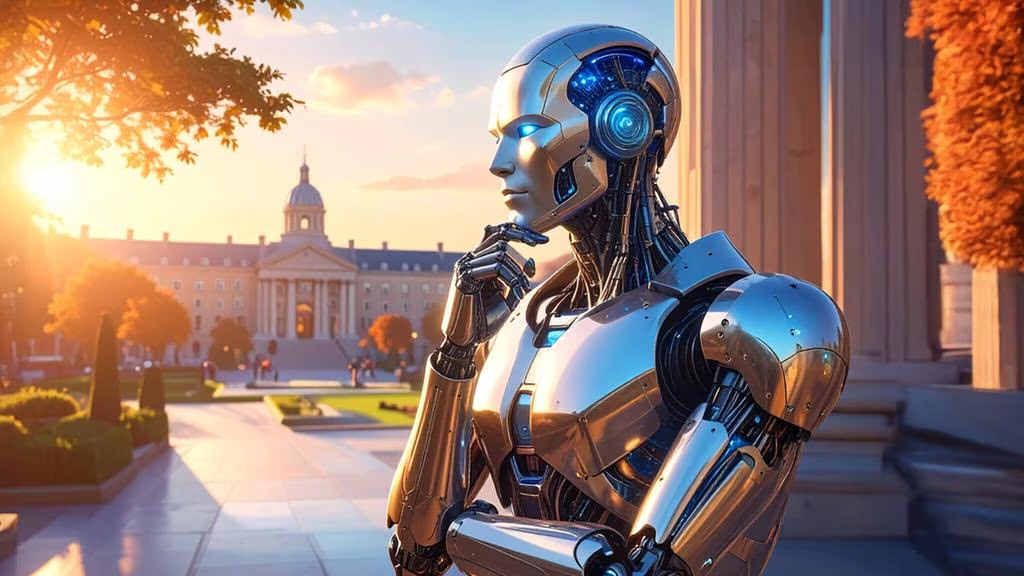
Alongside the chatbot sat a quieter, more insidious force: the algorithm itself. By 2025 it no longer simply organised information – it governed attention. What people saw, felt, and argued about was shaped less by importance than by engagement. To borrow from 20th century philosopher and communication theorist and educator Marshall McLuhan, the meme had become the message. Complex realities were compressed into images, slogans, clips, and talking points designed not to inform but to travel. The algorithm rewarded speed over reflection, certainty over doubt, heat over light. Politics, war, and grief were all flattened into content, stripped of context, and ranked by performance. What mattered most was not what was true or necessary, but what disseminated.

Passion without Wisdom

I wrote during the year that we seemed “full of passionate intensity” – Yeats’ phrase still apt in the twenty first century- but increasingly short on wisdom and insight. 2025 confirmed it. Anger was everywhere, empathy highly selective, certainty worn like armour. People felt deeply but thought narrowly. Moral energy surged but rarely slowed into understanding. The problem was not indifference; it was excess – too much feeling, too little reflection. In that environment, nuance looked like weakness and patience like complicity. What was missing was not information, but judgement – the harder work of holding contradiction, of resisting instant conclusions, of allowing complexity to temper conviction. Passion was abundant. Insight, increasingly rare.

Looking Toward 2026

Looking back on 2025, it seems that there  were no endings, neither happy or sad. Just a promise, it seems, of more of the same. The year didn’t solve anything. It clarified things. And if it clarified anything, it was that the world has grown adept at managing, ignoring, or absorbing what it cannot fix. It revealed a world adjusting to permanent instability. In this year of echoes, refrains, and unfinished sentences.

Passion, intensity, and outrage were abundant, but patience, wisdom, and insight remained scarce. Democracies strained under internal and external pressures. Wars lingered unresolved. Technology reshaped thought and attention.

Some argue that hope springs eternal, that yet, even amid the drift and the fractures, glimpses of understanding and resistance persisted, that although the world has settled into its chaos, we can be riders on the storm. But, I fear, 2026 arrives not as break, a failsafe, a safety valve, but as continuation. It looms as a test of endurance rather than transformation.  In my somnolent frame of mind, I’ve reached again for my Yeats. “Things fall apart; the centre cannot hold; mere anarchy is loosed upon the world, the blood-dimmed tide is loosed …”

After the chaos of 2024 and the hardening of 2025, the question is no longer what might go wrong. It’s what we’re prepared to live with.

And so we come to what In That Howling Infinite wrote in 2025.

What we wrote in 2025

It was a year that refused neat endings.

It began in a wasteland – Gaza as moral ground zero – and moved, restlessly, through revolutions real and imagined: Trump as symptom and accelerant, Putin as a man racing his own shadow, Syria forever at the crossroads where history idles and then accelerates without warning. Gaza returned, again and again, sunrise and false dawn, as spectacle and strategy; Sudan burned in near silence; Venezuela re-entered the frame as empire’s backyard as the US disinterred its Monrovian legacy. In That Howling Infinite featured pieces on each of these – several in many cases , twenty in all, plus a few of relevance to them, including an overview of journalist Robert Fisk’s last book (The Night of Power – Robert Fisk’s bitter epilogue). A broadranging historical piece written in the previous year and deferred, Modern history is built upon exodus and displacement, provided a corrective of sorts to the distorted narratives that have emerged in recent years due to a dearth of historical knowledge and the partisan weaponisation of words. 

It was almost as light relief that we turned to other subjects. Of particular interest was AI. Approaching remorselessly yet almost unrecognised in recent years, it banged a loud gong and crept from curiosity to condition, from tool to weather system, quietly rewriting the newsroom, the internet, and the idea of authorship. ChatGPT and other chatbots appeared not as saviours but as promise and peril in equal measure. By year end, we were fretting about using ChatGPT too much and regarding it as something to moderate like alcohol or fatty foods. We published three pieces on the subject in what seemed like rapid succession, and then pestered out – sucked into the machinery, I fear.

What with so much else attracting our attention, we nevertheless managed to find time for some history – including a  particularly enthralling and indeed iconoclastic book on the fall of the Ottoman Empire; the story of an Anzac brigade lost in Greece in 1942; “the Lucky Country” revisited after half a century;  and a piece long in the pipeline on the iconic singer and activist Paul Robeson.

In August, as on a whim, for light relief, we summoned up a nostalgic old Seekers’ song from the mid-sixties, a time when the world was on fire with war and rage much as it is today, but for us young folk back in the day, a time of hope and hedonism. For us, the carnival, clearly, is not over. The machinery is still whirring, the music still loud, and the lights still on. History is insisting on one more turn of the wheel, and the dawn, so often promised, so frequently invoked, has not yet broken.

January
The Gaza War … there are no winners in a wasteland
The way we were … reevaluating the Lucky Country

February
Let’s turn Gaza into Mar e Largo
Trump’s Second Coming … the new American Revolution
Cold Wind in Damascus … Syria at the crossroads

March
Trumps Revolution… he can destroy but he cannot create
Where have all the big books gone?
Putin’s War … an ageing autocrat seeks his place in history

April
The Trump Revolution … I run the country and the world
The Fall of the Ottoman Empire and the birth of Türkiye
Let Stalk Strine .. a lexicon of Australian as it was spoken (maybe)

May
The phantom of liberty … the paradoxes of conservativism
Shadows in search of a name … requiem for a war
The continuing battle for Australia’s history

July
A mighty voice … the odyssey of Paul Robeson

August
109 years of Mein Kampf … the book that ravaged a continent
High above the dawn is breaking … the unlikely origin of a poo song

September
Gaza sunrise or false dawn? Trump’s peace plan
Gaza sunrise or false dawn? Spectacle or Strategy
Will there ever be a Palestinian state?
Why Osana bin lost the battle but won the war
The Night of Power … Robert Fisks bitter epilogue
The promise and peril of ChatGPT
Who wrote this? The newsroom’s AI dilemma

October
AI and the future of the internet
Danger Angel … the ballad of Laura Loomer

November
A forgotten Anzac story in Greece’s bloody history
The most nihilistic war ever … Sudan’s waking nightmare
Answering the call … National Service in Britain 1945-1963
Tales of Yankee Power … at play in Americas backyard

December
Delo Kirova – the Kirov Case … a Soviet murder mystery
Between heaven and hell … Syria at the crossroads
This Is What It Looks Like
Tales of Yankee power … Why Venezuela, and why now?
Marco Rubio’s Venezuelan bargain

Read out reviews of prior years:

That was the year that was – retrospectives

A song for 2026: Lost love at world’s end …

It is our custom to conclude our annual wrap with a particular song that caught our attention during the year. Last year, we chose Tears for Fears’ Mad World.  It would be quite appropriate for 2025. But no repeats! so here is something very different. An outwardly melancholy song that is, in the most ineffable way quite uplifting. that’s what we reckon, anyway …

The Ticket Taker is on the surface a love song for the apocalypse; and it’s it’s one of the prettiest, most lyrically interesting songs I’ve heard in a long while. I could almost hear late-period Leonard Cohen and his choir of angels.

The apocalypse is both backdrop and metaphor. We’re not sure which. Is it really about a world ending, or just about the private ruin of a man left behind by love and fortune. The lyrics are opaque enough to evade final meaning, but resonant enough to keep circling back, like the ferry itself, between hope and futility. A love song, yes, but also a confession of entrapment: the gambler’s hope, the ark one cannot board.

The “Ticket Taker” song was written by Ben Miller and Jeff Prystowsky and is featured on The Low Anthem’s album Oh My God, Charlie Darwin. It features on Robert Plant’s latest foray into roots music – this time with English band Saving Grace. This flawless duet with Suzi Dian is mesmerising and magical.

Jeff will tell you that the song is “pure fiction,” that Ben “just made it up one day” – but fiction, as we know, has a way of smuggling deeper truths than fact dares admit.

Tonight’s the night when the waters rise
You’re groping in the dark
The ticket takers count the men who can afford the ark
The ticket takers will not board, for the ticket takers are tied
For five and change an hour, they will count the passers-by

They say the sky’s the limit, but the sky’s about to fall
Down come all them record books, cradle and all
They say before he bit it that the boxer felt no pain
But somewhere there’s a gambling man with a ticket in the rain

Mary Anne, I know I’m a long shot
But Mary Anne, what else have you got?
I am a ticket taker, many tickets have I torn
And I will be your ark, we will float above the storm

Many years have passed in this river town, I’ve sailed through many traps
I keep a stock of weapons should society collapse
I keep a stock of ammo, one of oil, and one of gold
I keep a place for Mary Anne, soon she will come home

Mary Anne, I know I’m a long shot
But Mary Anne, what else have you got?
I am a ticket taker, many tickets have I torn
And I will be your ark, we will float above the storm

Mary Anne, I know I’m a long shot
But Mary Anne, what else have you got?
I am a ticket taker, many tickets have I torn
And I will be your ark
Marco Rubio’s Venezuelan bargain

People with only a passing acquaintance with Latin American history and politics have been asking, with genuine puzzlement, “why Venezuela? And why now?” The question is reasonable enough, but the coverage has been thin – particularly here in Australia – where Venezuela tends to appear only as a shorthand for failure or excess, rarely as a site of serious American political investment.

In That Howling Infinite recently provided several reasonably comprehensive explanations in Tales of Yankee power … Why Venezuela, and why now? But what has been largely absent from this and from other discussions is the role being played by former senator and now Secretary of State Marco Rubio. That absence, as we shall see below,  is striking.

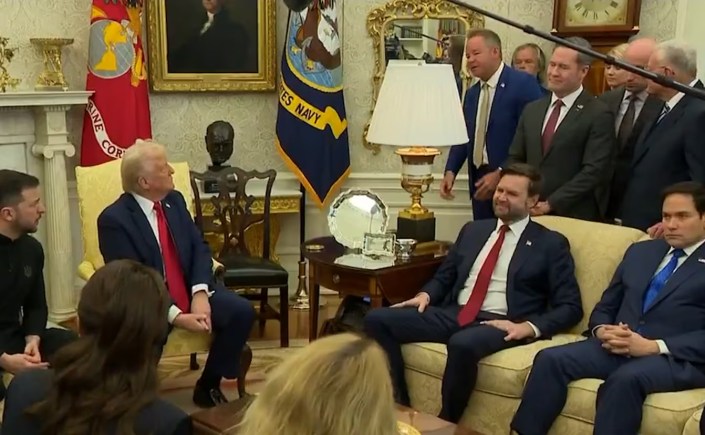
The Rubio connection surfaced explicitly in American author and commentator Fareed Zakaria’s latest Global Public Square broadcast on CNN, and once raised, it proved difficult to ignore. Rubio’s place in the MAGA-verse is, after all, an incongruous one. This is the same seasoned, disciplined, and electorally successful politician whom Donald Trump once ridiculed in the 2016 campaign as “Lil’ Marco,” a moment of theatrical humiliation that seemed, at the time, politically terminal. And yet here he is, back in the room and back at the table, standing stiffly beside Trump and self- styled “Secretary of War” Pete Hegseth in press conferences, Oval Office set-pieces, and cabinet gatherings, his discomfort almost palpable.

Watching those scenes, it is hard not to suspect a transaction. Not in the crude sense of quid pro quo, but in the quieter, more human register of political survival: the price one pays to remain relevant, to retain influence, to draw at least one clear moral boundary in an administration otherwise defined by improvisation and loyalty tests. It was this that set me thinking that Venezuela – by way of Cuba – may be Rubio’s price. The policy domain where he is allowed conviction, where memory still outranks expediency, and where supporting Trump does not feel, at least to himself, like surrender.

Intrigued by Zakaria’s brief “take” on Marco Rubio and Venezuela, I asked Chat GPT to sift through reportage in American media and other sources and come up with a more detailed story. That story follows.

See also in In That Howling InfiniteTales of Yankee Power … at play in America’s backyard, Tales of Yankee power … Why Venezuela, and why now? and the original  Tales of Yankee Power

Marco Rubio and the Politics of Memory

To understand Rubio’s Venezuela policy, it helps to stop thinking in terms of strategy alone and start thinking in terms of inheritance. This is not a story that begins in Caracas or Washington, but in Havana – or rather, in the Havana that survives only in memory: confiscated houses, interrupted childhoods, unfinished arguments passed down like heirlooms. Rubio speaks not just to voters, but to ghosts. And those ghosts have opinions.

For Rubio, socialism is not a theory, nor even a failed experiment. It is a family trauma, translated into politics. This matters because it explains both the intensity and the rigidity of his stance on Venezuela, and why compromise there feels not merely imprudent, but immoral. Venezuela matters because it looks like the past refusing to stay past.

The Cuban exile community in Miami has long provided American politics with a particular moral grammar: clarity over ambiguity, punishment over accommodation, endurance over negotiation. In this worldview, regimes do not soften; they calcify. Time is not neutral; it is the enemy. The lesson of Cuba is that hesitation becomes permanence. Rubio absorbed this lesson early, intuitively, and it has shaped his political ascent.

As Venezuela slid into authoritarian collapse in the 2010s, it became the perfect successor to Cuba as both warning and weapon. Unlike Havana, Caracas was still in motion. It had elections – imperfect, manipulable, but legible enough to serve as staging grounds for hope. It had oil, which meant leverage. And it had an opposition that could be imagined, at least briefly, as viable. Venezuela became Cuba-with-oil, a second chance to get history right.

Rubio seized that opportunity. He framed Venezuela not merely as a foreign policy challenge, but as Exhibit A in a broader moral argument about socialism, populism, and American decline. In doing so, he also performed a useful domestic alchemy: fusing Cuban-, Venezuelan-, and Nicaraguan-American experiences into a single narrative of victimhood and resistance. Florida’s exile communities became not distinct histories, but a shared cautionary tale.

This was not incidental to Rubio’s rise; it was central to it. Venezuela allowed him to marry personal biography to national rhetoric, foreign policy to electoral arithmetic. Hardline sanctions, regime-change language, and moral absolutism were not just positions – they were signals of fidelity to memory.

The Juan Guaidó episode in 2019 marked the high-water line of this approach. Rubio was among the loudest advocates of the belief that pressure, recognition, and a sufficiently confident declaration of inevitability would cause the Maduro regime to collapse. When it didn’t – when the military held, the opposition fractured, and the regime adapted – the failure did not soften conviction. It hardened it. In exile politics, failure is rarely read as miscalculation; more often it is read as insufficient resolve.

What has changed since is not Rubio’s worldview, but the world around it.

Venezuela has survived. Sanctions leaked. New patrons appeared. The regime learned how to manage scarcity and repression simultaneously. And the multipolar order – China, Russia, Iran – provided insulation that Cuba in the 1960s never had. The Cuban model, once a warning, began to look uncomfortably like a blueprint.

Enter Trump—again.

Rubio’s return to proximity with Trumpian power has been visibly uneasy. The discomfort is not theatrical; it is structural. Rubio is not a natural Trumpist. He believes in alliances, institutions, and the moral language of American leadership – however threadbare those concepts have become. Standing beside Trump and figures like Pete Hegseth in pressers and cabinet gatherings, Rubio often looks less like a disciple than a negotiated presence.

Which is why Venezuela matters now in a different way.

It is plausible – compelling, even – to read Rubio’s Venezuela focus as the price of admission. His moral compensation. The policy space he is allowed to dominate in exchange for supporting, or at least tolerating, other Trump policies that clearly sit uneasily with him. Give me Latin America, the bargain seems to say. Let me draw the line there.

Trump accepts this because it costs him little and gains him Florida. Rubio accepts it because Venezuela is the one issue where compromise feels like apostasy. It is his redemptive exception – the place where he can still be unbending, certain, and righteous, even as he swallows his discomfort elsewhere.

The result is a Venezuela policy overdetermined by symbolism. Sanctions become not just tools, but acts of remembrance. Engagement becomes not diplomacy, but forgetting. The ghosts hover constantly, reminding, accusing, insisting that this time must be different.

And yet the irony persists. Rubio’s politics of memory assumes that time favours pressure – that authoritarian regimes crack if held long enough. Venezuela suggests the opposite: that time favours adaptation. Survival is no longer failure; it is proof of concept. The past is not repeating itself exactly – it is mutating.

Which leaves Rubio caught between conviction and context. His stance is principled in its own terms, emotionally coherent, politically intelligible. But it struggles with a world in which pressure still matters, yet no longer decides outcomes.

Venezuela, in this telling, is not just a country. It is a memory test. A moral rehearsal. A stand-in for an argument with history that never quite concluded. Rubio stays in the room, visibly uneasy, because Venezuela allows him to believe that proximity to power has not dissolved purpose.

Whether that bargain helps Venezuela is uncertain. But as an explanation for Rubio himself – for his rigidity, his discomfort, his persistence – it is as close as politics gets to biography. And in exile politics, biography is destiny.

And here the circle closes.

Rubio believes Venezuela matters because it looks like the past refusing to stay past. But by treating it primarily as a moral inheritance rather than a living, adaptive system, he risks replaying the very tragedy exile politics warns against: mistaking endurance for fragility, and time for an ally.

So yes – read this as a bargain.

Rubio stays, visibly uneasy, because Venezuela is his line in the sand. His proof to himself that proximity to power has not dissolved conviction. It is the policy space where he can still speak to ghosts – and hear them answer back.

Whether that bargain produces better outcomes for Venezuela is another question entirely. But as a political arrangement, it is elegant, durable, and profoundly human.

Sources and References

Primary reporting & analysis

  • Fareed Zakaria, GPS / Global Public Square segments on Venezuela and US foreign policy (CNN, 2024–2025)
  • The New York Times, Marco Rubio and U.S. Venezuela Policy (various reports, 2019–2024)
  • The Washington Post, coverage of the Guaidó recognition and sanctions regime
  • Reuters, U.S. sanctions policy and Venezuela negotiations (ongoing reporting)

Cuba–Venezuela nexus

  • Julia E. Sweig, Cuba: What Everyone Needs to Know (Oxford University Press)
  • William LeoGrande & Peter Kornbluh, Back Channel to Cuba (University of North Carolina Press)
  • International Crisis Group reports on Venezuela–Cuba security cooperation

Exile politics & Florida

  • Javier Corrales & Michael Penfold, Dragon in the Tropics (Brookings Institution Press)
  • Pew Research Center, Cuban-American and Venezuelan-American political attitudes
  • Politico, Florida, Rubio, and Latin America policy analyses

Sanctions & authoritarian adaptation

  • Adam Tooze, essays on sanctions and multipolarity
  • Brookings Institution, Why sanctions fail (and sometimes work)
  • Carnegie Endowment for International Peace, Venezuela sanctions assessments

Tales of Yankee power … Why Venezuela, and why now?

Amid accusations from Venezuela of piracy, US lawmakers have moved to bring back privateers, authorised by government-issued letters of marque, to ply the trade of piracy in service of their country by targeting enemy ships.
The Washington Post, 19 December 2025

This story does not relate to Bob Dylan’s cryptic and nihilistic Señor (Tales of Yankee Power), from Street Legal (1978). As for the meaning of his song, well, that’s pretty hard to fathom. A cowboy fever dream, perhaps; one of those strange illusions you channel in the early morning between sleeping and waking, more about mood than meaning.

Rather, these tales refer to the United States’ troubled and troublesome historical and contemporary relationship with its Central and Latin American neighbours – and particularly, to its current crusade against Venezuela’s autocratic president Nicolás Maduro. And it is less about Venezuela than about the US itself – an empire in all but name struggling to recover its own reflection in the shifting mirror of history. The restless ghost of Manifest Destiny is still pacing the corridors of the West Wing and the State Department. The “tales of Yankee power” keep repeating because the empire cannot imagine itself without them. Each show of force, each threat of “covert operations” is a reassurance ritual, a way of proving that the old muscles still work. But as with all empires in decline, the performance reveals more fragility than strength. The Monroe Doctrine once kept others out; the Neo-Monroe Doctrine may exist only to convince America that it is still in.

In That Howling Infinite has walked this road before in a 2017 post also entitled Tales of Yankee Power, a feature on American songwriter Jackson Browne‘s1986 album Lives in the Balance. At the time critics reckoned that its contemporary content, the USA’s bloody meddling in Central America, limited its appeal and long-term significance. And yet, here in the early twentieth first century, where the wars of the Arab Dissolution dragged the world into its vortex, and Vladimir Putin’s invasion of Ukraine ended seventy five years of Pax Europa, the Great Power politics and proxy wars that taxed intellectual and actual imaginations in that seemingly distant decade jump back into the frame like some dystopian jack in the box.

Eight years after the original Tales of Yankee Power, the story hasn’t ended – it’s simply changed key. The Uncle Sam is still abroad, still restless, still convinced the hemisphere cannot manage without his supervision. Only the script has been updated: what was once called the Monroe Doctrine is now “neo”; what was once the “war on communism” is now the “war on drugs”. But the music is familiar – and derivative: in this sad world, whenever Uncle Sam (or Comrade Ivan for that matter) plays his hand, something wicked this ways comes. As Canadian songwriter Bruce Cockburn, who also condemned the North’s intervention in the politics of the South once sang, “Little spots on the horizon into gunboats grow … Whatever’s coming, there’s no place else to go, waiting for the moon to show”.

People with only a passing acquaintance with Latin American history and politics have been asking, with genuine puzzlement, “why Venezuela? And why now?” The question is reasonable enough, but the coverage has been thin – particularly here in Australia – where Venezuela tends to appear only as a shorthand for failure or excess, rarely as a site of serious American political investment.

So, as the history of US intervention in Latin America repeats itself – or rhymes, if that is the more appropriate adage – I asked Chat GPT to rummage through the copious commentary to shed some light on why, with so much else on its “to do” list, America is dedicating so much energy, military resources, credibility and prestige on a defiant caudillo and his ostensibly floundering state. It is followed by a précis of an illuminating article by American journalist John Masko analysing President Donald Trump’s options. [We have featured Masko’s work in a recent post, Tales of Yankee Power … at play in America’s backyard]

Have we see this film before? 

There is a temptation to see Washington’s renewed fixation on Venezuela as an anachronism, a Cold War reflex kicking in long after the war itself has dissolved into history’s sediment. Oil state, socialist autocracy, US sanctions, ritual denunciations of imperialism – surely we have seen this film before. And yet the timing matters. Not because Venezuela has suddenly changed, but because the world around it has.

For much of the past decade, Venezuela functioned as a kind of geopolitical ghost ship: visibly derelict, drifting just offshore, but no longer worth the trouble of boarding. Sanctions were imposed, statements were made, opposition leaders were anointed and then quietly forgotten. The regime endured, hollowed out but intact, while Washington’s attention migrated—to China, to Russia, to pandemics, to its own increasingly operatic domestic divisions.

What has changed is not Venezuela’s internal character so much as its external usefulness.

Start with the most prosaic explanation, the one policymakers prefer not to dwell on too explicitly: oil. Venezuela still sits atop the world’s largest proven reserves, a geological fact that stubbornly resists ideology. Years of mismanagement and sanctions have reduced production to a shadow of its former self, but the resource remains—latent, tempting, strategically inconvenient to ignore. In a world of supply shocks, Middle Eastern volatility, war in Ukraine, and a climate transition that talks green while still burning black, Washington has rediscovered the value of optionality. Not Venezuelan oil tomorrow, necessarily—but the capacity to influence when and how it might re-enter global markets.

But oil alone does not explain the renewed urgency. Venezuela has also become a symbolic problem—what might be called an authoritarian laboratory. It is a case study in regime survival under pressure: an illiberal state that absorbed sanctions, repression, diplomatic isolation, and international scolding, and still remained standing. Worse, it did so while cultivating alternative patrons—Russia, China, Iran—demonstrating that US pressure is no longer the decisive force it once imagined itself to be.

Left alone, Venezuela risks becoming precedent. A proof that sanctions can be endured, elections ritualised, opposition fragmented, and time allowed to do the rest. For an American foreign policy establishment already uneasy about its diminishing leverage, this is not an abstract concern. It cuts to the credibility of pressure itself.

Then there is migration, the most human—and politically combustible—dimension of the crisis. More than seven million Venezuelans have left their country, destabilising neighbours and feeding directly into US domestic politics. This is not simply a humanitarian tragedy; it is a hemispheric systems failure. From Washington’s vantage point, doing nothing is no longer neutral. Containment is expensive, intervention risky, abandonment costlier still.

And so we arrive at the question of timing. Why now?

Because Washington senses a narrow corridor. Maduro’s regime is weaker than it pretends but stronger than its critics admit. The opposition remains fractured but not extinguished. Sanctions relief, once treated as a moral hazard, has become a bargaining chip. And crucially, the US is acting before its own political calendar—always the hidden metronome of foreign policy—renders incremental diplomacy impossible. With another Trump presidency no longer unthinkable, subtlety has a sell-by date.

What the US is not doing, despite the familiar rhetoric, is embarking on a grand democratic crusade. The language of democracy remains, but largely as moral scaffolding. This is not Wilsonian idealism resurrected; it is managerial realism, stripped of romance.

The objectives are modest: reinsert leverage into a frozen conflict; test whether conditional sanctions relief still works in a multipolar world; signal to rivals that the Western Hemisphere is not entirely conceded; stabilise migration flows enough to quiet domestic unrest. Pressure without invasion. Engagement without trust. Diplomacy without illusion.

And this is where the contradictions sharpen. America is attempting to discipline illiberalism abroad while its own democratic norms feel brittle, contested, and—under the shadow of political retribution, institutional erosion, and performative governance—alarmingly provisional. It is hard to export confidence when you are busy auditing your own foundations.

So what will all this effort achieve?

In the best case, a managed thaw: partial electoral concessions, incremental sanctions easing, a trickle of oil, a slight widening of political space that can be narrowed again at will. Not democracy. Not regime change. Something closer to détente.

More likely, the choreography will look familiar. Maduro gives just enough to divide his opponents. Elections occur, tilted but recognisable. Washington claims progress. The regime consolidates. Oil flows marginally. Everyone declares victory, sotto voce.

The worst case is equally familiar: talks collapse, sanctions snap back, alliances harden, migration accelerates, and US credibility erodes a little further in a region already sceptical of American patience.

Which brings us, finally, to the point that sits beneath all the policy briefings and diplomatic cables.

Long story short …

In a nutshell: the US is leaning into Venezuela now because it wants leverage over oil, migration, and a stubborn authoritarian outlier—before rivals lock it in and before domestic US politics make subtle diplomacy impossible.

What it will achieve is unlikely to be transformation: at best a managed thaw and partial stability; at worst another reminder that pressure still matters—but no longer decides outcomes.

And perhaps that, more than anything, explains the urgency. Venezuela is not just a test of Maduro. It is a test of whether American power, recalibrated and diminished, can still bend events—or whether it has entered an era where it can only nudge, negotiate, and narrate its own restraint.

Coda

In the above overview, In That Howling Infinite has provides several reasonably comprehensive explanations for what is happening today in Venezuela and the Caribbean. But what has been largely absent from this and from other discussions is the role being played by former senator and now Secretary of State Marco Rubio. That absence, as we shall see below,  is striking. We have endeavored to address this in a companion piece to this post entitled Marco Rubio’s Venezuelan bargain

See also in In That Howling InfiniteTales of Yankee Power … at play in America’s backyard and the original  Tales of Yankee Power

Trump, Maduro, and the old, disgraced song sheet ..

The Chekovian principle: If there’s a gun on the wall in act 1, it has to be used in act 3, otherwise, what the point of it

Trump has to do something or his huff and puff loses all credibility.

Somewhere in the wings of world politics there hangs a theatrical maxim attributed to Chekhov: place a pistol on the wall in Act I, and someone must fire it by Act III. Americans profess to dislike theatre but cannot resist its narrative temptations; they threaten, they mobilise, they crescendo—and then, sooner or later, the audience expects the gun to go off.

Trump, a man who treats the world as a stage of which he is always the centre, has spent months pointing such a pistol at Venezuela. Warships prowled the Caribbean, threats were lobbed and withdrawn like fraternity-house dares, the Venezuelan regime was slapped with a foreign-terrorist designation—as though a label might restore the gravity of a play that has been poorly rehearsed. The horns swell, the curtains billow, and the crowd waits for the downbeat.

But Nicolás Maduro—part caudillo, part stagehand in an unraveling drama—has now done the one thing presidents hate most: he has refused to play his assigned role. He called the bluff.

When the Venezuelan National Assembly announced an investigation into an alleged American strike that killed survivors of a drug boat, it was the diplomatic equivalent of flicking Trump’s nose. It broke the Putin playbook: flattery first, deference always, never embarrass the man who believes himself the protagonist of history. Instead, Caracas stepped forward and said, in effect: All right then, fire your gun. We are still standing.

Now Trump is between a political rock and a theatrical hard place. His threats—grand, extravagant, and not altogether serious—have become a promise in the eyes of his supporters; promises demand fulfilment. To withdraw now would be humiliation. To act might mean plunging the United States back into the kind of messy, generational entanglement it claims to despise. The pistol on the mantel must discharge; the question is into what.

To parse the bind honestly, one must acknowledge an uncomfortable truth we have circled before: Venezuela is not a conventional state. It is a patchwork of criminal enclaves, guerrilla zones, mining fiefdoms, and military mafias stitched together by a government whose stability rests not on legitimacy but on shared complicity. Maduro presides not over a functioning bureaucracy but over a mutually-assured-corruption pact. The US demanding Maduro “stop the cartels” is akin to demanding a puppet cut its own strings.

Washington keeps treating narcotrafficking as a moral and strategic emergency demanding muscular intervention, and yet refuses the more awkward truth that demand originates north of the Río Grande. The US keeps trying to prune the branches while fertilising the roots. Eliminate a distribution node and another will spring up; curb the supply and the addiction of demand remains. This is the farce of policies sold as decisive: a clean narrative for messy problems.

That narrative—remove the strongman, restore democracy—does not fit a country that is less a dictatorship than a tangled criminal archipelago. The first domino in Trump’s new Monroe Doctrine refuses to topple. And worse: Washington is discovering that its preferred script cannot accommodate a terrain where power is exercised not by state capacity but by patronage, graft, and predation.

So what can Washington do? Masko’s menu of options—attacks on cartels, direct strikes on the regime, or covert coups—reads like a particularly bad buffet of imperial choices. Each invites familiar Latin American déjà vu: civil war, occupation, an opposition that cannot govern, and long occupations in which American “advisers” proliferate like mushrooms after rain. US policy keeps writing cheques reality cannot cash. Threats become commitments; commitments become entanglements; entanglements become “forever wars.”

If Trump escalates, Venezuela risks becoming another chapter in that long, wearying book the US pretends not to have read—even though it wrote half the pages. If he backs down, the political cost is immediate: the performance of American hemispheric resolve collapses into farce. The Monroe Doctrine reboot—portrayed as a return to muscular Rooseveltian policing—becomes a punchline when the first test proves a stubborn, shabby caudillo.

There is another uglier truth hidden in the theatre lights: Maduro’s survival is not proof of ideological victory but of practical, transactional survival. He has kept his inner circle bound to him through graft and opportunity; he has turned state instruments into instruments of private enrichment. That sort of stability looks like power because it is durable; but it is hollow, brittle, and violent. You cannot negotiate with a manager of vice the way you negotiate with a functioning state.

Trump staged a drama that now requires a climax, but the stage is rotten and the actors are improvising. The US treats Latin America like a backyard it keeps tripping over, never the garden it accidentally poisoned. Year after year Washington dramatises crises and expects tidy resolutions. Every generation invents a new justification—communism, terror, narco-terror—but the habit remains: pressure, coercion, intervention, regret.

The tragedy—ancient, predictable, almost Greek—is that Latin America again becomes the terrain on which American narratives are tested and American credibility measured, rather than a set of societies whose own tragedies and complexities deserve to be understood on their own terms. The region is treated as a proving ground for policy theater rather than a neighbour with histories, grievances and real human costs.

What should be done? Not much in the way of heroics. Policy that pretends to be theatre is precisely the policy that will go wrong fastest. If the United States truly seeks to reduce drug flows and migration, it must look at demand; it must reckon with domestic consumption patterns, with financial flows that launder proceeds northwards, with the geopolitics of trade and sanction that hollow out legal economies. Most of all, it must stop pretending that the remedy lies in a staged intervention that will neither eliminate the cartels nor restore democratic governance.

But the theatre will have its denouement whichever path is chosen. If the gun is fired, the consequences will echo for years in the hemisphere and in the lives of migrants and refugees. If it is not, the spectacle of American impotence will redraft the calculus of rivals and allies alike.

Either way, Venezuela will feel the impact long after the curtain falls. And the United States, which keeps writing checks the world will not conveniently cash, will be left to explain why a pistol on the mantel was ever thought a suitable prop for foreign policy.

https://unherd.com/2025/12/maduro-has-called-trumps-bluff/

Tales of Yankee Power … at play in America’s backyard


This Is What It Looks Like

For two years the chant was rehearsed, circulated, aestheticised: “globalise the intifada!”. A resistance moment. A noble liberation struggle, cleansed of consequence. Now that it has arrived not as metaphor but as blood, the same people who normalised the rhetoric – progressive activists, influencers, podcasters, the Greens, the Labor left – present themselves as mourners. Today it is condolences, unity, and prayers.

But you do not get to globalise the intifada and then feign surprise when it turns up.

This did not erupt spontaneously. It was built – patiently, rhetorically – until violence no longer felt aberrant but earned. Shock, at this point, is not innocence; it is evasion.

The Prime Minister calls for unity and convenes the National Security Committee of Cabinet. Necessary, yes – but no longer enough. The problem he faces is credibility. For two years the response to antisemitism has been managerial rather than moral: statements instead of lines, calibration instead of resolve.

The record is plain. Within hours of the October 7 Hamas massacre, and before Israel inflicted its biblical rage upon Gaza, Jews were openly abused outside the Sydney Opera House. Synagogues and childcare centres were firebombed and homes and vehicles vandalised. Hate preachers operated freely. Jewish students and academics were harassed on campus. Jewish artists were doxed and frozen out of cultural life. Antisemitism was rhetorically dissolved by equating it with Islamophobia, converting a specific hatred into a moral blur.

Week after week, marches moved through our cities celebrating “resistance”, praising terrorism, calling for Israel’s elimination, and chanting explicitly for the globalisation of the intifada: violence against Jews, everywhere – for what else could that word mean?  

The Second Intifada (2000–2005) was not a civil-rights uprising or a campaign of mass non-violent resistance. It was a sustained period of armed violence marked by suicide bombings, shootings, lynchings and rocket attacks against Israeli civilians—buses, cafés, nightclubs, markets—alongside heavy Israeli military responses, incursions, assassinations and widespread Palestinian casualties. Over 4,000 people were killed, the majority Palestinian but with a deliberate campaign of mass-casualty attacks on civilians at its core. It ended the Oslo peace process, entrenched mutual radicalisation, and normalised the targeting of civilians as political theatre.

So when activists chant “globalize the intifada,” they are not invoking protest or solidarity in the abstract. They are gesturing – whether knowingly or not – toward the export of that model: decentralised, ideologically justified violence against civilians, transposed from one conflict zone into the wider world. The slogan’s power lies precisely in its ambiguity; its danger lies in what history makes unambiguous.

Step by step, the chant has been normalised.

The year ends with an Islamist terrorist attack at Bondi Beach –  an ordinary, intimate place, place many of us walk, eat, linger. We were in Sydney last weekend, and had we stayed another night, we would very likely have been there ourselves, walking the promenade and then taking refreshment, as is our custom, at the North Bondi RSL, just across the road from the park where the atrocity occurred. Authorities had warned such an incident was probable. They were not speculating; they were reading the climate.

Antisemitism in Australia has risen to levels unseen in living memory – even in small country towns like the one we live near and in Byron Bay, meccas of alternative lifestyles and long-styled as havens of inclusion and wellness. Alongside this rise sits another failure: the government’s inability to confront antisemitism with clarity and force, preferring symbolic gestures and offshore moral posturing while hatred hardened at home.

Now, suddenly, our leaders discover grief. Social media is more revealing. Facebook fills with empathetic words and memes from politicians, public figures and keyboard activists who spent the past two years condemning Israel in ways that blurred – and often erased – the distinction between Israeli policy and Jewish existence, creating at best, indifference to Jewish fear and, at worst, a permissive climate of hostility toward Jews as such. Today it is all tolerance, inclusivity and unity – and an air of regret and reverence that reeks of guilt.

But not all. Social media has fractured along familiar lines. At one extreme are conspiracy theories — false flags, invented victims, claims the attackers were Israeli soldiers. At the other is denial: what antisemitism? Between them sits a more revealing response. There is genuine shock and horror, even remorse – but also a careful foregrounding of the Syrian-Australian man who intervened, coupled with a quiet erasure of the victims’ Jewishness; a reflexive turn to whataboutism; and a refusal, even now, to relinquish the slogans and moral habits of the past two years. If antisemitism is acknowledged at all, it is ultimately laid at the feet of Benjamin Netanyahu.

Why this reticence, this resistance to reassessment after the Bondi attack? Perhaps it lies less in ideology than in psychology. For some, there is a simple inability to relinquish prior convictions- positions publicly held, repeatedly performed, and now too entangled with identity to abandon without cost. For others, perhaps a deeper reluctance to acknowledge having been misinformed or misdirected, an admission that would require not just intellectual correction but moral self-reckoning. Empathy, too, has become selective: extending it fully to Jewish victims would require suspending, even briefly, a framework that collapses Jewish identity into the actions of the Israeli state. And finally, many are no longer reasoning freely at all, but are caught inside the machinery – the rhythms of platforms, slogans, group loyalties and algorithmic reinforcement – where reconsideration feels like betrayal and pause feels like capitulation.

So the question must be asked plainly: can many on the left side of politics, no matter how well-intentioned (and ill-formed) honestly say that nothing they have posted over the past two years contributed, even indirectly, to prejudice against Jewish people? Nothing that helped turn anxiety and empathy into hostility, criticism into contempt?

Australian Jews warned that today’s chant would become tomorrow’s attack. They were told they were exaggerating, weaponising history, crying wolf. Yet despite inquiries, legislation, and repeated arson and vandalism, the ecosystem of hate was allowed to deepen. Two years of weekly protests chanting “From the river to the sea”, “Globalise the intifada” and “Death to the IDF” – calling for the eradication of a nation state and its people – were treated as politics, not incitement. 

In July 2024 the government appointed Jillian Segal, a lawyer and businesswoman, as Australia’s first Special Envoy to Combat Antisemitism (followed soon afterwards by the appointment of Aftab Malik as Special Envoy to Combat Islamophobia). Her report, released a year later, was unambiguous: antisemitism had become “ingrained and normalised” across universities, schools, media and cultural institutions. She called for curriculum reform, university accountability, migration screening, and a serious national effort to explain what antisemitism is and why it corrodes societies.

Five months on, the government is still considering it. It has been under heavy pressure from many quarters to hasten slowly, including from within its own ranks: there were calls from the Labor left, including motions from branches and petitions, for Segal to be sacked and her report shredded.

Mere days after Bondi, the pushback has already begun. Pro-Palestinian platforms – and even some Labor branches and members – have denounced Jillian Segal, her report, and Prime Minister Albanese’s intention to implement its recommendations as an assault on democratic institutions and civil liberties. So, argue that that the Australian government is using the atrocity as a pretext to accelerate its repression of the Palestine movement, and, even, to protect and defend Australia’s complicity in what is viewed as the Gaza genocide. What this framing conspicuously avoids is any reckoning with the antisemitism the report documents-  or with the immediate, practical questions now facing authorities. Among these are the potential for copycat attacks, and what duty of care is owed to the Syrian-Australian man who intervened to stop the attack? Hamas and sections of Middle Eastern media have already branded him a traitor. In this moral economy, even heroism is conditional – and quickly becomes a liability.

The partisan responses have been opportunistically predictable. The Murdoch media accused the government of weakness. The Liberal Party, led by Opposition Leader Sussan Ley, accused Labor of neglect. Pauline Hanson followed, reliably. None of it alters the central fact identified by historian Simon Sebag Montefiore: the taboo on antisemitism has collapsed. Perhaps because Jewish identity is lazily collapsed into Israel. Perhaps because the world’s oldest hatred never disappears; it waits for permission. That permission was granted – gradually, rhetorically, respectably. And antisemitism does not arrive announcing itself. It seeps. It jokes. It chants. It flatters those who believe they are on the right side of history, until history arrives and asks what they tolerated in its name.

This did not come out of nowhere. It arrived exactly as advertised, and this is what it looks like. 

And shock, now, is not a moral position.

Postscript … just saying …

The following is a précis of an opinion piece in the  Sydney Morning Herald on 20 December 2025 by satirist and presenter Josh Szeps entitled “What kind of Australia do we want to be? Let’s stop dodging the hard questions”. It encapsulates succinctly the questions we must ask ourselves. It is no satire: 

In the aftermath of Bondi, everyone has an explanation and a slogan. Blame is flung in all directions – Israel, its critics, Muslims, the prime minister, “the world’s oldest hatred” – and consensus collapses into a hollow refrain: say no to hate. Comforting, yes; clarifying, no. Meanwhile, Jewish Australians now fear public gathering, and Muslim and Palestinian Australians brace for backlash of their own. This is the brittle edge of multiculturalism when the shared glue has weakened.

That glue once went by a plain name: liberal universalism – free speech, equality before the law, scepticism toward dogma, the right to criticise ideas without condemning people. Over the past decade it has been displaced by a politics of identity, grievance management, and performative outrage, leaving us unwilling to ask hard but necessary questions: how to integrate insular communities, how to criticise religious fanaticism without collapsing into bigotry, how to balance pluralism with a shared civic culture. Into that vacuum rush provocateurs, algorithms, and foreign actors only too happy to inflame old hatreds.

The weekly Gaza marches exposed this failure. Slogans like “globalise the intifada” or “from the river to the sea” may sound abstract or benign to some, but to many Jews they carry a very concrete historical threat – especially after October 7. That most marchers may not have grasped the implications is precisely the problem. Chanting borrowed slogans in mass, without curiosity or restraint, is not moral seriousness. Nor is pretending that theocratic, homophobic, antisemitic religious doctrines are merely “cultural differences” compatible with the values that made Australia attractive in the first place.

Multiculturalism survives only if it demands something of everyone: discomfort and openness from the majority; reciprocity, restraint and abandonment of imported feuds from minorities. If liberals won’t defend universal values — plainly, without euphemism or ritual throat-clearing — others, far less liberal, will step in and do it for them.

Here are three particularly resonant paragraphs: 

“Week after week, chunks of our cities were overtaken by protesters carrying signs that had nothing to do with Israeli policies, such as “globalise the intifada” and “by any means necessary”. The ubiquitous “from the river to the sea”, benign-sounding to bystanders, proposes that an Arab state ought to sit on top of all the land of Israel – that Jewish people should live at the pleasure of rulers whose theocratic education would make Australia’s most radical imam look like a Jew-loving hippy. Is such a sentiment just innocent political speech? Or, in the wake of the jihadism on October 7, 2023, could it be understood as a threat to conquer the world’s only Jewish safe space? 

… if you found yourself marching across the Sydney Harbour Bridge chanting slogans you didn’t write, about a complex issue you’re not really across, surrounded by crowds chanting the same thing, which others found intimidating … you may, in fact, not have been elevating the discourse. “Intifada” technically means “uprising”, but in the context of Palestinian resistance it implies exploding buses, drive-by shootings and suicide bombers in cafes. (See: “Second Intifada” in Wikipedia, kids). Presumably, most of the protesters didn’t know this. After last weekend, they do. The Intifada has been globalised …

It’s up to all of us to refresh multiculturalism by tethering it to universal values and admitting that it demands sacrifices all around. It demands that people in the majority make themselves uncomfortable, around unfamiliar languages, faiths, customs and food. And it demands that people in the minority give up dogmatism, grudges and cultural feuds”.

i couldn’t express it better myself …

Josh Szeps, satirist and presenter Sydney Morning Herald 20 December 2025


For more on the Middle East in in That Howling Infinite, see A Middle East Miscellany.

Sydney July 2025 (Getty)

Between heaven and hell … Syria at the Crossroads

There are moments in the Middle East when history suddenly shift gears and takes us all by surprise. Lenin knew the cadence: there are decades, he wrote, where nothing happens; and then, weeks in which decades happen. A year ago, Syria – trapped in the vortex of its civil war for almost fourteen years  and virtually ignored by the rest of the world since October 7 2023 – suddenly leapt into one of those crazy weeks, leaving allies, enemies, and analysts alike blinking in the dust. Even now, a year after the astonishing fall of Damascus, the country sits like Kipling’s Tomlinson at the gates of judgement: not quite damned, not fully redeemed, suspended between heaven and hell.

Sleepers awake …

For years, as The Independent’s Bel Trew observed last December (see Syria. Illusion, delusion and the fall of tyrants) the world forgot about Syria – notwithstanding the courageous efforts of western and Syrian reporters and humanitarian workers who strove in perilous circumstances to bear witness. The civil war had become the background hum of the region, a grim drone many had learned to tune out as Ukraine and Gaza dominated the world stage. The regime of Hafez al Assad, brutal and immovable, bolstered by Russia, Iran and Hezbollah, looked set to endure indefinitely. The jihadi rebel enclave in Idlib, though supported by Türkiye, was dismissed as a besieged hold-out. Even those who professed expertise couldn’t reliably tell you whether the war was still ongoing, who was fighting whom, or what stage the conflict had reached. It was as if the wheels of war had stopped spinning.

Then, over the space of days – eleven, to be precise – the wheels spun again. Hay’at Tahrir al-Sham’s fighters burst from their confined redoubt with a momentum no one expected (including, it seems, themselves), sweeping through Aleppo and racing down the highway to the capital. Analysts reached instinctively for historical parallels: Havana 1959, Saigon 1975, Kabul 2021. Analyst David Kilcullen pointed instead to Timur Kuran’s theory of the “preference cascade”: the sudden collapse of a regime that had mistaken silence for loyalty and compliance for consent. Assad’s security apparatus – omnipresent, omniscient, yet somehow oblivious – realised too late that its soldiers had no stomach left for the fight. The all-powerful giant had feet of clay.

It didn’t help that Iran, Assad’s indispensable patron, had stumbled into the most grievous strategic miscalculation of its post-1979 history. Flush with revolutionary zeal, Tehran had kicked the hornet’s nest in Lebanon, prompting Israel to pivot from Gaza to Hezbollah with stunning force. Suddenly Iran’s expeditionary assets were exhausted, its proxies over-extended, and its clerical leadership exposed as both ageing and isolated. Even the Ayatollah’s conspiratorial refrain – that the fall of Damascus was all a plot by the Great Satan, the Little Satan, and the Sultan in Ankara – couldn’t mask the fact that this was less Zionist cunning than simple imperial overreach. When the rebels came, neither Iran nor Hezbollah, nor Russia, entangled in its Ukrainian quagmire, could ride to the rescue.

But the rebels, too, were surprised. Their mandate from Ankara was modest – expand the borders of their statelet a little, test the regime’s nerve. Instead, they found themselves virtually unopposed on the road to Damascus.  In an Informative article in E-zine Unherd republished below, British writer and investigative journalist Tam Hussein  writes how many of the fighters interpreted the victory as divine intervention – not jihadi zealotry, but a sincere theological attempt to explain the inexplicable. The suddenness of Damascus’s collapse felt, to them, like an echo of Muhammad’s bloodless conquest of Mecca. And in a land where the eschatological imagination has always saturated politics, it didn’t take long before social media brimmed with end-times speculation. Ahmed al Shara’a – formerly Abu Mohammad al-Jolani, with a $10 million American bounty on his head – was seen by some as “the one”, and the precursor of the Mahdi and the foretold end of days.

Yet as Hussein rightly notes, miracles make poor policy. The survival of the new Syrian administration will depend not on prophecy but on governance, and on whether Shara’a, interim president and ex-jihadi turned statesman, can transform a miraculous seizure into a sustainable state.

To his credit, he has avoided the catastrophic purges that helped destroy post-invasion Iraq. He has kept the civil service intact, flirted audaciously with Western diplomacy, and allowed at least the theatrical semblance of elections. He has restored the embassy in London, opened channels to Washington, even  visiting the White House  and played the charm-game with Gulf capitals that only recently readmitted Assad into their fold. As Hussein writes, he has shown political finesse: keeping the constitution, appointing seventy parliamentarians himself, and balancing piety with pragmatism.

But the tightrope is frayed. Sectarian wounds – Druze, Alawite, Sunni, Christian – remain raw and unstitched, with the Latakia massacres now entering their fraught judicial phase, and Israel stirring the Druze pot. Kurdish anxieties simmer: the old “Arab-first” chauvinism must be abandoned if Syria’s patchwork is ever to become a tapestry again. Foreign fighters, once lionised, now loiter between hero and hazard, implicated in sectarian atrocities. Kurds clash with Syrian forces; Turkish troops press deeper into Rojava; Israel remains the unpredictable neighbour bestride the Golan; and Iran, though weakened, is never entirely out of the game. It is not inconceivable that the forces that helped topple Assad could yet turn their sights toward Jerusalem in the belief that prophecy demands it.

And there are darker portents too – those flickering shadows that hint the wind of freedom may be blowing from the wrong quarter. The new government’s early gestures toward Islamisation – the hair-covering admonition, the curriculum purge, the dismissal of women from key posts, the torching of a Christmas tree in Hama – suggest that pro-Russia and anti-western platforms like RT and Mint may have a point when they warn that the leopard has not fully changed its theological spots. Shara’a’s declaration that elections may be four years away, the dissolution of the old constitution, and the folding of all rebel factions into state structures recall less a liberal transition than a consolidation of revolutionary power.

Meanwhile, the country remains a mosaic of mini-wars. In the north, Turkish proxies grind against Kurdish forces in Rojava. In the south, local militias continue to resist HTS’s claim to national authority. In the west, Alawite formations cling to their shrinking redoubts. To the east, Islamic State survivors eye the chaos, waiting for the prison gates to break. And overhead, as ever, the Americans and Israelis fly their competing deterrents, ensuring the war never quite ends.

So: Syria stands at the crossroads. Will Syria’s future be heaven, hell, or merely another circle of the inferno?

Optimism is possible – cautiously so. If the West can avoid its habitual fatalism, if, when sanctions are lifted, investment flows, if Turkey and Israel can be coaxed into tolerable coexistence, if Kurdish autonomy is honoured, if sectarian grievances are handled with equity and not vengeance — then Syria could, in time, become a conservatively stable hub. Shara’a’s Idlib experiment shows he can build an economy under duress.

But the inverse is equally imaginable: a Lebanon-style implosion, a Yugoslav-style partition, or a Gaza-style fortress of permanent mobilisation. As Isreali commentator and contributor to Haaretz Zvi Bar’el wrote a year ago, writes, the warm international “envelope” around Damascus is generous but tentative. Nobody quite knows where Shara’a is heading. They simply assume anyone is better than Assad – the same mistake Syrians once made about the old Ba’athi patriarch Hafez al-Assad himself.

Right now, the future’s not ours to see. Something’s happening, but we don’t know what it is, and anyone with a deep knowledge of the Middle East knows that one must expected the unexpected. The old regional wars – Gaza, Lebanon, the Red Sea, Iran’s Axis of Resistance – though seemingly on hold, have not paused to let Syria breathe. The war in Ukraine grinds into winter, the bizarre Gaza peace plan shuffles on, and there are constant political shifts in Washington. Each of these could rewrite the geopolitical chess board yet again.

Still, as Robert Fisk wrote in the final line of the final book he never lived to promote: all wars come to an end, and that’s where history restarts. Syria is restarting now – painfully, precariously, imprecisely –  but restarting nonetheless.

Whether Syria walks toward heaven or hell remains to be seen. The choice –  as ever in the Levant – will not be its alone.

Syria Today: Walking Through the Wreckage

A year after the Assads fell, Syria still moves through its own ruins – startled by its freedom, and half-afraid of it. The dynasty’s collapse ended the nightmare but did not usher in a dream; it simply exposed, in unforgiving daylight, the damage done over half a century of dictatorship and more than a decade of war. The smashed cities are visible to any passer-by; the deeper wreckage – the traumas, resentments, and debts of blood – is harder to map and harder still to mend.

Sednaya prison’s opened gates remain the sharpest indictment. The men who stumbled out were not just survivors but witnesses, their bodies forcing the nation to acknowledge what many had whispered and few had dared investigate. Yet even this reckoning has not united the country. Sectarian reprisals and atrocities on the coast, more atrocity and calls for Druze autonomy demands in Sweida, tribal restlessness in the south and northwest, Kurdish self-rule in the north, and Alawite fear of collective punishment keep the national psyche taut and divided. Bitterness circulates like a second economy.

The economy, meanwhile, balances on a fraying tightrope. Western aid and investment have brought cranes, reopened highways, and a flicker of commerce, but also inflation that is hollowing out households. Reconstruction glimmers like a desert mirage: real enough to chase, never close enough to touch. Corruption accompanying nepotism and patronage has survived the revolution, and many returnees discover that rebuilding a home now costs more than earning one.

Politically, the country sits in an improvised equilibrium. Al Shara’a rules as both liberator and question mark – trusted by some, tolerated by others, watched by all. His pivot toward Washington, his quiet coordination with US forces, and his break with former comrades offer a new direction, but also a gamble. Around him, sovereignty is nibbled at the edges: Israel digs deeper into Quneitra province; Türkiye tightens its grip in the Kurdish north. Liberation has shifted the map without fully restoring control over it.

So Syria stands on the threshold, like Tomlinson, neither damned nor redeemed, simply called to account. The war is over, but its aftershocks and tremors linger in regional loyalties, local vendettas and regional manoeuvres. The people are free, yet unsure of that freedom’s limits and what it asks of them. And the vast machinery of the state still creaks with old habits and temptation.

And yet – a small, highly qualified yet – Syrians are imagining a future again. Not the predetermined script of dictatorship, nor the fatalism of war, but something open, negotiable, theirs’. For a people long told that nothing changes, the mere possibility of change is its own quiet revolution. Hope is not guaranteed; neither is stability. But the impossible has already happened once, and that alone shifts the horizon.

Postscript: the strange, messianic weather of revolutions

Among the HTS fighters Tam Hussein describes, the astonishingly swift and almost bloodless collapse of Damascus could never be reduced to battlefield arithmetic. After over a decade of stalemate and slaughter, the conquest of Damascus and the fall of Assad felt too abrupt, too neat, too historically implausible to be merely human. And so they reached, perhaps instinctively, for the vocabulary of prophecy that has long circulated in the Levant: the old stories of tyrants toppled in the final days, of a just ruler rising at history’s eleventh hour, of a brief season of peace before a climactic confrontation with “the Romans,” a term that in popular imagination now stretches elastically to include Israel, America, or the West at large.

In this folk-level cosmology – not the carefully parsed doctrine of scholars, but the lived, emotional scripture of men who have lived too long fear, death and loss loss – the victory in Damascus reads like a prophetic epic ballad. When a fighter told Hussein that Syria would enjoy “ten years of peace before the war with Israel,” he was drawing from a hazy amalgam of hadith traditions and battlefield folklore to make sense if the improbable: the idea of a lull before the storm, a breathing space before the world tilts into its final reckoning. It is vernacular eschatology, shaped as much by trauma and longing as by text.

Within that register, the murmurs that Shara’a/Jolani might be “the one” carry an unmistakable Mahdist echo. No fatwas or proclamations like when Da’ish leader Abu Bakr  al-Baghdadi famously declared the caliphate from the minbar of Mosul’s al-Nuri Mosque in 2014; but the emotional charge behind the phrase is unmistakabl: an intuitive reach for a Mahdi-shaped idea of the righteous restorer, the unifier, the man who appears when everything has fallen apart. It’s not that anyone literally thinks Jolani is the Mahdi; it’s that the mood of the moment makes such thoughts feel briefly within arm’s length. A silhouette on the horizon, nothing more.

And here, Syria is not unique. Revolutionary periods everywhere – the Protestant Reformation, the French Revolution, the Russian Revolution and Civil War, the Arab Spring even, have their magical phase — those jittery days when people begin to speak as if the world has cracked open, meaning is pouring through the seams, and events blur into myth. When a regime that seemed immovable collapses in a fortnight, people fall back on stories larger than themselves. Sudden upheaval, long suffering, and the ascent of a charismatic figure combine to crack open the ordinary world. Prophecy offers a narrative frame when history seems to be behaving like fable.

So the eschatological edge in these fighters’ conversations tells us less about doctrine and more about psychology. It’s a very human response: a form of magical thinking that arises when reality becomes too strange to process, a way of giving shape to chaos, of telling themselves that their suffering fits into a larger story. A coping mechanism, if you like –  a mythic vocabulary for a moment when Damascus fell, and the ordinary rules stopped making sense and the earth seemed briefly to tilt on its axis.

See also in In That Howling Infinite, Syria. Illusion, delusion and the fall of tyrants and Cold wind in Damascus – Syria at the crossroads. And  on the subject of messianism in general, see A Messiah is needed – so that he will not come

Will civil war return to Syria?

Its future is in the balance

Tam Hussein, Unherd December 8, 2025

A few months ago in Damascus, I discovered a medieval hospital. The door had been left slightly ajar, and I wandered in with my companion Hassan Idlibi — a rebel fighter and old friend. He hadn’t been in the Old City since the fall of Syria’s capital, exactly a year ago today. “When Damascus fell,” he told me, “we were at our lowest ebb. Even the attack on Aleppo was our last gasp. We wanted to break the stalemate. And then we just pushed and pushed, and we ended up sleeping inside the Umayyad Mosque. It was a miracle.”Idlibi, like many Syrians, did not interpret the taking of Damascus through geopolitics — but as divine intervention. This wasn’t because he was a mindless zealot. Far from it. He is one of the most well-read men I know. But, to his mind, the fall of Damascus was so sudden, so unexpected, that only the miraculous could explain it. The victory, he noted, had been achieved by those who had been motivated by Islam. Help had come from foreign fighters, the mujahideen, who travelled from across the globe to aid their co-religionists. And the campaign had been led by a former jihadi, Ahmed al-Sharaa, now the interim president of Syria. At the time, the old al-Qaeda operative, then known by his nom de guerre, Abu Mohammad al-Jolani, had a $10 million American bounty on his head.

After more than a decade of slaughter, no one had expected the capital to collapse. Assad, then president, had seemed like a stubborn wart: unpleasant but immovable. Jolani’s rebel enclave in the northern city of Idlib looked too small, too besieged, to pose a serious threat — though in fact it was performing better economically than inflation-ravaged Damascus, helped along by a reliable flow of Turkish hard currency. I myself expected the rebels to negotiate. What leverage did they have? Yet this rebel government, roughly the size of Croydon, took over the instruments of state, and since then has avoided stumbling into a new civil war.

The unexpected and largely peaceful victory was attributed to piety, prophecy, steadfastness. Some have even compared the final conquest of Damascus to Muhammad’s bloodless conquest of Mecca in 630. The idea of a “miracle”, here, is not mere rhetoric — it shapes political expectations. Some Syrians, at least based on my social media, think all this makes Sharaa “the one”, with my Facebook messages and WhatsApp chats awash with prophetic readings of the present. One believed Syria would now enjoy 10 years of peace before the war with Israel begins. Perhaps, he suggested, this was the prelude to the end of times. After all, so-called “Greater Syria” — encompassing much of the Levant — plays an important role in the Syrian and indeed Muslim sacral imagination. It is where prophets walked and is the place where many of the end of times narratives will play themselves out.

Yet if the fall of Damascus seemed miraculous to many Syrians, the survival of the new administration will depend less on providence than on governance. Despite his past, Sharaa has so far demonstrated an unexpected level of political finesse. He has kept the constitution, held elections — albeit with 70 seats appointed by himself — and all the while has acted the statesman. He is savvy enough to not mind having President Trump spray his latest fragrance on him in the Oval Office, or Syrian Jewish rabbis blessing him.

Sharaa has made some promising early decisions. By keeping the civil service intact, he has avoided the catastrophic purge that helped destroy post-invasion Iraq. He should continue recruiting highly-educated young Syrians from the diaspora — people familiar with Western administrations and political norms. Even so, the administration still has a tendency to fear scrutiny and behaves as if under siege. It should welcome a regulated free press, which would expose blind spots, not undermine authority. The British press has reported that Jonathan Powell’s Inter Mediate is working with the new government. This should be welcomed rather than criticised — not only for reasons of conflict resolution and soft power, but for its value in statecraft and building institutional capacity.

Sharaa’s priorities for the coming year are clear. The country remains immensely fragile, caught in a regional tug-of-war between Israel and its neighbours, and divided along ethnic and sectarian lines. The situation could easily drift into a reprise of Lebanon’s civil war. Sharaa’s first task is therefore to mend Syria’s sectarian and ethnic fractures with a sense of equity. The trials that began this month over the coastal massacres in Latakia will be an important test of how the country intends to move forward. The Druze and Alawite communities — already bruised by conflict and mistrust — require justice delivered without the language of sectarianism.

Meanwhile, Kurdish anxieties must be addressed by ending the Arab-first ideology of the old regime. Syria has never been a purely Arab country: even its favourite son, Saladin, the builder of that hospital I visited and whose grave in Damascus still draws multitudes, was a Kurd. Last year’s tentative permission for Kurdish new year celebrations (Newroz) suggests that a more pluralist future is possible. Yet it remains unclear how far Kurdish cultural expression will be allowed to develop. Already this month, exchanges of fire between Syrian government forces and Syrian Democratic Forces (SDF) units under Kurdish command show how fragile the situation is.

Perhaps the most difficult balancing act involves the foreign fighters who fought on Sharaa’s side. They carry immense symbolic weight in Syrian society — and are the cause of immense fear in the West. Many are ready to resume normal life, but others still see themselves as Islam’s warriors. Recent clashes in the Idlib countryside involving French foreign fighters reflect anxieties that any rapprochement with the West might see them handed over to their home governments. The image of Sharaa standing beside Trump, receiving a symbolic “anointing” of his new fragrance, alarms them even if such engagement is politically necessary.

Granting these fighters legal status, regularising their papers, integrating some into the national army or demobilising them with stipends and educational opportunities — not unlike the GI Bill for US veterans — could go a long way toward neutralising one of Syria’s most volatile pressures.

Then there is the conundrum of Israel. On this, Sharaa has cultivated deliberate ambiguity. At the United Nations, Syria has repeatedly noted its restraint regarding Israel’s illegal strikes on Syrian territory, yet Sharaa has resisted pressure to join Trump’s flagship Abraham Accords. Signing them now would be political suicide. But ambiguity buys him room to manoeuvre — and time to consolidate the state. The question is how long this can last.

For its part, the West has worked to prevent Syria from sliding into another civil war — one that would inevitably spill over into Europe, potentially replaying the exodus of 2015. With regional partners like Saudi Arabia and Turkey, Western governments have effectively restrained Israeli escalation, aware that renewed instability would eventually reach Jerusalem’s door. It’s not impossible to imagine rebels, having overthrown a “pro-Western stooge” like Sharaa and aided by foreign fighters, actually marching toward Israel, convinced that “the infidels” will never allow them to determine their own future. As they did in Damascus, so too — in their imagination — must they do in Jerusalem.

Thus far Sharaa has governed with surprising openness. He has welcomed Britain’s foreign secretary David Lammy, met American diplomats and General David Petraeus, played basketball with US soldiers, and cooperated in counter-terrorism operations. He has also restored relations with London, with foreign minister Asaad al-Shaibani reopening the Syrian embassy.

If Western governments refuse to work with him because of his Islamist roots, they will share responsibility should Syria fracture again. Sharaa’s past is not erased; he may remain an uncomfortable partner. But what is the alternative? That he be excluded from political life and drift into a Castro- or Maduro-like role on the sidelines? If the Saudi Crown Prince can be brought in from the cold after the Khashoggi murder, then almost anything is possible.

Here I recall a meeting with former Saudi spy chief Turki al-Faisal in his South Kensington apartment after the release of his memoir. Faisal lamented how his advice went unheeded after the Afghan-Soviet war. He had urged the international community to launch something akin to a Marshall Plan — an investment programme to stabilise Afghanistan. Had that happened, the region might not have unravelled. Instead, the country collapsed into years of civil war.

Likewise, fully lifting sanctions on Syria and providing a major investment programme, coupled with training and cultural exchange, could restrain the country’s more radical elements. Reining in Israeli escalation, de-escalating the Druze conflict, and mediating between the SDF and Damascus would all help prevent new wars. On this, the West could also spare itself a future security headache by helping Damascus regularise or demobilise foreign fighters rather than leaving them to drift. This would all help to displace messianism.

What, then, would such investment bring the West, beyond avoiding another gaping wound on its eastern flank? For sure, it will not turn Damascus into another Beirut, a place for foreign journalists to party, nor into a Deano-friendly Dubai. Syria will likely remain socially conservative, more like Muscat in Oman. Given time, however, it could become a commercial hub with a distinct cultural life, just as it has been for much of its epic history. This isn’t mere optimism: Sharaa turned Idlib, once a distant town, into a magnet for Damascenes seeking commercial opportunity. Investment now would bring the West a friendly partner, business prospects and political influence. The choice is stark. With support, Syria could become a kind of West Germany: rebuilt, integrated, and stable. Without it, the country risks becoming a new Jerusalem — a battleground charged with fire and prophecy.

Tam Hussein is an award winning investigative journalist and writer. His work has been recognised by the Royal Television Society Awards.

Delo Kirova … The Kirov Case, a Stalinist murder mystery


A few years back, I retrieved from my archive a dissertation I wrote whilst studying politics at the University of Reading in 1970 about Soviet dictator Joseph Stalin’s Great Terror. It was entitled “How Rational Was The Great Purge?” Though somewhat different in tenor, this is companion piece to that, yet one more addition to the narrative of arrests, trials, fabricated confessions, hostage-taking, deportations, torture and executions as Soviet Communist Party General Secretary Josef Stalin consolidated his rule, eliminated enemies real and imagined, and created his own model of a twentieth century socialist state. It commenced with the elimination of the Old Bolsheviks, his former comrades in arms in the Russian Revolution of October 1917 (there were two revolutions that year) and the bloody civil war that followed, and then expanded to embrace all in the party and society at large who may or may not have shared his vision. Intellectuals, philosophers, writers, poets, musicians, priests, scientists, academics, teachers, civil servants, workers and peasants, and the Red Army’s Officer Corps – the latter being a contributing factor to the Soviet Union’s need to make a pact with Nazi Germany in 1939 and its disastrously slow response to Hitlers invasion in June 1941.

An estimated death toll is difficult to determine. In those dark days, people simply disappeared, and the NKVD (the precursor to the KGB and present day FSI) covered its tracks well. The official number for the “Great Purge” of 1936-38, or “the Yezhovchina”, named for Victor Yezhov, head of the NKVD and Stalin’s lord high executioner, stands at 1,548,366 detained persons, of whom 681,692 were shot – an average of 1,000 executions a day. Various historians claim that the real number of victims could be twice as much.

But the the arrests, executions, and deportations commenced as early as 1930 and continued right up until Stalin’s death in 1953. Conquest, in his The Great Terror: A Reassessment does the gloomy math: 1930-36, 7 million; 1937-1938, 3 million; 1039-53, 10 million. The number of deaths in the Soviet Union that were explicitly ordered by someone – in other words, the number of executions – is actually relatively low at around 1.5 million. The majority of the deaths were caused by neglect or repressive policies – for example, those who died in the Soviet gulags, those who died while being deported, and German civilians and Prisoners of War are believed to have perished while under Soviet guard. The numbers who were transported, exiled, displaced, and scattered to concentration camps or far-eastern towns and villages were likewise incalculable.


The Shot in the Corridor

On 1st December in 1934, as the winter dusk pressed its blue-grey thumb across the courtyards of the Smolny Institute in Leningrad, a single gunshot cracked through the brittle calm. Sergey Mironovich Kirov – First Secretary of the Leningrad branch of the Communist Party of the Soviet Union, popular tribune, organisational wunderkind, and a man whose affability had made him the darling of the rank-and-file—fell outside his office, killed instantly by a bullet fired at point-blank range by Leonid Nikolaev, a nervous, impoverished, and previously disciplined Party member who had been wandering around Smolny with a revolver for weeks.

And here the historical record tilts its head. Nikolaev had already been arrested near Kirov’s office in October, gun in pocket, only to be released after a perfunctory interrogation. The NKVD, that ever-present priesthood of Soviet vigilance, somehow managed to remove or reassign Kirov’s guards on the day of the murder—an administrative coincidence so serendipitous it practically winks at the reader. Documents disappeared almost immediately. The crime scene was tidied up with un-Soviet efficiency. Even in Stalin’s lifetime, people whispered that this one was just a little too neat. 

Comrade General Secretary Stalin died on 3rd 1953, but the mystery did not. During the course of  ‘Secret Speech’ denouncing his former boss at the Twentieth Party Congress in 1956, Secretary Nikita Khrushchev announced that the party leaders were not satisfied with the hitherto accepted account of the assassination. ‘It must be asserted’, he said, ‘that to this day the circumstances surrounding Kirov’s murder hide many things which are inexplicable and mysterious and demand the most careful examination.’ There were reasons to suspect, he added, that Kirov’s murderer, Nikolayev, had been ‘assisted by someone from among the people whose duty it was to protect the person of Kirov’. He then cited some details:

A month before the killing, Nikolayev was arrested on the grounds of suspicious behaviour, but he was released and not even searched. It is an unusually suspicious circumstance that when the Chekist assigned to protect Kirov was being brought for an interrogation, on 2 December 1934, he was killed in a car ‘accident’. After the murder of Kirov, top functionaries of the Leningrad NKVD were given very light sentences, but in 1937 they were shot. We can assume that they were shot in order to cover the traces of the organisers of Kirov’s killing.

No actual or archival smoking gun has ever been found linking Stalin directly to the assassination. But as understood better than anyone, you don’t always need to give orders to get what you want; sometimes you merely need to lift an eyebrow, or refrain from stopping what you know is coming. Whether he orchestrated the murder or simply permitted the fates to do a little unofficial housecleaning, Stalin recognised Kirov’s death for what it was: an opening salvo in a new political era. A gift, as some later put it, from the socialist gods.

He rushed to Leningrad that very night—a grim figure stalking the polished corridors, smoking endlessly, looming over the bloodstained floor like a man already imagining the script he was about to write. Within hours, special decrees were drafted. Emergency powers were demanded. A new legal order materialised almost overnight: accelerated trials, truncated appeals, executions carried out within twenty-four hours. The machinery of terror, hitherto still warming up after collectivisation, now clicked decisively into gear.

Leningrad became the laboratory. More than 100,000 residents were arrested in the so-called Kirovskie potoki—the “Kirov batches”—a bureaucratic term so bland it might have referred to grain shipments rather than human lives. Arrests were made by quota rather than evidence. Lists circulated with blank spaces in which names could be conveniently filled. One’s fate depended not on guilt, but on arithmetic.

And this, astonishingly, was only the overture.

Between 1936 and 1938, the Soviet Union descended into the convulsive madness we now call the Great Purge. It was not simply a repressive campaign; it was a metaphysical restructuring of reality, a forced rewriting of the Soviet soul. The Party turned in upon itself like a great cannibalistic serpent. Old Bolsheviks—survivors of Siberia, civil war, famine, exile—stood on stage under the pitiless glare of Kaganovich’s lamps and confessed to crimes that would have embarrassed a mediocre novelist: working for the Germans, the Japanese, the Vatican, sometimes all at once. These confessions were extracted through sleep deprivation, threats to families, and the grim promise that cooperation might reduce the duration of one’s suffering before the inevitable bullet.

“Better that ten innocent men suffer than one spy escape,” Stalin reportedly told his inner circle. Whether he said it or not hardly matters; it distilled perfectly the moral arithmetic of the period. And Soviet bureaucrats, never ones to shirk a quota, applied that arithmetic with terrifying enthusiasm.

Millions were swept into the vortex. Workers vanished during lunch breaks; professors walked into lecture halls and never walked out; Red Army officers were summoned to meetings from which only the echo of their boots returned. Entire households—parents, children, in-laws—were removed en bloc, as if snipped from a photograph. The NKVD knock—three brisk raps that punctuated the night like an omen—became the most feared sound in the Soviet Union.

The damage to the Red Army was catastrophic. Three of the five marshals were eliminated. Thirteen of fifteen army commanders. Eight of nine admirals. Roughly half of all officer corps personnel were killed or imprisoned. When Hitler invaded in June 1941, the Soviet state staggered like a boxer already concussed before the fight had begun. The purges had not merely eliminated dissent; they had amputated competence.

Robert Conquest, in the mordant prose of The Great Terror, wrote that Stalin’s purges “destroyed the best and brightest of Soviet society, leaving in its wake a legacy of silence and servility.” It is difficult to dissent. At the nucleus of this great national trauma—like a dark planet around which the Soviet Union spun for the next decade—lay the corpse of Sergey Kirov, still and bloodied on the parquet floor of Smolny, a death reshaped by the state into a myth of enemies, a justification for a tyranny that would echo across generations.

And so the story resolves into the familiar Soviet paradox: a single bullet in a winter corridor becoming the pretext for a system built on fear, performance, and the relentless rewriting of truth. History, as ever, does not simply record events; it chooses its moments, stretches them, refracts them, and turns them into instruments. In Stalin’s hands, Kirov’s death became exactly that—a tool sharpened not by ideology alone, but by a man’s bottomless appetite for control.

Sergey Kirov: A Biographical Sketch 

Sergey Mironovich Kirov (1886–1934) occupies a distinctive place in Soviet history: a disciplined, loyal Bolshevik whose quiet career was overshadowed by the immense political power his death unleashed. Born Sergey Kostrikov in the provincial town of Urzhum and orphaned early, he rose from poverty into revolutionary politics through underground Marxist circles in technical school. He joined the Russian Social Democratic Labour Party in 1904, fought with the Bolsheviks in 1905, and endured the familiar cycle of arrests and exile that shaped many second-tier revolutionaries.

After 1917, Kirov built his reputation in the Caucasus – first in Tiflis, then in Azerbaijan and the broader Transcaucasian federation – where he proved an efficient administrator and a moderate, pragmatic voice on nationalities policy. His steady work in Baku won Stalin’s trust, marking him as a loyal and reliable lieutenant rather than an ideological innovator.

Kirov’s ascent reached its peak in 1926 when he replaced Grigory Zinoviev as head of the Leningrad Party organisation. In a volatile political environment he projected affability and organisational competence, and by the 17th Party Congress in 1934 he had become one of the Party’s most popular figures—popular enough to cause Stalin visible discomfort.

On 1 December 1934, Kirov was assassinated in the Smolny Institute by Leonid Nikolayev, a disgruntled minor Party member. The regime immediately portrayed the killing as an opposition conspiracy, but later archival evidence suggests that Stalin and the security services at least exploited the event, if not abetted it. In its aftermath, the “Kirov Case” became the justification for sweeping arrests, show trials, and the Great Terror that followed.

Kirov himself had posed no real challenge to Stalin. Yet in death he became the catalyst for Stalin’s most violent consolidation of power – a loyal apparatchik whose murder opened the door to the darkest machinery of the Soviet state.

A Bullet, a Bureaucracy, and the Old Trick of Power

On that winter evening in 1934, when Sergey Kirov collapsed in the Smolny corridor and the echo of Leonid Nikolaev’s revolver still trembled along the marble, the Soviet Union crossed one of those invisible historical thresholds. A man died, yes, but something else came sharply alive: the age-old political instinct to turn a crime into a charter.

Stalin saw at once what the moment offered. The corpse had barely cooled before he was demanding emergency powers, accelerated trials, and new legal instruments that would—purely coincidentally—vastly expand the reach of the NKVD. Kirov’s murder became the template for a new order, the catalyst for the machinery of quota-based repression that would culminate in the Great Purge.

And here the story widens, because history is full of such moments: a spark, a fire, and then—quite suddenly—a fire code rewritten in the name of safety, patriotism, or public order.

Power, after all, is seldom gained incrementally; it prefers the catalytic event.

The Nazis, of course, had already rehearsed this choreography of opportunistic outrage. When the Reichstag went up in flames on that cold February night in 1933, the fire itself mattered less than the story the new chancellor told about it. A lone Dutch drifter, Marinus van der Lubbe, may well have acted alone — the archival balance still leans that way — but Hitler and Göring seized upon the spectacle with preternatural speed, proclaiming a Communist uprising that existed nowhere but in their own ambitions. The ensuing Reichstag Fire Decree suspended civil liberties at a stroke; within days, thousands of political opponents were in custody; within weeks, Germany had its first concentration camps. What Kirov’s murder later became for Stalin — a ready-made key to unlock extraordinary repression — the Reichstag fire had already been for Hitler: the moment when fear, accusation, and executive power fused into a single instrument, and the machinery of dictatorship began to hum in earnest.

Even democratic states are not immune. Fasr-forward to 1964, when a murky naval skirmish in the Gulf of Tonkin—exaggerated at best, fictionalised at worst—was used to justify sweeping presidential war powers in Vietnam. Again, the pattern: an incident, an interpretation, and then an escalation that far outstripped the original event.

In the United States after 9/11, the Patriot Act expanded surveillance authority to a degree unthinkable only weeks earlier. Australia, after Bali and then after Sydney’s Lindt Café siege, hardened counter-terrorism laws that still sit uneasily with civil libertarians. France declared and repeatedly extended a state of emergency after the 2015 Paris attacks, normalising extraordinary policing powers. Israel has used the elastic concept of “emergency regulations” continually since 1948; the Occupied Territories have lived inside that emergency for more than half a century.

None of these analogies are morally identical—history is too unruly, and context is everything—but the structural echo is unmistakable. Violence bends the narrative arc; leaders seize the pen.

And this brings us back to Stalin’s peculiar genius: he didn’t just use Kirov’s murder to justify repression; he used it to ritualise repression. The Great Purge was not a single reactionary spasm but a system, a bureaucratised theology. The NKVD did not simply knock at doors; they filled quotas. Courts did not merely try cases; they enacted a morality play in which guilt was predetermined and confession became a sacrament. Terror became, quite literally, a mode of governance.

The difference in scale between the Kirov aftermath and, say, the Patriot Act is obvious. But the underlying logic—never waste a crisis—travels across centuries and ideologies. It is as old as the Roman Republic, which appointed dictators during emergencies (and occasionally forgot to roll the powers back), and as contemporary as any government tempted to expand executive reach during disorder.

One might even say—quietly, and with the historian’s gentle shrug—that Kirov’s death is what happens when a single bullet drops into a political ecosystem already saturated with suspicion, ideology, and a leader’s longing for omnipotence. The event becomes a story; the story becomes a mandate; the mandate becomes the new architecture of the state.

And so the long shadow of that Leningrad corridor stretches far beyond 1934. It is the shadow cast whenever governments discover that fear is a pliable material, and that extraordinary measures, once introduced, have an almost uncanny habit of lingering. The lesson, if we can call it that, is neither simple nor consoling: history’s turning points are often quieter than we think—just a gunshot in a hallway, an explosion in a building, a skirmish at sea—but the legal and political aftershocks can reverberate for generations.

From Smolny to Scottsdale … a bullet has its uses

If Kirov’s murder taught the twentieth century anything, it was that the meaning of a political assassination rarely lies in the event itself. The bullet is only the opening chord; the symphony is written afterwards, in the speeches, the security directives, the moral panics, and the institutional reshuffling that follow.

And in that sense, the killing of Charlie Kirk two months ago — whether one judged him a provocateur, a tribune of the populist right, or simply a highly effective megaphone — was always going to echo far beyond the crime scene. Kirk’s public persona was built on perpetual mobilisation; his death, inevitably, mobilised his movement again, but now under the darker banner of martyrdom. His memorials reflected that doubling: part sermon, part rally, part lament for a country slipping from its constitutional moorings.

But it was Stephen Miller, with his uniquely glacial cadence and his understanding of narrative opportunity, who supplied the Kirov-like inflection point. His statement — the warning you referenced earlier — was not merely an expression of grief but a deliberate recasting of the assassination as a signal, a sign of political war, an indictment of an alleged national slide into lawlessness promulgated by the “radical Left,” “deep-state actors,” and whatever other agents of chaos could be invoked for the occasion. Where others spoke about sorrow or unity, Miller spoke about security, retaliation, and the need for extraordinary measures.

And here we see the familiar pattern.

There is event as catalyst. As with Kirov, the Reichstag, and countless other precedents, the assassination becomes instantly detachable from its forensic specifics. It enters myth-space. What matters is not the evidence but the utility. A political movement in search of discipline or mobilisation suddenly finds itself handed a clarifying moment. The death becomes a symbol; the symbol becomes an argument.

There is the suspicion narrative. Just as Stalin insisted that Kirov’s killing revealed a vast conspiracy – conveniently amorphous enough to justify purging anyone he found inconvenient – Stephen Miller framed Kirk’s murder not as an isolated act but as a node in a network: a symptom of a broader threat, one that (he implied) justified the suspension of ordinary political restraint. It was, rhetorically speaking, the oldest move in the book: taking a single violent act and turning it into evidence of systemic existential crisis.

There is the call for expanded authority. Miller’s warning, as we discussed earlier, was not merely cautionary; it was a prelude. His argument threaded together a need for enhanced federal policing prerogatives, expanded domestic intelligence capabilities, and what he rather ominously called a “realignment of internal security expectations.” Underneath the phrases lay a familiar logic: this changes everything — and therefore everything must change. You can practically hear Beria nodding along from the afterlife.

There is the martyrdom of the fallen. Kirov was transformed in death from a moderately independent party chief into the gilded justification for the Great Terror. Kirk, too, is already undergoing a kind of mythological laundering. In certain strands of American right-wing discourse, he is being reimagined not merely as a media provocateur but as a culture-war sentinel struck down for the truths he spoke. That kind of sanctification is politically useful: martyrs don’t compromise, martyrs don’t embarrass you, and martyrs confer moral urgency.

There are the inevitable political aftershocks. And this is where the analogy becomes most illuminating. The aftermath of political violence often tells us more about a society than the violence itself. In the Soviet case, it was the acceleration of authoritarian rule. In Weimar Germany, it was the final collapse into dictatorship. In the post-9/11 United States, it was the normalisation of surveillance and the redefinition of security.

In the months since Kirk’s killing, we are witnessing something similar, albeit in an American key: attempts to mobilise his death into legislative proposals; rhetorical escalations framing internal political opponents as existential threats; renewed arguments for federalised policing reforms that concentrate authority; and the repurposing of the assassination as a rallying point for a harder-edged populist conservatism.

No two eras are identical. No analogy is perfect. But the structural pattern – event → narrative → authority — is hauntingly familiar.

Coda … 

We’d like to think that history runs on principles and ideologies, or moves to the will of great men. But mostly it turns on moments – sharp, shocking, sometimes sordid moments that give political actors the excuse to enact the plots, plans and programmes they were already dreaming or dreaming. Stalin, this story would have us believe, needed Sergey Kirov more dead than alive. Hitler needed the Reichstag fire’s plumes to rise just so. And in our own conflicted present, certain actors wanted, needed Charlie Kirk’s assassination to mean more than the tragedy it was: they needed it to become a story about enemies, collapse, and the heroic necessity of broader powers. Whether their narrative succeeds is another question. History is written not only by the victors but by the survivors – and we are still very much living in the moment.

A Bibliography on the Kirov Assassination and the Great Terror

1. Robert Conquest, The Great Terror: A Reassessment (Oxford University Press, 1990).
Conquest’s landmark revision of his 1968 classic, drawing on émigré testimony and early archival material. Still the most influential narrative framing Stalin as the architect not only of the Great Purge but of Kirov’s murder itself. Conquest argues that the political exploitation of the assassination was too rapid, too totalising, and too convenient to be accidental.

2. Amy Knight, Who Killed Kirov? The Kremlin’s Greatest Mystery (Hill and Wang, 1999).
The most comprehensive English-language study devoted specifically to the assassination. Knight uses post-Soviet archives, NKVD personnel files, and internal Party correspondence to argue that Stalin’s involvement is “highly probable.” An indispensable monograph.

3. Oleg V. Khlevniuk, Stalin: New Biography of a Dictator (Yale University Press, 2015).
Based on more extensive archival access than any historian before him. Khlevniuk maintains that while no direct written order for Kirov’s assassination has been found, the behaviour of Stalin and the NKVD “defies innocent explanation.” He focuses on how Stalin transformed the murder into a political instrument.

4. Oleg V. Khlevniuk, Master of the House: Stalin and His Inner Circle (Yale University Press, 2009).
Provides key context for Stalin’s relationship with Kirov, the dynamics of the Politburo, and the mechanism by which personal decisions translated into state terror. Essential for understanding the broader ecosystem in which the murder occurred.

5. J. Arch Getty, Origins of the Great Purges: The Soviet Communist Party Reconsidered, 1933–1938 (Cambridge University Press, 1985).
The central “revisionist” challenge to Conquest. Getty argues that bureaucratic chaos, factional competition, and institutional dysfunction explain much of the period, and that Stalin’s direct role in Kirov’s murder remains unproven. Important for historiographical balance.

6. Vadim Rogovin, 1937: Stalin’s Year of Terror (Mehring Books, 1998).
Rogovin, writing from a Marxist opposition (Trotskyist) perspective, argues unequivocally that Stalin ordered the assassination as part of a premeditated strategy to eliminate potential rivals. While ideologically framed, his research includes valuable Soviet sources and contemporary accounts.

7. Sheila Fitzpatrick, Everyday Stalinism: Ordinary Life in Extraordinary Times, Soviet Russia in the 1930s (Oxford University Press, 1999).
Though not focused on the assassination itself, Fitzpatrick provides the essential social context into which the event was inserted — showing how citizens experienced the tightening of repression after 1934. A vital complement to the political analyses.

8. N. V. Petrov & A. B. Roginsky (eds.), Kirovskoe delo [The Kirov Case] (Moscow: Memorial, 1993).
A collection of newly released documents from the early post-Soviet period, including NKVD reports, personnel files, witness statements, and internal memos relating to Kirov’s security arrangements. These documents confirmed the suspicious reassignment of guards, Nikolaev’s earlier arrest, and the swift destruction or sealing of evidence.

9. Alexandre Orlov, The Secret History of Stalin’s Crimes (Random House, 1953).
Memoir of a high-ranking NKVD defector. Orlov asserted that Stalin personally ordered the assassination. Though coloured by Cold War context and personal motives, his claims shaped early Western interpretations and remain part of the evidentiary landscape.

10. Nikita Khrushchev, “On the Cult of Personality and Its Consequences,” Secret Speech to the 20th Party Congress, February 1956.
Khrushchev accused Stalin of orchestrating or at least politically weaponising the assassination. Though politically motivated, the speech is a primary document revealing how Soviet leadership themselves interpreted the event after Stalin’s death.

Concise Bibliography 

Conquest, Robert. The Great Terror: A Reassessment. Oxford UP, 1990.
Figes, Orlando. A People’s Tragedy: The Russian Revolution 1891–1924. Jonathan Cape, 1996.
Getty, J. Arch, and Oleg Naumov. The Road to Terror: Stalin and the Self-Destruction of the Bolsheviks, 1932–1939. Yale UP, 1999.
Khlevniuk, Oleg. Stalin: New Biography of a Dictator. Yale UP, 2015.
Knight, Amy W. The Kirov Murder: Politics, Crime, and Conspiracy in Stalin’s Russia. Princeton UP, 1999.
Kotkin, Stephen. Stalin: Paradoxes of Power, 1878–1928. Penguin, 2014.
Montefiore, Simon Sebag. Stalin: The Court of the Red Tsar. Weidenfeld & Nicolson, 2003.
Rayfield, Donald. Stalin and His Hangmen: The Tyrant and Those Who Killed for Him. Viking, 2004.
Suny, Ronald Grigor. The Revenge of the Past: Nationalism, Revolution, and the Collapse of the Soviet Union. Stanford UP, 1993.
Tucker, Robert C. Stalin in Power: The Revolution from Above, 1928–1941. Norton, 1990


For Soviet tragics and nostalgics only: the following may be of archival interest:

Murder Revisited: The Case of Sergei Mironovich Kirov

Hugo Dewar 1965

Source: Problems of Communism, Volume 14, no 5, September-October 1965, Marxist Internet Archive, prepared by Paul Flewers. https://marxists.architexturez.net/archive/dewar/1965/kirov.htm

The thirtieth anniversary of the assassination of the Bolshevik leader and Politburo member Sergei Kirov (which took place 1 December 1934) passed without mention of the ‘thorough inquiry’ Khrushchev had promised into this event that marked the beginning of the era of the great Stalin purges. While a commemorative article was published in Pravda and a biography of Kirov by SV Krasnikov appeared in 1964, neither of these items offered any fresh material towards a solution of the Kirov mystery.

During the course of his ‘Secret Speech’ at the Twentieth Party Congress in 1956, Khrushchev had announced that the party leaders were not satisfied with the hitherto accepted account of the assassination. ‘It must be asserted’, he said, ‘that to this day the circumstances surrounding Kirov’s murder hide many things which are inexplicable and mysterious and demand the most careful examination.’ There were reasons to suspect, he added, that Kirov’s murderer, Nikolayev, had been ‘assisted by someone from among the people whose duty it was to protect the person of Kirov’. He then cited some details:

A month before the killing, Nikolayev was arrested on the grounds of suspicious behaviour, but he was released and not even searched. It is an unusually suspicious circumstance that when the Chekist assigned to protect Kirov was being brought for an interrogation, on 2 December 1934, he was killed in a car ‘accident’. After the murder of Kirov, top functionaries of the Leningrad NKVD were given very light sentences, but in 1937 they were shot. We can assume that they were shot in order to cover the traces of the organisers of Kirov’s killing. [1]

In 1961, some five years after Khrushchev’s first disclosures, the Soviet people at large learned of the Kirov ‘affair’ in the course of the Premier’s attack on the ‘anti-party group’ at the Twenty-Second Party Congress. Molotov, Kaganovich, Malenkov, Voroshilov and others, he stated, had ‘violently’ resisted the Twentieth Congress’ decision to launch the de-Stalinisation campaign and had continued their resistance afterwards, because they feared that ‘their role as accessories to mass reprisals’ would come to light. He went on:

These mass reprisals began after the assassination of Kirov. Great efforts are still needed to find out who was really to blame for his death. The deeper we study the materials connected with Kirov’s death, the more questions arise… A thorough inquiry is now being made into the circumstances of this complicated case. [2]

In further statements at the Twenty-Second Congress, it was asserted that Nikolayev had in fact been arrested on two occasions before the crime, that arms had been found on him, but that he had been released. Kirov’s bodyguard was said to have been killed while on his way to be questioned by Stalin, Molotov and Voroshilov. It was no longer ‘assumed’ but presented as fact that the NKVD functionaries had been shot in 1937 in order to cover up the traces of those involved in the assassination.

If one turns to the evidence presented at the Moscow Trial of March 1938, it will be seen that the substance of Khrushchev’s ‘revelations’ had long ago been put on record. The testimony given at the trial reflected its double aim: to reinforce the Stalinists’ previous charges against ‘Trotskyites and Zinovievites’ and at the same time to ‘purge the purgers’. Yet discounting embellishment, certain essential facts about the Kirov killing emerged at this time. GG Yagoda, former chief of the NKVD, now himself in the dock, gave this version of the affair:

In 1934, in the summer, Yenukidze informed me that the centre of the ‘block of Rights and Trotskyites’ had adopted a decision to organise the assassination of Kirov. Rykov took a direct part in the adoption of this decision… I marshalled a series of arguments about this terrorist act being inexpedient and unnecessary… Yenukidze insisted that I was not to place any obstacle in the way; the terrorist act, he said, would be carried out by the Trotsky – Zinovievite group. Owing to this, I was compelled to instruct Zaporozhets, who occupied the post of Assistant Chief of the Regional Administration of the People’s Commissariat of Internal Affairs, not to place any obstacles in the way of the terrorist act against Kirov. Sometime later Zaporozhets informed me that the organs of the People’s Commissariat of Internal Affairs had detained Nikolayev, in whose possession a revolver and a chart of the route Kirov usually took had been found. Nikolayev was released. Soon after that Kirov was assassinated by this very same Nikolayev. [3]

Yagoda’s secretary, Bulanov, dealt with the ‘accident’ to Kirov’s bodyguard as follows:

Yagoda further told me that Borisov, an employee of the Leningrad Administration of the People’s Commissariat of Internal Affairs, had a share in the assassination of Kirov. When members of the government came to Leningrad… to interrogate him as a witness… Zaporozhets…, fearing that Borisov would betray those who stood behind Nikolayev, decided to kill Borisov. On Yagoda’s instructions, Zaporozhets so arranged it that an accident occurred to the automobile which took Borisov to the Smolny. Borisov was killed in the accident… I then understood the exceptional and unusual solicitude which Yagoda had displayed when Medved, Zaporozhets and the other officials were brought to trial. [4]

This earlier trial of NKVD officials had also been made public at the time (1935). The indictment against them stated inter alia that FD Medved, chief of the Leningrad NKVD, and most of the others accused (twelve in all) had possessed information concerning the preparation for the attempt on Kirov but had taken no measures to prevent the crime, even though they had every chance to do so. [5] Furthermore, it was clear from what was said about them at the 1938 Moscow Trial that Medved and Zaporozhets had been shot in 1937.

Thus the facts given out by Khrushchev were hardly new. Although these facts without doubt came as something of a sensation to the party’s younger rank and file, all of the top leaders surviving from the purge period must have known them. Certainly it did not require years of investigation to dig them up.

What is new, of course, is the fresh interpretation given these facts. With the launching of the de-Stalinisation campaign, Khrushchev assigned the Kirov affair a role in the picture of the past that he was anxious to have the Soviet public accept. Kirov’s assassination was now presented as marking the entry into an entirely new phase of Soviet history; it was allegedly the true beginning of the Stalin era, during which Leninist party and state norms, hitherto prevailing, suffered a temporary defeat.

In his ‘Secret Speech’ Khrushchev put it like this: ‘After the criminal murder of Kirov mass repressions and brutal acts of violation of socialist legality began.’ [6] The basis for these mass repressions, Khrushchev recalled, was a decree of 1 December 1934 (the very day of the murder), which demanded a speed-up of investigations into terrorist acts, the denial of any right of appeal against sentences, and the carrying out of the death sentence immediately after a verdict. [7]

By 1961 Khrushchev and his supporters openly asserted that Stalin and his closest colleagues had seized on the Kirov murder to launch the era of terror, and the implication was strong that they may have indeed been accomplices in the act itself. Thus, in the 1959 edition of the history of the CPSU (which replaced the Stalinist work published in 1938), the assassination was still treated as the result of a plot by the ‘Zinovievites’; but in the revised edition of 1962 Stalin is accused of using the assassination as an excuse for organising reprisals against all those who in one way or another displeased him. This approach echoed the line taken at the Twenty-Second Congress by AN Shelepin (at the time Chairman of the Committee for State Security):

The assassination of Sergei Mironovich Kirov was used by Stalin and Molotov and Kaganovich, who were close to him, as an excuse for settling accounts with people they disliked (s neugodnymi liudmi). [8]

Obviously Khrushchev’s probe into the Kirov affair was useful to him first as a threat and finally as a weapon in the struggle against the ‘anti-party elements’. Yet the problem remained – and still remains for those who have replaced Khrushchev – to produce a full explanation of this event, which even today continues to hound the trail of Stalin’s erstwhile friends and associates.

In accordance with a decision of the Twenty-Second Party Congress to honour the memory of victims of the ‘personality cult’, Pravda from time to time carries articles on this theme. One such article, dealing with the Seventeenth Congress of the CPSU (1934), is an interesting example of the manner in which the anti-Stalinists try to explain how things went wrong. [9]

At the Seventeenth Congress, says this article, the party was ‘united and monolithic’. This was the ‘congress of the victors’, at which even former members of the opposition groupings – Zinoviev, Kamenev, Bukharin, Rykov and Tomsky – came forward to extol the successes achieved by socialist construction and to express their repentance for their past attitudes. By the time of this congress ‘the authority of the party had grown exceptionally’; this was the congress that marked the ‘firm and irrevocable victory of socialist relationships in our country’. NS Khrushchev is said to have declared at the congress: ‘The strength of our Lenin Central Committee lies in that it knew how to organise the party, knew how to organise the working class and the collective farmers…’ The names of some other delegates who spoke for this allegedly ‘united and monolithic’ party are cited, for the purpose of ‘rehabilitating’ them. Among those mentioned are I Zelenski and G Grinko, two of the accused at the 1938 Moscow trial; but no reference is made to the trial itself.

Kirov is referred to as ‘the wonderful Leninist’, the ‘favourite of the entire party’ (the words, incidentally, used by Lenin in his ‘Testament’ to characterise Bukharin):

Less than a year passed after the Seventeenth Congress when a criminal hand cut short the life of Kirov… This was a premeditated and carefully prepared crime, the circumstances of which, as NS Khrushchev declared at the Twenty-Second Congress, have not yet been fully cleared up.

The writer’s appraisal of the inner-party situation at the time of the Seventeenth Congress renders the subsequent fate of the party incomprehensible. In this united and monolithic organisation vested with such exceptional authority, how did it come about that – as the writer admits – 70 per cent of the Central Committee, and 1108 of the 1966 delegates who unanimously elected it, were subsequently condemned as counter-revolutionary traitors? Quite obviously this could not have happened under the conditions described.

That the Seventeenth Congress did indeed express the mood of jubilation and relief then prevailing in the top circles and among the activists of the party is indisputable. But underlying this mood was an awareness of the monstrous forces of repression and terror that had been created – forces that the activists themselves had helped to create, and yet that were in a sense alien and threatening to them. Hence the ovation given by the delegates to Kirov, who appeared at the congress as the outstanding champion of the authority of the party against the authority of the secret police.

There exists a document which is of exceptional value for an understanding of the political atmosphere of the time, which explains Kirov’s role and the hopes centred in him, and which also throws light on the motives of Leonid Nikolayev, his assassin. This is the so-called ‘Letter of an Old Bolshevik’, first published anonymously in two issues of the Menshevik monthly, Sotsialisticheski vestnik (Paris), 22 December 1936 and 17 January 1937; and subsequently published as a pamphlet, also anonymously, by the Rand School Press (New York City, 1937). The identity of the author, none other than NI Bukharin, was not revealed by the editorial board of Sotsialisticheski vestnik until 23 November 1959. (Bukharin at his trial in 1938 admitted that he had met in Paris, on his last trip abroad, a representative of the Mensheviks, Boris Nikolayevsky. It is not without significance that Bukharin knew that if he could trust no one else, he could trust his lifelong ideological opponents.)

Bukharin writes that Kirov ‘stood for the abolition of the terror, both in general and inside the party’:

We do not desire to exaggerate the importance of his proposals. It must not be forgotten that when the First Five-Year Plan was being put into effect, Kirov was one of the heads of the party, that he was one of those who inspired and carried through the notoriously ruthless measures against the peasants and the wiping out of the kulaks. The Kem and Murmansk coasts, with their prison camps, etc, were under his jurisdiction. Furthermore, he was in charge of the construction of the Baltic – White Sea Canal. This is enough to make it clear that Kirov could not be reproached with any undue regard for human lives. [10]

Yet according to Bukharin, Kirov’s previous role only served to strengthen his position as the advocate of reconciliation with former opposition elements, once the struggle for collectivisation was over and there remained ‘no more irreconcilable foes of any importance’.

It could be argued from this that Kirov stood in 1934 where the anti-Stalinists stand today. And, indeed, it is precisely this that makes Kirov so attractive a figure to the present leaders: it is possible to portray him as a precursor, a fighter against anti-party elements and a defender of the true Leninist tradition that the present regime has succeeded in reviving. Had he not been gotten rid of by the Stalinists, the argument goes, the mass repressions and violations of socialist legality would never have occurred.

The grain of truth in all this does not make it any the less a distortion of the facts. To get at the real truth one must also consider the other figure central to the drama, Leonid Nikolayev. Who was this man? What were his motives?

Practically no official information about Nikolayev has ever been divulged; but from Bukharin’s ‘Letter’ we learn that he fought on the front against Yudenich’s forces at the age of sixteen, [11] that he there joined the Komsomol, and later became a member of the party in Leningrad. At one time he was apparently connected with the NKVD. He also held a minor post as supervisor of a forced-labour camp in Murmansk. In 1933 he returned to Leningrad where, it was rumoured, he was again connected in some way with the NKVD (although this, wrote Bukharin, was kept especially secret). Early in 1934 he came into conflict with the party and was expelled, but was reinstated shortly afterwards on the grounds that he was suffering from nervous exhaustion and that too much should not therefore be expected of him.

The Moscow correspondent of the British Daily Worker at the time, WG Sheppard, stated that Nikolayev had formerly been a member of the Workers’ and Peasants’ Inspection. [12] This item of information is probably valid. It ties in with the mention by Victor Serge of a Nikolayev who, as an investigator of the Workers’ and Peasants’ Inspection in Leningrad, had been instrumental in obtaining the reinstatement of Serge’s father-in-law, Russakov, into his trade union. Serge describes Nikolayev as ‘a tall, lean young man, grey-eyed, with tousled hair, who showed himself singularly honest’. [13]

Bukharin’s ‘Letter’ refers to the diary that was found on Nikolayev when he was arrested. [14]Limited extracts from this diary, which were circulated among a select circle as top secret (to be returned when read), sufficed to indicate Nikolayev’s state of mind at the time. According to Bukharin:

Everything seems to point to the fact that his mind was preoccupied principally with personal conflicts with the party machine, which was becoming increasingly bureaucratic. The diary is full of references of this kind, and of complaints of the disappearance of the old friendly relationships which had made life in the party so pleasant in the years following the revolution. He returned again and again to the memories of those days, which appeared to him very simple and rosy, the days of a sort of brotherhood… His complaints about the bureaucratism that had developed inside the party were the starting point of Nikolayev’s critical attitude. Further than that he did not go. The striking thing is the disproportion between the gravity of his act and the absence of any more profound criticism on his part… Nothing existed for Nikolayev outside the party… To the condition of inner-party relationships he began to react with growing intensity, and gradually he came to regard the situation as a veritable betrayal of the fine party traditions of the past, as a betrayal of the revolution itself. [15]

The irony here revealed is that Nikolayev – the killer of Kirov – saw himself as a champion of the ‘fine party traditions of the past’. In strict justice, therefore, the anti-Stalinists ought at least to recognise that Nikolayev was neither the common criminal they make him out to be, nor merely a man oppressed by a personal grievance. Granted that he was gravely mistaken as to the effect of his act – that it must inevitably have had consequences opposite to those it was intended to produce. Still, all that he wanted was, like Zheliabov, ‘to give history a push’ – in the direction of ‘de-Stalinisation’. He knew from close personal experience the rottenness of the party regime; he saw no essential difference between the existing situation and that under Tsarism (he had, wrote Bukharin, steeped himself in the literature of the People’s Will and the Social Revolutionaries and been profoundly influenced by it); he knew that there was no hope of change through the channels of inner-party democracy, which had become an empty slogan. Thus he came to the conclusion that there was only one way of effective action left open: someone had to sacrifice himself by executing a prominent representative of the ‘usurpers’, as he called them, and so rouse the country to the danger facing it. Bukharin reports the story that when Stalin asked him why he had committed the murder, and pointed out to him that he was a lost man, Nikolayev replied: ‘What does it matter? Many are going under now. But in the days to come my name will be coupled with those of Zheliabov and Balmashev.’

Nikolayev was not to know that certain men behind Stalin were themselves interested in getting rid of Kirov. To Nikolayev – and to how many others like him? – Kirov was obviously neither more nor less than one of the ‘usurpers’. What could he know of the struggle on the summit of power between the ‘conciliators’ and the advocates of continued ruthless repression? Certainly he was aware of nothing to alter his opinion of Kirov as the close companion of Stalin, [16] and a dedicated, ruthless executor of Stalinist policy.

But even in the unlikely event that Nikolayev had recognised Kirov as a co-thinker, and that the assassination had therefore never occurred, would this really have made any difference at all to the subsequent course of events? Is it not clear that the long-drawn-out struggle between the Stalinised party and the Stalinist secret police inevitably had to come to a head? The ‘mysterious and suspicious circumstances’ surrounding Kirov’s death amount simply to the fact that the advocates of repression, who already controlled the country, regarded Kirov as a menace to their authority, and that they were therefore glad to get rid of him, using Nikolayev as their unwitting instrument. This one killing was used as a pretext for mass killings, but a pretext for them would in any event have been found because Stalin’s ‘working staff’ needed one. As Bukharin put it, the members of his staff were not in principle ‘opposed to a change in the general policy of the party’ – they were not even interested in general policy as such. ‘What they emphatically opposed was any change in internal party policy. They realised that… they could expect no mercy in the event of a change in the inner-party regime.’ [17] And they knew of course – none better – that the number desiring such a change was not negligible. The extent and ferocity of the ‘mass reprisals’ following Kirov’s death can be explained only on the basis of the feeling of fear and insecurity prevailing among those who were the major prop of the regime, the men of the NKVD. They knew how much they were hated, and by how many.

Nikolayev acted as a lone individual; there was no Trotskyite – Zinovievite – Bukharinite plot. But Stalin and his general staff knew that there existed throughout the country a sharp mood of extreme bitterness and incipient revolt against their dictatorship, and that Nikolayev’s act was an expression of this mood. It was for them essential to get rid of all former oppositional elements in the party and the state apparatus – to remove anyone at all who might conceivably serve to crystallise that mood into action. In due course, even to venture a word of protest in favour of one unjustly accused was taken as indicative of dangerous thinking. [18]

In his ‘Secret Speech’, Khrushchev himself gave an example from the year 1931 of the methods used in the internecine struggle for supreme power, [19] and in so doing contradicted his general thesis that the rot only set in after 1934. But, of course, that struggle had begun immediately upon Lenin’s death, and it became progressively more deadly and bloody. Sooner or later – Kirov affair or no Kirov affair – the line of blood would have finally closed the balance sheet and marked the victory of Stalinism. Khrushchev was at his most un-Marxist when he said that ‘had Lenin lived, such an extreme method would not have been used against many’ Trotskyite opponents of the ‘general line’. On the contrary, had Lenin lived, he would have stood in the dock with Bukharin. Stalin’s treatment of Krupskaya shows that he was no respecter of persons, however eminent.

The question arises: how did Khrushchev have the nerve to carry his charges against Stalin and his cohorts as far as he did without apparently entertaining any serious fear that his audience would draw the ‘wrong’ conclusions – notably in the matter of his own complicity? The only explanation would seem to be that the present Soviet generation is not able to check the facts it is now given against its own knowledge of the events to which those facts relate. It has no such knowledge. The facts about the circumstances surrounding the Kirov murder were new to it; it did not know that these very facts had been used at the Moscow Trials to incriminate – not Stalin and his close companions – but Stalin’s enemies in the party, or those insufficiently subservient to him. This generation does not know that the rehabilitation of Zelenski, Grinko and Ikramov invalidates their evidence at the Third Moscow Trial, evidence incriminating themselves and the other defendants. It does not know that the same is true of the rehabilitation of Yenukidze and Rudzutak, who – although they were not then in the dock (having been tried and condemned in separate and secret trials) – were in effect equally among the accused at the trial.

The report of the ‘thorough enquiry’ into the Kirov affair promised by Khrushchev in 1961 will – if it is a true account, and if it is ever made public – be of enormous importance to the present Soviet generation. For it could herald the official demolition of the most monstrous edifice of lies and slander ever erected by any government in the entire history of mankind: the Moscow Trials. And not only the Moscow Trials, the keystone of which was the Kirov affair, but also the trials that preceded them and of which – as Vyshinsky pointed out at the last great trial – they were a logical extension.

This work of demolition would give the Soviet people a clear view of their own political history; it would, further, lift from their minds the remaining load of suspicion of the outside world inculcated by those trials. The new anti-Stalinists have chipped at the structure, even made great holes in it, yet it still stands, a horrible memento to the depths of depravity to which mankind is capable of sinking.


Notes

1. The Anti-Stalin Campaign and International Communism: A Selection Of Documents (Columbia University Press, New York, 1956), pp. 25-26.

2. NS Khrushchev, Report on the Programme of the CPSU (Soviet Booklet no 81, London, 1961), p. 111; also Pravda, 19 October 1961.

3. Report of Court Proceedings in the Case of the Anti-Soviet ‘Bloc of Rights and Trotskyites’ (People’s Commissariat of Justice of the USSR, Moscow, 1938), pp. 572-73.

4. Report of Court Proceedings in the Case of the Anti-Soviet ‘Bloc of Rights and Trotskyites’, p. 559.

5. New York Times, 24 January 1935.

6. The Anti-Stalin Campaign and International Communism, p. 24

7. Khrushchev mentioned only Yenukidze as signatory of this decree, omitting the main signatory, Kalinin.

8. Pravda, 27 October 1961, p. 10.

9. L Shaumyan, ‘Na rubezhe pervykh pyatiletok’ (‘On the Threshold of the First Five-Year Plans’), Pravda, 7 February 1964.

10. Letter of an Old Bolshevik (Rand School Press, New York, 1937).

11. Was he related to the General Nikolayev taken prisoner on this front and hanged after refusing an offer by Yudenich to join his forces? See Erich Wollenberg, The Red Army (Secker and Warburg, London, 1940), p. 64.

12. WG Sheppard, The Truth About the Murder of Kirov (Modern Books, London, nd), p. 7.

13. Victor Serge, Mémoires dun Révolutionnaire (Editions du Seuil, Paris, 1951), p. 301.

14. Both Yagoda and his secretary, Bulanov, confirmed the existence of this diary at their trial.

15. Letter of an Old Bolshevik, pp. 28-29.

16. When the regime’s spokesmen today talk of those who were close to Stalin, they perhaps forget that The Short Biography of Stalin (Foreign Languages Publishing House, Moscow, 1951) carries a 1926 photograph of Stalin and Kirov together. The only other persons so honoured are Lenin, Kalinin and Gorky. No mention is made of Kirov’s assassination in the biography.

17. Letter of an Old Bolshevik, p.�29, emphasis in original.

18. Note the case of DA Lazurkin, for example, a party member from 1902 on, who spent 17 years in prisons and camps for this offence. See Pravda, 21 October 1963.

19. The Anti-Stalin Campaign, p. 66.