
Ah, you loved me as a loser, but now you’re worried that I just might win
You know the way to stop me, but you don’t have the discipline
How many nights I prayed for this, to let my work begin
First we take Manhattan, then we take Berlin
L Cohen
The second coming is certainly interesting. President Donald Trump doing everything he said he’d do – in spades.
His proposal for the reconstruction of the destroyed enclave of Gaza is, as Israeli president Benjamin Netanyahu says, out of the box. It looks like a case of “you guys have had years to sort this out for yourselves! Now let a very stable genius and the greatest nation in the universe to have a go”.
But is it an imperial tantrum or an actual initiative? As Israeli commentator Alon Pinkas states in the article republished below, it is incomprehensible, impractical, illogical, unviable – and illegal. He writes:
“So what does Trump want? Distraction. He thrives in the chaos and constant distractions he creates … Trump is a preeminent agent of chaos. That’s a trademark he has always paraded, boastfully and defiantly. As he said he would, he is actively generating and promoting chaos in America, discord within alliances, and is out to undermine the world order. Agents of chaos sow chaos. It’s that simple. They instill discordance, confusion, controversy and uncertainty. That’s a modus operandi, not a tailored policy or crisis management technique. Agents of chaos and anarchy are by definition out to disrupt the status quo by floating outrageous ideas, based on a simple principle: Everyone viscerally understands the status quo has exhausted its usefulness, more-of-the-same doesn’t work anymore”.
Juxtaposed to this article, we also republish an opinion piece by British broadcaster and journalist Jonathan Sacerdoti. He reckons that Trump’s proposal is at once breathtaking and groundbreaking. I’d like to have some of what he is smoking! But then again, maybe not …
Trump said in the Oval Office that he wants Palestinians to leave Gaza, and that ideally they would not return to the war-torn region. But the ambitious plan is not about to be implemented. Gazans, who survived 15 months of punishing attacks by Israel, largely don’t want to live in exile, and Trump isn’t going to send US troops to push almost 2 million people out of the Strip. Nor will Egypt and Jordan go along with it, despite Trump’s confidence that their reliance on US aid and military support gives him enough leverage to push them to take in massive numbers of Gazan refugees. For both countries, Trump’s proposal crosses red lines.
It is all probably a ploy to “change the game”, and perhaps, to strong arm the wealthy Gulf Arabs into financing Gaza’s reconstruction – though not a dollar will be offered by anyone until Hamas is out of the picture. As for Jordan and Egypt taking the ejected population, they both depend on US economic and military aid, so there’d be heavy Trumpian pressure on them too, though neither are keen to offer the Gazans a home: from past experience, they have no desire to import potential security threats from thousands of exiled jihadis and their families and hundreds of thousands of traumatized and angry refugees.
So, while in all likelihood, the plan will not happen, it will shake up the region nonetheless.
Meanwhile, the world justifiably hyperventilates in reaction to Donald Trump’s statement that the United States will “own” a Gaza Strip that has been ethnically cleansed of Palestinians”. Indeed. The left is hysterically outraged and the right hysterically jubilant. There is ignorance on all sides of the land and its people, their history and culture, needs and aspirations, their resilience and determination to have and to hold.
How people, especially in Gaza, can be so glibly reduced to chattels with no history, no identity, no connection to their land. At least no connection as deep as Trump’s connection to real estate. The two property tycoons are advancing the American Dream for Palestinians – nice big houses, well-paying jobs, upward financial mobility – not the Palestinian dream, which is to return home. They are also selling the renovator’s dream for Gaza: a knock-down-rebuild.
For all his talk about his and others’ “humanitarian hearts”, he probably gives little thought to them as human beings – he asks the world to reframe the rubble of Gaza as a real estate opportunity. He has neither empathy for a people nor an understanding of history and probably sees no personal need nor desire for either. He does not get the power and importance of blood and soil, of religious faith, and a people’s attachment to their homeland, be they Arabs or Israelis. Nor does he understand nor care that to many Arabs and Israelis, this, the modern world’s most intractable conflict, is both existential and sacred. For them, it is much, much more than a real estate deal, but part of their lives and their identity. It does not have a monetary value. See the Qatari carton below, hi ‘ashya’ la tushtaraa.
But never mind that. As republican congresswoman and MAGA acolyte Nancy Mace said in support of Trump’s proposal, “let’s turn Gaza into Mar-a-Largo!”
See also in In That Howling Infinite, Trumps second coming … a new American Revolution? and A Middle East Miscellany.

هي أشياء لا تشترى hi ‘ashya’ la tushtaraa Some things are not for sale. Qatari cartoon

Impractical, Incomprehensible, Illegal: Trump Traps Netanyahu and Sows Chaos With U.S. Takeover Plan for Gaza
Trump’s plan for the Gaza Strip that includes the relocation of 2 million Palestinians is not logical or viable. Whether it’s an imperialist tantrum or an actual ‘out of the box’ initiative, there is really no way to endorse, refute or examine it
You know the way to stop me, but you don’t have the discipline
How many nights I prayed for this, to let my work begin
First we take Manhattan, then we take Berlin
Leonard Cohen
You have to admire the noble attempts to instantly try and make sense of something U.S. President Donald Trump says one day, only to furiously rebuke and deride him the next. Oh wow, the sheer creativity and sublime “out of the box” innovation of proposing to relocate over 2 million Gazans and then “take over Gaza.” Genius.
Makes sense, right? Of course it does, because Gaza truly is uninhabitable. Oh no, but it’s not practical or viable. In fact, it’s incomprehensible.
So what does Trump want? Distraction. He thrives in the chaos and constant distractions he creates. Did he not impose 25 percent tariffs on Canada and Mexico, and then grant them a 30-day extension since they promised they would do the things they are already doing?
Trump is a preeminent agent of chaos. That’s a trademark he has always paraded, boastfully and defiantly. As he said he would, he is actively generating and promoting chaos in America, discord within alliances, and is out to undermine the world order.
Agents of chaos sow chaos. It’s that simple. They instill discordance, confusion, controversy and uncertainty. That’s a modus operandi, not a tailored policy or crisis management technique. Agents of chaos and anarchy are by definition out to disrupt the status quo by floating outrageous ideas, based on a simple principle: Everyone viscerally understands the status quo has exhausted its usefulness, more-of-the-same doesn’t work anymore.
As for the Israeli-Palestinian issue, the endless, irrelevant and incoherent mumbling about “the two-state solution” is just an exercise in futility. Trump only said what many are thinking, right?
Yet still, you might have missed three critical points in Tuesday’s reality TV sitcomin the East Room of the White House. First, until the United States “takes over Gaza,” the cease-fire and stage two of the hostage release agreement need to continue – otherwise how will the Americans take over Gaza?
Second, the United States is applying “maximum pressure” on Iran to compel it to engage in a new nuclear deal. So, no U.S. war in Iran for the time being.
Third, what happened to the “Saudi-Israeli normalization” process?
After Trump returned to power, initially it was all about annexing Canada and turning it into the 51st state. Then came the renaming of the Gulf of Mexico to the Gulf of America. Then came the audacious proposal to purchase Greenland from Denmark – and now the United States wants to take over Gaza and turn it into a Riviera.
That’s not a bad harvest for two weeks by the “America First” president of a superpower that has always prided itself on being “a reluctant empire.” Are these imperialist tantrums, common-sense truisms aimed at provoking and stirring emotions, a coherent plan? Or are they just outlandish and left-field comments with a life expectancy of several days at best? It could very well be all of the above.
The realtor-in-chief came up with an amazingly simple idea: empty the Gaza Strip so that reconstruction can begin. This real-estate development process evolved throughout Tuesday. First Trump called it a “demolition site,” repeating things he said a few days earlier about how the devastated-to-rubble Strip was uninhabitable. Then his aides said Gaza effectively required 15 years and billions of dollars for reconstruction, so the Palestinians would have no alternative but to move out. That makes sense when you come from real estate.
By noon, Gaza was a “hellhole,” which means that 2 million Palestinians must quickly move to Egypt and Jordan – who, according to Trump, will agree to accept them.
By late afternoon in the White House, Trump was proclaiming that America will take over and turn Gaza into “the Riviera of the Middle East.” But if the Palestinians are relocated, who will this Mar-a-Gaza be built for? Ah, that’s easy according to Trump: “Palestinians, mostly,” though it would also be “an international, unbelievable place.” So maybe Greenlanders fed up with the cold, or Canadians who want an NHL expansion team in Rafah.
There is no reference to legal matters: By what power and authority can the United States take over Gaza? Logistics: How do you relocate 2 million people, most of whom may not want to leave? Political: Who will manage this process? Financial: Who will fund this monumental undertaking? Regional: Most Arab countries have already vehemently rejected the idea.
Beyond the intuitive inclination to deride the concept, there is really no way to endorse, refute or examine its feasibility. So here’s the bottom line: Do not try to find logic, coherence or patterns. Just wait a few weeks. It may all change.
What Netanyahu did not get
Throughout his career, Benjamin Netanyahu always followed the sage advice of Yogi Berra: “When you come to a fork in the road, take it.” Years of solipsism, manipulation, deceit, duplicity, confabulation, interpolation and retraction, all woven into a modus operandi that provided him with success.
The indecision-maker would always come up with a speech, delivered with a tormented face and melodramatic baritone, describing the excruciating dilemmas he faced before making no decision. But not making a decision is a decision in and of itself, and he was good at it. Now Trump, for better or worse, is making decisions for him.
Netanyahu’s jig is up. He was nothing more than a prop in the Trump White House show. Trump upended the playing field on Gaza, Iran and everything else. It may not be sustainable, but as of today Netanyahu has to play by Trump’s rules.
Before going to Washington and after his meeting with Trump, he was presented with a fork in the road, a binary choice: desert the hostages, resume a goalless war and save his government in the immediate time frame. Or adhere to the cease-fire agreement he signed, move on to stage two and risk losing his ruling coalition.
Sometimes, making contradictory promises and giving inconsistent assurances is impossible to square. Now Netanyahu will try to market a mirage, according to which he was in on Trump’s plans. Maybe he was.
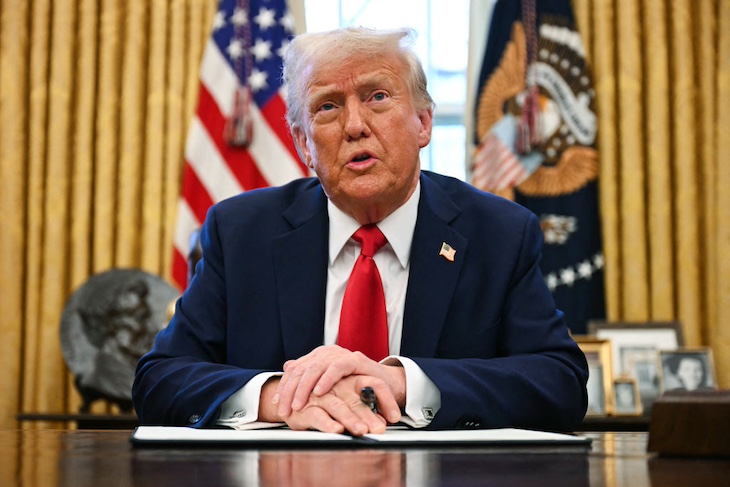
Some moments in history demand recognition, not just for their weight in the present but for the seismic shifts they herald. The Trump-Netanyahu press conference was one such moment – not a perfunctory diplomatic exercise, nor a routine reaffirmation of alliance, but an unambiguous declaration of intent. It was a disruption of long-entrenched, failed orthodoxies and the unveiling of a vision that dares to reimagine the Middle East in starkly different terms.
For decades, world leaders have clung to exhausted formulas – peace processes built on illusion, agreements predicated on fantasy, and a wilful refusal to acknowledge the fundamental realities of Palestinian rejectionism and terror. That era is now over. Standing together, the President of the United States and the Prime Minister of Israel made it unmistakably clear: they are not here to mollify, to equivocate, or to perpetuate the cycles of appeasement that have long defined western diplomacy towards the Arab-Israeli conflict. They are here to reset the board entirely.
Amid the declarations that emerged from this historic moment, one stood above all: Trump’s unequivocal statement that the goal is not to reform Gaza, not to manage it, but to remove its population entirely. No more illusions of Palestinian self-rule, no more diplomatic contortions to accommodate an irredeemable status quo. Trump’s is not another failed experiment in Palestinian self-rule – but a move to dismantle the population that carried out the most brutal attack on Jews since the Holocaust and to relocate them elsewhere.
The gravity of this pronouncement cannot be overstated. As Israeli commentator Amit Segal astutely observed, had the hard-right politician Itamar Ben-Gvir proposed such a policy as part of coalition negotiations merely two years ago, it would have ignited an international firestorm. Yet here it was, calmly, deliberately articulated as the official position of the most powerful nation on Earth.
Nor was this an offhand remark – no Trumpian improvisation to be explained away later. The president read from prepared notes, delivering the statement with the deliberation and gravity of a policy long in the making. This was not casual hyperbole, nor an idle provocation; it was a calculated, official pronouncement. It was an act of political theatre designed to break the bubble of denial and intransigence.
But that was only the beginning. Alongside this, Donald Trump laid out an unambiguous multi-part framework: no to a Palestinian state. The old paradigm, a fixture of failed diplomatic orthodoxy, is now irrelevant – a fantasy proven ever more unworkable each time it has been forced into action. Yes to an enduring peace with Saudi Arabia – without Palestinian preconditions. The old linkage between Arab-Israeli normalisation and Palestinian statehood is gone, though the Saudis swiftly denied this. Yes to permanently ending Hamas and ensuring Gaza can never again pose a threat. The destruction will be total. There will be no ‘rebuilding’ for Hamas to rule over, only American led efforts. Yes to stopping Iran’s nuclear ambitions – by any means necessary. Iran will be weakened, its regional reach crushed.
This is not a strategy of containment, nor an effort to sustain the perpetual diplomatic holding pattern that has defined western policy for decades. It is a vision of finality – an approach that seeks not to manage conflict but to bring it to a decisive and irreversible conclusion. If Obama was awarded the Nobel Peace Prize less than eight months into his presidency, Trump must surely be worthy just three weeks into his.
Trump’s ability to impose his will upon seemingly intractable situations is no accident. He understands that power is not merely about policy but about the mastery of organised chaos – the capacity to disrupt, to destabilise, and in doing so, to force a new reality into being. He has demonstrated time and again that resistance to his demands – whether from allies or adversaries – eventually bends to his will. Just ask Mexico, Canada, or the growing list of others. The question, therefore, is not whether this plan is feasible. The question is how long it will take before the world accepts that it is already in motion. Trump’s pronouncement is the emperor’s new clothes of Middle Eastern geopolitics: a reality that exists the moment he dares to name it.
Trump is set now to meet with Egypt’s President and Jordan’s King – two leaders whose cooperation will be critical in reshaping Gaza’s fate. These are not symbolic meetings. They show the seriousness of his intent, and are part of a rapidly unfolding strategy. If past is prologue, their initial resistance will give way to accommodation.
Meanwhile, Netanyahu stood beside Trump not as a mere ally but as a statesman fully aligned with the vision before them. He was not a leader reacting to a surprise American policy shift, but the co-architect of a new regional order. Together, these two men have already upended decades of Middle Eastern diplomacy with the Abraham Accords. What they now propose is even more ambitious.
Furthermore, by means of yet another executive order, Trump gave a forceful rejection of longstanding UN biases against Israel, removing financial and diplomatic support from institutions that have systematically worked against Israel’s legitimacy on the world stage. He cut all US funding to UNRWA, citing its infiltration by designated terrorist groups and the involvement of its employees in the 7 October attack. This move effectively ends American financial support for an agency long accused of fostering anti-Israel narratives and aiding Palestinian terrorism. The order also withdraws the United States from the UN Human Rights Council (UNHRC), halting American participation in a body that has consistently shielded human rights abusers while disproportionately targeting Israel. In addition, the US will conduct a review of its membership of UNESCO, withholding its share of funding and assessing the body’s history of anti-Israel bias, including its efforts to erase Jewish historical ties to significant sites like the Temple Mount and the Western Wall.
Trump’s vision will terrify those who have grown comfortable with the status quo. It will unsettle those who prefer diplomatic inertia to hard truths. And it will enrage those who have built careers, reputations, and fortunes upon the perpetuation of the unsolvable. But what he and Netanyahu propose is not reckless; it is reality-based. It acknowledges the unspeakable truth that policymakers have long whispered but never dared articulate: that Gaza, under its current governance and population, is a failed experiment that cannot be salvaged.
Ever the salesman, Trump frames this all as an opportunity for Gazans to build peaceful, prosperous lives – just somewhere else. Many will recoil at the audacity of this proposition. But is it not more audacious to continue pretending that Palestinian self-rule in Gaza can exist without terror, that this small strip of land under continued Palestinian rule can be anything other than a launchpad for perpetual war?
History will remember this moment not merely for what was said, but for what it signified: the point at which two leaders, long derided by their critics, once again proved that their vision is neither naïve nor impractical, but bold, comprehensive and daring.
Jonathan Sacerdoti (born 1980) is a British broadcaster, journalist, and TV producer. Born in London, his father was a Holocaust survivor, and his grandfather had been an Italian Rabbi.
 In That Howling Infinite