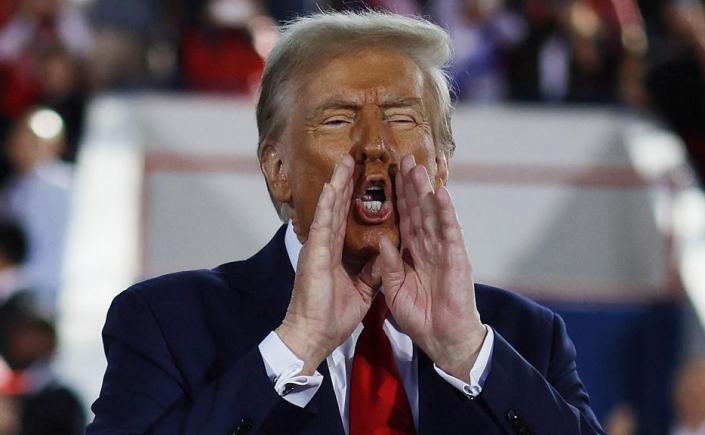
Countless left-wing memes about American stupidity illustrate how out of touch, self righteous, arrogant and morally “superior” many of the so-called “left” have become – unlike the Democrats whom New York Times columnist Maureen Dowd said were “finally waking up and realizing that woke is broke” after having embraced a self-defeating world view of “hyper-political correctness, condescension and cancellation”.
The Democrats. – and indeed, our Labor party – would ignore the outcome of the presidential election at their peril. The people, for better or worse, have spoken, and it’s a pointless exercise for the Democrats to live in a fantasy world of denial, not accepting their own responsibility in the loss. The Sydney Morning Herald’s Peter Hartcher wrote on 12 November:“ It’s also extremely condescending and arrogant to assume you know better and anyone who didn’t agree must be an idiot. In that light, I’d suggest Trump didn’t win this. The Democrats lost it in a spectacular fashion, and if you can lose it to the likes of Trump, something is majorly wrong on the left side of politics”.
There are lessons aplenty for Australian politics. The Coalition wants to spend the months leading up to next year’s election talking about migration driving up household bills. It has no actual plan for decreasing immigration or reducing inflation, but voters don’t care. They don’t do nuance. They’re disatisfied with the status quo and disappointed in the government. They’ll just want to punish the mob in charge. Sure, they’ll be burning down the house, and they’ll be in the house when it burns down (two song references there!) but they won’t care. The question will be “are you better off today than you were four years ago?” And, like in America, for a great many, the answer will be a big “no!”
Waleed Ali’s recent article on why Trump won concurs with the above: “Last week, a historically unpopular government, presiding over a period of high inflation that saw food prices especially explode, got thrown out of office. There is quite simply nothing extraordinary about that”. Former Liberal attorney general and high commissioner to the UK George Brandis wrote similar in the Herald on 18 November:“… the sheer weirdness of Donald Trump himself: narcissistic, vulgar, bombastic, mendacious, idiosyncratic, outrageous; while at the same time flamboyant, mesmerizing and on occasions very funny. He broke every rule, told every lie, did the unthinkable, said the unsayable and still came up … (you complete the pun). The epic unconventionality of Trump’s campaign dramatised a result that would probably have been the same had the Republican candidate been less unorthodox. For that reason, the outcome is fertile ground for over-interpretation and exaggeration”.
On a different but not dissimilar tack, John Carroll, Professor Emeritus of Sociology at La Trobe University wrote in The Australian:
“The resounding Trump victory confirms the cardinal law: politics is about power. In times of peace and prosperity, such as we in Australia have enjoyed for almost 80 years, it is easy to forget, and continue along in the hopeful illusion that life is good, people are intrinsically nice, and problems can be solved amicably …
… One of the appeals of Donald Trump to the United States electorate – I suspect his main appeal – has been that, in his bluster and braggadocio, he flexes power muscles and seems to show he is unafraid to mobilise power for his own ends. There is an intuitive understanding across middle and lower-middle America that progressive posturing and feel-good speeches will not steer the ship of state safely through turbulent waters. In contrast, Trump policy appears clear, direct, and down-to-earth – booming economy, secure borders, and resolved international conflict. When 70 per cent of Americans feel worse off than they were four years ago, they want strength in leadership and focus on their everyday interests.
…The Trump persona – aggressive, confrontational, and petulant, not to mention pathologically narcissistic – also seems to have appealed to marginalised social strata. Those living in poorer states, young black and Latino males, recent immigrants, and the old city working classes resenting their decline, all seem to have been drawn to his maverick contempt for the trendy issues of the time. His character may be suspect – indeed he is widely disliked – but he appears powerful, practical, and not of the coterie elite. In politics, power eclipses niceness”.
I republish below an opinion piece by The Australian’s editor at large Paul Kelly. It is to my mind one if the best articles I have read to date regarding the outcome of the American elections and how this may impact Australian politics. It is particularly interesting insofar as Kelly pushes back against the conservative narrative prevalent in the Murdoch media and among more extreme right wing commentators, politicians and culture warriors. Regarding Australian politics, he writes:
“If Trump succeeds he will further undermine the shaky policy framework of the Labor Party. The optics will be: Trump’s strength versus Albanese’s weakness. In this situation, the pro-Trump media and conservative drum-beaters in this country – in effect the Trump Appeasement Syndrome lobby – will demand the Peter Dutton-led Coalition follow their messiah while they will use Trump’s success to undermine Albanese. Destroying former prime minister Kevin Rudd as ambassador to the US is just the first step”.
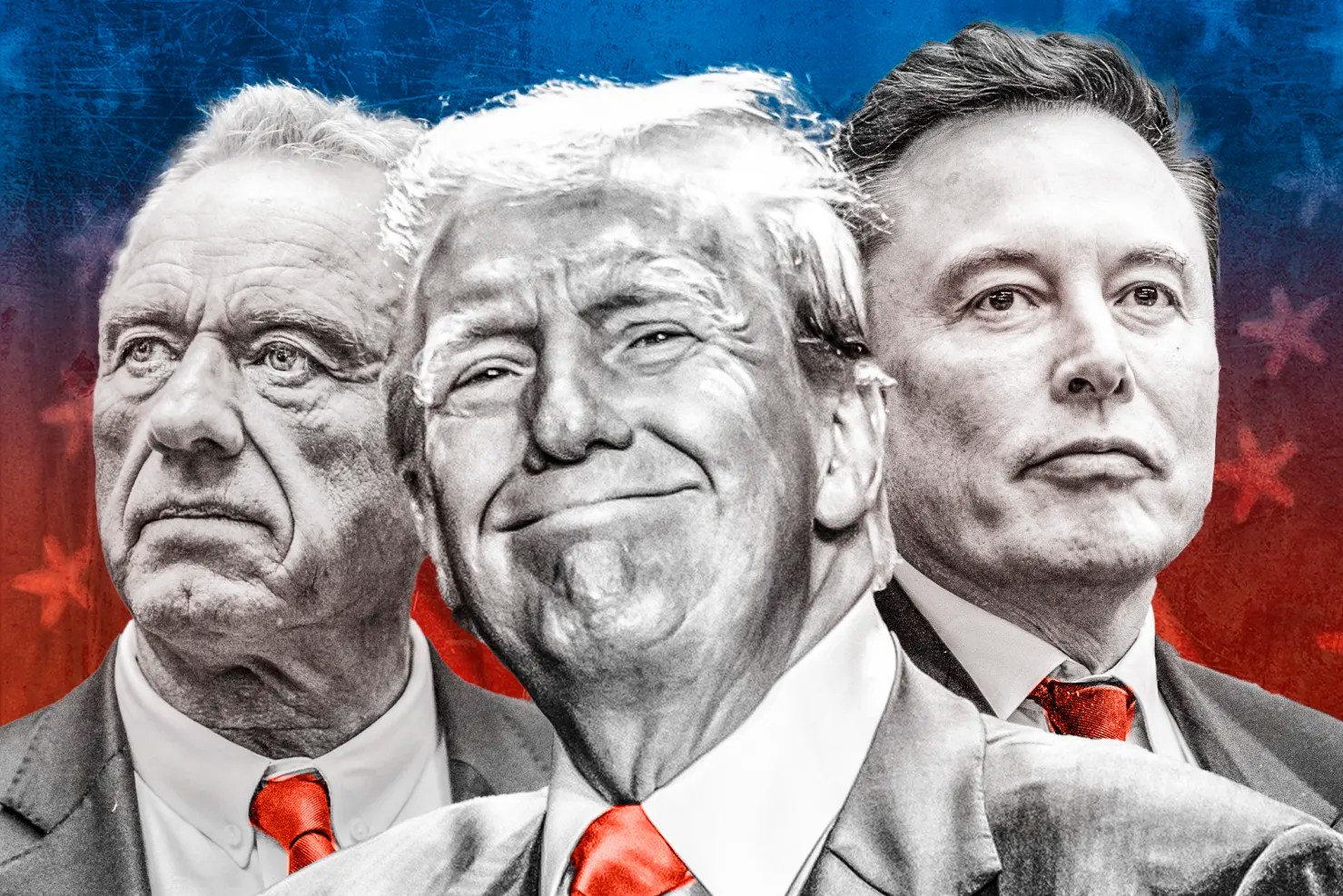
Trump and his cabinet picks Robert F Kennedy Jr and Elon Musk
Donald Trump’s revolution leaves Albanese exposed

The Trump Revolution is coming and, like all revolutions, its outcome will fluctuate between a glorious remaking of the existing order or a spectacular overreach and fall – maybe even a contradictory mix of both – with Anthony Albanese and Australia in front-row seats for the drama.
[In the same issue as this article, national affairs editor Joe Kelly summed up this revolution: “Trump’s sweeping “day one agenda” includes dismantling the deep state, pursuing mass deportations, imposing across-the-board tariffs, scrapping the “Green New Scam”, withdrawing from the Paris Agreement, rolling back environmental regulations, ending the Ukraine conflict, unpicking pro-transgender policies, pardoning January 6 offenders, and rolling back the Biden health and education agendas. This is a blueprint to overhaul the country. Leading thinkers are already focused on which items are set in stone and which could merely be attempts to enhance Trump’s negotiating position. While Trump is a familiar political figure, this exercise reveals his policy agenda has still generated widespread uncertainty. Paradoxically, no one knows how the experiment will turn out or even exactly what it is – a recipe for a populist catastrophe, or a profound new American reinvention”.]
From the Trump appointments so far, the big “America First” play is on. The sharemarket has been excited, the bond market is wary, Big Tech is king, Beijing should be worried. President Trump Mark II is more resolute and revolutionary than Trump Mark I.
His hunger for change seems ferocious; his willingness to take risks is more pronounced. He is assembling a tribe of Trump loyalists to punch through the disintegrating Democratic scaffold. Trump demands loyalty and prioritises vindication.
Two lights are flashing – danger and opportunity. Some people will make a stack of money and others will be cast into painful obscurity.
Trump is going to remind everyone of the extent of power vested in the office of US president when pushed to the limit.
Consider the Elon Musk appointment. Surely this can’t be true. The world’s richest man, heading social-media platform X, hanging out at Mar-a-Lago, almost part of the Trump family, will now co-lead a Department of Government Efficiency – sitting outside the federal government – and while keeping all his existing corporate positions, he will pursue his pledge to cut US agency budgets by $US2 trillion ($3 trillion), or about one-third.

Tesla CEO Elon Musk will now co-lead a Department of Government Efficiency. Picture: AFP
Of course, it is true – only in America. Think about this marriage: Trump’s America meets the Big Tech oligarchs. This is a serious moment for US capitalism, great for innovation, bad for integrity. Trump likens Musk’s brief to “the Manhattan Project of our time”. How many struggling Americans are going to be punished in the process? Australian officials, long familiar with our experience of external budget audits (think Tony Shepherd in 2013), know Musk’s promise is impossible in delivery terms. It can’t be done, short of a massive anti-Trump electoral revolt from the public.
At this time, however, such quibbles don’t matter. Nothing seems impossible in the exaggerated hype of Trump’s vindication. A tariff of 60 per cent on China’s imports? Sure. Cutting a third off federal agency budgets? No problem. Licensing the king of Big Tech, loaded with conflict-of-interest federal contracts, to stage a shooting gallery across the entire federal bureaucracy? Great idea. It’s called purging the deep state.
Change on the scale Trump wants generates both high excitement and high risk. Nobody can be sure of the consequences because these things have never been tried before and we don’t know where the line will be drawn between impression and reality. How long before Trump and Musk fall out?
Trump’s appointments show his priority to purge the “deep state” institutions of justice and intelligence. Given his history, these seem non-negotiable personal passions for Trump. He appointed former Democrat, now Trump loyalist, Tulsi Gabbard as director of national security despite, or perhaps because of, her sustained support for Russian leader Vladimir Putin.
He appointed a professional provocateur, Republican congressman Matt Gaetz, as attorney-general with Gaetz, already at political war with the Justice Department he is supposed to run, praised by Trump, who said Gaetz will end “the partisan weaponisation of our justice system”. That means a purge.

Trump has appointed Republican congressman Matt Gaetz as attorney-general. AFP
The wilful naivety of Trump’s apologists in this country looks embarrassing given Trump’s resolve to impose his will on the intelligence community, justice and the FBI. Gabbard’s appointment is highly dubious and Gaetz’s should be overruled, with The Wall Street Journal saying it would “undermine confidence in the law” and would be used for “political revenge”.
Trump’s mind seems a cross between powerful insights into the flaws of the Obama-Biden-Harris age and the vindictive fantasies of all rebels pulling down the established order.
But Trump’s experiment will resonate far beyond America. Markets seem alert to the inflationary consequences of his fiscal policy. The combination of Trump and our tight labour market will further weaken Anthony Albanese’s hope of an interest-rate cut before the election.
But the big picture consequences are far larger. At a time when most Western democracies are burdened by disillusion, poor economic and social outcomes and leadership that lacks either conviction or courage, Trump arrives as a giant on the stage of history.
He mocks the orthodox governing model. Much of Trump’s appeal is because he presents as a change agent against leaders running a failed status quo, witness the dismissed Biden-Harris team. More than 70 per cent of Americans felt their country was going in the wrong direction.
Trump’s win is the antithesis of Albanese’s victory in 2022 when Albanese ran on reassurance, incrementalism and “safe change”. Trump consigns “safe change” to the dustbin of history. He will steamroll Albanese’s “safe change” into the gutter. Trump’s American political strategy is the complete opposite of Albanese’s Australian strategy.
Of course, America is not Australia; we are different countries and in different moods. Yet the stakes for Australia cannot be denied – the more Trump succeeds, the more Labor’s policies will look feeble, ineffective and missing the big picture.
At almost every point in his agenda, Trump is diametrically opposed to Labor’s framework.
Consider the list: Trump wants savage public-sector cuts, a reduction in federal bureaucratic numbers, a purging of regulation, cutting the corporate tax rate to 15 per cent (half that of Australia), extending income tax cuts, imposing punitive tariffs on China where Australia is just restoring trade normality, repudiating free trade by resurrecting across-the-board tariffs, more support for oil and gas, walking out of the Paris Agreement on climate, dismantling environmental obstacles to development, cracking down on immigration, launching a domestic war on all forms of identity politics, boosting US defence spending and disdaining global institutions.
It is folly to think Trump won’t be influenced by the chasm between himself and Albanese. It’s good he told Albanese on the phone that Australia was the “perfect friendship”. Let’s cut to reality – if Trump has initial success in fuelling the animal spirits of the US economy, the governance model for Western democracy will be shaken to its foundations. Parties of the radical right will gain fresh traction everywhere.

It is folly to think Trump won’t be influenced by the chasm between himself and Albanese. AFP
If Trump succeeds he will further undermine the shaky policy framework of the Labor Party. The optics will be: Trump’s strength versus Albanese’s weakness. In this situation, the pro-Trump media and conservative drum-beaters in this country – in effect the Trump Appeasement Syndrome lobby – will demand the Peter Dutton-led Coalition follow their messiah while they will use Trump’s success to undermine Albanese. Destroying Kevin Rudd as ambassador is just the first step.
Of course, it might not evolve this way. It might be the precise opposite. You never know with Trump. He may overreach from the start, prioritising vengeance, smash too many institutional norms and, drunk on hubris, alienate even his own voters.
But last week Trump sent another message of profound significance for Australia – he is riding with the China hawks. This means Trump will expect Albanese to muscle up and toughen up against China. Forget the idea of Trump going cool on Australia – he likes us, he’ll go hot on Australia and expect more action from us to reinforce his China hawks.
This is surely the coming message from the appointment of Senator Marco Rubio as Secretary of State and Congressman Mike Waltz as his National Security Adviser.
Waltz, in a jointly written essay for The Economist, said the US must wind up the Ukraine conflict and direct its assets towards confronting and deterrence of China. Rubio warns China is “far more dangerous” than the old Soviet Union and poses the central threat of the 21st century. They will drive deeper US rivalry with China.
Rubio supports AUKUS. That’s the good news – but under Trump the US support for AUKUS means more action and commitment from Australia against China. That’s the transactional deal, got it?

China’s President Xi Jinping. AFP
How does this fit with Albanese’s “stabilisation” agenda with China? Answer: not comfortably. History tells us that Australian domestic support for the US alliance falls when there’s a US president we don’t like, witness the fall in popular backing for the alliance under George W. Bush. Now we will likely have in Trump a US president who expects us to get more hawkish on China while domestic support for that Trump-induced option will plummet.
It’s better for Australia that Trump rides with the China hawks, not the China doves. But you cannot miss the problem. Paul Keating sees it and fell upon the remarkable political monitor poll in The Sydney Morning Herald showing that 57 per cent said Australia should avoid taking sides in any war between the US and China, with only 16 per cent disagreeing. Extraordinary stuff.
Keating said this repudiated Albanese’s “lock-in” military arrangement with the US, the AUKUS agreement and the assumption Australia is tied to the US in any conflict.
Trump’s China policy looks ominous for Labor – his tariff strategy will weaken our trade with China while his overall “get tough” strategy will intensify anti-Trump sentiments within the public in Australia and ignite a debate within Labor, with protests the party is too accommodating of Trump’s anti-China stand. It will be dangerous and unpredictable.
The broader political takeout from Trump’s victory is the failure of Democratic Party progressivism – economic and cultural. This is a mammoth event. Of course, direct political lessons cannot be simply transposed from America to Australia. These are very different countries. Yet it would be unwise to assume there is no connection point for Australia from this epic US election.
Here are three propositions – that US progressives are no longer the party of the working class or the non-college educated; that US progressivism contains the seeds of its own destruction, witness the Trump counter-revolution; and that the deepest faith of the progressives – that Trump is a threat to democracy – didn’t work because the progressives constitute their own threat to democracy.
Let’s consider the first proposition – in effect, the voter realignment. Australian pollster Kos Samaras wrote post-election that low-income, working-class voters were heading right-wing. This realignment would reshape politics including in Australia and was tied to the changing nature of left-wing politics with its new priorities around climate change, social justice, urban fashions and housing.
Analysis by the Financial Times shows that in the US poorer and less-educated voters think Republicans best represent them, with the Democrats now the party of high-income and college-educated voters.
Trump won a majority of households with incomes of less than $100,000 while the Democrats won more support from the top third of the income bracket. Education is a sharp line of division – nearly two-thirds of voters without a college degree supported Trump.
Samaras warns the realignment in Australia deepens the divide between urban and rural voters and between professional and low-income voters, “creating fertile ground for conservative and populist leaders”. Is the urban professional class slowly suffocating Labor? Obviously, Dutton will be exploiting this divide at the coming poll.
On the second proposition, most progressives and elites in Australia are in denial, unable to admit what is happening, despite the defeat of the voice referendum at home and the evidence in the American election – many people voted for Trump on cultural grounds, pointing to a counter-revolution.
There are numerous pro-Trump commentators hailing the moment. Many exaggerate, yet the trend is manifest. Writing in the Financial Times, respected analyst John B Judis said Democrats must dissociate themselves from support for “gender-affirming care”, their opposition to strong borders, their backing of equal outcomes rather than equal opportunity on racial issues, their indifference to the plight of working-class men, just dismissing Trump supporters as racists and sexists, and their focus on imminent planetary apocalypse to justify draconian climate action.
He said the priorities of many voters who deserted the Democrats are decent jobs, safe streets and a proper safety net. But Judis warns even action on these fronts will fail politically “if Democrats don’t sever their identification with cultural radicalism”.
Labor hasn’t gone as far as the Democrats – but it is largely and proudly a progressive party now, and this risk is potent. Most progressive leadership elites in Australia don’t understand the consequences of the cultural positions they champion. Their cultural ignorance is astonishing and dangerous. They need to read the long masterclass provided in July this year by David Brooks in The New York Times.

s
Brooks said that with the demise of religion, US public life became secular in recent decades with “science and reason” becoming the methods by which the nation could be held together. It is now obvious that this answer, championed by the elites, has failed. “By the 21st century, it became clear that Americans were no longer just disagreeing with one another,” Brooks said. “They didn’t even perceive the same reality.”
Was there anything to fill this moral void? As usual, the left produced an answer – identity politics. Brooks said: “This story provides a moral landscape – there are those bad guys over there and us good guys over here. The story provides a sense of belonging. It provides social recognition.” It is orientated around proper esteem for and inclusion of different identity groups.
The problem, however, is the incompatibility of identity politics with the liberal principle of equality – that regardless of identity we are bonded by a common humanity. This is the foundation stone of our liberal democracy. Undermine this principle and our society is undermined. As Brooks says, “the problem with this form of all-explaining identity politics is that it undermines democracy”.
Trump’s voters don’t offer such sophisticated reasoning for their vote. But their visceral distrust of how they are being treated says this is what they feel in their bones. It is reinforced by numerous examples across their lives, telling them they don’t really count.
The more progressives in Australia push this ideology, the more they guarantee a backlash. Dutton knows this – he just needs to judge how far it has gone in Australia and how much to advance the counter-revolution.
This leads directly to the third proposition. The Democrats were consumed by the idea of Trump as a threat to democracy. Ultimately, this was the Harris campaign – and the argument was correct. Watching Trump’s backers in this country trying to pretend black was white was pitiful intellectual dishonesty. Trump refused to concede he lost in 2020 – of course he was a threat to democracy.
But what the Democrats didn’t get was the point brilliantly made by political scientist Yascha Mounk – some exit polls suggested that people felt Harris was a greater threat to democracy than Trump. “This hints at the fundamental fact of the past decade,” Mounk said. “A fact that elite discourse still has not fully confronted: citizens’ trust in mainstream institutions has been absolutely shattered. Corporations and the military, universities and the courts, all used to enjoy a certain modicum of residual trust. That trust is now gone. It is unlikely to return any time soon.”
It is gone because of the left’s march through the institutions, the story in both America and Australia. Progressive activists took charge, while established leaders were weak and ignorant. When people look across the landscape – universities, bureaucracies, cultural bodies, corporates, government departments – they see progressive values, great and small, shoved in their faces. It’s not the democracy they voted for
 In That Howling Infinite
[…] Calling Australia! Reading the Trump revolution […]