Australian voters are not in the habit of voting out governments and they tend not to discard an incumbent lightly. Historically, they have customarily cleaved to non-Labor governments. When they do so, it signals some wider shift in voter attitudes and inclinations. Here is my take on the many reasons why the Morrison government went down.
Oblivious to clear and present dangers
We’ve faced unprecedented crises during the last three years. Drought followed by devastating wild fires and floods – with the pandemic following on almost immediately. Experts agreed that these owed their intensity to climate change, but the federal government was hogtied by its in-house climate denialists, the co-opted satraps of old king coal, and the opinionated talking heads of the House of Murdoch (particularly the hosts of the cable TV “Sky at Night”). There were also crises of integrity and corruption, of rorting and pork-barreling and a refusal to establish a corruption bulldog with teeth; and of sexual assault and sundry naughty shenanigans in the corridors of our parliament. The Liberal Party’s “women problem” has been building for years; women voters have been moving away from the party for years’ have now turned against it with a vengeance. As commentator Samantha Maiden noted, they didn’t get women and women finally got them. The Government was also perceived as reluctant to embrace equity and diversity and to incorporate indigenous Australians, a culture over sixty thousand years old, into our constitution and our parliamentary consensus and consultation.
Whilst ever eager to perpetuate our endemic culture and history wars, it endeavored to weaponize matters of national security, particularly with regard to our strained relationship with China, and was seen by many as cynically planning a “khaki election” – though hairy-cheating drum beating rarely rarely distracts people from the real and present dangers of government incompetence, particularly when wages had Ben stagnant for years, rents and house prices had gone through the roof, and rising inflation was inflicting financial pain on most Australian households.
Our state governments reaped the benefits of comparative competence and incumbency in elections held in all states, and were way ahead of the federal government with regard to climate, equity and integrity. The federal government was weighed and found wanting. Whist eventually delivering resources and dollars, it had dragged its feet in its response to fires, floods, pandemic and vaccine roll-out, and inflationary pressures, forever running to catch up, and the gravest sin, blaming everyone else.
The revolt of the moderates
The government’s resistance to such ostensibly “woke” issues as climate change initiatives, social and gender justice and equity, and racial and religious discrimination, and even sheltering refugees and asylum seekers turned not just progressives against it, but also the party’s moderates, several of whom, educated, professional, wealthy and well connected women in affluent inner-city suburbs – the party’s heartland – decided to set up shop as “independents”, and electorally viable ones too. They’d reckoned the party had moved too far to the populist right and hoped to shock it back to the so-called “sensible centre”. By their reckoning, they and their supporters had not left the party – the party had left them. [See Hearing Voices – is Teal the real Deal? ]
Ironically, they targeted the party’s key parliamentary moderates, who were actually in agreement with them on their core issues, on the grounds they’d voted against their principles in the interests of their careers and party unity. And they took them out. As the Liberal Party comes to terms with its defeat, its recovery, and in rebuilding national support, it has to consider the reality that its moderate heart has been extracted and that the leader in waiting is an unpopular and much lampooned hardliner.
I don’t hold a hose
The coup de grace was delivered by the prime minister himself. He was disliked, hated even, and eventually, ridiculed – not just by progressives, but by his own side. He was condemned as a bully, a misogynist, a flimflam man (‘Scotty from marketing was the moniker he’d inherited from a patchy career in perception management), and, in his own words, a “bulldozer”. Indeed, the alpha male style of politics favored by Morrison and his acolytes, centred around aggression, masculinity (we call it ‘blokeyness’) and a disregard for science, and facts, whilst resonating with some sections of the community, alienated other people who have traditionally voted Liberal. It didn’t help that during our many crises, he was perceived to have gone literally and figuratively ‘walkabout’ – at the height of the bush fires that ravaged our east coast in December 2018, he took his family off to Hawaii for a Christmas holiday. the title of this section is his response to the question whether he thought this was a great idea.
Many colleagues considered him an electoral liability – now the end has come, many are revealing that there was indeed a plan to replace him with the now jilted Josh last autumn, but faithful Frydenberg stuck with his boss.
In the final days of his campaign, an edgy Morrison pledged that he would actually change for the better if we re-elected him last Saturday. In the event, friends and well as foes gave him the old heave-ho. Seven of these independents ousted the party’s most moderate members of parliament, including the Federal Treasurer. The Liberal Party no longer has any electorates overlooking Sydney Harbour. The seats of former Liberal prime ministers Malcolm Turnbull, Tony Abbott, John Howard, Billy McMahon (same area, reconstructed electorate), John Gorton, and Bob Menzies are all now held by Labor or independents. Voters in heartland seats, including those who once financed the party, and business people, it appears will in future be attracted to capable and articulate local independents deeply connected to their community and in touch with its concerns.
I wrote in a Facebook post ten days before the election: “The Australian Labor Party is the only party contesting this election that is campaigning for an actual change of government. To achieve this, Labor has to win – and win big. Politics is zero sum – you win or you lose. It’s a Herculean task. Labor has to win 76 sears outright to govern in its own right. That means holding on to twenty marginal seats and taking seven more from the Coalition … ALL commercial TV channels are strongly backing the Liberal-National Party. The Teals refuse to say what they’d do in the event of a hung parliament. Ignoring or, worse, drowning out Labor’s overarching message – a change of government – only helps the Tories. If Labor fails, voters who bemoan the return of the Coalition have only themselves to blame. Caveat Emptor!”
In the end, an electorate that is traditionally conservative and reluctant to change for changes sake, turned on an unpopular prime minister, a tired and complacent government weighed down by a lacklustre front bench, and a divided Coalition devoid of policy imagination. The Liberals lost a record seventeen seats, losing 19 to Labor, 6 to independents and 1 to the Greens, leaving it with 57 against Labor’s 76, with 14 others – the largest cross-bench in our parliamentary history. The new parliament is the most diverse in our history with more indigenous members than ever before and also more MPs of non Anglo-Celtic descent.
Morrison’s arrogant behaviour, apparent tolerance for undisguised rorting and failure to enunciate a coherent set of values led to most Australians judging he was no leader worthy of the name and showed him the door. Yesterday’s rooster is today’s feather duster, and don’t we feel happy!
The longest day
Voting is compulsory in Australia and unavoidable. Campaigns are about six weeks long, and are relentless, remorseless and as boring as all get out. We are heartily sick and tired of it all by the end. But we turn out nonetheless in numbers unmatched anywhere in the world. There is tradition of party volunteers handing out “how to vote” fliers to assist voters in our unique preferential voting system. And Election Day is always on a Saturday, and there is another tradition of scout troops and school children setting up fundraising hot-dog stands – we affectionately call this “democracy sausage”.
On Election Day, in our electorate, it rained, and rained, and rained – we’ve already had those apocryphal forty days no forty nights and were quite over the extreme wetness – and my wife and I, having organised our folk at the polling stations across our rural area, were “handing out” for the Australian Labor Party in a mountain town, froze to the bone. It was the longest day, but at its end, once the first results had come in, our unloved and unlamented prime minister conceded to his opponent, and our party leader Anthony Albanese became our 31st prime minister in our forty seventh parliament and our first of Italian descent – and without an Anglo-Celtic name – the son of a single mother in a run-down suburb in a council flat. He is only the fourth Labor leader since World War II – alongside Gough Whitlam, Bob Hawke and Kevin Rudd – to win government. the Liberal Party has held government for 51 pf the pass 73 years. In Australian politics, a win from opposition is a mighty feat indeed, notwithstanding that it’s primary vote fell below 33%, it’s lowest since 1931 – though the coalition’s vote sank like a stone to 36%, it’s worst result since Federation.
So now, the Liberal Party grapples with the first stages of grief, shock, anger and denial, and seeks solace from its vale of tears. The narrative according to a chorus of hard line Coalition MPs and mainly News Corps’ columnists and Sky at Night rangers goes like this: the Morrison government positioned itself as “Labor-lite”, experimenting “with the poison of leftism”, because it caved in on net-zero emissions, racked up budget deficits, abandoned “freedom” during the pandemic and shirked on fighting culture wars. To them, this was a shameless Marxist posture which not only failed to placate voters in the Liberals’ traditional seats, but alienated the party from “the Quiet Australians” and blue-collar battlers the party ought to regard as its real base less concerned about climate change than they are focused on cost-of-living pressures and whether their kids are being indoctrinated into radical doctrines at school. But they seem curiously unconcerned about a minimum wage for those struggling quiet Australians.
After nine years of stagnation and little progress on the key issues, Australia has once more a progressive government. There is a danger for a progressive party leader in raising unrealistic expectations, and Albanese is urging people to be patient. Over and over, he has said that he wants to under-promise and over-deliver. He has been cautious with his commitments, so, if there is change under this government, it is likely to come slowly.
[Spoiler Alert! The following paragraph contains many references to sundry ‘isms’ that will confuse and confound most readers. To define these adequately is beyond both the scope and the intention of this particular post. if in doubt, please Google it.}
The founder of the Liberal Party, Sir Robert Menzies, wanted to associate it with classical Victorian Liberalism with its primary emphasis on securing the freedom of the individual by limiting the power of the government, and a brand that would appeal to the innately socially and economically conservative ‘quiet Australians’ of the political centre. Increasingly, over the years, the party became associated with a more literally ‘conservative’ mindset, promoting traditional economic and social values that distinguished it from our contemporary definition of “Liberalism”, which most of us associate with democratic socialism and with the progressive social and fiscal policies advocated by the Australian Labor Party.
Why is Labor called Labor and not Labour?
Labor is spelled Labor and not Labour because, back in the day, in the 1890s, and before federation, In the labour movements, the trade unions that formed the Labor parties in the 1880s, and also the broader socialist movement at the time, there was a lot of reading of American socialist texts. Whilst the “labour movement” and labour parties in places like New Zealand and the United Kingdom all use “Labour”, the Australian Labor Party officially adopted the shorter spelling in 1912.
Prime Minister Anthony Albanese and new MP Chinese-Laotian Sally Sitou
It was a cold wet windy night in May as we wound our way up to Montmarte, arriving at our destination, an old stone building on the steep and cobbled Rue des Saules. It was after nine o’clock and we were late – the evening’s entertainment had commenced. The man who greeted us at the door asked us to wait until a song had finished and then ushered us into a a dimly-lit cellar-like room, its walls festooned with an eclectic collection of pictures, wooden tables and chairs, and stout benches pushed against the walls.
A bad start! The master of ceremonies, an eccentric chap with the air of an impatient headmaster gave us a stern look of disapproval as we took our seats in a corner at a wooden covered with initials that had been carved into its surface over decades – as if to say “bloody tourists!” A friendly chap bad us “bon soir” and served us glasses of the obligatory, sweet house red; and thenceforward, he, Le Maître, and the audience, who all appeared to be old pals, ignored us completely. Nevertheless, the evening was a hoot as our headmaster led the room in songs which everyone sang loudly and with gusto. All in French – we sang along when we knew the words. There were a couple of what us folkies would call “floor acts”, one a young man who reminded us of a friend of ours back in Oz, and a chirpy accordionist who seemed to have come straight out of French cabaret central casting.
Le Maître,
Welcome to Au Lapin Agile, the famous and venerable Parisian cabaret cum folk club in the centre of Montmartre (in the 18th arrondissement not far from the Basilica Sacre Coeur), where people gather and sing old French songs accompanied by guitar, piano and accordion. The musicians encourage the audience to join in with the singing so it helps if you speak French or are a quick learner – or if, like us, you remember the choruses from school days, including the famous Allouette, Frère Jacque and Les Chevaliers du Table Ronde (it’s about boozing and not King Arthur).
It’s been going literally forever – the mid-nineteenth century, anyway – and was originally called Cabaret des Assassins. So named, ‘tis said, because a band of assassins broke once in and killed the owner’s son. It had also been called Rendezvous Des Voleurs or “Thieves Meeting Place – which says something about the provenance of the punters back in the day.
It was over twenty years old when, in 1875, the artist Andre Gill painted the sign that suggested its permanent name – the picture of a rabbit jumping out of a saucepan. Locals started calling their neighborhood night-club Le Lapin à Gill, or “Gill’s rabbit’, and in time, this evolved into Cabaret Au Lapin Agile, or “The Nimble Rabbit Cabaret”.
Befitting its early reputation, Au Lapin Agile became popular with dubious Montmartre characters, including pimps, eccentrics, simple down-and-outers, a contingent of local anarchists, and students from the Latin Quarter, a sprinkling of well-heeled bourgeois out on a lark. and show business types like Parisian cabaret singer and comedian Aristide Bruand, the subject of a popular painting by Montmartre artist Toulouse Lautrec. When, at the beginning of the twentieth century, Au Lapin Agile was facing closure, Bruand bought the joint and handed the tenancy to Frédéric Gerard, known to all as Frédé.
It became a great venue for budding musicians to make their debuts and also a regular haunt for impoverished artists. Picasso, Modigliani, Apollinaire and Utrillo would spend their evenings immersed in philosophical debate and music. Often Frédé would accept paintings from the artists in payment for their drinks – Picasso gave Frédé an artwork actually called Au Lapin Agile which portrayed himself dressed as a harlequin sitting in the cabaret with a female companion. Frédé is also in the picture, playing the guitar in the background. In 1912, Frédé sold the painting for $20. In 1989, it went to auction at Sothebys and sold for $41 million. A replica of Picasso’s painting is on the far wall in the interior image below – the walls are covered with similar stuff. The original is on display at the Metropolitan Museum of Art in New York. The painting helped to make the cabaret world famous. The cabaret was also captured on canvas by Maurice Utrillo.
Au Laoin Agile – Arelquin tenant un verre by Pablo Picasso
Since the place was at the heart of artistic Paris at the turn of the twentieth century, it became a mecca for visiting artists and writers, including Ernest Hemingway and Charlie Chaplin, who would play his violin there. There was much discussion at the cabaret about “the meaning of art”, which inspired American comedian and entertainer, Steve Martin to write a play, Picasso at the Lapin Agile (1993) imagining a meeting there between Pablo Picasso and Albert Einstein. We saw it at Sydney’s Belvoir Theatre and thought it so good, we returned the following week to see it again – and bumped into film star Ralph Fiennes in the foyer during pre-play drinks (though we weren’t introduced).
We never imagined that the place actually existed and that one day, we’d one day go there!
In the past, the major parties have seen independents as a passing nuisance that fades over time, like the Australian Democrats. Their only concern was their preference flow. Times are indeed changing; unless the major parties change, these independents are here to stay … There are no safe seats any more. Peter Beattie, former premier of Queensland, 22 April Sydney Morning Herald
To paraphrase old Karl, a spectre is looming over Australian politics – commentators on the right believe it’s haunting the Liberal and National Party Coalition. But it also hovers over the Labor opposition.
One number is now keeping major party leaders and their confidants awake at night: 76. That is the bare minimum needed to form majority government in the 151 seat House of Representatives. It is the number the Coalition currently commands. And, right now, all the public polls show neither major party has electoral support to hit it.
Voters decide who gets their preferences, not parties. But history shows that the most disciplined flow is from the Greens to Labor. Antony Green’s research on the 2019 result confirms that more than 80 per cent of Greens voters put a two in the Labor column. With the Greens primary at, or above, 10 per cent Labor appears in the best shape to form government because minor party preferences flow to the Coalition at a lower rate. And there is a smorgasbord on offer for disaffected Coalition voters on the left and right. Clive Palmer’s billions have bought roughly 3 per cent of the primary and Pauline Hanson’s One Nation commands a similar number. In 2019, both delivered 65 per cent of their second preferences to the Coalition and 35 per cent to Labor.
But a recent development in Australian electoral politics is sending the statistics skewiff.
Enter the self proclaimed ‘community independents, the so-called ‘voices of …’ movement, labelled by observers across the political spectrum as ‘The Teals’, named for their almost uniform choice in campaign colour. I republish below two typical opinion pieces.
The first is by Paul Kelly, The Australian’s Editor at Large. From time to time, I republish articles by News Ltd commentators that I believe are worth sharing with those who cannot scale the News Corporation paywall. Kelly is one of those. Though undoubtedly of the right, often assuming many of the positions adopted by his more partisan colleagues, though in a much more nuanced and ‘reasonable’ manner, he writes well and wisely, most probably due to his long experience and high reputation on the Australian political scene.
He recently wrote a cogent piece on how the cohort of Teal Independents, backed up by the financial and political resources, and very substantial donations ‘war chest’ of the Climate 200 group, are offering their electorates and ourselves a model of participatory parliamentary democracy that is built on shaky foundations. Climate 200 founder and funder Simon Holmes a Court claims that “the shortest and surest path to good government is a minority government with a quality cross-bench”.
It is probably one of the best analyses of the aspirations and apparent appeal of this relatively recent political phenomenon. I also republish a left-wing perspective by journalist Mark Stanley on the MichaelWestMedia blog. He endeavours to answer the same basic and obvious question as Kelly: is teal the real deal?
Kelly has observed that an unprecedented passion for independents is taking hold in some of the richest suburbs of Australia. Its vanguard comes from predominantly professional, business and educated women who reside in affluent inner-city suburb. Not exclusively so, however. There is Helen Haines, the sitting member for the rural Victorian seat of Indi – and her colour is actually orange. In my own seat of Cowper, on the mid north coast, the anointed independent is well-known and popular health professional with strong local and indeed left wing roots: she is a former member of the Greens. Nor are they all female. Andrew Wilkie, long time Tasmanian MP, Stephen is on the ticket as is Stephen Pocock in the ACT who is running for senate.
These independents believe their voice has been denied for too long. This denial is the genesis of the ‘voices of … ‘ movement although their call is a world of difference from the nihilistic ‘mad as hell and we ain’t gonna take it any more’ populism of the far right and it’s lugubrious svengalis. There is an apparent conviction that the political system somehow is either discredited or broken or corrupt – perhaps all three – and needs to be rescued by a higher moralism. And they appeal to the many voters who see the Labor and the Coalition as Tweedledum and Tweedledee, and possible hope that the independents will ‘keep the bastards honest”, to use an old and defunct catchphrase.
But, Kelly notes, “this is delusion on a grand scale. Public disenchantment with the major parties is a statistical fact. But leaping to the assertion the public wants minority government is a false conclusion”.
The preoccupations of Holmes a Court and his coterie of self-proclaimed ‘community’ Independents do not reflect the country at large. The idea that people in a few rich seats, some of the wealthiest (and least ethnically diverse) electorates in the nation, can redirect Australia towards the path of superior policy morality testifies to denial about the diversity and competing interests across Australia.
Whilst an infusion of progressive populists into the House of Representatives might sound exciting, the outcome could be a more fractured polity and a further decline in the capacity of parliament to legislate challenging national interest policy. This is no way to run a parliament or a government and to look after our country’s interests.
The most important function of an election, Kelly states, is to elect a government. Everyone knows where Liberals, Labor and the Greens stand – but the independents will not say, if given minority government, which party they want in office. A group espousing integrity and transparency will not be honest with the public on the single most important decision they would be required to take as MPs. The reason, of course, is they seek to maximize their vote; like the singer in Leonard Cohen’s sardonic song, they endeavour to be all things to all people: “If you want a lover, I’ll do anything you ask me to. And if you want another kind of love, I’ll wear a mask for you”. “In a sense”, Kelly notes, they trade genuine influence for gesture politics”.
So far so good – and for the most part, I couldn’t agree with him more. But at this juncture, Kelly removes HIS mask. I ought t gave seen it coming when he has commented earlier in his article : “if the public wants more action on climate change, here an easy answer. Vote Labor”. And then, midway through, he lets his conservative cat out of the bag: “It is one thing for these voters to elect independents over sitting Liberal MPs in an act of protest, but it is entirely another thing for voters to tolerate the independents putting a Labor government into power. Do that and your future as an independent is fatally compromised – your future will be tied to the Labor government and any decisions your electorate doesn’t like”.
He points to the lessons learned the hard way by erstwhile Coalition parliamentarians Tony Windsor and Rob Oakeshott who in 2010 ignored the conservative disposition of their seats when they put Julia Gillard’s government into office. Facing hate mail, trolling and even death threats, they were unprepared to stand at the next election. This is the salutary lesson for the teal wave of Independents – for that way madness lies.
Kelly sees the independents as a progressive movement to defeat the Morrison government and that this is their raison d’être: “They seek not just to defeat the Liberal Party but also to engineer, from the outside, a progressive remaking of the party
I disagree strongly with his contention that the independents seek to install Anthony Albanese and his social democrats, I actually regard them as a threat to the prospects of a Labor government. Teal, after all, is not a primary colour. Indeed, it’s primary color is blue, and it’s secondary is green. Chris Kenny, a colleague of Kelly’s at The Australian, has quipped that teal is a blend of Green and blue blood – a thinly veiled swipe at what he perceives the affluent upper-middle class status of most of the inner city independents. But to my mind, one thing thing is for certain – teal is no friend of red.
But I do concur with the argument that are trying to change the system from within. But I would argue that these are conservative “wet liberals” who rather than betraying the party, are trying to drag its dominant right wing grudgingly towards the centre, the so-called “reasonable middle” where the majority of engaged Australians reside. Katrina Grace Kelly, another commentator for The Australian reported a comment from an voter in treasurer Josh Frydenberg’s blue-ribbon but threatened inner-Melbourne seat of Kooyong: “We are educated, moderate and bewildered small ‘L” Liberals wondering what the hell happened top out party”. Kelly writes: ‘Using the brand “independent” is brilliant but also deceptive. They are not a party as such but they have a common cause, common funding and common strategy. They only target government MPs. Frydenberg calls them “fake independents”’. Grumpy former prime minister John Hoard recently referred to them as ‘anti-Liberal groupies’, his ‘banger sisters’ allusion going down a treat among those who reckon that the Coalition has a problem with women.
The irony is that far from recreating the Liberal Party in their own image, insisting en passant that Scott Morrison – and as a bonus, deputy PM Barnaby Joyce – are replaced, and targeting the seats of what moderate Liberal MPs remain in the government, members who actually agree with most of what the independents are advocating, and are also, incidentally, more culturally and ethnically diverse than their challengers, they could potentially hand the leadership and the Lodge not to all-around nice guy Josh Frydenberg but to the not so lean and but definitely hungry defence minister Peter Dutton. Maybe they believe that the prospects of the potentially unelectable Dutton ascending to the party leadership will shock the it into a rush to centre-field. But that is magical thinking!
I believe that the independents are actually a political party in all but name. They spruik the same issues and causes, they sing from the same song sheet, and whilst they receive many donations from idealistic sympathisers from across the political spectrum, they are heavily funded by Climate 200. They even share that body’s financial controller. And they cleave broadly to the mission of Climate 200 cabal – a fairly homogeneous collective of like-minded, disaffected former politicians and pundits. It’s advisory panel includes former Tory John Hewson, disgraced Democrat leader Meg Lees (who many believe destroyed that party), former member for Wentworth Karyn Phelps, Tony Windsor and Rob Oakeshott. The only former Labor luminary is Barry Jones. When I first viewed the panel a month or so back, I swear that list was considerably longer, including several high profile rebel Tories, including defecting MP Julia Banks. As the say, “if it walks like a duck and squawks like a duck, then it is a duck”. QED.
The independents promote a false reality amid a fog of moralism. As Kelly notes, they might “offer much, but their capacity to change politics is heavily limited. In their strengths and flaws, they are a genuine manifestation of Australian democracy” – in all its infinite variety, I might add, and its contradictions.
In the MichaelWest Media blog, Mark Sawyer argues that if the independents are a threat to the Liberals, why’s would Labor get in the way? After, all.the enemy of my enemy is my friend, right. But, he writes: “… smarter heads on the progressive side of politics are likely to be looking a bit further. They know the short-term gain of putting Liberal MPs to the sword could lead to long-term pain”.
Indeed. Whilst challenging the Coalition, the independents’ attitude of “a plague on both their houses”, and a refusal to make deals with the major parties, not only hurts the Liberals, but also weakens Labor. Because, long story short.they want the parties to depend on them.
And yet, as any soft-left and disaffected and defecting Labor and Green supporters argue naively, the Independents’s Big Four pledges around which they rally – climate, integrity, fiscal discipline and treatment of women – do resonate with the electorate.
But there scope is a restricted one. The progressive policies in their brief manifesto theirs are feel-good positions, not policy. In being all things to all men and women they’ve cherry-picked what Sawyer called “the fun bits of the progressive agenda”.
They won’t touch the hard bits, including education and health, and the redistributive economic and fiscal policies (like including increasing taxes for the wealthy and for large corporations) which are central to the social democratic values of the true believers. The independents’ push for equity equality only goes so far.
And there are more areas where the independents fear to tread, other than acknowledging their worthiness. Support for the National Disability Insurance Scheme, for example; help for small business in recovery from the pandemic; truth in political advertising; enshrining a First Nations voice in the Constitution. Issues that require well-thought out policies.
It is much easier to argue as they do that the party system has run its course. But this disingenuous if nor ignorant of Australian history and politics. Although political parties are not mentioned in the constitution, they are parties are actually needed to form and run governments. As all politics 101 students are told, parties inform, articulate and mobilize otherwise unorganized electorates around coherent political platforms. Our parliamentary system is representative democracy, not participatory democracy.
Sawyer states it bluntly: “Broad-based parties gave us Medicare, the NDIS, anti-discrimination legislation – an endless list of civilising measures that have enhanced our democracy. Whether the independents make a better replacement to these mass movements, and whether they are the solution to the challenges facing the nation, is a question that should be posed by the progressive side of Australian politics”.
I’ll leave the last word to Dennis:
Arthur: I am your king!
Woman: Well I didn’t vote for you!
Arthur: You don’t vote for kings!
Woman: Well ‘ow’d you become king then?
Arthur: The Lady of the Lake, her arm clad in the purest shimmering samite, held aloft Excalibur from the bosom of the water, signifying by divine providence that I, Arthur, was to carry Excalibur. THAT is why I am your king!
Man: Listen: Strange women lying in ponds distributing swords is no basis for a system of government! Supreme executive power derives from a mandate from the masses, not from some farcical aquatic ceremony. You can’t expect to wield supreme executive power just ’cause some watery tart threw a sword at you!! I mean, if I went ’round, saying I was an emperor, just because some moistened bint had lobbed a scimitar at me, they’d put me away! Monty Python’s The Holy Grail
There are many delusions in election 2022 but few match the ambition of Climate 200 founder and funder Simon Holmes a Court with his claim that “the shortest and surest path to good government is a minority government with a quality cross-bench”.
“The assertion that Australia’s purpose and performance can be resurrected by building up the independent crossbench and shifting towards minority government is a triumph of cultural fashion over governing reality”.
Paul Kelly .The Weekend Australian, April 8th 2022
Simon Holmes a Court ‘should pray his goal of minority government doesn’t eventuate’There are many delusions in election 2022 but few match the ambition of Climate 200 founder and funder Simon Holmes a Court with his claim that “the shortest and surest path to good government is a minority government with a quality cross-bench”.
This is an astonishing claim – that improvement in Australian governance hinges upon denying a majority party in the House of Representatives and expanding the cross bench. It is a novel idea seen by its champions as an idea whose time has come.
The assertion that Australia’s purpose and performance can be resurrected by building up the independent cross-bench and shifting towards minority government is a triumph of cultural fashion over governing reality. Campaigning in the cause of a weak national government – in order to maximizing your own leverage – makes the Liberal and Labor parties look honourable and honest in their effort to represent their broader constituencies.
Yet the passion for independents is taking hold in some of the richest suburbs of Australia. Its vanguard comes from professional, business and educated women who believe their voice has been denied for too long; from climate-change believers who are sure the supreme test of government today, beyond any other issue, is radical action against global warming; from a visceral distrust, and perhaps a loathing, of Scott Morrison; and from the apparent conviction that the political system somehow is either discredited or broken or corrupt – perhaps all three – and needs to be rescued by a higher moralism.
The independents enjoy a surge of refreshing, spontaneous support, against the backdrop of disenchantment with the major parties and Holmes a Court’s laments about a political system plagued by inaction, self-interest and corruption. He has waxed lyrical, saying if his plan works “the pay-off for Australia will be enormous”. His tweets talk about flipping three Liberal seats. That would do the job and “we wake up on the morning after the election to a new country, visualize that!”
A new country? Based on minority government? Well, we do need to visualize that. How does that actually work? Holmes a Court in his tweets offered an answer: “We’ve seen the strength of minority government. From 2010-13, Julia Gillard’s government worked effectively and efficiently with a quality cross-bench to deliver a well-designed framework for climate action” and, evidently, “opinion polls show there is enthusiasm among voters to make it happen again”.
This is delusion on a grand scale. Public disenchantment with the major parties is a statistical fact. But leaping to the assertion the public wants minority government is a false conclusion. It may be a consequence of a series of voting results across seats – but that’s a different issue. Certainly, the Gillard example cannot sustain the proposition.
If the public wants more action on climate change, there’s an easy answer. Vote Labor. Give Labor a sound mandate. But the leafy seats cultivated by Holmes a Court cannot stomach voting Labor. That’s because this movement (talking now about the blue-ribbon Liberal seats) is one of the most elitist, high-income revolts ever witnessed in our political history.
Its preoccupations don’t reflect the country at large while they do reflect a sizable slice of the post-material, high-wealth seats in question. The extent of uncritical media support for the independents is an insight into the outlook and values of much of the progressive media in Australia. The idea that people in a few rich seats can redirect Australia towards the path of superior policy morality testifies to denial about the diversity and competing interests across this big country.
Central to this movement is a community idealism, the rise of single-issue causes and crusades and intolerance of the major parties whose task is to reflect a wider constituency with its myriad views. The idea that climate-change independents holding the balance of power will intimidate or persuade the major parties into revising their election platforms and going for more climate ambition is neither realistic nor a sound basis on which to achieve change.
An infusion of progressive populists into the House of Representatives might sound exciting but the outcome will be a more fractured polity and a further decline in the capacity of parliament to legislate challenging national interest policy. How do we know this? We know by looking at the way the Senate is now hostage to special-interest minority crossbenchers and is a graveyard for any politically tough reform.
The more scrutiny the independents get, the more dubious their claims become. The most important function of an election is to elect a government. Everyone knows where Liberals, Labor and the Greens stand – but the independents won’t say, if given minority government, which party they want in office. They won’t be honest with the public on the single most important decision they would be required to take as MPs. Where’s the integrity in that?
The reason, of course, is they seek to maximize their vote. It’s about their self-interest, and that’s as old-fashioned as politics. Nothing new there. Holmes a Court should pray his goal of minority government doesn’t eventuate because that would mean the independents would confront the central dilemma of their existence: the conflict between their progressive policies based on their rejection of the Morrison Liberal Party, and the enduring Liberal identity of their seats in the Liberal-versus-Labor contest.
It is one thing for these voters to elect independents over sitting Liberal MPs in an act of protest, but it is entirely another thing for voters to tolerate the independents putting a Labor government into power.
Do that and your future as an independent is fatally compromised – your future will be tied to the Labor government and any decisions your electorate doesn’t like.
The examples of independents Tony Windsor and Rob Oakeshott in 2010 constitute the enduring morality tale. Violating the conservative disposition of their seats, they put the Gillard government into office – far preferring her policies – and neither was prepared to stand at the next election. This is the fast route to terminating an independent’s career.
Rob Oakeshott and Tony Windsor after announcing their decision to back Julia Gillard in 2010.
This dilemma was captured by independent Zali Steggall on the ABC’s recent Q+A program, when she vacillated on which side she would support in minority government only to suggest she might consider the Liberals if they ditched Morrison as leader and that her other problem was Barnaby Joyce as Nationals leader. What’s next? Because the good people of Warringah don’t like Joyce, does he have to go as well?
This is political farce, no way to run a parliament or government, and no way to advance Australia’s real interest. Our political system is already struggling to deliver public interest outcomes, and having minority government for one term or longer is the last step the nation needs.
Sitting Liberals, however, know they face a threat from pivotal cultural changes in their seats. ABC election analyst Antony Green recently told Michelle Grattan from The Conversation that he believed “some” of the new independent candidates will win, thereby increasing the size of the cross-bench and deepening the Liberal Party’s woes.
A bigger question arises about the 2022 election: might success for the independent movement presage a structural change or realignment within conservative politics and the Liberal Party? Is the formula on which John Howard relied – social conservatism and liberal economics – now outdated?
If so, how will the Liberals renovate their profile? And how deep might any re-positioning run?
Basic to this issue is how do blue-ribbon Liberal electorates feel about being rendered largely impotent in the parliament. These are the seats that now or in the recent past have been represented by the most influential figures in the Liberal Party and in Australian governments – Josh Frydenberg, Joe Hockey, Malcolm Turnbull, Tony Abbott, Peter Costello, Andrew Robb, Julie Bishop, Andrew Peacock, among others.
This history and guaranteed influence in the cabinet room is a substantial sacrifice to make. And for what? Independents always get far greater publicity than the standard Liberal MP. Most, if not all, independents are hardworking, intelligent and diligent in following the needs of their electorates. But independents have limited real impact, policy influence and political leverage. In a sense, voters, by making this decision, trade genuine influence for gesture politics.
Perhaps voters won’t care. Independents have a record of holding their seats once they win. Yet the full ramifications of the cultural realignment that is under way are not clear. The independents, driven above all by climate change, believe the Liberals have betrayed their mission and dismiss with contempt Morrison’s major shift in Coalition policy to net zero at 2050.
They demand a climate-change policy that a Coalition government in the current context of Australian politics cannot deliver. But if you are a Wentworth voter keen for climate action, on what basis would you prefer independent Allegra Spender to sitting Liberal Dave Sharma, who is a supporter of more action and destined for a future cabinet? Again, to be brutal, it is the difference between waving the flag and having real influence in future governments.
Cabinet potential: Dave Sharma
The independents constitute a progressive movement designed to defeat the Morrison government. This is their reason for being and, in that sense, they assist Labor’s cause at this election. Indeed, their role in securing a change of government could be vital.
Using the brand “independent” is brilliant but also deceptive. They are not a party as such but they have a common cause, common funding and common strategy. They only target government MPs. Frydenberg calls them “fake independents”. They seek not just to defeat the Liberal Party but also to engineer, from the outside, a progressive remaking of the party.
They specialise in a “feel good” elusive rhetoric that sounds appealing but is designed to deceive and disguise. They say their task is always to consider legislation “on its merits” – but as journalist Margaret Simons pointed out in The Monthly, politics is about “competing merits” and competing interests. Their language aims only to conceal and deny scrutiny.
The job of politicians and parties is to arbitrate between competing merits. That’s what politics is about. It’s why politics is hard, tough and risky. It’s why political parties cannot satisfy everybody, why they need to compromise in meeting the demands of a diverse nation, and why they will always upset people.
The independents promote a false reality amid a fog of moralism. They offer much but their capacity to change politics is heavily limited. In their strengths and flaws, they are a genuine manifestation of Australian democracy.
The big question is whether they will peak at this poll with its anti-Liberal, anti-Morrison sentiment or whether they will put down deeper roots in promise of a political realignment.
Paul Kelly is Editor-at-Large on The Australian. He was previously Editor-in-Chief of the paper and he writes on Australian politics, public policy and international affairs.
Decapitating the Liberals, eliminating the Nationals from the councils of state: what’s not to like for progressive voters about the strong push by the climate independents at the May 21 federal election? Apart from the fact that they are pushing Labor where it cannot realistically go and eating the Greens’ lunch, quite a lot. Mark Sawyer looks at the progressive case against the independents associated with Simon Holmes a Court’s Climate 200 political lobby, and the Voices Of movement?
One of the big pitches of this movement is that these candidates, if elected to Parliament, will vote not on the party line, but consider every issue on its merits and in keeping with the wishes of their electorates. And while it’s an uncomfortable comparison to make, that’s exactly what Manchin and Sinema are doing.
It’s not the thing the rising independents have in common with those so-called enemies of progressive policy.
It’s not only the right under threat
A lot of the attention surrounding the independents standing at the May 21 federal election has come from the right. Not surprisingly since they are a threat to the Liberals. Why would Labor get in the way – the enemy of my enemy is my friend, right?
Smarter heads on the progressive side of politics are likely to be looking a bit further. They know the short-term gain of putting Liberal MPs to the sword could lead to long-term pain.
For a start, there are elements of the progressive agenda that are neatly suppressed by the Independents. Redistributive policies on private schools, taxes, negative gearing and franking credits are not a priority. In 2019 successful independent candidate Zali Steggall pledged to oppose any Labor government action on these issues. They are absent from the Labor agenda in 2022.
The most progressive of the mass-membership parties, the Greens, have switched focus to the Senate as the independent push diminishes their chances of adding to their one MP in the House of Representatives.
The Greens have their dossier of House votes by independents in favour of Stage 3 tax cuts for the wealthy and reforms which effectively restricted class actions against companies. Party hard-heads are making the best of the rise of the green-tinged independents whose economic stance is anathema to them.
As a senior Greens figure, who asked to be not named, put it: “We are glad they are there. We are all for it. They are stealing some of our funding – but that’s not our money anyway – and some of our voter base but they are on the same platform on climate and integrity.
“What we are most worried about is that they are against reform to the tax cuts.
“We still prefer them to LNP any day of the week but they will still pursue an inequality agenda whenever they get the chance.’’
Has the party system run its course?
Then there is the delegitimising of political parties as a vehicle for beneficial change. The Greens have derided the ‘’old parties’’. The independents shove them aside. The latter candidates refuse to answer direct questions about who they would support – Coalition or Labor – in the event of a hung parliament.
Their stance is dictated by the need to maximise support in traditionally conservative electorates. Partly this is because it has proved impossible for candidates to state clearly who they would support in the event of a hung parliament, knowing that most of their supporters want Labor and yet such an admission would open them to claims by the Liberals that they are captive to the left.
Better to argue that the party system has run its course. The future is not only female (in the case of almost all the candidates), but independent. The cause has been helped by the narrative that political parties are toxic places for women, full of bullying, assaults, cover-ups, sexism and even mean girls picking on other women.
But there’s a less comforting side to this individualistic vision. Collectivism is one of the keystones of progressive politics. ‘’Better together; stronger together’’ and all that. ‘’The people united, will never be defeated.’’ Now we are being told to trust the vision of one gifted individual, generally someone who has excelled in elite sport, the corporate world (such progressive beacons as McKinsey is on one CV), medicine and charitable activities. Calling Ayn Rand, it’s Margaret Thatcher on the line.
No person is an island and of course the independents have their networks and their supporters. And their big four pledges (climate, integrity, fiscal discipline and treatment of women) do chime with the interests of their electorate. But there are other issues.
As that previously quoted Greens operative puts it:
“They have to look after wealth, we get that.’’
A government of independents would be an unwieldy beast
Another little examined aspect of the independent push is the difficulties a big bloc of independents would experience and present under the current system.
Nobody reading this article needs to be told that the system expects MPs to form a government, not a ginger group. Over time, the system has demonstrated that political parties are the best way to form a government. And that’s the case even in Australia, where our constitution does not mention parties. The executive is formed from the legislature. The prime minister and other ministers have to be members of parliament.
A parliament of independents could only work in Australia if we separated the executive from the parliament, as in the US and France.
The last time Australians supported a referendum proposal, three propositions were adopted. One was designed to ensure that in the event of any vacancy in the Senate, a person from the former senator’s political party be appointed. The people agreed, in effect, that no independent could replace an elected member of a party if a Senate vacancy arose. The referendum was held 45 years ago on May 21, this year’s election day.
Our parliamentary system is representative democracy, not participatory democracy. And in the chamber, it is that MP alone, voting on government and opposition bills, setting the laws of our nation. An individual, thinking for himself or herself – like Joe Manchin and Kyrsten Sinema. When it comes to a vote in parliament, it can’t be argued that every independent is at the top of a tree made up of grassroots supporters.
It’s not so simple with Simon
Which brings us to Simon Holmes à Court, convenor of Climate 200. Wherever he has made the money he is bestowing on the independents via Climate 200, well, it’s his money and he can do what he likes. And despite attempts by Liberals such as Warren Mundine to make the link, he’s not the Clive Palmer of the left.
But even in the softest interviews, this seemingly reluctant svengali leaves the impression something’s not right. It’s not just tendentious claims that Coalition MPs take their seats for granted (would that be true of any?), or statements that, with just one word change, would be racist or sexist: ‘’There are enough white men in Parliament, we don’t need any more.’’ (And in an era that rightly emphasises diversity in all aspects of society, the diversity presented by the climate independents is something readers can make up their own mind about).
Take the issue of a possible hung parliament and the question of who the independents would support. Interviewers allow Holmes à Court to claim that the Liberals are already in a minority government because of their coalition with the Nationals. Other candidates may be running that line, certainly Zoe Daniel (Goldstein) has said it.
It is political sophistry to match Clive Palmer’s claim that his United Australia Party is the same party that provided two prime ministers in the 1930s. The Liberals and Nationals are in a formal coalition that has been presented, explicitly, to the voters in advance of every election since World War II (except in 1987). The media should challenge the false claim that the Liberals are in a minority government. Hating the Nationals is one thing for a progressive, but to blot out the choices of 16 electorates is anti-democratic.
Holmes à Court hasn’t told us the public would happen to any erring candidate who deviated from the path, who voted in opposition to their colleagues, or gave the government a vital vote, in other words, did a Joe Manchin.
In the end we are left with a Mr Moneybags doing his small bit for a bunch of aspiring parliamentarians. Now there’s a new way of doing things!
Blue-sky thinking: just the fun bits
It seems clear that ‘’Community Independents’’ have a program that cherry-picks the fun bits of the progressive agenda.
Labor accepts that fossil fuels still have a place on the energy grid and as export income. Labor’s man-mountain candidate for Hunter (NSW), Daniel Repacholi, isn’t talking about getting out of coal in a hurry. Labor makes its spokespeople sit on the ducking chair of progressive opinion and defend the continued association with fossil fuels and that emissions target that is more modest than the one the voters rejected in 2019.
Climate change and energy spokesman Chris Bowen battled gamely on the ABC’s Q+A (April 14) but the deck was stacked. It’s easier to shout ‘’no brainer’’ and soak up the applause when calling for an end to the use and export of fossil fuels than get down into the difficult details.
The tough part (raising the money) is left aside. The Greens state they’ll make billionaires pay for their program. The independents don’t even give us that level of complexity. Take Georgia Steele in Hughes (NSW).
Like the fellow independents, Steele’s key planks are, as described on her website: Taking action on climate change; Integrity in politics; Building a robust, sustainable economy; Working towards a more equitable Australia. Opening up any of those topics gets a few extras, such as support for the National Disability Insurance Scheme, help for small business in recovery from the pandemic, truth in political advertising, enshrining a First Nations voice in the Constitution. Stuff Labor would do (minus the subjectivity quagmire of truth in advertising).
Steele’s policy states: ‘’Long term (but starting immediately), we need to transition the economy from one reliant on fossil fuels to one with renewable energy at its centre.
‘’The opportunities here are endless, and the Government needs to recognise and run with them. Maintaining a strong economy is key to a bright future for all.’’
Blue-sky thinking without any sharp edges, such as maintaining the level of exports that underpin the economy. In other words, the perfect pitch.
The new populism
It is possible the Liberal Party could be destroyed by the independents if elected. The Coalition would be reduced to a right-wing rump. That’s the good news, right?
Maybe. But maybe, too, Labor would be sucked into the undertow. In the 1980s Labor decided it needed more than the politics of the ‘’warm inner glow’’ to make lasting changes to Australia. But now we seem to be seeing some sort of mass hypnosis, using key words of integrity, climate and equality, on environment-destroying posters in some of the most affluent places in the nation.
The idea that broad-based political parties are the healthiest thing for Australian democracy might sound hokey, but it is true. Broad-based parties gave us Medicare, the NDIS, anti-discrimination legislation – an endless list of civilising measures that have enhanced our democracy. Whether the independents make a better replacement to these mass movements, and whether they are the solution to the challenges facing the nation, is a question that should be posed by the progressive side of Australian politics.
In 2016, progressives were stunned by the election of Donald Trump and the victory of the Brexit forces in the UK referendum. Hot on the heels of thoseearthquakes came the victories of Bolsonaro in Brazil and Orban in Hungary, and the strong electoral showing of the right in France and Italy. Some analysts sawthese events as the revolt of the masses against the elites. But more analysts, especially on the progressive side, saw populism triumphing over policy.
Now we have populism’s respectable cousin. This is not the ‘’populism’’ that has become a byword for toxic rabble-rousing. This is sane policymaking. We are being told that there is a voice of the people that should be directly transmitted through the parliamentary process. And we are being told that it can only be delivered by independents, not the political parties.
The Climate 200 and Voices Of movements make no bones that, beyond the implementation of a few key principles, the electorate comes first. These movements are focused on some of the wealthiest (and least ethnically diverse) electorates in the nation.
A decade or so ago, British born South African singer and songwriter the late and much lamented Johnny Clegg(he died of cancer in July 2018) performed with his band at Newtown’s antique Enmore Theatre in inner Sydney. Renowned worldwide for his fusion of western and South African township music, the “White Zulu” as he was called, had captivated us and thousands of others with his bilingual songs and anthemic choruses – and he danced! The high kicking Zulu warrior dances of rejoicing, of rites of passage, and of war. And his choruses! Could he write choruses. They didn’t rise – they soared like African eagles and they made the hairs on the back of our heads stand up. The audience would sing along entranced, enthralled and seemingly word-perfect in a language they could not even begin understand. Towards the climax of his concert, when such was the energy you could sense an ascension to heights of glory, he’d introduce Impi, his story of the battle of Isandhlwana on January 22nd 1879, a battle considered the greatest ever defeat of a modern army by an indigenous people. A thousand voices joined him in song …
Impi! wo ‘nans’ impi iyeza Obani bengathinta amabhubesi?
War, O here comes war! Who can touch the lions?
It was an ironic moment in time and historical memory.
The South Africa’s apartheid regime has long since fallen, and Johnny Clegg was world famous for his decades-long anti-apartheid stand and for his fusion of western and African music and lyrics. Paul Simon had cited Clegg’s early band Juluka as an influence in his own iconic album Graceland. Whenever Clegg played in Australia – the Enmore gig was our third concert – white South Africans made up a large proportion of the audience. And they and us, again mostly white, would sing along and even dance in the aisles. But very few there that night would have much of an awareness of the historical and cultural backdrop to his songs – particularly the events described in Impi, those leading up to it, and the aftermath.
Indeed, few westerners are aware let alone knowledgeable of southern Africa’s history. It is a faraway land, distant geographically and culturally from the northern hemisphere, and known more for its wildlife and its troubles. For a long, long time it was called “the dark Continent”. In the excellent British espionage thriller Spooks, the fictional British Foreign Secretary declares contemptuously: “The continent of Africa in nothing but an economic albatross around our necks. It’s a continent of genocidal maniacs living in the Dark Ages”.
Moreover, few people actually interested in the British Empire and the imperial wars of conquest of what is now the Republic of South Africa are aware of the fact that the military disaster at Isandhlwana and the heroic defense of Rorke’s Drift in the southern summer of January 1879 were the chaotic prelude to the conquest of the powerful and independent kwaZulu, a kingdom established half century earlier by the charismatic and canny but brutal, paranoid and arguably psychotic warlord Shaka Zulu.
I do not profess to be an expert of African History and politics though cognisant of the subject from my reading over the years, ranging from studying sub-Saharan politics in the late sixties to reading James A Mitchener’s sprawling novel The Covenant (1980), which traces the history, interaction, and conflicts between South Africa’s diverse populations, from prehistoric times up to the 1970s. Recently, I read Australian author Peter Fitzsimmon’s entertaining and informative The Breaker in which he relates the story of the Boer War and of crack-horseman, bush poet, soldier and alleged war criminal Henry Morant, [see The ballad of ‘the Breaker’ – Australia’s Boer War] and Donald R Morris’s critically acclaimed The Washing of the Spears – the Rise and Fall of the Great Zulu Nation (1966).
The Washing of the Spears
American historian Donald R Morris’s seminal work on the rise and fall of the Zulu nation is near on sixty years old, and it shows in both the archaic lyricism of his prose – a style characteristic of his academic peers – and the mid twentieth century conservative mindset of shifting presumptions and prejudices, that was so much part of the sixties, that inform his point of view of events so long ago that shaped the development of modern Africa.
The book takes its title from the Zulu idiom for shedding the blood of enemies with the short tabbing spear developed by Shaka himself from the traditional Bantu assegai – an onomatopoeic word for the sound made when the spear was extracted from a wound.
While hardly the book to consult for a fast grasp of the outlines of Zulu history, it provides a sweeping, all-inclusive military, political, and personal record. It is a rousing narrative and highly informative, although it does get bogged down in the minutiae of political, administrative and military matters. The book is a close-typed 612 pager. The first 214 describe the rise of Zulu power – Shaka, Dingaan, Mpandi and Cetshwayo.
The famous battles are done and dusted in just seventy six pages. The remainder is taken up with the preparations for the invasion of Zululand, the second invasion, the defeat of the Zulus at Ulundi and the annexation of Zululand to the colony of Natal.
But this does not detract for one moment from the quality and detail, and also, the empathy and objectivity of Morris’s narrative. He treats the Zulu, as well as the Boers and British, fairly, portraying both admirable behaviors and the foibles and follies of all parties. Whilst some readers might conclude that despite its evenhanded approach, it fails to meet the high standards of contemporary political correctness, I am highly impressed by the author’s undisguised empathy for the Zulu people as demonstrated by the depth of his research into Zulu customs and etymology and the degree to which he describes by name and in detail the Zulu regiments arrayed against the Crown.
When it comes to the timeline of the battles of Isandhlwana and Rorke’s Drift, which occurred almost in tandem, it is a riveting re-enactment of the combat – a timeline that spoke to the the big screen films, Zulu released in 1964, recounting the story of Rorkes Drift, and Zulu Dawn which depicted Isandhlwana and was released to coincide with its centenary in 1979.
Saving The Colours, Isandhlwana
Here they come, black as hell and as thick as grass!
Long story short, the Zulu War of 1879 was an unprovoked, preventive war waged by an expansionist imperial power against an independent kingdom. After the initial disaster at Isandlwana, the native state was broken in a conquest that largely determined the place of the indigenous population within the European civilization of southern Africa, and it freed that civilization from any imperative nor the willingness listen to the voice of black Africa for nigh on one hundred years.
The Zulus did not want war, and were in effect enticed into it by colonial authorities who desired to break Zulu power once and for all. Morris describes in great detail the depths of skulduggery Britain’s representatives on the ground were prepared to descend to.
Preparations were made in plain view, both the gathering of military and paramilitary forces and the supply chain and logistics required to sustain them in the field. Once committed, the outcome was inevitable.
The first invasion ended, however, in disaster – the massacre at Isandlwana. But this was more due to the mistakes made by British commanders than to the undeniably overwhelming numbers and resolve of the Impi deployed against them. Lieutenant-General Lord Chelmsford divided his numerically inferior forces. The relatively small force left behind at the base camp at Isandlwana as poorly deployed, denying them the advantage of concentrated fire, critical ammunition boxes that could not be opened quickly because the tools were inadequate, and scouting that was lackadaisical in the extreme – so much so that 20000 warriors were able to gather undetected in a ravine close to the camp until it was too late.
The rest, as they say, is the study of military history. The defense of the border mission at Rorke’s Drift at about the same time as the battle was reacting its climax, itself a sideshow as thousands of warriors stormed the beleaguered outpost. The quotation at the head of this section is the cry of Chaplain George Smith on lookout on the ridge behind the mission. Rorke’s Drift was an opportunistic target for a small army of Zulus who had not engaged in the main battle, and probably had no intention of proceeding onward into Natal – Cetshwayo had expressly forbidden it. In the wake of the disaster, it became the stuff of legend, More Victoria Crosses were awarded here than in any other engagement by the British Army.
The next time, General Chelmsford took no chances. Thousands of soldiers and horsemen supported by thousands of wagons and tens and tens of thousands of draught animals slowly traversed miles and miles of uncharted bush to array before Cetshwayo’s Royal Kraal at Ulundi. Maximum force was applied on a chosen field of battle and the massed firepower of combined arms – Henry Martini rifles, cannon and Gatling guns against waves of Zulus armed with assegais and cow hide shields, with cavalry of the flanks to harry the foe once he was broken and scattered.
Morris’s conclusion to the battle of Ulundi is a poignant synopsis of the rise and fall of the Zulu nation. It is well worth reproducing in part:
“The camp on the the White Umfolozi was quiet that night. The war was over, and the battalions would soon be sailing to England. Chelmsford slept the sleep of the just. He had successfully concluded two arduous campaigns in a year and a half. Providence has been very good to him and he could hold his head high in the future. Sir Garnet Wolsey was welcome to whatever remained of the Zulu campaign.
The flames across the river died away, and the drifting black smoke was hidden by the soft night. A few miles to the west of the sleeping camp stood the kwaNabomba kraal, where Shaka had arrived 63 years ago to claim his inheritance. He had found an apathetic clan no one ever heard of, who numbered less than the Zulu dead that now lay and buried across the river, and out of them he had fashioned an army – and with that army, he had built an empire. The proud and fearless regiments had carried that assegais south to the Great Kei, west to the high wall of the Drakensberg Range, and north to Delagoa Bay. He had smashed more than 1000 clans and driven them from their ancestral lands, and more than 2 million people had perished in the aftermath of the rise of his empire, which had survived him by a scant 50 years. The last independent king of the Zulus was now a homeless refugee without a home, and his capital lay ashes. His army had ceased to exist, and what was left of the regiments had silently dispersed to seek their own kraals. The house of Shaka had fallen, and the Zulu empire was no more …
… The cost has been high. The house of Shaka had been overthrown and the Zulu kingdom fragmented. Some 8000 Zulu warriors had died and more than twice that number had been wounded, to perish or recover without medical attention. Thousand of Zulu cattle had been run off into Natal or slaughtered to feed the invaders, scores of kraals had been burned and the fields had gone untended …
… Over 32,400 men had taken the field in the Zulu campaign. The official British returns listed 76 officers and 1007 men killed in action and 37 officers and 206 men wounded. Close to 1000 Natal kaffirs had been killed; the returns were never completed. An additional 17 officers and 330 men had died of disease and 99 officers and 1286 men had to be invalided home. In all, 1430 Europeans had died, over 1300 of them at Isandhlwana. The war cost the crown was £5,230,323 – beyond the normal expense of the military establishment: the naval transport alone cost £700,000. A tremendous sum for the land transport which had employed over 4000 European and native drivers and leaders, more than 2500 carts and wagons, and has seen as many as 32,000 draft animals on the establishment at one time. No one ever counted the tens of thousands of oxen that had died.”
The Defense of Rorke’s Drift
The captains and the kings depart
The world at large took little note of the war – except perhaps for France. In a brief chapter entitled The Prince Imperial, Morris recounts the story of how the son of the deposed and exiled Emperor Napoleon III of France (the nephew of Napoleon Bonaparte), a graduate of Woolwich military academy, had joined the invasion force and had perished when his scouting patrol was was ambushed. As Morris describes it, the displays of mourning by the British establishment and also the public far exceeded their reaction to the deaths at Isandlwana.
But the breaking of Zulu power, removing the threat it posed to the emerging Boer republics, and Britain’s halting progress towards the confederation of the South Africa colonies, was to have a critical influence what came afterwards: two Anglo-Boer Wars, the creation of the Union of South Africa and the emergence of the white supremacist Apartheid republic with its system of racial segregation – which came to an end in the early nineteen nineties in a series of steps that led to the formation of a democratic government in 1994 and black majority rule.
As for Cetshwayo, he was tracked down and captured after Ulundi. In an early form of home detention, he was detained in Capetown. In time, he became in the eyes of the British public, a tragic figure, less the bloodthirsty Bantu as he’d been portrayed during the war, and more the noble savage as victim of predatory imperialism. He journeyed to England and was well received by all, and even enjoyed an audience with Queen Victoria who treated him with respect and amity. On his return to Capetown, moves to restore him to his throne were truncated by his death – ostensibly poisoned by rivals.
Shaka’s heirs are recognized as kings in kwaZulu to this day. Prince Mangosuthu Buthelezi portrayed his own great-grandfather, King Cetshwayo kaMpande, in the 1964 historical film Zulu. The future South African political leader and Zulu traditional prime minister was approached by filmmakers to take the role while they were scouting for extras in South Africa
In a memorial wall at Ulundi, the battle that ended the war and the Zulu nation, there is a small plaque that reads: “In memory of the brave warriors who fell herein 1979 in defense of the old Zulu culture”. From what I can gather, it is the only memorial erected to honour the Zulu nation.
A cinematic coda
Reading Morris’s book recently, I succumbed to the urge to rewatch both Zuluand its later prequel Zulu Dawn.. Their cinematic technology, character development and acting have not stood the test of time – and few of the lead characters are still with us – but one cannot fault their faithfulness to the author’s narrative.
What the films miss, however, is what I perceived as Morris’s oblique perspective of the Zulu war. They present the conflict in literal black and white – the mission civilatrice, the “white man’s burden”, whatever, bringing justice and order, not in that order, to bloodthirsty savages. In Zulu, the doughty British soldiers are well led and respond with courage and resilience, and also, earthy trench-humour. In Zulu Dawn, those soldiers are badly led by their snobbish and ineffectual leaders, and most particularly by General Chelmsford portrayed with smarmy insouciance by Peter O’Toole, and his supercilious staff. The “good guys”, Denholm Elliot’s Colonel Pulaine, an ill-cast Burt Lancaster’s Colonel Dunford, and Simon Ward’s Lieutenant Vereker and others are cardboard cutouts. Lieutenants Chard and Bromhead,the commanders at Rorke’s Drift, played by Stanley Baker and Michael Caine respectively, are the acme of bulldog spirit and stiff upper lip, and poster boys for many an imperial Facebook page. Cockney Caine hid his East End London accent and commenced his ascent to cinematic glory.
The rest of a large cast of extras, be they the Boer and native auxiliaries or the massed Zulu regiments chanting “uSuthu! USuthu!”, the war cry of the Shaka dynasty, are the backdrop to imperial derring do and disaster. In both movies, the scenes at the Zulu kraals present the cinematographers with an opportunity to indulge in a bit of National Geographic soft porn with dusky, lithe and bare-breasted maidens dancing in lines towards long-limbed and youthful Zulu warriors. Men march, men charge, men stand, men run, and men die. The action is not graphic and kinetic by modern standards – no Vikings or Game of Thrones blood and gore here.
Mark Stoler’s Things have changed blog spotprovides a brief but informative review of The Washing of the Spears, including a synopsis of the story line, including some interesting facts about the author. I have reproduced it below for your convenience. This eclectic blog, similar in content and diversity to In That Howling Infinite, is worth checking out.
Impi! wo ‘nans’ impi iyeza
Obani bengathinta amabhubesi?
Impi! wo ‘nans’ impi iyeza
Obani bengathinta amabhubesi?
Impi! wo ‘nans’ impi iyeza
Obani bengathinta amabhubesi?
Impi! wo ‘nans’ impi iyeza
Obani bengathinta amabhubesi?
All along the river
Chelmsford’s army lay asleep
Come to crush the Children of Mageba
Come to exact the Realm’s price for peace
And in the morning as they saddled up to ride
Their eyes shone with the fire and the steel
The General told them of the task that lay ahead
To bring the People of the Sky to heel
Impi! wo ‘nans’ impi iyeza
Obani bengathinta amabhubesi?
Impi! wo ‘nans’ impi iyeza
Obani bengathinta amabhubesi?
Mud and sweat on polished leather
Warm rain seeping to the bone
They rode through the season’s wet weather
Straining for a glimpse of the foe
Hopeless battalion destined to die
Broken by the Benders of Kings
Vainglorious General, Victorian pride
Would cost him and eight hundred men their lives
Impi! wo ‘nans’ impi iyeza
Obani bengathinta amabhubesi?
Impi! wo ‘nans’ impi iyeza
Obani bengathinta amabhubesi?
They came to the side of the mountain
Scouts rode out to spy the land
Even as the Realm’s soldiers lay resting
Mageba’s forces were soon at hand
And by the evening the vultures were wheeling
Above the ruins where the fallen lay
An ancient song as old as the ashes
Echoed as Mageba’s warriors marched away
Impi! wo ‘nans’ impi iyeza
Obani bengathinta amabhubesi?
Impi! wo ‘nans’ impi iyeza
Obani bengathinta amabhubesi?
Impi! wo ‘nans’ impi iyeza
Obani bengathinta amabhubesi?
Impi! wo ‘nans’ impi iyeza
Obani bengathinta amabhubesi?
Impi! wo ‘nans’ impi iyeza
Obani bengathinta amabhubesi?
Impi! wo ‘nans’ impi iyeza
Obani bengathinta amabhubesi?
Impi! wo ‘nans’ impi iyeza
I first came across the tale of Rorke’s Drift in a long-forgotten collection of stirring deeds written for children. I could not have been more than ten years old at the time . . .
The Defense of Rorke’s Drift, Alphonse de Neuville, 1880
Donald Morris (1924-2002) began research for The Washing of the Spears in 1956, completing the bulk of it between 1958 and 1962 when, according to the 1965 introduction to his book, he was “a naval officer stationed in Berlin“. Fascinated by the Battle of Rorke’s Drift, which occurred on January 22-3, 1879, and the stunning defeat of the British Army by the Zulus at Isandhlwana, earlier that same day, he planned to write a magazine article on the battles, until persuaded by Ernest Hemingway to compose an account of the entire Zulu War of 1879, as none had ever been published in the United States. Islandhlwana, 1879,
The mention of Hemingway, alerted me that Morris might be an interesting person in his own right. I originally read the book in the mid-1970s on the recommendation of an acquaintance who had been enthralled by it. At that time, there was very little information available on the author. More recently I’ve read the 1998 edition (the book has gone through several printings over the years), as well as Morris’ 2002 obituary and found that, indeed, he was quite an interesting character.
Educated at the Horace Mann School for Boys in New York City, he entered the navy in 1942 and then went on to the Naval Academy, graduating in 1948, remaining on active service until 1956, and retiring as a Lieutenant Commander. It turns out that his assignment as a naval officer in Berlin was a cover; from 1956 through 1972 he was a CIA officer in Soviet counterespionage, serving in Berlin, Paris, the Congo and Vietnam. From 1972 through 1989 he was foreign affairs columnist for the Houston Post. Morris spoke German, French, Afrikaans, Russian and Chinese, held a commercial pilot’s license and was a certified flight instructor.
Once Morris took up Hemingway’s suggestion and began research on the Zulu War, he realized he needed to find out more about its origins. It was a process that ended up taking him all the way back to the early 17th century, when both the Dutch and the Bantus (of whom the Zulu were a subgroup) first entered the lands that later became the Republic of South Africa, the Dutch in the southwest via the Capetown settlement and the cattle-herding Bantus migrating from the north. The result is a 603 page epic (excluding footnotes), encompassing almost 300 years of history, and all of it accomplished without visiting South Africa.
Morris tells us of the fate of the Bushmen and Hottentots, most of whom were destroyed, caught between the advancing Dutch settlers (who came to call themselves Boers) and Bantus. We learn of the coming of the English in the late 18th century, which accelerated the migration of Boer farmers, north, northeast and east of Capetown in order to escape British control. We learn of the emergence of the Zulu nation in the 1820s under Shaka, and of his brilliant in leadership, tactics and strategy as well as his erratic behavior and brutality. Zulu impi)
The innovative military system he developed and the incredible endurance and bravery of the Zulu warriors, made Shaka’s kingdom feared across the land, among both natives, Boer (who had also come to consider themselves natives) and English. Under Shaka and his successors, the Zulu controlled most of the coastal strip of southern Africa, eventually coming up against the Boers, who began their Great Trek in the 1830s to escape the encroaching English; a journey which took them to what was to become the Orange Free State, the Transvaal and Natal.
As the British consolidate their control we learn of the confinement of the Zulu Kingdom to a smaller area and then of the manipulations that led to the 1879 war. It culminates in Morris’ thrilling narrative of the events of January 1879. First, at Isandlhwana, where a British and native force of 1,800 was overwhelmed by the Zulu impis (the equivalent of a division in a western army), resulting in the worst defeat Britain ever suffered in Africa at the hands of a native force. Of 960 Europeans only 55 survived (every one of the 602 soldiers and officers of the British infantry perished), along with only 300 of the 850 native troops. Then came Rorke’s Drift, the mission station that had been converted into a supply station to support the British invasion of Zululand, where 140 soldiers (of whom more than 20 were incapacitated with sickness or wounds) faced 4,000 Zulus, who had crossed into Natal despite Zulu King Cetshwayo’s order that they not enter British territory. In fighting that was hand to hand at times, and went from 4 in the afternoon until after 2 the following morning, the Zulu were repulsed. Seventeen of the British soldiers were killed, eight severely wounded and almost all of the remainder were injured in some manner. Eleven Victoria Crosses, Britain’s highest military honor, were awarded to participants. It was the most awarded to one regiment in a single action up to that time. Among the recipients was a cook, Private Henry Hook, who took up arms and enabled the evacuation of the patients from the mission hospital while he battled Zulu warriors from room to room as the building burned down around him.
(Map by Lt
Map made by Lieutenant Chard, co-commander at Rorke’s Drift
Morris takes us through the conclusion of the war in which the British regrouped and reinvaded, finally conquering the Zulu, and of the sad decline of Zululand over the next decades.
The book is a rousing narrative and highly informative. My only criticism is that it does become bogged down at one point in the minutiae of the formation of the Natal Colony and the very confusing religious disputes among its European settlers. About 50 pages could have been edited out.
The author treats the Zulu, as well as the Boers and British, fairly, portraying both admirable behaviors and the foibles of all parties. Given the times it was written in, my guess is it would not meet with the full approval of today’s social justice crowd, despite its evenhanded approach.
I’ve read a bit about more recent historiography of the Zulu and this general period in South African history to get a sense of how the book is regarded today. In the decades since its publication much new information about the Zulu kingdom has become available that provides a more complete explanation of their thinking in the run up to the 1879 war and their strategy in conducting it. Some different takes on the campaign and battles have also become available. Nonetheless, the book remains highly regarded.
The 1988 edition of the book contains an unusual introduction from Mangosuthu Buthelezi, Chief Minister of kwaZulu, and descendant of King Shaka. In it, Buthelezi gives tribute to Morris’ efforts, placing it in the context of its time:
Forced to use the only sources available in the vast amount of research he undertook in order to write the book, he nevertheless could not entirely escape the clutches of a very biased recording of the past. It is, however, not the extent to which some of his observations could be questioned that is important, for at the time of its publication in 1966, The Washing of the Spears was the least biased of all accounts ever published about kwaZulu.
He traces the process of colonial domination over the Zulu people and step by step shows how the British occupation of Natal led to the formation of what the world now knows as an apartheid society. He writes with indignant awareness of how today’s apartheid society was made possible by brutal conquest and subjugation during British colonial times, and he had attributed historically important roles to the Zulu kings in his awareness of the Black man’s struggle against oppression.
He undertook a mammoth task and acquitted himself brilliantly. The Zulu people owe a debt of gratitude to Donald Morris. He saw the world through our eyes and he was at his brilliant best in writing about the major White actors who shaped events in South Africa during the nineteenth century. He stands with us as we revere the memory of people such as Bishop Colenso; he stands with us in the knowledge of what Sir Bartle Frere did; and he stands with us in an intense awareness of how people like Sir Theophilus Shepstone turned traitor to the people who had befriended him and about whom he talked as his friends.
Of course no account of the Zulu War, or at least no account at THC, would be complete without mention of the 1964 film Zulu, about the fight at Rorke’s Drift. Starring as the two young officers in charge of the defense were Stanley Baker as Lt. John Chard and newcomer Michael Caine as Lt Gonville Bromhead. King Cetshwayo was played by his great-grandson Chief Buthelezi! I quite enjoyed the movie as a teenager. Here’s a nice piece on the film from an historical perspective.
When the day is done and the ball has spun in the umpire’s pocket away, and all remains in the groundsman’s pains for the rest of the time and a day. There’ll be one mad dog and his master, pushing for four with the spin, on a dusty pitch with two pounds six of willow wood in the sun.
It was a magical Sunday afternoon during an English Indian Summer in September 2008, an afternoon that evokes memories of long gone childhood and adolescence. I was England on my tod to surprise my mother on her 80th Birthday, and passing through London, I was staying with one of my oldest friends and his family in Muswell Hill. He asked me if I’d like to pop down with him to the local cricket club to down a few ales and watch a game.
Now, in all of my adult life, I have never been into spectator sports, and I haven’t watched a cricket match for over half a century. But I was enjoying the company and the craic, and thought “well, why not?” So there we were, sitting in the little members stand, drinking beer and calling out “well bowled!” and “well played, sir!” like a pair of old die-hards. In addition to his many other talents, Peter was an avid and talented amateur cricketer, and the game was his passion – he once considered a professional career and in retirement and was part of a peregrinating team of amateur players who would criss-cross the world giving kit and coaching to young people who lacked the skill and wherewithal to play. The visited some thirty countries in their cricketing odyssey.
Peter Setterington passed away in his sleep on Wednesday 23rd March, 2022. He was almost seventy five. We’d been firm friends for five decades. It’s 4am the following Sunday and I’m sitting here writing this eulogy in a hotel room on the fifty fifth floor overlooking Sydney’s Darling Harbour and listening to Roy Harper’s tribute to the game that is played in heaven. It’s cold and rainy outside and this echoes the emptiness I am feeling inside.
‘Twas in another lifetime
When the moment comes and the gathering stands, and the clock turns back to reflect on the years of grace as those footsteps trace for the last time out of the act. Well this way of life’s recollection, the hallowed strip in the haze, the fabled men and the noonday sun are much more than just yarns of their days.
1972. I was house sharing with former uni pals in London’s East Finchley. One of my friends worked for a market research company located on the top floor of an ornate Georgian building in Trafalgar Square. It’s still there – it’s the one with the little cupola on top. He talked about this very friendly, garrulous, and ambitious bloke who’d just joined the team. Not long afterwards a girl who also worked there threw a party in Romford, Essex and invited Chris and us flat mates. And so one Saturday evening in spring, we all headed over there.
The party is now a blur. I was introduced to Peter for the first time, but then proceeded to get blind drunk. I passed out on the bathroom floor and woke up in a flat near Hampstead Heath with the sun streaming through the windows. A kindly lass had volunteered to put me up for the night and Peter, who lived in close by in Swiss Cottage at the time, had driven us there. I think I was fully clothed. He rang me up a few days later to ask how I was, and we became fast friends.
His helping me out at that party when we were total strangers was an early display of the decency and generosity of spirit that he showed to me and to others on many subsequent occasions. When a mutual friend got himself into dire straits and seem to have disappeared off the face of the earth, Peter made every effort to track him down until the trail went cold in Thailand. He was like that.
Later that year, my friends hit the Hippie Trail, ending up in Australia. I moved to a bedsit in Finsbury Park and commenced my Middle East studies at the School of Oriental and African Studies. A year later, I moved in with two gay friends who had a big house in Highgate. I cleaned the place and lived there for free in a top floor flat. They would introduce me to friends as “the only queer in the house”. Peter would often drop in of an evening in an old red Post Office van and we’d pop over to Jack Straw’s Castle by Hampstead Heath for a drink. He ran a mobile disco on the side at the time, and the van was the “band bus”.
During my London days, we’d visit each other and he’d have great parties. Peter really knew how to enjoy life and to help others to do so to. In March 1974, he threw one for me at his Swiss Cottage home to celebrate my 25th birthday, to which I invited all my London friends. I recall walking home to Highgate across the Heath in the early morning mist.
I’d stay weekends now and then with Peter’s folks in Oxford – Spring and summertime walks in bucolic gardens, punts on the River Cherwell and Pyms on the back porch. So quintessentially English. If I recall rightly, his father was a teacher at the university, well read and very erudite. His mother, whom Freddie had met whilst he was on military service in the Far East, was a charming and beautiful Burmese lady who treated me like part of a delightful and happy family.
In 1978, my wife and I moved to Australia. But when I returned to the old country, I’d stay with Peter and Jenny, first in Finsbury Park, and later in Muswell Hill near the Alexandra Palace. His home was our home, and as the years rolled by, Adèle, my second wife, and I watched Peter and Jenny’s sons grow from childhood to youth to family men.
Over time, Peter rose higher and higher in the marketing world, eventually becoming a senior executive for Saatchi and Saatchi – until he rationalized himself out of a job sometime in the nineties. I recall once lending him book called Driving The Pigs To Market, a take-down of the marketing industry. It may still be somewhere on his crowded bookshelf , and though I’ve stayed at his place many many times over the years, and I’ve searched the shelves, but could never find it.
On the surface, we seemed an odd couple, Peter and I – him with him marketing shtick and business acumen, and me with my Middle East studies, music and poetry, and later, as a visiting Aussie. But in reality, he was much, much more than his marketing persona. He was a Renaissance man whose interests extended far beyond his day job – he was well read and loved music and was an avid fisherman, hedonist and wine buff, and above all, a consummate family man.
We had clicked immediately, and whenever we reunited, he’d collect us from the tube station ( a long track by shanks’s, and we’d just pickup from where we’d last left off years before, chatting away through the night about life, the universe and everything, and downing gallons of French wine.
A big man with an unquenchable zest for life, he was a force of nature. With his cheeky grin, loud laugh and pukka accent, Peter was and is and will remain so much a part of my London life – and London will never be the same without him.
Yours was a life well lived, old chum, and yes, “very well played, Sir!”
Fare thee well …
When an old cricketer leaves the crease, you never know whether he’s gone. If sometimes you’re catching a fleeting glimpse of a twelfth man at silly Mid-on. And it could be Geoff and it could be John with a new ball sting in his tail. And it could be me and it could be thee and it could be the sting in the ale, the sting in the ale.
The Soviet invasion of Czechoslovakia in August 1968 was in many ways a seminal event in my own journeying. Until then, I was a political ingenue and a naive communist sympathizer and fellow-traveler, although my evolving perspectives were transforming and expanding as I studied the history and politics of Russia and the Soviet Union, under the tutelage of exiled Hungarian academicTibor Szamuely. Born in Moscow to a prominent communist family, his father disappeared into the Gulag. Young Tibor served in the Red Army, and he too was arrested and sent to a Labour camp. Rehabilitated, he served as Chancellor of Budapest University encore finally settling in the UK he taught me Russian politics at Reading University. He advised my to study with an open mind and to put off juvenile thinking. He hadn’t been well when I knew him and he died in 1972, a year after I graduated. Under his tuition, I’d resolved to specialize in Soviet Studies – but events intervened and I ended up in the Middle East (see: Tanks for the Memory – how Brezhnev changed my life).
I am recalling Tibor Szamuely today because he would always impress upon me the historical and political continuity of what he called The Russian Tradition – the title of his one and only book, published shortly before his death. He believed that the bloodstained drama of 1917 and the years that followed largely obscured the underlying consistency of Russian history. It is this basic pattern, circular and repetitive, that has seen the frequent turmoils that have overtaken this vast continent have in their various ways made changes that were essentially superficial, leading in the end to the intensification, under new forms, of the old authoritarian structure. From medieval times, autocracy has coexisted with a revolutionary traditionalism – a contradiction in terms as only Russia could sustain, a unique Russian capacity to seek revolution and discover regression, to invoke liberty merely to reinforce repression. if he were with us today, Szamuely would explain that the Soviet Union under Lenin and his successors and the Russia of Vladimir Putin bears so disconcertingly close a resemblance to Russia under the most savage of its tsars.
It is a theme echoed recently by Russian scholar and historian Simon Sebag Montefiore who wrote recently about how on 17th March, Putin appeared to threaten his people with a revival of Stalin’s Great Terror that began in 1937 and in which 1 million people were shot over two-and-a-half years:
“He’s dog-whistling 1937, so that’s pretty scary and the reason he’s doing it is because he realises there’s opposition in the elite and among the populace.He used all these keywords: ‘traitors,’ ‘enemy of the people,’ ‘scum,’ ‘bastards,’ all of which were from the thirties, which a Russian would know he’s threatening massive repression in Russia. He’s literally putting the fear, an ancestral, terrifying fear into these people. People who would have heard of these stories from their old parents, and grandparents and great-grandparents about the time when people didn’t sleep at night, they kept a bag packed in case they were deported. People were never seen again. It was a terrifying speech in only a way the Russians would know.”
‘Observing Putin’s mystical nationalism, his idea of Ukraine as part of Russia’s “spiritual space” … American historian Victoria Smolkin argues that his imagination of Ukraine is a fantasy of a fallen empire, a fever dream of imperial restoration. “Undoubtedly, many still harbour fantasies of such imperial restoration. But fantasy is not history, and it’s not politics. One can lament – as Putin does – that Soviet politics was not “cleansed” of the “odious” and “Utopian” fancies “inspired by the revolution,” which, in part, made possible the existence of contemporary Ukraine. But that is the burden of History – it is full of laments”.’
By his own account, Putin sees himself not as the heir to the Soviets but as a champion of Russian civilization and Moscow’s Eurasian empire, whose roots extend back to a much earlier Vladimir—St. Vladimir, the Grand Prince of Kyiv from about 980 to 1015. St. Vladimir was ruler of what the Russians consider their first empire, the Slavic state known as Kievan Rus—based, of course, in Kyiv, the capital of what is now Ukraine. St. Vladimir’s conversion to Christianity in 988 later gave rise to the idea that Russia would be the “third Rome”—the heir to the fallen Roman and Byzantine Empires following the surrender of Constantinople to the Ottomans. It is why, like Putin, many Russians refer to Kievan Rus as “the cradle of Russian civilization” and Kyiv as “the mother of Russian cities.”
He didn’t realize that even most of the Russian-language speakers in eastern Ukraine see themselves now as Ukrainian—that over the past 30 years, the Ukrainians had formed their own country. He didn’t realize that their sense of identity had changed,”
Fortress Russia This attitude also has profound roots in Russian history, especially the Russian belief that Orthodox Christianity is superior to the West’s liberalized Christianity, which Putin and other conservative Russians view as corrupted by Enlightenment ideas. In the early 19th century, the Russian answer to the French Revolution’s Enlightenment creed, “Liberté, Égalité, Fraternité (Freedom, Equality, Fraternity), was “Orthodoxy, Autocracy, and Nationality”—which Sergey Uvarov, minister of public education to Tsar Nikolai I, formulated as the conceptual foundation of the Russian Empire. This tripartite credo isn’t mentioned in Putin’s speeches and writings—he still likes to pretend Russia is a democracy—but it has been invoked by the far-right thinkers said to influence Putin, including Aleksandr Dugin, Lev Gumilev, Ivan Ilyin, Konstantin Leontiev, Sergei Petrovich Trubetskoy, and others dating back 200 years.
It is a sense that goes back centuries: In order to survive, you need strategic depth, so you need to push borders out as far away from the heartland as possible—not so much physical as geopolitical barriers. You just push until you meet something that can resist you.”
It is little understood by many Westerners that Russian literary figures they revere, such as Leo Tolstoy, Fyodor Dostoevsky and Aleksandr Solzhenitsyn, were also devotees of this idea of a “greater Russia” under an absolute autocrat. Solzhenitsyn, the Nobel Prize-winning author best known for writings that exposed the horrors of the Soviet gulag, later became one of Putin’s favorite intellectuals. Before his 2008 death, Solzhenitsyn wrote in an essay: “All the talk of a separate Ukrainian people existing since something like the ninth century and possessing its own non-Russian language is recently invented falsehood.” Shortly before his death in 1881, Dostoevsky wrote: “To the people the Czar is the incarnation of themselves, their whole ideology, their hopes and beliefs.”
Many commentators on left and right are now pondering what they see as the inevitability of what is happening today in Ukraine, and several of them point to the malign influence of the man people are calling “Putin’s brain”, the nationalist ideologue Aleksandr Dugin -a latter day Rasputin, indeed, although Vladimir Putin is not as naive and dependent as the doomed Tsar Nikolai II, he is seemingly appearing to be as isolated – he is nobody’s puppet. David von Drehle wrote recently in the Washington Post: “A product of late-period Soviet decline, Dugin belongs to the long, dismal line of political theorists who invent a strong and glorious past — infused with mysticism and obedient to authority — to explain a failed present. The future lies in reclaiming this past from the liberal, commercial, cosmopolitan present (often represented by the Jewish people). Such thinkers had a heyday a century ago, in the European wreckage of World War I: Julius Evola, the mad monk of Italian fascism; Charles Maurras, the reactionary French nationalist; Charles Coughlin, the American radio ranter; and even the author of a German book called “Mein Kampf.”
Greg Sheridan, Foreign Editor of The Australian and a committed Roman Catholic, wrote a very good piece not just discussing Dugin, but also, the long arm of Russian history and the depth of Russian culture, including not only those icons of the Russian literary cannon, but also, what he describes as the “self-obsessed and self-regarding Russian Orthodox Christianity”. It is, he says, “ a treasure of spiritual depth and theological insight. But it’s view if the rest if Christianity is tied up in its tangles relationship with Russian nationalism”. Russia, he writes, considers itself as the third Rome, the true heir and successor to Rome and Byzantium, and the chaplain to the tsars.
I republish Sheridan’s article below, along with a piece from the eZine Foreign Policy by Michael Hersh, Putins Thousand Year War, which follows a similar historical track although with more emphasis on its present day geopolitical implications.
Both lead us back to Tibor Szamuely’s perspective that in Russia, there is indeed nothing new under the sun.
Greg Sheridan, Foreign Editor, The Australian, 12th March 2022
Ukraine and Belarus are the absolute minimum Putin must reclaim for Russia
Is Vladimir Putin out of his mind? As their savage invasion of Ukraine began a third week, Russian forces deliberately bombed a maternity and children’s hospital in the southern city of Mariupol. Last week, they attacked a nuclear power plant. The Ukrainian government accuses Moscow of using illegal thermobaric bombs, vacuum bombs, which suck the oxygen even out of people’s lungs.
Evacuation routes for civilians fleeing the heavy fighting in Mariupol have been repeatedly agreed, then shelled when terrified women and children try to escape.
International sanctions have crippled the Russian economy, crashed the rouble, caused a flight of capital. Russian oligarchs have lost tens of billions of dollars. Civilised nations won’t let Russian planes enter their air space. Moscow has created the biggest European refugee crisis since World War II. US intelligence thinks Putin might be about to use chemical weapons.
On the battlefield, Russia’s forces have been humiliated by a much smaller, less well-equipped Ukrainian military enjoying overwhelming civilian support.
But Putin cannot afford to lose. In Russian history, losing a war normally leads to government collapse and often the ruler’s assassination. The Russian government is now a one-man show. All power resides in Putin, the most comprehensive personal dictatorship since Josef Stalin. Only Xi Jinping of China wields a similar degree of absolute control in a big nation.
Putin has re-established not the Cold War, but the pre-Cold War norm that major powers invade other nations for conquest and territory, and population. Putin has even threatened the use of nuclear weapons.
US senator Marco Rubio thinks Putin is deranged. Former secretary of state Condoleezza Rice, who met him many times, thinks he has changed. Previously, Putin was cool and calculated; now he’s erratic and delusional.
The televised kabuki performance Putin had his national security council put on, in which they all advised him to be tougher, from across a vast room (like Xi and Donald Trump, Putin is a germaphobe), not only looked weird but seemed false and clumsy, unlike most of Putin’s theatricality.
But this analysis is surely overdone. Putin has miscalculated in Ukraine. He thought his military stronger, Ukraine weaker, and the West more divided. But these are mistakes leaders, especially dictators who seldom get disagreeable advice, sometimes make. There is no reason to think Putin mad, even unbalanced. He’s always been a gambler. The next few weeks could be terrible, as the main military tactic left is simply to bomb and shell Ukrainian cities, repeatedly if not relentlessly, to cut off food, water and power, and effectively starve and murder the population into submission.
While Putin cannot afford to lose, perhaps he can compromise, using that word loosely, to describe a situation where he keeps a chunk of Ukraine but stops fighting. Putin is intensely unpredictable but he is not irrational and the Ukraine campaign lies at the very heart of his long-held ideological world view. It was predictable, and he himself often predicted it.
That world view is very particular and sees Russia as the centre of a Eurasian empire. It relies on a theory called Traditionalism, which rejects modernism and every aspect of Western liberalism, especially the West itself. This ideology is most clearly expressed in the writings of Aleksandr Dugin, who has prospered as a public sage under Putin. Dugin’s exotic views have earned him the label of Putin’s Rasputin (a mad mystic whose influence on the family of the last tsar, Nicholas II, was wholly baleful).
More of Dugin below, but Putin of course is nobody’s puppet and embodies many distinctive influences. Putin, now 69, was born in St Petersburg, studied law and went into the KGB. He rose to lieutenant-colonel and served in East Germany.
After the collapse of the Soviet Union, Putin became active in St Petersburg politics. He has said the chief lesson he learnt there was that if there’s going to be a fight, make sure you hit first.
Russian ultra-nationalist philosopher Aleksandr Dugin.
He was briefly in charge of intelligence services, then rose like a rocket to become prime minister, then president. He has been the boss of Russia for 20 years. That brings its own psychological baggage. Democratic leaders have told me they think people go a bit mad if they stay in the top job too long. That’s particularly so for dictators. As they grow older they seek a special place in history and become ever more paranoid. Numerous tsars were killed by ambitious rivals. Putin has no obvious succession plan. He has two daughters and may have a couple of sons, but none is involved in Russian politics or public life.
Putin is careful to look after his personal security detail. A number have become very wealthy. But the isolation, the gnawing paranoia, the eschatological date with history, these are the dark and lonely reaches of absolute power, which no human being is meant for.
Putin has said the collapse of the Soviet Union was the greatest tragedy of the 20th century. He was an orthodox communist, but this expresses nostalgia not for communism, which Putin routinely criticises or dismisses these days, but rather for the Russian empire embodied in the Soviet Union.
Dugin is an important expression of the dominant ideology of the Putin era, but Putin emerges out of a much broader tradition. That is the long history, the dark forest, of Russian nationalism and cultural hubris.
Russia is a paradox because it is indeed one of the greatest cultures. Fyodor Dostoevsky and Leo Tolstoy were perhaps the supreme novelists in any language. Life could not be complete without the melancholy sweetness of Tchaikovsky’s music. The Thief, a film made in Russia’s brief post-communist freedom, surely rates among the finest of all films.
But this culture is also self-obsessed and self-regarding. Russian Orthodox Christianity is a treasure of spiritual depth and theological insight. But its view of the rest of Christianity is tied up in its tangled relationship with Russian nationalism.
It considers itself the third Rome, and the true Rome. After the fall of Rome, in this view, Christianity was carried on in the Byzantine Empire. Constantinople (Istanbul) was the second Rome. Now Moscow is Byzantine’s rightful heir, the third Rome, the true Rome. Yet the Russian Orthodox Church has also always been the tsar’s chaplain.
Putin is much more a modern tsar than a modern communist like China’s Xi.
The tsars themselves, both the occasional liberal reformers and the aloof autocrats, resided at the heart of Russian cultural self-obsession and hostility to the West.
Dostoevsky was the supreme Christian novelist of the 19th century. His Christian vision was transcendent, at times sublime. The most Christ-like character in all Dostoevsky’s novels, Prince Myshkin, surely gives expression to Dostoevsky’s own views when he declares: “Our Christ must shine forth in opposition to the West … Catholicism is no more than an unchristian faith, it is not a faith but a continuation of the Holy Roman Empire.”
That last is an astonishing comment, given that the Holy Roman Empire hadn’t by then (1869) been powerful for hundreds of years. But that paranoid style, retaining grievance over hundreds of years, seeing enemies where none exist, that is characteristic of Russian culture both at the elite and the popular levels.
These qualities animate the mind of Vladimir Putin. He must have espoused atheism when a KGB colonel, but since ruling Russia he funds the Russian Orthodox Church and is happy to be filmed participating in its services on feast days.
Putin is said to own luxury yachts and enjoy living very well. But the Russian population never sees any debauchery from him. He is proud of his physical fitness and his private life is entirely private.
Putin may or may not hold any religious belief himself but he is in many ways a traditional tsarist leader. This tradition pays no lip service to Western liberalism.
I attended a lunch with Putin at the Sydney APEC summit in 2007. He told a long, and it must be said very funny, joke about what a fool Alexander Kerensky was. Kerensky was the social democrat leader the Russian communists deposed in 1917. Kerensky lived for a time in Brisbane in the 1940s. What Putin thought bizarre was that he formed a romantic liaison with a journalist. Putin thought this contemptible, grotesque, in any political leader. Putin went on and on about it. At the time it seemed funny enough, but odd. Looking back, I can’t imagine any other leader behaving that way.
Most dictators would ignore the press, democrats would celebrate it or josh it or whinge about it. Dictators pretending to be democrats would pretend to tolerate the media. Putin was none of those things. In expressing contempt for the press, in this case humorously, he was giving an early sign of the contempt in which he held all the norms of Western liberalism.
There is no better insight into the strategic mind of Putin than the book (which admittedly has a pretty wordy title): The American Empire Should be Destroyed – Aleksandr Dugin and the Perils of Immanentized Eschatology, by James Heiser, a Lutheran bishop in the US.
Dugin is a Russian political activist, university professor, prolific author and public commentator of great note. He has been a formal and informal adviser to several figures in the Russian leadership. Some of the things he says are truly bizarre and Putin doesn’t repeat those. But there is a deep continuity and overlap between Dugin’s writings and Putin’s recent long essay on why Russia and Ukraine are the one people, the one “spiritual space”.
There is no way Dugin could be as prominent as he is if Putin didn’t approve, and there is ample evidence that Putin, whom Dugin supports with wild enthusiasm, takes Dugin very seriously.
Dugin has written many books, but changed his fundamental views little over the years. A typical Dugin passage reads: “When there is only one power which decides who is right and who is wrong, and who should be punished and who not, we have a form of global dictatorship. This is not acceptable. Therefore, we should fight against it. If someone deprives us of our freedom, we have to react. And we will react. The American Empire should be destroyed. And at one point, it will be. Spiritually, globalisation is the creation of a grand parody, the kingdom of the Antichrist. And the United States is the centre of its expansion.”
For a time, Dugin was an anti-communist but he came to support the Soviet Union not long before it collapsed. He also sees good in Nazism, especially its paganism and its rejection of modernity, though of course he condemns its wildest excesses and certainly its war against Russia. Like many Nazis, he is obsessed with the occult.
People walk past a stencil painting of President Volodymyr Zelensky in Podgorica. AFP
He believes Russia is protected by a specific good angel, that every nation has its assigned angel. Russia’s angel is at war with the West’s angel.
Dugin is a member of the Russian Orthodox Church but has a very eccentric view of Christianity. He embraces Traditionalism, which he holds shows that traditional human life, which is decent and good, comes from primordial traditions which pre-date modernism, which is evil. He has a pretty arbitrary selection of some religions as OK – Russian Orthodox Christianity, Islam, Buddhism and a few others – and some as fraudulent and twisted, especially Catholicism and Protestantism.
He believes the good religions can all live side-by-side. More than that, he thinks all Russians are automatically Russian Orthodox. It doesn’t matter whether they go to church or not. The church is a kind of accompanying minor theme in the symphony of Russian nationalism. This ideology is immensely chauvinist, but not exactly racist. A nation is defined by cultural unity rather than race.
One of the things Dugin hates most about the West is its stress on individual rights. Peoples have rights, in Dugin’s view, but individual people do not. The society has rights; individuals do not have rights.
Dugin glorifies violence and the violent assertion of culture and national destiny.
Dugin also espouses the long-held Russian doctrine of Eurasianism. He sees the Eurasian culture as land-based, wholesome and good, and the Atlantic culture as sea-based, decadent and corrupt. He erects an enormous theological and philosophical sub-structure behind all this, but the bottom line is that Moscow should rule a Eurasian empire running from Western Europe all the way through central Asia and beyond.
The aftermath of Russian bombardment on a children hospital in Mariupol
Putin, following Dugin but also of course interpreting him freely, sees Ukraine and Belarus as the absolute minimum he must reclaim for Russia. Their addition would make Russia a nation of 200 million, and an even more vast geographical behemoth. Putin sometimes calls his opponents Nazis, as he grotesquely labels the Jewish President of Ukraine, but Putin has himself become a hero for the far right in the West. The right is always inclined to fall for a strongman leader. Putin funds, and thereby compromises and corrupts, the Russian Orthodox Church. He despises Western liberalism, the failings of which also distress Western conservatives. Putin promotes traditional values, as Dugin also claims to do within his bizarre world view. So before invading Ukraine, Putin had a lot of fans on the far right.
Dugin’s writings are a rich and weird compendium of often frightening conspiracies and speculations and they certainly exist at the extremes of Russian nationalism. There are countless milder versions than Dugin.
But the final element of Dugin’s theories which ought to give concern is his conviction that these are the “end days” and that a mighty battle between Russian Eurasia and the vile West is at hand. Putin is much smarter and more practical than Dugin. But this ideological impulse – to hate the West, to see anti-Russian conspiracies everywhere, to reclaim territory for Russia and favour violence – are all evident in the mind and actions of the Russian leader.
Whether or not Vladimir Putin’s invasion of Ukraine ends any time soon, what is certain to continue is the Russian president’s abiding hatred and mistrust of the United States and other Western powers, which he believes left him no choice but to launch an unprovoked war.
It’s not just Putin. These views are shared by the many Russian elites who have supported him for two decades. They have also been a chief reason for Putin’s domestic popularity—at least until recently, when his invasion ran into fierce resistance—even as he has turned himself into a dictator and Russia into a nearly totalitarian state reminiscent of the Soviet Union at its worst. It is an enmity worth probing in depth, if only to understand why Washington and the West almost certainly face another “long twilight struggle” with Moscow—in former U.S. President John F. Kennedy’s words—rivaling the 45-year Cold War.
The Russian president’s enduring antagonism toward the West is a complex tale, one compounded of Putin’s 69-year-old personal history as a child of World War II and career Soviet spy as well as the tangled, thousand-year history of Russia itself—or at leastPutin’s reading of it. At the bottom, Putin and the many right-leaning Russian officials, elites, and scholars who support him not only don’t want to be part of the West and its postwar liberal value system but believe their country’s destiny is to be a great-power bulwark against it.
Even if Putin is somehow ousted from power, the generals and security mandarins who surround him are just as vested in his aggression as he is. And already, Russia is almost as isolated economically as it was during the Soviet era.
Indeed, Putin may have been preparing for this moment longer than people realize: After the Russian leader annexed Crimea in 2014, the Kremlin’s longtime ideologist, Vladislav Surkov, wrote that it would mark “the end of Russia’s epic journey to the West, the cessation of repeated and fruitless attempts to become a part of Western civilization.” Surkov predicted that Russia would exist in geopolitical solitude for at least the next hundred years.
“Putin has no path back,” said Anna Ohanyan, a political scientist at Stonehill College and the author of several books on Russia. Like other Russia experts, Ohanyan believed at one point during Putin’s 20 years in power that he was seeking a way to wield Russian influence within the institutions of the international system while trying to build new, countervailing ones, such as the Shanghai Cooperation Organization. Now most of those initiatives have turned to ashes. “By challenging territorial norms, he’s throwing out the prospect of the path he’s been building,” she said.
Biden administration officials are still grappling with the implications of the new long-term struggle. To do so, they have already delayed publishing their new national security strategy slated for the spring. While the administration expects to maintain its Indo-Pacific focus, officials say Putin’s aggression is leading to much more intensive effort to pursue what was already one of U.S. President Joe Biden’s key goals: the revitalization of NATO and the Western alliance, especially the new militarization of major European Union nations such as Germany, which hitherto had been reluctant to play a leading defense role.
Ukraine became the touchstone of Putin’s anti-Western attitudes in large part because the Russian leader and his supporters saw their historical brother nation as the last red line in a long series of Western humiliations. Putin, in his speeches, has repeatedly called this the West’s “anti-Russia project.” These perceived humiliations go back a long, long way—not just in the 30 years since the Cold War ended, nor even in the 100 years since the Soviet Union was formed in 1922. They reach all the way back to the European Enlightenment of more than three centuries ago, which gave rise to liberty, democracy, and human rights. To Russian nationalists like Putin, these developments have gradually come to eclipse Russia’s distinct character as a civilization.
By his own account, Putin sees himself not as the heir to the Soviets but as a champion of Russian civilization and Moscow’s Eurasian empire, whose roots extend back to a much earlier Vladimir—St. Vladimir, the Grand Prince of Kyiv from about 980 to 1015. St. Vladimir was ruler of what the Russians consider their first empire, the Slavic state known as Kievan Rus—based, of course, in Kyiv, the capital of what is now Ukraine. St. Vladimir’s conversion to Christianity in 988 later gave rise to the idea that Russia would be the “third Rome”—the heir to the fallen Roman and Byzantine Empires following the surrender of Constantinople to the Ottomans. It is why, like Putin, many Russians refer to Kievan Rus as “the cradle of Russian civilization” and Kyiv as “the mother of Russian cities.”
Putin United the West—but Now Comes the Hard Part
Security will require painful trade-offs Western governments may not be ready to make.
All this history is key to understanding Putin’s delusional view that Ukraine is not, and can never be, a separate country and “never had a tradition of genuine statehood.” Putin made this plain in a Feb. 21 speech, three days before the invasion, and in a 6,800-word essay from July 2021 titled “On the Historical Unity of Russians and Ukrainians.” In that essay, he reached back more than 10 centuries to explain why he was convinced that “Russians and Ukrainians were one people—a single whole.” He claimed it was important to understand that Russians and Ukrainians, along with Belarusians, “are all descendants of Ancient Rus, which was the largest state in Europe.” Putin wrote: “The spiritual choice made by St. Vladimir … still largely determines our affinity today.”
Some scholars believe this obsession with long-ago history is why Putin, who during his two decades in power was often thought to be a wily and restrained tactician, made the biggest miscalculation of his career in invading Ukraine. In doing so, he united, in one reckless move, the Ukrainians and the Europeans as well as the rest of the world against him. “He didn’t realize that even most of the Russian-language speakers in eastern Ukraine see themselves now as Ukrainian—that over the past 30 years, the Ukrainians had formed their own country. He didn’t realize that their sense of identity had changed,” said Peter Eltsov, a professor at National Defense University and author of the new book The Long Telegram 2.0: A Neo-Kennanite Approach to Russia. “He also killed all the progress he was making in dividing Europe. Even Finland and Sweden, which had been neutral, are now talking about joining NATO. He achieved the 100 percent opposite result of what he wanted.”
Statue of Archangel Michael on the Lach Gates at Kyiv’s Independence Square
In 2005, five years after he was elected Russian president, Vladimir Putin said in a speech that “the demise of the Soviet Union was the greatest geopolitical catastrophe of the century … Tens of millions of our citizens and fellow countrymen found themselves outside the Russian Federation.” For the next seventeen years, he has appeared to become more and more obsessed with righting this historical wrong, particularly regarding Ukraine. Ostensibly pursuing the resurrection of Greater Russia, he denies one country’s existence whilst officially recognizing two others that have never existed. US President Biden remarked: “Who in the Lord’s name does Putin think gives him the right to declare new so-called countries on territory that belonged to his neighbours? To put it simply Russia just announced that it is carving out a big chunk of Ukraine”.
Russia’s massive invasion of its weaker neighbour, evoking analogies of Adolph Hitler’s Operation Barbarossa against the Soviet Union in June 1941, and George W Bush’s “shock and awe” assault on Iraq in March 1943, has led many western observers to question Putin’s rationality, whilst political actors debate his next moves, calibrate their responses short of war with Russia, and speculate about the end game.
Observing Putin’s mystical nationalism, his idea of Ukraine as part of Russia’s “spiritual space”, In a short essay republished below, American historian Victoria Smolkin argues that his imagination of Ukraine is a fantasy of a fallen empire, a fever dream of imperial restoration. “Undoubtedly, many still harbour fantasies of such imperial restoration. But fantasy is not history, and it’s not politics. One can lament – as Putin does – that Soviet politics was not “cleansed” of the “odious” and “Utopian” fancies “inspired by the revolution,” which, in part, made possible the existence of contemporary Ukraine. But that is the burden of History – it is full of laments”.
“Donbas is the heart of Russia”. Soviet poster 1921
Like many countries on the borders of powerful neighbours, Ukraine has long endured the slings and arrows of outrageous history. Its story, like that its neighbours, is long and complex. In competing national narratives, Russians and Ukrainians both claim credit for the creation of the Russian state, though others attribute this, with some credence, to the Vikings. The historical reality of Ukraine is complicated, a thousand-year history of changing religions, borders and peoples. The capital, Kyiv, was established hundreds of years before Moscow, although both Russians and Ukrainians claim Kyiv as a birthplace of their modern cultures, religion and language.
I highly recommend Serhii Plokhy’s The Gates of Europe, a well told and fascinating story of the origins of Ukraine and Belarus, and how their histories were intertwined, and entwined with those of of Poland, Lithuania (which was a large and powerful state once) and Russia. Ukraine has historically been the border between the catholic west and the orthodox east, the division running virtually down the middle. The name Ukraine is Slav for border land. Its geopolitical location and natural resources have led to the land being inflicted by invaders, civil wars, man-made famine and repression.
Eastern European countries, Ukraine included, have with good reason no love for Russia, be it Czarist, Soviet or Putin’s. Hungarians, Czechs, Poles and East Germans have seen Russian “peacekeeping” troops and tanks on their city streets, as have the Baltic countries, Afghans and Chechens. Millions of Ukrainians died under Stalin’s rule (and many, many millions of fellow-Soviet citizens). The 20th Century was not kind to the countries of Central and Eastern Europe. Historian Timothy Snyder called them “the blood lands”.
We should remember that the Soviet Union and the Russian Empire that preceded it were imperialist, colonial projects, a fact ignored by observers untutored in European history. As Smolkin observes:
“Outside the halls of academia, the former Soviet states are rarely referred to as “post-colonial.” Instead, they are usually called “post-Soviet,” a term which suggests that the collapse of the Soviet Union passively gave birth to liberated nations, each with their own unique language, history, literature and traditions. In reality, the former Soviet countries – Estonia, Latvia, Lithuania, Ukraine and Belarus among them – nurtured national movements for hundreds of years before finally getting to experience independence”.
In his remarks two days before the outbreak of war, Ukrainian President Volodymyr Zelensky took pains to emphasize the similarities between Russians and Ukrainians because that is what the moment called for. But for all the historical, cultural and linguistic similarities between Russians and Ukrainians, Ukraine is not Russia. Its people have been fighting Russian imperialism and colonial domination for hundreds of years.
Just as Ukraine is not Russia, Vladimir Putin is not Russia, although his acolytes and cronies argue otherwise. Stalin might have said that democracy fitted Russia like a saddle fitted a cow, and stories of brutal czars and autocrats might corroborate that. But Russia’s history in the modern era is also one of enlightenment, scientific achievement and an incredible cultural efflorescence. It is also a history of struggles for reform, for constitutional institutions, for human rights and for coming to terms with the horrors of Stalinism. Today it is the inheritors of these struggles who are being arrested on Russian streets in anti-war protests.
Ukraine’s national poet, the 19th-century bard Taras Shevchenko, helped build national identity through his verse, which he composed in both Russian and Ukrainian. In one of his most-cited poems, “The Caucasus,” written in 1845, he ridicules Russian expansionism and mourns the immense loss of life it had already wrought. He could have been writing about tyranny, repression and violence all around the world and through the ages:
“We groan beneath the yoke of hangmen while drunken justice sodden sleeps”.
In this sad, bad world, there is nothing new under the sun. 🇺🇦
On February 21, 2022, Vladimir Putin delivered a 56-minute televised national addressthat ended with his announcement that Russia would recognize the independence of eastern Ukraine’s self-declared separatist “republics.” The president spent most of the speech, however, contesting Ukrainian statehood and arguing that the government in Kyiv owes its territory today to the supposed generosity of the Bolsheviks, particularly Vladimir Lenin. To understand the scholarly merits of Ukrainian and Soviet history as presented by Mr. Putin, Meduza turned to Dr. Victoria Smolkin, a historian at Wesleyan University who studies Communism, the Cold War, as well as atheism and religion in the former Soviet Union. She is also the author of the 2018 book “A Sacred Space Is Never Empty: A History of Soviet Atheism.”
As a historian, what struck me most about the historical narrative of Vladimir Putin’s speech was not only what “historical facts” — to borrow his terminology — Putin used, but also what he left out. It is worth noting that the very existence of Ukraine, in Putin’s telling, should be understood against the backdrop of the Russian empire, which the Bolsheviks squandered by making “generous gifts” (щедрые подарки) of Russian territory to aspiring nationalities in general, and Ukrainians in particular. Rather than a sovereign nation-state, contemporary (post-Soviet) Ukraine, in this telling, is the product of Bolshevik nationality policy: “Vladimir Ilyich Lenin’s Ukraine.” But it also owes its existence to Russia’s largesse — its willingness to gift its territorial patrimony to the aspiring nations on Russian lands.
When, in 1922, “the USSR was established on the territory of the former Russian empire,” Ukraine constituted one of Soviet Union’s four original national republics. For some time after, more administrative units were established and dissolved, their borders rearranged, their numbers in flux. Eventually, they settled on fifteen. With the USSR’s dissolution in 1991, Ukraine (like the other republics) inherited these “Soviet” borders.
In Putin’s narrative, the reason for the current crisis is Ukraine’s persistent ingratitude for — and, what’s worse, squandering of — Russia’s “gift.”
Listening to the speech, one might be forgiven for asking, alongside Putin: Why was it necessary to “give such generous gifts”? Why, indeed. That the Bolsheviks would give away Russian lands on the cheap could only be considered “some kind of madness”! One might also be forgiven for thinking that the Bolsheviks were in possession of “Russian” lands and that the lands were theirs to give. In fact, Putin’s history lesson is conspicuously vague on what happened between February 1917 (when the Russian tsar abdicated and, in effect, dissolved the Russian imperial autocracy), and 1922 (when the Soviet Union was constituted on the empire’s remains). In the speech, we don’t really learn what happened to the Russian empire: one moment it’s there; the next, the Bolsheviks are giving away Russian lands to Ukrainians.
However, it was not the Bolshevik revolution in October of 1917 that created the possibility of Ukraine as an independent nation-state, but the collapse of the Russian empire nine months earlier, in February of 1917, under the weight of long-standing contradictions that could not withstand the pressure of the First World War.
In fact, by the time the Bolsheviks established the Soviet Union, the age of empires in Europe was over, and nation-states were the order of the day. Continental Europe’s great empires — Imperial Germany, Austria-Hungary, and the Ottoman empire — had not survived the war, collapsing in 1918, just as the Russian Empire had collapsed a year earlier. Their demise revealed that the administrative arrangements and ideological foundations of territorially vast multi-ethnic and multi-religious empires could not withstand the building pressure of nationalism. New nation-states emerged in their place — to see the radical transformation, just compare maps of Europe in 1914 and 1918 — and, within these new nation-states, new national minorities with their own aspirations to statehood.
Ukraine was part of this great political and geographical transformation. From 1917 until 1921, it was no longer tethered to the Russian empire. But it was also not yet firm in its national form or identity. As the Provisional Government assumed power in Russia following the collapse of the autocracy, a Ukrainian People’s Republic was proclaimed in Ukraine and recognized by Russia’s Provisional Government. Over the next four years, as the territories of the former Russian empire were embroiled in a Civil War, Ukraine’s identity and borders changed several times, until it fell under Bolshevik control in 1921 and was incorporated into the Soviet Union in 1922. Putin ties the existence of independent Ukraine to this final act — its incorporation into the USSR — but if one were to ask Ukrainians, both those who left and those who stayed, one would get numerous different answers.
Interestingly, of the German, Hapsburg, and Russian empires, only the Russian empire managed to survive in any guise. This was, in large part, thanks to the Bolsheviks, who managed to bring the new and aspiring nations of the former Russian empire into a new structure that had territorial unity and coherence. Crucially, to do this, they presented this new structure — the USSR — as an anti-imperialist project, in part to distinguish themselves from their imperial predecessor, the so-called “prison house of nations.” In exchange for recognizing Bolshevik political authority and accepting the centralized administrative structure of the Soviet Union, each new republic — or “administrative unit,” to use Putin’s term — was given “the status and form of a national government.”
That the Bolsheviks managed to reconstitute something that looked like the Russian empire at all is a testament not just to the radical upheavals of the time, but also to their political shrewdness. Perhaps most importantly, it is a testament to their willingness to hold on to power “at any price,” including terror, and to accept any costs, including mass famine. Seen this way, we might consider Russia’s political and territorial claims to Ukraine or any other former Soviet country not as a “generous gift” that Russia can withdraw, but as itself a “gift” of the Bolsheviks, since it was only made possible by the Bolsheviks’ ability to reconstitute, to borrow historian Francine Hirsch’s term, an “empire of nations,” with Russia as the de facto first among equals.
To see the form of this more clearly, imagine the fate of efforts to reconstitute the other empires that fell by the wayside of the long 19th century. What would happen if, for example, someone tried to reconstitute the Austro-Hungarian empire by making claims to present-day Austria, Hungary, the Czech Republic, Slovakia, Slovenia, Romania, Croatia, Bosnia-Herzegovina, as well as parts of Serbia, Montenegro, Romania, Italy, Poland, and even the western parts of Ukraine? Undoubtedly, many still harbor fantasies of such imperial restoration. But fantasy is not history, and it’s not politics. One can lament — as Putin does — that Soviet politics was not “cleansed” of the “odious” and “utopian” fancies “inspired by the revolution,” which, in part, made possible the existence of contemporary Ukraine. But that is the burden of History — it is full of laments.
Australian literary critic and cultural studies writer Peter Craven has been described as both a “literary hack” and “one of the most prolific, erudite and opinionated voices in Australian literary circles”. In 2004 he was awarded the Pascall Prize for Australian Critic of the Year. whatever subject he applies his keyboard to, be it for iconic poets and authors or literary contemplations on the legacies of Easter and Christmas, he turns out admirable pieces that are eclectic, erudite and empathetic. We have republished two of his articles in In That Howling Infinite ; The Magic of Dylan Thomas, and Go ask Alice. I think she’ll know, celebrating Alice in Wonderland’s 150th birthday.
Recently, he celebrated the centenary of the publication of three works he considers to be very near the summit of the western canon. 1922, he writes, was the annus mirabilis, the miracle year – 1922, – the year that modernist literature, by common consent the greatest writing the 20th century and its aftermath would witness, caused its greatest splash.
James Joyce’s Ulysses celebrated its centenary on February 2 this year. In Craven’s opinion, it is ‘the greatest demonstration of what can be done to the English language in the name of fiction’. It was also the year of the death of Marcel Proust, the French author of what would become in English the 12-volume Remembrance of Things Past, and when his English translator began the great English translation of A la recherche du temps perdu (literally, In Search of Lost Time), which Craven considers one of the greatest modern works of fiction in any language.
And in October 1922, English-American poet TS Eliot published The Waste Land, ‘the modernist poem that sounds like nothing on earth and that is in some ways the easiest entry point to the weirdnesses and wonders of modernism because it is short but easy to be seduced by the beauty of its music and the kaleidoscope of its imagery’.
As a teen I’d read Joyce’s’ short A Portrait of the Artist as a young Man, attracted by its Irishness – my parents were from the Emerald Isle – but I gave up on Finnegan’s Wake, although I could sing by heart the song that is said to have inspired Joyce to write it, as recorded by that grand old band The Clancy Brothers and Tommy Makem. The sheer size of Ulysses rendered this literary mountain unassailable even though the controversy that swirled about increased its attractiveness to an adolescent contrarian.
But in a boarding house in Delhi at the end of my outward journey on the Hippie Trail, I casually picked up a paperback copy of Ulysses. And for the next two months, Leopold Bloom’s figurative odyssey became my own as I journeyed back to Britain.
That dog-eared, spine-creased paperback visited Kashmir, Afghanistan, Iran, and Turkey as I headed westwards through the Kyber Pass, Afghanistan, Iran and Turkey. I finished it at last in a boarding house in Sultanahmet in Istanbul, just across from Hagia Sofia and the Blue Mosque, and I dip into it to this day. As Craven writes: ‘The rule with the miracle works of 1922 is to listen to them if your eyes reel. Just as Ulysses will continue to unfold its mysteries if you put on your best stage Irish and force yourself to read aloud’. And that, for me, is the best and only way to appreciate its magic – although being of Irish parentage, I don’t need stage Irish. Small wonder that folk around the world celebrate “Bloomsday” by marathon readings.
As a self-indulgent teenage poet in Birmingham, I’d already been sucked into TS Elliot’s dark universe. In reading Rhapsody on a Windy Night, I believed that, for me personally, I’d cracked the code of poetry. The Hollow Men has long served me as a political morality play: ‘Between the idea and the reality, between the motion and the act falls the Shadow”. And, as a longtime student of the Middle East, I still read The Journey of the Magi to ground my conflicting thoughts about this ever-intriguing part of the world.
As for The Waste Land, to use the language we used back then in that dear, dead decade, it was, well, ‘mind-blowing’, ‘far-out’, and ‘too much’ – and a ‘great trip’. Today, young folk would call it “awesome”. Back then, in bedsits, guitar in hand, I put cantos of it to music – unfinished songs that have never see the light of day.
Craven encapsulates it thus: ‘The Waste Land, which can be read aloud in an hour, is the great circus show of modernism. The collage of languages, the snippets of Dante, and all the many death had undone … this is an Alice in Wonderland world at the edge of madness: dislocated, disturbed and with an extraordinary dramatic power’.
Who am I to blow against the wind?
Marcel Proust, I could never get into to. As the song goes, ‘I tried, oh my god I tried’, but it went on like wallpaper and was like watching paint dry. Life is too short now, and there is too much to read and too few days to fill, so that land will have to remain unexplored.
Again, Craven comes to my aid. He adores Proust, but acknowledges that he can be hard going: ‘Think of Camus’s remark, “The monotony of Melville, the monotony of the Old Testament, the terrible monotony of Proust.” I love Herman Melville’s Moby-Dick and for all its length and digression, I consider it one of the best novels ever. The title of this blog is actually taken from it. I regard The King James Bible as one of the most beautiful books ever. But I’ll defer to Albert Camus’ summation of Marcel.
Craven, however, loves Proust. He wrote, in The Australian on December 9th 2023, in a review if a new translation of Swann’s Way: Remembrance of Things Past is one of the funniest novels ever written as well as one with an extraordinary intellectual architecture and it’s also true that as that expert on translation George Steiner said, no one can read it without feeling a frailty at the heart of their sexual being. It is one of the most dazzling works of fiction ever written which also has a sort of spellbinding maintenance of tone which is not so much monotony as its transcendence. And although it is grounded in personal experience everything is topsy-turvy in terms of its genesis”. But he pinpoints the seminal difference between two of the greatest authors of the Twentieth Century: “… everything in the book looks back. Proust’s Recherche is a hymn to the 19th century, where Joyce sucks up the salt and sweat of the 20th”.
How to read Ulysses in 5 easy steps (according to those who have read it):
1. Read it aloud and reread it.
2. Take your time (years, not months).
3. Start at chapter four.
4. Try to read it without trying to understand it on first go. Let go of the bits you don’t understand.
5. Skip the boring parts and go straight to the racy final chapter of Molly Bloom’s sexual musings (then, if not too shocked, you can go back to the masturbation, fisting and defecating chapters).
The year that changed literature
Peter Craven, The Australian, 25th February 2021
Irish writer James Joyce
They call it the annus mirabilis, the miracle year – 1922, a century ago now, was the year that modernist literature, by common consent the greatest writing the 20th century and its aftermath would witness, caused its greatest splash.
James Joyce’s Ulysses celebrated its centenary on February 2, and it is the greatest demonstration of what can be done to the English language in the name of fiction. And 1922 was the year Marcel Proust, the author of what would become in English the 12-volume Remembrance of Things Past, died and when his English translator CK Scott Moncrieff began the great English translation of A la recherche du temps perdu (literally, In Search of Lost Time) one of the greatest modern works of fiction in any language.
On top of this, in October 1922 TS Eliot published The Waste Land, the modernist poem that sounds like nothing on earth and that is in some ways the easiest entry point to the weirdnesses and wonders of modernism because it is short but easy to be seduced by the beauty of its music and the kaleidoscope of its imagery.
But let’s stick to the three anniversaries. Ulysses was published on Candlemas, which also happened to be Joyce’s 40th birthday.
It’s called Ulysses as a kind of clandestine joke on the classicism of the world because the hero, Leopold Bloom, is an Odysseus, a Ulysses figure who wanders around Dublin brooding with his own kind of wisdom, even though he knows his wife Molly is having it off with a character called Blazes Boylan. This saddens Bloom but it doesn’t stop the “cultured all round man”, as someone calls him, of acting not only with his own kindness but courage as he distracts himself and feels the depth of his sadness. He enjoys the sight of a girl exhibiting herself for his benefit on the beach, he goes to a funeral and he confronts a benighted patriot, known as the Citizen, the one-eyed Cyclops of this quasi-comical densely encyclopedic retelling of some meta-version of Homer’s Odyssey.
No one, of course, would have cottoned on to the fact Homer had anything to do with this were it not for the title and that Joyce allowed himself to collaborate with Stuart Gilbert (later to be the translator of Albert Camus) about all the obscure parallels. At some Paris party Joyce said to the young Vladimir Nabokov that it had all been “a terrible mistake” and that it was “an advertisement for the book”.
Poet and dramatist TS Eliot (1888-1965).
He was a great leg-puller whichever way you looked at him. What calling the book Ulysses advertised was that this was an epical endeavour Joyce was engaged on that used the fullest possible resources of language in an intrinsically if ambiguously poetic way, but it had something to do with the idea of fidelity in a woman and with the idea of a son-figure.
When Bloom confronts that one-eyed Citizen, he speaks on behalf of love: “I mean the opposite of hatred.” Bloom is a deeply civilised man in his bumbling way, but the son figure he stumbles on – Telemachus to his Odysseus – is Stephen Dedalus, whom readers may have encountered before in A Portrait of the Artist as a Young Man. Stephen is a self-portrait on Joyce’s part of his younger self, “with a great future behind him”, and Stephen is as brilliant as the day is long. Stephen is acrobatically smart, flypapered in the glories of the language of the world. He is proud and quick, and what you cop from the get go is the sheer blinding power of a mind that is Homeric in the compositional sense: this is a talent, it’s insinuated, that might rival Homer and who at first glance is likely to be Greek to anyone who tries to follow him.
“Ineluctable modality of the visible: at least that if no more, sought through my eyes. Signatures of all things I am here to read, seaspawn and seawrack, the nearing tide, that rusty boot.” Stephen’s voice, like the other two major ones – Bloom and Molly – talks to it without any concession of making things easy for the reader, but if you hang on all the main drift of the action, the innuendo and humour and sudden bits of something poignant, will be nakedly clear. It’s a portrait of a city, among other things, and the action is confined to one day. There’s a Nighttown chapter where everything is nightmarish as Stephen gets more and more drunk and where he cries, “Nothung” like a latter-day Siegfried from Richard Wagner’s Ring cycle.
Bloom, full of kindliness, takes him back to his home where Molly (who can be a seductive witch, is also a faithful wife in a fallen world) is in bed, and Bloom asks Stephen if he wants to stay the night.
“Was the proposal of asylum accepted?
“Promptly, inexplicably, with amicability, gratefully it was declined.”
This second last chapter of Ulysses is in question and answer form like a Catholic catechism, and perhaps in secular terms the voice it is couched in represents the spirit that personifies the feeling (love’s too big a word) between Bloom the father figure and Stephen the son. “What spectacle confronted them?” the wholly ghostly voice asks them. And the answer?’ “The heaventree of stars hung with humid nightblue fruit.”
French novelist Marcel Proust.
There is an extraordinary grace in the stiltedness of this parody of a Q&A but everything in Ulysses works by principle of parody because the book is deeply comical and it constantly sends up ways in which words fail while also being intent on the well-worn ways in which common garden language is the only language we have to express the things in the heart.
And this is all turned on its head by the grandeur of Molly Bloom’s soliloquy because Molly is also the muse and she can say anything in the most uninhibited way. She can say anything as she mixes everything together. She thinks about sex and then about lions and says, “I imagine he’d have something to say for himself, an old lion would.” And she says, “With him never embracing me except sometimes the wrong end of me.”
The great Irish actor Siobhan McKenna recorded the last half-hour of Ulysses with Molly’s unpunctuated drowsy and erotic ramblings, and she makes the syntax clairvoyantly clear and it remains far and away the finest introduction to Ulysses. A hundred years after its first publication the great climactic “Yes” remains breathtaking. “I asked him with my eyes to ask again yes and then he asked me would I yes to say yes my mountain flower and first I put my arms around him yes and drew him down to me so he could feel my breasts all perfume yes and his heart was going like mad and yes I said yes I will Yes.”
The rule with the miracle works of 1922 is to listen to them if your eyes reel. Just as Ulysses will continue to unfold its mysteries if you put on your best stage Irish and force yourself to read aloud, so Proust with his extraordinary long sentences (all those jewel-laden subordinate clauses) can sometimes be easier to read aloud than for the eye to comprehend. Among Proust performances the Ralph Richardson reading of Swann in Love is the parallel miracle to McKenna’s Molly Bloom.
But when Proust died in 1922 having left behind a completed (though not fully revised) text of the great work he’d changed fiction forever. “For a long time I used to go to bed early” is the first sentence of it and before we know where we are we are brought up close, with the greatest intimacy, to this exquisite sook of a child who is obsessed with being kissed goodnight by his mother and who as an adult narrator sees a lost past rising up for him simply because of the taste of that madeleine and that cup of tea.
Proust is the most essayistic but also the most lyrical of novelists and you can see why William Empson, one of the founders of modern criticism, could say his masterwork sometimes reads like criticism of genius of a lost masterpiece because part of the clairvoyant aspect of Proust is to make the interpretative unfolding part of the narrative drive of a book that can seem to make the earth stand still. Think of Camus’s remark, “The monotony of Melville, the monotony of the Old Testament, the terrible monotony of Proust.”
But the terrible monotony of Proust can be a chimera, an illusion. When you try to find it in any individual passage it fades away. The Proustian effect is a monumental thing created out of the book’s cumulative power.
A statue of poet and author James Joyce in downtown Dublin.
Yes, it’s a quest for time lost. Yes, it narrates a hero’s infatuation with the Guermantes aristocrats – no one has ever captured the besotted fascination with mindless glamour so effectively. Yes, it is also one of the greatest works to depict the power and enfeeblement of helpless, blind obsessive passion. Hence George Steiner saying, “No one could read Proust without feeling a frailty at the heart of their sexual being.”
At the same time, to read A la recherche du temps perdu is to feel you’ve experienced something like the totality of what the novel as an art form can express and represent, the novelistic power of a created world that is also blindingly and absolutely compellingly a recapitulated world.
And what a world. There’s the gay girl who spits on her dead father’s photo. There’s the fact he’s actually a great composer. There’s that extraordinary couple of lovers of the artistic, Madame and Monsieur Verdurin, and she is the greatest portrait of a vulgarian in history. There’s Gilberte with whom the hero – occasionally called Marcel – loves to wrestle. There’s his grandmother, a woman of absolute sincerity and culture and depth of love. There’s Albertine, who’s no better than she should be but can look like the abiding memory of everything. And then there’s the tremendous figure of the Baron de Charlus, gay and growling, an immense comic creation, black and brilliant and unforgettable.
Proust has a sustained treatment of the Dreyfus case that rocked Paris just as in Time Regained the characters are shadowed by the Great War. There is no greater memory of life than Proust. It falls on the reader like a revelation of what? The power of art, the power of life.
The Waste Land, which can be read aloud in an hour, is the great circus show of modernism. The collage of languages, the snippets of Dante, and all the many death had undone, the music of the Rhinemaidens, the cockney speech and the terrible dialogue of the woman who is mentally distressed and the man answering with what might be dispassionate hatred from inside his head. All that summoning up of a world where the gestures of lust are unreproved and undesired and then the kind of word salad where the French poem about the prince in the ruined tower blends with the injunctions of classical Indian precept and right at the end the repeated “shantih” is a token of peace or music or nothing.
But this is an Alice in Wonderland world at the edge of madness: dislocated, disturbed and with an extraordinary dramatic power.
If you don’t know the masterpieces of the annus mirabilis or need to revisit them, the centenary of 1922 is a good excuse
Soho (needless to say) I’m alone on your streets on a Friday evening I’ve been here all of the day I’m going nowhere with nowhere to go Al Stewart, 1972
… it felt like we had one toe in the Mediterranean, even though it was January and our fingers were numb under our gloves … Deborah Levy, The Man Who Saw Too Much
Sometimes, out of the blue, a message from the old country triggers happy memories and sends us wandering through “the foggy ruins of time”. An old friend from my London days emailed me the other day, recalling how back in the day, I’d frequent a cheap and cheerful Italian café in Soho – what was then “swinging” London’s seedy, sexy and infinitely interesting red-light, hip-boutique and cool restaurant mecca. She’d laid down one wintry English afternoon to relax with a novel, and to her surprise, two pages were dedicated to that very same café.
So, as often happens these days, I was soon flicking through my back pages and disappearing through the smoke rings of my mind.
.“… that motorway from Brum to London was a road well-traveled. In my final year at Moseley Grammar, I’d often hitch down to London for a weekend with pals who’d gone there before. We’d hang out at cheap and cheerful Pollo’s Italian restaurant in Old Compton Street in Soho and the Coach and Horses across the road, and go to Cousins folk and blues joint in a cellar in nearby Greek Street, and the 101 Jazz Club off Oxford Street. Bunjies folk cafè and Ronnie Scott’s jazz club were just around the corner. After a meal or a pint, I’d often catch the last tube to the end of the line closest to the M1. I can’t recall how many times I headed off into the night; and there were always drivers on the road at the witching hour. I guess many folks “get the urge for going”, as Joni sang back then, “and they had to go …” And in those generous times, people were happy to offer a lift to a wayfaring stranger – gentle souls who would not leave strays stranded by the dark wayside; lonesome folks seeking company and conversation in the dark night of the soul; curious people wondering why a young man would hitch the highways in the middle of the English night”.
Yes, Café Pollo was indeed a significant landmark of my London days.
I discovered Café Pollo in the Spring of 1966 when I’d first hitched to London with school friends to take part in a Campaign for Nuclear Disbarment march. From ‘66 through ‘71, I’d go there whenever I was in town, and regularly when I ended up living there – right up to my departure for Australia in 1978. When I was studying at the School of Oriental and African Studies, I’d go there for lunch after Friday classes with my best mate and soul brother Mike (we were born on the same day in the same year in a British city beginning with B).
So, for years and years I’d hung out at Pollo’s. Dined there, boozed there, courted there – almost always on spaghetti bolognese and Chianti with a sticky rum baba to follow. It was crowdy, noisy and smokey, and in winter, steamy and clammy – and “cheap as… “
Though I’d left Old England’s shores, I’d visit Pollo’s whenever I returned and catch up with old pals. When I became vegetarian, the bolognese was replaced with pesto pasta liguria or arrabbiata. When The Evening Standard and Time Out recommended it as an excellent “cheap eats”. I thought its glory days of low-key popularity were over. But it was always there, the same as it always was. The feature picture of this post was taken, I think, when Adèle and I were in England in 1987 – I still have that old Chinese denim jacket and use it for sitting around our bonfires in wintertime.
We continued to go there until 2005, when we were denied service as we just wanted a cup of coffee. The next time I popped by, in September 2008, it was gone. Indeed, it had closed soon after our disappointing coffee quest. Having served the impecunious for generations, it was, in the words of a classic London cafés blog, dismantled and dumped, to be born again as a classier, impersonal, cut-out trattoria – La Porchetta Pollo Bar.
But at least, the name and the memory live on …
Cheap, cheerful and unchanging …
Classic Caféspublished an excellent obituary to this Soho icon. Here are some extracts:
“The Pollo, at 20 Old Compton Street, with its ox-blood booths, lapidus beanpole railings, contemporary ceiling, murals, top notch signage, and perfectly preserved light fittings always had hungry queues waiting outside. It remained the proverbial Soho institution for as long as anyone could remember. A proper bargain Italian with perfect ‘60s decor, friendly banter and a worryingly high turnover of chefs (there always seemed to be a ‘chef wanted’ sign in the window). “Cheap and cheerful” remains the operative term at the long-standing Italian café Pollo …
… The almost endless hand-written choice of pastas has now been typed up for easier interpretation, but otherwise the menu remains much the same as I remember it being 20 years back. The food is still hearty, the prices are laughable for central London, the coffee is rocket fuel – and the waitresses still insist on doubling you up in the booths with complete strangers …
… Plenty has changed in London. Fortunately, Pollo hasn’t … The Pollo often finds its way onto the ‘top cheap London eats’ lists, and it was the Evening Standard listing under budget eating that first nudged me in its direction a few years ago… It isn’t fancy. It is an Italian restaurant. The inside looks something like a truckers’ caff, with formica tables and little booths, and there is more room downstairs if it looks full. There isn’t a lot of space and the tables are packed in, but the food is good. The main courses consist of a variety (unsurprisingly) of pasta and pizza dishes, again the price range for these tends to be between £3 – £5. There are some risottos as well, and some meat dishes, such as chicken with rice or veal which are a bit more expensive”.
One toe in the Mediterranean …
As for the book my London friend was reading, which inspired her email and my jaunt down the rabbit hole (a pleasant one), The Man Who Saw Everything by Deborah Levy, here’s what the protagonist had to sat about about our café de coeur:
“In late January 1989, Jennifer and I were sitting in a cheap Italian restaurant called Pollo in Old Compton Street, Soho. It was always full of students from Saint Martin’s our school around the corner because it offered its loyal impoverished customers three courses for a fiver. Jennifer had introduced me to Pollo when we first met. Once we discover spaghetti vongole and penne arrabbiata, it felt like we had one toe in the Mediterranean, even though it was January and our fingers were numb under our gloves … She devoured a plate of spaghetti bolgnese even though she was supposed to be a vegetarian. While she drank water, I knocked back carafe of red wine and ordered another one …. it was warm inside Pollo. Everyone was smoking and shouting us the waiters thumped plates steaming pasta on the formica table. A young man with a blue mohican was stubbing his cigarette in the avocado that had arrive on a plate. it was stuffed with something pink’.
Al Stewart’s Soho (needless to say …)
Apropos the song quoted at the beginning of this memories, whenever I recall Soho in the sixties, I always think about my bedsitter days in London to the early seventies and also, British singer-songwriter and musician Al Stewart’sover-orchestrated debut album of 1967, Bedsitter Images. I knew Al Stewart’s London ‘ere I first knew London. I bought the album when I first saw him perform at the famous Jug o’ Punch folk club in Digbeth, Birmingham, run by The Ian Campbell Folk Group (I also saw a teenage Joni Mitchell play there – it was love at first sight, and I bought her first album there too, Songs from a Seagull). Al may have autographed his record – I can’t recall. It was stolen from my bedsit room in Reading in 1970 along with many of my favourite discs.
Maybe it’s about what here in Australia that, borrowing from our indigenous compatriots, we might call “spirit of place” – the association with the streets within a hop, skip and an amble from Old Compton Street out into Shaftsbury Avenue and that bookshop in Charing Cross Road, the opening verse of the second track Swiss Cottage Manoeuvres, and that flat in Swiss Cottage, a suburb I used to frequent in the seventies. Maybe it’s the seedy, needy, greedy vibe of the priapic songs on Al’s follow up albums. An old friend and Al Stewart fanboy called them aural masturbation. Although there were many “love chronicles”, the lengthy titles track of his second album, Al also wrote about melancholy middle aged suburban couples and historical events, with the odd foray into poetic mysticism. My flat mates and I were all fans of Al back then, and went to most of his gigs.
In the early seventies, when a girlfriend started going out with him, I actually got to know him for a brief while. Indeed, one time, when he played in Birmingham Town Hall, me and a couple of pals drove up to my old hometown to see him, and after the show, invited him back to my folks’ place for a late night fry up. My mom reckoned he need fattening up. And afterwards, she and Al sat in the kitchen for a couple of hours talking about pop music. “I love Cat Stevens”, mom said. “Oh, I much prefer the Incredible String Band”, said Al. “Oh, they’re very weird, but Paul like them!” She said. Then they got talking about Mick Jagger. And my dad, in the sitting room, said to us others gathered there, and referring to Al’s stature, said “there’s not much to him is there!”. Strange but nice how you recall these little things. The folks have both passed on …
Cheap, cheerful and unchanging, with it garish turquoise neon sign and bold orange awning and signs advertising cushion rooms and belly dancing, Rowda Ya Habibi was a Newtown institution, and one of the first Lebanese restaurants in this cosmopolitan area.
It has been closed these past eighteen months – the pandemic finally closed the doors of this inner west icon, but driving down King Street recently and seeing its fading, sorrowful frontage brought back memories of our Newtown days.
Adèle and I had been coming here for for nigh on thirty five years. We’ve known Antoinette and Asaad Rowda, who ran the restaurant since 1978, and their family for much of that time, and the last time I was there, Antoinette introduced me to the tall handsome man I’d known as a toddler. Whenever I dropped by, we’d chat about Lebanon and Syria – they were Maronite Christians from the north of Lebanon – and I’d practice my Arabic.
I can’t count the number of takeaway felafel rolls we have eaten over the years, an instant and filling meal at a price that satisfied the appetites and wallets of tens of thousands of University of Sydney students, staff from the nearby Royal Prince Alfred Hospital, and locals over the years. And it was the place to go with friends on a budget to enjoy delicious, homemade Lebanese tucker and clap and laugh along to the belly dancer who would sweep in on a Friday night in a flurry of scarves and scimitars and entertain us with her raqs arabiyya dragging unwilling and clumsy customers to their feet to join her in the dance.
And at the risk of upsetting Syrians, Lebanese and Israelis, I’d would declare the house hommus “al ahsin fi al’alim”, the best in all the world.
Many historians claim that the Suez Crisis of late 1956 was the end of the beginning of Britain’s retreat from Empire and its decline as a Great Power. Britain’s divestment of its non-Anglo-Celtic empire began with its withdrawn from Palestine and the independence of India in 1947 and 1948 and proceeded apace through the sixties and seventies until today when but a handful of dependencies remain.
Why Britain reacted as it did to the rise of Gamal Abd al Nasser and his seizure of the Suez Canal in 1956 has long fascinated scholars. Watching ‘The Crown’, recently, and its portrayal of Sir Anthony Eden, and recalling Dennis Potter’s marvelously surreal take on the Suez Crisis in ‘Lipstick on Your Collar’, I discovered one possible explanation (though It doesn’t quite explain the decision of France and Israel to join Britain’s last imperial adventure).
The Suez Crisis had far-reaching consequences – though none as catastrophic on a political and human scale as when Britain and Australia joined America’s Iraq crusade in 2003. The humiliating withdrawal from Suez accelerated Britain’s slow decline from “great power” status, and the US’ steady ascent to world leadership. It was the harbinger of the end of an empire on which the sun never set. It burnished Nasser’s revolutionary credentials and gave rise to an anti-western, secular, and socialist Arab nationalism that challenged and, in many countries, toppled the established order in the Middle East. It led, in a short time, to the rise of the Ba’ath regimes in Syria and Iraq, which, it can be argued, set these countries on the road to ruin half a century later. And what might have been the consequences for Eastern Europe is “the West” had not been so distracted on the canal during Hungary’s quixotic revolution and its brutal suppression by the Soviet Union.
The Suez Crisiscame to a boil with what Arabs called the Tripartite Aggression, and Israelis, the Sinai War. Historians refer to it as the Second Arab–Israeli war – between the war that commenced with the conclusion of Britain’s mandate over Palestine, and ended with the establishment of the state of Israel and expulsion of over a quarter of a million Arabs from within the battle-won borders of the new state, and the Six Day War which has changed utterly Israel’s geography, politics, culture, society, identity and international standing.
It commenced with an invasion of Egypt in October 1956 by Israel, followed immediately by the United Kingdom and France. The aims were to regain control the Suez Canal a majority British owned strategic international waterway for the Western nations who depended upon it their oceanic commerce, and also, to remove Egyptian president Gamal Abdel Nasser, who had just nationalized the foreign-owned Suez Canal Company, which administered the canal. After the fighting had started, political pressure from the United States, the Soviet Union and the United Nations led to a withdrawal by the three invaders. It humiliated the United Kingdom and France and enhanced the reputation of Nasser. Although the three allies had attained a number of their military objectives, the Egyptians scuppered forty ships in the canal rendering it useless. As a result of the conflict, the United Nations created the UNEF Peacekeepersto police the Egyptian–Israeli border, British prime minister Anthony Eden resigned, and the Soviet Union, taking advantage may have been emboldened toinvade Hungary.
Fun in the sun
As with all international conflicts, the causes are much more complex than the actual casus belli that precipitate it, and beyond the intention and scope of this article. Issues geopolitical, strategic, tactical, historical, cultural and indeed, psychological proliferated, aggregated and aggravated, converging on one or more ignition points. The Cold War, the rise of Arab nationalism, the Arab Israeli conflict, the decline of the British Empire and Britain’s need to hang onto its status as a world power, and the personalities of the players, particularly the Egyptian leader and the British prime minister.
Sir Anthony greets his troops
And into this complex and volatile maze stepped longtime Australian Prime Minister monarchist and empire loyalist Sir Robert Menzies.
But first …
The view from Down Under
When many British folk of a certain age remember the Suez Crisis in the fall of 1956, they think of the “ Gyppos”, the jumped-up Arabs who defied then embarrassed Great Britain, brought down a prime minister, and dropped the curtain on the empire on which the sun never set. They might also at a stretch imaging a connection from this to Dodi al Fayyad and his dad, Muhammad, the one time owner of Harrods and the creator of that infamous shrine to his lad and the people’s princess who both perished in the Paris car crash that launched a thousand conspiracy theories – one of which was the the establishment’s fear that Diana would would bring forth an Egyptian baby.
As a youngster in Birmingham, the events in Egypt passed me by – I was however quite excited by the revolution in Hungary and the Soviet invasion that followed soon afterwards, and would spend hours drawing pictures of street battles, of tanks and fighters and security services men strung up on lampposts. But many young men doing their compulsory national service, including the sons and brothers of my friends and relatives, were fearful of being sent off to a foreign war, the last one being barely over a decade. This anxiety, and also the imperial angst of crusty ex-army civil servants, is beautifully portrayed in Dennis Potter’s brilliant Lipstick On Your Collar, and also the very commendable drama series The Hour. I have friends and acquaintances of British, Italian, Maltese and French descent who had been born in Egypt but had to leave with their families in during and after the crisis as the Egyptian government, vindictive in its victory, showed them the door.
When Aussies remember the Crisis – well, probably very few do. But way back then, in the days of the White Australia Policy (yes, we really did have that) and the early closing Six O’clock Swill (and yes, we had that too!), apart from many former soldiers who had memories of Egypt in both world wars, we just got on with the matters that preoccupied us in a year that Australian academic and author Hugh Richardson recounts in his highly informative and very entertaining 1956 – the year Australia welcomed the world. Richardson recreates the events of the year surrounding the Melbourne Olympics of November and December 1956, including the introduction of television in Australia, the arrival of Rock Around the Clock, the British nuclear test in the South Australian outback, the Soviet Union’s invasion of Hungary, and immediately before it, the Suez debacle.
Nowadays, many commentators and writers looking back on the fifties paint Australia as an insular, inward-focusing and churlish nation which many now internationally famous Australian abandoned for greener, more cerebral and creative British pastures. Richardson acknowledges this too, but contends that the country was in fact changing, in the early stages of our development into the worldly-wise, technologically connected, creative, cosmopolitan and multicultural nation that we imagine ourselves to be today. Undoubtedly, we are, but some disreputable skeletons still rattle around at the back of our national cupboard and sometimes fall out into the public space to the embarrassment of ourselves and the discomfort of our friends and neighbours.
This is not to say that Australia was detached from world affairs. Our innate conservatism, and religiosity, a traditionally strong emotional attachment to Great Britain, the homeland of most immigrants to Australia in the since the days of the first settlement, and a firm commitment to our alliance with the UK and the US, saw us drawn into the mindsets and machinations of the Cold War.
We signed up for the United Nation’s euphemistically termed “police action” in Korea, a war that concluded with a forever armistice, and contributed troops to the Malayan Emergency, a guerrilla war between Commonwealth armed forces and the Malayan National Liberation Army, the military arm of the Malayan Communist Party, from 1948 to 1960 in today’s Malaysia and Singapore. Australia’s commitment lasted 13 years, between 1950 and 1963 and until Vietnam and Afghanistan, was the longest continuous military commitment in our history.
On the home front, Robert Menzies endeavoured to ban the Communist Party in an Antipodean echo of Senator Joseph McCarthy’s inquisition in America. There were other similarities with the USA as an adolescent ASIO, the Australian Security Intelligence Agency, encouraged dobbers and snitches to shop their neighbours and colleagues. The actual extent and effectiveness of this is unknown to this day. The Labor Party fractured as fervent anti-communist Catholics walked out to establish the Democratic Labor Party, a rift than kept Labor in the political wilderness where it had … for a further sixteen years. And in April 1954, Vladimir Petrov,a Soviet security officer in the Canberra embassy defected to the West with his reluctant, patriotic wife, Evdokia, a valued cryptographer at the embassy, much to the ire of Comrade Khrushchev. In 1956, therefore, Australia was very much on the radar of what President Robert Reagan would later call The Evil Empire.
When Robert met Gamal
In Richardson’s narrative, it appears that unbeknownst to the ordinary man or woman on the Bondi bus, Australia played a significant role in the Suez Crisis, and indeed, there might’ve been a fair chance that our government would have volunteered our soldiers to join the party, much as we’d answered the old country’s call oft times before. But, as far as we know, Britain never asked and Australia never offered. It would appear that longtime Australian Prime Minister Robert Menzies main preoccupation that summer and fall was Britain’s imperial anguish, and how he might help assuage it.
The following narrative is quoted directly from Richardson’s book.
“During the build-up to the Crisis, British prime Minister Anthony Eden became consumed with an obsessional hatred for Nasser, and from March 1956 onward, was privately committed to the Nasser’s ousting. The American historian Donald Neff has written that Eden’s often hysterical and overwrought views towards Nasser almost certainly reflected the influence of the amphetamines to which he had had become addicted following a botched operation in 1953 together with the related effects of sustained sleep deprivation (Eden slept on average about 5 hours per night in early 1956).
Increasingly Nasser came to be viewed in British circles—and in particular by Eden—as a dictator, akin to Benito Mussolini. Ironically, in the buildup to the crisis, it was the actually the Labour leader Hugh Gaitskell and the left-leaning tabloid newspaper The Mirror that first made this comparison. . Anglo-Egyptian relations would continue on their downward spiral.
US President Eisenhower and Gamal Abdel Nasser
During World War II British prime minister Winston Churchill asked Anthony Eden who was foreign minister, to help him identify an appropriate candidate for to be minister of state in Cairo, Egypt. The position was strategically important because of the war in North Africa, but the candidate did not have to be British. Robert Menzies by this time had lost the prime ministership in Australia to John Curtin and was therefore able to be considered. He did not get the job. Eden actually even admitted later Menzies had not been accepted because “he probably would not get on with the people of of the Middle East, being a somewhat difficult person“. Now, Eden as British Prime Minister, was about to send Menzies on a far more difficult assignment.
Edens original observation was perhaps born out several years later when Menzies was in Cairo on a different mission – an international delegation sent to meet Colonel Nasser himself in an effort to persuade him that the canal to be placed under United Nations stewardship). “These Gyppos are dangerous lot of backward adolescents, full of self-importance and basic ignorance”, Menzies wrote in his diary. The attitude, not uncommon at the time, extended beyond the Egyptians. A former Australian High Commissioner to India Indonesia Italy and Kenya, Sir Walter Crocker, noted in 1955: “Menzies is anti-Asian; particularly anti-Indian… he just can’t help it”.
… While race proved challenging for Menzies, perhaps the more confronting charge was his apparent lack of curiosity about other nations, his unshakable faith in English superiority, and his lack of engagement with European languages.
Menzies believed that a strong response might be required to get Nasser to appreciate Britain’s point of view. Menzies was, in the public eye, a “Commonwealth man”. He had walked that stage, found a spot of obeisance near the crown, and felt like a valued elder statesman within the Commonwealth club of nations. But this mission to Egypt propelled him into a new kind of universe where the old verities no longer applied. He was about to embark on a delicate international mission of diplomacy, trying to negotiate with a new leader who was driven by forces Menzies could not fully comprehend, in a region about which had little interest ….
… Menzies had worked assiduously in London to get command of the brief for his mission. He and four advisors had nine meetings exploring the finances of the canal, and had spoken to the canal’s directors and even an engineer who was an expert in the area. Yet there was no discussion about the social and personal elements he needed to understand: why the Suez Canal was so important to the Egyptians, and why Nasser felt it now is the time to express his independence of thought and action.
The consequences of this shortsightedness became clear early on during Menzies meetings with Nasser. Menzies conducted the discussions like the barrister he once was, laying out the evidence, interrogating opinions, prosecuting a case, just as us Secretary of State Dulles had expected him to do. Nasser, Menzies confided to his staff, was naive and uncertain. Menzies believed he could influence him. Menzies base view was far less hospitable. He told Eden that Nasser was “in some ways a likable fellow but so far from being charming, he is rather gauche … I would say that he was a man of considerable but immature intelligence”. Menzies had more generalizations to make: “like many of these people in the Middle East (or even India) who I have met, his logic doesn’t travel very far; that is to say, he will produce a perfectly adequate minor premise , but his deduction will be astonishing”.
Nasser had his own description of Menzies – he was ‘a mule’.”
Coda – “I did but see her passing by …”
Robert Menzies love affair with Britain has opened him to posthumous ridicule in some quarters. Many would not know remember that in 1952, he ordered charges against the communist journalists Rex Chiplin for criticizing the coronation. That came to nought but Chiplin was later hauled before the Royal Commission on Espionage (1954-55), a copycat version of Senator McCarthy’s Committee of in-American Activities
usually connected to his public comment during the visit of the young Queen Elizabeth and her consort to Australia in 1952 when quoting 17th century poet John Ford, he said: “I did but see her passing, and yet I’ll love her ‘til I die”.
“Royalty can have a strange effect on people who come into contact with it. It had an extraordinary effect on an estimated 7 million Australians who flocked to see the young Queen Elizabeth 50 years ago …The estimated figure was about 70 per cent of the Australian population of nearly 10 million. Nearly one million people were thought to have crowded Sydney’s foreshores and streets when the Queen arrived on February 3, when the city’s population was 1.8 million. About 150,000 crammed around Sydney Town Hall and neighbouring streets when she attended the Lord Mayor’s Ball. A newspaper reported that 2000 collapsed in the crush”.
Until the abolition of royal honours by the Whitlam Labor government of 1972-76, Australian worthies were rewards with British knighthoods and were also entitled to sit in the British House of Lords as life-peers. It was Menzies’ fervent wish that he be accorded that honour, and after his retirement in 1966, prime minister William McMahon endeavoured to grant it – but he lost office to Gough Whitlam before he could satisfy Sir Robert’s hearts desire.
Sir Robert Menzies, monarchist, Empire Royalist,and consummate politician kept his hand on the steering wheel of a conservative and complacent Australia from 1949 until his retirement in 1966. Some believe that it was a stultifying hand. Others praise him – and praise him still – him for upholding traditional Australian values, and keeping us relaxed, comfortable and prosperous. But in his influential 1964 book The Lucky Country, academic, social critic and public intellectual Donald Horne wrote: “Australia is a lucky country run mainly by second rate people who share its luck. It lives on other people’s ideas, and, although its ordinary people are adaptable, most of its leaders (in all fields) so lack curiosity about the events that surround them that they are often taken by surprise”. It wasn’t meant as a compliment.
But the times they were a’changin’. Political, cultural and social change was already in motion at the time of the Melbourne Olympics, and continued apace through the sixties, reaching top speed with the election of the Whitlam Labor governmentin 1972.
I first arrived in Australia in December 1976 for a month’s vacation in my first wife’s home country, and immigrated a year later. Gough had gone by the time I landed, inauspiciously sacked by the Governor General at the instigation of the Liberal Party, Robert Menzies’ creation. But the country that became my home of over forty years was no longer that of 1956. That past was, to quote the much-quoted LP Hartley, “another country”.



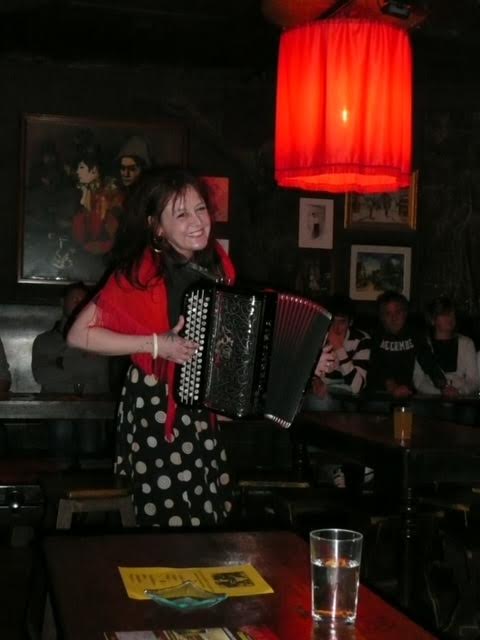


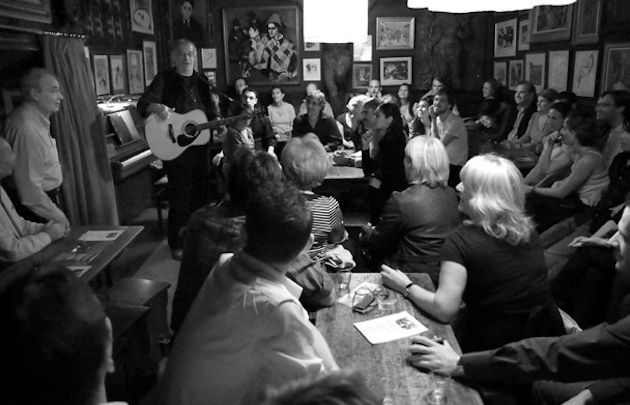
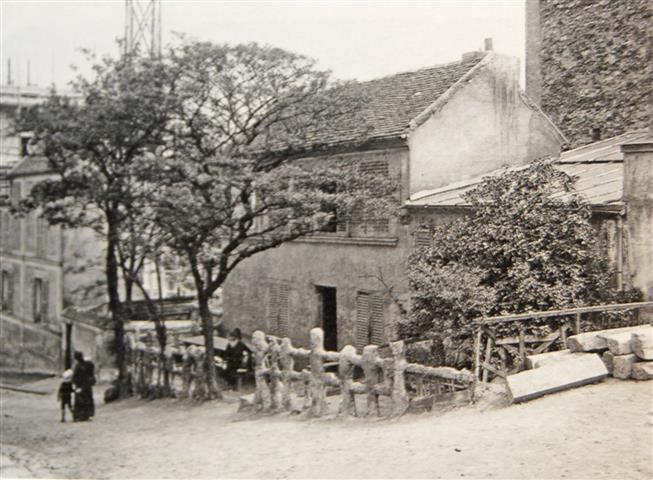


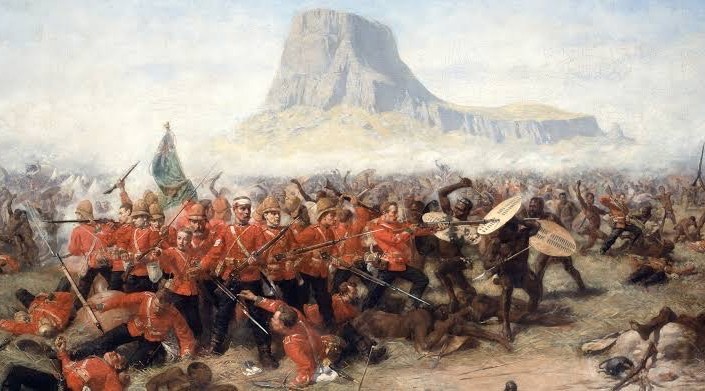
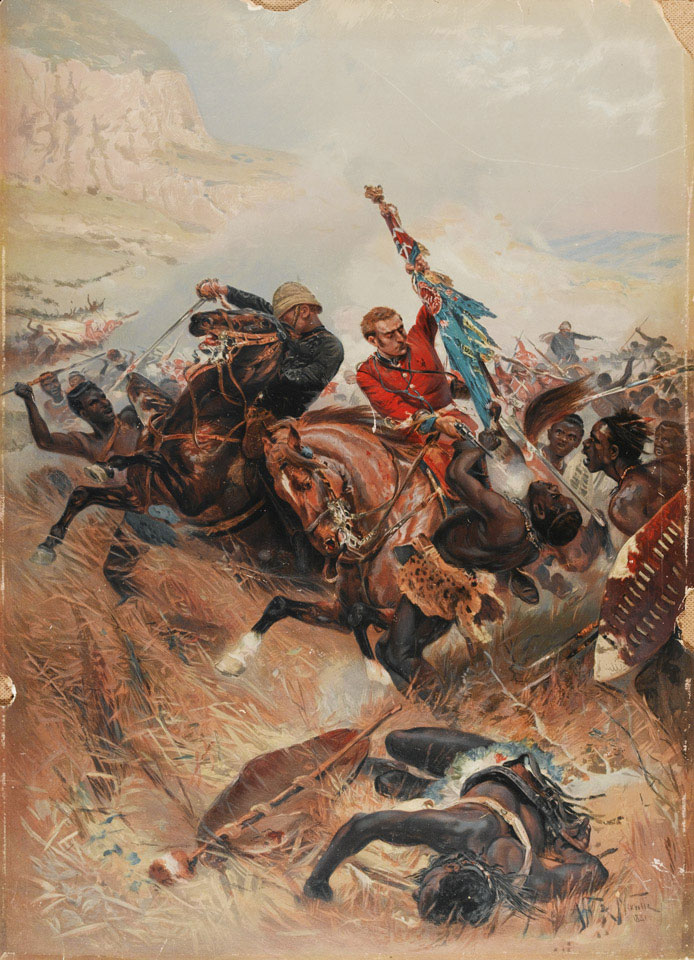

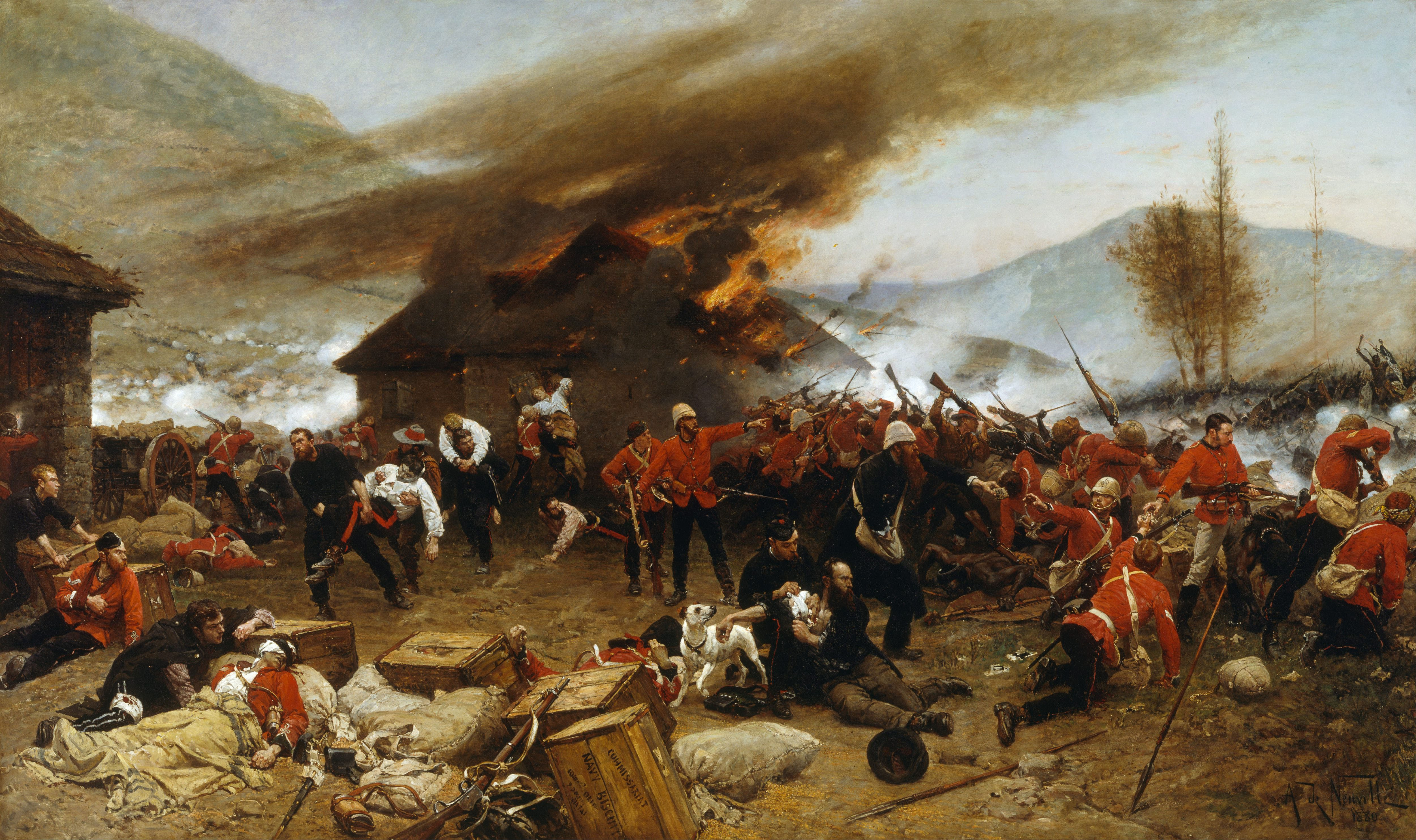 The Defense of Rorke’s Drift, Alphonse de Neuville, 1880
 Islandhlwana, 1879,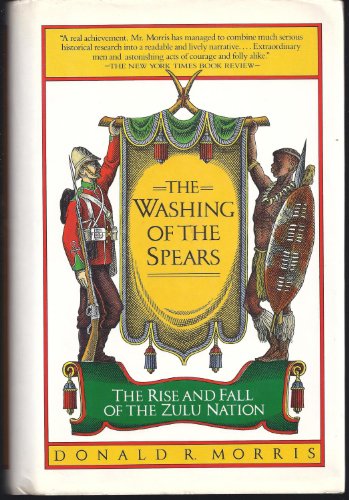
 Zulu impi)




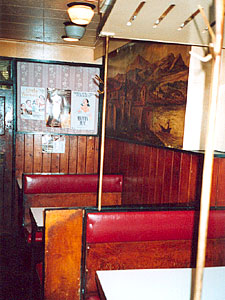


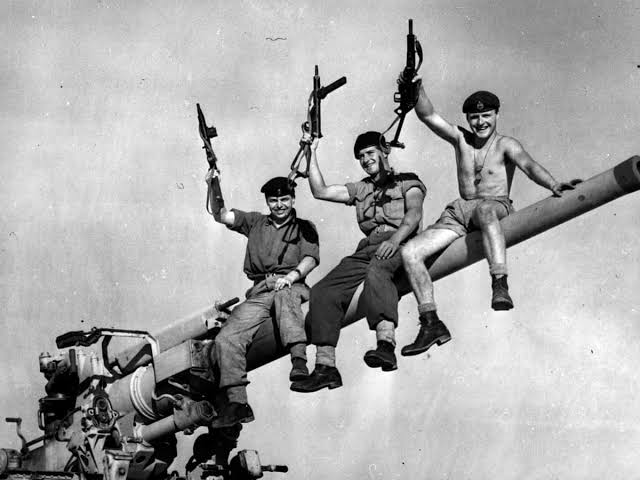
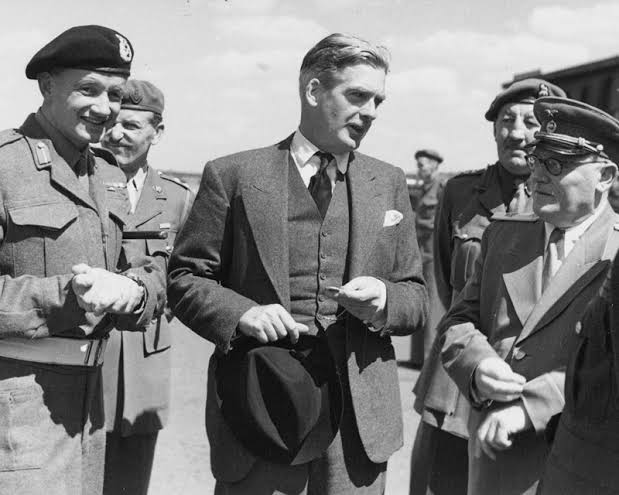
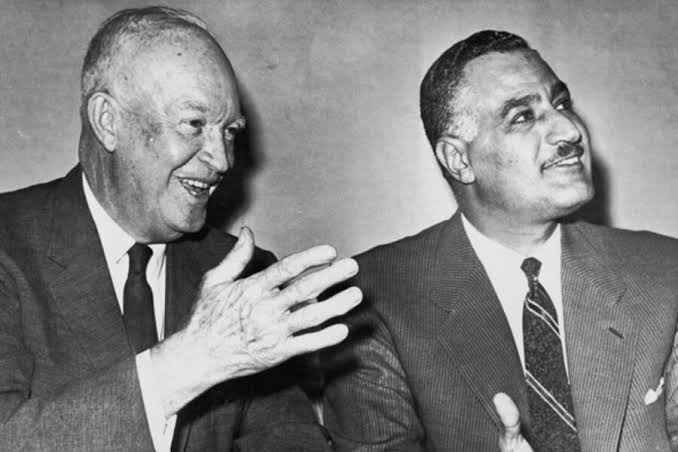
 In That Howling Infinite