The caged bird sings
with a fearful trill
of things unknown
but longed for still
and his tune is heard
on the distant hill
for the caged bird
sings of freedom
Maya Angelou
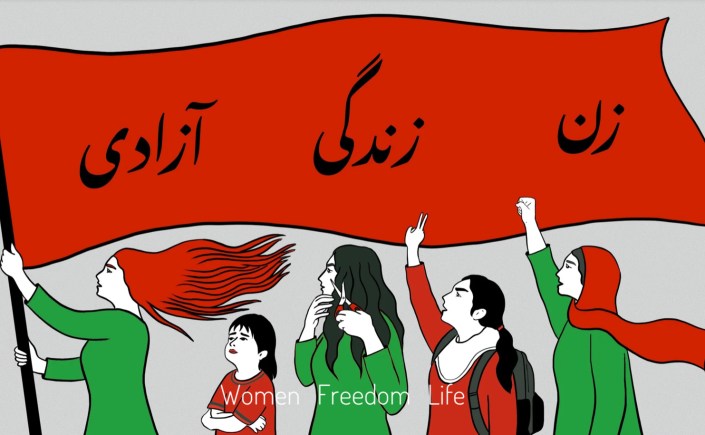
زن زندگی آزادی Zan zandaky āzādy Women freedom life
In our relatively comfortable, free and still democratic countries, it is difficult to put ourselves in the position of people desperate and passionate enough to risk life and limb and to face the terrible consequences of potentially heroic failure. We can but sense, vicariously, the ache and the urge behind Maya Angelous’s poem The caged bird sings of freedom (above) and Lord Byron’s passionate couplet:
Yet, Freedom! thy banner, torn, but flying,
Streams like the thunder-storm against the wind.
The courage of the of the Iranian protesters, and particularly the woman and girls who have been the vanguard of this unprecedented intifada cannot be exaggerated. For brave they are indeed. Having endured long years of a brutal and vengeful, corrupt and misogynistic theocratic regime and its security and paramilitary enforcers, they are fully aware of the consequences of their actions.
Several weeks, the nationwide protests that followed the murder in custody of a young woman arrested by the morality police after wearing her hijab inappropriately, and other young women and also, now, young men, who, officially, have died at their own hand or of pre-existing causes, have mobilized Iranians of all ethnicities, classes, ages and genders. And the security state us reacted predictably, red in tooth and claw. There is torture and death actual and awaiting on the streets of villages, towns and cities throughout the country, and the public trials with their black-garbed and turbaned hanging judges are in place and ready to protect the nation and the revolution in the name of Allah and the legacy of the canonised grey and dour uber-mullah Ayatollah Khomeini.
The perseverance and nihilistic exuberance of the Iranian street has reminded me of an exhilarating song and video created by a young Egyptian and his friends celebrating the demonstrations in Cairo’s Tahrir Square that precipitated the fall of practically Egyptian president-for-life Hosni Mubarak thirteen years ago last February. Sawt Al Huriya (The Voice of Freedom), went viral on YouTube after its release on 11 February 2011, the day before Mubarak’s departure?
Fast forward to the present, and we examine why the Islamic Republic’s sclerotic theocratic regime is so afraid of another song of revolution, the crowd sourced protest anthem, Baraya, which has become a thorn in the side of the government in Tehran.
Baraye, translated as “because of …” or “for …”, the anthem of Iran’s Woman, Life, Liberty protest movement grew organically from a Twitter hashtag trend in which Iranians expressed their uncountable discontents and their commitment to the protests. It continues to unite Iranians in their opposition to the rules, restriction nd repression of Islamic Republic weeks after it was first released online on an international and social media that the authorities have tried and failed to silence. To paraphrase Canadian songwriter and activist for injustice and the environment in his song Santiago Dawn (see below) to keep millions down “takes more than a strong arm up your sleeve”.
Bareya’s lyrics were created by the Iranians themselves and gathered and set to music , recorded, sung and shared by a young Iranian singer, Shervin Hajipour. Crazy brave, perhaps for predictably, he was detained by security operatives soon after he posted it on his Instagram page and forced to remove it from his feed. But it had already attracted millions of views worldwide and continued to be shared and shared and shared, and it has now been played and performed the world over as people across the glob empathize, identify with, and add to the images verbalised and the emotions these engender. We all have stories to relate of oppression and exclusion, of the abuse of power and privilege and the pervasiveness of prejudice and discrimination. To quote Bruce Cockburn once more about an earlier resistance, “see them matching home, see them rising like grass through cement in the Santiago dawn”.
Baraja gives voice to the voiceless – as Bob Dylan sang in another century, in comparatively straightened times:
For the countless confused, accused, misused, strung-out ones an’ worseAn’ for every hung-up person in the whole wide universeAn’ we gazed upon the chimes of freedom flashing
The Recording Academy, which hosts the annual Grammy Awards, announced that in its new merit category for best song for social change, more than 80% of nominations were for Baraye. Below is a video of the world-famous band Cold Play singing the song in Buenos Aires with Iranian actor Goldshifte Farahani.
The genesis of Baraya mirrors the organizational structure of the protests themselves insofar as like these, it is networked and leaderless, Ironically, however, David Patrikarakos editor of the e-zine Unherd wrote recently, this lack of leadership portends the protests’ doom:
“No leader has yet emerged. Instead, the protests are organised by different people or groups in different cities and towns on an almost ad hoc basis.The truth is that if the mullahs were to collapse tomorrow, there are no signs that a democratic movement would sweep to power …It is far more likely that the security state — led by the Revolutionary Guard Corps — would step into the void and make apparent what is already largely a fact: that Iran is no longer a clerical state but is now ruled by a Praetorian Guard …
… In 1979, Iranians held up images of Khomeini. In 2022, they tear them down. They know they want the regime gone but they have no one to hold up in its place. For a revolution to succeed, it’s not enough to be against someone; you have to be for someone else. It’s not enough that Khamenei loses. Someone else must win. Until that time, the mullahs will continue to cling on as murderously and barbarously as they always have, and Iranians will continue to die. For years Palestinians would say they needed a Saladin. They were wrong. What they need is a Ben Gurion. What the Iranian revolutionaries need now more than anything else is a Khomeini. Until that happens, this will only ever be half a revolution”.
At this moment in time, the outcome of that revolution hangs in the balance. The passion of the people for a better world is once again going up against the iron fist of the security state. Sadly, history past and present, in Iran and elsewhere, has shown us that when an irresistible force comes up against an immovable object, no matter how popular, righteous and justified that force may be, the immovable object invariably wins.
Meanwhile, hope springs eternal …
Our weapon was our dreams.
And we could see tomorrow clearly.
We have been waiting for so long.
Searching, and never finding our place.
In every street in my country,
The voice of freedom is calling.
Sawt al Huriya
Baraya … Because of
Because of dancing in the street
Because of fear while kissing
Because of my sister, your sister, our sister
Because of changing rotten minds
Because of shame for moneyless
Because of yearning for an ordinary life
Because of the scavenger kid and his dreams
Because of a command economy
Because of air pollution
Because of ‘Vali Asr’ Avenue, and its dying trees
Because of a cheetah (Pirouz) that may go extinct
Because of innocent, outlawed dogs
Because of the incessant crying
For the image to repeat this moment
Because of the smiling face
For students, for the future
Because of students, for the future
Because of this forced paradise
Because of the imprisoned elites
Because of Afghan kids
Because of all (Because of…) non-repetitive
Because of all these empty slogans
Because of the rubble of fake houses
Because of the feeling of peace
Because of the sun after a long night
Because of the nerve pills and insomnia
Because of man, country, rebuilding
Because of a girl who wished she was a boy
Because of woman, life, freedom
Because of freedom
Because of Mahsa Amini
See also in In That Howling Infinite, Sawt al Hurriya – remembering the Arab Spring, Messing with the Mullahs – America’s phoney war?. and A Middle East Miscellany
Why Is Iran’s Regime So Afraid Of This Song?

Demonstrators sing “Baraye” while holding their phone lights high during a march in support of protests in Iran. Allison Bailey, Reuters. 26th October 2021
“Baraye,” the anthem of Iran’s “Woman, Life, Liberty” protest movement—a song woven together entirely from a Twitter hashtag trend in which Iranians express their investment in the current protests—continues to unite Iranians in their opposition to the Islamic Republic several weeks after it was first released online.
For Iranians in Iran but also for the millions in the diaspora, this is the song of a generation, perfectly expressing this political moment and all that is at stake.
For dancing in the alleyways
Because of the fear you feel when kissing
For my sister, your sister, our sisters
To change the minds that have rotted away
Because of shame, because of being broke
Because of yearning for an ordinary life
What makes this moment different from previous periods of protest is that the wall of acquiescence and pretense that maintained the state’s authority in the public realm has been torn down on a scale not seen since the 1979 revolution. In its recounting of all the painful grievances, “Baraye,” which translates in English to “for” or “because of,” signals the end of patience with the status quo and opens vistas onto a new future with a vocal crescendo that culminates in the word “freedom.”
The song reveals the simple, ordinary nature of the things that Iranians are aching for, asking for, and even dying for. It is radical in revealing on a national level the cruelty of a system that denies such basic demands—exposing the devastating conditions Iranians face under the current regime.
If “Baraye” reflects a different, perhaps unprecedented mood on a national level, it also mirrors the organizational structure of this recent protest movement. If it is networked and leaderless, so is the song. The lyrics were written by Iranians at large and merely set to music and vocalized by the young up-and-coming singer Shervin Hajipour. This explains why security forces detained Hajipour a couple of days after he posted it on his Instagram page, where it had already accrued millions of views. The regime has tried for years to push the apparent and already real aspects of people’s lives out of the public sphere.
On social media, Iranians have created a life that more closely mirrors their inner selves—replete with harsh criticism of leading clerics including Iran’s supreme leader, Ayatollah Ali Khamenei; female solo vocalists who are otherwise banned singing at the top of their lungs; and the exhibition of private lives that are anything but a reflection of the state’s projected pious paradise. Still, the state has sought to maintain a semblance of its ideology and control in actual public spaces and its media.
“Baraye” has broken that violently imposed wall between the state’s enforced reality and people’s real lives. It forced into the open, in the face of authority, all that people have known for long but were not supposed to express openly on such a national dimension.
For the sake of a laughing face
For schoolkids, for the future
Because of this mandatory paradise
For imprisoned intellectuals
Since its release, the song has become the single most covered protest song in Iran’s history. Within a few short weeks after Hajipour composed the music for it, musicians across Iran and beyond its borders have sung it verbatim in their own voices, translated it, and sung it in other languages—and even universalized the lyrics for a more global audience.
Last week, the Iranian rapper Hichkas released a militant hip-hop track referencing “Baraye” through the more casual rap lingo “vase,” enumerating his reasons, starting with “vase Mahsa” (for Mahsa Jina Amini, whose death at the hands of Iran’s morality police sparked the protests) and ending with “for a good day,” in a nod to his own 2009 Green Movement protest song.

Mahsa Amini Protest in Iran

Protesters gather in London on Oct. 1 in solidarity with people protesting across Iran.
For the garbage-picking kid and her dreams
Because of this command economy
Because of this polluted air …
For a feeling of peace
For the sun after long nights
At the same time, “Baraye” creates national intimacy by citing very specific events that all Iranians have suffered through together, in a palimpsest of collective traumas. Hajipour sings “For the image of this moment repeating again,” drawn from a tweet with a photo of Hamed Esmaeilion and his young daughter relaxing together on a couch reading newspapers. (His wife and 9-year-old daughter were killed when Iran’s Revolutionary Guards mistakenly shot down a Ukrainian airliner leaving Tehran in January 2020, and Esmaeilion has become the face of the grief affecting all those who lost loved ones in the crash.)
This line resonates with Iranians because so many families have been torn apart by the country’s massive brain drain, caused by a closed and corrupt economy that offers few opportunities.
In other lines, Hajipour sings sarcastically “Because of this mandatory paradise,” referring to the theocratic state’s imposed restrictions, justified in the name of achieving an Islamic utopia.
In yet another, he sings of “houses in rubble,” pointing to collapsing buildings caused by the rampant nepotism and corruption that shield state-connected builders from transparency on safety measures. In another, he sings of the “imprisoned intellectuals,” in a nod not just to the hundreds of journalists, human rights lawyers, and filmmakers but even award-winning university students who have been locked up.
The chorus arising from hundreds of tweets is clear: This is a regime that seems to be against life itself, punishing dancing, kissing, and smiling faces.
The song’s singular overnight success is not a small achievement given the long, rich history of protest songs in Iran. Already at the time of Iran’s Constitutional Revolution in 1906, poets created songs about the spilled blood of the youth who agitated for representative government and, not long after, about the Morning Bird breaking the cage of oppression, which many decades later became one of the most intoned protest songs in post-revolutionary Iran.
The trajectory of Iran’s musical history clearly exhibited a century-long struggle for freedom and justice, not yet realized.
Although “Baraye” and other songs of the current protest movement continue this strong tradition, they break with the post-revolutionary legacy on one key point: They no longer call for reforms.
At the time of the last major convulsions in 2009, many activists and musicians of the Green Movement called forth songs from the 1979 revolution to stake a claim to the revolution’s original yet unattained promises. People wore headscarves and wristbands in the green of Imam Hussain and went to their rooftops to shout “Allahu akbar” to invoke God’s help against a corrupt, earthly power.
But this time around, there are no religious signifiers or any demands for reforms. If classical songs are performed, they are not the icon Mohammad Reza Shajarian’s conciliatory song Language of Fire in 2009, when Iranians were still agitating for reforms from within, but his militant 1979 song Night Traveler, (also known as “Give Me My Gun”) in which he calls “sitting in silence” a sin and asks for his gun so he can join the struggle. One of Shajarian’s masterful female protégés posted the song with the hashtag #Mahsa_Amini and swapped “the brother” out of the verses to sing “The sister is an adolescent, the sister is drowning in blood,” in recognition of the teenage girls who have given their lives in the protests.
The state security system instantly understood the significance of “Baraye” as a protest song. Hajipour was forced to take it off his Instagram account; however, not only has his song already been shared widely by other accounts and on other platforms, but the sentiments behind the lyrics are within the millions of people who wrote them.
The chants of “Death to the Dictator” have reverberated from the streets to the universities, from oil refineries to urban rooftops, and from bazaars to school courtyards. And so have the haunting calls for freedom repeatedly intoned at the end of “Baraye,” pouring forth from every corner of the actual and virtual Iranian public sphere.
That song’s reality can no longer be repressed and hidden by force.
Song lyrics in this article are based in part on Zuzanna Olszewska’s translations.
 In That Howling Infinite
[…] Ukraine and the curse of mystical nationalism and The Roots and Fruits of Putin’s Irridentism. “Because of …” Iran’s voice of freedom looks at the song that has become the rising’s anthem. No one can predict the outcome, whether it […]
[…] For more on the Middle East in In That Howling Infinite, see A Middle East Miscellany, Messing with the Mullahs – America’s phoney war? and “Because of …” Iran’s voice of freedom […]
[…] February 28, 2026Paul Hemphill Leave a comment Oscar Wilde, our patron saint of premature obituaries, once quipped, “The reports of my death are greatly exaggerated.” One is tempted to borrow the line here in reverse: the death of Ali Khamenei, if it has indeed occurred as described, is not exaggerated. The question, rather, is whether the death of his revolution is, or ever could be, so neat. In an eloquent article in The Atlantic, Karim Sadjadpour, American policy analyst at the Carnegie Endowment for International Peace in Washington D.C. casts him as custodian of a mausoleum, spokesman for a ghost, while Orwell hovers like a spectre over the scene, reminding us that the dead impose upon the living a worldview and a way of life long after the society beneath it has shifted, urbanised, digitised, globalised. Under Khamenei, the Islamic Republic became precisely that: liturgical slogans, policing of women’s bodies, the hijab both banner and boundary. And yet revolutions, like stubborn shadows, rarely die when their architects do. For the Islamic Republic was never a single body; it was an ecosystem, vascular and sprawling: clerical networks, the Revolutionary Guard, the Basij, foundations controlling vast swathes of the economy, a security apparatus honed by decades of sanctions, war, assassination, and unrest. Khamenei may have been the last of the first generation, the final living ligament to 1979 – but institutions outlive men. The IRGC, less ghost than organism, adaptive, entrepreneurial, entwined in Iran’s political economy and regional projection of power, had already evolved into a praetorian creature, more barracks than seminary. The revolution had become its own bureaucracy; the fervour was folded into files, the ecstatic theology into choreography. Khomeini was revelation; Khamenei was preservation. And that may yet be his most enduring achievement: he turned prophecy into paperwork, charisma into system, and systems, unlike prophets, require only control, not belief. Makes no mistake. The regime and its security apparatus and military industrial complex is lodged in the Iranian throat. It will take more than a gargle of American mouthwash to dislodge it! This stark image encapsulates decades of entrenchment, ideology, and bureaucracy, with a sly nod to futility. So what now? The hinge has turned, though the door may swing in any direction. Three paths suggest themselves. Consolidation: a successor, deliberately colourless, rises, the Guard tightens its grip, ideology becomes theatre while power migrates behind the curtain, the revolution persists because it can control, not because it inspires. Managed mutation: flexibility, the Islamic Republic’s paradoxical talent; controlled elections, tactical moderation, negotiation where expedient. Rhetoric may soften, “resistance” may become nationalist rather than theological, the ghost changes costume but remains on stage. Fracture: succession is a stress test unlike any other; elite rivalries, public impatience, economic exhaustion, and the memory of Mahsa Amini could conspire to splinter the coercive apparatus. The moral centre of Iranian society has shifted far from the revolution’s founding certainties; the dead can govern only so long as the living consent, or are compelled, to remember in the prescribed way. Sadjadpour warns that Khamenei’s life’s work was to preserve a revolution “heading for the ash heap.” Perhaps. But ash heaps are treacherous metaphors: they imply finality, neatness, closure. Iran’s modern history – constitutionalism, coups, revolution, reformist surges, Green Movement, uprisings – reveals something less linear and more cyclical: endings that seed beginnings, collapses that mutate, institutions that sediment while eras blur. The Islamic Republic may yet prove more durable than its critics predict, or more brittle than its guardians admit; revolutions, like empires, seldom die cleanly – they fade, calcify, mutate, or fall when no one quite expects it. Obituaries are tidy things. They suggest closure, a soft percussion of earth on coffin lid, the moral summation of man and era alike. But Khamenei’s political body was never contained within his frame. It was diffused: in barracks, seminaries, intelligence files, oil contracts, prison walls, procurement networks, and the muscle memory of repression. You cannot bury that with a single spade. What makes this moment feel epochal is generational: he was the last living ligament to 1979. The revolution has passed from incandescent revelation to bureaucratic inheritance, from the explosive charisma of Khomeini to the methodical, suspicious choreography of Khamenei, and inheritance is always more fragile than creation. One can die for a revolution; it is harder to live bureaucratically for one. So: exaggerated? If one means the man, no. If one means the era, perhaps – but eras rarely end cleanly. They blur, overlap, leave sediment, rearrange furniture before the house collapses. The hinge has turned. One can almost hear the machinery shifting – the faint metallic groan of succession in closed systems. Whether the door closes, swings wider, or jams halfway remains uncertain. Perhaps the true exaggeration lies not in the reports of death but in the certainty with which commentators predict what follows. For now, the obituary hovers between elegy and warning. Something has ended. What replaces it may look familiar, at least at first glance, but history delights in surprising both mourners and celebrants alike. And if one must borrow Wilde properly: it is not the death that is exaggerated—it is our confidence about the afterlife. https://www.theatlantic.com/international/2026/02/death-khamenei-end-era/686196/ This short epitaph is a précis of the article by Karim Sadjadpour in the Atlantic in 1March 2026 written by an AI language model For other articles in In That Howling Infinite, see: Messing with the Mullahs – America’s phoney war? The quality of mercy … looking beyond Iran’s ghost republic and “Because of …” Iran’s voice of freedom […]
[…] – America’s phoney war? The quality of mercy … looking beyond Iran’s ghost republic and “Because of …” Iran’s voice of freedom, and The end of the line … an epitaph for […]
[…] – America’s phoney war? The quality of mercy … looking beyond Iran’s ghost republic and “Because of …” Iran’s voice of freedom, and, most recently, Chaos without a compass … Donald Trump’s Persian “excursion”, and The […]
[…] – America’s phoney war? The quality of mercy … looking beyond Iran’s ghost republic and “Because of …” Iran’s voice of freedom, and, most recently, Chaos without a compass … Donald Trump’s Persian “excursion”, and The […]