The fall of the Ottoman Empire and the birth of Türkiye

Preface

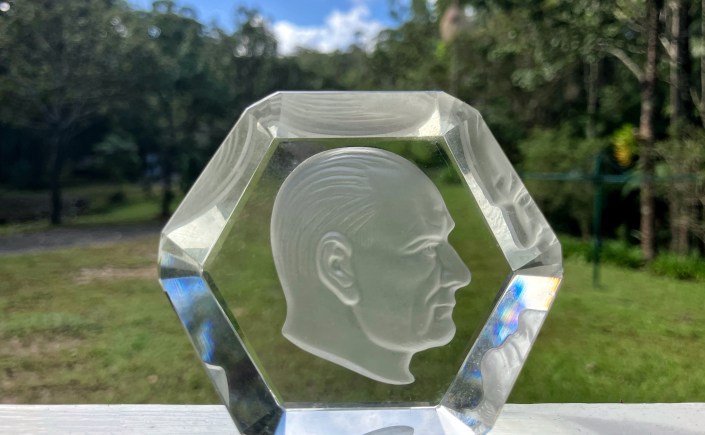
The featured image of this post is a profile in crystal of Kemal Atatürk that sits on my bookshelf as a reminder of my late friend and academic colleague Mehmet Naim Turfan. Naim, like millions of his compatriots, harboured a deep affection and respect for the legacy of Atatürk, the founder of modern Türkiye and its first president. It was gifted to me by His wife soon after his passing by his wife Barbara. His doctoral thesis was published posthumously in 2000 as Rise of the Young Turks: Politics, the Miliary and Ottoman Collapse. He is cited several times in the book that is the subject of this article. I thought of Naim often while reading the book and writing what follows.
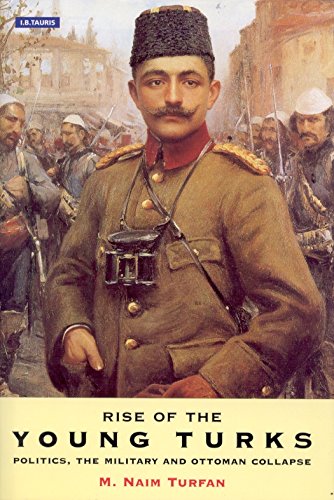
Enver Pasha, soldier, politician and member of the troika that ruled the Ottoman Empire before and during WW1

Ottoman Endgame

Many believe that prior to the outbreak of World War 1 in August 1914, Europe had been at peace. In matter of fact, brutal and bloody little wars had raged in Eastern Europe three years prior, whilst Italy fought the Ottoman Empire for Tripoli and Cyrenaica, both now modern Libya and yet also presently two warring parts of a fractured whole and now being triggered by the aftermath of equally nasty little wars in the same lands in the last quarter of the Nineteenth Century. The Ottoman Empire’s entry into alliance with the Central Powers in 1915 against the Entente of Britain, France and Russia was the direct outcome of what we know refer to generically as The Balkan Wars – which aided and abetted by Russia, saw the emergence of Serbia, Romania and Bulgaria. In retrospect, with the benefit of hindsight, they were the beginning of what we might now refer to as The Wars of the Ottoman Succession. They are not over.

The empire’s entry into the war on the side of the Central Powers against the Entente of Britain France and Russia was a devious, drawn-out business as it sought to take advantage of its potential allies in recovering why it lost in the preceding Balkan Wars that had deprived it of its European provinces,

Few have told the story of the fall of the Ottoman Empire and the birth of modern Türkiye as well as English historian Sean McMeekin in his geographically sprawling and historically enthralling book The Ottoman Endgame. He juxtaposes military operations in the empire with those on Europe’s eastern and western fronts, demonstrating how, in the shifting fortunes of war in Europe, each impacted the other from the first offensives in France and on the eastern front to the Russian Revolutions of 1917.

Author and journalist Christopher de Bellaigue sets the scene well in a brief but compelling review (published in full below with some excellent pictures, along with a article by the author himself):

”For the historian of the first world war, the Ottoman theatre is a blur of movement compared to the attrition of the western front. Its leading commanders might race off to contest Baku and entirely miss the significance of events in the Balkans, while the diffuse nature of operations tended to encourage initiative, not groupthink. The war of the Ottoman succession, as Sean McMeekin calls it, was furthermore of real consequence, breaking up an empire that had stifled community hatreds, and whose absence the millions who have fled sectarian conflict in our age may rue …

For the Ottomans, the “great war” of western historiography was part of a much longer period of conflict and revolution, and arguably not even its climax. The process started with the collapse of the Ottomans’ Balkan empire – encouraged by Russia, moderated by Britain – and it brought to power the militaristic regime of the Committee of Union and Progress, or CUP. When Turkey entered the European war on 10 November 1914, Ottoman innocence was long gone, the army fully mobilised, the people benumbed by loss and refugees and the empire hanging in the balance. And yet, for the CUP and its triumvirate of leading pashas, the Young Turk troika of Enver, Talat and Djemal, the moment was as fraught with opportunity as it was with danger. On the opportunity side of the ledger was the prospect of riding Germany’s coat tails to victory, overturning the Balkan reverses and winning back provinces in the east from the old enemy, Russia. Enver, the CUP’s diminutive generalissimo, even spoke of appealing to Muslim sentiment and marching all the way to India.

For the Russians, the game was about winning Constantinople (or Tsargrad, as they presumptuously called it) and with it unimpeded access to the Mediterranean through the Bosphorus; it was with “complete serenity”, Tsar Nicholas II informed his subjects, that Russia took on “this ancient oppressor of the Christian faith and of all Slavic nations”

The European war on the eastern and western fronts was characterized by attrition and stalemate, but that waged by the Ottomans and the Russians, and soon, the British and French, was in contrast, highly mobile and constantly shifting, with the exception perhaps of the allied assault on the Gallipoli Peninsula which very soon resembled the trench warfare and brutal but futile offensives that characterized the Western Front. It is difficult to comprehend to scale of the war fought in the Middle East in terms of its territorial extent. From Baghdad to Baku, Gallipoli to Gaza, the Black Sea to the Gulf of Aqaba and the Caspian Sea. It was waged across European and Asian Ottoman lands including present day Greece, Bulgaria and Romania in the west, in the Caucasus in the east, in present day Armenia, Georgia and Azerbaijan and Iran, and in the south in present day Syria, Iraq, Jordan, Israel and Palestine.

Though the Sultan departed, and with him, the Islamic Caliphate, and most of the empire’s non-Turkish lands – were lost, under the leadership of former Ottoman commander and war hero Mustafa Kemal Pasha, the Anatolian heartland resisted and ultimately repelled invading foreign armies, and the Turkish state he created endures today as an influential participant in world affairs.

Casting new light on old narratives

McMeekin, writes de Bellaigue, is an old-fashioned researcher who draws his conclusions on the basis of the documentary record. In the case of a conflict between Ottoman Turkey and Germany on one side, and Russia, Britain and France on the other, and involving Arabs, Armenians and Greeks, this necessitates linguistic talent and historical nous of a high order. McMeekin is at home in the archives of all major parties to the conflict and his accounts of some of the more contested episodes carry a ring of finality. Access to previously closed Russian and Turkish archives has provided new and potentially controversial insights into accepted narratives regarding the last years of the Ottoman Empire. Challenging long accepted narratives, he addresses three of the most enduring shibboleths of the First World War.

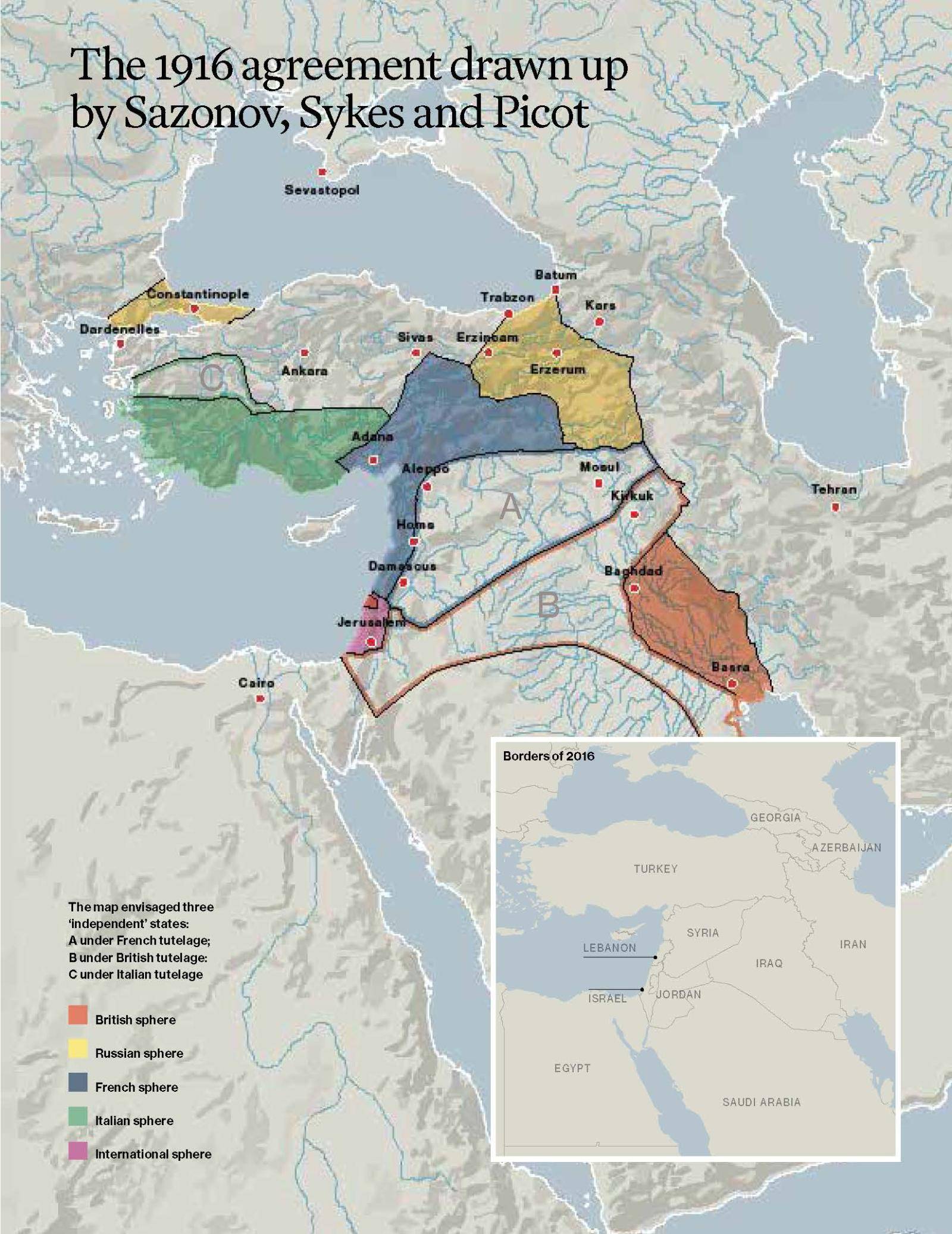
He jumps right in even before he begins his wide-ranging story, leaves hanging in the air like a predator drone until he returns to it in chronologically due course. The Sykes Picot Agreement of 1916 – the bête noir of most progressive narratives of the modern Middle East, and to many ill-informed partisans, the causus bello of the intractable Arab Israeli conflict – was not the brainchild of perfidious Albion and duplicitous France, but rather a plan for the dismemberment of the Ottoman Empire concocted by the foreign minister of Imperial Russia. France’s Monsieur François-George Picot and Britain’s Sir Mark Sykes played second and third violin to the “third man” Sergei Sazonov. Both Russia and France had for decades sought to establish their political, strategic and economic interests at the expense of the so-called “sick man of Europe”, an ostensibly terminal invalid who throughout the nineteenth century, had experienced many deathbed recoveries. Czar Nicholas II, in common with his Russian Orthodox predecessors, dreamt of bringing Istanbul, formerly Constantinople, the heart of the orthodox patriarchate, or Tsargrad into the empire. It was no coincidence that the infamous Sykes Picot pact was outed by Russia’s Bolshevik regime after the collapse of the Czarist regime to discombobulate the revolution’s foremost European enemies. 

The second icon of “received history” in McMeekin’s sights, is one Australia’s foundation stories – the ill-starred Dardanelles Campaign of 1915 and particularly, the the ANZAC’s Gallipoli legend. It was, from McMeekin’s perspective, a misconceived, poorly planned endeavour to capture the Ottoman capital, to relieve pressure on Russian forces engaged in bitter fighting in Eastern Anatolia, and potentially, to knock the Ottomans out of the war. Contrary to popular conceptions, the British were not exactly enthused by the idea. First Lord of the Admiralty Winston Churchill’s preference was for an assault on the “soft underbelly” of the empire – the port of Alexandretta in Ottoman Syria (now Turkish Antakya), with its strategic and logistic proximity to the Hijaz railway and the hinterland of the Levant. One indisputable fact about Gallipoli is that it assured the ascent Mustafa Kemal, a key commander who had already distinguished himself in the Balkan Wars, who would go on to conduct a fighting retreat of Ottoman Armies through what is now present-day Palestine and Syria, lead Turkish forces to victory in the war of liberation that followed, and, as Kemal Atatürk, would become the founder of modern Türkiye.

The third widely held narrative concerns the Armenian Genocide. Unlike the rulers of modern Türkiye, McMeekin does not deny its occurrence. Nor does he downplay or even ignore it, as does Israel for the idiosyncratic reason that it potentially minimises the horrors of the Shoah. Rather, he places it in the context of events in the empire’s Anatolian heartland. Two predominantly Armenian provinces in Eastern Anatolia were home to active nationalist independence movements, and these gave tacit and actual support to the Russian forces encroaching on the empire from the Caucasus and the Caspian Sea (in present day Azerbaijan and Georgia). Armenian militias fought alongside Russian forces on the Caucasian front whilst partisans operated behind ottoman lines, and cities, town and villages were actually “liberated”, fostering fears in the Istanbul government of an treasonous” fifth column”. McMeekin acknowledges the death toll of what we now recognise the systematic destruction of the Armenian people and identity which was spearheaded by the ruling Committee of Union and Progress (CUP) and implemented primarily through the mass deportation and murder of around one million Armenians during death marches to the Syrian Desert and the forced Islamization of others, primarily women and children. Whilst most probably died of inhumane treatment, exposure, privation and starvation, unknown numbers were murdered.
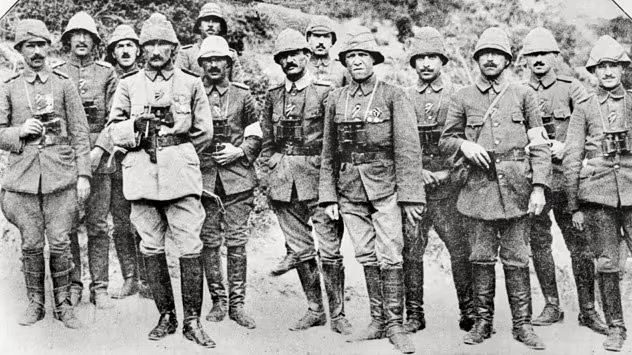
Kemal Pasha and Ottoman offices at Gallipoli

Parallels

Reading The Ottoman Endgame, I was reminded often of his compatriot Anthony Beevor’s harrowing tale of the Russian Revolution (reviewed in In That Howling Infinite’s Red and white terror – the Russian revolution and civil war. That Revolution and the end of the Ottoman Empire converged. McMeekin notes that with regard to the war in Anatolia and the Caucasus, the treaty of Brest-Litovsk, which ended the war between Czarist Russia and the Central Powers, was poisoned chalice for both Russia and Turkey and as significant as any of the treaties that followed the end of the war.

I found it fascinating that many individuals who were to play a significant part in the Russian Civil war also feature in Ottoman Endgame. Admiral Alexander Kolchak, commander of the imperial Black Sea fleet and General Anton Deniken, commander of Russian forces on the Caucasian front, became leaders of the Tsarist cause and were to command the counter-revolutionary White forces against the Red Army with the Siberian People’s Army and the Volunteer Army in Ukraine.

None were more prominent or as controversial in western narratives, however, as Winston Churchill. As noted above, McMeekin lays to rest the notion that the Dardanelles campaign and Gallipoli were Churchill’s sole doing and his folly – though he did blame himself later on and has been pilloried for it ever since. Ironically, once disgraced, and having volunteered to serve on the Western Front, at the end of the war, he was brought back into Lloyd George’s cabinet as Secretary of State for War. There, he advised against military intervention against Kemal’s nationalist forces and indeed mused about the option of dumping the Sazonov-Sykes-Picot dispensation imposed on the moribund empire’s Arab provinces after the armistice and of restoring the prewar territorial status quo, a kind of circumscribed Ottoman Redux. And yet, as civil war broke out and spread in the nascent Soviet Union, he was alone of his cabinet colleagues in advocating for a full-on allied intervention. Critics claimed that he dreamt, – though some believed that he fantasized – about of creating an effective White army and a borderlands alliance to defeat the Bolsheviks. But his aspirations were foiled by the imperialism of the White leadership and of White officers, and the various national movements’ fear that that if the Whites prevailed, they would restore Russian rule. Britain’s rulers were reticent about shoring up and providing financial, material support and also, soldiers sailors and airmen to brutal to demonstrably homicidal Cossack brigades and revanchist and reactionary royalist autocrats. It is not without reason that admirers and critics alike would agree that Winston had more positions than the Karma Sutra.

The Russian Revolutions – there were two, in February and October 1917 – and the Civil War that followed it, the disintegration of the Ottoman Empire followed by foreign intervention, the war of liberation, and the creation and endurance of Türkiye can be said to have defined the contours of modern Middle Eastern geopolitics, setting the stage for many if not most of the conflicts that have inflicted the region since, including three Gulf wars, the rise and fall of the Islamic State, the Lebanese, Iraqi and Syrian civil wars, and the Arab-Israel conflict, arguably the most intractable conflict of modern times. Cold War and also, the current Ukraine war.

In the wake of the fall of the Russian Empire, the Twentieth Century was not kind to the countries of Central and Eastern Europe. Historian Timothy Snyder called them “the blood lands”. Nor was it kind to the heirs and successors of the Ottoman Empire. Though the tyranny and oppression and the death and destruction wrought by rulers and outsiders upon the lands and peoples of the Middle East has been significantly less than that endured by the people of Eastern Europe and Russia, the region would fit Snyder’s sombre soubriquet.

© Paul Hemphill 2025. All rights reserved

Also in In That Howling Infinite, see Ottoman Redux – an alternative history and Red and white terror – the Russian revolution and civil war

For more on the Middle East, see A Middle East Miscellany
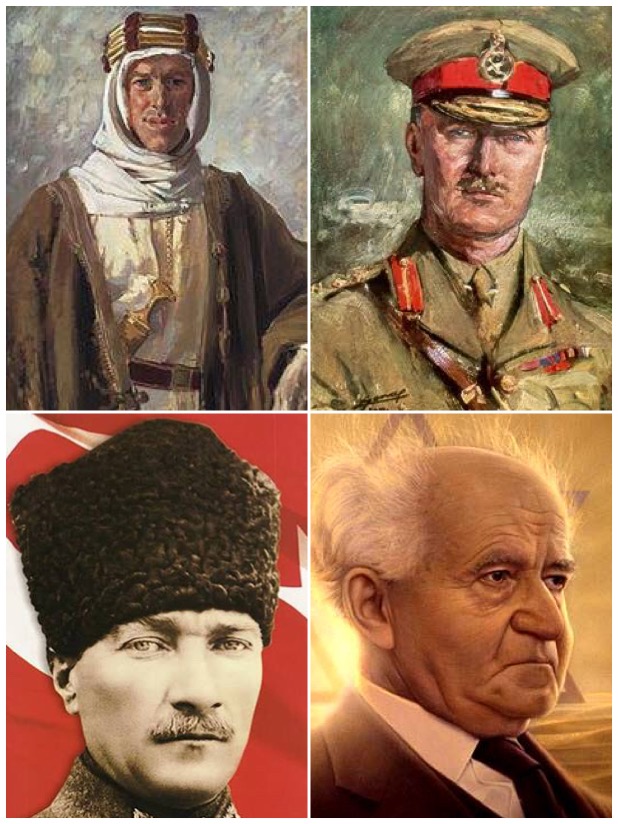
TE Lawrence, General Allenby, Kemal Ataturk, and Ben Gurion

Clone of Russia returns to a Middle East it never really left

Sykes and Picot have taken the blame but actually it was a Russian who drew the map of the Middle East, writes Sean McMeekin

The World Today, 7 December 2018
To judge from press coverage, the emergence of Islamic State has brought about a cartographic revolution in the Middle East. With the borders of Syria and Iraq in flux, journalists have resurrected the legend of Sykes-Picot, wherein Britain and France are said to have divided up the Ottoman empire between them in an agreement signed 100 years ago, in May 1916. Russia’s intervention in Syria, by upstaging the United States and her allies, seems in this view to be completing the rout of western influence in the Middle East, putting the final nail in the coffin of ‘Sykes-Picot’.

Rarely has history been more thoroughly abused. In reality, none of the contentious post-Ottoman borders of the Middle East was settled by Sykes and Picot in 1916: not the Iraq-Kuwait frontier notoriously crossed by Saddam’s armies in 1990, not those separating the Palestinian mandate from (Trans) Jordan and Syria, not the highly contested and still-in-flux Israeli/Palestinian partition of 1948, nor, in the most relevant example from today, those separating Syria from Iraq.

To take an obvious example from recent headlines, Mosul, the Iraqi city whose capture in June 2014 led Abu Bakr al-Baghdadi of Islamic State to proclaim himself Caliph Ibrahim, was actually assigned to French Syria in the 1916 agreement.

Journalists are even more spectacularly wrong in describing the Ottoman partition agreement as exclusively (or even primarily) a British-French affair, omitting the driving role played by Tsarist Russia and her Foreign Minister, Sergei Sazonov.

The final terms of what should more accurately be called the Sazonov-Sykes-Picot agreement were actually hashed out in the Russian capital of Petrograd in the spring of 1916, against the backdrop of crushing Russian victories over the Turks at Erzurum, Erzincan, Batum, and Trabzon (the British were reeling, having been humiliated at Gallipoli and in Iraq, where an expeditionary force would shortly surrender).

The conquest of northeastern Turkey in 1916 left Russia, unlike her grasping allies, in possession of most of the Ottoman territory she was claiming – barring only Constantinople (called ‘Tsargrad’ by the Russians), which still needed to be taken.

At the dawn of 1917, Tsarist Russia was poised to inherit the crown jewels of the Ottoman empire, including Constantinople, the Straits, Armenia, and Kurdistan, all promised to her in the Sazonov-Sykes-Picot Agreement. Along the Black Sea coast, Russian engineers were building a rail line from Batum to Trabzon, with the latter city a supply base for the Caucasian Army, poised for a spring assault on Sivas and Ankara. With Russia enjoying virtually uncontested naval control of the Black Sea, preparations were underway for an amphibious strike at the Bosphorus, spearheaded by a specially created ‘Tsargradskii Regiment’.

After watching her allies try, and fail, to seize the Ottoman capital during the Dardanelles/Gallipoli campaign of 1915 (when Sazonov had first put forward Russia’s sovereign claim on Constantinople and the Straits), Russia was now poised to seize the prize for herself – weather permitting, in June or July 1917.

Of course, it did not turn out that way. After the February Revolution of 1917, mutinies spread through the Russian army and navy, including the Black Sea fleet, just as it was poised to strike.

In a remarkable and little-known coincidence, on the very day the Foreign Minister of the Provisional Government, Pavel Milyukov, first aroused the anger of the Petrograd Soviet and the Bolsheviks by refusing to renounce Russia’s territorial claims on the Ottoman empire – April 4, 1917 – a Russian naval squadron approached the Bosphorus in ‘grand style’, including destroyers, battle cruisers, and three converted ocean liner-carriers which launched seaplanes to inspect Constantinople’s defences from the air. The amphibious plans were not abandoned until fleet commander Admiral AV Kolchak threw his sword overboard on June 21 during a mutiny. Even after ‘revolutionary sailors’ had taken control of the Black Sea fleet, a Russian amphibious strike force landed on the Turkish coastline as late as August 23, 1917, in one last sting by the old Tsargrad beast.

After the Bolsheviks took power, Russia collapsed into civil war, which left her prostrate, at Germany’s mercy. By signing a ‘separate peace’ with the Central Powers at Brest-Litovsk in March 1918, Russia forfeited her treaty claims to Armenia, Kurdistan, Constantinople, and the Straits, throwing the Sazonov-Sykes-Picot agreement of 1916 into chaos, even as new claimants were appearing on the scene, such as Italy and Greece – not to mention local actors: Jewish, Arab, and Armenian troops were attached as national ‘Legions’ to General Allenby’s mostly British army as it rolled up Palestine and Syria. These forces, along with French, Italian, and Greek expeditionary forces sent after the war, and the Turkish nationalists who regrouped under Mustafa Kemal in Ankara to oppose them, would determine the final post-Ottoman borders in a series of small wars between 1918 and 1922, with scarcely a nod to the Sazonov-Sykes-Picot Agreement.

While Russia’s forfeiture of her claims in 1918 was welcome, in a selfish sense, to the other players vying for Ottoman territory, it was not necessarily a positive one for the region. In the absence of Russian occupying troops to police the settlement, the

Allies, in 1919, offered Russia’s territorial share, now defined (in deference to Woodrow Wilson) as mandates, to the United States – only for the Senate to vote down the Versailles Treaty, rendering the arrangement moot. Lacking Russian or American troops as ‘muscle’, the Allies leaned on weaker proxies such as the Italians and, more explosively, local Greeks and Armenians, which aroused the anger of the Muslim masses and spurred the Turkish resistance led by Kemal (the future Atatürk). Armenians, Greeks and Kurds, too, could only lament the vacuum left behind by the departing Russians, which left them to face Turkish wrath alone.

Soviet Russia re-emerged as a player in the Middle East fairly quickly, not least as Mustafa Kemal’s key diplomatic partner during his wars against the West and its proxies from 1920-22. In a reminder of the enduring prerogatives of Russian foreign policy, the Cold War kicked into high gear when Stalin made a play for Kars, Ardahan, and the Ottoman Straits in 1946: these moves, along with the British withdrawal from Greece, Turkey, and Palestine, inspired the Truman doctrine.

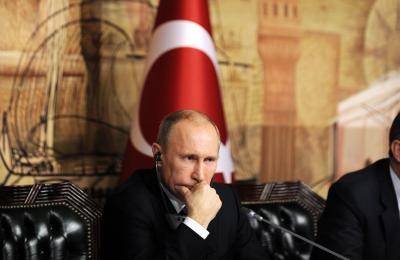
In an eerily similar replay of the history of 1917-18, the collapse of Soviet power in 1991 led Moscow to turn inward, withdrawing from the Middle East and inaugurating a period of US and western hegemony in the region, which turned out no less well than the Middle Eastern free-for-all of 1918-22. A prostrate and impoverished Russia put up no objection during the First Gulf War of 1991, and did little more than sputter during the Iraq War of 2003. Russia’s recovery of strength and morale in the Putin years led, almost inevitably, to her return in force to the Middle East – from which, in reality, she never truly left.

The Russian return to the region, along with Turkey’s increasingly overt hostility over her Syrian intervention, resurrects historical patterns far, far older than Sykes-Picot. For centuries, the Ottoman empire was the primary arena of imperial ambition for the Tsars, even as Russians were the most feared enemies of the Turks. In many ways, the Crimean War of 1853-56, which saw western powers (Britain, France, and an opportunistic Piedmont-Sardinia) unleash an Ottoman holy war against the Tsar to frustrate Russian ambitions in the Middle East, is a far more relevant analogy to the present crisis in Syria than the pseudo-historical myths of 1916. It is time we put the Sykes-Picot legend in the dustbin where it belongs.
Diplomatic carve-up: the third man

In David Lean’s 1962 film, ‘Lawrence of Arabia’, a cynical British official explains how the carcass of the Ottoman Empire was to be divided at the end of the First World War under the Sykes-Picot Agreement.

‘Mr Sykes is an English civil servant. Monsieur Picot is a French civil servant. Mr Sykes and Monsieur Picot met and they agreed that after the war, France and England would share the Turkish Empire, including Arabia. They signed an agreement, not a treaty, sir. An agreement to that effect.’

This summary of wartime diplomacy has proved long-lived. It encapsulates the less than honest dealings of the British government with the Arabs – who wanted independence after being liberated from Turkish domination, rather than rule by the European colonial powers – but it leaves out the key figure in the deliberations, Sergei Sazonov, Russian foreign minister, 1910-1916.

Sazonov was one of the most significant diplomats both before and during the Great War. It was thanks to his adroit manipulation that Britain and its allies came to accept that Russia would gain the Ottoman capital Constantinople, in the event of an Allied victory, an outcome that Britain had tried for decades to prevent.

At the talks in the Russian capital Petrograd in 1916, the British and French emissaries were far lesser agents of empire than their host.

Sir Mark Sykes was a gifted linguist, travel writer and Conservative politician, but no top-flight diplomat. As for François Georges-Picot, he was an experienced diplomat and lawyer and noted advocate for a greater Syria under French rule.

But with France having no troops in the eastern theatre of war, he had to accept Russia’s demand to swallow up large parts of what is now eastern Turkey, but which Paris had set out to claim.

Sykes died of influenza in 1919 at the Paris Peace Conference, where Sazanov represented the White Russians. He died in Nice in 1927

The Ottoman Endgame: War, Revolution, and the Making of the Modern Middle East, 1908-1923” by Sean McMeekin

Czar Nicolas I of Russia is sometimes credited with coining the phrase “Sick Man of Europe” to describe the decrepit Ottoman Empire of the mid-nineteenth century. By the early 20th century, there could be little doubt that the disparaging sobriquet applied in spades. The Ottoman Empire was soundly defeated in two Balkan wars in 1912 and 1913 by the comparatively pipsqueak countries of Bulgaria, Greece, Montenegro and Serbia. One result of the wars was that the Empire lost all of its European territories to the west of the River Maritsa, which now forms the western boundary of modern Turkey. Then, when World War I broke out, the Ottomans made the disastrous decision to side with the Central Powers against the Triple Entente, ending up on the losing side of that cataclysm.

882094291

A popular theory is that the carving up of the Ottoman lands after the war, pursuant to the Sykes-Picot Agreement between France and Britain, is the source of many of the problems of the current Middle East. In The Ottoman Endgame, Sean McMeekin concedes that it is not wrong to look to the aftermath of the war for the roots of many of today’s Middle Eastern problems, but the “real historical record is richer and far more dramatic than the myth.” For example, the notorious Sykes-Picot Agreement was sponsored primarily by Russia, whose foreign secretary, Alexander Samsonov, was the principal architect of the agreement. McMeekin’s retelling of the demise of the Ottoman Empire and its recrudescence as modern Turkey is a fascinating and complicated narrative.

Among the interesting facts McMeekin points out is that according to an 1893 census only 72% of the Ottoman citizens were Muslim, and that in the middle of the 19th century the majority of the population of Constantinople may have been Christian. The Balkan Wars started a trend, exacerbated by World War I, toward ethnic cleansing, with hundreds of thousands of Christians leaving the Empire and similar numbers of Muslims moving from territory lost by the Empire to areas it still controlled.

We in the West tend to think of World War I as a static slugfest conducted in the trenches of northern France. But the war in the East, particularly as it applied to the Ottoman Empire, was a much more mobile affair. In fact, the Ottomans ended up fighting the war on six different fronts, as the Entente Powers invaded them from many different angles.

Winston Churchill in 1914

Winston Churchill in 1914

At the outbreak of WWI, the Ottomans allied themselves with Germany out of fear of Russia, which had coveted control over the straits connecting the Black and Mediterranean seas for centuries. In 1914 the Russians invaded Eastern Anatolia and met with initial success. However, Russia feared its early success was quite precarious, and so it inveigled its ally, Britain, to launch a diversionary assault on the Gallipoli peninsula. The “diversion” became one of the most deadly killing grounds of the war, as the British poured hundreds of thousands of men into the battle in hopes of breaking the stalemate on the Western Front. The author credits Russian prodding more than Winston Churchill’s stubbornness for the extent of the British commitment. The Ottomans, led by Mustapha Kemal (later to be known as Ataturk, the “father of modern Turkey”), prevailed in this hecatomb, showing that there was still plenty of fight left in the “Sick Man.”

Turkish General Mustafa Kemal, center, at Gallipoli, 1915

Turkish General Mustafa Kemal, Gallipoli, 1915

The Ottomans also soundly defeated the British in Mesopotamia (modern Iraq) in late 1915, but they were less successful against the Russians, who invaded across the Caucasus and held much of eastern Anatolia until the Bolshevik revolution in 1917 caused them to withdraw voluntarily. The British ultimately prevailed against the Ottomans in 1918 by invading from Egypt through Palestine, with a little help from the Arabs of Arabia.

The Treaty of Versailles, which ended the war in Europe in 1919, did not end the war for the Ottomans. The victorious Allies were ready to carve up much of the Empire for themselves. The Ottoman armies were to disband; England was to keep Egypt and to get Palestine and Mesopotamia; France was to get Syria, Lebanon, and parts of modern Turkey; and Greece was to get a large swath of western Turkey. All might have gone according to that plan, but Mustapha Kemal (Attaturk) was still in charge of a small but effective fighting force in central Anatolia. Attaturk husbanded his forces and fought only when he had an advantage. In a war that lasted until 1923, he was able to expel the Greeks from Anatolia and to establish the boundaries of modern Turkey.

large

McMeekin deftly handles this complexity with a lucid pen. His descriptions of the various military campaigns are riveting. This is not to say that he shortchanges the political machinations taking place. He gives more than adequate coverage to the “Young Turks,” a triumvirate that ruled the Empire from 1909 until they eventually brought it to its ruin in 1919. He also covers the Armenian massacres as objectively as possible, given the enormity of the events described.

Evaluation: This is a very satisfying book and an excellent addition to the enormous corpus of World War I literature. The book includes good maps and photos.

Published by Penguin Press, an imprint of Penguin Random House, 2015

The many lives of an unsung Anzac hero

Once upon a war

Back in the last century, before ANZAC Day became the secular Christmas that it has become, before marketing people and populist politicians saw its commercial and political potential, before the fatal shore became a crowded place of annual pilgrimage, my Turkish friend, the late Naim Mehmet Turfan, gave me a grainy picture of a Turkish soldier at Gelibolu carrying a large howitzer shell on his back. Then there was this great film by Australian director Peter Weir, starring young Mel Gibson and Mark Lee. There were these images of small boats approaching a dark and alien shore, of Light Horsemen sadly farewelling their Walers as they embarked as infantry, and of the doomed Colonel Barton humming along to a gramophone recording of Bizet’s beautiful duet from The Pearl Fishers, ‘Au fond du temple saint’ before joining his men in the forlorn hope of The Nek …

At the heart of the Anzac Day remembrance is the Australian and New Zealand Army Corps’ role the Dardanelles campaign of 1915-16, Winston Churchill’s grandiose and ill-conceived plan to take the Ottoman Empire out of the war by seizing the strategic strait between the Black Sea and the Mediterranean, thereby threatening Istanbul, the Ottoman capital. It was a military failure. From the initial seaborne assault to the evacuation, it lasted eight months and cost 114,000 lives with 230,000 wounded.

In 1915, Australians greeted the landings at Gallipoli with unbridled enthusiasm as a nation-making event. But it wasn’t long before they were counting the dreadful cost. More than 8000 Australians died during the Gallipoli campaign. As a loyal member of the British Empire, Australia eventually sent 330,000 men overseas to fight for the King. Volunteers all, not all of them white men – despite the authorities’ policy of recruiting only Australians of Anglo-Celtic stock, their ranks included many indigenous, Chinese and others. By the time the war ended in 1918, 60,000 of them were dead. As the late historian Ken Inglis once pointed out: “If we count as family a person’s parents, children, siblings, aunts and uncles and cousins, then every second Australian family was bereaved by the war.

Gallipoli is cited as the crucible of Australian nationhood, but the Anzacs’ part in the doomed campaign was but a sideshow of the wider campaign. Although it is celebrated in Australian song and story, it was the Ottomans’ most significant victory in the war that was to destroy the seven-hundred-year-old Ottoman Empire secure the reputation of its most successful general Mustafa Kemal, who as Ataturk, became the founder of modern Turkey.

Some thirty-four thousand British soldiers died on the peninsula, including 3,400 Irishmen who are remembered In The Foggy Dew, one of the most lyrical and poignant of the Irish rebel songs: Right proudly high over Dublin town, they hung out the flag of war. ‘Twas better to die ‘neath that Irish sky than at Suvla or at Sud el Bar…Twas England bade our Wild Geese go that small nations might be free, But their lonely graves are by Suvla’s waves or the fringe of the grey North Sea.

Ten thousand Frenchmen perished too, many of these being “colonial” troops from West and North Africa. Australia lost near on ten thousand and New Zealand three. Some 1,400 Indian soldiers perished for the King Emperor. Fifty seven thousand allied soldiers died, and seventy five thousand were wounded. The Ottoman army lost fifty seven thousand men, and one hundred and seven thousand were wounded (although these figures are probably much higher). An overlooked fact is that some two thirds of the “Turkish” solders in Kemal’s division were actually Arabs from present day Syrian and Palestine. Gallipoli was indeed a multicultural microcosm of a world at war.

Whilst the flower of antipodean youth is said to have perished on Gallipoli’s fatal shore, this was just the overture. Anzac troops were dispatched to the Western Front, and between 1919 and 1918, 45,000 Aussies died there and 124,000 were wounded.

Once upon a war, the Dardanelles Campaign of 1915-16 was a sideshow to the bigger theatres of the Eastern and Western Fronts. To some, it was a reminder that they could not stomach Winston Churchill for this was said to be his greatest stuff up in a career replete with such (although they would admit that he more than exonerated himself his and Britain’s Finest Hour). For many Australians and New Zealanders, it was a national baptism of fire, of youthful sacrifice on the altar of Empire. And notwithstanding the military defeat and retreat, the folly and foolhardiness, in the harrowing adversity and heroism, lay the bones of a young country’s enduring creation myth.
Former soldier James Brown, Anzac’s Long Shadow

From The Watchers of the Water – a song about Gallipoli, © Paul Hemphill 2015. All rights reserved

Official war historian Charles Bean went ashore at Anzac Cove on 25 April, more than 5 hours after the first troops. Here is his first dispatch (it was not published in Australia until 13th May):

It was eighteen minutes past four on the morning of Sunday, 25th April, when the first boat grounded. So far not a shot had been fired by the enemy. Colonel McLagan’s orders to his brigade were that shots, if possible, were not to be fired till daybreak, but the business was to be carried through with the bayonet. The men leapt into the water, and the first of them had just reached the beach when fire was opened on them from the trenches on the foothills which rise immediately from the beach. The landing place consists of a small bay about half-a-mile from point to point with two much larger bays north and south. The country rather resembles the Hawkesbury River country in New South Wales, the hills rising immediately from the sea to 600 feet [183m]. To the north these ridges cluster to a summit nearly 1,000 feet [305m] high. Further northward the ranges become even higher. The summit just mentioned sends out a series of long ridges running south-westward, with steep gullies between them, very much like the hills and gullies about the north of Sydney, covered with low scrub very similar to a dwarfed gum tree scrub. The chief difference is that there are no big trees, but many precipices and sheer slopes of gravel. One ridge comes down to the sea at the small bay above mentioned and ends in two knolls about 100 feet [30m] high, one at each point of the bay.

It was from these that fire was first opened on the troops as they landed. Bullets struck fireworks out of the stones along the beach. The men did not wait to be hit, but wherever they landed they simply rushed straight up the steep slopes. Other small boats which had cast off from the warships and steam launches which towed them, were digging for the beach with oars. These occupied the attention of the Turks in the trenches, and almost before the Turks had time to collect their senses, the first boatloads were well up towards the trenches. Few Turks awaited the bayonet. It is said that one huge Queenslander swung his rifle by the muzzle, and, after braining one Turk, caught another and flung him over his shoulder. I do not know if this story is true, but when we landed some hours later, there was said to have been a dead Turk on the beach with his head smashed in. It is impossible to say which battalion landed first, because several landed together. The Turks in the trenches facing the landing had run, but those on the other flank and on the ridges and gullies still kept up a fire upon the boats coming in shore, and that portion of the covering force which landed last came under a heavy fire before it reached the beach. The Turks had a machine gun in the valley on our left, and this seems to have been turned on to the boats containing part of the Twelfth Battalion. Three of these boats are still lying on the beach some way before they could be rescued. Two stretcher-bearers of the Second Battalion who went along the beach during the day to effect a rescue were both shot by the Turks. Finally, a party waited for dark, and crept along the beach, rescuing nine men who had been in the boats two days, afraid to move for fear of attracting fire. The work of the stretcher-bearers all through a week of hard fighting has been beyond all praise.

And this was just the beginning …

More on the Anzacs in In That Howling Infinite: Tel al Sabi – Tarkeeth’s ANZAC Story 

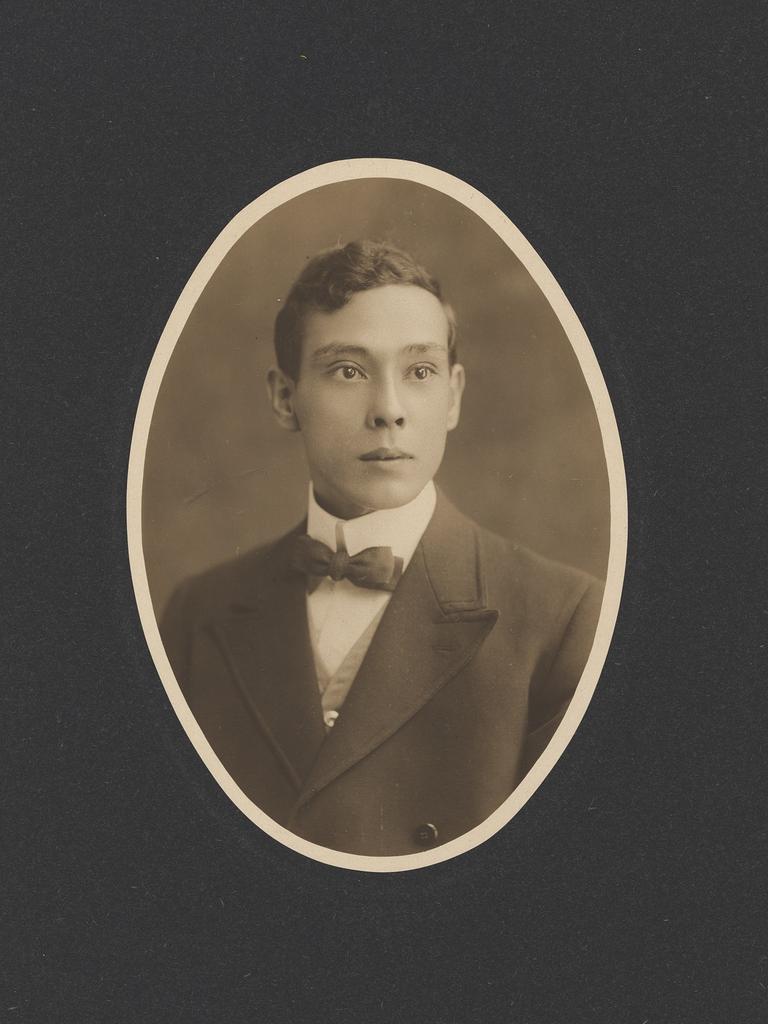
On 27th July 2024, the Australian published extracts from a recently published biography of Henry Koba Freame, adventurer, soldier, orchardist and interpreter. It provides such a stirring account of the landing of Australian soldiers at what is now Anzac Cove on 25th April 2015 and the subsequent Gallipoli campaign that it was worth republishing below. But first, a brief summary of Freame’s eventful life.

The road to Gallipoli

Wykeham Henry Koba Freame is believed to have been born on 28 February 1885 at Osaka, Japan, though on his enlistment in the Australian Imperial Force he gave his birthplace as Kitscoty, Canada. He was the son of Henry Freame, sometime teacher of English at the Kai-sei Gakko in Japan, and a Japanese woman, Shizu, née Kitagawa. As he was fluent in Japanese and spoke English with an accent it is likely that he was brought up in Japan. In 1906 he was a merchant seaman and on 19 July of that year married Edith May Soppitt at St John’s Anglican Church, Middlesbrough, England.

Freame probably came to Australia in 1911 and on enlisting in the A.I.F. on 28 August 1914 described himself as a horse-breaker of Glen Innes, New South Wales. Posted to the 1st Battalion as a private, he embarked for Egypt on the troopship Afric on 18 October and was promoted lance corporal on 7 January 1915. On 25 April he landed at Anzac and after three days of heavy fighting was promoted sergeant. He was awarded one of the A.I.F.’s first Distinguished Conduct Medals for ‘displaying the utmost gallantry in taking water to the firing-line although twice hit by snipers’. He was mentioned in dispatches for his work at Monash Valley in June when Charles Bean described him as ‘probably the most trusted scout at Anzac’.

Having served in the Hottentot rising of 1904-06 in German East Africa and in the Mexican wars, Freame was an accomplished scout before joining the A.I.F. He had an uncanny sense of direction and would wriggle like an eel deep into no man’s land, and at night even into enemy trenches, to pick up information. His dark complexion and peculiar intonation of speech had led his companions to believe that he was Mexican—an impression which he reinforced at Anzac where, in cowboy fashion, he carried two revolvers in holsters on his belt, another in a holster under his armpit and a bowie knife in his boot pocket. On 15 August he was wounded during operations at Lone Pine and was evacuated to Australia. He was discharged as medically unfit on 20 November 1916.

Freame settled on the Kentucky estate in New England, New South Wales, when the estate was subdivided for a soldier settlement scheme, and was appointed government storekeeper. He eventually acquired a Kentucky block and was a successful orchardist. His wife died in 1939 and on 16 August 1940 he married Harriett Elizabeth Brainwood, nurse and divorced petitioner, at St John’s Anglican Church, Milson’s Point, Sydney. With the outbreak of World War II he offered his services to the Australian Military Forces and in December 1939 was planted among the Japanese community in Sydney as an agent by military intelligence. In September 1940 he was appointed as an interpreter on the staff of the first Australian legation to Tokyo.

Early in April 1941, however, Freame returned to Australia because of ill health and was admitted to North Sydney Hospital suffering from a severe throat condition which greatly impaired his speech. He died on 27 May and was buried in Northern Suburbs cemetery with Anglican rites. His death certificate records the cause of death as cancer though Freame himself and later his wife alleged that he had been the victim of a garrotting in Japan. He considered that the attack was the consequence of the injudicious wording of the announcement in the Australian press of his posting to Tokyo. He had been described as employed by the Defence Department at a time when he was telling his Japanese acquaintances another story. Extant evidence provides no definite clarification of the circumstances of his death, though the claim of garrotting was investigated, and rejected, at the time.

James W. Courtney, the Australian Dictionary of Biography, Volume 8,1981

How did we forget this Anzac hero?

Harry Freame in 1915 before departing for Gallipoli

Harry Freame in 1915 before departing for Gallipoli

In the years after World War I, Harry Freame had a legitimate claim to be considered the most famous Anzac soldier to have landed at Gallipoli. Born in Japan and raised as a Samurai, he was the recipient of the first Distinguished Conduct Medal to be awarded to an Australian soldier for his efforts in those first bloody days of Gallipoli, and his name was legend among the Australian troops who had fought that tragic battle. As the landing turned into trench warfare, the troops knew Harry risked his neck each night to venture out into no-man’s land and map the Turkish defences.

Harry was on personal terms with the key Anzac commanders, and in the postwar years generals would visit him and reminisce about the war. Australia’s official war historian for World War I, Charles Bean, who first met Harry in June 1915, was fascinated by Harry his whole life. The Australian public came to know Harry through the newspapers of the day that splashed his wartime exploits of courage and daring across their pages.

What became of him?

The Bravest Scout at Gallipoli by Ryan Butta

Harry Freame’s boots hit the sands of Anzac Cove at around 7.40am on April 25, 1915. He was part of D Company, 1st Battalion. By the time they landed, Anzac Beach, as it came to be known, was already strewn with the broken and bloodied bodies of the men and pack animals that had come before them on that infamous morning.

It wasn’t Harry’s first sight of the region – he had sailed this way before – and it wasn’t his first taste of war.

There is a picture of Harry taken before the landing, most likely in Egypt. In it he is in full uniform, flat-brimmed hat, a bandana tied around his neck, wire clippers and binoculars attached to his belt. He holds his Lee–Enfield full wood .303 rifle by the barrel, the butt resting on the ground. He is looking slightly downwards at the camera. There is none of the naive merriment so often seen in the pictures of young Australian soldiers who had mistaken war for a great boys’ own adventure. But nor is there any fear in those eyes. Harry knew what he was in for, and he was ready for it.

As he waded through the waist-high water towards the sand, Harry carried in his pack three days’ rations and an extra 150 rounds of ammunition. He would have heeded the warning of Lieutenant General William Birdwood, the British officer in overall command of the ANZAC (Australian and New Zealand Army Corps) forces, who had advised the troops prior to landing to drink as much water as they could, as once ashore supply of food and water could not be guaranteed for at least three days.

The landing itself had been rehearsed as much as possible on the nearby Greek islands, under conditions nothing like what Harry and the rest of the Anzacs would soon face, but as the 1st Battalion’s official war diary records, “we knew very little of the actual plans for the attack – in fact, the whole thing seemed to be rather in the air, and so it proved”.

All that the officers of the 1st Battalion knew was that the 3rd Brigade was to land first and rush the enemy positions. When Harry and D Company landed on Anzac Beach, they had no idea what success, if any, the 3rd Brigade had had. Judging by the dead and dying who littered the beach, staining the Aegean waters red, and the enemy bullets and shells that whistled around their heads and whipped the waves to foam, it could be easily believed that none of the 3rd Brigade had survived that hellfire of a dawn.

Harry at age the age of 24

Harry at age the age of 24

Harry’s battalion formed up just north of Anzac Beach, in the shadow of Ari Burnu, sheltered from the murderous fire being poured down upon the landing from the peaks of Gaba Tepe, and waited for orders. When the orders came, they “were very vague”, alluding to nothing more than the need for the battalion to reinforce the firing line. But to reinforce a firing line, you needed to first find the firing line, and when the men looked up towards the imposing ridges and valleys that confronted them, there was no firing line.

The ridges above the beaches were crawling with pockets of men, some engaged in isolated fights, hand-to-hand combat wherein they lived or died by the thrust of their bayonets or the quickness of their wits.

Recalling that bloody morning, poet John Masefield wrote:

“All over the broken hills there were isolated fights to the death, men falling into gullies and being bayoneted, sudden duels, point blank, where men crawling through the scrub met each other and life went to the quicker finger, heroic deaths, where some half section which had lost touch were caught by ten times their strength and charged and died.

“No man of our side knew that cracked and fissured jungle. Men broke through it on to machine guns, or showed up on a crest and were blown to pieces, or leaped down from it into some sap or trench, to catch the bombs flung at them and hurl them at the thrower.

“Going as they did, up cliffs, through scrub, over ground … they passed many hidden Turks, who were thus left to shoot them in the back or to fire down at the boats, from perhaps only fifty yards away.”

The firing line, a concept easily imagined in the safety of an officer’s headquarters, was non-existent on the actual field of battle. On that first morning there was just a mad rush for high ground, up the forbidding slopes and into the ridges and valleys that held not only Turkish and German and Syrian troops and gunners but also the hope of cover and survival.

A primeval need to push further and further inland gripped the soldiers, in the hope that there, beyond the next valley, the next ridge, lay safety.

By 10am, with clothes still heavy with sea water after the landing and many of their rifles jammed with sand, now useful only for bayonet thrusts and charges, Harry and what elements of D Company were able to be formed up left the beach and set off for the ridges. Coming upon officers from the 3rd Battalion, D Company was redirected to the hill known as Baby 700, where reinforcements were urgently needed.

Through dense, waist-high scrub of gorse-like bushes and along the dried-up water courses littered with boulders, the men forged ahead uphill, legs heavy but the words of the commanding officers to advance, advance, advance running through their heads. Many of the men of D Company who fought their way up towards Baby 700 that clear bright morning would etch their names into the history of the Anzacs and the 1st Battalion: Major FJ Kindon, second-in-command of 1st Battalion; Major Blair Swannell, commanding officer of D Company; Captain Harold Jacobs, second-in-command of D Company; Lieutenant Geoffrey Street; and Captain Alfred Shout, the man who would leave Gallipoli the most decorated soldier of all, though sadly not with his life. And beside Shout, as was so often the case in the blood-soaked months that followed, in lock step, there was Lance Corporal Harry Freame.

Strategically important, Baby 700 had been the focus of intense fighting all morning, with remnants of the Australian 9th, 11th and 12th battalions all joining the battle as the Turkish troops advanced and retreated in a series of intense skirmishes conducted under the continuous hail of shrapnel fire from unseen Turkish positions. The approaches to Baby 700 were complicated by folds of ridges and valleys, and in these the Australian men became detached from their companies and lost until they could connect up with other Australian soldiers, sometimes from their own company, sometimes not.

Freame at his final Anzac Day march, in 1940.

Freame at his final Anzac Day march, in 1940.

By 11am, Harry and D Company had reached The Nek, a thin strip of ridge that connected to Baby 700. The area was being held by Captain Lalor and men of the 12th Battalion. Lalor was the grandson of Peter Lalor, the man who had led the revolt at Eureka. With him on that morning on the approaches to Baby 700, Lalor carried a magnificent sword, said to be the one used by his grandfather at that famous stockade. Swords had been prohibited to be carried during the landing, but Lalor had disregarded the order.

Across The Nek on the slopes of Baby 700, Turkish troops were gathering. Joining up with Lalor’s group, the newly arrived men of D Company formed up and charged the Turkish troops, driving them back into a gully before advancing up Baby 700.

After reaching the summit, D Company started to dig into that hardscrabble ground. The Turkish troops they had driven before them had retreated, but only to a previously unseen trench, and from here they poured heavy fire on the entrenching D Company. It was here that D Company’s commander, Major Blair Swannell, was killed on that first morning, shot dead just as he had earlier predicted he would be to his mates aboard the Minnewaska in the predawn fog before the landing.

Against the fierce Turkish assault, the Australians had only their rifles (when they worked), bayonets and pistols. The naval guns offered no support, as those manning them were afraid of firing on their own troops in the complicated mess of invaders and invaded that swarmed the hills of the peninsula.

A few artillery guns had been brought ashore at midday but were then ordered to be sent back out to the boats. Other commanders had refused to allow their guns to be landed, such was the chaos on the beaches, and it wasn’t until dusk that the first artillery guns came into action in support of the Australian troops.

The Australian firing line on Baby 700 could not hold, and over the course of the morning the Australian troops moved over the summit only to be thrown back by vicious counterattacks no fewer than five times.

In the midst of the fighting, there was Harry Freame, moving from position to position, scouting the ground and enemy positions, running messages between commanding officers.

At one point Harry and a small group of men drove a contingent of Turkish troops from a trench. But having gained the trench they found they were then held in place by persistent enemy fire. The men hadn’t heeded the words of Lieutenant General Birdwood, and who could blame them, and they were out of water, exhausted and near death. Without water they felt that they would soon perish or be forced to surrender.

Harry called for volunteers to brave the bullets and shrapnel and go for water. None raised a hand or spoke a word, so over the side of the trench he went, collecting water bottles from those who would never thirst again, fallen soldiers whose twisted repose could never be mistaken for the sleeping, a last look, a last thought of home or their best girl held fast in a glassy eye like a butterfly trapped in amber.

When Harry returned, he brought not only precious water but food and pickaxes for the grateful men.

All day the fighting raged on Baby 700, with ground taken then lost, the attackers and counterattackers continually changing roles, the air perfumed with the smell of the wild thyme that had been lashed by the bullets and shrapnel bursts. And as the day stretched on, still the men had no idea where the firing line was, only supposing that it was somewhere ahead of them, always somewhere over the next ridge, and that they must get to it. And if they could not advance, then at all costs they tried to hold on to whatever patch of land they had come to stop on.

At around 4.30pm, as D Company, reinforced now with New Zealand troops, fought to hold the right side of the Baby 700 slope, a massive Turkish counterattack was launched that peeled the Australians off the slope. Alfred Shout, who had been with Lalor when he was killed, had earlier left Harry and fourteen men at The Nek with orders to hold it no matter what. The small group came under intense fire and before long only nine men were left, and by the time Shout returned, retreating from Baby 700, only Harry and one other man held the position. The rest lay dead or dying about them. Shout ordered them both to follow him in retreat towards the beach.

After regrouping on the beach, Shout and Harry then set about rounding up men from various battalions, a combination of the stragglers and shirkers, the lost and the shell-shocked. Harry collected around two hundred men and led them back up the slopes to reinforce the New Zealand troops who were holding Walker’s Ridge, a key position leading back to Baby 700, which was by now firmly in Turkish hands.

Recording the efforts of Lance Corporal Harry Freame on that chaotic first day at Anzac Cove, official war correspondent Charles Bean wrote:

 “With such fighters as Lieutenant A.J. Shout, Lieutenant G.A. Street and Lieutenant Jacobs, all of his own battalion, he and others held vital positions in that constantly moving and changing fight but none was so ubiquitous as he, now holding a key ­position on The Nek leading to Baby 700, now ­finding for his commander the scattered parts of his battalion.”

As night fell on the evening of April 25, the fighting abated only somewhat; rifle fire and shrapnel bursts echoed through the night. At around midnight, Lieutenant General Birdwood sent an urgent message to his commander-in-chief, Sir Ian Hamilton, urging an immediate evacuation of the peninsula. Hamilton, from the comfort of the HMS Queen Elizabeth, was having none of it, advising Birdwood that he had “got through the difficult business and you have only to dig, dig, dig until you are safe”.

Freame with his stepsister in 1898.

Freame with his stepsister in 1898.

The following morning, April 26, the hills of the peninsula rang with the sounds of shovels, digging, digging, digging. Those not digging or engaged in holding a position were out scouring the ravines and hillsides for the wounded and missing, and it was while thus engaged that Harry came across a detachment of men under the command of Captain Harold Jacobs sheltering in a trench at Quinn’s Post. The men had had no water to drink and were in a desperate state. Harry offered to go for water and without a second thought braved the enemy fire that came in from unseen snipers and dashed back down the valley from where he had just come. He soon returned with the promised water, allowing the position to be held.

Realising that Lieutenant-Colonel Leonard Dobbin, the company commander, would need information on Captain Jacobs’ position and situation, Harry was again up and over the side of the trench, making his way back down the valley to where Lieutenant-Colonel Dobbin was located. As Harry approached Dobbin’s trench, he was heard to yell out, ‘All right!’ Arriving, he delivered his message to Dobbin. Mission accomplished, it was only then that Harry revealed that on the descent he’d been struck twice by snipers’ bullets, once through the fingers of the left hand and once through the left arm.

For the duration of the fighting at Gallipoli, Quinn’s Post remained the Anzacs’ most advanced position and the key to their defensive positions. It would never have been held if not for the bravery of Harry Freame.

Charles Bean later noted that very few men received decorations for the deeds performed at the Anzac Cove landings. But when the recommendations came out, the name Harry Freame was first among them. His citation read: “Has displayed the utmost gallantry in taking water to the firing line, though twice hit by sniper fire.” Harry’s commanding officer further reported: “Since I have assumed command of the Brigade, Serjeant Freame has almost daily performed some action worthy of recognition in the shape of carrying out night reconnaissance, conveying messages through dangerous zones etc etc. He is a fine fearless soldier who I strongly recommend for recognition.”

The recommendation was heeded and Harry, for his work over those first days of Gallipoli, was awarded the Distinguished Conduct Medal. Writing both publicly and privately years after the war, Bean offered the view that Harry should have been awarded the Victoria Cross and that the only reason he wasn’t awarded the VC was because, “Australian commanders hesitated to set up for that hallowed decoration any standard short of the impossible. I think that it is safe to say but for that Harry would have been awarded the highest decoration”.

When I set out to write this book, I wanted to discover why we had forgotten Harry Freame. Why, when our schoolchildren learn of the history of the Anzacs, do they learn more about a donkey than a man who was known at the time as the Marvel of Gallipoli? And I wanted to know why the Australian government covered up their role in the death of Harry Freame, why the man Charles Bean described as probably the most trusted scout at Gallipoli was never believed when he said, “They got me”.

This is an extract from The Bravest Scout At Gallipoli by Ryan Butta (Affirm Press) out now.

Red and white terror – the Russian revolution and civil war

… as a policeman, I would say, get hold of a man’s brother and you’re halfway home. Nor was it admiration for a better man than me. I did admire him, but I didn’t think he was a better man. Besides, I’ve executed better men than me with a small pistol. 

She’d come to Moscow to look for her child. I helped her as best I could, but I knew it was hopeless. I think I was a little in love with her. One day she went away and didn’t come back. She died or vanished somewhere, in one of the labor camps. A nameless number on a list that was afterwards mislaid. That was quite common in those days.

Yevgraf Zhivargo, in David Lean’s Doctor Zhivago (1965)

“The terror,” declared British Historian Simon Schama in his iconic Citizens: A Chronicle of the French Revolution “was merely 1789 with a higher body count; violence … was not just an unfortunate side effect … it was the Revolution’s source of collective energy. It was what made the Revolution revolutionary’. In short, “From the very beginning […] violence was the motor revolution”.

At the end of the chapter on the coming of thw Revolutionary Wars, he writes: ‘ … poets of romantic weather forecasting like William Wordsworth continued to describe the revolution is a cyclonic disturbance, but increasingly it was no longer the storm that invigorates in cleanses rather a dark and potent elemental rage moving forward in indiscriminate destruction its breath was no longer sweet but foul. It was the wind of war and if the wind of war comes, can the storm clouds of war be far behind’.

I thought a lot about the events of the French Revolution and the Napoleonic wars which followed it as I read English author and historian Anthony Beevor’s latest foray into Russian and Soviet history, Russia – Revolution and Civil War 1917-1921

Some books can be unrelentingly bleak and brutal, so grim and graphic in fact that you have to push yourself to finish them. Cormac McCarthy’s odyssey tale The Road is one such. But one doesn’t often say that about history books. Usually it is time, ennui or both that cry “enough, already!” You set it aside, promising to return to your bookmark – but you never do. I persevered with a veritable catalogue of the horrors that men can inflict upon their fellow humans (and yes, the perpetrators are apparently exclusively male, and the victims are males and females of many ethnicities). Beevor’s previous, highly acclaimed books Stalingrad and Berlin 1945 are chilling, but his latest takes top prize. And finish it I did …

The following is not a review of Beavor’s grim opus as such, but rather a thematic compendium of thoughts and observations derived from or inspired by the book.

Most academic accounts and university courses focus on the ideological and geopolitical dimensions of the origins, rise and consolidation of the Soviet Union, and its ultimate disintegration seventy years later. General public knowledge of the Russian Revolution and the civil war which followed it is relatively limited and cursory, often derived and books like Mikail Sholokhov’s saga of the Don Cossacks, Quiet Flows the Don and The Don Flows Home To The Sea, and Boris Pasternak’s Doctor Zhivago. Indeed, it was these novels and David Lean’s powerful adaptation of Doctor Zhivago that first attracted my interest in Russia as a school student in Birmingham. I majored in Politics at the University of Reading in the United Kingdom, and Soviet history and politics were an important part of my studies. Between those days and today, I’ve read widely about Russia’s history, past and present, and I am familiar with the events, ideas and personalities, their role in the broader and longer tableau of history, and the reverberations that are still felt today.

I have written often in In That Howling Infinite on Russian and Ukrainian history. Although I am no expert, and profess an amateur interest only, I do possess a short and humble pedigree. My tutor in Soviet Studies at Reading was exiled Hungarian academic and historian Tibor SzamuelyLike many refugees from Communism, he was descended from both perpetrators and victims. An uncle of the same name served in the Hungarian Soviet Republic that took power for six months under Béla Kun in 1919 and died violently that year when the revolution failed. He was among that government’s most bloodthirsty ministers and was called “Butcher Szamuely”. Szamuely’s family wound up in Moscow, where Tibor was born, and where his father was executed in Stalin’s purges. Young Tibor served in the Red Army, and he too was arrested and sent to a labour camp. Rehabilitated, he served as Chancellor of Budapest University. In 1964, then nearing 40, he was teaching in the “ideological institute” of Ghana’s Marxist president Kwame Nkrumah when he defected to England.

Back then, I was a political ingenue and a naïve communist sympathizer and fellow traveler, although my evolving perspectives were transforming and expanding. As my tutor, he advised me to study with an open mind and to put off juvenile thinking. He hadn’t been well when I knew him, and he died a year after I graduated. Under his tuition, I’d resolved to specialize in Soviet Studies – but events intervened, and I ended up in the Middle East (and that is another story. see: Tanks for the Memory – how Brezhnev changed my life). I nevertheless retained an active interest in the history and politics of Eastern Europe.

He would always impress upon me the historical and political continuity of what he called The Russian Tradition – the title of his one and only book, The Russian Tradition, published shortly before his death, and now, regrettably, out of print. I purchased a first edition when it was published and it is on my bookshelf still.

Szamuely believed that the bloodstained drama of the revolutions of 1917 – there were two, the social democratic one in the February, the Bolshevik one in November – and the years that followed, including civil war, the establishment of the USSR and Stalinism largely obscured the underlying consistency of Russian history. He did not live to see the decline and fall of the Soviet Union, and the advent of Putin and Russia Redux, but the basic pattern persists, circular and repetitive. The frequent turmoils that have overtaken this vast continent have in their various ways made changes that were essentially superficial, leading in the end to the intensification, under new forms, of the old authoritarian structure.

You – Bolshevik recruiting poster 1918


Contemplating civil wars

A civil war can emerge from the ashes of a wider, ongoing conflagration when factions or parties dispute the nature and terms of the post-bellum status quo and fracture along political and ideological lines. Many civil wars have arisen from the ashes of a prior war when there are what are perceived as existential issues unresolved and the availability of weapons and materièl and experienced and discontented men to use them.

There is a view that civil war can retrospectively be seen as a crucible of nation, a fiery furnace through which the righteous must walk – an ex post facto rationalization of the Nietzschean paradox of “that which does not kill us makes us strong”. Abraham Lincoln verbalized this in his Gettysburg Address in 1863 on a battlefield where the fallen had been only recently interred. Franco made a similar play as he laid claim to the wreckage that was Spain in the wake of three years of carnage, but then petrified his riven, country in autocratic stone until his death many decades later. The Russian Civil War was not accorded such a nation-building ethos as it was viewed by the Bolshevik victors as the crushing of a counter-revolution against a new world already being born.

Given Russia’s vast expanse, long history of restive regions, and large non-Russian ethnicities – all a result of centuries of imperial conquests – there is always the potential for the disintegration of centralized control and fragmentation. There is a rich history of state collapse following wars, revolutions, system breakdowns, economic crises, and other epochal events. Napoleon’s empire collapsed after his disastrous march on Moscow and subsequent defeat at the Battle of Leipzig. In 1918, the Ottoman, Austro-Hungarian, German, and Russian empires all collapsed in military defeat. Of course, people, decisions, and policies played a role, but ultimately it was war and the attendant economic and social crises that pushed these states over the edge into political chaos and often violence.

Once thing for sure, civil war, the Hobbesian “war if all against all” (Hobbes was thinking England’s) is undoubtedly the saddest, bloodiest and most visceral of all conflicts. I leave the last words to WB Yeats:

Things fall apart; the centre cannot hold;
Mere anarchy is loosed upon the world,
The blood-dimmed tide is loosed, and everywhere
The ceremony of innocence is drowned;
The best lack all conviction, while the worst
Are full of passionate intensity.

See: In that Howling Infinite, A House Divided – the Nature of Civil War

All fall down 

Revolutions are unpredictable. They never run in straight lines. They reverberate, the shockwaves expanding and impacting on their vicinity, and way beyond. The shots ricochet, like drive-by shootings and crossfires, and you never know who will be hit, where the bullets will come to rest, and who will be damaged or destroyed. Many people will be liberated, and many enslaved. Many peoples will prosper, and many, many will perish. As TS Elliot wrote, “between the idea and the reality falls the shadow”.”

When the Tsarist Russian empire collapsed halfway through the First World War, it was the first of four great empires to disintegrate. By war’s end, the conflict had destroyed the German, Hapsburg and Ottoman empires. But unlike these three, though the imperial house perished, the empire it ruled did not disintegrate. A handful of national movements, Finnish, Polish, Estonian, Latvian, and Lithuanian succeeded in breaking free, but most of murdered Tsar’s realm emerged from the convulsions of world war, revolution and civil war within a new Soviet empire, one that still ruled millions of square miles and a multitude of peoples.

The Russian Revolutions – the two in 1917, and a failed rising in 1905 in the wake of the disastrous (for Russia) of Russo-Japanese War – and the civil war that followed can be said to have defined the contours of modern European geopolitics, setting the stage for the Cold War and also, the current Ukraine war. The 20th Century was not kind to the countries of Central and Eastern Europe. Historian Timothy Snyder called them “the blood lands”.

The USSR was officially declared in the Bolshoi Theatre on 30th December 1922. Most people find this slightly surprising, because we assume that the Soviet Union must have been proclaimed immediately after The Bolshevik Revolution in November 1917. In fact, it only came into existence after a horrendous civil war that killed an estimated 10 million people, in which the deep national and ethnic tensions inside the old Russian Empire had been laid bare for all to see.

Historian Orlando Figes says in his seminal book about the Bolshevik revolution, A People’s Tragedy, that the failure of democracy in 1917 was deeply rooted in Russian culture and social history and what had started as a people’s revolution contained the seeds of its degeneration into violence and dictatorship.

In Russia, the revolution of February 1917 did not provoke a counterrevolution. The initial absence of any attempt to fight back was illustrative not so much apathy, as a feeling that there was very little of the ancien regime left that was worth defending. The overthrow of the czarist regime prompted a variety of reactions amongst the former ruling class: a resignation to events, bitterness at the incompetence and obstinacy of the Imperial Court, yet also an initial optimism among its more liberal and idealistic members. Most of the nobility and bourgeoisie supported the Provisional Government in the hope that it would at least restrain the worst excesses and keep the country together.

Soon after the November 1917 revolution, Lenin made it clear to the Bolsheviks that civil war was necessary to cleanse Russia of reactionary forces and old ways and to rebuild as a communist state and society. Moreover, he was confident that the Bolsheviks’ example would ignite revolution in the countries of Western Europe. German and Hungarian communists obliged, establishing people’s republics, which in turn invited counter revolution, the ousting of the revolutionaries, and reactionary military and police exacting bloody revenge on any leftists that could find.

The determination to resist only crystallized when the Bolshevik programme in the wake of the Bolshevik Revolution of October 1917 polarized opinion. The question is important when it comes to the origins of the Civil War itself, which led to the deaths of up to 12,000,000 people, the impoverishment of the whole country, and suffering on an unimaginable scale.

In June 1918 the Bolshevik regime was enjoying a brief respite from the rigors of revolution and civil war. Although surrounded on all sides by hostile forces, the Bolsheviks were in no immediate military danger. This welcome hiatus, lasting from the Treaty of Brest-Litovsk (March 1918) to the collapse of the Central Powers at the end of the year, allowed the Bolsheviks to consolidate their political and military strength.

In an uneasy alliance with the Bolsheviks were leftwing Socialist Revolutionaries who still dreamed of a constituent assembly and the anarchists who regarded Brest-Litovsk represented the watershed of the Revolution. In coming to terms with the Central Powers, the Bolsheviks had paid a staggering price in territory and resources. But, more importantly, they had preferred to make a pact with the imperialists rather than attempt to propagate the Revolution through popular initiatives, in particular, by partisan warfare.

Shortly after Brest-Litovsk the Bolsheviks turned against their erstwhile allies. The Cheka (the successor to the Czar’s Okrana secret police and the precursor to the NKVD, the KGB and the FSB) ostensibly created to suppress counterrevolutionaries, was unleashed on the Bolsheviks’ critics on the left. There were fierce battles between Chekists and anarchists in Petrograd and many other Russian cities.

It was game on.

It is difficult to comprehend to scale of the civil war that broke out in Russia in terms of its territorial extent, the numbers of nations and would-be states engaged in the conflict, and the destruction and carnage it wrought to soldier and civilian alike. Nor the ongoing relentlessness. Western European invaders had been defeated in the past (and indeed, the future) by what Mikhail Kutuzov, the Russian general who defeated Napoleon, called General Winter, but within the empire and its Soviet successor, weather did not stop play. Certainly, it complicated military operations, played havoc with logistics and supply-chains, and inflicted indescribable suffering upon soldiers and civilians. And the war went on …

The last of the Romanovs – Tsar Nicholas and his family, murdered by the Bolsheviks in July 1918

Revolution and reaction

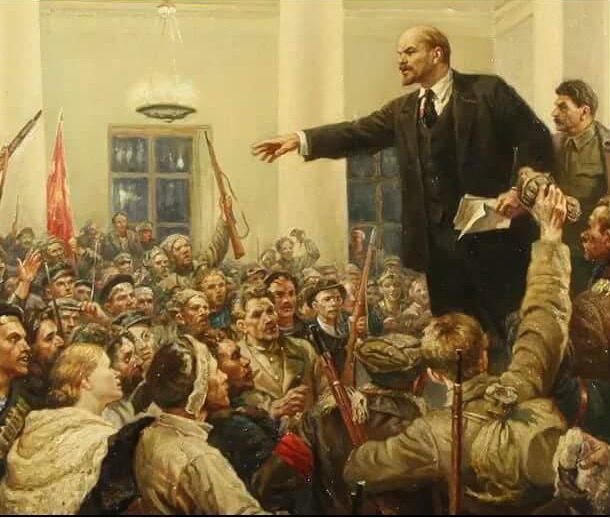
If Lenin was politically flexible with foreign powers, he was ruthless with his own people, including rival parties on the left. He grabbed power when the hapless provisional government lost its way in setting up a constituent assembly that was intended to be a democratic representation of all Russians. Lenin initially paid lip service to the assembly, while calling for power to go the “soviets” – people’s councils. In reality he had no intention of allowing any diminishment or oversight of his control of the Bolshevik party and, through its Council of People’s Commissars, the battered Russian state.

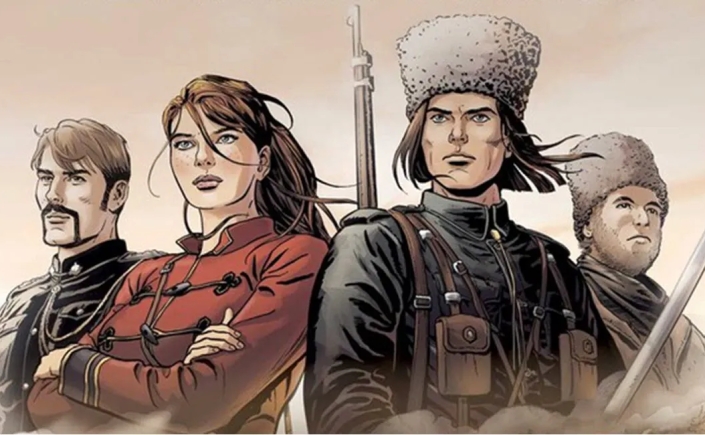
But no sooner had the Bolsheviks cemented their rule than they were fighting a civil war on multiple fronts against a mind-boggling array of enemies, stretching from revolutionary socialists  and anarchists to unreconstructed “White Russian” tsarists, nostalgic for a corrupt and flagrantly unjust regime and in between the Reds and Whites were the Greens or Partisans, mainly deserters from all sides who hated both Reds and Whites and attacked both, increasingly so as the war continued. And a range of foreign powers dealt themselves into the game to further their own strategic and ideological interests. [the featured picture of this piece is an idealized manga depiction of charismatic Ukrainian anarchist and Green Nestor Makhno, a larger-than-life figure who miraculous survived the civil way and died in his bed in exile]

The Whites were a confused, fractured and often dysfunctional coalition with rapid changes of command occasioned by personal ambitions and fluctuating military fortunes. White generals were committed to restoring the integrity of the Russian Empire, a self-defeating handicap that alienated potential allies on the fringes, like Finland, the Baltic states and Poland. Churchill underestimated this imperial obsession which prevented the alliances he wanted to defeat the Bolsheviks. The Greater Russia obsession also hampered efforts in the Caucasus where Georgians stirred regions like Ingushetia, Chechnya and Dagestan, giving Britain nightmares of Bolshevism spreading through Central Asia towards India, an obsession that continued through the twenties as described in Peter Hopkirk’s Setting the East Ablaze – Lenin’s Dream of an Empire in Asia.

Out on the edge of the old empire, White warlords endeavoured to carve out kingdoms for themselves. Many commanders spent more time terrorizing locals than fighting the Red partisans who were operating behind enemy lines across the war zone, creating a legacy and tradition the persist to this day.

The diffusion of opponents played into the Bolsheviks’ hands, as their differences were so extreme that a unified opposition fighting force was never a viable option. But if the battle lines were often blurred, the hatred felt by the combatants for each other was nightmarishly vivid.

The White’s defeat in the civil war wasn’t for lack of outside moral and materiel support. It was due largely to their inflexibility, including their refusal to contemplate land reform until it was far too late, and their refusal to grant any autonomy to nationalities of the Czarist Empire. Their administration was so useless that it’s barely existed. Paradoxically, they lost for reasons very similar to the way the Republicans lost the Spanish Civil War two decades later. In Spain, the antifascist alliance of the Republic could not prevail against Generalissimo Franciso Franco‘s disciplined and militarized regime. In Russia, the utterly incompatible alliance of socialist revolutionaries and reactionary monarchists didn’t stand a chance against the single-minded Communist dictatorship.

A leftist libertarian with St. George’s Cross, and a Sister of Mercy nurse, 1916.

World War 1.2

It in many ways it became World War 1.2. The idea of a purely Russian Civil War is misleading simplification, prompting one historian recently to describe it instead as ‘a world war condensed’.

It was waged across European and Asian Russia, including present day Belarus and Ukraine and the successor states of the Soviet Union in the Baltic, the Caucasus, and Central Asia – from Warsaw and Eastern Europe to the Urals and eastwards through the vastness of Siberia’s forests, deserts and tundra to Vladivostok in the Far East, from the arctic north to Crimea and the Black Sea, the Caspian Sea and the borders of what in 1918 ceased to be the Ottoman Empire. Fronts stretched for thousands of miles and advances and retreats likewise. The Trans-Siberian Railway, stretching the length of the former empire from Moscow to Vladivostok, was almost six thousand miles long, and it’s tributary lines served as strategic and logistical thoroughfares for all protagonists who weren’t mounted like the innumerable Cossacks tribes and the nascent Red Cavalry, bringing to prominence the armoured trains that became a symbol of the revolution.

It drew in most of Russia’s contemporary neighbours and more far-flung nations, including The USA, Britain, France, Germany Italy and Japan – the latter providing the largest contingent, estimated by British Intelligence as some 85,000 soldiers, more than many of the various White armies. Combatants included soldiers from these countries, the British dominions of Canada, Australia, South Africa, and India, and Chinese and Mongolian troops. And a multitude of ethnicities fought for their own warlords, their national place in the sun or else their very survival. Caught up in the transcontinental maelstrom were Slavs, Cossacks, Tartars, Turkmen, Arabs, Azeris, Persians, Turks, Armenians, Chechens, Kazakhs, Buryat Mongols, Kalmyks (Europe’s only Buddhist nation) and Jews. White divisions were augmented in Siberia by Mongolian, Chinese, Uighur and Kirghiz mercenaries.

Various nationalist movements arose, successfully and unsuccessfully in all parts of the former Russian Empire. The aftermath of the First World War and the collapse of the Russian Empire saw Polish, German, Italian, Hungarian, Romanian, Czech, and myriad other nationalities fighting for disparate sides, and Beevor skillfully frames the bizarre impact of this on the ethnic nationalist dimensions of the conflict.

The scale of military manoeuvres was unprecedented, as were the physical and supply difficulties over vast distances, and the extremities in climate, particularly the bitter Russian winter. The conflict became very much a cavalry war and indeed, a “railway war” notable for its armoured trains and the logistical lifeline of the Trans-Siberian Railway, protected for much if the conflict by the Czechoslovak Legion, a force of Czech and Slovak nationalists who having fought in the Czarist army, joined the Whites who controlled many towns in Siberia.

In addition to the Czechs, there was also a Polish Legion operating in the Far East. The commanders of both forces became increasingly disenchanted with the White officers who refused to countenance the independence of the border states and who shocked many with their brutality towards prisoners and civilians, and though thousands of miles from Europe, demanded repatriation – ostensibly by sea from Vladivostok.

Western Allies’ ideological perspective of the civil war was ambivalent. Though many, politicians and military alike, were viscerally opposed to Bolshevism and what it stood for, and feared a Red contagion infecting their own countries, a fear that was not unfounded. In the wake of the Revolution, a concatenation of revolts detonated across the globe. Bolshevism spread westwards, from Vienna through Budapest and Sofia to Kiel. The Bavarian Soviet Republic was briefly established in April 1919, before the far-Right Freikorps did it in. Britain wasn’t immune to the ferment. Between the February and October Revolutions, the Leeds Soviet did indeed appear to be the beginning of something, whilst strikes and demonstrations proliferated to be violently put down by the police and army. Winston Churchill alone of his cabinet colleagues wanted a full-on allied intervention and dreamed – some believed he was indeed dreaming but others claimed that he fantasized – of creating an effective White army and a borderlands alliance to defeat the Bolsheviks. But his aspirations were foiled by the imperialism of the White leadership and of White officers and the various national movements’ fear that that if the Whites prevailed, they would restore Russian rule. Britain’s rulers were reticent about shoring up and providing financial, material support and also, soldiers sailors and airmen to brutal to demonstrably homicidal Cossack brigades and revanchist and reactionary royalist autocrats.

British regiments were nevertheless deployed in Siberia and in the Far East as well as the Arctic and Caspian Sea. Royal Navy flotillas blockaded Petrograd in the Baltic, floated up the Volga in the south and down the Dvina in the arctic north, and controlled the Caspian Sea and the waters around the Crimean Peninsula. The Royal Air Force deployed Sopwith Camels and sea planes in surveillance and surveillance missions against the Red forces, who British officers called the “Bolos”. And artillery units and armoured car squadrons were attached to the various White armies.

Wider imperial concerns were in play too. Churchill rang alarm bells as the Reds pushed the Whites back in Siberia and Central Asia, alarming even his reticent cabinet colleagues with prospect of Reds on the borders of the Raj. The Great Game still had over a quarter of century to run before the final whistle blew. In the Far East, Britain and the US, and Reds and Whites alike, were nervous about the designs imperial Japanese was revealing with regard to the resources and the empty lands of eastern Siberia, the island of Sakhalin, the pacific littoral and Manchuria. Intelligence reports revealed that Japanese forces in the region exceeded all others involved, including the warring Russians.

Pogrom

Fratricidal wars are bound to be cruel because of the lack of definable front lines, because of their instant extension into civilian life, and because of the terrible hatreds and suspicions which they engender. The fighting ranged right across the Eurasian landmass was violent beyond belief, especially the unspeakable cruelty of the Cossack atamans in Siberia. Even that archconservative politician VV Shukgin believed that one of the major reasons for the failure of the whites what is a “moral collapse” – that they behaved as badly as their enemy.

There was nevertheless one subtle yet important difference. All too often, whites represented the worst examples of inhumanity, yet on that score, the Bolsheviks were unbeatable. It has been said that their ruthlessness has few parallels in recorded European history up until that time – believing that history was on their side, and that a new world was being created. The almost religious zeal with which they brutalized and killed combatants and innocents alike could be likened to the Albigensian Crusade in the early thirteenth century. [The Crusaders were accompanied by an official representative of the Pope, a French Cistercian monk named Arnaud Amalric. According to accounts written decades later, as the attack began, a soldier asked Amalric how they would be able to tell which Beziers townspeople were Catholics and which were Cathars. Some sources give the alleged quote as “Kill them all, for the Lord knows his own” or as “Kill them all. The Lord knows his own.”]

The focus on ordinary people also means their suffering is brought to the fore. And Beevor is unsparing in showing the chaotic violence of the conflict, and unrelenting in showing the sheer violence of both sides. Reds and Whites are both revealed as more than comfortable burning villages, shooting traitors, suspected or real, and torturing and massacring prisoners, and men women and children caught in the crossfire.

There were many instances of racist violence mainly on the White side – particularly towards Jews. The Whites’ antipathy towards Jews was to some degree due to their perception that most senior Bolshevik were Jewish, but mostly it was that old devil that never went away, antisemitism. The fall of the Romanovs and the ancien regime and the anti-Semitic pogroms they perpetuated continued. Retreat from the major cities brought out the worse in the Whites, with terrible massacres of Jews – although they were not the only perpetrators. Playwright And author Isaac Babel, attached as a correspondent and propagandist to the Red Cavalry on the Polish Soviet front in late 2020 posed the question: “what sort of person is our (Red) Cossack? Many layered: looting, reckless daring, professionalism, revolutionary spirit, bestial cruelty. The population await their saviors. The Jews look for liberation – and in ride the Kuban Cossacks”.

It is estimated that there were some 1300 anti-Semitic pogroms in the Ukraine during the civil war, with some 50000 to 60000 killed by both sides. There were pogroms in Belarus also, but these were not nearly as murderous as in Ukraine. A Soviet report of 1920 mentions 150,000 dead and as many again badly injured.

Churchill was well aware of the effect of the pogroms on public opinion in the West and sought in vain to exert pressure on white leaders to restrain their forces.,

Terror begat terror, leading to greater acts of conspicuous cruelty. After a particularly hard-fought battle in early 1919, a young White horse artillery officer recalled “for the first time since the start of the civil war, prisoners were not shot. There were too many of them”. This did not happen often – and such was the brutality meted out to captives on both sides, shooting was actually a blessing. An Odesa women witness after the fall of the city to the Whites, “Urrrraaa! Four and a half months under these five-pointed star oppressors”. Two days later, Beevor notes, she noted that all the Jews were in hiding. When a city held by the Reds fell to the Cossacks, a a female surgeon observed that fearing a program, two Jewish doctors in her hospital wisely ran to hide in the attic.

Bolshevik leaders and commanders on the field eventually realized that brutality did not endear their cause to the general populace and moderated their behaviour. Some Whites too came to that conclusion, and sought to prevent it at least limit atrocities, but reactionary officers and uncontrollable Cossacks persisted in burning, looting, torturing and murdering, inflicting irreparable damage to the anti-Bolshevik cause. Beevor reports instances when allied forces actually fired on Cossack perpetrators.

The End

As the whites retreated, support for the red army amongst the populace grew, as did its numbers as deserters returned to its ranks encouraged by the announcement of an amnesty and as defections from the White forces grew. Peasants grew less reluctant to serve in the Red Army Fear that with white advances and victory, old landlords would reclaim their land. Success bred success. The Whites’ ranks thinned with desertions defections and the need to transfer troops to defend its rear from attacks by partisans and freelance militias units. The Cossacks, disappointed and tired of war, turned about and headed home to their stanitsas laden with loot. The size of the frontline Red Army was eventually twice that of the Whites, as it eliminated the White armies in the north and east and closed in on the last remaining area under White control, Crimea, where rearguards held out long enough to ensure the evacuation of 150,000 soldiers and civilians by sea protected by the British and French navies.

In the aftermath of total Soviet victory, starvation struck the towns and cities across the land. Food requisitioning detachments scoured the countryside for supplies, their rapaciousness and brutality igniting peasant rebellions from Belarus to Siberia; tens of thousands of peasants rose in revolt, dealing brutally with any Bolshevik that came into their hands. The Red Army and Cheka reciprocated in spades with burning and looting, rape and torture, execution and exile to the emergent Gulag. Workers went on strike in the starving cities, and with the Whites vanquished and the civil war won, the call for democratization of Soviet rule grew louder.

And then, the sailors of the Baltic Fleet at the Kronstadt naval base, who’s guns had heralded the fall of the Romanovs, and whom Trotsky had called “the pride and glory of the Russian Revolution”, rebelled. The regime responded with lies – that the sailors had been suborned and were now Whites – and that White forces in Finland would be crossing the ice to help them. When this didn’t work, I resolved to crush them without mercy, dispatching trustworthy forces against them.

At the end, of 16000 sailors and their families, most were able to cross that ice to final and. But some 3000 fought a last stand and died by assault or firing squad. One of the last cries of protest by the Kronstadt sailors was “All of Soviet Russia has been turned into a Russian penal colony”.

Thus ended the Russian Civil War in November 1920.

… all wars come to an end. And that’s where history restarts.
British war and foreign correspondent Robert Fisk

Evacuees board ship in a Crimean portEpilogue

Epilogue … history repeats

Whilst there were many active fronts during the civil war, often simultaneously, extending for thousands of kilometers, around Archangelsk and Murmansk in the arctic, along the great rivers the Volga, the Don and the Dniester in the south, in the Baltic provinces, and in Belarus, and along the length of the Trans-Siberian Railway. And as during WW2 and the present-day Ukraine war, opposing armies advanced and retreated across Ukraine. Kiev was occupied, often several occasions, by Reds, Whites and Greens, and finally, the Polish Army which invaded Russia and Ukraine in 1920 to reclaim and defend the independence of the onetime Polish state, long divided between the now destroyed Russian, German and Austro-Hungarian empires. The names of the war-torn cities are today tragically familiar. Mariupol and Melitopol, Karchiv and Kherson. Kiev, Odessa and Lvov are now Kyiv, Odesa and Lviv.

© Paul Hemphill 2023 All rights reserved

Posts in In That Howling Infinite, about Eastern Europe:

Small Stories – A Tale of Twin Pines

One of the pleasures of moving to the Australian bush and living in Bellingen Shire is discovering its often overlooked history. This is the story of Twin Pines. Not as dippy as Twin Peaks, nor as sinister as Wayward Pines, it is a story of ordinary people doing extraordinary things.

When I first came to this land,
I was not a wealthy man,
So I built myself a shack,
And I did what I could.

I called my shack
Break My Back,
But the land was sweet and good,
And I did what I could.

When I first came to this land,
I was not a wealthy man.
So I built myself a farm.
I did what I could.

Prologue

We in Bellingen Shire , some ten kilometers west of the seaside town of Urunga on the mid north coast of New South Wales. The Tarkeeth Forest lies between the Bellinger and Kalang Rivers, and these are connected tidally to the ocean at Urunga – the only place in Australia where two rivers meet the ocean together. The forest rises from the rivers on either side of the Fernmount Range, the easternmost extension of the Great Dividing Range that spans the eastern edge of our island continent. Above and between the two rivers, it is a rain-harvesting, filtration and stabilization ecosystem vital to the waterways and wetlands around them, and is a habitat for bird, reptilian, mammalian and marsupial wildlife, including koalas, wallabies, echidnas, quolls, goannas, owls, fruit doves and cockatoos. The east-west Fernmount Range Trail is an ancient highway called the Yildaan Dreaming Track. It led from the plains beyond the Dorrigo massif to what is now the seaside town of Urunga, known then to the Gumbaynggirr people as a “place of plenty”. The first people would descend the spurs on the north and south flanks of the range to fishing and ceremonies on the riverside. The Tarkeeth Forest therefore contains areas of significant indigenous culture, recalling song lines and stories of the Dreamtime, places of ceremony, of birth and burial, and of atrocity.

The Fells of Twin Pines

Exploring the history of the forest, I chanced across Lloyd Fell’s story of the Fell Family Farm. This was located close to the present Twin Pines Trail, just east of Fells Road on South Arm Road, and west of the new bridge across the Kalang. It’s a great story of how the road got its name, and of how, in the late 19th century, Moses Lacey, the first selector, ran a store on the river bank. How back then, there was no road along the river, the South Arm (of the Bellinger), and access to farms along the river was by small jetties. South Arm Road was built to serve a quarry, now disused, just west of the present Fell’s Road.

Lloyd tells the story of how in 1926, New Zealand farmer, solo-yachtsman, and returned ANZAC Chris Fell first saw the land that became the family farm, purchasing it from Moses’s deceased estate for a thousand pounds. Chris was impressed by the two mature pines that stood on either side of the track leading to a rough timber house that already stood there – and these gave the farm its name. He cleared the bush, felling and hauling timber (helped by his neighbour Bennett’s bullock team) until he had sufficient land and capital to run cattle. In time, he built up a prosperous dairy business and cattle stud, and he and his wife Laura, a Sydneysider from a well-to-do Vaucluse family, raised their three children there. It was a hard life on the land back then – one of dedication, hard work, and perseverance. Power did not come to the South Arm until 1959. Many in the Shire still remember Chris and Laura and indeed, went to school with Lloyd, Bill and Margaret. When the kids were young, they went to the small Tarkeeth school house located just west of the present Fells Road junction. There are quite a few folk who remember attending the little school before its closure in 1972. Indeed, since I published the story on a local FaceBook page, and a former pupil published a picture of the Tarkeeth School’s “Class of ’68”, old aquaintances and school chums have reconnected with each other. Here is the History of Tarkeeth School. It can be obtained from Bellingen Museum,

Twin Pines is no more. When Chris could no longer work the farm, Bill took over the business. In 1966, with changes in the dairy industry rendering to business unprofitable, he sold it to the Errington family.They sold it shortly afterwards to Australian Paper Mills who in the early ’80s, sold it to State Forests – now the Forestry Corporation. APM cleared the land and established a flooded gum plantation thereon and on adjacent blocks – today’s Tarkeeth State Forest. That plantation is now being aggressively harvested – clear felled, actually – a matter of considerable concern to us locals and to many in the Shire. in the South, the forest comes right down to the Kalang River, and this too is a cause for concern as the harvesting and reforestation operations involve clearfelling, burning and spraying with herbicide. The consequences of an extreme weather event could be dire.

The farm house was not demolished. When the plantation was established, but was destroyed by fire years later. The school was sold to an Erik Johannsen who lived there for many years with a collection of animals. Tragically, he ended his own life after setting fire to the school. Fells Road puts the family name on the map, and whilst the Errintons did not linger here long, they are remembered in Erringtons Trail, a well-maintained forest track linking South Arm Road to the Fernmount Range Trail and thence the Bellinger Valley. Bennett the bullocky has a trail named for him too. Walking through the Forest Corp plantation, you can still just make out the place where the house stood. There is an old dam in the heart of the bush where tomatoes were once grown. In the the forest, amongst the plantation trees and native regrowth, you will come upon large, old angophera, grey gum, bloodwood and black butt habitat trees, their broad, spreading branches indicating that these once grew in open pasture.

The pines are still there, some ten metres in from South Arm Road. They are not on what is now the Twin Pines Trail, but at the beginning of a trail just to the east of it. A pair of big and beautiful hoop pines. And next to one of them, an old gate post, a dumb signpost to a a vanished past. Furthermore, they have had loads of babies. There are small hoop pines close to their parents, and eastwards along the road towards the new bridge over the Kalang. Nature never sleeps.

Hoop pines at Twin Pines, Tarkeeth

Nothing remains of the Fells farm except some old fence posts, but standing there, it is easy to imagine what it would have been like in those days. But one thing has not changed. Walk into the bush halfway between the pines and Eastern Trail, you will see what Chris Fells discovered back in the ‘thirties:

“Down on the left as you looked out of the house, there was an especially thick, almost impenetrable circle of bush surrounding a small lagoon. Within this, was a haven for all kinds of wildlife such as bandicoots, native possums, snakes, frogs, and and a great assortment of birds: parrots, kingfishers, kookaburras, currawongs, black ducks, bowerbirds, honey-eaters, and by the water itself, the beautiful egrets, ibis and spoonbills. If you peep into the lagoon from the road, its great white paperbark trees, knee-deep in thick green water, gave it an air of mystery and magic”.

And indeed, as the photographs below show, the Tarkeeth Lagoon is still quite special. Folk who grew up on South Arm Road and explored the area as children, still remember the mystery of the place. Those animals and birds still live in the Tarkeeth, but the tall paperbarks have long since fallen and lie as moss and epiphyte-covered sculptures beside the water.

img_7570

img_7569

img_7571

Read the full story of Twin Pines here in Lloyd Fell’s small but captivating book:

Click to access TwinPinesStory.pdf

Local historian John Lean’s new book “Settlers of South Bellingen and the Lower South Arm”, his “Settlers of the Upper South Arm and Spicketts Creek”, and also, “The History Of Tarkeeth Public School” are available at the Bellingen and Urunga museums.

For other posts in our Small Stories series of ordinary folk doing extraordinary things, see: The schools of the Tarkeeth, another tale from our neck of the woods; The Odyssey of Assid Corban, the story of a Lebanese migrant to New Zealand, and The Monarch of the Sea, the rollicking tale of an unlikely “pirate king”. There is also  No Bull! a true though somewhat overwrought local saga of battling bovines – set in Bonville, not far north of us.

Chris Fell – The ANZAC Story

A century ago, on 31st October 1917, the Australian Light Horse charged the Turkish trenches during the Battle of Beersheba in one of history’s last great cavalry charges. The 31 light horsemen who fell are buried in the Beersheba War Cemetery along with 116 British and New Zealand soldiers who perished in the Beersheba battle. There are 1,241 graves in the military cemetery, soldiers being brought in from other Great War Middle East battlefields. It is a tranquil, poignant, and beautiful place in the Negev Desert, where the bodies of young men from Australia and New Zealand and from the shires of England, Ireland, Scotland and Wales were laid to rest. “Lest we forget”.

In his ebook The Twin Pines Story, Lloyd Fell tells how his father served as a mounted machine gunner with the New Zealand forces in the Gaza ampaign of late 1917. His war record reports that he was one of the machine gunners who fought through the day before the famous charge to knock out the Turkish machine guns on the strategic al Saba Hill east of Beersheba. Had these fortifications not been overrun, the Light Horse  would have been prevented from advancing on the wells. Afterwards, the machine gunners and their Kiwi mates took part in a bayonet charge against the enemy.

As Jean Bou wrote in The Weekend Australian:
“The New Zealand brigade was sent against Tel el Saba, but this steep-sided hill with terraced entrenchments was formidable. The dismounted horsemen, with the limited fire support of their machine-gunners and the attached horse artillery batteries, had to slowly suppress the enemy defences and edge their way forward. Chauvel sent light horse to assist, but as the afternoon crawled on, success remained elusive. Eventually the weight of fire kept the defenders’ heads down enough that the New Zealanders were able to make a final assault. The hill was taken and the eastern approach to Beersheba opened, but nightfall was approaching.
See:
http://specialreports.theaustralian.com.au/888793/a-remarkable-feat-of-arms/

Beersheba War Cemetery, Israel

This post opened with that great troubadour Pete Seeger singing Oscar Brand’s celebrated pioneer song. I conclude with his rendering of David Mallet’s tribute to the simple life.

Inch by inch, row by row,
Gonna make this garden grow.
Gonna mulch it deep and low,
Gonna make it fertile ground.

Pullin’ weeds and pickin’ stones,
We are made of dreams and bones
Need spot to call my own
Cause the time is close at hand

Postscript – About Bellingen

We have been visiting Bellingen Shire for the last thirty years, and moved a house onto our bush block over twenty years ago. Bellingen, the Bellinger Valley on the Mid North Coast of New South Wales, is well known as a picturesque, well-preserved (founded in 1870) country town. In former times, it was the centre of a thriving dairy and timber industry, and more recently, as a popular tourist spot between the university city of Armidale and the country music capital of Tamworth to the west, and the Pacific “holiday coast” of Coffs Harbour, Sawtell, Urunga, and Nambucca Heads, to the east, with their sand, surf and sun.

Between the two is the Great Dividing Range, the rolling, high country escarpment of the New England Plateau with its gorges and waterfalls, and the world-heritage Dorrigo National Park with it timeless, untouched rainforests – a “land that time forgot”. And linking them all, the old trunk road, aptly if touristically named Waterfall Way.

Bellingen is popular for its cafes and coffee shops, craft industries and shops, music festivals, and federation facades. It’s visual appeal, and it’s bucolic rural environs have seen the town used on many occasions as a film location. In the seventies, it was a Mecca for young people seeking an alternative lifestyle. The hills thereabout are still scattered with cooperatives and communes, or, in local council-speak, multiple occupancies. In the old days, no love was lost between the “hippies” and the farmers and loggers, and politics were dominated by the rural, conservative “born to rule” National and Country Party. Nowadays, it’s heir, the National Party still dominates the political scene, but its clear majorities decrease fractionally election by election, and by the turn of the century, there may no longer be a National Party member. But demographics do change, as does society. The hippies’ children and the farmers’ kids grew up together, attended the high school together, played, partied, and paired together, and now, there are grand children and great grandchildren.

As the timber and dairy industry has declined, Bellingen’s economy has changed. Once exclusively agrarian – including a time as one of the prime producers of cannabis sativa – tourism now plays a vital role. Bellingen advertises itself to visitors and to present and future residents as a clean, green and sustainable shire. Nature’s wonderland, from its golden beaches to its mountain rainforests and waterfalls. A Tourist Heaven with a cornucopia of recreational activities for young and old – from lazy bathing and picnicking to energetic rambling and trecking, camping and climbing, canoeing and fishing. A cultural mecca with many cafes, live music, craft and artisan shops, and music and writers’ festivals.

Two years ago, the online magazine Traveller published a breathless paean to “the bohemian town that is heaven on earth’. Happy traveller Sheriden Rhodes wrote: Some places are so beautiful; it feels like holy ground. For me, Bellingen has always had that consecrated feeling. It’s obvious, given the name the early pioneers gave the Promised Land, a scenic 10 minute-drive from Bellingen’s township itself. Here the land is so abundantly verdant and fruitful; it literally drips with milk and honey. It’s a place so special the fortunate locals that call it home, including its most famous residents George Negus and David Helfgott would much rather keep all to themselves”.

This is the marketing spin hyped up by the council, the chamber of commerce, and real estate and B&B interests. The reality is somewhat different. Bellingen and the “Holiday Coast” generally have seen a large influx of city folk seeking a different lifestyle for themselves and their children, and also of retirees seeking rural or seaside tranquility – in such numbers that Coffs Harbour and its seaside satellites have become in many ways the Costa Geriatrica.

Many newcomers are not fully aware that the Coffs Coast generally is one of the poorest areas of rural New South Wales. Statistics for youth unemployment and senior poverty are among the highest in the state with all the attendant economic, social and psychological impacts as evidenced by high rates of depression, domestic violence and substance abuse. Health and transport services outside the urban centres are  pretty poor. Rising property values and high rents price low-income families and singles out of the market. Decreasing profit margins have forced many of those attractive cafes and coffee shops to close.

Nor is the clean, green, sustainable shire as picture perfect as the brochures portray It. There is environmental degradation with clear-felling and land-clearing, and flammable, monoculture, woodchip-bound eucalyptus plantations that encircle Bellingen – a potential fire bomb primed to explode during one of our scorching, hot dry summers. There is generational degradation of the Bellinger’s banks and the graveling up of its once deep depths. And there the encroachment and expansion of water-hungry, pesticide and herbicide reliant blueberry farms,

But on the right side of the ledger, we in the Shire are indeed blessed by Mother Nature. The coastline boasts magnicent headlands and promontories, and long, pristine and often deserted beaches. The World Heritage Gondwana rainforests are a national treasure, and surrounding national parks truly are a natural wonderland. We never tire of the drive from Urunga to Armidale via Waterfall Way, as it crosses the Great Dividing Range and the New England Plateau. The Kalang River as it flows beside South Arm Road and between the Tarkeeth and Newry State Forests is itself one of the Shire’s hidden and largely unvisited secrets, a haven for fishermen, canoeist and all who love mucking about in boats.

Compared to many places on this planet, we’ve really not much to complain about …