Trump, Venezuela, and the Dog that caught the car

Seems like I been down this way before
Is there any truth in that, señor?
Bob Dylan, Señor (Tales of Yankee Power)

In That Howling Infinite’s recent interest in Venezuela is less about Venezuela itself than about a familiar American habit resurfacing in a new theatre. We have seen this pattern before – in Iraq, in Afghanistan, in Libya – each intervention launched with confident rhetoric, elastic legal reasoning, and the quietly held belief that regimes, once struck, will obligingly collapse into something better. The names change; the logic does not. Venezuela now feels like the latest rehearsal space for a drama that has not yet finished running elsewhere.

This is where the US’ old Monroe Doctrine returns, not as doctrine so much as reflex. A Monroe Redux: stripped of 19th-century solemnity, repurposed for a world of drones, covert action, and press-conference deterrence. The Western Hemisphere is once again imagined as a special moral jurisdiction, even as the Middle East – long the cockpit of American intervention – appears exhausted, over-militarized, and politically unrewarding. Latin America, by contrast, offers proximity, asymmetry, and deniability. The geography has changed; the instincts have not.

This preoccupation also intersects with a longstanding fascination with the lessons of historian Barbara Tuchman’s acclaimed The March of Folly. Tuchman’s insight was not that governments lack information, but that they persist in policies demonstrably failing by their own stated objectives. Vietnam, later memorably described as “chaos without a compass,” remains the archetype: motion mistaken for strategy, escalation substituting for purpose. Iraq was folly recast as liberation; Afghanistan, folly prolonged as nation-building; Libya, folly laundered through humanitarian language. Iran hovers perpetually as folly-in-waiting, the regime-change itch that never quite gets scratched, yet never entirely disappears.

Viewed through this lens, Venezuela appears less as an isolated crisis than as a familiar historical rhyme. A little bombing here, a little bluster there; symbolic strikes presented as prudence, restraint marketed as strategy. It is not yet tragedy—history rarely announces itself so obligingly – but it carries the unmistakable scent of policies drifting, of a compass quietly returned to the drawer.

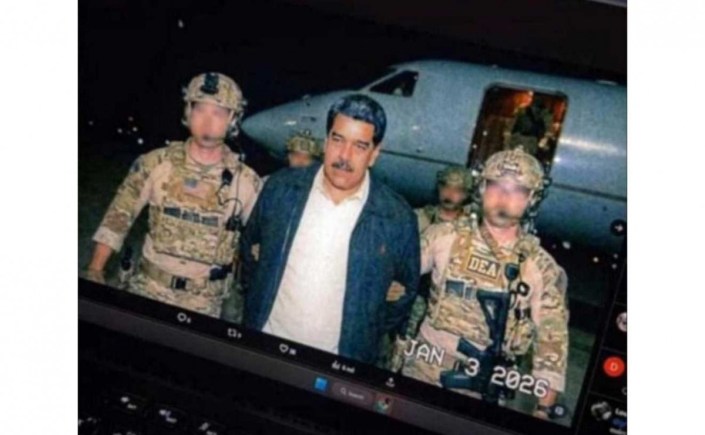
Tuchman’s opus is often misread as a study of stupidity. It is nothing of the sort. She was writing about persistence – about the peculiar ability of governments to continue down a path long after its internal logic has collapsed, armed with information but imprisoned by momentum. Vietnam was not born of ignorance but of escalation mistaken for purpose. Reading the accounts of Trump’s Venezuelan operation – no longer merely a “dock strike” but a full-blooded decapitation raid – one hears that same low, familiar hum: motion without destination, force without horizon.

A leap in the dark 

Everyone knew something like this was coming. Few expected it to be so clean. A president seized, command structures stunned, Caracas rattled just enough to demonstrate omnipotence without visibly levelling the city. From a tactical standpoint, it was impressive – the sort of operation that flatters planners and tempts presidents into believing that history, this time, might behave itself. But history rarely does. Leadership can be removed; regimes, less so. Chavismo survived Chávez’s death and Maduro’s long decay. Movements, unlike men, do not collapse neatly when the head is severed. They mutate. They harden. They endure.

This is where the metaphor shifts and darkens. The United States now looks less like a chess grandmaster and more like the proverbial dog that finally caught the car – triumphant, panting, and unsure what to do next. Decapitation creates ownership. Once you have removed the figurehead, ambiguity evaporates. The question is no longer whether Washington is intervening, but what exactly it intends to build, sustain, or suppress in the vacuum it has helped create.

A week ago, US action might have been interpreted as calibrated escalation: signalling without war, pressure without conquest, violence as message rather than mission. That logic may have held when the strike was offshore, symbolic, plausibly deniable as a prelude rather than a crossing. It is harder to sustain once the president of a sovereign state has been bundled onto a ship and flown north in handcuffs. Symbolism has consequences. At some point, signalling becomes authorship.

The deeper assumption underlying both phases – the demonstrative strike and the decapitation raid – is the same one that has haunted American foreign policy for decades: that limited, spectacular violence produces rational political outcomes. That elites defect under pressure rather than close ranks. That populations blame their rulers rather than the foreign power violating their sovereignty. That humiliation weakens movements rather than mythologising them. This faith survived Iraq, limped through Afghanistan, and still stalks Washington like an unkillable ghost.

What reads in Washington as restraint reads elsewhere as undeclared war. What Beltway strategists describe as “calibrated” looks, from Caracas – or Beijing, Moscow, Tehran, each of whom have form – like arbitrariness dressed up as doctrine. In his most recent foreign policy forays, Trump has fired missiles into Nigeria and sent special forces into Venezuela. He cannot wield enough influence to get his way with major powers, so he targets smaller ones. The White House spins this as a demonstration of American strength, but those who rule in Moscow and Beijing will not be fooled. Nor should anyone else. Whilst ostensibly demonstrating American strength, it also highlights its weakness. Today it is Venezuela; tomorrow it might be somewhere else entirely. The pattern is not coherence but surprise. Power exercised as theatre.

Trump’s foreign policy has always oscillated between maximalist rhetoric and minimalist follow-through. He threatens fire and fury, then settles for a crater and a press conference. He speaks the language of conquest while practising the art of nuisance. Yet Venezuela marks a subtle shift. This is no longer nuisance alone. By removing Maduro, Trump has crossed from menace into management, whether he wants the responsibility or not. Chaos, once unleashed, has a habit of demanding supervision.

The international reaction follows a script so familiar it almost performs itself. International law is solemnly invoked by states that otherwise treat it as optional décor. Yanqui imperialism is dusted off and waved aloft. Blood for oil, regime change, darkest chapters, dangerous precedents –  all the old tropes re-emerge, not because they are always wrong, but because they are always available. France, China, Russia, the EU condemn the breach while sidestepping the harder question: what is to be done now that a criminalised, hollowed-out regime has been removed not by its people, but by force?

Latin America splits along its habitual fault lines. Argentina’s Milei cheers liberty’s advance. Brazil’s Lula warns, with weary accuracy, that violence justified as justice tends to metastasise into instability. Neighbouring Colombia braces for refugees. Cuba mutters “state terrorism.” The region remembers – perhaps too well – that external interventions rarely end where their authors imagine.

What is most striking, though, is how little this seems to disturb the American political bloodstream. The legal basis for seizing a foreign head of state is treated as a technicality. Congressional war powers hover faintly in the background. The risk of retaliation, miscalculation, or long-term entanglement is acknowledged, then politely ignored. The old muscle memory of American power keeps flexing, long after the strategic rationale has atrophied.

And so Tuchman returns, not as a moralist but as a diagnostician. Folly is not recklessness; it is normalisation. It is the steady acceptance of contradiction as policy. Trump’s Venezuela adventure now embodies this perfectly: escalation without ownership, ownership without vision, action without explanation. Each move can be defended in isolation. Together, they form a strategy that cannot quite say what it is for.

Hovering over all of this – absurdly, yet tellingly – is the mirage of the Nobel Peace Prize so coveted by President Trump. The prize is not awarded for the mere absence of war, but for the construction of peace: treaties, frameworks, institutions that reduce violence rather than rebrand it. Bombing here, abducting there, tearing up agreements while demanding credit for not starting new wars is not peace-making; it is anti-diplomacy. Peace defined negatively, as something that has not yet collapsed.

One imagines the Nobel Committee reading this Venezuelan episode with a raised eyebrow: sovereignty breached as messaging, escalation choreographed like a reality-show arc, regime change gestured at but not owned. Peace prizes are not usually awarded for keeping one’s options open.

In the end, Trump’s Venezuelan jiggery-pokery is fascinating for the same reason Vietnam remains endlessly analysed. It shows how great powers drift — not because they are blind, but because they cannot quite decide what they are looking for. Chaos without a compass is not the absence of movement. It is movement mistaken for purpose. And history, as Tuchman patiently reminds us, is unforgiving toward those who confuse the two.

Wrong way, go back? 

Soon after the American militarily impressive operation, The Atlantic published an cautionary opinion piece by staff writer Colin Friedersdorf arguing that Trump has effectively launched a regime-change war against Venezuela without constitutional authority, democratic consent, or a plausible plan for what comes next. The core charge is not primarily strategic incompetence but constitutional betrayal.

He contrasts Trump’s actions with past presidents who, whatever their later failures, at least sought congressional authorisation before waging major wars. Roosevelt after Pearl Harbor and George W. Bush before Afghanistan and Iraq are invoked not as moral exemplars but as constitutional ones: they recognised that the power to initiate war belongs to Congress, and that legitimacy flows—however imperfectly—from public consent. Trump, by contrast, has dispensed with permission altogether.

Friedersdorf dismisses the administration’s legal justifications as threadbare. Labeling Maduro a “narcoterrorist” or pointing to a US indictment does not, he argues, amount to lawful grounds for war against a sovereign state. These are prosecutorial claims masquerading as casus belli, not a substitute for authorisation under domestic or international law.

Strategically, the article warns that toppling Maduro would be the easy part. Venezuela is already riddled with armed groups, including Colombian militants who use its territory as a base for smuggling and mining. Removing the regime risks unleashing forces that would not “go quietly,” echoing Iraq and Libya more than any clean counter-narcotics success.

Friedersdorf argues that Trump is uniquely unfitted for a regime-change war for several interlocking reasons, combining personal disposition, governance style, and historical patterns of behaviour. Unlike previous presidents who sought congressional authorisation—Roosevelt after Pearl Harbor, George W. Bush before Afghanistan and Iraq – Trump bypassed the Constitution entirely. For Friedersdorf, this is not merely a procedural violation; it signals a reckless disregard for the legal and democratic frameworks that constrain American war-making, a disregard which has tangible consequences when planning complex military operations overseas.

Second, Trump’s track record of self-interest and transactional politics undermines confidence in his strategic judgment. Friedersdorf points to a “lifelong pattern” in which Trump has pursued personal, familial, or financial gain, sometimes at the expense of institutional norms or public welfare. A regime-change war in a resource-rich country like Venezuela, Friedersdorf suggests, is exactly the kind of environment in which such temptations could manifest: the conflation of national interest with personal enrichment. Unlike professional soldiers or presidents with experience in foreign policy and national security, Trump’s incentives are highly idiosyncratic, making the outcomes of a war unpredictable and potentially self-serving.

Third, Friedersdorf questions Trump’s capacity for sustained leadership and operational management in a conflict that, by its nature, requires patience, coordination, and political nuance. Toppling Maduro may be “easy” in the sense of a tactical strike, but the aftermath – stabilising Venezuela, managing humanitarian fallout, and navigating regional politics – requires sustained commitment. Friedersdorf doubts that Trump possesses the temperament, patience, or skill to oversee such a complex and prolonged effort. The concern is that he could declare victory prematurely, mismanage occupation or transition, or escalate in ways that deepen instability rather than resolve it.

Finally, Friedersdorf critiques the political myopia and disregard for public opinion in Trump’s approach. Polls reportedly showed a majority of Americans opposed to military intervention in Venezuela, yet Trump proceeded unilaterally. In Friedersdorf’s assessment, this combination—constitutional bypass, personal opportunism, lack of leadership discipline, and political insensitivity—makes Trump not just ill-prepared, but dangerously mismatched to the responsibilities of a regime-change war, with risks to both American legitimacy and Venezuelan stability.

In short, Friedersdorf sees Trump as uniquely unfit because the personal, constitutional, and strategic factors that would constrain a conventional president are either absent or inverted in him, making a complex foreign intervention unusually perilous. And, even if the intervention were to improve Venezuelans’ lives – a possibility Friedersdorf does not dismiss outright – it would still represent a violation of American democratic norms.

The concluding warning is blunt: by choosing war despite public opposition and without congressional approval, Trump has shown contempt for both the Constitution and the electorate. If Congress does not assert its authority now, Friedersdorf fears this episode will become precedent – another step toward endless wars of choice launched by executive whim, not collective decision.

In short, the article frames Venezuela not merely as a foreign-policy gamble, but as a constitutional crisis in miniature – one that exposes how fragile America’s war-making restraints have become when a president decides they are inconvenient.

What happens now?

Everyone knew something like this was coming; perhaps fewer expected it to be executed with such clinical speed. The pre-dawn abduction of Nicolás Maduro by US forces is less a surprise than a punctuation mark — a moment where long-signalled intent finally hardened into action. A foreign head of state removed in two hours. Mission theatrically accomplished. Endgame conspicuously absent.

It is challenging, but not impossible, for American forces to amass massive military hardware, materiel and personnel offshore, bombard a small neighbour and send special forces into its capital. It is much harder for an American president to control what happens in the aftermath. This explains why global leaders are so cautious about this operation. No major European leaders have endorsed the use of force to bring down the Venezuelan government.

The real test for Trump is what comes next. He has been rightly critical of the US invasion of Iraq, and his MAGA movement favours “America First” rather than “regime change” overseas, but now he pursues a regime change of his own, with only a vague assurance that he and his lieutenants will run Venezuela for an unspecified time. The objective has a strategic element, in trying to slow the flow of drugs into America, but most of it is nakedly commercial. While other presidents might not have said this out loud, Trump is direct: he wants US control of the Venezuelan oil fields, with US oil companies investing and making money, so that oil production will increase.

In an opinion piece published in the Sydney Morning Hearal on 5th June, Robert Muggah, co-founder of the Igarapé Institute think tank and a fellow at Princeton University, usefully lays out five post-Maduro scenarios, though what binds them is not optimism but ambiguity. The first – Trump declares victory and walks away – would be the most American of outcomes: maximum disruption, minimum follow-through. Chavismo, minus its latest avatar, shuffles on; Washington expends enormous leverage only to abandon it; the refugees keep coming. The dog catches the car, looks briefly triumphant, and then isn’t quite sure what to do next.

The second scenario – a popular uprising washing away Chavismo – flatters liberal intuition but ignores institutional rot. Venezuela’s civic muscle has atrophied after years of repression, criminalisation, and mass emigration. Armed colectivos remain invested in chaos. What sounds like democratic renewal risks becoming a weak interim regime, punctuated by violence, oil-sector infighting, and amnesty wars.

Scenario three is the familiar regime-change fantasy: escalate, sanction, manage an election, install a friendly opposition figure, promise reconstruction. The problem, as ever, is legitimacy. A government midwifed too visibly by Washington inherits the original sin of imperial sponsorship. Chavismo’s anti-imperial narrative – long threadbare –  would suddenly acquire fresh oxygen, while external actors queue up to meddle by proxy. Another low-grade insurgency beckons.

The fourth option – US custodianship – is the one Trump has effectively name-checked: trusteeship without the label. Stabilise the bureaucracy, revive oil production, choreograph elections, dangle sanctions relief, keep troops nearby “just in case”. It is administratively coherent and politically radioactive. It risks converting a crisis of governance into a crisis of sovereignty, hardening nationalist resistance and validating the very mythology the intervention claims to dismantle.

Which leaves the fifth, and perhaps most honest, outcome: managed instability. No clean victory, no decisive collapse. A weakened Chavista elite, a divided opposition, fragmented security actors, and a US that calibrates pressure without appetite for occupation. A low-boil conflict, indefinitely deferred resolution, limbo as policy.

Hovering over all this is Monroe Doctrine 2.0 – a message not just to Caracas but to Havana, Managua, Bogotá, Panama, even further afield. This was less about Maduro than about signalling who gets to set terms in the hemisphere, and who doesn’t. A muscular reminder that alignment matters, and misalignment carries costs.

For Venezuelans themselves, the prognosis is bleakly familiar: another external intervention, another promise of order, another season of uncertainty. The screw tightens, the rhetoric soars, the moral justifications proliferate – and ordinary people remain suspended between liberation narratives and lived precarity.

History suggests this is not an ending but a prologue. The question, as always, is whether anyone involved is genuinely prepared to live with the consequences of what they’ve just begun.

See also in In That Howling InfiniteTales of Yankee Power … at play in America’s backyard, Tales of Yankee power … Why Venezuela, and why now?, Marco Rubio’s Venezuelan bargain and the original  Tales of Yankee Power

Caveat emptor

It is worth recalling, in this context, what ultimately happened to Muammar Gaddafi and Saddam Hussein – two leaders who, in different ways, became objects of Western fixation and regime-change temptation. Saddam was toppled by overwhelming force, hunted down, tried under a hastily constructed legal order, and hanged; the state he ruled collapsed with him, unleashing sectarian violence and regional instability that still reverberate. Gaddafi, having abandoned his weapons programmes in the hope of rehabilitation, was nevertheless pursued once the opportunity arose, cornered during a NATO-backed intervention, and killed by a mob in a Libyan drainage culvert. Libya followed him into fragmentation, militia rule, and proxy warfare.

In neither case did the removal of the strongman deliver the orderly political transformation that had been implicitly promised. What followed was not liberal democracy but vacuum – power without legitimacy, violence without direction. These episodes linger in the strategic memory not merely as moral tales but as practical ones: regime change is easy to threaten, harder to execute, and almost impossible to control once unleashed.
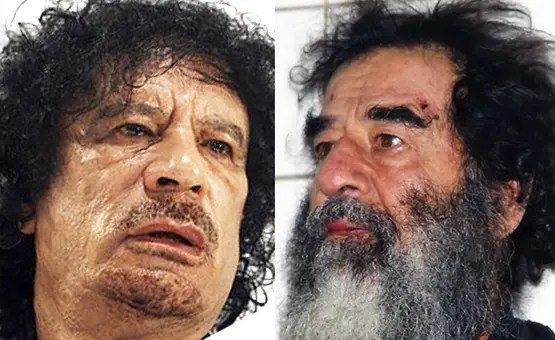

Muammar Gadaffi and Saddam Hussein in captivity

Feints, refrains and unfinished business. 2025 in review

And we are here as on a darkling plain
Swept with confused alarms of struggle and flight,
Where ignorant armies clash by night.
Mathew Arnold, Dover Beach

We called 2024 a “year of everything, everywhere, all at once”, and it earned the name. Crises collided, news arrived faster than we could process it, and the world seemed to exist in a state of constant shock. 2025 did not bring relief. Instead, the chaos began to settle. Wars dragged on, political divides hardened, social tensions deepened, and technology reshaped how we saw and understood it all.

It was the year the world stopped exploding in real time and started being what it had already become: messy, uneven, morally complicated, and stubbornly persistent. A year, indeed, in a world of echoes, refrains and unfinished business. And we spent the year watching power bargain brazenly in plain sight, trying to describe what was happening while it unfolded around us.

From Gaza to Ukraine, Sudan to Syria, from America’s self-inflicted fracture to Australia’s sudden wake-up call on Bondi Bondi, 2025 forced a reckoning: the world did not pause, but it did sort itself – deciding what we would notice, what we would ignore, and what we would learn to live with. Alongside human crises came the continuing advance of AI and chatbots, and the dominion of the algorithms that now govern attention, proving that disruption can be structural as well as geopolitical.

Gaza: War, Then “Ceasefire”

The war in Gaza dominated the year internationally and here in Australia, even as attention ebbed and flowed. Military operations continued for months, followed eventually by a “ceasefire” – a word doing far more work than it should or even justified. Fighting paused, hostages living and dead were returned and prisoners released, but the devastation remained: tens of thousands dead, cities demolished, humanitarian catastrophe unresolved. And the causes of the consequences standing still amidst the ruins and the rubble.

Western governments continued to back Israel while expressing concern for civilians, a contradiction that grew harder to defend, while street protests and online anger seethed all across the world. At the same time, antisemitism surged globally, often hiding behind the language of anti-Zionism. Two realities existed together, and too many people insisted on choosing only one.

By the end of the year, the war had not been resolved – merely frozen. Trust in Western moral leadership had been badly damaged, and Israelis and Palestinians remain in bitter limbo.

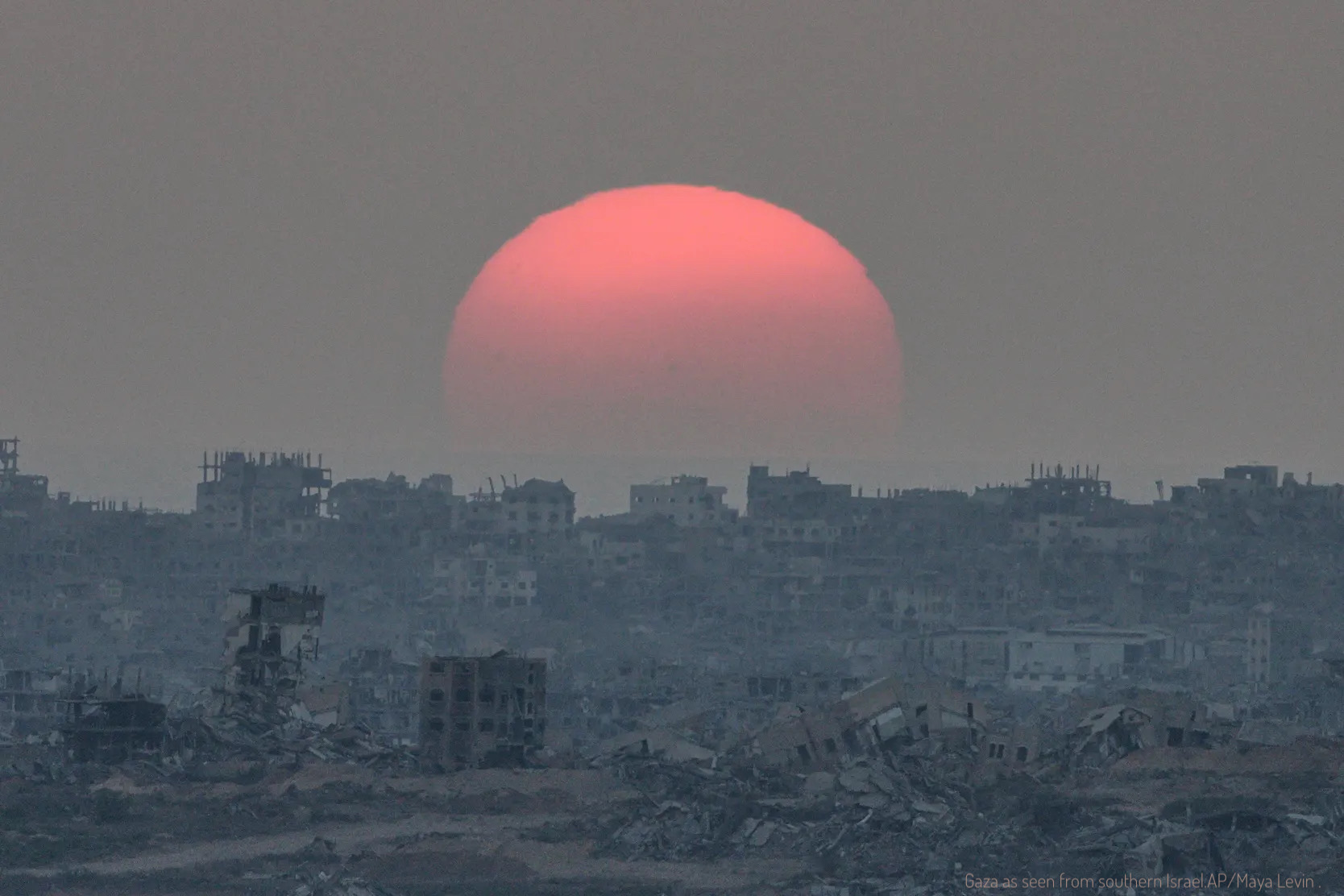
See Gaza sunrise or false dawn? Spectacle or Strategy

Iran, Israel and America’s bunker busters

Long-simmering tensions between Israel and Iran spilled into open conflict. What had once been indirect – proxies, cyberattacks, covert strikes – became visible. A brief but destructive war of missile exchanges ended with the United States asserting ordinance, deterrence and control.

The episode was brief but telling. It showed that America still reaches for its guns quickly, even as it struggles to define long-term goals. Another line was crossed, then quickly absorbed into the background of “normal” geopolitics.

Russia, Ukraine and Trump’s “Peace”

Ukraine entered 2025 mired in stalemate. Front lines barely moved. Casualties continued to mount. Western support held, but with clear signs of fatigue. And Donald Trump’s re-emergence reshaped the conversation. His promise to deliver instant “peace” reframed the war not as a question of justice or sovereignty, but of exhaustion. Peace was no longer about what Ukraine deserved, but about what the world was tired of sustaining and what the “art of the deal” could deliver.

The war didn’t end. It simply became something many wanted to stop thinking about. Not Ukraine and Russia, but. The carnage continues.

Donald Trump’s one-way crush on Vladimir gave us the one of the+most cringeworthy moments in global politics – Trump greeting the Russian president in Alaska: As the US president rolled out the red carpet for the world’s most dangerous autocrat, Russia’s attack on Ukraine accelerated. Trump got precisely nothing out of the meeting, except for the chance to hang out with a gangster he so obviously admires and of whom he is embarrassingly in awe.

Syria: Free, but stranded at the crossroads

A year after Assad’s fall, Syria remained unstable and unresolved. The regime was gone, but the future was unclear. Old sectarian tensions resurfaced, often in bloodshed, new power struggles emerged, powerful neighbours staked claims and  justice for past crimes remained distant.

Syria in 2025 was neither a success story nor a collapse – but suspended between heaven and hell, a country trying to exist after catastrophe with the rest of the world largely moving on.

See Between heaven and hell … Syria at the Crossroads

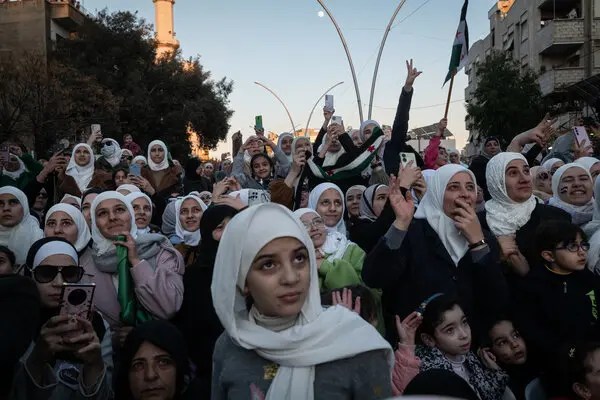
Women in Damascus celebrate the fall of the Assad regime

Sudan: what genocide actually looks like

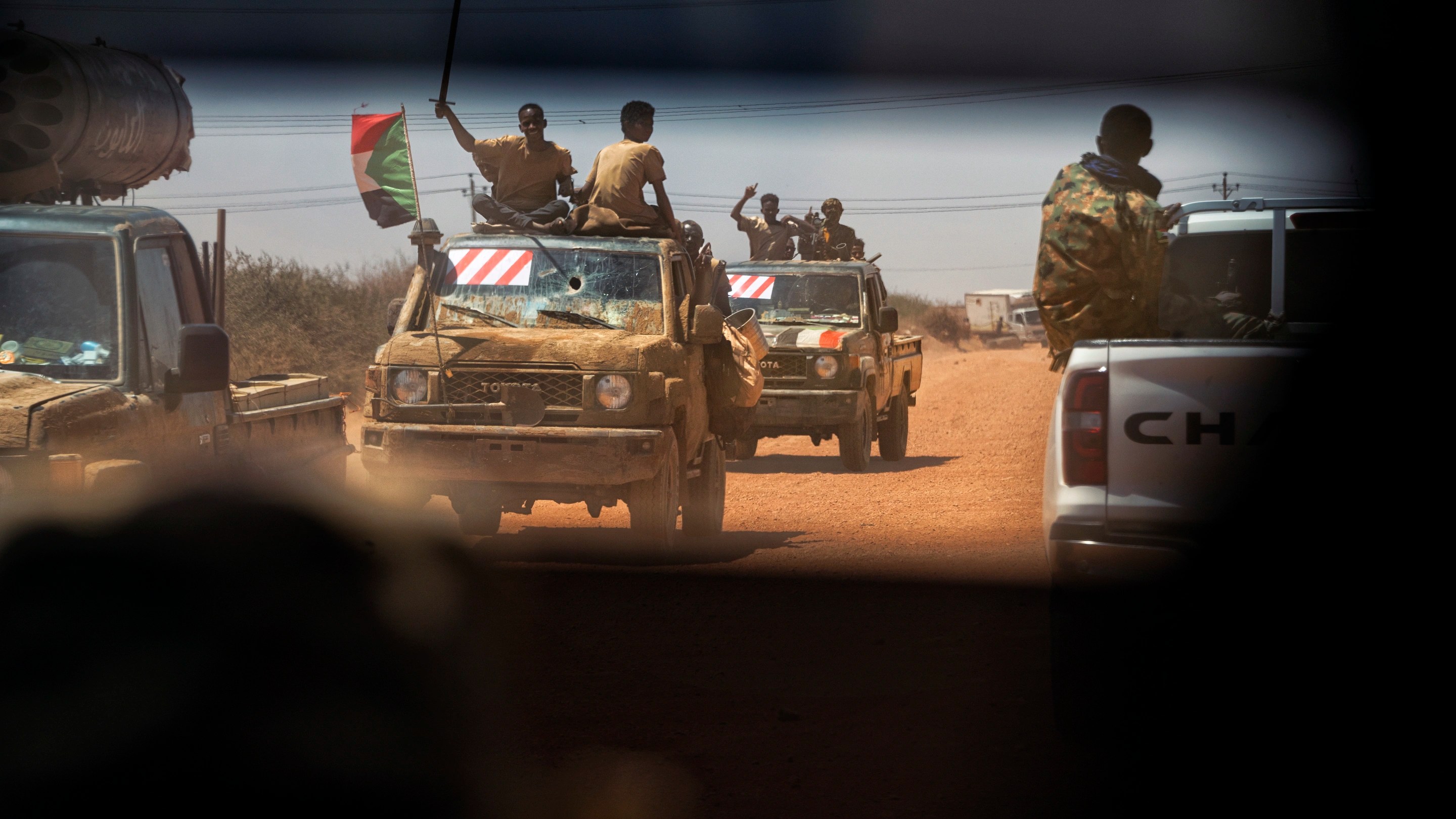
Sudan’s civil war continued with little international attention. Mass killing, ethnic cleansing, famine, and displacement unfolded slowly and relentlessly. This was genocide without spectacle. No clear narrative. No sustained outrage. It showed how mass atrocity can now occur not in secrecy, but in plain sight – and still be ignored.

see The most nihilistic war ever …Sudan’s waking nightmare

America: a country divided against itself

The United States spent 2025 deeply divided, with no sign of healing. Pew Research polling showed that seven out of ten republicans think that the opposite side is immoral while six of ten democrats thinks the same of their rivals.

Trump’s return to power sharpened those divisions. His administration governed aggressively: mass deportations, punitive tariffs, the dismantling of foreign aid, political retribution, and pressure on democratic institutions. The country looked inward and outward at the same time – less cooperative, more transactional, more openly nationalist. Democratic norms eroded not overnight, but through constant stress and disregard. With three years still to run and the tell-tale midterms approaching, allies and cronies are adjusting, bickering rivals are taking notes, and uncertainty has become the defining feature of American leadership. Meanwhile, #47 is slapping his name on everything he can christen, from bitcoins to battleships.

See, for light relief, Danger Angel … the ballad of Laura Loomer 

Monroe Redux: the return of “the Ugly American”

US foreign policy took on a blunt, old-fashioned tone. Pressure on Canada and Mexico increased. Talk of annexing Greenland resurfaced. Venezuela, caught in the maw of Yanqui bullying and bluster, waits nervously for Washington’s next move. The administration promised imminent land operations – and then bombed Nigeria! The revival of the old Monroe Doctrine felt, as baseball wizz Yogi Berra once remarked, like déjà vu all over again, not as strategy, but as instinct. Influence asserted, consultation discarded. The “ugly American” was back, and unapologetic.

See Tales of Yankee power … Why Venezuela, and why now?

Europe at a inflection point

Europe in 2025 didn’t collapse, as many pundits suggested it might, but it shifted. Far-right ideas gained ground even where far-right parties didn’t win and remained, for now, on the fringes albeit closer to electoral success. Borders tightened; policies hardened; street protests proliferated – against immigration and against Israel, Support for Ukraine continued, but cautiously. The continent stood at a crossroads: still committed to liberal values in theory, but increasingly selective in practice.

Uncle Sam’s  cold-shoulder

Rumbling away in the background throughout year was the quiet but  cumulative alienation of America’s allies. Not with a single rupture, but through a thousand small slights. transactional diplomacy dressed up as realism, alliances treated as invoices rather than covenants, multilateralism dismissed as weakness. Europe learned that security guarantees come with a mood swing; the Middle East heard policy announced via spectacle; Asia watched reassurance coexist uneasily with unpredictability.

The new dispensation was illustrated by the Trump National Security Strategy. It is at once candid and contradictory: it outlines a narrower, realist vision of American interests, emphasising sovereignty, burden-sharing, industrial renewal, and strategic clarity, yet it is riddled with silences, evasions, and tensions between rhetoric and likely action. Allies are scolded for weakness while the document avoids naming Russia’s aggression, underplays China, and projects American cultural anxieties onto Europe. These contradictions expose both strategic incoherence and the limits of paper doctrine against presidential temperament, leaving Europe facing an irreversible rupture in trust and revealing a strategy as much about America’s insecurities as its actual global posture.

The post-WW2 order has not so much been dismantled as shrugged at, and indeed, shrugged off. Trust eroded not because the United States has withdrawn from the world, but because it has remained present without being reliable, and presumed itself to be in charge. Power, exercised loudly but inconsistently, has discovered an old truth: allies can endure disagreement, but they struggle with contempt.

Australia in 2025 … high flight and crash landing

Though beset by a multitude of crises – the cost of living, housing, health and education services – the Albanese Labor government was returned comfortably in May, helped by a divided, incoherent, and seemingly out of touch opposition. For the rest the year, federal politics felt strangely frictionless with policy drift passing for stability. The Coalition remained locked in internal conflict, unable to present a credible alternative. The Greens, chastened by electoral defeat and in many formerly friendly quarters, ideological disillusionment, treaded water.

But beneath the surface, social cohesion frayed. Immigration debates sharpened. Antisemitism rose noticeably, no longer something Australians could pretend belonged elsewhere. Attacks on Jewish Australians forced a reckoning many had avoided and hoped would resolve once the tremors of the war in Gaza had ameliorated. Until 6.47pm on 7th December, a beautiful evening on Sydney’s iconic Bondi Beach. Sudden, brutal and in our summer playground, sectarian violence shattered the sense of distance Australians often feel from global disorder. At that moment, politics stopped feeling abstract. The world, with all its instability, barged in and brought the country down to earth.

See This Is What It Looks Like

Lifesavers on Bondi Beach, 20 December 2025. Edwina Pickles

Featured photograph and above:

A handful of bodies on Bondi Beach, and behind them, the howling infinite of expectation, obligation, and the careful rationing of human empathy. The smallness of the beach against the vastness of consequences. On December 20, 2025, Bondi’s iconic lifesavers formed a line stretching the entire length of the beach -silent, solemn, a nation visibly in mourning. Similar tributes unfolded from Perth to Byron Bay, gestures of unity in the face of a shock that touched the whole country.

The Year of the Chatbot: Promise, Power, and Risk

And now, a break from the doom and gloom …

2025 was the year when artificial intelligence became part of daily life. Chatbots ceased to be experimental and became integral, transforming from novelty to utility seemingly overnight. People used it to write, research, translate, plan, argue, comfort, and persuade; institutions and individuals adopted it instinctively. Setting tone as much as content, the ‘bots have lowered barriers to knowledge, sharpened thinking, and helped people articulate ideas they might otherwise struggle to express. Used well, they amplified curiosity rather than replace it.

The opportunities are obvious – but so are the risks. Systems that can clarify complexity can also flatten it. Chatbots sound confident even when wrong, smooth over disagreement, and made language cleaner, calmer, and more persuasive – but not necessarily truer. They reinforce confirmation bias, outrage, and tribal certainty, generating arguments instantly and flooding the zone with plausible-sounding text. As information has became faster, cheaper, and less reliable, Certainty has spread more easily than truth, so truth has to work much harder.

Dependence is subtler but real. Outsourcing thinking – summaries instead of reading, answers instead of wrestling – did not make humans stupid, but less patient. Nuance, doubt, and slow understanding became harder to justify in a world optimised for speed. Yet conversely, man people still seek context, history, and complexity. Used deliberately, AI could slow the pace, map contradictions, and hold multiple truths at once.

By the end of 2025, the question was no longer whether AI would shape public life – it already had. The real question is whether humans would use it as a shortcut, or as a discipline. The technology is neutral. The danger – and the promise – lies in how much thinking we are willing to give up, and how much responsibility we are prepared to keep.

See The promise and the peril of ChatGPT 

Algorithm and blues

Alongside the chatbot sat a quieter, more insidious force: the algorithm itself. By 2025 it no longer simply organised information – it governed attention. What people saw, felt, and argued about was shaped less by importance than by engagement. To borrow from 20th century philosopher and communication theorist and educator Marshall McLuhan, the meme had become the message. Complex realities were compressed into images, slogans, clips, and talking points designed not to inform but to travel. The algorithm rewarded speed over reflection, certainty over doubt, heat over light. Politics, war, and grief were all flattened into content, stripped of context, and ranked by performance. What mattered most was not what was true or necessary, but what disseminated.

Passion without Wisdom

I wrote during the year that we seemed “full of passionate intensity” – Yeats’ phrase still apt in the twenty first century- but increasingly short on wisdom and insight. 2025 confirmed it. Anger was everywhere, empathy highly selective, certainty worn like armour. People felt deeply but thought narrowly. Moral energy surged but rarely slowed into understanding. The problem was not indifference; it was excess – too much feeling, too little reflection. In that environment, nuance looked like weakness and patience like complicity. What was missing was not information, but judgement – the harder work of holding contradiction, of resisting instant conclusions, of allowing complexity to temper conviction. Passion was abundant. Insight, increasingly rare.

Looking Toward 2026

Looking back on 2025, it seems that there  were no endings, neither happy or sad. Just a promise, it seems, of more of the same. The year didn’t solve anything. It clarified things. And if it clarified anything, it was that the world has grown adept at managing, ignoring, or absorbing what it cannot fix. It revealed a world adjusting to permanent instability. In this year of echoes, refrains, and unfinished sentences.

Passion, intensity, and outrage were abundant, but patience, wisdom, and insight remained scarce. Democracies strained under internal and external pressures. Wars lingered unresolved. Technology reshaped thought and attention.

Some argue that hope springs eternal, that yet, even amid the drift and the fractures, glimpses of understanding and resistance persisted, that although the world has settled into its chaos, we can be riders on the storm. But, I fear, 2026 arrives not as break, a failsafe, a safety valve, but as continuation. It looms as a test of endurance rather than transformation.  In my somnolent frame of mind, I’ve reached again for my Yeats. “Things fall apart; the centre cannot hold; mere anarchy is loosed upon the world, the blood-dimmed tide is loosed …”

After the chaos of 2024 and the hardening of 2025, the question is no longer what might go wrong. It’s what we’re prepared to live with.

And so we come to what In That Howling Infinite wrote in 2025.

What we wrote in 2025

It was a year that refused neat endings.

It began in a wasteland – Gaza as moral ground zero – and moved, restlessly, through revolutions real and imagined: Trump as symptom and accelerant, Putin as a man racing his own shadow, Syria forever at the crossroads where history idles and then accelerates without warning. Gaza returned, again and again, sunrise and false dawn, as spectacle and strategy; Sudan burned in near silence; Venezuela re-entered the frame as empire’s backyard as the US disinterred its Monrovian legacy. In That Howling Infinite featured pieces on each of these – several in many cases , twenty in all, plus a few of relevance to them, including an overview of journalist Robert Fisk’s last book (The Night of Power – Robert Fisk’s bitter epilogue). A broadranging historical piece written in the previous year and deferred, Modern history is built upon exodus and displacement, provided a corrective of sorts to the distorted narratives that have emerged in recent years due to a dearth of historical knowledge and the partisan weaponisation of words. 

It was almost as light relief that we turned to other subjects. Of particular interest was AI. Approaching remorselessly yet almost unrecognised in recent years, it banged a loud gong and crept from curiosity to condition, from tool to weather system, quietly rewriting the newsroom, the internet, and the idea of authorship. ChatGPT and other chatbots appeared not as saviours but as promise and peril in equal measure. By year end, we were fretting about using ChatGPT too much and regarding it as something to moderate like alcohol or fatty foods. We published three pieces on the subject in what seemed like rapid succession, and then pestered out – sucked into the machinery, I fear.

What with so much else attracting our attention, we nevertheless managed to find time for some history – including a  particularly enthralling and indeed iconoclastic book on the fall of the Ottoman Empire; the story of an Anzac brigade lost in Greece in 1942; “the Lucky Country” revisited after half a century;  and a piece long in the pipeline on the iconic singer and activist Paul Robeson.

In August, as on a whim, for light relief, we summoned up a nostalgic old Seekers’ song from the mid-sixties, a time when the world was on fire with war and rage much as it is today, but for us young folk back in the day, a time of hope and hedonism. For us, the carnival, clearly, is not over. The machinery is still whirring, the music still loud, and the lights still on. History is insisting on one more turn of the wheel, and the dawn, so often promised, so frequently invoked, has not yet broken.

January
The Gaza War … there are no winners in a wasteland
The way we were … reevaluating the Lucky Country

February
Let’s turn Gaza into Mar e Largo
Trump’s Second Coming … the new American Revolution
Cold Wind in Damascus … Syria at the crossroads

March
Trumps Revolution… he can destroy but he cannot create
Where have all the big books gone?
Putin’s War … an ageing autocrat seeks his place in history

April
The Trump Revolution … I run the country and the world
The Fall of the Ottoman Empire and the birth of Türkiye
Let Stalk Strine .. a lexicon of Australian as it was spoken (maybe)

May
The phantom of liberty … the paradoxes of conservativism
Shadows in search of a name … requiem for a war
The continuing battle for Australia’s history

July
A mighty voice … the odyssey of Paul Robeson

August
109 years of Mein Kampf … the book that ravaged a continent
High above the dawn is breaking … the unlikely origin of a poo song

September
Gaza sunrise or false dawn? Trump’s peace plan
Gaza sunrise or false dawn? Spectacle or Strategy
Will there ever be a Palestinian state?
Why Osana bin lost the battle but won the war
The Night of Power … Robert Fisks bitter epilogue
The promise and peril of ChatGPT
Who wrote this? The newsroom’s AI dilemma

October
AI and the future of the internet
Danger Angel … the ballad of Laura Loomer

November
A forgotten Anzac story in Greece’s bloody history
The most nihilistic war ever … Sudan’s waking nightmare
Answering the call … National Service in Britain 1945-1963
Tales of Yankee Power … at play in Americas backyard

December
Delo Kirova – the Kirov Case … a Soviet murder mystery
Between heaven and hell … Syria at the crossroads
This Is What It Looks Like
Tales of Yankee power … Why Venezuela, and why now?
Marco Rubio’s Venezuelan bargain

Read out reviews of prior years:

That was the year that was – retrospectives

A song for 2026: Lost love at world’s end …

It is our custom to conclude our annual wrap with a particular song that caught our attention during the year. Last year, we chose Tears for Fears’ Mad World.  It would be quite appropriate for 2025. But no repeats! so here is something very different. An outwardly melancholy song that is, in the most ineffable way quite uplifting. that’s what we reckon, anyway …

The Ticket Taker is on the surface a love song for the apocalypse; and it’s it’s one of the prettiest, most lyrically interesting songs I’ve heard in a long while. I could almost hear late-period Leonard Cohen and his choir of angels.

The apocalypse is both backdrop and metaphor. We’re not sure which. Is it really about a world ending, or just about the private ruin of a man left behind by love and fortune. The lyrics are opaque enough to evade final meaning, but resonant enough to keep circling back, like the ferry itself, between hope and futility. A love song, yes, but also a confession of entrapment: the gambler’s hope, the ark one cannot board.

The “Ticket Taker” song was written by Ben Miller and Jeff Prystowsky and is featured on The Low Anthem’s album Oh My God, Charlie Darwin. It features on Robert Plant’s latest foray into roots music – this time with English band Saving Grace. This flawless duet with Suzi Dian is mesmerising and magical.

Jeff will tell you that the song is “pure fiction,” that Ben “just made it up one day” – but fiction, as we know, has a way of smuggling deeper truths than fact dares admit.

Tonight’s the night when the waters rise
You’re groping in the dark
The ticket takers count the men who can afford the ark
The ticket takers will not board, for the ticket takers are tied
For five and change an hour, they will count the passers-by

They say the sky’s the limit, but the sky’s about to fall
Down come all them record books, cradle and all
They say before he bit it that the boxer felt no pain
But somewhere there’s a gambling man with a ticket in the rain

Mary Anne, I know I’m a long shot
But Mary Anne, what else have you got?
I am a ticket taker, many tickets have I torn
And I will be your ark, we will float above the storm

Many years have passed in this river town, I’ve sailed through many traps
I keep a stock of weapons should society collapse
I keep a stock of ammo, one of oil, and one of gold
I keep a place for Mary Anne, soon she will come home

Mary Anne, I know I’m a long shot
But Mary Anne, what else have you got?
I am a ticket taker, many tickets have I torn
And I will be your ark, we will float above the storm

Mary Anne, I know I’m a long shot
But Mary Anne, what else have you got?
I am a ticket taker, many tickets have I torn
And I will be your ark

Marco Rubio’s Venezuelan bargain

People with only a passing acquaintance with Latin American history and politics have been asking, with genuine puzzlement, “why Venezuela? And why now?” The question is reasonable enough, but the coverage has been thin – particularly here in Australia – where Venezuela tends to appear only as a shorthand for failure or excess, rarely as a site of serious American political investment.

In That Howling Infinite recently provided several reasonably comprehensive explanations in Tales of Yankee power … Why Venezuela, and why now? But what has been largely absent from this and from other discussions is the role being played by former senator and now Secretary of State Marco Rubio. That absence, as we shall see below,  is striking.

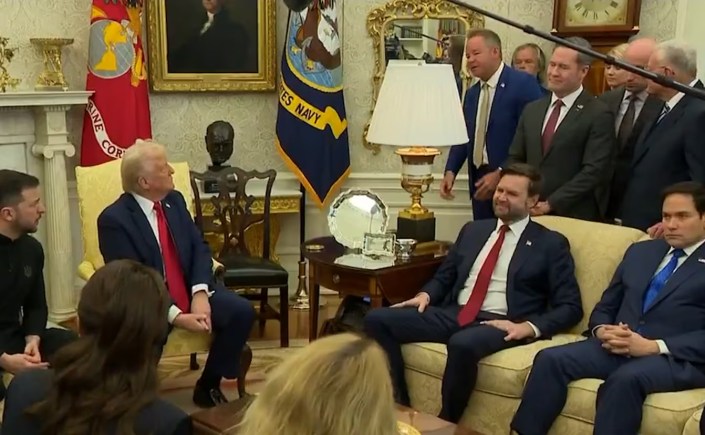
The Rubio connection surfaced explicitly in American author and commentator Fareed Zakaria’s latest Global Public Square broadcast on CNN, and once raised, it proved difficult to ignore. Rubio’s place in the MAGA-verse is, after all, an incongruous one. This is the same seasoned, disciplined, and electorally successful politician whom Donald Trump once ridiculed in the 2016 campaign as “Lil’ Marco,” a moment of theatrical humiliation that seemed, at the time, politically terminal. And yet here he is, back in the room and back at the table, standing stiffly beside Trump and self- styled “Secretary of War” Pete Hegseth in press conferences, Oval Office set-pieces, and cabinet gatherings, his discomfort almost palpable.

Watching those scenes, it is hard not to suspect a transaction. Not in the crude sense of quid pro quo, but in the quieter, more human register of political survival: the price one pays to remain relevant, to retain influence, to draw at least one clear moral boundary in an administration otherwise defined by improvisation and loyalty tests. It was this that set me thinking that Venezuela – by way of Cuba – may be Rubio’s price. The policy domain where he is allowed conviction, where memory still outranks expediency, and where supporting Trump does not feel, at least to himself, like surrender.

Intrigued by Zakaria’s brief “take” on Marco Rubio and Venezuela, I asked Chat GPT to sift through reportage in American media and other sources and come up with a more detailed story. That story follows.

See also in In That Howling InfiniteTales of Yankee Power … at play in America’s backyard, Tales of Yankee power … Why Venezuela, and why now? and the original  Tales of Yankee Power

Marco Rubio and the Politics of Memory

To understand Rubio’s Venezuela policy, it helps to stop thinking in terms of strategy alone and start thinking in terms of inheritance. This is not a story that begins in Caracas or Washington, but in Havana – or rather, in the Havana that survives only in memory: confiscated houses, interrupted childhoods, unfinished arguments passed down like heirlooms. Rubio speaks not just to voters, but to ghosts. And those ghosts have opinions.

For Rubio, socialism is not a theory, nor even a failed experiment. It is a family trauma, translated into politics. This matters because it explains both the intensity and the rigidity of his stance on Venezuela, and why compromise there feels not merely imprudent, but immoral. Venezuela matters because it looks like the past refusing to stay past.

The Cuban exile community in Miami has long provided American politics with a particular moral grammar: clarity over ambiguity, punishment over accommodation, endurance over negotiation. In this worldview, regimes do not soften; they calcify. Time is not neutral; it is the enemy. The lesson of Cuba is that hesitation becomes permanence. Rubio absorbed this lesson early, intuitively, and it has shaped his political ascent.

As Venezuela slid into authoritarian collapse in the 2010s, it became the perfect successor to Cuba as both warning and weapon. Unlike Havana, Caracas was still in motion. It had elections – imperfect, manipulable, but legible enough to serve as staging grounds for hope. It had oil, which meant leverage. And it had an opposition that could be imagined, at least briefly, as viable. Venezuela became Cuba-with-oil, a second chance to get history right.

Rubio seized that opportunity. He framed Venezuela not merely as a foreign policy challenge, but as Exhibit A in a broader moral argument about socialism, populism, and American decline. In doing so, he also performed a useful domestic alchemy: fusing Cuban-, Venezuelan-, and Nicaraguan-American experiences into a single narrative of victimhood and resistance. Florida’s exile communities became not distinct histories, but a shared cautionary tale.

This was not incidental to Rubio’s rise; it was central to it. Venezuela allowed him to marry personal biography to national rhetoric, foreign policy to electoral arithmetic. Hardline sanctions, regime-change language, and moral absolutism were not just positions – they were signals of fidelity to memory.

The Juan Guaidó episode in 2019 marked the high-water line of this approach. Rubio was among the loudest advocates of the belief that pressure, recognition, and a sufficiently confident declaration of inevitability would cause the Maduro regime to collapse. When it didn’t – when the military held, the opposition fractured, and the regime adapted – the failure did not soften conviction. It hardened it. In exile politics, failure is rarely read as miscalculation; more often it is read as insufficient resolve.

What has changed since is not Rubio’s worldview, but the world around it.

Venezuela has survived. Sanctions leaked. New patrons appeared. The regime learned how to manage scarcity and repression simultaneously. And the multipolar order – China, Russia, Iran – provided insulation that Cuba in the 1960s never had. The Cuban model, once a warning, began to look uncomfortably like a blueprint.

Enter Trump—again.

Rubio’s return to proximity with Trumpian power has been visibly uneasy. The discomfort is not theatrical; it is structural. Rubio is not a natural Trumpist. He believes in alliances, institutions, and the moral language of American leadership – however threadbare those concepts have become. Standing beside Trump and figures like Pete Hegseth in pressers and cabinet gatherings, Rubio often looks less like a disciple than a negotiated presence.

Which is why Venezuela matters now in a different way.

It is plausible – compelling, even – to read Rubio’s Venezuela focus as the price of admission. His moral compensation. The policy space he is allowed to dominate in exchange for supporting, or at least tolerating, other Trump policies that clearly sit uneasily with him. Give me Latin America, the bargain seems to say. Let me draw the line there.

Trump accepts this because it costs him little and gains him Florida. Rubio accepts it because Venezuela is the one issue where compromise feels like apostasy. It is his redemptive exception – the place where he can still be unbending, certain, and righteous, even as he swallows his discomfort elsewhere.

The result is a Venezuela policy overdetermined by symbolism. Sanctions become not just tools, but acts of remembrance. Engagement becomes not diplomacy, but forgetting. The ghosts hover constantly, reminding, accusing, insisting that this time must be different.

And yet the irony persists. Rubio’s politics of memory assumes that time favours pressure – that authoritarian regimes crack if held long enough. Venezuela suggests the opposite: that time favours adaptation. Survival is no longer failure; it is proof of concept. The past is not repeating itself exactly – it is mutating.

Which leaves Rubio caught between conviction and context. His stance is principled in its own terms, emotionally coherent, politically intelligible. But it struggles with a world in which pressure still matters, yet no longer decides outcomes.

Venezuela, in this telling, is not just a country. It is a memory test. A moral rehearsal. A stand-in for an argument with history that never quite concluded. Rubio stays in the room, visibly uneasy, because Venezuela allows him to believe that proximity to power has not dissolved purpose.

Whether that bargain helps Venezuela is uncertain. But as an explanation for Rubio himself – for his rigidity, his discomfort, his persistence – it is as close as politics gets to biography. And in exile politics, biography is destiny.

And here the circle closes.

Rubio believes Venezuela matters because it looks like the past refusing to stay past. But by treating it primarily as a moral inheritance rather than a living, adaptive system, he risks replaying the very tragedy exile politics warns against: mistaking endurance for fragility, and time for an ally.

So yes – read this as a bargain.

Rubio stays, visibly uneasy, because Venezuela is his line in the sand. His proof to himself that proximity to power has not dissolved conviction. It is the policy space where he can still speak to ghosts – and hear them answer back.

Whether that bargain produces better outcomes for Venezuela is another question entirely. But as a political arrangement, it is elegant, durable, and profoundly human.

Sources and References

Primary reporting & analysis

  • Fareed Zakaria, GPS / Global Public Square segments on Venezuela and US foreign policy (CNN, 2024–2025)
  • The New York Times, Marco Rubio and U.S. Venezuela Policy (various reports, 2019–2024)
  • The Washington Post, coverage of the Guaidó recognition and sanctions regime
  • Reuters, U.S. sanctions policy and Venezuela negotiations (ongoing reporting)

Cuba–Venezuela nexus

  • Julia E. Sweig, Cuba: What Everyone Needs to Know (Oxford University Press)
  • William LeoGrande & Peter Kornbluh, Back Channel to Cuba (University of North Carolina Press)
  • International Crisis Group reports on Venezuela–Cuba security cooperation

Exile politics & Florida

  • Javier Corrales & Michael Penfold, Dragon in the Tropics (Brookings Institution Press)
  • Pew Research Center, Cuban-American and Venezuelan-American political attitudes
  • Politico, Florida, Rubio, and Latin America policy analyses

Sanctions & authoritarian adaptation

  • Adam Tooze, essays on sanctions and multipolarity
  • Brookings Institution, Why sanctions fail (and sometimes work)
  • Carnegie Endowment for International Peace, Venezuela sanctions assessments

Tales of Yankee Power … at play in America’s backyard

Señor, señor
Can you tell me where we’re headin’?
Lincoln County Road or Armageddon?
Seems like I been down this way before
Is there any truth in that, señor?

This story does not relate to Bob Dylan’s cryptic and nihilistic Señor (Tales of Yankee Power), from Street Legal (1978). As for the meaning of his song, well, that’s pretty hard to fathom. A cowboy fever dream, perhaps; one of those strange illusions you channel in the early morning between sleeping and waking, more about mood than meaning.

Rather, these tales refer to the United States’ troubled and troublesome historical and contemporary relationship with its Central and Latin American neighbours – and particularly, to its current crusade against Venezuela’s autocratic president Nicolás Maduro. And it is less about Venezuela than about the US itself – an empire in all but name struggling to recover its own reflection in the shifting mirror of history. The restless ghost of Manifest Destiny is still pacing the corridors of the West Wing and the State Department. The “tales of Yankee power” keep repeating because the empire cannot imagine itself without them. Each show of force, each threat of “covert operations” is a reassurance ritual, a way of proving that the old muscles still work. But as with all empires in decline, the performance reveals more fragility than strength. The Monroe Doctrine once kept others out; the Neo-Monroe Doctrine may exist only to convince America that it is still in.

In That Howling Infinite has walked this road before in a 2017 post also entitled Tales of Yankee Power, a feature on American songwriter Jackson Browne‘s1986 album Lives in the Balance. At the time critics reckoned that its contemporary content, the USA’s bloody meddling in Central America, limited its appeal and long-term significance. And yet, here in the early twentieth first century, where the wars of the Arab Dissolution dragged the world into its vortex, and Vladimir Putin’s invasion of Ukraine ended seventy five years of Pax Europa, the Great Power politics and proxy wars that taxed intellectual and actual imaginations in that seemingly distant decade jump back into the frame like some dystopian jack in the box. As Mark Twain noted, “history doesn’t repeat itself, but it does rhyme”.

Eight years after the original Tales of Yankee Power, the story hasn’t ended – it’s simply changed key. The Uncle Sam is still abroad, still restless, still convinced the hemisphere cannot manage without his supervision. Only the script has been updated: what was once called the Monroe Doctrine is now “neo”; what was once the “war on communism” is now the “war on drugs”. But the music is familiar – and derivative: in this sad world, whenever Uncle Sam (or Comrade Ivan for that matter) plays his hand, something wicked this ways comes. As Canadian songwriter Bruce Cockburn, who also condemned the North’s intervention in the politics of the South once sang, “Little spots on the horizon into gunboats grow … Whatever’s coming, there’s no place else to go, waiting for the moon to show”.

Donald Trump’s Neo-Monroe Doctrine 

Yanqui wake up
Don’t you see what you’re doing
Trying to be the Pharoah of the West bringing nothing but ruin
Better start swimming
Before you begin to drown
All those petty tyrants in your pocket gonna weigh you down

Bruce Cockburn, Yanqui Go Home (1984)

Which brings us to American journalist John Masko’s insightful analysis of Trump’s Latin American policy in a recent Unherd article.  It is sharp and well-informed, particularly his framing of the “Neo-Monroe Doctrine” as the ideological scaffolding for Washington’s renewed interest in its southern backyard. Yet, like most American commentators, he skips over a crucial subplot – namely, the role of the United States itself in creating the very chaos it now claims to correct. Venezuela’s “descent into shambles,” as he calls it, did not occur in a geopolitical vacuum. Sanctions, economic strangulation, and decades of covert interference were not incidental background noise but deliberate acts of policy – the slow throttling of a regime that refused to align with the hegemon’s economic and political script. Without that context, the narrative too easily morphs into a morality play about Latin American incompetence, when in truth, it’s an old imperial story of cause, consequence, and selective amnesia.

Masko’s central thesis – that Trump has revived the Roosevelt Corollary to the Monroe Doctrine – is persuasive. In Trump’s mind, security begins at home and radiates outward; when weak or corrupt neighbours threaten that security, they must be coerced or replaced. The author rightly traces this logic back to Roosevelt’s 1904 declaration that the US would “police” the Western Hemisphere, supposedly without territorial ambition but with the clear intent of monopolising intervention. From Cuba to the Dominican Republic, Guatemala to Chile, the Corollary became the moral fig leaf for American coups, invasions, and corporate extractions. Trump, Masko argues, sees himself as restoring that prerogative – a hemispheric sheriff cleaning up the neighbourhood after decades of liberal hand-wringing.

There is, however, a deeper irony in Masko’s framing. He presents Trump’s military buildup around Venezuela – F-35s in Puerto Rico, B-52s off the coast, CIA “covert” operations loudly proclaimed on television – as a return to historical normalcy, a reassertion of superpower swagger. But this conveniently ignores that America never really stopped intervening. From Plan Colombia to the Contra wars, from IMF leverage to trade sanctions, the methods simply evolved. The empire modernised; the mission never changed.

Masko paints Venezuela as a nation hollowed out by corruption, its military loyal only through fear and patronage, its once-mighty oil industry captured by criminal syndicates and foreign proxies. He’s not wrong — but he omits the pressure points that made reform or recovery almost impossible: the freezing of foreign assets, oil export bans, and a sanctions regime designed to collapse the economy under the banner of “democracy promotion.” The result is a country starving under siege, then blamed for its own starvation. It is the oldest of imperial tricks: break it, then call it broken.

The author is also curiously incurious about the demand side of America’s perpetual Latin drug war. He notes Trump’s pretext of “narco-trafficking” but fails to mention that the real market for those drugs lies not in Caracas or Bogotá, but in Chicago and Miami. As long as there is insatiable appetite and profit north of the Rio Grande, cartels will thrive no matter how many “suspect vessels” are blown out of the Caribbean. America’s own prohibitionary puritanism – the same logic that gave birth to Al Capone – continues to nourish the problem it claims to fight.

Masko’s analysis of Trump’s strategy does capture one key insight: the re-militarisation of hemispheric policy as a form of domestic theatre. Trump’s “Neo-Monroe Doctrine” is less about Venezuela per se and more about a symbolic restoration of dominance. It is the same playbook that guided the 1989 invasion of Panama, when Noriega — once Washington’s man in the canal zone – became inconvenient and was duly removed under the banner of anti-narcotics and democracy. The echo is unmistakable. Venezuela today serves as both scapegoat and proving ground: a chance for Trump to replay history, cast himself as the avenger of American sovereignty, and perhaps even seize a few oil fields in the process – though that, as always, is to be disavowed in polite company.

What Masko misses, perhaps by design, is the wider economic and ideological dimension. To call this merely an attempt to “seize Venezuelan oil” is too simple – Trump’s doctrine is more performative than acquisitive. It is about reasserting that the Western Hemisphere remains, in practice if not in name, America’s exclusive zone of influence, a region where Chinese investment and Russian advisors are not just economic competitors but existential affronts. In that sense, the “Neo-Monroe Doctrine” is less a new foreign policy than a nostalgic hallucination: the dream of a hemisphere restored to its “natural order,” where Washington’s word is law and the rest are junior partners or failed states.

And yet, the danger lies precisely in that nostalgia. Venezuela’s collapse – accelerated by sanctions and corruption alike – has left it a tinderbox of criminal fiefdoms and shattered institutions. Push too hard and you get not regime change but fragmentation. The military Masko describes as Maduro’s bulwark could just as easily splinter, leaving behind a patchwork of armed enclaves and foreign proxies – a Caribbean Libya with oil rigs.

Trump, Masko concludes, is signalling not just to Caracas but to the continent: the Roosevelt Corollary is back. America will once again “help its friends and hamper its foes.” Perhaps so. But the hemisphere has changed; the hegemon’s writ is no longer automatic. China, once a distant abstraction, now bankrolls half the region’s infrastructure. Russia, Iran, and Turkey are present in the margins. The Monroe Doctrine may have been written to keep Europeans out of America’s backyard, but the world has since moved into the neighbourhood.

What emerges, finally, from Masko’s piece is a portrait not of a coherent strategy but of imperial muscle memory –  the reflex to intervene dressed up as rediscovered purpose. Trump’s “Neo-Monroe Doctrine” is at once a geopolitical manoeuvre and a campaign slogan: Make Latin America Great Again, or at least make it obedient again. The tragedy, as always, is that ordinary Venezuelans – impoverished, exiled, and exhausted – will pay the price for another American morality play performed for domestic applause.

  Trump is coming for Venezuela

John Masko, Unherd 24 October

America’s foreign policy appears to have been turned upside down. In the Middle East and Far East, which have consumed most of America’s defence planning energy over the last few decades, trade wars and diplomatic negotiations have replaced shows of military power. Meanwhile, the US is stockpiling both materiel and manpower off the shores of South America to a degree unseen in many decades.

As of this week, the US had positioned 10 F-35 fighter jets in Puerto Rico, along with three MQ-9 reaper drones. More than 4,500 Marines and sailors have taken up residence at US Southern Command in Miami, Florida. Last week, President Trump publicly announced that he was authorising CIA covert operations in Venezuela, and a group of B-52 bombers flew near Venezuela’s coast. More than five suspected drug ships, some originating in Venezuela, have been interdicted and destroyed by US forces over recent weeks.

To many in the foreign policy establishment, Trump’s fixation on squeezing Venezuelan dictator Nicolás Maduro has been an enigma. He has justified the buildup on the grounds that Maduro’s regime harbours drug producers and distributors. But when Maduro has tried to satisfy Trump — even accepting planeloads of deported Venezuelan nationals from America — Trump has rebuffed him and redoubled US pressure. Perplexed analysts are asking: what exactly is Trump trying to achieve, if nothing Maduro can offer will please him? Where can this lead except to war or a humiliating walk-back?

This reveals a fundamental misunderstanding between the Trump administration and the foreign policy establishment. Rather than focusing on the near-term risks of war in Venezuela, Trump is asking a higher-order question: What is the point of being a superpower if you can’t stop your neighbours from sneaking deadly drugs and unapproved migrants across your borders?

In Trump’s understanding, security begins at home, and then extends to the near-abroad. When weak or corrupt leaders nearby threaten the stability of the US, they must be either forced to change their behaviour, or they must be replaced. This has not been US policy for several decades, but for most of the 20th century, it was. The name of this policy was the Roosevelt Corollary to the Monroe Doctrine. What Trump is signalling in Venezuela is that the Roosevelt Corollary is back.

President Theodore Roosevelt announced the Corollary in 1904 in his Annual Address to Congress. Since the presidency of James Monroe a century earlier, it had been American policy to oppose any new colonisation or subjugation of lands in the Western Hemisphere by European powers. Monroe’s policy did not, however, provide a road map for when European countries sent ships into America’s backyard to collect debts or fight wars, as occurred during the British, Italian and German blockade of Venezuela in 1902. Determined to keep European warships out of America’s near-abroad, Roosevelt declared that US policy would be to have a monopoly over policing power in the Western seas. He further declared that it was no longer the sole purpose of the Monroe Doctrine to keep Europe out of our near-abroad; the doctrine would also now be used to protect American interests more generally. He explained: “It is always possible that wrong actions toward this nation or toward citizens of this nation… may result in our having to take action to protect our rights; but such action will not be taken with a view to territorial aggression, and it will be taken at all only with extreme reluctance.”

During the ensuing decades, the Roosevelt Corollary was periodically called upon to reestablish order in Latin American war zones and to prevent the accession of regimes dedicated to, in Roosevelt’s words, “wronging” the US. The Corollary underlay the brief US occupation of Cuba, from 1906-1909, after the Spanish-American War, two occupations of the chronically unstable Dominican Republic, and support for the Contras against the Sandinistas in Nicaragua. It also inspired the CIA-supported overthrows of Guatemalan President Jacobo Árbenz following his nationalisation of United Fruit Company lands, and of Chilean President Salvador Allende as he led that country’s mining-based economy into ruin. It was also behind America’s futile efforts — through an embargo, assassination attempts, and the failed Bay of Pigs invasion — to topple Cuban communist dictator Fidel Castro.

America’s failure to overthrow Castro, coupled with the relative untouchability of many Soviet-allied Latin regimes during the Cold War period, caused the Roosevelt Corollary to fall into disuse. The liberal internationalist order that followed the Cold War further discouraged the use of hard power to overthrow regimes hostile to American interests. But in 2025, the Trump Administration seems determined to bring it back.

Within the Roosevelt Corollary (or, as I’ve been told it’s referred to within the administration, “Neo-Monroe Doctrine”) framework, some of Trump’s harder-to-figure foreign policy actions begin to make more sense. One of these is the appointment of Cuban-American Florida Senator Marco Rubio as Secretary of State, which was perplexing alongside Trump’s more provocative foreign policy nominations of Pete Hegseth and Tulsi Gabbard. But when one considers Rubio’s knowledge of Latin America and his hawkish record on Latin American dictators in the context of the Roosevelt Corollary agenda, he fits perfectly.

Then there are Trump’s recent actions toward Argentina and Colombia, both of which would have seemed peculiarly drastic in past administrations, but represent a return to a Rooseveltian approach to doing business. For Argentine President Javier Milei, a libertarian friend of the US who faces a fiscal crunch at home, Trump recently structured a $40 billion loan package and floated a huge purchase of Argentine beef, much to the chagrin of American cattle ranchers. Colombian socialist President Gustavo Petro, on the other hand, faced a cutoff of all American aid (Colombia has received $14 billion in aid since 2000) due to his failure to address Colombian drug trafficking. In a Rooseveltian world, the President wields plenty of carrots and a big stick.

“What Trump is signalling in Venezuela is that the Roosevelt Corollary is back.”

In order to understand how Trump’s Roosevelt Corollary framework applies to Venezuela, we must first consider the state of the country today. Maduro’s Venezuela is a shambles by every possible metric: aside from its ruler’s personal security. Owing to a combination of mismanagement and corruption, Venezuela, once the wealthiest nation in Latin America, is now an economic basket case. Its economy is projected to contract by 3% this year, and inflation is at 682%. Venezuelan oil exports — the foundation of its economy — have declined by two thirds since 2012. As living standards and safety across the country have plummeted, nearly 30% of Venezuelans have left over the last 10 years, mostly for neighbouring Colombia, but many for the US (both legally and illegally).

Even with a hostile third of the country now gone, Maduro still received fewer votes for president than opposition candidate Edmundo González in last year’s election. While international organisations urged him to accept defeat, he declared victory and began a third term in office. Opposition leader María Corina Machado, whose exit polling efforts demonstrated that Maduro’s reelection was rigged, was awarded the Nobel Peace Prize for her efforts to fight the regime.

Yet while Maduro may be the world’s least legitimate leader, his position within Venezuela is still secure. As centuries of Latin American history have shown, military loyalty is the single most important requisite for regime security in the region. And while Maduro may have little else, he has that. As the Wall Street Journal has shown, Maduro has successfully “surrounded himself with a fortress of lieutenants whose fortunes and future are tied to his”. He has done this by imprisoning or exiling the disloyal, while encouraging the loyal to accept patronage jobs in state-run companies or payoffs from drug-traffickers to allow their shipments to pass. The result is a military that is just as fearful for the personal ramifications of regime failure as Maduro is himself. And in case Maduro’s reign of blackmail were to fail, there are Cuban counterintelligence officials and other paid spies installed in the ranks to detect any hint of insurrection. According to Edward Rodríguez, a defected former Venezuelan army colonel, snitching is richly rewarded with “jobs, money, cars and even homes” in a country where much of the population cannot consistently afford food.

With the government preoccupied by personal security and self-enrichment, it will surprise few that much of the official territory of Venezuela (precisely how much is unknown) is no longer under government control. Much of western Venezuela is controlled by Colombian drug-running and human-trafficking organisations like the National Liberation Army. And much of southern Venezuela is given over to feuding megabandas or organised crime rings — most infamously the gang Tren de Aragua, recently designated a foreign terrorist organisation by the US. The megabandashave outposts in Venezuela’s major cities, and all around the world, including in the US. One reason for Venezuela’s declining exports is that large parts of its major extractive industries — particularly mining — have been taken over by criminal enterprises whose activities occur off the books. These organisations control territory in the Orinoco Mining Arc in Venezuela’s southeast, where many of their mines are located.

Since Trump’s pressure campaign, Maduro has pumped out propaganda to recruit a citizen militia that can bolster the country’s depleted military. According to the Wall Street Journal, “on state television, radio and social media, announcers are telling Venezuelans that the U.S. is a rapacious Nazi-like state that wants to dig its claws into the country’s oil wealth but that the Venezuelan military, the National Bolivarian Armed Forces, are positioning to repel any invasion”. Maduro’s army currently numbers about 125,000 — a combination of military regulars and new recruits, so many of whom are above typical military age that they have been dubbed a “Dad’s Army” in the British press. According to recent reporting, the army is underfed, under-resourced, and has suffered from a significant brain-drain due to Maduro’s loyalty tests. Maduro reportedly also plans, in the event of invasion, on having the support of Colombia’s National Liberation Army — the least it can do for Caracas’ salutary neglect of its drug and human smuggling (whether before or after he delivers to Trump his proof that there’s no drug trafficking in Venezuela, one can only guess).

For the US, this all adds up to a puzzle: the Maduro regime’s continued existence directly hurts American interests, but the regime has hollowed out Venezuelan society and institutions to such a degree that regime change will probably result in further chaos, and very possibly a civil war — outcomes that also hurt American interests.

Trump has likely still concluded that regime change would help the US, but that to be effective, the muscle behind it will need to come from inside Venezuela itself. His military buildup is therefore an effort to pressure fence-sitters inside Venezuela’s military and underground political opposition (a group that still includes Machado herself) to provide that muscle. Perhaps if military brass begins to see that the Maduro regime’s days are numbered, their calculus on how best to preserve their own lives and careers will shift. There is also an outside chance that a skirmish with US forces, and a glimpse of the untenability of his position, might convince Maduro to resign or flee.

For the time being, direct covert action against Maduro’s person seems to be off the table. Ironically, we know this because of Trump’s highly irregular decision to broadcast his authorisation of CIA covert action to the world — meaning it would no longer be, well, covert. Trump’s threat of covert action, rather, functions as a nuclear bomb of psychological warfare, ensuring that every night for the foreseeable future, Maduro dreams of exploding cigars. Far more likely is covert action that assists in forming and resourcing opposition parties or militias, as the US has done in past Latin American revolutions. Conventional military strikes on Venezuela are possible but would need to be provoked. Conventional forces could also be deployed in ungoverned spaces against drug-traffickers, further underlining the impotence of the Maduro regime.

Where the Trump-Maduro standoff goes from here is hard to know. But the reasoning behind the buildup is abundantly clear, and it goes far beyond Venezuela’s drug distribution or human trafficking. It is a signal to the world, and to Latin America in particular, that American policy toward the Americas has changed. More precisely, it’s changed back from a policy of salutary neglect to an active posture in which American interests are stridently defended. As in the days of the Roosevelt Corollary, America will help its friends and hamper its foes. If a Latin American regime harms American interests, and regime change will improve the situation, America will not hesitate to affect its overthrow.

Venezuela resonates particularly with the original purpose of the Monroe Doctrine, which was to preclude European incursion into American waters. Venezuela is a long-term strategic partner of China, which relies heavily on Venezuelan oil and offers economic and political support to Venezuela internationally. Even as Venezuela has descended into ruin over the last few years, it has continued to serve as a beachhead for Chinese influence in America’s backyard. Just as President Monroe’s original doctrine intended to keep hostile foreign interference far away from American waters, President Trump’s updated Monroe Doctrine can do the same for America’s 21st-century threats.

Trump is likely gambling on the fact that Maduro’s fall would be universally popular. The rest of the world has watched in horror over the last several decades as Maduro and predecessor Hugo Chávez plunged their country into poverty and chaos. This means that if US pressure results in Maduro’s overthrow, Trump’s new Roosevelt Corollary will start out in the win column in the court of international public opinion. Whether the US stays in that column as it addresses challenges in Colombia, Peru and Argentina, only time will tell.


John Masko is a journalist based in Boston, specialising in business and international politics.