Enjoy the collage of photographs from In That Howling Infinite and check out the stories.
And visit us on FaceBook: In That Howling Infinite and HuldreFolk


Visit also:
https://m.facebook.com/HowlingInfinite/
https://m.facebook.com/hf1983/
Enjoy the collage of photographs from In That Howling Infinite and check out the stories.
And visit us on FaceBook: In That Howling Infinite and HuldreFolk
Visit also:
https://m.facebook.com/HowlingInfinite/
https://m.facebook.com/hf1983/

“Byzantium, Byzantium, Constantinople, Kostaniniyye, Istanbul – The City has tangled with or represented an “idea” for so many, its influence has spun so far that her story, whether imperial, spiritual, cultural or political, frequently ends up being played out anywhere and everywhere other than in the city itself”. Bethany Hughes , Istanbul – A Tale of Three Cities
As we observe Turkish president Recep Tayyib Erdogan’s apparent drive to reestablish Ottoman autocracy, those who take a longer view of history will assert that there is nothing new under the sun. There is nothing unprecedented about Erdogan’s apparent urge to don the imperial purple, and join the long cavalcade of colourful emperors and sultans that ruled the land that now constitute modern Turkey.
Richard Fidler reminds of this as he literally walks us through the streets of Istanbul.
Part father-son quest, part travel story, ‘Ghost Empire’ is at once a history, and a treasury of tales both true and far-fetched. The Australian author and broadcaster, and onetime member of the comedy trio, the Doug Anthony Allstars, has written a blend of popular history and meditation on the significance of history.
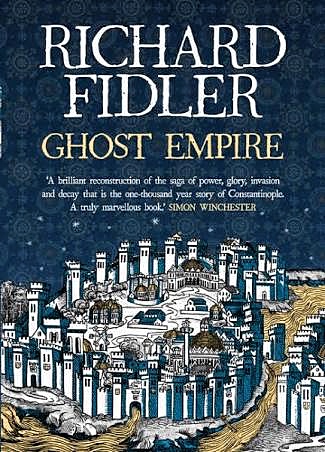
Although ‘Ghost Empire’ might in seem in parts overly breezy and lightweight, as an introduction to the ancient and wondrous city of Byzantium, Constantinople or Istanbul, it is an highly informative portal to weightier albeit less entertaining books. This is not to say it is without its more harrowing moments. Fidler dwells as much on the gory as on the glory. And indeed, for many, particularly the sons of emperors and sultans, confidants and conspirators, life could indeed be nasty, brutish and short.
Whilst Fidler’s primary focus is the story of the Byzantines, concluding with the fall of Constantinople in 1453, he travels back and forth in Istanbul’s long and storied history, between the violent past and the tumultuous present, from Julius Caesar and Constantine the Great, and the power couple Justinian and Theodosia, through Mehmet the Conqueror and Suleiman the Magnificent, to Ataturk and Erdogan, and captures the magic and at times, mayhem of the fabled metropolis that inspired WB Yeats to write:
“Once out of nature I shall never take
My bodily form from any natural thing,
But such a form as Grecian goldsmiths make
Of hammered gold and gold enamelling
To keep a drowsy Emperor awake;
Or set upon a golden bough to sing
To lords and ladies of Byzantium
Of what is past, or passing, or to come”
© Paul Hemphill 2017. All rights reserved
If Ghost Empire has whetted you appetite, i would recommend Bethany Hughes’ more substantial – “encyclopedic ” would a better description – Istanbul – A Tale of Three Cities (Orion 2017). It is a lengthy, comprehensive and fascinating journey from the prehistoric past to the polarizing present. There is also Simon Sebag Montefiore’s documentary, which personally, I found disappointing after his Jerusalem – The Biography.
Some photographs of Istanbul from our visit to Türkiye in 2014 follow …
For other posts about Türkiye in In That Howling Infinite, see: People watching in Sultanahmet, Ottoman Redux – an alternative history and The Watchers of the Water
Here are some reviews of Ghost Empire:
 Istanbul, from Galata Tower
 Cruising the Golden Horn
 The Sulaymaniya Mosque
 Aya Sofya
 The Hippodrome and the Blue Mosque
 The Fortress of Europe
 Valen’s Aqueduct
 Galata Tower
 Aya Sofya
 Aya Sofya
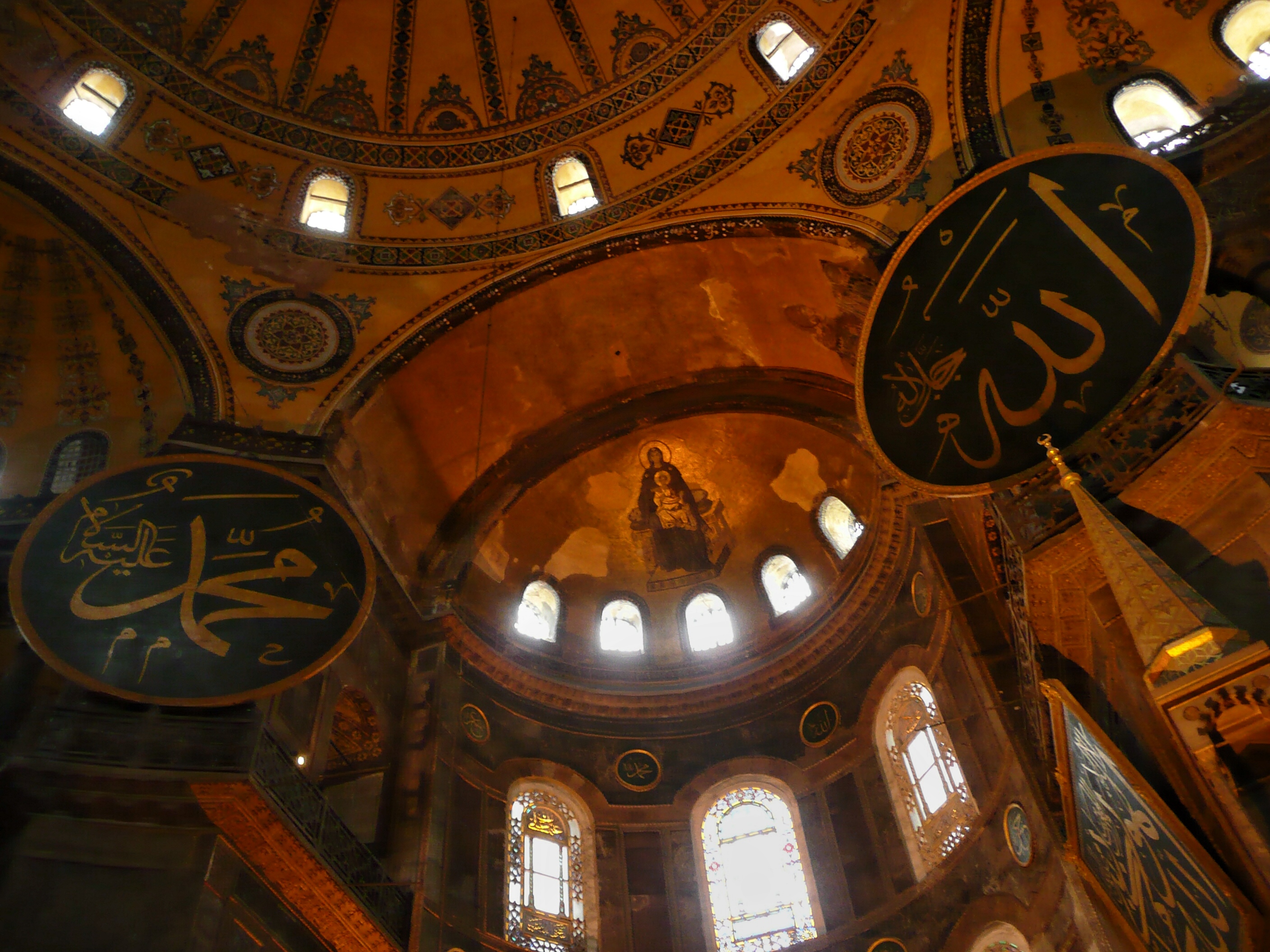 Aya Sofya
 Aya Sofya
 Halfden the Viking’s Grafitti in Aya Sofya
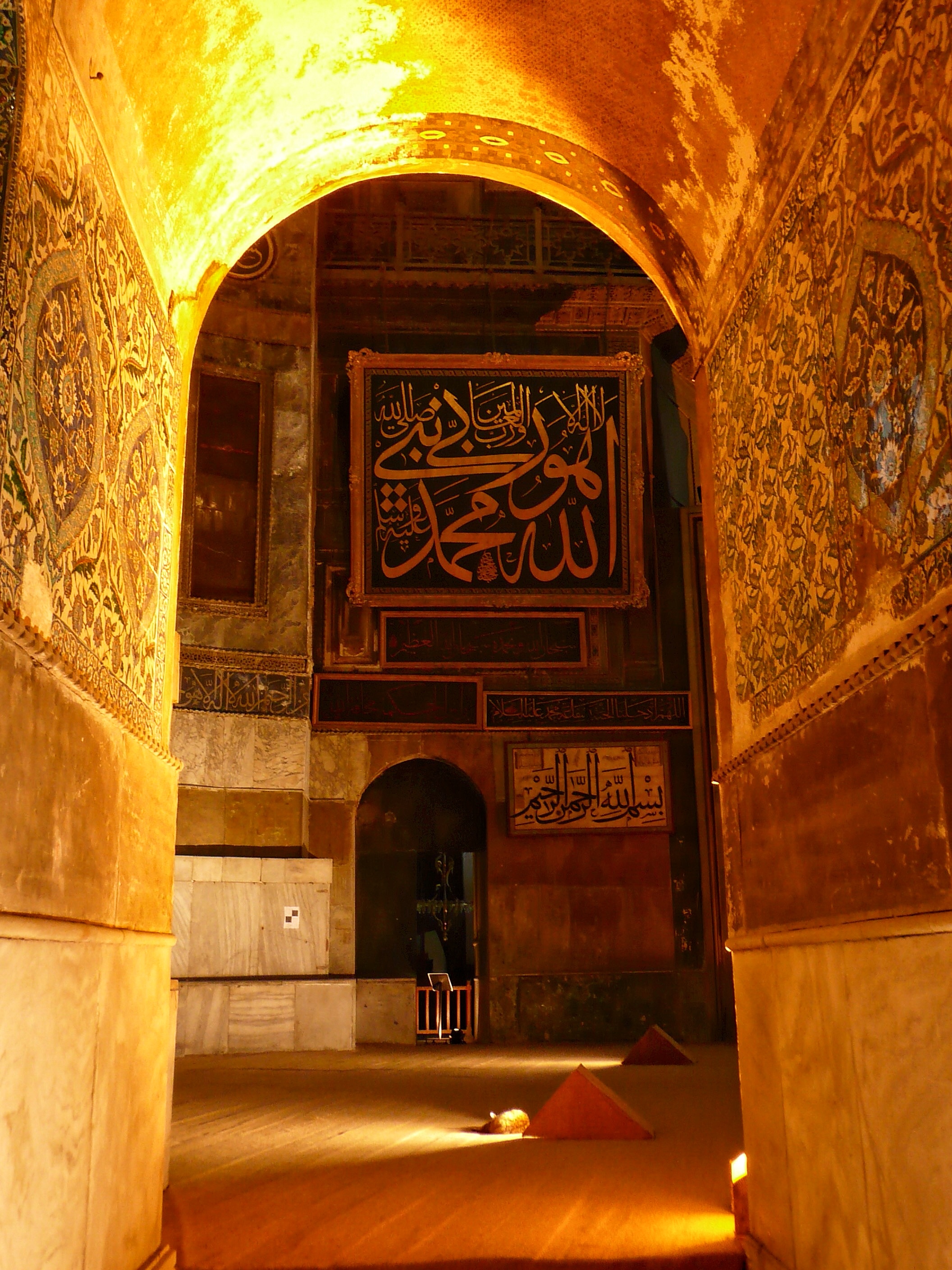 Aya Sofya
 Aya Sofya
 Sulaymaniya
 Justinian’s Cistern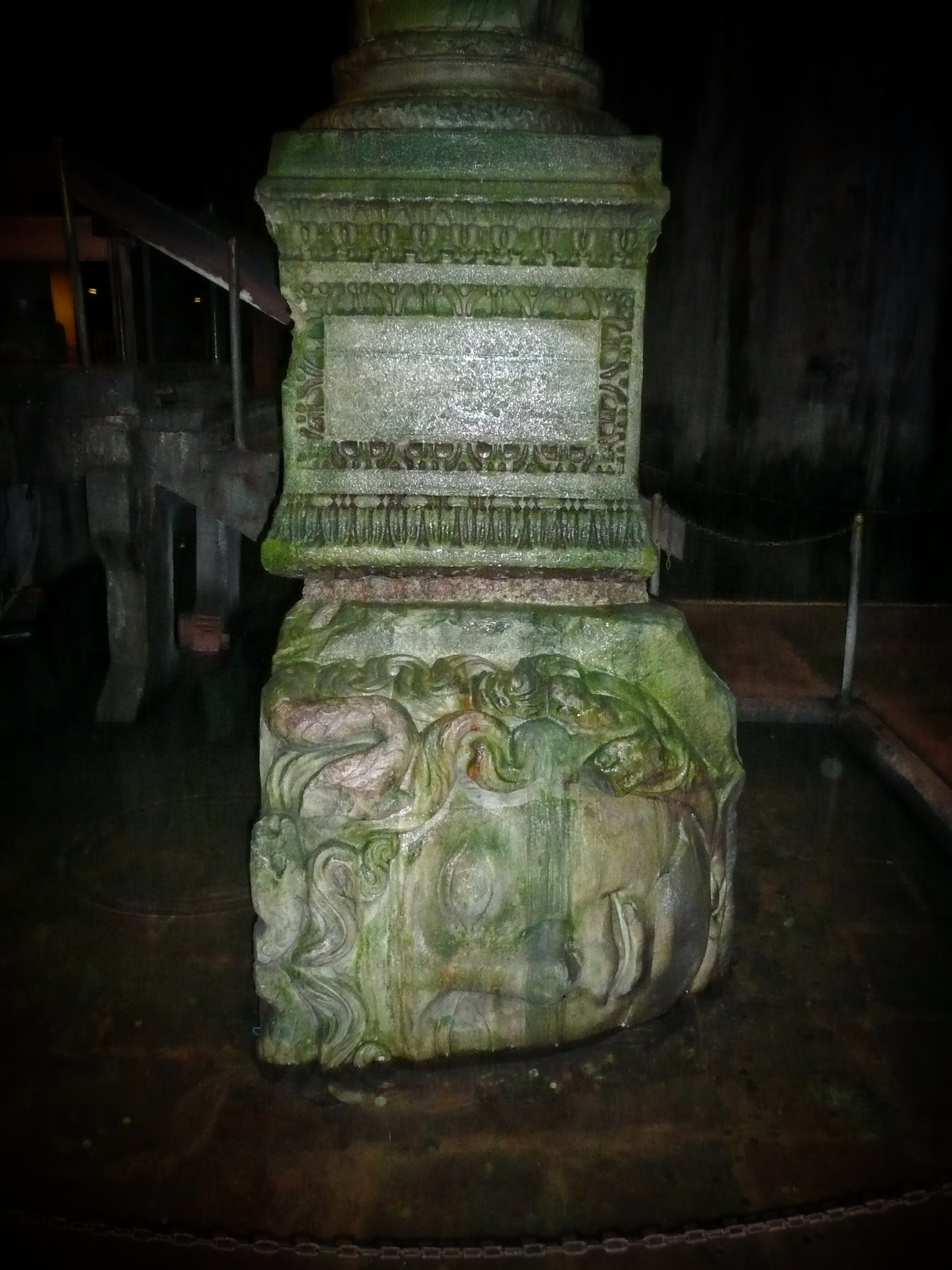
 Apollo and Medusa
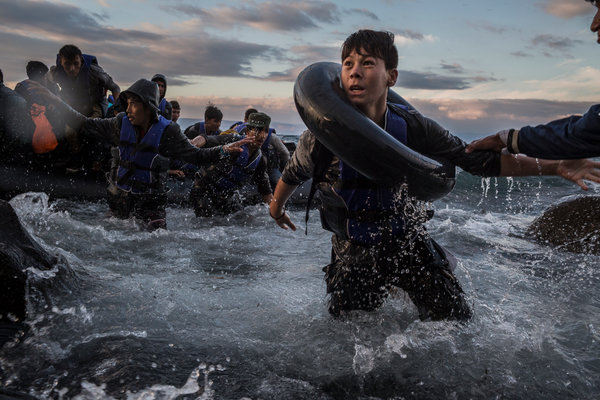
Never in modern times – since the Second World War – have there been so many refugees. There are over sixty nine million people around the world on the move today – people who have been forcibly displaced from their homes and are fleeing from persecution or conflict. Forty million people have been internally displaced within their own countries – including six million Syrians. Over 25 million are refugees in neighbouring countries and further afield -. 25% of them are in Turkey, Lebanon, Iran, Pakistan, and Uganda. five million are Syrians. These figures are of those registered by the UNHCR. The real numbers are much higher. [See below, The World Refugee Crisis in Brief, and The Refugee’s Journey]
Just imagine …
Millions are on the move – , and you are one of them.
Lebanese American BBC Journalist Kim Ghattas says well:
I often get asked why my family never left – or more pointedly, why my parents kept us there, dodging sniper fire on the way to school and back. The answer is this: We stayed because leaving is hard. Becoming refugees meant leaving our lives, our identity, and our dignity behind…No one’s first instinct is to leave. Their first choice is usually to hold on to the comforting familiarity of home; when that becomes impossible, you leave for another safer area within the country. Then you leave for a neighboring country, so you can return as soon as possible or even keep an eye on your property while you’re away. Only when the walls are closing in and the horizon is total darkness do you give up and leave everything you have ever known behind, lock the door to your home, and walk away.
Kim Ghittas, The Sad Fading Away of the Refugee Crisis, Foreign Policy 19th October 2015
no one leaves home until home is a sweaty voice in your ear
saying-
leave,
run away from me now
i don’t know what i’ve become
but i know that anywhere
is safer than here
Somali poet Warsan Shire, Home
A million spaces in the earth to fill, here’s a generation waiting still – we’ve got year after year to kill, but there’s no going home. Steve Knightley, Exile
Oh, the wind, the wind is blowing, through the graves the wind is blowing, freedom soon will come; then we’ll come from the shadows. Leonard Cohen, The Partisan
I pity the poor immigrant whose strength is spent in vain, whose heaven is like ironsides, whose tears are like rain. Bob Dylan, I Pity the Poor Immigrant
Just imagine …
What if you had to leave behind everything that you hold dear. Your identity, culture, language, faith. You job, your school. Your loved ones, your friends, and your play-mates.
What if you have to sleep with your shoes on so you are ready to run if your enemies are approaching your village? And then you have to flee your home and climb the mountain to escape, helping your youngsters and old folk up the rocky slopes in the summer heat, and there is nothing to eat or drink, and nothing you can do except wait for capture or rescue.
What would YOU do if you had but a short while to gather a few things together and run, leaving your whole life behind? What would you try and take with you?
Then you wash up, literally and figuratively, on foreign shores – in border refugee camps, dusty border towns or urban slums. And there you stay, with other tens, hundreds, thousands, maybe hundreds of thousands in like dire straits.
Until one day, you are selected for humanitarian settlement in a strange land at the other end of the earth.
That day may never come; so, impatient, frustrated, desperate, you use your family’s savings to pay smugglers and traffickers who prowl the desert and jungle camps like predators and the port cities of Turkey, Libya and South East Asia.
So you take to the seas in frail boats and brave the the deep and dangerous waters of the Mediterranean, the Adriatic and the Indian Ocean.
You might only have enough money for one passage, so you go on ahead and hope to send for your kin once you have reached safe haven.
You may be one of fortunate ones who make it – not one of those cast ashore, lifeless flotsam and jetsam like baby Aylan on his golden beach.
You are now one of tens of thousands in a river of desperate endeavour.
You walk the long miles of the unwelcoming highways of Eastern Europe to a German or Swedish sanctuary. You might end up in a detention camp in Italy or Spain, stranded in the Calais Jungle, or the harbours of Java and Sumatra.
Or else, you are parked in a hot and hostile makeshift camp somewhere near the Tropic of Capricorn.
Just imagine …
You have fled the terror of the warlords and the militias, the holy warriors and the ethnic cleansers.
You discover that the border camps of Jordan and Lebanon, Turkey and Afghanistan, Thailand and Malaysia, Kenya and Namibia have their own ecology of hardship and handouts, rape and robbery, beatings and bribes, illness and neglect, cursory and desultory treatment by overworked and under-resourced aid workers, and shake-downs by the criminals who thrive in these places and the cops who take a cut and turn a blind eye or else enforce punitive directives from politicians, parliaments and bureaucrats.
There, you and yours’ attempt to rebuild a semblance of a life-before amidst the tents and the shanties, the dust and the sewage, the summer’s heat and the winter’s cold. A mosque to pray in, a school for the children, games of football or backgammon for idle youth and menfolk.
You try to keep the children warm and fed and free of mortal illness; you try to keep the spirit alive in a time of anxiety, fear, threat, loss, and confusion, a time of hopeful emptiness and of empty hopelessness.

Zaatari refugee camp, Jordan July 2013
Just imagine …
You are one of the lucky few selected for settlement in the fabled, unknown ‘west’.
New lands, under foreign skies, different constellations, so far away it might as well be the moon.
You now dwell among strangers. You neither speak their language nor comprehend their ways or their foreign gods.
You have no friends or family to call on in time of need.
You must rebuild the basic buildings blocks of a normal life – where even the idea of a normal life has now changed utterly.
The houses, the streets, the shops, the money even – are all new.
The things you took for granted are no longer there, and in their place are new ways and means.
New systems and processes – social, welfare, health, education – with new rules and ways of getting things done. Going to the doctor, to the bank, to government offices.
Understanding that policemen and soldiers are not people you have to pay off or flee from.
Learning English.
Finding a home.
Getting the kids into a school.
Finding a job when your qualifications are not recognized, and work-ways are different to what you know.
The laws are new, the language is new, the way people dress and behave, talk, walk and eat is new.
Many new things are fascinating, tempting.
Others, confronting and insulting to your morality and values.
Some are alien, even, beyond your comprehension.
Codes of behaviour, dress, decorum, politeness, are new. Less formality, respect and deference; open displays of sexuality, affection, and rudeness that would not have been tolerated, permitted even, at home.
You don’t understand what makes the locals tick – their mannerisms, their speech, their body language, their concept of time and space, even.
And you are shocked and frightened by their hostility. Not all – just a noisy and troublesome few who talk quietly amongst themselves, or hurl abuse, or march through city streets with signs that scream, “go back to where you came from!”, “go home!”
Home?
There is no home.
Home is far, far away.
So far away, it might as well be on the moon.
Just imagine…
This is the new. And you still bear the cross of the old. The world you left behind is still with you.
You miss your family, your friends, and the comfort and support you all gave each other.
You miss your old life. The streets, the sounds, the smells. The weather and seasons. Your job, your status, your school, your neighbourhood.
You yearn for street and shop signs you could read, voices you understood on the radio and television, on the street, and on the buses.
You hate having to try and make yourself understood to officials and doctors, desk clerks and shop assistants, and even the supportive and ever helpful case workers whose mission is to help you get through all this.
You are homesick, and lonesome; you feel isolated, helpless, dependent.
There is a terrible ache in your heart and a rift in your soul.
And then there are the scars that won’t and perhaps can never heal. The psychological and physical effects of the events and experiences that forced you to flee your homeland.
Conflict and violence, intimidation and discrimination, torture and brutality, even. You have flashbacks, bad dreams, anxiety attacks, and actual physical and mental pain and anguish.
They say that PTSD is endless. There is no cure …
Just imagine…
You are a stranger in a strange land, and there’s no going home …
See also: Hejira
They that go down to the sea in ships, that do business in great waters; these see the works of the LORD, and his wonders in the deep. For he commandeth, and raiseth the stormy wind, which lifteth up the waves thereof. Psalm 107
Warsan Shire
no one leaves home unless
home is the mouth of a shark.
you only run for the border
when you see the whole city
running as well.
your neighbours running faster
than you, the boy you went to school with
who kissed you dizzy behind
the old tin factory is
holding a gun bigger than his body,
you only leave home
when home won’t let you stay.
no one would leave home unless home
chased you, fire under feet,
hot blood in your belly.
it’s not something you ever thought about
doing, and so when you did –
you carried the anthem under your breath,
waiting until the airport toilet
to tear up the passport and swallow,
each mouthful of paper making it clear that
you would not be going back.
you have to understand,
no one puts their children in a boat
unless the water is safer than the land.
who would choose to spend days
and nights in the stomach of a truck
unless the miles travelled
meant something more than journey.
no one would choose to crawl under fences,
be beaten until your shadow leaves you,
raped, then drowned, forced to the bottom of
the boat because you are darker, be sold,
starved, shot at the border like a sick animal,
be pitied, lose your name, lose your family,
make a refugee camp a home for a year or two or ten,
stripped and searched, find prison everywhere
and if you survive
and you are greeted on the other side
with
go home blacks, refugees
dirty immigrants, asylum seekers
sucking our country dry of milk,
dark, with their hands out
smell strange, savage –
look what they’ve done to their own countries,
what will they do to ours?
the dirty looks in the street
softer than a limb torn off,
the indignity of everyday life
more tender than fourteen men who
look like your father, between
your legs, insults easier to swallow
than rubble, than your child’s body
in pieces – for now, forget about pride
your survival is more important.
i want to go home,
but home is the mouth of a shark
home is the barrel of the gun
and no one would leave home
unless home chased you to the shore
unless home tells you to
leave what you could not behind,
even if it was human.
no one leaves home until home
is a damp voice in your ear saying
leave, run now, i don’t know what
i’ve become.

This Syrian mother and her child were rescued by the Greek Coast Guard.
Like death and taxes, the poor and racism, refugees have always been with us. But never in modern times – since the Second World War – have they been so many!
There are over sixty nine million people around the world on the move today – that have been forcibly displaced from their homes – fleeing from persecution or conflict.
This doesn’t count economic migrants who have hit the roads of sub Saharan Africa and Central America fleeing drought and crop failure, economic recession and unemployment, poverty, gangs and cartels, seeking a better life for themselves and the families in Europe or the USA.
Three quarters of a million ‘economic migrants’ are on the move in Central America, whilst the UN estimates that at least four million people have left Venezuela because of its political and economic crisis in what has been described as the biggest refuge crisis ever seen in the Americas. There are refugee camps on the Colombian border. Most are in Columbia but others have entered Brazil and Peru. But these are not by legal definition refugees – see below, The Refugees’ Journey .
Of those sixty nine million people over 11 million or 16% are Syrians. The numbers keep growing Thirty one people at being displaced every minute of the day. In 2018 alone, 16.2 million people were newly displaced.
Forty million people have been internally displaced within their own countries – this includes six million Syrians and off our radars, some two million souls who once lived in the contested regions of eastern Ukraine.
Over 25 million are refugees in neighbouring countries and further afield. 25% of them are in Turkey, Lebanon, Iran, Pakistan, and Uganda. Some 57% of them come from three countries: Syria, 6.3 million, Afghanistan 2.6 million and South Sudan 2.4 million. The top hosting counties are Turkey 3.5 million, Lebanon, 1 million, Pakistan 1.4 million, Uganda 1.4 million and Iran 1 million.
Jordan shelters over three quarters of a million Syrians; during the Iraq wars, this relatively poor country sheltered a similar number of Iraqis, and still hosts tens of thousands of Iraqi Christians who’ve fled persecution at home.
These figures are of those registered by the UNHCR. The real numbers are much higher. The Lebanese government estimates that there are more than 1.5 million Syrian refugees in the country.
Much of the focus these days is on the Middle East – Syria and its neighbours, on Libya and the frail boats crossing the Mediterranean, on the war in Yemen which has killed over thirteen thousand and displaced over two million.
But situation in Africa is as dire.
More than 2 million Somalis are currently displaced by a conflict that has lasted over two decades. An estimated 1.5 million people are internally displaced in Somalia and nearly 900,000 are refugees in the near region, including some 308,700 in Kenya, 255,600 in Yemen and 246,700 in Ethiopia.
By August 2018, the Democratic Republic of the Congo hosted more than 536,000 refugees from Burundi, the Central African Republic and South Sudan. And yet, there are over 4.5 million Congolese people displaced inside their own country and over 826,000 in neighbouring countries, including Namibia, Angola and Kenya.
Should the present situation in Sudan deteriorate into civil war, another tide of humanity will hit the road.
And closer to home, there are millions of refugees in Asia.
As of March 2019, there are over 100, 000 refugees in 9 refugee camps in Thailand (as of March 2019), mainly ethnic Karen and Shan. Refugees in Thailand have been fleeing ethnic conflict and crossing Myanmar’s eastern border jungles for the safety of Thailand for nearly 30 years.
There were an estimated 1 million Rohingya living in Myanmar before the 2016–17 crisis, and since August 2017, an estimated 625,000 refugees from Rakhine, had crossed the border into Bangladesh.
The top-level numbers are stupendous. The detail is scary.
Some 52% of the world’s refugees and displaced are children. And many are unaccompanied. Every hour, around 20 children run for their lives without their parents to protect them.
Children are the most vulnerable to disease and malnutrition and also to exploitation and lose years of schooling. Millions are elderly and are also face health problems.
And the problems facing young people and adults are all enormous. International aid is limited and host countries often unsympathetic. Work opportunities are few, some countries even forbidding refugees to take work, whilst unscrupulous employers exploit the desperate. Migrants are often encouraged, sometimes forcibly, to return to their countries of origin regardless of whether or not it is safe for them to return. There are reports that many have returned to Syria into the unwelcoming hands of the security services.
Refugees have lived in camps and towns in Pakistan and Thailand, Namibia and Kenyan for decades. Most refugee children were not born in their parents’ homelands.
And the camps are by no means safe havens. There may be no shelter or only basic shelter in tents; no privacy; a lack of clean water; meagre food; limited medical care; and the threat of injury, disease and epidemics. They may be poor physical security and armed attacks, and abuse by the authorities and officials. There may be organized crime, shakedowns and extortion, corruption and bribery.
Families may have become separated, exposing women and children without the protection of male family members to more fear and violence. Women are subsequently vulnerable to harsh conditions, including potential sexual and physical and abuse, poor healthcare, and unequal access to food and water. They may be coping with the loss of the head of the family and with the changing roles and responsibilities that come from being the sole parent. They may not know if their male family members will return to them safely and they must deal with the stress and anxiety, the grief and loss arising from their recent experiences. They might be fearful of the future, which in a camp is unknown and unpredictable
Of all displaced peoples, 17% of them are being hosted in Europe. According to recent data published by the UNHCR, Germany is home to the most refugees by far in Europe – 1.4 million in total. By comparison, France and Sweden have 402,000 and 328,000 respectively, and the UK, 122,000.
Australia’s contribution to the world’s refugee problem is but a drop in the ocean. But we have a long established humanitarian refugee settlement programme for people officially recognized as refugees by the UNHCR and selected for third-country settlement in Australia.
Our humanitarian migration intake for 2016 -17 was the highest year on record. The intake of 24,162 was some 10% of our broader migration program which saw 225,941 permanent additions to the Australian population, and included the special intake of Syrian and Iraqi refugees (an estimate 12,000 places over several years).
The figures are 17,500 in 2017-18 and similar in 2018-19, whilst Scott Morrison has pledged to freeze the number of humanitarian arrivals for the next term. Under the policy there will be an overall target of 60 per cent of the offshore component for women, up from 50.8 per cent in 2017-18. The Government will also push to increase the number of refugees and humanitarian entrants being settled in regional Australia from a target of 30 per cent to 40 per cent in 2019-20, whilst insisting that new arrivals will only go to areas where there is strong community support.
Coffs Harbour is one of several refugee intake towns in NSW, along with Armidale, Newcastle, Wollongong and Wagga Wagga. It’s medical and educational facilities have….
Coffs Harbour hosts several organizations dedicated to helping former refugees settle in Australia. They arrive in Australia on specific humanitarian visas and become permanent residents the moment they are admitted into the country. – and hence cease to be refugees.
SSI looks after them when they first arrive in Coffs Harbour. North Coast Settlement Services, a division of Saint Vincent de Paul Society, takes over once SSI’s work is done – after between six and eighteen months depending on a family’s needs, whilst the privately run Sanctuary organization assists settled migrants with such matters as family reunion and employment. An ancillary NSW government agency, the NSW Service for the Treatment and Rehabilitation of Torture and Trauma Survivors (STARTTS), assists new arrivals with psychological support, and particularly, the effects of PTSD. STARTTS services include counseling, group therapy, group activities and outings, camps for children and young people, English classes and physiotherapy
I spend two days a week as a volunteer with Settlement Services International, a Sydney-based community organisation that administers the Humanitarian Settlement Program (HSP) which supports refugees from the moment they arrive at the airport, provides essential support and information to assist refugees settle in Australia and empower them to gain independence and build strong connections in their new communities. SSI helps with the needs of new arrivals and the challenges of settling in a new country. Its aim is to enhance self-reliance with a focus on English language skills, education and job readiness.
SSI administers the Humanitarian Settlement Programme in several centres in regional NSW, including Coffs Harbour, Newcastle and Armidale. In all three areas, SSI has teams of staff on the ground who work with refugees, humanitarian entrants and their local communities to help new arrivals to through their initial settlement. The SSI team includes case managers and volunteers from the local community and from the refuge community itself
SSI’s work includes meeting and greeting, arranging temporary accommodation on arrival; orientation, including familiarization with Australian ways, our services and institutions, and getting around Coffs Harbour; basic official matters like Centrelink, banking, and health services; English classes at TAFE and enrolling children at schools; dealing with real estate agents, rental leases and looking after their rental properties.
When first volunteering, I worked for Anglicare. New arrivals were largely from Myanmar and Congo – mostly Christians – and from Afghanistan. Many of the latter came to Australia under the “woman at risk” programme – mothers and children with no father. Whilst all are Muslim, many were Shia Hazaras, a Turkic people persecuted by the Sunni Taliban. Since SSI took over from Anglicare in September 2017, whilst Burmese and African families continue to arrive, the emphasis has been on Yazidis from Iraq and Syria, and particularly from the Yazidi heartland of Sinjar in northern Iraq, where they endured enormous suffering and hardship at the hands of the Islamic State. Considered infidels by Da’ish, they were targets of a campaign of genocide from 2014. More than five thousand were killed, and some five to seven thousand were abducted and enslaved – mainly women and children. Such was the danger that the UNHCR and the Australian and other governments took whole families straight out of the war zone rather than from camps outside Iraq.
Yazidis are ethnically Kurdish, and their language, Kurmanji, is Kurdish. Their society is hierarchical and endogamous. Their religion, Yazidsm, is a monotheistic religion and has elements of ancient Mesopotamian faiths, including ancient Persian Mithraism, and some similarities to the Abrahamic religions, Judaism, Christianity and Islam. Because Yazidis believe in reincarnation and turn to the direction of the sun when praying, it has been thought – erroneously, that the religion has its origins in ancient Persian Zoroastrianism and Hinduism. They believe in the one god, the creator of all things, who delegated the ongoing management to a heptad of seven holy beings or angels, the chief of whom is Malek Taus – the Peacock Angel.
Malek Taus has in the past been associated, by Muslims and Christians, with Iblis, Satan, and the fall of proud Lucifer. This misinterpretation has led, historically, to Yazidis being perceived as devil worshipers, and thus being subject to persecution and pogrom. The atrocities of Da’ish were only different from past assaults and massacres in their scale and longevity.
Whilst case managers specifically look after the new arrivals, they depend upon a team of volunteers to assist them in a wide variety of tasks that we locals take for granted. for example: taking new arrivals them to medical or bank appointments, showing them how to use the bus network, setting up accommodation prior to arrival, minding children whilst parents attend appointments, and even helping folk to purchase use lawn mowers – there are few lawns in Iraq and Afghanistan.
As a volunteer, past and present tasks have included walkabouts to familiarize new arrivals with Coffs Harbour, accompanying clients to house inspections when seeking new rental accommodation, and assisting with rental application forms; sending important documents like birth, marriage and education certificates to Social Services’ translation service for official translations; helping clients to apply for bus concession cards, school bus cards, and children’s sport vouchers; and assisting with NBN plans and connections. I have fixed broken cupboards, replaced light bulbs, checked out washing machines and kitchen stoves. and taking families to school interviews.
As I can get by with spoken Arabic and can read and write the language, and as i am reasonably proficient with computers, I have helped with online applications and prepared resumes. I have shown clients how to budget their money, and have run a class on how to set up and use smart phone calendars to help them make and keep appointments. On occasions, I am asked to just drop in on clients to see how they are getting on, and sort any basic house problems.
My most rewarding experiences have been: assisting case managers at the airport when the clients first arrive. It’s a very emotional moment for all involved; Taking families who have never seen the sea before to the seaside; helping a clients get a job; and helping STARTTS run a youth group for children and young people by registering the young attendees
Since my twenties, I’ve had an interest and, indeed, a passion for the Middle East, its history and politics, its people and culture, its languages and religions. I’ve travelled often to the region, and have studied it formally and as a hobby. I learned standard Arabic in the seventies and worked in academic and government research. Though I took a very different road for two decades, I returned to Syria in the noughties and got back into Arabic both standard and colloquial (two relatively distinct languages).
On retirement, I wanted to do volunteer work, and by happenstance, Coffs Harbour was a refugees intake town with several organizations dedicated to assisting new arrivals. At first, I used my knowledge of Arabic script to assist Farsi-speaking Afghans, and then the Iraqi and Syrian Yazidis arrived. Though their native tongue is Kurdish Kurmanji, and few could speak English, many spoke Arabic. SSI had several Arabic speaking support-workers, and some new arrivals had good English and now work as Arabic and Kurmanji speaking support staff, I am able to step in when they are already booked. Who’d ever have thought I’d be able to use and grow my Arabic in Coffs Harbour.
Who is a migrant? Who is a refugee? Who is an asylum seeker?
A migrant is a person who makes a conscious choice to leave their country to seek a better life elsewhere. Before they decide to leave their country, migrants can seek information about their new home, study the language and explore employment opportunities. They can plan their travel, take their belongings with them, and say goodbye to the important people in their lives. They can continue to phone friends and family, or write, email or Skype them without fear of adverse consequences. They are free to return home at any time if things don’t work out as they had hoped, if they get homesick or if they wish to visit family members and friends left behind.
People who choose to migrate for economic reasons are sometimes called “economic refugees”, especially if they are trying to escape from poverty. But they are not recognized as refugees under international law. The correct term for people who leave their country or place of residence because they want to seek a better life is “economic migrant”.
However, the displacement of people caused by such economic circumstances, or by natural disasters like flood, drought or extreme weather, can contribute towards political, social and ethnic tensions that can precipitate refugee crises. Effective and timely external assistance from neighbours and donor nations will often help to avert this. Aid is therefore provided in an effort to keep people in their homes or in their home countries.
The 1951 United Nations Convention relating to the Status of Refugees states:
“Any person who owing to a well founded fear of being persecuted for reasons of race, religion, nationality, membership of a particular social group or political opinion, is outside the country of his/her nationality and is unable, or owing to such fear, is unwilling to avail himself/herself of the protection of that country.”
Refugees are forced to leave their country because they are at risk of, or have experienced persecution. Their concerns are human rights and safety, and not economic advantage. They leave behind their homes, most or all of their belongings, family members and friends. Some are forced to flee with no warning, and may not be able to say goodbye to friends and family, and may never be able to contact or see them again.
Many refugees have experienced significant trauma or been tortured or otherwise ill-treated. Their journey to safety is fraught with hazards, many risking their lives in search of protection. They cannot return home unless the situation that forced them to leave improves.
Location is all important. During civil unrest and conflict, people may be forced to leave their homes, but do not leave their country. These internally displaced persons (IDPs) are often referred to as refugees. But, whilst refugees and IDPs may flee for similar reasons, their legal status is very different. Whilst remaining within the borders of their home countries, IDPs are legally under the protection of their own government, even in cases where the government’s actions are the cause of their flight. A person cannot be recognized as a refugee unless they are outside their home country.
These seek protection as refugees, but their claim for refugee status has not yet been assessed. Many refugees have at some point been asylum seekers, that is, they have lodged an individual claim for protection and have had that claim assessed by a government or UNHCR.
Some refugees, however, do not formally seek protection as asylum seekers. During mass influx situations, people may be declared “prima facie” refugees without having undergone an individual assessment of their claims, as conducting individual interviews in these circumstances is generally impracticable (due the large numbers involved) and unnecessary (as the reasons for flight are usually self-evident). In other cases, refugees may be unable to access formal status determination processes or they may simply be unaware that they are entitled to claim protection as a refugee.
It is important to note that refugee status exists regardless of whether it has been formally recognized. People do not “become” refugees at the point when their claims for protection are upheld – they were already refugees, and the assessment process has simply recognized their pre-existing status. People become refugees (and are entitled to international protection and assistance) from the moment they flee their country due to a well-founded fear of persecution, as stipulated in the Refugee Convention.
The most common causes are war and civil unrest, persecution for political or religious beliefs, or ethnic and racial identity, and human rights violations by government authorities or rogue militias. There could be extreme political instability and fighting; assassinations of people associated with certain political or social groups; arbitrary arrest and torture, mutilation and degradation that can happen without warning; routine sexual violence towards women and girls; forced conscription of child soldiers, forcing families to flee to protect their children; and conscription for slave labour. Governments are unable to protect their citizens, and may actively participate in violations, leaving people with no place or person to turn to for protection.
Often people will hang on, hoping things will improve. Flight is the last option because it means leaving everything behind – home, possessions, jobs, education, family and friends, language, culture and identity. People are often forced to flee with very little warning, no time to collect identity documents or precious things, or say farewell to family, friends and neighbours. They may have to travel long distances, often on foot or in small boats, and through dangerous territory or waters. They may go for long periods without food and water. They may become in danger of being intercepted, robbed or recruited, raped or killed, imprisoned or repatriated.
The fortunate might reach a camp or other place of relative safety. In the camp there may be no shelter or only basic shelter in tents; no privacy; a lack of clean water; meagre food; limited medical care; and the threat of injury, disease and epidemics. They may be poor physical security and armed attacks, and abuse by the authorities and officials. There may be organized crime, shakedowns and extortion, corruption and bribery.
Families may have become separated, exposing women and children without the protection of male family members to more fear and violence. Women are subsequently vulnerable to harsh conditions, including potential sexual and physical and abuse, poor healthcare, and unequal access to food and water. They may be coping with the loss of the head of the family and with the changing roles and responsibilities that come from being the sole parent. They may not know if their male family members will return to them safely and they must deal with the stress and anxiety, the grief and loss arising from their recent experiences. They might be fearful of the future, which in a camp is unknown and unpredictable
The office of the United Nations High Commissioner for Refugees (UNHCR) is mandated by the United Nations to protect refugees and help them find solutions to their plight. It has over 4,000 staff in 120 countries and an annual budget of about US$1 billion. In addition to legal protection, UNHCR now also provides material relief in major emergencies either directly or in partnership with other agencies.
Refugee protection is covered by International Human Rights Law, and this sits within a broader framework of international law. The agency responsible for the oversight of international human rights law is the Office of the United Nations High Commissioner for Human Rights (UNHCHR).
Refugees are accorded certain rights under international law, including
The role of the UNHCR is to
Refer: http://www.refugeecouncil.org.au/fact-sheets/international-issues/durable-solutions/
Whilst the UNHCR strives for “durable solutions”, the reality of the global refugee problem is that many countries hosting refugees embrace “non-durable” solutions such as:
Settlement and Arrival
Refugees are selected for settlement in Australia by the Department Immigration and Border Protection, in conjunction with the UNHCR. Before arriving in Australia, humanitarian entrants are required to go through security and health checks.
The Australian Cultural Orientation program (AUSCO) is provided to humanitarian visa holders who are preparing to settle in Australia. The program provides practical advice and the opportunity to ask questions about travel to and life in Australia. It is delivered overseas, before they begin their journey. The International Organization for Migration (IOM) is currently contracted to deliver AUSCO on behalf of the DIBP.
The average length of time spent in a camp or in a place of first refuge is 17 years, and migrants may have little experience beyond this. Children may not even have known their home country. Many will have experiences extreme instability and uncertainty. Being selected for resettlement can be an overwhelming experience, and can include feelings of intense elation on one hand and fear and anxiety on the other.
Under such circumstances, a person may not always be aware of the potential difficulties of resettlement. On arrival, feelings can quickly move from elation and joy to culture shock, resentment, dislocation and confusion. It can take months, years even, for new arrivals to understand aspects of their new country and adapt to it.
Much of above material is taken from:

A song about Gallipoli, sung by a Turkish soldier
Monday 25th April is Australia and New Zealand’s national day of remembrance for all Anzac solders killed and wounded in their nation’s wars, and to honour servicemen and women past and present. At first, the Anzacs fought in the British Empire’s Wars, beginning with the Boer War, and then through two World Wars. From the mid -twentieth century, they have fought and died in what could ostensibly be called America’s wars even though these were waged under UN, EU or western alliance auspices: Korea, Gulf Wars II and III, Afghanistan, and the current interventions in Syria and Iraq. Incidentally, Australian veterans commanded mercenary forces hired by Saudi Arabia and the United Arab Emirates that laid waste to towns and villages in Yemen during its recent civil way – with the help of American and British weaponry.
At the heart of the Anzac Day remembrance is the Australian and New Zealand Army Corps’ role the Dardanelles campaign of 1915-16, Winston Churchill’s grandiose and ill-conceived plan to take the Ottoman Empire out of the war by seizing the strategic strait between the Black Sea and the Mediterranean, thereby threatening Istanbul, the Ottoman capital. It was a military failure. From the initial seaborne assault to the evacuation, it lasted eight months and cost 114,000 lives with 230,000 wounded.
In 1915, Australians greeted the landings at Gallipoli with unbridled enthusiasm as a nation-making event. But it wasn’t long before they were counting the dreadful cost. More than 8000 Australians died during the Gallipoli campaign. As a loyal member of the British Empire, Australia eventually sent 330,000 men overseas to fight for the King. Volunteers all, not all of them white men – despite the authorities policy of recruiting only Australians of Anglo-Celtic stock, their ranks included many indigenous, Chinese and others. By the time the war ended in 1918, 60,000 of them were dead. As the late historian Ken Inglis once pointed out: “If we count as family a person’s parents, children, siblings, aunts and uncles and cousins, then every second Australian family was bereaved by the war.
[As for the Anzac Day march], I’d say only returned people could march. And then the day would come, I’d hope, when there’d be the last person marching, the last survivor as it were. And I’d think what a great day that would be … because it would mean we’d been at peace for a long time. And that’s what those men in the First World War were fighting for.”
Bill Gammage, historian and author of The Broken Years.
Gallipoli is cited as the crucible of Australian nationhood, but the Anzacs’ part in the doomed campaign was but a sideshow of the wider campaign. Although it is celebrated in Australian song and story, it was the Ottomans’ most significant victory in the war that was to destroy the seven hundred year old Ottoman Empire secure the reputation of its most successful general Mustafa Kemal, who as Ataturk, became the founder of modern Turkey.
Some thirty four thousand British soldiers died on the peninsula, including 3,400 Irishmen, and ten thousand Frenchmen – many of these latter being “colonial” troops from West and North Africa. Australia lost near on ten thousand and NZ three. Some 1,400 Indian soldiers perished for the King Emperor. Fifty seven thousand allied soldiers died, and seventy five thousand were wounded. The Ottoman army lost fifty seven thousand men, and one hundred and seven thousand were wounded (although these figures are probably much higher). An overlooked fact is that some two thirds of the “Turkish” solders in Kemal’s division were actually Arabs from present day Syria, Israel and Palestine – and a small number of European Jews who had settled there and who as Ottoman citizens were subject to conscription.
Gallipoli was indeed a multicultural microcosm of a world at war.
Whilst the flower of antipodean youth is said to have perished on Gallipoli’s fatal shore, this was just the overture. Anzac troops were despatched to the Western Front, and between 1919 and 1918, 45,000 Aussies died there and 124,000 were wounded.
Once upon a war, the Dardanelles Campaign of 1915-16 was a sideshow to the bigger theatres of the Eastern and Western Fronts. To some, it was a reminder that they could not stomach Winston Churchill for this was said to be his greatest stuff up in a career replete with such (although they would admit that he more than exonerated himself his and Britain’s Finest Hour). For many Australians and New Zealanders, it was a national baptism of fire, of youthful sacrifice on the altar of Empire. And notwithstanding the military defeat and retreat, the folly and foolhardiness, in the harrowing adversity and heroism, lay the bones of a young country’s enduring creation myth.
Former soldier James Brown, Anzac’s Long Shadow
There are abundant primary and secondary sources relating to the Dardanelles campaign and the Anzacs, but here is a wiki primer: Gallipoli Campaign
Back in the last century, before ANZAC Day became the secular Christmas that it has become, before marketing people and populist politicians saw its commercial and political potential, before the fatal shore became a crowded place of annual pilgrimage, my Turkish friend, the late Naim Mehmet Turfan, gave me a grainy picture of a Turkish soldier at Gelibolu carrying a large howitzer shell on his back. Then there was this great film by Australian director Peter Weir, starring young Mel Gibson and Mark Lee. There were these images of small boats approaching a dark and alien shore, of Lighthorsemen sadly farewelling their Walers as they embarked as infantry, and of the doomed Colonel Barton humming along to a gramophone recording of Bizet’s beautiful duet from The Pearl Fishers, ‘Au fond du temple saint’ before joining his men in the forlorn hope of The Nek.
There were other melodies I could never quite get out of my head. One I first heard in a musical in Beirut before that magical city entered its Dark Ages – Al Mahatta, written by the famous Rabbani Brothers and starring the Lebanese diva Fayrouz. And The Foggy Dew, one of the most lyrical and poignant of the Irish rebel songs:
Right proudly high over Dublin town, they hung out the flag of war. ‘Twas better to die ‘neath that Irish sky than at Suvla or at Sud el Bar…Twas England bade our Wild Geese go that small nations might be free, But their lonely graves are by Suvla’s waves or the fringe of the grey North Sea.
Over three thousand Irishmen died at Gallipoli.
The song grew out of these many inspirations.
It was first performed in public by HuldreFolk in the closing concert of Coffs Harbour Folk Festival at the RSL on Australia Day 1984. When we had finished, there was absolutely silence in the hall. Then a voice cried out “the sky didn’t fall down!”, and the hall erupted with applause.
And here is HukdreFolk’s rendering of Russian poet Yevtushenko’s account of the parade of German prisoners of war through the streets of Moscow in 1941, juxtaposed with The Watchers of the Water.
Anthem for Doomed Youth
Wilfred Owen
What passing-bells for these who die as cattle?
Only the monstrous anger of the guns.
Only the stuttering rifles’ rapid rattle
Can patter out their hasty orisons.
No mockeries now for them; no prayers nor bells;
Nor any voice of mourning save the choirs,—
The shrill, demented choirs of wailing shells;
And bugles calling for them from sad shires.
What candles may be held to speed them all?
Not in the hands of boys, but in their eyes
Shall shine the holy glimmers of goodbyes.
The pallor of girls’ brows shall be their pall;
Their flowers the tenderness of patient minds,
And each slow dusk a drawing-down of blinds.
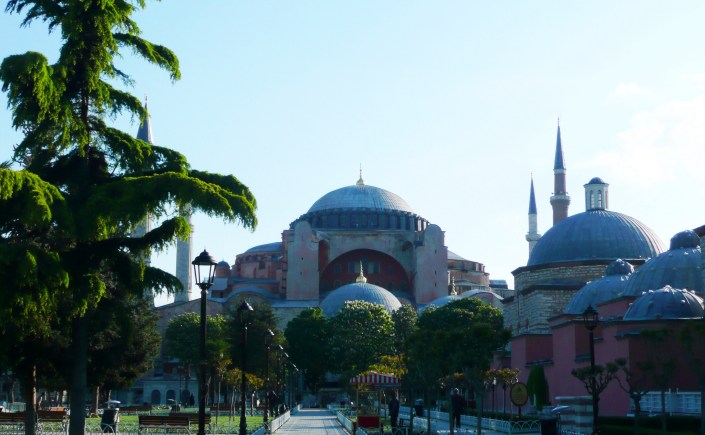
There would be later times (1965, 67, 69…) but I remember the first time. 1962. Having hitched through Europe and arriving in Istanbul. That special feeling. From Sultan Ahmed looking across the Bosporus towards the East, unknown roads and places and in the far distance a very vague idea of India…. Istanbul as a gateway to other worlds and new adventures….I was a young man drifting and dreaming, there were no guidebooks and I had not met anybody who had done the journey or heard stories from the road ahead….. The world was open, and I was ready….
Torben Huss, photographer
Haydarpasha Gan, late November 1972.
The last station on the line, and the end of Asia, after a twenty four hour train journey across Anatolia, from Teheran, including a wintry ferry ride across Lake Van, in the East, in the company of an idiosyncratic and proselytizing German pastor and a Pakistani student. The student and I quickly converted to Lutheranism just to shut him up.
There were no bridges across the Bosphorus in those days. Just the ferry that met the train to take us across to the Golden Horn to Eminou. And thence, a walk up to Sultanahmet, with the address of a doss house given to me by someone I’d met in Meshad near the Persian-Afghani border. A space on a floor for a few lira a night.
And then several weeks in Istanbul on two dollars a day, sleeping on the floor at what today would be called a backpacker’s hostel, broke and waiting for money to be sent from England. Weeks spent wandering the streets, wondering at the mosques and markets, getting stoned (dangerously in those days – remember ‘Midnight Express’?) in the Hippodrome, and dining cheaply morning, noon and night at the Pudding Shop.
Forty years on, and naturally, things have changed in many ways. Haydarpasha is closed for renovations and a rail link crosses the Bosphorus by undersea tunnel. There are now are two impressive suspension bridges.
Asian Istanbul, more of a sleepy suburb then, with some fine buildings scattered along the shore, is now a metropolis in its own right. And Istanbul is a city of thirteen million people.
The Pudding Shop is now world-famous on account of its hippie credentials and sells all kinds of good Turkish tucker, but a shadow of its former simplicity. Where once there thronged ragged and rangey adventurers on their journey east or west, tourists of all nations gather en masse.

The Pudding Shop 1969
Turkey in general, and Istanbul in particular, is now the place to be and the town to see – in these troubles times, it is a safe ‘Middle Eastern’ holiday destination, and a big cross on the cruise map. Almost every day, a fleet of giant liners ties up on the Yesilkoy quay. And their cargo soon materializes in Sultanahmet to view the BIg Four: the Blue Mosque, Aya Sofya, Topkapi Seray, and the Grand Bazaar. No time for the simple grandeur of the Sulaymaniyah Mosque, the other-worldliness of Byzantine Emperor Justinian’s vast underground cistern, or the aromatic gorgeousness of the Spice Bazaar down by the quays of Eminou.
Though no longer the exotic, half-east-half-west departure lounge for the old hippie trail, Istanbul is still a contradiction of past and present, trash and treasure, modernity and medaevilism. The dialectic is still evident, and maybe more so, between the ever changing now and the ever-present then, in the forever magical monuments and mosques, in the contrast between the modern young Turks in their western gaberdine and the many muhajibiin and well-covered conservatives.
Scratch Istanbul’s surface, and you will find a tangle of medieval streets and 21st Century traffic jams, bad drivers, and worse pavements. Walkers watch out!
And there is a poorer, working class, and even rural Istanbul. Suburbs just off the tourist map, where old men gather outside chai shops smoking, chatting and playing cards, and where women are rarely seen – when they do, most are covered.
Many Turks have come in from rural areas, and are still clad in traditional garb. There are now hundreds, maybe thousands of Syrian refugees in Istanbul now, seeking shelter from the storm in their sad and devastated homeland, and other Arabs fleeing the bitter winter that has followed the Arab Spring. Some rent apartments for their families, others beg in the streets.
As we walked along the highway that boarders the ancient walls and the Bosphorus, a speeding car hit an elderly Syria as he was crossing the dangerous road. We and his distraught family rushed to his aid, and mercifully he was unharmed but in shock, and did not want an ambulance. We placed him in a the comfortable position and I advised the young men with him in Arabic to keep a watch over him and to watch his eyes.
In contrast to these wandering souls, well-heeled Gulf Arabs arrive with too much money and too little taste. Istanbul is viewed as more stable, cosmopolitan, and naughty than tense and tenuous Beirut, and these wealthy visitors often seek to buy property here.
All the contrasts and contradictions are presently being played out in the politics and economics of this modern Turkey, and in the street protests, tear gas, and riot gear across the Golden Horn, up the hill around Taksim and Gezi Park, and across the suspension bridge. Partisans of Prime Minister (now presiden) Erdogan bump up against the Gulenists, followers of an exiled but influential dissident, and against the ever-ardent bearers of Kemal Ataturk’s torch. Folks still revere him as the Father of The Turks, but times change, some say, and so then must Ataturk, although the old man must spin some in his revered grave.
People say that Turkey is a divided nation right now. And this is manifested in accusations of creeping Islamization, counter-accusations of occidental decadence and depravity, allegations of corruption and cronyism, and street violence and police brutality. Back into November 1972, Military Rule was the norm, and dissent was silenced. Turkey was Asian, and Middle Eastern. Now the country still straddles east and west, coughing the European Union with much leas enthusiasms than hitherto or and presenting as the go-between ‘twixt The West and and Iran, and with the volatile lands to the south.
For better or ill, how things have changed.
© Paul Hemphill 2014. All rights reserved
 Torben Huss, Eminonu 1965
For other posts about Turkey in In That Howling Infinite, see: People watching in Sultanahmet, Sailing to Byzantium, Ottoman Redux – an alternative history and The Watchers of the Water
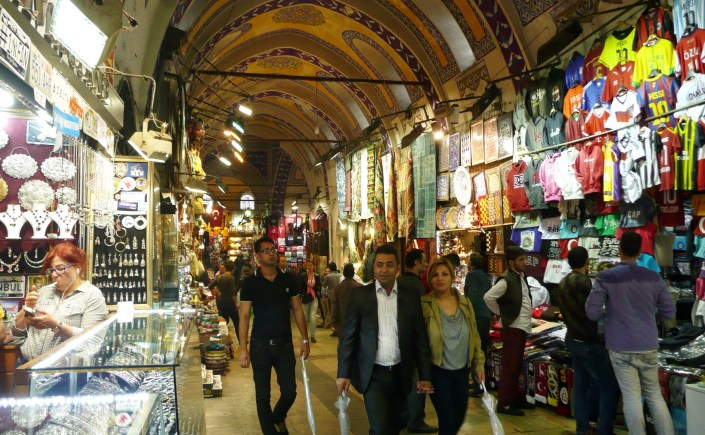
‘If you know your history, then you know where you coming from. Then you wouldn’t have to ask me who the ‘eck do I think I am’. Bob Marley, Buffalo Soldiers.
People watching in Sultanahmet on a wet Saturday afternoon in Spring.
It’s very like people watching in Newtown, Sydney.
The history of Istanbul, of Turkey, of the Turkish people, is written in the faces of the passersby. There is no pure Turk, just as there is no pure Arab, Jew, Slav, Celt, or Caucasian. Indeed, you see them all passing by. And it has been raining these past two days. The umbrella sellers are making a killing with their see-through parapluies. Everyone, tourists and locals alike are sporting them.
The weekend is promenade time. Families parade up and down, past the pastry and kebab shops, the hawkers and the hustlers. Young men sidle by with their girls, girls walk out with their honeys. Groups of girlfriends, and boy-groups gather and gaggle and gossip. Western folk and eastern folk. This is where east and west meet, literally, figuratively, ethnically, and yes, geographically. And it is written on the faces and in the garb of the perambulating populace.
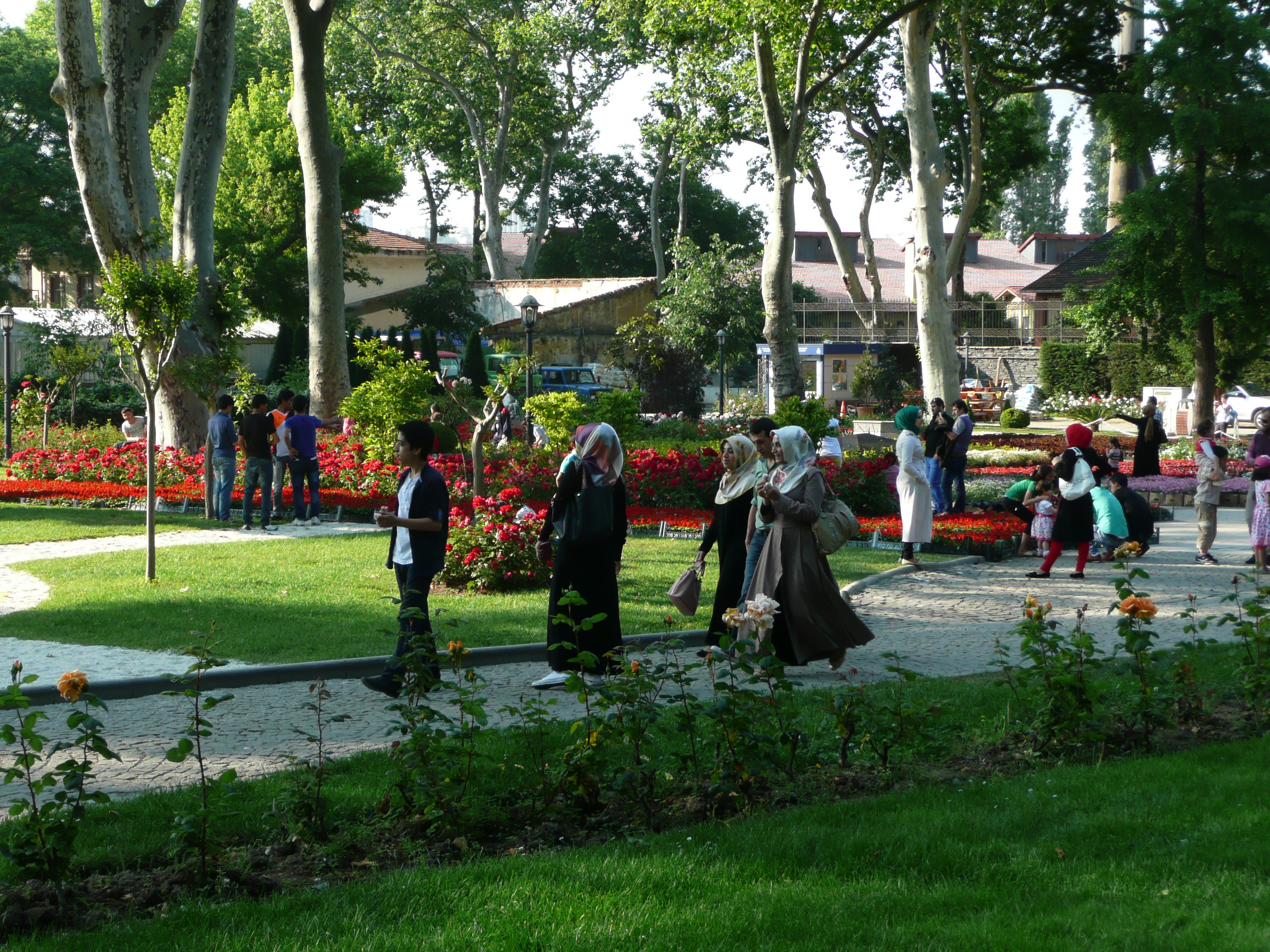
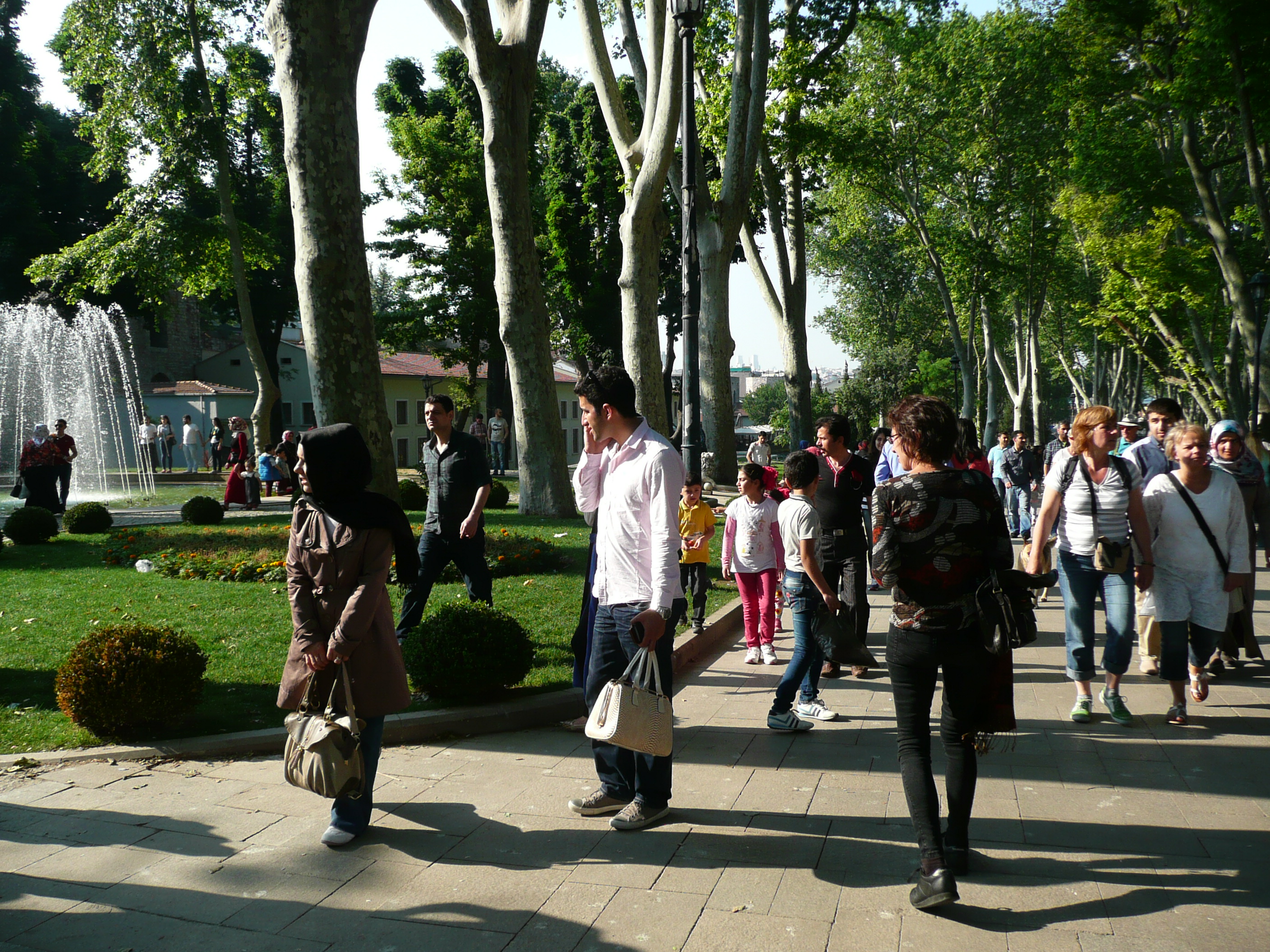
Sunday in the park
Muhajibabes in beautiful scarves (the Great Bazaar is chocka with wonderful day cashmeres and pashminas – there is no excuse for drabness). “Mandy, Mother of Brian” in vast and bulbous black. Ladies in full cover, some dark and exotic, and mysteriously alluring, and others that make me think that they are doing us all a favour (non-PC, but there you go). I just saw a clown with green hair and a red nose. Fashionistas and paysans. And the many, many ordinary folk, old, young, and babes in arms, enjoying the weekend. All oblivious to the feral dogs and cats that roam through these parts.
There are no pubs on every corner. There are no rows of wine bars. There are no ice-cream and yoghurt shops (though we did find a good bar just across from the square in front of Hagia Sophia).
Oh, it makes you wonder.
For other posts about Turkey in In That Howling Infinite, see:
Sailing to Byzantium, Ottoman Redux – an alternative history, Cha-cha-cha-changes and The Watchers of the Water
 In That Howling Infinite