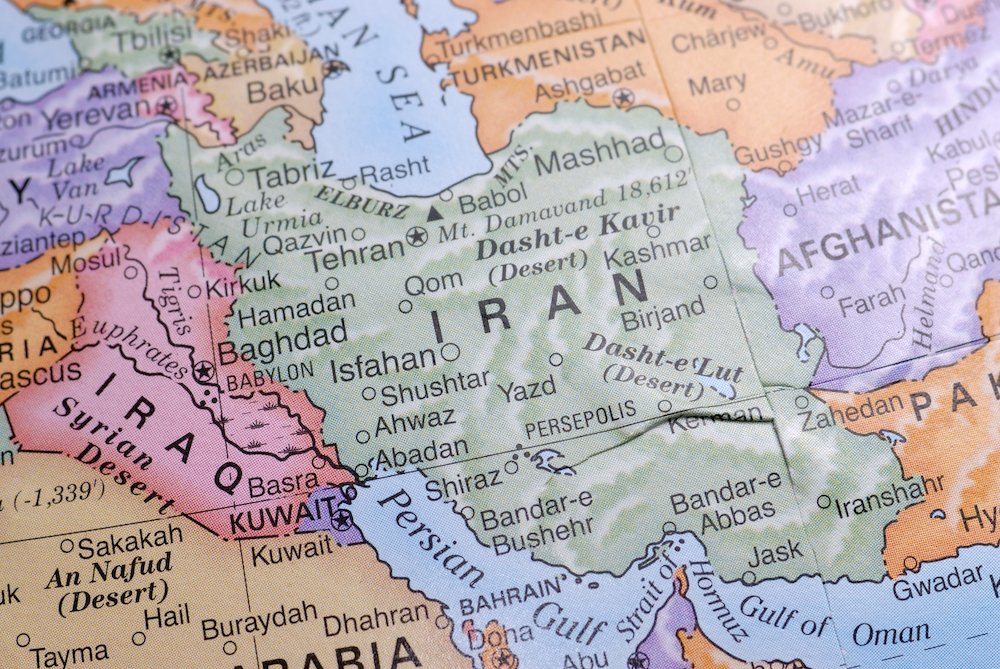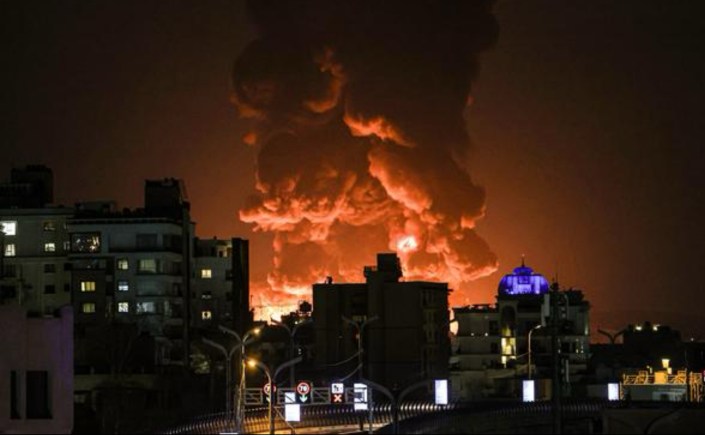
Chaos without a compass … Donald Trump’s Persian “excursion”

Without seeming to realise what he has done, Trump has exposed the raw fact that the US is no longer a full-spectrum military hegemon able to project power simultaneously in multiple theatres across the planet. It has superb armed forces and technology – but that is not the same thing.                                Ambrose Evans-Pritchard, The Telegraph, 11 March 2026

The Twentieth Century’s “Thirty Years War”, the war of my generation, was waged in South East Asia initially by the colonialist France, and then by neo-imperialist America. France’s war ended in defeat and ignominy for French arms and prestige, and a partition that was but a prelude to America’s Vietnam quagmire. [In In That Howling Infinite, see Tim Page’s War – a photographer’s Vietnam journey]

America’s War has since been defined as chaos without compass. It was inevitable that acclaimed historian Barbara Tuchman would chose it as one of her vignettes in The March of Folly, her celebrated study of débacles through the ages characterised by what would appear to be a single-minded determination amounting to tunnel vision that is akin to stupidity.

As Tuchman saw it, exceptionalism and manifest destiny are historically proven folly. Self-belief in American power and righteousness has historically created delusions of grandeur, obstinate attachment to unserviceable goals, stubbornness, and an inability to learn from past mistakes or even admitting error – a wooden-headedness that often sees the US persisting on erroneous paths that lead to loss of blood, treasure, reputation and moral standing.

Why did the US’ experience of backing the wrong horse in China in the forties not provide an analogy and warning in Vietnam in the fifties? Why did the experience in Vietnam not inform it with respect to Iran right up to the fall of the Shah in 1978? And why hadn’t it learned anything when it stumbled into Salvador in the eighties? And then, of course, we arrive in the 21st century with no-exit, never-ending wars in Afghanistan and Middle East that end in retreat and betrayal with the ‘freedom-loving’ USA still backing the wrong horses by supporting autocrats and tyrants against their own people.

Tuchman was describing a particular pathology of statecraft-  the spectacle of governments pursuing policies visibly contrary to their own interests while possessing the intelligence, experience and evidence to know better. Power, in such circumstances, is not lacking. Direction is.

In the American case, she saw something close to a recurring pattern. Self-belief in American power and virtue could generate a peculiar strategic blindness – delusions of grandeur, obstinate attachment to unserviceable goals, and a refusal to learn from past mistakes or even admit error. The result was a form of national tunnel vision: the conviction that sufficient determination and force must eventually bend reality to American purposes. Too often the outcome was the opposite — the expenditure of blood, treasure, prestige and moral authority in pursuit of objectives that proved unattainable.

It is difficult not to hear the echo of Tuchman’s diagnosis when considering the widening conflict now unfolding between Israel, the United States and Iran. The scale of the military campaign alone is remarkable. Australian commentator and security expert David David Kilcullen’s description in an article in The Australian, republished below, reads almost like a catalogue of twenty-first-century warfare: thousands of sorties in the first hundred hours, stealth fighters dismantling air defences, B-2 bombers opening corridors through Iranian airspace, naval engagements stretching from the Persian Gulf toward the Indian Ocean, tankers burning in the Strait of Hormuz while drones and missiles ripple across the wider region. Cyberattacks strike data centres, satellite navigation systems are jammed, and the conflict unfolds simultaneously across air, sea, cyberspace and orbit.

In strictly operational terms the campaign appears formidable. Iranian air defences have been degraded, missile launchers and command networks methodically targeted, naval assets hunted down. Western air power increasingly operates across Iranian skies with relative freedom. In the narrow military sense, success seems plausible.

Yet wars are not judged by tactical success but by political outcome. And here the picture grows strangely indistinct.

The most striking criticism of the conflict — articulated most clearly by Aris Roussinos in an article in Unherd republished below –  is that no one appears able to define what victory would mean. Possible objectives multiply: regime change in Tehran; destruction of Iran’s nuclear programme; the degradation of Iranian military capabilities; or a wider strategic aim of constraining Chinese influence across Eurasia. Each implies a different war. Regime change requires internal collapse or occupation. Nuclear disarmament ultimately requires diplomacy and verification. Strategic competition with China belongs largely to another theatre altogether.

The result is a peculiar strategic ambiguity: immense military force applied in pursuit of ends that remain fluid, sometimes contradictory, occasionally improvised after the fact.

Roussinos therefore invokes an earlier historical analogy: the Suez crisis of 1956 – as have other commentators. That operation was militarily successful yet politically disastrous. British and French forces seized the canal zone quickly and efficiently, only to discover that the political objective — preserving imperial influence — collapsed under international pressure. Today’s conflict, he suggests, may represent a kind of reverse Suez: a large military campaign unfolding before the political objective has even been clearly articulated.

Hovering behind this debate is another and more recent ghost: Iraq. Kilcullen’s experience in Iraq and Afghanistan informs his caution. Removing regimes, he notes in an article in The Australian, is often easier than replacing them. The Taliban returned after twenty years of war. Iraq descended into sectarian violence after Saddam’s fall. Libya’s regime collapsed quickly but left behind a fractured state.

Iran, however, is not Libya. It is a nation of ninety million people with a deep historical identity and a political culture shaped by both imperial memory and the Shiite narratives of martyrdom that animate the Islamic Republic. Foreign attack may weaken the regime — but it may also strengthen the nationalist solidarity on which that regime depends.

Here the shadow of Iraq becomes unavoidable. The question that haunted that war returns once more: what happens the day after victory?

Supporters of the campaign insist that what appears chaotic may in fact be the culmination of long-term strategy. Israeli intelligence has spent years penetrating Iranian networks, sabotaging nuclear infrastructure and eliminating key figures. Others place the conflict within the larger geopolitical contest with China, arguing that weakening Iran constrains Beijing’s long-term influence across Eurasia.

Yet even these arguments leave uncertainty intact. If the central contest lies with China, the Middle East becomes a dangerous diversion. If nuclear disarmament is the aim, diplomacy will eventually be unavoidable. If regime collapse is the goal, history suggests that air power alone rarely produces it.

Meanwhile the war itself expands. Hezbollah strikes from Lebanon. Houthi forces threaten shipping in the Red Sea. Missiles fall across Gulf states. Cyberattacks ripple outward through global infrastructure. Modern conflicts rarely remain geographically contained; the networks of trade, alliances and proxy forces ensure that violence spreads outward in widening circles.

Kilcullen’s observation, delivered with the weary clarity of experience, captures the problem succinctly: war is inherently complex and non-linear, unleashing forces that no strategist can fully predict or control.

Old phrases return easily in such circumstances. One of them comes from Cicero: Inter arma silent leges — among arms the laws fall silent. Yet when law falls silent, prudence often follows. The machinery of war — alliances, domestic politics, military planning — acquires its own momentum. Decisions initially framed as temporary expedients become permanent commitments. Vietnam began with advisers; Afghanistan with a punitive expedition; Iraq with inspections and resolutions. History rarely begins with the word “quagmire.”

What is most striking in the debate surrounding the present war is not the intensity of disagreement but the depth of uncertainty. Some believe the Iranian regime is brittle and nearing collapse; others believe foreign attack will strengthen it. Both views rely on historical analogy; neither fits perfectly.

Which brings us back, inevitably, to Tuchman. Her great theme was not that governments make mistakes — that is the normal condition of politics — but that they sometimes continue down dangerous paths even after the warning signs become visible.

Whether the present conflict will prove another example of such folly remains to be seen. It may yet reveal a coherent strategy whose logic becomes clear only with time. Or it may confirm once again Tuchman’s darker insight about the persistence of wooden-headedness in the councils of power.

For the moment the war continues: vast in scale, impressive in its technology, uncertain in its purpose. And somewhere in the background, like an echo from another era, the old phrase lingers once again – chaos without a compass.

And then, of course, there’s Trump. To return to Ambrose-Pritchard, who opened this essay: “So which will prevail in the tug of war within Trump’s personality: his fear of losing the US midterm election? Or his injured vanity and his psychological need to command “escalation dominance”, always and everywhere?

For other articles on Iran in In That Howling Infinite, see: Messing with the Mullahs – America’s phoney war? The quality of mercy … looking beyond Iran’s ghost republic and “Because of …” Iran’s voice of freedom, and The end of the line … an epitaph for a tyrant

Trump’s reverse Suez

Starmer should beware another quagmire

Aris Roussinos, Unherd,  March 7 2026 

As we approach the 70th anniversary of the Suez Crisis, from which France’s political class learned to never again let their country’s security become subject to America’s veto, and Britain’s to never again distinguish between its own national interests and Washington’s whims, it is worth remembering that — judged purely as a military operation — the seizure of the Canal Zone was highly successful. The Canal itself, and a buffer zone around it, were captured within days, with limited casualties; the operation’s technical proficiency was praised by the First Sea Lord, Lord Mountbatten, even as he twice attempted to resign in protest at the political folly of it all.

Yet success or failure will be a harder judgment to make for historians of Trump’s own latest Middle East adventure, which is already starting to look like a reverse Suez: its exposure of the limitations of pure military power; the domestic and international hostility; the fragility of alliance systems lazily assumed to be solid; and the wider overtones of an empire wildly overreaching in an attempt to stave off terminal decline. The difficulty in ascertaining, when this ends, whether or not Trump has achieved his war aims rests simply in the fact that the aims so far put forward have differed wildly, and are often mutually contradictory. The Suez Operation possessed a clearly defined military goal which succeeded, and a wider political one, which failed. As it stands, the Trump administration appears in possession of neither.

The broader arguments against the current conflict were most memorably made by Trump himself, campaigning as an anti-war candidate who would keep the United States out of costly and unmanageable Middle Eastern entanglements. His Vice-President, JD Vance, once articulately made the case against this very war. Having successfully demolished his own policy platform, it is difficult to determine what would now count as victory for Trump. The desired outcomes given, at the time of writing, have ranged from the maximalist deliverance of “freedom” to the Iranian people through full regime change in Tehran, through to inspiring an ideal “Venezuela solution” in which more amenable military figures launch an internal coup, then perhaps installing a Shah, ruling Iran remotely from the more stable comfort of Maryland. Or else simply destroying Iran’s nuclear enrichment capacity (which Trump claimed to have “obliterated” in June last year). This scrambling for post facto rationales appears to derive from the fact that Iran did not immediately fold, as Trump apparently assumed it would, with the assassination of its leadership: unlike today’s America, it is not a personalist regime.

Yet if America’s war aims are nebulous from a lack of preparation, Israel’s appear haphazard by design. Summing up Netanyahu’s goals, the Israeli strategic analyst Danny Citrinowicz observes that “If we can have a coup, great. If we can have people on the streets, great. If we can have a civil war, great. Israel couldn’t care less about the future [or] the stability of Iran.” Whatever Netanyahu’s aspirations, a heavily armed but leaderless Iran, engulfed in chaos, represents a strategic threat rather than a victory for the wider West. In this, it appears that America has launched a war alongside, and at the behest of, a notionally junior partner with wildly divergent goals, and which Washington has already admitted it is unable to rein in. For British politicians, all the warning lights should now be blinking red: even the Iraq War, a historic disaster, was vastly better conceived, planned and resourced than this.

“Even the Iraq War, a historic disaster, was vastly better conceived, planned and resourced than this.”

And if America’s war aims are vague and contradictory, their proposed means of achieving these desired outcomes are too — including Iranian submission through aerial bombing alone — a result which has never yet been obtained in the century-long history of air power — through launching a peripheral revolt in which Kurdish and perhaps Baluchi separatists act as America and Israel’s boots on the ground. The best that can currently be said for Trump’s gamble is that the desired end-state is so nebulous in its imagining, and the approach so scattergun, that almost any off-ramp can be spun as a victory by his imperial court and its attendant sycophants. With no single, coherent outcome proposed, Trump can claim, as he already has, that the war has already succeeded beyond the wildest dreams of planners. This is even as he is warning his base that victory may yet take some weeks, and cautioning Congress that “it is not possible at this time to know the full scope and duration of military operations that may be necessary”.

The war was, it seems, resourced for a few days of intensive bombing, with little anticipation of Iran striking back against Gulf states, and American early-warning facilities, with its arsenal of low-cost drones. Policy is now being made on the hoof, with senior administration officials “at each other’s throats” on the need for ground troops. CENTCOM, overseeing the war, has requested an increase in military intelligence analysts “to support operations against Iran for at least 100 days but likely through September”. The spectacle of a days-long special military operation, entered into with an over-confident faith in hard power achieving a swift political solution, then dragging on interminably, is all too familiar. For Vladimir Putin, certainly, America’s unforced error of embroiling itself in a quagmire US presidents have spent a half-century studiously avoiding is a godsend, depleting Western munitions stocks, replenishing the Kremlin’s coffers through rising oil and gas prices, and weakening Europe’s negotiating power.

Judged on strict military terms, though, the operation has chalked up notable successes. Iranian ballistic missile launches have slowed, and no doubt the aerial onslaught is depleting Iran’s arsenal of both munitions and launchers. The looming switch from stand-off munitions to less sophisticated bombs implies that air superiority has already been achieved, as Israel declared last weekend, or will soon be achieved, as the White House more cautiously claims. Whether or not Israel, the US and the Gulf states will run out of interceptor munitions before Iran runs out of missiles is a matter of speculation for even the best-informed analysts. Even as Pentagon sources brief concern over their dwindling arsenal, the Trump administration, for what it is worth, claims that it possesses “unlimited” stocks of munitions for a war that could last “forever” — while simultaneously blaming Ukraine for running down its weapons stockpile.

The most recent American attempt to exert its will in the region through air power alone, against Yemen’s Houthis, who are vastly weaker than Iran, entirely failed. The Houthis have not yet joined the war, as Hezbollah now has in response to Israel’s invasion of southern Lebanon: the prospects for escalation grow wider by the day. As for boots on the ground, the much-briefed claims that Iran’s Kurds are willing to join in the war against Tehran remains debatable. The Kurdish Regional Government of Northern Iraq, which hosts exiled Iranian Kurdish militias, has been warned by Iran that their entry into the war will invite an Iranian response, and has stressed its neutrality as a result. It has not even been a month since Washington abandoned its last Kurdish partners: they must now judge whether this time round America will prove a more dependable ally.

For all the military risks involved, it is very possible, though far from certain, that US and Israeli bombing can bring about the collapse of the Iranian state, though what happens next is anyone’s guess. The US Chairman of the Joint Chiefs, General Dan Caine, reportedly cautioned before the strikes began “about the potential downsides of launching a major military operation targeting Iran”, citing “the scale, complexity and potential for US casualties of such a mission”, and asserting he was “​​unable to predict what the result of a regime change operation would be”. Both the Iranians and the Americans have already claimed to have received, and rejected, the other’s request for a ceasefire, with Israel reportedly seeking assurances Washington is not already seeking private talks. In any case, the Iranians have good cause to be wary of negotiating with Trump, given that their previous rounds of negotiations ended in American and Israeli bombing. Indeed, the current war began with Israel’s aerial assassination of the country’s political leadership in the middle of negotiations which, the Trump administration later boasted, were merely a ruse. Some of America’s intended new rulers of Iran, Trump has claimed, have already been killed by Israel. Having launched a war of choice, at a time convenient to him, Trump may now find ending it a far less simple affair.

As it stands, it is in Iran’s interest to drag out the war for as long as possible, expanding it across the wider region, increasing the economic disruption to American allies, and capitalising on the widespread hostility to the war. As both Trump’s anti-interventionist base and the Democrat opposition rightly proclaim, this war has been entered into without any coherent plan, seemingly through Israel’s chain-ganging of the United States into military action it would not otherwise have chosen, an observation claimed as antisemitic by Israel’s advocates in the United States yet which has nevertheless also — bafflingly — been offered as proof of the war’s necessity by America’s Secretary of State Marco Rubio, the House Speaker Mike Johnson, Senate Intelligence Committee chair Tom Cotton, and most recently by Trump himself.

As for Netanyahu, he exultantly claims that bringing America into the war is something he has “yearned to do for 40 years”. The Democrats, repeatedly briefingthe attack line that Trump was “the first president stupid enough” to be cajoled by Netanyahu into war with Iran, have now been gifted a path to success in midterm elections which may yet overlap with the conflict itself. When as cynical a politician as Gavin Newsom feels safe questioning future military support to the “apartheid state” Israel, demanding from the podium “Why did we help Israel kill little girls?”, we see the cracks in America’s only true special relationship widening into a gulf. This war was, most probably, Netanyahu’s last chance to enlist the fading superpower against his decades-long foe. Whether it improves Israel’s long-term strategic position is doubtful in the extreme  — but none of this is Britain’s problem.

It goes against instinct to praise the Prime Minister for his lawyerly prevarication. Yet given all the risks and uncertainties inherent to this war the arguments against joining America and Israel’s wild gamble are as strong as can be imagined. Just weeks ago, the same Trump administration which now chides us for our caution was threatening to annex European territory, and mocking our participation in its previous disastrous wars. Even if we exclude, as the Prime Minister does not, the moral factors, Starmer is entirely correct to say that this is a war with “no viable plan”. It appears that the Prime Minister, through his twin flaws of excessive deference to both European opinion and international law, may yet be dragged, unwillingly, towards the national interest. We already have our own war to worry about, in which the desire or ability of the United States to negotiate a satisfactory conclusion looks as doubtful from London as Washington’s reliability as a negotiating partner must look from Moscow. American realists may be correct in stating that the Ukraine war, in which Britain is already dangerously over-exposed, is not a core Washington interest — but neither is Netanyahu’s latest war of choice a British or European interest. Simply put, there is no advantage for Britain in joining this distant conflict, and the national interest, as in the Gaza War of which this is a vast escalation, remains in staying out of the affair as far as possible.

It is absurd, then, to watch Reform politicians, so recently bemoaning Britain’s political enmeshment with distant Middle Eastern conflicts and diaspora grievances, caper onstage with Israeli and Iranian monarchist flags, demanding our involvement in this mess. Farage’s hiring as foreign policy adviser of the neoconservative lobbyist Alan Mendoza, who has never yet seen a disastrous war he did not wish to join, was a rare deviation from his sharp political instincts, and a warning of the major strategic risks inherent in a Reform government, however much their domestic agenda may appeal. The Greens will rightly benefit from this misstep, as will, on Reform’s Right, Restore, edging towards a Powellite indifference to distant wars. If he holds his course, so will Starmer too.

The dilemma now for the Prime Minister is whether or not to join the emergent European policy of defensive neutrality, protecting national and continental interests while refusing involvement in the wider campaign. Yet the almost wholesale capture of the British security establishment by an Atlanticist ethos indistinguishable from vassalage, along with the looming American usage of British bases for offensive purposes, will complicate this. Starmer initially refused to permit offensive raids to launch from British territory, a policy which, in Spain’s case, has seen Trump threaten to use its bases anyway. Such threats would appear less stark, no doubt, if Britain had not already placed the sovereignty of Diego Garcia under question, but we cannot all boast the strategic wisdom of David Lammy’s formerbrain. If allowing British bases to be used cannot be prevented, Starmer can either explain why, or — politically more likely — spin a plausible rationale for active involvement, attempting to make a virtue out of compulsion.

Yet there is another path, the one shown by Emmanuel Macron, now expanding across the continent the French-led defence axis initially trialled with Greece. At the same time, Macron is drawing a sharp dividing line between the interests of Europe and her many nation states, and of the erratic empire which alternately threatens and cajoles us. Seventy years ago, a misadventure in the Middle East saw Britain and France adopt opposing positions on American domination, which led us to this impasse. Through an accident of British politics, it falls to as unlikely a figure as Starmer to make just such another historic choice

Israel’s first air-to-air combat kill signals what it has planned.

Israel’s first air-to-air combat kill signals what it has planned.

On the first night of US-Israeli strikes against Iran last weekend, a friend and former colleague in Dubai sent me a video from his rooftop. Emirati air defences had just intercepted an Iranian drone across the street, metres from his house.

A loud explosion rattled his windows. I could hear car alarms in the background and his wife and young children expressing concern as he calmly escorted them down from the roof. I asked if I could do anything to help, and he came back with one word: “Exfil?”

“Exfiltration” – evacuation from the most heavily targeted areas – is a priority for some locals, most expats and many governments including Australia, which this week mounted one of the largest consular operations in our history.

Leaving not an option

For Iranian civilians facing intensive air and missile strikes after weeks of regime crackdowns that have already killed thousands, leaving is not an option.

Friends elsewhere in the region have decided to stay put, concluding their best bet is to shelter in place. In any case, with US and Israeli aircraft bombing all over Iran, and Iranian rockets striking targets across the Middle East, most have nowhere to go.

Evacuation flights have been made more difficult by sudden airspace closures given lack of warning for the attack, which began with Israeli air strikes while Iran and the US were still in negotiations, right after Omani mediators had announced a possible breakthrough.

Apart from its suddenness – despite a massive US military build-up across the past month, Israel struck without warning – the main feature of the conflict so far is its scope, scale and intensity.

This is by far the largest air campaign mounted by Israel and one of the largest conducted by the US, on a par with the bombing of Yugoslavia in 1999 or the initial air campaigns in Afghanistan and Iraq.

A group of men inspects the ruins of a police station in Tehran struck amid the US-Israel barrage on Iran. Picture: AP

A group of men inspects the ruins of a police station in Tehran struck amid the US-Israel barrage on Iran. Picture: AP

Already, within the first 100 hours, US aircraft had launched thousands of sorties, destroying hundreds of missile sites, command posts and air defences across Iran. Whatever its political framing, in practical terms this is a full-scale war.

The initial main effort was to establish air superiority, with F-35, F-22 and F-15E aircraft destroying Iranian warplanes and air base infrastructure. On the fourth day of the war, an Israeli F-35 shot down an Iranian fighter jet over northern Tehran, the first air-to-air combat kill by an F-35, and Israel’s first such aerial victory in 40 years.

The take-down of Iran’s air force was followed by the destruction of its air defences by US B-2 bombers using stand-off missiles, opening the skies for follow-on attacks by B-1 and B-52 bombers. These non-stealthy aircraft carry a massive bomb load. B-52s have been involved in the campaign already, releasing air-launched missiles up to 370km from their targets. Once Iran’s surface-to-air missiles are suppressed, however, the bombers can operate directly overhead, hugely increasing the weight of bombs dropped.

Expect more

We can expect US and Israeli aircraft, once they can operate with impunity, to further ramp up strikes, roaming the skies over Iran and hitting any identified threat. In effect, they will be working their way down the priority list as successive categories of higher-value targets are destroyed, a process that may take weeks.

A second task – destruction of Iran’s offensive missile launchers, command-and-control systems and storage and production facilities – is now the focus. Israeli and US forces are working in tandem, with Israel focusing on northern and western Iran, and US aircraft striking sites in the country’s central and southern regions.

A satellite image shows damage at Garmdarah missile base in northern Iran on March 4 following precision strikes. Picture: AFP/Satellite Image (c) 2026 Vantor

A satellite image shows damage at Garmdarah missile base in northern Iran on March 4 following precision strikes. Picture: AFP/Satellite Image (c) 2026 Vantor

This aspect of the campaign has been less successful so far. Iran is still launching large numbers of missiles against Haifa, Tel Aviv and other Israeli cities, and many are successfully evading Israeli interceptors. Other missiles have been destroyed over urban centres, with falling debris causing casualties on the ground. In strictly military terms, the campaign is going well for Israel and the US. But other aspects of the war have been more problematic.

The killing of supreme leader Ali Khamenei and other senior leaders in the first strike may have been intended to decapitate Iran’s regime and dislocate its response. But key leaders such as foreign minister Abbas Araghchi and Ali Larijani – former speaker of parliament, leader of the deadly anti-democracy crackdown in January and head of Iran’s national security council – are alive and in place.

Khamenei appears to have delegated launch authority to lower-level commanders in the Islamic Revolutionary Guard Corps, whose aerospace forces control parts of Iran’s missile arsenal, and the Artesh, Iran’s regular military which controls air defence. Junior commanders, cut off from Tehran in the first hours of the war, are making their own target selections, launching missiles and drones as far afield as Jordan, Turkey, Saudi Arabia and Azerbaijan. Closer in, Persian Gulf states such as Kuwait, Qatar, Bahrain, Oman and the United Arab Emirates have been particularly hard hit.

Hiogjh-ranking members of the Iranian Revolutionary Guards Corps (IRGC) attend an unveiling ceremony of an IRGC underground facility that houses hundreds of domestically built precision-strike missiles. Picture: IMAGO / ZUMA

Hiogjh-ranking members of the Iranian Revolutionary Guards Corps (IRGC) attend an unveiling ceremony of an IRGC underground facility that houses hundreds of domestically built precision-strike missiles. Picture: IMAGO / ZUMA

Iranian missiles are targeting civilian infrastructure, diplomatic posts, military bases, oil refineries, gas terminals, hotels, houses and shopping centres. Desalination plants – critical in a water-poor region – also have been targeted. Iran’s Lebanese ally, Hezbollah, seems to have launched the drone that hit Britain’s Akrotiri Air Base in Cyprus; in response, Israel is bombing Beirut, and Israeli troops and tanks have pushed farther into Lebanon, widening the war and inflicting several hundred casualties.

War on water

The war at sea has expanded even further. US and Israeli strikes destroyed the Iranian navy’s command post at Bandar Abbas this week and damaged at least nine warships including Iran’s sole drone carrier, the IRIS Shahid Bagheri, along with several Soleimani-class corvettes, smaller warships capable of operating independently or supporting fast attack craft in the Persian Gulf.

In a major escalation, the larger Moudge-class frigate IRIS Dena was sunk off Sri Lanka by a torpedo from a US submarine, as it made its way back to Iran after joint naval exercises with India, with the loss of up to 150 lives. In another grim milestone, this was the first time since 1945 that a US submarine has sunk an enemy warship by torpedo.

At least 10 oil tankers are now ablaze or sunk in the Strait of Hormuz, a critical chokepoint that accounts for more than 20 per cent of global oil flow. Commercial shipping has fallen to almost nothing.

On Thursday, Iran allowed a Chinese-flagged tanker through the strait, and the US has offered insur­ance and naval escort for other vessels in the area, but shipping companies and captains are understandably reluctant to run the risk, triggering a 90 per cent drop in traffic.

Further west, Iran’s Houthi allies in Yemen are restarting their efforts – suspended after last year’s Gaza ceasefire – to interdict shipping through the Bab el-Mandeb, the chokepoint at the southern end of the Red Sea. The Houthis also appear to have launched missiles into Saudi Arabia, which also has been hit by rockets from Iran itself.

Also this week, a Russian-flagged oil tanker was attacked in the western Mediterranean by a Ukrainian sea drone. Ukrainian attacks continue against Russian ships in the Black Sea, underscoring the connection between conflict in Europe and the newly opened front in the Middle East.

On the ground

On land, there is no sign yet of US or Israeli ground troops entering the war, though Israeli aircraft have begun targeting Iranian internal security forces such as the IRGC and its paramilitary arm, the Basij, which might be used to suppress an uprising. US media outlets are reporting CIA plans to arm and support Kurdish separatists against the regime. Kurdish leaders have denied this, even as Kurdish troops in Iraq are massingon the Iranian border, and there are unconfirmed reports of conflict inside northwestern Iran.

Other dissident groups – the anti-regime democracy movement and ethnic separatist Arab, Azeri and Baloch – suffered severely in January’s regime crackdown but may move against the government if the conflict continues. Such efforts almost certainly will fail unless these groups receive arms and support from external players.

Pakistan, which shares a border with Iran and is allied with Tehran’s regional rival Saudi Arabia, is committed to a war against its own former proxy, the Afghan Taliban, but could join in if the war escalates further.

Israeli police and emergency teams respond at the scene after a missile strike hit buildings in Tel Aviv’s Gush Dan area, in Israel, as Iran's missile attacks in retaliation for US-Israeli strikes continue. Picture: Getty Images

Israeli police and emergency teams respond at the scene after a missile strike hit buildings in Tel Aviv’s Gush Dan area, in Israel, as Iran’s missile attacks in retaliation for US-Israeli strikes continue. Picture: Getty Images

If a ground war does develop, it may look something like the invasion of Afghanistan in 2001, when intelligence and special warfare teams worked with Afghan allies on the ground, combining with US air power to overthrow the Taliban in less than seven weeks.

Conventional US ground forces are politically problematic for President Donald Trump, given deep scepticism among his MAGA base about foreign wars, American casualties and Israeli intentions.

On the other hand, CIA or special operations teams – given their small numbers and low profile – are seen as less risky, easier to justify, and thus the preferred option.

As in Afghanistan, the question for any ground campaign is what comes next. The potential for full-scale civil war inside Iran, accompanied by state fragmentation and a region-wide flood of refugees, was on the minds of diplomats and intelligence officers with whom I spoke this week, even as the conflict’s future remains unclear.

Taking down the regime is one thing; standing up a stable successor is entirely another, as any Iraq or Afghanistan veteran knows. Many leaders are clearly concerned about this.

All of this makes the current conflict more than just a third Gulf war. Countries that escaped previous conflicts are now suffering direct attacks, up-ending regional relationships as governments scramble to protect their populations. Closure of the Strait of Hormuz involves superpower interests and the global economy much more than previous rounds of conflict. The longer the war lasts, the greater the risk that it escalates even further, pulling more countries in.

International response

Broader responses have been mixed. European countries – following inter-allied controversy earlier this year over US threats to seize Denmark’s autonomous territory in Greenland – have expressed reservations, as has the EU.

An intercepted projectile falls into the sea near Dubai's Palm Jumeirah archipelago on March 1, 2026. Picture: AFP

An intercepted projectile falls into the sea near Dubai’s Palm Jumeirah archipelago on March 1, 2026. Picture: AFP

Britain offered defensive support only, prompting Trump to criticise Prime Minister Keir Starmer as “no Churchill” and complain that the special relationship is not what it once was.

Trump also announced “total suspension” of trade with Spain after Madrid blocked US aircraft from using Spanish bases for the attack. French President Emmanuel Macron declared the US-Israeli attack in violation of international law and called for a return to negotiations, while the UN said it had seen no evidence of ongoing Iranian nuclear weapons programs.

On the other hand, NATO secretary-general Mark Rutte expressed support for the operation.

US adversaries Russia and North Korea – both of which have close relationships with Iran – strongly condemned the attack. China did so too, but so far has offered only rhetorical support. This is somewhat surprising since China is a major weapon supplier to the regime in Tehran and announced, days before the US attack, that it was sending offensive and defensive weapons to Iran.

Under a 25-year agreement signed in 2021, China also accounts for 80 per cent of Iran’s oil exports and depends heavily on traffic through the Strait of Hormuz and the Red Sea. China has been stockpiling oil for several years, so Chinese leaders may calculate they can afford to wait, letting US stockpiles of bombs and missiles be depleted as the war goes on.

Alternatively, they may be scrambling to catch up with a rapidly evolving situation. Neither Moscow nor Beijing has yet moved to mediate or resolve the war.

Against this background, military lessons are already emerging. Artificial intelligence has dramatically accelerated the targeting process, with the campaign running on a continuously updated dynamic engagement matrix rather than a traditional daily task order. Satellite communications are ubiquitous, with small Starlink antennas seen mounted on American Low-Cost Unmanned Combat Attack System drones, themselves an improved copy of Iran’s Shahed-136 drone, the export version of which played a prominent part in Russia’s arsenal in Ukraine.

Beyond showing how adversaries copy each other’s battlefield technologies, the LUCAS drones illustrate how important space systems such as Starlink now are. Space has emerged as what the military calls a “warfighting domain” alongside air, space, sea and cyberspace. GPS spoofing and jamming, as all sides interfere with each other’s navigation satellites, has been particularly noticeable here as in Ukraine, with knock-on effects for civilian ships, aircraft and infrastructure.

Attacks on data centres, including three Amazon Web Services data centres hit by Iranian drones in the Emirates, underline the vulnerability of AI and cyber systems to physical attack.

An ambulance is parked near a sweeping blaze following Israeli bombardment on a solar farm and electricity generation facility in Lebanon's southern coastal city of Tyre on March 4, 2026. Israeli forces on March 4 advanced into a number of towns and villages in south Lebanon, a source from the UN peacekeeping force in the country, UNIFIL, told AFP. Picture: AFP

An ambulance is parked near a sweeping blaze following Israeli bombardment on a solar farm and electricity generation facility in Lebanon’s southern coastal city of Tyre on March 4, 2026. Israeli forces on March 4 advanced into a number of towns and villages in south Lebanon, a source from the UN peacekeeping force in the country, UNIFIL, told AFP. Picture: AFP

The war’s rapid spread outside Iran’s vicinity emphasises how modern conflicts, irrespective of causes, rarely remain geographically contained. Regional proxies – Hezbollah and the Houthis but also pro-Iranian militias in Iraq, Iranian-sponsored sleeper cells in Western countries, and the possibility that resistance groups may play the leading role in any ground campaign – emphasise how even the most conventional conflicts involve irregular warfare, with non-state armed groups operating on their own or advised by specialist operators.

At the strategic level, one lesson is that, irrespective of Trump’s need for a quick resolution to the conflict, lest it undermine his support ahead of critical midterm elections in November, war is inherently complex and non-linear, unleashing forces that cannot be predicted or controlled. Even now, the campaign is illustrating the impossibility of doing regime change from the air, to say nothing of whether regime change is even a viable goal: 20 years of the war on terror would suggest not.

One thing I heard whispered in Washington this week was that – between Venezuela, Greenland and now Iran – others may be concluding they cannot trust American negotiators. The terms of any deal seem increasingly contingent on political whim in the White House, rather than consistent policy, and attacking a counterparts mid-negotiation makes it less likely that adversaries will themselves negotiate in good faith.

This US navy handout photo released by US Central Command public affairs shows US sailors preparing to stage ordnance on the flight deck of Nimitz-class aircraft carrier USS Abraham Lincoln (CVN 72) in support of Operation Epic Fury. Picture: US navy/US Central Command/AFP

This US navy handout photo released by US Central Command public affairs shows US sailors preparing to stage ordnance on the flight deck of Nimitz-class aircraft carrier USS Abraham Lincoln (CVN 72) in support of Operation Epic Fury. Picture: US navy/US Central Command/AFP

One congressional staffer gloomily told me this week that, under this administration’s force-based approach to international relations, diplomatic consistency carried less weight, but that wouldn’t always be the case. Russia and China were watching this conflict closely, she noted, and if they saw an opportunity to move against Western interests while the US was tied down in Iran, credibility with allies would matter again, fast. The broader potential for escalation – for Gulf War III to become World War III – is not in the forefront of anyone’s mind at present but the risk is real.

Impact at home

For Australia, the implications of the current conflict are stark enough. As a globally connected trading nation, with millions of Australians overseas and massive exposure to the global system, Australians’ safety and our nation’s prosperity can easily be disrupted by events thousands of kilometres away. Just one illustration of this is petroleum imports, which despite rapid growth in renewables still drive almost every aspect of our economy.

The latest Australian petroleum statistics, from December 2025, showed Australia with 50 days net import coverage, 25 days of diesel consumption, enough jet fuel for 20 days and enough automotive petrol for 26 days. In other words, if global oil supplies are interrupted for more than three to four weeks, Australia’s transportation and production systems start grinding to a halt. The government has rightly advised against panic hoarding, but fuel resilience will become a real issue as the conflict drags on.

There is also the possibility that an expanded conflict may lead to a spike in terrorism risk. Iranian-sponsored terror cells aside, unrest among or against Iranian, Jewish, Kurdish, Arab and other communities is a real issue, one that many Western governments are watching, Australia almost certainly included.

A final possibility is that, if the war drags on or escalates, Australia and other allies may receive a US request for support. Intelligence, surveillance and reconnaissance – including joint facilities in Australia – are almost certainly already involved. No request for warships, aircraft or ground troops has been publicly discussed but planners would be wise to be thinking ahead.

In the meantime, and much more importantly, families such as my friend’s – across Iran, Israel, the Gulf states and elsewhere – are sheltering in basements, comforting their kids, hoping they have enough food, water, cash and medical supplies, and worrying what the future holds. Tens of thousands of Australians and other expats are stranded as they seek to leave the region, and millions more locals have no exit in sight. This war is unlikely to end soon, but it has already changed the game

 

Messing with the Mullahs – misreading the Islamic revolution

Most folk who are into history like to draw parallels and identify patterns in the past that reflect upon the present. As I do also, albeit in a more ambivalent way. Cleaving to Mark (Twain, that is). am fascinated more by the rhymes than the repetitions. Five years ago, i wrote Messing with the Mullahs – America’s phoney war? Events in the Middle East since October 7 2023, not least tit-for-tat aerial exchanges on we have seen in recent months between Israel and Iran, and the potential return of the unreformed and unchained prodigal son on January 6th 2025 render it relevant still. How long will it be before the war drums start beating on the Potomac and the Iran hawks circle over Washington DC seeking the restored king’s feckless and fickle ear? As they say, fools rush in where angels fear to tread.

Back then, I wrote:

“The story of the Iranian Revolution is a complex, multidimensional one, and it is difficult for its events and essence to be compressed into brief opinion pieces of any political flavour, no matter how even-handed they endeavour to be.

The revolution began slowly in late 1977 when demonstrations against Shah Reza Pahlevi, developed into a campaign of civil resistance by both secular and religious groups. These intensified through 1978, culminating In strikes and demonstrations that paralyzed the country. Millennia of monarchy in Iran ended in January 1979 when the Shah and his family fled into exile. By April, exiled cleric and longtime dissident Ayatollah Khomeini returned home to a rapturous welcome. Activist fighters and rebel soldiers overwhelmed troops loyal to the Shah, and Iran voted by national referendum to become an Islamic republic on April 1st, 1979. A new constitution saw Khomeini became Supreme Leader in December 1979.

The success and continuing durability of the Iranian Revolution derived from many sources, and many are not touched upon by commentators and pundits.

One can’t ignore the nature of the monarchy that preceded it – modernist on the one hand, and brutally repressive on the other; nor the unwavering and hypocritical support (including infrastructure, weapons, and intelligence) provided to it by western “democracies” since Britain and the US placed Reza Shah Pahlevi on the throne in 1953.

Nor should we ignore the nature of the unprecedented regime and state that was established forty years ago – a brutal, theocratic, patriarchal, quasi-totalitarian system that endeavours to control all aspects of its citizens’ lives, its rule enforced by loyal militias like the ruthless Basij and by the Revolutionary Guard, a military-industrial complex more powerful than the regular army.

The support and succour that the US gave to the deposed Shah and his family and entourage, and later, to the opponents of the revolution, served to unite the population around a dogmatic, cruel and vengeful regime, which, in the manner of revolutions past and present, “devoured its children”, harrying, jailing, exiling and slaughtering foes and onetime allies alike. One of the ironies of the early days of the revolution was its heterodox complexion – a loose and unstable alliance between factions of the left, right and divine. History is replete with examples of how a revolution besieged within and without by enemies actual and imagined mobilizes it people for its support, strength and survival.”

This brief outline summarises the events of 1979 and the decades which followed. It does not elaborate in any detail on the reasons for the downfall of the Shah and the durability of the regime that succeeded him. An impressive essay in the Jewish cultural e-zine Mosaic endeavours to do just that, providing as it does, insights into the history of modern Iranian history that few people today would be familiar with.

In it, the author suggests that “the most impressive of our experts persist in downplaying or ignoring the Islamic Republic of Iran’s driving forces can lead to misunderstandings of current affairs that are far from academic. Both nuclear negotiations and the sanctions, for instance, are premised on the assumption that Tehran is eager above all else to improve its country’s economy. While Ayatollah Khamenei and his minions doubtless care about trade and finances, they care much more about advancing their religious ideology across the Middle East, and like most religious believers, feel that spiritual concerns must ultimately trump material ones. It’s even possible that some might find the idea of suffering material hardships to achieve ideological goals appealing …

… If I’m right that Iranians didn’t rise up en masse because of the rising costs of onions or because they wanted to drive nicer cars, but because they were passionately opposed to secularization and American influence, then the U.S. cannot make peace with Iran even if the nuclear deal succeeds. The Islamic regime doesn’t oppose America because it supports Israel or Saudi Arabia, but because it represents Western secularism. Unless mass-conversion to Islam is in America’s future, that’s not something that’s likely to go away …

… One hopes that the loss of Afghanistan will finally hammer home the truth that the loss of Iran (in 1979) so signally failed to do: it’s religion, stupid.”

On matters messianic in In That Howling Infinite, see A Messiah is needed – so that he will not come and Al Aqsa Flood and the Hamas holy war. On the Middle East generally, see  A Middle East Miscellany:  

How Iran Thinks

Ze’ev Maghen, Mosaic, 7th March 2022

With a new nuclear deal on the way, attention is again turning to Iran. Four recent books, plus the deal itself, suggest that America and Europe are blind to the regime’s motivating spirit.

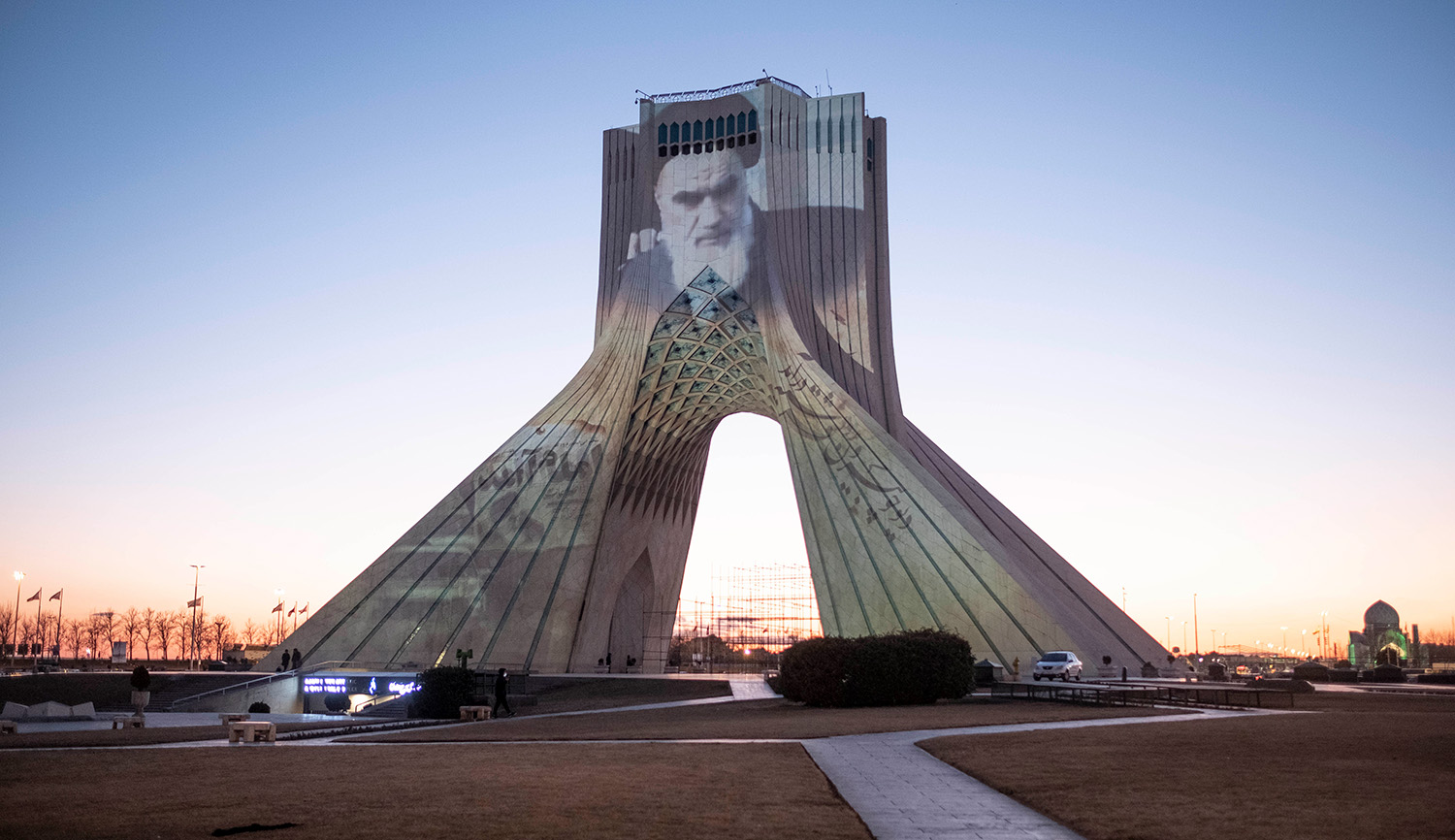
A portrait of the late Ayatollah Khomeini projected on the Azadi (Freedom) Monument in western Tehran on the 43rd anniversary of Iran’s 1979 Islamic Revolution in February 2022. Morteza Nikoubazl/NurPhoto via Getty Images.

A portrait of the late Ayatollah Khomeini projected on the Azadi (Freedom) Monument in western Tehran on the 43rd anniversary of Iran’s 1979 Islamic Revolution in February 2022. Morteza Nikoubazl/NurPhoto via Getty Images.

There is a well-known Persian children’s game in which a parent recites limerick-like poems while engaging in horseplay. One version, popular in the mid-20th century, had the father of the household seat himself on a carpet in the living room with one of his progeny standing to his right and the other to his left. The father would declaim:

There once was a cat (yek gorbeh bud)
Poor and miserable (bichareh bud)
A dog came and bit him in the belly (delash-o sag gaz gerefte bud)

(At this point the first child charges across the room and dives headlong into his father’s stomach.)

Next came a bear from behind and nearly killed the cat (khers az poshtesh taghriban koshtesh)

(The second son now bounds over and leaps onto his father’s back.)

But that cat, he rose, and he roared, and . . . turned himself into a lion! (gorbeh beh shir avaz shodeh bud)

(This being the signal for the father to get up and hurl his offspring this way and that onto the soft furniture.) 

More than just child’s play, this post-dinner diversion harbored an obvious historical-ideological meaning—a meaning as relevant today as it was 130 years ago. Anyone looking at a map of modern Iran will perceive the lineaments of what the country’s inhabitants call “the sleeping cat.” This cat—the Iranian state—was indeed in miserable shape domestically and geopolitically by the reign of Naser al-Din Shah (1848-1897). What little authority this Qajar king still possessed over his realm was retained by a method that a 20th-century Iranian intellectual would dub “positive equilibrium”: the sovereign survived by parceling out large swaths of Persian territory and granting irresponsibly generous economic concessions to local potentates and foreign powers so that each would defend the capital and environs against the encroachments of his counterparts. Of the many forces that Naser al-Din Shah had to “buy off” in this manner, none was more menacing than Russia, the bear that jumped onto the cat’s back, or more influential than Britain, the (bull)dog that bit the cat’s belly.

Before ousting the last Qajar ruler in a bloodless coup, the founder of the Pahlavi dynasty (1925-1979), Reza Shah, had risen through the ranks to become commander of the only serious military force in the country, the Cossack Brigade, created with Russian assistance decades earlier by that same Naser al-Din Shah. While in this post, Reza is said to have engaged every morning in a ritual reading of the newspaper, his face waxing redder with each account of Iranian failure or humiliation until finally, in a fit of rage, he would stand up and rip the tabloid to shreds. Soon, this determined corporal would rewrite the headlines that had so dismayed him, and do much to turn the sleeping cat into a rising lion.

Assisted by a cadre of military comrades and nationalist intellectuals, the new monarch set about pacifying the countryside, developing infrastructure, implementing reforms in fields like education, sanitation, technology, agriculture, and women’s rights, and in general shoving Iran, kicking and screaming, into the 20th century. He even gave his subjects three days to come up with last names for purposes of taxation, conscription, and general modernization (hitherto everyone had been known as “so-and-so son or daughter of so-and-so” or by a nickname reflecting his profession, town of origin, or infirmity). For all that Reza Shah has been depicted in post-revolutionary Khomeinist retrospect as the epitome of an incorrigible Westernizer, it cannot be denied that he raised Iran from a trampled and torn-apart virtual protectorate and a conspicuous consumer of European goods to the status of an essentially independent and self-respecting polity boasting border integrity and assiduously cultivating import-substitution industry. That the method employed to achieve all this progress was despotic was a price that even many liberal Iranian thinkers of the time were willing to pay.

Ousted by the allies in 1941 on the pretext of harboring Nazi sympathies—sympathies partially tied to the “Aryan Thesis” that made Germans and Persians ethnolinguistic cousins and that was all the rage in both countries at the time—Reza Shah was replaced by his twenty-one-year-old son Mohammad Reza Shah. In awe of his father, and having spent his teenage years in Switzerland at an elite boarding school, the new king was prepped to take up where the dynasty’s founder had left off. His career, and his overthrow in 1979 by the Islamist movement that now rules Iran, is at the center of four books published in the past decade which I will consider here. These books offer much in the way of fresh insights and original research, correcting some of the misconceptions that plague commentary about the country. And yet, for all their merits, they fail to grasp fully why the shah fell, what motivated the revolutionaries, and by extension, what motivates the current regime. For if we want to be able to make sense of the revolutionary ideologues who now rule Iran, we have to understand the political and cultural order they rebelled against, and why they rose up against it.

By looking at what these four works get right and, more importantly, what they get wrong, we can also better understand why so many Western experts and policymakers so consistently misread the Islamic Republic, its sensitivities, its hierarchies of honor and shame, holy and profane, just and unjust—and why academics are so ill-equipped to figure out a society that doesn’t conform to their own ideas of secular rationalism. With the U.S. about to conclude a second nuclear deal with the Islamic Republic, if press reports are to be believed, it’s worth considering how this regime came to be, and what makes it tick.

I. The Last Shah

As the Council on Foreign Relations scholar Ray Takeyh has shown better than any previous author in The Last Shah, Mohammad Reza’s reign began with an impressive geostrategic victory: with a little help from astute advisors at home and a determined postwar American administration, the fledgling Iranian sovereign induced no less a megalomaniacal expansionist than Joseph Stalin, at the zenith of his power, to pull his troops out of the northwestern province of Azarbayjan (not to be confused with the neighboring Soviet Republic of the same name), where they had supported local socialist secessionist movements. The cold war had begun, and Tehran was poised to reap the benefits.

Mohammad Reza’s next major challenge came from within, in the person of the charismatic prime minister Mohammad-e Mosaddeq (in office 1951-3), perceived ever since in popular imagination—and in much scholarship—as Iran’s fatefully foregone hope for true democracy.

Takeyh sets the record straight, demonstrating more effectively than any writer to date that Mosaddeq was, to the contrary, a highly unstable personality with dangerous dictatorial tendencies. (He also quashes once and for all the myth that the CIA and MI6 were primarily responsible for the 1953 coup that removed him.) The shah, argues this author, though no friend of democracy himself, was ultimately better for Iran than the prime minister. Indeed, Mohammad Reza eventually realized the very dream that Mosaddeq had failed so badly to achieve: not just oil independence, but oil hegemony for Iran. (Remember when we switched the limousine-like sedans we used to drive for the cramped, sardine-cans-on-wheels that we squeeze into today? That was because of the shah.)

Surrounding himself instead with one-dimensional, sycophantic technocrats, the shah soon became the lonely autocrat, a one-man-show.

The second Pahlavi sovereign got so good at his job, Takeyh maintains, that he felt he could dispense with the independent aristocratic elite whose corruption, bickering, and jostling for advantage threw a spoke into his rapidly rotating wheel of progress—even though it was just these aristocrats who had been the agents of his success, and had saved his throne on more than one occasion. Surrounding himself instead with one-dimensional, sycophantic technocrats, he soon became the lonely autocrat, a one-man-show. When the Middle East-wide, and worldwide, revolutionary fever of the second half of the 20th century finally caught up with him in 1979—another significant connection Takeyh makes—Iran’s ruler faced it bereft of the crucial assistance he needed to weather the storm.

II. The Fall of Heaven

The inability to delegate and insistence upon ruling instead of merely reigning that Takeyh perceives as a shortcoming, Andrew Scott Cooper sees as a strength: Mohammad Reza’s hands-on approach to monarchy got things done for his country. To Cooper, the shah is something very different from the corrupt autocrat of most histories, whose disastrous mistakes supposedly smothered democracy and brought about the revolution. Indeed, in The Fall of Heaven, Cooper’s 2016 history of the decline and fall of the Pahlavi dynasty, there is little that has traditionally been held against this despot that isn’t deftly turned into a virtue, or at worst a well-intentioned miscalculation. The abolition of the multiparty system in 1975, itself largely nominal by that time, and the inauguration in its place of the single Rastakhiz (“Resurrection”) party to which all citizens were obligated to pledge allegiance, is presented as a (botched) stepping-stone toward democracy—a claim doubly audacious since, as Takeyh had shown, Rastakhiz’s own leaders admitted that it was a bad joke from day one. Cooper does not scruple to attribute the refusal of Iran’s Westernizing monarch to rule constitutionally to “his skeptical attitude to the 1906 constitution, which he regarded as a European invention imposed on Iran by former colonial powers.” The shah’s innumerable affairs with married women and regular visits to Paris prostitutes were evidence of his “boundless energy,” and usefully cleared his head to attend to matters of state. Even the king’s leisurely helicopter rides (and those of his siblings) over a capital city choked to a stand-still by some of the worst traffic jams in history are depicted by this creative and sometimes credulous author as his majesty’s noble attempt to help alleviate that same congestion.

These impressive feats of legerdemain aside, however, Cooper is no cheap apologist. The Fall of Heaven is a stunning achievement, and will go down in literary-scholarly history as the book that did more to rehabilitate the Pahlavi family’s reputation than any volume published before or since the revolution. Cooper accomplishes this formidable task—punching a corridor through decades of pervasive and unrelenting vilification—primarily by amassing, organizing, analyzing, and presenting in vivid color an unprecedented amount of detail surrounding the final years of the monarchy. On top of play-by-play accounts of the political ins-and-outs, the economic ups-and-downs, the burgeoning unrest and the frantic diplomatic maneuverings, Cooper can tell us for any given date of 1978 what pop song topped the charts, which jewels Queen Farah Diba was wearing, whose child was killed in a hit-and-run accident, what TV series garnered the highest ratings, whether the king had indigestion (and what he took for it), which night-club was the hottest in town, and what the weather and pollution levels were like. Who knew, for instance, that on November 5, 1978, as the Khomeinist tidal wave crested and began to break over the Land of the Lion and the Sun, Fiddler on the Roof was playing to a full house at the Goldis movie theater in Tehran?

Cooper’s broad and meticulous sweep allows him to put a human face to Iranian society on the eve of what may plausibly be called the first genuinely popular revolution in modern times.

Such an accumulation of detail may seem frivolous; it is anything but. Cooper’s broad and meticulous sweep allows him to put a human face to Iranian society on the eve of what may plausibly be called the first genuinely popular revolution in modern times. It also allows him to put a human face to the royal couple—Mohammad Reza and his wife Farah Diba—painting them convincingly as benevolent, idealistic, patriotic, hard-working, fragile but fortitudinous, beleaguered but long-suffering, intelligent and generally likeable. Finally, this author’s wide grasp facilitates the assembly of an incomparably variegated collage of factors that, so he maintains, together contributed to the uprising of 1979. Beyond the usual suspects—a regime that educated the hell out of its subjects but denied them political participation; rapidly rising but no less rapidly disappointed economic expectations; the alienation and radicalization accompanying mass urbanization—Cooper adduces: a milk shortage, an egg shortage, a power outage, a cholera outbreak, a heatwave, a UFO sighting, an earthquake, a tax increase, the kidnapping and murder of a young boy, drought (on the one hand), unseasonably heavy rains (on the other), “a slew of disaster movies” that “emphasized failure of leadership, loss of control, and public panic,” the fact that according to the Asian zodiac 1978 was the Year of the Horse when people are prone to ”let loose” and “ignore the consequences of their actions,” and, to top it off, a plague of locusts.

The present writer admits to entertaining doubts about the “coalescence of causes” approach to historical convulsions. I remain convinced that people make history, and on the rare occasions when the particular person typing these lines does anything at all important, I tend to feel like I do it for one reason. Extrapolating to the relevant macrocosm, I’m basically with Ruhollah Khomeini, who famously remarked that “the Iranian people did not make the Islamic revolution to lower the price of watermelons” but rather did so “for the sake of throwing off the foreign yoke and restoring their kidnapped culture and creed.” (That’s two reasons, but they are closely related). Nevertheless, it cannot be denied that the human will, independent and focused though it may be, is nourished, guided, and battered this way and that by the context surrounding it, and for this reason Cooper’s litany is highly enlightening. Ironically, the only one of our four authors who is not Iranian digs more deeply into daily Iranian reality than any of his colleagues.

III. Moods of Self-Assurance and Insecurity

Louis XIV’s famous quip, L’etat c’est moi (“the state—is me”), rarely rang as true as it did in Iran of the 1960s and 70s. Flush with eleven-figure oil revenues and spoiled rotten by U.S. support that had gone from conditional to unconditional, Mohammad Reza neutered the government apparatuses, military command structures, and traditional pillars of the Persian state—court, bazaar, and mosque—that he saw as so many obstacles to his imperious charge in the direction of the “Great Civilization.” The king became the only game in town, his picture on the wall of every home and business, his decisions the only ones that mattered. Thus, an intimate biography of the man on the throne is essential to an understanding of the state of the Iranian nation in the decades immediately prior to the Khomeinist debacle. In his 2012 The Shah, Abbas Milani—a Stanford political scientist and Hoover Institution fellow—provides us with the best example of such a biography.

Milani chronicles the initially reluctant sovereign’s rise to power with an apposite mixture of objectivity, sympathy, and drama. He masterfully interweaves the personal and political, offering probing analyses of Mohammad Reza’s ambitions and inhibitions, phantoms and phobias, worldviews and prejudices. He covers more widely and perceptively than any earlier scholar the experiences and influences of the prince’s formative years, and arrays before the reader the alternating moods of self-assurance and insecurity, tenaciousness and irresolution, optimism and depression that helped make his reign something akin to a non-stop roller-coaster ride. Milani aptly points out that “many of [the shah’s] weaknesses as a leader were his virtues as a human being,” referring, inter alia, to this embattled ruler’s unwillingness to spill gallons of his countrymen’s blood in order to stay in power.

The king made use of authoritarian methods to propel Iranian society forward—which set that society on a direct collision course with those same authoritarian methods.

No work details and dissects to the same degree the myriad challenges facing this well-meaning monarch on the foreign and domestic scenes (not the least of which was the rampant corruption of his own family), challenges which—by exploiting the cold war, dispersing petrodollars, repressing Communists and clergymen, and generally playing his cards right—he faced down successfully for almost four decades. His inability to face down the final challenge Milani ascribes to a paradox: the king had made use of authoritarian methods to propel Iranian society forward in the direction of literacy, industry, professionalism, research, technology, consumerism, capitalism, nationalism, intellectualism, secularism, and individualism—all of which set that society on a direct collision course with those same authoritarian methods. (Or as Takeyh puts it, the shah “built the modern middle class, but refused to grant it a voice in national affairs.”) Indeed, Milani asserts, monarchy itself as an institution, and the squelching of political participation it inevitably entails, was fast becoming an anachronism by the mid-20th century, especially in the countries that Mohammad Reza held up to his subjects as models, and to whose universities he sent thousands of college students.

IV. Reasons for Ruination

Whereas from Milani we learn about the general from the particular—about the situation in the country from the personality of its ruler—the Yale historian Abbas Amanat, in Iran: A Modern History(2012), takes the reader on an oceanic voyage in the opposite direction. One of the many advantages of this impressively ambitious magnum opus is the historical depth and topical breadth it brings to bear on the issues that have preoccupied us so far, and that preoccupy all who think about contemporary Iran: Mohammad Reza’s record as leader, and the reasons for his ruination.

Amanat, one of the premier Iranologists of our time, whose vast and diverse erudition is matched only by the humanity that permeates his texts, is uniquely qualified to construct the stage upon which the 20th-century showdown between Pahlavism and Khomeinism would be played out. By the time we reach the reign of Mohammad Reza Shah—some 500 pages into the book—we have been exposed repeatedly to an interlocking network of patterns and trends that have functioned as the matrix of Iranian history for centuries, sometimes millennia. Many of these are couched in terms of dichotomies: centripetal versus centrifugal forces, tribal versus sedentary existence, antinomian heterodoxy versus a state-supported clerical establishment, Persian versus Arab, Turk versus Persian, Russian versus British, religion versus nationalism, tyranny versus just rule.

Amanat tackles the tenure of the “King of Kings, Light of the Aryans” (Mohammad Reza’s self-chosen moniker) with all these tensions in mind, while simultaneously illuminating the political, economic, social, and especially cultural mise en scene of the period. We do not get the shah as a willful individual, as a volatile jumble of psychological traits, as with Milani, but the shah as one actor among hundreds of others, in what sometimes feels like a non-fiction Persian version of War and Peace. The dense tangle of processes that eventually led to the fall of the monarchy cannot be easily untangled here, but it should be said that unlike Tolstoy, Amanat does not present the tragic denouement of 1979 as the inevitable result of an amalgam of impersonal forces. The hundreds of authors, artists, ambassadors, academics, activists, and agitators, together with no few vendors, workers, thugs, and other ordinary Iranians who contributed to this momentous event are more often than not introduced by name, their dreams and activities fleshed out, and these many human threads woven together into a kaleidoscopic revolutionary tapestry.

Amanat’s presentation is painfully balanced: he rakes the post-revolutionary regime over the coals for its many human-rights violations, but criticizes the Western supporters of Iraq during its war with Iran in the same breath, and no less fiercely. He takes Mohammad Reza to task for curtailing liberty and stifling creativity, but overall—as with Takeyh, Cooper, and Milani—appreciates much of what the ill-fated Pahlavi sovereign did for Iran, depicting him as a driven reformer with high ideals who transformed his country so profoundly that even the Islamists could not turn back the clock.

Certainly, one must be careful not to overdo such revisionist rehabilitation. It is one thing to debunk Amnesty International’s ridiculous claim— popularized with most effect by Reza Barahani’s powerful but unreliable 1977 Crowned Cannibals—that over 100,000 political prisoners were tortured in the shah’s jails. It is quite another to claim—as does Ervand Abrahamian, the highly regarded scholar who literally wrote the book on the subject—that torture as a method of repression virtually disappeared from the Iranian scene under the Pahlavis, re-emerging with a vengeance only with the onset of the Islamic Republic. The shah was a more benevolent dictator than the image conjured up for the West by the various shrill (and ungrateful) Iranian Students Associations that regularly marred his visits to Europe and the United States; but no small number of atrocities were carried out in his name and with his knowledge. Even Cooper, the Pahlavis’ biggest fan, saddles the king with the ultimate responsibility for decades of state-sponsored prisoner abuse, including not a few extrajudicial murders.

Women in today’s Iran may have to cover their hair, but they vote like maniacs and there are more of them in the universities and in a whole slew of prestigious professions than their male counterparts.

Still, to read these four authors, Iran’s final monarch did far more good than harm. He took a particularly ignorant populace (tellingly, Jewish academicians concluded that even Persian Jews were less knowledgeable than their co-religionists anywhere on the planet) and increased their literacy level sevenfold in less than two decades. He used the endless supply of black gold that percolated up through the Khuzestan flats not just to purchase tanker-loads of state-of-the-art weaponry (useless, in the event, as they had been for his father), but also to build schools, roads, hospitals, clinics, orphanages, universities, vocational colleges, sports centers, airports, sea-ports, factories, research laboratories, parks, zoos, commercial centers, chemical plants, railroads, theaters, galleries, and museums by the thousands. He divvied up latifundia all over the country, compensating the owners fairly and doling out hundreds of thousands of acres to the peasantry. (The fact that these peasants often preferred migration to shantytowns on the edge of big cities to farming their newly acquired plots was a worldwide problem, and not Mohammad Reza’s fault). He protected minorities—Jews, Bahais, Sunni Muslims—and, though a dyed-in-the-wool chauvinist himself, energetically promoted women’s causes. The last achievement was one that Khomeinism could not roll back: women in today’s Iran may have to cover their hair, but they vote like maniacs and there are more of them in the universities and in a whole slew of prestigious professions than their male counterparts.

The king made Iran into a respected player on the international scene, encouraging and inspiring other third-world countries by example, to say nothing of financing their development projects. Though easily irritated by independent thinking among his subordinates, he tolerated more societal dissent than is generally acknowledged, and his “liberalization program” of the late 1970s, as Takeyh points out, actually saw that tolerance increase just before things got really hairy. When the revolutionary tsunami finally hit, thousands of oppositionist intellectuals and activists were of sound enough body and mind to surf on it all the way to victory.

V. Economy or Religion?

So why did the tsunami hit at all? Why, in the end, did the country choose Islamist rule instead? If so many impressive accomplishments can be laid at Mohammad Reza’s door—and they indubitably can—then why did his people, whom he had benefited so greatly, give him the heave-ho in such a peremptory and humiliating fashion? For many, the answer revolves around the bottom line. Despite the dazzling economic success story that was Pahlavi Iran—between 1957 and 1977 the standard of living among the Persian populace rose no less than 500 percent—many Middle East specialists persist in seeking the underlying causes of the Khomeinist revolution in economic woes of one sort or another. Scores of analysts have proffered such confident assertions as the following, from the pen of the astute student of Islamism Nazih Ayubi, drawing on the no-less-astute Iran expert Fred Halliday:

“The revolution was the outcome of a complex and painful process of rapid and uneven economic development. The main reason why it occurred was that “conflicts generated in capitalist development intersected with resilient institutions and popular attitudes which resisted the transformation process.” (Political Islam: Religion and Politics in the Arab World, p. 387)

Takeyh himself opens his study with a question, “Why did Iran have a revolution in 1979?,” and an answer: “The immediate causes can be easily summarized: the economic recession of the mid-1970s had halted the shah’s development projects and created expectations that the state could not meet.” (This is the well-known but discredited “J-curve” theory, which states that an economic boom followed by a sudden downturn tends to cause revolution and unrest.) To his credit, Takeyh contradicts his own assessment at the very end of the book: “The economic recession of the mid-1970s is sometimes casually blamed for the revolution, but the Iranian people were frustrated with the shah’s dictatorship even when the economy was performing well.”

The main problem with such claims is that the various processes they blame for engendering discontent and consequent unrest in Iran—including “inflationary pressures,” “rising expectations,” and the catch-all urbanization and its manifold consequences—were in no way unique to Iran, and were in many if not most cases more moderate versions of simultaneous developments in other third-world polities where no comparable revolutions ensued. One of Amanat’s arguments, for instance, is not only questionable in itself, but could be applied just as well to any other country in the developing world:

”Since the beginning of the Pahlavi era, the Iranian population had improved in every generation physically, hygienically, and medically, from the frail, malnourished, and diseased population at the turn of the 20th century . . . to a relatively healthy, sanitary, and better nourished people in the last quarter of the century. The need for greater quantities and greater varieties of food, home appliances, electronics, and cars thus was bound to become a burden for a government anxious to keep its population economically content. “(p. 655)

None of this holds water. The citizens of Iran did not bare their chests to the bullets of the largest and best-equipped army in the region, overthrow their sovereign, and put an end to a millennia-old monarchical tradition, all for the lack of a toaster oven. The Washington Post had it right way back in 1978: “Rarely would contemporary history appear to provide such an example of a people’s ingratitude towards a leader who has brought about an economic miracle of similar proportions.”

The citizens of Iran did not bare their chests to the bullets of the largest and best-equipped army in the region all for the lack of a toaster oven.

Though no amount of counterargument will eliminate the widespread post-facto imagining of Iranian economic distress (which somehow went unnoticed before the revolution), if we seek to isolate the sui-generis ingredients that went into making the Khomeinist upheaval of 1979, we must look elsewhere. Admittedly, this additionally rules out factors like irritation on the part of the educated classes at the lack of opportunities for political participation: such irritation, too, existed in spades in other countries, and although secular democracy-seekers had kept the embers of Iranian dissidence glowing for years, it was not they who ignited the conflagration. The central motivations for the mass revolutionary action of 1978-9 must be sought in factors more specific to Iran, or at least more unique to the situation in the country at the time.

Where shall we look? Here our masters all fall short. Ask the average Joe who was compos mentis 40 years ago why the Iranians rose up against their ruler. (Mind you, not your average Iranian Joe: Persian-speakers are conspiracy freaks of a caliber beyond anything one finds in the West, and they are convinced to a man that the U. S. was behind the whole thing. Even the shah thought so.) Anyone who paid attention at the time—and who was not an academic and could therefore think straight—was cognizant of the simple truth that the king got canned because he had spat on his people’s most hallowed traditions. He and his coterie of “Westoxified” sophisticates had mocked their rituals, stripped their women, insulted their clergymen, blasphemed their god, replaced their sacred paragons with pagan nymphomaniacs, gotten drunk on their solemn holidays, razed their mosques (sometimes building banks and stadiums in their place), and made common cause with heretics and infidels—all in the name of progress.

We should pause to admit that Milani, Cooper, and others don’t see it this way: they make much of what they claim was the second Pahlavi sovereign’s backpedaling of his father’s harsh secularizing policies, pointing to everything from the son’s oath of office, which included appeals to Allah and commitments to promote Shiism; the widely publicized visit paid by the new monarch to the hospitalized Grand Ayatollah Borujerdi, head of the seminary system in the holy city of Qom; mystical experiences in which Mohammad Reza claimed to have received blessings from this or that imam; his habit of carrying a mini-Quran into his breast pocket; and a significant increase in the number of new places of worship, and a partial easing of the restrictions on the veil, under his reign.

While there is truth to all of this, the broader picture tells a different story. Oaths of office and hospital visits are recognized by the genuinely pious for just what they are: lip service. While assertions of dream visitations by saintly figures can be a feather in the turban of a respected theologian, in the case of non-observant ignoramuses like Mohammad Reza Shah—who once boasted to a gathering of Muslim divines that “I say my prayers every night before bed,” a decidedly non-Muslim comment—such claims merely point to the claimant’s abject irreligiosity. And, one might add, the irreligiosity of those who record and build theories upon such empty gestures.

More importantly, while the father’s anti-clericalism and march toward modernization may have been gruffer, under the son these tendencies matured and expanded relentlessly, to a large extent due to Iran’s exponentially proliferating contacts with Europe and even more so the United States. There were, albeit, more mosques built during this period, but the mushrooming cinemas were the up-and-coming place to be. The veil, it is true, could now be worn, but it was scorned by refined society, and more and more women preferred bouffant hairdos and mini-skirts. As uncomfortable and un-moored as traditional members of Iranian society began to feel in the 1930s, they would feel so to a far greater extent in the 1960s, and if they did not, that was because they had grown accustomed to the direction the country had been taking for decades, not because that direction had changed or been reversed.

The few supposedly regressive features that characterized the reign of the second Pahlavi monarch in connection with religion were offset ten times over by the juggernaut of modernization that was the hallmark of the era. And while traditionalism would on occasion receive disingenuous royal support as a counterweight to radicalism, the shah and his governments were, if anything, more inclined toward socialism than Shiism. Above all, as all our authors readily admit, their lodestar was always the West. In the eyes of the vast conservative sector of Iranian society, Pahlavism was hedonism, plain and simple. In the eyes of the increasing number of students who subscribed to the lay theoretician Ali Shari’ati’s militant neo-Shiiism—young people for whom faith had become cool again, and for whom the imperative of the hour was “the return to ourselves”—Pahlavism was the contemptible, traitorous antithesis of religio-cultural authenticity.

Political Islam has been eulogized by untold analysts almost since its birth, the classic example being Olivier Roy’s 1992 L’échec de l’islam politique (“The Failure of Political Islam”), a book that, given all that has transpired since its publication, should long ago have been renamed “My Failure as a Middle East Expert.” Incurable rationalist-materialists that so many Western thinkers are, it is extremely difficult for them to credit the power of the spiritual or theological, and they accordingly search high and low for alternate motivations, especially economic ones, to explain the behavior of individuals and collectives. Such an approach both informs, and is informed by, schools of thought like Marxism and realpolitik, as well as no few social sciences. Immune to religious passions themselves, scholars and journalists simply can’t accept that these passions can motivate tens of thousands of people.

If there is one deficiency common to the four undeniably outstanding studies we have been reviewing, it is that whereas Ayatollah Khomeini and company were sure that they had risen in revolt because Westernization in Iran had gone too far, our authors are all convinced that the revolution occurred because Westernization had not gone far enough. A related argument has been advanced by the prominent postmodernist scholar Ali Mirsepassi in his 2019 Iran’s Quiet Revolution. Mirsepassi notes correctly that intellectuals close to the Pahlavi court, and the sovereign himself, sometimes coopted the anti-“Westoxification” discourse of leftists and Islamists in order to take the wind out of their sails and, at the same time, delegitimize democracy as a foreign implant. He then maintains, based on this paradox, that it was the Pahlavi rejection rather than the Pahlavi adoption of modernity that led to the dynasty’s destruction, a theory as creative and counterintuitive as it is utterly spurious.

Islam as the central propelling factor in the resistance movement to the shah receives extremely short shrift from Takeyh, Cooper, Milani, and even Amanat. The last scholar’s profound knowledge of Shiism is matched only by his dislike for it: for instance, he calls the premier intellectual pursuit of the ayatollahs in their seminaries “tedious” on no less than four separate occasions in his massive tome. The revolutionaries aver in no uncertain terms that they did it for Islam; but our four authors, and scores of their colleagues, claim to know better.

Certainly, there were other modernizing rulers in other Middle Eastern countries who antagonized their Muslim constituents, both before and after the Iranian revolution. Taking Islam seriously as a motivating and enabling factor means, however, familiarizing ourselves with this confession’s considerable inner diversity. Iranian Islam has been Shiite Islam for over 500 years, and Shiism is a revolutionary vehicle like no other. Thanks to the circumstances of its evolution, the slogan “Fight the Powers that Be” is virtually encoded on its DNA. Moreover, Shiite clerics are comparatively independent of temporal rulers, while enjoying the wall-to-wall obedience of their flocks. Not for nothing did Khomeinism succeed so spectacularly where other Islamist movements had succeeded only partially or failed: the creed on which it is based provided both the impetus and the instrument for its triumph.

VI. Missing the Point

That the most impressive of our experts persist in downplaying or ignoring the Islamic Republic of Iran’s driving forces can lead to misunderstandings of current affairs that are far from academic. Both nuclear negotiations and the sanctions, for instance, are premised on the assumption that Tehran is eager above all else to improve its country’s economy. While Ayatollah Khamenei and his minions doubtless care about trade and finances, they care much more about advancing their religious ideology across the Middle East, and like most religious believers, feel that spiritual concerns must ultimately trump material ones. It’s even possible that some might find the idea of suffering material hardships to achieve ideological goals appealing.

Likewise, President Obama’s negotiations with Iran sought to recognize the country’s “equities” in the Middle East, with the ultimate aim of creating a balance among Iranian, Saudi, and Israeli spheres of influence. Again, Tehran may not be immune to such realpolitik considerations. But ultimately the Islamic Republic is engaged militarily in Yemen, Iraq, and Lebanon to advance the Islamic Revolution. The idea that well-meaning Western diplomats can simply sit Iranian diplomats down with their Saudi, Emirati, and Yemeni counterparts and work out a compromise based on mutual interests completely ignores the theological aspect of Khomeinist foreign policy.

Both nuclear negotiations and the sanctions are premised on the assumption that Tehran is eager above all else to improve its country’s economy.

And all this is even more true when it comes to Israel. Economics and power politics simply fail to explain the conflict between the two countries, which share no borders and had cordial relations under the shah. While Shiism historically contains ample anti-Semitic currents, it is not indelibly anti-Semitic—but Khomeinism is. And it views Jewish sovereignty in the Middle East as an unacceptable offense, which must be eradicated at almost any cost.

But Israel is only the Little Satan. The Great Satan is America, the main driver of “Westoxification.” If I’m right that Iranians didn’t rise up en masse because of the rising costs of onions or because they wanted to drive nicer cars, but because they were passionately opposed to secularization and American influence, then the U.S. cannot make peace with Iran even if the nuclear deal succeeds. The Islamic regime doesn’t oppose America because it supports Israel or Saudi Arabia, but because it represents Western secularism. Unless mass-conversion to Islam is in America’s future, that’s not something that’s likely to go away.

Only several months have elapsed since the richest and most powerful country in the world, having spent $300 million per day for twenty consecutive years on the restoration of the various branches of the national economy and on the creation of a 300,000-strong national army, was sent ignominiously packing with its tail between its legs by a bunch of ill-equipped local amateurs wearing turbans, robes, and sandals. One hopes that the loss of Afghanistan will finally hammer home the truth that the loss of Iran so signally failed to do: it’s religion, stupid

Ze’ev Maghen is chair of the department of Arab and Islamic studies at Bar-Ilan University. His latest book is Reading the Ayatollahs: The Worldview of Iran’s Religio-Political Elite. He is also the author of John Lennon and the Jews: A Philosophical Rampage.

Messing with the Mullahs – America’s phoney war?

“The Iranian regime took action today to increase its uranium enrichment.  It was a mistake under the Iran nuclear deal to allow Iran to enrich uranium at any level.  There is little doubt that even before the deal’s existence, Iran was violating its terms”. Statement from the White House Press Secretary 1st July 2019

The White House has not subsequently explained how a country can violate the terms of a deal before that deal existed. But, as New York Times commentator Roger Cohen wrote recently, ”President Donald Trump has been all over the place on Iran, which is what happens when you take a serious subject, treat it with farcical superficiality, believe braggadocio will sway a proud and ancient civilisation, approach foreign policy like a real-estate deal, defer to advisers with Iran Derangement Syndrome, refuse to read any briefing papers and confuse the American national interest with the Saudi or Israeli”.

There is transparent angst and disappointment among many in the US Administration that that Iran’s Islamic Republic has endured for forty years with no sign of collapse (there are parallel palpitations and peregrinations with regard to Cuba and more recently, to Venezuela). Iran ‘hawk’ John Bolton might declare that the Islamic Republic would not celebrate its fortieth anniversary the Iranian Revolution. But the anniversary is upon us already. Iran is not going anywhere else soon.

Presently, it would appear that the administration is backpedaling on its bellicose rhetoric as it responds to Congress’ concerns about what is perceived as a lack of a unified US strategy. The dispatch of an American battle fleet to the Persian Gulf in response to unexplained and indeterminate Iranian threats and provocations has now been re-framed as having successfully deterred Iran’s hardliners from miscellaneous mischiefs and miscalculations. And yet, others in the US and elsewhere are attributing such follies to the US itself?

By ironic synchronicity, I am rereading historian Barbara W Tuchman’s acclaimed The March of Folly – From Troy to Vietnam. Her opening sentence reads: ‘A phenomenon noticeable throughout history regardless of place or or period is the pursuit by governments of policies contrary to their own interests. Mankind, it seems, makes a poorer performance of government than most any other human activity’. Her many definitions of folly include dangerous delusions of grandeur and “and obstinate attachment to unserviceable goals”. History has shown us – I refrain from saying “taught us” because we rarely learn from history – the consequences of single-minded determination amounting to a tunnel vision that is akin to stupidity. Charging ahead regardless only works for those who are stronger than all obstacles. Only those holding all the trump cards can ignore the other players at the table. With the US ratchetting up the pressure on Iran, the law of unintended consequences is in play with many observers perceiving the American leadership as part of the problem and not part of the solution.

In recent moves that recall the US’ lurch into Iraq sixteen years ago on the basis of nonexistent – or at the least very well hidden – weapons of mass destruction, war drums are beating across the Potomac as Iran hawks boost the potential for war with the Islamic Republic. Curiously identical damage to Saudi and Emiratis vessels in the strategically important Persian Gulf point to Iranian sabotage. rather than signally Iran’s provocative intent, it looks more like a clumsy false-flag frolic by the geniuses who gave us thrillers like “how to murder a dissident journalist in plain sight”, “let’s bomb one of the poorest countries on earth back into the Stone Age”.

This can be set against a historical record that the US has not initiated a major war – that is one with congressional approval – without a false flag since the USS Maine blew up in Havana Harbour in 1898, thus taking the US into a war with Spain that resulted in the colonization the Philippines, Puerto Rico and Cuba. This includes the fabricated Gulf of Tonkin incident 1964 escalated an ongoing “skirmish” in Vietnam into an all-out conflict, and those Iraqi weapons of mass destruction that arguably brought us to where we are now.

Most folk who are into history like to draw parallels and identify patterns in the past that reflect upon the present. As I do also, albeit in a more ambivalent way. Cleaving to Mark (Twain, that is) rather than Marx, I am fascinated more by the rhymes than the repetitions. But “remembering’, as Taylor Swift sings. “comes in flashbacks and echoes”. Over to Bob Dylan:

Now the bricks lay on Grand Street
Where the neon madmen climb
They all fall there so perfectly
It all seems so well timed
An’ here I sit so patiently
Waiting to find out what price
You have to pay to get out of
Going through all these things twice
Oh, Mama, can this really be the end
To be stuck inside of Mobile
With the Memphis blues again

The story of the Iranian Revolution is a complex, multidimensional one, and it is difficult for its events and essence to be compressed into brief opinion pieces of any political flavour, no matter how even-handed they endeavour to be.

The revolution began slowly in late 1977 when demonstrations against Shah Reza Pahlevi, developed into a campaign of civil resistance by both secular and religious groups. These intensified through 1978, culminating In strikes and demonstrations that paralyzed the country. Millennia of monarchy in Iran ended in January 1979 when the Shah and his family fled into exile. By April, exiled cleric and  longtime dissident Ayatollah Khomeini returned home to a rapturous welcome. Activist fighters and rebel soldiers overwhelmed troops loyal to the Shah, and Iran voted by national referendum to become an Islamic republic on April 1st 1979. A new constitution saw Khomeini became Supreme Leader in December 1979.

The success and continuing durability of the Iranian Revolution derived from many sources, and many are not touched upon by commentators and pundits. Here are some of my own thoughts on disparate but intrinsic parts of the Islamic Republic’s story.

One can’t ignore the nature of the monarchy that preceded it – modernist on the one hand, and brutally repressive on the other; nor the unwavering and hypocritical support (including infrastructure, weapons, and intelligence) provided to it by western “democracies” since Britain and the US placed Reza Shah Pahlevi on the throne in 1953. And nor should we ignore the nature of the unprecedented regime and state that was established forty years ago – a brutal, theocratic, patriarchal, quasi-totalitarian system that endeavours to control all aspects of its citizens’ lives, its rule enforced by loyal militias like the ruthless Basij and by the Revolutionary Guard, a military-industrial complex more powerful than the regular army.

The support and succour that the US gave to the deposed Shah and his family and entourage, and later, to the opponents of the revolution, served to unite the population around a dogmatic, cruel and vengeful regime, which, in the manner of revolutions past and present, “devoured its children”, harrying, jailing, exiling and slaughtering foes and onetime allies alike. One of the ironies of the early days of the revolution was its heterodox complexion – a loose and unstable alliance between factions of the left, right and divine. History is replete with examples of how a revolution besieged within and without by enemies actual and imagined mobilizes it people for its support, strength and survival. Recall France after 1789 and Russian after 1917.  The outcome in both was foreign intervention and years of war and repression.

I fought in the old revolution 
on the side of the ghost and the King. 
Of course I was very young 
and I thought that we were winning; 
I can’t pretend I still feel very much like singing 
as they carry the bodies away.
Leonard Cohen

Too often, in modern times, the US administration of the day has been called upon by a new and potentially radical regime to take sides, and indeed, to accept a tentative hand of friendship. And too often, for reasons political, ideological, economic, religious even, the US has made what historians of all colours would deduce was the wrong call – with disastrous consequences for the  newly freed nation and, with perfect if partisan hindsight, the world. Think Vietnam, Egypt and Cuba. In each, there was a pivotal moment when the US could have given its support to the new rulers and potentially changed the course of the revolution, and the freshly “liberated” people, and our world, might have been better off for it. And, so it was in 1979, with Iran.

The US’ steadfast support for the Shah during his reign, and its enmity towards Iran’s new rulers, predictably reciprocated by the mullahs and their zealous supporters, created “the Great Satan”, a symbolism sustained by the reality that many in US political circles actively sought to undermine and destroy the revolution (and still do, championing the late Shah’s son as their annointed one.

Time and folly have not softened the fear and the fervour.

Here are but a selection from a sorry catalogue: the long-running embassy hostage drama, and failed and ignominious rescue attempts; the subsequent and continuing economic sanctions; the moral and material support provided to Saddam Hussein during the bloody eight year Iran-Iraq war (1980-88) which cost the lives of over half a million soldiers on both sides; the years of wrestling and wrangling, politicking and posturing over Iran’s quest for a nuclear deterrent against perceived US aggression, and the western powers’ push-back; the expansion of Iranian influence in the Middle East and beyond through proxies and patronage, subterfuge and subversion – often through those latter day sell-swords the Revolutionary Guards – a form of what strategic analysts now call “offshore balancing”, or, simply put, fighting your foes outside rather than within your own borders; and today’s quixotic tango in which a false move or miscalculation could have catastrophic consequences.

There have been moments of what reasonable folk might perceive as farce, such as when in February 1989, Ayatollah Khomeini issued a fatwa calling for the death of Salman Rushdie, author of The Satanic Verses, sparking violence and protests around the world. Or as tragedy, as in July 1988, when the USS Vincennes blew Iranian Flight 655 out of the sky above the Persian Gulf, killing 290 men, women and children. The ship’s captain was exonerated.

In February 2019, a Middle East Security Conference was convened in Warsaw by Secretary of State Mike Pompeo. It brought together sixty countries, including Arab states and Israel, ostensible to discuss a range of issues, including Syria and Palestine, but in reality, it was always about Iran. The Warsaw gathering was a strange beast – its very title was a misnomer, Vice President Pence making it quite clear Iran was the ‘greatest threat’ to peace and stability in Middle East that it’s transgressions be punished. He even implied that it was God’s will.

The conference was most notable for who wasn’t there – Russia, Turkey, China, and the EU leaders British, France and Germany, all of whom are opposed to Trump’s decision to withdraw from the 2015 Joint Comprehensive Plan of Action, the Iran nuclear deal to restrict Iran’s nuclear program. It is indicative of the US’ isolation with regard to Iran, and its inability to call the shots in a Middle East where Russian, Turkey and Iran hold all the cards. Pence and Pompeo meanwhile talk about regime change and democracy in Iran but ignore what is going on in the US’ lacklustre autocratic allies Egypt, Saudi Arabia, and Bahrain – this and international reaction to the US’ alleged complicity a slow-motion, as yet unresolved and unconsummated “coup” in Venezuela only serve to remind the world of Uncle Sam’s not altogether successful track-record of hypocrisy and hubris, interference and inconsistency.

Israeli prime minister Netanyahu had initially tweeted that the conference was convened to discuss what he called the “war with Iran”. Although he amended his tweet soon afterwards, he was not exaggerating. There is indeed a war between Iran on one hand and Israel and the Gulf monarchies on the other with other countries lending their support to one side or the other. America and its Middle East allies have been at war with Iran for forty years, and Iran has reciprocated.

It is said, not without reason, that Iran has long been preparing for a war with the US, and that the US has psyched itself into a martial mindset that justifies Iranian fears. If push did indeed come to shove and the present cold war turned hot, Iran might appear to be at a disadvantage. Compared to the US, its forces are poorly equipped and lacking in battle experience, although they are indeed well-provided for by the sanctions-hit regime, whilst the Revolutionary Guard’s Al Quds brigade has been given real battlefield experience in Syria and Iraq’s civil wars. They would however be defending their homeland, which for Iranians is holy ground regardless of who rules it.

The American people are weary and wary of foreign military commitments, and doubtless confused by the administration’s mix of pullback and push-back. For all it’s manpower and materiel, it’s experience and equipage, after its problematic excursions in Iraq and Afghanistan, the US armed forces cannot be said to be a uniformly committed, effective and high-morale fighting force. It would be dependent on allies of dubious intent and ability, and on free-booting contractors and mercenaries like Erik Prince’s hired guns and sell-swords.

As the Warsaw talk fest demonstrated, the US would have to act very much on its own against Iran, with Israel being its only potential partner of any value. And yet, even Israel appears to be reticent, having of late toned down its bellicose rhetoric.

Despite Bibi’s bark and bluster, Israel does not want anyone to go to war with Iran, and it does not want to be blamed if a conflict does erupt. Nothing focuses the mind more than the thought of thousands of Hezbollah’s Iranian-sourced precision missiles raining down on the Galilee. The Gulf states are tin-pot tyrants with meagre military skill and no desire to throw away their toys when the US (and Israel?) will do the fighting for them. Russia, Turkey, and, potentially, China, would be implacably opposed and would indeed run interference, and provide diplomatic, economic, military and logistical support.

Iran itself is not without the ability and the means to set up a multitude of diversions and distractions, whether it is playing with the US administration’s head, as it has been for forum decades, encouraging Hezbollah and Bashar Assad to make mischief on Israel’s northern border and the Golan, inciting its Palestinian pawn Islamic Jihad in Gaze, providing Yemen’s Houthis with the means to better target Saudi cities, or, perhaps counter-productively, initiating espionage and terrorist incidents on the US mainland and in Western Europe.

The US may opt for measures short of a “hot” war, as it doing right now with limited success, but the hawks are circling over Washington DC and may have the President’s feckless and fickle ear – and, as they say, fools rush in where angels fear to tread.


Here are some recent articles on the latest Iran-US  tango:

For more on the Middle East in in In That Howling Infinite, see A Middle East Miscellany