Rider Haggard and the book that launched a genre

In 2014, English author and academic Katherine Rundell published an entertaining article in the London Review of Books entitled Fashionable Gore. It served recently as the primarily source and backdrop for a podcast in the highly addictive podcast The Rest is History. The hosts, historians Tom Holland and Dominic Sandbrook, specialist in ancient and modern history respectively, have a jolly good time  discussing the legacy of English fin de siècle author Henry Rider Haggard, and particularly, his hugely popular adventure yarn King Solomon’s Mines.

Rundell writes: “King Solomon’s Mines is a very Victorian fable of endurance but it’s also a glorious romp, if you don’t mind your romps racist, sexist and tin-eared … It would be surprising if any white man born in 1856 had written non-racist, non-sexist fiction, whether it was set in Africa or not … You make a choice with Haggard: if you suspend not just disbelief but politics, logic and taste, the rewards are very real”. She first encountered the novel as a liberal-minded, educated adult when she could judge a book on its merits and its shortcomings. I was a pubescent early teen when it was recommended to us schoolboys by our English teacher, and was soon hooked on the adventure, the exotic settings and, especially the violence – and quickly moved on to its sequel, Alan Quartermain, follow up and 

I republish Fashionable Gore below. It’s a very good read.  Here is The Tom and Dom Show. But read on …

As a young man, in January 1879, Henry Rider Haggard walked the field of Isandlwana in present day in Kwa-Zulu Natal Province, South Africa just days after the battle in which a Zulu army totally destroyed – indeed, massacred – a British army. He was fascinated by and enamoured with Africa, the “dark continent” of myth and story. Having spent but a few weeks in the African bush, I fully under it – though I was accustomed to Australia’s big sky, the “vision splendid of the western plains extended” (that’s the “banjo”), the eldritch aura of Uluru, and the primeval magic of the coastal rain forest, we too succumbed to its spell.

To Henry, Africa was the “heart of darkness”, and yet also, a Garden of Eden, the home of the “noble savage” where a white Englishman, freed of the bonds of straightened Victorian Britain, could walk unexplored and uncharted lands, encounter many wonders, and in “proving” himself and testing his mettle, find himself and weigh his own worth.

You could say King Solomon’s Mines, his third of many adventure novels, could be said to have launched a thousand clichés and I’ve used a swag of them just then …

It all started with a bet …

Henry did not bide long in Africa, though long enough to be involved in the annexation of the Boer state of the Transvaal after the first Boer War in 1881, one of the triggers for the second and greater Boer War in 1899. He’d returned to England by 1885 when his elder brother pledged him five bob if the he could write a book half as good as Robert Lewis Stevenson’s hugely popular pirate jaunt “Treasure Island”.

By the end of the year, he had penned a novel that would become the foundational text of the lost world literary genre. King Solomon’s Mines was one of the first English adventure novels set in Africa, a story brimming with treasure, bravery and romance, and featuring all-action hero and big game hunter (naturally) Allan Quartermain and his conflicted band of British brothers (Scots and English to be precise – Stevenson, and before him, Sir Walter Scott

It was a romantic and what we call today white supremacist, man’s world of Britishness and brotherhood, martial prowess and manliness (or as Tom and Tom jest, “men in tight trousers”) in which the plucky British adventurer bested beast and barbarian and laughed in the face of fear. A “boy’s own” universe indeed, which I and my school chums lapped up with vicarious pubescent relish in the early sixties. All this “derring-do” is now dismissed as an outdated and anachronistic perspective of earlier generations, and what I perceived early on in my coming of age, as old-school Englishness. It was, of course, of its times. It lacked none of the sardonic ‘seventies irony of George McDonald Fraser’s celebrated Flashman comi-tragic adventures in which the eponymous antihero, the unreconstructed villain of Thomas Hughes’ Victorian yarn Tom Brown’s Schooldays, roves and rogers his way through the wars of the nineteenth century, somehow managing to escape by the skin of his teeth from one military disaster after another, including Custer’s famous “Last Stand” at Little Big Horn, the Charge of the Light Brigade, and the last stand of the 44th Foot at Gandamak during the disastrous First Afghan War of 1842.

In his turn-of-the-century prudish, Henry would never have let Quartermain and his pals go forth in such amours and priapic array as the nineteen seventies unchained and unzipped Harry Flashman. Though he shyly dallied with the picaresque – like Fraser, his few female characters were either portrayed as drop-dead gorgeous and dangerous or as plug-ugly and dangerous. But he views womenfolk with an almost schoolboy insouciance and deflection. Rundell observes that “the noble native woman always dies in Haggard – Quatermain feels ‘bound to say … that I consider her removal a fortunate occurrence, since, otherwise, complications would have been sure to ensue’, whilst she and the podcast pals chuckle over the male protagonists’ “euphoric homosociality”, taking great pleasure in quoting at length the following mellifluous piece of Victorian soft porn from King Solomon’s Mines: 

I am impotent even before its memory. Straight before us, rose two enormous mountains, the like of which are not, I believe, to be seen in Africa, if indeed there are any other such in the world, measuring each of them at least fifteen thousand feet in height, standing not more than a dozen miles apart, linked together by a precipitous cliff of rock, and towering in awful white solemnity straight into the sky. These mountains placed thus, like the pillars of a gigantic gateway, are shaped after the fashion of a woman’s breasts, and at times the mists and shadows beneath them take the form of a recumbent woman, veiled mysteriously in sleep. Their bases swell gently from the plain, looking at that distance perfectly round and smooth; and upon the top of each is a vast hillock covered with snow, exactly corresponding to the nipple on the female breast. The stretch of cliff that connects them appears to be some thousands of feet in height, and perfectly precipitous, and on each flank of them, so far as the eye can reach, extend similar lines of cliff, broken only here and there by flat table-topped mountains, something like the world-famed one at Cape Town; a formation, by the way, that is very common in Africa. To describe the comprehensive grandeur of that view is beyond my powers.

Much to my surprise and mirth, I’ve learnt that Shebas Breasts actually do exist.

Sheba’s Breasts Ezulwini Valley Swaziland

Rundell wrote of the titular character of She, Rider Haggard’s follow up adventure yarn, “she was wise and beautiful beyond imagining: a sultry multilingual virgin, wish-fulfillment made flesh … and even more than King Solomon’s Mines, it’s a book out of which obsessions and anxieties leak”. More into power than sex, she was, of course, the original “She Who Must Be Obeyed”. A Hammer horror film version released in 1965 starring pneumatic Bond siren Ursula Andress was an international success and notwithstanding the dusty demise of Ayesha, led to a 1968 sequel, The Vengeance of She, with another femme fatale from Mitteleuropa, Olinka Berova, in the title role. Neither film has aged well, though both ladies are still with us today. 

Ursula Andress as Ayesha

Rider Haggard’s work, particularly King Solomon’s Mines and She, would would inspire authors from the late nineteenth century to the early twenty first. His literary legacy can be tracked from his contemporaries and pen pals Conan Doyle and Rudyard Kipling, both of whom were to visit South Africa during the Boer War, including the former’s Lost World and Kipling’s Gunga Din and Kim, through early twentieth century early Irish Republican Army “martyr” Erskine Childers’ Riddle of the Sands, John Buchan’s Thirty Nine Steps and Prester John, and Edgar Rice Burroughs Tarzan series, to JRR Tolkien’s The Lord of the Rings (to many, regarded as the pinnacle of the adventure novel genre). Grahame Greene and Ian Fleming have acknowledged their debt to Rider Haggard, whilst the book has inspired movies from the beginning of the art form, including several remakes of King Solomon’s Mines and (the featured picture is from a loose British adaptation of 1937 starring Cedric Hardwicke, Anna Lee, and my namesake Africa American crooner and socialist Paul Robeson – unlike the movies, Henry would never have countenanced “leading ladies” in his manly romps) and latter day day blockbusters like the original Star Wars , and the Indiana Jones and Tomb Raider film series.

King Solomon’s Mines, its follow-ups and the many subsequent imitators are all variations on the derivative ‘hero’s quest’, the mono-myth popularized by by Joseph Campbell in his celebrated book The Hero with a Thousand Faces.That author described it thus:

A hero ventures forth from the world of common day into a region of supernatural wonder: fabulous forces are there encountered, and a decisive victory is won: the hero comes back from this mysterious adventure with the power to bestow boons on his fellow man.

Campbell borrowed the term monomyth from Irish author James Joyce’s Finnegans Wake – Joyce’s Ulysses was also highly influential in the structuring of the archetypal motif. He published The Hero’s Quest in 1949 but the idea behind the monomyth preceded him by millennia – think Odysseus and Aeneas, Beowulf and Sigurd/Siegfried, contemporaries like JRR, and latter-day film makers and authors. Star Wars creator George Lucas and Richard Adams, bunny-quest Watership Down have both acknowledged their debt to his book.

And so, to Fashionable Gore. The title refers to what Rundell refers to as a particularly Victorian fascination with bloodshed: “Second only to the relish of battle is Henry’s fascination with unusual ways a man might die”. A bit like Vikings, really, without the bonking …

© Paul Hemphill 2023 All rights reserved

See other stories of Africa in In That Howling Infinite: Johnny Clegg’s Impi – the Washing of the Spears and The ballad of ‘the Breaker’ – Australia’s Boer War and for more on “the hero’s quest”, see One ring to rule us all – does Tolkien matter? 

Fashionable Gore

Katherine Randell, London Review of Books, 3rd April 2014

I first encountered King Solomon’s Mines in the children’s section of a public library in Harare. Most of the books smelled of water damage and many had been taken out so rarely that the last ‘return by’ stamp pre-dated Mugabe and decimalisation. I was working through shelves of books about horses and morality tales written by women who manifestly did not like children, and took King Solomon’s Mines because it’s set in ‘the Manica country’, a province a few hundred miles east of Harare. It seemed run of the mill at the time, much like the other books in the library: it was tightly plotted, suspense-driven, lavishly sexist and racist. In fact, though it is often read as a children’s book, it isn’t; nor is it run of the mill. It is the book which sowed the seed for John Buchan’s Richard Hannay, for Indiana Jones and James Bond, and though less slick than its successors, its anxieties and lunacies are more interesting. It isn’t suitable for children; perhaps not suitable at all.

As a child Henry Rider Haggard was believed to be stupid: his father told him he was destined to become a greengrocer. The books aren’t proof that he wasn’t stupid; but they are proof that he was dogged and canny, with a strange and lurid imagination. Haggard’s father lived long enough to see his son become wealthier than he was and the author of a 15-volume series which ran for forty years; he was dead by the time his son was knighted in 1912 (a knighthood for services to literature was at the time largely unheard of, so his was given for services to the development of agriculture in Norfolk). King Solomon’s Mines was written in answer to a bet Haggard had made with his brother that he could write a book as good as Treasure Island. He said it took him six weeks (though novelists always lie about that sort of thing) and it was an immediate bestseller. The 1870 Education Act had produced a large cohort of literate citizens with an appetite for fiction. There was much in the book to be admired by the stay-at-home population of late 19th-century England: in the world Haggard created the governing principle was survival, not class or intellect, and the rewards for bravery were blood (other people’s) and diamonds. Graham Greene said that he valued Haggard’s book ‘a good deal higher than Treasure Island’.

The story follows the narrator Allan Quatermain – an elephant hunter with good manners – and his colleagues, Sir Henry Curtis and Captain Good, on a journey into Mashukulumbwe country. Quatermain early on stakes his claim to heroic status when he says that he has already killed, but always with the stern regret of the Victorian imperialist: ‘I have killed many men in my time, yet I have never slain wantonly or stained my hand in innocent blood, but only in self-defence.’ The men’s aim is to find Curtis’s estranged brother, about which they are guardedly optimistic, and to discover King Solomon’s diamonds, about which – not knowing the title of the book – they are sceptical.

The novel is peppered with geographical detail conveyed in the confident vernacular of contemporary explorers’ reports, though the information itself is often mildly insane. In Manicaland, only the Chimanimani mountains and Mount Nyangani, Zimbabwe’s highest peak, could serve as the basis for ‘Suliman’s Mountains’. The heroes expend much blood and sweat traversing snowy terrain (which, in real life, 11-year-old schoolchildren climb as a matter of routine). In a crevice Quatermain’s hired bearer freezes to death (‘like most Hottentots, he cannot stand cold’) and deep inside a cavern the explorers discover a dead body three hundred years old, preserved ‘fresh as New Zealand mutton’ in the atmosphere. Even in the coldest months the temperature in the Chimanimanis is between 12 and 15 degrees Celsius; Nyangani last had snow in 1935. Haggard knew Southern Africa – he made his first trip to South Africa as secretary to the governor of Natal at 19 and was later master and registrar of the High Court in the Transvaal – but the land he paints is as lurid and fantastical as the witches and secret kings who populate it.

Following an ancient Portuguese map, the three men and their servant, Umbopa, walk into the territory of a hostile tribe, who are awed out of their murderous intentions by the spectacle of Good’s false teeth and white legs. Good, the light-relief character, is forced to walk much of the journey without his trousers, so enamoured of his lower half are the Kukuana people. The tribesmen are also impressed by Quatermain’s gun, as he picks off an antelope from seventy yards with childlike pleasure. ‘“Bang! thud!” The antelope sprang in the air and fell on the rock dead as a door nail. A groan of simultaneous terror burst from the group before us.’ The Kukuanans, Quatermain learns, are ruled by an impostor king called Twala, who is in thrall to Gagool, a witch so pocked and wizened by age that Quatermain mistakes her for ‘a withered-up monkey, wrapped in a fur cloak’. Luckily, Umbopa turns out to be the rightful king of the Kukuana people: a snake tattooed around his middle is the proof. The next night, under cover of a convenient lunar eclipse, Umbopa unveils himself and declares war on the usurper king.

Most of the book focuses on the Kukuana kraal and the battlefield; despite the title, the quest to find the stones takes up only the last fifty pages. When the diamonds are found, in a cave with a hidden door, the moment is muted: ‘The chest was three-parts full of uncut diamonds, most of them of considerable size. Stooping, I picked some up. Yes, there was no doubt about it, there was the unmistakeable soapy feel about them.’ In the novel it isn’t the diamonds that shine but the sweat of male bodies at war. There’s no sex in the book: where there is delight in things bodily, it’s in the euphoric homosociality of the post-battle glow. Haggard’s reluctance to involve women is the most obvious difference between the Quatermain books and those of the writers who emulated them. John Buchan followed Haggard’s adventure-suspense formula closely and self-consciously: in The 39 Steps, the hero’s story is said to be ‘pure Rider Haggard’. But Buchan moistens his stories with sensual descriptions of food – particularly ham – and of beautiful women. Haggard’s heroes are small, bluff men, part of a literary tradition of beta males performing great feats, but the companions – Henry Curtis in King Solomon’s Mines, Leo Vincey in She –have beautiful bodies:

Round his throat he fastened the leopard-skin cloak of a commanding officer … the dress was, no doubt, a savage one, but I am bound to say that I seldom saw a finer sight than Sir Henry Curtis presented … It showed off his magnificent physique to the greatest advantage, and when [Umbopa] arrived presently, arrayed in similar costume, I thought to myself that I had never before seen two such splendid men.

Second only to the relish of battle is Haggard’s fascination with unusual ways a man might die. The highlight of King Solomon’s Mines for most children is the moment when a bull elephant, wounded by a bullet, attacks Good’s servant: ‘The brute seized the poor Zulu, hurled him to the earth, and placing one huge foot onto his body about the middle, twined its trunk around his upper part and tore him in two.’ It was in part because of the death of the poor Zulu that the manuscript was rejected by one of the first publishers to see it: ‘Never has it been our fate to wade through such a farrago of obscene witlessness …nothing is likely in the hands of the young to do so much injury as this recklessly immoral book.’ But it was a fashionable kind of gore. At the Colonial and Indian Exhibition, held at South Kensington in 1886, the entrance was taken up by a diorama depicting a stuffed tiger attacking a stuffed elephant. The exhibition attracted more than five and a half million visitors. Like Haggard’s fiction, it was lit by the radiance of Livingstone, Richard Burton and other empire-building Übermenschen. King Solomon’s Mines is a very Victorian fable of endurance but it’s also a glorious romp, if you don’t mind your romps racist, sexist and tin-eared.

It would be surprising if any white man born in 1856 had written non-racist, non-sexist fiction, whether it was set in Africa or not. Quatermain says of the Kukuana people: ‘These women, for a native race, are exceedingly handsome … the lips are not unpleasantly thick as is the case among African races.’ Narrators, of course, are not spokespersons for their authors and Haggard certainly wrote in the idiom of the time; the explorer Mungo Park, in the purportedly factual Travels in the Interior Districts of Africa, wrote in similar vein: ‘The noses of the Jaloffs are not so much depressed, nor the lips so protuberant, as among the generality of Africans … they are considered by the white traders as the most sightly Negroes in this part of the continent.’ You could say that if we excised all patriarchal books from the canon we would be left with The Very Hungry Caterpillarand little else, but few writers have embraced the status quo with such conviction. The racism in King Solomon’s Mines takes the form mainly of exhaustingly oracular pronouncements: there is none of Forster’s anxiety, or Kipling’s affection. Foulata is a tribeswoman who falls in love with Good, and risks her life to save him. When she dies – the noble native woman always dies in Haggard – Quatermain feels ‘bound to say … that I consider her removal a fortunate occurrence, since, otherwise, complications would have been sure to ensue’. The Quatermain novels become more explicitly unsettling as the series progresses; in a diary entry written in 1924, the year before his death, Haggard foresaw conflict between races as inevitable and bloody: ‘The great ultimate war, as I have always held, will be that between the white and coloured races.’ The sexism, on the other hand, is glossed as a charming foible: ‘I can safely say there is not a petticoat in the whole history.’ His characters describe themselves as misogynists with the same irritating coyness with which people today describe themselves as chocoholics.

She (1887) is a very different book; it certainly isn’t coy. It follows wise but ugly Ludwig Holly and beautiful but slow Leo Vincey to unknown lands on the east coast of Africa. Leo’s dying father bequeaths him a potsherd on which is written in Greek a family history showing that Leo is descended from the royal house of pharaohs, and an instruction that he seek out a beautiful white sorceress and her fiery pillar of eternal life. Haggard gives the Greek in full, in both uncial and cursive, and some of the earliest jacket covers used a photograph of a potsherd, made by Haggard’s sister-in-law, to add verisimilitude. (Vintage Classics has rejected the pot in favour of an orgasmic-looking woman.) The men travel by sea and land to find Ayesha, also known as She Who Must Be Obeyed: an all-powerful ruler, her beauty so terrible she is concealed from face to foot in ‘corpse-like wrappings’. She is wise – ‘the wisest man up on earth was not one-third as wise’ – and beautiful beyond imagining: a sultry multilingual virgin, wish-fulfilment made flesh. She, like King Solomon’s Mines, was written in six weeks and even more than King Solomon’s Mines, it’s a book out of which obsessions and anxieties leak. As Kipling wrote to Haggard, ‘you are a whale at parables and allegories and one thing reflecting another.’

The plot is as simple and linear as that of the earlier book: Queen Ayesha believes that Leo is the reincarnated soul of Kallikrates, a man she had loved and murdered when he remained loyal to another woman. When she learns that Leo too is in love with another woman, Ustane, Ayesha kills her with a gesture. Ayesha’s beauty is so overwhelming that Leo forgives her and kneels at her feet. The terrifying power of female beauty shapes the book. ‘No doubt she was a wicked person,’ Holly says, ‘and no doubt she had murdered Ustane when she stood in her path, but then she was very faithful, and by a law of nature man is apt to think but lightly of a woman’s crimes, especially if that woman be beautiful.’ And later: ‘What a terrifying reflection it is, by the way, that nearly all our deep love for women who are not our kindred depends … upon their personal appearance.’ Ayesha offers to reveal the source of her absolute power, and leads the men to the Fountain and Heart of Life. She bathes first, unclothing herself and re-wrapping her snake belt around her falling hair. It’s the only erotic moment in the book. Suddenly, as the men watch, she begins to shrivel in the flames, ageing before their eyes until she is ‘no larger than a monkey, skin puckered into a million wrinkles’. The powerful monkey-like woman seems to be a keystone of Haggard’s imagination: Gagool, unidentifiable as a woman when first encountered, is ‘so shrunken in size that it seemed no larger than the face of a year-old child’, ‘a withered-up monkey’ with ‘a skinny claw’; Ayesha’s body becomes ‘no bigger than that of a two-months’ child …the delicate hand was nothing but a claw now.’ Holly and Leo flee; Holly’s servant, Job, has died of fright, and they leave his corpse behind.

At the heart of the book is the sense that women, given power, will reign like despots or fail like children. As Margaret Atwood points out in her introduction, Haggard and his siblings had a doll called She Who Must Be Obeyed, who lived in a cupboard and whom the children both tortured and were haunted by. Read as an embodiment of Victorian neuroses and desires, She is a marvel. There are good feminist interpretations: Sandra Gilbert and Susan Gubar connect the witch-goddess figure with the newly fierce debates over the rights of women in Victorian England, and the proliferation of semi-scientific studies of woman’s ‘true nature’. With or without this reading, Shehas extraordinary moments. You make a choice with Haggard: if you suspend not just disbelief but politics, logic and taste, the rewards are very real. There is a peculiar and beautiful scene in which tribesmen, at Ayesha’s command, dance an ‘infernal and fiendish cancan’ in a room lit by burning corpses. ‘As soon as ever a mummy had burned down to the ankles, which it did in about twenty minutes, the feet were kicked away, and another put in its place.’ She burns the body of her two-thousand-year-old embalmed lover with acid: there is ‘a fierce fizzing and cracking sound’ and the man is turned into ‘a few handfuls of smoking white powder’. V.S.Pritchett wrote: ‘Mr E.M. Forster once spoke of the novelist sending down a bucket into the subconscious; the author of She installed a suction pump.’

The trouble with She is that it’s structured around a blank face. We are told that Ayesha had beauty ‘greater than the loveliness of the daughters of men’, but her beauty is sketchily imagined, asserted but never depicted. The result is that she is impossible to desire; a problem exacerbated by her voice and what she has to say. She rants like Nigel Farage, and has only one point to make: men are powerless in the face of beautiful women, women desire not men but power. The greatest woman to have lived is a disappointment, a heckling sex witch. Haggard would think I’m jealous. He says as much, near the end:

Of course, I am speaking of any man. We never had the advantage of a lady’s opinion of Ayesha, but I think it quite possible that she would have regarded the Queen with dislike, would have expressed her disapproval in some more or less pointed manner, and ultimately have got herself blasted.

Well, quite.

That was the year that was – don’t stop (thinking about tomorrow)

The prophet’s lantern is out
And gone the boundary stone
Cold the heart and cold the stove
Ice condenses on the bone
Winter completes an age
WH Auden, For the Time Being – a Christmas Oratorio, 1941

I considered using a line from the above as the title of this retrospective of 2022.  It was written during 1941 and 1942, though published in 1947, when the poet was in self-exile in the United States and viewing the war in Europe from afar – although the long poem from which it has been extracted does not in itself reflect such pessimism. A more fitting title could be taken from another long poem that was published in another (very) long poem published in 1947 – Auden’s often overlooked masterpiece The Age of Anxiety, a meditation on a world between the wreckage of The Second World War and of foreboding for the impending armed peace that we now look back on as the Cold War, with its oft-repeated mantra: “many have perished, and more most surely will”.

The year just gone was indeed a gloomy one, meriting a dismal heading. There are few indications of where it might take us in ‘23 and beyond, and my crystal ball is broken. Pundits reached for convenient comparisons. Some propounded that it was like the 1930s all over again when Europe constantly teetered on the brink of war. Others recalled 1989 with the fall of the aneroid Wall and the collapse of the Soviet Union. But, beware of false analogies. In 2022, things were more confused. The tides of history have often resembled swirling cross-currents.

Things, of course, might have been worse. There are, as I’ve noted in successive posts on my own Facebook page, many qualified “reasons to be cheerful”. The  year could have ended with Ukraine under Russian control. An emboldened China might have been encouraged to launch an assault on Taiwan. A red wave in the midterms would have buoyed Trump. And here in Australia, Scott Morrison might have secured another “miracle” election victory. The West could have retreated on all fronts.

Instead, therefore, I have selected a title that hedges its bets, because, to paraphrase the old Chinese adage, and the title of an earlier retrospective, we certainly live in interesting times and in 2023, and a lot of energy will be spent endeavouring to make sense of them – or, to borrow from Bob:

Pointed threats, they bluff with scorn
Suicide remarks are torn
From the fool’s gold mouthpiece
The hollow horn plays wasted words
Proves to warn that he not busy being born
Is busy dying

B Dylan

The year in review 

Christine McVie, longtime and founder member of Fleetwood Mac departed the planet on 30th November this year. And contemplating this year’s posts in In That Howling Infinite, I could not help thinking about one her most famous songs. I recalled that it featured on newsreels of the revolution that ousted the Shah of Iran in 1979.

Why not think about times to come?
And not about the things that you’ve done
If your life was bad to you
Just think what tomorrow will do
Don’t stop thinking about tomorrow
Don’t stop, it’ll soon be here
It’ll be better than before
Yesterday’s gone, yesterday’s gone

The song seemed quite apposite as the soundtrack of a revolution that had overthrown one of America’s many friendly autocrats. At the time, no one could predict what would happen, but, as with the fall of the Berlin Wall in 1989, it was a time optimistic expectation. And yet its shock waves have reverberated and ricocheted in ways unimagined at the time.

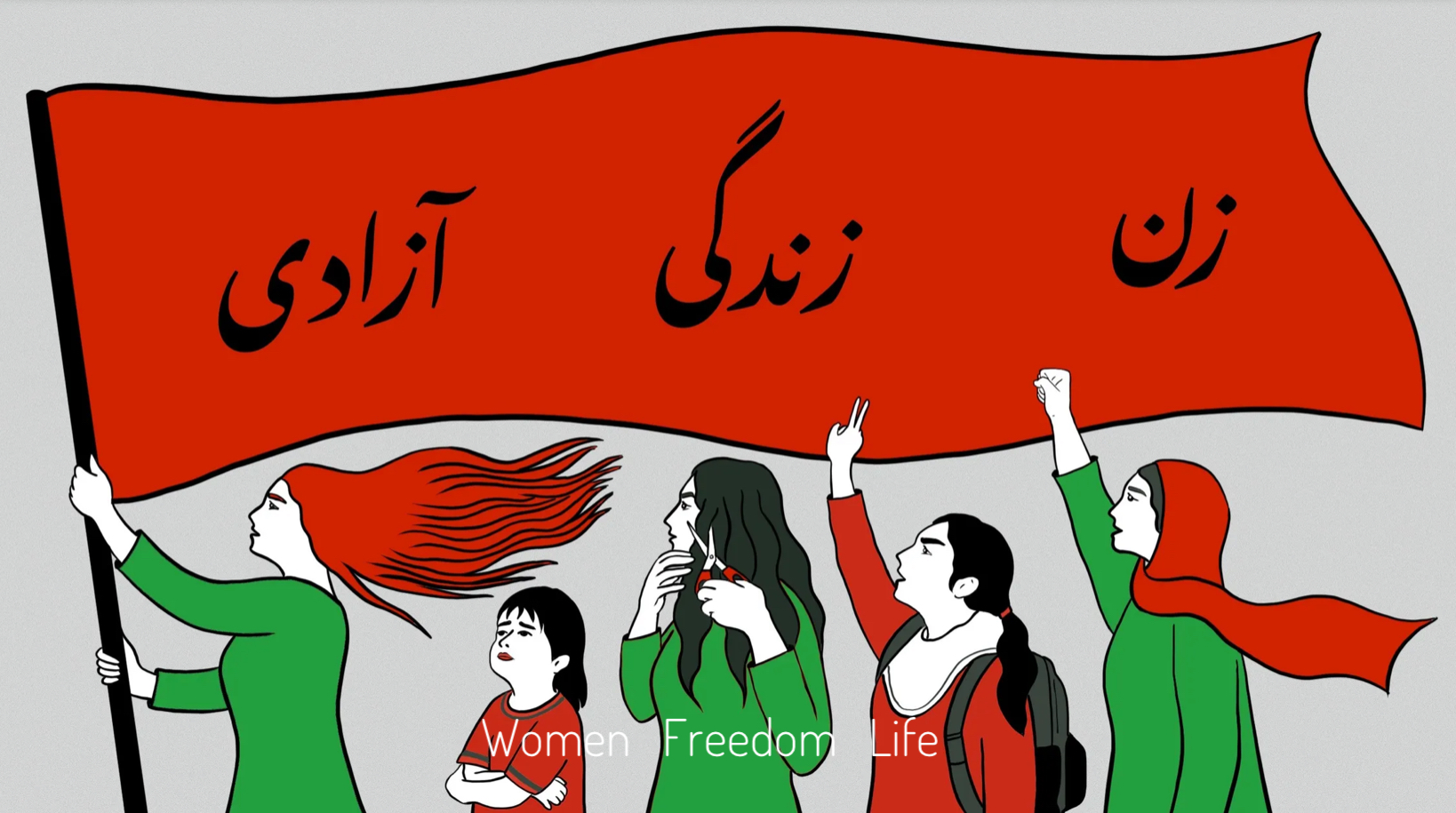
As 2022 ends, with blood flowing on the streets of Iran and in the mullahs’s torture cells as young people rise up against a hypocritically brutal theocratic tyranny, we see again and again how that which goes around comes around.

Women, Freedom, Life

If the malign hand of history has literally reached out and gripped Iran’s young women and girls by their hair, it has also endeavoured to strangle the thousand year old Ukrainian nation in the name of an atavistic irredentism. Russian troops invaded the Ukraine on February 24, causing what has since become the largest conflict in Europe since World War II. Out if the spotlight of the world’s easily distracted attention. intractable conflicts lumbered mercilessly on – in Syria, Yemen, Ethiopia, the Congo and many other “far away  places with strange sounding names”.  

On the far side of the world, the USA continued to struggle with the reverberations of January 6th 2021. Donald Trump, like Dracula, has not gone away, and whilst his 2024 presidential run is looking increasingly shaky, he continues to poison the atmosphere like radioactive dust. The unfortunate folk of the United Kingdom endured three prime ministers during the year, including the shortest ever in the history of the office, and after two years of pandemic, are facing a bleak economic winter as well as a frigid actual one.

In Australia, it was the year of the teal – at least according to those who study the evolution of language, the year we lost a queen, our long-serving foreign head of state, and a king of spin, the down-fallen and disgraced Scott Morrison. And a sodden La Nina saw incessant rain drown large swathes of eastern Australia, visiting misery on thousands. COVID-19 mutated, the Omicron variant surging from beginning of the year, ensuring no end to the pandemic – today, it seems like everyone we know has had it, including ourselves (and we were soooo careful for a full two years!). As restrictions were cautiously lifted, we as a nation are learning to live with it. 

Politically, it’s been a grand year for the Australian Labor Party. With our stunning Federal election win in May and in Victoria in November, the Albanese government’s star is on the ascendant and it’s legislative record in six months has out run nine years of Tory stagnation on climate, integrity and equality – a neglect that saw the rise of a new political force in the shape of a proto-party, the aforementioned “teal”, named for the colour of the candidates’ tee shirts. The opposition has been reduced to a bickering and carping crew, and whilst Labor continues to ride high in the polls, the Coalition bounces along the bottom of the pond.

Lismore, northern NSW, March 2023

Flooded house aflame, Lismore March 2022

Christine McVie was just one of many music icons who checked out this past year. The coal miner’s daughter, Loretta Lynn, crooned her last, as did rock ‘n roll bad boy Jerry Lee Lewis and Ronnie “the Hawk” Hawkins, who gave the boys in The Band their big break. Rock heavyweight (literally) Meatloaf took off like his bat out of hell and keyboard evangelist Vangelis boarded his chariot of fire.

Acclaimed British author Hilary Mantel, whose Wolf Hall trilogy inspired back to back posts in In That Howling Infinite in 2020 found “a place of greater safety”, and French author Dominique Lapierre also joined the choir invisible. I had first learned about Israel’s war of independence and the Palestinians’ al Nakba in his O Jerusalem, and about the bloody tragedy that accompanied the birth of India and Pakistan, in Freedom at Midnight, both books featuring in past posts. 

Mark Rylance and Damian Lewis as Tom and Hal

One could argue that the most significant departure was that of Britain’s longest serving monarch. Queen Elizabeth II had been on the throne for almost all of my life, as has the now King Charles III who was born four months before me, and of whom, as a nipper, I was jealous. I recall how I watched the queen’s coronation on a tiny black and white television in the crowded and smokey parlour of the boarding house run by a friend of our family. By happenstance, Netflix served up two over the top regal sagas to binge on: the penultimate season of The Crown, which whilst entertaining, was a disappointment in comparison with earlier seasons, and Harry and Meghan which was whilst excruciatingly cringe-worthy, was nevertheless addictive viewing. The passing of Her Maj reminded me that in my lifetime, I have witnessed three monarchs and eighteen British prime ministers (and incidentally, eighteen Australian prime ministers).  The public outpouring of grief for the Queen’s ascent to the choir invisible was unprecedented – the picture below demonstrates what the Poms do best …

The Queue along the Thames to pay respect to Her Maj

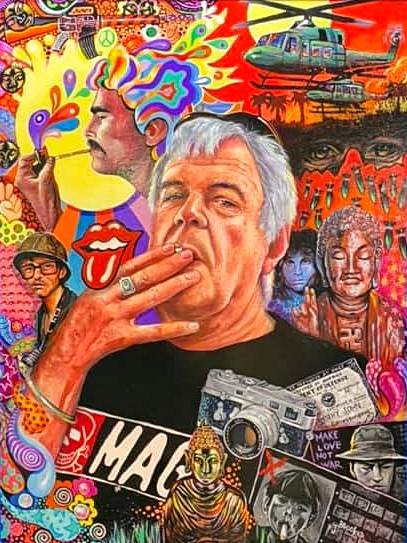
There were farewells much closer to home. My mediation colleague, aspiring author and friend John Rosley, and Beau Tindall, the son of my oldest Bellingen friend Warren, took off on the same day in May. Peter Setterington, my oldest friend in England – we first met in 1972 – died suddenly in London in March, and our friend and forest neighbour, the world-famous war photographer Tim Page, in August, after a short but nasty illness. Pete is memorialized in When an Old Cricketer Leave His Crease whilst Journey’s end – Tim Page’s wild ride,is an adaptation of the eulogy I gave for Tim in September, one of many on that sunny afternoon day in Fernmount. It is a coda to Tim Page’s  War – a photographer’s  Vietnam journey, a story we published a year ago.

Tim Page by Joanne Booker

What we wrote in 2022

The ongoing Ukraine War has dominated our perception of 2022, from the morning (Australian time) we watched it begin on CNN as the first Russian missiles struck Kyiv, to the aerial assault on infrastructure that has left Ukrainians sheltering through a cold, dark winter. Two posts in In That Howling Infinite examined the historical origins of the conflict: Borderlands – Ukraine and the curse of mystical nationalism and The Roots and Fruits of Putin’s Irridentism. “Because of …” Iran’s voice of freedom looks at the song that has become the rising’s anthem. None can predict the outcome – whether it will be a doomed intifada, the Arabic word that literally means a shaking off – historically of oppression – and figuratively, a rising up, like that in Ireland in 1798 and 1916, Warsaw in 1943 and 1945, and Hungary in 1956, or an Inqilab, another Arabic word meaning literally change or transformation, overturning or revolution.

The run up to May’s Australian elections inspired Teal independents – false reality in a fog of moralism.; and Australia votes – the decline and fall of the flimflam man. 

More distant history featured in Menzie’s Excellent Suez Adventure, the story of the Suez crisis of 1956 that historians argue augured the end of the British imperium, and the role played therein by longtime Australian prime minister Sir Robert Menzies. Johnny Clegg and the Washing of the Spears is a tribute to the late South African singer, dancer and songwriter, and a brief history of the war that destroyed the great Zulu nation, setting the scene for the modern history of South Africa. And journeying further back in time to sixteenth century Ireland, there is O’Donnell Abú – the Red Earl and history in a song, a discussion of the origins of a famous and favorite rebel song.

Then there are the semi-biographical “micro-histories” in In That Howling Infinite’s Tall tales, small stories, obituaries and epiphanies. In 2023, these included: Folksong Au Lapin Agile, the evening we visited Montmarte’s famous folk cabaret; Ciao Pollo di Soho – the café at the end of the M1, the story of a café that played a minor part in my London days, as described in detail in an earlier travelogue, Song of the Road – my hitchhiking days; Better read than dead – the joy of public libraries; The quiet tea time of the soul, an ode in prose to a favourite beverage; and The work, the working, the working life recalling the many jobs I took on in the sixties to keep myself in music, books, travel and sundry vices. 

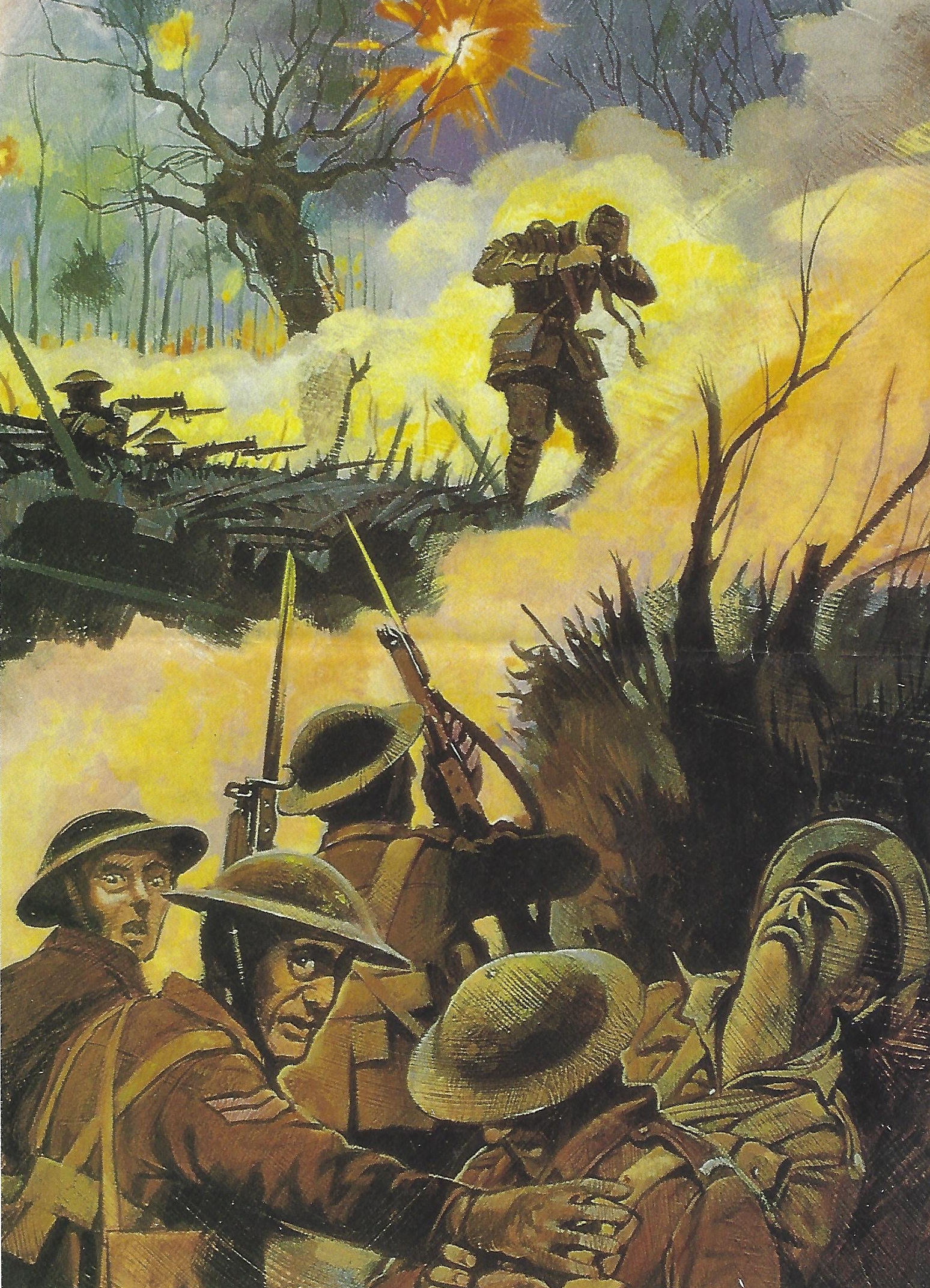
We cannot pass a year without something literary. We celebrated the centenary of three iconic literary classics in The year that changed literature, and with the release of The Rings of Power, the controversial prequel to The Lord of the Rings, we published a retrospective on the influence of JRR Tolkien. One ring to rule us all – does Tolkien matter? – a personal perspective with an opinion piece by English historian Dominic Sandbrook, an informative and entertaining chronicler of postwar British history and society which featured, in Unherd, an online e-zine that became a “must read” in 2022. A Son Goes To War – the grief of Rudyard Kipling recalls the death in battle on the Western Front in 1917 of the poet’s only son, it’s influence upon his subsequent work, whilst Muzaffar al Nawab, poet of revolutions and sorrow is an obituary for another poet, who seen a lifetime speaking truth to power.

And that was that for what was in so man ways a sad year. Meanwhile, In That Howling Infinite already has several works in progress, including a review of historian Anthony Beevor’s Russia – Revolution and Civil War, what King Herod really thought about the birth of baby Jesus, and the story of a famous and favourite British army marching song.

Best wishes for 2023 …

Death of a Son

That was the year that was – retrospectives

Life in Wartime – images of Ukraine

Johnny Clegg’s “Impi” – the Washing of the Spears

Under African Skies

A decade or so ago, British born South African singer and songwriter the late and much lamented Johnny Clegg (he died of cancer in July 2018) performed with his band at Newtown’s antique Enmore Theatre in inner Sydney. Renowned worldwide for his fusion of western and South African township music, the “White Zulu” as he was called, had captivated us and thousands of others with his bilingual songs and anthemic choruses – and he danced! The high kicking Zulu warrior dances of rejoicing, of rites of passage, and of war. And his choruses! Could he write choruses. They didn’t rise –  they soared like African eagles and they made the hairs on the back of our heads stand up. The audience would sing along entranced, enthralled and seemingly word-perfect in a language they could not even begin understand. Towards the climax of his concert, when such was the energy you could sense an ascension to heights of glory, he’d introduce Impi, his story of the battle of Isandhlwana on January 22nd 1879, a battle considered the greatest ever defeat of a modern army by an indigenous people. A thousand voices joined him in song …

Impi! wo ‘nans’ impi iyeza
Obani bengathinta amabhubesi?

War, O here comes war!
Who can touch the lions?

It was an ironic moment in time and historical memory.

The South Africa’s apartheid regime has long since fallen, and Johnny Clegg was world famous for his decades-long anti-apartheid stand and for his fusion of western and African music and lyrics. Paul Simon had cited Clegg’s early band Juluka as an influence in his own iconic album Graceland. Whenever Clegg played in Australia, white South Africans made up a large proportion of the audience. And they and us, again mostly white, would sing along and even dance in the aisles. But very few there that night would have much of an awareness of the historical and cultural backdrop to his songs – particularly the events described in Impi, those leading up to it, and the aftermath.

Indeed, few westerners are aware let alone knowledgeable of southern Africa’s history. It is a faraway land, distant geographically and culturally from the northern hemisphere, and we known more for its wildlife and its troubles. For a long, long time it was called “the dark Continent”.  In the excellent British espionage thriller Spooks, the Foreign Secretary declares contemptuously: “The continent of Africa in nothing but an an economic albatross around our necks. It’s a continent of genocidal maniacs living in the Dark Ages”.

Moreover, few people actually interested in the British Empire and the imperial wars of conquest of what is now the Republic of South Africa are aware of the fact that the military disaster at Isandhlwana and the heroic defense of Rorke’s Drift in the southern summer of January 1879 were the chaotic prelude to the conquest of the powerful and independent kwaZulu, a kingdom established half century earlier by the charismatic and canny but brutal, paranoid and arguably psychotic warlord Shaka Zulu.

I do not profess be an expert although cognizant of African History and politics from my own reading over the years, ranging from studying sub-Saharan politics in the late sixties to reading James A Mitchener’s sprawling novel The Covenant (1980), which traces the history, interaction, and conflicts between South Africa’s diverse populations, from prehistoric times up to the 1970s. Recently, I read Australian author Peter Fitzsimmon’s The Breaker in which he relates the story of Boer War, and Donald R Morris’s critically acclaimed The Washing of the Spears – the Rise and Fall  of the Great Zulu Nation (1966).

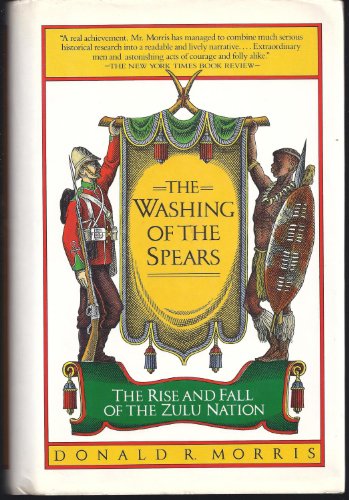
The Washing of the Spears

American historian Donald R Morris’s seminal work on the rise and fall of the Zulu nation is near on sixty years old, and it shows in both the archaic lyricism of his prose – a style characteristic of his academic peers – and that mid twentieth century conservative mindset of shifting presumptions and prejudices that was so much part of the sixties, that inform his point of view of events so long ago that shaped the development of modern Africa.

The book takes its title from the Zulu idiom for shedding the blood of enemies with the short tabbing spear developed by Shaka himself from the traditional Bantu assegai – an onomatopoeic word for the sound made when the spear was extracted from a wound.

While hardly the book to consult for a fast grasp of the outlines of Zulu history, it provides a sweeping, all-inclusive military, political, and personal record. It is a rousing narrative and highly informative, although it does get bogged down in the minutiae of political, administrative and military matters. The book is a close-typed 612 pager. The first 214 describe the rise of Zulu power – Shaka, Dingaan, Mpandi and Cetshwayo.

The battles are done and dusted in just seventy six pages. The remainder is taken up with the preparations for the invasion of Zululand, the second invasion, the defeat of the Zulus at Ulundi and the annexation of Zululand to the colony of Natal.

But this does not detract for one moment from the quality and detail, and also, the empathy and objectivity of Morris’s narrative. He treats the Zulu, as well as the Boers and British, fairly, portraying both admirable behaviors and the foibles of all parties. Whilst some readers might conclude that despite its evenhanded approach, it fails to meet the high standards of contemporary political correctness, I am highly impressed by the author’s undisguised empathy for the Zulu people as demonstrated by the depth of his research into Zulu customs and etymology and the degree to which he describes by name and in detail the Zulu regiments arrayed against the Crown.

When it comes to the timeline of the battles of Isandhlwana and Rorke’s Drift, which occurred almost in tandem, it is a riveting re-enactment of the combat – a timeline that spoke to the the big screen films, Zulu released in 1964 and Zulu Dawn which depicted Isandhlwana and was released to coincide with its centenary in 1979.

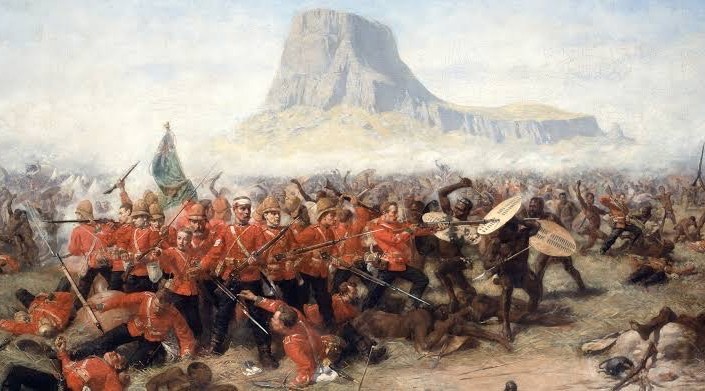
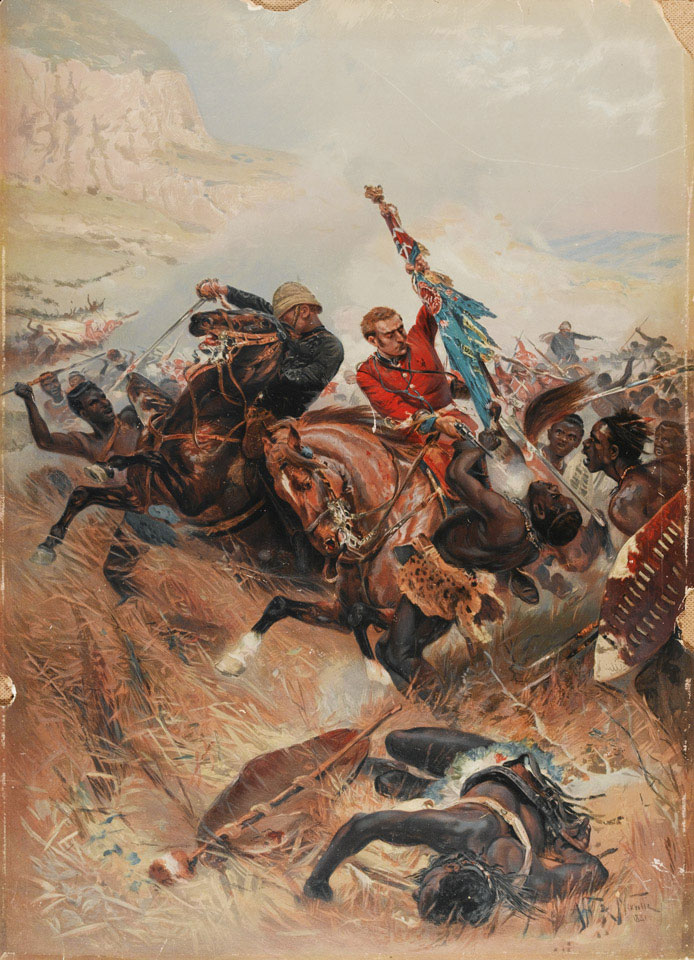
Saving The Colours, Isandhlwana

Here they come, black as hell and as thick as grass!

Long story short, the Zulu War of 1879 was an unprovoked, preventive war waged by an expansionist imperial power against an independent kingdom. After the initial disaster at Isandlwana, the native state was broken in a conquest that largely determined the place of the indigenous population within the European civilization of southern Africa, and it freed that civilization from any imperative nor the willingness listen to the voice of black Africa for nigh on one hundred years.

The Zulus did not want war, and were in effect enticed into it by colonial authorities who desired to break Zulu power once and for all. Morris describes in great detail the depths of skulduggery Britain’s representatives on the ground were pro armed to descend to. Pertains were in plain view, both the gathering of military and paramilitary forces and the supply chain and logistic required to sustain them in the field.

Once committed, the outcome was inevitable. The first invasion ended, however, in disaster – the massacre at Isandhlwana. But this was more due to the mistakes made by British commanders than to the undeniable overwhelming numbers and resolve of the Impi deployed against them. Lieutenant-General Lord Chelmsford divided his numerically inferior forces. The relatively small force left behind at the base camp at Isandlwana as poorly deployed, denying them the advantage of concentrated fire. critical ammunition boxes that could not be opened quickly because the tools were inadequate, and scouting that was lackadaisical in the extreme –  so much so that 20000 warriors were able to gather in a ravine close to the camp undetected until it was too late.

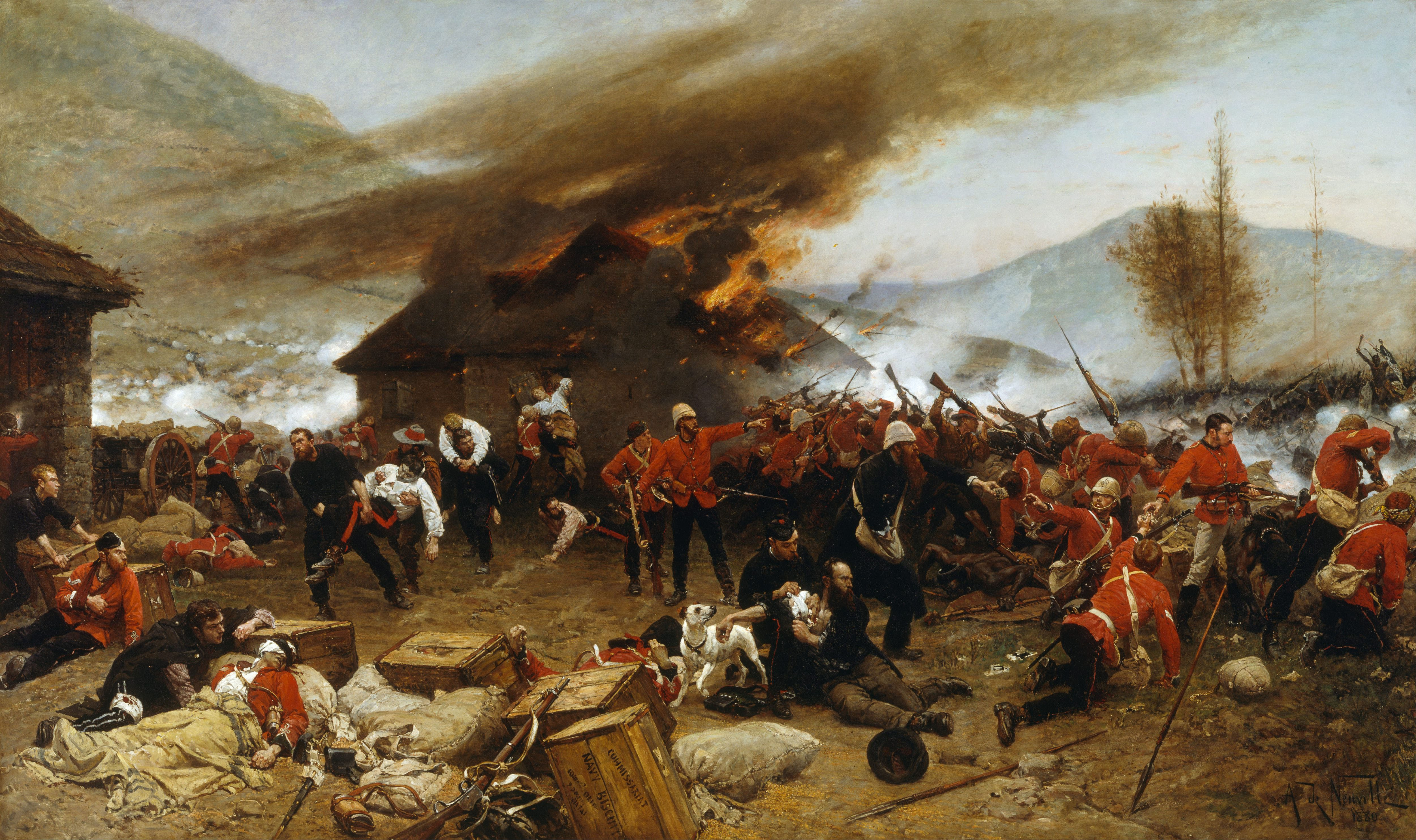
The rest, as they say, is the study of military history. The defense of the border mission at Rorke’s Drift at about the same time as the battle was reacting its climax, itself a sideshow as thousands of warriors stormed the beleaguered outpost. The quotation at the head of this section is the cry of Chaplain George Smith on lookout on the ridge behind the mission. Rorke’s Drift was an opportunistic target for a small army of Zulus who had not engaged in the main battle, and probably had no intention of proceeding onward into Natal – Cetshwayo had expressly forbidden it. In the wake of the disaster, it became the stuff of legend, More Victoria Crosses were awarded here than in any other engagement by the British Army.

The next time, General Chelmsford took no chances. Thousands of soldiers and horsemen supported by thousands of wagons and tens is tens of thousands of draught animals slowly traversed miles and mile of uncharted bush to array before Cetshwayo’s Royal kraal at Ulundi. Maximum force was applied on a chosen field of battle and massed firepower of combined arms – Henry Martini rifles, cannon and Gatling guns against waves of Zulus attend with assegais and cow hide shields with cavalry of the flanks to harry the foe once he was broken and scattered.

Morris’s conclusion to the battle of Ulundi is a poignant synopsis of the rise and fall of the Zulu nation. It is well worth reproducing in part:

“The camp on the the White Umfolozi was quiet that night. The war was over, and the battalions would soon be sailing to England. Chelmsford slept the sleep of the just. He had successfully concluded two arduous campaigns in a year and a half. Providence has been very good to him and he could hold his head high in the future. Sir Garnet Wolsey  was welcome to whatever remained of the Zulu campaign.

The flames across the river died away, and the drifting black smoke was hidden by the soft night. A few miles to the west of the sleeping camp stood th kwaNabomba kraal, where Shaka had arrives 63 years ago to claim his inheritance. He had found an apathetic clan no one ever heard of, who numbered  less than the Zulu dead that now lay and buried across the river, and out of them he had fashioned  an army, and with that army, he had built an empire. The proud and fearless regiments had carried that assegais south to the Great Kei, west to the high wall of the Drakensberg Range, and north to Delagoa Bay. He had smashed more than 1000 clans and driven them from their ancestral lands, and more than 2 million people had perished in the aftermath of the rise of his empire, which had survived him by a scant 50 years. The last independent king of the Zulus was now a homeless refugee without a home, and his capital lay ashes. His army had ceased to exist, and what was left of the regiments had silently dispersed to seek their own kraals. The house of Shaka had fallen, and the Zulu empire was no more …

… The cost has been high. The house of Shaka had been overthrown and Zulu kingdom fragmented. Some 8000 Zulu warriors it died and more than twice that number had been wounded, to perish or recover without medical attention. Thousand of Zulu cattle had been run off into Natal or slaughtered to feed the invaders, scores of kraals had been burned and the fields had gone untended …

… Over 32,400 men and taking the field in the Zulu campaign. The official British returns listed 76 officers and 1007 men killed in action and 37 officers and 206 men wounded. Close to 1000 Natal kaffirs had been killed; the returns were never completed. An additional 17 officers and 330 men had died of disease and 99 officers and 1286 men had to be invalided home. In all, 1430 Europeans had died, over 1300 of them at Isandhlwana. The war cost the crown £5,230,323 – beyond the normal expense of the military establishment: the naval transport alone cost £700,000. A tremendous sum for the land transport which had employed over 4000 European and native drivers and leaders, more than 2500 carts and wagons, and has seen as many as 32,000 draft animals on the establishment at one time. No one ever counted the tens of thousands of oxen that had died.”

The Defense of Rorke’s Drift

The captains and the kings depart

The world at large took little note of the war – except perhaps for France. In a brief chapter entitled The Prince Imperial, Morris recounts the story of how the son of the deposed and exiled Emperor Napoleon III of France, a graduate of Woolwich military academy had joined the invasion force and had perished when his scouting patrol was was ambushed. As Morris describes it, the displays of mourning by the British establishment and also the public far exceeded their reaction to the deaths at Isandlwana.

But the breaking of Zulu power, removing the threat it posed to the emerging Boer republics, and Britain’s halting progress towards the confederation of the South Africa colonies, was to have a critical influence what came afterwards: two Anglo-Boer Wars, the creation of the Union, and the emergence of the white supremacist Apartheid republic with its system of racial segregation which came to an end in the early nineteen nineties in a series of steps that led to the formation of a democratic government in 1994.

As for Cetshwayo, he was tracked down and captured after Ulundi. In an early form of home detention, he was detained in Capetown. In time, he became in the eyes of the British public, a tragic figure, less the bloodthirsty Bantu as he’d been portrayed during the war, and more the noble savage as victim of predatory imperialism. He journeyed to England and was well received by all, and even enjoyed an audience with Queen Victoria who treated him with respect and amity. On his return to Capetown, moves to restore him to his throne were truncated by his death – ostensibly poisoned by rivals. Shaka’s heirs are recognized as kings in kwaZulu to this day.

In a memorial wall at Ulundi, the battle that ended the war and the Zulu nation, there is a small plaque that reads: “In memory of the brave warriors who fell herein 1979 in defense of the old Zulu culture”. From what I can gather, it the only memorial erected to honour the Zulu nation.

A cinematic coda 

Reading Morris’s book recently, I succumbed to the urge to watch both Zulu and its later prequel Zulu Dawn.. Their cinematic technology, character development and acting have not stood the test of time – and few of the lead characters are still with us – one cannot fault their faithfulness to the author’s narrative.

What the films miss, however, is what I perceived as Morris’s oblique perspective of the Zulu war. They present the conflict in literal black and white – the mission civilatrice, white man’s burden, whatever, bringing justice and order, not in that order, to bloodthirsty savages. In Zulu, the doughty British soldiers are well led and respond with courage and resilience. In Zulu Dawn, those soldiers are badly led by their snobbish and ineffectual leaders, and most particularly by General Chelmsford portrayed with smarmy insouciance by Peter O’Toole, and his supercilious staff. The “good guys”, Denholm Elliot’s Colonel Pulaine, Burt Lancaster’s Colonel Dunford, and Simon Ward’s Lieutenant Vereker and others are cardboard cutouts. Lieutenants Chard and Bromhead,the commanders at Rorke’s Drift, played by Stanley Baker and Michael Caine respectively, are the acme of bulldog spirit and stiff upper lip, and poster boys for many an imperial Facebook page.

The rest of a large cast of extras, be they the Boer and native auxiliaries or the massed Zulu regiments chanting “uSuthu! USuthu!”, the war cry of the Shaka dynasty, are the backdrop to imperial derring do and disaster. In both movies, the scenes at the Zulu kraals present the cinematographers with an opportunity to indulge in a bit of National Geographic soft porn with dusky, lithe and bare-breasted maidens dancing in lines towards long-limbed and youthful Zulu warriors. Men march, men charge, men stand, men run, and men die. The action is not graphic by modern standards – no Vikings or Game of Thrones blood and gore here.

Mark Stoler’s Things have changed blog spot provides a brief but informative review of The Washing of the Spears, including a synopsis of the story line, including some interesting facts about the author. I have reproduced it below for your convenience- but the eclectic blog, similar in content and diversity to In That Howling Infinite, is worth checking out.

© Paul Hemphill 2022. All rights reserved

See also In In That Howling Infinite: The ballad of ‘the Breaker’ – Australia’s Boer War 

Impi

John Clegg

Impi! wo ‘nans’ impi iyeza
Obani bengathinta amabhubesi?
Impi! wo ‘nans’ impi iyeza
Obani bengathinta amabhubesi?
Impi! wo ‘nans’ impi iyeza
Obani bengathinta amabhubesi?
Impi! wo ‘nans’ impi iyeza
Obani bengathinta amabhubesi?

All along the river
Chelmsford’s army lay asleep
Come to crush the Children of Mageba
Come to exact the Realm’s price for peace
And in the morning as they saddled up to ride
Their eyes shone with the fire and the steel
The General told them of the task that lay ahead
To bring the People of the Sky to heel

Impi! wo ‘nans’ impi iyeza
Obani bengathinta amabhubesi?
Impi! wo ‘nans’ impi iyeza
Obani bengathinta amabhubesi?

Mud and sweat on polished leather
Warm rain seeping to the bone
They rode through the season’s wet weather
Straining for a glimpse of the foe
Hopeless battalion destined to die
Broken by the Benders of Kings
Vainglorious General, Victorian pride
Would cost him and eight hundred men their lives

Impi! wo ‘nans’ impi iyeza
Obani bengathinta amabhubesi?
Impi! wo ‘nans’ impi iyeza
Obani bengathinta amabhubesi?

They came to the side of the mountain
Scouts rode out to spy the land
Even as the Realm’s soldiers lay resting
Mageba’s forces were soon at hand
And by the evening the vultures were wheeling
Above the ruins where the fallen lay
An ancient song as old as the ashes
Echoed as Mageba’s warriors marched away

Impi! wo ‘nans’ impi iyeza
Obani bengathinta amabhubesi?
Impi! wo ‘nans’ impi iyeza
Obani bengathinta amabhubesi?
Impi! wo ‘nans’ impi iyeza
Obani bengathinta amabhubesi?
Impi! wo ‘nans’ impi iyeza
Obani bengathinta amabhubesi?
Impi! wo ‘nans’ impi iyeza
Obani bengathinta amabhubesi?
Impi! wo ‘nans’ impi iyeza
Obani bengathinta amabhubesi?
Impi! wo ‘nans’ impi iyeza

Zulu: The Washing Of The Spears

Things Have Changed blogspot, Mark Stoler, 24th September 2016

I first came across the tale of Rorke’s Drift in a long-forgotten collection of stirring deeds written for children.  I could not have been more than ten years old at the time . . . 

from the Introduction to The Washing Of The Spears: 
https://upload.wikimedia.org/wikipedia/commons/2/20/Alphonse_de_Neuville_-_The_defence_of_Rorke's_Drift_1879_-_Google_Art_Project.jpgThe Defense of Rorke’s Drift, Alphonse de Neuville, 1880

Donald Morris (1924-2002) began research for The Washing of the Spears in 1956, completing the bulk of it between 1958 and 1962 when, according to the 1965 introduction to his book, he was “a naval officer stationed in Berlin“.  Fascinated by the Battle of Rorke’s Drift, which occurred on January 22-3, 1879, and the stunning defeat of the British Army by the Zulus at Isandhlwana, earlier that same day, he planned to write a magazine article on the battles, until persuaded by Ernest Hemingway to compose an account of the entire Zulu War of 1879, as none had ever been published in the United States.
http://lowres-picturecabinet.com.s3-eu-west-1.amazonaws.com/109/main/1/424960.jpgIslandhlwana, 1879,

The mention of Hemingway, alerted me that Morris might be an interesting person in his own right.  I originally read the book in the mid-1970s on the recommendation of an acquaintance who had been enthralled by it.  At that time, there was very little information available on the author.  More recently I’ve read the 1998 edition (the book has gone through several printings over the years), as well as Morris’ 2002 obituary and found that, indeed, he was quite an interesting character.

Educated at the Horace Mann School for Boys in New York City, he entered the navy in 1942 and then went on to the Naval Academy, graduating in 1948, remaining on active service until 1956, and retiring as a Lieutenant Commander.  It turns out that his assignment as a naval officer in Berlin was a cover; from 1956 through 1972 he was a CIA officer in Soviet counterespionage, serving in Berlin, Paris, the Congo and Vietnam.  From 1972 through 1989 he was foreign affairs columnist for the Houston Post.  Morris spoke German, French, Afrikaans, Russian and Chinese, held a commercial pilot’s license and was a certified flight instructor.
https://pictures.abebooks.com/isbn/9780671631086-uk-300.jpg
Once Morris took up Hemingway’s suggestion and began research on the Zulu War, he realized he needed to find out more about its origins.  It was a process that ended up taking him all the way back to the early 17th century, when both the Dutch and the Bantus (of whom the Zulu were a subgroup) first entered the lands that later became the Republic of South Africa, the Dutch in the southwest via the Capetown settlement and the cattle-herding Bantus migrating from the north.  The result is a 603 page epic (excluding footnotes), encompassing almost 300 years of history, and all of it accomplished without visiting South Africa.

Morris tells us of the fate of the Bushmen and Hottentots, most of whom were destroyed, caught between the advancing Dutch settlers (who came to call themselves Boers) and Bantus.  We learn of the coming of the English in the late 18th century, which accelerated the migration of Boer farmers, north, northeast and east of Capetown in order to escape British control.  We learn of the emergence of the Zulu nation in the 1820s under Shaka, and of his brilliant in leadership, tactics and strategy as well as his erratic behavior and brutality. http://img.webme.com/pic/t/the-south-star/zuluattack.jpgZulu impi)

The innovative military system he developed and the incredible endurance and bravery of the Zulu warriors, made Shaka’s kingdom feared across the land, among both natives, Boer (who had also come to consider themselves natives) and English. Under Shaka and his successors, the Zulu controlled most of the coastal strip of southern Africa, eventually coming up against the Boers, who began their Great Trek in the 1830s to escape the encroaching English; a journey which took them to what was to become the Orange Free State, the Transvaal and Natal.


http://www.britishempire.co.uk/images4/anglozuluwarmaplarge.jpg
As the British consolidate their control we learn of the confinement of the Zulu Kingdom to a smaller area and then of the manipulations that led to the 1879 war.  It culminates in Morris’ thrilling narrative of the events of January 1879.  First, at Isandlhwana, where a British and native force of 1,800 was overwhelmed by the Zulu impis (the equivalent of a division in a western army), resulting in the worst defeat Britain ever suffered in Africa at the hands of a native force.  Of 960 Europeans only 55 survived (every one of the 602 soldiers and officers of the British infantry perished), along with only 300 of the 850 native troops.  Then came Rorke’s Drift, the mission station that had been converted into a supply station to support the British invasion of Zululand, where 140 soldiers (of whom more than 20 were incapacitated with sickness or wounds) faced 4,000 Zulus, who had crossed into Natal despite Zulu King Cetshwayo’s order that they not enter British territory.  In fighting that was hand to hand at times, and went from 4 in the afternoon until after 2 the following morning, the Zulu were repulsed.  Seventeen of the British soldiers were killed, eight severely wounded and almost all of the remainder were injured in some manner.  Eleven Victoria Crosses, Britain’s highest military honor, were awarded to participants. It was the most awarded to one regiment in a single action up to that time. Among the recipients was a cook, Private Henry Hook, who took up arms and enabled the evacuation of the patients from the mission hospital while he battled Zulu warriors from room to room as the building burned down around him.
(Map by Lt 

https://sites.google.com/site/victorianmaps/_/rsrc/1298181713829/home/africa/zulu-wars/3407021582_6e01780390.jpg

Map made by Lieutenant Chard, co-commander at Rorke’s Drift

Morris takes us through the conclusion of the war in which the British regrouped and reinvaded, finally conquering the Zulu, and of the sad decline of Zululand over the next decades.

The book is a rousing narrative and highly informative.  My only criticism is that it does become bogged down at one point in the minutiae of the formation of the Natal Colony and the very confusing religious disputes among its European settlers.  About 50 pages could have been edited out.

The author treats the Zulu, as well as the Boers and British, fairly, portraying both admirable behaviors and the foibles of all parties.  Given the times it was written in, my guess is it would not meet with the full approval of today’s social justice crowd, despite its evenhanded approach.

I’ve read a bit about more recent historiography of the Zulu and this general period in South African history to get a sense of how the book is regarded today.  In the decades since its publication much new information about the Zulu kingdom has become available that provides a more complete explanation of their thinking in the run up to the 1879 war and their strategy in conducting it.  Some different takes on the campaign and battles have also become available.  Nonetheless, the book remains highly regarded.

The 1988 edition of the book contains an unusual introduction from Mangosuthu Buthelezi, Chief Minister of kwaZulu, and descendant of King Shaka.  In it, Buthelezi gives tribute to Morris’ efforts,  placing it in the context of its time:

Forced to use the only sources available in the vast amount of research he undertook in order to write the book, he nevertheless could not entirely escape the clutches of a very biased recording of the past.  It is, however, not the extent to which some of his observations could be questioned that is important, for at the time of its publication in 1966, The Washing of the Spears was the least biased of all accounts ever published about kwaZulu.

He traces the process of colonial domination over the Zulu people and step by step shows how the British occupation of Natal led to the formation of what the world now knows as an apartheid society. He writes with indignant awareness of how today’s apartheid society was made possible by brutal conquest and subjugation during British colonial times, and he had attributed historically important roles to the Zulu kings in his awareness of the Black man’s struggle against oppression.

He undertook a mammoth task and acquitted himself brilliantly.  The Zulu people owe a debt of gratitude to Donald Morris.  He saw the world through our eyes and he was at his brilliant best in writing about the major White actors who shaped events in South Africa during the nineteenth century.  He stands with us as we revere the memory of people such as Bishop Colenso; he stands with us in the knowledge of what Sir Bartle Frere did; and he stands with us in an intense awareness of how people like Sir Theophilus Shepstone turned traitor to the people who had befriended him and about whom he talked as his friends.

Of course no account of the Zulu War, or at least no account at THC, would be complete without mention of the 1964 film Zulu, about the fight at Rorke’s Drift.  Starring as the two young officers in charge of the defense were Stanley Baker as Lt. John Chard and newcomer Michael Caine as Lt Gonville Bromhead.  King Cetshwayo was played by his great-grandson Chief Buthelezi!  I quite enjoyed the movie as a teenager.  Here’s a nice piece on the film from an historical perspective.

The ballad of ‘the Breaker’ – Australia’s Boer War

The Breaker Morant story is back in the news here in Australia with the investigation of our SAS for the unlawful killing and torturing of Afghanis.

Every once in a while, the matter of the trial and execution by firing squad of Harry “the Breaker” Morant for killing unarmed prisoners of war during the 19th Century fin de siecle Anglo-Boer War surfaces as his partisans push for a pardon. The war was Australian troops’ fourth overseas military adventure in the service of British Empire (the first was New Zealand’s Maori Wars, and later, in Sudan and during The Chinese Boxer Rebellion – with few engagements and no battle casualties (see Postscript below).

The argument goes like this: Lieutenants Harry Morant, an immigrant to Australia from Devon, England, and Peter Handcock, Australian born, were tried by a military court and executed unjustly as scapegoats of the British Empire. Some partisans are more nuanced. Celebrated lawyer and human rights advocate Geoffrey Robertson questions whether there was due legal process and not whether the two were guilty as charged.

The general consensus here in Australia, however, is that the two men received a fair trial (by martial law standards, that is ) and got what they deserved. It’s a similar “hero or villain” debate to that which has persisted for a century about our most famous bad guy,  bush ranger Ned Kelly. The consensus here too is that Ned received his just deserts for the shooting of the policemen at Stringybark Creek. As Ned said just before dropped through the trapdoor at Melbourne Gaol, “such is life”.

But back to “the Breaker”, Harry Morant, and the subject of the latest book from Australian author Peter FitzSimons, Breaker Morant. Morant earned his sobriquet for his superb horsemanship. Most folk know him only from Bruce Beresford’s excellent 1981 film, Breaker Morant and particularly, his famous last words: “Shoot straight, you Bastards! And don’t make a mess of it!”

Fitz is a “popular historian” and a fine storyteller – and Bob Dylan tragic (I once asked him to write a book about the Bobster, but he hedged with his answer). He has written prolifically on subjects as diverse as Captain Cook, the gruesome Batavia mutiny, and Ned Kelly, and particularly Australian military history, including books about Gallipoli, Pozières, Tobruk and Kokoda. He is an ardent republican, and that comes through strongly in his writing. He is excellent at drawing characters out of history and describing events in detail. I enjoy his tales very much, but I do not like his style – he writes in the vernacular, which is not a bad thing, but embroiders the story much to much, putting words into his historical characters’ mouths and retelling the event, be it a battle or a horse race, as if they were a contemporary action novel.

His Breaker Morant is true to form. Fitz bulls up his voluminous text with extraneous aphorisms and superfluous intrusions “of shreds and patches, of ballads, songs and snatches” (I can be as guilty as he) as if they were intrinsic to the narrative. And his sub-paragraph headings, employing puns and tabloid catchphrases seems to me as contrived and, well, naff.

He has little affection for his subject. “… that ragged, red faced charmer, the ever garrulous Breaker Morant” is introduced to us in the Australian bush as a Pommie, a compulsive liar and cheat, con-artist and impostor, faker and fantasist, one step ahead of creditors and the law. But man, he ride and shoot! There is no colt he cannot tame nor race or polo game he cannot win. And he can drink any man under the table.

Morant is a story teller non parièl – mostly about himself and his much embroidered exploits. He is able to impress and ingratiate himself upon people of all genders, classes and occupations, not the least, our celebrated poet lorikeet Henry “Banjo” Paterson. They bond over a shared accuity for penning bush ballads – and by the standards of that genre, The Breaker holds his own among Australian poets:

There was buckjumping blood in the brown gelding’s veins,
But, lean-headed, with iron-like pins,
Of Pyrrhus and Panic he’d plentiful strains,
All their virtues, and some of their sins.
‘Twas the pity, some said, that so shapely a colt
Fate should with such temper endow;
He would kick and would strike, he would buck and would bolt
Ah! – who’s riding brown Harlequin now?

From starlight to starlight – all day in between
The foam-flakes might fly from his bit,
But whatever the pace of the day’s work had been,
The brown gelding was eager and fit.
On the packhorse’s back they are fixing a load
Where the path climbs the hill’s gloomy brow;
They are mustering bullocks to send on the road,
But – who’s riding old Harlequin now?

Style aside, Fitz’s take on the Boer War is well researched, and his narrative is gripping and colourful in descriptions and language, and also characters. His is a cast of hundreds, including entertaining walk-on roles for the likes of young Winston  Churchill, Rudyard Kipling, Arthur Conan Doyle, and The Banjo, all of whom served as newspaper correspondents at one time or another during the conflict, and also, the celebrated Daisy Bates, remembered still for her work in remote indigenous communities, who was married to Harry for a short while up Queensland way until she tired of his drinking and gambling.

A dirty little war

The Anglo Boer War (October 1899 to May 1002), second of its name, was a dirty little war, fought for gold and diamonds and sold to the public throughout the empire as a “just war” to defend the interests of the non-Boer Uitlanders (‘outlanders’, who were predominantly British residents of the legitimate Boer republics) and to uphold Imperial honour (the Boers attacked first – a preemptive strike like Israel in 1967). Some sixty thousand Boers and their African auxiliaries (bribed or conscripted) faced off against six hundred thousand British and colonial soldiers, and again, African auxiliaries.

Most of the Imperial forces were British, including militias from Cape Colony and Natal, but Australians, Kiwis, Canadians, and Rhodesians served as eager volunteers in defense of the “home country”, and Indian soldiers were “volunteered” by the Raj, whilst indigenous people served as auxiliaries, and also as porters and servants who were often in the firing line. Mahatma Gandhi served as a stretcher bearer, again, in the line of fire, and established an “ambulance” service for the British army.

Boer (meaning “farmer”) is the common name for Afrikaans-speaking white South Africans descended from the Dutch East India Company’s’s original settlers at the Cape of Good Hope who adhered to the fundamentalist strictures of the Dutch Reformed Church.The Boer forces were citizen soldiers, but small numbers of Irish, Scots and English also served in the Boer commandos, and even some Americans and Frenchmen. Most were often long time settlers who fought to defend their farms and families and also, their country, and others were soldiers of fortune attracted by the Boers’ defense of their liberty.

The Imperial forces were commanded by the ageing but highly respected Lord Roberts, but operational command lay with General Kitchener, a man who was not averse to stringent measures and also to sacrificing his own men if it served his tactical or strategic purpose. Whilst he decreed that once a combatant had laid down his arms he was to be taken prisoner, his directive was sometimes ignored, as the tale of  The Breaker illustrated. In the conquest of the Sudan, Kitchener sanctioned cold-blooded murder of tens of thousands of captured and wounded mahdists in revenge for the death of General Gordon.

In his excellent Empire, economic historian Niall Ferguson’s has no kind words for Cecil Rhodes, who had an influential part to play in the events that led to the war, and he is quite iconoclastic with regard to imperial icons like Gordon, Kitchener and also, Baden Powell, the “hero of Mafeking” and subsequent founder of the Boy Scout Movement,  all of whom he characterizes as eccentric and potential nutcases. He likes Lawrence and Churchill, however, for all their faults, foibles and fables.

Once introduced in the opening chapter, the eponymous Breaker does does not figure prominently in the narrative until the second half of the book – the first half is taken up with the “formal” war – the military campaigns that conclude with the capture of the Boer capitals of Bloemfontein and Pretoria after the conquest and annexation of the independent Boer republics of The Orange Free Sate and Transvaal.

Thence follows the guerrilla war waged by the “bittereinders” that compelled Generals Roberts and Kitchener to resort to extreme measures to subdue the hold-out Boers, including a scorched-earth policy of demolition and confiscation, barbed wire and blockhouses, and herding civilians, including women and children into concentration camps – their African servants and workers were confined in separate camps. Thousands perished of starvation and disease.

Compelled by the inability of regular military Kitchener authorized the establishment of irregular formations to counter the Boer guerrillas with like-tactics – which is where colonial volunteers, like Harry Morant and his comrades, used to living in the saddle and off the land, came into their own. The latter part of the Boer war thus became one of the first instances of modern counterinsurgency operations, setting a president for further colonial wars – for example, the French in Indochina and Algeria, the British in Aden and Cyprus, and the Americans in Vietnam.

When Roberts returns home to retirement and his chief of staff assumes total command, Kitchener is implacable, vengeful and ruthless in his determination to bring in the bittereinders dead or alive, and to collectively punish their womenfolk and children and their African servants and field hands with the destruction of their livelihood and transportation to the camps outside the main towns. Captured combatants receive the punishment often meted out to rebels against the crown – they are transported – to India, Ceylon, Bermuda, and even Portugal and Madagascar – and ironically, St. Helena, the last exile of Napoleon Bonaparte. In their own way, the exiled Boers were the heirs of the Fenians and trade unionists who ended up in Australia where so many of Kitchener’s bushmen originated.

As peace talks were initiated and ended in stalemate, Kitchener dialed the brutality knob to full. He and his soldiers would refer to Kitchener’s “bag”, the tally of Boers killed or captured – a grim precursor to General William Westmoreland’s fixation with the “body count” during the Vietnam War.

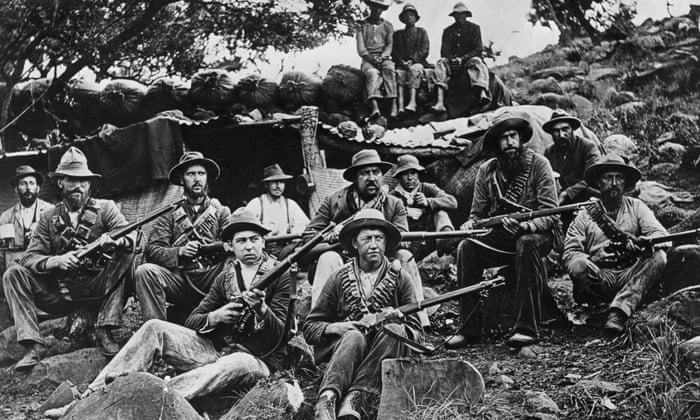
Boers at rest

Boers in action

Dark deeds in a sunny land

Enter the infamous Bushveldt Carbineers. The recruiters were by now literally scraping the barrel; as FitzSimons puts it, “a motley crew, a mix of the old and the bold, the young and the desperate, and those with no better options than joining an outfit destined to be operating in such dangerous realms. No fewer than a third of the new recruits have no military experience whatsoever, and some have never even ridden a horse”. “Rangers, rogues and renegades”  and “the rough and the rowdy, the wild and the woolly, and sometimes the demonic and dangerously”, and whilst in the field, as often as not, drunk – both officers and men. And among them, down on his luck in England and almost destitute and desperate, Harry Morant.

In control though not in command is Captain Alfred Taylor, Intelligence Officer and District and Native Commissioner, known to the natives as “Bulala”, killer. A psychopath is on the loose, appointed and sanctioned by Kitchener himself, and he finds willing henchmen in recently promoted and opportunist Lieutenants Morant and Handcock.

Half way through the 500 page book, FitzSimons changes pace. What had up to now been a largely historical narrative interspersed with colourful and entertaining vignettes, becomes a tale of dark deeds in a sunny land.

As Fitz tells it, encouraged by the sinister Taylor, who believes the only good Boer is a dead one, an increasingly delusional and unhinged Morant and the psychotic Handcock embark on a murder spree. As Moran would admit to the court, “we got them and we shot them under Rule 303”, referencing the Lee Enfield, the standard-issue British Army rifle.

Based on transcripts of their subsequent trial and letters and memoirs of fellow carbineers, Fitz reconstructs the events that conclude with Morant’s downfall and death. Reluctant members of firing squads and outright refuseniks put together a dossier and petition detailing the cold-blooded murder of surrendered Boers, children, an unfortunate priest, and also, a carbineer who’d threatened to blow the whistle.

Harry ‘Breaker’ Morant and third from left with the 2nd South Australian Mounted Rifles during the Boer War, circa 1900. .

The book becomes a page-turner as the petition is dispatched up the chain of command, the prospects of a cover-up being high. But no. There are indeed men of integrity in higher command who will see justice done – not the least because they wish to see the dangerous Taylor removed. The more pragmatic view the alleged crimes as impediments to bringing the Boer leaders to the negotiating table.

But the outcome is far from certain. As court martial proceedings conclude and sentences are handed down, including an acquittal for the nefarious Taylor, and a recommendation for clemency by the court after it sentences Moran and Handcock to death for multiple murders – they were in a war zone and under serve strain and provocation after all – Kitchener refused. How could he enter the peace talks that would soon come if the killers were let off the hook?

He dies almost two years to the date of his landing in South Africa with the second Contingent

The war winds down 

By war’s end, Britain’s claims to moral supremacy, already questioned by its waging a war of aggression against two small states, was irreparably damaged. Public opinion which had in the beginning embraced jingoism and righteous anger, once informed of the true nature of the war by returning journalists and also soldiers’ letters, and fired up by clergymen and humanitarians, began to question the purpose and the morality of the war. In Australia, the new narrative was championed by none other than Banjo who had early on developed an admiration for the Boer fighters, likening them to the resilient and resourceful folk of the Australian bush.

Many consider the Boer War as marking the beginning of the questioning of the British Empire’s level of power and prosperity; this is due to the war’s surprisingly long duration and the unforeseen, discouraging losses suffered by the British fighting the Boer citizen soldiers; and repugnance with regard to the ruthless treatment of non-combatants. Many parts of occupied Boer republics with their burned farmsteads and plundered lands resembled more a desert than a once prosperous agrarian economy.

Not that the Boers were exemplars of moral rectitude by our enlightened twenty-first Century standards. Their’s was a conservative and indeed fundamentalist society that regarded the indigenous people as inferior and destined to serve their needs. The British regarded the Boers attitude towards the kaffirs as unacceptable – and yet they too regarded the indigenous Africans as their inferiors – but their’s was a righteous though none the less prejudiced and patronizing “white man’s burden” mentality that characterized Victorian Britons’ view of Empire.

By the end of 1901, the British are physically and morally exhausted. Attrition has turned to atrophy. Kitchener craved an end to the conflict. “I wish I could find some way of finishing this war”, he writes to the Secretary of State for War. Especially now that it is is believed that ordered the execution of Boer prisoners “found in khaki” – wearing items of British uniform.

And so it comes to pass that two months after Morant and Handcock are laid in their un-shared un-hallowed grave, the Boer leadership, wanted to end the devastation and human misery, and the British unable to go forward of back, agree to terms, including ceding Boer sovereignty to Britain, an amnesty for all combatants, the return of the far-flung  transportees, and the emptying of the camps.

At the end of the day, after twenty months of conflict, some twenty two thousand British forces soldiers perished, whilst five thousand were sick and wounded.  Six thousand Boers were killed and twenty four thousand captured whilst twenty one thousand bittereinders surrendered. There were over forty six thousand civilian fatalities, and of 115,000 people incarcerated in concentration camps, twenty seven thousand women and children died, and twenty thousand Africans. Thirty thousand Boer homesteads had been destroyed and tens of thousand of those of Africans, and forty towns had been razed.

By 1910, the Dominion on South Africa had been established with English  and Afrikaans as its co-equal languages. The next stage of South Africa’s eventful history had begun.

Butchered To Make A Dutchman’s Holiday

-In prison cell I sadly sit,
A d__d crest-fallen chappie!
And own to you I feel a bit- A little bit – unhappy!
It really ain’t the place nor time To reel off rhyming diction –
But yet we’ll write a final rhyme Whilst waiting cru-ci-fixion!
No matter what ‘end’ they decide – Quick-lime or ‘b’iling ile,’ sir?
We’ll do our best when crucified To finish off in style, sir!
But we bequeath a parting tip For sound advice of such men,
Who come across in transport ship To polish off the Dutchmen!
If you encounter any Boers You really must not loot ’em!
And if you wish to leave these shores, For pity’s sake, DON’T SHOOT ‘EM!!
And if you’d earn a D.S.O., Why every British sinner
Should know the proper way to go Is: ‘ASK THE BOER TO DINNER!’
Let’s toss a bumper down our throat, – Before we pass to Heaven,
And toast: ‘The trim-set petticoat
We leave behind in Devon.’
At its end the manuscript is described –
The Last Rhyme and Testament of Tony Lumpkin

Postscript – Australia’s 19th century wars

Between 1845 and 1872 just over 2,500 Australian volunteers saw service in New Zealand during the wars between the Maori and Pakeha (white colonists) over the ownership of Maori lands. Though Australian born, troops all served in British regiments. The majority of these volunteers came from the colonies of New South Wales, Victoria and Tasmania.

In the early 1880s the British-backed Egyptian regime in the Sudan came under threat from local supporters of Muhammed Ahmed, also known as the Mahdi. In 1883 the Egyptian government was sent south to crush the revolt but instead of destroying the Mahdi’s forces, the Egyptians were soundly defeated. On March 29, 1885 a New South Wales contingent, an infantry battalion and an artillery battery, totalling 758 men. arrived in Sudan, It spent three months there  with no major engagements or battle casualties. there were three wounded soldiers and seven deaths from fever or dysentery.

In 1900, a contingent of mainly naval reservists was sent to China to restore order after the Boxer Rebellion. It didn’t take part in fighting and there were no battle casualties. The few fatalities were from disease.  The first Australian contingents, mostly naval reservists from New South Wales and Victoria, sailed in August 1900. Australian personnel sent to northern China were not engaged in combat. Six Australian’s died of sickness and injury and none were killed as a result of enemy action.


Read more about Australian history and politics in In That Howling Infinite: Down Under ; and British history in Foggy Ruins of Time

Many Australians past and present view Harry Morant as harshly dealt with, a  folkloric antihero  sacrificed on the alter of empire, as the following article by Fitz himself explains. But first, a word from an Australian country music icon.

They still sanctify the monster Breaker Morant – and insult the true heroes

Peter FitzSimons, Sydney Morning Herald,  September 14, 2021 

Edward Woodward as Breaker Morant

 The idea that Breaker Morant should be given a posthumous pardon is a persistent one, as is the idea that he should have his name added to the Boer War Memorial in Adelaide – the latter idea getting a new lease of life in a strong article published in The Advertiser in Adelaide on Saturday.

For the legend is a beauty: Breaker Morant was a Man From Snowy River in Australian uniform: a brilliant horseman, soldier and bush poet who was cruelly put up against the wall by those Pommy bastards, merely for following their orders.

Yes. So strong and seductive that the article in the ’Tiser records that 70 per cent of their respondents are in favour of Morant’s name being added to the Boer War Memorial. In terms of iconic status, it is of the ilk of the Anzac legend that Education Minister Alan Tudge is insistent must not be questioned in any way in the national history curriculum. As Tudge said last week, the Anzac legend is “not going to be a contested idea on my watch”.

But, based on the book I wrote on Morant, with the help of strong researchers who were able to dig fine detail, let’s contest the Morant legend and look at just one episode of his war career, this one while commanding the roving unit, the Bushveldt Carbineers, in the latter part of the Boer War. The first thing to note is that rather than being Australian, Morant was English and had joined the war effort from Australia after being here for a couple of decades – while the Bushveldt Carbineers was a wholly British unit.

On September 7, 1901, Morant hears of three unarmed, non-combatant Boers heading their way and wanting to surrender. Morant goes out to meet them in the company of one lieutenant and two other troopers. And there they are, up yonder: Boer farmer Roelf van Staden and his two sons, the youngest of whom, Chris, is 12 and desperately ill.

Morant takes immediate action, using a procedure he has previously developed to get through such matters most efficiently. He tells his men that when they get to the clearing up ahead, they must wait till he says “Lay down your arms”, and as soon as they relax, shoot ’em. Arriving at the clearing, Morant barks: “Dismount.” His men do so, and quickly bring up their rifles. The Boers look at them, horrified. “Lay down your arms!” Morant commands.

As planned, the father and his sons relax just a little . . . only for the Troopers to shoot them dead.

How do we know Morant committed these and other atrocities in which a dozen non-combatants were gunned down? There are many reasons, but they include 14 brave Australian soldiers and a Kiwi soldier risking their lives – for the first two soldiers in the Bushveldt Carbineers to publicly dissent had finished with a bullet in their heads – writing a letter to their commanding colonel, asking for Morant to be court-martialled. He was, during which Morant famously boasted of the atrocity of lining up eight unarmed Boer prisoners and shooting them by the side of a road. “We got them, and we shot them, under Rule .303!”

Of course, Morant was a practised hand at shooting prisoners by this time, having ordered a firing squad to execute a lone, injured prisoner, Floris Visser, to the disgust of men and officers alike. At least Visser was given the farce of a “drum head” court-martial, a kangaroo court improvised by Morant to justify murder as revenge for his friend Captain Percy Hunt.

Quoted in the Advertiser on Saturday, the Melbourne lawyer James Unkles said: “Injustices in times of war are inexcusable and it takes vigilance to right wrongs, to honour those unfairly treated and to demonstrate respect for the rule of law. How we respond to this case remains a test of our values and is vitally important.”

Was he speaking in sympathy with the dead Boers? He was not. He was pushing the case for Morant’s posthumous pardon, and for his name to be added to the Boer War Memorial in Adelaide, just as he was a prime agitator behind the Australian Parliament in 2009 voting in favour of petitions being presented to Queen Elizabeth II to review and posthumously overturn Morant’s convictions. Three years later, on the 110th anniversary of the execution of Morant and co-accused Peter Handcock, the Liberal member for Mitchell, Alex Hawke, rose in the House to make a claim for Morant and company’s pardon.

“It is timely for the Australian government to do everything it can to assist the modern-day descendants of these men to access a judicial review of this case. It is the case that the executions were conducted with extreme haste and without appeal.”

(A point of order, Mr Speaker, if I may. An appeal is something they had in civilian courts, but did not exist with courts-martial.)

”I think it is important,” Alex Hawke continued, “that we seek British government’s assistance in releasing all of the available records in relation to this case so that the modern -day descendants can know what happened and rightly, if necessary, receive a judicial review and pardon. It is an episode that appeals greatly to every Australian because of the doctrine of fairness which says that no-one should be treated differently because of their birth, rank or status. We do know that these men were treated differently because of their birth, rank and status. We certainly need legends in Australian history.”

We do. And we have plenty of bona fide ones, without the need to gloss over the record of a war criminal. But still it goes on!

In February 2018, the Australian Parliament passed a motion expressing “Sincere regret that Lieutenants Morant, [et al] were denied procedural fairness contrary to law and acknowledges that this had cruel and unjust consequences; and . . . sympathy to the descendants of these men as they were not tried and sentenced in accordance with the law of 1902.”
Any mention of sympathy and sincere regrets for the defenceless Boers, including children, that Morant had gunned down? None at all. Justice for them? No mention. Just an obsessive focus on aspects of the court-martial where t’s weren’t crossed and i’s weren’t dotted. And equal insistence, despite a lack of any evidence at all, that Morant did what he did under British orders.

Bottom line?

Some historical legends, like that of Morant, are so seductive they live on because people want to believe them. And it’s so powerful you even have serious people pushing the tragic absurdity of an Australian Parliament petitioning the Queen and the British Parliament to posthumously pardon an Englishman fighting for a British unit who committed the worst war atrocities of the Boer War!

But how much more inspirational is the truth? Morant was not the Man From Snowy River put up against the wall by those Pommy bastards. He was a vicious Pommy bastard put up against the wall by the men from Snowy River and others who risked their lives to bring him to justice to stop the atrocities.

There are heroes in this story. They are those troopers who risked their lives to turn Morant in. Imagine their thoughts at his name being next to theirs on the Adelaide Boer War Memorial.

There are victims. They are unarmed Boers ruthlessly gunned down on Morant’s orders.

How monstrously unjust to both heroes and victims to simply go with the legend, unexamined, uncontested.

Of course history must be always examined, contested, reviewed, told from diverse sides. Anything less is indoctrination.

Twitter: @Peter_Fitz