The phantom of liberty … the paradoxes of conservatism

Economist and commentator Henry Ergas wrote in The Australian recently: “With the Trump revolution wreaking havoc on conservative movements worldwide and the election rout leaving Liberals stunned, Australian conservatism faces an identity crisis it no longer can afford to ignore. Understanding its divergence from overseas traditions is vital to recovering and redefining the distinctive voice it needs to deal with the latest threat to its existence.”  I have repolished it below.
Personally, I find the crisis in contemporary conservatism, particularly as it pertains to Australia politics, fascinating. Here it is in danger descending into a culture of grievance and of populism (- defined as the quest for simple solutions to complex problems).

These fast-moving times are shaky ground for the creed. People are losing faith in institutions; the church no longer has moral influence; the social norms that once tied the community together are changing at lightning speed. Even many within what can be classified as the centre-right acknowledge  what might be described as the conservative movement is apparently on the back foot, scrambling to define itself by what it opposes rather than what it believes, plagued by self-doubt and confusion as to what to believe what to stand up for.

As younger voters in the Anglo-sphere veer away from conservative parties, old warhorses and young fogeys, an incongruous, anachronistic cabal of reactionaries if ever there was one, desperately seek relevance and comfort as they endeavour to beat back what they see as the rising tide of progressivism and the proliferation of what they condemned as “woke” – a portmanteau word for whatever that dislike and disdain in politics and society’s at large.

“Conservatism” is an intriguing concept. It can broadly be translated as “traditional” values, and can embrace a varied spectrum of “isms”, including authoritarianism, hierarchy, nationalism, nativism and ethnocentrism, and also, en passant, religiosity, homophobia, and indeed, anything deemed antithetical to the old, tried and true ways. In a general sense, it has gained traction across much of the world as people yearn for order and stability and belonging and identity that western-style liberalism with its ecumenical emphasis on identity, equity and diversity cannot satisfy. Many highlight what they see as to the erosion of national institutions, of Western culture and even morality itself. Some advocate a national conservatism that hold nations to be distinctive and to seek to protect this distinctiveness.

It is in essence an atavistic worldview, one which harks back to the ways of thinking and acting of a former time and a yearning for “la recherche du temps perdu”. In its modern manifestations, it is in many ways a belligerent, intolerant creed, quite distinct from the late 18th century English parliamentarian Edmund Burke’s benchmark conservatism, namely the preservation of principles of the past which emerge from “the nature of things by time, custom, succession, accumulation, permutation and improvement of property”, and in which institutions and customs were rendered sacred by longevity and continual use. The comfort of continuity, in fact.

And it is different to what perennial Australian prime minister Robert Menzies was alluding when he formed the Australian Liberal Party in 1945: “a healthy and proud sense of continuity, is one of the greatest steadying influences and a superb element of sanity in a mad world… “ in his Forgotten People speech of 1942, he invoked homes material, homes human and homes spiritual – the homes humans can live in and where families can be enriched spiritually – rather than the merits of some cold ideology. It was a uniquely reassuring doctrine for homely, ordinary folk opposed to change or frightened by it.

In his essay, “Why I Became A Conservative“, the late British philosopher Roger Scruton wrote that the romantic core of the creed was the search for the “lost experience of home”, the dream of a childhood that cannot ever be fully recaptured, but can be “regained and remodelled, to reward us for all the toil of separation through which we are condemned by our original transgression”. At the heart of conservatism, in other words, is love: love for things that exist or existed and must be saved.

In his introduction to A Political Philosophy, Scruton wrote: “the conservation of our shared resources — social, material, economic and spiritual — and resistance to social entropy in all its forms”. His conservatism was, above all, conservationist: constant care for institutions, customs, and family. His debt to Edmund Burke: society is a contract between the living, the dead and the unborn; a “civil association among neighbours” is superior to state intervention; “the most important thing a human being can do is to settle down, make a home and pass it on to one’s children”.

There is something quite benign about these concepts of conservatism. In stark contrast, conservatism that is gaining traction in many countries, particularly in eastern Europe, but also on the MAGA movement in the United States and on the far-right in Western Europe and also, Australia is a cold, atavistic and embittered beast. Populist in its nature, it appeals primarily to those who favour the reassuring hand of a paternal authority figure who is able to promise those aforementioned simple solutions to the modern world’s bewildering array of complex problems. Freethinkers, individuals, and all of heterodox opinions and practices, political, social, biological or spiritual – beware!

© Paul Hemphill 2025. All rights reserved

Disclaimer: the only thing this post has to do with Spanish director Luis Buñuel’s 1974 surrealist comedy drama Le Fantôme de la liberté is its title, although like the film, it challenges pre-conceived notions about the stability of social mores and reality.

See also in In That Howling Infinite, A Political World – thoughts and themes

Existential dilemma: the great conservative split

With the Trump revolution wreaking havoc on conservative movements worldwide and the election rout leaving Liberals stunned, Australian conservatism faces an identity crisis it no longer can afford to ignore.

Henry Ergas and Alex McDermott, The Australian 10 May 2025

The Trump revolution is wreaking havoc on conservative movements worldwide. Artwork: Frank Ling

In the aftermath of last weekend’s devastating election loss it is easy to write off conservatism in Australia. This wouldn’t be for the first time. As historian Keith Hancock observed in Australia (1930), conservative, in this country, has always been a term of abuse, implying that its target is an out-and-out reactionary.

There is nonetheless a profound paradox. Although conservative may be a term of abuse, Australian politics has long had a marked conservative vein, even as its chief protagonists have studiously avoided the descriptor. A hardy perennial, with a distinctive voice that contrasts with overseas conservatism, the conservative instinct in Australia has run deep, dominating federal politics for decades – and recovering, time and again, from setbacks that had been claimed to foreshadow its demise.

Now, however, with the Trump revolution wreaking havoc on conservative movements worldwide and the election rout leaving Liberals stunned, Australian conservatism faces an identity crisis it no longer can afford to ignore. Understanding its divergence from overseas traditions is vital to recovering and redefining the distinctive voice it needs to deal with the latest threat to its existence.

US President Donald Trump and Vice-President JD Vance. Picture: AP

US President Donald Trump and Vice-President JD Vance. Picture: AP

In part, that identity crisis reflects the factor that has made for conservatism’s enduring success: its infinite adaptability. Indeed, the term defies easy definition, just as the groups to which it has been applied defy ready categorisation, making the conservative identity inherently labile.

As Paul de Serville, a historian of Australian and British conservatism, has observed, every party that has emerged to represent conservatism’s interests and beliefs across the past 350 years “is a study in contradiction between opposing traditions and schools of thought”.

Even its founding parent, the movement that eventually became the Conservative Party in Britain, has “died or lain dormant” numerous times, split at least twice, and never settled on any singular set of policies, ideas and beliefs. Its capacity to incorporate diverse elements has in fact been one of its defining qualities. After all, “what other party has elected a Jewish novelist (Disraeli) to lead a group of wordless squires? Or a grocer’s daughter (Thatcher) to rule a sulky band of Tory Wets?”

But beneath the shifting terrain of cultural and political battlegrounds, there are in British conser­vatism some identifiable commitments. Originally, the commitment was above all to tradition. Born in the turmoil of the English civil war, the Tories (a term derived from the Middle English slang for outlaw) stood for loyalty to the Church of England and the crown. Unapologetic royalists, their clergy defended the church against the Puritans while stressing the values of family, home and nationhood. Over time, however, the primary emphasis of British conservatism changed into a commitment to the virtue of prudence.

Often associated with a sense of human limitations and the impossibility of achieving utopia, British conservatism became the embodiment of a Western intellectual tradition that extends back at least as far as St Augustine.

Former British Prime Minister Boris Johnson picture in 2019, led a populist style Conservative Party. Picture: AFP

Former British Prime Minister Boris Johnson led a populist style Conservative Party. AFP

Conservatism in the US had a starkly different origin and trajectory. Far from being a reaction to the threat of change, it was a by-product of the American Revolution’s fight against the crown. Initially, what it sought to conserve was the ideal of a “mixed constitution” whose myriad checks and balances could prevent the development of an overmighty state. That coexisted with the agrarian conservatism of the south that feared, above all, the centralism that might abolish slavery and privilege northern manufacturers over southern primary exporters. Together, those foundations fuelled the development of a staunchly conservative, often highly formalistic legalism whose power – unrivalled in any other Western country – grew with the ascendancy of the Supreme Court.

But as early as the 1820s that version of conservatism faced a powerful challenge from Andrew Jackson’s radical populism. Jacksonian populism had more than its fair share of incoherence but its grassroots pugnacity spawned one of US politics’ most enduring and certainly most distinctive notions: the spectre of a “deep state” that was liberty’s greatest enemy.

Permeated by a Manichean friend-enemy dynamic that distinguishes what American historian Richard Hofstadter famously called the “paranoid style” in US politics, the Jacksonians portrayed the federal government as far worse than overbearing: having been hijacked by the enemies of the common man, it was an actively malevolent force hiding behind the facade of law and order. Only by dismantling it could freedom be preserved.

Former US President Andrew Jackson. Jacksonian populism spawned one of US politics’ most enduring and distinctive notions: the spectre of a ‘deep state’. Picture: News Corp

Former US President Andrew Jackson

The Jacksonians left a deep imprint on the American right and most notably on its rhetoric, but they never entirely conquered the field. The somewhat rigid constitutional conservatism that had preceded Jacksonianism survived and, inspired by intellectual leaders such as Supreme Court associate justice Antonin Scalia, flourished.

At the same time, many other varieties of conservatism appeared and at times reappeared after having gone into abeyance.

For instance, Vice-President JD Vance’scommitment to an intensely moralistic vision of politics – that privileges honest labour over endless consumption, security at home over adventures overseas, family and local community over wider notions of society – renews a Catholic tradition that had waned as the ethnic communities that were its original bearers assimilated into the American mainstream.

Vice-President JD Vance’s commitment to an intensely moralistic vision of politics renews a Catholic tradition that had waned. Picture: AFP

Vice-President JD Vance

In that sense American conservatism was always as mutable, open-ended and diverse as the US itself. But for all of that diversity, the nature of the presidential contest periodically forced its differing elements to coalesce around a leader who somehow embodied the spirit of the times.

Seen in that perspective, Donald Trump’s ascendancy reflects the triumphant resurgence of the movement’s radical populist streak.

As with all populisms, Trump’s message jumbles together contradictory, even irreconcilable, components. But it isn’t intended as a coherent intellectual project – it is not a politics of ideas that Trump pursues but of emotive response and instantaneous impact.

Even less is it a politics of cautious pragmatism, as was the conservatism of Republicans George HW Bush or John McCain, who also channelled one of American patriotism’s many styles. And least of all is it, like Vance’s, a politics of high moral purpose. Rather, it is a politics of personal power, deployed, often arbitrarily, to purposes that can change unpredictably from day to day.

That it is not to deny that there runs through Trump’s project American conservatism’s golden thread: the goal of restoring what his supporters view as the freedoms that were the original promise of the American founding and, later, the American Revolution.

But much as was the case with the Jacksonians, that goal is to be achieved by demolishing existing institutions, which are cast as having betrayed the original promise, rather than through their cautious reform. Trumpism’s intensely antinomian character is starkly antagonistic to the American tradition of constitutional conservatism, which is why a number of unquestionably conservative scholars are challenging the administration’s actions in the courts. At the same time, its messianic quality, imbued with visions of future glory, breeds a fanaticism entirely alien to the British conservative tradition.

Trumpism breeds a fanaticism entirely alien to the British and Australian conservative tradition. Picture: AFP

Trumpism breeds a fanaticism alien to the British and Australian conservative tradition. AFP

It is entirely alien to the Australian conservative tradition too. Here the greatest difference lies in the fact the Australian political ethos has not seen the state as the enemy, much less as a malignant force. It has been regarded instead as a tool to be effectively used to benefit the people and help them flourish.

That difference from the US has profound historical roots. America’s initial European settlement occurred in the 1600s, a period distinguished in Britain by what became known as the “Old Corruption”. Government offices were chiefly sinecures, officially apportioned rackets for personal gain, propping up an oligarchy whose favours were openly for sale.

In contrast, European settlement in Australia and New Zealand began as sweeping reforms to Britain’s system of government were taking hold. For the first time it was becoming possible to treat the government as a utility, dispensing valued benefits, rather than as a lurking predator. Colonial governors’ administrations, while not without their own rackety aspects, were shaped by changes reducing royal patronage and improving government accountability. As Australian historian John Hirst argued, that laid the seeds of an enduring respect for impersonal authority, exercised, at least in theory, in the pursuit of prosperity and good order.

There were, for sure, periodic outbreaks of radical opposition. But the Australian approach was almost always to absorb the conflict by institutionalising its protagonists. Embedding the agitators within the system they were fighting against, that solution traded moderation for tangible gains.

For example, violent class war and mass strikes in the 1890s Depression culminated in the birth of the ALP as an official parliamentary party, changing laws and winning government. Later, the Arbitration Court became run largely by what had been the warring parties – the infamous “industrial relations club”, as columnist Gerard Henderson called it. In exchange for prestigious sinecures, the former enemies descended into what Hancock derided as a “pettifogging” legalism that suffocated the radicals.

Equally, landless gold-diggers demanded the squatters’ leases be ripped up, and stormed Victoria’s parliament in the 1850s. The Land Selection Acts in the subsequent decades established a regional population of often struggling farmers whose 20th-century political incarnation took the form of country parties.

Those parties not only secured “protection all round” in the 1920s, along with significant direct subsidies; they also ensured the establishment of marketing boards to which party worthies were invariably appointed. And much the same could be said of the Tariff Board, which shaped manufacturing protection for decades.

The corollary of that solution was a particular type of conservatism. Yes, in the early years of settlement there had been “real” conservatives of the Tory variety. But when self-government began, they were rudely jostled aside. Australian conservatism would not draw its strength from them.

It was instead the middle class that provided the dominating motifs of enduring Australian conservative strength. It isn’t difficult to understand why. The “workingman’s paradise” was a place where ordinary settlers and working men could get ahead, not rags-to-riches style, as the American dream pitched it, but enough to acquire comfort, leisure and independence.

Australian wages had been essentially the highest in the world since first settlement and the political victory of liberalism, which occurred during the 1850s gold rushes, ensured free markets and social mobility. To become an independent small business owner, to own your own home, to provide for your family, your children – this was the dream, and in Australia they by and large found it.

The conservatism that resulted from that success story incorporated the liberal beliefs and practices that proved so decisively triumphant in the colonial context. Historian Zachary Gorman observes that liberalism’s 19th-century victory in Australia was so comprehensive it became “less of a clear agenda and more of a pervasive political culture”. No longer conservatism’s upstart challenger as in Britain, liberalism here almost instantaneously became the established mainstream – it became what needed to be protected, as well as what conservatives sought to conserve.

Australian conservatism, then, sprang not out of reverence for the past or social hierarchy but from attachment to the enjoyments and freedoms of ordinary life that the most liberal polity in the world encouraged to flourish. It kept faith with ordinary experience and the socially durable values of an open society.

It soon came to shape the whole of the centre-right, underpinning both the twin liberal traditions of early 20th-century Australian life – the neo-Gladstonian free trade liberalism typified by NSW’s Henry Parkes, George Reid and Joseph Carruthers and the Deakenite liberalism protectionist Victoria championed.

More pragmatic and willing to innovate than, say, Britain’s Home Counties conservatism, Australian conservatism was dispositional rather than traditionalist – as a byproduct of urban, aspirational, middle-class Australia, generally inspired by the hope of improvement, it had no difficulty accommodating an uninterest in the past. The attachment to steady improvement was the important thing.

Robert Menzies’ pitch in his justly famous “Forgotten People” broadcast in 1942 captures this spirit perhaps better than any other significant Australian political testament. In it Menzies speaks directly to the attachment to the home and the family as the cornerstone of the “real life of the nation … in the homes of people who are nameless and unadvertised, and who … see in their children their greatest contribution to the immortality of their race”.

Accompanying that emphasis on home and family is a classically conservative sense of continuity.

“It’s only when we realise that we are a part of a great procession,” Menzies declared in laying the foundation stone of the National Library of Australia two months after he retired in March 1966, “that we’re not just here today and gone tomorrow, that we draw strength from the past and we may transmit some strength to the future.”

Across several decades of political leadership Menzies’ speeches pulsed with phrases that exemplified this disposition. His governments have been “sensible and honest”. He speaks “in realistic terms”, sustained “by an unshake­able belief in the good sense and honesty of our people”.

It was the constant undercurrent of hope and aspiration that gave Robert Menzies’ conservatism its distinctive flavour. Former PM Robert Menzies is pictured in 1941. Picture: Herald Sun

 Former PM Robert Menzies is pictured in 1941. Picture: Herald Sun

Yet this stress on continuity in Menzies’ rhetoric complemented rather than contradicted a commitment to what he referred to as “solid progress”. This country was a settler society built by successive waves of migrants; since its earliest days, its life had been saturated with optimism: Australia, said Menzies, was “our young and vigorous land”, still embarking on its glad, confident morning.

It was the constant undercurrent of hope and aspiration that gave Menzies’ conservatism its distinctive flavour, making it more explicitly geared to the confident expectation of future possibility than its European or American counterparts.

And it was precisely because it was so oriented to progress that the term conservative was generally avoided by the movement he forged, even as a conservative disposition bubbled along beneath its immediate surface, and was mirrored in electoral preferences of voters – not simply by voting right of centre but by giving governments a second term even if their first had been somewhat disappointing, and by regularly knocking back proposed constitutional changes.

However, those two elements – continuity and change – were uneasy bedfellows: continuity could, and eventually did, act as an obstacle to indispensable change.

The institutionalisation of conflict through entities such as the arbitration tribunals and the Tariff Board had, for decades, moderated conflict – but only at the price of inefficiencies that became ever more unsustainable as the world economy globalised in the 1970s and 80s. At that point, Australian conservatism entered into a prolonged crisis, torn between the deeply embedded value of caution and the equally strong value of adaptation.

It was easy to repeat Edmund Burke’s axiom that “A state without the means of some change, is without the means of its own conservation”; but effecting sweeping change without destroying the party’s unity was of an entirely different order of difficulty.

Nothing more clearly highlighted the dilemma than Liberal leader John Hewson’s Fightback – a call to arms that was as close as the movement ever came to a truly Thatcherite policy revolution. Its failure had many causes but one was the complete absence of the sense of continuity and stability that has always been dear to the Australian middle class.

It lacked, too, the high Gladstonian moral clarity that Margaret Thatcher articulated in her heroic campaign to reverse Britain’s slide to socialised mediocrity. In fact, Thatcher’s argument for the moral basis of capitalism had far more in common with Menzies’ creed of “lifters not leaners” than with Hewson’s “economic rationalism”.

Former British PM Margaret Thatcher addresses an election rally for Conservative Party leader William Hague in 2001. Picture: AP

Former British PM Margaret Thatcher2001. Picture: AP

What was needed was a new synthesis. As Menzies had, John Howard, the first Liberal leader to actively identify himself as a conservative, provided it.

Nigel Lawson, who served as the Thatcher government’s most consequential chancellor of the exchequer, once commented that whereas “Harold Macmillan had a contempt for the (Conservative) party, Alec Home tolerated it, and Ted Heath loathed it, Margaret (Thatcher) genuinely liked it. She felt a communion with it.” Exactly the same could be said about Howard: his scrupulous respect for his party’s traditional ethos helped him succeed for as long as he did.

That is not to deny that Howard at times pursued dramatic change – a GST, industrial relations reform, gun ownership – but the approach was rarely radical in style, much less revolutionary in tone. It is telling that the one reform that failed was Work Choices, which went furthest in dismantling existing institutions. And it is telling, too, that subsequent Coalition governments tinkered with the arrangements Labor put in its place rather than seeking their wholesale removal.

Now the synthesis Howard forged between conservation and change is yet again under extreme stress. So, too, are its electoral foundations, as the bases of politics undergo a profound transformation.

Because of Australian conservatism’s pragmatic nature, marshalling broad alliances against those forces and movements that endanger the foundations of the polity has always been its signature approach. Finding some common ground among its constituents, each of those alliances combined the shared opposition to an adversary with a positive program based on overlapping, if not entirely shared, values. The way Liberals, free-traders and protectionists alike rallied alongside Conservatives when threatened by a new common enemy, the ALP in the early 20th century, is a classic example.

John Howard pictured in 1996 after claiming victory for the Coalition. His scrupulous respect for his party’s traditional ethos helped him succeed for as long as he did. Picture: Michael Jones

John Howard pictured in 1996 after claiming victory for the Coalition. Picture: Michael Jones

However, the dominant force in contemporary politics is fragmentation: the centrifugal pressures that make coalitions hard to assemble but easy to destroy have become ever stronger as social media and identity politics shatter politics’ traditional alignments.

The centre-right is far from being immune from those tendencies, as the emergence of the teals shows. And they are compounded by the pressures of Trumpian populism, which is as hostile to the compromises coalition-building entails as it is to inherited institutions. The only coalitions Trumpism can forge are those that aggregate resentments: against the arrogance of the “progressives”, the abuses of power that occurred during the pandemic, the perception that common values are denigrated and despised.

To use a phrase American constitutional lawyer Greg Lukianoff and social psychologist Jonathan Haidt coined for the left, Trumpism’s dominant mode of action is “common-enemy politics”, with the adversary being the principal factor unifying its disparate parts. There are no shared values, nor any shared aspirations; the glue comes from shared hatreds.

But intransigent oppositionalism is no basis for a viable politics. Regardless of what Trump’s Australian acolytes believe, its transposition to this country would make for a future of repeated failure.

Rather, for a broader alliance to be possible again, a new synthesis is needed. Australia’s two greatest prime ministers, Menzies and Howard, suggest the way. Both exemplified a social conservatism that drew from the distinctively Australian emphasis on the conservative temperament over and above distinctive philosophical creed. Both forged a synthesis that combined an attachment to liberal principles with a commitment to large-scale changes needed to underwrite prolonged prosperity and progress.

Now, after the rout of last weekend’s election, that synthesis desperately needs to be redefined.

In the end, politics is about argument and arguments are about ideas. When politics seems so entirely bereft of them, Australian conservatives have no choice but to think again.

Henry Ergas is a columnist with The Australian. Alex McDermott is an independent historian.

The way we were … reevaluating The Lucky Country sixty years on

When I first arrived in Australia in April 1978, I was keen to know more about the country I had unexpectedly migrated to – as a matter of fact, apart from what I’d learned from my then-wife, who was a Sydneysider, I knew very little. Donald Horne’s The Lucky Country was highly recommended. And yet, the Australia Horne described therein did not seem like the country I was about to call home. It was a critique of “the way we were” – the somnolent fifties and sixties that preceded its publication – a society and a culture that ceased to be relevant in the decades that followed. As author and columnist Nick Bryant writes in a reevaluation republished below: “Just as the title has been misappropriated – it was meant sardonically.  its subtitle has been mislaid: Australia in the Sixties. Though many insights proved prescient and perennial, Horne was describing a different land”.

Indeed, the book had appeared as the Australia Horne described and condemned had already begun to change. An imperceptible social revolution had already been pushing against the rigid morality of the war-time generation. The comforting but constraining ties of the traditional family, religious observance and community obligation which were regarded as unreasonably oppressive by his generation and many in the one before it, were breaking down, to be replaced in the seventies by a more open, more travelled and and inquisitive society and a paternal and benevolent social welfare state which provided free healthcare and for a generation of Australians, free tertiary education – from which I, once naturalised, benefitted. Much if this change was not all that recognisable  at the time – transformations of this kind are mostly visible only with the benefit of hindsight.

The Lucky Country nevertheless continues to dominate the intellectual landscape; but 60 years after its publication, and as Bryant notes, it’s one that Australia mistakenly takes too seriously.

In a piece I wrote five years ago, How the “Lucky Country” lost its mojo. I quoted author and onetime publisher Steve Harris:

“Many who use the terms “lucky country” or “tyranny of distance” have probably not even read the books or understand their original context or meaning. If they read the books today, they might see that almost every form of our personal, community, national and global interests still involve “distance” as much as ever, and that notions of “the lucky country” ­remain ironic. ” The result, he laments, is a re-run of issues revisited but not ­resolved, opportunities not seized, and challenges not confronted … it is no surprise that the distance ­between word and deed on so many fronts, and so often, has created its own climate change, one of a collective vacuum or vacuousness. An environment where it is too easy to become disinterested, or be distracted by, or attracted to, those offering an “answer”, even if it is often more volume, ideology, self-interest, simplicity, hype and nonsense than validity, ideas, public­ interest, substance, hope and common sense. A 24/7 connected world where we drown in words and information but thirst for bona fide truth, knowledge and understanding, and more disconnectedness and disengagement”.

We republish below two retrospectives we’ll worth reading, one written from a conservative perspective, the other, by Bryant, from a relatively progressive viewpoint (there are some great pictures too). Both agree however that it is a book that can be read in a slightly or very different way by each generation, always having something new to say. As columnist Henry Ergas notes therein: “For all of its shortcuts and grievous errors, its insights still dazzle, no matter how often they are read or reread. So does its freshness, its sense of humour and perhaps most of all, its eager hopefulness and sense of aspiration”.

© Paul Hemphill 2025. All rights reserved

Sixty years on from Donald Horne’s instant classic, has The Lucky Country run out of luck?

Has a nation of gamblers with a disdain for ‘theory’ ridden its luck for too long?

“Join the Lucky Ones” ran the front-page headline of The Australian on Tuesday, December 1, 1964. Starting the next day, readers could enjoy “the first big instalment of Donald Horne’s controversial new book The Lucky Country”, which was being published that week.

Horne had a long association with Frank Packer and Australian Consolidated Press, but in a publishing coup Rupert Murdoch’s new national newspaper had secured exclusive rights for “the most candid, controversial book of the year”.

The Australian had begun life less than six months previously as a daring experiment, the first nationally circulated newspaper in a country beginning to fizz with a sense of expanding possibilities yet faced with new, sometimes daunting prospects in a dramatically changing world.

Horne’s much-anticipated “witty and irreverent study of Australians and their way of life” couldn’t have found a stage better suited to its bold approach or for the questions it was firing, at point-blank range, into the national conversation.

Australians were reintroduced to themselves in the weeks that followed as a people who “hate discussion and ‘theory’ but can step quickly out of the way if events are about to smack them in the face”.

Join the Lucky Ones: Page 11 from The Australian newspaper on December 2, 1964 featuring an extract of Donald Horne's 'The Lucky Country'

The Australian newspaper on December 2, 1964 featured an extract of ‘The Lucky Country’

They found out that “to understand Australian concepts of enjoyment one must understand that in Australia there is a battle between puritanism and a kind of paganism and that the latter is beginning to win”. Competitive sport, they were now given to understand, had all the qualities of “a ruthless, quasi-military operation”, making it “one of the disciplinary sides of Australian life”.

As for mateship, it reflected “a socially homosexual side to Australian male life” that involved “prolonged displays of toughness” in pubs, where men “stand around bars asserting their masculinity with such intensity that you half expect them to unzip their flies”.

Perhaps most arresting was the argument that went with the title’s assertion. Australian life, combining scepticism and “delight in improvisation”, had resulted in dependence on a type of gambler’s luck.

As circumstances shifted, Australians’ “saving characteristic, ‘the gambler’s coolness’ ”, had helped them to “change course quickly, even at the last moment”.

But the aim of those swerves had always been to “seek a quick easy way out”. Now that strategy needed to be reconsidered.

Abrupt changes

The Lucky Country packed many punches – and they landed at the perfect moment.

The tremendous post-war growth of an educated and engaged public had been evident since the mid-1950s as new magazines proliferated and the market for Australian books expanded more prodigiously than at any other time in the century.

Coupled with that were global shifts even more dramatic and described in The Australian’s first editorial, which spelled out both the paper’s vision and the challenges the nation faced.

Since the end of World War II all the major European empires had ceded or lost control of the lands and people to Australia’s immediate north. As British, Dutch and French imperial power in Southeast Asia collapsed, new nations – including Indonesia, Malaysia and Vietnam – were born and ancient ones, such as Burma and Thailand, reshaped. Behind them lay “the brooding power and intelligence of the new China, a land with whose people’s desires and plans our own future is deeply entwined”.

All the way with LBJ: The first Australian visit by a US President. United States President Lyndon B Johnson greets the crowd in Swanston Street, Melbourne. Picture: Ken Wheeler

The first Australian visit by a US President. United States President Lyndon B Johnson greets the crowd in Swanston Street, Melbourne. Ken Wheeler

These abrupt changes coincided with Britain trying to join the European Common Market, making it clear that wherever the United Kingdom saw its future, it was not primarily with the Commonwealth.

Losing the blanket of certainty that Australia’s close relationship with Britain had long provided was a blow. But, The Australian insisted, it could prove “a salutary shock”, as it helped us realise “that now, as never before in our history, we stand alone”.

Collection of snapshots

The Lucky Country’s impact was immediate and all-pervasive. Despite some scathing reviews (one confidently predicted the book would have been forgotten by the next football season), it flew off the shelves. Its initial print run of 18,000 sold out in nine days and the pace showed no sign of flagging.

In 1965 it sold another 40,000 copies before repeating the feat in 1966, a staying power beyond its publisher’s wildest dreams.

One of the books that truly defined the decade, it entrenched itself in the national consciousness in a way similar to Geoffrey Blainey’s The Tyranny of Distance, published two years later, another title that instantly entered the national lexicon.

Blainey’s deeply researched work, which reflected his training as a historian, was tightly argued. In contrast, even Horne admitted that his book was “a collection of snapshots of Australia”. An assemblage of ideas and insights that had been amassing for a decade, Horne thought it was part of the book’s success, handing readers a host of opinionated pages of observation and commentary.

Donald Horne at home: the author constantly fretted that his seminal book’s title had been misunderstood and misused.

Donald Horne at home

More than the loose structure, though, the book’s style was crucial to its impact. That style came from Horne’s long spell as a journalist, editor and advertising man.

Horne had a keen understanding of what readers wanted to know and talk about. He had spent years honing his approach, addressing Australia’s burgeoning magazine and newspaper readers, and recognised their hunger for a new type of journalism that The Australian sought to embody: urbane, expository, intelligent, sparky, informed.

And if it worked for magazines and papers, why not for a serious – if chronically irreverent – book about who we were and how we now lived?

The Lucky Country introduced this sharp change in tone to Australia in the 1960s, marking it as ineradicably as David Williamson’s plays would do. The content matched the tone, too, aggressively insisting that the way we lived had changed so abruptly that the nation could no longer be served by the standard-issue ideas.

The national mythology, populated by bush legend figures (shearers, bushrangers, drovers) and grizzled Anzacs, had no relevance to daily reality.

Australians were urbanites and suburbanites, and increasingly so: from 1947 to 1966 the percentage of Australian living in cities leapt from 68 per cent to 83 per cent.

Misappropriated and misunderstood

Horne’s coup was to bridge this gap between myth and reality. Certainly to his mind The Lucky Country’s success came from the fact it captured Australia as Australians experienced it, not through the fake lenses of a glorified past.

It was, Horne claimed, the first book to reflect “the suburban nature of the lives of most Australians without jeering at them”. What really cut through, however, was the book’s underlying thesis.

Despite its gadfly-like style, the book worked off a set of powerful assumptions that constituted a strong, even startling, argument.

Horne would complain ever after that its title had been misappropriated and misunderstood. But it is hard to deny that the title itself made the argument palpably clear.

Earlier exercises in self-reflection generally portrayed Australia’s journey to nationhood as a process of maturation. Nurtured under the shelter of Britain’s wing, foresight, hard work and inspired guidance had allowed the infant nation to grow into a strapping adult, capable of standing on its own feet.

Horne knocked that narrative for six. Australia’s prosperity and stability were not, he argued, the result of increasing national maturity, much less diligence and determination. They were due to sheer good fortune. To make things worse, it was a good fortune the country didn’t deserve – or know how to use.

The problem wasn’t the bulk of ordinary Australians, who weren’t a bad lot. It was “the people on top”. Our leaders and elites were second-rate provincial mediocrities who had got stuck in a groove some 50 or 60 years earlier and never budged out of it, even as one generation passed to another and still another.

Premature senility

Thanks to them, the nation was in a time warp, living out a fantasy that bore no relation to its realities – or its challenges.

The proper national metaphor, in Horne’s eyes, was not a maturational shift from boisterous youth to fully fledged adulthood; it was a leap from childhood to premature senility. Without “a radical overthrow and destruction of the prevailing attitudes of most of the nation’s masters” the decades to come would likely witness “a general demoralisation; the nation may become run down, old-fashioned, puzzled, and resentful”.

The radical overthrow and destruction of Australia’s outmoded approach, and the subsequent renewal, could, Horne speculated, possibly come through the rising generation. He was drawn to generational explanations of change, citing Walter Bagehot’s comment that “generally one generation succeeds another almost silently.

But sometimes there is an abrupt change. In that case the affairs of the country are apt to alter much, for good or for evil; sometimes it is ruined, sometimes it becomes more successful, but it hardly ever stays as it was.”

Modern classic: Cover of The Lucky Country, featuring the painting of the same title by Albert Tucker. Picture: Supplied

The Lucky Country, featuring the painting of the same title by Albert Tucker

Generational change had salvaged the national project before. The great Australian initiative, when Britain and other outside models of development had been energetically rejected, had emerged in the decades at the turn of the 20th century. This was when a nationalism of mateship represented “the general egalitarian position” that, flecked with Irish anti-English hostility, had formed an explicit contrast to an England of wealth and privilege. To those who had experienced that earlier time, “this present pause would be unbelievable”.

Robert Menzies epitomised everything that had gone wrong. He had absorbed too much of the pro-British obsequiousness of the post-World War I world, notably “the ceremonial clinging to Britain” that was “part of the delusional structure of the people who were running Australia”.

Unable to escape that delusional structure’s grip, subsequent generations had fallen into Menzies’ stride rather than broken it. And while Menzies’ leading rival, Arthur Calwell, could not be accused of being unduly pro-British, he was no better able “to recognise and dramatise the new strategic environment of Australia”.

Fresh start

As a result, “the nation that saw itself in terms of unique hope for a better way of life is becoming reactionary – or its masters are – addicted to the old, conformist” ways of doing things. The inability to cope with change meant the “momentum towards concepts of independent nationhood has slowed down, or stopped”.

There were, however, inklings of a fresh start. Although “still full of mystery”, the generation born during and immediately after the war “seems fresher”. Who knew, “it may be the generation that changes Australia”.

Expressing the egalitarian pragmatism that Horne identified as the quintessential philosophy of the national consciousness, the baby boomers would be socially progressive, tertiary-educated, technocratic pagans and managerially gifted hedonists. As they gained control, the better qualities of the Australian people, sprawling and sunburnt on the nation’s beaches, would finally be able to express themselves unencumbered by the tired leftovers of a bygone era.

Exactly how this revolution would occur was left unclear.

Bathers at Bronte Beach, Sydney, 1964, from John William's new book Line Zero: Photo-reportage 1958-2003. Picture: Supplied

Bathers at Bronte Beach, Sydney, 1964, John William’s Line Zero: Photo-reportage 1958-2003

Horne’s career had to this point been on the political right. He was still editor of Quadrant whenThe Lucky Country came out, a vigorous anti-communist who had run as a Conservative in an English election while living there in the 1950s.

In some ways, he might still have been a conservative – for example, in his identification of the ideals of egalitarianism and fraternity as the essence of a national culture that needed to be preserved.

What is certain, however, is that by the time of The Lucky Country, Horne was no conservator. His conservativism was what he now described as being of the “radical”, even “anarchist”, variety. Enormous social and political renovation was the order of the day and the book’s task, Horne said, was “to produce ideas that may prompt action at some later time” – but that would need a change agent only the future would disclose.

Whitlam the messiah

Given that sense of anticipation, it is unsurprising that Horne drank the Gough Whitlam Kool-Aid deeply and early. When Whitlam replaced Calwell as ALP leader, Horne declared that he “seemed to understand that not only the Labor Party but Australia as a whole needed a psychological reorientation, a new tone and style to make it adaptable in the modern world”.

In April 1973, less than six months after the federal election that brought “the ludicrous Menzies era” to a close, Horne predicted that Whitlam could easily become Australia’s greatest prime minister. Until then, it had begun to seem “as if our sense of nationality was going to remain rather grisly: a fairly second-rate European-type society cutting itself off from its environment and from the mainstreams of the age, trying to keep up its spirits by boasting about its material success, its mines and its quarries”.

Now he predicted a new national anthem within 12 months and a republic within 10 years. The eternal “tomorrow” of utopian political vision had suddenly become, as it were, Monday morning – and Whitlam was its messiah.

Inevitably, having soared to such heights, the deflation when the curtains fell on the new dawn was all the more traumatic. It exploded into visceral anger in the book Horne wrote immediately after the 1975 dismissal.

Whitlam, Horne said in Death of the Lucky Country, had been doubly “assassinated” – once by the governor-general, then again “by his defeat in an illegitimately called election, done in by strong and powerful enemies”.

In Gough we trust: Horne remained incandescent with rage long after the end of the Whitlam experiment. PIcture: Sunday Telegraph

Gough and singer Little Pattie. Sunday Telegraph


Donald Horne, centre, with union leader John Halfpenny, left, and authors Patrick White (right) and Frank Hardy in the background, leading the singing of Advance Australia Fair at Sydney Town Hall in 1976. They were “maintaining the rage” over the dismissal of prime minister Gough Whitlam one year earlier.. Kevin Berry

The elites had had their revenge. Public violence, Horne suggested, would be an entirely understandable response. Horne’s own response was unending, incandescent, outrage.

Mingled with bitterness, that outrage pervades everything Horne wrote after Whitlam’s ignominious end: largely second-rate works that have faded from memory. He had, it turned out, only one book in him – but it was, nonetheless, a book of immense importance, not least because of its tough-minded approach to Asia and its adamant rejection of non-alignment as a bastardised form of neutralism.

To say that is not to ignore the paradox that underpins the book. Horne’s discussion in The Lucky Country of Australia’s British inheritance was rich and nuanced. But as the years passed Britishness became a birth flaw to be denounced with ever greater ferocity.

Yet for all of Horne’s strident nationalism, The Lucky Country is redolent, if not derivative, of the Britain of the mid to late ’50s.

During his stint in Britain, Horne had fully absorbed the new concept of “the establishment”, coined by London columnist Henry Fairlie in 1955 to describe not simply the individuals who held and exerted political power but the whole network of institutions, practices and attitudes through which those in or near power maintained their ascen­dancy.

By 1960, denouncing the dead hand and crippling impact of a musty, hidebound elite had become the stock in trade of an emerging class of British com­mentators.

Horne brilliantly transposed that leitmotiv to Australia, just as he transposed those commentators’ biting tone and the advertising-influenced writing style of the new American journalism.

A front page story pointing readers to an extract from Donald Horne's 'The Lucky Country' to be published in the Australian; the next day, on December 2, 1964.

A front-page story pointing readers to an extract ‘The Lucky Country’ published in the Australian; the next day, on December 2, 1964.

But jingles are no substitute for deep analysis – and The Lucky Country’s marvellous hits come amid some disastrous misses.

No miss weighs more greatly, or has had more deleterious consequences, than Horne’s easy, airy dismissal of the extraordinary economic advance Australia had experienced since the ’40s. To describe that achievement as due to blind luck is simply absurd.

It was, in fact, achieved in the face of a world economy profoundly and increasingly adverse to primary exporters, who had to deal with plunging commodity prices, as well as the relatively slow growth, and chronic balance of payments problems, of Britain, which was still Australia’s crucial export market.

That Australia managed to not merely cope with that environment but grow rapidly was no gift of nature: it reflected the remarkable adjustment capability of its primary exporters, who, as well as turning to Asia’s emerging markets, reduced their costs more rapidly than prices were falling.

And it was the adaptiveness of its primary exporters, along with the entrepreneurship of towering giants such as Lang Hancock and Arvi Parbo, that set the foundations for the mining booms Horne derided as just due to luck.

Party’s over: Bronte Beach, Boxing Day 2024. Picture: NewsWire / Flavio Brancaleone

Party’s over: Bronte Beach, Boxing Day 2024. Picture: NewsWire / Flavio Brancaleone

The belief that Australia’s prosperity was the result of good fortune rather than entrepreneurship and aspiration became one of the left’s key illusions. It framed Whitlam’s disastrous economic policies, which assumed the Australian economy was “indestructible”; it has recurred in recent years as successive Labor governments have dismissed mining, low-cost energy and agriculture as mere residues of earlier ages. The blind luck thesis had a natural appeal to the new elites who, in the decades after Whitlam’s fall, committed themselves to the fundamental remaking of Australia.

So did the overestimate of the merits of technocratic bureaucracy and the underestimate of the merits of Australian traditions that permeates Horne’s work. In that respect, Horne was right: the baby boomer generation changed Australia. And it was armed with the Whitlam-Horne vision that its leading scions became the new establishment.

By the late ’80s this new order had almost entirely replaced Horne’s reviled old second-rate elites, taking the commanding heights of cultural institutions and regulatory bodies, as well as dominating acceptable political discourse.

Undoubtedly a classic

Under first the boomers, and then their children’s generation, the longstanding policies, prac­tices, norms and pronouns that had framed Australian life were upended, reversed, junked, repudiated.

In 1964, Horne declared that ordinary Australian people were not the problem: the elites were. Sixty years later that seems truer than at any other time in Australian history, but the elites in question are those whom Horne heralded and championed.

The great irony, though, is that the ordinary suburban Australians Horne brought to the forefront of national conversation have proven the immovable bulwark against which those new elites have collided, as they repeatedly rejected the new establishment’s wishes and projects.

Horne himself may not have appreciated this irony. But he can claim the credit for foretelling the two great protagonists in the national drama that continues to play itself out in the public square.

In the end, it is the hallmark of a classic that it is a book that can be read in a slightly or very different way by each generation, always having something new to say. Set against that test, The Lucky Country is undoubtedly a classic.

For all of its shortcuts and grievous errors, its insights still dazzle, no matter how often they are read or reread. So does its freshness, its sense of humour and perhaps most of all, its eager hopefulness and sense of aspiration.

On this joint birthday of The Lucky Country and of the newspaper that, 60 years ago, launched its career, renewing that spirit remains a task worthy of giants.

Henry Ergas is a columnist with The Australian. Alex McDermott is an independent historian.

Australia’s fortune was never dumb luck 

Nick Bryant, Sydney Morning Herald, 20 December 2024
Sixty summers ago, thousands of Australians were devouring a book published in the lead-up to Christmas which became an instant Aussie classic. Unveiled in December 1964, Donald Horne’s masterwork, The Lucky Country, soon became postwar Australia’s most intellectually influential book. When I first came to live here almost 20 years ago, I consumed it in one gulp, flying, fittingly enough, from Sydney to Perth. Nothing I had ever read so brilliantly encapsulated the vast and confounding continent down below.

Not only did his polemic meet the moment – its first print run sold out in less than a fortnight – in many ways it stood the test of time. Just consider the opening riff, which finds Horne, whisky in hand, on the terrace of a hotel in Hong Kong, considering the regional implications of China: “Australia’s problem is that it now exists in a new and dangerous power situation and its people and policies are not properly re-oriented towards the fact.” He could be describing this very instant.

If Horne had received royalties for every time his most quotable line was re-quoted – “Australia is a lucky country run mainly by second-rate people who share its luck” – his bank balance would have rivalled his analytical clout. But other Horneian bon mots were also worthy of repetition. “Many of the nation’s affairs are conducted by racketeers of the mediocre,” he wrote, in another skewering putdown. No wonder the book remains such a literary landmark.

Yet while the prose was scintillating and the thinking of the highest order, Horne had not produced a biblical text: sacred words by which we should continue to live our national intellectual life, a work that was doctrinal and everlasting.

Like his long-forgotten subtitle, the words Horne penned after his famous political sledge also need rescuing from obscurity. Not only were politicians second-rate, he said, but the country “lives on other people’s ideas”. In other words, it was second-hand. As he explained in the mid-1970s, “I had in my mind the idea of Australia as a derived society … In the lucky style, we have never ‘earned’ our democracy. We simply went along with some British habits”.

At first glance, Canberra seemed to prove this aphorism. The chambers of the old Parliament House looked like a loving recreation of the Palace of Westminster. But study more closely the history of Australian democracy, and a different story emerges. Rather than being slavishly imitative, Australia has a long history of democratic innovation. It pioneered the secret ballot, female enfranchisement, preferential voting and another essential safeguard against modern-day polarisation: compulsory voting. The history of Australia’s democracy is as much singular as derivative. It speaks of Australian exceptionalism and subverts Horne’s overarching thesis that the country was lazily derivative.

Even more problematic than Horne’s original thesis is the bastardised version of his thesis, which sees Australia as being unusually lucky because it was essentially a mine and paddock with glorious views. “I didn’t mean that it had a lot of material resources,” Horne was at pains to point out in the mid-70s. Yet, it’s precisely this interpretation that continues to exert such a vice-like grip on national thinking. What makes this false rendition so crippling and self-belittling is that it underestimates the extent to which Australia has made its own luck.

For much of the past half-century, however, that is precisely what has happened. The reform era of the Hawke, Keating and Howard years created an Australian model, blending government regulation, free enterprise and social welfare provisions such as Medicare, which underpinned decades of uninterpreted economic growth. Australia survived both the 1997 Asian financial crisis and the dot com recession at the turn of the century before the resources boom kicked in. Other countries have tried to decipher the success of the “wonder Down Under” economy, which is based as much on smart policy settings, such as the Four Pillar banking structure, as coal and iron ore.

In a complete upending of Horne’s thesis, Britain has regularly pilfered Australian ideas – from Tony Blair mimicking Hawke and Keating’s “Third Way” to the Conservatives replicating Howard’s “Pacific Solution”. The Albanese government’s social media ban for children below the age of 16 is being closely monitored by other countries. Whether it’s bans on cigarette advertising or forcing tech giants to pay news organisations for access to their journalism, Australia is looked upon globally as a laboratory of reform. The historian Geoffrey Blainey was onto something when he described Australia as “one of the most experimental, and one of the most exceptionalist, countries in the history of the modern world”.

For sure, Australia can too easily succumb to the influence of others. The Trumpification of Australian conservative politics offers a timely case in point. But this is not a country, as Horne put it 60 years ago, that simply “lives off other people’s ideas”. Far from it. Indeed, as well as the 60th anniversary of Horne’s opus, this month marks the 50th anniversary of the groundbreaking work that made solar a viable source of renewable energy. It was pioneered at the University of NSW by one of Australia’s unsung heroes, Professor Martin Green.

The Lucky Country is not the only book from that era that has shaped Australia’s modern-day sense of itself. Published two years later, Geoffrey Blainey’s The Tyranny of Distance reinforced the sense of geographic remoteness and geopolitical irrelevance. These two precepts have become increasingly obsolete, as the locus of the world has shifted from the Atlantic to the Indo-Pacific, but also proven surprisingly obdurate.

Cultural-cringe thinking, that “disease of the Australian mind” identified by A. A. Phillips in his 1950 Meanjin essay, also feels redundant. Far more significant a force is Australia’s cultural clout, as demonstrated this year by the First Nations artist Archie Moore, who became the first Australian to win the coveted Golden Lion award at the Venice Biennale.

Another overly influential work, Robin Boyd’s The Australian Ugliness, which was published in 1960, also feels outdated at a time when local architects are winning such global acclaim with their emphatically Australian aesthetic. The 2024 World Building of the Year, for example, is a public school in Sydney’s inner city designed by the local firm FJC Studio.

Too much of Australia’s postwar intellectual architecture relies on design work from a bygone age. The problem, moreover, is compounded by mutual reinforcement. Lucky Country thinking, Tyranny of Distance thinking and Cultural Cringe thinking have created a superstructure of national self-deprecation.

The good news is that applying a wrecking ball to this kind of antique thinking creates a knock-on effect. Pillars start collapsing on each other. Edifices crumble. Consider this passage penned 20 years ago by Clive James: “When my generation of expatriates went sailing to adventure, most of us believed that what we were leaving behind was a political backwater. In fact, it was one of the most highly developed liberal democracies on Earth, a fitting framework for the cultural expansion that has since made it the envy of nations many times its size.”

As James shows here, when you demolish one shibboleth – the idea that the polity is second rate – others come tumbling down.

Australia’s self-belittling streak has its uses. It requires a leap of imagination to see a Trump-like demagogue ever emerging here, given the enduring power of the tall-poppy syndrome and the scything down of puffed-up poseurs who take themselves too seriously.

The problem is that tall-poppy thinking is too often applied to the country as a whole. That, I would suggest, is a product of how Horne’s The Lucky Country still dominates the intellectual landscape. It is a brilliant book, but 60 years after its publication, it’s one that Australia mistakenly takes too seriously.

Donald Horne, centre, with union leader John Halfpenny, left, and authors Patrick White (right) and Frank Hardy in the background, leading the singing of Advance Australia Fair at Sydney Town Hall in 1976. They were “maintaining the rage” over the dismissal of prime minister Gough Whitlam one year earlier.Kevin Berry

Nick Bryant, a former BBC Washington correspondent, is the author of The Forever War: America’s Unending Conflict with Itself.

That was the year that was – don’t stop (thinking about tomorrow)

The prophet’s lantern is out
And gone the boundary stone
Cold the heart and cold the stove
Ice condenses on the bone
Winter completes an age
WH Auden, For the Time Being – a Christmas Oratorio, 1941

I considered using a line from the above as the title of this retrospective of 2022.  It was written during 1941 and 1942, though published in 1947, when the poet was in self-exile in the United States and viewing the war in Europe from afar – although the long poem from which it has been extracted does not in itself reflect such pessimism. A more fitting title could be taken from another long poem that was published in another (very) long poem published in 1947 – Auden’s often overlooked masterpiece The Age of Anxiety, a meditation on a world between the wreckage of The Second World War and of foreboding for the impending armed peace that we now look back on as the Cold War, with its oft-repeated mantra: “many have perished, and more most surely will”.

The year just gone was indeed a gloomy one, meriting a dismal heading. There are few indications of where it might take us in ‘23 and beyond, and my crystal ball is broken. Pundits reached for convenient comparisons. Some propounded that it was like the 1930s all over again when Europe constantly teetered on the brink of war. Others recalled 1989 with the fall of the aneroid Wall and the collapse of the Soviet Union. But, beware of false analogies. In 2022, things were more confused. The tides of history have often resembled swirling cross-currents.

Things, of course, might have been worse. There are, as I’ve noted in successive posts on my own Facebook page, many qualified “reasons to be cheerful”. The  year could have ended with Ukraine under Russian control. An emboldened China might have been encouraged to launch an assault on Taiwan. A red wave in the midterms would have buoyed Trump. And here in Australia, Scott Morrison might have secured another “miracle” election victory. The West could have retreated on all fronts.

Instead, therefore, I have selected a title that hedges its bets, because, to paraphrase the old Chinese adage, and the title of an earlier retrospective, we certainly live in interesting times and in 2023, and a lot of energy will be spent endeavouring to make sense of them – or, to borrow from Bob:

Pointed threats, they bluff with scorn
Suicide remarks are torn
From the fool’s gold mouthpiece
The hollow horn plays wasted words
Proves to warn that he not busy being born
Is busy dying

B Dylan

The year in review 

Christine McVie, longtime and founder member of Fleetwood Mac departed the planet on 30th November this year. And contemplating this year’s posts in In That Howling Infinite, I could not help thinking about one her most famous songs. I recalled that it featured on newsreels of the revolution that ousted the Shah of Iran in 1979.

Why not think about times to come?
And not about the things that you’ve done
If your life was bad to you
Just think what tomorrow will do
Don’t stop thinking about tomorrow
Don’t stop, it’ll soon be here
It’ll be better than before
Yesterday’s gone, yesterday’s gone

The song seemed quite apposite as the soundtrack of a revolution that had overthrown one of America’s many friendly autocrats. At the time, no one could predict what would happen, but, as with the fall of the Berlin Wall in 1989, it was a time optimistic expectation. And yet its shock waves have reverberated and ricocheted in ways unimagined at the time.

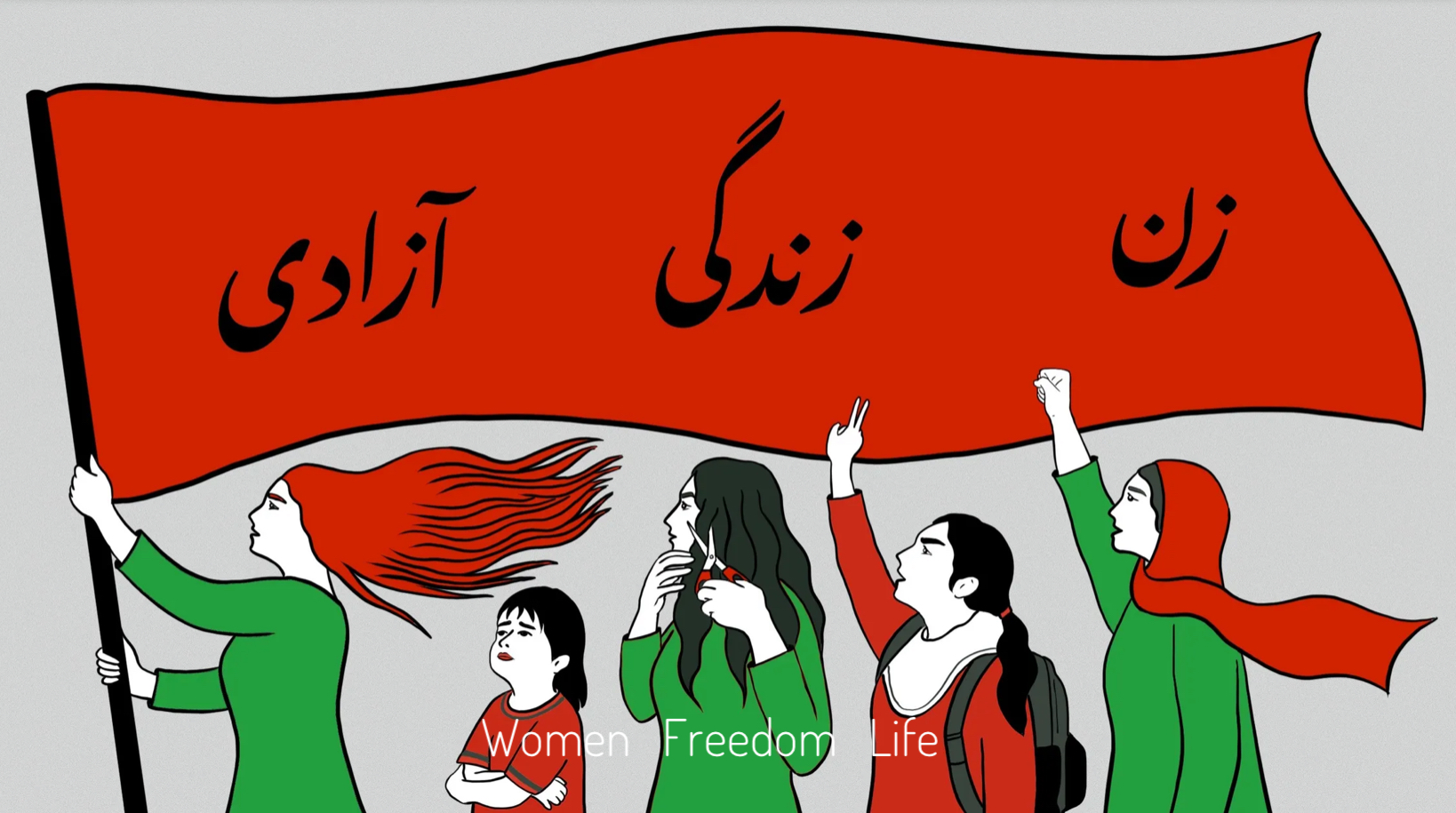
As 2022 ends, with blood flowing on the streets of Iran and in the mullahs’s torture cells as young people rise up against a hypocritically brutal theocratic tyranny, we see again and again how that which goes around comes around.

Women, Freedom, Life

If the malign hand of history has literally reached out and gripped Iran’s young women and girls by their hair, it has also endeavoured to strangle the thousand year old Ukrainian nation in the name of an atavistic irredentism. Russian troops invaded the Ukraine on February 24, causing what has since become the largest conflict in Europe since World War II. Out if the spotlight of the world’s easily distracted attention. intractable conflicts lumbered mercilessly on – in Syria, Yemen, Ethiopia, the Congo and many other “far away  places with strange sounding names”.  

On the far side of the world, the USA continued to struggle with the reverberations of January 6th 2021. Donald Trump, like Dracula, has not gone away, and whilst his 2024 presidential run is looking increasingly shaky, he continues to poison the atmosphere like radioactive dust. The unfortunate folk of the United Kingdom endured three prime ministers during the year, including the shortest ever in the history of the office, and after two years of pandemic, are facing a bleak economic winter as well as a frigid actual one.

In Australia, it was the year of the teal – at least according to those who study the evolution of language, the year we lost a queen, our long-serving foreign head of state, and a king of spin, the down-fallen and disgraced Scott Morrison. And a sodden La Nina saw incessant rain drown large swathes of eastern Australia, visiting misery on thousands. COVID-19 mutated, the Omicron variant surging from beginning of the year, ensuring no end to the pandemic – today, it seems like everyone we know has had it, including ourselves (and we were soooo careful for a full two years!). As restrictions were cautiously lifted, we as a nation are learning to live with it. 

Politically, it’s been a grand year for the Australian Labor Party. With our stunning Federal election win in May and in Victoria in November, the Albanese government’s star is on the ascendant and it’s legislative record in six months has out run nine years of Tory stagnation on climate, integrity and equality – a neglect that saw the rise of a new political force in the shape of a proto-party, the aforementioned “teal”, named for the colour of the candidates’ tee shirts. The opposition has been reduced to a bickering and carping crew, and whilst Labor continues to ride high in the polls, the Coalition bounces along the bottom of the pond.

Lismore, northern NSW, March 2023

Flooded house aflame, Lismore March 2022

Christine McVie was just one of many music icons who checked out this past year. The coal miner’s daughter, Loretta Lynn, crooned her last, as did rock ‘n roll bad boy Jerry Lee Lewis and Ronnie “the Hawk” Hawkins, who gave the boys in The Band their big break. Rock heavyweight (literally) Meatloaf took off like his bat out of hell and keyboard evangelist Vangelis boarded his chariot of fire.

Acclaimed British author Hilary Mantel, whose Wolf Hall trilogy inspired back to back posts in In That Howling Infinite in 2020 found “a place of greater safety”, and French author Dominique Lapierre also joined the choir invisible. I had first learned about Israel’s war of independence and the Palestinians’ al Nakba in his O Jerusalem, and about the bloody tragedy that accompanied the birth of India and Pakistan, in Freedom at Midnight, both books featuring in past posts. 

Mark Rylance and Damian Lewis as Tom and Hal

One could argue that the most significant departure was that of Britain’s longest serving monarch. Queen Elizabeth II had been on the throne for almost all of my life, as has the now King Charles III who was born four months before me, and of whom, as a nipper, I was jealous. I recall how I watched the queen’s coronation on a tiny black and white television in the crowded and smokey parlour of the boarding house run by a friend of our family. By happenstance, Netflix served up two over the top regal sagas to binge on: the penultimate season of The Crown, which whilst entertaining, was a disappointment in comparison with earlier seasons, and Harry and Meghan which was whilst excruciatingly cringe-worthy, was nevertheless addictive viewing. The passing of Her Maj reminded me that in my lifetime, I have witnessed three monarchs and eighteen British prime ministers (and incidentally, eighteen Australian prime ministers).  The public outpouring of grief for the Queen’s ascent to the choir invisible was unprecedented – the picture below demonstrates what the Poms do best …

The Queue along the Thames to pay respect to Her Maj

There were farewells much closer to home. My mediation colleague, aspiring author and friend John Rosley, and Beau Tindall, the son of my oldest Bellingen friend Warren, took off on the same day in May. Peter Setterington, my oldest friend in England – we first met in 1972 – died suddenly in London in March, and our friend and forest neighbour, the world-famous war photographer Tim Page, in August, after a short but nasty illness. Pete is memorialized in When an Old Cricketer Leave His Crease whilst Journey’s end – Tim Page’s wild ride,is an adaptation of the eulogy I gave for Tim in September, one of many on that sunny afternoon day in Fernmount. It is a coda to Tim Page’s  War – a photographer’s  Vietnam journey, a story we published a year ago.

Tim Page by Joanne Booker

What we wrote in 2022

The ongoing Ukraine War has dominated our perception of 2022, from the morning (Australian time) we watched it begin on CNN as the first Russian missiles struck Kyiv, to the aerial assault on infrastructure that has left Ukrainians sheltering through a cold, dark winter. Two posts in In That Howling Infinite examined the historical origins of the conflict: Borderlands – Ukraine and the curse of mystical nationalism and The Roots and Fruits of Putin’s Irridentism. “Because of …” Iran’s voice of freedom looks at the song that has become the rising’s anthem. None can predict the outcome – whether it will be a doomed intifada, the Arabic word that literally means a shaking off – historically of oppression – and figuratively, a rising up, like that in Ireland in 1798 and 1916, Warsaw in 1943 and 1945, and Hungary in 1956, or an Inqilab, another Arabic word meaning literally change or transformation, overturning or revolution.

The run up to May’s Australian elections inspired Teal independents – false reality in a fog of moralism.; and Australia votes – the decline and fall of the flimflam man. 

More distant history featured in Menzie’s Excellent Suez Adventure, the story of the Suez crisis of 1956 that historians argue augured the end of the British imperium, and the role played therein by longtime Australian prime minister Sir Robert Menzies. Johnny Clegg and the Washing of the Spears is a tribute to the late South African singer, dancer and songwriter, and a brief history of the war that destroyed the great Zulu nation, setting the scene for the modern history of South Africa. And journeying further back in time to sixteenth century Ireland, there is O’Donnell Abú – the Red Earl and history in a song, a discussion of the origins of a famous and favorite rebel song.

Then there are the semi-biographical “micro-histories” in In That Howling Infinite’s Tall tales, small stories, obituaries and epiphanies. In 2023, these included: Folksong Au Lapin Agile, the evening we visited Montmarte’s famous folk cabaret; Ciao Pollo di Soho – the café at the end of the M1, the story of a café that played a minor part in my London days, as described in detail in an earlier travelogue, Song of the Road – my hitchhiking days; Better read than dead – the joy of public libraries; The quiet tea time of the soul, an ode in prose to a favourite beverage; and The work, the working, the working life recalling the many jobs I took on in the sixties to keep myself in music, books, travel and sundry vices. 

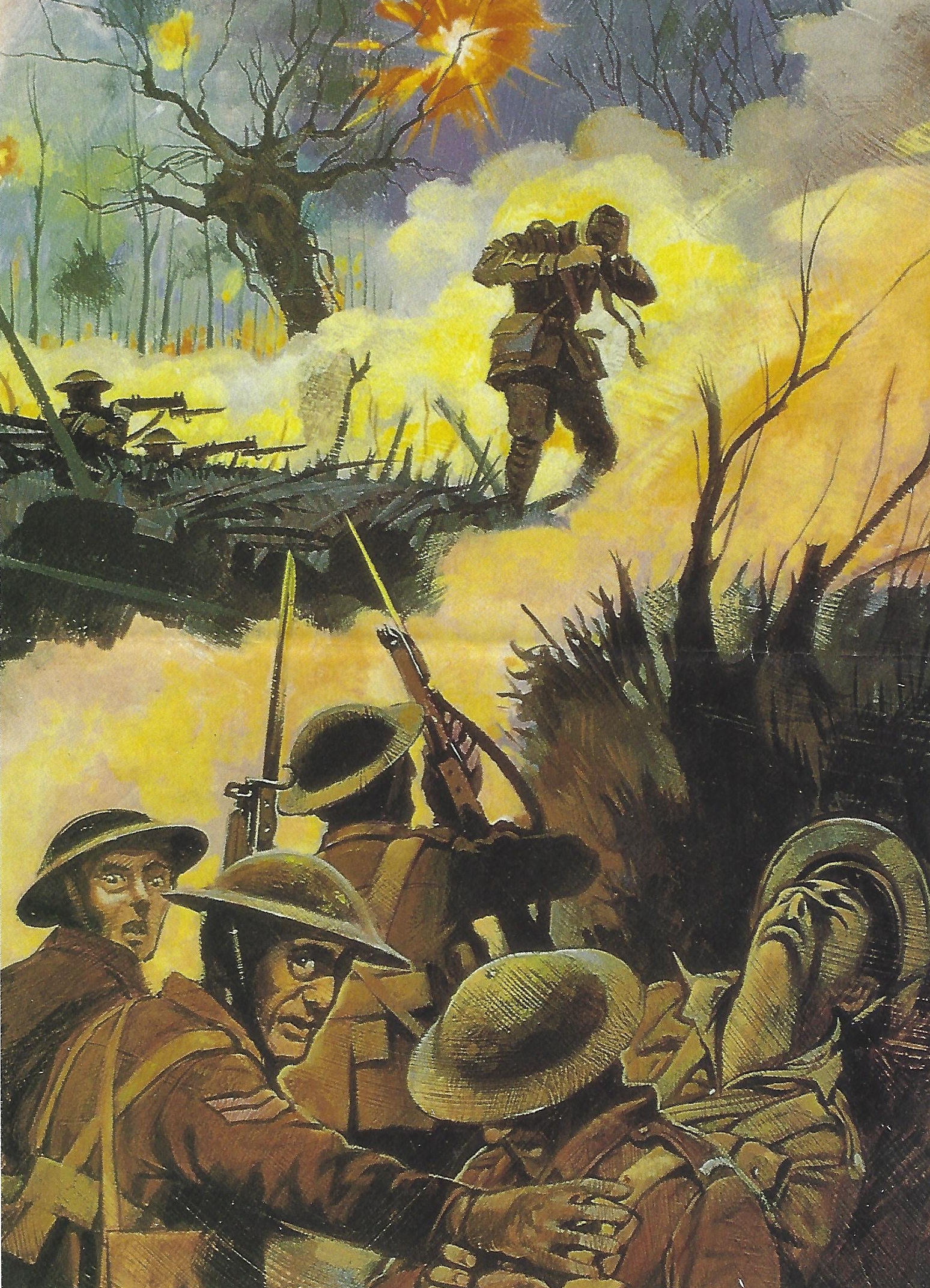
We cannot pass a year without something literary. We celebrated the centenary of three iconic literary classics in The year that changed literature, and with the release of The Rings of Power, the controversial prequel to The Lord of the Rings, we published a retrospective on the influence of JRR Tolkien. One ring to rule us all – does Tolkien matter? – a personal perspective with an opinion piece by English historian Dominic Sandbrook, an informative and entertaining chronicler of postwar British history and society which featured, in Unherd, an online e-zine that became a “must read” in 2022. A Son Goes To War – the grief of Rudyard Kipling recalls the death in battle on the Western Front in 1917 of the poet’s only son, it’s influence upon his subsequent work, whilst Muzaffar al Nawab, poet of revolutions and sorrow is an obituary for another poet, who seen a lifetime speaking truth to power.

And that was that for what was in so man ways a sad year. Meanwhile, In That Howling Infinite already has several works in progress, including a review of historian Anthony Beevor’s Russia – Revolution and Civil War, what King Herod really thought about the birth of baby Jesus, and the story of a famous and favourite British army marching song.

Best wishes for 2023 …

Death of a Son

That was the year that was – retrospectives

Life in Wartime – images of Ukraine

Menzie’s Excellent Suez Adventure

Many historians claim that the Suez Crisis of late 1956 was the end of the beginning of Britain’s retreat from Empire and its decline as a Great Power. Britain’s divestment of its non-Anglo-Celtic empire began with its withdrawn from Palestine and the independence of India in 1947 and 1948 and proceeded apace through the sixties and seventies until today when but a handful of dependencies remain.

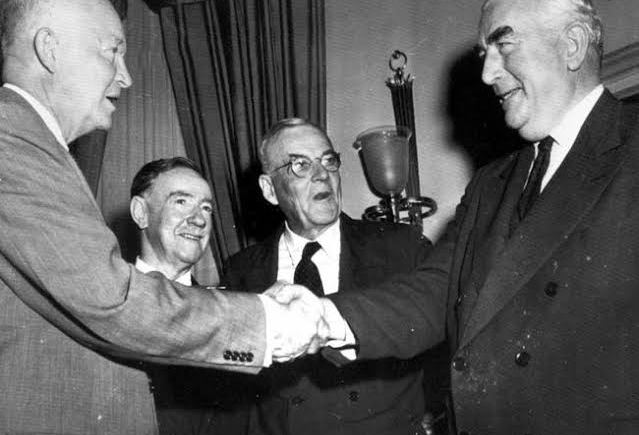
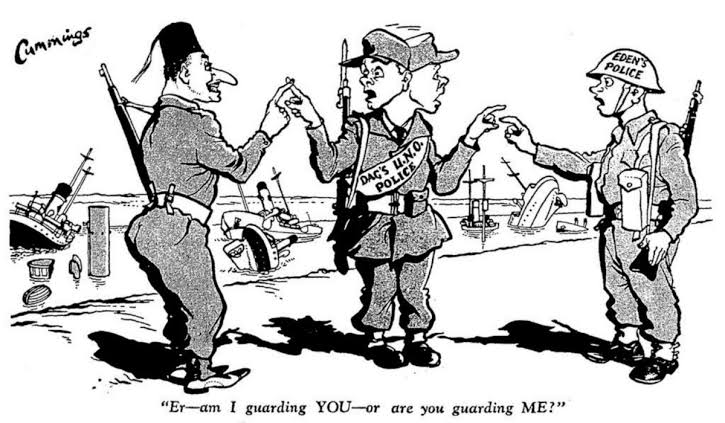
Why Britain reacted as it did to the rise of Gamal Abd al Nasser and his seizure of the Suez Canal in 1956 has long fascinated scholars. Watching ‘The Crown’, recently, and its portrayal of Sir Anthony Eden, and recalling Dennis Potter’s marvelously surreal take on the Suez Crisis in ‘Lipstick on Your Collar’, I discovered one possible explanation (though It doesn’t quite explain the decision of France and Israel to join Britain’s last imperial adventure). 

The Suez Crisis had far-reaching consequences – though none as catastrophic on a political and human scale as when Britain and Australia joined America’s Iraq crusade in 2003. The humiliating withdrawal from Suez accelerated Britain’s slow decline from “great power” status, and the US’ steady ascent to world leadership. It was the harbinger of the end of an empire on which the sun never set. It burnished Nasser’s revolutionary credentials and gave rise to an anti-western, secular, and socialist Arab nationalism that challenged and, in many countries, toppled the established order in the Middle East. It led, in a short time, to the rise of the Ba’ath regimes in Syria and Iraq, which, it can be argued, set these countries on the road to ruin half a century later. And what might have been the consequences for Eastern Europe is “the West” had not been so distracted on the canal during Hungary’s quixotic revolution and its brutal suppression by the Soviet Union.

The Suez Crisis in brief

The Suez Crisis came to a boil with what Arabs called the Tripartite Aggression, and Israelis, the Sinai War. Historians refer to it as the Second Arab–Israeli war –  between the war that commenced with the conclusion of Britain’s mandate over Palestine, and ended with the establishment of the state of Israel and expulsion of over a quarter of a million Arabs from within the battle-won borders of the new state, and the Six Day War which has changed utterly Israel’s geography, politics, culture, society, identity and international standing.

It commenced with an invasion of Egypt in October 1956 by Israel, followed immediately by the United Kingdom and France. The aims were to regain control the Suez Canal a majority British owned strategic international waterway for the Western nations who depended upon it their oceanic commerce, and also, to remove Egyptian president Gamal Abdel Nasser, who had just nationalized the foreign-owned Suez Canal Company, which administered the canal. After the fighting had started, political pressure from the United States, the Soviet Union and the United Nations led to a withdrawal by the three invaders. It humiliated the United Kingdom and France and enhanced the reputation of Nasser. Although the three allies had attained a number of their military objectives, the Egyptians scuppered forty ships in the canal rendering it useless. As a result of the conflict, the United Nations created the UNEF Peacekeepers to police the Egyptian–Israeli border, British prime minister Anthony Eden resigned, and the Soviet Union, taking advantage may have been emboldened to invade Hungary.  

Fun in the sun

As with all international conflicts, the causes are much more complex than the actual casus belli that precipitate it, and beyond the intention and scope of this article.  Issues geopolitical, strategic, tactical, historical, cultural and indeed, psychological proliferated, aggregated and aggravated, converging on one or more ignition points. The Cold War, the rise of Arab nationalism, the Arab Israeli conflict, the decline of the British Empire and Britain’s need to hang onto its status as a world power, and the personalities of the players, particularly the Egyptian leader and the British prime minister.

Sir Anthony greets his troops

And into this complex and volatile maze stepped longtime Australian Prime Minister monarchist and empire loyalist Sir Robert Menzies.

But first …

The view from Down Under 

When many British folk of a certain age remember the Suez Crisis in the fall of 1956, they think of the “ Gyppos”, the jumped-up Arabs who defied then embarrassed Great Britain, brought down a prime minister, and dropped the curtain on the empire on which the sun never set. They might also at a stretch imaging a connection from this to Dodi al Fayyad and his dad, Muhammad, the one time owner of Harrods and the creator of that infamous shrine to his lad and the people’s princess who both perished in the Paris car crash that launched a thousand conspiracy theories – one of which was the the establishment’s fear that Diana would would bring forth an Egyptian baby.

As a youngster in Birmingham, the events in Egypt passed me by – I was however quite excited by the revolution in Hungary and the Soviet invasion that followed soon afterwards, and would spend hours drawing pictures of street battles, of tanks and fighters and security services men strung up on lampposts. But many young men doing their compulsory national service, including the sons and brothers of my friends and relatives, were fearful of being sent off to a foreign war, the last one being barely over a decade. This anxiety, and also the imperial angst of crusty ex-army civil servants, is beautifully portrayed in Dennis Potter’s brilliant Lipstick On Your Collar, and also the very commendable drama series The Hour. I have friends and acquaintances of British, Italian, Maltese and French descent who had been born in Egypt but had to leave with their families in during and after the crisis as the Egyptian government, vindictive in its victory, showed them the door.

When Aussies remember the Crisis – well, probably very few do. But way back then, in the days of the White Australia Policy (yes, we really did have that) and the early closing Six O’clock Swill (and yes, we had that too!), apart from many former soldiers who had memories of Egypt in both world wars, we just got on with the matters that preoccupied us in a year that Australian academic and author Hugh Richardson recounts in his highly informative and very entertaining 1956 – the year Australia welcomed the world. Richardson recreates the events of the year surrounding the Melbourne Olympics of November and December 1956,  including the introduction of television in Australia, the arrival of Rock Around the Clock, the British nuclear test in the South Australian outback, the Soviet Union’s invasion of Hungary, and immediately before it, the Suez debacle.

Nowadays, many commentators and writers looking back on the fifties paint Australia as an insular, inward-focusing and churlish nation which many now internationally famous Australian abandoned for greener, more cerebral and creative British pastures. Richardson acknowledges this too, but contends that the country was in fact changing, in the early stages of our development into the worldly-wise, technologically connected, creative, cosmopolitan and multicultural nation that we imagine ourselves to be today. Undoubtedly, we are, but some disreputable skeletons still rattle around at the back of our national cupboard and sometimes fall out into the public space to the embarrassment of ourselves and the discomfort of our friends and neighbours.

This is not to say that Australia was detached from world affairs. Our innate conservatism, and religiosity, a traditionally strong emotional attachment to Great Britain, the homeland of most immigrants to Australia in the since the days of the first settlement, and a firm commitment to our alliance with the UK and the US, saw us drawn into the mindsets and machinations of the Cold War.

We signed up for the United Nation’s euphemistically termed “police action” in Korea, a war that concluded with a forever armistice, and contributed troops to the Malayan Emergency, a guerrilla war between Commonwealth armed forces and the Malayan National Liberation Army, the military arm of the Malayan Communist Party, from 1948 to 1960 in today’s Malaysia and Singapore. Australia’s commitment lasted 13 years, between 1950 and 1963 and until Vietnam and Afghanistan, was the longest continuous military commitment in our history.

 On the home front, Robert Menzies endeavoured to ban the Communist Party in an Antipodean echo of Senator Joseph McCarthy’s inquisition in America. There were other similarities with the USA as an adolescent ASIO, the Australian Security Intelligence Agency, encouraged dobbers and snitches to shop their neighbours and colleagues. The actual extent and effectiveness of this is unknown to this day. The Labor Party fractured as fervent anti-communist Catholics walked out to establish the Democratic Labor Party, a rift than kept Labor in the political wilderness where it had  … for a  further sixteen years. And in April 1954, Vladimir Petrov, a Soviet security officer in the Canberra embassy defected to the West with his reluctant, patriotic wife, Evdokia, a valued cryptographer at the embassy, much to the ire of Comrade Khrushchev. In 1956, therefore, Australia was very much on the radar of what President Robert Reagan would later call The Evil Empire.

When Robert met Gamal

In Richardson’s narrative, it appears that unbeknownst to the ordinary man or woman on the Bondi bus, Australia played a significant role in the Suez Crisis, and indeed,  there might’ve been a fair chance that our government would have volunteered our soldiers to join the party, much as we’d answered the old country’s call oft times before. But, as far as we know, Britain never asked and Australia never offered. It would appear that longtime Australian Prime Minister Robert Menzies main preoccupation that summer and fall was Britain’s imperial anguish, and how he might help assuage it.

The following narrative is quoted directly from Richardson’s book.

“During the build-up to the Crisis, British prime Minister Anthony Eden became consumed with an obsessional hatred for Nasser, and from March 1956 onward, was privately committed to the Nasser’s ousting. The American historian Donald Neff has written that Eden’s often hysterical and overwrought views towards Nasser almost certainly reflected the influence of the amphetamines to which he had had become addicted following a botched operation in 1953 together with the related effects of sustained sleep deprivation (Eden slept on average about 5 hours per night in early 1956).

Increasingly Nasser came to be viewed in British circles—and in particular by Eden—as a dictator, akin to Benito Mussolini. Ironically, in the buildup to the crisis, it was the actually the Labour leader Hugh Gaitskell and the left-leaning tabloid newspaper The Mirror that first made this comparison. . Anglo-Egyptian relations would continue on their downward spiral.

US President Eisenhower and Gamal Abdel Nasser

During World War II British prime minister Winston Churchill asked Anthony Eden who was foreign minister, to help him identify an appropriate candidate for to be minister of state in Cairo, Egypt. The position was strategically important because of the war in North Africa, but the candidate did not have to be British. Robert Menzies by this time had lost the prime ministership in Australia to John Curtin and was therefore able to be considered. He did not get the job. Eden actually even admitted later Menzies had not been accepted because “he probably would not get on with the people of of the Middle East, being a somewhat difficult person“. Now, Eden as British Prime Minister, was about to send Menzies on a far more difficult assignment.

Edens original observation was perhaps born out several years later when Menzies was in Cairo on a different mission – an international delegation sent to meet Colonel Nasser himself in an effort to persuade him that the canal to be placed under United Nations stewardship). “These Gyppos are dangerous lot of backward adolescents, full of self-importance and basic ignorance”, Menzies wrote in his diary. The attitude, not uncommon at the time, extended beyond the Egyptians. A former Australian High Commissioner to India Indonesia Italy and Kenya, Sir Walter Crocker, noted in 1955: “Menzies is anti-Asian; particularly anti-Indian… he just can’t help it”.

… While race proved challenging for Menzies, perhaps the more confronting charge was his apparent lack of curiosity about other nations, his unshakable faith in English superiority, and his lack of engagement with European languages.

Menzies believed that a strong response might be required to get Nasser to appreciate Britain’s point of view. Menzies was, in the public eye, a “Commonwealth man”. He had walked that stage, found a spot of obeisance near the crown, and felt like a valued elder statesman within the Commonwealth club of nations. But this mission to Egypt propelled him into a new kind of universe where the old verities no longer applied. He was about to embark on a delicate international mission of diplomacy, trying to negotiate with a new leader who was driven by forces Menzies could not fully comprehend, in a region about which had little interest ….

… Menzies had worked assiduously in London to get command of the brief for his mission. He and four advisors had nine meetings exploring the finances of the canal, and had spoken to the canal’s directors and even an engineer who was an expert in the area. Yet there was no discussion about the social and personal elements he needed to understand: why the Suez Canal was so important to the Egyptians, and why Nasser felt it now is the time to express his independence of thought and action.

The consequences of this shortsightedness became clear early on during Menzies meetings with Nasser. Menzies conducted the discussions like the barrister he once was, laying out the evidence, interrogating opinions, prosecuting a case, just as us Secretary of State Dulles had expected him to do. Nasser, Menzies confided to his staff, was naive and uncertain. Menzies believed he could influence him. Menzies base view was far less hospitable. He told Eden that Nasser was “in some ways a likable fellow but so far from being charming, he is rather gauche … I would say that he was a man of considerable but immature intelligence”. Menzies had more generalizations to make: “like many of these people in the Middle East (or even India) who I have met, his logic doesn’t travel very far; that is to say, he will produce a perfectly adequate minor premise , but his deduction will be astonishing”.

Nasser had his own description of Menzies – he was ‘a mule’.”

Coda – “I did but see her passing by …”

Robert Menzies love affair with Britain has opened him to posthumous ridicule in some quarters. Many would not know remember that in 1952, he  ordered charges against the communist journalists Rex Chiplin for criticizing the coronation. That came to nought but Chiplin was later hauled before the Royal Commission on Espionage (1954-55), a copycat version of Senator McCarthy’s Committee of in-American Activities

usually connected to his public comment during the visit of the young Queen Elizabeth and her consort to Australia in 1952 when quoting 17th century poet John Ford, he said: “I did but see her passing,  and yet I’ll love her ‘til I die”.

And yet, Sir Robert was not alone in his adulation. As the Sydney Morning Herald wrote on the fiftieth anniversary if the Royal tour:

“Royalty can have a strange effect on people who come into contact with it. It had an extraordinary effect on an estimated 7 million Australians who flocked to see the young Queen Elizabeth 50 years ago …The estimated figure was about 70 per cent of the Australian population of nearly 10 million. Nearly one million people were thought to have crowded Sydney’s foreshores and streets when the Queen arrived on February 3, when the city’s population was 1.8 million. About 150,000 crammed around Sydney Town Hall and neighbouring streets when she attended the Lord Mayor’s Ball. A newspaper reported that 2000 collapsed in the crush”.

Until the abolition of royal honours by the Whitlam Labor government of 1972-76, Australian worthies were rewards with British knighthoods and were also entitled to sit in the British House of Lords as life-peers. It was Menzies’ fervent wish that he be accorded that honour, and after his retirement in 1966, prime minister William McMahon endeavoured to grant it – but he lost office to Gough Whitlam before he could satisfy Sir Robert’s hearts desire.

Sir Robert Menzies, monarchist, Empire Royalist,and consummate politician kept his hand on the steering wheel of a conservative and complacent Australia from 1949 until his retirement in 1966. Some believe that it was a stultifying hand. Others praise him – and praise him still – him for upholding traditional Australian values, and keeping us relaxed, comfortable and prosperous. But in his influential 1964 book The Lucky Country, academic, social critic and public intellectual Donald Horne wrote: “Australia is a lucky country run mainly by second rate people who share its luck. It lives on other people’s ideas, and, although its ordinary people are adaptable, most of its leaders (in all fields) so lack curiosity about the events that surround them that they are often taken by surprise”. It wasn’t meant as a compliment.

But the times they were a’changin’. Political, cultural and social change was already in motion at the time of the Melbourne Olympics, and continued apace through the sixties, reaching top speed with the election of the Whitlam Labor government in 1972.

I first arrived in Australia in December 1976 for a month’s vacation in my first wife’s home country, and immigrated a year later. Gough had gone by the time I landed, inauspiciously sacked by the Governor General at the instigation of the Liberal Party, Robert Menzies’ creation. But the country that became my home of over forty years was no longer that of 1956. That past was, to quote the much-quoted LP Hartley, “another country”.

© Paul Hemphill 2022.  All rights reserved

For posts in In That Howling Infinite on the Middle East, see A Middle East Miscellany, on Australian history and politics, Down Under, and on history generally, Foggy Ruins of Time – from history’s pages.