Its been a diverse year In That Howling Infinite. We have traveled, to quote Bob Dylan, “all the way from New Orleans to Jerusalem” – and to many other places in between. Vikings and Roman legionaries; Bob Dylan, Jackson Browne and Bruce Cockburn; Britain in the ‘forties and Paris in the ‘fifties; America, the Levant, and even Wonderland. By Year’s end a million souls will have journeyed to Europe from the war-ravaged lands of the Middle East, and my final posts for the year contemplate what it might mean for refugees who find to safe haven in Australia.
Here is a retrospective.
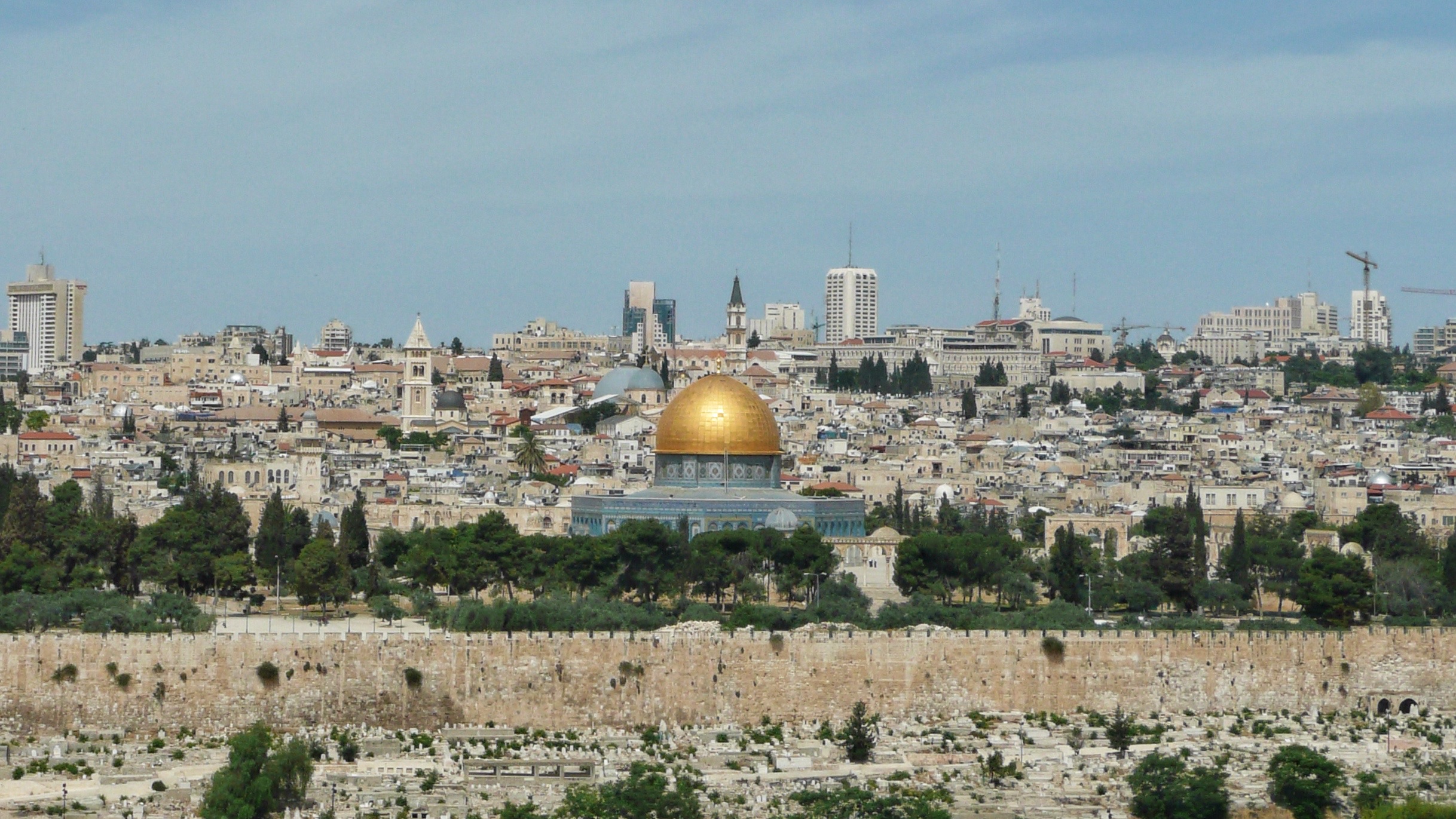
The year began with a short piece on recent archeological discoveries in Jerusalem that strongly suggested that the Via Dolorosathat Jesus trode on his final journey to Golgotha was the wrong route, and that instead, it began just inside of the Jaffa Gate. I took a light-hearted look at the Jerusalem Syndrome, a mental condition involving the presence of religiously-themed obsessive ideas, delusions and other psychoses triggered by a visit to The Holy City.
I read but one piece of fiction this year – a sad admission from a lifelong bibliophile – but this one book was probably one of the best I have read: The Incorrigible Optimists Club, winner of the prestigious Prix de Goncourt, by Jean Michel Guenassia. It is set in Paris’ Rive Gauche, as the ‘fifties gives way to the ‘sixties; as the crooners makes way for rock n’roll; as the Cold War divides a continent, sending dissidents and refugees fleeing to a safe haven in Paris; as the Algerian war divides and destroys families: and as the seeds of ‘les evenments de Mai 1968’ are sown in the hearts and souls of France’s young people. It is a coming of age book, of young hopes and fears, love and loss, a book about writers and reading, and the magic and power of the written word in prose and poetry.
March saw the passing of my old friend Dermott Ryder, chronicler and luminary of the Folk Music revival in Sydney in the early ‘seventies. Dermott’s Last Rideis my tribute to him. And April was a month of anniversaries and remembrance. Forty years since the outbreak of the Lebanese Civil War, and the centenary of the landings of the ANZACs at Gallipoli. Pity the Nation takes its title from Robert Fisk’s tombstone of a book on the long war; and he had taken it from a poem written in 1934 by Khalil Gibran, Lebanon’s most celebrated poet, a poem that was both a prophetic testament and a testimony of times to come: “Pity the nation divided into fragments, each fragment deeming itself a nation”. The Watchers of the Water is a song about Gallipoli sing by a Turkish solder.
May saw two diverse pieces of social history. The Spirit of 45 takes personal perspective of British filmmaker Ken Loach’s documentary of the excitement and optimism that followed the Labour Party’s election victory at the end of World War II. This laid the foundation stone for the British welfare state. Bob Dylan’s Americana discusses the meaning and significance of the lyrics and the imagery of Dylan’s early ‘eighties masterpiece Blind Willie McTell, a harrowing journey through America’s dark heart.
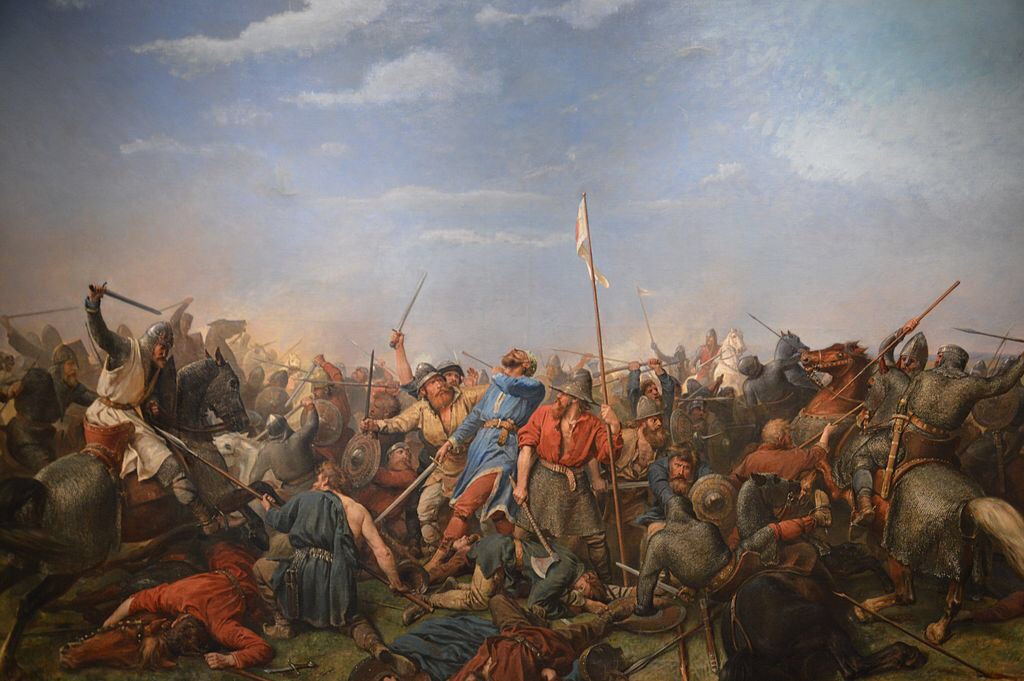
In June, we visited Yorkshire and in London, conjuring up memories and historical connections. Harald Went A Vikingis a saga about the first of two kings to die on English soil in the late summer of 1066, and the adventures that took him from Norway to Constantinople and Jerusalem and finally, to Yorkshire. Roman Wall Bluestakes its title from WH Auden’s poem about a homesick and grumpy legionnaire on Hadrian’s Wall, and contemplates the lives of the ethnically polyglot soldiery who defended the Empire’s borders. And June saw another famous anniversary, the Bicentennial of the momentous and bloody Battle of Waterloo. The Long Road to Waterloo prefaces a song for the men who, after twenty six long years of war, never came home.
Battle of Stamford Bridge, depicting King Harald Hardrada hit in the neck by an arrow
In July, controversy erupted in the Land of the Free over the flying of the Confederate Flag in states that were once part of Old Dixie. The dead hand of the Civil War reached out and touched the hearts of Americans and their friends throughout the world in the wake of yet another mass shooting. This time, a young man gunned down worshippers at prayer. That the victims were folk of colour, and the shooter, a young white extremist, reopened wounds that have never really healed. Rebel Yellsurmises that The South will always be with us, in our thoughts, in our historical memory, in our art and literature, our books and films, and our favourite music.
September marked the one hundred and fiftieth anniversary of the publication of Lewis Carroll’s timeless, fabulist masterpiece Alice In Wonderland. Go Ask Alice, I Think She’ll Know reproduces Australian critic Peter Craven’s masterful celebration of Alice 150. The title belongs to the mesmerizing Grace Slick of Jefferson Airplane who cut through to the rabbit chase channeling the long-gone Lewis in a psychedelic musical masterpiece.
On an infinitely sadder note, Ruins and Bones is a tribute to the memory of Syrian archeologist Khaled Muhammed al Asaad, murdered by ISIS in August 2015, and of Palmyra, the ‘Pearl of the Desert’.
Allende’s Desk and Osama’s Pyjamas is a brief commentary on the extension of American military power and the pathology of demons and demonization. Tales of Yankee Powerlooks at American foreign policy during the 1980s from the perspective of the songs of Jackson Browne and Bruce Cockburn.
November’s Children of the Revolution looks at the events that led up to the beginning of the Syrian Civil War, and the early days before it became too dangerous to gather on the streets, when men, women and children would parade in public places, waving the flag of the old Syria, the one that flew before the Assad clan seized power in 1966. Canny camera men could take media-friendly shots of photogenic little girls in face makeup looking sad, vulnerable and defiant. Those days of hope are long gone.
A highlight of this past year has been my work as a volunteer with the Humanitarian Settlement Services programme. The HSS’ mission is to assist newly arrived refugees to settle in Australia. In No Going Home, I endeavour to imagine the refugee journey. Hejirais a sequel of sorts and, indeed, a happy ending.
Happy New Year to these prospective New Australians, and to all my readers. May 2016 be fortunate and fulfilling.
Over the heather the wet wind blows, I’ve lice in my tunic and a cold in my nose. The rain comes pattering out of the sky, I’m a Wall soldier, I don’t know why. The mist creeps over the hard grey stone, My girl’s in Tungria; I sleep alone. Aulus goes hanging around her place, I don’t like his manners, I don’t like his face. Piso’s a Christian, he worships a fish; There’d be no kissing if he had his wish. She gave me a ring but I diced it away; I want my girl and I want my pay. When I’m a veteran with only one eye I shall do nothing but look at the sky
We’ve marvelled at Roman brickage from Syria to Cirencester, from Bath to Baalbek, but had never ventured to Hadrian’s Wall in Northumbria. WH Auden’s whimsical song, Roman Wall Blues, came to mind as we stood atop the windswept knoll that is Housesteads Roman Fort on a freezing May morning.
In the preface to Pax, the latest volume of his magisterial history of the Roman Empire, English historian Tom Holland notes that the northern bank of the river Tyne was the furthest north that a Roman Emperor ever visited. What was so important about Hadrian’s visit to Tyneside in 122AD was his decision there to mark in stone, for the first time, the official limits of his Empire. North of this great wall, there was paucity and unspeakable barbarism, scarcely worth bothering about; below the wall was civility and abundance and the blessings of Romanitas. To this day, those 73 miles of the Vallum Hadriani across the jugular of Britain still shape the common conception of where England and Scotland begin and end, even though the wall has never delineated the Anglo-Scottish border. For this colossal structure left enduring psychological as well as physical remains. To the Saxons, it was “the work of giants” and was often thought of as a metaphysical frontier with the land of the dead.
George RR Martin, author of The Game of Thrones, the artistic juggernaut, has said that his Ice Wall separating the northern wintry waste with its nomads and its demons from the settled and temperate Seven Kingdoms of Westeros with it castles and cities, it’s palaces and slums, it’s despots, destitute and the depraved, was inspired by a visit to Hadrian’s Wall – only he built it much longer and much, much higher.
“We walked along the top of the wall just as the sun was going down. It was the fall. I stood there and looked out over the hills of Scotland and wondered what it would be like to be a Roman centurion … covered in furs and not knowing what would be coming out of the north at you. George RR Martin has said that his Ice Wall separating the northern wintry waste with its nomads abd its demons from the settled and temperate Westeros with it castles and cities, it’s palaces and slums, and destitute and the depraved, was inspired by a visit to Hadrian’s Wall – only he built it much longer and much, much higher. “We walked along the top of the wall just as the sun was going down. It was the fall. I stood there and looked out over the hills of Scotland and wondered what it would be like to be a Roman centurion … covered in furs and not knowing what would be coming out of the north at you”.
There we were, then, on the edge of empire. The Roman Empire, that is. Among outposts and outcasts. Up on the hills in the nithering wind and the cold rain, the snow and the sleet, and in the valley below with the baths and the brothels. This is where worlds collided. Between the Roman cives and their satraps, and the barbarians of the northlands. Between Britannia and Caledonia. Where solders from Rome and the Italy-yet-to-be that surrounded it, from Gaul, Batavia, Asturias and Tungria, now France, Spain and the Low Countries, from Germania and Sarmatia in Central and Eastern Europe, marched and marauded, drank and dined, foraged and fucked, lived and died.
At the height of Empire, some seven hundred soldiers manned the fort we now call Housesteads, up high on the moors, a windswept outcrop with a vista of 360 degrees and a temperature near zero. Many more legionaries garrisoned the more sheltered Chesters Fort in the nearby-by valley below where the wall crosses the Tyne. These included cavalry, drafted from Sarmatia, in present day Hungary. This was the fanciful premise of King Arthur (2004) starring Clive Owen as a handsome, tortured soul wandering through a flawed film and Keira Knightly as a scantily clad, elfin warrior Guinevere, backed up by a gallant band of photogenic heroes who hailed from the eastern steppes.
When the Romans departed Britain, Hadrian’s Wall fell into disrepair – it was always permeable, and in time, had served its purpose – which was perhaps as much about public relations as protection. Archeologist Terri Madenholme wrote in Haaretz: “Despite itself having a culture of violence, Rome aimed to project an image of a nation of the civilized, and what better way than having it monumentalized in stone? When Hadrian set to build the 73-miles-long wall drawing the border between Roman Britannia and the unconquered Caledonia, the message became even more clear: this is us, and that’s them. Hadrian’s Wall was much more than just a border control, keeping the Scots in check: it was a monument to Roman supremacy, an attempt to separate the civilized world from the savages”.
“He set out for Britain”, Hadrian’s historian tells us, “and there he put right many abuses and was the first to build a wall 80 miles long [Roman miles] to separate the barbarians and the Romans.”
Housesteads Fort
At Vindolanda, to the south, a small town grew up around a large military camp. First of wood and then of stone, constructed by the legionnaires themselves, who included in their number skilled masons and carpenters. Their settlements endure to engage our imaginations today. In times of turmoil, these soldiers fought and fell. In quieter times, they relaxed and recuperated. And the locals gathered about them, built houses and gardens, opened shops and pubs and those aforementioned brothels. And life went on like it does in our time.
During conflict, the Roman auxiliaries guarded the borderlands, deterring the Picts, a dark-skinned painted people who raided from the northern badlands. When peace prevailed, the locals visited, traded, and settled in the viccii or villages that grew organically to the south of the forts that were constructed at intervals along the empire’s perimeter wall. There, they traded, and provided goods, services and entertainment for themselves and for the martial strangers that had come among them from faraway places they’d never heard of.
In the early days, the auxiliaries were not permitted to bring wives and children to the frontier. But folks being folk, they very soon established friendly relations with their neighbours, and legionaries would keep informal wives and families in the vicus. Soviet writer and war-correspondent Vasily Grossman encapsulated all this poignantly and succinctly in An Armenian Sketchbook: “The longer a nation’s history, the more wars, invasions, wanderings, and periods of captivity it has seen – the greater the diversity of its faces .Throughout the centuries and millennia, victors have spent the night in the homes of those whom they have defeated. This diversity is the story of the crazed hearts of women who passed away long ago, of the wild passion of soldiers intoxicated by victory, of the miraculous tenderness of some foreign Romeo towards some Armenian Juliet”.
Officers were allowed to bring their wives and children to their postings, and these endured their provincial, primitive exile by importing the necessities of a comfortable Roman life, including the celebrated Roman plumbing and central heating. Chesters boasts the best preserved military bathhouse in Britain. And so, the accessories of civic consumerism reached the frontier. Food and wine from the warm South were transported to the cold north-lands. Fashions in clothes and jewelry, day-to-day articles and artifacts, from glass and pewter dinnerware to cutlery, tools and sundry hardware. Recently, it has been revealed that these domestic items included what is believed to be the only known Roman dildo. Remnants and reports gathered in the Vindolanda museum open a window into a gone world.
Housesteads Fort
The wonderful Vindolanda tablets have preserved a picture of the oh-so-normal lives of these transplanted souls so far away from home. Amidst accounts and inventories, orders and troop dispositions, a quartermaster reports that supplies of beer are running low. An officer writes to another in a neighboring fort inquiring about the availability of accommodation for visitors and the quality thereof. One tablet reveals that Roman soldiers wore underpants, which, in view of the locale and climate thereabouts, is comforting to know. And another recounts workplace harassment and bullying that would today invoke grievance procedures. The wife of an officer invites another to a birthday party at her house in Vindolanda. There is an undercurrent of “Please come, I am bored shitless”, though a polite Roman matron would not commit such sentiments to a wooden tablet (nor reveal to her friend the existence of that aforementioned sexual comforter). It is probably the oldest surviving document in Latin written by a woman.
So who were these folk so near to us in their needs and desires, their hopes, fears and expectations, and so far from us in time, space and purpose? What did they think and feel? It is a question oft asked by empathetic history tragics. The thinking of another time can be hard to understand. Ideas and ideologies once compelling may become unfathomable. And the tone and sensibility that made those ideas possible is even more mysterious. We read, we ponder, and we endeavour to empathize, to superimpose the template of our value system, our socialization, our sensibilities upon the long-dead. And thence, we try to intuit, read between the lines, draw out understanding from poems, plays, novels, memoirs, pictures, photographs, and films of the past.
We feel we are experiencing another facet of the potential range of human experience. But in reality, we are but skimming the surface, drawing aside a heavy curtain for a momentary glimpse through an opaque window into the past. Yet, we persist nevertheless, because that is what humans do. Over two and a half thousand years ago, the controversial Greek poetess Sappho wrote ”I tell you, someone will remember us; even in another time”.
And in Vindolanda, up there on the wall, on the weather-beaten rim of the long-gone empire, we do …
One of the great unsung saviours of the UK’s heritage is remembered in the museum housing his remarkable collection at Chesters Roman Fort Museum which houses the Clayton Collection of and 5,500 catalogued items from a variety of sites along the central section of the wall.
Few people today have heard of John Clayton, yet he is one of the single most important individuals in the history of Hadrian’s Wall.
A classically educated Victorian gentleman who combined demanding roles running the family law firm and acting as town clerk for the city of Newcastle-upon-Tyne, Clayton had a passion for archaeology and the Roman military legacy in his beloved Northumberland.
Were it not for Clayton, large parts of Hadrian’s Wall would have disappeared as the industrial revolution fuelled the demand for stone to build factories, mines and mills. His role in the preservation and survival of Chesters Roman Fort – the best-preserved Roman cavalry fort in Britain, is now undisputed.
In the early 19th century Clayton lived at Chesters House in the parkland surrounding the Roman fort and from an early age became fascinated by the Roman relics that surrounded him.
By the 1830s he began buying land to preserve the Wall, at a time when what is now a World Heritage Site was little understood, and was being unthinkingly vandalised by quarrying and removal of stones for reuse. Clayton’s enthusiasm helped preserve the central stretch of Hadrian’s Wall that includes Chesters (Cilurnum), Housesteads and Vindolanda. He carried out some of the first archaeological excavations on the Wall and even brought early tourism to the area by displaying some of the finds at Chesters. Clayton managed the estate and its farms successfully, generating cash to fund further preservation and restoration work on the Wall. He never married, and died in 1890
The museum housing the Clayton Collection was opened next to the fort site in 1903, 13 years after his death. It is privately owned but curated by English Heritage on behalf of the Trustees of the Clayton Collection, and has been refurbished to bring it up to 21st century standards of conservation, display and interpretation. Yet, great care has been taken to respect its character and to retain the feel of a 19th century gentleman antiquarian’s collection, and many of the labels and original cases have been retained..
In my earlier blog, The Grand Old New Imperial Hotel, I wrote:
Had the hotel been there in Biblical times, what events we might have witnessed from our balcony. King Herod, the ostensibly psychotic master builder of Bible infamy dwelt opposite as he planned his Second Temple. So did Pontius Pilate. If one accepts the narrative of Simon Sebag-Montefiore, in his Jerusaelm : The Biography, we could also have watched the last journey of Jesus of Nazareth. It was but a short distance from the Citadel where he was condemned and Golgotha where he died: across the square, right at the New Imperial, left just past the Med, and straight on to the Hill of the Skull (where the Church of the Holy Sepulcher now stands). The present Via Dolorosa runs from the site of the Antonine Fortress, on the northern edge of the Haram ash Sharif, to The Church, its course set by custom and customers from Byzantine days.
As I relate in my earlier post, ‘Amazing Grace – There’s Magic In The Air‘ : “from the Jaffa Gate, we look out from our balcony in the Imperial Hotel, a late 19th Century mix of trash and treasure, five-star history, and ten-star views”.
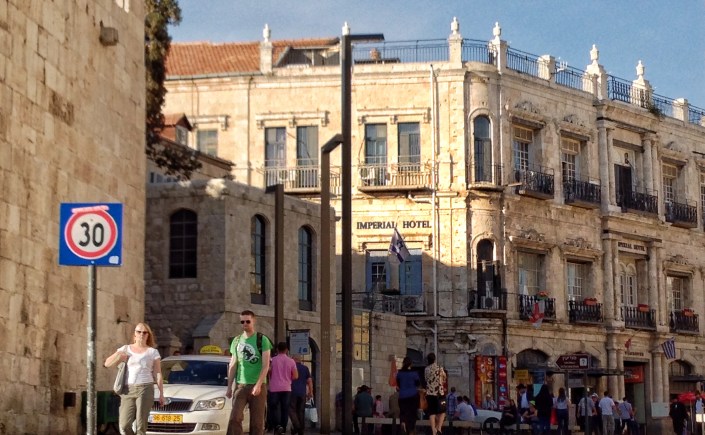
Planning our 2014 visit to Jerusalem (we were there in May 2014) I wanted to book a hotel that was both historical and conveniently close to The Old City. I also fancied the idea of staying in a pilgrim hotel so we could witness at first hand the excited comings and goings of the faithful (see my post ‘Messianic Carpet Rides‘). The New Imperial Hotel, just inside the Jaffa Gate, was just the ticket. And we struck solid gold! Stepping down from the Nesher bus on the road outside the famed Walls of Jerusalem and the Citadel (see: Once in Royals David’s Citadel), we looked up towards the Jaffa Gate and there, right above us was the imposing facade of the New Imperial Hotel.
The Jaffa Gate, in the western wall of the Old City (not to be confused with the ‘Western Wall’ or ‘Kotel’ so revered of Judaism), has traditionally been one of the busiest entrances to Jerusalem. Its Arabic name is Bab al Khalil (Gate of the Friend) a reference to Abraham, forefather of both Arabs and Jews. The wall bears the inscription in Arabic: “there is no god but Allah, and Abraham is the friend of Allah”. Topographically the Gate provided the easiest access, so it’s approaches provided a most convenient camping ground for the many invaders who sought to conquer the city. These included Greeks, Romans, Arabs, Frankish Crusaders, Turks, and finally, the British. Caliph Omar Ibn al Khatab entered through this gate after Jerusalem’s capture by the Muslims in 638AD. As did General Allenby, commander of the British forces which captured Jerusalem in December 1917.
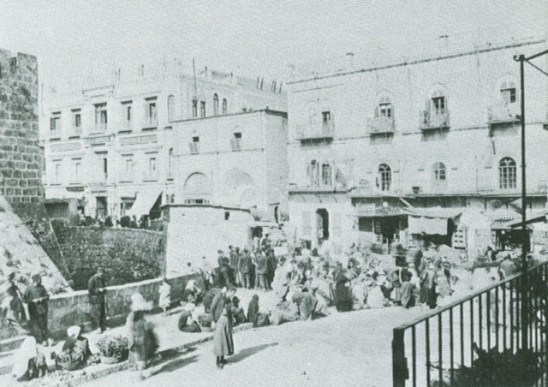
Just inside the wall, there were fields of winter wheat until the late nineteenth century; and in summertime, the empty fields became dumping grounds for carcasses of donkeys, camels and horses. The Turkish authorities moved this ‘cemetery’ outside the wall, and what was forever the main thoroughfare, became the location for important commercial institutions, including the Banco de Roma, the Anglo-Palestine Bank, and the German bank of Johannes Frutiger, the Austrian Post Office, The Thomas Cook Tourism and Travel Company, and the studios of a number of Jerusalem’s famous photographers.
And also, several hotels catering for the growing tourist industry, including the Mediterranean Hotel (now called The Petra), and in 1884, the Grand New Hotel, built on land owned by the Greek Orthodox Patriarchate. According to the Thomas Cook Tourist Handbook in 1876, the Mediterranean was “the best in Jerusalem”. Travelers were however wont to damn the Med with faint praise, and soon began to write about the really new, really ‘grand’ hotel with great facilities, round arched windows, high roof pedestals topped by Grecian urns, imposing entrance staircase, and balconies looking right out over Omar Ibn al Khatab Square. See the pictures below from the end of the 19th Century, showing the square in all variety of citizenry and costume.
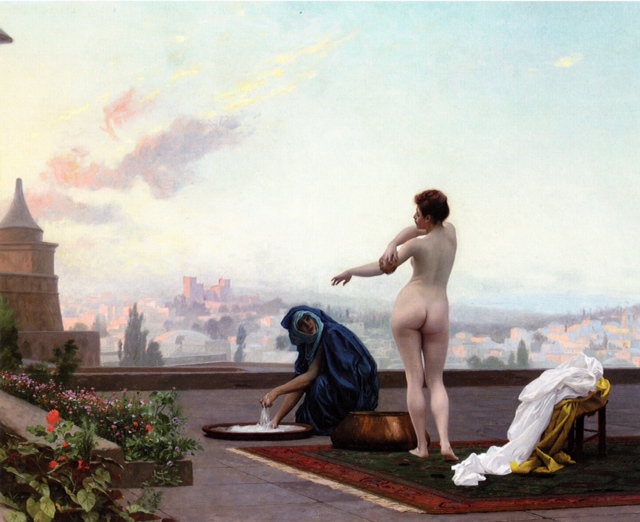
The place comes with a history. During construction, builders uncovered what was believed to be the Pool of a Bathsheba. It was said that Uriah’s wife was bathing thereon when spied upon by a randy King David. David subsequently sent Uriah off on a suicide mission to clear the way for his own passions. The historical record is confused here. Leonard Cohen and the painter Jean-Léon Gérôme apparently got it wrong. They both placed her up on the roof. The Bible says he saw her from the roof.
The view from the rarely frequented roof terrace of the New Imperial itself, whilst not quite as picaresque as the vision that tempted the poet king, offers a splendid vista of the cupolas of the Church of the Holy Sepulcher and the Dome of the Rock – not to mention a fine peek at the battlements of the Citadel. On the western side, we look out over West Jerusalem and what was the old Arab neighbourhood of Mamilla, now totally rebuilt with a lux shopping mall, the rectangular bulk of the King David Hotel, once the HQ of the British military and bombed by Irgun terrorists in June 1946, and the iconic YMCA tower.
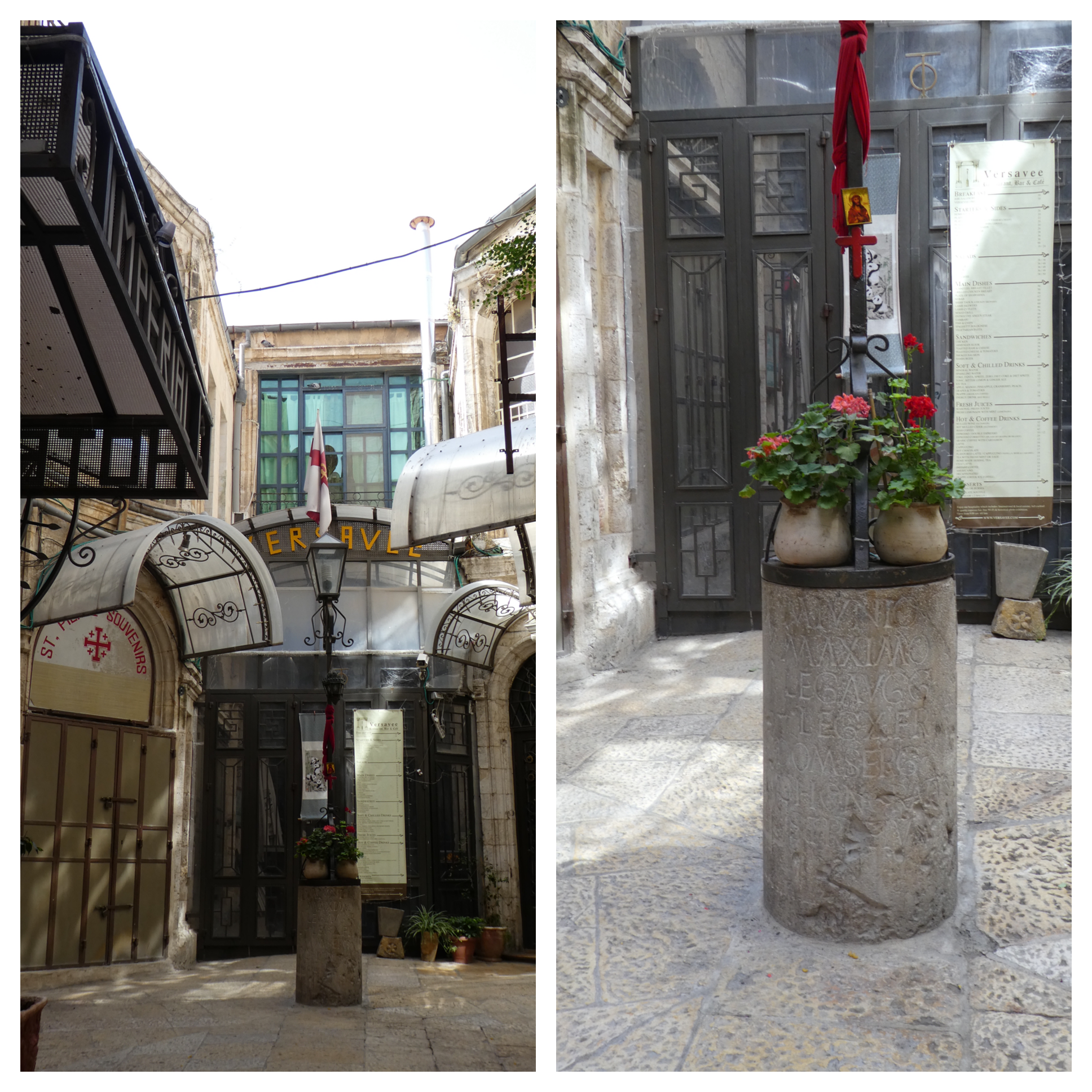
Anyhow, there is still an ancient cistern beneath the hotel. And also, part of the second wall. There are Roman tiles signifying the HQ the Roman Tenth Legion, and part a column erected by the legion, bearing a votive inscription honouring Emperor Augustus’ Legate, Marcus Julius Maximus. It stands there today as a pedestal for a street lamp, in the mews near the hotel front door and right in from of Versavee Restaurant and Bar, where the writer and his companions ate good Jerusalem fare and downed Israeli wine and Taybeh Palestinian beer.
Roman Column outside the New Imperial Hotel
Had the hotel been there in Biblical times, what events we might have witnessed from our balcony. King Herod, the ostensibly psychotic master builder of Bible infamy dwelt opposite as he planned his Second Temple (Herod might have murdered most of his nearest and dearest, but he was fitted up for the massacre of the innocents!). So did Pontius Pilate. If one accepts the narrative of Simon Sebag-Montefiore, in his Jerusaelm : The Biography, we could also have watched the last journey of Jesus of Nazareth. It was but a short distance from the Citadel where he was condemned and Golgotha where he died: cross the square, turn right at the New Imperial, left just past the Med, and straight on to the Hill of the Skull (where the Church of the Holy Sepulcher now stands). The present Via Dolorosa runs from the site of the Antonine Fortress, on the northern edge of the Haram ash Sharif, to The Church, its course set by custom and customers from Byzantine days. But, the wrong side of town! (See Nova Via Dolorosa).
I digress…From rom our hypothetical balcony, we could watch the comings and goings of the conquerors: the entry of the Roman Titus’ legions; Omar Ibn Al Khatab entering al Quds on foot; the arrival of the First Crusade at the Gates of Jerusalem; the exit of the crusader garrison and the Christian inhabitants when the city fell to Salahuddin (portrayed in Ridley Scott’s Kingdom Of Heaven). And thence, Mamlouks, Seljuks, and Ottomans. The last Kaiser, Wilhelm II, stayed at the hotel on his visit to the Holy Land in 1898. His bust still sits in the entrance hall. This is when The Grand became the New Imperial! Kaiser Bill came in style. No walking for him. The wall between the Jaffa Gate and citadel was torn down and its moat filled in on orders from Sultan Abdel Hamid II to enable the Kaiser and his wife and their huge entourage (looked after in grand style by Thomas Cook Tourism & Travel) to motor into the Old City (again, read Sebag-Montefiore’s amusing account).
Twenty years later, General Allenby and his British Army marched through the gate. The good general entered on foot just like old Omar. It would be fun to imagine that he made his proclamation of the liberation of Jerusalem from one of those balconies (probably the big one in the centre, which now serves the office of the present proprietor Walid Dajani); but the reality is that he marched right past the hotel, veered right, and ascending the imposing steps of Kings David’s Citadel, deliver his oration there (although he may have indeed lodged at the New Imperial during his brief sojourn). He spoke of how the Holy City had now been freed from the Turkish yoke, and that, safe in the bosom of His Majesty’s forces, the Palestinians, in all their diversity, Jews, Christians and Muslims, would enter a new era of health, wealth and happiness. If he was aware of the nefarious dealings of Messrs Sykes and Picot, and the arrangement made by Lloyd George and Chaim Weizmann, he did not let on. He left the best news for the politicians to reveal a while later, and for the world to agonize over ever since.
So we enter the Twentieth Century, with its momentous political upheavals, the hotel having several changes of management but remaining largely unchanged, with its balconies, and its grand entry staircase. Walid Dajani’s father, Mohammed, took a “protected” tenancy” of the hotel from the Greek Orthodox Church in 1949, In the 1950s and 1960s, the hotel housed a small cinema, and its elegant ballroom was a favourite Palestinian wedding venue. It was damaged during the 1948 war, and during the 1967 Six-Day War, it was used as a base by Israeli troops, then returned to the Dajani family, the tenants of the property. It is, as far as we know, still owned by the Greek Orthodox Church, a status that ten years ago gave rise to a curious controversy about its future status, and in 2019, to a High Court appeal of its sale, and that of The Petra Hotel, to a shadowy right wing Jewish group – see the link below.
And thence to the present, with Sayyid Dajani greeting us like long-lost relatives, “ahlan wa sahlan bil Quds”.
Postscript
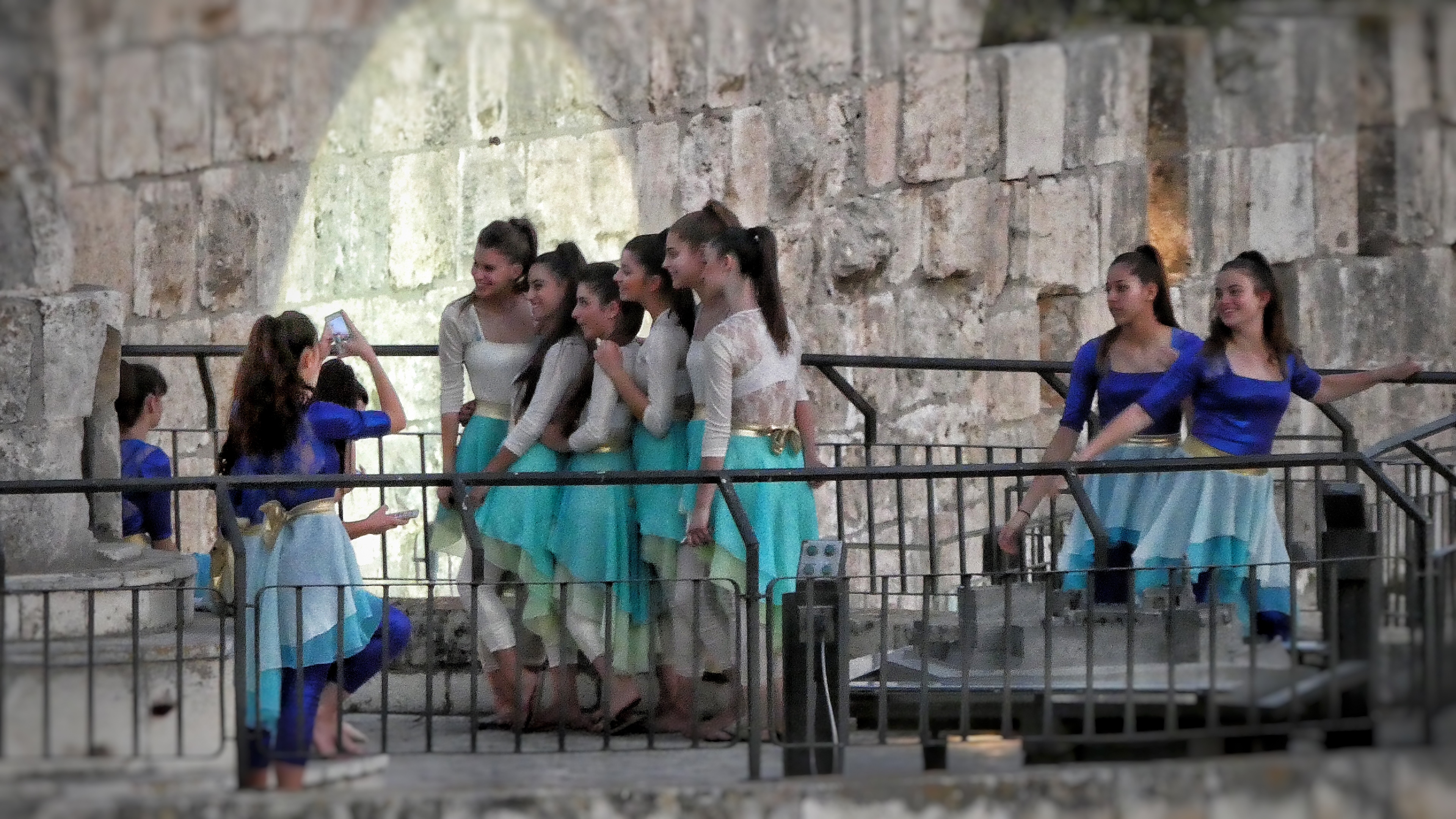
Such was our sojourn at the New Imperial in May 2014 – and our enjoyment of our room and its tiny balcony overlooking Omar Ibn Al Khattab Square, that we stayed there again for a month in 2016, booking the same room with its spectacular view of the comings and goings of all the tribes of Israel. In the warm evening, we’d sit in the roof garden directly across the street from King David’s Citadel with a good bottle of Israeli wine. Gazing on its towers, ramparts and gardens, we’d sense its story in our souls. We’d watch present generations passing beneath its walls, and the young folk dancing on the ramparts, all part of the passing parade of humanity that has lingered by and upon these ancient stones.






 In That Howling Infinite