This Is What It Looks Like

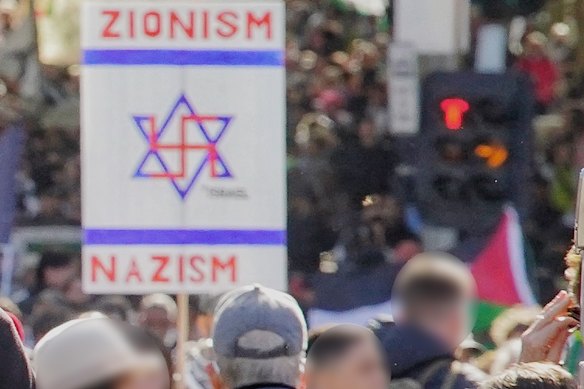
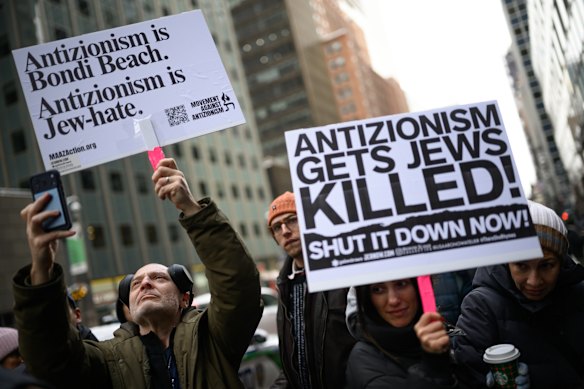
For two years the chant was rehearsed, circulated, aestheticised: “globalise the intifada!”. A resistance moment. A noble liberation struggle, cleansed of consequence. Now that it has arrived not as metaphor but as blood, the same people who normalised the rhetoric – progressive activists, influencers, podcasters, the Greens, the Labor left – present themselves as mourners. Today it is condolences, unity, and prayers.

But you do not get to globalise the intifada and then feign surprise when it turns up.

This did not erupt spontaneously. It was built – patiently, rhetorically – until violence no longer felt aberrant but earned. Shock, at this point, is not innocence; it is evasion.

The Prime Minister calls for unity and convenes the National Security Committee of Cabinet. Necessary, yes – but no longer enough. The problem he faces is credibility. For two years the response to antisemitism has been managerial rather than moral: statements instead of lines, calibration instead of resolve.

The record is plain. Within hours of the October 7 Hamas massacre, and before Israel inflicted its biblical rage upon Gaza, Jews were openly abused outside the Sydney Opera House. Synagogues and childcare centres were firebombed and homes and vehicles vandalised. Hate preachers operated freely. Week after week, marches moved through our cities celebrating “resistance”, praising terrorism, calling for Israel’s elimination, and chanting explicitly for the globalisation of the intifada: violence against Jews, everywhere – for what else could that word mean?  Jewish students and academics were harassed on campus. Jewish artists were doxed and frozen out of cultural life. Antisemitism was rhetorically dissolved by equating it with Islamophobia, converting a specific hatred into a moral blur.

Step by step, it was normalised.

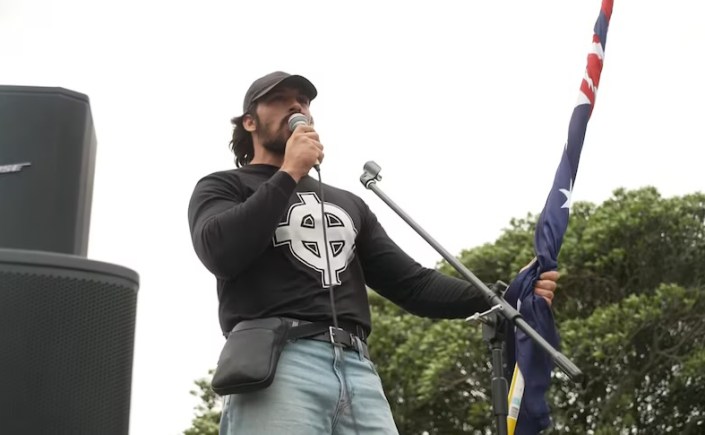
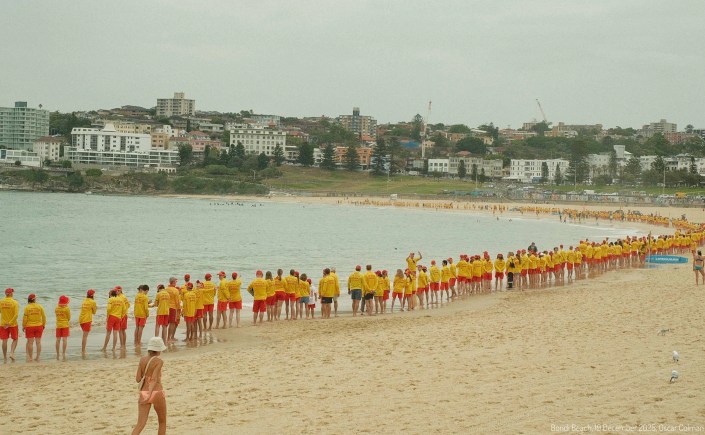
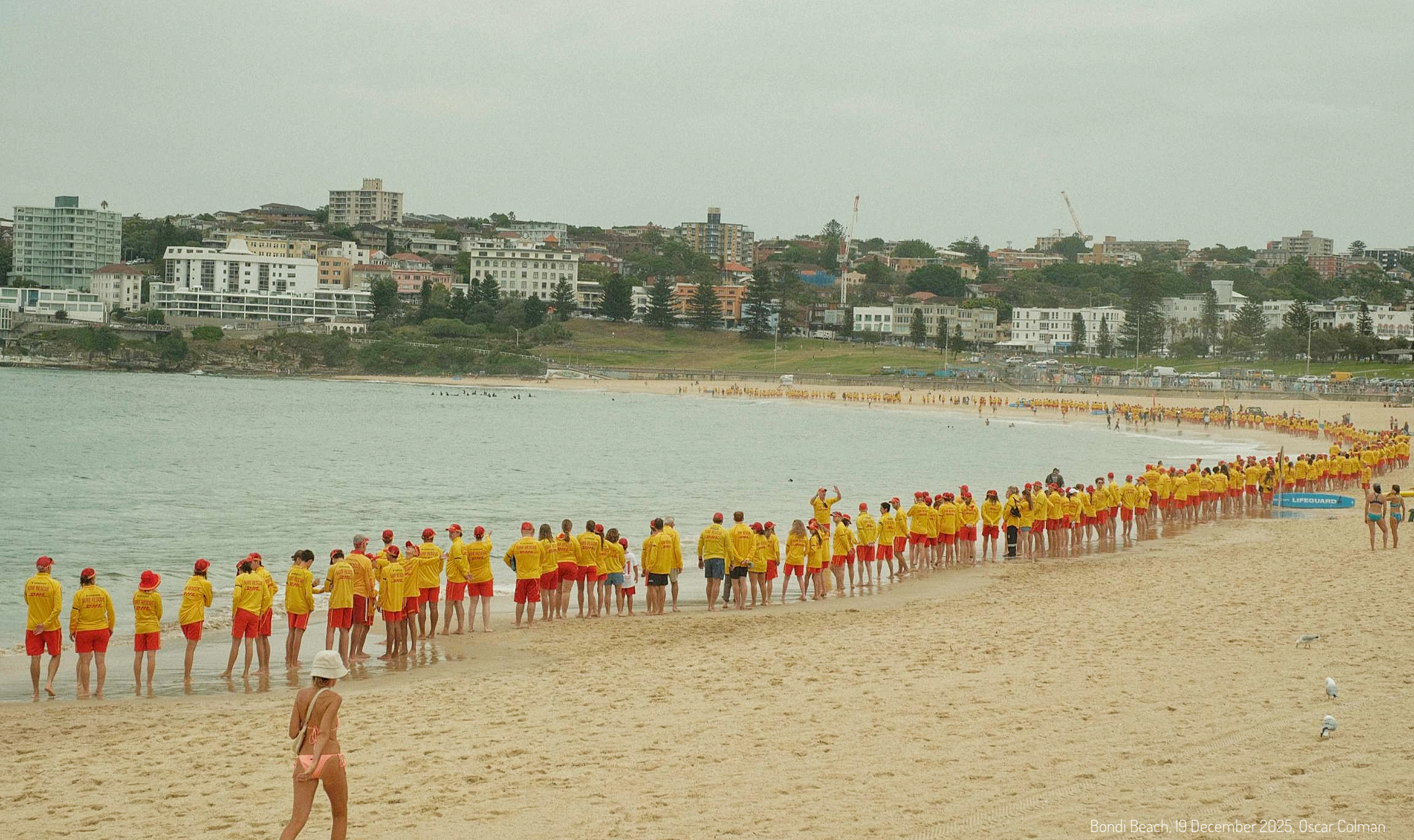
The year ends with an Islamist terrorist attack at Bondi Beach –  an ordinary, intimate place, place many of us walk, eat, linger. We were in Sydney last weekend, and had we stayed another night, we would very likely have been there ourselves, walking the promenade and then taking refreshment, as is our custom, at the North Bondi RSL, just across the road from the park where the atrocity occurred. Authorities had warned such an incident was probable. They were not speculating; they were reading the climate.

Antisemitism in Australia has risen to levels unseen in living memory – even in small country towns like the one we live near and in Byron Bay, meccas of alternative lifestyles and long-styled as havens of inclusion and wellness. Alongside this rise sits another failure: the government’s inability to confront antisemitism with clarity and force, preferring symbolic gestures and offshore moral posturing while hatred hardened at home.

Now, suddenly, our leaders discover grief. Social media is more revealing. Facebook fills with empathetic words and memes from politicians, public figures and keyboard activists who spent the past two years condemning Israel in ways that blurred – and often erased – the distinction between Israeli policy and Jewish existence, creating at best, indifference to Jewish fear and, at worst, a permissive climate of hostility toward Jews as such. Today it is all tolerance, inclusivity and unity – and an air of regret and reverence that reeks of guilt.

But not all. Social media has fractured along familiar lines. At one extreme are conspiracy theories — false flags, invented victims, claims the attackers were Israeli soldiers. At the other is denial: what antisemitism? Between them sits a more revealing response. There is genuine shock and horror, even remorse – but also a careful foregrounding of the Syrian-Australian man who intervened, coupled with a quiet erasure of the victims’ Jewishness; a reflexive turn to whataboutism; and a refusal, even now, to relinquish the slogans and moral habits of the past two years. If antisemitism is acknowledged at all, it is ultimately laid at the feet of Benjamin Netanyahu.

Why this reticence, this resistance to reassessment after the Bondi attack? Perhaps it lies less in ideology than in psychology. For some, there is a simple inability to relinquish prior convictions- positions publicly held, repeatedly performed, and now too entangled with identity to abandon without cost. For others, perhaps a deeper reluctance to acknowledge having been misinformed or misdirected, an admission that would require not just intellectual correction but moral self-reckoning. Empathy, too, has become selective: extending it fully to Jewish victims would require suspending, even briefly, a framework that collapses Jewish identity into the actions of the Israeli state. And finally, many are no longer reasoning freely at all, but are caught inside the machinery – the rhythms of platforms, slogans, group loyalties and algorithmic reinforcement – where reconsideration feels like betrayal and pause feels like capitulation.

So the question must be asked plainly: can many on the left side of politics, no matter how well-intentioned (and ill-formed) honestly say that nothing they have posted over the past two years contributed, even indirectly, to prejudice against Jewish people? Nothing that helped turn anxiety and empathy into hostility, criticism into contempt?

Australian Jews warned that today’s chant would become tomorrow’s attack. They were told they were exaggerating, weaponising history, crying wolf. Yet despite inquiries, legislation, and repeated arson and vandalism, the ecosystem of hate was allowed to deepen. Two years of weekly protests chanting “From the river to the sea”, “Globalise the intifada” and “Death to the IDF” – calling for the eradication of a nation state and its people – were treated as politics, not incitement. 

In July 2024 the government appointed Jillian Segal, a lawyer and businesswoman, as Australia’s first Special Envoy to Combat Antisemitism (followed soon afterwards by the appointment of Aftab Malik as Special Envoy to Combat Islamophobia). Her report, released a year later, was unambiguous: antisemitism had become “ingrained and normalised” across universities, schools, media and cultural institutions. She called for curriculum reform, university accountability, migration screening, and a serious national effort to explain what antisemitism is and why it corrodes societies.

Five months on, the government is still considering it. It has been under heavy pressure from many quarters to hasten slowly, including from within its own ranks: there were calls from the Labor left, including motions from branches and petitions, for Segal to be sacked and her report shredded.

Mere days after Bondi, the pushback has already begun. Pro-Palestinian platforms – and even some Labor branches and members – have denounced Jillian Segal, her report, and Prime Minister Albanese’s intention to implement its recommendations as an assault on democratic institutions and civil liberties. So, argue that that the Australian government is using the atrocity as a pretext to accelerate its repression of the Palestine movement, and, even, to protect and defend Australia’s complicity in what is viewed as the Gaza genocide. What this framing conspicuously avoids is any reckoning with the antisemitism the report documents-  or with the immediate, practical questions now facing authorities. Among these are the potential for copycat attacks, and what duty of care is owed to the Syrian-Australian man who intervened to stop the attack? Hamas and sections of Middle Eastern media have already branded him a traitor. In this moral economy, even heroism is conditional – and quickly becomes a liability.

The partisan responses have been opportunistically predictable. The Murdoch media accused the government of weakness. The Liberal Party, led by Opposition Leader Sussan Ley, accused Labor of neglect. Pauline Hanson followed, reliably. None of it alters the central fact identified by historian Simon Sebag Montefiore: the taboo on antisemitism has collapsed. Perhaps because Jewish identity is lazily collapsed into Israel. Perhaps because the world’s oldest hatred never disappears; it waits for permission. That permission was granted – gradually, rhetorically, respectably. And antisemitism does not arrive announcing itself. It seeps. It jokes. It chants. It flatters those who believe they are on the right side of history, until history arrives and asks what they tolerated in its name.

This did not come out of nowhere. It arrived exactly as advertised, and this is what it looks like. 

And shock, now, is not a moral position.

Postscript … just saying …

The following is a précis of an opinion piece in the  Sydney Morning Herald on 20 December 2025 by satirist and presenter Josh Szeps entitled “What kind of Australia do we want to be? Let’s stop dodging the hard questions”. It encapsulates succinctly the questions we must ask ourselves. It is no satire: 

In the aftermath of Bondi, everyone has an explanation and a slogan. Blame is flung in all directions – Israel, its critics, Muslims, the prime minister, “the world’s oldest hatred” – and consensus collapses into a hollow refrain: say no to hate. Comforting, yes; clarifying, no. Meanwhile, Jewish Australians now fear public gathering, and Muslim and Palestinian Australians brace for backlash of their own. This is the brittle edge of multiculturalism when the shared glue has weakened.

That glue once went by a plain name: liberal universalism – free speech, equality before the law, scepticism toward dogma, the right to criticise ideas without condemning people. Over the past decade it has been displaced by a politics of identity, grievance management, and performative outrage, leaving us unwilling to ask hard but necessary questions: how to integrate insular communities, how to criticise religious fanaticism without collapsing into bigotry, how to balance pluralism with a shared civic culture. Into that vacuum rush provocateurs, algorithms, and foreign actors only too happy to inflame old hatreds.

The weekly Gaza marches exposed this failure. Slogans like “globalise the intifada” or “from the river to the sea” may sound abstract or benign to some, but to many Jews they carry a very concrete historical threat – especially after October 7. That most marchers may not have grasped the implications is precisely the problem. Chanting borrowed slogans in mass, without curiosity or restraint, is not moral seriousness. Nor is pretending that theocratic, homophobic, antisemitic religious doctrines are merely “cultural differences” compatible with the values that made Australia attractive in the first place.

Multiculturalism survives only if it demands something of everyone: discomfort and openness from the majority; reciprocity, restraint and abandonment of imported feuds from minorities. If liberals won’t defend universal values — plainly, without euphemism or ritual throat-clearing — others, far less liberal, will step in and do it for them.

Here are three particularly resonant paragraphs: 

“Week after week, chunks of our cities were overtaken by protesters carrying signs that had nothing to do with Israeli policies, such as “globalise the intifada” and “by any means necessary”. The ubiquitous “from the river to the sea”, benign-sounding to bystanders, proposes that an Arab state ought to sit on top of all the land of Israel – that Jewish people should live at the pleasure of rulers whose theocratic education would make Australia’s most radical imam look like a Jew-loving hippy. Is such a sentiment just innocent political speech? Or, in the wake of the jihadism on October 7, 2023, could it be understood as a threat to conquer the world’s only Jewish safe space? 

… if you found yourself marching across the Sydney Harbour Bridge chanting slogans you didn’t write, about a complex issue you’re not really across, surrounded by crowds chanting the same thing, which others found intimidating … you may, in fact, not have been elevating the discourse. “Intifada” technically means “uprising”, but in the context of Palestinian resistance it implies exploding buses, drive-by shootings and suicide bombers in cafes. (See: “Second Intifada” in Wikipedia, kids). Presumably, most of the protesters didn’t know this. After last weekend, they do. The Intifada has been globalised …

It’s up to all of us to refresh multiculturalism by tethering it to universal values and admitting that it demands sacrifices all around. It demands that people in the majority make themselves uncomfortable, around unfamiliar languages, faiths, customs and food. And it demands that people in the minority give up dogmatism, grudges and cultural feuds”.

i couldn’t express it better myself …

Josh Szeps, satirist and presenter Sydney Morning Herald 20 December 2025


For more on the Middle East in in That Howling Infinite, see A Middle East Miscellany.
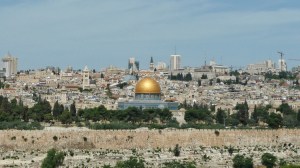
Sydney July 2025 (Getty)

Between heaven and hell … Syria at the Crossroads

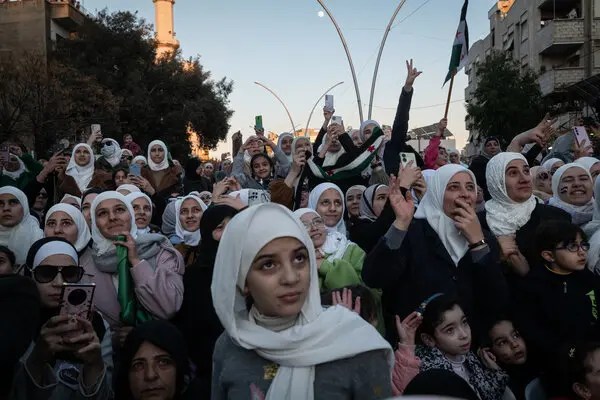
There are moments in the Middle East when history suddenly shift gears and takes us all by surprise. Lenin knew the cadence: there are decades, he wrote, where nothing happens; and then, weeks in which decades happen. A year ago, Syria – trapped in the vortex of its civil war for almost fourteen years  and virtually ignored by the rest of the world since October 7 2023 – suddenly leapt into one of those crazy weeks, leaving allies, enemies, and analysts alike blinking in the dust. Even now, a year after the astonishing fall of Damascus, the country sits like Kipling’s Tomlinson at the gates of judgement: not quite damned, not fully redeemed, suspended between heaven and hell.

Sleepers awake …

For years, as The Independent’s Bel Trew observed last December (see Syria. Illusion, delusion and the fall of tyrants) the world forgot about Syria – notwithstanding the courageous efforts of western and Syrian reporters and humanitarian workers who strove in perilous circumstances to bear witness. The civil war had become the background hum of the region, a grim drone many had learned to tune out as Ukraine and Gaza dominated the world stage. The regime of Hafez al Assad, brutal and immovable, bolstered by Russia, Iran and Hezbollah, looked set to endure indefinitely. The jihadi rebel enclave in Idlib, though supported by Türkiye, was dismissed as a besieged hold-out. Even those who professed expertise couldn’t reliably tell you whether the war was still ongoing, who was fighting whom, or what stage the conflict had reached. It was as if the wheels of war had stopped spinning.

Then, over the space of days – eleven, to be precise – the wheels spun again. Hay’at Tahrir al-Sham’s fighters burst from their confined redoubt with a momentum no one expected (including, it seems, themselves), sweeping through Aleppo and racing down the highway to the capital. Analysts reached instinctively for historical parallels: Havana 1959, Saigon 1975, Kabul 2021. Analyst David Kilcullen pointed instead to Timur Kuran’s theory of the “preference cascade”: the sudden collapse of a regime that had mistaken silence for loyalty and compliance for consent. Assad’s security apparatus – omnipresent, omniscient, yet somehow oblivious – realised too late that its soldiers had no stomach left for the fight. The all-powerful giant had feet of clay.

It didn’t help that Iran, Assad’s indispensable patron, had stumbled into the most grievous strategic miscalculation of its post-1979 history. Flush with revolutionary zeal, Tehran had kicked the hornet’s nest in Lebanon, prompting Israel to pivot from Gaza to Hezbollah with stunning force. Suddenly Iran’s expeditionary assets were exhausted, its proxies over-extended, and its clerical leadership exposed as both ageing and isolated. Even the Ayatollah’s conspiratorial refrain – that the fall of Damascus was all a plot by the Great Satan, the Little Satan, and the Sultan in Ankara – couldn’t mask the fact that this was less Zionist cunning than simple imperial overreach. When the rebels came, neither Iran nor Hezbollah, nor Russia, entangled in its Ukrainian quagmire, could ride to the rescue.

But the rebels, too, were surprised. Their mandate from Ankara was modest – expand the borders of their statelet a little, test the regime’s nerve. Instead, they found themselves virtually unopposed on the road to Damascus.  In an Informative article in E-zine Unherd republished below, British writer and investigative journalist Tam Hussein  writes how many of the fighters interpreted the victory as divine intervention – not jihadi zealotry, but a sincere theological attempt to explain the inexplicable. The suddenness of Damascus’s collapse felt, to them, like an echo of Muhammad’s bloodless conquest of Mecca. And in a land where the eschatological imagination has always saturated politics, it didn’t take long before social media brimmed with end-times speculation. Ahmed al Shara’a – formerly Abu Mohammad al-Jolani, with a $10 million American bounty on his head – was seen by some as “the one”, and the precursor of the Mahdi and the foretold end of days.

Yet as Hussein rightly notes, miracles make poor policy. The survival of the new Syrian administration will depend not on prophecy but on governance, and on whether Shara’a, interim president and ex-jihadi turned statesman, can transform a miraculous seizure into a sustainable state.

To his credit, he has avoided the catastrophic purges that helped destroy post-invasion Iraq. He has kept the civil service intact, flirted audaciously with Western diplomacy, and allowed at least the theatrical semblance of elections. He has restored the embassy in London, opened channels to Washington, even  visiting the White House  and played the charm-game with Gulf capitals that only recently readmitted Assad into their fold. As Hussein writes, he has shown political finesse: keeping the constitution, appointing seventy parliamentarians himself, and balancing piety with pragmatism.

But the tightrope is frayed. Sectarian wounds – Druze, Alawite, Sunni, Christian – remain raw and unstitched, with the Latakia massacres now entering their fraught judicial phase, and Israel stirring the Druze pot. Kurdish anxieties simmer: the old “Arab-first” chauvinism must be abandoned if Syria’s patchwork is ever to become a tapestry again. Foreign fighters, once lionised, now loiter between hero and hazard, implicated in sectarian atrocities. Kurds clash with Syrian forces; Turkish troops press deeper into Rojava; Israel remains the unpredictable neighbour bestride the Golan; and Iran, though weakened, is never entirely out of the game. It is not inconceivable that the forces that helped topple Assad could yet turn their sights toward Jerusalem in the belief that prophecy demands it.

And there are darker portents too – those flickering shadows that hint the wind of freedom may be blowing from the wrong quarter. The new government’s early gestures toward Islamisation – the hair-covering admonition, the curriculum purge, the dismissal of women from key posts, the torching of a Christmas tree in Hama – suggest that pro-Russia and anti-western platforms like RT and Mint may have a point when they warn that the leopard has not fully changed its theological spots. Shara’a’s declaration that elections may be four years away, the dissolution of the old constitution, and the folding of all rebel factions into state structures recall less a liberal transition than a consolidation of revolutionary power.

Meanwhile, the country remains a mosaic of mini-wars. In the north, Turkish proxies grind against Kurdish forces in Rojava. In the south, local militias continue to resist HTS’s claim to national authority. In the west, Alawite formations cling to their shrinking redoubts. To the east, Islamic State survivors eye the chaos, waiting for the prison gates to break. And overhead, as ever, the Americans and Israelis fly their competing deterrents, ensuring the war never quite ends.

So: Syria stands at the crossroads. Will Syria’s future be heaven, hell, or merely another circle of the inferno?

Optimism is possible – cautiously so. If the West can avoid its habitual fatalism, if, when sanctions are lifted, investment flows, if Turkey and Israel can be coaxed into tolerable coexistence, if Kurdish autonomy is honoured, if sectarian grievances are handled with equity and not vengeance — then Syria could, in time, become a conservatively stable hub. Shara’a’s Idlib experiment shows he can build an economy under duress.

But the inverse is equally imaginable: a Lebanon-style implosion, a Yugoslav-style partition, or a Gaza-style fortress of permanent mobilisation. As Isreali commentator and contributor to Haaretz Zvi Bar’el wrote a year ago, writes, the warm international “envelope” around Damascus is generous but tentative. Nobody quite knows where Shara’a is heading. They simply assume anyone is better than Assad – the same mistake Syrians once made about the old Ba’athi patriarch Hafez al-Assad himself.

Right now, the future’s not ours to see. Something’s happening, but we don’t know what it is, and anyone with a deep knowledge of the Middle East knows that one must expected the unexpected. The old regional wars – Gaza, Lebanon, the Red Sea, Iran’s Axis of Resistance – though seemingly on hold, have not paused to let Syria breathe. The war in Ukraine grinds into winter, the bizarre Gaza peace plan shuffles on, and there are constant political shifts in Washington. Each of these could rewrite the geopolitical chess board yet again.

Still, as Robert Fisk wrote in the final line of the final book he never lived to promote: all wars come to an end, and that’s where history restarts. Syria is restarting now – painfully, precariously, imprecisely –  but restarting nonetheless.

Whether Syria walks toward heaven or hell remains to be seen. The choice –  as ever in the Levant – will not be its alone.

Syria Today: Walking Through the Wreckage

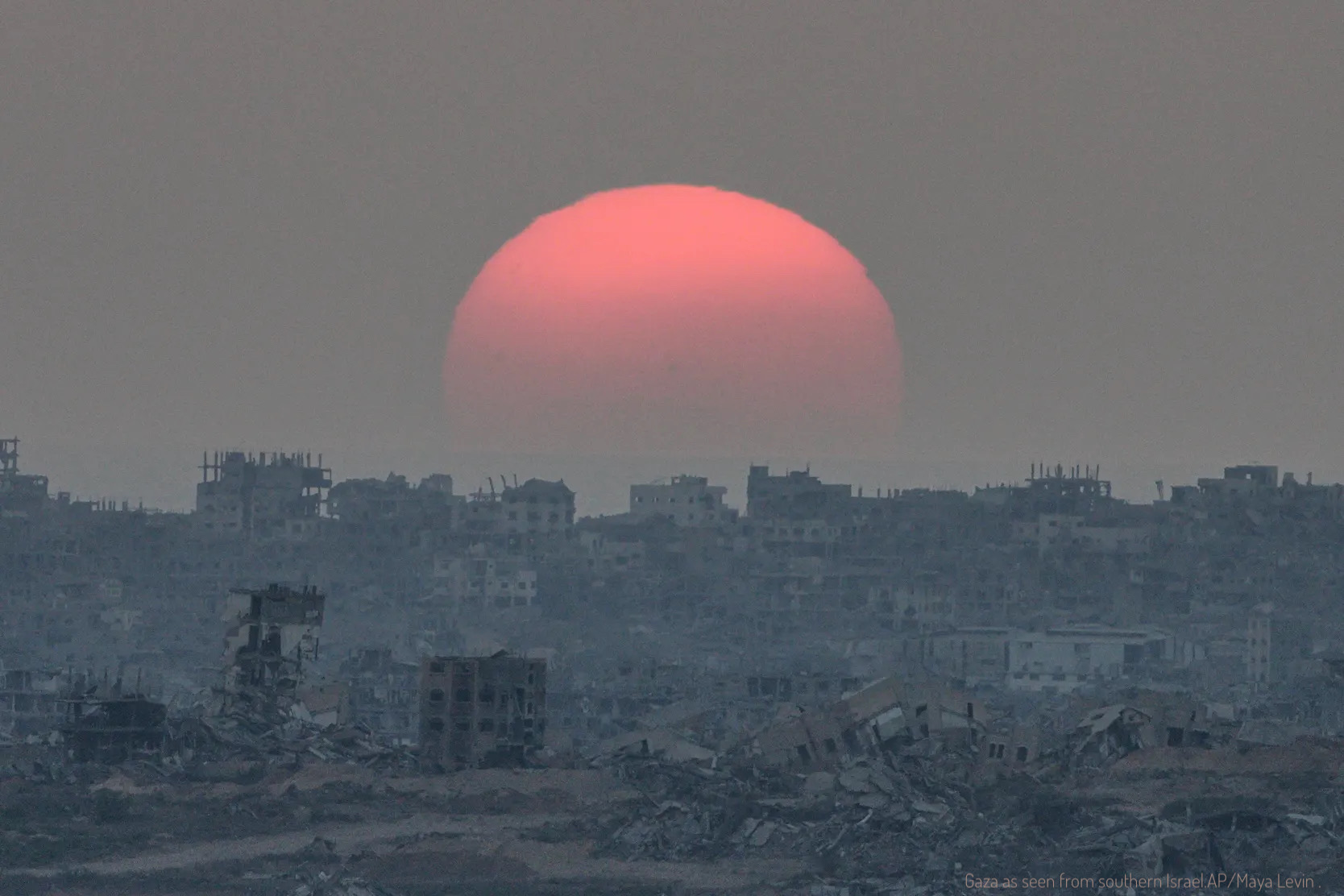
A year after the Assads fell, Syria still moves through its own ruins – startled by its freedom, and half-afraid of it. The dynasty’s collapse ended the nightmare but did not usher in a dream; it simply exposed, in unforgiving daylight, the damage done over half a century of dictatorship and more than a decade of war. The smashed cities are visible to any passer-by; the deeper wreckage – the traumas, resentments, and debts of blood – is harder to map and harder still to mend.

Sednaya prison’s opened gates remain the sharpest indictment. The men who stumbled out were not just survivors but witnesses, their bodies forcing the nation to acknowledge what many had whispered and few had dared investigate. Yet even this reckoning has not united the country. Sectarian reprisals and atrocities on the coast, more atrocity and calls for Druze autonomy demands in Sweida, tribal restlessness in the south and northwest, Kurdish self-rule in the north, and Alawite fear of collective punishment keep the national psyche taut and divided. Bitterness circulates like a second economy.

The economy, meanwhile, balances on a fraying tightrope. Western aid and investment have brought cranes, reopened highways, and a flicker of commerce, but also inflation that is hollowing out households. Reconstruction glimmers like a desert mirage: real enough to chase, never close enough to touch. Corruption accompanying nepotism and patronage has survived the revolution, and many returnees discover that rebuilding a home now costs more than earning one.

Politically, the country sits in an improvised equilibrium. Al Shara’a rules as both liberator and question mark – trusted by some, tolerated by others, watched by all. His pivot toward Washington, his quiet coordination with US forces, and his break with former comrades offer a new direction, but also a gamble. Around him, sovereignty is nibbled at the edges: Israel digs deeper into Quneitra province; Türkiye tightens its grip in the Kurdish north. Liberation has shifted the map without fully restoring control over it.

So Syria stands on the threshold, like Tomlinson, neither damned nor redeemed, simply called to account. The war is over, but its aftershocks and tremors linger in regional loyalties, local vendettas and regional manoeuvres. The people are free, yet unsure of that freedom’s limits and what it asks of them. And the vast machinery of the state still creaks with old habits and temptation.

And yet – a small, highly qualified yet – Syrians are imagining a future again. Not the predetermined script of dictatorship, nor the fatalism of war, but something open, negotiable, theirs’. For a people long told that nothing changes, the mere possibility of change is its own quiet revolution. Hope is not guaranteed; neither is stability. But the impossible has already happened once, and that alone shifts the horizon.

Postscript: the strange, messianic weather of revolutions

Among the HTS fighters Tam Hussein describes, the astonishingly swift and almost bloodless collapse of Damascus could never be reduced to battlefield arithmetic. After over a decade of stalemate and slaughter, the conquest of Damascus and the fall of Assad felt too abrupt, too neat, too historically implausible to be merely human. And so they reached, perhaps instinctively, for the vocabulary of prophecy that has long circulated in the Levant: the old stories of tyrants toppled in the final days, of a just ruler rising at history’s eleventh hour, of a brief season of peace before a climactic confrontation with “the Romans,” a term that in popular imagination now stretches elastically to include Israel, America, or the West at large.

In this folk-level cosmology – not the carefully parsed doctrine of scholars, but the lived, emotional scripture of men who have lived too long fear, death and loss loss – the victory in Damascus reads like a prophetic epic ballad. When a fighter told Hussein that Syria would enjoy “ten years of peace before the war with Israel,” he was drawing from a hazy amalgam of hadith traditions and battlefield folklore to make sense if the improbable: the idea of a lull before the storm, a breathing space before the world tilts into its final reckoning. It is vernacular eschatology, shaped as much by trauma and longing as by text.

Within that register, the murmurs that Shara’a/Jolani might be “the one” carry an unmistakable Mahdist echo. No fatwas or proclamations like when Da’ish leader Abu Bakr  al-Baghdadi famously declared the caliphate from the minbar of Mosul’s al-Nuri Mosque in 2014; but the emotional charge behind the phrase is unmistakabl: an intuitive reach for a Mahdi-shaped idea of the righteous restorer, the unifier, the man who appears when everything has fallen apart. It’s not that anyone literally thinks Jolani is the Mahdi; it’s that the mood of the moment makes such thoughts feel briefly within arm’s length. A silhouette on the horizon, nothing more.

And here, Syria is not unique. Revolutionary periods everywhere – the Protestant Reformation, the French Revolution, the Russian Revolution and Civil War, the Arab Spring even, have their magical phase — those jittery days when people begin to speak as if the world has cracked open, meaning is pouring through the seams, and events blur into myth. When a regime that seemed immovable collapses in a fortnight, people fall back on stories larger than themselves. Sudden upheaval, long suffering, and the ascent of a charismatic figure combine to crack open the ordinary world. Prophecy offers a narrative frame when history seems to be behaving like fable.

So the eschatological edge in these fighters’ conversations tells us less about doctrine and more about psychology. It’s a very human response: a form of magical thinking that arises when reality becomes too strange to process, a way of giving shape to chaos, of telling themselves that their suffering fits into a larger story. A coping mechanism, if you like –  a mythic vocabulary for a moment when Damascus fell, and the ordinary rules stopped making sense and the earth seemed briefly to tilt on its axis.

See also in In That Howling Infinite, Syria. Illusion, delusion and the fall of tyrants and Cold wind in Damascus – Syria at the crossroads. And  on the subject of messianism in general, see A Messiah is needed – so that he will not come

Will civil war return to Syria?

Its future is in the balance

Tam Hussein, Unherd December 8, 2025

A few months ago in Damascus, I discovered a medieval hospital. The door had been left slightly ajar, and I wandered in with my companion Hassan Idlibi — a rebel fighter and old friend. He hadn’t been in the Old City since the fall of Syria’s capital, exactly a year ago today. “When Damascus fell,” he told me, “we were at our lowest ebb. Even the attack on Aleppo was our last gasp. We wanted to break the stalemate. And then we just pushed and pushed, and we ended up sleeping inside the Umayyad Mosque. It was a miracle.”Idlibi, like many Syrians, did not interpret the taking of Damascus through geopolitics — but as divine intervention. This wasn’t because he was a mindless zealot. Far from it. He is one of the most well-read men I know. But, to his mind, the fall of Damascus was so sudden, so unexpected, that only the miraculous could explain it. The victory, he noted, had been achieved by those who had been motivated by Islam. Help had come from foreign fighters, the mujahideen, who travelled from across the globe to aid their co-religionists. And the campaign had been led by a former jihadi, Ahmed al-Sharaa, now the interim president of Syria. At the time, the old al-Qaeda operative, then known by his nom de guerre, Abu Mohammad al-Jolani, had a $10 million American bounty on his head.

After more than a decade of slaughter, no one had expected the capital to collapse. Assad, then president, had seemed like a stubborn wart: unpleasant but immovable. Jolani’s rebel enclave in the northern city of Idlib looked too small, too besieged, to pose a serious threat — though in fact it was performing better economically than inflation-ravaged Damascus, helped along by a reliable flow of Turkish hard currency. I myself expected the rebels to negotiate. What leverage did they have? Yet this rebel government, roughly the size of Croydon, took over the instruments of state, and since then has avoided stumbling into a new civil war.

The unexpected and largely peaceful victory was attributed to piety, prophecy, steadfastness. Some have even compared the final conquest of Damascus to Muhammad’s bloodless conquest of Mecca in 630. The idea of a “miracle”, here, is not mere rhetoric — it shapes political expectations. Some Syrians, at least based on my social media, think all this makes Sharaa “the one”, with my Facebook messages and WhatsApp chats awash with prophetic readings of the present. One believed Syria would now enjoy 10 years of peace before the war with Israel begins. Perhaps, he suggested, this was the prelude to the end of times. After all, so-called “Greater Syria” — encompassing much of the Levant — plays an important role in the Syrian and indeed Muslim sacral imagination. It is where prophets walked and is the place where many of the end of times narratives will play themselves out.

Yet if the fall of Damascus seemed miraculous to many Syrians, the survival of the new administration will depend less on providence than on governance. Despite his past, Sharaa has so far demonstrated an unexpected level of political finesse. He has kept the constitution, held elections — albeit with 70 seats appointed by himself — and all the while has acted the statesman. He is savvy enough to not mind having President Trump spray his latest fragrance on him in the Oval Office, or Syrian Jewish rabbis blessing him.

Sharaa has made some promising early decisions. By keeping the civil service intact, he has avoided the catastrophic purge that helped destroy post-invasion Iraq. He should continue recruiting highly-educated young Syrians from the diaspora — people familiar with Western administrations and political norms. Even so, the administration still has a tendency to fear scrutiny and behaves as if under siege. It should welcome a regulated free press, which would expose blind spots, not undermine authority. The British press has reported that Jonathan Powell’s Inter Mediate is working with the new government. This should be welcomed rather than criticised — not only for reasons of conflict resolution and soft power, but for its value in statecraft and building institutional capacity.

Sharaa’s priorities for the coming year are clear. The country remains immensely fragile, caught in a regional tug-of-war between Israel and its neighbours, and divided along ethnic and sectarian lines. The situation could easily drift into a reprise of Lebanon’s civil war. Sharaa’s first task is therefore to mend Syria’s sectarian and ethnic fractures with a sense of equity. The trials that began this month over the coastal massacres in Latakia will be an important test of how the country intends to move forward. The Druze and Alawite communities — already bruised by conflict and mistrust — require justice delivered without the language of sectarianism.

Meanwhile, Kurdish anxieties must be addressed by ending the Arab-first ideology of the old regime. Syria has never been a purely Arab country: even its favourite son, Saladin, the builder of that hospital I visited and whose grave in Damascus still draws multitudes, was a Kurd. Last year’s tentative permission for Kurdish new year celebrations (Newroz) suggests that a more pluralist future is possible. Yet it remains unclear how far Kurdish cultural expression will be allowed to develop. Already this month, exchanges of fire between Syrian government forces and Syrian Democratic Forces (SDF) units under Kurdish command show how fragile the situation is.

Perhaps the most difficult balancing act involves the foreign fighters who fought on Sharaa’s side. They carry immense symbolic weight in Syrian society — and are the cause of immense fear in the West. Many are ready to resume normal life, but others still see themselves as Islam’s warriors. Recent clashes in the Idlib countryside involving French foreign fighters reflect anxieties that any rapprochement with the West might see them handed over to their home governments. The image of Sharaa standing beside Trump, receiving a symbolic “anointing” of his new fragrance, alarms them even if such engagement is politically necessary.

Granting these fighters legal status, regularising their papers, integrating some into the national army or demobilising them with stipends and educational opportunities — not unlike the GI Bill for US veterans — could go a long way toward neutralising one of Syria’s most volatile pressures.

Then there is the conundrum of Israel. On this, Sharaa has cultivated deliberate ambiguity. At the United Nations, Syria has repeatedly noted its restraint regarding Israel’s illegal strikes on Syrian territory, yet Sharaa has resisted pressure to join Trump’s flagship Abraham Accords. Signing them now would be political suicide. But ambiguity buys him room to manoeuvre — and time to consolidate the state. The question is how long this can last.

For its part, the West has worked to prevent Syria from sliding into another civil war — one that would inevitably spill over into Europe, potentially replaying the exodus of 2015. With regional partners like Saudi Arabia and Turkey, Western governments have effectively restrained Israeli escalation, aware that renewed instability would eventually reach Jerusalem’s door. It’s not impossible to imagine rebels, having overthrown a “pro-Western stooge” like Sharaa and aided by foreign fighters, actually marching toward Israel, convinced that “the infidels” will never allow them to determine their own future. As they did in Damascus, so too — in their imagination — must they do in Jerusalem.

Thus far Sharaa has governed with surprising openness. He has welcomed Britain’s foreign secretary David Lammy, met American diplomats and General David Petraeus, played basketball with US soldiers, and cooperated in counter-terrorism operations. He has also restored relations with London, with foreign minister Asaad al-Shaibani reopening the Syrian embassy.

If Western governments refuse to work with him because of his Islamist roots, they will share responsibility should Syria fracture again. Sharaa’s past is not erased; he may remain an uncomfortable partner. But what is the alternative? That he be excluded from political life and drift into a Castro- or Maduro-like role on the sidelines? If the Saudi Crown Prince can be brought in from the cold after the Khashoggi murder, then almost anything is possible.

Here I recall a meeting with former Saudi spy chief Turki al-Faisal in his South Kensington apartment after the release of his memoir. Faisal lamented how his advice went unheeded after the Afghan-Soviet war. He had urged the international community to launch something akin to a Marshall Plan — an investment programme to stabilise Afghanistan. Had that happened, the region might not have unravelled. Instead, the country collapsed into years of civil war.

Likewise, fully lifting sanctions on Syria and providing a major investment programme, coupled with training and cultural exchange, could restrain the country’s more radical elements. Reining in Israeli escalation, de-escalating the Druze conflict, and mediating between the SDF and Damascus would all help prevent new wars. On this, the West could also spare itself a future security headache by helping Damascus regularise or demobilise foreign fighters rather than leaving them to drift. This would all help to displace messianism.

What, then, would such investment bring the West, beyond avoiding another gaping wound on its eastern flank? For sure, it will not turn Damascus into another Beirut, a place for foreign journalists to party, nor into a Deano-friendly Dubai. Syria will likely remain socially conservative, more like Muscat in Oman. Given time, however, it could become a commercial hub with a distinct cultural life, just as it has been for much of its epic history. This isn’t mere optimism: Sharaa turned Idlib, once a distant town, into a magnet for Damascenes seeking commercial opportunity. Investment now would bring the West a friendly partner, business prospects and political influence. The choice is stark. With support, Syria could become a kind of West Germany: rebuilt, integrated, and stable. Without it, the country risks becoming a new Jerusalem — a battleground charged with fire and prophecy.

Tam Hussein is an award winning investigative journalist and writer. His work has been recognised by the Royal Television Society Awards.

The most nihilistic war ever … Sudan’s waking nightmare

A man said to the universe:
“Sir, I exist!”
“However,” replied the universe,
“The fact has not created in me
A sense of obligation.”
American poet and author Stephen Crane, 1899

Statistics are sometimes used to express the scale of the destruction in Sudan. About 14 million people have been displaced by years of fighting, more than in Ukraine and Gaza combined. Some 4 million of them have fled across borders, many to arid, impoverished places—Chad, Ethiopia, South Sudan—where there are few resources to support them. At least 150,000 people have died in the conflict, but that’s likely a significant undercounting. Half the population, nearly 25 million people, is expected to go hungry this year. Hundreds of thousands of people are directly threatened with starvation. More than 17 million children, out of 19 million, are not in school. A cholera epidemic rages. Malaria is endemic.

But no statistics can express the sense of pointlessness, of meaninglessness, that the war has left behind alongside the physical destruction.

In what can only be described as a melancholy case of selective blindness, the gaze of western mainstream and social media, distracted by other conflicts and causes has been turned away. The global conscience has appeared unmoved. The numbers are obscene, the silence more so.

El Fasher, in Sudan’s far western province of Darfur, is once again the world’s unacknowledged abyss. The UN warns of genocide; videos show unarmed men executed in cold blood, hospitals shelled, aid workers vanished, women violated, and civilians starved into submission. The Rapid Support Forces – the Janjaweed (colloquial Arabic for “devil riders”) in new fatigues – are methodically annihilating ethnic groups such as the Masalit. El Fasher was the Sudanese army’s last holdout in Darfur and its capture marks a milestone in the two yea long civil war, giving the RSF de facto control of more than a quarter of the territory.

Why the silence?

Because Sudan resists the narrative template that powers modern activism. There is no imperial villain, no clear coloniser or colonised, no simple choreography of oppression and resistance. The slaughter of black Africans does not fit the anti-Western moral geometry upon which contemporary protest movements are built. Sudanese bodies fall outside the moral lens of the global North even as they fall in their thousands.

This is not to rank suffering but to note the selectivity of empathy. Sudan’s tragedy lacks the aesthetic of victimhood that flatters Western guilt. The WHO pleads for hospitals; journalists beg for their detained colleagues. It all sounds chillingly familiar – yet no outrage follows. Perhaps because Sudan offers no convenient villain, no redemption arc, no social currency.

At the heart of the moral selectivity of the globalised conscience lies outrage as performance, empathy as branding. Sudan exposes the performative element of protest: empathy contingent on narrative utility. Its tragedy has no liturgy, no public ritual of belonging. It shows what our age truly worships: not justice, but self-expression masquerading as it. And in El Fasher’s unmarked graves lies the measure of this hypocrisy – a mute testimony to the moral vanity of a world that rages for Palestine, hashtags for Ukraine, and sleeps through Sudan.

In That Howling Infinite has touched on this dissonance before in  The calculus of carnage – the mathematics of Muslim on Muslim mortality We wrote back then, in December 2023, when the Sudanese civil war has been raging for the best part of a year: “Call it moral relativism or “whataboutism” (or, like some conjuror’s trick, “don’t look here, look over there!) but it is not a matter of opinion, more a simple matter of observation, to point out that Muslims are in the main subdued when their fellow Muslims are killed by other Muslims … There has been no significant unrest in the West over the hundreds of thousands of Muslims killed by fellow Muslims (apart from a visceral horror of the violence inflicted upon civilians and prisoners by the jihadis of the Islamic State. No public outcry or social media fury, no angry street protests by left-wing activists of vacuous members by armchair, value-signaling clicktavists”. 

Journey to an civil war

American journalist Anne Applebaum wrote very long essay the August edition of The Atlantic: Sudan … the most nihilistic war ever. She believes that Sudan’s devastating civil war shows what will replace the liberal order: anarchy and greed. Her essay reads like a missive from a civilisation already past the point of rescue. The country she describes is less a state than a geography of ruin — a landscape where the coordinates of morality, nationhood, and even information itself have come apart. The title is no exaggeration; it is diagnosis and prognosis both. Sudan, she argues, is not an aberration but a preview — the shape of the world when the liberal order finally collapses, when wars are fought not for gods or ideas but for bullion and bodies.

Sudan’s civil war began, at least formally, as a contest between two men: General Abdel Fattah al-Burhan, commander of the regular army, and Mohamed Hamdan Dagalo, known as Hemedti, who rose from the Janjaweed militias to command the Rapid Support Forces. Both were products of the same regime; both were once partners in repression. When they turned upon each other in 2023, the result was not ideological conflict but a kind of mutual devouring. Each accused the other of betrayal; each proceeded to loot, starve, and bomb the very population he claimed to protect.

Applebaum’s Sudan is not one country but many — an archipelago of fiefdoms and frontiers, each governed by whoever holds the nearest airstrip or gold mine. And gold, indeed, is the keyword: the new oil of an old desert. Sudan possesses vast deposits of it, and with them a vast invitation to corruption. Wagner mercenaries mine and smuggle it northward to fund Russia’s war in Ukraine. The United Arab Emirates bankrolls Hemedti’s RSF in exchange for access and influence. Egypt and Chad manoeuvre for position; Iran quietly re-enters the game. The Sudanese warlords themselves fight not to win the nation but to control the veins of the earth — the alluvial goldfields of Darfur and the Nile Basin that glitter beneath the dust like a curse.

Western governments, overstretched and inward-turned, offer gestures in place of policy. Applebaum notes that the world’s great democracies — once self-appointed custodians of human rights — now behave like distracted landlords. There is a knock at the door, another tenant murdered in the basement, but the owner is on the phone about something else.

In this sense, Sudan is less an anomaly than a mirror. It shows us what happens when international law becomes theatre, when moral outrage is rationed by proximity and profit. It is not merely a humanitarian disaster but a philosophical one: a demonstration that without belief — in justice, in shared reality, in the notion that human suffering still obliges response — politics decays into predation.

Applebaum’s prose, always measured, carries a note of exhausted mourning. The old ideological world — that twentieth-century drama of fascism, communism, and liberal democracy — at least believed in something, even if those beliefs destroyed millions. Today’s warlords believe in nothing at all. They are not even tyrants in the grand style; they are contractors of chaos, CEOs of slaughter, men who weaponise hunger for leverage and sell access to ruins.

What makes her essay so haunting is that Sudan’s nihilism feels contagious. The war may be geographically distant, but morally it is next door. The same disintegration of purpose infects the international response — the shrugging cynicism, the moral fatigue, the slow erosion of empathy. Applebaum’s Sudan is what remains when the “rules-based order” becomes a slogan muttered by people who no longer believe it themselves.

Coda: A Mirror in the Sand

The desert, Applebaum implies, has turned into a mirror of the world’s soul — reflecting its avarice, its indifference, its slow retreat from meaning.

What lingers after Applebaum’s account is not simply pity for Sudan, though that would be reason enough, but unease — the feeling that the world’s moral compass has slipped its pole and is spinning uselessly in our hands. Sudan is not the exception; it is the precedent. It is the world without illusion: borders drawn in dust, governments as rackets, truth dissolved into overlapping transparencies.

Once, wars were waged for empire, for creed, for revolution — each claiming, however falsely, to serve a higher cause. Now they are fought for metal, for markets, for motion itself. The soldiers are mercenaries, the civilians collateral, the nations staging grounds for someone else’s ledger. Applebaum’s overlapping maps are more than an image of Sudan’s confusion; they are an x-ray of a civilisation that no longer shares a moral reference point. We are all now drawing our own maps, colouring the world according to our comfort zones, overlaying them until the truth beneath is invisible.

And so Sudan becomes both tragedy and parable. Its gold mines glitter like tombs of the old order — the liberal dream of rules, rights, and reason — while above them drones and scavengers circle. A century ago, Conrad called it the horror; today it is merely another tab on a newsfeed. The anarchy is not confined to Khartoum or Darfur. It is spreading quietly through the arteries of global indifference, through our own fatigue, our own appetite for distraction.

If Applebaum is right, Sudan is not at the edge of the world but at its centre. The future, it turns out, is already here: gilded, godless, and for sale to the highest bidder.https://www.theatlantic.com/magazine/archive/2025/09/sudan-civil-war-humanitarian-crisis/683563/

Postscript: selective empathy in a world of sorrow

Comparing the international outcry over Gaza to the silence on Sudan has been condemned as intellectual dishonesty. One comment on this post ran this:

“The mainstream media can stir outrage on any topic when its political masters and financial backers want it to. Why has it not done so in this instance? Follow the money is one rule of thumb. I assume it suits the powers that be to let the slaughter continue. I hope more people are inspired to become activists against this dreadful situation, but public opinion tends to follow the narrative manufactured by the media more than impel it. When it comes to pro-Palestinian activism it is the story of a long hard grind of dedicated protestors to get any traction at all against the powerful political and media interests which have supported the Israeli narrative and manufactured global consent for the genocide of Palestinians over many years. And still, although the tide is gradually turning, the West supports Israel to the hilt and crushes dissent. Using the silence in the media and in the streets over the slaughter in Sudan as an excuse to try and invalidate pro-Palestinian activism is a low blow and intellectually dishonest”.

This particular response is articulate and impassioned, but it also illustrates precisely the reflexive narrowing of moral vision that the comparison between Gaza and Sudan was meant to illuminate. The argument hinges on a familiar syllogism: that Western media outrage is never organic but always orchestrated (“follow the money”), that silence on Sudan therefore reflects elite indifference rather than public apathy, and that to highlight that silence is somehow to attack or “invalidate” the legitimacy of pro-Palestinian activism. It is a neat, closed circuit—morally reassuring, rhetorically watertight, but intellectually fragile.

For one thing, the claim that outrage over Gaza is a product of “a long hard grind” of dissenters battling pro-Israel hegemony may be partly true, but it fails to account for the asymmetry of moral attention. Why, if media outrage can be manufactured at will, does it attach so selectively? Why is one tragedy magnified until it becomes the world’s moral touchstone, while another, numerically and humanly no less immense, barely registers? This is not to invalidate solidarity with Gaza—it is to interrogate the mechanisms by which empathy itself is distributed, channelled, and constrained.

The “follow the money” thesis also misses something subtler and more disturbing. Western silence on Sudan is not an act of conspiracy but of exhaustion: no villains clearly marked, no sides easily named, no tidy narrative of good and evil to moralise upon. Sudan’s war—fragmented, internecine, post-ideological—does not lend itself to hashtags or flags on Instagram profiles. It is a horror too complex to package and too distant to own. By contrast, Gaza offers clarity, identity, and the reassuring architecture of blame: victims and oppressors, martyrs and monsters, the colonial morality play in perfect focus.

Thus, when critics accuse those who draw this comparison of “intellectual dishonesty,” they mistake the argument. To juxtapose Gaza and Sudan is not to weigh one body count against another, or to diminish Palestinian suffering. It is to expose the limits of our moral imagination – how empathy becomes performative when it is contingent on narrative simplicity or political fashion.

In Sudan, the gold glitters under the rubble. Warlords, mercenaries, and foreign patrons all claw for it while millions starve. In Gaza, the ruins are televised, moralised, and weaponised. Both are human catastrophes, but only one has an audience.

The point, then, is not that activists for Gaza are wrong—it is that they are lonely. If their struggle truly seeks a universal human justice, it must be capacious enough to include Darfur, Khartoum, El Fasher—to grieve what the cameras do not show. Otherwise, our compassion becomes another form of exceptionalism: the selective virtue of those who need their tragedies to fit the script.

In truth, to compare Gaza and Sudan is not to rank suffering or diminish solidarity, but to expose the limits of our moral bandwidth. Gaza compels because its story is legible—villains, victims, a script the world knows by heart. Sudan confounds because it is too fractured, too many nations within one, too little meaning to hold. There is no clear narrative, only greed, hunger, and gold buried beneath the ruins.

The real dishonesty is not in caring for Gaza, but in mistaking selective empathy for universal conscience. If our outrage depends on simplicity, we risk turning compassion into performance – mourning only what the cameras show, and averting our eyes from what they cannot.

Danger Angel … the ballad of Laura Loomer

Danger angel
Comes screaming through the clouds
She’s coming for your soul, child
She’s gonna take you down

Larkin Poe

Once in a while, In That Howling Infinite is attracted to “out there” larger than life identities, and, like mainstream and social media, gives them much more oxygen than they deserve. MAGA activist and provocateur Laura Loomer is one of those. Avatar and avenging angel, she is both symptom and symbol – the female face of Donald Trump’s politics of vengeance, fuelled by entitlement, envy, and zeal. shes turned grievance into influence, outrage into profession, loyalty into performance art. Some see her as comic relief; others, as proof that moral panic now pays. Either way, she’s the perfect child of her time – restless, theatrical, and forever online. Equal parts scandal, spectacle, and self-made legend, she’s the Right’s answer to the Left’s cancel culture: a one-woman inquisition armed with a smartphone and an inexhaustible sense of grievance.

We republish below Unherd editor and reporter James Billot’s article tracing the rise of this “hit woman” of MAGA politics, the scalps she has lifted, and the theatre of fear and fandom she inhabits. It’s an entertaining but nonetheless disturbing portrait of ambition, vanity, and the politics of outrage. Billot paints her as a digital Torquemada: part gossip columnist, part bounty hunter, part true believer.

As for the title of this piece, there is indeed a Ballad of Laura Loomer. It follows the précis. 

Précis: A hit job on a ‘hit woman’

Danger angel
Won’t listen to your prayers
She’ll drink your holy water
Slip into your nightmares
There’s nothing you can give her
That she hasn’t already got
While you might think you’ve caught her
You’ve blown your only shot, look out
Danger Angel!

Loomer has made herself indispensable to Donald Trump not through proximity or power, but through her peculiar genius for weaponised outrage – the art of turning suspicion into spectacle. Her method is almost monastic in its discipline. For 16 hours a day, she trawls social media for ideological impurity – anyone in government who displays insufficient loyalty to the Great Leader. The sins are various: vaccine sympathy, a whiff of neoconservatism, a stray Black Lives Matter post. The punishment is swift. She “Loomers” them – posting their misdeeds to her 1.8 million followers, tipping off the White House, and waiting for the axe to fall. According to her, dozens have been purged at her prompting: an FDA vaccine chief, an NSA lawyer, a West Point academic, defence and security staffers, and even senior Trump appointees who thought they were untouchable. It’s research as blood sport.

Billot’s portrait is gleefully surgical: the self-declared “most banned woman in the world” living in a Florida rental with four rescue dogs and a livestream habit, railing against the “Big Tech” cabal that simultaneously victimises and enriches her. She’s banned by Uber, Lyft, Twitter (then reinstated by Musk), PayPal, GoFundMe, Facebook, Venmo, and Clubhouse. Each ban becomes a badge of honour, another stripe on her martyr’s uniform. She wears persecution like perfume — and sells the bottle for $29.99 on her website.

Loomer’s life is powered by thwarted ambition. She missed out on Dartmouth, lost two congressional races, and has been repeatedly blocked from a White House role. Yet each rejection feeds her legend. Her career began in the Project Veritas circus — dressing in a burqa to “expose” voter fraud — and evolved into a full-blown performance art of paranoia. She disrupted a Trump-themed Julius Caesar production in 2017, screamed about “violence against Donald Trump”, and became a Fox News darling overnight. She has accused Casey DeSantis of faking cancer, called Islam a “cancer on humanity”, and suggested that Parkland and 9/11 were staged. Apology, for Loomer, is treason.

She calls herself an “investigative journalist”, but the investigations are really moral witch trials – improvised, viral, and frighteningly effective. She boasts that cabinet secretaries call her in panic to explain themselves before her next blast. Even those who despise her respect her reach. Her Rumble show – part soapbox, part sermon brings in $15,000 a month and features the MAGA trinity of sponsors: hair loss, erectile dysfunction, and gold. It is populism as home shopping channel.

What emerges from Billot’s piece is a grotesque yet compelling portrait: a woman who believes fear is the measure of respect; who seeks validation from a man who will never truly give it; who builds empires of influence on foundations of resentment. She is both symptom and symbol — the female face of Trump’s politics of vengeance, fuelled by a cocktail of entitlement, envy, and zeal.

The article is, yes, a hit piece – but on a hit woman who has built her fame on delivering them. It is difficult not to admire, in a perverse way, her ferocious will, her talent for narrative manipulation, her intuitive understanding of the algorithmic age: how outrage, once properly branded, can become a career. And yet, one senses that when the spotlight shifts, she will be alone again — another pawn discarded once her usefulness fades. Like all propagandists, she lives by the flame she feeds, and it will consume her soon enough.

Step outside Billot’s irony and the picture of Laura becomes at once less cartoonish and more troubling.  Academic analyses of the post-2016 MAGA media sphere – by researchers at George Washington University’s Programme on Extremism, the Oxford Internet Institute, and the Pew Research Centre – suggest that Loomer is neither a fringe eccentric nor an isolated provocateur but a structural feature of the ecosystem itself: an entrepreneur of grievance, feeding and fed by a self-sustaining outrage economy.  Her claim to be “the most banned woman in the world” is the cornerstone of what political scientists call the martyrdom loop- censorship begets notoriety, notoriety begets income, income sustains further provocation.  Studies by the Knight Foundation and NewGuard show that de-platforming frequently increases engagement among core followers; the sense of persecution becomes the product.  She is thus less an aberration than a prototype: the logical child of a system that monetises moral panic.

Her success, such as it is, also mirrors the logic of the platforms themselves.  Engagement-based algorithms on X, Rumble, and Truth Social reward moral extremity; the next post must out-outrage the last.  Her “hits” against officials accused of ideological impurity exemplify what information-ethics researchers call punitive virality – online denunciation with real-world consequences.  When civil-service careers collapse under these pile-ons, activism becomes indistinguishable from intimidation.  Even conservative outlets such as the Washington Examiner have begun to note the irony: this is cancel culture re-engineered by its own supposed opponents, a revolution now devouring itself.

Sociologically, Loomer’s self-reinvention – cosmetic transformation, performative devotion to Trump, ritual declarations of loyalty – fits a broader pattern noted by scholars of the American right: women in hyper-masculinist movements often claim power by policing the boundaries of belief more fiercely than their male counterparts.  She embodies that paradox of agency and subjugation, the inquisitor disguised as devotee.  Feminist media critics see in her a parody of empowerment—the female enforcer of patriarchal purity tests, punishing deviation with theatrical zeal.

Factually, her record is less about fabrication than inflation.  Independent checks by Reuters, AP Fact Check, and the ADL show consistent distortion and exaggeration, but rarely outright invention.  Yet every correction, every ban, every supposed silencing, only reinforces her narrative of persecution.  Communication theorists have observed this since the early Trump years: to her audience, refutation is proof that she must be right.  Counter-speech becomes confirmation bias, feeding the myth of suppressed truth.

Politically, she operates in the zone that historian Timothy Snyder calls sadopopulism, a political strategy where leaders inflict pain on their followers to maintain power, combining sadism (pleasure from inflicting pain) and populism (claiming to represent the common people) in a way that manipulates and controls the populace through fear, anxiety, and division – there is always an “other” to look down on and pillory.  In this way ,Snyder argues in his video (see below), America can be governed without policy and with pain.

Economically, she exemplifies the gigification of politics: a freelance inquisitor in the attention marketplace, thriving precisely because trust in institutions has collapsed. Psychologically, she is a practitioner of narcissistic moralism – the conviction that outrage itself is virtue. To dismiss her as a comic sideshow, as Billot half-invites us to do, is to miss the larger point: Loomer is not exceptional but emblematic. She is the distilled essence of a system that confuses virality with validity, noise with news, emotion with evidence. She is dangerous not for what she believes but for how effectively she has turned belief into business.  Remove her and another will appear, promising to keep everyone on their toes – another entrepreneur in the endless market of grievance that now passes for public life.

The above commentary was composed in collaboration with ChatGPT

For more on American politics in In That Howling Infinite, see My Country ‘Tis Of Thee 

More larger than life takes in In That Howling Infinite: The Monarch of the Sea  , Tim Page’s War – a photographer’s Vietnam, Lucifer Descending … encounters with the morning star, The Odyssey of Assid Corban

The Ballad of Laura Loomer

Laura Loomer – American activist and provocateur – rose from the fringes of the internet to become MAGA’s self-appointed scourge, a zealot in the age of algorithms.  Armed with outrage, she turned “opposition research” into ritual sacrifice, serving her King with names from the digital pyre.  But every court has its fool, every prophet her reflection; and when the storm subsides, only the glow of the screen remains.  This ballad is her mirror – half elegy, half exorcism, part lampoon, part lament, a hymn for the saint of spite.

She was born again in the wild news feed
Where the truth and thunder rhyme
With a restless greed and an aching need
To be trending one more time

“Fear’s the only faith I keep” she said
“And respect is just for the weak”
So she chased down the treasons fathoms deep
In the wastelands of the Woke

Sing a song for Laura Loomer
In the glow of her laptop’s light
In the name of all unholy
Raise a glass to the saint of spite

She courted the King with her venomous tongue
Fed him names from her digital pyre
He smiled and winked and the faithful sung
And the fearful fled her fire

But kingdoms built on shifting sands
Fade away like snow in June
She mistook his fickle favour
For promises carved in runes

Sing a song for Laura Loomer
In the glow of her laptop’s light
In the name of all unholy
Raise a glass to the saint of spite

Her dogs keep guard in the Florida rain
Her livestream hums in a world of blame
Each post is a rosary bead of pain
And each follower whispers her name

“I’m cancelled for telling the truth” she said
Though that truth was over blown
It rests with the ghosts of the posts that she made
And the crown she thought she’d owned

So raise a glass to the saints of spite
Who confuse the glare for grace
For they’re the children of the night
And are locked its wild embrace

Trump’s muckraker-in-chief wants to be feared

James Billot, Unherd, 11 October 2026

The famous Italian-American crime boss Frank Costello once said, “I’m a man who believes in the law. But I also believe in a little intimidation.” It’s a sentiment that Laura Loomer, MAGA’s most notorious activist-journalist, embraces with gusto. “It’s good to be feared because you have to keep people on their toes,” she says. “You’re not going to command respect otherwise.”

No one is feared more in MAGA world than Laura Loomer. She is Donald Trump’s unofficial muckraker-in-chief, a human-sized security wand who scans for political impurities in the government workforce. As she describes it, her job as an “investigative journalist” is to root out anyone disloyal to the President, be they bureaucrats, judges, or even cabinet secretaries.

Loomer does this by spending 16 hours a day, seven days a week, researching targets on the Internet. When she finds an incriminating piece of information — BLM support, vaccine promotion, or, worst of all, neoconservatism — she will push out the news to her 1.8 million X followers. She then presents it to the President, either in person or through his staff, and days later, that person is out of a job. They have been, as she modestly puts it, “Loomered”.

Once a Right-wing internet provocateur confined to the dark corners of the internet, Loomer now wields extraordinary influence in the White House. With near-unfettered access to the President — an informal adviser whose online crusades can make or break staff careers — she proudly declares that she has claimed over “four dozen” federal employee “scalps”, and expects “hundreds” more. These might be a “good metric” for success, but there is a more important measure in her eyes: validation from Trump, her peers, and the public.

Loomer’s life, though, has been characterised by disappointment: missing out on a spot at Dartmouth University (her father’s alma mater), narrowly losing a Congressional seat twice, and most recently being passed over for a White House job. Each loss has fuelled an enduring sense of injustice — that somehow the world owes her for her misfortune.

When I speak to her, she is seething with indignation. “I am the most underappreciated and undervalued journalist in America today,” Loomer tells me. “I don’t get the respect I deserve.” It is an interesting assumption from someone who has spent the better part of a decade stretching the bounds of what can be called “journalism”. Back in her college days, Loomer worked for Project Veritas, an activist group that uses sting recordings, stunts and entrapment to create bad publicity for its targets. On the day of the 2016 presidential election, Loomer arrived at a polling station dressed in a burqa and demanded a ballot under the name Huma Abedin. Her ballot was rejected, but the lesson stuck: outrage got attention.

Nine years on, her taste for controversy is undiluted. She has seized on national tragedies to advance her own political agenda and rarely, if ever, apologises when she is in the wrong. In September this year, shortly after a gunman killed four churchgoers in Michigan, Loomer claimed, “hate against Christians is widespread in places like Michigan because the entire state is being taken over by Muslims who refuse to assimilate”. The shooter later turned out to be a Trump-supporting Republican, yet Loomer stayed silent. And weeks before Charlie Kirk’s assassination, she labelled him a “charlatan” — a charge she stands by to this day.

Trump remains a fan, describing her as “a free spirit” and a “patriot”. She boasts that the pair of them chatted just a couple of weeks ago, but when I ask for details, she affects coyness, claiming she “doesn’t want to get into specifics”. This is the President after all. “I never ask him for anything,” says Loomer, “which is probably why he likes me so much.”

“She has seized on national tragedies to advance her own political agenda and rarely, if ever, apologises when she is in the wrong.”
Loomer’s devotion to the President is total. Her work, her weight (she lost 25 pounds to look “presentable” for him), and even her Mar-a-Lago face is shaped for Trump-appeal. But it took years of relentless campaigning, cheerleading, and provocative stunts for him to even notice her. In one memorable — and eerily prescient — example, Loomer disrupted a New York City production of Julius Caesar in 2017, in which Trump was reimagined as the titular character during his first term. Onstage, she screamed: “This is violence against Donald Trump! Stop the normalisation of political violence against the Right! This is unacceptable!” While Trump never publicly acknowledged the incident, it would be hard to imagine that he did not notice the subsequent widespread Fox News coverage.

Loomer revelled in the controversy that these stunts generated, and as her profile grew, so too did her notoriety. In 2017, she was banned by Uber and Lyft for complaining about a lack of “non-Muslim” drivers. Then, in 2018, Twitter banned her for attacking Ilhan Omar as “anti Jewish”, claiming that she was a member of a religion in which “homosexuals are oppressed” and “women are abused”. The bans kept coming, but she only grew louder and more provocative. By 2021, she had been barred from at least eight platforms — Uber, Lyft, Twitter, PayPal, GoFundMe, Venmo, Facebook, and Clubhouse — for hate speech and disinformation.

“I don’t know anybody else, aside from President Trump, who has been subjected to the level of deplatforming that I’ve been subjected to,” Loomer tells me with something akin to pride. She says this is why she failed to win her two Florida Congressional races in 2020 and 2022, despite Trump’s endorsement in the latter. “I was the first candidate in federal history that was completely denied all access to social media… I would have been the youngest woman ever elected to the United States Congress in US history had I not been silenced by Big Tech.” And the outrage-generation business clearly has benefits. On her website, where you can buy “Donald Trump did nothing wrong!” and “Forever Trump” T-shirts, a $30 book is on sale called Loomered: How I became the most banned woman in the world. Free speech martyrdom seems to have a few financial perks.

Her irritation has only deepened after the Supreme Court threw out her appeal this week against Big Tech over her bans — a case so weak that both X and Meta waived their right to respond (Elon Musk reinstated her in 2022). And she is indignant about her “stolen potential”. While she languished in Palo Alto purgatory, other Right-wing podcasters made their riches. “As a woman, you’re in your prime time in your twenties and thirties, so I wasn’t able to amass a fortune and build a media empire,” she says. “What’s so special about Ben Shapiro? He’s not breaking stories. He’s just commenting on the news. He’s Jewish, I’m Jewish. He’s conservative, I’m conservative. And yet, he has a company that is worth hundreds of millions of dollars.”

But nor was Ben Shapiro going around calling himself a “proud Islamophobe” and stating that Islam is a “cancer on humanity”. He wasn’t dressing up in Burqas to vote in presidential elections either. But Loomer breezes past these awkward facts. “I carry this resentment against Big Tech with me on a daily basis,” she says. “’I’ve had professional opportunities stolen from me, I’ve also had social opportunities stolen from me.”

Despite these bans, she still records a twice-weekly Rumble show that brings in around $15,000 a month. It is filmed in the spare bedroom of her Florida Panhandle rental apartment that she shares with her boyfriend and four rescue dogs. Each show runs for around three hours and features extensive, unscripted monologues on the “EXPLOSION” of Islamic terror in Britain, along with interviews with RFK’s so-called “Tylenol whisperer” and Camp Lejeune widows. They are part crusade, part carnival and part confessional; the only breaks come in the form of MAGA’s holy trinity of ads: hair loss, erectile dysfunction, and gold.

Her broadcasts are filled with a litany of familiar gripes. She is angry that she’s not a millionaire; angry that her work is overlooked; and angry that other journalists are deemed more respectable. “I know a lot of people who don’t even have anywhere near the following that I have — people who are kind of a joke — who have been given access to Air Force One,” she says. “It makes no sense.”

All the while, Loomer swims in a river of bitterness and entitlement. Her home is the command centre for what she describes as “opposition research”, where tips pour in about Biden holdovers, closet Leftists, and anyone she considers disloyal to the President. It is a craft she learnt from Roger Stone, her mentor and a longtime GOP operative who was sentenced to 40 months in federal prison during the Russiagate investigation in 2020. The 73-year-old made his name as the “original political hitman” by unearthing damaging (and sometimes fake) information about his political opponents. It turned him into an invaluable resource for not only Trump, but his Republican predecessors too.

Loomer’s approach to politics bears all the hallmarks of Stone’s skullduggery. She has weaponised opposition research and public pressure into tools which topple officials. During one particularly productive week over the summer, she claimed three “scalps”: the Trump administration ousted FDA vaccine chief Dr. Vinay Prasad, dismissed NSA General Counsel April Falcon Doss, and revoked Jen Easterly’s appointment as chair of West Point’s social sciences department — each decision coming shortly after her public attacks.

Loomer has also shown no hesitation in taking on even the most prominent figures in Trump’s cabinet. After attacking Pam “Blondi” for her handling of the Epstein files in July, a month later, she turned her sights on RFK Jr., claiming that he was plotting a 2028 presidential run. He denied the allegations, but what happened next was classic Loomerism: the pair made amends, with RFK meeting Loomer and announcing a plan to phase out animal testing — a cause close to her heart.

“Cabinet secretaries all try to have cordial relations with me because they’re scared of getting blown up,” she says when I ask whether she maintains contact with the administration. “So there’ve been a couple of times that I’ve had them call me and say, ‘Hey, I just want to explain what happened here’ because they’re worried about the backlash.” Are they frightened of her? “Well, my receipts are bulletproof,” she says. Was it the same with RKF? “We had a few conversations,” Loomer cryptically replies.

She will even criticise the President on rare occasions. Earlier this year, Loomer attacked Trump’s decision to accept a $400 million Qatari jet for Air Force One, calling it a “stain” on the presidency. And more recently, she threatened to pull her 2026 midterm vote when Defence Secretary Pete Hegseth announced that the US had approved the establishment of a Qatari Emiri Air Force facility in Idaho. “I cannot in good conscience make any excuses for the harboring of jihadis,” she posted. “This is where I draw the line.” “America could have been so great,” she followed up. “Now we will be a Muslim country. This must be what hell feels like.”

Given this power, why then, I ask, has she not been given a White House role, let alone a press pass? She claims that Trump has offered her a job four times, but White House staff have quietly blocked it on each occasion. “It’s professional jealousy,” she says. “President Trump’s staff who don’t like the fact he likes me… They just get high on their own power and don’t let me in.” She is, she insists, the victim of small-minded gatekeeping — a misunderstood ally whose loyalty is undervalued by the petty bureaucrats who feel threatened by her power. In Loomer’s eyes, she is utterly blameless.

But there is a danger here. As she recklessly burns through the administration, tying herself so closely to the fate and fortune of one man, with no formal role or official recognition, what, then, happens when he goes? She is left with no allies, no job, no platforms, no car rides — just scorched earth. For the first time, Loomer sounds uncertain. She pauses; introspection doesn’t come naturally. “By the time Trump’s out of office, I’ll be 36 years old. And by then, I’m going to have to start thinking about other things in life. So who knows whether I’ll be doing this forever.” And then she adds, with a straight face, “the Right-wing ecosystem has also become very toxic”.

Loomer, arguably more than anyone else in this sphere, has helped stoke that toxicity. Haranguing politicians with bullhorns, filming people without their knowledge or consent, and attempting to cancel public figures online represent the Right at its worst. These are gutter politics — and that’s before we flick through the long charge sheet of particularly “provocative” statements, including that the 2018 Parkland and Santa Fe high school shootings involved crisis actors; that Casey DeSantis, wife of then presidential candidate Ron DeSantis, exaggerated her breast cancer to boost her husband’s campaign; and that 9/11 was an “inside job”.

Our conversation revealed a woman who is a cocktail of festering resentment and entitlement, who will use any new connection for her own ends. She is the classic Trump pawn: deployed for as long as she is useful, and then discarded. The President will throw her a morsel of camaraderie from time to time, but it’ll never be more than that. She’s driven by this toxic frustration. It came as no real surprise when, a day after our conversation, she texted me a photo of “independent journalists” at the White House from Trump’s press secretary, Karoline Leavitt’s account. “No invite for me though.”

Loomer will inevitably be cast out — though she doesn’t seem to know it. “I don’t aggregate news, I create the news,” she says proudly. “The President has said that he sees my content and I’m pretty much followed by every single main White House staffer and cabinet member on X.” Her content extends far beyond X, but the poison that she helped to inject now courses through America’s body politic.

Why Osama bin Laden lost the battle but won the war

In a recent opinion piece in The Australian conservative British historian and US resident Niall Ferguson reflects on the legacy of 9/11 and concludes – after two decades of analysis – that the attacks on 11 September 2001 signaled not merely terrorism but a broader clash of civilisations that the West is now losing. Recalling his own reactions on that momentous day, Ferguson admits that he initially sought secular explanations for the attacks: economic downturns, American imperial overreach, and global political fragmentation. Yet re-examining Osama bin Laden’s statements, he recognises that the al-Qa’ida leader framed his actions as a religious war against “crusaders,” rooted in Islamic grievance over Palestine and Western dominance. Bin Laden’s explicit appeal to faith, not politics, aligns with Samuel Huntington’s much-criticised thesis that post–Cold War conflict would be cultural, with Islam and the West as enduring antagonists.

Although the United States and its allies largely defeated jihadist terrorism within their own borders—terrorism in Iraq has plummeted and attacks in the U.S. remain rare—Ferguson argues that Islamism has advanced through dawa (non-violent proselytising) and political penetration. Organisations such as the Council on American-Islamic Relations, linked to the Muslim Brotherhood, exploit Western legal and educational institutions while Gulf states like Qatar fund universities and shape intellectual climates. Meanwhile, demographic trends favour Islam: global Muslim populations are rising rapidly and will nearly equal Christians by mid-century, while Western societies grow more secular and internally divided.

Geopolitically, the West faces a resurgent “axis of upheaval”—China, Russia, Iran, and North Korea—while allies waver. The international solidarity that followed 9/11 contrasts sharply with the fragmented reaction to Hamas’s October 7, 2023 attacks on Israel, where UN resolutions condemned Israeli actions more than Islamist violence and several states recognised Palestinian statehood. Public opinion, especially among younger generations, has shifted sharply against Israel and, in some cases, towards open antisemitism; bin Laden’s anti-Western rhetoric even circulates approvingly on platforms like TikTok.

Ferguson concedes that bin Laden lost the “war on terror,” but claims he is winning the longer contest Huntington foresaw. Islamism thrives without spectacular violence, demographic momentum favours Muslim societies, and Western civilisation—once confident in its Judeo-Christian identity—is fractured and uncertain. Two decades after 9/11, Ferguson concludes that the clash of civilisations is real, and the West is no longer clearly ahead.

Also, in In That Howling Infinite, see A Short History of the Rise and Fall of the West , and A Middle East Miscellany

Osama bin Laden’s Posthumous Victory  

Niall Ferguson, The Australian, 19 September 2025
Last week’s azure September skies over New York brought back memories. Twenty-four years ago I was due to give a lecture at New York University. The date of the lecture was September 12. I never flew.

On the day of the attacks, I sat in my study at Jesus College, Oxford, staring incredulously at the pixelated live video of the World Trade Centre twin towers first blazing, then collapsing. Not long after, in April 2002, I accepted a chair at the Stern School of Business at New York University and resigned my Oxford professorship.

My motivation was partly the hereditary Scottish tendency to march towards the sound of gunfire. As a teenager in 1914, my grandfather John Ferguson had volunteered to fight the Germans. This seemed easier.

Regardless of the 9/11 attackers’ motives, I had a strong objection to terrorism as a political method – a result of growing up in Glasgow in the 1970s, when “the Troubles” in nearby Northern Ireland did more than merely resonate.

My first impulse after the attacks, in a piece for The New York Times, was to liken the sympathetic British reaction to 9/11 to the American reaction to the Blitz of 1940-41.

A man stands in the rubble, and calls out asking if anyone needs help, after the collapse of the first World Trade Center Tower. Picture: Doug Kanter / AFP

In the rubble, after the collapse of the first World Trade Center Tower. Doug Kanter / AFP

But I also warned Americans to “steel themselves for a long, inglorious kind of war that governments in Europe already know only too well”. In wars against terrorists, I wrote, “there are no quick victories. The foe does not line up his tanks for you to flatten, his ships for you to sink. His troops live among you.”

Yet this was not the Provisional IRA. Re-reading a transcript of Osama bin Laden’s first post-9/11 video, from November 3, 2001, I am reminded of how explicitly he declared a war of religion. “People were divided into two parts” after 9/11, he declared. “The first part supported these strikes against US tyranny, while the second denounced them.

“The vast majority of the sons of the Islamic world were happy about these strikes,” bin Laden went on, “because they believe that the strikes were in reaction to the huge criminality practised by Israel and the United States in Palestine and other Muslim countries.”

Al-Qaeda mastermind Osama bin Laden.

Al-Qaeda mastermind Osama bin Laden.

There were demonstrations of support for his action “from the farthest point in the eastern part of the Islamic world to the farthest point in the western part of the Islamic world”. This revealed the key reality: “This war is fundamentally religious. The people of the East are Muslims. They sympathised with Muslims against the people of the West, who are the crusaders.”

With the passage of 2½ decades, it is startling just how unambiguous bin Laden was about his religious motive. “Under no circumstances,” he declared, “should we forget this enmity between us and the infidels. For the enmity is based on creed … It is a question of faith, not a war against terrorism.” The goal of all Muslims should now be to “resist the most ferocious, serious and violent Crusade campaign against Islam ever since the message was revealed” to Mohammed.

Bin Laden saw the war he was waging as a counter-attack – “to take revenge for those innocent children in Palestine, Iraq, southern Sudan, Somalia, Kashmir and The Philippines”. The US president, George W. Bush, might be the latest “crusader”, who “carried the cross and raised its banner high”, but bin Laden traced his war back to the aftermath of World War I when “the whole Islamic world fell under the crusader banner … and Palestine was occupied by the British”. Now the tables had been turned. And he had turned them with just 19 men whose faith exalted martyrdom.

George W Bush standing next to retired firefighter Bob Beckwith, speaks to volunteers and firemen as he surveys the damage at the site of the World Trade Center in on September 14 2001. Picture: AFP

George W Bush and retired firefighter Bob Beckwith, September 14, 2001, AFP

You can see why, at the time, many commentators saw 9/11 as vindicating Harvard political scientist Samuel Huntington, whose seminal essay on The Clash of Civilisations had been published in 1993, as well as Princeton scholar Bernard Lewis, who had long argued that Islam was chronically unable to modernise.

My wife, Ayaan Hirsi Ali, was born in Somalia and shared this view, not because she was a scholar of Islam but because she was a Muslim – and, indeed, a former member of the Muslim Brotherhood. In September 2001, she was working at a political think tank in the Netherlands, having sought asylum there in 1992 to escape war-torn Mogadishu and an arranged marriage.

Author Ayaan Hirsi Ali

Author Ayaan Hirsi Ali

In her memoir, Infidel, she recalls how, after hearing bin Laden’s video, she “picked up the (Koran) and the hadith and started looking through them, to check. I hated to do it, because I knew that I would find bin Laden’s quotations in there.” She shot to notoriety by telling the Dutch that the 9/11 attackers were simply following the Prophet Mohammed’s injunction to wage holy war.

Over the past 24 years I have valiantly tried to see 9/11 differently – not as a civilisational clash between Islam and “the West” but as something that fit better into my own secular frame of reference. Raised an atheist, trained as an economic historian, I felt obliged to look behind what I took to be the facade of religious zealotry.

A decade after the attacks, in a piece I wrote for The New York Times Magazine, I portrayed them as the product of four underlying historical trends. First, the spread of terrorism from the Middle East and Europe to the US. Second, the post-2000 economic downturn, combined with widening inequality between nations and a coming oil shock, possibly compounded by a Saudi revolution akin to the one that overthrew the shah in Iran in 1979. (I completely failed to foresee the shale oil revolution and bought into the “peak oil” myth.) Third, the transition of American global power from informal to formal imperialism. And last, the fragmentation of the multicultural polity. (“Rather than anticipating a clash between monolithic civilisations, we should expect a continued process of political disintegration as religious and ethnic conflicts challenge the integrity of existing multicultural nation-states.”)

Missing in this – and in much of my work that followed – was Islam.

In The War of the World (2006), I got a little closer to Huntington, portraying 1979 as a much bigger turning point than 2001 in terms of the demographic as well as political rise of Islam, a point I returned to in Civilization: The West and the Rest (2011). However, laboriously quantifying every war since Huntington’s essay had appeared, I argued that most conflicts since 1993 had, in reality, been within rather than between civilisations. In The Square and the Tower (2017), I applied network theory to the problem, showing how al-Qaeda itself was a network within a much larger network of Islamist organisations; and that its expansion in response to the invasion of Iraq ultimately necessitated a networked response (in the form of General Stan McChrystal’s Joint Special Operations Command). Most recently, in Doom (2021), I downgraded 9/11 to just another disaster, and not a very big one: “In terms of excess mortality, April 2020 in New York City was … three and a half times worse than September 2001, the month of the 9/11 terrorist attack.”

Huntington, Lewis and my wife were right.

In Huntington’s original formulation, “the fundamental source of conflict” in the world after the Cold War would be cultural; “the principal conflicts of global politics” would be “between nations and groups of different civilisations” – “Western, Confucian, Japanese, Islamic, Hindu, Slavic-Orthodox, Latin American, and possibly African”. In particular, Huntington predicted, the “centuries-old military interaction between the West and Islam” could become “more virulent”. He also foresaw a “Confucian-Islamic military connection” that would culminate in a conflict between “The West and the Rest”.

Among the younger generation of proto-woke Ivy League professors, Huntington was widely mocked for his “essentialism”. But consider, with Huntington’s argument in mind, all that has happened since September 2001.

Terrorism has largely been contained in the US and EU, though not globally. In that sense, we won the “war on terror”, which was successfully displaced from the US to the periphery. It was ultimately defeated in Iraq, though not in Afghanistan. Today, as a result, terrorism in the world looks very different from what I foresaw in 2001. According to the Global Terrorism Index 2025, published by the Institute for Economics & Peace, the top five countries most impacted by terrorism last year were: Burkina Faso, Pakistan, Syria, Mali and Niger. Globally, terrorism peaked in 2014-15. In countries such as Iraq, it has declined dramatically. (In 2007, terrorists claimed 6249 lives in Iraq. Last year, the total was just 59.)

In the US, it is widely asserted, white supremacists now pose a bigger terrorist threat than Islamists – although the attack in New Orleans on January 1, 2025, when Shamsud-Din Jabbar killed 14 people by driving a pick-up truck into a crowd on Bourbon Street, is a reminder that Islamic State has not entirely gone away. We now know who murdered Charlie Kirk, and a white supremacist he was not.

Still, the latest Global Terrorism Threat Assessment by the Centre for Strategic and International Studies makes clear just how wrong I was in 2001 to anticipate a sustained campaign of jihadist terrorism in the US. Say what you like about our national security agencies, they won that war.

Yet nonviolent radicalisation (what Islam calls dawa as opposed to violent jihad) has advanced significantly everywhere in the Western world, wherever there are Muslim communities. The critical point – as my wife explained in a book on the subject – is that Islamism as a deeply illiberal political ideology does not need to engage in acts of terrorism to spread.

I never cease to marvel at the ingenuity with which the Muslim Brotherhood and other proselytising organisations spread their networks, through mosques, Islamic centres, schools, colleges and local politics. Consider only the effectiveness of the Council of American-Islamic Relations, founded in 1994, which today boasts on its website of having “100+ active lawsuits” and “600,000+ Legislative Action Alerts”, whatever that means. It has almost 30 offices throughout the country.

Most people who encounter CAIR take it to be something like the Anti-Defamation League for Muslims – a civil rights organisation that just happens to be concerned about the rights of Muslims. But it is not that at all.

Ten countries have recognised the non-existent Palestinian state since October 7, including three European Union EU member states, Ireland, Slovenia, and Spain. Canada, France, Australia and the United Kingdom Britain are itching to join them. Picture: AFP

Ten countries have recognized the non-existent Palestinian state since October 7, including three European Union EU member states, Ireland, Slovenia, and Spain. Canada, France, Australia and the United Kingdom Britain are itching to join them. Picture: AFP

Rather, it is more like a front organisation for the Muslim Brotherhood of America. In a recent article, Ayaan has brilliantly described the many ingenious ways that CAIR exploits the institutions of our open society, most recently settling a lawsuit to avoid revealing its sources of funding.

Good luck following the money. In her words: “The North American Islamic Trust (NAIT) controls mosque properties and financial assets. The Islamic Society of North America (ISNA) lends the Brotherhood a degree of religious legitimacy. The American Muslim Council (AMC) works the political front, cutting deals and building alliances. The Muslim American Society (MAS) runs operations on the ground, embedding itself firmly in local communities. In universities, the International Institute of Islamic Thought (IIIT) shapes the narrative. On campuses, the Muslim Students’ Association (MSA) targets the next wave of recruits. The Islamic Circle of North America (ICNA) and Young Muslims (YM) focus on families and youth.”

Even the United Arab Emirates has proscribed CAIR as a terrorist organisation. Yet dozens of Democratic legislators are on the record on the CAIR website, praising its work as they doubtless also praise the National Association for the Advancement of Colored People.

A complementary effort is the way Qatar – the largest source of foreign donations to US universities since reporting began in 1986 – funnels money into academia. According to the Network Contagion Research Institute, as reported in The Free Press, nearly a third of Qatari donations to American colleges – more than $US2bn – were given between 2021 and 2024. As Mitchell G. Bard shows in Arab Funding of American Universities (2025), this money is one of the reasons college campuses have become such hotbeds of anti-Semitism in recent years.

It is not just that the West has been successfully penetrated by an antagonistic civilisation that fundamentally rejects the fundamental division between religion and politics – church and state – that lies at the heart of both Christianity and Judaism. The West is also being geopolitically outmanoeuvred by “the rest” in just the way Huntington foresaw.

Former Hamas leaders Ismail Haniya and Yahya Sinwar wave during a rally marking the 30th anniversary of the founding of the Islamist movement in 2017. Picture: AFP

Late Hamas leaders Ismail Haniya and Yahya Sinwar during a rally marking the 30th anniversary of the founding of Hamas in 2017. AFP

Contrast the global order after 9/11 with the global order today. We have come a long way since NATO secretary-general George Robertson’s statement on September 11, 2001: “Our message to the people of the United States is … ‘We are with you’.”

In the past three years, Zbig Brzezinski’s worst-case scenario has come about. “Potentially, the most dangerous scenario,” he wrote in The Grand Chessboard (1997), “would be a grand coalition of China, Russia, and perhaps Iran, an ‘antihegemonic’ coalition united not by ideology but by complementary grievances”.

Since the Russian invasion of Ukraine, that grand coalition has come into being, with North Korea as a fourth member. The “axis of upheaval” (China, Russia, Iran, and North Korea) is now co-operating in military, economic and diplomatic ways.

Moreover, the Trump administration’s combative treatment of US allies (the EU, Japan, South Korea) and neutrals (Brazil, India and Switzerland), not least with respect to trade policy, is alienating not only the traditionally non-aligned but also key partners.

The upshot is that Israel is now virtually alone in fighting against the Islamists, so that even the US wants plausible deniability when, as earlier this month, the Israeli Air Force strikes the leadership of Hamas in the Qatari capital, Doha.

The point is that the clash of civilisation continues. Now ask yourself: Who’s winning?

The Hamas attack on Israel two years ago was essentially an Israeli 9/11 (worse in relative terms). But compare the global reactions.

UN Security Council Resolution 1373, adopted unanimously on September 28, 2001, called on all member states to freeze terrorist financing, pass anti-terrorism laws, prevent suspected terrorists from travelling across international borders, and screen asylum-seekers for possible terrorist ties. This was an unprecedented show of international unity.

By contrast, no Security Council resolution could be passed in the wake of October 7. UN General Assembly Resolution ES-10/21 – which called for an “immediate” and “sustained” humanitarian truce and “cessation of hostilities” in Gaza and condemned “all acts of violence aimed at Palestinian and Israeli civilians” – was introduced by Jordan on behalf of a group of Arab states. When it was adopted on October 27, 2023, 121 voted in favour, 44 abstained, 14 absented themselves and only 14 (including Israel and the US) voted against.

This video grab from footage released by the Israeli Hostage and Missing Families Forum campaign group shows what the group described as Israeli female soldiers being captured by Hamas during the October 7 attack on Israel

Video grab from footage released by the Israeli Hostage and Missing Families Forum campaign shows what the group described as Israeli female soldiers being captured by Hamas on 10/7

Ten countries have recognised the non-existent Palestinian state since October 7, including three EU member states, Ireland, Slovenia, and Spain. Canada, France, Australia and Britain are itching to join them.

In short, comparing the world today with that of 24 years ago, I am tempted to say bin Laden lost the war on terror but is winning the clash of civilisations. That’s not to say his particular brand of Salafist jihadism is winning; it can even be argued that it’s in decline. Bin Laden’s creed was always too uncompromising to form alliances of convenience. By contrast, the pro-Palestinian “global intifada” is much more omnivorous, and can easily absorb the old left (Marxism and pan-Arabism) and the new (anti-globalism and wokeism).

Demographically, Islam is certainly winning. According to Pew Research (June 2025), “The number of Muslims around the world grew 21 per cent between 2010 and 2020, from 1.7 billion to 2.0 billion.” That was twice as fast as the rest of the world’s population, increasing the Muslim share from 24 per cent to 26 per cent. Earlier research by Pew (from 2015) forecast that “if current trends continue, by 2050 the number of Muslims will nearly equal the number of Christians around the world”. In Europe, Pew estimated, Muslims would make up 10 per cent of the overall population, up from 5.9 per cent in 2010. In the US, Muslims would outnumber Jews. This does not seem implausible.

At the same time, Western civilisation today is so much more divided than it was 24 years ago. The public response to October 7 illuminated the divisions. Whereas older voters generally remain more pro-Israel than pro-Palestinian, younger cohorts have swung the other way. Perhaps that’s because to Gen Z, September 11 is a faint memory – as distant as the Cuban missile crisis and John F. Kennedy’s assassination were to my generation. But it’s also because the Islamists have done such a good job of co-opting the campus radicals, somehow overriding the cognitive dissonance in slogans such as “Queers for Palestine”, while tapping the anti-Semitism that still lurks on the far right.

According to Brookings, “young Republicans aged 18-49 have shifted from 35 per cent having an unfavourable view of Israel to 50 per cent unfavourable … Among Democrats, there has been an increase of 62 per cent to 71 per cent (with an unfavourable view of Israel) in the 18 to 49-year-old demographic … Only 9 per cent of those aged 18 to 34 approve of Israel’s military actions in Gaza.”

Supporters of Yemen's Houthi’s gather with pictures of Hamas' slain leader Yahya Sinwar during a rally last year. Picture: AFP

Supporters of Yemen’s Houthi’s with pictures of Hamas’ slain leader Yahya Sinwar2024: AFP

A recent poll in Britain by Campaign Against Anti-Semitism revealed a striking shift in attitudes towards Jews. Once again, the swing towards anti-Semitism is more pronounced among the young: “Forty-five per cent of the British public … believes that Israel treats the Palestinians like the Nazis treated the Jews … 60 per cent of young people believe this.

“Forty-nine per cent of 18-24-year-olds are uncomfortable spending time with people who openly support Israel.

“Only 31 per cent of young voters agree that Israel has a right to exist as a homeland for the Jewish people.

“Twenty-six per cent of the British public believes that Israel can get away with anything because its supporters control the media.

“Nineteen per cent of young people believe that the Hamas attack on Israel was justified.”

Such attitudes can be found in Britain on both the political left and the political right. A third of Labour voters say they are uncomfortable spending time with people who openly support Israel, as do 54 per cent of Green Party voters, 15 per cent of whom believe Hamas’s attack on Israel was justified. But almost one in four supporters of the rapidly growing Reform UK party, led by Nigel Farage, believe Jewish people “chase money more than other people do”.

During the Cold War, the West was often referred to as a “Judaeo-Christian” civilisation. That term is starting to seem like an anachronism. Two years ago, another bin Laden pronouncement – his Letter to America, originally published on the first anniversary of September 11 – enjoyed a sudden resurgence of interest, not least because its attacks on the power of American Jews seemed to strike a chord with young users of TikTok.

Palestinians celebrate their return after crossing the border fence with Israel on October 7, 2023. Picture: AFP

Palestinians celebrate their return after crossing the border fence with Israel on 10/7. AFP

One popular video showed a young woman brushing her hair with the caption, “When you read Osama bin Laden’s letter to America and you realise you’ve been lied to your whole entire life.” At one point in November 2023, a TikTok search for #lettertoamerica found videos with 14.2 million views. In total, about 300 videos were posted under that hashtag.

Walking the streets of New York last week, I felt old. To my children, my students and my employees, September 11 is not a memory. It is not even a historical fact. It is something people argue about on social media.

As I write, Tucker Carlson has just told Piers Morgan that an “FBI document” indicated “an Israeli spy ring in the United States … knew 9/11 was coming”. The reality is, of course, that only the conspirators themselves knew that. They also knew, very clearly, why they were going to do it.

It has taken me all these years to understand that 9/11 really was a clash of civilisations. And it has taken me until now finally to face the reality that ours is losing.

Niall Ferguson is the Milbank Family senior fellow at the Hoover Institution, Stanford University, and a senior faculty fellow of the Belfer Centre for Science and International Affairs at Harvard. He is the author of 16 books, including The Pity of War, The House of Rothschild, and Kissinger, 1923-1968: The Idealist. This essay originally was published in The Free Press


A mighty voice … the odyssey of Paul Robeson

Robeson’s extraordinary career intersects with some of modernity’s worst traumas: slavery, colonialism, the Cold War, Fascism. Stalinism. These are wounds covered over and forgotten, but never fully healed. Not surprisingly, the paths Robeson walked remain full of ghosts, whose whispers we can hear if we stop to listen. They talk to the past, but they also speak to the future.
Jeff Sparrow, No Way But This. In Search of Paul Robeson (2017)

I read Jeff Sparrow’s excellent biography of the celebrated American singer and political activist Paul Robeson several years ago. I was reminded of it very recently with the publication of a book about Robeson’s visit to Australia in November 1960, a twenty-concert tour in nine cities. I have republished a review below, together with an article by Sparrow about his book, and a review of the book by commentator and literary critic Peter Craven. the featured picture is of Robeson singing for the workers constructing the Sydney Opera House.

I have always loved Paul Robeson’s songs and admired his courage and resilience in the face of prejudice and adversity.  Duriung his colourful and controversial career (see the articles below), he travelled the world, including Australia and New Zealand and also, Britain. He visited England many times – it was there that my mother met him. She was working in a maternity hospital in Birmingham when he visited and sang for the doctors, nurses, helpers and patients. My mother was pregnant at the time – and, such was his charisma, that is why my name is Paul.

Paul Robeson was a 20th-century icon. He was the most famous African American of his time, and in his time, was called the most famous American in the world. His is a story of political ardour, heritage, and trauma.

The son of a former slave, he found worldwide fame as a singer and an actor, travelling from Hollywood in the USA to the West End of London, to Europe and also Communist Russia. In the sixties, he visited Australia and is long remembered for the occasion he sang the song Old Man River for the workers building the famous Sydney Opera House.

He became famous both for his cultural accomplishments and for his political activism as an educated and articulate black man in a white man’s racist world.

Educated at Rutgers College and Columbia University, he was a star athlete in his youth. His political activities began with his involvement with unemployed workers and anti-imperialist students whom he met in Britain and continued with support for the Republican cause in the Spanish Civil War and his opposition to fascism.

A respected performer, he was also a champion of social justice and equality. But he would go on to lose everything for the sake of his principles.

In the United States he became active in the civil rights movement and other social justice campaigns. His sympathies for the Soviet Union and for communism, and his criticism of the United States government and its foreign policies, caused him to be blacklisted as a communist during the McCarthy era when American politics were dominated by a wave of hatred, suspicion and racism that was very much like we see today,

Paul Robeson, the son of a slave, was a gifted linguist. He studied and spoke six languages, and sang songs from all over the world in their original language.

But his most famous song was from an American musical show from 1927 – Show Boat, by Jerome Kern and Oscar Hammerstein – called Old Man River. The song contrasted the struggles and hardships of African Americans during and after the years of slavery, with the endless, uncaring flow of the Mississippi River. It is sung the point of view of a black stevedore on a showboat, and is the most famous song from the show.

It is a paradox that a song written by Jewish Americans from the Jewish villages of Eastern Europe, the targets of prejudice and pogrom, should voice the cries of America’s down-trodden people.

When the song was first heard, America was a divided country and people of colour were segregated, abused and murdered. The plot of the musical was indeed about race, although it pulled its punches with the romantic message that love is colour-blind

It reflected America’s split personality – the land of the free, but the home of the heartless. Robeson sung the words as they were written, but later in his career, as he became more and more famous, he changed them to suit his own opinions, feelings, sentiments, and politics. So, when he sang to the workers in Sydney, Australia, his song was not one of slavery but one of resistance.

© Paul Hemphill 2025. All rights reserved

For other posts in In That Howling Infinite on American history and politics, see My Country, ’tis of Thee – Matters American

The Big Voice of the Left … Paul Robeson Resounds to this Day

Mahir Ali The Australian November 9, 2010

FIFTY years ago today, more than a decade before it was officially inaugurated, the Sydney Opera House hosted its first performance by an internationally renowned entertainer when Paul Robeson, in the midst of what turned out to be his final concert tour, sang to the construction workers during their lunch break.

Alfred Rankin, who was at the construction site on November 9, 1960, recalls this “giant of a man” enthralling the workers with his a cappella renditions of two of his signature songs, Ol’ Man River and Joe Hill.

“After he finished singing, the men climbed down from the scaffolding, gathered around him and presented him with a hard hat bearing his name,” Paul Robeson Jr writes in his biography of his father, The Undiscovered Robeson. “One of the men took off a work glove and asked Paul to sign it. The idea caught on and the men lined up. Paul stayed until he had signed a glove for each one of them.”

Workers had the best seats when Robeson sang at the Sydney Opera House, 9 November 1960

The visit, Rankin tells The Australian, was organised by the Building Workers Industrial Union of Australia and the Australian Peace Council’s Bill Morrow, a former Labor senator from Tasmania.

In a chapter on Robeson’s visit in the book Passionate Histories: Myth, Memory and Indigenous Australia, which will be launched in Sydney tomorrow, Ann Curthoys quotes the performer as saying on the day after his visit to the Opera House site: “I could see, you know, we had some differences here and there. But we hummed some songs together, and they all came up afterwards and just wanted to shake my hand and they had me sign gloves. These were tough guys and it was a very moving experience.”

In 1998, on the centenary of Robeson’s birth, former NSW minister John Aquilina told state parliament his father had been working as a carpenter at the Opera House site on November 9, 1960: “Dad told us that all the workers – carpenters, concreters and labourers – sang along and that the huge, burly men on the working site were reduced to tears by his presence and his inspiration.”

Curthoys, the Manning Clark professor of history at the Australian National University, who plans to write a book about the Robeson visit, also cites a contemporary report in The Daily Telegraph as saying that the American performer “talked to more than 250 workmen in their lunch hour, telling them they were working on a project they would be proud of one day”. [Curthoy’s book, The Last Tour: Paul and Eslanda Robeson’s visit to Australia and New Zealand, was published at last in 2025]

According to biographer Martin Duberman, Robeson wasn’t particularly enthusiastic about the offer of a tour of Australia and New Zealand from music entrepreneur D. D. O’Connor, but the idea of earning $US100,000 for a series of 20 concerts, plus extra fees for television appearances and the like, proved irresistible.

Robeson had once been one of the highest paid entertainers in the world, but from 1950 onwards he effectively had been deprived of the opportunity of earning a living. A combination of pressure from the US government and right-wing extremists meant American concert halls were closed to him, and the US State Department’s refusal to renew his passport meant he was unable to accept invitations for engagements in Europe and elsewhere. Robeson never stopped singing but was able to do so only at African-American churches and other relatively small venues. His annual income dwindled from more than $US100,000 to about $US6000.

At the time, Robeson was arguably one of the world’s best known African Americans. As a scholar at Rutgers University, he had endured all manner of taunts and physical intimidation to excel academically and as a formidable presence on the football field: alone among his Rutgers contemporaries, he was selected twice for the All-American side.

Alongside his athletic prowess, which was also displayed on the baseball field and the basketball court, he was beginning to find his voice as a bass baritone. When a degree in law from Columbia University failed to help him make much headway in the legal profession, he decided to opt for the world of entertainment, and made his mark on the stage and screen as a singer and actor.

An extended sojourn in London offered relief from the racism in his homeland and established his reputation as an entertainer, not least through leading roles in the musical Show Boat and in Othello opposite Peggy Ashcroft’s Desdemona.

(He reprised the role in a record Broadway run for a Shakespearean role in 1943 and again at Stratford-upon-Avon in 1959)

Robeson returned to the US as a star in 1939 and endeared himself to his compatriots with a cantata titled Ballad for Americans.

In the interim, he had been thoroughly politicised, not least through encounters in London with leaders of colonial liberation movements such as Kenya’s Jomo Kenyatta, Ghana’s Kwame Nkrumah and India’s Jawaharlal Nehru.

He had sung for republicans in Spain and visited the Soviet Union at the invitation of filmmaker Sergei Eisenstein.

Robeson’s refusal to reconsider his political affiliations once World War II gave way to the Cold War made him persona non grata in his homeland: his infatuation with the Soviet Union did not perceptibly pale in the face of horrific revelations about Stalinist excesses, partly because he looked on Jim Crow as his pre-eminent foe. It is therefore hardly surprising that exposure in Australia to Aboriginal woes stirred his passion.

On the day after his appearance at the Opera House site, at the initiative of Aboriginal activist and Robeson fan Faith Bandler he watched a documentary about Aborigines in the Warburton Ranges during which his sorrow turned to anger, and he vowed to return to Australia in the near future to fight for their rights. He made similar promises to the Māori in New Zealand.

But the years of persecution had taken their toll physically and psychologically: Robeson’s health broke down in 1961 and, on returning to the US in 1963, he lived the remainder of his life as a virtual recluse. He died in 1976, long after many of his once radical aspirations for African Americans had been co-opted into the civil rights mainstream. His political views remained unchanged.

It’s no wonder that, as writer and broadcaster Phillip Adams recalls, Robeson’s tour was like “a second coming” to “aspiring young lefties” in Australia.

Duberman cites Aboriginal activist Lloyd L. Davies’s poignant recollection of Robeson’s arrival in Perth on the last leg of his tour, when he made a beeline for “a group of local Aborigines shyly hanging back”.

“When he reached them, he literally gathered the nearest half dozen in his great arms.”

Davies heard one of the little girls say, almost in wonder, “Mum, he likes us.”

She would have been less surprised had she been aware of the Robeson statement that serves as his epitaph: “The artist must take sides. He must elect to fight for freedom or slavery. I have made my choice. I had no alternative.”

Left for Good – Peter Craven on Paul Robeson

The Weekend Australian. March 11 2017

What on earth impelled Jeff Sparrow, the Melbourne-based former editor of Overland and left-wing intellectual, to write a book about Paul Robeson, the great African American singer and actor?

Well, he tells us: as a young man he was transporting the libraries of a lot of old communists to a bookshop and was intrigued by how many of the books were by or about Robeson.

All of which provokes apprehension, because politics is a funny place to start with

Robeson, even if it is where you end or nearly end. Robeson was one of the greatest singers of the 20th century. When I was a little boy in the 1950s, my father used to play that velvet bottomlessly deep voice singing not only Ol’ Man River — though that was Robeson’s signature tune and his early recording of it is one of the greatest vocal performances of all time — but all manner of traditional songs. Not just the great negro spirituals (as they were known to a bygone age; Sparrow calls them slave songs) such as Go Down, Moses, but Shenandoah, No, John, No and Passing By, as well as the racketing lazy I Still Suits Me.

My mother, who was known as Sylvie and loathed her full name, which was Sylvia, said the only time she could stand it was when Robeson sang it (“Sylvia’s hair is like the night … such a face as drifts through dreams, such is Sylvia to the sight”). He had the diction of a god and the English language in his mouth sounded like a princely birthright no one could deny.

It was that which made theatre critic Kenneth Tynan say the noise Robeson made when he opened his mouth was too close to perfect for an actor. It did not stop him from doing Eugene O’Neill’s All God’s Chillun’ Got Wings or The Emperor Jones, nor an Othello in London in 1930 with Peggy Ashcroft as his Desdemona and with Sybil Thorndike as Emilia.

Robeson later did Othello in the 1940s in America with Jose Ferrer as Iago and with Uta Hagen (who created Martha in Who’s Afraid of Virginia Woolf?) as his Desdemona. He toured the country; he toured the south, which was almost inconceivable. When he was told someone had said the play had nothing to do with racial prejudice, Robeson said, “Let him play it in Memphis.”

Southern white audiences were docile until Robeson’s Othello kissed Hagen’s Desdemona: then they rioted. Robeson also made a point, at his concerts and stage shows, of insisting the audience not be segregated. James Earl Jones. who would play Robeson on the New York stage, says in his short book about Othello, “I believe Paul Robeson’s Othello is the landmark performance of the 20th century.”

Robeson would play the Moor again in 1959 at Stratford-upon-Avon. By that time, though, he had fallen foul of 1950s America. He had been called before the McCarthyist House Un-American Activities Committee. You can hear a dramatisation of his testimony with Earl Jones as Robeson, which includes an immemorial reverberation of his famous words when senator Francis E. Walter asked him why he didn’t just quit the US and live in Russia.

“Because my father was a slave and my people died to build this country, and I am going to stay here and have a part of it just like you. And no fascist-minded people will drive me from it. Is that clear?”

It’s funny how it was the real communists such as Bertolt Brecht and Robeson who handled the committee best. Still, in an extraordinary act of illiberalism, they took away his US passport and it took two years for the Supreme Court to declare in 1958 in a 5-4 decision that the secretary of state was not empowered to withdraw the passport of any American citizen on the basis of political belief.

When Paul Robeson sang at the Sydney Opera House

It was this that allowed Robeson to do his Othello in Peter Hall’s great centenary Stratford celebration along with Charles Laughton’s Lear and Laurence Olivier’s Coriolanus. It also allowed him to come to Australia. Very early on Sparrow tells the story of watching the clip of Robeson singing Ol’ Man River to construction workers in Sydney with the Opera House still a dream in the process of meeting impediments. The version Robeson sings is his own bolshie rewrite (“I must keep fightin’/ Until I’m dyin’ ”).

Well, fight he did and bolshie he was. I remember when I was a child my father telling me Robeson was a brilliant man, that he had won a sporting scholarship for American football (to Rutgers, in fact), that he’d gone on to receive a law degree (from Columbia, no less) and that he was so smart he had taught himself Russian.

But the sad bit was, according to my father, that he’d become a communist. Understandably so, my father thought, because of how the Americans treated the blacks. My father’s own radical impulses as a schoolboy had been encouraged, as Robeson’s were on a grander scale, by World War II where Uncle Joe Stalin was our ally in the war against Hitler’s fascism.

But this was the Cold War now, and a lot of people thought, with good reason, that it was behind the Iron Curtain that today’s fascists were to be found. Even if others such as the great German novelist Thomas Mann and Robeson thought they were encroaching on Capitol Hill.

Sparrow’s book No Way But This is circumscribed at every point by his primary interest in Robeson as a political figure of the Left rather than as a performer and artist.

It’s an understandable trap to fall into because Robeson was an eloquent, intelligent man of the Left and his status was also for a while there — as Sparrow rightly says — as the most famous black American on Earth. So his radicalism is both pointed and poignant.

His father, who became a Methodist minister, was born a slave and was later cruelly brought down in the world. But, unlike the old Wobblies whose bookcases he transported, Sparrow is not inward with what made Robeson famous in the first place and it shows.

No Way But This is a great title (“no way but this / killing myself, to die upon a kiss” is what Othello says when he’s dying over the body of Desdemona, whom he has killed) but Sparrow’s search for Robeson is not a great book.

As the subtitle suggests, it is a quest book but Sparrow is a bit like the Maeterlinck character cited in Joyce’s Ulysses who ends up meeting himself (whether in his Socrates or his Judas aspect) on his own doorstep. Sparrow goes to somewhere in the US associated with Robeson and meets a black-deaths-in-custody activist full of radical fervour. She introduces him to an old African-American who was in Attica jail for years. There is much reflection on the thousands of black people who were slaves on the plantations and the disproportionate number of them now in US prisons.

Yes, the figures are disquieting. No, they are not aspects of the same phenomenon even though ultimately there will be historical connections of a kind.

And so it goes. But this is a quest book that turns into a kind of travelogue in which Sparrow goes around the world meeting people who might illuminate Robeson for him but don’t do much for the reader except confirm the suspicion that the author’s range of acquaintance ought to be broader or that he should listen to people for a bit more rather than seek confirmation of his own predilections.

There are also mistakes. Sparrow seems to know nothing about the people with whom Robeson did Othello. There’s no mention of Thorndike, and when Ashcroft comes up as someone he had an affair with, Sparrow refers to the greatest actress of the Olivier generation as “a beautiful glamorous star”. Never mind that she was an actress of such stature, Judi Dench said when she played Cleopatra she could only follow Ashcroft’s phrasing by way of homage.

Sparrow also says “American actor Edmund Kean started using paler make-up for the role, a shift that corresponded with the legitimisation of plantation slavery”. Kean, who was the greatest actor of the later romantic period, was English, not American. His Othello would, I think, be more or less contemporary with William Wilberforce lobbying to have slavery made illegal. Sparrow seems to be confusing Kean with Edwin Booth, the mid-century Othello who happens to have been the brother of John Wilkes Booth, the assassin of Abraham Lincoln. But it’s still hard to see where the plantations fit in.

A few pages later — and it’s not important though it’s indicative — we hear of the rumour that Robeson was “romancing Edwina Mountbatten, Countess Mountbatten of Burma”. Well, whatever she was called in the early 1930s, it wasn’t Countess Mountbatten of Burma because her husband, Louis Mountbatten, the supreme allied commander in Southeast Asia during World War II, didn’t get the title until after the Japanese surrendered to him — guess where?

Such slips are worth belabouring only because they make you doubt Sparrow’s reliability generally. It’s worth adding, however, that his chapter about the prison house that the Soviet Union turned itself into is his most impressive. And the story of the last few years of Robeson’s life, afflicted with depression, subject to a lot of shock treatment, with recurrent suicide attempts, is deeply sad.

He felt towards the end that he had failed his people. He just didn’t know what to do. It was the melancholy talking as melancholy will.

It’s better to remember the Robeson who snapped back at someone who asked if he would join the civil rights movement: “I’ve been a part of the civil rights movement all my life.”

It’s to Sparrow’s credit that he’s fallen in love with the ghost of Robeson even if it’s only the spectral outline of that power and that glory he gives us.

Peter Craven is a cultural and literary critic

The Last Tour: Paul and Eslanda Robeson’s visit to Australia and NZ

Australians of a certain age know all about Paul Robeson’s magnificent voice. They know, too, that on a warm November day more than 60 years ago, the bass-baritone sang to 250 construction workers on the Sydney Opera House building site as the workers sat on scaffolding and stacks of timber and ate their lunch. Fewer know of Robeson’s Pro-Communist and pro-Soviet views and of how those beliefs damaged his career at home and abroad. And that’s not so surprising – as historian Ann Curthoys points out, the Cold War suppression of Robeson’s career and memory has been very effective.

Recovering the story of a man who was once the most famous African-American in the world and his equally impressive wife, Eslanda, is the task Curthoys, who grew up in an Australian communist family in the 1950s and 60s, sets herself in a new book, The Last Tour: Paul and Eslanda Robeson’s visit to Australia and New Zealand.

It follows the couple’s tour – a mix of his concerts and their public talks and media interviews – to Australia and New Zealand over October, November and December 1960. Curthoys goes further, using the seven-week tour by this celebrated singer to explore the social and political changes just beginning in post-War Australia. Her interest is “the slow transition from the Cold War era of the late 1940s and 50s, to the 60s era of the New Left, new social movements and the demand for Aboriginal rights”.

Curthoys is 79 now, but when Robeson toured she was 15 and living in Newcastle, a city the singer did not visit. Her mother, Barbara Curthoys, a well-known activist and feminist, was a fan of the singer but the trip passed the teenager by.

It was only decades later, as she researched her 2002 book on the 1965 Aboriginal Freedom Ride through regional NSW, that Curthoys connected with the story. As a university student she had taken part in the ride and moved from communism to the New Left. When she approached the subject as a historian, she realised that for some riders, their attendance at Robeson’s concerts five years earlier had been a defining moment in their “understanding of racial discrimination and Aboriginal rights”.

Curthoys has had a long career in research and teaching at the Australian National University and the University of Technology, Sydney. She’s part of a remarkable family, and not just parents Barbara and Geoffrey, who was a lecturer in chemistry at Newcastle University. Her sister Jean is a leading feminist philosopher and her husband, John Docker, has written several books on cultural history, popular culture and the history of ideas.

Curthoys began researching The Last Tour in 2007, but put it aside for another project on Indigenous Australians before resuming work on it during the Covid-19 lockdowns. Post-­Robeson, she has worked with two scholars on a forthcoming book on the history of domestic violence in Australia.

The tour, she says, was really several tours rolled into one with the Robesons covering many bases – from music to Cold War politics to feminism to Aboriginal rights. It was a conservative era: Robert Menzies’ Liberals ruled federally and five of the six Australian states had conservative governments. Robeson’s presence went unremarked by governments but for fans of his music – and his ideals – the tour was a significant event that was well covered by the press, even those opposed to his views on the Soviet Union.

For some fans, it was a music tour – 20 concerts in nine cities in Australia and New Zealand, at which Robeson sang his show-stoppers, including Deep River, Go Down, Moses; We Are Climbing Jacob’s Ladder, and the song with which he is always identified, Ol’ Man River. The 62-year-old with the extraordinary voice also delivered “recitations” – a monologue from Shakespeare’s Othello, an anti-segregationist poem Freedom Train, and William Blake’s anthem, Jerusalem.

What a thrill for Australian audiences, some of whom had followed the handsome, 1.9m singer and actor since the 1920s. Even in an age of limited communications, Robeson was well-known here through films; records and radio. Curthoys notes that one indicator of his fame was the way promising Aboriginal singers in the 1930s were dubbed “Australia’s Paul Robeson”.

He was famous – and controversial. Unlike many other supporters of communist ideas, Robeson refused to break from the Soviets after the invasion of Hungary in 1958 and continued to defend Moscow. The “anti-communist repression and hysteria” that gripped the US in the McCarthy era had a profound effect on his life and career, Curthoys writes. He was cited in 1947 by the House Committee on Un-American Activities as “supporting the Communist Party and its front organisations”.

A 1949 US tour was destroyed “after mass cancelling of bookings by venue managers either vehemently opposed to his politics or afraid in such a hostile climate of being classed as communist sympathisers themselves”. Then in 1950, he lost his passport. Over the years, he would “become for communists an emblem of defiance in the face of adversity, and one of the communist world’s most prominent speakers for peace,” ­Curthoys writes.

Unable to travel until his passport was restored in 1958, Robeson was steadfast in his support for communist ideals. That commitment was evident in Australia when the “peace tour” – built around a series of public meetings – was as important to the singer as the popular concerts where he reached a different audience. Curthoys details a related strand – the “workers’ tour”, which involved seven informal concert performances to groups of railway workers, waterside workers and those at work on the Opera House on that November day.

She says the events revealed much about the “the nature of class in Australia and New Zealand” at a time when “strong and confident trade unions” were interested in “broad cultural concerns”. Over several weeks Robeson attracted people who loved his music alongside those who loved his politics. Far from being shunned for his pro-Soviet views, Curthoys suggests, there was support from two different audiences – music people and “left-wing ­people who were either pro-Soviet or not”.

Even so, the Cold War anxieties over the Soviets meant a positive reception was not necessarily assured when Paul and Eslanda flew into Sydney at midday on Oct­ober 12, 1960. They were greeted by several hundred fans carrying peace banners but they faced pointed questions about the Soviet Union at the 20-minute press conference at the airport.

Robeson refused to condemn the suppression of the Hungarian uprising and media reports suggested a torrid exchange. Curthoys reviewed a tape of the press conference and says while the questioning was “a little aggressive”, the event was not as bad as reported in the media. Indeed it was “fairly friendly” albeit for a “bad patch” when Robeson refused to budge on Hungary.

That tape and others, along with newspapers and Trades Hall documentation, yielded rich material but so too did the ASIO files on the couple. At the Palace Hotel in Perth on December 2 an ASIO operative appeared to be among those at a reception organised by the communist-influenced Peace Council. Among guests were the writer (and well-known communist) Katharine Susannah Prichard and “two women by the name of Durack, who were writers and/or artists”.

Curthoys sees Robeson as a “very courageous, very intelligent, intellectual person, very thoughtful about music, about folk music, about people”, but says his commitment to the Soviet Union was a costly mistake. He had embraced Moscow when he and Eslanda visited in 1934 at the invitation of Soviet film director Sergei Eisenstein. Later, Robeson, a fluent Russian speaker, would say it was in the Soviet Union that he felt for the first time he was treated “not through the prism of race but simply as a human being”. Curthoys writes: “The excitement and validation he received during this visit would create a loyalty that later events would not dislodge and the public expression of which would damage him politically, commercially and professionally.”

The couple made several trips to the Soviet Union and accepted its political system completely. Curthoys notes: “They made no public comments about Stalin’s forced collectivisation policies that were in place during the 1930s and led to famine and the loss of millions of lives.” In Sydney Robeson was careful, but on November 5 he celebrated the forthcoming anniversary of the Russian Revolution at the Waterside Workers Federation in Sussex Street. Two days later, during his first public concert in the city, he paid tribute to the Soviet Union as “a new society”.

The Soviet Union had been a great influence but so too was the Spanish Civil War, which Curthoys says helped define his view of the political responsibilities of the artist.

“Increasingly famous as a public speaker, on 24 June, 1937, he made a huge impression at a mass rally at the Albert Hall in London sponsored by prominent figures such as WH Auden, EM Forster, Sean O’Casey, HG Wells and Virginia Woolf, held to raise financial aid for Basque child refugees from the war. In what became his most well-known and influential speech, he stressed how important it was for artists and scientists and others to take a political stand: ‘Every artist, every scientist, every writer must decide NOW where he stands. He has no alternative. There is no standing above the conflict on Olympian heights.’”

After World War II, Robeson was deeply involved in radical and anti-racism politics in the US but in 1947, as the Cold War worsened, he had had enough. He announced he intended to abandon the theatre and concert stage for two years to speak out against race hatred and ­prejudice. In fact he stopped stage acting for 12 years but continued to perform as a singer, often in support of political causes.

It was another 13 years before Australian audiences heard that glorious voice “live”. Australians, it seemed were primed for Paul. The tour may have been ignored by governments but during her research, Curthoys was “overwhelmed” by people “ready to assist, donating old programs, photographs, pamphlets, records, cassette tapes, invitations and other documents”.

Today, much of the Robeson image is defined by his Opera House performance on November 9 – high culture delivered, without condescension, to a building crew by a champion of the workers. Robeson, in a heavy coat, despite the warm weather, sang “from a rough concrete stage”. A PR expert could not have dreamt up a a better way to “democratise” an opera house than having the “first concert” delivered in its half- built shell. Curthoys shows how the event, no matter how memorialised now, was a small part of a tour that proved a financial and political success for the Robesons, who left Australia on December 4.

A few months later, depressed and exhausted, Robeson tried to commit suicide in Moscow. Over the next three years he was treated but could no longer perform or engage in public speaking. Curthoys notes that though his affairs with other women had strained their marriage, he and Eslanda had a common political vision and were together until her death in 1965. Robeson died on January 23, 1976 at the age of 77.

Helen Trinca’s latest book is Looking for Elizabeth: The Life of 
Elizabeth Harrower (Black Inc.)

The phantom of liberty … the paradoxes of conservatism

Economist and commentator Henry Ergas wrote in The Australian recently: “With the Trump revolution wreaking havoc on conservative movements worldwide and the election rout leaving Liberals stunned, Australian conservatism faces an identity crisis it no longer can afford to ignore. Understanding its divergence from overseas traditions is vital to recovering and redefining the distinctive voice it needs to deal with the latest threat to its existence.”  I have repolished it below.
Personally, I find the crisis in contemporary conservatism, particularly as it pertains to Australia politics, fascinating. Here it is in danger descending into a culture of grievance and of populism (- defined as the quest for simple solutions to complex problems).

These fast-moving times are shaky ground for the creed. People are losing faith in institutions; the church no longer has moral influence; the social norms that once tied the community together are changing at lightning speed. Even many within what can be classified as the centre-right acknowledge  what might be described as the conservative movement is apparently on the back foot, scrambling to define itself by what it opposes rather than what it believes, plagued by self-doubt and confusion as to what to believe what to stand up for.

As younger voters in the Anglo-sphere veer away from conservative parties, old warhorses and young fogeys, an incongruous, anachronistic cabal of reactionaries if ever there was one, desperately seek relevance and comfort as they endeavour to beat back what they see as the rising tide of progressivism and the proliferation of what they condemned as “woke” – a portmanteau word for whatever that dislike and disdain in politics and society’s at large.

“Conservatism” is an intriguing concept. It can broadly be translated as “traditional” values, and can embrace a varied spectrum of “isms”, including authoritarianism, hierarchy, nationalism, nativism and ethnocentrism, and also, en passant, religiosity, homophobia, and indeed, anything deemed antithetical to the old, tried and true ways. In a general sense, it has gained traction across much of the world as people yearn for order and stability and belonging and identity that western-style liberalism with its ecumenical emphasis on identity, equity and diversity cannot satisfy. Many highlight what they see as to the erosion of national institutions, of Western culture and even morality itself. Some advocate a national conservatism that hold nations to be distinctive and to seek to protect this distinctiveness.

It is in essence an atavistic worldview, one which harks back to the ways of thinking and acting of a former time and a yearning for “la recherche du temps perdu”. In its modern manifestations, it is in many ways a belligerent, intolerant creed, quite distinct from the late 18th century English parliamentarian Edmund Burke’s benchmark conservatism, namely the preservation of principles of the past which emerge from “the nature of things by time, custom, succession, accumulation, permutation and improvement of property”, and in which institutions and customs were rendered sacred by longevity and continual use. The comfort of continuity, in fact.

And it is different to what perennial Australian prime minister Robert Menzies was alluding when he formed the Australian Liberal Party in 1945: “a healthy and proud sense of continuity, is one of the greatest steadying influences and a superb element of sanity in a mad world… “ in his Forgotten People speech of 1942, he invoked homes material, homes human and homes spiritual – the homes humans can live in and where families can be enriched spiritually – rather than the merits of some cold ideology. It was a uniquely reassuring doctrine for homely, ordinary folk opposed to change or frightened by it.

In his essay, “Why I Became A Conservative“, the late British philosopher Roger Scruton wrote that the romantic core of the creed was the search for the “lost experience of home”, the dream of a childhood that cannot ever be fully recaptured, but can be “regained and remodelled, to reward us for all the toil of separation through which we are condemned by our original transgression”. At the heart of conservatism, in other words, is love: love for things that exist or existed and must be saved.

In his introduction to A Political Philosophy, Scruton wrote: “the conservation of our shared resources — social, material, economic and spiritual — and resistance to social entropy in all its forms”. His conservatism was, above all, conservationist: constant care for institutions, customs, and family. His debt to Edmund Burke: society is a contract between the living, the dead and the unborn; a “civil association among neighbours” is superior to state intervention; “the most important thing a human being can do is to settle down, make a home and pass it on to one’s children”.

There is something quite benign about these concepts of conservatism. In stark contrast, conservatism that is gaining traction in many countries, particularly in eastern Europe, but also on the MAGA movement in the United States and on the far-right in Western Europe and also, Australia is a cold, atavistic and embittered beast. Populist in its nature, it appeals primarily to those who favour the reassuring hand of a paternal authority figure who is able to promise those aforementioned simple solutions to the modern world’s bewildering array of complex problems. Freethinkers, individuals, and all of heterodox opinions and practices, political, social, biological or spiritual – beware!

© Paul Hemphill 2025. All rights reserved

Disclaimer: the only thing this post has to do with Spanish director Luis Buñuel’s 1974 surrealist comedy drama Le Fantôme de la liberté is its title, although like the film, it challenges pre-conceived notions about the stability of social mores and reality.

See also in In That Howling Infinite, A Political World – thoughts and themes

Existential dilemma: the great conservative split

With the Trump revolution wreaking havoc on conservative movements worldwide and the election rout leaving Liberals stunned, Australian conservatism faces an identity crisis it no longer can afford to ignore.

Henry Ergas and Alex McDermott, The Australian 10 May 2025

The Trump revolution is wreaking havoc on conservative movements worldwide. Artwork: Frank Ling

In the aftermath of last weekend’s devastating election loss it is easy to write off conservatism in Australia. This wouldn’t be for the first time. As historian Keith Hancock observed in Australia (1930), conservative, in this country, has always been a term of abuse, implying that its target is an out-and-out reactionary.

There is nonetheless a profound paradox. Although conservative may be a term of abuse, Australian politics has long had a marked conservative vein, even as its chief protagonists have studiously avoided the descriptor. A hardy perennial, with a distinctive voice that contrasts with overseas conservatism, the conservative instinct in Australia has run deep, dominating federal politics for decades – and recovering, time and again, from setbacks that had been claimed to foreshadow its demise.

Now, however, with the Trump revolution wreaking havoc on conservative movements worldwide and the election rout leaving Liberals stunned, Australian conservatism faces an identity crisis it no longer can afford to ignore. Understanding its divergence from overseas traditions is vital to recovering and redefining the distinctive voice it needs to deal with the latest threat to its existence.

US President Donald Trump and Vice-President JD Vance. Picture: AP

US President Donald Trump and Vice-President JD Vance. Picture: AP

In part, that identity crisis reflects the factor that has made for conservatism’s enduring success: its infinite adaptability. Indeed, the term defies easy definition, just as the groups to which it has been applied defy ready categorisation, making the conservative identity inherently labile.

As Paul de Serville, a historian of Australian and British conservatism, has observed, every party that has emerged to represent conservatism’s interests and beliefs across the past 350 years “is a study in contradiction between opposing traditions and schools of thought”.

Even its founding parent, the movement that eventually became the Conservative Party in Britain, has “died or lain dormant” numerous times, split at least twice, and never settled on any singular set of policies, ideas and beliefs. Its capacity to incorporate diverse elements has in fact been one of its defining qualities. After all, “what other party has elected a Jewish novelist (Disraeli) to lead a group of wordless squires? Or a grocer’s daughter (Thatcher) to rule a sulky band of Tory Wets?”

But beneath the shifting terrain of cultural and political battlegrounds, there are in British conser­vatism some identifiable commitments. Originally, the commitment was above all to tradition. Born in the turmoil of the English civil war, the Tories (a term derived from the Middle English slang for outlaw) stood for loyalty to the Church of England and the crown. Unapologetic royalists, their clergy defended the church against the Puritans while stressing the values of family, home and nationhood. Over time, however, the primary emphasis of British conservatism changed into a commitment to the virtue of prudence.

Often associated with a sense of human limitations and the impossibility of achieving utopia, British conservatism became the embodiment of a Western intellectual tradition that extends back at least as far as St Augustine.

Former British Prime Minister Boris Johnson picture in 2019, led a populist style Conservative Party. Picture: AFP

Former British Prime Minister Boris Johnson led a populist style Conservative Party. AFP

Conservatism in the US had a starkly different origin and trajectory. Far from being a reaction to the threat of change, it was a by-product of the American Revolution’s fight against the crown. Initially, what it sought to conserve was the ideal of a “mixed constitution” whose myriad checks and balances could prevent the development of an overmighty state. That coexisted with the agrarian conservatism of the south that feared, above all, the centralism that might abolish slavery and privilege northern manufacturers over southern primary exporters. Together, those foundations fuelled the development of a staunchly conservative, often highly formalistic legalism whose power – unrivalled in any other Western country – grew with the ascendancy of the Supreme Court.

But as early as the 1820s that version of conservatism faced a powerful challenge from Andrew Jackson’s radical populism. Jacksonian populism had more than its fair share of incoherence but its grassroots pugnacity spawned one of US politics’ most enduring and certainly most distinctive notions: the spectre of a “deep state” that was liberty’s greatest enemy.

Permeated by a Manichean friend-enemy dynamic that distinguishes what American historian Richard Hofstadter famously called the “paranoid style” in US politics, the Jacksonians portrayed the federal government as far worse than overbearing: having been hijacked by the enemies of the common man, it was an actively malevolent force hiding behind the facade of law and order. Only by dismantling it could freedom be preserved.

Former US President Andrew Jackson. Jacksonian populism spawned one of US politics’ most enduring and distinctive notions: the spectre of a ‘deep state’. Picture: News Corp

Former US President Andrew Jackson

The Jacksonians left a deep imprint on the American right and most notably on its rhetoric, but they never entirely conquered the field. The somewhat rigid constitutional conservatism that had preceded Jacksonianism survived and, inspired by intellectual leaders such as Supreme Court associate justice Antonin Scalia, flourished.

At the same time, many other varieties of conservatism appeared and at times reappeared after having gone into abeyance.

For instance, Vice-President JD Vance’scommitment to an intensely moralistic vision of politics – that privileges honest labour over endless consumption, security at home over adventures overseas, family and local community over wider notions of society – renews a Catholic tradition that had waned as the ethnic communities that were its original bearers assimilated into the American mainstream.

Vice-President JD Vance’s commitment to an intensely moralistic vision of politics renews a Catholic tradition that had waned. Picture: AFP

Vice-President JD Vance

In that sense American conservatism was always as mutable, open-ended and diverse as the US itself. But for all of that diversity, the nature of the presidential contest periodically forced its differing elements to coalesce around a leader who somehow embodied the spirit of the times.

Seen in that perspective, Donald Trump’s ascendancy reflects the triumphant resurgence of the movement’s radical populist streak.

As with all populisms, Trump’s message jumbles together contradictory, even irreconcilable, components. But it isn’t intended as a coherent intellectual project – it is not a politics of ideas that Trump pursues but of emotive response and instantaneous impact.

Even less is it a politics of cautious pragmatism, as was the conservatism of Republicans George HW Bush or John McCain, who also channelled one of American patriotism’s many styles. And least of all is it, like Vance’s, a politics of high moral purpose. Rather, it is a politics of personal power, deployed, often arbitrarily, to purposes that can change unpredictably from day to day.

That it is not to deny that there runs through Trump’s project American conservatism’s golden thread: the goal of restoring what his supporters view as the freedoms that were the original promise of the American founding and, later, the American Revolution.

But much as was the case with the Jacksonians, that goal is to be achieved by demolishing existing institutions, which are cast as having betrayed the original promise, rather than through their cautious reform. Trumpism’s intensely antinomian character is starkly antagonistic to the American tradition of constitutional conservatism, which is why a number of unquestionably conservative scholars are challenging the administration’s actions in the courts. At the same time, its messianic quality, imbued with visions of future glory, breeds a fanaticism entirely alien to the British conservative tradition.

Trumpism breeds a fanaticism entirely alien to the British and Australian conservative tradition. Picture: AFP

Trumpism breeds a fanaticism alien to the British and Australian conservative tradition. AFP

It is entirely alien to the Australian conservative tradition too. Here the greatest difference lies in the fact the Australian political ethos has not seen the state as the enemy, much less as a malignant force. It has been regarded instead as a tool to be effectively used to benefit the people and help them flourish.

That difference from the US has profound historical roots. America’s initial European settlement occurred in the 1600s, a period distinguished in Britain by what became known as the “Old Corruption”. Government offices were chiefly sinecures, officially apportioned rackets for personal gain, propping up an oligarchy whose favours were openly for sale.

In contrast, European settlement in Australia and New Zealand began as sweeping reforms to Britain’s system of government were taking hold. For the first time it was becoming possible to treat the government as a utility, dispensing valued benefits, rather than as a lurking predator. Colonial governors’ administrations, while not without their own rackety aspects, were shaped by changes reducing royal patronage and improving government accountability. As Australian historian John Hirst argued, that laid the seeds of an enduring respect for impersonal authority, exercised, at least in theory, in the pursuit of prosperity and good order.

There were, for sure, periodic outbreaks of radical opposition. But the Australian approach was almost always to absorb the conflict by institutionalising its protagonists. Embedding the agitators within the system they were fighting against, that solution traded moderation for tangible gains.

For example, violent class war and mass strikes in the 1890s Depression culminated in the birth of the ALP as an official parliamentary party, changing laws and winning government. Later, the Arbitration Court became run largely by what had been the warring parties – the infamous “industrial relations club”, as columnist Gerard Henderson called it. In exchange for prestigious sinecures, the former enemies descended into what Hancock derided as a “pettifogging” legalism that suffocated the radicals.

Equally, landless gold-diggers demanded the squatters’ leases be ripped up, and stormed Victoria’s parliament in the 1850s. The Land Selection Acts in the subsequent decades established a regional population of often struggling farmers whose 20th-century political incarnation took the form of country parties.

Those parties not only secured “protection all round” in the 1920s, along with significant direct subsidies; they also ensured the establishment of marketing boards to which party worthies were invariably appointed. And much the same could be said of the Tariff Board, which shaped manufacturing protection for decades.

The corollary of that solution was a particular type of conservatism. Yes, in the early years of settlement there had been “real” conservatives of the Tory variety. But when self-government began, they were rudely jostled aside. Australian conservatism would not draw its strength from them.

It was instead the middle class that provided the dominating motifs of enduring Australian conservative strength. It isn’t difficult to understand why. The “workingman’s paradise” was a place where ordinary settlers and working men could get ahead, not rags-to-riches style, as the American dream pitched it, but enough to acquire comfort, leisure and independence.

Australian wages had been essentially the highest in the world since first settlement and the political victory of liberalism, which occurred during the 1850s gold rushes, ensured free markets and social mobility. To become an independent small business owner, to own your own home, to provide for your family, your children – this was the dream, and in Australia they by and large found it.

The conservatism that resulted from that success story incorporated the liberal beliefs and practices that proved so decisively triumphant in the colonial context. Historian Zachary Gorman observes that liberalism’s 19th-century victory in Australia was so comprehensive it became “less of a clear agenda and more of a pervasive political culture”. No longer conservatism’s upstart challenger as in Britain, liberalism here almost instantaneously became the established mainstream – it became what needed to be protected, as well as what conservatives sought to conserve.

Australian conservatism, then, sprang not out of reverence for the past or social hierarchy but from attachment to the enjoyments and freedoms of ordinary life that the most liberal polity in the world encouraged to flourish. It kept faith with ordinary experience and the socially durable values of an open society.

It soon came to shape the whole of the centre-right, underpinning both the twin liberal traditions of early 20th-century Australian life – the neo-Gladstonian free trade liberalism typified by NSW’s Henry Parkes, George Reid and Joseph Carruthers and the Deakenite liberalism protectionist Victoria championed.

More pragmatic and willing to innovate than, say, Britain’s Home Counties conservatism, Australian conservatism was dispositional rather than traditionalist – as a byproduct of urban, aspirational, middle-class Australia, generally inspired by the hope of improvement, it had no difficulty accommodating an uninterest in the past. The attachment to steady improvement was the important thing.

Robert Menzies’ pitch in his justly famous “Forgotten People” broadcast in 1942 captures this spirit perhaps better than any other significant Australian political testament. In it Menzies speaks directly to the attachment to the home and the family as the cornerstone of the “real life of the nation … in the homes of people who are nameless and unadvertised, and who … see in their children their greatest contribution to the immortality of their race”.

Accompanying that emphasis on home and family is a classically conservative sense of continuity.

“It’s only when we realise that we are a part of a great procession,” Menzies declared in laying the foundation stone of the National Library of Australia two months after he retired in March 1966, “that we’re not just here today and gone tomorrow, that we draw strength from the past and we may transmit some strength to the future.”

Across several decades of political leadership Menzies’ speeches pulsed with phrases that exemplified this disposition. His governments have been “sensible and honest”. He speaks “in realistic terms”, sustained “by an unshake­able belief in the good sense and honesty of our people”.

It was the constant undercurrent of hope and aspiration that gave Robert Menzies’ conservatism its distinctive flavour. Former PM Robert Menzies is pictured in 1941. Picture: Herald Sun

 Former PM Robert Menzies is pictured in 1941. Picture: Herald Sun

Yet this stress on continuity in Menzies’ rhetoric complemented rather than contradicted a commitment to what he referred to as “solid progress”. This country was a settler society built by successive waves of migrants; since its earliest days, its life had been saturated with optimism: Australia, said Menzies, was “our young and vigorous land”, still embarking on its glad, confident morning.

It was the constant undercurrent of hope and aspiration that gave Menzies’ conservatism its distinctive flavour, making it more explicitly geared to the confident expectation of future possibility than its European or American counterparts.

And it was precisely because it was so oriented to progress that the term conservative was generally avoided by the movement he forged, even as a conservative disposition bubbled along beneath its immediate surface, and was mirrored in electoral preferences of voters – not simply by voting right of centre but by giving governments a second term even if their first had been somewhat disappointing, and by regularly knocking back proposed constitutional changes.

However, those two elements – continuity and change – were uneasy bedfellows: continuity could, and eventually did, act as an obstacle to indispensable change.

The institutionalisation of conflict through entities such as the arbitration tribunals and the Tariff Board had, for decades, moderated conflict – but only at the price of inefficiencies that became ever more unsustainable as the world economy globalised in the 1970s and 80s. At that point, Australian conservatism entered into a prolonged crisis, torn between the deeply embedded value of caution and the equally strong value of adaptation.

It was easy to repeat Edmund Burke’s axiom that “A state without the means of some change, is without the means of its own conservation”; but effecting sweeping change without destroying the party’s unity was of an entirely different order of difficulty.

Nothing more clearly highlighted the dilemma than Liberal leader John Hewson’s Fightback – a call to arms that was as close as the movement ever came to a truly Thatcherite policy revolution. Its failure had many causes but one was the complete absence of the sense of continuity and stability that has always been dear to the Australian middle class.

It lacked, too, the high Gladstonian moral clarity that Margaret Thatcher articulated in her heroic campaign to reverse Britain’s slide to socialised mediocrity. In fact, Thatcher’s argument for the moral basis of capitalism had far more in common with Menzies’ creed of “lifters not leaners” than with Hewson’s “economic rationalism”.

Former British PM Margaret Thatcher addresses an election rally for Conservative Party leader William Hague in 2001. Picture: AP

Former British PM Margaret Thatcher2001. Picture: AP

What was needed was a new synthesis. As Menzies had, John Howard, the first Liberal leader to actively identify himself as a conservative, provided it.

Nigel Lawson, who served as the Thatcher government’s most consequential chancellor of the exchequer, once commented that whereas “Harold Macmillan had a contempt for the (Conservative) party, Alec Home tolerated it, and Ted Heath loathed it, Margaret (Thatcher) genuinely liked it. She felt a communion with it.” Exactly the same could be said about Howard: his scrupulous respect for his party’s traditional ethos helped him succeed for as long as he did.

That is not to deny that Howard at times pursued dramatic change – a GST, industrial relations reform, gun ownership – but the approach was rarely radical in style, much less revolutionary in tone. It is telling that the one reform that failed was Work Choices, which went furthest in dismantling existing institutions. And it is telling, too, that subsequent Coalition governments tinkered with the arrangements Labor put in its place rather than seeking their wholesale removal.

Now the synthesis Howard forged between conservation and change is yet again under extreme stress. So, too, are its electoral foundations, as the bases of politics undergo a profound transformation.

Because of Australian conservatism’s pragmatic nature, marshalling broad alliances against those forces and movements that endanger the foundations of the polity has always been its signature approach. Finding some common ground among its constituents, each of those alliances combined the shared opposition to an adversary with a positive program based on overlapping, if not entirely shared, values. The way Liberals, free-traders and protectionists alike rallied alongside Conservatives when threatened by a new common enemy, the ALP in the early 20th century, is a classic example.

John Howard pictured in 1996 after claiming victory for the Coalition. His scrupulous respect for his party’s traditional ethos helped him succeed for as long as he did. Picture: Michael Jones

John Howard pictured in 1996 after claiming victory for the Coalition. Picture: Michael Jones

However, the dominant force in contemporary politics is fragmentation: the centrifugal pressures that make coalitions hard to assemble but easy to destroy have become ever stronger as social media and identity politics shatter politics’ traditional alignments.

The centre-right is far from being immune from those tendencies, as the emergence of the teals shows. And they are compounded by the pressures of Trumpian populism, which is as hostile to the compromises coalition-building entails as it is to inherited institutions. The only coalitions Trumpism can forge are those that aggregate resentments: against the arrogance of the “progressives”, the abuses of power that occurred during the pandemic, the perception that common values are denigrated and despised.

To use a phrase American constitutional lawyer Greg Lukianoff and social psychologist Jonathan Haidt coined for the left, Trumpism’s dominant mode of action is “common-enemy politics”, with the adversary being the principal factor unifying its disparate parts. There are no shared values, nor any shared aspirations; the glue comes from shared hatreds.

But intransigent oppositionalism is no basis for a viable politics. Regardless of what Trump’s Australian acolytes believe, its transposition to this country would make for a future of repeated failure.

Rather, for a broader alliance to be possible again, a new synthesis is needed. Australia’s two greatest prime ministers, Menzies and Howard, suggest the way. Both exemplified a social conservatism that drew from the distinctively Australian emphasis on the conservative temperament over and above distinctive philosophical creed. Both forged a synthesis that combined an attachment to liberal principles with a commitment to large-scale changes needed to underwrite prolonged prosperity and progress.

Now, after the rout of last weekend’s election, that synthesis desperately needs to be redefined.

In the end, politics is about argument and arguments are about ideas. When politics seems so entirely bereft of them, Australian conservatives have no choice but to think again.

Henry Ergas is a columnist with The Australian. Alex McDermott is an independent historian.

Shadows in search of a name … requiem for a war

Twas in another lifetime, one of toil and blood
When blackness was a virtue the road was full of mud
B Dylan, Shelter from the Storm

It is fifty years since the end of the 21 yearlong Vietnam War, the great war of my generation. Our friends Marianne Harris, partner of acclaimed photographer the late Tim Page and photo-journalist Ben Bohane have been in Cambodia and Vietnam along with many photographers and journalists who covered the conflict on all sides of the lines.

In reality, the conflict in Indochina began in 1946 when British forces handed the former French colony back to France, and the nationalist Viet Minh forced the French to surrender and withdraw in 1954. The Americans call it the Vietnam War but to the Vietnamese, it is The American War because it was the USA that came, saw and failed to conquer. No one really knows how many people perished. Civilian deaths range from 1.3 to 4.5 million, of which over 80% were Vietnamese and 7% Cambodian. American soldiers dead numbered 58,220 and wounded,153,303. The number of Vietnamese and Cambodian wounded is inestimable. An account of the war from Tim Page’s War – a photographer’s Vietnam journey is republished after the following poem.

On this anniversary, one which has been almost ignored in mainstream media, we remember all those lives lost, and the devastation inflicted on countries that were once “faraway places with strange sounding names”, as the old song goes.

A silent wall shouting for peace

The anniversary reminded me of an almost forgotten book that was published in the US back in mid ‘eighties as one of an excellent series entitled “A Day In The Life of … “ which chronicled in pictures the lives of ordinary people in major cities around the world. Uniquely, one of these was dedicated exclusively a monument, The Wall, the Vietnam Veterans’ Memorial in Washington DC – two black granite walls completed in 1982 engraved with the names of American service members who died or remain missing as a result of their service in Vietnam and Southeast Asia during the war. The book is poignant gallery of images and messages left at the memorial by loved ones and comrades, the emotional debris of that almost forgotten war that although long gone, reaches out through history with an admonishing finger: “Shadows in search of a name for victims we’ve left far behind”.

One of many anonymous notes left on the memorial pierced my heart and inspired the following poem and song:

“I shut my eyes and wouldn’t listen when they came with morning and told me that you had slipped away. I closed my mind against my thoughts, not wanting t believe you’d gone. Not dragged off, captured in the bright day’s savage madness, not overwhelmed by the dark blind angers of night, but here within the sight and sound and smell of the sea, and salty spray on gentle winds so near”.

When I read it, I thought immediately of the 19th century English poet Matthew Arnold’s On Dover Beach: “We are here as on a darkling plain, swept with confused alarms of struggle and flight, where ignorant armies clash by night”.

Shadows in Search of a Name

Echoes of honour and shame,
Phantoms of glory and fame,
Shadows in search of a name
For victims we’ve left far behind.

And all is not quite as it seems
In the dark corridors of his dreams,
In the silence of his senses,
The violence of his mind.

Storms that thunder and rain,
Lights that waver and wane,
Winds that howl out in pain,
Visions from a great height.

Time for the turmoil to cease,
A silent wall shouting for peace –
From the bright day’s savage madness,
Blind angers of night

You are the ice in my veins,
You are the age in my bones.
You are the flames in my heart
Raging out of control.

You are the blood on my hands,
You are the lies on my tongue.
You are the cries in my ears
And the eyes of my soul.

Echoes of honour and shame,
Phantoms of glory and fame.
Shadows in search of a name
For victims we’ve left far behind.

Vietnamese Americans gather in commemoration of the 50th Anniversary of the fall of Saigon. AP/Valerie Plesch 11 May 2025

The following is an extract from Tim Page’s War – a photographer’s Vietnam journey 

Chaos without a compass

A ship is waiting for us at the dock
America has trouble to be stopped
We must stop Communism in that land
Or freedom will start slipping through our hands.
I hope and pray someday the world will learn
That fires we don’t put out, will bigger burn
We must save freedom now, at any cost
Or someday, our own freedom will be lost.
Johnny Wright, Hello Vietnam

The Twentieth Century’s “Thirty Years War” was waged in South East Asia initially by the colonialist France, and then by neo-imperialist America. France’s war ended in defeat and ignominy for French arms and prestige, and a partition that was but a prelude to America’s Vietnam quagmire.

in his masterful documentary, The Vietnam War, acclaimed filmmaker Ken Burns narrator intoned: “America’s involvement in Vietnam began in secrecy. It ended, thirty years later, in failure, witnessed by the entire world. It was begun in good faith, by decent people, out of fateful misunderstandings, American overconfidence, and Cold War miscalculation. And it was prolonged because it seemed easier to muddle through than admit that it had been caused by tragic decisions, made by five American Presidents, belonging to both political parties”.

America’s War has since been defined as chaos without compass. It was inevitable that acclaimed historian Barbara Tuchman would chose it as one of her vignettes in The March of Folly, her celebrated study of débacles through the ages characterised by what would appear to be a single-minded determination amounting to tunnel vision that is akin to stupidity.

As Tuchman saw it, exceptionalism and manifest destiny are historically proven folly. Self-belief in American power and righteousness has historically created delusions of grandeur, obstinate attachment to unserviceable goals, stubbornness, and an inability to learn from past mistakes or even admitting error – a wooden-headedness that often sees the US persisting on erroneous paths that lead to loss of blood, treasure, reputation and moral standing.

Why did the US’ experience of backing the wrong horse in China in the forties not provide an analogy and warning in Vietnam in the fifties? Why did the experience in Vietnam not inform the it with respect to Iran right up to the fall of the Shah in 1978? And why hadn’t it learned anything when it stumbled into Salvador in the eighties? And then, of course, we arrive in the 21st century with no-exit, never-ending wars in Afghanistan and Middle East that end in retreat and betrayal with the ‘freedom-loving’ USA still backing the wrong horses by supporting autocrats and tyrants against their own people.

But, back to Vietnam …

As historian Per Yule noted in The Long Shadow: Australia’s Vietnam Veterans Since The War, the Vietnam War was based on an assortment of unproven assumptions and half truths. It wrongly identified a dictatorship as a democracy a civil war as an international conflict. Our armed forces were sent to fight in support of a corrupt military regime which received solid support only from the catholic minority and the small landowning class. Few willingly fought for the regime.

Many in the US military reckoned that if given a free hand by the administration of President Johnson, they could have prevailed against North Vietnam – by destroying it utterly with overwhelming firepower. But the US had backed the wrong side and no amount of support could make the South Vietnamese fight and die hard enough for their corrupt, incompetent, puppet government. We hear a similar rationale with regard to the the Afghan army’s rapid collapse and the US’ shambolic withdrawal from Afghanistan

The US wanted to convince the North Vietnamese that they couldn’t win on the battlefield. The North Vietnamese wanted to convince the American people that the cost in blood and treasure was too high. Both sides continued to believe that they could improve their positions through escalation and both continued to focus on military rather than political means to end the conflict. And so we were left with an almost certainly unwinnable strategy of bombing the enemy to the negotiating table when that enemy shows no willingness to negotiate under duress. The bombing campaign, code name Rolling Thunder, was described by a commentator in Ken Burns’ documentary The Vietnam War as “the dumbest campaign ever designed by a human being”.

The many names for a war lost before it began

All we need is a little determination;
Men, follow me, I’ll lead on.
We’re waist deep in the big muddy
And the big fool says to push on.
Pete Seeger, Waist Deep in the Big Muddy

Vietnam has been called the pointless war and the needless war. In a scene in Apocalypse Now Redux, Francis Ford Coppola’s recut of his seventies epic, Having denounced his country’s folly in being surrounded and defeated in the battle of Dien Bien Phu in 1954, which precipitated the end of French colonial rule and the beginning of US involvement in Indochina,  expatriate patriarch Hubert de Marais declares to his American guests: “You are fighting for the biggest nothing in history”.

It was certainly a costly war. The butchers bill was horrendous. No one really knows how many people perished. Civilian deaths range from 1.3 to 4.5 million.of which over 80% were Vietnamese and 7% Cambodian. American soldiers dead numbered 58,220 and wounded,153,303. The number of Vietnamese and Cambodian wounded is inestimable.

As for the American forces, it most certainly “the poor man’s war” – most who were perished or were maimed were not rich folks, and a disproportionate number were black. Amd the more who died, the more were sent to replace them. And like here in Australia, thecdraft caught mainly the poor and unconnected. Even as soldiers started going home, actual or attempted murder by enlisted men of their superiors increased alarmingly.

As to the monetary cost: an estimated $1 trillion in today’s dollars. But that is doubtlessly an understatement – what about the rebuilding, the rehabilitation, the recompense? Vietnam was the most heavily bombed country in history. More than 6.1 million tons of bombs were dropped, compared to 2.1 million tons in WW2. U.S. planes dumped 20 million gallons of herbicides to defoliate VietCong hiding places. It decimated 5 million acres of frostbite and 500,000 acres of farmland.

It has been called “the helicopter war” because choppers were the primary mode of ground combat and transport, and also “the television war – it’s triumphs (few) and tragedies (many) were beamed Into American homes nightly, fuelling the public’s confusion and unease about this Asian war, and eventually, the anger that forced the US government to eventually withdraw over half a million soldiers, marines, airmen and sailors and abandoning South Vietnam’s puppet government, its demoralised and abandoned army, and its unfortunate, battered and bloodied people to the tender mercies of the hardline and heartless ideologues in Hanoi.

Vietnam was also, notoriously, a pharmaceutical war. In its final year’s, as raw and reluctant draftees made up an increasing proportion of the US forces, indiscipline and substance abuse transformed, in the words of one professional soldier, an officer, a fine army into a rotten one. Alcohol, marijuana, acid, coke, heroin, and a cornucopia of pills were freely available on base, on leave in Saigon, and often, in the field, and many soldiers actually made it a business. The press too were sucked into the machinery.

And, it was a promiscuous war. So far away from home and loved ones, like warriors in all wars since time immoral, US solders took comfort and solace where they could find it. Historians, memoirists, veterans of both the French and American wars in Indochina write and talk of the beauty of the Vietnamese women. Economic deprivation and social dislocation create a flesh market supplying lonely, frightened strangers in a strange land.

It was chemical warfare – not the mustard gas of older wars, and the Zyklon B of the Nazi death camps, nor the recent wars in the Middle East, in the first Gulf War, between Iraq and Iran, and in Syria – but the broad-acre use of chemical defoliants designed to deny the enemy of jungle and forest concealment that left behind a bitter harvest, a legacy of disease, deformity and death that ricochets to this day.

And, in the United States, it was a war that divided a nation. The protest movement emerged during 1965. It grew and grew, and by the Moratorium of October 1969, it became the largest outpouring of public dissent in American history. The moratorium movement was massive and unprecedented – and peaceful. Nationwide, hundreds and hundreds of thousands of people across the US were marching. The children of politicians and officials and soldiers were also marching. They were marching not about winning or losing the war but demanding an end to the war.

It was a journalists war too, and the photographers’ War. The military had a relaxed and tolerant attitude towards the press that would seem profligate and foolhardy in today’s tightly managed and manipulated combat media. Journalists and photographers would be permitted and indeed invited along on patrols and sweeps, carrier landings, on helicopter “dust offs” (a euphemism for evacuating the wounded and the dead), and the controversial “search and destroy” operations that destroyed so many fields, villages and lives. Needless to say, the coopted fourth estate were often in harm’s way. They were taught how to use weapons and often actually did use them in self defence and, sometimes in anger. And like the officers and men with whom they worked, many were wounded and slain. More than two hundred would die covering the fighting in South East Asia.

And English photojournalist Tim Page, who ran away from boring ‘sixties Britain to the exotic East at the age of seventeen, taking the ‘overland’ route that decades later would be called ‘the Hippie Trail’, washed up in the war of our generation, and left it critically injured and indeed clinically dead in a medivac chopper.

The Vietnam War’s echoes reverberate to this day. In the United States, it has taken more than 50 years for such a traumatic defeat to fade. The deepest scars, inevitably, belong to those who suffered most. Author and Vietnam veteran Philip Caputo in the preface to his memoir A Rumor of War  wrote:

“I came home from the war with the curious feeling that I had grown older than my father, who was then 51,” writes. “A man saw the heights and depths of human behaviour in Vietnam, all manner of violence and horrors so grotesque that they evoked more fascination than disgust. Once I had seen pigs eating napalm-charred corpses – a memorable sight, pigs eating roast people.”

The scars on Vietnam itself were much deeper and long lasting – on its politics, still a authoritarian communist regime; its people – millions died, were wounded or suffered long term psychological and genetic damage; and its environment – the effects of broad-acre defoliants and the damage and debris of war.

© Paul Hemphill 2021.  All rights reserved

Tim Page in a tight spot

The continuing battle for Australia’s history

British archaeologist, academic and historian David Breeze has argued that “the study of history best proceeds through controversy”, suggesting that scholarly debate and differing interpretations of historical events are vital for a deeper understanding of the past, that that confronting alternative perspectives, reinterpreting evidence, and engaging in critical analysis can lead to more nuanced and accurate historical narrative.

This is particularly relevant with regard to the study of the historical and contemporary relationship between Australia and its indigenous minority.

I’ve written often about the indigenous history of our country. The following passage from my piece on Australia’s The Frontier Wars encapsulates my perspective:

”There is a darkness at the heart of democracy in the new world “settler colonial” countries like Australia and New Zealand, America and Canada that we struggle to come to terms with. For almost all of our history, we’ve confronted the gulf between the ideal of political equality and the reality of indigenous dispossession and exclusion. To a greater or lesser extent, with greater or lesser success, we’ve laboured to close the gap. It’s a slow train coming, and in Australia in these divisive days, it doesn’t take much to reignite our “history wars” as we negotiate competing narratives and debate the “black armband” and “white blindfold” versions of our national story”.

The historical truth, elusive and subjective, lies in the wide no man’s land between them – a view subscribed to by economist and commentator Henry Ergas in an informative tribute to the role of the recently deceased historian Keneth Wind

shuttle in The Australian. Ergas maps the topography of the history wars, marking out the battle lines between the so-called “revisionist” historians who are said to see no good in our history as it related to indigenous Australians and those, often on the conservative side of Australian politics, who ostensibly see no evil.

He begins by citing the nineteenth century German historian Leopold von Ranke who held that the historian’s highest calling was to write about the past “wie es eigentlich gewesen” – “as it had really been”. To achieve that task, Ranke had observed, three qualities were indispensable – common sense, courage and honesty: the first, to grasp things at all; the second, to not become frightened at what one sees; the third, to avoid the temptations of self-deception. Most of all, however, the historian needed to recognise that “Every epoch is equally close to God”, equally infused by grandeur and equally scarred by tragedy. It is not “the office of judging the past, or of instructing the present for the benefit of future ages” that has been assigned to historians; it is that of carefully reconstructing, rationally analysing and dispassionately presenting the past in all of its remoteness and complexity.

Reading Ergas’s tribute, I was reminded of what George MacDonald Fraser, creator of the infamously funny Flashman diaries, wrote in his wartime memoir Quartered Safe Out Here:

“You cannot, you must not, judge the past by the present; you must try to see it in its own terms and values, if you are to have any inkling of it. You may not like what you see, but do not on that account fall into the error of trying to adjust it to suit your own vision of what it ought to have been.”

Below are pieces published in
In That Howling Infinite in regard to Australian history as it these relate to Indigenous Australians:

Keith Windschuttle and the continuing battle for history

Henry Ergas, The Australian, 18 April 2025

Historian Keith Windschuttle in Perth, 2004. Picture: Ross Swanborough

Historian Keith Windschuttle in Perth, 2004.Ross Swanborough

With the death last week of Keith Windschuttle Australia lost a scholar driven by the duty Leopold von Ranke famously defined as the historian’s highest calling: to write about the past “wie es eigentlich gewesen” – “as it had really been”.

To achieve that task, Ranke observed, three qualities were indispensable – common sense, courage and honesty: the first, to grasp things at all; the second, to not become frightened at what one sees; the third, to avoid the temptations of self-deception.

Most of all, however, the historian needed to recognise that “Every epoch is equally close to God”, equally infused by grandeur and equally scarred by tragedy. It is not “the office of judging the past, or of instructing the present for the benefit of future ages” that has been assigned to historians; it is that of carefully reconstructing, rationally analysing and dispassionately presenting the past in all of its remoteness and complexity.

Never was that task harder than in this country’s “history wars”. Triggered, in the self-congratulatory words of the ANU’s Tom Griffiths, by a “concerted scholarly quest to dismantle the Great Australian Silence” – a silence that had “hardened into denialism … denial of bloody warfare on Australian soil” – the revisionist historians’ portrayal of Australia’s history as a never-ending tale of murderous dispossession, cultural decimation and environmental destruction inevitably took its toll on accuracy and objectivity.

There was, in the revisionists’ onslaught, little room for the Rankean virtues, first and foremost that of meticulous attention to the documentary records. It was therefore unsurprising that The Fabrication of Aboriginal History’s relentless focus on those records thrust Windschuttle into the firing line.

Historians Keith Windschuttle and Henry Reynolds.

Historians Keith Windschuttle and Henry Reynolds.

Nor was it surprising that he paid a high price for his audacity. As Tim Rowse, one of Australia’s most distinguished scholars of Aboriginal history, noted, “at least one speaker” at a 2001 National Museum of Australia conference on Windschuttle’s work “was patronising towards Windschuttle to a degree that exceeded anything I’ve experienced in academic life”; instead of addressing his arguments, the focus was on comparing Windschuttle to David Irving, thereby placing him “outside the conversations of humanists”.

Yet it would be wrong to suggest Windschuttle’s colossal efforts were ignored. As Rowse, who could hardly be accused of being a reactionary, admitted, Windschuttle’s review of the NSW archival evidence on the Stolen Generations was “compelling”, raising real questions about an episode that has become emblematic of “the heavy-handed and insensitive management of Indigenous Australians”.

Moreover, even the attempts to debunk the Fabrication’s contentions yielded tangible benefits. Windschuttle’s Quadrant articles were “widely derided as politically mischievous”, writes Mark Finnane, a legal historian whose work on the interactions between Indigenous Australians and the law has reshaped the field; but their longer-term impact “has been to accelerate research in local and regional studies”, providing a sounder factual base for broader analyses.

At least partly as a result, there are some outstanding works, including by historians broadly on the left, that are far removed both from the revisionists’ overwhelming Manicheanism and from the flights of fancy of the post-modernists Windschuttle had so effectively denounced in The Killing of History (1994).

For example, Rowse’s White Flour, White Power (1998) – with its conclusion that “‘assimilation’ was in some respects a constructive policy era, not only a destructive onslaught on Indigenous ways of life” – remains an exceptionally fine book, and several of his more recent essays, such as the one on the “protection” policy’s role in reversing the decline in the Indigenous population, directly challenge the revisionists’ core assumptions.

Equally, Finnane’s Indigenous Crime and Settler Law (2012), co-authored with Heather Douglas, provides a balanced account of the repeated efforts the colonial authorities made – albeit with only mixed success – to deal sensitively and humanely with the gap between tribal custom and English law.

The Killing Of History by Keith WindschuttleThe Fabrication of Aboriginal History by Keith Windschuttle

Noting that putting “the colonial encounter in polarised terms” as a clash between black and white “is an abstraction from a complex and constantly shifting reality”, Finnane and Douglas highlight the need to recognise that “settlers were divided – convicts, free immigrants, military, governors”, as were “Indigenous peoples – jealous of their own country, accustomed in many places to constant warring, seeking advantage of alliances with settlers to advance or protect their own interests”.

And Andrew Fitzmaurice’s Sovereignty, Property and Empire, 1500–2000 (2014) is a deeply researched corrective to simple-minded claims (including, unfortunately, by the High Court) about the relevance of “terra nullius” to Britain’s assertion of sovereignty.

But despite those efforts, the sloppiness continues, as even a cursory glance at the ever-expanding literature on the Native Mounted Police shows.

For example, the military historian Peter Stanley – who has been influential in the Australian War Memorial’s portrayal of the “frontier wars” – has recently claimed that “the Native Police were Australia’s own Einsatzgruppen”, the Nazi murderers who machine-gunned hundreds of thousands of Jews that they had herded on to the edge of pits, stripped naked and beaten to within an inch of their lives. That Stanley’s claim is abhorrent for minimising the horrors of the Holocaust should not need to be said; that it is grotesque for its obvious historical inaccuracy ought to be apparent to even the least informed reader.

Striking too are the contentions of Queensland historian Raymond Evans. The mounted police, Evans claimed in 2010, were responsible for 24,000 deaths. But since then, Evans, in work with Robert Orsted-Jensen, has nearly doubled that estimate to 41,040, allegedly on the basis of a methodology that is “conservative” and “cautious”.

Peter Stanley

Peter Stanley

Keith Windschuttle

Keith Windschuttle

In an attempt to justify relying on highly selective samples and superficial extrapolations, Orsted-Jensen has claimed that there was a “a very systematic, deliberate and comprehensive destruction of virtually all sensitive flies stored in Queensland’s Police Department” – an accusation that has become one of the revisionist historians most widely repeated tropes.

However, a devastating review of Evans and Orsted-Jensen’s work by Finnane and Jonathan Richards not only points to the wealth of documentary material on which Evans and Orsted-Jensen could have drawn; it also concludes that any gaps in the records are more likely “an accumulated outcome of administrative culling, bureaucratic indifference, and misadventure” than of systematic destruction.

In fact, “rather than a history of cover-up, the entire administration of the Native Police from as early as 1861 on illustrates the concern of governing elites with the risk of unwarranted killing”.

As for Evans and Orsted-Jensen’s estimates of casualties, Finnane and Richards show that they are “highly subjective … and correspondingly unreliable”, while “the picture (Evans and Orsted-Jensen) paint of massive governmental indifference to or complicity in the deaths of tens of thousands of Aboriginal deaths does not stand up to scrutiny”.

But if questionable assertions remain common in the professional literature, they absolutely pervade the public commentary. Predictably, the ABC publicised Evans and Orsted-Jensen’s estimates; no less predictably, it has done nothing to correct the record. And if the academic historians are willing to rebut inaccuracies in scholarly publications, they are far more reluctant to do so when that involves intervening in the public debate.

That was apparent in the wake of Keryn Walshe and Peter Sutton’s Farmers or Hunter Gatherers? (2021), which vividly exposed the flaws of fact and analysis in Bruce Pascoe’s Dark Emu. The reviews in scholarly journals, such as that by Peter Veth in Australian Archaeology (2021), did not mince their words about Pascoe’s egregious errors; but more often than not, the media commentary by academic historians was cautiously circumspect.

There were, for sure, attacks on Walshe and Sutton that merely reproduced the left’s deeply engrained orthodoxy. To take but one example, Heidi Norman from UTS accused Walshe and Sutton of “wanting to strip the debate of contemporary meaning” by deploying a neo-colonial framework in which “Western definitions and labels are supreme”.

However, the academics’ dominant tone was mealy-mouthed, conceding that Pascoe had made mistakes but arguing that those mistakes counted less than Dark Emu’s merits in advancing reconciliation.

Peter Sutton

Peter Sutton

James Boyce

James Boyce

Thus, reviewing Farmers or Hunter Gatherers? in The Guardian, Sydney University’s Mark McKenna carefully put the word ‘fact’ in scare quotes, as if there was some doubt as to its meaning; while “at face value, this is a dispute about ‘facts’”, he wrote, the dry-as-dust issues of evidence and verisimilitude are far less important than “Pascoe’s ability to capture and move audiences desperate to hear his stories of Aboriginal ‘achievement’”.

In exactly the same way, the Tasmanian historian James Boyce recognised shortcomings in Pascoe’s work but nonetheless hailed it as a “significant cultural achievement”, whose “lifegiving” story “speaks to people for whom Aboriginal Australia remains a foreign country but want this to change”.

And Henry Reynolds, writing in Meanjin, essentially pooh-poohed the criticisms, arguing that Pascoe’s faux pas was primarily one of terminology: had Pascoe “declared that the First Nations peoples were not ‘just’ hunters and gatherers but graziers rather than farmers”, the problems with his account would have been largely overcome.

The undertone, in those comments, was clear: that it would be unfair to disabuse Pascoe’s adoring white fans, whose intentions were as pure as their thoughts were confused. Keeping faith with those intentions might involve distorting the truth; but the lie, like those Plato advocates in The Republic, would be a noble one, which ruling elites tell “in order to benefit the polis” by convincing citizens that “it is not pious to quarrel”.

Bruce Pascoe

Bruce Pascoe

Ironically, in their effort not to discomfort the masses, the revisionists had enveloped themselves in a Great Australian Silence of their own.

Yet the harm those deliberate distortions of the historical record cause is not just to truthfulness; it is to our ability to live with the past, rather than to live in the past. For so long as we cannot accurately and dispassionately view this country’s history, we will lack the foundations needed to better shape its future.

And it is not much comfort to know that when intellectual constructs stray too far from careful readings of the world, as they so tragically have in everything to do with Indigenous history and policy, reality has a nasty habit of biting back.

In the end, Nietzsche was right: the basic question societies, no less than individuals, must face, is “How much truth can we endure? Error is not blindness; it is cowardice.” Exposing cowardice takes courage. Now, with Keith Windschuttle gone, that duty must fall to others.

The Trump Revolution …. ‘I run the country and the world’

If I ruled the world
Every day would be the first day of Spring
Every heart would have a new song to sing
And we’d sing of the joy every morning would bring
If I ruled the world
Every man would be as free as a bird
Every voice would be a voice to be heard
Take my word, we would treasure each day that occurred
My world would be a beautiful place
Where we would weave such wonderful dreams
My world would wear a smile on its face
Like the man in the moon has when the moon beams

Leslie Bricusse and Cyril Ornadel

On his inauguration on January 20 2025, US President Donald Trump declared to the American people, “My fellow citizens, the golden age of America begins right now.”

Pundits and partisans right across the political spectrum, both at home and overseas, agree that Donald John Trump’s second presidential term is probably the most consequential since Franklin Delano Roosevelt. That is perhaps the only thing that they can agree on.

After 100 days in office, he is in command, testing the limits of executive power, resetting political and cultural perceptions and expectations, and reframing America’s role in the worked. But it would seem to many that having arguably declared war on America and the world, he is veering out of control.

There is almost no part of American society which has not felt the blizzard of change from the day he was sworn in. In a stand-over style that is more mob boss than head of state, he has forged a new American imperialism to project what he perceives as US interests, secure strategic assets and rebuild American economic self-sufficiency. The global trading system that has been in place for 75 years has been crippled, if not destroyed, and economists and stock markets surmise that the US economy is on the verge of crashing. America is no longer the leader of the free world because the world is no longer following America, but rather, is taking evasive action. Trump has united the people of most countries around the world around their political leadership, and yet he has not united America and Americans.

In a recent opinion piece in the Sydney Morning Herald, Bruce Wolpe, a senior fellow at the University of Sydney’s United States Studies Centre and former Congressional staffer, wrote a concise overview of Trump’s tumultuous first 100 Days. I have borrowed from it to write the following précis.

Trump is not governing by legislating but by an unprecedented exercise of executive power. He has signed fewer bills into law than any recent modern president while his 100 executive orders have triggered a tidal wave of new policies to change what the government can and cannot do. His political style of is marked by decrees coupled with complete domination of the airwaves for several hours each day, from greeting world leaders in the Oval Office to his televised cabinet meetings. For Trump, it is all streaming, all the time.as he remarked in the prime-time public takedown of the Ukrainian president in the Ovak Office, this it makes for “good television”.

On foreign policy, Trump promised groundbreaking early success on the world stage. But he has to date failed to end the wars in Ukraine and Gaza, come close to a nuclear deal with Iran , or settling the dozens of trade wars he launched against his allies. Instead, there are constant reversals in tactics and rhetoric. He has decoupled America from the wider world with ramifications which will be felt for many years, if not decades. He has treated allies like adversaries, withdrawn America from numerous global institutions and treaties, erected daunting tariff barriers on all US trading partners and slashed US foreign aid and the State Department, terminating foreign aid, vaccines and food programme. The cumulative effect has been to gravely weaken America’s ability to wield soft power at a time when China and Russia are rushing to fill the vacuum.

Aided and abetted by billionaire Elon Musk, the world’s richest man, Trump unleashed Project 2025’s sledgehammer to the bureaucracy with overriding acts of Congress to dismantle agencies and programmes, mass firings, loyalty oaths, and the seizure of databases. And, as he promised on the campaign trail, Trump is exacting vengeance on his enemies. He has called on judges who have ruled against him to be impeached. He has blacklisted law firms that worked with Democrats, or else shook them down for millions of dollars of free work.  In a speech at the Department of Justice, Trump said his enemies were “scum”, that the cases brought against him were “bullshit”, that the judges who ruled against him were corrupt, his prosecutors were deranged, and that those who came after him should be imprisoned. In a war against the nation’s most prestigious universities, he is demanding their leftist woke elitism be expunged, or else research dollars and tax-free status will be eliminated. Meanwhile, he continues to target the media as the enemy of the people. The Associated Press has been excluded from presidential events; the Voice of America has been shut down; and Trump has asked the regulator to cancel the broadcast license of CBS whilst moving to defund public media’s NPR and PBS.

The Democrats in Washington meanwhile are adrift and effectively leaderless. With control of the House and the Senate, Trump dominates everything in the capital. The force, speed and scope of his administration’s actions are so intense that the Democrats cannot respond effectively. Its not as if everyone has been taken by surprise. If they had been paying attention, this is exactly what Trump and his team said they would do. It is the scale of this revolution that has put everyone into a spin. It is a time of everything happening everywhere all at once – in accordance with the MAGA mantra of “move fast and break things”.

But, say optimists, the pushback is coming. Every weekend, people are flooding the streets in cities across the country. That movement is growing. If all that Trump and his administration have let loose comes into full force but does not deliver the American miracle he promised – with recession, inflation, and chaos taking hold across the land – the midterm elections next year could be a turning point. The Democrats are in striking distance of retaking control of Congress. If so, Trump’s power may be checked and his golden age may be stillborn. And yet, nothing about Trump is certain. His approval ratings might now be at a historical low, but he has been wrongly written off many times before.

So, how did it come to this?

As the authors of the long but excellent opinion piece in The Atlantic published below explains, Donald Trump’s Second Coming began four years ago and took meticulous planning.

That’s right, it’s come to this
Yes, it’s come to this
And wasn’t it a long way down?
Wasn’t it a strange way down?
L Cohen, Dress Rehearsal Rag

Postscript: a bad case of imperial purple …

The story goes that Roman Emperor and stoic “philosopher king” Marcus Aurelius engaged a slave to follow him as he walked around Rome; his only job, whenever his master was praised, was to whisper in his ear, “Remember, you are just a man, you are just a man”. Washington, meanwhile, is starting to resemble some of the more excruciating scenes from the BBC’s iconic sword and sandals series I Claudius.

A recent artilce in The New Yorker wrote:

‘Brazen transaction mixed with humbling obeisance is hardly unknown in Washington … In Trump’s Washington, the imperative has never been plainer: if you want to get ahead or stay out of trouble, praise the President as much as he praises himself … The gestures of servility come from all over. At a Cabinet meeting not long ago, Trump’s secretaries took turns: “Your vision is a turning point and inflection point in American history” (Brooke Rollins, Agriculture); “You were overwhelmingly elected by the biggest majority—Americans want you to be President” (Pam Bondi, Attorney General); “What you’re doing now is a great service to our country, but ultimately to the world” (Marco Rubio, State) … At a hearing of the House Committee on Natural Resources, where a dozen or so members were discussing the Gulf of America Act of 2025, sponsored by Marjorie Taylor Greene. Democrat congressman Jared Huffman said: “This is remarkable new stuff in this committee, just bootlicking sycophancy of the highest order,” he said. (Not long after the hearing, Huffman suggested an amendment to rename Earth “Planet Trump”.’

Other Trump articles in In That Howling Infinite: Deconstructing Donald – translating Trumpspeak; Trumps second coming … a new American Revolution?; Trump’s revolution … he can destroy, but he cannot create

Heaven’s above! David Rowe

‘I RUN THE COUNTRY AND THE WORLD’

Donald Trump believes he’s invincible. But the cracks are beginning to show.

A black-and-white image of a smirking Donald Trump, cropped to half of his face.
Illustration by Dale Stephanos. Source: Ethan Miller / Getty.

In ordinary times, reporters seeking an on-the-record encounter with the commander in chief first write an elaborate proposal. The proposal details the goals of the interview, the broad areas of concern, and the many reasons the president must, for his own good, talk to these particular reporters and not other, perfectly adequate but still lesser reporters. This pitch is then sent to White House officials. If the universe bends favorably, negotiations ensue. If the staff feel reasonably confident that the interview will somehow help their cause, they will ask the president—with trepidation, at times—to sit for the interview. Sometimes, the president will agree.


Such is what happened recently to us. We went through this process in the course of reporting the story you are reading. We made our pitch, which went like this: President Donald Trump, by virtue of winning a second term and so dramatically reshaping the country and the world, can now be considered the most consequential American leader of the 21st century, and we want to describe, in detail, how this came to be. Just four years ago, after the violent insurrection he fomented, Trump appeared to be finished. Social-media companies had banned or suspended him, and he had been repudiated by corporate donors. Republicans had denounced him, and the country was moving on to the fresh start of Joe Biden’s presidency. Then came further blows—the indictments, the civil judgments, and the endless disavowals by people who once worked for him.

Trump agreed to see us. We were tentatively promised a meeting and a photo shoot—likely in the Oval Office, though possibly the Lincoln Bedroom. But then, as is so often the case with this White House, everything went sideways.

The week our interview was supposed to occur, Trump posted a vituperative message on Truth Social, attacking us by name. “Ashley Parker is not capable of doing a fair and unbiased interview. She is a Radical Left Lunatic, and has been as terrible as is possible for as long as I have known her,” he wrote. “To this date, she doesn’t even know that I won the Presidency THREE times.” (That last sentence is true—Ashley Parker does not know that Trump won the presidency three times.) “Likewise, Michael Scherer has never written a fair story about me, only negative, and virtually always LIES.”

Apparently, as word of our meeting spread through Trump’s inner circle, someone had reminded him of some of the things we (specifically Ashley) had said and written that he didn’t like. We still don’t know who it was—but we immediately understood the consequences: no photo shoot, no tour of the newly redecorated Oval Office or the Lincoln Bedroom, and definitely no interview.

But we’ve both covered Trump long enough to know that his first word is rarely his final one. So at 10:45 on a Saturday morning in late March, we called him on his cellphone. (Don’t ask how we got his number. All we can say is that the White House staff have imperfect control over Trump’s personal communication devices.) The president was at the country club he owns in Bedminster, New Jersey. The number that flashed on his screen was an unfamiliar one, but he answered anyway. “Who’s calling?” he asked.

Despite his attacks on us a few days earlier, the president, evidently feeling buoyed by a week of successes, was eager to talk about his accomplishments. As we spoke, the sounds of another conversation, perhaps from a television, hummed in the background.

The president seemed exhilarated by everything he had managed to do in the first two months of his second term: He had begun a purge of diversity efforts from the federal government; granted clemency to nearly 1,600 supporterswho had participated in the invasion of the U.S. Capitol on January 6, 2021, including those caught beating police officers on camera; and signed 98 executive orders and counting (26 of them on his first day in office). He had fired independent regulators; gutted entire agencies; laid off great swaths of the federal workforce; and invoked 18th-century wartime powers to use against a criminal gang from Venezuela. He had adjusted tariffs like a DJ spinning knobs in the booth, upsetting the rhythms of global trade and inducing vertigo in the financial markets. He had raged at the leader of Ukraine, a democratic ally repelling an imperialist invasion, for not being “thankful”—and praised the leader of the invading country, Russia, as “very smart,” reversing in an instant 80 years of U.S. foreign-policy doctrine, and prompting the countries of NATO to prepare for their own defense, without the protective umbrella of American power, for the first time since 1945.

TK

Donald Trump after being sworn in as president for his second term in the Rotunda of the United States Capitol (Shawn Thew / Reuters)

He had empowered one of his top political donors, Elon Musk, the richest man in the world, to slice away at the federal government and take control of its operating systems. He had disemboweled ethics and anti-corruption architecture installed after Watergate, and had declared that he, not the attorney general, was the nation’s chief law-enforcement officer. He had revoked Secret Service protection and security clearances from political opponents, including some facing Iranian death threats for carrying out actions Trump himself had ordered in his first term. He had announced plans to pave over part of the Rose Garden, and he had redecorated the Oval Office—gold trim and gold trophies and gold frames to go with an array of past presidential portraits, making the room look like a Palm Beach approximation of an 18th-century royal court.

Old foes were pleading for his grace. Meta—whose founder, Mark Zuckerberg, had become an enthusiastic supplicant—had paid $25 million to settle a civil lawsuit with Trump that many experts believed was meritless. Amazon’s founder, Jeff Bezos, the owner of The Washington Post, announced that he was banning his opinion writers from holding certain opinions—and then joined Trump for dinner the same night at the White House.

“He’s 100 percent. He’s been great,” the president told us, referring to Bezos. “Zuckerberg’s been great.”

We asked Trump why he thought the billionaire class was prostrating itself before him.

“It’s just a higher level of respect. I don’t know,” Trump said. “Maybe they didn’t know me at the beginning, and they know me now.”

“I mean, you saw yesterday with the law firm,” he said. He was referring to Paul, Weiss, Rifkind, Wharton & Garrison, one of the nation’s most prestigious firms, whose leader had come to the Oval Office days earlier to beg for relief from an executive order that could have crippled its business. Trump had issued the order at least partially because a former partner at the firm had in 2021 gone to work for the Manhattan District Attorney’s Office, where he was part of an investigation of the Trump Organization’s business practices. Also that week, an Ivy League institution, threatened with the cancellation of $400 million in federal funding, had agreed to overhaul its Middle Eastern–studies programs at the Trump administration’s request, while also acceding to other significant demands. “You saw yesterday with Columbia University. What do you think of the law firm? Were you shocked at that?” Trump asked us.

Yes—all of it was shocking, much of it without precedent. Legal scholars were drawing comparisons to Franklin D. Roosevelt and the early stages of the New Deal, when Congress had allowed FDR to demolish norms and greatly expand the powers of the presidency.

As ever, Trump was on the hunt for a deal. If he liked the story we wrote, he said, he might even speak with us again.

“Tell the people at The Atlantic, if they’d write good stories and truthful stories, the magazine would be hot,” he said. Perhaps the magazine can risk forgoing hotness, he suggested, because it is owned by Laurene Powell Jobs, which buffers it, he implied, from commercial imperatives. But that doesn’t guarantee anything, he warned. “You know at some point, they give up,” he said, referring to media owners generally and—we suspected—Bezos specifically. “At some point they say, No más, no más.” He laughed quietly.

Media owners weren’t the only ones on his mind. He also seemed to be referring to law firms, universities, broadcast networks, tech titans, artists, research scientists, military commanders, civil servants, moderate Republicans—all the people and institutions he expected to eventually, inevitably, submit to his will.

We asked the president if his second term felt different from his first. He said it did. “The first time, I had two things to do—run the country and survive; I had all these crooked guys,” he said. “And the second time, I run the country and the world.”

For weeks, we’d been hearing from both inside and outside the White House that the president was having more fun than he’d had in his first term. “The first time, the first weeks, it was just ‘Let’s blow this place up,’ ” Brian Ballard, a lobbyist and an ally of the president’s, had told us. “This time, he’s blowing it up with a twinkle in his eye.”

When we put this observation to Trump over the phone, he agreed. “I’m having a lot of fun, considering what I do,” he said. “You know, what I do is such serious stuff.”


EXILE

that trump now finds himself once again in a position to blow things up is astonishing, considering the depth of his fall. So much has happened so fast that the improbability of his comeback gets obscured. Perhaps no one in American history has had a political resurrection as remarkable as Donald Trump’s.

In the waning days of his first term, his approval rating stood at a pallid 34 percent. A few weeks earlier, he had watched on television while an insurrection he incited overran the Capitol; polls showed that a clear majority of Americans believed he bore responsibility for the attack. The House of Representatives had just impeached him for the second time—making him the only president to ever achieve that ignominy. And although the Senate failed to reach the two-thirds majority required for conviction, seven Republican senators voted to convict—the most members of a president’s own party to vote for an impeachment conviction in history.

Twitter and Facebook, his favorite social-media platforms, had banned or effectively silenced him, along with Instagram and YouTube. To try to reestablish direct connection with his followers, he would launch a blog, “From the Desk of Donald J. Trump.” But it gained little traction and was abandoned within weeks.

Major corporations announced that they were cutting off political contributions to officials who had supported Trump’s election lies. Deutsche Bank and Signature Bank decided to stop doing business with Trump and his companies. Perhaps most painful to the president, the PGA of America yanked its scheduled 2022 championship tournament from Trump’s Bedminster golf course. Former members of his own Cabinet and staff—people he had hired—would declare him, or had already declared him, “a moron” (Rex Tillerson, secretary of state), “more dangerous than anyone could ever imagine” (James Mattis, secretary of defense), “the most flawed person I have ever met” (John Kelly, chief of staff), and “a laughing fool” (John Bolton, national security adviser). And now longtime allies were abandoning him. Kevin McCarthy, the Republican House minority leader, had discussed pushing Trump to resign from office. On the evening of the insurrection, Senator Lindsey Graham, a compass reliably magnetized toward wherever power in the Republican Party lies, pointed away from Trump for the first time in four years. “Count me out,” Graham had declared on the Senate floor. “Enough is enough.” Rupert Murdoch, then the chairman of Fox Corporation, sent an email to a former Fox Broadcasting executive in which he declared, “We want to make Trump a non person.” Coming from Murdoch himself, the former Trump adviser Steve Bannon told us recently, “that’s a papal bull.”

On the morning of Joe Biden’s inauguration, Trump was a dozen miles southeast of the festivities, at Joint Base Andrews, preparing to depart for Florida. (Trump was the first president since Andrew Johnson, in 1869, to boycott the swearing-in of his successor.) Standing before a modest crowd, his dark overcoat a meager bulwark against the cold, the soon-to-be-former president cut a diminished figure.

Just before boarding Air Force One for the final time, to head to Mar-a-Lago, Trump spoke to those gathered to bid him farewell. “We will be back in some form,” he said, a notably modest framing from such a formerly oversize figure.

Few believed him. It didn’t even sound like he believed it himself. The Trump era was over.

Almost as soon as Trump arrived at his gilded Elba, he began plotting his return. He missed the press pool—the gaggle of reporters that tails every president—and once tried to summon it, only to be told that no such pool still existed. But it would turn out that the lack of attention in those first months—and the lack of access to social-media platforms—was a blessing. Enforced obscurity gave him the time and clarity he needed to plan his comeback.

To understand how Trump rose from the political dead, and how he set himself up to wield power in his second term, we spoke with dozens of top advisers, senior aides, allies, adversaries, and confidants. Many who talked with us did so only on the condition of anonymity, in order to be more candid or to avoid angering the president. The story they told us revealed that Trump’s time in the political wilderness is crucial to understanding the way he’s exercising power now.

He had been in Palm Beach a week when an opportunity presented itself. Trump heard that Kevin McCarthy would be in South Florida for fundraisers. Though the two men had clashed after the Capitol riot, Trump invited McCarthy to Mar-a-Lago. Even before the meeting happened, news of it leaked to The New York Times, shaking the political universe: Were Republican leaders, who had seemed so intent on purging Trump, embracing him again? When Trump and McCarthy met in person, the former president asked the minority leader who had tipped off the Times.

TK
Donald Trump departed Washington in 2021 a pariah, twice impeached, abandoned by former allies, and banned or suspended from his favorite social-media platforms. (Photo-illustration by Paul Spella. Sources: Noam Galai / Getty; Alex Edelman / AFP / Getty; Sepia Times / Universal Images Group / Getty.)

“I know who leaked it—you did,” McCarthy replied, multiple people briefed on the exchange told us.

“It’s good for both of us,” Trump shot back.

Both men were right. McCarthy had already concluded that the path back to Republican control of the House in the 2022 midterms—and his own path to the speakership—required a unified party, one that included Trump and his MAGA base. After the meeting, each man separately released the same photo: the two of them grinning amid the ostentatious splendor of Mar-a-Lago. Trump had taken his first step toward political redemption.

It is a truism that Trump has never felt governed by the traditional rules of politics. And he has always been convinced of his own genius, his pure gut instincts. But never more so than today. The past four years have turned him into a Nietzschean cliché. Banishment, multiple indictments, a 34-count felony conviction, repeated brushes with assassins—all have combined to convince him that he is impervious to challenges that would destroy others. Those years also strengthened in him the salesman’s instinct that he can bend reality to his will—turn facts into “fake news,” make the inconceivable not just conceivable but actual, transform the Gulf of Mexico into the Gulf of America, make people believe what he’s selling in defiance of what they see with their own eyes. This is the core lesson that Trump and his acolytes internalized from the 2020 election and January 6. The real-estate mogul who branded buildings with his name everywhere from Turkey to Uruguay, who sold the “world’s greatest steaks” and the “finest” wine and “fantastic” mattresses, had mastered the alchemy of perception. Reality, to Trump, is fungible. While reporting on Trump over the past four years, we were repeatedly struck that, in failing to drive a stake directly through his heart, all of the would-be vampire slayers—Democrats, Never Trumpers, Republican-primary opponents, prosecutors, judges, media critics—only strengthened him. Which brings us to a second lesson: Trump and his team realized that they could behave with near impunity by embracing controversies and scandals that would have taken down just about any other president—as long as they showed no weakness.

Even now, Trump—who described himself to us as “a very positive thinker”—struggles to admit that his return to power was a comeback. To concede that he’d had to come back would be to admit that he had fallen in the first place.

Early in our reporting for this article, we asked the Trump loyalist and former Breitbart News editor Raheem Kassam to explain how the president had been able to bend the country, and the world, to his will. Over a meal of oysters brûlées, duck confit, and fries cooked in beef tallow at Butterworth’s, the new MAGA haunt on Capitol Hill, he responded crudely, if vividly. “He didn’t bend them to his will,” Kassam said. “He bent them over.”

When we spoke with Trump in late March, his approval ratings seemed steady, his political base apparently unshakable. Institution after institution was submitting to him—“obeying in advance,” as the historian of authoritarianism Timothy Snyder has put it. Trump was carrying out his agenda with surprisingly little resistance, even from Democrats. But in the days and weeks that followed, the patina of infallibility began to crack. At the instigation of Elon Musk’s DOGE team, critical workers had been getting fired—and then hired back. An embarrassing (and possibly illegal) operations-security snafu, in which the editor of this magazine was included on a Signal group chat that discussed imminent attack plans on Houthi targets in Yemen, made the administration look incompetent, in a fashion reminiscent of the clown-car chaos of Trump 1.0. The president’s tariff rollout was shambolic, tanking the stock market and causing even some loyalists to question him publicly. His approval rating on the economy, long a buttress of his polling support, went negative. Was this what happens when a feeling of indomitability curdles into hubris? Or was this just the next setback for Trump—some combination of Houdini and Lazarus—to recover from?
THE ART OF THE COMEBACK

he had almost been destroyed before. After a real-estate downturn in the early 1990s, Trump found himself on the brink of financial ruin. His near bankruptcy and recovery led to his 1997 book, The Art of the Comeback. For his political advisers in exile, this book became essential reading.

The first pages list Trump’s “Top Ten Comeback Tips.” When we met one of his advisers recently, this person recounted from memory some of the rules on the list. “Rule 1 is: Play golf,” this adviser told us. “Rule 9 is: Get even.” (Rule 10, “Always have a prenuptial agreement,” seemed less applicable to politics.)

To stage a comeback, Trump would need the right staff. He had realized, in his exile, that at nearly every turn in his first term, someone on his own team—Reince Priebus, John Kelly, James Mattis, Bill Barr, Gary Cohn—had blocked him. He needed smart people who would figure out how to let him do everything that he wanted to do, in whatever way he wanted to do it. His first key hire was a political operative who had impressed the former president with her retrospective analysis of the 2020 election. Biden had won the election that year by flipping back into the Democratic column five key states—Arizona, Georgia, Michigan, Pennsylvania, and Wisconsin (along with a lone congressional district in Nebraska). One of the few bright spots for Trump in 2020 had been Florida, where he had increased his winning margin from 2016. What, Trump began asking his allies after the election, had he done right in Florida that he hadn’t done in the rest of the country?

The answer, in large part, boiled down to Susie Wiles, who had run Trump’s 2016 and 2020 campaigns in the state. Wiles, the daughter of the legendary NFL announcer Pat Summerall, is an experienced campaign operative (she was a scheduler for Ronald Reagan’s 1980 presidential campaign), who over the past three decades had developed deep Florida ties. After every campaign she runs, Wiles writes an “after action” report, documenting what worked and what didn’t. Over dinner with Trump on the patio at Mar-a-Lago in early 2021, she delivered “the Florida memo.” Soon after, he hired her to run his political operation, which eventually became his 2024 campaign.

Wiles saw that one thing that had held Trump back in 2020 was that he had not finished taking over the Republican Party during his first term. Part of Trump’s leverage had been his ability to endorse in Republican primaries—influence he was eager to reprise. “When I endorse somebody, they win,” Trump told us on the phone. “But even when I endorse them in the general election, mostly they win. It’s important.” (Now when Trump calls to pressure a fellow Republican about an issue or a vote, they are almost always grateful for his past support, or feel that they owe their seat to him.)

The Wiles process for evaluating potential endorsees—which she undertook with James Blair, now a deputy chief of staff in the White House, and Brian Jack, now a congressman representing Georgia—involved researching how they had spoken about Trump in the past. “The basic thing was their loyalty and their political viability,” one adviser told us. “So we were looking for things like: So, what did they say on J6? What did they say during the Access Hollywood tapes? What is their voting record with us?” Trump was building a coalition of loyalists, something he hadn’t sufficiently done during the first term.

Wiles had plenty of experience managing men with big personalities. But colleagues say a key reason she’s been successful working with Trump (she is now his White House chief of staff) is that she never tries to manage him. She does not imagine that she can control him, as some former top advisers attempted, and she tends not to offer advice unless specifically asked. Her primary role, as she sees it, is to set up processes to help ensure Trump’s success, and then to execute his directives, whatever they may be.

At first, Trump’s banishment from the big social-media platforms, along with mainstream media outlets’ reluctance—including Fox News’s—to give him much coverage, seemed potentially devastating. But Trump turned to the far-right platforms and activists still welcoming him. Taylor Budowich—now a White House deputy chief of staff—worked with MAGA influencers to evade the Twitter and Facebook bans: They would print out pro-Trump social-media posts; Budowich would have Trump sign the paper with his Sharpie, and then mail the signed post back to the influencer; almost invariably, the influencer would then post the signed missive, flexing their access and building their audience—while simultaneously amplifying Trump’s voice. At the same time, a video ecosystem grew up around Trump, with streaming platforms such as Right Side Broadcasting Network stepping in to cover his events when cable networks would not.

“Him being banned gave rise to people like me, because the president’s supporters followed me to find out what he was saying,” one MAGA influencer told us. “It backfired on the tech people who deplatformed him, because it platformed all of us.”

Trump, meanwhile, continued to promote the lie that he’d won the 2020 election, and that January 6 was just an ordinary Wednesday. Normal political logic suggested that this was a bad strategy. But his shamelessness, as ever, remained a strength. By repeating something frequently enough, he could slowly make it feel true, at least for his supporters.

Not long ago, we sat in Steve Bannon’s Capitol Hill rowhouse, where he records his War Room podcast, pressing him on Trump’s refusal to accept the results of the 2020 election, and his denial of what transpired on January 6. “Our reality is that we won” and that January 6 was a “fedsurrection,” Bannon said, referring to the conspiracy theory that FBI agents had incited the crowd on the Ellipse that day.

But this reality, we pointed out to Bannon, is simply not true.

“Now, here’s the interesting thing,” Bannon said. “Who’s won that argument? I think we have.”

“BE READY!”

the first televised hearing of the House select committee on January 6 was scheduled for the beginning of June 2022, and it was sure to be a spectacle that reminded viewers of the horror of the insurrection and emphasized the former president’s culpability. Trump’s team at Mar-a-Lago was desperate to distract attention from the hearing. At one point, someone proposed a brazen gambit: Trump could announce his 2024 bid for the presidency just minutes before the hearing gaveled in.

Trump’s response was telling. “I’m not ready for this,” he said. “We’re not ready for this right now.”

“That was the first moment of, like, ‘Okay, he’s not just thinking about it; he’s seriously thinking about how he wants to do it,’ ” one of his advisers told us. “He’s not going to just use it as a stunt to make a moment. He wants to win.”

Before long, Trump began emphasizing behind the scenes that he was serious. “Be ready,” he would repeat to people who had served with him the first time around. “Be ready! Be ready! We’re coming back! Be ready!”

Still, when Trump did launch his campaign, in November 2022, it did not get off to an auspicious start. Even his most fiercely supportive advisers concede that the announcement, in the form of an hour-long speech at Mar-a-Lago, was a dud.

Surprisingly few political reporters from major outlets were in attendance; it was as though the mainstream media still didn’t believe that Trump could be a viable candidate again. Worse, some members of Trump’s own family hadn’t bothered to show up. As the speech dragged on, even Fox News cut away, switching to what Bannon called “a C-level panel,” before returning for the final few minutes.

The campaign struggled to gain traction. Trump’s longtime pollster Tony Fabrizio told us that even months later, into early 2023, getting donors to attend the first big super-PAC event “was like pulling teeth.” And although Trump was now a declared presidential candidate, his team said it was still having trouble getting him booked even on shows such as Fox & Friends.

The first turning point, several advisers told us, came in February 2023. A Norfolk Southern train carrying hazardous chemicals derailed in East Palestine, Ohio, near the Pennsylvania border, spewing toxic material. Sitting in the West Palm Beach campaign headquarters one day, Trump’s team watched Joe Biden’s press secretary struggle to answer a question about the president’s plans for outreach to East Palestine. Soon after, Susie Wiles received a call from Trump’s oldest son, Don Jr., saying that his father ought to just show up there himself. When Wiles brought the suggestion to Trump, in the living room of Mar-a-Lago, his response was unequivocal: “That’s a great idea,” he enthused. “When can we go?”

Trump’s visit to East Palestine—and the footage of him buying McDonald’s for the first responders—had a potent effect. “It just reminded everyone that people still like this guy,” one adviser told us. “He’s still a draw.” Nearly two years later, Trump’s visit continued to resonate. “People are living their lives and they don’t delve that easily into policy,” a woman across the border in the swing state of Pennsylvania told our colleague George Packer before the election last fall. “All they know is that Trump was here buying everyone McDonald’s” and that Biden hadn’t visited for more than a year.

The halting start to the campaign kept Trump off the radar, giving his team time to plan. Former Trump advisers had used their years out of power to set up their own groups—America First Legal, America First Policy Institute, Center for Renewing America—to prepare for a second Trump administration.

“The people who were the true believers knew Trump was going to run again and win,” Caroline Wren, a former top Trump fundraiser, told us, adding that Trump’s policy loyalists “sat there and prepared executive orders for four years.”

The time out of the spotlight also allowed the team to build a new election strategy. By now, Trump had alienated a significant share of the voting public, and he was polling lower among some demographic groups than in previous elections. The conventional wisdom was that the criminal investigations and legal proceedings then under way would only increase that alienation. His campaign directors decided that the best tactic was to turn this problem into a strength. Chris LaCivita, who was a co–campaign manager alongside Susie Wiles and a military veteran wounded in the Gulf War in 1991, took to exhorting younger staffers with a Marine slogan: “Embrace the suck.”

The impulse to let Trump be Trump, so contrary to the instincts of much of the first-term staff, was laid out in a memo that James Blair and Tim Saler, the campaign’s lead data expert, sent to Wiles in early 2024. This became known around the campaign as the “gender memo.” “Instead of saying, ‘Look, we did two points worse with white suburban women between 2016 and 2020’ and ‘How do we get those points back?,’ what if we did it the other way?” an adviser familiar with the memo told us. “What if we said, ‘We gained eight points with non-college-educated men. What if we won them by 12?’ ”

TK
During his brief political exile, Trump hired the campaign operative Susie Wiles. (Photo-illustration by Paul Spella. Sources: ablokhin / Getty; Tom Brenner / The Washington Post / Getty; ZUMA Press / Alamy.)

The strategy had the benefit of letting Trump be the version of himself that appealed to those men. In a moment when the Democratic Party often felt like an amalgamation of East Coast elitists, niggling scolds, and far-left activists, Trump appeared to offer judgment-free populism to a populace sick of being judged.

Trump’s own view, we were told, was more self-referential: “Why would I distance myself from my people? They love me.”


“IT MADE ME STRONGER”

on friday, may 31, 2024, the day after Trump was convicted of 34 felony charges in a New York City courtroom, the treasurer at Make America Great Again Inc., the main super PAC supporting the former president, called his boss, Taylor Budowich, with good news. A large wire transfer was incoming—a record $15 million. The call set off an internal scramble, because the bank needed the donor’s name to approve the transfer, and nobody knew who it was.

Shortly thereafter, the treasurer called back. “I’m so sorry,” he told Budowich. “I misheard him. It’s not $15 million—it’s $50 million.”

“Don’t be sorry!” Budowich said. (The donation was eventually traced to Timothy Mellon, an heir to the Mellon banking fortune.)

The Democrats assumed that Trump’s legal issues would politically neuter him. “A convicted felon is now seeking the office of the presidency,” Biden would say. But all the scandals and controversies that would have sunk a different candidate became background static. “The thing about the court cases is there were too many of them, and this is one of Trump’s superpowers—he never just breaks the law a little bit; he does it all over the place,” Sarah Longwell, a formerly Republican, anti-MAGA political strategist who regularly conducts focus groups, told us. “And as a result, there were so many court cases that it was just white noise to voters. They couldn’t tell them apart.”

The Democratic base remained outraged. Trump’s base continued to believe his claims that all the criminal investigations and January 6 hearings constituted a “witch hunt.” But for the sliver of voters who would actually decide the election, the Democratic argument that Trump was a threat to democracy was too far removed from their more urgent concerns about grocery prices. As time passed and Trump continued to rewrite history to turn insurrectionists into “patriots,” the events of January 6 receded into abstraction for many of these voters.

“If you said, ‘What’s J6?,’ it’s like, ‘What is that? Bingo? Are you playing Battleship?’ ” the adviser familiar with the gender memo told us, describing what the campaign’s voter research had found.

Trump’s felony conviction actually proved to be a boon. This did not surprise his advisers. A year earlier, in the spring of 2023, when Trump had been indicted over hush-money payments to a porn star, his support in Republican-primary polls jumped 10 points within a month, to more than 50 percent—a level it would never drop below again. In the first three months of 2023, MAGA Inc. had reported raising only about $600,000; in the three months following the indictment, the group took in nearly $13 million. “Democrats just played right into our hands,” Fabrizio, the Trump pollster, told us.

For Trump’s base, the cases were energizing, and they put his Republican-primary opponents in the difficult position of having to defend Trump against “lawfare” or risk being seen as supporting the Democrats’ position. So even while campaigning against him for the nomination, they were in effect campaigning for him.

During his 2016 campaign, Trump had ignored the traditional fundraising circuit, which increased donor skepticism of him. But during his time in the wilderness, he began to enjoy raising money. He asked advisers to schedule more call time for him with top donors. He wrote personal notes, and he regularly invited wealthy supporters and potential donors to dine with him at Mar-a-Lago. He judged generosity not by the size of the check, his allies told us, but by the size of the check relative to the donor’s net worth. He liked pressuring donors to bet on him—and watching them squirm if they hedged. Sometimes he was blunt, invoking the specter of a President Kamala Harris taking their wealth.

(“If I’m not president, you’re fucked,” he would tell a roomful of oil executives at Mar-a-Lago after the election. “Look at your profit-and-loss statements. You realize what would have happened to you if she was president? What’s wrong with you?”)

The Supreme Court decision in July 2024 regarding a legal challenge to the federal prosecution of Trump for interfering in the 2020 election gave Trump and his allies further momentum. Trump v. United States addressed the question of legal liability for a president, but Trump’s allies focused on how the Court described the presidency itself, suggesting that all the powers of the executive branch were imbued in the personage. “Unlike anyone else,” the Court wrote, “the President is a branch of government.” That the prosecution of Trump both revivified his candidacy and then gave him more executive power in his second term remains a stinging irony for Democrats.

When we talked with Trump, we asked him if he thought the criminal prosecutions had made him stronger. “Shockingly, yes,” he said. “Normally, it would knock you out. You wouldn’t even live for the next day. You know, you’d announce your resignation, and you’d go back and ‘fight for your name,’ like everybody says—you know, ‘fight for your name, go back to your family.’ ”

He paused. “Yeah, it made me stronger, made me a lot stronger.”

In the final months of the campaign, Democratic strategists working for Vice President Harris focused on seven swing states. Trump, by contrast, told aides that he wanted to put resources into picking up voters even in states he was already certain to win.

“We don’t want anyone to know—it’s a surprise—but I think we might win the popular vote,” Trump would say to his advisers. “We have got to run up the score.”

During breaks between events, his team would place calls to groups of voters in red states and put him on the line. “This is your favorite president, Donald Trump,” he’d say, before launching into brief remarks. They would make calls from the motorcade, from the campaign plane, as many as 10 a day. In this way, working around the old mass media, Trump reached thousands of voters directly.

“If there was someone in America in some state, still awake, Donald Trump would find a way to get to them,” Chris LaCivita told us.

In 2016, Trump had been so frustrated about losing the popular vote to Hillary Clinton that he’d falsely asserted, “I won the popular vote if you deduct the millions of people who voted illegally.” Eight years later, he didn’t have to pretend. As Election Night gave way to dawn in Palm Beach, Trump basked in the comprehensiveness of his victory—all seven swing states, and a strong showing in the popular-vote tally, which he ultimately won. Several aides got calls from him around 4 a.m. “You won’t believe it,” Trump crowed, according to one. “I’ve already had 20 world leaders call me. They all want to kiss my ass.”

Some time later, Trump addressed a gathering of supporters in the living room at Mar-a-Lago. During his first term people would say, “Yeah, he won, but he doesn’t have a mandate, ” Trump told the crowd. “Now they can’t say it anymore.”


THE TRANSITION

people who worked with Trump in his first term used to play a parlor game of sorts. What would happen, they wondered, if they, the human guardrails, weren’t there to correct the president’s errors, to explain to him all the things he did not know or understand, to talk him out of or slow-walk his most destructive impulses?

During his first term, he faced resistance and obstruction from all over the government: from the courts and from the Democrats, but also from Republicans in the House and Senate, who at times treated him like a floundering student. The contempt was mutual. “Paul Ryan was a stupid person,” Trump told us in March, referring to the former Republican speaker of the House. “And Mitch, Mitch wasn’t much better,” Trump said of Mitch McConnell, the former Senate Republican leader and, lately, the epicenter of GOP resistance to Trump, such as it is. But some of the most crucial pushback came from within the executive branch. At times, his chief of staff and his White House counsel declined to carry out his orders. Trump had been apoplectic when “his” Justice Department, under Jeff Sessions and Rod Rosenstein, opened an independent-counsel investigation into whether the Russians had influenced the 2016 election and whether the Trump campaign had colluded with them.

This time would be different, because he’d learned from experience. “When I did it before, I never did it, you know?” he told us. “I didn’t know people in Washington.”

On January 15, at 8 p.m., five days before the inauguration, Trump sent out an incendiary post on Truth Social. In it, he described the sorts of people his incoming administration would not be hiring—a list that included anyone who had ever worked for, in his words, “Americans for No Prosperity (headed by Charles Koch), ‘Dumb as a Rock’ John Bolton, ‘Birdbrain’ Nikki Haley, Mike Pence, disloyal Warmongerers Dick Cheney, and his Psycho daughter, Liz,” and anyone “suffering from Trump Derangement Syndrome.” For those staffing Trump’s second term, the missive was doctrine: This time, loyalty would be absolute.

In 2016, few experienced Republicans had been involved in Trump’s campaign, so the pool of presumptive loyalists to draw from was small. His incoming team also used key transition picks—Cabinet secretaries, West Wing advisers—to reassure a still-skeptical Republican Party that Trump was one of them. This produced a dysfunctional dichotomy in which Reince Priebus, a mild-mannered traditional Republican from Wisconsin, and Steve Bannon, a revolutionary hell-bent on dismantling the administrative state, shared top billing in the West Wing. The competing camps—the MAGA fire-breathers, the establishment swamp creatures, “Javanka” and the globalists—leaked relentlessly to the media and tried to knife one another. A miasma of chaos surrounded Trump, and impaired the administration’s ability to carry out its policy agenda.

But by 2024, Trump had effectively consumed the party, and he had no need to recruit traditional Republicans, if any even remained. Cliff Sims, who during Trump’s first term had served as a communications aide in the White House before going to work for the director of national intelligence, helped the transition team manage hiring for the second term. The formula for staffing the administration wasn’t hard this time, Sims told us: “Don’t hire anyone who wasn’t committed to the agenda last time.”

“I knew that Stephen Miller would ultimately run the policy operation, with immigration as a top priority,” Sims told us, referring to Trump’s senior domestic-policy adviser, who is, famously, an immigration hard-liner. “So I just asked him, ‘Who do you want? Who should prepare DHS? Who should prepare ICE? Who are the rock stars from your team? Let’s get them all rolling.’ ” Same, too, with trade. Sims called Jamieson Greer, who had served as the chief of staff to the U.S. trade representative in Trump’s first term before taking over the role himself this time around. He asked Greer who Trump’s pro-tariff “killers on trade” were. “And he’s like, ‘I’ve been sitting here hoping someone would call about this; I’ve already got a list ready,’ ” Sims told us.

Because the transition hiring for the second term harvested a uniformly loyalist crop of staffers, getting things done the way Trump wants became easier. In the first term, executive orders designed by the MAGA faction were sometimes rushed through without proper legal vetting, in an attempt to prevent a warring faction from killing the directive, someone familiar with this process told us—which made them vulnerable to court challenges. This time around, the process for generating the orders is more disciplined.

Trump’s aides and advisers also now understood the hydraulics of the government better. They’d learned, for instance, that immigration policy was not contained solely within the Department of Homeland Security, and that to curb the flow of immigrants across the southern border, they also needed to install loyalists in crucial roles at the Department of Health and Human Services. When it came to the Bureau of Western Hemisphere Affairs at the State Department, they now knew they needed MAGA diehards in key roles. This kind of knowledge would now be applied to thousands of hires across dozens of agencies.

When his cabinet nominees hit trouble in the Senate, Trump and his team were determined to test their new power. “It was ‘You’ll eat your breakfast and you’ll like it,’ ” a veteran Republican operative told us. The first major test came during the former Fox News host Pete Hegseth’s quest for confirmation as defense secretary.

Senator Joni Ernst of Iowa, a Republican, was skeptical about Hegseth’s qualifications. Ernst is the first female combat veteran to serve in the Senate; Hegseth had previously said that women should not serve in combat roles. Ernst is also a sexual-assault survivor; Hegseth has been accused of sexual assault and other misconduct, including alcohol abuse. (Hegseth has denied the accusations.) But when Ernst publicly signaled that she might not be able to support the nomination, Trump’s allies leaped into action. On private text chains, they talked about how failing to win confirmation for Hegseth was untenable. The consensus was clear: Because Matt Gaetz had already had to withdraw as Trump’s pick for attorney general, if they lost another major nominee, there would be blood in the water. Even the most controversial—Hegseth, Tulsi Gabbard, Robert F. Kennedy Jr., Kash Patel—needed to be muscled through.

TK

Trump and his team saw the confirmation of their most controversial Cabinet nominees—Robert F. Kennedy Jr., Pete Hegseth, Tulsi Gabbard—as a chance to flex their power over the Republican Party. (Photo-illustration by Paul Spella. Sources: Rebecca Noble / Getty; Anna Moneymaker / Getty; Philip Yabut / Getty; Print Collector / Getty.)

They decided to make an example of Ernst, as a warning to other senators about what to expect if they stepped out of line. An op‑ed implicitly excoriating her appeared on Breitbart News ; Bannon and the gang on his War Room podcast hammered her relentlessly; and the powerful young conservative activist Charlie Kirk and his Turning Point USA team threatened to send resources to Iowa to oppose her reelection in 2026. Ernst’s effort to “end Pete Hegseth,” Kirk posted on X in early December, “is a direct attempt to undermine the President and his voters. Pete Hegseth is the redline. If you vote against him, primaries will ensue.”

Trump’s team knew that once the most prominent MAGA figures began their onslaught, second-tier influencers would follow. Ernst called around to Trump allies, begging them to stop the attacks. But they wouldn’t relent; she voted to confirm Hegseth.

Bill Cassidy, a Republican senator and physician from Louisiana, also briefly found himself in the hot seat as he struggled with his confirmation vote on Kennedy, a vaccine critic who has misstated scientific findings, to lead the nation’s top health agency. (Cassidy was also viewed as a problem by Trump supporters because he’d voted to convict the president for his role in the January 6 insurrection.)

Cassidy ultimately supported Kennedy’s nomination, though he maintained that the vote had nothing to do with his own reelection prospects in 2026. Afterward, in the course of general conversations about the midterms, Cassidy’s team sought Trump’s support in his upcoming GOP primary. Trump told an aide to relay to Cassidy: “I’ll think about it.” (A Trump adviser told us that, for the moment, the president and Cassidy have reached “an uneasy détente.”)

Business leaders fell more quickly in line. After the election, they descended on Mar-a-Lago.

At dinner with Silicon Valley moguls, Trump would sometimes play “Justice for All”—a song by the J6 Prison Choir that features men imprisoned for their actions on January 6 singing “The Star-Spangled Banner,” interspersed with Trump reciting the Pledge of Allegiance. One Trump adviser gleefully recounted how confused the tech billionaires appeared when “Justice for All” started, looking around for cues before inevitably rising and putting their hands over their hearts.

“The troll is strong,” the adviser told us.

The Thursday before the inauguration, a friend of Trump’s was sitting with him at Mar-a-Lago when the once and future president held up his phone to show off his recent-call log.

“Look who called in the past hour,” Trump boasted, then scrolled through a list that included Jeff Bezos, Elon Musk, Mark Zuckerberg, and Tiger Woods. Apart from Woods, all were former Trump critics who, eight years earlier, had tried to keep their distance.


SHOCK AND AWE

the start of a new presidency is a famously harried and jury-rigged affair. But Trump and his team had spent his time out of office preparing for his return. Longwell, the anti-MAGA strategist, told us—echoing something our colleague David Frum had warned about four years ago—that watching Trump’s second-term team attack the federal bureaucracy was like watching “the velociraptors who have figured out how to work the doorknobs.” Day one of the second term, the product of weeks of meticulous planning, was all about—in the Trump team’s words—“shock and awe.” “We did all the immigration and border executive orders,” an adviser told us. “If we just left it at that, all the stories would have been about what bad people we are—we’re kicking people out of this country. But then right after he signed those border executive orders, bam: the J6 pardons.” The adviser explained that, along with Trump’s multiple speeches that day and inaugural balls that evening, this meant “the media had to choose what to cover. It’s either the J6 pardons or the immigration executive orders.” This convulsion of activity, the adviser told us, was all “planned”—designed to overwhelm.

“We have everyone kind of in the barrel, like everyone’s on the spin cycle, just getting whipped around, and that’s advantageous for us,” another adviser told us.

In his first term, Trump had floated the idea of buying Greenland—speaking of it almost offhandedly as a potentially intriguing if unusual real-estate acquisition. But now, even before taking office again, he had suggested that Canada should be America’s 51st state, threatened to reclaim the Panama Canal, and vowed to gain control of Greenland—“one way or the other,” as he would later put it. He followed this during his inaugural address by invoking “manifest destiny,” the 19th-century idea that the United States has a divinely ordained right to control North America.

“This time it’s ‘Hey, fuck you, Greenland’s ours,’ ” Bannon told us.

He added that many of the things that, in his first term, Trump had floated as provocations or trollings or idle musings are now things the president realizes he can actually do. “These are all doable,” Bannon told us. “When you’ve come back from such long odds, you clearly feel, ‘I can do anything.’ ”

In his first term, Trump and his team had not done certain things—fired key bureaucrats, upended certain alliances, overhauled various initiatives—because, as one former adviser told us, “we thought they were red-hot.

“And then you touch it,” the former adviser continued, “and you realize it’s actually not that hot.” This may be the key insight of Trump’s second term. The first time around, aides were constantly warning him that the stove was too hot. This time, no one is even telling him not to touch the stove.

Tradition holds that artists honored with lifetime-achievement awards at the Kennedy Center meet with the sitting president. During Trump’s first term, some of the most prominent artists refused to do so. He, in turn, didn’t attend a single performance there.

“I didn’t really get to go the first time, because I was always getting impeached or some bullshit, and I could never enjoy a show,” Trump said, according to an adviser familiar with the comments. But as planning for the second inauguration got under way, someone mentioned the possibility of holding an event there, impelling Trump to muse aloud about naming himself chairman of the Kennedy Center, a position that had long been held by the philanthropist and Carlyle Group founder David Rubenstein. Trump ordered, “Call David Rubenstein and tell him he’s fired.”

TK

Overnight, Trump’s cultural remit went from queuing oldies on his iPad on the patio of Mar-a-Lago to being chairman of the Kennedy Center, one of the nation’s premier arts institutions. (Chip Somodevilla / Getty)

Some of Trump’s advisers have learned to operate by an unofficial rule: They make sure to do things after he says them twice. This is a necessary and important rule because, as one adviser explained, “he says a lot of shit.” So the second time Trump mentioned wanting to take over the Kennedy Center, his aides got to work, and in early February, Trump fired most of the board and named himself chairman. His cultural remit had gone overnight from entertaining his aides by playing oldies on his iPad on the patio of Mar-a-Lago to being chairman of the board of one of the nation’s premier arts institutions.

One of the most chaotic departures from convention has been Elon Musk’s prominent role in the administration. The disruption Musk has unleashed through DOGE, putting swaths of government “into the wood chipper,” as he described it, has tended to obscure the fact that the richest man in the world, who is one of Trump’s biggest financial donors, is attending Cabinet meetings while continuing to run his private businesses, which benefit from billions of dollars in federal contracts. The conflicts of interest here run fathoms deep. But Trump has confidently normalized all of it, even going so far as to conduct an infomercial for Tesla on the White House grounds.

In previous presidencies, Musk’s role in the administration would have been a scandal that dominated the media and congressional hearings for months. In Trump’s second term, this—by design—gets drowned out by everything else.

So, too, does Trump’s complete departure from convention regarding the Justice Department, which has historically had some independence from the president. In April, Trump ordered the DOJ to investigate Chris Krebs, who in Trump’s first term ran the Cybersecurity and Infrastructure Security Agency, which declared the 2020 election secure and Biden the legitimate winner. Trump, in short, wanted to prosecute Krebs for accepting reality. He has also made clear that he wants the attorney general to protect his supporters, including Musk, whose Tesla dealerships and charging stations have been targeted by vandals. “When I see things going on like what they’re doing to Elon, that’s terrible,” Trump told us. “That’s a terrible thing. That’s terrorism.”

Trump boasted to us of Musk’s private business successes as if they were his own. One of Musk’s companies, SpaceX, had just helped to retrieve astronauts who had been marooned for months on the International Space Station. “They don’t come out of there at some point, you know, the bones start to break down,” Trump said.

Trump marveled at the media’s coverage of the splashdown. “They said, ‘And the rocket’s coming down in the Gulf of America.’ They didn’t make a big deal. They didn’t say Trump named it,” he told us. “It was like it was old hat. And it’s been the Gulf of Mexico for hundreds of years, literally hundreds of years. The Gulf of Mexico, before our country was formed. It’s been a long time. And that’s good.”


“THAT IS NOT WHAT THEY SIGNED UP FOR”

for all of trump’s success in dominating the political sphere, Democrats have grown more optimistic that his political fortunes may be changing. Senator Elissa Slotkin of Michigan, who gave the Democratic rebuttal to Trump’s address to Congress in early March, told us that some of her constituents say their votes for Trump were born of despair. “They’ll say to me, ‘Look, it’s like I’m a Stage 4 cancer patient. My life has been getting worse, from my grandfather to my father, from my father to me, and my kids are going to do worse than me, so I need experimental chemo. Trump is my experimental chemo. It may hurt like hell. It may not work at all. But I’m at the end of my rope, and I’ll try anything.’ ”

We asked her whether now, several months into the second Trump administration, her constituents think the chemo is working. “I can’t tell you how many Trump voters have said to me, like, ‘Look, I voted for him to make the economy work. I did not vote for all of this craziness, and I certainly didn’t vote, for instance, for cuts to the VA,’ ” Slotkin said. “That is not what they signed up for.”

But in nearly every conversation we had with various Trump advisers, they told us that delivering on what people had voted for was in fact essential to holding the House and the Senate in the 2026 midterms. Trump himself has his eyes on a larger, long-term political realignment. “It’s a much different party,” he told us. “I got 38 percent of the male Black vote. Nobody knew that was possible. That’s a lot. I got 56 percent of Hispanics. How about that one? Every county along the Texas border is Hispanic. I won every one of them.” Though every single number he cited was wrong, the general thrust of his observation was correct.

Delivering on Trump’s campaign promises, his advisers told us, was the key not only to securing his legacy but to transforming the MAGA base into Republican voters for decades to come. (This project—persuading MAGA supporters to vote for Republicans even when Trump is not on the ballot—is a “central theme” of this presidency, one adviser repeatedly told us.) During the campaign and then the transition, Trump’s aides kept a shared document that meticulously cataloged and updated his promises for what he would do on day one, as well as what he’d promised to do more generally. The advisers we spoke with said that voters had absolutely known what they were asking for when they pulled the lever for Trump—and Trump’s team was determined to deliver.

But this is where the now nationally ingrained tendency to take Trump seriously but not literally may have created a disconnect between what Trump’s supporters thought they were voting for and what they are now getting, even among his most committed base. Over the years, Trump said many things that never came to fruition. Or he spoke with such hyperbole that everyone substantially discounted the reality of what he was ostensibly committing to. Or the policy implications of what he said would get obscured in the cloud of his ruminations about shark attacks and electrocutions and Hannibal Lecter—allowing voters to focus on what they liked and to ignore the riskier, more worrisome aspects of his promises. So although it’s true that Trump is delivering on commitments to impose tariffs, cut government waste, and aggressively deport immigrants, many of his voters are only now beginning to realize the effect these policies will have on their daily lives.

Several months into his second chance, the blitzkrieg of the early days continues—but it seems to be meeting more substantial resistance. Federal courts are once again blocking—or at least trying to block—Trump plans that flout the Constitution or stretch legal reasoning. The repeated rollouts and rollbacks and re-rollouts of his tariff measures have pushed the world toward an economic breaking point. (Even in the best-case scenario, any renaissance of the U.S. industrial base remains a long way off.) The Federal Reserve recently adjusted short-term-inflation projections higher, and GDP projections are getting lower. Financial analysts say the odds of a recession have risen significantly. The stock market just had its worst quarter in three years. When we talked with him in March, Trump had told us that Vladimir Putin “is going to be fine” in the Ukraine peace negotiations—but Putin has thwarted Trump’s promise of a quick deal. (“I’m trying to save a lot of lives in the world,” Trump told us. “You know, Ukraine and Russia—it’s not our lives, but it could end up in a Third World War.”)

The Signalgate fiasco appalled even a majority of Republicans. (Here Trump has so far stuck to his second-term policy of conceding essentially nothing, of never admitting weakness or a lie. To date, no one has been fired over Signalgate—though advisers we spoke with privately predicted that National Security Adviser Michael Waltz, who inadvertently added The Atlantic’s editor in chief to the attack-planning chain, would exit the administration by the end of the year, if not much sooner.) Mass anti-Trump protests, notably absent during the first two months of this term, have become more frequent, including in red states.

Even as Trump continually seeks to expand his presidential powers, he at times seems to acknowledge that they have limits. In our March conversation, he seemed frustrated at the notion that a court might try to curb his ability to deport anyone he wanted, however he wanted. Yet when we asked if he would go so far as to actively disregard a judicial order, his answer suggested that he understood the Constitution would not allow that. “I think the judge is horrible,” he said, referring to James Boasberg, the federal-district-court judge who had tried to stop deportations of Venezuelan migrants to El Salvador. But Trump then referenced the Supreme Court’s more congenial opinion in Trump v. United States, which had given him immunity from criminal prosecution for anything he does as part of his core “official” duties as president. “But I’ve had a lot of horrible judges, and I won on appeal, right? I got immunity on appeal,” he said. He told us that the Court is “going to do what’s right” when reviewing his expansive use of executive power, and he spoke with uncharacteristic charity about the Court’s Democratic appointees. “I see them at the State of the Union, things that I do, and I think they’re very good people,” he said.

When questioned, Trump has sought to evade direct responsibility for individual deportations by his administration, legal challenges to which are wending their way through the courts.

“You know, I’m not involved in that. I have many people, many layers of people that do that,” Trump told us when we asked if he was worried that he may have mistakenly deported innocent people. “I would say they are all extremely tough, dangerous people. I would say that. And, don’t forget, they came in the country illegally.”

Trump’s advisers argue that, overall, the shock-and-awe approach is working. “Think about everything that’s happened immediately on immigration,” Cliff Sims told us. “Oh, we’re just going to ship gang members to a prison in El Salvador? ‘Sure.’ We’re going to send Tom Homan”—Trump’s border czar—“to kick down the door of every criminal illegally in the country? ‘Have at it.’ It is the ultimate example of the ruthless efficiency of Trump 2.0.”

We asked Trump about the portraits on the walls of the Oval Office. Who, we wondered, had a legacy that he himself might like to have? “Ronald Reagan, I like in terms of style. But he was not good on trade—terrible on trade,” Trump replied. We pointed out that Reagan was also far more welcoming of immigrants. “Well, the toughest one in immigration was Eisenhower, believe it or not,” Trump said. “He was tough, and he just didn’t want people to come in illegally, like, you know, me. Well, I’m great on trade.”

Trump has also started talking publicly about running for a third term, which the Twenty-Second Amendment clearly prohibits. This started as joking comments with advisers—before making them, he would sometimes teasingly instruct the sober-minded Wiles, “Susie, close your ears”—but now seems to have become more serious. MAGA acolytes outside the administration have said they’ve been investigating ways of getting around the Twenty-Second Amendment, and an adviser acknowledged that if Trump thought a third term could somehow be made feasible, he would likely consider it.

We asked Trump about a rumor we’d heard that he had tasked his Justice Department with looking into the legality of his running again in 2028. He said he hadn’t, but then seemed to leave open the possibility. Was this the rare democratic norm he was unwilling to shatter? “That would be a big shattering, wouldn’t it?” he mused, laughing. “Well, maybe I’m just trying to shatter.” He noted, twice, that his supporters regularly shout for him to seek a third term, but concluded, “It’s not something that I’m looking to do. And I think it would be a very hard thing to do.” But not, it appears, a hard thing to profit from: The Trump Organization is now selling “Trump 2028” hats.

As a final question during our conversation in March, we asked the president whether he had concerns that his successor will follow his precedent and directly steer the powers of the presidency against his opponents, something he had accused Biden of doing against him. Wasn’t he laying the groundwork for an endless cycle of tit-for-tat retribution?

“Oh, I don’t know. I’ve already gone through it,” the president told us. “I got indicted five different times by five different scumbags, and they’re all looking for jobs now, so it’s one of those things. Who would have thought, right? It’s been pretty amazing.”

Three weeks after our initial phone call, the political complexion of the moment seemed to have shifted rather dramatically, and we wondered if that had changed Trump’s thinking. So we called the president’s cellphone, hoping to ask some follow-up questions. He didn’t answer. We left a voicemail.

That night, Saturday, April 12, Trump traveled from Mar-a-Lago to Miami to watch the mixed-martial-arts spectacle of UFC 314. He entered the arena like a conquering general, surrounded by a coterie of Cabinet secretaries and other high-level advisers and officials. The cheers from the adoring fans were uproarious. After some of the fights, the winner would rush to the side of the ring where Trump was sitting, to demonstrate fealty.

When the fights were over, well after midnight, Trump’s motorcade headed back to Air Force One, at the Miami airport. The next morning, one of us awoke to find that, at 1:28 a.m., the president had called, just as the pool report showed he was getting back in his motorcade. He hadn’t left a message. Had he been calling to ask if we’d seen what had transpired—the display of obeisance from these gladiators, and from his base? Or was this merely a late-night pocket dial? His team declined to clarify.

We made another appeal for an in-person interview. Later that day, an aide told us Trump was denying our request. But the rejection came with a message from the president—a message, Trump specified, only for Michael, not Ashley, with whom he was still annoyed. If the article we were working on really told the remarkable story of how he had come back from the political dead, “maybe The Atlantic will survive after all.” As is often the case with Trump, his business advice could also be interpreted as a kind of a threat.

The president had one last message for us. “What can be said?” Trump had instructed his aide to tell us. “I won the election in a landslide, and there isn’t anyone who can say anything about that. What can they write about?”

We thought we’d finished our story. But for Trump, negotiation is a perpetual state, and nine days later, he reversed himself again. We were asked to report to the Oval Office on the afternoon of April 24 for the interview we had first requested two months earlier. Trump also invited the editor in chief of this magazine, Jeffrey Goldberg, whom he had recently attacked as a “total sleazebag,” to join the meeting. Then, hours before we arrived, the president announced the interview to the world.

“I am doing this interview out of curiosity,” he wrote on Truth Social, “and as a competition with myself, just to see if it’s possible for The Atlantic to be ‘truthful.’ ” Goldberg, he added falsely, was a writer of “many fictional stories about me.” (Several White House aides, upon reading the message, joked about playing a prank on National Security Adviser Michael Waltz, the official who had accidentally added Goldberg to the Signal chat. “Tell Waltz to go into the Oval,” they dared one another, “but don’t tell him who’s in there.”)

“This will be very, very interesting,” Trump said, by way of greeting us as we approached the Resolute Desk. “You think Biden would do this? I don’t think so.”

In private, Trump often plays against the bombastic persona he projects in larger settings—at rallies, on television, on social media. He was launching a charm offensive, directed mainly at Goldberg. There was none of the name-calling or hostility he regularly levels at our magazine. He boasted about the 24-karat gold leaf he’d had imported from Palm Beach to decorate the Oval Office. “The question is: Do I do a chandelier?” he asked. “Beautiful crystal chandelier, top of the line.”

When we mentioned the turmoil at the Pentagon, including recent reporting that Pete Hegseth had installed a makeup room in the building, the president smiled. “I think he’s gonna get it together,” Trump said of Hegseth. “I had a talk with him, a positive talk, but I had a talk with him.” Trump also said that Waltz was “fine” despite being “beat up” by accidentally adding Goldberg to the Signal chat. What had Trump told his staff after the controversy? “Maybe don’t use Signal, okay?”

He spoke of his opposition with earnest befuddlement, if not actual pity. “I think that the Democrats have lost their confidence in the truest sense,” he said. “I don’t think they know what they’re doing. I think they have no leader. You know, if you ask me now, I know a lot about the Democrat Party, right? I can’t tell you who their leader is. I can’t tell you that I see anybody on the horizon.”

Trump pushed back on the notion, popular among some Wall Street analysts, that financial turmoil—plummeting markets, the threat of a recession, a weakened dollar—would cause him to roll back his tariff policies. “It always affects you a little bit,” he said, but there’s no red line, no “certain number” at which he would feel compelled to change course.

We asked about the concern that his administration was pushing the country toward authoritarianism, where politicians use the power of their office to punish their enemies for speaking their minds, as Trump was attempting to do to Chris Krebs, Harvard, law firms, universities, and news outlets. He did not answer the question directly, but instead talked about how he’d been wronged.

We pressed further, again bringing up his efforts to deport undocumented immigrants without due process. What would happen, we asked, if his administration accidentally got the wrong person—a legal resident, or even an American citizen? “Let me tell you that nothing will ever be perfect in this world,” he said.

Near the end of the interview, we asked Trump why, given that he’s now definitively won a second term, he can’t just let go of the claim that he won the 2020 election.

The president told us it would “be easier” for him to just accept our assertion. But he couldn’t. “I’m a very honest person, and I believe it with all my heart,” he said. “And I believe it with fact—you know, more important than heart. I believe it with fact.”

“I’d like to say that that is reality,” Trump said. “Probably I do create some things, but I didn’t create that.”

Never mind that the votes had been counted, the court cases concluded. He was still trying to shift perceptions, make a sale, bend the world to his will.


This article appears in the June 2025 print edition with the headline “Donald Trump Is Enjoying This.”