“When we remember Zion” … what’s in a word?

Zionism derives from the Hebrew Tsiyon – Mount Zion in Jerusalem  – and symbolizes the city and the Land of Israel. The term Zionismus was coined in 1890 by Austrian Jewish writer Nathan Birnbaum, replacing “Hovevei Zion” (“Lovers of Zion”). While the Jewish attachment to Zion is ancient, dating at least to the Babylonian Exile, modern Zionism emerged in late-19th-century Europe in response to anti-Semitism and rising nationalism, formalising the aspiration for Jewish return to their ancestral homeland.

We’ve been here before – not in the streets of Melbourne and Sydney with placards and police lines, nor in the corridors of Canberra where commissions are announced – but in language. Always in language.

For months now, perhaps years, In That Howling Infinite has been circling the same contested terrain: Is Israel a settler state or a returning people? Is Palestinian nationalism resistance or rejection? Is apartheid an analytic category or an accusation? Is “from the river to the sea” a geography or a prophecy? We have spent months disentangling words precisely because they matter: settler colonialism, indigeneity, apartheid, return, self-determination. Each carries law, history, trauma, aspiration. Each can illuminate. Each can distort. [See One Land, Two Peoples: History, Memory, Continuity, and Inheritance] and Same old stone, different rock. What’s in a word?]

Now another word –  or rather, an old word under new atmospheric pressure – demands the same care: “Zionist.”

Once a self-description, a term of late-Ottoman and Mandate-era political theory, shorthand for Jewish national revival; now increasingly an epithet, flung with the casual certainty of moral indictment.

Before we continue, let us make clear that the following essay is not an attempt to rehearse the full intellectual or political history of Zionism – its nineteenth-century European origins, its varieties (labor, revisionist, religious), its entanglement with empire and nationalism, its debates over diaspora and return. Those accounts are readily available elsewhere, in libraries,  lecture halls, and  the howling internet. Nor is it an exercise in catechism, for Zionism has never commanded universal assent among Jews; from Bundists to ultra-Orthodox anti-Zionists, from liberal diasporists to post-Zionist critics within Israel itself, and among Israelis and Jews today (whom many critics of Israel and its government push to the forefront of their cause as if to demonstrate its righteousness). Jewish history and contemporary politics contains vigorous dissent from the Zionist project. Rather, what concerns us here is a narrower and more combustible phenomenon: the contemporary habit of framing Zionism not simply as mistaken or unjust, but as morally equivalent to Nazism – and the accompanying charge that Jews, through the state that claims to represent their national aspirations, are now committing genocide. It is this rhetorical escalation, and the moral confusion it both expresses and produces, that demands examination.

The escalation and confusion was evident well before October 7 2023. On streets and social media, in university classrooms and in day-to-day conversations, on placards, in memes, sprayed in graffiti, the connection between Israel and the Third Reich was being turbocharged. Zionism was no longer merely criticised; it was Nazified. Israeli policy was not compared to other nationalisms; it was collapsed into World War II. The swastika, once the emblem of genocidal antisemitism, reappeared as rhetorical prop, pasted onto flags and caricatures, deployed for shock and applause.

This escalation did not need Al Aqsa Flood and the war it precipitated to ignite it;  merely intensified what had already been normalised. The analogy, once fringe, had drifted toward the mainstream of protest culture. And it matters –  not only as prejudice, though that is present, but as a symptom of rage, symbolic power, and the moral weight the Holocaust carries in public imagination. Nazism has become shorthand for illegitimacy; to affix it to Israel is an attempt to delegitimise the state’s moral right to exist.

In an article published in the Sydney Morning Herald on 14 February, appropriately, on Saint Valentine’s Day, Jewish campaigner Danny Berkovic argues that the word has become a socially acceptable proxy for “Jew.” He begins with protests during President Isaac Herzog’s visit to Australia, where “Zionists” were denounced as malign actors and Zionism was equated with Nazism. In private, he recounts being asked whether he was paid by Israel – the old dual-loyalty trope reissued with updated stationery. When he pressed his interlocutor – should Israel exist? should it exist as a Jewish state with equal rights? – the answer was yes to both. By his definition, that made the accuser a Zionist.

Yet the word was being used as moral condemnation. The definitional battle begins there.

Berkovic offers a deliberately minimalist account. Zionism, he says, is the belief that the Jewish people have the right to self-determination in their ancestral homeland; that Israel should exist as a Jewish state; that such existence is compatible with equal citizenship for Jews, Christians, Muslims and others. It does not prescribe borders. It does not require annexation. It does not mandate support for any government. It does not preclude criticism. It is a national movement – broad, internally diverse.

On that definition, most Jews worldwide qualify. The overwhelming majority identify in some fashion with Israel’s continued existence. And so when “Zionist” is spat as a term of inherent evil – supremacist, genocidal, morally bankrupt — it does not land as abstract critique. It lands collectively. The elasticity of the word allows hostility to be expressed while retaining plausible deniability. One need not say “Jew.” One says “Zionist.”

There is truth here.  Victor Klemperer, diarist of the Third Reich, writing in the shadow of a regime that turned vocabulary into vapour and vapour into poison, warned that words can act like arsenic. Not dramatic at first. Not even noticeable. They accumulate. They settle into the bloodstream of public life. They alter what can be said – and what can be thought. Respectable language can metabolise contempt.

Nowadays, while openly targeting Jews is socially taboo; “Zionist” can provide semantic cover. Equating Zionism with Nazism is not policy analysis; it is moral theatre. Suggesting hidden financial allegiance is not debate; it is inheritance from darker grammars.

But the story does not end with etymology.

Because when critics use the term pejoratively, they are often responding not to 19th century ideologue Theodore Herzl’s pamphlet but to rightwing Israeli politician Bezalel Smotrich’s expansionist programme. The definitional struggle is not purely semantic; it is a contest over which Zionism is politically operative – and therefore morally accountable.

Zionism has never been monolithic. Herzl’s liberal nationalism, seeking refuge and recognition among nations, is not Mandate-era Revisionist Ze’ev Jabotinsky’s iron wall. Cultural Zionism is not religious messianism. Labour Zionism, draining swamps and building institutions, is not identical to today’s annexationist maximalism. Religious Zionism grafted messianic longing onto modern sovereignty. These strands coexisted uneasily, sometimes violently.

Today, some of the most visible exponents of Zionism in power advocate annexation of the West Bank, legal differentiation between populations, and a theology-inflected claim to the whole land. They call themselves Zionists. Their critics do not invent the association; they encounter it on ministerial letterhead.

So when a protester condemns “Zionists,” the referent in their mind may not be Jewish self-determination in principle, but settlement expansion, permanent occupation, the rhetoric of “from the river to the sea” in reverse –  the Greater Israel mirror-image of Palestinian maximalism. To pretend these associations are conjured ex nihilo is disingenuous.

Yet to collapse all Zionism into that current is equally disingenuous.

Here the symmetry becomes uncomfortable. Just as “Zionist” can be weaponised to mean “Jew,” “anti-Zionist” can be weaponised to mean “antisemite,” foreclosing argument before it begins. Language slides in both directions. Each side accuses the other of bad faith; sometimes each is correct.

There are further complications. 1948 is not a footnote. For Jews, it is independence wrested from catastrophe that was the Shoah; for Palestinians, it is al Nakba, literally “catastrophe”, defeat and dispossession. Zionism is not only an abstract right but a historical event –  with winners, losers, and descendants who inherit both triumph and grievance. To define it purely as self-determination is to abstract it from its consequences. To define it purely as dispossession is to erase the catastrophe from which it arose.

The phrase “Jewish state” itself contains layers. A demographic majority? A Law of Return privileging Jewish immigration? National symbols and calendar? A civic democracy with Jewish cultural character but equal citizenship? Zionists disagree among themselves. So do critics. These are arguments about the nature of nation-states in a post-imperial world – arguments not confined to Israel. They are not, in themselves, antisemitic. But good faith requires precision.

If one believes Jewish collective self-determination is uniquely illegitimate – that Israel should not exist in any form as a Jewish polity – one must reckon with how that position will be heard by Jews shaped by statelessness and genocide. If one believes Israel should exist but its current government is reckless or unjust, then “Zionist” is an inadequate synonym for critique. If one believes Zionism’s realisation has entrenched unjust domination, that critique must be articulated without collapsing into collective vilification. And if one believes Jews as a group are morally bankrupt, no semantic pirouette will disguise the prejudice.

We have often warned of mirrored absolutes – annexationist dreams on one side, eradicationist chants on the other. “From the river to the sea” answered by “Judea and Samaria forever”, which envisages an Israel from that sane river to the sea. Each imagines exclusivity; each erases the other. The danger is not solidarity per se; it is the surrender of moral complexity.

In the wake of October 7 2023 and its aftermath, a hardening has taken hold across parts of the West: a rediscovery –  sometimes embarrassed, sometimes defiant – of solidarity with Israel. The term “Zio,” once flung as an epithet in online polemic, has been reclaimed half-seriously, half-sardonically. If the mere assertion of Israel’s right to exist now qualifies one as a zealot, then so be it. But if Zionism becomes a reactive identity badge – tribal solidarity in the face of hostility – it grows thinner than its history.

Historically, it was a spectrum: cultural revival, agricultural collectivism, diplomatic manoeuvre, spiritual longing, armed struggle, parliamentary debate. Palestinian nationalism, too, emerged from late-Ottoman modernity into Mandate uncertainty and war –  not reducible to Hamas, but spanning civic pluralism and Islamist absolutism alike. Both peoples carry aspiration and fear; both narratives are real; neither is complete alone.

Words change their weather. “Zionist” now carries heat – from hatred, from anger at power, from grief, from defiance, from genuine moral outrage at war and occupation. It can be weapon. It can be shield. It can be identity. It can be accusation.

The task is not to pretend the word is pristine, nor to concede it entirely to abuse, but to insist on distinctions.

Zionism is both refuge and sovereignty. It is both survival and statecraft. It contains Tel Aviv’s liberal dissent and Hebron’s fervour; Herzl’s diplomacy and the settler’s certainty. It is Aliyah and, in tragic counterpoint, Al-A’uda –  two grammars of return spoken over the same soil. It is refuge after Auschwitz and control over al Aqsa. It is a flag raised over independence, a checkpoint on a road, and a wall bisecting the land. Sovereignty is never morally weightless.

To deny Zionism’s pluralism is to falsify it; to deny its entanglement with power is to romanticise it.

History suggests that when words are repurposed to disguise prejudice, the damage rarely stops with words. History also suggests that when words are simplified to shield power from scrutiny, resentment ferments. If “Zionist” becomes a safe word for hate, something corrosive takes root. If it becomes a talisman against scrutiny, something else corrodes.

Between those distortions lies a narrower path –  unsatisfying to partisans, necessary for anyone who believes complexity is not weakness – where language is neither weapon nor alibi, but instrument.

The land remains small. The history immense. The language – elusive, illusive – continues to do its quiet work.

Perhaps our work is to be able to speak about Jewish and Palestinian self-determination without collapsing one into caricature and the other into sanctimony. Whether we can hold two national stories – each ancient, each wounded – without converting either into absolution.

The struggle, in the end, is not over a word alone. It is over whether we are willing to let it mean more than our anger requires.

Afterword

There is a moment when any extended discussion of Israel or Zionism tips into the gravitational pull that American attorney Mike Godwin formulated in 1990 as “Godwin’s Law”: that as an online discussion lengthens, there is a high probability of a comparison to Nazis or Hitler. Conceived, in part, to curb the trivialisation of the Holocaust in the unruly early days of internet debate, the maxim has since migrated into broader political discourse, where the invocation of Hitler often signals not illumination but exhaustion – the moment when analogy replaces analysis and moral thunder substitutes for evidence. It is frequently deployed to suggest that the person reaching for the Nazi comparison has, rhetorically at least, “lost” the argument. Yet Godwin himself cautioned that the law is descriptive, not absolute. It does not predict that every exchange will end in such hyperbole, only that, as tempers fray, the temptation becomes statistically likely. Nor did he deny that some comparisons to fascism may be warranted when describing genuinely fascistic behaviour. In a debate as charged as that surrounding Zionism – where accusations of apartheid, colonialism, ethnic cleansing, and even Nazism circulate with reckless ease – Godwin’s insight serves less as a gag rule than as a warning: once the Holocaust is instrumentalised as metaphor, the space for proportion, history, and moral seriousness contracts accordingly.

This essay was written in conversation with an AI language model, which contributed to drafting, and phrasing.

See also in In That Howling Infinite, A Political World – Thoughts and Themes, and A Middle East Miscellany. and also: This Is What It Looks Like“You want it darker?” … Gaza and the devil that never went away …How the jihadi tail wags the leftist dog, The Shoah and America’s Shame – Ken Burns’ sorrowful masterpiece, and Little Sir Hugh – Old England’s Jewish Question

Read on for Berkovic’s article, and an explainer” in bullet points of the many meanings and interpretations of Zionism.

Zionism – definitions, claims, and contested meanings

In Berkovic’s minimalist framing, Zionism is:

• The belief that the Jewish people constitute a nation entitled to self-determination.
• Rooted in Jewish historical, cultural, and ancestral connection to the land of Israel.
• The view that Israel should exist as a Jewish state.
• Compatible, in principle, with equal civil and political rights for non-Jewish citizens.
• Not inherently tied to:
• Specific borders.
• Settlement expansion.
• Annexation of the West Bank.
• Opposition to a two-state solution.
• Support for any particular Israeli government.
• Compatible with criticism of Israeli policy comparable to criticism directed at other states.

In historical reality, however, Zionism has also been:

• A late-19th and early-20th century nationalist movement emerging from European antisemitism, Ottoman decline, and modern political thought.
• A spectrum of ideological strands, including:
• Liberal political Zionism (Herzl).
• Cultural Zionism (Ahad Ha’am).
• Labour/socialist Zionism (Ben-Gurion, kibbutz movement).
• Revisionist Zionism (Jabotinsky’s “iron wall”).
• Religious Zionism (messianic and covenantal interpretations of sovereignty).
• A movement inseparable in practice from land acquisition, demographic change, and eventually state formation.
• Experienced by Jews primarily as refuge, survival, and national restoration.
• Experienced by Palestinians primarily as dispossession (Nakba) and the beginning of an enduring conflict over sovereignty and land⸻

In contemporary politics, “Zionism” can function as:

• A baseline affirmation of Israel’s legitimacy as a Jewish state.
• A broad umbrella identity encompassing Israelis and diaspora Jews across the political spectrum — including fierce critics of Israeli governments.
• A label claimed by religious-nationalist and annexationist actors advocating permanent control over the West Bank.
• A reactive identity marker in the wake of October 7 — reclaimed by some who feel that even acknowledging Israel’s right to exist now invites condemnation

In contemporary polemic, “Zionist” is sometimes used as:

• A synonym for “Jew,” allowing hostility toward Jews to be expressed with plausible deniability.
• A catch-all villain category, attributing collective moral corruption rather than critiquing specific policies.
• A shorthand not for Herzl’s theory of Jewish self-determination, but for the policies of the current Israeli government or the most hard-line currents within it.

Key tensions in the definitional struggle:

• The battle is not merely semantic but political: which Zionism is operative — Herzl’s refuge, Labour’s state-building, or Smotrich’s annexationism?
• Anti-Zionism can range from policy critique to categorical rejection of Jewish self-determination; its moral meaning depends on which of these is intended.
• Equating all Zionism with supremacism erases its plural history.
• Equating all anti-Zionism with antisemitism forecloses legitimate debate about power, occupation, and equality.
• The phrase “Jewish state” itself is contested: demographic majority, civic nation with Jewish character, ethnonational preference, or religious polity?

The core unresolved duality:

• Zionism is both refuge and sovereignty.
• It is both survival after statelessness and the exercise of state power.
• It is experienced as national liberation by one people and as national catastrophe by another.

Any serious discussion must hold those tensions without collapsing them into slogan or slur.

How ‘Zionist’ became a safe word for hate

Sydney Morning Herald, February 14, 2026

At protests against Israeli President Isaac Herzog’s visit to Australia, some demonstrators directed their anger not only at Israel’s policies but at “Zionists” themselves – accusing them of malign influence in the media and government. At other recent rallies, Zionism has been equated to Nazism and terrorism.
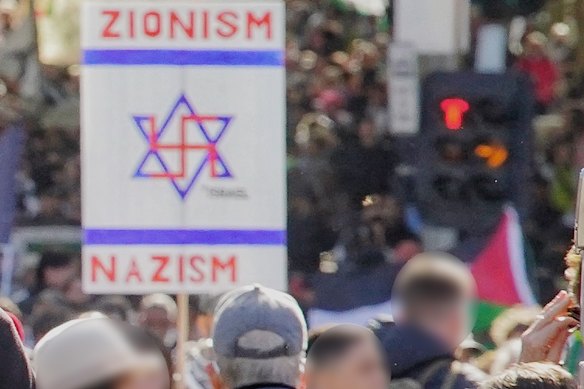
A sign juxtaposing Zionism and Nazism is displayed at a pro-Palestinian rally last May in Melbourne.
A sign juxtaposing Zionism and Nazism is displayed at a pro-Palestinian rally last May in Melbourne. LUIS ENRIQUE ASCUI

Victor Klemperer, a Jewish academic who survived Nazi Germany, warned that words can act like tiny doses of arsenic – swallowed unnoticed, accumulating slowly, until their poison takes hold. His insight was not about shouted slogans, but about respectable language that can normalise contempt. “Zionist” has entered this territory over the past two years.

In the wake of the Bondi attack, I was involved in a public campaign for a federal royal commission into antisemitism. My role prompted a message from someone I have known for more than 20 years. Had I been paid by Israel for my advocacy, he asked. It was an offensive question. The answer was no.

What followed was more revealing. “Zionists have always been morally bankrupt with a superiority complex,” he told me.

I asked him two simple questions. Did he believe the state of Israel should continue to exist? Yes. Did he believe it should exist as a Jewish state, provided Jews, Christians, Muslims and others were given equal rights? Yes.

By the standard definition, he qualified as a Zionist. He either did not understand the term – or he was deliberately repurposing it.
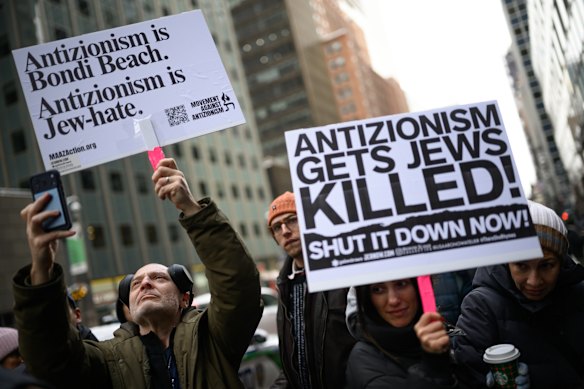
People hold signs at a vigil outside the Australian consulate in New York City after the Bondi massacre.
People hold signs at a vigil outside the Australian consulate in New York City after the Bondi massacre.GETTY IMAGES

That exchange mattered not because it was especially aggressive, but because it was ordinary. It was delivered calmly, with moral certainty, and without any sense of contradiction. It revealed something that has become increasingly common: the use of the word “Zionist” not to describe a belief, but to impugn a target.

Zionism, properly understood, is not complicated. It is the belief that the Jewish people have the right to self-determination in their ancestral homeland. In practical terms, it is the idea that Israel should exist as a Jewish state. In Australia, Zionism has long been openly supported by mainstream leaders from across the political spectrum as a legitimate expression of Jewish self-determination.


Zionism does not dictate borders. It does not prescribe military policy. It does not require allegiance to any government, leader or political party. It does not exclude any race or religion from Israeli citizenship. It does not preclude criticism of Israel and nor does it demand support for all actions taken by the Israeli state. Expansionism is not intrinsic to it, and nor does it require opposition to a two-state solution. To be clear, criticism of Israel that is similar to that levelled against any other country cannot be regarded as antisemitic.

Like any national movement, Zionism contains a wide spectrum of political views. Many Zionists oppose Israel’s current government. Many Israelis have protested against it for years. Some of the fiercest critics of Israeli policy are Israeli citizens, who nonetheless consider themselves proudly Zionist.

This clarity matters because once a word’s meaning is hijacked, it becomes available for misuse – or abuse.

In recent years, “Zionist” has increasingly been deployed as an insult. The term Zionist is no longer used to identify an idea, but it is spat to assign blame. “Zionists” are held responsible for a wide range of evils, often without definition or limitation. In many instances, “Zionist” is used synonymously with “Jew”, while maintaining just enough ambiguity to deny that Jews are being targeted at all. So why does this substitution occur?

Because openly targeting Jews is no longer socially acceptable. “Zionist” becomes the workaround – broad enough to encompass most Jews, yet elastic enough to provide moral cover. It allows hostility to be expressed while preserving plausible deniability.

We are repeatedly told that hostility toward “Zionists” is merely political critique. But if that were true, the criticism would be of policy. Instead, “Zionists” are accused of supremacy, immorality, or inherent evil. That is not political criticism. It is collective character assassination.

This matters because Zionism is not an abstract ideology for most Jews. It is bound up with history, vulnerability and survival. For many Jews – including those deeply critical of Israel – Zionism represents the belief that Jews should not again be stateless, dependent on the goodwill of others for protection. To insist that “anti-Zionism has nothing to do with Jews” while knowing that the overwhelming majority of Jews identify in some way with Zionism is disingenuous.

At best, it ignores how the word is actually used. At worst, the ambiguity is used intentionally as cover. This is why the definitional battle matters. Hijacking the meaning of Zionism allows hatred to masquerade as politics. The federal royal commission into antisemitism must grapple with these subtleties if it is to understand Jew hatred in Australia.

Existing legal frameworks are poorly equipped to deal with language that is technically deniable yet socially corrosive. They miss the cumulative effect of rhetoric that repeatedly singles out a group under a different name.

If the commission is to be meaningful, it must confront this linguistic sleight of hand directly. It must be willing to ask whether “Zionist” has become a socially acceptable stand-in for “Jew” – a way to legitimise hostility while denying responsibility for its impact. Because when words are repurposed to disguise prejudice, history suggests the damage rarely stops with words.

Danny Berkovic is a Sydney businessman and an organiser of the bondiresponse.com petition, which pushed the Albanese government to announce a royal commission into antisemitism.


100 years of Mein Kampf … the book that ravaged a continent

Perfection, of a kind, was what he was after,
And the poetry he invented was easy to understand;
He knew human folly like the back of his hand,
And was greatly interested in armies and fleets;
When he laughed, respectable senators burst with laughter,
And when he cried the little children died in the streets.
W H Auden, Epitaph On A Tyrant (1939)

The English poet W. H. Auden spent some time in Berlin during the early 1930s – the last years of the Weimar Republic prior to the Nazi ascendency –Some commentators suggest that Auden actually wrote Epitaph on a Tyrant in Berlin. But It was published in 1939, the year that the Second World War broke out – and Auden had departed the city before the end of Weimar in 1933. But he was full aware of where the world was heading – during the mid-thirties, he’d briefly journeyed to Republican Spain in the midst of the Civil War and to Kuomintang China during its war with Japan – see In That Howling Infinite’s Journey to a war – Wystan and Christopher’s excellent adventure.

The poem has been interpreted as a very brief study in tyranny, but few could doubt whom Auden had in mind. In this very short poem, Auden turns a familiar phrase from the New Testament in upon itself   evoking and then evicting ‘But Jesus said, Suffer little children, and forbid them not, to come unto me: for of such is the kingdom of heaven’ (Matthew 19:14). There is nothing Christlike about this tyrant: he will not suffer the little children to come unto him. The little children, instead, will be the ones to suffer. he also inverts a specific phrase by the nineteenth-century writer John Lothrop Motley, in The Rise of the Dutch Republic (1859), citing a report of 1584 about the death of the Dutch ruler William the Silent: ‘As long as he lived, he was the guiding star of a whole brave nation, and when he died the little children cried in the streets.’

I recalled the poem, one of the very first of Auden’s poems I encountered nearly sixty years ago, as I was reading the essay republished below written by the most erudite economist and academic Henry Ergas on the occasion  of the centenary of the publication on 16 August 1925, of Mein Kampf  (lit.My Struggle), Nazi Party founder and leader Adolf Hitler‘s combined autobiographical reflections and political manifesto, encompassing an uncompromising ideological programme of antisemitism, racial supremacy, and expansionist ambitions.

A century later, the impact of Mein Kampf on the world remains both undeniable and deeply troubling. Initially dismissed by some as the ramblings of a failed revolutionary, the book became the ideological blueprint for the Nazi regime, legitimising policies that culminated in the Holocaust and a world war that claimed tens of millions of lives. Beyond the destruction of the mid-twentieth century, Mein Kampf has endured as a symbol of hate literature, resurfacing periodically in extremist movements, political propaganda, and debates over free speech and censorship. Its centenary compels reflection not only on the book’s historical role in shaping one of the darkest chapters of human history, but also on the persistence of the prejudices and authoritarian impulses it so virulently expressed.

Mein Kampf‘s bitter harvest

The Second World War began on 2nd September 1939 with Germany’s sudden and unprovoked invasion of Poland on 2nd September, and Britain and France’s declaration of war on Germany the day after. On 17 September, the Soviet Union invaded the country from the east in accordance with the Treaty of Non-aggression between Germany and the Union of Soviet Socialist Republics,  ,forever known as the Molotov-Ribbentrop Pact. a neutrality pact between Nazi Germany and the Soviet Union signed in Moscow on August 23, 1939, by foreign ministers Joachim von Ribbentrop and Vyacheslav Molotov, respectively.

Japan formally entered the war on September 22, 1940 with the invasion of French Indochina, having been at war with China since 1931, and officially formed an alliance with Germany and Italy five days later. The United Kingdom declared war on the Empire of Japan  on 8 December 1941, following the Japanese attacks on British Malaya, Singapore and Hong Kong on the previous day, as well as in response to the bombing of the American fleet at Pearl Harbour on December 7. The United States to enter World War II the following day.

World War II ended in Europe on May 8, 1945, with Germany’s unconditional surrender, known as Victory in Europe Day (V-E Day). The war in the Asia Pacific concluded on September 2, 1945, with Japan’s formal surrender aboard the USS Missouri, designated Victory over Japan Day (V-J Day). This followed the atomic bombings of Hiroshima and Nagasaki and the Soviet Union’s declaration of war on Japan

The Nazis, with a little help from their allies and collaborators, murdered (there is no other word) an estimated six million Jews and 11 million others In camps and jails, reprisals and roundups, on the streets of cities, towns and villages, in fields and in forests, and in prison cells and torture chambers. And in the fog of war, the dearth of accurate records, and the vagaries of historical memory, the actual number is doubtless higher – much higher.

The term ‘Holocaust’ generally refers to the systematic and industrialized mass murder of the Jewish people in German-occupied Europe – called the Shoah or ‘catastrophe’ by Jews. But the Nazis also murdered unimaginable numbers of non-Jewish people considered subhuman – Untermenschen (the Nazis had a way with words!) – or undesirable.

Non-Jewish victims of Nazism included Slavs who occupied the Reich’s ostensible lebensraum – living space, or more bluntly, land grab (Russians – some seven million – Poles, another two – Ukrainians, Serbs and others in Eastern Europe caught in the Wehrmacht mincer; Roma (gypsies); homosexuals; the mentally or physically disabled, and mentally ill; Soviet POWs who died in their tens of thousands; Roman Catholics, Protestants, and Orthodox Christians who defied the regime; Jehovah’s Witnesses and Freemasons; Muslims; Spanish Republicans who had fled to France after the civil war; people of colour, especially the Afro-German Mischlinge, called “Rhineland Bastards” by Hitler and the Nazi regime; leftists, including communists, trade unionists, social democrats, socialists, and anarchists; capitalists, even, who antagonized the regime; and indeed every minority or dissident not considered Aryan (‘herrenvolk’ or part of the “master race”); French, Belgians, Luxemburgers, Dutch, Danes, Norwegians, Albanians, Yugoslavs, Albanians, and, after 1943, Italians, men, women and young people alike, involved with the resistance movements or simply caught up in reprisals; and anyone else who opposed or disagreed with the Nazi regime. See below, Ina Friedman’s The Other Victims of the Nazis and also, Wikipedia’s Victims of the Holocaust

Worldwide, over seventy million souls perished during World War II. We’ll never know just how many …

Lest we forget …

From In That Howling Infinite’s  2nd September 1939 – the rape of Poland (1)

The immoral mathematics of World War II – Deaths by Country 

COUNTRY MILITARY DEATHS TOTAL CIVILIAN AND MILITARY DEATHS
Albania 30,000 30,200
Australia 39,800 40,500
Austria 261,000 384,700
Belgium 12,100 86,100
Brazil 1,000 2,000
Bulgaria 22,000 25,000
Canada 45,400 45,400
China 3-4,000,000 20,000,000
Czechoslovakia 25,000 345,000
Denmark 2,100 3,200
Dutch East Indies 3-4,000,000
Estonia 51,000
Ethiopia 5,000 100,000
Finland 95,000 97,000
France 217,600 567,600
French Indochina 1-1,500,000
Germany 5,533,000 6,600,000-8,800,000
Greece 20,000-35,000 300,000-800,000
Hungary 300,000 580,000
India 87,000 1,500,000-2,500,000
Italy 301,400 457,000
Japan 2,120,000 2,600,000-3,100,000
Korea 378,000-473,000
Latvia 227,000
Lithuania 353,000
Luxembourg 2,000
Malaya 100,000
Netherlands 17,000 301,000
New Zealand 11,900 11,900
Norway 3,000 9,500
Papua New Guinea 15,000
Philippines 57,000 500,000-1,000,000
Poland 240,000 5,600,000
Rumania 300,000 833,000
Singapore 50,000
South Africa 11,900 11,900
Soviet Union 8,800,000-10,700,000 24,000,000
United Kingdom 383,600 450,700
United States 416,800 418,500
Yugoslavia 446,000 1,000,000

WORLDWIDE CASUALTIES*

Battle Deaths 15,000,000
Battle Wounded 25,000,000
Civilian Deaths 45,000,000

*Worldwide casualty estimates vary widely in several sources. The number of civilian deaths in China alone might well be more than 50,000,000.

Read also, in In That Howling Infinite: Righteous Among the Nations and Las Treces Rosas – Spain’s Unquiet Graves 

Mein Kampf made depravity the highest form of morality: Hitler’s ‘Nazi bible’ a playbook for hate

A picture-illustration showing Adolf Hitler in Munich in 1932 and his book, Mein Kampf. During WWII Hitler wore a simple uniform rather than the elaborate costume of a supreme commander, highlighting his affinity with the ‘grunts’ on the line. Picture: Heinrich Hoffmann/Archive Photos/Getty Images

A picture-illustration showing Adolf Hitler in Munich in 1932 and his book, Mein Kampf. During WWII Hitler wore a simple uniform rather than the elaborate costume of a supreme commander, highlighting his affinity with the ‘grunts’ on the line. Picture: Heinrich Hoffmann/Archive Photos/Getty Images


W
hen Adolf Hitler’s Mein Kampf (My Struggle) was published exact­ly 100 years ago, the reviews were scathing. The reader, proclaimed the Frankfurter Zeitung, could draw from the book one conclusion and one conclusion only: that Hitler was finished. The influential Neue Zurcher Zeitung was no kinder, lambasting “the sterile rumination of an agitator who is incapable of rational thought and has lost his grip on reality”. As for Karl Kraus, the great Austrian essayist and critic, he famously dismissed it, quipping: “When I think of Hitler, nothing comes to mind.”

But while the book that would become known as “the Nazi bible” was hardly an immediate bestseller, it was far from being a dismal flop. By the end of 1925, nearly 10,000 copies had been sold, necessitating a second print run, and monthly sales seemed to be trending up. Even more consequentially, Mein Kampf, with its comprehensive elaboration of the Nazi world view, proved instrumental in consolidating Hitler’s until then tenuous position as the leader of the Nationalsozialistische Deutsche Arbeiterpartei  (National Socialist German Workers’ Party) or NSDAP. Both Hitler and Max Amann, who ran the Nazis’ publishing house, had good reason to be pleased.

After all, the initial circumstances of the book’s production were scarcely promising. When Hitler arrived at Landsberg prison in November 1923, following the failure of a farcically mismanaged putsch, he was assessed by the staff psychologist as “hysterical” and suicidal. However, having determined to end it all by embarking on a hunger strike, he sat down to write his valedictory statement – and with the full support of the prison’s director, a Nazi sympathiser who was happy to accommodate his every need, the project soon expanded, until the writing came to consume Hitler’s days.

Once Emil Georg, a director of the powerful Deutsche Bank and generous funder of the NSDAP, provided the aspiring writer with a top-of-the-line Remington typewriter, a writing table and all the stationery he required, Hitler’s new career as an author – the profession he proudly declared on his 1925 tax return – was well and truly under way.

The difficulty, however, was that Hitler wrote very much as he spoke. Page after page required substantial editing, if not complete revision. Some of it was undertaken by Rudolf Hess, who had a university degree, and Ernst Hanfstaengl, a German-American Harvard graduate. But many of the most difficult sections were eventually worked over by the unlikely duo of a music critic, Josef Stolzing-Cerny, and Bernhard Stempfle, a priest.

The greatest tensions arose in settling the title. Hitler, with his habitual grandiloquence, had called it Four and a Half Years of Battling Lies, Stupidity and Betrayal. Convinced that title would doom it to failure, Amann adamantly insisted on, and seems to have devised, a shorter alternative. Thus was Mein Kampf, the name that would go down in history, born.

Mein Kampf’s singular lack of focus proved tobe a strength.

Mein Kampf’s singular lack of focus proved to
be a strength.

Viewed superficially, the text, despite its editors’ best efforts, seems inchoate, veering across a bewildering range of grievances, pseudo-historical accounts and exhortations. Yet its singular lack of focus proved to be a strength. It meant there was something in it for each of the social groups the Nazis were attempting to mobilise, with every one of those groups finding the real or imagined harms that afflicted it covered in its pages. And whenever they were discussed, each group’s darkest nightmares were portrayed in striking, often lurid terms.

Hitler himself explained his approach in the book’s discussion of propaganda.

“Most people,” Hitler said, “are neither professors nor university graduates. They find abstract ideas hard to understand. As a result, any successful propaganda must limit itself to a very few points and to stereotypical formulations that appeal to instincts and feelings, making those abstract ideas vividly comprehensible.”

That is exactly what Mein Kampf set out to do – and it did so by hammering three basic themes: that the Germans were victims; that the culprit for the wrongs they had suffered were the Jews; and that only a fight to the death against “world Jewry” could bring Germany’s redemption and return it to the pre-eminence that was its birthright and historic destiny.

What gave the book its resonance was that each of those themes was well and truly in the air. Nowhere was that clearer than in respect of victimhood.

Thus, the end of World War I had not been viewed in Germany as a military defeat. Rather, the widespread perception, vigorously propagated by General Erich Ludendorff, was that had the German army, which retained undisputed mastery over its home soil, not been “sabotaged” by liberals, freemasons, social democrats and communists, it would have held out, forcing the Allies to a settlement.

Key themes in Mein Kampf was that the Germans were victims and the culprit for the wrongs they had suffered were the Jews.

Key themes in Mein Kampf was that the Germans were victims and the culprit for the wrongs they had suffered were the Jews.

The capitulation was, in other words, the result of a “stab in the back” that treacherously delivered the nation to the harsh, grotesquely unjust, treatment eventually meted out at Versailles by the war’s victors.

Closely associated with the resulting sense of unfairness, and of an undeserved defeat, was the smouldering resentment felt by returning soldiers.

World War I had ushered in the glorification of the rank and file, expressed in countries such as France, Britain and Australia by the erection of national memorials for the Unknown Soldier. Here was a figure that represented both the individual and the mass: sanctified by the nation, the Unknown Soldier also stood for the multitudes sent out to die and too quickly forgotten.

That was the case almost everywhere – but not in the newly established Weimar Republic. Unlike its counterparts, the republic erected no national monument, created no worthy memorial: the ghosts of the dead were left unburied.

Moreover, unable to deal with the trauma of the war, the republic accorded veterans no special status: even when their wounds made them entirely disabled, they were entitled only to the paltry benefits accorded to others suffering from similar levels of disability.

With the country’s new leaders abandoning those who had borne so many risks and so much pain on Germany’s behalf, an unbridgeable cleavage opened up between “those who had been there” – with all of their rage and frustration, fury and disillusionment – and those who had not. It is therefore no accident that both for innumerable forgotten soldiers and for the families who had lost their sons and fathers, Hitler, who had lived through the carnage, came to symbolise the unknown soldier of World War I.

Nor is it an accident that during World War II he always donned a simple uniform rather than the elaborate costume of a supreme commander, thereby highlighting his unshakeable affinity with the “grunts” on the line.

Hitler, chancellor of Germany in 1933, is welcomed by supporters at Nuremberg. Picture: Hulton Archive/Getty Images

Hitler, chancellor of Germany in 1933, is welcomed by supporters at Nuremberg. Picture: Hulton Archive/Getty Images

The last, but perhaps most broadly felt, source of the sense of victimhood was the devastation wreaked by the “great inflation”.

The immediate effect of the price hikes, which began in 1921, accelerated in late 1922 and became a hyperinflation (that is, one involving monthly price increases of more than 50 per cent) in 1923 was to obliterate the savings of skilled workers, pensioners and the middle class. No less important, however, it also shattered those groups’ social standing which, in a society still geared to honour and respectability, relied on the ability to conspicuously maintain a dignified lifestyle appropriate for one’s status. Instead, for the first time in their lives, previously comfortable professionals, foremen and highly trained workers were reduced to a struggle of all against all, as they vainly attempted to sell once prized, often hard-earned assets that had suddenly – and mysteriously – become utterly valueless.

And as well as leaving a legacy of trauma, that experience created an enduring sense of unpredictability, casting the new republic as incapable of maintaining intact even the elementary foundations of daily life.

Stefan Zweig was therefore not exaggerating when he wrote, in his The World of Yesterday, that “nothing ever embittered the German people so much, nothing made them so furious with hate as the inflation. For the war, murderous as it was, had yet yielded hours of jubilation, with ringing of bells and fanfares of victory. And, being an incurably militaristic nation, Germany felt lifted in her pride by her temporary victories. But the inflation served only to make it feel soiled, cheated, and humiliated. A whole, scarred, generation could never forget or forgive.”

But where there are victims there must be victimisers – and Hitler delivered those too. Towering among them were the Jews.

Mein Kampf’s obsession with Jews is readily demonstrated: including cognate terms, such as Jewry, the 466 references to Jews in the book outnumber those to every other substantive term, including race (mentioned 323 times), Germany (306), war (305) and Marxism, which gets a paltry 194 – still ahead of national socialism and national socialists which, taken together, are referenced only 65 times.

It is certainly true that there is, in those obsessive references, virtually nothing original. Hitler’s tir­ades largely reassemble the anti-Semitic tropes that had emerged in the late 19th century and that were widely disseminated in a notorious forgery, The Protocols of the Elders of Zion.

But Hitler’s formulation, while substantively irrational, was arguably more logical than most in the way it combined and superimposed elements from conventional anti-Semitism, pseudo-biology and social Darwinism.

Mein Kampf’s promise of redemption was crucial … from the midst of despair, a new notion of German glory and greatness began to emerge. Hitler with Nazi officials in Munich in the summer of 1939, just before the start of WWII.

Mein Kampf’s promise of redemption was crucial … from the midst of despair, a new notion of German glory and greatness began to emerge. Hitler with Nazi officials in Munich in the summer of 1939, just before the start of WWII.

Thus, relying on a loose biological metaphor, it defined Jews as a parasite – but as one that had deliberate agency and that consciously (and collectively) sought to infect its victims, notably the “purer”, more advanced “races”.

Second, it asserted that the resulting infection was not only fatal to its victims but ultimately to their entire “race”.

Third, it projected on to that account the image of a Darwinian struggle that had been fought across recorded history’s entire course, between Jews on the one hand and the superior races on the other: a struggle that could end only with the extinction of the Jews or their adversaries.

And finally, it argued that, unless anti-Semites learnt to display the same degree of ruthlessness, the same insistence on ethnic loyalty, the same stealth and the same forms of manipulation of media and the public sphere, the Jews stood every chance of triumphing because they entirely lacked ethical standards, were exceptionally cunning, ambitious, aggressive and vindictive and – last but not least – had a natural bond to each other, combined with a murderous hatred of others.

The resulting portrayal of Jews was as terrifying as it was bizarre. Jews, it seemed, were chameleons, who were both subhuman yet extraordinarily capable, both fanatical Bolsheviks and natural capitalists, both physically repulsive yet immensely able to seduce and “infect” innocent Aryan maidens.

Moreover, they could shift effortlessly and surreptitiously from any one of those myriad shapes into any another, choosing whatever form was most likely to succeed in destroying their opponent.

As the great German philosopher Ernst Cassirer later recalled, he and his other Jewish friends found those claims “so absurd, so ridiculous, and so crazy, that we had trouble taking them seriously”. But others did not have any difficulty in doing so.

Many forces were at work. Some resulted from the war years. For example, the terrible food shortages caused by the British blockade (which was lifted only two years after the war ended) had resulted in spiralling prices for basics on the black market – with the finger being readily, although entirely incorrectly, pointed at alleged hoarding by Jews.

And more indirectly, but no less potently, the horrific second wave of the 1919 influenza pandemic, in which 400,000 Germans died, had given enormous prominence to notions of infection and contagion. As careful statistical studies subsequently showed, that prominence had enduring effects, as the Nazis secured significantly greater electoral support in the worst affected areas than in those where the death toll was lower.

But by far the greatest factor was the profound disruption of the post-war years, when everything Germans had taken as solid melted into thin air, leaving a pervasive feeling of bewilderment.

For all of its myriad flaws, the Kaiserreich, as the German Empire was known, had exuded a stability that made the future predictable. Now, with one seemingly incomprehensible event piling up on top of another, the desperate search to make sense of the world triggered an equally desperate search for someone to blame.

That was precisely what Hitler’s vast Jewish conspiracy offered. Mein Kampf, Heinrich Himmler pithily noted, was “a book that explains everything”. If it was so effective, Hannah Arendt later reflected, it was because its playing on tropes and stereotypes that were relatively familiar could, at least superficially, “fulfil this longing for a completely consistent, comprehensible, and predictable world without seriously conflicting with common sense”. All of a sudden, things fell into place – with consequences for Europe’s Jews that would forever sully Germany’s name.

Sign erected by British forces at the entrance to the Bergen-Belsen camp. Picture: Imperial War Museum

Sign erected by British forces at the entrance to the Bergen-Belsen camp. Picture: Imperial War Museum

Bodies being flung into a mass grave at Belsen. Picture from the book Children's House of Belsen, by camp survivor Hetty Verolme

Bodies being flung into a mass grave at Belsen. Picture from the book Children’s House of Belsen, by camp survivor Hetty Verolme

If those horrendous conse­quences eventuated, it was because Mein Kampf did not only identify an alleged disease; it also set out a path to national redemption. In that respect, too, its main points were entirely unoriginal.

However, what was relatively new, and especially important, was the unadulterated celebration of death and violence in which they were couched.

Whether Hitler called for Jews to be massacred is a matter of interpretation. What is beyond any doubt is that he came as close to it as one possibly could. The Jews, he claimed, would “accentuate the struggle to the point of the hated adversary’s bloody extermination”. As that happened, it would be absolutely impossible to defeat them “without spilling their blood”. And when it came to that, their opponents, locked “in a titanic struggle”, would have to “send to Lucifer” – that is, to hell – “those who had mounted an assault on the skies”: that is, the Jews.

There would be, in the process, countless victims; but the Aryans who perished would be martyrs, “acting in accordance with the will of the Almighty Creator”, and like Hitler himself “fighting for the work of the Lord”.

As with so much of Mein Kampf, the sheer violence of those calls, and of the text more generally, fell on fertile ground, again especially among veterans.

If those veterans had one thing in common it was the experience of “total war”, characterised by the ever-growing porousness of the boundaries between soldiers and civilians both as combatants and as targets of destruction.

Once they got to the front, it did not take long for ordinary soldiers to discard the fantasies of splendid bayonet charges across fields of flowers. Instead, burrowed underground in trenches filled with slime and excrement, rats and rotting body parts, what many learnt was that life was war, and war was life.

And at least for some, the sacrifice and devotion of their comrades also taught that violence brought out the best qualities in man.

Winifred Williams, a Welsh woman who became a friend and supporter, provided the paper on which Hitler wrote Mein Kampf while he was in jail.

Winifred Williams, a Welsh woman who became a friend and supporter, provided the paper on which Hitler wrote Mein Kampf while he was in jail.

Rendering that habituation to violence even more extreme was the experience of the 5 per cent or so of German soldiers who volunteered for Freikorps (Free Corps) units that fought, from 1918 to 1923, against the wave of revolutionary movements throughout central and eastern Europe.

Particularly in the Baltic states, those struggles were brutally uncompromising, with mass executions not only of adversaries but also of entire villages of helpless Jews. It was in those struggles that many ingredients of Nazism were forged – its symbols, like the death’s head and the swastika; its core staff, who later largely comprised the leading personnel first of the Nazi’s paramilitary units and then of the SS; and the unbridled anti-Semitic savagery of its killing squads. To all those who lived through those struggles, Mein Kampf seemed to perfectly capture their world view.

But Mein Kampf’s promise of redemption was crucial, too. Yes, Germany experienced the aftermath of World War I as an unmitigated disaster. Yet, from the midst of despair, a new notion of German glory and greatness began to emerge. When the war finally ended, the survivors could not but feel an urge to endow it with meaning – with the hope that the countless deaths would be redeemed by creating a better future, not only for themselves but also for the nation, a future shorn of the causes of everything that had gone wrong.

And no one, in the chaos and misery of post-World War I Germany, painted the path to that national salvation as starkly, and as effectively, as Hitler.

Death and destruction follow delirium as surely as dust and ashes follow fire. Two long decades, punctuated by Hitler’s accession to power in 1933, separated, almost precisely, the publication of Mein Kampf from the “Zero Hour”, as it became widely known, on May 7, 1945, when Germany, reduced to rubble, surrendered and officially ceased to exist. The vision – or hallucinations – Hitler had produced in Landsberg’s ja

Death and destruction follow delirium as surely as dust and ashes follow fire. Two long decades, punctuated by Hitler’s accession to power in 1933, separated, almost precisely, the publication of Mein Kampf from the “Zero Hour”, as it became widely known, on May 7, 1945, when Germany, reduced to rubble, surrendered and officially ceased to exist. The vision – or hallucinations – Hitler had produced in Landsberg’s jail ensured that the 20th century’s fields of glory would be sown with the corpses of innocent victims and the distorted fragments of shattered ideals.

Between those dates, the book’s fortunes closely tracked those of its author. After the crash of 1929, and the onset of the Depression, sales boomed; and once the Nazi regime was in place it became ubiquitous. A second volume had appeared in December 1926; it was added to the 400 pages of the first in 1930.

To cope with the length, the combined book was printed on extremely fine paper, exactly like a bible. Soon after that, an ever-wider range of formats – going from cheap paperback versions to extremely luxurious versions bound in leather – was offered to readers.

The regime recommended that municipalities give a good quality copy to newly married couples as they stepped out of the wedding ceremony; estimates vary but it seems two million couples benefited (if that is the right word). The book also became the standard prize in schools, workplaces and party organisations, bestowed on recipients with all the pomp the Fuhrer’s great work demanded. Altogether, by the “Zero Hour”, 12.5 million copies had found their way into the hands of potential readers – yielding Hitler copyright payments, partly deposited in a Swiss bank account, that made him an extremely wealthy man.

How many Germans actually read it is hard to say; the answers given to immediate post-war surveys were understandably evasive. What seems likely, however, is that its influence came less from the scrupulous consumption of the “Nazi bible” than from short excerpts, read out at meetings and over the radio or printed near the mastheads of major papers, as well as from the million or so copies of “reader’s digest”-like variants sold during the Reich’s golden years.

In the chaos and misery of post-WWI Germany, no one painted the path to that national salvation as starkly, and as effectively, as Hitler

In the chaos and misery of post-WWI Germany, no one painted the path to that national salvation as starkly, and as effectively, as Hitler

But its greatest impact was almost certainly indirect. Regardless of what ordinary Germans may or may not have done, abundant evidence shows it was carefully studied and frequently consulted by the Nazi leadership. The regime’s core principle, the so-called Fuhrerprinzip, specified that “what the Fuhrer says is law”: but what the Fuhrer had actually said, and even more so, what he wanted, was almost always hopelessly unclear – yet entire careers depended on guessing it accurately.

As a result, the everyday life of the Nazi hierarchy’s upper echelons was consumed in a competi­tion to “work towards the Fuhrer”, as Hitler’s great biographer, Ian Kershaw, called it: that is, in trying to anticipate the Fuhrer’s will and show that no one could be more ruthless or determined in putting it into effect. It was in that process that Mein Kampf was absolutely fundamental, invariably referred to and systematically used.

And it was through that process that Hitler’s words made depravity the highest form of morality, atrocity the surest sign of heroism, and genocide the key to redemption.

Outside Germany, very few grasped that those horrors would unfold. Winston Churchill, Franklin Delano Roosevelt, Charles de Gaulle and David Ben-Gurion were among those few, carefully annotating early versions and gasping at the book’s implications.

But their warnings were ignored because Mein Kampf was plainly the work of a madman. As the British Labour Party’s leading intellectual, Harold Laski, said, when he was asked why he dismissed it, rational men and women “could not bring themselves to contemplate such a world”, much less believe that “any child of the twentieth century” would regard it as a realistic possibility.

But the Nazi art of politics, as Joseph Goebbels concisely defined it, consisted precisely in making the impossible possible and the absolutely inconceivable a practical reality. That art did not disappear with Nazism’s demise, nor did the murderous anti-Semitism whose seeds Hitler sowed a century ago.

As we mark Mein Kampf’s grim anniversary, we must, this time, take them seriously.

The Shoah and America’s Shame – Ken Burns’ sorrowful masterpiece

And high up above my eyes could clearly see
The Statue of Liberty
Sailing away to sea
And I dreamed I was flying
Paul Simon, American Tune

Ken Burns is a documentary maker and storyteller without equal. All his films are masterpieces of American history. I’ve watched much if not most of his work. They are among the most unforgettable histories I’ve ever viewed, high up in what I’d consider the pantheon of the genre, alongside The Sorrow and the Pity, The Battle of Algiers, Salvador and Waco – Terms of EngagementThe Civil War raised the bar so high that very few documentary filmmakers have reached it, with its mix of surviving photographic images (in an style that Apple now promotes as its “Ken Burns Effect”) and the mesmerizing recitation of diaries, letters home, and official communications. The West confronted his country’s enduring creation myth with an honesty balanced by empathy. The Dustbowl was breathtaking in its images, its narrative and the spoken testimonies it presented. The Vietnam War was a relentless, harrowing story told in pictures and the witness of the people ground zero of a a conflict that has been called “chaos without a compass”.

The US and the Holocaust is Burns’ latest film. It does not make for easy viewing being a searing indictment of America’s response to the catastrophe that was approaching for European Jewry. It’s a significant exposition centred on just how much evidence was accessible to Americans during that appalling time, and asks just why rescuing Jews was no priority, except for those few individuals who actually took risks to help. As Burns observed: “There is an American reckoning with this, and it had to be told. If we are an exceptional country, we have to be tough on ourselves and hold ourselves to the highest standard. We cannot encrust our story with barnacles or sanitise our history into a feel-good story”. As historian Rebecca Erbelding suggests, “There is no real perception in the 1930s that America is a force for good in the world or that we should be involved in the world at all. There is no sense among the American people, among the international community, that it is anyone else’s business what is happening in your own country”. There is indeed a disconnect between America’s self regard as the land of the free and the “light on the hill”, and the cold reality – and realpolitik – of its actual record at home and abroad. There is a none too subtle irony in the titles Burns has chosen for each two hour episode, drawn from extracts from the poem by Emily Lazarus that adorns the base of The Statue of Liberty (see below).

Burns work reminds us that historical memory in America, Europe, and indeed Australia is often like a sieve. Give it a good shake and only the big chunks are left. The story of the US’ public opinion and government policy regarding the worsening plight of European Jewry during the nineteen thirties and the a second World War is not one of those. When I posted an article about the film on Facebook, many Americans commented that they were unaware of their country’s disregard and outright obstruction. Burns has opened a crack that has let the light in.  

The quotations cited above are from a review published recently in the Weekend Australian which I have republished below – it is an excellent and quite detailed account of the issues and the incidents featured in this sorry tale, and I cannot better it. But I will note one distinctive feature of Ken Burns’ documentaries – his skill at recounting unfolding stories which he interweaves through the ongoing narrative, drawing viewers inexorably in and acquainting them with the characters, their hopes and their fears, and ultimately, their fates be these tragic – alas. in the most part – or fortunate.

In The Vietnam War, I followed the journey of an eager and patriotic young soldier, Denton “Mogie” Crocker, as he roved out from mall town USA to the battlefields of Indochina. I recount it. in The Ballad of Denton Crocker – a Vietnam elegy. In America and the Holocaust, there is the story of Anne Frank’s family as they sought asylum in the USA from the moment the the Nazi regime started to come down hard on Germany’s Jewish community. We all know how that ended for Anne and her sister. There is also the saga of what Hollywood called “the voyage of the damned”, the subject of an overwrought and overacted feature film, which nevertheless was based upon the actual voyage of the SS St.Louis which departed Hamburg with nearly a thousand desperate but hopeful travellers, but was refused entry into American and Canadian ports, and returned eventfully to Rotterdam where Britain, Belgium, France and the Netherlands gave them shelter. The latter three were conquered by the Wehrmacht in 1940, with harrowing consequences for those passengers who settled there, but a half of the St. Louis’ human cargo survived the war, predominantly those who were permitted to settle in Britain. 

On a personal note, whilst I am myself of Irish descent, Catholic and Protestant in equal measure on each side, my wife’s father’s family were Jews from eastern Germany and Czechoslovakia and experienced the same travails as those described in Burns’ film. Many, including her father’s elderly parents, perished in the death camps, and are memorialised the Yad Vashem shrine of remembrance in Jerusalem – which I have visited many times. Others managed to leave Germany, including her father, who settled in London, where she was born, and her uncle who a  lawyer who left Germany in 1933 after the promulgation of the infamous Nuremberg Laws, who settled in England and  and then made Aliyah to Palestine, ending his days in Haifa, in an independent Israel. Others headed westwards to Latin America in the hope of securing entry to the US from there.

Epilogue. Antisemitism, the devil that never dies

It has been said, with reason, that antisemitism is the devil that never dies. And yet, is antisemitism a unique and distinct form of racism, or a subset of a wider fear and loathing insofar as people who dislike Jews rarely dislike only Jews?

Fear of “the other” is a default position of our species wherein preconceptions, prejudice and politics intertwine – often side by side with ignorance and opportunism. it is no coincidence that what is regarded as a dangerous rise in antisemitism in Europe, among the extreme left as much as the extreme right, is being accompanied by an increase in Islamophobia, in racism against Roma people, and indeed, in prejudice in general, with an increase in hate-speech and incitement in the media and online, and hate-crimes.

We are seeing once again the rise of nationalism and populism, of isolationism and protectionism, of atavistic nativism and tribalism, of demagogic leaders, and of political movements wherein supporting your own kind supplants notions of equality and tolerance, and the acceptance of difference – the keystones of multicultural societies. It is as if people atomized, marginalized and disenfranchised by globalization, left behind by technological, social and cultural change, and marginalized by widening economic inequality, are, paradoxically, empowered, energized, and mobilized by social media echo-chambers, opportunistic politicians, and charismatic charlatans who assure them that payback time is at hand. These days, people want to build walls instead of bridges to hold back the perceived barbarians at the gates.

© Paul Hemphill 2023 All rights reserved

From Little Sir Hugh – Old England’s Jewish Question

Also, on American history and politics, My country, ’tis of thee- on matters American

The New Colossus

     Emily Lazarus

Not like the brazen giant of Greek fame,
With conquering limbs astride from land to land;
Here at our sea-washed, sunset gates shall stand
A mighty woman with a torch, whose flame
Is the imprisoned lightning, and her name
Mother of Exiles. From her beacon-hand
Glows world-wide welcome; her mild eyes command
The air-bridged harbor that twin cities frame.
“Keep, ancient lands, your storied pomp!” cries she
With silent lips. “Give me your tired, your poor,
Your huddled masses yearning to breathe free,
The wretched refuse of your teeming shore.
Send these, the homeless, tempest-tost to me,
I lift my lamp beside the golden door!”

Ken Burns’ “The US and the Holocaust” tells of a shameful past

Graeme Blundell, The Weekend Australian, 11th March 2023

A scene from The US and the Holocaust
The latest documentary series from Ken Burns’s Florentine Films, The US and the Holocaust, is inspired in part by the US Memorial Museum’s “America and the Holocaust” exhibition. The series was developed with the assistance of the museum’s historians (many of whom appear in it) and its extensive archives.

It’s a significant exposition centred on just how much evidence was accessible to Americans during that appalling time, and asks just why rescuing Jews was no priority, except for those few individuals who took the risk to help.

For Burns, the series is the most important work of his professional career.

“There is an American reckoning with this, and it had to be told,” he says. “If we are an exceptional country, we have to be tough on ourselves and hold ourselves to the highest standard. We cannot encrust our story with barnacles or sanitise our history into a feel-good story.”

The US and the Holocaust was originally supposed to be released in 2023 but Burns accelerated production by several months, “much to the consternation of my colleagues, just because I felt the urgency that we needed to be part of a conversation”. That conversation for Burns and his colleagues is about “the fragility of democracies” and demonstrating how, “we’re obligated then to not close our eyes and pretend this is some comfortable thing in the past that doesn’t rhyme with the present”.

The filmmaker is fond of quoting Mark Twain’s, “History doesn’t repeat itself but it often rhymes,” and like all his films he wants this one to rhyme with the present.

“We remind people that it’s important that these impulses are not relegated to a past historical event,” Burns says. “It’s important to understand the fragility of our institutions and the fragility of our civilised impulses.”

As Holocaust historian Deborah Lipstadt, a significant voice in Burns’s documentary, says with some alarm in the series, “The time to stop a genocide is before it starts”.

And Peter Hayes, also a revered historian, says, underling the subtext of the documentary, “exclusion of people, and shutting them out, has been as American as apple pie”.

The three-part, six-hour series is directed and produced by Burns, Lynn Novick and Sarah Botstein, two of his long-term collaborators, and beautifully written by another Burns regular, Geoffrey Ward. As always Burns manages to find major actors to play the parts of his central characters in voice over, including Liam Neeson, Matthew Rhys, Paul Giamatti, Meryl Streep, Werner Herzog, Elliott Gould, Joe Morton and Hope Davis.

And like so many of Burns’s films it’s narrated in that mesmerising way by Peter Coyote, who Burns calls “God’s stenographer”. Coyote is able to voice such complex ideas with authority and empathy, often with a kind of beguiling liturgical intonation.

Stylistically recognisable and cinematically audacious, Burns’s memorable documentaries (many of which he has co-produced with Lynn Novick) include The Civil War, Baseball, Jazz, The War, The National Parks, The Dust Bowl, Prohibition, Country Music and more recently Hemingway. He constructs a compelling narrative by using almost novelistic techniques, imaginatively selecting archival material, photographed in his now famous way, immersing us in photographs, developing characters and arranging details around their stories.

The filmmakers present their story in this new series across three overflowing episodes in six challenging, engrossing hours: the first The Golden Door (Beginnings-1938); the second Yearning to Breathe Free (1938-1942); and the final The Homeless, Tempest-Tossed (1941-).

There are two parallel storylines that continuously reverberate off each other – the American side details the history of American anti-Semitism, the notion of “race betterment” and the evolving immigration policy; the German narrative arc deals with the way hatred of the Jews sprouted over time, how the Nazis pursued the end of Jewish intellectualism, and of course the process of their extermination.

The first episode covers the period from roughly the end of the 19th century to the late 1930s, a historical background that delivers context and perspective for the complex narrative that follows.

A scene from The US and the Holocaust

It’s broken by a short pre-titles sequence that involves new archival material from the centre of Frankfurt in 1933 of Otto Frank, father of Anne, Hitler having been in power for some months. Otto is desperate to get his family to America, but in the absence of an asylum policy, Jews seeking to escape Nazi persecution in Europe had to go through a protracted emigration procedure. It’s an unanticipated and surprising piece of the Franks’s story highlighting an American connection to the Holocaust.

(It’s a lovely, if distressing, example of the way Burns likes compelling personal narrative to wrap his ideas around, finding “characters” who become involved as events dictate.)

There was limited willingness to accept Jewish refugees. America did not want them, as Coyote says. Frank would continue to apply when they moved to Amsterdam but his immigration visa application to the American consulate in Rotterdam was never processed.

As the filmmakers later show so tragically, existence for European Jews became a deadly, exhausting pursuit of passports, identification cards, transit visas, and affidavits. As the journalist Dorothy Thompson, who features in the series, said, “For thousands and thousands of people a piece of paper with a stamp on it is the difference between life and death.”

We then cut to a beautiful period film sequence of the Statue of Liberty, Mother of Exiles, surrounded by slowly floating clouds, and a beautiful reading of the famous poem by 19th-century poet Emma Lazarus printed on a bronze plaque mounted inside the lower level of the pedestal:

Give me your tired, your poor,

Your huddled masses yearning to breathe free …,

I lift my lamp beside the golden door!

But the Golden Door, which gives the title for the first episode, had begun to close. The filmmakers take us back through history at quotas and the favouring of northerners over immigrants from southern or eastern Europe. Asians were largely locked out by the time of the Chinese Exclusion Act of 1882.

A so-called “racial abyss” was feared by Americans as the new century began; white people feared they would be outbred by the newcomers and their offspring. The white Protestant majority at the end of 19th century was certain that unless things changed they were about to be replaced.

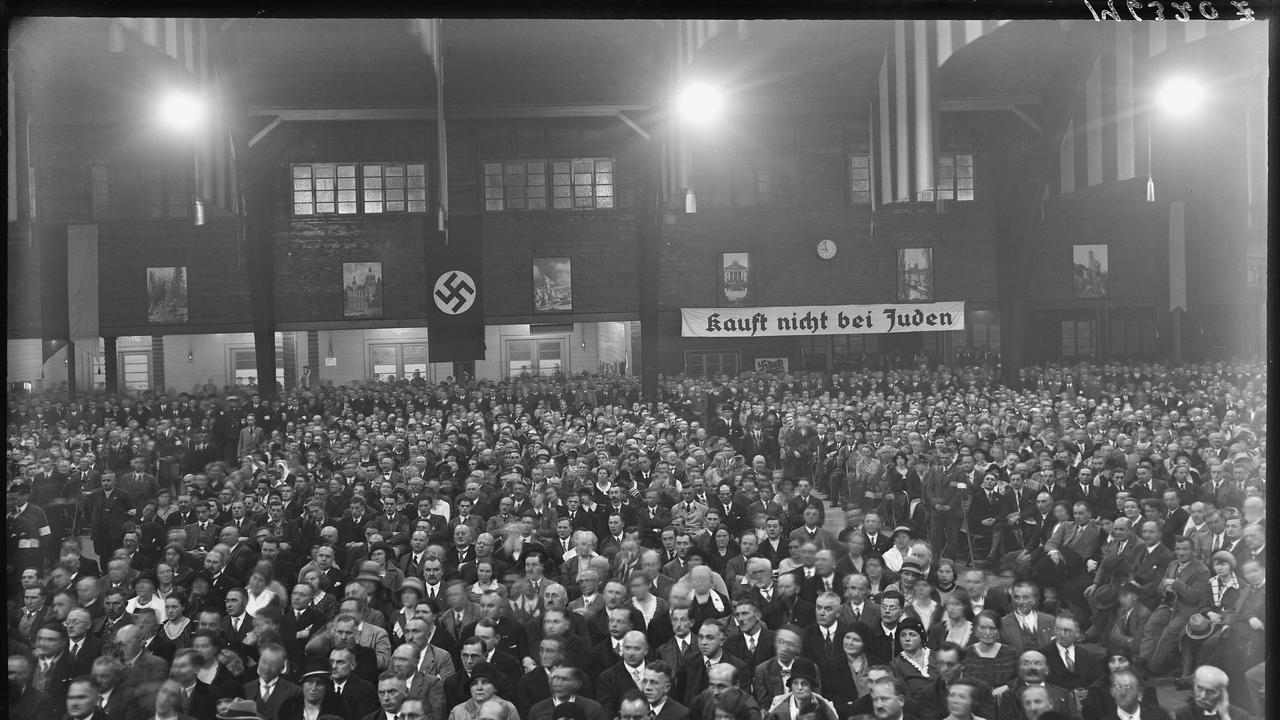
A part meeting with a sign reading "Kauft nicht bei Juden"- Don't buy from Jews.
A US Nazi Party meeting with a sign reading “Kauft nicht bei Juden”- Don’t buy from Jews.

A “mordant sentimentalism” was blamed by some for the US becoming “a sanctuary for the oppressed”, and “suicidal ethics” were leading to the extermination of the white people.

Helen Keller called it “cowardly sentimentalism” and Henry Ford, the series reveals, blamed Jews “for everything from Lincoln’s assassination to the change he thought he detected in his favourite candy bar”. He even published a hugely successful newspaper to triumphantly publish anti-Semitic harangues.

Jews were dismissed as “uncouth Asiatics” and the hogwash “science” of eugenics, the theory that humans can be improved through selective breeding of populations, was promulgated by conservationist Madison Grant’s The Passing of the Great Race. The filmmakers show how it evolved and thrived in response to America’s changing demographics.

It was a concept taken up by Hitler who also admired America’s expansion across the continent from east to west, brushing aside those who were already there. This was manifest destiny. “The immense inner strength of the US came from the ruthless but necessary act of murdering native people and herding the rest into cages,” he wrote. His dream was of territorial expansion and Germany would in time conquer the wild east of Europe he believed. “Our Mississippi,” he said, “must be the Volga”.

Jews, scapegoats for centuries, watched as anti-Semitism was normalised in the US, in and out of Washington. Burns and his colleagues closely follow the complex manoeuvrings of President Roosevelt as he coped with the anti-immigrant xenophobiaas well as a wilful, and for many, all-consuming obsession with white supremacy.

As historian Rebecca Erbelding suggests, “There is no real perception in the 1930s that America is a force for good in the world or that we should be involved in the world at all. There is no sense among the American people, among the international community, that it is anyone else’s business what is happening in your own country”.

The series unfolds with Burns’s typical elegance: the stylised organisation of personal anecdote, Coyote’s sonorous narration, erudite, subdued commentary from historians and some ageing witnesses to atrocities, an elegiac soundtrack from Johnny Gandelsman, and gracefully realised visual documentation.

Much of the German archival footage is not unfamiliar but some new sequences horrify and disturb deeply. SS soldiers parade in the streets, chanting “When Jewish blood spurts off a knife, everything will be all right”. And the midnight book burnings on May 10, 1933, are a frenzied, phantasmagoria of volumes hurled into bonfires, including the works of Jewish authors like Albert Einstein and Sigmund Freud as well as blacklisted American authors such as Ernest Hemingway and Helen Keller.

The series is an extraordinary piece of work, resonant and at times frightening. As historian Nell Irvin Painter says, “Part of this nation’s mythology is that we’re good people. We are a democracy, and in our better moments we are very good people. But that’s not all there is to the story”.

The US and the Holocaust is streaming on SBS On Demand.

Actor, director, producer and writer, Graeme Blundell has been associated with many pivotal moments in Australian theatre, film and television. He has directed over 100 plays, acted in about the same number, appeared in more than 40 films and hundreds of hours of television. He is also a prolific reporter, and is the national television critic for The Australian.