If you must say it, don’t say it in Jerusalem!

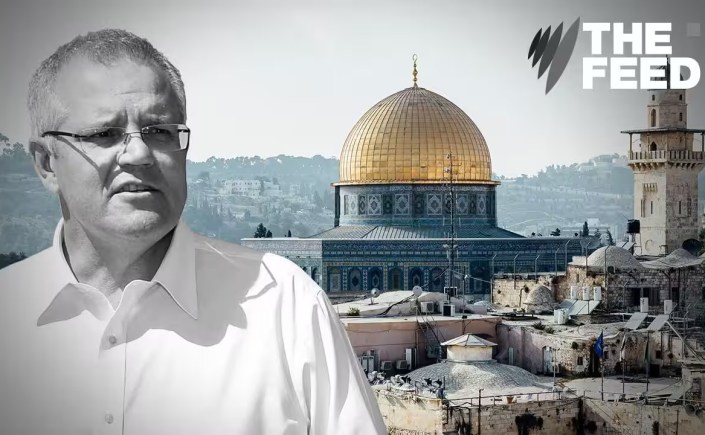
It was entitled: “Keeping Wolves from the Flock: The Case for Good Religion to Fight Anti-Semitism”. It was delivered on International Holocaust Remembrance Day on 27 January 2026 at the Binyaney Ha’uma Conference Center, Jerusalem, Israel. The presenter was former Australian prime Minister Scott Morrison. It was well received by audience, and praised by Israeli prime minister Binyamin Netanyahu. And it quickly reverberated back home.

The venue, the timing, and the company mattered. Israel, in the midst of an ongoing war and under the leadership of a government increasingly isolated internationally, was hardly a neutral stage. The event itself was framed as a moral gathering – a stand against antisemitism at a moment when Jewish communities worldwide feel newly exposed and embattled. Into this charged atmosphere stepped a deposed and disgraced Australian leader, now embarked on an international, largely ecclesiastical speaking circuit, offering prescriptions not for Israel, but for Islam in Australia.

The reaction in Australia followed well-worn grooves. Conservative outlets and commentators – most loudly those aligned with Murdoch media – cast Morrison as a truth-teller, bravely naming uncomfortable realities about radical Islam and standing up for Jewish security against a censorious, “woke” establishment that had been slow to deal with the acknowledged threat of radical Islamism. Progressive commentators, by contrast, focused on the dangers of securitising religion, the selective targeting of Muslims, exacerbating existing Islamophobia, and the symbolic violence of lecturing Australian minorities from abroad. The argument was instantly polarised, less a conversation than a mirror held up to our own media ecosystems and their predictable reflexes.

What was largely missing, however, was sustained attention to the deeper questions the speech inadvertently raised – questions that recur across debates about diversity, cohesion, and authority in plural societies. Who gets to speak about whom, and from where? How does a liberal democracy balance legitimate security concerns with religious freedom and civic trust? When does critique shade into control, and when does concern curdle into performance? And what happens when discussions about coexistence are conducted not face to face, but at altitude, before distant audiences primed for applause?

It is to those questions – rather than to the outrage or applause – that the brief following essay turns.

The politics of posturing 

There is a particular genre of speech that is recognisable before one even reaches the second paragraph. It is delivered abroad, framed as courageous, freighted with moral urgency, and aimed not so much at those ostensibly being addressed as at a wider, watching audience. Scott Morrison’s address in Israel belongs squarely in this genre. It is less a contribution to Australian social cohesion than a performance within a global culture war, delivered from a stage carefully chosen for its symbolism rather than its suitability.

Morrison, now out of office and out in the world, occupies a familiar post-political niche as he treads an international speaking circuit, heavily ecclesiastical in tone and audience, where moral clarity is prized over policy detail and applause over accountability. This matters, because the speech was not made in the Australian Parliament, not to Australian Muslims, not even in Australia. It was made in Israel – at a moment when Benjamin Netanyahu, politically cornered and morally embattled, will accept reassurance and affirmation from almost any quarter. In that sense, the speech served two purposes: it burnished Morrison’s credentials with a transnational conservative audience, and it offered Netanyahu symbolic solidarity. Australia, and Australian Muslims, were almost incidental.

The content of Morrison’s address has been widely rehearsed: calls for nationally consistent standards for Islamic institutions; accreditation and registration of imams; translation of sermons; expanded scrutiny of foreign funding; praise for Middle Eastern states that have “reasserted authority” over religious teaching. None of these ideas, taken in isolation, are wholly unthinkable. Liberal democracies already regulate religion in numerous ways – through education standards, charity law, financial transparency, and criminal statutes relating to incitement and abuse. No faith operates in a vacuum, and Islam is not exempt from the tensions between patriarchal authority and moral absolutism, and the egalitarian instincts of a secular, humanist society like Australia’s.

Nor is it controversial to observe that Islam, like Christianity before it, is engaged in a long, unfinished argument with modernity. Questions of gender, authority, pluralism, sexuality, and the limits of clerical power are not impositions from outside but live debates within Muslim communities themselves (see, in In That Howling Infinite, Islam’s house of many mansions and Educate a girl and you educate a community – exclude her and you impoverish it ). Australian Islam, however, is overwhelmingly benign, pragmatic, and law-abiding – a quiet negotiation between inherited tradition and lived reality, not a breeding ground of medieval zealotry. The men and women who left Australia to fight for ISIS were not summoned by local mosques but seduced by freelancing radicals in unregulated prayer halls algorithmic feeds, online grievance, and a search for meaning in a fractured digital world in which they find no place..

This is where Morrison’s argument begins to fray. Security agencies themselves – including ASIO director Mike Burgess – have been clear: you cannot arrest your way to social cohesion, nor spy your way to less youth radicalisation. The most rapidly evolving threats now emerge from the post-Covid morass of conspiracy theorists, anti-government paranoiacs, white nationalists, and apocalyptic survivalists – movements that often cloak themselves in Christian symbolism without any expectation that Christianity as a whole should be placed under special surveillance. To single out Islam, therefore, is not just analytically weak but politically loaded.

That loading is amplified by Morrison’s own biography. He is not a neutral secularist but an openly proselytising evangelical Christian, steeped in a tradition that would respond angrily to equivalent proposals applied to its own institutions. His political career was marked by secrecy, performative culture-war gestures, and a tendency to govern by symbolic posture rather than deliberative engagement – a style that ultimately saw him removed from office. These things do not invalidate his right to speak, but they do shape how his speech is received in his home country.

Then there is the matter of exemplars. Morrison’s citing of Saudi Arabia, the UAE, Egypt, and Jordan as models of religious regulation is not merely unfortunate; it is disqualifying. These are regimes that suppress women, persecute Christians and heterodox Muslims, criminalise dissent, and weaponise religion as an instrument of authoritarian control. They have form for dealing with Islamists like the Muslim Brotherhood with what the Americans euphemistically call “extreme prejudice”.

To invoke them while speaking the language of freedom of worship is to betray a deep confusion about the difference between liberal regulation and illiberal domination. If the aim is integration, these are strange teachers to cite.

Yet even all this misses the most important point, which is not what Morrison said but how and where he said it.

It is presumptuous to lecture Australians from abroad. It is disrespectful to address Australian Muslims without engaging them directly. And it is incendiary to do so from Israel – a place that is anything but neutral in Muslim political consciousness, and where questions of religion, power, land, and legitimacy are already saturated with pain and contestation. To speak from there is to speak over, not to; to align oneself symbolically before dialogue has even begun. No amount of policy caveating can undo that gesture.

This is where the charge of Islamophobia becomes both understandable and, paradoxically, incomplete. Morrison did not denounce Muslims as such, nor did he advocate exclusion or expulsion. But by singling out Islam, invoking authoritarian models, and delivering his critique from a stage freighted with geopolitical meaning, he helped reinforce the sense that Muslims are a problem to be managed rather than citizens to be engaged. That perception matters, because alienation is not a side effect of radicalisation; it is one of its preconditions.

The reactions to the speech followed predictable lines. British commentator Brendan O’Neill, for example, writing in The Australian, cast Morrison as a brave blasphemer, persecuted by a censorious “Islamophobia industry” – a piece of rhetorical theatre entirely consistent with Spiked’s long-standing contrarian brand and its comfortable alignment with Murdoch culture-war politics. Jacqueline Maley, writing in the Sydney Morning Herald, and the progressive wing of liberal commentary, focused on the dangers of securitisation, surveillance, and selective moral panic. Neither is wrong, exactly, but neither escapes their own political ecosystem.

What is striking is how little the speech had to do with Australia at all. It was not an attempt to build consensus, to consult, or to wrestle with the messy realities of pluralism. It was an attention-seeking intervention by a man no longer accountable to the electorate and yet nostalgic for its attention, speaking to an international audience that rewards moral certainty and civilisational framing. In that sense, the speech says less about Islam than it does about the temptations of post-power relevance.

If there is a lesson here, it is an old one. Social cohesion is not forged by speaking about communities from afar, nor by borrowing the language of security to police belief. It is built, slowly and imperfectly, through proximity, dialogue, and the unglamorous work of trust. Morrison chose distance instead. And in doing so, he turned a necessary conversation into a symbolic skirmish – one that generated headlines, applause, and division, but very little understanding. One that we hope, unrealistically alas, in today’s febrile political climate, will be forgotten sooner rather than later.

Call it concern if you like; politics has another word for speeches that travel so far to say so little at home: posturing.

For more on the Middle East in in That Howling Infinite, see A Middle East Miscellany.

Recent posts on the current state of Australian politics include Same old stone, different rock. What’s in a word?’ Shaping facts to feelings – debating intellectual dishonesty, Moral capture and conditional empathy, and Standing on the high moral ground is hard work!
Shaping facts to feelings – debating intellectual dishonesty

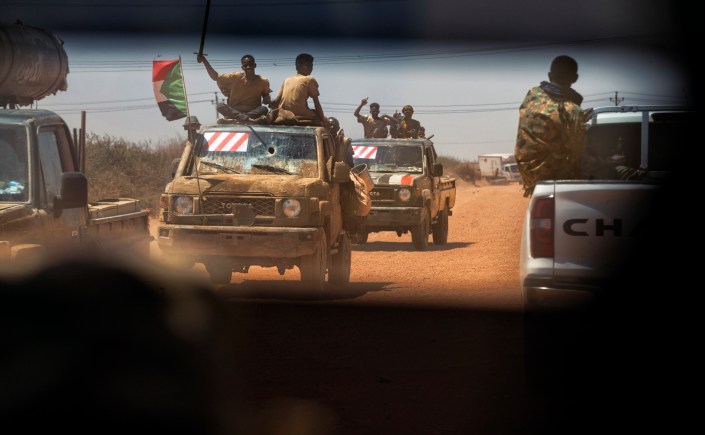
In early November last year, we published The most nihilistic war ever …Sudan’s waking nightmare, a harrowing piece about the atrocities being committed in the West Dharfur region of civil-war torn Sudan. A  friend commented on the article, accusing me of intellectual dishonesty in comparing the international outcry over Gaza to the silence on Sudan. His comment was not the first of similar justifications:

“ … with respect to the lack of outrage, the mainstream media can stir outrage on any topic when its political masters and financial backers want it to. Why has it not done so in this instance? Follow the money is one rule of thumb. I assume it suits the powers that be to let the slaughter continue. I hope more people are inspired to become activists against this dreadful situation, but public opinion tends to follow the narrative manufactured by the media more than impel it. When it comes to pro-Palestinian activism it is the story of a long hard grind of dedicated protestors to get any traction at all against the powerful political and media interests which have supported the Israeli narrative and manufactured global consent for the genocide  of Palestinians over many years. And still, although the tide is gradually turning, the West supports Israel to the hilt and crushes dissent. Using the silence in the media and in the streets over the slaughter in Sudan as an excuse to try and invalidate pro-Palestinian activism is a low blow and intellectually dishonest”.

This response is articulate and impassioned, but it also illustrates precisely the reflexive narrowing of moral vision that the comparison between Gaza and Sudan was meant to illuminate. His argument hinges on a familiar syllogism: that Western media outrage is never organic but always orchestrated (“follow the money”), that silence on Sudan therefore reflects elite indifference rather than public apathy, and that to highlight that silence is somehow to attack or “invalidate” the legitimacy of pro-Palestinian activism. It is a neat, closed circuit – morally reassuring, rhetorically watertight, but intellectually fragile.

In That Howling Infinite quizzed ChatGPT to collate, distill definitions and explanations of intellectual dishonest because we sensed its presence everywhere in the debate, including – uncomfortably – around my own thinking. Not as accusation, but as inquiry. The Gaza war has a peculiar way of forcing moral positions to harden quickly, of rewarding certainty and punishing hesitation, of turning complexity into suspicion. In that climate, asking what intellectual dishonesty actually looks like felt less like an abstract exercise than a necessary act of self-defence.

An ideological  comfort zone

Intellectual dishonesty, then, is the deliberate or unconscious use of argument, rhetoric, or selective reasoning to defend a position one knows – or should know – is incomplete, misleading, or false. It is less about lying outright and more about distorting truth for ideological comfort. It includes cherry-picking evidence, using double standards, appealing to emotion over reason, or refusing to acknowledge valid counterarguments. You could even call it “lying to oneself”, and truth be told, we are all guilty at one time or another.

Regarding the Gaza war, intellectual dishonesty is everywhere, on both sides of the divide, magnified by mainstream and social media’s hunger for moral simplicity and viral outrage. What begins as solidarity curdles into slogan; what starts as empathy ossifies into orthodoxy. And because this conflict sits at the intersection of history, identity, trauma, and power, the temptation to simplify—to choose a side and suspend thinking is especially strong.

I asked the question, then, not to sit in judgement above the fray, but to understand how easily moral seriousness can slip into moral performance, and how even good intentions can narrow rather than enlarge our field of vision.

Intellectual dishonesty is rarely the bald lie. More often it is the careful omission, the selective emphasis, the comfortable narrowing of vision that allows us to remain morally certain while thinking we are being rigorous. It is the use of argument, rhetoric, or evidence not to discover what is true, but to defend what feels right. Cherry-picking, double standards, euphemism, emotional substitution for analysis, the refusal to sit with uncomfortable counter-truth – these are not failures of intelligence so much as failures of discipline. They are the betrayal of thought in service of tribe.

Nowhere is this more visible than in the discourse surrounding Gaza. On all sides, intellectual dishonesty flourishes, amplified by mainstream and social media systems that reward moral clarity over moral accuracy, outrage over comprehension, and certainty over doubt. The war has become not merely a catastrophe but a stage upon which external protagonists perform their own identities, anxieties, and loyalties.

On the pro-Israel side, intellectual dishonesty often takes the form of moral laundering. Hamas’s atrocities – October 7, the hostages, the tunnels, the use of UN personnel and facilities – are rightly invoked, but too often as a solvent that dissolves all subsequent scrutiny. Civilian deaths become “collateral damage,” mass destruction becomes operational necessity, and a stateless, blockaded and exposed population is rhetorically elevated into a symmetrical belligerent confronting one of the most powerful militaries on earth. Euphemisms do heavy lifting: “targeted strikes,” “human shields,” “complex urban environments.” Criticism of Israeli policy is collapsed into antisemitism, not to defend Jewish safety but to foreclose moral argument. What is omitted – the occupation, the blockade, the decades of dispossession and accumulated trauma – is as important as what is said.

On the pro-Palestinian side, dishonesty manifests differently but no less pervasively. Moral outrage hardens into narrative absolutism. Hamas’s crimes are erased, justified, or absorbed into the abstraction of “muqawama”, resistance, or “sumud”, resilience, collapsing the distinction between combatant and civilian. Violence is romanticised, militants transfigured into symbols, their authoritarianism and indifference to Palestinian life quietly excised. Empathy becomes selective: Gazan children are mourned, Israeli families are passed over, or worse, subsumed into theory. History is flattened into a single moment of victimhood, stripped of Arab politics, Islamist extremism, regional failure, and internal Palestinian fracture. The powerful are cast as pure evil, the powerless as pure good, until reality itself becomes an inconvenience.

Mainstream media does not correct this; it accelerates it. Impartiality is performed while distortion is practised. Headlines flatten causality, images are severed from context, asymmetry is neutralised by “both sides” language. Social media perfects the process. Algorithms reward fury, not thought; spectacle, not inquiry. Influencers weaponise empathy itself – choosing which corpses to count, which cities to name, which pictures to publish (sometimes none to fussy about which war they portray), and which griefs to amplify. Moral clarity is produced without moral responsibility.

Beneath all this lies a deeper dishonesty, one that is existential rather than rhetorical. Each side insists its justice is indivisible, when in truth each vision of justice requires the other’s erasure. Gaza becomes less a human tragedy than a mirror onto which Western actors project their unresolved conflicts about empire, identity, guilt, and power. It is here that intellectual dishonesty ceases to be merely argumentative and becomes moral.

This is where the comparison with Sudan – and any forgotten or ignored war in this sad world – becomes instructive and also uncomfortable. When the relative silence surrounding Sudan’s catastrophe is raised, it is often dismissed as “whataboutism” or as an attempt to diminish Palestinian suffering. That response itself reveals the problem. The point is not to weigh body counts or rank atrocities, but to interrogate how empathy is distributed. Why does one horror become the world’s moral touchstone while another, no less vast or humanly devastating, barely registers?

The easy answer – “follow the money,” “manufactured outrage” – “media conspiracy” – “the Jewish Lobby” – is reassuring but incomplete. Western silence on Sudan is less conspiracy than exhaustion. Sudan offers no tidy morality play. No clean colonial narrative. No villains easily costumed for Instagram. Its war is fragmented, internecine, post-ideological: warlords, militias, foreign patrons, gold under rubble. It resists hashtags. Gaza, by contrast, offers clarity, identity, and the comforting architecture of blame. Victims and oppressors are sharply drawn; the script is familiar; moral alignment confers belonging.

In Sudan, millions starve while the gold glitters in the darkness deep beneath their feet. In Gaza, ruins are televised, moralised, and weaponised. Both are human catastrophes. Only one has an audience.

To point this out is not to invalidate solidarity with Gaza. It is to expose the limits of our moral imagination. Empathy that depends on narrative simplicity is not universalism; it is performance. Compassion that requires a script is conditional. If justice is truly the aspiration, it must be capacious enough to grieve Darfur and Khartoum alongside Gaza City, to care even when the cameras turn away.

Bringing it all back home  …

And this brings the argument uncomfortably close to home. Are we too guilty of intellectual dishonesty? To be I honest, yes – probably, at least sometimes. But then, who isn’t? The Gaza war is a moral minefield where even careful minds lose their footing. Passion bends the lens; grief distorts perspective; certainty is seductive. No one who cares deeply escapes the pull of identification.

Endeavouring to see all sides of an argument, age, experience, knowledge, empathy – and a growing impatience with historical illiteracy and intellectual laziness – inevitably shape what we see. A lifetime hatred of antisemitism runs through them as well, a moral watermark that does not fade simply because the world grows louder. These influences are not disclaimers; they are facts. Not excuses, merely coordinates. If an argument is bent  to fit a moral arc, felt more keenly for one set of victims, or wearied of slogans masquerading as history, then yes -we have been partial.

The difference lies in knowing it. Intellectual dishonesty becomes moral failure only when it is unacknowledged, when narrative becomes more important than truth, when the lens is never turned inward. What resists dishonesty is reflexivity: the willingness to ask whether one is being fair, whether one is seduced by one’s own argument, whether omission has crept in disguised as clarity.

So yes – guilty, but aware. Fallible, but striving. He who is without sin, after all, should be cautious about throwing stones, especially from within a glasshouse. Perhaps that is as close as any of us come to honesty: to keep turning the lens back on ourselves, again and again, until the view clears – or at least steadies enough to see by.

And that, is arguably not a failure of honesty but a condition of it. To articulate one’s influences is to refuse the pretence of neutrality, to acknowledge that objectivity is not the absence of bias but the discipline of recognising it. Impatience with ignorance is, at its core, a moral impatience: a refusal to see human tragedy flattened into slogans or history reduced to talking points. The danger, of course, is fatigue – after decades of watching the same horrors recur, empathy can harden into exasperation. But awareness of that tendency is itself a safeguard.

We are participants in the long conversation of conscience – who know that clarity and compassion rarely sit still in the same chair, but who insists they at least keep talking. In an age that prizes certainty above understanding, that may be the most honest posture left: to keep turning the lens back on ourselves,, resisting the comfort of tribe, and refusing to let thought become merely another form of allegiance.

Author’s  Note …

This opinion piece is one of several on the the attitudes of progressives towards the Israel, Palestine and the Gaza war. The first is Moral capture, conditional empathy and the failure of shock, a discussion on why erstwhile liberal, humanistic, progressive people from all walks of life have been caught up in what can be without subtly described as that anti-Israel machinery.Standing on the high moral ground is hard work! discusses the issues of free speech and “cancellation”, and boycotts with regard to the recent self-implosion of the Adelaide Writers’ Festival, one of the country’s oldest and most revered.

There are moments when public argument stops being a search for truth and becomes a test of belonging. Facts are no longer weighed so much as auditioned; empathy is rationed; moral language hardens into a badge system, issued and revoked according to rules everyone seems to know but few are willing to articulate. One learns quickly where the trip-wires are, which sympathies are permitted, which questions are suspect, and how easily tone can outweigh substance.

What interests me here is not the quarrel itself – names, borders, histories—but the habits of mind it exposes. The ease with which conviction can slide into choreography. The way intellectual honesty is praised in the abstract and punished in practice. The curious transformation of empathy from a human reflex into a conditional licence, granted only after the correct declarations have been made.

Across these pieces I circle the same uneasy terrain: the shaping of facts to fit feelings; the capture of moral language by ideological gravity; the performance of righteousness as both shield and weapon. Cultural spaces that once prided themselves on curiosity begin to resemble courts, where innocence and guilt are presumed in advance and the labour lies not in thinking, but in signalling.

This is not an argument against passion, nor a plea for bloodless neutrality. It is, rather, a meditation on how quickly moral seriousness curdles into moral certainty – and how much intellectual work is required to stand on what we like to call the high ground without mistaking altitude for clarity.

The position of In That Howling Infinite with regard to Palestine, israel and the Gaza war is neither declarative nor devotional; it is diagnostic. Inclined – by background, sensibility, and experience – to hold multiple truths in tension, to see, as the song has it, the whole of the moon. It is less interested in arriving at purity than in resisting moral monoculture and the consolations of certainty. That disposition does not claim wisdom; it claims only a refusal to outsource judgment or to accept unanimity as a proxy for truth.

On Zionism, it treats it not as a slogan but as a historical fact with moral weight: the assertion – hard-won, contingent, imperfect – that Jews are entitled to collective political existence on the same terms as other peoples. According to this definition, this blog is Zionist. It is not interested in laundering Israeli policy, still less in romanticising state power, but rejects the sleight of hand by which Israel’s existence is transformed from a political reality into a metaphysical crime. Zionism is not sacred, but its delegitimisation is revealing – because it demands from Jews what is demanded of no other nation: justification for being.

On anti-Zionism, it has been unsparing. It sees it not as “criticism of Israel” (which you regard as both legitimate and necessary) but as a categorical refusal to accept Jewish collective self-determination. What troubles it most is not its anger but its certainty: its moral absolutism, its indifference to history, its willingness to borrow the language of justice to license erasure. It is attentive to how anti-Zionism recycles older antisemitic patterns – collectivisation of guilt, inversion of victimhood, and the portrayal of Jews as uniquely malignant actors – while insisting, with studied innocence, that none of this concerns Jews at all. If not outright antisemitism, the line separating it from anti-Zionism is wafer—thin, and too often crosses over. 

The interest in moral capture is analytical rather than accusatory. It is not arguing that writers, academics, or institutions are malicious; rather, it are argues that they have become intellectually narrowed by the desire to belong to the “right side of history.” Moral capture explains how good intentions curdle into dogma, how solidarity becomes performative, and how the fear of social exile replaces the discipline of thought. It accounts for the strange phenomenon whereby intelligent people outsource their moral judgment to slogans, and experience constraint not as an intolerable injury to the self.

The Adelaide Writers’ Festival affairis seen not primarily about Randa Abdel-Fattah, nor even about free speech. It is a case study in institutional failure and cultural self-deception. The mass withdrawals are viewed not as acts of courage or principle but as gestures of affiliation – ritualised displays of virtue by people largely untouched by the substance of the dispute. What is disturbing is the asymmetry: the speed with which a festival collapsed to defend eliminationist rhetoric, and the silence that greeted the doxxing, intimidation, and quiet cancellation of Jewish writers and artists. Adelaide did not fall because standards were enforced, but because those standards were applied selectively and then disowned at the first sign of reputational discomfort.

Running through all of this is a consistent stance: a resistance to moral theatre, an impatience with historical amnesia, and a belief that intellectual honesty requires limits – on language, on fantasy, and on the indulgent belief that one’s own righteousness exempts one from consequence.

We are not asking culture to choose sides; you are asking it to recover judgment

.See in In That Howling Infinite, A Political World – Thoughts and Themes, and A Middle East Miscellany. and also: This Is What It Looks LikeYou want it darker?” … Gaza and the devil that never went away … , How the jihadi tail wags the leftist dog, The Shoah and America’s Shame – Ken Burns’ sorrowful masterpiece, and Little Sir Hugh – Old England’s Jewish Question

Islam’s house of many mansions

Islam, the faith of some two hundred million souls, has a long and well-documented history of pluralism and tolerance, and indeed, learning. But in recent decades, the faith has been hijacked by the punitive and literalist proclivities of the Salafis, condoned, coopted and championed by the conservative, corrupt, brutal, patriarchal and misogynistic autocracies of Saudi Arab and other Gulf States and ostensibly Islamic states like Iran. If ever there were exemplars for the “religion of peace”, and followers of a “merciful and compassionate” God, these are certainly not. To borrow another faith’s noun, theirs’ is in so many ways a gospel of bondage. [read Alastair Crooke’s excellent article on the history of Wahhabism]

[This, by the way, is a book review and not a theological critique. I neither profess nor profane, although my personal opinions might occasionally intrude. I admit to a sound but not specialist familiarity with and knowledge of Islam and Muslims, and a wide but not expert knowledge of the Middle East]

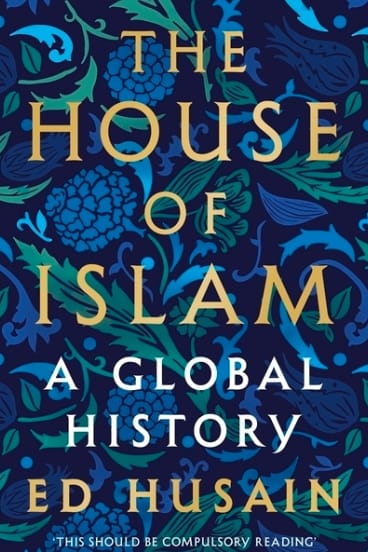
In The House of Islam – a global history  offers the potential for a softer, kinder, spiritual  Islam.  Author Ed Husain, British-born of Indian heritage, wears his Sufi heart on his sleeve.  “Preoccupied with spiritual awareness and depth, Sufi Islam transcends the performative trappings of superficial appearances such as beards and head-coverings, fixation with the simplistic binaries of haram and halal (what is forbidden and not forbidden in Islam) and the state’s imposition of sharia law.”

Little wonder that in many rooms in the House of Islam, Sufis are suspect, sanctioned and silenced – often brutally. As are many “heterogeneous” offshoots of this one true faith, including for many,  more than two hundred million Shiah.

It is the authoritarian, mediaeval Salafi-Wahhabi Arabian Peninsula theology and culture that has become commonly adopted as a marker of Muslim authenticity and has assumed the status of the ideal religious identity – notwithstanding the historical preeminence of Cairo, Damascus and Baghdad as centres of Muslim learning – and even though Arabs constitute a numerical minority in the Muslim world.

This “Arabization” and indeed, “Saudification” of Islam has colonized, distorted and, indeed, contorted and corrupted the spiritual message of Islam, and with the concurrent attractions and challenges of westernization, has, in Husain’s words, “disoriented the traditional Muslim equilibrium”, and brought forth jihadi abominations like al-Qaeda and Da’ish.

With the spread of ultra-conservative Salafi theology in many parts of the Arab and non-Arab Muslim world, Muslims are expected to dress in accordance with “modest” traditional Arabic attire and women are under pressure to wear the headscarf and other more extreme coverings – the latter never sanctioned by either Qur’an or Hadith writ. The writ runs deeper than outward appearance, as exemplified by the subordinate status of women in most Muslim societies. Moreover,  Arab and non-Arab Muslims are also expected to abandon their pre-Islamic history and culture – derided as remnants from pre-Islamic ignorance. In its most extreme manifestation, this saw the destruction of humanity’s priceless heritage at Palmyra and Nineveh. Some salafis call for the razing of Egypt’s pyramids.

Muslims in their glory days would refer to what went before as al Jahiliyya, the age of ignorance. But in so many ways, multitudes have returned there, helped in no small part by their more atavistic coreligionists who see salvation, wisdom and benefit to all in reverting to a medieval ethos and lifestyle of some golden age of faith which most scholars maintain never existed.

Islamists are intolerant of anything resembling a free exchange of ideas and information – the very concept of democracy is haram as the Prophet and his successors never thought of it – and possess a cultural antipathy, and iconoclastic rage for all things western, including, in some places,  western education (the derivation of the name ’Boko Haram’  for Nigeria’s ISIS franchise). The fundamentalist mindset in all its patriarchal intolerance, prejudice and misogyny is itself often embraced by the ignorant and the uneducated, the downcast and dispossessed, the bitter and the bigoted.

Husain points out that “not every Salafi is a jihadi, but every jihadi is a Salafi. Today’s jihadism, violating all the ethics of Islam, is nothing more than the continuation of the puritanism of the Salafi-Wahhabis“, which originated from the Saudi kingdom – guardian of Mecca and Medina, Islam’s most revered cities. There is no space for plurality and doubt in Salafi theology, rooted as it is in the discourse of yaqeen (certainty) and the propagation of an authoritarian one-dimensional piety.

This said, there are many more Muslim-majority states such as Turkey, Indonesia, Malaysia and Tunisia – countries that were conceived as secular states, and have largely remained secular or quasi-secular) , and indeed, have and made considerable democratic breakthroughs via the ballot box. Indonesia (the most populous Muslim-majority country) and Malaysia (one of the most industrialised Muslim-majority countries) are not located in the Arab Middle East. And yet, as events in Turkey and Indonesia have shown, the lure of radical Islam and its cultural and moral strictures is an attractive one to would-be authoritarians and to governments fearful of rising populist and nationalist tides.

And herein lies another portend. Just as the Muslim world has its share of religious and political extremists, so do an alarming number of Western democracies that are dominated by populists and ethno-nationalists who often do not hesitate to use religion as a blunt instrument of groupthink. I am thinking here of Russia and its Othodox Church, and of Polish Catholicism, but even ostensibly democratic USA and Israel are subject to the overweening influence of powerful evangelical and Haredim interest groups that endeavour to stamp their moral code on the more temporal majority. As radical British playwright Dennis Potter once remarked, “religion is the wound, not the bandage”.

Academic Lily Rahim notes in he review, published below, that this calls for a systematic analysis of the economic, socio-political, structural and institutional factors that have fueled the ascendancy of all forms of extremism, intolerance and exclusion, often rooted in authoritarian beliefs and systems. And that is a huge, multifaceted project, taking in the economic and social inequality that persists in countries rich and poor, the gap between the few ‘haves’ and the many ‘have-nots’, the power imbalances between the ‘North’ and the ‘South’, the pernicious rise of sectarianism and ethnocentrism, the mirage of ‘manifest destiny’, and the historical habit of the strong to bomb the weak and the poor to blazes.

Civil war and economic desperation have propelled millions of refugees across the Mediterranean and the Aegean Sea into Europe, threatening the unity and stability of the European Union. Islamic fundamentalism has filled the vacuum created by crumbling dictatorships and vanishing borders, unleashing atavistic, uncompromising and vicious Jihadis against their own people and co-religionists, and onto the streets of cities as far apart as Paris and Brussels, Istanbul and Baghdad, Jakarta and Mogadishu. In Syria particularly, but also in Iraq, Libya, Yemen, and Afghanistan, the longest war in the 21st Century, outsiders have intervened to further complicate the chaos, rendering an early end to what Rudyard Kipling called these “savage wars of peace” a forlorn hope.

“In many respects, the House of Islam is a microcosm of The House of Human History”.

Two other reviews of Ed Husain’s informative and illuminating boo follow.

For other posts regarding the Middle East in Into That Howling Infinite, see A Middle East Miscellany.  And, for a long view, read: A Brief History of the Rise and Fall of the West.

The House of Islam by Ed Husain.


The House of Islam by Ed Husain review – a powerful corrective

Boys prepare food for devout Muslims to break their day-long fast on the last Friday of the holy month of Ramadan in Mumbai, India.
         Boys prepare food for devout Muslims to break their day-long fast on the last Friday of  Ramadan in Mumbai, India ( Rajanish Kakade/AP)

Of the world’s 1.6 billion Muslims a very large number – perhaps a majority – observed the Ramadan fast last month. This doesn’t simply mean abstaining from food and water during the hours of daylight (as well as sex and cigarettes), but in many cases involves a deliberate reappraisal of one’s relation to God and the world, with more prayers and philanthropy and less shopping.

Of all the obligations that define Islam, Ramadan arouses perhaps the most irritation among some outsiders. A practice that places such a strain on the body is surely an affront to reason. Nor does it seem to make economic sense for workers to be tired and unproductive while declining to perform their allotted roles as consumers with credit ratings. And yet the west has absorbed Ramadan, if uneasily, with supermarket promotions for dates (the Prophet’s favoured breakfast), school assemblies on the subject and “What is Ramadan?” features even in the Sun.

Knowledge about Islam may have improved, but the speed with which relations are changing between Muslims and non-Muslims, and between Muslims, necessitates a constant reassessment of different worldviews and the way they interrelate. Isis’s defeat in Mesopotamia has not led to any meaningful dialogue between cultures. On the contrary, with Gaza aflame, the Iran nuclear accord uprooted and Sunni-Shia tensions at an all-time high, the prospects for detente have rarely been bleaker.

An airstrike on Islamic State militants in Sirte, Libya in 2016.
                      Airstrike on Islamic State militants in Sirte, Libya in 2016 )Manu Brabo/AP)

It’s an illustration of the insincerity of many world leaders that more than 250 French public figures, including former president Nicolas Sarkozy and three former prime ministers, recently demanded that Qur’anic verses endorsing the killing of non-Muslims be “struck down” – just as the Second Vatican Council expurgated elements of Catholic doctrine in the early 1960s. This meretricious proposal affects to assume that Islam is a centralised religion like Catholicism (it isn’t), that the Qur’an can be snipped and remain the Qur’an (it can’t), and that because they recognise the same holy book the Islam of the jihadi is the same as that of the Sufi or the Europeanised Muslim with his Qur’an on the top shelf and his bottle of burgundy on the bottom. When will someone put these contradictions of text, practice and culture into terms accessible to the layperson? Who will speak across the divides?

Enter Ed Husain. A Briton of Indian parentage, a Muslim whose bestselling book, The Islamist described his temporary embrace of the values of global jihad in the 90s, Husain retained his religious faith even after he became a government adviser on deradicalisation. Since then he has lived off the fat of the neoliberal establishment that ran the world before the age of Trump, working for Tony Blair’s Faith Foundation as well as several other well‑heeled thinktanks on both sides of the Atlantic. The anti-extremism organisation he co-founded in 2007, Quilliam, is considered by many to be hopelessly compromised by its support for government efforts to squeeze Muslims into the corset of “British” values.

Ed Husain in Brick Lane, London, May 2018.
                            Husain in Brick Lane, London, May 2018 (Andy Hall, The Observer)

Husain’s politics and the company he keeps may be questioned, but they evidently haven’t stopped him from thinking productively about Islam as a force for good in the world. An account of the compassion, reason and wonderment that Islam has exhibited for much of its history, this book is a powerful corrective to the widespread perception, fostered by jihadis and Islamophobes alike, that it’s a belief system for misanthropes.

Ever since its inception Islam’s ethos had been contested, but a disastrous turn came with rejection of the printing press and the triumph of scholasticism over independent reasoning, exacerbated by a morale-sapping struggle against European expansionism in the 19th and 20th centuries.

Husain rightly says that the root of much Muslim confusion is a sense that a glorious past has soured into defeat and humiliation, but fallen prestige is hardly the monopoly of Muslims. The West has also lost ground, particularly its white males; dealing with changes in status is a part of being human. In general, Husain is too apt to view Muslims and their dignity as qualitatively different from those of other people. His modern politics can also be sketchy. With justification he criticises Saudi Arabia for its promotion of bigotry – less understandable is his soft spot for the  Turkey of Recep Tayyip Erdogan –  less a paragon of generous Islam than thuggish majoritarianism. His insistence that Muslim nations accommodate the tiny Jewish state in their midst is common sense but a suggestion of a Middle Eastern union including Israel reads somewhat grotesquely in the light of the recent carnage in Gaza.

For all that, Husain has written a valuable book, full of suggestions for Islam’s implementation from a position of magnanimity and love. Then the confidence will return.

 The House of Islam: A Global History is published by Bloomsbury. To order a copy for £21.25 (RRP £25) go to guardianbookshop.com or call 0330 333 6846. Free UK p&p over £10, online orders only. Phone orders min p&p of £1.99.

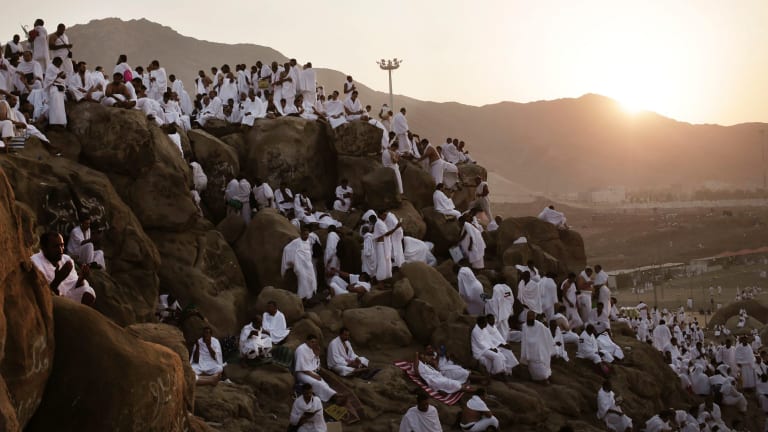
Muslim pilgrims pray on the Mountain of Mercy during The Haj. Mount Arafat, marked by a white pillar, is where Prophet Muhammad is believed to have delivered his last sermon to tens of thousands of followers some 1400 years ago, calling on Muslims to unite.
Muslim pilgrims pray on the Mountain of Mercy during The Haj. Mount Arafat, marked by a white pillar, is where Prophet Muhammad is believed to have delivered his last sermon to tens of thousands of followers some 1400 years ago, calling on Muslims to unite ( Nariman El-Mofty/AP)

In The House of Islam, Ed Husain affirms the centrality of the pluralist foundations and principles of Islam. Pluralism has also been rooted in Husain’s “lived reality”. His book opens powerfully, with Husain affirming his plural identity: “I am a Westerner and an observant Muslim. Caught between two worlds, I have learnt to dovetail the two facets of my identity. This book is a reflection of that inner bridge between Islam and the West”.

Yet, as the inflections of this superbly written book suggest, Husain’s “inner bridge” extends beyond “Islam and the West” and incorporates “the West” (Britain where he was born and raised), Islam (his faith) and India, his ancestral homeland.

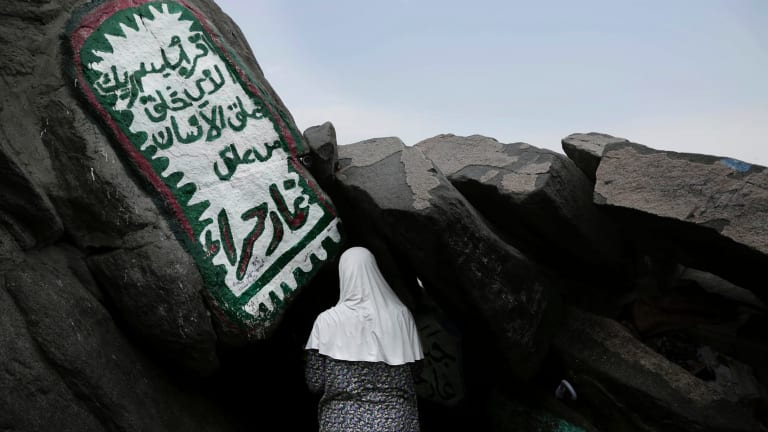
A Turkish Muslim woman prays inside Hiraa cave, where Prophet Muhammad received his first revelation from God to preach Islam, on Noor Mountain, on the outskirts of Mecca, Saudi Arabia.
A Turkish Muslim woman prays inside Hiraa cave, where Prophet Muhammad received his first revelation from God to preach Islam, on Noor Mountain, on the outskirts of Mecca, Saudi Arabia.Photo: AP

Husain’s Indian heritage comes across in his whimsical ruminations of Mughal Sufi history, in particular the riveting narrative of Jahanara Begum – the complex and colourful Sufi-inspired daughter of the Mughal emperor Shah Jahan (1592–1666), who built the Taj Mahal in memory of his beloved wife.

Hussain’s Sufi proclivities are apparent in the chapter “Who is a Sufi”, arguably one of the most engaging chapters. Husain describes the Sufi as one who “seeks only to please God, and does so in secret as often as possible”, grapples with “the heart and soul of Islam” and strives towards “maintaining equilibrium while swimming in deep oceans of spiritual awareness, and the ways in which the human ego could be crushed”.

Preoccupied with spiritual awareness and depth, Sufi Islam transcends the performative trappings of superficial appearances such as beards and head-coverings, fixation with the simplistic binaries of haram and halal (what is forbidden and not forbidden in Islam) and the state’s imposition of sharia law.

In contrast to the rigid, punitive and literalist tendencies of Salafi Islam, as promoted by the conservative monarchies in Saudi Arabia and other Gulf states and supposed Islamic states such as Iran, Sufi Islam’s leanings are inclusive, compassionate and speak to the complex yearnings of the human soul.

These leanings are evident in Rumi’s message of learning, hope and redemption, as the renowned Sufi poet ruminated: “Come. Come, whoever you are./ Wanderer, worshipper, lover of learning./ It doesn’t matter./ Ours is not a caravan of despair./ Come, even if you have broken your vows a thousand times./ Come, yet again, come, come.”

Husain’s considerable insights on the house of Islam, made up of more than 1.5 billion Muslims, have been shaped by his lived incarnations as an Islamist, Salafist and current abode in mystical Sufi Islam. His destiny within Sufi Islam culminated after many years of study under the guidance of Islamic scholars and living in the Middle East.

Enriched by these experiences, Husain notes that he has the “rare privilege of being an insider both in the West and in the Muslim World”. Yet, it could also be deduced that his acute insights have been cultivated by his status as an “outsider” in both the West and the Arab Middle East – stemming from his minority Indian ethnicity in both domains.

The House of Islam is understandably concerned with authoritarian and Salafi-Wahhabi Gulf Arab theology and culture that has become commonly adopted as a marker of Muslim authenticity. This peculiarity has assumed the status of the ideal religious identity – even though Arabs constitute a numerical minority in the Muslim world.

Husain insightfully asserts that Arabisation as well as Westernisation has “disoriented the traditional Muslim equilibrium”, as manifested by the rise of Salafi jihadi groups such as Isis and al-Qaeda.

With the spread of ultra-conservative Salafi theology in many parts of the Arab and non-Arab Muslim world, Muslims are expected to dress in accordance with “modest” traditional Arabic attire and women are under pressure to wear the headscarf and other coverings. Arab and non-Arab Muslims are also expected to jettison their pre-Islamic history and culture – derided as remnants from pre-Islamic ignorance or jahiliyya.

Husain reminds us of the paradox of the current Salafi dominance by noting that in the 1790s, Salafis were not even considered Muslims by the chief qadi (cleric) of Mecca; indeed, for several years Salafis were kept away from the holy cities and The Haj.

He highlights the theological ties between Salafi Islam and jihadi Islamists, such as Isis and al-Qaeda, by pointing out that “not every Salafi is a jihadi, but every jihadi is a Salafi…. Today’s jihadism, violating all the ethics of Islam, is nothing more than the continuation of the puritanism of the Salafi-Wahhabis”, which originated from the Saudi kingdom – guardian of Mecca and Medina, Islam’s most revered cities.

There is no space for plurality and doubt in Salafi theology, rooted as it is in the discourse of yaqeen (certainty) and the propagation of an authoritarian one-dimensional piety.

The House of Islam is a valuable read, particularly for those with some understanding of Islam and the Muslim world. Husain is a gifted writer and perceptive observer particularly of the Arab Middle East.

That said, the book makes minimal references to the more dynamic and democratising Muslim-majority states such as Indonesia, Malaysia and Tunisia – countries that were conceived as secular states (have largely remained secular or quasi-secular) and made considerable democratic breakthroughs via the ballot box. Instructively, Indonesia (the most populous Muslim-majority country) and Malaysia (one of the most industrialised Muslim-majority countries) are not located in the Arab Middle East.

Instead of pointing to Israel as a source of emulation for the Muslim world, Husain could well have highlighted these consolidating democracies. All three countries boast a vibrant civil society, coalition governments based on power-sharing and political systems based on secular constitutionalism.

Despite the penetrating insights in The House of Islam, Husain’s narrative of the myriad hurdles confronting the Palestinian struggle for self-determination, and Israel’s role in this struggle, is somewhat disappointing.

Just as the Muslim world has its share of religious and political extremists, so does Israel and an alarming number of Western democracies that are dominated by populists and ethno-nationalists. This calls for a systematic analysis of the economic, socio-political, structural and institutional factors that have fuelled the ascendency of all forms of extremism, intolerance and exclusion, often rooted in authoritarian beliefs and systems. In many respects, the House of Islam is a microcosm of The House of Human History.

https://www.smh.com.au/entertainment/books/the-house-of-islam-review-ed-husain-on-the-history-of-a-welcoming-religion-20180809-h13r0w.htm

Lily Rahim is an Associate Professor at the University of Sydney, where she teaches Political Islam and Southeast Asian Politics. Her more recent books include Muslim Secular Democracy and The Politics of Islamism. Ed Husain is a guest at the Melbourne Writers Festival (mwf.com.au).