Pity The Nation … Lebanon’s war of all against all

The Lebanese Civil War broke loose forty years ago this month. A cold war fuelled, by aggregating hostility between the Palestinian refugee community, a militarized state within a state, and their reluctant Lebanese hosts, became hot with deadly clashes between Palestinian and Maronite militias. Sects, clans, families, and the political parties and militias that gathered about them, went for their guns, the hounds of hell were loosed, and the massacres began.

In a Levantine echo of the Thirty Years War that raged through Western Europe from 1618, cities were destroyed and the countryside ravaged as armies, militias and gangsters fought over the fallen body of a divided and devastated land. Muslims fought Christians, Sunni fought Shi’a, Maronites fought Orthodox, Druze fought Muslims and Christians, Syrians fought Lebanese and Palestinians, communists fought nationalists, and Palestinians, at one time or other, fought everyone, including other Palestinians. And all changed partners and enemies in a bloody danse macabre that was at once mediaeval and mid-20th Century in its savagery.

This Hobbesian “war of all against all” drew in outsiders. Syrians, who during the course of their intervention, changed allies and adversaries as their political and strategic aims and interests mutated, and ruled the country until, implicated in the assassination of popular former prime Minister Rafik Hariri in 2005, beat an undignified retreat (whilst never quite relinquishing the levers of power). Israelis, threatened by guerrilla attacks in the Fatah land of southern Lebanon, ostensibly invaded Lebanon to destroy the Palestinian military machine, and as the midwife in the birth of the Shi’a Hezbollah, waded with eyes wide shut into a quagmire that many have viewed as their Vietnam. Americans and French, who intervened with the aim of separating the warring sides and pushing them towards a ceasefire, departed in the aftershock of Hezbollah bombs that killed hundreds of their servicemen. And United Nations Blue Berets who serve and die still in the hostile borderlands.

The war raged for the next fifteen years, staggering to an end in 1990 after claiming over 150,000 lives and destroying the lives of tens of thousands of others, including over 100,000 permanently handicapped. Nearly a million souls fled their homes, and some 76, 000 remain displaced to this day, now forgotten in the midst of the new and greater Syrian diaspora, whilst tens of thousands emigrated permanently. There are still some 17,000 “disappeared” who may be either still in Syrian or Lebanese jails, or more likely, in one of hundreds of unmarked graves scattered across this tiny country.

There are no memorials, no cenotaphs, no national commission to trace the missing, and no Madiba to gather and reconcile the sundered tribes. Just memories of what those who endured call “the events”, and for some, a selective amnesia. A harrowing half-life endures, sleeping embers constantly being fanned to life by the ill winds that blow across the porous frontier with Syria and the iron curtain that separates Hezbollah from Israel. It said that old wars beget future wars. And in no land can this be more of a self-fulfilling prophecy if the Gods Of War have their way.

As well they might as the legacy lives on in the rise and rise of Hezbollah, a non-state that is stronger than the state. In the use of car bombs, suicide bombers, foreign hostages, and human shields as canny weapons in what we now call asymmetrical urban warfare. In the destruction of the Palestinians’ once formidable military muscle, now quarantined in the Gaza ghetto and the impotent Palestinian Authority. In remembrance of the massacres of Sabra and Shatilla that still haunt Israeli and Palestinian dreams, when Yasser Arafat decamped for Libya with his army and left his people at the mercy of the Phalange militia. The Palestinians are still in Lebanon, still yearning for their terra irredenta in the south.

And in Lebanon redux, some say the old hatreds linger still and could rekindle the fires of war. Others hope that a younger generation do not take the road to perdition travelled by their elders. Armed young men in Sunni Tripoli and in Beirut’s Shi’a suburbs, and fighting in Syria may disagree. Calmer countries chart their fortunes with the rise and fall of their financial indices, whilst Lebanese can check the political weather by watching the market price of hand-guns and Kalashnikovs. They may have buried the hatchets, but many know where they are buried.

The roots and fruits of the Lebanese civil war are myriad and complex. The redoubtable journalist Robert Fisk unravels them best in his tombstone of book, Pity The Nation. Read it and weep. For it is a bloody saga of trial and treachery, of enmity and endurance, of courage and cravenness, but most of all, of infinite sadness. And none more so than when he writes of a Lebanese doctor, Amal Shamaa: “I had to take the babies and put them in buckets of water to put out the flames. When I took them out half an hour after, they were still burning. Even in the mortuary, they smouldered for hours”. “Next morning”, Fisk continues, “Amal Shamaa took the tiny corpses out of the mortuary for burial. To her horror, they again burst into flames”. Such is the effect of phosphorous shells on mortal flesh.

The title of Fisk’s book is that of a poem written in 1931 by Khalil Gibran, Lebanon’s most celebrated poet, a poem that was both a prophetic testament and a testimony of times to come: “Pity the nation divided into fragments, each fragment deeming itself a nation”.

Pity the nation that is full of beliefs and empty of religion.
Pity the nation that wears a cloth it does not weave
and eats a bread it does not harvest.

Pity the nation that acclaims the bully as hero,
and that deems the glittering conqueror bountiful.

Pity a nation that despises a passion in its dream,
yet submits in its awakening.

Pity the nation that raises not its voice
save when it walks in a funeral,
boasts not except among its ruins,
and will rebel not save when its neck is laid
between the sword and the block.

Pity the nation whose statesman is a fox,
whose philosopher is a juggler,
and whose art is the art of patching and mimicking

Pity the nation that welcomes its new ruler with trumpeting,
and farewells him with hooting,
only to welcome another with trumpeting again.

Pity the nation whose sages are dumb with years
and whose strongmen are yet in the cradle.

Pity the nation divided into fragments,
each fragment deeming itself a nation.

Kahlil Gibran, The Garden of The Prophet (1933)

ارحم على الامة
ارحم على الأمة المليئة بالمعتقدات والخالية من الدين.
ارحم على الأمة التي تلبس ثوبا لا يحاك.
وتأكل خبزا لا تحصد.
أشفق على الأمة التي تعتبر المتنمر بطلاً ،
ويعتبر منتصرها رائعا.
ارحم أمة تحتقر الشغف في أحلامها
لكنه يخضع لها عندما تستيقظ.
ارحم على الأمة التي لا ترفع صوتها
إلا عندما تمشي في جنازة ،
وتفتخر فقط بين أطلالها ،
ولن تنقذ نفسها عندما توضع رقبتها
بين السيف والكتلة.
ارحم على الأمة التي فيها رجل الدولة وهو ثعلب ،
والفيلسوف مشعوذ
فنه من الترقيع والتقليد
ارحم على الأمة التي تستقبل حاكمها الجديد بصوت عالٍ ،
ويقول وداعا له بسخرية ،
فقط للترحيب بآخر من خلال الاحتفال الصاخب مرة أخرى
ارحم على أمة حكماؤها أغبياء السنين ،
وأولئك الذين لا يزال رجالهم الأقوياء في المهد.
ارحموا الأمة منقسمة ،
وكل قطعة تعتبر نفسها أمة.

خليل جبران

Muslim gunmen clash with right-wing Phalange militiamen outside the Phoenicia Intercontinental hotel in Beirut, December, 1975.

© Paul Hemphill 2015. All rights reserved.

http://dailystar.com.lb/News/Lebanon-News/2014/Apr-12/253085-decades-on-lebanon-still-struggles-to-heal-war-wounds.ashx
http://en.m.wikipedia.org/wiki/Pity_the_Nation

The Watchers Of The Water

A song about Gallipoli, sung by a Turkish soldier

Once upon a war…

Monday 25th April is Australia and New Zealand’s national day of remembrance for all Anzac solders killed and wounded in their nation’s wars, and to honour servicemen and women past and present. At first, the Anzacs fought in the British Empire’s Wars, beginning with the Boer War, and then through two World Wars. From the mid -twentieth century, they have fought and died in what could ostensibly be called America’s wars even though these were waged under UN, EU or western alliance auspices: Korea, Gulf Wars II and III, Afghanistan, and the current interventions in Syria and Iraq. Incidentally, Australian veterans commanded mercenary forces hired by Saudi Arabia and the United Arab Emirates that laid waste to towns and villages in Yemen during its recent civil way – with the help of American and British weaponry.

At the heart of the Anzac Day remembrance is the Australian and New Zealand Army Corps’ role the Dardanelles campaign of 1915-16, Winston Churchill’s grandiose and ill-conceived plan to take the Ottoman Empire out of the war by seizing the strategic strait between the Black Sea and the Mediterranean, thereby threatening Istanbul, the Ottoman capital. It was a military failure. From the initial seaborne assault to the evacuation, it lasted eight months and cost 114,000 lives with 230,000 wounded.

In 1915, Australians greeted the landings at Gallipoli with unbridled enthusiasm as a nation-making event. But it wasn’t long before they were counting the dreadful cost. More than 8000 Australians died during the Gallipoli campaign. As a loyal member of the British Empire, Australia eventually sent 330,000 men overseas to fight for the King. Volunteers all, not all of them white men – despite the authorities policy of recruiting only Australians of Anglo-Celtic stock, their ranks included many indigenous, Chinese and others. By the time the war ended in 1918, 60,000 of them were dead. As the late historian Ken Inglis once pointed out: “If we count as family a person’s parents, children, siblings, aunts and uncles and cousins, then every second Australian family was bereaved by the war.

[As for the Anzac Day march], I’d say only returned people could march. And then the day would come, I’d hope, when there’d be the last person marching, the last survivor as it were. And I’d think what a great day that would be … because it would mean we’d been at peace for a long time. And that’s what those men in the First World War were fighting for.”
Bill Gammage, historian and author of The Broken Years.

Gallipoli is cited as the crucible of Australian nationhood, but the Anzacs’ part in the doomed campaign was but a sideshow of the wider campaign. Although it is celebrated in Australian song and story, it was the Ottomans’ most significant victory in the war that was to destroy the seven hundred year old Ottoman Empire secure the reputation of its most successful general Mustafa Kemal, who as Ataturk, became the founder of modern Turkey.

Some thirty four thousand British soldiers died on the peninsula, including 3,400 Irishmen, and ten thousand Frenchmen – many of these latter being “colonial” troops from West and North Africa. Australia lost near on ten thousand and NZ three. Some 1,400 Indian soldiers perished for the King Emperor. Fifty seven thousand allied soldiers died, and seventy five thousand were wounded. The Ottoman army lost fifty seven thousand men, and one hundred and seven thousand were wounded (although these figures are probably much higher). An overlooked fact is that some two thirds of the “Turkish” solders in Kemal’s division were actually Arabs from present day Syria, Israel and Palestine – and  a small number of European Jews who had settled there and who as Ottoman citizens were subject to conscription.

Gallipoli was indeed a multicultural microcosm of a world at war.

Whilst the flower of antipodean youth is said to have perished on Gallipoli’s fatal shore, this was just the overture. Anzac troops were despatched to the Western Front, and between 1919 and 1918, 45,000 Aussies died there and 124,000 were wounded.

Once upon a war, the Dardanelles Campaign of 1915-16 was a sideshow to the bigger theatres of the Eastern and Western Fronts. To some, it was a reminder that they could not stomach Winston Churchill for this was said to be his greatest stuff up in a career replete with such (although they would admit that he more than exonerated himself his and Britain’s Finest Hour). For many Australians and New Zealanders, it was a national baptism of fire, of youthful sacrifice on the altar of Empire. And notwithstanding the  military defeat and retreat, the folly and foolhardiness, in the harrowing adversity and heroism, lay the bones of a young country’s enduring creation myth.
Former soldier James Brown, Anzac’s  Long Shadow

There are abundant primary and secondary sources relating to the Dardanelles campaign and the Anzacs, but here is a wiki primer: Gallipoli Campaign

The genesis of a song …

Back in the last century, before ANZAC Day became the secular Christmas that it has become, before marketing people and populist politicians saw its commercial and political potential, before the fatal shore became a crowded place of annual pilgrimage, my Turkish friend, the late Naim Mehmet Turfan, gave me a grainy picture of a Turkish soldier at Gelibolu carrying a large howitzer shell on his back. Then there was this great film by Australian director Peter Weir, starring young Mel Gibson and Mark Lee. There were these images of small boats approaching a dark and alien shore, of Lighthorsemen sadly farewelling their Walers as they embarked as infantry, and of the doomed Colonel Barton humming along to a gramophone recording of Bizet’s beautiful duet from The Pearl Fishers, ‘Au fond du temple saint’ before joining his men in the forlorn hope of The Nek.

There were other melodies I could never quite get out of my head. One I first heard in a musical in Beirut before that magical city entered its Dark Ages  –  Al Mahatta, written by the famous Rabbani Brothers and starring the Lebanese diva Fayrouz. And The Foggy Dew, one of the most lyrical and poignant of the Irish rebel songs:

Right proudly high over Dublin town, they hung out the flag of war. ‘Twas better to die ‘neath that Irish sky than at Suvla or at Sud el Bar…Twas England bade our Wild Geese go that small nations might be free,  But their lonely graves are by Suvla’s waves or the fringe of the grey North Sea.

Over three thousand Irishmen died at Gallipoli.

The song grew out of these many inspirations.

It was first performed in public by HuldreFolk in the closing concert of Coffs Harbour Folk Festival at the RSL on Australia Day 1984. When we had finished, there was absolutely silence in the hall. Then a voice cried out “the sky didn’t fall down!”, and the hall erupted with applause.

And here is HukdreFolk’s rendering of Russian poet Yevtushenko’s account of the parade of German prisoners of war through the streets of Moscow in 1941, juxtaposed with The Watchers of the Water.

Anthem for Doomed Youth
Wilfred Owen

What passing-bells for these who die as cattle?
Only the monstrous anger of the guns.
Only the stuttering rifles’ rapid rattle
Can patter out their hasty orisons.
No mockeries now for them; no prayers nor bells;
Nor any voice of mourning save the choirs,—
The shrill, demented choirs of wailing shells;
And bugles calling for them from sad shires.

What candles may be held to speed them all?
Not in the hands of boys, but in their eyes
Shall shine the holy glimmers of goodbyes.
The pallor of girls’ brows shall be their pall;
Their flowers the tenderness of patient minds,
And each slow dusk a drawing-down of blinds.


Messianic Carpet Rides

When it comes to stories about The Middle East, I am reminded of the Bobster’s closing lines in the wonderful ‘Black Diamond Bay’: “Seems like every time you turn around, there’s another hard-luck story that you’re gonna hear”. Anyhow, getting away from all the doom and gloom, here is something completely different.

Our recent visit to Jerusalem inspired several posts on this blog, and several songs. One of the latter, published below, examines the Jerusalem Syndrome.

This is a group of mental phenomena involving the presence of either religiously themed obsessive ideas, delusions or other psychosis-like experiences that are triggered by a visit to the city of Jerusalem. It is not exclusive to one particular religion or denomination, having affected Jews, Christians and Muslims from many different countries and backgrounds.

Jerusalem is all about faith and passion, and there is no city on Earth that people get more passionate about. The light is luminous. In high summer it almost shimmers. The very air is full of prayer and politics, passion and pain, and the rocks and stones virtually sing a hallelujah chorus of history. I am not a religious person, but I cannot help getting excited by the place – although I do not transcend to transports of delight and delirium.

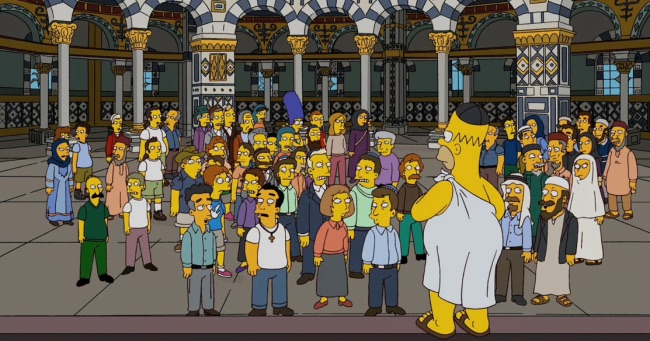
In The Simpsons episode The Greatest Story Ever D’ohed, the Simpsons travel to Israel where Homer is afflicted with the syndrome, the illness and its effect on Homer being one of the plot’s central themes. In The X-Files episode Revelations, agents Scully and Mulder try to subdue a man afflicted with a form of the syndrome.

Homer in the Mosque

The featured photograph at the head of this blog is a real-life version of the above Simpsons picture.  The man at centre stage is Carl James Joseph of Detroit, Michigan, ‘The Jesus Guy’ we encountered in the Church Of The Holy Sepulchre. He has been a common sight around the Old City for many years now.j

Of all the cities in the world, why Jerusalem?

“ The Arabs call the city ‘Al Quds’, “The Holy’. It was deemed sacred from pre-history. Those aforementioned iconoclast scholars suggest that Jerusalem was actually the holiest place in Islam, and that like Islam itself and the Prophet, Mecca and Medina were retrofitted to suit the conqueror’s narrative. A city of the mind as much as of this earth, it haunts the prayers and dreams of three faiths, and to this this day, it is coveted and contested. “The air above Jerusalem”, wrote Israeli poet Yehuda Amichai, “is filled with prayers and dreams, like the air above cities with heavy industry. Hard to breathe”. Arthur Koestler wrote: “The angry face of Yahweh is brooding over the hot rocks which have seen more holy murder, rape and plunder than any other place on earth”. Perhaps it is because Jerusalem is mankind’s number one hot spot! “There’s this thing that happens here, over the hell mouth”, says Buffy, “where the way a thing feels – it kind of starts being that way for real. I’ve seen all these things before – just not all at once”. More Jews have probably died violently in Jerusalem than in the Holocaust. And countless folk of other faiths have likewise perished”.  From A Brief History Of The Rise And Fall Of The West by Paul Hemphill

A lot of folk put a lot of energy into mattters millenarian, when they could divert it to more practical matters like health, water, human rights, blah, blah blah… Some diligent souls have constructed a 3D virtual second temple as a template for its reconstruction. And they don’t care if they start a world war to get it built. Others strive to create a Caliphate that will precipitate the long foretold great battle at The End of Days. And yet others are endeavoring to recreate Noah’s Ark in Kentucky, USA. Different tribe, same psychosis. Never underestimate the irrational mind. For such is the power of myth and magic even in this techno day and age. More blood has been shed in and for Jerusalem than any other city on earth, and we ain’t done yet!

The Jesus Guy

O Jerusalem!

Sound the trumpets of Zion to summon forth the saints.
From The Song of Solomon

O Jerusalem!
I never thought that faith could be so strong!
Ah, Jerusalem!
I never knew that faith could be such fun!

It’s something you don’t do at home.
It happens in Paris and Rome.
The fevered faithful’s illusion
That causes such holy confusion.
Scully and Mulder have fought it,
Homer Simpson has caught it
In Jerusalem.

Bear me up on angels wings
And other transcendental things.
Cradle me in Jesus’ arms,
Far from home but safe from harm.
Where the Golden Walls still glow,
Let my people go
To Jerusalem.
Never knew that faith could be so strong!
O Jerusalem,
Never knew that faith could be such fun!

Filipinas in a row harmonizing with “Swing Low
Sweet Chariot”.
Charismatic holy clown roams the alleys of the town,
Says he’s hunting down Iscariot.
Pentecostal Germans heard
Their pastor preach the Holy Word.
Drab babushkas clutch their crosses,
Eastern priest in black now blesses
Those who lie with arms out swept
On the rock where Jesus wept,
In Jerusalem.
Never knew that faith could be so strong!
O Jerusalem,
I want whatever they are on!

See that women dressed so plain, thinks she’s
Mary Magdelene
Waiting just beyond the Tomb for her Lord
To come again.
Is he not already here? Don’t you see him
Over there?
In his robe of woven wool, sandals, beard,
And flowing hair.
There’s lady known to me
Who would make a cup of tea
And take it to Mount Scopus every morning
To give to Christ when he returned in glory –
I tell you, I’m not making up this story!
Its Jerusalem!
I never knew that faith could be such fun!
O Jerusalem!
I want whatever they are on!

Sometimes in morning dreams, I see
The Holy City in front of me:
Forever and ever, and world without end,
We all need an invisible friend
In Jerusalem.

© Paul Hemphill 2014 All rights reserved

Mary Magdelene

Need to know more about the Jerusalem Syndrome?  Read: http://en.m.wikipedia.org/wiki/Jerusalem_syndrome

But the article reproduced below by Chris Nashawaty is much more entertaining.

See also the following article about ‘The Jesus Guy’:

http://www.dailymail.co.uk/news/article-2525844/The-Jesus-guy-Bearded-man-familiar-sight-Jerusalem-wearing-robe-carrying-cross-revealed-Detroit-preacher.html

And this recent piece in Ha’Aretz:

http://www.haaretz.com/israel-news/.premium-1.708900

Jerusalem Syndrome? Tourist Goes Treasure Hunting in Old City Cave

Nir Hasson Ha’Aretz Mar 15, 2016

image

Zedekiah’s Cave is a remnant of what was the largest quarry in Jerusalem that dates back to at least Second Temple times. Daniel Bar-On

An American tourist was arrested last week after spending the night in Zedekiah’s Cave, also known as Solomon’s Quarries, which lies under the Muslim Quarter of Jerusalem’s Old City.

Last Thursday afternoon, when the site was open to the public, the 19-year-old entered the cave carrying a backpack. When closing time came, he hid in one of the crevices of the cave and the security people did not notice him as they checked the site before closing. He was there overnight and started digging in various sections of the cave, apparently seeking to find some of the treasures that various legends say have been buried there over the centuries.

While the cave is usually closed on Fridays, last Friday it was opened to do some development work. The workers found the tourist in the cave covered with mud, his backpack full of stones and shards that he’d dug up from the floor of the cave. He was handed over to police and his findings were confiscated.

During questioning the young man could not explain his motives for what he did. Police said he apparently has emotional problems and may have contracted the so-called Jerusalem Syndrome, a phenomenon involving religious obsessions or other psychosis-like experiences seemingly triggered in some people by visiting Jerusalem. He was released and has since left the country.

Zedekiah’s Cave is a remnant of what was the largest quarry in Jerusalem that dates back to at least Second Temple times. It covers some nine dunams (two and a quarter acres), with an entrance between the Old City’s Damascus Gate and Herod’s Gate. Over the years a number of legends and traditions have sprung up involving the cave. The Jewish tradition is that King Zedekiah tried to flee through the cave during the destruction of the First Temple.

A later Muslim tradition identifies the cave as “the cave of Korah,” the place where the biblical Korah and his allies were swallowed up by the earth when they tried to revolt against Moses.

In 1968 a resident of the Old City claimed that his grandfather had hidden three crates of gold coins in the cave before the War of Independence. He asked permission to search for the crates using signs his grandfather had left him and promised in return to give three-quarters of the treasure to the authorities. He was given permission to search but found nothing.

The cave also serves as a ceremonial site for the Freemasons from the 1920s to this day. The Freemasons revere the place, believing it to have been the site from which the stones for the First Temple were quarried. Since the 1980s the cave is operated by the East Jerusalem Development Corporation as a tourist site, and events are held there from time to time.

The Jerusalem Syndrome: Why Some Religious Tourists Believe They Are the Messiah
Chris Nashawaty, Wired, 17th February 2012

Shortly after his 40th birthday, the life of a man we’ll call Ronald Hodge took a strange turn. He still looked pretty good for his age. He had a well-paying job and a devoted wife. Or so he thought. Then, one morning, Hodge’s wife told him she no longer loved him. She moved out the next day. A few weeks later, he was informed that his company was downsizing and that he would be let go. Not knowing where to turn, Hodge started going to church again.

Even though he’d been raised in an evangelical household, it had been years since Hodge had thought much about God. But now that everything seemed to be falling apart around him, he began attending services every week. Then every day. One night, while lying in bed, he opened the Bible and began reading. He’d been doing this every night since his wife left. And every time he did, he would see the same word staring back at him—the same four syllables that seemed to jump off the page as if they were printed in buzzing neon: Jerusalem. Hodge wasn’t a superstitious man, he didn’t believe in signs, but the frequency of it certainly felt like … something. A week later, he was 30,000 feet over the Atlantic on an El Al jet to Israel.

When Hodge arrived in Jerusalem, he told the taxi driver to drop him off at the entrance to the Old City. He walked through the ancient, labyrinthine streets until he found a cheap hostel near the Church of the Holy Sepulchre. He had a feeling that this was important. Supposedly built on top of the spot where Jesus Christ was crucified and three days later rose from the dead, the domed cathedral is the holiest site in Christendom. And Hodge knew that whatever called him to the Holy Land was emanating from there.

During his first few days in Jerusalem, Hodge rose early and headed straight to the church to pray. He got so lost in meditation that morning would slip into afternoon, afternoon into evening, until one of the bearded priests tapped him on the shoulder and told him it was time to go home. When he returned to his hostel, he would lie in bed unable to sleep. Thoughts raced through his head. Holy thoughts. That’s when Hodge first heard the Voice.

Actually, heard is the wrong word. He felt it, resonating in his chest. It was like his body had become a giant tuning fork or a dowsing rod. Taking a cue from the sign of the cross that Catholics make when they pray, Hodge decided that if the vibrations came from the right side of his chest, it was the Holy Ghost communicating with him. If he felt them farther down, near the base of his sternum, it was the voice of Jesus. And if he felt the voice humming inside his head, it was the Holy Father, God himself, calling.

Soon, the vibrations turned into words, commanding him to fast for 40 days and 40 nights. None of this scared him. If anything, he felt a warm, soothing peace wash over him because he was finally being guided.

Not eating or drinking came easily at first. But after a week or so, the other backpackers at his hostel began to grow concerned. With good reason: Hodge’s clothes were dirty and falling off of him. He had begun to emit a pungent, off-putting funk. He was acting erratically, hallucinating and singing the word Jesus over and over in a high-pitched chirp.

“Jesus … Jesus … Jesus …”

Hodge camped out in the hostel’s lobby and began introducing himself to one and all as the Messiah. Eventually, the manager of the hostel couldn’t take it anymore. He didn’t think the American calling himself Jesus was dangerous, but the guy was scaring away customers. Plus, he’d seen this kind of thing before. And he knew there was a man who could help.

Herzog Hospital sits on a steep, sun-baked hill on the outskirts of Jerusalem. Its sprawling grounds are dotted with tall cedars and aromatic olive trees. Five floors below the main level is the office of Pesach Lichtenberg, head of the men’s division of psychiatry at Herzog.

Lichtenberg is 52 years old and thin, with glasses and a neatly trimmed beard. Born into an Orthodox Jewish family in Crown Heights, Brooklyn, he moved to Israel in 1986 after graduating from Albert Einstein College of Medicine in the Bronx and has worked at Herzog more or less ever since. It’s here that he has become one of the world’s leading experts on the peculiar form of madness that struck Ronald Hodge—a psychiatric phenomenon known as Jerusalem syndrome.

On a bright, late summer morning, Lichtenberg greets me in the chaotic lobby of the hospital, smiling and extending his hand. “You missed it!” he says. “We had a new Chosen One brought into the ward this morning.” We go down to Lichtenberg’s office; on top of a bookcase is a giant shofar, a curved ram’s horn that religious Jews sound on the high holidays. A middle-aged British man under the doctor’s care had used it to trumpet the Messiah’s—that is to say, his own—coming. Lichtenberg explains that allowing me to meet his latest patient would violate hospital policy, and he can’t discuss ongoing cases. He’ll talk about past patients as long as I agree to de-identify them, as I did with Hodge. “But,” he adds, “that doesn’t mean we can’t try to find a messiah of our own. In a few days, we’ll take a walk around the Old City and maybe we’ll find one for you there.”

There’s a joke in psychiatry: If you talk to God, it’s called praying; if God talks to you, you’re nuts. In Jerusalem, God seems to be particularly chatty around Easter, Passover, and Christmas—the peak seasons for the syndrome. It affects an estimated 50 to 100 tourists each year, the overwhelming majority of whom are evangelical Christians. Some of these cases simply involve tourists becoming momentarily overwhelmed by the religious history of the Holy City, finding themselves discombobulated after an afternoon at the Wailing Wall or experiencing a tsunami of obsessive thoughts after walking the Stations of the Cross. But more severe cases can lead otherwise normal housewives from Dallas or healthy tool-and-die manufacturers from Toledo to hear the voices of angels or fashion the bedsheets of their hotel rooms into makeshift togas and disappear into the Old City babbling prophecy.

Lichtenberg estimates that, in two decades at Herzog, the number of false prophets and self-appointed redeemers he has treated is in the low three figures. In other words, if and when the true Messiah does return (or show up for the first time, depending on what you believe), Lichtenberg is in an ideal spot to be the guy who greets Him.

“Jerusalem is an insane place,” one anthropologist says. “It overwhelms people.”

While it’s tempting to blame the syndrome on Israel’s holiest city, that wouldn’t be fair. At least, not completely. “It’s just the trigger,” says Yoram Bilu, an Israeli psychological anthropologist at the University of Chicago Divinity School. “The majority of people who suffer from Jerusalem syndrome have some psychiatric history before they get here.” The syndrome doesn’t show up in the Diagnostic and Statistical Manual of Mental Disorders, but it and its kissing cousins are well-known to clinicians. For example, there’s Stendhal syndrome, in which visitors to Florence are overwhelmed by powerful works of art. First described in the early 19th century in Stendhal’s Naples and Florence: A Journey from Milan to Reggio, the disorder can lead to spontaneous fainting, confusion, and hallucinations. Paris syndrome, first described in 1986, is characterized by acute delusions in visitors to the City of Light and for some reason seems to preferentially affect Japanese tourists. Place, it seems, can have a profound effect on the mind.

What’s actually happening in the brain, though, isn’t completely clear. Faith isn’t easy to categorize or study. Andrew Newberg, a neuroscientist at Thomas Jefferson University in Philadelphia, has conducted several brain-imaging studies of people in moments of extreme devotion. The limbic system, the center for our emotions, begins to show much higher activity, while the frontal lobes, which might ordinarily calm people, start to shut down. “In extreme cases, that can lead to hallucinations, where someone might believe they’re seeing the face of God or hearing voices,” Newberg says. “Your frontal lobe isn’t there to say, ‘Hey, this doesn’t sound like a good idea.’ And the person winds up engaging in behaviors that are not their norm.”

SHE WOULD RUB HER TEMPLES, DESPERATE TO DIAL IN THE VOICE OF GOD LIKE SOMEONE TRYING TO TUNE IN A FAR-OFF RADIO STATION.
The psychosis typical of Jerusalem syndrome develops gradually. At first the victim may begin to feel symptoms of anxiety, nervousness, and insomnia. The next day, there may be a compulsive urge to break away from the rest of the tour group and visit holy places like the Church of the Holy Sepulchre or the Church of the Nativity in Bethlehem. Sufferers might follow this with a series of purification rituals such as shaving all of their body hair, clipping their nails, or washing themselves free of earthly impurities. The afflicted may then venture into the Old City to shout confused sermons claiming that redemption is at hand. In some cases, victims believe they are merely a cog in an ineffable process, helping to set the stage for the Messiah’s return with some small task they’ve been given. In more extreme cases, they can be swept up by psychotic delusions so intense, so ornate, that they become convinced they are Jesus Christ. “Jerusalem is an insane place in some ways. It overwhelms people, and it has for centuries,” Bilu says. “The city is seductive, and people who are highly suggestible can succumb to this seduction. I’m always envious of people who live in San Diego, where history barely exists.”

In other words, what you can blame Jerusalem for is looking like, well, Jerusalem. The Old City is a mosaic of sacred spaces, from the al-Aqsa Mosque to the Western Wall of the Temple Mount to the well-trodden stones on which Jesus supposedly walked. Like every city, it’s the combination of architecture and storytelling that makes Jerusalem more than just a crossroads. Great cities, the places that feel significant and important when you walk their streets, always rely on stagecraft—a deftly curving road, finely wrought facades, or a high concentration of light-up signage can all impart a sense of place, of significance. This architectural trickery can even instill a feeling of the sacred. The colonnades around St. Peter’s Square at the Vatican, the rock garden at Ryoanji temple in Kyoto, and the pillars at the Jamarat Bridge near Mecca all shoot laser beams of transcendence into the brain of a properly primed visitor. “Part of the experience of going to these places is the interweaving of past and present,” says Karla Britton, an architectural historian at the Yale School of Architecture. “There’s a collapse of time. And for some people who visit these sacred sights and spaces, this collapse can be psychologically disorienting. The whole act of pilgrimage is deliberately intended as a kind of disorientation.”

That in and of itself doesn’t make someone crazy. “There are a lot of people who come to Israel and feel God’s presence, and there’s nothing wrong with that,” Lichtenberg says. “That’s called, at the very least, a good vacation. God forbid a psychiatrist sticks his nose into something like that.” He smiles and rubs his beard. “But the question is, at what point is belief OK and at what point is it not OK? If someone says, ‘I believe in God,’ OK. And if they say, ‘I believe the Messiah will come,’ fine. And if they say, ‘I believe His coming is imminent,’ you think, well, that’s a man of real faith. But if they then say, ‘And I know who it is! I can name names!’ you go, wait a second—hold on!”

When people with Jerusalem syndrome show up at the hospital, doctors often just let them unspool their stories, however strange the narratives may seem. If the people aren’t dangerous, they are usually discharged. Violent patients might be medicated and kept under observation pending contact with their family or consulate. After all, the most effective treatment when it comes to Jerusalem syndrome is often pretty simple: Get the person the hell out of Jerusalem. “The syndrome is a brief but intense break with reality that is place-related,” Bilu says. “When the person leaves Jerusalem, the symptoms subside.”

Lichtenberg didn’t know any of this when he started at Herzog. Then, shortly after he began his residency in the late 1980s, he met a 35-year-old Christian woman from Germany. She was single and traveling alone in Israel. He remembers her as being gaunt, prematurely gray, and highly educated. The police had picked her up in the Old City for badgering tourists about the Lord’s return. “She arrived in a state of bliss because she believed the Messiah was coming,” Lichtenberg says. “I probably thought, she’s just meshuggeneh.”

Over the next few days, Lichtenberg underwent a transformation of his own. He became obsessed with the German woman’s case. He thought about how she would ricochet from periods of giddy rapture to moments of outright hostility and confusion. During her more manic moments, she wanted to share the Good News with the doctor. In her more depressive ones, she wandered the psychiatric ward desperately trying to hear the voices in her head that had gone momentarily silent. She would rub her temples as if she could dial in the voice of God, like someone trying to tune in a far-off radio station.

The woman stayed at the hospital for a month, until the doctor could arrange for her to be sent home. Lichtenberg has no idea what happened to her after she returned to Germany, but more than 20 years later he can still recall the smallest details of her case. “It was so interesting talking to her, but I was also a little embarrassed because there was no one at the hospital to encourage that sort of thing back then. At the time, the thinking here was more like, OK, what dosage is she getting? Should we increase it?”

This way of thinking is more sympathetic than many psychiatrists would call for. Actually, it wasn’t that long ago that one respected Israeli physician put two patients who both claimed to be the Messiah in a room together just to see what would happen. Each rabidly accused the other of being an impostor, barking fire-and-brimstone threats.

“People come to Israel and feel God’s presence,” Pesach Lichtenberg says. “There’s nothing wrong with that.”

Self-styled prophets have been journeying to Jerusalem on messianic vision quests for centuries. A certain Nazarene carpenter was merely the most charismatic and most written about. But it wasn’t until the 1930s that an Israeli psychiatrist named Heinz Herman clinically described Jerusalem syndrome for the first time. One of his early cases involved an Englishwoman who was so convinced the Second Coming was at hand that she climbed to the top of Jerusalem’s Mt. Scopus every morning with a cup of tea to welcome the Lord.

Most cases are harmless, but there have been disturbing exceptions. In 1969 an Australian tourist named Denis Michael Rohan was so overwhelmed by what he believed to be his God-given mission that he set fire to the al-Aqsa Mosque, one of Islam’s most sacred sites, which sits atop the Temple Mount directly above the Wailing Wall. The blaze led to rioting throughout the city. Rohan later said that he had to clear the site of “abominations” so it would be cleansed for the Second Coming. (The mosque was rebuilt by a Saudi construction company owned by Osama bin Laden’s father.)

More recently, an American man became so convinced he was Samson that he tried—and failed—to move a block of the Wailing Wall. An American woman came to believe she was the Virgin Mary and went to nearby Bethlehem to search for her baby, Jesus. And a few years ago, the Israeli press reported on a 38-year-old American tourist who, after spending 10 days in Israel, began roaming the surrounding hills muttering about Jesus. Shortly after being hospitalized, he jumped off a 13-foot-high walkway near the emergency room, breaking several ribs and puncturing his lung.

Lichtenberg says that during times of uncertainty and conflict (not infrequent in Israel), admissions to his ward spike. For example, in late 1999, when the rest of the world quaintly panicked about the Y2K bug and whether they’d be able to use their ATMs on January 1, Israel was on high alert, afraid that deranged religious crazies would flock to Jerusalem in anticipation of a millennial apocalypse. At the peak, five patients a week were brought into Lichtenberg’s ward. The country’s defense forces were concerned that someone would try to blow up the al-Aqsa Mosque, finishing the job Rohan started 30 years earlier.

One of the patients brought into Herzog at the time was an old man who sold novelty wooden back-scratchers near Lichtenberg’s home. The doctor knew him. He also knew that the man firmly believed he was King David. “Was he psychotic? Yeah, OK,” the doctor says with a shrug. “But I didn’t see any need to keep him. Unfortunately, he passed away recently. Otherwise, I would have loved for you to meet him. He would have been happy to talk to you.”

At 9 the next morning, the doctor and I are walking the narrow streets of the Old City. It seems like a good way to conduct an interview, outside the sterile confines of the hospital. Plus, we are still hoping to meet a messiah.

The scents of cumin and turmeric and cardamom are so overwhelming that my eyes begin to water. And even though the doctor has lived in Jerusalem for 25 years, his sense of direction in the winding alleys of the Muslim Quarter seems sketchy at best. After several embarrassing wrong turns and switchbacks, we find ourselves standing face-to-face with an Arab butcher skinning a goat that hangs on a giant rusty hook. We detour left down a dark passageway and nearly crash into a dozen elderly Italian women dressed in the black clothes of mourning, carrying a 6-foot wooden cross on their hunched backs. They’re huddled together like a rugby scrum, chanting in Latin as they take plodding steps along the Stations of the Cross, reenacting Jesus’ bloody march to his crucifixion.

We move aside to let them slowly pass. Neither one of us says a word. And as soon as they turn the corner and disappear from view, he turns to me. “I’ve got chills. Do you?”

I have to admit I do.

The doctor asks me to try to describe what I’m feeling as if I am one of his patients, and I stammer a response about going to Sunday School as a kid and the thick smell of incense I remember at Easter Mass at my father’s Syrian Orthodox church. But, really, as soon as I try to put the sentiment into words, the chills subside and trickle away.

This is essentially what happened to the patient I’ve called Ronald Hodge. After a month of taking antipsychotic drugs under Lichtenberg’s care at Herzog, he gradually came to accept the hazy reality of what he’d been through. He was still confused, but he was calmer, more cooperative, and he no longer felt voices thrumming through his body. The American consulate arranged for his discharge and put him on a flight back to the States. He went back to his old life.

Lichtenberg and I come to the Church of the Holy Sepulchre. Inside the entrance is the Stone of Unction, symbolizing the spot where Jesus’ body was anointed and wrapped in a shroud after he was taken down from the cross. Men are kneeling with lit candles. Women are kissing the stone and running their rosaries along the top of it. Many are crying. It’s profoundly moving.

We head east toward the Wailing Wall. There, rows of men dressed in black and wearing sidecurls are rocking back and forth as they pray. Lichtenberg grows quiet and slowly approaches the wall, rubbing his hand on one of the giant stones. He leans forward and softly kisses it. After a few minutes, he looks around and says, “No messiahs here today. Sorry.” He seems honestly apologetic.

Later, over a cold drink, Lichtenberg confesses that he sometimes views his patients with less-than-scientific eyes. “I guess when someone comes into the hospital claiming to be the Messiah, my interest is not just clinical,” he says. “Sometimes you can see right away that the patient isn’t the charismatic type. They’re just a sick patient. But, OK, yes, I’ll admit it. There have been a number of people over the years who managed to arouse a certain hope that, hey, wouldn’t it be great if this person really is the One? So far I’ve been disappointed. But you never know who will walk through that door tomorrow.” His cell phone buzzes on the table. He’s needed back at Herzog.

As Lichtenberg walks off toward the hospital, the drone of the muezzin’s call to prayer crackles and hisses over a loudspeaker. The hairs on the back of my neck stand up. Is this the strange power of Jerusalem? Or just the result of an overactive limbic system? It feels deeper than that—more holy. But then again, what is deeper than neurochemistry?

Chris Nashawaty (chris_nashawaty@ew.com) is a senior writer at Entertainment Weekly.
http://www.wired.com/2012/02/ff_jerusalemsyndrome/all/

Nova Via Dolorosa

In my earlier blog, The Grand Old New Imperial Hotel, I wrote:

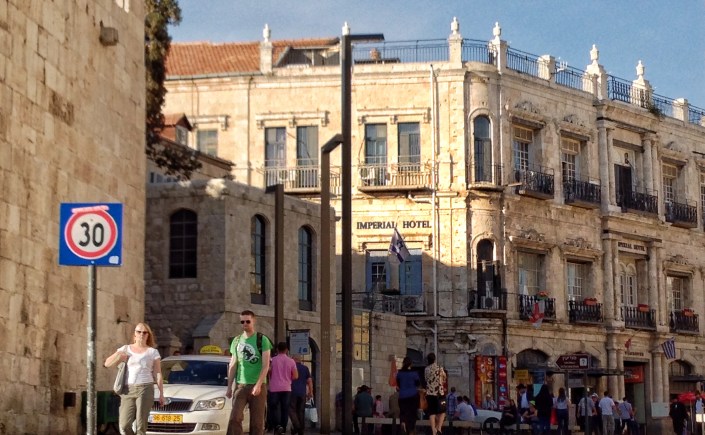
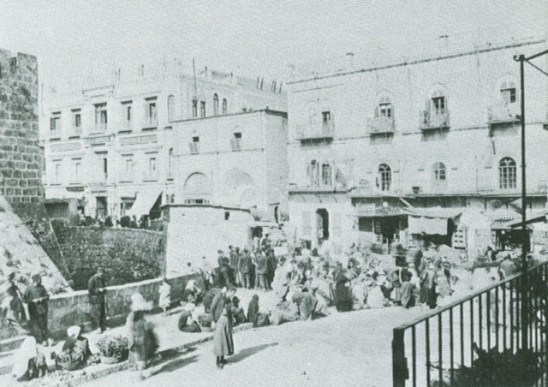
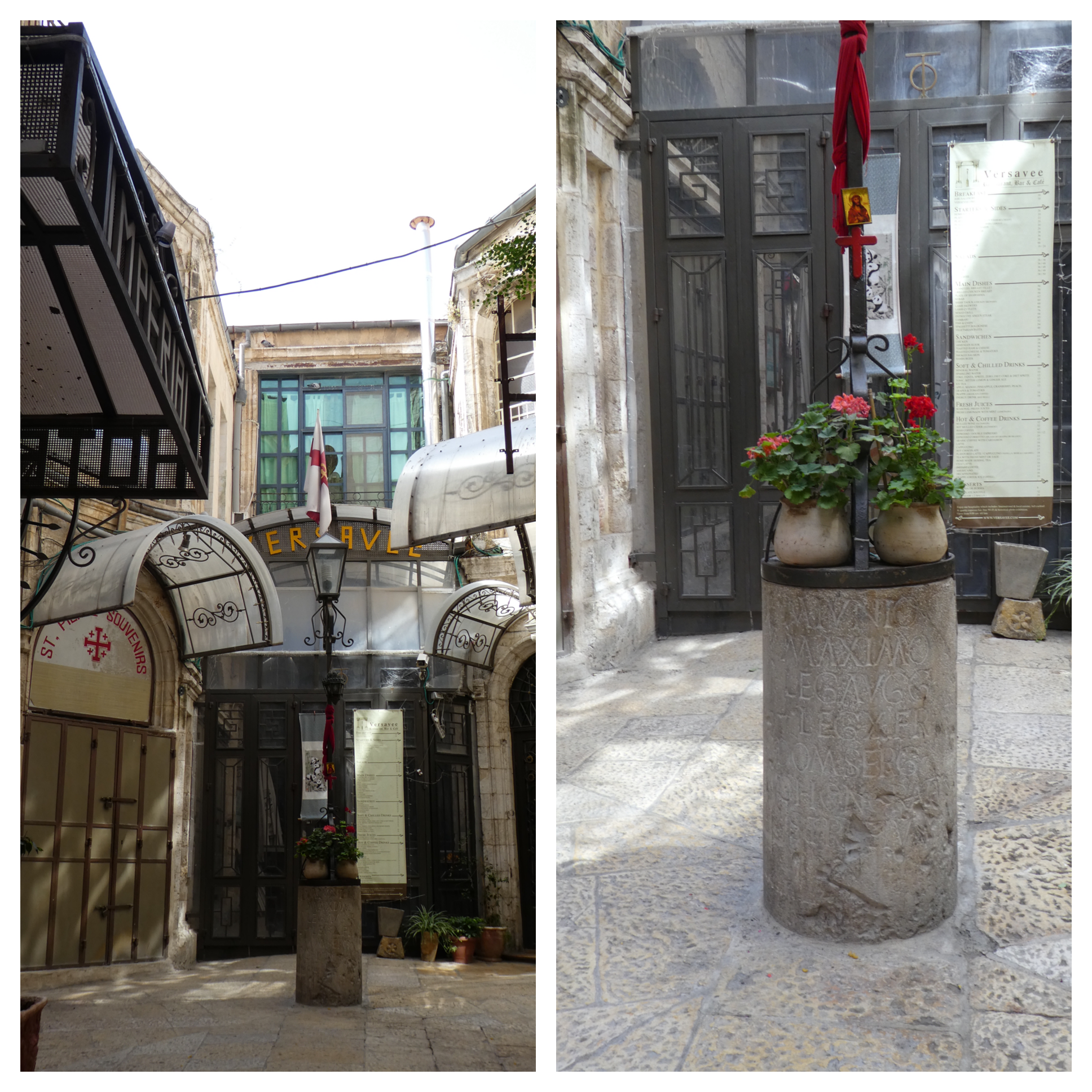
Had the hotel been there in Biblical times, what events we might have witnessed from our balcony. King Herod, the ostensibly psychotic master builder of Bible infamy dwelt opposite as he planned his Second Temple. So did Pontius Pilate. If one accepts the narrative of Simon Sebag-Montefiore, in his Jerusaelm : The Biography, we could also have watched the last journey of Jesus of Nazareth. It was but a short distance from the Citadel where he was condemned and Golgotha where he died: across the square, right at the New Imperial, left just past the Med, and straight on to the Hill of the Skull (where the Church of the Holy Sepulcher now stands). The present Via Dolorosa runs from the site of the Antonine Fortress, on the northern edge of the Haram ash Sharif, to The Church, its course set by custom and customers from Byzantine days.

https://howlinginfinite.wordpress.com/2014/09/01/the-grand-old-new-imperial-hotel/

And now it appears that this indeed might have been the case.

http://www.washingtonpost.com/world/middle_east/archaeologists-find-possible-site-of-jesuss-trial-in-jerusalem/2015/01/04/6d0ce098-7f9a-45de-9639-b7922855bfdb_story.html?hpid=z3

See also:

https://howlinginfinite.wordpress.com/2014/06/07/amazing-grace-theres-magic-in-the-air/

The Devil Drives

In a piece in this weekend’s Australian, historian David Pryce-Jones wrote: “A nation in which a self-appointed group such as the Taliban sets out to murder the young, and in the process blow some of its own to unrecognisable body parts, is not really a nation at all”.

I am reminded of Chaim Nachman Bialik’s poem, Al haShehita (On the Slaughter), about the Kishinev Pogrom in the spring of 1903: And cursèd be he that saith: avenge this! Such vengeance for blood of babe and maiden Hath yet to be wrought by Satan.

And also, of WH Auden’s Epitaph On A Tyrant :  Perfection, of a kind, was what he was after…When he laughed, respectable senators burst with laughter. And when he cried the little children died in the streets.

Read my earlier post on the plight of Syria’s children:

https://howlinginfinite.wordpress.com/2014/02/06/bombs-and-babies/

Massacre in Peshawar reflects disarray across the world of Islam

David Pryce-Jones, The Australian, December 20th 2014

Picture: Women at an anti-terrorist vigil in Lahore, Pakistan, after this week’s massacre in Peshawar. Source: AFP

The murder by Taliban suicide bombers of 132 children in a military school in Pakistan is grim evidence of the crisis destroying settled order in the world of Islam.

Whole populations are no longer willing to submit to the injustice and hypocrisy of their rulers. The Taliban is only one example of those who reject the structure of their state and fall back on primary identities of tribe and sect, oblivious to the even worse injustice and hypocrisy they are putting in place.

Taliban leaders embody the central paradox of Islamism, that they have a religious obligation to indoctrinate their rank and file with murderous rage and contempt. In most of the Middle East, the political process has narrowed to a version of civil war. Power is lying in the street and whoever is able to mobilise people of their own ethnicity or sect may seize it. Pakistan is a case in point.

A nation in which a self-appointed group such as the Taliban sets out to murder the young, and in the process blow some of its own to unrecognisable body parts, is not really a nation at all. The law of the jungle has become the sole moral code in operation. In the absence of social and institutional ties that bind together people of different origins, what can only be called the culture of killing drives everyone apart, brutalises their existence and ends in the delusion that victims are in fact martyrs.

“Those to whom evil is done,” in WH Auden’s much-quoted stanza, “do evil in return.” Sure enough, Taliban spokesmen are claiming that their suicide bombers killed these children only to make the military “feel the pain” for having killed the Taliban’s “loved ones”. In reality, the Taliban and the military are both armed gangs set on having exclusive power. Sponsoring or opposing one another in the permanent search for advantage, they have created a submerged underworld of violence, secret deals and even more secret betrayals.

It’s more or less impossible to judge whether the culture of killing depends more on Islamic faith or ethnic identity. Take the example of the so-called Islamic State, setting up its putative caliphate in what used to be Iraq and Syria.

Its appeal is to the Sunni branch of Islam, and its brutal pursuit of power is very like the Taliban’s. Its main enemy appears to be the Syrian regime of Bashar al-Assad that belongs to the Shia branch of Islam, but what may look primarily like a sectarian divide is also another fight between rival armed gangs for supremacy over the same territory; and going between the two is the usual murky underworld of various supposedly jihadi groups also engaged in secret deals and even more secret betrayals.

Islamic State certainly illustrates with a frightening brutality all its own the Koranic injunction to the faithful to “strike terror into the hearts of the enemies of Allah”. These enemies include all who do not enrol under its black flag. One Sunni tribe in Iraq that was prepared to oppose Islamic State has been almost wiped out in revenge. Kurds are mostly Sunni Muslims but on ethnic grounds Islamic State has been fighting them to a standstill for weeks. Although Yazidis are Arabs, it has driven them into exile because their faith derives from Zoroastrianism.

Christianity and the caliphate are of course incompatible. Islamic State beheaded four Christian children in Iraq because they refused to convert to Islam. Canon Andrew White, the representative in Iraq of the Archbishop of Canterbury, says of the violence done to Christians: “They killed in huge numbers, they chopped their children in half, they chopped their heads off, and they moved north, and it was so terrible …”

Horrific videos show lines of Islamic State executioners shooting prisoners so that their corpses fall into mass graves. Exactly as in similar footage of the SS on the Eastern front in World War II, the murderers appear completely calm, self-possessed, as though gratified by a job well done.

Al-Qa’ida has been the first to declare that terror publicity of this kind is counter-productive and gives infidels knowledge that should be kept from them.

The news from the Middle East bears out the observation made long ago by Job in the Bible and Homer in The Iliad that evil is limit­less, mankind is capable of any atrocity that serves his purpose and even divinities can do nothing much to reform this sad building block of human nature.

The vilest crime becomes permissible and even praiseworthy if it is presented as sacrosanct. Civilisation involves creating circumstances in which evil is suppressed or controlled so that evildoers are perceived as outsiders, removed to the margin of society where their capacity for harm is neutralised.

Now and again in history, someone with the necessary force of character has been able to build an ideology strong and coherent enough to persuade others that it is true, and a salvation. Ayatollah Ali Khamenei leading millions of Iranians to chant “death to America, the great Satan”, is replicating Joseph Goebbels whipping up war frenzy at mass meetings in Berlin. A month ago, a preacher by the name of Sheik Omar Abu Sara solemnly promised Jews, in the course of preaching a typical sermon in Jerusalem’s al-Aqsa mosque: “We shall slaughter you without mercy.” The culture of killing has taken hold.

In 1979 the trial took place in Germany of Ernst Heinrichsohn, a Nazi official who supervised the deportation of Jewish children from Paris to their death in Auschwitz. All had been separated from their parents; some were too young to know their names. Witnesses remembered Heinrichsohn hitting the children on the way to their deaths. In the courtroom he was insignificant, a nonentity, stupid, deceived by ideology. World war alone put an end to his evil.

Until such time as the Taliban, Islamic State, al-Qa’ida and the various other jihadi groups are confronted and brought to account, whatever the costs, Muslim civilisation will have to remain a contradiction in terms.

Historian David Pryce-Jones is a senior editor at National Review.

One, Two, Three, What are we fighting for?

In November, counter insurgency expert David Kilcullen delivered an excellent speech that is worth reading. It is reproduced here. He speaks of the origins and the ascendancy of Al Qa’ida and Daish, including the origin and meaning of Salafi Islam, and discusses the ideological, political and military basis of these organizations, and the effectiveness or otherwise of The West’s responses to the threat they present. Of many thoughtful observations, I note his thoughts concerning the radicalization of Muslim youth:

 “Western governments since 9/11 have had a bad habit of orientalizing Muslims, treating them as a special case, as an exotic, potentially violent minority, who need to be handled with kid gloves. Often governments have sought to deal with Muslims through traditional elders, appointed (sometimes self-appointed) leaders who the government treats as intermediaries, hoping they will keep their young men and women in line. This has three really bad effects. First, these so-called elders are often, by definition, more conservative, authoritarian and traditionalist, and by deferring to them were deepening the marginalization of young Muslims. Secondly, theres a moral hazard – people are encouraged to seek special treatment, to set themselves apart from the rest of society, leveraging the existence of extremist crazies as a way to advance their own agenda, and that tends to move entire communities in a more sectarian, segregated direction, and creates divisions in society that extremists can exploit. Finally, it creates the impression that a whole community is responsible for the actions of a lunatic, criminal fringe”.

Islamism and the threat to liberal values

David Kilcullen | 12 November 2014

2014 John Bonython Lecture, Sydney on November 12. The Centre for Independent Studies

 I want first to thank the Centre for Independent Studies for the opportunity to be part of this event, with its rich tradition of provocative debate. I want to thank the team for organizing this, and for your wonderful welcome. Most importantly, I want to thank all of you for coming out to be part of this discussion.

 My topic is “What are we fighting for? Islamism and the threat to liberal values.” I’m going to approach it through three questions that are simple to state, but extraordinarily complex to answer:

 What’s the ideology that drives groups like al Qaeda or the Islamic State?

Where did ISIS come from?

What should we be doing about it?

First, though, let me define my terms. By Islamic State, I mean the organization whose Arabic name is ad-Dawla al-Islamiyah fi ‘Iraq wal Sham, led by Abubakr al Baghdadi, now calling itself ad-Dawla al-Islamiyah or al-Khilafa, the Caliphate. I’ll use the acronym ISIS for this group, which fields more than 30,000 fighters. It controls a network of cities, populations and territory across about a third each of Iraq and Syria, owns economic assets that make it the richest terrorist group on the planet, and is expanding into the wider region, reinvigorating Islamist terrorism worldwide and radicalizing fringe members of our own societies, of whom thousands are fighting alongside the group.

 When I use the word Islam, I mean the second largest religion in the world, with 1.6 billion followers, founded by the prophet Muhammad. “Islamic” refers to characteristics of that religion, and a “Muslim” is someone who follows it. Islamism, on the other hand, is a political ideology that seeks to propagate a particular form of the religion, shape society around it, and (often) use violence to force it on others.

 Two other terms I’ll use are salafi-jihadist and takfir.  A salafi is someone who emulates early Muslims, as-salaf as-salih, the righteous ancestors, hence “salafi”. The salafi movement arose in the 19th century as an effort to reassert a strict interpretation of Islam in the face of colonialism, and experienced a revival—which some call neo-salafism—after the failure of Arab nationalism and socialism in the post-colonial Middle East. There are millions of Salafis, most of whom don’t personally use violence, but some do use violence to spread their beliefs within the framework of a global religious war—a jihad—and we call that subgroup salafi-jihadist. Finally, takfir is the practice of declaring other Muslims as apostates, liable to be killed.

 When I talk about liberal values, I’m not speaking of what people in the United States call “Progressive” politics, but about something older, more basic, namely the tenets of 19th and 20th century classical liberalism that shaped the societies we live in—individual freedom and accountability, civil liberties, limited government, the rule of law, free-market economics tempered by regulation, equality of opportunity, religious toleration, the removal of violence from politics. We differ about how to apply these ideas—how limited should government be, how much regulation is appropriate, what safety net should the state provide, how should we balance economic freedom with social justice—but these surface differences obscure a fundamental consensus in our societies around these values.

 As I’ll point out later, this set of unexamined assumptions about what society is, how it should be organized, and the bounds of acceptable conduct within it—assumptions shared across almost the entire political spectrum in our countries—are utterly foreign to Islamism, even in its non-violent form. It’s precisely these values that salafi-jihadists seek to destroy by killing or terrorizing all who hold them, and its these values that we ourselves can place at risk, depending on how we choose to react to the terrorist threat.

 Whats the ideology that drives groups like al Qaeda and ISIS?

 With that as context, what is ISIS? Is it just al Qaeda under another name? You could be forgiven for thinking that, if you listen to politicians talk about it. For diplomatic and legal reasons—because the U.S. Authorization for the Use of Military Force and UN Security Council Resolutions since 2001 were framed around al Qaeda—political leaders paint ISIS as an al Qaeda ally, but in fact the two are different. Let me explain, starting with al Qaeda.

Al Qaeda’s ideology has three components, only one of which is religious: the notion of defensive jihad. This idea is that when infidels attack an Islamic state, a defensive war becomes legitimate, and in defensive jihad (as distinct from offensive jihad, which can only be ordered by a Caliph, and fought by professional armies in accordance with Islamic norms of war) every Muslim has an individual obligation to participate.

Al Qaeda tacks onto this religious concept a second element—a political interpretation of current events—namely that the encroachment of western culture, values, and foreign policy into the Muslim world (by which Islamists mean all Muslim-majority countries, all countries with significant Muslim minorities, all countries with Islamic governments and all territories ever, at any time, controlled by the historical Caliphate) is so hostile to Islam that it represents an attack on an Islamic world community (which they call the ummah), that this is tantamount to infidel invasion of an Islamic state, and therefore a worldwide defensive jihad—endless war, everywhere, against all non-Muslims—is in effect, and is obligatory on all Muslims. Osama bin Laden declared the global jihad in two speeches during the 1990s.

Al Qaeda regards democracy—which organizes society around human rather than divine will, because individuals in democratic societies elect their governments, who set policies in line with public opinion—as idolatry, and holds every citizen of a democracy responsible for that country’s actions, those of its leaders (who every citizen elects) and of its allies. In other words, salafi jihadists hold every person here individually responsible for Australia’s actions and, by extension, those of the United States. In their view, that justifies violence against people we consider innocents—to them, in a democracy, there are no innocents because by voting in elections we are all responsible for our country’s policies. Further, some salafi-jihadists argue that modern connectivity is so pervasive, and the power of western ideas so insidious, that jihad cannot stop until every single person on the planet is converted or killed. Which, again, is all of us here tonight.

 To state the obvious, this stretches to breaking point the idea of defensive jihad in Islam—it broadens beyond all recognition the meaning of “invasion”; it holds every democratic citizen (as well as any Muslim who adopts democratic ideas) responsible for this supposed invasion, and posits the global ummah as a virtual state (with al Qaeda at its head) in defense of which this jihad takes place.

 I sometimes hear people ask: “If this idea’s so foreign to Islam, why don’t Muslims publicly reject it?” Actually, they have. Salafi-jihadist ideology has been repeatedly, publicly condemned by Islamic scholars and Muslim leaders worldwide. In 2005, for example, 200 Islamic scholars from 50 countries issued a religious ruling, the Amman Message, which condemned takfir and rejected jihadism. This message was reaffirmed in 2012.

 The final element of al Qaeda ideology is military. Remember the first element is that defensive jihad is legitimate (the religious component), and the second is that this is a defensive jihad (the political). The final component argues that because the West supports Israel and “apostate” governments in the Muslim world, and because Western militaries are so strong, conventional warfare—formed armies fighting openly, force-on-force, following international laws of war—is hopeless. But it also sees Westerners as weak, easily exhausted and intimidated, reliant on technology, unwilling to die for their beliefs. Hence terrorism, the killing of civilians, the torture and enslavement of non-combatants, intimidation through violence, become not only acceptable, but the military method of choice.

 This concept of a global guerrilla jihad led al Qaeda to a provocation strategy. Via the 9/11 attacks, al Qaeda sought to provoke a global religious war, dragging the West into protracted conflicts, exhausting our financial and military resources, sapping our political will, and ultimately forcing us to withdraw from the so-called “Muslim world”, leaving the field clear for a salafi jihadist takeover. Bin Laden outlined his strategy in 2004. He said:

 “All we have to do is to send two mujahideen to the furthest point East to raise a cloth on which is written al-Qaeda, in order to make the generals race there, to cause America to suffer human, economic and political losses without achieving for it anything of note . . . so we are continuing this policy of bleeding America to the point of bankruptcy. Allah willing and nothing is too great for Allah.”

 The idea was that intervention would bog us down in occupation warfare, which in turn would create a backlash that would allow al Qaeda to rally local groups (originally motivated by localized grievances) under the single explanatory narrative of a global Islamic jihad, and aggregate their effects into a worldwide uprising that would transform the planet, allowing a Caliphate to rise from the ashes.

 Notice that the Caliphate for al Qaeda was a distant future goal, deferred until after military victory—at different times, salafi-jihadist leaders spoke of it as being in Egypt, in Mecca, or in Baghdad—and its very vagueness allowed it to serve a unifying function as a kind of millennial jihadist utopia. Notice also a certain amount of what we might call “magical thinking” here: the idea that however powerful the enemy, truly Islamic fighters would demonstrate commitment to Allah by their effort, and Allah in turn would provide the victory.

 Thus while social movement theory, mass psychology and revolutionary warfare theory do indeed have something useful to say here, we can’t ignore the fact that Islam—a distorted version of Islam, to be sure, one most Muslims would scarcely recognize, a perversion perhaps, but Islam nonetheless—is fundamental to both the ideology and the strategy. There are plenty of murderous ideologies worldwide, but they’re not all the same. They reflect the ground from which they spring, and this one springs from Islam. To deny that just makes it harder to think clearly about the problem.

 On the other hand, holding something called “Islam” responsible for terrorism is as much an over-reach as holding Japanese culture responsible for the atrocities of World War Two, or blaming all Communists for Pol Pot. It not only accepts the al Qaeda line that there’s just one undifferentiated “true” Islam, whereas in fact Islam is massively diverse. It also treats non-violent Muslims the same as those who use violence in contravention of the Prophet Muhammad’s words that “there is no compulsion in religion” (al-Baqara, 256). And of course, it’s a logical fallacy to expect a constant cause to explain a variable effect: if Islam alone caused terrorism, we would have seen the same level of terrorism since the tenets of the religion were settled a thousand years ago, but we haven’t seen that—so other factors must also be at play.

 There’s a paradox here: on the one hand, only a tiny percentage of the world’s Muslims are involved in terrorist jihad. On the other, that jihad is real, it only takes a small number to sustain it, and of course everyone in it is a Muslim. This creates a fundamental tension—most Muslims aren’t’t jihadists, but all jihadists are Muslims—that can separate Muslims from society, create opportunities for authoritarian repression in the name of counterterrorism, and make every Muslim a target. It also creates a moral hazard: leaders of Muslim minorities in Western societies can demand special consideration, using the implied threat of violence by others as a way to get what they want, and that in turn can separate Muslims further from the rest of society. That’s what’s so insidious about this: not only terrorism, but also our reaction to it, can be equally destructive. I’d go further—our reaction has the potential to be vastly more destructive than the terrorism that gives rise to it. This paradox lies at the heart of al Qaeda’s strategy, in fact.

 Now, this is an obvious point, but the global uprising that bin Laden sought did not occur. After 9/11, the international community came down on al Qaeda like a ton of bricks. They were expelled from Afghanistan, damaged in Pakistan, defeated in Saudi Arabia, allied groups in Somalia, Yemen and North Africa were (temporarily) set back, affiliates in Southeast Asia lost support, and al Qaeda in Iraq was almost destroyed—by 2010, we’d reduced them to 5 per cent of their strength and banished the remnant from all major Iraqi cities. U.S.-led coalitions stabilized Iraq and Afghanistan, only to see Iraq unravel after leaving, and Afghanistan looking quite shaky as we exit.

 So, if al Qaeda’s strategy didn’t’t succeed, at least not in the way bin Laden intended, does that mean our strategy, the Global War on Terror, “overseas contingency operations”, worked? Well, unless you’ve been living under a rock, you would have to know that the answer to that question is a resounding NO. And that, of course, is because as al Qaeda has waned, we’ve seen the rise of ISIS.

 Let’s talk now about that group. ISIS comes from the same basic salafi-jihadist worldview as al Qaeda, and shares much of al Qaeda’s ideology, including the notion of defensive jihad and the focus on terrorism. It’s in the second component—the political interpretation—that it parts ways with al Qaeda, and that results in a starkly different strategy, and a different set of threats to our societies.

 ISIS is the successor to al Qaeda in Iraq. That might lead you to suppose that it was originally a branch of the wider al Qaeda movement, but actually its origin is independent. It came out of extremist circles in Jordan, propelled by anti-Shia sectarianism, and peaked in the intimately ferocious violence of the Iraq war.

 Its first leader, Abu Musab al-Zarqawi, emerged after the invasion of Iraq in 2003, when he formed terrorist cells to oppose the occupation, allied himself with Sunni nationalist and former regime fighters, took up the al Qaeda name as a branding exercise, and carried out attacks like the killing of UN Special Representative Sergio Vieira de Mello in 2003, the beheading of aid workers, the kidnapping, rape and murder of Shi’a children, and the 2006 Samarra bombing.

 Before he was killed in June 2006, Zarqawi unified several factions under the Islamic State of Iraq, part of the Mujahidin Shura Council, responsible for some of the most horrendous atrocities of the war. Zarqawi was succeeded by Omar al Baghdadi, himself killed in April 2010, to be followed by Abubakr al Baghdadi, the current leader of ISI, which expanded into Syria after the beginning of the Syrian Civil War, and now calls itself Islamic State.

 It was soon clear that there were ideological and strategic differences between al Qaeda and Zarqawi’s group. These emerged through a series of letters between Zarqawi and Ayman al-Zawahiri, then bin Laden’s deputy, which fell into the hands of western intelligence in 2005.

 Zarqawi viewed Shi’a Muslims and by extension their regional protector, Iran, as the greater threat. He saw Shi’a as apostates who should be slaughtered without mercy. He sought to provoke a sectarian civil war that would split Iraq, generate massive violence that would make the country ungovernable, drive out the occupation forces, collapse the state, and allow Zarqawi to inherit the wreckage. This translated into violence against Iraqi civilians, which for all its horror, was anything but random. Rather, it was designed to turn Shia and Sunni against each other, and both against the occupiers.

 Zawahiri and al Qaeda differed, not in terms of rejecting violence against Shi’a, but as a matter of strategy and timing. Zawahiri wanted Zarqawi to first rally all Iraqis against the occupation, and defer action against the Shi’a until after the invaders were expelled. He said, in effect, “form a popular front against the occupiers, you can always deal with the Shia later”. This was the classic al Qaeda aggregation strategy we’ve discussed, with a view to a global rather than a local agenda.

 Zarqawi and his successors reject that—not because they’re less opposed to the West, far from it, but because of a difference in strategic sequencing. They want to provoke an immediate sectarian war with the Shi’a, use that to unify Sunnis behind them, establish the Caliphate, build a powerful Islamic state, and then expand its territory by military conquest. What, for al Qaeda, is a distant millenarian utopia, is for ISIS an immediate, concrete, practical goal.

 That means a real state—with a territory, an army, a government, an economy, a population—and that makes ISIS a much more conventional state-building enterprise. Unlike al Qaeda with its post-modern notion of a virtual, non-territorial state, of guerrilla cells acting locally while thinking globally, and its call for an uprising by Muslims everywhere, ISIS wants the Caliphate now, as a real-world entity, in one territory, and then plans to expand it by military conquest. To use a Cold War analogy, if al Qaeda are Trotskyist, calling for world revolution, ISIS are Stalinist—socialism in one country.

 That’s why, whereas bin Laden said, “if you support al Qaeda, attack Westerners wherever they may be”, and sought to provoke our intervention in local conflicts so as to generate a global insurgency, al Baghdadi said “if you support ISIS, come to Syria and help us build the state.” He put out a call for doctors, engineers—and, of course, fighters—to join him. Far from wanting to provoke Western intervention, ISIS wants breathing space. It’s ultimately no less hostile to the West, but its sequencing is different: first build the Caliphate, then expand it, then take on the West. You can see the difference in al Qaeda’s English-language magazine, Inspire, which is full of tactical tips, articles on bomb-making, how to attack western societies from within, whereas the ISIS magazine, Dabiq, is full of propaganda about Syria and Iraq, and calls for people to travel to join the fight.

 If al Qaeda’s agenda is 21st century, ISIS looks, to many of my friends in Iraq and Syria, a lot like the 7th century. After Muhammad’s death in 632AD, his successors—the Caliphs—engaged in a campaign of military expansion that took them within a few decades to control vast territories in the Middle East, North Africa, South and Central Asia, and eventually into Spain and Southern Italy. These wars of Muslim Conquest, as they’re known, created the largest pre-Modern empire in history. The restoration of this Caliphate—as contrasted with the al Qaeda “virtual” Caliphate—lies at the heart of the ISIS agenda.

 ISIS has had a massively reinvigorating effect on the global jihad. We’ve seen groups in Indonesia, the Philippines, North Africa, and across the Middle East revive. Fighters have travelled to join ISIS from these areas, and from Europe, North America, Australia and New Zealand and Latin America—indeed, foreign fighter flows into Syria and Iraq are ten times what we saw at the height of the Iraq war.

 Where did ISIS come from?

 How did ISIS come to join al Qaeda at the peak of the global jihad? It resulted from two key events: the killing of Osama bin Laden, and the failure of the Arab Spring. Bin Laden’s death on the 2nd of May 2011 threw al Qaeda into disarray. The organization went through a succession struggle, and turned inward for several months before Ayman al-Zawahiri emerged as undisputed leader. Those months were critical, because mid-2011 was when the Arab Spring seemed to be succeeding—secular, democratic, largely peaceful protest movements in Tunisia, Egypt, Libya and Yemen had successfully thrown off dictatorships. For a time, this seemed to contradict al Qaeda’s argument that only terrorism against the West (the “far enemy”) could overthrow these regimes (the “near enemy”).

 But by late 2011, it was clear the Arab Spring was not going to deliver stable democracies. Egypt slipped back into authoritarianism, Yemen remained hugely violent, Libyans threw off Gaddafi but were left with an increasingly violent power vacuum, and a crackdown in Bahrain crushed protests there. Most importantly, in Syria, the early promise of a peaceful end to the Iranian-backed Damascus regime failed, the regime consolidated, and protests escalated into a horrific sectarian civil war.

 So peaceful methods failed (except in Tunisia, site of the original outbreak and, seemingly at present, the exception that proves the rule) and insurgencies emerged in Syria, Libya, Egypt’s Sinai desert, and Mali. al Qaeda, as I’ve mentioned, was in disarray: the Arab Spring seems to have caught them flat-footed. So as people turned back to violence, they didn’t’t look to al Qaeda: the group had lost credibility. That gap was increasingly filled by ISIS.

 ISIS, for its part, used Syria to reinvent itself after its defeat in Iraq. You recall the organization was down to only 5% of its strength by late 2011, it was scattered, on the run from U.S. and Iraqi forces. As the Syrian revolution unfolded, Abubakr al-Baghdadi sent a small cadre to Syria. They found sanctuary from pressure in Iraq, they could regroup and re-equip, and because of their battle experience, their financial backing from salafi donors, their tight organization, and their concrete, specific political program, they began to dominate. Three factors helped: the Assad regime, the West’s failure to support the secular democratic uprising, and the Iraqi government in Baghdad.

 In Syria, Assad claimed his opposition consisted entirely of jihadists. At first this was a lie: the same broad-based, secular, pro-democracy movement arose in Syria as elsewhere in the Arab Spring. But the violence of Assad’s crackdown turned protest into insurgency. Civil leaders were sidelined, armed groups began to grow, the movement became more extreme, and Assad’s lie became increasingly true. He maintained a de facto truce with ISIS until late 2013—the rise of ISIS helped prove his case about a jihadist enemy, ISIS spent most of its time attacking other rebel groups anyway, and avoided confronting the regime directly, so Assad in turn let ISIS gain control of Raqqa. Raqqa today is the ISIS capital, its major base, home to hundreds out of the thousands of foreign fighters who have flocked to join it.

 The second factor was our failure to support Syria’s democracy movement. It’s a self-serving myth that there was never a chance for the democracy movement to succeed. The democratic opposition to Assad was long-standing, it had significant popular support, and it was far stronger and better organized than Gaddafi’s opposition in Libya. Firm diplomatic pressure by the West in 2011, military support to democracy groups in 2012, and deterrent strikes against Assad when he began using chemical weapons against his own people in late 2012 and early 2013 could have made a real difference.

 Instead, we were tied up in Libya in 2011, gave virtually no support to the democracy movement, and offered too little help, too late, to the secular rebels. I’m not suggesting we should have invaded Syria—but I am suggesting that Western diplomatic efforts to ensure a political transition, backed by force if necessary to stop Assad’s violence against his people, in accordance with the established international principle of Responsibility to Protect, would have done a lot to prevent the emergence of ISIS. Even now, because Western countries have refused to come out strongly against Assad, and have yet to target any regime positions, many Syrians see our efforts as helping the regime. Few Syrians will back us against ISIS until we commit to overthrowing Assad, which for them is the whole point of the uprising.

 The final factor was the Iraqi government’s lurch into sectarianism at the end of 2011. It’s easy to blame Prime Minister Nuri al-Maliki here. I’ve heard people ask “What happened to Maliki? How did he go from being inclusive in 2007-8 to being sectarian in 2012”? That question bespeaks a lack of understanding of conditions in Iraq. Yes, Maliki was relatively inclusive in 2007-8: but that was when we had 165,000 U.S. troops in country, advisors embedded throughout his government and security forces, and were spending billions in assistance—we had huge leverage, and could ensure fair treatment for Sunnis, Shi’a and Kurds. Remember the Sunni community, by turning against al QaedaI  (now ISIS) during the Awakening, enabled a massive reduction in violence, allowing us to stabilize Iraq and start withdrawing. After the coalition withdrew, leaving zero troops behind, pulling out civilian advisers and cutting off assistance, we lost leverage. For his part, Maliki no longer had us to act as mediator or ensure fair outcomes. He was in a zero-sum game, where he could no longer afford to be inclusive—he had to consolidate his Shi’a support base, and seek Iranian support. He reneged on his deals with Sunnis and Kurds, and started sidelining professional military, police and administrative officials, and replacing them with sectarian (often corrupt) loyalists.

 As a result, by 2013, Iraq was in disarray, Kurds and Sunnis felt betrayed by Baghdad, tribal elders had been hung out to dry, the Iraqi security forces were engaged in what Sunnis saw as a sectarian version of ethnic cleansing, and there was space for a return of ISIS. And that created the environment that allowed the ISIS expansion in 2013, its jailbreaks, seizure of cities, expansion in Iraq and Syria, and its blitzkrieg-like breakout to Mosul and other cities in June 2014.

 What should we do about it?

 If that’s the threat, what should we do about it? We need to consider both the threat from Islamist terrorism, and the risk arising from our own reaction to that threat.

 We can break the terrorist threat into four components: domestic radicalization, foreign fighters, the effect on regional terror groups, and destabilization in the Middle East. Our strategic approach needs to address all four and, I would argue, in that order of priority.

 So, domestic radicalization first. What we see in Western societies is the seductive pull of ISIS on marginalized people, who feel themselves disenfranchised, losers in our society, and want to be part of something huge, successful, historical and important—ISIS offers them all that, a chance to validate themselves through action.

 Western governments since 9/11 have had a bad habit of orientalising Muslims, treating them as a special case, as an exotic, potentially violent minority, who need to be handled with kid gloves. Often governments have sought to deal with Muslims through traditional elders, appointed (sometimes self-appointed) leaders who the government treats as intermediaries, hoping they will keep their young men and women in line.

 This has three really bad effects. First, these so-called elders are often, by definition, more conservative, authoritarian and traditionalist, and by deferring to them we’re deepening the marginalization of young Muslims. Secondly, as I said earlier, there’s a moral hazard—people are encouraged to seek special treatment, to set themselves apart from the rest of society, leveraging the existence of extremist crazies as a way to advance their own agenda, and that tends to move entire communities in a more sectarian, segregated direction, and creates divisions in society that extremists can exploit. Finally, it creates the impression that a whole community is responsible for the actions of a lunatic, criminal fringe.

I think we need to do away with this approach. Repression, surveillance, and special intermediaries simply make the problem worse. We need to treat Australian Muslims like Australian Catholics, Australian Hindus or any other Australian—with all the rights, freedoms, expectations and responsibilities that come from free membership in a free society. If people engage in criminal acts, they need to be treated like any other criminal. We need to open up opportunities for self-expression and free agency within our own societies, so people can see that the answer to their problems lies here, not elsewhere. The answer to domestic radicalization, then, turns out to be more freedom, not less.

Likewise, though, with freedom comes responsibility. We need to be clear that we don’t plan to turn our societies inside out in order to make a disaffected minority more comfortable. The liberal values that lie at the heart of our society, on which our country is built, are not up for discussion. We can’t afford to be tolerant of intolerance, or to allow the implied threat of terrorism to let a minority (any minority) hold the rest of us to ransom.

The second threat is that of foreign fighters, and here the risk is that members of our own societies will join ISIS or al Qaeda, reinfiltrate back into our communities, and carry out attacks here. This threat is real, but we need to measure our response carefully lest we do more harm than good. I often hear people say “why do we need to intervene overseas? Let’s just pull up the drawbridge, take defensive measures to protect ourselves against domestic terrorism, and leave it at that.”

 I’m afraid that approach doesn’t really work. In the first place, there is no drawbridge. Australia is an open society, connected with the rest of the world, and our freedom and prosperity depends on maintaining that openness. Secondly, we need to be clear about what truly effective “defensive measures” would look like. These might include mass surveillance, collection of personal data, suppression of dissent, limits on free discussion, tracking of individuals on suspicion, detention without trial, travel and financial restrictions, and a pervasive police and security presence including fortified checkpoints in public places, heavily armed police and gun-carrying intelligence services with the power of arrest or to use lethal force. Since 9/11, many western countries have moved well on the way to some of these things in the name of protecting ourselves against terrorism. We may destroy our free and open society in order to save it: a fully protected society looks a lot like a police state.

 There’s a stark trade-off here. To put it one way, how many terrorist attacks, bombings or assassinations are we prepared to accept as the price of preserving our freedom? Conversely, how much privacy, freedom and civil liberty are we prepared to surrender in order to prevent those attacks? You can’t have your cake and eat it too. In a democracy, this is a decision that only the people can make. Technocrats—especially security professionals whose budget and advancement depend on the outcome, or politicians who know they will shoulder the blame for any attack—can’t be allowed to decide this for us. At the same time, if society decides a certain level of risk is acceptable, we can’t go back and retrospectively change our minds after the event, retroactively punishing security officials or political leaders for risk-management decisions we made as a society. What we need is a public, informed debate on this set of trade-offs, along with safeguards to protect ourselves and against unintended consequences.

 The third threat—the effect on regional terrorist groups—is something that Australia has done well since 9/11, and where current policy seems pretty well calibrated. Assistance to regional partners, information sharing, cooperation on regional security preparedness, and joint investigation when incidents occur, are all things that have been in place since 2003, after the first Bali bombing, and they have largely been effective in our region. We need to think about widening that regional network, and about how to react to increased threats, but in general terms I think we have those settings about right.

 The final threat—the destabilizing effect of ISIS in the Middle East and North Africa—is the one against which our troops are currently engaged in Iraq. To me, the logic of this is extremely clear. We’ve already talked about how attractive ISIS is to disaffected elements within our own society. It has an appeal precisely because of what seems to be an unbroken string of military victories, because it seems t successful, and it offers people the chance to share in that success and significance. We can turn our society upside down in order to deal with the threat from this side, or we can go to where ISIS is—currently, the Middle East and parts of North Africa—and inflict damage on the group that takes the shine off of it, shows people it can be defeated, and emphasizes that joining ISIS is a fool’s errand, it’s pretty dangerous over there, and you might not make it back. If we want to limit the restrictions to our freedom in this country, and relax those restrictions before they become permanent, we MUST deal with ISIS where it currently is.

 I am emphatically NOT talking about reinvading and reoccupying Iraq—that was a disaster the first time around, and doing it again wouldn’t make it any better. I’m also not talking a campaign destroy Assad militarily. I’m talking about a targeted effort using a combination of air power, special operations, military assistance and a limited number of combat troops to destroy the capacity of ISIS, break up the state it’s creating, encourage local opposition to take it down, and put enough pressure on Assad to force a negotiated settlement to the Syrian civil war, one in which secular democracy, with international support, plays a key role.

 I want to end with two concluding observations. The first is to re-emphasize something that I, and others, have been saying ever since 9/11, namely that this is a long war, a multi-generational struggle between two fundamentally opposed sets of values. It has already gone on for half a century, and it has just as long to run.

 One mistake we made after 9/11 was to focus too narrowly on al Qaeda, as if killing senior leaders equated to defeating the organization, and as if defeating al Qaeda equated to ending the terrorist threat. Let’s not make the same mistake again with ISIS. We will defeat ISIS, I have absolutely no doubt about that. But if we don’t also think more broadly, across all four of those threat categories, we’ll find ourselves back here again in another few years. Worse than that, al Qaeda hasn’t gone away, it’s eclipsed but far from defeated, and there’s every possibility it will compete with, or even partner with, the remnants of ISIS in the next phase of this long conflict.

 If we want to succeed in that conflict, we MUST find ways to deal with the threat that are cheap enough, non-intrusive enough, and sustainable enough, that we can maintain them essentially indefinitely, without destroying the free society we seek to protect.

And that’s my final point. I’ve spent a lot of time tonight speaking about what we’re fighting against, the enemy’s ideology and strategy. But let’s remember what we’re fighting for, those values on which our society is founded, and on which—whatever else we might disagree on—we have wide consensus.

 We believe in individual freedom, and the personal responsibility that comes with that. We believe in the pursuit of happiness, the sanctity of human life, in a secular state whose authority derives from consent of the governed, and whose purpose is to serve the needs of its citizens. We believe in a free market economy, as tempered by appropriate regulation, and in the rule of law as established by human society. We believe in respect for the rights of others, in gender equality including women’s autonomy, reproductive freedom, and freedom of sexual relations between consenting adults. We believe in social justice based on equality of opportunity and access, and in human progress through innovation and creativity.

 Yes, we disagree among ourselves on how to balance these values, and on what form they should take, and on their relative priority. But let’s recognize how utterly, and unalterably foreign these beliefs are to salafi-jihadists like al Qaeda, ISIS, or any of their fellow travellers, including even those who don’t actively use violence. Intolerance of difference, religion as a total explanation for all aspects of life, communal over individual purpose, the imposition of beliefs on others by force, the subjugation and oppression of women, a cult of death perpetrated by a hyperviolent nihilistic band of exterminators, a theocratic state whose authority derives from Allah rather than from its people, a non-rational cult of authority, intolerance of sexual or gender freedom, hostility to innovation and progress, and a return to the supposedly righteous ways of the seventh century.

 ISIS and groups like it are horrendous, but they’re not unique: in some ways, they’re just the latest in a long line of ideological enemies of liberal democracy, foes of the enlightenment that go back to 18th century Absolutist monarchism, Clericalism, and Authoritarianism, to 19th century ideas like Slavophilism and Communism, and to 20th century movements like the Nazi racial community of blood and soil, Fascism, Japanese militarism, or Stalinism. Today’s threat will go the way of those historical threats, I have no doubt about that—but it won’t happen without effort from all of us, a conscious effort to preserve our freedoms here at home, and to extend those freedoms to ALL members of our society, even as we defend them abroad.

http://www.cis.org.au/publications/speeches/article/5381-what-are-we-fighting-for-islamism-and-the-threat-to-liberal-values

 David John Kilcullen is an Australian author, strategist and counterinsurgency expert and is currently the non-executive Chairman of Caerus Associates, a strategy and design consulting firm that he founded. From 2005 to 2006, he was Chief Strategist in the Office of the Coordinator for Counterterrorism at the U.S. State Department. Kilcullen was a senior counter-insurgency advisor to General David Petraeus in 2007 and 2008, where he helped design and monitor the Iraq War troop surge, and was then a special advisor for counter-insurgency to Secretary of State Condoleezza Rice. He has has been a Senior Fellow of the Center for a New American Security, and an Adjunct Professor at the Paul H. Nitze School of Advanced International Studies at Johns Hopkins University. He has written three books: The Accidental Guerrilla, Counterinsurgency, and Out of the Mountains.
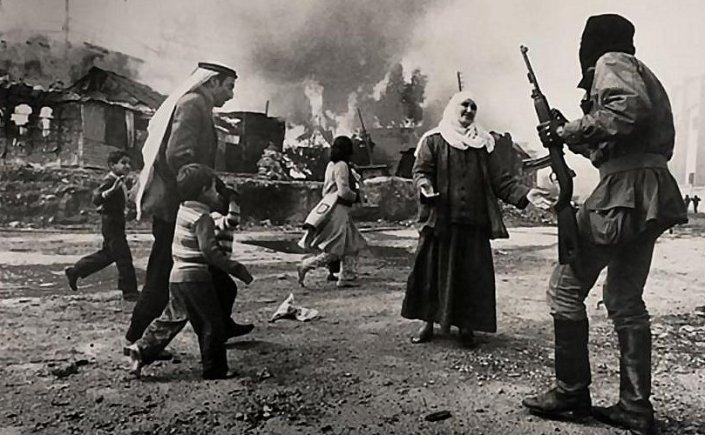
The Grand Old New Imperial Hotel

As I relate in my earlier post, ‘Amazing Grace – There’s Magic In The Air : “from the Jaffa Gate, we look out from our balcony in the Imperial Hotel, a late 19th Century mix of trash and treasure, five-star history, and ten-star views”.

Planning our 2014 visit to Jerusalem (we were there in May 2014) I wanted to book a hotel that was both historical and conveniently close to The Old City. I also fancied the idea of staying in a pilgrim hotel so we could witness at first hand the excited comings and goings of the faithful (see my post ‘Messianic Carpet Rides‘). The New Imperial Hotel, just inside the Jaffa Gate, was just the ticket. And we struck solid gold! Stepping down from the Nesher bus on the road outside the famed Walls of Jerusalem and  the Citadel (see: Once in Royals David’s Citadel), we looked up towards the Jaffa Gate and there, right above us was the imposing facade of the New Imperial Hotel.

The Jaffa Gate, in the western wall of the Old City (not to be confused with the ‘Western Wall’ or ‘Kotel’ so revered of Judaism), has traditionally been one of the busiest entrances to Jerusalem. Its Arabic name is Bab al Khalil (Gate of the Friend) a reference to Abraham, forefather of both Arabs and Jews. The wall bears the inscription in Arabic: “there is no god but Allah, and Abraham is the friend of Allah”. Topographically the Gate provided the easiest access, so it’s approaches provided a most convenient camping ground for the many invaders who sought to conquer the city. These included Greeks, Romans, Arabs, Frankish Crusaders, Turks, and finally, the British. Caliph Omar Ibn al Khatab entered through this gate after Jerusalem’s capture by the Muslims in 638AD. As did General Allenby, commander of the British forces which captured Jerusalem in December 1917.

Just inside the wall, there were fields of winter wheat until the late nineteenth century; and in summertime, the empty fields became dumping grounds for carcasses of donkeys, camels and horses. The Turkish authorities moved this ‘cemetery’ outside the wall, and what was forever the main thoroughfare, became the location for important commercial institutions, including the Banco de Roma, the Anglo-Palestine Bank, and the German bank of Johannes Frutiger, the Austrian Post Office, The Thomas Cook Tourism and Travel Company, and the studios of a number of Jerusalem’s famous photographers.

And also, several hotels catering for the growing tourist industry, including the Mediterranean Hotel (now called The Petra), and in 1884, the Grand New Hotel, built on land owned by the Greek Orthodox Patriarchate. According to the Thomas Cook Tourist Handbook in 1876, the Mediterranean was “the best in Jerusalem”. Travelers were however wont to damn the Med with faint praise, and soon began to write about the really new, really ‘grand’ hotel with great facilities, round arched windows, high roof pedestals topped by Grecian urns, imposing entrance staircase, and balconies looking right out over Omar Ibn al Khatab Square. See the pictures below from the end of the 19th Century,  showing the square in all variety of citizenry and costume.

Omperial 4 Imperial 2

The place comes with a history. During construction, builders uncovered what was believed to be the Pool of a Bathsheba. It was said that Uriah’s wife was bathing thereon when spied upon by a randy King David. David subsequently sent Uriah off on a suicide mission to clear the way for his own passions. The historical record is confused here. Leonard Cohen and the painter Jean-Léon Gérôme apparently got it wrong. They both placed her up on the roof. The Bible says he saw her from the roof.

The view from the rarely frequented roof terrace of the New Imperial itself, whilst not quite as picaresque as the vision that tempted the poet king, offers a splendid vista of the cupolas of the Church of the Holy Sepulcher and the Dome of the Rock – not to mention a fine peek at the battlements of the Citadel. On the western side, we look out over West Jerusalem and what was the old Arab neighbourhood of Mamilla, now totally rebuilt with a lux shopping mall, the rectangular bulk of the King David Hotel, once the HQ of the British military and bombed by Irgun terrorists in June 1946, and the iconic YMCA tower.

 Imperial 5

Anyhow, there is still an ancient cistern beneath the hotel. And also, part of the second wall. There are Roman tiles signifying the HQ the Roman Tenth Legion, and part a column erected by the legion, bearing a votive inscription honouring Emperor Augustus’ Legate, Marcus Julius Maximus. It stands there today as a pedestal for a street lamp, in the mews near the hotel front door and right in from of Versavee Restaurant and Bar, where the writer and his companions ate good Jerusalem fare and downed Israeli wine and Taybeh Palestinian beer.

Roman Colomn outside the New Imperial Hotel

Roman Column outside the New Imperial Hotel

Had the hotel been there in Biblical times, what events we might have witnessed from our balcony. King Herod, the ostensibly psychotic master builder of Bible infamy dwelt opposite as he planned his Second Temple (Herod might have murdered most of his nearest and dearest, but he was fitted up for the massacre of the innocents!). So did Pontius Pilate. If one accepts the narrative of Simon Sebag-Montefiore,  in his Jerusaelm : The Biography, we could also have watched the last journey of Jesus of Nazareth. It was but a short distance from the Citadel where he was condemned and Golgotha where he died: cross the square, turn right at the New Imperial, left just past the Med, and straight on to the Hill of the Skull (where the Church of the Holy Sepulcher now stands). The present Via Dolorosa runs from the site of the Antonine Fortress, on the northern edge of the Haram ash Sharif, to The Church, its course set by custom and customers from Byzantine days. But, the wrong side of town! (See Nova Via Dolorosa).

I digress…From rom our hypothetical balcony, we could watch the comings and goings of the conquerors: the entry of the Roman Titus’ legions; Omar Ibn Al Khatab entering al Quds on foot; the arrival of the First Crusade at the Gates of Jerusalem; the exit of the crusader garrison and the Christian inhabitants when the city fell to Salahuddin (portrayed in Ridley Scott’s Kingdom Of Heaven).  And thence, Mamlouks, Seljuks, and Ottomans. The last Kaiser, Wilhelm II, stayed at the hotel on his visit to the Holy Land in 1898. His bust still sits in the entrance hall. This is when The Grand became the New Imperial! Kaiser Bill came in style. No walking for him. The wall between the Jaffa Gate and citadel was torn down and its moat filled in on orders from Sultan Abdel Hamid II to enable the Kaiser and his wife and their huge entourage (looked after in grand style by Thomas Cook Tourism & Travel) to motor into the Old City (again, read Sebag-Montefiore’s  amusing account).

Twenty years later, General Allenby and his British Army marched through the gate. The good general entered on foot just like old Omar. It would be fun to imagine that he made his proclamation of the liberation of Jerusalem from one of those balconies (probably the big one in the centre, which now serves the office of the present proprietor Walid Dajani); but the reality is that he marched right past the hotel, veered right, and ascending the imposing steps of Kings David’s Citadel, deliver his oration there (although he may have indeed lodged at the New Imperial during his brief sojourn). He spoke of how the Holy City had now been freed from the Turkish yoke, and that, safe in the bosom of His Majesty’s forces, the Palestinians, in all their diversity, Jews, Christians and Muslims, would enter a new era of health, wealth and happiness. If he was aware of the nefarious dealings of Messrs Sykes and Picot, and the arrangement made by Lloyd George and Chaim Weizmann, he did not let on. He left the best news for the politicians to reveal a while later, and for the world to agonize over ever since.

So we enter the Twentieth Century, with its momentous political upheavals, the hotel having several changes of management but remaining largely unchanged, with its balconies, and its grand entry staircase. Walid Dajani’s father, Mohammed, took a “protected” tenancy” of the hotel from the Greek Orthodox Church in 1949, In the 1950s and 1960s, the hotel housed a small cinema, and its elegant ballroom was a favourite Palestinian wedding venue. It was damaged during the 1948 war, and during the 1967 Six-Day War, it was used as a base by Israeli troops, then returned to the Dajani family, the tenants of the property. It is, as far as we know, still owned by the Greek Orthodox Church, a status that ten years ago gave rise to a curious controversy about its future status, and in 2019, to a High Court appeal of its sale, and that of The Petra Hotel, to a shadowy right wing Jewish group – see the link below.

And thence to the present, with Sayyid Dajani greeting us like long-lost relatives, “ahlan wa sahlan bil Quds”.

Postscript

Such was our sojourn at the New Imperial in May 2014 – and our enjoyment of our room and its tiny balcony overlooking Omar Ibn Al Khattab Square, that we stayed there again for a month in 2016, booking the same room with its spectacular view of the comings and goings of all the tribes of Israel. In the warm evening, we’d sit in the roof garden directly across the street from King David’s Citadel with a good bottle of Israeli wine. Gazing on its towers, ramparts and gardens, we’d sense its story in our souls. We’d watch present generations passing beneath its walls, and the young folk dancing on the ramparts, all part of the passing parade of humanity that has lingered by and upon these ancient stones.

© Paul Hemphill 2014.  All rights reserved

Dancers promenade at the Son et Lumière

See also in In That Howling Infinite, A Middle East Miscellany

Imperial 7

https://howlinginfinite.wordpress.com/2014/06/07/amazing-grace-theres-magic-in-the-air   http://www.iaa-conservation.org.il/Projects_Item_eng.asp?subject_id=10&site_id=3&id=112  http://www.academia.edu/3677136/The_Mediterranean_Hotel_in_19th_Century_Jerusalem                    https://www.timesofisrael.com/greek-church-to-appeal-against-sale-of-old-city-hotels-to-right-wing-group/


 Imperial 1


Amazing Grace : There’s Magic In The Air

“If I forget thee, Oh Jerusalem!”

Jerusalem, The Golden. The Arabs call the city ‘Al Quds’, “The Holy’. It was deemed sacred from pre-history. Iconoclast scholars suggest that Jerusalem was actually the holiest place in Islam, and that like Islam itself and the Prophet, Mecca and Medina were retrofitted to suit the conqueror’s narrative. A city of the mind as much as of this earth, it haunts the prayers and dreams of three faiths, and to this this day, it is coveted and contested. “The air above Jerusalem”, wrote Israeli poet Yehuda Amichai, “is filled with prayers and dreams, like the air above cities with heavy industry. Hard to breath”. Arthur Koestler wrote: “The angry face of Yahweh is brooding over the hot rocks which have seen more holy murder, rape and plunder than any other place on earth”. Perhaps it is because Jerusalem is mankind’s number one hot spot! “There’s this thing that happens here, over the hell mouth”, says Buffy, “where the way a thing feels – it kind of starts being that way for real. I’ve seen all these things before – just not all at once”. More Jews have probably died violently in Jerusalem than in the Holocaust. And countless folk of other faiths have likewise perished.

Paul Hemphill, A Brief History Of The Rise And Fall Of The West

Jerusalem is all about faith and passion, and there is no city on Earth that people get more passionate about. The light is luminous. In high summer it almost shimmers. The very air is full of prayer and politics, passion and pain, and the rocks and stones virtually sing a hallelujah chorus of history. I am not a religious person, but I cannot help getting excited by the place –  although I do not transcend to transports of delight and delirium.

These include a group of mental phenomena involving the presence of either religiously themed obsessive ideas, delusions or other psychosis-like experiences that are triggered by a visit to the city of Jerusalem. It is not exclusive to one particular religion or denomination, having affected Jews, Christians and Muslims from many different countries and backgrounds. In The Simpsons episode The Greatest Story Ever D’ohed, the Simpsons travel to Israel where Homer is afflicted with the syndrome, the illness and its effect on Homer being one of the plot’s central themes. In The X-Files episode Revelations, agents Scully and Mulder try to subdue a man afflicted with a form of the syndrome.  read all about in Messianic Carpet Rides

It is Shabbat in Jerusalem, and there’s magic in the air.

This morning, Enya wafting across the square in front of the Imperial Hotel. This afternoon, a Gregorian Chant rendering of REM’s “Losing my religion”. This evening, Haredim hustle through Omar Ibn Al-Khatab Square just inside the Jaffa Gate on the way to the Kotel, and the walls in Royal David’s Citadel are alive with Son et Lumiere, a weird blend of classical and faux movie music, retelling the ageless story of this ageless old town.

The Kotel, or Western Wall, is open to all, twenty four seven. Women now have their own section – a hard-fought for innovation. And Jews of all courts and communities share the space without rancour, each tribe differentiated by their interpretation of the Holy Torah, and by their garb, as determined by the fashion codes of 18th Century forebears in Eastern Europe and Mitteleuropa, heedless of the Mediterranean climate.

This, the only variable remnant of the Herodian Great Temple, is Judaism’s Holiest Place. And down below, in the tunnel, one can now actually walk the wall’s fundament (and view the biggest house-brick in history). This too is now a sacred site, the more holy the closer one gets to the location of the long-destroyed Holy of Holies. Tucked away in in a courtyard in the heart of the Arab Quarter is yet another, tiny remnant called appropriately The Little Wailing Wall. It’s location, up a narrow deserted alleyway is one Jews where do not venture. We had the space all to ourselves.

Immediately above the Kotel, on Temple Mount, is the Islam’s third holiest, Al Haram ash Sharif, the “noble sanctuary “. It is said that the Prophet alighted here on his night journey to Jerusalem on Borak, the winged horse with a human face, conversed with Abraham, the father of the three faiths, and thence, ascended to Paradise. Revisionist historians suggest that Jerusalem may indeed have been the primary Islamic city, sacred from times long forgotten, until Mecca and Medina were retrofitted to suit the conquering Muslims’ desert narrative.

Non-Muslims can enter the Haram for strictly limited times (three hours a day, on five days of the week), and then, only through the Maghrebi (or Western) Gate, which ascends like an unsightly concertina from the right of the Kotel Plaza. Admittedly, the Haram custodians are wary of would-be desecrators and of Jewish religious elements seeking to pray on the Mount (haram!), and set precedents for the rebuilding of The Temple. But they do themselves and Islam no favours when the other People Of The Book permit pilgrims of all persuasions and passions to enter their precincts.

And passion is the name of the game.

On the Church Of All The Nations, at the foot of The Mount Of Olives, pious of all nations prostrate hysterically across the stone where Jesus wept and prayed in the Garden of Gethsemene. There is bliss in the Filipino pilgrims choraling ‘Amazing Grace’ in the Basilica of St. Anne. There is ecstasy In The Church of the Holy Sepulcher, an Escher jumble of chapels and chalices. Russian pilgrims, most of them babushkas, led by a priest in black, and looking like they have just come in from their villages on the steppe, clutch their many wooden crosses and clamour at the penultimate Station Of The Cross. A young man dressed like Jesus sits in a terry-towel habit of white, beard and hair looking for all the world like the Jesuses in ‘GodSpell’ and ‘Super Star’. Groups gather in clumps, cabals, and covens and read the Word to each other. A kind of ecclesiastical book club with only one book.

Over the centuries, The Church, as it is called, has seen much biffo and bloodshed as three faiths butted each other for dominance. At times, knives and guns have been drawn. The Ottomans sent in troops at one time to restore order, and they didn’t pussyfoot around. They used their weapons and scores of faithful were killed. Nowadays, there is the occasional dust up with monks from the opposing teams going at each other with baskets and brooms. There is a ladder below the middle window that has not been moved for three hundred years because no one can agree as to which faith can remove it. The right hand door was sealed up several hundred years ago to control (and charge for) pilgrim access. Nowadays, entry is free.

It’s that centuries old conflict between the three custodian faiths, the Roman Catholics, the Greek Orthodox, and the Armenians. They each have their own chapels within the church. The Greek’s have the glitziest. Historically, the first two have always been the strongest, backed by the French and the Russians respectively! It was one of the many causes of the bloody and arguably unnecessary Crimean War. Russian influence prevails still with state-supported legions of pilgrims who throng the Via Dolorosa. The Ethiopians now have a small presence. They have be given a tiny little chapel ON THE ROOF!  And there is a rival Tomb of Christ just outside the Old City walls in Arab East Jerusalem , patronized mainly by Protestants. But that is another story.

You know you are near the the Church of The Holy Sepulcher because the aroma of frankincense and candle wax hits you before you reach the it. The Pope arrives for a flying visit next week, so there are banners and all manner of preparations taking place to greet His Holiness. Outside the church of churches, still the basilica that the crusaders restored to Christendom in a welter of blood and violence, shops hawk kaffiyehs, kippas and headscarves, icons, crucifixes and menorahs. Jerusalem is economically ecumenical. And the patronage of pilgrims unites the divided sects of the Old City in a common purpose that prevails regardless of the political impasse, positions, and non-negotiables that divide their political and pastoral leaders.

At the Jaffa Gate, we look out from our balcony in The grand old New Imperial Hotel, a late 19th Century mix of trash & treasure, five-star history, and ten-star views. The Kaiser slept here in the days when Germany had an emperor. His bust sits in the entrance hall (on the floor, strangely enough, but nothing is surprising in this Fawlty Towers of a hotel). The old gate was demolished to let him and his entourage pass through. He didn’t want to walk like Omar al Khatib did when he first entered al Quds and claimed the city for Islam. British General Allenby walked too, and may have even stood on this same balcony in 1918 when he addressed Jerusalem and declared it liberated from Turkish rule. He left the the best news for the politicians to reveal a while later, and for the world to agonize over ever since.

And meanwhile, back in the now: Jaffa Gate, Shabbat.

The pilgrims are still flowing though like schools of fish, with matching hats, and happy, awestruck faces. Filipinos and Brazilians, Indians and Americans. And in a poignant sort of irony, Germans. Gloria in excelsis Deo! Tourists and backpackers amble through in daggy dress, maps and cameras in hand, all mini-back-packs and sun hats. Why do tourists dress so badly? And why in bright reds and blues that make them stand out so in photographs! Thank god for Photoshop!

Jews of all sects walk by all day and all night, in a myriad of hats and coats, the men in their devotional array, their ladies in plain garb. Young men walk out in groups of black, locked in serious discourse, young women, in many shades of sober fashion, yet all striving somehow for an individual voice. Young folk don bright plumage regardless of the chains of faith. Young soldiers ramble by, a hotchpotch in khaki and beige, half with handbags and sandals, clutching their mobile phones, and half with weapons and in army boots. A reminder that this is at once a land of fable and also one on constant alert. And just to prove this, on occasions, noisy groups of stotting teens with Israeli flags gallivant through the Old City, and one time, semi-automatics, “trying it on” with the ever vigilant Border Police who endeavour to keep the peace on this here frontier. Unmarked white vans, and incongruously, horse floats, are never far behind to foil these attempts to mark territory.

Yes, Jerusalem is all about faith and passion, and there is no city on Earth that people get more passionate about.

© Paul Hemphill 2014.  All rights reserved

image

Read more about Jerusalem in In That Howling Infinite: Oh, Jerusalem, A Middle East Miscellany, and A Short History of The Rise and Fall of The West

Cha … Cha … Changes

There would be later times (1965, 67, 69…) but I remember the first time. 1962. Having hitched through Europe and arriving in Istanbul. That special feeling. From Sultan Ahmed looking across the Bosporus towards the East, unknown roads and places and in the far distance a very vague idea of India…. Istanbul as a gateway to other worlds and new adventures….I was a young man drifting and dreaming, there were no guidebooks and I had not met anybody who had done the journey or heard stories from the road ahead….. The world was open, and I was ready….
Torben Huss, photographer

Haydarpasha Gan, late November 1972.

The last station on the line, and the end of Asia, after a twenty four hour train journey across Anatolia, from Teheran, including a wintry ferry ride across Lake Van, in the East, in the company of an idiosyncratic and proselytizing German pastor and a Pakistani student. The student and I quickly converted to Lutheranism just to shut him up.

There were no bridges across the Bosphorus in those days. Just the ferry that met the train to take us across to the Golden Horn to Eminou. And thence, a walk up to Sultanahmet, with the address of a doss house given to me by someone I’d met in Meshad near the Persian-Afghani border. A space on a floor for a few lira a night.

And then several weeks in Istanbul on two dollars a day, sleeping on the floor at what today would be called a backpacker’s hostel, broke and waiting for money to be sent from England. Weeks spent wandering the streets, wondering at the mosques and markets, getting stoned (dangerously in those days – remember ‘Midnight Express’?) in the Hippodrome, and dining cheaply morning, noon and night at the Pudding Shop.

Forty years on, and naturally, things have changed in many ways. Haydarpasha is closed for renovations and a rail link crosses the Bosphorus by undersea tunnel. There are now are two impressive suspension bridges.

Asian Istanbul, more of a sleepy suburb then, with some fine buildings scattered along the shore, is now a metropolis in its own right. And Istanbul is a city of thirteen million people.

The Pudding Shop is now world-famous on account of its hippie credentials and sells all kinds of good Turkish tucker, but a shadow of its former simplicity. Where once there thronged ragged and rangey adventurers on their journey east or west, tourists of all nations gather en masse.

The Pudding Shop 1969

Turkey in general, and Istanbul in particular, is now the place to be and the town to see – in these troubles times, it is a safe ‘Middle Eastern’ holiday destination, and a big cross on the cruise map. Almost every day, a fleet of giant liners ties up on the Yesilkoy quay. And their cargo soon materializes in Sultanahmet to view the BIg Four: the Blue Mosque, Aya Sofya, Topkapi Seray, and the Grand Bazaar. No time for the simple grandeur of the Sulaymaniyah Mosque, the other-worldliness of Byzantine Emperor Justinian’s vast underground cistern, or the aromatic gorgeousness of the Spice Bazaar down by the quays of Eminou.

Though no longer the exotic, half-east-half-west departure lounge for the old hippie trail, Istanbul is still a contradiction of past and present, trash and treasure, modernity and medaevilism. The dialectic is still evident, and maybe more so, between the ever changing now and the ever-present then, in the forever magical monuments and mosques, in the contrast between the modern young Turks in their western gaberdine and the many muhajibiin and well-covered conservatives.

Scratch Istanbul’s surface, and you will find a tangle of medieval streets and 21st Century traffic jams, bad drivers, and worse pavements. Walkers watch out!

And there is a poorer, working class, and even rural Istanbul. Suburbs just off the tourist map, where old men gather outside chai shops smoking, chatting and playing cards, and where women are rarely seen – when they do, most are covered.

Many Turks have come in from rural areas, and are still clad in traditional garb. There are now hundreds, maybe thousands of Syrian refugees in Istanbul now, seeking shelter from the storm in their sad and devastated homeland, and other Arabs fleeing the bitter winter that has followed the Arab Spring. Some rent apartments for their families, others beg in the streets.

As we walked along the highway that boarders the ancient walls and the Bosphorus, a speeding car hit an elderly Syria as he was crossing the dangerous road. We and his distraught family rushed to his aid, and mercifully he was unharmed but in shock, and did not want an ambulance. We placed him in a the comfortable position and I advised the young men with him in Arabic to keep a watch over him and to watch his eyes.

In contrast to these wandering souls, well-heeled Gulf Arabs arrive with too much money and too little taste. Istanbul is viewed as more stable, cosmopolitan, and naughty than tense and tenuous Beirut, and these wealthy visitors often seek to buy property here.

All the contrasts and contradictions are presently being played out in the politics and economics of this modern Turkey, and in the street protests, tear gas, and riot gear across the Golden Horn, up the hill around Taksim and Gezi Park, and across the suspension bridge. Partisans of Prime Minister (now presiden) Erdogan bump up against the Gulenists, followers of an exiled but influential dissident, and against the ever-ardent bearers of Kemal Ataturk’s torch. Folks still revere him as the Father of The Turks, but times change, some say, and so then must Ataturk, although the old man must spin some in his revered grave.

People say that Turkey is a divided nation right now. And this is manifested in accusations of creeping Islamization, counter-accusations of occidental decadence and depravity, allegations of corruption and cronyism, and street violence and police brutality. Back into November 1972, Military Rule was the norm, and dissent was silenced. Turkey was Asian, and Middle Eastern. Now the country still straddles east and west, coughing the European Union with much leas enthusiasms than hitherto or and presenting as the go-between ‘twixt The West and and Iran, and with the volatile lands to the south.

For better or ill, how things have changed.

© Paul Hemphill 2014.  All rights reserved

Torben Huss, Eminonu 1965

For other posts about Turkey in In That Howling Infinite, see: People watching in Sultanahmet, Sailing to Byzantium, Ottoman Redux – an alternative history and The Watchers of the Water  

People Watching In Sultanahmet

‘If you know your history, then you know where you coming from. Then you wouldn’t have to ask me who the ‘eck do I think I am’. Bob Marley, Buffalo Soldiers.

image

People watching in Sultanahmet on a wet Saturday afternoon in Spring.

It’s very like people watching in Newtown, Sydney.

The history of Istanbul, of Turkey, of the Turkish people, is written in the faces of the passersby. There is no pure Turk, just as there is no pure Arab, Jew, Slav, Celt, or Caucasian. Indeed, you see them all passing by. And it has been raining these past two days. The umbrella sellers are making a killing with their see-through parapluies. Everyone, tourists and locals alike are sporting them.

The weekend is promenade time. Families parade up and down, past the pastry and kebab shops, the hawkers and the hustlers. Young men sidle by with their girls, girls walk out with their honeys. Groups of girlfriends, and boy-groups gather and gaggle and gossip. Western folk and eastern folk. This is where east and west meet, literally, figuratively, ethnically, and yes, geographically. And it is written on the faces and in the garb of the perambulating populace.

Sunday in the park

Muhajibabes in beautiful scarves (the Great Bazaar is chocka with wonderful day cashmeres and pashminas – there is no excuse for drabness). “Mandy, Mother of Brian” in vast and bulbous black. Ladies in full cover, some dark and exotic, and mysteriously alluring, and others that make me think that they are doing us all a favour (non-PC, but there you go). I just saw a clown with green hair and a red nose. Fashionistas and paysans. And the many, many ordinary folk, old, young, and babes in arms, enjoying the weekend. All oblivious to the feral dogs and cats that roam through these parts.

There are no pubs on every corner. There are no rows of wine bars. There are no ice-cream and yoghurt shops (though we did find a good bar just across from the square in front of Hagia Sophia).

Oh, it makes you wonder.

For other posts about Turkey in In That Howling Infinite, see: 


Sailing to Byzantium, Ottoman Redux – an alternative history, Cha-cha-cha-changes and The Watchers of the Water