Rojava revisited. Can Syria break its sectarian cycle?

In January 2019, In That Howling Infinite published, Rojava and the Kurdish conundrum. The post wrote of Rojava as both experiment and predicament – a small, improbable polity suspended between larger, harder powers, “trapped between the Turkish hammer and the Syrian anvil.” Aris Roussinos, whose work we have reviewed before, now returns to the same terrain with the sombre clarity of hindsight. His recent essay on the collapse of the Autonomous Administration of North and East Syria reads less like contradiction than culmination. What was foreboding then is aftermath now.

Back in 2019, the drama was framed in the key of Trumpian bombast – promises to “totally destroy and obliterate” Turkey’s economy if Ankara stepped out of line — but the underlying reality was austere. The Kurdish-led Syrian Democratic Forces had borne the brunt of the fight against ISIS, lost thousands of men and women, guarded tens of thousands of jihadist detainees, and constructed, under the thin canopy of American airpower, a fragile, decentralised experiment in multi-ethnic governance. Remove the canopy and the weather would change. The Kurds knew it. So did Ankara, Damascus, Moscow and Tehran.

Roussinos describes that experiment –  the AANES – as an attempt to defy the “grim logic” of civil war in divided societies: that conflict eventually collapses into sectarian arithmetic. Ideologically, it was a pivot away from classic PKK ethnonationalism toward Abdullah Öcalan’s “democratic confederalism”: devolved authority, gender parity, communal councils, a deliberate blurring of ethnic hierarchy. In a region shaped by the memory of genocide, forced migration, Baathist Arabisation and mutual suspicion, it was both necessity and idealism. The geography of the Jazira –  oil-rich, landlocked, demographically mixed – demanded accommodation if it was to function at all.

Yet even in 2019 the limits were visible. Rojava was romanticised abroad –  “an anarchist-lite Paris Commune,” as we noted, perhaps half  ironically half-ironised then – but on the ground it was strategically exposed and socially fissured. Arabs and Turkmen did not uniformly welcome Kurdish administration. Kurdish politics itself was riven by clan and party rivalries. Turkey, Syria, Iraq and Iran all loathed the prospect of a sovereign Kurdistan. The experiment depended not merely on theory but on patronage.

That patronage proved fickle. The likely endgame sketched seven years ago was stark: the Kurds would fight if forced, but ultimately they would deal with Damascus to save their towns and families. Russia would mediate; Turkey would demand a border free of the YPG; Assad would insist on reintegration, autonomy trimmed to vassalage. The analogy to the Paris Commune was offered with unease – bold communal experiments have a habit of ending in blood and absorption.

Roussinos now writes from beyond that threshold. The new Damascus government –  jihadist-derived yet internationally tolerated – has reasserted control. The much-vaunted multi-ethnic Syrian Democratic Forces, proudly described as majority Arab, fractured under pressure. Arab components drifted back toward their ethnic kin in Damascus. What remained was recognisably Kurdish: the YPG under another name. Integration proceeded not as confederal partnership but as coerced subsumption.

Pro–Damascus media have seized on the SDF’s recruitment of women, alleging coercion and forced enlistment of minors. While underage recruitment has been documented in past years and prompted formal pledges to demobilise minors -with uneven implementation – broader claims of systematic kidnapping lack clear substantiation and coexist with extensive evidence of voluntary female participation grounded in the movement’s gender-egalitarian ethos. Such allegations serve a wider political purpose: portraying the Kurdish administration as socially aberrant and incompatible with a re-centralised Syrian state, framing critique of specific practices as part of its broader delegitimisation. In Roussinos’ terms, this is another instrument of Syria’s recurring cycle: peripheral autonomy is undermined not only by coercion on the battlefield but also by shaping perception, marking alternative governance as morally and politically untenable.

His larger point is less about Kurdish miscalculation than Syrian structure. Since independence, Syria has oscillated between peripheral revolt and centralised coercion. Its demographic entanglement – Sunni Arab majorities, Alawite and Druze minorities, Kurds without a state, ancient Christian communities –  renders majoritarian triumph unstable and decentralisation fragile. The AANES sought to transcend that arithmetic; it ultimately succumbed to it. Meanwhile, sectarian reprisals against Alawites and Druze in western Syria deepen minority distrust of Damascus, reinforcing the very cycle the new regime claims to end.

The pattern is not uniquely Syrian. Lebanon’s confessional balancing act has veered between uneasy accommodation and paralysis; Iraq’s post-2003 settlement oscillates between sectarian mobilisation and fragile cross-sectarian moments; the Balkans, from Bosnia to Kosovo, demonstrate how externally brokered pluralism can freeze conflict without dissolving its underlying fears. In each case, demography and memory shape politics as much as constitutions do. Power-sharing without trust calcifies; centralisation without restraint provokes resistance. The pendulum swings.

What is striking is the dialectical twist. The Kurdish movement in Syria attempted to move beyond ethnonationalism toward a post-national confederalism. Its collapse may instead accelerate a harder pan-Kurdish nationalism – the revival of the Ala Rengin flag, the renewed invocation of Rojava as West Kurdistan, the rhetoric of betrayed nationhood. When pluralist experiment yields vulnerability, ethnic consolidation gains appeal. The effort to dissolve identity politics may intensify it.

Can Syria break its sectarian cycle? Roussinos leaves the question open, but the burden is heavy. It would require disciplined control over disparate armed factions, credible guarantees to minorities, and a majority willing to exercise restraint rather than vengeance – feats rarer than battlefield victories. The Kurdish experiment failed not simply because it was naïve, but because it unfolded within a regional system that punishes fragility and rewards coercion.

In 2019, the mood was, borrowing from King Lear, “cheerless, dark and deadly.” In 2026, the darkness feels less theatrical, more structural. The Kurds remain what they have long been: resilient, battle-hardened, accustomed to betrayal. Their attempt to sketch another way -neither Baathist despotism nor jihadist dominion – has been curtailed. Yet the problem it sought to solve endures, not only in Syria but in every state where demography, memory and power are tightly braided. The lesson, as Roussinos insists, reaches well beyond the plains of the Jazira.

Paul hemphill, February 2026, with assistance in drafting by ChatGPT

For more on the Middle East in in That Howling Infinite, see A Middle East Miscellany.

See also, Syria. Illusion, delusion and the fall of tyrants, Cold Wind in Damascus …Syria at the crossroads, Between Heaven and Hell … Syria at the crossroads

Can Syria break its sectarian cycle?The Kurdish experiment was doomed

Aris Roussinos, Unherd 10 February 2026
Can Syria break its sectarian cycle?

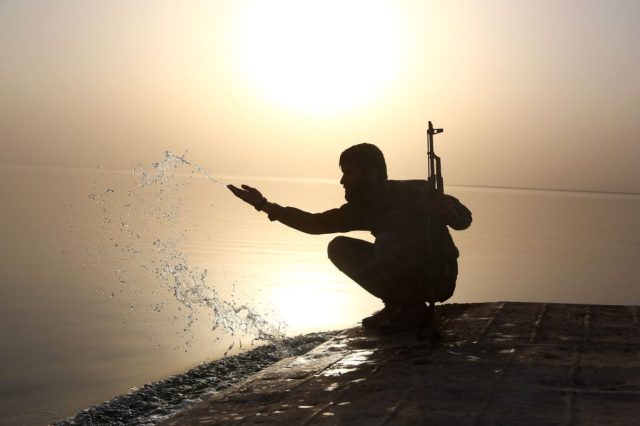
‘The remorseless logic of a country, like neighbouring Lebanon and Iraq, held hostage by its own tangled demographics.’ (Delil Souleiman / AFP / Getty Imges)

It is generally expected that, whatever the ostensible cause of a civil war, in a country divided on ethnic and religious lines the fighting will sooner or later assume an interethnic or sectarian flavour. The Autonomous Administration of North and East Syria (AANES), now having surrendered its autonomy under assault from the Syrian state’s new jihadist-derived government, was, whatever else it may have been, an attempt to rebut this grim logic. Indeed, the dusty and unprepossessing plains of the Syrian Jazira — the northeastern portion of the country, east of the Euphrates — served for more than a decade as an unlikely political experiment in the management and diffusion of ethnic conflict.

Whether noble or naive, this project now looks doomed as AANES’s great power backers turn their fickle attentions to Damascus, and the Damascus government has in turn successfully reasserted its control through military coercion. Within a matter of days, as its Sunni Arab levies turned their affections to their ethnic kin in Damascus and their guns on their former allies, Northeast Syria switched from a bold experiment in multi-ethnic governance to a desperate, rearguard battle for Kurdish cultural and political autonomy. The war, at its presumed end, reverted to the dynamics of its earliest days, when Ahmed al-Sharaa, then leader of the Syrian al-Qaeda faction Jabhat al-Nusra, had attempted, along with the Free Syrian Army (FSA) rebels and tribes of changeable loyalties, to seize control of the oil-rich, and newly Kurdish-run region, Syria’s breadbasket.

Simultaneously rich in resources yet neglected by its central government, and host to the country’s richest mix of ethnic and religious minorities, alternately the tools and the victims of the central state, the Syrian Jazira had always run according to its own dynamics. Both colonial French and independent Syrian administrations in distant, Levantine Damascus expended significant, if sporadic, effort in absorbing this neglected region of Mesopotamia within the modern state system, privileging one ethnic group against another for reasons of statecraft, and building model towns and vast dams, as evocative in their current dilapidation of failed modernities as the ancient tells dotting the landscape, now repurposed as gun emplacements, are of earlier lost civilisations.

Perhaps the AANES experiment can now be added to this melancholy list. Birthed from the fusion of Kurdish nationalism and Marxist-Leninist thought that initially drove the Kurdistan Workers’ Party (PKK) independence movement, the AANES, a project of the PKK’s Syrian sister organisation, the Democratic Union Party ‎(PYD), performed an attempted shift to anarchist political theory. The thought of the American writer Murray Bookchin, as reworked by the PKK’s occluded godhead figure Abdullah Öcalan from his Turkish jail cell, was its most notable innovation. Echoing Öcalan’s rejection of the PKK’s previous project of independence for the Kurdish nation, the AANES presented itself as an explicitly multi-ethnic, multi-sectarian state in which the greatest possible autonomy was devolved to religious and ethnic communities, beneath the benign framework of Jazira’s de facto autonomy from Damascus. In practice, the quasi-anarchist devolution of power resulted in the proliferation of bureaucratic structures. Local empowerment, similarly, meant the elevation of new elites loyal to the project, and the freezing out of dissidents, particularly rival Kurdish factions. Imperfect though it may have been, compared to the overt totalitarianism of the Baathist state, the anarchic infighting of the FSA rebels, and the gothic cruelties of ISIS, history is likely to remember it more favourably than today’s discourse would suggest.

“Perhaps the AANES experiment can now be added to this melancholy list.”

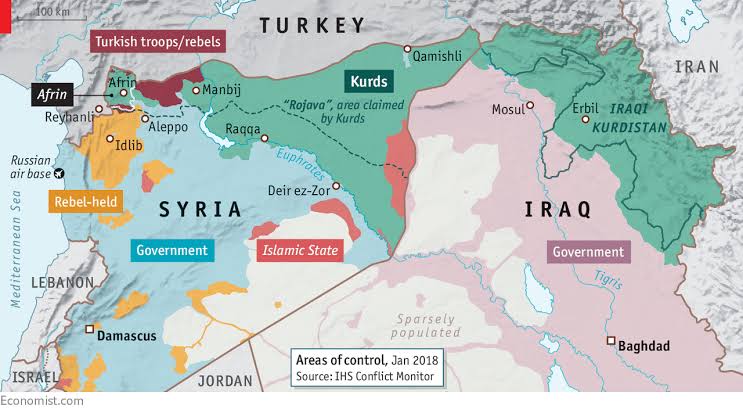
Barely populated until the French Mandate period, except during the annual circulation of nomadic Bedouin shepherds, the portion of Syria east of the Euphrates underwent during the early 20th century a transformative period of internal and external immigration and development analogous, in a modest way, to that of California or Australia. Ethnic Kurds fleeing the collapse of proto-nationalist rebellions in Ataturk’s Turkey, along with Syriac Christians fleeing the Seifo genocide and many uprooted Armenians streamed south across the culverts and rusting tracks of the Berlin-to-Baghdad railway line, which still marks the modern border, joining their ethnic kin residing there from the beginning of recorded history. Ethnic Assyrians from British-Mandate northern Iraq similarly sought French protection from the predation of the Iraqi state and its Kurdish, Arab and Turkmen auxiliaries, establishing a string of fiercely Christian villages along the Khabur river. Northeast Syria was shaped by the cultural memory of ethnic conflict; its past decade of governance was an attempt to evade the return of its attendant cruelties.

As such, the AANES project was always as much one of necessity as Leftist idealism. The Kurdish regions of northern Syria, stretching West of the Euphrates into Aleppo, were separated from each other by clusters of Arab and Turkmen towns and villages, in large part the result of the Baathist state’s settlement of Arabs from Syria’s desert hinterland to hinder any Kurdish attempts at secession. While the early successes of the Syrian Kurds under the PYD, following a negotiated handover of control by Assad’s overstretched government, resulted in what was essentially the occupation by its YPG military forces of Arab settlements, loyal to one or other rebel or jihadist faction, America’s decisive intervention in the war against ISIS resulted in both sudden and unexpected great power backing for Northeast Syria and an evolution of Kurdish political attitudes towards local Arabs.

Partly at America’s behest, in a failed attempt to assuage the Syrian rebels’ combative Western think-tank diaspora, and partly a genuine attempt to impose progressive governance among a population Kurds frequently portray as stunted by its own reactionary obscurantism and crude ethnic chauvinism, Northeast Syria’s autonomous quasi-government undertook a project of delegating political and military authority to Arab regions won back from ISIS. It was an ambitious goal which seemed, for a decade, to have won majority acquiescence, if not affection. It became the boast of the regional administration that its armed forces, the Syrian Democratic Forces (SDF), was now predominantly composed of Arabs, a feat of enlightened governance that rapidly proved hollow, over the past two weeks, when the majority of these Arab fighters effortlessly switched sides. Having lost almost all its Arab accretions, the SDF was once again, in practice, the Kurdish YPG, an ethnic militia fighting for purely Kurdish goals. Now that, under the threat of military defeat, a shrunken version of these forces will be subsumed under the Damascus government’s control, their future role — on paper, and in reality — remains to be seen.

The integration terms finally accepted, at gunpoint, by the autonomous administration last weekend, though better than those of a fortnight ago are worse than those of the unimplemented March agreement. Consequently, much has been made in recent days of the AANES’s failures to come to terms with al-Sharaa’s shock capture of the Syrian state just over a year ago, and negotiate a settlement with the new reality. Certainly, the region’s political focus had, since the seeming cornering of the Sunni Arab rebellion into its Idlib Bantustan, centred on negotiating re-integration into Assad’s Baathist state in a manner that preserved some means of political and military autonomy. Yet Assad, over-confident of his own position as victor of the long and bloody war, refused to offer more than integration into the central state on terms that amounted to surrender. The new regime in Damascus now offers little different: what has changed is its greater power of coercion, and international backing, compared to its previous Baathist iteration.

Putin, once an occasional, tacit partner of the Kurds west of the Euphrates, has fully backed the new Damascus government, another instance where Russia, once America’s rival in Syria, shares increasingly aligned interests with the Trump White House. Calls for the protection of Kurdish cultural rights and social norms by European states are outweighed by their overriding political interest in the accelerated removal of their more than one million mostly Sunni Arab refugees. Regionally, the success or otherwise of the Northeast’s reintegration will determine Israel’s ability to justify its military protection of Druze autonomists in the southern province of Sweida. Relations with mostly Shia Iraq, which has its own reasons to look askance at Sunni jihadist governance and is currently making a show of reinforcing its border with Syria, will be fraught at best. Given the sheer improbability of fate’s wheel suddenly projecting al-Sharaa into Assad’s Damascus palace, it would be foolhardy to offer any firm predictions, rather than vague anxieties, for the country’s future.

For the Kurds themselves, the experiment in enlightened multi-ethnic governance proved, at the crucial moment, a dramatic and costly Achilles heel. The result, over time, will likely be the weakening of PKK ideology in favour of some form of pan-Kurdish ethnic nationalism, whose early stirrings are apparent in the flow of volunteers from northern Iraq to defend their ethnic kin, the sudden revival of the Kurdish flag, Ala Rengin, in Northeast Syria, and in the readoption of the ethnic term Rojava, or West Kurdistan, in place of its previously bland geographic descriptor. When even Abdullah Öcalan’s nephew Ömer, an MP in Turkey’s parliament for the movement-aligned DEM party, feels compelled to proclaim “Long live the Kurds and Kurdistan”, and “the Kurdish nation will not forgive the enmity committed against it”, we sense the tectonic plates of Kurdish politics shifting away from Leftist post-national idealism towards an embryonic ethnic nationalism. The decade-long experience of Kurdish self-governance, military success and international diplomacy will shape whatever follows the likely collapse of the AANES statelet, whether what replaces it will coalesce in the mountainous redoubts of eastern Turkey, Western Iran and northern Iraq, or in the grey cities of the European diaspora. So, too, will bitter analysis of the project’s failings.

Yet it would be unfair for harsh self-criticism to so soon follow hindsight. For all its faults, the Kurdish project of autonomy from the Syrian central state evolved, through managing the dynamics of their multi-ethnic region, into one that ironically and idealistically attempted to make the very idea of equable Syrian co-existence a political possibility. Inversely, the current Damascus project of re-centralisation has, in western Syria, been accompanied by sectarian massacres and other abuses, which have increased the antipathy of peripheral minority populations towards the central state. Sunni Arab supporters of the al-Sharaa government, whose decade-long displeasure at having their ethnic kin ruled by minorities is accompanied by certainty of their own natural right to rule those same minorities, have made much of Kurdish intransigence while minimising or even justifying the starkest governance failures of their own new regime. Yet the past year’s massacres of Alawites and Druze, punctuating the failed integration talks with the AANES, only heightened the Kurdish disinclination to disarm and dissolve its forces and place the fates of its people in the benevolence of the central state.

Syria’s post-independence oscillation between peripheral revolts and centralised coercion, the very cycle that produced both Assad and his own overthrow, is simply the remorseless logic of a country, like neighbouring Lebanon and Iraq, held hostage by its own tangled demographics. Whether or not the new Syria can break this cycle is an open question. It will take great feats of governance, and of control over his own disparate armed forces, by al-Sharaa to avoid the logic of Syria’s demographic confusion weakening his own state-building project just as, suddenly and catastrophically, it did for the Kurds. Syria’s ethnic and religious complexity makes it a hard country to rule, historically veering, as a result, between instability and oppression. The Kurdish attempt to find another, progressive path ultimately failed, for the same reasons. The lessons, it ought not to need underlining, reach far beyond Syria’s borders.

Aris Roussinos is an UnHerd columnist and a former war reporter.

Rojava and the Kurdish conundrum

“As I have stated strongly before, and just to reiterate, if Turkey does anything that I, in my great and unmatched wisdom, consider to be off limits, I will totally destroy and obliterate the Economy of Turkey (I’ve done before!)”  Donald Trump 7th October 2019

The history of the Kurdish people has long been one of abandonment and betrayal. Recent events (October 2019)  bring to mind American baseball great Yogi Berra’s famous line: “It’s like déjà vu all over again”.

In line the promise to his base to pull American troops out of costly and interminable wars, President Donald Trump has decided to act on his earlier commitment to withdraw the US’ meagre but deterring force in north-eastern Syria, and hand Syrian lands controlled by the largely Kurdish Syrian Democratic Forces to Turkey, the Kurds’ long-time, inveterate enemy.

Already straining at the leash, President and would-be Sultan Recep Tayyib Erdoğan has his troops ready to go. With apparently declining political fortunes, he needs to shore up his nationalist credentials at home, and also eyes this part of Syria as a dumping ground for some two million Syrian refugees that Turkey no longer wishes to look after. Trump has warned Turkey that should it behave badly, like use disproportionate force or indulge in a bit of ethnic cleansing, the US will “destroy and obliterate” its economy.

So far, so … predictable, really. It replays the standard trope of the current US administration: the US is great because it crushes all before it.

Many are questioning POTUS’ “great and unmatched wisdom”. The US’ European allies and the Democratic Part are aghast at Trump’s move. The Pentagon warns that a Turkish invasion – for this is what it is – will further destabilize the region. And many of Trump’s staunchest Republican allies have broken their hitherto closed ranks with their Dear Leader and declared that a US withdrawal would be “catastrophic” – no mincing word here! – not only because it betrays their allies, sending an unfortunate signal to the US’ other friends and dependents, but also that it would be a steroid boost for the scattered, defeated, but not quite demoralized, still active and dangerous cadres of the Islamic State.

This is no rhetorical exaggeration. The SDF bore the brunt of the fight against ISIS in this theatre, and lost thousands of its its soldiers men and women both. Presently, they are guarding rend of thousands of captured ISIS fighters and their wives and children, and continue to combat instances of Islamist resurgence.

Should push come to shove – a likely prospect – Kurdish forces, whilst well-armed, experienced and motivated, are no match for the Turkish Army. Which leaves Syria’s Kurds with few practical options, none of them pleasant. One is to abandon the indefensible plains and withdrawing their traditional mountain heartlands – essentially, back to square one, but living to fight another day. Another is to do a deal with Assad’s regime. That would be a pact with the devil. Assad, backed by his Iranian, Russian and Hezbollah allies and auxiliaries, are bent on reuniting the shattered country and restoring Syrian, Arab dominion.

Things might not go all Turkey’s way, however. As Borzu Deragahi writes in The Independent, “… the risks for Turkey are  many. From the Saudi intervention in Yemen, to the Iranian role in Iraq, to the United Arab Emirates and Egypt’s backing for a warlord in Libya, the region is dotted with open-ended and expensive entanglements that end up backfiring”. . And the last time a country was given a green light to invade its neighbour did not end well – as Saddam Hussein discovered in Kuwait in 1991. It was, indeed the start of all our present nightmares. 

As the following article explains, Syria’s Kurds are are trapped between the Turkish hammer and the Syrian anvil. All is, as Kent lamented in King Lear, “cheerless, dark and deadly”.

Rojava and the Kurdish conundrum

Media coverage of the Syrian Kurds is largely a romantic narrative of brave and plucky soldiers -particularly photogenic female fighters and a selfless cadre of idealistic foreign fighters – in an egalitarian para-socialist, anarchist-lite reimagining of the Paris Commune overcoming poor odds against a resilient and vicious barbarian foe, threatened by traditional enemies to their rear, and about to be betrayed by their fair-weather allies. Some on the left cleave to a narrative that conforms with pro-Assad, Russa-aligned reportage that views any opposition to the legitimate Syrian government and its popularly elected President Bashar al Assad as either criminal or deluded, and a cat’s paw of western interests.

With US policy with regard to its erstwhile Kurdish ally in constant flux – some would describe it as floundering – here is a brief discussion on what or may not happen next. As is often the case in Middle Eastern affairs, and particularly in sad, shattered Syria, it may well be redundant tomorrow. 

But first, how did we get here?

Past

The Kurds are a distinct ethnic and linguistic group spread across northern Syria, southeast Turkey, northern Iraq and northwestern Iran. At the end of World War 1, with the disintegration of the multinational Austro-Hungarian, Russian and Ottoman empires, the Kurd’s representatives joined delegations from many other small nations demanding their own independent states. Unlike those in Eastern Europe, the Kurds were to be disappointed. Britain and France has already determined to divide the Arab provinces of the Ottoman Empire between themselves, and with Treaty of Sèvres of 1922, Kurds were subsumed into the new states of Syria and Iraq. Kemal Ataturk, having ejected Greek and other forces from Anatolia and established a unitary Turkish state, had no intention of allowing the Kurds in the east their own patrimony. And neither did the Persians (the country did not adopt the name Iran until 1935). 

For almost a hundred years, the governments of Iraq and Syria, Turkey and Iran, for reasons  strategic, economic, political and nationalistic, resisted the demands of their Kurdish citizens for autonomy let alone nationhood, and indeed actively discriminated against them. Dissent and rebellion were suppressed, often brutally, well into the 21st Century. 

The Turkish and Iraqi armies have waged war are against their restive Kurdish populations for decades. After the second Guif War (the Kuwait one),Iraq Kurds were able to establish an autonomous statelet aided by a US underwritten no-fly zone. The Kurdish PeshMerga forces sustained the bitter fight against a seemingly unstoppable Da’ish after Iraqi forces had fled the field and extended military and administrative control beyond their own territory. Syria’s Kurds were able to exploit the chaos of the civil war to establish autonomous cantons in the north-west aground the city of Afrin, and in the Syria-Turkey borderlands in the northeast, now known as Rojava. Having borne the brunt of the fight against Da’ish, armed by the US and aided by allied air power and special forces, they earned the ire and suspicion of Turkish prime minister and now president Recep Tayyib Erdogan, who for his own political purposes, had broken a longstanding truce with Turkish Kurds, branding them as terrorists, he maintained, in cahoots with their equally terrorist Syrian confrères. 

Taking advantage of the Syrian Army’s preoccupation with al Qaeda-aligned opposition forces in the northwest and a US policy vacuum with respect to Syria, and with the tacit approval of Syria‘s Russian ally, Turkish forces occupied Afrin and its surroundings. The US reliance on the Kurdish militias who bore the brunt of the fight against Da’ish in northeastern Syria, and the presence of a small US force have deterred Erdogan from moving against Rojava. Until recently, that is, when US President Donald Trump declared that the US would soon withdraw its 2,000 ground troops from Rojava, leaving the Kurds vulnerable to Turkish attack. Erdogan assured him that his forces would not move against Rojava … yet. The outcry among America’s allies was immediate. How could the US treat its allies so? What message would this send to potential allies in the future? The US would be handing Syria to Russia and Iran. Da’ish was not dead yet and would be reinvigorated by a US retreat and a conflict between Kurds and Turks. Backtracking somewhat, Trump has now threatened Turkey with economic destruction should it attack the Kurds. 

This then is the current state of play. 

Present

The Kurds are caught between a Turkish rock and a Syrian hard place, they can fight (they’ve a large, experienced, well trained and well-armed army, an esprit de Corp that few others possess) or they can deal – with Assad, that is, because Erdogan won’t play – for a degree of autonomy within the Syrian fold. The US might offer a no-fly zone which will interdict warplanes and choppers, strafing and barrel bombs, but wouldn’t stop tanks and infantry from manoeuvring with impunity. Kurdish forces would probably hold those off, and meanwhile others might be tempted into the fray. The resulting ground war could see neighbouring armies, Russian mercenaries and western special forces bogged down like the Americans were in Vietnam and the Russians in Afghanistan. 

In their presently autonomous ‘commune’ of Rojava in north eastern Syria, the Kurds are not in the strongest strategical or geopolitical position. It has a sizeable Arab population in, and Turcoman also, and many are not too happy to be governed by Kurds. Divisions are ethic, racial, and tribal as much as political, and there are reports that Kurdish soldiers and administrators have been a tad heavy handed. Arabs and others will no doubt be pining for Assad’s comradely embrace before long. The Kurds themselves are divided amongst themselves, often between families and clan, and rival militias, and have been for generations. In Iraq, for example, two extended families, the Barzanis and Talabanis, have dominated Kurdish politics and have fought  each other since Iraq was created in 1922, often siding with the Iraqi government against their rivals. The provincial capital of Kirkuk in northern Iraq was occupied by Barzani-controlled forces during the successful offensive against Da’ish, but was recently taken by Iraqi forces with the help of pro-Talabani Kurdish soldiery.

Rojava, furthermore, is landlocked, and strategically placed between Turkey, Iraq and western Syria, and there are oil reserves and agricultural land that Syria would want back. Syria, Iraq, Iran and Turkey all loathe the idea of an independent Kurdistan and indeed, could work together to enforce a blockade and ferment discord within.

Russian president Vladimir Putin is backing Assad’s campaign to reconquer all of Syria, and that includes Afrin, now Turkish occupied, and Rojava, which is currently being watched over by the US, and eyed-up by Erdogan. But Assad’s forces are currently preoccupied with retaking Idlib province from al Qaida and other Islamist groups and eliminating Da’ish hold-outs near Hama and in the south, so right now, they are not ready or able to move on either Afrin or Rojava. 

The Turks are quite aware that the Russians are reporting to Putin and also to Assad, and have been kind of warned off by the US, so they might be cautious. The Russians are in effect a tripwire. If the Turks occupy Syrian land, Assad will have to move against them – as will his Russian, Iranian and Hizbollah allies. He is probably already contemplating a move on Afrin, and if the Turks threaten to to occupy Rojava, he will have to move against them there too. And he has a brigade of battle-hardened troops just south east of there at Dier ez Zor. 

When push comes to shove, Turkey has a well-equipped NATO army, but it has limited battle-experience – fighting a historical Kurdish insurgency doesn’t count, and it’s officer corp has been decimated and demoralized in the wake of the failed “coup”. Assad can field a depleted but experienced, Russian-supplied army backed by Hizbollah and Iranian fighters. The Russians know this, the Americans know this, and one would assume that Erdogan knows this – unless he is totally blindsided by his sultanate ambitions.

Future

Academically, this Is all very interesting – but to the Kurds in Rojava, quite scary. They are the small guys and the fall guys in this geopolitical game. They fight hard and well and they fight to win what they can, but they also want to live to fight another day. They are used to betrayal and are probably inured to it. It has been their lot since World War 1 when they turned up at the peace conferences asking for a country of their own just like those other small nations who came into being in Eastern Europe.  

So they will deal with Assad – to save their skins, to save their towns, their homes and their families. They will endeavour to hold out against any Turkish offensive, buying time and perhaps, buying some for Assad too whilst he rolls up the rebels in the west and south. And whilst they hold on, they will bargain for a degree of autonomy, amnesty, and aid. 

This is where Russia can call the shots. There is in reality no good way forward for the Kurds, but there is a possibility that the worst can yet be avoided if Russia, keen to maintain it’s influence in a post-war Syria, can mediate an arrangement between Damascus and Ankara. 

Turkey’s bottom line is a border with Syria not under the control of the YPG/PKK, its erstwhile mortal enemy. Despite Erdogan’s jingoistic drum-beating, he probably does not want to occupy Syrian territory nor provoke confrontation with Assad and his allies. Assad wants a Syria free of Turkish (and, indeed NATO) troops and a return of his mandate and mukhabarat to all parts of the country, including the Kurdish north. He can live with the YPG, but only in its “proper” place: as a vassal, defanged, compliant, and a useful ally against Ankara.

Can and will the Kurds trust Assad? Never! After seventy years as second-class citizens in Syria, who would? One can but hope that the analogy of the Paris Commune is just that – an analogy only. That quixotic intifada ended tragically for the communards

Will all this come to pass? Who knows. The situation, the players, the circumstances change moment by moment. A few days ago, The Independent’s knowledgeable Middle East correspondent Patrick Cockburn wrote: “The only solution in northeast Syria is for the US to withdraw militarily under an agreement whereby Turkey does not invade Syria, in return for the Syrian government backed by Russia absorbing the Kurdish quasi-state so hated by the Turks and giving it some degree of internationally guaranteed autonomy. Any other option is likely to provoke a Turkish invasion and two million Kurds in flight – a very few of whom will one day end up on the pebble beaches of Dungeness”.  As I was saying …

See also in In The Howling Infinite A Middle East Miscellany and East 

For more posts on the Middle East, visit:
https://m.facebook.com/HowlingInfinite/
https://m.facebook.com/hf1983/