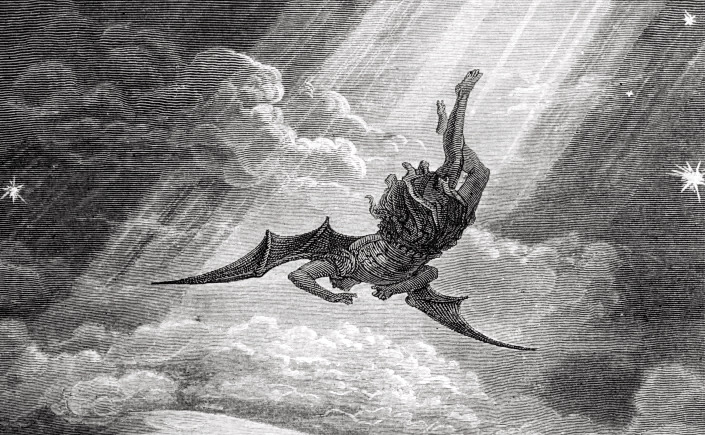
Lucifer descending … encounters with the morning star

Please allow me to introduce myself
I’m a man of wealth and taste
I’ve been around for a long, long year
Stole many a man’s soul and faith
The Rolling Stones, Sympathy for the Devil (1968)

Strange things happen If you stay
The devil will catch you anyway
He’ll seek you here he’ll seek you there
The devil will seek you everywhere.
Gun. Race with the Devil (1968)

My words appear to leave you cold;
Poor babes, I will not be your scolder:
Reflect, the Devil, he is old,
To understand him, best grow older.
Goethe, Faust

Say what you like about The Devil, he does at least give a fair price for souls. Faust got twenty four years of worldly knowledge and pleasure in exchange for his (more about him later). When Robert Johnson met him at the crossroads, he mastered the blues overnight. When it comes to music, he’s a hot fiddler – though when he came down to Georgia “lookin’ for a soul to steal”, young Johnny whupped him good. Leonard Cohen reversed this analogy when in one of his last songs, he sang “now the angel’s got a fiddle and the devil’s got a harp”. So, a warning to all: “Beelzebub has a devil put aside for me” and thee.

It is said the Devil “gets all the best songs”. He also gets a good few stories, in the form of “biographies” both scholarly and light-hearted and novels and movies that range from allegory to fantasy, depicting him the personification of evil or as a clever and entertaining trickster. In some, he is the ageless hornèd one, and in others, he is just plain horny – I’m thinking here of Jack Nicholson’s scene-stealing performance in the 1987 adaptation of John Updike’s The Witches of Eastwick, all wicked grins, lecherous asides and comedic menace. That’s actually one of the better films in a catalogue of cinematic corn that features Satan, to use another of his many names, in person, through a proxy or in psychic proximity to an endangered mortal soul.

Closer to home, my friend and budding author John Rosley, published a novella called A Touch of Sulphur before he passed on in 2022. Its narrator, an incarnated Satan, boasts about his achievements on earth. He has strong and politically incorrect views, particularly regarding the Catholic Church and its clergy whom he regards as his bitterest enemies, ripe for degradation in ways only a devil may invent. I hope that his story, available on Kindle via Amazon, didn’t cause him too many problems when he arrived at Saint Peter’s Gate and knocked on Heaven’s Door.

In the interest of balance, I must note that there been plenty of books written about the old fellow’s nemesis and arch-adversary – including those claimed to have been written by or on behalf of himself. The Almighty, Our Lord, Yahweh, Jehovah, Allah, Big Hughie, and more. There are, as Muslims rightly aver, a thousand names for God. Many contemporary scholars have penned biographies, and so has another friend of mine. This I actually proof-read, but it remains to this day unpublished.

The following, however, is a contemplation of Lucifer, biblical bête noir and literary anti-hero (he, like God goes by a multitude of soubriquets; but I like Lucifer best). It leans more to light-hearted than to outer darkness and neither scholarly nor theological, it is slightly iconoclastic, and, I hope, informative and entertaining. It describes my long and enduring artistic relationship with the “great tempter”, a literary fancy rather than some kind of weird bond with the evil one – neither amoral, immoral nor menacing, but more like a muse.

And …

It all began with Christopher Marlowe 

Dr Faustus. Was not that Lucifer an angel once?
Mephistopheles. Yes, Faustus, and most dearly loved of God.
Faust. How comes it then that he is Prince of Devils?
Meph. O, by aspiring pride and insolence,
For which God threw him from the face of heaven.
Faust. And what are you that live with Lucifer?
Meph. Unhappy spirits that live with Lucifer,
Conspired against our God with Lucifer,
And are for ever damned with Lucifer.
Faust. Where are you damned?
Meph. In hell.
Faust. How comes it then that thou art out of hell?
Meph. Why this is hell, nor am I out of it.
Think’st thou that I that saw the face of God
And tasted the eternal joys of heaven
Am not tormented with ten thousand hells,
In being deprived of everlasting bliss?
O, Faustus, leave these frivolous demands,
Which strike a terror to my fainting soul.
Christopher Marlowe, The Tragicall History of D. Faustus

That was Kit Marlowe, the Elizabethan playwright who gave us the story of Doctor Faust, the ambitious alchemist who “sold his soul to the Devil” – a salty tale taken up centuries later by German poet Friedrich Goethe and French composer Charles Gounod. His play is best known for his description of the legendary Helen of Troy as “the face that launched a thousand ships”: Marlowe may not have been the first to give us Faust, and nor was he to be the last. German polymath and write Johann Wolfgang Von Goethe took him in the early nineteenth century as did French composer Charles Gounod in 1859: a wonderful opera with a fabulous “soldiers’ chorus”. German author Thomas Mann published Doctor Faustus in 1947 wherein a gifted composer strikes a “Faustian bargain” for creative genius. These tales always end badly, their protagonists forgetting the maxim that those who sup with the devil should use a long spoon.

As for Marlowe, this sixteenth century “rake and rambling boy”, alleged bisexual and also government secret agent, was also an accomplished playwright, recognized as one of the most accomplished in a crowded Elizabethan field, and a master of blank verse – it’s still called “Marlowe’s mighty line”. In the perennial debate about whether or the Bard of Avon wrote the plays attributed to him, Marlowe’s name pops up as one of the prime candidates. A bit of a cruiser, a bit of a bruiser, he died in a tavern brawl in Deptford, southeast London.

It was through Marlowe that I first made a literary acquaintance with Lucifer – back in Moseley Grammar School in the mid-sixties when Kit got himself on to our A Level syllabus, and though one of our set plays was Edward II, the sad tale of a conflicted and controversial king, we were encouraged to read some of his plays. And I’ve always remembered the following exquisite demonstration of his “mighty line” as the medieval Mongol conqueror Amir Tamburlane grieves for his dying wife:

Black is the beauty of the brightest day;
The golden ball of heaven’s eternal fire,
That danc’d with glory on the silver waves,
Now wants the fuel that inflam’d his beams;
And all with faintness, and for foul disgrace,
He binds his temples with a frowning cloud,
Ready to darken earth with endless night.

Zenocrate, that gave him light and life,
Whose eyes shot fire from their ivory brows,
And temper’d every soul with lively heat,
Now by the malice of the angry skies,
Whose jealousy admits no second mate,
Draws in the comfort of her latest breath,
All dazzled with the hellish mists of death.
Now walk the angels on the walls of heaven,
As sentinels to warn th’ immortal souls
To entertain divine Zenocrate …

The crystal springs, whose taste illuminates
Refined eyes with an eternal sight,
Like tried silver run through Paradise
To entertain divine Zenocrate:

The cherubins and holy seraphins,
That sing and play before the King of Kings,
Use all their voices and their instruments
To entertain divine Zenocrate;

And, in this sweet and curious harmony,
The god that tunes this music to our souls
Holds out his hand in highest majesty
To entertain divine Zenocrate.

Then let some holy trance convey my thoughts
Up to the palace of th’ empyreal heaven,
That this my life may be as short to me
As are the days of sweet Zenocrate.

But back to Lucifer …

Lucifer and me

I heard the snake was baffled by his sin
He shed his scales to find the snake within
But born again is born without a skin
The poison enters into everything
Leonard Cohen, Treaty

As a nipper, I was well aware of his bad reputation. Brought up Irish catholic in Birmingham, there was no way that I could’ve missed him – it was always a “him” back then and never “her”, though our childhood was replete with biblical archetypes of amorally lapsed ladies with exotic names like Salome, Delilah, and Jezebel who often had songs, plays or movies written about them. Often, they too were portrayed as “the devil incarnate”. Elvis Presley sang about The devil in Disguise. Cliff Richard whinged about his Devil Woman. Fifties crooner Frankie Laine of High Noon and Rawhide fame sang about his unfaithful girlfriend: “if ever a devil was born without a pair of horns, it was you, Jezebel, it was you!”

That business in the Garden of Eden assured us that it was a woman who had committed the “original sin” and that all women were per se “the root of all evil”. This was when Satan earned his reputation as a tempter (nice apple), deceiver (Adam needn’t know) and liar (God won’t mind), and with it, the tag “Prince of Lies”. The implication was, that, if you fucked up, like evangelist preachers today who are caught with their pants down, “the devil made me do it”.

We were taught that Old Nick, as he was called, was forever lying in wait to divert us from the straight and narrow, and that the holier you were, indefinable though that was, the greater the effort he put into suborning you and the greater the rejoicing in the infernal realms should you stumble and fall. He isn’t alone, mind; look at the vicarious  pleasure we take in seeing the high and mighty brought low by human failings, particularly politicians and clerics who lecture us on old values like family, neighbourliness, decency, courtesy, and self-control. The internet preys upon everything vile in the human spirit and can corrupt what is good into that vileness, which would certainly be the work of Satan.

A comment in the e-zine Unherd recently described this well: “… what is evil within humanity is only there because of Satan in the first place, having been the one who tempted Adam and Eve into eating the fruit of the Tree of the Knowledge of Good and Evil that placed within us the seeds of his own evil and the root of our corruption. The knowledge of Evil is what spurs us to such negative and destructive impulses, but the knowledge of Good would pull us towards something higher. This of course would be abhorrent to the Dark Prince, thus necessitating the construction of such and infernal mechanism as this to further debase and erode God’s creation, to ‘finish the job’ as it were.”

By coincidence, I was only just listening to The Rest is History podcast about Martin Luther, and Dom and Tom recounted how the Reformation’s progenitor believed the evil one to be intensely real, a clear and present danger. Rantings about Satan were virulent and often quite alimentary, featuring lots of bodily fluids. There is an apocryphal story of how one time, assailed by Satan, Luther threw an inkwell at him. another time, when during an hallucinatory episode, Lucifer appeared to him as a little dog, though an avowed dog-lover, Martin flung unlucky Rover out of the window. A sad case of being in the wrong place at the wrong time. 

But I’d never encountered him represented as an actual person. Until I met Christopher Marlowe in Lower Sixth. Along with Kit, I also met Mephistopheles, a demonic go-between tasked by Lucifer to purchase the soul of the ambitious Dr Faustus. Admittedly, M was merely the middleman, but he gave his crew a bad name and literary fame. 

About the same time, I happened to bump into him at the amazing Birmingham Museum and Art Gallery – the magnificent statue of Lucifer that stood imperiously in the centre of the central hall. The winged bronze oversized figure (11 feet tall, weighing in at 2,000kg) is Jacob Epstein’s depiction of the Archangel  Lucifer, inspired by the renowned sculptor’s fascination with John Milton’s epic poem Paradise Lost (1667). It has stood at the heart of the museum, tall, stern and perhaps androgynous, a custodian of the gallery’s collection, an affirmation of the artist’s genius, and its value to the museum.

And so it was that at Moseley Grammar we learned through the unfortunate Faustus that Lucifer was an actual person, and an untrustworthy one at that. A fellow student, whom I did not know too well, and who was in fact one of the few Jewish students, wrote a poem for our school magazine (of which I was one of the editors). I remember but the last stanza (and later in life, used it as the last verse of a song).

But my literary liaison with Lucifer did not end there. Flatting in London in the early seventies, a friend introduced be to Lucifer’s Cage, a fiery instrumental by English guitarist Gordon Giltrap (who, incidentally, grew up in Deptford, the place of Kit Marlowe’s demise). The tune and its title, and that one verse slept in my imagination for decades, until they crystallized in a song.

Lucifer, star of the morning
Lucifer, prince of the night
Lucifer falling through darkness
Lucifer cast from the light.

Lucifer sits in his wasteland
Trapped in the cage of his pride
The sirens of importunate circumstance
Reclining in ranks by his side
Plots he has made, so ingenuous.
Dangerous follies and schemes
For he has stage-managed quite strenuous
Drunken prophecies, libels and dreams.

Lucifer frets in the wasteland
Locked in a pillar of ice
We know of this only to well
We have visited him there once or twice
For his is the language of liars
And his is the honour of thieves
And he is the master of eloquence
As the last of the honest men leaves.

Lucifer crawls from the wasteland
No solace or peace or rest.
For he has corrupted the wisest
And he has co-opted the best.
And all that is good has since vanished
And with it, the fair and the true
And the silences hurting his demon heart
Are haunting, haunting you.

And the road that winds out of Meggido
Is the path that leads to the pit
For Lucifer prizes a web of disguises
He merely selects one to fit.
And the road that runs down to Jericho
Is the path that leads him to you
And the paradox searing his demon soul
Is hunting, hunting you.

So make you no truce with Lucifer
Lucifer of fiery breath
For Lucifer is treachery
And treachery is death.

Lucifer, star of the morning
Lucifer, prince of the night
Lucifer falling through darkness
Lucifer cast from the light.

The “pillar of ice”, by the way, is borrowed from the fourteenth century Italian poet Dante Alighiari’s Inferno. In his account of life after death, the ninth and last of the concentric spheres of hell, is where betrayers and traitors languish.  It is presided over by the man himself, the greatest betrayer of all, though now impotent, encased up to chest in ice, a giant, bat-winged demon with with one head and three faces. Each weeps as it chews on a notorious sinner: Jesus’ betrayer Judas Iscariot, and Julius Caesar’s backstabbers Brutus and Cassius. His wing-beats raise a chill wind that continues to freeze the ice surrounding himself and the other sinners in the Ninth Circle, a wind that is felt throughout the other circles of Hell. In contrast to depictions of the devil in Dante’s day as a cunning foe ever ready to prey on human weakness, his Lucifer is strikingly modern, a metaphor for nothingness. Dribbling and speechless, he is all hat and no horse, or more apposite, all horns and no hellfire.

The Emperor of the kingdom dolorous
From his mid-breast forth issued from the ice …
Consider now how great must be that whole,
Which unto such a part conforms itself.
Were he as fair once, as he now is foul.

Doré’s Dante – Satan in Hell

Jacob Epstein’s Lucifer

Fallen Angels

So who exactly was this Lucifer, the biblical sum of all our fears?

Many Christians, whom I do not profess to be (I gave up practicing when I was good enough), believe that Satan, or “the devil” as he is commonly known, was once upon an eon ago a gorgeous angel much loved by God and named Lucifer – which means “star (or ‘son’) of the morning” – on account of his exemplary luminescence. No wonder early marketing folk got the idea of naming a brand of matches “Lucifers” – a tag memorialized in the First World War song It’s a long way to Tipperary and the soldiers’ trench superstition from the Crimean War to World War II  of “Three on a match.

He’d got tickets on himself, defied the boss and fell from grace. “Cast out into the Outer Darkness”, in fact. Hence French illustrator Gustave Doré’s striking image of him descending to Earth to fracture a cozy de facto relationship between Adam and Eve, the first human beings, a perfect pair “created in God’s image”, and thereafter to inflict mayhem upon mankind, including, as we have noted above, the concept of “original sin” which broadly defined all humanity as damned until it accepted the dominion of an almighty creator and condemned womankind to an eternity of subjugation to the patriarchy.

This assumption that he is a fallen angel is, scripturally, based the Book of Isaiah in the Old Testament of The Bible: “How art thou fallen from heaven, O Lucifer, son of the morning! How art thou cut down to the ground, which didst weaken the nations” (14:12).

But the tabloid story that has been handed down to us through the ages arguably originated in the apocryphal Book of Enoch, written sometime between 300-100 BCE and quite popular around the time of Jesus. It was widely circulated although it was considered a heretical text by the religious authorities on account of its opposition to mainstream Rabbinical Judaism. Whilst referenced a few times in the New Testament, it was rejected by the ecclesiastical canon, (though not, apparently, in Ethiopia – to this day, a unique African outlier to Christianity, and indeed, Judaism). But it’s from Enoch that we’ve inherited most of our mythology of the fallen angels, and also, a lot of apocalyptic imagery and millenarian or “end times” belief. 

The apocalyptic Book of Enoch gave names to the Sons of God – Lucifer and his comrades, and also, a mob called the Nephilim. The eponymous Enoch understood them to be fallen angels who, having fallen to Earth, had sex with human women – beautifully portrayed in Daniel Chester French’s sculpture, which has been described as the sexiest statue in Washington DC. God, naturally, punished them, and, their behaviour, it is said, in Noah’s flood.  So, it would seem, the fall of the angels related more to sexual sin than to Lucifer’s pride.
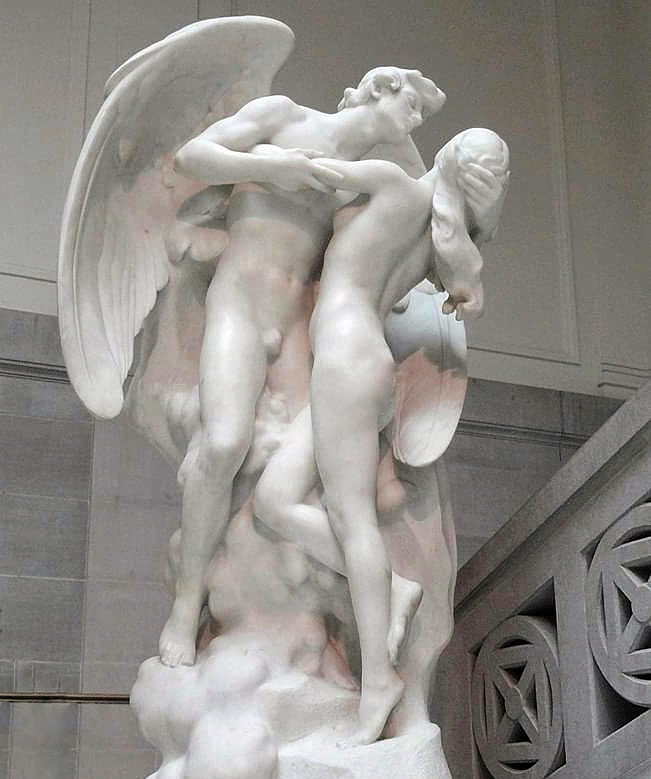
The Sons of God Saw the Daughters of Men That They Were Fair.
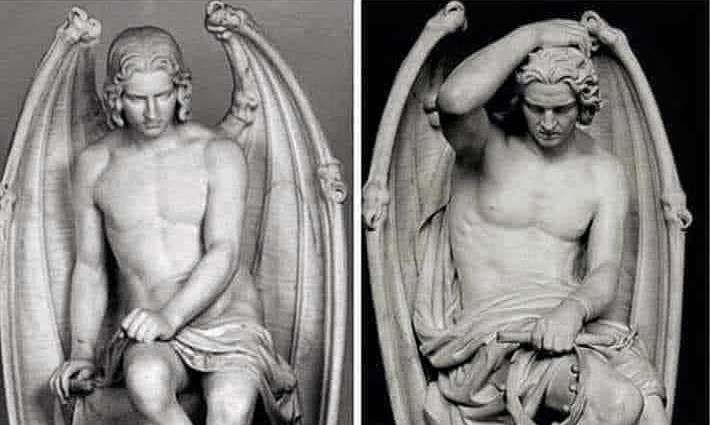
An artist made a sculpture of Lucifer that was too hot for the church so it commissioned his brother. He made an even hotter one!

Regarding the above picture, a Facebook comment read: “The depiction of Lucifer on the right looks exactly like the one in my dream.  I dreamt that I was in very dark hallway or corridor and suddenly the room lit up, not a very divine bright light but more like a very dim light, lit enough to see what was going on. There was this huge very tall, partially robed angel in crimson red. He raised his hands in the air, and when he did, blood exploded out of the walls. It scared the shit out of me. I jumped up out of bed and didn’t go back sleep until the next day. Satan is definitely real, and he isn’t a red goat with horns – he’s a very tall, nice-looking angel with wavy blonde hair – and very very powerful he has wavy blonde hair sort of like Logan Paul’s (an American social media influencer, professional wrestler, YouTuber, entrepreneur, and actor). Though this may sound silly or fun,  I’m not joking. I’ve I seen this m…..f…..r in my dream! It was Lucifer!”

And with regard to artistic depictions, there is the amazing sculpture The Fall of the Rebel Angels” created by sculptor Agostino Fasolato in the eighteenth-century. Almost two meters high and carved from a single block of Carrara marble, it is a pyramid of sixty contorted figures. At the top, wielding his sword of fire, is the archangel Michael who, according to religious tradition, led to forces of light in the tumultuous battle that saw Lucifer and his rebel angels consigned to hell. It an extraordinary intertwining of bodies, depicting the falling angels at the moment of their transformation into demons. So, there they are, agonised faces, hornèd heads, and serpents’ tails, rocking and rolling, tossing and turning, tumbling down, down, down into the infernal pit.

Paradise lost

The story of the fall of Lucifer is actually underpinned by not one but two works of fiction: Enoch’s, and the English puritan poet and pamphleteer John Milton’s imaginative and lyrical masterpiece Paradise Lost (1667) which has dominated our perspective of the story ever since.

Milton gave us the first lyrically and psychologically compelling portrait of Lucifer. He was not the sly predator of myth and menace but rather, (initially, at least) an edgy seductive hero. With his fine words, theatricality and swagger, the only ostensible sign of evil within, a lightning scar on his face: “He above the rest, in shape and gesture proudly eminent, stood like a tow’r”. And yet, he winds up as a washed out up idealist and revanchist cynic, “dismay mixt with obdurate pride and steadfast hate”.

Although I was familiar with Paradise Lost, I did not read Milton’s prose opus until the late seventies, encouraged by the the work of nineteenth century French lithographer Gustave Doré who rendered the poet’s words into pictorial flesh. That’s his iconic image of Lucifer descending to Earth at the head of this story.

Sometime in the early eighties, 83 or 84 I think, my old pal and provocateur Yuri the Storyteller introduced me to Lilith.

Lilith has been around for thousands of years. In the Talmud, she is described as a winged demoness with a human appearance. She appears in the bible, in the Dead Sea Scrolls, and in Hebrew folklore, and has been mentioned in black magic treatises. The apocryphal story is that Lilith was Adam’s first wife. God made Adam from dirt and clay. Adam bored, requested a companion, and God obliged with Lilith. Legend has it that her dirt was dirtier than Adam’s, but put that down to patriarchal prejudice and propaganda. More likely, she had the dirt on him! But I digress. Apparently, Lilith was not as inferior to Adam as he wanted. She wanted to be her own person, not Adam’s wife-slave. The story is that when Adam insisted on the missionary position, Lilith refused, saying “Why must I lie beneath you? We are both equal. We come from the same earth”. Adam got mad, and Lilith took off.

Because of this, she was banished from Eden and became a spirit associated with the seductive side of a woman. Eve came in her place to stand behind Adam, not beside him. Lilith became the timeless femme fatale, preying on the easily tempted weaker sex, the fabled incubus who comes at night upon men as they sleep. It is not for nothing that she has been hailed the (informal) goddess of wet dreams.

The legends are many and various. If you buy into the Lilith theory, you will see her cropping up throughout history in a variety of guises. In biblical times: Delilah, Salome, and Potophar’s wife. In fact and fable: Sheherazade, Lucrezia Borgia, Mata Hari, Evita Peron. Hollywood’s screen ‘sirens’ like Vivien Leigh, Elizabeth Taylor, and Marilyn Monroe. All of them antitheses to secular saints like Eve, Mary Magdalene, Joan of Arc, Florence Nightingale, Jackie Onassis, Mother Theresa, and Princess Diana.

Lilith’s story deserved an epic poem, so borrowing from Milton and the opening chapter of JRR Tolkien’s Silmarillion, I duly wrote Lilith – a poem of the fall. It was attributed to a Roman poet celebrated during the reigns of emperors Claudius and Nero. It’s forward read:

“The style of Lilith differs markedly from that of other poems attributed to Meniscus – most notably the Hebrew Heroes cycle and was evidently written for a different manner of presentation. It was most likely written to be recited rather than sang (as were his other “story songs”). Recitations were a common form of entertainment in the middle Roman period, owing their popularity to the enduring reputations of the “classical” writers of the time, Ovid, Horace and the like. It was not uncommon for such recitations to last several hours. But Meniscus, mindful of the fast-moving times, and also of the attention span of his audiences, appears to have honed his pieces down to between ten or fifteen minutes”.

It debuted at Victoria’s Port Fairy Folk Festival in about 1986 in a shambolic busy poetry competition – it came first, I recall, but the event was so poorly organized that I received neither award or recognition.


It began in suitably histrionic Genesis style:

Long time ago In a time before time,
When man was an atom in primeval slime,
When darkness lay hard on the face of the deep,
God called for his angels to sing him to sleep.

I hadn’t finished with Lucifer, however. He reappeared as metaphor in a gloomy commentary of the state of humanity in Devil’s Work, published in full at the end of this article. The narrative actually came to me in a dream – though this was not the nightmarish image of the sleepless Facebook commenter quoted above:

For what you’ve done to you own kind, you’ve done of your own will.
If I went away on a holiday, you’d be malignant still.
For all you’ve done unto yourselves, you’ve done because you must –
A self-destructive legacy to bring yourselves to dust.
To render you to dust.

The implication here is that we actually know Lucifer, Satan, the Devil, because, to use a an enduring aphorisms, “we have seen the enemy and he is us!”. Many writers have implied this. In 1942, not long after his return to the Anglican faith in which he’d been raised, my favourite poet WH Auden asked a Sunday School class: “Do you know what the Devil looks like? The Devil looks like me.” As an informative piece in The Daily Beast observed, “his sensitivity and acuity as a poet made him aware that the pathologies of ideology are first manifest in the pathologies of individuals, including and especially himself, a character he never shied from satirizing or indeed using as a template for the doomed romantic or cruel authoritarian he took as the protagonist of so many of his poems”.

And finally,Lucifer is also name checked in a sprawling ballad about Herman Melville’s Captain Ahab and his obsessive hunt for Moby-Dick, the famous white whale:

Down, down, deep down we dove
In a tangle of rigging and rage –
Down to the deep where the dead sailors sleep
In the darkness of Lucifer’s cage.
From Chapter Forty One – In That Howling Infinite 

A brief satanography

The following is an updated version in the introduction to Roman Holiday: The Poems of Meniscus Diabetes (1989). Most of it is compiled from Wikipedia.

‘Satanic’ implies the old God-Satan contradiction – and yet it is a paradox. You can’t really have the idea of a universal, omnipotent a God AND a universal, quite potent black hat opposing both Him and Man.

Indeed, we tend to anthropomorphize Old Nick more than we do his rival and nemesis God, although Jesus and Satan often have their own Fight Club going in the New Testament – the ostensibly “evil one” doesn’t get much of a gig in the Old Testament, which is not to say that Jewish folklore didn’t quite ignore him, as I will explain in eccentric detail below. The Essenes of old, who left us a heap of important written material in caves overlooking the Dead Sea, bought into the idea of a conflict between the spirit Princes of Light (God, and in time, Jesus) and of Darkness (Satan – which might’ve come from the ancient Persian Zoroastrian spirit of light and wisdom, Ahura Mazda (remember the light bulbs back in the day?) the Zoroastrian present day heirs are the persecuted Baha’i of Iran (though their HQ is in Haifa, Israel. Ironic, eh?) and the Parsi in India and Pakistan, a name derived from Farsi, now the language Iran and much of Afghanistan.

Then we have the old Parthian prophet Mani who, according to Wikipedia, sought to synthesize the teachings of most of the faiths in vogue from Europe to China and all places betwixt during the third century CE. He gave us Manichaeism, which teaches an elaborate dualistic cosmology that describes a struggle between a good, spiritual world of light, and an evil, material world of darkness. It’s not an optimistic one – through an ongoing historical process, light is gradually removed from the world of matter and returned to the world of light, whence it came. The Manicheans believed that God was just, and kind, and loving. He was forgiving God who would forgive us our trespasses. It was the Devil, therefore, who had to be propitiated with prayers and amulets and so on – averting “the Evil Eye”. The Manicheans were accordingly persecuted as heretics at best, and as devil-worshipers at worst.

Lucifer, of course, derived from the Latin, meant “light”. He was, of course, an angel. In angelology – yes, there is indeed such a field of study, angels were, or are, because quite a few folk believe that they are real, God’s bodyguards (assuming he was corporeal) and cops before the Jesuits took over. They are categorised by power, authority and also, light. Lucifer was “top gun”, the bee’s knees, dog’s balls, the primus inter pares. Until he got to big for his wings and staged a rebellion.

There is a downside to doing deals with the devil, unless you’re Robert Johnson at the famous Crossroads, or successfully challenging him to a duel like the young fiddler in The Devil Came Down to Georgia or the likely lad in the old English folk song False Knight on the Road. Look what happened to the ambitious Marlowevian sybarite Doctor Faustus.

The unfortunate Yazidi people of Iraqi Kurdistan and northern Syria, ethnically Kurdish, but an ancient religion in an intolerant sea of Islam, were long accused of being “devil worshippers” because they believe that whilst God is benevolent and will not do us intentional harm, the Devil can be quite malevolent and hence needs propitiating. This was how others perceived it back in the dark day, although more enlightened times have emphasized that the Yezidi Peacock Angel is a beautiful and as benign and benevolent a deity as any other in the deities beloved of the world’s believers.

The Peacock Angel,
 Deviant Art

There was no diabolical god in the Roman and Greek pantheon – or amongst the Norse Gods for that matter. There were gods who did nasty things, but that was because they are annoyed, or angered, or moved to vengeance or malice, or even, envy and lust. These, one placated to restore them to a better humour. Nor is the Satan, the principle of evil personified, actually in the bible. This was a later construct that was read back into it. In the bible according to the poet John in Milton, the devil, whilst not exactly pleasant and delightful, is either on the side of the heavenly authorities at the least, or at the least, not destructively opposed to them. In the words of that great song out of the Brill Building, NYC, “I’m just a boy whose intentions are good. Please don’t let me be misunderstood”.

© Paul Hemphill 2024. All rights reserved

For other indulgences in In That Howling Infinite. see It’s 3am and an hour of existential angst, Blue remembered hills – a land of lost contentment and The quiet teatime of the soul

Devil’s Work

I dreamt I fought the Devil and I bound him in strong chains
To answer for our consciences, to blame for mankind’s stains;
For all pain and perversion, crime and atrocity,
I brought the criminal to trial in the name of humanity.
This bane of humanity.

In judgement of the power man who makes us fight his fights,
And the holy men in uniform who trample on our rights;
To exact compensation for his prey alive and dead.
But when I brought him to the dock, this is what he said…
He said: “I had no part on what you say I’ve done to hapless man.
He’s master of his destiny – he does the worst he can.
I did not set the fires that burn – I only tend the flames.
Men forged the swords and lit the brands, wrought carnage my name.
They conquered in my name.

“The tyrants and oppressors who jockey for control,
Are of mankind’s own substance, the product of his soul.
The torturers and murderers – in these, I had no part.
They spring from man’s perverse desires and his infernal heart.
Damn his eternal heart.

“The tyrant is not guilty and the killer has clean hands.
They are but pawns of the soul of man and the fruits of his demands.
One half of mankind does not think, the other does not care –
And the sheep go to the slaughter when the wolf pack leaves the lair.
The wolf has left his lair.

“And I am but an image, a figment of your mind;
I am but the whipping boy your hide your sins behind.
I was here before you came to Earth, I’ll be here when you’re gone.
I don’t ask your forgiveness when you’re deserving none!
My undeserving son.

“For what you’ve done to you own kind, you’ve done of your own will.
If I went away on a holiday, you’d be malignant still.
For all you’ve done unto yourselves, you’ve done because you must –
A self-destructive legacy to bring yourselves to dust.
To render you to dust.

So when you say I want to rule a realm of ash and bones,
Let he who is devoid of sin go cast self-righteous stones.
I stand upon the sidelines, contemptuous, aloof.
I won’t condemn all that you’ve done.
I may condone all that you’ve done.
I’m quite content with what you’ve done. But cause it?
Give me proof!”

Rider Haggard and the book that launched a genre

In 2014, English author and academic Katherine Rundell published an entertaining article in the London Review of Books entitled Fashionable Gore. It served recently as the primarily source and backdrop for a podcast in the highly addictive podcast The Rest is History. The hosts, historians Tom Holland and Dominic Sandbrook, specialist in ancient and modern history respectively, have a jolly good time  discussing the legacy of English fin de siècle author Henry Rider Haggard, and particularly, his hugely popular adventure yarn King Solomon’s Mines.

Rundell writes: “King Solomon’s Mines is a very Victorian fable of endurance but it’s also a glorious romp, if you don’t mind your romps racist, sexist and tin-eared … It would be surprising if any white man born in 1856 had written non-racist, non-sexist fiction, whether it was set in Africa or not … You make a choice with Haggard: if you suspend not just disbelief but politics, logic and taste, the rewards are very real”. She first encountered the novel as a liberal-minded, educated adult when she could judge a book on its merits and its shortcomings. I was a pubescent early teen when it was recommended to us schoolboys by our English teacher, and was soon hooked on the adventure, the exotic settings and, especially the violence – and quickly moved on to its sequel, Alan Quartermain, follow up and 

I republish Fashionable Gore below. It’s a very good read.  Here is The Tom and Dom Show. But read on …

As a young man, in January 1879, Henry Rider Haggard walked the field of Isandlwana in present day in Kwa-Zulu Natal Province, South Africa just days after the battle in which a Zulu army totally destroyed – indeed, massacred – a British army. He was fascinated by and enamoured with Africa, the “dark continent” of myth and story. Having spent but a few weeks in the African bush, I fully under it – though I was accustomed to Australia’s big sky, the “vision splendid of the western plains extended” (that’s the “banjo”), the eldritch aura of Uluru, and the primeval magic of the coastal rain forest, we too succumbed to its spell.

To Henry, Africa was the “heart of darkness”, and yet also, a Garden of Eden, the home of the “noble savage” where a white Englishman, freed of the bonds of straightened Victorian Britain, could walk unexplored and uncharted lands, encounter many wonders, and in “proving” himself and testing his mettle, find himself and weigh his own worth.

You could say King Solomon’s Mines, his third of many adventure novels, could be said to have launched a thousand clichés and I’ve used a swag of them just then …

It all started with a bet …

Henry did not bide long in Africa, though long enough to be involved in the annexation of the Boer state of the Transvaal after the first Boer War in 1881, one of the triggers for the second and greater Boer War in 1899. He’d returned to England by 1885 when his elder brother pledged him five bob if the he could write a book half as good as Robert Lewis Stevenson’s hugely popular pirate jaunt “Treasure Island”.

By the end of the year, he had penned a novel that would become the foundational text of the lost world literary genre. King Solomon’s Mines was one of the first English adventure novels set in Africa, a story brimming with treasure, bravery and romance, and featuring all-action hero and big game hunter (naturally) Allan Quartermain and his conflicted band of British brothers (Scots and English to be precise – Stevenson, and before him, Sir Walter Scott

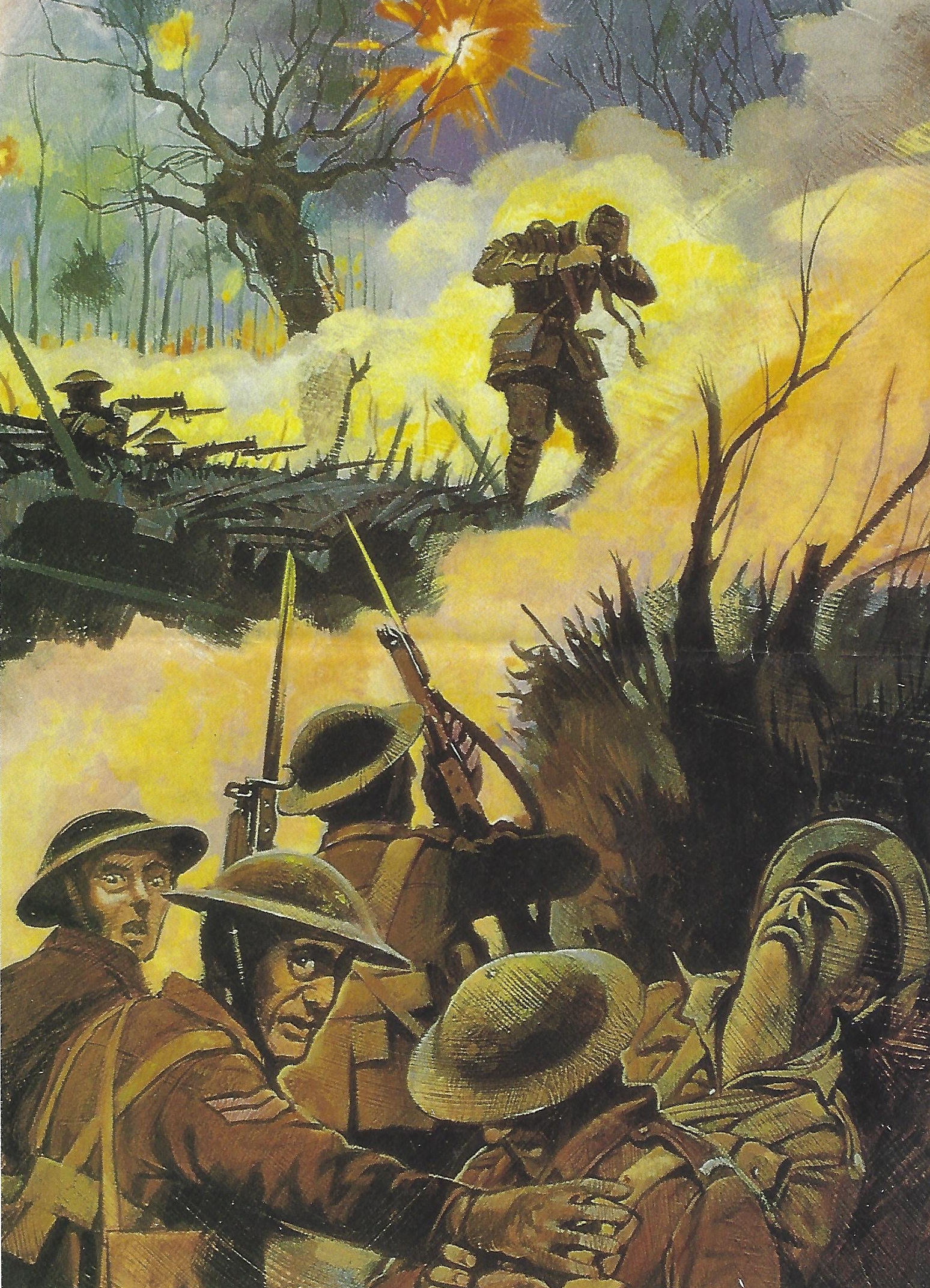
It was a romantic and what we call today white supremacist, man’s world of Britishness and brotherhood, martial prowess and manliness (or as Tom and Tom jest, “men in tight trousers”) in which the plucky British adventurer bested beast and barbarian and laughed in the face of fear. A “boy’s own” universe indeed, which I and my school chums lapped up with vicarious pubescent relish in the early sixties. All this “derring-do” is now dismissed as an outdated and anachronistic perspective of earlier generations, and what I perceived early on in my coming of age, as old-school Englishness. It was, of course, of its times. It lacked none of the sardonic ‘seventies irony of George McDonald Fraser’s celebrated Flashman comi-tragic adventures in which the eponymous antihero, the unreconstructed villain of Thomas Hughes’ Victorian yarn Tom Brown’s Schooldays, roves and rogers his way through the wars of the nineteenth century, somehow managing to escape by the skin of his teeth from one military disaster after another, including Custer’s famous “Last Stand” at Little Big Horn, the Charge of the Light Brigade, and the last stand of the 44th Foot at Gandamak during the disastrous First Afghan War of 1842.

In his turn-of-the-century prudish, Henry would never have let Quartermain and his pals go forth in such amours and priapic array as the nineteen seventies unchained and unzipped Harry Flashman. Though he shyly dallied with the picaresque – like Fraser, his few female characters were either portrayed as drop-dead gorgeous and dangerous or as plug-ugly and dangerous. But he views womenfolk with an almost schoolboy insouciance and deflection. Rundell observes that “the noble native woman always dies in Haggard – Quatermain feels ‘bound to say … that I consider her removal a fortunate occurrence, since, otherwise, complications would have been sure to ensue’, whilst she and the podcast pals chuckle over the male protagonists’ “euphoric homosociality”, taking great pleasure in quoting at length the following mellifluous piece of Victorian soft porn from King Solomon’s Mines: 

I am impotent even before its memory. Straight before us, rose two enormous mountains, the like of which are not, I believe, to be seen in Africa, if indeed there are any other such in the world, measuring each of them at least fifteen thousand feet in height, standing not more than a dozen miles apart, linked together by a precipitous cliff of rock, and towering in awful white solemnity straight into the sky. These mountains placed thus, like the pillars of a gigantic gateway, are shaped after the fashion of a woman’s breasts, and at times the mists and shadows beneath them take the form of a recumbent woman, veiled mysteriously in sleep. Their bases swell gently from the plain, looking at that distance perfectly round and smooth; and upon the top of each is a vast hillock covered with snow, exactly corresponding to the nipple on the female breast. The stretch of cliff that connects them appears to be some thousands of feet in height, and perfectly precipitous, and on each flank of them, so far as the eye can reach, extend similar lines of cliff, broken only here and there by flat table-topped mountains, something like the world-famed one at Cape Town; a formation, by the way, that is very common in Africa. To describe the comprehensive grandeur of that view is beyond my powers.

Much to my surprise and mirth, I’ve learnt that Shebas Breasts actually do exist.

Sheba’s Breasts Ezulwini Valley Swaziland

Rundell wrote of the titular character of She, Rider Haggard’s follow up adventure yarn, “she was wise and beautiful beyond imagining: a sultry multilingual virgin, wish-fulfillment made flesh … and even more than King Solomon’s Mines, it’s a book out of which obsessions and anxieties leak”. More into power than sex, she was, of course, the original “She Who Must Be Obeyed”. A Hammer horror film version released in 1965 starring pneumatic Bond siren Ursula Andress was an international success and notwithstanding the dusty demise of Ayesha, led to a 1968 sequel, The Vengeance of She, with another femme fatale from Mitteleuropa, Olinka Berova, in the title role. Neither film has aged well, though both ladies are still with us today. 

Ursula Andress as Ayesha

Rider Haggard’s work, particularly King Solomon’s Mines and She, would would inspire authors from the late nineteenth century to the early twenty first. His literary legacy can be tracked from his contemporaries and pen pals Conan Doyle and Rudyard Kipling, both of whom were to visit South Africa during the Boer War, including the former’s Lost World and Kipling’s Gunga Din and Kim, through early twentieth century early Irish Republican Army “martyr” Erskine Childers’ Riddle of the Sands, John Buchan’s Thirty Nine Steps and Prester John, and Edgar Rice Burroughs Tarzan series, to JRR Tolkien’s The Lord of the Rings (to many, regarded as the pinnacle of the adventure novel genre). Grahame Greene and Ian Fleming have acknowledged their debt to Rider Haggard, whilst the book has inspired movies from the beginning of the art form, including several remakes of King Solomon’s Mines and (the featured picture is from a loose British adaptation of 1937 starring Cedric Hardwicke, Anna Lee, and my namesake Africa American crooner and socialist Paul Robeson – unlike the movies, Henry would never have countenanced “leading ladies” in his manly romps) and latter day day blockbusters like the original Star Wars , and the Indiana Jones and Tomb Raider film series.

King Solomon’s Mines, its follow-ups and the many subsequent imitators are all variations on the derivative ‘hero’s quest’, the mono-myth popularized by by Joseph Campbell in his celebrated book The Hero with a Thousand Faces.That author described it thus:

A hero ventures forth from the world of common day into a region of supernatural wonder: fabulous forces are there encountered, and a decisive victory is won: the hero comes back from this mysterious adventure with the power to bestow boons on his fellow man.

Campbell borrowed the term monomyth from Irish author James Joyce’s Finnegans Wake – Joyce’s Ulysses was also highly influential in the structuring of the archetypal motif. He published The Hero’s Quest in 1949 but the idea behind the monomyth preceded him by millennia – think Odysseus and Aeneas, Beowulf and Sigurd/Siegfried, contemporaries like JRR, and latter-day film makers and authors. Star Wars creator George Lucas and Richard Adams, bunny-quest Watership Down have both acknowledged their debt to his book.

And so, to Fashionable Gore. The title refers to what Rundell refers to as a particularly Victorian fascination with bloodshed: “Second only to the relish of battle is Henry’s fascination with unusual ways a man might die”. A bit like Vikings, really, without the bonking …

© Paul Hemphill 2023 All rights reserved

See other stories of Africa in In That Howling Infinite: Johnny Clegg’s Impi – the Washing of the Spears and The ballad of ‘the Breaker’ – Australia’s Boer War and for more on “the hero’s quest”, see One ring to rule us all – does Tolkien matter? 

Fashionable Gore

Katherine Randell, London Review of Books, 3rd April 2014

I first encountered King Solomon’s Mines in the children’s section of a public library in Harare. Most of the books smelled of water damage and many had been taken out so rarely that the last ‘return by’ stamp pre-dated Mugabe and decimalisation. I was working through shelves of books about horses and morality tales written by women who manifestly did not like children, and took King Solomon’s Mines because it’s set in ‘the Manica country’, a province a few hundred miles east of Harare. It seemed run of the mill at the time, much like the other books in the library: it was tightly plotted, suspense-driven, lavishly sexist and racist. In fact, though it is often read as a children’s book, it isn’t; nor is it run of the mill. It is the book which sowed the seed for John Buchan’s Richard Hannay, for Indiana Jones and James Bond, and though less slick than its successors, its anxieties and lunacies are more interesting. It isn’t suitable for children; perhaps not suitable at all.

As a child Henry Rider Haggard was believed to be stupid: his father told him he was destined to become a greengrocer. The books aren’t proof that he wasn’t stupid; but they are proof that he was dogged and canny, with a strange and lurid imagination. Haggard’s father lived long enough to see his son become wealthier than he was and the author of a 15-volume series which ran for forty years; he was dead by the time his son was knighted in 1912 (a knighthood for services to literature was at the time largely unheard of, so his was given for services to the development of agriculture in Norfolk). King Solomon’s Mines was written in answer to a bet Haggard had made with his brother that he could write a book as good as Treasure Island. He said it took him six weeks (though novelists always lie about that sort of thing) and it was an immediate bestseller. The 1870 Education Act had produced a large cohort of literate citizens with an appetite for fiction. There was much in the book to be admired by the stay-at-home population of late 19th-century England: in the world Haggard created the governing principle was survival, not class or intellect, and the rewards for bravery were blood (other people’s) and diamonds. Graham Greene said that he valued Haggard’s book ‘a good deal higher than Treasure Island’.

The story follows the narrator Allan Quatermain – an elephant hunter with good manners – and his colleagues, Sir Henry Curtis and Captain Good, on a journey into Mashukulumbwe country. Quatermain early on stakes his claim to heroic status when he says that he has already killed, but always with the stern regret of the Victorian imperialist: ‘I have killed many men in my time, yet I have never slain wantonly or stained my hand in innocent blood, but only in self-defence.’ The men’s aim is to find Curtis’s estranged brother, about which they are guardedly optimistic, and to discover King Solomon’s diamonds, about which – not knowing the title of the book – they are sceptical.

The novel is peppered with geographical detail conveyed in the confident vernacular of contemporary explorers’ reports, though the information itself is often mildly insane. In Manicaland, only the Chimanimani mountains and Mount Nyangani, Zimbabwe’s highest peak, could serve as the basis for ‘Suliman’s Mountains’. The heroes expend much blood and sweat traversing snowy terrain (which, in real life, 11-year-old schoolchildren climb as a matter of routine). In a crevice Quatermain’s hired bearer freezes to death (‘like most Hottentots, he cannot stand cold’) and deep inside a cavern the explorers discover a dead body three hundred years old, preserved ‘fresh as New Zealand mutton’ in the atmosphere. Even in the coldest months the temperature in the Chimanimanis is between 12 and 15 degrees Celsius; Nyangani last had snow in 1935. Haggard knew Southern Africa – he made his first trip to South Africa as secretary to the governor of Natal at 19 and was later master and registrar of the High Court in the Transvaal – but the land he paints is as lurid and fantastical as the witches and secret kings who populate it.

Following an ancient Portuguese map, the three men and their servant, Umbopa, walk into the territory of a hostile tribe, who are awed out of their murderous intentions by the spectacle of Good’s false teeth and white legs. Good, the light-relief character, is forced to walk much of the journey without his trousers, so enamoured of his lower half are the Kukuana people. The tribesmen are also impressed by Quatermain’s gun, as he picks off an antelope from seventy yards with childlike pleasure. ‘“Bang! thud!” The antelope sprang in the air and fell on the rock dead as a door nail. A groan of simultaneous terror burst from the group before us.’ The Kukuanans, Quatermain learns, are ruled by an impostor king called Twala, who is in thrall to Gagool, a witch so pocked and wizened by age that Quatermain mistakes her for ‘a withered-up monkey, wrapped in a fur cloak’. Luckily, Umbopa turns out to be the rightful king of the Kukuana people: a snake tattooed around his middle is the proof. The next night, under cover of a convenient lunar eclipse, Umbopa unveils himself and declares war on the usurper king.

Most of the book focuses on the Kukuana kraal and the battlefield; despite the title, the quest to find the stones takes up only the last fifty pages. When the diamonds are found, in a cave with a hidden door, the moment is muted: ‘The chest was three-parts full of uncut diamonds, most of them of considerable size. Stooping, I picked some up. Yes, there was no doubt about it, there was the unmistakeable soapy feel about them.’ In the novel it isn’t the diamonds that shine but the sweat of male bodies at war. There’s no sex in the book: where there is delight in things bodily, it’s in the euphoric homosociality of the post-battle glow. Haggard’s reluctance to involve women is the most obvious difference between the Quatermain books and those of the writers who emulated them. John Buchan followed Haggard’s adventure-suspense formula closely and self-consciously: in The 39 Steps, the hero’s story is said to be ‘pure Rider Haggard’. But Buchan moistens his stories with sensual descriptions of food – particularly ham – and of beautiful women. Haggard’s heroes are small, bluff men, part of a literary tradition of beta males performing great feats, but the companions – Henry Curtis in King Solomon’s Mines, Leo Vincey in She –have beautiful bodies:

Round his throat he fastened the leopard-skin cloak of a commanding officer … the dress was, no doubt, a savage one, but I am bound to say that I seldom saw a finer sight than Sir Henry Curtis presented … It showed off his magnificent physique to the greatest advantage, and when [Umbopa] arrived presently, arrayed in similar costume, I thought to myself that I had never before seen two such splendid men.

Second only to the relish of battle is Haggard’s fascination with unusual ways a man might die. The highlight of King Solomon’s Mines for most children is the moment when a bull elephant, wounded by a bullet, attacks Good’s servant: ‘The brute seized the poor Zulu, hurled him to the earth, and placing one huge foot onto his body about the middle, twined its trunk around his upper part and tore him in two.’ It was in part because of the death of the poor Zulu that the manuscript was rejected by one of the first publishers to see it: ‘Never has it been our fate to wade through such a farrago of obscene witlessness …nothing is likely in the hands of the young to do so much injury as this recklessly immoral book.’ But it was a fashionable kind of gore. At the Colonial and Indian Exhibition, held at South Kensington in 1886, the entrance was taken up by a diorama depicting a stuffed tiger attacking a stuffed elephant. The exhibition attracted more than five and a half million visitors. Like Haggard’s fiction, it was lit by the radiance of Livingstone, Richard Burton and other empire-building Übermenschen. King Solomon’s Mines is a very Victorian fable of endurance but it’s also a glorious romp, if you don’t mind your romps racist, sexist and tin-eared.

It would be surprising if any white man born in 1856 had written non-racist, non-sexist fiction, whether it was set in Africa or not. Quatermain says of the Kukuana people: ‘These women, for a native race, are exceedingly handsome … the lips are not unpleasantly thick as is the case among African races.’ Narrators, of course, are not spokespersons for their authors and Haggard certainly wrote in the idiom of the time; the explorer Mungo Park, in the purportedly factual Travels in the Interior Districts of Africa, wrote in similar vein: ‘The noses of the Jaloffs are not so much depressed, nor the lips so protuberant, as among the generality of Africans … they are considered by the white traders as the most sightly Negroes in this part of the continent.’ You could say that if we excised all patriarchal books from the canon we would be left with The Very Hungry Caterpillarand little else, but few writers have embraced the status quo with such conviction. The racism in King Solomon’s Mines takes the form mainly of exhaustingly oracular pronouncements: there is none of Forster’s anxiety, or Kipling’s affection. Foulata is a tribeswoman who falls in love with Good, and risks her life to save him. When she dies – the noble native woman always dies in Haggard – Quatermain feels ‘bound to say … that I consider her removal a fortunate occurrence, since, otherwise, complications would have been sure to ensue’. The Quatermain novels become more explicitly unsettling as the series progresses; in a diary entry written in 1924, the year before his death, Haggard foresaw conflict between races as inevitable and bloody: ‘The great ultimate war, as I have always held, will be that between the white and coloured races.’ The sexism, on the other hand, is glossed as a charming foible: ‘I can safely say there is not a petticoat in the whole history.’ His characters describe themselves as misogynists with the same irritating coyness with which people today describe themselves as chocoholics.

She (1887) is a very different book; it certainly isn’t coy. It follows wise but ugly Ludwig Holly and beautiful but slow Leo Vincey to unknown lands on the east coast of Africa. Leo’s dying father bequeaths him a potsherd on which is written in Greek a family history showing that Leo is descended from the royal house of pharaohs, and an instruction that he seek out a beautiful white sorceress and her fiery pillar of eternal life. Haggard gives the Greek in full, in both uncial and cursive, and some of the earliest jacket covers used a photograph of a potsherd, made by Haggard’s sister-in-law, to add verisimilitude. (Vintage Classics has rejected the pot in favour of an orgasmic-looking woman.) The men travel by sea and land to find Ayesha, also known as She Who Must Be Obeyed: an all-powerful ruler, her beauty so terrible she is concealed from face to foot in ‘corpse-like wrappings’. She is wise – ‘the wisest man up on earth was not one-third as wise’ – and beautiful beyond imagining: a sultry multilingual virgin, wish-fulfilment made flesh. She, like King Solomon’s Mines, was written in six weeks and even more than King Solomon’s Mines, it’s a book out of which obsessions and anxieties leak. As Kipling wrote to Haggard, ‘you are a whale at parables and allegories and one thing reflecting another.’

The plot is as simple and linear as that of the earlier book: Queen Ayesha believes that Leo is the reincarnated soul of Kallikrates, a man she had loved and murdered when he remained loyal to another woman. When she learns that Leo too is in love with another woman, Ustane, Ayesha kills her with a gesture. Ayesha’s beauty is so overwhelming that Leo forgives her and kneels at her feet. The terrifying power of female beauty shapes the book. ‘No doubt she was a wicked person,’ Holly says, ‘and no doubt she had murdered Ustane when she stood in her path, but then she was very faithful, and by a law of nature man is apt to think but lightly of a woman’s crimes, especially if that woman be beautiful.’ And later: ‘What a terrifying reflection it is, by the way, that nearly all our deep love for women who are not our kindred depends … upon their personal appearance.’ Ayesha offers to reveal the source of her absolute power, and leads the men to the Fountain and Heart of Life. She bathes first, unclothing herself and re-wrapping her snake belt around her falling hair. It’s the only erotic moment in the book. Suddenly, as the men watch, she begins to shrivel in the flames, ageing before their eyes until she is ‘no larger than a monkey, skin puckered into a million wrinkles’. The powerful monkey-like woman seems to be a keystone of Haggard’s imagination: Gagool, unidentifiable as a woman when first encountered, is ‘so shrunken in size that it seemed no larger than the face of a year-old child’, ‘a withered-up monkey’ with ‘a skinny claw’; Ayesha’s body becomes ‘no bigger than that of a two-months’ child …the delicate hand was nothing but a claw now.’ Holly and Leo flee; Holly’s servant, Job, has died of fright, and they leave his corpse behind.

At the heart of the book is the sense that women, given power, will reign like despots or fail like children. As Margaret Atwood points out in her introduction, Haggard and his siblings had a doll called She Who Must Be Obeyed, who lived in a cupboard and whom the children both tortured and were haunted by. Read as an embodiment of Victorian neuroses and desires, She is a marvel. There are good feminist interpretations: Sandra Gilbert and Susan Gubar connect the witch-goddess figure with the newly fierce debates over the rights of women in Victorian England, and the proliferation of semi-scientific studies of woman’s ‘true nature’. With or without this reading, Shehas extraordinary moments. You make a choice with Haggard: if you suspend not just disbelief but politics, logic and taste, the rewards are very real. There is a peculiar and beautiful scene in which tribesmen, at Ayesha’s command, dance an ‘infernal and fiendish cancan’ in a room lit by burning corpses. ‘As soon as ever a mummy had burned down to the ankles, which it did in about twenty minutes, the feet were kicked away, and another put in its place.’ She burns the body of her two-thousand-year-old embalmed lover with acid: there is ‘a fierce fizzing and cracking sound’ and the man is turned into ‘a few handfuls of smoking white powder’. V.S.Pritchett wrote: ‘Mr E.M. Forster once spoke of the novelist sending down a bucket into the subconscious; the author of She installed a suction pump.’

The trouble with She is that it’s structured around a blank face. We are told that Ayesha had beauty ‘greater than the loveliness of the daughters of men’, but her beauty is sketchily imagined, asserted but never depicted. The result is that she is impossible to desire; a problem exacerbated by her voice and what she has to say. She rants like Nigel Farage, and has only one point to make: men are powerless in the face of beautiful women, women desire not men but power. The greatest woman to have lived is a disappointment, a heckling sex witch. Haggard would think I’m jealous. He says as much, near the end:

Of course, I am speaking of any man. We never had the advantage of a lady’s opinion of Ayesha, but I think it quite possible that she would have regarded the Queen with dislike, would have expressed her disapproval in some more or less pointed manner, and ultimately have got herself blasted.

Well, quite.

That was the year that was – don’t stop (thinking about tomorrow)

The prophet’s lantern is out
And gone the boundary stone
Cold the heart and cold the stove
Ice condenses on the bone
Winter completes an age
WH Auden, For the Time Being – a Christmas Oratorio, 1941

I considered using a line from the above as the title of this retrospective of 2022.  It was written during 1941 and 1942, though published in 1947, when the poet was in self-exile in the United States and viewing the war in Europe from afar – although the long poem from which it has been extracted does not in itself reflect such pessimism. A more fitting title could be taken from another long poem that was published in another (very) long poem published in 1947 – Auden’s often overlooked masterpiece The Age of Anxiety, a meditation on a world between the wreckage of The Second World War and of foreboding for the impending armed peace that we now look back on as the Cold War, with its oft-repeated mantra: “many have perished, and more most surely will”.

The year just gone was indeed a gloomy one, meriting a dismal heading. There are few indications of where it might take us in ‘23 and beyond, and my crystal ball is broken. Pundits reached for convenient comparisons. Some propounded that it was like the 1930s all over again when Europe constantly teetered on the brink of war. Others recalled 1989 with the fall of the aneroid Wall and the collapse of the Soviet Union. But, beware of false analogies. In 2022, things were more confused. The tides of history have often resembled swirling cross-currents.

Things, of course, might have been worse. There are, as I’ve noted in successive posts on my own Facebook page, many qualified “reasons to be cheerful”. The  year could have ended with Ukraine under Russian control. An emboldened China might have been encouraged to launch an assault on Taiwan. A red wave in the midterms would have buoyed Trump. And here in Australia, Scott Morrison might have secured another “miracle” election victory. The West could have retreated on all fronts.

Instead, therefore, I have selected a title that hedges its bets, because, to paraphrase the old Chinese adage, and the title of an earlier retrospective, we certainly live in interesting times and in 2023, and a lot of energy will be spent endeavouring to make sense of them – or, to borrow from Bob:

Pointed threats, they bluff with scorn
Suicide remarks are torn
From the fool’s gold mouthpiece
The hollow horn plays wasted words
Proves to warn that he not busy being born
Is busy dying

B Dylan

The year in review 

Christine McVie, longtime and founder member of Fleetwood Mac departed the planet on 30th November this year. And contemplating this year’s posts in In That Howling Infinite, I could not help thinking about one her most famous songs. I recalled that it featured on newsreels of the revolution that ousted the Shah of Iran in 1979.

Why not think about times to come?
And not about the things that you’ve done
If your life was bad to you
Just think what tomorrow will do
Don’t stop thinking about tomorrow
Don’t stop, it’ll soon be here
It’ll be better than before
Yesterday’s gone, yesterday’s gone

The song seemed quite apposite as the soundtrack of a revolution that had overthrown one of America’s many friendly autocrats. At the time, no one could predict what would happen, but, as with the fall of the Berlin Wall in 1989, it was a time optimistic expectation. And yet its shock waves have reverberated and ricocheted in ways unimagined at the time.

As 2022 ends, with blood flowing on the streets of Iran and in the mullahs’s torture cells as young people rise up against a hypocritically brutal theocratic tyranny, we see again and again how that which goes around comes around.

Women, Freedom, Life

If the malign hand of history has literally reached out and gripped Iran’s young women and girls by their hair, it has also endeavoured to strangle the thousand year old Ukrainian nation in the name of an atavistic irredentism. Russian troops invaded the Ukraine on February 24, causing what has since become the largest conflict in Europe since World War II. Out if the spotlight of the world’s easily distracted attention. intractable conflicts lumbered mercilessly on – in Syria, Yemen, Ethiopia, the Congo and many other “far away  places with strange sounding names”.  

On the far side of the world, the USA continued to struggle with the reverberations of January 6th 2021. Donald Trump, like Dracula, has not gone away, and whilst his 2024 presidential run is looking increasingly shaky, he continues to poison the atmosphere like radioactive dust. The unfortunate folk of the United Kingdom endured three prime ministers during the year, including the shortest ever in the history of the office, and after two years of pandemic, are facing a bleak economic winter as well as a frigid actual one.

In Australia, it was the year of the teal – at least according to those who study the evolution of language, the year we lost a queen, our long-serving foreign head of state, and a king of spin, the down-fallen and disgraced Scott Morrison. And a sodden La Nina saw incessant rain drown large swathes of eastern Australia, visiting misery on thousands. COVID-19 mutated, the Omicron variant surging from beginning of the year, ensuring no end to the pandemic – today, it seems like everyone we know has had it, including ourselves (and we were soooo careful for a full two years!). As restrictions were cautiously lifted, we as a nation are learning to live with it. 

Politically, it’s been a grand year for the Australian Labor Party. With our stunning Federal election win in May and in Victoria in November, the Albanese government’s star is on the ascendant and it’s legislative record in six months has out run nine years of Tory stagnation on climate, integrity and equality – a neglect that saw the rise of a new political force in the shape of a proto-party, the aforementioned “teal”, named for the colour of the candidates’ tee shirts. The opposition has been reduced to a bickering and carping crew, and whilst Labor continues to ride high in the polls, the Coalition bounces along the bottom of the pond.

Lismore, northern NSW, March 2023

Flooded house aflame, Lismore March 2022

Christine McVie was just one of many music icons who checked out this past year. The coal miner’s daughter, Loretta Lynn, crooned her last, as did rock ‘n roll bad boy Jerry Lee Lewis and Ronnie “the Hawk” Hawkins, who gave the boys in The Band their big break. Rock heavyweight (literally) Meatloaf took off like his bat out of hell and keyboard evangelist Vangelis boarded his chariot of fire.

Acclaimed British author Hilary Mantel, whose Wolf Hall trilogy inspired back to back posts in In That Howling Infinite in 2020 found “a place of greater safety”, and French author Dominique Lapierre also joined the choir invisible. I had first learned about Israel’s war of independence and the Palestinians’ al Nakba in his O Jerusalem, and about the bloody tragedy that accompanied the birth of India and Pakistan, in Freedom at Midnight, both books featuring in past posts. 

Mark Rylance and Damian Lewis as Tom and Hal

One could argue that the most significant departure was that of Britain’s longest serving monarch. Queen Elizabeth II had been on the throne for almost all of my life, as has the now King Charles III who was born four months before me, and of whom, as a nipper, I was jealous. I recall how I watched the queen’s coronation on a tiny black and white television in the crowded and smokey parlour of the boarding house run by a friend of our family. By happenstance, Netflix served up two over the top regal sagas to binge on: the penultimate season of The Crown, which whilst entertaining, was a disappointment in comparison with earlier seasons, and Harry and Meghan which was whilst excruciatingly cringe-worthy, was nevertheless addictive viewing. The passing of Her Maj reminded me that in my lifetime, I have witnessed three monarchs and eighteen British prime ministers (and incidentally, eighteen Australian prime ministers).  The public outpouring of grief for the Queen’s ascent to the choir invisible was unprecedented – the picture below demonstrates what the Poms do best …

The Queue along the Thames to pay respect to Her Maj

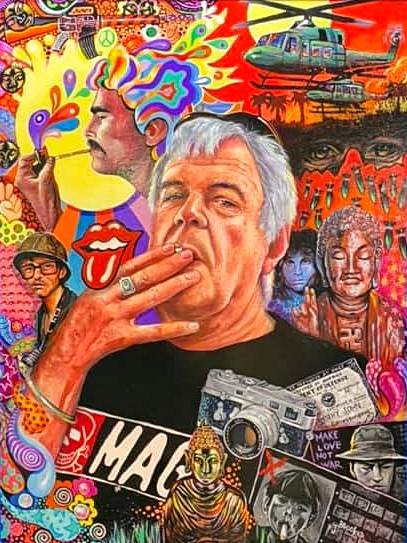
There were farewells much closer to home. My mediation colleague, aspiring author and friend John Rosley, and Beau Tindall, the son of my oldest Bellingen friend Warren, took off on the same day in May. Peter Setterington, my oldest friend in England – we first met in 1972 – died suddenly in London in March, and our friend and forest neighbour, the world-famous war photographer Tim Page, in August, after a short but nasty illness. Pete is memorialized in When an Old Cricketer Leave His Crease whilst Journey’s end – Tim Page’s wild ride,is an adaptation of the eulogy I gave for Tim in September, one of many on that sunny afternoon day in Fernmount. It is a coda to Tim Page’s  War – a photographer’s  Vietnam journey, a story we published a year ago.

Tim Page by Joanne Booker

What we wrote in 2022

The ongoing Ukraine War has dominated our perception of 2022, from the morning (Australian time) we watched it begin on CNN as the first Russian missiles struck Kyiv, to the aerial assault on infrastructure that has left Ukrainians sheltering through a cold, dark winter. Two posts in In That Howling Infinite examined the historical origins of the conflict: Borderlands – Ukraine and the curse of mystical nationalism and The Roots and Fruits of Putin’s Irridentism. “Because of …” Iran’s voice of freedom looks at the song that has become the rising’s anthem. None can predict the outcome – whether it will be a doomed intifada, the Arabic word that literally means a shaking off – historically of oppression – and figuratively, a rising up, like that in Ireland in 1798 and 1916, Warsaw in 1943 and 1945, and Hungary in 1956, or an Inqilab, another Arabic word meaning literally change or transformation, overturning or revolution.

The run up to May’s Australian elections inspired Teal independents – false reality in a fog of moralism.; and Australia votes – the decline and fall of the flimflam man. 

More distant history featured in Menzie’s Excellent Suez Adventure, the story of the Suez crisis of 1956 that historians argue augured the end of the British imperium, and the role played therein by longtime Australian prime minister Sir Robert Menzies. Johnny Clegg and the Washing of the Spears is a tribute to the late South African singer, dancer and songwriter, and a brief history of the war that destroyed the great Zulu nation, setting the scene for the modern history of South Africa. And journeying further back in time to sixteenth century Ireland, there is O’Donnell Abú – the Red Earl and history in a song, a discussion of the origins of a famous and favorite rebel song.

Then there are the semi-biographical “micro-histories” in In That Howling Infinite’s Tall tales, small stories, obituaries and epiphanies. In 2023, these included: Folksong Au Lapin Agile, the evening we visited Montmarte’s famous folk cabaret; Ciao Pollo di Soho – the café at the end of the M1, the story of a café that played a minor part in my London days, as described in detail in an earlier travelogue, Song of the Road – my hitchhiking days; Better read than dead – the joy of public libraries; The quiet tea time of the soul, an ode in prose to a favourite beverage; and The work, the working, the working life recalling the many jobs I took on in the sixties to keep myself in music, books, travel and sundry vices. 

We cannot pass a year without something literary. We celebrated the centenary of three iconic literary classics in The year that changed literature, and with the release of The Rings of Power, the controversial prequel to The Lord of the Rings, we published a retrospective on the influence of JRR Tolkien. One ring to rule us all – does Tolkien matter? – a personal perspective with an opinion piece by English historian Dominic Sandbrook, an informative and entertaining chronicler of postwar British history and society which featured, in Unherd, an online e-zine that became a “must read” in 2022. A Son Goes To War – the grief of Rudyard Kipling recalls the death in battle on the Western Front in 1917 of the poet’s only son, it’s influence upon his subsequent work, whilst Muzaffar al Nawab, poet of revolutions and sorrow is an obituary for another poet, who seen a lifetime speaking truth to power.

And that was that for what was in so man ways a sad year. Meanwhile, In That Howling Infinite already has several works in progress, including a review of historian Anthony Beevor’s Russia – Revolution and Civil War, what King Herod really thought about the birth of baby Jesus, and the story of a famous and favourite British army marching song.

Best wishes for 2023 …

Death of a Son

That was the year that was – retrospectives

Life in Wartime – images of Ukraine

One ring to rule us all – does Tolkien matter?

The world was young, the mountains green,
No stain yet on the Moon was seen,
No words were laid on stream or stone,
When Durin woke and walked alone.

The Song of Durin, JRR Tolkien

In Innovation, the final installment of Peter Ackroyd’s entertaining and informative History of England, he writes:

“The post-war years had brought fables of splrltual or material collapse, from That Hideous Strength to Brave New World to Ninteen Eighty-Four. During the Fifties, the novel seemed to be settling back to its journalistic roots – quotidian in subject, unpretentious in style – but the zeitgeist is a wayward wind. Among writers of fiction, another response was offered to the bewilderments of the post-war world, which was to fly above it. In 1955, Return of the King, the last installment of R. R. Tolkien’s The Lord of the Rings, was published. It was the resurrection of heroic romance, tempered by its author’s memories of war. It tells of a small, unregarded race of Middle-earth, the ‘hobbits’,who ‘arise to shake the counsels of great’. The freedom of the world hinges upon the destruction of something tiny, beautiful and evil, evil, a ring forged by a fallen angel. While elves, men and dwarves fight, two hobbits are tasked with the destruction of the great destroyer. A whole world, formed of its author’s experiments in language came into being to the extent that if anyone were to point out that Middle-earth’ is only a translation of the Norse ‘Mittlegard’, the hearer would respond with a shrug. It was there, whatever its origins. For the English journalist Bernard Levin, it offered a beautiful and salutary reminder that the ‘meek will inherit the earth’; for the American critic Edward Wilson, it was “juvenile trash”, a story of good boys being rewarded. In spite of the naysayers, the popularity and influence of The Lord of the Rings grew to unprecedented heights. Tolkien himself, a scholar and devout Catholic, was later to find his work taken up as a banner by most unlikely allies, a group that came to be known as ‘hippies’”.

Whenever a survey or poll crowns JRR Tolkien’s The Lord of the Rings as the public’s favourite novel – and there have been many during the past seventy years – and lauds the author as one of the most influential writers of the twentieth century, the reaction has always been the same from critics who have been sneering at his books since their publication. The Lord of the Rings has been dismissed as trivial, juvenile even, and not worth arguing about. It has been called archaic, backward looking, nostalgist and sentimentalist, and has been gaslit for misogyny and homo-eroticism, violence and even racism (with its ethnocentric and androgynous elves and it’s Graeco-Roman Gondorians besieged by darker races from the south and east). Yet, most critics have probably never read it.

On the side of the angels (or is it the elves?) are the millions who came of age with and fell in love with the books and adopted a Tolkienesque taxonomy for viewing the world as a perpetual dialectic between the forces of light and of darkness. Some have even studied the lineages and languages. The actress Liv Tyler, who plays a luminous Arwen Evenstar in Peter Jackson’s award-winning film trilogy is said to have learned elven, and I sometimes see people on the street with elven rune tattoos. Liv probably has one too. I once spied a young lady walking down King Street in Newtown, the boulevard of Sydney’s myriad young tribes, sporting eleven runes on the backs of her suntanned calves. I was cheekily tempted to tell her that they were upside down, but let the moment go. I recall that as we queued at the cinema to see The Fellowship of the Ring, young folk rhapsodized among themselves on the delights about to unfold before their very eyes.

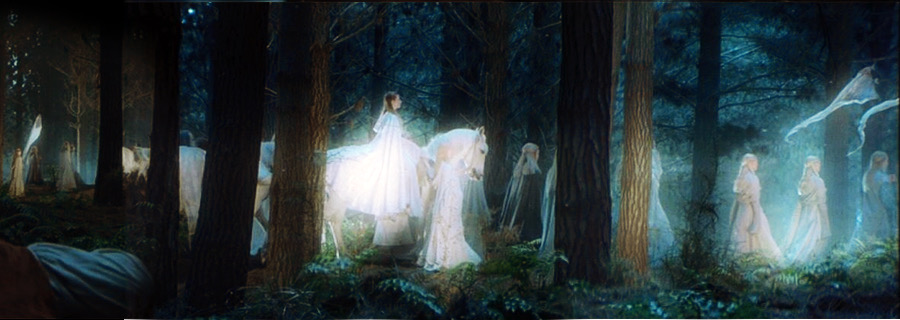
The Elves leave Middle Earth

The Hobbiton film-set on New Zealand’s North Island is one of that country’s premier tourist destinations – indeed, during the three years of the films’ successive release, a big sign at Auckland International Airport declared “Welcome to Orc Land!” The trilogy’s diverse film locations revealed to the world the exquisitely beautiful landscapes of Aotearoa.

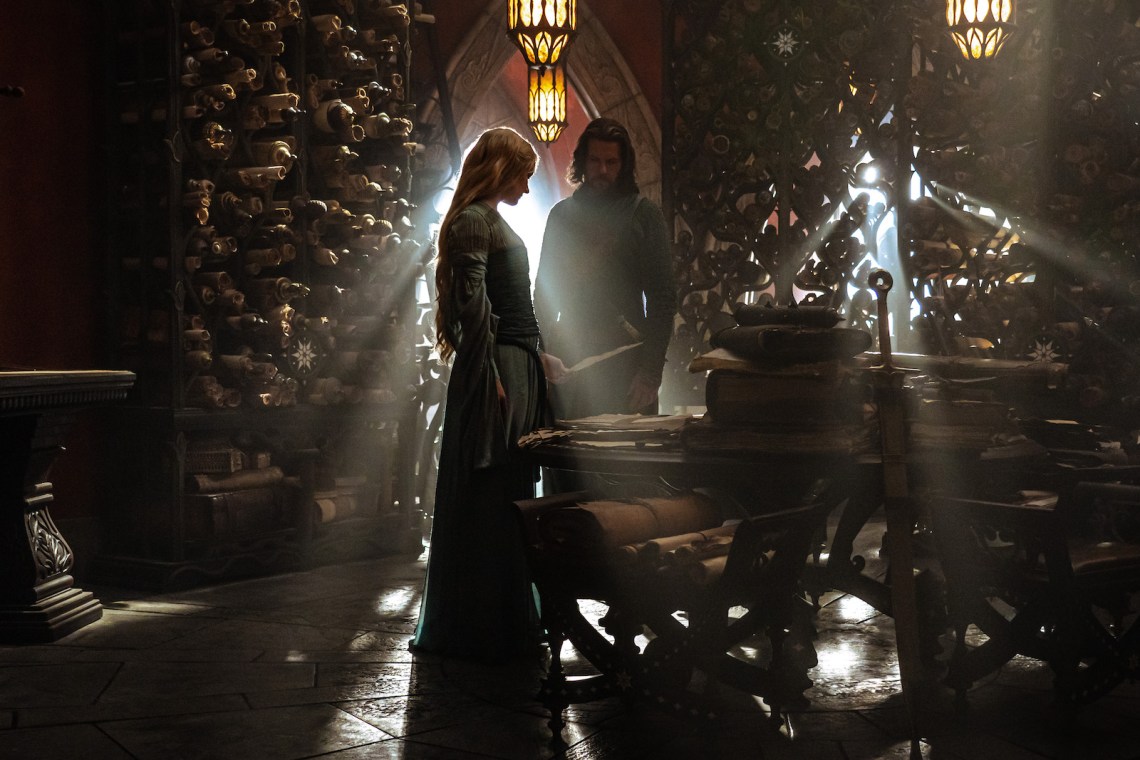
The films’ casting prompted criticism in some quarters insofar as the elves, men and dwarves were played by predominantly white Anglo Celtic actors the dubious Hobbit films (included spook Richard Armitage, Poldark heart-throb Aiden Turner,” everyman” Benedict Cumberbatch, and angsty Scottish actor Ian Nesbitt, all shrunk-down) whilst New Zealand’s indigenous Māori portrayed the evil orcs and Uruk Hai. Nevertheless, hundreds of kiwis, Pakeha and Māori alike, were employed as extras, the scenery dazzled the world and the economy of Aotearoa, The Land of the Long White Cloud, enjoyed a Middle Earth boom.

The recent streaming in 2022 of the extravagantly expensive prequel series The Rings of Power has stirred controversies of an altogether different variety insofar as many Tolkien die-hards and purists protested the acting of actors of colour as hobbits, dwarves and, heavens for it, elves! A most peculiar paradox, you might think, given those aforementioned condemnations of JRR’s ostensible racism. It just goes to show that you can please some of the people some of the time, but you can’t please all of the people all of the time. But more on Amazon’s epic later with an excellent article from the New York Review of Books.

Arwen Evenstar

In an opinion piece in the Unheard e-zine, republished below, British historian and author Dominic Sandbrook asks whether Tolkien’s works are indeed trivial. “Surely not”, he retorts. “Even if you can’t stand them, only a fool would deny that The Lord of the Rings occupies an extraordinary place in the modern imagination … he wasn’t just a man of his time; he remains a guide for our own … And his themes might have deliberately been chosen to appeal to modern readers, anxious about the consequences of science, the environmental costs of industry, the dangers of war and the fate of the individual in the face of the vast forces reshaping Western societies in the early 21st century.

I am reminded of a piece I read recently by writer, artist and Druid Cerri Lee:

” I suddenly realized it is a profound and overwhelming sense of loss for their world and mine that I feel as the Elves sail away from the Grey Havens.  When the Elves leave they take with them the enchantment from the land, something dies in it and I am left on the shores of Middle Earth amidst a fading beauty, as they sail on into the distance. The realization that now humans will have no restraints in their actions and will push forward the rise of mechanism, commerce on a global scale, and a discarding of anything that even looks like ‘fluffy’ thinking. My Middle Earth will never be the same again and I am constantly mourning its passing through this story. It leads me to wonder if some part of that feeling is what drove Tolkien to write his story”.

To put it simply, then, Tolkien matters. How many writers can you say that about, these days?”

Tolkien and me

The Road goes ever on and on
Down from the door where it began.
Now far ahead the Road has gone,
And I must follow, if I can,
Pursuing it with eager feet,
Until it joins some larger way
Where many paths and errands meet.
And whither then? I cannot say.
Walking Song, JRR Tolkien

My own life has intersected with JRR Tolkien on many serendipitous levels.

I first encountered The Lord of the Rings in my late teens when curiosity, imagination, and various substances bought me admission to his fantasy world, along with that of his fellow Inkling CS Lewis, creator of The Chronicles of NarniaI read all three books in the trilogy over a weekend in the autumn of 1968, and when I’d finished, I felt bereft and out of sorts. I reread it soon after, and again, and again – but didn’t we all in the days when Tolkien was king, and elves and ents walked among us. I set many of the songs to music – now long forgotten – and an apposite quotation was always on hand. I recall reciting the opening lines of The Song of Durin, which prefaces this piece, as I was walking home from a concert under a full moon on the eve of the landing of Apollo 11 upon the moon in July 1969. And many times as I headed eastwards on what we now call the hippie trail, I would recall Bilbo Baggin’s Walking Song.

In subsequent years as I evolved from naïf to cynical, and thence to other passions, the rereads slowed and then stopped, although I read and enjoyed The Silmarillion, and still treasure the opening chapter describing in a manner reminiscent of the St. James Bible of how the world was created by music. I began to pick holes in The Lord of the Rings’ story linewith its derivative ‘hero’s quest’, a monomyth popularised by Joseph Campbell in his celebrated book The Hero with a Thousand Faces; what I now viewed as stereotypical characters; the outdated and anachronistic perspectives of earlier generations; and what I perceived as old-school English prejudices. But, as Sandbrook points out, Tolkien was of his times, and those times were not kind to diversity and dissent.

And yet, The Lord of the Rings is ever present in my cultural and literary consciousness, and is often referred to and quoted. Here us one of my favourites:

It is not our part to master all the tides of the world, but to do what is in us for the succour of those years wherein we are set, uprooting the evil in the fields that we know, so that those who live after may have clean earth to till. What weather they shall have is not ours to rule.” The Return of the King

I have never lost my love for the poetry and the songs that complement the narrative  – the archaic syntax, rhyme, rhythm and balladry that I’ve incorporated into my own writing. There was a wonderful lyricism and, indeed, musicality to them that I still love. It’s as if they are just waiting for a tune to accompany them. Compare Tolkien’s Song of Ëarendil with own

– the style, that is, not the subject matter:

JRR:

In panoply of ancient kings,
in chainéd rings he armoured him;
his shining shield was scored with runes
to ward all wounds and harm from him;
his bow was made of dragon-horn,
his arrows shorn of ebony;
of silver was his habergeon,
his scabbard of chalcedony;
his sword of steel was valiant,
of adamant his helmet tall,
an eagle-plume upon his crest,
upon his breast an emerald.

Me:

With massive head,
And shoulders broad,
As lean and mean as Rambeau
(That’s Sly, and not that fey French bard
This bruiser was no bimbeau!).
His hide as dark as ebony,
As tough as old mahogany,
His horns shone like chalcedony,
This massif of solidity
Was built like a Pajero.

Years passed without a revisitation, but working for a publishing company that ‘owned’ the rights to his work, I collected the latest editions and often gave them away to young people who had yet to enter the magical world of Middle Earth. For all my later cynicism, I still regarded it as a book all young people ought to read. I read the whole thing once more prior to the release of Peter Jackson’s epic trilogy. The films were excellent, although I found the hobbits increasingly irritating, wishing that they’d all jump into the fires of Mount Doom, and the ents were a disappointment, a mob of corny and badly conceived muppets (they were indeed conceived by Jim Henson, the ‘father’ of Kermit and Miss Piggy). I am looking forward to the upcoming, uber-expensive television series – but I don’t reckon I’ll reread in preparation this time around. As for Jackson’s three part Hobbit extravaganza, in my opinion, it was a travesty.

Learning more about the author, I was to discover that he’d grown up in Birmingham, my hometown, first in leafy Edgbaston (the home of Cadbury and the Warwickshire County Cricket Club), where he’d attended the prestigious King Edward’s Grammar School – my own school, Moseley Grammar, was not in its league. He lived near Sarehole Mill, in present day Hall Green, around the turn of century, between the ages four and eight, and would have seen it from his house. The locale at that time was rural Worcestershire farmland and countryside and not in the Birmingham ‘burbs. He has said that he used the mill as a location in The Lord of the Rings for the Mill at Hobbiton: “It was a kind of lost paradise … There was an old mill that really did grind corn with two millers, a great big pond with swans on it, a sandpit, a wonderful dell with flowers, a few old-fashioned village houses and, further away, a stream with another mill … “

Sarehole Mill was just down the road from my school, and our sports field and cross-country tracks were adjacent to it. On many a wintry, cold, wet and windy Wednesday afternoon, I’d stagger past it on a muddy track. How I hated wet Wednesdays; dry ones were for rugby, and I hated them too!

Tolkien died aged 81 on September 2nd, 1973, in Bournemouth, Dorset, a town that I’ve visited infrequently. But I was actually in Bournemouth on that day to meet an old friend. Perchance his spirit swept passed me. On 2nd September 2017, the Oxford Oratory, Tolkien’s Roman Catholic parish church during his time in Oxford, offered its first Mass to advocate for his beatification, the first station on the road to canonisation, as an evangelist for nature, beauty and love.  A prayer was written for his cause:

“O Blessed Trinity, we thank You for having graced the Church with John Ronald Reuel Tolkien and for allowing the poetry of Your Creation, the mystery of the Passion of Your Son, and the symphony of the Holy Spirit, to shine through him and his sub-creative imagination. Trusting fully in Your infinite mercy and in the maternal intercession of Mary, he has given us a living image of Jesus the Wisdom of God Incarnate and has shown us that holiness is the necessary measure of ordinary Christian life and is the way of achieving eternal communion with You. Grant us, by his intercession, and according to Your will, the graces we implore [….], hoping that he will soon be numbered among Your saints. Amen.”

Just imagine, Saint John Ronald Reuel of Middle Earth!

© Paul Hemphill 2022.  All rights reserved

Read also in In That Howling Infinite, Tolkien’s Tarkeeth – in the darkest depths of Mordor and Better Read than Dead – books and reading

Gandalf the White

This is Tolkien’s World

The Lord of the Rings is more than nostalgic medievalism

Dominic Sandbrook, Unheard December 10th 2021

It’s exactly 20 years since I stood in line to see a film I had dreamed about since I was a little boy. Ever since I had first turned the pages of J. R. R. Tolkien’s The Lord of the Rings, I had wondered what it would be like to see it on the big screen: the hobbits, the battles, the sweeping landscapes, the blood and thunder. When I read that the director Peter Jackson was filming a trilogy of Tolkien’s masterpiece in New Zealand, I felt almost sick with anxiety. Would it be terrible? Would they sound like the All Blacks? What were they going to do about Tom Bombadil?

I need not have worried, of course. From the moment the lights dimmed in the Odeon, Leicester Square on 10 December 2001, the Lord of the Rings films were a phenomenal success. And although poor Tom B. never made it onto the screen, Jackson’s trilogy carried all before it, grossing a staggering $3 billion and winning a record-equalling 11 Oscars for the final instalment alone.

Two decades on, the films stand up remarkably well. As for the wider Tolkien industry, the bestselling books just keep on coming: The Fall of Arthur in 2013, Beren and Luthien in 2017, The Fall of Gondolin in 2018. And next autumn sees the release of Amazon’s Lord of the Rings prequel series – at a cool $1 billion over five seasons, the most expensive television project in history. Not bad for a writer who’s been dead since 1973.

To some people, all this could hardly be more infuriating. For as we all know, Tolkien is still associated in the public mind with a sweaty, furtive gang of misfits and weirdos — by which I mean those critics who, for more than half a century, have been sneering at his books and their readers.

As far back as the mid-Fifties, the American modernist Edmund Wilson published a comically wrong-headed review dismissing Tolkien’s work as “juvenile trash”, marked by — of all things! — an “impotence of imagination”. Decades later, Philip Pullman, never happier than when sneering at his Oxford forebears, called Tolkien’s efforts “trivial”, and “not worth arguing with”. And whenever some new survey crowns The Lord of the Rings as the public’s favourite novel, the reaction is always the same.

“Another black day for British culture” was Howard Jacobson’s verdict after a Waterstones poll put Tolkien’s work well clear at the top. “Ever since I arrived at Cambridge as a student in 1964,” agreed Germaine Greer, “it has been my nightmare that Tolkien would turn out to be the most influential writer of the 20th century. The bad dream has been realised.” Yet by her own admission, she had never even read him.

So are Tolkien’s works “trivial”, as Pullman claims? Surely not. Even if you can’t stand them, only a fool would deny that The Lord of the Rings occupies an extraordinary place in the modern imagination. Indeed, in his trenchant defence of Tolkien’s reputation, the literary scholar Tom Shippey suggests that much of the criticism is rooted in pure social and intellectual condescension, not unlike the rank snobbery that Virginia Woolf directed at Tolkien’s fellow Midlander Arnold Bennett. Shippey even argues that in the future, literary historians will rank The Lord of the Rings alongside post-war classics such as Nineteen Eighty-FourLord of the Flies and Slaughterhouse-Five. Who’s to say he’s wrong?

One reason highbrow people dislike The Lord of the Rings is that it is so backward-looking. But it could never have been otherwise. For good personal reasons, Tolkien was a fundamentally backward-looking person. He was born to English parents in the Orange Free State in 1892, but was taken back to the village of Sarehole, north Worcestershire, by his mother when he was three. His father was meant to join them later, but was killed by rheumatic fever before he boarded ship.

For a time, the fatherless Tolkien enjoyed a happy childhood, devouring children’s classics and exploring the local countryside. But in 1904 his mother died of diabetes, leaving the 12-year-old an orphan. Now he and his brother went to live with an aunt in Edgbaston, near what is now Birmingham’s Five Ways roundabout. In effect, he had moved from the city’s rural fringes to its industrial heart: when he looked out of the window, he saw not trees and hills, but “almost unbroken rooftops with the factory chimneys beyond”. No wonder that from the moment he put pen to paper, his fiction was dominated by a heartfelt nostalgia.

Nostalgia was in the air anyway in the 1890s and 1900s, part of a wider reaction against industrial, urban, capitalist modernity. As a boy, Tolkien was addicted to the imperial adventure stories of H. Rider Haggard, and it’s easy to see The Lord of the Rings as a belated Boy’s Own adventure. An even bigger influence, though, was that Victorian one-man industry, William Morris, inspiration for generations of wallpaper salesmen. Tolkien first read him at King Edward’s, the Birmingham boys’ school that had previously educated Morris’s friend Edward Burne-Jones. And what Tolkien and his friends adored in Morris was the same thing you see in Burne-Jones’s paintings: a fantasy of a lost medieval paradise, a world of chivalry and romance that threw the harsh realities of industrial Britain into stark relief.

It was through Morris that Tolkien first encountered the Icelandic sagas, which the Victorian textile-fancier had adapted into an epic poem in 1876. And while other boys grew out of their obsession with the legends of the North, Tolkien’s fascination only deepened. After going up to Oxford in 1911, he began writing his own version of the Finnish national epic, the Kalevala. When his college, Exeter, awarded him a prize, he spent the money on a pile of Morris books, such as the proto-fantasy novel The House of the Wolfings and his translation of the Icelandic Volsunga Saga. And for the rest of his life, Tolkien wrote in a style heavily influenced by Morris, deliberately imitating the vocabulary and rhythms of the medieval epic.

But there’s more to Tolkien than nostalgic medievalism. The Lord of the Rings is a war book, stamped with an experience of suffering that his modern-day critics can scarcely imagine. In his splendid book Tolkien and the Great War, John Garth opens with a rugby match between the Old Edwardians and the school’s first fifteen, played in December 1913. Tolkien captained the old boys’ team that day. Within five years, four of his teammates had been killed and four more badly wounded. The sense of loss haunted him for the rest of his life. “To be caught in youth by 1914 was no less hideous an experience than to be involved in 1939 and the following years,” he wrote in the second edition of The Lord of the Rings. “By 1918, all but one of my close friends were dead.”

Tolkien arrived on the Western Front in June 1916 as a signals officer in the 11th Lancashire Fusiliers, and experienced the agony of the Somme at first hand. In just three and a half months, his battalion lost 600 men. Yet it was now, amid the horror of the trenches, that he began work on his great cycle of Middle-earth stories. As he later told his son Christopher, his first stories were written “in grimy canteens, at lectures in cold fogs, in huts full of blasphemy and smut, or by candlelight in bell-tents, even some down in dugouts under shell fire”.

But he never saw his work as pure escapism. Quite the opposite. He had begun writing, he explained, “to express [my] feeling about good, evil, fair, foul in some way: to rationalise it, and prevent it just festering”. More than ever, he believed that myth and fantasy offered the only salvation from the corruption of industrial society. And far from shaking his faith, the slaughter on the Somme only strengthened his belief that to make sense of this broken, bleeding world, he must look back to the great legends of the North.

Yet The Lord of the Rings is not just a war book. There’s yet another layer, because it’s also very clearly an anti-modern, anti-industrial book, shaped by Tolkien’s memories of Edwardian Birmingham, with its forges, factories and chimneys. As a disciple of the Victorian medievalists, he was always bound to loathe modern industry, since opposition to the machine age came as part of the package. But his antipathy to all things mechanical was all the more intense because he identified them — understandably enough — with killing.

And although Tolkien objected when reviewers drew parallels between the events of The Lord of the Rings and the course of the Second World War, he often did the same himself. Again and again he told his son Christopher that by embracing industrialised warfare, the Allies had chosen the path of evil. “We are attempting to conquer Sauron with the Ring,” he wrote in May 1944. “But the penalty is, as you will know, to breed new Saurons, and slowly turn Men and Elves into Orcs.” Even as the end of the war approached, Tolkien’s mood remained bleak. This, he wrote sadly, had been, “the first War of the Machines … leaving, alas, everyone the poorer, many bereaved or maimed and millions dead, and only one thing triumphant: the Machines”.

Dominic Sandbrookis an author, historian and UnHerd columnist. His latest book is: Who Dares Wins: Britain, 1979-1982

Austin Gilkeson, New York Review of Books, January 24, 2023

Galadriel (Morfydd Clark) and Elendil (Lloyd Owen) in the archive of the Hall of Law in Númenor,  The Lord of the Rings: The Rings of Power, 2022

One September day in 1914, a young J.R.R. Tolkien, in his final undergraduate year at Oxford, came across an Old English advent poem called “Christ A.” Part of it reads, “Éalá Éarendel engla beorhtast/ofer middangeard monnum sended,” which he later rendered: “Hail Éarendel, brightest of angels/above the middle-earth sent unto men!” Safe in his aunt’s house in Nottinghamshire while battles raged on the continent, Tolkien took inspiration from this ode to the morning and evening star and wrote his own poem in modern English, “Éarendel the Mariner.” That poem was not published in his lifetime, but after it came the stories that would become The Silmarillion, The Hobbit, and The Lord of the Rings, which in turn inspired, to varying degrees, Earthsea, Star Wars, Dungeons & Dragons, Harry Potter, The Wheel of Time, The Witcher, Game of Thrones, and so on, an apostolic succession of fantasy.

The latest in the line is The Lord of the Rings: The Rings of Power. Amazon Studios does not have the rights to The Silmarillion, the posthumous collection of Tolkien’s mythology that serves as a sort of bible for Middle-earth, nor is it adapting The Lord of the Rings, Tolkien’s 1954 novel about the hobbit Frodo’s quest to save Middle-earth by destroying the One Ring, which holds the power of the Dark Lord Sauron. Peter Jackson’s film trilogy still looms too large. Instead, the showrunners, J.D. Payne and Patrick McKay, have crafted a prequel, set thousands of years before the events of the three-volume novel and drawn from bits of lore in its prologue, “Concerning Hobbits,” and extensive appendices on Middle-earth history and culture. It’s an undertaking not dissimilar from Tolkien’s own reworking of “Christ A,” spinning out a narrative from a few textual scraps—the kind of academic exercise an Oxford professor of Old English could appreciate.

It’s a pity the show doesn’t extend the same scholarly pleasures to its viewers. Its narrative conceits are those of big-budget TV: the so-called mystery boxes popularized by shows like Lost. What is the sigil that the elf warrior Galadriel (Morfydd Clark) finds carved in her dead brother’s flesh? Who is the stranger (Daniel Weyman) who falls from the sky and ends up living among a nomadic clan of proto-hobbits? Which character is really Sauron? Will the mortal Bronwyn (Nazanin Boniadi) and the elf Arondir (Ismael Cruz Córdova) kiss? The show hurries along toward the inevitable revelations: the sigil turns out to be a map of Sauron’s realm of Mordor; the magical stranger is almost certainly the wizard Gandalf; Sauron himself is the roguish drifter Halbrand (Charlie Vickers), who has a Forrest Gump–like ability to accidentally be in the right place at the right time. Beyond a few delightful glimpses of ancient hobbit culture, there is little sense of a deep past that can be excavated through careful reading.

This is partly a problem of translation. Contemporary television drives its narratives with its characters, by their arcs and inner conflicts. Tolkien’s characters remain largely static; it’s the world around them that changes. The concerns of the novel are civilizational rather than individual. What Aragorn thinks or wants in his personal life matters far less than the fact that he is descended from kings of Arnor, and before it Númenor and Beleriand. His fitness for the throne of Gondor is never in doubt, neither to himself nor to the reader. He’s simply the last pebble in a royal landslide that has been slowly rolling over Middle-earth for millennia.

The reader encounters this history in ruins and snippets of legendary songs. Galadriel speaks of her wanderings before the fall of the kingdoms of Nargothrond and Gondolin. Treebeard, an ancient tree-like creature, reminisces about long-lost forests and departed Entwives. Merry, whose hobbit-memory is not as long, wonders at the strange, weather-worn statues that line the path to Dunharrow in Rohan. Even the earthy Samwise sings about the death of the elf-king Gil-galad (played by Benjamin Walker in The Rings of Power). The songs, in particular, may seem like digressions or page-fillers, especially those sung in fictional languages, but they also provide a sense of Middle-earth’s cultures and history, stretching back into “the deeps of time.” The effect is like Tolkien’s description of the mines of Moria, where, “in the pale ray” of Gandalf’s illuminated staff, Frodo sees “glimpses of stairs and arches, and of other passages and tunnels, sloping up, or running steeply down, or opening blankly dark on either side. It was bewildering beyond hope of remembering.”

Nori Brandyfoot (Markella Kavenagh) in The Lord of the Rings: The Rings of Power, 2022

The novel evokes a wanderlust to go back and take those untrodden paths, but since its world exists only on paper all further discovery must be textual. In other words, it requires research. Payne and McKay understand the academic aspect of Tolkien’s work. Twice during the season, Galadriel goes to archives (one in the mortal kingdom of Númenor, another in the Elven Eregion) in search of the truth about Sauron. But there will be no flipping through card catalogs or paging through dusty tomes for our heroine—she has orcs to eviscerate. Galadriel has librarians pull the scrolls for her. Like the show itself, she’s afraid to sit still.

Tolkien’s books feature plenty of battles, but they also reflect the joys and pains of academic work. The Lord of the Rings is a novel “in which the scholarly rituals [are] observed; in which you flipped from index to text to appendix, cross-referring to maps,” as Jenny Turner wrote in 2001 in the London Review of Books. The book becomes, in her words, “a machine for the evocation of scholarly frisson. The thrills are the thrills of knowledge hidden, knowledge uncovered, knowledge that slips away.” Tolkien’s wizards are scholars first and sorcerers second. They each have areas of expertise and are renowned for their wisdom. And unlike Amazon’s Galadriel, they do their own research. Gandalf seeks out the history of the One Ring in the “hoards” of Gondor’s archives (a scene Jackson wisely kept in The Fellowship of the Ring, having Ian McKellen smoking a pipe and shuffling through piles of musty pages), while the arrogant Saruman turns traitor to the forces of good after delving too deep into the archives in an attempt to learn “the arts of the Enemy.” Tolkien’s greatest paean to academic pleasure is in the sprawling elf haven Rivendell, run by the “lore-master” Elrond and hidden in an alpine valley, which in The Silmarillion is described as “a refuge for the weary and the oppressed, and a treasury of good counsel and wise lore.” In Tolkien, refuge and research are bound together.

Tolkien’s brief respite at his aunt’s house, where he wrote “Éarendel the Mariner,” could not last. He belonged to what Angela Carter later described as “that generation for whom history [had] already prepared a special, exemplary fate in the trenches of France,” and soon he was on his way to the front. He fought at the Somme, a battle in which nearly 20,000 British soldiers, including one of his closest friends, were killed on the first day. He got lucky: he soon contracted trench fever in the lice-infested dugouts and was sent home to recuperate.

The Somme haunts Middle-earth, which is pocked with broken and drowned lands. “This is Mordor,” Frodo remarks on the ruins of his beloved home Bag-End when he returns to a scarred, occupied Shire at the end of The Lord of the Rings. After the war, Tolkien transformed Éarendel the Mariner from a celestial sailor into a warden on eternal watch, sailing over the Walls of Night to guard against the return of Morgoth, the Great Enemy, from out of the Void. The Rings of Power alludes to these wartime experiences. Early in the first episode, Galadriel wanders a devastated battlefield reminiscent of the Western Front. “We learned many words for death,” she says, and the show takes pains to demonstrate some of them in detail: stabbings, hackings, slashings, burnings, and decapitations. This is the visual language of contemporary prestige fantasy shows like Game of Thrones. Galadriel dispatches a snow-troll with John Wick–like elan—a far cry from the more measured violence of the novel, in which the soldier Faramir tells Frodo, after a battle against Sauron’s forces in his homeland of Gondor, “I do not love the bright sword for its sharpness, nor the arrow for its swiftness, nor the warrior for his glory. I love only that which they defend.”

Galadriel and Theo (Tyroe Muhafidin) in The Lord of the Rings: The Rings of Power, 2022

After the war Tolkien returned to academic work, first at the Oxford English Dictionary as a researcher and then as a professor at Leeds and Oxford. Besides enthralling some students, like W.H. Auden, and boring others, like Kingsley Amis, with his lectures on Old English, he translated Sir Gawain and the Green Knight and other Middle English texts. His greatest contribution to scholarship remains his 1936 lecture “Beowulf: The Monsters and the Critics,” which recast the Old English saga as a work of art rather than a historical document that served only as “a quarry of fact and fancy.”

To ennoble history and legend was also part of Tolkien’s fictional project: his books are stuffed with allusions to Old English texts. Bilbo’s burglary of Smaug’s hoard in The Hobbit mirrors a scene in Beowulf. Aragorn quotes a poem from Rohan that echoes the elegy “The Wanderer.” Elrond’s father is none other than Eärendil the Mariner. They also provide their own store of fictional lore. You can stop reading The Lord of the Rings when Samwise says, “Well, I’m back” by his hearth, or you can keep going, depending on how much you want to know about various elvish scripts and runes, or the differences between the calendars used in the Shire and the ones used in Númenor, or the fact that Merry Brandybuck’s actual name, in one of Tolkien’s invented languages, is “Kalimac Brandagamba.” “By the time the reader has finished the trilogy, including the appendices,” Auden wrote, “he knows as much about Tolkien’s Middle-earth, its landscape, its fauna and flora, its peoples, their languages, their history, their cultural habits, as, outside his special field, he knows about the actual world.”

This lore is essential to the structure and ultimate pleasure of the novel. Tolkien’s great theme is loss, the “inevitable overthrow in Time,” as he put it in his Beowulf lecture, fated for all cultures and civilizations. The reader can hardly be expected to feel that loss without some sense of its width and depth. Even the most casual reader can feel, as Frodo does in Galadriel’s forest of Lothlórien, that she has “stepped over a bridge of time…and was now walking in a world that was no more.”

*

The appendices are only the first step out the door. In the years after Tolkien’s death, in 1973, his son Christopher compiled, edited, and published a huge quantity of his father’s writing, starting with The Silmarillion in 1977 and later the twelve-volume History of Middle-earth. These books are labors of love. Much of what Tolkien left behind was disorganized and incongruent. He frequently switched characters’ names, rewrote and then left unfinished parts of stories and poems that contradicted what he’d written before, and changed his mind about such fundamental concepts as the origin of orcs, the nature of the sun and moon, and even the shape of the earth. Out of the drafts and notes, Christopher could have created any number of Silmarillions.

Tolkien’s original aim in his fiction was to craft a “a body of more or less connected legend…which I could dedicate simply to: to England; to my country,” which he felt lacked one beyond, as he wrote in a 1951 letter, “impoverished chap-book stuff.” This mythology would not be a political project like Virgil’s Aeneid, which tied Rome’s foundation to ancient Greek civilization, but an artistic attempt to capture “the tone and quality I desired, somewhat cool and clear…redolent of our ‘air.’” It was a particular and old air. The Englands of Dickens, Austen, Fielding, Milton, or even Chaucer are nowhere to be found. Instead, Tolkien’s is the England of the anonymous poets who wrote Beowulf and Pearl, largely bygone even by the time the English language settled into a familiar form, swamped by the Norman Conquests, great vowel shifts, gunpowder, and paper. There was no returning to that England, Tolkien knew, just as his characters could never return to the drowned lands of Beleriand and Númenor. “As the poet looks back into the past,” he wrote of Beowulf, “surveying the history of kings and warriors in the old traditions, he sees that all glory (or as we might say ‘culture’ and ‘civilization’) ends in night.” His project was to delay that night while he could—to preserve, not restore, what he felt was that older country’s “elusive beauty.”

Princess Disa (Sophia Nomvete) singing a funerary song in TThe Rings of Power

In the course of a few decades Tolkien achieved, quite by accident, what the Old English scribes, singers, and poets had taken centuries to create: a large, confused, and contradictory body of myths and legends. The mythology is unstable, snapping into whatever form one happens to be reading. Far from being frustrating, this has allowed for nearly endless exploration and debate: academic Tolkien journals, conferences, and societies—not to mention fan fiction, up to and including The Rings of Power—have sprouted around the world.

Amazon wants its own mythology, but for the same reason that Disney purchased Marvel and revived Star Wars and HBO spun off Game of Thronesinto House of the Dragon: there’s money to be made. However good their intentions, the showrunners’ ultimate task is to mine Tolkien’s works in order to create and expand the franchise. Tolkien’s “machine for the evocation of scholarly frisson” has been turned into an assembly line. The goal is to keep the machine running for as long as it is profitable, with no natural end in sight.

The Rings of Power does add its own bit of lore. In the fifth episode, Elrond (Robert Aramayo) recounts the legend of “The Roots of Hithaeglir,” according to which a lightning-struck tree creates the ore mithril, a powerful metal used in weapons and armor like the mail-shirt Frodo wears. Elrond calls the story “apocryphal,” a nod to the fact that it was invented whole-cloth for the show. It’s one of the writers’ attempts to tie various parts of Tolkien’s unwieldy legendarium together, in the same way that the show has Galadriel share a sea-tossed raft with Sauron and witness the creation of Mordor. Mithril, it is explained, is suffused with the light of a Silmaril, a holy jewel that can prevent the downfall of the Elves, who are otherwise due to suddenly “fade” in a matter of months (the show never tells us why or how).

This is an imperative of the contemporary franchise: everything must be connected somehow in an endless feedback loop (or ring). This is usually achieved through “fan service,” knowing winks and nods to characters and events the audience already knows, but an overreliance on such references seals the worlds off, and the air in them soon turns stale. There is no room for the organic happenstance of real life, for the inexplicable and strange, like Tolkien’s immortal weirdos Tom Bombadil and Goldberry, who were jettisoned from Jackson’s adaptation.

The show’s conceit about mithril also misunderstands the elegiac character of Tolkien’s novel. In the final episode, the elves create three rings—“Three Rings for the Elven kings under the sky,” in Tolkien’s lore—from mithril to stop the cataclysmic fading of their race (a fate clumsily literalized by diseased leaves falling from a magic tree). The Rings provide a convenient cure to the season’s contrived crisis, whereas in the book they were created, in Elrond’s words, for “understanding, making, and healing, to preserve all things unstained.” The tragedy is that the destruction of the One Ring, the only act that can save Middle-earth, will also mean the destruction of the Three, and “many fair things will fade and be forgotten.” The elves, like their creator did, understand that dwindling is inevitable. They just want to slow it and enjoy their works while they can, before they become, as Frodo thinks of Galadriel, “present and yet remote, a living vision of that which has already been left far behind by the flowing streams of Time.”

Tolkien’s Tarkeeth – In the Darkest Depths of Mordor

‘Twas was in the darkest depths of Mordor, I met a girl so fair, ’til Gollum and the evil  one crept up and slipped away with her, her, her…yeah!   Led Zepellin, Ramble On

And the embers of Eden burn. You can even see it from space.  Bruce Cockburn

In September 2016, as the Tarkeeth drama unfolded, I published Tolkien”s Tarkeeth – Images of Isengard. The aggressive forestry harvesting practices employed by Forestry Corporation New South Wales conjured up images of the sorcerer Saruman’s devastation of the forests of Isengard.

On Tuesday 11th April 2017,  Forestry Corporation  NSW set ablaze the debris left over from its clear-felling. That evening, Gwaihir, the Lord of the Eagles, flew over the burning hills of Bellingen Shire. This is what he saw:

Here is what the local newspaper reported:

https://www.coffscoastadvocate.com.au/news/like-a-scene-from-a-doomsday-sci-fi-movie-flames-b/3169934/

That November, FCNSW set the northside of the Fernmount Range escarpment ablaze in that they describe as routine hazard reduction to enhance our safety from bushfires. Forest defenders called it the Inferno.

https://m.facebook.com/groups/656451855903800/permalink/837814767767507/

And here is what I wrote the previous September:

JRR had never heard of the Tarkeeth Forest, but if he had, I am certain he would have had some harsh words for the clear-felling and burning big that is razing our forest even as I write.

In 1962, he wrote:

“Every tree has its enemy, few have an advocate. In all my works I take the part of trees against all their enemies”.

In 1972, just over a year before his death, he wrote:

“Dear Sir,

With reference to the Daily Telegraph of June 29th, I feel that it is unfair to use my name as an adjective qualifying ‘gloom’, especially in a context dealing with trees. In all my works I take the part of trees as against all their enemies. Lothlorien is beautiful because there the trees were loved; elsewhere forests are represented as awakening to consciousness of themselves. The Old Forest was hostile to two legged creatures because of the memory of many injuries. Fangorn Forest was old and beautiful, but at the time of the story tense with hostility because it was threatened by a machine-loving enemy. Mirkwood had fallen under the domination of a Power that hated all living things but was restored to beauty and became Greenwood the Great before the end of the story.

It would be unfair to compare the Forestry Commission with Sauron because as you observe it is capable of repentance; but nothing it has done that is stupid compares with the destruction, torture and murder of trees perpetrated by private individuals and minor official bodies. The savage sound of the electric saw is never silent wherever trees are still found growing.”

JRR Tolkien Letters 241 and 339

Yes, he really did say “Forestry Commission” – an old British statutory authority that bears no relation to our own government-owned Forestry Corporation, but keep Sauron and also Saruman in mind as you read the following.

As I survey the desolation of the Tarkeeth, I remember the words of poets long-departed.

Thomas Hardy, in his poignantly uplifting ‘The Darkling Thrush’:

The land’s sharp features seemed to be
The Century’s corpse outleant,
His crypt the cloudy canopy,
The wind his death-lament.
The ancient pulse of germ and birth
Was shrunken hard and dry,
And every spirit upon earth
Seemed fervourless as I.

And TS Elliot, in ‘The Wasteland’, a title so prophetically apt when I view the impact of clear-felling on what was until barely a week ago was a diverse ecosystem that had prospered in a failed monoculture plantation (See: my post ‘If You Go Down To the Woods Today‘):

What are the roots that clutch, what branches grow
Out of this stony rubbish? Son of man,
You cannot say, or guess, for you know only
A heap of broken images, where the sun beats,
And the dead tree gives no shelter, the cricket no relief,
And the dry stone no sound of water.

And then, there’s Bruce…