The Watchers Of The Water

A song about Gallipoli, sung by a Turkish soldier

Once upon a war…

Monday 25th April is Australia and New Zealand’s national day of remembrance for all Anzac solders killed and wounded in their nation’s wars, and to honour servicemen and women past and present. At first, the Anzacs fought in the British Empire’s Wars, beginning with the Boer War, and then through two World Wars. From the mid -twentieth century, they have fought and died in what could ostensibly be called America’s wars even though these were waged under UN, EU or western alliance auspices: Korea, Gulf Wars II and III, Afghanistan, and the current interventions in Syria and Iraq. Incidentally, Australian veterans commanded mercenary forces hired by Saudi Arabia and the United Arab Emirates that laid waste to towns and villages in Yemen during its recent civil way – with the help of American and British weaponry.

At the heart of the Anzac Day remembrance is the Australian and New Zealand Army Corps’ role the Dardanelles campaign of 1915-16, Winston Churchill’s grandiose and ill-conceived plan to take the Ottoman Empire out of the war by seizing the strategic strait between the Black Sea and the Mediterranean, thereby threatening Istanbul, the Ottoman capital. It was a military failure. From the initial seaborne assault to the evacuation, it lasted eight months and cost 114,000 lives with 230,000 wounded.

In 1915, Australians greeted the landings at Gallipoli with unbridled enthusiasm as a nation-making event. But it wasn’t long before they were counting the dreadful cost. More than 8000 Australians died during the Gallipoli campaign. As a loyal member of the British Empire, Australia eventually sent 330,000 men overseas to fight for the King. Volunteers all, not all of them white men – despite the authorities policy of recruiting only Australians of Anglo-Celtic stock, their ranks included many indigenous, Chinese and others. By the time the war ended in 1918, 60,000 of them were dead. As the late historian Ken Inglis once pointed out: “If we count as family a person’s parents, children, siblings, aunts and uncles and cousins, then every second Australian family was bereaved by the war.

[As for the Anzac Day march], I’d say only returned people could march. And then the day would come, I’d hope, when there’d be the last person marching, the last survivor as it were. And I’d think what a great day that would be … because it would mean we’d been at peace for a long time. And that’s what those men in the First World War were fighting for.”
Bill Gammage, historian and author of The Broken Years.

Gallipoli is cited as the crucible of Australian nationhood, but the Anzacs’ part in the doomed campaign was but a sideshow of the wider campaign. Although it is celebrated in Australian song and story, it was the Ottomans’ most significant victory in the war that was to destroy the seven hundred year old Ottoman Empire secure the reputation of its most successful general Mustafa Kemal, who as Ataturk, became the founder of modern Turkey.

Some thirty four thousand British soldiers died on the peninsula, including 3,400 Irishmen, and ten thousand Frenchmen – many of these latter being “colonial” troops from West and North Africa. Australia lost near on ten thousand and NZ three. Some 1,400 Indian soldiers perished for the King Emperor. Fifty seven thousand allied soldiers died, and seventy five thousand were wounded. The Ottoman army lost fifty seven thousand men, and one hundred and seven thousand were wounded (although these figures are probably much higher). An overlooked fact is that some two thirds of the “Turkish” solders in Kemal’s division were actually Arabs from present day Syria, Israel and Palestine – and  a small number of European Jews who had settled there and who as Ottoman citizens were subject to conscription.

Gallipoli was indeed a multicultural microcosm of a world at war.

Whilst the flower of antipodean youth is said to have perished on Gallipoli’s fatal shore, this was just the overture. Anzac troops were despatched to the Western Front, and between 1919 and 1918, 45,000 Aussies died there and 124,000 were wounded.

Once upon a war, the Dardanelles Campaign of 1915-16 was a sideshow to the bigger theatres of the Eastern and Western Fronts. To some, it was a reminder that they could not stomach Winston Churchill for this was said to be his greatest stuff up in a career replete with such (although they would admit that he more than exonerated himself his and Britain’s Finest Hour). For many Australians and New Zealanders, it was a national baptism of fire, of youthful sacrifice on the altar of Empire. And notwithstanding the  military defeat and retreat, the folly and foolhardiness, in the harrowing adversity and heroism, lay the bones of a young country’s enduring creation myth.
Former soldier James Brown, Anzac’s  Long Shadow

There are abundant primary and secondary sources relating to the Dardanelles campaign and the Anzacs, but here is a wiki primer: Gallipoli Campaign

The genesis of a song …

Back in the last century, before ANZAC Day became the secular Christmas that it has become, before marketing people and populist politicians saw its commercial and political potential, before the fatal shore became a crowded place of annual pilgrimage, my Turkish friend, the late Naim Mehmet Turfan, gave me a grainy picture of a Turkish soldier at Gelibolu carrying a large howitzer shell on his back. Then there was this great film by Australian director Peter Weir, starring young Mel Gibson and Mark Lee. There were these images of small boats approaching a dark and alien shore, of Lighthorsemen sadly farewelling their Walers as they embarked as infantry, and of the doomed Colonel Barton humming along to a gramophone recording of Bizet’s beautiful duet from The Pearl Fishers, ‘Au fond du temple saint’ before joining his men in the forlorn hope of The Nek.

There were other melodies I could never quite get out of my head. One I first heard in a musical in Beirut before that magical city entered its Dark Ages  –  Al Mahatta, written by the famous Rabbani Brothers and starring the Lebanese diva Fayrouz. And The Foggy Dew, one of the most lyrical and poignant of the Irish rebel songs:

Right proudly high over Dublin town, they hung out the flag of war. ‘Twas better to die ‘neath that Irish sky than at Suvla or at Sud el Bar…Twas England bade our Wild Geese go that small nations might be free,  But their lonely graves are by Suvla’s waves or the fringe of the grey North Sea.

Over three thousand Irishmen died at Gallipoli.

The song grew out of these many inspirations.

It was first performed in public by HuldreFolk in the closing concert of Coffs Harbour Folk Festival at the RSL on Australia Day 1984. When we had finished, there was absolutely silence in the hall. Then a voice cried out “the sky didn’t fall down!”, and the hall erupted with applause.

And here is HukdreFolk’s rendering of Russian poet Yevtushenko’s account of the parade of German prisoners of war through the streets of Moscow in 1941, juxtaposed with The Watchers of the Water.

Anthem for Doomed Youth
Wilfred Owen

What passing-bells for these who die as cattle?
Only the monstrous anger of the guns.
Only the stuttering rifles’ rapid rattle
Can patter out their hasty orisons.
No mockeries now for them; no prayers nor bells;
Nor any voice of mourning save the choirs,—
The shrill, demented choirs of wailing shells;
And bugles calling for them from sad shires.

What candles may be held to speed them all?
Not in the hands of boys, but in their eyes
Shall shine the holy glimmers of goodbyes.
The pallor of girls’ brows shall be their pall;
Their flowers the tenderness of patient minds,
And each slow dusk a drawing-down of blinds.


Dermott’s Last Ride

So, when my time it comes  and at last I leave this place, I’ll walk out past the charge hand’s gate and never turn my face. Up to the gates and into the sun, and I’ll leave it all behind, with one regret for the lads I’ve left to carry on their grind.    Factory Lad, Colin Dryden

Dermott Ryder, poet, writer, collector and chronicler of songs and stories, singer and songwriter, stalwart of the seventies and eighties Sydney folk scene, one-time manager of the legendary ‘‘Liz” Folk Club, and creator and longtime presenter of the iconic weekly folk radio programme Ryder ‘Round Folk, headed off to his big gig at the great folk club in the sky on the night of Tuesday 3rd March.

A retrospective follows, but first, enjoy two minutes of delight with the theme to Ryder Round Folk: a merrie morris, a hornpipe, and a hoot!

Dermott and I go back a long way, though not as long as most.

He arrived in Oz in 1968 as a Ten Pound Pom. Before that, he’d spent five years in the Royal Artillery on a short term commission, seeing service in Germany and in Malaya,  avoiding the nasty places that proliferated during the declining decades of the moribund British Empire. Trained in management, accounting and IT, he worked in Papua New Guinea before settling down in Sydney where he became a pillar of the folk music scene. Since his retirement, he has devoted his energies to his music and writing.

Dermott In Bougainville

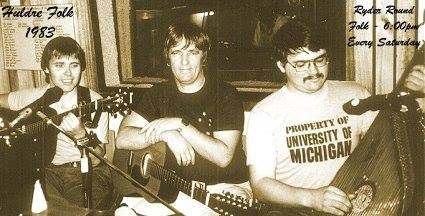
It was Victor Mishalow who first introduced me to Dermott in 1983. He was dropping into 2MBS for an interview on Ryder Round Folk, and he brought me and Yuri the Russian Storyteller along too. We had just launched our short and almost illustrious career as HuldreFolk. Dermott, as guru, mentor, and propagandist for the Sydney folk scene, gave us our first radio appearance. There is a famous photograph to commemorate it (Dermott’s archive of folkdoms’ seventies and eighties should be a national treasure. All the wannabes and could’ve beens, the famous and almost famous are celebrated therein).

HuldreFolk - Early Days. Ryder Round Folk 1983

The live concerts at 2MBS’s Chandos Street studios were a must-listen on the monthly calendar, with the good and the great of Sydney’s folksingers and musicians doing their thing. Guests included Victor, Yuri, Jim Taylor, Robin Connaughton, Penny Davies, Roger Illot, John Broomhall, Gordon McIntyre and Kate Delaney, Phil Lobl, Mary Jane Field, and the Fagans.

This was when Adele and I got to know Dermott and Margaret Ryder for the first time. We then learnt of his history: his part in the famous folk revival of the late sixties and early seventies, the first Port Jackson Folk Festival, the foundation if the NSW Folk Federation, and the famous Liz Folk Club in the Sydney CBD. He was among that first golden generation of folkies, including Colin Dryden, Gary Shearston, Declan Affley, Warren Fahey, John Dengate, Danny Spooner, Mike McClellan, Bernard Bolan, and Judy Small. Many other performers moved in Dermott’s musical orbit, including Andy George, Rhonda Mawer and the Shackistas of Narrabeen, Jim Jarvis, Al Ward, John Summers, and many, many more.

Dermott and I bonded further with our shared origins in the old country. He of Lancashire Irish heritage (Widnes, actually), and me, an Irish Brummie. We had a shared love of traditional Irish and English folk music. We probably even crossed bars in one of the many English folk clubs, in the ‘sixties. Most notably, the celebrated Jug O’Punch in the Birmingham suburb of Digbeth, run by the famous Ian Campbell Folk Group.*

        The Parting Glass

        Trad. as sung by Liam Clancy and Tommy Makem

Oh all the money that e’er I had
I spent it in good company
And all the harm that e’er I’ve done
alas, it was to none but me
For all I’ve done for want of wit
to memory now I can’t recall
So fill to me the parting glass
good night and joy be with you all

Oh all the comrades that e’er I’ve had
they are sorry for my going away
And all the sweethearts that e’er I’ve had
they would wish me one more day to stay
But since it falls unto my lot that
that I should rise and you should not
I’ll gently rise and I’ll softly call
good night and joy be with you all

Farewell, old friend.

Dermott and Margaret Ryder

  Leaving Can Be Easy

  By Dermott Ryder

  Leaving can be easy, when the right time comes.                                                                               Many will have gone before, in a long, long line.                                                                                 When it’s your turn, you look back, and smile,                                                                                     then look forward to your own new, far horizon.

 There are people to tell, and books to return,                                                                                 Broken bridges to mend now, better this way,                                                                                   leave no hurt feelings behind at the end of the day.                                                                           We are all travellers, and we will meet again.

 Don’t think of sleep. Keep that for much later.                                                                                    Give and take addresses and phone numbers.                                                                                  Make promises you probably won’t remember.                                                                                 Be pleasantly surprised and strangely grateful.

Welcome the crowd come to see you on your way,                                                                             and to share this rite of passage, to keep the faith                                                                             in this next step in the long tradition of the traveller.                                                                         Shake hands, and know that you cannot return.

* What a club that was. Back in the day, it hosted the cream of British folk music, including the Dubliners, the Furey Brothers, Martin Carthy, Peter Bellamy, and a very young and acoustic Al Stewart. Overseas guests included Tom Rush, an unknown Paul Simon, a young goddess called Joni Mitchell, and on an antipodean note, Trevor Lucas, who went to marry Fairport’s fair maid, Sandy Denny, and later, become a founding member of The Bushwhackers before his untimely demise in 1989.

Yuri The Storyteller … we’ll sure miss the old bastard!

No man could kill him – but his heart did. Anon

My old friend and Huldrefolk founder member, George Hofsteters, Yuri The Storyteller, passed away peacefully in his sleep yesterday morning, 9th July 2014.

Passing strangest is Yuri’s passing. He had such a life force. He was a force of nature, even, the kind of person you’d think would outlive us all. And it was ironic that he who raged so long against the establishment should go so quietly into the night. I would have expected a contrarian like Yuri to have been lynched by a mob of irate god-botherers.

Yuri’s departure brought me back to the dying decades of the last century, when the shadowy and iconoclastic HuldreFolk appeared out of nowhere with their unique combination of stories and songs, and then almost as suddenly, disappeared into the mists of memory.

I was playing at the celebrated Three Weeds Folk Club in Rozelle in the spring of 1983, performing a cover of Roman poet Meniscus Diabetes‘ popular song Roman Holiday.  I was distracted by a cackling in the front row; and there was Yuri, laughing his head off. After my set, we got together and swapped notes on life, the universe and everything. Fate would have it that celebrated bandurist Victor Mishalow was also on the bill that night. And Yuri and I were enthralled by the magic of the Carlingford Cossack’s grand instrument.

Yuri told us he was a Russian Storyteller, and that he was performing at the Humanist Society the following Tuesday. “Come along and play some songs and tunes”, he said. And so we did. Yuri enthralled us with his spirited rendering of Alfred Noyes’ The Highwayman.  And it was there, in Shepherd Street, Surrey Hills, that HuldreFolk was born. Over the next two years, HuldreFolk, named for the mythical and mystical ‘hidden people’ of Icelandic legend, played throughout Australia.

One such occasion was the very first time I visited Coffs Harbour, a seaside graveyard with lights on the mid north holiday coast of New South Wales, sometimes known as the Costa Geriatrica (as fate would have it, we now live in the forest some forty clicks away from there). Looking for a parking space outside the venue, Yuri cut into a space ahead of a car that had already bagged that spot. A few minutes later, the occupants of the car approached us, looking mean and moody. Tall, broad and hairy, they looked like bad news. Yuri was unperturbed. “My mate Paul is a black belt in karate”, he chirped …

On a return visit to Coffs Harbour, he and Victor Mishalow got a gig performing on the back of a flatbed truck in the mall for a smattering of disinterested passers-by. When they’d finished, the organiser asked Yuri how much they wanted, “Two hundred dollars”, Yuri said. Before the paymaster could reply, Yuri added: “Each!” And they got it.

Yuri could be a proper bastard sometimes.

Although HuldreFolk pursued their own paths and projects, during the following decades, they would pop up in unexpected places, like their namesakes, in ones, twos, threes, and on occasions with guest HuldreFolkies. Their last outing as a trio was in October 2007 at the North By Northwest Poetry And Folk Club. Google the videos on YouTube.

Such was his energy, after a series of concerts, I’d need several months away from him to recover. Whenever we had to do a road trip, Yuri would tell jokes non-stop – it was as if they were on a loop. Once he’d finished his repertoire, he’d automatically start again.

Whenever HuldreFolk worked together, their collaborations were creative and at times, crazy.

Listen to Victor’s haunting bandura arrangements behind many of Yuri’s stories, the bravado of ‘The Ballad of Boreslav’ and the wackiness of ‘The Song Of The Volga Shearers’. Back in the day when I was performing ‘I Still Call Mongolia Home’, ‘Brave Goliath’, and ‘Roman Holiday’, Yuri would say: “There has never been as song about the Spanish Inquisition. Why don’t you write one”. Or, “How about a song about the Vikings?” The rest, of course, is hysterical.

We would always introduce George as “The One And Only Yuri The Storyteller”. Watch him on You Tube reciting the epical ‘McArthur’s Fart’ or the poignant ‘Claudy’, and telling the magical story of ‘The Algonquin Cinderella’ or the faerie ‘Green Lady’, and you will see that he really was.

Goodbye old friend.

Blast from the past

On 28th October 2013, Yuri posted on the HuldreFolk Facebook page:

Hi, Amigo!

You’ve done a great job on the Huldrefolk page, I’m with you 100% and will support at every opportunity. Could not be on your side more if I was Eddie Obeid. Now here comes the ‘but’. It’s only a tiny elephant in a big room.

It’s been quite a while since we’ve trod the boards together. Obviously neither of us will get the applause or the audiences we once had and sensibly, we should be content to let someone else drive the celebrity bus. We once had the opportunity to be bigger than the Kingston Trio and Tiny Tim together, but the choices that were made ensured we would never be plagued by the paparazzi. Yet I do believe we have influenced others with the idea we once spearheaded. Story, song, music are being metamorphosed in countless variations. I’m glad we had something to do with that.

Today, however, I’m puzzled at why one would go to the trouble of going to the ‘Pet Cemetary’ of entertainment to resurrect on social media a tired old dinosaur that is hardly remembered, let alone noticed by all but a small coterie of moth eaten folkies whose perception of “Macarthur’ is deemed akin to ‘high culture’. Traditional folktales, I’m afraid, will always belong in the musty archives and forgotten bookshops. They are a relic. Fossils belong in museums. But then, being the sentimental bastard that my nature dictates me to be, I hope you get something nice and rewarding for your efforts. If it’s sentiment before oblivion, light the fuse. Cheers!

Yuri’s race had less than a year to run when he penned this piece.

In many ways, he was right – a cruel man but fair, as they say.

But what times we had!

http://youtu.be/l7Vg2Qb056Uhttp://youtu.be/shjC_bnekMYhttp://youtu.be/G6cPh6KF17Y