A mighty voice … the odyssey of Paul Robeson

Robeson’s extraordinary career intersects with some of modernity’s worst traumas: slavery, colonialism, the Cold War, Fascism. Stalinism. These are wounds covered over and forgotten, but never fully healed. Not surprisingly, the paths Robeson walked remain full of ghosts, whose whispers we can hear if we stop to listen. They talk to the past, but they also speak to the future.
Jeff Sparrow, No Way But This. In Search of Paul Robeson (2017)

I read Jeff Sparrow’s excellent biography of the celebrated American singer and political activist Paul Robeson several years ago. I was reminded of it very recently with the publication of a book about Robeson’s visit to Australia in November 1960, a twenty-concert tour in nine cities. I have republished a review below, together with an article by Sparrow about his book, and a review of the book by commentator and literary critic Peter Craven. the featured picture is of Robeson singing for the workers constructing the Sydney Opera House.

I have always loved Paul Robeson’s songs and admired his courage and resilience in the face of prejudice and adversity.  Duriung his colourful and controversial career (see the articles below), he travelled the world, including Australia and New Zealand and also, Britain. He visited England many times – it was there that my mother met him. She was working in a maternity hospital in Birmingham when he visited and sang for the doctors, nurses, helpers and patients. My mother was pregnant at the time – and, such was his charisma, that is why my name is Paul.

Paul Robeson was a 20th-century icon. He was the most famous African American of his time, and in his time, was called the most famous American in the world. His is a story of political ardour, heritage, and trauma.

The son of a former slave, he found worldwide fame as a singer and an actor, travelling from Hollywood in the USA to the West End of London, to Europe and also Communist Russia. In the sixties, he visited Australia and is long remembered for the occasion he sang the song Old Man River for the workers building the famous Sydney Opera House.

He became famous both for his cultural accomplishments and for his political activism as an educated and articulate black man in a white man’s racist world.

Educated at Rutgers College and Columbia University, he was a star athlete in his youth. His political activities began with his involvement with unemployed workers and anti-imperialist students whom he met in Britain and continued with support for the Republican cause in the Spanish Civil War and his opposition to fascism.

A respected performer, he was also a champion of social justice and equality. But he would go on to lose everything for the sake of his principles.

In the United States he became active in the civil rights movement and other social justice campaigns. His sympathies for the Soviet Union and for communism, and his criticism of the United States government and its foreign policies, caused him to be blacklisted as a communist during the McCarthy era when American politics were dominated by a wave of hatred, suspicion and racism that was very much like we see today,

Paul Robeson, the son of a slave, was a gifted linguist. He studied and spoke six languages, and sang songs from all over the world in their original language.

But his most famous song was from an American musical show from 1927 – Show Boat, by Jerome Kern and Oscar Hammerstein – called Old Man River. The song contrasted the struggles and hardships of African Americans during and after the years of slavery, with the endless, uncaring flow of the Mississippi River. It is sung the point of view of a black stevedore on a showboat, and is the most famous song from the show.

It is a paradox that a song written by Jewish Americans from the Jewish villages of Eastern Europe, the targets of prejudice and pogrom, should voice the cries of America’s down-trodden people.

When the song was first heard, America was a divided country and people of colour were segregated, abused and murdered. The plot of the musical was indeed about race, although it pulled its punches with the romantic message that love is colour-blind

It reflected America’s split personality – the land of the free, but the home of the heartless. Robeson sung the words as they were written, but later in his career, as he became more and more famous, he changed them to suit his own opinions, feelings, sentiments, and politics. So, when he sang to the workers in Sydney, Australia, his song was not one of slavery but one of resistance.

© Paul Hemphill 2025. All rights reserved

For other posts in In That Howling Infinite on American history and politics, see My Country, ’tis of Thee – Matters American

The Big Voice of the Left … Paul Robeson Resounds to this Day

Mahir Ali The Australian November 9, 2010

FIFTY years ago today, more than a decade before it was officially inaugurated, the Sydney Opera House hosted its first performance by an internationally renowned entertainer when Paul Robeson, in the midst of what turned out to be his final concert tour, sang to the construction workers during their lunch break.

Alfred Rankin, who was at the construction site on November 9, 1960, recalls this “giant of a man” enthralling the workers with his a cappella renditions of two of his signature songs, Ol’ Man River and Joe Hill.

“After he finished singing, the men climbed down from the scaffolding, gathered around him and presented him with a hard hat bearing his name,” Paul Robeson Jr writes in his biography of his father, The Undiscovered Robeson. “One of the men took off a work glove and asked Paul to sign it. The idea caught on and the men lined up. Paul stayed until he had signed a glove for each one of them.”
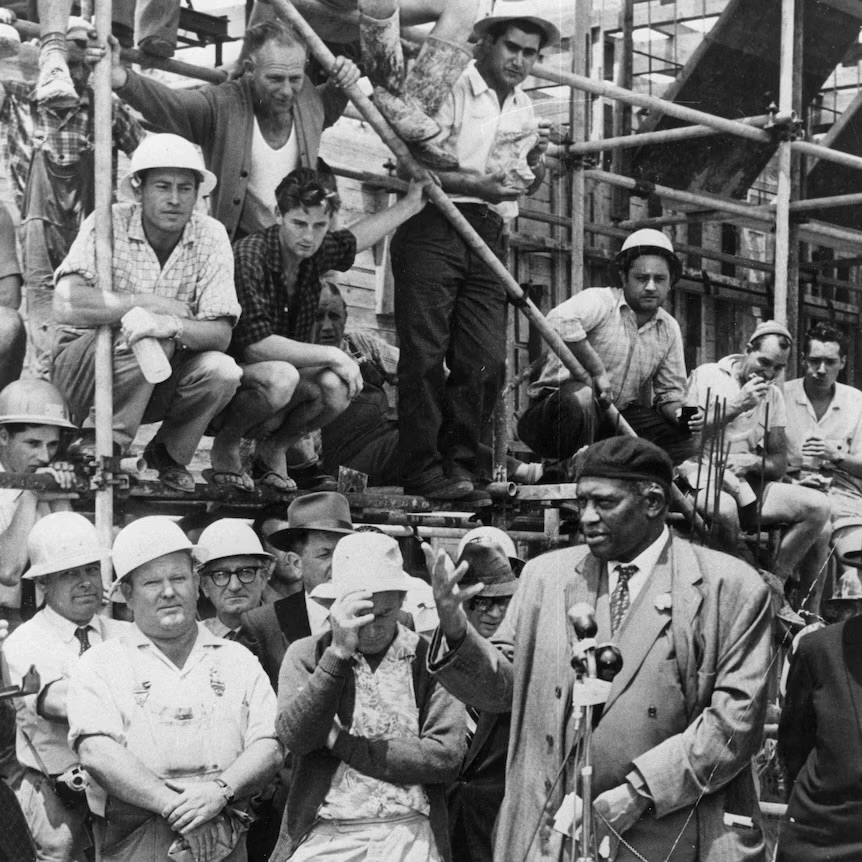
Workers had the best seats when Robeson sang at the Sydney Opera House, 9 November 1960

The visit, Rankin tells The Australian, was organised by the Building Workers Industrial Union of Australia and the Australian Peace Council’s Bill Morrow, a former Labor senator from Tasmania.

In a chapter on Robeson’s visit in the book Passionate Histories: Myth, Memory and Indigenous Australia, which will be launched in Sydney tomorrow, Ann Curthoys quotes the performer as saying on the day after his visit to the Opera House site: “I could see, you know, we had some differences here and there. But we hummed some songs together, and they all came up afterwards and just wanted to shake my hand and they had me sign gloves. These were tough guys and it was a very moving experience.”

In 1998, on the centenary of Robeson’s birth, former NSW minister John Aquilina told state parliament his father had been working as a carpenter at the Opera House site on November 9, 1960: “Dad told us that all the workers – carpenters, concreters and labourers – sang along and that the huge, burly men on the working site were reduced to tears by his presence and his inspiration.”

Curthoys, the Manning Clark professor of history at the Australian National University, who plans to write a book about the Robeson visit, also cites a contemporary report in The Daily Telegraph as saying that the American performer “talked to more than 250 workmen in their lunch hour, telling them they were working on a project they would be proud of one day”. [Curthoy’s book, The Last Tour: Paul and Eslanda Robeson’s visit to Australia and New Zealand, was published at last in 2025]

According to biographer Martin Duberman, Robeson wasn’t particularly enthusiastic about the offer of a tour of Australia and New Zealand from music entrepreneur D. D. O’Connor, but the idea of earning $US100,000 for a series of 20 concerts, plus extra fees for television appearances and the like, proved irresistible.

Robeson had once been one of the highest paid entertainers in the world, but from 1950 onwards he effectively had been deprived of the opportunity of earning a living. A combination of pressure from the US government and right-wing extremists meant American concert halls were closed to him, and the US State Department’s refusal to renew his passport meant he was unable to accept invitations for engagements in Europe and elsewhere. Robeson never stopped singing but was able to do so only at African-American churches and other relatively small venues. His annual income dwindled from more than $US100,000 to about $US6000.

At the time, Robeson was arguably one of the world’s best known African Americans. As a scholar at Rutgers University, he had endured all manner of taunts and physical intimidation to excel academically and as a formidable presence on the football field: alone among his Rutgers contemporaries, he was selected twice for the All-American side.

Alongside his athletic prowess, which was also displayed on the baseball field and the basketball court, he was beginning to find his voice as a bass baritone. When a degree in law from Columbia University failed to help him make much headway in the legal profession, he decided to opt for the world of entertainment, and made his mark on the stage and screen as a singer and actor.

An extended sojourn in London offered relief from the racism in his homeland and established his reputation as an entertainer, not least through leading roles in the musical Show Boat and in Othello opposite Peggy Ashcroft’s Desdemona.

(He reprised the role in a record Broadway run for a Shakespearean role in 1943 and again at Stratford-upon-Avon in 1959)

Robeson returned to the US as a star in 1939 and endeared himself to his compatriots with a cantata titled Ballad for Americans.

In the interim, he had been thoroughly politicised, not least through encounters in London with leaders of colonial liberation movements such as Kenya’s Jomo Kenyatta, Ghana’s Kwame Nkrumah and India’s Jawaharlal Nehru.

He had sung for republicans in Spain and visited the Soviet Union at the invitation of filmmaker Sergei Eisenstein.

Robeson’s refusal to reconsider his political affiliations once World War II gave way to the Cold War made him persona non grata in his homeland: his infatuation with the Soviet Union did not perceptibly pale in the face of horrific revelations about Stalinist excesses, partly because he looked on Jim Crow as his pre-eminent foe. It is therefore hardly surprising that exposure in Australia to Aboriginal woes stirred his passion.

On the day after his appearance at the Opera House site, at the initiative of Aboriginal activist and Robeson fan Faith Bandler he watched a documentary about Aborigines in the Warburton Ranges during which his sorrow turned to anger, and he vowed to return to Australia in the near future to fight for their rights. He made similar promises to the Māori in New Zealand.

But the years of persecution had taken their toll physically and psychologically: Robeson’s health broke down in 1961 and, on returning to the US in 1963, he lived the remainder of his life as a virtual recluse. He died in 1976, long after many of his once radical aspirations for African Americans had been co-opted into the civil rights mainstream. His political views remained unchanged.

It’s no wonder that, as writer and broadcaster Phillip Adams recalls, Robeson’s tour was like “a second coming” to “aspiring young lefties” in Australia.

Duberman cites Aboriginal activist Lloyd L. Davies’s poignant recollection of Robeson’s arrival in Perth on the last leg of his tour, when he made a beeline for “a group of local Aborigines shyly hanging back”.

“When he reached them, he literally gathered the nearest half dozen in his great arms.”

Davies heard one of the little girls say, almost in wonder, “Mum, he likes us.”

She would have been less surprised had she been aware of the Robeson statement that serves as his epitaph: “The artist must take sides. He must elect to fight for freedom or slavery. I have made my choice. I had no alternative.”

Left for Good – Peter Craven on Paul Robeson

The Weekend Australian. March 11 2017

What on earth impelled Jeff Sparrow, the Melbourne-based former editor of Overland and left-wing intellectual, to write a book about Paul Robeson, the great African American singer and actor?

Well, he tells us: as a young man he was transporting the libraries of a lot of old communists to a bookshop and was intrigued by how many of the books were by or about Robeson.

All of which provokes apprehension, because politics is a funny place to start with

Robeson, even if it is where you end or nearly end. Robeson was one of the greatest singers of the 20th century. When I was a little boy in the 1950s, my father used to play that velvet bottomlessly deep voice singing not only Ol’ Man River — though that was Robeson’s signature tune and his early recording of it is one of the greatest vocal performances of all time — but all manner of traditional songs. Not just the great negro spirituals (as they were known to a bygone age; Sparrow calls them slave songs) such as Go Down, Moses, but Shenandoah, No, John, No and Passing By, as well as the racketing lazy I Still Suits Me.

My mother, who was known as Sylvie and loathed her full name, which was Sylvia, said the only time she could stand it was when Robeson sang it (“Sylvia’s hair is like the night … such a face as drifts through dreams, such is Sylvia to the sight”). He had the diction of a god and the English language in his mouth sounded like a princely birthright no one could deny.

It was that which made theatre critic Kenneth Tynan say the noise Robeson made when he opened his mouth was too close to perfect for an actor. It did not stop him from doing Eugene O’Neill’s All God’s Chillun’ Got Wings or The Emperor Jones, nor an Othello in London in 1930 with Peggy Ashcroft as his Desdemona and with Sybil Thorndike as Emilia.

Robeson later did Othello in the 1940s in America with Jose Ferrer as Iago and with Uta Hagen (who created Martha in Who’s Afraid of Virginia Woolf?) as his Desdemona. He toured the country; he toured the south, which was almost inconceivable. When he was told someone had said the play had nothing to do with racial prejudice, Robeson said, “Let him play it in Memphis.”

Southern white audiences were docile until Robeson’s Othello kissed Hagen’s Desdemona: then they rioted. Robeson also made a point, at his concerts and stage shows, of insisting the audience not be segregated. James Earl Jones. who would play Robeson on the New York stage, says in his short book about Othello, “I believe Paul Robeson’s Othello is the landmark performance of the 20th century.”

Robeson would play the Moor again in 1959 at Stratford-upon-Avon. By that time, though, he had fallen foul of 1950s America. He had been called before the McCarthyist House Un-American Activities Committee. You can hear a dramatisation of his testimony with Earl Jones as Robeson, which includes an immemorial reverberation of his famous words when senator Francis E. Walter asked him why he didn’t just quit the US and live in Russia.

“Because my father was a slave and my people died to build this country, and I am going to stay here and have a part of it just like you. And no fascist-minded people will drive me from it. Is that clear?”

It’s funny how it was the real communists such as Bertolt Brecht and Robeson who handled the committee best. Still, in an extraordinary act of illiberalism, they took away his US passport and it took two years for the Supreme Court to declare in 1958 in a 5-4 decision that the secretary of state was not empowered to withdraw the passport of any American citizen on the basis of political belief.

When Paul Robeson sang at the Sydney Opera House

It was this that allowed Robeson to do his Othello in Peter Hall’s great centenary Stratford celebration along with Charles Laughton’s Lear and Laurence Olivier’s Coriolanus. It also allowed him to come to Australia. Very early on Sparrow tells the story of watching the clip of Robeson singing Ol’ Man River to construction workers in Sydney with the Opera House still a dream in the process of meeting impediments. The version Robeson sings is his own bolshie rewrite (“I must keep fightin’/ Until I’m dyin’ ”).

Well, fight he did and bolshie he was. I remember when I was a child my father telling me Robeson was a brilliant man, that he had won a sporting scholarship for American football (to Rutgers, in fact), that he’d gone on to receive a law degree (from Columbia, no less) and that he was so smart he had taught himself Russian.

But the sad bit was, according to my father, that he’d become a communist. Understandably so, my father thought, because of how the Americans treated the blacks. My father’s own radical impulses as a schoolboy had been encouraged, as Robeson’s were on a grander scale, by World War II where Uncle Joe Stalin was our ally in the war against Hitler’s fascism.

But this was the Cold War now, and a lot of people thought, with good reason, that it was behind the Iron Curtain that today’s fascists were to be found. Even if others such as the great German novelist Thomas Mann and Robeson thought they were encroaching on Capitol Hill.

Sparrow’s book No Way But This is circumscribed at every point by his primary interest in Robeson as a political figure of the Left rather than as a performer and artist.

It’s an understandable trap to fall into because Robeson was an eloquent, intelligent man of the Left and his status was also for a while there — as Sparrow rightly says — as the most famous black American on Earth. So his radicalism is both pointed and poignant.

His father, who became a Methodist minister, was born a slave and was later cruelly brought down in the world. But, unlike the old Wobblies whose bookcases he transported, Sparrow is not inward with what made Robeson famous in the first place and it shows.

No Way But This is a great title (“no way but this / killing myself, to die upon a kiss” is what Othello says when he’s dying over the body of Desdemona, whom he has killed) but Sparrow’s search for Robeson is not a great book.

As the subtitle suggests, it is a quest book but Sparrow is a bit like the Maeterlinck character cited in Joyce’s Ulysses who ends up meeting himself (whether in his Socrates or his Judas aspect) on his own doorstep. Sparrow goes to somewhere in the US associated with Robeson and meets a black-deaths-in-custody activist full of radical fervour. She introduces him to an old African-American who was in Attica jail for years. There is much reflection on the thousands of black people who were slaves on the plantations and the disproportionate number of them now in US prisons.

Yes, the figures are disquieting. No, they are not aspects of the same phenomenon even though ultimately there will be historical connections of a kind.

And so it goes. But this is a quest book that turns into a kind of travelogue in which Sparrow goes around the world meeting people who might illuminate Robeson for him but don’t do much for the reader except confirm the suspicion that the author’s range of acquaintance ought to be broader or that he should listen to people for a bit more rather than seek confirmation of his own predilections.

There are also mistakes. Sparrow seems to know nothing about the people with whom Robeson did Othello. There’s no mention of Thorndike, and when Ashcroft comes up as someone he had an affair with, Sparrow refers to the greatest actress of the Olivier generation as “a beautiful glamorous star”. Never mind that she was an actress of such stature, Judi Dench said when she played Cleopatra she could only follow Ashcroft’s phrasing by way of homage.

Sparrow also says “American actor Edmund Kean started using paler make-up for the role, a shift that corresponded with the legitimisation of plantation slavery”. Kean, who was the greatest actor of the later romantic period, was English, not American. His Othello would, I think, be more or less contemporary with William Wilberforce lobbying to have slavery made illegal. Sparrow seems to be confusing Kean with Edwin Booth, the mid-century Othello who happens to have been the brother of John Wilkes Booth, the assassin of Abraham Lincoln. But it’s still hard to see where the plantations fit in.

A few pages later — and it’s not important though it’s indicative — we hear of the rumour that Robeson was “romancing Edwina Mountbatten, Countess Mountbatten of Burma”. Well, whatever she was called in the early 1930s, it wasn’t Countess Mountbatten of Burma because her husband, Louis Mountbatten, the supreme allied commander in Southeast Asia during World War II, didn’t get the title until after the Japanese surrendered to him — guess where?

Such slips are worth belabouring only because they make you doubt Sparrow’s reliability generally. It’s worth adding, however, that his chapter about the prison house that the Soviet Union turned itself into is his most impressive. And the story of the last few years of Robeson’s life, afflicted with depression, subject to a lot of shock treatment, with recurrent suicide attempts, is deeply sad.

He felt towards the end that he had failed his people. He just didn’t know what to do. It was the melancholy talking as melancholy will.

It’s better to remember the Robeson who snapped back at someone who asked if he would join the civil rights movement: “I’ve been a part of the civil rights movement all my life.”

It’s to Sparrow’s credit that he’s fallen in love with the ghost of Robeson even if it’s only the spectral outline of that power and that glory he gives us.

Peter Craven is a cultural and literary critic

The Last Tour: Paul and Eslanda Robeson’s visit to Australia and NZ

Australians of a certain age know all about Paul Robeson’s magnificent voice. They know, too, that on a warm November day more than 60 years ago, the bass-baritone sang to 250 construction workers on the Sydney Opera House building site as the workers sat on scaffolding and stacks of timber and ate their lunch. Fewer know of Robeson’s Pro-Communist and pro-Soviet views and of how those beliefs damaged his career at home and abroad. And that’s not so surprising – as historian Ann Curthoys points out, the Cold War suppression of Robeson’s career and memory has been very effective.

Recovering the story of a man who was once the most famous African-American in the world and his equally impressive wife, Eslanda, is the task Curthoys, who grew up in an Australian communist family in the 1950s and 60s, sets herself in a new book, The Last Tour: Paul and Eslanda Robeson’s visit to Australia and New Zealand.

It follows the couple’s tour – a mix of his concerts and their public talks and media interviews – to Australia and New Zealand over October, November and December 1960. Curthoys goes further, using the seven-week tour by this celebrated singer to explore the social and political changes just beginning in post-War Australia. Her interest is “the slow transition from the Cold War era of the late 1940s and 50s, to the 60s era of the New Left, new social movements and the demand for Aboriginal rights”.

Curthoys is 79 now, but when Robeson toured she was 15 and living in Newcastle, a city the singer did not visit. Her mother, Barbara Curthoys, a well-known activist and feminist, was a fan of the singer but the trip passed the teenager by.

It was only decades later, as she researched her 2002 book on the 1965 Aboriginal Freedom Ride through regional NSW, that Curthoys connected with the story. As a university student she had taken part in the ride and moved from communism to the New Left. When she approached the subject as a historian, she realised that for some riders, their attendance at Robeson’s concerts five years earlier had been a defining moment in their “understanding of racial discrimination and Aboriginal rights”.

Curthoys has had a long career in research and teaching at the Australian National University and the University of Technology, Sydney. She’s part of a remarkable family, and not just parents Barbara and Geoffrey, who was a lecturer in chemistry at Newcastle University. Her sister Jean is a leading feminist philosopher and her husband, John Docker, has written several books on cultural history, popular culture and the history of ideas.

Curthoys began researching The Last Tour in 2007, but put it aside for another project on Indigenous Australians before resuming work on it during the Covid-19 lockdowns. Post-­Robeson, she has worked with two scholars on a forthcoming book on the history of domestic violence in Australia.

The tour, she says, was really several tours rolled into one with the Robesons covering many bases – from music to Cold War politics to feminism to Aboriginal rights. It was a conservative era: Robert Menzies’ Liberals ruled federally and five of the six Australian states had conservative governments. Robeson’s presence went unremarked by governments but for fans of his music – and his ideals – the tour was a significant event that was well covered by the press, even those opposed to his views on the Soviet Union.

For some fans, it was a music tour – 20 concerts in nine cities in Australia and New Zealand, at which Robeson sang his show-stoppers, including Deep River, Go Down, Moses; We Are Climbing Jacob’s Ladder, and the song with which he is always identified, Ol’ Man River. The 62-year-old with the extraordinary voice also delivered “recitations” – a monologue from Shakespeare’s Othello, an anti-segregationist poem Freedom Train, and William Blake’s anthem, Jerusalem.

What a thrill for Australian audiences, some of whom had followed the handsome, 1.9m singer and actor since the 1920s. Even in an age of limited communications, Robeson was well-known here through films; records and radio. Curthoys notes that one indicator of his fame was the way promising Aboriginal singers in the 1930s were dubbed “Australia’s Paul Robeson”.

He was famous – and controversial. Unlike many other supporters of communist ideas, Robeson refused to break from the Soviets after the invasion of Hungary in 1958 and continued to defend Moscow. The “anti-communist repression and hysteria” that gripped the US in the McCarthy era had a profound effect on his life and career, Curthoys writes. He was cited in 1947 by the House Committee on Un-American Activities as “supporting the Communist Party and its front organisations”.

A 1949 US tour was destroyed “after mass cancelling of bookings by venue managers either vehemently opposed to his politics or afraid in such a hostile climate of being classed as communist sympathisers themselves”. Then in 1950, he lost his passport. Over the years, he would “become for communists an emblem of defiance in the face of adversity, and one of the communist world’s most prominent speakers for peace,” ­Curthoys writes.

Unable to travel until his passport was restored in 1958, Robeson was steadfast in his support for communist ideals. That commitment was evident in Australia when the “peace tour” – built around a series of public meetings – was as important to the singer as the popular concerts where he reached a different audience. Curthoys details a related strand – the “workers’ tour”, which involved seven informal concert performances to groups of railway workers, waterside workers and those at work on the Opera House on that November day.

She says the events revealed much about the “the nature of class in Australia and New Zealand” at a time when “strong and confident trade unions” were interested in “broad cultural concerns”. Over several weeks Robeson attracted people who loved his music alongside those who loved his politics. Far from being shunned for his pro-Soviet views, Curthoys suggests, there was support from two different audiences – music people and “left-wing ­people who were either pro-Soviet or not”.

Even so, the Cold War anxieties over the Soviets meant a positive reception was not necessarily assured when Paul and Eslanda flew into Sydney at midday on Oct­ober 12, 1960. They were greeted by several hundred fans carrying peace banners but they faced pointed questions about the Soviet Union at the 20-minute press conference at the airport.

Robeson refused to condemn the suppression of the Hungarian uprising and media reports suggested a torrid exchange. Curthoys reviewed a tape of the press conference and says while the questioning was “a little aggressive”, the event was not as bad as reported in the media. Indeed it was “fairly friendly” albeit for a “bad patch” when Robeson refused to budge on Hungary.

That tape and others, along with newspapers and Trades Hall documentation, yielded rich material but so too did the ASIO files on the couple. At the Palace Hotel in Perth on December 2 an ASIO operative appeared to be among those at a reception organised by the communist-influenced Peace Council. Among guests were the writer (and well-known communist) Katharine Susannah Prichard and “two women by the name of Durack, who were writers and/or artists”.

Curthoys sees Robeson as a “very courageous, very intelligent, intellectual person, very thoughtful about music, about folk music, about people”, but says his commitment to the Soviet Union was a costly mistake. He had embraced Moscow when he and Eslanda visited in 1934 at the invitation of Soviet film director Sergei Eisenstein. Later, Robeson, a fluent Russian speaker, would say it was in the Soviet Union that he felt for the first time he was treated “not through the prism of race but simply as a human being”. Curthoys writes: “The excitement and validation he received during this visit would create a loyalty that later events would not dislodge and the public expression of which would damage him politically, commercially and professionally.”

The couple made several trips to the Soviet Union and accepted its political system completely. Curthoys notes: “They made no public comments about Stalin’s forced collectivisation policies that were in place during the 1930s and led to famine and the loss of millions of lives.” In Sydney Robeson was careful, but on November 5 he celebrated the forthcoming anniversary of the Russian Revolution at the Waterside Workers Federation in Sussex Street. Two days later, during his first public concert in the city, he paid tribute to the Soviet Union as “a new society”.

The Soviet Union had been a great influence but so too was the Spanish Civil War, which Curthoys says helped define his view of the political responsibilities of the artist.

“Increasingly famous as a public speaker, on 24 June, 1937, he made a huge impression at a mass rally at the Albert Hall in London sponsored by prominent figures such as WH Auden, EM Forster, Sean O’Casey, HG Wells and Virginia Woolf, held to raise financial aid for Basque child refugees from the war. In what became his most well-known and influential speech, he stressed how important it was for artists and scientists and others to take a political stand: ‘Every artist, every scientist, every writer must decide NOW where he stands. He has no alternative. There is no standing above the conflict on Olympian heights.’”

After World War II, Robeson was deeply involved in radical and anti-racism politics in the US but in 1947, as the Cold War worsened, he had had enough. He announced he intended to abandon the theatre and concert stage for two years to speak out against race hatred and ­prejudice. In fact he stopped stage acting for 12 years but continued to perform as a singer, often in support of political causes.

It was another 13 years before Australian audiences heard that glorious voice “live”. Australians, it seemed were primed for Paul. The tour may have been ignored by governments but during her research, Curthoys was “overwhelmed” by people “ready to assist, donating old programs, photographs, pamphlets, records, cassette tapes, invitations and other documents”.

Today, much of the Robeson image is defined by his Opera House performance on November 9 – high culture delivered, without condescension, to a building crew by a champion of the workers. Robeson, in a heavy coat, despite the warm weather, sang “from a rough concrete stage”. A PR expert could not have dreamt up a a better way to “democratise” an opera house than having the “first concert” delivered in its half- built shell. Curthoys shows how the event, no matter how memorialised now, was a small part of a tour that proved a financial and political success for the Robesons, who left Australia on December 4.

A few months later, depressed and exhausted, Robeson tried to commit suicide in Moscow. Over the next three years he was treated but could no longer perform or engage in public speaking. Curthoys notes that though his affairs with other women had strained their marriage, he and Eslanda had a common political vision and were together until her death in 1965. Robeson died on January 23, 1976 at the age of 77.

Helen Trinca’s latest book is Looking for Elizabeth: The Life of 
Elizabeth Harrower (Black Inc.)

The Wrath to Come. Gone With the Wind and America’s Big Lie

You offspring of serpents who warned you of the wrath to come. Matthew 3:7

There was a land of Cavaliers and Cotton Fields called the Old South. Here in this pretty world, Gallantry took its last bow. Here was the last ever to be seen of Knights and their Ladies Fair, of Master and of Slave. Look for it only in books, for it is no more than a dream remembered, a Civilization gone with the wind.  Prelude to the film of Gone with The Wind (1939)

… by the time you can no longer avoid thinking about your history, it has become so complex and confusing that you can no longer think about it clearly, and your morality is what is gone with the wind.
Sarah Churchwell, The Wrath to Come (2023)

American cultural historian Sarah Churchwell’s book The Wrath to Come – Gone With the Wind and the Myth of the Lost Cause or its alternative title, the Lies America Tells (tells itself” is more accurate) is a harrowing read about slavery, America’s original sin; about the civil war fought to end it; the brief Reconstruction years that followed; the lingering stain of white supremacism and racial violence; and of how discriminatory and oppressive Jim Crow laws of the late nineteenth century survived well into the twentieth with lynch law, segregation, vote suppression and the civil rights struggles of the sixties.

The Wrath to Come is also about how historiography – how historians analyze and interpret history, and how “we, the people” recall and retell history.

She quotes author and civil rights advocate James Baldwin’s essay The White Man’s Guilt:

“White man, Hear me! History, as nearly no one seems to know, is not merely something to be read. And it does not refer merely, or even principally, to the past. On the contrary, the great force of history comes from the fact that we carry it within us, are unconsciously controlled by it in many ways, and history is literally present in all we do”.

Churchwell notes how in 1935, Black writer WEB Du Bois warned “against writing history for our pleasure and amusement, for inflating our national ego”, or “using a version of historic fact, in order to influence and educate the new generation along the way we wish”. Such propaganda history is merely “lies agreed upon”, and had enabled a toxic mixture of libel, innuendo and silence to poison the well of American historiography”.

The Wrath to Come is also very much about today. Running right through the narrative are the currents and crises that culminated in the great American unraveling that led to the storming of the Capitol on January 6, 2021 – and as we know well, are yet to be fully played out in November 2024, and, as is most likely, beyond it. January 6th was, in her opinion the actualization of what Baldwin called “the wrath to come”, the moral derangement – spinning the nation off its axis. “Beyond the bars of our foolish little cages”, she writes, “a reckoning looms, at a scale we can’t assimilate”.

As an article in the New Yorker wrote recently, the pertinent issue now is not what caused the Civil War but what we should have learned from it. “January 6, 2021, is not an equivalent date in our history to April 12, 1861, but the radical Republican leaders who lived through the Civil War understood a principle that has been lost on their successors: that, if entrusted with power, leaders who commit assaults on the national government once may well attempt to do so again”. Many commentators remind Americans of the time when Benjamin Franklin, one of the original framers of the US Constitution, was walking out of Independence Hall after the Constitutional Convention in 1787, when someone shouted out, “Doctor, what have we got? A republic or a monarchy?” To which Franklin supposedly responded, with a rejoinder at once witty and ominous: “A republic, if you can keep it.”

“The past is not a prediction” Churchwell writes, “but it is a precedent, creating the possibilities for what the future will tolerate. The American future would, it turns out, tolerate a great deal”.

Gone with the myth 

Gone with the Wind shows what white America has believed – and wanted to believe – about its own history; it’ curates and cultivates America’s great white myths about itself.

Churchwell anchors her history around one of the most well known and loved stories of the twentieth centuries – the novel and the film of Atlanta author Margaret Mitchell’s epical Gone With the Wind. But while she may be deconstructing the iconic motion picture, it is very evident that the real target of her thesis is number forty-seven, whom she sees as America’s chaos personified. Whilst describing the brief and ineffective Reconstruction years that followed the American Civil War, with its “scallywags and carpetbaggers”, she gaslights “the greatest grifter the Republic has ever seen”. Like slavers, abortion and Vietnam, Trump is an issue that divides Americans, splitting families, straining the mystic chords of memory.

Within six months of its release in June 1936, Mitchell’s tale of tangled love set against the northern invasion and fall of the Old South, sold one million copies, making it the biggest-selling American novel to that date. It won a Pulitzer Prize and National Book Award, and has sold more than 30 million copies internationally.

The 1939 film adaptation starring Vivien Leigh as willful anti-heroine Scarlett O’Hara and Clark Gable as her rakish third husband Rhett Butler, won eight Academy Awards, including best picture, best actress for Leigh and best supporting actress for African-American actress Hattie McDaniel. McDaniel portrayed Scarlett’s outspoken chief house slave, Mammy, and made film history as the first black woman to take home an Oscar (although she was colour-barred from attending the Atlanta world premier).

Churchwell mounts an excoriating critique of the novel-turned-film for its denialism of the horrors of slavery and “shameless” historical distortions about the civil war and its aftermath. Such denialism, she contends, continues to divide America today.

Churchwell’s book adds a contemporary, political twist to such criticism: she argues America’s “most famous epic romance … provides a kind of skeleton key, unlocking America’s illusions about itself” and she links its sanitized treatment of slavery and promotion of white nationalism to Trumpism and the January 6, 2021, attack on Washington’s Capitol.

“When we understand the dark truths of American experience that have been veiled by one of the nation’s favourite fantasies, we can see how the country travelled from the start of the Civil War in 1861 to parading the flag of the side that lost that war (the Confederate flag) through the US Capitol in 2021.’’

Gone with the Wind advances a misleading version of American history known as the Lost Cause. This is the notion that “the Confederacy fought the Civil War (1861–65) as a principled defense of a noble civilization (the Old South) and its democratic rights, rather than as an unprincipled defense of the white supremacist system of chattel slavery … The specific rights in question were individual states’ rights to keep and trade enslaved people, but the Lost Cause skipped that part.’’

Extending this mythology, the film’s opening title cards briefly mention slavery but also refer to the Old South – which was home to four million slaves – as “a land of Cavaliers and Cotton fields,” and a “pretty world where Gallantry took its last bow.”

Similarly, she writes that Gone with the Wind “marks a cultural breakdown, the point where mythology triumphed over history’’. Therefore, “urging the erasure of Gone with the Wind would simply reinforce that … “

“… when a nation’s myths, no longer make sense of its reality, violence erupts. That is one of the many things that has happened to America. Mythmaking and misinformation have been spinning wildly through American political discourse, so they can be hard to catcher as they float, disembodied across our conversations … Like a carnival magician, myth-making points at something with its right hand while picking our pockets, with its left stop. If we stop looking where it’s pointing, we might just manage to protect our valuables – in this case a republic, if we can keep it … It turns out that the heart of the myth, as well as its mind, and its nervous system, most of its arguments and beliefs, it’s loves and hates, it’s lies and confusions and defense mechanisms, and wish fulfilments, are all captured) for the most part in inadvertently) in America’s most famous epic romance: Gone with the Wind.

… and when a country, become so lost in dreams, that it can no longer see reality, it loses its moral sanity … This book follows American history back down into the myth, to excavate what’s been buried – not just the fact that historians have carefully been long, bringing to light … but also suppressed psycho political realities. The lies, the distortions, justifications, the half-truths, the rampant projections, the cognitive dissonances, the negations, the flat denials all the stinging truths Americans don’t want to admit about ourselves that Gone with the Wind caught like flypaper …

It has often been said that America had to imagine itself to existence. Less often remarked is the corollary, that America is, in a very real sense, mainly a story the nation tells itself. That makes the US singularly subject to the meanings of stories and myths – all nations tell stories about themselves, but America has little to hold it together beyond those stories (which is one of the reasons it fetishes its founding documents). If Gone with the Wind is one of the most popular stories America has ever told about itself, then it matters that it is a profoundly antidemocratic, and a moral horror Show … judgment has been remarkably absent from the stories we tell about ourselves.

While Churchwell hopes that Donald Trump loses the November election, she is hardly optimistic about the republic’s future.  She sees the events of the last eight years, and indeed those preceding as “portents of a much deeper dislocation in American society. For over two decades now, Americans have been battered by non-stop crises at home and abroad – from the long War on Terror to Covid and the George Floyd protests – leading to what feels like national exhaustion and a deep pessimism about the future of democracy”.

 The old revolution and The Lost Cause

Gone with the Wind took a series of historical forces, and made them seem only natural

Maybe we were on the losing side. Not quite sure it was the wrong one. 
Captain Mal Reynolds, Firefly (episode 3)

From the beginning of Donald Trump‘s campaign to the turbulent end of his presidency, debates raged about whether his supporters were motivated by economic anxiety or racial animus. But in America the two are intertwined in a system of racial capitalism.

Gone with the Wind doesn’t just romanticize that system – it eroticizes it. The Lost Cause provided a genesis for modern America’s racialized economics and paramilitary white nationalism, in which racial segregation was the supposedly logical outcome of a fight over states’ rights. But the most vicious fights over these supposedly principled stances on states’ rights have always consistently been over racial power. In fact, states’ rights are almost never invoked in a context that is distinct from race. States’ rights created a fig leaf, an alibi from which white America benefits so deeply that the denials continue to this day.

Slavery was America’s Original Sin, a stain running through its technicolor grain. Over the period of the Atlantic Slave Trade, from approximately 1526 to 1867, some 12.5 million men, women, and children were taken in captivity from Africa; 10.7 million were taken aboard ship to the New World and placed in bondage in the Americas – possibly the costliest in human life of all long-distance global migrations. Four hundred years of slavery ended in civil war and a wasteland.

America’s road to the Civil War took decades. It is beyond the scope of this article. but within a month of Lincoln’s victory in the presidential election of 1861, South Carolina took the fatal step, followed over the next few months by the secession of most of the Lower South. A month after his inauguration, the Civil War erupted with the bombardment of Fort Sumter in Charleston harbour. As Churchwell recounts it, “…. once a people decides that it cannot live together or when a citizenry divides into clearly opposed blocs, it is impossible to predict just how conflict may erupt. But to say that it cannot happen is to ignore history. Even Lincoln downplayed the threat of southern secession during the 1860 campaign, not believing until it was too late that the South ever would take such a final step”.

The American Civil War claimed more than seven hundred thousand American lives, tore a young nation apart, and its echoes reverberate still one hundred and sixty years later, reflecting unresolved political fault lines that go back two centuries. years. Though the war ended slavery, there was still another hundred years of toiling towards true freedom. As Martin Luther King said, “Lord, we ain’t what we want to be; we ain’t what we ought to be; we ain’t what were gonna be, but thank God, we ain’t where we was”.

“The white South grabbed the moral high ground and clung on for dear life – while the white North met it more than halfway. By the turn of the century the south was winning the war of ideas, its big lie accepted across the United States”.

It used to be said that the South would rise again. It did, and indeed, some reckon, the South finally won the war.

Dixie rising 

Predictably, the ghosts of the American civil war have been haunting the ongoing presidential campaign and have forced their way back into popular consciousness.

Statues depicting figures from the war – and even of founding fathers or older presidents – and even the names of the schools, military bases and streets, have increasingly become a flashpoints for a real political and cultural struggle. A low-intensity war on the past is now being waged across many states, with the effect of hardening hearts and solidifying the battle lines being drawn in the sand.

In May 2024, it was reported that the Shenandoah County School Board in Virginia would restore the names of Confederate generals Thomas “Stonewall” Jackson, Robert E. Lee and Turner Ashby to two local schools. The controversial reversal comes nearly four years after the names were changed.

“Residents speaking in favour of reverting to the Confederate names included Stuart Didawick, who noted that his family’s roots run deep in the community, where his ancestors received land grants in the decades before the American Revolution. “When you vote on the name restorations”, he asked board members, “will you listen to the opinions of woke outsiders who have for the most part no ties to the land, the history, or the culture of this county? Or will you listen to the voices of the people who elected you to represent them, the people whose families built and have sustained this county for generations?” To which a student and athlete responded: “I would have to represent a man that fought for my ancestors to be slaves,” adding that she would feel as if she’s being disrespectful both to her ancestors and her family’s values.

Another pervasive ghost of the Civil War, the battle flag of Dixie, has never gone away. It was long a favoured accessory above government buildings and at right wing rallies in The South, those former secessionists states that lay south of the Mason-Dixon Line. It played a cameo role in popular culture, flying in The Dukes of Hazzard, True Blood, and even The Walking Dead. The right to flaunt “the Stars and Bars”, an enduring symbol of the lost Confederate cause, and a rallying point for those who still believe the rebel cause to be just, those who take solace from an heroic defeat, and those who believed that “the South will rise again”, and indeed those who KNOW that the South has indeed risen again. For have not the white, right wing, God fearing, Clinton-baiting, and Obama-hating ‘Red’ states of the South conquered and colonized the American political system?

Failed Republican presidential hopeful Nikki Haley was governor of South Carolina, the first state to secede in 1861, in 2015, when in 2015, Dylann Roof, a young white supremacist who had draped himself in the Confederate flag, massacred nine African American parishioners at a Black church in Charleston, the state capital. Haley called for the removal of the Confederate flag from the grounds of the State House, where it had been hoisted in the early 1960s as a rebuke to the civil rights movement. When the flag came down, a ceremony that felt like the final surrender of the Civil War, little did we know that what we were actually witnessing that summer was the beginning of the white nationalist counter-offensive headed by Trump. In a strange quirk of history, he launched his presidential bid the very day before the Charleston massacre.

During the run up to the Republican primaries, POTUS aspirant and Florida Governor Ron DeSantis defended part of his state’s African American history curriculum standards that claimed some enslaved people developed skills that “could be applied for their personal benefit.” Flag-remover Nikki Haley omitted any mention of slavery when she was asked to explain the cause of the Civil War at a town hall event. It wasn’t until the next day that Haley acknowledged the war was “about slavery”. Both now failed candidates reflected unresolved political fault lines that go back nearly 200 years.

© Paul Hemphill 2024.  All rights reserved

In !955, Ella Fitzgerald was jailed for singing to an integrated audience in Texas

Author’s note

Last year, my favorite podcast The Rest is History broadcast a long but informative interview with Churchwell herself. The link is below. I also republish a review of the book and its content that first appeared in The Australian in April 2023, and the unique story an escaped slave who found his way to Australia and lived to tell his tale in print – an 18,000-word essay about slavery, titled The United States Governed by Six Hundred Thousand Despots. 

Such was my enthusiasm for Churchwell’s book, I transcribed many of what I considered to be memorable and cogent quotes.  They are categorized and listed immediately after the following videos.

For other posts in In That Howling Infinite about the American Civil War, see Blind Willie McTell – Bob Dylan’s Americana, Cross the Green Mountain – Bob Dylan’s Americana, Rebel Yell, Land of the fearful – home of the heavily armed, and regarding American Fascism prior to World War II, see The Shoah and America’s Shame – Ken Burns’ sorrowful masterpiece 

Like my father before me
I will work the land
And like my brother above me
Who took a rebel stand
He was just 18, proud and brave
But a Yankee laid him in his grave
I swear by the mud below my feet
You can’t raise a Kane back up
When he’s in defeat
Robbie Robertson, The Band

Churchwell quotes …

The Dixie Dreamtime

The story is cloaked in self-delusion far worse than Scarlet’s, and the film – which recognizes the novel’s flaws more clearly perpetuated these solutions out of commercial interests. This modern myth affirmed all the nation’s favorite illusions about itself, up to and including its faith in its own innocence – and then sold that bill of goods to all and sundry, making a fortune in the process. Scarlett’s blinkers are typical too – the willful ignorance in which American popular memory likes to trade. What she couldn’t or wouldn’t see is the subject of the rest of this book …

… the savage viciousness of Jim Crow produced the consoling legend of a noble land of Cavaliers, and ladies, who presided over loyal servants, with gentle benevolence, which would become America’s favourite story for decades to come. Listen closely to what a culture keeps telling itself, and you’ll know not only what’s on its mind, but what it needs to hear. Gone with the Wind told Americans that they could survive anything, especially if ignored it … the denialism of American culture (is) its refusal to face facts, to recognize that what it tells itself simply isn’t true …

Even as white Americans were sharply censoring the rise of Fascism in Europe, traveling to Spain to volunteer against Franco’s army, they were also longing for the good old days when the United States have enslaved millions of non-white Americans …

Good stock

Slavery was abolished by the war, but white supremacism was not. The problem was that white Americans could abhor slavery, and fight a war to end it, and also abhor Black people. They could believe that slavery was a moral abomination, and also believe in eugenicist racial science that claimed non-white people were biologically inferior to white people, and that racism was the natural order of things, even if slavery was not …

Gone with the Wind appeared a mere decade after the Scopes Monkey Trial took Darwinism to court to try to deny that humans will be related to apes. The immense anxiety sparked by this idea was bound up in older racist tropes which held the Black people were apes and white people were human. Proof that white people were also descended from apes challenged the racial hierarchy …

Once white people were forced to concede that they might’ve come out of jungles two, scientific gracious, and sort through that they had emerged much earlier, and how much farther and Black people

Playing along with lesser folks, taking from them what you can, and then, kicking them to the curb, is also the secret of social Darwinism, which is inextricable from the novels racism. Both preach survival of the fittest, defining fitness through biological determinism, as heritable traits that mean survivalism is a question of innate character rather than environmental good fortune These ideas are fundamentally eugenicist, claiming not only that some humans “stock” is biologically superior to others, but that such groups come racially and ethnically presorted. Presumptions of lesser and greater beings, the right of merit to rule, was at the heart of the argument: an aristocratic entitlement to title that claimed privilege was founded on inherited superiority, rather than brute force or the dumb luck of circumstance … the notion of “good stock” and “breeding” that underpinned scientific racism …

In the wake of first first world war and the Russian revolution, the “red scare” enabled the second Klan to maintained its white supremacism but expanded its list of enemies to include most foreigners, especially Catholics, Jews, eastern and southern Europeans, as well as communist, socialist and labor organizations, all of whom it generally equated. This broad, stroke nativism was strongly eugenicist, promising to protect the “pure stock” of white American Protestantism from the racial “pollution” of mixing with inferior breeds …

Heirs to the white supremacist cause, the replacement theorists, Tucker Carlson, Kyle Rittenhouse. Fox host Tucker Carlson professed to be “shocked” that “seventeen year olds with rifles decided they had to maintain order when no one else would”. This is precisely the alibi that was always offered for white supremacist violence, straight out of Gone with the Wind and the newspaper lynching reports that that accompanied it. Scapegoating makes violence redemptive, as savagery is projected onto its victims, who deserve what they’re getting. The Klan was a group shaped around projection and scapegoating. Apologists of white supremacist from Thomas Dixon and Margaret Mitchell to Tucker, Carlson and Ann Coulter to the hyper partisan mob that stormed the Capitol all insisted that they were defending “extralegal justice”, as if extralegal were not just another word for illegal …

History is endlessly revised, even when it’s been chiseled in stone. Newly discovered facts can improve our understanding of the past, and sometimes people even ask new questions about the same old facts.

… Black Americans are left arguing that they are the ones owed by a nation which is yet to redeem the promises it made to the makes to them. That is the entire import of Dr. King’s 1963 “I have a dream” speech, a metaphor of redemption that he makes explicit, and explicitly economic: “we’ve come to our national capital to cash a check”, King said, on the “promissory note” signed by the architects of our republic, a promise of “unalienable rights” to “life, liberty and the pursuit of happiness”. But America has “defaulted on this promissory note” King charged. “America has given the Negro people a bad check, a check which has come back marked “insufficient funds” .

… the seed of white grievance, a nostalgic, resentment that perceives only loss of individual power, refusing to consider the question of collective equality. Grievance is the politics of narcissism, the refusal to shift your ground, nursing your grudges, building spite into politics, while telling your enemies to move on in the interest of unity, a unity in which you do not believe, and which you have no intention of compromising.

Women’s rights and suffrage

Mitchell was outraged that Blacks could vote and women could not … Real estate was also entangled with women’s rights, as women gradually bou property and paid tax, but still could not vote. Her mother argued the women’s suffrage, and is very terms woman paid taxes, but we’re not allowed to vote drunken bums on the sidewalk because they were men that they haven’t paid a dime when titled to vote, and we are not …

White wealth through property ownership is what Gone with the Wind wants to exult – while trying, less than successfully, to ignore the role of slavery and it’s aftermath in the creation of that wealth.

Gone with the Wind Shows how the mythology of American success stories, including those of immigrants, were also inculpated in the bloody history of institutionalized slavery. The triumphalism of the end of the immigrant success story has worked to school the question of complicity, the suppose and dog in this town, making good does so at the expense, And More, senses of one, of an entire Other, racially marked, underclass.

Fascism and the kloning of the Klan

My summary: Fascism as represented by the KKK and the plethora of “clothes line” political groups distinguished by a colourful array of shirts was characterized by an American nativism, xenophobic, and white supremacist, conspiratorially anti-Semitic and anti-communist paramilitary groups, leveraging existing bigotries on behalf of state violence, consolidating power for one small group, while dehumanizing, persecuting, and annihilating – the eugenicist exultation of certain “bloodlines” of over others, white grievance displaced onto racialized enemies within.

Fascism as represented by the KKK and the plethora of “clothes line” political groups distinguished by a colourful array of shirts was characterized by an American nativism, xenophobic, and white supremacist, conspiratorially anti-Semitic and anti-communist paramilitary groups, leveraging existing bigotries on behalf of state violence, consolidating power for one small group, while dehumanizing, persecuting, and annihilating – the eugenicist exultation of certain “bloodlines” of over others, white grievance displaced onto racialized enemies within.

The affinities between the second Klan and European fascism had only grown clearer since they are simultaneous start in the early 20s, with their shared cults of paramilitary violence, legal apartheids, eugenicist, ideologies, and paranoid cultures … a mast native about the sacredness of the course, the purity of the nation, and the exultation of violence to defend against the enemy within.

… there is a strong case for the fascism of the Klan with its paramilitary violence, it’s extra-legal assertions of power, it’s uniforms and rituals, it’s love of esoterica, its nostalgic racial fantasies, its conspiracy theories, and its existential rejection of the legitimacy of any government that opposes it, as historians of fascism pointed out … It was ennobled by myths of national purity, performed by masculinist cults of the leader, and sold as the will of the people.

Robert O Paxton, in the five stages of fascism, characterized it as a politics, “marked by obsessive preoccupation with community decline, humiliation, or victimhood, and by compensatory cults of unity, energy, and purity, in which a mass based party of committed nationalist militants, working in un easy, but effective collaboration with traditional elites, abandons democratic liberties and pursues, with redemptive violence, and without ethical or legal restraints, goals of internal cleansing and external expansion“.

The Black and brown shirts of European fascism were met by America’s own clothesline politics, all declaring sympathy with European fascism and espousing the rights of the white Christian American herrenvolk to dominate their nation too. The American right wing “haberdashery brigade” includes silver shirts, white shirts, dress shirts, and gray shirts. They were joined by the black Legion, the order of ‘76 and as well as Cristo-fascist groups, including defenders of the Christian faith and the Christian Front, whose members called themselves the brown shirts. The Friends of the Hitler movement, the official Nazi Association in America, was established in 1933, eventually becoming the German American Bund.

Denialism it had nothing to do with European Fascism ….

Racial bigotry in America, the times insisted, was just unthinking in the good, old, thickheaded, prejudiced, irrational human fashion. Whether unthinking racism is preferable to thinking racism is probably immaterial to its victims, as if lynching would be less objectionable if it weren’t defended on the grounds of rationality … i.e. white supremacism was just good old thickheaded American prejudice.

If Gone with the Wind is broadly fascistic in its outlook, the lost cause is even more so, in its glorification of the confederate causus belli, the cults of its leaders of its dead, its propaganda, it’s wars for territorial expansion, and the insistence on the sacred rebirth of the nation in the ashes reconstruction, the new order founded on the ongoing defiance of the federalist government of the United States, and a fundamental rejection of pluralist democracy.

A collection of material at Ferris State’s Jim Crow Museum of Racist Memorabilia, Grand Rapids, Michigan, 2004. Jim Prichard/AP

The Grapes of Wrath

Eight months before the film premiered in Atlanta, John Steinbeck published the grapes of broth, which would become the most popular novel of 1939. Widely hailed as a testament to human endurance, the novel took its title from the battle hymn of the Republic, Julia Ward Howe’s mighty Civil War anthem …Howe’s Bible steeped language comes from the book of revelation, in invoking divine Justice, when God’s truth will force the wine of freedom from the grapes of wrath. It is an image of anger, accumulated, even cultivated, long march of times.

What defined fascist propaganda was never its lies, wrote Hannah Arendt in 1945, for all propaganda is based on lies. What distinguishes fascist lies is that they are intended to negate reality, making “that true, which, until then could only be stated as a lie”. Fascists don’t lie to deceive; they lie to change reality. Lies about the Lost Cause did just that, using fiction to displace reality until the fiction has become a reality. Soon that fiction spread beyond the cult of true believers, normalizing itself in the body, politic for the best part of the century, a cancer legitimating unreason that metastasized long ago Mythology replaced history as the arbiter of American truth.

Line is not only the Hitlerian big lie of propaganda, but a culture of perversive, lying, what a Arendt called “lying as a way of life” and “lying on principle”. It is a systematic dishonesty that destroys the collective space of historical-factual reality.

The Birth of a Nation

In February 1915, upon viewing The Birth of a Nation at a special White House screening, President Woodrow Wilson reportedly remarked, “It’s like writing history with lightning. My only regret is that it is all so terribly true. This line has appeared in numerous books and articles over the past seventy years. But it was appended twenty years after the event to add a spurious authority- from a former president no less – to the mythical account of reconstruction told in the birth of a nation that gone with the wind recycled, creating a very efficient closed circle of mythmaking.

The Birth of a Nation, by all accounts the first American blockbuster, the first historical epic, the first Hollywood film to resemble what movies are like today, premiered in Los Angeles exactly 100 years ago on Sunday. But the centennial won’t be celebratory. It will likely be awkward, sobering even — because in director D.W. Griffith’s 12-reel Civil War saga, the Ku Klux Klan members are the glorious heroes.

Since its premiere on Feb. 8, 1915, the film has been at once wildly popular and widely condemned. It inspired the revival of the KKK but also galvanized what was then a nascent NAACP into action. It helped define what cinema means for American audiences. It was the first film ever shown inside the White House.

After 100 years, it has left a complicated, powerful legacy, but a legacy of what, exactly?

“Excuses are sometimes made by scholars of film for the content, but I don’t think that for the last ten to 15 years there has been any doubt that this is an unequivocally, viciously racist film,” says Paul McEwan, Associate Professor of Media and Communications at Muhlenberg College. McEwan has been studying and writing about the history of Birth of a Nation for 12 years. “I mean, this film makes Gone With the Wind look very progressive.”

Griffith claimed to be filming history, but Birth of a Nation, based on the novel The Clansman by Thomas Dixon, features a stunning revision of Reconstruction. White actors in blackface portray members of a barbaric, sex-crazed militia of freedmen that terrorizes and disenfranchises cowering whites. Black men overtake South Carolina’s judicial system and legislature, swigging whiskey and eating fried chicken on the floor of the State House. After the blackface character Gus attempts to rape a white woman, the protagonists don their hoods and apprehend him, lynching him after their version of a fair trial. The film is ostensibly about white national reconciliation at the expense of emancipated black Americans. A title card punctuates the action toward the end of the silent film to declare, “The former enemies of North and South are united again in defense of their Aryan birthright.” Despite its objectionable content, the film remains an essential part of the discussion about American cinema because of Griffith’s pioneering technical innovations. Things that today are completely taken for granted — like close-ups, fade-outs and even varying camera angles — originated with The Birth of a Nation‘s director and crew.

From the poverty shacks, he looks from the cracks to the tracks
And the hoofbeats pound in his brain
And he’s taught how to walk in a pack
Shoot in the back
With his fist in a clinch
To hang and to lynch
To hide ‘neath the hood
To kill with no pain
Like a dog on a chain
He ain’t got no name
But it ain’t him to blame
He’s only a pawn in their game
Bob Dylan

In the courtroom of honor, the judge pounded his gavel
To show that all’s equal and that the courts are on the level
And that the strings in the books ain’t pulled and persuaded
And that even the nobles get properly handled
Once that the cops have chased after and caught ’em
And that the ladder of law has no top and no bottom
Stared at the person who killed for no reason
Who just happened to be feelin’ that way without warnin’
And he spoke through his cloak, most deep and distinguished
And handed out strongly for penalty and repentance
William Zanzinger with a six-month sentence
Bob Dylan, The Lonesome Death of Hattie Carroll

In !955, Ella Fitzgerald was jailed for singing to an integrated audience in  Houston, Texas

Goosestepping back to political relevance

Artist Barry Blitt’s “Back to the Future.” In another year of political chaos, he “looks forward to depicting the pageantry, solemnity, and awe of the upcoming Presidential election”.

A slave writes to a Sydney paper

I’m trying to imagine what it might have been like to be the editor of a little Sydney newspaper called The Empire in the 1850s when a “fugitive slave” – owned from birth by the invalid daughter of an innkeeper in North Carolina – walked through the door, asking for a copy of the US Constitution.

He wanted to write about the slavery endured by whole branches of his family, and he needed the Constitution for reference.

It seems that this actually happened in Sydney in 1855. The New York Times had a story about it on the weekend. And you’re not going to believe how that story ends.

The slave in question was John Swanson Jacobs, described by the editors of The Empire (they are sadly not named) as “a man of colour, with bright intelligent eyes, a gentle firm voice, and a style of speech decidedly American.”

Jacobs had escaped bondage and made his way to Australia where he was desperate to find somebody willing to tell the story of slavery. By chance, the editors had “the last edition of the United States’ Constitution authorised by Congress” in their offices, and they agreed to lend it to Jacobs, who returned it after a fortnight, with an 18,000 word essay about slavery, titled The United States Governed by Six Hundred Thousand Despots.

The editors of The Empire agreed to publish it, and “scarcely altered a word”.

A first-hand account of slavery by an escaped slave has been found in an Australian newspaper archive.

A first-hand account of slavery by an escaped slave has been found in an Australian newspaper archive.

“The writer is in Sydney; we understand he has been among the successful gold-diggers,” they said. “We shall be much mistaken if his narrative is not read with a lively interest.”

More than 160 years later, you are being offered the opportunity to read that essay, because it has rather amazingly been re-discovered, and published in book form, and oh, it’s so harrowing.

It begins: “I was born in Edenton, North Carolina, one of the oldest States in the Union, and had five different owners in 18 years.

“My first owner was Miss Penelope Hannablue, the invalid daughter of an innkeeper. After her death I became the property of her mother.”

He describes the slavery endured by his father: “To be a man, and not to be. A father without authority – a husband and no protector … Such is the condition of every slave throughout the United States; he owns nothing – he can claim nothing. His wife is not his – his children are not his; they can be taken from him, and sold at any minute, as far as the fleshmonger may see fit to carry them.

“Slaves are recognised as property by the law and can own nothing except at the consent of their masters.

“A slave’s wife or daughter may be insulted before his eyes with impunity; he himself may be called on to torture them, and dare not refuse. To raise his hand in their defence, is death by the law. He must bear all things and resist nothing. If he leaves his master’s premises at any time without a written permit, he is liable to be flogged; yet they say we are happy and contented.”

He describes the death of Mrs Hannablue, and the sale of her slaves: “Here they are, old and young, male and female, married and single, to be sold to the highest bidder … They began to sell off the old slaves first, as rubbish; one very old man sold for one dollar; the old cook sold for 17 dollars; from that to 1,600 dollars, which was the price of a young man who was a carpenter.

“Dr Norcom, whose daughter owned my sister, bought me for a shop boy. It would be in vain for me to attempt to give a description of my feelings while standing under the auctioneer’s hammer.”

Jacobs escaped, and spent years on a whaling ship before landing in Australia. His essay was discovered just a few years ago, by an American literary scholar, Jonathan D.S. Schroeder, who came across it while digging through the Australian online newspaper database, Trove.

It is being published by the University of Chicago Press, who says accounts of slavery by the slaves themselves are exceedingly rare, and precious. They believe that Jacob was the brother of Harriet Jacobs, whose 1861 autobiography, Incidents in the Life of a Slave Girl is revered in the US as one of the first, first-hand published accounts of slavery, and therefore a treasure, as this essay also so very clearly is. You may read the whole thing on Trove or buy the book here.

Gone with the Lost Cause: O’Hara, Butler recast as ‘homicidal white supremacists’

The 20th century’s most famous fictional lovers had ‘profoundly fascistic worldviews’, according to an author who has mounted an excoriating critique of the novel-turned-film for its denialism of the horrors of slavery.

Actors Clark Gable and Vivien Leigh in 1939 film Gone with the Wind. Picture: Supplied

Clark Gable and Vivien Leigh in Gone with the Wind

American author Margaret Mitchell expected her first and only novel, Gone With The Wind, to sell about 5000 copies. Yet from the day it was published on June 30 1936, Mitchell’s 1037-page fable about the American Civil War and the pampered, manipulative daughter of a Georgia plantation owner, was not merely a bestseller: it evolved into an enduring – and polarising – cultural phenomenon.

Within six months of its release, Mitchell’s tale of tangled love set against the northern invasion and fall of the Old South, sold one million copies, making it the biggest-selling American novel to that date. It won a Pulitzer Prize and National Book Award and has sold more than 30 million copies internationally.

The 1939 film adaptation starring Vivien Leigh as willful anti-heroine Scarlett O’Hara and Clark Gable as her rakish third husband Rhett Butler, won eight Academy Awards, including best picture, best actress for Leigh and best supporting actress for African American actress Hattie McDaniel. McDaniel portrayed Scarlett’s outspoken chief house slave, Mammy, and made film history as the first black woman to take home an Oscar.

The film’s melodramatic love story — Scarlett spends years pining for a man she cannot have — along with its elegant balls, burnt orange skies, hooped gowns and epic scenes of dead and injured Confederate troops, proved a hit with moviegoers around the world. When adjusted for inflation, Gone with the Wind, which tracks Scarlett’s journey through civil war, near-starvation, three marriages and the loss of her only child, remains the highest-grossing film of all time, ahead of Avatar and Titanic.

American author Sarah Churchwell recounts these milestones in her provocative book, The Wrath to Come: Gone with the Wind and the Lies America Tells — and goes on to mount an excoriating critique of the novel-turned-film for its denialism of the horrors of slavery and “shameless” historical distortions about the civil war and its aftermath. Such denialism, she contends, continues to divide America today.

In fact, Churchwell — one of the headline speakers at next month’s Melbourne Writers Festival — argues that society belle-turned-wily survivor, Scarlett O’Hara, and gambler turned doting father, Rhett Butler, are “homicidal white supremacists with profoundly fascistic worldviews’’. Not the kind of academic who pulls her punches, she adds that Mitchell’s novel is “about enslavers busily pretending that slavery doesn’t matter — which is pretty much the story of American history’’.

The novel and film’s depiction of loyal, happy enslaved people — neither Scarlett’s family nor their wealthy plantation neighbours mistreat their slaves — has long been criticised. “Gone with the Wind does such violence to American history that it practically lynches it,’’ black journalist Ben Davis Jr wrote in 1940.

Scarlett (Vivien Leigh) being laced into a corset by Mammy (Hattie McDaniel) in Gone With the Wind.

Scarlett (Vivien Leigh) being laced into a corset by Mammy (Hattie McDaniel)

Churchwell’s book adds a contemporary, political twist to such criticism: she argues America’s “most famous epic romance … provides a kind of skeleton key, unlocking America’s illusions about itself” and she links its sanitised treatment of slavery and promotion of white nationalism to Trumpism and the January 6, 2021 attack on Washington’s Capitol. Significantly, just months before this attack, Donald Trump invoked Gone with the Wind at a rally while complaining about the South Korean film, Parasite, winning the Best Picture Oscar. Trump said he wished America would “bring back” films like the 1939 classic: “Can we get, like, Gone with the Wind back please?’’

As an American who lives in London and writes about US culture and history, Churchwell is often asked, “What has happened to America?”, since the 2016 election of Trump as US president “dumbfounded most of the watching world’’. She writes: “When we understand the dark truths of American experience that have been veiled by one of the nation’s favourite fantasies (Gone With The Wind), we can see how the country travelled from the start of the Civil War in 1861 to parading the flag of the side that lost that war (the Confederate flag) through the US Capitol in 2021.’’

In a Zoom interview, Review asks Churchwell whether she has faced pushback over her claims Scarlett and Rhett are homicidal white supremacists. A professor of American Literature at the University of London, she grins and says: “People have noticed it.’’

She says the book hasn’t come out in the US yet – it will be published there in June – “so we’ll see what they think’’ of her revisionist history of this popular American classic.

With her curtain of long blonde hair, Churchwell cuts a glamorous figure as she delivers her rapid-fire answers, which, like her writing, are mercifully free of academic jargon. She says of her denunciation of Scarlett and Rhett: “It is a statement of fact because they both espouse white supremacism over and over and over again. So it’s not an interpretation. It is a simple description of the things that they do and the things that they say.’’

The Wrath to Come – which British critics have described as “extraordinary” and as prising opening “often jaw-dropping history’’ – documents how, when under pressure, Scarlett uses the n-word in the novel. This racial slur appears in Mitchell’s book more than 100 times but was removed from the film’s script after black cast members and activists lobbied the blockbuster’s powerful producer, David O. Selznick.

Gone With the Wind author Margaret Mitchell

In Mitchell’s novel, during one wartime crisis, Scarlett threatens to sell a young, flighty slave, Prissy, “down the river’’ and also threatens her with: “You’ll never see your mother again or anybody you know’’. Later, when Scarlett and her Tara household are facing starvation following the siege of Atlanta, she again loses her temper with Prissy, uses the n-word against her for the first time and threatens to “wear this whip out on you’’.

During Reconstruction, Scarlett refers in disparaging terms to “damned n—-r lovers” and when she starts a timber mill business, she is troubled by “free nxxxxrs’” who won’t work for her (because ex-slaves now have the right to resign). All of these racial insults are omitted or softened in the film.

As for those homicidal claims, Scarlett shoots a white Yankee deserter who invades her family’s plantation house, in self-defence, takes his money and hides the body. In the novel, she is initially shocked at her violence, but Churchwell notes how she later mused she “could have … taken sweet pleasure in the feel of his warm blood on her bare feet’’. Rhett Butler, a self-interested gambler who eventually joins the Confederacy, admits in the book he killed a Yankee soldier in a bar-room argument, and murdered a black man because “he was uppity to a lady, and what else could a Southern gentleman do?’’

Then there is the racist language of Mitchell’s novel, which is “far more extreme”, says Churchwell, “than those who haven’t read it probably imagine’’. She argues: “Gone with the Wind never once refers to Black people as people or human beings – not a single time. They are only dehumanised and generic racial categories. Black people are either (various) animals, especially all sorts of apes; or they are savages, just out of the jungle; or they are ‘slaves’, ‘blacks’, ‘darkies’, ‘pickaninnies’, ‘negroes’, ‘mulattos’, or ‘nxxxxrs’.

“ … Tara’s field hands have ‘huge black paws’ and ‘caper with delight’ at encountering Scarlett, while freed slaves run wild ‘like monkeys or small children’ after emancipation, ‘as creatures of small intelligence might naturally be expected to do’.’’

The film uses the now-objectionable term “darkies” and as mentioned above, dropped the n-word. This toning down of the book’s racism “had the perverse outcome of reinforcing the Lost Cause myth that white Southerners treated Black people courteously,’’ Churchwell argues.

For the academic and author, the novel’s racial prejudice goes beyond its extensive use of offensive words: “It’s unreflective in its racism. It thinks there’s such a thing as a willing slave without stopping to think about the fact that those two words literally mean the opposite.’’ Although slavery ended because of the Civil War, she also contends that Gone with the Wind presents America’s post-war reconstruction and new era of rights for freed slaves as a tragedy – for Scarlett, and her slave-owning plantation class.

Churchwell, who has also written cultural histories of other American icons Marilyn Monroe and The Great Gatsby, says Gone with the Wind advances a misleading version of American history known as the Lost Cause. This is the notion that “the Confederacy fought the Civil War (1861–65) as a principled defence of a noble civilisation (the Old South) and its democratic rights, rather than as an unprincipled defence of the white supremacist system of chattel slavery … The specific rights in question were individual states’ rights to keep and trade enslaved people, but the Lost Cause skipped that part.’’

Extending this mythology, the film’s opening title cards briefly mention slavery but also refer to the Old South – which was home to four million slaves – as “a land of Cavaliers and Cotton fields,” and a “pretty world where Gallantry took its last bow.”

Churchwell, who has a PhD in English and American literature from Princeton University, is not the only cultural expert to question Gone with the Wind’s use of racist terms and extreme euphemism. This month, British journalists revealed that Pan Macmillan, publisher of Mitchell’s epic, had added a detailed trigger warning to the 2022 edition, pointing out the novel “includes problematic elements including the romanticisation of a shocking era in our history and the horrors of slavery’’.

In 2020, HBO Max temporarily pulled the film in the wake of George Floyd’s murder. It has since been restored to the streaming service with accompanying videos that denounce its racial representations and examine the film’s historical context.

The African-American rapper Queen Latifah has said the film should have been permanently banned by HBO Max. “Let Gone with the Wind be gone with the wind,’’ she said. Actress and TV host Whoopi Goldberg – the second black woman to win an acting Oscar after McDaniel – disagreed. She favoured educating viewers on the film’s context, adding: “If you start pulling every film, you’re going to have to pull … a very long list of films.’’

Churchwell’s inspiration for her book, which took her five years to write, were the American and UK statue wars. “I initially envisioned it as a much shorter, faster book,’’ she says. “ … At the same time, history kept galloping forward and Gone With the Wind kept coming into the news and Donald Trump kept pushing things forward. And so it was like it had more and more to say to our moment.’’

Sarah Churchwell.

Sarah Churchwell

She does not advocate cancelling Gone with the Wind or destroying statues. She argues it is better to place key statues of controversial historical figures in museums, with accurate contextual information. Similarly, she writes that Gone with the Wind “marks a cultural breakdown, the point where mythology triumphed over history’’. Therefore, “urging the erasure of Gone with the Wind would simply reinforce that failure’’.

Mitchell disliked nostalgic characterisations of the Old South as a land of “magnolias and moonlight’’. She describes Rhett – the embodiment of masculine virility – as “dark of face, swarthy as a pirate”, and conceived of Scarlett as a not especially beautiful anti-heroine: she was perplexed when her self-centred protagonist became a national heroine. An ex-journalist from Atlanta, Mitchell saw the adoration of Scarlett as “bad for the mental and moral attitude of a nation” and once complained: “The mythical Old South has too strong a hold on their (the public’s) imaginations to be altered by the mere reading of a 1037-page book.’’

The Wrath to Come acknowledges all this but notes that while Mitchell condemns Scarlett’s failings such as her greed and lack of self-awareness, she doesn’t challenge her racism. “Her white supremacism isn’t part of what makes her not admirable for Mitchell,’’ Churchwell tells Review.

Mitchell maintained that her black characters, including Tara’s slaves Mammy, Pork and Big Sam – the latter saves Scarlett’s life when she is attacked – behaved in a more noble manner than their white mistress. “It’s true most of the black characters in the novel are admirable in the sense they’re not evil,’’ responds Churchwell. However, she says that after the Civil War, as slaves were freed, Mitchell’s text often falsely characterised them as “a danger to civilised society’’.

Published in 27 languages, the novel has often been praised as a powerful account of the effects of war on innocent civilians, especially women, and Scarlett has been seen as a proto-feminist — a selfish but determined young woman who endures the chaos of war and flouts the stifling gender conventions of her time by going into business for herself. Former Democrat first lady Eleanor Roosevelt was a fan of the book, writing that it made the lingering enmity of the south “easy to understand … even to those who haven’t understood it before”. As a result, she sympathised, she said, with southern women whose “bitterness persisted so long” against the “northern invaders”.

Churchwell writes scornfully of this: “Even a white liberal like Eleanor Roosevelt sympathised after reading the novel not with enslaved people but with the women fighting to keep them in chains. This is what it means to naturalise a value system.’’ In our interview, Churchwell says Roosevelt’s sympathetic take “was obviously very representative of the ways that Americans read the book at that time’’.

The university professor concedes Scarlett has some winning qualities: “Vivien Leigh’s portrayal of Scarlett is one of the things that makes the film quite indelible. I think it’s an incredible performance. And she takes this character who is unlikable in all kinds of ways — is kind of stupid — and makes her a lot more interesting, charming and sympathetic.’’

McDaniel’s parents had been enslaved and she famously retorted to critics of her devoted house-slave role that she had chosen between $7 a week to be a maid, or $700 a week to play a maid. Even so, on the night she made Oscars history, McDaniel was forced to sit apart from white cast members during the awards ceremony in Los Angeles. Says Churchwell: “A lot of people now have the idea of a Jim Crow segregation in the US as being something that only happened in the south, but …. a kind of an apartheid line ran all the way across the US.’’

What about the notion Mitchell was a product of the early 20th century era, and that adult readers of her saga would understand this? “It’s true up to a point,” replies Churchwell. She says Mitchell’s contemporaries, Hemingway and Fitzgerald, also reflected the casual racism of their era, but “considerably less viciously” than she did. Unlike Mitchell, who defended her right to use the n-word, “they both evolved”.

Although Leigh’s Scarlett and Gable’s Rhett were arguably 20th century film’s most recognisable lovers, Churchwell maintains that Gone with the Wind’s historical distortions are still “vastly underestimated.’’.

“The book has always been recognised as racist,’’ she says. “I certainly didn’t write the book to be like, ‘Hey, I’ve got a revelation, ‘Gone With the Wind is racist – we never knew’.

“But the more that you go into it, the more you realise that there are ways in which we still haven’t reckoned with some of the truths about their (Scarlett and Rhett’s) positions. And (this is) despite the fact that they are both homicidal white supremacists — they just are.’’

Rhiannon the Revelator – In the dark times will there also be singing?

In the dark times will there also be singing?
Yes, there will also be singing. About the dark times.
Bertolt Brecht, motto to Svendborg Poems, 1939

Brown girl in the ring, raise your voice and sing

Rhiannon Giddens, a multifaceted singer, musician, folklorist and storyteller brings American history alive in her her drive to unearth the stories of forgotten people so that her audiences and listeners may remember them.

On Moon Meets The Sun, a defiantly joyous song, Giddens and her comrades of Our Native Daughters sing in the round over a polyrhythmic lacework of banjo and guitar, vowing not to let radical suffering diminish humanity. “You put the shackles on our feet, but we’re dancing”, she sings, “You steal our very tongue, but we’re dancing” “Ah, you sell our work for your profit, but we’re dancing,” she scoffs. “Ah, you think our home we have forgotten, but we’re dancing.” Then she recedes into the jubilant tangle of voices: “You can’t stop us now (We’ll be dancing). You can’t keep us down (We’ll be dancing)”. 

As Leonard Cohen sang, “that’s how the light gets in”. 

Songs of Our Native Daughters is at once a harrowing ride through early America’s darkness and also, a celebration of resilience and resistance. As  Rhiannon Giddens describes it:

“There is surely racism in this country — it’s baked into our oldest institutions – just as there is sexism, millennia old. At the intersection of the two stands the African American woman. Used, abused, ignored and scorned, she has in the face of these things been unbelievably brave, groundbreaking and insistent. Black women have historically had the most to lose, and have therefore been the fiercest fighters for justice — in large, public ways that are only beginning to be highlighted, and in countless domestic ways that will most likely never be acknowledged.” (NPR – First Listen to Our Native Daughters)

‘… slavery is not a historical event but rather an intrinsic, dominating, and ultimately destructive part of everyone’s day-to-day reality’ (CE Morgan’s “great American novel”)

When the day is done
The moon meets the sun
We’ll be dancing
When the day is done
The moon meets the sun
We’ll be dancing

You put the shackles on our feet
But we’re dancing
You steal our very tongue
But we’re dancing

Brown girl in the ring
Raise your voice and sing
Sing us solace
Sing us freedom
Hold us steady
Keep us breathing
We’ll endure this
You can’t stop us
And we’re dancing

You steal our children
But we’re dancing
You make us hate our very skin
But we’re dancing 

We’re your sons
We’re your daughters
But you sell us
Down the river
May the God
That you gave us
Forgive you
Your trespasses
We’re survivors
You can’t stop us
And we’re dancing

When the day is done
The moon meets the sun
We’ll be dancing
When the day is done
The moon meets the sun
We’ll be dancing

Like the rabbit
We won’t bend to your will
Like the spider
The smallest will still prevail
The stories of our elders
We find comfort in these
We smile to the sky
We move to stay alive
And we’re dancing

You steal our work for your profit
But we’re dancing
You think our home we have forgotten
But we’re dancing

Step into the circle
Step into the ring
Raise your voice and sing
Sing freedom
Sing freedom
You can’t stop us now
You can’t keep us down
We’ll be dancing

When the day is done
The moon meets the sun
We’ll be dancing
When the day is done
The moon meets the sun
We’ll be dancing

You can’t stop us now (We’ll be dancing)
You can’t keep us down (We’ll be dancing)
You can’t stop us now (We’ll be dancing)
You can’t keep us down (We’ll be dancing)
You can’t stop us now (We’ll be dancing)
You can’t keep us down (We’ll be dancing)
You can’t stop us now
You can’t keep us down
You can’t stop us now (We’ll be dancing)
You can’t keep us down (We’ll be dancing)
You can’t stop us now (We’ll be dancing)
You can’t keep us down (We’ll be dancing)

Quasheba, Quasheba
You’re free now, you’re free now
How does your spirit fly?
Blood of your blood
Bone of your bone
By the grace of your strength we have life

From the Golden Coast of Ghana
To the bondage of Grenada
You kept the dream of hope alive
They burned your body
They cursed your blackness
But they could not take your lights

Raped and beaten, your babies taken
Starved and sold and sold again
Ain’t you a woman, of love deserving
Ain’t it somethin’ you survived?

Quasheba, Quasheba
You’re free now, you’re free now
How does your spirit fly?
Blood of your blood
Bone of your bone
By the grace of your strength we have life

You dreamt of home, you dreamt of freedom
You died a slave, you died alone
You came from warriors who once built empires
Ashanti’s kingdom carries on

You were forgotten, almost forsaken
Your children founded generations
Your strength sustained them
They won their freedom
Traced their roots to find you [waiting?]

Quasheba, Quasheba
You’re free now, you’re free now
How far your spirit’s flown
Blood of your blood
Bone of your bone
By the grace of your strength we are home

Blood of your blood
Bone of your bone
By the grace of your strength we are home
We are home
We are home
We are home

Also in In That Howling Infinite,  Soul Food – music and musicians, a collection of posts on matters musical, My Country ’tis of thee, a collection of posts on american history, politics and music, Blind Willie McTell – Bob Dylan’s Americana, and The Sport of Kings – CE Morgan’s “great American novel”

Postscript

I am reminded of  Pete Seeger’s adaptation of the old Baptist hymn:

 My life flows on in endless song
Above earth’s lamentation.
I hear the real, thought far off hymn
That hails the new creation
Above the tumult and the strife,
I hear the music ringing;
It sounds an echo in my soul
How can I keep from singing?

and of Leonard Cohen’s Anthem

I can’t run no more
With that lawless crowd
While the killers in high places
Say their prayers out loud
But they’ve summoned, they’ve summoned up
A thundercloud
They’re going to hear from me

Here is the wondrous Éabha McMahon of Celtic Woman:


A cowboy key – how the west was sung

Oh, give me land, lots of land under starry skies above,
Don’t fence me in.
Let me ride through the wide open country that I love,
Don’t fence me in.
Let me be by myself in the evenin’ breeze,
And listen to the murmur of the cottonwood trees,
Send me off forever but I ask you please,
Don’t fence me in.
Cole Porter and lyrics by Robert Fletcher and Cole Porter.

Outlaw songs and cowboy gothic

“An old cowpoke went riding by one dark and windy day …”

In his informative and entertaining Way Out West series, in The Immortal Jukebox, British blogger and music chronicler Thom Hickey reminds us that the Western Writers of America declared Ghost Riders In The Sky the greatest of all Western songs.  I’m totally with Thom here. Written and recorded in 1948 by Sons of The Pioneers alumni Stan Jones, it is probably the best of a glorious herd. The lyrics echo the Seer of Patmos’ four horsemen of the apocalypse …

Their brands were still on fire and their hooves were made of steel
Their horns were black and shiny and their hot breath he could feel
A bolt of fear went through him as they thundered through the sky
For he saw the riders coming hard and he heard their mournful cry

It’s as far way from “Whoopee ti yi yo, get along little dogies” as Kansas is from Oz.

Stan Jones also wrote the haunting and evocative theme for John Ford’s 1956 masterpiece, The Searchers. It is a quixotically existential song

What makes a man to wander?
What makes a man to roam?
What makes a man leave bed and board
And turn his back on home?
Ride away, ride away, ride away

The Searchers is regarded by many to be the best western ever, and many modern filmmakers pay visual homage to it – recall Kill Bill and Westworld. I would argue that it is the second best, after Clint Eastwood’s redemptive avenger saga The Outlaw Josie Wales – which also had a memorable song, the corny Rose of Alabama, which would not be in Thom’s or anyone’s else’s cowboy song pantheon.

The Searchers and Kill Bill

And there’s Marty Robbins’ fatal fight for the affections of flirtatious Feleena at Rosa’s cantina in the West Texas town of El Paso. Yes, El Paso of 1959 is up there near the summit. It’s a crowded peak, with these songs tussling for space alongside a swag of worthy contenders.

Western movies provided irresistible opportunities for city songwriters to try their hands at moralistic cowboy carols. These included the Tin Pan Alley ring-in written by Burt Bacharach and Hal David and sung so well by Gene Pitney: The Man Who Shot Liberty Valance (1962). Those who tamed the wild west had cleaved to an ambivalent moral code …

But the point of a gun
Was the only law that Liberty understood
When the final showdown came at last
A law book was no good

From the moment a girl gets to be full grown
The very first thing she learns
When two men go out to face each other
Only one returns

The cowboy hero faced many challenges in his lonesome quest – none more so than Marshall Will Kane in Stanley Kramer’s showdown classic High Noon (1952) with its iconic theme song written by Ukrainian-born Dimitri Tiomkin and sung by the Chicago son of Sicilian immigrants Francesco Paolo LoVecchio – known to us as crooner Frankie Laine.

Oh, to be torn ‘tweenst love and duty
Supposin’ I lose my fair-haired beauty
Look at that big hand move along
Nearin’ high noon

The song is iconic. But rather than play it here, here is something completely different – the Ukrainian version performed by a shadowy, iconoclastic Australian combo:

Frankie Laine became a master of the genre with a swag of hits, including Gunfight at the OK Corral, Mule Train, The Hanging Tree, Cool Water, and Rawhide.

On the subject of films, let’s never forget the luminous, numinous, pulchritudinous Jane Fonda as Cat Balou on that “hangin’ day in Wolf City, Wyoming”, serenaded outside her death cell by Nat King Cole and Stubby Kayes as celluloid Earl Flatt and Lester Scruggs.

 Pancho was a bandit, boys – outlaw chic

There is a multitude of latter day tributes to the genre.

Many have tried their hand, and many have given us songs that endure. One is most certainly the mysteriously poignant, mariachi fever-dream Pancho and Lefty by the doomed Texan troubadour Townes Van Zandt, a song that has been covered by Emmylou Harris, Willie Nelson, and Bob Dylan. Townes later said that when writing the song, he had in mind President Nixon – figure that one out (as Neil Young did when he declaimed in The Old Campaigner that “even Richard Nixon has got soul …”).

Pancho was a bandit, boys
His horse was fast as polished steel,
Wore his gun outside his pants
For all the honest world to feel

“Dying outlaw’ ballads are a breed of their own, ranging from the maudlin and admonitory “take a warning from me” Streets of Laredo, to the syrupy Seven Spanish Angels sung so beautifully by Ray Charles and Willie Nelson:

There were seven Spanish angels at the altar of the sun
They were praying for the lovers in the valley of the gun
When the battle stopped and the smoke cleared
There was thunder from the throne
And seven Spanish angels took another angel home.
Troy Seals and Eddie Setser

Bob Dylan gave us a doom-laden outlaw Romeo and Juliet with Romance in Durango, not one of Desire’s outstanding tracks, but what a grand chorus:

No llores, mi querida, Dios nos vigila
Soon the horse will take us to Durango
Agarrame, mi vida, Soon the desert will be gone
Soon you will be dancing the fandango

El Paso, Pancho, Durango, those attendant Spanish angels – it is passing paradox that notwithstanding America’s ambivalent relationship with its Latino demographic, a Hispanic mystique permeates so many gorgeous songs!

Cocaine Canyon bad-boy Warren Zevon, never lost for a cowboy and rebel riff in his outstanding gothic oeuvre – his ingenue Frank and Jessie James, his tale of how two-timing Jeannie needed “a shooter, a shooter on her side”. and  the nihilistic Play it all night long: “Sweet home Alabama, play that dead band’s song!”.

Most bandit songs’ protagonists come out alive. But not all our trigger-happy troubadours end up with a bullet or a noose. The Everly Brothers sent a Message to Mary from a cold cell where the failed stage-coach robber was doing a long stretch, advising Mary that she ought to court a better beau; and Marty Robbins and Frankie Laine were both lucky enough to be spared The Hanging Tree.

Bob Dylan’s wonderful Blood on the Tracks included the cowboy-noir ballad Rosemary, Lily and the Jack of Hearts, a characters-driven saloon story of payback and pay-dirt which would not be out of place in decadent Deadwood and wired Westworld.

And, of course, there are the songs dedicated to the one they loved, the cowboy’s best pal, his Four Legged Friend. Roy Rogers blazed this equine trail, with that very song about his photogenic palomino Trigger. St. Leonard of Montreal, who had aspirations once upon a time to join a cowboy band, has given us his lyrically gorgeous paean to the pony and its desolate rider with the Ballad of the Absent Mare:

Say a prayer for the cowboy
His mare’s run away
And he’ll walk til he finds her
His darling, his stray

And from the sublime to the ridiculous, there’s Lyle Lovett calling up both Roy and Trigger and singing of how “… we could all together go out on the ocean, me upon my pony on my boat”.

Then there’s Lee Hazelwood, “the wayward guru of cowboy psychedelia” and onetime mentor of Nancy Sinatra (yes, he wrote These Boots Were Made For Walking – all over you). With his Great Plains drawl and his hankering for the outlaw Bad Girl who’d “took my silver spurs, a dollar and a dime, and left me cravin’ for more Summer Wine” with its “strawberries, cherries and an angel’s kiss in spring”,he was the inspiration for a kind of cowboy gothic that saw urban roustabout cos-play with Wild West dress-ups and bad-boy cowboy noir that found its apotheosis in the cover of the Eagles’s Desperado.

Emmylou Harris’ beau, Carolina coast-born Gram Parsons, who brought the Byrds eight miles down to the Sweetheart of the Rodeo,  pioneered “country rock”, went on to muster Keith Richards into the rockabilly ambiance of the Rolling Stones’s Devils Banquet, and on the brink of stardom, he exited on an overdose at the Jericho Tree Motel, close to the primeval vegetation that provided the title for Irish band U2’s excellent album – but that is not part of this story.

As big as all outdoors

Lost my heart in the Black Hills
The Black Hills of Dakota
Where the pines are so high
That they kiss the sky above
Sammy Fain, and Paul Francis Webster

There’s a bright golden haze on the meadow,
The corn is as high as an elephant’s eye,
An’ it looks like its climbin’ clear up to the sky.
Oh what a beautiful morning, Richard Rodgers and Oscar Hammerstein II

It was inevitable that cowboys should infiltrate that most American of theatrical excess, the musical. The contributions of the great musical songwriters – many of them urban Jewish immigrants from Eastern Europe – have endured with countless outings on screen and stage. Oklahoma gave us songs  “as big as all outdoors” with the title song, its standout ballad Oh What a Beautiful Mornin’, and the hand-clappin’, foot-stompin’ The Farmer and the Cow Man  (“Territory Folks should stick together”). Seven Brides For Seven Brothers brought the backwoods to the city with its retelling of the old tale of “the sobbin’ women who lived in the Roman days” (“… least that’s what Plutarch said!”) and songs like Wonderful, Wonderful Day, Bless Your Beautiful Hide, and Goin’ Courtin’. The rags to rodeo soapie Annie Get Your Gun gave us Doin’ What Comes Naturally and Anything You can Do. As they say, “there’s no business like show business”, and any excuse for a barn dance, shindig, hoedown or hootenanny.

My personal favourite is Calamity Jane. Doris Day could not be further from Robin Weigert’s foul-mouthed, drunk of Deadwood, but boy, could this girl “whip crack away” as she drove the Deadwood Stage into town. And didn’t we all yearn for “the Black Hills and the beautiful Indian country that I love” – notwithstanding the brutal irony that the seizure of that Indian country was the prelude to the annihilation of the Plains Indians.

Musical movies give film stars with terrible voices a chance to let it all hang out. Paint Your Wagon, was brought painfully and rib-ticklingly to life on the big screen by Clint Eastwood and Lee Marvin, who were not, to borrow Leonard Cohen’s word, “born with the gift of the golden voice”. Gruff Rod Steiger’s darkish Poor Judd is Daid  in Oklahoma gave Peter O’Toole and Richard Harris license to break out in dubious song in Man of La Mancha and Camelot. There is something evocative and timeless about Lee’s croaky I Was Born Under a Wondering Star: “… wheels were mean for rollin’, mules were mad to pack; I never saw a sight that don’t look better lookin’ back”. One can’t help but like it.

And whilst we’re breaking out the corn that sometimes is “as high as an elephant’s eye”, I have to admit that I have also always had an inexplicable affection for Tony Orlando’s melodramatic, latter-day revenger tragedy and El Paso clone I Did What I Did For Maria, and the overblown, whip-crackin’ Legend of Xanadu by that peculiar British band Dave Dee, Dozy, Beaky, Mick and Titch (the video is below – very cowboy cosplay and “all a bit Zorro”). Which brings us ineluctably – to the irreverently awful, bowdlerized Rawhide by the strange Scottish The Chaps (as in blokes or cowboy leg coverings?) and Sting’s eminently forgettable Cowboy Song. Here’s Tony grooving it with the dolly-birds during the decade that fashion forgot. And we never did find out what was done to Maria.

My cowboy days

How many Aussies of a certain age did not thrill at the Banjo’s ballad of the bushman that is almost our national poem:

He hails from Snowy River, up by Kosciusko’s side,
Where the hills are twice as steep and twice as rough,
Where a horse’s hoofs strike firelight from the flint stones every stride,
The man that holds his own is good enough.

Though I was immigrant and a townie, I had my ‘cowboy’ days. I was not a good rider, but I loved the craic. Not a natural like my future wife. When we first met, she kept four horses and looked after a whole riding school of them, bringing them in bareback riding, stock-whip cracking, a proper jillaroo. ‘Western pleasure’, it was called. No jackets and jodhpurs – it was cowboy hats, boots and blue jeans – before helmets and Occupational Health and Safety. I rode her gorgeous chestnut quarter horse called Twopence, and she, a handsome palomino named Trigger (of course). A riding accident put me in hospital – and I never rode a horse again. See In That Howling Infinite‘s The Twilight of the Equine Gods.

My riding days are over, but as this post will aver, I am still into westerns, and as a onetime musician myself, I have, in days gone by, penned songs in a cowboy key.

The Ballad of The Drover’s Dog is twin to iconic Australian poet Henry Lawson’s Harry Dale The Drover, that wistful if overwrought tragedy of the homeward bound stock-man who, along with his faithful hound, comes to grief in the flooded creek. Playing at a pub in Pontadawe, in South Wales, we sang the story of Bluey, a brave blue cattle dog. As ever, the audience took the song seriously albeit sardonically. But this time it was different – knowing smiles flickered across many faces. Afterwards, folk came up to us and asked if we heard of Swansea Jack, a local hero of yore who’d rescued sundry dogs and humans from the wild Bristol Channel until meeting dying a sailor’s death. Read the notes that accompany the song. Greater love hath no dog. Inspired by Henry, this story references council by-laws governing Sydney’s famous Bondi Beach.

From The Ballad of The Drovers Dog, it is only a hop, step, and a boot scoot to that song that dares not mention its name, a rollicking cross between The Man From Snowy River and Seven Brides For Seven Brothers. It is  loosely based on a true story – it was actually banned on our local radio station. As is Capricorn Cowboy: we were doing a gig in Cairns, in the tropical far north of Australia, against a backdrop of frogs and cicadas, street noise and broken and breaking glasses. One of the floor singers was Henry, a wannabe country & western singer. And country music of the cowboy variety is a thread that runs through most of these songs and stories. Three quarter time, regardless of the subject matter. I Still Call Mongolia Home, notwithstanding its title and subject matter, is a cowboy song through and through, dedicated as it is to The Duke himself. And Summer Is The Time, a Viking saga that meanders all over the map , resolves into a finale that would not be out of place in Oklahoma! Well, sort of. Listen to it and also the story of Henry below.

My Cowboy Days with Twopence & Trigger

Postscript – a cowboy like me

Americans love their outlaws and really love them running wild, and if that means going out in a blaze of glory, so much the better. We recall the closing camera pan of Bonny and Clyde, and the fade to sepia freeze-frame ending of Butch Cassidy and the Sundance Kid. In part, this is because the world’s most powerful country, and indeed, as recent history has shown, most libertarian, cleaves to its foundational “don’t tread on me” and “us against them” identities. In the American noir series Justified, an inept backwoods criminal declaims “he who is not with us – is not with us!”

But it is not only in the Land of the Free. England has its perennial and ageless Robin Hood – “age cannot wither nor custom stale” his infinite screen resurrections (there’s another on the way in 2021). And aren’t we still fascinated by those East End bully boys, the Kray Twins, DownUnder, the ghost of Ned Kelly haunts our ethos still, alongside those our famed and favoured bushrangers Captain Lightfoot and Ben Hall.

But the fascination with the cowboy is much more than outlaw chic. It is a deep and colourful repository of folk memories and foundation myths where fact and fiction coexist. During the closing scenes of The Man Who Shot Liberty Valance, the journalist says: “This is the West, sir. When the legend becomes fact, print the legend”. And it was always thus. As German cultural scientist Ulrich Raulff noted in his captivating Farewell to the Horse: “Like love and the stock exchange, our historical memory is a motherland of wishful thinking, sacrificed to our faith and blind to known fact s…This is why historical myths are so tenacious. It’s as though the truth even when it’s there for everyone to see, is powerless – it can’t lay a finger on the all powerful myth”.  [See: The Twilight of the Equine Gods]

The sad irony is that even as these songs, films and musicals were being created, the world of the cowboy was fast disappearing. Films such as The Wild Bunch and Butch Cassidy and The Sundance Kid saw its protagonists exit in a blaze of bloody glory. But the reality was more poignant: a slo-mo and allegorical lone rider heading into the sunset for one last time, an American archetype that is lost forever, as country singer Ed Bruce tells us in The Last Cowboy Song, the end of a hundred year waltz”, the video illustrated with a fine gallery of old photographs that recall Frederic Remington’s iconic paintings.

An Oklahoman friend reminded me of the famous Chisholm Trail, the rout for arduous cattle drives that traversed her state from Texas to Kansas. And there it is in Ed Bruce’s song too, together with references to Lewis & Clark, The Alamo, Custer’s Last Stand and other American epics. I had visions of visions of Rawhide and a young Clint Eastwood, but I also recalled our own  Long Paddock, the “travelling stock routes” where stockmen would walk their cattle to market over hundreds of miles exist today largely as tourist drives. Like the cowboy, our “drover” is a precious but passing of artefact of historical iconography.

We all get that cowboy vibe, the idea of a life lived on the edge. Though long “civilized” and sedentary, we harbour atavistic folk memories of running wild and free – from the law, from the tax man, from ‘civilization and its discontents‘. Even Taylor Swift has got the drift – albeit as image rather than actual in her song about a pair of hustlers: .

You’re a cowboy like me
Perched in the dark
Telling all the rich folks anything they wanna hear …
You’re a bandit like me
Eyes full of stars
Hustling for the good life
Never thought I’d meet you here …
I’ve had some tricks up my sleeve
Takes one to know one
You’re a cowboy like me

© Paul Hemphill 2020.  All rights reserved

For more posts on matters America in In That Howling Infinite, see My Country ’tis of thee, and on music, Soul Food- music and musicians.

Tales of Yankee Power

When Jackson Browne released Lives in the Balance in 1986, critics reckoned that its contemporary content, the USA’s bloody meddling in Central America, limited its appeal and long-term significance. And yet, here in the early twentieth first century, with the wars of the Arab Dissolution dragging the world into its vortex, the Great Power politics and proxy wars that taxed intellectual and actual imaginations in that seemingly distant decade jump back into the frame like some dystopian jack in the box. As Mark Twain noted, “history doesn’t repeat itself, but it does rhyme”.

Lives in the Balance was certainly a record for and of its times. Months before the Iran-contra scandal broke, Browne sang “I want to know who the men in the shadows are, I want to hear somebody asking them why. They can be counted on to tell us who our enemies are but they’re never the ones to fight or to die”. After the “arms for hostages” deals hit the news, increased public awareness of the US’ secret and dirty war in Nicaragua inspired him to produce a video for the title track well after the album had passed its sales peak.

Lives in the Balance

The album’s other songs sustained the assault. Soldier of Plenty condemns America’s paternalism towards its poor Latin neighbours. Lawless Avenues, with poignant Spanish lyrics by Browne and Warren Zevon’s old friend and collaborator, Jorge Calderón, takes us down the mean streets of Latino Los Angeles before sending its young anti-hero off to die in America’s wars. In the driving and ironic For America, Browne regrets his prior indifference and qualifies his conflicted patriotism: “I have prayed for America; I was made for America; it’s in my blood and in my bones. By the dawn’s early light! by all I know is right, we’re going to reap what we have sown”. in Til I Go Down, he sings “I’m not gonna shut my eyes, I’ve already seen the lies on the faces of the men of war leading people to the killing floor”. This song aptly plays out the end credits of the harrowing academy award winning The Panama Deception  which documents the US’ invasion of that unfortunate country.

Browne was not the first mainstream singer and songwriter to address America’s long and troublesome relationship with its Latin American neighbours. In his 1983 Stealing Fire and 1984 World of Wonders, Canadian Bruce Cockburn gave us the tragically beautiful Nicaragua and Santiago Dawn and the visceral If I Had a Rocket Launcher. On The Trouble With Normal (1983), there is Tropic Moon, with its cinematic imagery, and the lyrically deceptive Waiting For The Moon. The theme is the same as Browne’s – the North’s intervention in the politics of the South – particularly when comes to financing and arming rogue militias and warlords, and pliable, vicious and corrupt dictators: “Yanqui wake up, don’t you see what you’re doing, trying to be the Pharoah of the West bringing nothing but ruin…You’re my friend but I say Yanqui go home!”

World of Wonders

In this sad world, whenever Uncle Sam (or Uncle Ivan for that matter) plays his hand, something wicked this ways comes: “Little spots on the horizon into gunboats grow – waiting for the moon to show. Might be a party, might be a war when those faceless sailors come ashore. Whatever’s coming, there’s no place else to go, waiting for the moon to show”.

Cockburn’s poetic muse trumps Browne’s agit-prop. These lines from Tropic Moon are nonpareil: “Away from the river, away from the smoke of the burning, fearful survivors, subject of government directives. One sad guitar note echoes off the wall of the jungle. Seen from the air they’re just targets with nowhere to run to”. And: “the light through the wire mesh plays on the president’s pistol like the gleam of bead of sweat in the flow of a candle”.

Very little has changed since Browne and Cockburn sang their Tales of Yankee Power. “But who are the ones that we call our friends? These governments killing their own? Or the people who finally can’t take anymore, and they pick up a gun or a brick or a stone. And there are lives in the balance; there are people under fire; there are children at the cannons; and there is blood on the wire”. And if you were one of those people, why wouldn’t you say “If I had a rocket launcher, I would retaliate!“  As Cockburn sings in Santiago Dawn, “military thugs with their dogs and clubs spreading through the poblacion, hunting whoever has a voice, sure that everyone will run. They come in strong but its not that long before they know its not that easy to leave. To keep a million homeless down takes more than a strong arm up your sleeve”.

From Petrograd to Palestine, the story-line endures. The eighties were also the years of Russia’s Afghan quagmire, which led, ideologically if not geographically to the Chechen pogroms; and of a decade of bloodletting in Lebanon and in what in reality was the First Gulf War, that between Iran and Iraq. The Berlin Wall fell a few years before the events that drove these records, inspiring an outpouring of optimism as the countries of Eastern Europe broke free of the Soviet thrall. But this was not the Kumbaya moment that dreamers yearn for. Ensuing decades have seen a cartography of carnage: Bali and Beslan, Gaza and Grozny, Kabul and Kigali, Manhattan and Mogadishu, Sarajevo and Srebrenica.

We witness the anatomy of the new world economy in which millions of souls are on the move and everything can be traded for value. Bombs and babies, girls and guns, dollars, drugs and more besides. False prophets and bad dreams, broken promises and forlorn hopes, obscured visions and false horizons. “Many have perished, and more most surely will” – a line taken from WH Auden’s often overlooked masterpiece The Age of Anxiety, a meditation on a world in transition between the wreckage of The Second World War and foreboding for the impending armed peace that was itself to endure for another forty five years.

It is sadly ironic that our present world is passing through another time of uneasy transition, between the fixed certainties of great power rivalry and the intractable and bloody asymmetrical conflicts of today.

Paul Hemphill, November 2015 © All rights reserved

Postscript

The other day, I was listening to Dire Straits’ excellent 1985 album Brothers in Arms, and was reminded that several of the songs thereon refer, albeit obliquely, to the “bush wars” of Central America, and possibly also, to the US and Soviet Union’s proxy wars in Southern Africa and Afghanistan. There is Ride Across the River, with its Latino mood, and the beautiful and haunting title track. And there is The Man’s Too Strong, a powerful indictment of the cult of “the big man” that plagues countries all over the world. How often have these tyrants “re-written history with my armies and my crooks. Invented memories. I did burn all the books”. And how often too have they been tolerated, supported and bankrolled by Uncle Sam and Comrade Ivan.

Somewhere In Syria

Author’s Note:

This post is very much a companion piece to my recent post, Allende’s Desk and Osama’s Pyjamas, another tale of Yankee power, and its subject matter echoes that of A Brief History of the Rise and the Fall of the Westand my poem  E Lucevan le Stelle.

Its story does not relate to Bob Dylan’s cryptic and nihilistic Señor (Tales of Yankee Power), from Street Legal (1978), played here by bluegrass wiz Tim O’Brien. As for the meaning of the Bobster’s song, well, that’s pretty hard to fathom. A cowboy fever dream, perhaps; one of those strange illusions you channel in the early morning between sleeping and waking, more about mood than meaning. Perhaps it deserves a post of its own one find day.

Listen to Lives in the Balance in full be clicking on the blue text. Amid the its hard-hitting political commentary sits In the Shape of a Heart, considered to be one of Browne’s finest love songs. Yet this too might be regarded as controversial with regard to what it may or may not imply about the doomed relationship it describes. But like “the ruby she wore on the chain around her neck”, it is a finely cut gem.


Otis Redding – an unfinished life

Fifty years after his untimely death, a fabulous retrospective of the life, times, and musical greatness of Otis Redding:

Five magnificent years of an unfinished life. 

Singer-songwriter Otis Redding was born on September 9, 1941, in Dawson, Georgia. He became known the voice of soul music. Just as his career was taking off, he died in a plane crash on December 10, 1967. “(Sittin’ on) The Dock of the Bay” became posthumously his first and only Number One hit in January 1968.

Also, In That Howling Infinite, read:  The Strange Death of Sam Cooke

https://youtu.be/fTt9ZyMqU0E


The Strange Death of Sam Cooke

Listening to my good friend Demitri and his King Street Blues combo inspired me to revisit the early soul standards of the late fifties and early sixties. Inevitably the journey took me to Sam Cooke.

Sam Cooke

Sam Cooke (January 22, 1931 – December 11, 1964), born Samuel Cook, was an African-American recording artist, singer-songwriter and entrepreneur. He is commonly known as the King of Soul for his distinctive vocal abilities and influence on the modern world of music. His pioneering contributions to soul music led to the rise of Aretha Franklin, Bobby Womack, Al Green, Curtis Mayfield, Stevie Wonder, Marvin Gaye, and Billy Preston and popularized the likes of Otis Redding and James Brown.

Cooke had 30 U.S. top 40 hits between 1957 and 1964, and a further three after his death. Major hits included “You Send Me”, “A Change Is Gonna Come”, “Cupid”, “Chain Gang”,  and “Twistin’ the Night Away”. And few remember that Herman’s Hermits “Wonderful World” was written and first recorded by Cooke.

He was also among the first modern black performers and composers to attend to the business side of his musical career. He founded both a record label and a publishing company as an extension of his careers as a singer and composer. He also took an active part in the African-American Civil Rights Movement.

On December 11, 1964, Cooke was fatally shot by the manager of the Hacienda Motel in Los Angeles, California, at the age of 33. At the time, the courts ruled that Cooke was drunk and distressed, and that the manager had killed Cooke in what was later ruled a justifiable homicide. Since that time, the circumstances of his death have been widely questioned.  Wiki tells the story: http://en.wikipedia.org/wiki/Sam_Cooke

Here are some of Sam Cooke’s timeless hits:

And check out King Street Blues at:  https://www.facebook.com/KingStreetBlues

Rhiannon the Revelator – In the dark times will there also be singing?

 In the dark times will there also be singing?
Yes, there will also be singing. About the dark times.
Berthold Brecht

Rhiannon Giddens, a multifaceted singer, musician, folklorist and storyteller brings American history alive in her her drive to unearth the stories of forgotten people so that her audiences and listeners may remember them.
On Moon Meets The Sun,  a defiantly joyous song, Giddens and her comrades of Our Native Daughters sing in the round over a polyrhythmic lacework of banjo and guitar, vowing not to let radical suffering diminish humanity. “You put the shackles on our feet, but we’re dancing”, she sings, “You steal our very tongue, but we’re dancing” “Ah, you sell our work for your profit, but we’re dancing,” she scoffs. “Ah, you think our home we have forgotten, but we’re dancing.” Then she recedes into the jubilant tangle of voices: “You can’t stop us now (We’ll be dancing). You can’t keep us down (We’ll be dancing)”.
Rhiannon Giddens: “There is surely racism in this country — it’s baked into our oldest institutions – just as there is sexism, millennia old. At the intersection of the two stands the African American woman. Used, abused, ignored and scorned, she has in the face of these things been unbelievably brave, groundbreaking and insistent. Black women have historically had the most to lose, and have therefore been the fiercest fighters for justice — in large, public ways that are only beginning to be highlighted, and in countless domestic ways that will most likely never be acknowledged.”

https://www.youtube.com/watch?v=F0FfAagEkH8

https://www.youtube.com/watch?v=iZa1AMr7Kk0

Quasheba, Quasheba
You’re free now, you’re free now
How does your spirit fly?
Blood of your blood
Bone of your bone
By the grace of your strength we have life

From the Golden Coast of Ghana
To the bondage of Grenada
You kept the dream of hope alive
They burned your body
They cursed your blackness
But they could not take your lights

Raped and beaten, your babies taken
Starved and sold and sold again
Ain’t you a woman, of love deserving
Ain’t it somethin’ you survived?

Quasheba, Quasheba
You’re free now, you’re free now
How does your spirit fly?
Blood of your blood
Bone of your bone
By the grace of your strength we have life

You dreamt of home, you dreamt of freedom
You died a slave, you died alone
You came from warriors who once built empires
Ashanti’s kingdom carries on

You were forgotten, almost forsaken
Your children founded generations
Your strength sustained them
They won their freedom
Traced their roots to find you [waiting?]

Quasheba, Quasheba
You’re free now, you’re free now
How far your spirit’s flown
Blood of your blood
Bone of your bone
By the grace of your strength we are home

Blood of your blood
Bone of your bone
By the grace of your strength we are home
We are home
We are home
We are home

https://www.youtube.com/watch?v=zse7aJodkKg


Kingston, Jamaica 1983

I am reminded of  Pete Seeger’s adaptation of the old Baptist hymn:

” My life flows on in endless song
Above earth’s lamentation.
I hear the real, thought far off hymn
That hails the new creation
Above the tumult and the strife,
I hear the music ringing;
It sounds an echo in my soul
How can I keep from singing?”

Here is the wondrous Éabha McMahon of Celtic Woman:

https://www.youtube.com/watch?v=Z9hth14hokI


Gerry's avatarThat's How The Light Gets In

In the dark times
Will there also be singing?
Yes, there will also be singing
About the dark times.
– Bertolt Brecht, motto to Svendborg Poems, 1939

In an essay called ‘Undefeated Despair’, John Berger wrote of ‘Despair without fear, without resignation, without a sense of defeat.’ ‘However you look at it’, the Guardian editorialised a few days ago, ‘2017 offers a fearful prospect for America and the world.’ In the words of Paul Simon’s ‘American Tune’, I don’t have a friend who feels at ease when weighing the prospects for the year ahead. In the spirit that some solace may be found in poetry in these dark times, I offer a selection of poems or brief extracts – some have which have appeared in posts here before – which seem to offer meaning and hope; they may reflect Berger’s stance of undefeated despair, offering not ‘a promise, or a consolation, or an oath…

View original post 1,467 more words