“Because of …” Iran’s voice of freedom

The caged bird sings
with a fearful trill
of things unknown
but longed for still
and his tune is heard
on the distant hill
for the caged bird
sings of freedom
Maya Angelou

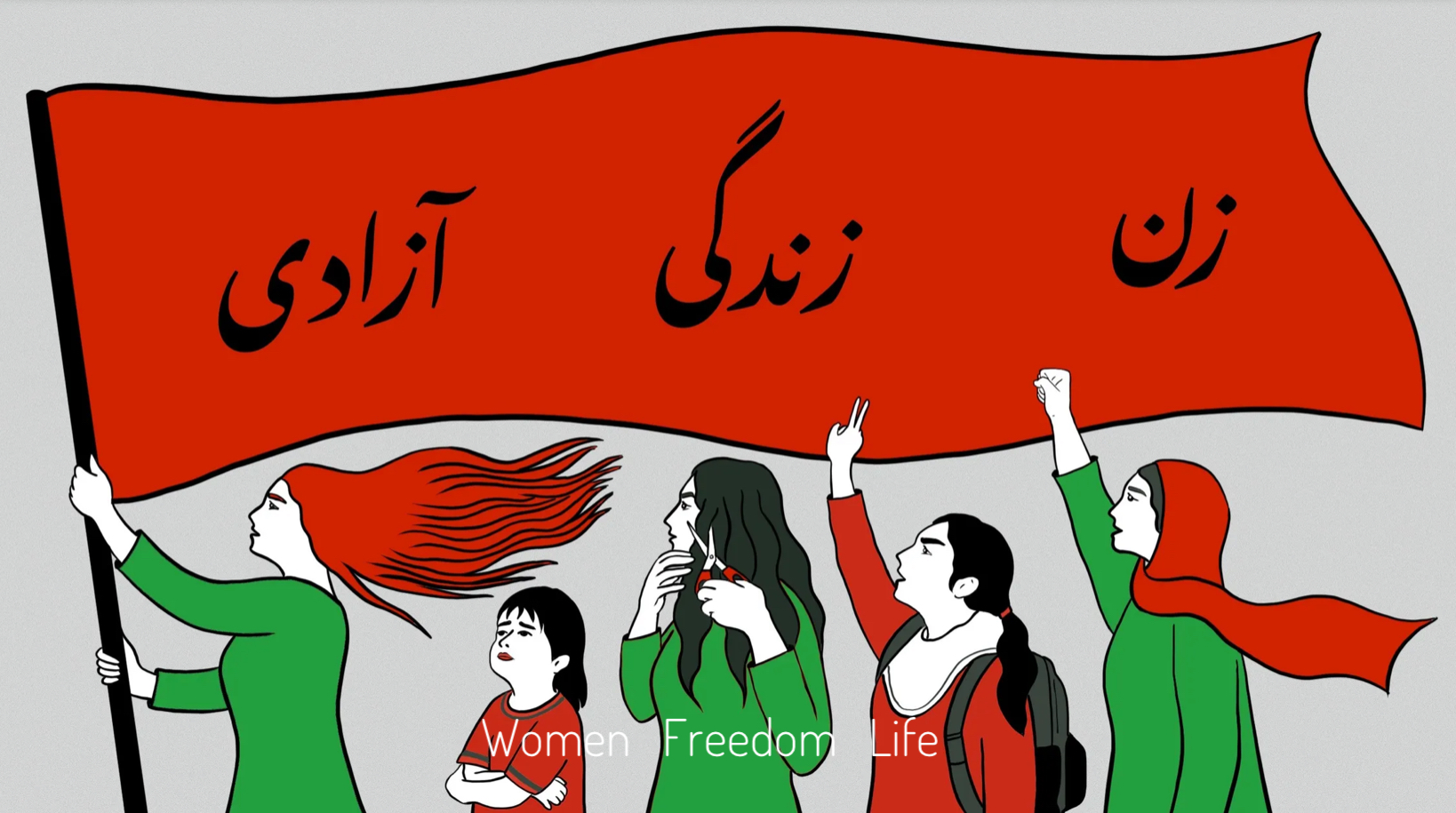
زن زندگی آزادی  Zan zandaky āzādy  Women freedom life

In our relatively comfortable, free and still democratic countries, it is difficult to put ourselves in the position of people desperate and passionate enough to risk life and limb and to face the terrible consequences of potentially heroic failure. We can but sense, vicariously, the ache and the urge behind Maya Angelous’s poem The caged bird sings of freedom (above) and Lord Byron’s passionate couplet:

Yet, Freedom! thy banner, torn, but flying,
Streams like the thunder-storm against the wind.

The courage of the of the Iranian protesters, and particularly the woman and girls who have been the vanguard of this unprecedented intifada cannot be exaggerated. For brave they are indeed. Having endured long years of a brutal and vengeful, corrupt and misogynistic theocratic regime and its security and paramilitary enforcers, they are fully aware of the consequences of their actions.

Several weeks, the nationwide protests that followed the murder in custody of a young woman arrested by the morality police after wearing her hijab inappropriately, and other young women and also, now, young men, who, officially, have died at their own hand or of pre-existing causes, have mobilized Iranians of all ethnicities, classes, ages and genders. And the security state us reacted predictably, red in tooth and claw. There is torture and death actual and awaiting on the streets of villages, towns and cities throughout the country, and the public trials with their black-garbed and turbaned hanging judges are in place and ready to protect the nation and the revolution in the name of Allah and the legacy of the canonised grey and dour uber-mullah Ayatollah Khomeini.

The perseverance and nihilistic exuberance of the Iranian street has reminded me of an exhilarating song and video created by a young Egyptian and his friends celebrating the demonstrations in Cairo’s Tahrir Square that precipitated the fall of practically Egyptian president-for-life Hosni Mubarak thirteen  years ago last February. Sawt Al Huriya (The Voice of Freedom), went viral on YouTube after its release on 11 February 2011, the day before Mubarak’s departure?

Fast forward to the present, and we examine why the Islamic Republic’s  sclerotic theocratic regime is so afraid of another song of revolution, the crowd sourced protest anthem, Baraya, which has become a thorn in the side of the government in Tehran.

Baraye, translated as “because of …” or “for …”, the anthem of Iran’s Woman, Life, Liberty protest movement grew organically from a Twitter hashtag trend in which Iranians expressed their uncountable discontents and their commitment to the protests. It continues to unite Iranians in their opposition to the rules, restriction nd repression of Islamic Republic weeks after it was first released online on an international and social media that the authorities have tried and failed to silence. To paraphrase Canadian songwriter and activist for injustice and the environment in his song Santiago Dawn (see below) to keep millions down “takes more than a strong arm up your sleeve”.

Bareya’s lyrics were created by the Iranians themselves and gathered and set to music , recorded, sung and shared by a young Iranian singer, Shervin Hajipour. Crazy brave, perhaps for predictably, he was detained by security operatives soon after he posted it on his Instagram page and forced to remove it from his feed. But it had already attracted millions of views worldwide and continued to be shared and shared and shared, and it has now been played and performed the world over as people across the glob empathize, identify with, and add to the images verbalised and the emotions these engender. We all have stories to relate of oppression and exclusion, of the abuse of power and privilege and the pervasiveness of prejudice and discrimination. To quote Bruce Cockburn once more about an earlier resistance, “see them matching home, see them rising like grass through cement in the Santiago dawn”.

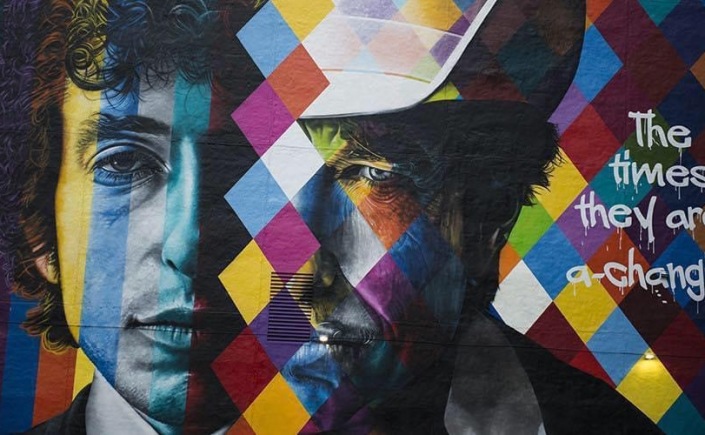
Baraja gives voice to the voiceless – as Bob Dylan sang in another century, in comparatively  straightened times:

For the countless confused, accused, misused, strung-out ones an’ worseAn’ for every hung-up person in the whole wide universeAn’ we gazed upon the chimes of freedom flashing

The Recording Academy, which hosts the annual Grammy Awards, announced that in its new merit category for best song for social change, more than 80% of nominations were for Baraye. Below is a video of the world-famous band Cold Play singing the song in Buenos Aires with Iranian actor Goldshifte Farahani.

The genesis of Baraya mirrors the organizational structure of the protests themselves insofar as like these, it is networked and leaderless, Ironically, however, David Patrikarakos editor of the e-zine Unherd wrote recently, this lack of leadership portends the protests’ doom:

“No leader has yet emerged. Instead, the protests are organised by different people or groups in different cities and towns on an almost ad hoc basis.The truth is that if the mullahs were to collapse tomorrow, there are no signs that a democratic movement would sweep to power …It is far more likely that the security state — led by the Revolutionary Guard Corps — would step into the void and make apparent what is already largely a fact: that Iran is no longer a clerical state but is now ruled by a Praetorian Guard …

… In 1979, Iranians held up images of Khomeini. In 2022, they tear them down. They know they want the regime gone but they have no one to hold up in its place. For a revolution to succeed, it’s not enough to be against someone; you have to be for someone else. It’s not enough that Khamenei loses. Someone else must win. Until that time, the mullahs will continue to cling on as murderously and barbarously as they always have, and Iranians will continue to die. For years Palestinians would say they needed a Saladin. They were wrong. What they need is a Ben Gurion. What the Iranian revolutionaries need now more than anything else is a Khomeini. Until that happens, this will only ever be half a revolution”.

At this moment in time, the outcome of that revolution hangs in the balance. The passion of the people for a better world is once again going up against the iron fist of the security state. Sadly, history past and present, in Iran and elsewhere, has shown us that when an irresistible force comes up against an immovable object, no matter how popular, righteous and justified that force may be, the immovable object invariably wins.

Meanwhile, hope springs eternal …

Our weapon was our dreams.
And we could see tomorrow clearly.
We have been waiting for so long.
Searching, and never finding our place.
In every street in my country,
The voice of freedom is calling.

Sawt al Huriya

Baraya … Because of 

Because of dancing in the street
Because of fear while kissing
Because of my sister, your sister, our sister
Because of changing rotten minds

Because of shame for moneyless
Because of yearning for an ordinary life
Because of the scavenger kid and his dreams
Because of a command economy

Because of air pollution
Because of ‘Vali Asr’ Avenue, and its dying trees
Because of a cheetah (Pirouz) that may go extinct
Because of innocent, outlawed dogs

Because of the incessant crying
For the image to repeat this moment
Because of the smiling face
For students, for the future
Because of students, for the future

Because of this forced paradise
Because of the imprisoned elites
Because of Afghan kids
Because of all (Because of…) non-repetitive

Because of all these empty slogans
Because of the rubble of fake houses
Because of the feeling of peace
Because of the sun after a long night

Because of the nerve pills and insomnia
Because of man, country, rebuilding
Because of a girl who wished she was a boy
Because of woman, life, freedom

Because of freedom

Because of Mahsa Amini

See also in In That Howling Infinite, Sawt al Hurriya – remembering the Arab Spring, Messing with the Mullahs – America’s phoney war?. and A Middle East Miscellany

Why Is Iran’s Regime So Afraid Of This Song?

Nahid Shamdouz,  assistant professor of Middle East and Media Studies at the University of Texas at Austin, Foreign Policy, 26th October 2022
Demonstrators sing "Baraye" while holding their phone lights high during a march in support of protests in Iran.

Demonstrators sing “Baraye” while holding their phone lights high during a march in support of protests in Iran. Allison Bailey, Reuters. 26th October 2021

“Baraye,” the anthem of Iran’s “Woman, Life, Liberty” protest movement—a song woven together entirely from a Twitter hashtag trend in which Iranians express their investment in the current protests—continues to unite Iranians in their opposition to the Islamic Republic several weeks after it was first released online.

For Iranians in Iran but also for the millions in the diaspora, this is the song of a generation, perfectly expressing this political moment and all that is at stake.

For dancing in the alleyways
Because of the fear you feel when kissing
For my sister, your sister, our sisters
To change the minds that have rotted away
Because of shame, because of being broke
Because of yearning for an ordinary life  

What makes this moment different from previous periods of protest is that the wall of acquiescence and pretense that maintained the state’s authority in the public realm has been torn down on a scale not seen since the 1979 revolution. In its recounting of all the painful grievances, “Baraye,” which translates in English to “for” or “because of,” signals the end of patience with the status quo and opens vistas onto a new future with a vocal crescendo that culminates in the word “freedom.”

The song reveals the simple, ordinary nature of the things that Iranians are aching for, asking for, and even dying for. It is radical in revealing on a national level the cruelty of a system that denies such basic demands—exposing the devastating conditions Iranians face under the current regime.

“Baraye” creates national intimacy by citing very specific events that all Iranians have suffered through together, in a palimpsest of collective traumas.

If “Baraye” reflects a different, perhaps unprecedented mood on a national level, it also mirrors the organizational structure of this recent protest movement. If it is networked and leaderless, so is the song. The lyrics were written by Iranians at large and merely set to music and vocalized by the young up-and-coming singer Shervin Hajipour. This explains why security forces detained Hajipour a couple of days after he posted it on his Instagram page, where it had already accrued millions of views. The regime has tried for years to push the apparent and already real aspects of people’s lives out of the public sphere.

On social media, Iranians have created a life that more closely mirrors their inner selves—replete with harsh criticism of leading clerics including Iran’s supreme leader, Ayatollah Ali Khamenei; female solo vocalists who are otherwise banned singing at the top of their lungs; and the exhibition of private lives that are anything but a reflection of the state’s projected pious paradise. Still, the state has sought to maintain a semblance of its ideology and control in actual public spaces and its media.

“Baraye” has broken that violently imposed wall between the state’s enforced reality and people’s real lives. It forced into the open, in the face of authority, all that people have known for long but were not supposed to express openly on such a national dimension.

For the sake of a laughing face
For schoolkids, for the future
Because of this mandatory paradise
For imprisoned intellectuals

Since its release, the song has become the single most covered protest song in Iran’s history. Within a few short weeks after Hajipour composed the music for it, musicians across Iran and beyond its borders have sung it verbatim in their own voices, translated it, and sung it in other languages—and even universalized the lyrics for a more global audience.

Last week, the Iranian rapper Hichkas released a militant hip-hop track referencing “Baraye” through the more casual rap lingo “vase,” enumerating his reasons, starting with “vase Mahsa” (for Mahsa Jina Amini, whose death at the hands of Iran’s morality police sparked the protests) and ending with “for a good day,” in a nod to his own 2009 Green Movement protest song.

Mahsa Amini Protest in Iran

Protesters gather in London on Oct. 1 in solidarity with people protesting across Iran.

Protesters gather in London on Oct. 1 in solidarity with people protesting across Iran.

For the garbage-picking kid and her dreams
Because of this command economy
Because of this polluted air …
For a feeling of peace
For the sun after long nights

At the same time, “Baraye” creates national intimacy by citing very specific events that all Iranians have suffered through together, in a palimpsest of collective traumas. Hajipour sings “For the image of this moment repeating again,” drawn from a tweet with a photo of Hamed Esmaeilion and his young daughter relaxing together on a couch reading newspapers. (His wife and 9-year-old daughter were killed when Iran’s Revolutionary Guards mistakenly shot down a Ukrainian airliner leaving Tehran in January 2020, and Esmaeilion has become the face of the grief affecting all those who lost loved ones in the crash.)
This line resonates with Iranians because so many families have been torn apart by the country’s massive brain drain, caused by a closed and corrupt economy that offers few opportunities.

In other lines, Hajipour sings sarcastically “Because of this mandatory paradise,” referring to the theocratic state’s imposed restrictions, justified in the name of achieving an Islamic utopia.

In yet another, he sings of “houses in rubble,” pointing to collapsing buildings caused by the rampant nepotism and corruption that shield state-connected builders from transparency on safety measures. In another, he sings of the “imprisoned intellectuals,” in a nod not just to the hundreds of journalists, human rights lawyers, and filmmakers but even award-winning university students who have been locked up.

The chorus arising from hundreds of tweets is clear: This is a regime that seems to be against life itself, punishing dancing, kissing, and smiling faces.

The song’s singular overnight success is not a small achievement given the long, rich history of protest songs in Iran. Already at the time of Iran’s Constitutional Revolution in 1906, poets created songs about the spilled blood of the youth who agitated for representative government and, not long after, about the Morning Bird breaking the cage of oppression, which many decades later became one of the most intoned protest songs in post-revolutionary Iran.

The trajectory of Iran’s musical history clearly exhibited a century-long struggle for freedom and justice, not yet realized.

Although “Baraye” and other songs of the current protest movement continue this strong tradition, they break with the post-revolutionary legacy on one key point: They no longer call for reforms.

At the time of the last major convulsions in 2009, many activists and musicians of the Green Movement called forth songs from the 1979 revolution to stake a claim to the revolution’s original yet unattained promises. People wore headscarves and wristbands in the green of Imam Hussain and went to their rooftops to shout “Allahu akbar” to invoke God’s help against a corrupt, earthly power.

But this time around, there are no religious signifiers or any demands for reforms. If classical songs are performed, they are not the icon Mohammad Reza Shajarian’s conciliatory song Language of Fire in 2009, when Iranians were still agitating for reforms from within, but his militant 1979 song Night Traveler, (also known as “Give Me My Gun”) in which he calls “sitting in silence” a sin and asks for his gun so he can join the struggle. One of Shajarian’s masterful female protégés posted the song with the hashtag #Mahsa_Amini and swapped “the brother” out of the verses to sing “The sister is an adolescent, the sister is drowning in blood,” in recognition of the teenage girls who have given their lives in the protests.

The state security system instantly understood the significance of “Baraye” as a protest song. Hajipour was forced to take it off his Instagram account; however, not only has his song already been shared widely by other accounts and on other platforms, but the sentiments behind the lyrics are within the millions of people who wrote them.

The chants of “Death to the Dictator” have reverberated from the streets to the universities, from oil refineries to urban rooftops, and from bazaars to school courtyards. And so have the haunting calls for freedom repeatedly intoned at the end of “Baraye,” pouring forth from every corner of the actual and virtual Iranian public sphere.

That song’s reality can no longer be repressed and hidden by force.

Song lyrics in this article are based in part on Zuzanna Olszewska’s translations.

Nahid Siamdoust is an assistant professor of Middle East and Media Studies at the University of Texas at Austin, and the author of Soundtrack of the Revolution: The Politics of Music in Iran.

A Son Goes To War – the grief of Rudyard Kipling

These were our children who died for our lands: they were dear in our sight.
We have only the memory left of their home-treasured sayings and laughter.
The price of our loss shall be paid to our hands, not another’s hereafter.
Neither the Alien nor Priest shall decide on it. That is our right.
But who shall return us the children?

In an excellent article commissioned by Vanity Fair in 1997, and republished below, the late author and celebrated contrarian Christopher Hitchens told a poignant story of the British poet Rudyard Kipling and the death in battle of his son John in France in 1915.

 He prefaced his tale with a scene-setting prelude:

“A ghost is something that is dead but won’t lie down. Those who were slaughtered between 1914 and 1918 are still in our midst to an astonishing degree. On the first day of the Battle of the Somme, in July 1916, the British alone posted more killed and wounded than appear on the whole of the Vietnam memorial. In the Battle of Verdun, which began the preceding February, 675,000 lives were lost. Between them, Britain, France, the United States, Germany, Turkey, and Russia sacrificed at least 10 million soldiers. And this is to say nothing of civilian losses. Out of the resulting chaos and misery came the avenging forces of Fascism and Stalinism”.

Hitchens referred to many of Kipling’s poems in his article, particularly those relating to the First World War, the jingoistic ones that greeted, indeed welcomed the beginning of hostilities, and the melancholy ones that marked their end, reflecting his personal loss and also that of tens of thousands of other parents and partners and siblings.

He does not mention however, Kipling’s post war short story, The Gardener, which directly addresses the grief and the loss felt by so many. John Kipling’s body was never found, but the poet and his wife made fruitless inquiries as to his fate and his whereabouts and, as patrons of the War Graves Commission, made many visits to the military cemeteries of Flanders.

British War Cemetery in Flanders

The Gardener tells the tale of a woman’s search for a loved one who fell. It is told from the woman’s point of view. Is the missing solder her her nephew or or son? Kipling is deliberately ambiguous, reflecting perhaps the morality of his times. It is up to the reader to draw his or her own conclusion. The ending is likewise opaque. Unlike the author, she does indeed find her lost soldier, but only with the the help of a kind, anonymous stranger. Again it is for the reader to judge – although Kipling himself left little room for ambiguity. The story ends in some editions with an asterisk in the text that links to a line from the Bible, John 20:15: “Jesus saith unto her, ‘Woman, why weepest thou; whom seekest thou?’ She, supposing him to be the gardener, saith unto him, ‘Sir, if thou has borne him hence, tell me where thou has laid him.’”

The Gardener is is republished below, following Hitchens’ article.

In 1992 the Commonwealth War Graves Commission announced that it had identified an Irish Guards lieutenant’s body in St Mary’s Advanced Dressing Station (ADS) near Loos as that of John Kipling. Seven years later authors Tonie and Valmai Holt published a book My Boy Jack, named for Kipling’s poemwhich disputed that the body in St Mary’s ADS is that of John Kipling. They based their case on two separate arguments: John Kipling was a 2nd lieutenant not a lieutenant when he died, and his body was found six kilometres away from where he fell. My Boy Jack is the story of a father in pursuit oh his son whose body was never found. Although Kipling’s poem, quoted by Hitchens in his piece, was a tribute to a 16 year old sailor, Jack Cornwell, who perished at his post during the Battle of Jutland in 1915, becoming the youngest recipient of the Victoria Cross, the book and the play and film adapted from it tell the story of Kipling and his son.

For all their money, fame and connections, the Kiplings were just another one of the 415,325 British and Irish families whose sons were killed during the first World War and were left with no place to grieve. It was Kipling who gave us the headstone words “known unto God”.

The Death of Son

American novelist Scott Spencer wrote about The Gardener in an opinion piece in The Atlantic in June 2017. He wrote:

“It’s hard to talk about a Kipling story without talking about Kipling, a shameless apologist for English imperialism who coined the phrase “the white man’s burden” and who was the first person to refer to the Germans as Huns. He was a man who glorified war without ever having fought in one—and that’s where you get into the intense mix of grief and shame that Kipling surely brought to this story. Like so many young men at the time, Kipling’s son John was frantic to get into the war, but was at first turned down for duty because of weak eyes. His father, a person of almost unimaginable influence for a writer—the youngest Nobel prize winner, a darling of the English military and the British aristocracy—intervened, greasing the wheels and getting his son into the war, with the result that the younger Kipling was killed almost instantly.

When all hope of finding his son alive or dead was at last abandoned, Kipling, in his famous “Epitaphs of the War,” wrote: “If any question why we died / tell them, because our fathers lied.” You sense this same self-implication in “The Gardener.” After all, why were those boys clamoring to go over and get themselves blown up like that? Because a culture had been created that glorified that military sacrifice, and encouraged you to feel that your life was incomplete if you hadn’t fought for your country. Millions of English boys like John Kipling (and like the fictional Michael) were raised in this atmosphere of almost rabid patriotism, an atmosphere that Rudyard Kipling had not only exploited in his writing but also helped to create. And when war was declared, some six million Englishmen, many of them little more than boys, were put to battle; nearly one million were killed, and still more were grievously injured.

The Gardener gets to the grief and futility Kipling must have felt by the end of it all.

In Kipling’s case, he never found that grave. But in Helen’s case, Jesus leads her right to it. Was Kipling himself looking for an expiation of the shame he felt for his share of the responsibility for the loss of his son in such a useless and meaningless way—and all the other hundreds of thousands of wartime deaths? It could be said that all armed conflicts are a ludicrous and shameful waste of lives, but World War I has a special place in the history of futility—a war without clear purpose, a war whose resolution would ultimately make the world a far worse place. What moves me in “The Gardener” is the way Kipling so artfully seeks relief from his own complicity in the myths that led to war

On his 18th birthday, Michael enlists in the British Army, and is slaughtered shortly after, his body covered over by debris and unable to be located. Much, much later Michael’s body is discovered and finally Helen is able to travel to his grave in a military cemetery in France to pay her last respects. The story, which is not very long, moves with the efficiency of a fable—years go by in a half sentence. The tone is almost matter-of-fact, but we are being set up by a master craftsman for the story’s devastating climactic scene. Helen wanders through a vast expanse of graves, all of them marked with a number, not a name, each individual soldier located only through a painstaking process of record-keeping. (It was Kipling who lifted the phrase “known unto God,” out of the Bible and into the cemeteries and the monuments for unknown soldiers.) Then, while searching the endless sea of crosses, helpless, Helen comes upon a gardener. Kipling describes the exchange this way:

[The gardener] rose at her approach and without prelude or salutation asked: “Who are you looking for?”

“Lieutenant Michael Turrell—my nephew,” said Helen slowly and word for word, as she had many thousands of times in her life.
The man lifted his eyes and looked at her with infinite compassion before he turned from the fresh-sown grass toward the naked black crosses.

“Come with me,” he said, “and I will show you where your son lies.”

“The man lifted his eyes and looked at her with infinite compassion before he turned from the fresh-sown grass toward the naked black crosses.
“Come with me”, he said, “and I will show you where your son lies.”

The story ends in some editions with an asterisk in the text that links to a line from the Bible, John 20:15: “Jesus saith unto her, ‘Woman, why weepest thou; whom seekest thou?’ She, supposing him to be the gardener, saith unto him, ‘Sir, if thou has borne him hence, tell me where thou has laid him.’”

See also in In That Howling Infinite, November 1918 – the counterfeit peace and  Dulce et ducorem est – the death of Wilfred Owen

Rudyard Kipling

Kipling and the Great War

© Paul Hemphill 2022. All rights reserved

Young Men and War

Christopher Hitchens, Vanity Fair, February 1997

Recently, amid the legions of anonymous W.W.I grave sites that cover northern France, the body of Rudyard Kipling’s son, John, was identified, almost 80 years after he died in the Battle of Loos. His tragic story explains the guilt and rage that consumed his father, England’s immortal Bard of Empire

Fin de Siècle

In Regeneration, the opening book of Pat Barker’s “Ghost Road” trilogy, about the First World War, one of the characters summons the waking nightmare of the trenches: “I was going up with the rations one night and I saw the limbers against the skyline, and the flares going up. What you see every night. Only I seemed to be seeing it from the future. A hundred years from now they’ll still be ploughing up skulls. And I seemed to be in that time and looking back. I think I saw our ghosts.”

A ghost is something that is dead but won’t lie down. Those who were slaughtered between 1914 and 1918 are still in our midst to an astonishing degree. On the first day of the Battle of the Somme, in July 1916, the British alone posted more killed and wounded than appear on the whole of the Vietnam memorial. In the Battle of Verdun, which began the preceding February, 675,000 lives were lost. Between them, Britain, France, the United States, Germany, Turkey, and Russia sacrificed at least 10 million soldiers. And this is to say nothing of civilian losses. Out of the resulting chaos and misery came the avenging forces of Fascism and Stalinism.

One reason for the enduring and persistent influence of the Great War (as they had to call it at the time, not knowing that it would lead to a second and even worse one) is that it shaped the literature of the Anglo-American world. Think of the titles that remain on the shelves: Good-Bye to All That, by Robert Graves, Anthem for Doomed Youth, by Wilfred Owen. The poetry of Rupert Brooke and Siegfried Sassoon. Translations from German and French, such as Erich Maria Remarque’s All Quiet on the Western Front and Under Fire, by Henri Barbusse. By enlisting in the Great War, a whole generation of Americans, including William Faulkner, Ernest Hemingway, e. e. cummings, and John Dos Passos, made the leap from small-town U.S.A. to 20th-century modernism. Loss of moral virginity and innocence is the burden of Sebastian Faulks’s elegiac novel, Birdsong, written in this decade, but as full of pain and poetry as if composed in his grandfather’s time. We owe the term “shell shock” to this period, and it sometimes feels as if the shock has never worn off.

I’ve been passing much of my time, over the past year or so, in trying to raise just one of these ghosts. On September 27, 1915, during the Battle of Loos, a young lieutenant of the Irish Guards was posted “wounded and missing.” His name was John Kipling, and he was the only son of the great Bard of Empire, Rudyard Kipling. Kipling never goes out of print, because he not only captured the spirit of imperialism and the white man’s burden but also wrote imperishable stories and poems—many of them to the boy John—about the magic and lore of childhood. And on that shell-shocked September day, the creator of Mowgli and Kim had to face the fact that he had sacrificed one of his great loves—his son, whom he called his “man-child”—to another of his great loves: the British Empire. You can trace the influence of this tragedy through almost every line that he subsequently wrote.

Go to the small towns of northern France today if you want to discover that the words “haunted landscape” are no cliche. Around the city of Arras, scattered along any road that you may take, are cemeteries. Kipling called them “silent cities.” (I came across an article in a French tourist magazine that recommended Arras to those who wished to pursue “de tourisme de necropole”—mass-grave tourism. Indeed, there isn’t much else to see.) This used to be the coal-bearing region of France, and great slag heaps and abandoned mine works add an additional layer of melancholy to the scenery. But otherwise it’s graveyards, graveyards all the way. Some of them are huge and orderly, with seemingly endless ranks and files of white markers stretching away in regimental patterns. But many are small and isolated, off in the middle of fields where French farmers have learned to plow around them. These represent heaps of bodies that simply couldn’t be moved and were interred where they lay. Huge land grants have been made by the government and people of France, in perpetuity, to Britain and Canada and India and the United States, just to consecrate the fallen.

His is one of the few parts of France where the locals are patient with Anglo-Saxon visitors trying to ask directions in French. And those French plowmen know what to do when, as so often happens, they turn up a mass of barbed wire or a batch of shells and mortars or a skeleton. (“A hundred years from now they’ll still be ploughing up skulls.”) They call the police, who alert the Commonwealth War Graves Commission. And then the guesswork can begin. There’s a good deal of latitude. Of the 531,000 or so British Empire dead whose remains have been fertilizing the region for most of the century, about 212,000 are still unidentified.

“Every now and then we have a bit of luck,” I was told by Peter Rolland of the commission, which runs a large and quiet office just outside Arras and which is charged with keeping all the graves clean. “Last year we dug up 12 corpses. Most of their dog tags and uniforms were eroded or decayed hopelessly. But we did manage to identify one Australian chap called Sergeant J. J. White. We even found his daughter, who was two years old when he was killed, and she came over for the funeral.”

And a few years ago, almost eight decades after he went missing, they found Kipling’s son, John. His body had lain in no-man’sland for three years and then been hastily shoveled into an unmarked grave. Kipling and his wife made several desperate visits to the area in the hope of identifying him, touring battlefield after battlefield. But this was in the days before proper dental records and DNA, and they gradually gave up. In 1992, thanks to painstaking record-keeping and the amateur interest taken by a member of the commission staff, one anonymous grave in one small cemetery was finally commemorated as John’s.

This means that a new marker has been erected. The old one read, A LIEUTENANT OF THE GREAT WAR. KNOWN UNTO GOD. The wording is actually that of Kipling Sr., who in order to atone for John’s disappearance became a founding member of what was then called the Imperial War Graves Commission, and helped design its monuments and rituals. As another atonement, he took on the unpaid job of writing the wartime history of the Irish Guards. In that work, he coldly summed up the regiment’s toll of 324 casualties in a single battle and noted that “of their officers, 2nd Lieutenant PakenhamLaw had died of wounds; 2nd Lieutenants Clifford and Kipling were missing. … It was a fair average for the day of a debut.”

John Kipling’s body had lain in no-man’s-land for three years and then been hastily shoveled into an unmarked grave.

Kipling’s autobiography, Something of Myself, is even more eerily detached. “My son John arrived on a warm August night of ’97, under what seemed every good omen.” That’s the only mention of the boy in the entire book. Kipling had already lost a beloved daughter to influenza. He seems to have felt that if he wrote any more he wouldn’t be able to trust himself.

For a father to mourn or to bury his son is an offense to the natural order of things. Yet another reason for the endless fascination of the Great War is the reverse-Oedipal fashion in which, for several lunatic years, the sight of old men burying young men was the natural order. And this in a civilized Europe bred to the expansive optimism of the late 19th century.

John Kipling was only 16 when the war broke out. Pressed, by his father to volunteer, he was rejected on the grounds of poor eyesight. (Those who have read “Baa Baa, Black Sheep,” Rudyard’s chilling story derived from his own childhood at the mercy of sadistic guardians, will remember the horror of the small boy being punished for clumsiness and poor scholarship when actually he has an undiagnosed myopia.) The proud and jingoistic father used his influence with the high command to get young John commissioned anyway. His mother’s diary recorded that “John leaves at noon. . . . He looks very straight and smart and young, as he turned [sic] at the top of the stairs to say: ‘Send my love to Dad-o.’ “

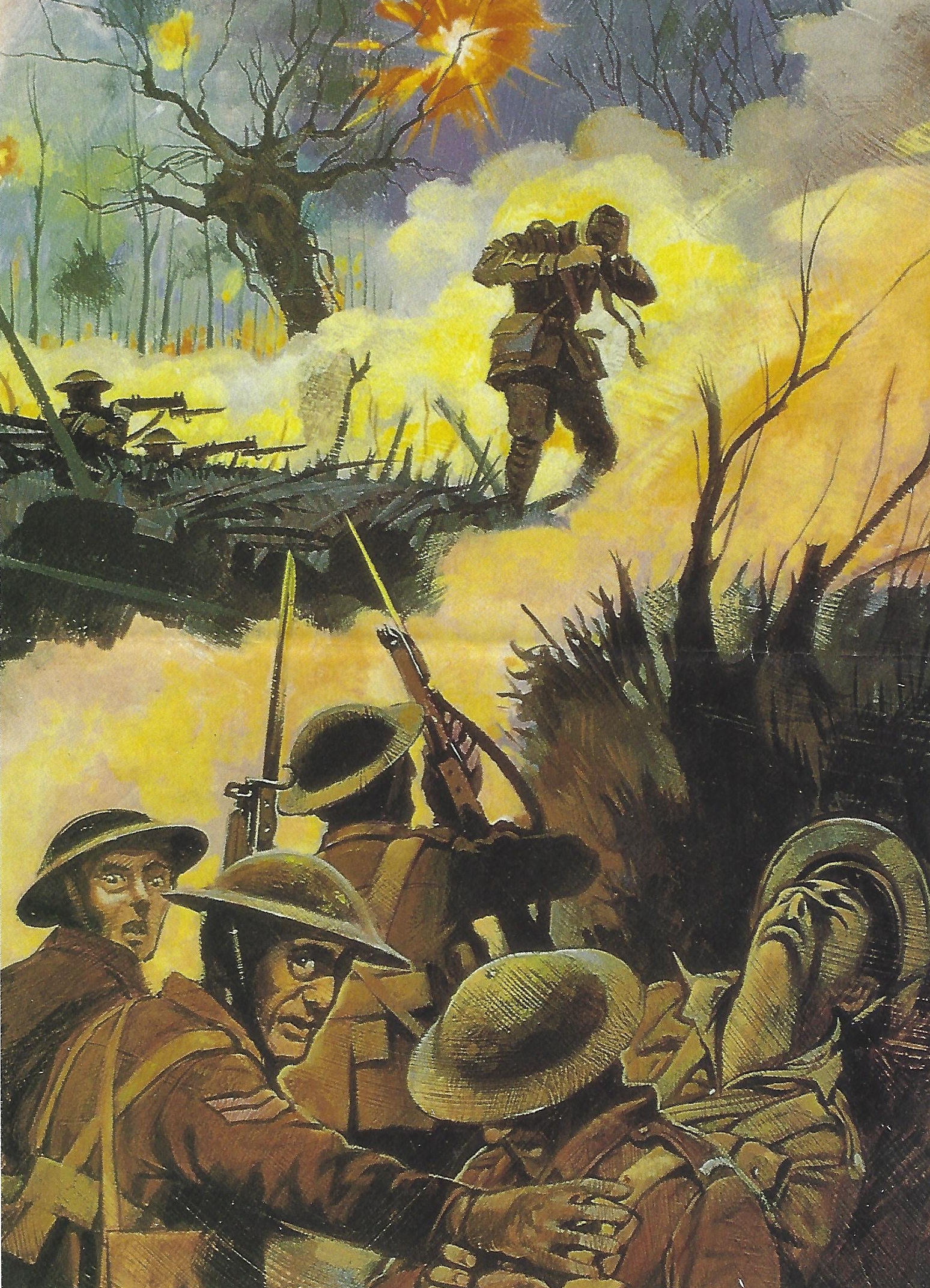
He didn’t last more than a few weeks. The village of Loos, where he disappeared, was also where the British found out about modern warfare; it was at Loos that they first tried to use poison gas as a weapon of combat. (It blew back into their own trenches, with unimaginable results.) In a neighboring sector a short while later, the British became the first to deploy a tank. But in late 1915, war was mainly blood, mud, bayonets, and high explosives.

Accounts of the boy’s last moments differ, but Kipling’s friend H. Rider Haggard (creator of King Solomon’s Mines and She) took a lot of trouble interviewing witnesses. He recorded in his diary that one of them, a man named Bowe, “saw an officer who he could swear was Mr Kipling leaving the wood on his way to the rear and trying to fasten a field dressing round his mouth which was badly shattered by a piece of shell. Bowe would have helped him but for the fact that the officer was crying with the pain of the wound and he did not want to humiliate him by offering assistance. I shall not send this on to Rudyard Kipling—it is too painful.”

Indeed it would have been: a halfblind kid making his retreat under fire and in tears, with a devastating wound. No definition of stiff upper lip would have covered it. And almost the last of John’s letters home had said, “By the way, the next time would you get me an Identification Disc as I have gone and lost mine. . . . Just an aluminum Disc with a string through it.” Probably it’s a good thing that the poet of the Raj never knew his boy died weeping. At one point he wrote, in a cynical attempt to brace himself, “My son was killed while laughing at some jest. I would I knew / What it was, and it might serve me in a time when jests are few.”

To a friend he wrote, “I don’t suppose there is much hope for my boy and the little that is left doesn’t bear thinking of. However, I hear that he finished well. . . . It was a short life. I’m sorry that all the years’ work ended in one afternoon, but lots of people are in our position, and it’s something to have bred a man.” His wife, Caroline, wrote more feelingly to her mother, “If one could but know he was dead …”

Haggard may have wished to spare Kipling pain, but one has to say that Kipling did not try to spare himself. His whole personality as an author underwent a deep change. At different stages, one can see the influence of parental anguish, of patriotic rage, of chauvinistic hatred, and of personal guilt. A single couplet almost contrives to compress all four emotions into one: “If any question why we died, / Tell them, because our fathers lied.”

These Spartan lines are anti-war and pro-war to almost the same extent. The fathers had lied, not just by encouraging their sons to take lethal risks, but by not preparing enough for war and therefore letting the young people pay for their complacency. Kipling’s longer poem “The Children” possesses the same ambiguity:

These were our children who died for our lands: they were dear in our sight.

    We have only the memory left of their home-treasured sayings and laughter.
    The price of our loss shall be paid to our hands, not another’s hereafter.
Neither the Alien nor Priest shall decide on it.    That is our right.
        But who shall return us the children?
At the hour the Barbarian chose to disclose his pretences,
    And raged against Man, they engaged, on the breasts that they bared for us,
    The first felon-stroke of the sword he had long-time prepared for us—
Their bodies were all our defence while we wrought our defences.
They bought us anew with their blood, forbearing to blame us,
Those hours which we had not made good when the Judgment o’ercame us.
They believed us and perished for it.    Our statecraft, our learning
Delivered them bound to the Pit and alive to the burning
Whither they mirthfully hastened as jostling for honour—
Nor since her birth has our Earth seen such worth loosed upon her.
Nor was their agony brief, or once only imposed on them.
    The wounded, the war-spent, the sick received no exemption:
    Being cured they returned and endured and achieved our redemption,
Hopeless themselves of relief, till Death, marveling, closed on them.
That flesh we had nursed from the first in all cleanness was given
To corruption unveiled and assailed by the malice of Heaven—
By the heart-shaking jests of Decay where it lolled in the wires—
To be blanched or gay-painted by fumes— to be cindered by fires—
To be senselessly tossed and retossed in stale mutilation
From crater to crater.    For that we shall take expiation.
        But who shall return us our children?

After a few lines of expressive loathing about the German foe, Kipling returns to the idea that the massacre of the innocents has an element of domestic responsibility to it:

(Chalk Pit Wood was the last place his son was seen alive.) And then, giving vent to all the ghastly rumors he and his wife had heard about what happened to bodies caught in no-man’sland, he continues:

Uncertainty was torturing Kipling here into imagining the worst and most obscene fate for his son. At other times he was more resigned and more wistful, as in the short poem “My Boy Jack” (1915):

“Have you news of my boy Jack? ”
Not this tide.
“When d’you think that he’ll come back?”
Not with this wind blowing, and this tide.

“Has any one else had word of him?”
Not this tide.
For what is sunk will hardly swim,
Not with this wind blowing, and this tide.

“Oh, dear, what comfort can I find?”
None this tide,
Nor any tide,
Except he did not shame his kind—
Not even with that wind blowing, and that tide.

Then hold your head up all the more,
This tide,
And every tide;
Because he was the son you bore,
And gave to that wind blowing and that tide!

The impression that the seeker in the poem is a woman. Odd to think of Kipling as having a feminine aspect, but perhaps the verse is meant as a tribute to his American wife, who was driven almost out of her mind with grief. On the other hand, one might throw sentiment to one side and remember that Kipling famously wrote (in a poem designed to tease a daughter who favored female suffrage) that “the female of the species is more deadly than the male.” And this is most certainly true of the main character in a subsequent short story of Kipling’s entitled “Mary Postgate.” Angus Wilson once described it as evil; at all events it is a paean of hatred and cruelty and shows Kipling banishing all his doubts and guilts in favor of one cathartic burst of sickening revenge.

Mary Postgate is a wartime spinster who looks after an elderly lady in an English village. One day, a German airman crashes in her garden and lies crippled in the laurel bushes. Mary Postgate decides to see how long it will take him to die. She tells nobody about the intruder and makes no effort to summon help. She waits and watches “while an increasing rapture laid hold on her.” As the young man finally expires, she “drew her breath short between her teeth and shivered from head to foot.” Then she takes a “luxurious hot bath before tea” and, “lying all relaxed on the other sofa,” startles her employer by looking, for once, “quite handsome!”

It’s really seriously creepy to find Kipling—normally rather reticent in such matters—writing a caricature of a female orgasm and wallowing in the voluptuousness of sadism. The justification for it all is that a child has been killed by a bomb in the village. “I have seen the dead child,” says Mary Postgate to the dying airman. So the link is unmistakable. And the story—published in 1917—is closed by one of the worst sets of verses that this splendid poet ever composed. Its refrain is the line “When the English began to hate.” Omitted from most anthologies, it is a vulgar and bullying rant, which promises that “Time shall count from the date / That the English began to hate.”

I first became aware of the poem when it was dished out as a leaflet by a British Nazi organization in the 1970s. (David Edgar makes use of it in Destiny, his incisive play about the mentality of Fascism.) I have often thought it very fortunate that Kipling died in 1936. He had already begun to praise Mussolini by then, and God knows what he might have said about the manly new Germany-even though his visceral dislike of all Germans would perhaps have kept him in check. He certainly disliked Germans (whom he habitually called “Huns”) even more than he did Jews (whom he generally called “Hebrews”).

His letters are fiercer than his poems and short stories, and like them they took a turn for the worse after John’s disappearance. To his old friend L. C. Dunsterville he wrote, at the height of the bloodletting in September 1916, that things seemed to be going jolly well on the Western Front. “It’s a scientific-cumsporting murder proposition with enough guns at last to account for the birds, and the Hun is having a very sickly time of it. He has the erroneous idea that he is being hurt, whereas he won’t know what real pain means for a long time. I almost begin to hope that when we have done with him there will be very little Hun left.”

The word for this, in or out of context, is “unseemly.”

Most interesting, though, was his extensive wartime correspondence with Theodore Roosevelt. One has to remember that Kipling at that time was the best-known living writer in the English language. His following in the United States was immense. His famous poem “The White Man’s Burden,” more often quoted than read, had actually been written for Roosevelt in 1898 and was addressed to the U.S. Congress. It urged that body (successfully) to “take up the white man’s burden” by annexing the newly conquered Philippines. Such was Kipling’s ability to sway public opinion on both sides of the Atlantic that in 1914, when the Liberal British foreign secretary, Sir Edward Grey, heard that Kipling was planning a trip to America, Grey told the Cabinet that unless he was assured that this dangerous Tory poet was going in an unofficial capacity he would resign at once.

Teddy Roosevelt, of course, favored American entry into the Great War, and Kipling made a point of supplying him with ammunition. The poet didn’t hesitate to make very emotional appeals, and as a result gave a few hostages to fortune. In December 1914 he wrote to T.R. telling him encouragingly that the Germans “have been sending up their younger men and boys lately on our front. This is valuable because these are prospective fathers, and they come up to the trenches with superb bravery. Then they are removed.”

The letter goes on, “Suppose my only son dies, I for one should not View with equanimity’ Mr Wilson (however unswayed by martial prejudice) advising or recommending my country how to behave at the end of this War.” Kipling really despised Woodrow Wilson and his hypocritical neutrality, and after John’s death he gave his contempt free rein, describing Wilson as equivalent to an ape looking down from a tree. “My grief,” he wrote, “is that the head of the country is a man unconnected by knowledge or experience with the facts of the world in which we live. All of which must be paid for in the lives of good men.”

This relentless drumbeat, which also urged T.R. in menacing tones to beware of the millions of potentially disloyal German-Americans, helped breed a prowar atmosphere in the United States. Many of the Americans who went to fight in Europe did so as volunteers, preparing the ground for later, full-scale intervention. And when the American Expeditionary Force got going, it took heavy casualties. Among these was Quentin Roosevelt, son of Teddy, who was killed while serving as a pilot. T.R.’s response was almost Kiplingesque in its gruffness. “My only regret is that I could not give myself,” he said. But of course he could not have given himself, any more than Kipling could. This was an opportunity open strictly to sons.

The creator of Mowgli and Kim sacrificed one of his great loves-his son-to another of his great loves: the British Empire.

The current tenant of Headstone Two I in Row D of Plot Seven in St. Mary’s I Advanced Dressing Station Cemetery never had any idea of what a titanic conflict had snuffed out his life. Nor had he any notion of the role his death would play in his father’s poetry or his father’s propaganda. His is just one of 1,768 British and 19 Canadian graves in St. Mary’s ADS, 1,592 of which are unidentified and likely to remain so forever.

The gardener, Ian Nelson, met me at the gate and took me around. He was a working-class type from my hometown in Hampshire, just one of the many hundreds of people who live and work in northern France, stranded in time, preserving a moment and observing the decencies. He wasn’t the garrulous type, preferring to roll his own cigarettes and to say briefly that he was “old-fashioned” and “felt we owed something” to the fallen. His main enemies were the moles, which spoil the flower beds and lawns. He explained to me how certain alpine and herbaceous plantings protect the headstones from mud splashes in the winter and mowing machines in the summer. Floribunda roses were in profusion, and baby maple trees, and there was the odd Flanders poppy.

The register and the visitors’ book were kept in a metal-and-stone safe in a corner of the cemetery, and as we got there we found an old metal button in the dirt. It was a standard-issue Great War soldier’s button, with a faded lion-and-unicorn motif, and Mr. Nelson let me keep it with a look that said, Plenty more where that came from. Most of the names in the register are printed and have been for decades, and it is reprinted every few years. But a handwritten addition had just been made, showing that John, only son of Mr. and Mrs. Rudyard Kipling of Bateman’s, Burwash, Sussex, England, had made the supreme sacrifice while serving as a lieutenant in the Irish Guards. The visitors’ book had a space for remarks, and many visitors had done their best to say something. I didn’t want to let down the side, so I put in the last few lines of Wilfred Owen’s “The Parable of the Old Man and the Young.”

Owen was killed in a futile canal crossing skirmish just a few days before the end of the war, in November 1918 (his mother got the telegram just as the church bells were pealing for victory and a general rejoicing was getting under way), but before he died he composed the most wrenching and lyrical poetry of the entire conflict. Nearly 50 years later, it furnished the libretto for Benjamin Britten’s War Requiem. In Owen’s rewriting of the story of Abraham and Isaac, the old man is about to press the knife to the throat of his firstborn:

When lo! an angel called him out of heaven, Saying, Lay not thy hand upon the lad, Neither do anything to him. Behold,

A ram, caught in a thicket by its horns; Offer the Ram of Pride instead of him.

But the old man would not so, but slew his son,

And half the seed of Europe, one by one. □

British women tending war graves, Abbeville

The Gardener

By Rudyard Kipling

Every one in the village knew that Helen Turrell did her duty by all her world, and by none more honourably than by her only brother’s unfortunate child. The village knew, too, that George Turrell had tried his family severely since early youth, and were not surprised to be told that, after many fresh starts given and thrown away he, an Inspector of Indian Police, had entangled himself with the daughter of a retired non-commissioned officer, and had died of a fall from a horse a few weeks before his child was born.

Mercifully, George’s father and mother were both dead, and though Helen, thirtyfive and independent, might well have washed her hands of the whole disgraceful affair, she most nobly took charge, though she was, at the time, under threat of lung trouble which had driven her to the south of France. She arranged for the passage of the child and a nurse from Bombay, met them at Marseilles, nursed the baby through an attack of infantile dysentery due the carelessness of the nurse, whom she had had to dismiss, and at last, thin and worn but triumphant, brought the boy late in the autumn, wholly restored, to her Hampshire home.

All these details were public property, for Helen was as open as the day, and held that scandals are only increased by hushing then up. She admitted that George had always been rather a black sheep, but things might have been much worse if the mother had insisted on her right to keep the boy. Luckily, it seemed that people of that class would do almost anything for money, and, as George had always turned to her in his scrapes, she felt herself justified – her friends agreed with her – in cutting the whole non-commissioned officer connection, and giving the child every advantage. A christening, by the Rector, under the name of Michael, was the first step. So far as she knew herself, she was not, she said, a child-lover, but, for all her faults, she had been very fond of George, and she pointed out that little Michael had his father’s mouth to a line; which made something to build upon.

As a matter of fact, it was the Turrell forehead, broad, low, and well-shaped, with the widely spaces eyes beneath it, that Michael had most faithfully reproduced. His mouth was somewhat better cut than the family type. But Helen, who would concede nothing good to his mother’s side, vowed he was a Turrell all over, and, there being no one to contradict, the likeness was established.

In a few years Michael took his place, as accepted as Helen had always been – fearless, philosophical, and fairly good-looking. At six, he wished to know why he could not call her ‘Mummy’, as other boys called their mothers. She explained that she was only his auntie, and that aunties were not quite the same as mummies, but that, if it gave him pleasure, he might call her ‘Mummy’ at bedtime, for a pet-name between themselves.

Michael kept his secret most loyally, but Helen, as usual, explained the fact to her friends; which when Michael heard, he raged.

“Why did you tell? Why did you tell?” came at the end of the storm.

“Because it’s always best to tell the truth”, Helen answered, her arm round him as he shook in his cot.

“All right, but when the troof’s ugly I don’t think it’s nice.”

“Don’t you, dear?”

“No, I don’t and” – she felt the small body stiffen – “now you’ve told, I won’t call you ‘Mummy’ any more – not even at bedtimes.”

“But isn’t that rather unkind?” said Helen softly.

“I don’t care! I don’t care! You have hurted me in my insides and I’ll hurt you back. I’ll hurt you as long as I live!”

“Don’t, oh, don’t talk like that, dear! You don’t know what – “

“I will! And when I’m dead I’ll hurt you worse!”

“Thank goodness, I shall be dead long before you, darling.”

“Huh! Emma says, ‘Never know your luck’.” (Michael had been talking to Helen’s elderly, flat-faces maid.) “Lots of little boys die quite soon. So’ll I. Then you’ll see!”

Helen caught her breath and moved towards the door, but the wail of ‘Mummy! Mummy!’ drew her back again, and the two wept together.

At ten years old, after two terms at a prep. school, something or somebody gave him the idea that his civil status was not quite regular. He attacked Helen on the subject, breaking down her stammered defences with the family directness.

“Don’t believe a word of it”, he said, cheerily, at the end. “People wouldn’t have talked like they did if my people had been married. But don’t you bother, Auntie. I’ve found out all about my sort in English Hist’ry and the Shakespeare bits. There was William the Conqueror to begin with, and – oh, heaps more, and they all got on first-rate. ‘Twon’t make any difference to you, by being that – will it?”

“As if anything could – ” she began.

“All right. We won’t talk about it any more if it makes you cry”. He never mentioned the thing again of his own will, but when, two years later, he skilfully managed to have measles in the holidays, as his temperature went up tot the appointed one hundred and four he muttered of nothing else, till Helen’s voice, piercing at last his delirium, reached him with assurance that nothing on earth or beyond could make any difference between them.

The terms at his public school and the wonderful Christmas, Easter, and Summer holidays followed each other, variegated and glorious as jewels on a string; and as jewels Helen treasured them. In due time Michael developed his own interests, which ran their courses and gave way to others; but his interest in Helen was constant and increasing throughout. She repaid it with all that she had of affection or could command of counsel and money; and since Michael was no fool, the War took him just before what was like to have been a most promising career.

He was to have gone up to Oxford, with a scholarship, in October. At the end of August he was on the edge of joining the first holocaust of public-school boys who threw themselves into the Line; but the captain of his O.T.C., where he had been sergeant for nearly a year, headed him off and steered him directly to a commission in a battalion so new that half of it still wore the old Army red, and the other half was breeding meningitis through living overcrowdedly in damp tents. Helen had been shocked at the idea of direct enlistment.

“But it’s in the family”, Michael laughed.

“You don’t mean to tell me that you believed that story all this time?” said Helen. (Emma, her maid, had been dead now several years.) “I gave you my word of honour – and I give it again – that – that it’s all right. It is indeed.”

“Oh, that doesn’t worry me. It never did”, he replied valiantly. “What I meant was, I should have got into the show earlier if I’d enlisted – like my grandfather.”

“Don’t talk like that! Are you afraid of its ending so soon, then?”

“No such luck. You know what K. says.”

“Yes. But my banker told me last Monday it couldn’t possibly last beyond Christmas – for financial reasons.”

“I hope he’s right, but our Colonel – and he’s a Regular – say it’s going to be a long job.”

Michael’s battalion was fortunate in that, by some chance which meant several ‘leaves’, it was used for coast-defence among shallow trenches on the Norfolk coast; thence sent north to watch the mouth of a Scotch estuary, and, lastly, held for weeks on a baseless rumour of distant service. But, the very day that Michael was to have met Helen for four whole hours at a railway-junction up the line, it was hurled out, to help make good the wastage of Loos, and he had only just time to send her a wire of farewell.

In France luck again helped the battalion. It was put down near the Salient, where it led a meritorious and unexacting life, while the Somme was being manufactured; and enjoyed the peace of the Armentières and Laventie sectors when that battle began. Finding that it had sound views on protecting its own flanks and could dig, a prudent Commander stole it out of its own Division, under pretence of helping to lay telegraphs, and used it round Ypres at large.

A month later, and just after Michael had written Helen that there was noting special doing and therefore no need to worry, a shell-splinter dropping out of a wet dawn killed him at once. The next shell uprooted and laid down over the body what had been the foundation of a barn wall, so neatly that none but an expert would have guessed that anything unpleasant had happened.

By this time the village was old in experience of war, and, English fashion, had evolved a ritual to meet it. When the postmistress handed her seven-year-old daughter the official telegram to take to Miss Turrell, she observed to the Rector’s gardener: “It’s Miss Helen’s turn now”. He replied, thinking of his own son: “Well, he’s lasted longer than some”. The child herself came to the front-door weeping aloud, because Master Michael had often given her sweets. Helen, presently, found herself pulling down the house-blinds one after one with great care, and saying earnestly to each: “Missing always means dead.” Then she took her place in the dreary procession that was impelled to go through an inevitable series of unprofitable emotions. The Rector, of course, preached hope end prophesied word, very soon, from a prison camp. Several friends, too, told her perfectly truthful tales, but always about other women, to whom, after months and months of silence, their missing had been miraculously restored. Other people urged her to communicate with infallible Secretaries of organizations who could communicate with benevolent neutrals, who could extract accurate information from the most secretive of Hun commandants. Helen did and wrote and signed everything that was suggested or put before her.

Once, on one of Michael’s leaves, he had taken her over a munition factory, where she saw the progress of a shell from blank-iron to the all but finished article. It struck her at the time that the wretched thing was never left alone for a single second; and “I’m being manufactured into a bereaved next of kin”, she told herself, as she prepared her documents.

In due course, when all the organizations had deeply or sincerely regretted their inability to trace, etc, something gave way within her and all sensations – save of thankfulness for the release – came to an end in blessed passivity. Michael had died and her world had stood still and she had been one with the full shock of that arrest. Now she was standing still and the world was going forward, but it did not concern her – in no way or relation did it touch her. She knew this by the ease with which she could slip Michael’s name into talk and incline her head to the proper angle, at the proper murmur of sympathy.

In the blessed realization of that relief, the Armistice with all its bells broke over her and passed unheeded. At the end of another year she had overcome her physical loathing of the living and returned young, so that she could take them by the hand and almost sincerely wish them well. She had no interest in any aftermath, national or personal, of the war, but, moving at an immense distance, she sat on various relief committees and held strong views – she heard herself delivering them – about the site of the proposed village War Memorial.

Then there came to her, as next of kin, an official intimation, backed by a page of a letter to her in indelible pencil, a silver identity-disc and a watch, to the effect that the body of Lieutenant Michael Turrell had been found, identified, and re-interred in Hagenzeele Third Military Cemetery – the letter of the row and the grave’s number in that row duly given.

So Helen found herself moved on to another process of the manufacture – to a world full of exultant or broken relatives, now strong in the certainty that there was an altar upon earth where they might lay their love. These soon told her, and by means of time-tables made clear, how easy it was and how little it interfered with life’s affairs to go and see one’s grave.

So different”, as the Rector’s wife said, “if he’d been killed in Mesopotamia, or even Gallipoli.”

The agony of being waked up to some sort of second life drove Helen across the Channel, where, in a new world of abbreviated titles, she learnt that Hagenzeele Third could be comfortably reached by an afternoon train which fitted in with the morning boat, and that there was a comfortable little hotel not three kilometres from Hagenzeele itself, where one could spend quite a comfortable night and see one’s grave next morning. All this she had from a Central Authority who lived in a board and tar-paper shed on the skirts of a razed city of whirling lime-dust and blown papers.

“By the way”, said he, “you know your grave, of course?”

“Yes, thank you”, said Helen, and showed its row and number typed on Michael’s own little typewriter. The officer would have checked it, out of one of his many books; but a large Lancashire woman thrust between them and bade him tell her where she might find her son, who had been corporal in the A.S.C. His proper name, she sobbed, was Anderson, but, coming of respectable folk, he had of course enlisted under the name of Smith; and had been killed at Dickiebush, in early ‘Fifteen. She had not his number nor did she know which of his two Christian names she might have used with his alias; but her Cook’s tourist ticket expired at the end of Easter week, and if by then she could not find her child she should go mad. Whereupon she fell forward on Helen’s breast; but the officer’s wife came out quickly from a little bedroom behind the office, and the three of them lifted the woman on to the cot.

“They are often like this”, said the officer’s wife, loosening the tight bonnet-strings. “Yesterday she said he’d been killed at Hooge. Are you sure you know your grave? It makes such a difference.”

“Yes, thank you”, said Helen, and hurried out before the woman on the bed should begin to lament again.

Tea in a crowded mauve and blue striped wooden structure, with a false front, carried her still further into the nightmare. She paid her bill beside a stolid, plain-featured Englishwoman, who, hearing her inquire about the train to Hagenzeele, volunteered to come with her.

“I’m going to Hagenzeele myself”, she explained. “Not to Hagenzeele Third; mine is Sugar Factory, but they call it La Rosière now. It’s just south of Hagenzeele Three. Have you got your room at the hotel there?”

“Oh yes, thank you, I’ve wired.”

“That’s better. Sometimes the place is quite full, and at others there’s hardly a soul. But they’ve put bathrooms into the old Lion d’Or – that’s the hotel on the west side of Sugar Factory – and it draws off a lot of people, luckily.”

“It’s all new to me. This is the first time I’ve been over.”

“Indeed! This is my ninth time since the Armistice. Not on my own account. I haven’t lost anyone, thank God – but, like everyone else, I’ve lot of friends at home who have. Coming over as often as I do, I find it helps them to have someone just look at the – place and tell them about it afterwards. And one can take photos for them, too. I get quite a list of commissions to execute.” She laughed nervously and tapped her slung Kodak. “There are two or three to see at Sugar Factory this time, and plenty of others in the cemeteries all about. My system is to save them up, and arrange them, you know. And when I’ve got enough commissions for one area to make it worth while, I pop over and execute them. It does comfort people.”

“I suppose so”, Helen answered, shivering as they entered the little train.

“Of course it does. (Isn’t lucky we’ve got windows-seats?) It must do or they wouldn’t ask one to do it, would they? I’ve a list of quite twelve or fifteen commissions here” – she tapped the Kodak again – “I must sort them out tonight. Oh, I forgot to ask you. What’s yours?”

“My nephew”, said Helen. “But I was very fond of him”.

“Ah, yes! I sometimes wonder whether they know after death? What do you think?”

“Oh, I don’t – I haven’t dared to think much about that sort of thing”, said Helen, almost lifting her hands to keep her off.

“Perhaps that’s better”, the woman answered. “The sense of loss must be enough, I expect. Well I won’t worry you any more.”

Helen was grateful, but when they reached the hotel Mrs Scarsworth (they had exchanged names) insisted on dining at the same table with her, and after the meal, in the little, hideous salon full of low-voiced relatives, took Helen through her ‘commissions’ with biographies of the dead, where she happened to know them, and sketches of their next of kin. Helen endured till nearly half-past nine, ere she fled to her room.

Almost at one there was a knock at her door and Mrs Scarsworth entered; her hands, holding the dreadful list, clasped before her.

“Yes – yes – I know”, she began. “You’re sick of me, but I want to tell you something. You – you aren’t married, are you? Then perhaps you won’t… But it doesn’t matter. I’ve got to tell someone. I can’t go on any longer like this.”

“But please -” Mrs Scarsworth had backed against the shut door, and her mouth worked dryly.

“In a minute”, she said. “You – you know about these graves of mine I was telling you about downstairs, just now? They really are commissions. At least several of them are.” Here eye wandered round the room. “What extraordinary wall-papers they have in Belgium, don’t you think? … Yes. I swear they are commissions. But there’s one, d’you see, and – and he was more to me than anything else in the world. Do you understand?”

Helen nodded.

“More than anyone else. And, of course, he oughtn’t to have been. He ought to have been nothing to me. But he was. He is. That’s why I do the commissions, you see. That’s all.”

“But why do you tell me?” Helen asked desperately.

“Because I’m so tired of lying. Tired of lying – always lying – year in and year out. When I don’t tell lies I’ve got to act ’em and I’ve got to think ’em, always. You don’t know what that means. He was everything to me that he oughtn’t to have been – the real thing – the only thing that ever happened to me in all my life; and I’ve had to pretend he wasn’t. I’ve had to watch every word I said, and think out what lie I’d tell next, for years and years!”

“How many years?” Helen asked.

“Six years and four months before, and two and three-quarters after. I’ve gone to him eight times, since. Tomorrow I’ll make the ninth, and – and I can’t – I can’t go to him again with nobody in the world knowing. I want to be honest with someone before I go. Do you understand? It doesn’t matter about me. I was never truthful, even as a girl. But it isn’t worthy of him. So – so I – I had to tell you. I can’t keep it up any longer. Oh, I can’t!”

Next morning Mrs Scarsworth left early on her round of commissions, and Helen walked alone to Hagenzeele Third. The place was still in the making, and stood some five or six feet above the metalled road, which it flanked for hundreds of yards. Culverts across a deep ditch served for entrances through the unfinished boundary wall. She climbed a few woodenfaced earthen steps and then met the entire crowded level of the thing in one held breath. She did not know that Hagenzeele Third counted twenty-one thousand dead already. All she saw was a merciless sea of black crosses, bearing little strips of stamped tin at all angles across their faces. She could distinguish no order or arrangement in their mass; nothing but a waist-high wilderness as of weeds stricken dead, rushing at her. She went forward, moved to the left and the right hopelessly, wondering by what guidance she should ever come to her own. A great distance away there was a line of whiteness. It proved to be a block of some two or three hundred graves whose headstones had already been set, whose flowers were planted out, and whose new-sown grass showed green. Here she could see clear-cut letters at the ends of the rows, and, referring to her slip, realized that it was not here she must look.

A man knelt behind a line of headstones – evidently a gardener, for he was firming a young plant in the soft earth. She went towards him, her paper in her hand. He rose at her approach and without prelude or salutation asked: “Who are you looking for?”

“Lieutenant Michael Turrell – my nephew”, said Helen slowly and word for word, as she had many thousands of times in her life.

The man lifted his eyes and looked at her with infinite compassion before he turned from the fresh-sown grass toward the naked black crosses.

“Come with me”, he said, “and I will show you where your son lies.”

When Helen left the Cemetery she turned for a last look. In the distance she saw the man bending over his young plants; and she went away, supposing him to be the gardener.

Muzaffar al Nawab, poet of revolutions and sorrow

Iraq bade farewell on May 20 2022 to one of its foremost poets, Muzaffar Abdul Majeed Al-Nawab. He passed away in the UAE, where he’d lived in exile, after a long illness at the age of 88. His body was brought back to Iraq, where it was  met by the prime minister and other prominent officials, and was buried in the holy Shiite city of Najaf.

He was known in the Arab world as the “revolutionary poet” in recognition of a lifetime of publically opposing and criticizing corrupt Arab regimes, and for which, he spent many, many years in jail or in exile.

He was following a long tradition of writers and intellectuals who have ‘suffered’ for their art. Nearly 175 years ago English poet Percy Bysshe Shelley wrote in his Defence of Poetry: “poets are the unacknowledged legislators of the world.” In the years since, many poets have taken that role to heart, right up to the present day.

They’ve been rebel-rousers and protesters, revolutionaries and yes, sometimes, lawmakers. Some, like Czech author Václav Havel have become presidents. Poets like Nawab have commented on the events of the day, giving voice to oppressed and downtrodden, condemned tyrants, immortalized rebels, and campaigned for social change. Most chant from the sidelines and the bleachers. Others place themselves in harms way. Many end up in dungeons and torture chambers, and some have perished for their art and articulation. So it was with Spanish poet Garcia Lorca, murdered in 1936 by Generalissimo Franco’s Nationalist soldiery at the beginning of the savage Spanish Civil War. So it was with Chilean folk singer and songwriter Victor Lara, slain in a soccer stadium in September 1973 by Augusto Pinochet’s thugs.

The silencing of singers and poets on account of their words and their voices diminishes our lives and indeed, it diminishes the world in which we live, and in its hatred and nihilism, strikes at the heart of the values we hold most dear. But history has shown that the death of the singer does not kill the song. The dictator perishes but the poet remains.

What is Freedom? – ye can tell
That which slavery is, too well –
For its very name has grown
To an echo of your own.
Shelley The Masque of Anarchy, published posthumously in 1832

Revolution Road

Let the word makers and the revolution singers awake!
Egyptian poet Abd al-Wahhab al-Bayati

Al-Nawab was born in Baghdad, Iraq, in 1934,  into an aristocratic Shi’ite family of Indian origin that appreciated art, poetry and music, and from an early age, he displayed a talent for poetry . Completing his undergraduate studies at the University of Baghdad he became a teacher, but was expelled for political reasons in 1955 and remained unemployed for three years.

He joined the Iraqi Communist Party while still at college, and was detained and tortured by the Hashemite regime that ruled Iraq at that time. After the Iraqi revolution in 1958 which overthrew the monarchy, he was appointed an inspector at the Ministry of Education. In 1963 he was forced to leave Iraq to neighbouring Iran, after the intensification of competition between the nationalists and the communists who were prosecuted and put under strict observation by the republican regime. He was arrested and tortured by Savak, the Iranian secret police, before being forcibly repatriated to the Iraqi government. An Iraqi court handed down a death sentence against him for one of his poems, but this was later commuted to life imprisonment. He escaped from prison by digging a tunnel and fled to the marshlands, where he joined a communist faction that sought to overthrow the government.

Known for his powerful revolutionary poems and scathing invective against Arab dictators, the first complete Arabic language edition of his works was published in London in 1996 by “Dar Qanbar” He lived in exile in many countries, including Syria, Egypt, Lebanon and Eritrea, where he stayed with the Eritrean rebels, before returning to Iraq in 2011. Before he returned to Iraq, he had been essentially stateless, being able to travel only on Libyan travel documents.

Nawab’s popular and eloquent poetry earned him a prominent position at the forefront of modern Arabic literature. He was known as the “revolutionary poet” for decrying corrupt regimes across the Arab world. His poems were filled with revolutionary fervor, social anger, satire, and rebellion against injustice and corruption by Arab dictators. Syrian writer Aws Daoud Yaqoub described Nawab in a book dedicated to his poetry as the poet of “revolutions and sorrow.”

Nawab was also known as a poet of pop culture as his poems spoke to the Iraqis of all age groups, useing simplified folk language in a frank and sharp way. He sometimes resorted to attacks and obscene words to deliver a specific message. In 2018, he was nominated by the Iraqi Writers Union for the Nobel Prize for Literature. Many of his poems, composed in the spoken dialect,  were sung by some of the most renowned Iraqi singers, such as Yas Khoder. These include the poems called “Oh, Basil [Ya Rihan], “Al-Rayl and Hamad,” and The Night of Violet.”

Some Arab intellectuals considered him a great poet with sincere revolutionary principles who railed  against  oppressive regimes, injustice and corruption, using piercing words to expose the defects and deficiencies of the state, society, and poetry and to strip the emperor naked. He called for an end to the traditional practice in Arabic poetry of setting up poets and singers to perform songs of praise to the regime, sultan, or king.

He took extreme hostile positions against the West, Israel and the allies of the United States, such as the Gulf states. In one of his most renowned poems, he described the commanders of these countries as “the pigs of this Gulf” in the poem of this title. He described Arab meetings to solve the Arab issues, especially Palestine, as “lesbian meetings” in the sense that they produce nothing, and mocked the Arab rulers, saying “a pig’s pen is cleaner than the cleanest of you.”

And yet, many criticized him for his selective attitudes towards the tyrannical regimes in the region, and for behaviour that appeared to contradict to his declared principles. For example, the UAE has normalized ties with Israel, which contradicted Nawab’s opposition to both the rulers of the Gulf states and to Israel. His attitude attracted harsh criticism from critics on social media, who lamented the special treatment he received before his death in Gulf state that he had often condemned. Dhafer Al-Ajmi, Executive Director of the Gulf Monitoring Group, tweeted that Nawab was mostly known for decrying Gulf leaders using vulgar language to describe them. “Despite that, he died in a Gulf hospital, where he received treatment at the order of a Gulf Sheikh.” Saudi journalist Ali Al-Quhais noted that Nawab died in the Gulf states after he offended them and their rules, and even insulted Mecca. “The Gulf countries held poetry evenings for him and opened their hospitals to him,” Quhais said, criticizing Nawab for keeping mute when his own country [Iraq] was occupied

Other critics have  described him as sectarian and partisan, since he often attacked Arab rulers, the West and Israel, whilst praising Ayatollah Khomeini and Syrian dictator Bashar al-Assad, and failed to take any position on the occupation of Iraq, which brought the Shiites to power in that country after American invasion and the fall of Saddamn Hussein.. His poetry also included strong words against sacred Sunni figures such as Abu Sufyan and Amro bin Al-Aas, who are among the Ansar or Companions of the Prophet – and who are are frowned upon by Shiites because of their attitude towards Imam Ali.

.Others, howver, believe Nawab’s positions were not sectarian at all, but rather, expressed his revolutionary left-wing stance against reactionary principles, colonialism and injustice – he referred to himself in his poetry as an Qarmatian, in reference to a social movement which led a revolution against the Abbasid Caliphate between the years 899 -107, and which included non-Arab nationalities, including black-skinned people.

By describing himself thus, he sought to allude to his Indian origins, family having migrated to Iraq during 19th century. This would explains the diverse cultural aspect of his poems, and why he addressed issues like Iraq’s oppressed Iraqi cultural minorities and their long history of persecution under the dominion of the Arab majority.

Iraq was once distinguished by its ethnic, religious and cultural diversity, as it was home to large communities of diverse origins. Today, these communities are on the brink of disappearance, as they were forced to flee the political, security and societal pressures in the absence of the authority of law and the state.

From an obituary published by e-zine al Monitor on 27th May 2022.

For more on Arab poets, in In That Howling Infinite, see: Ghayath al Madhoun – the agony of an exiled poet, and O Beirut – songs for a wounded city (Syrian poet Nizār Tawfīq Qabbānī and  Lebanon’s national cultural icon, Fairuz).

Poetry Defeats Authority: Muzaffar al-Nawab 

An Iraqi man feeds seagulls

An Iraqi man feeds seagulls on a bridge across the Tigris River in central Baghdad,
December 11, 2020. Ahmad al Rubaye AFP

There are still poets that dare to tell this world about the wrong things that occur. They do that as if they were “Romeo” in Shakespeare’s play “Romeo & Juliet”. However, Arab repression forces them to “praise” rulers, politicians and security apparatus instead of writing for “Juliet”. While doing that, they use a totally very different language to deal with that circle. They curse when hit by batons and spit when tortured. They “pee on this apparatus” when their humanity is killed! The Iraqi poet Muzaffar al-Nawab (1934) managed to develop a unique style to deal with such a thing. He used a language that no other poet can create unless he/she was exiled from an Arab capital or subjugated to physical and psychological torture. Poets even have to face firmly “the beast” in Tehran to develop such a language. There, dozens of flagellants will be waiting to beat the poet with a whip and large boots.

Al-Nawab wrote in one of his poems about that experiment:

“ike two dull houses of ants
Are the eyes of the flagellants’ chief
His nose’s hair was growing like those of a pig
Mucus words were in his mouth
He was dripping them in my ears
He asked me: Who are you?
I was embarrassed to tell him:
I resisted colonization, so my homeland displaced me.
My eyes fainted from torture.

Although his family was an aristocratic one, al-Nawab became a member of the Iraqi Communist Party. After the coup of 1963, he became a fugitive. He fled to Iran and hid in Tehran. He was arrested there and held in prison for 5 months without knowing what was happening in his country. Then, he was sent back from Tehran to Basra in Iraq  and afterwards to Baghdad.

His journey of rejection started there. Later rejection turned into a language that Al-Nawab mastered. He produced his first poem of rejection “Acquittal”. This poem became for him the start of being abused and tortured continuously. It was like a monster that kept chasing him.

At that moment, al-Nawab defeated authority for the first time. He uttered his first “no” in public. This refusal costed him 20 years of prison. Writing the aforementioned poem meant also putting him into jail for extra three years. Thus, his journey of rejection started with a “no” and a poem.

The trail was absurd. Al-Nawab stood and they asked him to insult the communist party to claim his acquittal. It wasn’t an easy choice as the poet’s answer would have affected another 120 prisoners by doing what he was asked to do. They said to him: Curse the party. But he said: No. They asked him to curse all parties. He said: No. And he wrote his “Acquittal” poem in a folk Iraqi poetry. While imitating the language of a mother, he wrote the following:

Time crashes your bones for betrayal.
You compromise your wound for meanness
And you have to hide it.
O son, let the wound be cleaned.
Let it bleed.
My son, don’t conceal our honor.
O son, acquittal remains rotten forever.
You know my son with every acquittal,
We rebury each martyr of our people.

Al-Nawab wasn’t using rejection in his poetry alone, but also in each situation of his life. “Semi actions” used to annoy him a lot. In Al Hillah prison, the poet helped in 1965 Hamed Maksood, who was sentenced to death, to escape. Like a painter, he made Hamed back then look like an eighty years old man. He stamped Hamed’s hands with the prison’s stamp to look like a visitor. He also transformed his pillow into a sick sleeping man and the police got deceived by this ruse. After that, Al-Nawab himself escaped from the prison at the beginning of 1967. He got used to escaping with the same way. Meanwhile, his poems were reaching readers and this casted him with homage. He got used to escaping which comes before confrontation and even when he got arrested in Iran, he tried to escape. His second attempt to escape from Al Hillah prison succeeded by digging a tunnel in the prison that 40 prisoners, including Al-Nawab, escaped from. He, then, disappeared in Baghdad before authorities issued an amnesty order for political opponents.

This was his second victory over the authority in poetry and life. These victories were accompanied usually with him being tortured and exiled. He was arrested in 1968 and he met the former Iraqi president Saddam Hussein. May be the authority was trying to buy his silence or to direct his speech, but he said about both options: “Why does suppression enter the heart and censorship controls my silence, papers, steps and my mazes? Don’t I have the right to be silent, to speak, to walk outside the official path or to cry? Don’t I have the right to publish and distribute fire for free?”

In an unknown building, Saddam Hussein met him and asked him: “Don’t you trust the central government?” Al-Nawab replied: “I don’t trust you; you can send me back to jail.”

These constant escapes from one place to another have violated Al-Nawab’s humanity. In return, he created linguistic violations by attacking ministers, parliament’s meetings, police, informants and Arab league’s summits. He asks in his poem “The old pub”:

“How can man maintain his dignity while security apparatus hands reach everywhere?”

Al-Nawab was cursing on behalf of a whole nation. He represented hundreds of thousands of the poor who couldn’t curse the ones who deserved being cursed. Through this, he was freeing the anger of a whole nation, speaking to it in a way that he learned by blood. He cursed, with generosity, those who deserved that; those who tortured him, occupied his land, sold him and killed his joy. His curses became inclusive. He utters them from his throat that contains the throats of the silenced nation in an era that he called the urine era as he says:

I pee on the governing police.
It is the era of urine.
I pee on the tables, the parliaments and ministers with no shame
As they fought us with no shame.
The authorities of apes,
The parties of apes,
The apparatus of apes,
No!
The apes’ shit is better than you.

Using these linguistic violations in poetry was a response to abusing and suppressing thousands of people. But one person dared to use it and utter words before batons and torture chairs. That one was Muzaffar al-Nawab.

The poet, whose joy was killed in all Arab capitals, acknowledges the outright defeat and declares that in his poem “Summits”:

Now, I confess before the desert
That I’m filthy like your defeat.
O defeated rulers, defeated parties
Oh loser rulers
O defeated public
How rude we are!
And we deny it, how rude we are!

After the curse that he wrote in the poem: “Son of bitches, I exclude none of you”, he was shot but he survived. He says about this sentence: “They now got used to it” and he laughs.

In the home of foreignness and the collective feeling of alienation, Al-Nawab asks:

Oh, my homeland;
Are you the land of enemies?
O my homeland that is displayed as a morning star in the market

Speaking to God, he says:

Glory to you, I have accepted all things except humiliation.
I was satisfied that my share of life to be like that of a bird.
But glory to you, even birds have homes that they come back to.
And I’m still flying.
This homeland that extends from the sea to the sea
Is like adjacent prisons.
They are like a jailer who arrests another jailer.

Al-Nawab asks after all for forgiveness but tries to maintain his rejection:

Forgive my sadness, wine, outrage and harsh words.
Some of you will say that they were saucy.
Ok!
Show me then a situation that is more insolent
than the one we are now living in!

Journey’s end – photographer Tim Page’s wild ride

Time is an ocean but it ends at the shore
You may not see me tomorrow

Bob Dylan

Friends of acclaimed Anglo-Australian photographer, writer and humanist Tim Page, gathered from all across the shire, from the mountains to the sea, and from around Australia on Saturday 10th September to bid him farewell at his bush home in Fernmount next to Tarkeeth Forest to bid him farewell. Bellingen’s resident square-tailed kite did a fly past as if to salute him, and as we sat around the campfire under a full moon, a bevy of fireflies emerged from the forest like faeries coming for to carry him home.

Tim had departed this mortal realm at 4.15pm on Wednesday 24th August 2022, after a relatively short illness. He been sleeping most of the time during those last few days when we dropped by on our way over the hill. We knew it was very close as we’d visited several times, and almost at the exact time of his passing, we’re were actually driving by but decided not to disturb him.

The international and social media response to Tim’s death was astounding and almost instantaneous. Within hours, tributes had been published and posted all over the world. The New York Times published an excellent eulogy, as did the Sydney Morning Herald. The Guardian presented an excellent gallery of his work. An interview by the ABC with Ben Bohane, photojournalist and author and longtime friend and mentee, is both poignant and precise. We had the pleasure of meeting Ben when he visited Bellingen and spent several days with Tim immediately before his death.

He was given a fine send-off. As one mourner noted in a Facebook tribute, “It was a long, melancholic, yet kind of wonderful weekend … the kind of gathering he’d have loved, crammed with people he cared about, the Stones and Dylan rolling out over the Birds of Paradise grove in the gully, a grassy aroma in the air, and tales of his misdemeanours, wisdom and humanity prompting chuckles and affirmations as a light breeze loosened leaves and sent them down in lazy spirals onto his wicker casket …”

Fine eulogies were delivered by Tim’s “brothers” in photo-journalism who’d worked with him over all over the world and down the years. There were tales of battlefields and bar-rooms, of recovery and resilience, of road trips and revelries, of incidents and accidents.

Tim Page 1944-2022

Tim Page 1944-2022

I spoke too, as a friend and a forest neighbour, and also, as a resident of Bellingen Shire. We’d had the privilege and pleasure of sitting with Tim for many an hour during the three months of his decline. We talked of was and when, of our childhoods in Nineteen Fifties England, of life in our valley, of history and politics and of his long and colourful career – and we were able to say goodbye to him in person four days before the end.

This is what I said …

Journey’s End

Living just over the hill, and forever dropping in here at paradise park, Adèle and I spent many an hours sharing stories and gossip with Tim and his partner Marianne and her sister Annette, who we farewelled right here just over a year ago. We all shared a common English heritage, having all grown up in postwar Britain with its rationing, blandness and monochrome conformity – in the midst of the Cold War and under the shadow of the mushroom cloud.

During the three months of his decline, Tim and I would reminisce about our common boyhoods in nineteen fifties England before we both split for foreign parts. 

We were into bicycles with drop handlebars and comics like The Beano and illustrated stories about “the war” – which was still a lived experience for the adults around us whilst the sons and brothers of our friends and acquaintances were called up for national service. We’d built the same Airfix aeroplane kits and hung our trophies from our bedroom ceilings – Tim’s are now hanging in his archive bunker over yonder. I believe he still has his Hornby train set and, no doubt, his Meccano – folks here of a certain vintage will know what I mean. He was and remained a great collector of stuff. He even picked up a UN Toyota “technical” utility truck in Bosnia and brought it back here. [Author’s note: he eventually gave the truck to a friend up the valley and it saw service as a water carrier during the devastating wildfires of our 2019-20 Black Summer]

In the sixties, we’d listened to the same music, and used some of the same drugs – me, much less than he. We both took to the Hippie Trail from Europe to Asia taking the ‘overland’ road that decades later would be called ‘the Hippie Trail’.

But Tim had already been two years “in country” when I was demonstrating in front of the US embassy in London’s Grosvenor Square against what Kenny Rodgers would call “that crazy Asian war”. 

Tim virtually ambled into the Vietnam War, the last of the “great” wars of the Twentieth Century, and though photography was a teenage hobby, in Vietnam, he drifted into the profession almost by accident. The war was a conflict with many names, but the best is probably one from Ken Burns great documentary: “chaos without a compass”. Tim navigated it cannily if carelessly for several but left ‘Nam a few years later critically injured in a minefield and indeed clinically dead in a medivac chopper. Post-op and recuperating in the US, Tim took himself off to Woodstock, New York State. where it was being said that there was going be a cool scene – which indeed there was, as we all remember:  the famous music festival held over three days in August 1969 on Max Yasgur’s dairy farm in Bethel, New York (65 km) southwest of the town of Woodstock. But Tim never got to hear any of the great music – complications from his injuries meant that he had to be medivacced out of Woodstock, probably on the same chopper that had just brought in the legendary Crosby, Stills and Nash.

Tim told us the clear-felled Tarkeeth Forest to our immediate south, just beyond those trees, reminded him of those Vietnam battlegrounds – indeed, the use of fires and herbicides in Forestry Corporation’s “forest re-establishment” reminded him of the devastation wrought by the defoliant Agent Orange in that unfortunate country. Ironically, Agent Orange may have contributed to his illness. He was unable to have MRI scans because of the shrapnel fragments in his liver from one of his many close encounters with the Grim Reaper. 

Listening to Tim’s stories, you wonder whether this peregrinating, ever-restless bloke had more lives than a cat! When he was first diagnosed in early May, as Adèle and sat on his hospital bed, I remarked that he’d already used up his nine lives. He replied: “No matter how many times you’ve faced the prospect of death, you’re never prepared for it”.

But, when the end came, he faced it with stoicism and courage. I hope that when we get there, we’ll all be as brave. 

Farewell wild rover.

Your’s was a life well lived, and to borrow from Rudyard Kipling, filling the unforgiving minute of the unrelenting day with sixty seconds worth of distance run.

As Bob Dylan sang, “Time is an ocean but it ends at the shore – you may not see me tomorrow”.

Of our elaborate plans, the end
Of everything that stands, the end
No safety or surprise, the end
Jim Morrison 1967

This painting by his friend Joanne Brooker portrays his long and colourful career.

Tim Page by Joanne Brooker

In Country

Tim Page’s War

Any good war picture is an anti-war picture. Tim Page

Almost exactly a year ago, In That Howling Infinite published a piece on Tim’s journey to a war. I had been editing one of his several autobiographical accounts of his adventures and reading Max Hastings’ tombstone of a book, Vietnam – an Epic Tragedy, and spent hours talking to Tim about his life and viewing his splendid if often harrowing pictures. In Tim’s words, written on his archive “bunker”, a converted shipping container that became his last great project (buoyed up on steroids, he’d risen from his bed finished unpacking his collection on the Saturday before he died), “Any good war picture is an anti-war picture”.

In Tim Page’s War – a photographer’s Vietnam Journey, I wrote:

For Tim, it was the worst of times, it was the best of times. “Hot and cold running …” he says, using the vernacular of those days … booze, drugs, girls, he meant – battle injuries and diseases – and action, lots of it, in the air in helicopters and on occasion, fighter bombers, on the land in jeeps, armoured vehicles, and motor bikes, on the rivers in patrol boats, and on foot. The lure of sex, drugs, and excitement – and paid work for a major news agency saw him wash up in Saigon and the celebrated, inebriated Frankie’s House, a kind of home-away-from home and party house for transiting bao chi – ‘round-eye’ newsmen – a decadent, dissolute, de facto foreign correspondents club. From here, they would fan out though war-wracked South Vietnam under the often dodgy and dangerous protection of Uncle Sam. Like the soldiers they accompanied, many came back in body bags or on stretchers. Many just disappeared, and it has been Tim’s mission in life to trace these lost souls. They include his best buddy Sean Flynn, the son of famous actor and pants man Errol Flynn”.

In the 1992 series of Frankie’s House, based on Tim’s Vietnam days, he was portrayed by the Scottish actor Iain Glen, famous nowadays for his role as Ser Jorah Mormont in Game of Thrones.

Iain Glen on the left as Tim Page in Frankie’s House

“Any good war picture is an anti-war picture”.

For what is it to die but to stand naked in the wind and to melt into the sun?
And what is it to cease breathing, but to free the breath from its restless tides, that it may rise and expand and seek God unencumbered?
Only when you drink from the river of silence shall you indeed sing.
And when you have reached the mountain top, then you shall begin to climb.
And when the earth shall claim your limbs, then shall you truly dance.
Khalil Gibran

We die with the dying:
See, they depart, and we go with them.
We are born with the dead:
See, they return, and bring us with them.
The moment of the rose and the moment of the yew-tree
Are of equal duration…

TS Elliot, Little Giddng

© Paul Hemphill 2022. All rights reserved

In In That Howling Infinite, see also, Tall tales, small stories, obituaries and epiphanies

Also in In That Howling InfiniteThe Ballad of Denton Crocker – a Vietnam elegy ; anThings fall apart, the centre cannot hold – 1968 revisited

Better Read Than Dead – the joy of public libraries

In 1839, in the midst of a half-century of post-Napoleonic political ferment and incipient revolution, English author Edward Bulwer-Lytton coined the adage “the pen is mightier than the sword”, implying that the written word is more effective than violence as a tool for communicating a point. It’s no wonder that the straighteners, the autocrats and the fundamentalists want to ban and even burn books. In his dystopian novel Fahrenheit 451, published in 1953 at the height of America’s McCarthy anti-communist witch-hunts, Ray Bradbury wrote: “The problem in our country isn’t with books being banned, but with people no longer reading. You don’t have to burn books to destroy a culture. Just get people to stop reading them”.

But, encouragingly, reports of the demise of the written word in the form of the humble published book are exaggerated and premature.

Which brings us to keepers of the flame – the torch of knowledge and not the bearers of the fire-brands,  the people who look after our public libraries. Oscar-winning documentary-maker Michael Moore once said admiringly that librarians were a more dangerous group than he had realized: “You think they’re just sitting there at the desk, all quiet and everything. They’re, like, plotting the revolution, man.”

To the American industrialist and philanthropist Andrew Carnegie, libraries were temples of learning and self-improvement. “A library outranks any other one thing a community can do to benefit its people,” said Carnegie, who put his money where his mouth was. By 1929, he had paid for the construction of more than 2500 libraries, most of them in the USA.

Back in the day … 

I reckon that I was visiting libraries even before I could read, but that could well be my mind playing tricks on my memory. But once I commenced grammar school, the local library, but a short walk away, was a world of wonders. Yardley Wood Library, in south Birmingham on the quiet northerly extension of busy Highfield Road, between a small housing estate of postwar prefabs on the east and a large expanse of recreation field at its rear, and but ten minutes from home, was the grail of my early education and my widening general knowledge of the outside world.

As an early teen, I’d stay weekends at my Aunt Mary’s house in the inner city on the border of Moseley and Balsall Heath, and the Victorian grandeur and shadowy interior of Balsall Heath Library became yet another “garden of earthly delights”. This library is the featured picture of this post. The tall chimney on the left belongs to the immediately adjacent Balsall Heath swimming baths, where my uncles and aunts who shared our home would take their weekly baths (even if they didn’t need them, as the old saw goes), where I’d go in my weekend sleep-overs, and where, when struggling with my Boy Scout swimming test, I’d push myself through the pool. And loathed every minute, Although I now live in a land blessed with beautiful beaches, I still hate being in water any deeper than my bath!

Yardley Wood Library, Birmingham

In these two “houses of wisdom”, I’d browse the stacks, thumbing through art books and atlases, encyclopaedias and illustratatives, and I’d always have three or four books on loan, with a particular interest in history, biographies and historical fiction. My reading was eclectic ab initio, from the early adolescent “he went with … “ great explorer adventures by Louse Andrews Kent and the many books of H Rider Haggard, both quite politically incorrect and vulnerable to ‘cancellation’ in today’s prescriptive cultural climate, to the relatively anodyne French ‘soft-porn’ of Anne Golon’s Angélique series, to Mikhail Sholokhov’s And Quiet Flows the Don and its sequel The Don Flows Home to the Sea, which introduced me to Russian history and politics and a youthful dalliance with The Communist Manifesto and the Communist Party. I remain very interested, and have written often on the subject. For example, Stalin’s Great Terror, The Russian Tradition – Russia, Ukraine and Tibor Szamuely, and Red and white terror – the Russian revolution and civil war

Eventually, as I studied for A Levels in the late ‘sixties, I entered Birmingham’s cavernous Central Library in the heart of the Second City. Opening in 1865 and rebuilt in 1882: it was a magnificent edifice within and without. I recall it when I rewatch the Game of Thrones episode in which would-be meister Sam Tarly enters the Citadel in Old Town for the first time. This Victorian relic was replaced by a brand new, brutalist building in 1974 – which I never saw as this too was closed in 2013 and replaced by the present Birmingham Library  – which I visited when I was in Birmingham two years later.

Birmingham Central Library

The interior of Birmingham Central Library

The William Shakespeare Room reconstructed atop the new BirminghamLibrary, 2015

My alma materMoseley Grammar School boasted a small but diverse library that beckoned during lunch breaks, with its high, wooden-beamed ceiling, it’s wrought iron balcony and the spiral staircase that led up to the landmark school tower in subsequent years, the library was closed for safety reasons, but a recently completed renovation project has brought it back into use as the photo of former pupils gathered therein on the occasion of Heritage Day 2022 shows.

I’ve written fleetingly of this library before: “It was one of those beautiful late-spring evenings that you would get in the England of youthful memory. The evening sun poured through the gothic stained glass windows of the school library – it was one of those schools. A group of lower sixth lads, budding intellectuals all, as lower sixth tended to be, gathered for a ‘desert island disks” show-and tell of their favourite records. Mine was Wishin’ and Hopin’  (by (Dusty Springfield). Then it was on to the next. Clunk, hiss, electric guitar intro, and: “My love she speaks like silence, without ideas or violence, she doesn’t have to say she’s faithful, but she’s true like ice, like fire…” I was gone, far gone. So was Dusty”. From Whats Bob Got To Do With It?

It is one of those instances of serendipity we encounter on our journey through life that the first serious love of my life was studying to be … drum roll! …a librarian, and in time became the chief librarian of a major English university, whilst  one of my oldest London friends rose to a that position in the university I attended in the ‘seventies. How about that?

Moseley Grammar School, Birmingham

Former pupils of Moseley Grammar School gather in the refurbished library, 2022

Here in the now …

In Australia, if attendance figures are any indication, the public library is our most valued cultural institution. In the year to July 2018, about 7.6 million people visited Australian libraries – more than went to museums (6.7 million), art galleries (6.3 million), plays (3.9 million) or musicals and opera (3.5 million). But it was the return rate that really set libraries apart. Whereas at least half of those who visited museums or the theatre went only once in the year, three-quarters of library visitors went back at least three times, and one-third visited more than 10 times. Australians make about 114 million visits to public libraries annually.

Here where I now live in Australia, on the Mid North Coast of New South Wales, Coffs Harbour library is the mother ship with satellites at the outlying townships of Woolgoolga and Toormina – the latter is named for Taormina in Sicily, the site of one of the most famous theatres of Greek antiquity. Our own shire has libraries in Bellingen, Dorrigo and Urunga.

I get to the library nearly every time I’m in Coffs Harbour, just to browse the stacks (there is something there for everyone) and check out the history books – as ever – and the large collection of cds. I almost always come away with something I had not intended to read or listen too. It’s a calm and peaceful space, with friendly and helpful staff, and yet always quite busy – particularly at its free computer and wi-fi benches. Members can even borrow ukuleles! [Since this article was written, the library has relocated to brand new premises, and it is even better than before, with a more computers for public use, study rooms off-side for small groups, and meeting rooms available to the public. The ukulele shelf is still there]

As a volunteer with Settlement Services International, before Covid 19 closed our office and cut the flow of refugees to Australia, I often took newly-arrived refugee families there as part of their orientation. I’d help them enroll and give them a brief tour of the facilities, and particularly the computers, the foreign language section which houses a growing collection, including books in Arabic and Farsi, and the children’s section (which hosts regular and free storytelling and craft sessions for preschools kiddies), and encourage them to return – it’s such an excellent introduction to our language, society and culture.

The old Coffs Harbour Library

As the following essay shows, libraries are much much more than their books and their educational and technical resources and facilities. They are not just a reference service but also a place for the vulnerable and the lonely, a “shelter from the storm” for people of all ages and circumstances. In a world where social and community services are being ground down, and loneliness and isolation are endemic, libraries provide vital lifelines for all manner of folk. from elderly people who value the human interaction with library staff and with other visitors, to the isolated young mother who enjoys the support and friendship that grows from a baby rhyme time session, to people who want to play the ukulele (visitors can actually borrow ukuleles as one would borrow books), to people like me just seeking time out time in a peaceful and welcoming space.

© Paul Hemphill 2022.  All rights reserved

Postscript

I wrote recently about Moseley Grammar School in an article on JRR Tolkien:

“Learning more about the author, I was to discover that he’d grown up in Birmingham, my home town, first in leafy Edgbaston (the home of Cadbury and the Warwickshire County Cricket Club), where he’d attended the prestigious King Edward’s Grammar School – my own school, Moseley Grammar, was not in its league. He lived near Sarehole Mill, in present day Hall Green, around the turn of century, between the ages four and eight, and would have seen it from his house. The locale at that time was rural Worcestershire farmland and countryside and not in the Birmingham ‘burbs. He has said that he used the mill as a location in The Lord of the Rings for the Mill at Hobbiton: “It was a kind of lost paradise … There was an old mill that really did grind corn with two millers, a great big pond with swans on it, a sandpit, a wonderful dell with flowers, a few old-fashioned village houses and, further away, a stream with another mill … “  Sarehole Mill was just down the road from my school, and our sports field and cross country tracks were adjacent to it. On many a wintry, cold, wet and windy Wednesday afternoon, I’d stagger past it on a muddy track. How I hated wet Wednesdays; dry ones were for rugby, and I hated them too!”  From: One ring to rule us all – does Tolkein matter?

For more stories like this one in In That Howling Infinite, see Tall tales, small stories, eulogies and epiphanies, and on books and reading generally, see Better read than dead – books, poetry and reading.

One for the books: the unlikely renaissance of libraries in the digital age

One ring to rule us all – does Tolkien matter?

The world was young, the mountains green,
No stain yet on the Moon was seen,
No words were laid on stream or stone,
When Durin woke and walked alone.

The Song of Durin, JRR Tolkien

In Innovation, the final installment of Peter Ackroyd’s entertaining and informative History of England, he writes:

“The post-war years had brought fables of splrltual or material collapse, from That Hideous Strength to Brave New World to Ninteen Eighty-Four. During the Fifties, the novel seemed to be settling back to its journalistic roots – quotidian in subject, unpretentious in style – but the zeitgeist is a wayward wind. Among writers of fiction, another response was offered to the bewilderments of the post-war world, which was to fly above it. In 1955, Return of the King, the last installment of R. R. Tolkien’s The Lord of the Rings, was published. It was the resurrection of heroic romance, tempered by its author’s memories of war. It tells of a small, unregarded race of Middle-earth, the ‘hobbits’,who ‘arise to shake the counsels of great’. The freedom of the world hinges upon the destruction of something tiny, beautiful and evil, evil, a ring forged by a fallen angel. While elves, men and dwarves fight, two hobbits are tasked with the destruction of the great destroyer. A whole world, formed of its author’s experiments in language came into being to the extent that if anyone were to point out that Middle-earth’ is only a translation of the Norse ‘Mittlegard’, the hearer would respond with a shrug. It was there, whatever its origins. For the English journalist Bernard Levin, it offered a beautiful and salutary reminder that the ‘meek will inherit the earth’; for the American critic Edward Wilson, it was “juvenile trash”, a story of good boys being rewarded. In spite of the naysayers, the popularity and influence of The Lord of the Rings grew to unprecedented heights. Tolkien himself, a scholar and devout Catholic, was later to find his work taken up as a banner by most unlikely allies, a group that came to be known as ‘hippies’”.

Whenever a survey or poll crowns JRR Tolkien’s The Lord of the Rings as the public’s favourite novel – and there have been many during the past seventy years – and lauds the author as one of the most influential writers of the twentieth century, the reaction has always been the same from critics who have been sneering at his books since their publication. The Lord of the Rings has been dismissed as trivial, juvenile even, and not worth arguing about. It has been called archaic, backward looking, nostalgist and sentimentalist, and has been gaslit for misogyny and homo-eroticism, violence and even racism (with its ethnocentric and androgynous elves and it’s Graeco-Roman Gondorians besieged by darker races from the south and east). Yet, most critics have probably never read it.

On the side of the angels (or is it the elves?) are the millions who came of age with and fell in love with the books and adopted a Tolkienesque taxonomy for viewing the world as a perpetual dialectic between the forces of light and of darkness. Some have even studied the lineages and languages. The actress Liv Tyler, who plays a luminous Arwen Evenstar in Peter Jackson’s award-winning film trilogy is said to have learned elven, and I sometimes see people on the street with elven rune tattoos. Liv probably has one too. I once spied a young lady walking down King Street in Newtown, the boulevard of Sydney’s myriad young tribes, sporting eleven runes on the backs of her suntanned calves. I was cheekily tempted to tell her that they were upside down, but let the moment go. I recall that as we queued at the cinema to see The Fellowship of the Ring, young folk rhapsodized among themselves on the delights about to unfold before their very eyes.

The Elves leave Middle Earth

The Hobbiton film-set on New Zealand’s North Island is one of that country’s premier tourist destinations – indeed, during the three years of the films’ successive release, a big sign at Auckland International Airport declared “Welcome to Orc Land!” The trilogy’s diverse film locations revealed to the world the exquisitely beautiful landscapes of Aotearoa.

The films’ casting prompted criticism in some quarters insofar as the elves, men and dwarves were played by predominantly white Anglo Celtic actors the dubious Hobbit films (included spook Richard Armitage, Poldark heart-throb Aiden Turner,” everyman” Benedict Cumberbatch, and angsty Scottish actor Ian Nesbitt, all shrunk-down) whilst New Zealand’s indigenous Māori portrayed the evil orcs and Uruk Hai. Nevertheless, hundreds of kiwis, Pakeha and Māori alike, were employed as extras, the scenery dazzled the world and the economy of Aotearoa, The Land of the Long White Cloud, enjoyed a Middle Earth boom.

The recent streaming in 2022 of the extravagantly expensive prequel series The Rings of Power has stirred controversies of an altogether different variety insofar as many Tolkien die-hards and purists protested the acting of actors of colour as hobbits, dwarves and, heavens for it, elves! A most peculiar paradox, you might think, given those aforementioned condemnations of JRR’s ostensible racism. It just goes to show that you can please some of the people some of the time, but you can’t please all of the people all of the time. But more on Amazon’s epic later with an excellent article from the New York Review of Books.

Arwen Evenstar

In an opinion piece in the Unheard e-zine, republished below, British historian and author Dominic Sandbrook asks whether Tolkien’s works are indeed trivial. “Surely not”, he retorts. “Even if you can’t stand them, only a fool would deny that The Lord of the Rings occupies an extraordinary place in the modern imagination … he wasn’t just a man of his time; he remains a guide for our own … And his themes might have deliberately been chosen to appeal to modern readers, anxious about the consequences of science, the environmental costs of industry, the dangers of war and the fate of the individual in the face of the vast forces reshaping Western societies in the early 21st century.

I am reminded of a piece I read recently by writer, artist and Druid Cerri Lee:

” I suddenly realized it is a profound and overwhelming sense of loss for their world and mine that I feel as the Elves sail away from the Grey Havens.  When the Elves leave they take with them the enchantment from the land, something dies in it and I am left on the shores of Middle Earth amidst a fading beauty, as they sail on into the distance. The realization that now humans will have no restraints in their actions and will push forward the rise of mechanism, commerce on a global scale, and a discarding of anything that even looks like ‘fluffy’ thinking. My Middle Earth will never be the same again and I am constantly mourning its passing through this story. It leads me to wonder if some part of that feeling is what drove Tolkien to write his story”.

To put it simply, then, Tolkien matters. How many writers can you say that about, these days?”

Tolkien and me

The Road goes ever on and on
Down from the door where it began.
Now far ahead the Road has gone,
And I must follow, if I can,
Pursuing it with eager feet,
Until it joins some larger way
Where many paths and errands meet.
And whither then? I cannot say.
Walking Song, JRR Tolkien

My own life has intersected with JRR Tolkien on many serendipitous levels.

I first encountered The Lord of the Rings in my late teens when curiosity, imagination, and various substances bought me admission to his fantasy world, along with that of his fellow Inkling CS Lewis, creator of The Chronicles of NarniaI read all three books in the trilogy over a weekend in the autumn of 1968, and when I’d finished, I felt bereft and out of sorts. I reread it soon after, and again, and again – but didn’t we all in the days when Tolkien was king, and elves and ents walked among us. I set many of the songs to music – now long forgotten – and an apposite quotation was always on hand. I recall reciting the opening lines of The Song of Durin, which prefaces this piece, as I was walking home from a concert under a full moon on the eve of the landing of Apollo 11 upon the moon in July 1969. And many times as I headed eastwards on what we now call the hippie trail, I would recall Bilbo Baggin’s Walking Song.

In subsequent years as I evolved from naïf to cynical, and thence to other passions, the rereads slowed and then stopped, although I read and enjoyed The Silmarillion, and still treasure the opening chapter describing in a manner reminiscent of the St. James Bible of how the world was created by music. I began to pick holes in The Lord of the Rings’ story linewith its derivative ‘hero’s quest’, a monomyth popularised by Joseph Campbell in his celebrated book The Hero with a Thousand Faces; what I now viewed as stereotypical characters; the outdated and anachronistic perspectives of earlier generations; and what I perceived as old-school English prejudices. But, as Sandbrook points out, Tolkien was of his times, and those times were not kind to diversity and dissent.

And yet, The Lord of the Rings is ever present in my cultural and literary consciousness, and is often referred to and quoted. Here us one of my favourites:

It is not our part to master all the tides of the world, but to do what is in us for the succour of those years wherein we are set, uprooting the evil in the fields that we know, so that those who live after may have clean earth to till. What weather they shall have is not ours to rule.” The Return of the King

I have never lost my love for the poetry and the songs that complement the narrative  – the archaic syntax, rhyme, rhythm and balladry that I’ve incorporated into my own writing. There was a wonderful lyricism and, indeed, musicality to them that I still love. It’s as if they are just waiting for a tune to accompany them. Compare Tolkien’s Song of Ëarendil with own

– the style, that is, not the subject matter:

JRR:

In panoply of ancient kings,
in chainéd rings he armoured him;
his shining shield was scored with runes
to ward all wounds and harm from him;
his bow was made of dragon-horn,
his arrows shorn of ebony;
of silver was his habergeon,
his scabbard of chalcedony;
his sword of steel was valiant,
of adamant his helmet tall,
an eagle-plume upon his crest,
upon his breast an emerald.

Me:

With massive head,
And shoulders broad,
As lean and mean as Rambeau
(That’s Sly, and not that fey French bard
This bruiser was no bimbeau!).
His hide as dark as ebony,
As tough as old mahogany,
His horns shone like chalcedony,
This massif of solidity
Was built like a Pajero.

Years passed without a revisitation, but working for a publishing company that ‘owned’ the rights to his work, I collected the latest editions and often gave them away to young people who had yet to enter the magical world of Middle Earth. For all my later cynicism, I still regarded it as a book all young people ought to read. I read the whole thing once more prior to the release of Peter Jackson’s epic trilogy. The films were excellent, although I found the hobbits increasingly irritating, wishing that they’d all jump into the fires of Mount Doom, and the ents were a disappointment, a mob of corny and badly conceived muppets (they were indeed conceived by Jim Henson, the ‘father’ of Kermit and Miss Piggy). I am looking forward to the upcoming, uber-expensive television series – but I don’t reckon I’ll reread in preparation this time around. As for Jackson’s three part Hobbit extravaganza, in my opinion, it was a travesty.

Learning more about the author, I was to discover that he’d grown up in Birmingham, my hometown, first in leafy Edgbaston (the home of Cadbury and the Warwickshire County Cricket Club), where he’d attended the prestigious King Edward’s Grammar School – my own school, Moseley Grammar, was not in its league. He lived near Sarehole Mill, in present day Hall Green, around the turn of century, between the ages four and eight, and would have seen it from his house. The locale at that time was rural Worcestershire farmland and countryside and not in the Birmingham ‘burbs. He has said that he used the mill as a location in The Lord of the Rings for the Mill at Hobbiton: “It was a kind of lost paradise … There was an old mill that really did grind corn with two millers, a great big pond with swans on it, a sandpit, a wonderful dell with flowers, a few old-fashioned village houses and, further away, a stream with another mill … “

Sarehole Mill was just down the road from my school, and our sports field and cross-country tracks were adjacent to it. On many a wintry, cold, wet and windy Wednesday afternoon, I’d stagger past it on a muddy track. How I hated wet Wednesdays; dry ones were for rugby, and I hated them too!

Tolkien died aged 81 on September 2nd, 1973, in Bournemouth, Dorset, a town that I’ve visited infrequently. But I was actually in Bournemouth on that day to meet an old friend. Perchance his spirit swept passed me. On 2nd September 2017, the Oxford Oratory, Tolkien’s Roman Catholic parish church during his time in Oxford, offered its first Mass to advocate for his beatification, the first station on the road to canonisation, as an evangelist for nature, beauty and love.  A prayer was written for his cause:

“O Blessed Trinity, we thank You for having graced the Church with John Ronald Reuel Tolkien and for allowing the poetry of Your Creation, the mystery of the Passion of Your Son, and the symphony of the Holy Spirit, to shine through him and his sub-creative imagination. Trusting fully in Your infinite mercy and in the maternal intercession of Mary, he has given us a living image of Jesus the Wisdom of God Incarnate and has shown us that holiness is the necessary measure of ordinary Christian life and is the way of achieving eternal communion with You. Grant us, by his intercession, and according to Your will, the graces we implore [….], hoping that he will soon be numbered among Your saints. Amen.”

Just imagine, Saint John Ronald Reuel of Middle Earth!

© Paul Hemphill 2022.  All rights reserved

Read also in In That Howling Infinite, Tolkien’s Tarkeeth – in the darkest depths of Mordor and Better Read than Dead – books and reading

Gandalf the White

This is Tolkien’s World

The Lord of the Rings is more than nostalgic medievalism

Dominic Sandbrook, Unheard December 10th 2021

It’s exactly 20 years since I stood in line to see a film I had dreamed about since I was a little boy. Ever since I had first turned the pages of J. R. R. Tolkien’s The Lord of the Rings, I had wondered what it would be like to see it on the big screen: the hobbits, the battles, the sweeping landscapes, the blood and thunder. When I read that the director Peter Jackson was filming a trilogy of Tolkien’s masterpiece in New Zealand, I felt almost sick with anxiety. Would it be terrible? Would they sound like the All Blacks? What were they going to do about Tom Bombadil?

I need not have worried, of course. From the moment the lights dimmed in the Odeon, Leicester Square on 10 December 2001, the Lord of the Rings films were a phenomenal success. And although poor Tom B. never made it onto the screen, Jackson’s trilogy carried all before it, grossing a staggering $3 billion and winning a record-equalling 11 Oscars for the final instalment alone.

Two decades on, the films stand up remarkably well. As for the wider Tolkien industry, the bestselling books just keep on coming: The Fall of Arthur in 2013, Beren and Luthien in 2017, The Fall of Gondolin in 2018. And next autumn sees the release of Amazon’s Lord of the Rings prequel series – at a cool $1 billion over five seasons, the most expensive television project in history. Not bad for a writer who’s been dead since 1973.

To some people, all this could hardly be more infuriating. For as we all know, Tolkien is still associated in the public mind with a sweaty, furtive gang of misfits and weirdos — by which I mean those critics who, for more than half a century, have been sneering at his books and their readers.

As far back as the mid-Fifties, the American modernist Edmund Wilson published a comically wrong-headed review dismissing Tolkien’s work as “juvenile trash”, marked by — of all things! — an “impotence of imagination”. Decades later, Philip Pullman, never happier than when sneering at his Oxford forebears, called Tolkien’s efforts “trivial”, and “not worth arguing with”. And whenever some new survey crowns The Lord of the Rings as the public’s favourite novel, the reaction is always the same.

“Another black day for British culture” was Howard Jacobson’s verdict after a Waterstones poll put Tolkien’s work well clear at the top. “Ever since I arrived at Cambridge as a student in 1964,” agreed Germaine Greer, “it has been my nightmare that Tolkien would turn out to be the most influential writer of the 20th century. The bad dream has been realised.” Yet by her own admission, she had never even read him.

So are Tolkien’s works “trivial”, as Pullman claims? Surely not. Even if you can’t stand them, only a fool would deny that The Lord of the Rings occupies an extraordinary place in the modern imagination. Indeed, in his trenchant defence of Tolkien’s reputation, the literary scholar Tom Shippey suggests that much of the criticism is rooted in pure social and intellectual condescension, not unlike the rank snobbery that Virginia Woolf directed at Tolkien’s fellow Midlander Arnold Bennett. Shippey even argues that in the future, literary historians will rank The Lord of the Rings alongside post-war classics such as Nineteen Eighty-FourLord of the Flies and Slaughterhouse-Five. Who’s to say he’s wrong?

One reason highbrow people dislike The Lord of the Rings is that it is so backward-looking. But it could never have been otherwise. For good personal reasons, Tolkien was a fundamentally backward-looking person. He was born to English parents in the Orange Free State in 1892, but was taken back to the village of Sarehole, north Worcestershire, by his mother when he was three. His father was meant to join them later, but was killed by rheumatic fever before he boarded ship.

For a time, the fatherless Tolkien enjoyed a happy childhood, devouring children’s classics and exploring the local countryside. But in 1904 his mother died of diabetes, leaving the 12-year-old an orphan. Now he and his brother went to live with an aunt in Edgbaston, near what is now Birmingham’s Five Ways roundabout. In effect, he had moved from the city’s rural fringes to its industrial heart: when he looked out of the window, he saw not trees and hills, but “almost unbroken rooftops with the factory chimneys beyond”. No wonder that from the moment he put pen to paper, his fiction was dominated by a heartfelt nostalgia.

Nostalgia was in the air anyway in the 1890s and 1900s, part of a wider reaction against industrial, urban, capitalist modernity. As a boy, Tolkien was addicted to the imperial adventure stories of H. Rider Haggard, and it’s easy to see The Lord of the Rings as a belated Boy’s Own adventure. An even bigger influence, though, was that Victorian one-man industry, William Morris, inspiration for generations of wallpaper salesmen. Tolkien first read him at King Edward’s, the Birmingham boys’ school that had previously educated Morris’s friend Edward Burne-Jones. And what Tolkien and his friends adored in Morris was the same thing you see in Burne-Jones’s paintings: a fantasy of a lost medieval paradise, a world of chivalry and romance that threw the harsh realities of industrial Britain into stark relief.

It was through Morris that Tolkien first encountered the Icelandic sagas, which the Victorian textile-fancier had adapted into an epic poem in 1876. And while other boys grew out of their obsession with the legends of the North, Tolkien’s fascination only deepened. After going up to Oxford in 1911, he began writing his own version of the Finnish national epic, the Kalevala. When his college, Exeter, awarded him a prize, he spent the money on a pile of Morris books, such as the proto-fantasy novel The House of the Wolfings and his translation of the Icelandic Volsunga Saga. And for the rest of his life, Tolkien wrote in a style heavily influenced by Morris, deliberately imitating the vocabulary and rhythms of the medieval epic.

But there’s more to Tolkien than nostalgic medievalism. The Lord of the Rings is a war book, stamped with an experience of suffering that his modern-day critics can scarcely imagine. In his splendid book Tolkien and the Great War, John Garth opens with a rugby match between the Old Edwardians and the school’s first fifteen, played in December 1913. Tolkien captained the old boys’ team that day. Within five years, four of his teammates had been killed and four more badly wounded. The sense of loss haunted him for the rest of his life. “To be caught in youth by 1914 was no less hideous an experience than to be involved in 1939 and the following years,” he wrote in the second edition of The Lord of the Rings. “By 1918, all but one of my close friends were dead.”

Tolkien arrived on the Western Front in June 1916 as a signals officer in the 11th Lancashire Fusiliers, and experienced the agony of the Somme at first hand. In just three and a half months, his battalion lost 600 men. Yet it was now, amid the horror of the trenches, that he began work on his great cycle of Middle-earth stories. As he later told his son Christopher, his first stories were written “in grimy canteens, at lectures in cold fogs, in huts full of blasphemy and smut, or by candlelight in bell-tents, even some down in dugouts under shell fire”.

But he never saw his work as pure escapism. Quite the opposite. He had begun writing, he explained, “to express [my] feeling about good, evil, fair, foul in some way: to rationalise it, and prevent it just festering”. More than ever, he believed that myth and fantasy offered the only salvation from the corruption of industrial society. And far from shaking his faith, the slaughter on the Somme only strengthened his belief that to make sense of this broken, bleeding world, he must look back to the great legends of the North.

Yet The Lord of the Rings is not just a war book. There’s yet another layer, because it’s also very clearly an anti-modern, anti-industrial book, shaped by Tolkien’s memories of Edwardian Birmingham, with its forges, factories and chimneys. As a disciple of the Victorian medievalists, he was always bound to loathe modern industry, since opposition to the machine age came as part of the package. But his antipathy to all things mechanical was all the more intense because he identified them — understandably enough — with killing.

And although Tolkien objected when reviewers drew parallels between the events of The Lord of the Rings and the course of the Second World War, he often did the same himself. Again and again he told his son Christopher that by embracing industrialised warfare, the Allies had chosen the path of evil. “We are attempting to conquer Sauron with the Ring,” he wrote in May 1944. “But the penalty is, as you will know, to breed new Saurons, and slowly turn Men and Elves into Orcs.” Even as the end of the war approached, Tolkien’s mood remained bleak. This, he wrote sadly, had been, “the first War of the Machines … leaving, alas, everyone the poorer, many bereaved or maimed and millions dead, and only one thing triumphant: the Machines”.

Dominic Sandbrookis an author, historian and UnHerd columnist. His latest book is: Who Dares Wins: Britain, 1979-1982

Austin Gilkeson, New York Review of Books, January 24, 2023

Galadriel (Morfydd Clark) and Elendil (Lloyd Owen) in the archive of the Hall of Law in Númenor,  The Lord of the Rings: The Rings of Power, 2022

One September day in 1914, a young J.R.R. Tolkien, in his final undergraduate year at Oxford, came across an Old English advent poem called “Christ A.” Part of it reads, “Éalá Éarendel engla beorhtast/ofer middangeard monnum sended,” which he later rendered: “Hail Éarendel, brightest of angels/above the middle-earth sent unto men!” Safe in his aunt’s house in Nottinghamshire while battles raged on the continent, Tolkien took inspiration from this ode to the morning and evening star and wrote his own poem in modern English, “Éarendel the Mariner.” That poem was not published in his lifetime, but after it came the stories that would become The Silmarillion, The Hobbit, and The Lord of the Rings, which in turn inspired, to varying degrees, Earthsea, Star Wars, Dungeons & Dragons, Harry Potter, The Wheel of Time, The Witcher, Game of Thrones, and so on, an apostolic succession of fantasy.

The latest in the line is The Lord of the Rings: The Rings of Power. Amazon Studios does not have the rights to The Silmarillion, the posthumous collection of Tolkien’s mythology that serves as a sort of bible for Middle-earth, nor is it adapting The Lord of the Rings, Tolkien’s 1954 novel about the hobbit Frodo’s quest to save Middle-earth by destroying the One Ring, which holds the power of the Dark Lord Sauron. Peter Jackson’s film trilogy still looms too large. Instead, the showrunners, J.D. Payne and Patrick McKay, have crafted a prequel, set thousands of years before the events of the three-volume novel and drawn from bits of lore in its prologue, “Concerning Hobbits,” and extensive appendices on Middle-earth history and culture. It’s an undertaking not dissimilar from Tolkien’s own reworking of “Christ A,” spinning out a narrative from a few textual scraps—the kind of academic exercise an Oxford professor of Old English could appreciate.

It’s a pity the show doesn’t extend the same scholarly pleasures to its viewers. Its narrative conceits are those of big-budget TV: the so-called mystery boxes popularized by shows like Lost. What is the sigil that the elf warrior Galadriel (Morfydd Clark) finds carved in her dead brother’s flesh? Who is the stranger (Daniel Weyman) who falls from the sky and ends up living among a nomadic clan of proto-hobbits? Which character is really Sauron? Will the mortal Bronwyn (Nazanin Boniadi) and the elf Arondir (Ismael Cruz Córdova) kiss? The show hurries along toward the inevitable revelations: the sigil turns out to be a map of Sauron’s realm of Mordor; the magical stranger is almost certainly the wizard Gandalf; Sauron himself is the roguish drifter Halbrand (Charlie Vickers), who has a Forrest Gump–like ability to accidentally be in the right place at the right time. Beyond a few delightful glimpses of ancient hobbit culture, there is little sense of a deep past that can be excavated through careful reading.

This is partly a problem of translation. Contemporary television drives its narratives with its characters, by their arcs and inner conflicts. Tolkien’s characters remain largely static; it’s the world around them that changes. The concerns of the novel are civilizational rather than individual. What Aragorn thinks or wants in his personal life matters far less than the fact that he is descended from kings of Arnor, and before it Númenor and Beleriand. His fitness for the throne of Gondor is never in doubt, neither to himself nor to the reader. He’s simply the last pebble in a royal landslide that has been slowly rolling over Middle-earth for millennia.

The reader encounters this history in ruins and snippets of legendary songs. Galadriel speaks of her wanderings before the fall of the kingdoms of Nargothrond and Gondolin. Treebeard, an ancient tree-like creature, reminisces about long-lost forests and departed Entwives. Merry, whose hobbit-memory is not as long, wonders at the strange, weather-worn statues that line the path to Dunharrow in Rohan. Even the earthy Samwise sings about the death of the elf-king Gil-galad (played by Benjamin Walker in The Rings of Power). The songs, in particular, may seem like digressions or page-fillers, especially those sung in fictional languages, but they also provide a sense of Middle-earth’s cultures and history, stretching back into “the deeps of time.” The effect is like Tolkien’s description of the mines of Moria, where, “in the pale ray” of Gandalf’s illuminated staff, Frodo sees “glimpses of stairs and arches, and of other passages and tunnels, sloping up, or running steeply down, or opening blankly dark on either side. It was bewildering beyond hope of remembering.”

Nori Brandyfoot (Markella Kavenagh) in The Lord of the Rings: The Rings of Power, 2022

The novel evokes a wanderlust to go back and take those untrodden paths, but since its world exists only on paper all further discovery must be textual. In other words, it requires research. Payne and McKay understand the academic aspect of Tolkien’s work. Twice during the season, Galadriel goes to archives (one in the mortal kingdom of Númenor, another in the Elven Eregion) in search of the truth about Sauron. But there will be no flipping through card catalogs or paging through dusty tomes for our heroine—she has orcs to eviscerate. Galadriel has librarians pull the scrolls for her. Like the show itself, she’s afraid to sit still.

Tolkien’s books feature plenty of battles, but they also reflect the joys and pains of academic work. The Lord of the Rings is a novel “in which the scholarly rituals [are] observed; in which you flipped from index to text to appendix, cross-referring to maps,” as Jenny Turner wrote in 2001 in the London Review of Books. The book becomes, in her words, “a machine for the evocation of scholarly frisson. The thrills are the thrills of knowledge hidden, knowledge uncovered, knowledge that slips away.” Tolkien’s wizards are scholars first and sorcerers second. They each have areas of expertise and are renowned for their wisdom. And unlike Amazon’s Galadriel, they do their own research. Gandalf seeks out the history of the One Ring in the “hoards” of Gondor’s archives (a scene Jackson wisely kept in The Fellowship of the Ring, having Ian McKellen smoking a pipe and shuffling through piles of musty pages), while the arrogant Saruman turns traitor to the forces of good after delving too deep into the archives in an attempt to learn “the arts of the Enemy.” Tolkien’s greatest paean to academic pleasure is in the sprawling elf haven Rivendell, run by the “lore-master” Elrond and hidden in an alpine valley, which in The Silmarillion is described as “a refuge for the weary and the oppressed, and a treasury of good counsel and wise lore.” In Tolkien, refuge and research are bound together.

Tolkien’s brief respite at his aunt’s house, where he wrote “Éarendel the Mariner,” could not last. He belonged to what Angela Carter later described as “that generation for whom history [had] already prepared a special, exemplary fate in the trenches of France,” and soon he was on his way to the front. He fought at the Somme, a battle in which nearly 20,000 British soldiers, including one of his closest friends, were killed on the first day. He got lucky: he soon contracted trench fever in the lice-infested dugouts and was sent home to recuperate.

The Somme haunts Middle-earth, which is pocked with broken and drowned lands. “This is Mordor,” Frodo remarks on the ruins of his beloved home Bag-End when he returns to a scarred, occupied Shire at the end of The Lord of the Rings. After the war, Tolkien transformed Éarendel the Mariner from a celestial sailor into a warden on eternal watch, sailing over the Walls of Night to guard against the return of Morgoth, the Great Enemy, from out of the Void. The Rings of Power alludes to these wartime experiences. Early in the first episode, Galadriel wanders a devastated battlefield reminiscent of the Western Front. “We learned many words for death,” she says, and the show takes pains to demonstrate some of them in detail: stabbings, hackings, slashings, burnings, and decapitations. This is the visual language of contemporary prestige fantasy shows like Game of Thrones. Galadriel dispatches a snow-troll with John Wick–like elan—a far cry from the more measured violence of the novel, in which the soldier Faramir tells Frodo, after a battle against Sauron’s forces in his homeland of Gondor, “I do not love the bright sword for its sharpness, nor the arrow for its swiftness, nor the warrior for his glory. I love only that which they defend.”

Galadriel and Theo (Tyroe Muhafidin) in The Lord of the Rings: The Rings of Power, 2022

After the war Tolkien returned to academic work, first at the Oxford English Dictionary as a researcher and then as a professor at Leeds and Oxford. Besides enthralling some students, like W.H. Auden, and boring others, like Kingsley Amis, with his lectures on Old English, he translated Sir Gawain and the Green Knight and other Middle English texts. His greatest contribution to scholarship remains his 1936 lecture “Beowulf: The Monsters and the Critics,” which recast the Old English saga as a work of art rather than a historical document that served only as “a quarry of fact and fancy.”

To ennoble history and legend was also part of Tolkien’s fictional project: his books are stuffed with allusions to Old English texts. Bilbo’s burglary of Smaug’s hoard in The Hobbit mirrors a scene in Beowulf. Aragorn quotes a poem from Rohan that echoes the elegy “The Wanderer.” Elrond’s father is none other than Eärendil the Mariner. They also provide their own store of fictional lore. You can stop reading The Lord of the Rings when Samwise says, “Well, I’m back” by his hearth, or you can keep going, depending on how much you want to know about various elvish scripts and runes, or the differences between the calendars used in the Shire and the ones used in Númenor, or the fact that Merry Brandybuck’s actual name, in one of Tolkien’s invented languages, is “Kalimac Brandagamba.” “By the time the reader has finished the trilogy, including the appendices,” Auden wrote, “he knows as much about Tolkien’s Middle-earth, its landscape, its fauna and flora, its peoples, their languages, their history, their cultural habits, as, outside his special field, he knows about the actual world.”

This lore is essential to the structure and ultimate pleasure of the novel. Tolkien’s great theme is loss, the “inevitable overthrow in Time,” as he put it in his Beowulf lecture, fated for all cultures and civilizations. The reader can hardly be expected to feel that loss without some sense of its width and depth. Even the most casual reader can feel, as Frodo does in Galadriel’s forest of Lothlórien, that she has “stepped over a bridge of time…and was now walking in a world that was no more.”

*

The appendices are only the first step out the door. In the years after Tolkien’s death, in 1973, his son Christopher compiled, edited, and published a huge quantity of his father’s writing, starting with The Silmarillion in 1977 and later the twelve-volume History of Middle-earth. These books are labors of love. Much of what Tolkien left behind was disorganized and incongruent. He frequently switched characters’ names, rewrote and then left unfinished parts of stories and poems that contradicted what he’d written before, and changed his mind about such fundamental concepts as the origin of orcs, the nature of the sun and moon, and even the shape of the earth. Out of the drafts and notes, Christopher could have created any number of Silmarillions.

Tolkien’s original aim in his fiction was to craft a “a body of more or less connected legend…which I could dedicate simply to: to England; to my country,” which he felt lacked one beyond, as he wrote in a 1951 letter, “impoverished chap-book stuff.” This mythology would not be a political project like Virgil’s Aeneid, which tied Rome’s foundation to ancient Greek civilization, but an artistic attempt to capture “the tone and quality I desired, somewhat cool and clear…redolent of our ‘air.’” It was a particular and old air. The Englands of Dickens, Austen, Fielding, Milton, or even Chaucer are nowhere to be found. Instead, Tolkien’s is the England of the anonymous poets who wrote Beowulf and Pearl, largely bygone even by the time the English language settled into a familiar form, swamped by the Norman Conquests, great vowel shifts, gunpowder, and paper. There was no returning to that England, Tolkien knew, just as his characters could never return to the drowned lands of Beleriand and Númenor. “As the poet looks back into the past,” he wrote of Beowulf, “surveying the history of kings and warriors in the old traditions, he sees that all glory (or as we might say ‘culture’ and ‘civilization’) ends in night.” His project was to delay that night while he could—to preserve, not restore, what he felt was that older country’s “elusive beauty.”

Princess Disa (Sophia Nomvete) singing a funerary song in TThe Rings of Power

In the course of a few decades Tolkien achieved, quite by accident, what the Old English scribes, singers, and poets had taken centuries to create: a large, confused, and contradictory body of myths and legends. The mythology is unstable, snapping into whatever form one happens to be reading. Far from being frustrating, this has allowed for nearly endless exploration and debate: academic Tolkien journals, conferences, and societies—not to mention fan fiction, up to and including The Rings of Power—have sprouted around the world.

Amazon wants its own mythology, but for the same reason that Disney purchased Marvel and revived Star Wars and HBO spun off Game of Thronesinto House of the Dragon: there’s money to be made. However good their intentions, the showrunners’ ultimate task is to mine Tolkien’s works in order to create and expand the franchise. Tolkien’s “machine for the evocation of scholarly frisson” has been turned into an assembly line. The goal is to keep the machine running for as long as it is profitable, with no natural end in sight.

The Rings of Power does add its own bit of lore. In the fifth episode, Elrond (Robert Aramayo) recounts the legend of “The Roots of Hithaeglir,” according to which a lightning-struck tree creates the ore mithril, a powerful metal used in weapons and armor like the mail-shirt Frodo wears. Elrond calls the story “apocryphal,” a nod to the fact that it was invented whole-cloth for the show. It’s one of the writers’ attempts to tie various parts of Tolkien’s unwieldy legendarium together, in the same way that the show has Galadriel share a sea-tossed raft with Sauron and witness the creation of Mordor. Mithril, it is explained, is suffused with the light of a Silmaril, a holy jewel that can prevent the downfall of the Elves, who are otherwise due to suddenly “fade” in a matter of months (the show never tells us why or how).

This is an imperative of the contemporary franchise: everything must be connected somehow in an endless feedback loop (or ring). This is usually achieved through “fan service,” knowing winks and nods to characters and events the audience already knows, but an overreliance on such references seals the worlds off, and the air in them soon turns stale. There is no room for the organic happenstance of real life, for the inexplicable and strange, like Tolkien’s immortal weirdos Tom Bombadil and Goldberry, who were jettisoned from Jackson’s adaptation.

The show’s conceit about mithril also misunderstands the elegiac character of Tolkien’s novel. In the final episode, the elves create three rings—“Three Rings for the Elven kings under the sky,” in Tolkien’s lore—from mithril to stop the cataclysmic fading of their race (a fate clumsily literalized by diseased leaves falling from a magic tree). The Rings provide a convenient cure to the season’s contrived crisis, whereas in the book they were created, in Elrond’s words, for “understanding, making, and healing, to preserve all things unstained.” The tragedy is that the destruction of the One Ring, the only act that can save Middle-earth, will also mean the destruction of the Three, and “many fair things will fade and be forgotten.” The elves, like their creator did, understand that dwindling is inevitable. They just want to slow it and enjoy their works while they can, before they become, as Frodo thinks of Galadriel, “present and yet remote, a living vision of that which has already been left far behind by the flowing streams of Time.”

Australia Votes – The Decline and Fall of the Flimflam Man

Australian voters are not in the habit of voting out governments and they tend not to discard an incumbent lightly. Historically, they have customarily cleaved to non-Labor governments. When they do so, it signals some wider shift in voter attitudes and inclinations. Here is my take on the many reasons why the Morrison government went down.

Oblivious to clear and present dangers

We’ve faced unprecedented crises during the last three years. Drought followed by devastating wild fires and floods – with the pandemic following on almost immediately. Experts agreed that these owed their intensity to climate change, but the federal government was hogtied by its in-house climate denialists, the co-opted satraps of old king coal, and the opinionated talking heads of the House of Murdoch (particularly the hosts of the cable TV “Sky at Night”). There were also crises of integrity and corruption, of rorting and pork-barreling and a refusal to establish a corruption bulldog with teeth; and of sexual assault and sundry naughty shenanigans in the corridors of our parliament. The Liberal Party’s “women problem” has been building for years; women voters have been moving away from the party for years’ have now turned against it with a vengeance. As commentator Samantha Maiden noted, they didn’t get women and women finally got them. The Government was also perceived as reluctant to embrace equity and diversity and  to incorporate indigenous Australians, a culture over sixty thousand years old, into our constitution and our parliamentary consensus and consultation.

Whilst ever eager to perpetuate our endemic culture and history wars, it endeavored to weaponize matters of national security, particularly with regard to our strained relationship with China, and was seen by many as cynically planning  a “khaki election” – though hairy-cheating drum beating rarely rarely distracts people from the real and present dangers of government incompetence, particularly when wages had Ben stagnant for years, rents and house prices had gone through the roof, and rising inflation was inflicting financial pain on most Australian households.

Our state governments reaped the benefits of comparative competence and incumbency in elections held in all states, and were way ahead of the federal government with regard to climate, equity and integrity. The federal government was weighed and found wanting. Whist eventually delivering resources and dollars, it had dragged its feet in its response to fires, floods, pandemic and  vaccine roll-out, and inflationary pressures,  forever running to catch up, and the gravest sin, blaming everyone else.

The revolt of the moderates

The government’s resistance to such ostensibly “woke” issues as climate change initiatives, social and gender justice and equity, and racial and religious discrimination, and even sheltering refugees and asylum seekers turned not just progressives against it, but also the party’s moderates, several of whom, educated, professional, wealthy and well connected women in affluent inner-city suburbs – the party’s heartland – decided to set up shop as “independents”, and electorally viable ones too. They’d reckoned the party had moved too far to the populist right and hoped to shock it back to the so-called “sensible centre”. By their reckoning, they and their supporters had not left the party – the party had left them. [See Hearing Voices – is Teal the real Deal? ]

Ironically, they targeted the party’s key parliamentary moderates, who were actually in agreement with them on their core issues, on the grounds they’d voted against their principles in the interests of their careers and party unity. And they took them out. As the Liberal Party comes to terms with its defeat, its recovery, and in rebuilding national support, it has to consider the reality that its moderate heart has been extracted and that the leader in waiting is an unpopular and much lampooned hardliner.

I don’t hold a hose

The coup de grace was delivered by the prime minister himself. He was disliked, hated even, and eventually, ridiculed – not just by progressives, but by his own side. He was condemned as a bully, a misogynist, a flimflam man (‘Scotty from marketing was the moniker he’d inherited from a patchy career in perception management), and, in his own words, a “bulldozer”. Indeed, the alpha male style of politics favored by Morrison and his acolytes, centred around aggression, masculinity (we call it ‘blokeyness’) and a disregard for science, and facts, whilst resonating with some sections of the community, alienated other people who have traditionally voted Liberal. It didn’t help that during our many crises, he was perceived to have gone literally and figuratively ‘walkabout’ – at the height of the bush fires that ravaged our east coast in December 2018, he took his family off to Hawaii for a Christmas holiday. the title of this section is his response to the question whether he thought this was a great idea.

Many colleagues considered him an electoral liability – now the end has come, many are revealing that there was indeed a plan to replace him with the now jilted Josh last autumn, but faithful Frydenberg stuck with his boss.

In the final days of his campaign, an edgy Morrison pledged that he would actually change for the better if we re-elected him last Saturday. In the event, friends and well as foes gave him the old heave-ho. Seven of these independents ousted the party’s most moderate members of parliament, including the Federal Treasurer. The Liberal Party no longer has any electorates overlooking Sydney Harbour. The seats of former Liberal prime ministers Malcolm Turnbull, Tony Abbott, John Howard, Billy McMahon (same area, reconstructed electorate), John Gorton, and Bob Menzies are all now held by Labor or independents. Voters in heartland seats, including those who once financed the party, and business people, it appears will in future be attracted to capable and articulate local independents deeply connected to their community and in touch with its concerns.

I wrote in a Facebook post ten days before the election: “The Australian Labor Party is the only party contesting this election that is campaigning for an actual change of government. To achieve this, Labor has to win – and win big. Politics is zero sum – you win or you lose. It’s a Herculean task.  Labor has to win 76 sears outright to govern in its own right. That means holding on to twenty marginal seats and taking seven more from the Coalition … ALL commercial TV channels are strongly backing the Liberal-National Party. The Teals refuse to say what they’d do in the event of a hung parliament. Ignoring or, worse, drowning out Labor’s overarching message – a change of government – only helps the Tories. If Labor fails, voters who bemoan the return of the Coalition have only themselves to blame. Caveat Emptor!”

In the end, an electorate that is traditionally conservative and reluctant to change for changes sake, turned on an unpopular prime minister, a tired and complacent government weighed down by a lacklustre front bench, and a divided Coalition devoid of policy imagination. The Liberals lost a record seventeen seats, losing 19 to Labor, 6 to independents and 1 to the Greens, leaving it with 57 against Labor’s 76, with 14 others – the largest cross-bench in our parliamentary history. The new parliament is the most diverse in our history with more indigenous members than ever before and also more MPs of non Anglo-Celtic descent.

Morrison’s arrogant behaviour, apparent tolerance for undisguised rorting and failure to enunciate a coherent set of values led to most Australians judging he was no leader worthy of the name and showed him the door. Yesterday’s rooster is today’s feather duster, and don’t we feel happy!

The longest day

Voting is compulsory in Australia and unavoidable. Campaigns are about six weeks long, and are relentless, remorseless and as boring as all get out. We are heartily sick and tired of it all by the end. But we turn out nonetheless in numbers unmatched anywhere in the world. There is tradition of party volunteers handing out “how to vote” fliers to assist voters in our unique preferential voting system. And Election Day is always on a Saturday, and there is another tradition of scout troops and school children setting up fundraising hot-dog stands – we affectionately call this “democracy sausage”.

On Election Day, in our electorate, it rained, and rained, and rained – we’ve already had those apocryphal forty days no forty nights and were quite over the extreme wetness – and my wife and I, having organised our folk at the polling stations across our rural area, were “handing out” for the Australian Labor Party in a mountain town, froze to the bone. It was the longest day, but at its end, once the first results had come in, our unloved and unlamented prime minister conceded to his opponent, and our party leader Anthony Albanese became our 31st prime minister in our forty seventh parliament and our first of Italian descent – and without an Anglo-Celtic name – the son of a single mother in a run-down suburb in a council flat. He is only the fourth Labor leader since World War II – alongside Gough Whitlam, Bob Hawke and Kevin Rudd – to win government. the Liberal Party has held government for 51 pf the pass 73 years. In Australian politics, a win from opposition is a mighty feat indeed, notwithstanding that it’s primary vote fell below 33%, it’s lowest since 1931 – though the coalition’s vote sank like a stone to 36%, it’s worst result since Federation.

So now, the Liberal Party grapples with the first stages of grief, shock, anger and denial, and seeks solace from its vale of tears. The narrative according to a chorus of hard line Coalition MPs and mainly News Corps’ columnists and Sky at Night rangers goes like this: the Morrison government positioned itself as “Labor-lite”, experimenting “with the poison of leftism”, because it caved in on net-zero emissions, racked up budget deficits, abandoned “freedom” during the pandemic and shirked on fighting culture wars. To them, this was a shameless Marxist posture which not only failed to placate voters in the Liberals’ traditional seats, but alienated the party from “the Quiet Australians” and blue-collar battlers the party ought to regard as its real base less concerned about climate change than they are focused on cost-of-living pressures and whether their kids are being indoctrinated into radical doctrines at school. But they seem curiously unconcerned about a minimum wage for those struggling quiet Australians.

After nine years of stagnation and little progress on the key issues, Australia has once more a progressive government. There is a danger for a progressive party leader in raising unrealistic expectations, and Albanese is urging people to be patient. Over and over, he has said that he wants to under-promise and over-deliver. He has been cautious with his commitments, so, if there is change under this government, it is likely to come slowly.

Here we go!

© Paul Hemphill 2022.  All rights reserved

For more in In That Howling Infinite on Australian history and politics, see Down Under ; and specifically on the 2022 election, Hearing Voices – is Teal the real Deal?

Postscript

Why aren’t the Liberals called Conservatives?

[Spoiler Alert! The following paragraph contains many references to sundry ‘isms’ that will confuse and confound most readers. To define these adequately is beyond both the scope and the intention of this particular post. if in doubt, please Google it.}

The founder of the Liberal Party, Sir Robert Menzies,  wanted to associate it with classical Victorian Liberalism with its primary emphasis on securing the freedom of the individual by limiting the power of the government, and a brand that would appeal to the innately socially and economically conservative ‘quiet Australians’ of the political centre. Increasingly, over the years, the party became associated with a more literally ‘conservative’ mindset, promoting traditional economic and social values that distinguished it from our contemporary definition of “Liberalism”, which most of us associate with democratic socialism and with the progressive social and fiscal policies advocated by the Australian Labor Party.

Why is Labor called Labor and not Labour?
Labor is spelled Labor and not Labour because, back in the day, in the 1890s, and before federation, In the labour movements, the trade unions that formed the Labor parties in the 1880s, and also the broader socialist movement at the time, there was a lot of reading of American socialist texts. Whilst the “labour movement” and labour parties in places like New Zealand and the United Kingdom all use “Labour”, the Australian Labor Party officially adopted the shorter spelling in 1912.

Prime Minister Anthony Albanese and new MP Chinese-Laotian Sally Sitou

Folksong Au Lapin Agile

It was a cold wet windy night in May as we wound our way up to Montmarte, arriving at our destination, an old stone building on the steep and cobbled Rue des Saules. It was after nine o’clock and we were late – the evening’s entertainment had commenced. The man who greeted us at the door asked us to wait until a song had finished and then ushered us into a a dimly-lit cellar-like room, its walls festooned with an eclectic collection of pictures, wooden tables and chairs, and stout benches pushed against the walls.

A bad start! The master of ceremonies, an eccentric chap with the air of an impatient headmaster gave us a stern look of disapproval as we took our seats in a corner at a wooden covered with initials that had been carved into its surface over decades – as if to say “bloody tourists!” A friendly chap bad us “bon soir” and served us glasses of the obligatory, sweet house red; and thenceforward, he, Le Maître, and the audience, who all appeared to be old pals, ignored us completely. Nevertheless, the evening was a hoot as our headmaster led the room in songs which everyone sang loudly and with gusto. All in French – we sang along when we knew the words. There were a couple of what us folkies would call “floor acts”, one a young man who reminded us of a friend of ours back in Oz, and a chirpy accordionist who seemed to have come straight out of French cabaret central casting.


Le Maître,

Welcome to Au Lapin Agile, the famous and venerable Parisian cabaret cum folk club in the centre of  Montmartre (in the 18th arrondissement not far from the Basilica Sacre Coeur), where people gather and sing old French songs accompanied by guitar, piano and accordion. The musicians encourage the audience to join in with the singing so it helps if you speak French or are a quick learner – or if, like us, you remember the choruses from school days, including the famous Allouette, Frère Jacque and Les Chevaliers du Table Ronde (it’s about boozing and not King Arthur).

It’s been going literally forever – the mid-nineteenth century, anyway – and was originally called Cabaret des Assassins. So named, ‘tis said, because a band of assassins broke once in and killed the owner’s son. It had also been called Rendezvous Des Voleurs or “Thieves Meeting Place – which says something about the provenance of the punters back in the day.

It was over twenty years old when, in 1875, the artist Andre Gill painted the sign that suggested its permanent name – the picture of a rabbit jumping out of a saucepan. Locals started calling their neighborhood night-club Le Lapin à Gill, or “Gill’s rabbit’, and in time, this evolved into Cabaret Au Lapin Agile, or “The Nimble Rabbit Cabaret”.

Befitting its early reputation, Au Lapin Agile became popular with dubious Montmartre characters,   including pimps, eccentrics, simple down-and-outers, a contingent of local anarchists, and students from the Latin Quarter, a sprinkling of well-heeled bourgeois out on a lark. and show business types like Parisian cabaret singer and comedian Aristide Bruand, the subject of a popular painting by Montmartre artist Toulouse Lautrec. When, at the beginning of the twentieth century, Au Lapin Agile was facing closure, Bruand bought the joint and handed the tenancy to Frédéric Gerard, known to all as Frédé.

It became a great venue for budding musicians to make their debuts and also a regular haunt for impoverished artists. Picasso, Modigliani, Apollinaire and Utrillo would spend their evenings immersed in philosophical debate and music. Often Frédé would accept paintings from the artists in payment for their drinks – Picasso gave Frédé an artwork actually called Au Lapin Agile which portrayed himself dressed as a harlequin sitting in the cabaret with a female companion. Frédé is also in the picture, playing the guitar in the background. In 1912, Frédé sold the painting for $20. In 1989, it went to auction at Sothebys and sold for $41 million. A replica of Picasso’s painting is on the far wall in the interior image below – the walls are covered with similar stuff. The original is on display at the Metropolitan Museum of Art in New York. The painting helped to make the cabaret world famous. The cabaret was also captured on canvas by Maurice Utrillo.

Au Laoin Agile – Arelquin tenant un verre by Pablo Picasso

Since the place was at the heart of artistic Paris at the turn of the twentieth century, it became a mecca for visiting artists and writers, including Ernest Hemingway and Charlie Chaplin, who would play his violin there. There was much discussion at the cabaret about “the meaning of art”, which inspired American comedian and entertainer, Steve Martin to write a play, Picasso at the Lapin Agile (1993) imagining a meeting there between Pablo Picasso and Albert Einstein. We saw it at Sydney’s Belvoir Theatre and thought it so good, we returned the following week to see it again – and bumped into film star Ralph Fiennes in the foyer during pre-play drinks (though we weren’t introduced).

We never imagined that the place actually existed and that one day, we’d one day go there!

© Paul Hemphill 2022.  All rights reserved

See also in In That Howling Infinite, Ciao Pollo di Sohomemories of a classic café ; The Incorrigible Optimists Club – Jean-Michel Guenassia’s debut masterpiece; and Tall Tales, Small Stories, Eulogies and Obituaries 

Back when Le Maître,was much younger

Little has changed


Hearing voices – is Teal the real deal?

In the past, the major parties have seen independents as a passing nuisance that fades over time, like the Australian Democrats. Their only concern was their preference flow. Times are indeed changing; unless the major parties change, these independents are here to stay … There are no safe seats any more. 
Peter Beattie, former premier of Queensland, 22 April Sydney Morning Herald

To paraphrase old Karl, a spectre is looming over Australian politics – commentators on the right  believe it’s haunting the Liberal and National Party Coalition. But it also hovers over the Labor opposition.

One number is now keeping major party leaders and their confidants awake at night: 76. That is the bare minimum needed to form majority government in the 151 seat House of Representatives. It is the number the Coalition currently commands. And, right now, all the public polls show neither major party has electoral support to hit it.

Voters decide who gets their preferences, not parties. But history shows that the most disciplined flow is from the Greens to Labor. Antony Green’s research on the 2019 result confirms that more than 80 per cent of Greens voters put a two in the Labor column.  With the Greens primary at, or above, 10 per cent Labor appears in the best shape to form government because minor party preferences flow to the Coalition at a lower rate. And there is a smorgasbord on offer for disaffected Coalition voters on the left and right. Clive Palmer’s billions have bought roughly 3 per cent of the primary and Pauline Hanson’s One Nation commands a similar number. In 2019, both delivered 65 per cent of their second preferences to the Coalition and 35 per cent to Labor.

But a recent development in Australian electoral politics is sending the statistics skewiff.

Enter the self proclaimed ‘community independents, the so-called ‘voices of …’ movement, labelled by observers across the political spectrum as ‘The Teals’, named for their almost uniform choice in campaign colour. I republish below two typical opinion pieces.

The first is by Paul Kelly, The Australian’s Editor at Large. From time to time, I republish articles by News Ltd commentators that I believe are worth sharing with those who cannot scale the News Corporation paywall. Kelly is one of those. Though undoubtedly of the right, often assuming many of the positions adopted by his more partisan colleagues, though in a much more nuanced and ‘reasonable’ manner, he writes well and wisely, most probably due to his long experience and high reputation on the Australian political scene.

He recently wrote a cogent piece on how the cohort of Teal Independents, backed up by the financial and political resources, and very substantial donations ‘war chest’ of the Climate 200 group, are offering their electorates and ourselves a model of participatory parliamentary democracy that is built on shaky foundations. Climate 200 founder and funder Simon Holmes a Court claims that “the shortest and surest path to good government is a minority government with a quality cross-bench”.

It is probably one of the best analyses of the aspirations and apparent appeal of this relatively recent political phenomenon. I also republish a left-wing perspective by journalist Mark Stanley on the MichaelWestMedia blog. He endeavours to answer the same basic and obvious question as Kelly: is teal the real deal?

Kelly has observed that an unprecedented passion for independents is taking hold in some of the richest suburbs of Australia. Its vanguard comes from predominantly professional, business and educated women who reside in affluent inner-city suburb. Not exclusively so, however. There is Helen Haines, the sitting member for the rural Victorian seat of Indi – and her colour is actually orange. In my own seat of Cowper, on the mid north coast, the anointed independent is well-known and popular health professional with strong local and indeed left wing roots: she is a former member of the Greens. Nor are they all female. Andrew Wilkie, long time Tasmanian MP, Stephen is on the ticket as is Stephen Pocock in the ACT who is running for senate.

These independents believe their voice has been denied for too long. This denial is the genesis of the ‘voices of … ‘ movement although their call is a world of difference from the nihilistic ‘mad as hell and we ain’t gonna take it any more’ populism of the far right and it’s lugubrious svengalis. There is an apparent conviction that the political system somehow is either discredited or broken or corrupt – perhaps all three – and needs to be rescued by a higher moralism. And they appeal to the many voters who see the Labor and the Coalition as Tweedledum and Tweedledee, and possible hope that the independents will ‘keep the bastards honest”, to use an old and defunct catchphrase.

But, Kelly notes, “this is delusion on a grand scale. Public disenchantment with the major parties is a statistical fact. But leaping to the assertion the public wants minority government is a false conclusion”.

The preoccupations of Holmes a Court and his coterie of self-proclaimed ‘community’ Independents do not reflect the country at large. The idea that people in a few rich seats, some of the wealthiest (and least ethnically diverse) electorates in the nation, can redirect Australia towards the path of superior policy morality testifies to denial about the diversity and competing interests across Australia.

Whilst an infusion of progressive populists into the House of Representatives might sound exciting, the outcome could be a more fractured polity and a further decline in the capacity of parliament to legislate challenging national interest policy. This is no way to run a parliament or a government and to look after our country’s interests.

The most important function of an election, Kelly states, is to elect a government. Everyone knows where Liberals, Labor and the Greens stand – but the independents will not say, if given minority government, which party they want in office. A group espousing integrity and transparency will not be honest with the public on the single most important decision they would be required to take as MPs. The reason, of course, is they seek to maximize their vote; like the singer in Leonard Cohen’s sardonic song, they endeavour to be all things to all people: “If you want a lover, I’ll do anything you ask me to. And if you want another kind of love, I’ll wear a mask for you”. “In a sense”, Kelly notes, they trade genuine influence for gesture politics”.

So far so good – and for the most part, I couldn’t agree with him more. But at this juncture, Kelly removes HIS mask. I ought t gave seen it coming when he has commented earlier in his article : “if the public wants more action on climate change, here an easy answer. Vote Labor”. And then, midway through, he lets his conservative cat out of the bag: “It is one thing for these voters to elect independents over sitting Liberal MPs in an act of protest, but it is entirely another thing for voters to tolerate the independents putting a Labor government into power. Do that and your future as an independent is fatally compromised – your future will be tied to the Labor government and any decisions your electorate doesn’t like”.

He points to the lessons learned the hard way by erstwhile Coalition parliamentarians Tony Windsor and Rob Oakeshott who in 2010 ignored the conservative disposition of their seats when they put Julia Gillard’s government into office. Facing hate mail, trolling and even death threats, they were unprepared to stand at the next election. This is the salutary lesson for the teal wave of Independents – for that way madness lies.

Kelly sees the independents as a progressive movement to defeat the Morrison government and that this is their raison d’être: “They seek not just to defeat the Liberal Party but also to engineer, from the outside, a progressive remaking of the party

I disagree strongly with his contention that the independents seek to install Anthony Albanese and his social democrats, I actually regard them as a threat to the prospects of a Labor government. Teal, after all, is not a primary colour. Indeed, it’s primary color is blue, and it’s secondary is green. Chris Kenny,  a colleague  of Kelly’s  at The Australian, has quipped that teal is a blend of Green and blue blood – a thinly veiled swipe at what he perceives the affluent upper-middle class status of most of the inner city independents. But to my mind, one thing thing is for certain – teal is no friend of red.

But I do concur with the argument that are trying to change the system from within. But I would argue that these are conservative “wet liberals” who rather than betraying the party, are trying to drag its dominant right wing grudgingly towards the centre, the so-called “reasonable middle” where the majority of engaged Australians reside. Katrina Grace Kelly, another commentator for The Australian  reported a comment from an voter in treasurer Josh Frydenberg’s blue-ribbon but threatened inner-Melbourne seat of Kooyong: “We are educated, moderate and bewildered small ‘L” Liberals wondering what the hell happened top out party”. Kelly writes: ‘Using the brand “independent” is brilliant but also deceptive. They are not a party as such but they have a common cause, common funding and common strategy. They only target government MPs. Frydenberg calls them “fake independents”’. Grumpy former prime minister John Hoard recently referred to them as ‘anti-Liberal groupies’, his ‘banger sisters’ allusion going down a treat among those who reckon that the Coalition has a problem with women.

The irony is that far from recreating the Liberal Party in their own image, insisting en passant that Scott Morrison – and as a bonus, deputy PM Barnaby Joyce – are replaced, and targeting the seats of what moderate Liberal MPs remain in the government, members who actually agree with most of what the independents are advocating, and are also, incidentally, more culturally and ethnically diverse than their challengers, they could potentially hand the leadership and the Lodge not to all-around nice guy Josh Frydenberg but to the not so lean and but definitely hungry defence minister Peter Dutton. Maybe they believe that the prospects of the potentially unelectable Dutton ascending to the party leadership will shock the it into a rush to centre-field. But that is magical thinking!

I believe that the independents are actually a political party in all but name. They spruik the same issues and causes, they sing from the same song sheet, and whilst they receive many donations from idealistic sympathisers from across the political spectrum, they are heavily funded by Climate 200. They even share that body’s financial controller. And they cleave broadly to the mission of Climate 200 cabal – a fairly homogeneous collective of like-minded, disaffected former politicians and pundits. It’s advisory panel includes former Tory John Hewson, disgraced Democrat leader Meg Lees (who many believe destroyed that party), former member for Wentworth Karyn Phelps, Tony Windsor and Rob Oakeshott. The only former Labor luminary is Barry Jones. When I first viewed the panel a month or so back, I swear that list was considerably longer, including several high profile rebel Tories, including defecting MP Julia Banks.  As the say, “if it walks like a duck and squawks like a duck, then it is a duck”. QED.

The independents promote a false reality amid a fog of moralism. As Kelly notes, they might “offer much, but their capacity to change politics is heavily limited. In their strengths and flaws, they are a genuine manifestation of Australian democracy” – in all its infinite variety, I might add, and its contradictions. 

In the MichaelWest Media blog,  Mark Sawyer argues that if  the independents are a threat to the Liberals, why’s would Labor get in the way? After, all.the enemy of my enemy is my friend, right. But, he writes: “… smarter heads on the progressive side of politics are likely to be looking a bit further. They know the short-term gain of putting Liberal MPs to the sword could lead to long-term pain”.

Indeed. Whilst challenging the Coalition, the independents’ attitude of “a plague on both their houses”, and a  refusal to make deals with the major parties, not only hurts the Liberals, but also weakens Labor. Because, long story short.they want  the parties to depend on them.

And yet, as any soft-left and disaffected and defecting Labor and Green supporters argue naively, the Independents’s Big Four pledges around which they rally – climate, integrity, fiscal discipline and treatment of women – do resonate with the electorate.

But there scope is a restricted one.  The progressive policies in their brief manifesto theirs are feel-good positions, not policy. In being all things to all men and women they’ve cherry-picked what Sawyer called “the fun bits of the progressive agenda”.

They won’t touch the hard bits, including education and health, and the redistributive economic and fiscal policies (like including increasing taxes for the wealthy and for large corporations) which are central to the social democratic values of the true believers. The independents’ push for equity equality only goes so far.

And there are more areas where the independents fear to tread, other than acknowledging their worthiness. Support for the National Disability Insurance Scheme, for example; help for small business in recovery from the pandemic; truth in political advertising; enshrining a First Nations voice in the Constitution. Issues that require well-thought out policies.

It is much easier to argue as they do that the party system has run its course. But this disingenuous if nor ignorant of Australian history and politics. Although political parties are not mentioned in the constitution, they are parties are actually needed  to form and run governments. As all politics 101 students are told, parties inform, articulate and mobilize otherwise unorganized electorates around coherent political platforms. Our parliamentary system is representative democracy, not participatory democracy.

Sawyer states it bluntly: “Broad-based parties gave us Medicare, the NDIS, anti-discrimination legislation – an endless list of civilising measures that have enhanced our democracy. Whether the independents make a better replacement to these mass movements, and whether they are the solution to the challenges facing the nation, is a question that should be posed by the progressive side of Australian politics”.

I’ll leave the last word to Dennis:

Arthur: I am your king!
Woman: Well I didn’t vote for you!
Arthur: You don’t vote for kings!
Woman: Well ‘ow’d you become king then?
Arthur: The Lady of the Lake, her arm clad in the purest shimmering samite, held aloft Excalibur from the bosom of the water, signifying by divine providence that I, Arthur, was to carry Excalibur. THAT is why I am your king!
Man: Listen: Strange women lying in ponds distributing swords is no basis for a system of government! Supreme executive power derives from a mandate from the masses, not from some farcical aquatic ceremony. You can’t expect to wield supreme executive power just ’cause some watery tart threw a sword at you!! I mean, if I went ’round, saying I was an emperor, just because some moistened bint had lobbed a scimitar at me, they’d put me away!
Monty Python’s The Holy Grail

Where otherwise credited, © Paul Hemphill 2022.  All rights reserved


Also in In That Howling Infinite: Political World – thoughts and themes, and  Down Under – Australian history and politics

Election 2022: New ‘independents’ promote false reality in a fog of moralism

There are many delusions in election 2022 but few match the ambition of Climate 200 founder and funder Simon Holmes a Court with his claim that “the shortest and surest path to good government is a minority government with a quality cross-bench”.

“The assertion that Australia’s purpose and performance can be resurrected by building up the independent crossbench and shifting towards minority government is a triumph of cultural fashion over governing reality”.

Paul Kelly .The Weekend  Australian, April 8th 2022

Simon Holmes a Court ‘should pray his goal of minority government doesn’t eventuate’. Picture: Aaron Francis

Simon Holmes a Court ‘should pray his goal of minority government doesn’t eventuate’There are many delusions in election 2022 but few match the ambition of Climate 200 founder and funder Simon Holmes a Court with his claim that “the shortest and surest path to good government is a minority government with a quality cross-bench”.

This is an astonishing claim – that improvement in Australian governance hinges upon denying a majority party in the House of Representatives and expanding the cross bench. It is a novel idea seen by its champions as an idea whose time has come.

The assertion that Australia’s purpose and performance can be resurrected by building up the independent cross-bench and shifting towards minority government is a triumph of cultural fashion over governing reality. Campaigning in the cause of a weak national government – in order to maximizing your own leverage – makes the Liberal and Labor parties look honourable and honest in their effort to represent their broader constituencies.

Yet the passion for independents is taking hold in some of the richest suburbs of Australia. Its vanguard comes from professional, business and educated women who believe their voice has been denied for too long; from climate-change believers who are sure the supreme test of government today, beyond any other issue, is radical action against global warming; from a visceral distrust, and perhaps a loathing, of Scott Morrison; and from the apparent conviction that the political system somehow is either discredited or broken or corrupt – perhaps all three – and needs to be rescued by a higher moralism.

The independents enjoy a surge of refreshing, spontaneous support, against the backdrop of disenchantment with the major parties and Holmes a Court’s laments about a political system plagued by inaction, self-interest and corruption. He has waxed lyrical, saying if his plan works “the pay-off for Australia will be enormous”. His tweets talk about flipping three Liberal seats. That would do the job and “we wake up on the morning after the election to a new country, visualize that!”

A new country? Based on minority government? Well, we do need to visualize that. How does that actually work? Holmes a Court in his tweets offered an answer: “We’ve seen the strength of minority government. From 2010-13, Julia Gillard’s government worked effectively and efficiently with a quality cross-bench to deliver a well-designed framework for climate action” and, evidently, “opinion polls show there is enthusiasm among voters to make it happen again”.

This is delusion on a grand scale. Public disenchantment with the major parties is a statistical fact. But leaping to the assertion the public wants minority government is a false conclusion. It may be a consequence of a series of voting results across seats – but that’s a different issue. Certainly, the Gillard example cannot sustain the proposition.

If the public wants more action on climate change, there’s an easy answer. Vote Labor. Give Labor a sound mandate. But the leafy seats cultivated by Holmes a Court cannot stomach voting Labor. That’s because this movement (talking now about the blue-ribbon Liberal seats) is one of the most elitist, high-income revolts ever witnessed in our political history.

Its preoccupations don’t reflect the country at large while they do reflect a sizable slice of the post-material, high-wealth seats in question. The extent of uncritical media support for the independents is an insight into the outlook and values of much of the progressive media in Australia. The idea that people in a few rich seats can redirect Australia towards the path of superior policy morality testifies to denial about the diversity and competing interests across this big country.

Central to this movement is a community idealism, the rise of single-issue causes and crusades and intolerance of the major parties whose task is to reflect a wider constituency with its myriad views. The idea that climate-change independents holding the balance of power will intimidate or persuade the major parties into revising their election platforms and going for more climate ambition is neither realistic nor a sound basis on which to achieve change.

An infusion of progressive populists into the House of Representatives might sound exciting but the outcome will be a more fractured polity and a further decline in the capacity of parliament to legislate challenging national interest policy. How do we know this? We know by looking at the way the Senate is now hostage to special-interest minority crossbenchers and is a graveyard for any politically tough reform.

The more scrutiny the independents get, the more dubious their claims become. The most important function of an election is to elect a government. Everyone knows where Liberals, Labor and the Greens stand – but the independents won’t say, if given minority government, which party they want in office. They won’t be honest with the public on the single most important decision they would be required to take as MPs. Where’s the integrity in that?

The reason, of course, is they seek to maximize their vote. It’s about their self-interest, and that’s as old-fashioned as politics. Nothing new there. Holmes a Court should pray his goal of minority government doesn’t eventuate because that would mean the independents would confront the central dilemma of their existence: the conflict between their progressive policies based on their rejection of the Morrison Liberal Party, and the enduring Liberal identity of their seats in the Liberal-versus-Labor contest.

It is one thing for these voters to elect independents over sitting Liberal MPs in an act of protest, but it is entirely another thing for voters to tolerate the independents putting a Labor government into power.

Do that and your future as an independent is fatally compromised – your future will be tied to the Labor government and any decisions your electorate doesn’t like.

The examples of independents Tony Windsor and Rob Oakeshott in 2010 constitute the enduring morality tale. Violating the conservative disposition of their seats, they put the Gillard government into office – far preferring her policies – and neither was prepared to stand at the next election. This is the fast route to terminating an independent’s career.

Rob Oakeshott and Tony Windsor after announcing their decision to back Julia Gillard in 2010.Rob Oakeshott and Tony Windsor after announcing their decision to back Julia Gillard in 2010.

This dilemma was captured by independent Zali Steggall on the ABC’s recent Q+A program, when she vacillated on which side she would support in minority government only to suggest she might consider the Liberals if they ditched Morrison as leader and that her other problem was Barnaby Joyce as Nationals leader. What’s next? Because the good people of Warringah don’t like Joyce, does he have to go as well?

This is political farce, no way to run a parliament or government, and no way to advance Australia’s real interest. Our political system is already struggling to deliver public interest outcomes, and having minority government for one term or longer is the last step the nation needs.

Sitting Liberals, however, know they face a threat from pivotal cultural changes in their seats. ABC election analyst Antony Green recently told Michelle Grattan from The Conversation that he believed “some” of the new independent candidates will win, thereby increasing the size of the cross-bench and deepening the Liberal Party’s woes.

A bigger question arises about the 2022 election: might success for the independent movement presage a structural change or realignment within conservative politics and the Liberal Party? Is the formula on which John Howard relied – social conservatism and liberal economics – now outdated?

If so, how will the Liberals renovate their profile? And how deep might any re-positioning run?

Basic to this issue is how do blue-ribbon Liberal electorates feel about being rendered largely impotent in the parliament. These are the seats that now or in the recent past have been represented by the most influential figures in the Liberal Party and in Australian governments – Josh Frydenberg, Joe Hockey, Malcolm Turnbull, Tony Abbott, Peter Costello, Andrew Robb, Julie Bishop, Andrew Peacock, among others.

This history and guaranteed influence in the cabinet room is a substantial sacrifice to make. And for what? Independents always get far greater publicity than the standard Liberal MP. Most, if not all, independents are hardworking, intelligent and diligent in following the needs of their electorates. But independents have limited real impact, policy influence and political leverage. In a sense, voters, by making this decision, trade genuine influence for gesture politics.

Perhaps voters won’t care. Independents have a record of holding their seats once they win. Yet the full ramifications of the cultural realignment that is under way are not clear. The independents, driven above all by climate change, believe the Liberals have betrayed their mission and dismiss with contempt Morrison’s major shift in Coalition policy to net zero at 2050.

They demand a climate-change policy that a Coalition government in the current context of Australian politics cannot deliver. But if you are a Wentworth voter keen for climate action, on what basis would you prefer independent Allegra Spender to sitting Liberal Dave Sharma, who is a supporter of more action and destined for a future cabinet? Again, to be brutal, it is the difference between waving the flag and having real influence in future governments.

Cabinet potential: Dave Sharma. Picture: Renee NowytargerCabinet potential: Dave Sharma

The independents constitute a progressive movement designed to defeat the Morrison government. This is their reason for being and, in that sense, they assist Labor’s cause at this election. Indeed, their role in securing a change of government could be vital.

Using the brand “independent” is brilliant but also deceptive. They are not a party as such but they have a common cause, common funding and common strategy. They only target government MPs. Frydenberg calls them “fake independents”. They seek not just to defeat the Liberal Party but also to engineer, from the outside, a progressive remaking of the party.

They specialise in a “feel good” elusive rhetoric that sounds appealing but is designed to deceive and disguise. They say their task is always to consider legislation “on its merits” – but as journalist Margaret Simons pointed out in The Monthly, politics is about “competing merits” and competing interests. Their language aims only to conceal and deny scrutiny.

The job of politicians and parties is to arbitrate between competing merits. That’s what politics is about. It’s why politics is hard, tough and risky. It’s why political parties cannot satisfy everybody, why they need to compromise in meeting the demands of a diverse nation, and why they will always upset people.

The independents promote a false reality amid a fog of moralism. They offer much but their capacity to change politics is heavily limited. In their strengths and flaws, they are a genuine manifestation of Australian democracy.

The big question is whether they will peak at this poll with its anti-Liberal, anti-Morrison sentiment or whether they will put down deeper roots in promise of a political realignment.

Paul Kelly is Editor-at-Large on The Australian. He was previously Editor-in-Chief of the paper and he writes on Australian politics, public policy and international affairs.

Is teal the real deal? It’s not just the right facing a shake-up 

Mark Sawyer, 26th April 2022

Decapitating the Liberals, eliminating the Nationals from the councils of state: what’s not to like for progressive voters about the strong push by the climate independents at the May 21 federal election? Apart from the fact that they are pushing Labor where it cannot realistically go and eating the Greens’ lunch, quite a lot. Mark Sawyer looks at the progressive case against the independents  associated with Simon Holmes a Court’s Climate 200 political lobby, and the Voices Of movement?

One of the big pitches of this movement is that these candidates, if elected to Parliament, will vote not on the party line, but consider every issue on its merits and in keeping with the wishes of their electorates. And while it’s an uncomfortable comparison to make, that’s exactly what Manchin and Sinema are doing.

It’s not the thing the rising independents have in common with those so-called enemies of progressive policy.

It’s not only the right under threat

A lot of the attention surrounding the independents standing at the May 21 federal election has come from the right. Not surprisingly since they are a threat to the Liberals. Why would Labor get in the way – the enemy of my enemy is my friend, right?

Smarter heads on the progressive side of politics are likely to be looking a bit further. They know the short-term gain of putting Liberal MPs to the sword could lead to long-term pain.

For a start, there are elements of the progressive agenda that are neatly suppressed by the Independents. Redistributive policies on private schools, taxes, negative gearing  and franking credits are not a priority. In 2019 successful independent candidate Zali Steggall pledged to oppose any Labor government action on these issues. They are absent from the Labor agenda in 2022.

The most progressive of the mass-membership parties, the Greens, have switched focus to the Senate as the independent push diminishes their chances of adding to their one MP in the House of Representatives.

The Greens have their dossier of House votes by independents in favour of Stage 3 tax cuts for the wealthy and reforms which effectively restricted class actions against companies. Party hard-heads are making the best of the rise of the green-tinged independents whose economic stance is anathema to them.

As a senior Greens figure, who asked to be not named, put it: “We are glad they are there. We are all for it. They are stealing some of our funding – but that’s not our money anyway – and some of our voter base but they are on the same platform on climate and integrity.

“What we are most worried about is that they are against reform to the tax cuts.

“We still prefer them to LNP any day of the week but they will still pursue an inequality agenda whenever they get the chance.’’

Has the party system run its course?

Then there is the delegitimising of political parties as a vehicle for beneficial change. The Greens have derided the ‘’old parties’’. The independents shove them aside. The latter candidates refuse to answer direct questions about who they would support – Coalition or Labor – in the event of a hung parliament.

Their stance is dictated by the need to maximise support in traditionally conservative electorates. Partly this is because it has proved impossible for candidates to state clearly who they would support in the event of a hung parliament, knowing that most of their supporters want Labor and yet such an admission would open them to claims by the Liberals that they are captive to the left.

Better to argue that the party system has run its course. The future is not only female (in the case of almost all the candidates), but independent. The cause has been helped by the narrative that political parties are toxic places for women, full of bullying, assaults, cover-ups, sexism and even mean girls picking on other women.

But there’s a less comforting side to this individualistic vision. Collectivism is one of the keystones of progressive politics. ‘’Better together; stronger together’’ and all that. ‘’The people united, will never be defeated.’’ Now we are being told to trust the vision of one gifted individual, generally someone who has excelled in elite sport, the corporate world (such progressive beacons as McKinsey is on one CV), medicine and charitable activities. Calling Ayn Rand, it’s Margaret Thatcher on the line.

No person is an island and of course the independents have their networks and their supporters. And their big four pledges (climate, integrity, fiscal discipline and treatment of women) do chime with the interests of their electorate. But there are other issues.

As that previously quoted Greens operative puts it:

“They have to look after wealth, we get that.’’

A government of independents would be an unwieldy beast

Another little examined aspect of the independent push is the difficulties a big bloc of independents would experience and present under the current system.

Nobody reading this article needs to be told that the system expects MPs to form a government, not a ginger group. Over time, the system has demonstrated that political parties are the best way to form a government. And that’s the case even in Australia, where our constitution does not mention parties. The executive is formed from the legislature. The prime minister and other ministers have to be members of parliament.

A parliament of independents could only work in Australia if we separated the executive from the parliament, as in the US and France.

The last time Australians supported a referendum proposal, three propositions were adopted. One was designed to ensure that in the event of any vacancy in the Senate, a person from the former senator’s political party be appointed. The people agreed, in effect, that no independent  could replace an elected member of a party if a Senate vacancy arose. The referendum was held 45 years ago on May 21, this year’s election day.

Our parliamentary system is representative democracy, not participatory democracy. And in the chamber, it is that MP alone, voting on government and opposition bills, setting the laws of our nation. An individual, thinking for himself or herself – like Joe Manchin and Kyrsten Sinema. When it comes to a vote in parliament, it can’t be argued that every independent is at the top of a tree made up of grassroots supporters.

It’s not so simple with Simon

Which brings us to Simon Holmes à Court, convenor of Climate 200. Wherever he has made the money he is bestowing on the independents via Climate 200, well, it’s his money and he can do what he likes. And despite attempts by Liberals such as Warren Mundine to make the link, he’s not the Clive Palmer of the left.

But even in the softest interviews, this seemingly reluctant svengali leaves the impression something’s not right. It’s not just tendentious claims that Coalition MPs take their seats for granted (would that be true of any?), or statements that, with just one word change, would be racist or sexist: ‘’There are enough white men in Parliament, we don’t need any more.’’ (And in an era that rightly emphasises diversity in all aspects of society, the diversity presented by the climate independents is something readers can make up their own mind about).

Take the issue of a possible hung parliament and the question of who the independents would support. Interviewers allow Holmes à Court to claim that the Liberals are already in a minority government because of their coalition with the Nationals. Other candidates may be running that line, certainly Zoe Daniel (Goldstein) has said it.

It is political sophistry to match Clive Palmer’s claim that his United Australia Party is the same party that provided two prime ministers in the 1930s. The Liberals and Nationals are in a formal coalition that has been presented, explicitly, to the voters in advance of every election since World War II (except in 1987). The media should challenge the false claim that the Liberals are in a minority government. Hating the Nationals is one thing for a progressive, but to blot out the choices of 16 electorates is anti-democratic.

Holmes à Court hasn’t told us the public would happen to any erring candidate who deviated from the path, who voted in opposition to their colleagues, or gave the government a vital vote, in other words, did a Joe Manchin.

In the end we are left with a Mr Moneybags doing his small bit for a bunch of aspiring parliamentarians. Now there’s a new way of doing things!

Blue-sky thinking: just the fun bits

It seems clear that ‘’Community Independents’’ have a program that cherry-picks the fun bits of the progressive agenda.

Labor accepts that fossil fuels still have a place on the energy grid and as export income. Labor’s man-mountain candidate for Hunter (NSW), Daniel Repacholi, isn’t talking about getting out of coal in a hurry. Labor makes its spokespeople sit on the ducking chair of progressive opinion and defend the continued association with fossil fuels and that emissions target that is more modest than the one the voters rejected in 2019.

Climate change and energy spokesman Chris Bowen battled gamely on the ABC’s Q+A (April 14) but the deck was stacked. It’s easier to shout ‘’no brainer’’ and soak up the applause when calling for an end to the use and export of fossil fuels than get down into the difficult details.

The tough part (raising the money) is left aside. The Greens state they’ll make billionaires pay for their program. The independents don’t even give us that level of complexity. Take Georgia Steele in Hughes (NSW).

Like the fellow independents, Steele’s key planks are, as described on her website: Taking action on climate change; Integrity in politics; Building a robust, sustainable economy; Working towards a more equitable Australia. Opening up any of those topics gets a few extras, such as support for the National Disability Insurance Scheme, help for small business in recovery from the pandemic, truth in political advertising, enshrining a First Nations voice in the Constitution. Stuff Labor would do (minus the subjectivity quagmire of truth in advertising).

Steele’s policy states: ‘’Long term (but starting immediately), we need to transition the economy from one reliant on fossil fuels to one with renewable energy at its centre.

‘’The opportunities here are endless, and the Government needs to recognise and run with them. Maintaining a strong economy is key to a bright future for all.’’

Blue-sky thinking without any sharp edges, such as maintaining the level of exports that underpin the economy. In other words, the perfect pitch.

The new populism

It is possible the Liberal Party could be destroyed by the independents if elected. The Coalition would be reduced to a right-wing rump. That’s the good news, right?

Maybe. But maybe, too, Labor would be sucked into the undertow. In the 1980s Labor decided it needed more than the politics of the ‘’warm inner glow’’ to make lasting changes to Australia. But now we seem to be seeing some sort of mass hypnosis, using key words of integrity, climate and equality, on environment-destroying posters in some of the most affluent places in the nation.

The idea that broad-based political parties are the healthiest thing for Australian democracy might sound hokey, but it is true. Broad-based parties gave us Medicare, the NDIS, anti-discrimination legislation – an endless list of civilising measures that have enhanced our democracy. Whether the independents make a better replacement to these mass movements, and whether they are the solution to the challenges facing the nation, is a question that should be posed by the progressive side of Australian politics.

In 2016, progressives were stunned by the election of Donald Trump and the victory of the Brexit forces in the UK referendum. Hot on the heels of those earthquakes came the victories of Bolsonaro in Brazil and Orban in Hungary, and the strong electoral showing of the right in France and Italy. Some analysts saw these events as the revolt of the masses against the elites. But more analysts, especially on the progressive side, saw populism triumphing over policy.

Now we have populism’s respectable cousin. This is not the ‘’populism’’ that has become a byword for toxic rabble-rousing. This is sane policymaking. We are being told that there is a voice of the people that should be directly transmitted through the parliamentary process. And we are being told that it can only be delivered by independents, not the political parties.

The Climate 200 and Voices Of movements make no bones that, beyond the implementation of a few key principles, the electorate comes first. These movements are focused on some of the wealthiest (and least ethnically diverse) electorates in the nation.

But that’s a story for another day.

Johnny Clegg’s “Impi” – the Washing of the Spears

Under African Skies

A decade or so ago, British born South African singer and songwriter the late and much lamented Johnny Clegg (he died of cancer in July 2018) performed with his band at Newtown’s antique Enmore Theatre in inner Sydney. Renowned worldwide for his fusion of western and South African township music, the “White Zulu” as he was called, had captivated us and thousands of others with his bilingual songs and anthemic choruses – and he danced! The high kicking Zulu warrior dances of rejoicing, of rites of passage, and of war. And his choruses! Could he write choruses. They didn’t rise –  they soared like African eagles and they made the hairs on the back of our heads stand up. The audience would sing along entranced, enthralled and seemingly word-perfect in a language they could not even begin understand. Towards the climax of his concert, when such was the energy you could sense an ascension to heights of glory, he’d introduce Impi, his story of the battle of Isandhlwana on January 22nd 1879, a battle considered the greatest ever defeat of a modern army by an indigenous people. A thousand voices joined him in song …

Impi! wo ‘nans’ impi iyeza
Obani bengathinta amabhubesi?

War, O here comes war!
Who can touch the lions?

It was an ironic moment in time and historical memory.

The South Africa’s apartheid regime has long since fallen, and Johnny Clegg was world famous for his decades-long anti-apartheid stand and for his fusion of western and African music and lyrics. Paul Simon had cited Clegg’s early band Juluka as an influence in his own iconic album Graceland. Whenever Clegg played in Australia, white South Africans made up a large proportion of the audience. And they and us, again mostly white, would sing along and even dance in the aisles. But very few there that night would have much of an awareness of the historical and cultural backdrop to his songs – particularly the events described in Impi, those leading up to it, and the aftermath.

Indeed, few westerners are aware let alone knowledgeable of southern Africa’s history. It is a faraway land, distant geographically and culturally from the northern hemisphere, and we known more for its wildlife and its troubles. For a long, long time it was called “the dark Continent”.  In the excellent British espionage thriller Spooks, the Foreign Secretary declares contemptuously: “The continent of Africa in nothing but an an economic albatross around our necks. It’s a continent of genocidal maniacs living in the Dark Ages”.

Moreover, few people actually interested in the British Empire and the imperial wars of conquest of what is now the Republic of South Africa are aware of the fact that the military disaster at Isandhlwana and the heroic defense of Rorke’s Drift in the southern summer of January 1879 were the chaotic prelude to the conquest of the powerful and independent kwaZulu, a kingdom established half century earlier by the charismatic and canny but brutal, paranoid and arguably psychotic warlord Shaka Zulu.

I do not profess be an expert although cognizant of African History and politics from my own reading over the years, ranging from studying sub-Saharan politics in the late sixties to reading James A Mitchener’s sprawling novel The Covenant (1980), which traces the history, interaction, and conflicts between South Africa’s diverse populations, from prehistoric times up to the 1970s. Recently, I read Australian author Peter Fitzsimmon’s The Breaker in which he relates the story of Boer War, and Donald R Morris’s critically acclaimed The Washing of the Spears – the Rise and Fall  of the Great Zulu Nation (1966).

The Washing of the Spears

American historian Donald R Morris’s seminal work on the rise and fall of the Zulu nation is near on sixty years old, and it shows in both the archaic lyricism of his prose – a style characteristic of his academic peers – and that mid twentieth century conservative mindset of shifting presumptions and prejudices that was so much part of the sixties, that inform his point of view of events so long ago that shaped the development of modern Africa.

The book takes its title from the Zulu idiom for shedding the blood of enemies with the short tabbing spear developed by Shaka himself from the traditional Bantu assegai – an onomatopoeic word for the sound made when the spear was extracted from a wound.

While hardly the book to consult for a fast grasp of the outlines of Zulu history, it provides a sweeping, all-inclusive military, political, and personal record. It is a rousing narrative and highly informative, although it does get bogged down in the minutiae of political, administrative and military matters. The book is a close-typed 612 pager. The first 214 describe the rise of Zulu power – Shaka, Dingaan, Mpandi and Cetshwayo.

The battles are done and dusted in just seventy six pages. The remainder is taken up with the preparations for the invasion of Zululand, the second invasion, the defeat of the Zulus at Ulundi and the annexation of Zululand to the colony of Natal.

But this does not detract for one moment from the quality and detail, and also, the empathy and objectivity of Morris’s narrative. He treats the Zulu, as well as the Boers and British, fairly, portraying both admirable behaviors and the foibles of all parties. Whilst some readers might conclude that despite its evenhanded approach, it fails to meet the high standards of contemporary political correctness, I am highly impressed by the author’s undisguised empathy for the Zulu people as demonstrated by the depth of his research into Zulu customs and etymology and the degree to which he describes by name and in detail the Zulu regiments arrayed against the Crown.

When it comes to the timeline of the battles of Isandhlwana and Rorke’s Drift, which occurred almost in tandem, it is a riveting re-enactment of the combat – a timeline that spoke to the the big screen films, Zulu released in 1964 and Zulu Dawn which depicted Isandhlwana and was released to coincide with its centenary in 1979.

Saving The Colours, Isandhlwana

Here they come, black as hell and as thick as grass!

Long story short, the Zulu War of 1879 was an unprovoked, preventive war waged by an expansionist imperial power against an independent kingdom. After the initial disaster at Isandlwana, the native state was broken in a conquest that largely determined the place of the indigenous population within the European civilization of southern Africa, and it freed that civilization from any imperative nor the willingness listen to the voice of black Africa for nigh on one hundred years.

The Zulus did not want war, and were in effect enticed into it by colonial authorities who desired to break Zulu power once and for all. Morris describes in great detail the depths of skulduggery Britain’s representatives on the ground were pro armed to descend to. Pertains were in plain view, both the gathering of military and paramilitary forces and the supply chain and logistic required to sustain them in the field.

Once committed, the outcome was inevitable. The first invasion ended, however, in disaster – the massacre at Isandhlwana. But this was more due to the mistakes made by British commanders than to the undeniable overwhelming numbers and resolve of the Impi deployed against them. Lieutenant-General Lord Chelmsford divided his numerically inferior forces. The relatively small force left behind at the base camp at Isandlwana as poorly deployed, denying them the advantage of concentrated fire. critical ammunition boxes that could not be opened quickly because the tools were inadequate, and scouting that was lackadaisical in the extreme –  so much so that 20000 warriors were able to gather in a ravine close to the camp undetected until it was too late.

The rest, as they say, is the study of military history. The defense of the border mission at Rorke’s Drift at about the same time as the battle was reacting its climax, itself a sideshow as thousands of warriors stormed the beleaguered outpost. The quotation at the head of this section is the cry of Chaplain George Smith on lookout on the ridge behind the mission. Rorke’s Drift was an opportunistic target for a small army of Zulus who had not engaged in the main battle, and probably had no intention of proceeding onward into Natal – Cetshwayo had expressly forbidden it. In the wake of the disaster, it became the stuff of legend, More Victoria Crosses were awarded here than in any other engagement by the British Army.

The next time, General Chelmsford took no chances. Thousands of soldiers and horsemen supported by thousands of wagons and tens is tens of thousands of draught animals slowly traversed miles and mile of uncharted bush to array before Cetshwayo’s Royal kraal at Ulundi. Maximum force was applied on a chosen field of battle and massed firepower of combined arms – Henry Martini rifles, cannon and Gatling guns against waves of Zulus attend with assegais and cow hide shields with cavalry of the flanks to harry the foe once he was broken and scattered.

Morris’s conclusion to the battle of Ulundi is a poignant synopsis of the rise and fall of the Zulu nation. It is well worth reproducing in part:

“The camp on the the White Umfolozi was quiet that night. The war was over, and the battalions would soon be sailing to England. Chelmsford slept the sleep of the just. He had successfully concluded two arduous campaigns in a year and a half. Providence has been very good to him and he could hold his head high in the future. Sir Garnet Wolsey  was welcome to whatever remained of the Zulu campaign.

The flames across the river died away, and the drifting black smoke was hidden by the soft night. A few miles to the west of the sleeping camp stood th kwaNabomba kraal, where Shaka had arrives 63 years ago to claim his inheritance. He had found an apathetic clan no one ever heard of, who numbered  less than the Zulu dead that now lay and buried across the river, and out of them he had fashioned  an army, and with that army, he had built an empire. The proud and fearless regiments had carried that assegais south to the Great Kei, west to the high wall of the Drakensberg Range, and north to Delagoa Bay. He had smashed more than 1000 clans and driven them from their ancestral lands, and more than 2 million people had perished in the aftermath of the rise of his empire, which had survived him by a scant 50 years. The last independent king of the Zulus was now a homeless refugee without a home, and his capital lay ashes. His army had ceased to exist, and what was left of the regiments had silently dispersed to seek their own kraals. The house of Shaka had fallen, and the Zulu empire was no more …

… The cost has been high. The house of Shaka had been overthrown and Zulu kingdom fragmented. Some 8000 Zulu warriors it died and more than twice that number had been wounded, to perish or recover without medical attention. Thousand of Zulu cattle had been run off into Natal or slaughtered to feed the invaders, scores of kraals had been burned and the fields had gone untended …

… Over 32,400 men and taking the field in the Zulu campaign. The official British returns listed 76 officers and 1007 men killed in action and 37 officers and 206 men wounded. Close to 1000 Natal kaffirs had been killed; the returns were never completed. An additional 17 officers and 330 men had died of disease and 99 officers and 1286 men had to be invalided home. In all, 1430 Europeans had died, over 1300 of them at Isandhlwana. The war cost the crown £5,230,323 – beyond the normal expense of the military establishment: the naval transport alone cost £700,000. A tremendous sum for the land transport which had employed over 4000 European and native drivers and leaders, more than 2500 carts and wagons, and has seen as many as 32,000 draft animals on the establishment at one time. No one ever counted the tens of thousands of oxen that had died.”

The Defense of Rorke’s Drift

The captains and the kings depart

The world at large took little note of the war – except perhaps for France. In a brief chapter entitled The Prince Imperial, Morris recounts the story of how the son of the deposed and exiled Emperor Napoleon III of France, a graduate of Woolwich military academy had joined the invasion force and had perished when his scouting patrol was was ambushed. As Morris describes it, the displays of mourning by the British establishment and also the public far exceeded their reaction to the deaths at Isandlwana.

But the breaking of Zulu power, removing the threat it posed to the emerging Boer republics, and Britain’s halting progress towards the confederation of the South Africa colonies, was to have a critical influence what came afterwards: two Anglo-Boer Wars, the creation of the Union, and the emergence of the white supremacist Apartheid republic with its system of racial segregation which came to an end in the early nineteen nineties in a series of steps that led to the formation of a democratic government in 1994.

As for Cetshwayo, he was tracked down and captured after Ulundi. In an early form of home detention, he was detained in Capetown. In time, he became in the eyes of the British public, a tragic figure, less the bloodthirsty Bantu as he’d been portrayed during the war, and more the noble savage as victim of predatory imperialism. He journeyed to England and was well received by all, and even enjoyed an audience with Queen Victoria who treated him with respect and amity. On his return to Capetown, moves to restore him to his throne were truncated by his death – ostensibly poisoned by rivals. Shaka’s heirs are recognized as kings in kwaZulu to this day.

In a memorial wall at Ulundi, the battle that ended the war and the Zulu nation, there is a small plaque that reads: “In memory of the brave warriors who fell herein 1979 in defense of the old Zulu culture”. From what I can gather, it the only memorial erected to honour the Zulu nation.

A cinematic coda 

Reading Morris’s book recently, I succumbed to the urge to watch both Zulu and its later prequel Zulu Dawn.. Their cinematic technology, character development and acting have not stood the test of time – and few of the lead characters are still with us – one cannot fault their faithfulness to the author’s narrative.

What the films miss, however, is what I perceived as Morris’s oblique perspective of the Zulu war. They present the conflict in literal black and white – the mission civilatrice, white man’s burden, whatever, bringing justice and order, not in that order, to bloodthirsty savages. In Zulu, the doughty British soldiers are well led and respond with courage and resilience. In Zulu Dawn, those soldiers are badly led by their snobbish and ineffectual leaders, and most particularly by General Chelmsford portrayed with smarmy insouciance by Peter O’Toole, and his supercilious staff. The “good guys”, Denholm Elliot’s Colonel Pulaine, Burt Lancaster’s Colonel Dunford, and Simon Ward’s Lieutenant Vereker and others are cardboard cutouts. Lieutenants Chard and Bromhead,the commanders at Rorke’s Drift, played by Stanley Baker and Michael Caine respectively, are the acme of bulldog spirit and stiff upper lip, and poster boys for many an imperial Facebook page.

The rest of a large cast of extras, be they the Boer and native auxiliaries or the massed Zulu regiments chanting “uSuthu! USuthu!”, the war cry of the Shaka dynasty, are the backdrop to imperial derring do and disaster. In both movies, the scenes at the Zulu kraals present the cinematographers with an opportunity to indulge in a bit of National Geographic soft porn with dusky, lithe and bare-breasted maidens dancing in lines towards long-limbed and youthful Zulu warriors. Men march, men charge, men stand, men run, and men die. The action is not graphic by modern standards – no Vikings or Game of Thrones blood and gore here.

Mark Stoler’s Things have changed blog spot provides a brief but informative review of The Washing of the Spears, including a synopsis of the story line, including some interesting facts about the author. I have reproduced it below for your convenience- but the eclectic blog, similar in content and diversity to In That Howling Infinite, is worth checking out.

© Paul Hemphill 2022. All rights reserved

See also In In That Howling Infinite: The ballad of ‘the Breaker’ – Australia’s Boer War 

Impi

John Clegg

Impi! wo ‘nans’ impi iyeza
Obani bengathinta amabhubesi?
Impi! wo ‘nans’ impi iyeza
Obani bengathinta amabhubesi?
Impi! wo ‘nans’ impi iyeza
Obani bengathinta amabhubesi?
Impi! wo ‘nans’ impi iyeza
Obani bengathinta amabhubesi?

All along the river
Chelmsford’s army lay asleep
Come to crush the Children of Mageba
Come to exact the Realm’s price for peace
And in the morning as they saddled up to ride
Their eyes shone with the fire and the steel
The General told them of the task that lay ahead
To bring the People of the Sky to heel

Impi! wo ‘nans’ impi iyeza
Obani bengathinta amabhubesi?
Impi! wo ‘nans’ impi iyeza
Obani bengathinta amabhubesi?

Mud and sweat on polished leather
Warm rain seeping to the bone
They rode through the season’s wet weather
Straining for a glimpse of the foe
Hopeless battalion destined to die
Broken by the Benders of Kings
Vainglorious General, Victorian pride
Would cost him and eight hundred men their lives

Impi! wo ‘nans’ impi iyeza
Obani bengathinta amabhubesi?
Impi! wo ‘nans’ impi iyeza
Obani bengathinta amabhubesi?

They came to the side of the mountain
Scouts rode out to spy the land
Even as the Realm’s soldiers lay resting
Mageba’s forces were soon at hand
And by the evening the vultures were wheeling
Above the ruins where the fallen lay
An ancient song as old as the ashes
Echoed as Mageba’s warriors marched away

Impi! wo ‘nans’ impi iyeza
Obani bengathinta amabhubesi?
Impi! wo ‘nans’ impi iyeza
Obani bengathinta amabhubesi?
Impi! wo ‘nans’ impi iyeza
Obani bengathinta amabhubesi?
Impi! wo ‘nans’ impi iyeza
Obani bengathinta amabhubesi?
Impi! wo ‘nans’ impi iyeza
Obani bengathinta amabhubesi?
Impi! wo ‘nans’ impi iyeza
Obani bengathinta amabhubesi?
Impi! wo ‘nans’ impi iyeza

Zulu: The Washing Of The Spears

Things Have Changed blogspot, Mark Stoler, 24th September 2016

I first came across the tale of Rorke’s Drift in a long-forgotten collection of stirring deeds written for children.  I could not have been more than ten years old at the time . . . 

from the Introduction to The Washing Of The Spears: 
https://upload.wikimedia.org/wikipedia/commons/2/20/Alphonse_de_Neuville_-_The_defence_of_Rorke's_Drift_1879_-_Google_Art_Project.jpgThe Defense of Rorke’s Drift, Alphonse de Neuville, 1880

Donald Morris (1924-2002) began research for The Washing of the Spears in 1956, completing the bulk of it between 1958 and 1962 when, according to the 1965 introduction to his book, he was “a naval officer stationed in Berlin“.  Fascinated by the Battle of Rorke’s Drift, which occurred on January 22-3, 1879, and the stunning defeat of the British Army by the Zulus at Isandhlwana, earlier that same day, he planned to write a magazine article on the battles, until persuaded by Ernest Hemingway to compose an account of the entire Zulu War of 1879, as none had ever been published in the United States.
http://lowres-picturecabinet.com.s3-eu-west-1.amazonaws.com/109/main/1/424960.jpgIslandhlwana, 1879,

The mention of Hemingway, alerted me that Morris might be an interesting person in his own right.  I originally read the book in the mid-1970s on the recommendation of an acquaintance who had been enthralled by it.  At that time, there was very little information available on the author.  More recently I’ve read the 1998 edition (the book has gone through several printings over the years), as well as Morris’ 2002 obituary and found that, indeed, he was quite an interesting character.

Educated at the Horace Mann School for Boys in New York City, he entered the navy in 1942 and then went on to the Naval Academy, graduating in 1948, remaining on active service until 1956, and retiring as a Lieutenant Commander.  It turns out that his assignment as a naval officer in Berlin was a cover; from 1956 through 1972 he was a CIA officer in Soviet counterespionage, serving in Berlin, Paris, the Congo and Vietnam.  From 1972 through 1989 he was foreign affairs columnist for the Houston Post.  Morris spoke German, French, Afrikaans, Russian and Chinese, held a commercial pilot’s license and was a certified flight instructor.
https://pictures.abebooks.com/isbn/9780671631086-uk-300.jpg
Once Morris took up Hemingway’s suggestion and began research on the Zulu War, he realized he needed to find out more about its origins.  It was a process that ended up taking him all the way back to the early 17th century, when both the Dutch and the Bantus (of whom the Zulu were a subgroup) first entered the lands that later became the Republic of South Africa, the Dutch in the southwest via the Capetown settlement and the cattle-herding Bantus migrating from the north.  The result is a 603 page epic (excluding footnotes), encompassing almost 300 years of history, and all of it accomplished without visiting South Africa.

Morris tells us of the fate of the Bushmen and Hottentots, most of whom were destroyed, caught between the advancing Dutch settlers (who came to call themselves Boers) and Bantus.  We learn of the coming of the English in the late 18th century, which accelerated the migration of Boer farmers, north, northeast and east of Capetown in order to escape British control.  We learn of the emergence of the Zulu nation in the 1820s under Shaka, and of his brilliant in leadership, tactics and strategy as well as his erratic behavior and brutality. http://img.webme.com/pic/t/the-south-star/zuluattack.jpgZulu impi)

The innovative military system he developed and the incredible endurance and bravery of the Zulu warriors, made Shaka’s kingdom feared across the land, among both natives, Boer (who had also come to consider themselves natives) and English. Under Shaka and his successors, the Zulu controlled most of the coastal strip of southern Africa, eventually coming up against the Boers, who began their Great Trek in the 1830s to escape the encroaching English; a journey which took them to what was to become the Orange Free State, the Transvaal and Natal.


http://www.britishempire.co.uk/images4/anglozuluwarmaplarge.jpg
As the British consolidate their control we learn of the confinement of the Zulu Kingdom to a smaller area and then of the manipulations that led to the 1879 war.  It culminates in Morris’ thrilling narrative of the events of January 1879.  First, at Isandlhwana, where a British and native force of 1,800 was overwhelmed by the Zulu impis (the equivalent of a division in a western army), resulting in the worst defeat Britain ever suffered in Africa at the hands of a native force.  Of 960 Europeans only 55 survived (every one of the 602 soldiers and officers of the British infantry perished), along with only 300 of the 850 native troops.  Then came Rorke’s Drift, the mission station that had been converted into a supply station to support the British invasion of Zululand, where 140 soldiers (of whom more than 20 were incapacitated with sickness or wounds) faced 4,000 Zulus, who had crossed into Natal despite Zulu King Cetshwayo’s order that they not enter British territory.  In fighting that was hand to hand at times, and went from 4 in the afternoon until after 2 the following morning, the Zulu were repulsed.  Seventeen of the British soldiers were killed, eight severely wounded and almost all of the remainder were injured in some manner.  Eleven Victoria Crosses, Britain’s highest military honor, were awarded to participants. It was the most awarded to one regiment in a single action up to that time. Among the recipients was a cook, Private Henry Hook, who took up arms and enabled the evacuation of the patients from the mission hospital while he battled Zulu warriors from room to room as the building burned down around him.
(Map by Lt 

https://sites.google.com/site/victorianmaps/_/rsrc/1298181713829/home/africa/zulu-wars/3407021582_6e01780390.jpg

Map made by Lieutenant Chard, co-commander at Rorke’s Drift

Morris takes us through the conclusion of the war in which the British regrouped and reinvaded, finally conquering the Zulu, and of the sad decline of Zululand over the next decades.

The book is a rousing narrative and highly informative.  My only criticism is that it does become bogged down at one point in the minutiae of the formation of the Natal Colony and the very confusing religious disputes among its European settlers.  About 50 pages could have been edited out.

The author treats the Zulu, as well as the Boers and British, fairly, portraying both admirable behaviors and the foibles of all parties.  Given the times it was written in, my guess is it would not meet with the full approval of today’s social justice crowd, despite its evenhanded approach.

I’ve read a bit about more recent historiography of the Zulu and this general period in South African history to get a sense of how the book is regarded today.  In the decades since its publication much new information about the Zulu kingdom has become available that provides a more complete explanation of their thinking in the run up to the 1879 war and their strategy in conducting it.  Some different takes on the campaign and battles have also become available.  Nonetheless, the book remains highly regarded.

The 1988 edition of the book contains an unusual introduction from Mangosuthu Buthelezi, Chief Minister of kwaZulu, and descendant of King Shaka.  In it, Buthelezi gives tribute to Morris’ efforts,  placing it in the context of its time:

Forced to use the only sources available in the vast amount of research he undertook in order to write the book, he nevertheless could not entirely escape the clutches of a very biased recording of the past.  It is, however, not the extent to which some of his observations could be questioned that is important, for at the time of its publication in 1966, The Washing of the Spears was the least biased of all accounts ever published about kwaZulu.

He traces the process of colonial domination over the Zulu people and step by step shows how the British occupation of Natal led to the formation of what the world now knows as an apartheid society. He writes with indignant awareness of how today’s apartheid society was made possible by brutal conquest and subjugation during British colonial times, and he had attributed historically important roles to the Zulu kings in his awareness of the Black man’s struggle against oppression.

He undertook a mammoth task and acquitted himself brilliantly.  The Zulu people owe a debt of gratitude to Donald Morris.  He saw the world through our eyes and he was at his brilliant best in writing about the major White actors who shaped events in South Africa during the nineteenth century.  He stands with us as we revere the memory of people such as Bishop Colenso; he stands with us in the knowledge of what Sir Bartle Frere did; and he stands with us in an intense awareness of how people like Sir Theophilus Shepstone turned traitor to the people who had befriended him and about whom he talked as his friends.

Of course no account of the Zulu War, or at least no account at THC, would be complete without mention of the 1964 film Zulu, about the fight at Rorke’s Drift.  Starring as the two young officers in charge of the defense were Stanley Baker as Lt. John Chard and newcomer Michael Caine as Lt Gonville Bromhead.  King Cetshwayo was played by his great-grandson Chief Buthelezi!  I quite enjoyed the movie as a teenager.  Here’s a nice piece on the film from an historical perspective.