Gaza sunrise or false dawn? Trump’s peace plan

US President Donald Trump’s twenty-point comprehensive peace plan for Gaza, published in full below, is a fascinating document – part fever dream of a “deal of the century,” part boardroom restructuring plan, part realpolitik ceasefire blueprint. And for Trump, yes – the dangling Nobel, the glittering carrot at the end of the labyrinth.

On paper it sounds almost seductively tidy: IDF withdrawal, Hamas stand-down,  aid flowing, hostages returned in return for prisoners released, multinational security force, guns decommissioned, technocrats taking over, reformed PA, while a “Board of Peace” chaired by Trump (and perhaps Tony Blair in a cameo) ushers in a gleaming new Gaza.

In That Howling Infinite reserves its opinion in these early days. It’s the only show in town right now and it is generating interest and potential commitment by all those parties who would have to make it happen. There’ll be dissenting voices on all sides, but at the end of the day, they have little to offer except more war and vitriol. You don’t use gasoline to put out a fire. To borrow from J Lennon, all we are saying is give peace a chance”.

But, nevertheless, the gap between the paper and the ground is immense.

Here are some early observations:

  • Ambition vs. feasibility. The plan imagines simultaneous hostage exchanges, mass prisoner releases, Hamas disarmament, and international deployment – all within days or weeks. Each step is individually fraught; stacked together, the sequencing is almost fantastical.
  • Actors and trust. It assumes that Hamas will voluntarily surrender weapons and that Israel will trust an international stabilization force enough to withdraw, all while regional guarantors enforce compliance. None of these actors currently exhibit the trust or cohesion needed.
  • Power dynamics. The “Board of Peace” with Trump as chair feels less like neutral governance and more like a branding exercise. Palestinians, already wary of external control, would likely see it as another foreign trusteeship.
  • Statehood dangling. The plan holds out a “credible pathway” to Palestinian self-determination but keeps it conditional on reforms and compliance – carrot and stick politics that might prolong, rather than resolve, the status question.
  • Optics of ownership. The redevelopment language (special economic zones, “miracle cities”) reads like a Gulf mega-project transplanted onto a traumatised strip of land, risking the perception of Gaza as a real-estate venture rather than a society with its own political agency.

So, on paper, it is clever and comprehensive, giving something to everybody, and promising an imminent end to the destruction and carnage of the past two years. But in reality, it is almost impossible to realise without a fundamental shift in regional politics and in the balance of trust. It reads less as a near-term peace plan than as a campaign manifesto – designed to signal vision and dominance, to offer every constituency a glimmer of what they want, and to position Trump as indispensable even if none of it materialises.

Read part 2 here: Gaza Sunrise or False Dawn (2) Spectacle or strategy?

Also, in In That Howling Infinite, see A Short History of the Rise and Fall of the West and A Middle East Miscellany

What will the warring parties and outsiders take the plan?

This will depend less on the fine print than on who authored it, and on the political imaginaries each camp carries into the debate. A few likely responses:

1. Israel & Netanyahu

  • Netanyahu, ever the tactician, would welcome the optics: Trump is both his old ally and a political shield. “Deradicalised Gaza,” hostages back, no forced concessions on West Bank settlements—what’s not to like?
  • The Israeli right could live with it, because it leaves the question of Palestinian statehood indefinitely conditional.
  • Centrists and security hawks might applaud the ISF mechanism and U.S. guarantees, though the idea of foreign troops patrolling Gaza would make many nervous.

2. Palestinians in Gaza and the West Bank

Gaza:

  • Immediate Relief vs. Distrust. Ordinary Gazans, exhausted by war and blockade, might welcome the promise of aid, reconstruction, and an end to bombardment. Rubble removed, water flowing, bakeries open—that is tangible.
  • But many will see it as conditional relief: they must surrender political agency, accept foreign trusteeship (“Trump’s Board of Peace”), and live under an imposed technocracy. To them, this may feel like a wardship, not a liberation.
  • Trauma & Pragmatism. After such devastation, some Gazans might pragmatically say, “we’ll take the deal, anything is better than this,” but the resentment toward outside control will simmer.

West Bank:

  • Deep Cynicism. Palestinians in the West Bank already regard the PA as corrupt and ineffectual, and many see U.S.-brokered plans as cover for Israeli expansion. The plan doesn’t address settlements, land seizures, checkpoints, or settler violence—all daily realities.
  • Result: West Bank Palestinians are likely to dismiss it as another charade – aid and optics in Gaza while the core occupation issue festers on their side of the Green Line.

3. Hamas and Its Supporters/Enablers

Hamas in Gaza:

  • Existential Threat. The plan effectively demands Hamas disarm, disband, or exile itself. For Hamas leadership, this is unconditional defeat in all but name.
  • Pragmatists vs. Hardliners. Some Hamas figures might toy with amnesty or safe passage, but for the movement’s core (military wing, ideological diehards), surrendering weapons = suicide.

Hamas Supporters in the West Bank:

  • They will frame the plan as capitulation and collaboration with occupiers. It hands Hamas a propaganda card: “see, the Americans and Israelis want to erase us.”
  • This could deepen West Bank radicalisation and further delegitimize the PA if it tries to administer such a deal.

Regional Supporters (Hezbollah, Iran, Qatar, Turkey):

  • Iran & Hezbollah: Will reject outright – it neuters their “Axis of Resistance”. They will continue funding and arming whatever underground or splinter groups emerge.
  • Qatar & Turkey: May hedge. They might support parts of the plan if it relieves humanitarian disaster, but not if it sidelines Hamas entirely.

Diaspora Palestinians & Pro-Hamas Sympathisers:

  • Many in exile view Hamas (however critically) as a symbol of armed resistance. For them, a Trump-blessed disarmament deal is betrayal dressed as peace.
  • Expect mass rejection from diaspora activists, especially in Europe and the Americas, where “Free Palestine” remains the rallying cry.

Net Effect

  • For Gazans: temporary relief but long-term discontent.
  • For West Bank Palestinians: scorn and dismissal.
  • For Hamas: existential rejection.
  • For Hamas’s backers: rejection, with potential escalation elsewhere (Lebanon, Syria, Red Sea) to keep the “resistance flame” alive.

In short, the plan may stop the bombs, but it does not resolve the politics. Gazans might sigh with relief; West Bankers will sneer; Hamas will fight on; its allies will sabotage; and the diaspora will rage.

3. Arab League & Regional States

Publicly, Arab governments (Egypt, Jordan, Saudi Arabia, UAE) would almost certainly bless the plan, because it ends the bloodletting, brings in money, and doesn’t force them to grapple with Hamas. Privately, they’d be wary: nobody relishes underwriting Gaza’s reconstruction while taking the blame for failed implementation. But in a rules-based, donor-heavy framework, they could sell it as Arab pragmatism.

4. Western Powers

Washington under Trump (and perhaps a Republican-leaning Congress) would present this as a masterstroke—“the deal no one else could deliver.” Europe would likely sigh in relief: anything that halts the war is better than nothing, and the technocratic language about governance and reform plays to EU ears. But the suspicion will linger: is this peace-building, or is it Trump building another gilded tower on scorched earth?

5. UN & International Institutions

UN agencies would leap at guaranteed humanitarian access, even under Trump’s “Board of Peace.” The problem: the UN is accustomed to being scapegoated, and here it would once again be implementing someone else’s design, while absorbing the failures if and when they come.

6. Progressives & Global Pro-Palestinian Activists

For many, this is a non-starter. It doesn’t dismantle the occupation, doesn’t guarantee sovereignty, doesn’t address the Nakba legacy – it freezes the conflict in a Trump-branded frame. They will dismiss it as paternalism dressed as pragmatism: Gazans are told to behave, hand over weapons, accept foreign trusteeship, and maybe, one day, statehood might be considered. For many progressives, and their Arab collaborators, the plan will probably not be enough. Though they’ve clamoured all along for a ceasefire, it’s not the one they wanted – a Free Palestine, and for some a Juden Frei Palestine “from the river to the sea”. Add the Trump factor: for progressives, he is the antithesis of credibility, and they abhor all he stands for. Even if the plan included a sovereign Palestinian state tomorrow, they’d likely distrust it as a Trojan horse.

7. The Subtext

The stark divide is this:

For state actors (Israel, Arab governments, Western powers), this looks like a workable ceasefire mechanism dressed up as reconstruction.

For non-state voices (Palestinian street, global solidarity movements), it looks like an elaborate cage, perhaps cleaner and better lit, but still a cage.

Netanyahu and the Arab League could sell it; the UN and EU could implement it; the U.S. could campaign on it; but progressives and much of Palestinian civil society will continue to shout: it’s not liberation, it’s management. And “management,” in the political imagination of the dispossessed, is simply another word for betrayal.

How will Donald Trump “sell” his “deal of the century “?

Trump’s political “genius” (and danger) is that he doesn’t need buy-in from the ground; he needs headlines at home and optics abroad. Here’s how the calculus lines up:

1. In the U.S. Domestic Arena

“The Deal Nobody Else Could Do.” Trump frames himself as the only leader who could stop the war, get hostages released, and bring aid trucks rolling in. The fact that Gazans or the diaspora are furious is immaterial – he’s selling to voters in Michigan, not in Khan Younis.

Optics of Strength. He casts the plan as disciplining Hamas (“they lay down arms or leave”) while also delivering humanitarian relief. That duality – tough but generous – is powerful on the campaign trail.

Nobel Peace Prize Theater. He doesn’t need to win it; he just needs to say he deserves it. The claim itself becomes part of his narrative of grievance and triumph.

2. Internationally

Israel: Netanyahu nods, Israeli centrists sigh in relief – Trump can present himself as Israel’s indispensable friend who also delivers quiet.

Arab League: Even tepid Arab League approval lets Trump boast: “I got the Arabs and Israelis on the same page.” That plays huge in diplomatic theater.

Europe: Brussels won’t love him, but the EU will be glad the bombs stopped. That’s enough for Trump to say, “they all lined up behind me.”

3. Against His Rivals

Against Biden/Democrats: He can taunt: “Biden let it burn, I brought peace.” Never mind the plan’s contradictions; soundbites are what matter.

Against Progressives: Their rejection of his plan – because it’s not liberation, because it has his name on it – becomes his foil. He’ll say: “They wanted chaos, I delivered peace, and they’re still angry.” That reframes them as radical spoilers.

4. The Spin Strategy

Even if Gazans accept aid but curse Trump, West Bank Palestinians reject it outright, Hamas refuses and Iran sneers, Trump still wins in the court of perception. He’ll point to convoys of aid, hostages walking free, and international press conferences flanked by Arab and Israeli leaders

For Trump, that’s success: not solving the conflict, but owning the narrative. He thrives on appearances of deal-making mastery, regardless of whether the underlying conflict is frozen, festering, or flaring again.

In other words: he doesn’t need the plan to work on the ground; he needs it to look like it worked just long enough. If later it unravels—well, that just proves others failed to sustain his deal.

A New Gaza governed by a New Palestinian Authority?

Trump’s plan waves vaguely toward a “reformed” Palestinian Authority (PA) as the eventual sovereign custodian of Gaza, but the devil lives in the details. The PA’s own house is famously messy.

Mahmoud Abbas and the Palestinian Authority (PA) are deeply unpopular among Palestinians because they are seen as stale, corrupt, and complicit. Abbas has overstayed his democratic mandate – his presidential term expired in 2009, yet he still rules by decree. Elections have been repeatedly postponed, hollowing out legitimacy. The PA is plagued by corruption, nepotism, and inefficiency, with patronage networks benefiting a small elite while everyday life in the West Bank deteriorates under occupation.

Worse, many Palestinians view the PA’s security coordination with Israel as collaboration – protecting Israel from attacks but delivering little political gain in return. Add to that the lack of progress toward statehood, the failure to heal the Fatah–Hamas split, and an aging leadership out of touch with a restless younger generation. The result: a widespread sense that the PA is more interested in preserving its own survival than advancing Palestinian freedom.

So what are the prospects for cleaning out these Augean Stables?

Every credible roadmap to Palestinian self-rule (whether in US “peace plans”, Arab League proposals, or European policy papers) circles back to roughly the same cluster of reforms:

Governance & Legitimacy

  • Elections: The PA has not held national elections since 2006. Regular, transparent presidential and legislative elections – monitored by international observers – are the baseline for legitimacy.
  • Leadership Renewal: President Mahmoud Abbas is in his late eighties and is highly unpopular. A clear succession process and generational turnover are essential to avoid a post-Abbas vacuum.
  • Rule of Law: Independent judiciary, due process in security courts, and an end to arbitrary detentions.

Security Sector Reform

  • Professionalisation of Forces: Unifying and depoliticising security services, with recruitment based on merit rather than factional loyalty.
  • Accountability Mechanisms: Civilian oversight, parliamentary scrutiny, and credible disciplinary systems to curb corruption and abuses.
  • Monopoly of Force: Ending the proliferation of armed factions and militias under semi-official umbrellas.

Anti-Corruption & Financial Transparency

  • Audit & Oversight: Strengthening the Palestinian Anti-Corruption Commission and ensuring regular public audits of ministries and security budgets.
  • Revenue Management: Transparent tax collection and spending, including reforms to the “clearance revenue” system Israel currently controls.
  • Private-Sector Safeguards: Modern procurement laws and independent regulators to reduce crony capitalism.

Institutional Consolidation

  • West Bank–Gaza Integration: Building unified administrative structures so that a future Gaza administration is not a parallel mini-state.
  • Service Delivery: Reliable health, education, and municipal services that reduce dependence on patronage networks.
  • Civil Society Engagement: Empowering NGOs and trade unions to act as watchdogs.

How Could This Be Realised?

External Leverage

  • Conditional Aid: The EU, U.S., and Gulf donors can tie financial support to measurable governance benchmarks (audits, election timelines, security milestones).
  • Arab Sponsorship: Egypt, Jordan, Saudi Arabia, and the UAE can provide both funding and political cover, helping broker intra-Palestinian reconciliation and mediating with Israel.

Internal Dynamics

  • Generational Change: A younger cohort of Fatah leaders and technocrats—already impatient with the old guard—must be empowered through credible elections.
  • Reconciliation with Hamas: Without some power-sharing or security arrangement, reform in the West Bank alone will not translate into legitimate rule in Gaza.

Israeli Role

  • Movement & Access: Reforms are impossible if Israel continues to restrict travel, tax revenue, and trade. Donors will demand at least tacit Israeli cooperation.
  • Security Coordination: A reformed PA security force must convince Israel that it can prevent attacks without being perceived domestically as a subcontractor for occupation.

Sustainability

  • Economic Viability: Reforms will collapse without a functioning economy—investment, trade corridors, and reliable tax revenue are oxygen.
  • Public Buy-In: Palestinians must see tangible improvements (jobs, mobility, basic freedoms) or reforms will be dismissed as foreign diktats.
  • Political Horizon: Even the best technocracy cannot survive perpetual occupation. A credible path to sovereignty—however distant—must accompany reforms to give them meaning.

In short, the PA must become a transparent, accountable proto-state while operating under occupation and facing a rival government in Gaza. It is a Sisyphean task, but not impossible if external actors (Israel included) provide real incentives, if donors enforce conditionality with patience, and if a younger Palestinian leadership can seize the moment. Without those three legs – international pressure, internal renewal, and a political horizon – the reform talk remains another Nobel-baiting paragraph in a White House press release.

[The above commentary and hypothetical is a the outcome of a conversation and collaboration between In That Howling Infinite and ChatGPT. The following list is the real deal]

Screenshot

Trump’s 20-point plan to end the war in Gaza:

  1. Deradicalisation & Security – Gaza will be a deradicalised, terror-free zone that does not pose a threat to its neighbours.
  2. Redevelopment for Gazans – Gaza will be redeveloped for the benefit of the people of Gaza, who have suffered more than enough.
  3. Immediate Ceasefire & Withdrawal – If both sides agree to this proposal, the war will immediately end. Israeli forces will withdraw to the agreed-upon line to prepare for a hostage release. During this time, all military operations, including aerial and artillery bombardment, will be suspended, and battle lines will remain frozen until conditions are met for the complete staged withdrawal.
  4. Hostage Return – Within 72 hours of Israel publicly accepting this agreement, all hostages, alive and deceased, will be returned.
  5. Prisoner Exchange – Once all hostages are released, Israel will release 250 life-sentence prisoners plus 1,700 Gazans detained after October 7th, 2023 (including all women and children detained in that context). For every Israeli hostage whose remains are released, Israel will release the remains of 15 deceased Gazans.
  6. Hamas Amnesty & Exit – Once all hostages are returned, Hamas members who commit to peaceful co-existence and to decommissioning their weapons will be given amnesty. Members of Hamas who wish to leave Gaza will be provided safe passage to receiving countries.
  7. Immediate Humanitarian Aid – Upon acceptance of this agreement, full aid will be immediately sent into the Gaza Strip, at minimum matching the quantities specified in the January 19, 2025 agreement, including infrastructure rehabilitation (water, electricity, sewage), hospital and bakery repairs, and equipment to remove rubble and open roads.
  8. Uninterrupted Aid Channels – Entry and distribution of aid in Gaza will proceed without interference from either party through the United Nations, the Red Crescent, and other neutral international institutions. Opening the Rafah crossing in both directions will follow the same mechanism as in the January 19, 2025 agreement.
  9. Transitional Governance – Gaza will be governed by a temporary technocratic, apolitical Palestinian committee responsible for daily public services, supervised by a new international transitional body, the Board of Peace, chaired by President Donald J. Trump with other members and heads of state (including former UK Prime Minister Tony Blair) to be announced. This body will manage funding and redevelopment until the Palestinian Authority completes its reform program and can securely take control.
  10. Trump Economic Development Plan – A Trump-led economic development plan will convene experts who have helped build thriving Middle Eastern cities, synthesizing security and governance frameworks to attract investment and create jobs, opportunity, and hope in Gaza.
  11. Special Economic Zone – A special economic zone will be established with preferred tariff and access rates to be negotiated with participating countries.
  12. Freedom of Movement – No one will be forced to leave Gaza. Those who wish to leave will be free to do so and free to return. People will be encouraged to stay and build a better Gaza.
  13. Demilitarization & Monitoring – Hamas and other factions will have no role in Gaza’s governance. All military, terror, and offensive infrastructure—including tunnels and weapons production—will be destroyed and not rebuilt. An independent, internationally funded buy-back and reintegration program will oversee the permanent decommissioning of weapons, verified by independent monitors.
  14. Regional Security Guarantee – Regional partners will provide guarantees to ensure that Hamas and other factions comply with their obligations and that “New Gaza” poses no threat to its neighbors or its own people.
  15. International Stabilization Force (ISF) – The United States will work with Arab and international partners to develop a temporary ISF to immediately deploy in Gaza. The ISF will train and support vetted Palestinian police, consult with Jordan and Egypt, help secure border areas, prevent munitions smuggling, and facilitate the rapid and secure flow of goods to rebuild Gaza. A deconfliction mechanism will be agreed upon.
  16. Israeli Withdrawal – Israel will not occupy or annex Gaza. As the ISF establishes control and stability, the Israeli military will withdraw based on standards, milestones, and timeframes linked to demilitarization, progressively handing over Gaza to the ISF and transitional authority until complete withdrawal (except for a temporary security perimeter).
  17. Partial Implementation if Hamas Refuses – If Hamas delays or rejects the proposal, the plan—including scaled-up aid—will proceed in the terror-free areas handed over from the Israeli military to the ISF.
  18. Interfaith Dialogue – An interfaith dialogue process will be established to promote tolerance and peaceful coexistence, aiming to change mindsets and narratives among Palestinians and Israelis by highlighting the benefits of peace.
  19. Path to Palestinian Statehood – While Gaza’s redevelopment advances and Palestinian Authority reforms are implemented, conditions may emerge for a credible pathway to Palestinian self-determination and statehood, recognized as the aspiration of the Palestinian people.
  20. U.S.-Brokered Political Horizon – The United States will establish a dialogue between Israel and the Palestinians to agree on a political horizon for peaceful and prosperous coexistence.

Blood and Brick … a world of walls

When our gallant Norman foes
Made our merry land their own,
And the Saxons from the Conqueror were flying,
At his bidding it arose in its panoply of stone,
A sentinel unliving and undying.
Insensible, I trow, as a sentinel should be,
Though a queen to save her head should come a-suing,
There’s a legend on its brow that is eloquent to me,
And it tells of duty done and duty doing.
The screw may twist and the rack may turn,
And men may bleed and men may burn,
O’er London town and its golden hoard
I keep my silent watch and ward!
WS Gilbert and Arthur Sullivan, The Yeomen of the Guard

I read British historian David Fry’s informative Walls: a history of civilisation in blood and brick a few years ago.

We’re not talking here of idioms, metaphors and analogies, like “facing the wall”, “up against the wall”, “another brick in the wall” and the anodyne “blank wall”. It’s all about imposing and impressive, massive and deliberately built structures designed to protect, contain or separate.

The breaching of Israel’s formidable high-tech wall which ostensibly sealed off the Palestinian enclave of Gaza on October 7th 2023 (more on that later) brought me back to my earlier notes. I’d gathered a few excellent reviews and random thoughts thereon, and I resolved to complete this article. The reviews republished below are informative and comprehensive, and well-worth reading.

I offer my own thought on the subject by way of an introduction. Neither they or I mention of a certain iconic song by Pink Floyd (I “almost mentioned the war” above) but I couldn’t resist opening with what many would call “the wall of walls”. It’s not Hadrian’s Wall, which has fascinated me since our first visit in 2015, when we stood atop the windswept knoll that is Housesteads Roman Fort on a freezing May morning. Nor is the Great Wall of China, iconic and impressive as it is – though I’m sure that if it had existed, you’d’ve been able to see this too from space. By the way, the opening quotation is a paean to the Tower of London, which, “if walls could talk” would have a great tale to tell.

The author at Housesteads Fort on Hadrian’s Wall

The view from Housesteads Fort, Hadrian’s Wal

The Wall has stood through it all …

I am the watcher on the wall. I am the shield that guards the realms of men. I pledge my life and honor to the Night’s Watch, for this night and all the nights to come.
The Oath of The Night’s Watch, Game of Thrones

George RR Martin, the author of the Game of Thrones epic has said that his Ice Wall separating the northern wintry waste with its nomads and its demons from the settled and temperate Westeros with its castles and cities, its palaces and slums, and destitute and the depraved, was inspired by a visit to Hadrian’s Wall – only he built it much longer and much, much higher. “We walked along the top of the wall just as the sun was going down. It was the fall. I stood there and looked out over the hills of Scotland and wondered what it would be like to be a Roman centurion … covered in furs and not knowing what would be coming out of the north at you” However, the author adds thats: Hadrian’s Wall is impressive, but it’s not really tall. A good ladder would be all you need to scramble right on over it. When you’re doing fantasy, it has to be bigger than in real life”.

We built a wall once …

A big one. Separating the backyard of our house from Camden Street, Newtown, Sydney. It was well over six foot high, rendered and scored to look “authentic” and entered thought a gate set into an ornate arch moulded to replicate the century-old portico of our front door. To build a wall that high, we had to take Council to the Land and Environment Court. We left that house over two decades ago. Our old house has changed hands several times since, but when the present owners wanted to redevelop the back end of that one-time corner shop that we once called home, Council mandated that the wall and the gateway had to be preserved because it was “heritage”. Such is the power and presence of walls.

Which brings us to the punchline. We built the wall for privacy and for security. But one night, while we were socialising upstairs, person or persons unknown scaled our wall, entered our house and swiped the handbags on the kitchen table. When the police came to investigate, a very agile constable shimmied up the wall and sat atop. So much for our wall. We ought to have laid broken glass or razor wire!

And that is the thing about walls:

Walls work … until they don’t 

We know that the Ice Wall protected by those Watchers of our opening quote fell to the zombie ice dragon Viserion and the dead. Drogon, the last of Queen Daenerys Targaryen’s “children” shattered the walls of Kings Landing, the decadent yet depressing capital of Westeros, and incinerated its unfortunate townsfolk.

The dead watch Visarion do his thing

Hadrian’s Wall fell into disrepair – it was always permeable, and in time, had served its purpose – which was perhaps as much about public relations as protection. Archeologist Terri Madenholme wrote in Haaretz: “Despite itself having a culture of violence, Rome aimed to project an image of a nation of the civilized, and what better way than having it monumentalized in stone? When Hadrian set to build the 73-miles-long wall drawing the border between Roman Britannia and the unconquered Caledonia, the message became even more clear: this is us, and that’s them. Hadrian’s Wall was much more than just a border control, keeping the Scots in check: it was a monument to Roman supremacy, an attempt to separate the civilized world from the savages”.

“He set out for Britain”, Hadrian’s historian tells us, “and there he put right many abuses and was the first to build a wall 80 miles long [Roman miles] to separate the barbarians and the Romans.

The Great Wall of China has in many places withstood the ravages of time, which says something about the skills of the workers who built it and the quality of its brickage. It had only been breached by Genghis Khan and the Manchus – until August 24 2023 when two Chinese construction workers in Shanxi province, were looking for a shortcut and drove heavy machinery through it, causing what authorities described as “irreversible damage” when they used an excavator to widen a gap in the wall.

The hole in the wall

The famous Theodosian Walls protected Constantinople since the foundation of the new capital of the Roman Empire by Emperor Constantine in 324 until they were breached by the Ottoman sultan Mehmet the Conqueror in 1453. He’d brought along a huge army and a bloody big gun. [The event is imaginatively recreated in Cloud Cuckoo Land  the 2021 novel by Pulitzer prize-winning author Anthony Doerr] Istanbul remained the capital of then Ottoman Empire for over half a millennium, and though dilapidated and discontinuous, they endure still. We have walked around them.

During the Cold War, Soviet controlled East Germany built its Berlin Wall virtually overnight to halt the haemorrhage of its population to the west and freedom, and it endured for thirty years with all its concrete, wire, guards, guns and deaths, until it fell, over thirty years ago, virtually overnight. And rejoicing Germans demolished it for souvenirs.

In Belfast, the capital of Northern Ireland, there are imposing walls that have actually stood longer than that in Berlin. Now called the the Peace Walls, they were first erected by the British army in 1969. They were temporary affairs of corrugated iron, as the inter-community conflict solidified and ossified, they were soon  extended and upgraded to bricks, steel and concrete. The walls separated predominantly Protestant loyalist and Catholic nationalist enclaves throughout The Troubles, the three decades of bombings, murders, riots and civil-rights protests.

Though not all linked, 38 kilometres of walls still slice through the city, outliving the conflict that engendered them. Only some short sections have been removed – partly they’ve become a tourist attraction, while the communities that live closest to them say they still provide a sense of security – though tensions may have eased, people are easily divided and it’s much harder to bring them together again. In the Shankill and Falls roads area of western Belfast, which were particularly notorious during The Troubles, the wall is splattered with political messaging, which makes it easy to know which side you’re on. One side has portraits of British soldiers and the queen and kerbs are painted red, white and blue. On the other the colours of the Irish flag predominate, framing portraits of Republican heroes and hunger-strike martyrs.
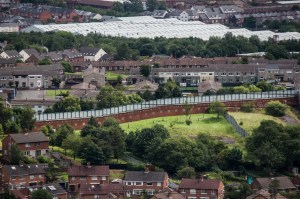
Belfast’s Peace Wall

Walls or fortified fences are all the fashion in the Middle East. Egypt has built one on its border with Libya – and also with Gaza. Saudi Arabia has put one between it a Yemen and also, one with Iraq. Kuwait has one too with its former invader. In the Maghreb, Morocco constructed the longest wall in the world dividing the former colony of Spanish Sahara from its independence fighters in their Algerian sanctuaries; and yet, the modern world’s longest enduring independence struggle continues.

The Israelis built the Separation Wall to halt the bombings of buses and bistros in Jerusalem and Tel Aviv during the Second Intifada and have maintained it as an instrument of security and control and of divisive national politics. And on the whole, it has worked, except that it has entrenched the isolation from each other of the Israeli and Palestinian communities, and increased in many, a lack of familiarity and empathy and a mutual fear and loathing that does not auger well for peaceful coexistence.

If you walk atop the Ottoman Walls that still circle the Old City of Jerusalem, you can see it and the Haram Al Sharif, the Dome of the Rock, from where the walls pass Mount Zion. It snakes away in the distance through the arid landscape and white sandstone suburbs like an incongruous grey scar. We’ve crossed through the wall and IDF and Border Police checkpoints many times in our travels through Israel and Palestine. On one journey, a cross-country drive across the Judean desert from the satellite city of Ma’ale Adumin to the ancient and amazing monastery of Mar Saba, we passed through fields where Bedouin women harvested wild wheat with sickles as their forebears did of old and actually walked across the footings of a section of the wall that has been abandoned when the high court determined that its construction would prevent the Bedouin from traversing their traditional grazing grounds.

In his final book, Night of Power, published posthumously in 2024, the late foreign correspondent Robert Fisk provides a dramatic description of this “immense fortress wall” which snakes “firstly around Jerusalem but then north and south of the city as far as 12 miles deep into Palestine territory, cutting and escarping its way over the landscape to embrace most of the Jewish colonies … It did deter suicide bombers, but it was also gobbled up more Arab land. In places it is 26 feet or twice the height of the Berlin wall. Ditches, barbed wire, patrol roads and reinforced concrete watchtowers completed this grim travesty of peace. But as the wall grew to 440 miles in length, journalists clung to the language of ‘normalcy’ a ‘barrier’ after all surely is just a pole across the road, at most a police checkpoint, while a ‘fence’ something we might find between gardens or neighbouring fields. So why would we be surprised when Italian Prime Minister Silvio Berlisconi, traveling through the massive obstruction outside Bethlehem in February 2010 said that he did not notice it. But visitors to Jerusalem are struck by the wall’s surpassing gray ugliness. Its immensity dwarfed the landscape of low hills and Palestinian villages and crudely humiliated beauty of the original Ottoman walls Churches mosques and synagogues .. Ultimately the wall was found to have put nearly 15% of West Bank land on the Israeli side and disrupted the lives of a third of the Palestine population. It would, the UN discovered, entrap 274,000 Palestinians in enclaves and cut off another 400,000 from their fields, jobs, schools and hospitals”.

Leftwing Israeli journalist Amira Haas, who lives in the West Bank, takes Fisk on a tour of the wall:

“Towering 26 feet above us, stern, monstrous in its determination, coiling and snaking between the apartment blocks and skulking in wadis and turning back on itself until you have two walls, one after the other. You shake your head a moment – when suddenly through some miscalculation surely – there is no wall at all but a shopping street or a bare hillside of scrub and rock. And then the splash of red, sloping rooves and pools and trees of the colonies and yes, more walks and barbed wire fences and yet bigger walls. And then, once more the beast itself, guardian of Israel’s colonies: the Wall.

The Separation Wall between Jerusalem and Ramallah. Paul Hemphill 2016

Israel also built a forty-mile so-called smart fence around the Hamas-controlled enclave of Gaza, decked out with cameras, radars, and sensors. It was meant to both stop large-scale Hamas attacks and provide warning if Hamas was gathering its forces. This failed disastrously on October 7th 2023.

Those defenses, of course, did work for many years. The Hamas, which used to send numerous suicide bombers into Israel, was largely unable to penetrate the border from Gaza, in large part due to the fence. In fact, Hamas had to plan for several years and conduct a massive operation to overcome the defenses – not an easy task and one that should have been detected and disrupted by Israeli intelligence.

The Hamas’ assault on the black Shabbat demonstrated chillingly that defenses by themselves are never sufficient. They must be backed up by intelligence and a rapid-response capability, making any breach less consequential for Israel and potentially disastrous for Hamas. Indeed, had Israel been able to scramble a small number of attack helicopters to Gaza quickly as the assault force was breaching the fence, Hamas would have suffered huge losses.

Yes, walls work, until, for one reason or another, they don’t …

Aida Refugee Camp outside  Bethlehem, Paul Hemphill 2016

An illusion of safety

I will ask more of you than any khal has ever asked of his khalassar! Will you ride the wooden horses across the black salt sea? Will you kill my enemies in their iron suits and tear down their stone houses? Will you give me the Seven Kingdoms, the gift Khal Drogo promised me before the Mother of Mountains? Are you with me? Now… and always!”  
Danearys Targaryen, Game of Thrones

And they were, and they did, with the help, of course, of dragons.

While walls are destined to fall one day, people like walls. They project a language of security – but their construction stems from a sense of insecurity, an intense fear of losing what you have.

In an early post, The Twilight of the Equine Gods, we talked of the horsemen of the plains and steppes who descended violently upon the sedentary lands of Europe the Middle East and China. The folk on the pointy end of their depredations built walls to keep them out.

But while people feel safe behind walls, their impregnability is often illusory.

Walls have gates and these permit ordinary, decent folk to enter and exit – to work, to trade, to parlay, to mingle, communicate and court. The forts along Hadrian’s Wall tell the story of such coexistence and cohabitation. But some people don’t bother with gates. Thieves can scale them and climb over them. Enemies too – they clamber over them, dig under them, mine them and bring them tumbling down, or by subterfuge, they can suborn, beguile or bribe a turncoat or waverer to open the gates or reveal a secret entrance. The ancient Greeks bearing their dubious gifts brought down “the topless towers of Illium” with a ruse that launched a thousand analogies and the famous aphorism “beware Greeks bearing gifts”. The Greeks have never lived that one down.

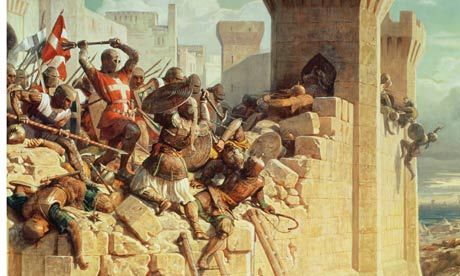
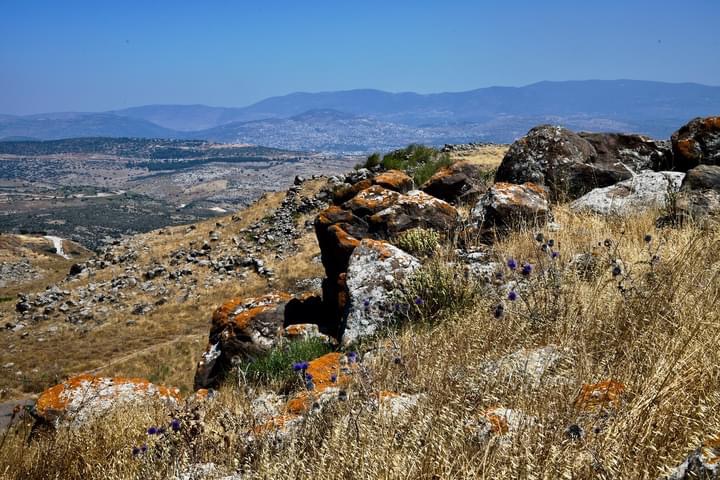
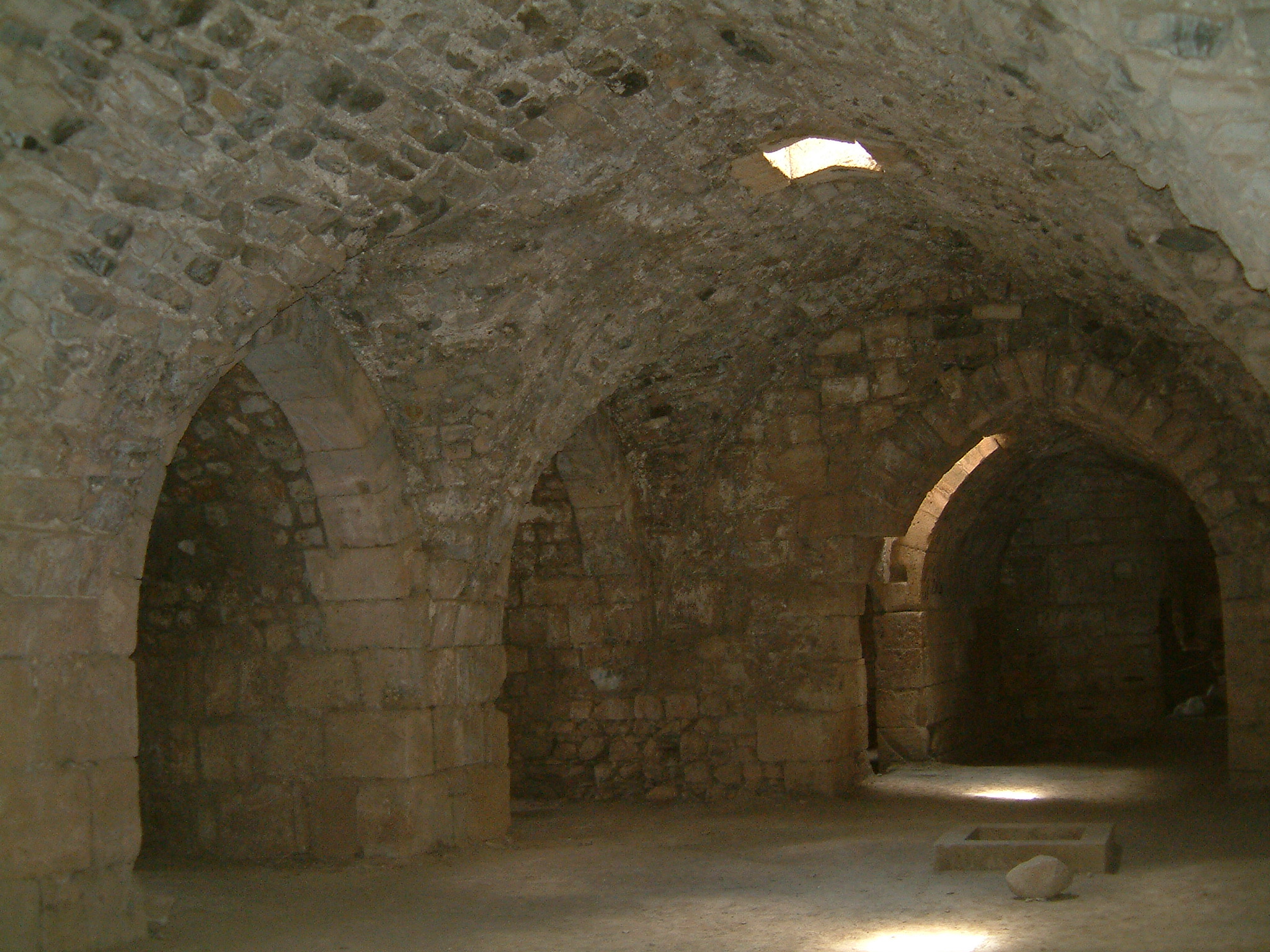
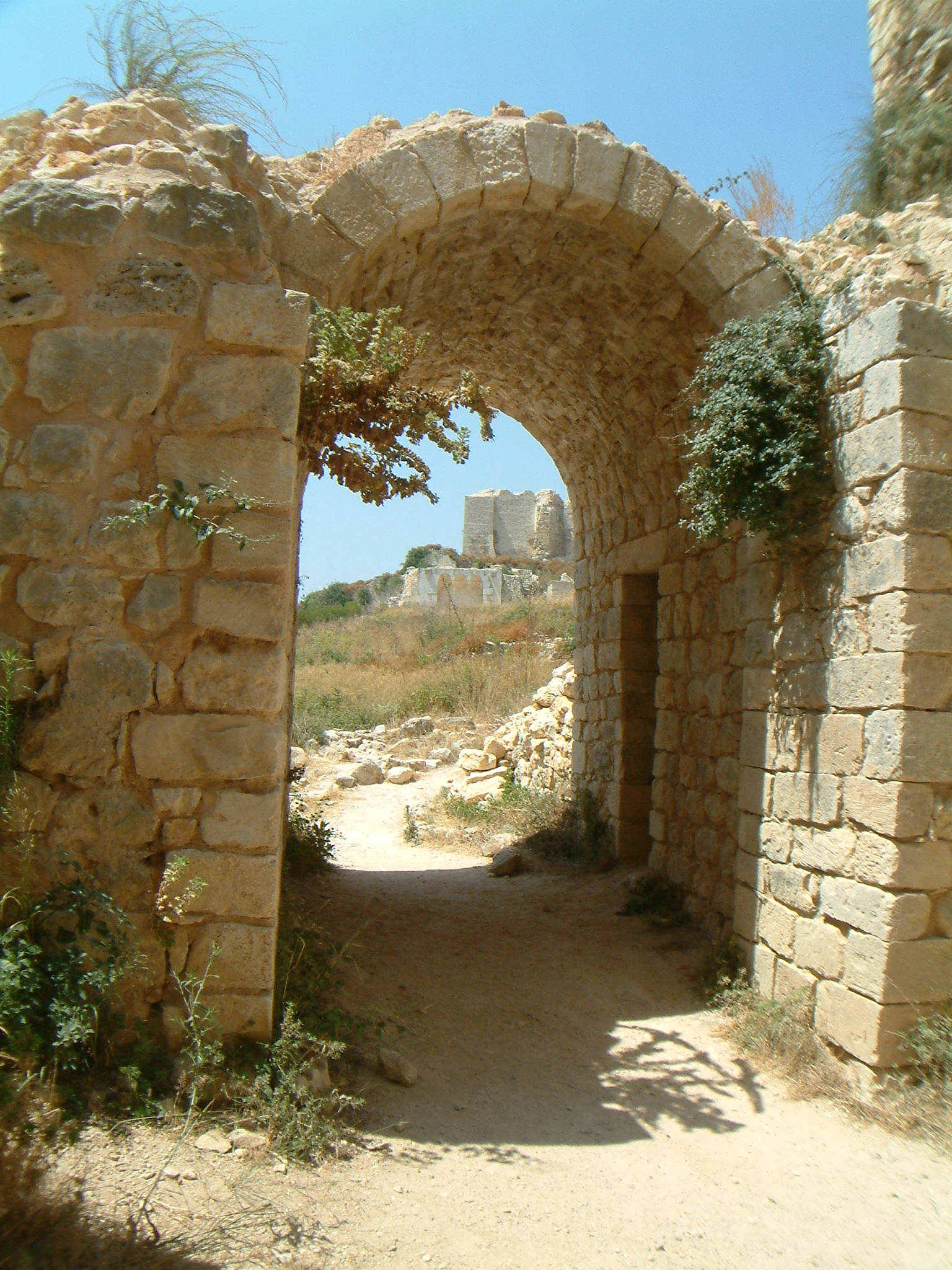
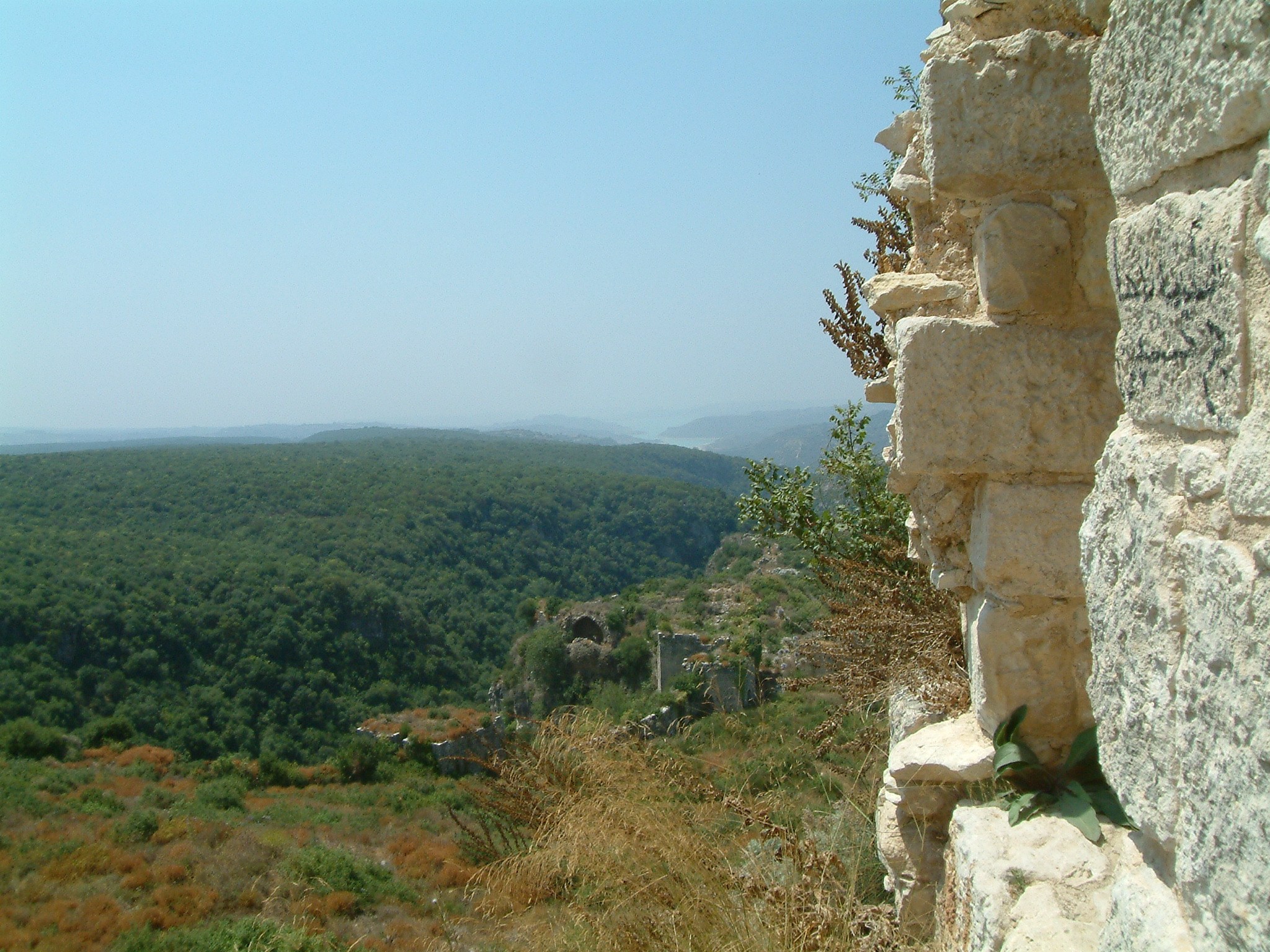
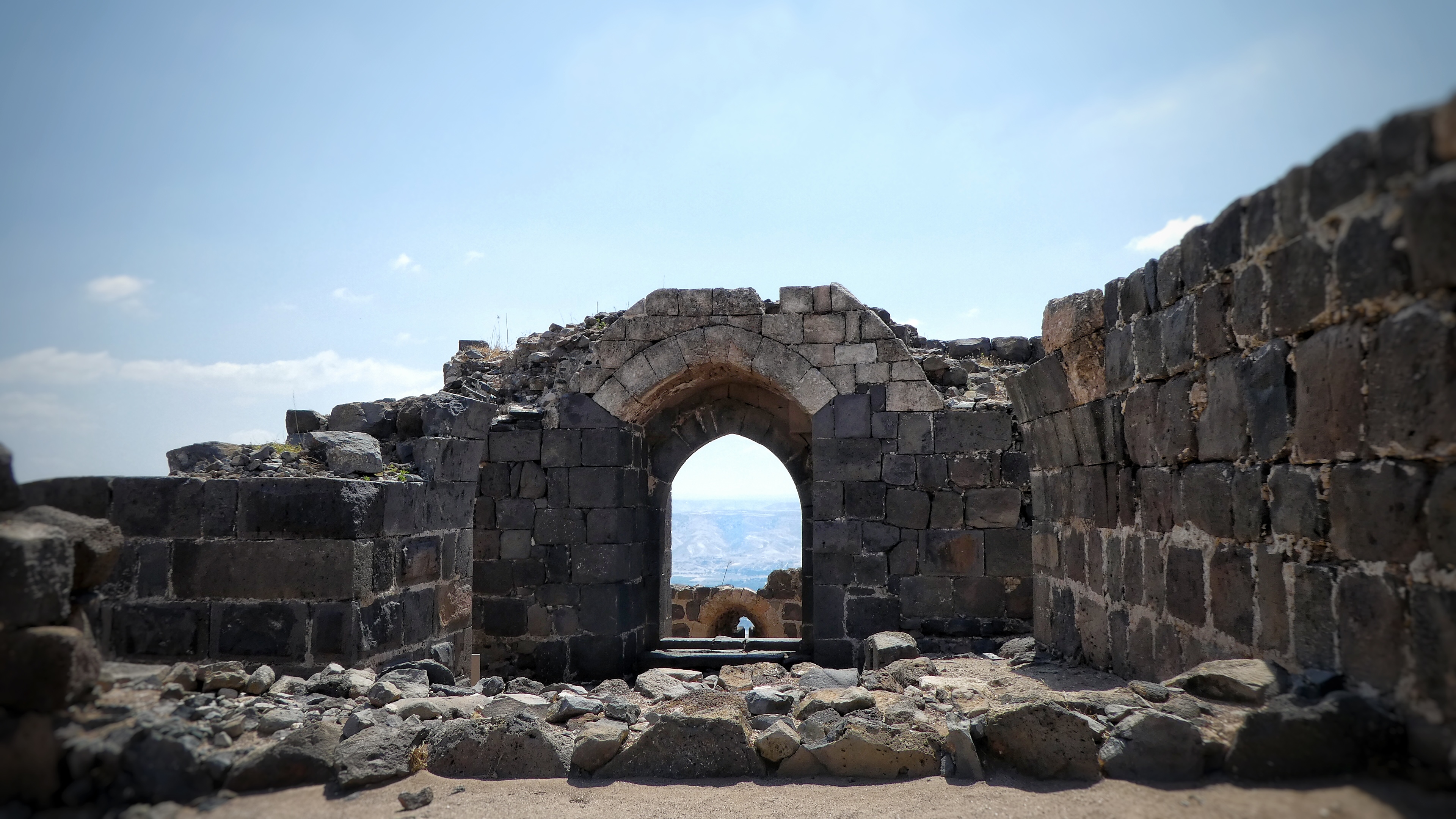
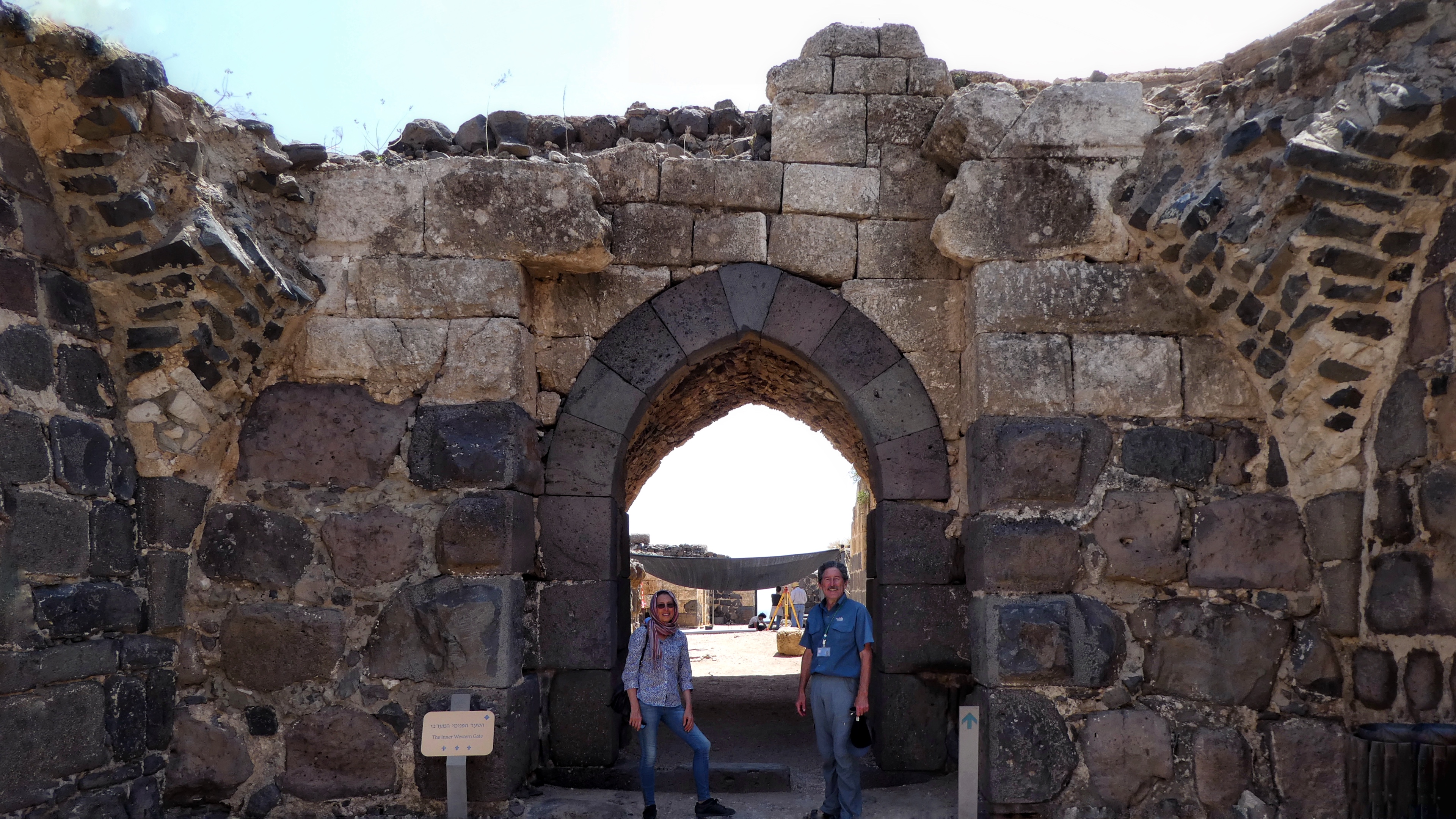
I’ve had the privilege and pleasure of walking the corridors and standing on battlements of some of those great crusader castles of Syria and Palestine – of Qala’t al Husn, known to the world as Krak de Chevaliers, of Qala’t Salahuddin in Syria’s Alawite heartland, and Belvoir in Israel. These fell not by storm but by subterfuge – plants, turncoats or bribes By geological happenstance, these three significant citadels were built above the great Rift Valley that runs from Africa to Turkey and from their still imposing ramparts, the traveller can look out over several countries and appreciate the strategic importance of these man-made megaliths.

Krak de Chevaliers, Husn, near Homs, Syria. Paul Hemphill 2006

Krak de Chevaliers,Paul Hemphill 2006

The Golden Gate, Jerusalem, from Gethsemene. Paul Hemphill 2016

A world of walls

And the great and winding wall between us
Seem to copy the lines of your face
Bruce Cockburn, Embers of Eden

In his Booker Award winning novel Apeirogon, Irish author Column McCann’s Palestinian protagonist Rami, speaking of the death of his daughter at the hands of the IDF, says: “all walls are destined to fall, no matter what”. But Rami “was not so naive, though, to believe that more would not be built. It was a world of walls. Still, it was his job to insert a crack in the one most visible to him”.

Walls are in vogue nowadays. We declare that we should be building bridges, and yet, we keep building walls. Indeed, walls and wire define and divide the brotherhood of man.

Walls keep unwanted people out and nervous people in. Or prisoners – the world is full of those. The USA, The Land of the Free, incarcerates more than any other nation – except China. More than Iran, or Turkey, each with tens of thousands of political prisoners. The majority of inmates in American and Australian jails are black.

And walls protect us from “the other”.

Australian commentator Waleed Aly wrote in the SMH 9 November 2019: “A wall doesn’t just exclude. It obscures. It renders those on the other side invisible. And once people are invisible, they become mythological beasts. Their lives, their attitudes, their aspirations all become figments of our imagination”. Read the full article below.

To my thinking, this can apply to several of today’s intractable conflicts. The division between North and South Korea, for example, with its heavily weaponized DMZ. Iran and its ostensible enemies. And as I alluded to above, the walls that divide Israelis and Palestinians in the West Bank and in Gaza.

Back in the day, I would walk from Ramallah, then but a small town, to Jerusalem. I’d traverse the old city, and head up the Jaffa Road to the bus station and thence, to Tel Aviv. Today, there is the Separation Barrier and checkpoints, and exclusive roads – easier for visitors like ourselves as we traversed the Occupied Territories, but excruciating and humiliating for the tens of thousands of Palestinians who, until October 7, crossed into Israel daily to work “on the other side” and visit family and friends in East Jerusalem and in Israel.

Amira Haas describes the road I once walked down: “It’s a destruction of peoples life – it’s the end of the world. See here? We go straight to Jerusalem. Not now. This was a busy road and you can see here how people invested in homes with a little bit of grace, the strength of the houses, the stone. Look at the Hebrew signs because these Palestinians used to have so many Israeli customers”. But, Fisk writes, “almost all the shops are closed, the houses shuttered, weeds and sticks along the broken curb. The graffiti is pitiful, the sun merciless, the sky so caked with the heat that the grey of the Wall sometimes merges into the grey stone of the sky. “It is pathetic this place” Amira Hass says. I’ve always been showing it to people always, you know hundred times and it never stop shocking me”.

The border fence between Saudi Arabia and Iraq

The border fence between Kuwait and Iraq

Girt by sea … 

That’s from our Australian national anthem, a paean to our pale Anglo-Celtic Christian heritage, continually updated as our values and our demography changes. It reminds us that walls are not necessarily built of bricks and mortar. An ocean can serve the same purpose.

The English, for example, have always rejoiced in their insular status. As early as the 13th century, an English chronicler described England as “set at the end of the world, the sea girding it around”. It was the sentiment which Shakespeare put into the mouth of the dying John of Gaunt in Richard II”: This precious stone set in the silver sea, which serves it in the office of a wall, or as a moat defensive to a house, against the envy of less happy lands.” It is part of the classic canon of English patriotism. Yet it was and remains a myth. As historian Jonathan Sumption, has pointed out, politically, England was not an island until defeat in the Hundred Years War made it one – had been part of a European polity.

Indeed, the aforementioned Hadrian’s Wall served as a more strategic historical reference point. In the preface to Pax, the latest volume of his magisterial history of the Roman Empire, English historian Tom Holland notes that the northern bank of the river Tyne was the furthest north that a Roman Emperor ever visited. What was so important about Hadrian’s visit to Tyneside in 122AD was his decision there to mark in stone, for the first time, the official limits of his Empire. North of this great wall, there was paucity and unspeakable barbarism, scarcely worth bothering about; below the wall was civility and abundance and the blessings of Romanitas. To this day, those 73 miles of the Vallum Hadriani across the jugular of Britain still shape the common conception of where England and Scotland begin and end, even though the wall has never delineated the Anglo-Scottish border. For this colossal structure left enduring psychological as well as physical remains. To the Saxons, it was “the work of giants” and was often thought of as a metaphysical frontier with the land of the dead – George  R got that part right too.

The “sceptred isle” tag prevails, but. It’s how many Brit’s saw themselves back then and right up to the sixties when we had to memorise it at grammar school: This earth of majesty, this seat of Mars, this other Eden, demi-paradise, this fortress built by Nature for herself against infection and the hand of war. This happy breed of men, this little world”. I couldn’t resist quoting it.

Our Island Story: A Child’s History of England, by British author Henrietta Elizabeth Marshall, first published in 1905, covered the history of England from the time of the Roman occupation until Queen Victoria’s death, using a mixture of traditional history and mythology to explain the story of British history in a way accessible to younger readers. It depicted the union of England and Scotland as a desirable and inevitable event, and praises rebels and the collective will of the common people in opposing tyrants, including kings like John and Charles I. It inspired a parody, 1066 and All That. Former Prime Minister David Cameron chose the book when asked to select his favourite childhood book in October 2010: “When I was younger, I particularly enjoyed Our Island Story … It is written in a way that really captured my imagination and which nurtured my interest in the history of our great nation”.

Maybe the Island Nation prevailed in its time – notwithstanding John Bull’s Other Island just over the water and the “troubles” it caused. But the French port of Calais that was such a headache to the Plantagenet kings back in the day is a persistent migraine today as folk from faraway places arrivethere hoping to board flimsy boats, casting their fortunes and their lives to the waves of one of the world’s busiest and tempestuous sea ways in the hope of a better life in the green and pleasant land of song and story.

We in Australia do have a unique wall – the ocean surrounding us.

Our former and now disgraced Australian prime minister Scott Morrison prime minister once declared that he himself was a wall, barring what we in official Australia call unauthorized arrivals by sea. The wall surrounding our continent – we are indeed the only nation that covers exclusively its own continent – is a wide watery one – huge, forbidding, and, depending on the operating budget and competence of the Australian Border Force, impenetrable. And it costs is a motza. In December 2020, The Guardian reported that Australia will spend nearly $1.2 billion on offshore detention – it’s called “processing” – that financial year, even though fewer than 300 people remained in ‘offshore detention” in Papua New Guinea and Nauru That’s roughly $4m for each person. Our government has spent more than $12 billion on offshore processing in the past eight financial years.

It might be less than the US$20 billion President Trump wanted to waste on a border wall, but it is far more as a proportion of government revenue and national income and more than five times the UN refugee agency’s entire budget for all of Southeast Asia.

That’s all from me. The reviews follow, but first some of the articles referred to in my narrative.

© Paul Hemphill 2024.  All rights reserved.

Al Tariq al Salabiyin – the Crusaders’ Trail

Roman Wall Blues – life and love in a cold climate

The Twilight of the Equine Gods

Thirty years after the fall of the Berlin Wall, we are building them again

Waleed Ali, Sydney Morning Herald, November 7, 2019

Sometimes that is literal as in the case of Donald Trump most famous, still unfulfilled promise. Sometimes this is figurative as in the case of Brexit (though it has dangerously literal implications in Northern Ireland). And sometimes this is a particularly pointed development, as in the case of countries that were once part of the Soviet bloc, which have turned in sharply illiberal, nationalist, anti-immigrant directions: places like Hungary and Poland.

Even as far afield as Australia we are being lightly stalked by this fortress mentality, too. Mostly this has focused on boats, but it is spreading now to a populist suspicion of globalisation more generally, especially where it involves us having obligations to other countries or the environment.

I don’t want to stretch the comparison too far. Today’s walls are about excluding the foreigner, while the Berlin Wall was built for the opposite reason: to keep East Germans in. But there is still an important continuity here, something powerful and important in the idea of a wall, that makes it so symbolic, whatever immediate function it serves. More profound than the physical barrier is the psychological one. That’s as true today as it was in Berlin.

Konrad Schumann leaps the barbed wire into West Berlin on 15 August 1961

Children at the Berlin Wall on Sebastianstrasse, around 1964 (Lehnartz/ullstein bild, Getty Images)

The fall of the Berlin Wall, November 1989

These narratives tell an uncomplicated story of the other that is really designed to tell an uncomplicated, heroic story about oneself. The East’s imagined multitudes of poor Westerners was a way of saying the Eastern system was superior and just. Hence, the West had to be wild and unequal. Meanwhile, the Western story of the East was a way of eliding its own shortcomings, establishing a triumphant narrative of freedom that swept away concerns about social injustice.

Walls make this so much easier. Aside from all else they do, walls prevent us from knowing each other. That has serious real-world consequences. We call the period after the Berlin Wall fell “reunification”, but it was really a Western annexation of the East. East became West, not some other accommodation. So thorough was the West’s self-regard, so comprehensive its belief in the East’s unmitigated bleakness, that it respected none of the institutions the East had built. It privatised and sold off its industries to the highest bidder – inevitably West Germans. It shut down its companies, more or less assuming they had nothing to offer.

The result saw East Germans with little choice but to head West for jobs, and the East hasn’t quite recovered. Today it is older, poorer, and endures higher unemployment. It’s only by knowing this that we can understand why a government study found 38 per cent of East Germans think reunification was a bad thing. A majority feel they are now second-class citizens. We’re seeing a rise of far-right radicalism, even neo-Nazism, in Germany. Its heartland is in the East.

Today’s walls are built on the same logic. They all offer some self-aggrandizing view of the world in which everyone else deep down wishes they were like us. Whether believing in the eternal supremacy of the British Empire in the case of Brexit, or that asylum seekers are really more interested in finding a back door to Australia than they are in fleeing persecution, the foreigner exists mostly as a counterpoint to our own magnificence. What matters is that they remain unknown and unknowable so we can mould them to our opposites, and they can be scapegoated for our problems.

We’re so committed to this kind of psychology that we will establish walls precisely where we’re told they can’t be built. Even something as borderless as the internet has become a landscape of barricades, populated by people talking only about their enemies and only to their friends. As a result, almost no one is knowable anymore.

So let me add one more idea to this week’s litany of Berlin Wall reflections: that it be a symbol of human arrogance. The arrogance to control and lie to one’s own people, sure. But the arrogance of choosing isolation, too. The arrogance of believing that the other has nothing to offer us. And the arrogance of believing that we can be fully formed in others’ absence; of treating other people as mere raw material from which we can manufacture ourselves.

Waleed Aly is a regular columnist and a lecturer in politics at Monash University.

A crash course in barrier building

Walls: a history of civilisation in blood and brick by David Fry Faber 2018.
Reviewed in the Australian by Pat Shell, March 16, 2019

“Build bridges, not walls. It’s a slogan”, writes Frye (Ancient and Middle Eastern History/Eastern Connecticut State Univ.), “designed to give military historians fits.”

Bridges, after all, have military purposes: to get across moats and earthworks and to ford rivers into enemy territory. Walls, on the other hand, make peace – history offers plenty of examples, he writes, to show that “the sense of security created by walls freed more and more males from the requirement of serving as warriors.”

Indeed, by Frye’s account, walls are hallmarks of civilization, if ones that are easily thwarted.

One of his examples is the Tres Long Mur, a defensive structure built more than 4,000 years ago, stretching across the Syrian desert and shielding some of the world’s oldest towns from marauders from the steppes beyond. There are mysteries associated with the ruins, just as there are with the Great Wall of China, another of Frye’s examples—and one that proves, readily, that where walls go up, people find ways to get around and over them.

The author’s pointed case study of Hadrian’s Wall shows that it may not have been a defensive success, but that does not mean it didn’t have a defensive purpose, as some scholars have recently argued. As he writes, wittily, “there is little to be gained from rationalizing an irrational past.”

Another defensive failure is the Maginot Line, which became more symbolic than practical in an age of modern tanks; on the reverse side are spectacular successes, such as the great walls of Constantinople, which shielded the city from siege by as many as 200,000 soldiers of the caliphate, “one of the greatest turning points in history.”

Walls have many purposes, he concludes, and it is rather ironic that the matter of walls is often as divisive as a wall itself.

A provocative, well-written, and – with walls rising everywhere on the planet – timely study.

Walls work, and walls save lives. So declared Donald Trump in the 2019 State of the Union address. Not long after that, he went a step further, just clearing Congress’ refusal to front with the funds for 4 billion bricks to be a national emergency.

There are times when that view could be right. How a well-built levee might postpone the inevitable when the rain keeps fallin’ and the river done rose. For a while it least.

But the US president wasn’t talking about breakwaters and climate change mitigation. The tsunami he is hoping to surf home to a tsecond term is a tidal bore of human flesh. He thinks that a Mexican wall is needed to keep out rapists, drug dealers, terrorists and Venezuelan communists.

But his wall, if ever built, will never achieve what wall builders through the ages have vainly striven for: to stop time itself, to freeze history at the pinnacle of their power. And in so doing, through the erection of military masonry on a monumental scale, confidently wallow in the triumphant delusions screamed by Ozymandias at weary gods who have heard it all before.

In short, the inevitable corollary of the invention of Real Estate: the creation of an exclusive neighbourhood to keep out riffraff.

Walls, David Frye’s fascinating and timely analysis of the rise and fall of empires, religions, cultures and languages, is so compellingly readable because it urges to look closely at human artifacts so everyday, so ordinary that we only rarely see them as instruments of power and authority. They can be impressive, sure, but not like an aircraft carrier steaming lies and all the flight of the two banners overhead.

We walk past walls every day. We live behind them. They hold up our roofs. Once fitted with a solid locked door and the steel-grated windows, they protect us, and not just from the wind and the rain.

Frye is an American historian. His main point is not just that walls, the stone and earthen shield of homesteads, palaces, towns, indeed entire nations, are as old as civilisation itself. He thinks that for all intents and purposes, walls are civilisation itself, or, at the very least have allowed civilisations to come into being.

He reminds us that like armies, walls don’t go anywhere. Like armies, they can be enormous, and symbolic of great power and proprietary rights, but they rise and fall in situ, and define the status of all who live around them.

Either you live inside the wall, or you don’t. And depending on how you define civilizations, they rarely flourish without a stable address of some sort. The Athenians wouldn’t have bothered building the Parthenon if they’d had to pull it down every winter to follow their goats to Macedonia in search of greener pastures. But they had to be able to go to bed at night confident that the marvels of the Acropolis would still be there in the morning.

And while the kind of people who write and read books such as Walls are by definition “inside the wall” characters, Frye notes the disdain with which “basket carrying” sybarites were regard by those on the outer.

The barbarians, the hordes. The marauding warriors. Luxury is for wimps, art an affectation citation for the feeble and effete. The Huns, Mongols, Cossacks, Names that are synonymous for people who would rather burn a city to the ground than simply move in and celebrate their luxurious residential arrangements by draining the wine cellars and frolicking in the fountains.

When the great unwashed arrived in sufficient numbers to break down the ramparts, they didn’t mess around. To them, plumbing, hanging gardens, marble theatres and elegant geometry will not try ounce of human aspiration, but conversions.

It is this primal fear of defenses overwhelmed that fuels Trump’s calculated hysteria today. While he may, without quite saying it in so many words, be grasping for historical legitimacy by asking his countrymen to “Remember The Alamo”, He does play on fears food in for thousands of years of siege warfare, and the grizzly fates that befell the losers.

And while the discounted insurance premiums that come with the electrified fences and gated communities of Bel Air and Rhode Island might ease the terror of wealthy Americans, a home invasion is small beer compared to the total collapse of “homeland security” in the real world.

Of the examples Frye gives of barriers breached and the resultant bloodbaths, and there are many, perhaps the most extraordinary is the Mongol demolition of Thirteenth Century China. “ The population of China fell from a 120 million in 1207 to 60 million in 1290. Mongols “boasted that they could ride over the sites of many former cities without encountering any remains high enough to make their horses stumble”.

Genghis Khan, born and bred on the merciless steppe, saw Chinese sophistication as an affront to nature, much as the Spartans mocked the music and theatre of the Athenians.

He shrugged off the carnage and destruction he had wrought as nature’s mockery of Chinese hubris and pretensions: “Heaven is weary of the beauty of the inordinate luxury of China”.

Trump doesn’t care for it much either, it seems. Perhaps a wise adviser might take a moment to point out to him the bridges are usually a far better long-term investment than barbed wire.

as The Eurasian Steppe by the archaeologist Warwick Ball makes clear, rather than a semi-wild anteroom to the continent, “the history, languages, ideas, art forms, peoples, nations and identities of the steppe have shaped almost every aspect of the life of Europe”. Europeans from further west have for centuries been prone to viewing the steppe as the haunt of wild tribes, and the source of occasional, fearsome destruction.
https://unherd.com/2022/07/the-fate-of-europe-lies-in-the-steppes/

Review of Walls: history of civilisation in blood and brick 

John M. Formy-Duval, retired teacher of ancient and medieval history and educator, on this books and  reading blogspot.

In Walls: a History of Civilization in Blood and Brick, David Frye has written an encompassing and enlightening review of walls through the centuries, ranging from 2000 B.C. to the present. A “Selected Timeline” covers the subject matter in four geographical areas: Near East and Central Asia; Europe; China; and the Americas. Frye writes that walls can take the form of “protectionist economic policies,” a “great internet firewall,” razor wire with motion sensors, or concrete barriers. Stringent, punitive immigration policies around the world seek to keep the perceived destroyers of “our culture out.” That is, we belong here; you do not.

“Few civilized people have even lived without them,” Frye emphasizes. From ditches to sapling fences to berms to walls, the level of sophistication rose as people perceived an increasing need for protection from, literally, the barbarians at the gate. Farmers settled and fortified their small villages. Even today one finds fences around Maasai villages in Tanzania. As villages transitioned into cities, their walls grew with them, often into great defensive bulwarks. Even Shakespeare’s Juliet recognized that “these walls are high and hard to climb.”

The epilogue “Love Your Neighbor, but Don’t Pull Down Your Hedge” covers the period from 1990 to the present. This section begins and ends with an account of how the Malibu coastline transitioned from the single ownership of May Rindge in 1892 until 1926, when she grudgingly agreed to lease some properties after numerous shootings, sheep poisonings, and a Supreme Court decision that went against her. Focusing on the present, Frye embarks on an account of the spate of walls built since the Berlin Wall was torn down. From the United States to the Middle East to Southern Europe and India, and nearly everywhere else, it seems, the pace, enormity, and sophistication of these walls is astounding.

People are familiar with the walls Israel has erected in which “infrared night sensors, radar, seismic sensors for detecting underground activity, balloon-born cameras, and unmanned, remote-controlled Ford F-350 trucks, equipped with video cameras and machine guns, augment the wall’s concrete slabs and concertina wire.” Lesser known is Saudi Arabia’s effort, begun in 2003, to create a barrier across its eleven-hundred-mile border with Yemen. The barrier rises across the desolate Empty Quarter, home of significant oil reserves. “Ten-foot high steel pipes, filled with concrete” provide the frame for razor wire while tunnels burrow deep underground. The Saudis have a second, more heavily fortified wall that ranges six hundred miles along their border with Iraq. Egypt, Jordan, India, Thailand and Malaysia, Morocco and Algeria, and Kenya are also in the wall-building business, often with funds or construction assistance either from the United States government or private businesses.

The U.S. was in the wall-building business along our border with Mexico long before the present administration, although the present focus changed the dialogue. We had barriers, little more than fences, before the Berlin Wall fell. Under President Clinton, for example, extensions were added to the existing barriers in 1993, 1994, and 1997. After Berlin, however, the word “wall” was largely abandoned in favor of softer language, and in 2006 the “Secure Fence Act” extended the extensions undertaken during Clinton’s time in office. Who knows what will happen at the present time?

Walls have deep effects on us. They box us in; they shut us out; they keep others out. They come in physical form, but they can be purely psychological, designed to prevent us from sinking into “the other side of the tracks.” Professional nomenclature excludes people and gives the holders of the language key a sense of superiority. Myriad iterations of “wall” provide endless means to isolate us and keep them out.

Frye provides the who, what, where, when, and how of walls ancient and modern. The Great Wall and Hadrian’s Wall are generally known, but he touches on the thousands of walls that continue to exist today and continue to be built “while we wait on everyone else to become just as civilized as we are.”

About Walls

Review in Always Trust in Books blog

For thousands of years, humans have built walls and assaulted them, admired walls and reviled them. Great Walls have appeared on nearly every continent, the handiwork of people from Persia, Rome, China, Central America, and beyond. They have accompanied the rise of cities, nations, and empires. And yet they rarely appear in our history books.

Spanning centuries and millennia, drawing on archaeological digs to evidence from Berlin and Hollywood, David Frye uncovers the story of walls and asks questions that are both intriguing and profound. Did walls make civilization possible? Can we live without them?

This is more than a tale of bricks and stone: Frye reveals the startling link between what we build and how we live, who we are and how we came to be. It is nothing less than the story of civilization.

‘The creators of the first civilisations descended from generations of wall builders. They used their newfound advantages in organization and numbers to build bigger walls. More than a few still survive. In the pages that follow, I will often describe these monuments with imposing measures – their height, their thickness, sometimes their volumes, almost always their lengths. These numbers may begin to lose their impact after a while. They can only tell us so much. We will always learn more by examining the people who built the walls or the fear that lead to their construction.’

David Frye’s Walls is a classic non-fiction read that left me not only well informed but with a deeper appreciation and understanding of world history. From 10,000 B.C right up to the present day, David Frye explains how fundamental the invention, construction and development of walls were (and still are) to the progression of humanity. If you are here purely for a history of walls then you may be disappointed as DF is more interested in the influence instead of the existence of walls. DF took me on a guided tour through key periods in the history of mankind and how the creation (and protection) of walls allowed us to flourish as a species but also the ramifications and innovations that they led to later on.

DF lead me through civilisations that either accepted or rejected the concept of being walled (or caged) in and how their decisions affected the population and also the other nations around them. Walls redefined our ability to exist in a barbaric world and allowed us to focus on scientific and cultural advancements. It also allowed some kingdoms to go soft, so to speak. DF also focuses on the absence of walls and how it changed the civilisations who refused to hide behind them; nations like the Spartans, Mongols and Native Americans who lived to fight for what was theirs or claim new lands for themselves.

The amount of coverage is exceptional, from the Roman Empire, Mesopotamia and China (with their many great walls) to Greece, Constantinople and Berlin. Walls are essential to the telling of history and David Frye did a fantastic and immersive job with his writing. Informative, concise, engrossing (narrative elements), well structured and paced out, David’s writing made this book totally worth my time. He could have easily knocked out this book with his extensive knowledge of war and culture but he went the extra mile. Making connections, observations and theories that made the content more comprehensive and digestible (with some hilarious comments too).

Recent history seems in part to be governed by a chain reaction that saw the building of more and more elaborate walls. Each emperor saw fit to out do their predecessors or competition. Each iteration of wall has its successes and failures, while destroying them advanced weaponry and military tactics along the way. I loved spending time with different time periods and walking amongst the mythos, history, socio-economic backgrounds, knowledge and statistics surrounding the world’s walls and those compelled to build them for their own needs or the needs of many. I especially enjoyed how David Frye’s message about walls was fluid and how it evolved over the course of the book. How humanity grew out of their need for walls and yet still see them in a symbolic nature. How destroying a wall can be as powerful as building one.

Frye knows perfectly where to stop and elaborate or move on to new points. He also doesn’t shy away from the darker shades of history so be aware of graphic detail. There is a lot to learn in this book but DF has written it in a way that it is never too much and I always wanted to know more. There are many highlights to Walls and I can’t recommend it enough to Non-Fiction lovers of many varieties. If you like detail, history, mythology (and ghost stories), the many aspects of building civilisation and humanity’s past then Walls is a great book to get stuck into. We owe walls our lives and without their protection our societies would have never been the same.

‘The walls alone have seen the truth, and they are mute’

David Frye

A native of East Tennessee, David Frye received his Ph.D. in late ancient history from Duke University in 1991 and is presently a professor of history at Eastern Connecticut State University, where he teaches ancient and medieval history. Frye’s academic articles have appeared in the UK, Germany, Sweden, and Denmark, as well as the United States, in journals such as Nottingham Medieval Studies, Classical World, Byzantion, Historia, Hermes: Zeitschrift fur klassische Philologie, The Journal of Ecclesiastical History, and Classica et Mediaevalia. In addition, he has published in various popular archaeological and historical magazines and on the online humor site McSweeney’s. As part of his research, he has participated in archaeological excavations in Britain and Romania. (Goodreads Biography)


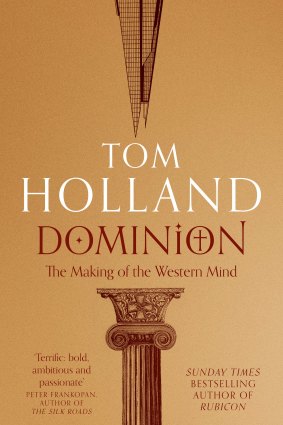
Getting back to the garden – Tom Holland’s Dominion

The Battle of Basildon 2011

There’s a whisper in our souls – the world has suffered long.
Beneath these skies have rolled two thousand years of wrong.
Bless This Day, Paul Hemphill
(after Edward Sears’ carol It Came Upon A Midnight Clear)

There’s a memorable scene towards the end of Martin Scorsese’s masterful adaptation of Nikos Kazantzakis’ historical novel The Last Temptation of Christ (he also wrote Zorba the Greek) in which the peregrinating proselytizer Saint Paul meets a raised and reluctant Jesus who has sought domestic anonymity in contented cohabitation with reformed hooker Mary Magdalene – or so we are led to believe, for there is more than meets the eye in this iconoclastic film (the soundtrack alone, Passion, by Peter Gabriel, is more than worth the price of admission). “I am so glad that I’ve met you”, says the pompously dismissive Paul, “and now, I can forget you”.

I thought of this scene often whilst reading British historian Tom Holland’s revelatory and wide-ranging Dominion (2019), recounting the origins and the transformative and disruptive influence of the world’s biggest faith. Saint Paul, a central character in the drama, has a lot to answer for – though the Persians, Greeks, Romans, Jews and Muslims are significant supporting actors.

Tom Holland is an erudite British historian, specializing in classical and early medieval history. I’ve read many of his books. His Roman trilogy, RubiconDynasty and his recent Pax read like thrillers, as does In the Shadow of the Sword which chronicles the rise of Islam. He’s also written on Greek and Persian classical history. Together with fellow historian Dominic Sandbrook,, he writes and broadcasts The Rest is History, an excellent podcast [Sandbrook is an informative and entertaining authority on postwar British history and society, and his quad of books on the fifties to the early eighties are wide-ranging and highly entertaining and informative – particularly so as I actually grew from boy to man in these dynamic decades.

In an earlier book, Dynasty, the saga of the Augustan caesars, Holland wrote: “The age was a rotten one: diseased, debased and degraded”. But to us, two thousand years on, it seems like it was always thus. He doesn’t shy away from criticism. All over Europe and the New World, Holland writes, “in church after church, we encounter the same fascinating admixture of the salacious, the sexual, the sadistic, and the sacred”.

We of the western world are heirs to a civilization that has for two millennia endeavoured to get back to the garden – in a continual cycle of striving for perfection and falling into to evil ways. 

Holland argues that all “western” moral and social norms are the product of what he defines as the Christian revolution, a revolution that continues to shape the modern world. Even if churches across the West continue to empty, Christian values continue to define who we are and the battles we choose to fight. In a recent interview in The Australian occasioned by the imminent arrival DownUnder of The Rest is History podcast’s roadshow, Holland refers to instincts and muscle memories that derive from 2000 years of Christianity.

Though Christianity’s spiritual roots go deeper than year one of the Christian era, it had to actually begin as it did – with believers. As American author EC Morgan wrote in her magnificent Deep South epic The Sport of Kings, “Our stories about life and death are meaningless if they aren’t shared. Community is what religious faith is all about. Believers are persistent. They refuse to forget. Without believers, the sacrifice of Jesus Christ would have been forgotten, a lost relic of history, just the story of a wandering radical with a vision for a new kingdom. It was only the witness of a community through storytelling that transformed Jesus’ tragic death into God’s ultimate sacrifice. In their rebelling, he was no longer a political dissident put to death by the state, but a hero”.

Holland is not a nostalgic Christian who reads history. At the time of Dominion’s publication, he confessed to being an atheist. Like atheists, including myself, he sways to the rhythm of a spiritual drum. He is, rather, a historian observing the influence of Christianity without making moral judgments. He says large swathes of Western modernity are having arguments within a Christian framework, often without realising it.

Even those who reject religion – those who hold to atheism, humanism, scientism, secularism, egalitarianism, feminism, and many other ‘isms, find their beliefs ineradicably shaped by Christian preconceptions, prejudices, and, indeed, superstitions. Holland writes that Christianity continues to infuse people’s morals and presumptions “so utterly that many failed even to detect their presence. Like dust particles so fine as to be invisible to the naked eye, they were breathed in equally by everyone: believers, atheists and those who never paused so much as to think about religion … perhaps the most compelling point is the way Christianity defines even its opponents. Even as the woke generation condemns Christian history as oppressive, patriarchal, racist and all the other now-standard derelictions, the standards of justice and equality by which they judge these shortcomings remain ineradicably Christian. In that sense, Holland concludes, Christendom will remain with us a while yet”.

Our conservatism, our fear of change, our contempt for “the other”, our atavistic hopes and fears, our yearning for renewal and revolution, and in the contemporary argot, our political correctness and value signaling, even – our love for our neighbour and our intolerance of his and her resistance and reticence, doubt and difference, our hostility and our hubris, our ethnocentrism and our ecumenism, all spring from the same source: that lowly stable in a satellite suburb of Jerusalem, in the Roman colony of Judea two millennia ago. O Little Town of Bethlehem, how still we see thee lie

In his interview with The Australian, Holland said that at the centre of social movements of the ’60s and onwards, from civil and gay rights to the more recent Black Lives Matters and #MeToo is “Christ’s great promise that the last should be first”.

“The 1960s will come to be seen as a decade as significant for Christendom as the 1520s. We are living through a process of moral and ethical and, indeed, theological change comparable to the Reformation in the 16th century. And the idea of reformation, the idea of casting off superstition, idols, opening yourself to the spirit. You get that in the 1520s, and you get that in the 1960s. The difference in the 1960s is that what is being cast off is essentially what you might call a conservative Christian understanding of how society should function, going to church, experiencing liturgies, Sunday schools, familiarity with the Bible.”

There is, he continues, “a kind of Christ-shaped hole in our public culture. And George Floyd kind of filled that gap for that summer of 2020 … Two thousand years of Christian sexual morality had resulted in men and women widely taking this for granted. Had it not, then #MeToo would have had no force”.

Again, Holland makes no judgment about this. He is simply observing that Christianity explains “woke­ism”, whatever that portmanteau word might mean to the mind of the beholder. Not to mention our polarized and argumentative modernity.

Whatever Holland’s own spiritual beliefs – in Dominion he is quite discreet – there is a curious dualism, disconnect even, in the manner in which Dominion has been presented to its prospective readership. On the one hand, it is offered as an essentially humanistic tract linking the rise and rise of Christianity with humankind’s eternal striving for perfection of a sort. When I bought the book, it this aspect that drew me to it after reading the reviews I republish below. And yet, as illustrated by its two distinctively different covers, it has also been deliberately targeting a Christian market. here they are, the opaquely secular and the transparently sacred.

But, back to Dominion.

The reviews below provide an excellent overview of the scale and achievement of Holland’s project. I see no reason to compete with them. but I must add that I was mightily impressed by the literal cast of thousands he assembled to tell his story. There are many surprising and entertaining but always pertinent segues, from Adam to Zarathustra (of Nietzsche fame), with cameo appearances from a long-dead famous white men, iconic persons of colour like Martin Luther King, Nelson Mandela and Desmond Tutu, some most impressive women, and contemporaries as diverse as Harvey Weinstein, Margaret Atwood and Angela Merkel. There is a cornucopia of texts from Job’s tears to John Lennon’s Imagine, a connecting of movements and zeitgeists from crusaders to slavery abolitionists to #MeToo, from the protestant reformation to revolutions political and social, and a globetrotting, time-shifting odyssey from Megiddo to Mordor, the Crucifixion to California Dreaming.

Surprisingly, the Bard of Avon doesn’t earn a guernsey. You won’t find him in the glossary. It was after all he who held up a mirror to our humanity, and who is in his turn held most highly in the canon of our Anglosphere. Is it because there was no room at the inn? Because that rundown inn in that little town of Bethlehem, is the alpha and omega, the hopes and fears all our years, and they abide with us still.

And by us, I also include myself. My father was an Orangeman from Ulster, and my mother, a Catholic from County Wexford. I was born in Birmingham, England, baptized as a Catholic, and raised as a Catholic. I was educated in the British cultural milieu, with Roman Catholic teaching and thinking, but received prodigious input from a British upbringing and an education in an English grammar school grounded in the Church of England and replete with the history of invasions, civil wars, reformation, revolution and empire.

 All these laid the bedrock of my spiritual and cultural identity. Much of this was inherited from “priest-ridden Ireland” and its centuries of resistance to the Sassenach (Saxon, that is) overlord, from whence I acquired most of my DNA and to which I ascribe to myself (a subjective thing and not for others to judge) a Celtic soul and a rebel heart.

“Once a Catholic, always a Catholic” they used to say to me when I’d declare that I’d given up practicing when I was good enough. That was not long after my confirmation by the Archbishop of Birmingham in St Chad’s Cathedral. There was no great epiphany. No revelation from the sea of unknowing. I remained in a Catholic scout troop and participated in church parades and attended mass of a Sunday to pleased my mother. I just kind of slip slided away, and then came the sixties with its Marx and music, and all the rest: the sights, sounds, sensibilities and substances of that generous decade …

But, as my songs and stories and politics attest, like Holland, I’ve not ventured all that far from the mother ship.

As a parting disclaimer, I am named not for Saint Paul but for the acclaimed American socialist and singer Paul Robeson.

Lord of the starfields
Ancient of Days
Universe Maker
Here’s a song in your praise
Bruce Cockburn

We are stardust
Billion year old carbon
We are golden
Caught in the devil’s bargain
And we’ve got to get ourselves
Back to the garden

Joni Mitchell, Woodstock

Featured picture: Dale Farm – The Battle of Basildon 2011

© Paul Hemphill 2023 All rights reserved

Postscript

By 2025, Tom Holland has openly returned to the Christian fold, as have many prominent intellectuals, including historian Niall Ferguson, or converted like and his wife, activist and author Ayaan Hirsi Ali who was formerly a Muslim. The reasons why such thinkers seek the transcendent in their later years is beyond the remit of this review, though Holland admits to having been wrong about Christianity, that his spiritual quest led him to Dominion. now come to see Christianity as the story of power willingly spent on behalf of the vulnerable; strength deployed to protect the weak, power that is used to take the vulnerable off of crosses, rather than put them there. https://theopolisinstitute.com/tom-holland-and-the-liberating-power-of-christianity/

As for myself, I still hear the thrum of that spiritual drum, but even though I head for that inevitable final exit and the “great unknown”, I do not hear the call of the numinous. I was unexpectedly presented with an opportunity to contemplate this recently when old friend of my own age shared with me the story of how he’d taken the hallucinatory drug mescaline for the first time in a bucolic Welsh setting in 1972:

“I had an experience of enlightenment, of self-discovery, that transformed my understanding of the world. I realised that all is one, and that this One is what ‘I’ am – an unborn, undying, eternal, formless Reality – that is all that exists and all that has ever existed – and that this world of form that we perceive is nothing other than this formless Reality. This experience led me down the path of spiritual search from that moment on. Scriptural writings like the Upanishads which had previously seemed obscure and impenetrable suddenly became dazzlingly clear to me as I realised that their writers were describing the experience I had just had myself. I found numerous teachers who were describing the same experience and showing a path to discover it. I felt a particular affinity for the teaching of the South Indian guru Ramana Maharshi, but also found my experience reflected in the teachings of the Sufis and the Zen masters”.

Though I too had taken mescaline and acid in the late sixties, I did not travel down such paths. “For whatever reasons”, I wrote him back, “nature, nurture or narcotics, I’ve never experienced anything like what you describe, nor, for good or ill, have I sought it. Transcendence is something I read about but have never encountered, although I might’ve got a hint of it momentarily in the Taj Mahal when I was high on speed (to keep me awake on overnight train Indian journeys). Maybe that might explain my perspective on history, politics, society and culture, and life, even. Matter of fact. Hard-boiled. Blunt. Brutal even. Quizzical, yes. Cynical, certainly. Your favourite song of the seventies is probably John Lennon’s Imagine. Mine is more like David Bowie’s Life on Mars”.

See also in In That Howling Infinite: The Rest is History – a gift that keeps on giving ; O Little Town of Bethlehem, how still we see thee lie

Barney Zwartz, Sydney Morning Herald November 15, 2019
Caravaggio's The Crowning with Thorns.

Caravaggio’s The Crowning with Thorns.

This huge and sweeping account of the past 2500 years has a similarly large-scale ambition: “to explore how we in the West came to be what we are and to think the way that we do.” And his argument is compelling: even those who reject religion – those who hold to atheism, humanism, scientism, secularism – find their beliefs ineradicably shaped by Christian presuppositions.

Holland writes that Christianity continues to infuse people’s morals and presumptions “so utterly that many failed even to detect their presence. Like dust particles so fine as to be invisible to the naked eye, they were breathed in equally by everyone: believers, atheists and those who never paused so much as to think about religion.”

Holland explores the influence of the world’s biggest faith.
Holland manages to traverse Western history from the Persian invasion of Greece in 480BC to Donald Trump by the technique of taking some often-obscure figure or event and expanding from that to social transformation. So he leaps from the Apostle Paul, herald of a new beginning, to church fathers Irenaeus and the development of the canon, Origen and the invention of theology, the council of Nicaea, Martin of Tours and the exaltation of poverty, and Bede and a calendar based on the birth of Christ.

Perhaps Holland’s most important contribution is to lay waste the secularist founding myth that reason, empiricism, evidence, humanism and the like emerged in the Enlightenment fully formed like Botticelli’s The Birth of Venus, not only owing nothing to the preceding centuries but indeed in contrast to them.

Holland, an atheist, is no apologist for Christianity but is honest enough to acknowledge that his values and world view emerged from Christianity rather than pagan antiquity.

Take human rights, a key concept in modern law and ethics. Rights are by no means self-evident or inalienable, as the US Declaration of Independence states, and would have attracted contempt in pre-Christian societies such as ancient Rome or China.

Rights’ essential precondition is the Genesis teaching of humans made in God’s image, and therefore endowed with dignity and worth. It led Gregory of Nyssa in the fourth century to rail against slavery and abandoning unwanted infants on rubbish heaps and was made explicit by 11th-century canon lawyer Gratian, who pronounced that everyone was equal in the sight of God. Anything in the legal system obstructing this idea had to go.

“Much flowed from this formulation that earlier ages would have struggled to comprehend. Age-old presumptions were being decisively overturned: that custom was the ultimate authority; that the great were owed a different justice from the humble; that inequality was something natural, to be taken for granted,” Holland writes. In 1550 Bartolome de las Casas demanded justice for South American Indians, using the term “derechos humanos”, human rights. The genius of the authors of the US Constitution 200 years later was to garb in the robes of the Enlightenment the radical Protestantism that shaped the fledgling nation.

Darwin, in contrast, pointed out how unnatural such a concept is in the light of evolution, observing that “philanthropy and care for the poor must be highly injurious to the race of man”.

And today the insistence of the United Nations and others on the antiquity and broad acceptance of human rights is a fiction to allow it to be a global rather than merely a Western understanding. Secularism, in an identical manner, depended on the care with which it covered its tracks, Holland says.

The idea of the secular, contrasted with the religious, is an important theme of the great fourth-century theologian Augustine, in The City of God, and reaches fulfilment in the humiliation of Henry IV before Pope Gregory in 1076, which divided the religious and secular realms (giving the Church great power in both).

So embedded is it that nearly a millennium later German chancellor Angela Merkel appealed to it in 2014 to claim that Islam belongs as much as Christianity in modern Germany. So it may, but not because traditional Islam admits the idea of the secular, a notion born purely from Christian history. To Islam, it is an artificial divide. But, as Holland notes, the West has become skilled in repackaging Christian concepts for non-Christian audiences.

The idea that science needed to set itself free of dogma and superstition, possible only in the Enlightenment, is another fiction that can be believed only by those ignorant of history. Holland turns to Abelard – the ill-fated lover of Heloise – who devoted his post-castration life to promoting the idea that God’s order was rational and governed by rules that humans could seek to comprehend. His conviction that identifying the laws that governed nature would honour the God who made them led to the founding of universities in the 12th century.

Similarly, humanism has smuggled in Christian assumptions unacknowledged. Without the biblical story of creation in God’s image, the reverence of humanists for their own species “risks seeming mawkish and shallow”. Indeed, philosophers such as Peter Singer have attacked such notions as “speciesism”.

And the claim in the Humanist Manifesto that morals can be developed from science is another fantasy. “The primary dogma of humanism – that morality is an intrinsic part of human nature based on understanding and a concern for others – found no more corroboration in science than did the dogma of the Nazis that anyone not fit for life should be exterminated,” Holland writes. “The wellspring of humanist values lay not in reason, not in evidence-based thinking, but in history.”

An interesting thesis is that those who most truly understood Christianity’s radical role were those who most despised it, and here Holland cites Nietzsche, the Marquis de Sade, Thomas Huxley and Heinrich Himmler. Nietzsche thought Christianity a slave morality, a way for the weak to bind the strong, but also recognized its values could not survive without the God who sanctioned them. Himmler, who had a 50-year plan to eradicate Christianity, believed the strong had both a duty and obligation to eliminate the weak.

Holland acknowledges that the course of Christianity has been a mixed blessing. Christians have indeed been oppressors and exploiters, although the backlash against that has also been Christian. He details many embarrassing aspects, from crusades to corruption, and especially the totalitarian idea of truth that justifies persecuting those who differ. The heresy hunters of the inquisition survive today in the self-righteous “woke” fanatics, who no longer have the power to burn people at the stake but try to end careers, ruin reputations and close down discussions.

This is an astounding book, not only for its scope – cultural, political, social, intellectual, historical – and its originality, but for its masterly writing. Holland has a knack for the colourful twist. Writing of the summer of love, 1967, he notes: “Preachers, seen through the marijuana haze of a squat in San Francisco, had the look of bigots. Where was the love in short-haired men jabbing their fingers and going puce?”

He also has an eye for fascinating detail. For example, we owe capital letters and question marks to the abbot Alcuin of Tours, adviser to Charlemagne in the eighth century, who did a vast amount to popularize the Bible as a single source of revelation.

But sometimes Holland is a bit too graphic to be comfortable. His detailed discussion of death by crucifixion is stomach-churning; still more so the Persian punishment of the scaphe, in which the victim is trapped inside a log but for his extremities, covered in honey, and devoured over days by insects and maggots from within. Believe me, Holland’s account is horrifically more detailed.

In an enterprise as vast as Dominion, there are inevitably lacunae. Critics have observed that Holland underplays the role of Eastern Orthodox Christianity and the rise of trade, but the book is already nearly 600 pages. Another occasional weakness is that Holland’s narrative style means that he may pass over contested aspects of history to stick with his main line, though footnotes can redeem him.

For me, perhaps the most compelling point is the way Christianity defines even its opponents. Even as the woke generation condemns Christian history as oppressive, patriarchal, racist and all the other now-standard derelictions, the standards of justice and equality by which they judge these shortcomings remain ineradicably Christian. In that sense, Holland concludes, Christendom will remain with us a while yet.

Barney Zwartz is a Senior Fellow of the Centre for Public Christianity.

The legacy of Christianity

An absorbing survey of Christianity’s subversive origins and enduring influence is filled with vivid portraits, gruesome deaths and moral debates

Holland might also have pointed out that the ancient Romans reserved crucifixion mostly for political rebels. Jesus may not have been a Lenin, but it might have suited the Jewish leaders to persuade Pontius Pilate, the Roman governor, that he was. He would certainly have knocked around with Zealots, the anticolonial revolutionaries of the day. A few of his disciples were probably paid-up members of the group, as (probably) were the two so-called thieves between whom he hung on the cross. Pilate wouldn’t have needed much convincing to reach for the hammer and nails. Contrary to the gospels’ portrait of him as a kind of Guardian-reading liberal, reluctant to use his power and bemusedly in search of truth, the historical Pilate was a moral monster who would have crucified his own grandmother, and who was finally dismissed from the imperial service for corruption.

Despite these omissions, Dominion packs an astonishing amount of stuff into its 500 pages on Christianity’s enduring influence. Holland has all the talents of an accomplished novelist: a gift for narrative, a lively sense of drama and a fine ear for the rhythm of a sentence. He also has an intense, sometimes rather grisly feel for the physical: the book is resonant with the cracking of bones, flaying of flesh and shrieks of small children tossed into fires. Some of this was inflicted on Christians, and some of it inflicted by them.

Rather than unpack complex theological debates, the book gives us a series of vivid portraits of some key figures in Christian history: St Paul, St AugustinePeter Abelard, Catherine of Siena, a former playboy known as Francis of Assisi and a host of more modern luminaries. Yet this is not just a galaxy of Christian superstars. They are all embedded in their historical contexts, as the book moves from Caesar Augustus to the #MeToo movement. There is even a medieval forerunner of feminism in the figure of the Milanese noblewoman Guglielma, who announced that she was the Holy Spirit made flesh for the redemption of women, and with engaging modesty baptised them in the name of the Father, the Son and herself.

Other intriguing details abound. When Notre Dame was being built in medieval Paris, a collective of prostitutes offered to pay for one of its windows and dedicate it to the Virgin Mary. Followers of Satan around the same time were obliged to suck on the tongue of a giant toad and lick the anus of a black cat. Galileo had a craving for celebrity and was an inveterate social climber. Yet, though the book is full of such titbits, there is a seriousness at its heart. Holland argues that all “western” moral and social norms are the product of the Christian revolution. He is haunted by St Paul’s claim that God chose the weak and foolish things of the world to shame the strong, and to drive the point home he might have looked at the beginning of Luke’s gospel. We encounter there an obscure young Jewish woman called Mary who is pregnant with Jesus, and Luke puts into her mouth a cry of praise that some scholars believe is a Zealot chant. It speaks of how you will know who God is when you see the poor coming to power and the rich sent empty away. It is this which must be weighed in the balance against the killing fields of Christendom.

Louis IX en route to Egypt, leading the Seventh Crusade.
Louis IX en route to Egypt, leading the Seventh Crusade. Photograph: Alamy

So, too, must the notion of love. This book is full of saints and martyrs selflessly devoted to others. Yet what distinguishes the Judeo-Christian idea of love from the romantic, erotic, touchy-feely sense it has acquired in modern times is that it has nothing to do with feeling. Love for the New Testament is a social practice, not a sentiment. How you feel about the person whose place you take in the queue for the gas chambers is neither here nor there. You don’t even have to know him. Only a love of this ruthlessly impersonal kind, which couldn’t care less about the gender, rank, skin colour or personality of whoever needs your help, could prove equal to what St John darkly calls the powers of this world: Trump, PutinBolsonaro and their lackeys.

You can, however, make a fetish or idol out of anything, as Freud instructs us. Such false gods fill every chapter of this illuminating study. Yet Holland is surely right to argue that when we condemn the moral obscenities committed in the name of Christ, it is hard to do so without implicitly invoking his own teaching.

Terry Eagleton is a literary critic, writer and chair in English literature in Lancaster University’s department of English and creative writing. His latest book is The Event of Literature

From the foggy ruins of time – our favourite history stories

I wear the weave of history like a second skin,
I wake with runes of mystery of how we all begin,
I walk the paths of pioneers who watched the circus start,
The past now beats within me like a second heart.
Paul Hemphill. E Lucivan Le Stelle

Whilst its scope is eclectic and wide ranging in content In That Howling Infinite is especially a history blog. It’s subject matter is diverse. Politics, literature, music, and memoir are featured –  but it is at its most original and informative, a miscellany of matters historical, gathered in Foggy Ruins of Time – from history’s back pages – yes, an appropriation of lyrics from two Bob Dylan Songs.

In compiling the annual retrospective for 2022, I decided I would put together a list of my favourite posts in each of the categories described above, beginning with the history ones. My primary criteria were not so much the subject matter, which is diverse, as can be seen from the ten choices (shown here in alphabetical order) but firstly, what I most enjoyed writing and secondly, those I considered the most original insofar as I referenced and republished few other voices, other than direct quotations from the sources I was consulting and books I was reviewing.

A cowboy key – how the west was sung

Outlaw songs and outlaw gothic are as much apart if the mythic Wild West as cowboys and gunslingers. A nostalgic canter through some of my personal favourites on records and in movies.

Androids Dolores and Teddy enjoy the Westworld view

Al Tariq al Salabiyin – the Crusaders’ Trail 

Western folk, long on romanticism and short on historical knowledge, associate crusades and crusaders with medieval knights, red crosses emblazoned on white surcoats and shields and wielding broadswords battling it out with swarthy scimitar-swinging, be-turbaned Saracens. Here, we widen that orientalist perspective.

The Crusades

A Short History of the Rise and Fall of the West

“… one thing is for certain: we all love a good story. As they say, in Arabic, as indeed in all tongues, times and places, “ka-n ya ma ka-n bil ‘adim izzama-n wa sa-lifi al aSri  wa la-wa-n”‘ or, “once upon an time”. An original,  idiosyncratic and not strictly accurate journey through those foggy ruins of time.

Somewhere in Syria

Beyond Wolf Hall – Icarus ascending 

We know how the story of Thomas Cromwell ends. It’s how Booker prize winner Hilary Mantel gets us there that matters. Our questions here are whether Thomas could sense where it was all headed, and whether he could have quit while he was ahead.

Beyond Wolf Hall – Revolution Road

“A wide-ranging rural road trip through England’s green and pleasant land takes the traveller by antique and desolated abbeys and monasteries, their ageing walls crumbling and lichen covered, their vaulted pediments open to the English elements. The celebrated poets of the romantic era immortalized these relics in poetry, and even today, when one stands in grassy naves, gazing skywards through skeletal pillars, one can almost feel an ode coming on”. A brief dissertation on Thomas Cromwell’s English revolution.

Mark Rylance and Damian Lewis as Tom and Hal

Martin Sparrow’s Blues

It is late summer in 1806, in the colony of New South Wales. After he loses everything he owns in a disastrous flood, former convict, failed farmer, and all-round no-hoper and ne’er-do-well Martin Sparrow heads into the wilderness that is now the Wollemi National Park in the unlikely company of an outlaw gypsy girl and a young wolfhound. Historian Peter Cochrane’s tale of adventure and more often than not, misadventure, set on the middle reaches of the Hawkesbury River at time when two culturally and spiritually disparate peoples collided.

Roman Holiday – the perils of a poet in Nero’s Rome

In the First century, the Roman Empire was a far-ranging and cosmopolitan polity extending from the shores of the Atlantic to the borders of Persia. As far as we can ascertain from the historical record, Meniscus Diabetes was born in Rome in 25 CE. His father was a Greek slave in the Imperial Household of Tiberius Caesar, Emperor of Rome. These were turbulent times for Rome and Romans, but our hero managed to navigate through them.

The Sport of Kings – CE Morgan’s “Great American Novel 

The Sport of Kings’ is not a history book – nor is it an historical novel. But it is most certainly about history. And about identity. As Morgan puts it: “You would never escape the category of your birth”. It is also about memory and myth: “Repeated long enough, stories become memory and memory becomes fact”. It is both a meditation on race, on slavery – America’s “original sin” – and a bitter inversion of the American dream.

The Twilight of the Equine Gods 

An illuminating canter through the story of the “Centaurian Pact” between humans and horses. it is at once a ride andrevelation, and a reminiscence of my short-lived ‘cowboy’ days. The horse” has been man’s most important companion – forget cats and dogs – and the most durable of historical alliances, and yet, over the span of a few decades, a relationship that endured for six millennia went “to the dogs” – excuse my awful pet-food pun. And it happened almost unremarked, unnoticed, and unsung.

Tim Page’s War – a photographer’s Vietnam journey 

Our forest neighbour, recently deceased and internationally acclaimed English photojournalist Tim Page ran away from boring ‘sixties Britain to the exotic East at the age of seventeen, taking the ‘overland’ route that decades later would be called ‘the Hippie Trail’. He washed up in the great war of our generation, and left it critically injured and indeed clinically dead in a medivac chopper. This is the story of a war, and a young man who wandered into that war.

Al Tariq al Salabiyin – the Crusaders’ Trail

The story that dominated the news in the last year of the Eleventh Century was how the heirs to the Roman Empire in the west, the Franks and the Normans, descendants of nomadic marauders who broke the power of Rome, fired up with religious zeal and the prospects of material gain, embarked upon the first  of a series of Crusades to free the Holy Land and the paths that Jesus trode, from the heathen Mohammedan.

The spark that lit the holy fire is almost too familiar in the retelling, and yet it remains indispensable to any long view of the Crusades. On 27 November 1095, outside the walls of Clermont in southern France, a crowd gathered at the summons of an ageing but ascendant pope whose words were about to tilt the axis of Mediterranean history. Urban II – sixty years old, politically embattled in Rome, and yet at the height of his authority – had convened a council to wrestle with the crises pressing in on Christendom: the papacy’s own internal instability, desperate appeals from a shrinking and frightened Constantinople, and rumours drifting westward of Jerusalem under the mailed fist of the Seljuk Turks. The cathedral could not contain the multitude, so a wooden platform was erected in a cold, open field, the November light thin and pitiless. There, Urban rose to speak.

From across almost a millennium, his address reads less like a sermon and more like an ignition sequence. First came the lamentation: the “horrible tales” seeping out of the East – Christians butchered in their homes, pilgrims robbed and mutilated, churches desecrated, the Holy City itself profaned. Urban’s imagery was designed to wound: intestines torn from the living, women violated beside the altars. Medieval Europe knew violence intimately, but this – an assault upon Jerusalem, the locus of Christ’s passion – had the quality of sacrilege. It was not simply a call for help; it was a desecration demanding redress.

Then came the pivot. Urban shifted from lament to command, from mourning to mandate. Jerusalem, he declared, was “the navel of the world,” held captive by an “accursed race,” crying out for rescue. He was not summoning an army so much as sanctifying one. What he offered was a pilgrimage of arms, a martial devotion with the astonishing promise of plenary remission: salvation available not through cloister or confession, but on the battlefield. The crowd erupted. “Deus vult!” – “God wills it!”- rolled across the field like a winter storm breaking. The bishop of Le Puy was the first to step forward, but hundreds followed in moments, thousands soon after. In that instant a new identity was born. Men ceased to be merely French or Italian or Norman or German. They became Crucesignati: those who had taken the cross.

Urban’s spell was rhetorical, not strategic. He had consulted no great lords, commanded no armies, and possessed no grand plan for the liberation of the Holy Land. Yet within months, tens of thousands nobles, peasants, monks, wanderers, and entire families – began the long march east. Many departed too soon and perished before they reached the Balkans; others succumbed to famine, disease, or ambush along the two-thousand-mile road. Perhaps a third survived. And when that hardened remnant reached Jerusalem in August 1099, exactly three years later, they stormed the walls in a frenzy and massacred Muslims and Jews alike. Faith had propelled them; blood sealed their triumph.

Clermont occupies a paradoxical place in the broader sweep of Crusading history. It was not, as later romantic mythmaking would insist, the beginning of a civilisational clash between Christendom and Islam. By 1095, that frontier had existed for centuries: from 1633, Islamic armies had swept through the ancient Christian provinces of the Near East and North Africa, conquered most of Spain, pressed repeatedly into Europe, and continued to raid its Mediterranean coasts. Jerusalem had fallen to Caliph Umar Ibn al Khattab in 638. The world Urban addressed was not naïve to the East; it was harried by it. What he unleashed at Clermont was therefore not the beginning of conflict but its transformation – from a series of regional contests into a mass, messianic mobilisation that bound spiritual salvation to military victory.

The Crusader states that emerged from this convulsion – the Latin principalities of the Levant – briefly reshaped Near Eastern power and granted the Byzantine Empire a stay of execution. Urban himself would not live to hear of Jerusalem’s fall; he died weeks before the news reached Rome. Yet the consequences of that cold November day radiated outward through the centuries. Few moments in medieval history illustrate so starkly how a single speech, delivered from a rickety platform beneath a hard winter sky, could alter the trajectory of continents.

In 1099, things changed utterly for east-west relations, whilst the crusaders and the fiefdoms they established in the Levant have haunted historical memory to this day.

Preface

The Crusades have enthralled me from an early age. From the television serials and films of Robin Hood and Ivanhoe to Ridley Scott’s derivative, flashy, but entertaining Kingdom of Heaven. Indeed, westerners, long on romanticism and short on historical knowledge, associate crusades and crusaders with medieval knights, red crosses emblazoned on white surcoats and shields and wielding broadswords and battle axes battling it out with swarthy scimitar-swinging, be-turbaned Saracens. In succeeding years, I widened my early, naive perspective, learned more about the crusades and actually visited many of the fortresses the invaders built to defend their stolen patrimony, including the breathtaking Qala’at Al Husn – Krak de Chevaliers west of the Syrian city of Homs, described by TE Lawrence as “the best preserved and most wholly admirable castle in the world”. A selection of my photographs accompanies this article.

What follows is a contemplation on the origins, character and events of the crusades. It does not claim to be a comprehensive and scholarly treatise – erudite and dedicated historians have been there and done that. Rather it is a synthesis my own knowledge of the history of the Middle East and opinions and observations derived therefrom. The inspiration and impetus derived from a three part documentary series that screened on Al Jazeera a few years back. I have my criticisms of the series – it is hammy and very badly dressed, with op shop clothes and fake beards and wigs – i would never have let my crusaders and saracens out looking like that! – and lots of running and galloping around in sand deserts (the Levant is anything but … ) This was most probably due to a meagre budget, but with academic talking heads from Europe and the Middle East giving a commentary in English, French and Arabic, it contains many stimulating talking points, and it makes for a fascinating if harrowing tale.

What’s in a word? 

Let’s begin with etymology.

Saracen derives form from the Greek, Sarakēnós or desert dwellers. a term with negative connotations widely used among Christian writers in Europe during the Middle Ages to refer to Arab Muslims. The implication was that they were a shady bunch. Arabs themselves did not use the word, but, irony of ironies, in modern Arabic, sariqun means thieves and bandits – very  much like the derivation of the word Tory from the Irish word tóir ‘, bandit or highwayman, but in reality, a member of the Irish resistance to the depredations of Oliver Cromwell’s army in the mid seventeenth century. Beware of the pit of false associations and assumptions.

The Muslims called the invaders – for that is what they were – Franks believing that the invaders came from the western European land. Muslim historians did not use the term crusader; to them, it was not a religious war or a Christian one – it certainly was an unchristian war even if the cross was its symbol. They regarded eastern Christians just as much as victims as Muslims – which was indeed the case. To fired-up Franks, all cats were black in the dark. But in time, Arabs too came to refer to the Crusades as al Hurub as Salabiya, the Crusader Wars, salib being Arabic for ‘cross’.

The words Crusade and Crusader have different connotations in the western and eastern worlds.

Arabs and Muslims generally regard the Crusaders as invaders motivated not by faith but by ignorance and prejudice, and by material and territorial gain. Back then, the Arabs, and also, the Byzantines, regarded the Franks as brave, bold warriors, but also as opportunists and hypocrites, and uncouth and under-civilized compared to themselves.

When contemporary westerners talk of crusades in a Middle Eastern context, it is an unfortunate appropriation that is intended to imply righteous and spiritually and morally-justified and resolute endeavour – and yet to other cultures, it transmits a contrary and sinister signal. Arabs (and Afghans, Iranians, Kurds, and others) run for their rocket-launchers or for meagre shelter. The word is catnip to the propagandists and recruiters of al Qaida, ISIS, and the Taliban, and to Hamas and Hezbollah.

The Crusades were not originally called such. For a century, western Christians called it The Lord’s War”,  The Lord’s Militia, and, without a hint of irony, The Pilgrimage. It was only later that it came to be called was called The Crusades by European historians – who were in the main, monks – in 12th Century Germany, when a word emerged that meant “marked by the cross”, and the “Crusader” entered common usage.

There are other lexicographical connections. The Arabic word for foreigner, ‘faranjiye’ is derived from Frank (or maybe  not – for it is also said that ‘faranjiya’ was a transliteration of Varangarians, the Byzantine emperor’s Viking bodyguard, deriving from the Greek Varangos, for the Scandinavian Varing or Vara, either a place name or a family name, which became the Arabic Varank).

To head down an historical byway, one particular commander of the Varangarian Guard was Harald Hardrada, who, as King of Norway, died in Yorkshire, England, at the Battle of Stamford Bridge, the first of two kings to die during the English summer of 1066. Whilst specifically the imperial bodyguard, the Varangarians fought on the empire’s frontiers against Arab pirates and raiders, marauding nomads from the steppes, Saracens, Normans(in southern Italy) and Bulgarians. How Harald came to Mickelgard, or Great City, as the Norsemen called Constantinople, is a story in itself, but the sagas say that he even traveled to Jerusalem, protecting caravans of Christian pilgrims. Just picture it. A brigade of Norseman slashing and bashing their way through the wadis and wastelands of Syria, fifty years before the first crusaders put Jerusalem to the sword. One further Scandinavian digression: in 1110, Sigurd, the teenage King of Norway, having fought his way around the Mediterranean with a sixty ship fleet massacring infidels as he went, landed at Acre in Palestine and wintered in what the Norsemen called Jorsalaberg (See;  Harald Went a ‘Viking).

 Jerusalem dreaming

Like most historical events, the crusades were not black and white. The Christian and Muslim claims on the Levant were and remain historically, geographically and archaeologically tenuous. Neither were traditional, indeed, indigenous settlers. It was and is still about conquest – to have and to hold. Hence the Frankish lords, and the Muslim warlords who confronted and in time felled and expelled them, laid claim to power by force of arms, and by their mission, Jihad – and then and now,  Jerusalem!

Jerusalem has always been about faith and passion – and to this day, there has been no city on Earth that people have got more passionate about.  It’s a place of exquisite beauty. For many, its long history is more a matter of faith than of fact, the prime place on earth for God to meet Man, and for for some, the best argument against religion.  I feel it myself whenever i am there!  The light is luminous. In high summer it almost shimmers. The very air is full of prayer and politics, passion and pain, and the rocks and stones virtually sing a hallelujah chorus of history. I am not a religious person, but I cannot help getting excited by the place –  although I do not transcend to transports of delight and delirium like some do.

The city was deemed sacred from pre-history. Jews have long called it Jerusalem the Golden – it constitutes the bedrock of their ancient faith. Christians venerate it as the site of the death and resurrection of the Christ.  The Arabs call the city ‘Al Quds’, “The Holy’.

Iconoclast scholars suggest that Jerusalem was actually the holiest place in Islam, and that like Islam itself and the Prophet, Mecca and Medina were retrofitted to suit the conqueror’s narrative.  The Haram ash Sharif, or Noble Sanctuary. The Dome of the Rock stands atop the boulder on which Abraham was said to have sought to sacrifice his son Isaac when the Lord stayed his hand, and from which Mohammad was said to have leapt to heaven to meet with his prophetic predecessors after his Night Journey to Jerusalem on the back of of Buraq, a steed with a human face.

A city of the mind as much as of this earth, Jerusalem haunts the prayers and dreams of three faiths, and to this day, it is coveted and contested. “The air above Jerusalem”, wrote Israeli poet Yehuda Amichai, “is filled with prayers and dreams, like the air above cities with heavy industry. Hard to breath”.  Arthur Koestler wrote: “The angry face of Yahweh is brooding over the hot rocks which have seen more holy murder, rape and plunder than any other place on earth”. Perhaps it is because Jerusalem is mankind’s number one hot spot.  “There’s this thing that happens here, over the Hell Mouth”, says Buffy Summers the Vampire Slayer, “where the way a thing feels – it kind of starts being that way for real. I’ve seen all these things before – just not all at once”. More Jews have probably died violently in Jerusalem than in the Holocaust. And countless folk of other faiths have likewise perished.

It was and remains venerated, coveted and fought over. During its long history, it has been attacked 52 times, besieged 23 times, captured and recaptured 44 times and destroyed twice. There is a harrowing account of the Roman siege and fall in 70 CE in Simon Sebag Montefiore’s Jerusalem – a Biography, a must-have travel companion when visiting. Whilst the Romans laid siege and starved the city, it’s population already boosted during Passover, the Jewish rebels within fought a civil war among themselves. Tens of thousands died, and more were enslaved, and the Jews of Roman Palestine scattered across the known world. The city was raised to the ground – you can still see the huge bricks of the temple scattered around the foot of the eastern wall, just along from the Kotel plaza – and Emperor Hadrian rebuilt it in the Roman style, renaming it Aelia Capitolina.


The taking of Jerusalem by the Crusaders,15th July 1099

The Lord’s War

The crusaders were drawn to the biblical “land of milk and honey” promised by god to the Jews, and now, by Pope Urban, his representative on earth. The ordinary folk who joined the quixotic Peter the Hermit’s disastrous “people’s crusade” in 1096 set out for the Holy Land out of an ignorant and innocent belief in a release from the vale of tears that was their ordinary feudal lot. There is no reason not to believe that for many Christians, attaining the Kingdom of Heaven was more Important than our brig span on this mortal coil. For a poor man in feudal days, death and salvation on crusade was preferable to a lifetime of hard labour in the fields of an earthly lord.

The people’s crusade has been regarded as a prelude to the First Crusade or, as a distinct part it, to be distinguished from the “Princes’ Crusade” which followed it three years later. This was much more well-organized, well-armed, and well-funded, and its participants were of an altogether different and secular mindset, and cut from a brutal and acquisitive martial cloth: the younger sons of western European aristocratic families and their armed gangs, fighting men, and more aptly, bandits, of poor means and avaricious dreams, and warlords who craved lands and lordships, provinces and principalities. They sought not salvation but sovereignty. And they only agreed to participate in the crusades if there was something in it for them.

In our more secular, rational times, we condemn those who maim and murder in the name of their god. But do not for a moment dismiss the power of religious fervour in those far-off days. The promise of a full remission of all sins and a place in paradise was a powerful motivator (and among some faithful, it still is).

Nevertheless, God and gilt, backed by martial grunt, propelled young and old, rich and poor, the mighty and the meek down the long, hard, and for most, murderous road to Jerusalem. Many perished en route, including tens of thousands of Jews who happens to be living in what is now Germany, Austria and the Balkans, and as many Christians in Anatolia and the Levant who happened to look like, well, Muslims! Collateral damage was not a Twentieth Century phenomenon.

Though outnumbered and beset by fatigue, hunger and thirst, the soldiers of Christ stormed Jerusalem and put thousands of its inhabitants to the sword – men, women, children and livestock, Muslims, Jews and Christians – it really didn’t  matter because after all those long months and miles of trial and tribulation, their blood was up, and they were doing God’s work. Six months afterwards, a Frankish visitor recorded that the Holy City reeked still of death and decay.

There was nothing new here! Jerusalem has witnessed much bloodshed during its long history.

It has been attacked 52 times, besieged 23 times, captured and recaptured 44 times and destroyed twice. There is a harrowing account of the Roman siege and fall in 70 CE in Simon Sebag Montefiore’s excelent Jerusalem – a Biography, a must-have travel-companion when visiting the Old City. Whilst the Romans laid siege and starved Jerusalem, it’s population already boosted during Passover, the Jewish rebels within fought a civil war among themselves. When the legions finally broke into the city, tens of thousands died, and more were enslaved, and the Jews of Roman Palestine were scattered across the known world. The city was razed to the ground – you can still see the huge bricks of the temple scattered around the foot of the eastern wall, just along from the Kotel plaza – and Emperor Hadrian rebuilt it in the Roman style, renaming it Aelia Capitolina.

When the Christian Crusaders sacked Jerusalem a millennium later, they left it standing with all the Roman, Byzantine and Muslim architecture that we see today, but slaughtered the unfortunate inhabitants. The next conqueror, Salah ad Din was more merciful a century later – he released the Christians who paid a ransom, though enslaving those who couldn’t raise the cash – it is said that he actually put his hand in his pocket to release a a few sad souls. Instances like this fostered the occidental myth of the noble and merciful Saladin that has endured in fiction and in film.

The crusader kingdoms of Palestine  lasted a hundred years, leaving their castles and churches to remind us of their passing. They were, in modern parlance, a colonial project, the First Crusade was followed by a new campaign in Western Europe, not for pilgrims and solders, but for the common people to settle, live and work in the Holy Land – Germans, French, Italians. Former serfs became landholders. Minor nobles styled themselves as lords and monarchs in the lands they had seized, and displayed all the material accoutrements of rank and status. Wherever there was land and water, the newcomers moved in, seizing and settling the fertile coastal littoral and the fertile valleys – and iconic though arid Jerusalem, of course, and leaving the desert wastes and wadis to the Saracens.

“Settler colonialism” the crusader kingdoms might have been, but unlike other colonial projects from Romans to the  British and French empires, many of the newcomers came to admire and mimic local ways. The Franks and Germans settled down, became landholders and aristocrats, settled down and absorbed the local vibe – clothes, food, hygiene habits (including regular bathing) and sexual relationships. In old British Empire parlance, they “went native”.

The Seven Crusades in Brief

That First Crusade owed its success more to Muslim disunity than to military might. The Franks were few in number, their ranks depleted during their oriental odyssey by battle, disease and defections – as ambitious lords and their entourages established their own domains in the cities they seized – Antioch, Tyre, and Acre, and in the east, the outlier Anatolian County of Edessa – out and out land grab and coup d’état by Baldwin of Boulogne, younger brother of Godfrey, who became the first king of Jerusalem.

The Franks soon fractured; the ‘Leper King’ of Jerusalem was surrounded by power-hungry warlords who pushed against his policy coexistence with the Muslims – principally Raymond de Chatillon and Guy de Lusignan, garishly portrayed as storybook villains in Ridley Scott’s slash-and-bash Kingdom of God.

The Muslim fight-back began, however, when they found capable warlords who enforced unity, cohesion and purpose amongst jealous and competing emirs. First, there were the Zengids, Imad ed Din and his son, Nour ed Din, both murdered by recalcitrant emirs, who seized Edessa – and then the Ayyubids – most notably, a Kurdish warlord from Tikrit (hometown of Saddam Hussein, small world that it is), Salah ed Din Ibn Ayyubi,

Salah ad Din, the legendary Saladin, was clever, cunning, and for all his fictional and cinematic credentials as a very “noble savage”, a cold-hearted and cruel emir. Back in his day, Egypt was ruled by the Shia Fatamids – he engineered a military putsch and massacred them all. But he is revered to this day as an Arab and Muslim hero – notwithstanding his murderous methods and his Kurdish pedigree.

Salah ad Din al Ayubi guards the Damascus Citadel

The Kingdom of Jerusalem fell to Salah ad Din in 1187, after the devastating defeat of the crusader army on the Horns of Hattin in Galilee, and the surrender of the city by Balian of Ibelin (portrayed inaccurately with stiff upper lip by Orlando Bloom in Ridley Scott’s film).  This is what Hattin looks like today, still as hot and dry as it was on that fateful day so long ago. The photographs were taken by our friend and guide Shmuel Browns of Isreal Tours.

Though they lost Jerusalem and Acre, the crusaders held on to their other domains, and successive popes and potentates fired hopes of its deliverance into the hands of true believers. Once again, the Muslims were their own worst enemies. Salah ed Din, the renowned soldier and schemer, could not escape the assassin’s poison forever (it may have been just typhoid, but why spoil a good yarn?), and his death left the Ayyubid lands in the hands of lesser men.  Pilgrims weep beside his tomb adjacent to the glorious Omayyad Mosque in Damascus. There are actually two catafalques – one modest and one extravagant, the latter donated by Kaiser Wilhelm of First World War fame during his celebrated tour of the Levant. It is said that his entourage attempted to poach Salah ad Din’s tomb and spirit it back to Germany, but were intercepted by the Sultan’s police.

Further crusades followed; there were to be seven in all, several headed up by the Holy Roman Emperor (an empire that was, in eighteenth century historian Edward Gibbons’ words, neither Roman nor holy), and the kings of France and England – the latter being Richard I, the celebrated “Lion Heart”, remembered by Muslims to this day more for his brutality than for his deeds of derring-do. The Second, launched to recapture Edessa, and failing in that, to take Damascus, was beaten back by Imad ad Din. The Third was King Richard’. He’d  hoped to take back Jerusalem, after several military successes, languished on the Mediterranean coast.

There has been much folklore build around the contest between the Lion Heart and Saladin, but in fact the two never met. Salah ad Din’s brother handled the inconclusive negotiations. Richard eventually headed home, a journey which saw him held for literally a “kings ransom” for over a year in what is today’s Austria. After an absence of four years, he returned to England to confront his brother John who has acted as regent whilst he’d been gallivanting through the Levant. Hence the finale of so many many bad Robin Hood and Ivanhoe fictions and films – one always anticipates the friendly, avuncular brogue of Sean Connery. Richard died on campaign in France five years later, in 1199 whilst besieging a nondescript French fortress. He was killed by a crossbow wound that turned gangrenous – a scene reenacted in another of Ridley Scott’s dubious historical epics, about Robin Hood, of course – he really should have stuck to xenomorphs. Richard’s heart was buried at Rouen in Normandy, his guts in Châlus (where he died), and the rest of his body at the feet of his father Henry II (of The Lion in Winter fame) at Fontevraud Abbey in Anjou.

Between the third and fourth, there occurred in about 1212 a quixotic venture that has gone down in historical memory and indeed, myth, as the Children’s Crusade, a dream-driven and ultimately fatal frolic intended to convert the Muslims of the Holy Land to Christianity, but instead, led to tens of thousands of children from France and Germany to be sold into slavery.

The Fourth Crusade demonstrated how for many soldiers of the cross, greed trumped creed when they sacked Constantinople in 1198, the greatest Christian city in the world, and slaughtered thousands of its inhabitants in what has been interpreted as the Papacy’s assault on the Orthodox faith – in reality, it was a brutal and bloody smash-and-grab. The Fifth made for Egypt in 1217 in what Winston Churchill might have described, in another time about another place, as a”soft under-belly”, and failed, just like Winston’s disastrous Dardanelles campaign, when the River Nile’s floods quagmired the  Franks’ heavy cavalry.

The Sixth, led by Frederick II, the Holy Roman Emperor, recovered Jerusalem without bloodshed, Frederick having made a deal with Salah ed Din’s son Kamil, who had fallen out with his siblings. But fifteen years later, in 1244, it was reconquered. The Seventh returned to Egypt – what do they say about those who ignore history, etcetera? – and came up against the Mamluks, a Caucasian slave army raised bu Egypt’s Ayyubid rulers. In 1250, the Mamluks checkmated (ironically, a transliteration of the original Arabic), the invaders and their commander, French King Louis IX (later to be called Louis the Pious, but, whatever …) was taken captive. The king and his nobles were ransomed, and the rest given the choice between conversion and decapitation. And yet, the end of the Ayyubid dynasty followed soon afterwards when the the slave solders seized power for themselves and set their emir on the throne.

As often happens, the tides of history turn as events further afield intrude – and these afforded the crusader kingdoms a reprieve. In defending their stolen patrimony against the Arab push-back, the Crusader Kings conveniently colluded with another new power that had emerged out of the east. The Mongols had spilled out off the steppes of central Asia, having conquered the ancient Chinese empire; and once again, the nomads were on the move as the sons and heirs of Genghis Khan sought khanates and kingdoms of their own in the west. When they advanced into the Levant, they came up against, and then collaborated with the Franks against the Saracens. History is never black and white – the crusaders also did deals with Muslim warlords if it suited their common interests. In their politics as well as their lifestyles, many ‘went native’. They even employed the same hit-men, the infamous Hashashiyun, the Assassins, shadowy knives for hire, who although Shia in religious persuasion, and opposed to Sunni rulers, hired themselves out to Muslims and Crusaders alike.

The Mongol warlord Hulagu stormed Baghdad in 1258 and put it to the sword. It is said of old, that before the advent of Hulagu, a cockerel could graze from Baghdad to Basra without alighting to earth, such was the fertility and prosperity of the Land of the Two Rivers. In the wake of the Mongol, with his mass slaughter and the destruction of the long-lasting irrigation systems, came the Arab proverb: “When God made Hell he did not think it bad enough so he created Mesopotamia” (the British and Indian Armies learnt this the hard way during the disastrous Mesopotamian Campaign of 1916). The place never recovered, although the Marsh Arabs of southern Iraq endured through all of this until the present, when their way of life was finally destroyed by Saddam Hussein.

The antique, strategic and economically powerful cities of Aleppo and Damascus fell soon after, and with the fall of Baghdad, this ended the Abbasid caliphate. Only the Mamluks in Egypt held out, and under Sultan Saif ad Din al Qutuz, – born in Transoxiana in Central Asia – fought back, stemming the Mongol tide at Ain Jalut, Goliath’s Spring, in Galilee, in 1260. The Mongol forces, commanded by a Christian mercenary, included a sizeable contingent of Muslim and Christian Allies. The enemy of my enemy is my friend.

The victory established the legitimacy of Mamluk power in the Levant. And yet, Qutuz was assassinated soon afterwards, and the blond, blue-eyed former slave soldier Malik az Zahir Rukn ad Din Baibars, born just east of the Volga River, took power – it was said that he had a hand in Qutuz’ murder – and  for seventeen years, he engaged in perpetual jihad against the Salabiyin. Village by village, town by town, fortress by fortress, all the way from from Cairo to Antioch – which fell in 1268.  He was supplanted by other despots, not the least, the famed one-time slave, the blonde, blue-eyed Mameluk Baibars who ruled Egypt, conquered Syria, and died when he inadvertently ate the poison he intended for his dinner guest. it was Baybars who brought the crusader kingdoms to an end – in 1291, when Acre, the last remaining crusader cities, fell to his forces.

Faith’s flickering flame

The causes of the decline in crusading and the failure of the crusader states are multi-faceted. The nature of crusades was unsuited to the defense of the Holy Land. Crusaders were on a personal pilgrimage and usually returned when it was completed. Although the ideology of crusading changed over time, crusades continued to be conducted without centralized leadership by short-lived armies led by independently minded potentates, but the crusader states needed large standing armies. Religious fervour was difficult to direct and control even though it enabled significant feats of military endeavour. Political and religious conflict in Europe combined with failed harvests reduced Europe’s interest in Jerusalem. The distances involved made the mounting of crusades and the maintenance of communications difficult. It enabled the Islamic world, under the charismatic leadership of Zengi, Nur al-Din, Saladin, the ruthless Baibars and others, to use the logistical advantages of proximity.

The curtain was descending on the Crusader kingdoms. The remaining enclaves endeavoured to deal with Baybars, but he died when he inadvertently ate the poison he had intended for his dinner guest – or so it is said. His successor, Al-Ashraf Salāh ad-Dīn Khalil ibn Qalawūn, opted for jihad, setting his sights on Tripoli. The Crusade, meanwhile, had run out of steam. The Roman church was losing respect and influence in Europe as kings and princes contested its dominance and dissident preachers condemned its decadence and hypocrisy.

The Crusader fire flamed, flickered, and died.

There would be no help forthcoming for the beleaguered folk of Outremer – promoting the the beginning of “Frankish flight”. The Muslim forces of the Levant and Egypt united to take Acre, the last crusader foothold, in 1291. Those farangi who could could not flee or be ransomed, were enslaved, the ultimate and unfortunate fallout of failure. Qalawun was assassinated by dissident emirs two years later. Levantine Sultans would have had problems getting life insurance.

Crusader cemetery at Atlit Beach, near Haifa, Isreal.

Farewell to the Faranjiye

When all was done and dusted, when the last ships departed, the unfortunate thousands who were unable to escape, were consigned to military barracks, slave markets, and harems. Their descendants’ genes added to the Middle East’s ethnic kalabash, along with the DNA of Persians, Assyrians, Greeks and Romans who went before, the white Circassian boys and girls enslaved in succeeding centuries, and the French, African, Indian and Anglo soldiers who followed on in recent history.

And those who could, went “home” – strangers in a strange land. The crusades built a bridge between east and west, between civilizations. When they decamped the Levant during the Muslim “reconquista”, the fleeting Franks carried in their cultural luggage  many incendiary materials that arguably helped to spark the Renaissance and the Reformation. They imported vocabulary, fruits and vegetables and exotic spices that we savour still. With al oud, they gave us the lute (although this may have infiltrated via Moorish Iberia – eternally blessing us with the Spanish guitar). Other stowaways included Arabic translations of long-lost Greek texts on philosophy, politics, medicine, science, astronomy and more, and Arabic scholars to translate them into Latin.

The Crusades were long, brutal and bloody, and ultimately a pointless failure. And yet, the world would be poorer but for the cultural legacy of these two centuries of contact and conflict.

The Return of the Crusader. Karl Friedrich Lessing 1835

“The Return of the Crusader,” painted by Karl Friedrich Lessing in 1835, masterfully captures the poignant essence of a crusader’s homecoming. Through evocative brushstrokes and intricate details, Lessing brings to life the emotional journey of a warrior returning from the Holy Land, conveying both the triumphs and trials of his quest. The artwork seamlessly blends historical narrative with a profound exploration of human experience, inviting viewers to delve into the complexities of faith, resilience, and the inexorable passage of time.

Epilogue

The Christian passion for Crusades did not end with the fall of Outremer. Contrary to popular belief, the passion for aggression in the name of the One True God do not end with the lonely old knight in Indiana Jones and  the Last Crusade. Once kindled, it took centuries to subside – if it indeed has today!

In Eastern Europe, the Knights of the Teutonic Order, blooded in the Holy Land, sought to deliver the pagans of the Baltic lands to the Lord – by the sword. The blood lust did not abate, nor the desire for land and its resources as they turned on the already christianized Poles, Lithuanians and Rus. Soviet cinema icon Sergei Eisenstein tells the story in epic style in Alexander Nevsky. Wartime propaganda it might have been, but nonetheless, it did happen.

In France during the Thirteenth Century, Catholic nobles turned their wrath on the unorthodox Cathars – they called themselves the “good Christians” – as the Albigensian Crusade raped, pillaged and burned its way through the Languedoc, consigning thousands of ‘heretics’ to the cleansing fire. As in the Levant, loot and lands reinforced the prophet motive behind what became known as “the burning times”.

In Spain, Catholic kings clawed back the Muslim Moorish kingdoms of Andalusia in the Reconquista. The last Muslim kingdom fell to Ferdinand and Isabella of Aragon and Castille in 1492, the year they dispatched Christopher Columbus westwards to seek a passage to the Indies and expelled the Jews from Spain. Columbus himself saw his mission as the beginning of a great crusade against the Ottoman Turks and for the liberation of Jerusalem. This did not eventuate, but those who followed him to the New World became “conquistadors” in the service of God. King and mammon.

Demonstrating Mark Twain’s aphorism that whilst history does not repeat itself, it sometime it rhymes, a populist rightwing (and Jewish) candidate in the upcoming French presidential election has named his anti-immigrant and anti-Muslim party “Reconquête” or “Reconquest”.

The rise and rise of the Ottoman Empire after the fall of Byzantine Constantinople in 1453 rekindled the crusader fire in the breasts of Christian kings – faith forever furnished by the prospects of lucre. When Sultan Sulayman The Magnificent, laid siege to Vienna in 1529, the Catholic kings of Europe dispatched troops to frustrate him and force him to retreat. Vienna was the high tide the Ottoman ascendancy, and it was down hill all the way to what became known in the Nineteenth Century as the Eastern Question: “what shall we do about the Old Man of Europe?” This was diplomatic code for how France, Britain and Russia could benefit from the disintegration of a moribund Ottoman Empire. One of the triggers for the quixotic, heroic, pointless and bloody Crimean War was the tussle between France and Russia over the right to protect the Holy Places of Jerusalem.

The Eastern Question did not go away after this bloody stalemate. Conflict between the empire and breakaway Christian states continued for over half a century, with the European powers as ever seeking an edge – until an assassination in the once Ottoman City of Sarajevo changed the game entirely. The Holy Land assumed a strategic importance during the World War that followed, and remained a magnet for politicians’ millenarian fantasies. Welsh Pentecostal prime minster Lloyd George succumbed to the spell of the Promised Land and the return of the wandering Jews to their ancient homeland  “from Moab to the sea”. That gave us, among other contemporary troubles, the Balfour Declaration, the State of Israel, an Nakba, the Occupation, and in contra-flow, the Palestinian National Movement, “the right of return”, and the Hamas Charter. Roots and fruits .

So when in the wake of 9/11 George W Bush referred to his War on Terror and invasion of Iraq as a crusade, small wonder Muslims the world over became agitated, and many declared Holy War against al Salabiyin.

 © Paul Hemphill 2021.  All rights reserved

On the trail of the Crusaders  – a journey in pictures 

 ... canyons and castles pass pass ageless and ageing and captive in time. Valences, Paul Hemphill

Monarchs and lords have built castles for millennia for security, to guard strategic places, and to coew the local, often conquered populace  or routes, and to impress and cow the local populace. People feel strong behind castle walls, they feel powerful, and they feel safe. But their impregnability is often illusory.  Enemies can scale them and climb over them, and they can dig under them, or by subterfuge, suborn, beguile or bribe a turncoat or waverer to open the gates or reveal a secret entrance. Those great crusader castles of Syria and Palestine, Krak de Chevaliers, Sahyun Castle and Belvoir, fell not by storm but by subterfuge.

We have had the privilege and pleasure of visiting many crusade castles in Syria and Israel, and present below a small gallery of pictures taken thereof.

Krak des Chevaliers

The Crusader fortress of Qalaat al Husn in the Homs Governate of Syria is considered to be one of the most important preserved medieval military castles in the world, and one of the most spectacular. T. E. Lawrence described it as “perhaps the best preserved and most wholly admirable castle in the world”. In places the walls are 100 feet thick.  In its day, it garrisoned some 2,000 men – and their horses: see the picture below. It was known by its crusader name Castle of the Horsemen or Knights. But the name Krak originated in the earlier castle Qalaat Akrad – the Castle of the Kurds. It is one of many fortresses that were part of a defensive network along the border of the old Crusader states. The fortress controlled the road to the Mediterranean, and from this base, the Knights Hospitallers could exert some influence over Lake Homs to the east to control the fishing industry and watch for Muslim armies gathering in Syria.

The stables of the Castle of the Horsemen

 Qala’t Salah ad Din

Sahyun Castle  also known as the Castle of Saladin is a medieval castle in northwestern Syria. It is is ocated 7 km east of al Haffah town and 30 km east of the city of Latakia, in high mountainous terrain on a forested  ridge between two deep ravines The site has been fortified since at least the mid 10th century. Early in the 12th century the Franks took control and it became  part of the newly formed crusader stare of the Principality of Antioch. The Crusaders undertook an extensive building programme, giving the castle much of its current appearance. In 1188 it fell to the forces of Salah ad Din after a three-day siege. In 2006, the castles of Qal’at Salah El-Din and Krak des Chevaliers were recognised as a World Hertiage Site by UNESCO.

Qalaat Salah ad Din
The entrance bridge across the ravine

Belvoir Castle

Belvoir Castle (Kokhav Hayarden), situated just south of Beit She’an in northern Israel, was built by the Hospitaller Knights in the late 12th Century to guard the sugar trade between the Jordan Valley and Acre. It surrendered to Salah ad Din in 1189 three years after the battle of Hattin and the fall of Jerusalem and Acre. It was destroyed in 1220 to prevent its reoccupation during subsequent crusades. Young French archeologists were busy here during our visit. It was good to watch then at work.

Belvoir Castle, Isreal;

Akko

Old Akko, once Ptolomais, and Acre, was  major seaport for Greeks, Romans, Byzantines, Arabs, Crusaders, and Ottomans. Cleopatra came here. Richard the Lion Heart committed a bloody atrocity here. Napoleon besieged it. And the famous jailbreak that inspired Leon Uris’ Exodus took place here – those scenes in the movie were actually filmed at Akko Prison. Excavations in the Ottoman citadel and in exercise yard of Acre Prison revealed a magnificent crusader city buried below. Dating back to the 12th and 13th centuries, it includes the fortress of the Order of the Knights of St John, the Hospitallers. The world heritage site is a series of beautifully conserved and where necessary, carefully reconstructed halls, chambers, passage wants and streets.

Akko Harbour

The Subterranean Crusader City at Akko

Qala’at Namrud

Qal’at Namrud is situated  on the southern slopes of Mount Hermon in the Golan some 800m above sea level, It was built bt Salh ad Din’s nephew to guard a major access route to Damascus against armies coming from the west. It was captured by the Mongols, recaptured by Mamluk Sultan Baybars, and it lost its strategic value as the Crusader threat receded. It was destroyed by an earthquake in the 18th century. Sic transit gloria.

Qal’at Namrud

Qal’at Namrud

Caesarea Fortress

In 1101, the Frankish army under King Baldwin I conquered the ancient Herodean city of Caesarea. It was captured by Saladin in 1187 after only a short siege and  was retaken in 1191 by Richard the Lion Heart, , who exiled the Muslim inhabitants.  The cathedral of the Crusader city was built on the podium raised by King Herod to serve as his city’s acropolis. The end of Crusader Caesarea came in 1265, when the Mamluk Sultan Baybars attacked the city. After a short siege, the Crusader defenders gave up hope and evacuated the city. The conquering Mamluks, fearing a return of the Crusaders, razed the city’s fortifications to the ground.

The castle gate

Ceasarea gate house

Atlit

Atlit Castle lies on the Mediterranean cost between Caesarea and Haifa.  Today it is a military facility and access is forbidden. However, one can still wander through the derelict crusade cemetery close by. Atilt Detainee Camp, where Jewish refugees fleeing Nazi persecution where incarcerated behind barbed wire. In October 1945, the Palmach underground army, under the leadership of Yitzhak Rabin, carried out a daring raid which released all the prisoners.

Crusader fortress and cemetery at Atlit Beach

A crusaders grave outside Atlit castle,

Atlit Detainee Camp

Atlit Detainee Camp

Authors Note

Much of the story of Jerusalem itself  is extracted from From A Short History Of The Rise And Fall Of The West. For more on the Middle East and matters historical, see also in In That Howling Infinite, A Middle East Miscellany, and Foggy Ruins of Time – from history’s pages.
The bibliography of the Crusades is enormous and varied.  Below are two brief and very accessible books.

Amazing Grace : There’s Magic In The Air

“If I forget thee, Oh Jerusalem!”

Jerusalem, The Golden. The Arabs call the city ‘Al Quds’, “The Holy’. It was deemed sacred from pre-history. Iconoclast scholars suggest that Jerusalem was actually the holiest place in Islam, and that like Islam itself and the Prophet, Mecca and Medina were retrofitted to suit the conqueror’s narrative. A city of the mind as much as of this earth, it haunts the prayers and dreams of three faiths, and to this this day, it is coveted and contested. “The air above Jerusalem”, wrote Israeli poet Yehuda Amichai, “is filled with prayers and dreams, like the air above cities with heavy industry. Hard to breath”. Arthur Koestler wrote: “The angry face of Yahweh is brooding over the hot rocks which have seen more holy murder, rape and plunder than any other place on earth”. Perhaps it is because Jerusalem is mankind’s number one hot spot! “There’s this thing that happens here, over the hell mouth”, says Buffy, “where the way a thing feels – it kind of starts being that way for real. I’ve seen all these things before – just not all at once”. More Jews have probably died violently in Jerusalem than in the Holocaust. And countless folk of other faiths have likewise perished.

Paul Hemphill, A Brief History Of The Rise And Fall Of The West

Jerusalem is all about faith and passion, and there is no city on Earth that people get more passionate about. The light is luminous. In high summer it almost shimmers. The very air is full of prayer and politics, passion and pain, and the rocks and stones virtually sing a hallelujah chorus of history. I am not a religious person, but I cannot help getting excited by the place –  although I do not transcend to transports of delight and delirium.

These include a group of mental phenomena involving the presence of either religiously themed obsessive ideas, delusions or other psychosis-like experiences that are triggered by a visit to the city of Jerusalem. It is not exclusive to one particular religion or denomination, having affected Jews, Christians and Muslims from many different countries and backgrounds. In The Simpsons episode The Greatest Story Ever D’ohed, the Simpsons travel to Israel where Homer is afflicted with the syndrome, the illness and its effect on Homer being one of the plot’s central themes. In The X-Files episode Revelations, agents Scully and Mulder try to subdue a man afflicted with a form of the syndrome.  read all about in Messianic Carpet Rides

It is Shabbat in Jerusalem, and there’s magic in the air.

This morning, Enya wafting across the square in front of the Imperial Hotel. This afternoon, a Gregorian Chant rendering of REM’s “Losing my religion”. This evening, Haredim hustle through Omar Ibn Al-Khatab Square just inside the Jaffa Gate on the way to the Kotel, and the walls in Royal David’s Citadel are alive with Son et Lumiere, a weird blend of classical and faux movie music, retelling the ageless story of this ageless old town.

The Kotel, or Western Wall, is open to all, twenty four seven. Women now have their own section – a hard-fought for innovation. And Jews of all courts and communities share the space without rancour, each tribe differentiated by their interpretation of the Holy Torah, and by their garb, as determined by the fashion codes of 18th Century forebears in Eastern Europe and Mitteleuropa, heedless of the Mediterranean climate.

This, the only variable remnant of the Herodian Great Temple, is Judaism’s Holiest Place. And down below, in the tunnel, one can now actually walk the wall’s fundament (and view the biggest house-brick in history). This too is now a sacred site, the more holy the closer one gets to the location of the long-destroyed Holy of Holies. Tucked away in in a courtyard in the heart of the Arab Quarter is yet another, tiny remnant called appropriately The Little Wailing Wall. It’s location, up a narrow deserted alleyway is one Jews where do not venture. We had the space all to ourselves.

Immediately above the Kotel, on Temple Mount, is the Islam’s third holiest, Al Haram ash Sharif, the “noble sanctuary “. It is said that the Prophet alighted here on his night journey to Jerusalem on Borak, the winged horse with a human face, conversed with Abraham, the father of the three faiths, and thence, ascended to Paradise. Revisionist historians suggest that Jerusalem may indeed have been the primary Islamic city, sacred from times long forgotten, until Mecca and Medina were retrofitted to suit the conquering Muslims’ desert narrative.

Non-Muslims can enter the Haram for strictly limited times (three hours a day, on five days of the week), and then, only through the Maghrebi (or Western) Gate, which ascends like an unsightly concertina from the right of the Kotel Plaza. Admittedly, the Haram custodians are wary of would-be desecrators and of Jewish religious elements seeking to pray on the Mount (haram!), and set precedents for the rebuilding of The Temple. But they do themselves and Islam no favours when the other People Of The Book permit pilgrims of all persuasions and passions to enter their precincts.

And passion is the name of the game.

On the Church Of All The Nations, at the foot of The Mount Of Olives, pious of all nations prostrate hysterically across the stone where Jesus wept and prayed in the Garden of Gethsemene. There is bliss in the Filipino pilgrims choraling ‘Amazing Grace’ in the Basilica of St. Anne. There is ecstasy In The Church of the Holy Sepulcher, an Escher jumble of chapels and chalices. Russian pilgrims, most of them babushkas, led by a priest in black, and looking like they have just come in from their villages on the steppe, clutch their many wooden crosses and clamour at the penultimate Station Of The Cross. A young man dressed like Jesus sits in a terry-towel habit of white, beard and hair looking for all the world like the Jesuses in ‘GodSpell’ and ‘Super Star’. Groups gather in clumps, cabals, and covens and read the Word to each other. A kind of ecclesiastical book club with only one book.

Over the centuries, The Church, as it is called, has seen much biffo and bloodshed as three faiths butted each other for dominance. At times, knives and guns have been drawn. The Ottomans sent in troops at one time to restore order, and they didn’t pussyfoot around. They used their weapons and scores of faithful were killed. Nowadays, there is the occasional dust up with monks from the opposing teams going at each other with baskets and brooms. There is a ladder below the middle window that has not been moved for three hundred years because no one can agree as to which faith can remove it. The right hand door was sealed up several hundred years ago to control (and charge for) pilgrim access. Nowadays, entry is free.

It’s that centuries old conflict between the three custodian faiths, the Roman Catholics, the Greek Orthodox, and the Armenians. They each have their own chapels within the church. The Greek’s have the glitziest. Historically, the first two have always been the strongest, backed by the French and the Russians respectively! It was one of the many causes of the bloody and arguably unnecessary Crimean War. Russian influence prevails still with state-supported legions of pilgrims who throng the Via Dolorosa. The Ethiopians now have a small presence. They have be given a tiny little chapel ON THE ROOF!  And there is a rival Tomb of Christ just outside the Old City walls in Arab East Jerusalem , patronized mainly by Protestants. But that is another story.

You know you are near the the Church of The Holy Sepulcher because the aroma of frankincense and candle wax hits you before you reach the it. The Pope arrives for a flying visit next week, so there are banners and all manner of preparations taking place to greet His Holiness. Outside the church of churches, still the basilica that the crusaders restored to Christendom in a welter of blood and violence, shops hawk kaffiyehs, kippas and headscarves, icons, crucifixes and menorahs. Jerusalem is economically ecumenical. And the patronage of pilgrims unites the divided sects of the Old City in a common purpose that prevails regardless of the political impasse, positions, and non-negotiables that divide their political and pastoral leaders.

At the Jaffa Gate, we look out from our balcony in The grand old New Imperial Hotel, a late 19th Century mix of trash & treasure, five-star history, and ten-star views. The Kaiser slept here in the days when Germany had an emperor. His bust sits in the entrance hall (on the floor, strangely enough, but nothing is surprising in this Fawlty Towers of a hotel). The old gate was demolished to let him and his entourage pass through. He didn’t want to walk like Omar al Khatib did when he first entered al Quds and claimed the city for Islam. British General Allenby walked too, and may have even stood on this same balcony in 1918 when he addressed Jerusalem and declared it liberated from Turkish rule. He left the the best news for the politicians to reveal a while later, and for the world to agonize over ever since.

And meanwhile, back in the now: Jaffa Gate, Shabbat.

The pilgrims are still flowing though like schools of fish, with matching hats, and happy, awestruck faces. Filipinos and Brazilians, Indians and Americans. And in a poignant sort of irony, Germans. Gloria in excelsis Deo! Tourists and backpackers amble through in daggy dress, maps and cameras in hand, all mini-back-packs and sun hats. Why do tourists dress so badly? And why in bright reds and blues that make them stand out so in photographs! Thank god for Photoshop!

Jews of all sects walk by all day and all night, in a myriad of hats and coats, the men in their devotional array, their ladies in plain garb. Young men walk out in groups of black, locked in serious discourse, young women, in many shades of sober fashion, yet all striving somehow for an individual voice. Young folk don bright plumage regardless of the chains of faith. Young soldiers ramble by, a hotchpotch in khaki and beige, half with handbags and sandals, clutching their mobile phones, and half with weapons and in army boots. A reminder that this is at once a land of fable and also one on constant alert. And just to prove this, on occasions, noisy groups of stotting teens with Israeli flags gallivant through the Old City, and one time, semi-automatics, “trying it on” with the ever vigilant Border Police who endeavour to keep the peace on this here frontier. Unmarked white vans, and incongruously, horse floats, are never far behind to foil these attempts to mark territory.

Yes, Jerusalem is all about faith and passion, and there is no city on Earth that people get more passionate about.

© Paul Hemphill 2014.  All rights reserved

image

Read more about Jerusalem in In That Howling Infinite: Oh, Jerusalem, A Middle East Miscellany, and A Short History of The Rise and Fall of The West