Blue remembered hills – a land of lost contentment

Let everyone debate the true reality
I’d rather see the world the way it used to be”
A little bit of freedom’s all we lack
So catch me if you can I’m goin’ back
Carole King and Gerry Goffin as sung by Dusty Springfield

Blue Remembered Hills

Into my heart an air that kills from yon far country blows:
What are those blue remembered hills,
What spires, what farms are those?

That is the land of lost content,
I see it shining plain,
The happy highways where I went
And cannot come again

From The Shropshire Lad. AE Houseman

Houseman’s famous poem looks back at childhood as a “land of lost content”; when you are a child you are innocent, and you don’t have a care in the world. He says that childhood is a “happy highway where I went and cannot come again”, implying that they are the best years of your life but that you can never go back there. When the late British playwright Dennis Potter took the poem and turned it in to a play about a group of children on their school holidays in the Forest of Dean in Gloucester, he was asking if childhood is indeed such a land of lost content and are children really so innocent.

“Nostalgia”, literally the pain associated with the thought of home, or homesickness, is derived from the Greek “nostos”, a theme used in Ancient Greek literature – most notably in Homer’s Odyssey –  involving an epic hero returning home after a long time away, often by sea. In Ancient Greek society, it was deemed a high level of heroism or greatness for those who managed to return. The Greeks compared the feeling to the pain of an old wound, a twinge in the heart more potent than memory alone. The Odyssey reveals the deepest longings and tensions of the human soul and the fundamental structure of the journey of life: nostalgia for a home that our younger selves took for granted, and bittersweet return to people and places that have changed forever.

But nostalgia isn’t all it’s cracked out to be. And indeed, it can bring out the worst in us becoming a millstone of bitterness and regret strung about the necks of discontented souls who drift off into a maze of memories, meanings and emotions.

In the seventeenth century, many considered it an illness that was curable, and could be treated with opium or with trip to the countryside. Other scholars of the phenomenon have noted that until the nineteenth century it was regarded as more a geographical longing than a temporal one, homesickness for a place rather than for an era. American author and essayist Thomas Mallon  wrote in a review in New Yorker: “In the same seventeenth century that prescribed methods of relief for nostalgia, writers like the poet John Milton and Robert Burton, who actually wrote a book called The Anatomy of Melancholy. went hunting for twinges of wistfulness as if these were magic mushrooms. Through the centuries, it has been regarded sometimes a harmless solace and occasionally, as a dangerous indulgence, a mental quicksand in which we allow the past to drown the present”.

Nostalgia’s pain can be exquisite, and many of those susceptible to it have sought to cultivate rather than banish the condition. But even if we do not dive in and get lost in the past, it is nevertheless built into us consciously or subliminally. We practice it culturally all of the time. It is often more triggered by the elemental senses, smell and taste and touch, than the sights and sounds from which constant revivals of fashion and music are constructed. Which, I guess, is why folk still flock to ever recycled retreads of the musicals of Andrew Lloyd Webber. 

The film Casablanca has probably inspired more feelings of nostalgia than any other movie, no matter that its famous song insists that “the fundamental things apply time goes by”. Likewise Yesterday, , the most covered song in history with well over two  thousand iterations: “Yesterday, my troubles seemed so far away.  Now it looks as though they’re here to stay.  Oh, I believe in yesterday”.  As Paul sings in the “outro”, “mmm-mmm-mmm-mmm, hmm-hmm”. I reckon he played us softies like a fiddle. “Oh, it makes you wonder”, exclaims Robert Plant in Stairway to Heaven, another opaquely nostalgic piece

Comedians have been know to lampoon nostalgia. Monty Python’s famous “Four Yorkshiremen” sketch is an absurdist riff on nostalgia itself, its quartet of old codgers wallowing in pseudo-memories of deprivation and competing for pride of place with the sheer awfulness of the pasts that they invent. Australian comic Rodney Rude went outrageously further. Go google.

And then there are “memberberries”. These featured in the long running American TV show South Park in 2016 as a purple sentient grape like-fruit that rots the brain with fake nostalgia. They evoke feelings of nostalgia in those who eat them, recalling pop culture icons that engender comforting feelings for the supposedly good times of the past. They almost constantly talk about things people remember fondly, particularly the original Star Wars trilogy. They always phrase their reminiscing as “member…?” They also make conservative comments, like recalling when marriage was only between a man and Ronald Reagan. “Member when there weren’t so many Mexicans?” They appear seem to be indestructible as one was seen burned by a torch and acid, and electrified with little to no effects, but, can be squished, eaten, and shot. Their exact origin remains unknown, but they are believed to date back to Ancient Rome.

But seriously, nostalgia is like a “pathology” that  presents as an inability to move forward and accept change. As technology frog-marches us into the future, we keep a constant backward glance. 

Personal genealogical research, German academic and cultural historian Tobias Becker reminds us in his recent  Yesterday- A New History of Nostalgia that it is the third most common use of the internet after shopping and pornography. Some of those pursuing it, he notes, are just casually curious,. Others are taking what feels like refuge in an earlier time, or seeking a more solid sense of an ethnic identity that can shape their own outlooks and politics.

And this is where it can get dangerous because the word itself can be weaponised. People on the left often insist that people overtly inclined to nostalgia are really seeking a fig leaf for their own racism. Folk of the right cleave to the revival of glory days of old, whether they existed or not, which at its most extreme can be used as a battle cry in the “war against woke”, “replacement theory” and the likes of the MAGA movement, and even Brexit.

Thomas Mallon, quoted above, provides what I consider a fair explanation for this present day fascination, and to some, preoccupation, with our past. Nostalgia, he reckons, goes much deeper than just an idea or concept. So deep in fact “that one wonders if it isn’t a neurological condition, something fundamental and immune to the vagaries of history. As people begin living beyond their Biblical allotment of seventy years, they experience the first exaggerated panics over forgetting a name or a date, which is usually remedied by a Google search. But then comes the growing realization that short-term memory has nothing like the staying power of the long-term variety. Mentally, the seven ages of man speed up their full-circling, until the past’s sovereignty over the present is complete. The further along one gets, the more one understands that the past is indeed another country, and that, moreover, it is home. Long-term memory’s domination of short may be a hardwired consolation that nature and biology have mercifully installed in us”.

Margaret Thatcher, however, often she might have invoked her hardworking grocer father, generally regarded the past as a place where she wouldn’t be caught dead (she was happier sitting atop a bulldozer or a tank).

[For a broader, academic discussion of the topic see The Future of Nostalgia by the late American cultural theorist and artist Svetlana Boyd (Basic Books, New York 2001 or this précis http://monumenttotransformation.org/atlas-of-transformation/html/n/nostalgia/nostalgia-svetlana-boym.html  She wrote about two kinds of nostalgia: restorative nostalgia, which is an attempt to restore the past, and reflective nostalgia, which focuses on longing, loss and the instability of memory. I don’t want to be 17 again – that starry-eyed slacker! – but neither would I wish that self away. Then there’s Bulgarian author and essayist Maria Popova’s analogy that we are all our ages “stacked within the current self like Russian nesting dolls, not to be outgrown but to be tenderly incorporated”.]

A warm inner glow

What happened to the boy I was?
Why did he run away?
And leave me old and thinking, like
There’d be no yesterday?
Spike Milligan, Indian Boyhood

There’s nothing inherently or intrinsically wrong with nostalgia. Nostalgia is not just wanting to go back to something that no longer exists, but wanting to go back to something because it no longer exists. It’s not just that the past is another country, to borrow JP Hartley’s famous aphorism, where they did things differently, as did we, they perceived and thought things differently too. Whilst we rejoice in “the good old days” of our youth, like the parable of the blind wise men examining an elephant, our perspective is coloured by our experiences and our circumstances before, during and after, and the expectations and assumptions, prejudices and predilections that these engendered.

When we were younger, time appeared to move more slowly than in our later years. It is in our nature to imagine and indeed, re-imagine our salad days as the best of times and the worst of times. But looking back through our back pages, these years was perhaps no better or worse, no more significant or seminal than any era fore or aft. Like objects seen through the rear-view mirror, memories always seem a lot closer and bigger. When I’ve revisited roads and streets where I grew up, playing or sauntering or rolling home with a skinful in the pale moonlight, they are no way as wide, long or spacious as they are to the mind’s eye.

Vivid memories can distort time, making you feel that that weren’t that long ago. It’s not easy to let go of what you can’t forget, particularly if your imagine yourself in a perpetual winter of discontent in which everything passes and everything changes, and the pace, the degree and the contours of change are difficult to comprehend, leaving you feeling discombobulated, disassociated and maybe, even, a little disappointed. But we do, however, enhance our depth of perception and perspective and accordingly, our understanding.

Yet, memories are fallible at the best of times, and the way we narrate our own lives can often be partial versions of the truth. Whether our images of worse-but-better times are accurate, or just scrappy patchworks of meme, myth and memory, they are deeply ingrained.

But with most things, it’s all a matter of proportion.

call it memory, call it geography, call it
the vast landscape of childhood or night—a thing
disappearing—a country turning into a map.
Stav Poleg, Memory and Geography

Sunbathing in Banalities

When we talk about the past, we always reveal something about the present. It is hard to imagine a more intriguing or overlooked body of evidence for assessing recent British social history than the Facebook groups that have proliferated in the last couple of decades as young folk have surrendered the Facebook social media space to us “boomers”. These nostalgia communities have flourished on Facebook as its user base has grown ever older in the past decade.

It may not be “representative” in any quantifiable way, but the sample size is vast, and the memes are a canvas for a whole range of contemporary insecurities and collective memories. History might be written by the winners, but anyone can share a post on Facebook. It has given us something like a more chaotic, 21st-century version of Mass Observation, that treasure trove of vox populi reportage from the ‘thirties onwards.

Though there is nothing generationally unique in the desire to bask in the banalities of our pasts, there are now many Facebook groups devoted to commemorating the same mundane aspects of life. They’re not necessarily rivals – many folk subscribe to several. British groups include The Yesteryears Revisited, Do You Remember This?, I Grew Up In The 1970s, The British Nostalgic Bible, and One Hundred and Ten Percent British. Together, these Facebook groups have close to 2 million members: more than the official pages for the Labour Party, the Conservatives and the Lib Dems combined. The baby boomer nostalgia industrial complex is thriving.

I am a member of several such groups. My favourites are Midland Memories, celebrating where I grew up in Birmingham and it’s environs; Swinging Sixties London, rejoicing in those generous times of music, colour and adventure; Yesterday’s Britain, It was a Better Britain, which i believe is now defunct, was long on nostalgia and short on tolerance for “the new “, but had wonderful pictures; and three fabulous Hippie Trail groups which are a kind of virtual “school reunion” for now superannuated former rovers like myself and many friends who journeyed overland to India and beyond in the sixties and seventies.

On these blue remembered hills, there are no births, marriages or deaths, no wars, no world-historic events, no great men and women of history. There is no post asking “who remembers the Cuban missile crisis?” or “who remembers the sinking of the Belgrano?” Or even, given the recent broadcasting of deliciously subversive The Crown, “where were you when you heard that Prince Di had died?”  Those questions are too remote from ordinary life. Instead, we have “Who remembers ….? … bin men, street cleaners, milkmen and coal men, dinky toys and chocolate bars, gramophones, Dixon of Dock Green and Listen With Mother. We truly are … The Village Green Preservation Society:

We are the Sherlock Holmes English Speaking Vernacular
Help save Fu Manchu, Moriarty and Dracula
We are the Office Block Persecution Affinity
God save little shops, china cups and virginity
We are the Skyscraper condemnation Affiliate
God save Tudor houses, antique tables and billiards …
Preserving the old ways from being abused
Protecting the new ways for me and for you
What more can we do?
Ray Davies, The Kinks

The “proper binmen(the featured picture of this post) and like memes are popular to a degree that may feel initially baffling. They attract phenomenal interest and enthusiasm from older Britons on Facebook, where a whole constellation of meanings and memories are projected on to them: pride, anger, resentment, weariness, ennui and fond, at times very touching, personal recollection. They embody a lost postwar idyll – and often, in many people’s imaginations, point to a decline in the fortunes of a once-proud and powerful nation and its national character, as seen in what is perceived as the apparently appalling state of their modern-day counterparts, and indeed, society as a whole, which is rotten in spirit, character and service.

The gripes of wrath

There used to be trams
Not very quick got you from place to place
But now there’s just jams, half a mile thick
Stay in the human race, I’m walking
They’ve stuck parking meters outside our door to greet us
No, Fings ain’t wot they used t’be
Monkeys flying around the moon
We’ll be up there wiv ’em soon
Fings ain’t wot they used t’be
Once our beer was froffy, but now its froffy coffee
No fings ain’t wot they used t’be
Lionel Bart, as sung by Max Bygraves

This was actually the title song of a 1959 musical produced by British playwright Joan Littlewood with songs by Lionel Bart (of Oliver fame). It launched the career of “Carry On …” star Barbara Windsor. The Carry On films, featuring the cream of contemporary British comedy, were themselves an audiovisual time capsule of a simpler time with their contrived plot lines, slapstick humour and “nudge nudge wink wink” innuendo.

It is a revelation to observe how lovely snaps of the past and “the way we were” (yet another retroflective weepy) can so easily trigger the rantings of “grumpy old white folk” against “wokey snowflakes”. The past was not better or worse than the present. It was just different and we held different views, perceptions, prejudices and, as importantly, expectations. And maybe, it is disappointed expectations and the realities of ageing that engender a jaundiced view of today’s world. To quote American baseball ace Yogi Berra, “the future ain’t what it used to be”.

Those were days when boys were boys, girls were girls, and  “when chips were chips”, not microchips, and preferably with lashings of salt and vinegar and wrapped up in newspaper. These, like so much else, were much better then.

“Everyone knew their place”, lament some aging nostalgists. One member of a “memories” group shared: “In those days we had capital punishment, homosexuals were jailed, and prison was not like a holiday camp. Hardly any illegal immigrants, most children were brought up in a family with two parents who were allowed to discipline their children if necessary. The woke brigade did not exist and snowflakes only fell from the sky in the winter” Another wrote of “a lack of discipline in all walks of society, therefore lack of respect. Too many immigrants from the 50s on, not heeding Mr Powell’s wise words. Glad I’m old and won’t be here in 20 years time; I feel sorry for generations to come. Certain areas are already like the lawless, drug-fuelled, murderous parts of the Caribbean. You can never bring back those wonderful early post war times portrayed in that picture”. And another: “No wokey snowflakes, no oil protesters, no green loonies, people being allowed to get on with their lives. Happy days!” Also, while we’re at it, let’s reclaim well-loved and once casually used words like “gay”, “queer” and “fag” and many others that mean something else, usually unpleasant, today. And we never did get an answer to Spike Milligan’s Goon Show query: “What’s become of that crispy bacon we had before the war, ey

Back in those days, we were “a gentler, kinder more law abiding and respectful society”. There was respect, you read. “Men were men and women were women. Streets were cleaner, as was our language. Policemen were politer. There were no litter, no wogs, no tattoos”. There was no intrusive and onerous health and safety regulations, so kiddies could play on the spotless streets and on unfenced and cluttered bombsites without fear of accident and stranger danger, and almost ever face you’d see was white, and you could actually see those faces

The right wing has an advantage in appealing to dislocated and atomised people: It doesn’t have to provide a compelling view of the future. All it needs is a romantic conception of the past, to which it can offer the false promise of return. When people are scared and full of despair, “let’s go back to the way things were” is a potent message, especially for those with memories of happier times. Those were invariably remembered as socially cohesive – and white.

Ever since then, to quote another song, “It’s been a hard days night …”

Many folk comment about the absence of coloured faces, hijabs, etcetera in old photos, and rant about “the invasion”. They blame “the government” for introducing mass immigration. Hardly surprising when half the government are immigrants themselves”. Some add that politicians ought to to be indigenous – whatever that means as indigeneity is a murky subject. One states that any politician should be an indigenous person . “What idiot first allowed immigrants to take office. Us ordinary folk know they don’t give a hoot for their own people they are in it for themselves and power trip and I’m talking about our own indigenous MPs as for the others …Can you imagine Brits going to Asian countries and being elected to the three highest offices in their government?it just would not happen, but here is does. this is why were are the state we are in”.

When a group member declared “time take the country back!”, I cheekily replied “where to? 1950?”

“There was a time”, someone wrote, “a time when the Sceptred Isle [that came from the Bard of Avon] was full of proper born and bred British folk … who had been through two world wars … Fought for this country … got married had two lovely white children, a boy wearing boys’ things a girl wearing girls’ things … No doubt husband still slogging away twelve hours a day down some coal pit, not sunning himself on some Caribbean island … Showed respect to king and queen … Armed forces … Police and doctors … And discipline was enforced in school and home … There was conscription and hanging and children called out “mum and and dad, auntie and uncle” … A policeman, doctor, teacher were Sir or Miss or Mrs … church on Sunday .. Christening, Confirmation, Holy Matrimony. The priest was a Vicar for the CofE … Vicar was called “Father” there were no women vicars … Catholics were tolerated but the Irish were a problem … I could go on reminiscing but it’s time for my meds and an afternoon nap … GOD SAVE THE KING and GOD SAVE THIS SEPTIC ISLE …

At this point, I realized that this stream of unconsciousness was probably a wind-up. But it encapsulated perfectly a mindset of disconsolate misery. We are not only surrounded by the ghosts of Old Britain – and here in Australia by a comparable cohort – but also by its living dead, the remnants and survivals, the attitudes and assumptions, the fallacies and fears, the nostalgia and the neurosis. As American author William Faulkner wrote, “the past is never past. It is always with us”.

Glory days

I could tell you my adventures—beginning from this morning,” said Alice a little timidly; “but it’s no use going back to yesterday, because I was a different person then.
Lewis Carroll, Alice’s Adventures in Wonderland

And so, the past takes on the appearance of a mythical landscape, and escapist fantasy even, of the monoculture, the civility, the cleanliness of minds, hearts, and places, the abiding sense of order, the and the idea – or the lie, more like, that if things were better run nowadays, we can retreat to it.

The following comment to an article like this one in my favourite e-zine Unherd on 3rd October 2023 put it thus: “… as my generation has aged and the future hasn’t perhaps turned out as well as our parents would have hoped, we have created a slightly cartoonish overly sentimental narrative that harks back to ‘our’ glory days. But of course, they weren’t our glory days at all – they were the glory days of our parents”. WH Auden said it similarly in a sonnet of 1938:

Some could not like or change the young and mourn for
Some wounded myth that once made children good,
Some lost a world they never understood,
Some saw too clearly all that man was born for.

There were never any “good old days”, really. There was poverty, slum dwellings, inequality, intolerance, deference, corporal and capital punishment. Things might seem bad today, but social, medical and technological change and growing awareness and concern for others have made life better overall. The “freedom” of those “good old days” was an illusion. Step out of line, be you female, gay or Red, long-haired or “other”, and you were taunted, cold-shouldered, black-balled or bullied. Homosexuals were jailed. “It was hard”, one member once commented, “but respectful of community. To which I replied: “…yeah, but no, but … there was always an “other”. Irish, Catholics, travelers, beatniks, teddy boys, gays, West Indians

As for everyone “knowing their place”, my place would’ve been at the bottom if not for the social and political change, including free healthcare and education, that enabled working class children to grow up healthy and ambitious.

And what’s with the discipline thing? One group member commented that the banning of corporal punishment in schools was “the start of the rot”, whatever that meant to him (yes, it’s usually males who seem dig a bit of biffo against school children – you see it often on social media when schoolies walk out on climate strikes). I never relished the ruler, cane or gym pump (which I endured, infrequently, fortunately).

Corporal punishment was often administered by teachers who enjoyed meting it out – that it was a power thing, and arguably, at times psycho-sexual. In short, child abuse. I was caned and slippered on several occasions, not for indiscipline at all but for academic performance. The teachers inflicting it were known to be bullies but the powers that be tolerated it because such measures were for “our own good” and didn’t cause long term harm. The “it made a man of me” school are possibly retrofitting their childhood experience to suit their contemporary grumpiness.

The “this will hurt me more than it hurts you”, “it’s for your own good”, and “spare the rod …” etcetera, left me cold. Nor the likes of “manners maketh the man”. I can’t say that this made a “man” of me! That, I put down to the National Health Service, free public education right through to sixth form and scholarships to university – and public libraries.

[As an aside, Fintan O’Toole’s “personal” history of modern Ireland, We don’t know ourselves, describes the horrific abuse meted out on generations of Irish children by church run schools, children’s homes and reformatories – to which the authorities turned a blind eye, and which the public tacitly condoned with its silence. O’Toole is mostly definitely in the “corporal punishment is potentially sadism or sado-masochism” camp]

When it comes to modern devices and distractions, folk hark back with a “we didn’t have … and ….” and “we had to made do with …” To which I reply “we would’ve if we could’ve if it had been invented”. Which is probably the case as we boomers took enthusiastically to music cassettes and cds, Walkman and PCs, mobile phones and smart TVs. Odds are the group members are typing their griping on an iPad or iPhone or similar.

I get it that, for some folk, there is an atavistic, rueful longing for the good old days, a golden age when things were simpler albeit less comfortable, when folk were respectful and deferential, and appreciative of the achievements and sacrifices of their fellow countrymen and, at times, women. otherwise”. But, those “seasons in the sun” were, to quote Boz, “… the worst of times and the best of times”. They were then and now is now.

Think I’m going down to the well tonight
And I’m going to drink ’til I get my fill
And I hope when I get old, I don’t sit around thinking about it
But I probably will
Yeah, just sitting back
Trying to recapture a little of the glory of
Well, the time slips away
Leaves you with nothing, mister, but boring stories of
Glory days
They’ll pass you by, glory days
In the wink of a young girl’s eye, glory days
Bruce Springsteen

A glass half full

“So what? Yes, things change. I’ve noticed. Yes”, wrote British stand-up comic, satirist, writer, and broadcaster Simon Evans, in Quillette, 2nd March 2023. “The sands of time will run through the hourglass and the desert winds will blow away the dust of my bones and raze my vainglorious monuments to the ground. Big deal. I like change. New things replace the old and the world would be boring were it not so”.

Indeed! To riff once more on Charles Dickens, the past and the present are no better or worse, just different. Times change. Things change. We change. I was born in 1949, grew up in the fifties and came of age in the sixties. “Then” was good. It is now 2023, and “now” is good too. Back “then”, I could never have imagined today. 

I’m a glass half full person, and also, a keen participant on social media nostalgie. Not because I’m embittered or regretful, but rather, I derive great enjoyment from basking in “les temps perdu”. Things change, for change they must – and not all change is for the best. To some changes, I am reconciled. Others sadden me, but I have accepted that it is less than politic and also quite pointless to complain.

The “good old days” narratives that “we might’ve been poor, but we were happy” and that simpler, slower-moving times were better than today’s fast-paced, economically and socially and culturally changing world, might be comforting, but may not be realistic ones. Yes, we recall that might’ve been happier, more contented even, as Houseman might’ve thought, and our world seemed bigger and brighter, like objects seen through the rear-view mirror, as noted above; but we were young and naïve and everything was new to us. We looked about ourselves with fresh and un-taught eyes and minds. Back then, we may have been young gods and goddesses, and the open road was laid out before us.

And yet, give me today any day for all its faults, challenges and complications – and its cultural and technological advances. In truth my wife and I would not be here now if not for modern medicine. And that might well be the problem when it comes to our present “civilization and its discontents” (that’s from my old friend Nietzsche). In olden days we’d’ve been dust by now and wouldn’t have had to go through this existential “vale of tears”.

If, like dear dead Dusty, my school boy crush, who opened this piece, I’d like think that if I could go back “to the things I learned so well in my youth, those days when I was young enough to know the truth”,  I’d like to take with me my twenty first century septuagenarian sense and sensibility, sans the world-weary cynicism and physical inconveniences of my age and aging – and my iPad. Forget the phone!
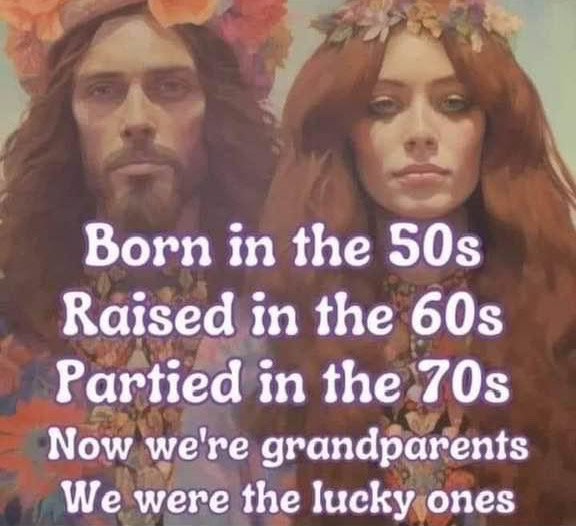
And every day can be my magic carpet ride

On a personal note, back in those dear gone days, I was a Roman Catholic and my folks were paddies and went to a school that was secular with a very strong CofE ethos. Boy Scout, Senior Scout. Working class, obedient to a degree but never deferential to the powers that be, republican from an early age, socialist when I reached the age of independence, though with half-informed thinking, got into fabulous music, went to uni, had sex, did drugs, hitchhiked, travelled the hippy trail, dodged the slings and arrows of outrageous fortune, and even worked for the MoD, emigrated to Australia, where, through hard yakka and a shitload of good fortune, I did quite well for myself. So I’ll admit that my up-beat perspective of today is to a very large degree due to my good fortune. Not that I’ve been especially astute, canny, and opportunistic, but rather, I’ve been lucky with the hands that have been dealt me throughout my life.

And that went right back to the beginning. As I have written often before, my brothers and I grew up in a a comfortable, happy home with loving parents and a great aunt, “with free medical treatment for all our ailments, and free optical and dental care. I still have crooked teeth – no fancy orthodontics on the NHS – but I have all my teeth still. And my eyesight. We were educated, for free. This came in during the war with the Butler Act. So, thanks to the Welfare State, we were housed and healthy enough to get to primary school and beyond. Once there, we had free books, free pens and paper, and compulsory sport, and doctors and nurses would turn up on a regular basis to check our vitals. When we came out the other side, we were free to make our own choices, and chart our own course through the reefs and shoals of life. And thus, we were able to reach the glorious ‘sixties ready to rock ‘n roll”.

The Spirit of ’45

Back in the days gone by

My memories are my greatest riches
From back in the days gone by ,,,…
Time moves on like a melody, and
I can hear those memories sing
Larkin Poe, Tears of Blue and Gold (2020)

Yes, my formative years were the sixties, and I wouldn’t have missed them for quids (not that I’d had anything to do with being born at the right time in the right place), when, if we wished, we were able to break free of the surly bonds of the past. I have written earlier:

“Cynics say that most people who remember the sixties were not there. Well, I was, and I remember it all so well. And was it as great as they say? Yes it was, to me at any rate. But in reality, the story of the ‘swinging sixties’ has grown with the telling. In the closing scene of The Man Who Shot Liberty Valance, the journalist says: “This is the West, sir. When the legend becomes fact, print the legend”. And much of what has been remembered, written, and said about those years has followed that maxim.

This was indeed a decade of change and ferment. Values changed, morals changed, habits changed, clothes changed, music changed (the best music ever, many have argued). The way people looked at the world and thought about it. We often look back and remark that a supernova of creativity burst over the western world during those years, the likes of which was not seen before and has never been seen again. And nowhere more so than in decadent, decaying, depressing, old England, trapped in tradition, class, and prejudice.

And yet, this revolution road was walked by but a few. The greater proportion of the populace, young and old alike, carried on as if nothing untoward was happening. Following in their fathers’ footsteps, faithful to social and economic scripts written before their time, possessed of neither time, means, opportunity or inclination to indulge in the sensual, intellectual, artistic and political playground that was accessible to students and socialites of that generation. People were more affluent, no doubt, more comfortable in a maslovian sense, more socially mobile, better educated (a relative term, this), but overall, not overly adventurous. And truth be said, many of the social and political changes that are said to epitomize the ‘sixties, were well underway during the ‘fifties and even earlier or did not reach true fruition until the decades that followed.

But for we few, we happy few, in our own private Idahos, our little self-important backwaters of intellectual and cultural elitism, times were indeed a’changin”.

London was the “scene”, and then only the West End. The rest of the was still pretty drab and monochrome. But everywhere, clothes and music started to brighten things up.

With these metaphorical themes, so then did the threads unravel, so began a journey that is now drawing to a conclusion. These were the moments I occupied, looking out onto England, but imagining the wider world. And then, from the far side of the world, where the journey will most likely end, in the midst of an Australian forest. Here we are then, with the world literally at our fingertips, as we look out onto a world that is smaller, more knowledgeable, more prejudiced, less wise, more dangerous, more enthreatened, but as ever, beautiful, unfathomable, and magical. And at times like these, perhaps like Banjo, “I somehow fancy that I’d like to change with Clancy” as he “sees the vision splendid of the sunlit plains extended, and at night, the wondrous glory of the everlasting stars”. And hope that like the Bobster, we shall “dance beneath the diamond sky with one hand waving free, silhouetted by the sea, circled by the circus sand, with all memory and fate driven deep beneath the waves”. But let’s leave the last words to AA Milne as we bid farewell forever to The House at Pooh Corner: “wherever they go, and whatever happens to them on the way, in that enchanted place on the top of the Forest, a little boy and his Bear will always be playing”.

Back In The Day

The beat goes on

When we reminisce about our “salad days”, they’re nothing more emotionally satisfying than the music we listened to; it is a portal to those times because there is nothing like songs and music from our past for unlocking memories. As the old crooner used to sing, those “magic moments” provided us with our very own soundtrack, a veritable code that even today, connects us to our contemporaries.

One constant nostalgist Facebook meme is the audio cassette tape. It inaugurated an era when it was possible to control one’s private soundscape, something we all take for granted now. It was cheap, portable, easy to use, and eminently shareable. It could live in the footwell of the a car or the bottom of a backpack. And was thrilling to those of us raised on vinyl. Suddenly, anyone with a cheap tape player could record music and share it. With its advent of the audio cassette, many of us took to compiling party tapes and car tapes of favourite songs to mark our passage from adolescence to adulthood, tapes that we would share with friends and also, with the objects of our young emotions and affections.

Nowadays, we have more ways to access music than at any time in history and a whole world of unfamiliar styles to explore, aided by instant access if we desire, to platforms like You Tube. And yet, there has been research to show that our willingness to explore new or unfamiliar music declines with age. It’s as if we believe, like American songwriter and musician Bob Seger: “today’s music ain’t got the same soul; like that old time rock ‘n’ roll”. There appears to be a consensus that people are highly likely to have their taste shaped by the music they first encounter in adolescence when our brains have developed to the point where we can fully process what we’re hearing, whilst the new experiences and heightened emotions of those years create strong and lasting bonds of memory based on pleasures past.

Donovan and Jenny Boyd wear the love like heaven

Farewell Middle Earth 

I’ll leave my conclusion to American writer, artist and Druid (yes), Cerri Lee:

I suddenly realized it is a profound and overwhelming sense of loss for their world and mine that I feel as the Elves sail away from the Grey Havens. When the Elves leave, they take with them the enchantment from the land, something dies in it and I am left on the shores of Middle Earth amidst a fading beauty, as they sail on into the distance. The realization that now humans will have no restraints in their actions and will push forward the rise of mechanism, commerce on a global scale, and a discarding of anything that even looks like ‘fluffy’ thinking. My Middle Earth will never be the same again and I am constantly mourning its passing through this story. It leads me to wonder if some part of that feeling is what drove Tolkien to write his story.

As a fifty something woman I am starting to feel my age in the way I think. Occasionally I fall pray to the “In my day” ‘rose-tinted’ view of how things were ‘back in the day’. I don’t really think times were ever any better as such, no, definitely not better. But maybe the problems seemed more understandable, more bite sized and chewable. In truth they were not, but memory is a funny thing, as we all know, it can warp and change how we view the past.

I know that things on the global scale have always been complicated, difficult and a fine tightrope walk between warring factions, people in famine and glut, all striving for a peaceful coexistence. It is only the access to media coverage that bring the problems so close to home leaving me with the sense that I am standing before the Black Gates of Mordor, with the armies of the enemy massing on the other side and the Great Eye glaring down on me from his Tower.

© Paul Hemphill 2023.  All rights reserved

Finally I understand why Tolkien’s Elves make me cry

“You want it darker?” … Gaza and the devil that never went away …

They’re lining up the prisoners
And the guards are taking aim
I struggle with some demons
They were middle-class and tame
I didn’t know I had permission
To murder and to maim
Leonard Cohen, You want it darker?

There is no decent place to stand in a massacre”.
Leonard Cohen, The Captain

The events of the past four weeks in Israel should make us all question our previous assessments and assumptions. One assumption is that antisemitism is no longer a major threat to Diaspora Jews, and that much of the talk about it was an obsession and distraction from much weightier issues that Jews should be focusing on.

The Hamas’ assault was almost perfect act of Taqiyyah, deception and dissimulation in an ostensibly Islamic cause. The term تقیة taqiyyah is derived from the trilateral root wāw-qāf-yā, literally denoting caution, fear, prudence, guarding against a danger), carefulness and wariness. It used unprecedented intelligence tactics to mislead Israel over past last months, by giving a public impression that it was not willing to go into a fight or confrontation with Israel while preparing for this massive operation. As part of its subterfuge over the past two years, Hamas refrained from military operations against Israel even as another Gaza-based armed group known as Islamic Jihad launched a series of its own assaults or rocket attacks.

One of the reasons Israel was caught unaware was because its security apparatus believed Hamas had changed its ways. Contrary to all the evidence afforded by a long history and a painful present, a belief emerged that its leaders are at least somewhat “like us” – they want the same things, they act the same way. Israel watched Hamas train for October 7 believing that the training for the real thing was itself the deception. All of the country’s formidable military technology meant nothing for the simple reason that — despite decades filled with thousands upon thousands of Hamas-directed attacks and kidnappings — they believed there was nothing on the other side of that fence to be overly alert to.

The audacity and brutality of the attack were as astonishing as its secrecy. The images of fear and bloodletting, of ecstatic attack and capture, guarantee that October 7, 2023, will become an indelible tragedy in Jewish history. Hamas probably succeeded beyond their expectation. Now they are having to deal with an Israel determined to decimate them

Since the Simhat Torah massacre, which mirrored in so many ways the pogroms inflicted upon Jewish communities in Eastern Europe in the late nineteenth and early twentieth centuries, what we’ve been seeing in cities around the world is that antisemitism is the devil that never goes away. One could also ask whether anti-Zionism is but an old hatred clad in new clothes. One phenomenon of anti-Semitism is its ­ability to mutate over history: from religious hatred to ethnic hatred to hatred of Israel in any form. If the marchers want a two-state ­solution, a pathway to peace, they do not say so. They chant “From the river to the sea”, which is a call for ethnic cleansing at best, and genocide at worst, though many do not know the name of the river, or the name of the sea.

Hamas recorded and broadcast the images of its atrocities on October 7 to make sure Israel and the world knew exactly what it had done. Israel has struck back hard on Gaza, killing many civilians in the densely populated region to reach Hamas targets. The Palestinian authorities say over 10,000 civilians have been killed, over a third of them children, and about two-thirds of Gaza’s 2.3 million people have been made homeless, unable to escape the territory. As tens of thousands flee and the bodies pile up, the brief moment of sympathy for Israel has receded and a tide of anti-Jewish sentiment is rising around the world.

International political theorist Arta Moeini wrote in Unherd on 4th November: “The moment Hamas carried out its heinous terror attacks against Israel, the war in Gaza was instantly globalised, reverberating in the hearts and minds of people oceans away who were neither Israeli nor Gazan. Millions on social media picked a side, proudly displaying their solidarity flags and condemning their opponents as either evil terrorists or genocidal oppressors. Both foreign states and populations assumed reflexive positions, railing against antisemitism or settler-colonialism and identifying with the “victims” in a Manichaean struggle that cares little for historical context, nuance or open debate. They became virtual participants in the conflict, as if their own lives and futures depended on it, cancelling and dehumanizing their opposition other just as the most extreme Hamasi Islamist or Israeli Zionist would do”.

In western, Liberal-democratic countries with some of the largest Jewish communities there are mass marches with open calls to kill Jews; there is the defacement and removal of posters of hostages being held in Gaza; and Israel is being held responsible by mainstream politicians and media figures for war crimes committed by Hamas; and there’s a flood of antisemitic poison on social media. It appears to have given permission for progressive activists to clothe antisemitism as anti-colonialism, and indeed, an alibi to say the most racist of things, and yet to retain all innocence in their own minds. And the more morally certain people are that they are right, the easier it is for them to miss their own complicity.

Rare is the criticism of the less savoury aspects of Muslim religion and society, like its patriarchal authoritarianism, its latent misogyny, and its antisemitism and homophobia. The intersectional narrative inhaled by activists, giving comfort to the “oppressed” legitimizes unspeakable cruelty against the “oppressor”. Hence, we have the sublimation of antisemitism into support and justification for the atrocities of the Hamas. [Pogrom, by the way, is a Russian-Yiddish word derived from “to destroy by violence]

Many people, particularly on the left, have forgotten or just ignore what triggered the latest bloody episode in the long running bloody saga. If you deliberately target civilians, regardless of your ideology, religion or ethnicity, you have lost all moral authority whatsoever. There are no excuses, no mitigations and no explanations. You have become the very thing you purport to hate.

For sure, an almost sixty year long occupation of the West Bank and the ongoing blockade of Gaza are criminal, and Israel’s behaviour thereby, is inexcusable. We can argue forever whether it is justifiable or necessary. But remember that in Gaza, the Hamas is a quasi-government, and a reactionary, exclusivist outfit with a “post-Israel” vision that will produce an ethnically cleansed theocratic dictatorship. And when it launched its troops on the kibbutzs of the Negev twith orders to behave like Da’ish, murdering kids at a music festival killing, raping, mutilating, and abducting unarmed men, women, children and babies, the opprobrium inevitably and unfortunately attaches to all Palestinians.

It is not helped when in the West Bank and elsewhere, such “bravery” is celebrated with sweets, ululation and “happy shots”, when people in a crowd in the forecourt of the iconic Sydney Opera House chant from the river to the sea” and “gas the Jews”, and social media is awash with memes that display but limited knowledge of the history and politics of the Middle East.

The Hamas now holds some 250 Israeli men, women and children captive in Gaza, adding to over two million Palestinians that are serving as human shields against what it knew would be inevitable Israeli vengeance. It has reportedly three months of supplies in its tunnels whilst above them, the Gazans run out of gas, food and water and medical facilities are brought to a standstill. Hundreds of thousands of civilians are now caught in a crossfire of Hamas’ making. There are reports that the Hamas is preventing Gazans from leaving, determined to use them as human shields, and has actually fired on fleeing convoys. They need to be protected, but how? We need to seek justice for Palestinians without glorifying unspeakable violence.

Luxury beliefs and historical illiteracy 

The term “luxury beliefs” was coined to describe how privileged progressives like to traffic in a kind of unhinged extremist rhetoric. Partly, it’s a byproduct of their insulation from ever having to experience the practical impact of what they advocate. When people in Australia chant “from the river to the sea”, and “gas the Jews”, relatively few are saying this because they have a material interest in obliterating the real Israel and rendering the land “Judenfrei” (remember that word!) More have no particular animus toward Jewish people – they just don’t care about them. But most are moved by a desire to weaken what Israel symbolizes: the US.

Many left-wing impressions are coloured by a an antipathy for the policies of the United States, an antipathy that for many was born of the Vietnam War and was perpetuated by America’s interference in the affairs of nations large and small since then – and of course, America’s strong ideological and military support for Israel. Uncle Sam certainly does have a case to answer. There’s no denying the hundreds of thousands, millions maybe, of bodies of men, women and children that could be laid at the foot of Abe Lincoln’s huge statue in Washington DC. But giving aid and comfort to a regime that is antithetical to your beliefs and also your lifestyle does not compute. It is an ideological stance uninformed by knowledge and awareness of the nature of the Israeli and Palestinian entities, their peoples, and their cultures in the 21st Century. None of these are what they were in the nineteen seventies and eighties.

Writing in The Australian on 29th October, commentator Gemma Tognini wrote: “As I watched mainly white, middle-class privileged (in the truest sense of that word, not the co-opted, cheapened version) people parade themselves around as soft apologists for a declared terror organization, I felt despair. How? How did we get here? … What’s been on display on university campuses since October 7 has been terrifying in its historical illiteracy, lack of humanity and ideological zealotry”.

It’s worthwhile quoting what else she had to say about such “luxury beliefs”:

“… This is the soft generation. Their grandparents fought type 2 diabetes, not Nazism. It was reported that (perhaps unsurprisingly) the University of Sydney Student Representative Council urged students to “stand against oppression … until Palestine is free”. Let me tell you one thing I’m willing to bet on. Not one of them would volunteer to go help the cause. Not one of them would give up their Uber eats, days at the pub and total freedom to go live in a place where being gay is an offence punishable by death, fewer than 20 per cent of women are allowed to work and more than 20 per cent of women are married under the age of 17. Good luck wearing a bikini or your active wear in downtown Gaza.

And then, there’s a punchline: “… this conflict in the Middle East, this visceral, existential attack on Israel, and on Jewish people the world over, seems to have ripped something open to reveal an ideological hatred that I don’t understand. It’s a good impetus to raise the voting age, to be honest. If your response to the fact that the Arab states are refusing to take refugees, that Egypt won’t open its northern border for the same reason, is “Israel’s committing genocide”, then sorry, you’re not intellectually agile enough to be in the conversation … If it were 1400 young people barbarically slaughtered anywhere else in the world, if it were any other ethnic cohort, these same junior cowards, and the universities they attend, would be condemning the act and the actors”

I couldn’t say it better, particularly her allusion to “historical illiteracy, lack of humanity and ideological zealotry”. Many people out there in the world of university politics, social media, and reflex virtue signalling, have, for a variety of reasons a limited, even cursory knowledge of the roots and fruits of intractable conflicts that originated decades, centuries, millennia ago. As the late Israeli Amos Oz explained in his excellent book, How to Cure a Fanatic, Arabs and Jews typically understand each other far better than westerners understand either of them. Cost-free wisdom from western liberals is so often pathetically ill-informed and bathing in self-righteousness.

Russia’s invasion of Ukraine did not originate in 2022 or 2014 or even 1991 when Ukraine departed the defunct Soviet Union. The wars of the Yugoslav secession did not begin when Serbia attacked the newly independent states of Slovenia, Croatia, Bosnia and Kosovo from 1991. The seeds of the Syrian civil war were sown well before 2011. So too with the story of Israel and Palestine, one of the world’s most intractable conflicts, did not begin on October 7th.

A war of words 

Understanding is not enhanced when a conflict morphs into a battle of words as well as weapons, the words invariably loaded with emotional and ideological weight. Enter the old adage “one person’s terrorist in another’s freedom fighter. The Hamas calls itself al muqawamah, resistance – it’s the “m” in its acronymic name – see below) as also does Hezbollah, which means literally Party of God (though the deity him/herself has no say in the matter). Türkiye’s opportunistic president calls Hamas fighters mujahidin, holy warriors, a name that recalls Afghanistan resistance to Russia’s invasion in the eighties. Whilst some refer to a terrorist attack, many pro-Palestinian groups have called it an intifada, as have memes and posters put up by “progressives” recalling the two earlier risings against the occupation, implying that it was the work of freedom fighters resisting colonialism. Some have even called for a “global intifada”, though against what and whom is unclear.

Then there’s the sad semantics around other descriptors, each loaded with partisanship and emotion. Self-defense. Proportionate or disproportionate response. Collective punishment. Moral equivalence. Human shields. Hostages. Refugees. Collateral damage. Just war. War crimes. Genocide. Justice, Revenge. Warriors. Executioners. Shahidiin (or martyrs). Thugs. Pick a side, pick your vocabulary to suit. It makes you wish for the now depleted ammo of syntax like “shock and awe” and “war on terror” – though we’re getting plenty of both right now as “we sit back and watch while the death count gets higher”.

Only two things are certain: antisemitism is the devil that has never gone away, and everything is broken.

As Leonard Cohen sang, “There is no decent place to stand in a massacre”.

Meanwhile, in the corridors of power

On 24th October, Antonio Gutierrez, the perennially exasperated and disappointed secretary general of the United Nations, told the Security Council that “it is important to also recognize the attacks by Hamas did not happen in a vacuum. The Palestinian people have been subjected to 56 years of suffocating occupation. They have seen their land steadily devoured by settlements and plagued by violence; their economy stifled; their people displaced, and their homes demolished.

Truth be told, it has indeed been the past that has brought us to this. Lost in the miasma of violence is the fact that Israel has occupied the West Bank for 56 years and, along with Egypt, maintained  a cordon sanitaire around the Gaza Strip. Prominent features of life for Palestinians in these areas are violence, dispossession, and dehumanization. Under these circumstances, there are few Palestinians who regard resistance as illegitimate. The ‘Hamas attack was a reaction to many things, including settler attacks on and evictions of Palestinians in the West Bank; attacks on Muslim and Christian holy sites by Israeli extremists; and Israel’s normalization with Arab countries, that is seen as an attempt by Israeli Prime Minister Benjamin Netanyahu to “liquidate” Palestinian rights and the Palestinian cause.

“But” as Guterres then stressed, “the grievances of the Palestinian people cannot justify the appalling attacks by Hamas.  And those appalling attacks cannot justify the collective punishment of the Palestinian people”. Their hopes for a political solution to their plight have been vanishing”.

Israel’s delegate was predictably enraged. But Guterres’ statement at least condemned the Hamas – unlike a UN General Assembly resolution a few days later which condemned Israel for its collective punishment of defenseless Gazans whilst completely ignoring the direct causus bellum. Making no reference to the barbarous attack by the Hamas was an absurdist denial of reality, as if Israel had decided to bomb Gaza on a whim, unprovoked.

Like Guterres, politicians across the western world endeavour to straddle the barbed wire fence, calling almost out of habit for the elusive “two state solution” as a panacea for the Palestinians’ plight. But in reality, there can be no two-state solution when an immovable and irredentist Hamas remains as a powerful if beleaguered “third state”. As Australian prime minister Anthony Albanese stated, “we have picked a side against Hamas. And we did that very clearly and unequivocally because the actions of Hamas are against the interests of both the Israeli population, clearly, but also against the interests of Palestinians”.

Calls for a ceasefire by world leaders and humanitarian organization’s go unheeded in the stark reality that a ceasefire would effectively give the Hamas the justification to declare victory whist permitting the mortal threat it poses to Israel to continue. Israel knows that if its response to the terrorists is unconvincing, the attacks on it on all sides will redouble. The sharp rise in global antisemitism reminds Jewish people that they may never be truly safe anywhere., and this intensifies, rather than weakens, the desire for a defendable homeland.

The Hamas and together with the ineffectual, corrupt and discredited Palestinian Authority which ostensibly governs the West Bank, and Hezbollah, the Lebanese paramilitary force on Israel’s northern border, most Arab states, Iran, and their western and southern sympathizers blame the situation on the historical behaviour and present policies of Israel and the US, implying that really, Israel had it coming.

There is much discussion in the mainstream media about what comes next if the Hamas is destroyed or effectively neutered and Gaza is “liberated” from its thrall. Should the IDF reinstate the occupation it ended two decades ago? Should Israel hand the enclave over to the Palestinian Authority, to use a decidedly un-Muslim analogy, organize a piss up in a brewery? Or should the UN, or at a stretch, the Arab League, a club of autocrats and tyrants, assume military and political administration until it can be reincorporated into a reformed and workable Palestine?

And even then, should any of these scenarios work out, would Israel be in the mood to make nice? The Hamas pogrom has not helped Palestinians in besieged Gaza, nor will it help those in the occupied West Bank who have been subjected to IDF incursions and vigilante violence by angry settlers. Nor will it encourage Israel to moderate its draconian policies and end the occupation.

Little mention has been made, both before and after outbreak of war of what may have been going on in the PA’s domain. The old, ineffectual and rejected Mahmoud Abbas, “emir” of Palestine, in the eighteenth year of his four-year term, is ill and probably dying, so there is a power struggle already underway in what are in fact three Palestines, Gaza, the West Bank, and the Diaspora (principally Syria, Lebanon and Jordan) over the succession. Meanwhile, Iran and its proxy, Hezbollah are stirring the pot, whilst even the Yemeni Houthis, who you’d think were busy with their own nasty civil war, the third strand, with Hezbollah and the Hamas of Iran’s “Axis of Resistance”, are lobbying missiles Israel’s way up the Red Sea.

The whole thing is a bloody mess (literally and figuratively) and the implications for Israel, Palestine and others unpredictable. The violence reminded me of the Lebanese civil war, and particularly, of Maronite Christian militia’s massacre of Palestinians in Sabra and Chatila (ironically, with Israeli connivance) in 1982. I am reminded also of Chaim Nachman Bialik’s poem, Al haShehita (On the Slaughter), about the Kishinev Pogrom in present day Moldova in the spring of 1903:

And cursèd be he that saith: avenge this! Such vengeance for blood of babe and maiden Hath yet to be wrought by Satan.

Whosoever sows the wind reaps the whirlwind.

Rafah, Gaza

From the river to the sea, Palestine will be free 

It is much more than a snappy chant. The Hamas’ stated goal is the “liberation” of what is presently Israel and the expulsion annihilation of its people, and it pays little heed for the suffering of the people of Gaza – Hamas leader Moussa Abu Marzouk, for example, in a recent interview on Russia Today’s Arabic channel, told an interviewer that his movement had not built bomb shelters in Gaza for its population because it was the job of the UN and the “occupation” – that is, Israel – to look after the civilians of the Strip.

In an interview on October 24, 2 on Lebanon’s LBC TV. Ghazi Hamad of the Hamas political bureau declared that the Hamas, was prepared to repeat the October 7 “Al-Aqsa Flood” Operation time and again until Israel is annihilated. He added that Palestinians are willing to pay the price and that they are “proud to sacrifice martyrs.” He said that Palestinians are the victims of the occupation, therefore no one should blame them for the events of October 7 or anything else, adding: “Everything we do is justified.”

Some extracts:

“We must teach Israel a lesson, and we will do this again and again. The Al-Aqsa Flood is just the first time, and there will be a second, a third, a fourth, because we have the determination, the resolve, and the capabilities to fight. Will we have to pay a price? Yes, and we are ready to pay it. We are called a nation of martyrs, and we are proud to sacrifice martyrs”.

“We did not want to harm civilians, but there were complications on the ground, and there was a party in the area, with [civilian] population … It was a large area, across 40 kilometres”.

“The existence of Israel is illogical. The existence of Israel is what causes all that pain, blood, and tears. It is Israel, not us. We are the victims of the occupation. Period. Therefore, nobody should blame us for the things we do. On October 7, October 10, October the millionth – everything we do is justified”.

Hamad: “The occupation must come to an end … I am talking about all the Palestinian lands”
News anchor: “Does that mean the annihilation of Israel?”
Hamad: “Yes, of course”.

If the Arabs put down their weapons today, there would be no more violence. If the Jews put down their weapons today, there would be no more Israel.
Golda Meir, Israeli prime minister, 1973

© Paul Hemphill 2023 All rights reserved
Note: al Hamas is the Arabic word for ‘zeal’ and also, an acronym for Ḥarakah al-Muqāwamah al-ʾIslāmiyyah, the “Islamic Resistance Movement”; Hezbollah means ‘Party of God’.

For more on antisemitism in In That Howling Infinite, see: Little Sir Hugh – Old England’s Jewish Question; and The Shoah and America’s Shame – Ken Burns’ sorrowful masterpiece 

For more on Palestine and Israel in In That Howling Infinite, see: A Middle East Miscellany

Addendum – poster wars

Why are Americans tearing down posters of children held hostage by Hamas?

Linda Dayan wrote in Haaretz on 26th October:

Those removing flyers may not be ready to look into the eyes of ‘the other side’ and acknowledge that they are people. But the consequences of this lack of introspection go far beyond posters

If you’re a Jew on Instagram, you’ve probably seen a particular genre of video going around: a shaky phone camera follows a person, either in a big city or on a college campus, as they tear down posters bearing the names and faces of Israeli civilians kidnapped by Hamas.

Sometimes they’re smiling, sometimes they’re defiant, sometimes they hide their faces from the person filming them. In one, the person says “kalba” (the Arabic word for bitch) while tearing down a flyer. In another, a man holding a wad of posters says he is doing so because “Jews in Israel – I mean, the Israeli government – are bombing Gaza.” When the cameraman asks, in a thick Israeli accent, why Hamas killed babies and even pets, he responds: “I can’t explain what people filled with rage do.”

Channel 12’s Yuna Leibzon tweeted photos from New York of posters that had been defaced – instead of “kidnapped,” they now read “occupier.” (If the person who did this is not Algonquian, I have unfortunate news for them about their own status.)

It is clear that the posters rouse discomfort in these people, and not in the “this could have been me” way that many Jews view them. Some, like the aforementioned man, look into the faces of abducted children and see the airstrikes that followed. Others have mentally transformed them into human embodiments of the occupation. A few accounts state that the people tearing down the posters do not believe that Hamas took hostages at all.

The people kidnapped by Hamas, much like the October 7 atrocities, represent a kink in a very clear narrative thread. The people holding tight to this thread might not be ready to face the realization that not all acts are justified so long as they bear the banner of “resistance.” They might not be ready to hold the idea that it’s okay to say out loud that the occupation is wrong, but so is holding an infant hostage. They might not be ready to look into the eyes of “the other side,” and acknowledge that they are people.

But the consequences of this lack of introspection go far beyond posters and posing. After a silent vigil in which they held photos of the kidnapping victims, Jewish students at the Cooper Union had to barricade themselves into the library as anti-Israel protesters stormed the building. The Anti-Defamation League reported 193 antisemitic incidents since October 7 – a 21 percent spike in the United States. A University of California, Davis, professor posted online against “all these Zionist journalists who spread propaganda and misinformation,” and noted that their children are vulnerable.

It is good, correct and just to stand up for Palestinians, to make the plight of Gazan civilians known, to mourn for the innocent lives lost. None of that demands erasing the reality of Hamas’ campaign of kidnapping and murder. And none of that demands harassing, threatening and attacking Jewish institutions and individuals, wherever they may be.

Of course, this may not be about Palestinians at all: Alawi and Shi’ite students in America did not have to barricade themselves in after Bashar Assad’s airstrikes on the Yarmouk Palestinian refugee camp. And in that case, perhaps these people can leave the Palestinians out of such campaigns, and be open about the narratives and ideologies that drive them to erase the faces of our children.

A defaced poster depicting a woman held captive by Hamas is seen as people attend a pro-Palestinian rally as part of a walkout by New York University students

Authors Note

Whenever In That Howling Infinite posts commentaries such as this, people ask why I rarely forward my own opinion on the issues I am presenting or discussing. On the contrary, I would argue that my views are fairly transparent in in the subjects I chose to engage with, the words I use, and the vein in which I use them. 

The following is an updated version of a postscript I wrote six years ago after I’d last visited Israel. It does not mention in detail the events since then, including the Israel’s rapprochement with its autocratic neighbours, the political paralysis that has afflicted Israeli politics for several years, and the war now being wages in the besieged enclave of Gaza. The rest still holds true.

With respect to my numerous posts about Israel and Palestine, and the Middle East in general, I  come to my conclusions from a political science and sociology perspective – that’s where my academic experience came from – and a background in conflict resolution, supported by study and travel. If I do on occasions display any particular bias, it originates in my longtime interest, understanding and affection for the history, politics, and culture of the region, of its geography and archeology, and of its people of all faiths and nationalities.

I believe that the systematic dispossession of almost a million Palestinians and the destruction of half of their towns and villages in 1948 is Israel’s original sin. It is the primal stain that colours and corrupts all that followed. And yet, if not for the actions, often daring, often brave, often questionable, and often deplorable, of the politicians and soldiers of 1948 – and of the generations that followed –  Israel would not exist today. This paradox is addressed sympathetically by Avi Shalit In My Promised Land, referred to above, and scathingly by ‘new history’ scholar Ilan Pappe in The Ethnic Cleansing of Palestine.   

The Occupation, fifty-six years old this year, which grew out of the unexpectedly total victory of June 1967, has taken on strategic, ideological and indeed messianic dimensions by many in the  Israeli government and political elite. It compounded the original sin, deepened the primal stain, released the demons of messianic fervour, and wounded Israel’s soul. The settlements locked the nation into the colonialist project. With the close call of the Yom Kippur War, the violence and murder of the first and second Intifadat, and present Palestinian jacquerie, Israel’s heart has not just hardened, it has become sclerotic.

I admit that I have always been sympathetic towards Israel – from my first visit in 1972. I’ve travelled its length and breadth and also visited the major Palestinian cities of the West Bank. But mine is not a blinkered viewpoint. I am deeply critical of Israeli politics and policies and have no respect for many of its leaders. Yet there are hundreds of thousands of Israelis who oppose the present government and long for justice and peace. And if – a very big “if” – Arab Israelis and the Israeli left could work together, they could obtain a majority in the Knesset and change Israel’s politics.

Meanwhile, Binyamin Netanyahu and his nationalist coalition allies call all the shots, the Israelis continue to control and exploit the land, its people, and its resources, whilst varying degrees of annexation are on the cards. The settlements are an abomination, as are the policies and practices of the state and its occupying army. There’s no escaping these facts.

But I am likewise critical of Palestinian governance, politics and politicians. The Hamas and the PA are on the nose in their respective fiefdoms, and if a moderate “third force” were to arise – and survive, because sure as hell, they would risk being murdered – Palestinians who just want a quiet, normal life, adequate services, and opportunities for their children, and Israelis who want likewise, might – just might – reject their extremist, dogmatic, entrenched leaders and reach some form of modus vivendi.

Palestinians themselves have to take control of their own lives, kick out their corrupt leaders, cease inculcating their children with hatred and jihadism, and use all that international good will and dollars to build a viable economy that can provide jobs, opportunities, and security, economic and physical to the people. Only this way will they be inoculated against cronyism, corruption and extremism. And yet, the dead hand of a moribund, patriarchal, conservative and ethnocentric culture holds them back – but that is the subject of another, future discussion for In That Howling Infinite.

Today, the ‘powers that be’, defenders and beneficiaries of a status quo that looks more like a cul de sac, predominate over a dispiriting array of competing, clamouring factions, left, right, nationalist, secular, tribal, Haredi, and Islamist alike. New, young, brace, local voices in both Israel and Palestine, are not heard.

So what happens next?

I get that question too. And I am perennially reluctant to venture an answer beyond one that runs like “on the one hand…but then on the other”.  I inevitably fall back on Robert Fisk’s response to the same question with regard to the calamitous freezing over of the Arab Spring and the fall and rise again of the same old autocrats and tyrants: “my crystal ball is broken”. It’s a cop out, really, but just as cogent as that famous line in that UK spy drama Spooks: “What’s going to happen to me?” “Bad things!”

One thing is for sure: as songwriter Warren Zevon sang, “the hurt gets worse, and the heart get harder”.

October 8th, 2017, and 6th November 2023

The new anti-Semitism looks a lot like the old hatred

The current wave of anti-Jewish hostility did not originate with the Gaza war, and its horrors. It has been building for decades.

Anti-Israel signs are held at a Palestine rally in Melbourne’s CBD. Picture: NCA NewsWire / David Crosling

Anti-Israel signs are held at a Palestine rally in Melbourne’s CBD. Picture: NCA NewsWire / David Crosling

Since the Hamas mass terrorist attack on October 7 and Israel’s military response, we have witnessed an explosion of anti-Jewish hatred. It is frequently mixed in with legitimate expressions of support for Palestinian civilians suffering the terrible violence of a protracted conflict. The Netanyahu government’s conduct of the war is certainly a reasonable target for trenchant criticism, including by Israel’s own citizens.

The combination of these themes makes the public response to the Gaza war complex and difficult to process. For most Jews it is nothing short of a continuing nightmare.

Deep anti-Semitism has been on vivid display in certain parts of the movement leading the anti-Israel protests. This has been explicit in celebrations of Hamas and its terrorist massacre of Israeli civilians as a heroic act of resistance, together with calls for such attacks to be repeated. This has been paired with simultaneous insistence, in some quarters, that no atrocities were committed. The dual response is reminiscent of a certain type of Holocaust denial. On one hand the mass violence that the Nazis committed against European Jewry is justified as a response to the odious behaviour of the Jews, and the threat that they posed to their host societies. On the other the historical reality of the Nazi genocide is questioned, or it is denied entirely.

Shalom Lappin.

Shalom Lappin.

The New Antisemitism by Shalom Lappin

The New Antisemitism by Shalom Lappin

Some anti-Israel demonstrations have skidded into violent assaults on local Jewish communities, and harassment of Jewish students on campuses around the world. Boycotts, exclusions, and “political” acceptability tests in the academic, publishing and entertainment worlds are now common phenomena. They recall darker periods of Jewish history. No other diaspora ethnic group associated with a country run by a widely censured regime is subject to this sort of marginalisation.

When racists target Muslims, or other immigrant groups after terrorist attacks, or the misdeeds of a foreign government, broad segments of public opinion, particularly on the liberal left, defend the victims of prejudice, precisely as they should. By contrast, attacks on Jews are explained away as possibly misguided expressions of fully comprehensible outrage at Israel’s egregious behaviour.

The current wave of anti-Jewish hostility did not originate with the Gaza war, and its horrors. It has been building for decades, as indicated by the steady annual increase in anti-Semitic incidents across the globe, at least since 2000. This has now become a flood. It is the result of deeper economic and political forces that have undermined the social contract that once defined the post-war era. A sharp rise in economic inequality within countries across the world is a major factor driving the unravelling of the post-war era. The unconstrained globalisation of financial markets and trade has been largely responsible for the skewed within-country (as opposed to between-country) distribution of wealth. It is creating a cleavage of populations into a comparatively small group of wealthy beneficiaries of economic growth, and increasingly large groups of people who endure a declining standard of living and jarring social dislocation. This disaffection has provided the basis for a variety of extremist anti-globalisation movements that exploit identity politics as the focus of their reaction to the chaos and instability that is attending the collapse of the post-war order.

A pro-Palestine activist in New York. Picture: AFP

A pro-Palestine activist in New York. Picture: AFP

These movements thrive on the sense of powerlessness among electorates. This is feeding a breakdown of mainstream political institutions, which are increasingly perceived as unable to respond effectively to the pressing problems that people are contending with in their daily lives. Polarisation between far-right and far-left anti-globalisation movements has now become a defining feature in the political life of many countries, with traditional centrist parties fading into irrelevance in a variety of places. The alliance of much of the far left with radical Islamist movements (also a form of anti-globalist, identity-focused reaction) has accentuated this clash. The nature of the alliance has come sharply into view in the course of the ongoing anti-Israel protests over the past 10 months.

The far-right threat has emerged in recent European elections, in Trump’s current presidential campaign, and in the current riots sweeping the UK. It is also apparent in the authoritarian regimes that control Russia, Hungary and Turkey, as well as in Modi’s Hindu nationalist government.

Anti-Semitism is a central feature of the anti-globalisation movements of the far right, the far left and radical Islamism. This is due to the fact that it is deeply entrenched within both Western and Middle Eastern cultures. It encodes myths of power and conspiracy that provide simple, satisfying answers to complex problems in times of severe crisis. It turns on the notion that the Jews are an illicit collectivity whose continued existence as a group obstructs the realisation of the respective (and mutually incompatible) utopian programs to which each of these movements is dedicated.

Anti-Semitism was marginalised in the West during the post-war period. It has now flooded back into mainstream discourse as a potent factor in mobilising support for totalising ideologies across the political spectrum. In its capacity to cross political boundaries from right to left, anti-Semitism is a unique form of racism. To identify it properly, it is necessary to understand its history throughout the millennia that it has plagued the societies where it has taken root. It is essential to recognise its very specific expression as a reaction to the current political and social crisis. It is also important to combat it in its current manifestation, rather than through the backward-looking ideologies of the past.

For the most part the gate keepers of liberal opinion and the custodians of public discourse have simply stepped aside while anti-Jewish campaigns, often packaged as “anti-Zionism”, have been raging in their institutions. They issue pious incantations of their commitment to banishing racism, gender discrimination, anti-Semitism and Islamophobia, while doing nothing to implement this commitment in the current crisis. They take strong action against assaults on other embattled ethnic minorities and gender groups, as ought to be the case. They assume the role of neutral moderators when such attacks are launched against Jews. They frequently sanitise these attacks as an exercise of the right to free speech, even when this speech crosses into active incitement to hatred and violence.

The current wave of anti-Jewish racism is not only a threat to Jews. It is a challenge to the survival of democracy and the viability of liberal values. Political leaders are singularly failing to address this threat, and the forces that have produced it. They are largely content to step back and allow the manifestations of anti-Semitism to multiply, as long as the appearance of public peace is maintained. In fact, this peace is increasingly frayed. The extremist movements that converge on the Jews as the source of their problems have much larger agendas. They seek to transform the social order in their own image, overturning the foundations of liberal democracy.

In treating anti-Semitism as a parochial development, threatening only Jews, current political and cultural leaders are allowing large swathes of public life to be taken over by movements that are determined to overturn democracy. Recent history is littered with precedents that warn of the dangers involved in ignoring the larger threat that anti-Semitism presages. By failing to address these movements, and the deeper causes of the crisis that generated them, political and cultural leaders in the West risk repeating past historical errors that have led to disastrous consequences. It is long past time to address this issue honestly and effectively. To start to do so requires that we acknowledge the extent of the problem, and that we describe it accurately. Most people who shape mainstream opinion in the West have yet to take this initial step.

Shalom Lappin’s The New Antisemitism (Polity Books, 1 September) investigates the upsurge of anti-Jewish racism now manifest across the world

.

Thinking globally, acting locally – how landowners can protect koalas

It is generally acknowledged that we in Australia, as elsewhere on Earth, are facing an extinction crisis brought on by climate change and environmental destruction. We see in our own little part of the planet the crisis in microcosm, with accelerated clear fell logging operations in the state forests immediately adjacent to our towns and villages, and in close proximity to our rivers and flood plains with most of the timber extracted from these forests destined for chipping on the wharfs of Port Brisbane for shipping to Asia, or to feed the ostensibly “green” bio-mass power plant at Broadwater, near Byron Bay.

Such harvesting is highly aggressive. It is clear-fell by highly sophisticated and costly harvesters rather than selectively harvest by chains saws as in the past, followed by burning of what cannot be sold off in windrows or in power stations, and ground-spraying of the naked land with a cocktail of toxic chemicals. There is then plantation re-establishment with highly flammable eucalyptus monoculture. All this on moist forest escarpments and lowlands bordering large rivers, where, with heavy rains and frequent flooding, everything – soil, ash, and poison, flows downhill. Ongoing clear-felling in the state forest plantations closely rounding Bellingen and its peri-urban areas adds to the cumulative impact of similarly aggressive harvesting operations in other forests in the Coffs Harbour and Bellingen region in recent years.

Here in Bellingen Shire, people report refugee koalas, many sick, injured and starving, koalas on roadways, in backyards, and on bush properties like our own that border the logging areas. And it is not just our iconic koalas who are threatened by what is in all but name a highly mechanised and relatively unregulated extractive industry. For residents close to and adjacent to these areas, it is equivalent to living next to a open-cut coal mine.

Sitting on the edge of the wilderness
An injured koala beside the clearfell

There are many other protected and endangered species living in the understory and old habitat trees in plantations that are “waiting for the chop”. These include koalas, quolls, sooty and powerful owls, great barred frogs, and fruit doves where forty years of native forest ingrowth and state plantation neglect have ensured the development of a biodiverse ecosystem. But the fragmentation of forest, logging in both state and private forests is destroying the connectivity of healthy koala populations, and koalas are increasingly forced forced to survive on the fringes of the state forests in private landholdings.

So, what can we who live on these borderlands do?

As habitats come increasingly under threat, and as reform and remediation take time, private landholders must do all they can for themselves and for the environment. One option available to them is a legally binding agreement between the landholder and the Biodiversity Conservation Trust under the NSW Biodiversity Conservation Act of 2016

Local Land Services NSW also offers partnerships concentrating specifically on the protection of koalas. It has successfully delivered a koala project, funded by the Australian Government, that focused on recovery actions that protect, enhance and restore Koala habitat on private land in four key Areas of Regional Koala Significance (ARKS) between Port Macquarie and Coffs Harbour. Below is a short video presented by LLS officer Asheley Goodwills about the project, focussing on Bellingen Shire.

LLS’ website notes:

“Koalas are uniquely Australian. They are one of our most loved and iconic animals and people come from all over the world to see them. Koalas, like all native animals, are culturally significant to the Indigenous People of the lands in which they live. Unfortunately, koala populations are more and more at risk of decline for a variety of reasons.

A growing human population, particularly in areas along Australia’s east coast, has led to large-scale clearing of better-quality koala habitats with many koala populations struggling within smaller, fragmented patches of poorer quality habitat. Other threats, such as drought, fire, climate change, disease, vehicle strike and dog attack are further impacting koala populations.

Creating ‘habitat refuges’ in areas remote from, and resilient to, such threats is extremely important for long-term koala persistence”.

What are Conservation Agreements? 

They are designed  and financed by NSW government’s department of environment and heritage, it is available to landholders who demonstrate that their property or part of has conservation value in flora or fauna or both and who wish to preserve its environmental integrity and biodiversity through an agreement creating a Wildlife Refuge or a Conservation Area.

What do they mean?

• The landholder establishes legal protection over a specific part of their property, effectively safeguarding it from logging and from development that might compromise its ecological integrity.

• Conservation agreements are entered on the property’s certificate of title.

• There are a range of options through the BCT or also private covenants that can be on title. Some conservation agreements are in perpetuity; others can be terminated by a future owner.

• In return for preserving part of the property, the landholder can obtain practical and financial help to preserve, protect and enhance its biodiversity.

What are the drawbacks to a conservation agreement?

• Landholders may be worried about an affectation on title and may therefore be reticent about entering into an agreement for perpetuity.

• Prospective buyers may also be reluctant to undertake the obligations under the agreement.

• But times are a’changin’ and increasingly, landholders and potential purchasers of properties in areas of ecological value are interested in conserving and enhancing our natural environment and are willing to do play their own part.

• Real estate agents, valuers and banks are becoming more and more accustomed to dealing with properties containing Wildlife Refuges and Conservation Areas.

What are the landholder’s obligations?

• To maintain the property and keep it in good order.

• To take practical steps to improve its conservation values and prevent harm to its biodiversity.

• To carrying out work where necessary to protect flora and fauna and soil and drainage, and to control invasive weeds and feral animals.

• To permit inspections by BCT to ensure compliance, review work, and undertake surveys and research.

What are the benefits to the landholder?

• The individual landholder can make an important contribution to the long-term conservation of biodiversity in NSW.

• An important incentive of the Conservation Partners Programme is that owners can apply for a conservation partner’s grant. Grants available for Conservation Areas are larger than those available for Wildlife Refuges. They are utilized to maintain and enhance the ecological integrity and biodiversity of the land.

• They can be applied to a range of activities, e.g. revegetation, weed and feral animal control, and infrastructural repairs and maintenance, including access trails, drainage and fencing.

• BCT provides advice and guidance throughout the process, including how to complete the application, recommending contractors, and assessing their quotations.

What is the agreement process?

• The landholder contacts BCT and submits an “expression of interest” in making an agreement. BCT arranges a site visit to explain the process and undertake a preliminary inspection.

• The landholder decides whether the agreement is for a Wildlife Refuge or a Conservation Area.

•An application is submitted providing property details, the area/areas proposed to be conserved, and the landholder’s assessment of the ecological values.

• BCT engages a professional ecologist to provide an expert opinion, make an assessment, draft supporting maps, and recommend whether an agreement should proceed after which BCT decides to make the agreement and commences its preparation.

• The landholder provides supplementary information and schedules, including maps showing what areas are included and which are excluded, e.g. buildings and infrastructure.

Who do you call?

• Bct.nsw.gov.au; info@bct.nsw.gov.nat; 1300 992 688

• You can also reach out to North Coast Local Land Services about natural resource management and funding opportunities. Call 1300 795 299 or emailadmin.northcoast@lls.nsw.gov.au

What are we doing in our Conservation Area?

• We are in year one of a three-year grant cycle with a grant of $15000 a year. and have engaged an experienced local regenerator recommended by BCT.

• The team is engaged in extensive vine and weed control (particularly lantana which may attract invasive bell myna).

• We are very pleased with its work, particularly as it provided good feedback on species present and has identified rare flora that we had not expected to find.

• BCT has been fabulous throughout the process, providing advice and encouragement.

Further posts in In That Howling InfiniteThe agony and extinction of Blinky Bill; Paradise Regained – back to nature in Queensland; The Bonfire of the Insanities – the biofuel greenwash

Koala Detection dogs

We have encountered two koalas on our property over the last two years, including a breeding female with a joey, and we’ve had the good fortune to have been assisted by Canines for Wildlife. 

Here is a lovely film of the detection dogs in action made by our friend Sarah George. They also feature in the LLS film featured above.

Scat hunting on our conservation area

Scats of a female koala and it’s joey found by Canines for Wildlife in our conservation area

Our latest koala high up in a tallowood

Author’s note

We live in heart of the Tarkeeth Forest, some ten kilometers from the seaside town of Urunga on the mid north coast of New South Wales.

The forest rises on Fernmount Range from the Bellinger River to the north and Kalang River to the south forming a watershed and providing a vital connecting forested corridor for koalas between the habitats of the hinterland and coastal lowlands. Above and between the two rivers, the forest is an important rain-harvesting, filtration, and stabilization ecosystem vital to the wetlands and rivers. The lower estuary is formed where the two rivers converge, creating a large and dynamic system which flows into the Pacific Ocean at Urunga.

It is an important habitat for bird, reptilian, mammalian and marsupial wildlife, including koalas, quolls. wallabies, echidnas, goannas, owls, fruit doves, and cockatoos.

The east-west Fernmount Range Trail is an ancient highway from the plains to Urunga, known to the Gumbaynggirr nation as a “place of plenty”. The forest contains areas of significant indigenous culture, recalling song lines and stories of the Dreamtime, places of ceremony, of birth and burial, and of atrocity.

This land was rainforest once. In the late nineteenth and early twentieth centuries, much of it was cleared manually and laboriously for dairy farming, and in the late sixties, most of the landowners sold their farms to Australian Pulp Mills. APM cleared the farmland and established the flooded gum plantation that is now Tarkeeth State Forest to supply a paper mill that was to be built just south of Coffs Harbour. This never happened – the project’s planners had inexplicably overlooked the lack of a massive water supply. Eventually, the plantations were sold to the government-owned Forestry Commission of New South Wales – now Forestry Corporation NSW. The plantation has now been harvested – clear felled, actually, burned, sprayed, and replanted with a highly flammable eucalyptus monoculture. – a matter of considerable concern to us forest neighbours and to many in the Shire.

Getting back to the garden – Tom Holland’s Dominion

The Battle of Basildon 2011

There’s a whisper in our souls – the world has suffered long.
Beneath these skies have rolled two thousand years of wrong.
Bless This Day, Paul Hemphill
(after Edward Sears’ carol It Came Upon A Midnight Clear)

There’s a memorable scene towards the end of Martin Scorsese’s masterful adaptation of Nikos Kazantzakis’ historical novel The Last Temptation of Christ (he also wrote Zorba the Greek) in which the peregrinating proselytizer Saint Paul meets a raised and reluctant Jesus who has sought domestic anonymity in contented cohabitation with reformed hooker Mary Magdalene – or so we are led to believe, for there is more than meets the eye in this iconoclastic film (the soundtrack alone, Passion, by Peter Gabriel, is more than worth the price of admission). “I am so glad that I’ve met you”, says the pompously dismissive Paul, “and now, I can forget you”.

I thought of this scene often whilst reading British historian Tom Holland’s revelatory and wide-ranging Dominion (2019), recounting the origins and the transformative and disruptive influence of the world’s biggest faith. Saint Paul, a central character in the drama, has a lot to answer for – though the Persians, Greeks, Romans, Jews and Muslims are significant supporting actors.

Tom Holland is an erudite British historian, specializing in classical and early medieval history. I’ve read many of his books. His Roman trilogy, RubiconDynasty and his recent Pax read like thrillers, as does In the Shadow of the Sword which chronicles the rise of Islam. He’s also written on Greek and Persian classical history. Together with fellow historian Dominic Sandbrook,, he writes and broadcasts The Rest is History, an excellent podcast [Sandbrook is an informative and entertaining authority on postwar British history and society, and his quad of books on the fifties to the early eighties are wide-ranging and highly entertaining and informative – particularly so as I actually grew from boy to man in these dynamic decades.

In an earlier book, Dynasty, the saga of the Augustan caesars, Holland wrote: “The age was a rotten one: diseased, debased and degraded”. But to us, two thousand years on, it seems like it was always thus. He doesn’t shy away from criticism. All over Europe and the New World, Holland writes, “in church after church, we encounter the same fascinating admixture of the salacious, the sexual, the sadistic, and the sacred”.

We of the western world are heirs to a civilization that has for two millennia endeavoured to get back to the garden – in a continual cycle of striving for perfection and falling into to evil ways. 

Holland argues that all “western” moral and social norms are the product of what he defines as the Christian revolution, a revolution that continues to shape the modern world. Even if churches across the West continue to empty, Christian values continue to define who we are and the battles we choose to fight. In a recent interview in The Australian occasioned by the imminent arrival DownUnder of The Rest is History podcast’s roadshow, Holland refers to instincts and muscle memories that derive from 2000 years of Christianity.

Though Christianity’s spiritual roots go deeper than year one of the Christian era, it had to actually begin as it did – with believers. As American author EC Morgan wrote in her magnificent Deep South epic The Sport of Kings, “Our stories about life and death are meaningless if they aren’t shared. Community is what religious faith is all about. Believers are persistent. They refuse to forget. Without believers, the sacrifice of Jesus Christ would have been forgotten, a lost relic of history, just the story of a wandering radical with a vision for a new kingdom. It was only the witness of a community through storytelling that transformed Jesus’ tragic death into God’s ultimate sacrifice. In their rebelling, he was no longer a political dissident put to death by the state, but a hero”.

Holland is not a nostalgic Christian who reads history. At the time of Dominion’s publication, he confessed to being an atheist. Like atheists, including myself, he sways to the rhythm of a spiritual drum. He is, rather, a historian observing the influence of Christianity without making moral judgments. He says large swathes of Western modernity are having arguments within a Christian framework, often without realising it.

Even those who reject religion – those who hold to atheism, humanism, scientism, secularism, egalitarianism, feminism, and many other ‘isms, find their beliefs ineradicably shaped by Christian preconceptions, prejudices, and, indeed, superstitions. Holland writes that Christianity continues to infuse people’s morals and presumptions “so utterly that many failed even to detect their presence. Like dust particles so fine as to be invisible to the naked eye, they were breathed in equally by everyone: believers, atheists and those who never paused so much as to think about religion … perhaps the most compelling point is the way Christianity defines even its opponents. Even as the woke generation condemns Christian history as oppressive, patriarchal, racist and all the other now-standard derelictions, the standards of justice and equality by which they judge these shortcomings remain ineradicably Christian. In that sense, Holland concludes, Christendom will remain with us a while yet”.

Our conservatism, our fear of change, our contempt for “the other”, our atavistic hopes and fears, our yearning for renewal and revolution, and in the contemporary argot, our political correctness and value signaling, even – our love for our neighbour and our intolerance of his and her resistance and reticence, doubt and difference, our hostility and our hubris, our ethnocentrism and our ecumenism, all spring from the same source: that lowly stable in a satellite suburb of Jerusalem, in the Roman colony of Judea two millennia ago. O Little Town of Bethlehem, how still we see thee lie

In his interview with The Australian, Holland said that at the centre of social movements of the ’60s and onwards, from civil and gay rights to the more recent Black Lives Matters and #MeToo is “Christ’s great promise that the last should be first”.

“The 1960s will come to be seen as a decade as significant for Christendom as the 1520s. We are living through a process of moral and ethical and, indeed, theological change comparable to the Reformation in the 16th century. And the idea of reformation, the idea of casting off superstition, idols, opening yourself to the spirit. You get that in the 1520s, and you get that in the 1960s. The difference in the 1960s is that what is being cast off is essentially what you might call a conservative Christian understanding of how society should function, going to church, experiencing liturgies, Sunday schools, familiarity with the Bible.”

There is, he continues, “a kind of Christ-shaped hole in our public culture. And George Floyd kind of filled that gap for that summer of 2020 … Two thousand years of Christian sexual morality had resulted in men and women widely taking this for granted. Had it not, then #MeToo would have had no force”.

Again, Holland makes no judgment about this. He is simply observing that Christianity explains “woke­ism”, whatever that portmanteau word might mean to the mind of the beholder. Not to mention our polarized and argumentative modernity.

Whatever Holland’s own spiritual beliefs – in Dominion he is quite discreet – there is a curious dualism, disconnect even, in the manner in which Dominion has been presented to its prospective readership. On the one hand, it is offered as an essentially humanistic tract linking the rise and rise of Christianity with humankind’s eternal striving for perfection of a sort. When I bought the book, it this aspect that drew me to it after reading the reviews I republish below. And yet, as illustrated by its two distinctively different covers, it has also been deliberately targeting a Christian market. here they are, the opaquely secular and the transparently sacred.

But, back to Dominion.

The reviews below provide an excellent overview of the scale and achievement of Holland’s project. I see no reason to compete with them. but I must add that I was mightily impressed by the literal cast of thousands he assembled to tell his story. There are many surprising and entertaining but always pertinent segues, from Adam to Zarathustra (of Nietzsche fame), with cameo appearances from a long-dead famous white men, iconic persons of colour like Martin Luther King, Nelson Mandela and Desmond Tutu, some most impressive women, and contemporaries as diverse as Harvey Weinstein, Margaret Atwood and Angela Merkel. There is a cornucopia of texts from Job’s tears to John Lennon’s Imagine, a connecting of movements and zeitgeists from crusaders to slavery abolitionists to #MeToo, from the protestant reformation to revolutions political and social, and a globetrotting, time-shifting odyssey from Megiddo to Mordor, the Crucifixion to California Dreaming.

Surprisingly, the Bard of Avon doesn’t earn a guernsey. You won’t find him in the glossary. It was after all he who held up a mirror to our humanity, and who is in his turn held most highly in the canon of our Anglosphere. Is it because there was no room at the inn? Because that rundown inn in that little town of Bethlehem, is the alpha and omega, the hopes and fears all our years, and they abide with us still.

And by us, I also include myself. My father was an Orangeman from Ulster, and my mother, a Catholic from County Wexford. I was born in Birmingham, England, baptized as a Catholic, and raised as a Catholic. I was educated in the British cultural milieu, with Roman Catholic teaching and thinking, but received prodigious input from a British upbringing and an education in an English grammar school grounded in the Church of England and replete with the history of invasions, civil wars, reformation, revolution and empire.

 All these laid the bedrock of my spiritual and cultural identity. Much of this was inherited from “priest-ridden Ireland” and its centuries of resistance to the Sassenach (Saxon, that is) overlord, from whence I acquired most of my DNA and to which I ascribe to myself (a subjective thing and not for others to judge) a Celtic soul and a rebel heart.

“Once a Catholic, always a Catholic” they used to say to me when I’d declare that I’d given up practicing when I was good enough. That was not long after my confirmation by the Archbishop of Birmingham in St Chad’s Cathedral. There was no great epiphany. No revelation from the sea of unknowing. I remained in a Catholic scout troop and participated in church parades and attended mass of a Sunday to pleased my mother. I just kind of slip slided away, and then came the sixties with its Marx and music, and all the rest: the sights, sounds, sensibilities and substances of that generous decade …

But, as my songs and stories and politics attest, like Holland, I’ve not ventured all that far from the mother ship.

As a parting disclaimer, I am named not for Saint Paul but for the acclaimed American socialist and singer Paul Robeson.

Lord of the starfields
Ancient of Days
Universe Maker
Here’s a song in your praise
Bruce Cockburn

We are stardust
Billion year old carbon
We are golden
Caught in the devil’s bargain
And we’ve got to get ourselves
Back to the garden

Joni Mitchell, Woodstock

Featured picture: Dale Farm – The Battle of Basildon 2011

© Paul Hemphill 2023 All rights reserved

Postscript

By 2025, Tom Holland has openly returned to the Christian fold, as have many prominent intellectuals, including historian Niall Ferguson, or converted like and his wife, activist and author Ayaan Hirsi Ali who was formerly a Muslim. The reasons why such thinkers seek the transcendent in their later years is beyond the remit of this review, though Holland admits to having been wrong about Christianity, that his spiritual quest led him to Dominion. now come to see Christianity as the story of power willingly spent on behalf of the vulnerable; strength deployed to protect the weak, power that is used to take the vulnerable off of crosses, rather than put them there. https://theopolisinstitute.com/tom-holland-and-the-liberating-power-of-christianity/

As for myself, I still hear the thrum of that spiritual drum, but even though I head for that inevitable final exit and the “great unknown”, I do not hear the call of the numinous. I was unexpectedly presented with an opportunity to contemplate this recently when old friend of my own age shared with me the story of how he’d taken the hallucinatory drug mescaline for the first time in a bucolic Welsh setting in 1972:

“I had an experience of enlightenment, of self-discovery, that transformed my understanding of the world. I realised that all is one, and that this One is what ‘I’ am – an unborn, undying, eternal, formless Reality – that is all that exists and all that has ever existed – and that this world of form that we perceive is nothing other than this formless Reality. This experience led me down the path of spiritual search from that moment on. Scriptural writings like the Upanishads which had previously seemed obscure and impenetrable suddenly became dazzlingly clear to me as I realised that their writers were describing the experience I had just had myself. I found numerous teachers who were describing the same experience and showing a path to discover it. I felt a particular affinity for the teaching of the South Indian guru Ramana Maharshi, but also found my experience reflected in the teachings of the Sufis and the Zen masters”.

Though I too had taken mescaline and acid in the late sixties, I did not travel down such paths. “For whatever reasons”, I wrote him back, “nature, nurture or narcotics, I’ve never experienced anything like what you describe, nor, for good or ill, have I sought it. Transcendence is something I read about but have never encountered, although I might’ve got a hint of it momentarily in the Taj Mahal when I was high on speed (to keep me awake on overnight train Indian journeys). Maybe that might explain my perspective on history, politics, society and culture, and life, even. Matter of fact. Hard-boiled. Blunt. Brutal even. Quizzical, yes. Cynical, certainly. Your favourite song of the seventies is probably John Lennon’s Imagine. Mine is more like David Bowie’s Life on Mars”.

See also in In That Howling Infinite: The Rest is History – a gift that keeps on giving ; O Little Town of Bethlehem, how still we see thee lie

Barney Zwartz, Sydney Morning Herald November 15, 2019
Caravaggio's The Crowning with Thorns.

Caravaggio’s The Crowning with Thorns.

This huge and sweeping account of the past 2500 years has a similarly large-scale ambition: “to explore how we in the West came to be what we are and to think the way that we do.” And his argument is compelling: even those who reject religion – those who hold to atheism, humanism, scientism, secularism – find their beliefs ineradicably shaped by Christian presuppositions.

Holland writes that Christianity continues to infuse people’s morals and presumptions “so utterly that many failed even to detect their presence. Like dust particles so fine as to be invisible to the naked eye, they were breathed in equally by everyone: believers, atheists and those who never paused so much as to think about religion.”

Holland explores the influence of the world’s biggest faith.
Holland manages to traverse Western history from the Persian invasion of Greece in 480BC to Donald Trump by the technique of taking some often-obscure figure or event and expanding from that to social transformation. So he leaps from the Apostle Paul, herald of a new beginning, to church fathers Irenaeus and the development of the canon, Origen and the invention of theology, the council of Nicaea, Martin of Tours and the exaltation of poverty, and Bede and a calendar based on the birth of Christ.

Perhaps Holland’s most important contribution is to lay waste the secularist founding myth that reason, empiricism, evidence, humanism and the like emerged in the Enlightenment fully formed like Botticelli’s The Birth of Venus, not only owing nothing to the preceding centuries but indeed in contrast to them.

Holland, an atheist, is no apologist for Christianity but is honest enough to acknowledge that his values and world view emerged from Christianity rather than pagan antiquity.

Take human rights, a key concept in modern law and ethics. Rights are by no means self-evident or inalienable, as the US Declaration of Independence states, and would have attracted contempt in pre-Christian societies such as ancient Rome or China.

Rights’ essential precondition is the Genesis teaching of humans made in God’s image, and therefore endowed with dignity and worth. It led Gregory of Nyssa in the fourth century to rail against slavery and abandoning unwanted infants on rubbish heaps and was made explicit by 11th-century canon lawyer Gratian, who pronounced that everyone was equal in the sight of God. Anything in the legal system obstructing this idea had to go.

“Much flowed from this formulation that earlier ages would have struggled to comprehend. Age-old presumptions were being decisively overturned: that custom was the ultimate authority; that the great were owed a different justice from the humble; that inequality was something natural, to be taken for granted,” Holland writes. In 1550 Bartolome de las Casas demanded justice for South American Indians, using the term “derechos humanos”, human rights. The genius of the authors of the US Constitution 200 years later was to garb in the robes of the Enlightenment the radical Protestantism that shaped the fledgling nation.

Darwin, in contrast, pointed out how unnatural such a concept is in the light of evolution, observing that “philanthropy and care for the poor must be highly injurious to the race of man”.

And today the insistence of the United Nations and others on the antiquity and broad acceptance of human rights is a fiction to allow it to be a global rather than merely a Western understanding. Secularism, in an identical manner, depended on the care with which it covered its tracks, Holland says.

The idea of the secular, contrasted with the religious, is an important theme of the great fourth-century theologian Augustine, in The City of God, and reaches fulfilment in the humiliation of Henry IV before Pope Gregory in 1076, which divided the religious and secular realms (giving the Church great power in both).

So embedded is it that nearly a millennium later German chancellor Angela Merkel appealed to it in 2014 to claim that Islam belongs as much as Christianity in modern Germany. So it may, but not because traditional Islam admits the idea of the secular, a notion born purely from Christian history. To Islam, it is an artificial divide. But, as Holland notes, the West has become skilled in repackaging Christian concepts for non-Christian audiences.

The idea that science needed to set itself free of dogma and superstition, possible only in the Enlightenment, is another fiction that can be believed only by those ignorant of history. Holland turns to Abelard – the ill-fated lover of Heloise – who devoted his post-castration life to promoting the idea that God’s order was rational and governed by rules that humans could seek to comprehend. His conviction that identifying the laws that governed nature would honour the God who made them led to the founding of universities in the 12th century.

Similarly, humanism has smuggled in Christian assumptions unacknowledged. Without the biblical story of creation in God’s image, the reverence of humanists for their own species “risks seeming mawkish and shallow”. Indeed, philosophers such as Peter Singer have attacked such notions as “speciesism”.

And the claim in the Humanist Manifesto that morals can be developed from science is another fantasy. “The primary dogma of humanism – that morality is an intrinsic part of human nature based on understanding and a concern for others – found no more corroboration in science than did the dogma of the Nazis that anyone not fit for life should be exterminated,” Holland writes. “The wellspring of humanist values lay not in reason, not in evidence-based thinking, but in history.”

An interesting thesis is that those who most truly understood Christianity’s radical role were those who most despised it, and here Holland cites Nietzsche, the Marquis de Sade, Thomas Huxley and Heinrich Himmler. Nietzsche thought Christianity a slave morality, a way for the weak to bind the strong, but also recognized its values could not survive without the God who sanctioned them. Himmler, who had a 50-year plan to eradicate Christianity, believed the strong had both a duty and obligation to eliminate the weak.

Holland acknowledges that the course of Christianity has been a mixed blessing. Christians have indeed been oppressors and exploiters, although the backlash against that has also been Christian. He details many embarrassing aspects, from crusades to corruption, and especially the totalitarian idea of truth that justifies persecuting those who differ. The heresy hunters of the inquisition survive today in the self-righteous “woke” fanatics, who no longer have the power to burn people at the stake but try to end careers, ruin reputations and close down discussions.

This is an astounding book, not only for its scope – cultural, political, social, intellectual, historical – and its originality, but for its masterly writing. Holland has a knack for the colourful twist. Writing of the summer of love, 1967, he notes: “Preachers, seen through the marijuana haze of a squat in San Francisco, had the look of bigots. Where was the love in short-haired men jabbing their fingers and going puce?”

He also has an eye for fascinating detail. For example, we owe capital letters and question marks to the abbot Alcuin of Tours, adviser to Charlemagne in the eighth century, who did a vast amount to popularize the Bible as a single source of revelation.

But sometimes Holland is a bit too graphic to be comfortable. His detailed discussion of death by crucifixion is stomach-churning; still more so the Persian punishment of the scaphe, in which the victim is trapped inside a log but for his extremities, covered in honey, and devoured over days by insects and maggots from within. Believe me, Holland’s account is horrifically more detailed.

In an enterprise as vast as Dominion, there are inevitably lacunae. Critics have observed that Holland underplays the role of Eastern Orthodox Christianity and the rise of trade, but the book is already nearly 600 pages. Another occasional weakness is that Holland’s narrative style means that he may pass over contested aspects of history to stick with his main line, though footnotes can redeem him.

For me, perhaps the most compelling point is the way Christianity defines even its opponents. Even as the woke generation condemns Christian history as oppressive, patriarchal, racist and all the other now-standard derelictions, the standards of justice and equality by which they judge these shortcomings remain ineradicably Christian. In that sense, Holland concludes, Christendom will remain with us a while yet.

Barney Zwartz is a Senior Fellow of the Centre for Public Christianity.

The legacy of Christianity

An absorbing survey of Christianity’s subversive origins and enduring influence is filled with vivid portraits, gruesome deaths and moral debates

Holland might also have pointed out that the ancient Romans reserved crucifixion mostly for political rebels. Jesus may not have been a Lenin, but it might have suited the Jewish leaders to persuade Pontius Pilate, the Roman governor, that he was. He would certainly have knocked around with Zealots, the anticolonial revolutionaries of the day. A few of his disciples were probably paid-up members of the group, as (probably) were the two so-called thieves between whom he hung on the cross. Pilate wouldn’t have needed much convincing to reach for the hammer and nails. Contrary to the gospels’ portrait of him as a kind of Guardian-reading liberal, reluctant to use his power and bemusedly in search of truth, the historical Pilate was a moral monster who would have crucified his own grandmother, and who was finally dismissed from the imperial service for corruption.

Despite these omissions, Dominion packs an astonishing amount of stuff into its 500 pages on Christianity’s enduring influence. Holland has all the talents of an accomplished novelist: a gift for narrative, a lively sense of drama and a fine ear for the rhythm of a sentence. He also has an intense, sometimes rather grisly feel for the physical: the book is resonant with the cracking of bones, flaying of flesh and shrieks of small children tossed into fires. Some of this was inflicted on Christians, and some of it inflicted by them.

Rather than unpack complex theological debates, the book gives us a series of vivid portraits of some key figures in Christian history: St Paul, St AugustinePeter Abelard, Catherine of Siena, a former playboy known as Francis of Assisi and a host of more modern luminaries. Yet this is not just a galaxy of Christian superstars. They are all embedded in their historical contexts, as the book moves from Caesar Augustus to the #MeToo movement. There is even a medieval forerunner of feminism in the figure of the Milanese noblewoman Guglielma, who announced that she was the Holy Spirit made flesh for the redemption of women, and with engaging modesty baptised them in the name of the Father, the Son and herself.

Other intriguing details abound. When Notre Dame was being built in medieval Paris, a collective of prostitutes offered to pay for one of its windows and dedicate it to the Virgin Mary. Followers of Satan around the same time were obliged to suck on the tongue of a giant toad and lick the anus of a black cat. Galileo had a craving for celebrity and was an inveterate social climber. Yet, though the book is full of such titbits, there is a seriousness at its heart. Holland argues that all “western” moral and social norms are the product of the Christian revolution. He is haunted by St Paul’s claim that God chose the weak and foolish things of the world to shame the strong, and to drive the point home he might have looked at the beginning of Luke’s gospel. We encounter there an obscure young Jewish woman called Mary who is pregnant with Jesus, and Luke puts into her mouth a cry of praise that some scholars believe is a Zealot chant. It speaks of how you will know who God is when you see the poor coming to power and the rich sent empty away. It is this which must be weighed in the balance against the killing fields of Christendom.

Louis IX en route to Egypt, leading the Seventh Crusade.
Louis IX en route to Egypt, leading the Seventh Crusade. Photograph: Alamy

So, too, must the notion of love. This book is full of saints and martyrs selflessly devoted to others. Yet what distinguishes the Judeo-Christian idea of love from the romantic, erotic, touchy-feely sense it has acquired in modern times is that it has nothing to do with feeling. Love for the New Testament is a social practice, not a sentiment. How you feel about the person whose place you take in the queue for the gas chambers is neither here nor there. You don’t even have to know him. Only a love of this ruthlessly impersonal kind, which couldn’t care less about the gender, rank, skin colour or personality of whoever needs your help, could prove equal to what St John darkly calls the powers of this world: Trump, PutinBolsonaro and their lackeys.

You can, however, make a fetish or idol out of anything, as Freud instructs us. Such false gods fill every chapter of this illuminating study. Yet Holland is surely right to argue that when we condemn the moral obscenities committed in the name of Christ, it is hard to do so without implicitly invoking his own teaching.

Terry Eagleton is a literary critic, writer and chair in English literature in Lancaster University’s department of English and creative writing. His latest book is The Event of Literature

The Rest is History – a gift that keeps on giving

the past is always trickling under the soil, a slow leak you can’t trace. Often meaning is only revealed retrospectively. Hilary Mantel, The Mirror and the Light

You think that you can forget the past; you can’t. The past is a living thing, you own it, owe it.”Montrose’s letter to Atticus, Lovecraft Country

The past is never dead. It is not even past.  William Faulkner

Remembering …comes in flashbacks and echoes. Taylor Swift’s Red

The past beats inside me like a second heart. John Banville, The Sea

We watch history, we make history, and then one day, we become it. Kendall Roy, Succession

I have little affection for News Corp commentator Janet Albrechtsen – a right wing culture warrior who cloaks her predictable positions with a patina of legal erudition (she does have a legal background, but a barrister friend who once worked with her described her as less clever than she thought she was). But I recently discovered that she and I actually have one thing in common. We are both big fans of The Rest is History, an excellent podcast created and broadcast by British historians Dominic Sandbrook and Tom Holland. And so, for the first, and probably the last time, I not only enjoyed one of her opinions pieces, but I am actually republishing it here in In That Howling Infinite.

Tom Holland specializes in classical and early medieval history, and Dominic Sandbrook is an informative and entertaining chronicler of postwar British history and society. I’ve read many of their books. Holland’s Roman trilogy, Rubicon, Dynasty and his recent Pax read like thrillers, and he’s also written on Persian and Islamic history. Sandbrook’s quad of books on Britain are wide-ranging and highly entertaining, covering the social and political history from the fifties though to the the early eighties.

The Rest is History is both highly entertaining and illuminating with this unlikely but erudite dynamic duo presentng wide-ranging and well-researched stories from history’s back pages served up with bad accents and impersonations and humorous irreverence regarding assorted shibboleths and sacred cows. They have fun with history and at each other’s expense – though more often it is Dom taking the piss out of Tom.

Since the first episode on Greatness aired in October 2020 during Britain’s draconian Covid lockdown, there have now been almost four hundred more – about important events and personalities, cities and countries,  political and cultural movements, and wars and revolutions metaphorical and actual. There’s counterfactuals, predictions and projections, culture wars and conspiracy theories. Some multi-episode podcasts are particularly enthralling. The story of Irish independence is one. The rise of British Fascism is another. The two part British Fashion in the Sixties is a hoot. Stand-alone episodes on JRR Tolkien, Rider Haggard and JK Rowling are likewise entertaining whilst others, like the sad story of Lady Jane Grey, “the Nine Day Queen”, are tragic. The Rest is History is a gift that keeps on giving.

Whilst Tom and Dom are certainly small “c” conservatives, I’m glad that they do not go all out partisan for the “anti-woke” brigade – there are lots of jibes at readers of The Guardian. They do, however, have no time for history and culture wars nor identity politics. We have to take our history, the good and the bad, as it comes. Many of the things we learnt at school or in our national narratives have retrospectively proven false or distorted.

When telling their tales, be they long, tall or small, they demonstrate that not all history has to be important so long as it is interesting. It’s the stories that enthrall children when they are first taught history – that is how I became passionate about it and remain so.

In the early sixties, we were introduced to the romantic, exciting, and often sugar-coated basics, and only later on did we learn that the Boer War and the Indian Mutiny for example were not that noble and glorious at all but nasty scraps with atrocities committed on all sides. Recall that corny old chestnut 1066 And All That, which I read as a lad and still dip into now and then for its perspective on what we were taught back in the day as “good kings” and “good things”. “Bad kings” were more often than not the stuff of Shakespeare, whilst there were remarkably few “bad things”, and if there were, it’s wasn’t us wot did it. As a nipper, I came across the ‘He Went With …’ books of American author Louse Andrews Kent in which a young lad (always a chap) accompanied famous explorers on their journeying. Columbus, Magellan and Vasco de Gama got a gig, as did landlubbers Champlain and Marco Polo. Ladybird Books introduced starry-eyed youngsters to those intrepid Brits Captains Cook and Scott, Drake and Raleigh. Back then, of course, we were not to know what came next: the European mission civilatrice.

In time, like St Paul, “I put off childish things”, but believe still that history can and should be fun as well as serious, and not just the bailiwick of crusty academics, history snobs and culture warriors. There’s a Canadian writer who tells stories from world history called “Sweary History” or The Day Shit Went Down – I’m sure you get the drift.

I don’t regard myself as a “historian” but rather as a longtime and eternal student, and have been thus since. I’ve degrees in history and politics. I’ve been studying history since first form, back in 1960. I’ve been filling in the gaps ever since, learning new things every day from books, journals, television, and media both mainstream and social. Today, I read history books more than any other books and always have a few on the go.  I’ll never made history, not will I make it in the time I have left on this fascinating planet, but I write about history and endeavour to increase other’s interest in and awareness of history and its importance to us all. Just like The Rest is History, indeed.

Albrechtsen’s piece coincides with the pair’s imminent visit to Australia and New Zealand to “perform” The Rest is History live. Doubtlessly, they will give us their narrative on Australian history. I look forward to hearing what they have to say about our British inheritance, the colonial legacy, and our very own history wars. Sandbrook tells her:

“Seeing history as a mirror for our own concerns  patronizes the past because it turns the past into a plaything for our own prejudices and predilections. People do get bored of these things. History, including our own of British colonialism, is more complicated, more capacious, more interesting than a black-and-white morality tale. The story of the British Empire, of Australia, they’re really complicated stories involving generations of very different people who had different motives.”

Says Holland: “Captain Cook – a goodie, or a baddie? I’m opposed to that view of history because I don’t think it’s history. It could be philosophy, it could be theology … it could be all kinds of disciplines,” but he says it is not the role of historians to make moral judgments about the past. “We’re The Rest is History, we are not The Rest is Morality”.

Sandbrook is asked what on earth  he could say that would get them cancelled in Australia.  “Maybe the big mistake was for the British to give any degree of self-government to Australia at all.” He’s joking.

See history posts in In That Howling Infinite: Foggy Ruins of Time – from history’s backpages

The Rest is History hosts say stop moralising about the past

The Rest is History podcast hosts Tom Holland and Dominic Sandbrook.

Tom Holland and Dominic Sandbrook.

How often do you think about the Roman Empire? It turns out lots of men do, and often. Or at least many say they do.

Last month, this random question began circulating on social media, with women doing the asking. The similarity of the responses made headlines around the world in the same week I was speaking with British historian Tom Holland. Surely Holland would think a lot about the ancient world?

I try out the question over pizza and wine with a group of four men on a sunny spring day on the Mornington Peninsula. One asks if Rome is code for sex. No, fellas, I mean Rome as in Augustus, bloodshed, the Colosseum, concrete, the Julian calendar and all that stuff.

All four men say, one way or another, that they think about ancient Rome most days. Seriously? The closest I come to musing regularly about ancient history is Brad Pitt circa AD2004 as Achilles. Yes, he’s a Greek, not real. Whatever.

Holland and fellow Brit Dominic Sandbrook have become superstars of history. Their podcast, The Rest is History, attracted a cult following after the first episode, released in London during the Covid lockdown in 2020. Its popularity has soared, along with the profiles of its hosts. Today the show attracts more than 10 million downloads a month, half by people under 35.

It’s not hard to see why. The two popular historians bring something different and remarkable to the telling of history. Holland, who hails from Broad Chalke near Salisbury in southern England, taught himself Greek to write a new translation of Herodotus’s The Histories. Sandbrook, from the West Midlands, is a modern historian and author of numerous books on Britain from the 1960s to the ’80s, including Who Dares Wins and a host of history books for children.

Holland immerses us in ancient stories – all magnificently foreign, rousing and grisly. As he explores the lives of Nero and eunuchs, Theodora, the Empress of Byzantium, Thermopylae and Salamis and everything else about ancient Rome or Greece, it’s thrilling.

His latest book, Pax, the third in a series, covers Roman power under emperors such as Vespasian, Titus, Domitian and Hadrian. On the last page, Holland records a scrawl of graffiti on a rock face in the wilds beyond Palestine: “The Romans always win.”

To be honest, his excitement about the subject is so palpable I wasn’t game enough to ask how often he thinks about ancient Rome. It really would have been the equivalent of asking a man how often he thinks about sex.

When I catch up with his colleague Sandbrook a week later, he teases that “the imbalance in how often Tom thinks about those two things is very, very unhealthy”.

Such is the elation in Sandbrook’s voice during his podcasts on Watergate, could it be that he thinks about Richard Nixon as often as Holland thinks about Rome? Sandbrook taught a twice-weekly year-long course on Nixon at Sheffield University. That’s a lot of Nixon. He tells me that by the end of the course many of his students empathised with the awkward, flawed man who struggled with the fact he could never be as cool as the Kennedys. But who is?

The absence of politics in their telling of history is a tonic in this exhaustingly moralising era. Those who want to corral history to suit their politics by expunging bits or rewriting parts will get a fright: neither man will have a bar of this modern obsession to overlay the past with modern filters of sex, gender, race and so on.

During Pride Week in Britain, the pair released a podcast on the intriguing story of Hadrian and his lover Antinous. Holland points out that though the alluring Antinous has become a modern-day gay icon, calling the young Greek gay doesn’t capture the time; it’s like saying Julius Caesar conquered France. The correct word is Gaul.

Similarly, in writing Pax, Holland is trying to see that world through Roman eyes. “I deliber­ately say in my introduction that I’m not going to judge the Romans by our standards,” he tells Inquirer from his home in London.

Though we might regard some of the actions of the Romans as unspeakable crimes, let’s try to understand why they didn’t see them as crimes, he says. This is the study of history.

Sandbrook predicts a younger generation will kick out the po-faced cultural curators of the aching wokeness that has imbued history. Or it will burn itself out.

“Seeing history as a mirror for our own concerns … patronises the past because it turns the past into a plaything for our own prejudices and predilections,” Sandbrook says. “People do get bored of these things.” History, including our own of British colonialism, is more complicated, more capacious, more interesting than a black-and-white morality tale.

“The story of the British Empire, of Australia, they’re really complicated stories involving generations of very different people who had different motives.”

Holland agrees. “Captain Cook – a goodie, or a baddie? I’m opposed to that view of history because I don’t think it’s history. It could be philosophy, it could be theology … it could be all kinds of disciplines,” but he says it is not the role of historians to make moral judgments about the past. “We’re The Rest is History, we are not The Rest is Morality,” he says.

If society is applying modern filters of sex, gender and race to the past, that tells us something about our own time; it says nothing about that period in history.

“One of the things that has happened since the ’60s with the collapse of the traditional biblical narratives that sustained our cultural and intellectual discourses is that people need new stories. History has come to serve people as a quarry for moral stories, it’s come to replace religious studies,” Holland says.

Speaking from his home in Chipping Norton in West Oxfordshire, Sandbrook says the worst kind of history is “the history that makes you feel smug about yourself … It smacks of smug narcissism about our own virtue.”

History should give us a sense of our own “cosmic insignificance” and an understanding that what we believe is contingent on our circumstances. “You read about all these people who lived before, who had lives of such tremendous richness and colour, and they’re all gone. And one day that will be us.

“Just as people before us believed lots of things that we now think are demented, the things that we value so highly may seem unreasonable to our successors. What history should give us is a sense of humility.”

In a similar vein, Holland says history has left him with a “nagging sense of nihilism, a sense that perhaps there is no absolute morality”.

“People across the world and throughout time have believed an incredible array of things about how you should behave, what it is to be good, what sexuality morality should be, how you should treat your fellow human beings, all kinds of things, what gender relations should be. There is no absolute right way of structuring your society. If I’d grown up as a Spartan or an Assyrian, would I believe in human rights? I would not.”

That brings us to Dominion, Holland’s 2019 book about how the Christian revolution continues to shape the modern world. Even if churches across the West continue to empty, Christian values continue to define who we are and the battles we choose to fight.

Holland tells Inquirer that at the centre of social movements of the ’60s, from civil and gay rights to the more recent Black Lives Matters, is “Christ’s great promise that the last should be first”.

“The 1960s will come to be seen as a decade as significant for Christendom as the 1520s. We are living through a process of moral and ethical and, indeed, theological change comparable to the Reformation in the 16th century. And the idea of reformation, the idea of casting off superstition, idols, opening yourself to the spirit. You get that in the 1520s, and you get that in the 1960s.

“The difference in the 1960s is that what is being cast off is essentially what you might call a conservative Christian understanding of how society should function, going to church, experiencing liturgies, Sunday schools, familiarity with the Bible.”

What remains, says Holland, are instincts and muscle memories that derive from 2000 years of Christianity. Why, he asks, did the killing of an innocent man – George Floyd – by the security apparatus of an imperial power have the impact that it did across the world? It seems odd, he says, until you remember that the foundational figure of Christ was an innocent man put to death by the security apparatus of an earlier imperial power.

There is “a kind of Christ-shaped hole in our public culture. And George Floyd kind of filled that gap for that summer of 2020.”

Holland is not a nostalgic Christian who reads history. He is a historian observing the influence of Christianity without making moral judgments. He says large swaths of Western modernity are having arguments within a Christian framework, often without realising it. Should sodomy be condemned, or monogamy be encouraged with same-sex marriage? These are Christian values, and people, by the democratic process in many countries, have settled on the latter.

Holland says the #MeToo movement is an extension of the Christian value that “the human body is not an object, not a commodity to be used by the rich and powerful as and when they pleased”.

“Two thousand years of Christian sexual morality had resulted in men and women widely taking this for granted. Had it not, then #MeToo would have had no force,” Holland writes in Dominion. He says the same “last shall be first” kind of “hyper-Protestantism push” also has infused the trans movement. With no formal church framework to arbitrate arguments, it has become “a free-for-all” where everyone is understandably trying to do it for themselves.

He adds that often these debates – not just about trans issues – become vitriolic because there is a modern revulsion against the doctrine of original sin – a tremendously democratising idea.

Once you reject that even the greatest saint is a sinner then some people will see themselves as perfect. They will be more prone to casting out those they see as not perfect. Without original sin, there is a peculiar virtue in being last, in being a victim, and there is less room for redemption as people set down their own unyielding boundaries about who is good and who is bad.

Again, Holland makes no judgment about this; he is simply observing that Christianity explains woke­ism. Not to mention our polarised modernity.

Sandbrook, the modern historian, is concerned that the “hysterical polarisation of American politics” is turning the US into a dysfunctional society as the tectonic plates of power are shifting towards a dominant Asia. It is, he says, a return to the older pattern of geopolitical rivalries involving China, India, Turkey, Iran. “These would have seemed very familiar to people 2000 years ago.” And this is happening when the centre ground of politics is disappearing in the US.

'The Rest is History' podcast with Tom Holland & Dominic Sandbrook.

‘He says once you treat your domestic political enemies as a genuine threat to the republic, when you say they are not merely wrong, they are treacherous, and we must do everything we can to stop them, then “it’s really difficult to see how you turn back without some major crisis”.

The two historians will be in Australia in late November, performing their Rest is History live show soon after the referendum about changing our Constitution has been decided. That’s right. History sells tickets at the box office, too. So how will these historians answer questions about British colon­ialism?

“Tom is so jittery,” says Sandbrook. “He said to me, ‘Please don’t say anything that will get us cancelled in Australia. Also, don’t tell the journalist that I told you this.’ ”

That Sandbrook wants me to print this tells you that the dynamic between these two men is as vibrant as the content of their podcasts. They have fun with history and at each other’s expense. Though more often it is Sandbrook taking the piss out of Holland.

I ask Sandbrook what on earth he could say that would get them cancelled in Australia. “Maybe the big mistake was for the British to give any degree of self-government to Australia at all.” He’s joking.

On a more serious note, the pair will delve into Australian history late next month when they release two episodes on Captain James Cook.

Neither Holland nor Sandbrook knew in 2020 how successful their podcast would become. Sandbrook recounts that Holland wanted the “worst title ever” for their new venture: Podpast. “It was such a terrible title,” he says, laughing. They settled on The Rest is History. And, well, the rest is history.

Though it’s also possible that a lame title would not have stopped these men becoming rock stars of history

Silencing The Voice – the Anatomy of a No voter

It takes love over gold
And mind over matter
To do what you do that you must
When the things that you hold
Can fall and be shattered
Or run through your fingers like dust
Mark Knopfler, Dire Straits

The vibe in Bellingen town on the mid north coast of New South Wales during our months of campaigning for Yes and right up to 6pm on Saturday was such that you’d think we’d brought it home. But that was our hearts and hopes speaking – our heads were well aware that we were in trouble. The Yes vote in the two Bellingen booths was at the last count 66% – much like inner city Sydney and Melbourne – but alas we were just a cork bobbing in a rough sea of No. The overall national count was 60% No, an almost mirror image, whilst our federal electorate Cowper, with 67% No, was one of the highest in the country. In 1967, it recorded the lowest Yes vote. Plus ça change, plus c’est la même chose

Like the campaign and media coverage leading up to 14 October, the poll reflected and exposed pre-existing divisions in our society, economy and politics, each melding into each other: Inner city versus outer suburbs, cities versus the regions, younger versus older, affluent versus the less well-off, educated versus less educated, black versus white (and even, black versus black) and the the so-called black armband and the white blindfold narratives of our history. Aboriginal communities wanted the Voice, but suburban and regional Australia rejected it. Even a large number of Labor and Green Party supporters cast No votes. The further one got from the cities, the more Australia said No.

Are we a nervous, frightened nation unwilling to look back, and unable to look forward? Perhaps a less accusatory explanation is that most Aussies are not feeling too generous right now, and that they don’t want to give our First Nation fellow-citizens what they perceive is more than anybody else gets. And we allowed politics and politicians’ interests to erode Australians’ inherent goodwill. We were, it seems easy prey. As Peter Hartcher wrote in Sunday’s online Sydney Morning Herald:

“The giant Gulliver of Australian goodwill allowed itself to be immobilized by a hundred petty Lilliputian doubts and fears, turning five years of Yes into a decisive No. Most Australian adults were unable to sustain their natural big-heartedness when it was beset by an unrelenting storm of hostility and suspicion. John Howard, for instance, urged people to vote No because of the need to “maintain the rage”. What on earth does the former prime minister have to be so angry about? What is it about a disadvantaged minority comprising 3 per cent of the population that demands a sustained national rage? … Political combat overtakes rationality and, regrettably, it easily overwhelms innate human goodwill. The No campaign will be very pleased with itself for so easily frightening and befuddling the electorate out of its inherent good intentions. Australia could be forgiven for being embarrassed.”

Bernard Keane of Crikey was less constrained:

“The Voice, according to the No campaign, is a threat to white Australians – a threat mostly unarticulated, but some particularly racist No campaigners have gone there, saying it will impose reparations, or dispossess Australians of their property. The message of the No campaign, from Peter Dutton and former Liberal leaders like Howard and Abbott, is: be scared. There is always someone out to get you, to take something of yours, to get something you don’t have. You’re the victim. Indigenous peoples are just the latest in a long line of people trying to do you over, with the help of an “elite” that hates you. Live in fear, and huddle in resentment”.

Spruiking the Voice at market stalls over the last three months and visiting many booths in our shire, copping shouts of both encouragement and expletive laden opprobrium, and reading-up on a variety of media, here are some observations by myself and others. Each can apply to one or to many No voters, though not necessary to all.

There were, after all, many, many fair-minded, thoughtful and well-meaning voters who sincerely believed that the Voice was not the way to go, and they would most likely have voted for the constitutional recognition of our First Nations people if it had stood alone as the referendum question – notwithstanding that symbolic recognition by itself was not what the 250 delegates to the First Nations National Constitutional Convention of Australia Aboriginal and Torres Strait Islander leaders asked for in the Uluṟu Statement from the Heart six long years ago.

But all reflect in some way the mindset of a change-averse, suspicious and nervous nation.

Many No voters …
  1. Thought that the Voice went too far and was too powerful – some arguing that it would be litigious and would grind government to a standstill whilst others claimed it would invite indigenous intervention in all areas of policy
  2. Thought that the Voice didn’t go far enough and wasn’t powerful enough – that it was potentially impotent
  3. Thought that it would threaten their property ownership – the cry  “they’ll come after our homes!” echoed claims raised during the Mabo days
  4. Thought that it would take away native title rights from aboriginals (with help from the UN, one person told us)
  5. Thought that a mere 3.5% of the population would control our government (some people actually think the percentage is much greater than that)
  6. Thought that a Voice would lead to a treaty, “pay the rent” and reparations – a bridge too far
  7. Thought a Voice would “divide us” and render one group “more equal than others” – as if we weren’t divided and unequal already as anyone with a skerrick of awareness of Australian history, politics and society would know (but pundits believe that in the end, this was the prime factor in the No victory)
  8. Didn’t understand what they were voting for and didn’t care – lack of knowledge and interest in our political system among so many people is quite worrying.
  9. Didn’t get the Voice model – there were many who didn’t understand it and also many who did and had valid questions on detail and proces
  10. Had little or no knowledge or interest in Australia’s history since 1788
  11. Didn’t have any idea of the process First Nations people went through to arrive at the Statement from the Heart
  12. Were disgruntled with and don’t trust governments, and are basically anti any and everything.- some, like the International Socialists urged a boycott arguing that each side represented a capitalist plot
  13. Thought compulsory voting is a chore and a bore – and is seen by some as anti democraticWe’re rusted on LNP voters who like Dutton, want to take paint off the Labor government
  14. Were PHON, PUP and UAP people; antipodean Trumpistas and Putinophiles, RWNJs, QAnon, anti vaxxers and other conspiritualists; and sovereign citizens (who do not recognize the Australian state at all – “we are all individuals!”, and each man “is an island unto himself”, to reverse the John Donne aphorism
  15. Were Blak Sovereignty indigenous and their white supporters who do not recognize what they see as the colonialist state and demand sovereignty of their own – and ironically, these now claim the outcome as a victory as it will have established their credentials and even attract disappointed and disillusioned Yes voters to their cause. What might have seemed like a cul de sac may one day become a reality
  16. Were misinformed, gullible, naive and easily misled by opportunists, misinformation and downright lies, and came up with the most fantastical scenarios and ridiculous assumptions
  17. Were selfishly thinking that by depriving others of something they’d be better off, that aboriginals get too much already, that they get more than everybody else, and if they get more, they’ll waste it
  18. Were more concerned about money than anything else – we are going through straightened economic times right now with seemingly insolvable cost of living, health  and housing crises – and that it will negatively affect themselves
  19. Weren’t impressed when their rock idols Farnsey, Barnsey and the Oils supported the Voice in song and statement. As left wing columnist Julie Szego noted in a nuanced piece in my favourite  e-zine Unherd, the use of You’re the Voice “was intended to rouse the already converted into evangelical fervour — nostalgic Gen X’ers like me dutifully blubbered – but talkback callers expressed their displeasure at the soundtrack to their youth enlisted in the service of a partisan cause”
  20. Weren’t influenced by our indigenous sports icons Cathy Freeman, Nova Peris, Ash Barty and Yvonne Goolagong Cawley advocating for a Yes vote – and weren’t impressed that the major sporting codes all signed up to Yes
  21. Certainly weren’t impressed when banks and other large corporations put their shareholders’ money into the Yes  campaign – though large donors to No, including Gina Rhinehart, Australia’s richest person, kept their largesse out of the public eye (taking advantage of our lax laws on political donations)
  22. Weren’t put off by the company they had been keeping, including the likes of old Tory warhorses like John Howard and Tony Abbot, the discredited Scott Morrison, the aforementioned Gina, Rupert Murdoch, Pauline Hanson, Alan Jones, Peta Credlin, and an almost unanimous coven of Sky at Night opinionistas
  23. Didn’t have any idea of the process First Nations people went through in 2017 to arrive at the Uluṟu Statement from the Heart (see our prior article The Uluru Statement from the Heart‘)
  24. Believed that The Voice was cooked up by the Albanese Labor government and Aboriginal elites (whoever they are) otherwise know as the so-called “Canberra Voice” – these same people probably deride aboriginals for being uneducated and that when they do get an education, deride them as elites
  25. Were smug and paternalistic, thinking they know exactly what First Nations people need – and that is certainly not A Voice – even though they haven’t been within cooee of or spoken to an aboriginal in their lives
  26. Labor and Green supporters who subscribed to some but not all of the above

What next?

As the indigenous leaders of the Yes23 campaign take time out for refection and grieving, I guess we can now all go back to feeling good about ourselves and our nation, or, as former PM John Howard described it a couple of decades ago, “relaxed and comfortable”.

Questions will most certainly be asked. How did the high levels of support for the Voice slide so far? Why wasn’t there a better response to misinformation? Why couldn’t the falsehoods be sufficiently countered? Why were so many still unsure about this simple proposition? As for some other form of constitutional recognition, as suggested by Dutton, that seems far-fetched without the support of Indigenous Australians. And Labor is in no mood right now to bowl up another referendum on anything, either this term or next. So, while the political caravan moves on, the problems for Indigenous Australians will remain.

This will probably be my last word on the Indigenous Voice to Parliament in In That Howling Infinite (though, of course, never say never!). I’ll leave you with these words of the late Margaret Thatcher on the night she became prime minister of the United Kingdom in May 1979:

“I would just like to remember some words of St. Francis of Assisi which I think are really just particularly apt at the moment. ‘Where there is discord, may we bring harmony. Where there is error, may we bring truth. Where there is doubt, may we bring faith. And where there is despair, may we bring hope’ …  . and to all …. people – howsoever they voted – may I say this. Now that the election is over, may we get together and strive to serve and strengthen the country of which we’re so proud to be a part … There is now work to be done’.

We know what happened next …

Relaxed and Comfortable

© Paul Hemphill 2023 All rights reserved

See also other articles on the Voice to Parliament in In That Howling Infinite, including The Uluru Statement from the Heart, Hopes and fears – the morning after the referendum for The Voice, and A Voice crying in the wilderness

Postscript: on referendums

“Until Saturday, we had not had a referendum for 24 years, and since Saturday, no successful referendum for 45 years. They have become sport for opposition governments to gain political points and a petri dish for propagating misinformation and conspiracy theories. In a hyper-partisan and post-truth world, the prospects of referendum success now depend more than ever on an elusive spirit of bipartisan cooperation”.
Anne Twoomey, constitutional lawyer, SMH 17th October 2023


Hopes and fears – the morning after the referendum for The Voice

“We remember emotions … long after the details have faded. For the potency of emotion is barnacled on memory … and I know I’ll remember forever how I will feel when the vote for an Indigenous voice to parliament is declared. Win or lose”. Nikki Gemmell, The Weekend Australian, 23rd September 2023

“At a time when surveys tell us our sense of national pride is falling to alarming levels, we need to ask whether rejecting a voice would help us feel proud of our nation or fuel the growing sense of disconnection”. Chris Kenny, The Weekend Australian, 23rd September 2023

In July, I wrote in A Voice crying in the wilderness:

“Peter Dutton declared  that “the Prime Minister is saying to Australians ‘just vote for this on the vibe”. And yet, it is the “vibe” that will get The Voice over the line. Perhaps the good heart will prevail Australia-wide on polling day and those “better angels of our nature” will engender trust in our indigenous and also political leaders to deliver an outcome that dispels the prevailing doubt, distrust and divisiveness, and exorcise the dark heart that endures still in our history, our culture and our society. Because if the referendum goes down, none of us will feel too good the morning after …

The divisiveness of this referendum will probably be felt for years to come. The polarization it has brought into the open (for some would argue that it has already been there as illustrated by our perennialcukrure and history wars) is a path from which it is notoriously hard to turn back. Whether you were  “Yes” or  “No” may well will be a key marker of political identity? Will it also some to symbolize Australia’s great continental divide?

Sky after Dark and News Corp opinionista Chris Kenny, who is almost alone among his colleagues in speaking out in support of the Indigenous and Torres Strait Islander Voice to Parliament, wrote today of the daunting prospect of a No vote on October 14th, and what it might mean for our country and how we feel about it, and also, about ourselves as Australians. To help readers scale The Australian’s pay-wall, I republish it below.

Here are some cogent points from his article:

“When we wake on Sunday, October 15, it will be too late to reconsider …

First and foremost, a No victory would have repudiated Indigenous aspiration, rejecting a proposal for constitutional recognition and non-binding representation formulated after decades of consideration and consultation. This would not so much be a setback for reconciliation but a roadblock that will take many years to get around …

Would a No vote resolve a single issue or merely delay our attempts to resolve them? Would it make us a better nation, or anchor us to unflattering elements of our past?

Would a Yes victory give us a sense of accomplishment and set us on a course for improvement? Would a Yes vote rejuvenate reconciliation and wrap our arms around Indigenous Australians and their challenges?

Would a Yes victory display a bigger, more optimistic and accepting country? Would a No vote confirm us as a frightened, insular and small-minded nation?

While the No leadership would presumably counsel against celebrations in favour of making sober pronouncements about preventing a constitutional mistake, there would likely be outbreaks of triumphalism from many No supporters if they defeat the referendum proposal.

This would create a harrowing contrast with a mournful Yes camp and the reality of Indigenous Australians feeling rejected in their own country.

Where Yes would have provided a path forward, with immediate work to be done to legislate, construct and implement the voice, defeat will lead to nothing. The task ahead will be simply a return to the status quo, the failed status quo.

Indigenous people, communities and organisations understandably would feel dispirited. Whatever the merits of the respective campaigns, negative politics again would have proven more effective than positive advocacy – a misleading scare campaign would have thwarted a carefully devised and constitutionally conservative reform.

A nation that has been talking the talk on reconciliation would have been revealed as too timid to walk the walk.

We would have spent decades of consideration and consultation to come up with the desired constitutional amendment, and then strangely rejected it.

A country in which all sides of politics say they want reconciliation, representation and recognition would have deliberately refused to give Indigenous people a guaranteed say on matters affecting them. We would have become, for a time at least, the scared weird little country”.

Read the full article below, but first, Back to Gemmell:

“Once upon a time I was tremendously naive. I assumed the Voice would bring Australia together, in joy and healing; that it would mark a new waypoint of maturity in the evolution of our nation. In simpler times I dreamed that the vision of an advisory body on Indigenous affairs, painstakingly devised over 15 long years, would be agreed to, and a new era of nationhood would be ushered in.

The proposal felt necessary, suturing, for all of us. It felt like a proposal that went some way towards lifting the corrosive weight of past wrongs. Considered and careful, it seemed a simple request: for an Indigenous committee to be able to advise parliament on Indigenous issues, without being able to make laws or control funding. Yet what a sour-spirited campaign we’ve seen from the forces determined to scupper this vision …

More than 80 per cent of Indigenous people support this voice proposal. The idea came directly from Aboriginal communities, not politicians. I cannot imagine the broken hearts among many of them if this proposal isn’t carried; it would feel like a soul blow, along with all the other soul blows over generations, that would reverberate for years to come.

Once I dreamt of a feeling of great national pride, and relief, following a successful vote for the Voice. Now I worry there’ll be despair and disbelief among many, that in the end it came to this. And anger. Towards one of its scupperers-in-chief most of all. I feel certain Mr Dutton will never become prime minister if the No vote prevails. Be careful what you wish for, sir. The feeling towards you will linger, long after the specifics have faded”.

Press Gallery journalist of the year David Crow observed in the Sydney Morning Herald on 19th June, “The Voice is more than recognition because Indigenous leaders wanted practical change. The terrible suffering of First Australians over 235 years gave those leaders good cause to demand a right to consult on federal decisions, even at the risk of a tragic setback for reconciliation if the referendum fails. Practical change is ultimately about power, and the polls suggest many Australians do not want to give Indigenous people more power. It is too soon to be sure”.

A gloomy prospect, eh?

See other related stories in In That Howling Infinite: 

No vote would confirm us as a frightened, insular nation

The Weekend Australian, 23rd September 2023
If Australia votes No, the task ahead will be simply a return to the status quo, the failed status quo, writes Chris Kenny. Picture: NCA NewsWire / Morgan Sette

A morning is looming for this nation, just three weeks away, that warrants attention from all voters entrusted with a historic choice.

My worry is that, instead of Ron­ald Reagan’s Morning in America, the dawn after the voice referendum will herald Kris Kristofferson’s Sunday Morning Coming Down. We owe it to ourselves to think carefully about what a No vote would say and do in this country. When we wake on Sunday, October 15, it will be too late to reconsider.

First and foremost, a No victory would have repudiated Indigenous aspiration, rejecting a proposal for constitutional recognition and non-binding representation formulated after decades of consideration and consultation. This would not so much be a setback for reconciliation but a roadblock that will take many years to get around.

Similar to how the same-sex marriage plebiscite overwhelmed the gay and lesbian communities with a sense of acceptance and inclusion, a No victory would represent a fend-off to our Indigenous population. They were promised recognition, engaged in good faith to find a suitable path, made their considered request to the nation, and their fellow citizens will have slammed a door in their face.

And why? To save the nation from the risk of entrenched racial division? Or to deliver an ephemeral partisan win?

After a No victory (the phrase seems like an oxymoron) we would face a vacuum, with Labor, Greens and Liberal voice supporters left defeated and impotent, and the Coalition leadership promising more of the same – although weirdly, a vague promise of some kind of legislated voice in the future. If the referendum is defeated, we would be a discombobulated, dispirited and divided federation for some time to come.

Offers of a second referendum would be seen as a cruel joke. The option of bipartisan support for purely symbolic recognition in the preamble would be the epitome of condescension – telling Indigenous Australians we have rejected their voice but propose, instead, something less, something we are prepared to give, not because it is worthy but because it is easy.

Beads and trinkets.

This strikes to the heart of the reconciliation bargain. Reconciliation is about making good and restoring friendly relations – it is about compromise. Just as apologies require acceptance, reconciliation demands concession from all sides.

Indigenous people have provided a road map to put the sins and trauma of the past behind us and forge a future together. The No campaign rejects this because they believe they will lose something, or risk losing something. This seems selfish and paranoid given we are talking about only a constitutional guarantee to have some kind of body giving Indigenous people a non-binding say on issues that affect them.

What the No campaign is saying is that they want reconciliation without compromise or cost. They want reconciliation where the aggrieved party is given nothing, not even a constitutional protection that injustices cannot easily be perpetrated against them again.

This represents a shrivelled view of this nation’s history and future. The No campaign wants our political architecture to curl up like an echidna under attack, remaining defensive and prickly until the Indigenous issues go away.

If we put aside the deceptive scare campaigns from the No side, which pretends the voice will have real power rather than merely an advisory platform, there is an even uglier aspect to the voice opposition. The campaign has increasingly morphed into an opportunity to vent grievances against any aspect of Indigenous people’s place in our society.

The No advocates now argue that if you do not like welcomes to country, you should vote No to a voice. If you think a lot of money is wasted on Indigenous programs, vote No. If you think Indigenous people should not be given additional opportunities for university, jobs or contracts, vote No. If you think we hear too much about Indigenous culture and history, vote No. If you oppose treaties, Vote No. And if you do not want to shift the date of Australia Day, vote No.

This has become a grab-bag of anti-Indigenous grievance, which makes it the worst manifestation of politics this nation has seen in living memory.

But it is also a collection of issues that will continue to be debated and tackled, whether we have an Indigenous voice or not – which makes the argument inane.

There is a harsh, resentful and divisive element in the debate. And we must be able to call it out without the shrill cries that we are accusing others of racism or demonising people for their views.

It is clear many voters do not want to be troubled by Indigenous issues or aspirations. They might have little or no contact with Indigenous people or problems and want it all to go away. That is a benign and plausible interpretation of what seems to be a visceral rejection of the voice proposition.

These sentiments are not reason enough to vote No. And it should be beneath the No campaign to attempt to exploit them.

Voting No will not make anything go away, except a voice.

Nyunggai Warren Mundine. Picture: NCA NewsWire / Morgan Sette

Prominent No campaigner Nyunggai Warren Mundine, for instance, wants to shift the date of Australia Day and supports treaties and other agreements between Indigenous groups and governments. And state governments are negotiating treaties and establishing voices regardless.

Yet the No campaign creates irrational fear about treaties and Australia Day. If the No case wins, Mundine and others still will advocate for treaties and shifting Australia Day. So, what is the scare campaign about?

The lead No campaigner, opposition Indigenous Australians spokeswoman Jacinta Nampijinpa Price, is a brave advocate. I have helped to platform her determined efforts to give voice to grassroots Indigenous people for many years, helping her to become a national voice.

Price began speaking up for Indigenous Australians, for her community, as an Alice Springs councillor and entered federal politics to become a voice for the “silent victims” in Indigenous communities. So it is paradoxical that her robust politicking is probably the most influential factor in threatening a permanent Indigenous voice.

Her good intentions are beyond question; Price, her family and supporters believe a voice will amplify the views of the wrong people – the same Indigenous leadership she and her family have battled for years.

This novice senator and rising political star is campaigning against the possibility of a bad voice – yet the Coalition promises to legislate a voice, go figure.

The alternative was for the Coalition to throw in their lot with the voice and ensure it is effective and driven by grassroots concerns – practical rather than ideological. We will never know what might have been.

Taken to its logical conclusion, this fear of the voice running astray is a surrender that would have thwarted the creation of our Federation in the 1890s. Any representative or governance model requires constant engagement and vigilance to protect the complacent mainstream from the activism of the ideologues.

The Coalition decided instead to make this a partisan contest. While Anthony Albanese must wear his share of blame for the failure of bipartisanship, it is rich indeed for the Coalition to blame Labor for the division when it deliberately chose to make this a defining debate between the major parties.

If it is successful, the No campaigners would have done nothing but preserve a situation that the entire nation knows is grossly unsatisfactory. How would history judge them?

We should consider what this does to our sense of worth as a nation. At a time when surveys tell us our sense of national pride is falling to alarming levels, we need to ask whether rejecting a voice would help us feel proud of our nation or fuel the growing sense of disconnection.

Would a No vote resolve a single issue or merely delay our attempts to resolve them? Would it make us a better nation, or anchor us to unflattering elements of our past?

Would a Yes victory give us a sense of accomplishment and set us on a course for improvement? Would a Yes vote rejuvenate reconciliation and wrap our arms around Indigenous Australians and their challenges?

Would a Yes victory display a bigger, more optimistic and accepting country? Would a No vote confirm us as a frightened, insular and small-minded nation?

While the No leadership would presumably counsel against celebrations in favour of making sober pronouncements about preventing a constitutional mistake, there would likely be outbreaks of triumphalism from many No supporters if they defeat the referendum proposal.

This would create a harrowing contrast with a mournful Yes camp and the reality of Indigenous Australians feeling rejected in their own country.

Where Yes would have provided a path forward, with immediate work to be done to legislate, construct and implement the voice, defeat will lead to nothing. The task ahead will be simply a return to the status quo, the failed status quo.

Indigenous people, communities and organisations understandably would feel dispirited. Whatever the merits of the respective campaigns, negative politics again would have proven more effective than positive advocacy – a misleading scare campaign would have thwarted a carefully devised and constitutionally conservative reform.

A nation that has been talking the talk on reconciliation would have been revealed as too timid to walk the walk.

We would have spent decades of consideration and consultation to come up with the desired constitutional amendment, and then strangely rejected it.

A country in which all sides of politics say they want reconciliation, representation and recognition would have deliberately refused to give Indigenous people a guaranteed say on matters affecting them. We would have become, for a time at least, the scared weird little country.

Outlander – if I didna hae bad luck, I’d hae no luck at all …

History can’t be trusted
Brianna Randall

It’s good I’m Scottish. I’m Scottish. I am Scottish.
I can complain about things, I can really complain about things.

Peter Capaldi, the Twelfth Doctor, discovers he has a Scottish accent

The pipes, the pipes are calling …

Well, after nearly a decade, we heard them at last and surrendered to Outlander  

The promise of exotic Celtic locations, steamy sex scenes, and graphic violence was too irresistible – all this and the fact that we’d run out of tempting things to watch on Foxtel, SBS and Netflix … And so we settled down to what would be eight  seasons of the celebrated time-shifting highland fling (before bingeing on Game of Thrones for the umpteenth time. By happenstance, the final episodes dropped on Netflix on the same day as GoT’s imaginative prequel The House of the Dragons – a fine time for fantasy fans. 

If you’re into stories with eye-candy, period costume, great music, loads of gratuitous violence and soft porn garnished with some history, this one’s for you. It’s a bit like reading Playboy for the stories.

And, of course, there’s time-travel, a perennial fantasy and science fiction trope. Nor is time travel involving Scotland original. The many incarnations of Doctor Who have made many visits to Scotland during their adventures. Way back in 1966 The Highlanders saw Patrick Troughton’s Second Doctor arrive in the Scottish Highlands in 1746 just after the Battle of Culloden. It was here that The Doctor met Jamie McCrimmon (actually, Yorkshire actor, Frazer Hines), a piper of the Clan MacLeod who would go on to be a regular and popular companion to the Doctor. Since then, there have been four Scottish Doctors and many Scottish lead characters. American author Diana Gabaldon says she created the Outlander stories (on which the series is based – there are nine of them) after watching Hines in Doctor Who and based her leading man on him. Hines actually has a role in the 21st century Doctor,  Season 1, episode 11.

Fraser Hines as Jamie, 1966

The Whovian Paradox

So, here we were, time-hopping back and forth between 1745 and 1945, the ‘45 Scottish Highland rising and the end of WWII, and then, the American colonies before and during the American War of Independence, the late nineteen sixties and early eighties. The traffic at the magical stone rings of Craigh na Dun, somewhere near Inverness (they’re actually on Lewis in the Outer Hebrides) and North Carolina (apparently, they’re styrofoam) reaches rush hour proportions as one, two, one again, three and four, family members and other sundry “travelers” pass to and fro’.

The title of this piece, as everybody ought to know, is borrowed from the old blues song Born Under A  Bad Sign, immortalised, of course by the best rock trio ever, Cream. It describes a narrative arc which follows a “Groundhog Day” formula. The heroine Clare Fraser late of 1945, a former WWII battlefield nurse, after landing in the Scottish Highlands in 1744, is over ensuing years captured by British Army Redcoats, press-ganged by the Royal Navy, arrested by colonial vigilantes, almost burnt for a witch by superstitious puritans, has sex with Bonnie Prince Charlie, and is serially rescued in the nick of time by her husband, rebellious and handsome highlander Jamie Fraser. Jamie is captured, arrested, flogged, enslaved, kidnapped and worse, and is rescued, in the nick of time by his resilient spouse. This happens numerous times, with sundry villains outwitted, overcome and served their just desserts – with plenty of time to spare for many interminable sex-scenes (why take five minutes of screen time when you’ve seven seasons to fill), and one excruciatingly graphic and gratuitous episode of sexual violence which, counting flashbacks, must’ve taken up to a hour or more of screen time. It must have caused consumer conniptions because by series seven, the show runners had seriously toned down the adult content.

Their ill-starred son in law Roger Mackenzie endures a similar helter-skelter ride as he embarks on a literal “hero’s journey” from academic and folksinger to preacher to late twentieth century “househusband” – his adventures including being press-ganged by pirates, “sold” to native Americans, and fighting successively for the British army and the insurgent Continental Army. 

For all the back and forth, the melodramatic fol-de-rol, the surfeit of rumpy-pumpy and violence, and the gorgeous highland and American scenery, as a historical and well-costumed drama, it presents a well-researched and historically accurate – if simplified – portrayal of society and politics leading up to the Jacobite Rebellion of 1745-46, including a brutal reenactment of the Battle of Culloden, the last battle fought on British soil, and the American Revolutionary War, of the French court at Versailles, of medical techniques in the 18th Century (Clare is an experienced battlefield nurse and qualified twentieth century doctor), and of the original sins that still haunt the United States today: the institution of slavery and the fate of the indigenous Americans. There are many historical characters including an unflattering portrayal of Bonnie Prince Charlie, the leader of the Jacobite forces, and a more sympathetic George Washington (but not his alleged wooden teeth). There is also a brief cameo for the not yet treasonous Benedict Arnold. 

There was an original and to my mind amusing walk-on role which may have gone over the heads of most viewers, particularly as no reference is made to her back story. When Charles Stewart was on the run after Culloden, he was aided in his flight by minor aristocrat Flora MacDonald who was subsequently arrested for her role and consigned to the Tower of London, but later amnestied. She married an army captain also named McDonald, and they emigrated to the American colonies, where she is fleetingly introduced to our Jamie at a society soirée. Her captain actually served with the British forces during the American War of Independence, and as a result, their property was confiscated. They relocated to Canada and soon, after, returned to Scotland. 

One early criticism I had of Outlander was that the highlanders all spoke Scottish Gaelic. Not that I’ve a problem with the tongue because it’s a beautiful language and I wish I could’ve learned Gaelic in the past – it was my Irish mother’s native tongue, though she lost it after years of living in England. But because there were no subtitles. I realized very soon that this was intentional as it emphasised just how alien the whole scene must’ve been to English Claire, now dependent upon Jamie, who, like Mel Gibson’s William Wallace, was multilingual, and a handful of bilingual clansmen to understand what was being said around and about her. Jamie’s pet name for her is Sassenach, meaning foreigner or, indeed, Outlander, derived from the English saxonīs or saxons, and used by Catholic highlanders for protestants of the Anglican persuasion. By the second season, to borrow from Jamie, I “dinnae fash”.

Many books and films of the fantasy genre have endeavoured to resolve what one could call the Whovian Paradox – the desire to go back and change history for the better. But, as the ever-regenerating Doctor himself always cautioned his constantly changing and ever-enthusiastic companions, you can’t just go back and alter history.  We’ve seen it often in films like Terminator, 12 Monkeys and Looper.  For all its melodrama and conjecture, Outlander manages to weave, at times clumsily, through the conundrums and contradictions. But no spoilers here … 

Songs of Rebellion 

Now, let’s talk about the music. The Outlander books by Diana Gabaldon make constant references to songs and music from the periods in which the stories are set, be these eighteenth century Scotland and America or the twentieth century. The series’ soundtrack created by American composer and musician Bear McCreary works well in providing a sense of place and time. As an old folkie of Celtic blood, I enjoyed hearing snippets of songs and tunes that I’ve known since childhood, including Marie’s Wedding and Johnny Cope.

The main theme, in the opening TikTok’s, and as a leitmotif throughout story  is the ersatz Jacobite song Over The Sea to Skye. It’s a grand old song, and I’ve written about it before:

There are many folk songs that we are convinced are authentically “traditional”, composed in the days gone by an unknown hand and passed down to us by word of mouth and then, perhaps, by broadsheets and handbills, rustic kitchens and Victorian parlours, until finally pressed into vinyl during the mid-twentieth century folk revival. And yet many such songs were indeed written by poets and songwriters of variable fame. One such is The Skye Boat Song. 

This famous song is one of many inspired by the Scottish Jacobite Rising against Protestant England’s rule in 1745. It recalls the journey of Prince Charles Edward Stuart, “Bonny Prince Charlie”, from Benbecula to the Isle of Skye as he evaded capture by government troops after his defeat at the Battle of Culloden in 1746. The Jacobite Rebellion was sparked by many political, cultural and economic factors. but essentially, it was a dynastic civil war. 

Songwriter and philanthropist Sir Harold Boulton, 2nd Baronet composed the lyrics to an air collected by Anne Campbelle MacLeod in the 1870s. According to Andrew Kuntz, a collector of folk music lore, MacLeod was on a trip to the isle of Skye and was being rowed over Loch Coruisk (Coire Uisg, the “Cauldron of Waters”) when the rowers broke into a Gaelic rowing song “Cuachag nan Craobh” (“The Cuckoo in the Grove”). MacLeod set down what she remembered of the air, with the intention of using it later in a book she was to co-author with Boulton.

It was first published in 1884 Around 1885 the famed author Robert Louis Stevenson, considering Boulton’s lyrics words “ unworthy”, composed verses “more in harmony with the plaintive tune”. Purged of Jacobite content, these mentioned neither Charlie nor Culloden.

Boulton’s is the one that endured, along with the sentimental perspective Bonny Prince Charlie

But historical fact has never dimmed the popularity of the song. It is often played as a slow lullaby or waltz in many and varied contexts including soundtracks, including Outlander (adapting the text of the text Robert Lewis Stevenson’s poem “Sing Me a Song of a Lad That Is Gone” (1892).

Billow and breeze, islands and seas,
Mountains of rain and sun,
All that was good, all that was fair,
All that was me is gone.

The rendering of the song changes through the seasons, with female and male solos, a capella and choral. The most poignant is that of season 7, featuring as it does Irish singer Sinéad O’Connor, who passed away this July , not long after the season aired fir the first time. Listen to it below. 

There was another piece that was used to excellent and atmospheric effect in the lead up to the Battle of Culloden. Bear McCreary has written: “To properly underscore these episodes, I needed a song that was written during the Jacobite uprising as opposed to after it, a song that makes no comment about loss, only promises of victory.
 I turned to famed Scottish composer and music historian John Purser, who was gracious with his time and assembled a collection a historically-accurate songs for me. I was immediately drawn to the soaring melody in Moch Sa Mhadainn, song composed by Scottish Gaelic poet Alasdair mac Mghaighstir Alasdair (known in English as Alexander MacDonald), a member of Clan MacDonald of Clanranald). A celebrated poet of the Jacobite era, Alasdair composed this song upon hearing the news that Prince Charles Edward Stuart had landed at Glenfinnan. That was perfect!  When Jamie opens the letter in “The Fox’s Lair” and learns he has been roped into the revolution, this song was actually being composed somewhere in Scotland at that very moment.“ Moch sa Mhadainn ‘s Mi a’ Dùsgadh (Early As I Awaken), also known as Oran Eile Don Phrionnsa (Song to the Prince) or Clan Ranald’s Welcome. I have published it at the end of this post.

A Scottish footnote

The two Scottish rebellions of the 18th century were as much civil wars as insurrections against the English Crown. Lowland Scots of the south were against the highlanders of the north. Catholics fought Presbyterians – but many Protestants fought the Crown, a legacy perhaps of the English Civil War, Cromwell’s Commonwealth, the Restoration in the previous century. Clan chiefs allied themselves to the Crown or to the Jacobite cause based upon family ties and self interest. The Crown’s forces at Culloden contained many Scottish soldiers, including senior commanders. Irish Catholic forces who had no love for protestant England fought on the side of the Jacobites. The forces who tracked down the rebels after the battle were often Scots, as were the soldiers and officers carrying out the reprisals and infamous Highland Clearances that followed – the latter being dictated by economics as much as politics, often in the interests of Glasgow and Edinburgh landowners who wanted the land cleared of residents so they could run lucrative sheep farms. A larger than life character like the celebrated Rob Roy MacGregor was very much a charming scoundrel who always had some sort of scheme going, and like most clan leaders, he had contacts in the highest places, including the palace.

I recently rewatched a televisual recreation of the battle of Culloden that I’d first seen in 1964 by British film maker Peter Watkins. For its time, it was a well-balanced account, featuring “interviews” with the principal protagonists on both sides, an engrossing narrative, and some pretty harrowing scenes of the carnage inflicted on the Highland forces by the well-armed and well-trained Redcoats. There is a link to the full film below. 

The Jacobite Rebellion itself was sparked by many political, cultural and economic factors. but essentially, it was a dynastic civil war. The battle on Culloden Moor dashed for two and a half centuries the Scots’ dreams of independence. Charles Edward Stuart, the “Young Pretender” to the Protestant Hanoverian English throne that once belonged to the Roman Catholic Stuart clan, fled into exile in France. And that’s where he remained, although his last resting place is in the crypt of Saint Peter’s Basilica in Rome – an ironic ending for this could’ve been champion of Catholic hopes. Bonny Prince Charlie had many romantic and rousing songs written about him. But in reality he wasn’t the dashing, gallant leader that the songs portrayed and that the Scots and their Celtic Irish allies yearned for. He was an indecisive and vacillating leader who thought himself much cleverer and popular than he actually was. portrayal in Outlander is most unflattering. When the going got rough, he got going – and left the the Scots and Irish who supported him with blood and treasure to the tender mercies of the Sassenach foe”.

And yet, the songs live on to this day, most notably in The Skye Boat Song, Mo Gile Mear, Will Ye No Come Back Again. The old and well-recorded favourite Óró sé do bheatha ‘bhaile has also been associated with the Jacobite cause as Séarlas Óg (“Young Charles” in Gaelic). The poet Padraig Pearse, leader of the doomed intifada we know as the Easter Rising of 1916, added new verses, and so the song entered the rebel canon.

Thou art the choicest of all rulers
Here’s a health to thy returning,
Charlie His the royal blood unmingled
Great the modesty in his visage
Moch Sa Mhadainn (Song to the Prince)

The Jacobites: ‘Don’t let romanticism obscure the threat they posed

Alison Campsie, 19th Nov 2020

The Battle of Culloden as depicted by Swiss painter David Morier, who was paid a pension by the Duke of Cumberland, the commander of the British Army at the battle. PIC: Creative Commons.
The Battle of Culloden, David Morier, who was paid a pension by the Duke of Cumberland, the commander of the British Army at the battle. PIC: Creative Commons.

The romanticism of Jacobites should not obscure the threat they posed to the British Army in the years following the Battle of Culloden, a leading historian has said.

They soldiers were stationed in 400 cantonment camps – from forts to staging posts – from Lerwick to the Western Isles and from Aberdeen to Gretna, with 60 patrols remaining in Scotland a decade after the battle.

 
Professor Pittock, in an online lecture hosted by History Scotland magazine, said: “Although Jacobitism became romanticized, that romanticism should not be obscured by its reality.
 
“Its reality was that it had to be contained so extensively in such a prolonged way and so completely.”
 
He added: “Although the Jacobites became romanticised the romanticisation was itself a reaction to the seriousness of the threat it was seen as posing at the time.

“Romanticism kept the Jacobites alive but it also kept it at a safe distance.”

Prof Pittock noted that around 1,000 Jacobites died at Culloden with another 2,000 killed in the days that followed given the army’s ‘licence to kill’ supporters of the cause.

Soldiers were paid 16 guineas for the capture of Jacobite colours and 2s and 6d for every Jacobite musket or broadsword seized, Prof Pittock said.

He added that Cumberland and his commanders rotated their soldiers every three months in order to prevent connections being forged with local people.


Their longer term role was to police ‘Highland dress’, protect the collection of taxes and “overawe the local population”.

But residents chose not to help the soldiers in some cases with a report from Glen Dessary noting that ‘the people are unwilling to part with any provisions’ for the forces.

Desertions were not uncommon, with two deserters from Pulteney’s Regiment sentenced to death. However, it was decided that one should be spared, with a roll of a dice determining who should live, research by Prof Pittock found.

He pointed to the building of Fort George at Arderseir, which served as a British Army garrison from 1757, which cost around £2m to build at a time when Britain was heading into the Seven Years War while servicing a massive national debt.

“What that should tell us that whatever people might think about the Jacobite cause being romanticised, or it being wrong, it was not what their enemies thought at the time,” Prof Pittock added.

“That is extremely important. You cannot understand Jacobitism by looking down the wrong end of a telescope,” he said.

Details of the British Army occupation of Scotland following Culloden have also been brought to light by the Stennis Historical Society, which has researched and digitised hundreds of records of cantonment camps set up across the country post-Culloden.

The Jacobites who fought on after Culloden

The Scotsman, 16th Apr 2019

The battle was lost, the rising was over, and the rebels were told by their leader to go home. But for hundreds of Jacobites, the fight was still on, despite their defeat at the Battle of Culloden, with many remaining armed and engaged long after Bonnie Prince Charlie went on the run on April 16, 1746.

Around 1000 Jacobites ­gathered the following day at Ruthven ­Barracks, where a written order from Prince Charles Edward Stuart told them to “seek their own safety” and disband,

But, for many, surrendering was too dangerous an option, according to Professor Murray ­Pittock, ­historian and pro-vice principal of Glasgow University.

As time went on, the risks of Jacobites handing themselves in became clear.

Prof Pittock said: “The mood of the Ruthven meetings was downcast. Many fought on to avoid capture or because the risk of surrendering was high.

“To see how the British Army is dealing with people, there is not really a lot of incentive to go home. They think they will be at more risk.

“In June, a number of Jacobites went into Fort William after the British government ­promised six weeks’ immunity. Captain Scott drowned them in a salmon net.”

Jacobites engaged in low-level disruption, raiding and ­protection of vulnerable tenantry as well as recruitment to the Irish Brigade and probably Scottish regiments in French service, including Ecossais Royales.

Assassinations of unpopular ­government officers or sympathizers were also recorded. The British government still considered the Jacobite threat to be “major” at this time with around 12,000 to 13,000 soldiers deployed across the entire country – from Berwick and Stranraer to Elgin, Forres, Stonehaven, Inverbervie and Montrose – by the end of August 1746.

As government forces mobilized, significant units of armed Jacobites continued to appear in the field, said Prof Pittock, who is due to publish a book on the British Army between 1746 and 1760.

At the end of April, 120 armed MacGregor men were recorded in Balqhuidder after marching home ‘colours flying and pipes playing’ with the Army unwilling to tackle or pursue Jacobite units that maintained discipline, Prof Pittock said.

One battalion of Lochiel’s ­regiment was still operational in May – as were 500 men under ­Clanranald. Orkney remained under Jacobite control until late that month and, despite British attacks, four local Jacobite lairds remained successfully hidden.

Clans made concerted attempts to resist Cumberland and his men with around a dozen chiefs meeting at Mortlaig in early May.

“At the meeting… they entered into a bond for their mutual defence and agreed never to lay down their arms, or make a general peace without the consent of the whole,” according to an 1832 account by James Browne.

“By the bond of association, the chiefs agreed…to raise on behalf of the prince and in defense of their country, as many able-bodied armed men as they could on their respective properties.”

Around 600 men gathered later that month across the north and west but the clans “ultimately did not have the time or morale to raise or retain enough men in the field,” Prof Pittock said.

Although a unified response failed to materialize, Jacobites remained active across Scotland. Jacobite expresses – the non-stop delivery of letters by horse – continued until August. A British regiment was deployed across Banffshire in the summer of 1746 with insurgents reported in Argyll that September.

Arms were surrendered in the Mearns right into the summer of 1748.

“British atrocities may have been carried out against innocent ­victims, but there were plenty of continuing Jacobite threats,” Prof Pittock said.

© Paul Hemphill 2023 All rights reserved

Over the sea to Skye

Mo Ghile Mear – Irish myth and melody

بيان أولورو من القلب – أساس الصوت في البرلمان

إن بيان أولورو من القلب هو وثيقة جميلة، وهي نتيجة مداولات ٢٥٠ مندوبًا إلى المؤتمر الدستوري الوطني للأمم الأولى لزعماء السكان
الأصليين في أستراليا وسكان جزر مضيق توريس الذي عقد على مدى أربعة أيام بالقرب من أولورو في وسط أستراليا في مايو ٢٠١٧.
وبعد عقود من الإعداد، كانت هذه دعوة من هذه المجموعة من شعوب الأمم الأولى إلى الأستراليين من غير السكان الأصليين للدعوة إلى إصلاح جوهري للمساعدة في تحقيق حقوق السكان الأصليين، من خلال إنشاء صوت للسكان الأصليين في البرلمان ولجنة ماكاراتا. “ماكاراتا” هي كلمة يلنو متعددة الطبقات تُفهم على أنها الالتقاء بعد صراع. وينص البيان على أن لجنة ماكاراتا ستتولى عمليات صنع الاتفاق (المعاهدة) وقول الحقيقة بين الحكومات والأمم الأولى.
وتدعو إلى إجراء إصلاحات هيكلية، سواء اعترافًا بالسيادة المستمرة للشعوب الأصلية أو لمعالجة “العجز” الهيكلي الذي أدى إلى تفاوتات حادة بين الأستراليين الأصليين وغير الأصليين. ويدعو إلى إنشاء مؤسستين جديدتين؛ صوت الأمم الأولى المحمي دستوريًا ولجنة ماكاراتا، للإشراف على صنع الاتفاقات وقول الحقيقة بين الحكومات والأمم الأولى.
ويمكن تلخيص هذه الإصلاحات في الصوت والمعاهدة والحقيقة.
الصوت – آلية تمثيلية منصوص عليها دستوريًا لتقديم مشورة الخبراء إلى البرلمان حول القوانين والسياسات التي تؤثر على السكان الأصليين وسكان جزر مضيق توريس.
المعاهدة – عملية صنع اتفاق بين الحكومات وشعوب الأمم الأولى تعترف بالحقوق والمصالح الثقافية التاريخية والمعاصرة للشعوب الأولى من خلال الاعتراف رسميًا بالسيادة، ولم يتم التنازل عن تلك الأرض أبدًا.
الحقيقة – عملية شاملة لكشف المدى الكامل للظلم الذي يعاني منه السكان الأصليون وسكان جزر مضيق توريس، لتمكين الفهم المشترك لتاريخ أستراليا الاستعماري وتأثيراته المعاصرة.

بيان أولورو من القلب

لقد اجتمعنا في المؤتمر الوطني الدستوري ٢٠١٧، قادمين من كل سماء الجنوب، لنصدر هذا البيان من القلب:

كانت قبائلنا من السكان الأصليين وسكان جزر مضيق توريس هي أولى الدول ذات السيادة في القارة الأسترالية والجزر المجاورة لها، وقد امتلكتها بموجب قوانيننا وعاداتنا. لقد فعل أسلافنا ذلك، وفقًا لتقدير ثقافتنا، منذ الخلق، ووفقًا للقانون العام منذ “الأزل”، ووفقًا للعلم منذ أكثر من ٦٠ ألف عام.

هذه السيادة هي فكرة روحية: وبالتالي فإن رابطة الأجداد بين الأرض، أو “الطبيعة الأم”، والسكان الأصليين وسكان جزر مضيق توريس المولودين تظل مرتبطة بها، ويجب أن تعود إلى هناك يومًا ما لتتحد مع أسلافنا. وهذا الارتباط هو أساس ملكية الأرض، أو بالأحرى السيادة. ولا يتم التخلي عنه أو إخماده، ويتعايش مع سيادة التاج.

كيف يمكن أن يكون خلاف ذلك؟ أن الشعوب امتلكت الأرض منذ ستين ألف سنة، وهذا الرابط المقدس اختفى من تاريخ العالم في مائتي عام فقط؟

ومع التغيير الدستوري الأساسي والإصلاح الهيكلي، نعتقد أن هذه السيادة القديمة يمكن أن تتألق كتعبير أكمل عن القومية الأسترالية.

وبالمقارنة، نحن أكثر الناس سجنا على هذا الكوكب. نحن لسنا شعبًا إجراميًا بالفطرة. يتم عزل أطفالنا عن عائلاتهم بمعدل غير مسبوق. لا يمكن أن يكون هذا لأننا لا نحبهم. شبابنا يقبعون في المعتقلات بأعداد فاحشة. ويجب أن يكونوا أملنا في المستقبل.

إن هذه الأبعاد لأزمتنا توضح الطبيعة الهيكلية لمشكلتنا. هذا هو عذاب كوننا بلا قوة

ونسعى إلى إجراء إصلاحات دستورية لتمكين شعبنا واحتلال مكانه الصحيح في بلدنا. عندما يكون لدينا القدرة على تحديد مصيرنا، سوف يزدهر أطفالنا. سيسيرون في عالمين وستكون ثقافتهم هدية لبلدهم.

نحن ندعو إلى إنشاء صوت للأمم الأولى المنصوص عليه في الدستور.

المكاراتا تتويج لأجندتنا: التقارب بعد النضال. إنه يجسد تطلعاتنا لعلاقة عادلة وصادقة مع شعب أستراليا ومستقبل أفضل لأطفالنا على أساس العدالة وتقرير المصير.

نسعى إلى تشكيل لجنة ماكاراتا للإشراف على إبرام الاتفاقات بين الحكومات والأمم الأولى وقول الحقيقة حول تاريخنا.

في عام ١٩٦٧ تم إحصائنا، وفي عام ٢٠١٧ نسعى إلى أن يُسمع صوتنا. نترك المعسكر الأساسي ونبدأ رحلتنا عبر هذا البلد الشاسع. ندعوكم للسير معنا في حركة الشعب الأسترالي من أجل مستقبل أفضل

Read the original English version of The Uluru Statement from the Heart:   https://howlinginfinite.com/2023/09/04/the-uluru-statement-from-the-heart/

See other related stories in In That Howling Infinite: 

Continue reading

The dark nights of a restless soul – a Sri Lankan ghost story

Hear the cry in the tropic night
Should be the cry of love but it’s a cry of fright
Some people never see the light
‘Til it shines through bullet holes
Bruce Cockburn, Tropic Moon

Ceylon  was a beautiful country until it filled up with savages.
Shehan Karunatilaka

You forget what you want to remember and you remember what you want to forget.
Cormac McCarthy, The Road

Reading The Seven Moons of Maali Almeida, the 2022 Booker Prize winning second novel by Sri Lankan author Shehan Karunatilaka, one can appreciate why thousands of his compatriots have taken to the sea in small boats and braved the Indian Ocean to reach Australia. It is the story of a dissolute war photographer and gambler set in the early years of the civil war which raged across the island of Sri Lanka from 1983 to 2009 claiming up to 100,000 lives with untold missing and injured, most of them ethic Tamils like those desperate seafarers who head our way only to be turned back or else incarcerated in offshore detention camps.

The war in Sri Lanka in which the Sri Lankan  government, dominated by the Buddhist Sinhalese , aided by India “peacekeepers” fought brutal Marxist insurgents and ethnic Tamil Hindu separatists, lasted for 26 years, ending in 2009 with the defeat and lasting bitterness of the separatist Tamil Tigers.

The book is set in 1989, which Karunatilaka has described as “the darkest year in my memory, when there was an ethnic war, a Marxist uprising, a foreign military presence and state counter-terror squads”.

Only a few years earlier there had been a wave of state sponsored pogroms of Tamils in the north and east of the island, but terror took many forms. The character of Maali was inspired by Richard de Zoysa, a gay middle-class activist whose murder in 1990 has never been solved. Many journalists also went missing; one editor was gunned down in the street.

War memorial, Puthukkudiyiruppu, Sri Lanka. 1 June 24. Eranga Jayawardena/AP

The Seven Moons is a war-story told with a mordant humour reminiscent of Joseph Heller’s Catch 22 and Kurt Vonnegut’s Slaughterhouse Five and in many ways, Thomas Pynchon’s Gravity’s Rainbow. Others have likened it to the writing if Gabriell Garcia Marquez and Salman Rushdie, whilst Karunatilaka indeed acknowledges an “uncle Kurt”, and Kurt Vonnegut’s MO, the methodical chaos, is a constant.

But it is more than a war story. It is in fact a ghost story, yet, it is just as much a political satire, a love story and a steamy wallow in the slums and fleshpots of Sri Lanka’s capital Colombo: the fetid streets of the city, where the death squads roam … a stinking city, where deeds go unpunished and ghosts walk unseen. And all is framed within a murder mystery. And to my mind, an idiosyncratic treatise about reincarnation. I don’t want to go back. Don’t want to be reborn. Don’t want to be anything. Can I just be nothing?

Sinhalese Maali Almeida, beautiful, smart, gay and arrogant, and an incorrigible libertine, suddenly wakes up dead, presumed murdered – one of thousands who perished at the hands of others during those years – and is not too clear about the circumstances. He finds himself in a kind half world populated by the ghosts of the departed, ghouls and demons, and has seven “moons” or nights to decide whether he wishes to enter “into the light “, a peaceful and memory-free afterlife, or remain earthbound for eternity as a ghost who is “blown on the winds” or a sentient ghoul who rides them. Accompanied by a mentor who resembles a grotesque disneyesque guide, all street wisdom and wisecracks, he resolves to guide the two people he loves, his boyfriend and his platonic girlfriend, to the secrets that will unmask his killers and exact revenge for the carnage that they have wreaked upon their country.

The novel is simultaneously harrowing and mordantly humorous, written with such lyrical panache that I couldn’t resist writing down a swag of memorable lines. Apart from those quoted above, here are others. 

Some are are philosophical and existential:

Do animals get an afterlife. Or is their punishment to be reborn as human

Every soul is allowed seven moons to wander the In Between. To recall past lives. And then to forget. They want you to forget. Because, when you forget, nothing changes …

Nothing is forgotten. We just don’t know where we put it.

Why are we born, why do we die, why anything has to be.and all the universe has to say in reply is: I don’t know, asshole, stop asking.

You have one response for those who believe Colombo to be overcrowded: wait till you see it with ghosts

You know the trouble with karma, boss? The assumption is that everything is in its right place. So we do nothing abd let karma takes its course. It’s as pointless as saying “Inshallah”

You believed that no harm would reach you , because you were protected, not by angels, but by the law’s of probability, which states that really bad things happened not very often, except when they did.

Others could be described as socio-political:

Evil is not what we should fear, Creatures with power in their own interest: that is what should make a us shudder. How else to explain the worlds madness?

Everyone is proud and greedy and no one can decide things without money changing hands or fists being raised.

The World will not correct itself. Revenge is your right.

Even do-gooders have their agendas.

I make what most of the world’s millionaires do not … Enough.

Why is Sri Lanka number one in suicides? … Are we that much more sadder or violent than the rest of the world? It’s because we have just the right amount of education to understand that the world is cruel. And just enough corruption in equality, to feel powerless against it.

You look up at the giant chimney, spewing black smog towards the heavens, where the stars look away and the gods refuse to hear.

… dismissed as yet another lost cause that began with good intentions.

… you … wonder if one day they will invent a bomb that knew whom to spare. The one good thing you can say about a bomb is that it isn’t racist or sexist or concerned about class.

© Paul Hemphill 2023 All rights reserved

See also in In That Howling Infinite, Better Read Than Dead – books and reading

It’s obvious why this novel won the Booker Prize

What if the Afterlife were a bureaucracy? What if you had to stand in line with all those other ghosts, aka The Dead, and had to fill in forms and have various checks on your body – assuming you have an intact body – before you can move on to the Eternal Light.

Shehan Karunatilaka sets his 2022 Booker-winning The Seven Moons of Maali Almeida exactly here. He said recently that Sri Lankans are used to living in a bureaucracy that extends into most details of their lives so why not in the Afterlife as well? The witty Ministry of The Afterlife both carries and demonstrates the humour of the entire novel.

Not that there is anything novelistically new about this holding pen; George Saunders’ Lincoln in the Bardo, Steve Toltz’s Here Goes Nothing and, my choice, Elif Shafik’s Ten Minutes, Thirty Eight Seconds in this Strange World, laid some groundwork. “Bardo” is the most useable, less-cliched version of this world. It is the Tibetan word for an interim, provisional world where the dead must wait before rebirth, so there’s a bit of movement between worlds possible. Karunatilaka has acknowledged Saunders’ brilliant novel as an influence, but his bureaucracy is his own brilliant invention. Karunatilaka also acknowledges an “uncle Kurt”, and Kurt Vonnegut’s MO, the methodical chaos, is a constant.

There is a plot: it is 1989, the height of the complex and brutal civil war in Sri Lanka and Maali, beautiful, smart, arrogant finds himself dead, in line with other recent dead, waiting to be moved on. He is only 34. In life, he is a photojournalist, well-connected and keen to report to the world everything he knows and how he has seen it. He is not an idealist, but he is open to new ideas and often “in the wrong place holding a camera”. He is also gay and closeted at the height of the HIV-AIDS epidemic.

At first, he doesn’t believe he’s dead, he has taken too many “silly” drugs and just has to let them wear off, and besides, he cannot remember dying. If he can’t remember that in this gruesome dream then his death can’t be true. The purgatorial scenes alone would win Karunatilaka the Booker.

When Maali understands that this pandemonium is not a dream he decides he has to find out what happened to him and the novel becomes a murder mystery fully lined with political and social comment/satire. His main thought is that he has a box of photographs under a bed that political people on every side would want. Was he murdered for these images? He has one week to find out.

He also has other reasons to return to the upper world: “You listen to the wind and think of all the things you never understood. ‘My friends. My mother. I have to see them’.” He particularly needs to tell the young man who loves him “that he is sorry”. Sorry for what turns out to be a terrible thread. It is this poignancy, the ability Maali has to reflect on the beauty of life, that elevates the writing.

“Over a short and useless existence, you examined evidence and drew conclusions. We are a flicker of light between two long sleeps. Forget the fairy tales of gods and hells and previous births. Believe in odds and in fairness and in stacking decks that are already stacked, in playing your hand as best you can for as long as you can. You were led to believe that death was sweet oblivion and you were wrong on both counts.”

This is Karunatilaka’s second novel, although it was previously published under a different title and in a different form in India. During the pandemic he has been working on this re-titled version with his wider audience in mind. These alterations and insertions mean that the chaos and bastardy of the times that were esoterically Sri Lankan are explained in moments of drawing breath between the hurtling story. It is told entirely in the second person, a difficult stylistic device.

It has the bleak power of Solzhenitsyn’s The Gulag Archipelago. And unlike that great book it is relentlessly, shockingly funny. Apparently, Sri Lankans are renowned for their magnificent grim humour. This novel explains why they need it. The dead are speaking here and there is nothing they cannot say

Life after death in Sri Lanka

Tomiwa Owolade, The Guardian 9 Aug 2022

Shehan Karunatilaka made a splash a decade ago with his debut novel Chinaman. Winner of the 2012 Commonwealth book prize and hailed as one of the great Sri Lankan novels, it recounts the alcohol-soaked life of a retired sports journalist who sets out on a zany quest to track down a great cricketer of the 1980s who has mysteriously gone missing.

His Booker-longlisted state-of-the-nation satire, The Seven Moons of Maali Almeida, returns to 1980s Sri Lanka, and similarly has a debauched protagonist. Maali, the son of a Sinhalese father and a burgher mother, is an itinerant photographer who loves his trusted Nikon camera; a gambler in high-stakes poker; a gay man and an atheist. And at the start of the novel, he wakes up dead.

He thinks he has swallowed “silly pills” given to him by a friend and is hallucinating. But no: he really is dead, and seemingly locked in an underworld. It’s no Miltonian pandemonium; for him, “the afterlife is a tax office and everyone wants their rebate”. Other souls surround him, with dismembered limbs and blood-stained clothes; and they are incapable of forming an orderly queue to get their forms filled in. Many of the people he meets in this bleakly quotidian landscape are victims of the violence that plagued Sri Lanka in the 80s, including a Tamil university lecturer who was gunned down for criticising militant separatist group the Tamil Tigers. The novel also depicts the victims of Marxist group the Janatha Vimukthi Peramuna , or People’s Liberation party, who similarly waged an insurrection against the Sri Lankan government, and killed many leftwing and working-class civilians who got in their way.

Maali is a witness to the brutality of the insurrections in Sri Lanka. Working for newspapers and magazines, his ambition is to take photographs “that will bring down governments. Photos that could stop wars.” He has shot “the government minister who looked on while the savages of ’83 torched Tamil homes and slaughtered the occupants”, and taken “portraits of disappeared journalists and vanished activists, bound and gagged and dead in custody”.

Those photos are stored underneath a bed in his family home. Now, stuck in the underworld, he has only seven moons – one week – to get in contact with his friend Jaki and her cousin, persuade them to retrieve the stash of photos, and share them throughout Colombo, Sri Lanka’s largest city, in order to expose the profoundly violent nature of the conflict. It’s explained to Maali that “every soul is allowed seven moons to wander the In Between. To recall past lives. And then, to forget. They want you to forget. Because, when you forget, nothing changes.” Maali doesn’t want his contribution as a witness to be consigned to oblivion. His own death has viscerally exposed to him the fragility of life, and the photos constitute his legacy for his country and a defence against collective amnesia.

The Seven Moons of Maali Almeida is written in the second person, which gives the narrative a slightly distancing effect, but it’s compensated for by the sardonic humour. In one passage, the narrator muses: “You have one response for those who believe Colombo to be overcrowded: wait till you see it with ghosts.” Another asks: “Do animals get an afterlife? Or is their punishment to be reborn as human?” Another compelling feature is the vivid use of similes: one man’s battered body is described as having ribs caved in “like a broken coconut”.

The obvious literary comparisons are with the magical realism of Salman Rushdie and Gabriel García Márquez. But the novel also recalls the mordant wit and surrealism of Nikolai Gogol’s Dead Souls or Mikhail Bulgakov’s The Master and Margarita. The scenarios are often absurd – dead bodies bicker with each other – but executed with a humour and pathos that ground the reader. Beneath the literary flourishes is a true and terrifying reality: the carnage of Sri Lanka’s civil wars. Karunatilaka has done artistic justice to a terrible period in his country’s history.