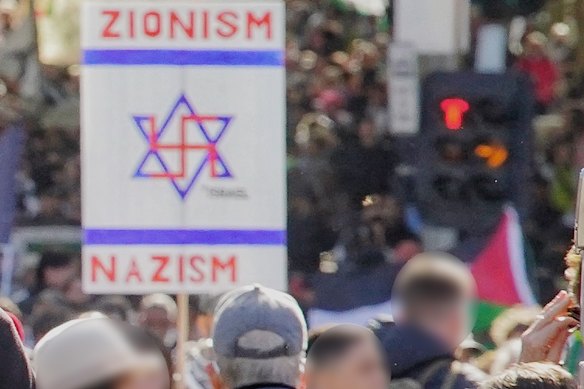
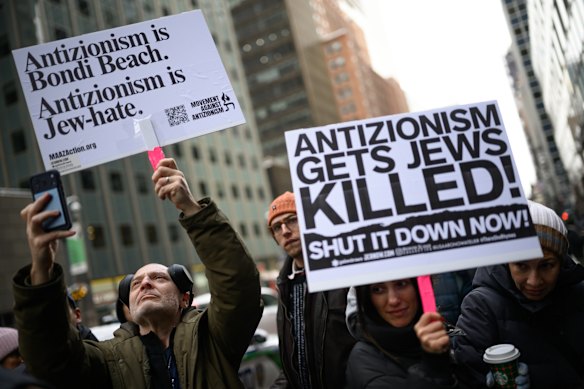
For two years the chant was rehearsed, circulated, aestheticised: “globalise the intifada!”. A resistance moment. A noble liberation struggle, cleansed of consequence. Now that it has arrived not as metaphor but as blood, the same people who normalised the rhetoric – progressive activists, influencers, podcasters, the Greens, the Labor left – present themselves as mourners. Today it is condolences, unity, and prayers.
But you do not get to globalise the intifada and then feign surprise when it turns up.
This did not erupt spontaneously. It was built – patiently, rhetorically – until violence no longer felt aberrant but earned. Shock, at this point, is not innocence; it is evasion.
The Prime Minister calls for unity and convenes the National Security Committee of Cabinet. Necessary, yes – but no longer enough. The problem he faces is credibility. For two years the response to antisemitism has been managerial rather than moral: statements instead of lines, calibration instead of resolve.
The record is plain. Within hours of the October 7 Hamas massacre, and before Israel inflicted its biblical rage upon Gaza, Jews were openly abused outside the Sydney Opera House. Synagogues and childcare centres were firebombed and homes and vehicles vandalised. Hate preachers operated freely. Week after week, marches moved through our cities celebrating “resistance”, praising terrorism, calling for Israel’s elimination, and chanting explicitly for the globalisation of the intifada: violence against Jews, everywhere – for what else could that word mean? Jewish students and academics were harassed on campus. Jewish artists were doxed and frozen out of cultural life. Antisemitism was rhetorically dissolved by equating it with Islamophobia, converting a specific hatred into a moral blur.
Step by step, it was normalised.
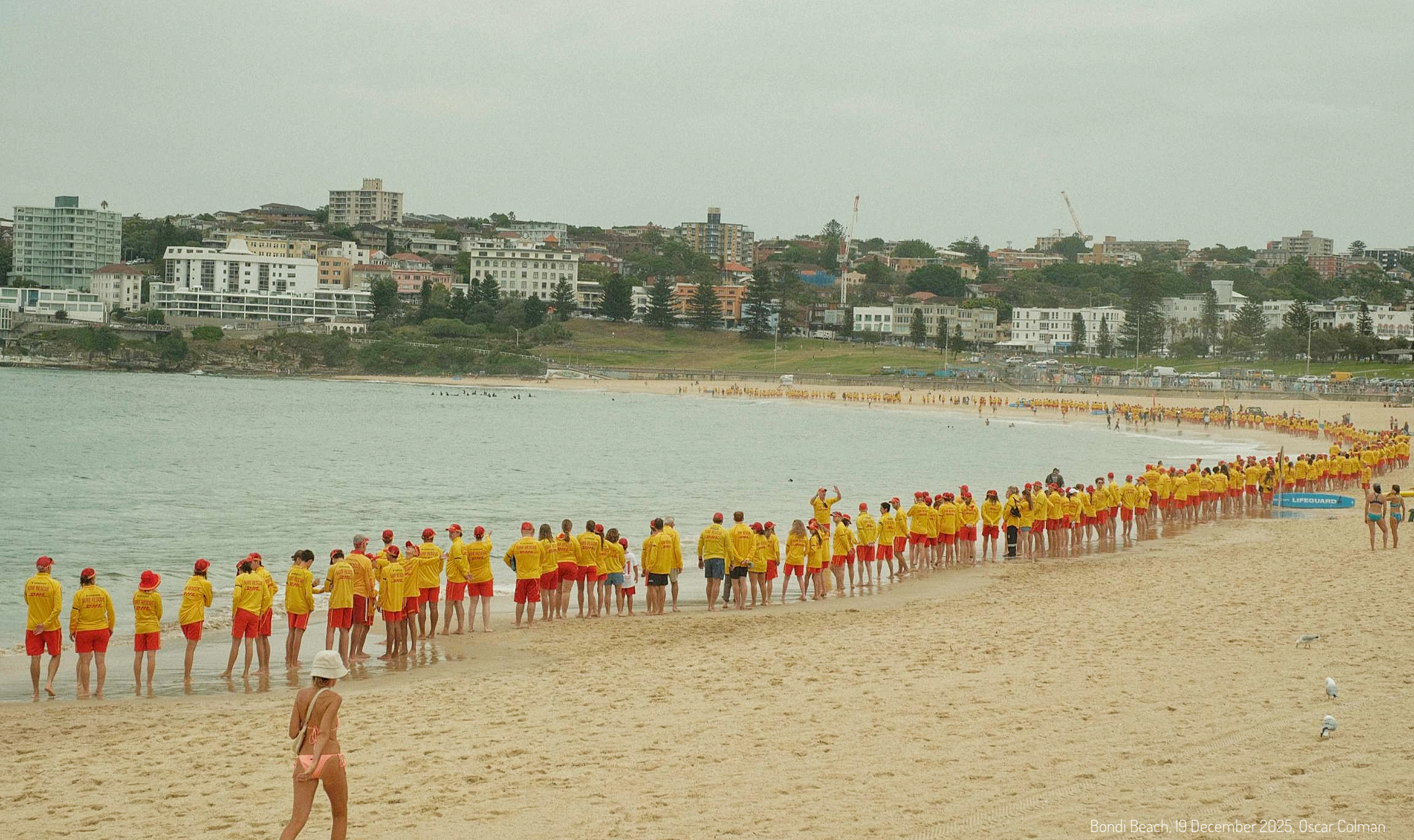
The year ends with an Islamist terrorist attack at Bondi Beach – an ordinary, intimate place, place many of us walk, eat, linger. We were in Sydney last weekend, and had we stayed another night, we would very likely have been there ourselves, walking the promenade and then taking refreshment, as is our custom, at the North Bondi RSL, just across the road from the park where the atrocity occurred. Authorities had warned such an incident was probable. They were not speculating; they were reading the climate.
Antisemitism in Australia has risen to levels unseen in living memory – even in small country towns like the one we live near and in Byron Bay, meccas of alternative lifestyles and long-styled as havens of inclusion and wellness. Alongside this rise sits another failure: the government’s inability to confront antisemitism with clarity and force, preferring symbolic gestures and offshore moral posturing while hatred hardened at home.
Now, suddenly, our leaders discover grief. Social media is more revealing. Facebook fills with empathetic words and memes from politicians, public figures and keyboard activists who spent the past two years condemning Israel in ways that blurred – and often erased – the distinction between Israeli policy and Jewish existence, creating at best, indifference to Jewish fear and, at worst, a permissive climate of hostility toward Jews as such. Today it is all tolerance, inclusivity and unity – and an air of regret and reverence that reeks of guilt.
But not all. Social media has fractured along familiar lines. At one extreme are conspiracy theories — false flags, invented victims, claims the attackers were Israeli soldiers. At the other is denial: what antisemitism? Between them sits a more revealing response. There is genuine shock and horror, even remorse — but also a careful foregrounding of the Syrian-Australian man who intervened, coupled with a quiet erasure of the victims’ Jewishness; a reflexive turn to whataboutism; and a refusal, even now, to relinquish the slogans and moral habits of the past two years. If antisemitism is acknowledged at all, it is ultimately laid at the feet of Benjamin Netanyahu.
So the question must be asked plainly: can many on the left side of politics, no matter how well-intentioned (and ill-formed) can honestly say that nothing they have posted over the past two years contributed, even indirectly, to prejudice against Jewish people? Nothing that helped turn anxiety and empathy into hostility, criticism into contempt?
Australian Jews warned that today’s chant would become tomorrow’s attack. They were told they were exaggerating, weaponising history, crying wolf. Yet despite inquiries, legislation, and repeated arson and vandalism, the ecosystem of hate was allowed to deepen. Two years of weekly protests chanting “From the river to the sea”, “Globalise the intifada” and “Death to the IDF” – calling for the eradication of a nation state and its people – were treated as politics, not incitement.
In July 2024 the government appointed Jillian Segal, a lawyer and businesswoman, as Australia’s first Special Envoy to Combat Antisemitism (followed soon afterwards by the appointment of Aftab Malik as Special Envoy to Combat Islamophobia). Her report, released a year later, was unambiguous: antisemitism had become “ingrained and normalised” across universities, schools, media and cultural institutions. She called for curriculum reform, university accountability, migration screening, and a serious national effort to explain what antisemitism is and why it corrodes societies.
Five months on, the government is still considering it. It has been under heavy pressure from many quarters to hasten slowly, including from within its own ranks: there were calls from the Labor left, including motions from branches and petitions, for Segal to be sacked and her report shredded.
Mere days after Bondi, the pushback has already begun. Pro-Palestinian platforms – and even some Labor branches and members – have denounced Jillian Segal, her report, and Prime Minister Albanese’s intention to implement its recommendations as an assault on democratic institutions and civil liberties. So, argue that that the Australian government is using the atrocity as a pretext to accelerate its repression of the Palestine movement, and, even, to protect and defend Australia’s complicity in what is viewed as the Gaza genocide. What this framing conspicuously avoids is any reckoning with the antisemitism the report documents- or with the immediate, practical questions now facing authorities. Among these are the potential for copycat attacks, and what duty of care is owed to the Syrian-Australian man who intervened to stop the attack? Hamas and sections of Middle Eastern media have already branded him a traitor. In this moral economy, even heroism is conditional – and quickly becomes a liability.
The partisan responses have been opportunistically predictable. The Murdoch media accused the government of weakness. The Liberal Party, led by Opposition Leader Sussan Ley, accused Labor of neglect. Pauline Hanson followed, reliably. None of it alters the central fact identified by historian Simon Sebag Montefiore: the taboo on antisemitism has collapsed. Perhaps because Jewish identity is lazily collapsed into Israel. Perhaps because the world’s oldest hatred never disappears; it waits for permission. That permission was granted – gradually, rhetorically, respectably. And antisemitism does not arrive announcing itself. It seeps. It jokes. It chants. It flatters those who believe they are on the right side of history, until history arrives and asks what they tolerated in its name.
This did not come out of nowhere. It arrived exactly as advertised, and this is what it looks like.
“We are cursed to live in a time of great historical significance: when future historians look back at 2023, the distinguishing feature of this year will likely be the recurrence of ethnic cleansing on a vast scale”.
Thus wrote Unherd columnist and former war correspondent Aris Roussinos in December. 2023, but he would draw the same conclusion in 2024 and in 2025. He notes that ethnic cleansing is taking place on a vast scale in many parts of the world. Yet, apart from the current outrage at Israel’s war on Hamas in Gaza, turbocharged as it is by unprecedented and arguably one-sided mainstream and social media coverage, international reaction has been muted to the point of indifference. Roussinos’ article is republished below, and the following overview is inspired by and draws on his observations.
The term ethnic cleansing is elusive and politically charged. In an age of endemic conflict, identity politics and competing narratives, it has become a contested and often diluted concept invoked with increasing frequency. Yet, it remains undefined in law. Unlike genocide or war crimes, it has never been codified as a distinct offence under international law, and so its use is contested.
A United Nations Commission of Experts investigating violations during the wars in the former Yugoslavia offered the most widely cited descriptions. In its interim report it defined ethnic cleansing as “rendering an area ethnically homogeneous by using force or intimidation to remove persons of given groups from the area.” In its final report the following year, the Commission elaborated: it is “a purposeful policy designed by one ethnic or religious group to remove by violent and terror-inspiring means the civilian population of another ethnic or religious group from certain geographic areas.” What is clear in these descriptions is that ethnic cleansing is deliberate, systematic, and political in nature.
The Commission also catalogued the methods through which such policies are carried out. They include murder, torture, arbitrary arrest and detention, extrajudicial executions, rape and sexual violence, severe injury to civilians, confinement of populations in ghettos, forcible deportation and displacement, deliberate military attacks or threats of attacks on civilian areas, the use of human shields, the destruction and looting of property, and assaults on hospitals, medical staff and humanitarian organisations such as the Red Cross and Red Crescent. The Commission concluded that these acts could amount to crimes against humanity, war crimes, and in some instances, fall within the meaning of the Genocide Convention.
Many people today use the term ethnic cleansing interchangeably with genocide, since both involve the violent removal and destruction of communities and often lead to similar outcomes of death, displacement, and cultural erasure. Ethnic cleansing, which refers to the forced expulsion of a group from a territory through intimidation, violence, or coercion, frequently overlaps with acts that fall under the 1948 UN Genocide Convention, such as mass killings and the destruction of cultural or religious life. This blurring of concepts reflects not only the moral outrage provoked by such crimes but also frustration at the narrowness of legal categories, which can leave survivors feeling their suffering has been minimized by technical distinctions. Historical cases illustrate how the line between the two has often been perilously thin: the mass deportations and killings of Armenians in 1915, which many scholars and states regard as genocide and even describe as a holocaust – though Türkiye denies it and Israel avoids official recognition for fear of diluting the unique status of the Shoah – the expulsions and massacres of Bosnian Muslims in the 1990s, and the flight of the Rohingya from Myanmar all show how ethnic cleansing has so often carried genocidal dimensions – as is particularly the case today with the war in Gaza which has polarized and politicized ordinary people and activists alike worldwide who have through lack of knowledge or opportunism conflated the two.
Yet it is important to recognize that genocide and ethnic cleansing are not strictly interchangeable. Genocide requires proof of an intent to destroy, in whole or in part, a national, ethnic, racial, or religious group, whereas ethnic cleansing focuses primarily on expulsion, which may or may not involve that deeper intent to annihilate. Ethnic cleansing can amount to genocide when the purpose is to eradicate a group, but not all instances meet this threshold. In public discourse, however, people motivated more by empathy and emotion than by detailed knowledge of history or law are often inclined to conflate the two, since the lived experience of the victims—violence, displacement, and cultural obliteration – appears indistinguishable from destruction itself. More informed observers, by contrast, emphasize legal precision and historical context, recognizing that while the outcomes often overlap, preserving the distinction remains vital for accurate analysis and accountability.
The moral revulsion ethnic cleansing excites is the natural and humane reaction, but historically and also presently, it is not an uncommon phenomenon. For the American sociologist and academic Michael Mann, ethnic cleansing is the natural consequence of modernity, “the dark side of democracy”: a recurring temptation of the modern nation-state. The following sections provided examples from the last thirty years, followed by a survey of instances of ethnic cleansing during the early to mid Twentieth Century. They describe how ethnic cleansing is not only a crime of forced removal and murder but also an assault on identity, memory, and the very visibility of a people.
[The featured picture at the head of this blog post is one of Palestinian artist Ismail Shammout’s striking illustrations of Al Nakba, the dispossession of tens of thousands of Palestinian Arabs during Israel’s war of independence, from In That Howling Infinite’s Visualizing the Palestinian Return – the art of Ismail Shammout]. More of his art is included below]
Expulsion, eradication and exile
The Wars of the Yugoslav Succession in the 1990s – encompassing Croatia, Bosnia, and Kosovo – offer a clear illustration of ethnic cleansing in a modern European context. As Yugoslavia disintegrated, political and military leaders pursued campaigns aimed at creating ethnically homogeneous territories, often through the systematic targeting of civilians. In Bosnia, Serb forces carried out mass killings, forced deportations, rape, and the deliberate destruction of homes, schools, and cultural heritage sites, culminating in the Srebrenica massacre of 1995, in which more than 8,000 Muslim men and boys were killed. In Croatia and Kosovo, similar tactics were deployed: ethnic minorities were expelled, villages razed, and communities terrorised into flight. The International Criminal Tribunal for the former Yugoslavia (ICTY) documented and prosecuted these actions as crimes against humanity and war crimes, establishing that the campaigns were not chaotic consequences of war, but deliberate, coordinated policies of ethnic removal. The tribunal’s rulings provide a legal benchmark for understanding ethnic cleansing as the purposeful removal of populations through violence, intimidation, and coercion, a pattern that recurs across history and geography—from the forced expulsions of Armenians in 1915, to the population exchanges of Greece and Turkey in 1923, to the contemporary displacement of Rohingya, Palestinians, Ukrainians, and Afghans. These cases demonstrate that ethnic cleansing combines physical violence, forced migration, and cultural erasure, often leaving long-term social, political, and demographic scars that endure generations after the immediate conflict.
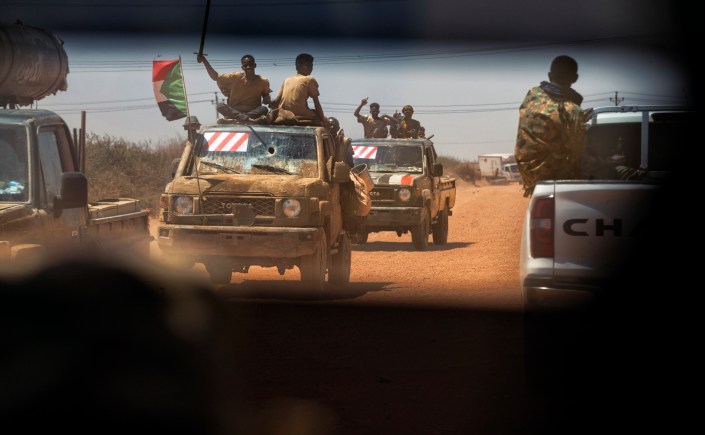
Sudan has witnessed repeated waves of ethnic cleansing over recent decades, most infamously in Darfur in the early 2000s, when government-backed Arab Janjaweed militias targeted non-Arab communities with systematic violence. Villages were burned, civilians massacred, women subjected to mass rape, and more than 2.5 million people displaced, in what the International Criminal Court later described as crimes against humanity, war crimes, and genocide. The displacement and destruction in Darfur followed earlier campaigns of forced removal during Sudan’s long north–south civil war, where entire communities in the south and Nuba Mountains were uprooted by aerial bombardment, scorched earth tactics, and starvation sieges. Today, ethnic cleansing has returned with devastating intensity: since April 2023, renewed fighting between the Sudanese Armed Forces and the Rapid Support Forces (successors to the Janjaweed) has triggered mass atrocities, including the killing of thousands and the flight of more than 7 million civilians, many across borders into Chad, South Sudan, and Egypt. Reports of targeted massacres against non-Arab groups in West Darfur suggest continuity with earlier campaigns, underscoring how ethnic cleansing in Sudan is not an isolated event but a recurring feature of its violent political landscape.
The Rohingya expulsions in Myanmar provide a stark contemporary example of ethnic cleansing. Since 2017, Myanmar’s military has carried out systematic campaigns of violence, including mass killings, sexual violence, arson, and the destruction of villages, aimed at driving the Rohingya Muslim population from Rakhine State. More than 700,000 Rohingya have fled to neighbouring Bangladesh, creating one of the world’s largest refugee crises. The violence has been accompanied by measures of cultural and social exclusion: denial of citizenship, restrictions on movement, and the erasure of Rohingya identity from official records. The United Nations and international observers have described these actions as ethnic cleansing, noting the deliberate intent to remove an entire ethnic group from a geographic area, while some investigators have determined that elements of the campaign meet the criteria for genocide.
Armenia and its surrounding regions have been scarred by cycles of ethnic cleansing for more than a century. The Armenian genocide of 1915–1916, carried out by the Ottoman Empire, combined forced deportations, massacres, and cultural destruction with the intent of removing Armenians from their ancestral lands in Anatolia. More than a million were killed or died on death marches, and countless others were scattered into diaspora communities across the Middle East, Europe, and the Americas. Later, in the Soviet period, Armenians and Azerbaijanis experienced repeated forced movements, with pogroms and expulsions erupting during times of political instability. Most recently, the 2023 offensive by Azerbaijan in Nagorno-Karabakh resulted in the flight of almost the entire Armenian population of the enclave—around 120,000 people—into Armenia proper, effectively erasing a centuries-old community. These waves of displacement illustrate how ethnic cleansing in Armenia is not confined to the past but has recurred across generations, leaving lasting demographic, cultural, and political consequences for the region.
During the past two years, mass expulsions from neighbouring countries returned large numbers of Afghans to Taliban-run Afghanistan. Pakistan has deported nearly half a million Afghans; Iran has driven out hundreds of thousands more. What is packaged as “repatriation” is, in many cases, forced displacement: exiles who had tenuous livelihoods, access to education, or limited civil freedoms in exile are now returned to a polity where the rights — especially the rights of women and girls — are ruthlessly curtailed. The Taliban’s record on gender is well known: it controls a society where women are barred from education and work, forced into early marriages, and denied even minimal public freedoms. Public-life prohibitions and systematic punishments disproportionately harm women and girls. Returning families are therefore being pushed into what many observers describe as among the worst possible places in the world for women — a profoundly gendered and life-threatening form of displacement.
The erasure of culture and historical memory
Like genocide, ethnic cleansing may not be limited the physical expulsion or eradication of people. It can be political, cultural and geographical, and often works through more insidious forms of erasure.
China’s policies in Xinjiang are an example. It has renamed at least 630 villages in Xinjiang, erasing references to Uyghur culture in what human rights advocates say is a systematic propaganda rebrand designed to stamp out the Muslim minority group’s identity. Human Rights Watch has documented a campaign of renaming thousands of villages across the region, stripping out references to Uyghur religion, history and culture. At least 3,600 names have been altered since 2009, replaced by bland slogans such as “Happiness,” “Unity” and “Harmony.” Such bureaucratic changes appear mundane, but they are part of a systematic project to erase Uyghur identity from the landscape itself.
Ukraine illustrates another, more violent dimension of contemporary ethnic cleansing. Russia is coercively integrating five annexed Ukrainian regions — an area the size of South Korea — into its state and culture. Ukrainian identity is being wiped out through the imposition of Russian schooling and media, while more than a million Russian citizens have been settled illegally into the occupied zones. At the same time, some three million Ukrainians have fled or been forced out. Torture centres have been established, with one UN expert describing their use as “state war policy.” Russian forces have employed sexual violence, disappearances and arbitrary detentions, and carried out massacres. Civilian deaths officially stand at around 10,000, but independent estimates suggest a figure closer to 100,000. Homes and businesses have been seized and redistributed to the cronies of Russian officials and officers. On top of these abuses, thousands of Ukrainian children have been taken from their families and deported into Russia for adoption and assimilation, with the threat that when they reach 18 they will be conscripted into the Russian military. This programme of child transfers has been declared a war crime by international courts, and represents perhaps the most chilling element of the campaign to erase Ukrainian identity across generations. Russian propagandists, including ideologues such as Alexander Dugin, routinely describe Ukrainians as “vermin” to be eliminated — language that many experts say is consistent with genocidal intent.
The long arm of history
Historical precedent is sobering, underscoring how entrenched practices definable as ethnic cleansing are. Some examples follow.
The Armenian genocide of 1915–1916 is a historical example where the term “ethnic cleansing” can be applied alongside, though not identical to, the legal concept of genocide. Ottoman authorities systematically deported, massacred, and starved Armenians from their ancestral homelands in Anatolia, often under the guise of military necessity. Entire villages were emptied, survivors forced on death marches into the Syrian desert, and cultural and religious heritage deliberately destroyed. These actions aimed to remove the Armenian population from the territory of the Ottoman Empire, making the region ethnically and religiously homogeneous, which aligns closely with contemporary definitions of ethnic cleansing. The genocide combined mass killing with forced displacement and cultural erasure, illustrating how ethnic cleansing and genocide can overlap in both intent and method. (See The Fall of the Ottoman Empire and the birth of Türkiye)
The Armenian case also illustrates how recognition of genocide is often bound up not only with history but with contemporary politics. Türkiye continues to deny that the mass deportations and killings of Armenians in 1915 amounted to genocide, framing them instead as wartime relocations within the collapsing Ottoman Empire. Israel, despite wide acknowledgment among its own scholars of the genocidal character of the events, has avoided official recognition, partly out of diplomatic considerations toward Türkiye, once a key regional ally, but also out of concern that equating the Armenian tragedy with the Shoah might dilute the unique historical and moral status attached to the Holocaust in Jewish memory and international discourse. This reluctance is not unique to Israel: several states have long hesitated to employ the term “genocide” for fear of straining relations with Ankara or complicating their own foreign policy priorities. Such debates demonstrate how the line between ethnic cleansing and genocide is not only a matter of legal precision but also of political narrative, with governments and institutions sometimes reluctant to apply the most condemnatory labels even where evidence overwhelmingly supports them.
As the Northern Irish writer Bruce Clark observed in his excellent book Twice A Stranger on the euphemistically termed “population exchanges” between Greece and Turkey exactly a century ago, “Whether we like it or not, those of us who live in Europe or in places influenced by European ideas remain the children of Lausanne,” the 1923 peace treaty, finalizing the dismemberment of the Ottoman Empire after the First World War, which decreed a massive, forced population movement between Turkey and Greece”, and in effect, One and a quarter million Greek Orthodox Christians were removed from Anatolia, the heartland of the new republic of Türkiye, and nearly 400,000 Muslims from Greece, in a process overseen by the Norwegian diplomat Fridtjof Nansen leading a branch of the League of the Nations which would later – perhaps ironically – evolve into today’s UNHCR.
During the Second World War, Soviet Union alone deported half a million Crimean Tatars and tens of thousands of Volga Germans to Siberia. In 1945, the victorious Allied powers oversaw the removal of some 30 million people across Central and Eastern Europe to create ethnically homogeneous states. At Yalta and Potsdam, Britain, the US, and the Soviet Union endorsed the expulsion of 12 million Germans, over 2 million Poles, and hundreds of thousands of Ukrainians, Hungarians, and Finns.
The partition of British India in 1947 produced one of the largest and bloodiest forced migrations in modern history. As the new states of India and Pakistan were created, an estimated 12 to 15 million people crossed borders in both directions – Muslims moving into Pakistan, Hindus and Sikhs into India – in a desperate effort to reach what they hoped would be safer ground. The upheaval was marked by extreme communal violence, massacres, abductions, and sexual assaults. Between 500,000 and 1 million people are thought to have been killed, and millions more were uprooted from ancestral homes they would never see again. The trauma of Partition continues to shape Indian and Pakistani national identities, as well as the politics of South Asia to this day. (See Freedom at Midnight (2): the legacy of partition) and Freedom at Midnight (1): the birth of India and Pakistan
The dismemberment of Mandate Palestine by the new state of Israel, Jordan and Egypt in 1948 brought two simultaneous mass displacements that remain unresolved. During the first Arab–Israeli war more than 700,000 Palestinians fled or were expelled from their homes in what became Israel. Known as the Nakba or “catastrophe,” this created a vast refugee population now numbering in the millions, many still stateless. Jews living in what is now the Old City and East Jerusalem, and the West Bank seized by Jordan were expelled. Jews living across the Arab world in Iraq, Yemen, Egypt, Libya, Syria and elsewhere – faced growing hostility, persecution, and expulsion. Between 1948 and the 1970s, an estimated 800,000 to 1,000,000 Jews left or were forced out, many stripped of property and citizenship. Most resettled in Israel, where their presence profoundly altered the country’s politics and culture. Palestinians and Jews alike endured dispossession, trauma and exile, and both experiences fuel competing narratives of grievance that continue to define the conflict.
Israelis are themselves, for the most part, the product of 20th-century ethnic cleansings, in the Middle East as well as Europe: indeed the descendants of Middle Eastern Jews, like the Security Minister Itamar Ben-Gvir, are the country’s most radical voices on the Palestinian Question. But unlike the Mizrahim, and displaced of Eastern and south-eastern Europe, the Palestinians have no Israel to go to. There is no Palestinian state waiting to absorb them. Indeed, for Gaza’s population, the vast majority of whom descend from refugees from what is today Israel, Gaza was their place of refuge, and the 1948 Nakba the foundational event in their sense of Palestinian nationhood. For all that ethnic cleansing punctuates modern history, there is no precedent for such a process of double displacement, and the political consequences cannot at this stage be determined. We may assume they will not be good, and an analogue to Europe’s post-war neighbourly relations will not be found.
Conclusion: The Age of Dispossession
In many historical cases, expulsions, however brutal, were stabilized by the existence of ethnic homelands ready to absorb the displaced. Refugees were incorporated into nationalist projects in Greece and Türkiye, or into newly homogenized states such as Poland and Ukraine, where they became central to the shaping of modern politics. The Karabakh Armenians driven into Armenia may follow this precedent, potentially reshaping the political order of a small and embattled state.
Ethnic cleansing in the twenty-first century, however, combines these older methods with new techniques. Violence, rape, deportation, and massacre continue, but are now accompanied by cultural erasure, bureaucratic renaming, engineered resettlement, propaganda, and the deliberate targeting of children for assimilation. Unlike many twentieth-century precedents, today’s displaced populations often have nowhere safe to go, forced into territories with no protective homeland or into environments of repression, creating open-ended cycles of dispossession. The erasure of identities in Xinjiang, the coercive integration of Ukrainian territories, the expulsion of Rohingyas and Afghans, the depopulation of Karabakh, and the looming threat of Gaza – where Palestinians face the looming threat of another mass displacement, echoing the 1948 Nakba – collectively demonstrate that ethnic cleansing is not a relic of the past.
It remains a recurring feature of our age – modern history is indeed built upon exodus and displacement – and its human cost is profound and incalculable.
Postscript … Al Nakba, a case study in dispossesion
In the late nineteenth and early twentieth centuries, European Jews came to a land that was already inhabited by another, different people. Over two decades, they forced the guarantor power out by terrorism and took the land by conquest, expelling most of its original inhabitants by force. They have sowed their share of wind, too. Both sides want all the land for themselves.
Al Nakba, is the Arabic name for the “catastrophe” that befell the Arab inhabitants of Mandate Palestine during the war that was fought between Arabs and Jews in 1947-1948, resulting in the expulsion of upwards of 700,000 Arab Palestinians. That it happened is incontrovertible. But the facts, even those that are attested to by all reputable politicians and academic authorities, including Israelis, have long been subject to doubt and distortion by all sides of what has since been called “The Middle East Conflict” – notwithstanding that there have been conflicts in the Middle East more devastating and bloodier in terms of destruction and mortality including in Lebanon, Iraq, Syria, Algeria, Libya, and Sudan.
I do not to intend here to retell the history of Al Nakba. There many accounts available in print including those by Arab and Israeli authors, and in film, particularly an excellent documentary broadcast by Al Jazeera in May 2013 and repeated often?
June 17th, 2018, I wrote about it in a Facebook post:
Al Nakba did not begin in 1948. Its origins lie over two centuries ago….
So begins this award-winning series from Al Jazeera, a detailed and comprehensive account of al Nakba, the establishment of the State of Israel in 1948 and the dispossession and expulsion of the Palestinians who lived within its borders.
It is a well-balanced narrative, with remarkable footage, that will not please the ardent partisans of both sides who prefer their story of 1948 to be black and white.
Revisionist Israeli historians Ilan Pappe, Avi Shlaim, and Teddy Katz describe the ruthless and relentless military operations to clear and cleanse “Ha’aretz”, the land, of its Arab inhabitants and their history, whilst Palestinian historians tell the story from the Palestinian perspective, describing the critical failings of Palestinian’s political leaders and neighbouring Arab governments. Elderly Palestinians who were forced into exile and to camps in Jordan and Lebanon tell their sad stories of starvation and poverty, violence and death, and of terrible sadness, homesickness and longing that the passing years and old age have never diminished.
“When I left my homeland, I was a child. Now, I’m an old man. So are my children. But did we move forward? Where is our patriotism? Patriotism is about the pockets of our current leaders. They build high buildings and go to fancy banquets. They pay thousands for their children’s weddings”. Refugee Hosni Samadaa.
“We’re repeating the same mistakes. Before 1948 the Palestinian National Movement was split on the basis of rival families. Today, it is split into different parties over ideology, jurisdiction and self-interests. We didn’t learn our lesson. We were led by large, feudal landowners. Today, we are led by the bourgeoisie. Before 1948, we were incapable of facing reality. Today, we are just as inept. Before 1948, people chose the wrong leadership. And today, we are following the wrong leaders”. Researcher Yusuf Hijazi.
The truth about the ethnic cleansing in Gaza – modern Europe was built on exodus and displacement
Aris Roussinos, Unherd, December 18 2023
We are cursed to live in a time of great historical significance: when future historians look back at 2023, the distinguishing feature of this year will likely be the recurrence of ethnic cleansing on a vast scale. In just the past few months, Pakistan has deported nearly half a million Afghan migrants, while Azerbaijan has forced 120,000 Armenians — the statelet’s entire population — from newly-conquered Karabakh, both to broad international indifference. As the UNHCR has warned, the forced expulsion — that is, the ethnic cleansing — of Gaza’s Palestinian population is now the most likely outcome of the current war.
With no prospect of Palestinians and Israelis living together peaceably, anything short of absolute military victory unacceptable to both the Israeli government and its voters, but no meaningful plan for who will rule the uninhabitable ruins of post-war Gaza, the only realistic solution to the Palestinian problem, for Israel, is the total removal of the Palestinians. As Israel’s former Interior Minister has declared: “We need to take advantage of the destruction to tell the countries that each of them should take a quota, it can be 20,000 or 50,000. We need all two million to leave. That’s the solution for Gaza.”
Israeli officials have not been shy in promoting this outcome to a war, according to the President Isaac Herzog, for which “an entire nation… is responsible”. Israel’s agriculture minister Avi Dichter has asserted that “We are now rolling out the Gaza Nakba,” adding for emphasis that the result of the war will be “Gaza Nakba 2023. That’s how it’ll end.”Israel’s Intelligence Ministry has published a “concept paper” proposing the expulsion of Gaza’s entire population to the Sinai desert, and Israeli diplomats have been trying to win international support for this idea. According to the Israeli press, Israeli officials have sought American backing for a different plan to distribute Gaza’s population between Egypt, Turkey, Iraq and Yemen, tying American aid to these countries’ willingness to accept the refugees. In a Wall Street Journal opinion piece, two Israeli lawmakers have instead urged Western countries — particularly Europe — to host Gaza’s population, asserting that: “The international community has a moral imperative—and an opportunity—to demonstrate compassion [and] help the people of Gaza move toward a more prosperous future.” The outcome for Gaza’s Palestinians does not appear to be in doubt: what remains to be haggled over is their final location.
The only actor that can prevent the ethnic cleansing of Gaza is the United States, and for domestic political reasons it is disinclined to do so. While the Biden administration declaresit does not support “any forced relocation of Palestinians outside of the Gaza Strip”, it is not taking any action to prevent it. If the expulsion of Gaza’s 2.3 million population comes to pass, the result will be the most significant instance of ethnic cleansing in a generation, which will define Biden’s presidency for future historians. Yet outrage over such events is selective. It is not entirely true, as some Middle Eastern commentators claim, that Western complicity in the looming ethnic cleansing of Gaza highlights a lesser interest in Arab or Muslim lives: the Armenian case highlights that eastern Christians also barely flicker on the world’s moral radar.
This week’s awarding of the right to host next year’s COP29 climate conference to Azerbaijan, just a few months after its ethnic cleansing of Karabakh, reminds us that the supposed international taboo on the practice does not, in reality, exist. When ethnic cleansing is permissible, and when it is a war crime, depends, it seems, on who is doing it, and to whom. Azerbaijan is oil-rich, useful to Europe, and able to buy favourable Western coverage; Armenia is poor, weak and friendless in the world. Similarly, the extinction of much of the Christian population of the Middle East as a result of the chaos following the Iraq War won very little international attention or sympathy: communities which survived in their ancient homelands from Late Antiquity, riding out the passage of Arab, Mamluk, Ottoman and European imperial rule, did not survive the American empire.
Yet while the moral revulsion such events excite is the natural and humane reaction, ethnic cleansing is less rare an event than the crusading military response to its Nineties occurrence in the Balkans may make us think. For the sociologist Michael Mann, ethnic cleansing is the natural consequence of modernity, “the dark side of democracy”. As the Northern Irish writer Bruce Clark observed in his excellent book Twice A Stranger on the euphemistically termed “population exchanges” between Greece and Turkey exactly a century ago, “Whether we like it or not, those of us who live in Europe or in places influenced by European ideas remain the children of Lausanne,” the 1923 peace treaty “which decreed a massive, forced population movement between Turkey and Greece”. One and a quarter million Greek Orthodox Christians were removed from Anatolia, and nearly 400,000 Muslims from Greece, in a process overseen by the Norwegian diplomat Fridtjof Nansen leading a branch of the League of the Nations which would later — perhaps ironically — evolve into today’s UNHCR.
It was a cruel process, wrenching peoples from ancestral homelands in which they had lived for centuries, even millennia— and by the end of it half a million people were unaccounted for, presumably dead. Yet it was viewed as a great diplomatic triumph of the age, perhaps with good reason: without meaningful minorities on each side of each others’ borders to stoke tensions, Greece and Turkey have not fought a war in a century. Indeed, as late as 1993, the Realist IR scholar John Mearsheimer could propose a “Balkan Population Exchange commission” for the former Yugoslavia explicitly modelled on the 1923 precedent, asserting that “populations would have to be moved in order to create homogeneous states” and “the international community should oversee and subsidize this population exchange”. For the younger Mearsheimer, ethnic cleansing was the only viable solution to Yugoslavia’s bloody and overlapping ethnic map: “Transfer is a fact. The only question is whether it will be organized, as envisioned by partition, or left to the murderous methods of the ethnic cleansers.” Thirty years later, however, Mearsheimercondemns Israel’s planned expulsions from Gaza outright.
There is a dark irony here: the forced expulsion of peoples is an affront to liberal European values, yet it is rarely acknowledged that our modern, hitherto peaceful and prosperous Europe is built on the foundation of ethnic cleansing. Perhaps the ramifications of such a truth are too stark to bear, yet it is nevertheless the case that the peaceable post-1945 order depended on mass expulsions for its stability. Using the 1923 exchange as their explicit model, the victorious allies oversaw the forced removal of 30 million people from their homes in Central and Eastern Europe towards newly homogeneous ethnic homelands they had never seen. At the Yalta and Potsdam conferences, Britain, the United States and the Soviet Union settled upon the expulsion of 12 million Germans, more than 2 million Poles and hundreds of thousands of Ukrainians, Hungarians and Finns from their ancestral homes.
As Churchill declared in Parliament in 1944, “expulsion is the method that, so far as we have been able to see, will be the most satisfactory and lasting. There will be no mixture of populations to cause endless trouble, as has been in the case of Alsace-Lorraine. A clean sweep will be made.” Only two years later, once the Cold War had begun and the Soviet Union and its vassal Poland become a rival, did Churchill fulminate against the “enormous and wrongful inroads upon Germany, and mass expulsions of millions of Germans on a scale grievous and undreamed of” by “the Russian-dominated Polish Government”. In ethnic cleansing, as in so many other things, political context is the final arbiter of morality.
But as a result, Germany has never since unsettled Europe with revanchist dreams; both Poland and Western Ukraine became, for the first time in their histories, ethnically homogenous entities. As the Ukrainian-Canadian historian Orest Subtelny has observed, the forced separation of Poles and Ukrainians, once locked in bitter ethnic conflict against each other, has led to today’s amicable relationship: “It seems that the segregation of the two peoples was a necessary precondition for the development of a mutually beneficial relationship between them. Apparently the old adage that ‘good fences make for good neighbors’ has been proven true once more.” That we have forgotten the vast scale of the forced expulsions which established Europe’s peaceful post-war order is, in a strange way, a testament to their success.
Yet what made the mass expulsions following the First and Second World Wars broadly successful was that those expelled at least had ethnic homelands to receive them. In Greece and Turkey, the refugees fully adopted the ethnic nationalism of their new countries, in Greece providing the bedrock of later republican sympathies, and in Turkey the core support for both secular Kemalist nationalism and occasional bouts of military rule. In the newly-homogenous Poland and Ukraine, refugees shorn of their previous local roots and at times ambiguous ethnic identities fully adopted in recompense a self-identification with their new nation-states which has helped define these countries’ modern politics. The 120,000 Karabakh refugees will likely become a political bloc in tiny Armenia, affecting the country’s future political order in ways yet hard to discern.
Israelis are themselves, for the most part, the product of 20th-century ethnic cleansings, in the Middle East as well as Europe: indeed the descendants of Middle Eastern Jews, like the Security Minister Itamar Ben-Gvir, are the country’s most radical voices on the Palestinian Question. But the Palestinians, like the ethnic French narrator of Houellebecq’s Submission, have no Israel to go to. Unlike the 20th century displaced of Eastern and south-eastern Europe, there is no Palestinian state waiting to absorb them. Indeed, for Gaza’s population, the vast majority of whom descend from refugees from what is today Israel, Gaza was their place of refuge, and the 1948 Nakba the foundational event in their sense of Palestinian nationhood. For all that ethnic cleansing punctuates modern history, there is no precedent for such a process of double displacement, and the political consequences can not at this stage be determined. We may assume they will not be good, and an analogue to Europe’s post-war neighbourly relations will not be found.
Egypt’s disinclination to host two million Gazan refugees is not merely a matter of solidarity, but also self-preservation: flows of embittered Palestinian refugees helped destabilise both Lebanon, where their presence set off the country’s bloody ethnic civil war, and Jordan, where they make up the demographic majority. It is doubtful too, given the recent tenor of its politics, that Europe will be eager to receive them, no matter how humanitarian the language with which Israeli officials couch their planned expulsion. Rendered stateless, driven from their homes and brutalised by war, Gaza’s refugees remain unwanted by the world, perhaps destined to become, as the Jews once were, a diaspora people forever at the mercy of suspicious hosts.
A terrible injustice for the Palestinians, their ethnic cleansing may yet provide Israel with a measure of security, even as it erodes the American sympathy on which the country’s existence depends. The broader question, perhaps, is whether or not the looming extinction of Palestinian life in Gaza, like the expulsion of Karabakh’s Armenians, heralds the beginning of a new era of ethnic cleansing, or merely the settling of the West’s unfinished accounts. Like the movements which bloodily reshaped Central Europe, Israel’s very existence is after all a product of the same nationalist intellectual ferment of fin-de-siècle Vienna. In 1923, while acknowledging its necessity, the British Foreign Secretary Lord Curzon called the Greco-Turkish population exchange “a thoroughly bad and vicious [idea] for which the world would pay a heavy penalty for a hundred years to come”. Exactly a century later, Gaza’s Palestinians look destined to become the final victims of Europe’s long and painful 20th century
Nakba, where Palestinian victim mythology began
‘Nakba Day’ was commemorated this week with even more vehemence than usual. The greatest tragedy is that the Palestinian people who fled remain frozen in time.
Protestors at a Sydney rally to mark the anniversary of the ‘Nakba’. David Gray/AFP
On Wednesday, “Nakba Day” was commemorated around the world with even more vehemence than usual as outpourings of hatred against Israel, sprinkled with ample doses of anti-Semitism, issued from screaming crowds.
What was entirely missing was any historical perspective on the Nakba – that is, the displacement, mainly through voluntary flight, of Palestinians from mandatory Palestine. Stripped out of its broader context, the event was invested with a uniqueness that distorts the processes that caused it and its contemporary significance.
It is, to begin with, important to understand that the displacement of Palestinians was only one facet of the sweeping population movements caused by the collapse of the great European land empires. At the heart of that process was the unravelling of the Ottoman Empire, which started with the Greek war of independence in 1821 and accelerated during subsequent decades.
As the empire teetered, religious conflicts exploded, forcing entire communities to leave. Following the Crimean War of 1854-56, earlier flows of Muslims out of Russia and its border territories became a flood, with as many as 900,000 people fleeing the Caucasus and Crimea regions for Ottoman territory. The successive Balkan wars and then World War I gave that flood torrential force as more than two million people left or were expelled from their ancestral homes and sought refuge among their co-religionists.
The transfers reshaped the population geography of the entire Middle East, with domino effects that affected virtually every one of the region’s ethnic and religious groups.
The formation of new nation-states out of what had been the Ottoman Empire then led to further rearrangements, with many of those states passing highly restrictive nationality laws in an attempt to secure ethnic and religious homogeneity.
Nothing more starkly symbolised that quest for homogeneity than the Convention Concerning the Exchange of Greek and Turkish Populations signed on January 30, 1923. This was the first agreement that made movement mandatory: with only a few exceptions, all the Christians living in the newly established Turkish state were to be deported to Greece, while all of Greece’s Muslims were to be deported to Turkey. The agreement, reached under the auspices of the League of Nations, also specified that the populations being transferred would lose their original nationality along with any right to return, instead being resettled in the new homeland.
Underlying the transfer was the conviction, articulated by French prime minister (and foreign minister) Raymond Poincare, that “the mixture of populations of different races and religions has been the main cause of troubles and of war”, and that the “unmixing of peoples” would “remove one of the greatest menaces to peace”.
That the forced population transfers, which affected about 1.5 million people, imposed enormous suffering is beyond doubt. But they were generally viewed as a success. Despite considerable difficulties, the transferred populations became integrated into the fabric of the recipient communities – at least partly because they had no other option. At the same time, relations between Turkey and Greece improved immensely, with the Ankara Agreements of 1930 inaugurating a long period of relative stability.
The result was to give large-scale, permanent population movements, planned or unplanned, a marked degree of legitimacy.
Thus, the formation of what became the Irish Republic was accompanied by the flight of Protestants to England and Northern Ireland, eventually more than halving, into an insignificant minority, the Protestant share of the Irish state’s population; that was viewed as easing the tensions that had so embittered the Irish civil war.
It is therefore unsurprising that further “unmixing” was seen by the allies in World War II as vital to ensuring peace in the post-war world. In a statement later echoed by Franklin Roosevelt, Winston Churchill made this explicit in 1944, telling the House of Commons he was “not alarmed by the prospect of the disentanglement of populations, nor even by these large transferences, which are more possible in modern conditions than they ever were before”.
The immediate effect, endorsed as part of the Potsdam Agreements and implemented as soon as the war ended, was the brutal expulsion from central and eastern Europe of 12 million ethnic Germans whose families had lived in those regions for centuries. Stripped of their nationality and possessions, then forcibly deported to a war-devastated Germany, the refugees – who received very little by way of assistance – gradually merged into German society, though the scars took decades to heal.
Even more traumatic was the movement in 1947 of 18 million people between India and the newly formed state of Pakistan.
As Indian novelist Alok Bhalla put it, India’s declaration of independence triggered the subcontinent’s sudden descent into “a bestial world of hatred, rage, self-interest and frenzy”, with Lord Ismay, who witnessed the process, later writing that “the frontier between India and Pakistan was to see more tragedy than any frontier conceived before or since”. Yet in the subcontinent too, and especially in India, the integration of refugees proceeded to the point where little now separates their descendants from those of the native born.
All that formed the context in which the planned partition of Palestine was to occur. The 1937 Peel Commission, which initially proposed partition, had recommended a mandatory population exchange but the entire issue was ignored in UN Resolution 181 that was supposed to govern the creation of the two new states.
When a majority of the UN General Assembly endorsed that resolution on November 29, 1947, the major Zionist forces reluctantly accepted the proposed partition, despite it being vastly unfavourable to them. But the Arab states not only rejected the plan, they launched what the Arab League described as “a war of extermination” whose aim was to “erase (Palestine’s Jewish population) from the face of the earth”. Nor did the fighting give any reason to doubt that was the Arabs’ goal.
At least until late May 1948, Jewish prisoners were invariably slaughtered. In one instance, 77 Jewish civilians were burned alive after a medical convey was captured; in another, soldiers who had surrendered were castrated before being shot; in yet another, death came by public decapitation. And even after the Arab armies declared they would abide by the Geneva Convention, Jewish prisoners were regularly murdered on the spot.
While those atrocities continued a longstanding pattern of barbarism, they also reflected the conviction that unrestrained terror would “push the Jews into the sea”, as Izzedin Shawa, who represented the Arab High Committee, put it.
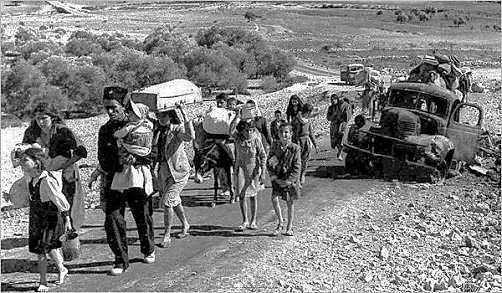
Arabs flee in 1948 ahead of the ‘war of extermination’ against Israel.
History/Universal Images Group via Getty Images
A crucial element of that strategy was to use civilian militias in the territory’s 450 Arab villages to ambush, encircle and destroy Jewish forces, as they did in the conflict’s first three months.
It was to reduce that risk that the Haganah – the predecessor of the Israel Defence Force – adopted the Dalet plan in March 1948 that ordered the evacuation of those “hostile” Arab villages, notably in the surrounds of Jerusalem, that posed a direct threat of encirclement. The implementation of its criteria for clearing villages was inevitably imperfect, but the Dalet plan neither sought nor was the primary cause of the massive outflow of Arab refugees that was well under way before it came into effect.
Nor was the scale of the outflow much influenced by the massacres committed by Irgun and Lehi – small Jewish militias that had broken away from the Haganah – which did not loom large in a prolonged, extremely violent, conflict that also displaced a very high proportion of the Jewish population.
Rather, three factors were mainly involved. First, the Muslim authorities, led by the rector of Cairo’s Al Azhar Mosque, instructed the faithful to “temporarily leave the territory, so that our warriors can freely undertake their task of extermination”.
Second, believing that the war would be short-lived and that they could soon return without having to incur its risks, the Arab elites fled immediately, leaving the Arab population leaderless, disoriented and demoralised, especially once the Jewish forces gained the upper hand.
Third and last, as Benny Morris, a harsh critic of Israel, stresses in his widely cited study of the Palestinian exodus, “knowing what the Arabs had done to the Jews, the Arabs were terrified the Jews would, once they could, do it to them”.
Seen in that perspective, the exodus was little different from the fear-ridden flights of civilians discussed above. There was, however, one immensely significant difference: having precipitated the creation of a pool of 700,000 Palestinian refugees, the Arab states refused to absorb them.
Rather, they used their clout in the UN to establish the UN Relief and Works Agency for Palestine Refugees, which became a bloated, grant-funded bureaucracy whose survival depended on endlessly perpetuating the Palestinians’ refugee status.
In entrenching the problem, the UN was merely doing the bidding of the Arab states, which increasingly relied on the issue of Palestine to convert popular anger at their abject failures into rage against Israel and the West. Terminally corrupt, manifestly incapable of economic and social development, the Arab kleptocracies elevated Jew-hatred into the opium of the people – and empowered the Islamist fanaticism that has wreaked so much harm worldwide.
Nor did it end there. Fanning the flames of anti-Semitism, the Arab states proceeded to expel, or force the departure of, 800,000 Jews who had lived in the Arab lands for millennia, taking away their nationality, expropriating their assets and forbidding them from ever returning to the place of their birth. Those Jews were, however painfully, integrated into Israel; the Palestinian refugees, in contrast, remained isolated, subsisting mainly on welfare, rejected by countries that claimed to be their greatest friends. Thus was born the myth of the Nakba.
That vast population movements have inflicted enormous costs on those who have been ousted from their homes is undeniable. Nor have the tragedies ended: without a murmur from the Arab states, 400,000 Palestinians were expelled from Kuwait after the first Gulf War, in retaliation for the Palestine Liberation Organisation’s support of Saddam Hussein. More recently, Myanmar has expelled 1.2 million Rohingya.
But the greatest tragedy associated with the plight of the Palestinians is not the loss of a homeland; over the past century, that has been the fate of tens of millions. Rather, it is the refusal to look forward rather than always looking back, an attitude encapsulated in the slogan “from the river to the sea”.
That has suited the Arab leaders, but it has condemned ordinary Palestinians to endless misery and perpetual war. Until that changes, the future will be a constant repetition of a blood-soaked past
In 1929, there is violence at the Western Wall in Jerusalem – then a narrow alley named for Buraq, the steed with a human face that bore the Prophet Mohammed on his midnight journey to Jerusalem, and not the Kotel Plaza of today. The event, which was actually called the Buraq rising was incited by rumours that Jews planned to overrun the Haram al Sharif, the third holiest site in Islam. A massacre of Jews in Hebron in the south followed. These were a bleak precursor of the wars to come.
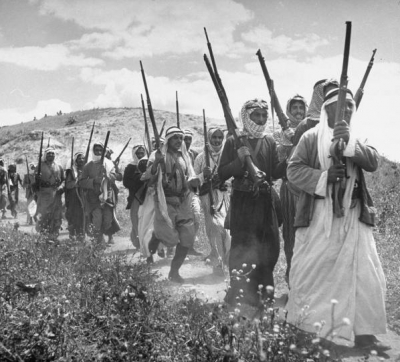
Fast forward to mid-April 1936. Following two incidents of killing carried out in by both Arabs and Jews, an Arab National Committee declared a strike in the city of Jaffa. National Committees were formed in other Palestinian cities and representatives of Arab parties formed the “Arab Higher Committee” led by Haj Amin al-Husseini. A general strike spread throughout Palestine, accompanied by the formation of Palestinian armed groups that started attacking British forces and Jewish settlements. Thus began the “Great Palestinian Revolt. It lasted for three years.
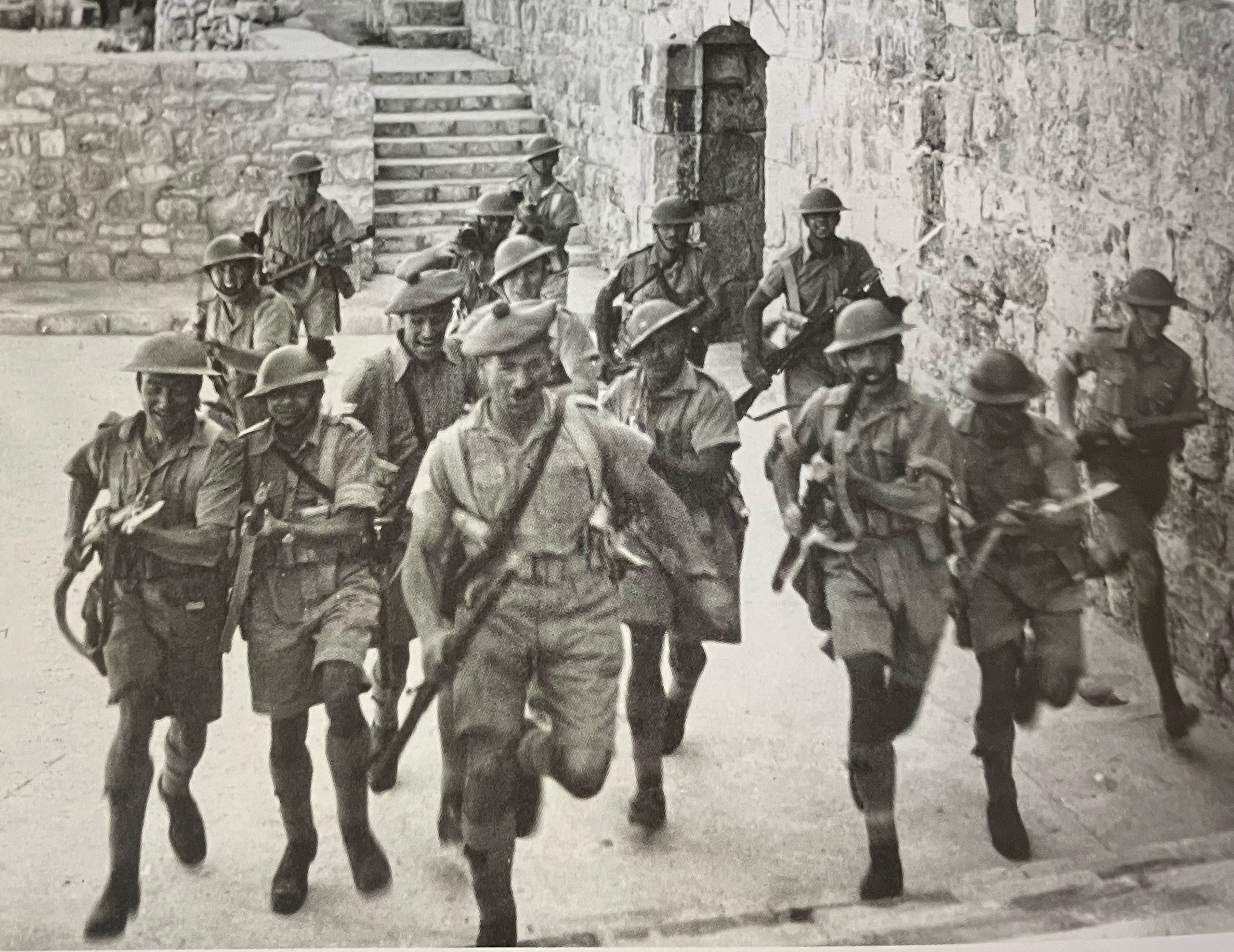
British troops run through Jerusalem’s’ Old City during the Great Revolt
Roots and fruits
The ongoing struggle with regard to the existence Israel and Palestine is justifiably regarded the most intractable conflict of modern times. Whilst most agree that its origins lie in the political and historical claims of two people, the Jewish Israelis and the predominantly Muslim Palestinians for control over a tiny wedge of one-time Ottoman territory between Lebanon and Syria in the north, Jordan in the east, and Egypt to the south, hemmed in by the Mediterranean Sea. There is less consensus as to when the Middle East Conflict as it has become known because of its longevity and its impact on its neighbours and the world in general, actually began.
Was it the infamous Balfour Declaration of 1917 promising a national home for Jews in an Ottoman governate already populated by Arabs, or the secretive Sykes Picot Agreement that preceded it in 1916, staking imperial Britain’ and France’s claim to political and economic influence (and oil pipelines) in the Levant? Was it the establishment of the British Mandate of Palestine after the Treaty of Sèvres of 1922 which determined the dissolution of the defeated Ottoman Empire. Or was it the end of that British mandate and the unilateral declaration of Israeli independence in 1948 and the war that immediately followed?
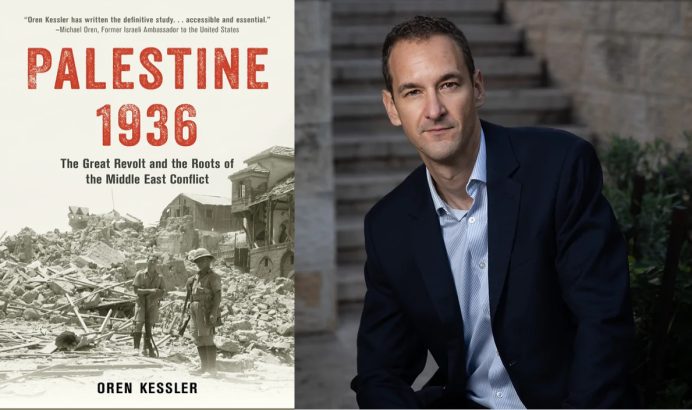
In his book Palestine 1936: The Great Revolt and the Roots of the Middle East Conflict (Rowman & Littlefield, 2023) Israeli journalist and author Oren Kesslerargues powerfully that the events in Mandatory Palestine between 1936 and 1939 shaped the subsequent history of the conflict for Israelis and Palestinians. The book identifies what was known at the time as The Great Revolt as the first Intifada, a popular uprising which actually sowed the seeds of the Arab military defeat of 1947-48 and the dispossession and displacement of over seven hundred thousand Palestinian Arabs, which has set the tone of the conflict for almost a century.
It is a tragic history shared with knowledge in hindsight of the decades of violence and bloodshed in the region that followed. It begins in the time before Palestine became political entity, when mainly Eastern European Jews began settling in progressively larger numbers to the consternation of the Arab populace.
The 1936 conflict stemmed from questions of how to divide the land and how to deal with the influx of Jewish people – questions that remain relevant today. In an extensive interview coinciding with the book’s publication (republished below) Kessler notes that, for the Arab residents, the problem was one of immigration and economics; for the Zionists, it was about finding a home. These two positions soon became irreconcilable issues, leading to sporadic violence and then to continual confrontation.
He believes that the Revolt is the point when both sides really came to see the conflict as zero sum. insofar that whichever community had the demographic majority in Palestine would be the one that would determine its fate. However, in the 1920s, the Jews were so far from that majority that both sides were able to postpone the final reckoning. In the 1930s, the Jews threatened to become a majority, and this was the immediate precursor to the rising. There was no way that the objective of bringing as many Jews to the land as possible could be achieved without bringing about some serious Arab pushback.
It is Kessler’s view that it was during revolt that a strong sense of Arab nationalism in Palestine extended beyond the urban elites to all corners of the country. All segments of Arab society – urban and rural, rich and poor, rival families, and even to a large extent Muslim and Christian – united in the same cause against Zionism and against its perceived enabler, the British Empire. The Arab public in Palestine was becoming increasingly politically aware and consciously perceiving itself as a distinct entity – distinct from its brethren in Syria, in large part because it has a different foe: not simply European imperialism but this very specific threat presented by Zionism.
The British government made early efforts at keeping the peace, but these proved fruitless. And when the revolt erupted in 1936, it sent a royal commission to Palestine, known to history as the Peel Commission, to examine the causes of the revolt. It proposed in effect the first ‘two state solution.’ The Emir Abdullah of Transjordan publicly accepted this plan. The main rival clan to the Husseinis, the Nashashibis, privately signaled that they were amenable – not thrilled, but amenable. And their allies held the mayorships of many important cities – Jaffa, Haifa, and even Nablus, Jenin and Tulkarem, which today are centres of militancy. And yet the Mufti makes very clear that he regards this plan as a degradation and a humiliation, and all of these erstwhile supporters of partition suddenly realise that they are against partition.
Kessler believes that this is the point at which a certain uncompromising line became the default position amongst the Arab leadership of Palestine, with dire consequences for the Palestinians themselves, and when Yishuv leader David Ben Gurion saw an opportunity to achieve his long-standing objective of creating a self-sufficient Jewish polity, one that could feed itself, house itself, defend itself, employ itself, without any help from anyone – neither British or Arabs. When the Arabs called a general strike and boycott, cut all contacts with the Jewish and British economies and closed the port of Jaffa in Spring 1936, he lobbied successfully with the British to allow the Jews to open their own port in Tel Aviv, ultimately causing a lot of economic pain to the Arabs and helping the Jews in their state-building enterprise.
This is a mosaic history, capturing the chaotic events on the ground through snippets of action. And also, the people involved.
There are heroes and villains aplenty in this relatively untold story. The urbane and erudite nationalists Muhammed Amal and George Antonius who strive for middle ground against increasingly insurmountable odds, and who died alone and exiled having failed to head off the final showdown that is today known as Al Nakba. The farseeing, resolute, and humourless Ben Gurion and the affable, optimistic Chaim Weizmann, who became Israel’s first prime minister and president respectively. The New York born Golda Meyerson, more of a realist than either leader, who would also one day become prime minister. The irascible revisionist Vladimir Ze’ev Jabotinski, the forebear of today’s virulent rightwing nationalists
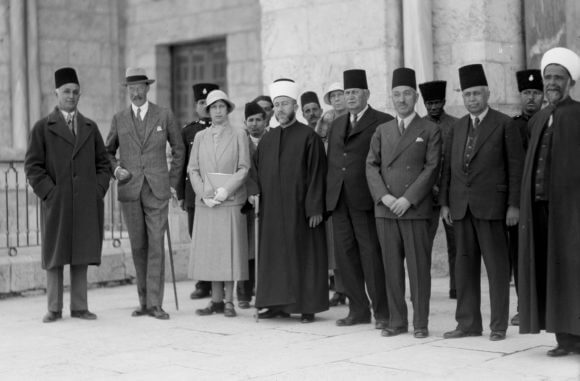
The hardliner Mufti Haj Amin al Husseini, whose uncompromising stance, malign political influence, and conspiratorial association with the Nazis set the stage for a long general strike, the Great Revolt, and ultimately, the débâcle of 1948. The flamboyant rebel leaders, Syrian Izz al Din al Qassam, who is memorialized in the name of the Hamas military wing and a Gaza-made rocket, and Fawzi al Qawuqji. Qassam was gunned down by British soldiers during the revolt whilst Qawuqji lived on to become one of the most effective militia leaders in the war of 1948, and to perish therein. Both are remembered today as Palestinian martyrs whilst the Mufti is an arguably embarrassing footnote of history. There’s an article about his relatively unremarked death at the end of this post.
Amin al-Husseini in 1929
And in the British corner, the well-intentioned high commissioners who vainly endeavoured to reconcile the claims of two aspirant nations in one tiny land, and quixotic figures like the unorthodox soldier Ord Wingate who believed he was fulfilling prophecy by establishing the nucleus of what would become the IDF (like many charismatic British military heroes, and particularly General Gordon and Baden-Powell, both admirers and detractors regarded him a potential nut-case); and the Australian-born ex-soldier Lelland Andrews, assistant district commissioner for Galilee, who also conceived of his mission as divinely ordained. Lewis was murdered by Arab gunmen and Wingate went down in an aeroplane over Burma during WW2.
There are appearances from among many others, Lloyd George, Winton Churchill and Neville Chamberlain, Adolph Hitler and Benito Mussolini, Franklin D Eisenhower and Joseph Kennedy.
The book highlights the work of powerful British functionaries in handling early confrontations: they are memorialized for starting commissions to study the matter and to generate ideas, though many of their ideas weren’t followed or were followed to ill effect. None solved the problem, making this account of the earliest days of the conflict all the more heartbreaking.
All under the shadow of the impending Shoah, and the inevitable showdown that would culminate in al Nakba.
The road to Al Nakba
Kessler argues that the Arab social fabric and economy are completely torn and shattered by the end of this revolt that in many ways the final reckoning for Palestine between Jews and Arabs – the civil war that erupts in 1947 – is actually won by one side and lost by the other nearly a decade earlier.
The final paragraphs of Kessler’s enthralling book are worth quoting because they draw a clear line between the events of the Great Revolt and the catastrophe, al Nakba, of 1948:
“For the Jews, perhaps the greatest shift was psychological. they had withstood of powerful sustained assault and lived to tell about it. One book on Zionist leaders” thinking in this era is titled Abandonment of Illusions. The belief of material gains would bring Arab consent now naïve and, worse, dangerous. Instead, by the end of the revolt and the start of the world war, much of Palestine’s Jewish mainstream had accepted the fact that the country’s fate would ultimately be determined and maintained by force.
“By 1939, the Yishuv had achieved the demographic weight, control of strategic areas of land, and much of the weaponry and military organization that would be needed as a springboard for taking over the country within less than a decade”, writes the Palestinian American historian Rasheed Khalidi.
Khalid argues that the Palestinian catastrophe of 1947 -1949 was predicated on a series of previous failures: “a deeply divided leadership, exceedingly limited finances, no centrally organized military forces or centralized administrative organs, and no reliable allies. They faced a Jewish society in Palestine which although small relative to theirs, was political unified, had centralized para-state institutions, and was increasingly well-led and extremely highly motivated”.
For Palestinians, he maintains, the Nakba – the catastrophe of their military drubbing, dispossession and dispersal – was but a forgone conclusion. For them, the terrible events that bookended the year 1948 “were no more than a postlude, a tragic epilogue to the shattering defeat of 1936- 39”.
The Great Revolt, Kessler says, has cast its shadow over the Israeli-Palestinian conflict ever since – for the Arabs, for the Jews, and for attempts to resolve the conflict. It is still remembered by Palestinians and Israelis alike. Palestinian folk songs still celebrate the revolt, and in my he regards the. BDS movement as direct descendant of the general strike that preceded the revolt. The two-state solution that is still the international community’s favoured solution to the conflict is but a variation of that original partition plan of 1937.
In so many ways, for both Israelis and Palestinians, this revolt rages on.
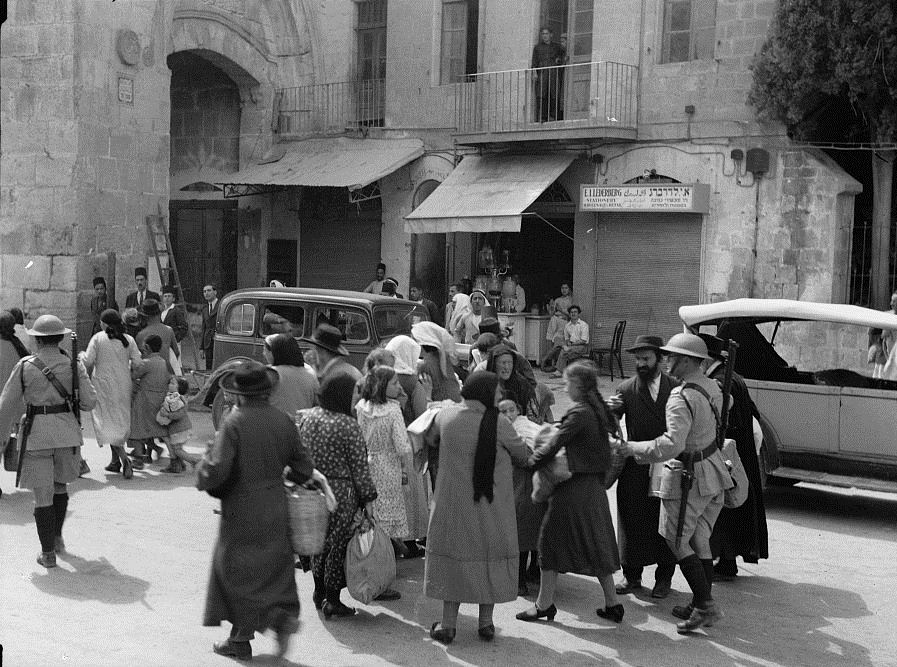
The picture at the head of this post shows British troops marching through Ibn Khatib Square in 1936 past King David’s Citadel and towards the Jaffa Gate
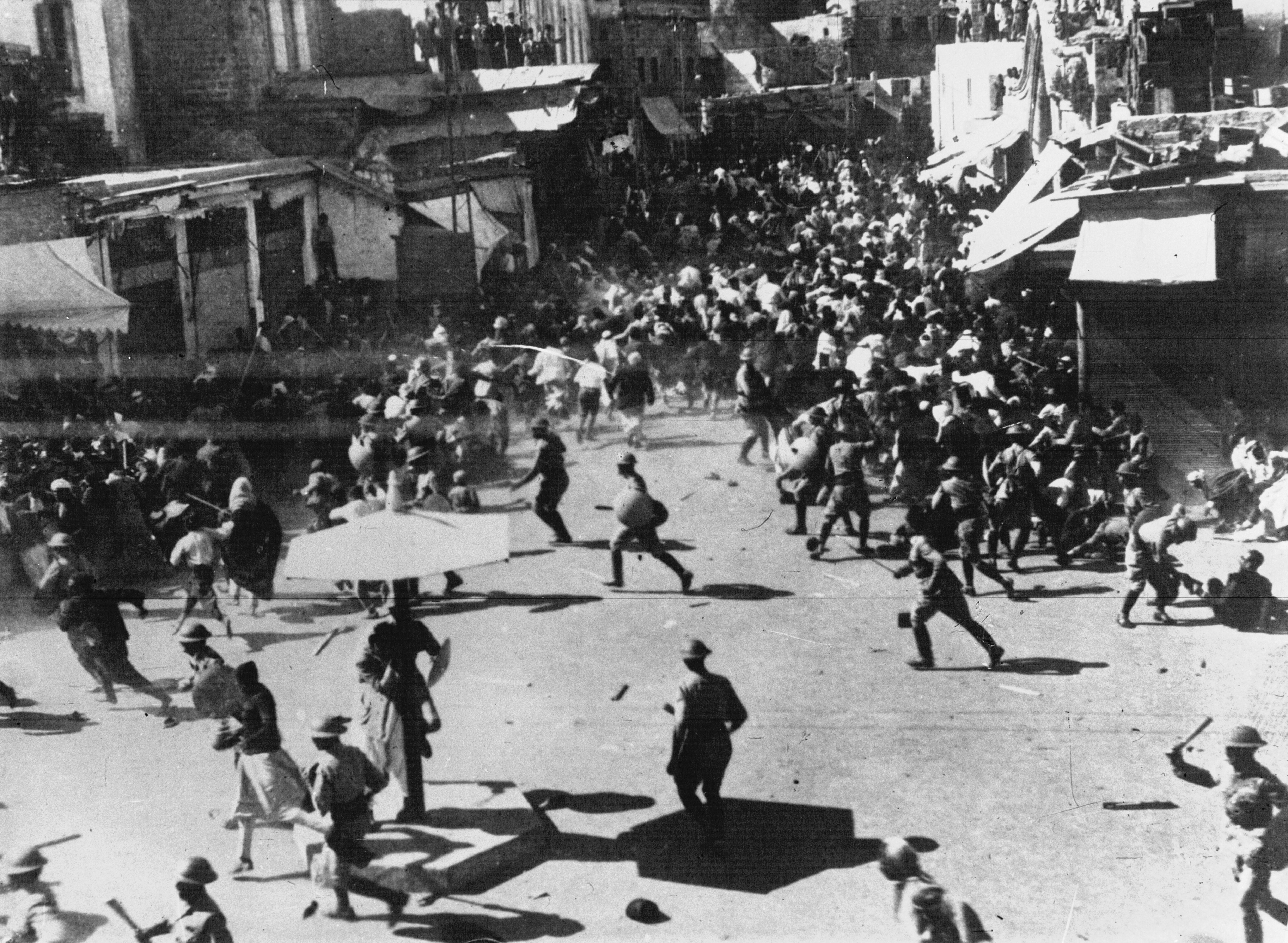
British policemen disperse an Arab mob during the Jaffa riots in April 1936 (The Illustrated London News)
Jews evacuate the Old City of Jerusalem after Arab riots in 1936.
Oren Kessler’s new book Palestine 1936: The Great Revolt and the Roots of the Middle East Conflict (Rowman & Littlefield, 2023) argues powerfully that events in Mandatory Palestine between 1936 and 1939 have shaped the subsequent history of the conflict for Israelis and Palestinians. Called ‘the definitive study’ by Michael Oren, Kessler’s book identifies the revolt as the true first intifada, an uprising which laid the ground for the Arab defeat in 1947-48 and which has set the tone of the conflict for almost a century. He sat down with Fathom deputy editor Jack Omer-Jackaman to discuss the book, recently released in the UK.
Jack Omer-Jackaman: The general reader, in English at least, has lacked a history of the Great Revolt and its repercussions. What have they been missing and with what consequences for our understanding of the conflict?
Oren Kessler: I argue that although this is an Arab revolt, it is as much a Jewish story as an Arab story. From the Arab perspective it’s an extremely formative event – it’s the crucible in which Palestinian Arab identity coalesced as virtually all strands of Arab society came together in a common purpose against a common foe. But on the Jewish side this is an equally seminal and decisive event. It’s often forgotten but this is the period in which the words ‘Jewish State’ first appear on the international agenda – not just the ‘national home’ promised in the Balfour Declaration, but a Jewish state to all intents and purposes, as part of a ‘two-state solution.’ It’s also the period in which the British Empire sows the seeds for a Jewish army. So, in all of these ways this is a hugely formative chapter in the history in the Land of Israel/Palestine, for the conflict itself, and for attempts to resolve it. The degree to which this chapter hasn’t gotten its due is actually quite startling. It’s not entirely clear to me why such a pivotal event right before the Second World War hasn’t gotten its due in English outside of a handful of academic works.
JOJ: And why has the 1936-1939 Revolt been relatively ignored?
OK: It’s a very good question. In the book I quote Professor Mustafa Kabha of the Open University of Israel, who argues that in the Palestinian narrative and consciousness, the revolt has been side-lined, marginalised by the overwhelming primacy of the Nakba. The Nakba is much ‘easier’ to fit into the narrative because, from the Palestinian perspective, it’s the moment at which they are betrayed and unjustly treated by Zionism, by British Imperialism, even by their fellow Arabs who fail to rescue them from the Zionist menace. Whereas dealing with 1936-39 requires a lot more soul-searching. There is a huge convulsion of Arab infighting in this period – there is much Arab bloodshed at the hands of fellow Arabs. That is a lot more difficult for a national narrative to rationalise.
Every national movement has its narrative and its storyline, and the Jewish national narrative tends to be quite forward moving: from the first wave of immigration in the late 19th Century, on to the Balfour Declaration, the start of the British Mandate and the Jewish state-building of the 1920s and 30s, then the agony of the Holocaust and finally the redemption of statehood. That’s essentially the Zionist story, and I think a large-scale, concerted nationalist uprising against that story is a somewhat unwelcome blip in the narrative arc.
JOJ: Let’s set the geopolitical scene at that time: talk to us about the connections between European and local events.
OK: Throughout the book, I bounce back and forth between the situations in Palestine and Europe, because they’re inseparable – certainly from a British perspective, and equally from a Jewish one. The revolt begins only three years after Hitler comes to power in Germany in 1933. There are also other antisemitic movements ascendent across Europe, in places like Poland, Hungary and Romania, and very many Jews are desperate to leave. But almost all potential sanctuaries in the world have been closed; the US has been almost closed to immigration since the Immigration Act of 1924. In many ways, Palestine is the only significant possible refuge left for the Jews of Europe. So Jewish immigration into Palestine is skyrocketing in these years – the Jewish population there doubles in the first half of the 1930s. In 1935, 60,000 Jews come into Palestine, which is nearly double that of the year before, so the Jews are approaching 30 per cent of the population by the time the revolt erupts. The revolt is thus a direct result of the European situation, since it’s very clear to the Arabs of Palestine that if things continue this way, Palestine will have a Jewish majority before long.
From a British perspective, the war clouds looming over Europe make it very difficult for the British army to quash the revolt. They simply don’t have the manpower for it, at least until the Munich Agreement of 1938, granting Hitler the Sudetenland. With the appeasement of Hitler, Britain and all of Europe breathe a sigh of relief and buy some time (at least that’s how it felt at the time). After Munich the British are able to send two divisions to Palestine, which constitutes the largest British army deployment in the interwar period. This is another reason it’s startling that this era has been so overlooked.
JOJ: That leads us neatly onto the next topic, which looks at the balance of power post and ante the revolt. How does each side – and let’s include the British – go into the period and how do they emerge?
OK: Until Munich, the British are severely undermanned in Palestine, and this directly benefits the Jews because this is the period in which the British finally accede to a long-standing demand by the Haganah – the Jewish self-defence group that is technically illegal but tolerated by the British – to arm and train Jews in large numbers. And that’s what happens: 15,000-20,000 Jews join the Palestine Police as Jewish Supernumerary Police. And though they receive their weapons, training and part of their salary from the British government, it’s clear to everyone that they’re ultimately answerable to the Haganah. So the Jews, led by David Ben-Gurion – already in this era the clear leader of Palestine’s Jews – are able to turn adversity to advantage and make tremendous gains, militarily and otherwise, throughout the Arab revolt.
it’s the mirror image for the Arab side. The revolt to crush Zionism crushes the Arabs instead. The initial unity of the revolt’s first phase under the leadership of Grand Mufti Hajj Amin al Husseini – which includes a six-month general strike – gives way in the second phase (from Autumn 1937) to a convulsion of infighting and score settling. Several thousand Arabs are killed by their fellow Arabs, and the Arab leadership – namely the mufti and his associates – is driven into exile. And of course the British begin taking very heavy-handed measures – including a number of incidents that qualify as atrocities – to quash the revolt. Huge numbers of Arab men are put in prison or killed by the British, and thousands of homes demolished. The Arab social fabric and economy are completely torn and shattered by the end of this revolt. I argue in the book, and this is an argument that has also been made by the Palestinian-American professor Rashid Khalidi, that in many ways the final reckoning for Palestine between Jews and Arabs – the civil war that erupts in 1947 – is actually won by one side and lost by the other nearly a decade earlier.
JOJ: The popular narrative is that Palestinian nationalism – as distinct from wider Arab or Syrian nationalism – was a product of the 1930s. What did your study of the period tell you about this?
OK: I think Palestine is sui generis in many ways, including the development of nationalism there. In my view it is during the Arab revolt that a strong sense of Arab nationalism in Palestine extends beyond the urban elites to all corners of the country. All segments of Arab society – urban and rural, rich and poor, rival families, and even to a large extent Muslim and Christian – unite in the same mission against Zionism and against its perceived handmaiden: the British Empire.
The Arab public in Palestine is growing increasingly politically aware and consciously perceiving itself as a distinct entity – distinct from its brethren in Syria, in large part because it has a different foe: not simply European imperialism but this very specific threat presented by Zionism.
JOJ: So was the 1936-1939 Revolt the crucial event in the origins of the modern Israeli-Palestinian conflict? Was this the point at which it became zero sum for both sides? Or was it just the first time there was a wider realisation of this?
OK: I’ve lost track of how many people who, when I start telling them about my book, assume I’m referring to the Hebron massacre of 1929. In my view the Hebron riots were just that: they were riots, they were an outburst of terrorism, but not a sustained nationalist uprising in the way that the Great Revolt of 1936 is – not an intifada in the parlance of today. I think in many ways, the Revolt is when both sides really come to see this conflict as zero sum. But it was always in a way zero sum in that whichever community has the demographic majority in Palestine would be the one that would determine its fate. This is an age in which the world is moving, however haltingly, from imperialism towards self-determination, and it is clear to both Jews and Arabs alike that having a majority would be absolutely key. However, in the 1920s, the Jews were so far from that majority that both sides were able to postpone the final reckoning. In the 1930s, the Jews are threatening to become a majority, and that’s the immediate precursor to this revolt erupting.
JOJ: Is it fair to say that the tone was set at this time, on the Palestinian side, for this being a conflict that demands hardliners? That the tone was set of leadership by extremists like Qassam and Hajj Amin[1] and not more moderate figures like Faisal or the Nashashibis?
OK: Yes, I do think that this is the period in which the intransigent line taken by Hajj Amin becomes not just mainstream but one from which it is very dangerous to deviate. Hajj Amin, even after fleeing the country in Autumn of 1937, manages to exert his will over the revolt from afar, and anyone who dares step out of line or contemplate reaching some sort of modus vivendi with the Zionist movement tends to find himself dead or in some other serious trouble. A prime example of that is the reaction among prominent Arabs to the partition plan. In late 1936, the British government sends a royal commission to Palestine, known to history as the Peel Commission, to examine the causes of the revolt, and famously it proposes the first ‘two state solution.’ The Emir Abdullah of Transjordan publicly accepts this plan. The main rival clan to the Husseinis, the Nashashibis, privately signal that they are amenable; not thrilled, but amenable. And their allies hold the mayorships of quite a few important cities – Jaffa, Haifa, and even Nablus, Jenin and Tulkarem, which today are centres of militancy. And yet the Mufti makes very clear that he regards this plan as a degradation and a humiliation, and all of these erstwhile supporters of partition suddenly realise that they are against partition. So yes, I do think that this is the point at which a certain uncompromising line becomes the default one amongst the Arab leadership of Palestine, with really devastating results for the Palestinians themselves.
JOJ: Let’s look to the Jewish side. Is it the first, or at least a formative, time when differing approaches to state-building and self-defence within the Zionist movement are clearly exposed?
OK: Absolutely. During the Arab Revolt the Haganah adheres to a policy called havlagah, meaning self-restraint, despite the revolt’s very high toll in Jewish blood. Some 500 Jews are killed in this revolt; these are huge numbers, comparable to those in the Second Intifada in much more recent times. The logic is to convince the British that they can be trusted with weapons and, as mentioned earlier, that’s exactly what happens. The Irgun – the Revisionist, right-wing dissident Zionist group, whose ideological leader is Vladimir Jabotinsky – has a very different view, much more in line with ‘an eye for an eye’. They believe that it has to be made very clear to the Arabs that Jewish blood could not be shed unanswered, and that taking the fight to the Arabs, including civilians, would have a deterrent effect. We see dozens of Irgun attacks targeting Arab civilians during the revolt. I don’t think there’s any other way to describe this than terrorism – this isn’t ‘collateral damage’ in an attempt to target militants, but a mentality in which ‘If the Arabs target our civilians, we’ll target theirs’. So, there’s a real schism between these two Zionist movements, but the Haganah are able to convince the British that they are in control and are the mainstream, and that the Irgun is merely a fringe group. And that’s how this crucial British-Jewish military cooperation begins.
JOJ: Could the Yishuv leadership have acted any differently in the years prior to the revolt and forestalled it? Or not without sacrificing immigration?
OK: A very good question, and one which gets back to this question of whether it’s a zero sum conflict. I don’t agree with the rose-tinted analyses of history that I sometimes hear, which claim that in the Ottoman and early Mandate eras the two communities were able to get along in peace and it is somehow British mismanagement that prompted the conflict. Rather it seems to me that when the Jews were a minority, they didn’t present too much of a disruption to the status quo, but as soon as they began to threaten to reach a majority, there is almost no alternative to this conflict breaking out. That’s how Ben-Gurion looks at this situation throughout, and he never agrees to even slowimmigration. By contrast, Chaim Weizmann, head of the world Zionist Organisation, is willing to slow immigration to try to cultivate Arab goodwill and cooperation. I don’t see how that objective of bringing as many Jews to the land as possible could be achieved without bringing about some serious Arab pushback.
JOJ: To what extent was the Arab general strike self-defeating in allowing Ben-Gurion unprecedented opportunities for a key Zionist priority: the conquest of labour?[2]
The general strike starts almost at the very beginning of the revolt and lasts six months – still one of the longest general strikes anywhere in history. It is a source of great Arab pride. As I mentioned, Ben-Gurion really is an expert in turning adversity into advantage. He sees a tremendous opportunity to achieve his long-standing objective of creating a self-sufficient Jewish polity, one that could feed itself, house itself, defend itself, employ itself, without any help from anyone – not the British or the Arabs. In the strike, the Arabs cut all contacts with the Jewish and British economies, and when Jaffa port closed in Spring of 1936, Ben-Gurion pleads successfully with the British to allow the Jews to open their own port in Tel Aviv. The British agree and Ben Gurion is euphoric, hailing the fact that the Jews now have an outlet to the world as a second Balfour Declaration. That’s just one example of how the Arab strike and boycott ultimately cause a lot of economic pain to the Arabs and help the Jews in their state-building enterprise.
JOJ: You benefited tremendously from the declassification of the Peel Commission’s secret testimonies, which threw up some fascinating revelations. What did we learn about the origins of the Balfour Declaration, for example?
This was one of the most interesting troves of archival documents that I found in my research. The British Government kept the Peel Commission documents classified for 80 years, and they were very quietly declassified only in 2017. I wrote an article in Fathom in 2020 about the 1937 secret testimony of David Lloyd George, the Prime Minister at the time of the Balfour Declaration, on why the government had issued that historic and controversial document. Explaining his decision of two decades earlier, he says the Jews ‘are a dangerous people to quarrel with, but they are a very helpful people if you can get them on your side.’ He says that he and his ministry were very concerned, in the midst of the First World War, that the Jews of America and Russia might not support the allies but go over to the German side. There were even murmurings that the Germans were thinking of a ‘Balfour Declaration’ of their own. Lloyd George makes very clear in this testimony that that was a primary reason that the Declaration was given at that time. And he says that, in his opinion, the declaration more than paid for itself by the help that the Jews of America and Russia gave in various ways during the war.
JOJ: Herbert Samuel’s testimony was interesting, too.
OK: Samuel was the first High Commissioner for Palestine, as well as a Jew and a Zionist. In his testimony he is asked why he appointed Hajj Amin as Grand Mufti in the first place in the early 1920s – this is the only occasion I’ve ever seen him asked about this decision, which is one of the most fateful taken in the entire history of the Israeli-Arab conflict. He basically says, and I’m paraphrasing: ‘look, I had no choice. We had to appoint someone from the Husseini family because we had already given the other great Arab families various other perks, and so the Husseinis needed to get the muftiship. And Amin was the only Husseini with the requisite religious education having studied at al Azhar in Egypt.’ Samuel doesn’t admit it was a mistake but defends the decision and says that Hajj Amin had more or less behaved well until that point. (That is not quite true: the British had sentenced him in absentia for rabble rousing in 1920.) These are fascinating documents that were originally slated for destruction; the witnesses who give testimony do so on that understanding. But one very forward-looking British official has the foresight to stow them away,scribbling in the marginsthat they chronicle ‘an important chapter in the history of Palestine and the Jewish people, and will, no doubt, be of considerable value to the historians of the remote future.’
JOJ: Let’s look at Peel’s partition proposals a little deeper. We tend, optimistically, to think that decisions taken by high level politicians and civil servants are subject to forensic detail and informed by expert knowledge. How does the British process for proposing the first two-state solution correct us on this?
OK: That is one of the most fascinating discoveries contained in the secret testimonies: just how this two-state solution is arrived at. One of the commission members is an Oxford don by the name of Professor Reginald Coupland, an Africa-focused historian not particularly well-versed in the Middle East. He arrives at the idea that just as the Greeks and Turks were separated after World War One, in what he referred to as a ‘clean cut’, so Jews and Arabs need to be separated in that same way. It is really Coupland, with the help of a few British colonial servants in Palestine, who pushes through this idea of a two-state solution. And they do so quite hastily – when you look at the minutes of these secret testimonies, it’s just a few pages in which they discuss the practicability and the details of such a solution. It’s Coupland, an irrigation advisor by the name of Douglas Harris, and the assistant district commissioner for Galilee, Lewis Andrews (who shortly thereafter is assassinated) who draft the first two-state solution, which becomes the ideological template for every subsequent attempted solution to the conflict, from the UN’s exactly a decade later onto the various subsequent iterations until our time.
JOJ: Let’s talk about another piece of Mandate administration,the 1939 MacDonald White Paper, which barred Jews entry to Palestine just months before the outbreak of World War Two. Does your book have anything to say on this that is new?
OK: There’s a general familiarity, at least among Jews, with the White Paper and that it is a bad an unjust thing. But the genesis of the White Paper has not been researched to the degree it deserves, and in the book I devote a whole chapter to it. The Colonial Secretary at the time is Malcolm MacDonald, who is only 37 years old (he is the son of the first Labour Prime Minister, Ramsay MacDonald). This is the Chamberlain government, which is dedicated to appeasement, not just in Europe but in the Middle East. Even though MacDonald is a member of the National Labour Party, he is a loyal member of the ministry and determines, with the advice of senior officials in the army and the government, that some drastic changes need to be made to Britain’s Palestine policy in such a crucial period. There is a feeling that world war would break out at any point and that Muslim opinion, particularly in India, has to be appeased, lest Muslim subjects of the empire side with Hitler.
When you look at the discussion, you see that the British policy makers plan to go far in the direction of Arab demands when they call the St James’s Conference in 1939. And yet, throughout these negotiations, they go quite a bit farther even than they originally intend. So, where 60,000 Jews immigrated to Palestine in 1935, the 1939 White Paper limits Jewish immigration to a total of 75,000 over five years, after which Palestine would become an independent state. The White Paper doesn’t say an independent Arab state, but of course if Jewish immigration is limited to keep the Jews under 35 or 40 per cent of the population, it’s clear to everyone that this would be a de facto Arab state. This is mid-1939, when the Jews of Europe are most desperate to find sanctuary outside of Europe, and the White Paper is seen by the Jews and their supporters as a tremendous betrayal, and a reneging not just on the Peel Commission plan of two years previous, but on the Balfour Declaration itself.
This is one of the tremendous ‘what ifs’ of history: what would have happened had the White Paper not been passed, or had the Peel partition plan of 1937 gone through? Ben-Gurion, after the Holocaust, said that had the Jews had the small state promised to them in 1937, six million could have been saved. I think that’s perhaps an overstatement: I’m not sure that the very small state offered to them was developed enough to absorb six million people. It was Golda Meir who said that had the Jewish state been established (and the White Paper not implemented), hundreds of thousands could have been saved: I think that’s a plausible reading of history. The White Paper is what finally turns Ben-Gurion against the British. It’s when he decides that the British-Zionist partnership is essentially over and when he starts to look across the ocean to America as the great potential supporter of Zionism.
JOJ: Finally, it’s fascinating to see how the 1936-1939 Revolt and this period lives in the iconography of both Israelis and Palestinians. You don’t have to look too hard to see it referenced or deployed in the present day. It occupies a place of glory for Palestinians, which is rather ironic given its role in the catastrophe of 1948. And on the Israeli side, it was referenced not too long ago by Finance Minister Bezalel Smotrich.
OK: I argue that the revolt has cast its shadow over the Israeli-Palestinian conflict ever since – for the Arabs, for the Jews, and for attempts to resolve the conflict. Just recently, for example, in the Gaza conflict of May 2021, you may remember that the war extended to the battlefield of social media. When the Arabs of Israel and the West Bank joined together in a one-day strike, Twitter was abuzz with comparisons to 1936. And, as you mention, Bezalel Smotrich tweeted: ‘the riots of the Arab enemy take us back many years to the great Arab revolt. Back then a hostile British government protected rioters. Today a worthless, weak Jewish government, a contaminated judiciary and a law enforcement system emasculated by dangerous post-national and post-modern notions…’ Palestinian folk songs still celebrate the revolt, and in my view the BDS movement is a direct descendant of the general strike. Finally, as I mentioned earlier, the two-state solution that is still the international community’s the favoured solution to the conflict is simply a variation of the original partition plan of 1937. In so many ways, for both Israelis and Palestinians, this revolt rages on.
[1] Editor’s note: Hajj Amin al Husseini, appointed by the British Mandate as Grand Mufti in 1921, would become a determined supporter of Nazi Germany. At his 1941 meeting with Hitler, Hajj Amin declared himself ‘fully reassured and satisfied’ with Hitler’s reassurance that once having achieved the ‘total destruction of the Judeo-Communist empire in Europe… Germany’s objective would then be solely the destruction of the Jewish element residing in the Arab sphere’. In 1943, the SS enlisted Hajj Amin to lead a recruitment drive among Bosnian Muslims, SS Main Office Chief Berger noting the ‘extraordinarily successful impact’ of the Mufti’s activities.
[2] Editor’s note: The concept of Kibbush Haavoda, the conquest of labour, was a key plank in Labour Zionism. Its priorities were the encouraging of manual and agricultural labour amongst Jewish immigrants to Palestine and a reliance on Jewish labour for the Jewish economy
In 1936, widespread Palestinian dissatisfaction with Britain’s governance erupted into open rebellion. Several key dynamics and events can be seen as setting the stage for this uprising. In Palestine, as elsewhere, the 1930s had been a time of intense economic disruption. Rural Palestinians were hit hard by debt and dispossession, and such pressures were only exacerbated by British policies and Zionist imperatives of land purchases and “Hebrew labor.” Rural to urban migration swelled Haifa and Jaffa with poor Palestinians in search of work, and new attendant forms of political organizing emerged that emphasized youth, religion, class, and ideology over older elite-based structures. Meanwhile, rising anti-Semitism—especially its state-supported variant—in Europe led to an increase of Jewish immigration, legal and illegal, in Palestine.
Unsurprisingly, the combination of these various trends produced periodic upheavals, from the 1929 al-Buraq Uprising to multicity demonstrations in 1933 against the British Mandate. In October 1935, the discovery of a shipment of arms in the Jaffa port destined for the Haganah fueled Palestinian concerns that the Zionist movement was introducing the human and military resources necessary for its state-building project under the nose of the British. Meanwhile, the popular and populist Syrian Shaykh Izzeddin al-Qassam , who preached to the slum-dwelling rural transplants near Haifa’s rail yards and who had spent the early 1930s building a cell-based paramilitary network, was killed in a firefight with British forces in November 1935. Qassam’s funeral in Haifa elicited a mass outpouring of public outrage. These events are often seen as direct predecessors of the mass Palestinian uprising that took place in 1936.
The Great Palestinian Rebellion , or the Great Arab Revolt, as this uprising came to be known, lasted for three years and can be generally divided into three phases. Thefirst phase lasted from the spring of 1936 to July 1937. With tensions throughout Palestine running high since the fall of 1935, the revolt was ignited in mid-April 1936 when followers of Qassam attacked a convoy of trucks between Nablus and Tulkarm , killing two Jewish drivers. The next day, the Irgun killed two Palestinian workers near Petah Tikva , and in the following days, deadly disturbances ensued in Tel Aviv and Jaffa. In Nablus, an Arab National Committee was formed and a strike was called on 19 April. National Committees in other cities echoed the call to strike, and on 25 April the Arab Higher Committee (Lajna) (AHC) was formed, chaired by Haj Amin al-Husseini , to coordinate and support a nationwide general strike, which was launched on 8 May.
The strike was widely observed and brought commercial and economic activity in the Palestinian sector to a standstill. Meanwhile, Palestinians throughout the countryside came together in armed groups to attack—at first sporadically, but with increasing organization— British and Zionist targets. Some Arab volunteers joined the rebels from outside Palestine, though their numbers remained small in this period. The British employed various tactics in an attempt to break the strike and to quell the rural insurrection. The ranks of British and Jewish policemen swelled and Palestinians were subjected to house searches, night raids, beatings, imprisonment, torture, and deportation. Large areas of Jaffa’s Old City were demolished, and the British called in military reinforcements.
Concurrent with military operations and repressive measures, the British government dispatched a commission of inquiry headed by Lord Peel to investigate the root causes of the revolt. In October 1936, under the combined pressure of British policies, other Arab heads of state, and the effects of a six-month general strike on the Palestinian population, the AHC called off the strike and agreed to appear before the Peel Commission . A period of lower intensity conflict prevailed as the Peel Commission toured the country, but tensions continued to build in anticipation of the commission’s report. In July 1937, the Peel Commission published its report, recommending Palestine’s partition into Jewish and Arab states. Dismayed by this negation of their desires and demands, the Palestinian population relaunched their armed insurgency with renewed intensity, initiating the second phase of the revolt.
This second phase, lasting from July 1937 until the fall of 1938, witnessed significant gains by the Palestinian rebels. Large swaths of the hilly Palestinian interior, including for a time the Old City of Jerusalem , fell fully under rebel control. Rebels established institutions, most significantly courts and a postal service, to replace the British Mandate structures they sought to dismantle. The British, meanwhile, imposed even harsher measures to try to quash the revolt. The AHC and all Palestinian political parties were outlawed, political and community leaders were arrested, and a number of high-profile public figures exiled. The military aspects of counterinsurgency intensified, and British tanks, airplanes, and heavy artillery were deployed throughout Palestine. The British also meted out collective punishment: thousands of Palestinians were relegated to “detention camps”; residential quarters were destroyed; schools were closed; villages were collectively fined and forced to billet British troops and police. Zionist military institutions took advantage of the situation to build up their capacities with British support. By early 1939, members of the Jewish Settlement Police (about 14,000) were subsidized, uniformed, and armed by the British government as a thinly veiled front for the Haganah, and so-called Special Night Squads comprising Jewish and British members launched “special operations” against Palestinian villages.
Thethird phaseof the rebellion lasted roughly from the fall of 1938 to the summer of 1939. The British dispatched another commission of inquiry, this one headed by Sir John Woodhead , to examine the technical aspects of implementing partition. In November 1938, the Woodhead Commission report concluded that partition was not practicable, marking a certain British retreat from the Peel recommendation. At the same time, however, the British launched an all-out offensive: in 1939 more Palestinians were killed, more were executed (by hanging), and nearly twice as many were detained than in 1938. Such brutality placed immense pressure on the rebels, exacerbating rifts between the political leadership of the AHC exiled in Damascus and local leadership on the ground, between rebel bands and village populations that were expected to support and supply them, and ultimately between Palestinians who remained committed to the revolt and those willing to reach a compromise with the British. British-supported Palestinian “Peace Bands” were dispatched to battle their compatriots.
In May 1939, the British government published a new White Paperthat proposed the following: Britain’s obligations to the Jewish national home had been substantially fulfilled; indefinite mass Jewish immigration to and land acquisition in Palestine would contradict Britain’s obligations to the Palestinians; within the next five years, no more than 75,000 Jews would be allowed into the country, after which Jewish immigration would be subject to “Arab acquiescence”; land transfers would be permitted in certain areas, but restricted and prohibited in others, to protect Palestinians from landlessness; and an independent unitary state would be established after ten years, conditional on favorable Palestinian-Jewish relations.
The combined impact of Britain’s military and diplomatic efforts brought the rebellion to an end in the late summer of 1939. Over the revolt’s three years, some 5,000 Palestinians had been killed and nearly 15,000 wounded. The Palestinian leadership had been exiled, assassinated, imprisoned, and made to turn against one another. At the same time, the White Paper—despite its limitations—offered certain concessions to the rebels’ demands. Whatever gains Palestinians might have made through the revolt, however, were quickly overtaken by the larger geopolitical processes of World War II , and the combined British-Zionist assault on Palestinian political and social life during the revolt had a long-lasting impact.
“VISIT OF H.R.H. PRINCESS MARY AND THE EARL OF HARWOOD. MARCH 1934. PRINCESS MARY, THE EARL OF HARWOOD, AND THE GRAND MUFTI, ETC. AT THE MOSQUE EL-AKSA [I.E., AL-AQSA IN JERUSALEM].” LIBRARY OF CONGRESS, LC-M33- 4221.
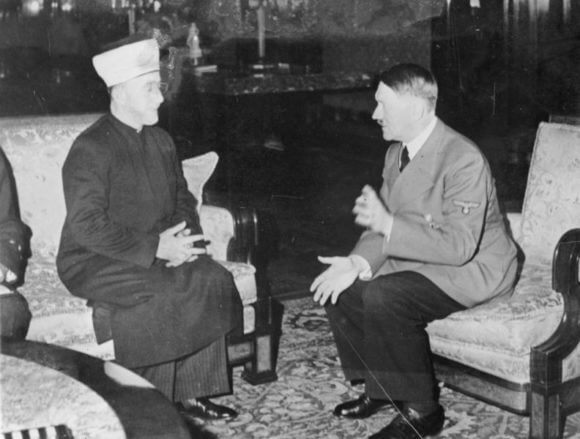
A two-part archive, labeled “Activities of the Grand Mufti of Jerusalem” and dated 1940-1941, sits in Britain’s National Archives in Kew. This writer successfully had the first part declassified in 2014. The second part remains sealed. My 2018 attempt to have these ten pages declassified was refused on the grounds that the archive might “undermine the security of the country [Britain] and its citizens.”[1] None of its secrets are to be available until January, 2042; and if the paired file is any precedent, even in 2042 it will be released only in redacted form.
The ‘Grand Mufti’ in the archive’s heading is Haj Amin al-Husseini, the Palestinian leader whom posterity best remembers for his alignment with the Italian and German fascists; and the years 1940-1941 place him not in Palestine, but in Iraq — and if the second archive extends to late 1941, in Europe. What could possibly be hidden in a World War II document about a long-dead Nazi sympathizer that would present such a risk to British national security eight decades later, that none of it can be revealed? At present, only the UK government censors know; but the answer may have less to do with the fascists and al-Husseini than with British misdeeds in Iraq, and less to do with Britain’s national security than with its historical embarrassment.
When in 1921 votes were cast for the new Mufti of Jerusalem, Amin al-Husseini came in last among the four candidates. But votes in Palestine mattered as little then as they do now, and the British, Palestine’s novice replacement occupiers for the Ottomans, handed the post to al-Husseini. At first, he proved to be an asset to the British. But as the years passed, his opposition to Zionism, support for Palestinian nationalism, and ultimately his involvement in the 1936 Palestinian uprising, led to calls for his arrest.
“ARAB DEMONSTRATIONS ON OCT. 13 AND 27, 1933. IN JERUSALEM AND JAFFA. RETURN OF GRAND MUFTI FROM INDIA. MET BY HUNDREDS OF CARS AT GETHSEMANE, NOV. 17, 1933.” LIBRARY OF CONGRESS, LC-M33- 4218.
In mid-October of 1937, he fled from hiding in Palestine to Beirut. Two years later and six weeks after the outbreak of World War II, in mid-October of 1939, he slipped to Baghdad, where his sympathies for the Italian fascists further alarmed the British. Fast-forward another two years to late 1941, and al-Husseini is in Europe, meeting with Benito Mussolini on the 27th of October, and on the 28th of November meeting with the Führer himself at the Reich Chancellery in Berlin.
Al-Husseini’s motivation for embracing the Axis was likely a combination of selfish political opportunism and the belief that the alignment would help safeguard against the takeover of Palestine by the Zionists. The reasoning, however grotesque, was the same used by Lehi (the ‘Stern Gang’) in its own attempted collaboration with the fascists: Britain was the obstacle both to Palestinian liberation, and to unbridled Zionism, and for both the Mufti and Lehi, defeating that obstacle meant embracing its enemies. Even the ‘mainstream’ David Ben-Gurion had no moral qualms about taking advantage of Britain’s struggle against the Nazis — a struggle for which his Jewish Agency was already conspicuously unhelpful — by exploiting Britain’s post-war vulnerabilities.[2]
Posterity has treated Lehi’s and the Mufti’s flirtations with the fascists quite differently. Lehi, the most fanatical of the major Zionist terror organizations, was transformed into freedom fighters, and ex-Lehi leader Yitzhak Shamir was twice elected as Israeli Prime Minister. In contrast, Zionist leaders quickly seized on al-Husseini’s past to smear not just him, but the Palestinians as a people, as Nazis.
The use of al-Husseini’s unsavory history to ‘justify’ anti-Palestinian racism continues to the present day. Most bizarrely, in 2015 Israeli Prime Minister Benjamin Netanyahu claimed that Hitler had not intended to exterminate the Jews — that is, not until al-Husseini planted the words in his ear — which translates as “got the idea from the Palestinians”. A private citizen would likely have been arrested under German law for this attempt to rewrite the Holocaust.
THE MUFTI OF JERUSALEM, SAYID AMIN AL HUSSEINI, MEETS WITH HITLER, NOVEMBER 1941.
Iraq won limited independence in 1932, just before the Nazis came to power. When the Mufti ensconced himself in Iraq seven years later, the country was under nominally ‘pro-British’ Prime Ministers, and Regent ‘Abd al-Ilah for the four-year-old king, Faisal II. This uneasy British-Iraqi equilibrium ended on first day of April 1941, when four Iraqi officers known as the Golden Square, wanting full independence (and similarly aligning themselves with the fascists in the foolish belief that doing so would help them get it), staged a coup d’état. It lasted two months. British troops ousted the coup on the first day of June — and as they did, anti-Jewish riots rocked Baghdad. An estimated 180 Jewish Iraqis were killed and 240 wounded in this pogrom known as the Farhud.
Why would the momentary power vacuum of the British takeover lead to anti-Jewish terror? While doing research for my 2016 book, State of Terror, I was intrigued by the claim of one Iraqi Jewish witness, Naeim Giladi, that these ‘Arab’ riots were orchestrated by the British to justify their return to power.[3] Indeed, the riots seemed unnatural in a society where Jews had lived for two and a half millennia, and the “pro-Axis” Golden Square takeover two months earlier had not precipitated any such pogrom. Yet it was also true that Zionism had created ethnic resentment, and Giladi did not question that junior officers of the Iraqi army were involved in the violence. The evidence provided by Giladi was compelling enough to seek out clues among British source documents that were not available to him.
And that, along with the hope of shedding new light on the Mufti’s pro-fascist activities, brought me to the archive at issue and my qualified (redacted) success in getting the first part declassified– officially titled, CO 733/420/19. Not surprisingly, much of the file focused on legitimate worry over the Mufti’s dealings with the Italian fascists. Some of the British voices recorded considered him to be a serious threat to the war effort, and a report entitled “Inside Information” spoke of the Mufti’s place in an alleged “German shadow government in Arabia”. Others dismissed this as “typical of the sort of stuff which literary refugees put into their memoirs in order to make them dramatic” and suggested that the Mufti’s influence was overstated.
Whatever the case, by October 1940, the Foreign Office was considering various methods for “putting an end to the Mufti’s intrigues with the Italians”, and by mid-November,
it was decided that the only really effective means of securing a control over him [the Mufti] would be a military occupation of Iraq.
British plans of a coup were no longer mere discussion, but a plan already in progress:
We may be able to clip the Mufti’s wings when we can get a new Government in Iraq. F.O. [Foreign Office] are working on this”.
So, the British were already working on re-occupying Iraq five months before the April 1941 ‘Golden Square’ coup.
A prominent thread of the archive was: How to effect a British coup without further alienating ‘the Arab world’ in the midst of the war, beyond what the empowering of Zionism had already done? Harold MacMichael, High Commissioner for Palestine, suggested the idea “that documents incriminating the Mufti have been found in Libya” that can be used to embarrass him among his followers; but others “felt some hesitation … knowing, as we should, there was no truth in the statement.”
But frustratingly, the trail stops in late 1940; to know anything conclusive we need the second part’s forbidden ten pages: CO 733/420/19/1.
The redacted first part partially supports, or at least does not challenge, Giladi’s claim. It proves that Britain was planning regime change and sought a pretext, but gives no hint as to whether ethnic violence was to be that pretext. Interestingly, Lehi had at the time reached the same conclusion as Giladi: its Communique claimed that “Churchill’s Government is responsible for the pogrom in Baghdad”.[4]
Does the public have the right to see still-secret archives such as CO 733/420/19/1? In this case, the gatekeepers claimed to be protecting us from the Forbidden Fruit of “curiosity”: They claimed to be distinguishing between “information that would benefit the public good”, and “information that would meet public curiosity”, and decided on our behalf that this archive fit the latter.[1] We are to believe that an eight-decade-old archive on an important issue remains sealed because it would merely satisfy our lust for salacious gossip.
Perhaps no assessment of past British manipulation in Iraq would have given pause to the Blair government before signing on to the US’s vastly more catastrophic Iraqi ‘regime change’ of 2003, promoted with none of 1940’s hesitation about using forged ‘African’ documents — this time around Niger, instead of Libya. But history has not even a chance of teaching us, if its lessons are kept hidden from the people themselves.
Note: According to Giladi, the riots of 1941 “gave the Zionists in Palestine a pretext to set up a Zionist underground in Iraq” that would culminate with the (proven) Israeli false-flag ‘terrorism’ that emptied most of Iraq’s Jewish population a decade later. Documents in Kew seen by the author support this. But to be sure, the Zionists were not connected with the alleged British maneuvers of 1941.
1. Correspondence from the UK government, explaining its refusal to allow me access to CO 733/420/19/1:
Section 23(1) (security bodies and security matters): We have considered whether the balance of the public interest favours releasing or withholding this information. After careful consideration, we have determined that the public interest in releasing the information you have requested is outweighed by the public interest in maintaining the exemption. It is in the public interest that our security agencies can operate effectively in the interests of the United Kingdom, without disclosing information that would assist those determined to undermine the security of the country and its citizens.
The judiciary differentiates between information that would benefit the public good and information that would meet public curiosity. It does not consider the latter to be a ‘public interest’ in favour of disclosure. In this case, disclosure would neither meaningfully improve transparency nor assist public debate, and disclosure would not therefore benefit the public good.
2. Ben-Gurion looked ahead to when the end of the war would leave Britain militarily weakened and geographically dispersed, and economically ruined. He cited the occupation of Vilna by the Poles after World War I as a precedent for the tactic. For him, the end of WWII only presented an opportunity for the takeover of Palestine with less physical resistance; it also left Britain at the mercy of the United States for economic relief, which the Jewish Agency exploited by pressuring US politicians to make that assistance contingent on supporting Zionist claims to Palestine. At a mid-December 1945 secret meeting of the Jewish Agency Executive, Ben-Gurion stressed that “our activities should be directed from Washington and not from London”, noting that “Jewish influence in America is powerful and able to cause damage to the interests of Great Britain”, as it “depends to a great extent on America economically” and would “not be able to ignore American pressure if we succeed in bringing this pressure to bear”. He lauded Rabbi Abba Silver in the US for his aggressiveness on the issue, while noting that he was nonetheless “a little fanatical and may go too far”. (TNA, FO 1093/508). The Irgun was more direct in 1946, stating that Britain’s commuting of two terrorists’ death sentences and other accommodations to the Zionists “has been done with the sole purpose to calm American opposition against the American loan to Britain”. (TNA, KV 5-36). Meanwhile, in the US that year Rabbi Silver’s bluntness on the tactic worried Moshe Shertok (a future prime minister). Although like Ben-Gurion, Shertok said that “we shall exploit to the maximum the American pressure on the British Government”, in particular the pre-election period (and in particular New York), but urged “care and wisdom in this” so as not to give ammunition to “anti-Zionists and the anti-semites in general”. Shertok criticized Silver for saying publicly that “he and his supporters opposed the loan to be granted to the British Government”. (TNA, CO 537/1715)
3. Suárez, Thomas, State of Terror: How Terrorism Created Modern Israel[Skyscraper, 2016, and Interlink, 2017]; In Arabic, هكذا أقيمت المستعمرة [Kuwait, 2018]; in French, Comment le terrorisme a créé Israël[Investig’Action, 2019] Giladi, Naeim, Ben-Gurion’s Scandals: How the Haganah and the Mossad Eliminated Jews [Dandelion, 2006]
4. Lehi, Communique, No. 21/41, dated 1st of August 1941
Update: This post originally referred to the “four-year-old Prime Minister, ‘Abd al-Ilah,” not the four-year-old King Faisal under Regent ‘Abd al-Ilah. Commenter Jon S. corrected us, and the post has been changed.
The day the Mufti died
Yes, Hajj Amin al-Husayni collaborated with the Nazis, but that’s not why he was dropped from the Palestinian narrative
Martin Kramer, Times of Israel Blogs, July 5, 202
Please note that the posts on The Blogs are contributed by third parties. The opinions, facts and any media content in them are presented solely by the authors, and neither The Times of Israel nor its partners assume any responsibility for them. Please contact us in case of abuse. In case of abuse,
“To His Eminence the Grand Mufti as a memento. H. Himmler. July 4, 1943.” Israel State Archives.
Fifty years ago, on July 4, 1974, Hajj Amin al-Husayni, the “Grand Mufti” of Jerusalem, passed away in Beirut, Lebanon, at the American University Hospital. At age 79, he died of natural causes. The Mufti had faded from the headlines a decade earlier. In 1961, his name had resurfaced numerous times during the Jerusalem trial of Adolf Eichmann. But a couple of years later, the Palestinian cause gained a new face in Yasser Arafat. With that, the Mufti entered his final eclipse.
When he died, the Supreme Muslim Council in Jerusalem asked the Israeli authorities for permission to bury him in the city. Israel refused the request. Any Palestinian who wanted to attend the funeral in Lebanon would be allowed to do so, but the Mufti of Jerusalem would not be buried in Jerusalem. Instead, the Mufti was laid to rest in the Palestinian “Martyrs’ Cemetery” in Beirut.
The Mufti was appointed to his position by the British in 1921. Within the British Empire, authorities preferred to work through “native” institutions, even if they had to create them on the fly. So they established a supreme council for Palestine’s Muslims and placed the Mufti at its helm. Although he lacked religious qualifications, he came from a leading family and appeared capable of striking deals.
In fact, he used his position to oppose the Jewish “National Home” policy of the Mandate. The “Arab Revolt” of 1936 finally convinced the British that he had to go, and in 1937 he fled the country.
After a period in Lebanon, he ended up in Iraq, where he helped foment a coup against the pro-British regime. When British forces suppressed the coup, he fled again, making his way through Tehran and Rome to Berlin. There, the Nazi regime used him to stir up Arabs and Muslims against the Allies. He was photographed with Hitler and Himmler, recruited Muslims to fight for the Axis, and attempted to secure promises of independence for colonized Arabs and Muslims. None of his efforts met with much success. His role, if any, in the Holocaust is a contested matter. Hitler and his henchmen hardly needed any prompting to execute their genocidal plans. Clearly, though, the Mufti rooted for Jewish destruction from the fifty-yard line.
After the Nazi collapse, he fell into French hands and spent a year in comfortable house detention near Paris. Later, he fled to Egypt and subsequently moved in and out of Syria and Lebanon. Following the Arab debacle of 1948, Egypt established an “All Palestine Government” in the refugee-choked Gaza Strip, leaving the presidency open for the Mufti. It didn’t last long. He continued to maneuver through Arab politics, but he was yesterday’s man to a new generation of Palestinians born in exile. During the Eichmann trial, the prosecution sought to implicate the Mufti as an accomplice. Yet the Mossad never came after him, and he didn’t die a martyr’s death.
Man without a country
The Mufti was a formidable politician. In 1951, a State Department-CIA profile of him opened with this evocative enumeration of his many talents, which is worth quoting at length:
King of no country, having no army, exiled, forever poised for flight from one country to another in disguise, he has survived because of his remarkable ability to play the British against the French, the French against the British, and the Americans against both; and also because he has become a symbol among the Arabs for defending them against the Zionists. His suave penchant for intrigue, his delicate manipulation of one Arab faction against another, combined with the popularity of his slogan of a united Muslim world, has made him a symbol and a force in the Middle East that is difficult to cope with and well nigh impossible to destroy. The names of Machiavelli, Richelieu, and Metternich come to mind to describe him, yet none of these apply. Alone, without a state, he plays an international game on behalf of his fellow Muslims. That they are ungrateful, unprepared, and divided by complex and innumerable schisms, does not deter him from his dream.
Profilers would later write similar things about Arafat, but the Mufti had none of Arafat’s cultivated dishevelment. He was manicured, even chic:
The Mufti is a man of striking appearance. Vigorous, erect, and proud, like a number of Palestinian Arabs he has pink-white skin and blue eyes. His hair and beard, formerly a foxy red, is now grey. He always wears an ankle length black robe and a tarbush wound with a spotless turban. Part of his charm lies in his deep Oriental courtesy; he sees a visitor not only to the door, but to the gate as well, and speeds him on his way with blessings. Another of his assets is his well-modulated voice and his cultured Arabic vocabulary. He can both preach and argue effectively, and is well versed in all the problems of Islam and Arab nationalism. His mystical devotion to his cause, which is indivisibly bound up with his personal and family aggrandizement, has been unflagging, and he has never deviated from his theme. For his numerous illiterate followers, such political consistency and simplicity has its advantages. The Mufti has always known well how to exploit Muslim hatred of ‘infidel’ rule.
So why did the Mufti fade into obscurity? (By 1951, he was on his way out.) Many mistakenly believe his collaboration with Hitler and the Nazis discredited him. It didn’t. Not only did the Arabs not care, but Western governments eyed the Mufti with self-interest. The general view in foreign ministries held that he had picked the wrong side in the war, but not more than that.
The above-quoted American report expressed this view perfectly: “While the Zionists consider him slightly worse than Mephistopheles and have used him as a symbol of Nazism, this is false. He cared nothing about Nazism and did not work well with Germans. He regarded them merely as instruments to be used for his own aims.” If so, why not open a discreet line to him and let him roam the world unimpeded?
Nakba stigma
What finally discredited the Mufti in Arab opinion, where it mattered most, was his role in the 1948 war. It was a war he wanted and believed his side would win. In late 1947, the British sent someone to see if there might be some behind-the-scenes flexibility in his stance on partition, which he had completely rejected. There wasn’t. He explained:
As regards the withdrawal of British troops from Palestine, we would not mind. We do not fear the Jews, their Stern, Irgun, Haganah. We might lose at first. We would have many losses, but in the end we must win. Remember Mussolini, who talked of 8,000,000 bayonets, who bluffed the world that he had turned the macaronis back into Romans. For 21 years he made this bluff, and what happened when his Romans were put to the test? They crumbled into nothing. So with the Zionists. They will eventually crumble into nothing, and we do not fear the result, unless of course Britain or America or some other Great Power intervenes. Even then we shall fight and the Arab world will be perpetually hostile. Nor do we want you to substitute American or United Nations troops for the British. That would be even worse. We want no foreign troops. Leave us to fight it out ourselves.
This underestimation of the Zionists proved disastrous, even more so than his overestimation of the Axis. He later wrote his memoirs, blaming “imperialist” intervention, Arab internal divisions, and world Zionist mind-control for the 1948 defeat. To no avail: his name became inseparable from the Nakba, the loss of Arab Palestine to the Jews. His reputation hit rock bottom, along with that of the other failed Arab rulers of 1948.
Upon his death in 1974, he received a grand sendoff in Beirut from the PLO. In 1970, Arafat had transferred the PLO headquarters from Jordan to Lebanon, and the funeral finalized his status as the sole leader of the Palestinian people. Four months later, Arafat addressed the world from the podium of the UN General Assembly, achieving an international legitimacy that the Mufti could never have imagined.
The PLO then dropped the Mufti from the Palestinian narrative; nothing bears his name. Even Hamas, which inherited his uncompromising rigidity and Jew-hatred, doesn’t include him in their pantheon. (Their man is Izz al-Din al-Qassam, a firebrand “martyr” killed by the British in 1935.)
If anyone still dwells on the Mufti, it’s the Israelis, including their current prime minister, who find him useful as a supposed link between the Palestinian cause and Nazism. One can understand Palestinians who push back on this; the Mufti was no Eichmann. But that doesn’t excuse Palestinian reluctance to wrestle candidly with the Mufti’s legacy. He personified the refusal to see Israel as it is and an unwillingness to imagine a compromise. Until Palestinians exorcise his ghost, it will continue to haunt them.
In our more secular, rational times, we condemn those who maim and murder in the name of their god. But do not for a moment dismiss the power of religious fervour … The promise of a full remission of all sins and a place in paradise was a powerful motivator (and among some faithful, it still is). Al Tariq al Salabiyin – the Crusaders’ Trail, In That Howling Infinite
… it would be a mistake to assume that the pattern of apocalyptic thought exists only within the framework of religious belief. Its fingerprint can also be found in secular revolutionary movements and in modern ideological worldviews
Amit Vershinsky, Israeli historian and author
Messianism, the belief in the advent of a “promised one”, a Messiah or Mahdi, who emerges as the saviour of a people and who will bring about a better world, has never gone out of fashion, particularly in the Middle East, its theological birthplace. It originated as a Zoroastrian religious belief and flowed into the Abrahamic religions, Judaism, Christianity and Islam, but other faiths also harbour messianistic proclivities. And yet, messianism can be temporal as much as spiritual, as illustrated by the ideological movements which determined the course of twentieth century history.
The yearning for an ideal leader has long been ingrained in our collective psyche: a hero, mortal or divine, who would appear at the darkest hour and lead his people through the struggle to ultimate triumph. Even though we may not personally subscribe to a spiritual belief in the end of days, it is there in our historical memory and in the myths that are often shaped by it, as the following lines, referencing Alexander the Great, Genghis Khan and King Arthur, these “once and future” kings, illustrate:
We sing such songs as we might hear In dreams before day breaking, As ancient echoes hide between The slumber and the waking. We remember, Yes, we remember
Iskander marched this way and back Across these battlefields of old. Persepolis he burned and in Babylon he died, And now, embalmed in gold, He lies waiting.
The killer khan in death reclines Amidst his guards and concubines, Who died so none would ever see The final resting place where he Lies waiting.
And in our own imagining The fabled, once and future king Upon an island in a lake, He slumbers still but will awake One day.
World-renowned Critical Theorist, activist, psychoanalyst, and public Marxist intellectual, Erich Fromm(1900-1980) distinguished two kinds of messianism. One he saw as radical and progressive, the other as regressive and potentially reactionary: “prophetic messianism” and “catastrophic or apocalyptic” messianism.
Prophetic messianism, Fromm argued, conceives the messianic event as occurring within history and time and not arriving through a rupture from history and time. Regressive catastrophic messianism on the other hand sees the messianic event entering history from outside, a force majeure, and not as an outcome of human activity. He saw “prophetic messianism” as a “horizontal” longing, a longing for human-made change, and “catastrophic messianism” as a vertical” longing, a longing for an external, transcendent “saviour” (perhaps a human leader or a deterministic law governing history) that will enter history from a realm outside of human affairs.
Because prophetic messianism views the messianic event as the outcome of human progress, it encourages productive and revolutionary action, and it makes planning or “anticipatory change” possible. By contrast, because catastrophic messianism views the messianic event as the outcome of the transcendent entering history to rescue a fallen humanity, catastrophic messianism encourages passive waiting or even destructive or unnecessarily violent action aimed at speeding the coming of the apocalypse. Like the types of false hope that Fromm warns against, catastrophic messianism risks becoming quietism on the one hand or actively destructive nihilism on the other.
[These two previous paragraphs are an edited extract of a review by Dutch publishing house Brill of Erich Fromm’s Revolutionary Hope by Joan Braune, 1st January 2014}
Today, catastrophic messianism is active and influential in our world’s most enduring conflicts – the clear and present danger facing the non-Muslim world by Islamic extremism, and the current war between the predominantly Jewish State of Israel and the Islamic fundamentalist Hamas and its allies
In islamic eschatology, the end of times will portend Malhama Al-Kubra, the “last battle between the forces of light and of darkness, an apocalyptic struggle so intense that according to some Hadith narrations, were a bird to pass their flanks, it would fall down dead before reaching the end of them. Many texts say that this will take place at Dabiq in northern Syria. As testament to its relevance in contemporary Islamist thinking, the brutally fundamentalist Islamic State adopted the name for its magazine.
The irony is that increasingly in the Jewish state, the existential crisis emanating from the catastrophe of October 7 and the encirclement of the tiny country by enemies determined to wipe it off the map, has arguably fostered a messianic fervour in Israel too.
In an informative article in Haaretz, writer and historian Amit Varshizky contemplates the connections between conflict and catastrophe on the one hand and an emerging messianism on the other among both religious and non-religious Jews.
This article reminded me of British historian Norman Cohn‘s influential book The Pursuit of the Millenium which I first read in ‘seventies. Indeed, Varshinsky refers to him. Cohn’s work as a historian focused on the problem of the roots of a persecutorial fanaticism which became resurgent in modern Europe at a time when industrial progress and the spread of democracy had convinced many that modern civilization had stepped out forever from the savageries of earlier historical societies. In ThePursuit, he traced back to the distant past the pattern ofchiliasticupheaval that marred the revolutionary movements of the 20th century. He had described all his workas studies on the phenomena that sought “to purify the world through the annihilation.
Vershinsky writes:
“The origins of this craving for destruction and strife reside in the belief that the coming of the Messiah will be preceded by a period of “pangs of the Messiah,” characterized by suffering and ordeals; in short, there is no redemption that is not acquired without torments. This is a basic element of political messianism, which interprets historical events in a mythic light, as the embodiment of sanctity in concrete reality … the power of this redemptive mysticism derives from the fact that it does not talk about far-reaching cosmic transformations in the order of creation, as predicted by the Prophets. It refers, rather, to messianic fulfillment within the realm of historical, concrete time, and as such it is tightly linked to human deeds … History demonstrates how apocalyptic interpretations can be created from the experience of an existential crisis, which brings to a head the everlasting tension between deficiency and the striving for fulfillment – a tension that characterizes the human condition in general. Since the start of recorded history, periods that were marked by political crises, plagues, social anxieties and collective despair have been accompanied by the rise of apocalyptic interpretations that have vested history with a new and sanctified significance and have charged the events of the hour with redemptive meaning. As Norman Cohn showed, marking a low point as a formative moment of spiritual renascence that leads to redemption is part of a recurring pattern that appears in all apocalyptic interpretations of events throughout Western history. Cosmic disorder is a precursory and necessary stage for the coming of the Messiah and the establishment of the Kingdom of God … But it would be a mistake to assume that the pattern of apocalyptic thought exists only within the framework of religious belief. Its fingerprint can also be found in secular revolutionary movements and in modern ideological worldviews”.
Disasters are a fertile ground for purveyors of apocalyptic prophecies
Oil-storage facility in Hםuthi-held Hodeida, Yemen after the port was hit by Israeli planes July 20. “War advances “the purification, refining and galvanizing of the Jewish people” Rav Kook.”: AFP
Social media is flooded with clips of rabbis calculating the end times and intoxicated with salvation as they declare that we are poised at the onset of the flowering of our redemption. Rabbi Naftali Nissim, a YouTube star in-the-making, waxed poetic: “There has never been a beautiful period like this… What happened on Simhat Torah [October 7] is a prelude to redemption.” Rabbi Yaakov Maor explained that “Rafah [in Gaza] refers to ‘288 sparks’ [the numerological value of the word ‘RFH,” and a concept in kabbalistic literature]. The redemption is near!” And Rabbi Eliezer Berland, head of the Shuvu Banim group in the Breslav Hasidic sect, promised: “This is the last war before the Messiah. After this war, Messiah Son of David will come.”
But such talk is not confined to the yeshivas and the kollels (yeshivas for married men), it’s even voiced on commercial television. Dana Varon, a presenter and commentator on the right-wing Channel 14, stated, “It’s written in the Mishna: The Galilee will be destroyed and the Golan shall be emptied, and the people of the border wander from city to city, that’s the Mishna coming to realization within us literally, I’m happy about this.”
Her colleague Yinon Magal went even farther in a radio broadcast. “The feeling is that we are approaching great days. We are in a redemptive process, and prophecies are happening.” And on another occasion: “Only the Messiah [can] supplant Bibi.” Magal is a demagogue and the embodiment of narcissism, but his remarks reflect a prevailing sentiment among broad circles of the settler and Hardali(nationalist ultra-Orthodox) right, and one that has also been adopted by broad segments of the ruling party.
The sentiment itself is not new. Since the advent of religious Zionism, it has greased the movement’s ideological wheels and been the driving force of the settlement project and the vision of Greater Israel. What is new is the popularity these ideas enjoy in the present-day political and public discourse, and how they have traveled from the margins of right-wing politics into the Likud center. Prime Minister Benjamin Netanyahu, who is captive by choice of power-hungry Kahanists and other extremists, is dragging Israel into the grip of an apocalyptic ecstasy that is deepening the existing crisis and creating new conditions for realizing the messianic fantasy of conquering all the territories of the Land of Israel, replacing Israeli democracy with the kingdom of the House of David and building the Third Temple.
This accounts for the enthusiastic spirit that has gripped the messianic camp since October 7, as well as the repeated provocations on the part of individuals and groups in an attempt to ignite a conflagration in the West Bank and pull the Arabs in Israel into the blaze.
War of Gog and Magog
The origins of this craving for destruction and strife reside in the belief that the coming of the Messiah will be preceded by a period of “pangs of the Messiah,” characterized by suffering and ordeals; in short, there is no redemption that is not acquired without torments. This is a basic element of political messianism, which interprets historical events in a mythic light, as the embodiment of sanctity in concrete reality. According to this approach, the birth of Israel and the Zionist enterprise, particularly since the victory in the 1967 Six-Day War, are manifestations of emerging redemptive reality. This reading of events is based in part on tractate Berakhot in the Talmud, according to which between this world and the time of the Messiah there is only “servitude to the [foreign] kingdoms.”
Indeed, the power of this redemptive mysticism derives from the fact that it does not talk about far-reaching cosmic transformations in the order of creation, as predicted by the Prophets. It refers, rather, to messianic fulfillment within the realm of historical, concrete time, and as such it is tightly linked to human deeds. Rabbi Shlomo Aviner, the dean of Ateret Yerushalayim Yeshiva and the former rabbi of the settlement of Beit El, put it succinctly: “We assert the absolute certainty of the appearance of our redemption now. There is no barrier here of secret and hidden.”
The same applies to the present war; it needs to be seen in its biblical dimension and perceived through a messianic prism. In this sense, the history of our generation is not much different from the chronicles of the Exodus from Egypt and the conquests of Joshua. At that time, too, the events occurred by natural means and the military victories opened the age of redemption.
The Gaza war, from this perspective, is bringing closer the Jewish people’s collective redemption. Light and dark are intertwined here, destruction and revival are interlocked like revealed and concealed, and as material and spiritual reality. Accordingly, the greater the dimensions of the destruction and the devastation, so too will the spiritual transformation brought by the campaign in its wake be augmented. The war is the purgatory that will steel the spirit of the Jewish people, which is already at the stage of incipient redemption. Anyone seeking a foundation for this idea will find it in the thought of Rabbi Zvi Yehuda Kook (the son of Abraham Isaac Kook): “What is the reason for the War of Gog and Magog? Following the establishment of Israel’s sovereignty, war can possess only one purpose: the purification, refining and galvanizing of Knesset Israel [the Jewish people].”
What is the conclusion? The more that suffering increases, the more good there will be; and “the more they were oppressed, the more they increased and spread out” (Exodus 2:12). They will multiply and burst forth, for like the measure of justice, so too is the measure of mercy. And as Dana Varon noted in replying to her critics, “It’s a good sign. Because if all the bad and the wicked materialize, that is a sign that the good is also guaranteed and is arriving.”
Sanctified victims
The designation of catastrophe as a condition for salvation is not new in human history. History demonstrates how apocalyptic interpretations can be created from the experience of an existential crisis, which brings to a head the everlasting tension between deficiency and the striving for fulfillment – a tension that characterizes the human condition in general. Since the start of recorded history, periods that were marked by political crises, plagues, social anxieties and collective despair have been accompanied by the rise of apocalyptic interpretations that have vested history with a new and sanctified significance and have charged the events of the hour with redemptive meaning.
As the British historian Norman Cohn showed, marking a low point as a formative moment of spiritual renascence that leads to redemption is part of a recurring pattern that appears in all apocalyptic interpretations of events throughout Western history. Cosmic disorder is a precursory and necessary stage for the coming of the Messiah and the establishment of the Kingdom of God.
But it would be a mistake to assume that the pattern of apocalyptic thought exists only within the framework of religious belief. Its fingerprint can also be found in secular revolutionary movements and in modern ideological worldviews. Marxism, for example, is based on the assumption that history is progressing toward a final end, after which there will be no more oppression, injustice or wars. The realization of the Marxist utopia sees extreme aggravation in the living conditions of the working class as a necessary condition for world revolution, and for the formation of a classless society that will bring about the end of history.
Fascism, and German fascism in particular, preserves a central place for apocalyptic patterns of thought. In Hitler’s Third Reich, whose followers adopted the Christian eschatological concept of the “Thousand Year Reich,” extensive use was made of the narrative of fall and redemption as a means to consolidate the Nazi movement’s ideological hold on the German public. The Nazi ideologues and propagandists were successful in evoking the deepest fears of their contemporaries, and in depicting Germany’s military defeat in World War I and the national nadir as a formative moment of illumination, resurrection and renewal.
As the Nazis conceived it, the catastrophe of the war marked the watershed – it was a rupture that exposed the subversive activity of the Jews, awakened the German people to recognize its inner strength and accelerated a process of national renewal. It was precisely the destruction and the mass killing of the Great War that made it possible to formulate a new worldview and philosophy of life that was based on recognition of the vital powers of the race and the organic essence of the people (the Volk). As such, the sacrifice of the war’s fallen was vested with sanctified validity.
The totalitarian movements thus secularized the apocalyptic pattern of thought and implanted it in their worldview. They offered their believers a utopian vision that was based not on divine redemption but on scientific progress, naturalism and the sovereignty of humanity. Their followers were driven by a sense of moral eclipse and existential dread, accompanied by a call to eradicate the old world and to build on its ruins a new, orderly world. The total war, in the Nazi case, or the total revolution, in the communist case, were perceived as a necessary stage to realize the secular utopia, and made it possible to normalize the most horrific crimes and sanctify every form of violence. The historical lesson is thus clear: Every attempt to establish the Kingdom of God on earth is destined to ignite the first of in the abode of man.
Here lies the danger in striving for a politics of “total solutions,” whether on the right or on the left. That form of politics entrenches a false picture of reality and paves the way for demagogues and populist false messiahs who are adept at exploiting social distress and anxiety by appealing to the urge for redemption and the human need for absoluteness.
Not only does political messianism cast on its leaders a sanctity of religious mission that is insusceptible to doubt; it also requires the marking of enemies (or political rivals) as foes that are delaying redemption, in the spirit of the Latin phrase, “Nullus diabolus, nullus redemptor” (No devil, no redeemer). In this sense, the more powerful the messianic idea is, the greater the violence and the destruction it sows when the demand for absoluteness shatters on the rocks of reality; the height of the sublimity toward which it thrusts is matched only by the depth of the abyss into which it is liable to slide. For the more that reality declines to acquiesce to the absolutist demands of the advocates of political messianism, the greater the strength they wield to shape it in the image of their utopian visions; and the more untenable this becomes, the more they attribute their failure to an internal enemy and to the power of abstract conspiracies.
David Ben Gurion: “The Messiah has not yet come, and I do not long for the Messiah to come. The moment the Messiah will come, he will cease to be the Messiah”. Fritz Cohen / GPO
Between the absurd and the meaningful
It’s only natural for people to seek to inform their lives with meaning that transcends their temporary, ephemeral existence. It’s also natural that in periods of mourning and distress they should wish to console themselves and imbue their sacrifice and loss with cosmic meaning. Crisis and catastrophe can indeed serve as an opportunity for renewal, and there is also nothing intrinsically wrong with the longing for redemption or for the absolute that is innate in the human psyche. The danger lies in the attempt to transform redemption into a political program, and the ambition to bring the heavenly kingdom into being in this world. The demand for absolute justice always ends in injustice. Moreover, a cause that relies on unjust means can never be a just cause.
In a meeting with intellectuals and writers in October 1949, David Ben-Gurion said, “The Messiah has not yet come, and I do not long for the Messiah to come. The moment the Messiah will come, he will cease to be the Messiah. When you find the Messiah’s address in the phone book, he is no longer the Messiah. The greatness of the Messiah is that his address is unknown and it is impossible to get to him and we don’t know what kind of car he drives and whether he drives a car at all, or rides a donkey or flies on eagles’ wings. But the Messiah is needed – so that he will not come. Because the days of the Messiah are more important than the Messiah, and the Jewish people is living in the days of the Messiah, expects the days of the Messiah, believes in the days of the Messiah, and that is one of the cardinal reasons for the existence of the Jewish people.”
Those remarks can be taken at face value, but it’s desirable to understand them as a message that encapsulates universal human requirements: People need belief, vision and a guiding ideal, but as is the way with ideals, it’s certain that this too will never materialize but will remain on the utopian horizon toward which one must strive but to which one will never arrive. Humanity, thus, is fated to exist in the constant tension between want and fullness, between the absurdity and futility of life and our need for meaning, purpose and significance. That tension can be a millstone around our necks and enhance the attraction of political messianism in its diverse forms.
Accordingly, it’s a mistake to assume that the allure of messianism can be fought only with rational tools. Myth cannot be suppressed by reason, and the yearning for the absolute cannot be moderated by means of learned, logical arguments. It was Friedrich Nietzsche, of all people, the philosopher who perhaps more than any other is associated with modern atheism and the “death of God,” who maintained that the death of God does not necessarily herald the death of faith, and that the rejection of religion and a consciousness of God’s absence do not mean that the craving for the absolute has ceased to exist.
On the contrary, it is precisely the death of God, precisely his nonexistence, that keeps alive more forcefully the longing for him, and spurs man to find substitutes. Hence Nietzsche’s famous cry: “Two thousand years have come and gone – and not a single new god!” The secular individual who has been orphaned of God is fated to give birth from within to new gods that will provide a response to one’s unfulfilled religious longing. God is dead, but his shadow continues to pursue humanity and to drive people to act in numberless forms and ways.
The denial of God’s shadow and of the unrequited longing of the human psyche for the absolute are the root of the blindness of secular culture in our time, and the source of its weakness in the light of the messianic sentiment. Under the guise of post-ideological pragmatism and economical rationalism, secular liberalism has completely forsaken the psycho-religious needs of the current generation in favor of material utilitarianism, narcissistic individualism and consumerist escapism, and has abandoned the possibility of bringing into being a life of a spiritual and cultural character capable of providing a response to the basic need for meaning and self-transcendence. Secular culture may perhaps allow freedom of choice (and that’s not a little), but in itself it does not offer another positive meta-narrative, guiding idea or existential meaning in an era of consumer and technological alienation. Into this vacuum political messianism has penetrated, as it offers an answer for spiritual longings and existential anxieties.
The formulators of state-oriented Zionism, head by Ben-Gurion, understood this well. They sought to harness the religious impulse to nation building and to the formation of a new Hebrew (Jewish) identity that draws on the messianic sources but does not attach itself to their religious content and instead secularizes it. In this way the messianic tension served Ben-Gurion to forge an ideal vision of a Jewish state that would be a moral paragon and a light unto the nations.
Is a return to the fold of Ben-Gurion-style Zionism the answer? Probably not. One thing, however, is certain: besides the urgent need to separate religion and state, and to anchor Israel’s secular-liberal character in a constitution, a deep transformation is also necessary in secular culture, in education, in artistic creation and in the intellectual-spiritual life. Because in order to do battle against the messianic myth, a counter-myth is needed, one that does not lie within the realms of religion and meta-earthly redemption, but in the imperfect world of humankind. It alone is capable of providing a substitute for the temptations of the diverse types of political messianism and of providing human beings with a horizon free of all supernatural, theistic, utopian or redemptive qualities.
Firstly, it’s been there for eons, it’s cliffs of chalk and dolomite keeping a lonely watch over the Judean Desert, the Great Rift Valley with the Dead Sea 400 meters below in its deep, and the limestone plateau of Moab beyond.
Secondly, Herod the Great (37-4BCE) built a palace atop its mesa-like summit (see my King Herod’s edifice complex), and during the great Judean Revolt against Rome which ended in 71CE with the destruction of Jerusalem, it was occupied and fortified by sicarii rebels (named so for their knives, their weapon of choice) and their families.
Third, it’s one of Israel’s most popular tourist attractions.
Fourth, it was a terrible, interminable film. The aging Peter O’Toole could only have done it for the dosh, though all those Judean landscapes are cinematic heaven – the Judean Desert is one of the most beautiful vistas in the world.
And fifthly, and most importantly, Masada is intrinsic to the state of Israel’s national story and its Identity. It was the site of a very famous last stand – like Thermopylae, the Alamo, Gandamak, Little Big Horn, and Isandlwana were famous last stands. An heroic, to the very ‘last man’ of the few against an overwhelmingly, most often ‘savage’ many. But this one raises a finger of defiance at all who threaten the tiny but nuclear state: Never again shall Masada fall!
Masada has long been a favourite place of pilgrimage site for Jewish youth groups, and for years the IDF has held induction ceremonies there. These ceremonies are now also held at various other memorable locations, including the Armoured Corps Memorial at Latrun, the Western Wall and Ammunition Hill in Jerusalem, Akko Prison, and training bases. It was declared a UNESCO World Heritage Site in 2001.
But there’s a sixth thing about Masada, or more accurately a 5.2 – the historical truth of the story is open to conjecture.
The popular narrative of what happened long ago in the Spring of 74 CE is that a tiny band of men, women and children, having held out against for two years on a barren mountain top defying the might of the greatest military power the antique world has known, and chose to self-slaughter rather than endure the indignity of execution or captivity.
The only historical account of the siege was written after the event by the Jewish scholar Flavius Josephus who allegedly interviewed a couple of the survivors who has managed to escape before the end.
Josephus was a high born, well-educated rebel leader who had surrendered to the Romans before the siege of Jerusalem. Apparently, he impressed Vespasian, the Roman general but predicting he’d become emperor, and thence acted as his advisor on Jewish affairs. Vespasian did indeed become emperor, so Josephus’ star must’ve shone even brighter, and he served Vespasian’s son Titus when the latter took command of the forces in Judea on his father’s accession and conquered and destroyed Jerusalem in 70CE.
Nowadays, historians and archaeologists are reconsidering the facts of the siege and the suicides, and whilst not arguing outright that Josephus fabricated the story, suggest he may have embellished it. Most interested parties, including our guide Shmuel, have their own interpretation – the archeological evidence is ambiguous at best and is entirely rejected by some scholars. Some believe the holdout and the siege were not that significant by The Romans’ reckoning – they certainly took their time doing something about it two years afterwards in fact. But a sideshow in a successfully concluded war. Others argue that the mass-suicide did not occur and that the rebels and their families were simply massacred. A selection of articles regarding the many theories about Masada are republished below.
As the journalist exclaims at the end of The Man Who Shot Liberty Valence, why let the truth get in the way of a good story?
Climbing Masada
I wrote in my Travel diary for Thursday, 12 July 1971: “A desert ride, traveling the length of the Dead Sea to the mountain fortress of King Herod with a a host of American Jews. It was high summer, and the sun was at its height. The climb was a 35-minute agony but oh, the panorama! And it was heaven to collapse atop as tourists stepped over me on their way to the cable car (at a pound a return trip, way too much for my budget). The summit was an empty ruin of reconstruction, but it must’ve been impressive, and view from below must’ve given the Romans the shits. I came, saw and descended. The return journey to Jerusalem via the Ein Gedi oasis and a Dead Sea resort was a bad trip dominated by those American Jews”.
I visited Masada again in May 2014 with my wife Adèle – and we decided we’d watch the sunrise from its crest. So, there we were in the car park, five o’clock in the morning, in the deep dark with fellow travelers a third our age. And we were off! at a brisk pace up the zig zag track. It was better maintained since my prior trek, but torturous, nonetheless. Up up and up as the lightening day at our backs reminded us that the clock was tick tick ticking and that any delay or mishap would render our mission pointless. I can’t say whether this climb was any better or worse than my first – but this time, I was much fitter, even at my age, and it was not in the middle of the day in high summer.
And then, there we were – in good time to catch our breath and settle in at a good vantage point as the horizon glowed and old sol peeked bit by bit above the blackness of the Moab wilderness in the east, casting his good day sunshine rays on the glistening Dead Sea over a thousand feet below. It was a glorious feeling – the sense of achievement we felt that we were fit enough to keep pace with the young folk, and the beauty of the view. To our left, a pair of lovely Israeli girls began to sing a joyous Hebrew song. On our right, a gaggle of German Pentecostals were led in prayer by their pastor. Hosanna in excelsis!
And then, it was all over. The daylight revealed the remains of Herod’s palace and the zealot rebels’ village spread out behind us, and the rock-fill ramp the Romans constructed to take Masada by storm. A too-short reconnoiter and it was time to head back to join our bus. We’d looked forward to taking the easy way down, by cable car. But that didn’t start running until nine o’clock; it was seven o’clock and our bus left in less than an hour. So off we went …
Our return journey to Jerusalem was much like my first – a refreshment stop at the oasis of Ein Gedi (and a brief stroll through the scenic national park in the wadi – which hadn’t been established in 1971) and a two-hour stopover at a sad venerate of a resort on the diminishing Dead Sea so our companions could wallow in the mud. We chose to sit at a deserted bar like a couple of Tom Waits’ mates with a couple of glasses of local vino blanco. The resort itself appeared to be designed for Russian tourists, as was demonstrated by the arrival of a bus load of babushkas led by a black-robed and bearded orthodox priest. To borrow from Leonard, I have seen the future baby, and it mundane!
Israel’s Masada myth: doubts cast over ancient symbol of heroism and sacrifice
Story of Jewish rebels taking their own lives while under siege in desert fortress was either exaggerated or untrue, say experts
Herod the Great’s fortified complex at Masada was a winter retreat but also an insurance against a feared rebellion of his Jewish subjects or an attack from Rome. Luxurious palaces, barracks, well-stocked storerooms, bathhouses, water cisterns sat on a plateau 400m above the Dead Sea and desert floor. Herod’s personal quarters in the Northern Palace contained lavish mosaics and frescoes.
But by the time the Jews revolted against the Romans, Herod had been dead for seven decades. After the temple in Jerusalem was destroyed, the surviving rebels fled to Masada, under the command of Eleazer Ben Yair. Around 960 men, women and children holed up in the desert fortress as 8,000 Roman legionnaires laid siege from below.
Using Jewish slave labour, the Romans built a gigantic ramp with which they could reach the fortress and capture the rebels. On 15 April in the year 73CE, Ben Yair gathered his people and told them the time had come to “prefer death before slavery”. Using a lottery system, the men killed their wives and children, then each other, until the last survivor killed himself, according to historian Flavius Josephus’s account.
The Romans advanced but found only “an awful solitude, and flames within and silence, they were at a loss to conjecture what had happened Here encountering the mass of slain, instead of exulting as over enemies, they admired the nobility of their resolve”. Josephus recorded that two women and three children survived to tell the tale.
After the declaration of the state of Israel in 1948, Masada took on a new significance, symbolising heroism and sacrifice. “It is a place of ancient doom which time has turned into a symbol of the pride of a new nation,” wrote Ronald Harker in the Observer book on Masada, published in 1966.
Newly enlisted soldiers were taken to the desert fortress to swear their oath of allegiance, including the shout: “Masada will not fall again!”
But some have cast doubt on the “myth of Masada”, saying it was either exaggerated or the suicide story was simply wrong.
Guy Stiebel, professor of archaeology at Jerusalem’s Hebrew University and Masada expert, said the evolution of myth is common in young nations or societies. “In Israel it’s very typical to speak in terms of black and white, but looking at Masada I see a spectrum of grey.
The left regard Masada as a symbol of the destructive potential of nationalism. The right regard the people of Masada as heroes of our nation. For me, both are wrong.
“If you put me in a corner and ask do you think they committed suicide, I will say yes. But this was not a symbolic act, it was a typical thing to do back then. Their state of mind was utterly different to ours.
“The myth evolved. All the ingredients were there. At the end of the day, it’s an excellent story and setting, you can’t ask for more.”
Yadin Roman, the editor of Eretz magazine, who is compiling a commemorative book on the Masada excavation, said some archaeologists had posited alternative theories, involving escape, although in the absence of evidence many were now returning to the suicide theory.
“Masada became an Israeli myth,” he said. For a nation still reeling from the revelations of the 1961 trial of Adolf Eichmann, “brave Jewish warriors standing up to the might of the Roman army was a much-needed antidote. But some people challenged the merits of the story – you stand alone on a hill to fight your enemies and then commit suicide? This is the ‘Masada complex’? This is the model for Israel?”
David Stacey, a veteran of the excavation 50 years ago, dismissed the story of mass suicide. “It was completely made up, there was no evidence for it,” he said. “Did Yadin pursue this story because he was an ardent nationalist, or because he needed to raise money for his excavation? Yadin was a smart enough operator to know that to succeed, you’ve got to sell a story. He succeeded.”
Masada: From Jewish Revolt to Modern Myth
Jodi Magness. Princeton: Princeton University Press 2019.
“A dream of ages has come true: Masada has been excavated and reconstructed.” So wrote Yigael Yadin of the Hebrew University of Jerusalem in a tourist pamphlet about Masada published in November 1965. Yadin extolled remarkable finds, including “tens of miles of walls; 4000 coins,” and more than 700 inscribed ostraka, which he and his team recovered from the Herodian palace-fortress of Masada during 11 months of excavations between 1963 and 1965. To some scholars in the 21st century, however, the exultant tone of Yadin’s expression (in both the pamphlet and his popular book, Masada: Herod’s Fortress and the Zealots’ Last Stand, Random House 1966) betrayed a political agenda that complicated both his professional legacy and that of the site. In Masada: From Jewish Revolt to Modern Myth, however, Jodi Magness reclaims both the remains of Masada and the work of its famed excavator Yadin by reframing, and thus transforming, the narratives about each. Rather than merely summarizing the results of excavations or associated scholarship, Magness’ treatment does something novel: it constitutes a multidimensional work that uses Masada as “a lens through which to explore the history of Judea” (3) from the middle of the second century BCE through the first century CE.
The renown of Masada, of course, predates Magness’ treatment and more recent explorations of the site. Part of its fame owes to the remarkable geographic position of the elaborate palace-fortress, constructed by Herod, which looms over an extreme and desiccated landscape beside the Dead Sea. Yet Josephus, who composed his Jewish War in Rome under Flavian patronage, is credited for immortalizing this fortress and the demise of the Jewish rebels who had retreated there. Indeed, the soliloquy Josephus attributes to a certain Eleazar Ben-Yair dramatically concludes his account of the Jewish revolt against Rome (66–73 CE). Fully aware that the Romans had encircled their holdout and that the remainder of Judea had already fallen into Roman hands, Ben-Yair exhorts his compatriots in their final hour “not [to] disgrace ourselves. . . . Let us not . . . deliberately accept the irreparable penalties awaiting us if we are to fall alive into Roman hands” (Joseph., BJ 7.553–65; Loeb transl.). Ben-Yair proposes, instead, to enact a mass suicide whereby he and his peers would take their own lives immediately after those of their surviving wives and children (“Let our wives thus die dishonored, our children unacquainted with slavery,” BJ 7.335). Magness begins her preface with Ben-Yair’s words, but then, unexpectedly, challenges the plausibility of the associated account; she introduces readers to why stories in Josephus such as this one are of suspect historicity. In discussing the remains of Roman camps and siege works at Masada, including those she excavated herself, Magness demonstrates why answers to questions about the last days of Masada are best sought through archaeology, outside of Josephus’ narrative (ch. 1). This is so, despite the renown of Josephus’ writings on the topic, which lured generations of explorers and archaeologists to risk their lives in search of the original site where Ben-Yair and his peers purportedly chose death over surrender (ch. 2).
In subsequent chapters, Magness takes a panoramic view, contextualizing Masada in its natural, architectural, political, and historical settings. “Masada in Context” (ch. 3) manifests how harsh, inaccessible, and challenging for human habitation were the landscapes surrounding and including Masada, even if, under periods of Hasmonean control of Judea, rulers systematically constructed fortresses in comparable locations (e.g., Hyrcania, Machaerus, Callirhoe). Whether the Hasmoneans originally built on Masada remains debatable, but Magness’ summary of Herod’s local construction illustrates how elaborate his northern palace was, with a service quarter, synagogue, western palace quarter (which included a bathhouse and rooms with elaborate mosaic decoration), and southern portion, which included water installations and cisterns that Yadin once estimated could hold 1,400,000 cubic feet of water (69; cf. BJ 7.290–91). But while Masada might have reflected multiple feats of engineering, particularly given its topography and climate, Magness notes that it was merely one component of Herod’s legendary building program, which entailed extensive construction in Jerusalem (including Herod’s palace, the western hill, Temple Mount, and Antonia fortress), Caesaria Maritima (a man-made harbor, pagan temples, and aqueducts), as well as Samaria-Sebaste, Jericho, and Herodium (ch. 4). “Judea Before Herod” (ch. 5) and “From Herod to the First Jewish Revolt Against Rome” (ch. 6) collectively offer a valuable historiography of the region, emphasizing the social, political, economic, and religious unrest that ultimately impelled the revolt in 66 CE. Magness chronicles how Judea grew increasingly fractious, following internal divisions between “sects” of Pharisees, Essenes, Sadducees, and Jesus followers; political machinations of the Hasmoneans; and intersections between local and regional geopolitics. These last included Parthian invasions; the ascendancy and reign of Herod; the division of Herod’s kingdom among his three sons; and the subsequent imposition of a series of Roman governors, including procurators Lucceius Albinus in 62–64 CE and Gessius Florus in 64–66. By 66, Judea had indeed become a “tinderbox about to go up in flames” (141). Jewish rebellions in Caesaria Maritima followed provocations of non-Jewish residents; revolt spread to Jerusalem and ultimately precipitated the Roman destruction of the Jerusalem Temple. Yet, as Magness details, Jewish rebellions against Rome also spread outside urban centers; Herod’s old fortresses in Machaerus and Masada became sites of refuge for ragtag groups of rebels and refugees, brigands, and those identified as the Sicarii (164–65), as well as women and children.
In “The Rebel Occupation of Masada (66–73/74 CE)” Magness resumes her direct consideration of the site (ch. 8). This chapter offers a significant payoff: its evaluation of the stratigraphy and quality of finds at Masada yields a gripping analysis of the rebels’ last days in the fortress. Magness’ interpretations of distributions of cooking pots, ovens (tabuns),utensils, domestic objects, and cosmetic items, as well as hair nets, louse-ridden combs, plaited human hair, and remains of olives, fish, dough, dried figs, nuts, and pomegranates, recreate the tenor of daily life for those who had taken over Herod’s fortress. This analysis reflects the strengths of her previous work, Stone and Dung, Oil and Spit: Jewish Daily Life in the Time of Jesus (Eerdmans 2011). It is in fact the very abundance of food and daily supplies found on Masada that prompts Magness to suggest that “Josephus’s account of the mass suicide” (BJ 7.336), which had also detailed the rebels’ preliminary destruction of their means of subsistence, “is all or partly fabricated” (170). In chapter 9 (“‘Masada Shall Not Fall Again’: Yigael Yadin, the Mass Suicide, and the Masada Myth”), Magness continues to reassess aspects of the excavation and reception history of Masada in the 20th and 21st centuries.
Among the most satisfying portions of the book are its final chapters, where the work of preceding sections comes to fruition in revealing why Masada fell as it likely did. These are also the places where Magness fully enters the narrative, describing her own role in the history of the site. For instance, while she chronicles the life and excavations of Yadin, as well as his professional career in archaeology and Israeli politics; she also situates her personal experience studying with him as an 18-year-old student at the Hebrew University of Jerusalem. Indeed, she declares that Yadin was “. . . the most mesmerizing speaker I have ever heard” (190). After briefly engaging with the work of scholars who have critiqued Yadin’s interpretations of data, including Nahman Ben-Yehuda (The Masada Myth: Collective Memory and Mythmaking in Israel, University of Wisconsin Press 1995), Magness consolidates her appreciation for Yadin’s methods and cautiousness as an archaeologist, particularly following her own excavation of the Roman military camp. The epilogue also plays a significant role in concluding the book, where Magness rewards readers by giving them directions for her favorite route to tour Masada, detailing how and where to ascend the site, in which order to view its remains, and where to gaze. She thereby invites readers, as future tourists, to enter the same spatial continuum as Herod, ancient rebels, explorers, and archaeologists, who once occupied the same ground under wildly discrepant circumstances and conditions.
Few would be better suited to produce a work such as this one. Magness herself studied with Yadin; she co-published the military equipment from his excavations and, in 1995, excavated the assault ramp and Camp F at Masada alongside Gideon Foerster, Haim Goldfus, and Benny Arubas. As Yadin never completely published his teams’ discoveries from Masada (he produced only one report, The Excavation of Masada 1963/4: Preliminary Report, Israel Exploration Society 1965, and popular assessments in Hebrew and English in 1966), various archaeologists and specialists, including Ehud Netzer and Magness, published the findings from his original excavations in eight volumes after his death (Masada: The Yigael Yadin Excavations 1963–1965 Final Reports, Israel Exploration Society and Hebrew University of Jerusalem 1984–2007). Amnon Ben-Tor subsequently synthesized these reports, making their contents accessible to the “educated and inquisitive layperson” (Back to Masada, Israel Exploration Society 2009, quote from p. 2). Magness’ project expands on these preceding works, as she redefines the story of Masada by vivifying its historical age as much as the state of its remains. She is also a rare field archaeologist skilled in transforming technical findings into riveting and thoroughly readable historiography, thereby successfully filling a lacuna in existing literature about the period; her account meaningfully integrates literary and archaeological evidence and scholarship in ways that differently benefit researchers, undergraduate students in archaeology and ancient history, and an interested public. Her Masada is a distinctive one, revealing why Masada has mattered to so many people throughout history and continues to do so today.
Karen B. Stern
Department of History, Brooklyn College of the City University of New York
“Since we long ago resolved never to be servants to the Romans, nor to any other than to God Himself, Who alone is the true and just Lord of mankind, the time is now come that obliges us to make that resolution true in practice … We were the very first that revolted, and we are the last to fight against them; and I cannot but esteem it as a favor that God has granted us, that it is still in our power to die bravely, and in a state of freedom.” Elazar ben Yair, leader of the Sicarii rebels
A servant of the American people, the new U.S. president, Donald Trump, will be visiting Israel next week on his very first foreign tour. Among the rumored stops on his brief trip – later debunked – was Masada, icon of Jewish resistance. But is the story behind Masada and the suicide of the Jews cornered there, rather than capitulate to Roman hegemony, fake news?
Every schoolchild in Israel knows the story of how Jewish heroes revolted against the pagan Romans, holed up in the desert fortress of Masada – and opted for mass suicide, killing themselves and their families, over capture and humiliation by Emperor Vespasian’s forces.
The story of the Siege of Masada was brought down the ages thanks to Joseph ben Matityahu, a.k.a. Flavius Josephus, once a commander in the Great Jewish Revolt that began in 67 C.E. who turned coat and became an advisor to Vespasian. He told of the defenders led by Elazar ben Yair and their decision to die rather than be taken.
Josephus’ account in “The Wars of the Jews” states that there were 967 people at the fortress of Masada. They had been waging a guerrilla campaign against the Romans, the historian recounted, but in 73 C.E., with the war all but won by the Romans, Flavius Silva and his legions arrived to complete the victory.
Born free, die free
According to the romantic story, to die free rather than live as slaves, the defenders each killed their own families, and then drew lots to determine who would kill their compatriots. Only two women and five children were supposed to have survived, by hiding.
The late general and archaeologist Yigael Yadin, who led the 1963 excavations of the fortress built by King Herod, felt that the archaeological evidence supported Josephus’ account. However, despite the general acceptance of this account among Israelis as fact, scholars do not all agree.
The truth is that Yadin’s excavations yielded little archaeological material to corroborate, or negate, the account of the siege laid out by Josephus. The finds remain open to interpretation. And the fact is that Josephhus’ account remains the only one of the events on the windswept desert plateau by the Dead Sea.
The walls of the Masada fortress, built by King Herod, once bore frescoes.Credit: Ilan Assayag
What wasn’t there
The excavators under Yadin were disappointed by how little they found to confirm Josephus’ account, admits Professor Nachman Ben-Yehuda, professor at Hebrew University in Jerusalem. He for one feels that Yadin modified his conclusions to support Josephus’ version in his own book “The Masada Myth: Collective Memory and Mythmaking in Israel” (1995).
Among the items that Yadin found at Masada were scrolls, pottery, clothes, including a sandal, weapons that include arrow heads of indeterminate origin and slingshot stones, and Jewish coins that date up to the year of the siege, proving human occupation at the time. However, what these items do not prove, is what happened at Masada in 73 C.E.
Haim Goldfus, professor at Ben Gurion University of the Negev, has long cast doubt on the existence of a siege. In fact he suspects there was no war there at all. “There is no evidence at all at the site of blood being spilled in battle,” Goldfus told Haaretz in the past.
Any tour guide worth his salt immediately points at the battery, otherwise known as the “Roman ramp,” which the Roman soldiers were supposed to have used to position a battering ram to break through the fortress’ massive stone walls.
Nonsense, say some scholars. “It couldn’t have fulfilled the role attributed to it in breaking through the wall, because it was too narrow and small and couldn’t have been used by the Roman army to position a battering ram. In light of the finds in the area where the [Romans] broke through, we understood that nothing happened there,” Goldfus says.
The “Roman ramp” at Masada: Some scholars think it too narrow and small to have been used to breach the fortress’ thick walls. Credit: Dan Lundberg
Other scholars argue in favor of tradition. Jonathon Roth of San Jose State University in California believes that a siege did take place, and that due to the height of the rock spur the Romans used as a foundation for their construction, they would have been able to construct their ramp in as little as four to six weeks. The siege would have been over shortly after that, Roth feels.
Though the first interpretation is tempting, unfortunately, no one can say for certain.
The missing dead
Despite Josephus’ account that 967 people called the fortress of Masada home in their final day, only 28 bodies were discovered by excavators, and only three were found in the palace, where Josephus said all were killed.
While wild animals, scavengers, and weather could explain why more intact bodies have not been found, thus far there have been no signs of any other bodies.
The missing bodies cast further doubt on Josephus’ account. It raises the possibility that Professor Jerome Murphy-O’Conner, from Ecole Biblique, was correct: there was no mass suicide at Masada.
Professor Yadin thought the remains had to be of Masada’s defenders and that the three found together were a family, perhaps the last defender who killed his men and his family and then finally killed himself. Yadin based his interpretation on the remains of armor found nearby, as Richard Monastersky wrote in 2002.
However, an anthropologist on the excavation team estimated that the man was between 20 and 22 years old, the woman was between 17 and 18, and the child was 11 or 12. While the man and woman could have been a married couple, the child could not have been theirs.
The other 25 bodies were found in a cave, which isn’t mentioned in Josephus’ account, while the bodies he did mention just aren’t there.
Shay Cohen, professor of Hebrew literature and philosophy at Harvard University, suspects these remains were indeed of Jews hiding from the Romans, but not well enough, and they were killed.
If so, that would contradict the account that the defenders of Masada were willingly killed by their own people to avoid capture by the Romans.
Joseph Zias of Jerusalem’s Rockefeller Museum suggests another possibility. He believes that the remains could be those of Roman soldiers. This would fit with Yadin’s admission that he had found the bones of pigs with the remains.
Dwelling with the swinewould have been taboo for the Jewish rebels. However, Zias says, the Romans had no such constraints and also sacrificed pigs during burials.
The Legion Tenth Fretensis, who conducted the siege, even had a boar as one of their emblems, Zias says
Fourteen of the skeletons found in the cave were adult males. Six of them were between the ages of 35-50 and had builds that were of a “distinctly different physical type from the rest,” Prof. Ben Yehuda told Monastersky. That begs the thought that some of the bodies belonged to Romans soldiers, who may have been killed during a fight for the fortress, or may have been part of the occupation force left behind after the siege.
Unfortunately, the question of what happened to the remaining defenders is still unanswered. And if some of the few bodies belonged to Romans, killed in fighting for the fortress of Masada or otherwise, the story of a mass suicide becomes more questionable.
There’s a whisper in our souls – the world has suffered long. Beneath these skies have rolled two thousand years of wrong.
Bless This Day, Paul Hemphill
(after Edward Sears’ carol It Came Upon A Midnight Clear)
There’s a memorable scene towards the end of Martin Scorsese’s masterful adaptation of Nikos Kazantzakis’ historical novel The Last Temptation of Christ (he also wrote Zorba the Greek) in which the peregrinating proselytizer Saint Paul meets a raised and reluctant Jesus who has sought domestic anonymity in contented cohabitation with reformed hooker Mary Magdalene – or so we are led to believe, for there is more than meets the eye in this iconoclastic film (the soundtrack alone, Passion, by Peter Gabriel, is more than worth the price of admission). “I am so glad that I’ve met you”, says the pompously dismissive Paul, “and now, I can forget you”.
I thought of this scene often whilst reading British historian Tom Holland’s revelatory and wide-ranging Dominion (2019), recounting the origins and the transformative and disruptive influence of the world’s biggest faith. Saint Paul, a central character in the drama, has a lot to answer for – though the Persians, Greeks, Romans, Jews and Muslims are significant supporting actors.
Tom Holland is an erudite British historian, specializing in classical and early medieval history. I’ve read many of his books. His Roman trilogy, Rubicon, Dynasty and his recent Pax read like thrillers, as does In the Shadow of the Sword which chronicles the rise of Islam. He’s also written on Greek and Persian classical history. Together with fellow historian Dominic Sandbrook,, he writes and broadcasts The Rest is History, an excellent podcast [Sandbrook is an informative and entertaining authority on postwar British history and society, and his quad of books on the fifties to the early eighties are wide-ranging and highly entertaining and informative – particularly so as I actually grew from boy to man in these dynamic decades.
In an earlier book, Dynasty, the saga of the Augustan caesars, Holland wrote: “The age was a rotten one: diseased, debased and degraded”. But to us, two thousand years on, it seems like it was always thus. He doesn’t shy away from criticism. All over Europe and the New World, Holland writes, “in church after church, we encounter the same fascinating admixture of the salacious, the sexual, the sadistic, and the sacred”.
We of the western world are heirs to a civilization that has for two millennia endeavoured to get back to the garden – in a continual cycle of striving for perfection and falling into to evil ways.
Holland argues that all “western” moral and social norms are the product of what he defines as the Christian revolution, a revolution that continues to shape the modern world. Even if churches across the West continue to empty, Christian values continue to define who we are and the battles we choose to fight. In a recent interview in The Australian occasioned by the imminent arrival DownUnder of The Rest is History podcast’s roadshow, Holland refers to instincts and muscle memories that derive from 2000 years of Christianity.
Though Christianity’s spiritual roots go deeper than year one of the Christian era, it had to actually begin as it did – with believers. As American author EC Morgan wrote in her magnificent Deep South epic The Sport of Kings,“Our stories about life and death are meaningless if they aren’t shared. Community is what religious faith is all about. Believers are persistent. They refuse to forget. Without believers, the sacrifice of Jesus Christ would have been forgotten, a lost relic of history, just the story of a wandering radical with a vision for a new kingdom. It was only the witness of a community through storytelling that transformed Jesus’ tragic death into God’s ultimate sacrifice. In their rebelling, he was no longer a political dissident put to death by the state, but a hero”.
Holland is not a nostalgic Christian who reads history. At the time of Dominion’s publication, he confessed to being an atheist. Like atheists, including myself, he sways to the rhythm of a spiritual drum. He is, rather, a historian observing the influence of Christianity without making moral judgments. He says large swathes of Western modernity are having arguments within a Christian framework, often without realising it.
Even those who reject religion – those who hold to atheism, humanism, scientism, secularism, egalitarianism, feminism, and many other ‘isms, find their beliefs ineradicably shaped by Christian preconceptions, prejudices, and, indeed, superstitions. Holland writes that Christianity continues to infuse people’s morals and presumptions “so utterly that many failed even to detect their presence. Like dust particles so fine as to be invisible to the naked eye, they were breathed in equally by everyone: believers, atheists and those who never paused so much as to think about religion … perhaps the most compelling point is the way Christianity defines even its opponents. Even as the woke generation condemns Christian history as oppressive, patriarchal, racist and all the other now-standard derelictions, the standards of justice and equality by which they judge these shortcomings remain ineradicably Christian. In that sense, Holland concludes, Christendom will remain with us a while yet”.
Our conservatism, our fear of change, our contempt for “the other”, our atavistic hopes and fears, our yearning for renewal and revolution, and in the contemporary argot, our political correctness and value signaling, even – our love for our neighbour and our intolerance of his and her resistance and reticence, doubt and difference, our hostility and our hubris, our ethnocentrism and our ecumenism, all spring from the same source: that lowly stable in a satellite suburb of Jerusalem, in the Roman colony of Judea two millennia ago. O Little Town of Bethlehem, how still we see thee lie…
In his interview with The Australian, Holland said that at the centre of social movements of the ’60s and onwards, from civil and gay rights to the more recent Black Lives Matters and #MeToo is “Christ’s great promise that the last should be first”.
“The 1960s will come to be seen as a decade as significant for Christendom as the 1520s. We are living through a process of moral and ethical and, indeed, theological change comparable to the Reformation in the 16th century. And the idea of reformation, the idea of casting off superstition, idols, opening yourself to the spirit. You get that in the 1520s, and you get that in the 1960s. The difference in the 1960s is that what is being cast off is essentially what you might call a conservative Christian understanding of how society should function, going to church, experiencing liturgies, Sunday schools, familiarity with the Bible.”
There is, he continues, “a kind of Christ-shaped hole in our public culture. And George Floyd kind of filled that gap for that summer of 2020 … Two thousand years of Christian sexual morality had resulted in men and women widely taking this for granted. Had it not, then #MeToo would have had no force”.
Again, Holland makes no judgment about this. He is simply observing that Christianity explains “wokeism”, whatever that portmanteau word might mean to the mind of the beholder. Not to mention our polarized and argumentative modernity.
Whatever Holland’s own spiritual beliefs – in Dominion he is quite discreet – there is a curious dualism, disconnect even, in the manner in which Dominion has been presented to its prospective readership. On the one hand, it is offered as an essentially humanistic tract linking the rise and rise of Christianity with humankind’s eternal striving for perfection of a sort. When I bought the book, it this aspect that drew me to it after reading the reviews I republish below. And yet, as illustrated by its two distinctively different covers, it has also been deliberately targeting a Christian market. here they are, the opaquely secular and the transparently sacred.
But, back to Dominion.
The reviews below provide an excellent overview of the scale and achievement of Holland’s project. I see no reason to compete with them. but I must add that I was mightily impressed by the literal cast of thousands he assembled to tell his story. There are many surprising and entertaining but always pertinent segues, from Adam to Zarathustra (of Nietzsche fame), with cameo appearances from a long-dead famous white men, iconic persons of colour like Martin Luther King, Nelson Mandela and Desmond Tutu, some most impressive women, and contemporaries as diverse as Harvey Weinstein, Margaret Atwood and Angela Merkel. There is a cornucopia of texts from Job’s tears to John Lennon’s Imagine, a connecting of movements and zeitgeists from crusaders to slavery abolitionists to #MeToo, from the protestant reformation to revolutions political and social, and a globetrotting, time-shifting odyssey from Megiddo to Mordor, the Crucifixion to California Dreaming.
Surprisingly, the Bard of Avon doesn’t earn a guernsey. You won’t find him in the glossary. It was after all he who held up a mirror to our humanity, and who is in his turn held most highly in the canon of our Anglosphere. Is it because there was no room at the inn? Because that rundown inn in that little town of Bethlehem, is the alpha and omega, the hopes and fears all our years, and they abide with us still.
And by us, I also include myself. My father was an Orangeman from Ulster, and my mother, a Catholic from County Wexford. I was born in Birmingham, England, baptized as a Catholic, and raised as a Catholic. I was educated in the British cultural milieu, with Roman Catholic teaching and thinking, but received prodigious input from a British upbringing and an education in an English grammar school grounded in the Church of England and replete with the history of invasions, civil wars, reformation, revolution and empire.
All these laid the bedrock of my spiritual and cultural identity. Much of this was inherited from “priest-ridden Ireland” and its centuries of resistance to the Sassenach (Saxon, that is) overlord, from whence I acquired most of my DNA and to which I ascribe to myself (a subjective thing and not for others to judge) a Celtic soul and a rebel heart.
“Once a Catholic, always a Catholic” they used to say to me when I’d declare that I’d given up practicing when I was good enough. That was not long after my confirmation by the Archbishop of Birmingham in St Chad’s Cathedral. There was no great epiphany. No revelation from the sea of unknowing. I remained in a Catholic scout troop and participated in church parades and attended mass of a Sunday to pleased my mother. I just kind of slip slided away, and then came the sixties with its Marx and music, and all the rest: the sights, sounds, sensibilities and substances of that generous decade …
But, as my songs and stories and politics attest, like Holland, I’ve not ventured all that far from the mother ship.
As a parting disclaimer, I am named not for Saint Paul but for the acclaimed American socialist and singer Paul Robeson.
Lord of the starfields Ancient of Days Universe Maker Here’s a song in your praise
Bruce Cockburn
We are stardust
Billion year old carbon
We are golden
Caught in the devil’s bargain
And we’ve got to get ourselves
Back to the garden
Joni Mitchell, Woodstock
Featured picture: Dale Farm – The Battle of Basildon 2011
By 2025, Tom Holland has openly returned to the Christian fold, as have many prominent intellectuals, including historian Niall Ferguson, or converted like and his wife, activist and author Ayaan Hirsi Ali who was formerly a Muslim. The reasons why such thinkers seek the transcendent in their later years is beyond the remit of this review, though Holland admits to having been wrong about Christianity, that his spiritual quest led him to Dominion. now come to see Christianity as the story of power willingly spent on behalf of the vulnerable; strength deployed to protect the weak, power that is used to take the vulnerable off of crosses, rather than put them there. https://theopolisinstitute.com/tom-holland-and-the-liberating-power-of-christianity/
As for myself, I still hear the thrum of that spiritual drum, but even though I head for that inevitable final exit and the “great unknown”, I do not hear the call of the numinous. I was unexpectedly presented with an opportunity to contemplate this recently when old friend of my own age shared with me the story of how he’d taken the hallucinatory drug mescaline for the first time in a bucolic Welsh setting in 1972:
“I had an experience of enlightenment, of self-discovery, that transformed my understanding of the world. I realised that all is one, and that this One is what ‘I’ am – an unborn, undying, eternal, formless Reality – that is all that exists and all that has ever existed – and that this world of form that we perceive is nothing other than this formless Reality. This experience led me down the path of spiritual search from that moment on. Scriptural writings like the Upanishads which had previously seemed obscure and impenetrable suddenly became dazzlingly clear to me as I realised that their writers were describing the experience I had just had myself. I found numerous teachers who were describing the same experience and showing a path to discover it. I felt a particular affinity for the teaching of the South Indian guru Ramana Maharshi, but also found my experience reflected in the teachings of the Sufis and the Zen masters”.
Though I too had taken mescaline and acid in the late sixties, I did not travel down such paths. “For whatever reasons”, I wrote him back, “nature, nurture or narcotics, I’ve never experienced anything like what you describe, nor, for good or ill, have I sought it. Transcendence is something I read about but have never encountered, although I might’ve got a hint of it momentarily in the Taj Mahal when I was high on speed (to keep me awake on overnight train Indian journeys). Maybe that might explain my perspective on history, politics, society and culture, and life, even. Matter of fact. Hard-boiled. Blunt. Brutal even. Quizzical, yes. Cynical, certainly. Your favourite song of the seventies is probably John Lennon’s Imagine. Mine is more like David Bowie’s Life on Mars”.
Barney Zwartz, Sydney Morning Herald November 15, 2019
Caravaggio’s The Crowning with Thorns.
This huge and sweeping account of the past 2500 years has a similarly large-scale ambition: “to explore how we in the West came to be what we are and to think the way that we do.” And his argument is compelling: even those who reject religion – those who hold to atheism, humanism, scientism, secularism – find their beliefs ineradicably shaped by Christian presuppositions.
Holland writes that Christianity continues to infuse people’s morals and presumptions “so utterly that many failed even to detect their presence. Like dust particles so fine as to be invisible to the naked eye, they were breathed in equally by everyone: believers, atheists and those who never paused so much as to think about religion.”
Holland manages to traverse Western history from the Persian invasion of Greece in 480BC to Donald Trump by the technique of taking some often-obscure figure or event and expanding from that to social transformation. So he leaps from the Apostle Paul, herald of a new beginning, to church fathers Irenaeus and the development of the canon, Origen and the invention of theology, the council of Nicaea, Martin of Tours and the exaltation of poverty, and Bede and a calendar based on the birth of Christ.
Perhaps Holland’s most important contribution is to lay waste the secularist founding myth that reason, empiricism, evidence, humanism and the like emerged in the Enlightenment fully formed like Botticelli’s The Birth of Venus, not only owing nothing to the preceding centuries but indeed in contrast to them.
Holland, an atheist, is no apologist for Christianity but is honest enough to acknowledge that his values and world view emerged from Christianity rather than pagan antiquity.
Take human rights, a key concept in modern law and ethics. Rights are by no means self-evident or inalienable, as the US Declaration of Independence states, and would have attracted contempt in pre-Christian societies such as ancient Rome or China.
Rights’ essential precondition is the Genesis teaching of humans made in God’s image, and therefore endowed with dignity and worth. It led Gregory of Nyssa in the fourth century to rail against slavery and abandoning unwanted infants on rubbish heaps and was made explicit by 11th-century canon lawyer Gratian, who pronounced that everyone was equal in the sight of God. Anything in the legal system obstructing this idea had to go.
“Much flowed from this formulation that earlier ages would have struggled to comprehend. Age-old presumptions were being decisively overturned: that custom was the ultimate authority; that the great were owed a different justice from the humble; that inequality was something natural, to be taken for granted,” Holland writes. In 1550 Bartolome de las Casas demanded justice for South American Indians, using the term “derechos humanos”, human rights. The genius of the authors of the US Constitution 200 years later was to garb in the robes of the Enlightenment the radical Protestantism that shaped the fledgling nation.
Darwin, in contrast, pointed out how unnatural such a concept is in the light of evolution, observing that “philanthropy and care for the poor must be highly injurious to the race of man”.
And today the insistence of the United Nations and others on the antiquity and broad acceptance of human rights is a fiction to allow it to be a global rather than merely a Western understanding. Secularism, in an identical manner, depended on the care with which it covered its tracks, Holland says.
The idea of the secular, contrasted with the religious, is an important theme of the great fourth-century theologian Augustine, in The City of God, and reaches fulfilment in the humiliation of Henry IV before Pope Gregory in 1076, which divided the religious and secular realms (giving the Church great power in both).
So embedded is it that nearly a millennium later German chancellor Angela Merkel appealed to it in 2014 to claim that Islam belongs as much as Christianity in modern Germany. So it may, but not because traditional Islam admits the idea of the secular, a notion born purely from Christian history. To Islam, it is an artificial divide. But, as Holland notes, the West has become skilled in repackaging Christian concepts for non-Christian audiences.
The idea that science needed to set itself free of dogma and superstition, possible only in the Enlightenment, is another fiction that can be believed only by those ignorant of history. Holland turns to Abelard – the ill-fated lover of Heloise – who devoted his post-castration life to promoting the idea that God’s order was rational and governed by rules that humans could seek to comprehend. His conviction that identifying the laws that governed nature would honour the God who made them led to the founding of universities in the 12th century.
Similarly, humanism has smuggled in Christian assumptions unacknowledged. Without the biblical story of creation in God’s image, the reverence of humanists for their own species “risks seeming mawkish and shallow”. Indeed, philosophers such as Peter Singer have attacked such notions as “speciesism”.
And the claim in the Humanist Manifesto that morals can be developed from science is another fantasy. “The primary dogma of humanism – that morality is an intrinsic part of human nature based on understanding and a concern for others – found no more corroboration in science than did the dogma of the Nazis that anyone not fit for life should be exterminated,” Holland writes. “The wellspring of humanist values lay not in reason, not in evidence-based thinking, but in history.”
An interesting thesis is that those who most truly understood Christianity’s radical role were those who most despised it, and here Holland cites Nietzsche, the Marquis de Sade, Thomas Huxley and Heinrich Himmler. Nietzsche thought Christianity a slave morality, a way for the weak to bind the strong, but also recognized its values could not survive without the God who sanctioned them. Himmler, who had a 50-year plan to eradicate Christianity, believed the strong had both a duty and obligation to eliminate the weak.
Holland acknowledges that the course of Christianity has been a mixed blessing. Christians have indeed been oppressors and exploiters, although the backlash against that has also been Christian. He details many embarrassing aspects, from crusades to corruption, and especially the totalitarian idea of truth that justifies persecuting those who differ. The heresy hunters of the inquisition survive today in the self-righteous “woke” fanatics, who no longer have the power to burn people at the stake but try to end careers, ruin reputations and close down discussions.
This is an astounding book, not only for its scope – cultural, political, social, intellectual, historical – and its originality, but for its masterly writing. Holland has a knack for the colourful twist. Writing of the summer of love, 1967, he notes: “Preachers, seen through the marijuana haze of a squat in San Francisco, had the look of bigots. Where was the love in short-haired men jabbing their fingers and going puce?”
He also has an eye for fascinating detail. For example, we owe capital letters and question marks to the abbot Alcuin of Tours, adviser to Charlemagne in the eighth century, who did a vast amount to popularize the Bible as a single source of revelation.
But sometimes Holland is a bit too graphic to be comfortable. His detailed discussion of death by crucifixion is stomach-churning; still more so the Persian punishment of the scaphe, in which the victim is trapped inside a log but for his extremities, covered in honey, and devoured over days by insects and maggots from within. Believe me, Holland’s account is horrifically more detailed.
In an enterprise as vast as Dominion, there are inevitably lacunae. Critics have observed that Holland underplays the role of Eastern Orthodox Christianity and the rise of trade, but the book is already nearly 600 pages. Another occasional weakness is that Holland’s narrative style means that he may pass over contested aspects of history to stick with his main line, though footnotes can redeem him.
For me, perhaps the most compelling point is the way Christianity defines even its opponents. Even as the woke generation condemns Christian history as oppressive, patriarchal, racist and all the other now-standard derelictions, the standards of justice and equality by which they judge these shortcomings remain ineradicably Christian. In that sense, Holland concludes, Christendom will remain with us a while yet.
Barney Zwartz is a Senior Fellow of the Centre for Public Christianity.
The legacy of Christianity
An absorbing survey of Christianity’s subversive origins and enduring influence is filled with vivid portraits, gruesome deaths and moral debates
Holland might also have pointed out that the ancient Romans reserved crucifixion mostly for political rebels. Jesus may not have been a Lenin, but it might have suited the Jewish leaders to persuade Pontius Pilate, the Roman governor, that he was. He would certainly have knocked around with Zealots, the anticolonial revolutionaries of the day. A few of his disciples were probably paid-up members of the group, as (probably) were the two so-called thieves between whom he hung on the cross. Pilate wouldn’t have needed much convincing to reach for the hammer and nails. Contrary to the gospels’ portrait of him as a kind of Guardian-reading liberal, reluctant to use his power and bemusedly in search of truth, the historical Pilate was a moral monster who would have crucified his own grandmother, and who was finally dismissed from the imperial service for corruption.
Despite these omissions, Dominion packs an astonishing amount of stuff into its 500 pages on Christianity’s enduring influence. Holland has all the talents of an accomplished novelist: a gift for narrative, a lively sense of drama and a fine ear for the rhythm of a sentence. He also has an intense, sometimes rather grisly feel for the physical: the book is resonant with the cracking of bones, flaying of flesh and shrieks of small children tossed into fires. Some of this was inflicted on Christians, and some of it inflicted by them.
Rather than unpack complex theological debates, the book gives us a series of vivid portraits of some key figures in Christian history: St Paul, St Augustine, Peter Abelard, Catherine of Siena, a former playboy known as Francis of Assisi and a host of more modern luminaries. Yet this is not just a galaxy of Christian superstars. They are all embedded in their historical contexts, as the book moves from Caesar Augustus to the #MeToo movement. There is even a medieval forerunner of feminism in the figure of the Milanese noblewoman Guglielma, who announced that she was the Holy Spirit made flesh for the redemption of women, and with engaging modesty baptised them in the name of the Father, the Son and herself.
Other intriguing details abound. When Notre Dame was being built in medieval Paris, a collective of prostitutes offered to pay for one of its windows and dedicate it to the Virgin Mary. Followers of Satan around the same time were obliged to suck on the tongue of a giant toad and lick the anus of a black cat. Galileo had a craving for celebrity and was an inveterate social climber. Yet, though the book is full of such titbits, there is a seriousness at its heart. Holland argues that all “western” moral and social norms are the product of the Christian revolution. He is haunted by St Paul’s claim that God chose the weak and foolish things of the world to shame the strong, and to drive the point home he might have looked at the beginning of Luke’s gospel. We encounter there an obscure young Jewish woman called Mary who is pregnant with Jesus, and Luke puts into her mouth a cry of praise that some scholars believe is a Zealot chant. It speaks of how you will know who God is when you see the poor coming to power and the rich sent empty away. It is this which must be weighed in the balance against the killing fields of Christendom.
Louis IX en route to Egypt, leading the Seventh Crusade. Photograph: Alamy
So, too, must the notion of love. This book is full of saints and martyrs selflessly devoted to others. Yet what distinguishes the Judeo-Christian idea of love from the romantic, erotic, touchy-feely sense it has acquired in modern times is that it has nothing to do with feeling. Love for the New Testament is a social practice, not a sentiment. How you feel about the person whose place you take in the queue for the gas chambers is neither here nor there. You don’t even have to know him. Only a love of this ruthlessly impersonal kind, which couldn’t care less about the gender, rank, skin colour or personality of whoever needs your help, could prove equal to what St John darkly calls the powers of this world: Trump, Putin, Bolsonaro and their lackeys.
These men are nationalist bigots, which suggests another sense in which Christianity can be subversive. Holland remarks that the early Christians’ refusal to identify themselves with a homeland was a cause of scandal. They were branded as rootless vagrants who delighted in being alien, and thus made a boast out of what should have been a source of shame. Christianity started life as an eastern, not western phenomenon, but rapidly left its birthplace behind. What held it together was faith, not territory. One was no longer to grovel before the idols of state, tribe, nation and household. And as for household, almost every reference to the family in the New Testament is deeply hostile. Kinship and blood ties no longer matter, and Jesus’s treatment of his mother is by no means always that of a good Jewish boy.
You can, however, make a fetish or idol out of anything, as Freud instructs us. Such false gods fill every chapter of this illuminating study. Yet Holland is surely right to argue that when we condemn the moral obscenities committed in the name of Christ, it is hard to do so without implicitly invoking his own teaching.
Terry Eagleton is a literary critic, writer and chair in English literature in Lancaster University’s department of English and creative writing. His latest book is The Event of Literature
And high up above my eyes could clearly see The Statue of Liberty Sailing away to sea And I dreamed I was flying
Paul Simon, American Tune
Ken Burns is a documentary maker and storyteller without equal. All his films are masterpieces of American history. I’ve watched much if not most of his work. They are among the most unforgettable histories I’ve ever viewed, high up in what I’d consider the pantheon of the genre, alongside The Sorrow and the Pity, The Battle of Algiers, Salvador and Waco – Terms of Engagement. The Civil War raised the bar so high that very few documentary filmmakers have reached it, with its mix of surviving photographic images (in an style that Apple now promotes as its “Ken Burns Effect”) and the mesmerizing recitation of diaries, letters home, and official communications. The West confronted his country’s enduring creation myth with an honesty balanced by empathy. The Dustbowl was breathtaking in its images, its narrative and the spoken testimonies it presented. The Vietnam War was a relentless, harrowing story told in pictures and the witness of the people ground zero of a a conflict that has been called “chaos without a compass”.
The US and the Holocaust is Burns’ latest film. It does not make for easy viewing being a searing indictment of America’s response to the catastrophe that was approaching for European Jewry. It’s a significant exposition centred on just how much evidence was accessible to Americans during that appalling time, and asks just why rescuing Jews was no priority, except for those few individuals who actually took risks to help. As Burns observed: “There is an American reckoning with this, and it had to be told. If we are an exceptional country, we have to be tough on ourselves and hold ourselves to the highest standard. We cannot encrust our story with barnacles or sanitise our history into a feel-good story”. As historian Rebecca Erbelding suggests, “There is no real perception in the 1930s that America is a force for good in the world or that we should be involved in the world at all. There is no sense among the American people, among the international community, that it is anyone else’s business what is happening in your own country”. There is indeed a disconnect between America’s self regard as the land of the free and the “light on the hill”, and the cold reality – and realpolitik – of its actual record at home and abroad. There is a none too subtle irony in the titles Burns has chosen for each two hour episode, drawn from extracts from the poem by Emily Lazarus that adorns the base of The Statue of Liberty (see below).
Burns work reminds us that historical memory in America, Europe, and indeed Australia is often like a sieve. Give it a good shake and only the big chunks are left. The story of the US’ public opinion and government policy regarding the worsening plight of European Jewry during the nineteen thirties and the a second World War is not one of those. When I posted an article about the film on Facebook, many Americans commented that they were unaware of their country’s disregard and outright obstruction. Burns has opened a crack that has let the light in.
The quotations cited above are from a review published recently in the Weekend Australian which I have republished below – it is an excellent and quite detailed account of the issues and the incidents featured in this sorry tale, and I cannot better it. But I will note one distinctive feature of Ken Burns’ documentaries – his skill at recounting unfolding stories which he interweaves through the ongoing narrative, drawing viewers inexorably in and acquainting them with the characters, their hopes and their fears, and ultimately, their fates be these tragic – alas. in the most part – or fortunate.
In The Vietnam War, I followed the journey of an eager and patriotic young soldier, Denton “Mogie” Crocker, as he roved out from mall town USA to the battlefields of Indochina. I recount it. in The Ballad of Denton Crocker – a Vietnam elegy.In America and the Holocaust, there is the story of Anne Frank’s family as they sought asylum in the USA from the moment the the Nazi regime started to come down hard on Germany’s Jewish community. We all know how that ended for Anne and her sister. There is also the saga of what Hollywood called “the voyage of the damned”, the subject of an overwrought and overacted feature film, which nevertheless was based upon the actual voyage of the SS St.Louis which departed Hamburg with nearly a thousand desperate but hopeful travellers, but was refused entry into American and Canadian ports, and returned eventfully to Rotterdam where Britain, Belgium, France and the Netherlands gave them shelter. The latter three were conquered by the Wehrmacht in 1940, with harrowing consequences for those passengers who settled there, but a half of the St. Louis’ human cargo survived the war, predominantly those who were permitted to settle in Britain.
On a personal note, whilst I am myself of Irish descent, Catholic and Protestant in equal measure on each side, my wife’s father’s family were Jews from eastern Germany and Czechoslovakia and experienced the same travails as those described in Burns’ film. Many, including her father’s elderly parents, perished in the death camps, and are memorialised the Yad Vashem shrine of remembrance in Jerusalem – which I have visited many times. Others managed to leave Germany, including her father, who settled in London, where she was born, and her uncle who a lawyer who left Germany in 1933 after the promulgation of the infamous Nuremberg Laws, who settled in England and and then made Aliyah to Palestine, ending his days in Haifa, in an independent Israel. Others headed westwards to Latin America in the hope of securing entry to the US from there.
Epilogue. Antisemitism, the devil that never dies
It has been said, with reason, that antisemitism is the devil that never dies. And yet, is antisemitism a unique and distinct form of racism, or a subset of a wider fear and loathing insofar as people who dislike Jews rarely dislike only Jews?
Fear of “the other” is a default position of our species wherein preconceptions, prejudice and politics intertwine – often side by side with ignorance and opportunism. it is no coincidence that what is regarded as a dangerous rise in antisemitism in Europe, among the extreme left as much as the extreme right, is being accompanied by an increase in Islamophobia, in racism against Roma people, and indeed, in prejudice in general, with an increase in hate-speech and incitement in the media and online, and hate-crimes.
We are seeing once again the rise of nationalism and populism, of isolationism and protectionism, of atavistic nativism and tribalism, of demagogic leaders, and of political movements wherein supporting your own kind supplants notions of equality and tolerance, and the acceptance of difference – the keystones of multicultural societies. It is as if people atomized, marginalized and disenfranchised by globalization, left behind by technological, social and cultural change, and marginalized by widening economic inequality, are, paradoxically, empowered, energized, and mobilized by social media echo-chambers, opportunistic politicians, and charismatic charlatans who assure them that payback time is at hand. These days, people want to build walls instead of bridges to hold back the perceived barbarians at the gates.
Also, on American history and politics, My country, ’tis of thee- on matters American
The New Colossus
Emily Lazarus
Not like the brazen giant of Greek fame,
With conquering limbs astride from land to land;
Here at our sea-washed, sunset gates shall stand
A mighty woman with a torch, whose flame
Is the imprisoned lightning, and her name
Mother of Exiles. From her beacon-hand
Glows world-wide welcome; her mild eyes command
The air-bridged harbor that twin cities frame.
“Keep, ancient lands, your storied pomp!” cries she
With silent lips. “Give me your tired, your poor,
Your huddled masses yearning to breathe free,
The wretched refuse of your teeming shore.
Send these, the homeless, tempest-tost to me,
I lift my lamp beside the golden door!”
Ken Burns’ “The US and the Holocaust” tells of a shameful past
Graeme Blundell, The Weekend Australian, 11th March 2023
A scene from The US and the Holocaust
The latest documentary series from Ken Burns’s Florentine Films, The US and the Holocaust, is inspired in part by the US Memorial Museum’s “America and the Holocaust” exhibition. The series was developed with the assistance of the museum’s historians (many of whom appear in it) and its extensive archives.
It’s a significant exposition centred on just how much evidence was accessible to Americans during that appalling time, and asks just why rescuing Jews was no priority, except for those few individuals who took the risk to help.
For Burns, the series is the most important work of his professional career.
“There is an American reckoning with this, and it had to be told,” he says. “If we are an exceptional country, we have to be tough on ourselves and hold ourselves to the highest standard. We cannot encrust our story with barnacles or sanitise our history into a feel-good story.”
The US and the Holocaust was originally supposed to be released in 2023 but Burns accelerated production by several months, “much to the consternation of my colleagues, just because I felt the urgency that we needed to be part of a conversation”. That conversation for Burns and his colleagues is about “the fragility of democracies” and demonstrating how, “we’re obligated then to not close our eyes and pretend this is some comfortable thing in the past that doesn’t rhyme with the present”.
The filmmaker is fond of quoting Mark Twain’s, “History doesn’t repeat itself but it often rhymes,” and like all his films he wants this one to rhyme with the present.
“We remind people that it’s important that these impulses are not relegated to a past historical event,” Burns says. “It’s important to understand the fragility of our institutions and the fragility of our civilised impulses.”
As Holocaust historian Deborah Lipstadt, a significant voice in Burns’s documentary, says with some alarm in the series, “The time to stop a genocide is before it starts”.
And Peter Hayes, also a revered historian, says, underling the subtext of the documentary, “exclusion of people, and shutting them out, has been as American as apple pie”.
The three-part, six-hour series is directed and produced by Burns, Lynn Novick and Sarah Botstein, two of his long-term collaborators, and beautifully written by another Burns regular, Geoffrey Ward. As always Burns manages to find major actors to play the parts of his central characters in voice over, including Liam Neeson, Matthew Rhys, Paul Giamatti, Meryl Streep, Werner Herzog, Elliott Gould, Joe Morton and Hope Davis.
And like so many of Burns’s films it’s narrated in that mesmerising way by Peter Coyote, who Burns calls “God’s stenographer”. Coyote is able to voice such complex ideas with authority and empathy, often with a kind of beguiling liturgical intonation.
Stylistically recognisable and cinematically audacious, Burns’s memorable documentaries (many of which he has co-produced with Lynn Novick) include The Civil War, Baseball, Jazz, The War, The National Parks, The Dust Bowl, Prohibition, Country Music and more recently Hemingway. He constructs a compelling narrative by using almost novelistic techniques, imaginatively selecting archival material, photographed in his now famous way, immersing us in photographs, developing characters and arranging details around their stories.
The filmmakers present their story in this new series across three overflowing episodes in six challenging, engrossing hours: the first The Golden Door (Beginnings-1938); the second Yearning to Breathe Free (1938-1942); and the final The Homeless, Tempest-Tossed (1941-).
There are two parallel storylines that continuously reverberate off each other – the American side details the history of American anti-Semitism, the notion of “race betterment” and the evolving immigration policy; the German narrative arc deals with the way hatred of the Jews sprouted over time, how the Nazis pursued the end of Jewish intellectualism, and of course the process of their extermination.
The first episode covers the period from roughly the end of the 19th century to the late 1930s, a historical background that delivers context and perspective for the complex narrative that follows.
A scene from The US and the Holocaust
It’s broken by a short pre-titles sequence that involves new archival material from the centre of Frankfurt in 1933 of Otto Frank, father of Anne, Hitler having been in power for some months. Otto is desperate to get his family to America, but in the absence of an asylum policy, Jews seeking to escape Nazi persecution in Europe had to go through a protracted emigration procedure. It’s an unanticipated and surprising piece of the Franks’s story highlighting an American connection to the Holocaust.
(It’s a lovely, if distressing, example of the way Burns likes compelling personal narrative to wrap his ideas around, finding “characters” who become involved as events dictate.)
There was limited willingness to accept Jewish refugees. America did not want them, as Coyote says. Frank would continue to apply when they moved to Amsterdam but his immigration visa application to the American consulate in Rotterdam was never processed.
As the filmmakers later show so tragically, existence for European Jews became a deadly, exhausting pursuit of passports, identification cards, transit visas, and affidavits. As the journalist Dorothy Thompson, who features in the series, said, “For thousands and thousands of people a piece of paper with a stamp on it is the difference between life and death.”
We then cut to a beautiful period film sequence of the Statue of Liberty, Mother of Exiles, surrounded by slowly floating clouds, and a beautiful reading of the famous poem by 19th-century poet Emma Lazarus printed on a bronze plaque mounted inside the lower level of the pedestal:
Give me your tired, your poor,
Your huddled masses yearning to breathe free …,
I lift my lamp beside the golden door!
But the Golden Door, which gives the title for the first episode, had begun to close. The filmmakers take us back through history at quotas and the favouring of northerners over immigrants from southern or eastern Europe. Asians were largely locked out by the time of the Chinese Exclusion Act of 1882.
A so-called “racial abyss” was feared by Americans as the new century began; white people feared they would be outbred by the newcomers and their offspring. The white Protestant majority at the end of 19th century was certain that unless things changed they were about to be replaced.
A US Nazi Party meeting with a sign reading “Kauft nicht bei Juden”- Don’t buy from Jews.
A “mordant sentimentalism” was blamed by some for the US becoming “a sanctuary for the oppressed”, and “suicidal ethics” were leading to the extermination of the white people.
Helen Keller called it “cowardly sentimentalism” and Henry Ford, the series reveals, blamed Jews “for everything from Lincoln’s assassination to the change he thought he detected in his favourite candy bar”. He even published a hugely successful newspaper to triumphantly publish anti-Semitic harangues.
Jews were dismissed as “uncouth Asiatics” and the hogwash “science” of eugenics, the theory that humans can be improved through selective breeding of populations, was promulgated by conservationist Madison Grant’s The Passing of the Great Race. The filmmakers show how it evolved and thrived in response to America’s changing demographics.
It was a concept taken up by Hitler who also admired America’s expansion across the continent from east to west, brushing aside those who were already there. This was manifest destiny. “The immense inner strength of the US came from the ruthless but necessary act of murdering native people and herding the rest into cages,” he wrote. His dream was of territorial expansion and Germany would in time conquer the wild east of Europe he believed. “Our Mississippi,” he said, “must be the Volga”.
Jews, scapegoats for centuries, watched as anti-Semitism was normalised in the US, in and out of Washington. Burns and his colleagues closely follow the complex manoeuvrings of President Roosevelt as he coped with the anti-immigrant xenophobiaas well as a wilful, and for many, all-consuming obsession with white supremacy.
As historian Rebecca Erbelding suggests, “There is no real perception in the 1930s that America is a force for good in the world or that we should be involved in the world at all. There is no sense among the American people, among the international community, that it is anyone else’s business what is happening in your own country”.
The series unfolds with Burns’s typical elegance: the stylised organisation of personal anecdote, Coyote’s sonorous narration, erudite, subdued commentary from historians and some ageing witnesses to atrocities, an elegiac soundtrack from Johnny Gandelsman, and gracefully realised visual documentation.
Much of the German archival footage is not unfamiliar but some new sequences horrify and disturb deeply. SS soldiers parade in the streets, chanting “When Jewish blood spurts off a knife, everything will be all right”. And the midnight book burnings on May 10, 1933, are a frenzied, phantasmagoria of volumes hurled into bonfires, including the works of Jewish authors like Albert Einstein and Sigmund Freud as well as blacklisted American authors such as Ernest Hemingway and Helen Keller.
The series is an extraordinary piece of work, resonant and at times frightening. As historian Nell Irvin Painter says, “Part of this nation’s mythology is that we’re good people. We are a democracy, and in our better moments we are very good people. But that’s not all there is to the story”.
The US and the Holocaust is streaming on SBS On Demand.
Actor, director, producer and writer, Graeme Blundell has been associated with many pivotal moments in Australian theatre, film and television. He has directed over 100 plays, acted in about the same number, appeared in more than 40 films and hundreds of hours of television. He is also a prolific reporter, and is the national television critic for The Australian.
As we commemorate the 80th anniversary of the beginning of the Second World War, with Germany’s unprovoked invasion of Poland on 2nd September, and Britain and France’s declaration of war on Germany the day after, let us bow our heads for the victims of Nazism.
The term ‘Holocaust’ generally refers to the systematic and industrialized mass murder of the Jewish people in German-occupied Europe – called the Shoah or ‘catastrophe’ by Jews. But the Nazis also murdered unimaginable numbers of non-Jewish people considered subhuman – Untermenschen (the Nazis had a way with words!) – or undesirable.
Non-Jewish victims of Nazism included Slavs who occupied the Reich’s ostensible lebensraum – living space, or more bluntly, land grab (Russians – some seven million – Poles, another two – Ukrainians, Serbs and others in Eastern Europe caught in the Wehrmacht mincer; Roma (gypsies); homosexuals; the mentally or physically disabled, and mentally ill; Soviet POWs who died in their tens of thousands; Roman Catholics, Protestants, and Orthodox Christians who defied the regime; Jehovah’s Witnesses and Freemasons; Muslims; Spanish Republicans who had fled to France after the civil war; people of colour, especially the Afro-German Mischlinge, called “Rhineland Bastards” by Hitler and the Nazi regime; leftists, including communists, trade unionists, social democrats, socialists, and anarchists; capitalists, even, who antagonized the regime; and indeed every minority or dissident not considered Aryan (‘herrenvolk’ or part of the “master race”); French, Belgians, Luxemburgers, Dutch, Danes, Norwegians, Albanians, Yugoslavs, Albanians, and, after 1943, Italians, men, women and young people alike, involved with the resistance movements or simply caught up in reprisals; and anyone else who opposed or disagreed with the Nazi regime. See below, Ina Friedman’s The Other Victims of the Nazis and also, Wikipedia’s Victims of the Holocaust
The Nazis, with a little help from their allies and collaborators, murdered (there is no other word) an estimated six million Jews and 11 million others In camps and jails, reprisals and roundups, on the streets of cities, towns and villages, in fields and in forests, and in prison cells and torture chambers. And in the fog of war, the dearth of accurate records, and the vagaries of historical memory, the actual number is doubtless higher – much higher.
Lest we forget …
Worldwide, over seventy million souls perished during World War II. We’ll never know just how many …
Fifty years after the end of World War II, few people are aware that Jews were not the only victims of the Nazis. In addition to six million Jews, more than five million non-Jews were murdered under the Nazi regime. Among them were Gypsies, Jehovah’s Witnesses, homosexuals, blacks, the physically and mentally disabled, political opponents of the Nazis, including Communists and Social Democrats, dissenting clergy, resistance fighters, prisoners of war, Slavic peoples, and many individuals from the artistic communities whose opinions and works Hitler condemned.1
The Nazis’ justification for genocide was the ancient claim, passed down through Nordic legends, that Germans were superior to all other groups and constituted a “master race.”
Who constituted this “master race?” Blue-eyed, blond-haired people of Nordic stock, or “Aryans.” As such, they had the right to declare who was worthy of life and who was not, who was to be maimed by sterilization or experimented upon in the interest of attaining racial purity, and who was to be used as slave labor to further the Nazi empire.
In the world the Nazis wished to create, Jews and Gypsies were to be eliminated as racially, socially, and physically defective. The deaf, the blind, the physically disabled, homosexuals, the mentally ill, and alcoholics were either to be sterilized or killed simply because they were viewed as “genetically defective.” Slavic people, though labeled racially inferior by the Germans, would be allowed to exist as slaves in order to supply the Nazis with free labor. Criminals, political enemies of the state, and homosexuals were pronounced socially undesirable and subject to the will of the Nazis.
Barely two months after attaining power, the Nazis laid the constitutional foundation for Hitler’s dictatorship with the passage of the Enabling Act on March 24, 1933. This legislation was subtitled “The Law to Remove Stress from the People and State.” It gave Hitler the right to pass any law without the approval of the Reichstag. In effect, the implementation of this law allowed the Nazis to completely ignore the civil and human rights previously guaranteed by the German constitution.
In addition to passing laws legalizing their denial of human rights, the Nazis began a press and radio propaganda campaign to portray their intended victims as rats, vermin, and Untermenschen (subhumans). Inmates of concentration camps were listed as Stuecks (pieces), with assigned numbers, rather than being permitted the dignity of a name. If a German gave these victims a thought, he was to think of them as animals.
Although belief in the theory that one race was superior to others was not unique to Hitler and the Nazis, the enthusiastic support given to Nazis by all facets of German society, particularly the scientific community, was unique.2 Geneticists, scientists, doctors, and anthropologists from the internationally acclaimed Kaiser Wilhelm Institute cooperated in the process of experimenting on human beings to prove the theory of a master race. Spurious experiments to “show” the inferiority of non-Nordic groups such as blacks, Jews, Gypsies, Poles, and others were conducted. Teachers embarrassed Jewish and Gypsy children by directing so-called scientific efforts that included measuring the sizes of their heads in order to prove so-called “mental deficiencies.” Other efforts by the scientific community included certifying that sterilization or annihilation was necessary for “undesirable groups.”
In 1943, Professor Eugen Fischer, director of the Kaiser Wilhelm Institute for Anthropology, Human Genetics, and Eugenics, wrote to a German newspaper: “It is a rare and special good fortune for a theoretical scientist to flourish at a time when the prevailing ideology welcomes it, and its findings immediately serve the policy of the state.”3 Professor Fischer’s “good fortune” included creating an environment that allowed Dr. Mengele and others who took the Hippocratic oath the right to experiment on human beings and to murder them in the “interest” of science. This included the experiments Mengele performed on Jewish and Gypsy twins in Auschwitz, injecting them with chemicals and germs. If one twin died, the other twin was murdered to compare their physiognomy.
In efforts to breed a master race, more than 300,000 German Aryans were sterilized and countless numbers were gassed, under a law passed on July 14, 1933, the “Law for the Prevention of Genetically Diseased Offspring.” In his book Murderous Science, Dr. Benno Mueller-Hill notes that the aforementioned statute provided for compulsory sterilization in cases of “congenital mental defects, schizophrenia, manic-depressive psychosis, hereditary epilepsy . . . and severe alcoholism.”4 This included the blind and the deaf, even those who became deaf or blind from illnesses such as scarlet fever or from accidents.
A few years ago, on a trip to Germany, I interviewed deaf people who had been sterilized by the Nazis. In one case, a nine year-old girl had been removed from her school and taken to a hospital by the principal for sterilization. “When I came to,” she said, “I found my parents by my bed weeping.” To prevent them from protesting, the state had not notified them beforehand.
The Nazis also had a significant impact on the lives of black children, who were the offspring of German women and African soldiers stationed in the Rhineland after World War I. Many of these so-called “Rhineland Bastards” were picked up from the streets or from classrooms and sterilized, often without anesthesia. Due to the application of the “Law for the Prevention of Off-spring with Hereditary Defects,” which was passed in 1933, approximately 400 of these children were deprived of their right to reproduce.
Homosexuals were often given the choice of sterilization, castration, or incarceration in a concentration camp. This treatment was “legaquot; because of a law passed in 1871, under paragraph 175 of the German penal code, making homosexuality a criminal offense.5 Under the Nazis, thousands of persons were persecuted and punished on the charge of homosexuality. Many were sent to concentration camps, where they had to wear a pink triangle (rosa Windel).
When the war broke out in 1939, Hitler ordered the elimination of the severely retarded because they were “useless eaters.”6 Operating from headquarters at Tiergartenstrasse 4 in Berlin, the “T-4” program took the retarded to extermination centers and gassed them with carbon monoxide. In two years, from 1939 to 1941, more than 50,000 persons were killed in this program. In 1941, the Bishop of Muenster protested these gassings, and they were stopped. However, the victims had served their purpose as guinea pigs in the refinement of the use of gas for the mass killing of Jews and Gypsies. The lessons learned in these earlier executions were used in the death camps.
In Mein Kampf, Hitler had made known his antipathy toward Christianity. Reverence would be shown to Hitler and not to the traditional symbols of Christianity. Statues of Jesus Christ and the Virgin Mary would be banished and, in their place, the Fuehrer’s photographs would be displayed. The Old Testament was to be discarded as “a Jew book full of lies,” and Mein Kampf would supersede the New Testament. In place of the banished cross would stand the swastika.
Both the priests and ministers who spoke out against the Nazis were labeled “political opponents,” and “enemies of the state.” Many of these dissenters were sent to Dachau concentration camp, where a special barracks was set aside for religious leaders. This isolation was to keep the clergy from giving solace or rites to the rest of the prisoners. In the camps, the clergy, like other inmates, were used as slave laborers and in medical experiments.7 Of the 2,270 priests and ministers from nineteen occupied countries who were interned in Dachau, 1,034 perished.
The handful of Catholic priests in Germany who protested the actions of the Nazis was also punished. For example, Provost Bernard Lichtenberg of St. Hedwig’s Cathedral in Berlin was arrested, imprisoned for two years, rearrested at the end of his sentence, and shipped to Dachau. He died en route.
In 1938, when Cardinal Michael von Faulhaber of Munich, a leader of the Catholic hierarchy, protested the persecution of Jews, the Nazis attempted to burn down his house.
Most clergymen either did not read Mein Kampf or ignored its foreshadowing of things to come, and thus the majority of Germany’s religious leaders supported Hitler’s nationalistic ambitions. Yet there were those among the religious community who did challenge the Nazis. Out of 17,000 Protestant clergy, three thousand were Evangelical Lutherans who opposed the Nazis. Some of the members of the group were arrested and sent to concentration camps-never to return. Others worked quietly in their opposition. Some spoke out because of Hitler’s attacks on the church, and a few because of his actions against the Jews.
Jehovah’s Witnesses, though few in number, also were seen as a threat to the Nazis. Not only did they oppose war and refuse to fight, but they also urged others not to serve. In addition, Witnesses refused to salute the flag or to say “Heil Hitler.” To a Jehovah’s Witness, saluting the flag or any authority other than Jehovah God is the same as worshipping idols.
Along these lines, my book The Other Victims: First Person Stories of Non-Jews Persecuted by the Nazis relates the story of the Kusserow family. Not only the parents, but also their eleven children, were punished for being Jehovah’s Witnesses. In 1936, when the father, Franz Kusserow, refused to renounce his religion, he was put in jail until the end of the war. Two sons were executed because they refused induction into the army. Another son was incarcerated in Dachau, where he contracted tuberculosis and died shortly after the war. The three youngest children were sent to reform school for “re-education.” Mrs. Kusserow and the older girls were taken either to prison or to concentration camps.
The Gypsies, like the Jews, were condemned by the Nazis to complete annihilation for being racially impure, socially undesirable, and “mentally defective.”8 The persecution of Gypsies was not new in Germany. A “Central Office for the Fighting of the Gypsy Menace” had been established in 1899. In 1933, a plan to put thirty thousand Gypsies aboard ships and sink the ships in the middle of the Atlantic Ocean was abandoned, but many Gypsies were sterilized under a law that permitted the sterilization of “mental defectives.” In Dachau, Gypsies were used in experiments to test the amount of salt water an individual could drink before death occurred. At least half a million Gypsies were murdered by the Germans in the gas chambers, in experiments, or in general round-ups.
Although the Nazis declared Polish people Untermenschen, or subhumans, thousands of Polish children who were blond haired and blue eyed were separated from their families and sent to Germany to be raised in German homes as Aryans. The dark-haired, dark-eyed sisters and brothers remaining in Poland were to be taught only simple arithmetic, to sign their names, and to offer obedience to their German masters. Their purpose in life was to serve as slaves for the German empire. Anyone caught trying to give further instruction to Polish children was to be punished. Despite the ban on education, secret schools flourished in attics and basements.
Because of the ideological and racial antipathy toward Russian Communism, between two and three million Russian prisoners of war were purposely starved to death by the Nazis. Others were shipped in cattle cars to concentration or extermination camps. Most died of disease, exhaustion, or starvation.
No article on the non-Jewish victims would be complete without mentioning the first opponents of the Nazis: Germans who happened to be Communists or Social Democrats, judges and lawyers, or editors and journalists who had opposed the Nazis. They were the first to be arrested.
As soon as the Nazis came to power, the goal of eliminating all opposition took primacy. Trucks and police vans raced up and down the streets arresting any threat to Nazi rule, including those members of the artistic community who demanded cultural freedom. Books were burned. Authors and artists were either imprisoned or purposely denied the ability to earn a livelihood.
Even telling a joke about Hitler could lead to a death sentence. The evening before he was to give a concert, pianist Robert Kreitin remarked to the woman with whom he was staying, “You won’t have to keep Hitler’s picture over your mantle much longer. Germany’s losing the war.” The woman reported him to the Gestapo. The day of the concert, he was arrested and executed.
A few years ago, I conducted interviews in Germany for a biography, Flying Against The Wind: The Story of a Young Woman Who Defied the Nazis. The young woman, Cato Bontjes van Beek, was one of the few Germans to resist the Nazis. While she opposed the regime, her favorite cousin, Ulrich, supported Hitler and joined the Storm Troopers. Everyone I talked to described her blond-haired, blue-eyed cousin as “a sweet and sensitive person, an artist and a poet.”
“How was it possible,” I asked Cato’s mother, “that Ulrich was so fanatical about Hitler? He came from the same background as Cato.”
“When Ulrich looked in the mirror,” she said, “he saw the Master Race.”
It was people like Ulrich, along with the scientists and the judges who administered Nazi “justice,” who gave Hitler the manpower and the consent to murder six million Jews and five million non-Jews.
Although Hitler is dead, the theories that he espoused remain alive. With the modern tools being developed by biologists and other scientists, it is important for young people to be made aware that knowledge can be manipulated and turned into tools of destruction.
In every generation, educating the young is an awesome task. Today, with new scientific advances, the rapid spread of knowledge through computer networks, and the ability to alter the material being transmitted, it is more important than ever that students learn to think for themselves. Part of that learning process should include the devastating effects of prejudice. A true understanding of the history of the Holocaust would make that lesson clear.
Notes
1Susan Bachrach, Tell Them We Remember: The Story of the Holocaust (Boston: Little Brown, 1995), 20.
2 Nora Levin, The Holocaust. (New York: Thomas Y. Crowell, 1968), 11-15
3 Eugen Fischer, Deutsche Allgemeine Zeitung (Germany) March 28, 1943.
4 Benno Mueller-Hill, Murderous Science (New York: Oxford University Press, 1984), 28.
5 Richard Plant, The Pink Triangle: The Nazi War Against Homosexuals (New York: Holt, 1986), 211-19.
6 Robert Jay Lifton, The Nazi Doctors: Medical Killing and the Psychology of Genocide (New York: Basic Books, 1986), 46.
7 Barbara Distel, Dachau (Bruxelles: Comité International de Dachau, 1985), 11.
8 Ian Hancock, The Pariah Syndrome (Ann Arbor, Michigan: Karoma Publishers, 1987), 63-6
9. BibliographyBethge, Eberhard. Costly Grace: An Illustrated Biography of Dietrich Bonhoeffer. New York: Harper & Row, 1979.Forman, James. The Traitor. New York: Hawthorn Books, 1970.Friedman, Ina. The Other Victims: First Person Stories of Non-Jews Persecuted by the Nazis. Boston: Houghton Mifflin, 1990.—–. Flying Against the Wind: The Story of a Young Woman Who Defied the Nazis. Brookline: Lodgepole Press, 1995.Hancock, Ian. The Pariah Syndrome: An Account of Gypsy Slavery and Persecution. Ann Arbor: Karoma, Inc., 1986.Hanser, Richard. A Noble Treason: The Revolt of the Munich Students Against Hitler. New York: Putnam, 1979.Kanfer, Stefan. The Eighth Sin. New York: Random House, 1978.Lukas, Richard C., ed. Out of the Inferno: Poles Remember the Holocaust. Lexington: The University Press of Kentucky, 1989.Mueller-Hill, Benno. Murderous Science: Elimination by Scientific Selection of Jews, Gypsies, and Others. Germany 1933-1945. New York: Oxford University Press, 1988.Plant, Richard. The Pink Triangle: The Nazi War Against Homosexuals. New York: Holt, 1986.Ramati, Alexander. And the Violins Stopped Playing: A Story of the Gypsy Holocaust. New York: Watts, 1986.Snyder, L. Louis. Hitler’s German Enemies: Portraits of Heroes Who Fought the Nazis. New York: Hippocrene Press, 1990.Wise, Robert. The Pastors’ Barracks. Wheaton, Illinois: Victor Books, 1986.
Ina R. Friedman is the author of The Other Victims: First Person Stories of Non-Jews Persecuted by the Nazis (Boston: Houghton Mifflin, 1990), which was cited in 1991 as one of the “Best Books” of the American Library Association-Young Adult Division. Her latest book, Flying Against the Wind: The Story of a Young Woman Who Defied the Nazis, is a biography of a German Christian who resisted the Nazis (Brookline, Massachusetts: Lodgepole Press, 1995).
Out came the thick thick blood, out came the thin Out came the bonny heart’s blood till there was none within She threw him in the old draw well fifty fathoms deep
Little Sir Hugh
On a visit to Lincoln Cathedral a few years back, we chanced upon a small memorial in the South Choir Aisle commemorating the long-dead ‘Little Saint Hugh’, the subject, I recalled, of a gothic folk-song resuscitated during the British folk revival and popularized by Steeleye Span back in the seventies. Little Sir Hugh, a tale of the death of a young lad at the hands of a mysterious lady, had been shorn of its true context – a fabricated ‘blood libel’ that led to the trial and execution of nineteen Lincoln Jews. It is believed that high churchmen exploited the incident to lure a profitable flow of pilgrims to the shrine of a martyr and saint. The mystery surrounding the boy’s demise was the first time that the English Crown gave credence to ritual child murder allegations with the direct intervention of Henry III. As a consequence, unlike other English blood libels – and there were many – the story entered the historical record, medieval literature and popular ballads that circulated until the twentieth century as the folk-rock song demonstrated. Read more here. See also below, in the last segment of this blog.
That northern summer, we’d spent a month in the historic northern city of York where we visited Clifford’s Tower, the remnant of a thirteenth century castle on the old city walls, and the site of a medieval pogrom. The English Heritage sign at the gate recalls how in 1190, 150 Jewish men, women and children fled thence to escape townspeople’s wrath, and when the latter had set the tower alight, chose to do a Masada rather than surrender to the bloodthirsty mob (the Masada analogy is my own – the iconic Jewish narrative was unknown in the twelfth century). The tourist spiel, reluctant to disturb the squeamish, does not call it out as murder – but the stone walls do, as does the city’s historical narrative: English Heritage; History of York.
In November 2019, the Times Of Israel reported on how after over eight hundred years, a Jewish community has re-established itself in York – it was as if there existed an unspoken herem or boycott on the city on account of what our indigenous people here in Australia would call “sorry business”. The article includes a good account of the deadly pogrom.
In the words of Taylor Swift, history often comes in flashbacks and echoes: an intriguing BBC programme called History Cold Case reveals how seventeen bodies of men, women and children had been discovered at the bottom of a well in Norwich. The findings of the forensic anthropologists were both tragic and terrifying.
Mother mother make my bed Make for me a winding sheet Wrap me up in a cloak of gold See if I can sleep
Little Sir Hugh
The devil that never dies
England has long had an ambivalent, discriminatory, and often deadly relationship with its Jewish people, from medieval days to the present. As illustration, there is an arguably apocryphal story of how in 1290, when Edward 1 ordered the expulsion of all Jews from England, a sea captain taking a boatload of Jews to France, asked them to walk with him on the sand whilst the tide was out. He deliberately deserted them, swiped their stuff, and scarpered back to his ship before the tide came in, leaving them to a watery fate.
Today, we live in a largely post-Christian world, so why does such an ancient prejudice persist?
One clue is to be found in William Shakespeare’s The Merchant of Venice. At its tragicomic core is a stock caricature of a Jewish moneylender. The Bard paints his Shylock portrait with empathy: “Hath not a Jew hands, organs, affections, passions? … If you prick us do we not bleed?” But any sympathy evoked for Shylock does not wash away the stigma that he is distastefully alien, and to the degree that humiliating him and treating him with unscrupulous dishonesty is seemingly excused, with his own daughter converting to Christianity and robbing him.
There were no practising Jews in Shakespeare’s England; they had been expelled from the country in 1290, 300 years earlier. The only Jews then living in England, from which Jews were officially barred until the mid-17th century, were a small group of semi-clandestine descendants of Marranos who did what they could to conceal their Jewish identity. In other words, the play is tapping into prejudice latent deep in the national psyche, appealing to an audience that had no experience of actual Jews living in the streets of London or even any ancestral memory of them. This astonishing fact should give us pause. It seems that anti-Semitic prejudice endures long underground, dormant like a sleeping troll. And it is swiftly aroused.
But let us give the Bard his due. As Jewish-language columnist Philologos observes, Shylock “is by far the play’s most interesting and complex person. Admittedly, he has stereotypic features. His obsession with money, his legalistic mind, his obduracy: this is not only how most Englishmen, who had no actual experience with Jews, thought of them in Shakespeare’s time, it is also integral to the play’s symbolic structure, which pits the Old Testament against the New, the severity of Judaism against Christian compassion, vengefulness against forgiveness. Yet given this framework, Shakespeare did his best to modulate his characters and keep them from becoming caricatures. Shylock is unmerciful but never unfeeling, hard-hearted but not soft-headed, pitiless but also to be pitied, just as Antonio, Bassanio, Portia, and the Venetian high society they belong to are likable but frivolous, high-minded but hypocritical, loving toward each other but mean to the stranger—especially, of course, to Shylock himself”.
Philologos also argues that the name Shylock was not of Jewish origin, but rather that Shakespeare would have concocted it from a variety of contemporary non-Jewish sources: “It’s hardly a Jewish name, nor was it one in the late 1590s when he wrote the play. In fact, it wasn’t an actual name at all. What gave Shakespeare the idea for it? Nobody, it turns out, really knows.”
Shylock and Jessica, Maurycy Gottlieb (1876), Polish Ministry of Culture via Wikipedia
Oliver Cromwell allowed Jews to return to England in 1657; the Lord Protector saw no difference between Judaism and any other faith of ‘the Book’. But it took another two hundred years for male Jews in Britain to be granted equal civil rights, including the right to enter Oxford and Cambridge Universities, to join the public service, run for municipal office, and eventually, to stand for parliament. Just as catholics had to wait some three hundred years for emancipation, for Jews, it was indeed a slow train coming …
But even thereafter, the living wasn’t easy. In the Nineteen Thirties, there were running battles as Oswald Mosley’s Nazi-styled Blackshirts marched through the Jewish neighbourhoods of East London. During the hot, austerity-pinched summer of 1947, there anti-Jewish riots throughout England following the hanging of two British sergeants in Palestine by the Jewish terrorist Irgun in response to the hanging of three of its members by the British Mandate authorities. Manchester witnessed its own mini-Kristalnacht. Ironically, one of the sergeants was Jewish.
I recall walking through London’s cosmopolitan Notting Hill with an Israeli friend in the summer of 1976. There were big swastikas daubed on a wall. “That is why we have Israel”, Miri said. A few weeks later, these very streets became a war zone as racial tensions escalated into violence as the August Bank Holiday Notting Hill Carnival gave way to running street battles.
Today, the British Labour Party is tying itself in literal and figurative Gordian knots with accusations and counter-accusations of antisemitism (whilst the US Democratic Party is likewise tossing and turning over the badly thought-through, naive comments of an ingenue congresswomen). Meanwhile, the transparent xenophobes and antisemites of the alt- and ofttimes mainstream right hide in plain sight in the corridors of power and preen on streets and social media.
It has been said, with reason, that antisemitism is the devil that never dies. And yet, is antisemitism a unique and distinct form of racism, or a subset of a wider fear and loathing insofar as people who dislike Jews rarely dislike only Jews?
Fear of “the other” is a default position of our species wherein preconceptions, prejudice and politics intertwine – often side by side with ignorance and opportunism. it is no coincidence that what is regarded as a dangerous rise in antisemitism in Europe, among the extreme left as much as the extreme right, is being accompanied by an increase in Islamophobia, in racism against Roma people, and indeed, in prejudice in general, with an increase in hate-speech and incitement in the media and online, and hate-crimes.
We are seeing once again the rise of nationalism and populism, of isolationism and protectionism, of atavistic nativism and tribalism, of demagogic leaders, and of political movements wherein supporting your own kind supplants notions of equality and tolerance, and the acceptance of difference – the keystones of multicultural societies. It is as if people atomized, marginalized and disenfranchised by globalization, left behind by technological, social and cultural change, and marginalized by widening economic inequality, are, paradoxically, empowered, energized, and mobilized by social media echo-chambers, opportunistic politicians, and charismatic charlatans who assure them that payback time is at hand. These days, people want to build walls instead of bridges to hold back the perceived barbarians at the gates.
Lately, I have been working my way through British historian Peter Ackroyd’s six-volume History of England. I’ve enjoyed a re-acquaintance with half-remembered names and places, moments and movements from long-gone school and university history classes. Given his arduous brief – he’d resolved to recount the story of England from its birth in the Neolithic Age to the dawn of the Twentieth Century -it is relatively lightweight but informative, family friendly with the nasty and naughty bits toned down, and inspirational precedents and premises accentuated to illustrate evolution and progress, whether it be of language or lifestyle,ideologies or institutions. He wears his liberal heart prominently on his sleeve, whether it is in describing the casual cruelty of the slave trade or the plight of children in the “dark satanic mills” of the industrial revolution. A recurring leitmotif is England’s unique and intractable Irish Question, and particularly its responsibility for and response to An Gorta Mór, ‘The Great Hunger’. An he confronts England’s medieval Jewish Question head on, describing a not so happy and glorious period in its history.
When this article was posted on Facebook, it elicited the following comment. The questions raised will most certainly be checked out and appropriate changes will be made.
“A slightly problematic piece (though I’d had no idea that Peter Ackroyd had read Robert Stacey’s work so carefully). It’s worth noting, however, that the story of how the captain forced the Jews to walk on the sand is anything but apocryphal – said captain spent two years in a Sandwich gaol on Edward I’s explicit order as a result (and probably died at the end of that period). There were to many holes in the Norwich documentary for it to be taken seriously. And, as with the other ritual murder ‘saints’, Little St. Hugh was never a popular attraction – that accolade goes to St. Hugh of Avalon in the case of Lincoln. The small one was, at best a distraction and it’s clear that the Chapter tried to avoid him as much as possible”.
The Hammer
Peter Ackroyd, Foundation – The History Of England Volume 1, Chapter 20
King Edward 1 was known as ‘the hammer of the Scots’ but he could more pertinently be known as the hammer of die Jews. He exploited them and harassed them; finally he expelled them. Their crime was to become superfluous to his requirements. The history of the ]ews in medieval England is an unhappy and even bloody one. They had arrivedfrom Rouen, in the last decades of the eleventh century; they were first only settled in London across a broad band of nine parishes but in the course of the next few decades they also removed to York, Winchester, Bristol and other market towns. The previous rulers of England, in the ninth and tenth centuries, had not welcomed them; Jewish merchants would have provided too much competition for Anglo-Saxon traders.
William the Conqueror brought them to England because he had found that in Normandy they had been good for business; in particular they provided access to the silver of the Rhineland. The Jews of Rouen may also have helped to finance his invasion of England, in return for the chance to work in a country from which they had previously been barred. Another reason can be given for the favour they found with the king. Since Christians were not allowed to lend money at interest, some other group of merchants had to be created. The Jews became moneylenders by default, as it were, and as a result they were abused and despised in equal measure. But they did not only lend money; they were also money-changers and goldsmiths. money; they also exchanged plate for coin. They provided ready money, a commodity often in short supply.
The Norman kings of England, therefore, found them to be very useful. They could borrow from them but, more profitably, they could tax them. They could levy what what were known as ‘tallages’, and succeeding kings were able to take between a third and a quarter of the Jews’ total wealth at any one time. As a result the Jews, in the twelfth centurywere afforded royal protection. No Jew was allowed to become a citizen, or to hold land, but the neighbourhood of the Jewry was
like the royal forests exempt from common law; the Jews were simply the kings chattels, who owed life and property wholly to him. They were granted the protection of the royal courts, and thier binds were placed in a special chamber of the royal palace at . Westminster. A Jewish exchequer was established there, with its own clerks and justices.
In return for royal favour the Jews brought energy and prosperity to the business of the realm; their loans helped to make possible the great feats of Norman architecture, and the unique stone houses of Lincoln and Bury St Edmunds are credited to them. Jacob le Toruk had a grand stone house in Cannon Street, in the London parish of St Nicholas Acon. The Jews also introduced the more advanced forms of medical learning, and were able to serve as doctors even to the native community. Roger Bacon himself studied under rabbis at Oxford.
More dubious legal tactics were also enforced. William Rufus decreed, for example, that Jews could not be converted to Christianity; he did not want their number to fall. That may not have If) been a very Christian act but William Rufus was never a very good Christian. He supported the Jews partly because it offended the bishops; he enjoyed causing affront to his churchmen.
That royal protection did not necessarily extend very far. At the time of the coronation of Richard I in 1189, some Jews were beaten back from the front row of spectators; the crowd turned on them, and a riotous assault began upon the London quarters of fresh outrages as the of Jewry. The incident became the cause of fresh outrages as the news of the attack spread; it emboldened native hostility, and gave an excuse for further carnage. 500 Jews, with their families, took refuge in in thecastle at York where they were n besieged by the citizens; in desperation, the men killed their wives and children before killing themselves.
Richard 1 was even then malting preparations for his crusade to the Holy Land; violence and religious bigotry were in in the air. His successor, John, renewed his protection in exchange for large sums of money. In 1201 a formal charter was drawn up, giving the Jews their own court. They were allowed to live ‘freely and honorably’ in England, which meant that they were here to make money for the king. Nine years later John took overall the debts of the Jews, living or dead, and tried to extract the money from the debtors for his own benefit. It was another reason for the barons’ revolt that led to the sealing of the Magna Carta.
Antisemitism was part of the Christian condition throughout Europe. The Jewish people were abused for being the ‘killers of Christ’, with convenient forgetfulness of the fact that Jesus himself was Jew, but other more material reasons account d for the racial hatred. By the middle of the twelfth century, several prominent Jewish moneylenders had extended very large loans to some of the noblest men in the kingdom; men like th famous Aaron of Lincoln were the only ones with resources large enough to meet the obligations of the magnates. If they could be attacked or killed, and their bonds destroyed, then the great ones of the land would benefit. The myth that they were engaged in the ‘ritual murder of Christian infants became common at times of financial crisis when the populace could be incited to take sanguinary vengeance. It is a matter of historical record that England took the lead in the execration of the Jews.
The first rumour of a ritual crucifixion emerged In 1144, with the story of the death of William of Norwich, and thereafter the tales of ritual murder spread through Europe. England was also the first country to condemn all Jews as criminal ‘coin-clippers’, and the iconography of antisemitism is to be found n the west front of Lincoln Cathedral.
In 1239, during the reign of Henry III, a great census of the Jews and their debts was carried out. The representatives of all the Jews in England were then obliged to convene at Worcester and agree to pay over 20,000 marks to the king’s treasury. This measure effectively bankrupted some of them, which meant that their usefulness had come to an end. Fourteen years later, Henry III ordained a Statute of Jewry that enforced a number of disciplinary measures including the compulsory badge of identification, This was or tabula of yellow felt 3 by 6 inches (7.5 by 15 cm) to be worn on an outer garment. it was to be carriedby every Jew over the age of seven years. Two years later Henry investigated the death of a boy, Hugh, in Lincoln; he believed or professed to believe that this was a crime of ritual murder and as a result, 19 Jews from the city were executed and 100 dispatched to prison in the castle.
Edward I was even more ferocious. He ordered that certain Jews, who had been acquitted of the charge of ritual murder, be retried. In November 1278, 600 Jews were imprisoned in the Tower of London on charges of tampering with the currency. 269 of them were hanged six months later. In 1290 he expelled all of the remaining Jews from his kingdom; they were now approximately2,000. He did not take this step out of misplaced religious zeal; it was the measure demanded by the parliament house before they would agree to fresh taxation. In fact the expulsion was seen
by many chroniclers as one of the most important and enlightened acts of his reign. The antisemitism of the medieval English people is clear enough. Some have argued that in subtly modified forms it has continued to this day.
A unique form of religious persecution, the ‘Blood Libel’ or ‘ritual child murder allegation’, arose in England for the first time in Norwich in the 12th century when the body of a boy was found in the depths of Thorpe Woods outside of the city. Periodically, Medieval English Jews were falsely accused of ‘ritual child murder’ by local Christians. It was usually claimed they tortured and killed little Christian boys in a mockery of Christ’s crucifixion, and that they used their blood for magical purposes. The idea of Jews attacking children for blood may have been partly derived and adapted from East Anglian rural folklore, where evil fairies, called ‘Pharisees’, lived underground and sucked the blood of children. The children were probably the victims of accidents or lawless violence, while the accusers’ motives are now generally accepted to have been for financial, political, or religious gain. It set a pattern for future persecution.
In Lincoln, in 1255, ‘Little Hugh’ was found dead near the Lincoln Jewry. The Jews were accused of ritual child murder, not by popular hue and cry, but five weeks later at the instigation of John of Lexington, the brother of Bishop Robert Lexington (1254-58). He had traveled from the North, with the deeply impoverished King, who was desperately raising funds to pay to the Pope for his son Edmund to be crowned King of Sicily, partly by pardoning murderers for cash. Henry III was under threat of excommunication if he did not pay the money to the Pope. Lexington supported by the King secured a forced confession from Copin the Jew, who was then killed despite having been promised a pardon for his confession. In consequence 91 Jews were imprisoned in the Tower of London. Eighteen were summarily executed by the King, for the temerity of requesting a trial by Jury and not trusting the mercy of the King. The rest (including a convert to Judaism called John) were eventually released due to the intervention of the Friars. The boy was then venerated as a local saint (but never canonized) after a miracle was claimed, and he was enshrined in the Cathedral until the Reformation. There is little evidence that the shrine was popular and some doubt that there was ever a proper cult of Hugh. The King was clearly the prime mover in the Blood Libel, aided and abetted by John of Lexington and probably also by the Papal Nuncio. He took the lead in choreographing the rapid events over several days in Lincoln, leading to the confession and condemnation of the Jews. He was the main financial beneficiary. The Papal Nuncio, Rostand Masson, was apparently present with the King throughout the events as part of his retinue. Seven days afterwards he declared Henry’s son, King of Sicily. Therefore it seems that the Jews of Lincoln were sacrificed for the King’s Sicilian business. The motives of the Bishop and the Cathedral cannot be accurately determined, though they played their role in supporting and not resisting the drama. Joe Hillaby asserts that John of Lexington’s actions were extraordinarily timely and fortuitous in assisting his brother the Bishop in his task to magnify the existing cult of Hugh of Avalon and the task of building the Angel Choir, as well as establishing the new cult of the ‘Little Hugh’.
The boy martyr was later celebrated in numerous ballads and songs as well as in Chaucer’s ‘Prioress’s Tale’ (Canterbury Tales). The gruesome lyrics of the ‘Ballad of Little Sir Hugh’ (but usually without mention of any explicit Jewish identity of the alleged perpetrators) are still performed today in folk music circles, frequently without any explanation or apology. As such, ‘Blood Libels’ became one of the most pernicious and enduring of all anti-Semitic fabrications, spreading through Europe and beyond, even up to the present day.
During the 1290s, soon after the general expulsion of the Jews from England by Edward I, the remains of Little Hugh were translated to a new shrine intruded into the South Choir Aisle Screen, but there is little evidence that the cult was ever a success. The architectural evidence (as interpreted by Stocker and Hillaby) suggests that Edward I had a significant role in its construction. Two out of four original coats of arms on the shrine were Edward’s, and we know that he made a gift to the shrine in 1299 / 1300. The style of the shrine seems to be modelled on the architectural tabernacles for the statues on the original 12 Queen Eleanor crosses, erected by Edward I on the path and resting places of his wife’s body, on its way to London from Lincoln, rather than upon usual sepulchral design. It seems entirely likely that the shrine was intended to be linked to the visceral tomb of Queen Eleanor, at the end of the same aisle in the Cathedral. Hillaby asserts that the shrine may have also been intended as a symbol and a piece of royal propaganda, to deflect hostility from Edward and his wife who trafficked in Jewish debts, and to build on the gratitude of the nation in his subsequent action as ‘defender’ of Christianity in expelling the Jews in 1290.
The original plinth and raised back panel of the shrine of the c. 1290s still survive. There are also two broken stumps of the former canopy at the back that made what would have been part of a panel at the side of a small side arch forming the upper structure of the shrine. There are still visible traces of rich green and blue pigment used to decorate parts of the shrine. At the end of the 19th century it was said that there were remnants of gilding as well.
The pierced base of the shrine has gone, along with its ornate canopy, with tall side pinnacles, niches, and the decorative finial with a niche illustrated in Dugdale’s drawing. These were all removed in the Civil War. It seems that there was also a figure of Little Hugh in the shrine. Overall the shrine was a tall monument, reaching at least up to the top of the choir wall, if not higher.
In 1736 the painted, freestone figure of a little boy, about 20 inches high, still existed and was recorded by an antiquarian, Smart Lethieullier. It was by tradition part of the original shrine. The figure was supposed to bear the marks of crucifixion. The head had by that time been broken off and it had been removed from the shrine and was in ‘a by-place just behind the High Altar, where we found it covered with dust and obscurity’.
In 1791, the tomb was opened, when the Cathedral paving was renewed. The remains of Little Hugh were found in a stone coffin just below the paving and seen for the first time since the Middle Ages. The boy was apparently four feet and two inches tall and was thought to have a rather long thin face. No doubt modern forensic work, if available, would have been able to say something about the circumstances of his death. The skeleton provided a refutation of one allegation, as his teeth had not been smashed, as alleged in the blood libel stories.
A careful examination of the surroundings of the shrine shows other significant features. The former upper superstructure of the shrine was skillfully and well integrated into the screen wall of the choir and looks as if it had been carefully planned and positioned so as to be a focus of the aisle in which it stands, even though it was not part of the original design. An impression is gained that the canopy may have been rested, afterwards, above, and onto, an existing tomb, which was itself much more crudely inserted into the Choir wall. It rested on and above the base and back of the tomb (the surviving elements) and was structurally separate, and not built in one piece, which is why the dismantling of the canopy at the Reformation did not destroy the tomb beneath.
The evidence suggests that an original tomb of Little Hugh was significantly embellished to become a major feature of the south side of the Cathedral and in its day represented not only the cult of Little Hugh, but garnered a royal meaning and patronage as well and was quite imposing in its improved state after 1290.
The Cathedral for many years placed a notice by the shrine of Little Hugh to explain its meaning, but it is easy for the casual visitor to completely miss the remains. The notice has its own history and has evolved over the years. Before 1959, a notice largely repeated the traditional libel. But in 1959, it was replaced by the then Dean, the Rev D.C. Dunlop, who was reported by the Daily Telegraph as saying that the Chapter did not wish, ‘to see things that are not true up on the walls of the Cathedral’ and that a new notice would correct the record. This new notice, cancelling the libel, remained in place for a good many years, but recently has been further revised and then improved again, most recently through a collaboration project between the Cathedral and the Jewish community.
Between July 2008 and September 2009, the notice was entirely re-written in an interfaith collaboration, by Professor Brian Winston (for the Lincoln Jewish Community), Carol Bennett (for the Cathedral) and Marcus Roberts (JTrails) as part of the Trails Jewish heritage project in Lincoln, working in the first instance with the Lincoln Jewish Community. The American academic Elisa van Court had criticised the wording of the existing signage in 1997 and again in a publication in 2006. The new plaque refers to ‘Little Hugh’ without referring to him as ‘Saint’ since he was never officially recognised as such by Rome. Calling him a ‘saint’ confers false credibility for the blood libel in Lincoln. The new signage also draws notice to the terrible consequences for the medieval Jewish community (the most notable omission in the original signage as high-lighted by van Court) and the contemporary relevance of the shrine. The new notice is the result of excellent interfaith relations between the communities and a desire to show the real significance of the Lincoln Blood Libel today.
Featured photograph: Banksey mural on the road into Bethlehem, Paul Hemphill May 2016
Winston Churchill defined the fanatic as one who can’t change his mind and won’t change the subject. Celebrated Israel author Amos Oz argues against religious fundamentalism, political cynicism and wishful thinking, reflecting on the rise of fundamentalism, and how, in an increasingly complex world, we take cover in xenophobia, religious fanaticism, and isolationism. He argues against fanaticism and for the acceptance of differences of opinion, celebrating the Jewish tradition of disputation, interpretation and persuasion and discovering an “anarchist gene” that thrives on disagreement as the perfect antidote to dogma.
Some people argue that Israeli commentators like Amos Oz, David Grossman, Gideon Levi, Uri Avnery, Ari Shavit, and Sarah Tuttle-Singer are cliche-bound idealists who love the Israel they wish to see, and not the one of a real, mutable and dangerous world. Fanatics and zealots themselves, indeed. It is a valid if over-the-top criticism, but does not detract from what they are telling us. They, like their critics love their country with all their hearts. But they and ourselves all have our idealized homeland, a Dreamtime of our memories and imaginations, and it is, in a way, a kind of “magical thinking”. The irony is that the outside, “western” world often appears to share the same, romanticized, idealized and unrealistic concept of what Israel was, is and ought to be, and harshly holds it to that lofty standard regardless of the fact that no nation , however heroic and glamourous its creation story, is pure and innocent.
Nevertheless, Australian publisher Louse Adler distills perfectly the message of this timely, perceptive book:
Dear Zealots: Letters from a Divided Land, by Amos Oz
Louse Adler, The Australian May 26, 2018
Writing about the Middle East may be considered timely, given the latest battles between the Israeli military and the citizens of Gaza. Yet this impasse has been in urgent need of resolution for 70 years.
Whether you celebrate the establishment of the state of Israel or mourn it as the Nakba, what remains a tragedy is the lack of a just solution that brings peace to the region and recognises the equally rights of competing claims.
Dear Zealots: Letters From a Divided Land, the 40th book from Israeli writer Amos Oz, offers the slimmest hope that peace may be possible, and a dire warning about the unholy coalition of anti-democratic forces that may thwart progress. Criticism of Zionism and contemporary Israeli politics is de rigueur in Israel, often cited as a testimony to this democratic island isolated in the midst of a fundamentalist Middle East. It is a truism that debate in Israel is robust and that critics of the state are afforded the right to dissent.
Despite treason accusations and the issuing of death threats, writers and journalists such as Oz, David Grossman, Etgar Keret and Gideon Levy continue to identify the moral malaise infecting Israeli society while the occupation of Palestine continues and settlements increase.
But these longstanding and courageous opponents of the government’s attitudes to its neighbours have had little impact, despite their oratorical skills, international visibility and credibility. Great writers continue to write, speak out, sign petitions and demonstrate to no avail. Paradoxically, beyond Israel it is almost impossible to speak about government policies without inciting the wrath of its loyal defenders.
Into this seemingly intractable quagmire Oz has lobbed his latest literary missile. He argues against religious fundamentalism, political cynicism and wishful thinking. In three powerful essays he reflects on the rise of fundamentalism and why, in an increasingly complex world, we take cover in xenophobia, religious fanaticism, isolationism.
Winston Churchill defined the fanatic as one who can’t change his mind and won’t change the subject. Dear Zealots is an argument against fanaticism and for the acceptance of differences of opinion. Only Oz could include Israel’s “hilltop thugs”, Islamophobes, the Ku Klux Klan and Islamic State in one sentence; adding veganism, smoking and breastfeeding to this catalogue of zealotry. Against the rise of the zealot Oz celebrates the Jewish tradition of disputation, interpretation and persuasion. His discovery of an “anarchist gene” that thrives on disagreement is the perfect antidote to dogma.
Oz loves Israel. He tends to romanticise the place, pointing to the country’s eight million prime ministers, eight million prophets and eight million messiahs. However, a cacophony of voices and opinions doesn’t ensure a genuinely democratic state. A state that does not offer full rights to all citizens, a state inextricably bound by religious authority, where there is no separation of church and state, imperils democracy.
The conflation of Israeli political practice and Jewish heritage makes it difficult to prise apart the state, the residual impact of its eastern European founders, religious influences and the challenging ethnic demographics of the polity.
Oz rages against Halachic Judaism, a form of religious piety demanding blind faith, investing God with supreme authority and believing the Torah protects Jews from assimilation. In Halachic Judaism, the history of the Jewish people is an unchanging story of sin, suffering and repentance. According to this logic, the innocent victims of the Holocaust, like those killed in Israeli military service, are martyrs sanctifying God’s name. Where else do we hear this today?
Who is a Jew remains a fundamental question. The answer delivers remarkable consensus. Everyone seems to agree that the most Jewish Jews are the “black hats”. Next are the settlers, then the traditional Jews who drive to synagogue but don’t eat prawns, then the Jews who are lost. The worst are the Jewish anti-Zionists, lefties who go on about human rights and peace.
Oz argues Jewish identity does not derive from holding fast to religious orthodoxy but is
amassed over generations, customs absorbed from outside which become part of the family, perhaps a certain type of humour, an inclination to be critical and sceptical, to be ironic, self-pitying and sometimes self-righteous, pragmatism tinged with fantasy, ecstasy diluted with scepticism, euphoria blended with pessimism, melancholy cheerfulness, a healthy suspicion of authority and a stubborn resistance to injustice.
The summation by Oz, often described as the secularists’ rabbi, of the commandments is the exhortation “to cause no pain”. That humanist ethos insists on the right of all to equal rights and a dignified life. That principle is disappearing from the fabric of Israel and the moral lacuna is being filled by pieties and pessimism.
Fundamentalism in Israel has brought together an unholy alliance between the ultra-Orthodox Haredim (anti-Zionist) and the (pro-Zionist) Messianic Jews of the settlements. Neither recognise the authority of the state of Israel. Fortress Israel is also the binding idea for Israel’s religious fundamentalists and political right; they perpetuate the myth of Israel being forever in conflict with the rest of the world.
The Israeli left’s attempts to resolve the conflict imply the terrifying prospect that Israel’s exceptionalism will evaporate, its identity will be lost, with assimilation an inevitability. Oz proposes instead that the focus should be on the future, forgetting the border fetishes of both the left and right along with the flags and holy sites.
In the final essay, Dreams Israel Should Let Go of Soon, Oz argues that Israel hasn’t won a war since 1967 and that, after 100 years of struggle, the Palestinian aspiration to self-determination has not been vanquished. There is justice and injustice on both sides in equal measure, and a two-state solution is the only way to ensure the continuation of a Jewish state and justice for the Palestinians. This will require compromise from both, and compromise is the antithesis of zealotry.
Dear Zealots is a passionate polemic against dogmatism and defeatism. Viscerally angered by the idea of irreversibility, Oz rejects as irrevocable the settlements and occupation. Religious fanatics demand a theocratic state; the right continues to ignore international pressure; the left argues that the status quo is apartheid and the only solution is one state. Oz, a left-wing Zionist, opposes occupation but defends the historical right of Jews to statehood. He refuses to give up on democracy, on Israel or on justice for Palestinians.
Jews and Arabs are Semites, sharing more than they have chosen to remember, including a sensibility tinged with pessimism. Perhaps we should keep in mind the story of the Jewish optimist and the Jewish pessimist. The Jewish pessimist turns to the Jewish optimist and says: “Oy, things can’t get any worse for our people!” The Jewish optimist turns to the Jewish pessimist, smiles, and says: “Sure it can!”
It is the obligation of all of us with a social conscience to wish Oz all power to his pen.
Louise Adler is chief executive of Melbourne University Publishing.
Dear Zealots: Letters from a Divided Land, By Amos Oz (Chatto & Windus, 224pp, $29.99)
Whenever I pen commentaries such as this, people ask why I rarely forward my own opinion on the issues I am presenting or discussing. On the contrary, I would argue that my views are fairly transparent in in the subjects I chose to engage with, the words I use, and the vein in which I use them.
With respect to my numerous posts about Israel and Palestine, and the Middle East in general, I come to my conclusions from a political science and sociology perspective – that’s where my academic experience came from – and a background in conflict resolution, supported by study and travel. If I do on occasions display any particular bias, it. originates in my longtime interest, understanding and affection for the history, politics and culture of the region, of its geography and archeology, and of its people of all faiths and nationalities that I make my observations.
I am presently working on a piece that encapsulates my thoughts on this complex and controversial subject. But meanwhile, here is a brief exposition.
I do believe that the systematic dispossession of almost a million Palestinians and the destruction of half of their towns and villages in 1948 is Israel’s original sin. It is the primal stain that colours and corrupts all that followed. And yet, if not for the actions, often daring, often brave, often questionable, and often deplorable, of the politicians and soldiers of 1948 – and of the generations that folllowed – Israel would not exist today. This paradox is addressed sympathetically by Avi Shalit in My Promised Land, referred to above, and scathingly by ‘new history’ scholar Ilan Pappe in TheEthnic Cleansing of Palestine.
The Occupation, fifty years old this year, which grew out of the unexpectedly total victory of June 1967, has taken on strategic, ideological and indeed messianic dimensions by many in the Israeli government and political elite. It compounded the original sin, deepened the primal stain, released the demons of messianic fervour, and wounded Israel’s soul. The settlements locked the nation into the the colonialist project. With the close-call of the Yom Kippur War, the violence and murder of the first and second Intifadat, and present Palestinian jaquerie, Israel’s heart has not just hardened, it has become sclerotic.
I admit that I have always been sympathetic towards Israel – from my first visit in 1972. But it is not a blinkered viewpoint. I am deeply critical of Israeli politics and policies, and have no respect for many of its leaders.
Ayelet Shaked, the nationalist’s La Pasionaria, and her boss Naftali Bennett do not not represent ALL Israelis! They hold extremist views just like we in UK, US, and Australia have parties and individuals with extremist views. But there are hundreds of thousands of Israelis who oppose the present government and long for justice and peace. And if – a very big “if” – Arab Israelis and the Israeli left could work together, they could obtain a majority in the Knesset and change Israel’s politics.
Yet meanwhile, Binyamin Netanyahu and his nationalist allies call all the shots, the Israelis continue to control and exploit the land, its people, and its resources, whilst varying degrees of annexation are on the cards. The settlements are an abomination, as are the policies and practices of the state and its occupying army, as described by Lyons and others. There’s no escaping these facts.
But I am likewise critical of Palestinian governance, politics and politicians. Hamas and the PA are on the nose in their respective fiefdoms, and if a moderate “third force” were to arise – and survive, because sure as hell, they would risk being murdered – Palestinians who just want a quiet, normal life, adequate services, and opportunities for their children, and Israelis who want likewise, might – just might – reject their extremist, dogmatic, entrenched leaders and reach some form of modus vivendi.
Palestinians themselves have to take control of their own lives, kick out their corrupt leaders, cease inculcating their children with hatred and jihadism, and use all that international good will and dollars to build a viable economy that can provide jobs, opportunities, and security, economic and physical to the people. Only this way will they be inoculated against cronyism, corruption and extremism. And yet, the dead hand of a moribund, patriarchal, conservative and ethnocentric culture holds them back – but that is the subject of another, future discussion for In That Howling Infinite.
Today, the ‘powers that be’, defenders and beneficiaries of a status quo that looks more like a cul de sac, predominate over a dispiriting array of competing, clamouring factions, left, right, nationalist, secular, tribal, Haredi, and Islamist alike. New, young, brace, local voices in both Israel and Palestine, are not heard.
So what happens next?
I get that question too. And I am perennially reluctant to venture an answer beyond one that runs like “on the one hand…but then on the other”. I inevitably fall back on Robert Fisk’s response to the same question with regard to the calamatous freezing over of the Arab Spring and the fall and rise again of the same old autocrats and tyrants: “my crystal ball is broken”. It’s a cop out, really, but just as cogent as that famous line in that UK spy drama Spooks: “What’s gong to happen to me?” “Bad things!”
One thing is for sure: as songwriter Warren Zevon sang, “the hurt gets worse, and the heart get harder”.