The Night of Power – Robert Fisk’s bitter epilogue

“All wars come to an end and that’s where history restarts”

“History stretches out into the future as well as the past”

“All wars may end in negotiations, but not all negotiations end wars”

The indefatigable British journalist, author, and longtime Beirut resident Robert Fisk Robert Fisk died of a stroke in St Vincent’s Hospital, Dublin, on October 30, 2020. He was 75. Fearless and inquisitive, often iconoclastic and controversial, “Mister Robert,” as he was known from Algeria to Afghanistan, was one of the finest journalists of his generation—the greatest reporter on the modern Middle East. There is probably no better body of work for understanding the region. Respected and reviled in equal measure by left and right alike, Fisk spoke truth to power for more than half a century.

He was obsessive, he was angry, and – having read many of his books – I believe he suffered from undiagnosed PTSD throughout his career in the Middle East. His lifelong obsessions were the arrogance and misuse of power, the lies and impunity of the rulers: presidents and prime ministers, kings and emirs, dictators and theocrats, torturers and murderers. And always the countless innocents who endured and suffered, dying in their tens – and tens – of thousands on the altar of power and greed.

The Night of Power 

His last book, The Night of Power: The Betrayal of the Middle East, published posthumously in 2023, takes up where his monumental The Great War for Civilisation (2005) ended—with the contrived U.S.-British-Australian invasion of Iraq. The Great War for Civilisation was a tombstone of a book, literally and figuratively, as was its predecessor Pity the Nation (1990), his definitive history of the Lebanese civil war.

The Night of Power  is no less harrowing, covering the occupation of Iraq, the 2006 Israel–Lebanon war, the Arab Spring, the rise of Egypt’s new pharaoh Abdel Fattah al-Sisi, the lonely death of Mohammed Morsi, Israel’s occupation of the West Bank and seize of Gaza, and the Syrian civil war. It ranges widely – but its coherence lies in Fisk’s unrelenting theme: the cycle of war, the corruption of power, and the persistence of memory. To read it is to feel Fisk’s own cynicism, sadness and anger.

The title is deeply symbolic. In Islamic tradition, Laylat al-Qadr, the Night of Power, is the night the Qur’an was first revealed to the Prophet Muhammad: “The Night of Power is better than a thousand months … Peace it is, until the rising of the dawn” (Qur’an 97). It is a night of blessing beyond measure, greater than a lifetime of devotion. The title is bitterly ironic: the “night of power” he recounts is one of betrayal, cruelty, and endless war.

It is both a summation of his life’s work and a testament to his method. Over four decades, Fisk was a witness to almost every major conflict in the Middle East — Lebanon, Iran, Iraq, Palestine, Algeria, Afghanistan, Syria, Egypt — and the wars of the Yugoslav succession. His dispatches carried both forensic detail and moral outrage. This last work, published in the year of his death, is less a memoir than a vast chronicle of empire, war, betrayal, and resistance.

Fisk had long insisted that reporters must “be on the side of those who suffer.” He was no neutral stenographer of official sources. He distrusted governments – Western and Arab alike – and prized first hand testimony, walking the ruins, speaking to survivors, writing down the words of the powerless. The Night of Power continues in this vein, but with a sharpened sense of history. Fisk threads together centuries of conquest and resistance, showing how imperial arrogance, local despotism, and religious zealotry have conspired to devastate the region.

The last two paragraphs Robert Fisk wrote before his death, closing The Night of Power, cut like a blade through the pieties of Western journalism:

“Failure to distinguish between absolute evil, semi-evil, corruption, cynicism and hubris produced strange mirages. Regimes which we favoured always possessed ‘crack’ army divisions, ‘elite’ security units, and were sustained by fatherly and much revered ruling families. Regimes we wished to destroy were equipped with third-rate troops, mutineers, defectors, corrupt cops, and blinded by ruling families. Egypt with its political prisoners, its police torture and fake elections, was a tourist paradise. Syria with its political prisoners, police torture and fake elections, would like to be. Iran, with its political prisoners, police torture and fake elections was not — and did not wish to — be a tourist paradise.” (p. 533)

In the end, according to those closest to him, including his wife Nelofer Pazira-Fisk, an award-winning Afghan-Canadian author, journalist and filmmaker, who edited the book and wrote its final chapter, Fisk despaired. He feared that nothing he had written over four decades had made any difference – that things had, in fact, grown worse. As Kent says to the blinded King Lear, “All is cheerless, dark, and deadly”.

And yet the worst was arguably still to come: the chaotic retreat of America and its allies from Afghanistan and the Taliban’s reimposition of rule, including the literal silencing of women’s voices; Russia’s invasion of Ukraine and its murderous war of attrition that has now passed its thousandth day; Hamas’s atrocity of October 7, 2023, Israel’s biblical-scale revenge, and the utter destruction of Gaza; and the latest Israel–Lebanon war that saw the decapitation and emasculation of Hezbollah.

The Legacy of a Fearless Reporter

The Night of Power stands as a testament to Robert Fisk’s fearless journalism and his relentless moral compass. Across decades of war reporting, Fisk bore witness to suffering few dared to confront. He was unflinching in exposing the hypocrisies of Western powers, the brutality of dictators, and the costs of occupation, war, and empire. Yet he also captured the human dimension: the courage, endurance, and resilience of those who suffered, whether in Iraq, Gaza, Egypt, or Syria.

This final work synthesizes Fisk’s signature qualities: exhaustive research, direct engagement with the people whose lives were upended, and an ethical rigor that held both oppressors and complicit outsiders accountable. The Night of Power is not merely a chronicle of events; it is a meditation on power, betrayal, and history itself.

Fisk’s prose, vivid and often lyrical, reminds readers that journalism can be a form of witness — bearing truth against overwhelming odds. Even in despair, he recognized the persistence of human agency, the cycles of history, and the moral imperative to see, to name, and to remember. His death in 2020 marked the end of a career unparalleled in courage and conscience, but his work, particularly this last book, endures as both a warning and a guide for understanding the Middle East and the forces that shape our world.

In reading The Night of Power, one cannot avoid Fisk’s central lesson: history may restart at the end of every war, but the witness to injustice is what shapes the moral memory of humanity. The quotations at the head of this review, indeed, the final words of the book, weary yet resolute, are a fitting epitaph. Fisk saw the world as it was, not as we wished it to be: corrupt, cruel, but always turning, always restarting.

All wars come to an end and that’s where history restarts
Robert Fisk, The Night of Power

Postscript

The final chapter of The Night of Power was written by Fisk’s wife Nelofer Pazira-Fisk, She was based in Beirut for fifteen years working alongside her late husband and reported from Iraq, Afghanistan, Turkey, Egypt and Syria. The following podcast by American war correspondent Chris Hedges, with Fisk’s first wife Lara Marlowe is a worthy tribute .

See also, in In That Howling Infinite The calculus of carnage – the mathematics of Muslim on Muslim mortality 

The following briefly summarizes the main themes of The Night of Power drawing largely upon his own words

Robert Fisk’s Catalogue of Carnage

Hear the cry in the tropic night, should be the cry of love but it’s a cry of fright
Some people never see the light till it shines through bullet holes
Bruce Cockburn, Tropic Moon

Iraq: Catastrophe Foretold

Fisk argued that Iraq’s occupation was fraudulent from the start, brutal in execution, and ferocious in its response to insurgency. The Americans tolerated the inhuman behaviour of their own soldiers, relied on mercenaries and “greedy adventurers,” and mixed Christian religious extremism with an absurd political goal of “remaking the Middle East.” It was “tangled up in a web of political naivety and Christian muscularity”.It was bound, he wrote, to end in catastrophe.

“We were pulling at the threads of the society with no sense of responsibility as occupiers just as we had no serious plans for state reconstruction. Washington never wanted Iraq’s land. Of course the countries resources were a different matter, but its tactics did fit neatly into the prairies of the old West. The tribes could be divided and occupiers would pay less in blood. as long as they chose to stay. One set of tribes were bought off with guns and firewater the other with guns and dollar bills. Serious resistance, however, would invoke “the flaming imperial anger” of all occupation armies.

The rhetoric echoed the 19th century missionary zeal of empire. Western fascination with the Biblical lands was used to justify conquest: as Lieutenant General Stanley Maude told the people of Baghdad in 1917, the Allies wished them to “prosper even as in the past when your ancestors gave to the world Literature, Science, and Art, and when Baghdad city was one of the wonders of the world” (p. 92).

The modern occupation, Fisk observed, was nothing but “the rape of Iraq”. Oil wealth was divided up in a scandal of corruption involving US contractors and Iraqi officials. “The costs were inevitably as dishonest as the lies that created the war … I knew corruption was the cancer of the Arab world but I did not conceive of how occupying Power supposedly delivering Iraqi their long sort freedom could into a mafia and at such breathtaking speed”.

Security became a malignant industry; by 2006 mercenaries accounted for half of Western forces, sucking money out of the country. The food system, 10,000 years old, was destroyed by Paul Bremer’s infamous Order 81, which forbade farmers from saving their own seed. Iraq became a “giant live laboratory for GMO wheat,” its people “the human guinea pigs of the experiment”.

And through it all, a campaign of suicide bombings –  unprecedented in scale –  turned Iraq into the crucible of modern terror. Editors never tried to count them. The figures, Fisk noted, were historically unparalleled.

The trial of Saddam Hussein

The US ambassador to Iraq once claimed she had been “unable to convince Saddam that we would carry through what we warned we would.” Fisk dismissed this as absurd. Saddam, he argued, was well aware of Western threats, but the framing of his trial was designed to obscure deeper truths.

If Saddam had been charged with the chemical massacre at Halabja, defence lawyers could have pointed out that every US administration from 1980 to 1992 was complicit in his crimes. Instead, he was tried for the judicial murder of 148 men from Dujail — heinous, but “trifling in comparison” (p. 92). The great crimes of the Baathist regime — the 1980 invasion of Iran, the suppression of Shia and Kurdish revolts in 1991 — were deemed unworthy of the court’s attention.

Pakistan: Fragile State, Useful Pawn

Fisk’s lens widened to Pakistan, where he recorded with scorn the ISI’s admission that the reality of the state was defined not by American might but by “corrupt and low-grade governance”. A US intelligence officer boasted: “You’re so cheap … we can buy you with a visa, with a visit to the US, even with a dinner.”

This, Fisk suggested, was not just Pakistan but almost every Arab or Muslim state in thrall to Washington: Egypt, Jordan, Syria, the Gulf states under their dictators and kings, even Turkey. He wrote that Osama Bin Laden’s choice to hide in Pakistan embodied a weird symmetry: the man who dreamed of a frontierless caliphate sought refuge in the very sort of corrupt, Western-backed dictatorship he despised.

Rendition: Complicity in Torture

The “war on terror” extended beyond borders. CIA, MI5 and MI6 operatives were deeply involved in rendition. Prisoners were knowingly dispatched to states where torture was inevitable, even fatal. Fisk insisted on repeating this uncomfortable truth: Western democracies had integrated torture into their security architecture.

Israel and Palestine: The Last Colonial War

Fisk was unsparing in his treatment of Israel’s expansion. He rejected any obfuscation: Israel seized the opportunity to consolidate its control with a land grab for the most prominent hilltops and the most fertile property in the West Bank for settlements constructed on land legally owned for generations by Arabs, destroying any chance the Palestinian Arabs could have a viable state let alone a secure one.”). These settlements, he wrote, “would become the focus of the world’s last colonial war.”

He surmised: “Will the Jews of what was Palestine annex the West Bank and turn its inhabitants into voteless guest workers and all of mandate Palestine into an apartheid state? There was a mantra all repeat that only other way to resolve Israeli rule in the West Bank would be a transfer of the Palestinians across the Jordan into the Hashemite kingdom on the other side of the river. In other words, expulsion”

The Wall 

Fisk’s Fisk’s description of the Separation Wall is dramatic and unforgettable: an   “immense fortress wall” which snakes “firstly around Jerusalem but then north and south of the city as far as 12 miles deep into Palestine territory, cutting and escarping its way over the landscape to embrace most of the Jewish colonies … It did deter suicide bombers, but it was also gobbled up more Arab land. In places it is 26 feet or twice the height of the Berlin wall. Ditches, barbed wire, patrol roads and reinforced concrete watchtowers completed this grim travesty of peace. But as the wall grew to 440 miles in length, journalists clung to the language of ‘normalcy’ a ‘barrier’ after all surely is just a pole across the road, at most a police checkpoint, while a ‘fence’ something we might find between gardens or neighbouring fields. So why would we be surprised when Italian Prime Minister Silvio Berlisconi, traveling through the massive obstruction outside Bethlehem in February 2010 said that he did not notice it. But visitors to Jerusalem are struck by the wall’s surpassing gray ugliness. Its immensity dwarfed the landscape of low hills and Palestinian villages and crudely humiliated beauty of the original Ottoman walls Churches mosques and synagogues .. Ultimately the wall was found to have put nearly 15% of West Bank land on the Israeli side and disrupted the lives of a third of the Palestine population. It would, the UN discovered, entrap 274,000 Palestinians in enclaves and cut off another 400,000 from their fields, jobs, schools and hospitals. The UN concluded that many would “choose to move out.” Was that the true purpose?“.

Leftwing Israeli journalist Amira Haas, who lives in the West Bank, takes Fisk on a tour of the wall: “Towering 26 feet above us, stern, monstrous in its determination, coiling and snaking between the apartment blocks and skulking in wadis and turning back on itself until you have two walls, one after the other. You shake your head a moment – when suddenly through some miscalculation surely – there is no wall at all but a shopping street or a bare hillside of scrub and rock. And then the splash of red, sloping rooves and pools and trees of the colonies and yes, more walks and barbed wire fences and yet bigger walls. And then, once more the beast itself, guardian of Israel’s colonies: the Wall”.

See also, in In That Howling InfiniteBlood and Brick … a world of walls

Banksy on The Wall. Paul Hemphill, May 2016

Gaza: Junkyard of History

Although Oslo’s creators fantasied that it would become part of the Palestinian state, Gaza’s destiny was isolation. It has been a junkyard of history variously ruled by Christians and Muslims, ruined and rebuilt under the Ottomans, and fought for by the British and Turks in the First World War, and now reduced to a prison state.,

Egypt: A Revolution Betrayed

Mohammed Morsi embodied both hope and tragedy. “An intelligent, honourable, obtuse, arrogant and naïve man”. No visionary, he was “was shambolic, inspiring, occasionally brutal and very arrogant”.  He set off down the road to Egyptian democracy with no constitution no parliament and no right to command his own countries army …set off down the road to democracy “with no constitution, no parliament and no right to command his own country’s army”. And when the end came, as come it must, he could not smell trouble; he did not see what was coming.

In a coup that was not a coup, which former British prime minister Tony Blair called “an awesome manifestation of power”, “the democratically elected president was suspended, the constitution annulled, tekevion stations closed, the usual suspects arrested … Yet President Obama could not bring himself to admit this. He asked the Egyptian military “to return full authority back to a democratically elected civilian government… Through an inclusive and transparent process” without explaining which particular elected civil civilian government he had in mind”.

This was just the beginning. In the six years that followed, Egypt’s executioners and jailers were kept busy. “They hung 179 men, many of them tortured before confessing to murder, bomb attacks or other acts of terrorism”. It was claimed that Al Sisi had returned the country to a Mubarak style dictatorship in the seven years of his own war against the brotherhood between 1990 and 1997. Mubarak’s hangman had executed only 68 Islamists and locked up 15,000. By 2019  Al Sisi had 60,000 political prisoners

To Fisk, this was a sign of fear as much as it was evidence of determination to stamp out terror. Al Sisi had three separate conflict on his hands: his suppression of the brotherhood on the ground that they were themselves violent terrorists, the campaign by Islam extreme groups against Egypt’s minority Christian cops, and most frightening of all the very real al Qaeda and ISIS war against Al Sisi’s own regime. “The prisons of the Middle East, Fisk concluded, were “universities for future jihadi”.

See also, in In That Howling Infinite and Sawt al Hurriya – remembering the Arab Spring

Remember and witness

Silencing the women of the revolution 

The misogyny if the counterrevolution was stark. Fisk wrote: “… if the senior officers wished to prune the branches of the revolution the participation of women was something that could not be tolerated. Why did there suddenly occur without apparent reason a spate of sexual attacks by soldiers that were clearly intended to frighten young women off the street,  revealing a side to the Egyptian military that none of us had recognised. The misogynistic and shocking display of brutality towards women that could not have been the work of a few indisciplined units”. With sexual assaults on women protesters, virginity tests and public humiliation, “heroes of the 1973 war had become molesters”.

The lonesome death of Muhammad Morsi

Morsi would struggle on for years before a series of mass trials would entrap him and his brotherhood colleagues and quite literally exhaust him to death. Morsi’s slow death in solitary confinement was, Fisk insisted, “utterly predictable, truly outrageous and arguably a case of murder”. He was denied treatment, denied family visits, denied a funeral. “To die in a dictator’s prison, or at the hands of a dictator’s security services”, Fisk wrote, “is to be murdered.”

It did not matter, he continued “if it was the solitary confinement, the lack of medical treatment or the isolation, or if Morsi had been broken by the lack of human contact for those whom he loved. “The evidence suggested that Morsi’s death must’ve been much sought after by his jailers, his judges, and the one man in Egypt who could not be contradicted. You don’t have to be tortured with electricity to be murdered”.

Fisk’s description of Morsi’s death is a sad one. “Symbolism becomes all”, he wrote. “The first and last elected president of a country dies in front of his own judges and is denied even a public funeral. The 67-year-old diabetic was speaking to the judges, on trial this time for espionage, when he fainted to the floor. Imagine the response of the judges when he collapsed. To be prepared to sentence a man to the gallows and to witness him meeting his maker earlier than planned must’ve provoked a unique concentration of judicial minds. could they have been surprised groups had complained of Morsi’s treatment for the world media and the world had largely ignored the denunciations. What might have been surprising to his judges was that he managed to talk for five minutes before he departed the jurisdiction forever?”

See also, in In That Howling Infinite, Nowhere Man – the lonesome death of Mohamed Morsi 

Mohammed Morsi in the cage of justice

Russia in the Syrian Cockpit

Regarding Russia’s critical intervention in the Syrian civil war, Fisk wrote:

“We Westerners have a habit of always looking at the Middle East through our own pious cartography, but tip the map 90° and you appreciate how close Syria is to Russia and its Chechen Muslim irredentists. No wonder Moscow watched the rebellion in Syria with the gravest of concern. Quoting Napoleon, who said “if everyone wants to understand the behaviour of a country, one has to look at a map”, my Israeli friend (the late) Uri Avnery wrote that “geography is more important than ideology, however fanatical. Ideology changed with time”.

The Soviet Union, he continued was most ideological country in the 20th century. “It abhorred it predecessor, Tsarist Russia. It would have abhorred its successor, Putin‘s Russia. But Lo and behold – the Tsars, Stalin and Putin conduct more or less the same foreign policy. I wrote that Russia is back in the Middle East. Iran is securing its political semicircle of Tehran, Baghdad Damascus, and Beirut. And if the Arabs – or the Americans – want to involve themselves, they can chat to Putin”.

Yarmouk camp, Damascus. Once the thriving home of Syria’s Palestinian refugees, September 2025

Author’s note

Laylatu al Qadri

لَْيلَُةاْلَقْدِر َخْيٌر ِّمْنأَْل ِف َشْھٍر. َسَلاٌم ِھَي َحَّتى َمْطلَِعاْلَفْجِر
Laylatu alqadri khayrun min alfi shahriin.Salamun hiya hatta matla’i alfajrii
The night of power is better than one thousand months.
(That night is) Peace until the rising of the dawn.
Al Qur’an al Karīm, Surat Al Qadr 97

I first learned about the Quran and The Night of Power in Cairo when I was staying at the home of Haji Abd al Sami al Mahrous a devout Muslim doctor who had cared for me when I had fallen ill. There was a particular beauty and magic about the idea of a night that surpassed all other nights in sacredness. The fascination stayed with me, and when I returned to London and was learning Arabic and studying Middle East politic at SOAS, it inspired a song.

Shape without form, a voice without sound,
He moves in an unseen way;
A night of power, eternal hour,
Peace until the break of day;
The doubter’s dart, the traveller’s chart,
An arrow piercing even to the coldest heart,
A hand surpassing every earthly art,
And shows everyone his own way

Paul Hemphill, Embryo

When Freedom Comes, She Crawls on Broken Glass

In an earlier post in In That Howling Infinite, I wrote:

My song  When Freedom Comes is a tribute to Robert Fisk (1946-2020), indomitable, veteran British journalist and longtime resident of Beirut, who could say without exaggeration “I walk among the conquered, I walk among the dead” in “the battlegrounds and graveyards” of “long forgotten armies and long forgotten wars”. It’s all there, in his grim tombstone of a book, The Great War for Civilization (a book I would highly recommend to anyone wanting to know more about the history of the Middle East in the twentieth century – but it takes stamina – at near in 1,300 pages – and a strong stomach – its stories are harrowing).

The theme, alas, is timeless, and the lyrics, applicable to any of what Rudyard called the “savage wars of peace” being waged all across our planet, yesterday, today and tomorrow – and indeed any life-or-death battle in the name of the illusive phantom of liberty and against those intent on either denying it to us or depriving us of it. “When freedom runs through dogs and guns, and broken glass” could describe Paris and Chicago in 1968 or Kristallnacht in 1938. If it is about any struggle in particular, it is about the Palestinians and their endless, a fruitless yearning for their lost land. Ironically, should this ever be realized, freedom is probably the last thing they will enjoy. They like others before them will be helpless in the face of vested interest, corruption, and brute force, at the mercy of the ‘powers that be’ and the dead hand of history.

The mercenaries and the robber bands, the warlords and the big men, az zu’ama’, are the ones who successfully “storm the palace, seize the crown”. To the victors go the spoils – the people are but pawns in their game.

In 2005, on the occasion of the publication of his book, Fisk addressed a packed auditorium in Sydney’s Macquarie University. Answering a question from the audience regarding the prospects for democracy in the Middle East, he replied:

“Freedom must crawl over broken glass”

When Freedom Comes, She Crawls on Broken Glass 

There goes the freedom fighter,
There blows the dragon’s breath.
There stands the sole survivor;
The time-worn shibboleth.
The zealots’ creed, the bold shahid,
Give me my daily bread
I walk amongst the conquered
I walk amongst the dead

Paul Hemphill, When Freedom Comes

I reference this melancholy state of affairs in man of my songs:

High stand the stars and moon,
And meanwhile, down below,
Towers fall and tyrants fade
Like footprints in the snow.
The bane of bad geography,
The burden of topography.
The lines where they’re not meant to be
Are letters carved in stone.
They’re hollowed of all empathy,
And petrified through history,
A medieval atrophy
Defends a feeble throne.
So order goes, and chaos flows
Across the borderlines,
For nature hates a vacuum,
And in these shifting tides,
Bombs and babies, girls and guns,
Dollars, drugs, and more besides,
Wash like waves on strangers’ shores,
Damnation takes no sides.
Paul Hemphill, E Lucevan Le Stelle

Syria. Illusion, delusion and the fall of tyrants

So we march to the rhythm of the revolution;
Oh it is our shining hour.
Move to the rhythm of the revolution,
And the revolution’s power.
Run with the rhythm of the revolution,
Storm the palace, seize the crown.
Rise to the rhythm of the revolution,
Shake the system, break it down!
Paul Hemphill, Rhythm of the Revolution

Recent events in the Middle East seem to validate Vladimir Lenin’s aphorism, “there are decades where nothing happens; and there are weeks where decades happen”.

For years” wrote Bel Tru, the Independent’s correspondent in the Levant, a worthy successor to the late Robert Fisk and now retired Patrick Cockburn.East, “the world forgot about Syria. Many believed it was lost in an unsolvable abyss following the collapse of the 2011 revolution into a bloody civil war – made increasingly complex by the intervention of a mess of internal and international actors. Most assumed that the immovable regime of Bashar al-Assad had won, and that nothing would ever change. Few could even tell you if the war was still ongoing, let alone what stage it was at”.

Until Syrian rebel fighters stormed out of their fastness in Idlib province, which had been besieged and contained and for years by government forces and Russian bombers, and in an off sense that too the world by surprise, they took control of Aleppo, Syria’s largest city?

Over the space of a week, it seemed as if the nightmares of the past had come rushing into the present as the current wars in Gaza and Lebanon were pushed to the sidelines.

Iran’s theocratic tyrant Ayatollah Khamenei declared that the rebel offensive that destroyed the 52-year-old Assad dynasty in a mere eleven days was all a foreign plot concocted by the Great Satan and the Little Satan, aided and abetted by the wannabe Sultan of Türkiye (and there might indeed be a kernel of truth in that). In his opinion, it had nothing to do with the fact that the brutal and irredeemably corrupt Syrian regime was rotten to its core and that like the Russian army in 1917, its reluctant conscript soldiers, neglected, poorly paid and hungry, refused to fight for it whilst its commanders ran for their lives. Built to fight Israel and then to subdue Syrians, it had over time ate itself in corruption, neglect and ineptitude. Western radicals of the regressive left will doubtless believe the good ayatollah because that is what they are conditioned to believe rather than learning anything about Syria or the region generally.

if Khamenei could only have removed the mote from his eye, he’d have seen that the fall of Bashar al Assad was the indirect result of the most disastrous series of foreign policy miscalculations since the theocratic regime took power in Tehran in 1979. In the wake of Hamas’s murderous attack on Israel on October 7, 2023, Iran made the fatal error of ordering its proxy Hezbollah in Lebanon to begin a low-level war against northern Israel, lobbing missiles and drones into it almost daily. What Tehran did not calculate was that once Israel had largely destroyed Hamas in Gaza it would turn its guns on to Hezbollah with stunning force. The indirect effect of Iran’s miscalculation was that neither Hezbollah nor Iran was in a position to help Assad repel the rebels when they launched their assault. Iran has now lost its regional ally Syria, in addition to Hezbollah and Hamas, leaving it unusually isolated in the region when its ageing clerical leadership is increasingly unpopular with its own people.

Over the coming weeks and months, commentators, pundits and so-called experts will ruminate on the causes of the fall of one of the Middle East’s most enduring and also, even by the region’s low standards, brutal regime, and on what may or may not happen now.

I republish below two excellent opinion pieces offering some answers to each question respectively. Each in their own way follow the advice of most scholars of the Middle East: expect the unexpected. And whilst most observers admit to having been taken by surprise when Hayat al Tahrir al Sham fell upon Aleppo, including intelligence organizations that ought to have known better, none were perhaps more surprised than the insurgents themselves when only a fortnight ago, they were given the nod by their Turkish patron to endeavour to expand the borders of their statelet and suddenly found themselves on an almost empty highway to Damascus.

Analyst and commentator David McCullen (who has featured prominently on this blog in the past) examines warning signs that may have indicated that all was not well in the Assad kingdom, drawing on on historical parallels to explain why the Bashar al Assad and his longtime all-pervasive and ever-watching security apparatus failed to see the gathering storm unlit it had engulfed them.

He references particularly the political scientist Timur Kuran, the originator of the concept of “preference cascade”: “… under repressive regimes (or ostensibly democratic ones that censor dissent) the gap between public pronouncements and private opinions increases over time, until many individuals dissent from the approved narrative and lose faith in institutions that promote it but remain reluctant to reveal their real views. This “preference falsification” creates a deceptive impression of consensus. It can make regimes believe they have more support than they really do, while convincing dissidents they are all alone so there is no point expressing a contrary opinion. But when an unexpected shock reduces the regime’s power to suppress dissent, people suddenly feel empowered to express their real opinions. They realise these opinions are widely shared and the false consensus evaporates. This can trigger a “preference cascade”, where individuals or institutions suddenly change sides and support for the government collapses overnight”.

Kilcullen concludes: “Given the speed and totality of Assad’s collapse, some observers seem to be assuming that HTS will now, by default, become the dominant player in Syria. On its face, this may seem a reasonable assumption, given what happened in similar situations – Havana 1959, Saigon 1975, Kabul 2021 and so on”. But he cautions that “it would be premature in Syria’s case since the war is very much ongoing. As the northern hemisphere winter closes in and Western allies prepare for a change of administration in Washington, Syria – along with Gaza, Lebanon, the Red Sea, Ukraine, Taiwan and the Korean peninsula – will remain a major flashpoint into the new year”.

Indeed, the immediate future is far from clear. It is axiomatic to say that most commentators who say they understand what is going to happen in the Levant often don’t. To quote B Dylan, something’s happening, and we don’t yet know what it is …

In the second article republished below, Israeli commentator Zvi Bar’el examines possibilities, including the Herculean task of putting the fractured state of Syria back together again. As Australian diplomat David Livingstone wrote in the Sydney Morning Herald on 3 December, “Syria and its conflict is a mosaic of combatants rather than a dichotomy of good versus evil. Loyalties usually reflect a person’s religion or ethnicity. The Sunnis hate the nominally Shiite regime of Assad; Assad himself is the inheritor of atrocities by his father’s regime against the Sunni, including the destruction of Hama and slaughter of many of its inhabitants in 1982; the Kurds want an autonomous homeland; and the Turkmen are no friends to Assad or extremist Sunnis”.

So, where to from here? Syria now pauses at a crossroads, where both hope for a better future, and scepticism that it will be achieved, are equally warranted. Whether or not the new Syrian regime can succeed is an open question.

There is much to be done, with little time and meagre resources to do it. Forces, factions and faiths will now have to be reconciled. The divided country is shattered physically, economically and psychologically. Some 410,000 Syrians are estimated to have been killed in war-related violence up to the end of last year making it the bloodiest conflict of the 21st century to date. The dead will have to counted and accounted for, including tens and tens of thousands lost in the regime’s jails and prisons, and the survivors of rehabilitated. Scores may have to be settled either in blood or in spirit. About half of the country’s pre-war population has either fled abroad or internally displaced. The new government will need to ensure civilians’ safety, enable the return of millions of refugees and internally displaced, and rehabilitate the infrastructure and civil services. But the country is broke, while one economist estimates that the physical damage across the country amounts to $150 billion.

What form will a government take? Does the new administration intend to hold elections? Will HTS leader Ahmed al Shara and his comrades set up a government that will be agreed on by all the communities, factions, militia, and foreign forces? Will the new constitution be Islamic? To this his new prime minister replies, “God willing, but clearly all these details will be discussed in the constitutional process.” When Italian journalist Andrea Nicastro asks him “do I understand correctly when I say you’re ready to make peace with Israel and that you’re hostile to Iran, Hezbollah and Russia?” Al-Bashir thanks him and leaves without answering.

Meanwhile, Arab states, who once spurned Assad’s regime and were tentatively cozying up to him only recently, having invited Syria back into the Arab League. European states are contemplating whether or not to remove HTS from their lists of proscribed terrorist organizations. Assad’s erstwhile backers, Iran and Russia, which in fact controlled large parts of Syria, left Dodge in haste and are now replaced by two new-old occupiers, Israel, and Turkey. One took over the “Syrian Hermon” and a little further – to the condemnation of Arab regimes and the United Nations, the other is completing the occupation of the Kurdish regions in northern Syria.

No love is lost between the two of them, but it seems fate insists on making them meet in war fronts. As Bar’el adds, “… once as partners when they helped Azerbaijan in its war against Armenia and once as enemies in the Gaza front or now on Syrian soil. There’s no knowing, maybe al Shara will be the best man who will get to reconcile between them. Miracles happen, even if under the nose of the best intelligence services in the world, who didn’t know and didn’t evaluate the complete collapse of the Assad regime”. “The warm Arab and international envelope tightening around Damascus”, he writes, “is ready to give him credit although it doesn’t know yet where he’s heading, assuming any leader will be better than Assad. That, by the way, is what the Syrians also believed Assad senior would be when he toppled the rule of General Salah Jedid, only to get a new mass murderer.

Right now, as the old song goes, “the future’s not ours to see …” But we might take hope from the last line of the late Robert Fisk‘s last book, The Night of Power, published posthumously earlier this year: “… all wars come to an end and that’s where history restarts”. 

Author’s note

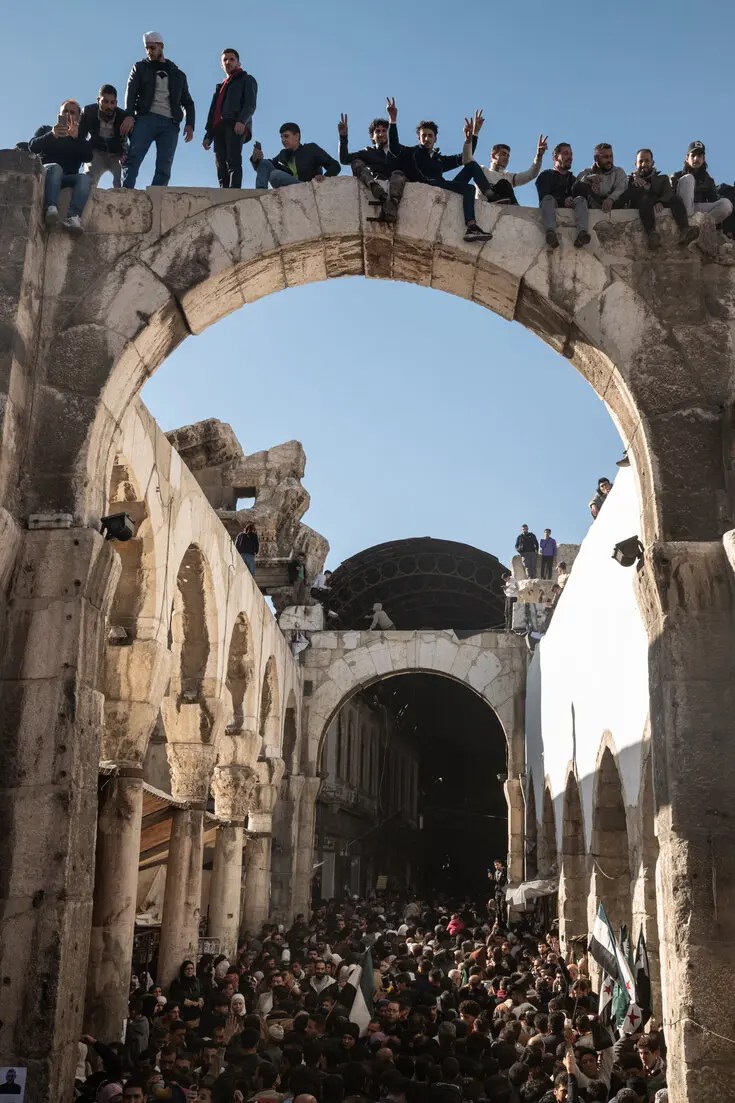
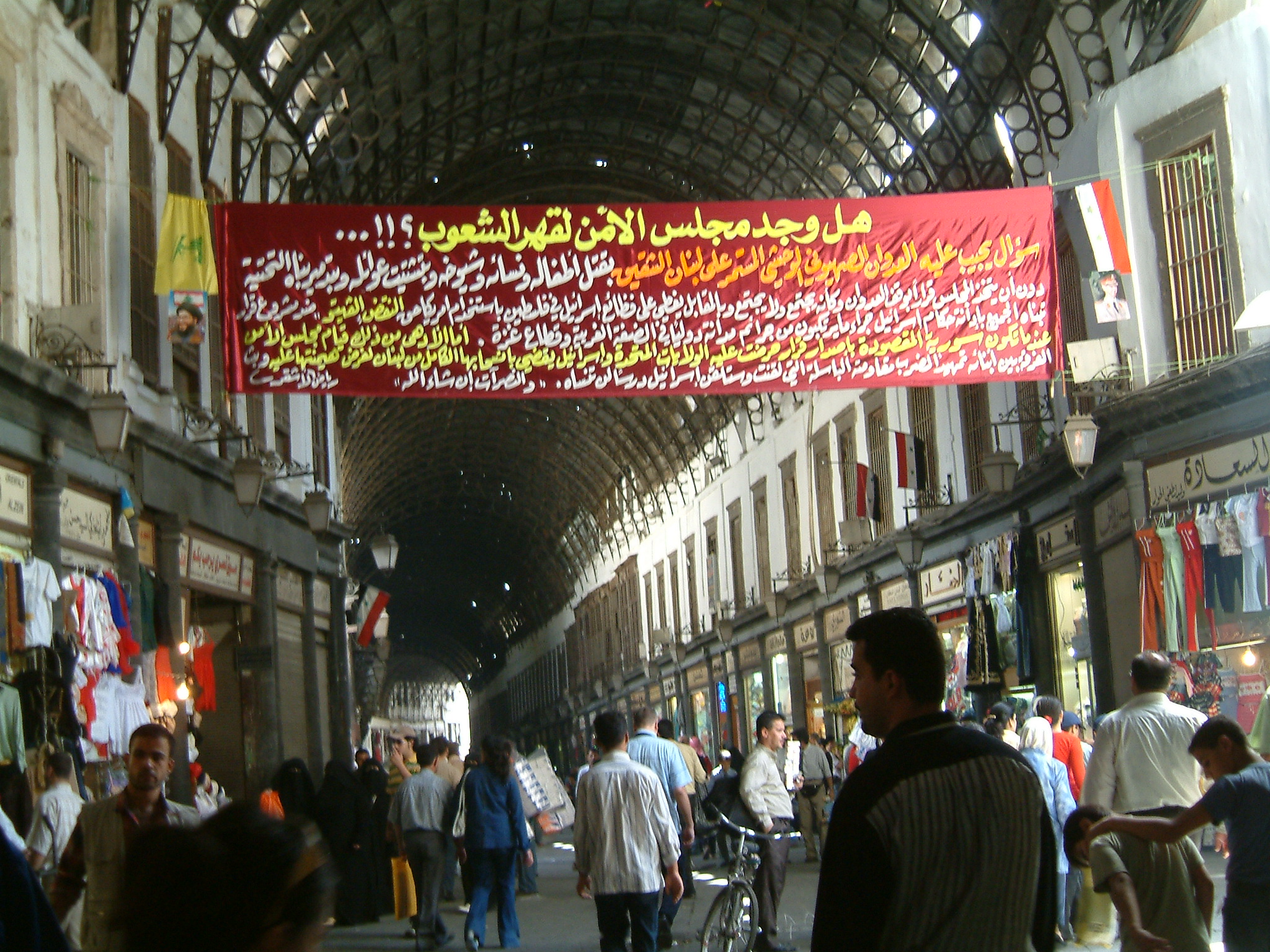
There have been many stunning pictures published to date of the Syrian revolution, but none that I’ve found as personally poignant as this one. It depicts jubilant Syrians lining the Roman archway that stands at the eastern end of Damascus’ historic Suq al Hamadiyah. When we were last in Syria, in the Spring of 2009, I photographed the arch from inside the darkened Suq (during one of the city’s frequent power cuts) , revealing the impressive remnants of the Roman Temple of Jupiter and the magnificent Omayyad Mosque, the fourth holiest place in Islam (after Mecca, Medina and Al Quds/Jerusalem).

For more on the Middle East in in That Howling Infinite, see A Middle East Miscellany:  

Syrians atop the Roman archway at the end of Damascus’ historic Suq al Hamadiyah

The Suq Al Hamadiyah, Temple of Jupiter and the Umayyad Mosque Mosque. P Hemphill 2009

The Suq Al Hamadiyah, Temple of Jupiter and the Umayyad Mosque Mosque. P Hemphill 2009

Aleppo shock to Hama huge leap forward: triggers in Syria’s 11-day blitz that unravelled Assad

David Kilcullen, The Australian, 13th December 2024

The speed of the regime’s collapse was startling, but it should not have been. Beyond the general dynamics of government collapse, something else was happening.

The regime’s collapse accelerated dramatically after the fall of the central Syrian city of Hama on the evening of Thursday, December 5, Syria time. Picture: Emin Sansar/Anadolu via Getty Images

The regime’s collapse accelerated dramatically after the fall of the central Syrian city of Hama on the evening of Thursday, December 5, Syria time. Picture: Emin Sansar/Anadolu via Getty Images

This was not strictly true: HTS had been biding its time in its stronghold of Idlib province, on Syria’s northwestern border with Turkey, for five years since a ceasefire brokered by Turkish and Russian negotiators in 2020, avoiding direct confrontation with the regime and building its own structure outside state control.

Its parallel government included several ministries and a civil administration, the Syrian Salvation Government, governing a population of four million, the size of Croatia or Panama. Though dominated by HTS, the SSG has been somewhat politically inclusive, and several non-HTS leaders have had key roles in its administration.

It sought to include the independent governance councils that had arisen organically during the early days of the anti-Assad rebellion, and it established local municipal managers to provide essential services across its territory.

HTS’s small combat groups operated like a fast-moving light cavalry force. Picture: Omar Haj Kadour / AFP

HTS’s small combat groups operated like a fast-moving light cavalry force. Picture: Omar Haj Kadour / AFP

American analysts in 2020 assessed the SSG as technocratic, “post-jihadi”, focused on internal stability and non-ideological governance, seeking acceptance from Turkey and the US, and unlikely to become a launch pad for external attacks.

Aaron Zelin – the Western expert most familiar with HTS and the author of an important book on the organisation, The Age of Political Jihadism – has observed that despite still holding extremist beliefs, HTS acts more like a state than a jihadist group.

While the SSG was focusing on social services and economic activity, HTS commanders were investing in advanced military capabilities. Building on experience from before the 2020 ceasefire, HTS organised its forces into small combat groups of 20 to 40 fighters that could mass quickly to swarm a target using several teams, or disperse to avoid enemy airstrikes or artillery.

They were highly mobile, operating like a fast-moving light cavalry force, mounted in a mix of hard and soft-skinned vehicles that included captured armoured vehicles and armed pick-up trucks (known as technicals).

Reconnaissance teams, scouts and snipers moved in civilian cars or on motorcycles. HTS combat groups carried heavy and light weapons including rocket launchers, captured artillery pieces, mortars, recoilless rifles, anti-tank missiles and Soviet-bloc small arms seized from the government or rival resistance groups including Islamic State.

Rebel fighters stand next to the burning gravesite of Syria's late president Hafez al-Assad at his mausoleum in the family's ancestral village of Qardaha. Picture: Aaref Watad / AFP

Rebel fighters stand next to the burning gravesite of Syria’s late president Hafez al-Assad at his mausoleum in the family’s ancestral village of Qardaha. Picture: Aaref Watad / AFP

HTS also used the ceasefire to professionalise itself, studying the wars in Ukraine, Gaza and Lebanon. It established a military academy to educate officers in “military art and science”, and created civil affairs units, humanitarian agencies and a specialised organisation to convince government supporters to defect.

It used drones for reconnaissance, for leaflet drops on regime-controlled areas and as one-way attack munitions to strike targets with explosive warheads. It manufactured weapons and drones, and modified technicals with additional armour. HTS leaders built intelligence networks and command-and-control systems while allegedly also forging relationships with regional intelligence services and special operations forces.

Thus, the strength of HTS was not unexpected in itself. On the other hand, the rapidity of the regime’s collapse – which accelerated dramatically after the fall of the central Syrian city of Hama on the evening of Thursday, December 5, Syria time – was startling. It probably should not have been. Governments, unlike resistance movements, are tightly coupled complex systems that rely on numerous institutions and organisations, all of which must work together for the state to function.

As Joseph Tainter showed in The Collapse of Complex Societies, once co-ordination begins to break down, these interdependent systems unravel, the collapse of each brings down the next, and the entire structure falls apart. For this reason, in a process familiar to practitioners of irregular warfare, resistance groups (which tend to be loosely structured and thus more resilient to chaos) degrade slowly under pressure – and rebound once it is relieved – whereas governments collapse quickly and irrevocably once initial cohesion is lost.

As a team led by Gordon McCormick showed in a seminal 2006 study, governments that are losing to insurgencies reach a tipping point, after which they begin to decay at an accelerating rate. The conflict then seems to speed up and the end “is typically decisive, sudden and often violent”.

This pattern was very noticeable during the fall of the Afghan republic in 2021, for example, which also occurred in an 11-day period. The final Taliban offensive captured every province but one, and took the capital, Kabul, in a series of victories between August 4 and 15, 2021. Many garrisons surrendered, fled without fighting or changed sides.

Initial rebel successes made the regime look weak, allies failed to offer support, the security forces defected and other rebel groups suddenly rose up across the country. Picture: Aaref Watad / AFP

Initial rebel successes made the regime look weak, allies failed to offer support, the security forces defected and other rebel groups suddenly rose up across the country. Picture: Aaref Watad / AFP

To be sure, the Taliban’s final campaign was built on years of coalition-building and insurgent warfare. Similar to HTS, the Taliban relied on patient construction of parallel networks largely illegible to an Afghan state increasingly alienated from, and seen as illegitimate by, its own people.

It also was enabled by a stunningly shortsighted political deal with the US in 2020 and an incompetent US-led withdrawal in 2021. Even so, the collapse of the Kabul government was faster than expected, with president Ashraf Ghani fleeing by helicopter in a manner remarkably similar to Bashar al-Assad’s exit last weekend.

The fall of South Vietnam in 1975 was likewise extraordinarily rapid, occurring in just nine days after the decisive battle of Xuan Loc, with South Vietnam’s last president, Nguyen Van Thieu, fleeing for Taiwan on a military transport plane.

Similarly, Fulgencio Batista’s government in Cuba fell in only five days, between December 28, 1958 – when a rebel column under Che Guevara captured the town of Santa Clara – and the early hours of January 1, 1959, when Batista fled by aircraft to the Dominican Republic. He had announced his resignation to shocked supporters a few hours earlier at a New Year’s Eve party in Havana, starting a scramble for the airport.


In Syria’s case, beyond these general dynamics of government collapse, something else was happening: a military version of what political scientists call a “preference cascade”.

As Timur Kuran, originator of the concept, points out, under repressive regimes (or ostensibly democratic ones that censor dissent) the gap between public pronouncements and private opinions increases over time, until many individuals dissent from the approved narrative and lose faith in institutions that promote it but remain reluctant to reveal their real views. This “preference falsification” creates a deceptive impression of consensus. It can make regimes believe they have more support than they really do, while convincing dissidents they are all alone so there is no point expressing a contrary opinion.

But when an unexpected shock reduces the regime’s power to suppress dissent, people suddenly feel empowered to express their real opinions. They realise these opinions are widely shared and the false consensus evaporates. This can trigger a “preference cascade”, where individuals or institutions suddenly change sides and support for the government collapses overnight.

In particular, the moment when security forces, particularly police, refuse to fire on protesters is often decisive, as seen in the fall of the Suharto government in 1998, the overthrow of Hosni Mubarak in 2011 or the collapse of the East German regime in 1989.

Kuran’s initial work centred on the East European revolutions of 1989, which were unexpected at the time but seemed inevitable in retrospect, something Kuran later came to see as inherent in revolutionary preference cascades.

The most extreme case was the fall of Nicolae Ceausescu in Romania. During a mass rally on December 21, 1989 the dictator suddenly realised, his face on camera registering utter shock, that what he had initially perceived as shouts of support were actually calls for his downfall. When his security ser­vices refused to fire on the protesters, Ceausescu was forced to flee by helicopter. Four days later, he and his wife Elena were dead, executed after a brief military trial.

A woman poses for a photograph with a rebel fighter's gun in Umayyad Square in Damascus. Syria’s population finally felt free to dissent from the dominant narrative. Picture: Chris McGrath/Getty Images

A woman poses for a photograph with a rebel fighter’s gun in Umayyad Square in Damascus. Syria’s population finally felt free to dissent from the dominant narrative. Picture: Chris McGrath/Getty Images

Syria this week was another example of a preference cascade. Initial rebel successes made the regime look weak, allies failed to offer support, the security forces defected and other rebel groups suddenly rose up across the country. Syria’s population – previously reluctant to express anti-regime sentiment for fear of repression or social ostracism – finally felt free to dissent from the dominant narrative. Assad lost control, was forced to flee, and his government collapsed. It is worth briefly recounting the sequence of events.

On November 27, the HTS offensive began with a sudden attack on Aleppo City. The outskirts of Aleppo are only 25km from the HTS stronghold in Idlib, so although the outbreak of violence was a surprise, there was little initial panic. The regime responded with airstrikes and artillery, with Russian warplanes in support.

The first major shock was the fall of Aleppo on November 30, after three days of heavy fighting. As Syria’s second largest city, scene of a bloody urban battle in 2012-16, Aleppo’s sudden collapse was a huge blow to the government. The HTS capture of Aleppo airport, east of the city, denied the regime a key airbase from which to strike the rebels, and cut the highway to northeast Syria. At this point the regime seemed capable of containing HTS, though clearly under pressure, and there was still relatively little panic.

But then on December 4, HTS attacked the city of Hama, which fell on the evening of December 5. This was a huge leap forward – Hama is 140km south of Aleppo down Syria’s main north-south M5 highway, meaning the rebel forces had covered a third of the distance to Damascus in a week. The fall of Hama was another political and psychological blow to Assad’s regime: Hama had never been under rebel control at any time since 2011.

Syrian rebel fighters at the town of Homs, 40km south of Hama, a critically important junction controlling the M5 and the east-west M1 highway that links Damascus and central Syria to the coast, and dominating Syria’s heavily populated central breadbasket. Picture: Aaref Watad / AFP

Syrian rebel fighters at the town of Homs, 40km south of Hama, a critically important junction controlling the M5 and the east-west M1 highway that links Damascus and central Syria to the coast, and dominating Syria’s heavily populated central breadbasket. Picture: Aaref Watad / AFP

The collapse at Hama – and the perception of regime weakness this created – triggered a preference cascade. Immediately, commanders began negotiating with or surrendering to the rebels or evacuating their positions. Also, after Hama’s fall, Iranian forces negotiated safe passage and began withdrawing from Syria, denying the government one of its key allies, further weakening Assad’s credibility, and encouraging yet more supporters to defect.

The regime’s other main ally, Russia, had already retreated to its bases at Khmeimim and Tartous, on Syria’s Mediterranean coast, after losing large amounts of military equipment and a still-unknown number of casualties. The same day, Hezbollah declined to offer material assistance to the Syrian government, given that it was still under Israeli pressure and had taken significant damage in 66 days of conflict.

The town of Homs lay 40km south of Hama – not much closer to Damascus but a critically important junction controlling the M5 and the east-west M1 highway that links Damascus and central Syria to the coast, and dominating Syria’s heavily populated central breadbasket. By early Friday, December 6, HTS combat groups were massing to assault Homs, but the city’s defences collapsed and it fell without a significant fight. By this point, security forces were dispersing, some retreating to Damascus but many fleeing to coastal areas.

The fall of Hama and Homs in quick succession encouraged other rebel groups to pile on, with several now mounting their own offensives against the regime. Uprisings broke out in the southern cities of Daraa and As-Suwayda on Friday and Saturday, December 6 and 7. These were less of a shock than the loss of Hama – Daraa was, after all, the cradle of the revolution in 2011 – but given everything else that was happening, the government simply lacked the forces to suppress them.

Simultaneously, US-backed forces in the far south advanced north from their base at al-Tanf, near the Jordanian border, while US-allied Kurdish troops of the Syrian Democratic Forces attacked in the east, crossing the Euphrates and seizing regime-controlled territory near Deir Ezzour. American aircraft flew airstrikes to support the SDF, which also seized the border post at Bou Kamal, blocking access to Iraqi militias that had been crossing into Syria to support the regime.

By Sunday, the regime had collapsed and the rebels occupied Damascus without a fight. Picture: Louai Beshara / AFP

By this point – last Saturday evening, December 7, Syria time – the government was on its last legs. That night an uprising broke out in Damascus, launched by civilian resistance groups and disaffected military units keen to distance themselves from the regime as the rebels closed in. Government troops began abandoning their posts, changing into civilian clothes, ditching their equipment and disappearing into the night. Large numbers of armoured vehicles, including T-72 tanks, were abandoned in the streets of the capital. Assad had planned to address the nation that evening but did not appear.

Later that night, apparently without asking Assad, the high command of the Syrian armed forces issued an order to all remaining troops to lay down their weapons and disperse. Assad fled about 2am on Sunday, flying out in a Russian transport aircraft. Assad’s prime minister, Mohammed al-Jalali, announced that he was willing to act as caretaker during transition to a provisional government, showing that Syria’s civil government, like the regime’s military forces, had collapsed. Despite initial reports that Assad’s aircraft had been denied entry into Lebanese airspace then shot down over Homs, Russian media reported later on Sunday that he had arrived in Moscow.

By Sunday, the regime had completely collapsed and the rebels, led by HTS commander Ahmed al-Sharaa, formerly known as Abu Mohammed al-Jolani, occupied Damascus without a fight.

The same day, US aircraft mounted dozens of airstrikes across the country, targeting Islamic State or regime forces, while Israeli troops crossed the Golan Heights buffer zone and began advancing towards Damascus. By Monday, despite initially claiming their incursion was limited and temporary, Israeli forces were 25km from Damascus, Israeli politicians had announced the permanent annexation of the Golan, and Israeli aircraft were striking Syrian military bases and sinking Syrian ships at the Latakia naval base.

Israel has denied media reports that its troops have taken control of Syrian territory.
In addition to the Israeli incursion through the Golan, Turkish-backed troops of the Syrian National Army are attacking the SDF across a strip of northern Syria, apparently attempting to create their own buffer zone separating the SDF – which Ankara sees as allied to the Kurdistan Workers Party – from Turkish territory.

The SDF has seized a chunk of eastern Syria, other US-allied rebel groups hold key parts of the south, and Islamic State still has numerous supporters and active cells in the country. Russia still controls its two Syrian bases, while Syria’s ethnic and religious minorities including Christians and Alawites are deeply anxious about the future, despite promises of tolerance from HTS.

Given the speed and totality of Assad’s collapse, some observers seem to be assuming that HTS will now, by default, become the dominant player in Syria. On its face, this may seem a reasonable assumption, given what happened in similar situations – Havana 1959, Saigon 1975, Kabul 2021 and so on.

But it would be premature in Syria’s case since the war is very much ongoing. As the northern hemisphere winter closes in and Western allies prepare for a change of administration in Washington, Syria – along with Gaza, Lebanon, the Red Sea, Ukraine, Taiwan and the Korean peninsula – will remain a major flashpoint into the new year.

David Kilcullen served in the Australian Army from 1985 to 2007 and was a senior counter-insurgency adviser to General David Petraeus in 2007 and 2008, when he helped design and monitor the Iraq War troop surge.

The Most Courted Leader in the Middle East Still Has No State

Arab and European heads of state are lining up to meet Ahmed A-Shara, the leader of the Syrian rebel organizations that ousted Assad, who has returned to his original name and is no longer calling himself al-Golani

Zvi Bar’el, Haaretz ,Dec 13, 2024
After taking control, he hastened to renounce his underground name and resumed his local name, Ahmed A-Shara. He ousted Bashar Assad’s horror regime and started to sprout the first buds of “new Syria,” whose outcome is still hard to fathom. The race for shaking his hand is in full swing.
Qatar is an old friend of A-Shara (one has to practice the name) and during the years of his organization’s existence it supported the militias that made up Hayat Tahrir al-Sham, which he set up on the ruins of Jabhat a-Nusra and it’s also expected to help him rehabilitate his country.

Qatar isn’t alone. In the race to the presidential palace in Damascus the Turkish Foreign Minister Hakan Fidan came first to shake A-Shara’s hand. The foreign ministers of other Arab states, such as Egypt, Saudi Arabia, and the UAE are preparing to land in Damascus in the coming days to personally congratulate the leader of the sister state.

At the same time Biden’s administration is examining the possibility of removing A-Shara and his group from the terrorists’ list while European leaders, headed by Italian Prime Minister Giorgia Meloni, who only two weeks ago spoke of the possibility to normalize their relations with the Assad regime, are already trying to coordinate meetings with the new regime’s leadership.

The irony doesn’t stop there. Iran and Russia, which in fact controlled large parts of Syria, are now replaced by two new-old occupiers, Israel, and Turkey. One took over the “Syrian Hermon “and a little further, the other is completing the occupation of the Kurdish regions in North Syria. No love is lost between the two of them, but it seems fate insists on making them meet in war fronts.

Once as partners when they helped Azerbaijan in its war against Armenia and once as enemies in the Gaza front or now on Syrian soil. There’s no knowing, maybe A-Shara will be the best man who will get to reconcile between them. Miracles happen, even if under the nose of the best intelligence services in the world, who didn’t know and didn’t evaluate the complete collapse of the Assad regime.

The warm Arab and international envelope tightening around Damascus is ready to give him credit although it doesn’t know yet where he’s heading, assuming any leader will be better than Assad. That, by the way, is what the Syrians also believed Assad senior would be when he toppled the rule of General Salah Jedid, only to get a new mass murderer.

The first declarations and interviews of A-Shara and senior officials of his administration sound good and even encouraging. The temporary prime minister, Mohammed al-Bashir, said in an interview to the Italian newspaper Corriere della Sera on Wednesday that at this stage the new administration has three top goals – to ensure the civilians’ safety, to return the refugees and to rehabilitate the infrastructure and civil services.
How to achieve those goals? “It will take time but we’ll get there,” says the former prime minister of the Idlib region’s rescue government under A-Shara’s command and was blasted publicly for the brutal way he ran the rebel province.
Al-Bashir also says the temporary government will serve until the beginning of March, but does not clarify what will happen after that date. Will he manage to draft a new constitution and election law by then? Does the new administration even intend to hold elections, or does he hope within that time to set up a government that will be agreed on by all the communities, factions, militia, and foreign forces?
Will the new constitution be Islamic? To this he replies, “God willing, but clearly all these details will be discussed in the constitutional process.”
Journalist Andrea Nicastro asks him “do I understand correctly when I say you’re ready to make peace with Israel and that you’re hostile to Iran, Hezbollah and Russia?” Al-Bashir thanks him and leaves without answering.
There can be no complaints about a prime minister or organization head who only two weeks ago merely prepared to expand the borders of his control region and suddenly found himself on an empty highway to Damascus, for having no political, economic, or strategic plan and for having to wriggle around ideological and religious issues. A-Shara has more urgent business, for example, an empty state coffer.
If he wants to ensure civilian safety and public services he’ll have to pay wages to thousands of policemen, teachers, judges, garbage contractors, rebuild the crushed electric system, mend roads and traffic lights when not a single dollar, according to al-Bashir, remain in the till.
Head of the Syrian trade bureau said this week Syria will move from a state-controlled economy to a free market economy. This is encouraging but to apply it they will need investors and ensure their investment.
Government ministers, most of them served in the “rescue government” in Idlib, estimate they’d be able to raise funds from Arab countries and mainly the UAE and Turkey, persuade Syrian businesspeople in exile to invest in the homeland and also return to Syria funds that were smuggled out by the Assad regime. But Arab and international aid usually comes with a list of rigid conditions, like demands for a profound economic reform, preserving human rights and minority rights, civilian safety, and no less important a political agenda that is compatible with the donor states’ aspirations.
Syria is not an only child. Soon the donor states will be asked to help to rebuild Lebanon and perhaps later Gaza as well. A conservative estimate sets Syria’s national debt at some $31 billion, $5 billion of them to the IMF and $26 billion to Russia and to Iran.
More realistic estimates cite a debt of more than $30 billion to Iran alone, which invested some $50 billion in the last 14 years.
The oil wells that remained in the Assad regime’s control produced only some 9,000 oil barrels a day, now the new administration can produce oil from the oil fields controlled by the Kurds in the northeast of the state after they retreated from Dir A-Zur, which was reoccupied by the pro-Turkish militias.
But perhaps this will no longer be enough to reinstate the agriculture and food production industry, or to generate millions of workplaces that were lost during the war.
A-Shara portrays himself as “everyone'” leader and his prime minister aspires to set up an administration that represents all the ethnic communities and minorities. But will he gain the cooperation of the Alawite minority, which makes up 10 percent of the population? Will the Kurds in the north give up their aspirations for autonomy?
A large concentration of Alawites resides in the Latakia province on the Mediterranean coast, its people are well armed and afraid that armed militias or the regime itself would want to take revenge on them. Will they agree to disarm?
The Kurds are being pushed out of some of their provinces and only this week retreated from Manjib city west of the Euphrates River, after the Syrian National Army, the large pro-Turkish militia, conquered the city.
This retreat is the outcome of American mediation leaning on a Turkish commitment not to harm Kurdish civilians who leave the city. But Kurds continue to control the regions east of Euphrates, and Turkey wants to keep them away from those too. AT the same time their conduct has made it clear it is ready to cooperate with the A-Shara regime and be an integral part of Syria.

But it’s not clear yet under what terms. Will they want to preserve their provinces’ autonomy, and will the Syrian regime agree, when Turkey operates its military and economic leverages. Will the Kurds even have a bargaining chip left when Trump enters the White House? Trump tried already in 2019 to withdraw U.S. forces from Syria and was blocked by internal and external pressure. Now he may implement his wish with his ally Recep Erdogan.

Syrian commentators have begun to draw a map in which Syria could be a federation divided into autonomous cantons, Kurdish in the north, Sunni-Arab in the center, Alawite in the west and perhaps Druze in the south, a sort of expansion of the Iraqi model where an autonomous Kurdish region exists. The Shi’ites in the south are demanding their own province.
It is doubtful whether this model has a chance of being implemented in Syria but bringing it up in itself shows the explosives in store for the new Syrian regime. This is only a partial list because beyond the various ethnic communities and minorities, A-Shara will have to deal with a population that is mostly Sunni but secular. Will this population toe the line with a radical religious agenda, on which A-Shara was raised and has preached?
So far Syria has conveniently been attached to the “Shi’ite axis though it was an organ of Iran’s Islamic revolution.
But the Alawite faction doesn’t count in Iran as an authentic Shi’ite faction. Hafez Assad himself had to ask his friend, the influential religious leader Moussa al-Sader, to issue a ruling that the Alawite religion is part of the formal “Shi’a” and therefore part of the Islam religion.
This was after a long violent clash he conducted against Sunni and Shi’ite religious leaders who ruled the Alawite faction wasn’t Muslim at all and therefore Assad senior cannot be president, because the constitution stipulated the state’s president had to be Muslim.
A-Shara won’t have that dilemma, but as one who hasn’t concealed his aspiration to set up a religious state, he will have to decide how to settle between the religious vision and the character of the population and the state that hasn’t yet been established

The first Intifada … Palestine 1936

In 1929, there is violence at the Western Wall in Jerusalem – then a narrow alley named for Buraq, the steed with a human face that bore the Prophet Mohammed on his midnight journey to Jerusalem, and not the Kotel Plaza of today. The event, which was actually called the Buraq rising was incited by rumours that Jews planned to overrun the Haram al Sharif, the third holiest site in Islam. A massacre of Jews in Hebron in the south followed. These were a bleak precursor of the wars to come.

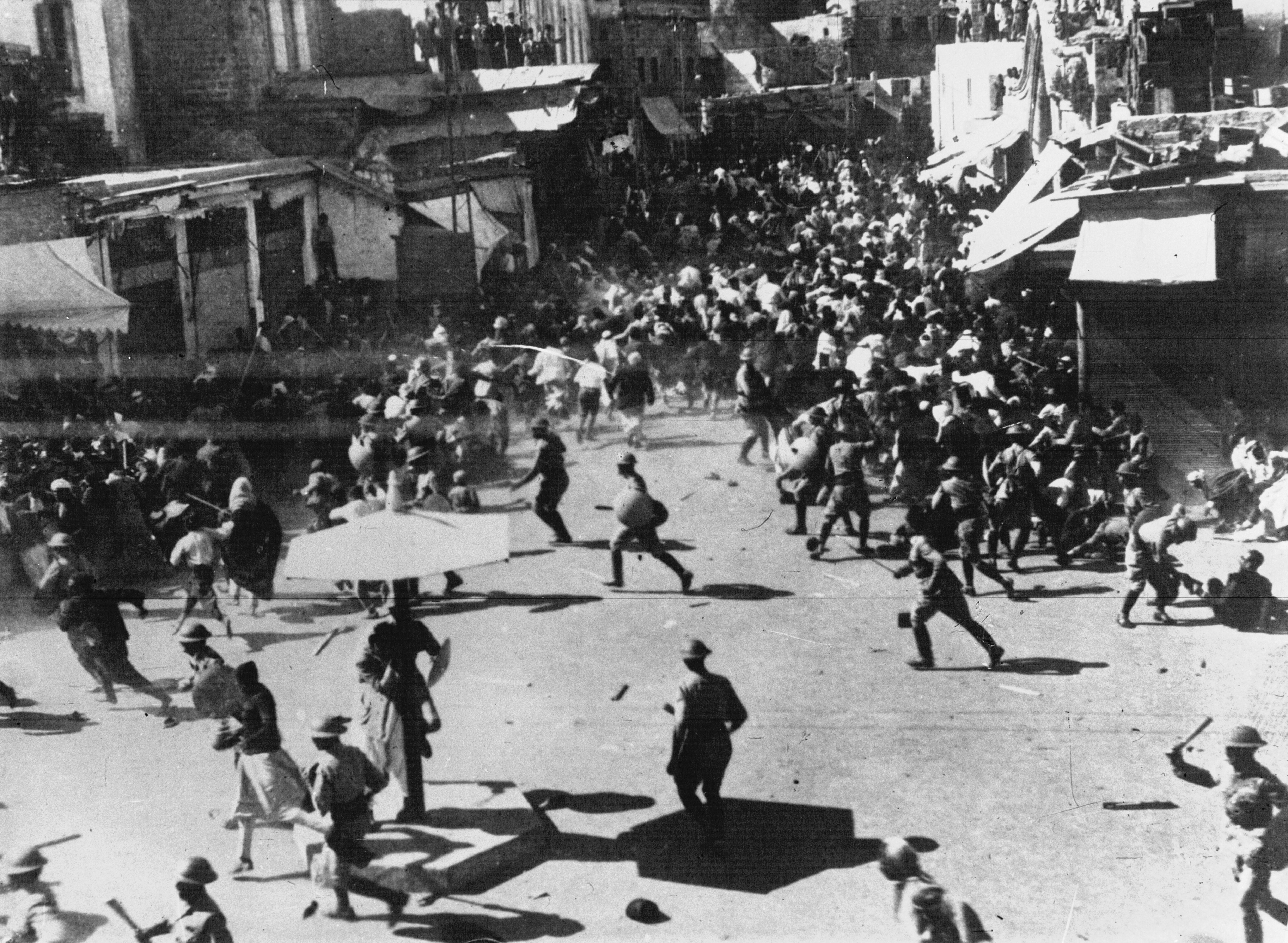
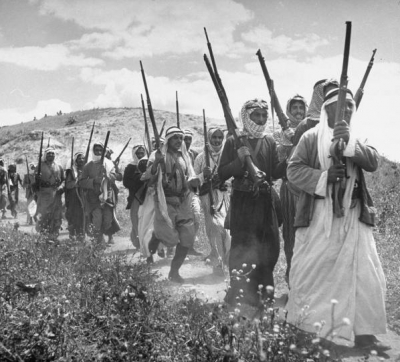
Fast forward to mid-April 1936. Following two incidents of killing carried out in by both Arabs and Jews, an Arab National Committee declared a strike in the city of Jaffa. National Committees were formed in other Palestinian cities and representatives of Arab parties formed the “Arab Higher Committee” led by Haj Amin al-Husseini. A general strike spread throughout Palestine, accompanied by the formation of Palestinian armed groups that started attacking British forces and Jewish settlements. Thus began the “Great Palestinian Revolt. It lasted for three years.

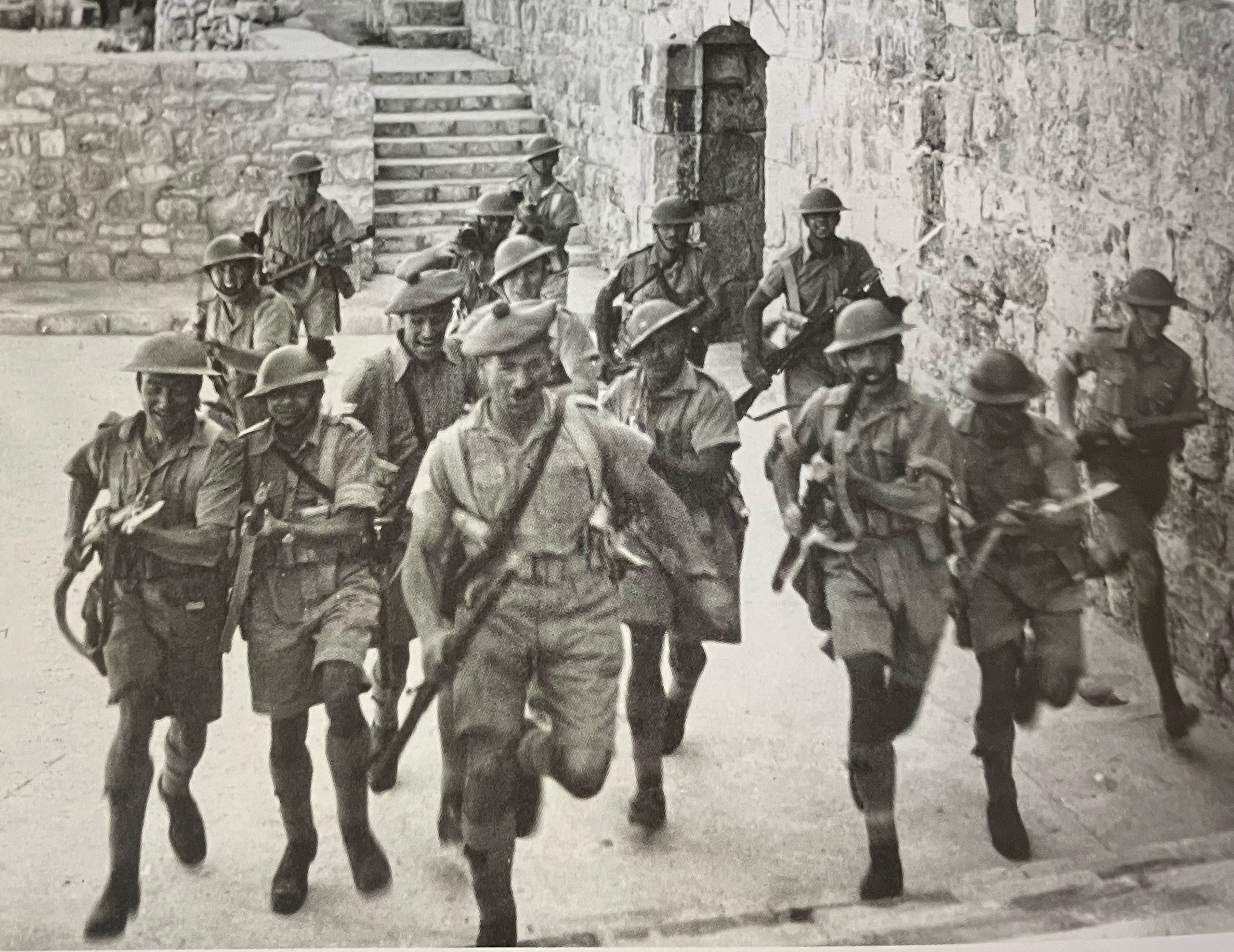
British troops run through Jerusalem’s’ Old City during the Great Revolt

Roots and fruits 

The ongoing struggle with regard to the existence Israel and Palestine is justifiably regarded the most intractable conflict of modern times. Whilst most agree that its origins lie in the political and historical claims of two people, the Jewish Israelis and the predominantly Muslim Palestinians for control over a tiny wedge of one-time Ottoman territory between Lebanon and Syria in the north, Jordan in the east, and Egypt to the south, hemmed in by the Mediterranean Sea. There is less consensus as to when the Middle East Conflict as it has become known because of its longevity and its impact on its neighbours and the world in general, actually began.

Was it the infamous Balfour Declaration of 1917 promising a national home for Jews in an Ottoman governate already populated by Arabs, or the secretive Sykes Picot Agreement that preceded it in 1916, staking imperial Britain’ and France’s claim to political and economic influence (and oil pipelines) in the Levant? Was it the establishment of the British Mandate of Palestine after the Treaty of Sèvres of 1922 which determined the dissolution of the defeated Ottoman Empire. Or was it the end of that British mandate and the unilateral declaration of Israeli independence in 1948 and the war that immediately followed?

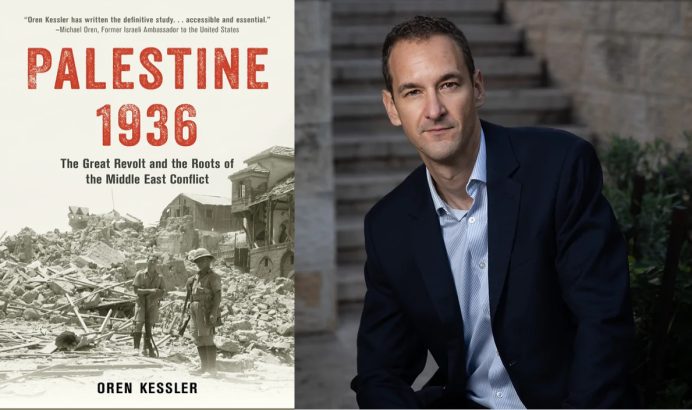
In his book Palestine 1936: The Great Revolt and the Roots of the Middle East Conflict (Rowman & Littlefield, 2023) Israeli journalist and author Oren Kessler argues powerfully that the events in Mandatory Palestine between 1936 and 1939 shaped the subsequent history of the conflict for Israelis and Palestinians. The book identifies what was known at the time as The Great Revolt  as the first Intifada, a popular uprising which actually sowed the seeds of the Arab military defeat of 1947-48 and the dispossession and displacement of over seven hundred thousand Palestinian Arabs, which has set the tone of the conflict for almost a century.

It is a tragic history shared with knowledge in hindsight of the decades of violence and bloodshed in the region that followed. It begins in the time before Palestine became political entity, when mainly Eastern European Jews began settling in progressively larger numbers to the consternation of the Arab populace.

The 1936 conflict stemmed from questions of how to divide the land and how to deal with the influx of Jewish people – questions that remain relevant today. In an extensive interview coinciding with the book’s publication (republished below) Kessler notes that, for the Arab residents, the problem was one of immigration and economics; for the Zionists, it was about finding a home. These two positions soon became irreconcilable issues, leading to sporadic violence and then to continual confrontation.

He believes that the Revolt is the point when both sides really came to see the conflict as zero sum. insofar that whichever community had the demographic majority in Palestine would be the one that would determine its fate. However, in the 1920s, the Jews were so far from that majority that both sides were able to postpone the final reckoning. In the 1930s, the Jews threatened to become a majority, and this was the immediate precursor to the rising. There was no way that the objective of bringing as many Jews to the land as possible could be achieved without bringing about some serious Arab pushback.

It is Kessler’s view that it was during revolt that a strong sense of Arab nationalism in Palestine extended beyond the urban elites to all corners of the country. All segments of Arab society – urban and rural, rich and poor, rival families, and even to a large extent Muslim and Christian – united in the same cause against Zionism and against its perceived enabler, the British Empire. The Arab public in Palestine was becoming increasingly politically aware and consciously perceiving itself as a distinct entity – distinct from its brethren in Syria, in large part because it has a different foe: not simply European imperialism but this very specific threat presented by Zionism.

The British government made early efforts at keeping the peace, but these proved fruitless. And when the revolt erupted in 1936, it sent a royal commission to Palestine, known to history as the Peel Commission, to examine the causes of the revolt. It proposed in effect the first ‘two state solution.’ The Emir Abdullah of Transjordan publicly accepted this plan. The main rival clan to the Husseinis, the Nashashibis, privately signaled that they were amenable – not thrilled, but amenable. And their allies held the mayorships of many important cities – Jaffa, Haifa, and even Nablus, Jenin and Tulkarem, which today are centres of militancy. And yet the Mufti makes very clear that he regards this plan as a degradation and a humiliation, and all of these erstwhile supporters of partition suddenly realise that they are against partition.

Kessler believes that this is the point at which a certain uncompromising line became the default position amongst the Arab leadership of Palestine, with dire consequences for the Palestinians themselves, and when Yishuv leader David Ben Gurion saw an opportunity to achieve his long-standing objective of creating a self-sufficient Jewish polity, one that could feed itself, house itself, defend itself, employ itself, without any help from anyone – neither British or Arabs. When the Arabs called a general strike and boycott, cut all contacts with the Jewish and British economies and closed the port of Jaffa in Spring 1936, he lobbied successfully with the British to allow the Jews to open their own port in Tel Aviv, ultimately causing a lot of economic pain to the Arabs and helping the Jews in their state-building enterprise.

This is a mosaic history, capturing the chaotic events on the ground through snippets of action. And also, the people involved. 

There are heroes and villains aplenty in this relatively untold story. The urbane and erudite nationalists Muhammed Amal and George Antonius who strive for middle ground against increasingly insurmountable odds, and who died alone and exiled having failed to head off the final showdown that is today known as Al Nakba. The farseeing, resolute, and humourless Ben Gurion and the affable, optimistic Chaim Weizmann, who became Israel’s first prime minister and president respectively. The New York born Golda Meyerson, more of a realist than either leader, who would also one day become prime minister. The irascible revisionist Vladimir Ze’ev Jabotinski, the forebear of today’s virulent rightwing nationalists

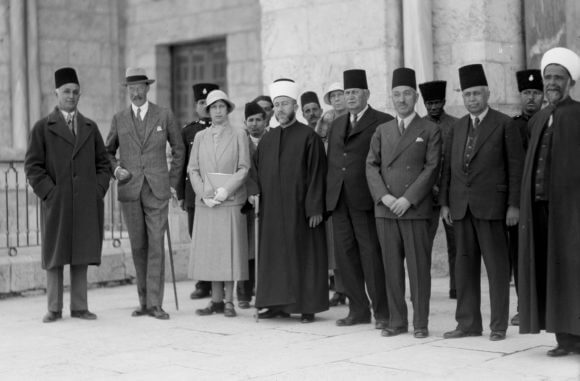
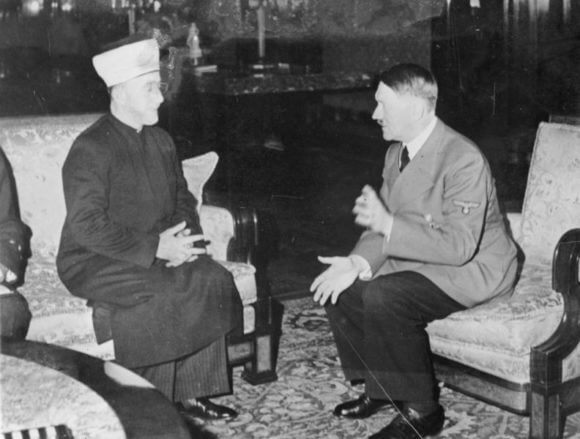
The hardliner Mufti Haj Amin al Husseini, whose uncompromising stance, malign political influence, and conspiratorial association with the Nazis set the stage for a long general strike, the Great Revolt, and ultimately, the débâcle of 1948. The flamboyant rebel leaders, Syrian Izz al Din al Qassam, who is memorialized in the name of the Hamas military wing and a Gaza-made rocket, and Fawzi al Qawuqji. Qassam was gunned down by British soldiers during the revolt whilst Qawuqji lived on to become one of the most effective militia leaders in the war of 1948, and to perish therein. Both are remembered today as Palestinian martyrs whilst the Mufti is an arguably embarrassing footnote of history. There’s an article about his relatively unremarked death at the end of this post. 

Amin al-Husseini in 1929

And in the British corner, the well-intentioned high commissioners who vainly endeavoured to reconcile the claims of two aspirant nations in one tiny land, and quixotic figures like the unorthodox soldier Ord Wingate who believed he was fulfilling prophecy by establishing the nucleus of what would become the IDF (like many charismatic British military heroes, and particularly General Gordon and Baden-Powell, both admirers and detractors regarded him a potential nut-case); and the Australian-born ex-soldier Lelland Andrews, assistant district commissioner for Galilee, who also conceived of his mission as divinely ordained. Lewis was murdered by Arab gunmen and Wingate went down in an aeroplane over Burma during WW2.

There are appearances from among many others, Lloyd George, Winton Churchill and Neville Chamberlain, Adolph Hitler and Benito Mussolini, Franklin D Eisenhower and Joseph Kennedy.

The book highlights the work of powerful British functionaries in handling early confrontations: they are memorialized for starting commissions to study the matter and to generate ideas, though many of their ideas weren’t followed or were followed to ill effect. None solved the problem, making this account of the earliest days of the conflict all the more heartbreaking.

All under the shadow of the impending Shoah, and the inevitable showdown that would culminate in al Nakba.

The road to Al Nakba

Kessler argues that the Arab social fabric and economy are completely torn and shattered by the end of this revolt that in many ways the final reckoning for Palestine between Jews and Arabs – the civil war that erupts in 1947 – is actually won by one side and lost by the other nearly a decade earlier.

The final paragraphs of Kessler’s enthralling book are worth quoting because they draw a clear line between the events of the Great Revolt and the catastrophe, al Nakba, of 1948:

“For the Jews, perhaps the greatest shift was psychological. they had withstood of powerful sustained assault and lived to tell about it. One book on Zionist leaders” thinking in this era is titled Abandonment of Illusions. The belief of material gains would bring Arab consent now naïve and, worse, dangerous. Instead, by the end of the revolt and the start of the world war, much of Palestine’s Jewish mainstream had accepted the fact that the country’s fate would ultimately be determined and maintained by force.
 
“By 1939, the Yishuv had achieved the demographic weight, control of strategic areas of land, and much of the weaponry and military organization that would be needed as a springboard for taking over the country within less than a decade”, writes the Palestinian American historian Rasheed Khalidi.
 
Khalid argues that the Palestinian catastrophe of 1947 -1949 was predicated on a series of previous failures: “a deeply divided leadership, exceedingly limited finances, no centrally organized military forces or centralized administrative organs, and no reliable allies. They faced a Jewish society in Palestine which although small relative to theirs, was political unified, had centralized para-state institutions, and was increasingly well-led and extremely highly motivated”.
 
For Palestinians, he maintains, the Nakba – the catastrophe of their military drubbing, dispossession and dispersal – was but a forgone conclusion. For them, the terrible events that bookended the year 1948 “were no more than a postlude, a tragic epilogue to the shattering defeat of 1936- 39”.
 
The Great Revolt, Kessler says, has cast its shadow over the Israeli-Palestinian conflict ever since – for the Arabs, for the Jews, and for attempts to resolve the conflict. It is still remembered by Palestinians and Israelis alike. Palestinian folk songs still celebrate the revolt, and in my he regards the. BDS movement as direct descendant of the general strike that preceded the revolt. The two-state solution that is still the international community’s favoured solution to the conflict is but a variation of that original partition plan of 1937.

In so many ways, for both Israelis and Palestinians, this revolt rages on.

© Paul Hemphill 2024.  

Kessler’s interview in Fathom e-zine follows, together with serval informative articles on the Great Revolt and its aftermath

For more on Israel and Palestine in In That Howling Infinite, see: A Middle East Miscellany

The picture at the head of this post shows British troops marching through Ibn Khatib Square in 1936 past King David’s Citadel and towards the Jaffa Gate

British policemen disperse an Arab mob during the Jaffa riots in April 1936 (The Illustrated London News)


Jews evacuate the Old City of Jerusalem after Arab riots in 1936.

An interview with Oren Kessler

by Oren Kessler
 
 
3365748242
Great Arab Revolt, 1936-1939
A Popular Uprising Facing a Ruthless Repression
 
In 1936, widespread Palestinian dissatisfaction with Britain’s governance erupted into open rebellion. Several key dynamics and events can be seen as setting the stage for this uprising. In Palestine, as elsewhere, the 1930s had been a time of intense economic disruption. Rural Palestinians were hit hard by debt and dispossession, and such pressures were only exacerbated by British policies and Zionist imperatives of land purchases and “Hebrew labor.” Rural to urban migration swelled Haifa and Jaffa with poor Palestinians in search of work, and new attendant forms of political organizing emerged that emphasized youth, religion, class, and ideology over older elite-based structures. Meanwhile, rising anti-Semitism—especially its state-supported variant—in Europe led to an increase of Jewish immigration, legal and illegal, in Palestine.

Unsurprisingly, the combination of these various trends produced periodic upheavals, from the 1929 al-Buraq Uprising to multicity demonstrations in 1933 against the British Mandate. In October 1935, the discovery of a shipment of arms in the Jaffa port destined for the Haganah fueled Palestinian concerns that the Zionist movement was introducing the human and military resources necessary for its state-building project under the nose of the British. Meanwhile, the popular and populist Syrian Shaykh Izzeddin al-Qassam , who preached to the slum-dwelling rural transplants near Haifa’s rail yards and who had spent the early 1930s building a cell-based paramilitary network, was killed in a firefight with British forces in November 1935. Qassam’s funeral in Haifa elicited a mass outpouring of public outrage. These events are often seen as direct predecessors of the mass Palestinian uprising that took place in 1936.

The Great Palestinian Rebellion , or the Great Arab Revolt, as this uprising came to be known, lasted for three years and can be generally divided into three phases. The first phase lasted from the spring of 1936 to July 1937. With tensions throughout Palestine running high since the fall of 1935, the revolt was ignited in mid-April 1936 when followers of Qassam attacked a convoy of trucks between Nablus and Tulkarm , killing two Jewish drivers. The next day, the  Irgun killed two Palestinian workers near Petah Tikva , and in the following days, deadly disturbances ensued in Tel Aviv and Jaffa. In Nablus, an Arab National Committee was formed and a strike was called on 19 April. National Committees in other cities echoed the call to strike, and on 25 April the Arab Higher Committee (Lajna) (AHC) was formed, chaired by Haj Amin al-Husseini , to coordinate and support a nationwide general strike, which was launched on 8 May.

The strike was widely observed and brought commercial and economic activity in the Palestinian sector to a standstill. Meanwhile, Palestinians throughout the countryside came together in armed groups to attack—at first sporadically, but with increasing organization— British and Zionist targets. Some Arab volunteers joined the rebels from outside Palestine, though their numbers remained small in this period. The British employed various tactics in an attempt to break the strike and to quell the rural insurrection. The ranks of British and Jewish policemen swelled and Palestinians were subjected to house searches, night raids, beatings, imprisonment, torture, and deportation. Large areas of Jaffa’s Old City were demolished, and the British called in military reinforcements.

Concurrent with military operations and repressive measures, the British government dispatched a commission of inquiry headed by Lord Peel to investigate the root causes of the revolt. In October 1936, under the combined pressure of British policies, other Arab heads of state, and the effects of a six-month general strike on the Palestinian population, the AHC called off the strike and agreed to appear before the Peel Commission . A period of lower intensity conflict prevailed as the Peel Commission toured the country, but tensions continued to build in anticipation of the commission’s report. In July 1937, the Peel Commission published its report, recommending Palestine’s partition into Jewish and Arab states. Dismayed by this negation of their desires and demands, the Palestinian population relaunched their armed insurgency with renewed intensity, initiating the second phase of the revolt.

This second phase, lasting from July 1937 until the fall of 1938, witnessed significant gains by the Palestinian rebels. Large swaths of the hilly Palestinian interior, including for a time the Old City of Jerusalem , fell fully under rebel control. Rebels established institutions, most significantly courts and a postal service, to replace the British Mandate structures they sought to dismantle. The British, meanwhile, imposed even harsher measures to try to quash the revolt. The AHC and all Palestinian political parties were outlawed, political and community leaders were arrested, and a number of high-profile public figures exiled. The military aspects of counterinsurgency intensified, and British tanks, airplanes, and heavy artillery were deployed throughout Palestine. The British also meted out collective punishment: thousands of Palestinians were relegated to “detention camps”; residential quarters were destroyed; schools were closed; villages were collectively fined and forced to billet British troops and police. Zionist military institutions took advantage of the situation to build up their capacities with British support. By early 1939, members of the Jewish Settlement Police (about 14,000) were subsidized, uniformed, and armed by the British government as a thinly veiled front for the Haganah, and so-called Special Night Squads  comprising Jewish and British members launched “special operations” against Palestinian villages.

The third phase of the rebellion lasted roughly from the fall of 1938 to the summer of 1939. The British dispatched another commission of inquiry, this one headed by Sir John Woodhead , to examine the technical aspects of implementing partition. In November 1938, the Woodhead Commission report concluded that partition was not practicable, marking a certain British retreat from the Peel recommendation. At the same time, however, the British launched an all-out offensive: in 1939 more Palestinians were killed, more were executed (by hanging), and nearly twice as many were detained than in 1938. Such brutality placed immense pressure on the rebels, exacerbating rifts between the political leadership of the AHC exiled in Damascus and local leadership on the ground, between rebel bands and village populations that were expected to support and supply them, and ultimately between Palestinians who remained committed to the revolt and those willing to reach a compromise with the British. British-supported Palestinian “Peace Bands” were dispatched to battle their compatriots.

In May 1939, the British government published a new White Paperthat proposed the following: Britain’s obligations to the Jewish national home had been substantially fulfilled; indefinite mass Jewish immigration to and land acquisition in Palestine would contradict Britain’s obligations to the Palestinians; within the next five years, no more than 75,000 Jews would be allowed into the country, after which Jewish immigration would be subject to “Arab acquiescence”; land transfers would be permitted in certain areas, but restricted and prohibited in others, to protect Palestinians from landlessness; and an independent unitary state would be established after ten years, conditional on favorable Palestinian-Jewish relations.

The combined impact of Britain’s military and diplomatic efforts brought the rebellion to an end in the late summer of 1939. Over the revolt’s three years, some 5,000 Palestinians had been killed and nearly 15,000 wounded. The Palestinian leadership had been exiled, assassinated, imprisoned, and made to turn against one another. At the same time, the White Paper—despite its limitations—offered certain concessions to the rebels’ demands. Whatever gains Palestinians might have made through the revolt, however, were quickly overtaken by the larger geopolitical processes of World War II , and the combined British-Zionist assault on Palestinian political and social life during the revolt had a long-lasting impact.

 
Selected Bibliography:

Anderson, Charles W. “State of Formation from Below and the Great Revolt in Palestine.” Journal of Palestine Studies 47, no. 1 (Autumn 2017): 39-55.

Hughes, Matthew. “From Law and Order to Pacification: Britain’s Suppression of the 1936–1939 Arab Revolt in Palestine.” Journal of Palestine Studies 39, no.2 (Winter 2010): 6–22.

Kanafani, Ghassan. The 1936–39 Revolt in Palestine.

Shbeib, Samih. “Poetry of Rebellion: The Life, Verse and Death of Nuh Ibrahim during the 1936–39 Revolt.” Jerusalem Quarterly 25 (Winter 2006): 65–78.

Sufian, Sandy. “Anatomy of the 1936-39 Revolt: Images of the Body in Political Cartoons of Mandatory Palestine.” Journal of Palestine Studies 37, no.2 (Winter 2008):  23–42.

Swedenburg, Ted. Memories of Revolt: The 1936–1939 Rebellion and the Palestinian National Past. Fayetteville: University of Arkansas Press, 2003.

Britain says releasing a 1941 document about Palestine might ‘undermine security’

A two-part archive, labeled “Activities of the Grand Mufti of Jerusalem” and dated 1940-1941, sits in Britain’s National Archives in Kew. This writer successfully had the first part declassified in 2014. The second part remains sealed. My 2018 attempt to have these ten pages declassified was refused on the grounds that the archive might “undermine the security of the country [Britain] and its citizens.”[1] None of its secrets are to be available until January, 2042; and if the paired file is any precedent, even in 2042 it will be released only in redacted form.

The ‘Grand Mufti’ in the archive’s heading is Haj Amin al-Husseini, the Palestinian leader whom posterity best remembers for his alignment with the Italian and German fascists; and the years 1940-1941 place him not in Palestine, but in Iraq — and if the second archive extends to late 1941, in Europe. What could possibly be hidden in a World War II document about a long-dead Nazi sympathizer that would present such a risk to British national security eight decades later, that none of it can be revealed? At present, only the UK government censors know; but the answer may have less to do with the fascists and al-Husseini than with British misdeeds in Iraq, and less to do with Britain’s national security than with its historical embarrassment.

When in 1921 votes were cast for the new Mufti of Jerusalem, Amin al-Husseini came in last among the four candidates. But votes in Palestine mattered as little then as they do now, and the British, Palestine’s novice replacement occupiers for the Ottomans, handed the post to al-Husseini. At first, he proved to be an asset to the British. But as the years passed, his opposition to Zionism, support for Palestinian nationalism, and ultimately his involvement in the 1936 Palestinian uprising, led to calls for his arrest.

Photograph labelled 'Arab demonstrations on Oct. 13 and 27, 1933. In Jerusalem and Jaffa. Return of Grand Mufti from India. Met by hundreds of cars at Gethsemane, Nov. 17, 1933.'

“ARAB DEMONSTRATIONS ON OCT. 13 AND 27, 1933. IN JERUSALEM AND JAFFA. RETURN OF GRAND MUFTI FROM INDIA. MET BY HUNDREDS OF CARS AT GETHSEMANE, NOV. 17, 1933.” LIBRARY OF CONGRESS, LC-M33- 4218.

In mid-October of 1937, he fled from hiding in Palestine to Beirut. Two years later and six weeks after the outbreak of World War II, in mid-October of 1939, he slipped to Baghdad, where his sympathies for the Italian fascists further alarmed the British. Fast-forward another two years to late 1941, and al-Husseini is in Europe, meeting with Benito Mussolini on the 27th of October, and on the 28th of November meeting with the Führer himself at the Reich Chancellery in Berlin.

Al-Husseini’s motivation for embracing the Axis was likely a combination of selfish political opportunism and the belief that the alignment would help safeguard against the takeover of Palestine by the Zionists. The reasoning, however grotesque, was the same used by Lehi (the ‘Stern Gang’) in its own attempted collaboration with the fascists: Britain was the obstacle both to Palestinian liberation, and to unbridled Zionism, and for both the Mufti and Lehi, defeating that obstacle meant embracing its enemies. Even the ‘mainstream’ David Ben-Gurion had no moral qualms about taking advantage of Britain’s struggle against the Nazis — a struggle for which his Jewish Agency was already conspicuously unhelpful — by exploiting Britain’s post-war vulnerabilities.[2]

Posterity has treated Lehi’s and the Mufti’s flirtations with the fascists quite differently. Lehi, the most fanatical of the major Zionist terror organizations, was transformed into freedom fighters, and ex-Lehi leader Yitzhak Shamir was twice elected as Israeli Prime Minister. In contrast, Zionist leaders quickly seized on al-Husseini’s past to smear not just him, but the Palestinians as a people, as Nazis.

The use of al-Husseini’s unsavory history to ‘justify’ anti-Palestinian racism continues to the present day. Most bizarrely, in 2015 Israeli Prime Minister Benjamin Netanyahu claimed that Hitler had not intended to exterminate the Jews — that is, not until al-Husseini planted the words in his ear — which translates as “got the idea from the Palestinians”. A private citizen would likely have been arrested under German law for this attempt to rewrite the Holocaust.

The mufti of Jerusalem, Sayid Amin al Husseini, meets with Hitler, November 1941.

THE MUFTI OF JERUSALEM, SAYID AMIN AL HUSSEINI, MEETS WITH HITLER, NOVEMBER 1941.

Iraq won limited independence in 1932, just before the Nazis came to power. When the Mufti ensconced himself in Iraq seven years later, the country was under nominally ‘pro-British’ Prime Ministers, and Regent ‘Abd al-Ilah for the four-year-old king, Faisal II. This uneasy British-Iraqi equilibrium ended on first day of April 1941, when four Iraqi officers known as the Golden Square, wanting full independence (and similarly aligning themselves with the fascists in the foolish belief that doing so would help them get it), staged a coup d’état. It lasted two months. British troops ousted the coup on the first day of June — and as they did, anti-Jewish riots rocked Baghdad. An estimated 180 Jewish Iraqis were killed and 240 wounded in this pogrom known as the Farhud.

Why would the momentary power vacuum of the British takeover lead to anti-Jewish terror? While doing research for my 2016 book, State of Terror, I was intrigued by the claim of one Iraqi Jewish witness, Naeim Giladi, that these ‘Arab’ riots were orchestrated by the British to justify their return to power.[3] Indeed, the riots seemed unnatural in a society where Jews had lived for two and a half millennia, and the “pro-Axis” Golden Square takeover two months earlier had not precipitated any such pogrom. Yet it was also true that Zionism had created ethnic resentment, and Giladi did not question that junior officers of the Iraqi army were involved in the violence. The evidence provided by Giladi was compelling enough to seek out clues among British source documents that were not available to him.

And that, along with the hope of shedding new light on the Mufti’s pro-fascist activities, brought me to the archive at issue and my qualified (redacted) success in getting the first part declassified– officially titled, CO 733/420/19. Not surprisingly, much of the file focused on legitimate worry over the Mufti’s dealings with the Italian fascists. Some of the British voices recorded considered him to be a serious threat to the war effort, and a report entitled “Inside Information” spoke of the Mufti’s place in an alleged “German shadow government in Arabia”. Others dismissed this as “typical of the sort of stuff which literary refugees put into their memoirs in order to make them dramatic” and suggested that the Mufti’s influence was overstated.

Whatever the case, by October 1940, the Foreign Office was considering various methods for “putting an end to the Mufti’s intrigues with the Italians”, and by mid-November,

it was decided that the only really effective means of securing a control over him [the Mufti] would be a military occupation of Iraq.

British plans of a coup were no longer mere discussion, but a plan already in progress:

We may be able to clip the Mufti’s wings when we can get a new Government in Iraq. F.O. [Foreign Office] are working on this”.

So, the British were already working on re-occupying Iraq five months before the April 1941 ‘Golden Square’ coup.

A prominent thread of the archive was: How to effect a British coup without further alienating ‘the Arab world’ in the midst of the war, beyond what the empowering of Zionism had already done? Harold MacMichael, High Commissioner for Palestine, suggested the idea “that documents incriminating the Mufti have been found in Libya” that can be used to embarrass him among his followers; but others “felt some hesitation … knowing, as we should, there was no truth in the statement.”

But frustratingly, the trail stops in late 1940; to know anything conclusive we need the second part’s forbidden ten pages: CO 733/420/19/1.

The redacted first part partially supports, or at least does not challenge, Giladi’s claim. It proves that Britain was planning regime change and sought a pretext, but gives no hint as to whether ethnic violence was to be that pretext. Interestingly, Lehi had at the time reached the same conclusion as Giladi: its Communique claimed that “Churchill’s Government is responsible for the pogrom in Baghdad”.[4]

Does the public have the right to see still-secret archives such as CO 733/420/19/1? In this case, the gatekeepers claimed to be protecting us from the Forbidden Fruit of “curiosity”: They claimed to be distinguishing between “information that would benefit the public good”, and “information that would meet public curiosity”, and decided on our behalf that this archive fit the latter.[1] We are to believe that an eight-decade-old archive on an important issue remains sealed because it would merely satisfy our lust for salacious gossip.

Perhaps no assessment of past British manipulation in Iraq would have given pause to the Blair government before signing on to the US’s vastly more catastrophic Iraqi ‘regime change’ of 2003, promoted with none of 1940’s hesitation about using forged ‘African’ documents — this time around Niger, instead of Libya. But history has not even a chance of teaching us, if its lessons are kept hidden from the people themselves.

Note: According to Giladi, the riots of 1941 “gave the Zionists in Palestine a pretext to set up a Zionist underground in Iraq” that would culminate with the (proven) Israeli false-flag ‘terrorism’ that emptied most of Iraq’s Jewish population a decade later. Documents in Kew seen by the author support this. But to be sure, the Zionists were not connected with the alleged British maneuvers of 1941.

1. Correspondence from the UK government, explaining its refusal to allow me access to CO 733/420/19/1:

Section 23(1) (security bodies and security matters): We have considered whether the balance of the public interest favours releasing or withholding this information. After careful consideration, we have determined that the public interest in releasing the information you have requested is outweighed by the public interest in maintaining the exemption. It is in the public interest that our security agencies can operate effectively in the interests of the United Kingdom, without disclosing information that would assist those determined to undermine the security of the country and its citizens.

The judiciary differentiates between information that would benefit the public good and information that would meet public curiosity. It does not consider the latter to be a ‘public interest’ in favour of disclosure. In this case, disclosure would neither meaningfully improve transparency nor assist public debate, and disclosure would not therefore benefit the public good.

2. Ben-Gurion looked ahead to when the end of the war would leave Britain militarily weakened and geographically dispersed, and economically ruined. He cited the occupation of Vilna by the Poles after World War I as a precedent for the tactic. For him, the end of WWII only presented an opportunity for the takeover of Palestine with less physical resistance; it also left Britain at the mercy of the United States for economic relief, which the Jewish Agency exploited by pressuring US politicians to make that assistance contingent on supporting Zionist claims to Palestine. At a mid-December 1945 secret meeting of the Jewish Agency Executive, Ben-Gurion stressed that “our activities should be directed from Washington and not from London”, noting that “Jewish influence in America is powerful and able to cause damage to the interests of Great Britain”, as it “depends to a great extent on America economically” and would “not be able to ignore American pressure if we succeed in bringing this pressure to bear”. He lauded Rabbi Abba Silver in the US for his aggressiveness on the issue, while noting that he was nonetheless “a little fanatical and may go too far”. (TNA, FO 1093/508). The Irgun was more direct in 1946, stating that Britain’s commuting of two terrorists’ death sentences and other accommodations to the Zionists “has been done with the sole purpose to calm American opposition against the American loan to Britain”. (TNA, KV 5-36). Meanwhile, in the US that year Rabbi Silver’s bluntness on the tactic worried Moshe Shertok (a future prime minister). Although like Ben-Gurion, Shertok said that “we shall exploit to the maximum the American pressure on the British Government”, in particular the pre-election period (and in particular New York), but urged “care and wisdom in this” so as not to give ammunition to “anti-Zionists and the anti-semites in general”. Shertok criticized Silver for saying publicly that “he and his supporters opposed the loan to be granted to the British Government”. (TNA, CO 537/1715)

3. Suárez, Thomas, State of Terror: How Terrorism Created Modern Israel[Skyscraper, 2016, and Interlink, 2017]; In Arabic, هكذا أقيمت المستعمرة [Kuwait, 2018]; in French, Comment le terrorisme a créé Israël[Investig’Action, 2019]
Giladi, Naeim, Ben-Gurion’s Scandals: How the Haganah and the Mossad Eliminated Jews [Dandelion, 2006]

4. Lehi, Communique, No. 21/41, dated 1st of August 1941

Update: This post originally referred to the “four-year-old Prime Minister, ‘Abd al-Ilah,” not the four-year-old King Faisal under Regent ‘Abd al-Ilah. Commenter Jon S. corrected us, and the post has been changed.

The day the Mufti died 

Yes, Hajj Amin al-Husayni collaborated with the Nazis, but that’s not why he was dropped from the Palestinian narrative 

Martin Kramer, Times of Israel Blogs, July 5, 202

Please note that the posts on The Blogs are contributed by third parties. The opinions, facts and any media content in them are presented solely by the authors, and neither The Times of Israel nor its partners assume any responsibility for them. Please contact us in case of abuse. In case of abuse,

“To His Eminence the Grand Mufti as a memento. H. Himmler. July 4, 1943.” Israel State Archives.

Fifty years ago, on July 4, 1974, Hajj Amin al-Husayni, the “Grand Mufti” of Jerusalem, passed away in Beirut, Lebanon, at the American University Hospital. At age 79, he died of natural causes. The Mufti had faded from the headlines a decade earlier. In 1961, his name had resurfaced numerous times during the Jerusalem trial of Adolf Eichmann. But a couple of years later, the Palestinian cause gained a new face in Yasser Arafat. With that, the Mufti entered his final eclipse.

When he died, the Supreme Muslim Council in Jerusalem asked the Israeli authorities for permission to bury him in the city. Israel refused the request. Any Palestinian who wanted to attend the funeral in Lebanon would be allowed to do so, but the Mufti of Jerusalem would not be buried in Jerusalem. Instead, the Mufti was laid to rest in the Palestinian “Martyrs’ Cemetery” in Beirut.

The Mufti was appointed to his position by the British in 1921. Within the British Empire, authorities preferred to work through “native” institutions, even if they had to create them on the fly. So they established a supreme council for Palestine’s Muslims and placed the Mufti at its helm. Although he lacked religious qualifications, he came from a leading family and appeared capable of striking deals.

In fact, he used his position to oppose the Jewish “National Home” policy of the Mandate. The “Arab Revolt” of 1936 finally convinced the British that he had to go, and in 1937 he fled the country.

After a period in Lebanon, he ended up in Iraq, where he helped foment a coup against the pro-British regime. When British forces suppressed the coup, he fled again, making his way through Tehran and Rome to Berlin. There, the Nazi regime used him to stir up Arabs and Muslims against the Allies. He was photographed with Hitler and Himmler, recruited Muslims to fight for the Axis, and attempted to secure promises of independence for colonized Arabs and Muslims. None of his efforts met with much success. His role, if any, in the Holocaust is a contested matter. Hitler and his henchmen hardly needed any prompting to execute their genocidal plans. Clearly, though, the Mufti rooted for Jewish destruction from the fifty-yard line.

After the Nazi collapse, he fell into French hands and spent a year in comfortable house detention near Paris. Later, he fled to Egypt and subsequently moved in and out of Syria and Lebanon. Following the Arab debacle of 1948, Egypt established an “All Palestine Government” in the refugee-choked Gaza Strip, leaving the presidency open for the Mufti. It didn’t last long. He continued to maneuver through Arab politics, but he was yesterday’s man to a new generation of Palestinians born in exile. During the Eichmann trial, the prosecution sought to implicate the Mufti as an accomplice. Yet the Mossad never came after him, and he didn’t die a martyr’s death.

Man without a country

The Mufti was a formidable politician. In 1951, a State Department-CIA profile of him opened with this evocative enumeration of his many talents, which is worth quoting at length:

King of no country, having no army, exiled, forever poised for flight from one country to another in disguise, he has survived because of his remarkable ability to play the British against the French, the French against the British, and the Americans against both; and also because he has become a symbol among the Arabs for defending them against the Zionists. His suave penchant for intrigue, his delicate manipulation of one Arab faction against another, combined with the popularity of his slogan of a united Muslim world, has made him a symbol and a force in the Middle East that is difficult to cope with and well nigh impossible to destroy. The names of Machiavelli, Richelieu, and Metternich come to mind to describe him, yet none of these apply. Alone, without a state, he plays an international game on behalf of his fellow Muslims. That they are ungrateful, unprepared, and divided by complex and innumerable schisms, does not deter him from his dream. 

Profilers would later write similar things about Arafat, but the Mufti had none of Arafat’s cultivated dishevelment. He was manicured, even chic:

The Mufti is a man of striking appearance. Vigorous, erect, and proud, like a number of Palestinian Arabs he has pink-white skin and blue eyes. His hair and beard, formerly a foxy red, is now grey. He always wears an ankle length black robe and a tarbush wound with a spotless turban. Part of his charm lies in his deep Oriental courtesy; he sees a visitor not only to the door, but to the gate as well, and speeds him on his way with blessings. Another of his assets is his well-modulated voice and his cultured Arabic vocabulary. He can both preach and argue effectively, and is well versed in all the problems of Islam and Arab nationalism. His mystical devotion to his cause, which is indivisibly bound up with his personal and family aggrandizement, has been unflagging, and he has never deviated from his theme. For his numerous illiterate followers, such political consistency and simplicity has its advantages. The Mufti has always known well how to exploit Muslim hatred of ‘infidel’ rule. 

So why did the Mufti fade into obscurity? (By 1951, he was on his way out.) Many mistakenly believe his collaboration with Hitler and the Nazis discredited him. It didn’t. Not only did the Arabs not care, but Western governments eyed the Mufti with self-interest. The general view in foreign ministries held that he had picked the wrong side in the war, but not more than that.

The above-quoted American report expressed this view perfectly: “While the Zionists consider him slightly worse than Mephistopheles and have used him as a symbol of Nazism, this is false. He cared nothing about Nazism and did not work well with Germans. He regarded them merely as instruments to be used for his own aims.” If so, why not open a discreet line to him and let him roam the world unimpeded?

Nakba stigma

What finally discredited the Mufti in Arab opinion, where it mattered most, was his role in the 1948 war. It was a war he wanted and believed his side would win. In late 1947, the British sent someone to see if there might be some behind-the-scenes flexibility in his stance on partition, which he had completely rejected. There wasn’t. He explained:

As regards the withdrawal of British troops from Palestine, we would not mind. We do not fear the Jews, their Stern, Irgun, Haganah. We might lose at first. We would have many losses, but in the end we must win. Remember Mussolini, who talked of 8,000,000 bayonets, who bluffed the world that he had turned the macaronis back into Romans. For 21 years he made this bluff, and what happened when his Romans were put to the test? They crumbled into nothing. So with the Zionists. They will eventually crumble into nothing, and we do not fear the result, unless of course Britain or America or some other Great Power intervenes. Even then we shall fight and the Arab world will be perpetually hostile. Nor do we want you to substitute American or United Nations troops for the British. That would be even worse. We want no foreign troops. Leave us to fight it out ourselves. 

This underestimation of the Zionists proved disastrous, even more so than his overestimation of the Axis. He later wrote his memoirs, blaming “imperialist” intervention, Arab internal divisions, and world Zionist mind-control for the 1948 defeat. To no avail: his name became inseparable from the Nakba, the loss of Arab Palestine to the Jews. His reputation hit rock bottom, along with that of the other failed Arab rulers of 1948.

Upon his death in 1974, he received a grand sendoff in Beirut from the PLO. In 1970, Arafat had transferred the PLO headquarters from Jordan to Lebanon, and the funeral finalized his status as the sole leader of the Palestinian people. Four months later, Arafat addressed the world from the podium of the UN General Assembly, achieving an international legitimacy that the Mufti could never have imagined.

The PLO then dropped the Mufti from the Palestinian narrative; nothing bears his name. Even Hamas, which inherited his uncompromising rigidity and Jew-hatred, doesn’t include him in their pantheon. (Their man is Izz al-Din al-Qassam, a firebrand “martyr” killed by the British in 1935.)

If anyone still dwells on the Mufti, it’s the Israelis, including their current prime minister, who find him useful as a supposed link between the Palestinian cause and Nazism. One can understand Palestinians who push back on this; the Mufti was no Eichmann. But that doesn’t excuse Palestinian reluctance to wrestle candidly with the Mufti’s legacy. He personified the refusal to see Israel as it is and an unwillingness to imagine a compromise. Until Palestinians exorcise his ghost, it will continue to haunt them.


Song of the Road (2) – The Accidental Traveller

In a highway service station
Over the month of June
Was a photograph of the earth
Taken coming back from the moon
And you couldn’t see a city
On that marbled bowling ball
Or a forest or a highway
Or me here least of all
You couldn’t see these cold water restrooms
Or this baggage overload
Westbound and rolling taking refuge in the roads
From Joni Mitchell’s Hejira

When the Beatles and their partners, with Donovan and Mia Farrow in tow, travelled to India to sit at the well-kissed feet of the Maharishi, they would’ve travelled by BOAC jetliner. But hundreds if not thousands of young people from Europe and North America were already making their own own way, by boats, trains, trucks and automobiles, motorbikes and bicycles, and in extremis, shank’s pony, some ten thousand kilometres and more  to the end of the line, be this Kathmandu, Kolkata (where I ended up), South East Asia (Tim Page, a recently departed friend, ended up there as a war photographer in America’s “crazy Asian war) or Australia (that’s where my uni pals washed up – see below). Other adventurers set out in the opposite direction from conservative Australia and New Zealand-Aotearoa heading for Britain, the “old country” and a wider world. The numbers would swell during the seventies and the “overland” as it was then called became the well-travelled “Hippie Trail” – until the Iranian Revolution and the Afghan wars effectively blocked it to all but a resolute and crazy-brave few.

The Beatles in India

I’d never intended to hit the hippie trail back in the day. In the northern summer of 1971, I didn’t even know it existed.

I’d just finished my final exams, graduating with a good degree, but after three exciting and formative years, it was as if everything had suddenly ground to a halt. Uni was over; a romantic relationship was on the rocks; I was footloose and free, floating and feeling the urge to escape elsewhere, somewhere, anywhere. I’d no idea at all what I would do next, other than an inchoate plan to undertake post-graduate study – guided by my tutor and mentor exiled Hungarian academic Tibor Szamuely, my academic interest was Eastern Europe and the Soviet Union, but that was to be down the track.

When the finals results came out, I spent the evening at the student union with friends, unwinding and getting pissed; and the very next day, I walked into the Student Travel office and booked a one-way air ticket to Athens (only my second time on an aeroplane), passage by steamer from Piraeus, Athen’s port, to Alexandria, Egytpt, via Limassol, Cyprus, and back from Egypt to Piraeus and thence to Tel Aviv, Israel, with no bookings for onward travel.

Seized by the idea of visiting the two principal antagonists of the almost recent Six Day War, I’d a naive and uninformed notion to view both sides of the Arab-Israeli puzzle (and we’re no nearer a solution today, and I’ve spent half a century since watching and waiting – but that is another story). Within a few weeks, I’d bought a second-hand rucksack and sleeping bag, converted my savings to traveler’s cheques – there were still currency restrictions in the UK on how much cash you could take out of the country – packed a few things, and in the words of Cat Stevens, I was “on the road to find out”.

That road took me through the Middle East, and on and on, until I reached Kolkata in Bengal. What was planned as but a two month holiday to “clear my mind out”, to quote that Cat song again, extended to over six months as the appetite grew with the eating.

I traveled through lands of which I knew very little, picking up fragments of history and heritage, parables and politics as eastwards I roamed, through the lands of antiquity and of empire: Greece and Cyprus; Egypt and Israel; the Levant (old French for the lands of the rising sun – Lebanon, Syria, and Jordan); Iraq before Saddam, and Iran under the Shah; Pakistan and India, who went to war with each other as I crossed their frontiers (a story for another time); and then back to Britain by way of Turkey and the fabled Pudding Shop.

I stood beside the great rivers of ancient stories – the Nile and the Jordan, the Orontes and the Yarmouk, the Tigris and Euphrates, the Indus and the Ganges. I traveled though deserts and mountains, the Himalayas and the Hindu Kush. I climbed through the Kyber Pass, immortalised by imperial endeavour and hubris, and the valley of Kashmir, a betrayed and battered paradise. I crossed Lake Van, in the shadow of Mount Ararat, and the Bosphorus, from into Europe. I stood atop ancient stones in Memphis and Masada, Baalbek and Babylon, Jalalabad and Jerusalem.

On my return, my plan to specialize in Soviet Studies evaporated as I resolved to learn more about these lands, their peoples, and their histories, and this I did. The Middle East has long-since captivated and colonized much of my intellectual life, imbuing it with a passion that has found expression in my persona, my politics, my prose, my poetry, and my songs.

See: East – an anthology and Song of the Road (1)  – my hitchhiking days

Broken statues, empty tombs.
Ghosts of commoners and kings
Walk the walls and catacombs,
The castles and the shrines,
Marking lives and story lines,
Lie the ruins and the bones,
The ruins and the bones,
Ruins and bones.

Through the desert to the beyond … 

I was at the end of the beginning. Having travelled through Egypt and Israel, I’d decided, for many reasons, that I wasn’t ready to return to England as planned, and recalling the advice of a fellow traveler I’d met in Cairo, I resolved to head east …

In early 1972, I wrote in an empty1962 diary: “Friday 20th August 1971, a fateful day indeed, when manifold and manifest destinies unfolded, when plans were forgotten and begotten, when the past was shelved and the future postponed. To the desert. Through the desert. To the beyond. To see. To decide. To move forever onwards with no direction home. With no grip of time to defeat me or dictate to me …”

Less prosaically, my actual travel diary recorded on that day:

“Arriving in Nicosia from Tel Aviv at 15.15 after a neglectful and body-shaking El Al flight, I headed straight into town from.an almost deserted airport. How much Anglo, how much Greek, how empty. Hot and boring in my mobile mood. Bought a ticket to Beirut and headed straight out again on the six o’clock Air Liban Boeing 707. A highly hospitable fifty five minute flight and by seven o’clock I was passing through Lebanese customs … “

The following day, I wrote:

Saturday, 21st August 1971, Beirut
“Now for a calculation space … I have £55 in travelers’ cheques and £25 in cash. Eighty quid in all. How far will that go? Syria? Iraq? Jordan? Afghanistan, Iran? Then home? Visas, maybe five quid? Amman to Baghdad, four? Damascus Amman Two? Amman to Baghdad, Teheran, Kabul 10 quid? That’s £21 all up. Kabul to Istanbul, £13, so £34 in all. £3 max in each for contingencies? £15 or £49. Leaving about 30 quid by Istanbul. Cutting Jordan, could save four. India? There is time, but little money … Even if the three quid were cut and Jordan too, that would leave £19 from Kabul to Delhi – but I must eat, I must eat somewhere – hence, no India…this time … “

But the appetite grew with the eating and the road led on and on …

Life on the road …

People will tell you where they’ve gone
They’ll tell you where to go
But till you get there yourself you never really know
Where some have found their paradise
Others just come to harm
Amelia, it was just a false alarm

Joni Mitchell, Amelia

Traveling was sooo different back then in the days before ubiquitous air travel, the Internet and mobile phones. On the road, our destinations were set, but these were fluid in their timeline and attainment. Much of our information came by word of mouth from other travellers on the road. You’d head to places other people had recommended, without having seen pictures and read descriptions on the internet. You couldn’t book a hotel room in advance so we often never knew where we’d sleep. You’d find a bed for the night once we’d arrived in a city, town or village or if you were in the information loop, you’d rock up at well-frequented hostelries like Amir Kabir in central Teheran, Mrs Dunkeley’s Guest House in the heart of New Delhi, and the famed houseboats on Dal Lake in Kashmir. Often, you slept on floors, in railway station waiting rooms, in constant fear of robbery, or beneath the stars. You’d spend long hours waiting in the post office to place a call home, and sometimes the operator didn’t know where that was. Letters would take an age to reach their destination. I wrote letters to England from Amir Kabir, and picked up the replies on my return journey months later. You’d work out how to deal with banks and money changers to convert travelers cheques to the local currency – and  keep a close count of every cent because these were limited, and you were constantly worried about being ripped off.

Hotel Amir Kabir, Teheran

Like many on the road, I travelled on the cheap, crowded onto local buses, struggling to grab a third class seat on packed trains, eating street food. watched every dinar and dollar, rial and rupee. To supplement my diminishing funds, I washed dishes – and sold blood twice, to the Red Crescent in Jerusalem’s Old City (risky) and In New Delhi (in hindsight, potentially suicidal).

I’d only intended to be out of the country for about a month, but had cleaned out my bank account. I’d worked on building sites in Birmingham during the summer breaks from University, and had earned enough to keep me in books and records and other “luxuries” and also for travel. And I got to India and back to Istanbul before I ran out of cash and had to get my folks to wire me enough for a ticket home. My university pals who took The Overland a year later washed up in Darwin stoney broke and had to work their way all the way south to Bondi Beach, where they’d resolved to rent a flat overlooking the Pacific Ocean. Of the five who roved out, three returned to England, but two remained, establishing careers, marrying “sheilas” and raising children and grandchildren – by happy circumstance, I too settled in Australia six years later, and John (RIP) and Christian became my oldest friends in Australia.

Most of us travelled without cameras and so relied on travel diaries and memories. I had a dinky old Kodak and couldn’t afford a lot of film – I sold some for extra cash somewhere along the way – so I had had just a few pictures on a couple of rolls. And I had to wait until my return to England to take them to Boots Chemist for processing. And looking back, perhaps it was easier and also most adventurous in those days to be present, to live in the moment, and to be surprised over things you hadn’t seen before, not even in books and photographs. So many everyday things are now very practical with ATMs and mobile phones and travel advisories to hand, whilst our mobile phones and tablets absorb so much of our attention. In some ways these take away much of the vicarious risks and also, magic. I’m sure glad to have experienced travelling in the old-fashioned way.

If you never go, you’ll never grow 

I’ll conclude this story by observing in the present how in all my journeying, I never came to harm, whether by mishap or misadventure, malice or malignancy.

The accidental journey was driven by a combination of whim, thrift, expedience, and necessity, but also, by a sense of romantic adventure – buoyed by what seems in retrospect, a naive feeling of dare-devil invulnerability.

Passers-by, and local people I’d meet would often ask where I was going and why I traveled thus. They’d tell me it was dangerous, that there were men out there who would rob me or do me harm. When I returned home, folk would ask if I faced danger and if I was  afraid. Yet, we who traveled the world before jumbo jets and cruise ships understood that bad things could happen and that they sometimes did whether you journeyed by thumb, van, bus or train. In hotels and hostels from Beirut to Baghdad, Kabul to Kolkata, you’d pick up word-of-mouth “travel advisories”, warnings and “war stories”. In India, I’d been told of a chap who’d been robbed and stranded in Afghanistan, and I actually met him when I bunked down in a backpackers’ in Sultanahmet, Istanbul, on my way back to Britain.

As I journeyed “there and back again”, I took risks on rickety buses and in reckless cars. I’d walk alone through slums and shanty towns and eat food sold on the streets. I risked typhoid and cholera outbreaks, caught “Cairo belly”, sold blood in “third world” clinics, and ran from thrown stones and the sound of gunfire. I was arrested for spying on the Aswan Dam in upper Egypt (though released soon afterwards) and handcuffed as a “joke” in a Beirut police station. I’d crossed a battle-scarred landscape between Syria and Jordan on foot, and watched the military buildup in Kashmir as the Indo-Pakistan war was breaking out.

So yes, there always was a risk; but if you think too much about it, you’d never go, and if you never go, you’ll never grow.

The Road goes ever on and on
Down from the door where it began.
Now far ahead the Road has gone,
And I must follow, if I can,
Pursuing it with eager feet,
Until it joins some larger way
Where many paths and errands meet.
And whither then? I cannot say.
Walking Song, JRR Tolkien

© Paul Hemphill 2023 All rights reserved

My road in pictures

The brown fedora, Giza 1971

By the rivers of Babylon, August 1971

Srinegar, October 1971

Luxor, Egypt 1971

Me and the gang, Mount Scopus, Jerusalem 1971

Layers, Damascus 2009

Salah ad Din al Ayubi, Damascus 2009

Sun al Hamadiyya, Damascus 2006

Bakdash ice cream parlour, Damascus 2009

Cruising the Golden Horn, Istanbul 2014

The Sulaymaniya Mosque, Istanbul 2014

Jerusalem the Golden

Bondi or Bust

The morning after the night before …
In late summer 1972 we housemates threw an all-night farewell party before going our separate ways. Christian, Brendan, John, Mike and Eric embarked on the hippie trail across Asia and ended up in God’s Own Country. Having recently returned from that same odyssey, I remained in London, but destiny saw me washed up DownUnder five years later. The first picture portrays the laid-back lethargy of that morning in East Finchley. Chris is in the shot so Brendan must’ve taken the photograph. The second is taken when we got it all together for a more formal tableau with Chris behind the camera.


Shortly thereafter, the five pioneers set off for Dover and the East. Many years later, Christian revealed these pictures from their journey. The first is of John and Chris soon after landing in northern Australia. The others are pictures of Chris’ tote bag. He still has it.

Muzaffar al Nawab, poet of revolutions and sorrow

Iraq bade farewell on May 20 2022 to one of its foremost poets, Muzaffar Abdul Majeed Al-Nawab. He passed away in the UAE, where he’d lived in exile, after a long illness at the age of 88. His body was brought back to Iraq, where it was  met by the prime minister and other prominent officials, and was buried in the holy Shiite city of Najaf.

He was known in the Arab world as the “revolutionary poet” in recognition of a lifetime of publically opposing and criticizing corrupt Arab regimes, and for which, he spent many, many years in jail or in exile.

He was following a long tradition of writers and intellectuals who have ‘suffered’ for their art. Nearly 175 years ago English poet Percy Bysshe Shelley wrote in his Defence of Poetry: “poets are the unacknowledged legislators of the world.” In the years since, many poets have taken that role to heart, right up to the present day.

They’ve been rebel-rousers and protesters, revolutionaries and yes, sometimes, lawmakers. Some, like Czech author Václav Havel have become presidents. Poets like Nawab have commented on the events of the day, giving voice to oppressed and downtrodden, condemned tyrants, immortalized rebels, and campaigned for social change. Most chant from the sidelines and the bleachers. Others place themselves in harms way. Many end up in dungeons and torture chambers, and some have perished for their art and articulation. So it was with Spanish poet Garcia Lorca, murdered in 1936 by Generalissimo Franco’s Nationalist soldiery at the beginning of the savage Spanish Civil War. So it was with Chilean folk singer and songwriter Victor Lara, slain in a soccer stadium in September 1973 by Augusto Pinochet’s thugs.

The silencing of singers and poets on account of their words and their voices diminishes our lives and indeed, it diminishes the world in which we live, and in its hatred and nihilism, strikes at the heart of the values we hold most dear. But history has shown that the death of the singer does not kill the song. The dictator perishes but the poet remains.

What is Freedom? – ye can tell
That which slavery is, too well –
For its very name has grown
To an echo of your own.
Shelley The Masque of Anarchy, published posthumously in 1832

Revolution Road

Let the word makers and the revolution singers awake!
Egyptian poet Abd al-Wahhab al-Bayati

Al-Nawab was born in Baghdad, Iraq, in 1934,  into an aristocratic Shi’ite family of Indian origin that appreciated art, poetry and music, and from an early age, he displayed a talent for poetry . Completing his undergraduate studies at the University of Baghdad he became a teacher, but was expelled for political reasons in 1955 and remained unemployed for three years.

He joined the Iraqi Communist Party while still at college, and was detained and tortured by the Hashemite regime that ruled Iraq at that time. After the Iraqi revolution in 1958 which overthrew the monarchy, he was appointed an inspector at the Ministry of Education. In 1963 he was forced to leave Iraq to neighbouring Iran, after the intensification of competition between the nationalists and the communists who were prosecuted and put under strict observation by the republican regime. He was arrested and tortured by Savak, the Iranian secret police, before being forcibly repatriated to the Iraqi government. An Iraqi court handed down a death sentence against him for one of his poems, but this was later commuted to life imprisonment. He escaped from prison by digging a tunnel and fled to the marshlands, where he joined a communist faction that sought to overthrow the government.

Known for his powerful revolutionary poems and scathing invective against Arab dictators, the first complete Arabic language edition of his works was published in London in 1996 by “Dar Qanbar” He lived in exile in many countries, including Syria, Egypt, Lebanon and Eritrea, where he stayed with the Eritrean rebels, before returning to Iraq in 2011. Before he returned to Iraq, he had been essentially stateless, being able to travel only on Libyan travel documents.

Nawab’s popular and eloquent poetry earned him a prominent position at the forefront of modern Arabic literature. He was known as the “revolutionary poet” for decrying corrupt regimes across the Arab world. His poems were filled with revolutionary fervor, social anger, satire, and rebellion against injustice and corruption by Arab dictators. Syrian writer Aws Daoud Yaqoub described Nawab in a book dedicated to his poetry as the poet of “revolutions and sorrow.”

Nawab was also known as a poet of pop culture as his poems spoke to the Iraqis of all age groups, useing simplified folk language in a frank and sharp way. He sometimes resorted to attacks and obscene words to deliver a specific message. In 2018, he was nominated by the Iraqi Writers Union for the Nobel Prize for Literature. Many of his poems, composed in the spoken dialect,  were sung by some of the most renowned Iraqi singers, such as Yas Khoder. These include the poems called “Oh, Basil [Ya Rihan], “Al-Rayl and Hamad,” and The Night of Violet.”

Some Arab intellectuals considered him a great poet with sincere revolutionary principles who railed  against  oppressive regimes, injustice and corruption, using piercing words to expose the defects and deficiencies of the state, society, and poetry and to strip the emperor naked. He called for an end to the traditional practice in Arabic poetry of setting up poets and singers to perform songs of praise to the regime, sultan, or king.

He took extreme hostile positions against the West, Israel and the allies of the United States, such as the Gulf states. In one of his most renowned poems, he described the commanders of these countries as “the pigs of this Gulf” in the poem of this title. He described Arab meetings to solve the Arab issues, especially Palestine, as “lesbian meetings” in the sense that they produce nothing, and mocked the Arab rulers, saying “a pig’s pen is cleaner than the cleanest of you.”

And yet, many criticized him for his selective attitudes towards the tyrannical regimes in the region, and for behaviour that appeared to contradict to his declared principles. For example, the UAE has normalized ties with Israel, which contradicted Nawab’s opposition to both the rulers of the Gulf states and to Israel. His attitude attracted harsh criticism from critics on social media, who lamented the special treatment he received before his death in Gulf state that he had often condemned. Dhafer Al-Ajmi, Executive Director of the Gulf Monitoring Group, tweeted that Nawab was mostly known for decrying Gulf leaders using vulgar language to describe them. “Despite that, he died in a Gulf hospital, where he received treatment at the order of a Gulf Sheikh.” Saudi journalist Ali Al-Quhais noted that Nawab died in the Gulf states after he offended them and their rules, and even insulted Mecca. “The Gulf countries held poetry evenings for him and opened their hospitals to him,” Quhais said, criticizing Nawab for keeping mute when his own country [Iraq] was occupied

Other critics have  described him as sectarian and partisan, since he often attacked Arab rulers, the West and Israel, whilst praising Ayatollah Khomeini and Syrian dictator Bashar al-Assad, and failed to take any position on the occupation of Iraq, which brought the Shiites to power in that country after American invasion and the fall of Saddamn Hussein.. His poetry also included strong words against sacred Sunni figures such as Abu Sufyan and Amro bin Al-Aas, who are among the Ansar or Companions of the Prophet – and who are are frowned upon by Shiites because of their attitude towards Imam Ali.

.Others, howver, believe Nawab’s positions were not sectarian at all, but rather, expressed his revolutionary left-wing stance against reactionary principles, colonialism and injustice – he referred to himself in his poetry as an Qarmatian, in reference to a social movement which led a revolution against the Abbasid Caliphate between the years 899 -107, and which included non-Arab nationalities, including black-skinned people.

By describing himself thus, he sought to allude to his Indian origins, family having migrated to Iraq during 19th century. This would explains the diverse cultural aspect of his poems, and why he addressed issues like Iraq’s oppressed Iraqi cultural minorities and their long history of persecution under the dominion of the Arab majority.

Iraq was once distinguished by its ethnic, religious and cultural diversity, as it was home to large communities of diverse origins. Today, these communities are on the brink of disappearance, as they were forced to flee the political, security and societal pressures in the absence of the authority of law and the state.

From an obituary published by e-zine al Monitor on 27th May 2022.

For more on Arab poets, in In That Howling Infinite, see: Ghayath al Madhoun – the agony of an exiled poet, and O Beirut – songs for a wounded city (Syrian poet Nizār Tawfīq Qabbānī and  Lebanon’s national cultural icon, Fairuz).

Poetry Defeats Authority: Muzaffar al-Nawab 

An Iraqi man feeds seagulls

An Iraqi man feeds seagulls on a bridge across the Tigris River in central Baghdad,
December 11, 2020. Ahmad al Rubaye AFP

There are still poets that dare to tell this world about the wrong things that occur. They do that as if they were “Romeo” in Shakespeare’s play “Romeo & Juliet”. However, Arab repression forces them to “praise” rulers, politicians and security apparatus instead of writing for “Juliet”. While doing that, they use a totally very different language to deal with that circle. They curse when hit by batons and spit when tortured. They “pee on this apparatus” when their humanity is killed! The Iraqi poet Muzaffar al-Nawab (1934) managed to develop a unique style to deal with such a thing. He used a language that no other poet can create unless he/she was exiled from an Arab capital or subjugated to physical and psychological torture. Poets even have to face firmly “the beast” in Tehran to develop such a language. There, dozens of flagellants will be waiting to beat the poet with a whip and large boots.

Al-Nawab wrote in one of his poems about that experiment:

“ike two dull houses of ants
Are the eyes of the flagellants’ chief
His nose’s hair was growing like those of a pig
Mucus words were in his mouth
He was dripping them in my ears
He asked me: Who are you?
I was embarrassed to tell him:
I resisted colonization, so my homeland displaced me.
My eyes fainted from torture.

Although his family was an aristocratic one, al-Nawab became a member of the Iraqi Communist Party. After the coup of 1963, he became a fugitive. He fled to Iran and hid in Tehran. He was arrested there and held in prison for 5 months without knowing what was happening in his country. Then, he was sent back from Tehran to Basra in Iraq  and afterwards to Baghdad.

His journey of rejection started there. Later rejection turned into a language that Al-Nawab mastered. He produced his first poem of rejection “Acquittal”. This poem became for him the start of being abused and tortured continuously. It was like a monster that kept chasing him.

At that moment, al-Nawab defeated authority for the first time. He uttered his first “no” in public. This refusal costed him 20 years of prison. Writing the aforementioned poem meant also putting him into jail for extra three years. Thus, his journey of rejection started with a “no” and a poem.

The trail was absurd. Al-Nawab stood and they asked him to insult the communist party to claim his acquittal. It wasn’t an easy choice as the poet’s answer would have affected another 120 prisoners by doing what he was asked to do. They said to him: Curse the party. But he said: No. They asked him to curse all parties. He said: No. And he wrote his “Acquittal” poem in a folk Iraqi poetry. While imitating the language of a mother, he wrote the following:

Time crashes your bones for betrayal.
You compromise your wound for meanness
And you have to hide it.
O son, let the wound be cleaned.
Let it bleed.
My son, don’t conceal our honor.
O son, acquittal remains rotten forever.
You know my son with every acquittal,
We rebury each martyr of our people.

Al-Nawab wasn’t using rejection in his poetry alone, but also in each situation of his life. “Semi actions” used to annoy him a lot. In Al Hillah prison, the poet helped in 1965 Hamed Maksood, who was sentenced to death, to escape. Like a painter, he made Hamed back then look like an eighty years old man. He stamped Hamed’s hands with the prison’s stamp to look like a visitor. He also transformed his pillow into a sick sleeping man and the police got deceived by this ruse. After that, Al-Nawab himself escaped from the prison at the beginning of 1967. He got used to escaping with the same way. Meanwhile, his poems were reaching readers and this casted him with homage. He got used to escaping which comes before confrontation and even when he got arrested in Iran, he tried to escape. His second attempt to escape from Al Hillah prison succeeded by digging a tunnel in the prison that 40 prisoners, including Al-Nawab, escaped from. He, then, disappeared in Baghdad before authorities issued an amnesty order for political opponents.

This was his second victory over the authority in poetry and life. These victories were accompanied usually with him being tortured and exiled. He was arrested in 1968 and he met the former Iraqi president Saddam Hussein. May be the authority was trying to buy his silence or to direct his speech, but he said about both options: “Why does suppression enter the heart and censorship controls my silence, papers, steps and my mazes? Don’t I have the right to be silent, to speak, to walk outside the official path or to cry? Don’t I have the right to publish and distribute fire for free?”

In an unknown building, Saddam Hussein met him and asked him: “Don’t you trust the central government?” Al-Nawab replied: “I don’t trust you; you can send me back to jail.”

These constant escapes from one place to another have violated Al-Nawab’s humanity. In return, he created linguistic violations by attacking ministers, parliament’s meetings, police, informants and Arab league’s summits. He asks in his poem “The old pub”:

“How can man maintain his dignity while security apparatus hands reach everywhere?”

Al-Nawab was cursing on behalf of a whole nation. He represented hundreds of thousands of the poor who couldn’t curse the ones who deserved being cursed. Through this, he was freeing the anger of a whole nation, speaking to it in a way that he learned by blood. He cursed, with generosity, those who deserved that; those who tortured him, occupied his land, sold him and killed his joy. His curses became inclusive. He utters them from his throat that contains the throats of the silenced nation in an era that he called the urine era as he says:

I pee on the governing police.
It is the era of urine.
I pee on the tables, the parliaments and ministers with no shame
As they fought us with no shame.
The authorities of apes,
The parties of apes,
The apparatus of apes,
No!
The apes’ shit is better than you.

Using these linguistic violations in poetry was a response to abusing and suppressing thousands of people. But one person dared to use it and utter words before batons and torture chairs. That one was Muzaffar al-Nawab.

The poet, whose joy was killed in all Arab capitals, acknowledges the outright defeat and declares that in his poem “Summits”:

Now, I confess before the desert
That I’m filthy like your defeat.
O defeated rulers, defeated parties
Oh loser rulers
O defeated public
How rude we are!
And we deny it, how rude we are!

After the curse that he wrote in the poem: “Son of bitches, I exclude none of you”, he was shot but he survived. He says about this sentence: “They now got used to it” and he laughs.

In the home of foreignness and the collective feeling of alienation, Al-Nawab asks:

Oh, my homeland;
Are you the land of enemies?
O my homeland that is displayed as a morning star in the market

Speaking to God, he says:

Glory to you, I have accepted all things except humiliation.
I was satisfied that my share of life to be like that of a bird.
But glory to you, even birds have homes that they come back to.
And I’m still flying.
This homeland that extends from the sea to the sea
Is like adjacent prisons.
They are like a jailer who arrests another jailer.

Al-Nawab asks after all for forgiveness but tries to maintain his rejection:

Forgive my sadness, wine, outrage and harsh words.
Some of you will say that they were saucy.
Ok!
Show me then a situation that is more insolent
than the one we are now living in!