November 1918, the counterfeit peace

Of our elaborate plans, the end
Of everything that stands, the end
No safety or surprise, the end
Jim Morrison

For God so loved the world, that He gave His only begotten Son.  John 3:16

The eleventh hour of the eleventh day of the eleventh month of 1918 saw an end to four years of carnage on the western front and the end of of the First World War. The armies were demobbed and men went home to lives that were changed utterly:  British and French, Austrian and German, Belgian and Italian, Serbs and Bulgarians, Turks and Arabs, and also, soldiers from across the ocean – Americans and Canadians, Australians and New Zealanders,  South Africans and Indians. Friends and foes.

The victors retired to a restless peace, but the vanquished, Germany, Austria, and Hungary, descended into revolution and civil war for a time as  gangs of former soldiers fought on the left and the right. In eastern Europe, the crumbling of empires, the Russian revolution, civil war and the struggle to establish the borders of newly established states meant that armed violence continued, leaving deep scars and bitterness that many ways set the stage for the autocracies of the 1930s and further bloodshed.

The Polish-Soviet war lasted until 1921. The Russian Civil War, ending in 1923, raged across most of today’s Ukraine, Belarus, Moldova and the Baltic region. British, Australian, American and French soldiers were dispatched to Murmansk and Archangel to fight the Red Army; Poles fought Ukrainians and Lithuanians, and defeated the Soviets at the gates of Warsaw; pogroms were perpetrated against Jews just as they had been for years, decades, centuries prior, accelerating  ,  with subsequent consequence, Aliyah to Palestine.

The Greek-Turkish war of 1919-1922, which saw the Greeks, with British and French support, endeavouring to seize Constantinople, led to terrible massacres, and a forced exchange of populations that uprooted one and a half million Greeks and Turks from towns and villages they had occupied for a millennium. Armies marched back and forth across the Great European Plain, bringing devastation and starvation and destroying millions of lives. Central Asia, the lands now covered by the once Soviet ‘’stans likewise became battlegrounds for Reds, Whites and local warlords.

And in ‘John Bull’s Other Island’, as expat GBS Shaw called it, a “terrible beauty was born” – WB Yeats’ exquisite words – the doomed intifada that was the rebellion of Easter 1916, launched, opportunistically yet quixotically whilst English eyes were elsewhere, led exponentially into open rebellion, a qualified victory, and a civil war and partition that rested, roused and then resurrected in Derry in 1968 and decades termed somewhat innocuously ‘The Troubles’.

For some, there was light at the end of the terrible territorial tunnel. Poles, Czechs, Slovaks, Finns, Estonians, Latvians and Lithuanians, achieved statehood, or the restoration of nationhood, as did, fleetingly, Ukrainians, Armenians and Azerbaijanis. Poland reappeared on the map after over a century of having been carved up by empires. Hungarians lost two-thirds of their territory and more than half of their population. “Little” Serbia, which had ignited the Balkan powder keg in 1914, with Gavril Princip’s famous shot that ricocheted through complacent, twitchy and mightily armed Europe, was united with its Slav but religiously fractured Balkan neighbours in the Kingdom of Yugoslavia – and we now know how well that worked out.

Beyond Europe too, a bitter ‘Peace’ sowed dragon’s teeth. Last year, we commemorated the centenaries of the infamous Sykes Picot Agreement, the first draft of a colonial dispensation that established borders that remained unchallenged until Da’ish assaulted the status quo in 2014, and the Balfour Declaration, which set in train the rise and rise of the state of Israel and the long descent of Palestinian hopes for a land of their own. Ironically, the most militant Zionist pioneers and later, soldiers, terrorists and statesmen, emigrated from Poland and the Tsarist empire. These many legacies resonate today.

The end of WW1 saw the destruction of the Ottoman Empire and left Britain in control of Palestine and Mesopotamia. The peace conferences that followed led to the creation of modern Turkey, and, though for decades under French and British colonial rule, Lebanon, Syria, Iraq and Jordan. The Kurds turned up at the conference table but were denied a seat and thereafter, a state.

The war changed more than maps, frontiers and regimes. The needs of modern warfare brought women into the workforce, galvanizing the movements that won them the vote in many democracies. The pace of technological change already underway in industrialized countries was quickened by the demands of war, and advances in land transportation and aviation continued exponentially, as did the development of weaponry, together with the insatiable demand for fossil fuels. Economic privation precipitated the first successful Communist revolution and many failed ones, whilst the peace, resentments, reparations, and recession prompted many to turn to far-right authoritarians in Italy and then Germany. The mass movements of populations helped spread the deadliest epidemic the world has ever known: the 1918 influenza virus or Spanish Flu, which quietly killed possibly up to a hundred million souls – more than both world wars combined.

In the last decades of the Twentieth Century, historians would observe with the benefit of hindsight how the Second World War rose ineluctably from the ashes of the first, just as the division of Europe and the Soviet enslavement (and I say this as a lifelong leftist) of those Eastern European countries that emerged after 1918 led to the Europe of today, and as the peoples of the Middle East reaped the whirlwinds of both conflagrations. Many look back on the tumultuous decades that followed the Great War, and sensing signals and signposts in contemporary  temporal tea leaves, advise is to be afraid, be very afraid.

We like to identify patterns in history that help us understand and explain our contemporary world. But we should exercise caution. To continue the hindsight riff, remember that things we see in the rear view mirror appear closer than they really are. The world is very much different today, as is our knowledge, our perception, our hopes and fears, and so also, our prognostications and expectations. If we can do it all over again, we’ll do it differently, and much more dangerously and destructively. Having learned so much, we have, one fears, understood so little.

 As we remember that moment in Western Europe and the Levant when the guns at last fell silent, let us contemplate melancholy mathematics of the human toll poignantly described by American economist and academic Patrick Chovanec in a fine article in the New York Review of Books, which I have reproduced below:

 “In the Great War itself, over sixteen million people died, including almost seven million civilians. The US got off relatively lightly, with 117,465 people killed, just 0.13 percent of its population. In Serbia, somewhere between 17 and 28 percent of the country’s population was killed. But even numbers like these leave little concrete impression on our minds … people would (tell) me about a grandfather or great-uncle who fought and died in the war, and is forever twenty-four-years old in some field in France, or Turkey, or Italy, or at sea. For most people, that absence is what defined the war: someone left and never came home. The world that they shaped, by their presence and their absence, is the one that we live in, whether we realize it or not. And we, like them, can only grope our way forward, day by day, into an unknown future”.

Qurba-n قُرْبان

Sacrifice  – Rayner Hoff, Anzac Memorial, Sydney

On the occasion of the centenary, read also, Dulce et ducorem est – the death of Wilfred Owen, and A Brief History of the Rise and Fall of the West, 


World War I Relived Day by Day

Photo12/UIG via Getty Images

Gavrilo Princip arrested after his assassination of Archduke Franz Ferdinand of Austria, Sarajevo, June 28, 1914

Four years ago, I went to war. Like many of the people whose stories I followed in my daily “live-tweets” on World War I, I had no idea what I was getting myself into. What began as an impulsive decision to commemorate the hundredth anniversary of Austrian Archduke Ferdinand’s death at the hands of a Serbian assassin, in June 1914, snowballed into a blood-soaked odyssey that took me—figuratively and literally—from the rolling hills of northern France, to the desert wastes of Arabia, to the rocky crags of the Italian Alps, to the steel turret of a rebel cruiser moored within range of the czar’s Winter Palace in St. Petersburg, Russia. And like the men and women who actually lived through it, now that the Great War is ending I find myself asking what, if anything, I’ve learned from it all.

In the American mind, World War I typically occupies an unimpressive place as a kind of shambolic preamble to the great good-versus-evil crusade of World War II, a pointless slugfest in muddy trenches for no worthy purpose, and no worthwhile result. Its catchphrases—“The War to End All Wars,” “Make the World Safe for Democracy”—evoke a wry and knowing chuckle. As if. But the war I encountered, as it unfolded day by day, was far more relevant, passionate, and unpredictable.

Posting daily newspaper clippings and photographs, found mainly in books and online archives, I began to see the Great War as a kind of portal between an older, more distant world—of kings with handlebar mustaches, splendid uniforms, and cavalry charges—and the one that we know: of planes and tanks, mass political movements, and camouflage. It snuffed out ancient monarchies in czarist Russia, Habsburg Austria, and Ottoman Turkey, and gave birth to a host of new nations—Poland, Hungary, Czechoslovakia, Syria, Iraq, Jordan, Lebanon, Finland, Estonia, Latvia, Lithuania, Ukraine, Armenia, Azerbaijan—that, in their struggles to survive and carve out an identity, continue to shape our world today. The British declared their intent to create a national homeland in Palestine for the Jews.

Daily Mirror/Mirrorpix via Getty Images

Russian infantry marching to battle, Poland, August 1914

The needs of the war brought women into the workforce, and helped win them the right to vote. The huge privations it inflicted triggered the world’s first (successful) Communist revolution, and the frustrations it unleashed prompted many, afterward, to turn to far-right authoritarians in Italy and then Germany. And finally—though many have forgotten it—the comings and goings of people caused by the war helped spread the deadliest epidemic the world has ever known: the 1918 influenza virus, which quietly killed an estimated 50–100 million human beings in their homes and in hospitals, more than both world wars combined.

I also encountered a cast of characters more varied and amazing than I thought possible. Rasputin, the dissolute Russian mystic who warned Czar Nicholas that going to war would destroy his dynasty, and was murdered in part because he was (falsely) suspected as a German agent. The Austrian Emperor Karl, who inherited a war he didn’t want, and tried fruitlessly to make peace. T.E. Lawrence, a scholarly young intelligence officer whose affinity for the Arabs helped turn them to the Allied cause, and shaped the modern Middle East. Mata Hari, a Dutch-born exotic dancer who played double-agent, seducing high-ranking Allied and German officers for valuable information, until she was caught and shot by the French as a spy.

Some of the names are familiar, and offer hints of future greatness—or infamy. A young anti-war journalist named Benito Mussolini, sensing the way the wind blows, changes his tune and aggressively advocates for Italy to enter the war, before signing up himself. A young Charles De Gaulle is wounded at Verdun and taken prisoner for the rest of the conflict. A relatively young Winston Churchill plans the disastrous Gallipoli Campaign and pays his penance by serving in the trenches, before making a political comeback. A young Harry S. Truman serves as an artillery officer on the Western Front, alongside (and outranked by) a young George C. Marshall (his future Army Chief of Staff and Secretary of State) and Douglas MacArthur (his future general in the Pacific and Korea). A young George S. Patton develops a fascination with tanks. A young Walt Disney doodles cartoons on the side of the ambulances he drives, in the same unit as a young Ray Kroc (the founder of McDonald’s). Another young ambulance driver, Ernest Hemingway, finds inspiration on the Italian Front for his novel A Farewell to Arms. A young Hermann Göring (later head of the Luftwaffe) becomes a dashing flying ace, while a young Erwin Rommel wins renown fighting at Verdun and in the Alps. Meanwhile, an odd young German corporal, who volunteered in the very first days of the war, is blinded by poison gas in its final days, and wakes up in hospital to the bitter news that Germany has lost. His name is Adolf Hitler.

General Photographic Agency/Getty Images

French troops under shellfire during the Battle of Verdun, 1916

The dramatic panoply of people, places, and events, however, only occasionally rises to the fore. For the most part, the war is a steady stream of ordinary people doing ordinary things: washing their clothes, attending a concert, tallying supplies, fixing a car. History books give us a distorted sense of time, because they fast forward to major events. A day may take a chapter, a month may be passed over in a sentence. In fact, there were periods where nothing much happened—plans were being made, troops trained, supplies positioned—and when you live-tweet, you experience that waiting. Sometimes, it led to intriguing surprises, like photographs of dragon dances performed by some of the 140,000 Chinese laborers brought over to France to lend muscle to the Allied war effort. Mostly, it was a matter of endurance. Each winter, the fighting came to almost a complete stop as each country hunkered down and hoped its food would last. The “turnip winter” of 1916–1917, when the potato crop failed, nearly broke Germany; the increasingly desperate craving for “bread and peace” did break Russia the following year.

The future president Herbert Hoover made his reputation by coordinating food relief shipments to German-occupied Belgium, and later as the US “food czar” ensuring Allied armies and populations were fed. The vast mobilization was effective: by 1918, the Allies were able to relax their food rationing, while Germany and its confederates, strangled by an Allied naval blockade, were on the verge of starvation. America’s war effort was accompanied by a vast expansion in the federal government’s power and reach. It nationalized (temporarily) the railroads and the telephone lines. It set prices for everything from sugar to shoes, and told motorists when they could drive, workers when they could strike, and restaurants what they could put on their menus. It seized half a billion dollars of enemy-owned property, including the brand rights to Bayer aspirin, and sold them at auction. The US government also passed espionage and sedition laws that made it illegal to criticize the war effort or the president. Some people were sent to prison for doing so, including the Socialist Party leader Eugene V. Debs, who ran for president for a fifth and final time from a cell.

Hulton Archive/Getty Images

A woman munitions worker operating a machine in an armaments factory, Britain, circa 1915

Winning the war, however, was far from a sure thing. For three years, the Allies threw themselves against an evenly-matched enemy on the Western Front, without making any breakthroughs, while the Eastern Front gradually crumbled. An early Allied foray to take out Turkey, at Gallipoli in 1915, ended in bloody disappointment. Inducing Italy to enter the war on the Allies’ side, that same year, was supposed to swing the entire conflict in their favor; instead, the catastrophic Italian rout at Caporetto, in the autumn of 1917, put the Allied effort in greater jeopardy. When Lenin seized power in Russia, at the end of 1917, he took it immediately out of the war and ceded immense land and resources to German control. True, the US had by then entered the war, in response to Germany’s submarine campaign against merchant ships and its clumsy diplomatic scheming in Mexico. But with the war in the East essentially won, the Germans saw a window in which they could shift all of their armies to the West and crush the exhausted British and French before enough American troops could arrive to make a difference. Their spring offensive, or “Kaiser’s Battle,” in early 1918 drove deep into Allied lines, prompting the French government to evacuate Paris.

The Germans’ big roll of the dice failed. The Allies held, and the US mobilized much faster than anyone expected. By the summer of 1918, a perceptible change had taken place. Hundreds of thousands of American troops were arriving every month at French ports, and their first units were taking part in battles, piecemeal at first, to push the Germans back. Even in September, however, nearly everyone expected the war to continue into 1919. That was when a huge US army of 3 million men would be ready to take part in a big Allied offensive that would drive all the way to Berlin. It never happened. That fall, the German army—and those of Turkey, Austria, and Bulgaria—first buckled, then collapsed like a rotten log. By November 11, the war was over.

The fact that nobody saw the end coming, the way it did, highlights the value of going back, a hundred years later, and reliving events day by day, as they took place. What may seem obvious now was anything but so then, and we do the people who lived through it, and our understanding of them, a real disservice when we assume that it was. “Life can only be understood backwards,” the Danish philosopher Søren Kierkegaard observed, “but it must be lived forwards.” The British historian C.V. Wedgewood elaborated on the same idea: “History is lived forwards but is written in retrospect. We know the end before we consider the beginning and we can never wholly recapture what it was like to know the beginning only.” We can’t entirely forget that we know what happened next, but when we at least try to identify with people who did not know, we shed new light on them, and on what did happen.

Fine Art Images/Heritage Images/Getty Images

Leon Trotsky with the Soviet delegation to negotiate a peace treaty with Germany, Brest-Litovsk, 1918

Take the Russian Revolution. We see it as the birth of a Communist superpower, and struggle to make sense of the seemingly half-baked, half-hearted effort by the Allies to intervene by sending troops, including Americans, to Russia’s ports in the far north and far east. People at the time, however, saw it almost entirely through the prism of the Great War. At first, the Allies welcomed the overthrow of the czar, and believed it would rejuvenate the failing Russian war effort. By replacing an infamous autocrat on the Allied roster with a fledgling democracy, it made “making the world safe for democracy” a more credible call to arms, and helped pave the way for the US to enter the war. When Lenin took over and made a ruinous peace with the Central Powers, he was seen as simply a German puppet. And when Bolshevik forces, augmented with released German and Austrian prisoners of war, attacked a unit of Czech soldiers crossing Siberia to rejoin the Allies on the Western Front, those suspicions blossomed into fear of a full-fledged German takeover of Russia. The Allies sent troops to key Russian ports to secure the war supplies stockpiled there and provide an exit route for the loyal Czechs. They considered trying to “reopen” the Eastern Front, but realized it would take far too many men. They assumed that when Germany was defeated, their proxy Lenin would eventually fall, and when the war ended, they naturally lost interest. It all makes sense, but only if you see through the eyes that people saw through at the time.

Did it really matter who won the war? In its aftermath, the Great War came to be seen as a colossal waste, a testament to the vanity of nations, of pompous older men sending foolish younger men into the meat-grinder for no good reason. War poems like “Dulce et decorum est” and novels like All Quiet on the Western Front have crystalized this impression. But this was not how people felt at the time. German atrocities in Belgium and on the high seas—some exaggerated, but others quite real—convinced many people that civilization, as they knew it, really was at stake. I was consistently and often surprisingly struck by the sincerity of support, not just on the home front, but among soldiers who had seen the worst of combat, for pursuing the war unto victory. The tone matures, but remains vibrant: these were, for the most part, people who believed in what they were fighting for. At what point the bitter cynicism set in, after the war ended, I cannot say. But at some point, that enthusiasm, and even the memory of it, became buried with the dead.

Bettmann/Getty Images

Boys wearing bags of camphor around their necks to ward off influenza, 1917

Though, in fact, in many places the war did not actually end. An armistice was declared on the Western Front, and the armies there were disbanded and sent home. But Germany, Austria, and Hungary all descended into revolution and civil war for a time, with gangs of demobilized soldiers fighting on all sides. In Russia, the Soviet regime and its multiple enemies would battle for several years, while trying to reconquer territory surrendered when it quit the war against Germany. The Greeks tried to reclaim Constantinople from the Turks, and would be massacred when the Turks succeeded in reconsolidating their country. The Poles fought wars with the Ukrainians and the Soviets to define the boundaries of their newly independent country. Jews and Arabs continue to fight over the new lands liberated from the Ottoman Empire to this day.

In the Great War itself, over 16 million people died, including almost 7 million civilians. The US got off relatively lightly, with 117,465 people killed, just 0.13 percent of its population. In Serbia, somewhere between 17 percent and 28 percent of the country’s population was killed. But even numbers like these leave little concrete impression on our minds. Some of the most touching parts of my experience live-tweeting were the times when people would tweet back to me about a grandfather or great-uncle who fought and died in the war, and is forever twenty-four-years old in some field in France, or Turkey, or Italy, or at sea. For most people, that absence is what defined the war: someone left and never came home. The world that they shaped, by their presence and their absence, is the one that we live in, whether we realize it or not. And we, like them, can only grope our way forward, day by day, into an unknown future.

Historica Graphica Collection/Heritage Images/Getty Images

British artillery at the Somme, France, 1916

Dulce et decorum est – the death of Wilfred Owen

Poet Wilfred Owen died on 4 November 1918 – seven days before the guns fell silent. The centenary of his death was marked in the village where he died by a ceremony in which the Last Post was played on a bugle Owen took from a German soldier killed during the battle to cross the nearby Sambre-Oise.

A poignant, fitting tribute by Gerry Condon of Liverpool to all the “doomed youth” of all wars. Lest we forget …

On the road to the last resting place of Wilfred Owen

Ors Communal Cemetery, the last resting place of Wilfred Owen

See also in Into That Howling Infinite,: In the dark times, will there also be singing?, a selection of poetry compiled by Gerry Cordon around the theme of “undefeated despair”

https://youtu.be/GRkQIxwE5lk

Whoar! And Peace – or, Gone with the Balalaikas

Here are random thoughts on the latest television dramatization of War and Peace which showed on free-to-air here in Australia in September 2017 and has been repeated many times since.

In the early ‘seventies, I went through a ‘Russian’ phase, wading patiently and pensively through the greatest literary hits of Tolstoy, Dostoevsky, Turgenev and Solzhenitsyn. They seemed to suit my temperament during the cold, damp winter months as I journeyed back and forth on the London Undergound to mundane and monotonous temp jobs. I recall watching all seven hours of Sergei Bondarchuk’s epic ‘sixties adaptation in one overnight sitting at at an art house cinema in Bloomsbury Square in 1973. But I fell asleep during the thunderous battle of Borodino. The BBC crammed its 1972 adaptation of War and Peace into fifteen hours over twenty episodes – the film that shot Anthony Hopkins and Robert Powell to stardom.

How on earth do you compress some 1,500 close-typed pages into just six one-hour episodes, as the Beeb’s  latest period piece does?

A lot, obviously, has to go.

So, out go all the long expositions and naval-gazing ruminations. There no need to ponder much on the inner manifestations of the ‘Russian soul’, whatever that might be. The philosophizing that was retained felt lightweight and incongruous against the splendour of the social scene, the rural vista, the battlefields, and great historical events. Hence Andre’s deep-and-meaningfull thoughts on glory, and latterly, on bucolic visions, seemed a tad intrusive. Pierre’s thoughts on freedom. freemasonry and, latterly, after his near-death experiences, on brotherly love and the simple life, appear lightweight and cloying.

And to suit our twenty-first century tastes, in comes some glamorous naughtiness – a surfeit of sexy vignettess which old Leo Tolstoy would probably have loved but would never have committed to print, and some poetic license (or licentiousness), bare thighs and cleavage so that we well and truly got the message. It was, nonetheless a “polite society” sans filth, blood, and profanity.

What Tolstoy left to surmise and imagination, this down-sized saga leaves no sheet unturned. Helene and Anatole Kuragin really do appear to have had it off together, and she does indeed bonk Nikolai’s mates Dolokhov and Drubetskoy, and sundry others – she was quite clearly the Petrograd bike. And, of course, she comes to a bad, hallucinogenic, and sanguinary end.

The families are well drawn, and quite humorously depicted. The scheming, naughty Kuragins; the affectionate and lighthearted Rostovs, headed up by their bumbling, adoring and ultimately impecunious papa – well played by comedian Adrian Edmondson. The uptight, and undemonstrative Bolkonskys, with Jim Broadbent giving a masterclass in fine acting – “best in show” indeed. We get a fair if Kubrikesqe ‘Eyes Wide Shut’ picture of Pierre Bezukhov’s wicked, dissolute lifestyle, and his faltering, stumbling road to redemption.

So, does this truncation of the big book work? I would say yes. The story flowed, the various story-lines held together, and it was relatively easy to keep track of the characters by their appearance if not by their long names. The best way to judge a serialization is by the question: do you finish an episode looking forward to the next? And the answer is yes.

As for the cast, it appears like anyone who was anybody in British television drama or comedy, looked good in historical costume and was not in Game of Thrones, got a gig and a chance to do Napoleonic dress-ups – with the exception perhaps of Colin Firth, Aiden Turner, John Simm, Matt Smith,  Jenna Coleman, Olivia Colman and Claire Foy.

Lily James is gorgeous in an elfin, ingenue way. Although her Natasha Rostova looks and behaves like an eighteen year old throughout, and not the thirteen years old who ages in years and wisdom as portrayed by Tolstoy. She sang beautifully, and she sure can dance. The famous Natasha’s Dance scene was nicely done if too brief. It was over too quickly and failed to show how important this particular scene was to Tolstoy ; in the book, the Rostovs retire to a wooden hut at the end of a day’s hunting, where folk songs are played to the balalaika. Natasha dances to a song, but it is not a waltz or polka she is doing – instinctively, she dances like a peasant girl. The Russian soil is in her blue blood. Nevertheless, I do like Lily James. And so, it seems do the powers that be: she’s doing quite alright these days with lead roles in Darkest Hour, Mama Mia! Here we go again (singing and dancing again), and Yesterday, again singing and dancing – the lass cant keep still.

Paul Dano, the slim, young, scheming, preacher of There Will Be Blood, as Pierre Bezukov? Still slim and young looking, though “kinda funny looking” as they say in Fargo-speak. But portraying the tall, fat, shortsighted, dissolute and bumbling Pierre? Amazingly, it seems to have worked. His is a credible performance, although his “niceness” to the Rostovs and Bolkonskys, and his transformation to all-round good guy could be quite irritating. Inept, opinionated, inadequate, and out of his depth both romantically and socially. My favourite Pierre moment in the book is when he resolves to  liberate or lighten the burden on his serfs – a subject close to Tolstoy’s heart – and how his steward circumvents his wishes. This was not even touched on in the film.

Jim Broadbent as the crusty, cranky old curmudgeon Bolkonsky Senior was a tour de force. He stole every scene he was in, and although he was not like I imagined from the book – less ascetic, more rough-edged – he was the best character in the film.

Adrian Edmondson, comedienne Jennifer Saunders’s other half, and bad boy of The Young Ones and Bottom, was an unexpected delight as the genial but incompetent Rostov patriarch. He played it for laughs, and his decline under financial pressures and family tragedy was nicely handled.

James Norton’s wannabe martial hero Andrei Bolkonsky was a stitched up, uptight, frustrating, and irritating jerk. You wanted to give him a good shake. And that’s just how Tolstoy would have liked it. He looked good, especially in uniform, and carried himself just as a stitched up, uptight jerk would. I guess that makes his apotheosis and death all the more interesting. So nice that everyone got to say their goodbyes. The Gladiatoresqe ‘out of body’, vanishing into into the Russian sunset sequence as he passed on was a bit too much, but.

Jessie Buckley as his sister Princess Marya was excellent. Whilst she was in no way as plain and unprepossessing as Tolstoy painted her, her “ugly duckling” transformation was lovely to behold. I actually felt happy that she finally found happiness. She had to lose her father and brother to find herself, and also, find Nikolai, the naive and gallant hussar. Irish Jessie has been making quite  a name for herself of late as a country and western singer, and in major roles in the dubious Taboo and chilling Chernobyl.

Jack Lowden’s Nikolai, Natasha’s air-headed, profligate brother, was very well cast. A selfish prick who takes his folks for granted (and bankrupts them for bad measure), and treats pretty, poor, patient, pauper Sonya terribly, he has awful taste in friends (except for loyal Denisov) and plays a terrible game of cards,. But he sings beautifully (his duet with Natasha is a delight), and looks great in uniform.

Tuppence Middleton played Helene Kuragin as the soap-opera bad girl. She looked good, took her clothes off, wore see-through fashions, and camped it up (would Tolstoy have let her out like that, I wonder? He would doubtless of appreciated her “indoors,). And you couldn’t wait for Pierre to kick her out.

Helene and Anatole Kuragin

Minor characters were presented – with the exception of Matthieu Kannovitz’s Napoleon – a very poor caricature. I liked Brian Cox’s Kutuzov, but for me, he will always be Dalgeish of Deadwood. And Aneurin Barnard was excellent as the opportunistic Boris Drubetskoy. His meeting with Napoleon was a hoot. He is a great actor, having portrayed Cilla Black’s Bobby in Cilla, David Bailey in We’ll Take Manhattan. Rebecca Front was very good as his scheming, impecunious and irritating Mama – well remembered from the comedies The Thick of It and Nighty Night, and still, to a degree, playing it for laughs – even when securing Pierre’s inheritance by wrestling a soon-to-be disappearing will from the hands of his avaricious relatives.

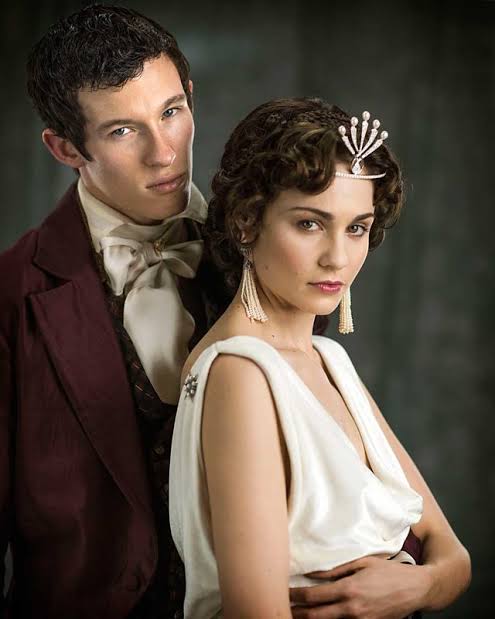
Stephen Rea played Prince Vassily Kuragin with a supercilious lugubriousness, whilst Callum Turner portrays his son Anatole as a card-board cut-out rake. Gillian Anderson, looked resplendent as society hostess Anna Pavlovna Scherer, did not have very much to do except play, well, a society hostess. And lastly, there was Tom Burke’s over-the-top bad-boy Fedor Dolokhov. As Tolstoy himself put it: “There are three things I love to do!’ he roared. ‘Fight, drink, and I can’t remember the other one … “ And: “I think you’re an absolute ruffian,’ Helene tutted, branding him ‘disgusting.’

One judges the success of a visual dramatization by how well renders the original’s iconic scenes and set-pieces. Here then is a brief critique.

The famous, plot-setting grand ball was nicely done – the set, the clothes, and the dancing, building up well to Nat and Andy’s meeting and floor show. Natasha’s Dance at the Rostov dacha, so iconic and important to Tolstoy’s narodnik sympathies, was, however, disappointingly undercooked.  Bezukhov and  Dolakhov’s duel in the snow , was deftly done, demonstrating what a foolish, deadly practice this was. Pierre’s Freemason initiation was risably pythonesqe – all signs and handshakes and overdone dramatics. Why bother?

The French Invasion of 1812, heralded Halley’s Comet, as a vast army crossing the Neimen, Boney’s fateful Rubicon, is melodramatically underwhelming but perhaps, to be otherwise would have required a very big budget. and yet, the battle of Borodino – I was awake for this one – was probably the best screen portrayal of this bloodbath that I have seen. The French occupation of Moscow was cliched and cursory, whilst the burning of the city, always difficult portray in film, came across as cut-price CGI. The disastrous French retreat from Moscow, prisoners in tow,  was likewise difficult to portray, but somehow, by thinking small and focusing on the micro-dramas of the debacle, and with some cold-weather channeling of David Lean’s Dr Zhivago, it actually worked.

And finally, when the tumult and the shouting ended, the captains and the kings departed, and the characters have met their various ends or apotheoses, what of that bucolic happy families ending?

As Tolstoy himself was to say, in the opening lines of another weighty tome, all happy families are alike. The rural family barbecue was a derivative denouement. The surviving members of the three families, now three generations, gather together after all their trials and tribulations in an idyllic rustic lifestyle bought and paid for with Bezukhov and Bolkonsky money. It is reminiscent of the final scene in Cold MountainShenandoah, How the West was Won, The Sound of Music, and many others in which ‘Good’ eventually triumphs over despair, deprivation and disaster – you know how it goes: “We’re so glad all the bad stuff is over and done – may our lives now be pleasant and delightful”. Or as Tiny Tim (of Dickens’ fame, not Tulips) declaimed, “God bless us all!”

But, Tolstoy’s drawn-out, ponderous and indeed, anticlimactic and awful “getting of wisdom” finale would not have worked on screen. “Thankfully!” many would declare.  And anyhow, isn’t this how the classic hero’s quest is meant to end: with revelation redemption, reunion, and a kind of contentment. The old Count, in his mystical, mythic way, wouldn’t have wanted it any other way.

And after six hours of pretty good entertainment, who am I to blow against the wind?


Here’s what the papers said:

And here is all you ever wanted to know about Leo Tolstoy’s War and Peace, but were put off by three inches of closely-typed mall print:

War and Peace by Leo Tolstoy – digested read

We’re going to speak Frussian, join the army, fall in love, fall out of love, get very cold, and then die
Illustration: Matt Blease
                                                                Illustration: Matt Blease

It was July 1805, and all St Petersburg was concerned about the advance of Bonaparte. Though not so much as to cancel a soiree at which Pierre, a bastard by birth but not by nature, was to be introduced to Russian society.

“Pierre is not one of nous,” several guests observed. “Not only does he forget choses but he doesn’t speak Frussian. Et he drinks even plus que nous.”

Prince Andrew, a bastard by nature but not by birth, cleared his throat delicately. “As a member of the officer class, I have decided to join the army,” he declared.

“I shall join the hussars,” Nicholas declared, while his sister Natasha eyed up potential husbands. They might become rather scarce.

Pierre checked his fob watch. The pages were turning faster than he expected and his father had now died. “I seem to find myself the richest man in Russia.”

War proved more terrible than either Andrew or Nicholas has expected. Dreams as well as men got killed. “How I embrace death,” Andrew murmured as the battle of Austerlitz raged. “Pas so vite,” said Napoleon. “Permettez-moi de vous donner une main. Now I must wash my chubby little body.”

“I’m home,” said Andrew as his wife died in childbirth.

Pierre felt the burden of expectation and married Helene but, helas, she had a bit on the cote. The anguish was intolerable, but Pierre felt obliged not to kill his love rival in a duel and left St Petersburg for many years to ruminate on Freemasonry before deciding a knotted handkerchief was not for him. Instead, he chose to improve the lot of his serfs, who had up till now remained entirely invisible. “Harrumph,” he concluded at last. “I cannot improve their lot because they have never had it so good.” Tolstoy nodded approvingly, lifting his eyes momentarily from the handsome handmaiden beneath him.

“So, 500 roubles on the peace lasting,” said Nicholas, as Napoleon and the Tsar embraced in friendship, thereby losing the remains of the Rostov fortune.

“I am distraught,” Andrew declared as Natasha fell dangerously ill.

It was now 1812 and Pierre was beside himself as the French approached Moscow. “‘I am deranged with symbolism and Helene has left me even though I left her first. I vow to kill Napoleon,” he said.

Je ne peux pas believe que je have just perdu the battle of Borodino,” Napoleon squeaked, his shoe-lifts giving him gip. “The French had by lointhe best army.”

“But Russia had nature and spirituality on its side,” said Tolstoy while a chorus of Volga boatmen sang patriotic songs.

“Can you not faire quelque chose about the fumee in Moscow?” asked Napoleon. “Et quand will I receive the surrender?”

Jamais,” Mother Russia replied. First scorched earth, then General Winter. War is hell.

Pierre hovered between madness and death as the French performed atrocities during their withdrawal from the icy embrace of Mother Russia.

“There is a nobility in being broke,” said Nicholas’s aunt. “So I am going to give you some more money.” “Oh, thank you,” Nicholas replied. “Now I can marry Mary. And maybe you and Andrew can make up now, Natasha?”

“I forgive you, Natasha,” said Andrew, before dropping dead.

“That’s handy,” said Pierre, appearing out of nowhere. “Maybe I can marry you instead.”

“Yes please,” Natasha whimpered. “I can give up my singing, we can have four children and I can become a right old drudge, because Leo thinks that submission is a woman’s natural state.”

Tolstoy bowed his head. He was tired. The novel was a difficult thing. Not that his book was a novel, of course. Though people would be bound to call it that. Fools all of them. We can only know we know nothing.

 Hear Simon Callow read John Crace’s digested War and Peace on the BBC Today programme

When Harald Went A Viking

When we were in Istanbul in 2014, we were particular keen to see the famous Viking graffiti on a rail of the gallery of the beautiful Aya Sofya basilica. And there indeed it was, carved by Halvden, a 9th Century soldier of the Emperor’s Varangian Guard, an elite force of Viking mercenaries. The name Varangian  derives from the Greek via Old Norse væringi or ‘pledge’.

This year, we visited York, successively a Roman, Saxon, and Viking city.

I have an intense interest in connections, in the valences that link people, times, and places. And in York, there were many. Constantine, the creator of the Byzantine Empire, and founder of Constantinople, was declared emperor here on the death in York of his father. His statue sits (literally) outside York Minster. The Roman brickage we saw in Ephesus, Palmyra, and Jerusalem was replicated here in York, and in the forts of Hadrian’s Wall. And it was exciting to discover another connection to Istanbul, and that long-departed Viking warrior.

Viking Grafitti in Hagia Sophia, Istanbul

Viking graffiti in the Hagia Sophia, Istanbul

My story recalls one the most famous dates in English history, the the Battle of Hastings. But I shall not retell the story of that battle, nor of the battle at Stamford Bridge which preceded it. Rather, I will describe one particular Viking’s adventurous journeying before he met his doom near York in September 1066.

Harald Sigurdsson, named Hardrada (“Stern Counsel” or “Hard Ruler”), was born about 1015, and he was the first King to perish in 1066. King of Norway, his appetite grew with the eating, and he made unsuccessful plays for the thrones of Denmark and England. Failing the first, he invaded and raided east of what was then Eoforic (formerly Roman Eboracum, Viking Jorvik, and today, York – and there is an isolated hamlet on the plateau to our west in northern New South Wales called Ebor). His protagonist that day was one Harold Godwinson of Wessex, otherwise known as Harold II, King of England. Harold marched his army all the way up to Eoforic to confront his almost-namesake and Harald’s ally, one Tostig Goodwinson, Saxon turncoat and also, Harold’s embittered brother. In four days, Harold marched his army 180 miles from London, meeting and defeating Harald and Tostig at Stamford Bridge, just east of York. Hearing that William the Bastard, Duke of Normandy had landed near Hastings to challenge his claim to the English throne, King Harold then marched his army south again. 241 miles this time. The rest, as they say, is history.

King Harald is not hard to find on the Internet. There are websites, histories, and even novels that tell his story in lesser and greater detail – I republish a review of Don Hollway’s imaginative The Last Viking below. And, rumour has it, Leonardo DiCaprio is pondering the prospect of making a movie about him, and possibly starring in it. There are also many resources dealing with the Varangian Guard. I recommend Frank Westenfelder’s succinct blog history of mercenaries, Soldiers of Misfortune. So what follows is my own sensationalist synopsis, written as much for entertainment as for education.

As a teen Harald was caught up in internecine warfare between battling Viking eorls. Brothers and half-brothers, rebels and pretenders fought for lands and crowns in the realms that now constitute Scandinavia. Young Harald often fought and failed, and on failing, he fled. He washed up in Kyivan Rus on Lake Ladoga, east of present day Petersburg, and then entered the service of Grand Prince Jaroslav or (Yaroslavl) the Wise in Novgorod. The principality of Kyivan Rus, by the by, was the predecessor of today’s Ukraine, Russia, and Belorussia, and was established and ruled for over a century by Viking warriors. Harald captained the Grand Prince’s soldiery and, so the sagas sing, paid court to Jaroslav’s beautiful daughter Elesiv (Elisabeth). Ukrainian historians maintain that Yaroslavl actually ruled in raked in Kyiv and that his daughter was called Yelizaveta; but they tell the same story.

In Jaroslav’s service, Harold fought Poles, Estonians, Turkic nomads, and Byzantines. He eventually took five hundred Viking warriors to Constantinople – the Norsemen called it Mickelgard, or Great City – where his martial reputation saw him rise to head the Varangian Guard, that same mob that our Istanbul graffitist served in. Whilst this was specifically the emperors’s bodyguard, as an elite force, it fought on the empire’s frontiers against Arab pirates and raiders, marauding nomads from the steppes, Saracens, Normans and Bulgarians. The sagas say that Harald even traveled to Jerusalem – the Vikings called it Jorsalberg – protecting caravans of Christian pilgrims. Just picture it. A brigade of Norseman slashing and bashing their way through the wadis and wastelands of Syria, fifty years before the first crusaders put Jerusalem to the sword.

Harald passed twelve years in Byzantium departing a wealthy warrior. Not that his leaving was without complications. Implicated in murky financial dealings (including a fair amount of looting and blackmail), Byzantine power struggles, and, possibly, an illicit love affair with the Empress Zoe, he fled with his men in two ships. One was trapped by the famous chain that was strung across the Bosporus (see below for more details). but his boat reached the Black Sea and sailed thence to Rus’ once more, and the lovely Princess.

Elisef’s father, the renowned Jaroslav ‘the law giver’, was in fact the son of a Viking Varangian, and this may have been a reason he gave Harald sanctuary and employment in the first place, and encouraged him to seek service in Constantinople. Whilst there, Harald had secured sufficient funds to finance a bid for the Norwegian throne. After much battling and bargaining, he succeeded, and indeed, ruled Norway for twenty years until he made the fateful decision to try his hand in England.

Tostig was angry that Harold has taken the earldom of Northumbria away from him, and so encouraged Harald to challenge his brother’s disputed claim to the English throne. It is mooted that Viking Harald and French William each believed that he had been promised said crown by the dying English king, Edward the Confessor. Both therefore came ashore with their forces to claim what they reckoned was their inheritance. Which was why the unfortunate Harold did his exhausting round-trip in September and October of 1066.

At Stamford Bridge, Harald’s long run of good fortune ran out. the Norns, having long ignored him, decided to cut his thread. The Viking army was heavily beaten, and Harald himself was struck in the throat by an arrow and killed early on in the battle in a state of “berserkergang” or “battle rage”. He wore no body armour nor carried a shield, fighting fiercely with both hands clutching his heavy sword. Dying thus, sword in his hand, he was assured entry into Valhalla.

There’s a good account of 1066, the “year of the three battles”, in History Extra‘s story of the three battles that lost England.

And so our story ends. Scholars have considered Harald’s death in battle as the end of The Viking Age. He is also reckoned to have been the last great Viking king, indeed, the last great Viking.

© Paul Hemphill 2015

There is a song for every occasion, and with our our sojourn in York, and Viking fact and fiction echoing along its ersatz City Walls, I would like to share my very own Viking saga:

Further Reading

The Saga of Harald Hardrada

The original source for much of what we know of Harald is The Heimskringia Saga. therein is much more fascinating detail of his adventures, including the full story of his escape from Constantinople. All of Harald’s Varangians piled onto two ships and rowed like crazy for the chain. As they approached, he had every man who wasn’t rowing pick up any baggage he had and run to the back of the boat, so that the prow of was raised and the stern lay low in the water. Thus, the ships managed to run themselves halfway up onto the chain, whereupon all the vikings at the stern ran to the front with their gear, so that the ships tilted forward and came down on the other side. At least, that was the plan. Harald’s ship made it but the other broke its keel and sank, along with half of his men. The Saga is available in the online Gutenberg Library. Go to Saga 8, The Saga of Harald Hardrade.

Anglo Saxon Varangians

An exciting addition to the saga of the Varangian Guard is recent evidence that in the wake of they Norman Conquest, Saxon exiles emigrated from conquered England and joined the Emperor’s bodyguard. They acquired quite a reputation for martial prowess, and were believed to have established a city in what is today the Crimean Peninsula. Read Caitlin Green’s well-written post: New England on the Black Sea

The Vikings of Rus

The principality of Kyivan Rus, with its capital at Kyiv,  was established and ruled for over a century by Viking warriors who ventured south down the great rivers of today’s Ukraine, Russia, and Belorussia. The Viking age lasted from the end of the eighth century to the latter half of the eleventh.

The vikings raided and traded, subjugated and ruled whole countries or parts thereof, transforming existing politics and creating new ones. In so doing, they butted up against the Byzantine Empire, even reaching the gates of Constantinople itself. Envoys of the king of Rus first came to the city in 838, offering peace, friendship and trade. But there was also conflict. In 860, Vikings besieged the city and passing through the Bosporus into the Mediterranean, plundered Byzantine-controlled islands. This was repeated in 959.

Over time, relations became much more cordial. Prince Volodymyr the Great of Kyiv converted to Christianity in 988, a purely political move to secure the goodwill of the Byzantine empire, his most powerful and dangerous neighbour. He adopted the Byzantine orthodoxy, thus drawing  him closer to the empire, and proceeded to convert his subjects. Alliances of mutual benefit were formed, with Vikings fighting Byzantium’s border wars, and were often sealed with marriages between Viking lords and Byzantine princesses.

Constantinople was like a lode star to the Vikings. The princes of Kyivan Rus were attracted to its wealth and commerce, and also to the power, prestige and high culture. Indeed, they endeavoured to replicate it on the Dnieper. Voldymyr’s grandson Yaroslav/Jaroslav (he’s acclaimed by both Ukraine and Russia) rebuilt Kyiv in Byzantium’s image, in brick and stone, built a magnificent cathedral modeled on Theodosius’ Aya Sofia, naming it Saint Sofia, and a raised a Golden Gate like that in the Great City. Princes in other cities followed Kyiv’s example.

Everything was violently undone in 1238 when the Mongols invaded Kyivan Rus, and Kyiv itself was devastated in 1240, and did not recover its former importance and prosperity for centuries. Yet, the cathedral of St Sophia still stands in the heart of Kiev, as it has done for almost a millennium, its golden domes a symbol of the advent of Christianity in eastern Europe.

There’s a fascinating account of Kyivan Rus See Serhii Plokhy’s history of Ukraine, The Gates of Europe.

Read more in In That Howling Infinite :

Kirkwall Cathedral, Shetland, UK

Kirkwall Cathedral, Shetland, UK

If you love heroic fantasy a la George R.R. Martin, you’ll love ‘The Last Viking’

Harald Hardrada, the 11th-century Norse adventurer of Don Hollway’s “The Last Viking,” led an iron-hammered life of struggle, travel, scheming and violence. Especially that last. As Tom Shippey observed in his history of Viking culture, “Laughing Shall I Die,” everything the ax-wielding warriors of the North did “was based on violence. That is what Vikings were good at, especially good at, spectacularly good at.”

And none more so than Harald Hardrada, Harald the Hard-Ruler or Tyrant, whose marauding ways came to an end in England at the Battle of Stamford Bridge, near York, in the pivotal year of 1066. In effect, the 51-year-old invader, by then the king of Norway, was caught by surprise. The Anglo-Saxon King Harold Godwinson unexpectedly quick-marched his army north, covering 200 miles in four or five days instead of the usual two weeks. Hollway calls this “one of the greatest feats of military tactics in medieval history.” Yet even though Harald, the “thunderbolt of the North,” was defeated and killed, he unknowingly exacted a cold revenge. Immediately after this costly, hard-fought victory, the Anglo-Saxon king and his remaining, exhausted troops were compelled to hurry back south to face William of Normandy — soon to be William the Conqueror — at the Battle of Hastings. A fresher, bigger army might have changed English history. As it was, in just three weeks both the age of the Vikings and the reign of the Anglo-Saxons reached a blood-drenched close.

When we think of Vikings, we generally picture dragon ships raiding the coasts of England and Scotland or intrepidly sailing westward across the Atlantic to Iceland and, quite probably, North America. Yet Harald passed much of his young manhood in the wild, wild East, where this “almost legendary Norse hero”— as John Julius Norwich calls him in “Byzantium: The Apogee”— served as a mercenary in the Byzantine Empire’s elite Varangian Guard, eventually becoming its de facto commander. He also participated in diplomatic missions and military actions in the Holy Land, Sicily and Constantinople itself. Beyond that, matters grow somewhat hazy.

Much of what we know about Harald derives from Icelandic sagas, poems and histories, supplemented by Byzantine sources, such as Michael Psellus’s “Chronographia.” In “The Last Viking,” Hollway, a journalist specializing in military history, dramatically weaves together all the facts and most of what is conjectured about the Viking, the result being at once a biography and “a melding, comparison and recounting of the old tales.” Was the handsome blond warrior a favorite of the aging, lustful Empress Zoe? Did he gouge out the eyes of the pusillanimous Emperor Michael V? Was he the secret lover of the Emperor Constantine IX’s mistress? Might the imperial throne have actually been within reach of his sword-arm? Though it’s impossible to be sure, all of these questions could plausibly be answered “yes.” That’s what the ­skalds and chroniclers believed and that’s the riveting story Hollway tells.

In the year 1030 Harald was 15 years old when he joined his much older half brother Olaf, the deposed king of Norway, in the latter’s attempt to regain his throne. Just before the climactic battle of Stiklestad, Olaf told Harald he was too young for the upcoming clash of arms, to which the teenager reportedly countered, “I will certainly be in this battle. I’m not too weak to handle a sword. If necessary my hand can be strapped to the hilt.” During the fighting, Olaf was killed and Harald left for dead. But the boy survived, recovered from his wounds, and with a small company headed for Russia, traveled up the Neva River to Lake Ladoga and then on to Kiev, where his kinsman Prince Yaroslav ruled. Three years later, only 18, Harald captained that prince’s household guard. Recognizing that he could rise no higher in Kiev, this ambitious, natural-born commander sailed and portaged down the river Dnieper, then crossed the Black Sea to Miklagard, the Big City, as the Scandinavians called Constantinople.

                                                     “The Last Viking” author Don Hollway 

Hollway devotes half his book to Harald’s adventures and machinations during the decade he spent with the Varangian Guard. Toward the end of those years, the Viking and his closest lieutenants were cast into a lightless dungeon, yet nonetheless managed to break out, kidnap the emperor’s mistress and commandeer two galleys. But so what? Escape by sea was blocked by a heavy barrier chain stretched across the estuary known as the Golden Horn. Ever resourceful, Harald ordered his men to row toward it with all their might just as he and the others on board all rushed to the ship’s stern. This raised its bow high enough so that the vessel rode halfway over the chain, at which point everyone immediately raced forward to elevate the galley’s back half, allowing the ship to slide down into open water.

Once back in Kiev, Harald married Yaroslav’s pretty daughter Elisaveta, then journeyed homeward to seize power in Norway and attempt to subjugate Sweden and Denmark. Up to this point, the Viking could be construed a hero or at least a brilliantly audacious and quick-witted soldier of fortune, but in his unrelenting drive to be ruler of all Scandinavia he soon grew treacherous and cruel, looting and burning Danish cities, murdering any nobles who stood against him. His battle standard, white silk bearing the image of a black raven, became known as Land-Waster. The chance to bring England under its sway ultimately led to Harald’s last stand at Stamford Bridge.

A fencer and historical reenactor, Don Hollway excels at describing medieval weaponry, shield walls and battle tactics. Yet this isn’t just a book for military history buffs. If you love Frans Bengtsson’s picaresque masterpiece, “The Long Ships,” Robert Graves’s intrigue-suffused “I, Claudius,” or heroic fantasy in the mold of Robert E. Howard, George R.R. Martin and Howard Andrew Jones, you owe it to yourself to pick up “The Last Viking.” It’s that exciting, that good.

Michael Dirda reviews books for Style every Thursday.

The Last Viking – the True Story of King Harald Hardrada, Don Hollway, Osprey.

Sic semper tyrannis

You come at the king, you best not miss.
Omar Little, The Wire (after RW Emerson)

The phrase “one man’s freedom fighter is another man’s terrorist” is at once apt, correct, and yet often oversimplified to the point of disingenuousness. The word “terrorist” itself describes its goal. To instill fear in the heart of the enemy. In the past, the target would have been the king, the dictator, the ruling class, and those who served them and upheld their rule. Politicians, officials, solders and policemen. Today, terrorists indiscriminately target whole societies. Irish bombers blasted communities of the rival faith, murdered shoppers, office workers, and pub patrons, as well as soldiers and policemen. Palestinian suicide bombers hit malls and pizza bars in city centres. ISIS, al Qa’ida and the Taliban detonate cars in busy city streets and publicly execute prisoners in callous and calculating “lectures in flesh” (the phrase is civil rights lawyer Geoffrey Robertson’s, from his chilling account of the trials and execution of King Charles I of England and those who sentenced him, The Tyrannicide Brief.).

But targeted and random terrorism has a long historical pedigree. For centuries, it has been the desperate and nihilistic weapon of last resort of resistance and rebellion against perceived oppression and injustice, and against invaders and occupiers.

In the second century BCE Palestine, the Maccabees used assassination in their resistance to the Seleucid Greeks, and a century later, the Jewish zealots, the Sicarii, named for the easily concealed small daggers, paid the Romans in like coin, and ultimately in an insurrection that culminated in the destruction of Jerusalem in 70CE and the scattering of the Jewish race (giving history the emotive and symbolic last exit that was Masada). In an etymological irony that Mark Twain would have been proud of, the present unrest in Jerusalem, a large number of young Palestinians have perished in attempting to stab jewish soldiers and civilians. Their jaquerie is called the “Intifada Sakni-in”, the ‘Knife Uprising – an echo of those long-dead Sicarii “dagger men”.

Nowadays, one would be excused for thinking that “terrorism” and “terrorist” are synonymous with Arabs and Muslims. And a historical precedent reinforces this erroneous assumption. The Hashishan or “Assassins” of Middle East fame (yes, that is where that noxious noun originated) were Muslim men and boys mesmerized and mentored by Rashid ad Din as Sina-n, the “Old Man of the Mountain” (and all this, before Osama in the caves of Tora Bora), and were Twelfth Century  hit-men contracted out to rival Muslim princes in the internecine conflicts that plagued the Levant in the wake of the Crusades and the demise of the great Arab Caliphates.

But the assassin’s knife (and in modern times, the gun and bomb, and latterly cars and trucks) predates these medieval hoods and links the Hebrew rebels of old to the Irgun and Stern Gang who encouraged Britain and the UN to abandon Palestine in 1948, bequeathing most of it to the new state of Israel, and triggering the Palestinian diaspora. European anarchists and Irish rebels and loyalists were adept at shootings and ambushes. In Algeria, during the ‘fifties, the nationalist FLN and the “colon” OAS shot and bombed each other and those unfortunates caught in the crossfire. The IRA perfected the improvised explosive device that today has crippled thousands of American, Canadian, and Australian soldiers in Iraq abd in Afghanistan. Hindu Tamil separatists of Sri Lanka introduced the suicide bomber, an economical and efficient weapon against soft (civilian, that is) targets, deployed today by Islamist killers in the streets of London and Lahore, Damascus and Dar es Salaam, Jerusalem and Jakarta. Whilst Arabs – and particularly Palestinians may have given the world the hijacking of aircraft – a tactic that fell into disuse due to diminishing political returns and rapid response forces – other Arabs showed us how to fly them into public buildings as the whole world watched in horror and disbelief. The shockwaves of this one are still reverberating through the deserts of the east and the capitals of the western world.

In going up up against their occupiers, the Palestinians have an old heritage. In my old country, Boudicca and Caractacus fought a losing battle against the Romans in Britain during the First CE. The Roman historian Tacitus ascribed to a vanquished chieftain the memorable words  “solitudinem faciunt, pacem appellant” – they make a desert and they call it peace. After the battle of Hastings in 1066, the defeated Saxons pushed back against the Normans and brought the genocidal wrath of William the Conqueror down on their heads with the devastating “Harrying of the North”. The Green Man and Robin Hood legends are said to be a retrospective and romanticised remembering of the Saxon resistance. Warrior fugitives from that failed guerilla war fled as far as Constantinple, where many joined the Emperor’s acclaimed Varangarian Guard, (see When Harald Went A Viking) 

In the streets and the countryside of Ireland, my parents’ birthplace, the United Irishmen, Fenians, Free Staters, IRA and Unionists fought against the redcoats, tommies, and black and tans of the British Army. Fought amongst themselves, fought against each other, and killed and were killed in their centuries long war of liberation. And in my adopted country, indigenous Australians fought a futile frontier war against settlers and soldiers just as native Americans did, albeit on a much smaller scale, and paid the price in hangings, massacres, poisoned wells, dispossession, marginalization, and “stolen children”. The legacy of those times lingers still – see The Frontier Wars – Australia’s heart of darkness.

In Central America, Juarez led the Mexicans against the French, and Sandino, Nicaraguans against US marines. Spaniards rose up against Napoleon’s forces, giving the world the word “guerilla”, or “little war”. Russian partisans ambushed the Grande Armé and the Wehrmacht. Throughout occupied Europe, the very term “resistance” became synonymous with the heroic unequal struggle against tyranny. In another of history’s ironies, muqa-wamat, Arabic word for resistance, unites sectarian rivals Hamas and Hizbollah against Israel.

And not just resistance to invasion and occupation, but also against oppression by one’s own rulers. Religious tracts tie themselves in knots reconciling the obligation to obey our rulers with the right to resist and overthrow those that rule badly. The unequal struggle against tyranny – or what is perceived by the perpetrators as tyranny – is the cause that inspires men and women to desperate acts.

The most celebrated in fact, film and fiction is the death of Julius Caesar at the hands of peers who feared that he intended to usurp the ostensibly democratic Republic (ostensible because democratic it was not) and institute one-man rule. That ended badly for the conspirators, and for Rome, as it precipitated years of civil war and ultimately, half a century of empire).

In 1880 the reforming Czar Alexander II of Russia, discovered the hard way that liberating the serfs did not inoculate himself against the bomb that took his legs and his life. His fearful and unimaginative successors hardened their hearts and closed their minds against further reform. setting in train the crackdown on dissent and democratic expression that led eventually to the storming of the Winter Palace on Petrograd in 1917. Narodnaya Volya, the killers called themselves – the People’s Will. And that is what terrorists do. They appeal and owe fealty to a higher court, a greater good, a savage God.

So it was when student and Serbian nationalist Gavril Princip assassinated Archduke Ferdinand of Austria-Hungary in June 1914 and ignited the spark that lit the conflagration of World War 1 which precipitated the demise of the old European empires.

So too when John Brown and his sons brought their broadswords to bear on slavers and their sympathizers and made a date with destiny at Harpers Ferry. Their famous raid may or may not have accelerated the downward slide to the secession and civil war that erupted the following year, but it provided a moral and symbolic prelude and also, the resonating battle hymn of the republic. John Wilkes Booth bookended this bloody era with his histrionic and public murder of Abraham Lincoln, shouting “sic semper tyrannis”, “thus always to tyrants,” attributed to Brutus at Caesar’s assassination – today, it’s the Virginia state motto. Brown and Booth were quite clear in their motives. As was were the segregationalist shooters who did for African Americans Medgar Evers and Martin Luther King. Less so were the killers of the Kennedy brothers in the sixties.

To conclude, sometimes that savage, rebel God is one of faith, sometimes, of blood and soil. In some instances, it is revenge for wrongs real and imagined – the reasons at times lost or forgotten through the passage of time and fading memories. And often, “the cause” is corrupted by the immoral economics of illicit commerce, including contraband, kidnapping, blackmail and extortion. Sometimes all merge in an incongruous hybrid of religious passion, ethic identity, libertarian or anarchistic fervour, and protection racket. As was the case in Northern Ireland, in Lebanon, in sub-Saharan Africa, and currently so in Syria and Iraq.

But most times, terror and turmoil is simply a political weapon planned, targeted and executed as a mechanism of regime change. Rebellion, revolt and revolution. Resisting, opposing, challenging, confronting and defeating the central authority. The seizing, holding, consolidation and keeping of political power.

And one thing is for sure. The outcome is unpredictable. History does not move in straight lines, but often follows a bitter and twisted path. Cliched as it is, the phrase “be careful what you wish for” is an apt one. And when, as Bob Dylan sang, “the line it is drawn, the curse it is cast”, there is no going back. To quote WB Yeats’ famous lines, “all is changed, changed utterly”.

Terrorism, then, can shift the course of history. If we were to stumble into the swamp of alternative histories, imagine what might of happened

If Caesar had walked home from the senate on the Ides of March
If Lincoln had been able to guide the Reconstruction
If the reforming Czar had introduced democratic government to Russia
If Gavril Princip’s shot had missed the archduke
If Kennedy had returned from Dallas
If John Lennon outlived George Harrison
If Yitzak Rabin had left the peace concert in Tel Aviv
If the Twin Towers stood still

To quote “Stairway to Heaven”, a curiously apposite title given the millenarian mindset of many terrorists, “Oh, it makes you wonder!”

The Long Road To Waterloo

The rebel yell that resounded in Paris in the summer of 1789 reverberated around Europe for 26 years until it sounded for the last time on the fields of Waterloo. On an overcast summer’s morning on Sunday 18th June, two hundred years ago, over one hundred thousand soldiers prepared to face each other in damp Belgian farmland. More gathered during that “longest day”. When darkness fell, up to fifty thousand of them lay dead or seriously wounded. A British rifleman would later recall: “I had never yet heard of a battle in which everybody was killed, but this seemed likely to be an exception, as all were going by turns.”

To historians, Waterloo is one of the great battles of history, a turning point, the beginning of the modern era. It ended the wars that had convulsed Europe – and since the French Revolution,  the First French Empire and the career of Napoleon Bonaparte, one of the greatest commanders and statesmen in history. And it ushered in almost half a century of international peace in Europe; no further major conflict occurred until the Crimean War.

This song is for all those men who, after these long years of war, never came home.

https://soundcloud.com/user6120518-1/the-song-of-the-soldier-1815.

The Song Of The Soldier

Chaos is majestic in its way. I contemplate this vista of destruction and death with pain and helplessness in my soul.  
Red Army Captain Pavel Kovalenko, in All Hell Let Loose, Max Hastings, 2011

Before him, he carries noise, and behind him, he leaves tears; death, that dark spirit,
in’s nervy arm doth lie; which, being advanc’d, declines, and then men die.
Volumnia, in Shakespeare’s Corialanus, Act 2, Scene 1.

A new age dawned when the Bastille fell
Twenty six long years ago.
We marched the road of Europe
In the revolution’s glow.
In the floodtide of that revolution,
We bartered our young lives away.
And shoulder to shoulder we stood to arms
And held our foes at bay.

Against the might of empires,
Beyond our wildest dreams,
We fought the professional armies
Of Europe’s old regimes.
And hungry, tired and poorly armed,
We ragged volunteers
Pushed them back in disarray
Far from our own frontiers.

And we talked that time of setting stars
And the twilight of great powers.
And we never once thought that the sun would set
On an empire such as ours’.
But the siren song of liberty
Has lost its golden thrill.
The new age is now stained with blood
And we are marching still.

There came a great adventurer
For whom France was much too small.
As if we’d had not enough of war,
We answered to his call.
He was like a father unto us.
He served his children’s need.
A substitute for politics, for intellect and greed.

But he overreached in pomp and pride
To serve his vanity.
And we, the soldiers of the line,
Paid with our blood his fee.
‘til the whole world turned against us.
It neither forgot nor forgave
We who came to liberate
But stayed on to enslave

And we talked that time of setting stars
And the twilight of great powers.
And we never once thought that the sun would set
On an empire such as ours’.
But the siren song of liberty
Has lost its golden thrill.
The new age is now stained with blood
And we are marching still.

From the dust of Torres Vedras
To the bloodstained Russian snow.
We followed the Eagles loyally.
Never questioned why we go.
‘til the tide of conquest turned abut,
And showed us how it feels
To retrace weary footsteps
With the wolves hard at our heels.

And now we march our final march
On Belgium’s fertile soil.
We see an end to all or pain
And an end to mortal toil.
And the dream which fired us through the years
Has nothing left to yield
But peace that comes from a nameless death
On a confused battlefield.

And we talked that time of setting stars
And the twilight of great powers.
And we never once thought that the sun would set
On an empire such as ours.
But the tyrant song of liberty
Has lost its golden thrill.
The new age is now stained with blood
And we are marching still.

© Paul Hemphill 1984

A Short History Of The Rise And Fall Of The West

See also:

https://howlinginfinite.com/2016/04/08/thermidorian-thinking/

 http://www.economist.com/news/books-and-arts/21651775-appallingly-bloody-yet-decisive-battle-waterloo-june-1815-deserve

http://www.telegraph.co.uk/culture/books/bookreviews/11075393/Waterloo-by-Tim-Clayton-and-Waterloo-the-Aftermath-by-Paul-OKeeffe-review-compelling.html