The Boys of Wexford – memory and memoir

We are the boys of Wexford, who fought with heart and hand
To burst in twain the Saxon chain, and free our native land!
The Boys of Wexford, RD Royce 1898

Glory-o, Glory-o to her brave men who died
For the cause of long down-trodden man.
Glory-o to Mount-Leinster’s own darling and pride
Dauntless Kelly, the boy from Killane.
Patrick Joseph McCall, 1898

It was on this day in 1798, during the first great Irish rebellion against British dominion, that the Battle of Vinegar Hill took place at Inis Córthaid, now the second-largest town in County Wexford.

The Rebellion of 1798 (Éirí Amach) also known as the United Irishmen Rebellion, was an uprising against British rule in Ireland during the summer of ‘98. The United Irishmen, a republican revolutionary group influenced by the ideas of the American and French revolutions, were the drivers of the rebellion. It was led by Presbyterians irate at being shut out of power by the Anglican establishment whilst Catholics became increasingly involved. Plans called for significant French support, which never eventuated. The uprising was poorly organized, uncoordinated, and quickly suppressed by much more powerful British forces. Both sides indulged in bloody reprisals. Between 10,000 to 30,000 souls perished, most of them Irishmen and women of all denominations.

The rebellion raged Ireland-wide, but County Wexford was its heart. Overlooking the town, Vinegar Hill was the site of the largest camp and the headquarters of the Irish rebels who held County Wexford for thirty days against vastly superior English forces; and it was there, after inflicting several defeats upon the insurgents that the English sought to finally destroy the rebel army. Battle raged on Vinegar Hill itself and in the streets of Enniscorthy with considerable loss of life among both rebels and civilians. It marked a turning point in the rising, being the last attempt by the rebels to hold and defend ground against the British military.

The famous statue in the market square of Enniscorthy shows the doomed Father Murphy, a leader of the ’98, pointing the way to Vinegar Hill for a young volunteer, ‘The Croppy Boy’.
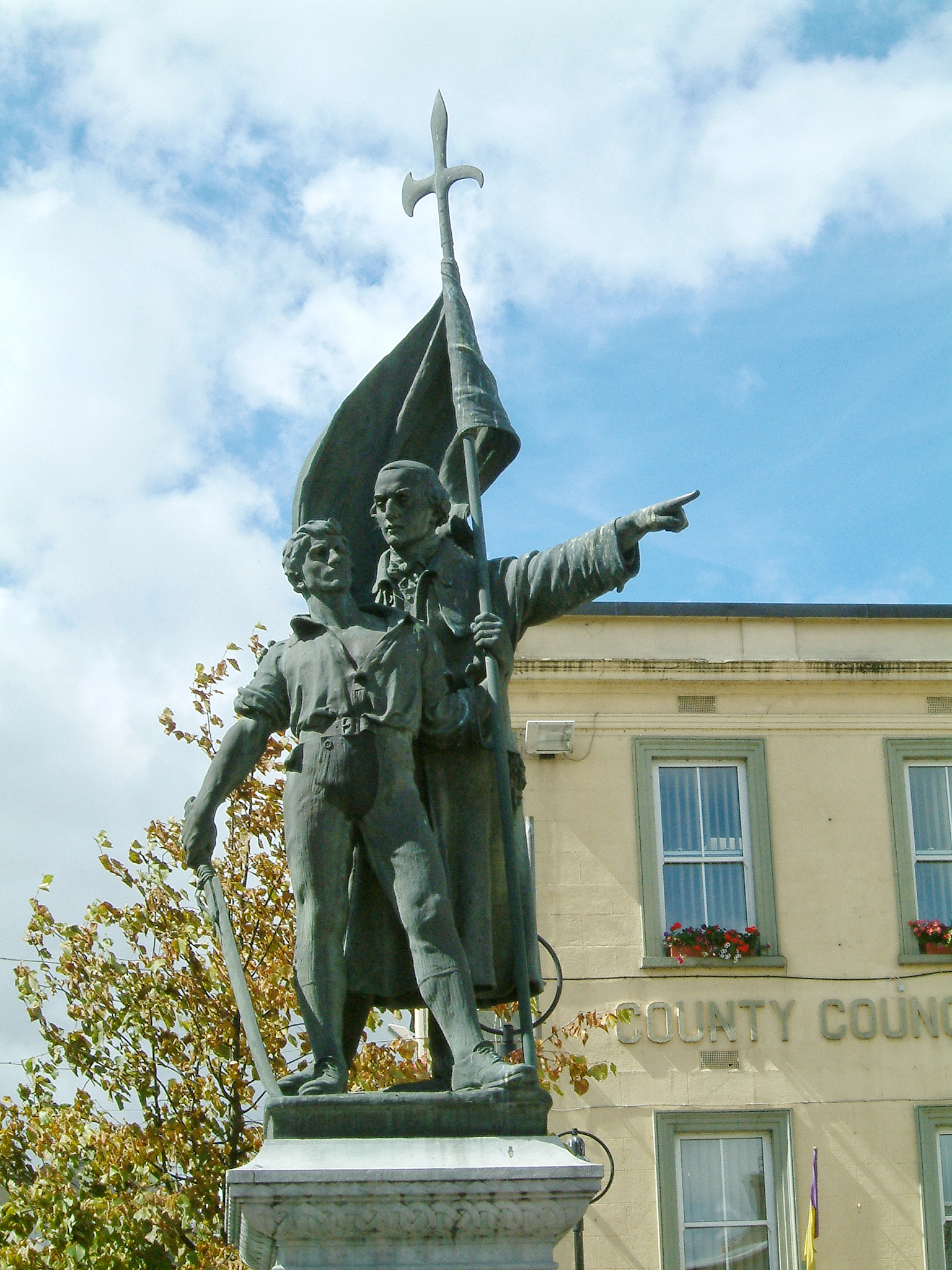
Father Murphy and The Croppy Boy

The Battle of Vinegar Hill, Enniscorthy

History – and indeed, our lives – have a way of echoing across the world and down the years. In 1804, Irish convicts in the far-away penal colony of New South Wales, raised the flag of rebellion against the British soldiery and the colonial masters they served. It was the only convict rising in Australia. Many of those convicts would have been involved in the ‘98, and transported to Botany Bay for their part in it. Their quixotic Intifada was crushed at a place they called Vinegar Hill after the Wexford battle. In 1979, having migrated to Australia, I visited what is believed to be the site of the convicts’ revolt, the Castlebrook lawn cemetery on Windsor Road, Rouse Hill, where a monument commemorating the revolt was dedicated in 1988, Australia’s bicentennial year. Once open farmland, a place of market gardens and horse riding (back in the day,we would canter across its  gently rolling paddocks), it is now a suburban sprawl of McMansions.

The Battle of Vinegar Hill, New South Wales

Myth and memory often embellish the stories and the glories of oppressed people rising up against the power, but when we recall these oftimes forlorn hopes, from Spartacus to the Arab Spring, it is difficult to imagine ourselves, in our relatively comfortable, free and democratic countries, in the position of people desperate and passionate enough to risk life and limb and to face the terrible consquences of heroic failure.  We can but sense, vicariously, the ache and the urge behind Lord Byron’s passionate couplet:

Yet, Freedom! thy banner, torn, but flying,
Streams like the thunder-storm against the wind.

And ponder Seamus Heaney’s poignant Requiem for the Croppies:

The pockets of our greatcoats, full of barley
No kitchens on the run, no striking camp
We moved quick and sudden in our own country.
The priest lay behind ditches with the tramp.
A people, hardly marching on the hike
We found new tactics happening each day:
We’d cut through reins and rider with the pike
And stampede cattle into infantry,
Then retreat through hedges where cavalry must be thrown.
Until, on Vinegar Hill, the fatal conclave.
Terraced thousands died, shaking scythes at cannon.
The hillside blushed, soaked in our broken wave.
They buried us without shroud or coffin
And in August the barley grew up out of the grave.

Father Murphy and me

I’ve always felt a connection with Vinegar Hill and “the boys of Wexford” who fought there.

In Birmingham, back in the early fifties, we lived with our aunt in a cold-water, back-alley walk-up on the border of Balsall Heath (just inside Moseley, a ‘better’ suburb). Aunty Mary was my mother’s mother’s sister. Her family had lived through Ireland’s war of independence and the civil war that followed, and she carried with her the memory of those times when she migrated to Birmingham before the Second World War – after her husband had run off “with another woman” (these things happened in Catholic Ireland). She lived in that same old house right through the Blitz when German bombers regularly targeted The Second City’s engineering, motor and arms factories, and not a few public buildings including the Piccadilly and Waldorf cinemas on nearby Stratford Road which were destroyed with considerable loss of life. Mary would serve tea to the bomb-disposal lads as they carried out their dangerous work. When her sister died and daddy Paddy (Patrick Joseph, my middle names) had decamped – he’d found a new Love – Mary brought their six children over to Birmingham from Enniscorthy one by one.

I never met nor learned what became of my grandfather. My aunt and mother would say that if Paddy Whelan died, the devil himself would come and tell us. Old Nick never did, but my brother Robert recently chased down the records. Paddy also crossed the water, passing on in Leicester – not that far from Brum – in 1985 at the age of eighty.

My father arrived in Brum by another road. He was born in Castlederg in County Tyrone. An Ulster man, indeed, and Protestant too, He and several of his brothers has likewise crossed the water in search of a new life. Most Ulster ‘Proddies’ migrated to Glasgow in those days – the original homeland of the the Protestant settlement of Ulster initiated by King James I of England and consolidated with Orange King Billy’s victory over the forces of catholic ex-king James II at the Battle of the Boyne in 1690. you can read more about all that here, and its legacy in Northern Ireland here. How he and my mom got together is another story and quite unrelated to this one. But it had a lot to do with the times. geography, coincidence, miscommunication, innocence – and romance.

I was born in Mary’s house. She had a friend who had once given birth so that friend was the midwife. My brothers followed over the next two years. By then, the National Health Service had kicked in, and they were born in hospital. Childbirth, forever dangerous, was now rendered less life-threatening. There we all lived, three kids, our folks, Aunty Mary, three uncles, two aunts, a pekingese called Monty, named for the famous field Marshall, and an ancient white cat called Gorgee. Monty was flattened by a bus on Moseley Road, right outside our home.

Three bedrooms, girls in one, boys in another, and our family in the third. Outside loo and coal shed, no bathroom or hot water (we kids bathed in the kitchen sink and grown-ups went down to The Baths). Cold and damp, and close to the shops. And there we lived until 1956 when a council house in Yardley Wood became our first family home. Cold and colder running water that froze in winter, but it was at least inside the house; a bathroom with hot water heated in a big gas boiler; and an outside flush lavatory that was nevertheless immediately adjacent to the backdoor and not down in the garden. A big garden it was too, for winter and spring vegetables, snowmen and summer camp-outs.

There we grew, with free medical treatment for all our ailments, and free optical and dental care. I still have crooked teeth – no fancy orthodontics on the NHS – but I have all my teeth still. And my eyesight. We were educated for free. This came in during the war with the Butler Act. So, thanks to the Welfare State, we were housed and healthy enough to get to primary school and beyond. Once there, we had free books, free pens and paper and compulsory sport, and doctors and nurses would turn up on a regular basis to check our vitals. And thus, we were able to reach the glorious ‘sixties ready to rock ‘n roll.

In 1956, my uncle took me “across the sea to Ireland” to meet our family – my mother’s, that is. Dad was a proddie from County Tyrone, and we didn’t talk about them. We stayed in the tiny terrace house in Patrick Street where my mother was born in 1928, a crowded place with an outside toilet and a whitewashed back wall that looked out onto windswept fields beyond.

Uncle Sonny (Philip, really, but knicknamed for Al Jolson’s famous song), took me to the top of Vinegar Hill, and it’s lonely ruined round tower, used then as a shelter for cattle. We visited the statue of Father John Murphy and the young volunteer, and I learned the story of The Croppy Boy. Today, the term “croppy” is used derogatively to refer to a country bumpkin. Back then, it also referred to the young patriots who answered to the call “at the rising of the moon”. Their name came from their cropped hair – interpreted by some at the time as symbolic of the rejection of the powdered wigs of the gentry and also of the style popularised by French revolutionaries. Sonny took me to The Bloody Bridge on the outskirts of town where Father Murphy was tortured and executed by the English soldiers, the ‘yeos’ (or yeomen). I put my fingers in the groove in the  bridge’s stone parapet, said to have been made by the dying priest himself. We walked across the bridge in Wexford Town where so many martyrs perished at the hands of the foe – and, alas, so many innocents were murdered by the rebels. Little matter that the bridge we now trode was the third built there since those fateful days.

History was alive, and it was black and white. People remembered, as if it was yesterday, how Oliver Cromwell cut a bloody swathe through Catholic Ireland and massacred the innocents of Wexford town. It was said that people hung Cromwell’s picture upside down in their living rooms, and turned his face to the wall for good measure. Relatives would recount how the Black and Tans, the English paramilitaries raised to terrorise the populace, held their bayonets to women’s throats demanding “where’s your husband?”…or father…or son…Even the English teachers at my English grammar school would remark that the ‘Tans were war veterans who’d survived carnage of the Western Front and wanted more.

In the summer of 1969 my brother and I and an old chum spent several weeks in an Enniscorthy that looked and felt felt like it had not changed since Aunty Mary’s day – so well portrayed in the academy award nominated film Brooklyn. Dressed as we were in hippie garb and sporting long locks, we cut incongruous figures in the pubs and at the local hop, and were so unsuccessful hitchhiking around the county that we walked many a long Irish mile. We hiked to Killane, Sean Kelly’s country, and inspired by the song, climbed upwards though heath and hedge to the top of Mount Leinster. We stayed at 13 Patrick Street, and spent a lot of time sitting up on Vinegar Hill, beneath its round tower, looking down on the River Slaney and the town beyond. My brother was a keen photographer, and he took the following pictures:

The Croppy Boy 1969
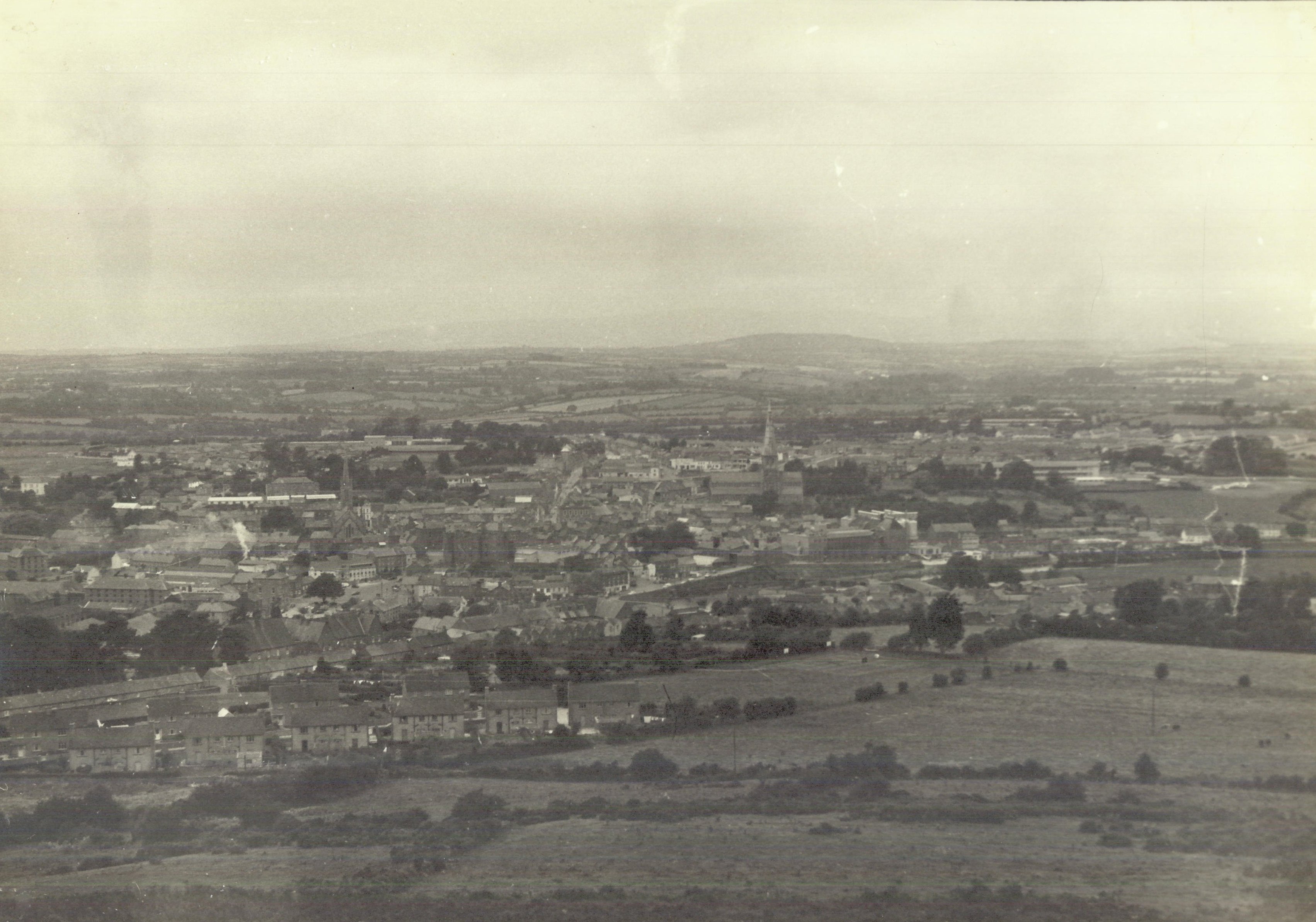
Enniscorthy from atop Vinegar Hill August 1969

Enniscorthy Sunset August 1969

Fast forward into another century, and I was “on the Holy Ground once more”. Adèle and I attended the wedding of an old pal and cosmic twin (born on the same day as me at about the same time, in English town beginning with B) we were the only Brits in a seminar at London’s School of Oriental and African Studies. Back then, SOAS was known to many Arabs as the school of spies, a status I was reminded of by the owner of our hotel when we all visited Damascus in 2006. But I digress.

The wedding was held at an old pub in right in the heart of Ireland, and in getting there, we did a whistle-stop tour of the south, including Enniscorthy, Wexford and Ross, the heartland of the ‘98 rebellion. When I first visited Enniscorthy, you could lie down in the middle of the Main Street and not be disturbed by traffic. This time, you could still lie down in th middle of Main Street – we were stuck in a traffic jam as we wound up the hill past Saint Aiden’s Cathedral to Patrick Street, which was no longer on the edge of town. The old house was still standing, as the song goes. Clean and crisp and pebble-dashed. As we stood outside number thirteen, a young goth girl in a multicoloured hoodie with tattoos and piercings opened the door. I told her how my mother and her brothers and sisters were born in this very house a long, long time ago, and that we’d come all the way from Australia to see it. “You don’t say!” she said.

13 Patrick Street, August 2004

Vinegar Hill August 2004

I was best man at that wedding, and in a speech largely devoted to the groom and our mutual, lifelong appreciation of Bob Dylan, I was able to relate to guests young and old tales of my Irish childhood, taking us all “down the foggy ruins of time”, and sang extracts from songs I actually did learn at my mothers knee. When I was little, mother Mary would march us up and down the parlour as she sang Enniscorthy’s songs of rebellion: Kelly the Boy From Killane, Boulavogue, and the eponymous Boys of Wexford.  “In comes the captain’s daughter, the captain of the Yeos …” – I’ve always wondered what became of that young rebel lass. Transported to Australia with hundreds of others, maybe? The songlines of my Celtic twilight.

We were told that such songs were banned in Britain, and that we must never sing them in public. There’s nothing so tempting as forbidden fruit. A relative brought us over Irish Songs of Freedom, sung in a sweet tenor by Willie Brady – a daring deed indeed, listening to it was,   and perhaps my first act of rebellion. We know now that this was all a cod. The Clancy Brothers were singing those rebel songs to packed houses the length and breadth of the British Isles and North America. And today, of course, you lose count of the collections and anthologies of Irish songs of freedom, rebellion or resistance, sung with vim, vigour, and nostalgic gusto from the Clancy Brothers and Dubliners back in the day to Sinead O’Connor and Celtic Woman.

In true men, like you men – songs of ‘98

So, on this, the two hundredth and twentieth anniversary of Vinegar Hill, let us remember the patriot men with a few of those old songs.

At Vinegar Hill o’er the pleasant Slaney
Our heroes vainly stood back to back
And the yeos at Tullow took Father Murphy
And burnt his body upon the rack
God grant you glory, brave Father Murphy
And open heaven to all your men
The cause that called you may call tomorrow
In another fight for the green again
Boulavogue Patrick Joseph McCall 1898

The song commemorates local parish priest Father John Murphy, he of the statue in he market place, who led his parishioners into battle in Wexford. Father Murphy and the other rebel leaders were captured and executed. He was hanged, decapitated, his corpse burnt in a barrel of tar, and his head placed on a spike as a warning to other rebels.

Enniscorthy is in flames and old Wexford is won
And tomorrow the barrow will cross
On the hill o’er the town we have planted a gun
That will batter the gateway to Ross
All the Forth men and Bargy men will march o’er the heath
With brave Harvey to lead in the van
But the foremost of all in the grim gap of death …
Will be Kelly, the boy from Killane

But the gold sun of freedom grew darkened at Ross
And it set by the Slaney’s red wave
And poor Wexford stripped naked hung high on a cross
With her heart pierced by traitors and knaves.
Glory-o, Glory-o to her brave men who died
For the cause of long down-trodden man.
Glory-o to Mount-Leinster’s own darling and pride
Dauntless Kelly, the boy from Killane
.

Patrick Joseph McCall 1898

Sean Kelly was one of the leaders of the ‘98, celebrated for his role in then Battle of Ross, where he was wounded. After the fall of Wexford on 21 June, he was dragged from his sick bed, tried and sentenced to death and hanged on Wexford Bridge along with seven other rebel leaders. His body was then decapitated, the trunk thrown into the River Slaney and the head kicked through the streets before being set on display on a spike as a warning to others.

These were bad times for brave men.

The “grim gap of death”
The battle of Ross, April 5th 1798

Some on the shores of distant lands
Their weary hearts have laid,
And by the stranger’s heedless hands
Their lonely graves were made;
But though their clay be far away,
Beyond the Atlantic foam,
In true men, like you, men,
Their spirit’s still at home.
Who Fears to Speak of ‘98, John Kells Ingram 1843

See also, Irish Rebel Music, and A Selection of songs of ’98.

And in In That Howling Infinite, see Mo Ghile Mear – Irish myth and melody

Easter 1916 … a Wexford postscript

History might not repeat, but indeed it sometimes rhymes. The republican tricolour flew for a week over Enniscorthy in April 1916. A month before, Padraig Pearse, who would be one of the leaders of the Dublin insurrection, visited Enniscorthy for the commemoration of Robert Emmet, the Republican leader hanged for his rising of 1803, and told officers of the town’s republican Irish Volunteers that orders for an armed uprising would come soon. One of the Volunteers’ active supporters was actually a local priest called Father Murphy!

This article by John Dorney in The Irish Story website recalls these little known events.

“County Wexford is famous in Irish nationalist folklore as the site of the 1798 rebellion. In that year the republican Society of the United Irishmen proclaimed a “Wexford Republic”, which operated for a month before it was bloodily suppressed. What is less well-known is the role of the county in the Easter Rising of 1916, when the town of Enniscorthy was taken over for a week by the local units of the Irish Volunteers. Although much less bloody than the celebrated events of ’98, or of the Rising in Dublin, in which almost 500 people were killed within five days of fighting, the Wexford rebellion of 1916 does provide a fascinating look at reactions to the insurrection in provincial Ireland”. 

The Easter Rising in County Wexford

Enoch knocking on England’s door

As I look ahead, I am filled with foreboding; like the Roman,
I seem to see the River Tiber foaming with much blood

Fifty years ago, conservative British MP Enoch Powell got himself sacked as a shadow minister after he controversially warned that Britain would face “rivers of blood” if it did not reduce immigration. The BBC has now kicked off a shit-storm by announcing that Scottish actor and erstwhile Stars Wars emperor Ian McDiarmid will recite Enoch’s incendiary speech in full for the very first time.

What Powell said back then, at closed gathering of Conservative Party faithful in Birmingham on 20th April 1968, was regarded as unacceptably over the top, rhetorical hyperbole. But we get stuff like this all the time these days. Every Tom, Dick and Himmler on the right of politics from Brixton to Brisbane, from Galveston to Gdańsk, from Hopkins to Hanson, come up with this and worse every day – to the delight of dog-whistling shock-jocks, populist politicians, and angry white men and women who hanker after the “good old days’ and want somebody or other to go back to where they’re came from – which quite often happens to be just around the corner: comedian Lenny Henry, raised in the Midlands’ Black Country (just west of Birmingham) which many wanted to make white, would satirize such white delusions: In a gig at West Bromwich , he said the National Front wanted to give black people £1,000 to go home. Fine, Henry said: after all, that would more than cover his bus fare back to Dudley.

After what was regarded at the time as Britain’s most racist election in 1964, Liverpudlian bard Brian Patten penned the wistful, unseasonable I’m Dreaming of a White Smethwick (just down the road from Brum and Dudley) in response to the the mood of certain sections in the population about immigration, a mood which entered the national dialogue in odorous array once Enoch let slip the hounds of woe, and which, as the Brexit referendum and its fallout continue to demonstrate, has never dissipated.

Immigration debates are running hot in western democracies, including down here in Australia, and on the neo-authoritarian eastern edges of the European Union, as fringe and mainstream parties defend and propound their invariably conflicting and flawed understanding of western civilization against disparate and often doomsday scenarios of mass migration, islamification, and ‘white replacement”.

This is not, however, the time or place to engage with these issues.  The fiftieth anniversary of Enoch’s seminal “Rivers of Blood” speech has been greeted with many articles and reminiscences. This one in the New York Review of Books, Enoch, Bageye and Me, I found particularly informative and also entertaining. A piece in the Guardian on that infamous Smethwick by-election is also worth reading. I reproduce Brian Patten’s poem below.

But right now, I want to leave the commemoration and commentary to the pundits and recall my own encounters with the phenomenon of Enoch Powell. I never actually met the man – the nearest I ever got to him was about twenty metres – let’s just say  that on several occasions, our paths intersected

Vox Pop!

Back in the day, the words that Enoch had made flesh were not to be said in polite company. And yet, they could not be unsaid, and in pubs, parlours and playgrounds across Britain, he strummed a power chord long before these were invented.

In the summer of 1968, I had completed my final school year in, yes, Birmingham, of all places, at what was then emphatically white-bread, boys-only Moseley Grammar School.

Those hypothetical rivers of blood had a particular resonance in the industrial West Midlands with its motor industries and variegated populace a long-time home of immigrants and their descendants from all quarters of the coloured commonwealth. As I have written earlier, the bleak and bland streets and suburbs of our English and Irish Birmingham were already rocking with new sounds and flavours, from the ska and reggae beats of Sparkhill to the spicy aromas of Balsall Heath and Alum Rock. There was prejudice, there was discrimination, there was at times violence, but as Britain emerged from the austerity of the war years, as the bombed cities were rebuilt, and a resuscitated economy created a consumer society, labour shortages persuaded politicians to facilitate mass immigration from the empire – and particularly, from the West Indies and the Indian subcontinent (See: Weighing the White Man’s Burden)

And Birmingham, the Motown of the north, was at the heart of the calabash. But scratch its skin, and you find … Ron Simcox.

I spent the summer of ‘68 working as a labourer on a building site in Chelmsely Wood on the outskirts of Brum. Back then, my back was strong, my eye was keen, and my ears were sharp – and my memory for conversations, well, it must’ve been good, because a few years later, I was able to recall almost verbatim the world according to Simcox, a dark angel washed in White Tide.  Warning! Bad language follows.

Ganger-man, foreman, industrial spy, jack of all trades, agent provocateur, martinet, scourge of the to bureaucrats, friend of the workers, champion of the oppressed, bless his soul and damn his eyes in the same breath. The man’s an institution – like prostitution. Big mouth, big belly, very big. Look, look at my tan, my body beautiful, “all muscle 18 stone and still as fit as a 18 year old!”

“Go to the other shop – not to the black man’s. You don’t know what filth he has in that place. Mind you, his bird could do with a good seeing to …”

“Bleedin’ wogs – we never should’ve let ‘em in now. Old Enoch Powell’s dead bloody right, int’e. We should kick ‘em all back to fucking India. If I had my way, I’d shoot the bleeding lot of them filthy cunts, coming over here and spreading their diseases, an’ fillin’ up all our hospitals, and taking the money and sending it all back home, and getting the fuck out of here when they get it …”

“We should offer to pay to pay ‘em a thousand quid each to go home, then put them in a boat and send them all to Jamaica or wherever the black monkeys come from. And when they’re in the middle of the ocean, torpedo the lot of them buggers. Anybody who gets to Jamaica after that would deserve the thousand bloody quid, I tell you!”

Ron couldn’t brook the shirkers, could Ron. But that was easy as he was always heard before he was seen even, and even if you had pleasure of gazing upon this Adam, he would rarely see you as he was for ever distracted by the body he was always admiring in car windows or or by the local talent of the estate across the way.

“How would you like those thighs around you, eh? Corr! I could take that one from behind!”

Ah, Ron, a way with words. “What are you doin’ Enoch? Come ‘ere bollock-chops. Fucking stoodents – good for nothing bastards. If I had my way, y’know what I’d do to these stoodents if they caused trouble? You know what I’d do. I’d turn the fuckin’ sewer hoses on ‘em, I would, cover ‘em in shit. Then they’d have to wash to get rid of the smell. Turn the hoses on ‘em. Cover ‘em in all the shit and rubbish, and all the jonnies and the jammies and the slime. That’d really shake ‘em up and give ‘em some sense it would!”

Always a one for words was Ron. All this and the big blue tractor too. Nine hours a day, six days a week and thirty quid at the end of it …

From Tabula Rase – Early Years: Poems of Paul Hemphill Volume One

Street Fighting Man

Among the Left, of course, Enoch was the fifth horseman of the black apocalypse. Even his name, with its Old Testament pedigree, was vicariously baleful. I recall his patrician mug on the cover of many a Private Eye, and artist Gerald Scarfe’s visceral caricature of the metaphorical hornèd one recoiling from a jar of Robertson’s Marmalade (golliwog and all – and, did you know that you can still buy golliwogs in Australia?)

Soon after Enoch’s incendiary oratory, prime and minister Harold Wilson chose a wet and windy Sunday afternoon in Spring to attend a Labour party function at Birmingham’s Victorian town hall. It was just over a month since the memorable mêlée in front of the American embassy in Grosvenor Square, and many of us, students, unionists, anarchists, and a raj taj and bobtail of South Asian organisations, anticipated a confrontation with Birmingham’s finest. We were, predictably, outmaneuvered and outnumbered, and in an early incarnation of what  today we call “kettling”, the “wabble of woudy webels” were hemmed in, facing uphill on Bennett’s Hill, a wind-swept side street of Birmingham’s finance district. We learnt there, as we did during those Vietnam demonstrations in Grosvenor Square, that there’s no greater killer of revolutionary passion than the sight of a wall of fat horse’s arses backing towards you with those nervous hooves a’twitching (see: The Twilight of the Equine Gods).

Children of the Revolution

But I digress. Enoch! He was like catnip to the young and not so young of what was then the idealistic, radical, and what with Vietnam and Paris providing the fuel, fired-up left. What was it Old William Wordsworth said? “Bliss it was in that dawn to be alive. But to be young was very heaven”. As Marc would later warble, “you can’t stop the children of the revolution, oh, no…”

Later that year, I had gone up to Reading University, and as one would in those dynamic days – though not so many working class lads like myself – and, as a political ingenue, I was  soon involved in sundry sit-ins and soviets. It was what young students did. Enoch Powell, exiled to the  back bench, was at lose end. He had yet to be born-again as an Ulster Unionist MP, this most Churchillian – in a turncoat sense – of politicians. And like many career-truncated pollies nowadays, he had embarked on what was then a not so lucrative speakers circuit – and he was addressing the Conservative Club on the subject of … economics!

Naturally, we arrived well in advance, revved up and ready for revolution, and totally packed the lecture hall. The Young Tories were left out in the cold in their tweeds and twinsets (really, that’s what straight folk wore in those days, particularly Reading University which boasted a reputable college of agriculture that attracted the sons and a few daughters of the rural shires). When Enoch entered, there was sheer pandemonium. Cat-calls, wolf-whistles, swearwords, and those corny couplets that folk chant at marches (“Yes, we are  all individuals!”). You couldn’t hear a bomb drop. The Antichrist just stood there at the lectern, cool, calm and collected as the vitriol poured over and around him. In retrospect, knowing as I do now that he’d “had a good war” as a decorated, veteran combat officer in World War 2, he was ice-cool under fire. Stock-still, silent, that famous, disdainful mug of his calm and expressionless. As the hubbub subsided, people got bored, tired, and impatient, muttered and mumbled, and shut up. And he gave his prepared speech. On economics. No old Roman aphorisms. No allusions or innuendo. Plain and simple, dry, economics. And gave it well. Cogent, it was, the odd joke, even, and informative. He had our interest, had our attention, and we listened. And when he’d finished, he was given a standing ovation. In recognition of his courage, I would like to think. Like Daniel in the lion’s den and  the three amigos in the fiery furnace cool as a cucumber.

I’m Dreaming of a White Smethwick
(An old, never-to-be-forgotten song by Brian Patten)

I’m Dreaming of a White Smethwick,
One I didn’t want to know,
Where they’ll have allwhite, allright children
And the White and White Minstrel Show.
I’m Dreaming of a White Smethwick
Where they’ll have a brandnew dance;
Teach their kids to close their eyes
And forget that once
Strange men came to Smethwick
With slogans whitewashed on their minds,
They campaigned about a while
And left their shit behind.
I saw black father christmasses
Burning in the snow,
Protesting to the Opposition
About what happened a while ago.
The last blackbird’s been shot in Smethwick
And the council’s doing allright,
The M.P.’s in the Commons
Making sure his words are white.
Chorus: May all your days be merry and bright
And may all your citizens be white.

Poet’s Note: As in numerous folk songs, the words may be improvised on to suit the present.

And here are other posts in In That Howling Infinite with regard to the ‘sixties: Springtime in Paris – remembering May 1968; Recalling the Mersey Poets; The Strange Death of Sam Cooke; Looking for LehrerShock of the Old – the glory days of prog rock; Window on a Gone World; Back in the day; The Incorrigible Optimists Club.

Weighing the White Man’s Burden

By all ye cry or whisper,
By all ye leave or do,
The silent sullen peoples
Shall weigh your Gods and you.
Rudyard Kipling

And where the crazy whiteman
And his teargas happiness
Lies dead and long since buried
By his own fantastic mess
Roy Harper

As a young lad in Birmingham, my school chums and I would be enthralled by a world map covered in red – the empire upon which the sun never set. As Britain turns its back on Europe, it would seem that quite a few folk are still enamoured of the defunct Imperium. A 2014 YouGov opinion poll that found 59% British people polled believed the old British Empire was something to be proud of. 34% wished they still had one.

Back in the day, we’d do school projects about cocoa cultivation on the Gold Coast (now Ghana, not our Australian schoolies’ mecca), rubber trees in Malaya and East Africa, and tea plantations in Assam and Ceylon – enhanced by attractive, child-friendly posters and other educational aids provided gratis by the likes of Cadbury, Dunlop and Typhoo. That these household names had factories in our industrial ‘second city’ which encouraged school outings rendered the wonders of empire all the more tangible.

In the Britain of my childhood, the “silent sullen peoples” of Rudyard Kipling’s famous poem were beginning to “colour-up” (pun quite intended) our monochrome, white-bread, demographic cityscape. The bleak and bland streets and suburbs of our English and Irish Birmingham were already rocking with new sounds and flavours, from the ska and reggae beats of Sparkhill to the spicy aromas of Balsall Heath and Alum Rock. There was prejudice, there was discrimination, there was at times violence, but as Britain emerged from the austerity of the war years, as the bombed cities were rebuilt, and a resuscitated economy created a consumer society, labour shortages persuaded politicians to facilitate mass immigration from the empire – and particularly, from the West Indies and the Indian subcontinent

Words like imperialism and colonialism, economics and exploitation, were yet to enter our vocabularies. The colonies and dependencies spread across all continents, and the ‘grown-up’ white ‘commonwealths’ and ‘dominions’ like Australia, New Zealand, Canada, South Africa, and Rhodesia, were the friends, partners, and indeed, children of the mother country.

It was, we perceived, in the innocence of youth and the blinkers of our school curricula, a benign and fruitful partnership of mutual benefit to all. “To serve our captives’ need”, we gave them our civilizing, Judeo-Christian, Anglo-Celtic values, our able and empathetic if patronizing and prejudiced administrators, our gallant soldiers, pious pastors, selfless doctors and inspiring teachers. They in return yielded up their natural resources and an abundance of cheap labour, and when the Empire was imperiled, they despatched their young men in their thousands to perish in our wars.

We were not to know that the mournful notes of the Last Post were sounding across a changing post-war world. The Union Jack was was descending on buildings and parade grounds the world over as unfamiliar new flags were raised in their stead. Tired, broke, and damaged Britain was retreating from Empire, as were France and the Netherlands, and a new imperium was rising in the west. Within a decade, India, and Pakistan and Ceylon were joined by Indonesia, and a score of young nations emerged throughout Africa. France fought long and bloody wars in Vietnam and Algeria to cling on to its colonial patrimony, and it too finally let go of its “fluttered folk and wild”.

And we were not to know the reality of Britain’s “mission civilatrice”. From the seventeenth century, the European colonizing powers were enmeshed by trade, greed, and national aggrandizement in what today we would define as “mission creep”. Distant posts morphed over three centuries into vast bureaucracies, mines and plantations that underwrote the North’s industrial and commercial hegemony, and into societies ruled by white, expatriate elites and segregated by class, caste, clan and colour.

How all this played out in The Raj is described in detail by politician and historian Shashi Tharoor in Inglorious Empire: What the British did in India.  This is reproduced below, together with a video, whilst the full Kipling poem, a song by Roy Harper, and a review by Australian author Christopher Kremmer follows.

Read also my earlier posts on India and the passing of Empire:

For more posts by In That Howling Infinite, visit:
https://m.facebook.com/HowlingInfinite/
https://m.facebook.com/hf1983/

But what about the railways…? The myth of Britain’s gifts to India 

Shashi Tharour, The Gusrdian, March 9, 2017

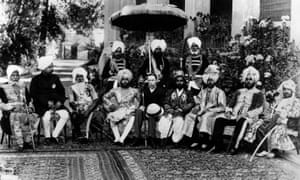
Holding court ... the lieutenant-general of the Punjab takes tea with maharajas and Rajas in 1875.
The lieutenant-general of the Punjab takes tea with maharajas and Rajas in 1875. Photograph: Popperfoto
Many modern apologists for British colonial rule in India no longer contest the basic facts of imperial exploitation and plunder, rapacity and loot, which are too deeply documented to be challengeable. Instead they offer a counter-argument: granted, the British took what they could for 200 years, but didn’t they also leave behind a great deal of lasting benefit? In particular, political unity and democracy, the rule of law, railways, English education, even tea and cricket?

Indeed, the British like to point out that the very idea of “India” as one entity (now three, but one during the British Raj), instead of multiple warring principalities and statelets, is the incontestable contribution of British imperial rule.

Unfortunately for this argument, throughout the history of the subcontinent, there has existed an impulsion for unity. The idea of India is as old as the Vedas, the earliest Hindu scriptures, which describe “Bharatvarsha” as the land between the Himalayas and the seas. If this “sacred geography” is essentially a Hindu idea, Maulana Azad has written of how Indian Muslims, whether Pathans from the north-west or Tamils from the south, were all seen by Arabs as “Hindis”, hailing from a recognisable civilisational space. Numerous Indian rulers had sought to unite the territory, with the Mauryas (three centuries before Christ) and the Mughals coming the closest by ruling almost 90% of the subcontinent. Had the British not completed the job, there is little doubt that some Indian ruler, emulating his forerunners, would have done so.

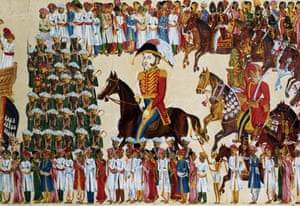
Divide and rule ... an English dignitary rides in an Indian procession, c1754. Photograph: Universal History Archive/Getty Images
 Divide and rule … an English dignitary rides in an Indian procession, c1754. Photograph: Universal History Archive/Getty Images

Far from crediting Britain for India’s unity and enduring parliamentary democracy, the facts point clearly to policies that undermined it – the dismantling of existing political institutions, the fomenting of communal division and systematic political discrimination with a view to maintaining British domination.

Since the British came from a hierarchical society with an entrenched class system, they instinctively looked for a similar one in India. The effort to understand ethnic, religious, sectarian and caste differences among Britain’s subjects inevitably became an exercise in defining, dividing and perpetuating these differences. Thus colonial administrators regularly wrote reports and conducted censuses that classified Indians in ever-more bewilderingly narrow terms, based on their language, religion, sect, caste, sub-caste, ethnicity and skin colour. Not only were ideas of community reified, but also entire new communities were created by people who had not consciously thought of themselves as particularly different from others around them.

Large-scale conflicts between Hindus and Muslims (religiously defined), only began under colonial rule; many other kinds of social strife were labelled as religious due to the colonists’ orientalist assumption that religion was the fundamental division in Indian society.

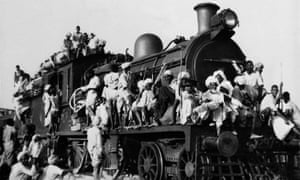
Muslim refugees cram aboard a train during the partition conflict in 1947 ... the railways were first conceived by the East India Company for its own benefit. Photograph: AP
Muslim refugees cram aboard a train during the partition conflict in 1947 … the railways were first conceived by the East India Company for its own benefit. Photograph: AP


It is questionable whether a totalising Hindu or Muslim identity existed in any meaningful sense in India before the 19th century. Yet the creation and perpetuation of Hindu–Muslim antagonism was the most significant accomplishment of British imperial policy: the project of divide et impera would reach its culmination in the collapse of British authority in 1947. Partition left behind a million dead, 13 million displaced, billions of rupees of property destroyed, and the flames of communal hatred blazing hotly across the ravaged land. No greater indictment of the failures of British rule in India can be found than the tragic manner of its ending.

Nor did Britain work to promote democratic institutions under imperial rule, as it liked to pretend. Instead of building self-government from the village level up, the East India Company destroyed what existed. The British ran government, tax collection, and administered what passed for justice. Indians were excluded from all of these functions. When the crown eventually took charge of the country, it devolved smidgens of government authority, from the top, to unelected provincial and central “legislative” councils whose members represented a tiny educated elite, had no accountability to the masses, passed no meaningful legislation, exercised no real power and satisfied themselves they had been consulted by the government even if they took no actual decisions.

As late as 1920, under the Montagu-Chelmsford “reforms”, Indian representatives on the councils – elected by a franchise so restricted and selective that only one in 250 Indians had the right to vote – would exercise control over subjects the British did not care about, like education and health, while real power, including taxation, law and order and the authority to nullify any vote by the Indian legislators, would rest with the British governor of the provinces.

Democracy, in other words, had to be prised from the reluctant grasp of the British by Indian nationalists. It is a bit rich to oppress, torture, imprison, enslave, deport and proscribe a people for 200 years, and then take credit for the fact that they are democratic at the end of it.

A corollary of the argument that Britain gave India political unity and democracy is that it established the rule of law in the country. This was, in many ways, central to the British self-conception of imperial purpose; Kipling, that flatulent voice of Victorian imperialism, would wax eloquent on the noble duty to bring law to those without it. But British law had to be imposed upon an older and more complex civilisation with its own legal culture, and the British used coercion and cruelty to get their way. And in the colonial era, the rule of law was not exactly impartial.

Crimes committed by whites against Indians attracted minimal punishment; an Englishmen who shot dead his Indian servant got six months’ jail time and a modest fine (then about 100 rupees), while an Indian convicted of attempted rape against an Englishwoman was sentenced to 20 years of rigorous imprisonment. In the entire two centuries of British rule, only three cases can be found of Englishmen executed for murdering Indians, while the murders of thousands more at British hands went unpunished.

The death of an Indian at British hands was always an accident, and that of a Briton because of an Indian’s actions always a capital crime. When a British master kicked an Indian servant in the stomach – a not uncommon form of conduct in those days – the Indian’s resultant death from a ruptured spleen would be blamed on his having an enlarged spleen as a result of malaria. Punch wrote an entire ode to The Stout British Boot as the favoured instrument of keeping the natives in order.

Political dissidence was legally repressed through various acts, including a sedition law far more rigorous than its British equivalent. The penal code contained 49 articles on crimes relating to dissent against the state (and only 11 on crimes involving death).

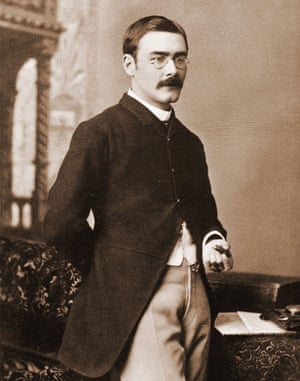
Rudyard Kipling, ‘that flatulent voice of Victorian imperialism would wax eloquent on the noble duty to bring law to those without it’. Photograph: Culture Club/Getty Images


Of course the British did give India the English language, the benefits of which persist to this day. Or did they? The English language was not a deliberate gift to India, but again an instrument of colonialism, imparted to Indians only to facilitate the tasks of the English. In his notorious 1835 Minute on Education, Lord Macaulay articulated the classic reason for teaching English, but only to a small minority of Indians: “We must do our best to form a class who may be interpreters between us and the millions whom we govern; a class of persons, Indians in blood and colour, but English in taste, in opinions, in morals and in intellect.”

The language was taught to a few to serve as intermediaries between the rulers and the ruled. The British had no desire to educate the Indian masses, nor were they willing to budget for such an expense. That Indians seized the English language and turned it into an instrument for our own liberation – using it to express nationalist sentiments against the British – was to their credit, not by British design.

The construction of the Indian Railways is often pointed to by apologists for empire as one of the ways in which British colonialism benefited the subcontinent, ignoring the obvious fact that many countries also built railways without having to go to the trouble and expense of being colonised to do so. But the facts are even more damning.

The railways were first conceived of by the East India Company, like everything else in that firm’s calculations, for its own benefit. Governor General Lord Hardinge argued in 1843 that the railways would be beneficial “to the commerce, government and military control of the country”. In their very conception and construction, the Indian railways were a colonial scam. British shareholders made absurd amounts of money by investing in the railways, where the government guaranteed returns double those of government stocks, paid entirely from Indian, and not British, taxes. It was a splendid racket for Britons, at the expense of the Indian taxpayer.

The railways were intended principally to transport extracted resources – coal, iron ore, cotton and so on – to ports for the British to ship home to use in their factories. The movement of people was incidental, except when it served colonial interests; and the third-class compartments, with their wooden benches and total absence of amenities, into which Indians were herded, attracted horrified comment even at the time.

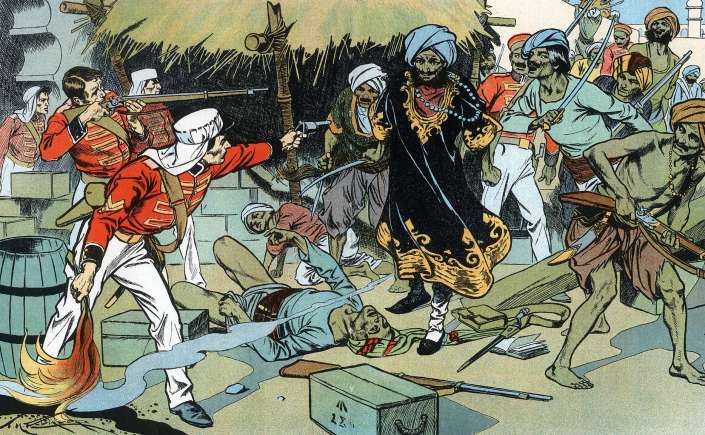
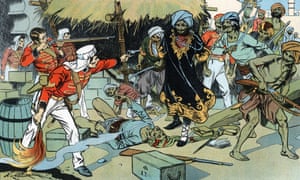
Asserting British rule during the war of independence, also known as the Indian mutiny, 1857. Photograph: Universal History Archive/Getty Images
 Asserting British rule during the war of independence, also known as the Indian mutiny, 1857. Photograph: Universal History Archive/Getty Images


And, of course, racism reigned; though whites-only compartments were soon done away with on grounds of economic viability, Indians found the available affordable space grossly inadequate for their numbers. (A marvellous post-independence cartoon captured the situation perfectly: it showed an overcrowded train, with people hanging off it, clinging to the windows, squatting perilously on the roof, and spilling out of their third-class compartments, while two Britons in sola topis sit in an empty first-class compartment saying to each other, “My dear chap, there’s nobody on this train!”)

Nor were Indians employed in the railways. The prevailing view was that the railways would have to be staffed almost exclusively by Europeans to “protect investments”. This was especially true of signalmen, and those who operated and repaired the steam trains, but the policy was extended to the absurd level that even in the early 20th century all the key employees, from directors of the Railway Board to ticket-collectors, were white men – whose salaries and benefits were also paid at European, not Indian, levels and largely repatriated back to England.

Racism combined with British economic interests to undermine efficiency. The railway workshops in Jamalpur in Bengal and Ajmer in Rajputana were established in 1862 to maintain the trains, but their Indian mechanics became so adept that in 1878 they started designing and building their own locomotives. Their success increasingly alarmed the British, since the Indian locomotives were just as good, and a great deal cheaper, than the British-made ones. In 1912, therefore, the British passed an act of parliament explicitly making it impossible for Indian workshops to design and manufacture locomotives. Between 1854 and 1947, India imported around 14,400 locomotives from England, and another 3,000 from Canada, the US and Germany, but made none in India after 1912. After independence, 35 years later, the old technical knowledge was so completely lost to India that the Indian Railways had to go cap-in-hand to the British to guide them on setting up a locomotive factory in India again. There was, however, a fitting postscript to this saga. The principal technology consultants for Britain’s railways, the London-based Rendel, today rely extensively on Indian technical expertise, provided to them by Rites, a subsidiary of the Indian Railways.

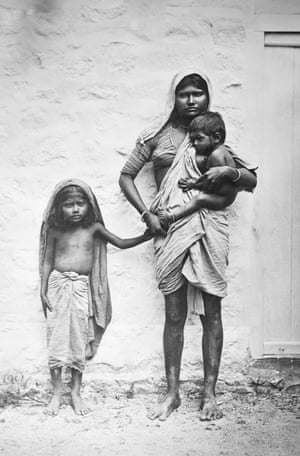
Mother and children ... the British left a society with 16% literacy, a life expectancy of 27 and over 90% living below the poverty line.
The British left a society with 16% literacy, a life expectancy of 27 and over 90% living below the poverty line. Photograph: Bettmann/Bettmann Archive


The process of colonial rule in India meant economic exploitation and ruin to millions, the destruction of thriving industries, the systematic denial of opportunities to compete, the elimination of indigenous institutions of governance, the transformation of lifestyles and patterns of living that had flourished since time immemorial, and the obliteration of the most precious possessions of the colonised, their identities and their self-respect. In 1600, when the East India Company was established, Britain was producing just 1.8% of the world’s GDP, while India was generating some 23% (27% by 1700). By 1940, after nearly two centuries of the Raj, Britain accounted for nearly 10% of world GDP, while India had been reduced to a poor “third-world” country, destitute and starving, a global poster child of poverty and famine. The British left a society with 16% literacy, a life expectancy of 27, practically no domestic industry and over 90% living below what today we would call the poverty line.

The India the British entered was a wealthy, thriving and commercialising society: that was why the East India Company was interested in it in the first place. Far from being backward or underdeveloped, pre-colonial India exported high quality manufactured goods much sought after by Britain’s fashionable society. The British elite wore Indian linen and silks, decorated their homes with Indian chintz and decorative textiles, and craved Indian spices and seasonings. In the 17th and 18th centuries, British shopkeepers tried to pass off shoddy English-made textiles as Indian in order to charge higher prices for them.

The story of India, at different phases of its several-thousand-year-old civilisational history, is replete with great educational institutions, magnificent cities ahead of any conurbations of their time anywhere in the world, pioneering inventions, world-class manufacturing and industry, and abundant prosperity – in short, all the markers of successful modernity today – and there is no earthly reason why this could not again have been the case, if its resources had not been drained away by the British.

If there were positive byproducts for Indians from the institutions the British established and ran in India in their own interests, they were never intended to benefit Indians. Today Indians cannot live without the railways; the Indian authorities have reversed British policies and they are used principally to transport people, with freight bearing ever higher charges in order to subsidise the passengers (exactly the opposite of British practice).

This is why Britain’s historical amnesia about the rapacity of its rule in India is so deplorable. Recent years have seen the rise of what the scholar Paul Gilroy called “postcolonial melancholia”, the yearning for the glories of Empire, with a 2014 YouGov poll finding 59% of respondents thought the British empire was “something to be proud of”, and only 19% were “ashamed” of its misdeeds.

All this is not intended to have any bearing on today’s Indo-British relationship. That is now between two sovereign and equal nations, not between an imperial overlord and oppressed subjects; indeed, British prime minister Theresa May recently visited India to seek investment in her post-Brexit economy. As I’ve often argued, you don’t need to seek revenge upon history. History is its own revenge.

Inglorious Empire by Shashi Tharoor is published by Hurst & Company at £20

https://www.theguardian.com/world/2017/mar/08/india-britain-empire-railways-myths-gifts#img-2

Rudyard Kipling published his famous poem to salute the US’ conquest of the Philippines in 1899, although he had originally written it to celebrate Queen Victoria Diamond Jubilee.


    The White Man’s Burden

Take up the White Man’s burden –
Send forth the best ye breed –
Go bind your sons to exile
To serve your captives’ need;
To wait in heavy harness
On fluttered folk and wild –
Your new-caught sullen peoples,
Half devil and half child.

Take up the White Man’s burden –
In patience to abide
To veil the threat of terror
And check the show of pride;
By open speech and simple,
An hundred times made plain,
To seek another’s profit,
And work another’s gain.

Take up the White Man’s burden –
And reap his old reward,
The blame of those ye better,
The hate of those ye guard –
The cry of hosts ye humour
(Ah slowly !) towards the light:-
“Why brought ye us from bondage,
“Our loved Egyptian night ?”

Take up the White Man’s burden –
Ye dare not stoop to less –
Nor call too loud on Freedom
To cloak your weariness;
By all ye cry or whisper,
By all ye leave or do,
The silent sullen peoples
Shall weigh your Gods and you.

In 1970, Roy Harper, Britain’s high priest of lyrical angst Roy created a counterpoint with this song from Flat, Baroque and Berserk.

Shashi Tharoor’s indictment of the British in India

Christopher Kremmer, Sydney Morning Herald, August 18, 2017

“Orright,” concedes the leader, Reg, played by John Cleese. “But apart from the sanitation, the medicine, education, wine, public order, irrigation, roads, the freshwater system and public health, what have the Romans ever done for us?”

In Inglorious Empire: What the British Did to India, Shashi Tharoor, writer, politician and United Nations-based diplomat for 30 years, asks a similar question to the one posed by Cleese’s beleaguered revolutionary.

In doing so, he seeks to remind misty-eyed Raj romantics that colonialism was no joke. As empires go, he says, Britain’s was uncommonly ruthless, devious and rapacious in its quest to enslave a people whose leaders failed to see how free trade, unwisely managed, can undermine a country’s long-term sovereignty and prosperity.

In the process, Tharoor accuses a number of historians, most prominent among them, Niall Ferguson, of being apologists for the racial discrimination, violence, economic sabotage and denial of liberty embodied by centuries of British rule in India.
It all began as a harmless commercial enterprise, Tharoor reminds us. In 1600, the British East India Company was formed under royal charter. Its aim was to compete with colonial rivals such as the French and Dutch for lucrative trade opportunities with India, an industrial and cultural superpower that under its Mughal emperors would account for 27 per cent of the world economy.

Awash with gems, natural resources, shipyards and a sophisticated cultural life, the Mughals were happy to trade. By the end of the century, however, they were tired, divided, and overextended. In 1739, the capital at Delhi was sacked by the Persians.

Meanwhile, in the expanding coastal trading posts, the initial presence of armed guards to protect the company’s staff and premises had evolved into a fully fledged army that by 1757 under Robert “Clive of India” had toppled the independent nawab of India’s richest province, Bengal. By 1800, the company had 260,000 men under arms and a talent for regime change that brought 200 million people under its control.

In 1857, after Hindu and Muslim rebels joined in a bloody revolt, India came under direct rule from London, and the company was eventually dissolved. The new Raj survived two world wars and the Great Depression, extending British rule for another 90 years until Gandhi’s Freedom movement triumphed in 1947, albeit at the terrible cost of Partition.

It is unusual, but not unheard of today to meet Indians who believe their country was better off under the Raj. Muddle-headed history is much more prominent in soon to be Brexited Britain. Tharoor cites a 2014 opinion poll that found 59 per cent of British people polled believed the old empire was something to be proud of. Thirty-four per cent wished they still had one.

Tharoor marshalls a formidable array of research to make the case that such attitudes are anachronistic and poorly informed. All the old chesnuts, for example, that the British modernised India, bequeathed it a tradition of parliamentary democracy and civilised the locals by teaching them the gentlemanly sport of cricket, are lined up and skewered, or at least plausibly challenged.

The company smashed India’s advanced textiles industries, literally by demolishing factories and imposing tariffs of 70-80 per cent on exports to Britain. In doing so, they turned a manufacturing, shipbuilding nation into a source of raw materials with little scope for value adding industries. The railways, he argues, were developed principally to more efficiently ship out those raw materials, and were financed by an elaborate and shonky racket that enriched British investors by inflating the cost of Indian rail track to twice that of Australia and Canada.

Meanwhile, ordinary Indians were taxed 50 per cent of their incomes, far beyond their experience and capacity to pay. Defaulters were tortured and jailed or, in the case of two-thirds of Indians under British rule in the late 18th century, fled their lands.

“The bones of the cotton weavers were bleaching the plains of India,” as one colonial administrator observed. The treasuries of princely states such as Bengal were systematically looted by coercive and corrupt methods, while prices for basic commodities were driven up by the opulent lifestyles of expatriate Britons.

Indian taxes not only paid the salaries of the British army of occupation, but also of the hundreds of thousands of Indian troops who became cannon fodder for British interests on the Western Front, at Gallipoli, and in Mesopotamia.

Behind the entire rip-off, as Ferdinand Mount, has observed, “lay the hard calculus of the City of London”. The Indian currency was manipulated to British advantage, and its trade with Europe was forced to go through London. Specifications were set to ensure that Indian steel could not be exported to Britain. India did not miss the bus of the Industrial Revolution – it was forcibly prevented from boarding it.

Discrimination against Indians in civil service employment was rife. Even the arch-colonial writer Rudyard Kipling observed that the bureaucracy was “neither Indian, nor civil, nor a service”. The “justice” British rule gave India meant it was almost impossible for a white man to be given a serious term in jail for murdering his Indian servant, which happened rather a lot. The racism of the occupiers gave the lie to the fiction of modern, enlightened and benign British rule. As one viceroy put it, “We are all British gentlemen engaged in the magnificent work of governing an inferior race”.

Tharoor acknowledges the sincere efforts of many British expats to ameliorate the harsh realities of colonial rule. But even in the 20th century, when the sun was setting on the Raj, enlightenment attitudes took second place to the desire to crush the Indian independence movement. The same people who condemned the nationalist leader Nehru to 10 years in British Indian jail cells also labelled Gandhi’s non-violent campaign for freedom as terrorism. Newspapers that alerted the public to such injustices, particularly the vernacular press, were often censored or shut down.

For all its claims to superiority, the British Empire was in charge in India during no fewer than 11 famines in which 30 to 35 million people died of starvation, Tharoor notes. Ultimately, he believes, Britain’s desire for wealth trumped all other values and considerations. The rhetoric of uplifting the benighted brown man was always a self-serving, grotesque and conceited pose to justify a regime that bribed and murdered, annexed and stole to enrich a certain class of Briton.

This book burns with the power of intellect married with conviction. It ends with Tharoor commenting that the way the Raj ended was its greatest indictment. The collapse of British rule amid devastating sectarian violence and creation of a Muslim “homeland” in Pakistan can be seen as the logical conclusion of 90 years of divide and rule strategies as London clung desperately to power in the subcontinent.

As they washed their hands and packed their carpet bags, the British departed an India in which 84 per cent of people could not read or write their own name in any language. What an achievement. In 1600, Britain produced 1.8 per cent of the world’s gross domestic product, compared with India’s 23 per cent. By the end of the Raj, Britain’s share had multiplied fivefold, while India had been reduced to penury.

But in 70 short years, India’s proud republic has made enormous strides in literacy, numeracy and poverty reduction, and is now the world’s fastest growing major economy.

Yet there are contradictions in the new India’s rise, some with their roots in the British period, like the ruling Hindu nationalist movement’s proclivity to cast the Indian identity in sectarian terms. At times, Tharoor’s determination to resist such trends leads him to downplay the injustices of earlier empires to more graphically illustrate the failings of the British one.

Yet overall, this is erudite, well-written, thoroughly documented and persuasive history that focuses varied sources into a coherent critique of colonialism in the Indian context. Tear up your copies of Ferguson’s neo-liberal mind rot and get angry like Tharoor.


The Spirit of ’45

I was a child of the Welfare State.

Born in the early years after the end of World War II, I was aware that the dominant mood was relief that it was over, sadness at those lost and most importantly a forward looking attitude to improve things and not simply to get back to what life had been like before. The traces of the conflict were all around me in once blitzed Birmingham – in the barren, levelled  ‘wastelands’ where streets had once stood, in the austerity, and the monotonous and monochrome drabness of couture and cuisine. To my boyish mind, “the war” was a shared community experience, a shadow which few, I now recall, talked about; but also, the stuff of puerile fantasies fostered by comic books, Airfix models, and patriotic movies that were literally and figuratively black and white.

Life was not all roses in those immediate post-war years, but better by far than what went before. Rationing was still in place when I was born in Birmingham in 1949, not ending until 1954. Young men still had to do their national service (the last call up was in 1960, the year I started Secondary school). We lived with our aunt in a cold-water, back-alley walk-up on the border of Balsall Heath (just inside Moseley, a ‘better’ suburb). Aunty Mary was my mother’s mother’s sister. When her sister died and daddy Paddy ran off with another women, Mary brought the six children over to Birmingham from Enniscorthy, County Wexford one by one. She had come to Birmingham from Ireland before the war, after her husband had run off (these things happened in Catholic Ireland). And she lived in that same old house right through the Blitz when German bombers regularly targeted The Second City’s engineering, motor and arms factories, and not a few public buildings including the Piccadilly and Waldorf cinemas on nearby Stratford Road.

I was born in her house. She had a friend who had once given birth, so that friend was the midwife. My brothers followed over the next two years. By then, National Health Service had kicked in, so they were born in hospital. Childbirth, forever dangerous, was now rendered less life threatening. There we all lived, three kids, our folks, three uncles, two aunts, a dog and a cat. Three bedrooms, girls in one, boys in another, and our family in the third. Outside loo and coal shed, no bathroom or hot water (we kids bathed in the kitchen sink and grown- ups went down to The Baths), Cold and damp, and close to the shops. And there we lived until, in 1956 when a council house in Yardley Wood became our first family home. Cold and colder running water that froze in winter, but it was at least inside the house;  bathroom with hot water boiled in a big gas boiler; and an outside flush lavatory that was nevertheless immediately adjacent to the backdoor and not down the garden. A big garden too, for winter and spring vegetables, and summer camp-outs.

There we grew, with free medical treatment for all our ailments, and free optical and dental care. I still have crooked teeth – no fancy orthodontics on the NHS – but I have all my teeth still. And my eyesight. We were educated, for free. This came in during the war with the Butler Act. So, thanks to the Welfare State, we were housed and healthy enough to get to primary school and beyond. Once there, we had free books, free pens and paper, and compulsory sport, and doctors and nurses would turn up on a regular basis to check our vitals. And thus, we were able to reach the glorious ‘sixties ready to rock ‘n roll.

Which brings me by a circuitous route to British director Ken Loach’s 2013 documentary, The Spirit of ’45,  a celebration of the radical changes that took place under the Labour government of Clement Attlee which came to power in 1945.

What a year that was! No sooner had the war ended, than the British electorate voted out its esteemed and beloved war leader, Winston Churchill, and bought Labour’s promise of a democratic socialism. Drawing on archive footage, and presented in black and white with contemporary interviews with dockers and miners, doctors and nurses, politicians and economists, Loach describes the nationalisation of the public services, and their subsequent privatisation three decades later. His interviewees provide poignant anecdotes about the poverty of the 1930s, dangerous and exploitative working conditions, poor housing, and abysmal health care, and the renewed sense of purpose and optimism after the end of the war and Labour’s landslide victory. He recounts the subsequent expansion of the welfare state, with its free to all medical service, and the nationalization of significant parts of the British economy, most notably, electricity, the railways, and the mines.

The Attlee government was elected due to a general belief that nothing would or could be as it had been before. Britain had pulled together to win the war; now, it would transform the peace. This was The ‘Spirit’ of ’45.

But whilst ‘spirit’ can imply  ‘esprit’ and elation, it can also mean ‘ghost’ insofar as Loach rages against the death of all that hope, optimism, and vision in the decades that followed.. It is a call to arms for a return to the public unity of those heady post-war years and against the policies of subsequent governments, and most particularly those of Margaret Thatcher, that have progressively demolished the Britain that Clement Attlee and Aneurin Bevan strove to build. And it is a reminder that the NHS is worth fighting for at a time when it is being progressively dismantled. With stills of modern soup kitchens and the Occupy movement camped outside St Paul’s, Loach clearly believes that Occupy inherits that spirit of ’45.

Viewing The Spirit of ’45 was exhilarating. It was full of Wow! moments. The footage of the poverty of the depression years, the slum dwellings, urchin children playing on the streets or on the slag heaps, the unemployment queues, the scavenging for coal, the Jarrow March. Diseases now preventable or eradicated, then mortal. Five in a bed, and two of them dead. Malnutrition and rickets. Bread and dripping sandwiches? You needed beef for dripping. Fat chance. It was bread and jam, thank you (and grateful for it, one was tempted to respond – there were indeed some Monty Python moments there, particularly the one-down-manship sketch “when I was a lad, we were so poor…”

Relying so heavily on memories and reminiscences, the film is nostalgic, sentimental, and simplistic even, with little in-depth analysis. A tick-a-box of the many innovations that greeted the arrival of the baby boomers. Presented in such a clear and uncluttered fashion, it was quite stirring. That is Ken Loach for you. What you see is what you get: a one-sided history lesson.

The film leaps from the Attlee government straight into the darkest days of the Thatcher government, with no discussion of the political, economic and social changes and challenges in between. The road from Clement to Maggie was an eventful and for many, a traumatic one. The Counter Revolution took decades to establish itself. The great experiment of 1945 contained the seeds of its own destruction.

Loach’s focus on the years of nationalization and privatization makes narrative and dramatic sense.

But the years in between were dramatic also. Read Dominic Sandbrook’s great quartet. The titles say it all: Never Had It So Good: A History of Britain from Suez to the Beatles; White Heat: A History of Britain in the Swinging Sixties; State of Emergency; The Way We Were: Britain 1970–1974; and Seasons in the Sun: The Battle for Britain, 1974-1979. These were best of times, these were the worst of times, as the Great Man might have said. And the worst was to come, when Britain apparently went down the gurgler, and Thatcher had to break it to fix it. And like Dr Frank’s monster, it did not quite come back together right.

The Spirit of ’45 received favourable reviews (one follows), most writers qualifying their praise with Loach’s unapologetic partisanship – he is Ken Loach, after all, and you either dig him or you don’t. My favourite film is his 1995 Spanish Civil War drama, Land and Freedom. And you most certainly don’t get a balanced view of that conflict from this. As with The Spirit of ’45, you just sit back and go for a revolutionary ride.

See also othet memories in In That Howling Infinite:

Dave Calhoun, Time Out, 11th Feb 2013

Ken Loach rarely makes documentaries, and when he does, they’re usually about an urgent topical issue, such as the 1980s miners’ strike (‘Which Side Are You On?’) or the 1990s Liverpool Dockers’ strike (‘The Flickering Flame’). On the surface, ‘The Spirit of ’45’ takes a longer view than those films. This rousing and saddening film reminds us of the air of progress and reconstruction that took hold in British politics immediately after World War II. It takes us right back to the founding of the welfare state and, with it, the nationalization of the health service, transport, energy, housing and other areas of public life, as initiated by Clement Attlee’s 1945-1951 Labour government. The faces we see at the beginning of the film of young Britons celebrating in the fountains at Trafalgar Square in May 1945 symbolize the hope of a nation: that things can only get better after six years of war.

But Loach, the director of ‘Kes’ and ‘Looking for Eric’, is equally concerned with the spirit of modern Britain. For him, the socialism of our past – of Attlee and his comrades Nye Bevan, Herbert Morrison and others – could teach the present a thing or two. And so the second part of ‘The Spirit of ’45’ ponders an altogether different mood than that in the 1940s: Thatcherism and the more recent failure of organised labour to live up to its founding principles. If ‘The Spirit of ’45’ might provoke David Cameron to raise his eyes skywards, it might also have Ed Miliband cowering behind an unwritten manifesto. Loach’s quiet, unforced position is that the left is equally guilty of abandoning the promise and passion of the post-war years.

Yet, as political essays go, this is a tender, soft and humane film. It’s a compelling mix of interviews, old and new, with archive footage, much of it from old newsreels and public information films. There’s no voice-over, just faces and voices – the voices of ageing nurses, doctors, miners, union officials and others, alongside a handful of economists and historians. Some of Loach’s arresting interviewees, like Sam Watts from Liverpool and the former Welsh miner Ray Davies, recall what poverty looked like in the 1930s, reminding us why the welfare state was necessary in the first place. Others, like a trio of nurses from Manchester and the Welsh GP Dr Julian Tudor Hart, remember the excitement and the work of the early NHS. In fact, the NHS emerges as one of the film’s chief concerns: it’s both the great survivor of the welfare state and the institution of that age currently facing the biggest threat from political decisions.

Ninety-odd minutes is not enough for this subject. There are inevitable omissions (no education, for example), and Loach makes a slightly jarring leap from a chronology of nationalization that speeds through the 1950s and ’60s to the 1979 election of Thatcher. But always apparent is his clear thesis and the infectious commitment and fervour of his interviewees. The film works all at once as a lament, a celebration and a wake-up call to modern politicians and voters.