This Is What It Looks Like

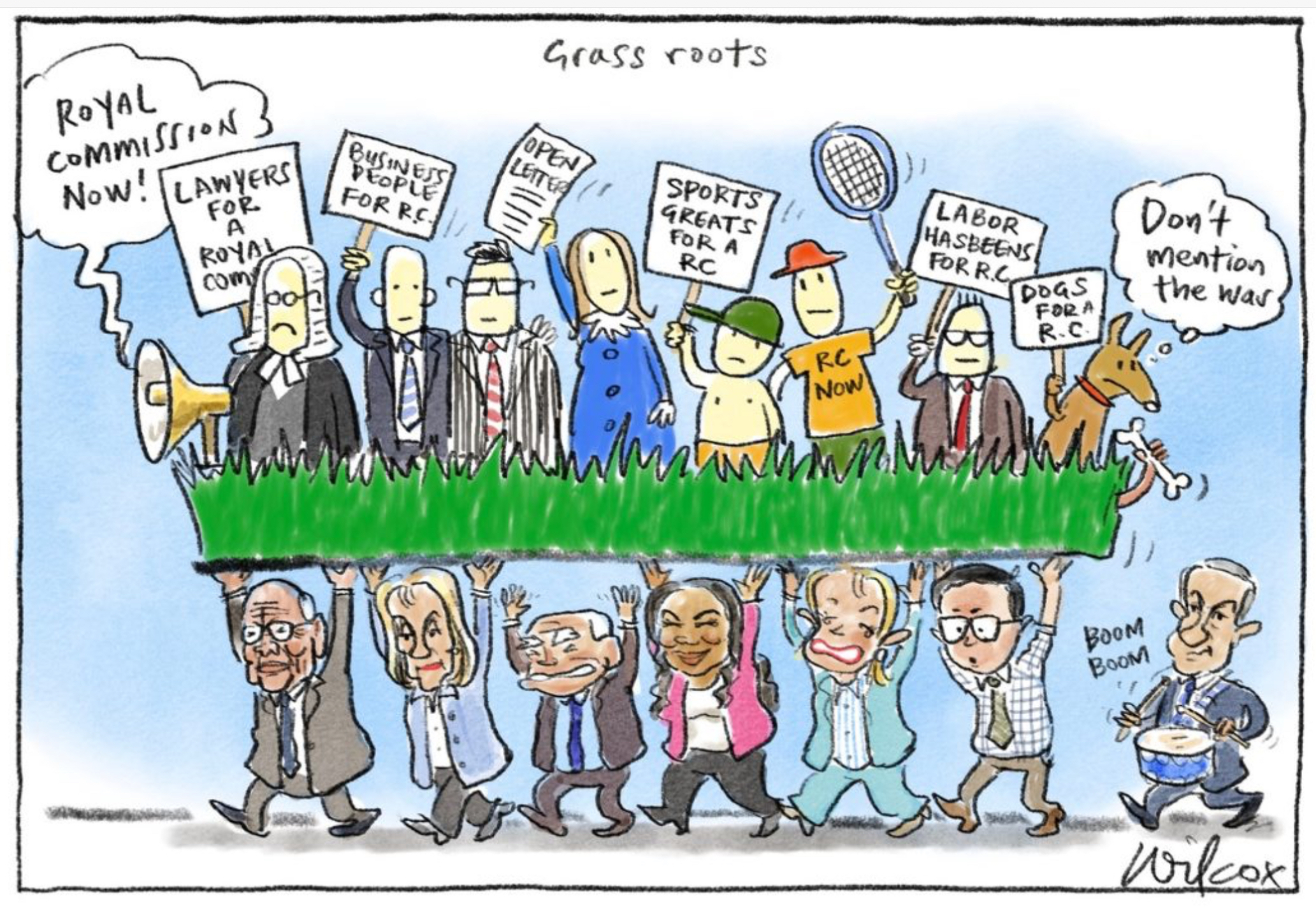
For two years the chant was rehearsed, circulated, aestheticised: “globalise the intifada!”. A resistance moment. A noble liberation struggle, cleansed of consequence. Now that it has arrived not as metaphor but as blood, the same people who normalised the rhetoric – progressive activists, influencers, podcasters, the Greens, the Labor left – present themselves as mourners. Today it is condolences, unity, and prayers.

But you do not get to globalise the intifada and then feign surprise when it turns up.

This did not erupt spontaneously. It was built – patiently, rhetorically – until violence no longer felt aberrant but earned. Shock, at this point, is not innocence; it is evasion.

The Prime Minister calls for unity and convenes the National Security Committee of Cabinet. Necessary, yes – but no longer enough. The problem he faces is credibility. For two years the response to antisemitism has been managerial rather than moral: statements instead of lines, calibration instead of resolve.

The record is plain. Within hours of the October 7 Hamas massacre, and before Israel inflicted its biblical rage upon Gaza, Jews were openly abused outside the Sydney Opera House. Synagogues and childcare centres were firebombed and homes and vehicles vandalised. Hate preachers operated freely. Week after week, marches moved through our cities celebrating “resistance”, praising terrorism, calling for Israel’s elimination, and chanting explicitly for the globalisation of the intifada: violence against Jews, everywhere – for what else could that word mean?  Jewish students and academics were harassed on campus. Jewish artists were doxed and frozen out of cultural life. Antisemitism was rhetorically dissolved by equating it with Islamophobia, converting a specific hatred into a moral blur.

Step by step, it was normalised.

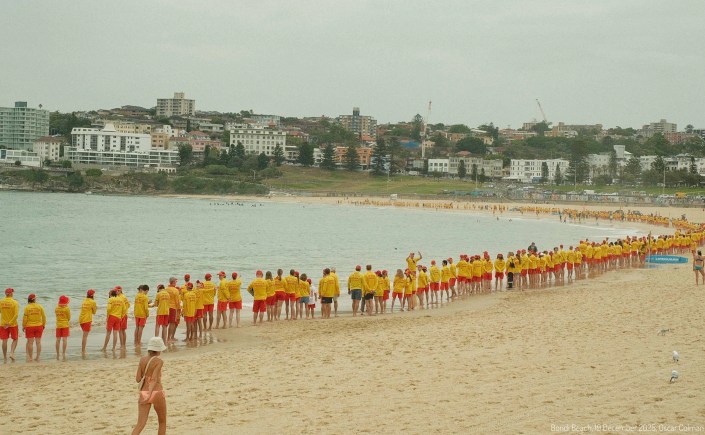
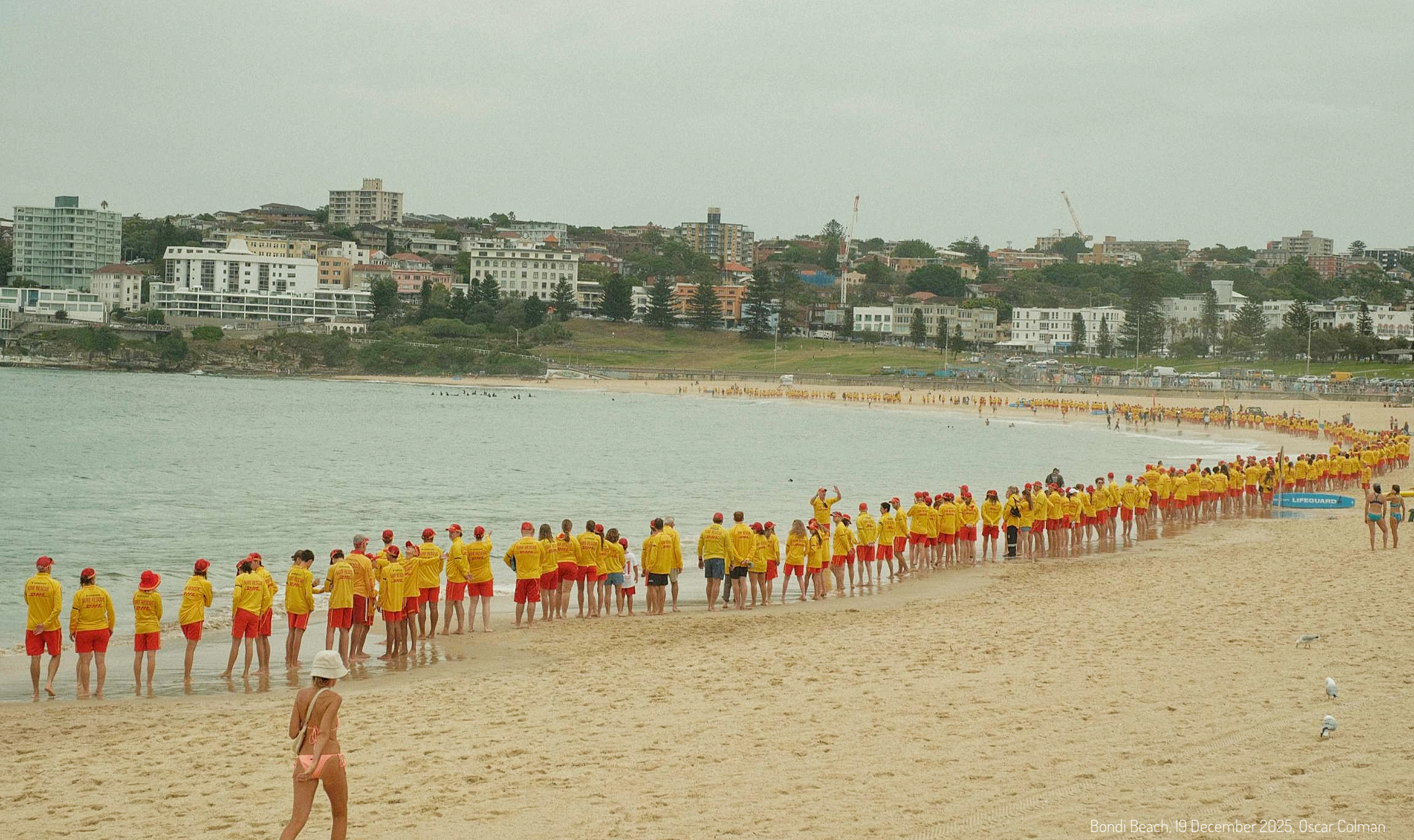
The year ends with an Islamist terrorist attack at Bondi Beach –  an ordinary, intimate place, place many of us walk, eat, linger. We were in Sydney last weekend, and had we stayed another night, we would very likely have been there ourselves, walking the promenade and then taking refreshment, as is our custom, at the North Bondi RSL, just across the road from the park where the atrocity occurred. Authorities had warned such an incident was probable. They were not speculating; they were reading the climate.

Antisemitism in Australia has risen to levels unseen in living memory – even in small country towns like the one we live near and in Byron Bay, meccas of alternative lifestyles and long-styled as havens of inclusion and wellness. Alongside this rise sits another failure: the government’s inability to confront antisemitism with clarity and force, preferring symbolic gestures and offshore moral posturing while hatred hardened at home.

Now, suddenly, our leaders discover grief. Social media is more revealing. Facebook fills with empathetic words and memes from politicians, public figures and keyboard activists who spent the past two years condemning Israel in ways that blurred – and often erased – the distinction between Israeli policy and Jewish existence, creating at best, indifference to Jewish fear and, at worst, a permissive climate of hostility toward Jews as such. Today it is all tolerance, inclusivity and unity – and an air of regret and reverence that reeks of guilt.

But not all. Social media has fractured along familiar lines. At one extreme are conspiracy theories — false flags, invented victims, claims the attackers were Israeli soldiers. At the other is denial: what antisemitism? Between them sits a more revealing response. There is genuine shock and horror, even remorse — but also a careful foregrounding of the Syrian-Australian man who intervened, coupled with a quiet erasure of the victims’ Jewishness; a reflexive turn to whataboutism; and a refusal, even now, to relinquish the slogans and moral habits of the past two years. If antisemitism is acknowledged at all, it is ultimately laid at the feet of Benjamin Netanyahu.

So the question must be asked plainly: can many on the left side of politics, no matter how well-intentioned (and ill-formed) can honestly say that nothing they have posted over the past two years contributed, even indirectly, to prejudice against Jewish people? Nothing that helped turn anxiety and empathy into hostility, criticism into contempt?

Australian Jews warned that today’s chant would become tomorrow’s attack. They were told they were exaggerating, weaponising history, crying wolf. Yet despite inquiries, legislation, and repeated arson and vandalism, the ecosystem of hate was allowed to deepen. Two years of weekly protests chanting “From the river to the sea”, “Globalise the intifada” and “Death to the IDF” – calling for the eradication of a nation state and its people – were treated as politics, not incitement.

In July 2024 the government appointed Jillian Segal, a lawyer and businesswoman, as Australia’s first Special Envoy to Combat Antisemitism (followed soon afterwards by the appointment of Aftab Malik as Special Envoy to Combat Islamophobia). Her report, released a year later, was unambiguous: antisemitism had become “ingrained and normalised” across universities, schools, media and cultural institutions. She called for curriculum reform, university accountability, migration screening, and a serious national effort to explain what antisemitism is and why it corrodes societies.

Five months on, the government is still considering it. It has been under heavy pressure from many quarters to hasten slowly, including from within its own ranks: there were calls from the Labor left, including motions from branches and petitions, for Segal to be sacked and her report shredded.

Mere days after Bondi, the pushback has already begun. Pro-Palestinian platforms – and even some Labor branches and members – have denounced Jillian Segal, her report, and Prime Minister Albanese’s intention to implement its recommendations as an assault on democratic institutions and civil liberties. So, argue that that the Australian government is using the atrocity as a pretext to accelerate its repression of the Palestine movement, and, even, to protect and defend Australia’s complicity in what is viewed as the Gaza genocide. What this framing conspicuously avoids is any reckoning with the antisemitism the report documents-  or with the immediate, practical questions now facing authorities. Among these are the potential for copycat attacks, and what duty of care is owed to the Syrian-Australian man who intervened to stop the attack? Hamas and sections of Middle Eastern media have already branded him a traitor. In this moral economy, even heroism is conditional – and quickly becomes a liability.

The partisan responses have been opportunistically predictable. The Murdoch media accused the government of weakness. The Liberal Party, led by Opposition Leader Sussan Ley, accused Labor of neglect. Pauline Hanson followed, reliably. None of it alters the central fact identified by historian Simon Sebag Montefiore: the taboo on antisemitism has collapsed. Perhaps because Jewish identity is lazily collapsed into Israel. Perhaps because the world’s oldest hatred never disappears; it waits for permission. That permission was granted – gradually, rhetorically, respectably. And antisemitism does not arrive announcing itself. It seeps. It jokes. It chants. It flatters those who believe they are on the right side of history, until history arrives and asks what they tolerated in its name.

This did not come out of nowhere. It arrived exactly as advertised, and this is what it looks like. 

And shock, now, is not a moral position.


For more on the Middle East in in That Howling Infinite, see A Middle East Miscellany.

Sydney July 2025 (Getty)

A forgotten Anzac story in Greece’s bloody history

A king sate on the rocky brow
Which looks o’er sea-born Salamis;
And ships, by thousands, lay below,
And men in nations—all were his!
He counted them at break of day – 
And when the sun set, where were they?
Lord Byron, Don Juan

Christopher Allen, The Australian’s art critic, writes of how Greece’s antiquity presses in on the present. It is a lightweight piece, surveying as it does three millennia of history, from the days of the Greeks, Alexander, the Great and the Romans to those of the Ottomans and their successor states –  but it is elucidating nonetheless.

It is a brief reminder of the veracity of the phrase “history is always with us”, and of how the past continues to shape the present through its influence on culture, human nature, and ongoing events – a constant guide, providing both cautionary tales and inspiration for the future, as we carry our history with us in our identities, cultures, societies and recurring patterns of behaviour. As author and activist James Baldwin is attributed to have said, “History is not the past. It is the present. We carry our history with us. We are our history”.

Greece has always lived a double life. To the casual visitor, it is a sun-splashed idyll of sea and sky, but its history tells a darker story – a long, hard ledger of heroes and horrors, and the stubborn will to survive wedged between warring empires. The last two and a half millennia have been less a tranquil Mediterranean tableau than a parade of conquerors, liberators, and the occasional poet-adventurer.

Over time, Greece has drawn to its shores soldiers and adventurers, poets and dreamers – and naive youths like myself. I hitch-hiked down from what was then Yugoslav in the summer of 1970, a young man with a second-hand rucksack and followed the looping Adriatic highway from Thessaloniki and Athens. I knew enough history to feel the charge of passing near Thermopylae, where Spartans once made their famous last stand against the might of Xerxes. But I wasn’t to learn until over half a century later that an army of ANZACs battled overwhelming odds just a valley away.

The past, in Greece, as in the Middle East, always stands just offstage, awaiting its cue and refusing to stay politely within its own century. It is not merely one of the world’s most benevolent postcards; it is a crossroads of empires, a battleground of ambitions, a cavalcade of famous names and places, where East and West have met, mingled, clashed, and sometimes embraced in the long swirl of history, where the mythic and the modern travel together.

One particular reference also reminds me of how history sends out roots, twigs and branches throughout the settled and hence recorded world.

Tempe, on Sydney’s Cooks River, wears its classical inheritance more openly than most Sydney suburbs. When Alexander Brodie Spark built Tempe House in the 1830s, he christened the estate after the Vale of Tempe in northern Greece – a narrow, ten-kilometre gorge carved by the Pineiós River as it threads between Olympus and Ossa. The poets imagined Poseidon’s trident had cleft the mountains to make it; Apollo and the Muses strolled beneath its laurels; sacred branches were cut there for Delphi. Spark, standing between his own modest “Mount Olympus” and the river, saw a faint echo of the Greek idyll and gave the place its name.

But the Vale of Tempe was never entirely pastoral. Armies have squeezed through that narrow defile for millennia. The Persians marched through it on their way south – Tempe lies just north of the iconic pass of Thermopylae, part of the same chain of passes that determined so much of Greek military history. And in the twentieth century it would again become a stage for outsiders in uniform.

In April 1941 Australian and New Zealand troops, together with British units, were thrown into Greece as Lustre Force – outnumbered, outgunned, and facing a German army with air superiority and modern communications. One of the hardest-fought delaying actions took place – inevitably, given the geography – at Tempe Gorge on 18 April (the featured image of this post, from the collection of the Australian War Museum). The Australian brigade was commanded by Brigadier A.S. Allen, who had formed the first battalion of the new AIF. His “Anzac Force” (apparently the last operational use of that designation) held the gorge long enough to impede the German advance and allow wider Allied withdrawals. The serene valley Spark had sentimentalised became, for a few violent hours, an Anzac bottleneck: those same narrow walls that once sheltered shrines now channelling rifle fire and Stuka attacks. Many of those men would soon find themselves on Crete, resisting the first large-scale parachute assault in military history.

And then – because Australia never resists a touch of Mediterranean whimsy—the Hellenic (and Hellenistic) echoes continue in our own neighbourhood on the Midnorth Coast. Halfway along the road from Bellingen to Coffs Harbour lies the township of Toormina, home to our closest shopping centre and to the Toormi pub. Its name began its life on the slopes of Mount Tauro in Sicily, in the ancient town of Taormina, the site of a famous amphitheater. In the 1980s local Italian residents of who were clients of developer Patrick Hargraves (the late father of a good friend of ours) suggested the name “Taormina” for the new subdivision. He liked the idea but clipped the opening “a” to make it more easily pronounceable- and Toormina entered the Gregory’s and thelocal vernacular.

So in our small corner of New South Wales, Greek myth, Persian marches, Anzac rearguards, and Sicilian nostalgia all whisper from the signposts. Tempe and Toormina: unlikely twins, proof that even the quietest suburb can carry the long shadows of the ancient world.

See also in In That Howling Infinite, Ottoman Redux – an alternative history and The fall of the Ottoman Empire and the birth of Türkiye 

Uncovering a forgotten Anzac story in Greece’s bloody history

From ancient battles to World War II, a visit to Athens’ War Museum exposes the dramatic military history that shaped modern Greece. Christopher Allen’s deeply personal connection unravelled in the process.

Christopher Allen, The Australian, 21 November 2025
James Stuart, View of the Erechtheion, Athens, October 1787. Photo: Royal Academy of Arts, London. Photographer: Prudence Cuming Associates Limited.

James Stuart, View of the Erechtheion, Athens, October 1787. Royal Academy of Arts, London. Photographer. Prudence Cuming Associates Limited.

A little over 200 years ago, the Greeks began their war of independence from the Ottoman Empire, which had conquered most of the Byzantine world in the 15th century; the renaissance in Western Europe thus coincided with the beginning of a new dark age for the Greeks under Turkish oppression. Some islands held out for longer: Rhodes, home of the Knights of St John, was taken in 1522, forcing them to withdraw to Malta; Cyprus, ruled by the French Lusignan dynasty from the time of the Crusades and then by Venice, was brutally conquered in 1571, and Crete, held by Venice since 1205, finally fell after a generation-long siege in 1669.

The Ottoman Empire reached the apogee of its power in the early 18th century, but then began a slow decline, one of whose incidental effects was to make the Greek world more accessible to Western travellers: James Stuart and Nicholas Revett spent time in Athens from 1751 and published their Antiquities of Athens in several volumes in 1762. By the early 19th century, Greece had become part of the itinerary of the Grand Tour; by 1816, the Parthenon Frieze was in the British Museum and profoundly transformed modern understanding of Ancient Greek art.

Meanwhile the Greek War of Independence began with revolts in the Peloponnese in 1821 and a Declaration of Independence in 1822, eliciting a savage response from the Turks and sympathy from intellectuals and the educated public in Western European countries. The slaughter of the population of the island of Chios in 1822 led Eugène Delacroix to paint his famous Massacre at Chios, exhibited in the Salon of 1824 and purchased in the same year for the national collection; it is today in the Louvre. In 1823, the most famous poet of his day, Lord Byron, who had already demonstrated his sympathy for Armenian culture and independence from the Ottomans, went to Greece to help in the fight, both personally and financially.

This 1813 portrait by Phillips depicts Lord Byron, the famous English poet, wearing traditional Albanian attire. It captures his fascination with the Balkans and his travels, marking a moment of cultural exchange in his life. Picture: Alamy

This 1813 portrait by Phillips depicts Lord Byron in traditional Albanian attire. Alamy

Byron’s death in 1824 at Missolonghi only attracted more attention and sympathy to the cause of Greek freedom, and the great powers – Britain, France and Russia – warned the Turks about further repression, even though they were also committed, for different reasons, to maintaining the integrity of the crumbling Ottoman Empire. In 1827, at the Battle of Navarino, an international fleet led by the British and commanded by Sir Edward Codrington destroyed the Turkish and Egyptian navies. After further interventions on land by Russian and French forces, the Ottoman Empire was compelled, by the Treaty of Constantinople in 1832, to accept the independence of mainland Greece, although initially only as far north as the so-called Arta-Volos Line. The north, including Thessaly, Macedonia and Thrace, remained in Ottoman hands and Mustafa Kemal Ataturk was born in the former Byzantine city of Salonika in 1881.

Instability in the Balkan provinces of the Ottoman Empire in the 1870s gave the new Greek nation the opportunity to annex the central region of Thessaly in 1881 (while Britain incidentally acquired Cyprus in 1878). Further important gains were made during the two Balkan Wars (1912-13): much of Epirus in the northwest as well as Salonika and most of southern Macedonia, most of the Aegean Islands and Crete; the British had already ceded the Ionian Islands in 1863 and the Italians would relinquish the Dodecanese after World War II in 1947. Meanwhile, in the aftermath of World War I, Greece had briefly seized eastern Thrace and territories in Anatolia, soon to be retaken by the Turks with immense loss of life in the Great Fire of Smyrna in 1922.

Model of Byzantine warship from the War Museum

Model of Byzantine warship from the War Museum

This is of course a very much simplified version of the extraordinarily complicated story of Balkan politics from the mid-19th century, which forms such an important part of the lead-up to World War I. All of these events were accompanied not only by terrible military casualties on all sides, but by massive disruption to the population of lands where people of different ethnicities and faiths had lived side-by-side for centuries as part of a multiethnic empire, including war crimes and atrocities against civilians and non-combatants. And Greeks who had previously enjoyed political and economic prominence throughout the Ottoman world, including the Phanariots of Constantinople, were first stripped of their privileges, then persecuted and finally expelled in the tragic population exchange of 1923.

All of these events and many more are covered in the exhibits at the Athens War Museum, which I had never visited until a few weeks ago, but which gives a vivid idea of the almost continuous warfare that has been carried on over the past couple of centuries in a land most tourists imagine as a paradise of sea, sun and waterside taverns. The events of the war of liberation, especially as we pass through so many bicentenaries in the current decade, are naturally well represented: there is, for example, a new and interactive display devoted to the sea battle of Navarino and events surrounding this decisive moment in the war.

There are portraits of the many famous leaders of the independence movement in their picturesque costumes, as well as dramatic reimaginings of heroic battles, and of course weapons and equipment of the time. The resonance of the Greek struggle in Western Europe is recalled in a copy of Delacroix’s Massacre at Chios, as well as a version of Thomas Phillips’s portrait of Lord Byron in exotic Albanian costume (1813), of which the original hangs in the British embassy at Athens; another replica by the artist himself, but only of the head and shoulders, is in the National Portrait Gallery in London.

Eugène Delacroix, The Massacre at Chios

But there is much more about the history of Greece in Antiquity, and the chronological arrangement of the displays makes this an effective way to follow the sequence of events, especially the main episodes of the Persian Wars – with the great battles of Marathon in 490BC and Salamis in 480 – as well as the subsequent conflict between Athens and her quasi-subject states on one side and Sparta and her Peloponnesian allies on the other, known as the Peloponnesian War.

This disastrous war (431-404 BC) was followed in the second half of the fourth century by the rise of Philip of Macedon to hegemony, for the first time, over almost all of mainland Greece. After his assassination in 336, his young son, who became Alexander the Great, embarked on a spectacular campaign that led to the conquest of the whole of the vast Persian empire, from Egypt to what are now Afghanistan and Pakistan. Alexander’s conquests led to the extension of Greek language and civilisation deep into Asia, creating the international culture of the Hellenistic period, characterised among other things by a rich and complex exchange of ideas and forms between East and West.

He left an indelible impression on all the lands he conquered and is, for example, the first historical figure in the Persian national epic, the Shahname. By the time of Ferdowsi, who composed this masterpiece a millennium ago, the Persians had forgotten about the Achaemenid dynasty that first created the Persian empire in the sixth century BC; even the great site of Persepolis was and still is called Takht-e Jamshid, the throne of Jamshid, one of the mythical rulers from the great epic.

Each of Alexander’s battles – he is one of the handful of great generals never to have been defeated – is illustrated in clear diagrams, but they are also recalled in later images, in this case particularly in a series of 17th-century engravings whose story is probably unknown to almost all visitors to the museum. These are reproductions of gigantic paintings made as cartoons for tapestries commissioned by the young Louis XIV in the 1660s from Charles Le Brun, who was to become his court painter and who was later responsible for the decorations at Versailles, including the Hall of Mirrors. The series illustrates the valour but also the magnanimity of Alexander, as is clear from the moralising inscriptions attached in the engraved versions. For a long time, the huge canvases were not displayed at the Louvre, but for the last few decades have had their own room upstairs in the Sully wing.

Following the chronological sequence from antiquity we eventually get back to the war of independence and its sequels already mentioned above; but the story continues, after what the Greeks call the Asia Minor Catastrophe of the early 1920s, with a new calamity two decades later. For Mussolini invaded Greece in October 1940 expecting, like Putin in Ukraine, to achieve an easy victory and utterly underestimating the strength and resolve of the Greek army. By the following spring, it was clear that he was getting nowhere, and Hitler decided to come to his rescue by invading Greece in April 1941.

A. Bormans, engraving after Charles Le Brun Alexander and King Porus

A. Bormans, engraving after Charles Le Brun Alexander and King Porus

An Allied army, mostly consisting of Australian and New Zealand troops as well as some British units, was hastily put together and sent from Egypt to Greece as Lustre Force. It was heavily outnumbered by the Germans, who were also massively better equipped and had the benefit of air cover and wireless radio communication. Nonetheless, the Allied army put up a determined resistance in a series of battles including one notable action on April 18, 1941 at Tempe Gorge commanded by my grandfather, then Brigadier AS Allen, who had formed the first battalion of the new AIF and taken our first troops to World War II. The brigade he commanded at Tempe was known as “Anzac Force”, apparently the last use of the term, after the designation Anzac Corps for the whole Australian and NZ component of Lustre Force.

After the evacuation of mainland Greece, my grandfather was sent to fight the Vichy French in Syria, but many of our troops were taken to Crete, where in May 1941 they were faced with the first and only large-scale parachute assault in military history, in which the Germans suffered appalling casualties but ultimately prevailed. Next year will be the 85th anniversary of these dramatic events in Greece and Crete, and among other things will be commemorated by an exhibition of Australian and NZ artists whom I accompanied on a two-week tour of these battlefields in the second half of October.

It was a moving experience to visit what are today the peaceful sites of such desperate battles almost three generations ago, aware at the same time of the long history of warfare in the same lands: the Persians marched through Tempe, which is just north of Thermopylae; Caesar defeated Pompey at Pharsalus (now Farasala), which you pass on the train from Athens to Salonika (now Thessaloniki), and; Cassius and Brutus died at Philippi in Macedonia, defeated by the Caesarian forces of Octavian and Mark Antony.

Christopher Allen is the national art critic for Culture and has been writing in The Australian since 2008. He is an art historian and educator, teaching classical Greek and Latin. He has written an edited several books including Art in Australia and believes that the history of art in this country is often underestimated.

Continue reading

“High above the dawn is waiting” … the unlikely origin of a pop song

It is three years since Australian songstress Judith Durham took the Morningtown Ride. Dusty Springfield’s brother Tom followed soon afterwards.

Judith might not have been my teenage crush – that was Dusty – but The Seekers were a significant part of my adolescent soundtrack. Aussies were an exotic species back then in Britain, and to me, more associated with now-disgraced Rolf Harris with Tie Me Kangaroo Down Sport and Sun Arise, but there was also Frank Ifield and Patsy Ann Noble. More Aussies followed them to Britain – the Easybeats and Bee Gees entering the pop charts soon afterwards, while soon to be famous actors, artists, authors and activists had already steamed back to Old England’s Shores and were busy making names for themselves.

The Seekers were “discovered” by Tom Springfield and were marketed as the new Springfields, the natural heirs to that wholesome folksey trio (he had written their greatest hits or adapted them from folk standards). When the Seekers folded in 1969, group member Keith Potger gave us the New Seekers, a bunch of pretty blonde Brits who most people now believe wanted to buy the world a coke! For trivia fans, that song was (spoiler alert!) the happy hippie  finale of that fabulous series Madmen.

The Seekers released their smash hit, the allegorical song of farewell The Carnival Is Over in 1965. Tom based it on a traditional Russian song about a brutal Cossack rebel [read all about him below]. A natural linguist, he’d learned Russian whilst undergoing compulsory national service in the fifties. Apparently, those few conscripts who graduated from the Ministry of Defence’s Russian Language School as interpreters and translators were regarded as the crême de la crême of conscripts. Often, trainees would put on concerts of Russian songs and plays for their own amusement.

Tom Springfield borrowed the melody of The Carnival is Over from Stenka Razin a traditional folk tune set to music in the 19th Century by Dimitry Sadovnikov. It told the tale of a drunken seventeenth century Cossack rebel who threw his Persian bride of one night over the side of his boat into the Volga River when his men accused him of going soft. Tom changed the story entirely though he retained a nautical riff and cast the star-crossed lovers as the theatre characters Pierrot and Columbine rather than casting them overboard.

Stepan Razin on the Volga (by Boris Kustodiev, (1918) State Russian Museum, St Petersburg.

Tom’s song was an ironic mid twentieth century reimagining in which a tragic, violent and mythic saga of patriotism, loyalty, and patriarchal authority illustrative of national an revolutionary folklore was reinvented into wistful pop as a saccharine song of romance, emotion, loss, and a meditation on the impermanence – how the joys of love are fleeting. No such maudlin melancholy on the part of the preening old riverboat pirate. Over the side she goes!

The lyrics and the sentiment couldn’t have been more different:

From beyond the wooded island
To the riverbank he came,
On his breast he held a maiden,
And his comrades called her name.
Then he flung her to the waters,
Crying, ‘Thus I make my vow,
I will have no foreign woman
As a wife to me now.’

Say goodbye, my own true lover
As we sing a lovers’ song
How it breaks my heart to leave you
Now the carnival is gone
High above the dawn is waiting
And my tears are falling rain
For the carnival is over
We may never meet again

Pierrot and Columbine

The shift from revolutionary folklore to wistful pop is emblematic of the 20th-century repurposing of folk traditions – filtering political anthems through modern, personal, and emotional frameworks. The lyrics and the sentiment couldn’t have been more different:

If you watch the hoary old Hammer horror film Rasputin, about the sinister Svengali who enchanted the last Czarina of Russia – portrayed herein by that eminent old frightener Christopher Lee – you will recognise the tune as a recurring leitmotif.

There is a clunky film reenactment of the story, sung by the famous Red Army Choir immediately below the Seekers‘ song.

Read more about music in In That Howling Infinite in Soul Food – Music and Musicians

Stenka Razin – A Cossack who scared the tsar

Old Seekers and New


The Carnival is Over 

Say goodbye, my own true lover
As we sing a lovers’ song
How it breaks my heart to leave you
Now the carnival is gone

High above the dawn is waiting
And my tears are falling rain
For the carnival is over
We may never meet again

Like a drum, my heart was beating
And your kiss was sweet as wine
But the joys of love are fleeting
For Pierrot and Columbine

Now the harbour light is calling
This will be our last goodbye
Though the carnival is over
I will love you ’til I die

Like a drum, my heart was beating
And your kiss was sweet as wine
But the joys of love are fleeting
For Pierrot and Columbine
Now the harbour light is calling

This will be our last goodbye
Though the carnival is over
I will love you ’til I die
Though the carnival is over
I will love you ’til I die

Stenka Razin

From beyond the wooded island
To the river wide and free
Proudly sailed the arrow-breasted
Ships of Cossack yeomanry.

On the first is Stenka Razin
With his princess by his side
Drunken holds in marriage revels
With his beauteous young bride.

From behind there comes a murmur
“He has left his sword to woo;
One short night and Stenka Razin
Has become a woman, too.”

Stenka Razin hears the murmur
Of his discontented band
And his lovely Persian princess
He has circled with his hand.

His dark brows are drawn together
As the waves of anger rise;
And the blood comes rushing swiftly
To his piercing jet black eyes.

“I will give you all you ask for
Head and heart and life and hand.”
And his voice rolls out like thunder
Out across the distant land.

Volga, Volga, Mother Volga
Wide and deep beneath the sun,
You have never such a present
From the Cossacks of the Don.

So that peace may reign forever
In this band so free and brave
Volga, Volga, Mother Volga
Make this lovely girl a grave.

Now, with one swift mighty motion
He has raised his bride on high
And has cast her where the waters
Of the Volga roll and sigh.

Now a silence like the grave
Sinks to all who stand and see
And the battle-hardened Cossacks
Sink to weep on bended knee.

“Dance, you fools, and let’s be merry
What is this that’s in your eyes?
Let us thunder out a chantey
To the place where beauty lies.”

From beyond the wooded island
To the river wide and free
Proudly sailed the arrow-breasted
Ships of Cossack yeomanry.

A mighty voice … the odyssey of Paul Robeson

Robeson’s extraordinary career intersects with some of modernity’s worst traumas: slavery, colonialism, the Cold War, Fascism. Stalinism. These are wounds covered over and forgotten, but never fully healed. Not surprisingly, the paths Robeson walked remain full of ghosts, whose whispers we can hear if we stop to listen. They talk to the past, but they also speak to the future.
Jeff Sparrow, No Way But This. In Search of Paul Robeson (2017)

I read Jeff Sparrow’s excellent biography of the celebrated American singer and political activist Paul Robeson several years ago. I was reminded of it very recently with the publication of a book about Robeson’s visit to Australia in November 1960, a twenty-concert tour in nine cities. I have republished a review below, together with an article by Sparrow about his book, and a review of the book by commentator and literary critic Peter Craven. the featured picture is of Robeson singing for the workers constructing the Sydney Opera House.

I have always loved Paul Robeson’s songs and admired his courage and resilience in the face of prejudice and adversity.  Duriung his colourful and controversial career (see the articles below), he travelled the world, including Australia and New Zealand and also, Britain. He visited England many times – it was there that my mother met him. She was working in a maternity hospital in Birmingham when he visited and sang for the doctors, nurses, helpers and patients. My mother was pregnant at the time – and, such was his charisma, that is why my name is Paul.

Paul Robeson was a 20th-century icon. He was the most famous African American of his time, and in his time, was called the most famous American in the world. His is a story of political ardour, heritage, and trauma.

The son of a former slave, he found worldwide fame as a singer and an actor, travelling from Hollywood in the USA to the West End of London, to Europe and also Communist Russia. In the sixties, he visited Australia and is long remembered for the occasion he sang the song Old Man River for the workers building the famous Sydney Opera House.

He became famous both for his cultural accomplishments and for his political activism as an educated and articulate black man in a white man’s racist world.

Educated at Rutgers College and Columbia University, he was a star athlete in his youth. His political activities began with his involvement with unemployed workers and anti-imperialist students whom he met in Britain and continued with support for the Republican cause in the Spanish Civil War and his opposition to fascism.

A respected performer, he was also a champion of social justice and equality. But he would go on to lose everything for the sake of his principles.

In the United States he became active in the civil rights movement and other social justice campaigns. His sympathies for the Soviet Union and for communism, and his criticism of the United States government and its foreign policies, caused him to be blacklisted as a communist during the McCarthy era when American politics were dominated by a wave of hatred, suspicion and racism that was very much like we see today,

Paul Robeson, the son of a slave, was a gifted linguist. He studied and spoke six languages, and sang songs from all over the world in their original language.

But his most famous song was from an American musical show from 1927 – Show Boat, by Jerome Kern and Oscar Hammerstein – called Old Man River. The song contrasted the struggles and hardships of African Americans during and after the years of slavery, with the endless, uncaring flow of the Mississippi River. It is sung the point of view of a black stevedore on a showboat, and is the most famous song from the show.

It is a paradox that a song written by Jewish Americans from the Jewish villages of Eastern Europe, the targets of prejudice and pogrom, should voice the cries of America’s down-trodden people.

When the song was first heard, America was a divided country and people of colour were segregated, abused and murdered. The plot of the musical was indeed about race, although it pulled its punches with the romantic message that love is colour-blind

It reflected America’s split personality – the land of the free, but the home of the heartless. Robeson sung the words as they were written, but later in his career, as he became more and more famous, he changed them to suit his own opinions, feelings, sentiments, and politics. So, when he sang to the workers in Sydney, Australia, his song was not one of slavery but one of resistance.

© Paul Hemphill 2025. All rights reserved

For other posts in In That Howling Infinite on American history and politics, see My Country, ’tis of Thee – Matters American

The Big Voice of the Left … Paul Robeson Resounds to this Day

Mahir Ali The Australian November 9, 2010

FIFTY years ago today, more than a decade before it was officially inaugurated, the Sydney Opera House hosted its first performance by an internationally renowned entertainer when Paul Robeson, in the midst of what turned out to be his final concert tour, sang to the construction workers during their lunch break.

Alfred Rankin, who was at the construction site on November 9, 1960, recalls this “giant of a man” enthralling the workers with his a cappella renditions of two of his signature songs, Ol’ Man River and Joe Hill.

“After he finished singing, the men climbed down from the scaffolding, gathered around him and presented him with a hard hat bearing his name,” Paul Robeson Jr writes in his biography of his father, The Undiscovered Robeson. “One of the men took off a work glove and asked Paul to sign it. The idea caught on and the men lined up. Paul stayed until he had signed a glove for each one of them.”

Workers had the best seats when Robeson sang at the Sydney Opera House, 9 November 1960

The visit, Rankin tells The Australian, was organised by the Building Workers Industrial Union of Australia and the Australian Peace Council’s Bill Morrow, a former Labor senator from Tasmania.

In a chapter on Robeson’s visit in the book Passionate Histories: Myth, Memory and Indigenous Australia, which will be launched in Sydney tomorrow, Ann Curthoys quotes the performer as saying on the day after his visit to the Opera House site: “I could see, you know, we had some differences here and there. But we hummed some songs together, and they all came up afterwards and just wanted to shake my hand and they had me sign gloves. These were tough guys and it was a very moving experience.”

In 1998, on the centenary of Robeson’s birth, former NSW minister John Aquilina told state parliament his father had been working as a carpenter at the Opera House site on November 9, 1960: “Dad told us that all the workers – carpenters, concreters and labourers – sang along and that the huge, burly men on the working site were reduced to tears by his presence and his inspiration.”

Curthoys, the Manning Clark professor of history at the Australian National University, who plans to write a book about the Robeson visit, also cites a contemporary report in The Daily Telegraph as saying that the American performer “talked to more than 250 workmen in their lunch hour, telling them they were working on a project they would be proud of one day”. [Curthoy’s book, The Last Tour: Paul and Eslanda Robeson’s visit to Australia and New Zealand, was published at last in 2025]

According to biographer Martin Duberman, Robeson wasn’t particularly enthusiastic about the offer of a tour of Australia and New Zealand from music entrepreneur D. D. O’Connor, but the idea of earning $US100,000 for a series of 20 concerts, plus extra fees for television appearances and the like, proved irresistible.

Robeson had once been one of the highest paid entertainers in the world, but from 1950 onwards he effectively had been deprived of the opportunity of earning a living. A combination of pressure from the US government and right-wing extremists meant American concert halls were closed to him, and the US State Department’s refusal to renew his passport meant he was unable to accept invitations for engagements in Europe and elsewhere. Robeson never stopped singing but was able to do so only at African-American churches and other relatively small venues. His annual income dwindled from more than $US100,000 to about $US6000.

At the time, Robeson was arguably one of the world’s best known African Americans. As a scholar at Rutgers University, he had endured all manner of taunts and physical intimidation to excel academically and as a formidable presence on the football field: alone among his Rutgers contemporaries, he was selected twice for the All-American side.

Alongside his athletic prowess, which was also displayed on the baseball field and the basketball court, he was beginning to find his voice as a bass baritone. When a degree in law from Columbia University failed to help him make much headway in the legal profession, he decided to opt for the world of entertainment, and made his mark on the stage and screen as a singer and actor.

An extended sojourn in London offered relief from the racism in his homeland and established his reputation as an entertainer, not least through leading roles in the musical Show Boat and in Othello opposite Peggy Ashcroft’s Desdemona.

(He reprised the role in a record Broadway run for a Shakespearean role in 1943 and again at Stratford-upon-Avon in 1959)

Robeson returned to the US as a star in 1939 and endeared himself to his compatriots with a cantata titled Ballad for Americans.

In the interim, he had been thoroughly politicised, not least through encounters in London with leaders of colonial liberation movements such as Kenya’s Jomo Kenyatta, Ghana’s Kwame Nkrumah and India’s Jawaharlal Nehru.

He had sung for republicans in Spain and visited the Soviet Union at the invitation of filmmaker Sergei Eisenstein.

Robeson’s refusal to reconsider his political affiliations once World War II gave way to the Cold War made him persona non grata in his homeland: his infatuation with the Soviet Union did not perceptibly pale in the face of horrific revelations about Stalinist excesses, partly because he looked on Jim Crow as his pre-eminent foe. It is therefore hardly surprising that exposure in Australia to Aboriginal woes stirred his passion.

On the day after his appearance at the Opera House site, at the initiative of Aboriginal activist and Robeson fan Faith Bandler he watched a documentary about Aborigines in the Warburton Ranges during which his sorrow turned to anger, and he vowed to return to Australia in the near future to fight for their rights. He made similar promises to the Māori in New Zealand.

But the years of persecution had taken their toll physically and psychologically: Robeson’s health broke down in 1961 and, on returning to the US in 1963, he lived the remainder of his life as a virtual recluse. He died in 1976, long after many of his once radical aspirations for African Americans had been co-opted into the civil rights mainstream. His political views remained unchanged.

It’s no wonder that, as writer and broadcaster Phillip Adams recalls, Robeson’s tour was like “a second coming” to “aspiring young lefties” in Australia.

Duberman cites Aboriginal activist Lloyd L. Davies’s poignant recollection of Robeson’s arrival in Perth on the last leg of his tour, when he made a beeline for “a group of local Aborigines shyly hanging back”.

“When he reached them, he literally gathered the nearest half dozen in his great arms.”

Davies heard one of the little girls say, almost in wonder, “Mum, he likes us.”

She would have been less surprised had she been aware of the Robeson statement that serves as his epitaph: “The artist must take sides. He must elect to fight for freedom or slavery. I have made my choice. I had no alternative.”

Left for Good – Peter Craven on Paul Robeson

The Weekend Australian. March 11 2017

What on earth impelled Jeff Sparrow, the Melbourne-based former editor of Overland and left-wing intellectual, to write a book about Paul Robeson, the great African American singer and actor?

Well, he tells us: as a young man he was transporting the libraries of a lot of old communists to a bookshop and was intrigued by how many of the books were by or about Robeson.

All of which provokes apprehension, because politics is a funny place to start with

Robeson, even if it is where you end or nearly end. Robeson was one of the greatest singers of the 20th century. When I was a little boy in the 1950s, my father used to play that velvet bottomlessly deep voice singing not only Ol’ Man River — though that was Robeson’s signature tune and his early recording of it is one of the greatest vocal performances of all time — but all manner of traditional songs. Not just the great negro spirituals (as they were known to a bygone age; Sparrow calls them slave songs) such as Go Down, Moses, but Shenandoah, No, John, No and Passing By, as well as the racketing lazy I Still Suits Me.

My mother, who was known as Sylvie and loathed her full name, which was Sylvia, said the only time she could stand it was when Robeson sang it (“Sylvia’s hair is like the night … such a face as drifts through dreams, such is Sylvia to the sight”). He had the diction of a god and the English language in his mouth sounded like a princely birthright no one could deny.

It was that which made theatre critic Kenneth Tynan say the noise Robeson made when he opened his mouth was too close to perfect for an actor. It did not stop him from doing Eugene O’Neill’s All God’s Chillun’ Got Wings or The Emperor Jones, nor an Othello in London in 1930 with Peggy Ashcroft as his Desdemona and with Sybil Thorndike as Emilia.

Robeson later did Othello in the 1940s in America with Jose Ferrer as Iago and with Uta Hagen (who created Martha in Who’s Afraid of Virginia Woolf?) as his Desdemona. He toured the country; he toured the south, which was almost inconceivable. When he was told someone had said the play had nothing to do with racial prejudice, Robeson said, “Let him play it in Memphis.”

Southern white audiences were docile until Robeson’s Othello kissed Hagen’s Desdemona: then they rioted. Robeson also made a point, at his concerts and stage shows, of insisting the audience not be segregated. James Earl Jones. who would play Robeson on the New York stage, says in his short book about Othello, “I believe Paul Robeson’s Othello is the landmark performance of the 20th century.”

Robeson would play the Moor again in 1959 at Stratford-upon-Avon. By that time, though, he had fallen foul of 1950s America. He had been called before the McCarthyist House Un-American Activities Committee. You can hear a dramatisation of his testimony with Earl Jones as Robeson, which includes an immemorial reverberation of his famous words when senator Francis E. Walter asked him why he didn’t just quit the US and live in Russia.

“Because my father was a slave and my people died to build this country, and I am going to stay here and have a part of it just like you. And no fascist-minded people will drive me from it. Is that clear?”

It’s funny how it was the real communists such as Bertolt Brecht and Robeson who handled the committee best. Still, in an extraordinary act of illiberalism, they took away his US passport and it took two years for the Supreme Court to declare in 1958 in a 5-4 decision that the secretary of state was not empowered to withdraw the passport of any American citizen on the basis of political belief.

When Paul Robeson sang at the Sydney Opera House

It was this that allowed Robeson to do his Othello in Peter Hall’s great centenary Stratford celebration along with Charles Laughton’s Lear and Laurence Olivier’s Coriolanus. It also allowed him to come to Australia. Very early on Sparrow tells the story of watching the clip of Robeson singing Ol’ Man River to construction workers in Sydney with the Opera House still a dream in the process of meeting impediments. The version Robeson sings is his own bolshie rewrite (“I must keep fightin’/ Until I’m dyin’ ”).

Well, fight he did and bolshie he was. I remember when I was a child my father telling me Robeson was a brilliant man, that he had won a sporting scholarship for American football (to Rutgers, in fact), that he’d gone on to receive a law degree (from Columbia, no less) and that he was so smart he had taught himself Russian.

But the sad bit was, according to my father, that he’d become a communist. Understandably so, my father thought, because of how the Americans treated the blacks. My father’s own radical impulses as a schoolboy had been encouraged, as Robeson’s were on a grander scale, by World War II where Uncle Joe Stalin was our ally in the war against Hitler’s fascism.

But this was the Cold War now, and a lot of people thought, with good reason, that it was behind the Iron Curtain that today’s fascists were to be found. Even if others such as the great German novelist Thomas Mann and Robeson thought they were encroaching on Capitol Hill.

Sparrow’s book No Way But This is circumscribed at every point by his primary interest in Robeson as a political figure of the Left rather than as a performer and artist.

It’s an understandable trap to fall into because Robeson was an eloquent, intelligent man of the Left and his status was also for a while there — as Sparrow rightly says — as the most famous black American on Earth. So his radicalism is both pointed and poignant.

His father, who became a Methodist minister, was born a slave and was later cruelly brought down in the world. But, unlike the old Wobblies whose bookcases he transported, Sparrow is not inward with what made Robeson famous in the first place and it shows.

No Way But This is a great title (“no way but this / killing myself, to die upon a kiss” is what Othello says when he’s dying over the body of Desdemona, whom he has killed) but Sparrow’s search for Robeson is not a great book.

As the subtitle suggests, it is a quest book but Sparrow is a bit like the Maeterlinck character cited in Joyce’s Ulysses who ends up meeting himself (whether in his Socrates or his Judas aspect) on his own doorstep. Sparrow goes to somewhere in the US associated with Robeson and meets a black-deaths-in-custody activist full of radical fervour. She introduces him to an old African-American who was in Attica jail for years. There is much reflection on the thousands of black people who were slaves on the plantations and the disproportionate number of them now in US prisons.

Yes, the figures are disquieting. No, they are not aspects of the same phenomenon even though ultimately there will be historical connections of a kind.

And so it goes. But this is a quest book that turns into a kind of travelogue in which Sparrow goes around the world meeting people who might illuminate Robeson for him but don’t do much for the reader except confirm the suspicion that the author’s range of acquaintance ought to be broader or that he should listen to people for a bit more rather than seek confirmation of his own predilections.

There are also mistakes. Sparrow seems to know nothing about the people with whom Robeson did Othello. There’s no mention of Thorndike, and when Ashcroft comes up as someone he had an affair with, Sparrow refers to the greatest actress of the Olivier generation as “a beautiful glamorous star”. Never mind that she was an actress of such stature, Judi Dench said when she played Cleopatra she could only follow Ashcroft’s phrasing by way of homage.

Sparrow also says “American actor Edmund Kean started using paler make-up for the role, a shift that corresponded with the legitimisation of plantation slavery”. Kean, who was the greatest actor of the later romantic period, was English, not American. His Othello would, I think, be more or less contemporary with William Wilberforce lobbying to have slavery made illegal. Sparrow seems to be confusing Kean with Edwin Booth, the mid-century Othello who happens to have been the brother of John Wilkes Booth, the assassin of Abraham Lincoln. But it’s still hard to see where the plantations fit in.

A few pages later — and it’s not important though it’s indicative — we hear of the rumour that Robeson was “romancing Edwina Mountbatten, Countess Mountbatten of Burma”. Well, whatever she was called in the early 1930s, it wasn’t Countess Mountbatten of Burma because her husband, Louis Mountbatten, the supreme allied commander in Southeast Asia during World War II, didn’t get the title until after the Japanese surrendered to him — guess where?

Such slips are worth belabouring only because they make you doubt Sparrow’s reliability generally. It’s worth adding, however, that his chapter about the prison house that the Soviet Union turned itself into is his most impressive. And the story of the last few years of Robeson’s life, afflicted with depression, subject to a lot of shock treatment, with recurrent suicide attempts, is deeply sad.

He felt towards the end that he had failed his people. He just didn’t know what to do. It was the melancholy talking as melancholy will.

It’s better to remember the Robeson who snapped back at someone who asked if he would join the civil rights movement: “I’ve been a part of the civil rights movement all my life.”

It’s to Sparrow’s credit that he’s fallen in love with the ghost of Robeson even if it’s only the spectral outline of that power and that glory he gives us.

Peter Craven is a cultural and literary critic

The Last Tour: Paul and Eslanda Robeson’s visit to Australia and NZ

Australians of a certain age know all about Paul Robeson’s magnificent voice. They know, too, that on a warm November day more than 60 years ago, the bass-baritone sang to 250 construction workers on the Sydney Opera House building site as the workers sat on scaffolding and stacks of timber and ate their lunch. Fewer know of Robeson’s Pro-Communist and pro-Soviet views and of how those beliefs damaged his career at home and abroad. And that’s not so surprising – as historian Ann Curthoys points out, the Cold War suppression of Robeson’s career and memory has been very effective.

Recovering the story of a man who was once the most famous African-American in the world and his equally impressive wife, Eslanda, is the task Curthoys, who grew up in an Australian communist family in the 1950s and 60s, sets herself in a new book, The Last Tour: Paul and Eslanda Robeson’s visit to Australia and New Zealand.

It follows the couple’s tour – a mix of his concerts and their public talks and media interviews – to Australia and New Zealand over October, November and December 1960. Curthoys goes further, using the seven-week tour by this celebrated singer to explore the social and political changes just beginning in post-War Australia. Her interest is “the slow transition from the Cold War era of the late 1940s and 50s, to the 60s era of the New Left, new social movements and the demand for Aboriginal rights”.

Curthoys is 79 now, but when Robeson toured she was 15 and living in Newcastle, a city the singer did not visit. Her mother, Barbara Curthoys, a well-known activist and feminist, was a fan of the singer but the trip passed the teenager by.

It was only decades later, as she researched her 2002 book on the 1965 Aboriginal Freedom Ride through regional NSW, that Curthoys connected with the story. As a university student she had taken part in the ride and moved from communism to the New Left. When she approached the subject as a historian, she realised that for some riders, their attendance at Robeson’s concerts five years earlier had been a defining moment in their “understanding of racial discrimination and Aboriginal rights”.

Curthoys has had a long career in research and teaching at the Australian National University and the University of Technology, Sydney. She’s part of a remarkable family, and not just parents Barbara and Geoffrey, who was a lecturer in chemistry at Newcastle University. Her sister Jean is a leading feminist philosopher and her husband, John Docker, has written several books on cultural history, popular culture and the history of ideas.

Curthoys began researching The Last Tour in 2007, but put it aside for another project on Indigenous Australians before resuming work on it during the Covid-19 lockdowns. Post-­Robeson, she has worked with two scholars on a forthcoming book on the history of domestic violence in Australia.

The tour, she says, was really several tours rolled into one with the Robesons covering many bases – from music to Cold War politics to feminism to Aboriginal rights. It was a conservative era: Robert Menzies’ Liberals ruled federally and five of the six Australian states had conservative governments. Robeson’s presence went unremarked by governments but for fans of his music – and his ideals – the tour was a significant event that was well covered by the press, even those opposed to his views on the Soviet Union.

For some fans, it was a music tour – 20 concerts in nine cities in Australia and New Zealand, at which Robeson sang his show-stoppers, including Deep River, Go Down, Moses; We Are Climbing Jacob’s Ladder, and the song with which he is always identified, Ol’ Man River. The 62-year-old with the extraordinary voice also delivered “recitations” – a monologue from Shakespeare’s Othello, an anti-segregationist poem Freedom Train, and William Blake’s anthem, Jerusalem.

What a thrill for Australian audiences, some of whom had followed the handsome, 1.9m singer and actor since the 1920s. Even in an age of limited communications, Robeson was well-known here through films; records and radio. Curthoys notes that one indicator of his fame was the way promising Aboriginal singers in the 1930s were dubbed “Australia’s Paul Robeson”.

He was famous – and controversial. Unlike many other supporters of communist ideas, Robeson refused to break from the Soviets after the invasion of Hungary in 1958 and continued to defend Moscow. The “anti-communist repression and hysteria” that gripped the US in the McCarthy era had a profound effect on his life and career, Curthoys writes. He was cited in 1947 by the House Committee on Un-American Activities as “supporting the Communist Party and its front organisations”.

A 1949 US tour was destroyed “after mass cancelling of bookings by venue managers either vehemently opposed to his politics or afraid in such a hostile climate of being classed as communist sympathisers themselves”. Then in 1950, he lost his passport. Over the years, he would “become for communists an emblem of defiance in the face of adversity, and one of the communist world’s most prominent speakers for peace,” ­Curthoys writes.

Unable to travel until his passport was restored in 1958, Robeson was steadfast in his support for communist ideals. That commitment was evident in Australia when the “peace tour” – built around a series of public meetings – was as important to the singer as the popular concerts where he reached a different audience. Curthoys details a related strand – the “workers’ tour”, which involved seven informal concert performances to groups of railway workers, waterside workers and those at work on the Opera House on that November day.

She says the events revealed much about the “the nature of class in Australia and New Zealand” at a time when “strong and confident trade unions” were interested in “broad cultural concerns”. Over several weeks Robeson attracted people who loved his music alongside those who loved his politics. Far from being shunned for his pro-Soviet views, Curthoys suggests, there was support from two different audiences – music people and “left-wing ­people who were either pro-Soviet or not”.

Even so, the Cold War anxieties over the Soviets meant a positive reception was not necessarily assured when Paul and Eslanda flew into Sydney at midday on Oct­ober 12, 1960. They were greeted by several hundred fans carrying peace banners but they faced pointed questions about the Soviet Union at the 20-minute press conference at the airport.

Robeson refused to condemn the suppression of the Hungarian uprising and media reports suggested a torrid exchange. Curthoys reviewed a tape of the press conference and says while the questioning was “a little aggressive”, the event was not as bad as reported in the media. Indeed it was “fairly friendly” albeit for a “bad patch” when Robeson refused to budge on Hungary.

That tape and others, along with newspapers and Trades Hall documentation, yielded rich material but so too did the ASIO files on the couple. At the Palace Hotel in Perth on December 2 an ASIO operative appeared to be among those at a reception organised by the communist-influenced Peace Council. Among guests were the writer (and well-known communist) Katharine Susannah Prichard and “two women by the name of Durack, who were writers and/or artists”.

Curthoys sees Robeson as a “very courageous, very intelligent, intellectual person, very thoughtful about music, about folk music, about people”, but says his commitment to the Soviet Union was a costly mistake. He had embraced Moscow when he and Eslanda visited in 1934 at the invitation of Soviet film director Sergei Eisenstein. Later, Robeson, a fluent Russian speaker, would say it was in the Soviet Union that he felt for the first time he was treated “not through the prism of race but simply as a human being”. Curthoys writes: “The excitement and validation he received during this visit would create a loyalty that later events would not dislodge and the public expression of which would damage him politically, commercially and professionally.”

The couple made several trips to the Soviet Union and accepted its political system completely. Curthoys notes: “They made no public comments about Stalin’s forced collectivisation policies that were in place during the 1930s and led to famine and the loss of millions of lives.” In Sydney Robeson was careful, but on November 5 he celebrated the forthcoming anniversary of the Russian Revolution at the Waterside Workers Federation in Sussex Street. Two days later, during his first public concert in the city, he paid tribute to the Soviet Union as “a new society”.

The Soviet Union had been a great influence but so too was the Spanish Civil War, which Curthoys says helped define his view of the political responsibilities of the artist.

“Increasingly famous as a public speaker, on 24 June, 1937, he made a huge impression at a mass rally at the Albert Hall in London sponsored by prominent figures such as WH Auden, EM Forster, Sean O’Casey, HG Wells and Virginia Woolf, held to raise financial aid for Basque child refugees from the war. In what became his most well-known and influential speech, he stressed how important it was for artists and scientists and others to take a political stand: ‘Every artist, every scientist, every writer must decide NOW where he stands. He has no alternative. There is no standing above the conflict on Olympian heights.’”

After World War II, Robeson was deeply involved in radical and anti-racism politics in the US but in 1947, as the Cold War worsened, he had had enough. He announced he intended to abandon the theatre and concert stage for two years to speak out against race hatred and ­prejudice. In fact he stopped stage acting for 12 years but continued to perform as a singer, often in support of political causes.

It was another 13 years before Australian audiences heard that glorious voice “live”. Australians, it seemed were primed for Paul. The tour may have been ignored by governments but during her research, Curthoys was “overwhelmed” by people “ready to assist, donating old programs, photographs, pamphlets, records, cassette tapes, invitations and other documents”.

Today, much of the Robeson image is defined by his Opera House performance on November 9 – high culture delivered, without condescension, to a building crew by a champion of the workers. Robeson, in a heavy coat, despite the warm weather, sang “from a rough concrete stage”. A PR expert could not have dreamt up a a better way to “democratise” an opera house than having the “first concert” delivered in its half- built shell. Curthoys shows how the event, no matter how memorialised now, was a small part of a tour that proved a financial and political success for the Robesons, who left Australia on December 4.

A few months later, depressed and exhausted, Robeson tried to commit suicide in Moscow. Over the next three years he was treated but could no longer perform or engage in public speaking. Curthoys notes that though his affairs with other women had strained their marriage, he and Eslanda had a common political vision and were together until her death in 1965. Robeson died on January 23, 1976 at the age of 77.

Helen Trinca’s latest book is Looking for Elizabeth: The Life of 
Elizabeth Harrower (Black Inc.)

The phantom of liberty … the paradoxes of conservatism

Economist and commentator Henry Ergas wrote in The Australian recently: “With the Trump revolution wreaking havoc on conservative movements worldwide and the election rout leaving Liberals stunned, Australian conservatism faces an identity crisis it no longer can afford to ignore. Understanding its divergence from overseas traditions is vital to recovering and redefining the distinctive voice it needs to deal with the latest threat to its existence.”  I have repolished it below.
Personally, I find the crisis in contemporary conservatism, particularly as it pertains to Australia politics, fascinating. Here it is in danger descending into a culture of grievance and of populism (- defined as the quest for simple solutions to complex problems).

These fast-moving times are shaky ground for the creed. People are losing faith in institutions; the church no longer has moral influence; the social norms that once tied the community together are changing at lightning speed. Even many within what can be classified as the centre-right acknowledge  what might be described as the conservative movement is apparently on the back foot, scrambling to define itself by what it opposes rather than what it believes, plagued by self-doubt and confusion as to what to believe what to stand up for.

As younger voters in the Anglo-sphere veer away from conservative parties, old warhorses and young fogeys, an incongruous, anachronistic cabal of reactionaries if ever there was one, desperately seek relevance and comfort as they endeavour to beat back what they see as the rising tide of progressivism and the proliferation of what they condemned as “woke” – a portmanteau word for whatever that dislike and disdain in politics and society’s at large.

“Conservatism” is an intriguing concept. It can broadly be translated as “traditional” values, and can embrace a varied spectrum of “isms”, including authoritarianism, hierarchy, nationalism, nativism and ethnocentrism, and also, en passant, religiosity, homophobia, and indeed, anything deemed antithetical to the old, tried and true ways. In a general sense, it has gained traction across much of the world as people yearn for order and stability and belonging and identity that western-style liberalism with its ecumenical emphasis on identity, equity and diversity cannot satisfy. Many highlight what they see as to the erosion of national institutions, of Western culture and even morality itself. Some advocate a national conservatism that hold nations to be distinctive and to seek to protect this distinctiveness.

It is in essence an atavistic worldview, one which harks back to the ways of thinking and acting of a former time and a yearning for “la recherche du temps perdu”. In its modern manifestations, it is in many ways a belligerent, intolerant creed, quite distinct from the late 18th century English parliamentarian Edmund Burke’s benchmark conservatism, namely the preservation of principles of the past which emerge from “the nature of things by time, custom, succession, accumulation, permutation and improvement of property”, and in which institutions and customs were rendered sacred by longevity and continual use. The comfort of continuity, in fact.

And it is different to what perennial Australian prime minister Robert Menzies was alluding when he formed the Australian Liberal Party in 1945: “a healthy and proud sense of continuity, is one of the greatest steadying influences and a superb element of sanity in a mad world… “ in his Forgotten People speech of 1942, he invoked homes material, homes human and homes spiritual – the homes humans can live in and where families can be enriched spiritually – rather than the merits of some cold ideology. It was a uniquely reassuring doctrine for homely, ordinary folk opposed to change or frightened by it.

In his essay, “Why I Became A Conservative“, the late British philosopher Roger Scruton wrote that the romantic core of the creed was the search for the “lost experience of home”, the dream of a childhood that cannot ever be fully recaptured, but can be “regained and remodelled, to reward us for all the toil of separation through which we are condemned by our original transgression”. At the heart of conservatism, in other words, is love: love for things that exist or existed and must be saved.

In his introduction to A Political Philosophy, Scruton wrote: “the conservation of our shared resources — social, material, economic and spiritual — and resistance to social entropy in all its forms”. His conservatism was, above all, conservationist: constant care for institutions, customs, and family. His debt to Edmund Burke: society is a contract between the living, the dead and the unborn; a “civil association among neighbours” is superior to state intervention; “the most important thing a human being can do is to settle down, make a home and pass it on to one’s children”.

There is something quite benign about these concepts of conservatism. In stark contrast, conservatism that is gaining traction in many countries, particularly in eastern Europe, but also on the MAGA movement in the United States and on the far-right in Western Europe and also, Australia is a cold, atavistic and embittered beast. Populist in its nature, it appeals primarily to those who favour the reassuring hand of a paternal authority figure who is able to promise those aforementioned simple solutions to the modern world’s bewildering array of complex problems. Freethinkers, individuals, and all of heterodox opinions and practices, political, social, biological or spiritual – beware!

© Paul Hemphill 2025. All rights reserved

Disclaimer: the only thing this post has to do with Spanish director Luis Buñuel’s 1974 surrealist comedy drama Le Fantôme de la liberté is its title, although like the film, it challenges pre-conceived notions about the stability of social mores and reality.

See also in In That Howling Infinite, A Political World – thoughts and themes

Existential dilemma: the great conservative split

With the Trump revolution wreaking havoc on conservative movements worldwide and the election rout leaving Liberals stunned, Australian conservatism faces an identity crisis it no longer can afford to ignore.

Henry Ergas and Alex McDermott, The Australian 10 May 2025

The Trump revolution is wreaking havoc on conservative movements worldwide. Artwork: Frank Ling

In the aftermath of last weekend’s devastating election loss it is easy to write off conservatism in Australia. This wouldn’t be for the first time. As historian Keith Hancock observed in Australia (1930), conservative, in this country, has always been a term of abuse, implying that its target is an out-and-out reactionary.

There is nonetheless a profound paradox. Although conservative may be a term of abuse, Australian politics has long had a marked conservative vein, even as its chief protagonists have studiously avoided the descriptor. A hardy perennial, with a distinctive voice that contrasts with overseas conservatism, the conservative instinct in Australia has run deep, dominating federal politics for decades – and recovering, time and again, from setbacks that had been claimed to foreshadow its demise.

Now, however, with the Trump revolution wreaking havoc on conservative movements worldwide and the election rout leaving Liberals stunned, Australian conservatism faces an identity crisis it no longer can afford to ignore. Understanding its divergence from overseas traditions is vital to recovering and redefining the distinctive voice it needs to deal with the latest threat to its existence.

US President Donald Trump and Vice-President JD Vance. Picture: AP

US President Donald Trump and Vice-President JD Vance. Picture: AP

In part, that identity crisis reflects the factor that has made for conservatism’s enduring success: its infinite adaptability. Indeed, the term defies easy definition, just as the groups to which it has been applied defy ready categorisation, making the conservative identity inherently labile.

As Paul de Serville, a historian of Australian and British conservatism, has observed, every party that has emerged to represent conservatism’s interests and beliefs across the past 350 years “is a study in contradiction between opposing traditions and schools of thought”.

Even its founding parent, the movement that eventually became the Conservative Party in Britain, has “died or lain dormant” numerous times, split at least twice, and never settled on any singular set of policies, ideas and beliefs. Its capacity to incorporate diverse elements has in fact been one of its defining qualities. After all, “what other party has elected a Jewish novelist (Disraeli) to lead a group of wordless squires? Or a grocer’s daughter (Thatcher) to rule a sulky band of Tory Wets?”

But beneath the shifting terrain of cultural and political battlegrounds, there are in British conser­vatism some identifiable commitments. Originally, the commitment was above all to tradition. Born in the turmoil of the English civil war, the Tories (a term derived from the Middle English slang for outlaw) stood for loyalty to the Church of England and the crown. Unapologetic royalists, their clergy defended the church against the Puritans while stressing the values of family, home and nationhood. Over time, however, the primary emphasis of British conservatism changed into a commitment to the virtue of prudence.

Often associated with a sense of human limitations and the impossibility of achieving utopia, British conservatism became the embodiment of a Western intellectual tradition that extends back at least as far as St Augustine.

Former British Prime Minister Boris Johnson picture in 2019, led a populist style Conservative Party. Picture: AFP

Former British Prime Minister Boris Johnson led a populist style Conservative Party. AFP

Conservatism in the US had a starkly different origin and trajectory. Far from being a reaction to the threat of change, it was a by-product of the American Revolution’s fight against the crown. Initially, what it sought to conserve was the ideal of a “mixed constitution” whose myriad checks and balances could prevent the development of an overmighty state. That coexisted with the agrarian conservatism of the south that feared, above all, the centralism that might abolish slavery and privilege northern manufacturers over southern primary exporters. Together, those foundations fuelled the development of a staunchly conservative, often highly formalistic legalism whose power – unrivalled in any other Western country – grew with the ascendancy of the Supreme Court.

But as early as the 1820s that version of conservatism faced a powerful challenge from Andrew Jackson’s radical populism. Jacksonian populism had more than its fair share of incoherence but its grassroots pugnacity spawned one of US politics’ most enduring and certainly most distinctive notions: the spectre of a “deep state” that was liberty’s greatest enemy.

Permeated by a Manichean friend-enemy dynamic that distinguishes what American historian Richard Hofstadter famously called the “paranoid style” in US politics, the Jacksonians portrayed the federal government as far worse than overbearing: having been hijacked by the enemies of the common man, it was an actively malevolent force hiding behind the facade of law and order. Only by dismantling it could freedom be preserved.

Former US President Andrew Jackson. Jacksonian populism spawned one of US politics’ most enduring and distinctive notions: the spectre of a ‘deep state’. Picture: News Corp

Former US President Andrew Jackson

The Jacksonians left a deep imprint on the American right and most notably on its rhetoric, but they never entirely conquered the field. The somewhat rigid constitutional conservatism that had preceded Jacksonianism survived and, inspired by intellectual leaders such as Supreme Court associate justice Antonin Scalia, flourished.

At the same time, many other varieties of conservatism appeared and at times reappeared after having gone into abeyance.

For instance, Vice-President JD Vance’scommitment to an intensely moralistic vision of politics – that privileges honest labour over endless consumption, security at home over adventures overseas, family and local community over wider notions of society – renews a Catholic tradition that had waned as the ethnic communities that were its original bearers assimilated into the American mainstream.

Vice-President JD Vance’s commitment to an intensely moralistic vision of politics renews a Catholic tradition that had waned. Picture: AFP

Vice-President JD Vance

In that sense American conservatism was always as mutable, open-ended and diverse as the US itself. But for all of that diversity, the nature of the presidential contest periodically forced its differing elements to coalesce around a leader who somehow embodied the spirit of the times.

Seen in that perspective, Donald Trump’s ascendancy reflects the triumphant resurgence of the movement’s radical populist streak.

As with all populisms, Trump’s message jumbles together contradictory, even irreconcilable, components. But it isn’t intended as a coherent intellectual project – it is not a politics of ideas that Trump pursues but of emotive response and instantaneous impact.

Even less is it a politics of cautious pragmatism, as was the conservatism of Republicans George HW Bush or John McCain, who also channelled one of American patriotism’s many styles. And least of all is it, like Vance’s, a politics of high moral purpose. Rather, it is a politics of personal power, deployed, often arbitrarily, to purposes that can change unpredictably from day to day.

That it is not to deny that there runs through Trump’s project American conservatism’s golden thread: the goal of restoring what his supporters view as the freedoms that were the original promise of the American founding and, later, the American Revolution.

But much as was the case with the Jacksonians, that goal is to be achieved by demolishing existing institutions, which are cast as having betrayed the original promise, rather than through their cautious reform. Trumpism’s intensely antinomian character is starkly antagonistic to the American tradition of constitutional conservatism, which is why a number of unquestionably conservative scholars are challenging the administration’s actions in the courts. At the same time, its messianic quality, imbued with visions of future glory, breeds a fanaticism entirely alien to the British conservative tradition.

Trumpism breeds a fanaticism entirely alien to the British and Australian conservative tradition. Picture: AFP

Trumpism breeds a fanaticism alien to the British and Australian conservative tradition. AFP

It is entirely alien to the Australian conservative tradition too. Here the greatest difference lies in the fact the Australian political ethos has not seen the state as the enemy, much less as a malignant force. It has been regarded instead as a tool to be effectively used to benefit the people and help them flourish.

That difference from the US has profound historical roots. America’s initial European settlement occurred in the 1600s, a period distinguished in Britain by what became known as the “Old Corruption”. Government offices were chiefly sinecures, officially apportioned rackets for personal gain, propping up an oligarchy whose favours were openly for sale.

In contrast, European settlement in Australia and New Zealand began as sweeping reforms to Britain’s system of government were taking hold. For the first time it was becoming possible to treat the government as a utility, dispensing valued benefits, rather than as a lurking predator. Colonial governors’ administrations, while not without their own rackety aspects, were shaped by changes reducing royal patronage and improving government accountability. As Australian historian John Hirst argued, that laid the seeds of an enduring respect for impersonal authority, exercised, at least in theory, in the pursuit of prosperity and good order.

There were, for sure, periodic outbreaks of radical opposition. But the Australian approach was almost always to absorb the conflict by institutionalising its protagonists. Embedding the agitators within the system they were fighting against, that solution traded moderation for tangible gains.

For example, violent class war and mass strikes in the 1890s Depression culminated in the birth of the ALP as an official parliamentary party, changing laws and winning government. Later, the Arbitration Court became run largely by what had been the warring parties – the infamous “industrial relations club”, as columnist Gerard Henderson called it. In exchange for prestigious sinecures, the former enemies descended into what Hancock derided as a “pettifogging” legalism that suffocated the radicals.

Equally, landless gold-diggers demanded the squatters’ leases be ripped up, and stormed Victoria’s parliament in the 1850s. The Land Selection Acts in the subsequent decades established a regional population of often struggling farmers whose 20th-century political incarnation took the form of country parties.

Those parties not only secured “protection all round” in the 1920s, along with significant direct subsidies; they also ensured the establishment of marketing boards to which party worthies were invariably appointed. And much the same could be said of the Tariff Board, which shaped manufacturing protection for decades.

The corollary of that solution was a particular type of conservatism. Yes, in the early years of settlement there had been “real” conservatives of the Tory variety. But when self-government began, they were rudely jostled aside. Australian conservatism would not draw its strength from them.

It was instead the middle class that provided the dominating motifs of enduring Australian conservative strength. It isn’t difficult to understand why. The “workingman’s paradise” was a place where ordinary settlers and working men could get ahead, not rags-to-riches style, as the American dream pitched it, but enough to acquire comfort, leisure and independence.

Australian wages had been essentially the highest in the world since first settlement and the political victory of liberalism, which occurred during the 1850s gold rushes, ensured free markets and social mobility. To become an independent small business owner, to own your own home, to provide for your family, your children – this was the dream, and in Australia they by and large found it.

The conservatism that resulted from that success story incorporated the liberal beliefs and practices that proved so decisively triumphant in the colonial context. Historian Zachary Gorman observes that liberalism’s 19th-century victory in Australia was so comprehensive it became “less of a clear agenda and more of a pervasive political culture”. No longer conservatism’s upstart challenger as in Britain, liberalism here almost instantaneously became the established mainstream – it became what needed to be protected, as well as what conservatives sought to conserve.

Australian conservatism, then, sprang not out of reverence for the past or social hierarchy but from attachment to the enjoyments and freedoms of ordinary life that the most liberal polity in the world encouraged to flourish. It kept faith with ordinary experience and the socially durable values of an open society.

It soon came to shape the whole of the centre-right, underpinning both the twin liberal traditions of early 20th-century Australian life – the neo-Gladstonian free trade liberalism typified by NSW’s Henry Parkes, George Reid and Joseph Carruthers and the Deakenite liberalism protectionist Victoria championed.

More pragmatic and willing to innovate than, say, Britain’s Home Counties conservatism, Australian conservatism was dispositional rather than traditionalist – as a byproduct of urban, aspirational, middle-class Australia, generally inspired by the hope of improvement, it had no difficulty accommodating an uninterest in the past. The attachment to steady improvement was the important thing.

Robert Menzies’ pitch in his justly famous “Forgotten People” broadcast in 1942 captures this spirit perhaps better than any other significant Australian political testament. In it Menzies speaks directly to the attachment to the home and the family as the cornerstone of the “real life of the nation … in the homes of people who are nameless and unadvertised, and who … see in their children their greatest contribution to the immortality of their race”.

Accompanying that emphasis on home and family is a classically conservative sense of continuity.

“It’s only when we realise that we are a part of a great procession,” Menzies declared in laying the foundation stone of the National Library of Australia two months after he retired in March 1966, “that we’re not just here today and gone tomorrow, that we draw strength from the past and we may transmit some strength to the future.”

Across several decades of political leadership Menzies’ speeches pulsed with phrases that exemplified this disposition. His governments have been “sensible and honest”. He speaks “in realistic terms”, sustained “by an unshake­able belief in the good sense and honesty of our people”.

It was the constant undercurrent of hope and aspiration that gave Robert Menzies’ conservatism its distinctive flavour. Former PM Robert Menzies is pictured in 1941. Picture: Herald Sun

 Former PM Robert Menzies is pictured in 1941. Picture: Herald Sun

Yet this stress on continuity in Menzies’ rhetoric complemented rather than contradicted a commitment to what he referred to as “solid progress”. This country was a settler society built by successive waves of migrants; since its earliest days, its life had been saturated with optimism: Australia, said Menzies, was “our young and vigorous land”, still embarking on its glad, confident morning.

It was the constant undercurrent of hope and aspiration that gave Menzies’ conservatism its distinctive flavour, making it more explicitly geared to the confident expectation of future possibility than its European or American counterparts.

And it was precisely because it was so oriented to progress that the term conservative was generally avoided by the movement he forged, even as a conservative disposition bubbled along beneath its immediate surface, and was mirrored in electoral preferences of voters – not simply by voting right of centre but by giving governments a second term even if their first had been somewhat disappointing, and by regularly knocking back proposed constitutional changes.

However, those two elements – continuity and change – were uneasy bedfellows: continuity could, and eventually did, act as an obstacle to indispensable change.

The institutionalisation of conflict through entities such as the arbitration tribunals and the Tariff Board had, for decades, moderated conflict – but only at the price of inefficiencies that became ever more unsustainable as the world economy globalised in the 1970s and 80s. At that point, Australian conservatism entered into a prolonged crisis, torn between the deeply embedded value of caution and the equally strong value of adaptation.

It was easy to repeat Edmund Burke’s axiom that “A state without the means of some change, is without the means of its own conservation”; but effecting sweeping change without destroying the party’s unity was of an entirely different order of difficulty.

Nothing more clearly highlighted the dilemma than Liberal leader John Hewson’s Fightback – a call to arms that was as close as the movement ever came to a truly Thatcherite policy revolution. Its failure had many causes but one was the complete absence of the sense of continuity and stability that has always been dear to the Australian middle class.

It lacked, too, the high Gladstonian moral clarity that Margaret Thatcher articulated in her heroic campaign to reverse Britain’s slide to socialised mediocrity. In fact, Thatcher’s argument for the moral basis of capitalism had far more in common with Menzies’ creed of “lifters not leaners” than with Hewson’s “economic rationalism”.

Former British PM Margaret Thatcher addresses an election rally for Conservative Party leader William Hague in 2001. Picture: AP

Former British PM Margaret Thatcher2001. Picture: AP

What was needed was a new synthesis. As Menzies had, John Howard, the first Liberal leader to actively identify himself as a conservative, provided it.

Nigel Lawson, who served as the Thatcher government’s most consequential chancellor of the exchequer, once commented that whereas “Harold Macmillan had a contempt for the (Conservative) party, Alec Home tolerated it, and Ted Heath loathed it, Margaret (Thatcher) genuinely liked it. She felt a communion with it.” Exactly the same could be said about Howard: his scrupulous respect for his party’s traditional ethos helped him succeed for as long as he did.

That is not to deny that Howard at times pursued dramatic change – a GST, industrial relations reform, gun ownership – but the approach was rarely radical in style, much less revolutionary in tone. It is telling that the one reform that failed was Work Choices, which went furthest in dismantling existing institutions. And it is telling, too, that subsequent Coalition governments tinkered with the arrangements Labor put in its place rather than seeking their wholesale removal.

Now the synthesis Howard forged between conservation and change is yet again under extreme stress. So, too, are its electoral foundations, as the bases of politics undergo a profound transformation.

Because of Australian conservatism’s pragmatic nature, marshalling broad alliances against those forces and movements that endanger the foundations of the polity has always been its signature approach. Finding some common ground among its constituents, each of those alliances combined the shared opposition to an adversary with a positive program based on overlapping, if not entirely shared, values. The way Liberals, free-traders and protectionists alike rallied alongside Conservatives when threatened by a new common enemy, the ALP in the early 20th century, is a classic example.

John Howard pictured in 1996 after claiming victory for the Coalition. His scrupulous respect for his party’s traditional ethos helped him succeed for as long as he did. Picture: Michael Jones

John Howard pictured in 1996 after claiming victory for the Coalition. Picture: Michael Jones

However, the dominant force in contemporary politics is fragmentation: the centrifugal pressures that make coalitions hard to assemble but easy to destroy have become ever stronger as social media and identity politics shatter politics’ traditional alignments.

The centre-right is far from being immune from those tendencies, as the emergence of the teals shows. And they are compounded by the pressures of Trumpian populism, which is as hostile to the compromises coalition-building entails as it is to inherited institutions. The only coalitions Trumpism can forge are those that aggregate resentments: against the arrogance of the “progressives”, the abuses of power that occurred during the pandemic, the perception that common values are denigrated and despised.

To use a phrase American constitutional lawyer Greg Lukianoff and social psychologist Jonathan Haidt coined for the left, Trumpism’s dominant mode of action is “common-enemy politics”, with the adversary being the principal factor unifying its disparate parts. There are no shared values, nor any shared aspirations; the glue comes from shared hatreds.

But intransigent oppositionalism is no basis for a viable politics. Regardless of what Trump’s Australian acolytes believe, its transposition to this country would make for a future of repeated failure.

Rather, for a broader alliance to be possible again, a new synthesis is needed. Australia’s two greatest prime ministers, Menzies and Howard, suggest the way. Both exemplified a social conservatism that drew from the distinctively Australian emphasis on the conservative temperament over and above distinctive philosophical creed. Both forged a synthesis that combined an attachment to liberal principles with a commitment to large-scale changes needed to underwrite prolonged prosperity and progress.

Now, after the rout of last weekend’s election, that synthesis desperately needs to be redefined.

In the end, politics is about argument and arguments are about ideas. When politics seems so entirely bereft of them, Australian conservatives have no choice but to think again.

Henry Ergas is a columnist with The Australian. Alex McDermott is an independent historian.

Let Stalk Strine – a lexicon of Australian as it was once spoken (maybe)

How’s your ebb tide?
Do you sign on the dotted lion?
Is your tea nature Orpheus Rocker?
Who is Charlie Charm Puck in ‘Waltzing Matilda’

Back in London in the early seventies, when Earl’s Court in Kensington was such a mecca for itinerant Australians that it was known in London and in Australia as Kangaroo Valley, I was acquainted with many expatriate and transient Aussies. Indeed, I married one I’d met at the School of Oriental and African Studies where we were both studying.

Breaking free of the cultural confines of their conservative country, many young Aussies overcame historian Geoffrey Blainey called “the tyranny of distance” by flying across it or joining the famous Hippie Trail from Southeast Asia to what many still referred to as “The Old Country”. Some became household names, including actor Barry Humphries, writer Clive James, art critic Robert Hughes, journalists John Pilger, lawyer Geoffrey Robertson, fashion designer Jenny Kee and sociologist Germaine Greer, and bands like The Easy Beats and The Bee Gees, who were actually Poms returning home, and the Seekers. By far the most controversial were the editors of Oz Magazine, Richard Neville, Richard Walsh and Martin Sharpe, the defendants in the infamous Oz Trial of 1970, at the time, the longest obscenity trial in British legal history, and the first time that an obscenity charge was combined with the charge of conspiring to corrupt public morals. See The Australians who set 60s Britain swinging 

Most, however, were just ordinary folk, and they were so ubiquitous in London that they were often the butt of jokes (mostly good natured) and comedies, as personified in the cringeworthy uber-Coker Barry McKenzie which featured in Nicholas Garland’s comic strip in the satirical magazine Private Eye and Bruce Beresford’s dubious directorial debut, The Adventures of Barry McKenzie. 

I was fascinated and highly amused by the Aussie’s accents and their many hilarious colloquialisms, including “I’m as dry as a dingo’s conger” and “flat out as a lizard drinking”. To assist my communication with these antipodean strangers, I purchased a little lexicon assembled by Professor Afferbeck Lauder of the University of Sinny. I was assured that this was exactly how Strine was spoke by dinkum Strayans.

When I emigrated DownUnder a few years later, I found that very few natives spoke proper Strine – though there was The Paul Hogan Show – that the Australian accent was perpetually evolving due to the country’s exposure to outside cultural influences – especially American and British – and its increasing multiculturalism.

Rereading Let Stalk Strine recently, I found was a little like opening a time capsule or deciphering a text of Chaucerian English, though vagrant traces of the old vernacular linger still in such “Australianisms” as nukelar, envimint, gomint, and, of course, Straya. But even the use of words such as these is not widespread, and usually confined to interviews with National Party politicians and Pauline Hanson.

The book is still available, and although air fridge Strines and new Strines no longer speak the lingo, it is picture of the strine wire flife half a century ago.

Here are some of my personal favourites. They’re still pretty grouse after all these years.

There’s “baked necks” and “egg nishner”, “garbled mince” and “nairm semmitch”, the public speaking opener “laze and gem…”, and the nursery rhyme Chair Congeal. There’s idioms like “fitwer smeeide” and “fiwers youide”, translated as “if I were you, I would” and “if I were you, I’d…” as in “fitwer smeeide leave him. He saw-way sonn the grog” and “fiwers youide leave him anode goan livener unit”. And there’s the prefix didjerie as in “didgerie dabout it in the piper” and “ didgerie lee meenit or were you kidding”, and, of course, “he plays the didgerie do real good”.

My personal favourite, relevant, apt even, to this day is “Aorta”.

To quote the author, it is “the personification of the benevolently paternal welfare state to which all Strines – being fiercely independent and individualistic- appeal for help and comfort in moments of frustration and anguish. The following are typical examples of such appeals. They reveal the innate reasonableness and sense of justice which all Strines possess to such a marked degree: “Aorta build another arber bridge. An aorta stop half these cars from cummer ninner the city – so a fella can get twerk on time”. “Aorta have more buses. An aorta mikey smaller so they don’t take up half the road. An aorta put more seats in ‘em so you do a tester stand all the time. An aorta put more room in ‘em. You can tardily move in ‘em air so cradled. Aorta do summing about it.”

For more on Australia in In That Howling Infinite, see Down Under

The way we were … reevaluating The Lucky Country sixty years on

When I first arrived in Australia in April 1978, I was keen to know more about the country I had unexpectedly migrated to – as a matter of fact, apart from what I’d learned from my then-wife, who was a Sydneysider, I knew very little. Donald Horne’s The Lucky Country was highly recommended. And yet, the Australia Horne described therein did not seem like the country I was about to call home. It was a critique of “the way we were” – the somnolent fifties and sixties that preceded its publication – a society and a culture that ceased to be relevant in the decades that followed. As author and columnist Nick Bryant writes in a reevaluation republished below: “Just as the title has been misappropriated – it was meant sardonically.  its subtitle has been mislaid: Australia in the Sixties. Though many insights proved prescient and perennial, Horne was describing a different land”.

Indeed, the book had appeared as the Australia Horne described and condemned had already begun to change. An imperceptible social revolution had already been pushing against the rigid morality of the war-time generation. The comforting but constraining ties of the traditional family, religious observance and community obligation which were regarded as unreasonably oppressive by his generation and many in the one before it, were breaking down, to be replaced in the seventies by a more open, more travelled and and inquisitive society and a paternal and benevolent social welfare state which provided free healthcare and for a generation of Australians, free tertiary education – from which I, once naturalised, benefitted. Much if this change was not all that recognisable  at the time – transformations of this kind are mostly visible only with the benefit of hindsight.

The Lucky Country nevertheless continues to dominate the intellectual landscape; but 60 years after its publication, and as Bryant notes, it’s one that Australia mistakenly takes too seriously.

In a piece I wrote five years ago, How the “Lucky Country” lost its mojo. I quoted author and onetime publisher Steve Harris:

“Many who use the terms “lucky country” or “tyranny of distance” have probably not even read the books or understand their original context or meaning. If they read the books today, they might see that almost every form of our personal, community, national and global interests still involve “distance” as much as ever, and that notions of “the lucky country” ­remain ironic. ” The result, he laments, is a re-run of issues revisited but not ­resolved, opportunities not seized, and challenges not confronted … it is no surprise that the distance ­between word and deed on so many fronts, and so often, has created its own climate change, one of a collective vacuum or vacuousness. An environment where it is too easy to become disinterested, or be distracted by, or attracted to, those offering an “answer”, even if it is often more volume, ideology, self-interest, simplicity, hype and nonsense than validity, ideas, public­ interest, substance, hope and common sense. A 24/7 connected world where we drown in words and information but thirst for bona fide truth, knowledge and understanding, and more disconnectedness and disengagement”.

We republish below two retrospectives we’ll worth reading, one written from a conservative perspective, the other, by Bryant, from a relatively progressive viewpoint (there are some great pictures too). Both agree however that it is a book that can be read in a slightly or very different way by each generation, always having something new to say. As columnist Henry Ergas notes therein: “For all of its shortcuts and grievous errors, its insights still dazzle, no matter how often they are read or reread. So does its freshness, its sense of humour and perhaps most of all, its eager hopefulness and sense of aspiration”.

© Paul Hemphill 2025. All rights reserved

Sixty years on from Donald Horne’s instant classic, has The Lucky Country run out of luck?

Has a nation of gamblers with a disdain for ‘theory’ ridden its luck for too long?

“Join the Lucky Ones” ran the front-page headline of The Australian on Tuesday, December 1, 1964. Starting the next day, readers could enjoy “the first big instalment of Donald Horne’s controversial new book The Lucky Country”, which was being published that week.

Horne had a long association with Frank Packer and Australian Consolidated Press, but in a publishing coup Rupert Murdoch’s new national newspaper had secured exclusive rights for “the most candid, controversial book of the year”.

The Australian had begun life less than six months previously as a daring experiment, the first nationally circulated newspaper in a country beginning to fizz with a sense of expanding possibilities yet faced with new, sometimes daunting prospects in a dramatically changing world.

Horne’s much-anticipated “witty and irreverent study of Australians and their way of life” couldn’t have found a stage better suited to its bold approach or for the questions it was firing, at point-blank range, into the national conversation.

Australians were reintroduced to themselves in the weeks that followed as a people who “hate discussion and ‘theory’ but can step quickly out of the way if events are about to smack them in the face”.

Join the Lucky Ones: Page 11 from The Australian newspaper on December 2, 1964 featuring an extract of Donald Horne's 'The Lucky Country'

The Australian newspaper on December 2, 1964 featured an extract of ‘The Lucky Country’

They found out that “to understand Australian concepts of enjoyment one must understand that in Australia there is a battle between puritanism and a kind of paganism and that the latter is beginning to win”. Competitive sport, they were now given to understand, had all the qualities of “a ruthless, quasi-military operation”, making it “one of the disciplinary sides of Australian life”.

As for mateship, it reflected “a socially homosexual side to Australian male life” that involved “prolonged displays of toughness” in pubs, where men “stand around bars asserting their masculinity with such intensity that you half expect them to unzip their flies”.

Perhaps most arresting was the argument that went with the title’s assertion. Australian life, combining scepticism and “delight in improvisation”, had resulted in dependence on a type of gambler’s luck.

As circumstances shifted, Australians’ “saving characteristic, ‘the gambler’s coolness’ ”, had helped them to “change course quickly, even at the last moment”.

But the aim of those swerves had always been to “seek a quick easy way out”. Now that strategy needed to be reconsidered.

Abrupt changes

The Lucky Country packed many punches – and they landed at the perfect moment.

The tremendous post-war growth of an educated and engaged public had been evident since the mid-1950s as new magazines proliferated and the market for Australian books expanded more prodigiously than at any other time in the century.

Coupled with that were global shifts even more dramatic and described in The Australian’s first editorial, which spelled out both the paper’s vision and the challenges the nation faced.

Since the end of World War II all the major European empires had ceded or lost control of the lands and people to Australia’s immediate north. As British, Dutch and French imperial power in Southeast Asia collapsed, new nations – including Indonesia, Malaysia and Vietnam – were born and ancient ones, such as Burma and Thailand, reshaped. Behind them lay “the brooding power and intelligence of the new China, a land with whose people’s desires and plans our own future is deeply entwined”.

All the way with LBJ: The first Australian visit by a US President. United States President Lyndon B Johnson greets the crowd in Swanston Street, Melbourne. Picture: Ken Wheeler

The first Australian visit by a US President. United States President Lyndon B Johnson greets the crowd in Swanston Street, Melbourne. Ken Wheeler

These abrupt changes coincided with Britain trying to join the European Common Market, making it clear that wherever the United Kingdom saw its future, it was not primarily with the Commonwealth.

Losing the blanket of certainty that Australia’s close relationship with Britain had long provided was a blow. But, The Australian insisted, it could prove “a salutary shock”, as it helped us realise “that now, as never before in our history, we stand alone”.

Collection of snapshots

The Lucky Country’s impact was immediate and all-pervasive. Despite some scathing reviews (one confidently predicted the book would have been forgotten by the next football season), it flew off the shelves. Its initial print run of 18,000 sold out in nine days and the pace showed no sign of flagging.

In 1965 it sold another 40,000 copies before repeating the feat in 1966, a staying power beyond its publisher’s wildest dreams.

One of the books that truly defined the decade, it entrenched itself in the national consciousness in a way similar to Geoffrey Blainey’s The Tyranny of Distance, published two years later, another title that instantly entered the national lexicon.

Blainey’s deeply researched work, which reflected his training as a historian, was tightly argued. In contrast, even Horne admitted that his book was “a collection of snapshots of Australia”. An assemblage of ideas and insights that had been amassing for a decade, Horne thought it was part of the book’s success, handing readers a host of opinionated pages of observation and commentary.

Donald Horne at home: the author constantly fretted that his seminal book’s title had been misunderstood and misused.

Donald Horne at home

More than the loose structure, though, the book’s style was crucial to its impact. That style came from Horne’s long spell as a journalist, editor and advertising man.

Horne had a keen understanding of what readers wanted to know and talk about. He had spent years honing his approach, addressing Australia’s burgeoning magazine and newspaper readers, and recognised their hunger for a new type of journalism that The Australian sought to embody: urbane, expository, intelligent, sparky, informed.

And if it worked for magazines and papers, why not for a serious – if chronically irreverent – book about who we were and how we now lived?

The Lucky Country introduced this sharp change in tone to Australia in the 1960s, marking it as ineradicably as David Williamson’s plays would do. The content matched the tone, too, aggressively insisting that the way we lived had changed so abruptly that the nation could no longer be served by the standard-issue ideas.

The national mythology, populated by bush legend figures (shearers, bushrangers, drovers) and grizzled Anzacs, had no relevance to daily reality.

Australians were urbanites and suburbanites, and increasingly so: from 1947 to 1966 the percentage of Australian living in cities leapt from 68 per cent to 83 per cent.

Misappropriated and misunderstood

Horne’s coup was to bridge this gap between myth and reality. Certainly to his mind The Lucky Country’s success came from the fact it captured Australia as Australians experienced it, not through the fake lenses of a glorified past.

It was, Horne claimed, the first book to reflect “the suburban nature of the lives of most Australians without jeering at them”. What really cut through, however, was the book’s underlying thesis.

Despite its gadfly-like style, the book worked off a set of powerful assumptions that constituted a strong, even startling, argument.

Horne would complain ever after that its title had been misappropriated and misunderstood. But it is hard to deny that the title itself made the argument palpably clear.

Earlier exercises in self-reflection generally portrayed Australia’s journey to nationhood as a process of maturation. Nurtured under the shelter of Britain’s wing, foresight, hard work and inspired guidance had allowed the infant nation to grow into a strapping adult, capable of standing on its own feet.

Horne knocked that narrative for six. Australia’s prosperity and stability were not, he argued, the result of increasing national maturity, much less diligence and determination. They were due to sheer good fortune. To make things worse, it was a good fortune the country didn’t deserve – or know how to use.

The problem wasn’t the bulk of ordinary Australians, who weren’t a bad lot. It was “the people on top”. Our leaders and elites were second-rate provincial mediocrities who had got stuck in a groove some 50 or 60 years earlier and never budged out of it, even as one generation passed to another and still another.

Premature senility

Thanks to them, the nation was in a time warp, living out a fantasy that bore no relation to its realities – or its challenges.

The proper national metaphor, in Horne’s eyes, was not a maturational shift from boisterous youth to fully fledged adulthood; it was a leap from childhood to premature senility. Without “a radical overthrow and destruction of the prevailing attitudes of most of the nation’s masters” the decades to come would likely witness “a general demoralisation; the nation may become run down, old-fashioned, puzzled, and resentful”.

The radical overthrow and destruction of Australia’s outmoded approach, and the subsequent renewal, could, Horne speculated, possibly come through the rising generation. He was drawn to generational explanations of change, citing Walter Bagehot’s comment that “generally one generation succeeds another almost silently.

But sometimes there is an abrupt change. In that case the affairs of the country are apt to alter much, for good or for evil; sometimes it is ruined, sometimes it becomes more successful, but it hardly ever stays as it was.”

Modern classic: Cover of The Lucky Country, featuring the painting of the same title by Albert Tucker. Picture: Supplied

The Lucky Country, featuring the painting of the same title by Albert Tucker

Generational change had salvaged the national project before. The great Australian initiative, when Britain and other outside models of development had been energetically rejected, had emerged in the decades at the turn of the 20th century. This was when a nationalism of mateship represented “the general egalitarian position” that, flecked with Irish anti-English hostility, had formed an explicit contrast to an England of wealth and privilege. To those who had experienced that earlier time, “this present pause would be unbelievable”.

Robert Menzies epitomised everything that had gone wrong. He had absorbed too much of the pro-British obsequiousness of the post-World War I world, notably “the ceremonial clinging to Britain” that was “part of the delusional structure of the people who were running Australia”.

Unable to escape that delusional structure’s grip, subsequent generations had fallen into Menzies’ stride rather than broken it. And while Menzies’ leading rival, Arthur Calwell, could not be accused of being unduly pro-British, he was no better able “to recognise and dramatise the new strategic environment of Australia”.

Fresh start

As a result, “the nation that saw itself in terms of unique hope for a better way of life is becoming reactionary – or its masters are – addicted to the old, conformist” ways of doing things. The inability to cope with change meant the “momentum towards concepts of independent nationhood has slowed down, or stopped”.

There were, however, inklings of a fresh start. Although “still full of mystery”, the generation born during and immediately after the war “seems fresher”. Who knew, “it may be the generation that changes Australia”.

Expressing the egalitarian pragmatism that Horne identified as the quintessential philosophy of the national consciousness, the baby boomers would be socially progressive, tertiary-educated, technocratic pagans and managerially gifted hedonists. As they gained control, the better qualities of the Australian people, sprawling and sunburnt on the nation’s beaches, would finally be able to express themselves unencumbered by the tired leftovers of a bygone era.

Exactly how this revolution would occur was left unclear.

Bathers at Bronte Beach, Sydney, 1964, from John William's new book Line Zero: Photo-reportage 1958-2003. Picture: Supplied

Bathers at Bronte Beach, Sydney, 1964, John William’s Line Zero: Photo-reportage 1958-2003

Horne’s career had to this point been on the political right. He was still editor of Quadrant whenThe Lucky Country came out, a vigorous anti-communist who had run as a Conservative in an English election while living there in the 1950s.

In some ways, he might still have been a conservative – for example, in his identification of the ideals of egalitarianism and fraternity as the essence of a national culture that needed to be preserved.

What is certain, however, is that by the time of The Lucky Country, Horne was no conservator. His conservativism was what he now described as being of the “radical”, even “anarchist”, variety. Enormous social and political renovation was the order of the day and the book’s task, Horne said, was “to produce ideas that may prompt action at some later time” – but that would need a change agent only the future would disclose.

Whitlam the messiah

Given that sense of anticipation, it is unsurprising that Horne drank the Gough Whitlam Kool-Aid deeply and early. When Whitlam replaced Calwell as ALP leader, Horne declared that he “seemed to understand that not only the Labor Party but Australia as a whole needed a psychological reorientation, a new tone and style to make it adaptable in the modern world”.

In April 1973, less than six months after the federal election that brought “the ludicrous Menzies era” to a close, Horne predicted that Whitlam could easily become Australia’s greatest prime minister. Until then, it had begun to seem “as if our sense of nationality was going to remain rather grisly: a fairly second-rate European-type society cutting itself off from its environment and from the mainstreams of the age, trying to keep up its spirits by boasting about its material success, its mines and its quarries”.

Now he predicted a new national anthem within 12 months and a republic within 10 years. The eternal “tomorrow” of utopian political vision had suddenly become, as it were, Monday morning – and Whitlam was its messiah.

Inevitably, having soared to such heights, the deflation when the curtains fell on the new dawn was all the more traumatic. It exploded into visceral anger in the book Horne wrote immediately after the 1975 dismissal.

Whitlam, Horne said in Death of the Lucky Country, had been doubly “assassinated” – once by the governor-general, then again “by his defeat in an illegitimately called election, done in by strong and powerful enemies”.

In Gough we trust: Horne remained incandescent with rage long after the end of the Whitlam experiment. PIcture: Sunday Telegraph

Gough and singer Little Pattie. Sunday Telegraph


Donald Horne, centre, with union leader John Halfpenny, left, and authors Patrick White (right) and Frank Hardy in the background, leading the singing of Advance Australia Fair at Sydney Town Hall in 1976. They were “maintaining the rage” over the dismissal of prime minister Gough Whitlam one year earlier.. Kevin Berry

The elites had had their revenge. Public violence, Horne suggested, would be an entirely understandable response. Horne’s own response was unending, incandescent, outrage.

Mingled with bitterness, that outrage pervades everything Horne wrote after Whitlam’s ignominious end: largely second-rate works that have faded from memory. He had, it turned out, only one book in him – but it was, nonetheless, a book of immense importance, not least because of its tough-minded approach to Asia and its adamant rejection of non-alignment as a bastardised form of neutralism.

To say that is not to ignore the paradox that underpins the book. Horne’s discussion in The Lucky Country of Australia’s British inheritance was rich and nuanced. But as the years passed Britishness became a birth flaw to be denounced with ever greater ferocity.

Yet for all of Horne’s strident nationalism, The Lucky Country is redolent, if not derivative, of the Britain of the mid to late ’50s.

During his stint in Britain, Horne had fully absorbed the new concept of “the establishment”, coined by London columnist Henry Fairlie in 1955 to describe not simply the individuals who held and exerted political power but the whole network of institutions, practices and attitudes through which those in or near power maintained their ascen­dancy.

By 1960, denouncing the dead hand and crippling impact of a musty, hidebound elite had become the stock in trade of an emerging class of British com­mentators.

Horne brilliantly transposed that leitmotiv to Australia, just as he transposed those commentators’ biting tone and the advertising-influenced writing style of the new American journalism.

A front page story pointing readers to an extract from Donald Horne's 'The Lucky Country' to be published in the Australian; the next day, on December 2, 1964.

A front-page story pointing readers to an extract ‘The Lucky Country’ published in the Australian; the next day, on December 2, 1964.

But jingles are no substitute for deep analysis – and The Lucky Country’s marvellous hits come amid some disastrous misses.

No miss weighs more greatly, or has had more deleterious consequences, than Horne’s easy, airy dismissal of the extraordinary economic advance Australia had experienced since the ’40s. To describe that achievement as due to blind luck is simply absurd.

It was, in fact, achieved in the face of a world economy profoundly and increasingly adverse to primary exporters, who had to deal with plunging commodity prices, as well as the relatively slow growth, and chronic balance of payments problems, of Britain, which was still Australia’s crucial export market.

That Australia managed to not merely cope with that environment but grow rapidly was no gift of nature: it reflected the remarkable adjustment capability of its primary exporters, who, as well as turning to Asia’s emerging markets, reduced their costs more rapidly than prices were falling.

And it was the adaptiveness of its primary exporters, along with the entrepreneurship of towering giants such as Lang Hancock and Arvi Parbo, that set the foundations for the mining booms Horne derided as just due to luck.

Party’s over: Bronte Beach, Boxing Day 2024. Picture: NewsWire / Flavio Brancaleone

Party’s over: Bronte Beach, Boxing Day 2024. Picture: NewsWire / Flavio Brancaleone

The belief that Australia’s prosperity was the result of good fortune rather than entrepreneurship and aspiration became one of the left’s key illusions. It framed Whitlam’s disastrous economic policies, which assumed the Australian economy was “indestructible”; it has recurred in recent years as successive Labor governments have dismissed mining, low-cost energy and agriculture as mere residues of earlier ages. The blind luck thesis had a natural appeal to the new elites who, in the decades after Whitlam’s fall, committed themselves to the fundamental remaking of Australia.

So did the overestimate of the merits of technocratic bureaucracy and the underestimate of the merits of Australian traditions that permeates Horne’s work. In that respect, Horne was right: the baby boomer generation changed Australia. And it was armed with the Whitlam-Horne vision that its leading scions became the new establishment.

By the late ’80s this new order had almost entirely replaced Horne’s reviled old second-rate elites, taking the commanding heights of cultural institutions and regulatory bodies, as well as dominating acceptable political discourse.

Undoubtedly a classic

Under first the boomers, and then their children’s generation, the longstanding policies, prac­tices, norms and pronouns that had framed Australian life were upended, reversed, junked, repudiated.

In 1964, Horne declared that ordinary Australian people were not the problem: the elites were. Sixty years later that seems truer than at any other time in Australian history, but the elites in question are those whom Horne heralded and championed.

The great irony, though, is that the ordinary suburban Australians Horne brought to the forefront of national conversation have proven the immovable bulwark against which those new elites have collided, as they repeatedly rejected the new establishment’s wishes and projects.

Horne himself may not have appreciated this irony. But he can claim the credit for foretelling the two great protagonists in the national drama that continues to play itself out in the public square.

In the end, it is the hallmark of a classic that it is a book that can be read in a slightly or very different way by each generation, always having something new to say. Set against that test, The Lucky Country is undoubtedly a classic.

For all of its shortcuts and grievous errors, its insights still dazzle, no matter how often they are read or reread. So does its freshness, its sense of humour and perhaps most of all, its eager hopefulness and sense of aspiration.

On this joint birthday of The Lucky Country and of the newspaper that, 60 years ago, launched its career, renewing that spirit remains a task worthy of giants.

Henry Ergas is a columnist with The Australian. Alex McDermott is an independent historian.

Australia’s fortune was never dumb luck 

Nick Bryant, Sydney Morning Herald, 20 December 2024
Sixty summers ago, thousands of Australians were devouring a book published in the lead-up to Christmas which became an instant Aussie classic. Unveiled in December 1964, Donald Horne’s masterwork, The Lucky Country, soon became postwar Australia’s most intellectually influential book. When I first came to live here almost 20 years ago, I consumed it in one gulp, flying, fittingly enough, from Sydney to Perth. Nothing I had ever read so brilliantly encapsulated the vast and confounding continent down below.

Not only did his polemic meet the moment – its first print run sold out in less than a fortnight – in many ways it stood the test of time. Just consider the opening riff, which finds Horne, whisky in hand, on the terrace of a hotel in Hong Kong, considering the regional implications of China: “Australia’s problem is that it now exists in a new and dangerous power situation and its people and policies are not properly re-oriented towards the fact.” He could be describing this very instant.

If Horne had received royalties for every time his most quotable line was re-quoted – “Australia is a lucky country run mainly by second-rate people who share its luck” – his bank balance would have rivalled his analytical clout. But other Horneian bon mots were also worthy of repetition. “Many of the nation’s affairs are conducted by racketeers of the mediocre,” he wrote, in another skewering putdown. No wonder the book remains such a literary landmark.

Yet while the prose was scintillating and the thinking of the highest order, Horne had not produced a biblical text: sacred words by which we should continue to live our national intellectual life, a work that was doctrinal and everlasting.

Like his long-forgotten subtitle, the words Horne penned after his famous political sledge also need rescuing from obscurity. Not only were politicians second-rate, he said, but the country “lives on other people’s ideas”. In other words, it was second-hand. As he explained in the mid-1970s, “I had in my mind the idea of Australia as a derived society … In the lucky style, we have never ‘earned’ our democracy. We simply went along with some British habits”.

At first glance, Canberra seemed to prove this aphorism. The chambers of the old Parliament House looked like a loving recreation of the Palace of Westminster. But study more closely the history of Australian democracy, and a different story emerges. Rather than being slavishly imitative, Australia has a long history of democratic innovation. It pioneered the secret ballot, female enfranchisement, preferential voting and another essential safeguard against modern-day polarisation: compulsory voting. The history of Australia’s democracy is as much singular as derivative. It speaks of Australian exceptionalism and subverts Horne’s overarching thesis that the country was lazily derivative.

Even more problematic than Horne’s original thesis is the bastardised version of his thesis, which sees Australia as being unusually lucky because it was essentially a mine and paddock with glorious views. “I didn’t mean that it had a lot of material resources,” Horne was at pains to point out in the mid-70s. Yet, it’s precisely this interpretation that continues to exert such a vice-like grip on national thinking. What makes this false rendition so crippling and self-belittling is that it underestimates the extent to which Australia has made its own luck.

For much of the past half-century, however, that is precisely what has happened. The reform era of the Hawke, Keating and Howard years created an Australian model, blending government regulation, free enterprise and social welfare provisions such as Medicare, which underpinned decades of uninterpreted economic growth. Australia survived both the 1997 Asian financial crisis and the dot com recession at the turn of the century before the resources boom kicked in. Other countries have tried to decipher the success of the “wonder Down Under” economy, which is based as much on smart policy settings, such as the Four Pillar banking structure, as coal and iron ore.

In a complete upending of Horne’s thesis, Britain has regularly pilfered Australian ideas – from Tony Blair mimicking Hawke and Keating’s “Third Way” to the Conservatives replicating Howard’s “Pacific Solution”. The Albanese government’s social media ban for children below the age of 16 is being closely monitored by other countries. Whether it’s bans on cigarette advertising or forcing tech giants to pay news organisations for access to their journalism, Australia is looked upon globally as a laboratory of reform. The historian Geoffrey Blainey was onto something when he described Australia as “one of the most experimental, and one of the most exceptionalist, countries in the history of the modern world”.

For sure, Australia can too easily succumb to the influence of others. The Trumpification of Australian conservative politics offers a timely case in point. But this is not a country, as Horne put it 60 years ago, that simply “lives off other people’s ideas”. Far from it. Indeed, as well as the 60th anniversary of Horne’s opus, this month marks the 50th anniversary of the groundbreaking work that made solar a viable source of renewable energy. It was pioneered at the University of NSW by one of Australia’s unsung heroes, Professor Martin Green.

The Lucky Country is not the only book from that era that has shaped Australia’s modern-day sense of itself. Published two years later, Geoffrey Blainey’s The Tyranny of Distance reinforced the sense of geographic remoteness and geopolitical irrelevance. These two precepts have become increasingly obsolete, as the locus of the world has shifted from the Atlantic to the Indo-Pacific, but also proven surprisingly obdurate.

Cultural-cringe thinking, that “disease of the Australian mind” identified by A. A. Phillips in his 1950 Meanjin essay, also feels redundant. Far more significant a force is Australia’s cultural clout, as demonstrated this year by the First Nations artist Archie Moore, who became the first Australian to win the coveted Golden Lion award at the Venice Biennale.

Another overly influential work, Robin Boyd’s The Australian Ugliness, which was published in 1960, also feels outdated at a time when local architects are winning such global acclaim with their emphatically Australian aesthetic. The 2024 World Building of the Year, for example, is a public school in Sydney’s inner city designed by the local firm FJC Studio.

Too much of Australia’s postwar intellectual architecture relies on design work from a bygone age. The problem, moreover, is compounded by mutual reinforcement. Lucky Country thinking, Tyranny of Distance thinking and Cultural Cringe thinking have created a superstructure of national self-deprecation.

The good news is that applying a wrecking ball to this kind of antique thinking creates a knock-on effect. Pillars start collapsing on each other. Edifices crumble. Consider this passage penned 20 years ago by Clive James: “When my generation of expatriates went sailing to adventure, most of us believed that what we were leaving behind was a political backwater. In fact, it was one of the most highly developed liberal democracies on Earth, a fitting framework for the cultural expansion that has since made it the envy of nations many times its size.”

As James shows here, when you demolish one shibboleth – the idea that the polity is second rate – others come tumbling down.

Australia’s self-belittling streak has its uses. It requires a leap of imagination to see a Trump-like demagogue ever emerging here, given the enduring power of the tall-poppy syndrome and the scything down of puffed-up poseurs who take themselves too seriously.

The problem is that tall-poppy thinking is too often applied to the country as a whole. That, I would suggest, is a product of how Horne’s The Lucky Country still dominates the intellectual landscape. It is a brilliant book, but 60 years after its publication, it’s one that Australia mistakenly takes too seriously.

Donald Horne, centre, with union leader John Halfpenny, left, and authors Patrick White (right) and Frank Hardy in the background, leading the singing of Advance Australia Fair at Sydney Town Hall in 1976. They were “maintaining the rage” over the dismissal of prime minister Gough Whitlam one year earlier.Kevin Berry

Nick Bryant, a former BBC Washington correspondent, is the author of The Forever War: America’s Unending Conflict with Itself.

Welcome to Country, a symbol of mutual respect

We aknowledge the Gumbaynggirr People, the traditional custodians of the Land we are standing upon, and the Land from the Tablelands to the sea; and who have been here for over sixty-five thousand years. We also pay respect to Elders past, present and emerging of the Gumbaynggirr nation and to other Aboriginal and First Nation people present.

Today, at public gatherings and meetings, at carnivals and ceremonials, at conferences and conventions, many of us recognize and acknowledge our first peoples as the traditional owners of this land and acknowledge elders past, present and future.

Last year, among Murdoch’s myrmidons and his stablemates on Foxtel’s Sky after Dark, Chris Kenny was the only advocate for the Indigenous Voice to Parliament.

In the an opinion piece republished below, he writes: “In my view they have become a welcome and useful addition to our national culture. However, there is no reason they should be treated as some sacred rite, beyond criticism or even a laugh … In recent weeks there has been more anger and outrage rather than laughter over welcomes to country, and much of it is entirely unreasonable. It is clear some Australians resent them; we often hear people completely misconstrue the sentiment by declaring they do not want to be “welcomed to their own country”.

On the first anniversary of the unsuccessful Voice referendum, the Sydney Morning Herald reported that leading No campaign spokesperson Nyunggai Warren Mundine had said that debate on the Voice provoked a more profound national discussion about whether Indigenous people should have what he termed “special rights”. He says progressives and conservatives he spoke to during the campaign wanted practical improvements on issues such as education but were sick of gestures such as welcome to country ceremonies. “People like the concept but it goes overboard when it is every meeting at work and every plane when you land. It’s like a new religion, like the new saying of grace before meals. The Yes people haven’t realised they are actually turning people against them by overkill.”

Much of the antagonism towards Welcome to Country has indeed been fuelled by the divisive hangover of the referendum. In its aftermath, there was talk among some right-wing commentators, including former Liberal prime minister Tony Abbott, and organizations like Advance Australia, that the time had come to see off the irritatingly woke and ubiquitous welcomes and acknowledgements. The “silent majority” of Australians, they claimed, had made their view known with the resounding rejection of the Indigenous Voice to Parliament. The attacks have expanded and amplified on talkback radio and by some of Kenny’s colleagues on Sky News (particularly the opinionated and misanthropic swamp creatures of Sky After Dark) which had run a news-stream dedicated to promoting the No case.

But the reality is that these expectations have not been realized and that regardless of the unfortunate outcome of the referendum of October 14th, 2023, the Welcome to Country is alive and well among Australians of goodwill throughout our wide land.

I concur with what Kenny writes, including his admonition that the ritual ought not be overdone and inappropriate, such as in events wherein a local Indigenous representative offers an official welcome to country, and then every speaker feels the need to share their own version of recognition in well-intentioned but redundant virtue-signalling.

There are also instances where welcomes and acknowledgements can be too political and aggressive. Declaring that “sovereignty was never ceded”, or demanding that we defer to a particular culture can be interpreted as is an unwelcome and uncomfortable imposition and is not the reason people may have turned up to a particular event.

Back in July 2022, when The Voice was a hopeful prospect, the ABC’s Q&A programme was hosted by the indigenous Garma Festival in the Northern Territory. Its MC, Stan Grant, journalist, writer, academic and a Wiradjuri man, defined sovereignty in the context of the indigenous Voice to Parliament and the Uluru Statement from the Heart as a spiritual concept. White folk associate it with powers and thrones, with control over states and nations and their citizens, with ownership, particularly of territory, of land, of real estate. Country, as Kenny concludes in his opinion piece, does not mean a sovereign nation, but rather, the traditional lands of indigenous people – just as these routinely talk about going back to their traditional family regions as being “on country”.

To some Welcome to Country  might be a “woke” imposition, but to many others, it is a mark of respect and an acknowledgment of our history. To borrow from Mark Twain, reports of its death have been greatly exaggerated.

I’m quite relaxed  and comfortable about that …

For more in In That Howling Infinite on on Indigenous Australians and The Voice Referendum, see:

Welcomes to country are a mark of mutual respect

Brendan Kerin gave a brilliantly welcoming and informative speech prior to the GWS Giants and Brisbane Lions game at Sydney Olympic Park. Picture: Fox Sports

Brendan Kerin gives a Welcome to Country at Sydney Olympic Park.  Fox Sports

Welcomes to country and recognitions of traditional owners have rapidly become ubiquitous, if not universally embraced. They continue to spark unnecessary controversy and acrimony.

In my view they have become a welcome and useful addition to our national culture. However, there is no reason they should be treated as some sacred rite, beyond criticism or even a laugh.

Early on, I was sceptical and remember two decades ago, when working for then foreign minister Alexander Downer, we were at a function at the Adelaide Convention Centre, built over the city’s main railway station, and Downer was on stage waiting to speak when then Democrats senator Natasha Stott-Despoja began her remarks by recognising the “traditional owners”. It was quite a novel and woke gesture at the time, and I texted Downer asking why we needed to recognise the South Australian railways?

Boom Tish! The private quip was just to see the amusement on Downer’s face, and I wasn’t dis­appointed.

In recent weeks there has been more anger and outrage rather than laughter over welcomes to country, and much of it is entirely unreasonable. It is clear some Australians resent them; we often hear people completely misconstrue the sentiment by declaring they do not want to be “welcomed to their own country”.

Kenny acknowledges that there were rational and reasonable reasons to oppose the referendum, but “it was clear then and is perhaps even more obvious now that a sizeable minority voted no because they did not want to hear from their Indigenous compatriots again”.

A welcome to country speech is made ahead of the International Test Match between the Wallabies and Georgia at Allianz Stadium in Sydney in July. Picture: Getty

 Welcome to country speech of the International Test Match between the Wallabies and Georgia at Allianz Stadium in Sydney in July. Getty

Much of this antagonism has been fueled by the divisive hangover from the unsuccessful voice referendum. During that debate, Marcia Langton said that if the no vote prevailed it might be difficult for Indigenous elders to accept invitations to provide welcomes to country.

This understandably emotional reflection has been twisted into a promise to abandon the ceremonies if the referendum failed and thrown back at Professor Langton and Indigenous Australians ever since, with demands for the promise to be honoured. As a voice advocate, I was at pains to point out there were rational and reasonable reasons to oppose the referendum, but it was clear then and is perhaps even more obvious now that a sizeable minority voted no because they did not want to hear from their Indigenous compatriots again.

“Controversial Welcome to Country at AFL semi-final sparks bitter backlash,” screamed the Daily Mail this week after Brendan Kerin performed the ceremony at the GWS Giants versus Brisbane Lions match at Homebush. The story quoted social media posts saying: “What a disgrace, referring to BC as Before Cook and then lecturing everyone” and “Woke Joke. Australia has fallen.”

Others pointed out, in a chippy display, that there would be no AFL if Captain Cook had not voyaged to Australia. Our nation’s history is not a zero-sum equation.

The attacks were expanded and amplified on talkback radio and by some of my colleagues on Sky News. In my view, Kerin’s speech was brilliantly welcoming and informative, and genuinely aimed at explaining why these ceremonies are not about welcoming people to Australia.

Kerin said the ceremony had existed for 250,000 years BC, which he explained as “Before Cook” drawing laughs from the crowd. Sure, the figure he used was ridiculous (homo sapiens are only known to have existed for 200,000 years) but let us call that poetic license – his point was that welcome to country ceremonies existed in ancient Indigenous cultures as a way for members of one tribe or language group to gain permission to traverse or visit the country of another group.

“Within Australia we have many Aboriginal lands, and we refer to our lands as ‘country’,” Kerin said. “So it’s always a welcome to the lands you’ve gathered on – a welcome to country is not a ceremony we’ve invented to cater for white people.”

That was a terrific and generous explainer. Country does not mean a sovereign nation but the lands of that people – just as Indigenous people routinely talk about going back to their traditional family regions as being “on country”.

Dancers perform during the welcome to country before the friendly between AC Milan and AS Roma in Perth in May. Picture: Getty

Dancers perform during the welcome to country before the friendly between AC Milan and AS Roma in Perth in May. Getty

Major sporting events are occasions when these ceremonies are most appropriate; the crowd was about to enjoy a terrific game of a sport Indigenous Australians love, claim some role in creating, and excel at. And Kerin was there to welcome people, not to their nation, but to that particular region, letting them know about the ­cultural history of that place, and inviting them to have a wonderful night. It astounds me that anyone could find this anything but up­lifting, adding to the richness of the experience.

Sometimes welcomes to country are overdone and inappropriate. I have been to events where they open proceedings with a local Indigenous representative doing an official welcome to country, but then every speaker feels the need to share their own version of recognition, as if they have to tick it off for fear of being seen to boycott the gesture.

Even online meetings can ­labour under the same endless ­virtue-signalling. This sort of stuff is over the top and unnecessary, and in the end, it must be counterproductive because it generates eye-rolling or open resistance.

There are also instances where welcomes to country can be too political and aggressive. Telling us that sovereignty was never ceded, or demanding that we defer to a particular culture, is not welcoming. Especially at sporting, artistic or entertainment events, any sort of political lecturing is an unwelcome imposition – it is not the reason people have turned up.

Ancient tribal practices about visiting other tribal lands were very different and varied across the continent, so it is true that the modern welcome to country model has only been around for about 40 years. This does not delegitimise it; rather it correctly identifies it as a modern cultural evolution to help bring Indigenous and non-Indigenous Australians together.

In these pages last month, Melbourne barristers Lana Collaris and Georgina Schoff aired a spirited legal debate about whether a welcome to country is appropriate for law council meetings. My view is that it is hardly necessary in such a context.

More to the point, if people try to invest some legal weight to the custom – with references to “nationhood” and “sovereignty” – they will kill it off. I too object to the “first nations” terminology which has been imported from the US and is heavily politicised.

Welcomes to country work best and will survive best if we keep ­politics and legality right out of it. At heart, it is simply about people sharing their histories and offering a hand of friendship.

Just like toasts at birthday parties or speeches at weddings, these things are sometimes over-cooked or strike the wrong chord. Other times they just seem completely inappropriate and out of place – last year I heard a recorded welcome to country on a bus from Melbourne’s Spencer Street station to Tullamarine.

But conducted properly at the right events, this practice enriches all of us and furthers reconciliation. As I travel around Australia I find it fascinating to know which Aboriginal group covers which territory, and it is terrific that children learn this at school.

That does not mean that we need to change the names of our cities or places, and it does not mean that schools should send kids on a guilt trip. However, it does mean we can have a richer sense of our history, one that stretches at least 40,000 years BC.

When I have travelled in Ireland, for instance, I have wanted to know which county I am in and learn a little about its unique history, likewise the states of the US. And in America I have wanted to know a little about the indigenous groups, the Sioux or Lakota, Cherokee, Cheyenne and Navajo, their similarities, differences, battles, and their impact on contemporary events.

Why would we not want to know about all this in our own cities and states, in our own country? Sure, there are Indigenous activists who run extreme agendas, just as there are racist extremists who have abhorrent attitudes towards Indigenous people, but surely the overwhelming majority of us want to know each other, help each other, and respect each other.

It is that simple. Welcomes to country are a mark of mutual ­respect, and a touchstone for deeper understanding. I am hopeful and confident they will be part of our national culture for centuries to come

When Freedom comes, she crawls on broken glass

Flashing for the warriors whose strength is not to fight
Flashing for the refugees on the unarmed road of flight
An’ for each an’ ev’ry underdog soldier in the night
An’ we gazed upon the chimes of freedom flashing
Bob Dylan, Chimes of Freedom

Hear the cry in the tropic night, should be the cry of love but it’s a cry of fright
Some people never see the light till it shines through bullet holes
Bruce Cockburn, Tropic Moon

When Freedom Comes is a tribute to Robert Fisk (1946-2020), indomitable, veteran British journalist and longtime resident of Beirut, who could say without exaggeration “I walk among the conquered, I walk among the dead” in “the battlegrounds and graveyards” of “long forgotten armies and long forgotten wars”. It’s all there, in his grim tombstone of a book, The Great War for Civilization (a book I would highly recommend to anyone wanting to know more about the history of the Middle East in the twentieth century – but it takes stamina – at near in 1,300 pages – and a strong stomach – its stories are harrowing).

The theme, alas, is timeless, and the lyrics, applicable to any of what Rudyard called the “savage wars of peace” being waged all across our planet, yesterday, today and tomorrow – and indeed any life-or-death battle in the name of the illusive phantom of liberty and against those intent on either denying it to us or depriving us of it. “When freedom runs through dogs and guns, and broken glass” could describe Paris and Chicago in 1968 or Kristallnacht in 1938. If it is about any struggle in particular, it is about the Palestinians and their endless, a fruitless yearning for their lost land. Ironically, should this ever be realized, freedom is probably the last thing they will enjoy. They like others before them will be helpless in the face of vested interest, corruption, and brute force, at the mercy of the ‘powers that be’ and the dead hand of history.

The mercenaries and the robber bands, the warlords and the big men, az zu’ama’, are the ones who successfully “storm the palace, seize the crown”. To the victors go the spoils – the people are but pawns in their game.

In 2005, on the occasion of the publication of his book, Fisk addressed a packed auditorium in Sydney’s Macquarie University. Answering a question from the audience regarding the prospects for democracy in the Middle East, he replied:

“Freedom must crawl over broken glass”

Freedom Comes 

… all wars come to an end. And that’s where history restarts.  Robert Fisk

There goes the freedom fighter,
There blows the dragon’s breath.
There stands the sole survivor;
The time-worn shibboleth.
The zealots’ creed, the bold shahid,
Give me my daily bread
I walk amongst the conquered
I walk amongst the dead

Here comes the rocket launcher,
There runs the bullets path,
The revolution’s father,
The hero psychopath.
The wanting seed, the aching need
Fulfill the devil’s pact,
The incremental balancing
Between the thought and act.

The long-forgotten army
In the long-forgotten war.
Marching to a homeland.
We’ve never seen before.
We feel the wind that blows so cold amidst
The leaves of grass.
When freedom comes to beating drums
She crawls on broken glass

There rides the mercenary,
Here roams the robber band.
In flies the emissary
With claims upon our land.
The lesser breed with savage speed
Is slaughtered where he stands.
His elemental fantasy
Felled by a foreign hand.

The long-forgotten army
In the long-forgotten war.
Marching to a homeland.
We’ve never seen before.
We feel the wind that blows so cold amidst
The leaves of grass.
When freedom comes to beating drums
She crawls on broken glass.

Thy kingdom come, thy will be done
On heaven and on earth,
And each shall make his sacrifice,
And each shall know his worth.
In stockade and on barricade
The song will now be heard
The incandescent energy
Gives substance to the word.

Missionaries, soldiers,
Ambassadors ride through
The battlegrounds and graveyards
And the fields our fathers knew.
Through testament and sacrament,
The prophecy shall pass.
When freedom runs through clubs and guns,
She crawls on broken glass.

The long-forgotten army
In the long-forgotten war.
Marching to a homeland.
We’ve never seen before.
We feel the wind that blows so cold amidst
The leaves of grass.
When freedom comes to beating drums
She crawls on broken glass
When freedom comes to beating drums
She crawls on broken glass

© Paul Hemphill 2012

From: In That Howling Infinite – Poems of Paul Hemphill Volume 5

See also in In That Howling Infinite, A Middle East Miscellany, See also: East – An Arab Anthology and   A Short History of the Rise and Fall of the West

The many lives of an unsung Anzac hero

Once upon a war

Back in the last century, before ANZAC Day became the secular Christmas that it has become, before marketing people and populist politicians saw its commercial and political potential, before the fatal shore became a crowded place of annual pilgrimage, my Turkish friend, the late Naim Mehmet Turfan, gave me a grainy picture of a Turkish soldier at Gelibolu carrying a large howitzer shell on his back. Then there was this great film by Australian director Peter Weir, starring young Mel Gibson and Mark Lee. There were these images of small boats approaching a dark and alien shore, of Light Horsemen sadly farewelling their Walers as they embarked as infantry, and of the doomed Colonel Barton humming along to a gramophone recording of Bizet’s beautiful duet from The Pearl Fishers, ‘Au fond du temple saint’ before joining his men in the forlorn hope of The Nek …

At the heart of the Anzac Day remembrance is the Australian and New Zealand Army Corps’ role the Dardanelles campaign of 1915-16, Winston Churchill’s grandiose and ill-conceived plan to take the Ottoman Empire out of the war by seizing the strategic strait between the Black Sea and the Mediterranean, thereby threatening Istanbul, the Ottoman capital. It was a military failure. From the initial seaborne assault to the evacuation, it lasted eight months and cost 114,000 lives with 230,000 wounded.

In 1915, Australians greeted the landings at Gallipoli with unbridled enthusiasm as a nation-making event. But it wasn’t long before they were counting the dreadful cost. More than 8000 Australians died during the Gallipoli campaign. As a loyal member of the British Empire, Australia eventually sent 330,000 men overseas to fight for the King. Volunteers all, not all of them white men – despite the authorities’ policy of recruiting only Australians of Anglo-Celtic stock, their ranks included many indigenous, Chinese and others. By the time the war ended in 1918, 60,000 of them were dead. As the late historian Ken Inglis once pointed out: “If we count as family a person’s parents, children, siblings, aunts and uncles and cousins, then every second Australian family was bereaved by the war.

Gallipoli is cited as the crucible of Australian nationhood, but the Anzacs’ part in the doomed campaign was but a sideshow of the wider campaign. Although it is celebrated in Australian song and story, it was the Ottomans’ most significant victory in the war that was to destroy the seven-hundred-year-old Ottoman Empire secure the reputation of its most successful general Mustafa Kemal, who as Ataturk, became the founder of modern Turkey.

Some thirty-four thousand British soldiers died on the peninsula, including 3,400 Irishmen who are remembered In The Foggy Dew, one of the most lyrical and poignant of the Irish rebel songs: Right proudly high over Dublin town, they hung out the flag of war. ‘Twas better to die ‘neath that Irish sky than at Suvla or at Sud el Bar…Twas England bade our Wild Geese go that small nations might be free, But their lonely graves are by Suvla’s waves or the fringe of the grey North Sea.

Ten thousand Frenchmen perished too, many of these being “colonial” troops from West and North Africa. Australia lost near on ten thousand and New Zealand three. Some 1,400 Indian soldiers perished for the King Emperor. Fifty seven thousand allied soldiers died, and seventy five thousand were wounded. The Ottoman army lost fifty seven thousand men, and one hundred and seven thousand were wounded (although these figures are probably much higher). An overlooked fact is that some two thirds of the “Turkish” solders in Kemal’s division were actually Arabs from present day Syrian and Palestine. Gallipoli was indeed a multicultural microcosm of a world at war.

Whilst the flower of antipodean youth is said to have perished on Gallipoli’s fatal shore, this was just the overture. Anzac troops were dispatched to the Western Front, and between 1919 and 1918, 45,000 Aussies died there and 124,000 were wounded.

Once upon a war, the Dardanelles Campaign of 1915-16 was a sideshow to the bigger theatres of the Eastern and Western Fronts. To some, it was a reminder that they could not stomach Winston Churchill for this was said to be his greatest stuff up in a career replete with such (although they would admit that he more than exonerated himself his and Britain’s Finest Hour). For many Australians and New Zealanders, it was a national baptism of fire, of youthful sacrifice on the altar of Empire. And notwithstanding the military defeat and retreat, the folly and foolhardiness, in the harrowing adversity and heroism, lay the bones of a young country’s enduring creation myth.
Former soldier James Brown, Anzac’s Long Shadow

From The Watchers of the Water – a song about Gallipoli, © Paul Hemphill 2015. All rights reserved

Official war historian Charles Bean went ashore at Anzac Cove on 25 April, more than 5 hours after the first troops. Here is his first dispatch (it was not published in Australia until 13th May):

It was eighteen minutes past four on the morning of Sunday, 25th April, when the first boat grounded. So far not a shot had been fired by the enemy. Colonel McLagan’s orders to his brigade were that shots, if possible, were not to be fired till daybreak, but the business was to be carried through with the bayonet. The men leapt into the water, and the first of them had just reached the beach when fire was opened on them from the trenches on the foothills which rise immediately from the beach. The landing place consists of a small bay about half-a-mile from point to point with two much larger bays north and south. The country rather resembles the Hawkesbury River country in New South Wales, the hills rising immediately from the sea to 600 feet [183m]. To the north these ridges cluster to a summit nearly 1,000 feet [305m] high. Further northward the ranges become even higher. The summit just mentioned sends out a series of long ridges running south-westward, with steep gullies between them, very much like the hills and gullies about the north of Sydney, covered with low scrub very similar to a dwarfed gum tree scrub. The chief difference is that there are no big trees, but many precipices and sheer slopes of gravel. One ridge comes down to the sea at the small bay above mentioned and ends in two knolls about 100 feet [30m] high, one at each point of the bay.

It was from these that fire was first opened on the troops as they landed. Bullets struck fireworks out of the stones along the beach. The men did not wait to be hit, but wherever they landed they simply rushed straight up the steep slopes. Other small boats which had cast off from the warships and steam launches which towed them, were digging for the beach with oars. These occupied the attention of the Turks in the trenches, and almost before the Turks had time to collect their senses, the first boatloads were well up towards the trenches. Few Turks awaited the bayonet. It is said that one huge Queenslander swung his rifle by the muzzle, and, after braining one Turk, caught another and flung him over his shoulder. I do not know if this story is true, but when we landed some hours later, there was said to have been a dead Turk on the beach with his head smashed in. It is impossible to say which battalion landed first, because several landed together. The Turks in the trenches facing the landing had run, but those on the other flank and on the ridges and gullies still kept up a fire upon the boats coming in shore, and that portion of the covering force which landed last came under a heavy fire before it reached the beach. The Turks had a machine gun in the valley on our left, and this seems to have been turned on to the boats containing part of the Twelfth Battalion. Three of these boats are still lying on the beach some way before they could be rescued. Two stretcher-bearers of the Second Battalion who went along the beach during the day to effect a rescue were both shot by the Turks. Finally, a party waited for dark, and crept along the beach, rescuing nine men who had been in the boats two days, afraid to move for fear of attracting fire. The work of the stretcher-bearers all through a week of hard fighting has been beyond all praise.

And this was just the beginning …

More on the Anzacs in In That Howling Infinite: Tel al Sabi – Tarkeeth’s ANZAC Story 

On 27th July 2024, the Australian published extracts from a recently published biography of Henry Koba Freame, adventurer, soldier, orchardist and interpreter. It provides such a stirring account of the landing of Australian soldiers at what is now Anzac Cove on 25th April 2015 and the subsequent Gallipoli campaign that it was worth republishing below. But first, a brief summary of Freame’s eventful life.

The road to Gallipoli

Wykeham Henry Koba Freame is believed to have been born on 28 February 1885 at Osaka, Japan, though on his enlistment in the Australian Imperial Force he gave his birthplace as Kitscoty, Canada. He was the son of Henry Freame, sometime teacher of English at the Kai-sei Gakko in Japan, and a Japanese woman, Shizu, née Kitagawa. As he was fluent in Japanese and spoke English with an accent it is likely that he was brought up in Japan. In 1906 he was a merchant seaman and on 19 July of that year married Edith May Soppitt at St John’s Anglican Church, Middlesbrough, England.

Freame probably came to Australia in 1911 and on enlisting in the A.I.F. on 28 August 1914 described himself as a horse-breaker of Glen Innes, New South Wales. Posted to the 1st Battalion as a private, he embarked for Egypt on the troopship Afric on 18 October and was promoted lance corporal on 7 January 1915. On 25 April he landed at Anzac and after three days of heavy fighting was promoted sergeant. He was awarded one of the A.I.F.’s first Distinguished Conduct Medals for ‘displaying the utmost gallantry in taking water to the firing-line although twice hit by snipers’. He was mentioned in dispatches for his work at Monash Valley in June when Charles Bean described him as ‘probably the most trusted scout at Anzac’.

Having served in the Hottentot rising of 1904-06 in German East Africa and in the Mexican wars, Freame was an accomplished scout before joining the A.I.F. He had an uncanny sense of direction and would wriggle like an eel deep into no man’s land, and at night even into enemy trenches, to pick up information. His dark complexion and peculiar intonation of speech had led his companions to believe that he was Mexican—an impression which he reinforced at Anzac where, in cowboy fashion, he carried two revolvers in holsters on his belt, another in a holster under his armpit and a bowie knife in his boot pocket. On 15 August he was wounded during operations at Lone Pine and was evacuated to Australia. He was discharged as medically unfit on 20 November 1916.

Freame settled on the Kentucky estate in New England, New South Wales, when the estate was subdivided for a soldier settlement scheme, and was appointed government storekeeper. He eventually acquired a Kentucky block and was a successful orchardist. His wife died in 1939 and on 16 August 1940 he married Harriett Elizabeth Brainwood, nurse and divorced petitioner, at St John’s Anglican Church, Milson’s Point, Sydney. With the outbreak of World War II he offered his services to the Australian Military Forces and in December 1939 was planted among the Japanese community in Sydney as an agent by military intelligence. In September 1940 he was appointed as an interpreter on the staff of the first Australian legation to Tokyo.

Early in April 1941, however, Freame returned to Australia because of ill health and was admitted to North Sydney Hospital suffering from a severe throat condition which greatly impaired his speech. He died on 27 May and was buried in Northern Suburbs cemetery with Anglican rites. His death certificate records the cause of death as cancer though Freame himself and later his wife alleged that he had been the victim of a garrotting in Japan. He considered that the attack was the consequence of the injudicious wording of the announcement in the Australian press of his posting to Tokyo. He had been described as employed by the Defence Department at a time when he was telling his Japanese acquaintances another story. Extant evidence provides no definite clarification of the circumstances of his death, though the claim of garrotting was investigated, and rejected, at the time.

James W. Courtney, the Australian Dictionary of Biography, Volume 8,1981

How did we forget this Anzac hero?

Harry Freame in 1915 before departing for Gallipoli

Harry Freame in 1915 before departing for Gallipoli

In the years after World War I, Harry Freame had a legitimate claim to be considered the most famous Anzac soldier to have landed at Gallipoli. Born in Japan and raised as a Samurai, he was the recipient of the first Distinguished Conduct Medal to be awarded to an Australian soldier for his efforts in those first bloody days of Gallipoli, and his name was legend among the Australian troops who had fought that tragic battle. As the landing turned into trench warfare, the troops knew Harry risked his neck each night to venture out into no-man’s land and map the Turkish defences.

Harry was on personal terms with the key Anzac commanders, and in the postwar years generals would visit him and reminisce about the war. Australia’s official war historian for World War I, Charles Bean, who first met Harry in June 1915, was fascinated by Harry his whole life. The Australian public came to know Harry through the newspapers of the day that splashed his wartime exploits of courage and daring across their pages.

What became of him?

The Bravest Scout at Gallipoli by Ryan Butta

Harry Freame’s boots hit the sands of Anzac Cove at around 7.40am on April 25, 1915. He was part of D Company, 1st Battalion. By the time they landed, Anzac Beach, as it came to be known, was already strewn with the broken and bloodied bodies of the men and pack animals that had come before them on that infamous morning.

It wasn’t Harry’s first sight of the region – he had sailed this way before – and it wasn’t his first taste of war.

There is a picture of Harry taken before the landing, most likely in Egypt. In it he is in full uniform, flat-brimmed hat, a bandana tied around his neck, wire clippers and binoculars attached to his belt. He holds his Lee–Enfield full wood .303 rifle by the barrel, the butt resting on the ground. He is looking slightly downwards at the camera. There is none of the naive merriment so often seen in the pictures of young Australian soldiers who had mistaken war for a great boys’ own adventure. But nor is there any fear in those eyes. Harry knew what he was in for, and he was ready for it.

As he waded through the waist-high water towards the sand, Harry carried in his pack three days’ rations and an extra 150 rounds of ammunition. He would have heeded the warning of Lieutenant General William Birdwood, the British officer in overall command of the ANZAC (Australian and New Zealand Army Corps) forces, who had advised the troops prior to landing to drink as much water as they could, as once ashore supply of food and water could not be guaranteed for at least three days.

The landing itself had been rehearsed as much as possible on the nearby Greek islands, under conditions nothing like what Harry and the rest of the Anzacs would soon face, but as the 1st Battalion’s official war diary records, “we knew very little of the actual plans for the attack – in fact, the whole thing seemed to be rather in the air, and so it proved”.

All that the officers of the 1st Battalion knew was that the 3rd Brigade was to land first and rush the enemy positions. When Harry and D Company landed on Anzac Beach, they had no idea what success, if any, the 3rd Brigade had had. Judging by the dead and dying who littered the beach, staining the Aegean waters red, and the enemy bullets and shells that whistled around their heads and whipped the waves to foam, it could be easily believed that none of the 3rd Brigade had survived that hellfire of a dawn.

Harry at age the age of 24

Harry at age the age of 24

Harry’s battalion formed up just north of Anzac Beach, in the shadow of Ari Burnu, sheltered from the murderous fire being poured down upon the landing from the peaks of Gaba Tepe, and waited for orders. When the orders came, they “were very vague”, alluding to nothing more than the need for the battalion to reinforce the firing line. But to reinforce a firing line, you needed to first find the firing line, and when the men looked up towards the imposing ridges and valleys that confronted them, there was no firing line.

The ridges above the beaches were crawling with pockets of men, some engaged in isolated fights, hand-to-hand combat wherein they lived or died by the thrust of their bayonets or the quickness of their wits.

Recalling that bloody morning, poet John Masefield wrote:

“All over the broken hills there were isolated fights to the death, men falling into gullies and being bayoneted, sudden duels, point blank, where men crawling through the scrub met each other and life went to the quicker finger, heroic deaths, where some half section which had lost touch were caught by ten times their strength and charged and died.

“No man of our side knew that cracked and fissured jungle. Men broke through it on to machine guns, or showed up on a crest and were blown to pieces, or leaped down from it into some sap or trench, to catch the bombs flung at them and hurl them at the thrower.

“Going as they did, up cliffs, through scrub, over ground … they passed many hidden Turks, who were thus left to shoot them in the back or to fire down at the boats, from perhaps only fifty yards away.”

The firing line, a concept easily imagined in the safety of an officer’s headquarters, was non-existent on the actual field of battle. On that first morning there was just a mad rush for high ground, up the forbidding slopes and into the ridges and valleys that held not only Turkish and German and Syrian troops and gunners but also the hope of cover and survival.

A primeval need to push further and further inland gripped the soldiers, in the hope that there, beyond the next valley, the next ridge, lay safety.

By 10am, with clothes still heavy with sea water after the landing and many of their rifles jammed with sand, now useful only for bayonet thrusts and charges, Harry and what elements of D Company were able to be formed up left the beach and set off for the ridges. Coming upon officers from the 3rd Battalion, D Company was redirected to the hill known as Baby 700, where reinforcements were urgently needed.

Through dense, waist-high scrub of gorse-like bushes and along the dried-up water courses littered with boulders, the men forged ahead uphill, legs heavy but the words of the commanding officers to advance, advance, advance running through their heads. Many of the men of D Company who fought their way up towards Baby 700 that clear bright morning would etch their names into the history of the Anzacs and the 1st Battalion: Major FJ Kindon, second-in-command of 1st Battalion; Major Blair Swannell, commanding officer of D Company; Captain Harold Jacobs, second-in-command of D Company; Lieutenant Geoffrey Street; and Captain Alfred Shout, the man who would leave Gallipoli the most decorated soldier of all, though sadly not with his life. And beside Shout, as was so often the case in the blood-soaked months that followed, in lock step, there was Lance Corporal Harry Freame.

Strategically important, Baby 700 had been the focus of intense fighting all morning, with remnants of the Australian 9th, 11th and 12th battalions all joining the battle as the Turkish troops advanced and retreated in a series of intense skirmishes conducted under the continuous hail of shrapnel fire from unseen Turkish positions. The approaches to Baby 700 were complicated by folds of ridges and valleys, and in these the Australian men became detached from their companies and lost until they could connect up with other Australian soldiers, sometimes from their own company, sometimes not.

Freame at his final Anzac Day march, in 1940.

Freame at his final Anzac Day march, in 1940.

By 11am, Harry and D Company had reached The Nek, a thin strip of ridge that connected to Baby 700. The area was being held by Captain Lalor and men of the 12th Battalion. Lalor was the grandson of Peter Lalor, the man who had led the revolt at Eureka. With him on that morning on the approaches to Baby 700, Lalor carried a magnificent sword, said to be the one used by his grandfather at that famous stockade. Swords had been prohibited to be carried during the landing, but Lalor had disregarded the order.

Across The Nek on the slopes of Baby 700, Turkish troops were gathering. Joining up with Lalor’s group, the newly arrived men of D Company formed up and charged the Turkish troops, driving them back into a gully before advancing up Baby 700.

After reaching the summit, D Company started to dig into that hardscrabble ground. The Turkish troops they had driven before them had retreated, but only to a previously unseen trench, and from here they poured heavy fire on the entrenching D Company. It was here that D Company’s commander, Major Blair Swannell, was killed on that first morning, shot dead just as he had earlier predicted he would be to his mates aboard the Minnewaska in the predawn fog before the landing.

Against the fierce Turkish assault, the Australians had only their rifles (when they worked), bayonets and pistols. The naval guns offered no support, as those manning them were afraid of firing on their own troops in the complicated mess of invaders and invaded that swarmed the hills of the peninsula.

A few artillery guns had been brought ashore at midday but were then ordered to be sent back out to the boats. Other commanders had refused to allow their guns to be landed, such was the chaos on the beaches, and it wasn’t until dusk that the first artillery guns came into action in support of the Australian troops.

The Australian firing line on Baby 700 could not hold, and over the course of the morning the Australian troops moved over the summit only to be thrown back by vicious counterattacks no fewer than five times.

In the midst of the fighting, there was Harry Freame, moving from position to position, scouting the ground and enemy positions, running messages between commanding officers.

At one point Harry and a small group of men drove a contingent of Turkish troops from a trench. But having gained the trench they found they were then held in place by persistent enemy fire. The men hadn’t heeded the words of Lieutenant General Birdwood, and who could blame them, and they were out of water, exhausted and near death. Without water they felt that they would soon perish or be forced to surrender.

Harry called for volunteers to brave the bullets and shrapnel and go for water. None raised a hand or spoke a word, so over the side of the trench he went, collecting water bottles from those who would never thirst again, fallen soldiers whose twisted repose could never be mistaken for the sleeping, a last look, a last thought of home or their best girl held fast in a glassy eye like a butterfly trapped in amber.

When Harry returned, he brought not only precious water but food and pickaxes for the grateful men.

All day the fighting raged on Baby 700, with ground taken then lost, the attackers and counterattackers continually changing roles, the air perfumed with the smell of the wild thyme that had been lashed by the bullets and shrapnel bursts. And as the day stretched on, still the men had no idea where the firing line was, only supposing that it was somewhere ahead of them, always somewhere over the next ridge, and that they must get to it. And if they could not advance, then at all costs they tried to hold on to whatever patch of land they had come to stop on.

At around 4.30pm, as D Company, reinforced now with New Zealand troops, fought to hold the right side of the Baby 700 slope, a massive Turkish counterattack was launched that peeled the Australians off the slope. Alfred Shout, who had been with Lalor when he was killed, had earlier left Harry and fourteen men at The Nek with orders to hold it no matter what. The small group came under intense fire and before long only nine men were left, and by the time Shout returned, retreating from Baby 700, only Harry and one other man held the position. The rest lay dead or dying about them. Shout ordered them both to follow him in retreat towards the beach.

After regrouping on the beach, Shout and Harry then set about rounding up men from various battalions, a combination of the stragglers and shirkers, the lost and the shell-shocked. Harry collected around two hundred men and led them back up the slopes to reinforce the New Zealand troops who were holding Walker’s Ridge, a key position leading back to Baby 700, which was by now firmly in Turkish hands.

Recording the efforts of Lance Corporal Harry Freame on that chaotic first day at Anzac Cove, official war correspondent Charles Bean wrote:

 “With such fighters as Lieutenant A.J. Shout, Lieutenant G.A. Street and Lieutenant Jacobs, all of his own battalion, he and others held vital positions in that constantly moving and changing fight but none was so ubiquitous as he, now holding a key ­position on The Nek leading to Baby 700, now ­finding for his commander the scattered parts of his battalion.”

As night fell on the evening of April 25, the fighting abated only somewhat; rifle fire and shrapnel bursts echoed through the night. At around midnight, Lieutenant General Birdwood sent an urgent message to his commander-in-chief, Sir Ian Hamilton, urging an immediate evacuation of the peninsula. Hamilton, from the comfort of the HMS Queen Elizabeth, was having none of it, advising Birdwood that he had “got through the difficult business and you have only to dig, dig, dig until you are safe”.

Freame with his stepsister in 1898.

Freame with his stepsister in 1898.

The following morning, April 26, the hills of the peninsula rang with the sounds of shovels, digging, digging, digging. Those not digging or engaged in holding a position were out scouring the ravines and hillsides for the wounded and missing, and it was while thus engaged that Harry came across a detachment of men under the command of Captain Harold Jacobs sheltering in a trench at Quinn’s Post. The men had had no water to drink and were in a desperate state. Harry offered to go for water and without a second thought braved the enemy fire that came in from unseen snipers and dashed back down the valley from where he had just come. He soon returned with the promised water, allowing the position to be held.

Realising that Lieutenant-Colonel Leonard Dobbin, the company commander, would need information on Captain Jacobs’ position and situation, Harry was again up and over the side of the trench, making his way back down the valley to where Lieutenant-Colonel Dobbin was located. As Harry approached Dobbin’s trench, he was heard to yell out, ‘All right!’ Arriving, he delivered his message to Dobbin. Mission accomplished, it was only then that Harry revealed that on the descent he’d been struck twice by snipers’ bullets, once through the fingers of the left hand and once through the left arm.

For the duration of the fighting at Gallipoli, Quinn’s Post remained the Anzacs’ most advanced position and the key to their defensive positions. It would never have been held if not for the bravery of Harry Freame.

Charles Bean later noted that very few men received decorations for the deeds performed at the Anzac Cove landings. But when the recommendations came out, the name Harry Freame was first among them. His citation read: “Has displayed the utmost gallantry in taking water to the firing line, though twice hit by sniper fire.” Harry’s commanding officer further reported: “Since I have assumed command of the Brigade, Serjeant Freame has almost daily performed some action worthy of recognition in the shape of carrying out night reconnaissance, conveying messages through dangerous zones etc etc. He is a fine fearless soldier who I strongly recommend for recognition.”

The recommendation was heeded and Harry, for his work over those first days of Gallipoli, was awarded the Distinguished Conduct Medal. Writing both publicly and privately years after the war, Bean offered the view that Harry should have been awarded the Victoria Cross and that the only reason he wasn’t awarded the VC was because, “Australian commanders hesitated to set up for that hallowed decoration any standard short of the impossible. I think that it is safe to say but for that Harry would have been awarded the highest decoration”.

When I set out to write this book, I wanted to discover why we had forgotten Harry Freame. Why, when our schoolchildren learn of the history of the Anzacs, do they learn more about a donkey than a man who was known at the time as the Marvel of Gallipoli? And I wanted to know why the Australian government covered up their role in the death of Harry Freame, why the man Charles Bean described as probably the most trusted scout at Gallipoli was never believed when he said, “They got me”.

This is an extract from The Bravest Scout At Gallipoli by Ryan Butta (Affirm Press) out now.