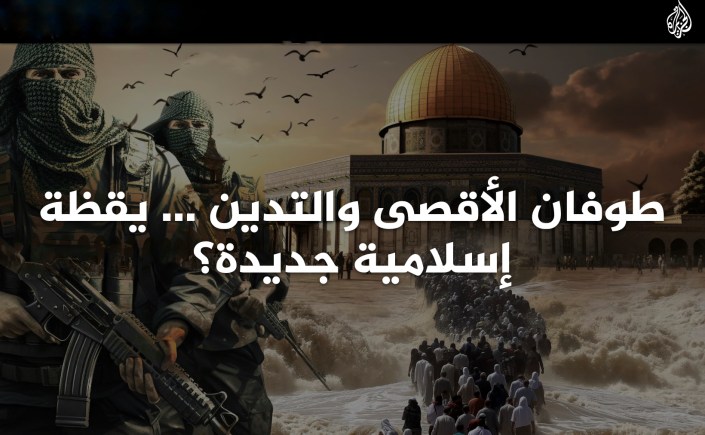
Al Aqsa Flood and the Hamas holy war

It has been said before and often, that Qatari owned Al Jazeera presents the non-Arabic speaking world with a markedly different narrative of the Gaza war to what it relays to its Arabic readers – it is the most popular news source in the Arab world, particularly among Palestinians.

Viewing or reading Al Jazeera English, you would think that Israel’s onslaught is directed entirely against the defenceless and helpless civilians of the unfortunate enclave. There are very rarely images of the militants who are engaged on a daily basis in fierce battles and deadly firefights with the IDF. Al Jazeera Arabic on the other hand, posts pictures and videos of the fighters, illustrating their courage, their resilience in the face of overwhelming odds, and their successes in the face of overwhelming military odds. 

On 13 August 2024, Al Jazeera Arabic published a series of seven articles under a forward titled The Al-Aqsa Flood and Religiosity… A New Islamic Awakening

The title refers to the pogrom of October 7 in which Islamic militants slaughtered some 1,200 Israeli men, woman and children and kidnapped over 200. It was given the name  Amaliyyat Tufān al Aqsa – Al Aqsa Flood, insofar as its purpose was to  preempt a Jewish takeover of Al Aqsa Mosque in Jerusalem, the third holiest Islamic shrine – notwithstanding the fact that nothing of the kind was happening. Israel’s angry response has been biblical in its brutality, with nine months of air and ground assault that has devastated the enclave of Gaza and, according to health officials killed more than 40,000 people (uncorroborated figures provided by the Hamas-run health authorities that include thousands of militants killed in the fighting, and persons who would have died under normal circumstances had war not broken out).

An earlier piece in In That Howling Infinite, Lebensraum Redux – Hamas’ promise of the hereafter revealed the Hamas master plan for the destruction of the state of Israel and the dispersion and disposal of its Jewish inhabitants. Statements like this and the longstanding foundational Hamas Covenant, which also calls for the eradication of Israel do not generally attract mainstream and social media interest, even after October 7.

Few have actually read the 1988 Hamas Covenant or the revised charter that was issued in 2017. The neglect is nonetheless surprising considering the clear exposition of the Islamist, genocidal intent of the Hamas and Islamic Jihad. This accords with a view held by many knowledgeable and well-informed observers and commentators that the original intent of Operation Al Aqsa Flood was to race en-masse across the Negev to the Occupied Territories and spark a general Palestinian rising which would precipitate an invasion of Israel by its Arab neighbours – a repeat of the war of 1948 without its outcome, but rather, al Nakba in reverse.  

We’ll probably never really know why this scenario was not followed through, and what may have been the outcome. Some may argue a 100km sprint across the open desert to the nearest Palestinian city, Hebron, was an impossible task. Others might surmise that the militants who descended on the borderland kibbutzim and the Nova Trance Festival to molest, maim and murder were distracted by the easy prey and the release of pent-up rage and brutal vengeance.

Al Aqsa Flood  may have failed, with only the Black Shabbat and the destruction of Gaza to show for it, but without doubt, it ignited a wildfire that has reinvigorated the Palestinian cause in the eyes of the world and severely damaged Israel’s standing on the world stage. The Hamas maintains that the ongoing carnage is justified, with many senior officials, declare in the safety of their sanctuaries in Qatar and Beirut that they’d do it all over again … and again.

The Al Jazeera series is enlightening in several respects, particularly insofar as it does not recognise the events of October 7 for what they were; and whilst acknowledging that there is a battle raging in the enclave but eschewing any reference to the carnage it is causing among the Gazan population, it presents the moral and humanitarian disaster of the Gaza war as the beginning of an Islamic enlightenment:

“Outside the military battlefield, there was another battle raging alongside the flood, which is the battle of conflicting identities that the world witnessed with the flood, and the accompanying signs of a noticeable religious awakening among young people around the world, and the restoration of the centrality of the role of religion in Arab public affairs”.

By happenstance, I read this series not long after In That Howling Infinite published A Messiah is needed – so that he will not come, which discussed the phenomenon of messianism with particular reference to the connections between the conflict and catastrophe of the Gaza war on the one hand and an emerging messianism on the other among both religious and non-religious Jew. It noted:

In the eyes of Israel’s principal foes, the so-called “Axis of Resistance”, Iran and its Islamist proxies in Palestine, Lebanon, Syria, Iraq and Yemen, the current Arab Israeli conflict is in reality a holy war with inseparable and uncompromising religious, political and military dimensions that take on a messianic character.

The irony is that increasingly in the Jewish state, the existential crisis emanating from the catastrophe of October 7 and the encirclement of the tiny country by enemies determined to wipe it off the map, has arguably fostered a messianic fervour in Israel too.

We republish the foreword to the Al Jazeera series below in both English and Arabic.

See also in In That Howling Infinite, A Middle East Miscellany:  

Al-Aqsa Flood and Religiosity …  A New Islamic Awakening?

“Outside the military battlefield, there was another battle raging alongside the flood, which is the battle of conflicting identities that the world witnessed with the flood, and the accompanying signs of a noticeable religious awakening among young people around the world, and the restoration of the centrality of the role of religion in Arab public affairs”.

What is the religious symbolism of the red cows that the Zionist settlers brought before the flood? Why did the spokesman for the Qassam Brigades denounce them in a speech? And what is the meaning of the concept of the nation in the speeches of the resistance leaders? Why did the Zionist Prime Minister invoke the story of the “Amalekites” from the Old Testament to justify the Israeli brutality in the Gaza Strip? And why do we only receive clips of resistance fighters accompanied by glorification and praise and mention of the virtue of martyrdom?

Many questions about religion and religiosity and their relationship to the flood have imposed themselves since the outbreak of the flood on October 7, 2023. From the first moments of the flood, and with the resistance members crossing the security fence of the Gaza Strip, the sounds of glorification and praise of the resistance fighters preceded the sounds of the Kalashnikovs. During the battle, the leaders of each team did not limit themselves to the military and strategic mention of the battle, but they loaded the battle itself with many religious symbols, which are no less present and important than the importance of the security, intelligence and military machine. Outside the military battlefield, there was another battle raging alongside the flood, which is the battle of conflicting identities that the world witnessed with the flood, and the accompanying signs of a noticeable religious awakening among young people around the world, and the restoration of the centrality of the role of religion in Arab public affairs.

All of this prompted us to ask the question: What is the position of religion and religiosity in the battle of the flood? This was the file titled “The Flood of Al-Aqsa and Religiosity… A New Islamic Awakening?!” which consisted of 7 articles.

The first article was an extensive article titled “From the Tortured of the Earth to the Beloved of God… How did Arab Youth Return to the Questions of Faith and Religiosity after the Events of October 7?” The work on the article took 8 months, during which we met with dozens of young people around the world between the ages of 20 and 40 to monitor the transformations of Arab youth after the flood, and the transformation of many of them from “indifference” to a state of sweeping religiosity, and sometimes even readiness to engage in the broad Islamic state, and support the Islamic resistance. All of this was monitored by the article, and their testimonies recorded the impact of the flood on them and its effect on the transformations they went through.

As for the second article, it was a conceptual article entitled “Cultural Wars and the War on Gaza… How did October 7 formulate the concept of the nation?” The article followed the conflict of identities that accompanied the flood, and how the speeches of the resistance spokesman restored the concept of “nation” and made it the heart of the battle of the flood, and how the Zionists and their allies tried to redraw the concept of the term “nation” in the past decades!

Then we delved into the third article into a forward-looking article entitled “The Flood, Prophecy, and the Hour… Welcome to the Exceptional Times!” to tell us how prophecy can have its effect on military reality? And how faith becomes a refuge for salvation for the resistance fighters when all roads are narrow, moments of foresight are absent, and work becomes based on the sites of destiny.

As for the fourth article, it was about the presence of the Zionist religious narrative on social media platforms, especially TikTok. The article “Religious Zionism on TikTok… This is how genocide was legitimized in Gaza” attempted to monitor the religious presence of Zionist figures and those influenced by them on TikTok, and how this presence helped justify the genocide with a clear conscience! The article placed this Zionist religious narrative in a comparative case with the role of Arab influencers and the religious narrative they carried during the war.

From TikTok to psychology, in the fifth article we went to reconsider Western psychology and the problem of Western standards on religion and religiosity in the article “What is faith? About Gaza and the Istisqa prayer in the summer”, which monitored the academic deficiency in Western standards of religiosity when trying to apply them to Muslim peoples. The article revealed that the case of “Gaza” remains a unique case that is difficult to frame within the material framework of the psychology of religiosity in its Western perspective.

Then we reinforced it with the sixth article, in which we returned to the impact of religion on the battlefield, which is the article “Psychology of Religiosity… The Infrastructure of Resistance in Gaza”, which attempted to draw the line between religious motivation and mental health in crises, and monitored the religious beliefs of the people of Gaza that created meaning from the womb of suffering, and concluded the article by talking about the uniqueness of Islam in drawing the path of salvation for its followers in the two cases of life or martyrdom.

Finally, we concluded with the seventh article, which tells the expansion of the circle of influence to the ends of the world by reviewing the story of an evangelical Christian Islam, and how the Gazan model of religiosity was transformed into a beacon of global guidance.

طوفان الأقصى والتدين … يقظة إسلامية جديدة؟!

مقدمة الملف ما الرمزية الدينية للبقرات الحُمر التي استجلبها المستوطنون الصهاينة قبيل الطوفان؟ ولمَ ندد بها المتحدث باسم كتائب القسام في خطاب له؟ وبأي مدلولٍ حضر مفهوم الأمة في خطابات قادة المقاومة؟ ولماذا استدعى رئيس الوزراء الصهيوني قصة “العماليق” من العهد القديم تبريرًا للوحشية الإسرائيلية على قطاع غزة؟ ولماذا لا تصلنا مقاطع مقاتلي المقاومة إلا مصحوبة بالتكبير والتهليل وذكر فضل الشهادة؟

أسئلة كثيرة حول الدين والتدين وعلاقتهما بالطوفان فرضت نفسها منذ اندلاع الطوفان في السابع من أكتوبر ٢٠٢٣. فمنذ اللحظات الأولى للطوفان، ومع عبور أفراد المقاومة السياج الأمني لغُلاف غزة كان أصوات التكبير والتهليل للمقاومين تسبق أصوات الكلاشنكوف. وفي أثناء المعركة لم يكتف قادة كل فريق بالذكر العسكري والإستراتيجي للمعركة، وإنما شحنوا المعركة ذاتها بكثير من الرمزيات الدينية، التي لا تقل في حضورها وأهميتها عن أهمية الآلة الأمنية والإستخباراتية والعسكرية. أما خارج ميدان المعركة العسكري، فكان ثمة معركة أخرى تدور رحاها إلى جوار الطوفان، وهي معركة الهويات المتصارعة التي شهدها العالم مع الطوفان، وما صاحب ذلك من بوادر استفاقة دينية ملحوظة في أوساط الشباب حول العالم، واستعادة محورية دور الدين في الشأن العام العربي.

كل ذلك دفعنا إلى طرح سؤال: ما هو موقع الدين والتدين في معركة الطوفان؟ فكان هذا الملف الذي حمل عنوان “طوفان الأقصى والتدين … يقظة إسلامية جديدة؟!” والذي تكون من 7 مواد.

كانت المادة الأولى مادة مستفيضة بعنوان “من معذبي الأرض إلى أحباب الله … كيف عاد الشباب العربي إلى سؤالي الإيمان والتديّن بعد أحداث السابع من أكتوبر” وقد استغرق العمل على المادة 8 أشهر، التقينا فيها بعشرات الشباب حول العالم من الفئة العمرية ما بين 20 إلى 40 لرصد تحولات الشباب العربي بعد الطوفان، وتحول كثير منهم من “اللامبالاة” إلى حالة التدين الجارف، بل وأحيانا التأهب للانخراط في الحالة الإسلامية الواسعة، ومناصرة المقاومة الإسلامية. كل ذلك رصدته المادة، وسجلت بشهاداتهم وقع الطوفان عليهم وأثره في التحولات التي خاضوها.

أما المادة الثانية كانت مادة مفاهيمية بعنوان “الحروب الثقافية والحرب على غزة.. كيف صاغ 7 أكتوبر مفهوم الأمة؟” تتبعت المادة صراع الهويات التي صاحب الطوفان، وكيف استعادات خطابات المتحدث باسم المقاومة مفهوم “الأمة” وجعلته في القلب من معركة الطوفان، وكيف حاول الصهاينة وحلفائهم إعادة رسم مفهوم مفردة “الأمة” في العقود الماضية!

ثم دلفنا في المادة الثالثة إلى مادة استشرافية بعنوان “الطوفان والنبوءة والساعة … مرحبًا بك في الأزمنة الاستثنائية!” لتخبرنا كيف يمكن للنبوءة أن يكون لها أثرها في الواقع العسكري؟ وكيف يصبح الإيمان ملاذ الخلاص للمقاومين عندما تضيق جميع الطرق، وتنعدم لحظات الاستشراف، ويصبح العمل على مواقع القدر.

أما المادة الرابعة فكانت عن حضور السردية الدينية الصهيونية على منصات التواصل الاجتماعي، وخاصة التيك توك. فكانت مادة “الصهيونية الدينية على “تيك توك”.. هكذا شُرّعت الإبادة في غزّة” حاولت هذه المادة رصد الحضور الديني للخامات الصهاينة والمتأثريين بهم على التيك توك، وكيف ساعد هذا الحضور على تبرير الإبادة بضمير مرتاح! ووضعت المادة هذه السردية الدينية الصهيونية ضمن حالة مقارنة مع دور المؤثريين العرب والسردية الدينية التي حملوها أثناء الحرب.

ومن التيك توك إلى علم النفس، فقد ذهبنا في المادة الخامسة إلى إعادة النظر في علم النفس الغربي وإشكالية المقايس الغربية حول الدين والتدين في مادة “ما الإيمان؟ عن غزة وصلاة الاستسقاء في الصيف” والتي رصدت النقص الأكاديمي في مقاييس التدين الغربية عند محاولة تطبيقها على الشعوب المسلمة. وكشفت المادة أن حالة “غزة” تظل حالة فريدة ومستعصية على التأطير ضمن الإطار المادي لعلم نفس التدين في منظوره الغربي.

وثم عززنا بالمادة السادسة التي عُدنا فيها إلى أثر الدين في أرض المعركة، وهي مادة “سيكولوجية التديّن.. البنية التحتيّة للمقاومة في غزة” والتي حاولت رسم الخط بين الدافع الديني والصحة النفسية في الأزمات، ورصدت المسلمات الدينية لأهل غزة والتي خَلّقَت المعنى من رحم المعاناة، وختمت المادة بالحديث عن فرادة الإسلام في رسم مسار الخلاص لأتباعه في حالتي الحياة أو الشهادة.

وأخيرًا ختمنا بالمادة السابعة، التي تحكي اتساع دائرة التأثير إلى أطراف المعمورة باستعراضنا لقصة إسلام مسيحيّ إنجيليّ، وكيف تحول نموذج التديّن الغزيّ إلى منار هداية عالميّة.

من معذبي الأرض – 1

الحروب الثقافية والحرب – 2

الطوفان والنبوءة والساعة

الصهيونية الدينية على تيك توك – 4

ما الإيمان؟ عن غزة – 5

سيكولوجية التديّن -6

قصة إسلام إنجيلي أميركي


A Messiah is needed – so that he will not come

In our more secular, rational times, we condemn those who maim and murder in the name of their god. But do not for a moment dismiss the power of religious fervour … The promise of a full remission of all sins and a place in paradise was a powerful motivator (and among some faithful, it still is).
Al Tariq al Salabiyin – the Crusaders’ Trail, In That Howling Infinite

… it would be a mistake to assume that the pattern of apocalyptic thought exists only within the framework of religious belief. Its fingerprint can also be found in secular revolutionary movements and in modern ideological worldviews
Amit Vershinsky, Israeli historian and author

Messianism, the belief in the advent of a “promised one”, a Messiah or Mahdi, who emerges as the saviour of a people and who will bring about a better world, has never gone out of fashion, particularly in the Middle East, its theological birthplace. It originated as a Zoroastrian religious belief and flowed into the Abrahamic religions, Judaism, Christianity and Islam, but other faiths also harbour messianistic proclivities. And yet, messianism can be temporal as much as spiritual, as illustrated by the ideological movements which determined the course of twentieth century history.

The yearning for an ideal leader has long been ingrained in our collective psyche: a hero, mortal or divine, who would appear at the darkest hour and lead his people through the struggle to ultimate triumph. Even though we may not personally subscribe to a spiritual belief in the end of days, it is there in our historical memory and in the myths that are often shaped by it, as the following lines, referencing Alexander the Great, Genghis Khan and King Arthur, these “once and future” kings, illustrate:

We sing such songs as we might hear
In dreams before day breaking,
As ancient echoes hide between
The slumber and the waking.
We remember,
Yes, we remember

Iskander marched this way and back
Across these battlefields of old.
Persepolis he burned and in Babylon he died,
And now, embalmed in gold,
He lies waiting.

The killer khan in death reclines
Amidst his guards and concubines,
Who died so none would ever see
The final resting place where he
Lies waiting.

And in our own imagining
The fabled, once and future king
Upon an island in a lake,
He slumbers still but will awake
One day.

Ruins and Bones, Paul Hemphill

World-renowned Critical Theorist, activist, psychoanalyst, and public Marxist intellectual, Erich Fromm (1900-1980) distinguished two kinds of messianism. One he saw as radical and progressive, the other as regressive and potentially reactionary: “prophetic messianism” and “catastrophic or apocalyptic” messianism.

Prophetic messianism, Fromm argued, conceives the messianic event as occurring within history and time and not arriving through a rupture from history and time. Regressive catastrophic messianism on the other hand sees the messianic event entering history from outside, a force majeure, and not as an outcome of human activity. He saw “prophetic messianism” as a “horizontal” longing, a longing for human-made change, and “catastrophic messianism” as a vertical” longing, a longing for an external, transcendent “saviour” (perhaps a human leader or a deterministic law governing history) that will enter history from a realm outside of human affairs.

Because prophetic messianism views the messianic event as the outcome of human progress, it encourages productive and revolutionary action, and it makes planning or “anticipatory change” possible. By contrast, because catastrophic messianism views the messianic event as the outcome of the transcendent entering history to rescue a fallen humanity, catastrophic messianism encourages passive waiting or even destructive or unnecessarily violent action aimed at speeding the coming of the apocalypse. Like the types of false hope that Fromm warns against, catastrophic messianism risks becoming quietism on the one hand or actively destructive nihilism on the other.

[These two previous paragraphs are an edited extract of a review by Dutch publishing house Brill of Erich Fromm’s Revolutionary Hope by Joan Braune, 1st January 2014}

Today, catastrophic messianism is active and influential in our world’s most enduring conflicts – the clear and present danger facing the non-Muslim world by Islamic extremism, and the current war between the predominantly Jewish State of Israel and the Islamic fundamentalist Hamas and its allies

In islamic eschatology, the end of times will portend Malhama Al-Kubra, the “last battle between the forces of light and of darkness, an apocalyptic struggle so intense that according to some Hadith narrations, were a bird to pass their flanks, it would fall down dead before reaching the end of them. Many texts say that this will take place at Dabiq in northern Syria. As testament to its relevance in contemporary Islamist thinking, the brutally fundamentalist Islamic State adopted the name for its magazine.

In the eyes of Israel’s principal foes, the so-called “Axis of Resistance”, Iran and its Islamist proxies in Palestine, Lebanon, Syria, Iraq and Yemen, the current Arab Israeli conflict is in reality a holy war with inseparable and uncompromising religious, political and military dimensions that take on a messianic character.

The irony is that increasingly in the Jewish state, the existential crisis emanating from the catastrophe of October 7 and the encirclement of the tiny country by enemies determined to wipe it off the map, has arguably fostered a messianic fervour in Israel too.

In an informative article in Haaretz, writer and historian Amit Varshizky contemplates the connections between conflict and catastrophe on the one hand and an emerging messianism on the other among both religious and non-religious Jews.

This article reminded me of British historian Norman Cohn‘s influential book The Pursuit of the Millenium which I first read in ‘seventies. Indeed, Varshinsky refers to him. Cohn’s work as a historian focused on the problem of the roots of a persecutorial fanaticism which became resurgent in modern Europe at a time when industrial progress and the spread of democracy had convinced many that modern civilization had stepped out forever from the savageries of earlier historical societies. In The Pursuit, he traced back to the distant past the pattern of chiliastic upheaval that marred the revolutionary movements of the 20th century. He had described all his work as studies on the phenomena that sought “to purify the world through the annihilation.

Vershinsky writes:

“The origins of this craving for destruction and strife reside in the belief that the coming of the Messiah will be preceded by a period of “pangs of the Messiah,” characterized by suffering and ordeals; in short, there is no redemption that is not acquired without torments. This is a basic element of political messianism, which interprets historical events in a mythic light, as the embodiment of sanctity in concrete reality … the power of this redemptive mysticism derives from the fact that it does not talk about far-reaching cosmic transformations in the order of creation, as predicted by the Prophets. It refers, rather, to messianic fulfillment within the realm of historical, concrete time, and as such it is tightly linked to human deeds … History demonstrates how apocalyptic interpretations can be created from the experience of an existential crisis, which brings to a head the everlasting tension between deficiency and the striving for fulfillment – a tension that characterizes the human condition in general. Since the start of recorded history, periods that were marked by political crises, plagues, social anxieties and collective despair have been accompanied by the rise of apocalyptic interpretations that have vested history with a new and sanctified significance and have charged the events of the hour with redemptive meaning. As Norman Cohn showed, marking a low point as a formative moment of spiritual renascence that leads to redemption is part of a recurring pattern that appears in all apocalyptic interpretations of events throughout Western history. Cosmic disorder is a precursory and necessary stage for the coming of the Messiah and the establishment of the Kingdom of God … But it would be a mistake to assume that the pattern of apocalyptic thought exists only within the framework of religious belief. Its fingerprint can also be found in secular revolutionary movements and in modern ideological worldviews”.

See also in In That Howling Infinite, A Middle East Miscellany    A Short History of the Rise and Fall of the West and Lebensraum Redux – Hamas’ promise of the hereafter

Amit Varshizky, Haaretz, Aug 3, 2024

Disasters are a fertile ground for purveyors of apocalyptic prophecies

Oil-storage facility in Hםuthi-held Hodeida, Yemen after the port was hit by Israeli planes July 20. “War advances “the purification, refining and galvanizing of the Jewish people” Rav Kook.”: AFP

Social media is flooded with clips of rabbis calculating the end times and intoxicated with salvation as they declare that we are poised at the onset of the flowering of our redemption. Rabbi Naftali Nissim, a YouTube star in-the-making, waxed poetic: “There has never been a beautiful period like this… What happened on Simhat Torah [October 7] is a prelude to redemption.” Rabbi Yaakov Maor explained that “Rafah [in Gaza] refers to ‘288 sparks’ [the numerological value of the word ‘RFH,” and a concept in kabbalistic literature]. The redemption is near!” And Rabbi Eliezer Berland, head of the Shuvu Banim group in the Breslav Hasidic sect, promised: “This is the last war before the Messiah. After this war, Messiah Son of David will come.”

But such talk is not confined to the yeshivas and the kollels (yeshivas for married men), it’s even voiced on commercial television. Dana Varon, a presenter and commentator on the right-wing Channel 14, stated, “It’s written in the Mishna: The Galilee will be destroyed and the Golan shall be emptied, and the people of the border wander from city to city, that’s the Mishna coming to realization within us literally, I’m happy about this.”

Her colleague Yinon Magal went even farther in a radio broadcast. “The feeling is that we are approaching great days. We are in a redemptive process, and prophecies are happening.” And on another occasion: “Only the Messiah [can] supplant Bibi.” Magal is a demagogue and the embodiment of narcissism, but his remarks reflect a prevailing sentiment among broad circles of the settler and Hardali (nationalist ultra-Orthodox) right, and one that has also been adopted by broad segments of the ruling party.

The sentiment itself is not new. Since the advent of religious Zionism, it has greased the movement’s ideological wheels and been the driving force of the settlement project and the vision of Greater Israel. What is new is the popularity these ideas enjoy in the present-day political and public discourse, and how they have traveled from the margins of right-wing politics into the Likud center. Prime Minister Benjamin Netanyahu, who is captive by choice of power-hungry Kahanists and other extremists, is dragging Israel into the grip of an apocalyptic ecstasy that is deepening the existing crisis and creating new conditions for realizing the messianic fantasy of conquering all the territories of the Land of Israel, replacing Israeli democracy with the kingdom of the House of David and building the Third Temple.

This accounts for the enthusiastic spirit that has gripped the messianic camp since October 7, as well as the repeated provocations on the part of individuals and groups in an attempt to ignite a conflagration in the West Bank and pull the Arabs in Israel into the blaze.

War of Gog and Magog

The origins of this craving for destruction and strife reside in the belief that the coming of the Messiah will be preceded by a period of “pangs of the Messiah,” characterized by suffering and ordeals; in short, there is no redemption that is not acquired without torments. This is a basic element of political messianism, which interprets historical events in a mythic light, as the embodiment of sanctity in concrete reality. According to this approach, the birth of Israel and the Zionist enterprise, particularly since the victory in the 1967 Six-Day War, are manifestations of emerging redemptive reality. This reading of events is based in part on tractate Berakhot in the Talmud, according to which between this world and the time of the Messiah there is only “servitude to the [foreign] kingdoms.”

Indeed, the power of this redemptive mysticism derives from the fact that it does not talk about far-reaching cosmic transformations in the order of creation, as predicted by the Prophets. It refers, rather, to messianic fulfillment within the realm of historical, concrete time, and as such it is tightly linked to human deeds. Rabbi Shlomo Aviner, the dean of Ateret Yerushalayim Yeshiva and the former rabbi of the settlement of Beit El, put it succinctly: “We assert the absolute certainty of the appearance of our redemption now. There is no barrier here of secret and hidden.”

The same applies to the present war; it needs to be seen in its biblical dimension and perceived through a messianic prism. In this sense, the history of our generation is not much different from the chronicles of the Exodus from Egypt and the conquests of Joshua. At that time, too, the events occurred by natural means and the military victories opened the age of redemption.

The Gaza war, from this perspective, is bringing closer the Jewish people’s collective redemption. Light and dark are intertwined here, destruction and revival are interlocked like revealed and concealed, and as material and spiritual reality. Accordingly, the greater the dimensions of the destruction and the devastation, so too will the spiritual transformation brought by the campaign in its wake be augmented. The war is the purgatory that will steel the spirit of the Jewish people, which is already at the stage of incipient redemption. Anyone seeking a foundation for this idea will find it in the thought of Rabbi Zvi Yehuda Kook (the son of Abraham Isaac Kook): “What is the reason for the War of Gog and Magog? Following the establishment of Israel’s sovereignty, war can possess only one purpose: the purification, refining and galvanizing of Knesset Israel [the Jewish people].”

What is the conclusion? The more that suffering increases, the more good there will be; and “the more they were oppressed, the more they increased and spread out” (Exodus 2:12). They will multiply and burst forth, for like the measure of justice, so too is the measure of mercy. And as Dana Varon noted in replying to her critics, “It’s a good sign. Because if all the bad and the wicked materialize, that is a sign that the good is also guaranteed and is arriving.”

Sanctified victims

The designation of catastrophe as a condition for salvation is not new in human history. History demonstrates how apocalyptic interpretations can be created from the experience of an existential crisis, which brings to a head the everlasting tension between deficiency and the striving for fulfillment – a tension that characterizes the human condition in general. Since the start of recorded history, periods that were marked by political crises, plagues, social anxieties and collective despair have been accompanied by the rise of apocalyptic interpretations that have vested history with a new and sanctified significance and have charged the events of the hour with redemptive meaning.
As the British historian Norman Cohn showed, marking a low point as a formative moment of spiritual renascence that leads to redemption is part of a recurring pattern that appears in all apocalyptic interpretations of events throughout Western history. Cosmic disorder is a precursory and necessary stage for the coming of the Messiah and the establishment of the Kingdom of God.

But it would be a mistake to assume that the pattern of apocalyptic thought exists only within the framework of religious belief. Its fingerprint can also be found in secular revolutionary movements and in modern ideological worldviews. Marxism, for example, is based on the assumption that history is progressing toward a final end, after which there will be no more oppression, injustice or wars. The realization of the Marxist utopia sees extreme aggravation in the living conditions of the working class as a necessary condition for world revolution, and for the formation of a classless society that will bring about the end of history.

Fascism, and German fascism in particular, preserves a central place for apocalyptic patterns of thought. In Hitler’s Third Reich, whose followers adopted the Christian eschatological concept of the “Thousand Year Reich,” extensive use was made of the narrative of fall and redemption as a means to consolidate the Nazi movement’s ideological hold on the German public. The Nazi ideologues and propagandists were successful in evoking the deepest fears of their contemporaries, and in depicting Germany’s military defeat in World War I and the national nadir as a formative moment of illumination, resurrection and renewal.

As the Nazis conceived it, the catastrophe of the war marked the watershed – it was a rupture that exposed the subversive activity of the Jews, awakened the German people to recognize its inner strength and accelerated a process of national renewal. It was precisely the destruction and the mass killing of the Great War that made it possible to formulate a new worldview and philosophy of life that was based on recognition of the vital powers of the race and the organic essence of the people (the Volk). As such, the sacrifice of the war’s fallen was vested with sanctified validity.

The totalitarian movements thus secularized the apocalyptic pattern of thought and implanted it in their worldview. They offered their believers a utopian vision that was based not on divine redemption but on scientific progress, naturalism and the sovereignty of humanity. Their followers were driven by a sense of moral eclipse and existential dread, accompanied by a call to eradicate the old world and to build on its ruins a new, orderly world. The total war, in the Nazi case, or the total revolution, in the communist case, were perceived as a necessary stage to realize the secular utopia, and made it possible to normalize the most horrific crimes and sanctify every form of violence. The historical lesson is thus clear: Every attempt to establish the Kingdom of God on earth is destined to ignite the first of in the abode of man.

Here lies the danger in striving for a politics of “total solutions,” whether on the right or on the left. That form of politics entrenches a false picture of reality and paves the way for demagogues and populist false messiahs who are adept at exploiting social distress and anxiety by appealing to the urge for redemption and the human need for absoluteness.

Not only does political messianism cast on its leaders a sanctity of religious mission that is insusceptible to doubt; it also requires the marking of enemies (or political rivals) as foes that are delaying redemption, in the spirit of the Latin phrase, “Nullus diabolus, nullus redemptor” (No devil, no redeemer). In this sense, the more powerful the messianic idea is, the greater the violence and the destruction it sows when the demand for absoluteness shatters on the rocks of reality; the height of the sublimity toward which it thrusts is matched only by the depth of the abyss into which it is liable to slide. For the more that reality declines to acquiesce to the absolutist demands of the advocates of political messianism, the greater the strength they wield to shape it in the image of their utopian visions; and the more untenable this becomes, the more they attribute their failure to an internal enemy and to the power of abstract conspiracies.

David Ben Gurion: “The Messiah has not yet come, and I do not long for the Messiah to come. The moment the Messiah will come, he will cease to be the Messiah”. Fritz Cohen / GPO

Between the absurd and the meaningful

It’s only natural for people to seek to inform their lives with meaning that transcends their temporary, ephemeral existence. It’s also natural that in periods of mourning and distress they should wish to console themselves and imbue their sacrifice and loss with cosmic meaning. Crisis and catastrophe can indeed serve as an opportunity for renewal, and there is also nothing intrinsically wrong with the longing for redemption or for the absolute that is innate in the human psyche. The danger lies in the attempt to transform redemption into a political program, and the ambition to bring the heavenly kingdom into being in this world. The demand for absolute justice always ends in injustice. Moreover, a cause that relies on unjust means can never be a just cause.
In a meeting with intellectuals and writers in October 1949, David Ben-Gurion said, “The Messiah has not yet come, and I do not long for the Messiah to come. The moment the Messiah will come, he will cease to be the Messiah. When you find the Messiah’s address in the phone book, he is no longer the Messiah. The greatness of the Messiah is that his address is unknown and it is impossible to get to him and we don’t know what kind of car he drives and whether he drives a car at all, or rides a donkey or flies on eagles’ wings. But the Messiah is needed – so that he will not come. Because the days of the Messiah are more important than the Messiah, and the Jewish people is living in the days of the Messiah, expects the days of the Messiah, believes in the days of the Messiah, and that is one of the cardinal reasons for the existence of the Jewish people.”
Those remarks can be taken at face value, but it’s desirable to understand them as a message that encapsulates universal human requirements: People need belief, vision and a guiding ideal, but as is the way with ideals, it’s certain that this too will never materialize but will remain on the utopian horizon toward which one must strive but to which one will never arrive. Humanity, thus, is fated to exist in the constant tension between want and fullness, between the absurdity and futility of life and our need for meaning, purpose and significance. That tension can be a millstone around our necks and enhance the attraction of political messianism in its diverse forms.

Accordingly, it’s a mistake to assume that the allure of messianism can be fought only with rational tools. Myth cannot be suppressed by reason, and the yearning for the absolute cannot be moderated by means of learned, logical arguments. It was Friedrich Nietzsche, of all people, the philosopher who perhaps more than any other is associated with modern atheism and the “death of God,” who maintained that the death of God does not necessarily herald the death of faith, and that the rejection of religion and a consciousness of God’s absence do not mean that the craving for the absolute has ceased to exist.

On the contrary, it is precisely the death of God, precisely his nonexistence, that keeps alive more forcefully the longing for him, and spurs man to find substitutes. Hence Nietzsche’s famous cry: “Two thousand years have come and gone – and not a single new god!” The secular individual who has been orphaned of God is fated to give birth from within to new gods that will provide a response to one’s unfulfilled religious longing. God is dead, but his shadow continues to pursue humanity and to drive people to act in numberless forms and ways.

The denial of God’s shadow and of the unrequited longing of the human psyche for the absolute are the root of the blindness of secular culture in our time, and the source of its weakness in the light of the messianic sentiment. Under the guise of post-ideological pragmatism and economical rationalism, secular liberalism has completely forsaken the psycho-religious needs of the current generation in favor of material utilitarianism, narcissistic individualism and consumerist escapism, and has abandoned the possibility of bringing into being a life of a spiritual and cultural character capable of providing a response to the basic need for meaning and self-transcendence. Secular culture may perhaps allow freedom of choice (and that’s not a little), but in itself it does not offer another positive meta-narrative, guiding idea or existential meaning in an era of consumer and technological alienation. Into this vacuum political messianism has penetrated, as it offers an answer for spiritual longings and existential anxieties.

The formulators of state-oriented Zionism, head by Ben-Gurion, understood this well. They sought to harness the religious impulse to nation building and to the formation of a new Hebrew (Jewish) identity that draws on the messianic sources but does not attach itself to their religious content and instead secularizes it. In this way the messianic tension served Ben-Gurion to forge an ideal vision of a Jewish state that would be a moral paragon and a light unto the nations.

Is a return to the fold of Ben-Gurion-style Zionism the answer? Probably not. One thing, however, is certain: besides the urgent need to separate religion and state, and to anchor Israel’s secular-liberal character in a constitution, a deep transformation is also necessary in secular culture, in education, in artistic creation and in the intellectual-spiritual life. Because in order to do battle against the messianic myth, a counter-myth is needed, one that does not lie within the realms of religion and meta-earthly redemption, but in the imperfect world of humankind. It alone is capable of providing a substitute for the temptations of the diverse types of political messianism and of providing human beings with a horizon free of all supernatural, theistic, utopian or redemptive qualities.

A Messiah is needed – so that he will not come.