
Zionism derives from the Hebrew Tsiyon – Mount Zion in Jerusalem – and symbolizes the city and the Land of Israel. The term Zionismus was coined in 1890 by Austrian Jewish writer Nathan Birnbaum, replacing “Hovevei Zion” (“Lovers of Zion”). While the Jewish attachment to Zion is ancient, dating at least to the Babylonian Exile, modern Zionism emerged in late-19th-century Europe in response to anti-Semitism and rising nationalism, formalising the aspiration for Jewish return to their ancestral homeland.
We’ve been here before – not in the streets of Melbourne and Sydney with placards and police lines, nor in the corridors of Canberra where commissions are announced – but in language. Always in language.
For months now, perhaps years, In That Howling Infinite has been circling the same contested terrain: Is Israel a settler state or a returning people? Is Palestinian nationalism resistance or rejection? Is apartheid an analytic category or an accusation? Is “from the river to the sea” a geography or a prophecy? We have spent months disentangling words precisely because they matter: settler colonialism, indigeneity, apartheid, return, self-determination. Each carries law, history, trauma, aspiration. Each can illuminate. Each can distort. [See One Land, Two Peoples: History, Memory, Continuity, and Inheritance] and Same old stone, different rock. What’s in a word?]
Now another word – or rather, an old word under new atmospheric pressure – demands the same care: “Zionist.”
Once a self-description, a term of late-Ottoman and Mandate-era political theory, shorthand for Jewish national revival; now increasingly an epithet, flung with the casual certainty of moral indictment.
Before we continue, let us make clear that the following essay is not an attempt to rehearse the full intellectual or political history of Zionism – its nineteenth-century European origins, its varieties (labor, revisionist, religious), its entanglement with empire and nationalism, its debates over diaspora and return. Those accounts are readily available elsewhere, in libraries, lecture halls, and the howling internet. Nor is it an exercise in catechism, for Zionism has never commanded universal assent among Jews; from Bundists to ultra-Orthodox anti-Zionists, from liberal diasporists to post-Zionist critics within Israel itself, and among Israelis and Jews today (whom many critics of Israel and its government push to the forefront of their cause as if to demonstrate its righteousness). Jewish history and contemporary politics contains vigorous dissent from the Zionist project. Rather, what concerns us here is a narrower and more combustible phenomenon: the contemporary habit of framing Zionism not simply as mistaken or unjust, but as morally equivalent to Nazism – and the accompanying charge that Jews, through the state that claims to represent their national aspirations, are now committing genocide. It is this rhetorical escalation, and the moral confusion it both expresses and produces, that demands examination.
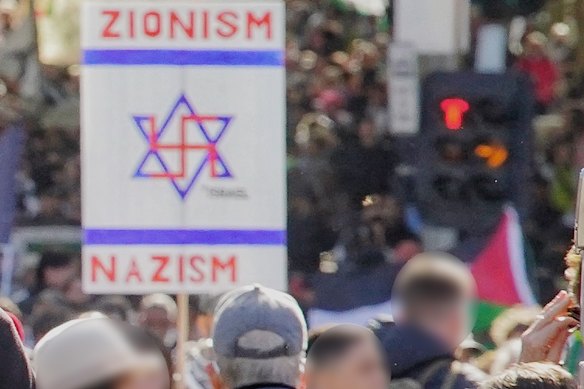
The escalation and confusion was evident well before October 7 2023. On streets and social media, in university classrooms and in day-to-day conversations, on placards, in memes, sprayed in graffiti, the connection between Israel and the Third Reich was being turbocharged. Zionism was no longer merely criticised; it was Nazified. Israeli policy was not compared to other nationalisms; it was collapsed into World War II. The swastika, once the emblem of genocidal antisemitism, reappeared as rhetorical prop, pasted onto flags and caricatures, deployed for shock and applause.
This escalation did not need Al Aqsa Flood and the war it precipitated to ignite it; merely intensified what had already been normalised. The analogy, once fringe, had drifted toward the mainstream of protest culture. And it matters – not only as prejudice, though that is present, but as a symptom of rage, symbolic power, and the moral weight the Holocaust carries in public imagination. Nazism has become shorthand for illegitimacy; to affix it to Israel is an attempt to delegitimise the state’s moral right to exist.
In an article published in the Sydney Morning Herald on 14 February, appropriately, on Saint Valentine’s Day, Jewish campaigner Danny Berkovic argues that the word has become a socially acceptable proxy for “Jew.” He begins with protests during President Isaac Herzog’s visit to Australia, where “Zionists” were denounced as malign actors and Zionism was equated with Nazism. In private, he recounts being asked whether he was paid by Israel – the old dual-loyalty trope reissued with updated stationery. When he pressed his interlocutor – should Israel exist? should it exist as a Jewish state with equal rights? – the answer was yes to both. By his definition, that made the accuser a Zionist.
Yet the word was being used as moral condemnation. The definitional battle begins there.
Berkovic offers a deliberately minimalist account. Zionism, he says, is the belief that the Jewish people have the right to self-determination in their ancestral homeland; that Israel should exist as a Jewish state; that such existence is compatible with equal citizenship for Jews, Christians, Muslims and others. It does not prescribe borders. It does not require annexation. It does not mandate support for any government. It does not preclude criticism. It is a national movement – broad, internally diverse.
On that definition, most Jews worldwide qualify. The overwhelming majority identify in some fashion with Israel’s continued existence. And so when “Zionist” is spat as a term of inherent evil – supremacist, genocidal, morally bankrupt — it does not land as abstract critique. It lands collectively. The elasticity of the word allows hostility to be expressed while retaining plausible deniability. One need not say “Jew.” One says “Zionist.”
There is truth here. Victor Klemperer, diarist of the Third Reich, writing in the shadow of a regime that turned vocabulary into vapour and vapour into poison, warned that words can act like arsenic. Not dramatic at first. Not even noticeable. They accumulate. They settle into the bloodstream of public life. They alter what can be said – and what can be thought. Respectable language can metabolise contempt.
Nowadays, while openly targeting Jews is socially taboo; “Zionist” can provide semantic cover. Equating Zionism with Nazism is not policy analysis; it is moral theatre. Suggesting hidden financial allegiance is not debate; it is inheritance from darker grammars.
But the story does not end with etymology.
Because when critics use the term pejoratively, they are often responding not to 19th century ideologue Theodore Herzl’s pamphlet but to rightwing Israeli politician Bezalel Smotrich’s expansionist programme. The definitional struggle is not purely semantic; it is a contest over which Zionism is politically operative – and therefore morally accountable.
Zionism has never been monolithic. Herzl’s liberal nationalism, seeking refuge and recognition among nations, is not Mandate-era Revisionist Ze’ev Jabotinsky’s iron wall. Cultural Zionism is not religious messianism. Labour Zionism, draining swamps and building institutions, is not identical to today’s annexationist maximalism. Religious Zionism grafted messianic longing onto modern sovereignty. These strands coexisted uneasily, sometimes violently.
Today, some of the most visible exponents of Zionism in power advocate annexation of the West Bank, legal differentiation between populations, and a theology-inflected claim to the whole land. They call themselves Zionists. Their critics do not invent the association; they encounter it on ministerial letterhead.
So when a protester condemns “Zionists,” the referent in their mind may not be Jewish self-determination in principle, but settlement expansion, permanent occupation, the rhetoric of “from the river to the sea” in reverse – the Greater Israel mirror-image of Palestinian maximalism. To pretend these associations are conjured ex nihilo is disingenuous.
Yet to collapse all Zionism into that current is equally disingenuous.
Here the symmetry becomes uncomfortable. Just as “Zionist” can be weaponised to mean “Jew,” “anti-Zionist” can be weaponised to mean “antisemite,” foreclosing argument before it begins. Language slides in both directions. Each side accuses the other of bad faith; sometimes each is correct.
There are further complications. 1948 is not a footnote. For Jews, it is independence wrested from catastrophe that was the Shoah; for Palestinians, it is al Nakba, literally “catastrophe”, defeat and dispossession. Zionism is not only an abstract right but a historical event – with winners, losers, and descendants who inherit both triumph and grievance. To define it purely as self-determination is to abstract it from its consequences. To define it purely as dispossession is to erase the catastrophe from which it arose.
The phrase “Jewish state” itself contains layers. A demographic majority? A Law of Return privileging Jewish immigration? National symbols and calendar? A civic democracy with Jewish cultural character but equal citizenship? Zionists disagree among themselves. So do critics. These are arguments about the nature of nation-states in a post-imperial world – arguments not confined to Israel. They are not, in themselves, antisemitic. But good faith requires precision.
If one believes Jewish collective self-determination is uniquely illegitimate – that Israel should not exist in any form as a Jewish polity – one must reckon with how that position will be heard by Jews shaped by statelessness and genocide. If one believes Israel should exist but its current government is reckless or unjust, then “Zionist” is an inadequate synonym for critique. If one believes Zionism’s realisation has entrenched unjust domination, that critique must be articulated without collapsing into collective vilification. And if one believes Jews as a group are morally bankrupt, no semantic pirouette will disguise the prejudice.
We have often warned of mirrored absolutes – annexationist dreams on one side, eradicationist chants on the other. “From the river to the sea” answered by “Judea and Samaria forever”, which envisages an Israel from that sane river to the sea. Each imagines exclusivity; each erases the other. The danger is not solidarity per se; it is the surrender of moral complexity.
In the wake of October 7 2023 and its aftermath, a hardening has taken hold across parts of the West: a rediscovery – sometimes embarrassed, sometimes defiant – of solidarity with Israel. The term “Zio,” once flung as an epithet in online polemic, has been reclaimed half-seriously, half-sardonically. If the mere assertion of Israel’s right to exist now qualifies one as a zealot, then so be it. But if Zionism becomes a reactive identity badge – tribal solidarity in the face of hostility – it grows thinner than its history.
Historically, it was a spectrum: cultural revival, agricultural collectivism, diplomatic manoeuvre, spiritual longing, armed struggle, parliamentary debate. Palestinian nationalism, too, emerged from late-Ottoman modernity into Mandate uncertainty and war – not reducible to Hamas, but spanning civic pluralism and Islamist absolutism alike. Both peoples carry aspiration and fear; both narratives are real; neither is complete alone.
Words change their weather. “Zionist” now carries heat – from hatred, from anger at power, from grief, from defiance, from genuine moral outrage at war and occupation. It can be weapon. It can be shield. It can be identity. It can be accusation.
The task is not to pretend the word is pristine, nor to concede it entirely to abuse, but to insist on distinctions.
Zionism is both refuge and sovereignty. It is both survival and statecraft. It contains Tel Aviv’s liberal dissent and Hebron’s fervour; Herzl’s diplomacy and the settler’s certainty. It is Aliyah and, in tragic counterpoint, Al-A’uda – two grammars of return spoken over the same soil. It is refuge after Auschwitz and control over al Aqsa. It is a flag raised over independence, a checkpoint on a road, and a wall bisecting the land. Sovereignty is never morally weightless.
To deny Zionism’s pluralism is to falsify it; to deny its entanglement with power is to romanticise it.
History suggests that when words are repurposed to disguise prejudice, the damage rarely stops with words. History also suggests that when words are simplified to shield power from scrutiny, resentment ferments. If “Zionist” becomes a safe word for hate, something corrosive takes root. If it becomes a talisman against scrutiny, something else corrodes.
Between those distortions lies a narrower path – unsatisfying to partisans, necessary for anyone who believes complexity is not weakness – where language is neither weapon nor alibi, but instrument.
The land remains small. The history immense. The language – elusive, illusive – continues to do its quiet work.
Perhaps our work is to be able to speak about Jewish and Palestinian self-determination without collapsing one into caricature and the other into sanctimony. Whether we can hold two national stories – each ancient, each wounded – without converting either into absolution.
The struggle, in the end, is not over a word alone. It is over whether we are willing to let it mean more than our anger requires.
Afterword
There is a moment when any extended discussion of Israel or Zionism tips into the gravitational pull that American attorney Mike Godwin formulated in 1990 as “Godwin’s Law”: that as an online discussion lengthens, there is a high probability of a comparison to Nazis or Hitler. Conceived, in part, to curb the trivialisation of the Holocaust in the unruly early days of internet debate, the maxim has since migrated into broader political discourse, where the invocation of Hitler often signals not illumination but exhaustion – the moment when analogy replaces analysis and moral thunder substitutes for evidence. It is frequently deployed to suggest that the person reaching for the Nazi comparison has, rhetorically at least, “lost” the argument. Yet Godwin himself cautioned that the law is descriptive, not absolute. It does not predict that every exchange will end in such hyperbole, only that, as tempers fray, the temptation becomes statistically likely. Nor did he deny that some comparisons to fascism may be warranted when describing genuinely fascistic behaviour. In a debate as charged as that surrounding Zionism – where accusations of apartheid, colonialism, ethnic cleansing, and even Nazism circulate with reckless ease – Godwin’s insight serves less as a gag rule than as a warning: once the Holocaust is instrumentalised as metaphor, the space for proportion, history, and moral seriousness contracts accordingly.
This essay was written in conversation with an AI language model, which contributed to drafting, and phrasing.
See also in In That Howling Infinite, A Political World – Thoughts and Themes, and A Middle East Miscellany. and also: This Is What It Looks Like, “You want it darker?” … Gaza and the devil that never went away …How the jihadi tail wags the leftist dog, The Shoah and America’s Shame – Ken Burns’ sorrowful masterpiece, and Little Sir Hugh – Old England’s Jewish Question
Read on for Berkovic’s article, and an explainer” in bullet points of the many meanings and interpretations of Zionism.

Zionism – definitions, claims, and contested meanings
In Berkovic’s minimalist framing, Zionism is:
• The belief that the Jewish people constitute a nation entitled to self-determination.
• Rooted in Jewish historical, cultural, and ancestral connection to the land of Israel.
• The view that Israel should exist as a Jewish state.
• Compatible, in principle, with equal civil and political rights for non-Jewish citizens.
• Not inherently tied to:
• Specific borders.
• Settlement expansion.
• Annexation of the West Bank.
• Opposition to a two-state solution.
• Support for any particular Israeli government.
• Compatible with criticism of Israeli policy comparable to criticism directed at other states.
In historical reality, however, Zionism has also been:
• A late-19th and early-20th century nationalist movement emerging from European antisemitism, Ottoman decline, and modern political thought.
• A spectrum of ideological strands, including:
• Liberal political Zionism (Herzl).
• Cultural Zionism (Ahad Ha’am).
• Labour/socialist Zionism (Ben-Gurion, kibbutz movement).
• Revisionist Zionism (Jabotinsky’s “iron wall”).
• Religious Zionism (messianic and covenantal interpretations of sovereignty).
• A movement inseparable in practice from land acquisition, demographic change, and eventually state formation.
• Experienced by Jews primarily as refuge, survival, and national restoration.
• Experienced by Palestinians primarily as dispossession (Nakba) and the beginning of an enduring conflict over sovereignty and land⸻
In contemporary politics, “Zionism” can function as:
• A baseline affirmation of Israel’s legitimacy as a Jewish state.
• A broad umbrella identity encompassing Israelis and diaspora Jews across the political spectrum — including fierce critics of Israeli governments.
• A label claimed by religious-nationalist and annexationist actors advocating permanent control over the West Bank.
• A reactive identity marker in the wake of October 7 — reclaimed by some who feel that even acknowledging Israel’s right to exist now invites condemnation
In contemporary polemic, “Zionist” is sometimes used as:
• A synonym for “Jew,” allowing hostility toward Jews to be expressed with plausible deniability.
• A catch-all villain category, attributing collective moral corruption rather than critiquing specific policies.
• A shorthand not for Herzl’s theory of Jewish self-determination, but for the policies of the current Israeli government or the most hard-line currents within it.
Key tensions in the definitional struggle:
• The battle is not merely semantic but political: which Zionism is operative — Herzl’s refuge, Labour’s state-building, or Smotrich’s annexationism?
• Anti-Zionism can range from policy critique to categorical rejection of Jewish self-determination; its moral meaning depends on which of these is intended.
• Equating all Zionism with supremacism erases its plural history.
• Equating all anti-Zionism with antisemitism forecloses legitimate debate about power, occupation, and equality.
• The phrase “Jewish state” itself is contested: demographic majority, civic nation with Jewish character, ethnonational preference, or religious polity?
The core unresolved duality:
• Zionism is both refuge and sovereignty.
• It is both survival after statelessness and the exercise of state power.
• It is experienced as national liberation by one people and as national catastrophe by another.
Any serious discussion must hold those tensions without collapsing them into slogan or slur.
How ‘Zionist’ became a safe word for hate
At protests against Israeli President Isaac Herzog’s visit to Australia, some demonstrators directed their anger not only at Israel’s policies but at “Zionists” themselves – accusing them of malign influence in the media and government. At other recent rallies, Zionism has been equated to Nazism and terrorism.
Victor Klemperer, a Jewish academic who survived Nazi Germany, warned that words can act like tiny doses of arsenic – swallowed unnoticed, accumulating slowly, until their poison takes hold. His insight was not about shouted slogans, but about respectable language that can normalise contempt. “Zionist” has entered this territory over the past two years.
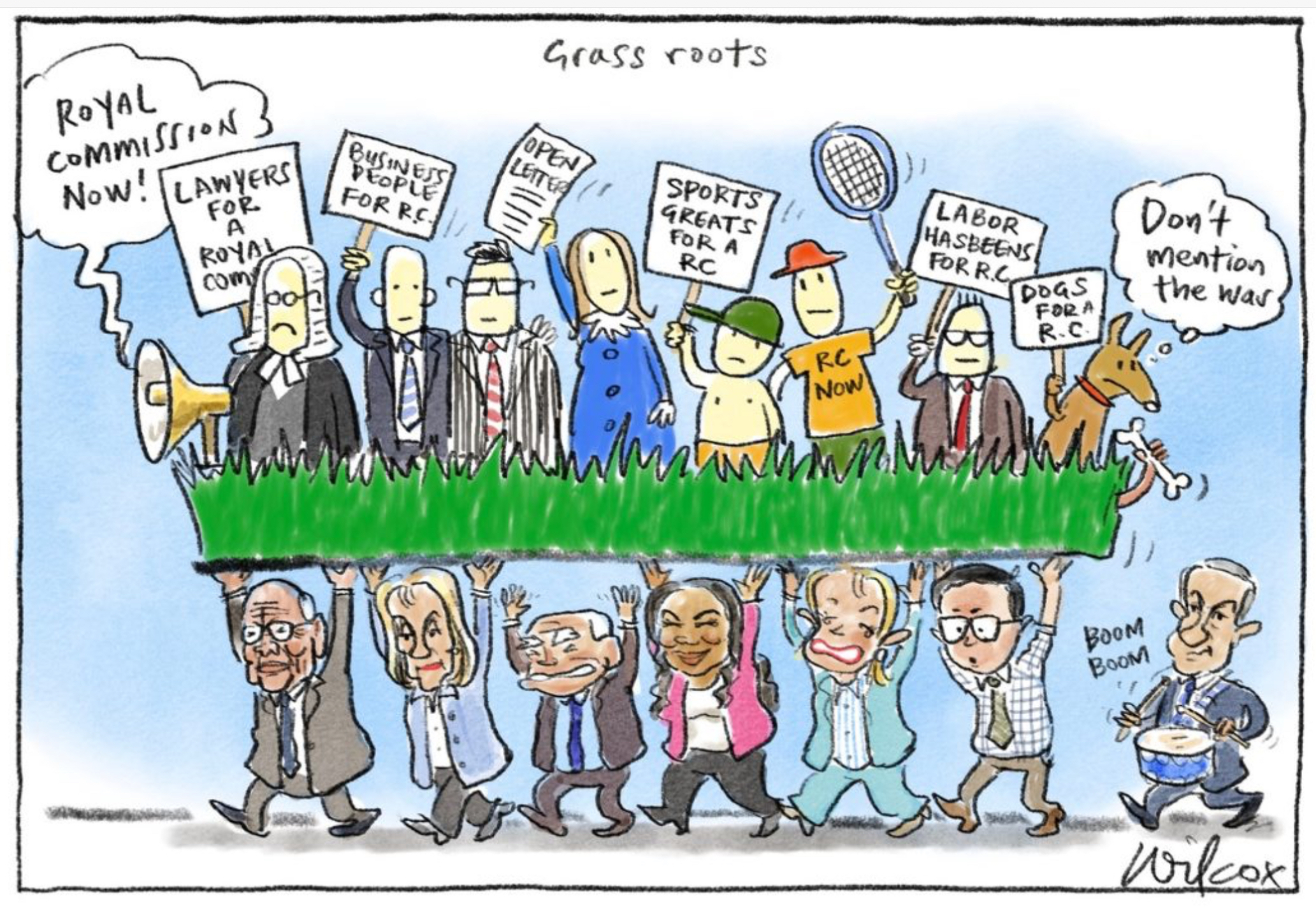
In the wake of the Bondi attack, I was involved in a public campaign for a federal royal commission into antisemitism. My role prompted a message from someone I have known for more than 20 years. Had I been paid by Israel for my advocacy, he asked. It was an offensive question. The answer was no.
What followed was more revealing. “Zionists have always been morally bankrupt with a superiority complex,” he told me.
I asked him two simple questions. Did he believe the state of Israel should continue to exist? Yes. Did he believe it should exist as a Jewish state, provided Jews, Christians, Muslims and others were given equal rights? Yes.
By the standard definition, he qualified as a Zionist. He either did not understand the term – or he was deliberately repurposing it.
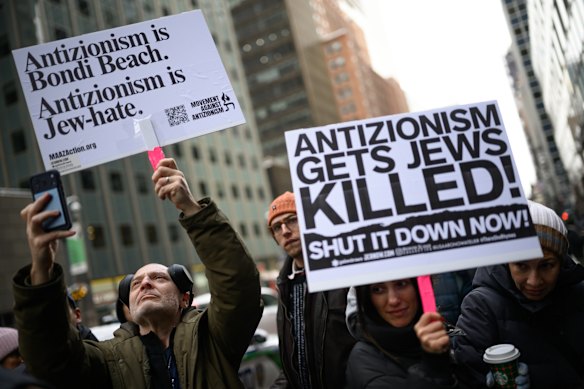
That exchange mattered not because it was especially aggressive, but because it was ordinary. It was delivered calmly, with moral certainty, and without any sense of contradiction. It revealed something that has become increasingly common: the use of the word “Zionist” not to describe a belief, but to impugn a target.
Zionism, properly understood, is not complicated. It is the belief that the Jewish people have the right to self-determination in their ancestral homeland. In practical terms, it is the idea that Israel should exist as a Jewish state. In Australia, Zionism has long been openly supported by mainstream leaders from across the political spectrum as a legitimate expression of Jewish self-determination.
Zionism does not dictate borders. It does not prescribe military policy. It does not require allegiance to any government, leader or political party. It does not exclude any race or religion from Israeli citizenship. It does not preclude criticism of Israel and nor does it demand support for all actions taken by the Israeli state. Expansionism is not intrinsic to it, and nor does it require opposition to a two-state solution. To be clear, criticism of Israel that is similar to that levelled against any other country cannot be regarded as antisemitic.
Like any national movement, Zionism contains a wide spectrum of political views. Many Zionists oppose Israel’s current government. Many Israelis have protested against it for years. Some of the fiercest critics of Israeli policy are Israeli citizens, who nonetheless consider themselves proudly Zionist.
This clarity matters because once a word’s meaning is hijacked, it becomes available for misuse – or abuse.
In recent years, “Zionist” has increasingly been deployed as an insult. The term Zionist is no longer used to identify an idea, but it is spat to assign blame. “Zionists” are held responsible for a wide range of evils, often without definition or limitation. In many instances, “Zionist” is used synonymously with “Jew”, while maintaining just enough ambiguity to deny that Jews are being targeted at all. So why does this substitution occur?
Because openly targeting Jews is no longer socially acceptable. “Zionist” becomes the workaround – broad enough to encompass most Jews, yet elastic enough to provide moral cover. It allows hostility to be expressed while preserving plausible deniability.
We are repeatedly told that hostility toward “Zionists” is merely political critique. But if that were true, the criticism would be of policy. Instead, “Zionists” are accused of supremacy, immorality, or inherent evil. That is not political criticism. It is collective character assassination.
This matters because Zionism is not an abstract ideology for most Jews. It is bound up with history, vulnerability and survival. For many Jews – including those deeply critical of Israel – Zionism represents the belief that Jews should not again be stateless, dependent on the goodwill of others for protection. To insist that “anti-Zionism has nothing to do with Jews” while knowing that the overwhelming majority of Jews identify in some way with Zionism is disingenuous.
At best, it ignores how the word is actually used. At worst, the ambiguity is used intentionally as cover. This is why the definitional battle matters. Hijacking the meaning of Zionism allows hatred to masquerade as politics. The federal royal commission into antisemitism must grapple with these subtleties if it is to understand Jew hatred in Australia.
Existing legal frameworks are poorly equipped to deal with language that is technically deniable yet socially corrosive. They miss the cumulative effect of rhetoric that repeatedly singles out a group under a different name.
If the commission is to be meaningful, it must confront this linguistic sleight of hand directly. It must be willing to ask whether “Zionist” has become a socially acceptable stand-in for “Jew” – a way to legitimise hostility while denying responsibility for its impact. Because when words are repurposed to disguise prejudice, history suggests the damage rarely stops with words.
Danny Berkovic is a Sydney businessman and an organiser of the bondiresponse.com petition, which pushed the Albanese government to announce a royal commission into antisemitism.

 In That Howling Infinite