Shadows in search of a name … requiem for a war

Twas in another lifetime, one of toil and blood
When blackness was a virtue the road was full of mud
B Dylan, Shelter from the Storm

It is fifty years since the end of the 21 yearlong Vietnam War, the great war of my generation. Our friends Marianne Harris, partner of acclaimed photographer the late Tim Page and photo-journalist Ben Bohane have been in Cambodia and Vietnam along with many photographers and journalists who covered the conflict on all sides of the lines.

In reality, the conflict in Indochina began in 1946 when British forces handed the former French colony back to France, and the nationalist Viet Minh forced the French to surrender and withdraw in 1954. The Americans call it the Vietnam War but to the Vietnamese, it is The American War because it was the USA that came, saw and failed to conquer. No one really knows how many people perished. Civilian deaths range from 1.3 to 4.5 million, of which over 80% were Vietnamese and 7% Cambodian. American soldiers dead numbered 58,220 and wounded,153,303. The number of Vietnamese and Cambodian wounded is inestimable. An account of the war from Tim Page’s War – a photographer’s Vietnam journey is republished after the following poem.

On this anniversary, one which has been almost ignored in mainstream media, we remember all those lives lost, and the devastation inflicted on countries that were once “faraway places with strange sounding names”, as the old song goes.

A silent wall shouting for peace

The anniversary reminded me of an almost forgotten book that was published in the US back in mid ‘eighties as one of an excellent series entitled “A Day In The Life of … “ which chronicled in pictures the lives of ordinary people in major cities around the world. Uniquely, one of these was dedicated exclusively a monument, The Wall, the Vietnam Veterans’ Memorial in Washington DC – two black granite walls completed in 1982 engraved with the names of American service members who died or remain missing as a result of their service in Vietnam and Southeast Asia during the war. The book is poignant gallery of images and messages left at the memorial by loved ones and comrades, the emotional debris of that almost forgotten war that although long gone, reaches out through history with an admonishing finger: “Shadows in search of a name for victims we’ve left far behind”.

One of many anonymous notes left on the memorial pierced my heart and inspired the following poem and song:

“I shut my eyes and wouldn’t listen when they came with morning and told me that you had slipped away. I closed my mind against my thoughts, not wanting t believe you’d gone. Not dragged off, captured in the bright day’s savage madness, not overwhelmed by the dark blind angers of night, but here within the sight and sound and smell of the sea, and salty spray on gentle winds so near”.

When I read it, I thought immediately of the 19th century English poet Matthew Arnold’s On Dover Beach: “We are here as on a darkling plain, swept with confused alarms of struggle and flight, where ignorant armies clash by night”.

Shadows in Search of a Name

Echoes of honour and shame,
Phantoms of glory and fame,
Shadows in search of a name
For victims we’ve left far behind.

And all is not quite as it seems
In the dark corridors of his dreams,
In the silence of his senses,
The violence of his mind.

Storms that thunder and rain,
Lights that waver and wane,
Winds that howl out in pain,
Visions from a great height.

Time for the turmoil to cease,
A silent wall shouting for peace –
From the bright day’s savage madness,
Blind angers of night

You are the ice in my veins,
You are the age in my bones.
You are the flames in my heart
Raging out of control.

You are the blood on my hands,
You are the lies on my tongue.
You are the cries in my ears
And the eyes of my soul.

Echoes of honour and shame,
Phantoms of glory and fame.
Shadows in search of a name
For victims we’ve left far behind.

Vietnamese Americans gather in commemoration of the 50th Anniversary of the fall of Saigon. AP/Valerie Plesch 11 May 2025

The following is an extract from Tim Page’s War – a photographer’s Vietnam journey 

Chaos without a compass

A ship is waiting for us at the dock
America has trouble to be stopped
We must stop Communism in that land
Or freedom will start slipping through our hands.
I hope and pray someday the world will learn
That fires we don’t put out, will bigger burn
We must save freedom now, at any cost
Or someday, our own freedom will be lost.
Johnny Wright, Hello Vietnam

The Twentieth Century’s “Thirty Years War” was waged in South East Asia initially by the colonialist France, and then by neo-imperialist America. France’s war ended in defeat and ignominy for French arms and prestige, and a partition that was but a prelude to America’s Vietnam quagmire.

in his masterful documentary, The Vietnam War, acclaimed filmmaker Ken Burns narrator intoned: “America’s involvement in Vietnam began in secrecy. It ended, thirty years later, in failure, witnessed by the entire world. It was begun in good faith, by decent people, out of fateful misunderstandings, American overconfidence, and Cold War miscalculation. And it was prolonged because it seemed easier to muddle through than admit that it had been caused by tragic decisions, made by five American Presidents, belonging to both political parties”.

America’s War has since been defined as chaos without compass. It was inevitable that acclaimed historian Barbara Tuchman would chose it as one of her vignettes in The March of Folly, her celebrated study of débacles through the ages characterised by what would appear to be a single-minded determination amounting to tunnel vision that is akin to stupidity.

As Tuchman saw it, exceptionalism and manifest destiny are historically proven folly. Self-belief in American power and righteousness has historically created delusions of grandeur, obstinate attachment to unserviceable goals, stubbornness, and an inability to learn from past mistakes or even admitting error – a wooden-headedness that often sees the US persisting on erroneous paths that lead to loss of blood, treasure, reputation and moral standing.

Why did the US’ experience of backing the wrong horse in China in the forties not provide an analogy and warning in Vietnam in the fifties? Why did the experience in Vietnam not inform the it with respect to Iran right up to the fall of the Shah in 1978? And why hadn’t it learned anything when it stumbled into Salvador in the eighties? And then, of course, we arrive in the 21st century with no-exit, never-ending wars in Afghanistan and Middle East that end in retreat and betrayal with the ‘freedom-loving’ USA still backing the wrong horses by supporting autocrats and tyrants against their own people.

But, back to Vietnam …

As historian Per Yule noted in The Long Shadow: Australia’s Vietnam Veterans Since The War, the Vietnam War was based on an assortment of unproven assumptions and half truths. It wrongly identified a dictatorship as a democracy a civil war as an international conflict. Our armed forces were sent to fight in support of a corrupt military regime which received solid support only from the catholic minority and the small landowning class. Few willingly fought for the regime.

Many in the US military reckoned that if given a free hand by the administration of President Johnson, they could have prevailed against North Vietnam – by destroying it utterly with overwhelming firepower. But the US had backed the wrong side and no amount of support could make the South Vietnamese fight and die hard enough for their corrupt, incompetent, puppet government. We hear a similar rationale with regard to the the Afghan army’s rapid collapse and the US’ shambolic withdrawal from Afghanistan

The US wanted to convince the North Vietnamese that they couldn’t win on the battlefield. The North Vietnamese wanted to convince the American people that the cost in blood and treasure was too high. Both sides continued to believe that they could improve their positions through escalation and both continued to focus on military rather than political means to end the conflict. And so we were left with an almost certainly unwinnable strategy of bombing the enemy to the negotiating table when that enemy shows no willingness to negotiate under duress. The bombing campaign, code name Rolling Thunder, was described by a commentator in Ken Burns’ documentary The Vietnam War as “the dumbest campaign ever designed by a human being”.

The many names for a war lost before it began

All we need is a little determination;
Men, follow me, I’ll lead on.
We’re waist deep in the big muddy
And the big fool says to push on.
Pete Seeger, Waist Deep in the Big Muddy

Vietnam has been called the pointless war and the needless war. In a scene in Apocalypse Now Redux, Francis Ford Coppola’s recut of his seventies epic, Having denounced his country’s folly in being surrounded and defeated in the battle of Dien Bien Phu in 1954, which precipitated the end of French colonial rule and the beginning of US involvement in Indochina,  expatriate patriarch Hubert de Marais declares to his American guests: “You are fighting for the biggest nothing in history”.

It was certainly a costly war. The butchers bill was horrendous. No one really knows how many people perished. Civilian deaths range from 1.3 to 4.5 million.of which over 80% were Vietnamese and 7% Cambodian. American soldiers dead numbered 58,220 and wounded,153,303. The number of Vietnamese and Cambodian wounded is inestimable.

As for the American forces, it most certainly “the poor man’s war” – most who were perished or were maimed were not rich folks, and a disproportionate number were black. Amd the more who died, the more were sent to replace them. And like here in Australia, thecdraft caught mainly the poor and unconnected. Even as soldiers started going home, actual or attempted murder by enlisted men of their superiors increased alarmingly.

As to the monetary cost: an estimated $1 trillion in today’s dollars. But that is doubtlessly an understatement – what about the rebuilding, the rehabilitation, the recompense? Vietnam was the most heavily bombed country in history. More than 6.1 million tons of bombs were dropped, compared to 2.1 million tons in WW2. U.S. planes dumped 20 million gallons of herbicides to defoliate VietCong hiding places. It decimated 5 million acres of frostbite and 500,000 acres of farmland.

It has been called “the helicopter war” because choppers were the primary mode of ground combat and transport, and also “the television war – it’s triumphs (few) and tragedies (many) were beamed Into American homes nightly, fuelling the public’s confusion and unease about this Asian war, and eventually, the anger that forced the US government to eventually withdraw over half a million soldiers, marines, airmen and sailors and abandoning South Vietnam’s puppet government, its demoralised and abandoned army, and its unfortunate, battered and bloodied people to the tender mercies of the hardline and heartless ideologues in Hanoi.

Vietnam was also, notoriously, a pharmaceutical war. In its final year’s, as raw and reluctant draftees made up an increasing proportion of the US forces, indiscipline and substance abuse transformed, in the words of one professional soldier, an officer, a fine army into a rotten one. Alcohol, marijuana, acid, coke, heroin, and a cornucopia of pills were freely available on base, on leave in Saigon, and often, in the field, and many soldiers actually made it a business. The press too were sucked into the machinery.

And, it was a promiscuous war. So far away from home and loved ones, like warriors in all wars since time immoral, US solders took comfort and solace where they could find it. Historians, memoirists, veterans of both the French and American wars in Indochina write and talk of the beauty of the Vietnamese women. Economic deprivation and social dislocation create a flesh market supplying lonely, frightened strangers in a strange land.

It was chemical warfare – not the mustard gas of older wars, and the Zyklon B of the Nazi death camps, nor the recent wars in the Middle East, in the first Gulf War, between Iraq and Iran, and in Syria – but the broad-acre use of chemical defoliants designed to deny the enemy of jungle and forest concealment that left behind a bitter harvest, a legacy of disease, deformity and death that ricochets to this day.

And, in the United States, it was a war that divided a nation. The protest movement emerged during 1965. It grew and grew, and by the Moratorium of October 1969, it became the largest outpouring of public dissent in American history. The moratorium movement was massive and unprecedented – and peaceful. Nationwide, hundreds and hundreds of thousands of people across the US were marching. The children of politicians and officials and soldiers were also marching. They were marching not about winning or losing the war but demanding an end to the war.

It was a journalists war too, and the photographers’ War. The military had a relaxed and tolerant attitude towards the press that would seem profligate and foolhardy in today’s tightly managed and manipulated combat media. Journalists and photographers would be permitted and indeed invited along on patrols and sweeps, carrier landings, on helicopter “dust offs” (a euphemism for evacuating the wounded and the dead), and the controversial “search and destroy” operations that destroyed so many fields, villages and lives. Needless to say, the coopted fourth estate were often in harm’s way. They were taught how to use weapons and often actually did use them in self defence and, sometimes in anger. And like the officers and men with whom they worked, many were wounded and slain. More than two hundred would die covering the fighting in South East Asia.

And English photojournalist Tim Page, who ran away from boring ‘sixties Britain to the exotic East at the age of seventeen, taking the ‘overland’ route that decades later would be called ‘the Hippie Trail’, washed up in the war of our generation, and left it critically injured and indeed clinically dead in a medivac chopper.

The Vietnam War’s echoes reverberate to this day. In the United States, it has taken more than 50 years for such a traumatic defeat to fade. The deepest scars, inevitably, belong to those who suffered most. Author and Vietnam veteran Philip Caputo in the preface to his memoir A Rumor of War  wrote:

“I came home from the war with the curious feeling that I had grown older than my father, who was then 51,” writes. “A man saw the heights and depths of human behaviour in Vietnam, all manner of violence and horrors so grotesque that they evoked more fascination than disgust. Once I had seen pigs eating napalm-charred corpses – a memorable sight, pigs eating roast people.”

The scars on Vietnam itself were much deeper and long lasting – on its politics, still a authoritarian communist regime; its people – millions died, were wounded or suffered long term psychological and genetic damage; and its environment – the effects of broad-acre defoliants and the damage and debris of war.

© Paul Hemphill 2021.  All rights reserved

Tim Page in a tight spot

The ride of the psychotic Valkyries – Apocalypse Now Redux

Photographs of guns and flame
Scarlet skull and distant game
Bayonet and jungle grin
Nightmares dreamed by bleeding men
Lookouts tremble on the shore
But no man can find the war
Tim Buckley 1976

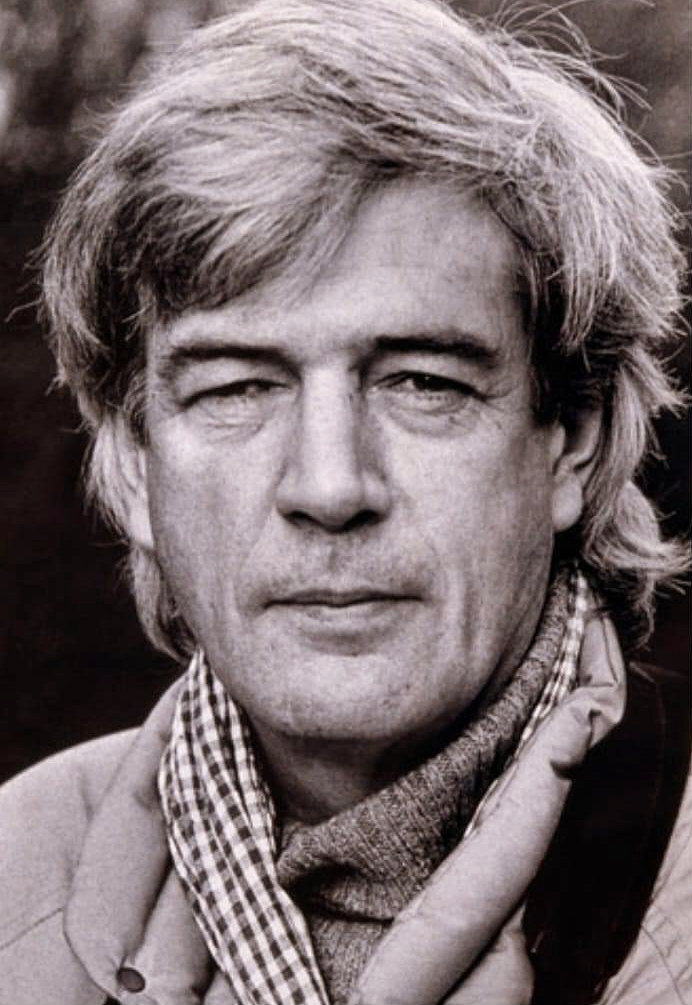
Our recently departed friend Tim Page was the central character in the 1992 ABC miniseries Frankie’s House, the story of the celebrated, inebriated Vietnamese home-away-from home and party house in Saigon for transiting newsmen – a decadent, dissolute, de facto foreign correspondents club. Tim was portrayed by Scottish actor Iain Glen, famous nowadays for his role as Ser Jorah Mormont in Game of Thrones. This was not Tim’s first first portrayal in film. Denis Hopper’s strung-out photojournalist in the 1979 film Apocalypse Now was said to have been inspired by Tim’s Vietnam adventures. This was referred to many times in the many media tributes that followed his passing and at his farewell in August last year.

Rewatching the film recently, for the first time in decades, I thought Hopper’s over the top, incongruous and unexplained character bears little resemblance to the Tim Page we knew. And yet, as Tim and his partner Mau were later to point out to me, Hopper’s cracked and crazed camera cowboy illustrated exactly what the soldiers at ground zero experienced in America’s war, a war that has since been defined as chaos without compass.

The film is loosely based on Joseph Conrad’s novel Heart of Darkness, set in a dark and deadly Belgium-ravaged Congo. A special forces officer is sent on a mission to assassinate a rogue officer who has established a quasi-kingdom in the heart of the Jungle. With poetic and creative license Francis Ford Coppola created a psychedelic fever dream somewhere up the crazy river on a journey through a war that had already been lost while the powers that be had concealed the fact to the American public and to the world at large.

The Vietnam War’s echoes reverberate to this day. In the United States, it has taken more than 50 years for such a traumatic defeat to fade. The deepest scars, inevitably, belong to those who suffered most. Author and Vietnam veteran Philip Caputo in the preface to his memoir A Rumor of War  wrote:

“I came home from the war with the curious feeling that I had grown older than my father, who was then 51,” writes. “A man saw the heights and depths of human behaviour in Vietnam, all manner of violence and horrors so grotesque that they evoked more fascination than disgust. Once I had seen pigs eating napalm-charred corpses – a memorable sight, pigs eating roast people.”

The scars on Vietnam itself were much much deeper and long lasting – on its politics, still a authoritarian communist regime; its people – millions died, were wounded or suffered long term psychological and genetic damage; and its environment – the effects of broad-acre defoliants and the damage and debris of war.

Two seminal scenes in the film encapsulate the carnage wrought in a country the US government wanted to “bomb back into the stone-age”.

Ou first introduction is where “little spots on the horizon, into gunships grow”, to borrow from Canadian songwriter Bruce Cockburn, as a squadron of US helicopters approach a tropical shore and attack a Vietcong camp in an idyllic seaside village to the exhilarating accompaniment of Richard Wagner’s rollicking The Ride of the Valkyries. Amidst the rattle of machine guns, the explosions and the flames, the American crews are portrayed as gung-ho and dispassionate participants in a real-time video game. The Vietnamese men, women and children are tiny black-garbed figures running around in panic like a disturbed ant’s nest, falling, flailing and flying through the air. Yet you know that this is no computer game. These helpless and doomed people are merely targets with nowhere to run to.

The second scene is set towards the end of the film, up that crazy river. The assassin, Willard, is about to slay his target, Colonel Kurtz – but not before Kurtz, filmed in a flame-lit semi-darkness, declares that he wants to die as a soldier and “not like some poor, crazed rag-assed renegade”. He then delivers his final testament on a war that has been all for nothing, and on why it has been lost:

“I’ve seen horrors … horrors that you’ve seen. But you have no right to call me a murderer. You have a right to kill me. You have a right to do that … but you have no right to judge me. It’s impossible for words to describe what is necessary to those who do not know what horror means. Horror. Horror has a face … and you must make a friend of horror. Horror and moral terror are your friends. If they are not, then they are enemies to be feared. They are truly enemies. I remember when I was with Special Forces. Seems a thousand centuries ago. We went into a camp to inoculate the children. We left the camp after we had inoculated the children for Polio, and this old man came running after us, and he was crying. He couldn’t see. We went back there, and they had come and hacked off every inoculated arm. There they were in a pile. A pile of little arms. And I remember … I … I … I cried. I wept like some grandmother. I wanted to tear my teeth out. I didn’t know what I wanted to do. And I want to remember it. I never want to forget it. I never want to forget. And then I realized … like I was shot … like I was shot with a diamond … a diamond bullet right through my forehead. And I thought: My God … the genius of that. The genius. The will to do that. Perfect, genuine, complete, crystalline, pure. And then I realized they were stronger than we. Because they could stand that these were not monsters. These were men … trained cadres. These men who fought with their hearts, who had families, who had children, who were filled with love … but they had the strength … the strength … to do that. If I had ten divisions of those men, then our troubles here would be over very quickly. You have to have men who are moral … and at the same time who are able to utilize their primordial instincts to kill without feeling … without passion … without judgment … without judgment. Because it’s judgment that defeats us”.

The film itself is much better than I recall it first time around. Perhaps it is because I now know substantially more about the Vietnam War than I did then. But also, because the 2001 directors cut, Apocalypse Now Redux has nearly an hour of footage that never reached the original cinema release, much of it quite crucial to an understanding of how pointless and crazy the war became.

The film contains several changes, mostly subtle, and two entirely new scenes, both of which enhance and serve to illustrate just how inchoate and crazy the war had become by the end of the sixties. By the time Richard Nixon was elected president in November 1968 with a promise to end the war and “bring the boys home”, it had almost seven years still to run.

One of the new scenes is set on the tiny US Navy river boat taking Willard up-country, Earlier in the story, the famous Penthouse Playmates arrive at a rear-base to entertain the troops. We now meet  them again at a neglected and run-down forward fire base further up the river. It is a bizarre scene with an equally bizarre script in which two stranded and befuddled beauties struggle with the surreal setting and its drug and combat addled garrison. The other has Captain Willard and the team encounter a family of well-armed holdout French colonists on their remote rubber plantation. Here we have the film’s the only solid explication of the origins and inevitable outcome of the Indochina conflict. Having denounced his country’s folly in being surrounded and defeated in the battle of Dien Bien Phu in 1954, which precipitated the end of French colonial rule and the beginning of US involvement in Indochina, patriarch Hubert de Marais declares: “You are fighting for the biggest nothing in history”.

© Paul Hemphill 2023 All rights reserved

Read more about the Vietnam War in In That Howling Infinite: The Ballad of Denton Crocker – a Vietnam elegy; Tim Page’s War – a photographer’s Vietnam journey; Journey’s end – photographer Tim Page’s wild ride; Things fall apart, the centre cannot hold – 1968 revisited 

Colonel Kurtz’s “Horror” monologue from Apocalypse Now,  performed by Marlon Brando

Journey’s end – photographer Tim Page’s wild ride

Time is an ocean but it ends at the shore
You may not see me tomorrow

Bob Dylan

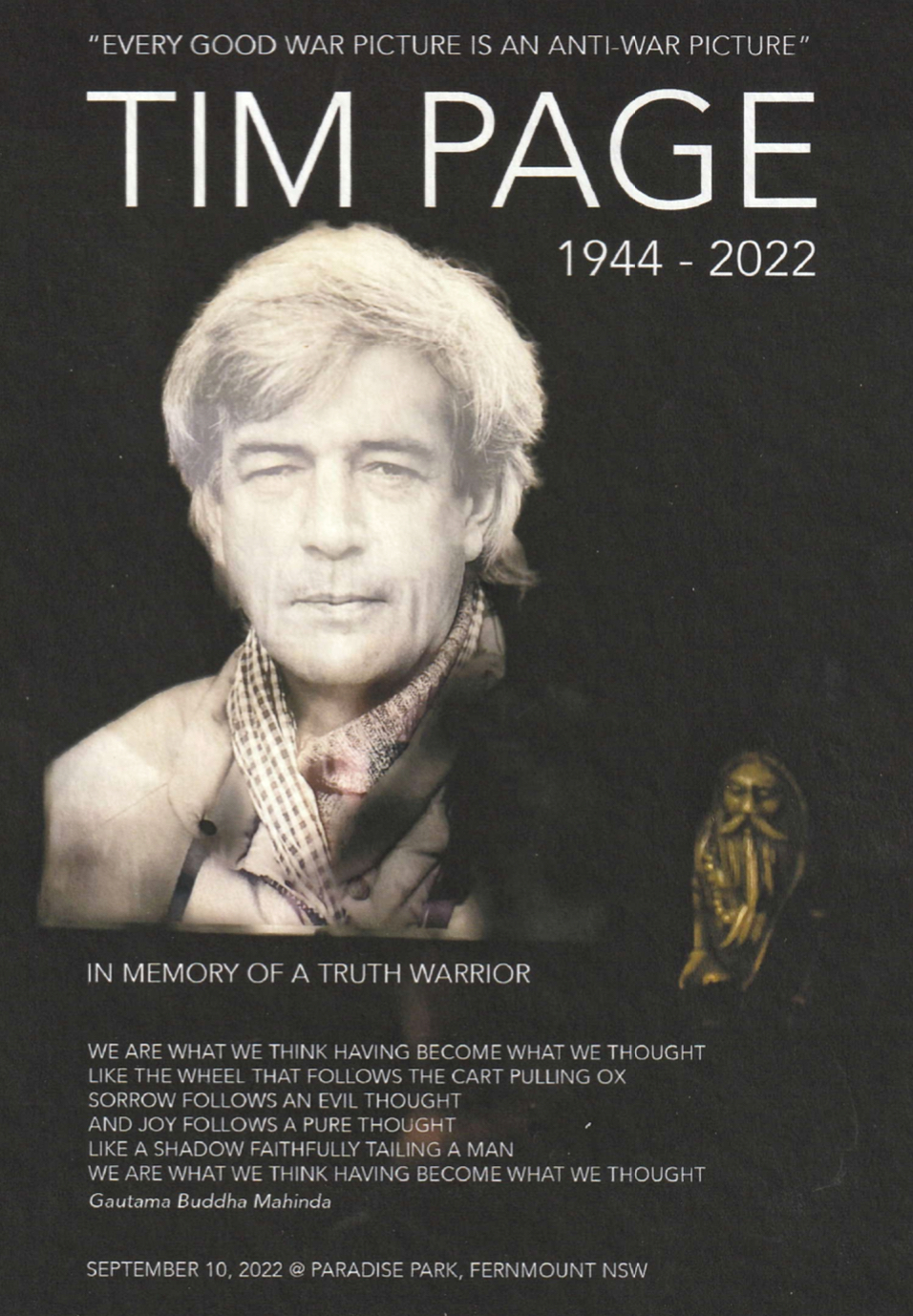
Friends of acclaimed Anglo-Australian photographer, writer and humanist Tim Page, gathered from all across the shire, from the mountains to the sea, and from around Australia on Saturday 10th September to bid him farewell at his bush home in Fernmount next to Tarkeeth Forest to bid him farewell. Bellingen’s resident square-tailed kite did a fly past as if to salute him, and as we sat around the campfire under a full moon, a bevy of fireflies emerged from the forest like faeries coming for to carry him home.

Tim had departed this mortal realm at 4.15pm on Wednesday 24th August 2022, after a relatively short illness. He been sleeping most of the time during those last few days when we dropped by on our way over the hill. We knew it was very close as we’d visited several times, and almost at the exact time of his passing, we’re were actually driving by but decided not to disturb him.

The international and social media response to Tim’s death was astounding and almost instantaneous. Within hours, tributes had been published and posted all over the world. The New York Times published an excellent eulogy, as did the Sydney Morning Herald. The Guardian presented an excellent gallery of his work. An interview by the ABC with Ben Bohane, photojournalist and author and longtime friend and mentee, is both poignant and precise. We had the pleasure of meeting Ben when he visited Bellingen and spent several days with Tim immediately before his death.

He was given a fine send-off. As one mourner noted in a Facebook tribute, “It was a long, melancholic, yet kind of wonderful weekend … the kind of gathering he’d have loved, crammed with people he cared about, the Stones and Dylan rolling out over the Birds of Paradise grove in the gully, a grassy aroma in the air, and tales of his misdemeanours, wisdom and humanity prompting chuckles and affirmations as a light breeze loosened leaves and sent them down in lazy spirals onto his wicker casket …”

Fine eulogies were delivered by Tim’s “brothers” in photo-journalism who’d worked with him over all over the world and down the years. There were tales of battlefields and bar-rooms, of recovery and resilience, of road trips and revelries, of incidents and accidents.

Tim Page 1944-2022

Tim Page 1944-2022

I spoke too, as a friend and a forest neighbour, and also, as a resident of Bellingen Shire. We’d had the privilege and pleasure of sitting with Tim for many an hour during the three months of his decline. We talked of was and when, of our childhoods in Nineteen Fifties England, of life in our valley, of history and politics and of his long and colourful career – and we were able to say goodbye to him in person four days before the end.

This is what I said …

Journey’s End

Living just over the hill, and forever dropping in here at paradise park, Adèle and I spent many an hours sharing stories and gossip with Tim and his partner Marianne and her sister Annette, who we farewelled right here just over a year ago. We all shared a common English heritage, having all grown up in postwar Britain with its rationing, blandness and monochrome conformity – in the midst of the Cold War and under the shadow of the mushroom cloud.

During the three months of his decline, Tim and I would reminisce about our common boyhoods in nineteen fifties England before we both split for foreign parts. 

We were into bicycles with drop handlebars and comics like The Beano and illustrated stories about “the war” – which was still a lived experience for the adults around us whilst the sons and brothers of our friends and acquaintances were called up for national service. We’d built the same Airfix aeroplane kits and hung our trophies from our bedroom ceilings – Tim’s are now hanging in his archive bunker over yonder. I believe he still has his Hornby train set and, no doubt, his Meccano – folks here of a certain vintage will know what I mean. He was and remained a great collector of stuff. He even picked up a UN Toyota “technical” utility truck in Bosnia and brought it back here. [Author’s note: he eventually gave the truck to a friend up the valley and it saw service as a water carrier during the devastating wildfires of our 2019-20 Black Summer]

In the sixties, we’d listened to the same music, and used some of the same drugs – me, much less than he. We both took to the Hippie Trail from Europe to Asia taking the ‘overland’ road that decades later would be called ‘the Hippie Trail’.

But Tim had already been two years “in country” when I was demonstrating in front of the US embassy in London’s Grosvenor Square against what Kenny Rodgers would call “that crazy Asian war”. 

Tim virtually ambled into the Vietnam War, the last of the “great” wars of the Twentieth Century, and though photography was a teenage hobby, in Vietnam, he drifted into the profession almost by accident. The war was a conflict with many names, but the best is probably one from Ken Burns great documentary: “chaos without a compass”. Tim navigated it cannily if carelessly for several but left ‘Nam a few years later critically injured in a minefield and indeed clinically dead in a medivac chopper. Post-op and recuperating in the US, Tim took himself off to Woodstock, New York State. where it was being said that there was going be a cool scene – which indeed there was, as we all remember:  the famous music festival held over three days in August 1969 on Max Yasgur’s dairy farm in Bethel, New York (65 km) southwest of the town of Woodstock. But Tim never got to hear any of the great music – complications from his injuries meant that he had to be medivacced out of Woodstock, probably on the same chopper that had just brought in the legendary Crosby, Stills and Nash.

Tim told us the clear-felled Tarkeeth Forest to our immediate south, just beyond those trees, reminded him of those Vietnam battlegrounds – indeed, the use of fires and herbicides in Forestry Corporation’s “forest re-establishment” reminded him of the devastation wrought by the defoliant Agent Orange in that unfortunate country. Ironically, Agent Orange may have contributed to his illness. He was unable to have MRI scans because of the shrapnel fragments in his liver from one of his many close encounters with the Grim Reaper. 

Listening to Tim’s stories, you wonder whether this peregrinating, ever-restless bloke had more lives than a cat! When he was first diagnosed in early May, as Adèle and sat on his hospital bed, I remarked that he’d already used up his nine lives. He replied: “No matter how many times you’ve faced the prospect of death, you’re never prepared for it”.

But, when the end came, he faced it with stoicism and courage. I hope that when we get there, we’ll all be as brave. 

Farewell wild rover.

Your’s was a life well lived, and to borrow from Rudyard Kipling, filling the unforgiving minute of the unrelenting day with sixty seconds worth of distance run.

As Bob Dylan sang, “Time is an ocean but it ends at the shore – you may not see me tomorrow”.

Of our elaborate plans, the end
Of everything that stands, the end
No safety or surprise, the end
Jim Morrison 1967

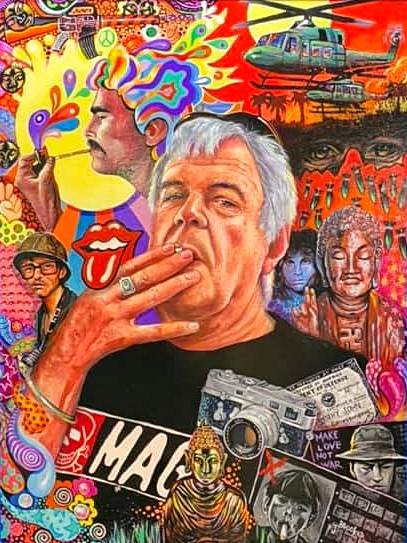
This painting by his friend Joanne Brooker portrays his long and colourful career.

Tim Page by Joanne Brooker

In Country

Tim Page’s War

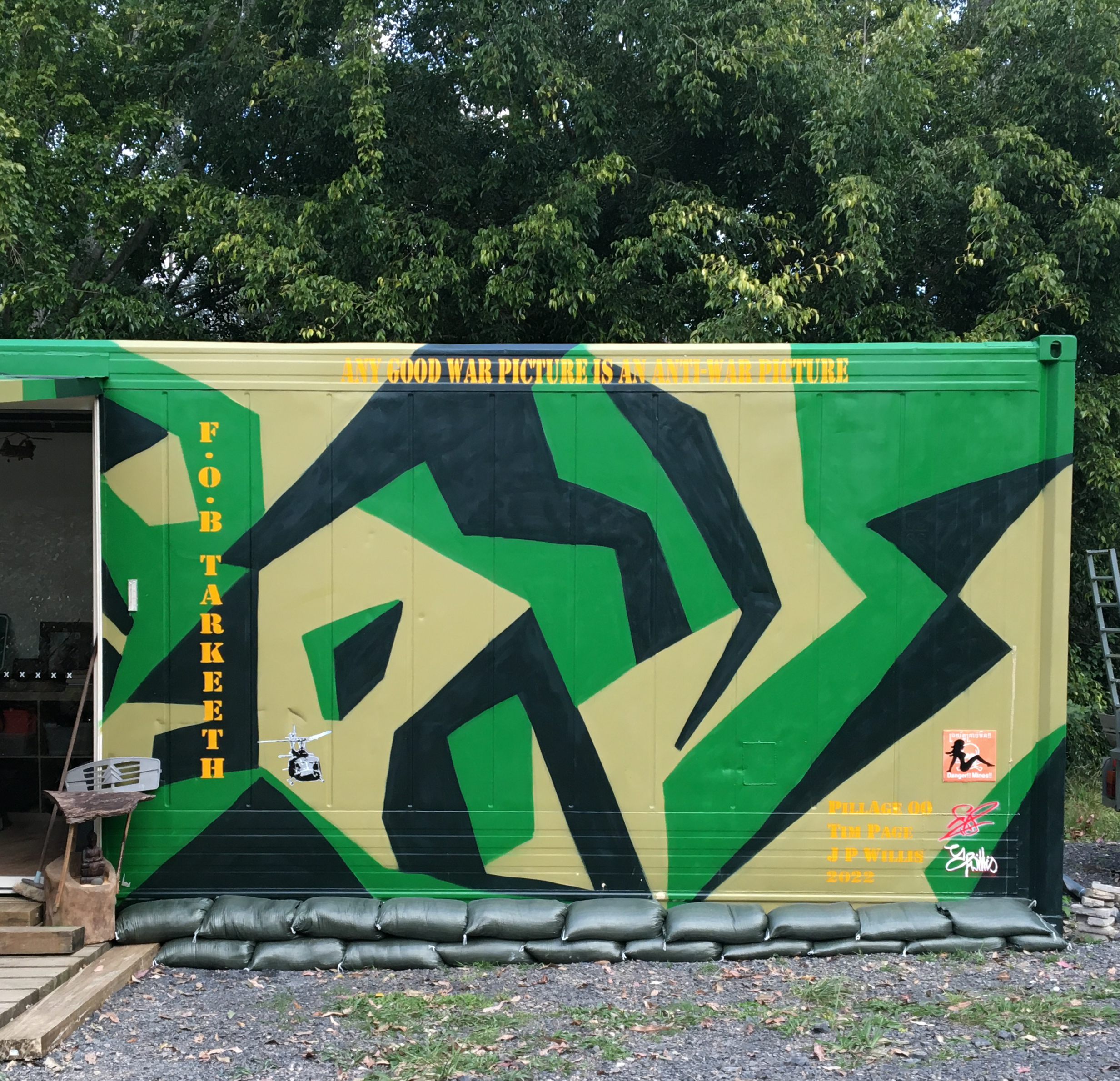
Any good war picture is an anti-war picture. Tim Page

Almost exactly a year ago, In That Howling Infinite published a piece on Tim’s journey to a war. I had been editing one of his several autobiographical accounts of his adventures and reading Max Hastings’ tombstone of a book, Vietnam – an Epic Tragedy, and spent hours talking to Tim about his life and viewing his splendid if often harrowing pictures. In Tim’s words, written on his archive “bunker”, a converted shipping container that became his last great project (buoyed up on steroids, he’d risen from his bed finished unpacking his collection on the Saturday before he died), “Any good war picture is an anti-war picture”.

In Tim Page’s War – a photographer’s Vietnam Journey, I wrote:

For Tim, it was the worst of times, it was the best of times. “Hot and cold running …” he says, using the vernacular of those days … booze, drugs, girls, he meant – battle injuries and diseases – and action, lots of it, in the air in helicopters and on occasion, fighter bombers, on the land in jeeps, armoured vehicles, and motor bikes, on the rivers in patrol boats, and on foot. The lure of sex, drugs, and excitement – and paid work for a major news agency saw him wash up in Saigon and the celebrated, inebriated Frankie’s House, a kind of home-away-from home and party house for transiting bao chi – ‘round-eye’ newsmen – a decadent, dissolute, de facto foreign correspondents club. From here, they would fan out though war-wracked South Vietnam under the often dodgy and dangerous protection of Uncle Sam. Like the soldiers they accompanied, many came back in body bags or on stretchers. Many just disappeared, and it has been Tim’s mission in life to trace these lost souls. They include his best buddy Sean Flynn, the son of famous actor and pants man Errol Flynn”.

In the 1992 series of Frankie’s House, based on Tim’s Vietnam days, he was portrayed by the Scottish actor Iain Glen, famous nowadays for his role as Ser Jorah Mormont in Game of Thrones.

Iain Glen on the left as Tim Page in Frankie’s House

“Any good war picture is an anti-war picture”.

For what is it to die but to stand naked in the wind and to melt into the sun?
And what is it to cease breathing, but to free the breath from its restless tides, that it may rise and expand and seek God unencumbered?
Only when you drink from the river of silence shall you indeed sing.
And when you have reached the mountain top, then you shall begin to climb.
And when the earth shall claim your limbs, then shall you truly dance.
Khalil Gibran

We die with the dying:
See, they depart, and we go with them.
We are born with the dead:
See, they return, and bring us with them.
The moment of the rose and the moment of the yew-tree
Are of equal duration…

TS Elliot, Little Giddng

© Paul Hemphill 2022. All rights reserved

In In That Howling Infinite, see also, Tall tales, small stories, obituaries and epiphanies

Also in In That Howling InfiniteThe Ballad of Denton Crocker – a Vietnam elegy ; anThings fall apart, the centre cannot hold – 1968 revisited