Better read than dead … where have all the big books gone?

The big books. The ambitious books, the life-changing books, the long books, the time-consuming books, the dense books. Not the “classics” because classics aren’t necessarily big and big isn’t necessarily classic (whatever that means, anyway) but the important books our culture used to produce but, today, we rarely see on bookshelves, where have they gone?

My mother used to tell me I was reading almost as soon as I could walk, and I was enrolled in libraries at an early age. In my lifetime, I’ve probably gone through tens of thousands of books of all sizes and genres. Now in my twilight years, though I still I love reading books, I would no longer regard reading as a hobby like I would be in the past, and I do not consume as many books as I did in earlier days. I often feel that I have lost the appetite for “big books” – big in the dimension and the number of pages, but not in the sense of scope and content and the literary reputation of the author. Back in day, I would tackle both the size and the sensibility of books with alacrity and and excitement, eager as I was then for knowledge and insight – those lengthy, complicated, and yes, ambitious, life-changing and time-consuming books that novelist Steve Orr name-checks in the opinion piece republished below.

As for those “big books”, I started early. Grammar School curricula mandated “set books” from the “canon” of English literature. William Shakespeare and Charles Dickens, of course, and also, among others, Christopher Marlowe, Geoffrey Chaucer, Oscar Wilde, GB Shaw, and John Steinbeck. Although we deep-dived into specific books, we were encouraged to read their other works, and more besides. So, I came to know The Iliad, The Odyssey and The Aenead, and also the French ‘greats’ Alexander Dumas and Victor Hugo. I can’t recall how I came to discover Mikhail Sholokov’s dramatic tales of the Don Cossacks, but they gave me a fascination with Russian history that has endured to this day, and introduced me to the Russian Revolution and Civil War – and socialism (see The Russian Tradition – Russia, Ukraine and Tibor Szamuely and other pieces).

During my university years, few non-fiction works of note come to mind though I’m sure I’d have read a few – including all three books of Tolkien’s trilogy which I binged on over one cold and rainy English weekend in Reading. Three years later, whilst traveling the celebrated Hippie Trail to India and back, I’d pick up random tomes in hotels and doss houses along the road. It was between Kashmir and Istanbul, I met James Joyce’s Leopold Bloom and Dostoevsky’s melancholy Prince Mishkin.

Moving to London in the early seventies, I spent hours traveling back and forth on the London Underground – always with a good book in hand. I went through phases. The Russian canon of Tolstoy, Dostoevsky, Pasternak, and Solzhenitsyn, all angst and agony, suited me well in my restless years. When my mood changed from melancholy to mellow, from the blues to the bucolic, I worked through all of Thomas Hardy’s tales of rural England, and discovered that Rudyard Kipling was much, much more than Mowgli. I encountered Milton’s fallen angel ( see Lucifer Descending … encounters with the morning star) whilst Don Quixote and Captain Ahab gave me a good literary workout. The name of this blog is taken from Moby-Dick. Meanwhile, the current best-seller lists provided many worthy reads.

Through the eighties and nineties, I would have several books on the go and would plough through several works of fiction and non-fiction each month. With the onset of the internet and the social media age, my decades long passion for history and politics superseded my fondness for a good book or two as I dedicated more of my leisure hours to news media and on-line feeds. The acquisition of an iPad in 2011 accelerated the demise of the actual printed word. I have never, however, read an e-book, and probably never will, and I buy books still, including several I would argue fitted Orr’s criteria of “big” – particularly CE Morgan’s “great American novel” The Sport of Kings and Hilary Mantel’s Wolf Hall trilogy. But since retiring to the bush, my reading capacity is down to a book every one or two months, depending in on its size.

Orr’s piece reminded me of my once prevailing but receding passion for the tangible printed word, providing not so much an obituary to the “big books” but a wake-up call.

“Maybe it’s time to commit”, he writes, “Maybe it’s time to (re-)rewire our brains to work in years, months, instead of fractions of seconds. Maybe it’s time to stop saying, “I’ll wait for the movie”. Maybe it’s time to admit we all have a little of Ahab’s obsession, Humbert’s lustings – maybe there’s a bit of Christian Stead’s controlling Sam Pollit in all us’.

“In short’, he concludes, “maybe we are the book and the book is us. Let’s admit, as Stead did when writing The Man Who Loved Children, the best way to exorcise the past is to write (and read) about it. This, as it turns out, isn’t a desirable but a necessary thing. Shall we admit, in the end, the questions the big books pose no longer interest us because we no longer interest ourselves?”

Postscript

From Better read than dead – are books the footprints from our past?

Last year, I jettisoned half of a book collection I’d accumulated over sixty years, more went this year – books that had followed me as I moved from Birmingham to Reading to London in the sixties and seventies, migrated to Australia, and moved from house to house in Sydney and finally settled in the midst of a forest in northern New South Wales.

Out went books of all formats and genres. Mementos of former passions and fashions. Relics of past courses and careers. Old school textbooks, university texts, fiction, nonfiction, dictionaries, coffee table books. I’d worked for years in publishing, so the complimentary copies alone were colossal..

I’d already culled boxes of books a decade ago when we’d last moved house and home, and this time, I was determined to downsize further. My primary criteria was that if I hadn’t looked inside the covers of a book for twenty, thirty, fifty years, then I wasn’t likely to do so in the next five, ten, twenty years I have left on this planet.

Nevertheless, I kept back five full shelves Books of poetry, some of them a century old. All-time favourite novels, including the iconic Russians, Hardy, Herbert and Heinlein. Non-fiction histories I regard with particular nostalgia or think might be of use again one day. Books about music and musicians, particularly the Beatles and the Bobster. Recent purchases. And, books I consider “rare” – a subjective descriptor that I can only explain as old books which I picked up in secondhand bookshops when I lived in London in the sixties and seventies. Some, I reckon, are actually rare!

For more on books and reading in In That Howling Infinite, see Better Read Than Dead – the joy of public libraries

Where have all the big books gone?

The big books. The ambitious books, the life-changing books, the long books, the time-consuming books, the dense books. Not the “classics” because classics aren’t necessarily big and big isn’t necessarily classic (whatever that means, anyway) but the important books our culture used to produce but, today, we rarely see on bookshelves, where have they gone?

Why aren’t (many) people writing them? And more importantly, why aren’t people reading them?

This is a not a new concern. Charles Bukowski in 1990 asked: “… well, where are they?/ the Hemingways, the T.S. Eliots, the Pounds … dead, I know/ but where are the re-/ placements, where are the new/ others?’

Poet and writer Charles Bukowski.

Poet and writer Charles Bukowski.

What was a casual question back then seems to have a new ­urgency now.

There are lots of reasons, and I’d like to explore some of them here. I suspect technology, in its various forms, is taking over the jobs we used to trust our brains to do: critical thinking, imagination, reasoning and speech and (civilised) argument and social intercourse at a personal and public level. We say, “Oh, well, I’m too busy to tackle Anna Karenina,” then pick up our phone to check the latest tweet.

We don’t value time in the same way we used to – slow, precious, filled with good smells and sounds and ideas and meaningful things. We’re happy to waste time. Like, surely, we’ll get it back? We’re happy to fill the gap with more technology, updated phones and watches. And the result? We’ve become lazy, and lonely. We’ve privatised our inner spaces, sold off our opinions, let someone else make Pixar and Marvel dreams for us. And worse, for too many people now, everything’s about money. We’ve shat on our curiosity, given up on the daily awe that came from sensing our place in nature, the consolations and compromises that made civilisation possible, and pleasant. The result? Each new generation bleeding out its limited reserves of empathy, understanding and wisdom.

Readers seem hung up on plot. Easy plots. Familiar plots. Plots that come from and return to a screen. Problem being, the big books are about big characters: Miss Havisham, Elizabeth Hunter, Captain Ahab, Tom Joad. It takes time to build up a complex, flawed life on a page, each verb and adjective competing for the smallest breath and bit of meaning. Even when contemporary writers have a crack, readers falter, stray, give up. There’s something easier, more immediate to hand. Something involving the discovery of a body on a beach and working out how it go there. Harold Bloom: “I am not unique in my elegiac sadness at watching reading die, in the era that celebrates Stephen King and J.K. Rowling rather than Charles Dickens and Lewis Carroll.”

Ironically, it’s the loss of critics like Bloom that’s allowed the problem to fester. The loss of literary criticism generally, space in newspapers, reviews themselves (ironically, surviving in 50-word online grabs where they’re easily ignored).

Today, there are fewer places to publish extracts, to make meandering explorations that interrogate context, subtext, the way authors’ lives morph onto the page, how we needn’t make the mistakes of the past, how too many of our views are founded on faulty assumptions.

All of this might seem ho-hum: “It’s a shame but, you know, the world’s changing.”

If it wasn’t for what we risked losing. That is, the understanding of what it means to be a human on Earth, a human among millions who’ve lived and died with the same urges and joys and terrors and disappointments. How else to connect with the tribe of humanity that’s fallen through time’s long ruin? Bloom again: “We read deeply for various reasons, most of them familiar: that we cannot know enough people profoundly enough; that we need to know ourselves better.”

Keira Knightley in a scene from film Anna Karenina.

Keira Knightley in a scene from film Anna Karenina.

Or as Jonathan Franzen put it in How to Be Alone: “Readers and writers are united in their need for solitude … in their reach inward, via print, for a way out of loneliness.”

The very idea of reading deeply; of making connections in order to become better people (or at least remain sane, or maybe even happy). But now, visual seems to have won out over text; we have a poorer understanding of irony, sarcasm, the art of persuasion, voice, a well-turned sentence, the art of choosing the best word (even grammar, spelling); we can’t grasp complex sentences, let alone the formal language that glues so many big books together. In short, we’re out of practice. Kids grow up without books in the house, without reading role models (family, let alone politicians and public figures, having been replaced with sporty types). No one demands sustained reading and schools are too busy teaching “multi-modal” texts (more screens) while avoiding quality books lest they disadvantage non-readers. Meanwhile, the books that are read are short, plotish, weighed down with well-meaning but yawn-worthy attempts at solving the world’s problems. Despite schools’ mission to create readers, at the end of the day they leave more waiting for a bus that’ll never come. Apart from this, schools and universities are busy “de-colonising” bookshelves, removing Pip because (I suspect) the local gauleiter has never read Great Expectations. In short, there goes the Western canon. Anyway, chances are younger English teachers haven’t read much, or they’ve been co-opted from the geography department to make up the numbers.

And what about the writers? Bukowski: “I don’t ask for Dostoevsky, there’s no replacement for Feodor Mikhailovich. But these now, what are/ they: making their tiny splashes, what practiced ineptness, what boredom of language, what a/ crass bastardly trick against print against pages …”

The reasons are complex, but the outcomes clear: writers are no longer culturally important; big books are rarely produced by profit-driven publishers, therefore fewer are written, creating a self-fulfilling Coriolis effect of big books down little drains. But mostly, big books are hard to write. Think of Patrick White churning out an Eye of the Storm or Riders in the Chariot: a hundred thousand-plus handwritten words, typed up, corrected, typed again, “oxy-welded”, years and years of solid, thankless, grinding warfare with an Olivetti and the English language to produce a masterpiece that, even then, required a visionary ­publisher (Ben Huebsch) and well-read public to give it any chance at all.

And talking about the journey. Perhaps part of the problem is that we’ve lost interest in the journey on which writers can take us over our lives. From comics, to pre-franchised, pre-teen Tolkien, the discovery of Holden Caulfield, the oh-so-clever twenty-something Infinite Jest, then to something serious, Bolano, perhaps, and on and on it goes, the road less travelled that’s no longer travelled at all. And what have we lost? The unbroken chain of meaning from Homer to Dante, Chaucer to Shakespeare, to a 20th century profusion of styles that offered Joyce in the morning and Hesse in the afternoon.

For me, as a 12- or 13-year-old, it was Dickens. To think, someone had actually dreamed up Micawber and Betsey Trotwood! Without that narrative, that connection, how do we even know what we’re missing, or misunderstanding? Are we ready to give up the collective memory that, according to Italo Calvino, holds together “the imprint of the past and the plan for the future …”

Or is it simply that we no longer know how to be alone anymore? Bloom said it was all about finding a mind “more original than our own”. But now, we’re all creators, posting a hundred daily autobiographies on TikTok. Ironically, this seems to be leaving us more lonely than ever and, having withdrawn within ourselves, having discovered we’re bored with what’s being said and sung and tweeted, we can’t work out what’s next?

Maybe it’s time to commit. Maybe it’s time to (re-)rewire our brains to work in years, months, instead of fractions of seconds. Maybe it’s time to stop saying, “I’ll wait for the movie”. Maybe it’s time to admit we all have a little of Ahab’s obsession, Humbert’s lustings – maybe there’s a bit of Christian Stead’s controlling Sam Pollit in all us.

In short, maybe we are the book and the book is us. Let’s admit, as Stead did when writing The Man Who Loved Children, the best way to exorcise the past is to write (and read) about it. This, as it turns out, isn’t a desirable but a necessary thing. Shall we admit, in the end, the questions the big books pose no longer interest us because we no longer interest ourselves?

Stephen Orr is an award-winning novelist. He will be a guest at Adelaide Writers’ Week on Wednesday 5 March.

Whoar! And Peace – or, Gone with the Balalaikas

Here are random thoughts on the latest television dramatization of War and Peace which showed on free-to-air here in Australia in September 2017 and has been repeated many times since.

In the early ‘seventies, I went through a ‘Russian’ phase, wading patiently and pensively through the greatest literary hits of Tolstoy, Dostoevsky, Turgenev and Solzhenitsyn. They seemed to suit my temperament during the cold, damp winter months as I journeyed back and forth on the London Undergound to mundane and monotonous temp jobs. I recall watching all seven hours of Sergei Bondarchuk’s epic ‘sixties adaptation in one overnight sitting at at an art house cinema in Bloomsbury Square in 1973. But I fell asleep during the thunderous battle of Borodino. The BBC crammed its 1972 adaptation of War and Peace into fifteen hours over twenty episodes – the film that shot Anthony Hopkins and Robert Powell to stardom.

How on earth do you compress some 1,500 close-typed pages into just six one-hour episodes, as the Beeb’s  latest period piece does?

A lot, obviously, has to go.

So, out go all the long expositions and naval-gazing ruminations. There no need to ponder much on the inner manifestations of the ‘Russian soul’, whatever that might be. The philosophizing that was retained felt lightweight and incongruous against the splendour of the social scene, the rural vista, the battlefields, and great historical events. Hence Andre’s deep-and-meaningfull thoughts on glory, and latterly, on bucolic visions, seemed a tad intrusive. Pierre’s thoughts on freedom. freemasonry and, latterly, after his near-death experiences, on brotherly love and the simple life, appear lightweight and cloying.

And to suit our twenty-first century tastes, in comes some glamorous naughtiness – a surfeit of sexy vignettess which old Leo Tolstoy would probably have loved but would never have committed to print, and some poetic license (or licentiousness), bare thighs and cleavage so that we well and truly got the message. It was, nonetheless a “polite society” sans filth, blood, and profanity.

What Tolstoy left to surmise and imagination, this down-sized saga leaves no sheet unturned. Helene and Anatole Kuragin really do appear to have had it off together, and she does indeed bonk Nikolai’s mates Dolokhov and Drubetskoy, and sundry others – she was quite clearly the Petrograd bike. And, of course, she comes to a bad, hallucinogenic, and sanguinary end.

The families are well drawn, and quite humorously depicted. The scheming, naughty Kuragins; the affectionate and lighthearted Rostovs, headed up by their bumbling, adoring and ultimately impecunious papa – well played by comedian Adrian Edmondson. The uptight, and undemonstrative Bolkonskys, with Jim Broadbent giving a masterclass in fine acting – “best in show” indeed. We get a fair if Kubrikesqe ‘Eyes Wide Shut’ picture of Pierre Bezukhov’s wicked, dissolute lifestyle, and his faltering, stumbling road to redemption.

So, does this truncation of the big book work? I would say yes. The story flowed, the various story-lines held together, and it was relatively easy to keep track of the characters by their appearance if not by their long names. The best way to judge a serialization is by the question: do you finish an episode looking forward to the next? And the answer is yes.

As for the cast, it appears like anyone who was anybody in British television drama or comedy, looked good in historical costume and was not in Game of Thrones, got a gig and a chance to do Napoleonic dress-ups – with the exception perhaps of Colin Firth, Aiden Turner, John Simm, Matt Smith,  Jenna Coleman, Olivia Colman and Claire Foy.

Lily James is gorgeous in an elfin, ingenue way. Although her Natasha Rostova looks and behaves like an eighteen year old throughout, and not the thirteen years old who ages in years and wisdom as portrayed by Tolstoy. She sang beautifully, and she sure can dance. The famous Natasha’s Dance scene was nicely done if too brief. It was over too quickly and failed to show how important this particular scene was to Tolstoy ; in the book, the Rostovs retire to a wooden hut at the end of a day’s hunting, where folk songs are played to the balalaika. Natasha dances to a song, but it is not a waltz or polka she is doing – instinctively, she dances like a peasant girl. The Russian soil is in her blue blood. Nevertheless, I do like Lily James. And so, it seems do the powers that be: she’s doing quite alright these days with lead roles in Darkest Hour, Mama Mia! Here we go again (singing and dancing again), and Yesterday, again singing and dancing – the lass cant keep still.

Paul Dano, the slim, young, scheming, preacher of There Will Be Blood, as Pierre Bezukov? Still slim and young looking, though “kinda funny looking” as they say in Fargo-speak. But portraying the tall, fat, shortsighted, dissolute and bumbling Pierre? Amazingly, it seems to have worked. His is a credible performance, although his “niceness” to the Rostovs and Bolkonskys, and his transformation to all-round good guy could be quite irritating. Inept, opinionated, inadequate, and out of his depth both romantically and socially. My favourite Pierre moment in the book is when he resolves to  liberate or lighten the burden on his serfs – a subject close to Tolstoy’s heart – and how his steward circumvents his wishes. This was not even touched on in the film.

Jim Broadbent as the crusty, cranky old curmudgeon Bolkonsky Senior was a tour de force. He stole every scene he was in, and although he was not like I imagined from the book – less ascetic, more rough-edged – he was the best character in the film.

Adrian Edmondson, comedienne Jennifer Saunders’s other half, and bad boy of The Young Ones and Bottom, was an unexpected delight as the genial but incompetent Rostov patriarch. He played it for laughs, and his decline under financial pressures and family tragedy was nicely handled.

James Norton’s wannabe martial hero Andrei Bolkonsky was a stitched up, uptight, frustrating, and irritating jerk. You wanted to give him a good shake. And that’s just how Tolstoy would have liked it. He looked good, especially in uniform, and carried himself just as a stitched up, uptight jerk would. I guess that makes his apotheosis and death all the more interesting. So nice that everyone got to say their goodbyes. The Gladiatoresqe ‘out of body’, vanishing into into the Russian sunset sequence as he passed on was a bit too much, but.

Jessie Buckley as his sister Princess Marya was excellent. Whilst she was in no way as plain and unprepossessing as Tolstoy painted her, her “ugly duckling” transformation was lovely to behold. I actually felt happy that she finally found happiness. She had to lose her father and brother to find herself, and also, find Nikolai, the naive and gallant hussar. Irish Jessie has been making quite  a name for herself of late as a country and western singer, and in major roles in the dubious Taboo and chilling Chernobyl.

Jack Lowden’s Nikolai, Natasha’s air-headed, profligate brother, was very well cast. A selfish prick who takes his folks for granted (and bankrupts them for bad measure), and treats pretty, poor, patient, pauper Sonya terribly, he has awful taste in friends (except for loyal Denisov) and plays a terrible game of cards,. But he sings beautifully (his duet with Natasha is a delight), and looks great in uniform.

Tuppence Middleton played Helene Kuragin as the soap-opera bad girl. She looked good, took her clothes off, wore see-through fashions, and camped it up (would Tolstoy have let her out like that, I wonder? He would doubtless of appreciated her “indoors,). And you couldn’t wait for Pierre to kick her out.

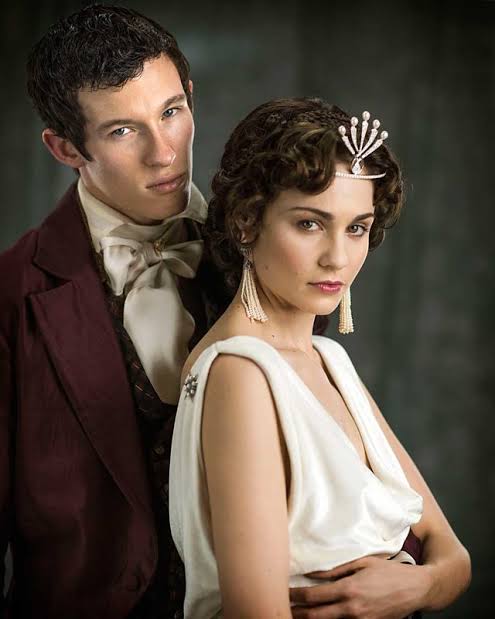
Helene and Anatole Kuragin

Minor characters were presented – with the exception of Matthieu Kannovitz’s Napoleon – a very poor caricature. I liked Brian Cox’s Kutuzov, but for me, he will always be Dalgeish of Deadwood. And Aneurin Barnard was excellent as the opportunistic Boris Drubetskoy. His meeting with Napoleon was a hoot. He is a great actor, having portrayed Cilla Black’s Bobby in Cilla, David Bailey in We’ll Take Manhattan. Rebecca Front was very good as his scheming, impecunious and irritating Mama – well remembered from the comedies The Thick of It and Nighty Night, and still, to a degree, playing it for laughs – even when securing Pierre’s inheritance by wrestling a soon-to-be disappearing will from the hands of his avaricious relatives.

Stephen Rea played Prince Vassily Kuragin with a supercilious lugubriousness, whilst Callum Turner portrays his son Anatole as a card-board cut-out rake. Gillian Anderson, looked resplendent as society hostess Anna Pavlovna Scherer, did not have very much to do except play, well, a society hostess. And lastly, there was Tom Burke’s over-the-top bad-boy Fedor Dolokhov. As Tolstoy himself put it: “There are three things I love to do!’ he roared. ‘Fight, drink, and I can’t remember the other one … “ And: “I think you’re an absolute ruffian,’ Helene tutted, branding him ‘disgusting.’

One judges the success of a visual dramatization by how well renders the original’s iconic scenes and set-pieces. Here then is a brief critique.

The famous, plot-setting grand ball was nicely done – the set, the clothes, and the dancing, building up well to Nat and Andy’s meeting and floor show. Natasha’s Dance at the Rostov dacha, so iconic and important to Tolstoy’s narodnik sympathies, was, however, disappointingly undercooked.  Bezukhov and  Dolakhov’s duel in the snow , was deftly done, demonstrating what a foolish, deadly practice this was. Pierre’s Freemason initiation was risably pythonesqe – all signs and handshakes and overdone dramatics. Why bother?

The French Invasion of 1812, heralded Halley’s Comet, as a vast army crossing the Neimen, Boney’s fateful Rubicon, is melodramatically underwhelming but perhaps, to be otherwise would have required a very big budget. and yet, the battle of Borodino – I was awake for this one – was probably the best screen portrayal of this bloodbath that I have seen. The French occupation of Moscow was cliched and cursory, whilst the burning of the city, always difficult portray in film, came across as cut-price CGI. The disastrous French retreat from Moscow, prisoners in tow,  was likewise difficult to portray, but somehow, by thinking small and focusing on the micro-dramas of the debacle, and with some cold-weather channeling of David Lean’s Dr Zhivago, it actually worked.

And finally, when the tumult and the shouting ended, the captains and the kings departed, and the characters have met their various ends or apotheoses, what of that bucolic happy families ending?

As Tolstoy himself was to say, in the opening lines of another weighty tome, all happy families are alike. The rural family barbecue was a derivative denouement. The surviving members of the three families, now three generations, gather together after all their trials and tribulations in an idyllic rustic lifestyle bought and paid for with Bezukhov and Bolkonsky money. It is reminiscent of the final scene in Cold MountainShenandoah, How the West was Won, The Sound of Music, and many others in which ‘Good’ eventually triumphs over despair, deprivation and disaster – you know how it goes: “We’re so glad all the bad stuff is over and done – may our lives now be pleasant and delightful”. Or as Tiny Tim (of Dickens’ fame, not Tulips) declaimed, “God bless us all!”

But, Tolstoy’s drawn-out, ponderous and indeed, anticlimactic and awful “getting of wisdom” finale would not have worked on screen. “Thankfully!” many would declare.  And anyhow, isn’t this how the classic hero’s quest is meant to end: with revelation redemption, reunion, and a kind of contentment. The old Count, in his mystical, mythic way, wouldn’t have wanted it any other way.

And after six hours of pretty good entertainment, who am I to blow against the wind?


Here’s what the papers said:

And here is all you ever wanted to know about Leo Tolstoy’s War and Peace, but were put off by three inches of closely-typed mall print:

War and Peace by Leo Tolstoy – digested read

We’re going to speak Frussian, join the army, fall in love, fall out of love, get very cold, and then die
Illustration: Matt Blease
                                                                Illustration: Matt Blease

It was July 1805, and all St Petersburg was concerned about the advance of Bonaparte. Though not so much as to cancel a soiree at which Pierre, a bastard by birth but not by nature, was to be introduced to Russian society.

“Pierre is not one of nous,” several guests observed. “Not only does he forget choses but he doesn’t speak Frussian. Et he drinks even plus que nous.”

Prince Andrew, a bastard by nature but not by birth, cleared his throat delicately. “As a member of the officer class, I have decided to join the army,” he declared.

“I shall join the hussars,” Nicholas declared, while his sister Natasha eyed up potential husbands. They might become rather scarce.

Pierre checked his fob watch. The pages were turning faster than he expected and his father had now died. “I seem to find myself the richest man in Russia.”

War proved more terrible than either Andrew or Nicholas has expected. Dreams as well as men got killed. “How I embrace death,” Andrew murmured as the battle of Austerlitz raged. “Pas so vite,” said Napoleon. “Permettez-moi de vous donner une main. Now I must wash my chubby little body.”

“I’m home,” said Andrew as his wife died in childbirth.

Pierre felt the burden of expectation and married Helene but, helas, she had a bit on the cote. The anguish was intolerable, but Pierre felt obliged not to kill his love rival in a duel and left St Petersburg for many years to ruminate on Freemasonry before deciding a knotted handkerchief was not for him. Instead, he chose to improve the lot of his serfs, who had up till now remained entirely invisible. “Harrumph,” he concluded at last. “I cannot improve their lot because they have never had it so good.” Tolstoy nodded approvingly, lifting his eyes momentarily from the handsome handmaiden beneath him.

“So, 500 roubles on the peace lasting,” said Nicholas, as Napoleon and the Tsar embraced in friendship, thereby losing the remains of the Rostov fortune.

“I am distraught,” Andrew declared as Natasha fell dangerously ill.

It was now 1812 and Pierre was beside himself as the French approached Moscow. “‘I am deranged with symbolism and Helene has left me even though I left her first. I vow to kill Napoleon,” he said.

Je ne peux pas believe que je have just perdu the battle of Borodino,” Napoleon squeaked, his shoe-lifts giving him gip. “The French had by lointhe best army.”

“But Russia had nature and spirituality on its side,” said Tolstoy while a chorus of Volga boatmen sang patriotic songs.

“Can you not faire quelque chose about the fumee in Moscow?” asked Napoleon. “Et quand will I receive the surrender?”

Jamais,” Mother Russia replied. First scorched earth, then General Winter. War is hell.

Pierre hovered between madness and death as the French performed atrocities during their withdrawal from the icy embrace of Mother Russia.

“There is a nobility in being broke,” said Nicholas’s aunt. “So I am going to give you some more money.” “Oh, thank you,” Nicholas replied. “Now I can marry Mary. And maybe you and Andrew can make up now, Natasha?”

“I forgive you, Natasha,” said Andrew, before dropping dead.

“That’s handy,” said Pierre, appearing out of nowhere. “Maybe I can marry you instead.”

“Yes please,” Natasha whimpered. “I can give up my singing, we can have four children and I can become a right old drudge, because Leo thinks that submission is a woman’s natural state.”

Tolstoy bowed his head. He was tired. The novel was a difficult thing. Not that his book was a novel, of course. Though people would be bound to call it that. Fools all of them. We can only know we know nothing.

 Hear Simon Callow read John Crace’s digested War and Peace on the BBC Today programme