A wide-ranging rural road trip through England’s green and pleasant land takes the traveller by antique and desolated abbeys and monasteries, their ageing walls crumbling and lichen covered, their vaulted pediments open to the English elements. The celebrated poets of the romantic era immortalized these relics in poetry, and even today, when one stands in grassy naves, gazing skywards through skeletal pillars, one can almost feel an ode coming on. Their number is remarkable – as a Wikipedia catalogue shows – and incalculable. The list is by no means exhaustive. There were one eight hundred religious houses existed in England and Wales before Henry VIII’s dissolution of the the monasteries and abbeys. Virtually every town of any size had at least one abbey, priory, convent or friary, including many small houses of monks, nuns, canons or friars. Many were spared despoliation and demolition, but many more were reduced to ruins and rubble by workmen and weather.
The 1530s were among the most significant in British history for the changes they wrought on its politics, society, culture. The backwash of the King’s Great Matter – his divorce from Katarina of Aragon, the onetime Spanish Princess and daughter of the formidable Queen Isabella, who was unable to give him a male heir to set fast his dynasty, and his marriage to Anne Boleyn in the hope that love and lust would bring forth male progeny – severed Britain from Rome’s papal dominion in matters of church and state, of its people’s bodies and souls. The pope in faraway Rome, regarded as a puppet of the Hapsburg Holy Roman Emperor in Vienna – who centuries later, historian Edward Gibbons declared as neither holy nor Roman – refused to grant Henry a divorce from Queen Katherine, his niece. Their reluctance and ultimate failure to secure this for their master doomed two wise, erudite and formidable chancellors, Cardinal Wolsey and Thomas More.
They were succeeded by Thomas Cromwell – kin, by way of his nephew, to his more famous namesake, Lord Protector Of The first and last English republic, Oliver Cromwell. Cromwell has until very recently been one of those people who whilst having immense historical significance is virtually unknown outside academia – most probably because his preeminent role in English government, politics, religion and society has long been overshadowed by the deeds and misdeeds of his royal master. Everybody knows about Henry and his six unfortunate wives – only one, Jane Parr who outlived him, got to live happily ever after – and his schism with catholic Rome that led to the establishment of the Church of England. It’s as if the narrative of the juvenile but enduring British history primer 1066 And All That had become established fact – to wit, Henry was “a bad king” but The Reformation was “a good thing”. Few will be aware that Cromwell, Henry’s counsellor and Chief Minister, had a hand in three of those marriages and their undoing, and was the prime mover for Henry’s religious revolution, and much more besides.
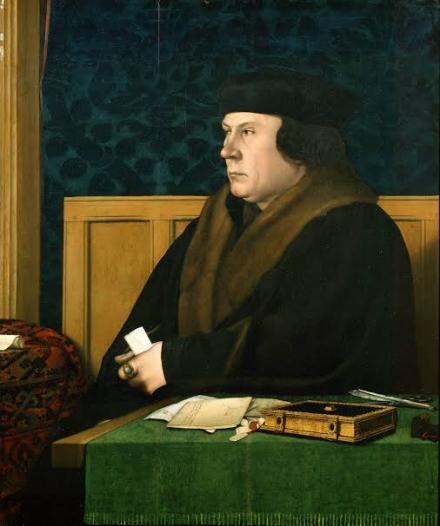
German artiist Hans Holbein The Younger’s portrait of Cromwell
The Hand of the King
In Hilary Mantel’s superb Wolf Hall and it’s equally magnificent sequels, Bring Up The Bodies and The Mirror and the Light, the story of English King Henry VIII is retold through the life and times of Thomas Cromwell, royal counsellor and chancellor. All the manoeuvres and machinations of church and state are set against the background of day to day life in 16th century England politics,trade, commerce and culture; and the annual plague that scourged high and low born alike, swift and deadly, laughing in the morning, dead by the evening. And threading through it all, is the religious ferment that was to persist, dangerous and deadly, for the next 150 years – Henry’s split with Rome, his founding of what was to become the Church of England, papists and protestants, priests and puritans, bells and smells, hair shirts, and burning flesh.
This article is the first of two published In That Howling Infinite discussing Hilary Mantel’s Cromwell. Read Beyond Wolf Hall – Icarus Ascending here.

It is Mantel we must thank for placing Cromwell on a pedestal denied him for close on five hundred years. He is now a household name, and even, as she has herself described it, an industry. She and Oxford scholar and ecclesiastical historian Diarmaid MacCulloch have developed a mutual appreciation of each other’s ‘Crummie’, and it is MacCulloch’s 2018 biography Thomas Cromwell – A Life that is the ‘go to’ book for a definitive insight into the man and his works.
Before Wolf Hall, many of a certain age might remember he was portrayed with leering, Machiavellian relish by the late Leo McKern in the old movie A Man For All Seasons. In the play and film adaptation, Cromwell was the definitive ‘baddie’ and nemesis of the virtuous and principled Thomas Moore. Wolf Hall tells a different tale. More is the wowser and prig, and also, a keen inquisitor and torturer. And Cromwell is the reasonable, affable, capable, cultured “man for all seasons”.
Younger generations met him In HBO’s sprawling, splendidly dressed, violent and naughty multi-series The Tudors. James Frain plays Cromwell as an able, cunning, too-clever by half, commoner on the make; a vindictive and vengeful man who is not averse to “showing the instruments” (of torture, that is) and ordering their use upon those he wishes to interrogate and invariably execute. Hilary Mantel’s Thomas would do no such thing. A lifetime of observing and recording has taught him that less sanguinary measures more often than not encourage confessions, and indeed, as the value of information gleaned under torture is usually false, tend to elicit the truth also. Merely talking about the instruments is enough to open the most reticent of mouths. In the television adaptation of Wolf Hall, Cromwell is played with calm understatement and restraint by veteran actor Mark Rylance.

Henry VIIII and Anne Boleyn in The Tudors
In her review of the book, What Hilary Mantel left left out, The Guardian’s Jessie Collins wrote of Cromwell: “It is his contradictions that stand out: intense focus and frenetic energy, rapacity and a social conscience, “clubbability” and a trainspotterish enthusiasm for waterworks. He was a wily operator, but a favourite of widows and wayward young men. He was undoubtedly ruthless, but sometimes tried to mitigate the king’s cruellest inclinations. He was at his fiercest when seeking revenge for Wolsey’s fall, but if we are to be sympathetic to Cromwell – as MacCulloch is – then we must recognise its correlative: his ardent loyalty”.
Reviewing MacCulloch’s tome for The London Review of Books, Stephen Alford wrote that is was “necessarily the study of a royal bureaucracy knocked into shape by the size of the job it had to deal with, as well as a close encounter with a Church remodelled in the 1530’s image of a king”.
And regarding ‘The Hand of the King’, to borrow contemporary coinage, Alford continues: “A man who in life strenuously resisted easy categories, Cromwell has been forced into the competing roles of hero and villain many times over. Neither quite fits him. To his enemies, of whom by the late 1530s there were many, he was an abominable heretic. Even today it can seem that every ruined monastery south of Carlisle and Berwick was somehow pulled to pieces by Cromwell personally … Over the centuries great claims have been made on Cromwell’s behalf. One is that he helped to bring the ‘true religion’ of Protestantism to England. Another is that he revolutionised and modernised the functioning of the English state. Both rest their weight on an individual whose life story is full of question marks …”
I have reproduced Alford’s and Collin’s reviews of MacCulloch’s biography of Cromwell below. They are well worth reading.
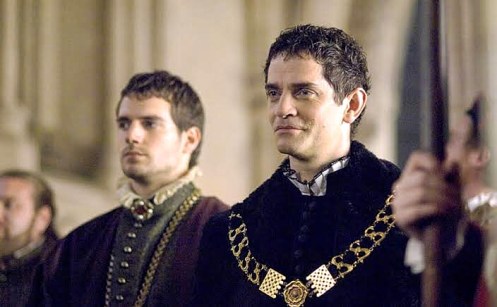
James Frain as Cromwell in The Tudors
The rift with Rome
Henry’s dispute with the Pope concerning his Great Matter was ostensibly more about monarchical power and sovereignty, his existential need to secure his heirs, and to Europe’s dynastic yet dysfunctional power struggles than about religion. He did not regard himself as one of the reformists, or Protestants as they became known. He remained, and regarded himself, a catholic monarch, and a “Defender of the Faith”, a title the Pope himself conferred upon him for his written repudiation of the heretical works and preachings of one time cleric Martin Luther – and a motto that still circles the image of the monarch on Britain’s coinage.
Mantel’s Thomas Cromwell is well aware that Henry is no true Protestant and that. His repudiation of papal authority split is about power and sovereignty, and not popish practises, which he persists in observing. The king continues to follow the mass, to observe the saints’s days (though there are less of them now). Both king and clergy resisted the publication and dissemination of the bible in English. Like their predecessors, they did not want the lower orders to discover that the scriptures made no mention therein of indulgences, of clerical celibacy, of purgatory, and indeed, of clergy. Like the kings and prelates of Catholic Europe, he was not averse to consigning heretics to faith’s cleansing fire, and torched those who’d adopted the rejectionist doctrines of Martin Luther and John Calvin – those who by the end of the sixteenth century, would be described as Protestants – and before that, theological dissidents who populated a broad continuum between traditionalists and reformers. Later, when Protestants were in the ascendant, the authorities cast Catholic and other adversaries into the fire.
But perennially impecunious, His Majesty can smell the money and is soon hooked on the riches and the lands that accrue to the crown and its cronies with the dissolution of the great abbeys and monastic houses. Thomas, his “go to”, “can do” red right hand fixes it – to his own benefit and that of his family and friends, and, also of the impecunious honour-rich but debt-deprived ancient families.
Whilst Henry was opportunistic and impulsively adventurous, Thomas, for all his erudition, political skill, and lived experience in Europe and England, was actually a cautious and calculating true believer. Stephen Alford again: “He was a man of the world, a pragmatist whose preoccupations were with the possible; it just so happened that for Cromwell the scope of possibility was so much greater than it seemed to be for other people. Yet he was a believer too, from at least the 1520s an enthusiast for Reformation. After 1537, as secure as he was ever likely to be politically, he began to pursue with a single mind an evangelical agenda. But he was also cautious …In the always unpredictable and often dangerous religious landscapes of the 1520s and 1530s he played his faith very close to his chest. Spared the agony and ecstasy of a public spiritual crisis, he left prophecy and martyrdom to others”.
In the wake of Cardinal Wolsey’s failure and demise, Cromwell becomes the public face of the king’s split with Rome and the spiritual and temporal authority of the Pope. His Protestant beliefs, fostered during his sojourn in the heretical Low Countries, impelled his rejection of the Roman faith with its corruption and its confidence tricks, its profiteering and its hypocrisy, its fabricated sinecures and sacraments, its relics and its indulgence. His pure hatred and contempt for the whole shaky edifice is force-fed by the prospects of divesting the English church of its immense power, wealth and influence, of filling the crown’s hungry coffers.
Cromwell is fully aware that he is loathed by the common people who yearn for the old, familiar ways, the “bells and smells”, the bits of dead saints’ bones and the shreds of their shrouds. They rise up, in a quixotic revivalist crusade called The Pilgrimage of Grace, and having risen up in rebellion against the new order, are on his orders, put down mercilessly with sword and rope by England’s hereditary warlords.
“It takes a generation, he says, to reconcile heads and hearts. Englishmen of every Shire are wedded to what their nurses told them. They not like to think too hard, or disturb the plan of the world that exists inside their heads, and they will not accept change unless it puts them in a better case”?
And yet he is resolute in his convictions. “But new times are coming … children yet to be born – will never have known their country in thrall to an old fraud in Rome. They will not put their faith in the teeth and bones of the dead, or in holy water, ashes and wax. When they can read a Bible for themselves, they will be closer to God than to their own skin. They will speak His language, and He theirs”.

The Dissolution Of the Monasteries
The harrowing of the shires
Hilary Mantel gives us a formidable and very original account of the dissolution of the monasteries and the demolition of the very foundations of the established faith. She catalogues the work of the commissioners, the enforcers and the executioners, the suppression of the superstitions and the scams, and the rivers of gold that flowed into the pockets of the king and his agents along with lands and mansions. It’s such a remarkable read, I quote it here in full:
This winter the king is taking the surrender of the great abbeys, with their manorial titles and broad acres, their watercourses, fishponds, pastures, their livestock and the contents of their barns: Every grain of wheat weighed, every hide counted. If some geese have flocked to market, cattle strolled to the slaughterhouse, trees felled themselves, coins jumped into passing pockets… it is regrettable, but the kings commissioners, men not easy to deceive, could not go about their work without their presence being heralded: The monks have plenty of time to spirit the assets away. Treat the King fairly, and he will be a good master. When Saint Bartholomew surrenders and it’s bells are taken to Newgate, Prior Fuller is granted land and a pension. Officers of the Court of Augmentations move into its great buildings, and Richard Riche plans to turn the prior’s lodgings into his townhouse. In the North Country, Abbot Bradley of Fountains settles for an annual pension of 100 pounds. The Abbot of Winchcombe, always a helpful man, accepts a hundred and forty. Hailes surrenders, where they displayed the blood of Christ in a phial. The great convent at Syon is marked for closure, and he reminds himself of Launde, with Prior of Lancaster has been in post for three decades, which is too long. It has not been a pious or happy house these last years. When questioned the prior would always declaring, omnia bene, all’s well, but it wasn’t: the church roof leaked and there were always women about. All that is over now. He will rebuild it, a house after his own liking, in England’s calm and green heart. In dark weather, he dreams of the garden arbour, of the drifting petals of the rose, pearl-white and blush-pink. He dreams of violets, hearts-ease and the blue stars of the pervink or periwinkle, used by our maids as lovers knots; in Italy they weave them into garlands for condemned men … (page 699)
… In November he writes in his memoranda, “the Abbott of Reading to be tried and executed”. He has seen the evidence and the indictments; there is no doubt of the verdict, so why pretend that there is? The Days of the great abbeys died with the north country rebellion. The king will no longer countenance subversion of his rule, or the existence of men who lie awake in their plush curtained lodgings and dream of Rome. Thousands of acres of England are now released, and the men who lived on them dispersed to the parishes, or to the universities if they are learned: if not, to whatever trade they can find. For the abbots and priors it’s mostly ends with an annuity, but if necessary with a noose. He has taken into custody Richard Whiting, the Abbott of Glastonbury, and after his trial he is dragged on a hurdle through the town and hanged, alongside his treasurer and his sacristan, on top of the tor: an old man and a foolish, with a traitors heart; an embezzler too, who has hidden his treasures in the walls. Or so the commissioners say. Such offences might be overlooked, if they were not proof of malice, a denial of the king’s place as head of the church, which makes him head of all chalices, pyxs, crucifixes, chasubles and copes, of candlesticks, crystal reliquaries, painted screens and images in guilds and glass.
No ruler is exempt from the death except King Arthur. Some say he is only sleeping, and will rise in an hour of peril: if say, the emperor sends troops. But at Glastonbury they have long claimed that he was as mortal as you and me, and that they have his bones. Time was, when the abbey wanted funds, the monks were on the road with the mouldy head of John the Baptist and some broken bits of the manger from Bethlehem. But when that failed to make that coffers chime, what did they arrange to find beneath the floor? The remains of Arthur, and beside him the skeleton of a queen with a long golden hair?
The bones proved durable. They survived the fires have destroyed most of the Abbey. Over the years they attracted so many pilgrims that Beckett’s shrine waxed jealous. Lead cross, crystal cross, Isle of Avalon: they wrung out of pennies from the treacherous and awed. Some say Jesus himself trod this ground, a bruit that the townsfolk encourage: at Saint George’s In they have an imprint of Christ’s foot, and for a fee you can trace around it and take the paper home. They claim that, after the crucifixion, Joseph of Arimathea turned up, with the Holy Grail in his baggage. 700 He brought a relic of Mount Calvary itself, part of the hole in which the foot of the cross was placed. He planted his staff in the ground, from which a Hawthorne flowered, and continues to flower in the fat years and lean, as the Edwards and Henrys reign and die and go down to dust. Now down to dust with them go all the Glastonbury relics, two saints called Benignus and two kings called Edmund, a queen called Bathilde, Athelstan the half-king, Bridget and Crisanta, and the broken head of Bede. Farewell, Guthlac and Gertrude, Hilda and Hubertus, two abbots called Seifredus, and pope called Urbanus.Adieu, Adelia, Aidan Alphege, Wenta, Walburga, and Cesarius the martyr: sink from man’s sight, with your muddles and your misstranscriptions, with the shaking of your flaky finger bones and the compound jumble of your skulls. Let us bury them once and for all, the skeletons of mice that mingle with holy dust; the ragged pieces of your tunics, your hairshirts clumbed with blood, your snippets and your offcuts and the crisp charred clothing of the three men who escaped from the Burning Fiery Furnace. The lily has faded, that the virgin held on the day the angel came. The taper is quenched, that lighted the Saviour’s tomb. Glastonbury Tor is over 500 feet high. You can see for miles. You can see a new country if you look, where everything is fresh, repainted, re-enamelled, bleached, scrubbed clean … (page 701)
While the welcoming party is around the sea, the Abbott of Colchester is in the air. Colchester had signed up to the King supremacy, he had taken the oath. Then he gave backward, in whispers behind the hand: More and Fisher were martyrs, how he pitied them! When he was called upon to surrender his abbey, he said the king had no right to it – which is to say, his will and laws I know. He is head neither of the spiritual realm nor the temporal; in effect he is no king and parliament can make the law. According to the Abbot.
… It is the last of the hangings, he is sure. They were infecting each other, Colchester, Glastonbury and Reading. But now resistance to the King’s will is broken. All other houses can be closed by negotiation: no more blood, no more ropes and chains. No more examples are needed; the traitor’s banner is trampled, that portrayed the Five Wounds. Superstitious men in the north claim that in addition to his principal wounds, Christ suffered 5470 more. They say that every day fresh ones are incised, as he is cut and flayed by Cromwell. (page 709)
Let England shake
Thomas Cromwell was executed on Tower Hill on 28th July 1540 and was buried in the Tower of London’s Chapel of St Peter ad Vincula. Interred thereto are Anne Boleyn and Margaret Pole, Countess of Salisbury and the last of the Plantagenet line – both of whom were executed through Cromwell’s’ manoeuvrings. Seventeen year old Catherine Howard became Henry’s fifth wife on the day that Cromwell died – and condemned for adultery and accordingly, high treason, she went to the block on Tower Green less than two years later. These were dark times for bad girls and wide boys.
Hilary Mantel’s story has been about England, it’s legends and it’s legacies, it’s rythmns and rhymes, it’s history past, present, and future. And he, Thomas Cromwell, has made England shake. And hisnrevolution endured. Henry VIII let it run, and his son, frail but resolutely Protestant Edward, endeavoured to anchor it. The Spanish Princess’s daughter ‘Bloody Mary’ strove with fire and sword to unmake it. And Anne Boleyn’s child, Elizabeth, set it in concrete so strong that Scottish James and his unfortunate son Charles I could not crack its foundations.
The rest, as they say, is our history.
© Paul Hemphill 2020. All rights reserved
For other posts in In That Howling Infinite on matters historical, see Foggy Ruins of Time – history’s pages
Stephen Alford, London Review of Books November 8th 2018
Review of Thomas Cromwell – A Life by Diarmaid MacCulloch, September 2018
In 1517, a fierce commercial struggle broke out in England between two enterprising competitors in the busy trade of saving souls. The English Province of Austin Friars and Our Lady’s Gild of Boston, deep in the Lincolnshire fenland, went to law over the sale of indulgences, those pardons, common across the whole of Europe, offering remission for souls in purgatory. Since 1500 Our Lady’s Gild had built up what was probably the largest indulgences business in the kingdom. The friars pursued the same trade with equal vigour. The collision of interests was not surprising – big money was at stake. Far away in Saxony, Martin Luther, a brother Augustinian, was about to open heavy fire on what he saw as the whole worthless racket.
Our Lady’s Gild threw its considerable resources at the case. It appealed to Thomas Wolsey, Henry VIII’s indispensable right hand: cardinal, archbishop, lord chancellor, Wolsey was a formidable broker of power. And it also bought the services of a clever (and therefore expensive) attorney. This was Thomas Cromwell, who in early 1519 went to Rome to make his client’s case at the pope’s court. He journeyed via Calais, was away on his mission for 26 weeks, and as he travelled read Erasmus of Rotterdam’s New Testament in Greek and Latin. Erasmus, the most brilliant scholar of the age, got him thinking.
Cromwell loved books. He was a talented linguist and his Italian in particular was excellent. But he wasn’t a secluded intellectual. He hadn’t studied at a university, and the law he picked up in London he used to make a good living for himself. Intelligent and restless, he had knocked around a bit in his time. Teenage wanderlust had taken him as far as the Mediterranean, and in his twenties he was in Antwerp, the greatest European entrepôt of its day, a magnet for merchants and high financiers. He was comfortable in mercantile company and he liked money. Socially it was tricky to pin him down. His father was a yeoman with a substantial interest in brewing, his mother was a gentlewoman. He was thus himself a bit of a hybrid, and would always remain so. The accounts of Our Lady’s Gild of Boston gave their comfortably middle-aged attorney (he was now in his thirties) the gentleman’s title of master. Cromwell was the boy from Putney who rose and fell at the court of Henry VIII with, as Diarmaid MacCulloch’s biography shows, spectacular unobtrusiveness.
A man who in life strenuously resisted easy categories, Cromwell has been forced into the competing roles of hero and villain many times over. Neither quite fits him. To his enemies, of whom by the late 1530s there were many, he was an abominable heretic. Even today it can seem that every ruined monastery south of Carlisle and Berwick was somehow pulled to pieces by Cromwell personally. Reginald Pole called him a Machiavel, and the label, seemingly congruent with the Frick Collection’s famous portrait by Hans Holbein the Younger, has stuck: Cromwell’s intensely focused stillness suggests a man it would be unwise to cross. Even for those who lionised him as a champion of the English Reformation, there were bits of his life which didn’t quite fit. The story of attorney Cromwell’s mission to Rome was first told by John Foxe in Actes and Monumentes, the ‘Book of Martyrs’. Foxe had to rescue his hero with some deft literary footwork, turning on its head the uncomfortable tale of Cromwell’s journey to the heart of Roman superstition and error. Elizabethan Protestants could thank providence that Erasmus’s New Testament had spoken to Cromwell’s spiritual sensitivity in those weeks of travel and given him a ‘better understanding’ of God’s truth.
Over the centuries great claims have been made on Cromwell’s behalf. One is that he helped to bring the ‘true religion’ of Protestantism to England. Another is that he revolutionised and modernised the functioning of the English state. Both rest their weight on an individual whose life story is full of question marks. There is no tidy box of historical explanation into which we can put him. The brisk judgment of Hugh Trevor-Roper was that Cromwell ‘was a freak in English history’. It has always been easier to fall back on broad-brush assertions or to dismiss him with an adjective: ‘sinister’ and ‘Machiavellian’ used to be two of the most common. As Geoffrey Elton wrote in 1953, ‘We do not call a man sinister whom we know well, whether we like him or not.’ But Elton merely restates the problem. How do we get to know Thomas Cromwell in the first place?
The answer is by a painstaking forensic recovery of every surviving piece of evidence and then letting the completed dossier speak for itself. MacCulloch’s biography is itself an exercise in Cromwellian rigour. Nothing here is rushed, no detail overlooked. Care and precision are everything. Later reminiscences of Cromwell are positioned and repositioned, the chronology tested, every particle sifted and cross-referenced. We need to know before we can judge. We feel by the end of MacCulloch’s formidable book that we know Cromwell very well indeed.
The Cromwell of this Life seems at times to be a watcher more than an actor, purposeful and busy yet somehow also passive. He had a strong sense of family and kinship, and a gift for making friendships durable enough to survive the later painful upheavals in religious belief. He understood the obligations of courteous reciprocity in a society whose mechanisms were lubricated by patronage. MacCulloch’s Cromwell is a collector and a reader of books. Italy is his passion, Italian the shared language of his friends and colleagues. He read Machiavelli (History of Florence as well as The Prince), Petrarch and Castiglione’s manual for the courtier, Il Cortegiano – important reading for the attorney from Putney. He was on equal terms with university scholars like Cranmer, a don to his fingertips. But Cromwell never lost the self-containment and self-reliance of the autodidact. He was a man of the world, a pragmatist whose preoccupations were with the possible; it just so happened that for Cromwell the scope of possibility was so much greater than it seemed to be for other people.
Yet he was a believer too, from at least the 1520s an enthusiast for Reformation. After 1537, as secure as he was ever likely to be politically, he began to pursue with a single mind an evangelical agenda. But he was also cautious. As Foxe described it (and his description seems to fit the man), Cromwell’s conversion was a process, not a spasm of Damascene revelation. In reading the Erasmian New Testament, as Foxe put it, Cromwell ‘began to be touched and called to better understanding’. In the always unpredictable and often dangerous religious landscapes of the 1520s and 1530s he played his faith very close to his chest. Spared the agony and ecstasy of a public spiritual crisis, he left prophecy and martyrdom to others.
Striking in the world MacCulloch builds around Cromwell is its sense of order and routine, its reasonableness, its gentleness even. The fractures of the 1530s, the consequences foreseen and unforeseen of Henry’s ‘Great Matter’ – the problem of Katherine of Aragon and the break with the Church of Rome – are all the more shocking because the bonds of social and political solidarity which pushed Cromwell up the ladder of preferment and promotion had once been so resilient. He had no grand plan for greatness. To talk about his ‘rise to power’ after 1530 feels almost like bad form; however true, the cliché, which suggests the energy of personal ambition, doesn’t quite fit. Though he was ever the sharp-eyed attorney, it was his grasp of minutiae, his gift with a pen, his ability to persuade others, his patience, that really marked him out. He had an instinct for the right move to make at the right time, offering a masterclass in the softly, softly approach to the acquisition of authority. In his life, routine and process counterweighted those moments in Henrician politics when the blade of the executioner’s axe met the neck on the block or the fire was lit under the prisoner bound to a stake. Volatility in this book is left to King Henry, tantrums and petty revenge to Anne Boleyn, sulks and tactlessness to Stephen Gardiner, fuming at upstart nobodies to His Grace the Duke of Norfolk. Cromwell, without title and for a long time without proper position, moved quietly ever forward.
It all began in Putney, a few miles upriver from London, where he was born and from where he escaped probably as soon as he was able. Born around 1485, he was a teenager at the turn of the new century. His father, Walter Cromwell alias Smith, was a more or less successful businessman whose brushes with manorial justice were practically routine. His mother’s name may have been Katherine, and her origins can be traced with some close detective work to the Meverell family of the Staffordshire Peaks.
The mature Cromwell looked back to his own wild youth, ‘as he himself was wont oftentimes to declare unto Cranmer Archbishop of Canterbury, showing what a ruffian he was in his young days’ (the words belong to John Foxe). We shouldn’t take him too seriously here; it is easy to overlook his wry sense of humour. He was a wanderer and a traveller, and gave himself an education in the world so very different from the suffocating discipline and narrow curriculum of a university. What historians and biographers can’t fix with the certainty of fact and evidence offers the novelist the rich and necessary space of imaginative possibility. This has been true of Cromwell’s life since the 16th century. A novella by the Italian author Matteo Bandello, printed (naturally) by John Foxe, interpreted Cromwell’s adolescent travels in Europe as an escape from the violence of his father, a story with shaky foundations that was taken up with enthusiasm by the Victorians. Our first meeting with a young Thomas felled and bloodied by the calculated savagery of Walter Cromwell’s kicks in Hilary Mantel’s Wolf Hall is viscerally memorable.
There is no clear vision of Cromwell until the age of forty, though by the 1510s he begins to come a little more into focus. He married his wife, Elizabeth, probably a few years after Henry’s accession in 1509. They had two daughters, Anne and Grace, and a son, Gregory, born in 1519 or 1520. At some point in the 1520s Elizabeth’s mother, Mercy (the Mistress Prior always popular with the family’s friends and handy with medicines), moved in. In 1523 the Cromwells took up residence near Austin Friars, in a grand house on Throgmorton Street. Thomas was doing well for himself. Nestled close to the beautiful Augustinian friary, his legal practice took him upriver to the Court of Chancery in Westminster. His Anglo-Italian business and legal connections were extensive. He counted as friends and clients merchants who went to the king’s court to trade their luxurious fabrics before Henry himself. Already Cromwell was on the fringes of power.
The big step up came in 1524, when he was recruited into the household of Cardinal Wolsey. Wolsey, prince of the Church and Henry’s man, wanted to build his legacy in stone. He planned two colleges, one in Ipswich (his home town) and the other in Oxford, as well as a tomb that would stand as a masterpiece to celebrate a masterly career. With his scrupulous eye for detail, Cromwell was perfect for the job of managing these considerable projects. This laid the groundwork for a later career that, had Wolsey lived years longer, might never have happened. Cromwell had the job of winding up some small religious foundations whose liquidations funded Wolsey’s colleges and tomb. Cromwell visited these houses and, with an improvisatory talent for handling the paperwork, oversaw the legal details. By the late 1520s few outsiders knew the English monasteries better than he did. He was given a job and got on with it, enjoying his freedom. In recruiting distinguished scholars for the Oxford foundation, Cromwell already had a good eye for university men sympathetic to Reformation ideas.
And so he prospered and he learned. Elected to the House of Commons for the Parliament of 1523, he saw for the first time from the inside a body he would come to manage in the 1530s with the same confidence he demonstrated in Wolsey’s service. He knew early on what he was up against, though he saw too the very human side of institutions. Of his 17 weeks in Parliament he wrote to a friend in 1523: ‘Howbeit, in conclusion, we have done as our predecessors have been wont to do, that is to say, as well as we might, and left where we began.’ Even the frighteningly efficient attorney had a sense of humour.
The hardest year personally and professionally was 1529. Elizabeth, Anne and Grace Cromwell died and Wolsey proved unable to deliver what Henry VIII had demanded: a satisfactory conclusion to the Great Matter, the neat annulment of a marriage to Katherine of Aragon that had been no marriage at all in the eyes of the king. Wolsey – like everyone else – had failed to attend to his majesty’s delicate conscience. Yet Cromwell remained close to Wolsey. He stuck his neck out to defend the cardinal in the Parliament of 1529, where Wolsey’s many enemies were determined to bring him down once and for all. For most of 1530 Cromwell hovered uncertainly between loyalties. But he was Wolsey’s man still, handling his master’s business long after the cardinal’s fall.
Parliament had shown his capabilities. In early January 1530 he took a walk with the king in his majesty’s garden at Westminster during which, such evidence as there is suggests, he gave an expert’s view of how profit might be made out of Church reform. Henry, at a critical moment in his fight with Rome, saw the possibilities. But no deal was done. That summer Cromwell toyed with a plan to fall back on his private practice as an attorney. In August 1530 he laboured over the wording of a letter to his disgraced master, who seemed incapable of keeping himself out of the headlines. ‘Learn to experiment how ye shall banish and exile the vain desires of this unstable world,’ he wrote to Wolsey. Now with a decision to make for himself, Cromwell’s words may have spoken as much to his own situation.
Something almost irresistible seems to be acting on Cromwell in the early 1530s, MacCulloch’s biography suggests, and the next step in his career happened as a kind of natural process, like the turning of the seasons. Somehow it was inevitable. Some people noticed it, some didn’t. By 1530 he had supporters at court, and they shared a common profile: they had been close to Wolsey, they didn’t like Anne Boleyn, but they were obeying as loyal subjects the king’s efforts to get rid of Queen Katherine, though with little enthusiasm. Just when few knew precisely how to give Henry what he wanted, Cromwell was the man being talked about. ‘And forasmuch as now his Majesty had to do with the Pope, his great enemy, there was (he thought) in all England, none so apt for the King’s purpose, which could say or do more in that matter than could Thomas Cromwell.’ So, in later years, said Sir John Russell, a court insider.
From 1531 Cromwell became the king’s fixer. In a sense he merely moved from one legacy project to another, for by now Henry was no longer content to play by the rules of Rome. His majesty’s cause had run into the buffers at the legatine court at Blackfriars in 1529, precipitating the collapse of Wolsey’s power. Yet Henry refused to give up, and by 1530 a kind of royal think tank, of which Cranmer was a member, was beginning to suggest a radical change of strategy.
The King Henry of this biography is impulsive and unpredictable, with a short attention span and a consistently high regard for his own genius. In the Great Matter he knew what he wanted. When in late 1530 Henry read a dossier that set out compelling historical evidence of his own spiritual supremacy, he annotated it in 46 places. Even Henry’s normally dormant critical senses were alert enough to ask of key passages ‘Ubi hic?’ (‘Whence does this come?’). But naturally he was an enthusiast, for supposedly erudite scholarship by others told him what he wanted to hear. In his mind was the image that Cromwell and Cranmer were later able to transmit to all the king’s subjects by means of the title-page of the Great Bible: Henry at the centre of everything, beholden to no other human power, communicating with his God without the need for an intercessor.
It was Cromwell’s job to make something strong and meaningful out of this confection of royal ego, dodgy history, polarised court politics and happenstance. It was a task that involved facing down the elite of the English clergy, detaching England from the authority of the bishop of Rome by statutory means (while emphasising that the king was very firmly above any law), managing official propaganda, and breaking Henry’s opponents. Thomas More and John Fisher were two victims. In the final encounters with More we find in Cromwell the human face of a process the collateral damage of which meant almost nothing to the king; they were two servants of a royal master, bound by that commonality, who found themselves on opposite sides of his majesty’s will. Cromwell as ever got on with the job, roughly balancing duty and conscience, and smoothing to the best of his ability the sharper edges of Henry’s displeasure.
Closeness to the king himself mattered more for Cromwell than formal position. The later promotions – Baron Cromwell of Wimbledon in 1536, Earl of Essex for a mere two months in the year of his downfall, 1540 – look like overcompensations for a loyal servant snubbed early on. But the initial appointments, the earliest signs of favour, meant something. Master of the jewels (1532), chancellor of the exchequer (1533), master of the rolls (1534), vice-gerent in spirituals (1535): each of these gave access to the king and influence over the flow of paper, allowing Cromwell to expand his horizons and his control. Newly promoted, he quickly needed a portrait (hence Holbein’s extraordinary picture) and a coat of arms, for which he, daringly, chose to incorporate elements of Wolsey’s own. Always perhaps a little unpredictable, a bit of a hybrid, his standing was never quite fixed. In fact the new offices of vice-gerent and vicar-general, which gave him as the king’s deputy the authority to suppress the religious houses, produced a very English awkwardness over etiquette. How should one refer to the vice-gerent? ‘Your grace’ was out, ‘Your holiness’ a non-starter. One bureaucrat with a talent for flattery came up with the perfect title: ‘Your goodness’. Probably it spoke to Cromwell’s own genius for flexible improvisation, as well as to his sense of humour.
The question that used to be asked of the huge upheavals of Reformation in the 1530s was ‘King or minister?’ Henry or Cromwell? Whose responsibility was it all? Whose vision? Whose fault? These questions once made sense, based as they were on the belief that an individual alone might be masterful or visionary enough to direct the fortunes of a kingdom. We seem today to have lost that easy faith. In the 1530s there was a sustained effort at making the Henrician revolution work, at least in the interests of the king. That conversation between Cromwell and Henry in Westminster in early 1530 bore fruit. The king and his elite made a fortune out of the Church and its lands. Enforcement was tough, its instruments being a new treason law and propaganda and new agencies of government able to process a massive administration. There was of course a reaction from subjects who saw their world being ripped apart. In the great rebellion in the north of England in 1536 ‘pilgrims’ stood for the commonwealth against Cromwell and other heretics. And all of this from the king’s passion and scruple of conscience. There was little intelligent design here, at least initially. Henry was too flawed a leader to have thought very much or for very long about the consequences of what he began, other than for himself. Led by impulse from one moment to another, he put the allegiance of loyal subjects under immense strain. Disconnected from the human cost of his actions, he was a tyrant in the making.
Holbein’s portrait of Cromwell shows the ideal bureaucrat. Within reach are the implements of office: quill, book and papers. The steadiness of the gaze is what unnerves the viewer. Cromwell’s instinct for government and process, and his sense of balance, were impeccable, at least when he was at the height of his powers. He liked detail and he preferred neat uniformity. He understood possibilities and he worked with the realities of the moment. He was able to manage change on an immense scale. He shared with friends like Thomas Cranmer a reforming agenda in religion, and he had ambitions for his own promotion and the standing of his family. But even Cromwell could go only so far. He was human after all. Later portraits lack Holbein’s extraordinary precision but they succeed in showing just a little softening of that early hardness.
A Life of Thomas Cromwell is necessarily the study of a royal bureaucracy knocked into shape by the size of the job it had to deal with, as well as a close encounter with a Church remodelled in the 1530s in the image of a king. This is where MacCulloch’s passion lies: one feels his love of ecclesiastical process and order, his sympathy for spiritual men wrestling with the material realities of change and ambition. He has the pleasure in fine detail of an antiquary, the historian’s range and depth of vision and the biographer’s feel for his subject. This is a book about people, their friendships, alliances and obligations. As such it is inevitably a book about the forces in the 1530s that had the power to fracture all of those things. In it we never lose sight of Cromwell’s humanity. One strand of this is the protective eye he kept on wayward boys, the first of them Wolsey’s genially feckless illegitimate son Thomas Winter, the second his own son Gregory. An exquisite Holbein miniature of Gregory in 1537 shows a young man of about 18 with closely cropped hair. Lips pressed together, he looks down. There is something submissive in his attitude: the son of a powerful man with a certain weight of expectation resting on young shoulders. How different from the experience a generation earlier of that young ruffian who had knocked around Europe in the years after 1500, and who later made his own way up the ladder.
The end came in 1540. It was the strangest of years: an earldom, an English Bible, another neck on the block. The politics of the court finally caught up with Cromwell, as they had with so many others before. The debacle of the Cleves marriage, which was annulled after six months, left him exposed to enemies ready to take advantage of his having fallen from favour with the king. Of Cromwell’s arrest in early June we have a second-hand account by the French ambassador. Informed by the captain of the king’s guard that he was a prisoner, he ‘ripped his cap from his head and threw it to the ground in contempt, saying to the Duke of Norfolk and others of the Privy Council assembled there that this was the reward of the good service he had done to the king, and that he appealed to their consciences to know whether he was a traitor in their accusations.’ Norfolk’s response was to rip the Garter collar of St George from the prisoner’s neck. It’s likely His Grace rather enjoyed the moment.
In spite of his appeal to the loyal service he had given his majesty, he’d been around long enough to know that any minister was in the end dispensable. He served at his majesty’s pleasure, and his majesty’s track record spoke for itself. It was the same for everyone: once you were on the wrong side of Henry, he cut himself off completely, pulling down the shutters even on his closest relationships. In any case, Cromwell had never made Wolsey’s mistake of believing that he was the king’s friend. In some ways, oddly, Cromwell and Henry seem to have operated almost in parallel spheres. It was true at the very end. On the day of Cromwell’s execution, 28 July 1540, the king was otherwise occupied: that was the day he married Katherine Howard. With Cromwell on the scaffold there was no melodrama, only loyal submission to God and to Henry’s will. His thoughts in those few remaining minutes of his life were for the future wellbeing and security of his family.
In 1529, at the fall of Wolsey, Stephen Vaughan wrote to Cromwell: ‘You are more hated for your master’s sake than for anything else which I think you have wrongfully done against any man.’ We might ask ourselves whether Vaughan’s judgment is as true for the king Cromwell served, for that second legacy project he steered through to a conclusion of sorts – the heavy burden of a service from which he is only now being rescued.
Jessie Childs, The Guardian, 22nd September 2018
iarmaid MacCulloch, who is presumably no stranger to mispronunciation, thinks we’ve been getting Thomas Cromwell wrong. It should be “Crummle”. This matters more now that Cromwell is a household name, or, as Hilary Mantel has put it, “an industry”. There have been several biographies of him recently, but this is the one, according to the Booker-winner, “we have been awaiting for 400 years”.
The admiration is mutual: Mantel appears in MacCulloch’s introductory material as well as the main text, where he refers to a scene in her novel Wolf Hall in which Cromwell’s glowering portrait is unveiled. He adds that Cromwell put up with it, whereas Thomas More’s image took Holbein “quite a lot of adjustment to get right”. The two are now locked in a duel in the Frick collection in New York.
So this is far from being a buttoned-up biography of Henry VIII’s chief minister. MacCulloch is a stylish and playful writer who knows his readership and keeps his more scholarly conversations (“Frankly, that seems a naive reading of events”) to the back of the book. It is, at the same time, seriously heavyweight, both in terms of size (more than 700 pages) and archival heft. Anyone looking for the true story of Wolf Hall will be challenged, but also mightily rewarded. MacCulloch is Professor of the History of the Church at Oxford (you have to understand religion to get anywhere near Cromwell) and has spent six years reading, re-dating and interrogating Cromwell’s papers.
Cromwell only really got going in his 40s. His early years, like Shakespeare’s, are “lost” to the historian. MacCulloch does a fine job of slashing through dense undergrowth and catching “Putney straws in the wind”. The Cromwells might have had Irish roots. Thomas’s father, Walter, a brewer, was charged with assault, but was not necessarily abusive. MacCulloch doesn’t now think that he watered down his beer.

The Dissolution Of the Monasteries
As a teenager, Thomas travelled to Europe and opened his eyes to Florentine politics, Habsburg-Valois wars, Antwerp markets and the intellectual ferment of the early 16th century. He returned, according to MacCulloch, “the best Italian in all England” and it is ironic – though by no means incredible – that the man who would be known as the hammer of the monasteries began his career (in legal work for a Lincolnshire guild) as a champion of papal indulgences. MacCulloch speculates that his son Gregory might even be named after Pope Gregory the Great.
Cromwell soon caught the eye of Cardinal Wolsey and went to work on his “legacy project”, which involved dissolving monasteries in order to fund two memorial colleges and liaising with Italian sculptors on a magnificent tomb, topped by four bronze angels. Then Wolsey fell, the legacy was dismantled, and the angels flew. They eventually alighted on the gateposts of Wellingborough Golf Club and are now in the Victoria and Albert Museum.
Cromwell was rescued by Henry VIII, who relied on his “improvisatory genius” to drive through the break with Rome. Councillor Cromwell had the instinct to recognise the potential of parliament as an instrument of government. He had the talent to oversee the Valor ecclesiasticus, a financial survey comparable to the Domesday Book in scope. He had the chutzpah to curb the power of the church, as well as to marry his son to the king’s sister-in-law, and he was cut-throat enough to destroy Anne Boleyn, among others.
His greatest lasting achievement was the provision of an authorised vernacular Bible
None of this was straightforward, as can sometimes appear in more condensed narratives. MacCulloch describes Cromwell’s progress as “complex and crabwise”. He came to be loathed by the nobility as an upstart and by the rest of the country as a metropolitan elitist. The Pilgrimage of Grace (‘a northern civil war’) nearly toppled him, but iIn the end what did it was the king’s fourth marriage to Anne of Cleves. Henry’s Trumpian sense of injury was nowhere more apparent than in the bedroom.
Cromwell’s driving impulse was not to revolutionise government, but the church. MacCulloch brilliantly teases out his links to reformers in Zürich, far hotter Protestants than Martin Luther, who was too hot for Henry VIII. This was supremely risky and it is astounding that he should become, in 1535, vice-gerent in spirituals – effectively the lay head of the church under the king – a position that was unique and never repeated. His greatest lasting achievement was the provision of an authorised vernacular Bible, “the basis of every English biblical translation until modern times”.
This is a superb rendering of an extraordinary decade and a virtuoso portrait of the man whom most contemporaries blamed for its worst outrages. MacCulloch’s focus is sharp, but since nearly every item of business and news crossed Cromwell’s desk in the 1530s, there are fascinating vignettes on everything from water mills to Münster, that city state of apocalyptic fanatics who refused to baptise their babies. MacCulloch thinks it plausible that Cromwell’s much-laudedintroduction of parish registers listing burials, marriages and baptisms was a way of flushing out Anabaptist extremists at home.
Geoffrey Elton, the Cambridge don whose name was synonymous with Cromwell in the second half of the 20th century, didn’t think that his biography could be written. He thought it a poor way of doing history, and infra dig for a scholar, but the main problem was the nature of the evidence. It is overwhelmingly political and half of it is missing. MacCulloch thinks the filed copies of Cromwell’s sent letters, the ‘out-tray’, were burnt by his servants when he was arrested in June 1540. A few survive, but not enough. There is often a sense with Cromwell that we are running alongside his supplicants, clawing at his cloak as he hastens from Austin Friars, to Westminster, to The Rolls, to the Court.

The Family of Henry Viii: an Allegory of the Tudor Succession, by Lucas de Heere, 1572.
There are no Cromwellian poems (though MacCulloch might have thrown us one of Wyatt’s), no hint from Cromwell as to why he didn’t remarry after the early deaths of his wife and two daughters, not even a legal trial at which he might have dropped his guard as More had done in 1535.
It is remarkable, therefore, how much of the man MacCulloch does, in fact, capture, certainly more than any previous attempt. It is his contradictions that stand out: intense focus and frenetic energy, rapacity and a social conscience, “clubbability” and a trainspotterish enthusiasm for waterworks. He was a wily operator, but a favourite of widows and wayward young men. He was undoubtedly ruthless, but sometimes tried to mitigate the king’s cruellest inclinations. He was at his fiercest when seeking revenge for Wolsey’s fall, but if we are to be sympathetic to Cromwell – as MacCulloch is – then we must recognise its correlative: his ardent loyalty.
There is a beautifully drawn scene in which Wolsey, his power ebbing away, avidly reads a letter from Cromwell and keeps it close, like a talisman. We later find Master Cromwell painfully drafting another letter that is full of crossings-out and corrections. He was trying to save Wolsey from himself, and from Henry VIII, who was manipulable, but always the master and sometimes a monster. “No one,” MacCulloch asserts, “reading the original of this letter can think of Cromwell simply as a heartless bureaucrat.”
• Thomas Cromwell: A Life is published by Allen Lane. To order a copy for £25.80 (RRP £30) go to guardianbookshop.com or call 0330 333 6846. Free UK p&p over £10, online orders only. Phone orders min p&p of £1.99.




 In That Howling Infinite