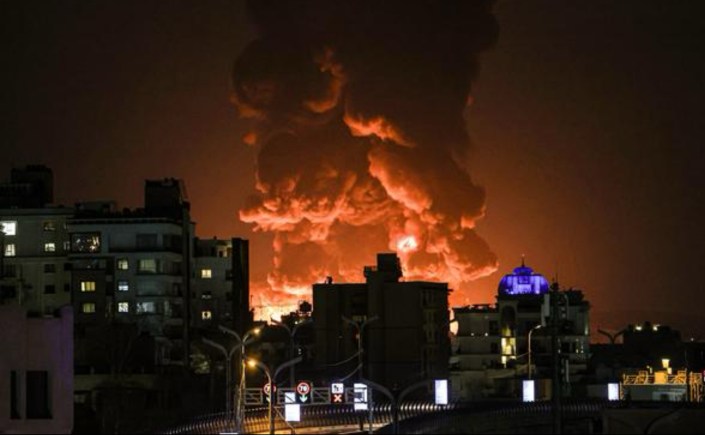
Without seeming to realise what he has done, Trump has exposed the raw fact that the US is no longer a full-spectrum military hegemon able to project power simultaneously in multiple theatres across the planet. It has superb armed forces and technology – but that is not the same thing. Ambrose Evans-Pritchard, The Telegraph, 11 March 2026
The Twentieth Century’s “Thirty Years War”, the war of my generation, was waged in South East Asia initially by the colonialist France, and then by neo-imperialist America. France’s war ended in defeat and ignominy for French arms and prestige, and a partition that was but a prelude to America’s Vietnam quagmire. [In In That Howling Infinite, see Tim Page’s War – a photographer’s Vietnam journey]
America’s War has since been defined as chaos without compass. It was inevitable that acclaimed historian Barbara Tuchman would chose it as one of her vignettes in The March of Folly, her celebrated study of débacles through the ages characterised by what would appear to be a single-minded determination amounting to tunnel vision that is akin to stupidity.
As Tuchman saw it, exceptionalism and manifest destiny are historically proven folly. Self-belief in American power and righteousness has historically created delusions of grandeur, obstinate attachment to unserviceable goals, stubbornness, and an inability to learn from past mistakes or even admitting error – a wooden-headedness that often sees the US persisting on erroneous paths that lead to loss of blood, treasure, reputation and moral standing.
Why did the US’ experience of backing the wrong horse in China in the forties not provide an analogy and warning in Vietnam in the fifties? Why did the experience in Vietnam not inform it with respect to Iran right up to the fall of the Shah in 1978? And why hadn’t it learned anything when it stumbled into Salvador in the eighties? And then, of course, we arrive in the 21st century with no-exit, never-ending wars in Afghanistan and Middle East that end in retreat and betrayal with the ‘freedom-loving’ USA still backing the wrong horses by supporting autocrats and tyrants against their own people.
Tuchman was describing a particular pathology of statecraft- the spectacle of governments pursuing policies visibly contrary to their own interests while possessing the intelligence, experience and evidence to know better. Power, in such circumstances, is not lacking. Direction is.
In the American case, she saw something close to a recurring pattern. Self-belief in American power and virtue could generate a peculiar strategic blindness – delusions of grandeur, obstinate attachment to unserviceable goals, and a refusal to learn from past mistakes or even admit error. The result was a form of national tunnel vision: the conviction that sufficient determination and force must eventually bend reality to American purposes. Too often the outcome was the opposite — the expenditure of blood, treasure, prestige and moral authority in pursuit of objectives that proved unattainable.
It is difficult not to hear the echo of Tuchman’s diagnosis when considering the widening conflict now unfolding between Israel, the United States and Iran. The scale of the military campaign alone is remarkable. Australian commentator and security expert David David Kilcullen’s description in an article in The Australian, republished below, reads almost like a catalogue of twenty-first-century warfare: thousands of sorties in the first hundred hours, stealth fighters dismantling air defences, B-2 bombers opening corridors through Iranian airspace, naval engagements stretching from the Persian Gulf toward the Indian Ocean, tankers burning in the Strait of Hormuz while drones and missiles ripple across the wider region. Cyberattacks strike data centres, satellite navigation systems are jammed, and the conflict unfolds simultaneously across air, sea, cyberspace and orbit.
In strictly operational terms the campaign appears formidable. Iranian air defences have been degraded, missile launchers and command networks methodically targeted, naval assets hunted down. Western air power increasingly operates across Iranian skies with relative freedom. In the narrow military sense, success seems plausible.
Yet wars are not judged by tactical success but by political outcome. And here the picture grows strangely indistinct.
The most striking criticism of the conflict — articulated most clearly by Aris Roussinos in an article in Unherd republished below – is that no one appears able to define what victory would mean. Possible objectives multiply: regime change in Tehran; destruction of Iran’s nuclear programme; the degradation of Iranian military capabilities; or a wider strategic aim of constraining Chinese influence across Eurasia. Each implies a different war. Regime change requires internal collapse or occupation. Nuclear disarmament ultimately requires diplomacy and verification. Strategic competition with China belongs largely to another theatre altogether.
The result is a peculiar strategic ambiguity: immense military force applied in pursuit of ends that remain fluid, sometimes contradictory, occasionally improvised after the fact.
Roussinos therefore invokes an earlier historical analogy: the Suez crisis of 1956 – as have other commentators. That operation was militarily successful yet politically disastrous. British and French forces seized the canal zone quickly and efficiently, only to discover that the political objective — preserving imperial influence — collapsed under international pressure. Today’s conflict, he suggests, may represent a kind of reverse Suez: a large military campaign unfolding before the political objective has even been clearly articulated.
Hovering behind this debate is another and more recent ghost: Iraq. Kilcullen’s experience in Iraq and Afghanistan informs his caution. Removing regimes, he notes in an article in The Australian, is often easier than replacing them. The Taliban returned after twenty years of war. Iraq descended into sectarian violence after Saddam’s fall. Libya’s regime collapsed quickly but left behind a fractured state.
Iran, however, is not Libya. It is a nation of ninety million people with a deep historical identity and a political culture shaped by both imperial memory and the Shiite narratives of martyrdom that animate the Islamic Republic. Foreign attack may weaken the regime — but it may also strengthen the nationalist solidarity on which that regime depends.
Here the shadow of Iraq becomes unavoidable. The question that haunted that war returns once more: what happens the day after victory?
Supporters of the campaign insist that what appears chaotic may in fact be the culmination of long-term strategy. Israeli intelligence has spent years penetrating Iranian networks, sabotaging nuclear infrastructure and eliminating key figures. Others place the conflict within the larger geopolitical contest with China, arguing that weakening Iran constrains Beijing’s long-term influence across Eurasia.
Yet even these arguments leave uncertainty intact. If the central contest lies with China, the Middle East becomes a dangerous diversion. If nuclear disarmament is the aim, diplomacy will eventually be unavoidable. If regime collapse is the goal, history suggests that air power alone rarely produces it.
Meanwhile the war itself expands. Hezbollah strikes from Lebanon. Houthi forces threaten shipping in the Red Sea. Missiles fall across Gulf states. Cyberattacks ripple outward through global infrastructure. Modern conflicts rarely remain geographically contained; the networks of trade, alliances and proxy forces ensure that violence spreads outward in widening circles.
Kilcullen’s observation, delivered with the weary clarity of experience, captures the problem succinctly: war is inherently complex and non-linear, unleashing forces that no strategist can fully predict or control.
Old phrases return easily in such circumstances. One of them comes from Cicero: Inter arma silent leges — among arms the laws fall silent. Yet when law falls silent, prudence often follows. The machinery of war — alliances, domestic politics, military planning — acquires its own momentum. Decisions initially framed as temporary expedients become permanent commitments. Vietnam began with advisers; Afghanistan with a punitive expedition; Iraq with inspections and resolutions. History rarely begins with the word “quagmire.”
What is most striking in the debate surrounding the present war is not the intensity of disagreement but the depth of uncertainty. Some believe the Iranian regime is brittle and nearing collapse; others believe foreign attack will strengthen it. Both views rely on historical analogy; neither fits perfectly.
Which brings us back, inevitably, to Tuchman. Her great theme was not that governments make mistakes — that is the normal condition of politics — but that they sometimes continue down dangerous paths even after the warning signs become visible.
Whether the present conflict will prove another example of such folly remains to be seen. It may yet reveal a coherent strategy whose logic becomes clear only with time. Or it may confirm once again Tuchman’s darker insight about the persistence of wooden-headedness in the councils of power.
For the moment the war continues: vast in scale, impressive in its technology, uncertain in its purpose. And somewhere in the background, like an echo from another era, the old phrase lingers once again – chaos without a compass.
And then, of course, there’s Trump. To return to Ambrose-Pritchard, who opened this essay: “So which will prevail in the tug of war within Trump’s personality: his fear of losing the US midterm election? Or his injured vanity and his psychological need to command “escalation dominance”, always and everywhere?
For other articles on Iran in In That Howling Infinite, see: Messing with the Mullahs – America’s phoney war? The quality of mercy … looking beyond Iran’s ghost republic and “Because of …” Iran’s voice of freedom, and The end of the line … an epitaph for a tyrant
Trump’s reverse Suez
Starmer should beware another quagmire
As we approach the 70th anniversary of the Suez Crisis, from which France’s political class learned to never again let their country’s security become subject to America’s veto, and Britain’s to never again distinguish between its own national interests and Washington’s whims, it is worth remembering that — judged purely as a military operation — the seizure of the Canal Zone was highly successful. The Canal itself, and a buffer zone around it, were captured within days, with limited casualties; the operation’s technical proficiency was praised by the First Sea Lord, Lord Mountbatten, even as he twice attempted to resign in protest at the political folly of it all.
Yet success or failure will be a harder judgment to make for historians of Trump’s own latest Middle East adventure, which is already starting to look like a reverse Suez: its exposure of the limitations of pure military power; the domestic and international hostility; the fragility of alliance systems lazily assumed to be solid; and the wider overtones of an empire wildly overreaching in an attempt to stave off terminal decline. The difficulty in ascertaining, when this ends, whether or not Trump has achieved his war aims rests simply in the fact that the aims so far put forward have differed wildly, and are often mutually contradictory. The Suez Operation possessed a clearly defined military goal which succeeded, and a wider political one, which failed. As it stands, the Trump administration appears in possession of neither.
The broader arguments against the current conflict were most memorably made by Trump himself, campaigning as an anti-war candidate who would keep the United States out of costly and unmanageable Middle Eastern entanglements. His Vice-President, JD Vance, once articulately made the case against this very war. Having successfully demolished his own policy platform, it is difficult to determine what would now count as victory for Trump. The desired outcomes given, at the time of writing, have ranged from the maximalist deliverance of “freedom” to the Iranian people through full regime change in Tehran, through to inspiring an ideal “Venezuela solution” in which more amenable military figures launch an internal coup, then perhaps installing a Shah, ruling Iran remotely from the more stable comfort of Maryland. Or else simply destroying Iran’s nuclear enrichment capacity (which Trump claimed to have “obliterated” in June last year). This scrambling for post facto rationales appears to derive from the fact that Iran did not immediately fold, as Trump apparently assumed it would, with the assassination of its leadership: unlike today’s America, it is not a personalist regime.
Yet if America’s war aims are nebulous from a lack of preparation, Israel’s appear haphazard by design. Summing up Netanyahu’s goals, the Israeli strategic analyst Danny Citrinowicz observes that “If we can have a coup, great. If we can have people on the streets, great. If we can have a civil war, great. Israel couldn’t care less about the future [or] the stability of Iran.” Whatever Netanyahu’s aspirations, a heavily armed but leaderless Iran, engulfed in chaos, represents a strategic threat rather than a victory for the wider West. In this, it appears that America has launched a war alongside, and at the behest of, a notionally junior partner with wildly divergent goals, and which Washington has already admitted it is unable to rein in. For British politicians, all the warning lights should now be blinking red: even the Iraq War, a historic disaster, was vastly better conceived, planned and resourced than this.
And if America’s war aims are vague and contradictory, their proposed means of achieving these desired outcomes are too — including Iranian submission through aerial bombing alone — a result which has never yet been obtained in the century-long history of air power — through launching a peripheral revolt in which Kurdish and perhaps Baluchi separatists act as America and Israel’s boots on the ground. The best that can currently be said for Trump’s gamble is that the desired end-state is so nebulous in its imagining, and the approach so scattergun, that almost any off-ramp can be spun as a victory by his imperial court and its attendant sycophants. With no single, coherent outcome proposed, Trump can claim, as he already has, that the war has already succeeded beyond the wildest dreams of planners. This is even as he is warning his base that victory may yet take some weeks, and cautioning Congress that “it is not possible at this time to know the full scope and duration of military operations that may be necessary”.
The war was, it seems, resourced for a few days of intensive bombing, with little anticipation of Iran striking back against Gulf states, and American early-warning facilities, with its arsenal of low-cost drones. Policy is now being made on the hoof, with senior administration officials “at each other’s throats” on the need for ground troops. CENTCOM, overseeing the war, has requested an increase in military intelligence analysts “to support operations against Iran for at least 100 days but likely through September”. The spectacle of a days-long special military operation, entered into with an over-confident faith in hard power achieving a swift political solution, then dragging on interminably, is all too familiar. For Vladimir Putin, certainly, America’s unforced error of embroiling itself in a quagmire US presidents have spent a half-century studiously avoiding is a godsend, depleting Western munitions stocks, replenishing the Kremlin’s coffers through rising oil and gas prices, and weakening Europe’s negotiating power.
Judged on strict military terms, though, the operation has chalked up notable successes. Iranian ballistic missile launches have slowed, and no doubt the aerial onslaught is depleting Iran’s arsenal of both munitions and launchers. The looming switch from stand-off munitions to less sophisticated bombs implies that air superiority has already been achieved, as Israel declared last weekend, or will soon be achieved, as the White House more cautiously claims. Whether or not Israel, the US and the Gulf states will run out of interceptor munitions before Iran runs out of missiles is a matter of speculation for even the best-informed analysts. Even as Pentagon sources brief concern over their dwindling arsenal, the Trump administration, for what it is worth, claims that it possesses “unlimited” stocks of munitions for a war that could last “forever” — while simultaneously blaming Ukraine for running down its weapons stockpile.
The most recent American attempt to exert its will in the region through air power alone, against Yemen’s Houthis, who are vastly weaker than Iran, entirely failed. The Houthis have not yet joined the war, as Hezbollah now has in response to Israel’s invasion of southern Lebanon: the prospects for escalation grow wider by the day. As for boots on the ground, the much-briefed claims that Iran’s Kurds are willing to join in the war against Tehran remains debatable. The Kurdish Regional Government of Northern Iraq, which hosts exiled Iranian Kurdish militias, has been warned by Iran that their entry into the war will invite an Iranian response, and has stressed its neutrality as a result. It has not even been a month since Washington abandoned its last Kurdish partners: they must now judge whether this time round America will prove a more dependable ally.
For all the military risks involved, it is very possible, though far from certain, that US and Israeli bombing can bring about the collapse of the Iranian state, though what happens next is anyone’s guess. The US Chairman of the Joint Chiefs, General Dan Caine, reportedly cautioned before the strikes began “about the potential downsides of launching a major military operation targeting Iran”, citing “the scale, complexity and potential for US casualties of such a mission”, and asserting he was “unable to predict what the result of a regime change operation would be”. Both the Iranians and the Americans have already claimed to have received, and rejected, the other’s request for a ceasefire, with Israel reportedly seeking assurances Washington is not already seeking private talks. In any case, the Iranians have good cause to be wary of negotiating with Trump, given that their previous rounds of negotiations ended in American and Israeli bombing. Indeed, the current war began with Israel’s aerial assassination of the country’s political leadership in the middle of negotiations which, the Trump administration later boasted, were merely a ruse. Some of America’s intended new rulers of Iran, Trump has claimed, have already been killed by Israel. Having launched a war of choice, at a time convenient to him, Trump may now find ending it a far less simple affair.
As it stands, it is in Iran’s interest to drag out the war for as long as possible, expanding it across the wider region, increasing the economic disruption to American allies, and capitalising on the widespread hostility to the war. As both Trump’s anti-interventionist base and the Democrat opposition rightly proclaim, this war has been entered into without any coherent plan, seemingly through Israel’s chain-ganging of the United States into military action it would not otherwise have chosen, an observation claimed as antisemitic by Israel’s advocates in the United States yet which has nevertheless also — bafflingly — been offered as proof of the war’s necessity by America’s Secretary of State Marco Rubio, the House Speaker Mike Johnson, Senate Intelligence Committee chair Tom Cotton, and most recently by Trump himself.
As for Netanyahu, he exultantly claims that bringing America into the war is something he has “yearned to do for 40 years”. The Democrats, repeatedly briefingthe attack line that Trump was “the first president stupid enough” to be cajoled by Netanyahu into war with Iran, have now been gifted a path to success in midterm elections which may yet overlap with the conflict itself. When as cynical a politician as Gavin Newsom feels safe questioning future military support to the “apartheid state” Israel, demanding from the podium “Why did we help Israel kill little girls?”, we see the cracks in America’s only true special relationship widening into a gulf. This war was, most probably, Netanyahu’s last chance to enlist the fading superpower against his decades-long foe. Whether it improves Israel’s long-term strategic position is doubtful in the extreme — but none of this is Britain’s problem.
It goes against instinct to praise the Prime Minister for his lawyerly prevarication. Yet given all the risks and uncertainties inherent to this war the arguments against joining America and Israel’s wild gamble are as strong as can be imagined. Just weeks ago, the same Trump administration which now chides us for our caution was threatening to annex European territory, and mocking our participation in its previous disastrous wars. Even if we exclude, as the Prime Minister does not, the moral factors, Starmer is entirely correct to say that this is a war with “no viable plan”. It appears that the Prime Minister, through his twin flaws of excessive deference to both European opinion and international law, may yet be dragged, unwillingly, towards the national interest. We already have our own war to worry about, in which the desire or ability of the United States to negotiate a satisfactory conclusion looks as doubtful from London as Washington’s reliability as a negotiating partner must look from Moscow. American realists may be correct in stating that the Ukraine war, in which Britain is already dangerously over-exposed, is not a core Washington interest — but neither is Netanyahu’s latest war of choice a British or European interest. Simply put, there is no advantage for Britain in joining this distant conflict, and the national interest, as in the Gaza War of which this is a vast escalation, remains in staying out of the affair as far as possible.
It is absurd, then, to watch Reform politicians, so recently bemoaning Britain’s political enmeshment with distant Middle Eastern conflicts and diaspora grievances, caper onstage with Israeli and Iranian monarchist flags, demanding our involvement in this mess. Farage’s hiring as foreign policy adviser of the neoconservative lobbyist Alan Mendoza, who has never yet seen a disastrous war he did not wish to join, was a rare deviation from his sharp political instincts, and a warning of the major strategic risks inherent in a Reform government, however much their domestic agenda may appeal. The Greens will rightly benefit from this misstep, as will, on Reform’s Right, Restore, edging towards a Powellite indifference to distant wars. If he holds his course, so will Starmer too.
The dilemma now for the Prime Minister is whether or not to join the emergent European policy of defensive neutrality, protecting national and continental interests while refusing involvement in the wider campaign. Yet the almost wholesale capture of the British security establishment by an Atlanticist ethos indistinguishable from vassalage, along with the looming American usage of British bases for offensive purposes, will complicate this. Starmer initially refused to permit offensive raids to launch from British territory, a policy which, in Spain’s case, has seen Trump threaten to use its bases anyway. Such threats would appear less stark, no doubt, if Britain had not already placed the sovereignty of Diego Garcia under question, but we cannot all boast the strategic wisdom of David Lammy’s formerbrain. If allowing British bases to be used cannot be prevented, Starmer can either explain why, or — politically more likely — spin a plausible rationale for active involvement, attempting to make a virtue out of compulsion.
Yet there is another path, the one shown by Emmanuel Macron, now expanding across the continent the French-led defence axis initially trialled with Greece. At the same time, Macron is drawing a sharp dividing line between the interests of Europe and her many nation states, and of the erratic empire which alternately threatens and cajoles us. Seventy years ago, a misadventure in the Middle East saw Britain and France adopt opposing positions on American domination, which led us to this impasse. Through an accident of British politics, it falls to as unlikely a figure as Starmer to make just such another historic choice

Israel’s first air-to-air combat kill signals what it has planned.
A loud explosion rattled his windows. I could hear car alarms in the background and his wife and young children expressing concern as he calmly escorted them down from the roof. I asked if I could do anything to help, and he came back with one word: “Exfil?”
“Exfiltration” – evacuation from the most heavily targeted areas – is a priority for some locals, most expats and many governments including Australia, which this week mounted one of the largest consular operations in our history.
Leaving not an option
For Iranian civilians facing intensive air and missile strikes after weeks of regime crackdowns that have already killed thousands, leaving is not an option.
Friends elsewhere in the region have decided to stay put, concluding their best bet is to shelter in place. In any case, with US and Israeli aircraft bombing all over Iran, and Iranian rockets striking targets across the Middle East, most have nowhere to go.
Evacuation flights have been made more difficult by sudden airspace closures given lack of warning for the attack, which began with Israeli air strikes while Iran and the US were still in negotiations, right after Omani mediators had announced a possible breakthrough.
Apart from its suddenness – despite a massive US military build-up across the past month, Israel struck without warning – the main feature of the conflict so far is its scope, scale and intensity.
This is by far the largest air campaign mounted by Israel and one of the largest conducted by the US, on a par with the bombing of Yugoslavia in 1999 or the initial air campaigns in Afghanistan and Iraq.

A group of men inspects the ruins of a police station in Tehran struck amid the US-Israel barrage on Iran. Picture: AP
Already, within the first 100 hours, US aircraft had launched thousands of sorties, destroying hundreds of missile sites, command posts and air defences across Iran. Whatever its political framing, in practical terms this is a full-scale war.
The initial main effort was to establish air superiority, with F-35, F-22 and F-15E aircraft destroying Iranian warplanes and air base infrastructure. On the fourth day of the war, an Israeli F-35 shot down an Iranian fighter jet over northern Tehran, the first air-to-air combat kill by an F-35, and Israel’s first such aerial victory in 40 years.
The take-down of Iran’s air force was followed by the destruction of its air defences by US B-2 bombers using stand-off missiles, opening the skies for follow-on attacks by B-1 and B-52 bombers. These non-stealthy aircraft carry a massive bomb load. B-52s have been involved in the campaign already, releasing air-launched missiles up to 370km from their targets. Once Iran’s surface-to-air missiles are suppressed, however, the bombers can operate directly overhead, hugely increasing the weight of bombs dropped.
Expect more
We can expect US and Israeli aircraft, once they can operate with impunity, to further ramp up strikes, roaming the skies over Iran and hitting any identified threat. In effect, they will be working their way down the priority list as successive categories of higher-value targets are destroyed, a process that may take weeks.
A second task – destruction of Iran’s offensive missile launchers, command-and-control systems and storage and production facilities – is now the focus. Israeli and US forces are working in tandem, with Israel focusing on northern and western Iran, and US aircraft striking sites in the country’s central and southern regions.

A satellite image shows damage at Garmdarah missile base in northern Iran on March 4 following precision strikes. Picture: AFP/Satellite Image (c) 2026 Vantor
This aspect of the campaign has been less successful so far. Iran is still launching large numbers of missiles against Haifa, Tel Aviv and other Israeli cities, and many are successfully evading Israeli interceptors. Other missiles have been destroyed over urban centres, with falling debris causing casualties on the ground. In strictly military terms, the campaign is going well for Israel and the US. But other aspects of the war have been more problematic.
The killing of supreme leader Ali Khamenei and other senior leaders in the first strike may have been intended to decapitate Iran’s regime and dislocate its response. But key leaders such as foreign minister Abbas Araghchi and Ali Larijani – former speaker of parliament, leader of the deadly anti-democracy crackdown in January and head of Iran’s national security council – are alive and in place.
Khamenei appears to have delegated launch authority to lower-level commanders in the Islamic Revolutionary Guard Corps, whose aerospace forces control parts of Iran’s missile arsenal, and the Artesh, Iran’s regular military which controls air defence. Junior commanders, cut off from Tehran in the first hours of the war, are making their own target selections, launching missiles and drones as far afield as Jordan, Turkey, Saudi Arabia and Azerbaijan. Closer in, Persian Gulf states such as Kuwait, Qatar, Bahrain, Oman and the United Arab Emirates have been particularly hard hit.

Hiogjh-ranking members of the Iranian Revolutionary Guards Corps (IRGC) attend an unveiling ceremony of an IRGC underground facility that houses hundreds of domestically built precision-strike missiles. Picture: IMAGO / ZUMA
Iranian missiles are targeting civilian infrastructure, diplomatic posts, military bases, oil refineries, gas terminals, hotels, houses and shopping centres. Desalination plants – critical in a water-poor region – also have been targeted. Iran’s Lebanese ally, Hezbollah, seems to have launched the drone that hit Britain’s Akrotiri Air Base in Cyprus; in response, Israel is bombing Beirut, and Israeli troops and tanks have pushed farther into Lebanon, widening the war and inflicting several hundred casualties.
War on water
The war at sea has expanded even further. US and Israeli strikes destroyed the Iranian navy’s command post at Bandar Abbas this week and damaged at least nine warships including Iran’s sole drone carrier, the IRIS Shahid Bagheri, along with several Soleimani-class corvettes, smaller warships capable of operating independently or supporting fast attack craft in the Persian Gulf.
In a major escalation, the larger Moudge-class frigate IRIS Dena was sunk off Sri Lanka by a torpedo from a US submarine, as it made its way back to Iran after joint naval exercises with India, with the loss of up to 150 lives. In another grim milestone, this was the first time since 1945 that a US submarine has sunk an enemy warship by torpedo.
At least 10 oil tankers are now ablaze or sunk in the Strait of Hormuz, a critical chokepoint that accounts for more than 20 per cent of global oil flow. Commercial shipping has fallen to almost nothing.
On Thursday, Iran allowed a Chinese-flagged tanker through the strait, and the US has offered insurance and naval escort for other vessels in the area, but shipping companies and captains are understandably reluctant to run the risk, triggering a 90 per cent drop in traffic.
Further west, Iran’s Houthi allies in Yemen are restarting their efforts – suspended after last year’s Gaza ceasefire – to interdict shipping through the Bab el-Mandeb, the chokepoint at the southern end of the Red Sea. The Houthis also appear to have launched missiles into Saudi Arabia, which also has been hit by rockets from Iran itself.
Also this week, a Russian-flagged oil tanker was attacked in the western Mediterranean by a Ukrainian sea drone. Ukrainian attacks continue against Russian ships in the Black Sea, underscoring the connection between conflict in Europe and the newly opened front in the Middle East.
On the ground
On land, there is no sign yet of US or Israeli ground troops entering the war, though Israeli aircraft have begun targeting Iranian internal security forces such as the IRGC and its paramilitary arm, the Basij, which might be used to suppress an uprising. US media outlets are reporting CIA plans to arm and support Kurdish separatists against the regime. Kurdish leaders have denied this, even as Kurdish troops in Iraq are massingon the Iranian border, and there are unconfirmed reports of conflict inside northwestern Iran.
Other dissident groups – the anti-regime democracy movement and ethnic separatist Arab, Azeri and Baloch – suffered severely in January’s regime crackdown but may move against the government if the conflict continues. Such efforts almost certainly will fail unless these groups receive arms and support from external players.
Pakistan, which shares a border with Iran and is allied with Tehran’s regional rival Saudi Arabia, is committed to a war against its own former proxy, the Afghan Taliban, but could join in if the war escalates further.

Israeli police and emergency teams respond at the scene after a missile strike hit buildings in Tel Aviv’s Gush Dan area, in Israel, as Iran’s missile attacks in retaliation for US-Israeli strikes continue. Picture: Getty Images
If a ground war does develop, it may look something like the invasion of Afghanistan in 2001, when intelligence and special warfare teams worked with Afghan allies on the ground, combining with US air power to overthrow the Taliban in less than seven weeks.
Conventional US ground forces are politically problematic for President Donald Trump, given deep scepticism among his MAGA base about foreign wars, American casualties and Israeli intentions.
On the other hand, CIA or special operations teams – given their small numbers and low profile – are seen as less risky, easier to justify, and thus the preferred option.
As in Afghanistan, the question for any ground campaign is what comes next. The potential for full-scale civil war inside Iran, accompanied by state fragmentation and a region-wide flood of refugees, was on the minds of diplomats and intelligence officers with whom I spoke this week, even as the conflict’s future remains unclear.
Taking down the regime is one thing; standing up a stable successor is entirely another, as any Iraq or Afghanistan veteran knows. Many leaders are clearly concerned about this.
All of this makes the current conflict more than just a third Gulf war. Countries that escaped previous conflicts are now suffering direct attacks, up-ending regional relationships as governments scramble to protect their populations. Closure of the Strait of Hormuz involves superpower interests and the global economy much more than previous rounds of conflict. The longer the war lasts, the greater the risk that it escalates even further, pulling more countries in.
International response
Broader responses have been mixed. European countries – following inter-allied controversy earlier this year over US threats to seize Denmark’s autonomous territory in Greenland – have expressed reservations, as has the EU.

An intercepted projectile falls into the sea near Dubai’s Palm Jumeirah archipelago on March 1, 2026. Picture: AFP
Britain offered defensive support only, prompting Trump to criticise Prime Minister Keir Starmer as “no Churchill” and complain that the special relationship is not what it once was.
Trump also announced “total suspension” of trade with Spain after Madrid blocked US aircraft from using Spanish bases for the attack. French President Emmanuel Macron declared the US-Israeli attack in violation of international law and called for a return to negotiations, while the UN said it had seen no evidence of ongoing Iranian nuclear weapons programs.
On the other hand, NATO secretary-general Mark Rutte expressed support for the operation.
US adversaries Russia and North Korea – both of which have close relationships with Iran – strongly condemned the attack. China did so too, but so far has offered only rhetorical support. This is somewhat surprising since China is a major weapon supplier to the regime in Tehran and announced, days before the US attack, that it was sending offensive and defensive weapons to Iran.
Under a 25-year agreement signed in 2021, China also accounts for 80 per cent of Iran’s oil exports and depends heavily on traffic through the Strait of Hormuz and the Red Sea. China has been stockpiling oil for several years, so Chinese leaders may calculate they can afford to wait, letting US stockpiles of bombs and missiles be depleted as the war goes on.
Alternatively, they may be scrambling to catch up with a rapidly evolving situation. Neither Moscow nor Beijing has yet moved to mediate or resolve the war.
Against this background, military lessons are already emerging. Artificial intelligence has dramatically accelerated the targeting process, with the campaign running on a continuously updated dynamic engagement matrix rather than a traditional daily task order. Satellite communications are ubiquitous, with small Starlink antennas seen mounted on American Low-Cost Unmanned Combat Attack System drones, themselves an improved copy of Iran’s Shahed-136 drone, the export version of which played a prominent part in Russia’s arsenal in Ukraine.
Beyond showing how adversaries copy each other’s battlefield technologies, the LUCAS drones illustrate how important space systems such as Starlink now are. Space has emerged as what the military calls a “warfighting domain” alongside air, space, sea and cyberspace. GPS spoofing and jamming, as all sides interfere with each other’s navigation satellites, has been particularly noticeable here as in Ukraine, with knock-on effects for civilian ships, aircraft and infrastructure.
Attacks on data centres, including three Amazon Web Services data centres hit by Iranian drones in the Emirates, underline the vulnerability of AI and cyber systems to physical attack.

An ambulance is parked near a sweeping blaze following Israeli bombardment on a solar farm and electricity generation facility in Lebanon’s southern coastal city of Tyre on March 4, 2026. Israeli forces on March 4 advanced into a number of towns and villages in south Lebanon, a source from the UN peacekeeping force in the country, UNIFIL, told AFP. Picture: AFP
The war’s rapid spread outside Iran’s vicinity emphasises how modern conflicts, irrespective of causes, rarely remain geographically contained. Regional proxies – Hezbollah and the Houthis but also pro-Iranian militias in Iraq, Iranian-sponsored sleeper cells in Western countries, and the possibility that resistance groups may play the leading role in any ground campaign – emphasise how even the most conventional conflicts involve irregular warfare, with non-state armed groups operating on their own or advised by specialist operators.
At the strategic level, one lesson is that, irrespective of Trump’s need for a quick resolution to the conflict, lest it undermine his support ahead of critical midterm elections in November, war is inherently complex and non-linear, unleashing forces that cannot be predicted or controlled. Even now, the campaign is illustrating the impossibility of doing regime change from the air, to say nothing of whether regime change is even a viable goal: 20 years of the war on terror would suggest not.
One thing I heard whispered in Washington this week was that – between Venezuela, Greenland and now Iran – others may be concluding they cannot trust American negotiators. The terms of any deal seem increasingly contingent on political whim in the White House, rather than consistent policy, and attacking a counterparts mid-negotiation makes it less likely that adversaries will themselves negotiate in good faith.

This US navy handout photo released by US Central Command public affairs shows US sailors preparing to stage ordnance on the flight deck of Nimitz-class aircraft carrier USS Abraham Lincoln (CVN 72) in support of Operation Epic Fury. Picture: US navy/US Central Command/AFP
One congressional staffer gloomily told me this week that, under this administration’s force-based approach to international relations, diplomatic consistency carried less weight, but that wouldn’t always be the case. Russia and China were watching this conflict closely, she noted, and if they saw an opportunity to move against Western interests while the US was tied down in Iran, credibility with allies would matter again, fast. The broader potential for escalation – for Gulf War III to become World War III – is not in the forefront of anyone’s mind at present but the risk is real.
Impact at home
For Australia, the implications of the current conflict are stark enough. As a globally connected trading nation, with millions of Australians overseas and massive exposure to the global system, Australians’ safety and our nation’s prosperity can easily be disrupted by events thousands of kilometres away. Just one illustration of this is petroleum imports, which despite rapid growth in renewables still drive almost every aspect of our economy.
The latest Australian petroleum statistics, from December 2025, showed Australia with 50 days net import coverage, 25 days of diesel consumption, enough jet fuel for 20 days and enough automotive petrol for 26 days. In other words, if global oil supplies are interrupted for more than three to four weeks, Australia’s transportation and production systems start grinding to a halt. The government has rightly advised against panic hoarding, but fuel resilience will become a real issue as the conflict drags on.
There is also the possibility that an expanded conflict may lead to a spike in terrorism risk. Iranian-sponsored terror cells aside, unrest among or against Iranian, Jewish, Kurdish, Arab and other communities is a real issue, one that many Western governments are watching, Australia almost certainly included.
A final possibility is that, if the war drags on or escalates, Australia and other allies may receive a US request for support. Intelligence, surveillance and reconnaissance – including joint facilities in Australia – are almost certainly already involved. No request for warships, aircraft or ground troops has been publicly discussed but planners would be wise to be thinking ahead.
In the meantime, and much more importantly, families such as my friend’s – across Iran, Israel, the Gulf states and elsewhere – are sheltering in basements, comforting their kids, hoping they have enough food, water, cash and medical supplies, and worrying what the future holds. Tens of thousands of Australians and other expats are stranded as they seek to leave the region, and millions more locals have no exit in sight. This war is unlikely to end soon, but it has already changed the game

 In That Howling Infinite