As evening fell the day’s oppression lifted
Far peaks came into focus, it had rained.
Across wide lawns and cultured flowers drifted
The conversation of the highly trained.
Two gardeners watched them pass and priced their shoes
A chauffeur waited, reading in the drive
For them to finish their exchange of views.
It seemed a picture of the private life.
Far off, no matter what good they intended
The armies waited for a verbal error
With all the instruments for causing pain
And on the issue of their charm depended
A land laid waste, its towns in terror
And all its young men slain.
Embassy, WH Auden, from Journey to a War
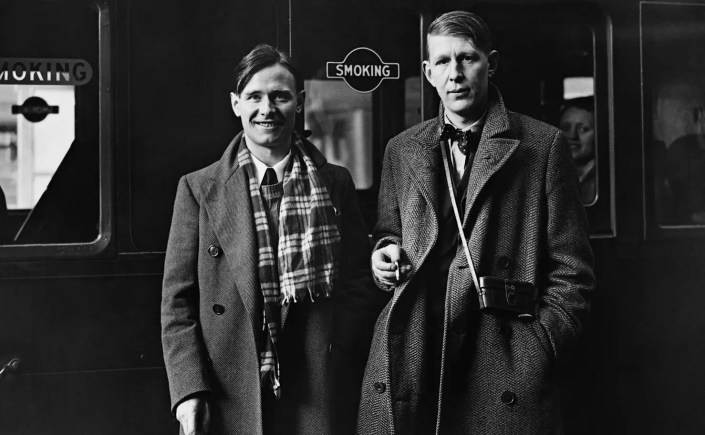
In 1938, English writers WH Auden and Christopher Isherwood were commissioned by their publishers to write a travel book about the East. Auden was already established as one of Britain’s foremost poets whilst his friend and onetime lover Isherwood was acclaimed as an author and dramatist. His Berlin Stories, two novels set in the last days of the Weimar Republic and today acclaimed as classics of modern fiction; the semi autobiographical Goodbye to Berlin (1939) inspired the remarkable musical Cabaret (1966).
By adventurous choice they went to China for six months, their journey coinciding with Imperial Japan’s brutal invasion. American poet and educator Mildred Boie, reviewing the book for Atlantic in November 1939, takes up the story:
“With the good fortune of famous and attractive young men they were helped and shown about by everybody from coolies to ambassadors, journalists to generals. They behaved, as they observed and wrote (to judge from the diary), with the engaging frankness and immaturity of English schoolboys, with the ingenious confidence and casual incompleteness of amateurs. But these qualities are inadequate for reporting war, for evaluating life and death in so desperate and disastrously complicated a country as China. The authors were not only amateurs as foreign correspondents, they were also dilettantes: they played at getting to the front, at taking notes on slums, at dashing from formal garden parties to meetings with intellectuals and busy military and diplomatic leaders. They suffered almost as much, certainly as consciously, from blisters, constipation, boredom, sleeplessness, and hangovers as from the shape of poverty, the taste of fear, the sight and smell of death. They were always safe, always outside.”
Collectively, perhaps, we most resemble a group of characters in one of Jules Verne’s stories about lunatic English explorers.
War is bombing an already disused arsenal, missing it and killing a few old women. War is lying in a stable with a gangrenous leg. War is drinking hot water in a barn and worrying about one’s wife. War is a handful of lost and terrified men in the mountains, shooting at something moving in the undergrowth. War is waiting for days with nothing to do; shouting down a dead telephone; going without sleep, or sex, or a wash. War is untidy, inefficient, obscure, and largely a matter of chance.
On their safe return, the pair put together Journey to a War, travel book in prose and verse that was published in 1939. The book is in three parts: a series of poems by Auden describing his and Isherwood’s journey to China in 1938; a “Travel-Diary” by Isherwood (including material first drafted by Auden) about their travels in China itself, and their observations of the Sino-Japanese War; and “In Time of War: A Sonnet Sequence with a Verse Commentary” by Auden, with reflections on the contemporary world and their experiences in China. The book also contains a selection of photographs by Auden.
I am never much good at defending the British Empire, even when drunk
Christopher Isherwood
I republish below an excellent article in the blog Books and Boots – Reflections on Books and Art. It provides a more detailed background to the genesis of the book, setting the geopolitical scene, describing Auden’s anticlimactic and, it would seem, personally disappointing visit to Spain during its civil war, and the poetry within.
See also in In That Howling Infinite, Better read than dead … books, poetry and reading
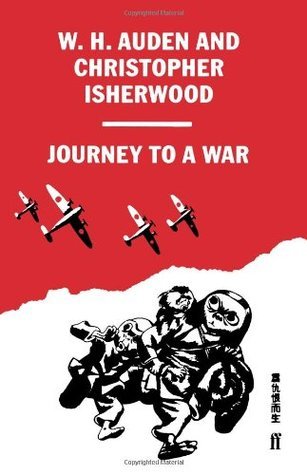

WH Auden and Christopher Isherwood
Journey To A War by W.H. Auden and Christopher Isherwood (1939)
When we awoke early next morning the train was crossing a wide valley of paddy fields. The rising sun struck its beams across the surfaces of innumerable miniature lakes; in the middle distance farmhouses seemed actually to be floating on water. Here and there a low mound rose a few feet above the level of the plain, with a weed-grown, ruinous pagoda, standing upon it, visible for miles around. Peasants with water-buffaloes were industriously ploughing their arable liquid into a thick, brown soup.
(Journey To A War, p.191)
Collectively, perhaps, we most resemble a group of characters in one of Jules Verne’s stories about lunatic English explorers. (p.104)
The Sino-Japanese War
In July 1937 – exactly a year after the start of the Spanish Civil War – Japan attacked China. It was hardly a surprise. In 1931 the so-called ‘Mukden Incident’ had helped spark the Japanese invasion of Manchuria (the large area to the north east of China, just above Beijing). The Chinese were defeated and Japan created a new puppet state, Manchukuo (setting up the last Qing emperor as its puppet ruler) through which to rule Manchuria.
Going further back, in 1894–1895 China, then still under the rule of the Qing dynasty, was defeated by Japan in what came to be called the First Sino-Japanese War. China had been forced to cede Taiwan to Japan and to recognise the independence of Korea which had, in classical times, been under Chinese domination.
In other words, for 40 years the rising power of militaristic, modernising Japan had been slowly nibbling away at rotten China, seizing Taiwan, Korea and Manchuria. Now the military junta in Tokyo decided the time was right to take another bite, engineered an ‘incident’ at the Marco Polo bridge on the trade route to Beijing, and used this as a pretext to attack Beijing in the north and Shanghai in the south.
Thus there was quite a lot of military and political history to get to grips with in order to understand the situation in China, but what made it even more confusing was the fact that China itself was a divided nation. First, the nominal government – the Chinese Nationalist Party or Kuomintang under its leader Chiang Kai-shek – had only with difficulty put down or paid off the powerful warlords who for decades had ruled local regions of China after the collapse of the Qing Dynasty in 1911.
But second, Chiang faced stiff competition from the Chinese Communist Party. The two parties had lived in uneasy alliance until Chiang staged a massacre of communists in Shanghai in 1927 which brought the tension between Chinese nationalists and communists into the open.
It was the three-way destabilisation of China during this period – warlords v. Nationalists v. Communists – which had helped Japan invade and take over Manchuria. Prompted by the 1937 Japanese attack the Nationalists and Communists formed an uneasy alliance.
Auden in Spain
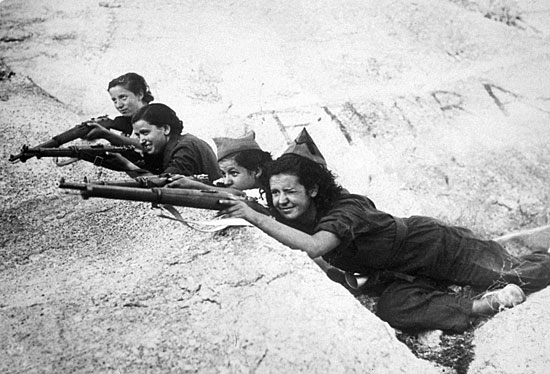
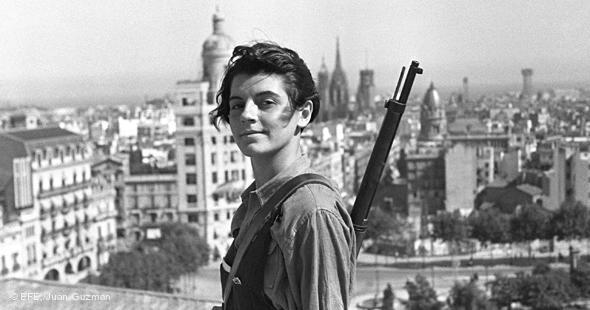
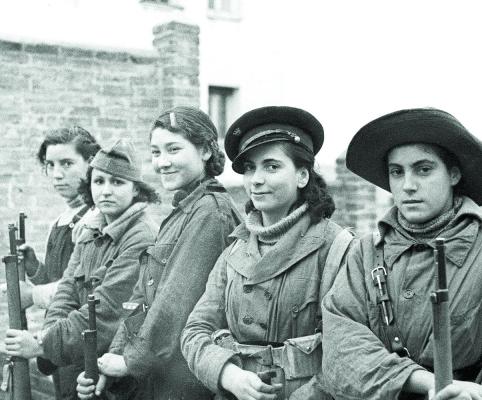
Meanwhile, back in Europe, the great political issue of the age was the Spanish Civil War which began when General Franco led a military uprising against the democratically elected government in July 1936. Like many high-minded, middle class liberals, Auden and Isherwood both felt the time had come to put their money where their mouths were. Auden did actually travel to Spain in January 1937 and was there till March, apparently trying to volunteer to drive an ambulance in the medical service. Instead, red tape and the communists who were increasingly running the Republican forces apparently blocked him from getting a useful job. He tried to help out at the radio station but discovered its broadcasts were weak and there were no vacancies.
Frustrated and embarrassed, Auden was back in England by mid-March 1937. The long-term impact of the trip was his own surprise at how much it upset him to see the churches of Barcelona which had all been torched and gutted by a furious radical populace as symbols of oppression. Auden was shocked, and then shocked at his reaction. Wasn’t he meant to be a socialist, a communist even, like lots of other writers of his generation? The Spain trip was the start of the slow process of realisation which was to lead him back to overt Christian faith in the 1940s.
Also Auden saw at first hand the infighting on the Republican side between the communist party slavishly obeying Stalin’s orders, and the more radical Trotskyite and Anarchist parties who, later in 1937, it would crush. Later he paid credit to George Orwell’s book Homage To Catalonia for explaining the complex political manoeuvring far better than he could have. But watching the Republicans fight among themselves made him realise it was far from being a simple case of black and white, of Democracy against Fascism.
So by March 1938 Auden had returned to Britain, where he was uncharacteristically silent about his experiences, and got on with writing, editing new works for publication (not least an edition of his play The Ascent of F6 and Letters From Iceland).
Meanwhile, Christopher Isherwood was living in Paris managing his on-again, off-again relationship with his German boyfriend Heinz. And although he had accommodated Auden on an overnight stop in the French capital and waved him off on the train south to Spain, Isherwood hadn’t lifted a finger for the Great Cause.
Then, in June 1937, Auden’s American publisher, Bennet Cerf of Random House, had suggested that after the reasonable sales of his travel book about Iceland, maybe Auden would be interested in writing another travel book, this time travelling to the East. Isherwood was a good suggestion as collaborator because they had just worked closely on the stage play, The Ascent of F6 and had begun work on a successor, which was to end up becoming the pay On The Frontier. The pair were considering the travel idea when the Japanese attacked China, quickly took Beijing and besieged Shanghai.
At once they seized on this as the subject of the journey and the book. Neither had really engaged with the war in Spain; travelling east would be a way to make amends and to report on what many people considered to be the Eastern Front of what was developing into a worldwide war between Fascism (in this case Japan) and Democracy (in this case the Chinese Nationalists).
China also had the attraction that, unlike Spain, it wouldn’t be stuffed full of eminent literary figures falling over themselves to write poems and plays and novels and speeches. Spain had been a very competitive environment for a writer. Far fewer people knew or cared about China: it would be their own little war.
And so Auden and Isherwood left England in January 1938, boat from Dover then training it across France, then taking a boat from Marseilles to Hong Kong, via Egypt, Colombo and Singapore.
Journey to a War
Journey To A War is not as good as Letter From Iceland, it’s less high spirited and funny. There isn’t a big linking poem like Letter To Lord Byron to pull it together, and there isn’t the variety of all the different prose and verse forms Auden and MacNeice cooked up for the earlier book.
Instead it overwhelmingly consists of Isherwood’s very long prose diary of what happened to them and what they saw in their three months journey around unoccupied China.
The book opens with a series of sonnets and this was the form Auden chose to give the book poetic unity – sonnets, after all, lend themselves to sequences which develop themes and ideas, notably the Sonnets of Shakespeare, or his contemporaries Spencer and Sidney. There’s a collection of half a dozen of them right at the start, which give quick impressions of places they visited en route to China (Macau, Hong Kong). Then, 250 pages of Isherwood prose later, there’s the sonnet sequence titled In Time of War.
But instead of the bright and extrovert tone of Letters From Iceland, Auden’s sonnets are often obscure. They are clearly addressing some kind of important issues but it’s not always clear what. This is because they are very personal and inward-looking. Auden is clearly wrestling with his sense of liberal guilt. The results are rather gloomy. Spain had disillusioned him immensely. He went to Spain thinking the forces of Evil were objective and external. But his first-hand experience of the internecine bickering on the Republican side quickly showed him there is no Good Side, there are no Heroes. History is made by all of us and so – all of us are to blame for what happens. Travel as far as you want, you’re only running away from the truth. If we want to cure the world, it is we ourselves that we need to cure first.
Where does this journey look which the watcher upon the quay,
Standing under his evil star, so bitterly envies,
As the mountains swim away with slow calm strokes
And the gulls abandon their vow? Does it promise a juster life?
Alone with his heart at last, does the fortunate traveler find
In the vague touch of a breeze, the fickle flash of a wave,
Proofs that somewhere exists, really, the Good Place,
Convincing as those that children find in stones and holes?
No, he discovers nothing: he does not want to arrive.
His journey is false, his unreal excitement really an illness
On a false island where the heart cannot act and will not suffer:
He condones his fever; he is weaker than he thought; his weakness is real…
(from The Voyage by W.H. Auden)
‘An illness on a false island’ which is clearly England, a place ‘where the heart cannot act’. The traveller is trying to escape himself but cannot and glumly realises ‘he is weaker than he thought’. Or the thumping final couplet of the sonnet about Hong Kong:
We cannot postulate a General Will;
For what we are, we have ourselves to blame.
Isherwood’s diary
Luckily, the prose sections of the book are written by Isherwood and these are much more fun. He keeps up the giggling schoolboy persona of the novel he’d recently published, Mr Norris Changes Trains (1935), he notes the way the Chinese pronounce their names Au Dung and Y Hsaio Wu, he sounds wide-eyed and optimistic. He hadn’t seen what Auden had seen in Spain, wasn’t struggling with the same doubts.
On February 28 1938 they leave Hong Kong by steamer for Canton and Isherwood finds everyone and everything hilarious. Look a Japanese gunboat! Listen, the sound of bombs falling! He has same facility for the disarmingly blunt image which he deploys in the Berlin stories. The mayor of Canton (Mr Tsang Yan-fu) is always beaming, has a face like a melon with a slice cut out of it. After dinner the Chinese general entertains them by singing Chinese opera, showing how different characters are given different tones and registers (‘the romantic hero emits a sound like a midnight cat’).
He refers to the whole trip as a dream and as a landscape from Alice in Wonderland – they expected Chinese people to behave as in a Gilbert & Sullivan opera and had rehearsed elaborate compliments, and are disarmed when they’re much more down to earth. The train journey on through Hunan province is boring, the tea tastes of fish, they amuse themselves by reading out an Anthony Trollope novel or singing in mock operatic voices.
But this sense of unreality which dogs them is simply because both of them didn’t have a clue what was going on, what was at stake, the military situation, had never seen fighting or battle and weren’t proper journalists. They were privileged dilettantes, ‘mere trippers’, as Isherwood shamefacedly explains when they meet real war correspondents at a press conference (p.53).
In Hankow the Consul gives them Chiang, a middle-aged man with the manners of a perfect butler to be their guide. They attend the official war briefings alongside American and Australian journalists, they meet Mr Donald, Chiang Kai-shek’s military adviser, the German adviser General von Falkenhausen, Agnes Smedley, Madame Chiang Kai-shek herself, and with delight are reunited with Robert Capa, the soon-to-be legendary American war photographer who’d they’d met on the boat out. They attend traditional Chinese opera, which Isherwood observes with the eye of a professional playwright.
They catch the train to Cheng-chow which has been repeatedly bombed by the Japanese, capably looked after by their ‘boy’, Chiang. They are heading north on the train when they learn that Kwei-teh has fallen, nonetheless they decide to press on to Kai-feng. With them is an exuberant and seasoned American doctor, McClure, who takes them to watch some operations. They walk round the stinking foetid town. They go to the public baths which stink of urine. Then they catch a train to Sü-chow. And then onto Li Kwo Yi where they argue with Chinese commanding officers (General Chang Tschen) to allow them to go right up to the front line, a town divided by the Great Canal.
If you’ve no idea where any of these places are, join the club. I was reading an old edition but, even so, it had no map at all of any part of the journey. Which is ludicrous. The only map anywhere appears to have been on the front cover of the hardback edition, replaced (uselessly) by an anti-war cartoon on the paperback editions, and even this doesn’t show their actual route.

With no indication where any of these places are, unless you are prepared to read it with an atlas open at your side, Isherwood’s long prose text becomes a stream of clever observations largely divorced from their context. Even an atlas is not that useful given that Isherwood uses the old form of the placenames, all of which, along with most people’s names, have changed. Thus Sian, capital of Shen-si province, is now Xian, capital of Shaanxi Province, Sü-chow is now Suzhou, and so on.
We are intended to enjoy the surreal aspects of travelling in a deeply foreign land – the village restaurant which was papered entirely with pages of American tabloid magazines, and so covered with photos of gangsters and revelations about fashionable divorcees (p.126); or the expensive hotel in Sian whose menu included ‘Hat cake’ and ‘FF potatoes’ (p.141). Beheading is a common punishment because the Chinese believe a body needs to be complete to enter the afterlife. They meet lots of tough and brave American missionaries, mostly from the American south.
Finally, back in Hankow (Hankou) they become part of polite society again, are invited to a party of Chinese intellectuals, a party given by the British admiral and consul, where they meet the legendary travel writer Peter Fleming and his actress wife Celia Johnson, the British ambassador Archibald Kerr, the American communist-supporting journalist, Agnes Smedley (p.156). Fleming pops up a lot later at their hotel in Tunki, and is too suave, handsome and self-assured to possibly be real.
Militarily, Journey To A War confirms the opinions of the modern histories of the war I’ve read, namely that the Nationalist side was hampered by corruption, bad leadership and, above all, lack of arms & ammunition. When they retook cities which had been under communist influence the Chiang’s Nationalists realised they needed some kind of ideology which matched the communists’ emphasis on a pure life and so, in 1934, invented the New Life Movement i.e. stricter morals, which Madame Chiang politely explains.
Isherwood notices the large number of White Russian exiles, often running shops, come down in the world. This reminds me of the Russian nanny J.G. Ballard had during his boyhood in 1930s Shanghai, as described in his autobiography Miracles of Life.
From pages 100 to 150 or so our intrepid duo had hoped to approach the front line in the north and had crept up to it in a few places, but ultimately refused permission to go further, to visit the Eighth Route Army, and so have come by boat back down the Yangtze River to Hankou. Now they plan to travel south-east towards the other main front, where the Japanese have taken Shanghai and Nanjing.
On the Emperor of Japan’s birthday there is a particularly large air-raid on Hankow and they make themselves comfortable on the hotel lawn to watch it. The Arsenal across the river takes a pasting and they go to see the corpses. 500 were killed. Nice Emperor of Japan.
They take a river steamer to Kiukiang and stay at the extraordinary luxury hotel named Journey’s End and run by the wonderfully eccentric Mr Charleton. They catch the train from Kiukiang to Nanchang, stay there a few days, then the train on to Kin-hwa (modern Jinhua). Here they are horrified to discover their arrival has been anticipated and they are treated like minor royalty, including a trip to the best restaurant in town with 12 of the city’s top dignitaries.
Auden and I developed a private game: it was a point of honour to praise most warmly the dishes you liked least. ‘Delicious,’ Auden murmured, as he munched what was, apparently, a small sponge soaked in glue. I replied by devouring, with smiles of exquisite pleasure, an orange which taste of bitter aloes and contained, at its centre, a large weevil. (p.195)
They are taken by car to the town of Tunki. They try to get permission to push on to see the front near the Tai Lake, They have to cope with the officious newspaperman, A.W. Kao. This man gives a brisk confident explanation of what’s happening at the front. Neither Auden nor Isherwood believe it. Isherwood’s explanation describes scenes they’ve seen on their visit, but also hints at what Auden might have seen on his (mysterious) trip to civil war Spain. Auden is given a speech defining the nature of modern war:
War is bombing an already disused arsenal, missing it and killing a few old women. War is lying in a stable with a gangrenous leg. War is drinking hot water in a barn and worrying about one’s wife. War is a handful of lost and terrified men in the mountains, shooting at something moving in the undergrowth. War is waiting for days with nothing to do; shouting down a dead telephone; going without sleep, or sex, or a wash. War is untidy, inefficient, obscure, and largely a matter of chance. (p.202)
Peter Fleming turns up looking gorgeous, professional, highly motivated, speaking good Chinese. He attends briefings, manages the locals with perfect manners. They organise an outing towards the front, with sedan chairs, bearers, two or three local notables (T.Y. Liu, A.W. Kao, Mr Ching, Major Yang, Shien), Fleming is indefatigable. On they plod to Siaofeng, Ti-pu and Meiki. Here the atmosphere is very restless, the miltary authorities are visibly unhappy to see them, half their own Chinese want to get away. The spend a troubled night, with people coming and going at the military headquarters where they’ve bivouaced and, after breakfast, they give in to the Chinese badgering, turn about, and retrace their steps. Twelve hours later the town of Meiki fell to the Japanese. On they plod up a steep hillside, carried by coolies, and down the precipitous other side, down to Tien-mu-shan and then by car to Yu-tsien (p.229).
We stopped to get petrol near a restaurant where they were cooking bamboo in all its forms – including the strips used for making chairs. That, I thought, is so typical of this country. Nothing is specifically either eatable or uneatable. You could being munching a hat, or bite a mouthful out of a wall; equally, you could build a hut with the food provided at lunch. Everything is everything. (p.230)
Isherwood hates Chinese food and, eventually, Auden agrees. At Kin-hwa Fleming leaves them. It’s a shame they’ve ended up getting on famously. It’s interesting that both Auden and Isherwood initially were against him because he went to Eton. The narcissism of minor differences knows no limits.
They say goodbye to all the people they’ve met in Kin-hwa and set off by bus for Wenchow. They take a river steamer from Wenchow to Shanghai.
Arrival in Shanghai on 25 May signals the end of their adventures. They stay in the chaotic, colourful, corrupt city till 12 June. Fascinating to think that over in his house in the International Settlement, young James Graham Ballard was playing with his toy soldiers, dreaming about flying and laying the grounds for one of the most distinctive and bizarre voices in post-war fiction.
And Isherwood confirms the strange, deliriously surreal atmosphere of a Chinese city which had been invaded and conquered by the Japanese, who had destroyed a good deal of the Chinese city but left the International and the French Settlements intact. They attend receptions at the British Embassy, are the guest of a British businessman hosting high-level Japs.
There is no doubt Auden and Isherwood hate the Japanese, can’t see the flag hanging everywhere without thinking about all the times in the past four months when they’ve ducked into cover as Japanese bombers rumbled overhead and fighters swooped to strafe the roads.
This is the only section of this long book with real bite. Isherwood interviews a British factory inspector who describes the appalling conditions Chinese workers endure and notes that they’ll all be made much worse by the Japanese conquerors.
Schoolboys
It’s a truism to point out that the Auden Generation was deeply marked by its experience of English public schools, but it is still striking to see how often the first analogy they reach for is from their jolly public schools, endless comparisons with school speeches and prize days and headmasters.
- Under the camera’s eye [Chiang kai-shek] stiffened visibly like a schoolboy who is warned to hold himself upright (p.68)
- Mission-doctors [we were told] were obliged to smoke in secret, like schoolboys (p.88)
- They scattered over the fields, shouting to each other, laughing, turning somersaults, like schoolboys arriving at the scene of a Sunday school picnic (p.142)
- The admiral, with his great thrusting naked chin… and the Consul-General, looking like a white-haired schoolboy, receive their guests. (p.156)
- [Mr A.O. Kao] has a smooth, adolescent face, whose natural charm is spoiled by a perpetual pout and by his fussy school-prefect’s air of authority (p.201)
- Producing a pencil, postulating our interest as a matter of course, he drew highroads, shaded in towns, arrowed troop movements; lecturing us like the brilliant sixth-form boy who takes the juniors in history while the headmaster is away. (p.200)
- The cling and huddle in the new disaster
Like children sent to school (p.278) - With those whose brains are empty as a school in August (p.291)
The photos
At the end of the huge slab of 250 pages of solid text, the book then had 31 pages of badly reproduced black and white photos taken by Auden. In fact there are 2 per page, so that’s 62 snaps in all.
I don’t think there’s any getting round the fact that they’re average to poor. Some are portraits of people they met, notably Chiang kai-shek and Madame Chiang, Chou en-lai of the communists, and celebrities such as Peter Fleming the dashing travel writer and Robert Capa the handsome war photographer. A dozen or more named people, Chinese, missionaries and so on. And then lots of anonymous soldiers and scenes, the dead from an air raid, the derailed steam train, coolies in poverty, a Japanese prisoner of war, a Japanese soldier keeping guard in Shanghai, Auden with soldiers in a trench and so on.
Remarkably, few if any of these seem to be online. I can’t imagine they’re particularly valuable and their only purpose would be to publicise the book and promote Auden and Isherwood’s writings generally, so I can’t imagine why the copyright holders have banned them. If I owned them, I’d create a proper annotated online gallery for students and fans to refer to.
In Time of War
The book then contains a sequence of 27 sonnets by Auden titled In Time of War. In later collections he retitled them Sonnets from China. They are, on the whole, tiresomely oracular, allegorical and obscure. The earlier ones seem to be retelling elements of the Bible, Genesis etc as if recapitulating the early history of mankind. These then somehow morph into the ills of modern society with its bombers.
But one of them stands out from the rest because it reports real details and rises to real angry eloquence.
Here war is simple like a monument:
A telephone is speaking to a man;
Flags on a map assert that troops were sent;
A boy brings milk in bowls. There is a plan
For living men in terror of their lives,
Who thirst at nine who were to thirst at noon,
And can be lost and are, and miss their wives,
And, unlike an idea, can die too soon.
But ideas can be true although men die,
And we can watch a thousand faces
Made active by one lie:
And maps can really point to places
Where life is evil now:
Nanking; Dachau.
(Sonnet XVI from In Time of War)
Those last lines have stayed with me all my life. Nanking. Dachau. The darkness at the heart of the twentieth century.
Commentary
The last thing in the book is a long poem in triplets, from pages 289 to 301 and titled simply Commentary.
It’s a sort of rewrite of Spain, again giving a hawk’s eye view of history and society, the world and human evolution. It starts off describing what they’ve seen in Auden’s characteristic sweeping style, leaping from one brightly described detail to another, before wandering off to give snapshots of great thinkers from Plato to Hegel.
But at quite a few points voices emerge to deliver speeches. Then, on the last page, the Commentary becomes extremely didactic, ending with a speech by the Voice of Man, no less, the kind of speech he turned out by the score for his plays and choruses and earlier 1930s poems.
But in this context it seems inadequate to the vast and catastrophic war in China which they have just glimpsed, and which was to last for another seven years (till Japan’s defeat in 1945) and was itself followed by the bitter civil war (1945-48) which was only ended by the triumph of Mao Zedong’s communist party early in 1949.
The Japanese invasion of 1937 turned out to be just the start of a decade of terror and atrocity, and Auden’s response is to have the ‘Voice of Man’ preach:
‘O teach me to outgrow my madness.
It’s better to be sane than mad, or liked than dreaded;
It’s better to sit down to nice meals than nasty;
It’s better to sleep two than single; it’s better to be happy.
Ruffle the perfect manners of the frozen heart,
And once again compel it to be awkward and alive,
To all it suffered once a silent witness.
Clear from the head the masses of impressive rubble;
Rally the lost and trembling forces of the will,
Gather them up and let them loose upon the earth,
Till they construct at last a human justice,
The contribution of our star, within a shadow
Of which uplifting, loving, and constraining power
All other reasons may rejoice and operate.‘
It yet another of his prayers, deliberately personal in scale, addressed mostly to chums from public school, fellow poets, friendly dons and reviewers. It is calling on people who are already well-fed, well-educated and mostly decent chaps to be a bit more decent, if that’s alright. But ‘ruffling up your perfect manners’ wasn’t going to stop Franco or the Japs, Hitler or Stalin.
It is ironic of Auden to ask people to remove from their heads ‘impressive rubble’, which I take to mean the luggage of an expensive education in the arts – as that is precisely what he was going to use to make a living out of for the next 35 years and which was to underpin and inform all his later works.
And there are numerous small but characteristic examples of learnèd wit it here, such as when they light a fire which is so smokey that it forces them out of the room and Auden wittily remarks, ‘Better to die like Zola than Captain Scott’ (i.e. of smoke asphyxiation rather than from freezing).
In this respect the Commentary is another grand speech which, like the grand speeches in the plays he’d just written with Isherwood, was, in the end, addressed to himself. Once again, as with Spain, Auden has used a huge historical event to conduct a lengthy self-analysis.
Auden’s contemporary readers were impressed, as ever, by his style and fluency but, as ever, critical of his strange inability to engage with anything outside himself and, specifically, to rise to the occasion of such a massive historical event.
Half way through the text Isherwood tells a story about Auden’s complete conviction that the train they’re on won’t be shot at by the Japanese, whose lines they are going to travel very close to. Sure enough the train emerges on to a stretch of line where it is clearly visible from the forward Japanese lines, which they know to contain heavy artillery, and so they pass a few minutes of terror, petrified that the Japanese might start shelling any second. In the event, there is no shelling, and the train veers away to safety. ‘See. I told you so,’ says Auden, and Isherwood reflects that there’s no arguing with ‘the complacency of a mystic’.
It’s a joke at his old mate’s expense and yet I thought, yes – complacency – in Auden’s case complacency means undeviating confidence in his own mind and art to hold off, inspect and analyse. He creates a rhetoric of concern but it is nothing more than that, a poet’s rhetoric, fine to admire but which changes nothing.
And he knew this, had realised it during the trip to Spain, and had lost heart in the political verse of the 1930s. The pair returned from China via America, where all mod cons were laid on by his American publishers and Auden realised that here was a much bigger, richer, more relaxed, open, friendly and less politically pressurised environment in which to think and write.
He returned to England just long enough to wind up his affairs, pack his bags, then in January 1939 he and Isherwood sailed back to the States which would become his home for the next 30 years, and set about rewriting or suppressing many of his most striking poems from the troubled Thirties, trying to rewrite and then censor what he came to think of as his own dishonesty, pursuing a quest for his own personal version of The Truth.
Related links
- Journey To A War online
- China’s War with Japan 1937 – 1945 by Rana Mitter (2013)
- The Penguin History of Modern China: The Fall and Rise of a Great Power, 1850 to the Present by Jonathan Fenby (2013)
1930s reviews
- The Auden Generation
- Mr Norris Changes Trains by Christopher Isherwood (1935)
- The Ascent of F6 by W.H. Auden and Christopher Isherwood (1936)
- Goodbye To Berlin by Christopher Isherwood (1939)
- The Aerodrome by Rex Warner (1941)
- Penguin Book of Spanish Civil War Verse edited by Valentine Cunningham
- Poetry of the Thirties by Robin Skelton
Journey To A War by W.H. Auden and Christopher Isherwood (1939)


 In That Howling Infinite