Gaza Sunrise or False Dawn?(2) … spectacle or strategy?

Trump’s Gaza Peace Plan: Spectacle, Strategy, and the Limits of Diplomacy

In late September 2025, US President Donald Trump unveiled a sweeping 20‑point peace plan for Gaza, accompanied by the familiar trappings of performance: the East Room of the White House, cameras flashing, a florid declaration of “eternal peace in the Middle East,” and a newly anointed “Board of Peace” with Trump as chair and Tony Blair as his deputy. On paper, the plan promises ceasefire, reconstruction, hostage releases, demilitarization, a staged Israeli withdrawal, and a technocratic administration in Gaza overseen by an international board. In practice, it reads as equal parts showmanship, improvisation, and coercive diplomacy, an audacious gambit with enormous potential benefits and equally enormous pitfalls.

For the Trump administration, the plan is a chance to rewrite the narrative: to isolate Hamas, reassert US influence in the Gulf, forestall further annexation of the West Bank, and offer Netanyahu a politically palatable off‑ramp from the brutal two‑year campaign in Gaza. For the international community — including the Arab Gulf states, Qatar, Jordan, Turkey, and Indonesia — it presents an opportunity to participate in a stabilizing initiative and to demonstrate relevance after years of watching humanitarian crises unfold from the sidelines. Yet beneath the pageantry lie structural asymmetries, enormous trust deficits, and profound omissions, particularly the conspicuous absence of the Palestinians themselves from meaningful negotiation.

In That Howling Infinite reserves its opinion in these early days. It’s the only show in town right now and it is generating interest and potential commitment by all those parties who would have to make it happen. There are already dissenting voices on all sides – the pro-Palestinian “progressive” left have been predictably dismissive  of what is indeed an imposed solution to an intractable problem – although it would appear that there are many cooks in the kitchen other than Donald Trump and Binyamin Netanyahu. Some have even condemned it for its demand that Hamas, the instigator of the war, to surrender unconditionally. But at the end of the day, they have little to offer except more war and vitriol. You don’t use gasoline to put out a fire. The reality is that the parties that can make this happen, including providing the proposed security forces and the resources to rebuild the devastated enclave and rehouse and rehabilitate its homeless and harrowed people, appear at this stage to have signed on. Early days, but, to  borrow from J Lennon, “all we are saying is give peace a chance”.

Read part 1 here: Gaza sunrise or false dawn? Trump’s 20 point peace plan

Also, in In That Howling Infinite, see A Short History of the Rise and Fall of the West and A Middle East Miscellany

[The following analysis is the outcome of a conversation and collaboration between In That Howling Infinite and ChatGPT.

Screenshot

Mechanics of the Plan

The plan’s framework is deceptively simple:

  1. Immediate Ceasefire and Hostage Exchange: Hamas must release all remaining Israeli hostages, alive or dead, within 72 hours. In return, Israel promises a staged withdrawal to a security perimeter.
  2. Prisoner Release and Amnesty: Israel would release approximately 2,000 Palestinian prisoners, including those detained after the October 2023 attacks. Hamas fighters willing to renounce violence could gain amnesty; those choosing exile would receive safe passage.
  3. Board of Peace and Reconstruction: A transitional authority, the so-called Board of Peace, would oversee governance and reconstruction, with Trump as chair and Blair as deputy. Aid delivery, infrastructure rebuilding, and the restoration of hospitals, water, electricity, and sewage would be managed under this international technocratic oversight.
  4. International Stabilization Force (ISF): Western and Arab troops would replace Israeli forces in Gaza, ensuring security during reconstruction and the reestablishment of governance. The exact composition and mandate remain undefined, a critical gap given the operational risks.
  5. Pathway to Palestinian Statehood: A vague promise of “conditions for self-determination” exists, contingent on PA reform, reconciliation between Gaza and the West Bank, and adherence to technocratic administration under international oversight.

On paper, it is a plan that offers incentives to every major party: Hamas faces conditional amnesty; Israel gains hostages, de-escalation, and security assurances; the Gulf states gain influence; and the PA is positioned to regain a governance role in Gaza. It is, in principle, a diplomatic masterstroke — if it can be implemented.

Gaps, Omissions, and Absurdities

Yet the devil — and much of the comedy — lies in the details not addressed:

Hamas Exclusion: The central conflict party, Hamas, was neither consulted nor invited. Trump openly admitted, “I have not dealt with them,” and proposed outsourcing the group’s compliance to Arab and Muslim mediators. The result is a coercive ultimatum dressed as a peace initiative: accept the terms or face complete annihilation with US backing.

Palestinian Agency Ignored: The two million Gazans whose lives are at stake had no seat at the table. Aid, reconstruction, and governance are treated as top-down deliverables, with no credible mechanism for local input. Gaza becomes a theatre set, not a living society.

Unclear Implementation: The ISF, Board of Peace, and PA reform mechanisms are vaguely defined. Who will command the stabilization troops? How will the PA be reformed to earn legitimacy in Gaza? What safeguards prevent reconstruction materials from being diverted to military purposes? These questions are unanswered, leaving enormous operational and political gaps.

West Bank Neglected: Despite daily settler-Palestinian clashes, the plan offers almost no operational framework for the West Bank. New settlements, such as the E1 project, threaten to fracture any contiguous Palestinian state. The plan’s silence on this is a glaring omission.

Asymmetry and Risk: The plan favors Israel far more than Hamas. The militant group is asked to surrender hostages and arms simultaneously, a leap of faith in a context of zero trust. The amnesty offer is conditional and uncertain; refusal triggers an existential threat. Israel, by contrast, faces comparatively modest obligations, particularly given the indefinite “security perimeter” it maintains.

Domestic Israeli Politics: Netanyahu’s right-wing cabinet, notably Bezalel Smotrich and Itamar Ben-Gvir, remain uncompromisingly hawkish. Trump’s backing gives Netanyahu room to sell the plan domestically, but hardliners could sabotage implementation, and prior experience demonstrates Netanyahu’s readiness to resume military operations when politically expedient.

Performance Over Policy: The East Room spectacle was classic Trump: a reality-TV cadence applied to diplomacy. Grandiose claims of “eternal peace,” self-anointment, photo ops with global leaders, and theatrical references to “the ocean” Israel ceded in 2005 illustrate a plan heavy on optics and light on enforceable substance.

International Reception

The plan has drawn broad, if cautious, support:

  • Arab and Muslim States: Qatar, Jordan, UAE, Saudi Arabia, Indonesia, and Turkey issued a joint endorsement emphasizing aid delivery, hostages, non-displacement, and the integration of Gaza with the West Bank under a Palestinian state framework.
  • Europe: Macron and Starmer endorsed the effort to secure hostages and reduce conflict.
  • Australia: Prime Minister Anthony Albanese welcomed the initiative as a constructive step, while opposition figures criticized Canberra’s earlier symbolic recognition of Palestinian statehood as performative and irrelevant.

Yet these endorsements are conditional and aspirational, recognizing the plan’s promise without committing to enforcement.

Perspectives of Israelis, Palestinians, and Activists

Israeli Public: Polls indicate two-thirds of Israelis want the war to end. The hostage release and cessation of bombardment offer tangible relief. Hardline right-wing factions, however, may resist compromises that limit continued Israeli military prerogatives. Indeed, the far-right, whose ethnic cleansing designs are explicit and who have driven so much of Netanyahu’s prosecution of this war appear to hate Trump’s plan: “a tragedy of leadership” and “an act of wilful blindness” in the phrase of Finance Minister Bezalel Smotrich.

Palestinians: Exhausted by years of blockade and bombardment, Gazans desire immediate relief. But the lack of agency and the conditional, externally imposed nature of governance and reconstruction make the plan potentially resented as foreign administration rather than liberation.

Progressives and Activists: Pro-Palestinian advocates will likely view the plan skeptically. While it promises aid and reconstruction, it circumvents local agency, substitutes technocratic administration for democratic governance, and leaves Palestinian sovereignty largely aspirational. International human rights groups will monitor for coercion, displacement, and military overreach.

Political Theatre

The plan is an exercise in spectacle: Trump as self-styled savior, Netanyahu as pliant yet menacing partner, Palestinians and Hamas as props off-stage. The terminology — “Board of Peace,” “International Stabilisation Force,” “demilitarization” — evokes bureaucracy rather than genuine power-sharing. It is as much a political theatre as a policy framework, designed to satisfy domestic and international optics. In that sense, it is both brilliant and cynical: brilliant in its choreography of alliances and threats; cynical in its disregard for the lived realities of Gaza’s population.

Promise and Peril

Trump’s plan is audacious. It isolates Hamas, engages Gulf wealth, nudges Netanyahu toward tactical concessions, and offers a narrow window for reconstruction and peace. Yet structural asymmetries, zero trust, vague operational mechanisms, potential sabotage from hardliners, and the absence of Palestinian agency render it precarious.

If Hamas accepts, the plan could relieve immediate humanitarian crises, return hostages, and establish a technocratic administration capable of rebuilding Gaza — a diplomatic triumph in a region long starved of them. If it fails, it will cement perceptions of American theatre in place of effective policy, leaving Gaza’s suffering unresolved and occupation repackaged as transition.

And if Hamas actually accepts, and the plan moves ahead, what would happen if, having received the hostages, Israel simply decided to remain in Gaza, or refused to return Palestinian prisoners. Given how Netanyahu’s political survival depends on his far-right coalition partners, and given how clearly those partners want the war to continue and Israel to remain in Gaza, this is not remotely a fanciful scenario. And if it transpired, who aside from Trump could do anything about it? Netanyahu highlighted this feature of the plan for a reason: almost certainly as a signal to those far-right allies that they needn’t fear.

The plan is shot through with such difficulties. Netanyahu notes that Israel’s withdrawal from Gaza will be gradual and “linked to the extent of disarmament and demilitarisation” of Hamas. What happens if Israel decides progress on this is too slow and resumes bombing?

The deal envisages a technocratic Palestinian committee to provide day-to-day services, until the Palestinian Authority is adequately reformed. Who would be the arbiter of whether this has been satisfied? And more specifically, what would happen if Israel simply declared it hasn’t? Given this is the precursor to the possibility of the Palestinian state Netanyahu has always opposed, it’s again a perfectly likely scenario. Will some independent body resolve this?

All of this is a reflection of the fact that this is not a deal in any sense. No Arab nation was present at that press conference. The plan was developed with no discernible Palestinian involvement at all. Trump has declared there’s “not much” room for Hamas to negotiate terms, and that it had days to accept or “pay in hell”.
The Arab and Muslim nations that welcomed this, and whose involvement will be crucial in it working, have set out conditions Netanyahu explicitly rejects and which the Trump plan doesn’t allow for, including that Israel withdraw fully from Gaza and commit to a pathway for a Palestinian state. Moreover, they want the Palestinian Authority to invite them to provide troops to stabilise Gaza so they aren’t seen as yet another occupying force. Trump’s plan provides for none of that.

The lesson is stark: diplomacy without inclusion, even when performed at the highest theatrical scale, is fragile. For now, the Board of Peace is more a symbol of hope than a guarantor of change — a test of whether spectacle can ever substitute for governance, and whether exhausted populations, international actors, and political opportunists will allow vision to overcome reality.

It is all down to will. The will of Hamas to accept its dismantling, when this has always been non-negotiable for it. The will of Netanyahu to end a war he has shown every interest in prolonging. The will of Trump to force Israel to abide faithfully by the plan, even where it’s politically inconvenient. The worry isn’t just that this seems unlikely on all fronts. That’s inevitable in such an intractable tragedy. 

In short, the plan may well work; or it may simply provide another act in a two-decade-long tragedy, with Trump and Netanyahu as performers and Gaza as the stage.

Total war in an urban landscape – Israel’s military quandary

Commentator and counterinsurgency expert is always worth reading – and below is his latest piece for The Australian. In my opinion, he is one of the most articulate and knowledgeable analysts of political and military affairs in the contemporary Middle East.

In the following analysis of Israel’s invasion of the Palestinian enclave of Gaza, in response to the Hamas’ murderous assault on October 7th last year, he argues that despite calls from the US and others to “fight a different war”, the realities on the ground and the torturous dynamics of Israeli and Palestinian politics – which few outside observers are aware of or are even interested – dictate that is that the present carnage and destruction is unavoidable when you conduct large-scale combat operations in a heavily populated city in which a committed and unscrupulous enemy has spent years and millions of dollars constructing an elaborate and powerful attack base within and below a crowded and built-up urban landscape unmindful of the human consequences of its actions. The Hamas and its Islamist allies have taken Mao Zedong’s dictum that “the guerrilla must move amongst the people as fish swim in the sea” to extreme lengths, not only embedded within civilian population, but denying it protection and shelter whilst exploiting its vulnerability.

UN and world opinion is demanding Israel cease its brutal operations, and the Arab street and western progressives, if not expressing support for the Hamas, are  justifying its actions, including downplaying or even denying the atrocities of October 7. Israeli military planners are therefore in a moral and tactical quandary. With the Hamas and its Islamist allies and enablers posing a real and long-proclaimed existential threat to the Jewish state, what would a rational, reasonable person have Israel do to defend itself? If the current approach is inhumane, what is the alternative?

Kilcullen concludes that the only way Israel could have avoided the present outcome would have been to not go into Gaza at all – or for October 7 never to have happened. Short of a permanent ceasefire, which seems highly unlikely, or the Hamas surrenders and releases the remaining hostages living and dead, which also seems improbable – or a fundamental transformation of the conflict through direct intervention by Hezbollah in the north – “things seem set to continue as they are for the immediate future”.

And then what?

I wrote in an earlier piece:

“There is much discussion in the mainstream media about what comes next if the Hamas is destroyed or effectively neutered and Gaza is “liberated” from its thrall. Should the IDF reinstate the occupation it ended two decades ago? Should Israel hand the enclave over to the Palestinian Authority, to use a decidedly un-Muslim analogy, organize a piss up in a brewery? Or should the UN, or at a stretch, the Arab League, a club of autocrats and tyrants, assume military and political administration until it can be reincorporated into a reformed and workable Palestine? And even then, should any of these scenarios work out, would Israel be in the mood to make nice? The Hamas pogrom has not helped Palestinians in besieged Gaza, nor will it help those in the occupied West Bank who have been subjected to IDF incursions and vigilante violence by angry settlers. Nor will it encourage Israel to moderate its draconian policies and end the occupation”.

I concluded then, and believe still that “the whole thing is a bloody mess (literally and figuratively) and the implications for Israel, Palestine and others unpredictable”.

For more on Israel and Palestine in In That Howling Infinite, see A Middle East Miscellany..See also, The Calculus of Carnage – the mathematics of Muslim on Muslim mortality

The bloody reality of fighting an embedded enemy

David Kilcullen, Weekend Australian March  24, 2024

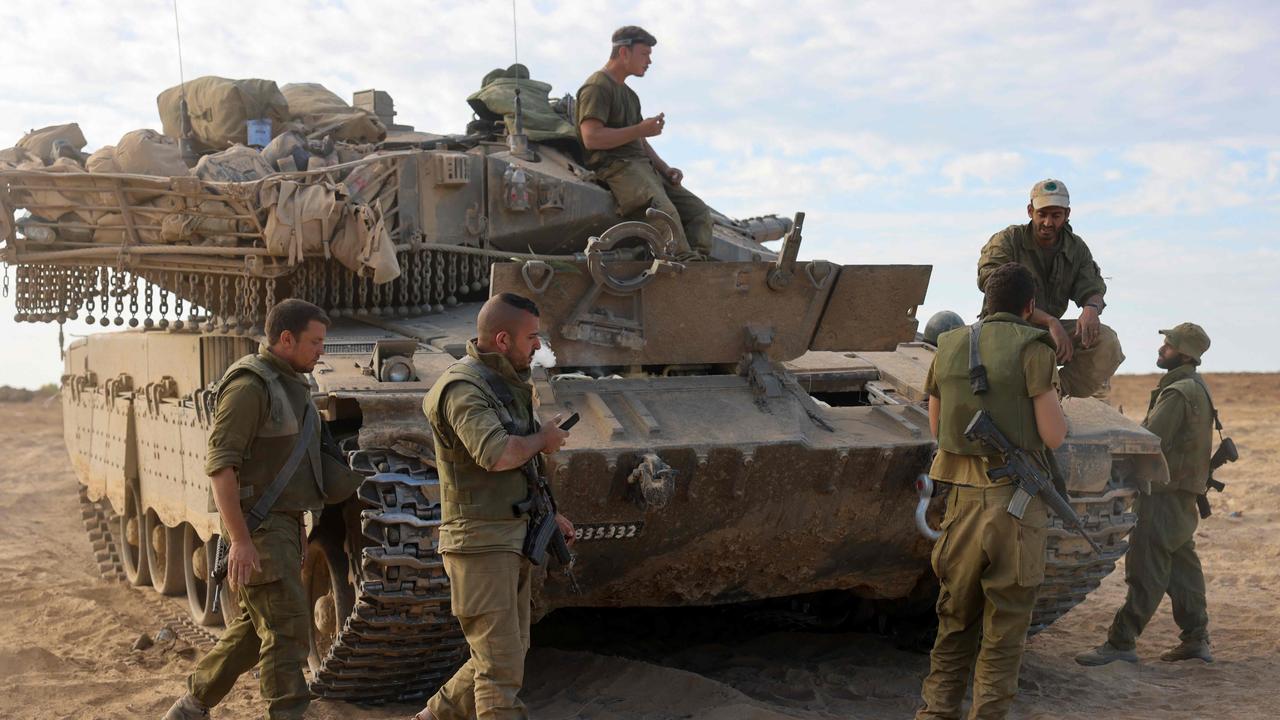
An Israeli soldier walks past army bulldozers deployed near the border with Gaza. Picture: Menahem Kahana/AFP        Bulldozers deployed near the Gaza border. Menahem Kahana/AFP

You can tell a lot about a military force, and the conditions under which it operates, by watching how it prefers to fight. Americans, for example, prefer stand-off strikes with laser-guided bombs and long-range rockets: they seek the illusion of distance, precision and cleanness, avoiding the bloody, complex reality of ground combat. Russians, by contrast, are famous for massing enormous weights of artillery against a single point, then flinging “disposable infantry” into meat-grinder assaults.

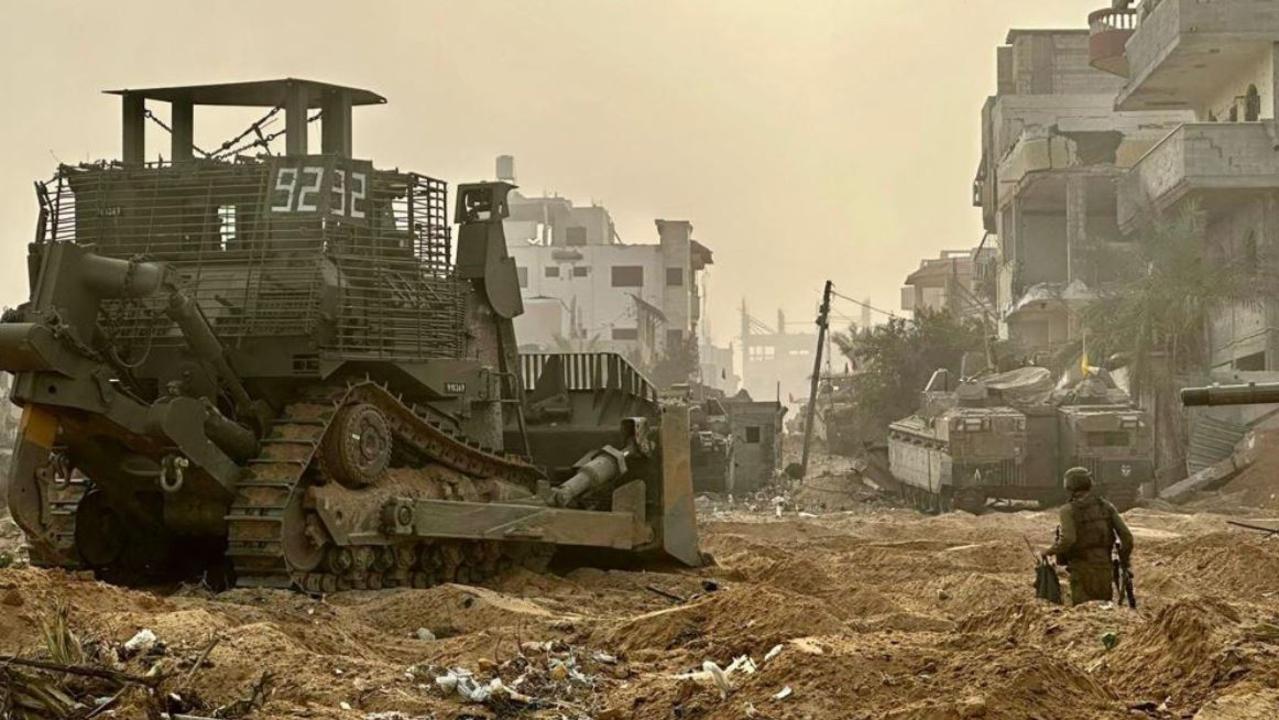
A central tool of Israeli tactics is the armoured bulldozer: slow, implacable, destroying obstacle after obstacle as it grinds forward. Israel’s ground campaign in Gaza has relied heavily on these bulldozers, which weigh more than an Abrams tank and can demolish buildings, clear rubble, destroy strong points or build berms under heavy fire.

US criticism of Israel’s approach reflects the preference for precision. Council on Foreign Relations president emeritus Richard Haass, one of America’s most distinguished foreign policy thinkers, wrote recently that Israel could have fought a different war. Its approach, Haass wrote, “should have been more precise, giving priority to eliminating Hamas’s leadership and key fighters as intelligence allowed. Israel should have relied more on small-unit operations rather than aerial bombardment.”

A central tool of Israeli tactics is the armoured bulldozer. Picture: Menahem Kahana/AFP
Armoured bulldozer.Menahem Kahana/AFP

While acknowledging that this might have taken months or years, and “some Hamas fighters who embedded themselves in schools and hospitals would have escaped punishment”, he argued that “this would have been preferable to killing thousands of civilians, further radicalising the Palestinian population and alienating the region and the world”.

It might indeed have been preferable, but would it have been possible? Could Israel really have adopted a stand-off approach, using small-team raids and surgical strikes to target Hamas leadership, do minimal damage to Gaza and its population, and still achieve its objectives? Answering these questions starts by understanding why the armoured bulldozer has become so central to Israeli tactics in the first place.

We are talking here of what is, rather than what ought to be. In an ideal world, October 7 would not have happened, Israel would never have needed to mount a full-scale ground invasion of the Gaza Strip, and thousands of civilians – Israeli and Palestinian, men, women and children – would be alive and well today instead of dead, wounded or held hostage.

But those things did happen, and any attempt to make sense of the war needs to take that fact as its starting point.

Richard Haass. Picture: Alex Wong/Getty Images
Richard Haass. Alex Wong/Getty Images

For reasons we will explore, destruction of the urban environment itself, rather than merely defeating an opponent within it, has become a key part of how the Israel Defence Forces fight in cities.

This, in turn, reflects the reality that, in a multi-generational struggle for territorial and demographic dominance, across a tiny area – all of Israel is only about twice the size of Greater Melbourne – it’s often simply impossible to disentangle opponents such as Hamas from the populations and landscapes in which they hide. Under these conditions, military commanders sometimes see destroying an urban area outright (or flattening parts of it) as the only way to achieve their missions. Some analysts (including several Israelis) condemn this as “urbicide” – killing entire cities rather than just fighting within them – but many IDF commanders, tasked by Israeli politicians with clearing a deeply embedded enemy from a densely urbanised, heavily populated area, see few other options.

On the ground in Gaza, infantry and armour move together in integrated combat teams with dismounted troops, tanks and armoured personnel carriers co-operating to support the manoeuvre of bulldozers as they push forward, clearing rubble, destroying Hamas positions and knocking down houses. Demolition teams, equipped with explosives and moving on foot, systematically blow up structures that could pose a threat. Tunnels and bunkers are blown up or bulldozed, their entrances sealed, with explosions often caught on video and disseminated on social media by the troops themselves. These videos have prompted criticism and some were cited as evidence in the genocide case against Israel in the International Court of Justice. But the videos also encourage civilians to evacuate ahead of advancing troops, reinforcing official IDF calls for the population to leave, and arguably reducing their exposure to combat.

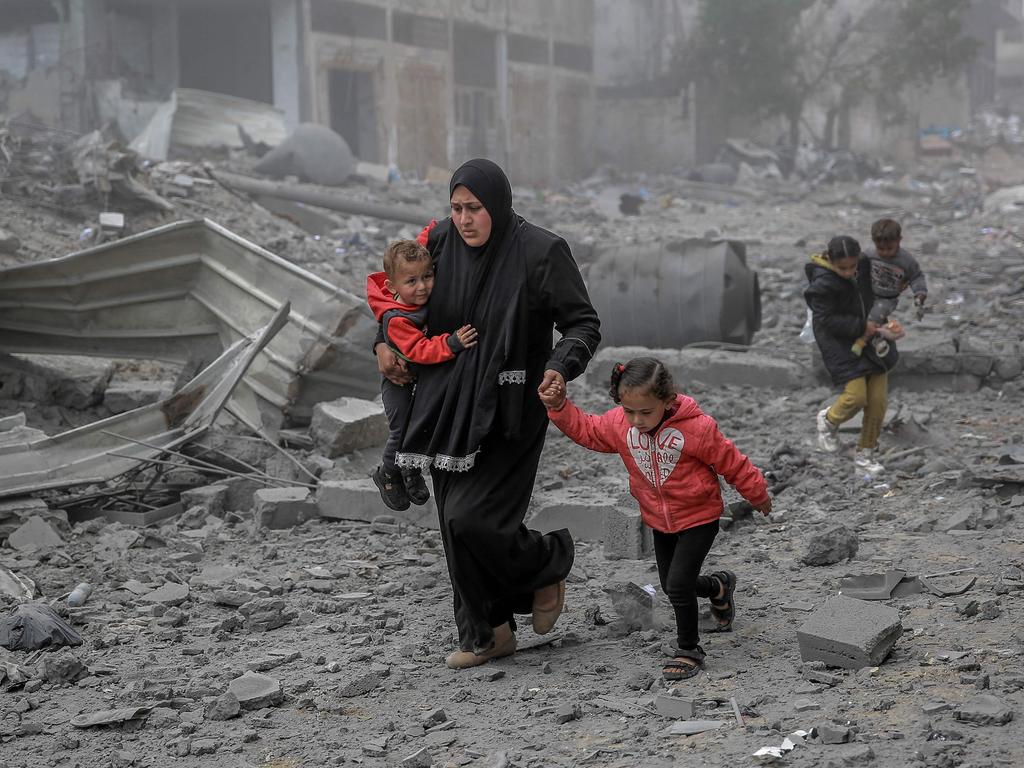
Palestinians flee the area after Israeli bombardment in central Gaza City. Picture: AFP
Palestinians flee after Israeli bombardment in central Gaza City. AFP

Much of the Gaza Strip is now not only uninhabitable but uninhabited. The IDF advance has pushed the population ahead of it, with civilians fleeing along evacuation corridors such as Salah al-Din Road, the main thoroughfare that runs down the middle of the strip and connects Gaza City with Khan Younis farther south. Both are depopulated, with 1.5 million civ­ilians now crowded into Rafah in the far south. Only about 300,000 civilians now remain in northern Gaza. (Before the war, the entire strip had a population slightly less than 2.2 million people.)

As the advance pauses each evening, rather than withdraw and thereby cede territory that would then have to be recaptured, the bulldozers build berms and defensive positions for the assault troops, allowing them to encamp in the ruins and restart the advance after resting. Most camps are used for one or two nights, then abandoned as the advance moves on, but some are semi-permanent forward operating bases. Attack helicopters provide fire support and air cover.

By January, entire neighbourhoods in Gaza had been razed using these methods.

Israeli forces also are constructing a buffer zone along Gaza’s landward border. Described before the current war as the “world’s largest open-air prison”, Gaza already had a 300m-wide exclusion zone that separated residential areas from the border fence. Israeli observation posts covered that zone and could shoot anyone approaching the fence.

But October 7 showed that a determined enemy could cut the fence at numerous places, so bulldozers and combat engineers have been widening the buffer since. Israeli officials say this is a critical security measure to allow civilians to return to the settlements that Hamas attacked on October 7. IDF engineers also are bulldozing buildings to construct an east-west road across the northern third of the strip, cutting Gaza in two and creating a field of fire 300m wide.

IDF D9 Israeli bulldozer in Gaza. Picture: IDF Spokesperson's Unit
IDF D9 Israeli bulldozer in Gaza. IDF Spokesperson’s Unit

The bulldozer (or perhaps the steamroller) is an apt metaphor for the campaign itself – the IDF is, in effect, bulldozing its way across Gaza, slowly but implacably pushing the population ahead of it, destroying Hamas as it goes, while removing much of the urban area itself. This represents a brutally terrain-centric approach to battle. But it also reflects the reality of deep entanglement among armed enemies, civilian populations and dense urban areas, in a zero-sum territorial conflict fought explicitly for control of living space. It embodies decades of tit-for-tat adaptation by both sides.

One battle – the Battle of Jenin, fought in a West Bank refugee camp in April 2002 – was an inflection point. The term refugee camp is technically accurate but gives the wrong impression: the Jenin camp was not a temporary collection of huts but a densely built-up area with multi-storey concrete structures. The IDF entered the camp to clear it of Hamas and other militants who were using it as a base for suicide bombings against Israeli civ­ilians. Nine days into the battle, after severe losses in an ambush, the IDF pulled back, reorganised, then re-entered using new tactics based on small combined-arms combat teams centred on armoured bulldozers. The bulldozers cleared improvised explosive dev­ices and booby traps, destroyed fighting positions, then flattened a 200m-by-200m area in the centre of the camp, which became an IDF base, effectively ending that round of fighting.

The IDF approach in Jenin was studied by US and Australian commanders during the Iraq war. They concluded its impact on civilians – and its physical destructiveness – made it a last resort at best. US forces tried (often unsuccessfully) to protect Iraqi civilians and avoid urban incursions. They built kilometres of concrete T-wall in Baghdad, for example, to keep hostile populations apart, separate them from insurgents and stop militants moving around the city, precisely so as to avoid destructive armoured forays into inhabited areas.

But Iraq – where the US-led coalition saw itself (and was seen by locals) as a purely temporary presence, trying to defeat an enemy with minimal damage, then stabilise things enough to leave – was far different from Israel, where both sides claim much of the same territory as their own. This is a demographic and territorial conflict between populations with irreconcilable claims to the same tiny area of land, a zero-sum contest where destruction of settlements and denial of access helps cement control at the expense of the adversary.

A more apt analogy for today’s fighting would be the battle against Islamic State in the northern Iraqi city of Mosul during 2016-17. This was an enormous battle, about the same size and duration as the current Gaza campaign. It did massive damage to Mosul, which before the battle had a population of 1.2 million people, and lasted nine months.

Islamic State had just over two years to put Mosul into a state of defence – from June 2014, when it captured the city, until October 2016, when the Iraqi-led offensive to retake it began. In that short period, Islamic State fighters developed dense belts of booby traps, dug deep defensive positions, and embedded themselves in the human and physical fabric of the city, thereby making it impossible for an opponent to attack them without also damaging the city and killing civilians.

Ultimately, Mosul soaked up more than 90,000 Iraqi troops and hundreds of foreign advisers, against 6000 to 12,000 Islamic State fighters. The battle displaced at least a million people, destroyed large parts of the city and may have killed as many as 40,000 civilians, according to the Asayish, the Kurdish Regional government’s intelligence service.

Hamas, by contrast, had almost two decades in complete control of Gaza (from 2006 to 2023). It used that time to develop a fearsome defensive complex, with numerous strong points and hundreds of kilometres of underground passages, embedding itself thoroughly into the physical environment of the strip and its population. The organisation had 30,000 fighters in total before the Gaza campaign began, far more than the Islamic State garrison defending Mosul.

Any ground invasion of Gaza was therefore bound to be bloody, protracted and destructive, on the scale of Mosul or larger. This is exactly what we are seeing, and what most military analysts expected.

Palestinians gather in a street as humanitarian aid is airdropped. Picture: AFP
Palestinians gather as humanitarian aid is airdropped: AFP

The notion of a clean, surgical, stand-off campaign, using precision strikes and small-team raids to destroy Hamas without damaging Gaza or harming civilians – as attractive as it sounds in theory – is simply not practicable, as our own recent history in places such as Mosul shows. Again, we are talking about what is rather than what ought to be. But reality is reality: the only way for Israel to avoid the kind of campaign that is happening now would have been not to go in at all, leaving Hamas in control of Gaza, which was politically unacceptable after October 7. To understand why that was so, we need to return briefly to Jenin.

Jenin was designated in the 1995 Oslo II Accord as part of “Area A”, putting it under the control of the Palestinian Authority, but the IDF repeatedly raided the camp before and after the 2002 battle.

From March 2022, incursions increased to an almost nightly tempo under Operation Breakwater, a counterterrorism effort targeting Jenin and the town of Nablus, 35km farther south.

The IDF said in mid-2023 that at least 50 attacks against Israeli civ­ilians had originated from Jenin in the preceding two years. In late July, weeks before the October 7 attacks, Israeli tanks, bulldozers and infantry launched their largest incursion into Jenin since the 2002 battle. Since the IDF launched its full-scale ground invasion of Gaza, raids into Jenin, Nablus and other West Bank towns have continued.

This is what some Israelis call “mowing the grass” – repeated raids into an area to disrupt terrorist groups and reduce the threat.

IDF commanders historically knew that such incursions were only a temporary measure, doing little more than managing the threat until it inevitably regenerated. They recognised the destruction and enduring hatred that the raids caused among local populations but accepted that the intractable politics behind the conflict precluded any permanent solution.

Israeli Prime Minister Benjamin Netanyahu. Picture: Leo Correa/AFP
 Prime Minister Benjamin Netanyahu. Leo Correa/AFP

This attitude – resignedly mowing the grass, forever, with no hope of any permanent settlement given the underlying politics – changed radically for many Israelis on the morning of October 7. After that assault, public pressure for a final defeat of Hamas built up inexorably on the Netanyahu government, from a population stunned by the audacity, scale and suddenness of the attacks, infuriated by the intelligence failure that allowed them to happen, horrified at their brutality, and demanding Hamas be destroyed once and for all.

Mowing the grass was no longer acceptable.

Tactics are downstream from politics, and this fundamental change in the underlying politics of the conflict is why, despite escalating criticism from the Biden administration and a genocide accusation in The Hague, Israel’s campaign has unfolded in such an implacable, bulldozer-like manner.

Since October 7, opinion has hardened even further on both sides: in polls last month a large majority of Israeli respondents expressed opposition to a Palestinian state “under any circumstances” and opposed a ceasefire until all hostages are released. Likewise, in November last year, 59 per cent of Palestinians surveyed said they “extremely supported” the October 7 attacks, while 16 per cent “somewhat supported” them.

The IDF’s campaign, successful though it has been in achieving the goals laid down by Israeli political leaders, has reached the point where politicians themselves have to take it to the next stage. This is all that any military operation can deliver. But given the hardening of Israeli and Palestinian public opinion – and the fact Hamas still holds 130 hostages and has refused to guarantee their safety – it’s hard to see any space for a political solution.

The pre-October 7 political conditions, of uneasy coexistence and periodic mowing of the grass, have been overtaken by events, suggesting that the campaign (with or without a temporary ceasefire) will end only with a complete Israeli tactical victory in Gaza. Whether such a victory would meet Israel’s broader strategic goals – and whether the country could then rebuild relationships that have been tested by the conflict – is a more complex question.

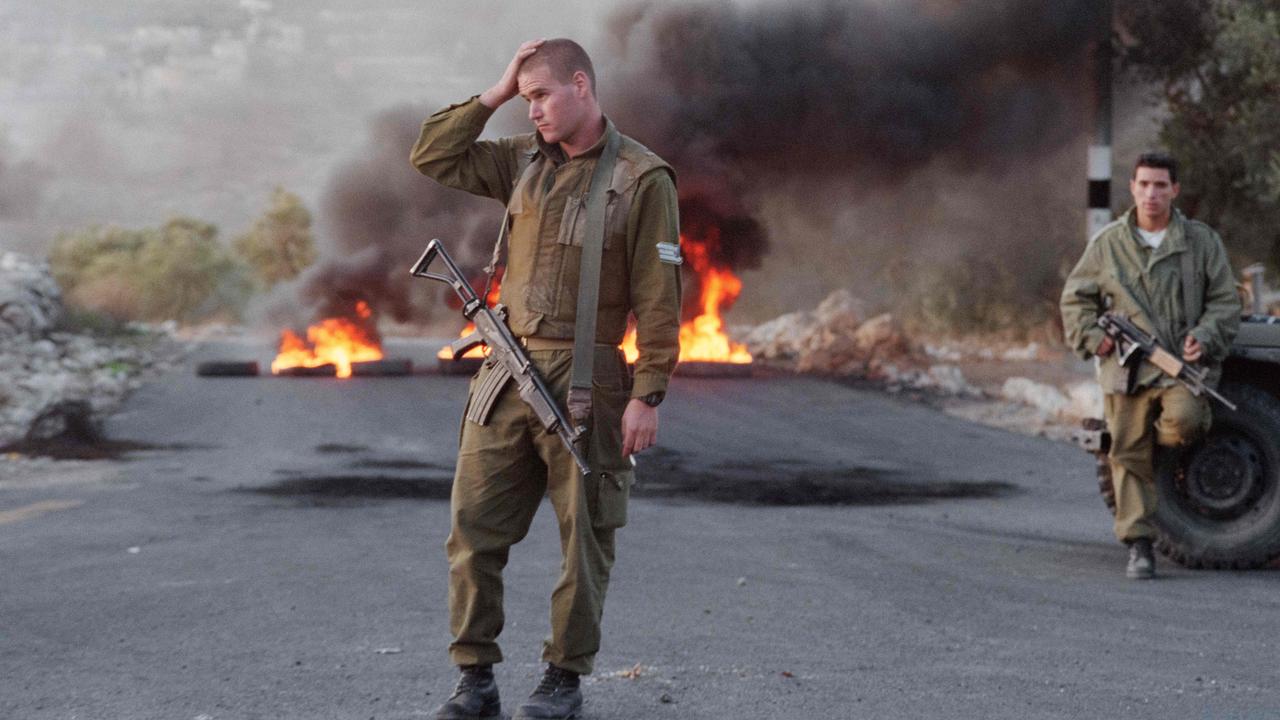
Israeli soldiers stand near a roadblock of burning tires placed by Jewish settlers. Picture: Sven Nackstrand/AFP)
 Israeli soldiers near a roadblock of burning tires placed by Jewish settlers. Sven Nackstrand/AFP

The next military objective is Rafah, where vast numbers of civilians are now crowded, under horrific conditions, into one of the last remaining Hamas-controlled areas. The more the advance squeezes civilians into this southwestern corner of the strip, the greater the pressure on Israel for a ceasefire or evacuation of non-combatants. That pressure has been growing from the US congress and the Biden administration, with stop-start negotiations periodically raising hopes of a temporary ceasefire but offering little likelihood of an enduring end to the fighting.

But even as the campaign inside Gaza itself comes to a crisis, two other crises threaten to expand the conflict. Roughly 1900 km south of Gaza, in the Bab al-Mandab, the narrowest point of the Red Sea, forces loyal to Ansarallah – the so-called Houthi movement that controls much of Yemen – have mounted a successful campaign to interdict shipping, using drones and missiles, in support of Hamas and probably at the behest of Iran, which sponsors both the Houthis and Hamas.

Targeting Western and Israeli-connected ships, the Houthis have managed to reduce regional shipping by more than 90 per cent since last November. Perhaps more important, the cost to ship a 40-foot container from China to Europe has almost tripled since the start of December, putting significant pressure on global trade. This brings other players – including several European powers and, most important, China – into the equation. China’s approach has been characteristically cautious, but the Red Sea crisis is increasing pressure on Tel Aviv to end the conflict, even as the IDF nears its last major objective.

A second problem is Hezbollah, another Iranian proxy whose forces sit just across Israel’s northern border and are vastly more militarily capable than those of Hamas. Indeed, it is hard to overstate how much more powerful Hezbollah is than Hamas: it possesses an enormous inventory of rockets, drones and missiles, exercises functional control of Lebanon’s government, and has barely used its most capable assets since the start of the Gaza conflict. Hassan Nasrallah, head of Hezbollah, repeatedly has called for an end to the war, and Hezbollah is intensifying its artillery and rocket attacks against northern Israel but is yet to mount a ground offensive or unleash its full force. If it were to do so, Israel’s strategic position would worsen catastrophically, overnight.

All this is true, but also perhaps irrelevant. In war, military action is driven by political decisions, and political decisions are shaped by public opinion.

In Israel’s case, public pressure for a permanent defeat of Hamas is now overwhelming, and this in turn drives political decisions that have resulted in the Gaza ground campaign. In turn, the evolution of Israeli (and Hamas) tactics and tools over decades of conflict have shaped the way that campaign is being conducted. To imagine that Israel could or should have fought the campaign using a surgical, precision, stand-off, small-team approach would be a fundamental misunderstanding of urban warfare and of how the underlying politics driving the conflict have shifted since October 7.

While many Australians are rightly watching the Gaza war with horror, the harsh reality – as Mosul shows – is that this is what happens when you do large-scale combat operations in a heavily populated city. The only way to avoid this would have been for Israel not to go in at all or for October 7 never to have happened. Short of a ceasefire (which seems highly unlikely) or a fundamental transformation of the conflict via direct Hezbollah intervention, things seem set to continue as they are for the immediate future.

David Kilcullen served in the Australian Army from 1985 to 2007 and was a senior counter-insurgency adviser to General David Petraeus in 2007 and 2008, when he helped design and monitor the Iraq War troop surge. His 2015 essay Blood Year: Terror and the Islamic State won the 2015 Walkley award for long-form writing and was published as a full-length book in 2016 by Oxford University


Castles Made of Sand

A recent article in Newsweek noted:

“More than three-quarters of Palestinians feel their government is corrupt. Asked to name the biggest problem in society, a majority of respondents choose internal ones: poverty, unemployment, corruption and the political schism between Hamas and Fatah. Just 27 percent say the occupation is their largest concern, according to the Palestinian Center for Policy and Survey Research, the top pollster in the territories. The official unemployment rate in the West Bank is 16 percent, and roughly one in five families lives in poverty. (The actual figures are thought to be higher). Yet the streets of Ramallah are lined with billboards advertising million-shekel apartments. A tenuous middle class has loaded up on consumer debt, which soared from $1.3 billion in 2012 to $2.2 billion just three years later. All of this has served to make Palestinians more risk-averse. The way a CEO of a major bank in Ramallah sees it: “You’re not going to join an intifada when you have to make mortgage payments.”

Meanwhile, the economies of Israel and Palestine are effectively integrated. Israel controls trade The Palestinian market us captive one for Israeli products, whilst Palestinian goods have limited acess to the Israeli market. Al Jazeera has recently published an informative piece this subject.

The following is based on our own observations and knowledge, and these are informed by what we have seen and read, and what we were told by Palestinians we talked to during our travels through the West Bank. We do not profess to be experts – we are neither academics nor professional commentators. And accordingly, we welcome objective comments and contributions that both support and question our observations.

Castles Made of Sand 

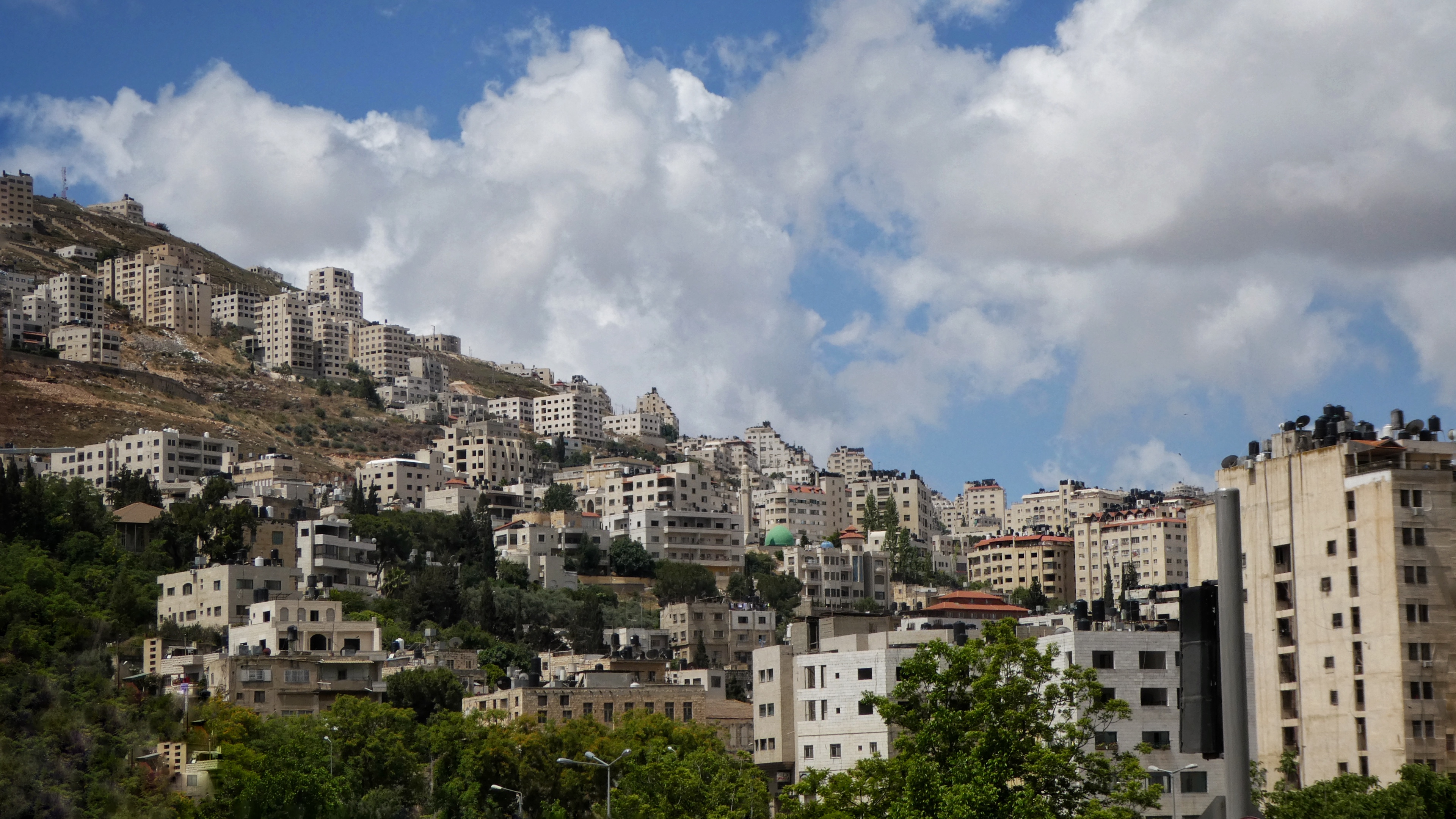
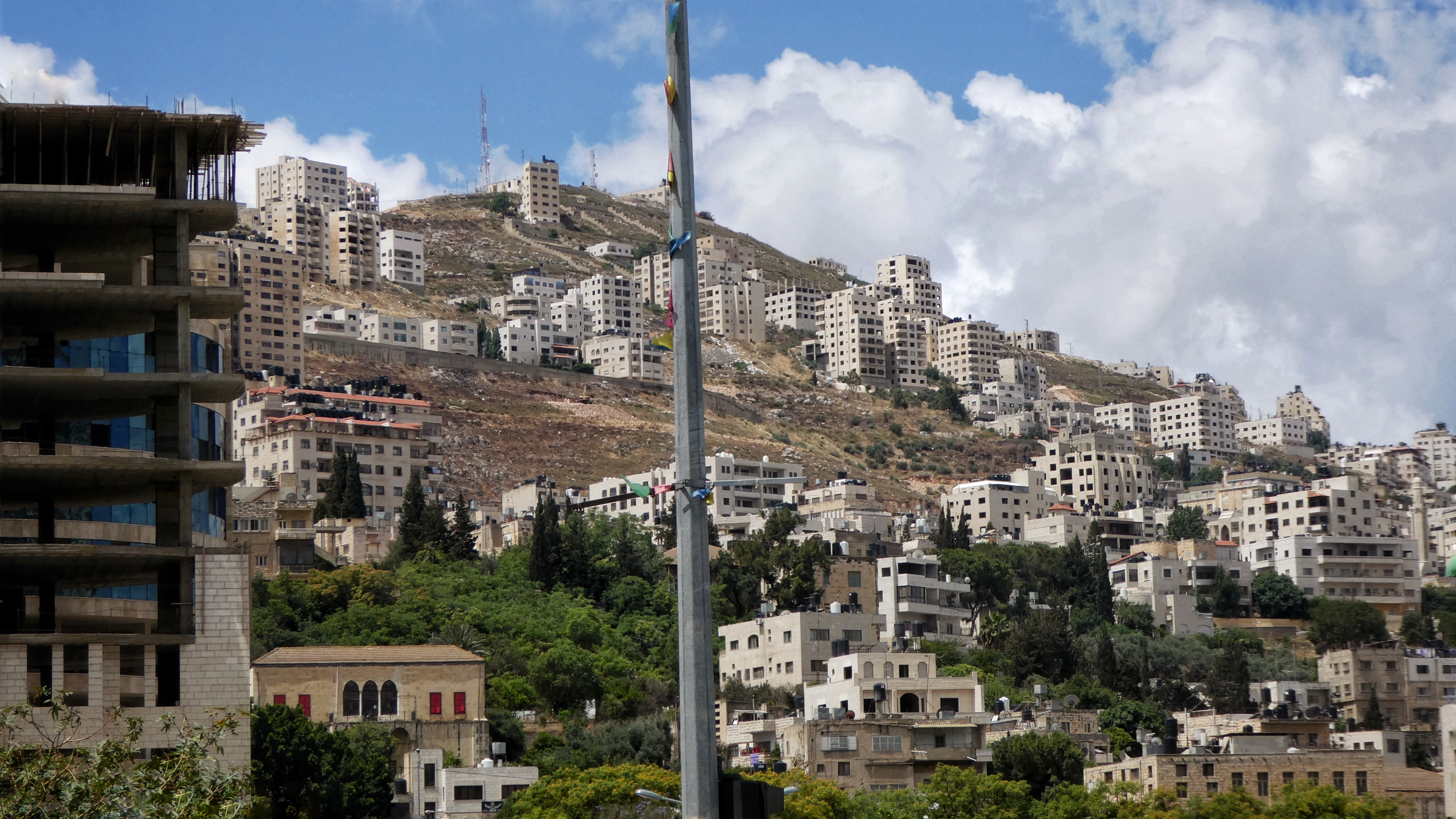
Whilst the attention of the international media and of NGOs is focused on Israeli settlements, there is a land rush going on in the cities of the West Bank.

A big surprise in our travels through the Occupied Territories, was the residential construction boom going on in cities fully governed by the Palestinian Authority (PA). We had been aware of this prior to coming to Israel, but not of its scale. To our knowledge, mainstream media has hardly  covered this at all, and when it does, more often than not it is PR rather than critical analysis (see links below). Our guides, for reasons of their own, were reticent about discussing it.

We often hear that development is held back by the Occupation, that buildings without official approval are subject to demolition, and that there is no land available for Palestinians to build on. Likewise, we hear about how the water supply to the Est Bank is severely restricted. Israeli settlements enjoy an abundance whist Palestinian homes endure meagre rations. Indeed, our guides would stand beneath hills covered in building sites and repeatedly tell us all this.

Most certainly, building by Palestinians is severely restricted in Area C (60% of the West Bank, and 4% of its Arab population) which is under Israeli control, and Area B, under the joint control Israel and the Palestinian Authority (22% and 41% respectively).  And water is indeed problem insofar as the aquifers are located in Israel itself, and supply is hostage  to logistical and political exingenices, and also, to an antiquated Jordanian distribution infrastructure vulnerable to regular breakdowns and leaks.

But billions of expatriate dollars are being invested in medium and high density apartment blocks in area A, the 18% of the West Bank controlled by the PA (and 55% of Palestinian Arabs) in Ramallah, the de facto capital, and in Nablus, Hebron and Jenin. It is a common practice throughout the Middle East for expatriates to remit funds to build a house or houses for their families, or to add extra storeys to the old family home (unfinished upper storeys are a familiar feature of Arab towns in the Levant). But since its establishment, the PA has actively encouraged Palestinians who have “made it” overseas to invest in their nascent homeland by repatriating their stash and putting it into the burgeoning property market. The national accounts prepared by the Palestinian Monetary Authorty show that remittances from overseas have risen steadily in recent years. But do not detail where it is ultimately invested

Where does the land available for development come from? Local commentators suggest that families sell their land to developers. There are suggestions too that speculators take advantage of Shariah inheritance laws, whereby a parcel of land or an apartment block is divided up between sons, by targeting the weakest link – the most needy for quick cash, or more easily intimidated by strong arm tactics – and then persuading the other siblings to sell. The PA is regarded by many as notoriously corrupt, and it is not unlikely that government land and land held in trust is transferred into private hands through cronyism, kickbacks and connections. And what better home for trousered cash that cannot be transferred into offshore bank accounts than bricks and mortar?

Whatever the mechanism, the slopes of the hills surrounding the larger cities are adorned with hectare after hectare of high rises. Most are works in progress, and much of those that are completed appear to be unoccupied. And, on the subject of water supply, we observed that the new buildings were not topped by the roof water tanks that are ubiquitous in most Palestinian towns and villages. No water shortages here, it would seem.

We were informed that a small apartment can cost between $60 and $100,000 before fit-out. Add another 10-20% for fixtures and fittings. Most Palestinians cannot afford these modest apartments. Those that do are in paid employment, mainly working for the PA or for UNRWA (United Nations Relief and Works Agency for Palestine Refugees in the Near East) and the many NGOs that operate here. And they raise the finance through very un-islamic mortgages. Large billboards on highways offer financial advice and funds to affluent-looking young professionals.

imageimage

The irony is that most employed Palestinians depend upon the survival of the PA and indeed, on the continuation of the Occupation. UNWRA, the United Nations agency that caters exclusively for Palestinian refugees employs some 30,000 people, the vast majority of whom are Palestinian (only a few hundred are not), and as such, it is the largest single employer of Palestinians in Gaza and the West Bank (by comparison, the UN High Commission for Refugees employs only 5,000 to 6,000 people globally).

Should the PA collapse or be abolished, should UNWRA be dissolved, should a Palestinian state be established in the West Bank, the government, and those businesses and agencies that depend upon it for contracts and custom could become insolvent, whilst there is always the possibility that international funding could be reduced or withdrawn. In short, the housing bubble could burst, the property market collapse, and those photogenic young professionals in the billboards, and their families, could lose their jobs and their homes.

The health of the Palestinian economy is also an perennial risk factor. The economy had been improving in recent years, with unemployment in the West Bank falling and and private investment in construction growing. The two might have been working hand in hand, coinciding with commencement of the building boom. But during the past three years, economic indicators have gone backwards owing to the political and economic uncertainty, with falling rates of growth, high inflation, and continuing high rates of unemployment and poverty. Economic recession, therefore, could likewise impact on the property market.

These are worst-case scenarios. But there are other economic implications.

For example, this property boom is speculative rather than productive investment in a Palestinian economy that is heavily dependent – some would argue almost totally – on Israel and on international aid. Whilst aid donors and agencies bankroll roads and essential services like schools, power, water, and the like, some say the money should instead be invested in business startups and entrepreneurial enterprises, developing the fiscal and human capital so that Palestinians can provide for their own welfare. National self-esteem should come from being economically sustainable and not from being an indigent state.

Also, there is growing economic inequality between the haves and the have nots. Before the establishment of the PA, we were told, things were more evenly balanced. Most of the population were on a more or less equal footing. There was a sense of “we are all in it together”. Now there is a palpable sense of every man for himself.

Author’s Note

Reiterating the forward to this post, this is based on our own observations and knowledge, and these are informed by what we have seen and read – we are neither academics nor professional commentators. But, as we sincerely desire to acquire and to present as accurate a picture as possible, we welcome objective comments and contributions that both support and question our observations. Any such insights will be incorporated into the post.

Much of what I have written is covered in this illuminating report by the Jerusalem Centre for a Public Affairs published in November 2015 (the picture gallery is an eye-opener): Luxury alongside poverty in the Palestinian Authority

See also: https://en.m.wikipedia.org/wiki/West_Bank

Photographic Postscript: every picture tells a story

Palestinian developer and billionaire Munib al Masri, so-called “Duke of Nablus” built himself a mansion atop a hill overlooking Nablus. That’s his personal mosque up there. Some locals say he could’ve built one for them in the city instead.

Al Misri's mosque

Al Masri’s mosque

New high-rise buildings look down on a billboard honouring a young shahi-d or martyr.

Those who can, invest. Those who cannot, become martyrs.

Those who can, invest. Those who cannot, become martyrs.

Afterword : The Duke of Nablus and his kin

Relatives Municipal al Masri include his cousin and fellow billionaire, Arab Bank and Paltel chairman Sabih al-Masri, and nephews, developer Bashar Masri, and Jordanian former prime minister Taher al-Masri. The Masris would appear to be the Palestininian Authority’s development choice, and also, Israel’s.

http://www.spiegel.de/international/world/dream-of-a-palestinian-tiger-boom-times-in-the-west-bank-a-759046.html
http://www.bbc.com/news/magazine-31154138
http://cnsnews.com/news/article/us-govt-funding-313m-mortgages-palestinians-west-bank
https://en.m.wikipedia.org/wiki/Munib_al-Masri
https://en.m.wikipedia.org/wiki/Bashar_Masri