In my earlier blog, The Grand Old New Imperial Hotel, I wrote:
Had the hotel been there in Biblical times, what events we might have witnessed from our balcony. King Herod, the ostensibly psychotic master builder of Bible infamy dwelt opposite as he planned his Second Temple. So did Pontius Pilate. If one accepts the narrative of Simon Sebag-Montefiore, in his Jerusaelm : The Biography, we could also have watched the last journey of Jesus of Nazareth. It was but a short distance from the Citadel where he was condemned and Golgotha where he died: across the square, right at the New Imperial, left just past the Med, and straight on to the Hill of the Skull (where the Church of the Holy Sepulcher now stands). The present Via Dolorosa runs from the site of the Antonine Fortress, on the northern edge of the Haram ash Sharif, to The Church, its course set by custom and customers from Byzantine days.
As I relate in my earlier post, ‘Amazing Grace – There’s Magic In The Air‘ : “from the Jaffa Gate, we look out from our balcony in the Imperial Hotel, a late 19th Century mix of trash and treasure, five-star history, and ten-star views”.
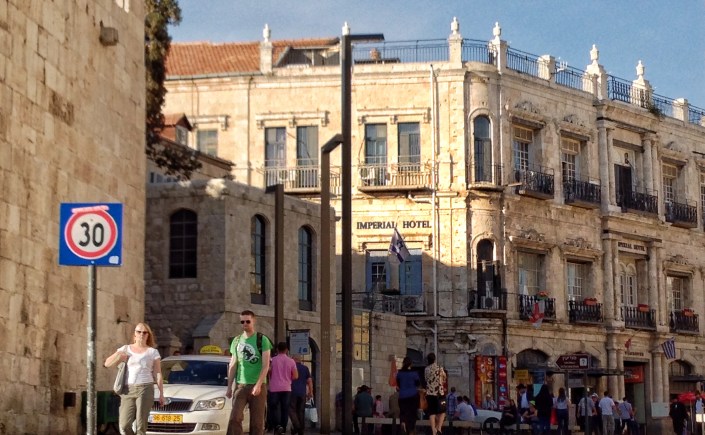
Planning our 2014 visit to Jerusalem (we were there in May 2014) I wanted to book a hotel that was both historical and conveniently close to The Old City. I also fancied the idea of staying in a pilgrim hotel so we could witness at first hand the excited comings and goings of the faithful (see my post ‘Messianic Carpet Rides‘). The New Imperial Hotel, just inside the Jaffa Gate, was just the ticket. And we struck solid gold! Stepping down from the Nesher bus on the road outside the famed Walls of Jerusalem and the Citadel (see: Once in Royals David’s Citadel), we looked up towards the Jaffa Gate and there, right above us was the imposing facade of the New Imperial Hotel.
The Jaffa Gate, in the western wall of the Old City (not to be confused with the ‘Western Wall’ or ‘Kotel’ so revered of Judaism), has traditionally been one of the busiest entrances to Jerusalem. Its Arabic name is Bab al Khalil (Gate of the Friend) a reference to Abraham, forefather of both Arabs and Jews. The wall bears the inscription in Arabic: “there is no god but Allah, and Abraham is the friend of Allah”. Topographically the Gate provided the easiest access, so it’s approaches provided a most convenient camping ground for the many invaders who sought to conquer the city. These included Greeks, Romans, Arabs, Frankish Crusaders, Turks, and finally, the British. Caliph Omar Ibn al Khatab entered through this gate after Jerusalem’s capture by the Muslims in 638AD. As did General Allenby, commander of the British forces which captured Jerusalem in December 1917.
Just inside the wall, there were fields of winter wheat until the late nineteenth century; and in summertime, the empty fields became dumping grounds for carcasses of donkeys, camels and horses. The Turkish authorities moved this ‘cemetery’ outside the wall, and what was forever the main thoroughfare, became the location for important commercial institutions, including the Banco de Roma, the Anglo-Palestine Bank, and the German bank of Johannes Frutiger, the Austrian Post Office, The Thomas Cook Tourism and Travel Company, and the studios of a number of Jerusalem’s famous photographers.
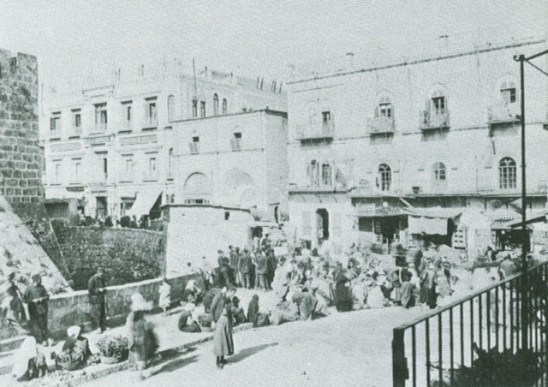
And also, several hotels catering for the growing tourist industry, including the Mediterranean Hotel (now called The Petra), and in 1884, the Grand New Hotel, built on land owned by the Greek Orthodox Patriarchate. According to the Thomas Cook Tourist Handbook in 1876, the Mediterranean was “the best in Jerusalem”. Travelers were however wont to damn the Med with faint praise, and soon began to write about the really new, really ‘grand’ hotel with great facilities, round arched windows, high roof pedestals topped by Grecian urns, imposing entrance staircase, and balconies looking right out over Omar Ibn al Khatab Square. See the pictures below from the end of the 19th Century, showing the square in all variety of citizenry and costume.
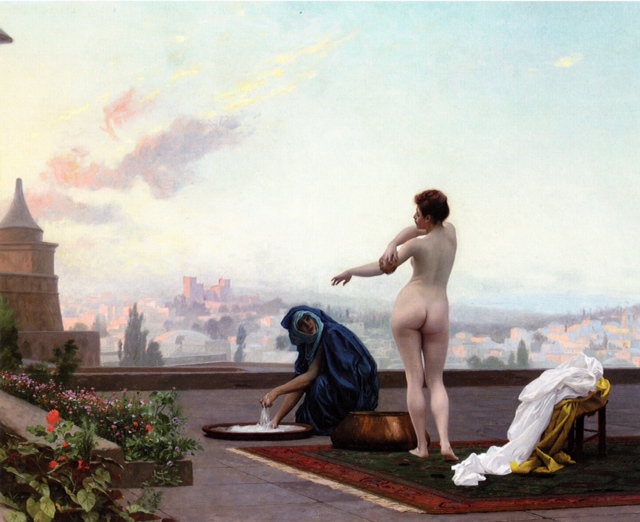
The place comes with a history. During construction, builders uncovered what was believed to be the Pool of a Bathsheba. It was said that Uriah’s wife was bathing thereon when spied upon by a randy King David. David subsequently sent Uriah off on a suicide mission to clear the way for his own passions. The historical record is confused here. Leonard Cohen and the painter Jean-Léon Gérôme apparently got it wrong. They both placed her up on the roof. The Bible says he saw her from the roof.
The view from the rarely frequented roof terrace of the New Imperial itself, whilst not quite as picaresque as the vision that tempted the poet king, offers a splendid vista of the cupolas of the Church of the Holy Sepulcher and the Dome of the Rock – not to mention a fine peek at the battlements of the Citadel. On the western side, we look out over West Jerusalem and what was the old Arab neighbourhood of Mamilla, now totally rebuilt with a lux shopping mall, the rectangular bulk of the King David Hotel, once the HQ of the British military and bombed by Irgun terrorists in June 1946, and the iconic YMCA tower.
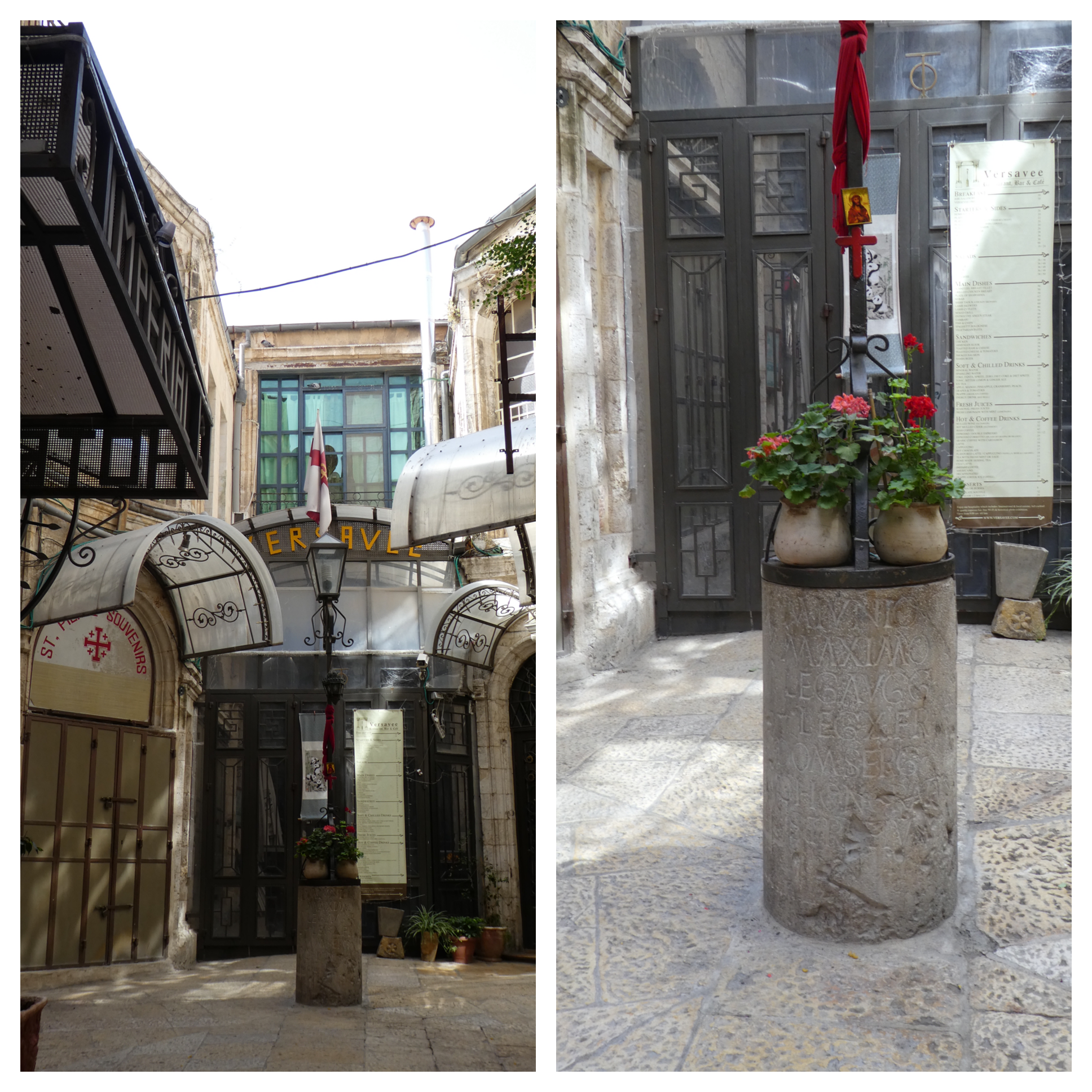
Anyhow, there is still an ancient cistern beneath the hotel. And also, part of the second wall. There are Roman tiles signifying the HQ the Roman Tenth Legion, and part a column erected by the legion, bearing a votive inscription honouring Emperor Augustus’ Legate, Marcus Julius Maximus. It stands there today as a pedestal for a street lamp, in the mews near the hotel front door and right in from of Versavee Restaurant and Bar, where the writer and his companions ate good Jerusalem fare and downed Israeli wine and Taybeh Palestinian beer.
Roman Column outside the New Imperial Hotel
Had the hotel been there in Biblical times, what events we might have witnessed from our balcony. King Herod, the ostensibly psychotic master builder of Bible infamy dwelt opposite as he planned his Second Temple (Herod might have murdered most of his nearest and dearest, but he was fitted up for the massacre of the innocents!). So did Pontius Pilate. If one accepts the narrative of Simon Sebag-Montefiore, in his Jerusaelm : The Biography, we could also have watched the last journey of Jesus of Nazareth. It was but a short distance from the Citadel where he was condemned and Golgotha where he died: cross the square, turn right at the New Imperial, left just past the Med, and straight on to the Hill of the Skull (where the Church of the Holy Sepulcher now stands). The present Via Dolorosa runs from the site of the Antonine Fortress, on the northern edge of the Haram ash Sharif, to The Church, its course set by custom and customers from Byzantine days. But, the wrong side of town! (See Nova Via Dolorosa).
I digress…From rom our hypothetical balcony, we could watch the comings and goings of the conquerors: the entry of the Roman Titus’ legions; Omar Ibn Al Khatab entering al Quds on foot; the arrival of the First Crusade at the Gates of Jerusalem; the exit of the crusader garrison and the Christian inhabitants when the city fell to Salahuddin (portrayed in Ridley Scott’s Kingdom Of Heaven). And thence, Mamlouks, Seljuks, and Ottomans. The last Kaiser, Wilhelm II, stayed at the hotel on his visit to the Holy Land in 1898. His bust still sits in the entrance hall. This is when The Grand became the New Imperial! Kaiser Bill came in style. No walking for him. The wall between the Jaffa Gate and citadel was torn down and its moat filled in on orders from Sultan Abdel Hamid II to enable the Kaiser and his wife and their huge entourage (looked after in grand style by Thomas Cook Tourism & Travel) to motor into the Old City (again, read Sebag-Montefiore’s amusing account).
Twenty years later, General Allenby and his British Army marched through the gate. The good general entered on foot just like old Omar. It would be fun to imagine that he made his proclamation of the liberation of Jerusalem from one of those balconies (probably the big one in the centre, which now serves the office of the present proprietor Walid Dajani); but the reality is that he marched right past the hotel, veered right, and ascending the imposing steps of Kings David’s Citadel, deliver his oration there (although he may have indeed lodged at the New Imperial during his brief sojourn). He spoke of how the Holy City had now been freed from the Turkish yoke, and that, safe in the bosom of His Majesty’s forces, the Palestinians, in all their diversity, Jews, Christians and Muslims, would enter a new era of health, wealth and happiness. If he was aware of the nefarious dealings of Messrs Sykes and Picot, and the arrangement made by Lloyd George and Chaim Weizmann, he did not let on. He left the best news for the politicians to reveal a while later, and for the world to agonize over ever since.
So we enter the Twentieth Century, with its momentous political upheavals, the hotel having several changes of management but remaining largely unchanged, with its balconies, and its grand entry staircase. Walid Dajani’s father, Mohammed, took a “protected” tenancy” of the hotel from the Greek Orthodox Church in 1949, In the 1950s and 1960s, the hotel housed a small cinema, and its elegant ballroom was a favourite Palestinian wedding venue. It was damaged during the 1948 war, and during the 1967 Six-Day War, it was used as a base by Israeli troops, then returned to the Dajani family, the tenants of the property. It is, as far as we know, still owned by the Greek Orthodox Church, a status that ten years ago gave rise to a curious controversy about its future status, and in 2019, to a High Court appeal of its sale, and that of The Petra Hotel, to a shadowy right wing Jewish group – see the link below.
And thence to the present, with Sayyid Dajani greeting us like long-lost relatives, “ahlan wa sahlan bil Quds”.
Postscript
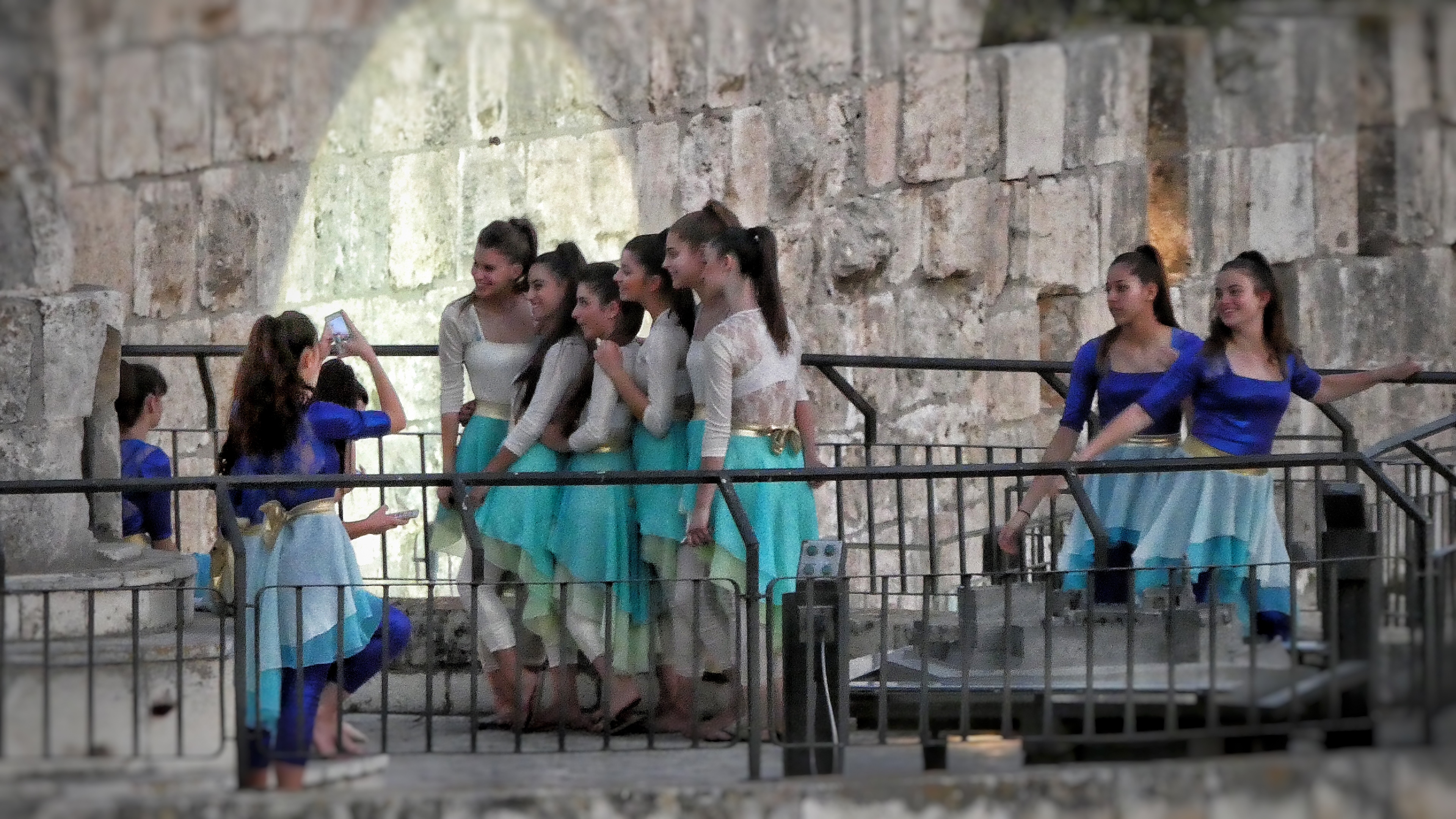
Such was our sojourn at the New Imperial in May 2014 – and our enjoyment of our room and its tiny balcony overlooking Omar Ibn Al Khattab Square, that we stayed there again for a month in 2016, booking the same room with its spectacular view of the comings and goings of all the tribes of Israel. In the warm evening, we’d sit in the roof garden directly across the street from King David’s Citadel with a good bottle of Israeli wine. Gazing on its towers, ramparts and gardens, we’d sense its story in our souls. We’d watch present generations passing beneath its walls, and the young folk dancing on the ramparts, all part of the passing parade of humanity that has lingered by and upon these ancient stones.
Jerusalem, The Golden. The Arabs call the city ‘Al Quds’, “The Holy’. It was deemed sacred from pre-history. Iconoclast scholars suggest that Jerusalem was actually the holiest place in Islam, and that like Islam itself and the Prophet, Mecca and Medina were retrofitted to suit the conqueror’s narrative. A city of the mind as much as of this earth, it haunts the prayers and dreams of three faiths, and to this this day, it is coveted and contested. “The air above Jerusalem”, wrote Israeli poet Yehuda Amichai, “is filled with prayers and dreams, like the air above cities with heavy industry. Hard to breath”. Arthur Koestler wrote: “The angry face of Yahweh is brooding over the hot rocks which have seen more holy murder, rape and plunder than any other place on earth”. Perhaps it is because Jerusalem is mankind’s number one hot spot! “There’s this thing that happens here, over the hell mouth”, says Buffy, “where the way a thing feels – it kind of starts being that way for real. I’ve seen all these things before – just not all at once”. More Jews have probably died violently in Jerusalem than in the Holocaust. And countless folk of other faiths have likewise perished.
Jerusalem is all about faith and passion, and there is no city on Earth that people get more passionate about. The light is luminous. In high summer it almost shimmers. The very air is full of prayer and politics, passion and pain, and the rocks and stones virtually sing a hallelujah chorus of history. I am not a religious person, but I cannot help getting excited by the place – although I do not transcend to transports of delight and delirium.
These include a group of mental phenomena involving the presence of either religiously themed obsessive ideas, delusions or other psychosis-like experiences that are triggered by a visit to the city of Jerusalem. It is not exclusive to one particular religion or denomination, having affected Jews, Christians and Muslims from many different countries and backgrounds. In The Simpsons episode The Greatest Story Ever D’ohed, the Simpsons travel to Israel where Homer is afflicted with the syndrome, the illness and its effect on Homer being one of the plot’s central themes. In The X-Files episode Revelations, agents Scully and Mulder try to subdue a man afflicted with a form of the syndrome. read all about in Messianic Carpet Rides
It is Shabbat in Jerusalem, and there’s magic in the air.
This morning, Enya wafting across the square in front of the Imperial Hotel. This afternoon, a Gregorian Chant rendering of REM’s “Losing my religion”. This evening, Haredim hustle through Omar Ibn Al-Khatab Square just inside the Jaffa Gate on the way to the Kotel, and the walls in Royal David’s Citadelare alive with Son et Lumiere, a weird blend of classical and faux movie music, retelling the ageless story of this ageless old town.
The Kotel, or Western Wall, is open to all, twenty four seven. Women now have their own section – a hard-fought for innovation. And Jews of all courts and communities share the space without rancour, each tribe differentiated by their interpretation of the Holy Torah, and by their garb, as determined by the fashion codes of 18th Century forebears in Eastern Europe and Mitteleuropa, heedless of the Mediterranean climate.
This, the only variable remnant of the Herodian Great Temple, is Judaism’s Holiest Place. And down below, in the tunnel, one can now actually walk the wall’s fundament (and view the biggest house-brick in history). This too is now a sacred site, the more holy the closer one gets to the location of the long-destroyed Holy of Holies. Tucked away in in a courtyard in the heart of the Arab Quarter is yet another, tiny remnant called appropriately The Little Wailing Wall. It’s location, up a narrow deserted alleyway is one Jews where do not venture. We had the space all to ourselves.
Immediately above the Kotel, on Temple Mount, is the Islam’s third holiest, Al Haram ash Sharif, the “noble sanctuary “. It is said that the Prophet alighted here on his night journey to Jerusalem on Borak, the winged horse with a human face, conversed with Abraham, the father of the three faiths, and thence, ascended to Paradise. Revisionist historians suggest that Jerusalem may indeed have been the primary Islamic city, sacred from times long forgotten, until Mecca and Medina were retrofitted to suit the conquering Muslims’ desert narrative.
Non-Muslims can enter the Haram for strictly limited times (three hours a day, on five days of the week), and then, only through the Maghrebi (or Western) Gate, which ascends like an unsightly concertina from the right of the Kotel Plaza. Admittedly, the Haram custodians are wary of would-be desecrators and of Jewish religious elements seeking to pray on the Mount (haram!), and set precedents for the rebuilding of The Temple. But they do themselves and Islam no favours when the other People Of The Book permit pilgrims of all persuasions and passions to enter their precincts.
And passion is the name of the game.
On the Church Of All The Nations, at the foot of The Mount Of Olives, pious of all nations prostrate hysterically across the stone where Jesus wept and prayed in the Garden of Gethsemene. There is bliss in the Filipino pilgrims choraling ‘Amazing Grace’ in the Basilica of St. Anne. There is ecstasy In The Church of the Holy Sepulcher, an Escher jumble of chapels and chalices. Russian pilgrims, most of them babushkas, led by a priest in black, and looking like they have just come in from their villages on the steppe, clutch their many wooden crosses and clamour at the penultimate Station Of The Cross. A young man dressed like Jesus sits in a terry-towel habit of white, beard and hair looking for all the world like the Jesuses in ‘GodSpell’ and ‘Super Star’. Groups gather in clumps, cabals, and covens and read the Word to each other. A kind of ecclesiastical book club with only one book.
Over the centuries, The Church, as it is called, has seen much biffo and bloodshed as three faiths butted each other for dominance. At times, knives and guns have been drawn. The Ottomans sent in troops at one time to restore order, and they didn’t pussyfoot around. They used their weapons and scores of faithful were killed. Nowadays, there is the occasional dust up with monks from the opposing teams going at each other with baskets and brooms. There is a ladder below the middle window that has not been moved for three hundred years because no one can agree as to which faith can remove it. The right hand door was sealed up several hundred years ago to control (and charge for) pilgrim access. Nowadays, entry is free.
It’s that centuries old conflict between the three custodian faiths, the Roman Catholics, the Greek Orthodox, and the Armenians. They each have their own chapels within the church. The Greek’s have the glitziest. Historically, the first two have always been the strongest, backed by the French and the Russians respectively! It was one of the many causes of the bloody and arguably unnecessary Crimean War. Russian influence prevails still with state-supported legions of pilgrims who throng the Via Dolorosa. The Ethiopians now have a small presence. They have be given a tiny little chapel ON THE ROOF! And there is a rival Tomb of Christ just outside the Old City walls in Arab East Jerusalem , patronized mainly by Protestants. But that is another story.
You know you are near the the Church of The Holy Sepulcher because the aroma of frankincense and candle wax hits you before you reach the it. The Pope arrives for a flying visit next week, so there are banners and all manner of preparations taking place to greet His Holiness. Outside the church of churches, still the basilica that the crusaders restored to Christendom in a welter of blood and violence, shops hawk kaffiyehs, kippas and headscarves, icons, crucifixes and menorahs. Jerusalem is economically ecumenical. And the patronage of pilgrims unites the divided sects of the Old City in a common purpose that prevails regardless of the political impasse, positions, and non-negotiables that divide their political and pastoral leaders.
At the Jaffa Gate, we look out from our balcony in The grand old New Imperial Hotel, a late 19th Century mix of trash & treasure, five-star history, and ten-star views. The Kaiser slept here in the days when Germany had an emperor. His bust sits in the entrance hall (on the floor, strangely enough, but nothing is surprising in this Fawlty Towers of a hotel). The old gate was demolished to let him and his entourage pass through. He didn’t want to walk like Omar al Khatib did when he first entered al Quds and claimed the city for Islam. British General Allenby walked too, and may have even stood on this same balcony in 1918 when he addressed Jerusalem and declared it liberated from Turkish rule. He left the the best news for the politicians to reveal a while later, and for the world to agonize over ever since.
And meanwhile, back in the now: Jaffa Gate, Shabbat.
The pilgrims are still flowing though like schools of fish, with matching hats, and happy, awestruck faces. Filipinos and Brazilians, Indians and Americans. And in a poignant sort of irony, Germans. Gloria in excelsis Deo! Tourists and backpackers amble through in daggy dress, maps and cameras in hand, all mini-back-packs and sun hats. Why do tourists dress so badly? And why in bright reds and blues that make them stand out so in photographs! Thank god for Photoshop!
Jews of all sects walk by all day and all night, in a myriad of hats and coats, the men in their devotional array, their ladies in plain garb. Young men walk out in groups of black, locked in serious discourse, young women, in many shades of sober fashion, yet all striving somehow for an individual voice. Young folk don bright plumage regardless of the chains of faith. Young soldiers ramble by, a hotchpotch in khaki and beige, half with handbags and sandals, clutching their mobile phones, and half with weapons and in army boots. A reminder that this is at once a land of fable and also one on constant alert. And just to prove this, on occasions, noisy groups of stotting teens with Israeli flags gallivant through the Old City, and one time, semi-automatics, “trying it on” with the ever vigilant Border Police who endeavour to keep the peace on this here frontier. Unmarked white vans, and incongruously, horse floats, are never far behind to foil these attempts to mark territory.
Yes, Jerusalem is all about faith and passion, and there is no city on Earth that people get more passionate about.




 In That Howling Infinite