
That is the land of lost content,
I see it shining plain,
The happy highways where I went
And cannot come again
From The Shropshire Lad. AE Houseman
A few days ago, a Facebook message popped up out of the blue from England. It was from the niece of a friend – the daughter of his sister Jean. Heather wrote that they’d like to hear some stories of our time together. Predictably, as it so often is in these declining years, memories came flooding back.
Dave Shaw died suddenly of a brain hemorrhage in in the town of Pershore, Worcestershire, on Saturday 5th January 2013 at the age of 64. He was farewelled at his beloved Pershore Abbey, an historic church I knew well from many visits to his home, on Wednesday 23rd January. I hadn’t seen him since my visit to England in the summer of 2005, and I learnt of his passing by accident. My mother passed away in Nottingham at the end of January, and as Dave would often drop in and visit her when he passed through Birmingham, I rang him up to tell him of her death. I tried his home many times without answer, so I reckoned I’d contact Pershore Council to get in touch with him. My google inquiries ended up at The Evesham Journal, a local Worcestershire newspaper. And that’s when I learned that he had gone.
The following is an expanded version of a piece published in the Evesham Journal on1st February 2013
Our back pages
Dave was my oldest friend – from when we entered Moseley Grammar School in Birmingham in September 1960.
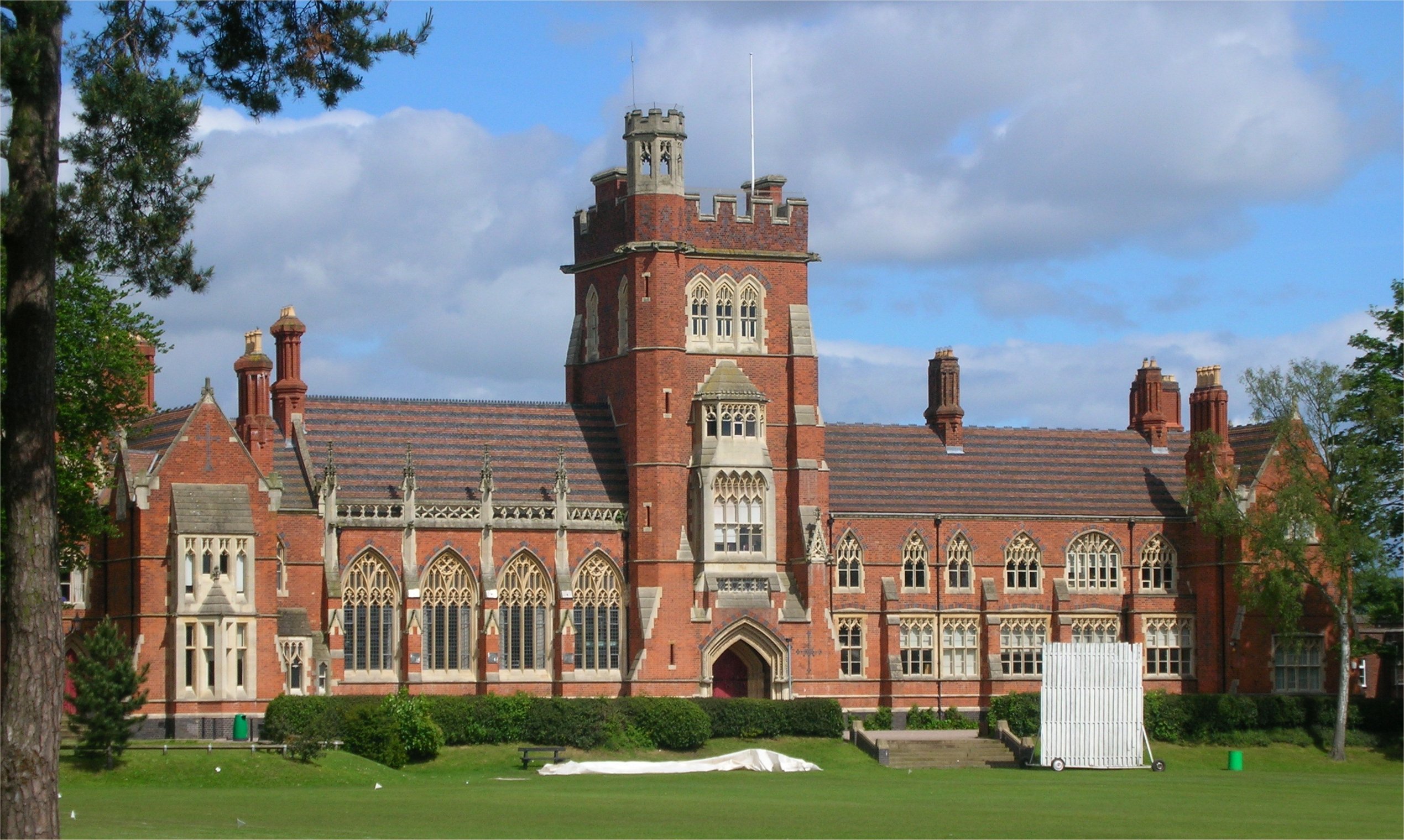
Moseley Grammar School, Birmingham
Through the Sixties, we came of age together, shared music, frequented folk clubs, did pub crawls through Birmingham, went to Birmingham City football matches (we were Blues fans and not supporters of Aston Villa, the other Brummie team) and hitchhiked to CND rallies and folk festivals. When we left Brum in 1967 and lived in other cities, we visited each other often and always remained in touch. Although I moved to Australia in 1978, I travelled to Pershore every time I returned to England and caught up with him and his family. One time, Dave came out to Australia. There’s a couple of pictures here of that trip, featuring Dave, myself, my ex, Libby, and her sister Mary Jane, who was once a famous singer here in Australia but, sadly, took her own life in 1990. It must’ve been about 1982 as Libby and I separated the following year.
But let’s go back to the days when school chums became friends, the time when you began to address your mates by their christian names and not by surname, as was customary in grammar schools back then. Back to the Sixth Form when we began to “put off childish things” and as much as we could in our provincial and underage circumstances, “got with” the sixties zeitgeist and engaged with the wider world. We read the poetry of the American Beat Poets, our own Mersey Poets and John Lennon. We listened to the music, and particularly Bob Dylan. During school holidays, four of us, Dave, Peter Bussey, Malcom Easthope and myself, would go to the Jug o’ Punch in Digbeth run by the celebrated Ian Campbell Folk Group, to drink bitter, sing along to folk songs and listen to the likes of The Dubliners, Al Steward and Roy Harper, and, sigh, a young, gorgeous and melodious Joni Mitchell. We’d meet once a week at the Golden Eagle in Hill Street to talk politics and poetry, and read our own juvenile verse, before heading off to other pubs in the Birmingham CBD.
In those days, it was cool for teenagers to ride motor scooters – if they could get their parents permission. Several of my pals owned one, including Dave who’d bought a second hand lambretta. I recall this today because it reminded me of one of our better-heeled chums who had a brand new model. His dad was a publican, and one time, he threw a party at his father’s pub in Coventry and a mob of us got a lift there from another student who’d actually owned a car – a rare thing in those days. It came back to me today how that party ended for me and Dave. We both got very drunk, I tripped and sprained my ankle, and as we were driven back to Brum, I was sprawled in the back seat, and Dave, sitting beside me, chucked up. That wasn’t the last time I injured myself whilst inebriated. I can’t recall Dave getting as rat-arsed again.
Later, we graduated to cannabis, and would toke at each other’s homes on weekends – one time, we hired a rowboat in Stratford on Avon and spent a stoned afternoon on the river. So Wind in the Willows. One lovely early summer’s day in 1969 when “we happy few, we band of brothers” camped out in my room at Reading uni, and dropped acid by the lake in nearby Whiteknights Park. It was a strange, trippy day, during which there was a police bust on my hall of residence, and we watched in amaze as people rushed down to the lake and threw many unidentified objects therein.
Fast forward to the eighties …
Though settled in Australia, I visited England often, and always took time out to catch up with Dave in either Birmingham or Pershore. When I was performing at folk clubs in 1987 and 1988, he acted as my local contact person. He also introduced me to his old friend Stan Banks, who’d served in World War II a bomb aimer and photographer on the night raids over Germany. On retirement from school teaching, Stan dedicated himself to the peace movement – which was how Dave came to meet him. Stan shared with us many enthralling and harrowing tales of his flying days.
Dave and I shared a common interest in the environment, cultural heritage and wildlife and we would exchange news on our endeavours. When we’d visit Pershore, he’d always take us out on a ramble or a drive to some out of the way place with an archaic name and take in a few nice country pubs on the way. On one visit, he gave me an instruction sheet for building boxes to shelter micro-bats. We have five of them around our home in northern New South Wales, and several of them are occupied all year around.
Green and progressive in word and deed, and dedicated to Pershore, Dave served as a Town Councillor for twenty-two years. Whenever we’d walk around town together or enter shops and pubs, folk would be always coming up to talk to him. At his funeral, the flag atop the abbey was flown at half-mast for the first time ever whilst fellow councillor Chris Parson praised him as “a giant of a man” – which I found apt but amusing considering Dave was short and slight of stature.
The feature photograph of him with his binoculars and bird book outside the glorious Pershore Abbey is a beautiful way to remember him.
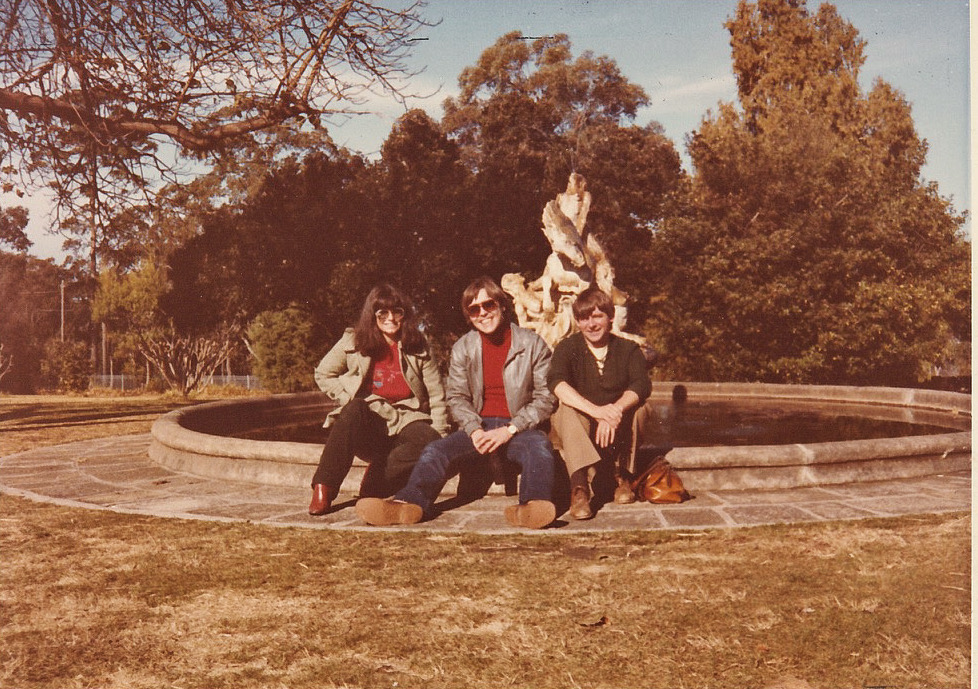
Norman Linsday Gallery and Museum, Faulconbridge, NSW
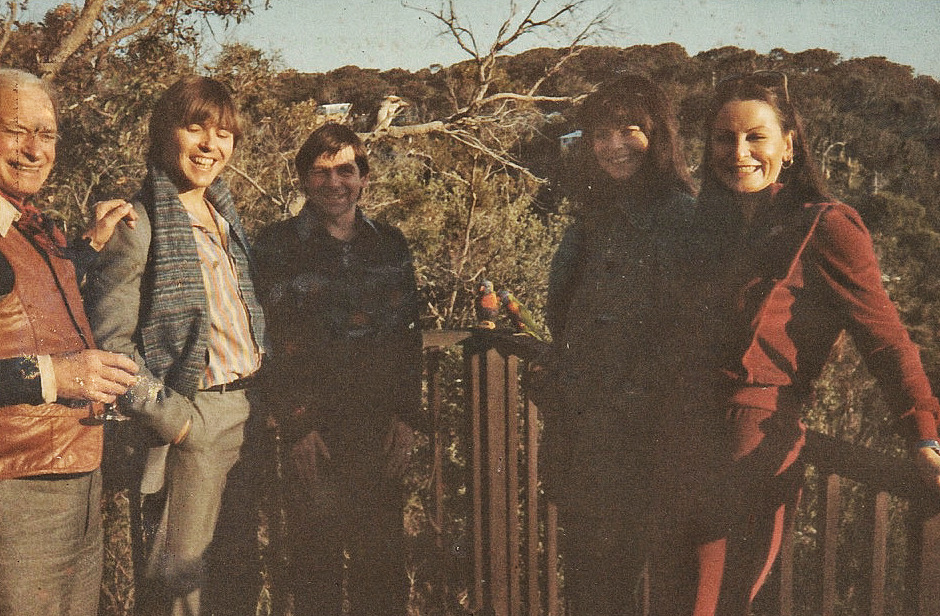
Dave meets the Boyd Family, Palm Beach, NSW
When Heather read this story, she wrote:
“That is absolutely beautiful! Thank you so much, I hope you had as much pleasure from writing that as I did reading it. I laughed out loud and cried. Lovely. My mum will love this. ❤️ p.s I knew all along he was a stoner!! And with that asthma too? What was he like? I miss him a lot. X”
I replied:
“A lovely bloke. A gentle, laid back soul who was always in a calm, good mood. I recall a time when he visited me in London just as I was about to head off to the Middle East. I’d just had a typhoid shot and was as sick as a dog – and he’d come all this way to see me off. He was so cool about it. What will be will be. Que sera sera! Did you know he was fluent in Spanish. It was one of his passions. He had Portuguese too, and I believe some Russian. I went through a “Russian phase” too in the early seventies, but ended up in the Middle East instead, by accident, and learned Arabic. Still learning. It’s effing difficult if you don’t have a gift for languages, but it keeps the old brain active.
Heather:
Sounds just like the Dave I knew. I am glad I found one person who he went to the Blues with him as I always wondered. Did you know we put some of his ashes at St. Andrews? Yes he was a language genius wasn’t he? Yes he was a language genius I think. Apparently he could get by in about 9 languages but he was very humble about it.
The ‘sixties … memories of London and Ireland
Dave is referenced many times in In That Howling Infinite, though, for privacy reasons, not by name. I also dedicated one of my poetry books to him: Tabula Rasa – Early Days. Below are a couple of extracts that are specifically talking about Dave.
“As I wrote in a recent trawl through my back pages, Song of the Road – my hitchhiking days: “… that motorway from Brum to London was a road well-traveled. In my final year at Moseley Grammar, I’d often hitch down to London for a weekend with pals who’d gone there before. We’d hang out at cheap and cheerful Pollo’s Italian restaurant in Old Compton Street in Soho and the Coach and Horses across the road and go to Cousin’s folk and blues joint in a cellar in nearby Greek Street, and the 101 Jazz Club off Oxford Street. Bunjies folk café and Ronnie Scott’s jazz club were just around the corner. After a meal or a pint, I’d often catch the last tube to the end of the line closest to the M1. I can’t recall how many times I headed off into the night; and there were always drivers on the road at the witching hour. I guess many folks “get the urge for going”, as Joni sang back then, “and they had to go …” And in those generous times, people were happy to offer a lift to a wayfaring stranger – gentle souls who would not leave strays stranded by the dark wayside; lonesome folks seeking company and conversation in the dark night of the soul; curious people wondering why a young man would hitch the highways in the middle of the English night. Yes, Café Pollo was indeed a significant landmark of my London days:. From Ciao Pollo di Soho – the cafe at the end of the M1
“In the summer of 1969, my brother and I and an old chum spent several weeks in an Enniscorthy that looked and felt like it had not changed since Aunty Mary’s day – so well portrayed in the academy award nominated film Brooklyn. Dressed as we were in hippie garb and sporting long locks, we cut incongruous figures in the pubs and at the local hop, and were so unsuccessful hitchhiking around the county that we walked many a long Irish mile. We hiked to Killane, Sean Kelly’s country, and inspired by the song, climbed upwards though heath and hedge to the top of Mount Leinster. We stayed at 13 Patrick Street and spent a lot of time sitting up on Vinegar Hill, beneath its round tower, looking down on the River Slaney and the town beyond. My brother was a keen photographer, and he took the following picture”. Thats Dave on the left, and me on the right. From The Boys of Wexford – memory and memoir
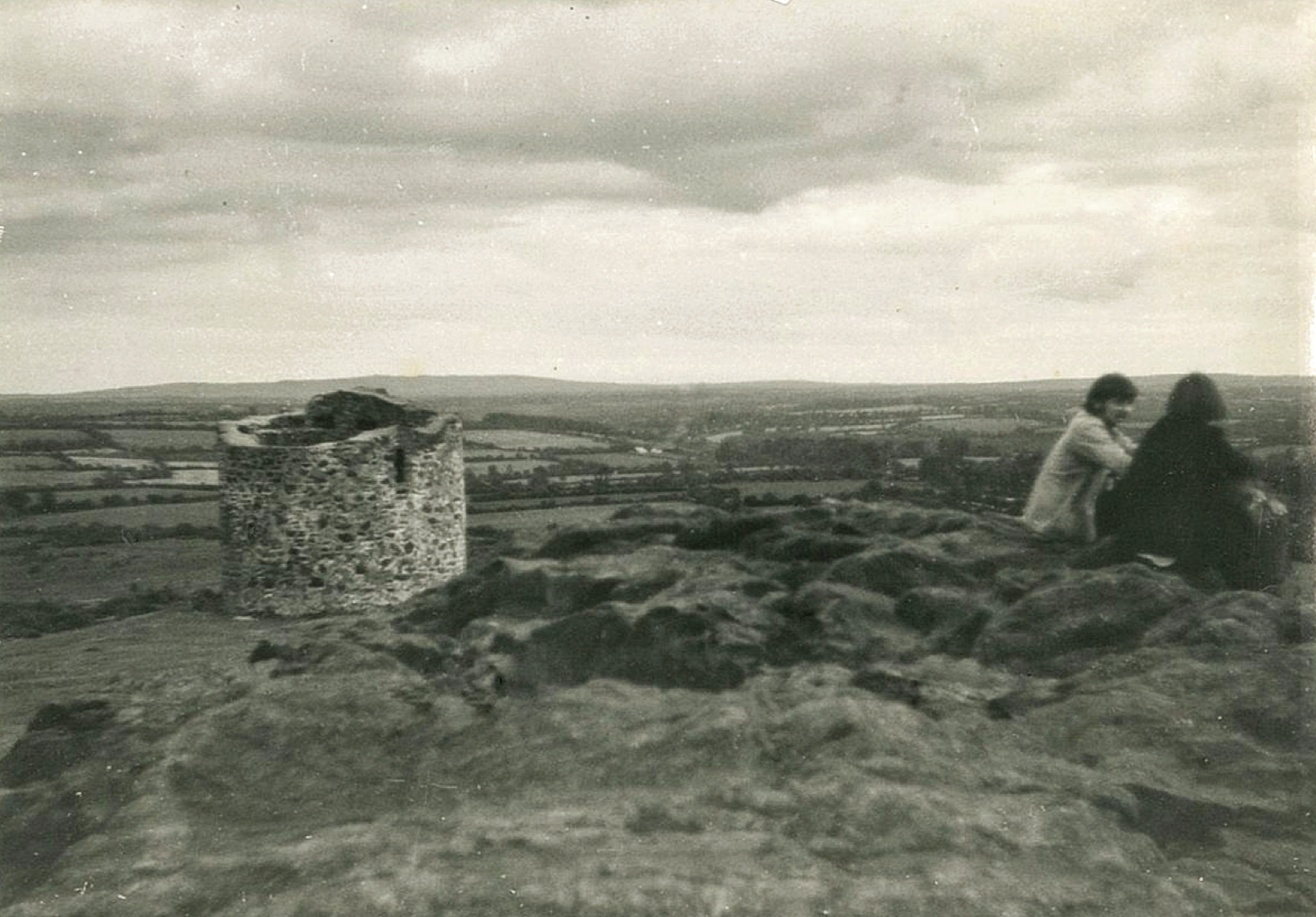
“On Vinegar Hill o’er the pleasant Slaney”
And a final vignette, also featured in Song of the Road,from 1970, I think:
”One glorious English summer I arranged to meet up with my late pal Dave Shaw in Cambridge, where he was attending a summer school at the University, and go to the celebrated Cambridge Folk Festival. I clocked off from my work on the motorway, got home, just ten minutes away – I said we were close! – showered and packed, and headed to the Clock Garage roundabout and put out my thumb. I took the M1 to London’s North Circular, and cut across to the A10 (there was no M11 in those days) and, And, my stars were alignment on this night ride, arrived at Dave’s digs in time for breakfast.I don’t remember much of the festival bill, but American folk diva Odetta was singing, and also, our idol, Roy Harper, England’s high priest of angst.
I had to leave Cambridge around Sunday lunchtime, after Roy’s last set, to return to Brum for work on Monday. Rather than head back down to London, to save time – a quixotic idea when you are hitching – I decided to cut cross-country to connect with the M1 at Newport Pagnell – in those days before GPS and route planners, a cheap, creased road map from WH Smith was the best we had, plus a good sense of direction, fair weather and loads of luck. And such are the movements of the cosmos, that my one and only only ride took me to, yes, what was then the bucolic village of Newport Pagnell. It was one of those summer evenings in England, when the days are long, the air warm and languorous, and the light, luminous. Birds were singing and church bells were ringing for evensong, and in my mind’s ear, I’d like to imagine that cows were lowing and sheep were bleating. One could almost feel an ode coming on. So there I was, once more, at the services on-ramp, hitching a ride to Birmingham , and hopping aboard an old Land Rover for what was the slowest and noisiest ride ever – which took me almost to my door”.
“When we were younger, time appeared to move more slowly than in our later years. It is in our nature to imagine and indeed, re-imagine our salad days as the best of times and the worst of times. But looking back through our back pages, these years was perhaps no better or worse, no more significant or seminal than any era fore or aft. Like objects seen through the rear-view mirror, memories always seem a lot closer and bigger. When I’ve revisited roads and streets where I grew up, playing or sauntering or rolling home with a skinful in the pale moonlight, they are no way as wide, long or spacious as they are to the mind’s eye. Vivid memories can distort time, making you feel that that weren’t that long ago”. From Blue remembered hills – a land of lost contentment




 In That Howling Infinite