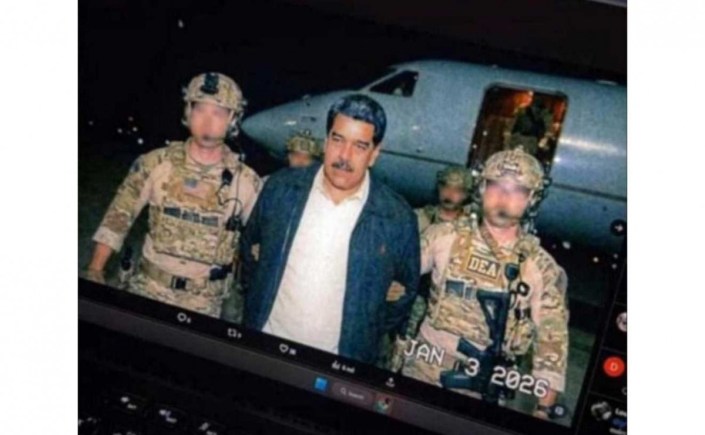
Seems like I been down this way before
Is there any truth in that, señor?
Bob Dylan, Señor (Tales of Yankee Power)
In That Howling Infinite’s recent interest in Venezuela is less about Venezuela itself than about a familiar American habit resurfacing in a new theatre. We have seen this pattern before – in Iraq, in Afghanistan, in Libya – each intervention launched with confident rhetoric, elastic legal reasoning, and the quietly held belief that regimes, once struck, will obligingly collapse into something better. The names change; the logic does not. Venezuela now feels like the latest rehearsal space for a drama that has not yet finished running elsewhere.
This is where the US’ old Monroe Doctrine returns, not as doctrine so much as reflex. A Monroe Redux: stripped of 19th-century solemnity, repurposed for a world of drones, covert action, and press-conference deterrence. The Western Hemisphere is once again imagined as a special moral jurisdiction, even as the Middle East – long the cockpit of American intervention – appears exhausted, over-militarized, and politically unrewarding. Latin America, by contrast, offers proximity, asymmetry, and deniability. The geography has changed; the instincts have not.
This preoccupation also intersects with a longstanding fascination with the lessons of historian Barbara Tuchman’s acclaimed The March of Folly. Tuchman’s insight was not that governments lack information, but that they persist in policies demonstrably failing by their own stated objectives. Vietnam, later memorably described as “chaos without a compass,” remains the archetype: motion mistaken for strategy, escalation substituting for purpose. Iraq was folly recast as liberation; Afghanistan, folly prolonged as nation-building; Libya, folly laundered through humanitarian language. Iran hovers perpetually as folly-in-waiting, the regime-change itch that never quite gets scratched, yet never entirely disappears.
Viewed through this lens, Venezuela appears less as an isolated crisis than as a familiar historical rhyme. A little bombing here, a little bluster there; symbolic strikes presented as prudence, restraint marketed as strategy. It is not yet tragedy—history rarely announces itself so obligingly – but it carries the unmistakable scent of policies drifting, of a compass quietly returned to the drawer.
Tuchman’s opus is often misread as a study of stupidity. It is nothing of the sort. She was writing about persistence – about the peculiar ability of governments to continue down a path long after its internal logic has collapsed, armed with information but imprisoned by momentum. Vietnam was not born of ignorance but of escalation mistaken for purpose. Reading the accounts of Trump’s Venezuelan operation – no longer merely a “dock strike” but a full-blooded decapitation raid – one hears that same low, familiar hum: motion without destination, force without horizon.
A leap in the dark
Everyone knew something like this was coming. Few expected it to be so clean. A president seized, command structures stunned, Caracas rattled just enough to demonstrate omnipotence without visibly levelling the city. From a tactical standpoint, it was impressive – the sort of operation that flatters planners and tempts presidents into believing that history, this time, might behave itself. But history rarely does. Leadership can be removed; regimes, less so. Chavismo survived Chávez’s death and Maduro’s long decay. Movements, unlike men, do not collapse neatly when the head is severed. They mutate. They harden. They endure.
This is where the metaphor shifts and darkens. The United States now looks less like a chess grandmaster and more like the proverbial dog that finally caught the car – triumphant, panting, and unsure what to do next. Decapitation creates ownership. Once you have removed the figurehead, ambiguity evaporates. The question is no longer whether Washington is intervening, but what exactly it intends to build, sustain, or suppress in the vacuum it has helped create.
A week ago, US action might have been interpreted as calibrated escalation: signalling without war, pressure without conquest, violence as message rather than mission. That logic may have held when the strike was offshore, symbolic, plausibly deniable as a prelude rather than a crossing. It is harder to sustain once the president of a sovereign state has been bundled onto a ship and flown north in handcuffs. Symbolism has consequences. At some point, signalling becomes authorship.
The deeper assumption underlying both phases – the demonstrative strike and the decapitation raid – is the same one that has haunted American foreign policy for decades: that limited, spectacular violence produces rational political outcomes. That elites defect under pressure rather than close ranks. That populations blame their rulers rather than the foreign power violating their sovereignty. That humiliation weakens movements rather than mythologising them. This faith survived Iraq, limped through Afghanistan, and still stalks Washington like an unkillable ghost.
What reads in Washington as restraint reads elsewhere as undeclared war. What Beltway strategists describe as “calibrated” looks, from Caracas – or Beijing, Moscow, Tehran, each of whom have form – like arbitrariness dressed up as doctrine. In his most recent foreign policy forays, Trump has fired missiles into Nigeria and sent special forces into Venezuela. He cannot wield enough influence to get his way with major powers, so he targets smaller ones. The White House spins this as a demonstration of American strength, but those who rule in Moscow and Beijing will not be fooled. Nor should anyone else. Whilst ostensibly demonstrating American strength, it also highlights its weakness. Today it is Venezuela; tomorrow it might be somewhere else entirely. The pattern is not coherence but surprise. Power exercised as theatre.
Trump’s foreign policy has always oscillated between maximalist rhetoric and minimalist follow-through. He threatens fire and fury, then settles for a crater and a press conference. He speaks the language of conquest while practising the art of nuisance. Yet Venezuela marks a subtle shift. This is no longer nuisance alone. By removing Maduro, Trump has crossed from menace into management, whether he wants the responsibility or not. Chaos, once unleashed, has a habit of demanding supervision.
The international reaction follows a script so familiar it almost performs itself. International law is solemnly invoked by states that otherwise treat it as optional décor. Yanqui imperialism is dusted off and waved aloft. Blood for oil, regime change, darkest chapters, dangerous precedents – all the old tropes re-emerge, not because they are always wrong, but because they are always available. France, China, Russia, the EU condemn the breach while sidestepping the harder question: what is to be done now that a criminalised, hollowed-out regime has been removed not by its people, but by force?
Latin America splits along its habitual fault lines. Argentina’s Milei cheers liberty’s advance. Brazil’s Lula warns, with weary accuracy, that violence justified as justice tends to metastasise into instability. Neighbouring Colombia braces for refugees. Cuba mutters “state terrorism.” The region remembers – perhaps too well – that external interventions rarely end where their authors imagine.
What is most striking, though, is how little this seems to disturb the American political bloodstream. The legal basis for seizing a foreign head of state is treated as a technicality. Congressional war powers hover faintly in the background. The risk of retaliation, miscalculation, or long-term entanglement is acknowledged, then politely ignored. The old muscle memory of American power keeps flexing, long after the strategic rationale has atrophied.
And so Tuchman returns, not as a moralist but as a diagnostician. Folly is not recklessness; it is normalisation. It is the steady acceptance of contradiction as policy. Trump’s Venezuela adventure now embodies this perfectly: escalation without ownership, ownership without vision, action without explanation. Each move can be defended in isolation. Together, they form a strategy that cannot quite say what it is for.
Hovering over all of this – absurdly, yet tellingly – is the mirage of the Nobel Peace Prize so coveted by President Trump. The prize is not awarded for the mere absence of war, but for the construction of peace: treaties, frameworks, institutions that reduce violence rather than rebrand it. Bombing here, abducting there, tearing up agreements while demanding credit for not starting new wars is not peace-making; it is anti-diplomacy. Peace defined negatively, as something that has not yet collapsed.
One imagines the Nobel Committee reading this Venezuelan episode with a raised eyebrow: sovereignty breached as messaging, escalation choreographed like a reality-show arc, regime change gestured at but not owned. Peace prizes are not usually awarded for keeping one’s options open.
In the end, Trump’s Venezuelan jiggery-pokery is fascinating for the same reason Vietnam remains endlessly analysed. It shows how great powers drift — not because they are blind, but because they cannot quite decide what they are looking for. Chaos without a compass is not the absence of movement. It is movement mistaken for purpose. And history, as Tuchman patiently reminds us, is unforgiving toward those who confuse the two.
Wrong way, go back?
Soon after the American militarily impressive operation, The Atlantic published an cautionary opinion piece by staff writer Colin Friedersdorf arguing that Trump has effectively launched a regime-change war against Venezuela without constitutional authority, democratic consent, or a plausible plan for what comes next. The core charge is not primarily strategic incompetence but constitutional betrayal.
He contrasts Trump’s actions with past presidents who, whatever their later failures, at least sought congressional authorisation before waging major wars. Roosevelt after Pearl Harbor and George W. Bush before Afghanistan and Iraq are invoked not as moral exemplars but as constitutional ones: they recognised that the power to initiate war belongs to Congress, and that legitimacy flows—however imperfectly—from public consent. Trump, by contrast, has dispensed with permission altogether.
Friedersdorf dismisses the administration’s legal justifications as threadbare. Labeling Maduro a “narcoterrorist” or pointing to a US indictment does not, he argues, amount to lawful grounds for war against a sovereign state. These are prosecutorial claims masquerading as casus belli, not a substitute for authorisation under domestic or international law.
Strategically, the article warns that toppling Maduro would be the easy part. Venezuela is already riddled with armed groups, including Colombian militants who use its territory as a base for smuggling and mining. Removing the regime risks unleashing forces that would not “go quietly,” echoing Iraq and Libya more than any clean counter-narcotics success.
Friedersdorf argues that Trump is uniquely unfitted for a regime-change war for several interlocking reasons, combining personal disposition, governance style, and historical patterns of behaviour. Unlike previous presidents who sought congressional authorisation—Roosevelt after Pearl Harbor, George W. Bush before Afghanistan and Iraq – Trump bypassed the Constitution entirely. For Friedersdorf, this is not merely a procedural violation; it signals a reckless disregard for the legal and democratic frameworks that constrain American war-making, a disregard which has tangible consequences when planning complex military operations overseas.
Second, Trump’s track record of self-interest and transactional politics undermines confidence in his strategic judgment. Friedersdorf points to a “lifelong pattern” in which Trump has pursued personal, familial, or financial gain, sometimes at the expense of institutional norms or public welfare. A regime-change war in a resource-rich country like Venezuela, Friedersdorf suggests, is exactly the kind of environment in which such temptations could manifest: the conflation of national interest with personal enrichment. Unlike professional soldiers or presidents with experience in foreign policy and national security, Trump’s incentives are highly idiosyncratic, making the outcomes of a war unpredictable and potentially self-serving.
Third, Friedersdorf questions Trump’s capacity for sustained leadership and operational management in a conflict that, by its nature, requires patience, coordination, and political nuance. Toppling Maduro may be “easy” in the sense of a tactical strike, but the aftermath – stabilising Venezuela, managing humanitarian fallout, and navigating regional politics – requires sustained commitment. Friedersdorf doubts that Trump possesses the temperament, patience, or skill to oversee such a complex and prolonged effort. The concern is that he could declare victory prematurely, mismanage occupation or transition, or escalate in ways that deepen instability rather than resolve it.
Finally, Friedersdorf critiques the political myopia and disregard for public opinion in Trump’s approach. Polls reportedly showed a majority of Americans opposed to military intervention in Venezuela, yet Trump proceeded unilaterally. In Friedersdorf’s assessment, this combination—constitutional bypass, personal opportunism, lack of leadership discipline, and political insensitivity—makes Trump not just ill-prepared, but dangerously mismatched to the responsibilities of a regime-change war, with risks to both American legitimacy and Venezuelan stability.
In short, Friedersdorf sees Trump as uniquely unfit because the personal, constitutional, and strategic factors that would constrain a conventional president are either absent or inverted in him, making a complex foreign intervention unusually perilous. And, even if the intervention were to improve Venezuelans’ lives – a possibility Friedersdorf does not dismiss outright – it would still represent a violation of American democratic norms.
The concluding warning is blunt: by choosing war despite public opposition and without congressional approval, Trump has shown contempt for both the Constitution and the electorate. If Congress does not assert its authority now, Friedersdorf fears this episode will become precedent – another step toward endless wars of choice launched by executive whim, not collective decision.
In short, the article frames Venezuela not merely as a foreign-policy gamble, but as a constitutional crisis in miniature – one that exposes how fragile America’s war-making restraints have become when a president decides they are inconvenient.
What happens now?
Everyone knew something like this was coming; perhaps fewer expected it to be executed with such clinical speed. The pre-dawn abduction of Nicolás Maduro by US forces is less a surprise than a punctuation mark — a moment where long-signalled intent finally hardened into action. A foreign head of state removed in two hours. Mission theatrically accomplished. Endgame conspicuously absent.
It is challenging, but not impossible, for American forces to amass massive military hardware, materiel and personnel offshore, bombard a small neighbour and send special forces into its capital. It is much harder for an American president to control what happens in the aftermath. This explains why global leaders are so cautious about this operation. No major European leaders have endorsed the use of force to bring down the Venezuelan government.
The real test for Trump is what comes next. He has been rightly critical of the US invasion of Iraq, and his MAGA movement favours “America First” rather than “regime change” overseas, but now he pursues a regime change of his own, with only a vague assurance that he and his lieutenants will run Venezuela for an unspecified time. The objective has a strategic element, in trying to slow the flow of drugs into America, but most of it is nakedly commercial. While other presidents might not have said this out loud, Trump is direct: he wants US control of the Venezuelan oil fields, with US oil companies investing and making money, so that oil production will increase.
In an opinion piece published in the Sydney Morning Hearal on 5th June, Robert Muggah, co-founder of the Igarapé Institute think tank and a fellow at Princeton University, usefully lays out five post-Maduro scenarios, though what binds them is not optimism but ambiguity. The first – Trump declares victory and walks away – would be the most American of outcomes: maximum disruption, minimum follow-through. Chavismo, minus its latest avatar, shuffles on; Washington expends enormous leverage only to abandon it; the refugees keep coming. The dog catches the car, looks briefly triumphant, and then isn’t quite sure what to do next.
The second scenario – a popular uprising washing away Chavismo – flatters liberal intuition but ignores institutional rot. Venezuela’s civic muscle has atrophied after years of repression, criminalisation, and mass emigration. Armed colectivos remain invested in chaos. What sounds like democratic renewal risks becoming a weak interim regime, punctuated by violence, oil-sector infighting, and amnesty wars.
Scenario three is the familiar regime-change fantasy: escalate, sanction, manage an election, install a friendly opposition figure, promise reconstruction. The problem, as ever, is legitimacy. A government midwifed too visibly by Washington inherits the original sin of imperial sponsorship. Chavismo’s anti-imperial narrative – long threadbare – would suddenly acquire fresh oxygen, while external actors queue up to meddle by proxy. Another low-grade insurgency beckons.
The fourth option – US custodianship – is the one Trump has effectively name-checked: trusteeship without the label. Stabilise the bureaucracy, revive oil production, choreograph elections, dangle sanctions relief, keep troops nearby “just in case”. It is administratively coherent and politically radioactive. It risks converting a crisis of governance into a crisis of sovereignty, hardening nationalist resistance and validating the very mythology the intervention claims to dismantle.
Which leaves the fifth, and perhaps most honest, outcome: managed instability. No clean victory, no decisive collapse. A weakened Chavista elite, a divided opposition, fragmented security actors, and a US that calibrates pressure without appetite for occupation. A low-boil conflict, indefinitely deferred resolution, limbo as policy.
Hovering over all this is Monroe Doctrine 2.0 – a message not just to Caracas but to Havana, Managua, Bogotá, Panama, even further afield. This was less about Maduro than about signalling who gets to set terms in the hemisphere, and who doesn’t. A muscular reminder that alignment matters, and misalignment carries costs.
For Venezuelans themselves, the prognosis is bleakly familiar: another external intervention, another promise of order, another season of uncertainty. The screw tightens, the rhetoric soars, the moral justifications proliferate – and ordinary people remain suspended between liberation narratives and lived precarity.
History suggests this is not an ending but a prologue. The question, as always, is whether anyone involved is genuinely prepared to live with the consequences of what they’ve just begun.
See also in In That Howling Infinite, Tales of Yankee Power … at play in America’s backyard, Tales of Yankee power … Why Venezuela, and why now?, Marco Rubio’s Venezuelan bargain and the original Tales of Yankee Power
Caveat emptor
It is worth recalling, in this context, what ultimately happened to Muammar Gaddafi and Saddam Hussein – two leaders who, in different ways, became objects of Western fixation and regime-change temptation. Saddam was toppled by overwhelming force, hunted down, tried under a hastily constructed legal order, and hanged; the state he ruled collapsed with him, unleashing sectarian violence and regional instability that still reverberate. Gaddafi, having abandoned his weapons programmes in the hope of rehabilitation, was nevertheless pursued once the opportunity arose, cornered during a NATO-backed intervention, and killed by a mob in a Libyan drainage culvert. Libya followed him into fragmentation, militia rule, and proxy warfare.
In neither case did the removal of the strongman deliver the orderly political transformation that had been implicitly promised. What followed was not liberal democracy but vacuum – power without legitimacy, violence without direction. These episodes linger in the strategic memory not merely as moral tales but as practical ones: regime change is easy to threaten, harder to execute, and almost impossible to control once unleashed.
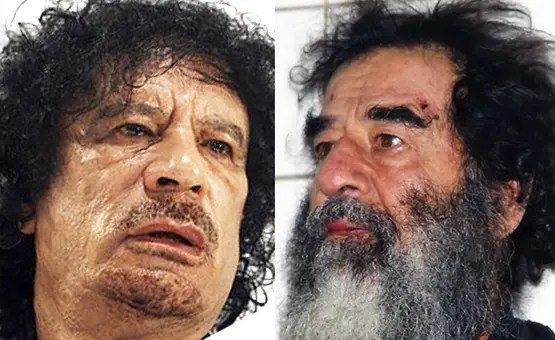
Muammar Gadaffi and Saddam Hussein in captivity
 In That Howling Infinite