… she is accumulating stories, adding them to the library of self, becoming larger. She might become as large as all literature. She will, at any rate, have a voyager’s easy wherewithal among this society of the unread and unworldly
Thus did an author describe an anonymous young woman he encountered on a Melbourne tram.
It got me thinking, and I asked my self a question: If our books are the footprints of our past, when you discard those books, are you discarding that past?
Earlier this year, I’d jettisoned half of a book collection I’d accumulated over sixty years – books that have followed me as moved from Birmingham to reading to London, migrated to Australia, and moved from house to house in Sydney and finally settled in the midst of a forest in northern New South Wales.
Out went books of all formats and genres. Mementos of former passions and fashions. Relics of past courses and careers. Old school textbooks, university texts, fiction, nonfiction, dictionaries, coffee table books. I’d worked for years in publishing so the complimentary copies alone were colossal. .
I’d already culled box-fulls of books a decade ago when we’d last moved house and home, and this time, I was determined to downsize further.
My primary criteria was that if I hadn’t looked inside the covers of a book for twenty, thirty, fifty years, then I wasn’t likely to do so in the next five, ten, twenty years I have left on this planet.
Nevertheless, I kept back five full shelves.
Books of poetry, some of them a century old. All-time favourite novels, including the iconic Russians, Hardy, Herbert and Heinlein. Non-fiction histories I regard with particular nostalgia or think might be of use again one day. Books about music and musicians, particularly the Beatles and the Bobster. Recent purchases. And, books I consider “rare” – a subjective descriptor that I can only explain as old books which I picked up in secondhand bookshops when I lived in London in the sixties and seventies. Some, I reckon, are actually rare!
Sooner or later, these too may go.
When I review my remaining shelves, all bending under the weight of their contents, I contemplate the next cut.
Do I feel I am discarding my past?
I was unsure.
Since the great clean out, I’ve been reminded often, out of the blue – by a film, perhaps, a podcast or an article I’ve read online – of a particular ex-book or two or three. I’ve mourned their departure and wished that I’d kept them. It’s like a bibliographical version of a phantom limb.
Last night I asked a friend and fellow-bibliophile the question I posed at the head of this piece.
He replied with a question. “Where did your books end up?”
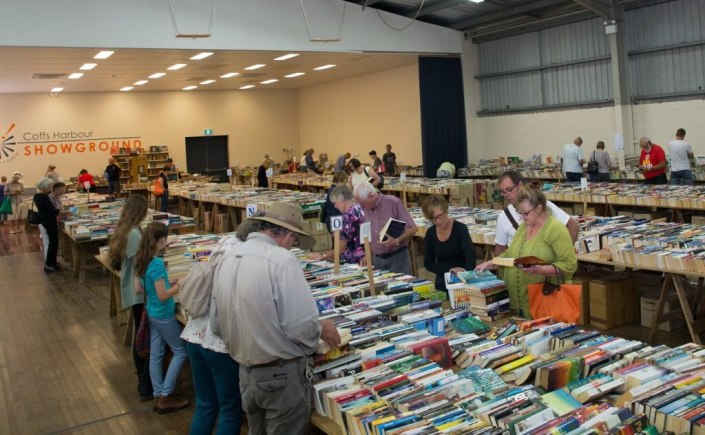
“At the Coffs Harbour Rotary Club’s annual charity bookfest”, I replied.
“Then you did the right thing”, he said.
“Your books will enjoy a new life. They will continue their work, giving pleasure and knowledge to new readers”.
I made that last bit up – poetic license, familiar to all book lovers.
© Paul Hemphill 2024. All rights reserved
Below are a selection of recent articles from the Sydney Morning Herald on the joys of books and of reading. The first is the story I referred to above. It illustrates beautifully how books lead you into imaginary worlds, or, as the author puts it, “the limitless wonderland of all I’ve read”. The second tells the story of the “street libraries” that have proliferated in recent years. Here on the Coffs Coast, there are shelves in in the two main shopping malls where folk can donate, swap or borrow books of all genres or simply browse whilst shopping, whilst there are several tiny libraries in our local towns of Bellingen and Urunga. The last considers the changing faces, forms and functions of public libraries. “These aren’t libraries your parents or older siblings may have visited”, the writer observes. A visit to Coffs Harbour’s new, beaut library would confirm that.
The featured image and that below are of the Coffs Harbour Rotary Club’s annual Bookfest, a hugely popular event on the Mid North Coast of New South Wales that raises thousands of dollars for Rotary’s charitable works. I’ve taken home some surprising “finds” in recent years.
Read also in In That Howling Infinite, Better Read Than Dead – the joy of public libraries
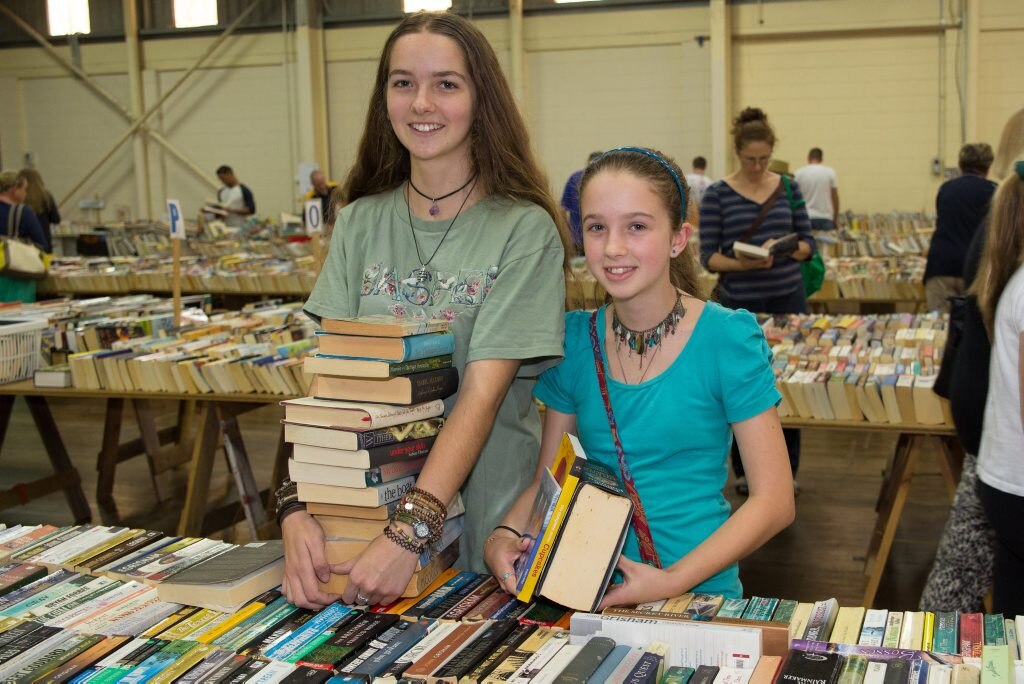
Coffs Harbour Rotary Club BookFest
Australia’s last reader was on my tram, travelling to another world

The last reader in Australia turns out to be a young woman. No surprise. John Logie Baird rendered men illiterate at a stroke when he invented the TV in 1926.
She sits on the 109 heading for Box Hill reading a paperback, her mind pincered and freed by noise-cancelling headphones. Look at her face – she is not here, she is there, in that world she and the author have agreed on. I can’t see the book’s cover – hence it is all books to me. It’s an Indian novel, an anthology of verse, a cavernous collection of short stories – it’s the limitless wonderland of all I’ve read.
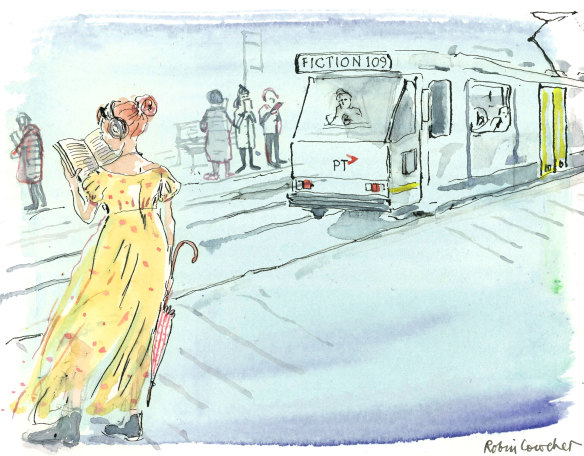
I’m waiting for her eyes to widen as Oliver Twist asks for more. I’m waiting for her to shake her head and hold the book out and stare at its cover and silently mouth the words, “Doris Lessing … girl, what the absolute f—?”
A block further on up Collins Street she nearly laughs, but catches herself, because … these 109 riders, these TikTokettes who surround her – they are not to know or understand that Quixote has taken his sword to puppets while believing them men.
If she is an assiduous reader, the young woman on 109, (and I believe she is: look at her bend to the page) she is accumulating stories, adding them to the library of self, becoming larger. She might become as large as all literature. She will, at any rate, have a voyager’s easy wherewithal among this society of the unread and unworldly, these cerebral homebodies, her fellow tram riders, these addicts stoned by the blizzard of micro-vids blowing from their phones.
Reading requires sharp neurological footwork. It is not a passive activity. Scans of the brain show areas of it are lit like aurora when you are reading. Imagining 1930s Maycombe, Alabama during the Depression, its streets and stores, its loungers and livery, is a mental workout that the cleavage vignettes on OnlyFans and the skateboard pratfalls of TikTok don’t require and can’t supply.
Rates of literacy were low before the printing press. Reading was confined to clerks, diplomats and priests – a tool-of-trade, and a skill as rare and dubious as clairvoyance. Guttenberg enabled the novel – a new handheld entertainment, a portable story for which you didn’t need a whole theatre – you could now hold escapades and hemispheres in your hand.
People now see reading as a quaint, historical diversion, a pastime for those who lacked more splendid options, a drag, something akin to needlepoint or whittling, a distraction for castaways and folk who got snowed-in for long winters without power, a hobby for paranoid misanthropes, abandoned widows and anti-social geeks – for Victorians, Edwardians and colonials. The citizens of the TikTok epoch think of libraries as a type of asylum.
Watching her read her paperback, this young woman on the 109, I know she is a juggler of empires, a traveller in limitless cities, is becoming wise in love, and steeped in tragedy’s lore, and, as well, is an addict of hilarity, and goes to sleep listening to orchestras play at unsuspecting ducal balls held on the eve of revolutions.
I also know she is the final ambassador sent by Australia to the country of Fiction to represent us there, to meet its ancient and vibrant people and assure its VIPs we love reading and will always be their allies. But this is mere diplomacy. It is not true. She will be the last visitor from here. That place’s splendours are undiminished, but superseded – and Australians do not go there any more.
My street library was just a family project. What happened next, well, you wouldn’t read about it
Amy Adeney, Sydney Morning Herald, June 28, 2024
I’d heard about street libraries and noticed the occasional book box on side streets – but I didn’t know much about the movement, or how they worked. I purchased a large ready-made raw timber unit from the Street Library Australia website and got to work on the fun bit – bringing it to life. We chose a deep purple paint colour called Dumbledore and adorned the doorframe with mirrors and jewels.
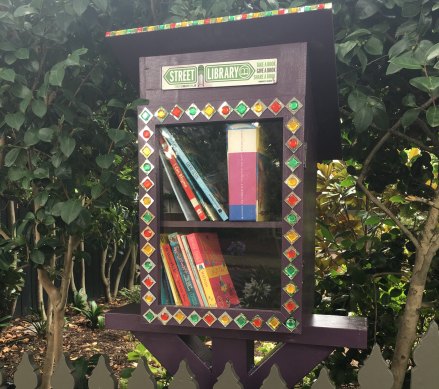
The website advises that it’s a good idea to give your street library a name, and Dumbledore felt perfect – a font of wisdom and knowledge, like the books that it would hold. When the paint and glue were dry, Dumbledore was glorious to behold, and once it was installed on a post behind our front fence with a bunch of books inside, I dropped a note in every letterbox on the street informing residents of the new street library. At that point I was ready to sign off – mission accomplished.
What came next was entirely unexpected. Notes and cards began to appear in our letterbox, thanking me for “adding a touch of beauty to our neighbourhood,” for initiating such a “fabulous venture,” and promising to add and swap books. The cards were mainly from strangers. We had lived in the house for six years but had never spoken to many of our neighbours.
Suddenly, we found ourselves striking up conversations with people as they browsed the library, chatting about books and offering recommendations. On days when the box was full, small piles of books would be left on our doorstep, to be squished into the shelves when there was space available.
The little library that has a 20 per cent chance of winning best in world

At Sydney’s Marrickville Library, you can get pizza delivered to your lounge chair or secret nook. Even better, you can eat it there or in the sunken garden while using the wifi.
In China, the 31,800 square metre New Ningbo Library is open 24 hours a day and will serve around 8000 visitors a day.
These two libraries are among five finalists announced last Friday for the International Public Library of the Year Award 2021 to be announced in August.
Its “Future Library” project has commissioned authors including Margaret Atwood to write novels that won’t be published – or even available to be read – until 100 years from now.
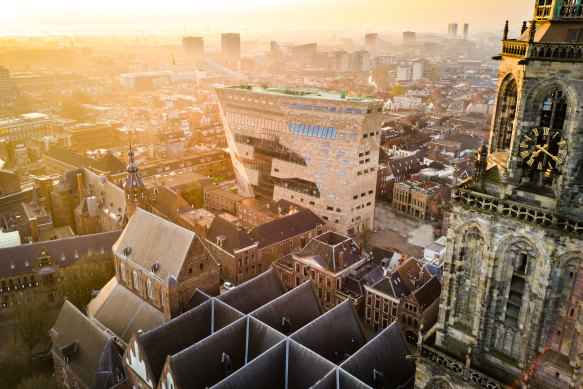
Another finalist, the library and cultural centre Forum Groningen in the Netherlands, is based on the Roman forum. And the Het Predikheren, the new library in Belgium, incorporates a Baroque monastery. It was described by judges as “poetic” with a sense of “mystique”.
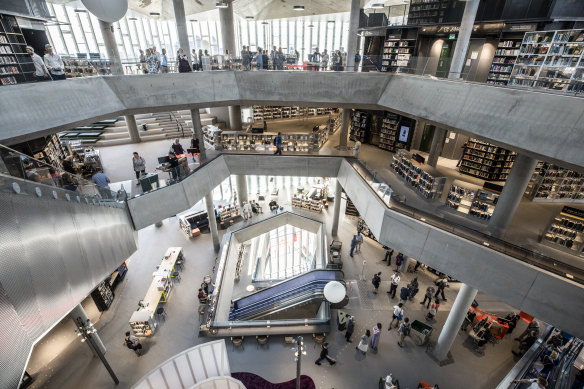
Nearly all have cinemas, play and meeting areas and public spaces.
Today’s libraries had a greater variety of nuanced spaces for different types of visitors with different needs and differing amounts of tolerance for noise. They had also made it easier to find items in the collection, he said.
Many libraries were now being designed with increased outdoor space where patrons could use the wifi but still be safely spaced, he said.
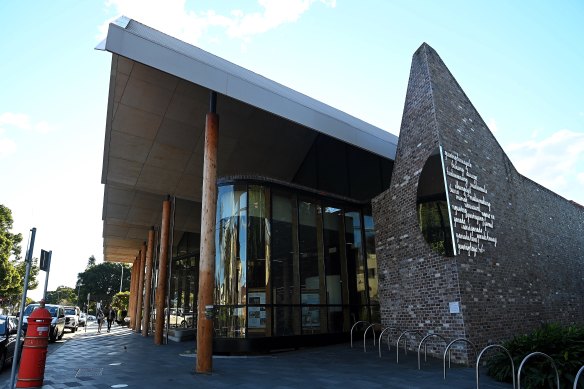
Marrickville Library, designed by architects BVN, has already won nine national architecture awards, three National Trust heritage awards and a NSW landscaping award.
Announcing the shortlist, the judges admired Marrickville’s beautiful adaptive re-use of the old Marrickville hospital. The floating canopy roof originates from the pitched roof of the existing building.
Since the announcement that the Australian library was a finalist for the international award, staff have been awed by the quality and size of the international competitors.
So what does Marrickville have that they don’t?
Heart, said Inner West council mayor Darcy Byrne. “It’s not just a library, it is the town square. It is the heart of Marrickville. It is such a lively place. There are so many young people coming in. It is not quiet or old or dead. It is lively and youthful.”
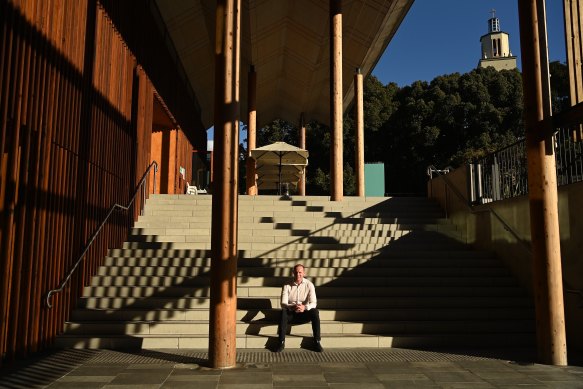
Last October, the 3600 square metre library had 53,000 visitors, including a record number of young people studying at university or the HSC. It’s become so popular that the council’s senior manager of libraries Caroline McLeod has had to place three orders for additional chairs.
SInce it opened in late 2019, visitors numbers have more than doubled. Many come for the day. “It’s a joyous thing to see how many people are in the library,” said Ms McLeod.
Ms McLeod said it might not have a hidden library like Norway’s. But it did “have secret spots or secluded spots where you can be alone”.


 In That Howling Infinite